
Turning Your Blog into A Book (or Several Books)

vols 1 and 2

Last fall I got into a discussion with a fellow blogger, Luanne at The Family Kalamazoo, about preserving all our work.  What happens if WordPress crashes some day? What if the Internet becomes a thing of the past like VCRs and turntables? All our hard work could be for naught.  Our grandchildren won’t know a thing about their ancestors and will have to start all over again.

I’d also been getting requests over and over again from my father.  He wanted me to print out all my blog posts.  He said it was too hard to go back and find earlier posts.  I told him that printing them out would not work well because I’d lose all the formatting, and he’d end up with hundreds of pages of posts all in reverse chronological order. (I did explain that new posts had links back to related posts, but he wanted a hard copy.)

So I decided to explore some options.  And what I found was a site called blogbooker.com.   It’s a free site that converts your blog into PDFs.  But not just that.  It creates a table of contents using your blog post titles and puts everything in chronological order.  I was very excited by the results.

Contents

But then I still had well over a thousand pages of PDFs, and printing all of them would still lead to an unmanageable pile of paper that no one would be able to use easily.  Plus the ink I’d use in printing them would be costly.

Fortunately, blogbooker also suggested several sites where you can turn those PDFs into a published book—either an e-book or a full-fledged hard copy bound book.  The one I chose was Lulu.com.  I looked at the various options, and for cost reasons I chose to print the blog in a paperback format on 8 by 11 sized pages in black and white.  Since I did this after blogging for fifteen months, I had to break the blog into four volumes.  That meant creating separate PDFs on blogbooker for four different volumes.  No big deal.  It’s easy enough, and remember that blogbooker is free.

Lulu.com is not free, at least not for hard copy printed books, but it is really reasonable.  Each volume cost me about $15 a copy, and I made two copies of each, one for me and one for my parents.  At least now my parents can flip through the pages and find older posts, and I can sleep a little more easily, knowing that there are two hard copies of my blog.  And they really look quite nice—I was pleased with how they came out.  The photos and graphics are not as clear as on the Internet, but they are adequate, and the text is all there as are all the comments.
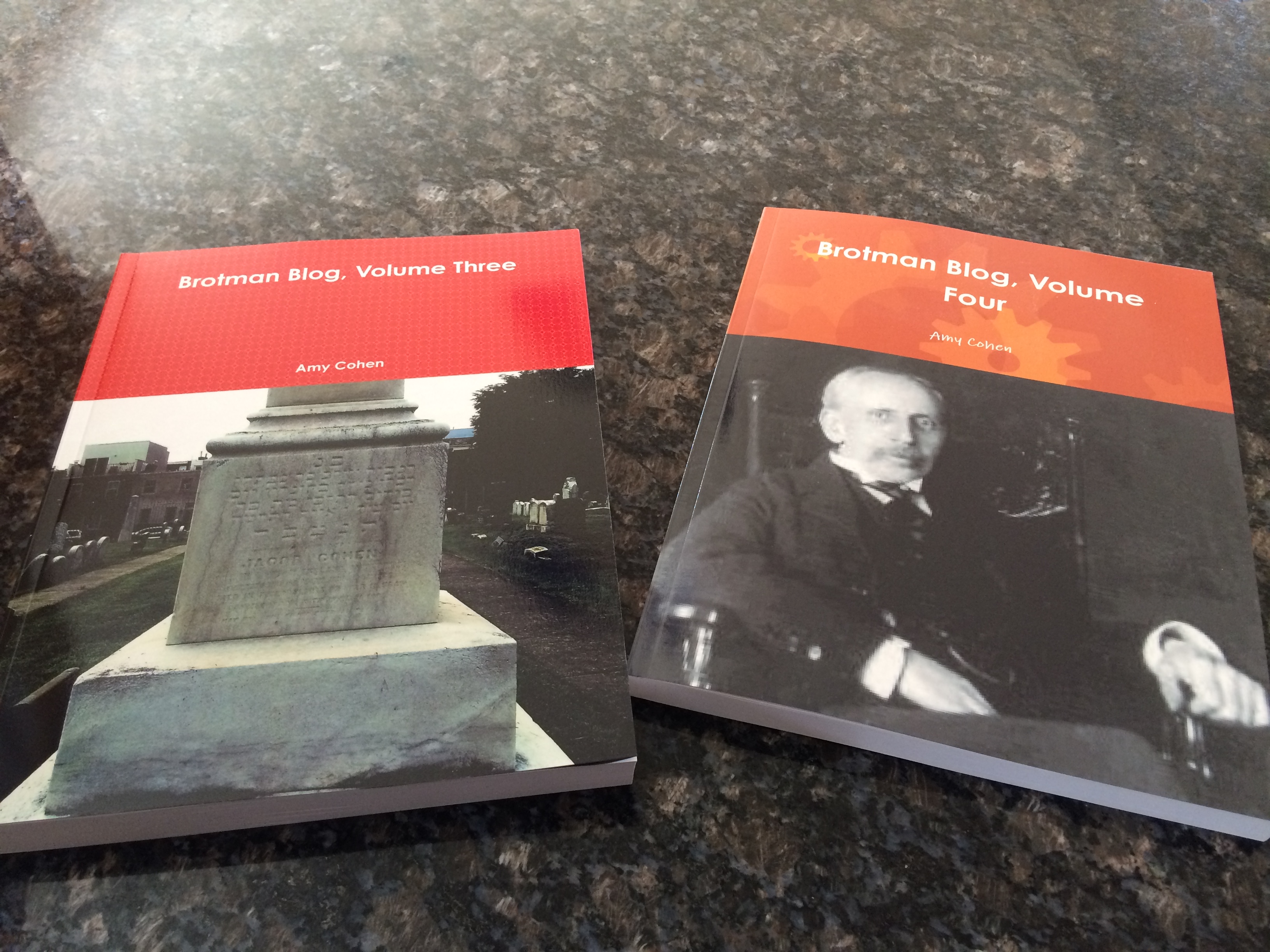
vol 3 and 4


I’ve just created and ordered Volume Five, covering from January 1, 2015 through April 21, 2015.   (If there are any family members or even just interested readers who want a volume, let me know.  🙂 )

What do you do to preserve your work? How do you make sure that all your research and documents and photographs are going to be safe and accessible for another 100 years or more?


A World Apart, Part 2: Life in Galicia

In the segment of the book I read last night, Margoshes described his childhood and in particular two aspects of it: his education and the role of the synagogue in his life.  One thing that had not been clear to me in the first part of the book is that Margoshes and his family dressed in traditional Hasidic clothing.  That is, even though they considered themselves maskilim and not Hasidic, they dressed like Hasidim and not in modern clothing.

Here is what Margoshes has to say about his teachers in Lemberg, where he lived until he was fourteen: “I don’t have much to recount about the [teachers] I had in my youth.  One thing I realize now is that they knew very little themselves and were therefore incapable of accomplishing anything substantial with their students, even though their pupils included boys with good heads on their shoulders.”  (p. 39)  Some of his teachers were worse than incompetent—they were psychologically and physically abusive, though no one would have thought of it that way back then.  Margoshes reports that there was an understanding among the boys at the school that they would not report what the teachers were doing to them.  Only when a servant noticed a huge bruise on Margoshes’ leg from a teacher’s painful pinching did his parents learn of the abuse and have him change schools (though not have the teacher removed or disciplined).  Although Margoshes did have one teacher whom he found effective and knowledgeable, overall his experience in school was not a positive force in his life.

The school was for boys only; there is no discussion of what girls his age would be doing while he was in school.  Margoshes did have two girls who became his friends when he would visit their house to pick up papers for his father.  He would sit and play cards with them while he waited, but he never told his family about the friendships because apparently playing cards and being friends with girls would not have been considered acceptable behavior.

Other than these two girls, Margoshes only discusses male friends—boys he would read and discuss books with in an area where they would gather in front of the synagogue, books that he describes as Haskalah books.  He does not explain what that means, but from what I can infer, these were books written in Hebrew that went beyond traditional prayer or holy books and discussed broader issues and views of the world.  There were 15-20 boys who would gather every night to do this.  Margoshes wrote, ”Above everything, we would talk a lot and wonder at the young people of Lemberg who had thrust themselves into the wide world several years earlier.  … [This] was our ideal, and we all aspired to reach those heights.”  (p. 47) Interestingly, although these boys knew Yiddish, Hebrew, and some German, they did not know Polish, the language of their country, and had no desire to learn it.  “Our spirits were focused on ideals and we had no interest in practical life.” (p. 48)

The institution that played a huge part in the daily life of Margoshes and his community was the synagogue or “kloyz,” as they called it.  Men attended the kloyz twice a day every day and drew people from across the region.  Poor people as well as wealthy people prayed at the Lemberg Kloyz. There were many wealthy men in the community, and the kloyz was also where they made business connections.  Overall, however, it was more a place for religious and social gathering and played a central role in the lives of these people.  Margoshes wrote, “I loved the Kloyz with all of my heart and always felt at home there; after all, I was there twice a day over several years for prayers.” (p. 51) He considers it the place where the best times of his childhood took place.

When he was fourteen and after his father had died, Margoshes and his family moved to Tarnow, a city where there were over 15,000 Jews (somewhat smaller than Lemberg). Sadly for Margoshes, he did not find a similar community of boys in Tarnow who were interested in reading Haskalah books.  His traditional education continued with one of the most respected rabbis in Tarnow, but his intellectual life and interest in more worldly matters seems to have been limited after the move away from Lemberg.

Although the descriptions of his education and religious life were interesting, I found this whole section of the book somewhat frustrating.  Margoshes grew up in a relatively wealthy home (they had servants, after all) and a home where he was encouraged to receive a traditional education.  But the book nowhere reveals up to this point what life was like for those who were not so fortunate.  What did the girls do while the boys were at school? What about children from poor families? Did they get any education? Margoshes is rightly proud of his accomplished family, but it would be more interesting to me (and I assume others) if he had revealed more about the rest of his society.  Perhaps that will come now in the next section which describes his marriage and presumably a more adult perspective.

Maybe Joseph and Bessie were among the educated and wealthy Jews in their community, but it seems more likely that they were not.  I am hoping that Margoshes at some point talks about the lives of people from different social and economic backgrounds.