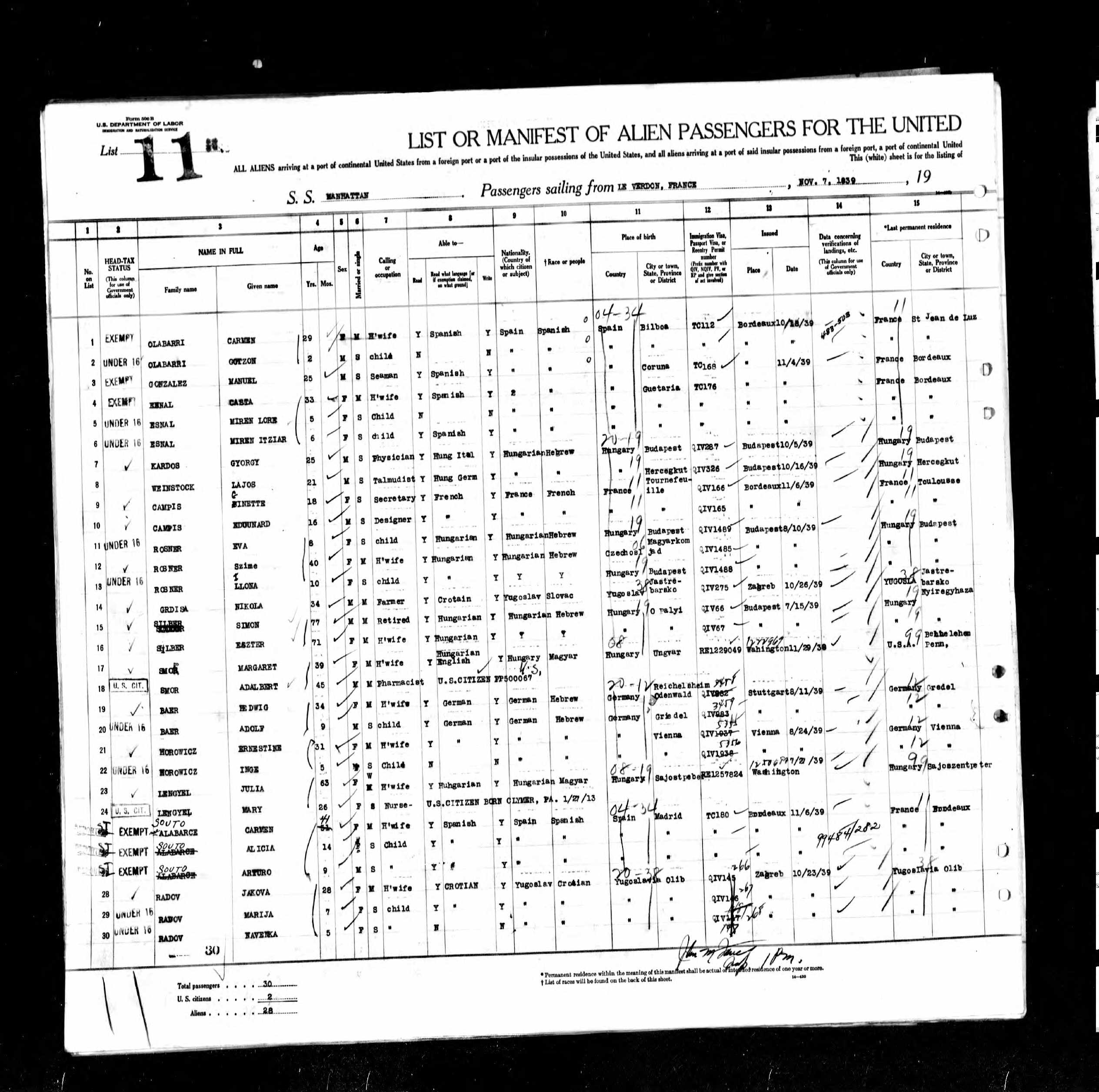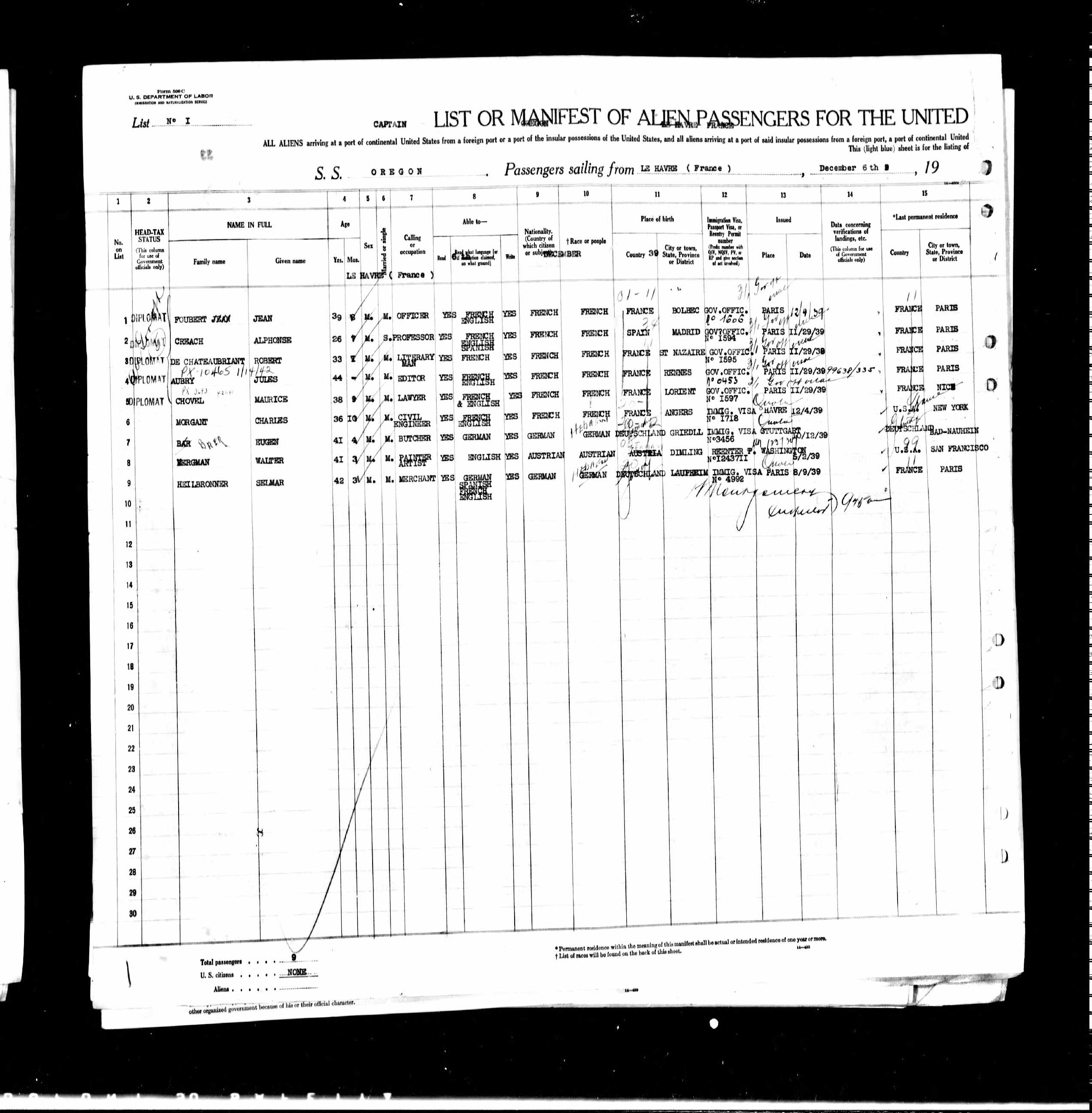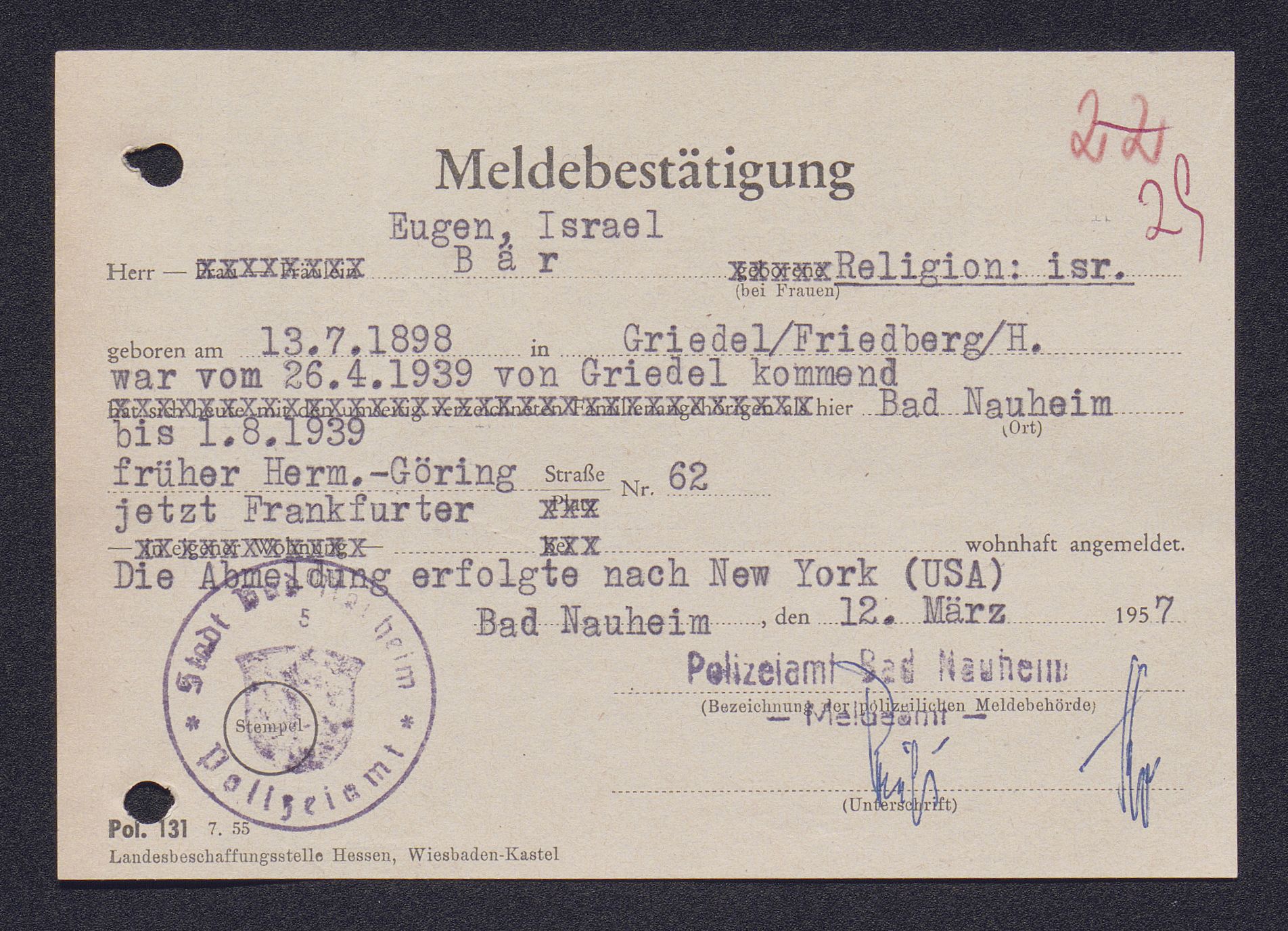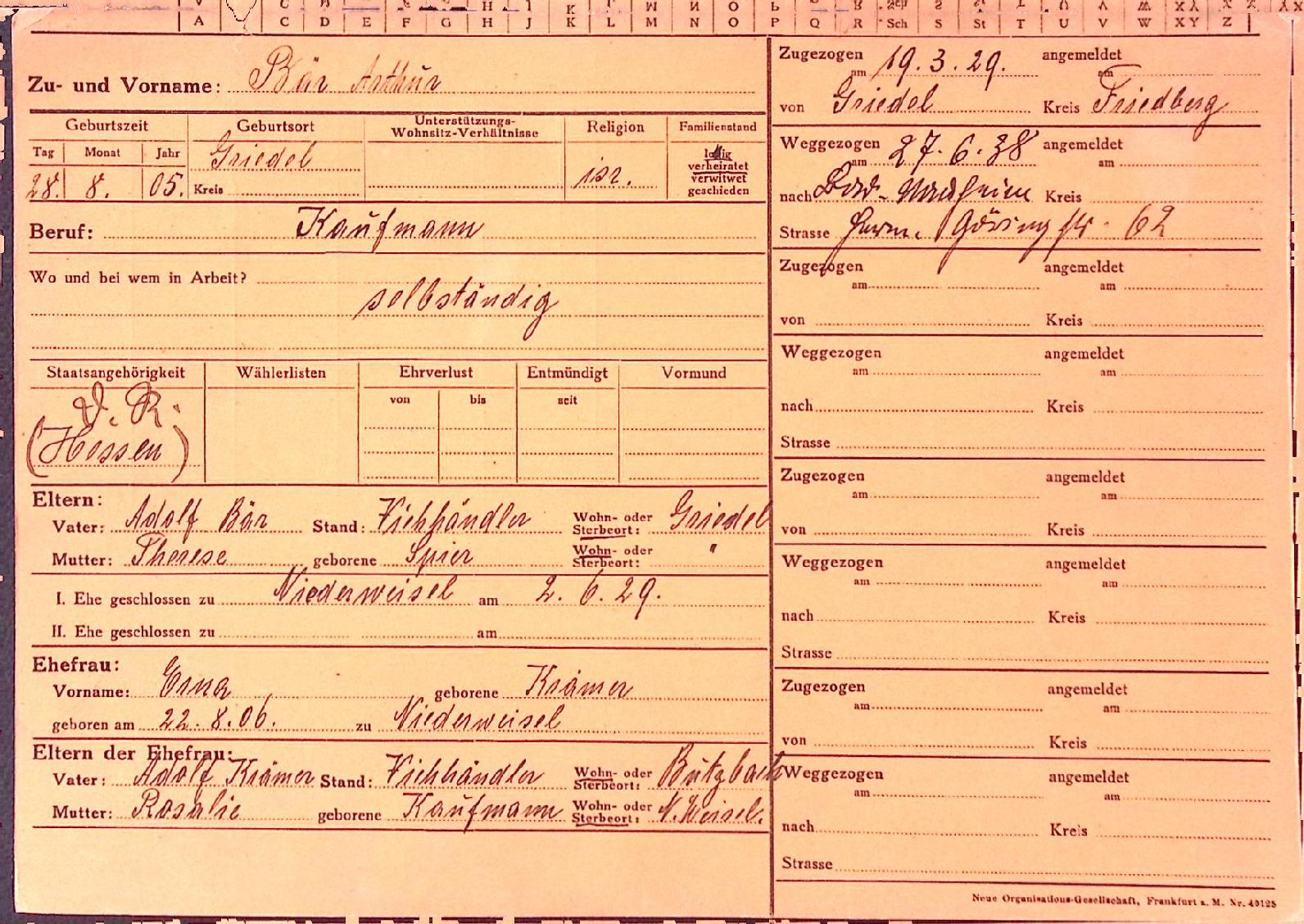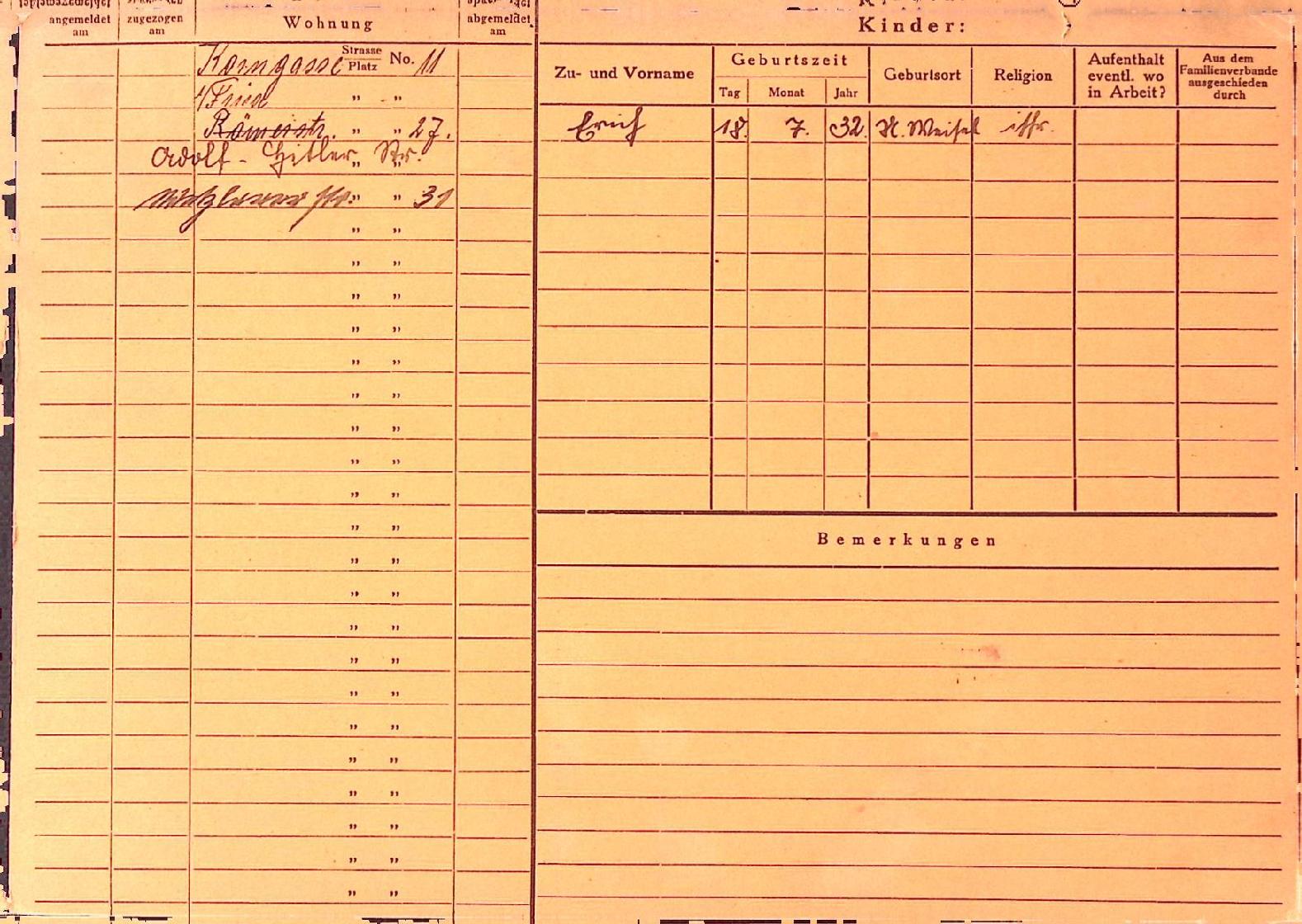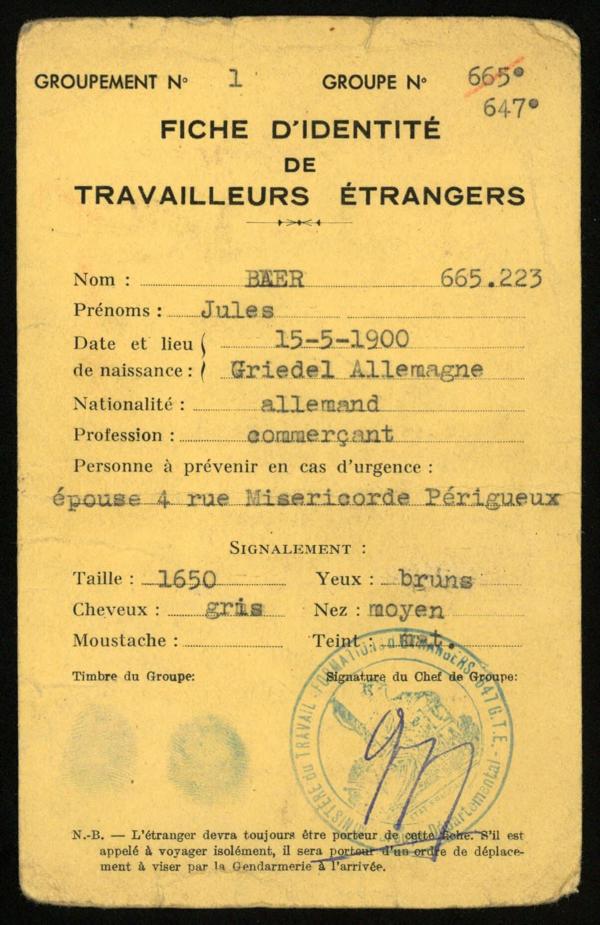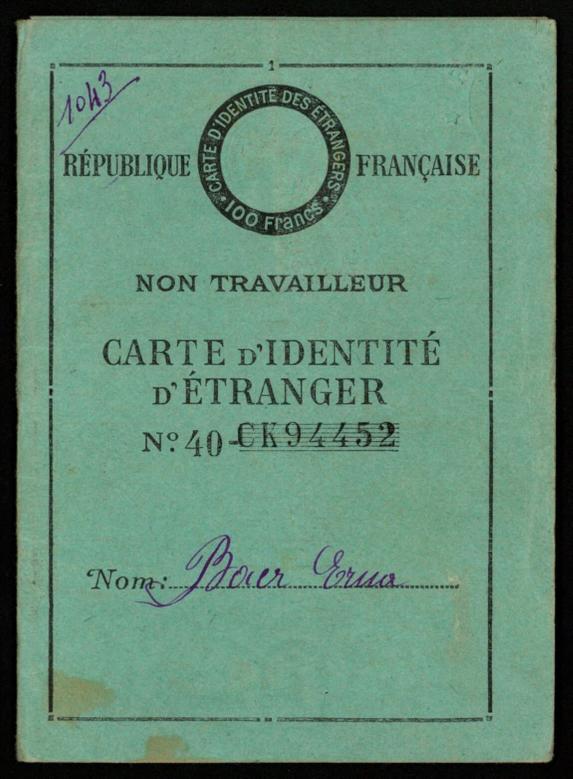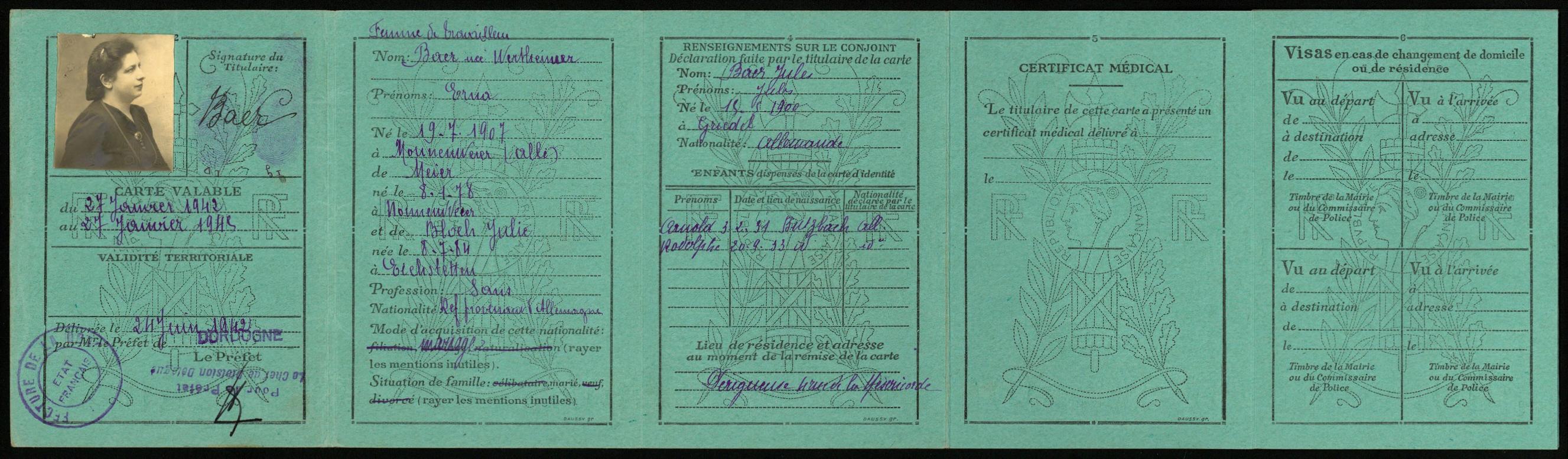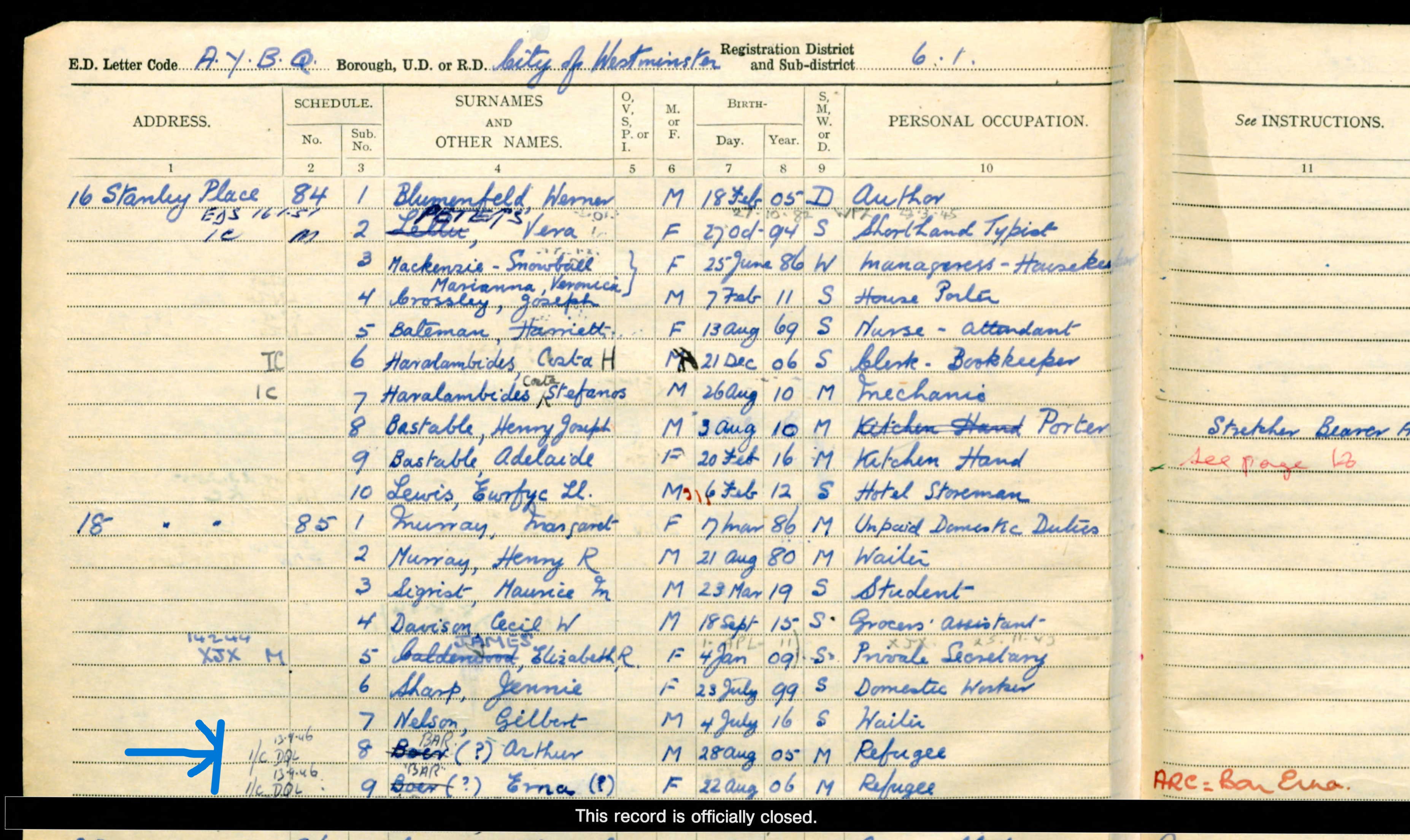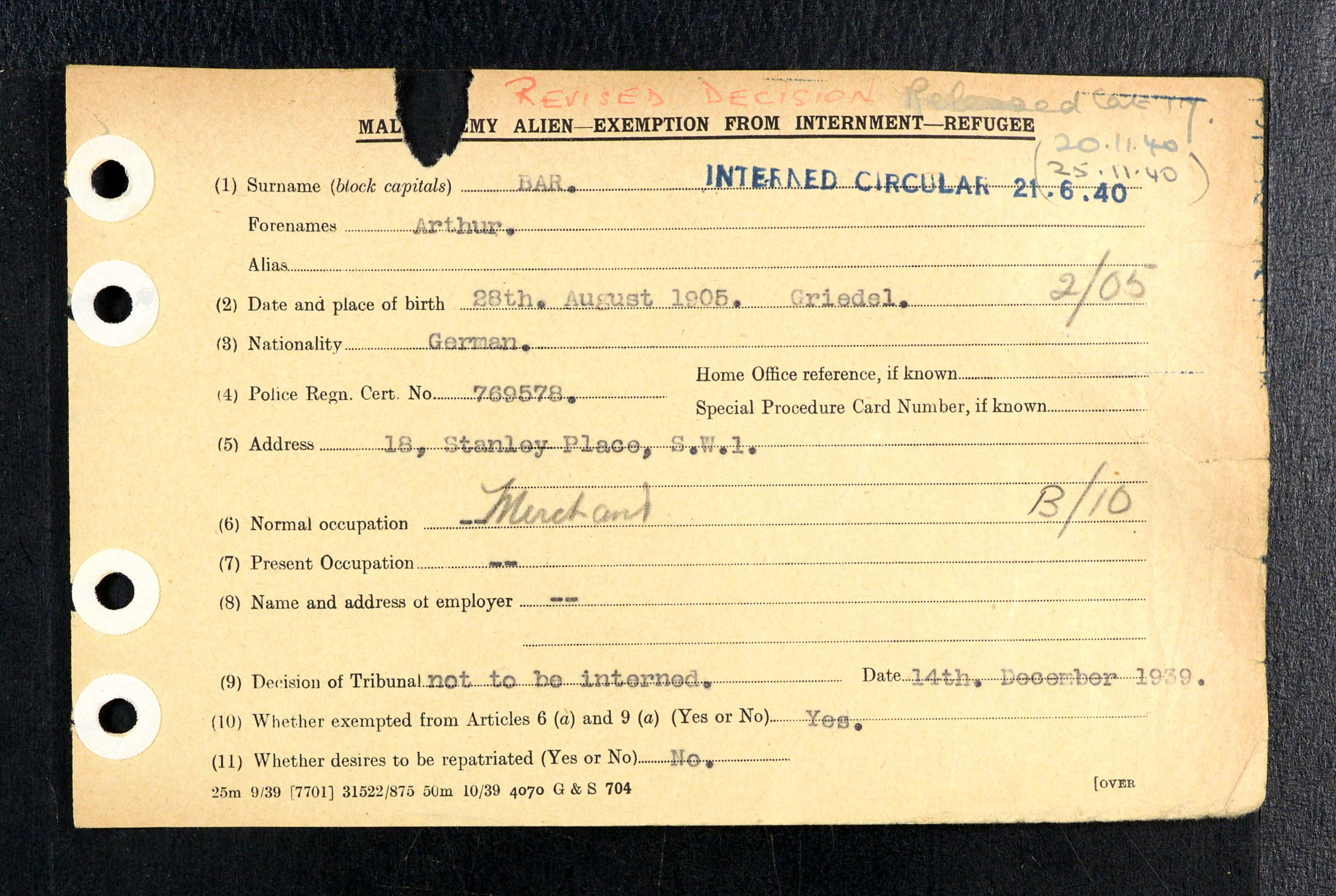
We saw last time that Eugen Baer and his family left Griedel for Bad Nauheim and were in Bad Nauheim until August 1, 1939. According to their ship manifests, his wife Hedwig and son Adolf had visas for the US from the consulate in Stuttgart dated August 11, 1939, ten days later. But Eugen did not obtain his visa until October. And yet even Hedwig and Adolf did not sail for the US until November and Eugen not until December.
This had me perplexed. What could have held them up? Why didn’t they travel together? I had several theories. Maybe Eugen was sick. Maybe he had a harder time getting a visa. Maybe there were quotas for men that were different from women. Theories but no answers. I didn’t know why Eugen’s visa was dated so much later than that of his wife and son or why he didn’t get a ticket on the same ship as Hedwig and Adolf. Maybe there was no more room on that ship, maybe he needed to tie up loose ends before he could leave.
One thing my general research indicated was that none of them could have received a visa from the US consulate unless they already had tickets on a ship to the US.1 That meant that by August 11, 1939, at least Hedwig and Adolf and perhaps even Eugen already had purchased their tickets. And yet they didn’t arrive in the US for months.
And then I found a 2020 obituary for their son Adolf that revealed part of the story. It included this information:
Ed [as he was known in the US] was born on January 7, 1930 in Greidel [sic], Germany, and immigrated to New York City in 1939 with his mother, Hedwig. They settled in Baltimore, MD in 1940 when his father, Eugene, was able to join them after being separated from his family and held falsely in a French internment camp in Falaise.
So Eugen had been separated from his wife and son, but when? And why in France?
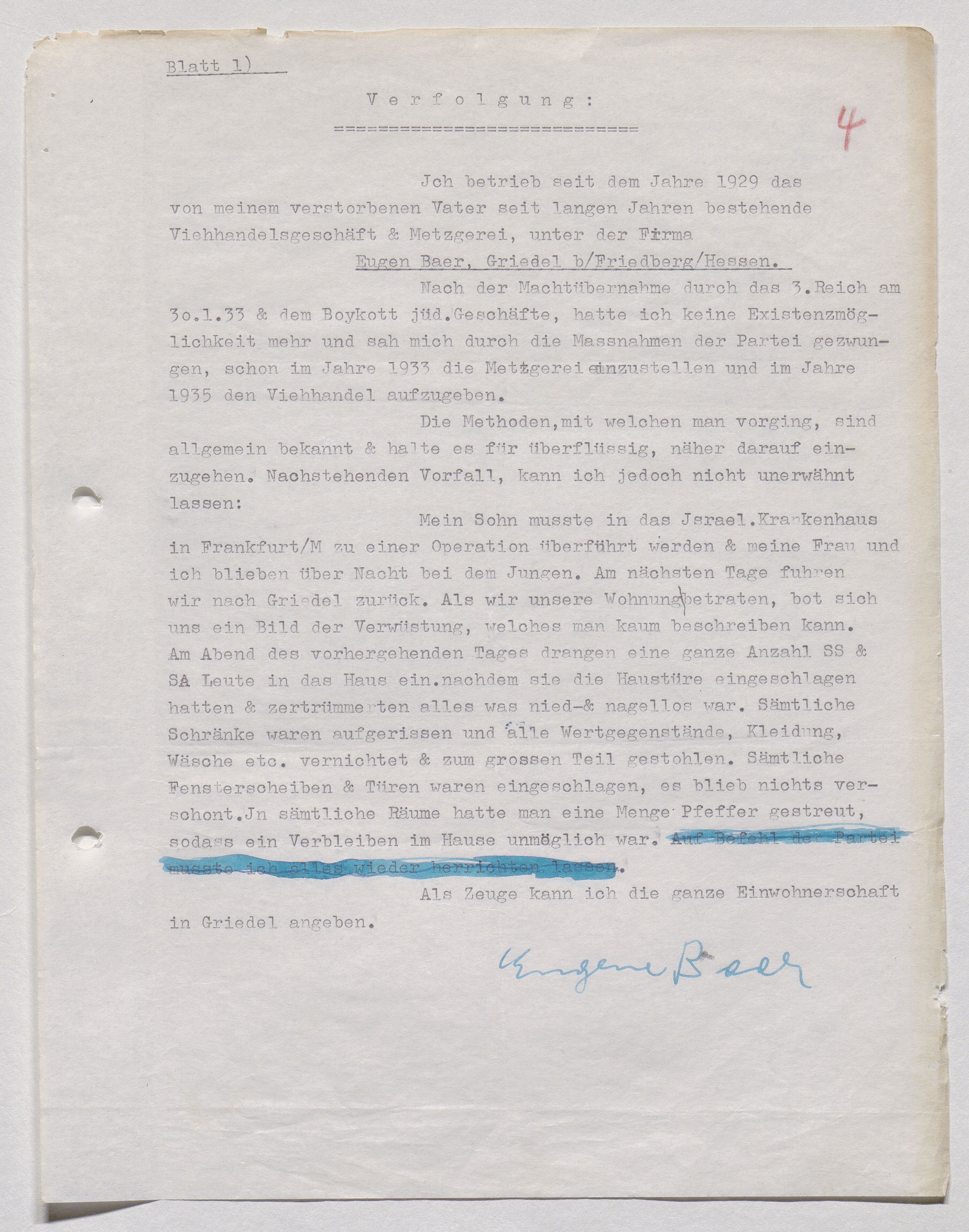
Only when I received the documents relating to the compensation claim that Eugen filed after the war was I able to put together more of their story. In detailing his emigration costs as part of that claim, Eugen claimed in part, “2½ tourist-class passages (per attached invoice) RM 1,163.12. These tickets were not used, since the ship was recalled before Southampton.”2
T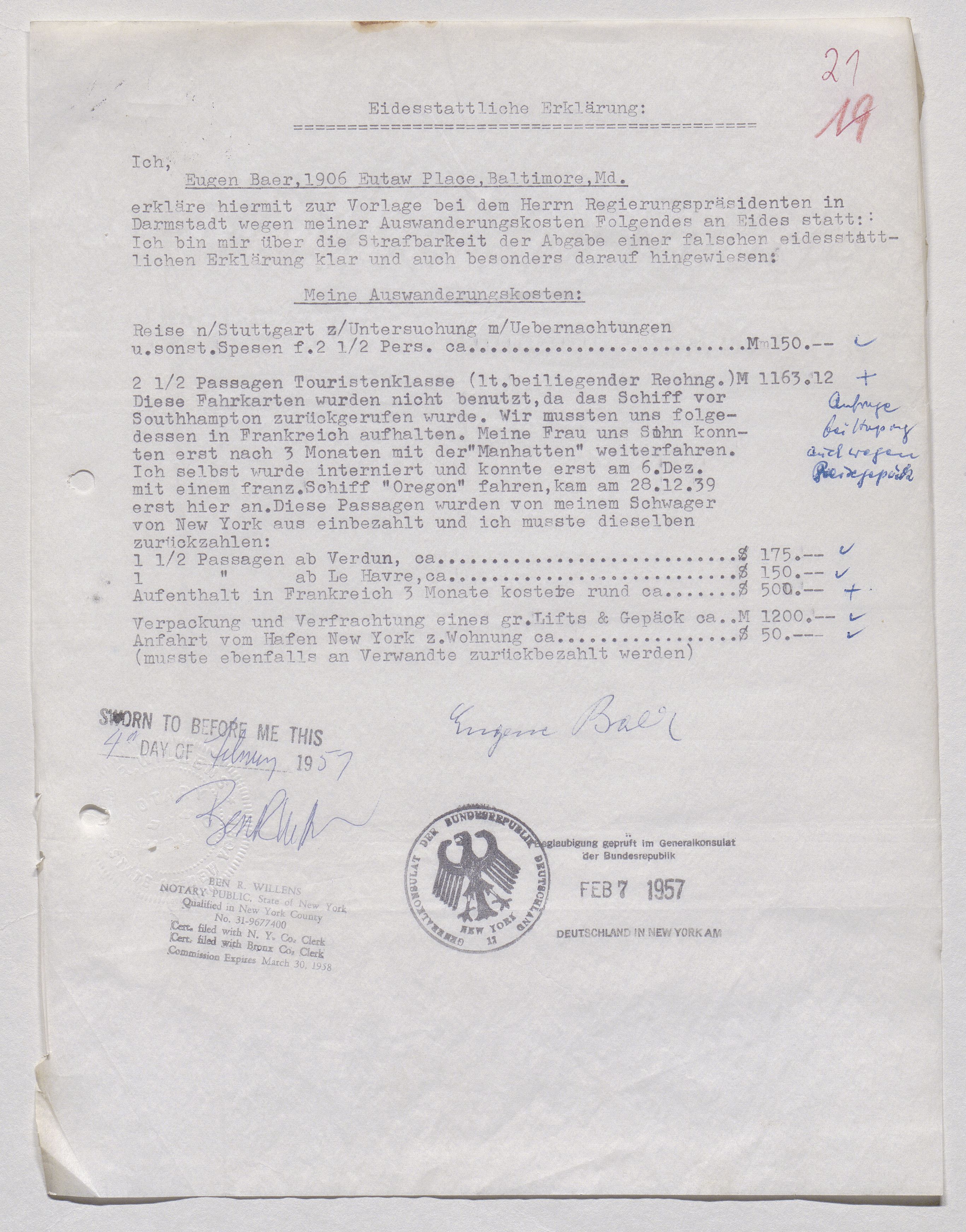 he file from Germany also included a confirmation of the purchase of these tickets from Hamburg-Amerika Linie, otherwise referred to as HAPAG, the shipping company from which Eugen and his family originally planned to travel to New York. This meant that at that time the ship was to sail in August, 1939, Eugen also must have had a visa from the US Consulate in Stuttgart, likely obtained the same time that Hedwig and Adolf received theirs.
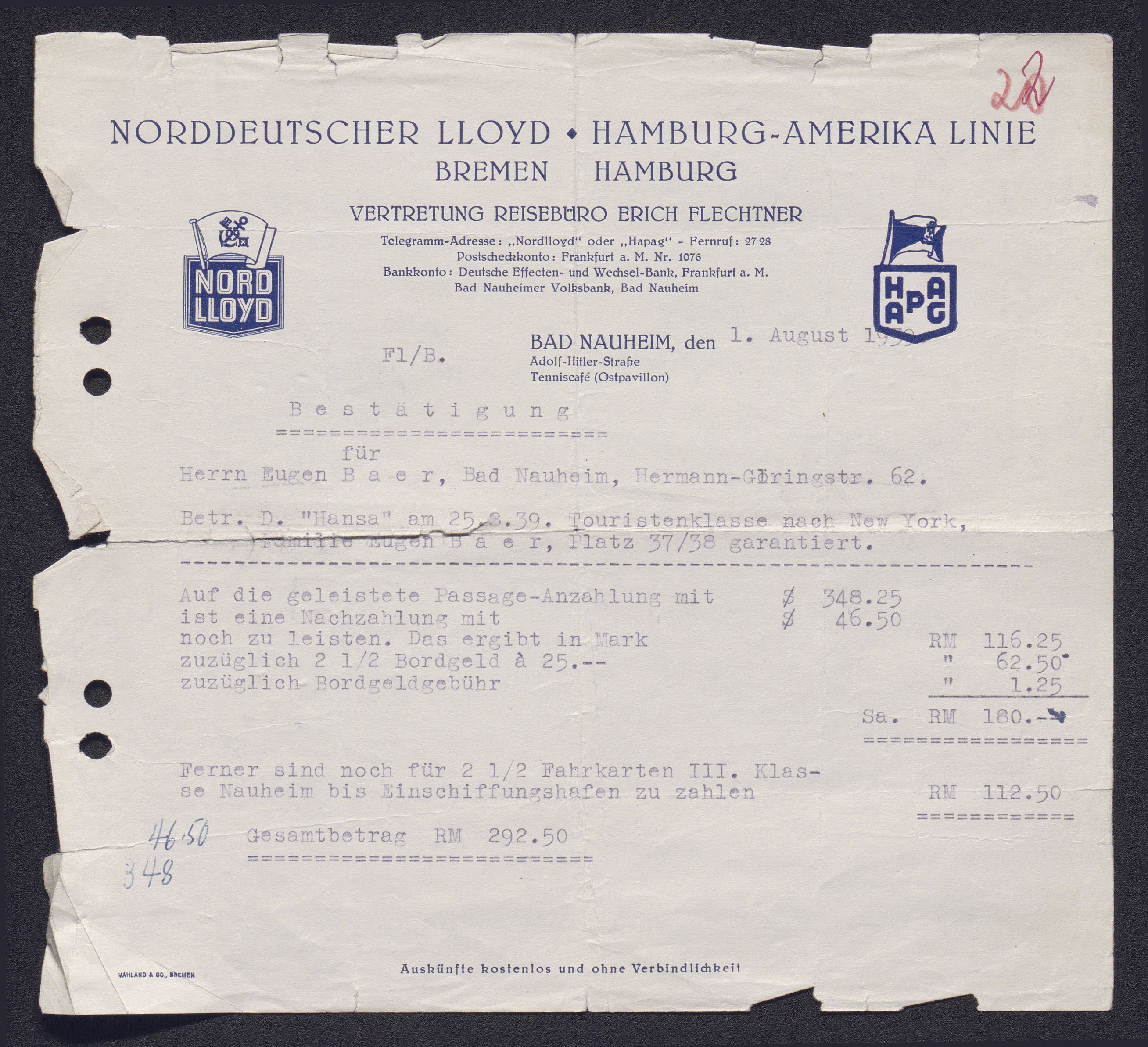
HHStAW Abt. 518 Nr. 23400, Norddeutscher Lloyd/Hamburg-Amerika Linie Bestätigung, 1 Aug. 1939, p. 22.
But that ship was recalled, as Eugen wrote, because two weeks after they obtained their visas on August 11, 1939, Hitler ordered all German commercial ships to return to Germany or a neutral port, and no German ships could leave Germany after that date.3
This explains why despite having visas in August, Hedwig and Adolf did not leave until months later. Their original plan to leave failed once the ship had to return to port. The family thus had to purchase new tickets from a non-German shipping company sailing out of a non-German port. As Eugen wrote:4
We consequently had to stay in France. My wife and son could only continue on with the “Manhattan” after 3 months. I myself was interned and could only travel on 6 Dec. with a French ship, the “Oregon,” arriving here only on 28.12.39. These passages were paid in advance by my brother-in-law from New York and I had to repay him:
1½ passages from Verdun, approx. $175.—
1 [passage] from Le Havre, approx. $150.—
Stay in France for 3 months cost approx. $500.—
But when had they gotten to France? And where did they stay? The compensation claim file included a statement from Julius Baer, Eugen’s brother, who, as you may recall, had left Germany in 1936 and settled with his family in Molsheim, France, in the Alsace region. Julius wrote:
My brother Eugen came 8 days before the outbreak of war, with his family (wife and son) to us in Molsheim, in order to emigrate to America from here. He had already paid for the ship tickets on the “Hansa” and wanted to board the ship with his family at the port of Cherbourg. Due to the war events the ship did not sail, and so he traveled back from Cherbourg to Paris. He himself was held as a foreigner in a camp until the end of 1939, and his wife and son were sent to Bordeaux and Limoges. Since all three had no financial means and had not anticipated these events, I of course, as the only brother living here, had to provide for their support. I lent them, successively, sums amounting to the equivalent of 500 dollars.[translation by Claude.ai]
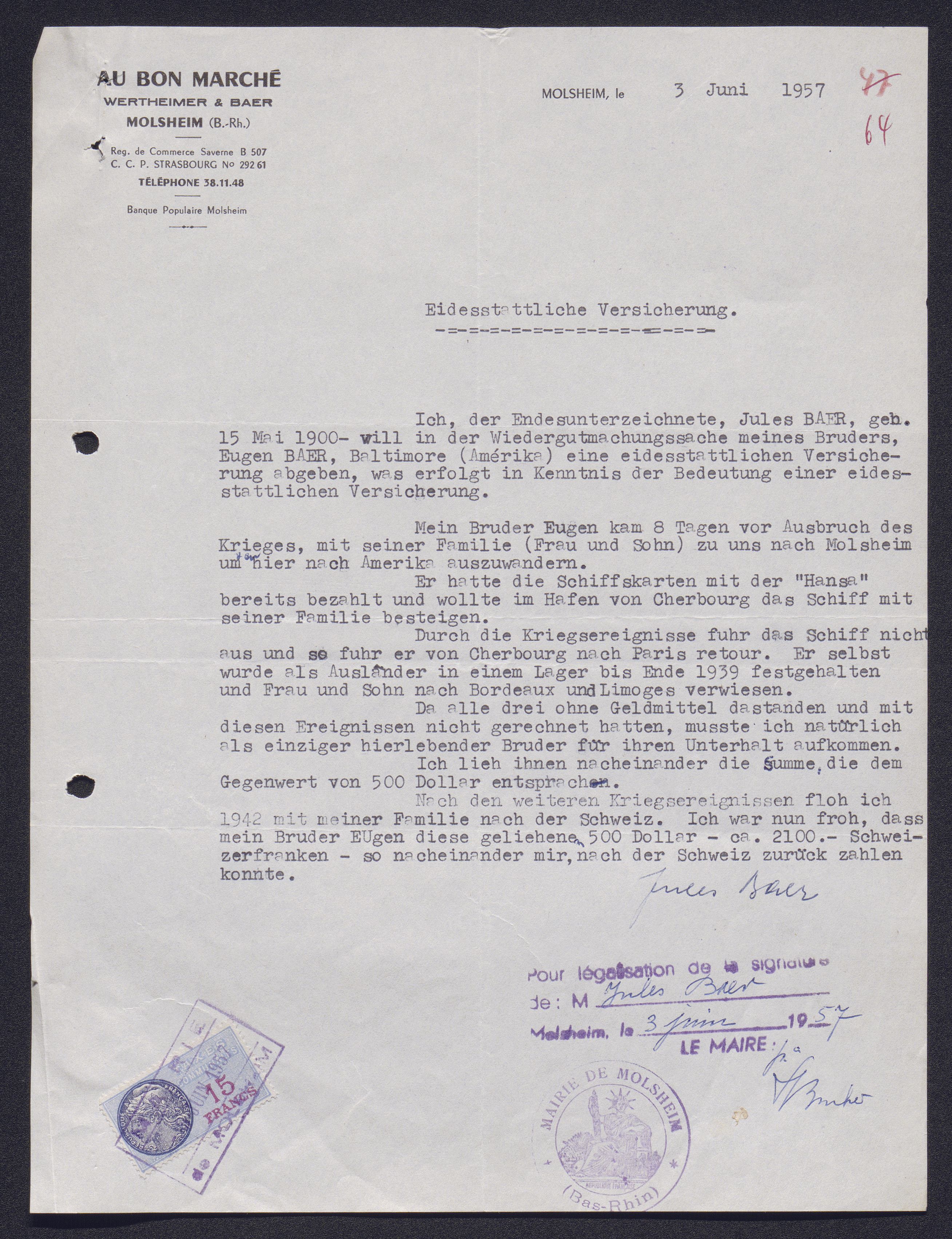
HHStAW Abt. 518 Nr. 23400, Jules Baer, eidesstattliche Versicherung, 3 June 1957, p. 47
World War II started on September 1, 1939, and eight days before September 1, 1939, was August 24, 1939. A separate confirmation from HAPAG indicates that August 24, 1939 was the day that Eugen, Helga, and Adolf were supposed to embark from Hamburg:
We hereby confirm that Mr. Eugen Baer and family traveled with our former ship S.S. HANSA on 24 August 1939 from Hamburg, and that this steamer was recalled one day after departure due to the threat of war, so that the family had to withdraw from the voyage. As is further evident from our records, the family’s assets were confiscated pursuant to an order of the Chief of the Security Police and the SD dated 2 November 1942.
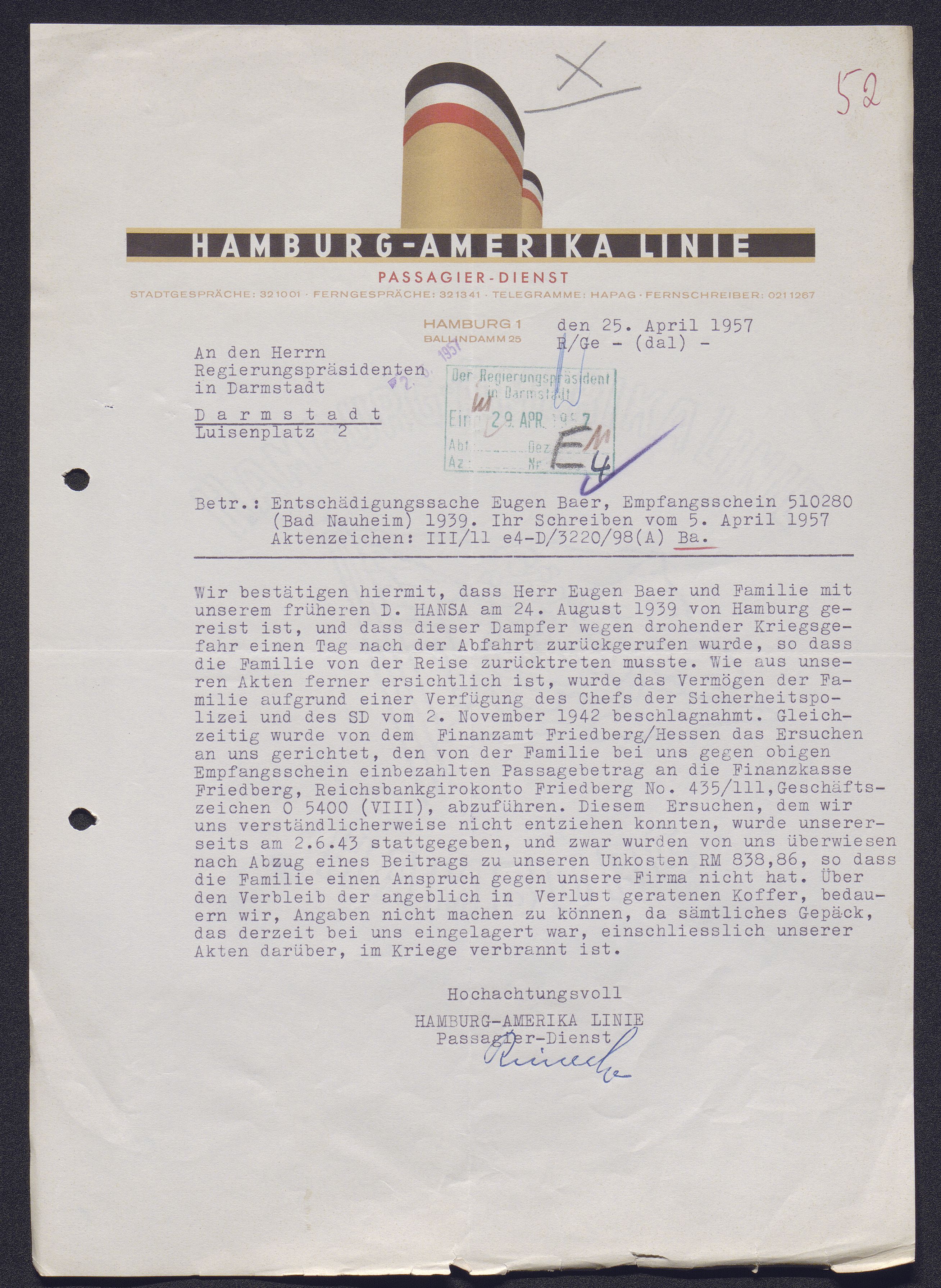
HHStAW Abt. 518 Nr. 23400, Hamburg-Amerika Linie to Regierungspräsident Darmstadt, 25 April 1957, p. 52.
Thus, Eugen and family went to Molsheim after their ship was turned back, leaving behind their possessions. I cannot explain why Julius said they were sailing from Cherbourg and HAPAG says Hamburg, but as we will see, their possessions were confiscated in Hamburg. More on that to come in my next post.
We know from their ship manifest that Hedwig and Adolf were eventually able to get tickets on the US-owned ship, the SS Manhattan, and left from Le Verdun, France on November 7, 1939. But Eugen was left behind. I am hoping to get more information about his arrest and time in the French concentration camp, but for now we know that Eugen was later able to get a new visa to travel to the US in October and sailed out of France in December. On December 28, 1939, he joined his family in the United States.
- United States Holocaust Memorial Museum, “Immigration to the United States, 1933–41,” Holocaust Encyclopedia, https://encyclopedia.ushmm.org/content/en/article/immigration-to-the-united-states-1933-41. ↩
- Hessisches Hauptstaatsarchiv Wiesbaden (HHStAW), Abt. 518, Nr. 23400 (Wiedergutmachungsakte Eugen Baer, 1954–1960) eidesstattliche Erklärung (emigration costs), 4 Feb. 1957, p. 21. [hereinafter cited as ” HHStAW Abt. 518 Nr. 23400, Eugen Baer” with the appropriate title and page number in the file.] ↩
- See, e.g., “The S.S. Bremen: Last Voyage of a Luxury Liner,” Cruising the Past, https://www.cruiselinehistory.com/the-s-s-bremen-last-voyage-of-a-luxury-liner/; also, see the Kriegstagebuch der Seekriegsleitung 1939–1945 (KTB Skl), the official daily war diary of the German Naval High Command, at https://uboatdata.ussleahy.com/SKL/1/Trans/wardiarygermanna11939germ.pdf ↩
- See Note 2, supra. ↩