Adelheid Rothschild: How She Survived the Holocaust

My cousin Adelheid Rothschild survived the Holocaust, as did her father Berthold and sister Helene/Hana, as we have seen,  but unlike her father and sister, Adelheid spent time in a concentration camp. She was deported from Amsterdam to the concentration camp at Bergen Belsen. She survived the war and at some point immigrated to Palestine/Israel, where she lived near her sister for the rest of her life. Her nephew Meir has shared a number of photos of Adi (as she was known in Israel) and his mother Hana, two of which I already shared. Here’s one more:
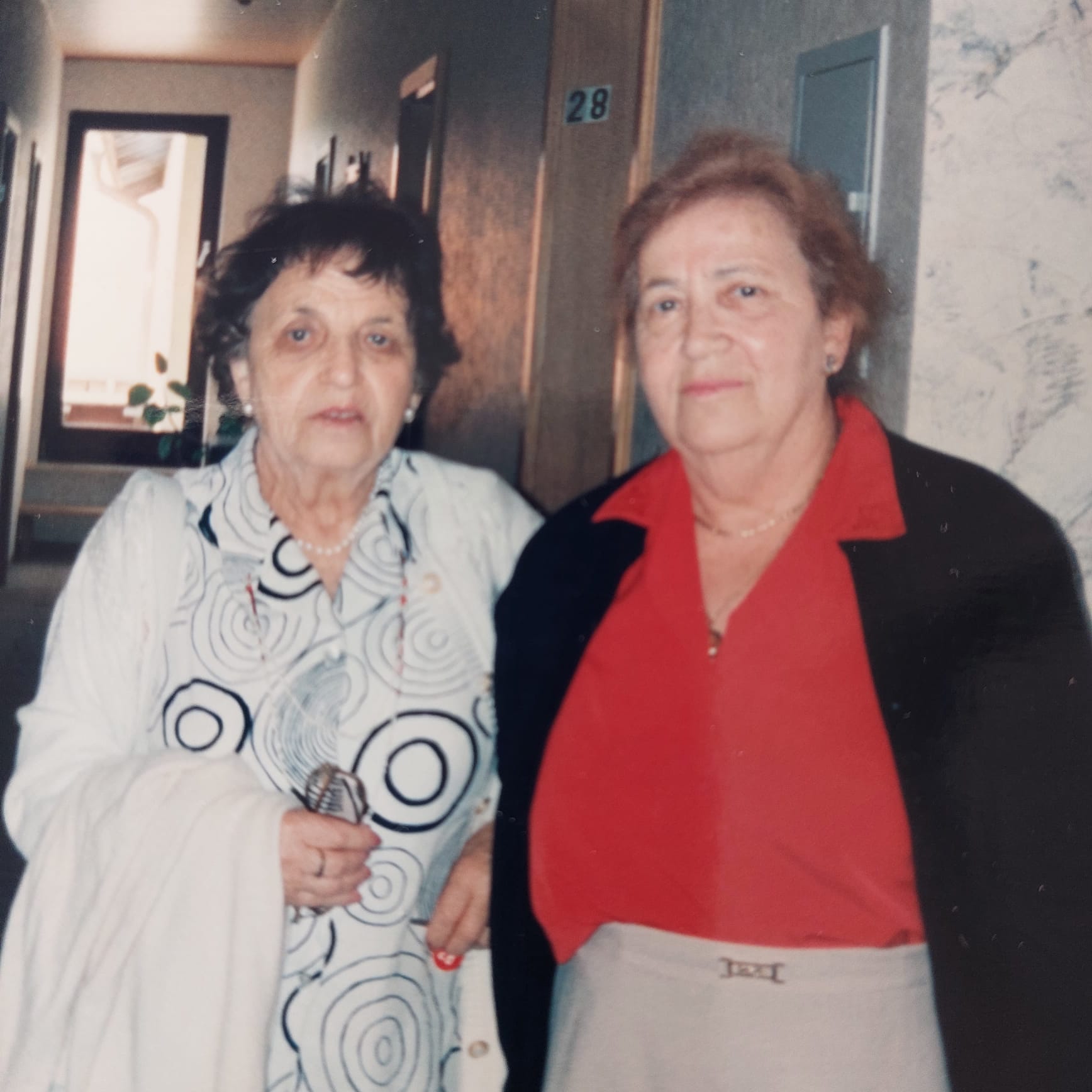
Helene/Hana and Adelheid/Adi in Germany, 1998.
Courtesy of the family

But one of the many questions that remained was when did Adi leave Germany for Amsterdam? Her father left for South Africa in 1936 when she was just sixteen, and her sister left for Palestine in 1937 around the same time that their mother Selma/Sarah Adler died. Adi was the last remaining member of that family to be left in Germany if she was still there after her sister left and mother died.

It took me quite some doing, but I believe I finally have some answers. I found in the Amsterdam Archives the following resident registration card for Adi.
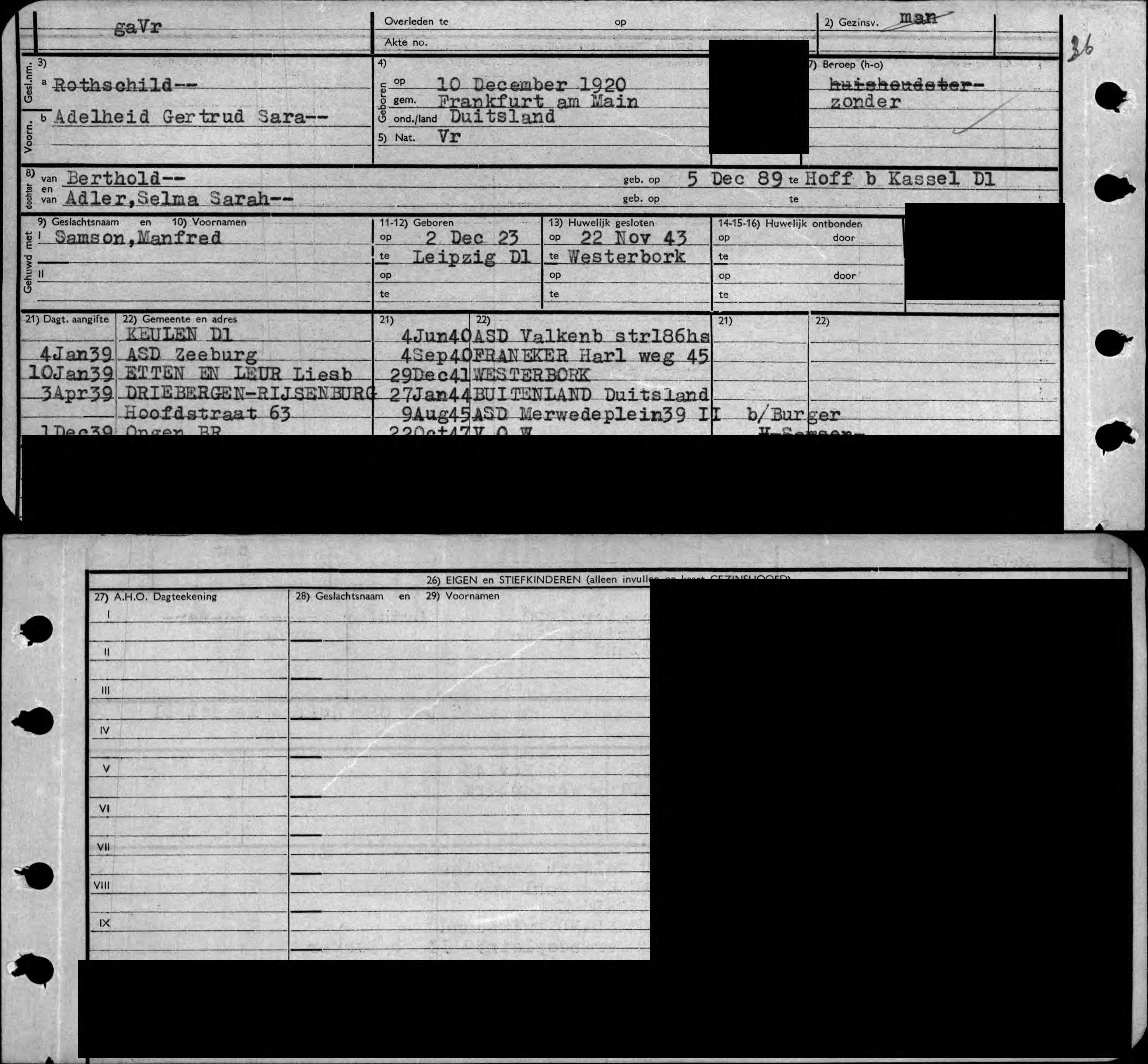
Adelheid Rothschild Samson registration card from the Amsterdam Archives, found at https://archief.amsterdam/archief/30238/691

The card contains the following information, including pertinent information about Adi’s whereabouts in the Netherlands. Note that it starts with Adelheid being single and then was updated to show her marriage information. The card contains the following information:

Surname: Rothschild. First names: Adelheid Gertrud Sara

Born10 December 1920, Frankfurt am Main, Germany–Female

Father: Berthold, born 5 Dec 1889 in Hoff b. Kassel, Germany

Mother: Adler, Selma Sarah

Occupation: Housewife/without 

Married to: Samson, Manfred,  born 2 December 1923, Leipzig, Germany

Married on: 22 November 1943

Place of marriage: Westerbork

Address History 

| Date | Municipality | Address |

| 4 Jan 1939 | Cologne, Germany | (arrival from abroad) |

| 4 Jan 1939 | Amsterdam – Zeeburg | |

| 10 Jan 1939 | Etten en Leur, Liesberg | Hoofdstraat 63 |

| 3 Apr 1939 | Driebergen-Rijsenburg | |

| 1 Dec 1939 | Ommen, BB | |

| 4 Jun 1940 | Amsterdam | Valkenburgerstraat 186hs |

| 4 Sep 1940 | Franeker | Harlingerweg 45 |

| 29 Dec 1941 | Westerbork | |

| 27 Jan 1944 | Abroad – Germany | 

| 9 Aug 1945 | Amsterdam | Merwedeplein 39 II |

| 22 Oct 1947 | Amsterdam | VOW |


Of particular interest to me was the date of Adelheid’s arrival in the Netherlands: January 4, 1939, from Cologne, Germany. She was then not yet nineteen years old and had been without any immediate family member in Germany for almost two years.

Adelheid then lived in various towns in the Netherlands between January 4, 1939, and December 1941 when she was sent to Westerbork, the location where the Nazis sent the Jews they rounded up while awaiting transport to the concentration camps. It was there that Adelheid met and married Manfred Samson, a marriage of convenience, according to Meir.

I was curious about what advantages that marriage afforded Adelheid and/or Manfred, so I decided to dig a little deeper. What I learned was that people held at Westerbork learned that it was better to be deported to Bergen Belsen, which was not a death camp, than to Auschwitz or another death camp. One article described the purpose of the Bergen Belsen camp:

In late 1942, Hitler and SS chief Heinrich Himmler agreed to make a camp for the purpose of setting aside Jewish families as hostages, with specific instructions that they be given healthy living conditions, so that they could be used at an unspecified later to be traded as hostages for Germans civilians living in allied and allied-occupied countries, for foreign currency, or for much-needed supplies. For this purpose, Jewish people were to be chosen under categories such as those who had special influential connections in foreign countries; those who were themselves of some importance in foreign countries; those who already had so-called ‘Palestine certificates’ giving them the right to emigrate to Palestine; those who already had authorized travel visas to allied countries; those who had ‘hostage value’ via political or economic means, or who were leading Jewish functionaries….Despite the name, the camp was still a part of the Nazi concentration camp system. Belsen was unique in the Nazi camp system in a number of ways, however. From the very start it was a camp intended for families, with a large number of children and teenagers. As a rule, entire families rather than single persons were not [sic??]sent to Belsen, even if only one person in family fulfilled the above criteria for ‘hostage value’.

Thus, perhaps Manfred and Adelheid married because they wanted to go to Bergen Belsen, a safer camp, and only one of them qualified as having “hostage value.” I was curious what a Palestine certificate was and how one obtained one and learned that they were issued by the Jewish Agency in Palestine to give those living under Nazi control permission to escape to Palestine. But only those who had a family member living already in Palestine were eligible to obtain one of these certificates. Remember that Adelheid’s sister Helene (Hana) had already immigrated to Palestine in 1937, so Adelheid was eligible to apply for a Palestine certificate. Perhaps Manfred was not, so Adelheid married him to save him from being sent to Auschwitz. Although they later divorced, Adelheid likely saved his life.

The chronology then continues, showing that in January 1944, Adelheid was deported. From other documents we learned that she and Manfred ended up in the Bergen-Belsen concentration camp. According to a record I located at JewishGen.com, Adelheid Rothschild and her husband Manfred Samson were liberated at Tröbitz on April 23, 1945, just a week after the war in Europe ended.
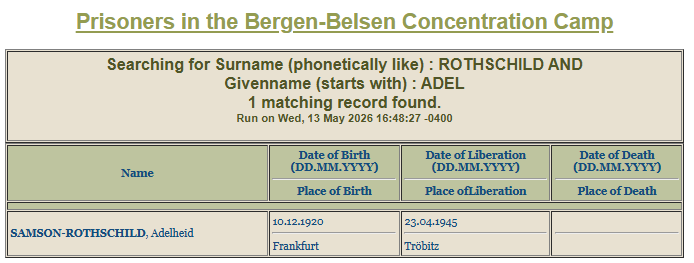
I looked up Tröbitz and learned that that was where “the Lost Train” ended up as described in an article at the Yad Vashem website:

Between 6-10 April 1945, days before the liberation of the Bergen-Belsen concentration camp in Germany, three trains were sent from the camp with some 7,000 Jews on board, bound for the Terezin ghetto.  The first train was liberated by the Allies.  The second train reached Terezin on 21 April, and the third, later known as “The Lost Train”, never reached its destination.  After a journey of approximately two weeks, the train was stopped on a destroyed bridge on the Elster River, and on 23 April, it was liberated by the Red Army on the outskirts of the German village of Tröbitz.

The article then tells the story of Betje Andriesse, and her children Bram, Tett and Mirjam, passengers on that train presumably along with Adelaide Rothschild Samson. Betje’s husband Hermann died in February 1945 from starvation and illness at Bergen Belsen (as did Anne Frank). Like Adelaide and Manfred, the Andriesse family had been sent from Amsterdam to Westerbork and then to Bergen-Belsen around the same time. Perhaps they all knew each other. And they likely were all on the same Lost Train. According to an article on JewishGen, there were initially 2500 people on that train, which was supposed to be going to Theriesenstadt, but never made it there.

The Yad Vashem article continued, “For two interminable weeks, the train zigzagged between bombed tracks and destroyed bridges, and on 23 April, it was liberated by the Red Army on the outskirts of the German village of Tröbitz.  Survivors of the journey were given lodging in the village.” But over 600 of the people on that train died during that trip or afterwards in Tröbitz—from disease and malnutrition. Fortunately, Adelheid and Manfred were among those who survived.

In June 1945, the survivors were brought to the Netherlands, and if you look at the chronology on Adelheid’s registration card, you will see that she is registered again as a resident of Amsterdam in August 1945.

The last entry on the card says that on October 22, 1947, she was “VOW,” which stands for “Vertrokken Onbekend Waarheen,” which translates to “Departed to Unknown Destination.” Although I cannot be sure until the Israel State Archives reopen after the war, I am going to guess that that’s when Adelheid and Manfred left Amsterdam for what was then Palestine, soon to be Israel.

It’s remarkable to me to think of all Adelheid survived. I know her marriage to Manfred Samson did not, but somehow together the two of them survived the terrors of Bergen Belsen and the Lost Train and both ended up living the rest of their lives in Israel.
Irma and Hilde: The Power of Love

In my last post, I shared the story of my cousin Erwin Rothschild and his wife Irma Simon. As we saw, Erwin died from typhoid fever at Bergen-Belsen, but Irma survived. Erwin had done everything he could to keep Irma, her sister Hilde, and Hilde’s husband Simon Eisenmann alive, but in the end only Hilde and Irma survived. They were two young widows in their thirties as the war drew to a close in Europe.

As recounted by Irma in her moving testimony for the Shoah Foundation,1 in the spring of 1945 Irma and Hilde and about 2200 other prisoners at Bergen-Belsen were put on cattle trains by the Nazis with nothing to eat but one turnip each and taken on a long and twisting trip through Germany. When they saw the planes of the Allies flying overhead, they hung white shirts out the window, trying to save themselves from being bombed. As the train neared Frankfurt an der Oder near the Polish border, the Nazi guards abandoned the train, and the Russians came to liberate the people on the train on April 23, 1945. The Russians told the prisoners that they should go to a nearby village called Trobitz, which had been emptied of its residents and would be safe for the survivors.2

They had to walk to the village, but Hilde, who weighed only 70 pounds, was too weak to walk. So Irma and another woman found a wheelbarrow and pushed Hilde to the village. They settled into the village where there was shelter and food. One man died from eating too much food too quickly. Many others—about 600 people—died while living in Trobitz. But Irma and Hilde survived.

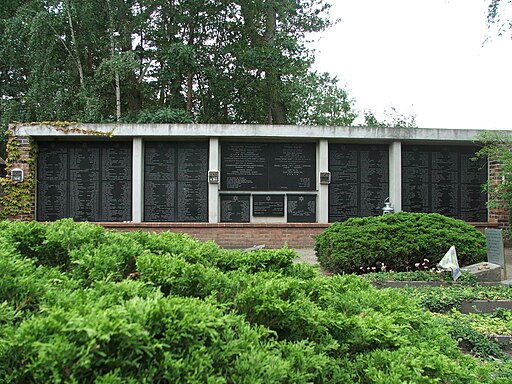
Memorial listing the names of those from the Lost Train who died in Trobitz, LutzBruno, Public domain, via Wikimedia Commons

The people living in Trobitz were taken later by the Allies to Leipzig for a week and then they were allowed to go “home.” Irma and Hilde went back to the southern part of the Netherlands, where Hilde, a Dutch citizen by marriage, lived in a cloister and Irma was interned in a school. They could not return to Amsterdam because northern Holland had not yet been liberated. Once the war ended, the sisters moved to Amsterdam and then immigrated to the US in 1947 with the help of their brother Julius, who lived in Philadelphia. They traveled on the Queen Elizabeth and were able to get kosher food on the ship. Irma and Hilde settled in Washington Heights in New York, and Irma continued her career as a kindergarten teacher.

Both Irma and Hilde remarried in the 1950s, Irma to Nathan Haas, and Hilde to Nathan Meyer, both also German Jewish survivors of the Holocaust. Neither had children. They lived in adjoining apartments in Washington Heights. In 1967 the two couples moved to one house together in Englewood, New Jersey. They all became active in the Orthodox Jewish community there. Their second husbands both died in the 1970s, but Irma and Hilde continued to live together for the rest of their lives.

As reported by Joseph Berger in The New York Times on December 29, 2004,3 Irma and Hilde decided when they were 97 and 94, respectively, that they wanted to live the rest of their lives in Israel in a home for senior citizens in Jerusalem called Beit Barth. Berger described their special relationship and recounted their long lives together during and after the Holocaust:

The two sisters were inseparable….[He then described much of what I’ve reported earlier about their lives during the Holocaust.]

They came to the United States together and lived with their second husbands in adjoining apartment buildings in Washington Heights. … As if that were not close enough, they moved in 1967 into a single suburban ranch house in Englewood, N.J., which they continued to share after their husbands died.

Until yesterday. That was when Irma Haas, 97, and Hilde Meyer, 94, set off from Kennedy International Airport for Israel to spend the remainder of their lives in the same residence for the elderly in Jerusalem.

… With canes across their laps, they sat next to each other in wheelchairs as El Al security hurriedly examined their passports and put them through the requisite grilling about who had packed their bags and whether they had received any gifts. Much of the time, Hilde, looking frightened, clutched Irma’s left arm with her right hand.

“She cannot let go of me,” Irma said, mentioning their wartime terror. “She is afraid she would be brought somewhere and I would not come.”

…Both sisters are slight of build and wear gray shaytls, or wigs. Irma is hardier, Hilde more easily rattled. They were born in Londorf, a town in Hessen, a German state where their family’s roots stretch back hundreds of years. …Irma promised her mother that she would always take care of the more delicate Hilde….

Judy Marcus, their second cousin, who accompanied them on the flight, said the two sisters seemed to have eluded the arrows of sibling rivalry. “They were never jealous of each other,” she said. “They were always happy whatever the other one had.”

About two years ago, Hilde was briefly hospitalized and pleaded that Irma remain at her side. Mrs. Marcus said she told a hospital official: “They are Holocaust survivors. They can’t be separated.”

“They made a special dispensation to allow Irma to sleep in Hilde’s room,” Mrs. Marcus recalled. “But Irma would not have left anyway, even if it meant sitting up in a chair all night.”

Only death separated these two amazing sisters. Hilde died first on May 8, 2005;4 she was 94 and had been in Israel for only five months. Irma Simon Rothschild Haas, who had done so much to care for her younger sister and whose strength got them through the camps, liberation, and immigration to the US, died on April 17, 2009, just six months before she would have turned 102.5 She had outlived her parents, all her siblings, and two husbands. Neither Irma nor Hilde had had children, so there are no direct descendants to remember these two remarkable women. But I will forever, and I hope that you will also.

I wish I had some photos of Irma and Hilde I could share. All I found is this one small photo from the New York Times in 2004 when they moved to Israel. But If you haven’t already, please watch Irma’s Shoah Foundation testimony—if for no other reason than to see Irma with Hilde together near the end of that testimony. I guarantee it will both bring you to tears and lift you up with joy. The power of their love was immeasurable.


  1. Haas, Irma. Interview 32295. Interview by Miriam Horowitz. Visual History Archive, USC Shoah Foundation, 04 August 1997. https://vha.usc.edu/testimony/32295. Accessed 18 Jan 2024. Almost all of the information in this post came from Irma’s testimony, except where noted. 
  2. You can read more about the “lost train” from Bergen-Belsen to Trobitz here, here, and here. 
  3. Joseph Berger, “A Bond the Holocaust and Time Couldn’t Break,” The New York Times, December 29, 2004, page B1. See also “Holocaust Survivors from Englewood Begin Their New Lives in Jerusalem,” The Hackensack Record, December 31, 2004, p. A5. 
  4. Hilde Meyer, Gender Female, Birth Date 30 Sep 1910, Death Date 8 May 2005,
    Claim Date 13 Jul 1972, SSN 081242610, Ancestry.com. U.S., Social Security Applications and Claims Index, 1936-2007 
  5. Find a Grave, database and images (https://www.findagrave.com/memorial/254917717/irma-haas: accessed 18 January 2024), memorial page for Irma Simon Haas (9 Oct 1907–17 Apr 2009), Find a Grave Memorial ID 254917717, citing Har HaMenuchot Cemetery, Jerusalem, Jerusalem District, Israel; Maintained by DTWer (contributor 47953179). 

Erwin Rothschild As Remembered By His Wife Irma

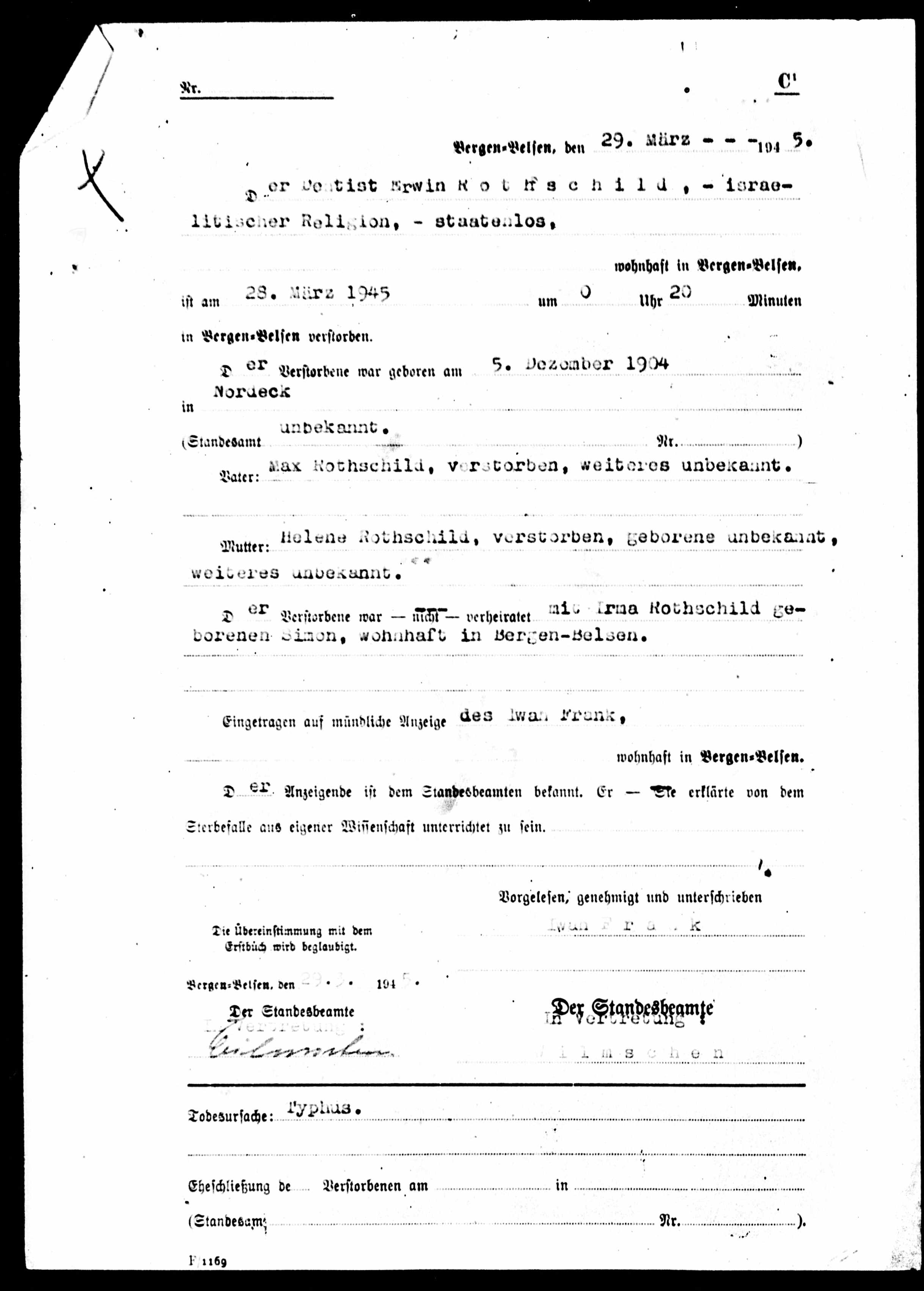
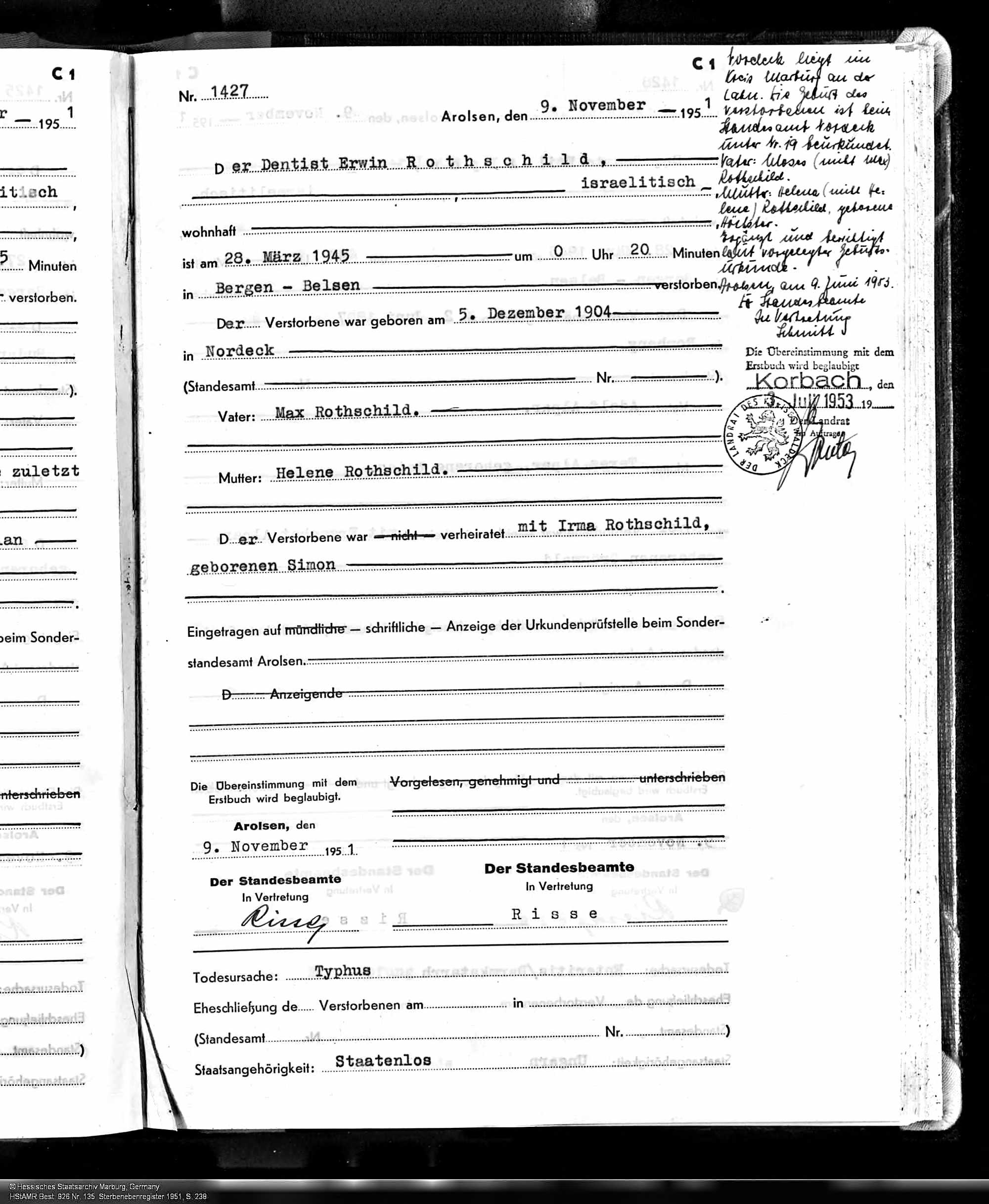
Although two daughters of Moses Max Rothschild appear to have survived the Holocaust, his son Erwin was not as fortunate. The only official records I have for Erwin Rothschild are two that relate to his death, but they also include his birth date and his parents’ names. He was born on December 5, 1904, in Nordeck, Germany, and he died of typhus on March 28, 1945, in the Bergen-Belsen concentration camp. These two records also both provide evidence that Erwin was a dentist and that he was married to Irma Simon. But not much else can be discerned about Erwin’s life from these two documents.

Erwin Rothschild death record from the Bergen Belsen Concentration Camp, The National Archives at College Park; College Park, Maryland; Microfilm: A3355; ARC: 596972; Title: Lists and Registers of German Concentration Camp Inmates, 1946 – 1958; Record Group: 242; Record Group Title: National Archives Collection of Foreign Records Seized, 1675 – 1958
Source Information
Ancestry.com. Germany, Concentration Camp Records, 1937-1945

Erwin Rothschild death certificate, Hessisches Hauptstaatsarchiv; Wiesbaden, Deutschland; Personenstandsregister Sterberegister; Signatur: 135; Laufende Nummer: 926
Year Range: 1951, Ancestry.com. Hesse, Germany, Deaths, 1851-1958

Fortunately, Erwin’s widow Irma Simon Rothschild Haas gave testimony to the Shoah Foundation and filled in the details of Erwin’s life as well has her own quite moving and amazing life story. I am so grateful to the Shoah Foundation for recording and preserving these stories.

Irma was 89 years old when she was interviewed on August 4, 1997. But you would never know it from the sharpness of her mind, the depth and precision of her memories, and her ability to answer probing and difficult questions. She was an incredible storyteller, and I felt like I was with her during those awful years of the Holocaust. I started out wanting to learn more about Erwin, but by the end of Irma’s testimony I was moved to tears by not only what I’d learned about Erwin, but by what I’d learned from Irma about the best side of human nature. Find two hours in your busy lives and listen to what Irma has to say. You also will never forget her. 1

Although I cannot do justice to Irma’s testimony in a brief paraphrasing of its content, I want to tell the story of Erwin and Irma as best I can. Irma Simon was born on October 9, 1907, in the small town of Londorf, Germany. Irma had two older brothers, Siegfried and Julius, and a younger sister Hilde.

Irma went to school to become a kindergarten teacher and worked in Cologne, Frankfurt, and Berlin before the Nazi era. She was working in a children’s home for 150 children in 1935 outside of Berlin when the Nuremberg Laws were enacted and the home was no longer able to obtain kosher meat. Irma left the home and found a new job teaching in Berlin. She lived with an unnamed cousin of Erwin Rothschild, and I assume that that is how she met Erwin. He was practicing dentistry in Berlin at that time.

After Kristallnacht in November 1938, the school where Irma had been working closed, and Erwin and Irma and her parents tried to get out of Germany . One of her brothers, Julius, was already in the US, her sister Hilde was married to Simon Eisenmann and living in Amsterdam, and her other brother Siegfried had been arrested after Kristallnacht and sent to Sachsenhausen. With Irma’s help and a visa obtained by her sister Hilde in Holland, Siegfried was released and left for South America. Later, Hilde was also able to get a visa for their parents and for her sister Irma to come to Holland.

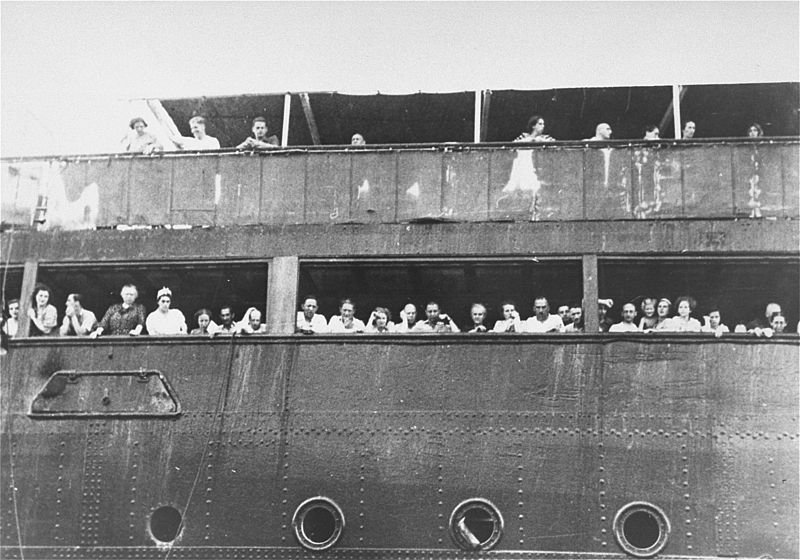
Meanwhile, Erwin Rothschild, who was now engaged to Irma Simon, had gotten a ticket to leave Germany on the ill-fated ship, the St. Louis in the spring of 1939. I’ve previously told the story of the St. Louis, the ship that was turned away from Cuba and from the US and had to sail back to Europe in June, 1939, returning its passengers to a likely death in the Holocaust. Erwin ended up in Holland where Irma and her family were living.

Jewish refugees aboard the SS St. Louis attempt to communicate with friends and relatives in Cuba, who were permitted to approach the docked vessel in small boats. |Source=USHMM, courtesy of National Archives and Records Adminis (public domain)

But Erwin was not able to live in Amsterdam where Irma was living; as a refugee from the St Louis, he was required by the Dutch to live in the internment camp in Westerbork. But he was free to work as a dentist in Amsterdam and to see Irma, who was working at a children’s home in Amsterdam.

However, when the Nazis invaded Holland in May, 1940, the school was forced to close and the children were evicted. Irma helped find homes for 130 of those children with families in Amsterdam. The Nazis also took over the camp at Westerbork where Erwin was living.

Nazi troops and supporters in front of De Bijenkorf, Dam Square, Amsterdam, The Netherlands, 1941 (crop of original 1941 public domain photo). 47thPennVols, CC0, via Wikimedia Commons

In 1942 Erwin and Irma married, but Irma stayed with her parents in Amsterdam because they all believed she would be safer there. But by the end of that year her parents were taken to Westerbork. To avoid being taken to a concentration camp at Vught where conditions were worse, Irma voluntarily moved to Westerbork to be with her husband Erwin as well as her parents and her sister Hilde and brother-in-law Simon. Conditions at Westerbork were at that time not bad at all, and Irma became a dental assistant working with Erwin.

In September 1943, Irma’s parents were put on a transport to Bergen-Belsen, where conditions were much worse. Then Irma’s sister Hilde and her husband Simon Eisenmann were put on a list for transport despite having certificates to go to Palestine, which were supposed to keep them (and Erwin and Irma) off the transport lists. Erwin figured out that there was confusion regarding a different man named Eisenmann and got Hilde and Simon off the list.

In December 1943, they were told that the Westerbork camp was to be dissolved and all those with Palestine certificates would go to a Red Cross camp, but in fact  Erwin, Irma, Hilde, and Simon and the others were all sent to Bergen-Belsen, arriving there on February 1, 1944, just a day after Irma’s parents had been transferred from Bergen-Belsen to Theresienstadt. Irma was heartbroken not to have had a chance to see her parents. She never saw them again. They died at Theresienstadt.

The conditions at Bergen-Belsen were terrible. Irma, Erwin, Hilde, and Simon all worked in a quarry, where Erwin feared his hands would be so damaged from smashing rocks that he would never practice dentistry again. But then one of the older camp dentists died, and Erwin was drafted into being a camp dentist. That meant he could live in the hospital with the doctors with better living conditions than being in the barracks.

Women and Children at Bergen Belsen Concentration Camp, 1945, No 5 Army Film & Photographic Unit, Morris (Sgt), Public domain, via Wikimedia Commons

When a young SS officer who was also a dentist needed dental care one day, he asked Erwin to help him. At first Erwin refused, saying he was not allowed to treat Aryans. But the officer insisted, saying the other (non-Jewish) dentist was not as good. So Erwin treated him, and the officer arranged to have Irma become his assistant and to live in the hospital with the nurses.

But Hilde and her husband Simon were still in the barracks, and in November 1944, Simon died from typhoid fever. Hilde was bereft, and Erwin and Irma did everything they could to give her support. But she became very sick, and Erwin, without permission, had her brought to the camp hospital. Although he was caught and punished for doing that, he saved Hilde’s life.

But unfortunately, Erwin could not save his own life. In early 1945, a camp was set up near Bergen-Belsen for women who had been transferred from Auschwitz. Erwin was sent there to provide dental care for these women and contracted typhoid fever from them. He died from the disease on March 28, 1945,2 leaving Irma, like her sister Hilde, a young widow still imprisoned at Bergen-Belsen.

I will tell the rest of Irma and Hilde’s story in my next post. But this post is to honor the memory of my cousin Erwin Rothschild, a man who not only cared for those at Westerbork and Bergen-Belsen, but who managed to keep his wife Irma and her sister Hilde safe. From the way Irma spoke about him more than 50 years after he died, I could tell that theirs was a true love story and that Erwin was a good, decent, courageous, and compassionate man. How tragic that he died caring for others just a few weeks before the war ended in Europe.


  1. Haas, Irma. Interview 32295. Interview by Miriam Horowitz. Visual History Archive, USC Shoah Foundation, 04 August 1997. https://vha.usc.edu/testimony/32295. Accessed 14 Jan 2024.  You do not need to download Irma’s testimony; it is available online at the citation above. All the information in this post came from Irma’s testimony. 
  2. In her testimony Irma said that Erwin died on March 27, 1945, but the death records above both indicate that he died on March 28. I don’t know which is more accurate, but I am using the recorded date.