

Iriwin Elkins 1960
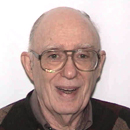
I recently connected with Richard Elkins, the grandson of Rebecca Rosenzweig Elkin. Rebecca died in 1921 at age 27, when her son Irving was less than two years old. Irving grew up to be Irwin Elkins, who married Muriel, with whom he had two sons, Michael and Richard. Richard was kind enough to share with me some stories about Irwin’s life. With his permission, I am including some of what he shared with me in his own words.
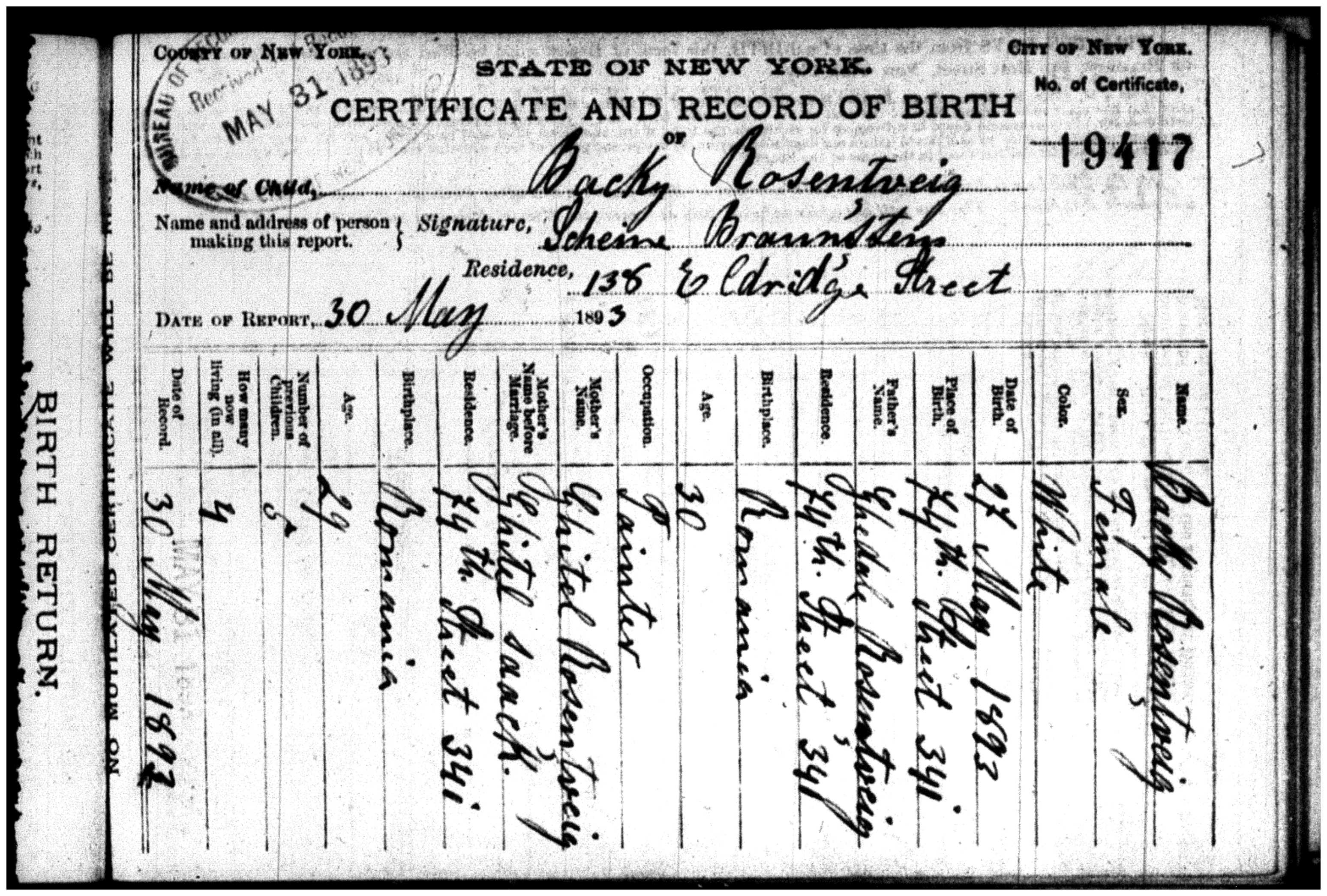
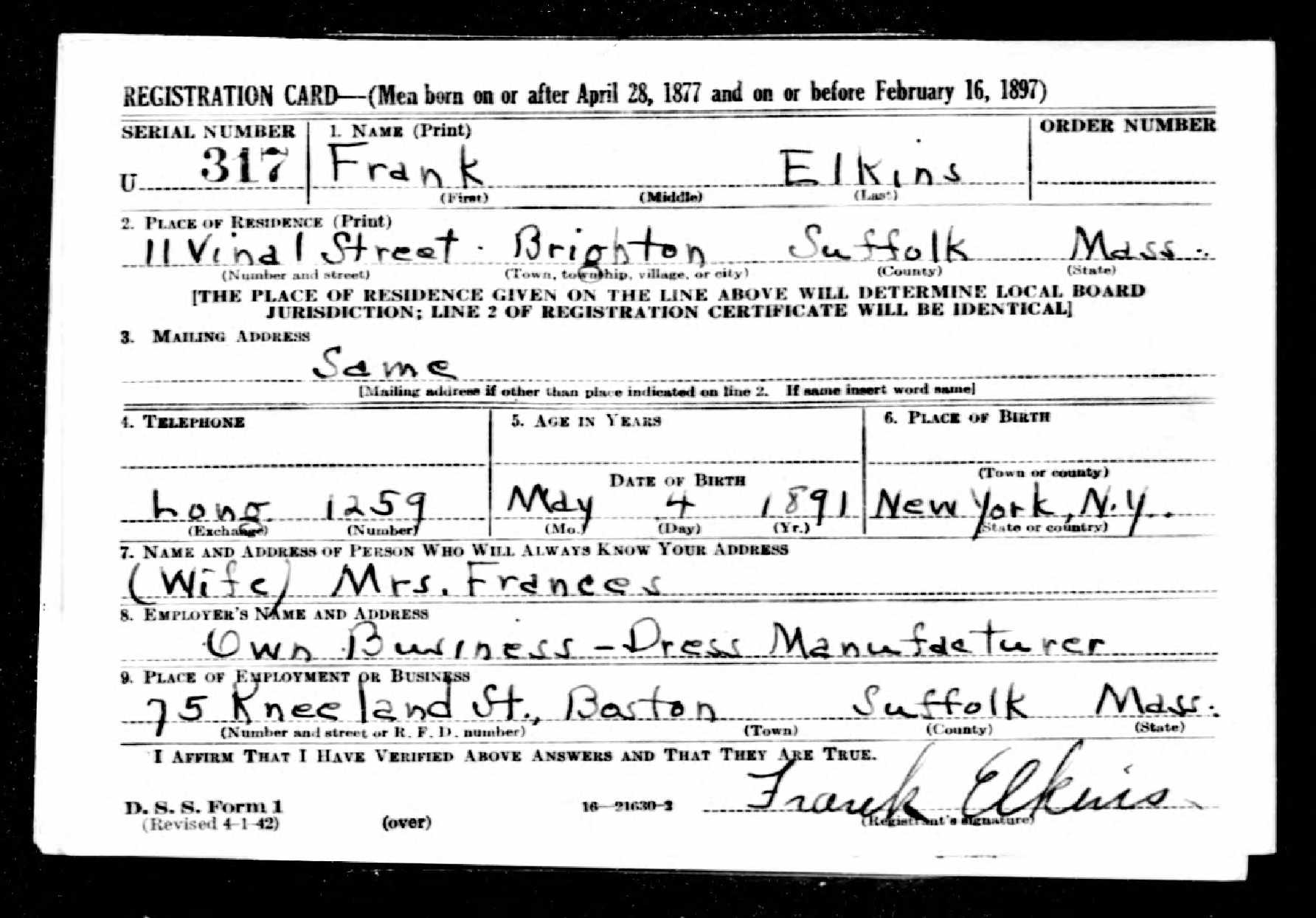
First, some background. Rebecca Rosenzweig, my grandfather’s first cousin and the daughter of Gustave and Gussie Rosenzweig, married Frank Elkin in 1914. Her son Irving was born in 1919. After Rebecca died in 1921, Frank married Frances Reiner in 1922 and moved to Boston. Frank and Frances had a son named Stanley, who was born in 1925. In 1930 Frank was back in Brooklyn with Frances and the boys, but sometime thereafter they returned to the Boston area, where they settled permanently. I had assumed that Irving had stayed with Frank and his new wife during the 1920s, but Richard informed me otherwise.
“When Rebecca Rosenzweig passed away in 1921, Irwin Elkin moved into the home of Gustave and Gussie Rosenzweig, where he resided for eight years until 1929. Irving adored his Grandma Rosenzweig, and Grandma Rosenzweig adored my Dad. My Dad thought of Gussie as his mother. My Dad said Gussie was a fabulous cook. My Dad never spoke about Gustave.”
Perhaps the reason that Irwin never spoke about Gustave was that by 1921, Gustave and Gussie were divorced or at least no longer living together. If Irwin’s years with his grandmother were from 1921 to 1929, he was living with just Gussie, Ray, and Lizzie.
One of Irwin’s favorite stories about his years living with his grandmother was this one, according to Richard: “There was a large family gathering at Gustave and Gussie’s home, and Gussie discovered that she did not have enough food to feed the entire clan. Gussie pulled my Dad aside and told him to tell all the other children that when Gussie asked who wanted chicken for dinner, all the children were to say, ”No, thank you,” because they were not hungry. That way there would be enough food for the adults. When everyone sat down at the table, Gussie asked who wants chicken for dinner? All the children dutifully said no thank they were not hungry and were excused from the table. After the dinner was served and completed, Gussie then announced, ‘Any child who did not eat my chicken dinner will get no dessert!’ “
Richard also shared this story about his uncle, Jack Rosenzweig: “The only other story I recall about my Dad growing up in the Rosenzweig household is someone my Dad referred to as Uncle Jack who had a wild sense of humor. Jack worked behind the counter in the post office. One day my Dad walked into the post office to see Jack and Jack told my Dad he went to Yankee Stadium and met with legend Babe Ruth. Jack then tossed to my Dad a baseball with Babe Ruth’s autograph on it. There was just one problem. The autograph was written in purple indelible ink that was the same color ink that Jack used to address packages for postal customers.”
Irwin’s time with the Rosenzweig family ended in 1929. Richard wrote: “In 1929 Irwin was told to pack up his belongings. Frank arrived from Boston, picked up Irwin, and they went back to Boston on the train. My Dad was aware that Frank had remarried and had met Frances (Fan) Reiner. What my Dad did not know, until he arrived at his new home, is that he had a kid brother named Stanley who was six years younger than he was. That fact had been withheld from him while Irwin was living in the Rosenzweig household.”
I asked Richard if he knew why Frank and Frances had moved to Boston rather than stay in NYC. He wrote:
“Although Francis Fan Reiner was born in New Jersey, her extended family lived in Boston. … The second move back to Boston occurred because Frank changed professions. He met a couple who were twenty years younger than he was named Joseph Cohen and his wife Rene Cohen. They opened up a business called Debonair Frocks located on Kneeland Street that was in the high rent fashion district in Boston. Frank was the salesman who traveled throughout New England.”
Richard also told me that his father graduated from Boston English High School and was accepted into the MIT School of Engineering. He could not afford the $600 per year tuition and instead went to Northeastern University, which had awarded him a football and baseball scholarship and the opportunity to work on a paid co-op job. According to Richard, “Frank and Fanny Elkins were very unhappy that Irwin wanted to study engineering in college. They believed it was a useless profession. They would invite family and friends over to convince my Dad that the future was in clothing, not engineering. People need things to wear, they don’t need mechanical engineers.”
Irwin soon proved them wrong. Richard wrote:
“When World War II broke out with the bombing of Pearl Harbor, my Dad had just graduated Northeastern and tried to enlist as a fighter pilot. He was rejected for two reasons. He stood 6’4 and weighed 200 pounds which made him too large to fly. He also had his degree in mechanical and aeronautical engineering that made him too valuable to serve in the armed forces. My Dad was assigned to be a civilian contractor working for Bethlehem Steel at the Fore River Ship Yard in Quincy, Massachusetts. His responsibility was to oversee the construction of light cruisers and destroyers, take them to sea on shakedown cruises, and sign off on their seaworthiness before turning over the ships to the War Department.
“It was my Dad’s crew of engineers at the Fore River Shipyard who perfected the “Davit” that was first invented in 1928. It’s the device that holds a ship’s lifeboats in place that would lower the lifeboat by hand cranking the boat down into the water. My Dad was the lead engineer who re-designed the Davit into a fully automated self-contained hydraulic system that would first lower the two arms holding the lifeboat from their vertical position – while keeping the lifeboat level – into a horizontal position for boarding. The Davit hydraulics would then resume lowering the lifeboat into a fully locked horizontal position at which point a second set of hydraulics would automatically lower the lifeboat while maintaining its level stability even if the weight distribution in the boat was not balanced. The end result was an automated steady descent onto the water regardless of the surf conditions or high winds.
“If you want to see first-hand the engineering legacy of Irwin “Tiny” Elkins, then take a vacation cruise on a Princess, Carnival, Disney, or Royal Caribbean ship. Look closely at the hydraulics on the Davit’s holding up the lifeboats. Nothing has changed in the past seventy years. The survivors of cruise ship disasters like the Concordia in Italy can thank the Rosenzweig family genes for that innovated engineering solution.”

Irwin Elkins with Piper Cub 1958
Richard also shared these recollections of his father:
“My Dad was physically a large man and a wonderful athlete. Growing up we skied together, played tennis, and golfed. In a batting cage he could outdo me with little effort. Whenever anyone asked my Dad why such a large person like him was called “Tiny,” his standard response was “I was an incubator baby, and the nurse in charge turned the heat up too high.” Whenever he was asked why he did not have a middle name, his standard response was, “My parents were so poor they could not afford one for me.” Whenever someone asked him why he was so tall, his standard response was “So if I cut off my legs, will it make you feel any better?” In his business dealings he often told his customers, “It will be done my way and don’t worry about it. If I’m wrong, I’ll deal with it after I’m dead.” If someone did something that my Dad considered to be stupid, my Dad would point to his head and say “That’s using your toukis.”
Finally, I asked Richard whether his father ever reconnected with the Rosenzweig family. He shared this story:
“In 1969 a woman and her son walk into my Dad’s office in Brattleboro. When my Dad asks if he can help her, she introduces her son named Steven Rosenthal who will be a student at Windham College in nearby Putney. My Dad replies, why is that of interest to me? She informs my Dad that her name is Rebecca Kurtz Rosenthal. She was named after my Dad’s mother Rebecca Rosenzweig. Her mother was Sarah Rosenzweig, the sister of Rebecca Rosenzweig. To say that my Dad was completely stunned at this unannounced visit is an understatement.”
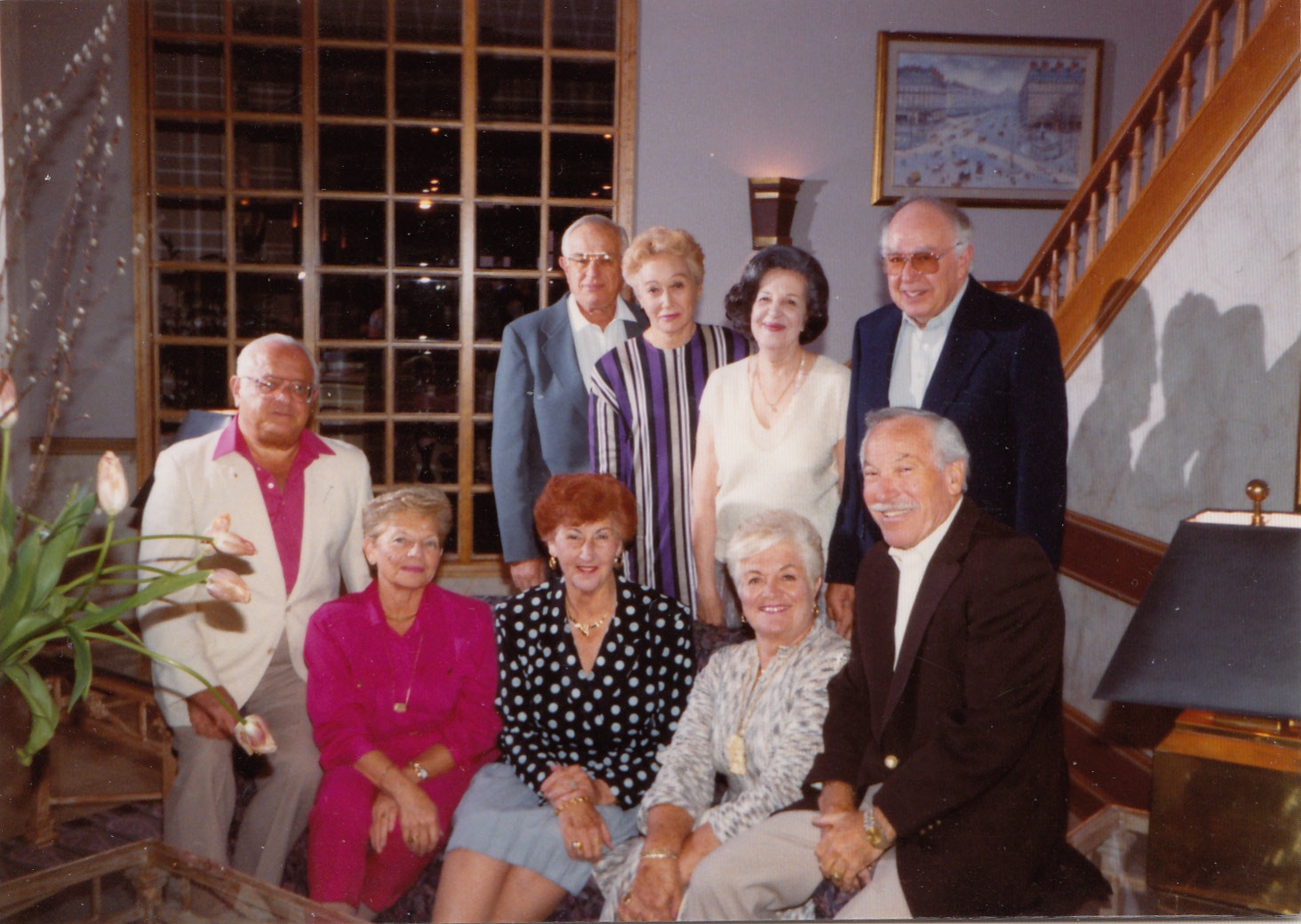
Irwin Elkins reunited with his cousins Rebecca Kurtz and Ben Kurtz and others in Florida 1992
The following year Richard himself met the Rosenzweig family:
“In 1970 at a family reunion in Long Island, New York, at the home of Rebecca Kurtz Rosenthal and her husband Sam Rosenthal, I arrived with my parents. Other than Rebecca and her husband Sam, none of the Rosenzweig family knew that my Dad would be attending the reunion. When we walked into the backyard Rebecca introduced my Dad to all of her family. I distinctly remember a flood of tears because the entire Rosenzweig clan had not seen Irwin in over forty years.”
“Rebecca’s and Sam’s son, Steven, introduced me to a woman he called “My Great Aunt Lizzie.” She must have been Lizzie Rosenzweig. She knew the name of the cemetery where Rebecca was buried. When my Dad asked her what his mother died from, Lizzie replied that she succumbed to a flu pandemic in 1921 that devastated NYC. Lizzie also informed my Dad that he had two older brothers named Milton and David who also died from the same pandemic that took his mother’s life. “
“When the emotions settled down several hours later, Lizzie told my Dad a comical story about when Frank showed up at the Rosenzweig household to court Rebecca, Lizzie’s parents would lock all the other sisters into their parent’s bedroom. However, they were allowed to put their ear to the door and listen.”
Rebecca’s death certificate indicates that Rebecca in fact died from tuberculosis at a sanitarium in Liberty, New York, where she had been a patient for a little over a month before her death. 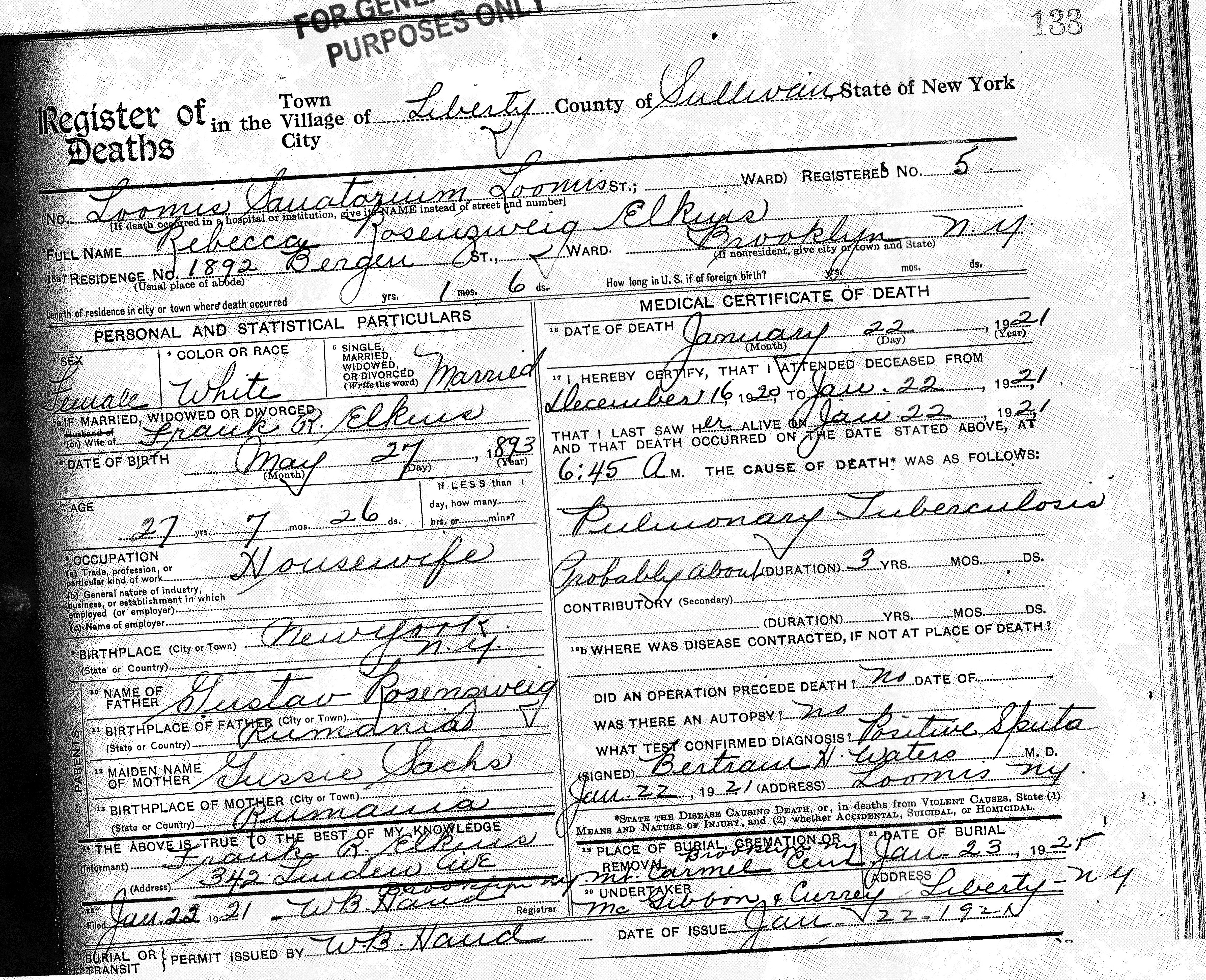 I also found the death certificates for Rebecca and Frank’s two other sons. The first born was Milton, born on December 14, 1914, just nine months after Rebecca and Frank were married. He died just five months later on May 16, 1915. It seems he had been sick for two months, in other words, since he was really just an infant.

Milton Elkin death certificate
The second child was Daniel (not David). He was born October 31, 1916, and died December 16, 1917, when he was just over a year old, from broncho pneumonia.

Daniel Elkin death certificate
Although the family lore was that Rebecca and the two boys died during the flu pandemic of 1921, that appears not to be true. It would appear instead that Milton died over a year before Daniel was even born, and that Daniel died two years before Irving was born and four years before Rebecca died. Maybe the family remembered it differently because it was just too painful to imagine Rebecca and Frank losing one child after another and then Frank losing Rebecca when Irving was not yet two years old. It is too painful to imagine.
I am deeply appreciative of Richard’s willingness to share his family stories. They preserve not only the memory of his grandmother Rebecca, who never saw her son grow up; they also preserve the memory of that son, Richard’s father, Irwin Elkins, who despite losing his mother at such a young age, grew up to be a man with a great sense of humor, a wonderful father, a successful businessperson, and an inspired engineer. The resilience of the human spirit is remarkable.







 Brotmanblog: A Family Journey