
Before I write about the next phase in the life of Hart Levy Cohen and his children, I want to explain what I have learned or rather tried to learn about his life and his family before he came to London. From the English census of 1841, I knew he was born in “foreign parts” outside of Great Britain. The 1851 English census was more specific; it said that he was born in Holland. The 1860 US census was even more specific than that. It reported his place of birth as Amsterdam.

Knowing his Hebrew name, his father’s Hebrew name, his English name and his approximate year of birth, I thought that I would be able to find some record of Hart’s birth and of his family in Holland fairly easily. When I first found this information over a year ago, I searched every way I could on a site called Akevoth, which has a huge database and lots of information on Dutch Jewry. It’s a wonderful resource, but I was soon overwhelmed. There were just too many people with the names Hart(og), Levie, and Cohen or some combination of two of those three. I had no way to figure out whether any of those people were my relatives. I’ve just looked again, and now I remember why I was overwhelmed. It’s like looking for a needle in a haystack. Last time I had not known about FamilySearch, so I have now looked there as well, and once again, I have not found anything definitive there or on ancestry.com.
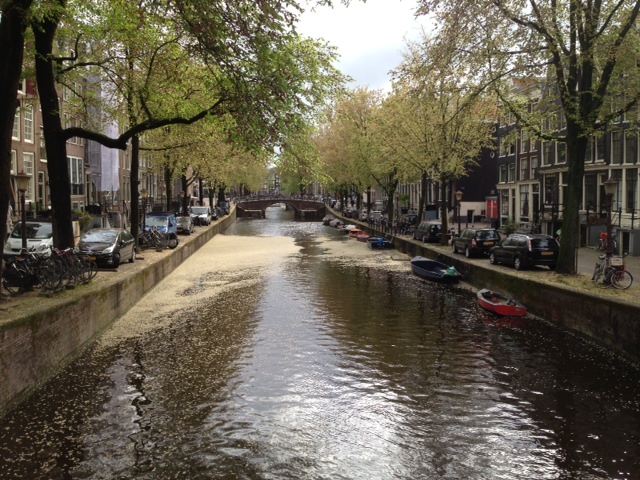
I’ve also had a chance to try and find evidence of Hart not only online, but also in Amsterdam itself. Last spring we took a weeklong trip to Amsterdam. We had an amazing time and loved the city. It was not a trip we took for genealogical purposes, but rather a general interest trip to see the art, walk the canals, visit the museums, drink the beer, and learn about the history of Amsterdam. Part of that history is, of course, the history of the Jews in Amsterdam, and in addition to an incredibly moving visit to Anne Frank’s house, we also took a walking tour of Jewish Amsterdam with Jeannette Loeb, a Dutch Jew herself with expertise in the history of the Jews in Amsterdam.
From Jeannette and other sources, I’ve learned some of the long history of the Jews in Amsterdam. Like England and like the United States, the earliest Jews in Amsterdam were Sephardic—traders from Portugal and Spain. When the Netherlands established their independence from Spain, religious freedom was one of the important tenets of the new state, allowing not only Protestants but also Jews to practice their religion. The Sephardic Jewish community became well-integrated both socially and economically in Amsterdam, although Jews were not given the full legal rights of citizens.
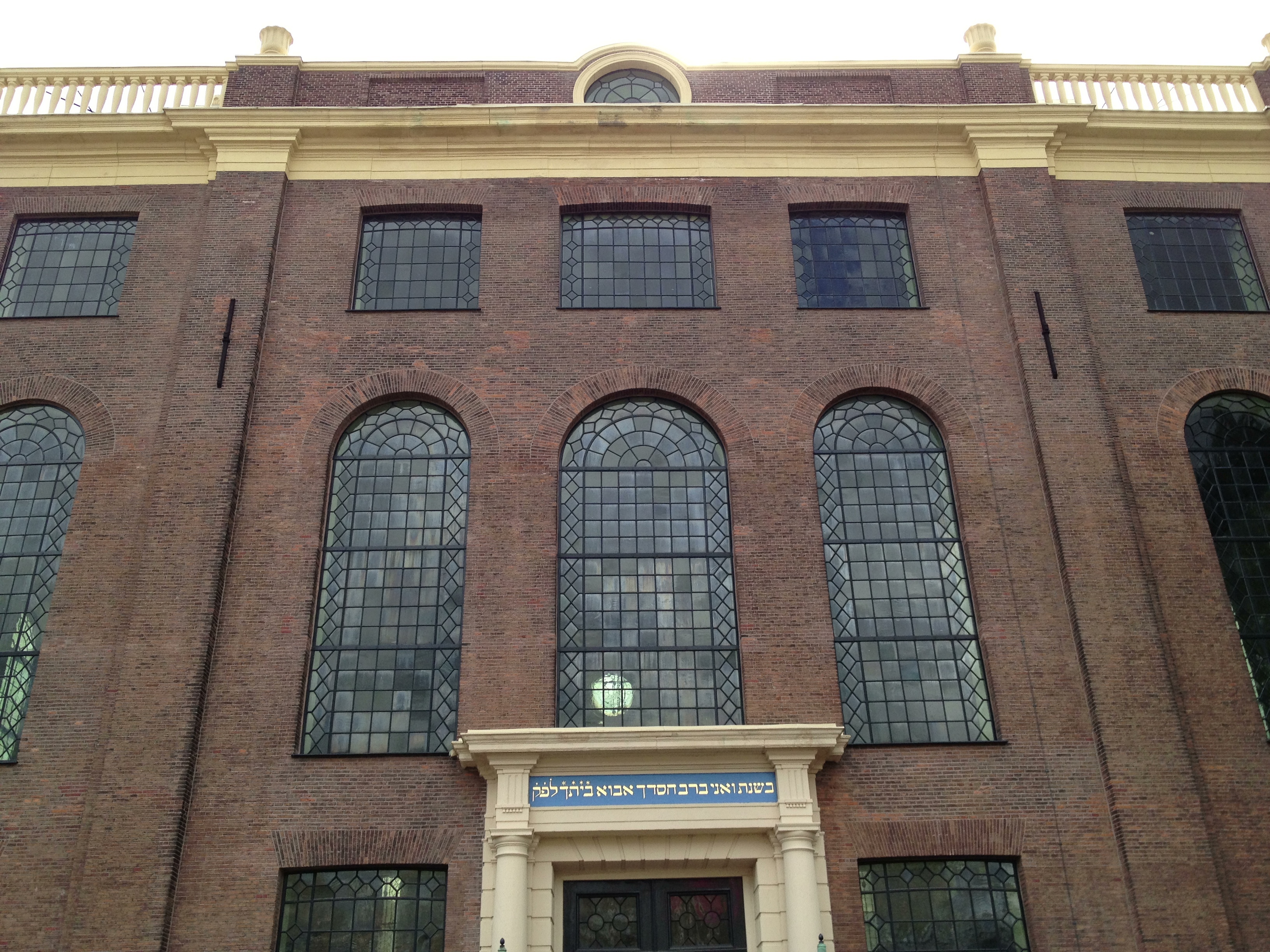
Portuguese Synagogue Amsterdam
It was not until the late 17th century that Ashkenazi Jews from Germany and Poland began to settle in Amsterdam to escape persecution and poverty. These immigrants were helped by the established Sephardic community, although the two communities retained their own languages, practices and synagogues. Although they started off poverty-stricken, the Ashkenazi community became more economically stable over the years. In 1792 Jews were finally given full legal rights in the Netherlands, certainly late but nevertheless a full forty years before Jews were given such rights in England.

Joods Historisch Museum (Jewish Historical Museum) in Amsterdam, Holland. {| cellspacing=”0″ style=”width:400px; text-align:left; color:#000; background:#ddd; border:1px solid #bbb; margin:1px; direction:ltr;” class=”layouttemplate” | style=”width:22px; height:22px;” | 20px|link= | style=”font-size:8pt; padding:1pt; line-height:1.1em;” | This is a photo of rijksmonument number 265 |} 00000265 (Photo credit: Wikipedia)
Before World War II, there were 80,000 Jews living in Amsterdam, about 10% of the overall population. Almost all of them were killed during the Holocaust, leaving only 20,000 Jews in Amsterdam after the war. Today there is a small Jewish community in Amsterdam, but nothing like that large and active Jewish community that existed before the Holocaust.

Holocaust Memorial Amsterdam
Thus, in the late 18th century when Hart was born, the Ashkenazi Jewish community in Amsterdam was fairly well established, and Jews had full legal rights by the time he was a young adult in 1792. Why did he leave? What was the economic situation of his family? Who was his family?
While we were on our walking tour, I asked Jeannette Loeb where I might be able to get some help in tracking my Dutch ancestor, Hart Levy Cohen. She suggested that I visit the Amsterdam city archives and ask for some help in searching the city records. I followed her advice and spent a couple of hours there with an archivist who specialized in Dutch Jewish genealogy. He sifted through many books of records of births and circumcisions, but was unable to come up with anything definitive. As he explained to me, until 1812 most Ashkenazi Jews in Amsterdam (and in Europe generally) did not have surnames. People were known only by their patronyms, that is, by their Hebrew name paired with their father’s Hebrew name. Because of that, it is nearly impossible to identify specific families. Rather, there are just a very large number of people with very similar names. Hart was probably Hartog in Amsterdam, a Dutch version of Hirts, and there were many Hartog Cohens. Cohen was also probably a patronymic label, referring to the Cohanim tribe, not a specific family.
Thus, for now I am going to once again put aside any attempt to find Hart Levy Cohen’s father or other relatives and ancestors. Perhaps I will have another chance to go to Amsterdam or find some other clues to help me sift through all the data. Perhaps there will be some hole in this “brick dyke” that will allow me to find my ancestors. For now instead I will bring the story forward and trace Hart’s children and grandchildren all the way to my father and to his children.
Related articles


 Brotmanblog: A Family Journey