
Although my stats show a lot of visitors, I’ve gotten very little feedback on my last two posts (and I am very grateful for the feedback I did receive), so perhaps I am just asking questions that can’t be answered—or that need to be answered by an expert. But here is one last attempt to figure out who these people are in this photograph. Please let me know what you think. On the advice of my cousin Pete, I consulted a few web sites providing fashion information for the purpose of dating photographs, and it seems very likely that this photograph was taken sometime between 1890 and 1905. I can’t narrow it down much more than that based on the clothing.
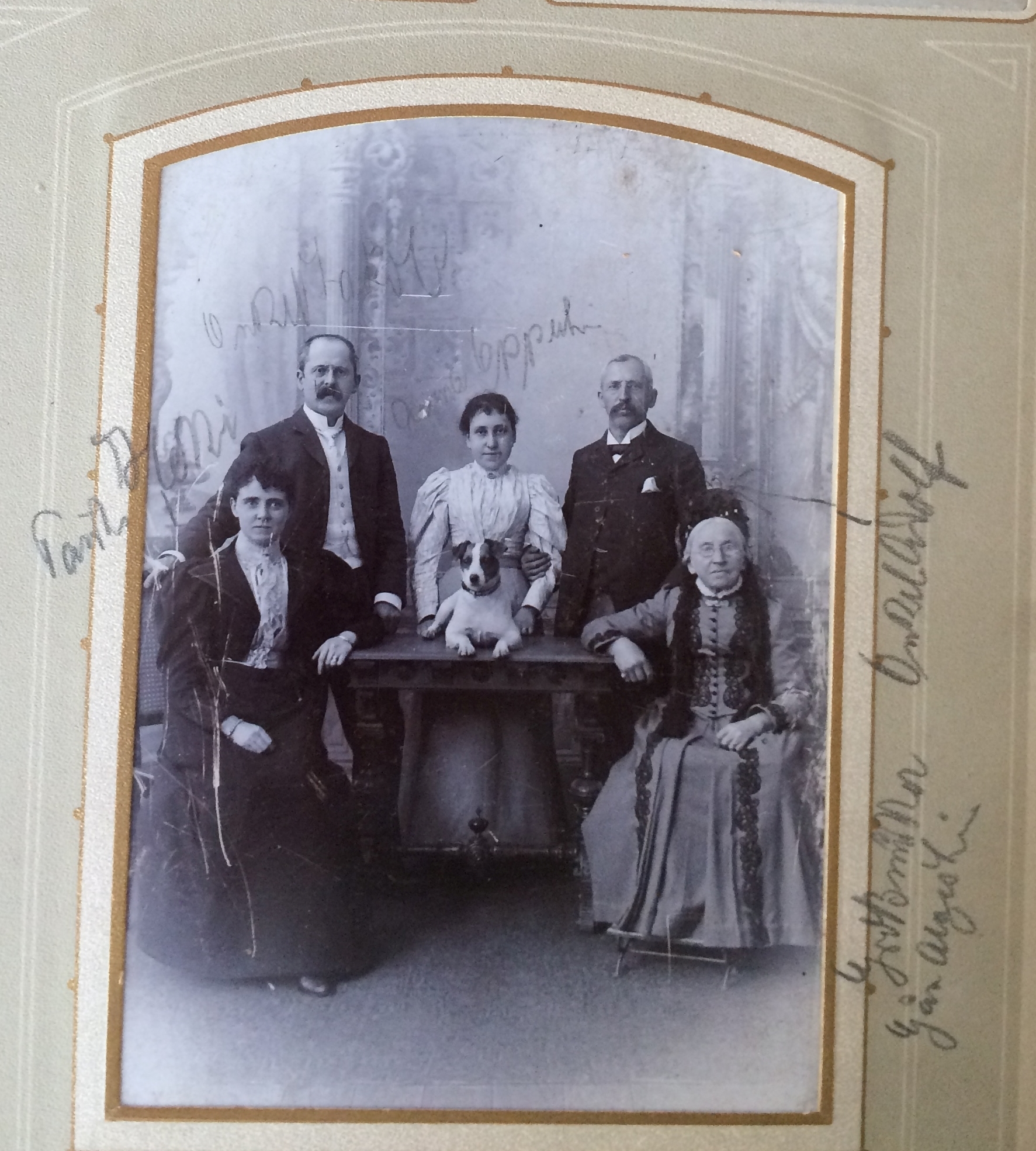
Who are these people? When was this taken?
Today I am focused primarily on the man on the right, who is labeled Onkel Adolf.
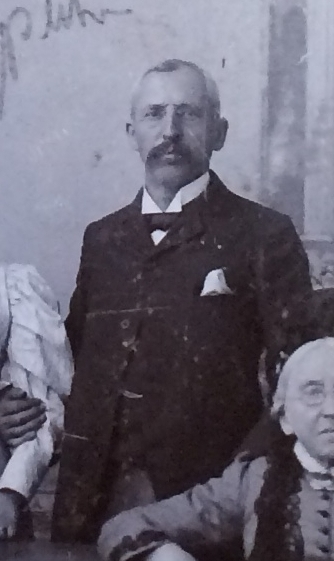
I have only found two Adolfs in the extended Seligmann family. One is Adolf Arnfeld, Bettina Seligmann‘s husband, but this is Bettina, and she is not in the group photo, so that makes no sense.

Bettina Arnfeld nee Seligmann
The second Adolf was Adolf Seligman, my three-times-great-uncle who immigrated to Santa Fe and settled there. He did make a trip to Germany in 1900, so this photo might have been taken then. Adolf was born in 1843, so if the photo was taken in 1900, he would have been 57. Certainly the man in the photograph looks about that age.

Date: Saturday, November 10, 1900 Paper: New Mexican (Santa Fe, NM) Volume: 37 Issue: 226 Page: 4
Fortunately, Adolf’s granddaughter Davita recently contacted me after finding the blog, and she sent me this photograph of her grandfather on a trip to Egypt. Adolf died in 1920 when he was 77, and I would guess he was between 65 and 70 when this photograph was taken. Is this the same man as Onkel Adolf in the group photo above?

To me there is similarity in the eyes, mouth and ears, but the older man has a fuller face (just as the older “Babetta” has a fuller face than the younger one). What do you think?
The other man in the group photograph is labeled Onkel Jakob. Since I can’t find a Jakob Seligmann who would fit into this photograph, I am wondering whether it could be James Seligman, the brother who immigrated to England and whose estate was the reason for all those Westminster Bank family trees. Perhaps James was born Jacob and Anglicized his name when he immigrated? Since I have no birth record for James, I do not know.
(UPDATE: I checked with some people from the German Genealogy Group, and several people confirmed that James was not a name used for boys in Germany in the 19th century; the German equivalent was Jakob. James was an English name. Thus, I am now persuaded that this was in fact James/Jakob Seligmann.)
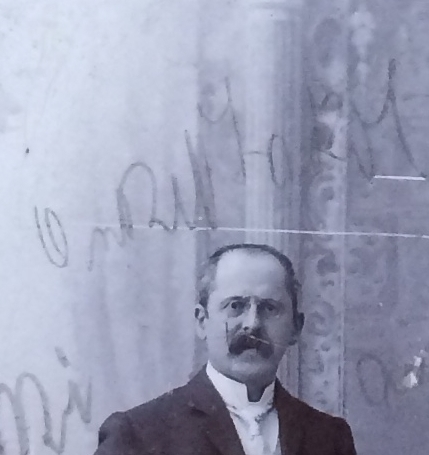
If the two men are Babetta’s sons Adolf and James, it would make sense that the two women are either their wives or their sisters. Adolf married Lucille Gorman in 1902 when she was nineteen and he was sixty. The woman standing next to Adolf does not look that young nor is she labeled with any name that looks like Lucille or Lucy. James Seligman’s wife’s name was Henrietta, and the name above the woman next to him does not look at all like Henrietta.
So could they be sisters of Adolf and James? Could the two women be two daughters of Moritz and Babetta whom I just had not yet found? After all, I had no birth record for James, but only learned of him because of the settlement of his estate. Perhaps there were other children born to Moritz and Babetta. There is a six year gap between Pauline’s birth in 1847 and James in 1853, time enough for two more daughters.
One other reason I think this is possible is that Davita told me that her grandfather Adolf’s favorite sister was Minnie, depicted with him in the photograph in Egypt.

But I have no record of a sister named Minnie. Both Bernard and Adolf named a daughter Minnie, so this does seem to suggest there was a Minnie in the family. But….neither of the women in the group photo is labeled Minnie.
Here is a closeup of Minnie from the Egypt photo and a closeup of the woman on the left in the group photo.


Same person? The nose and mouth are similar, as is the hair. Again, the woman in the Egypt photo has a fuller face, and it’s hard to compare the eyes since she is squinting into the sun, but it could be the same person, couldn’t it?
But that name above her head doesn’t look like Minnie to me.

So who are these people? I am as confused now as I was when I started. Please let me know what you think!


 Brotmanblog: A Family Journey