The Mysterious Administratrix

As I wrote last week, Samuel Hamberg, my great-grandfather’s second cousin, was orphaned in 1879 in Columbia, South Carolina, when his father Charles committed suicide two years after Samuel’s mother Lena had died at age 28.  But how did Samuel end up in Pennsylvania? Looking for the answer to that question led to another mystery and, I think, more answers.

Charles Hamberg died without a will, leaving behind personal property consisting primarily of furniture and household items valued at that time at $487.71; today that would be equivalent to approximately $11,600.  The administratrix of his estate was someone named Amelia (or Amalia or Amalie[1] ) Hamberg.
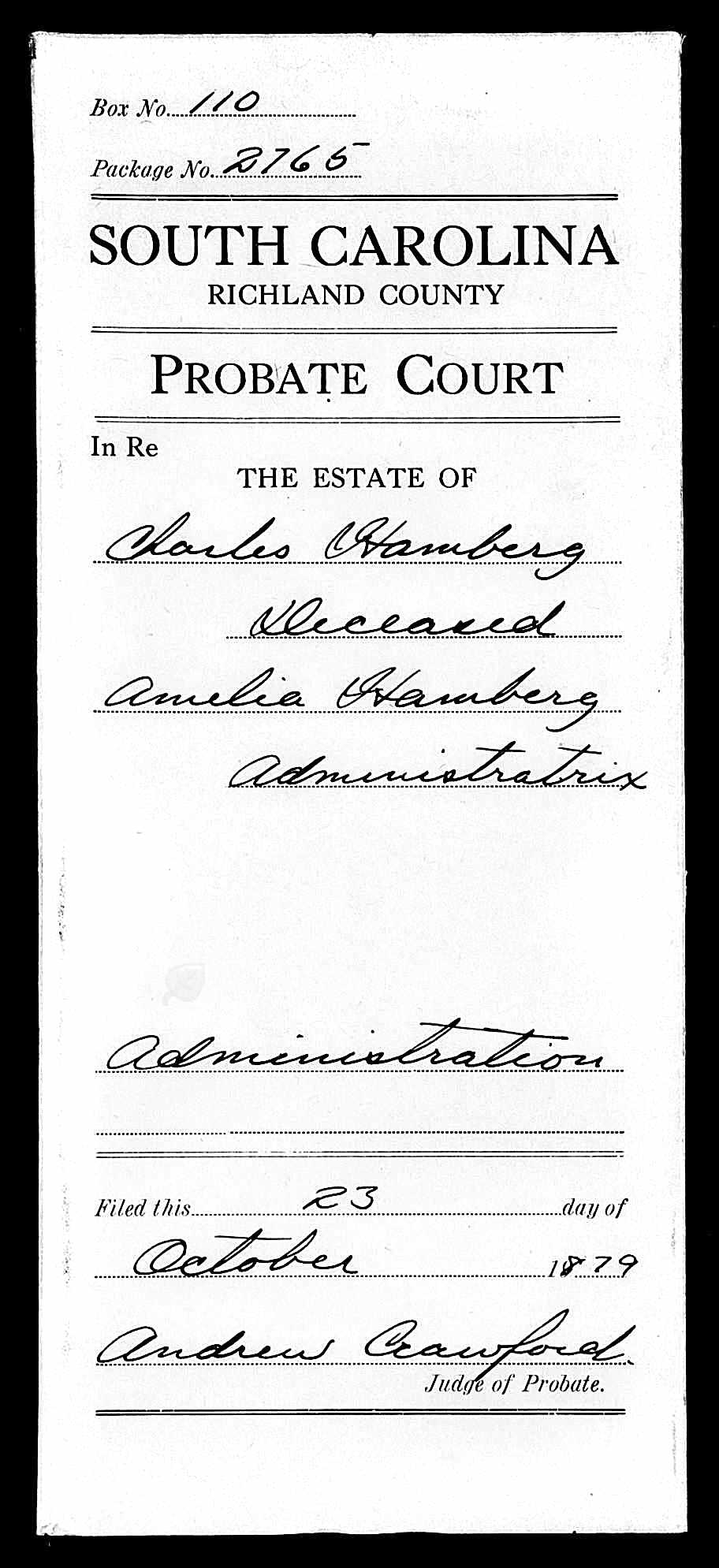
Richland County, South Carolina Miscellaneous Estate Records, 1799-1955; Author: South Carolina. County Court (Richland County); Probate Place: Richland, South Carolina

Richland County, South Carolina Miscellaneous Estate Records, 1799-1955; Author: South Carolina. County Court (Richland County); Probate Place: Richland, South Carolina


Now who was she?  For a long time I assumed she was yet a third wife, someone Charles married after Mary, who’d been murdered, and Lena, mother of Samuel.  Lena had died in 1877, leaving Charles with their nine year old son.  I figured he had quickly married again, finding a mother for Samuel.  But I could not find one record for an Amalia or Amelia or Amalie Hamberg anywhere in South Carolina before or after Charles’ death. I couldn’t even find someone with just that first name who seemed a likely candidate.  I was working in circles, getting frustrated.

Then I searched for anyone named Amelia or Amalia or Amalie Hamberg anywhere in the US, and I found one Amalia Hamberg on a death record for her daughter Hattie Baer Herman, who had died in Philadelphia in 1910.  Hattie’s father was Jacob Baer.  Both parents were born in Germany, according to the death certificate.


Death certificate of Hattie Baer, daughter of Amalia Hamberg Ancestry.com. Pennsylvania, Death Certificates, 1906-1963 [database on-line]. Provo, UT, USA: Ancestry.com Operations, Inc., 2014. Original data: Pennsylvania (State). Death certificates, 1906–1963. Series 11.90 (1,905 cartons). Records of the Pennsylvania Department of Health, Record Group 11. Pennsylvania Historical and Museum Commission, Harrisburg, Pennsylvania.

Death certificate of Hattie Baer, daughter of Amalia Hamberg
Ancestry.com. Pennsylvania, Death Certificates, 1906-1963 [database on-line]. Provo, UT, USA: Ancestry.com Operations, Inc., 2014.
Original data: Pennsylvania (State). Death certificates, 1906–1963. Series 11.90 (1,905 cartons). Records of the Pennsylvania Department of Health, Record Group 11. Pennsylvania Historical and Museum Commission, Harrisburg, Pennsylvania.

Then it occurred to me: what if Amalia was not Charles Hamberg’s wife, but a sister or a cousin? If Charles died unmarried and intestate, some other family member might have been appointed to administer his estate.

So I looked back at the Hamberg family tree, and I saw that there was a Malchen Hamberg on the tree.  Malchen was the daughter of Seligmann Hamberg and granddaughter of Moses Hamberg.  She was my great-grandfather’s first cousin.
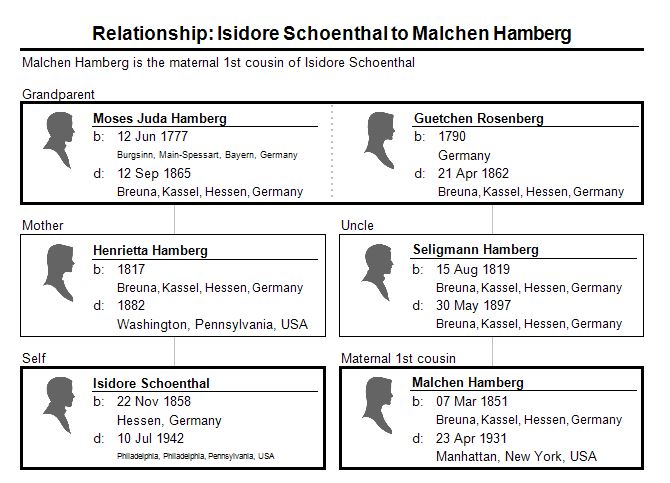
corrected relationship isidore schoenthal to malchen hamberg


Malchen was born March 7, 1851, in Breuna, and according to the family report posted on the site maintained by Hans-Peter Klein, she had emigrated from Germany.  She certainly looked like a possible candidate for the Amalia Hamberg who had been appointed to administer Charles Hamberg’s estate.  She was, like my great-grandfather, a first cousin, once removed, of Charles Hamberg.

corrected chart charles hamberg to malchen hambeg


So I had found yet another Hamberg cousin who had immigrated to the US.  Further research revealed that Amalia had immigrated in 1871, arriving in Baltimore.

Amalie Hamberg passenger ship manifest for the USS Baltimore, arriving September 4, 1871, Baltimore, MD Maryland, Baltimore Passenger Lists, 1820-1948," database with images, FamilySearch (https://familysearch.org/ark:/61903/1:1:QK6L-H1ZK : accessed 2 May 2016), Amalie Hamberg, ; citing Immigration, Baltimore, Baltimore, Maryland, United States, NARA microfilm publications M255, M596, and T844 (Washington, D.C.: National Archives and Records Administration, n.d.); FHL film 417,401.

Amalie Hamberg passenger ship manifest for the USS Baltimore, arriving September 4, 1871, Baltimore, MD  Line 388
Maryland, Baltimore Passenger Lists, 1820-1948,” database with images, FamilySearch (https://familysearch.org/ark:/61903/1:1:QK6L-H1ZK : accessed 2 May 2016), Amalie Hamberg, ; citing Immigration, Baltimore, Baltimore, Maryland, United States, NARA microfilm publications M255, M596, and T844 (Washington, D.C.: National Archives and Records Administration, n.d.); FHL film 417,401.

According to the 1900 census, Amalia married Jacob Baer in 1873.  Reviewing the birth records of their children indicated that Amalia and Jacob lived in Pittsburgh for many years where they had nine children born between 1874 and 1891.  (More on Amalia and her family in a later post.)  The fact that Amalia ended up in Pittsburgh where her Schoenthal cousins were living further corroborated my assumption that she was in fact Malchen Hamberg of Breuna.

And then the icing on the cake: I received the death certificate for Amalia Baer.   Amalia Baer died on April 23, 1931, in New York City.  Her father’s name was Selig Hamburger.
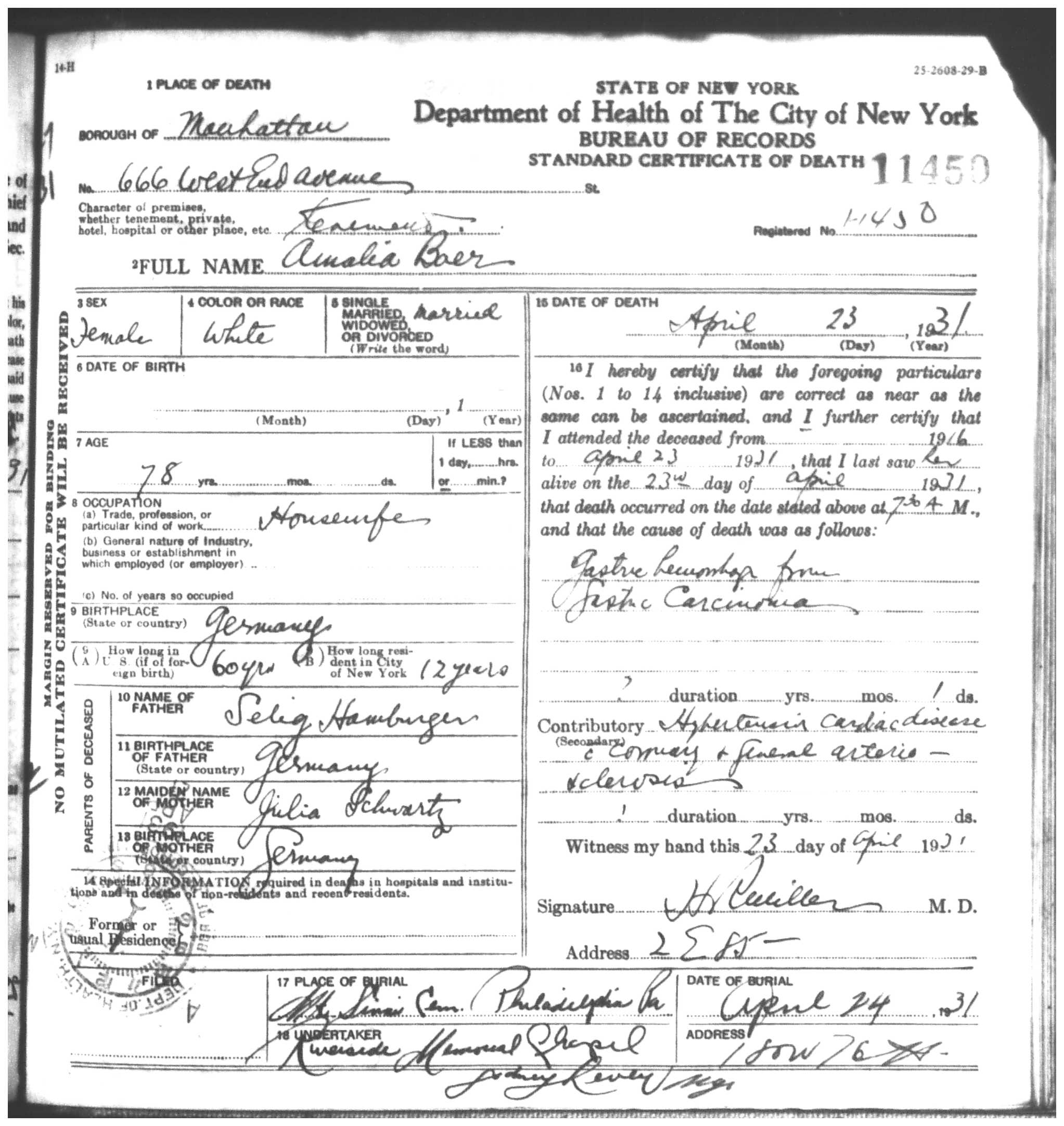
Baer, Amalia death page 1

Baer, Amalia death page 2


Okay, it not precisely right.  Malchen’s father was Seligmann Hamberg.  So the informant cut off a syllable from the first name and added one to the surname.  I still think Amalia was Malchen.

The mother’s name was even further off—Julia Schwartz instead of Jette Gans.  But death certificates are often filled with mistakes, and it’s not surprising that the informant did not have completely accurate information about the parents of a 78 year old woman, parents that the informant had likely never met.

The certificate also stated that Amalia had been in the US for 60 years; Amalia Hamberg had arrived in 1871, sixty years before 1931, the year Amalia Baer died.

So I am 99% sure that Malchen Hamberg, granddaughter of my three-times great-grandfather Moses Hamberg, was Amalia Hamberg, wife of Jacob Baer, administratrix of Charles Hamberg’s estate.

Only one thing seemed strange.  If Amalia married Jacob Baer in 1873, why was she using the name Hamberg in 1879 when she was appointed to administer Charles’ estate? I don’t know.  Hence, that lingering one percent of doubt.

There are also other questions.  Why wasn’t Charles’ brother Moses made the administrator of his estate? He was the closest relative.  Why Amalia, his cousin and a woman, instead?

Well, I cannot find the Moses Hamberg from Breuna who immigrated in 1846 as a seventeen year old shoemaker on any subsequent record.  Having searched every census from 1850 forward using wild cards, misspellings, and several databases, I have hit that proverbial brick wall. I can find other men named Moses Hamberg, but none that fit the other criteria for being the correct person.  Either the age is off, the birth place is wrong, or the family members and structure are different.

Maybe Moses changed his name so drastically that it is undiscoverable.  Maybe he died and his death is not recorded anywhere I can find.  Maybe he returned to Germany or went to some third place.  I don’t know.  But I can’t find him.  That may explain why Amalia, not Moses, administered Charles Hamberg’s estate.

But there are other questions.  By 1879 Amalia had several young children of her own to care for.  Did she travel to South Carolina to deal with Samuel and with the estate?  Or was it all handled locally by Walter. S. Monteith, the Columbia attorney representing Amalia, according to the estate papers?

And how did Samuel get from Columbia, South Carolina, to Washington, Pennsylvania? Did Amalia go to get him? Or Henry? Or some other family member? Or did he take a train by himself? These are all questions for which I have no answers.

As for what happened to Samuel after he came to Pennsylvania—well, that’s a story for yet another post.


[1] The spelling varies according to the record; later records seem to consistently use Amalia so I will adopt that in this post.

The Tragic Story of Charles Hamberg: Gun Violence in South Carolina

Last week I wrote about Samuel Hamberg, the twelve year old boy who appeared in the household of my great-great-uncle Henry Schoenthal in 1880 as his adopted son.  As I described in that post, I had determined that Samuel was the son of Charles Hamberg of Columbia, South Carolina; he appeared on the 1870 census living in Charles Hamberg’s household along with a woman named Tenah Hamberg and a servant also with the first name Tenah.

Through my research, I concluded that Charles Hamberg was in fact born Baruch Hamberg, the son of the first Samuel Hamberg, my great-great-grandmother Henriette Hamberg Schoenthal’s uncle, her father’s younger brother.

Relationship of Henrietta Hamberg and Charles Hamberg

Baruch had left Breuna, Germany, in 1852, with his first cousin Abraham, who died in Savannah, George, in 1854.  Baruch, I postulated, became Charles and had married a woman named Mary E. Hanchey in New Hanover, North Carolina, in March, 1853.

Charles Hamberg and Mary Hanchey marriage record 1853 Ancestry.com. North Carolina, Marriage Records, 1741-2011 [database on-line]. Provo, UT, USA: Ancestry.com Operations, Inc., 2015. Original data: North Carolina County Registers of Deeds. Microfilm. Record Group 048. North Carolina State Archives, Raleigh, NC.

Charles Hamberg and Mary Hanchey marriage record 1853
Ancestry.com. North Carolina, Marriage Records, 1741-2011 [database on-line]. Provo, UT, USA: Ancestry.com Operations, Inc., 2015.
Original data: North Carolina County Registers of Deeds. Microfilm. Record Group 048. North Carolina State Archives, Raleigh, NC.

But why did Samuel end up with my great-great-uncle Henry in Washington, Pennsylvania, in 1880? What had happened to his father? His mother? And who was his mother? Was it Mary Hanchey, the woman Charles married in 1853 and with whom he was living in 1860? Or was it “Tenah,” the woman he was living with in 1870?

First, I focused on Mary, the first wife.  Searching on Ancestry, I found this entry:

Record of Deaths in Columbia South Carolina page 80 [p.80] Mrs. Mary A. Hamberg , wife of Charles Hamberg died in Col’a So. Ca. Novr 18, 1866, having been shot [page 166] by a man, Toland A. Bass, a few days previous.

Unfortunately, the database had no further information about this terrible incident, but I was determined to learn more about Mary’s death.  Was it accidental? A murder? What happened to Toland Bass?

After much searching, I found this article from the November 20, 1866 issue of The Daily Phoenix, the Columbia, South Carolina, daily paper (p. 2):

Daily Phoenix article 11 20 1866 p 2


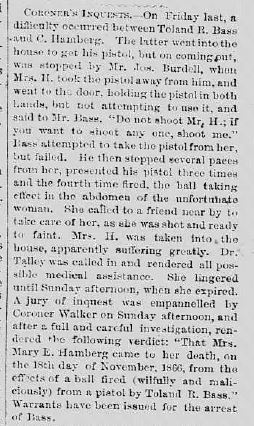
Coroner’s Inquests.—On Friday last, a difficulty occurred between Toland R. Bass and C. Hamberg.  The latter went into the house to get his pistol, but on coming out, was stopped by Mr. Jos. Burdell, when Mrs. H. took the pistol away from him and went to the door, holding the pistol in both hands, but not attempting to use it, and said to Mr. Bass, “Do not shoot Mr. H.; if you want to shoot any one, shoot me.”  Bass attempted to take the pistol from her, but failed.  He then stepped several paces from her, presented his pistol three times and the fourth time fired, the ball taking effect in the abdomen of the unfortunate woman. 

She called to a friend near by to take care of her, as she was shot and ready to faint.  Mrs. H. was taken into the house apparently suffering greatly.  Dr. Talley was called in and rendered all possible medical assistance.  She lingered until Sunday afternoon, when she expired.  A jury of inquest was empannelled by Coroner Walker on Sunday afternoon, and after a full and careful investigation, rendered the following verdict: “That Mrs. Mary E. Hamberg came to her death, on the 18th of November, 1866, from the effects of a ball fired (willfully and maliciously) from a pistol by Toland R. Bass.” Warrants have been issued for the arrest of Bass.

Who was Toland Bass, and why did he kill Mary Hanchey Hamberg? Why did Mary suggest that he should shoot her, not her husband?

The only thing I could find about Mr. Bass was that he served as a private in the Confederate Army during the Civil War in Company H of the South Carolina Cavalry Regiment.


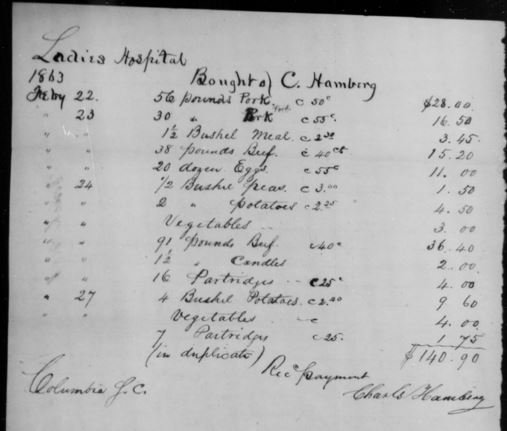
Charles Hamberg, on the other hand, appears to have been a private citizen in Columbia, South Carolina, during the Civil War, selling provisions to the Ladies Hospital.  Here is an example of an invoice he submitted:

Page 15 Confederate Citizens File - Fold3 https://www.fold3.com/image/31347220?xid=1945

Page 15 Confederate Citizens File – Fold3
https://www.fold3.com/image/31347220?xid=1945


I don’t know what might have precipitated this altercation between Bass and the Hambergs; all I can do is speculate.  Columbia, South Carolina, had suffered much damage during the Civil War.  The Union Army occupied the city during the last months of the war in 1865.  As described in Wikipedia:

On February 17, 1865, Columbia surrendered to Sherman, and Wade Hampton’s Confederate cavalry retreated from the city. Union forces were overwhelmed by throngs of liberated Federal prisoners and emancipated slaves. Many soldiers took advantage of ample supplies of liquor in the city and began to drink. Fires began in the city, and high winds spread the flames across a wide area. Most of the central city was destroyed, and municipal fire companies found it difficult to operate in conjunction with the invading army, many of whom were also fighting the fire. The burning of Columbia has engendered controversy ever since, with some claiming the fires were accidental, a deliberate act of vengeance, or perhaps set by retreating Confederate soldiers who lit cotton bales while leaving town. On that same day, the Confederates evacuated Charleston. On February 18, Sherman’s forces destroyed virtually anything of military value in Columbia, including railroad depots, warehouses, arsenals, and machine shops.

English: The Burning of Columbia, South Caroli...

English: The Burning of Columbia, South Carolina, February 17, 1865 (Photo credit: Wikipedia)

You can read more about the Columbia fires here and here.  In the aftermath of the war and during Reconstruction, places like Columbia struggled to rebuild their economy and their infrastructure.  There was widespread poverty.  Perhaps Toland Bass was an embittered Southern veteran; perhaps he resented Charles Hamberg as a merchant who not only didn’t serve in the war but made money during it.  Or maybe it is something much more personal that created the animosity that led to the gruesome murder of Mary Hanchey Hamberg. I don’t know.

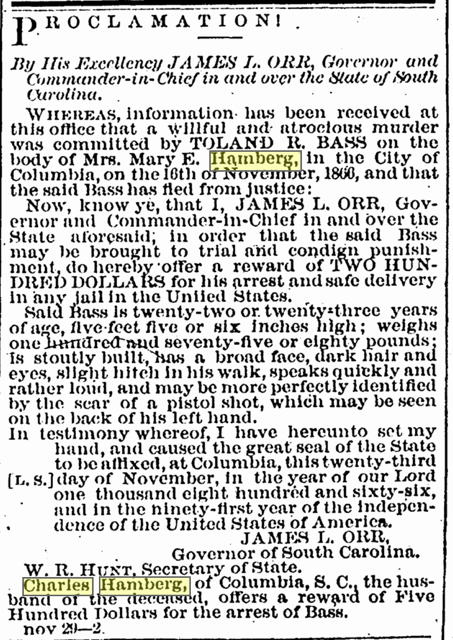
After the murder, Toland Bass ran off to avoid arrest, and the governor of South Carolina, James L. Orr, issued a proclamation offering an award of $200 for his arrest and delivery to South Carolina for trial. Charles Hamberg offered a separate award of $500 for his arrest. (Thank you to Ann Meddin Hellman of the Jewish Historical Society of South Carolina for helping me locate some of these articles

Proclamation about Mary Hamberg's murder

Thursday, November 29, 1866 Paper: (Charleston, South Carolina)


Bass eluded arrest for four months until he was finally found and arrested in New York in March, 1867.

Arrest of Toland Bass


I could not find any record of a trial or any other proceeding involving Bass, but I did find this news item announcing his death from cholera on July 15, 1867.

Death of Toland R Bass


Meanwhile, Charles Hamberg had moved on.  Thanks to my blogging friend Cathy Meder-Dempsey, I know that Charles married Lena Goodman on April 6, 1867, in Charleston, South Carolina.

I believe that Lena was incorrectly entered as “Tenah” on the 1870 census and that she was the mother of Samuel Hamberg, the boy later adopted by Henry Schoenthal.  Although I do not have an exact birthdate for Samuel, the 1900 census reported that he was born in February 1868, that is, about eleven months after the marriage of Charles Hamberg and Lena Goodman.

Even after remarrying, Charles seemed to have troubles in Columbia.  In September, 1869, he was involved in another rather unpleasant altercation:

Charles Hamberg assault

There was also a dispute at his store:

CHarles Hamberg unruly customer

Charles also charged a police officer with inappropriate conduct (public drunkenness) and engaged in a citizen’s arrest.  He seemed to have a tendency to get involved in conflicts.

In the 1870s, Charles advertised his wood and coal business regularly in the Columbia newspaper, The Daily Phoenix.

Charles Hamberg coal


He also participated in a Purim celebration in Columbia, dressing up as Jocko the Ape.  (Purim is a Jewish holiday where children and adults dress up in costumes and celebrate the triumph of the Jews over the evildoer Haman who sought to kill the Jews in ancient Persia.)

The Daily Phoenix, March 26, 1872, p. 2

The Daily Phoenix, March 26, 1872, p. 2


So whatever his troubles, Charles seemed to be living a somewhat ordinary life in Columbia.

So what happened that caused little Samuel to be adopted by Henry Schoenthal? Tragically, both of Samuel’s parents died before 1880.  His mother Lena died in 1877 and is buried in the cemetery of the Columbia Hebrew Benevolent Society.  She was only 28 years old.  I’ve been unable to locate a death certificate or obituary yet, but will continue to look.  (I contacted the cemetery, but they did not have any further information.)

chbs1HambergLena

Headstone for Lena Hamberg at the Hebrew Benevolent Society cemetery in Columbia, SC http://jhssc.org/hebrew-benevolent-society-cemetery/


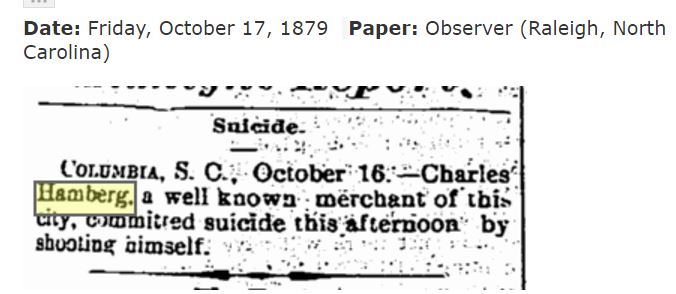
Two years later on October 16, 1879, Charles Hamberg ended his own life, apparently due to financial difficulties, although I would venture that having had one wife murdered and a second dying at a very young age might also have given him sufficient reason for some desperation.  His suicide made the papers even beyond Columbia.

Charles Hamberg suicide Charles Hamberg suicide 3 Charles Hamberg suicide 2


Can you imagine today identifying someone by their religious background for no apparently relevant reason?

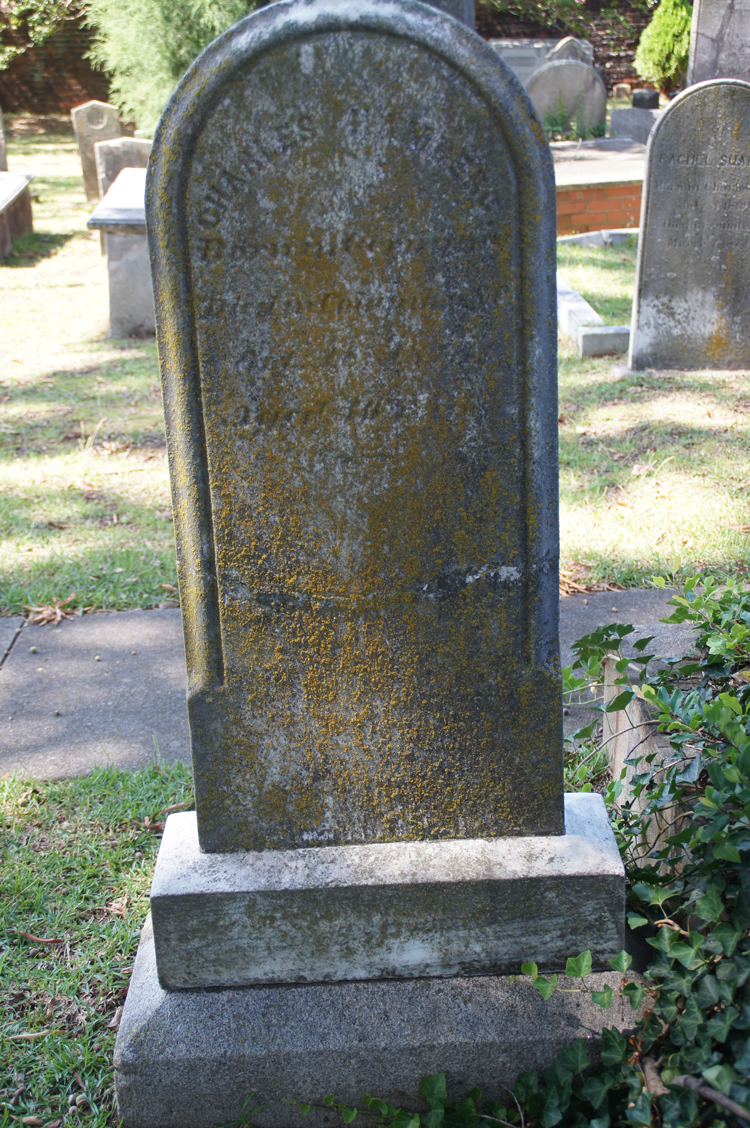
Charles is also buried in the Columbia Hebrew Benevolent Society cemetery, next to Lena.

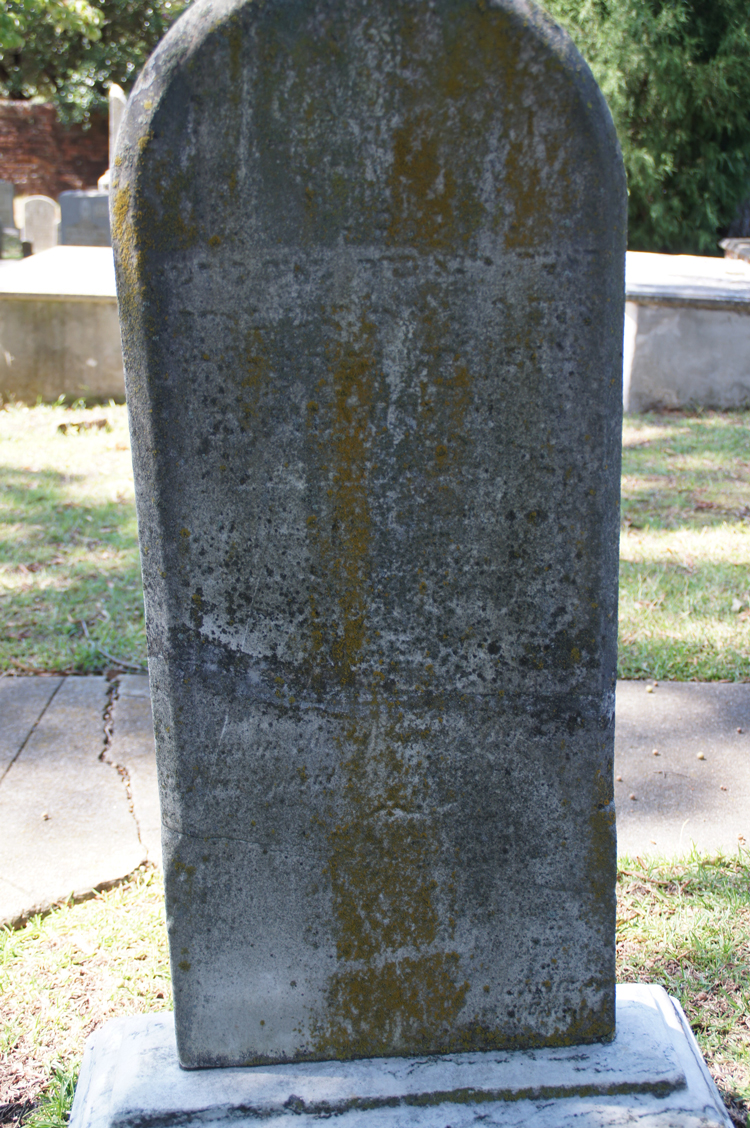
Charles Hamberg headstone

Headstone of Charles Hamberg at Hebrew Benevolent Society cemetery in Columbia, SC http://jhssc.org/hebrew-benevolent-society-cemetery/

What a hard life Charles Hamberg had once coming to the US.  He lost his cousin Abraham in 1854, his wife Mary was murdered in 1866, his second wife Lena died in 1877, and he suffered financial problems and took his own life in 1879.   I imagine that that was not the life he dreamed of when he left Breuna, Germany, in 1852.  For him the American dream did not come to be.

His son Samuel was just eleven years old and had lost his mother and his father.   He ended up in Pennsylvania with Henry Schoenthal, his second cousin.  How did he end up there?  That leads to the next mystery.

The Adopted Son: Who Was He?

As I move closer to closure on the family of Levi Schoenthal and Henriette Hamberg, my great-great-grandparents[1], I want to ask for your help regarding a mystery involving a boy I believe was part of Henriette’s family, the Hambergs. I need to know if my thinking about him makes sense.

His name was Samuel Hamberg (spelled Hamburg here), and in 1880 he was twelve years old and living in Washington, Pennsylvania, as the adopted son of my great-great-uncle Henry Schoenthal and Helene Lilienfeld.

Henry Schoenthal and family 1880 census Year: 1880; Census Place: Washington, Washington, Pennsylvania; Roll: 1202; Family History Film: 1255202; Page: 596A; Enumeration District: 271

Henry Schoenthal and family 1880 census
Year: 1880; Census Place: Washington, Washington, Pennsylvania; Roll: 1202; Family History Film: 1255202; Page: 596A; Enumeration District: 271


Who was he? Was he part of my great-great-grandmother’s family?  According to the 1880 census, Samuel was born in 1868 in South Carolina.  Henry Schoenthal, the first of Henriette Hamberg’s children to emigrate from Germany, hadn’t arrived until 1866, two years before Samuel was born.  Henry settled in Pennsylvania.  How would a boy born in a state so far away two years after Henry arrived  in the US have ended up with Henry unless there was a family connection?  The surname Hamberg couldn’t just be a coincidence, could it?

His first name also seemed unlikely to be a coincidence.  Henriette’s father was Moses Hamberg, my three-times great-grandfather.  Moses had a younger brother named Samuel, my four-times great-uncle. Young Samuel could have been named for him.  The name similarities added to my hunch that this Samuel Hamberg was in some way related to my great-great-grandmother and the other Hambergs from Breuna.  I had to figure this one out.

I was able to locate a two year old boy named Samuel Hamberg on the 1870 census living in Columbia, South Carolina, in the household of a Charles Hamberg, age 46, and a Tenah Hamberg, age 21.  Given the birth place, name, and age of the boy, I felt it quite likely that this was the same boy who ten years later was living with Henry Schoenthal in Pennsylvania.  Unfortunately, the 1870 census did not include information describing the relationships among those in a household, but I assumed that Charles and Tenah were the father and mother of little Samuel.  If so, who were they?

Charles Hamberg household 1870 US census Year: 1870; Census Place: Columbia, Richland, South Carolina; Roll: M593_1507; Page: 140B; Image: 287; Family History Library Film: 553006

Charles Hamberg household 1870 US census
Year: 1870; Census Place: Columbia, Richland, South Carolina; Roll: M593_1507; Page: 140B; Image: 287; Family History Library Film: 553006

According to the 1870 census, Charles was born in Prussia 46 (or is it a 40?) years earlier or in 1824 or so. (Breuna was within the boundaries of Prussia from 1866 until the German Federation was created in 1871.)  Charles was working as a “ret gro” merchant, which I interpret to mean a retail grocery merchant. Tenah was born in South Carolina as was Samuel.

I was able to trace Charles back ten more years to the 1860 census, where he was also living in Columbia, South Carolina, but married not to Tenah but a woman named Mary.  According to the 1860 census, Charles was then 28, so born in 1832; according to this census, he was born in Germany and working as a merchant.  Mary was a North Carolina native and 27 years old.

Charles Hamberg and household 1860 US census Year: 1860; Census Place: Columbia, Richland, South Carolina; Roll: M653_1227; Page: 26; Image: 57; Family History Library Film: 805227

Charles Hamberg and household 1860 US census
Year: 1860; Census Place: Columbia, Richland, South Carolina; Roll: M653_1227; Page: 26; Image: 57; Family History Library Film: 805227

I then discovered a marriage record for Charles Hamberg and Mary Hanchey reporting their marriage in 1853 in New Hanover, North Carolina.

Charles Hamberg and Mary Hanchey marriage record 1853 Ancestry.com. North Carolina, Marriage Records, 1741-2011 [database on-line]. Provo, UT, USA: Ancestry.com Operations, Inc., 2015. Original data: North Carolina County Registers of Deeds. Microfilm. Record Group 048. North Carolina State Archives, Raleigh, NC.

Charles Hamberg and Mary Hanchey marriage record 1853
Ancestry.com. North Carolina, Marriage Records, 1741-2011 [database on-line]. Provo, UT, USA: Ancestry.com Operations, Inc., 2015.
Original data: North Carolina County Registers of Deeds. Microfilm. Record Group 048. North Carolina State Archives, Raleigh, NC.

But that was the earliest record I could find for Charles Hamberg.  And I still didn’t know whether he was related to the Hambergs of Breuna, my great-great-grandmother’s family.

Fortunately for me, others, including the noted genealogist Hans-Peter Klein, had already done extensive research of the Hamberg family tree. You can find it here.[2]  There was no Charles Hamberg listed in the records in Breuna.  But there were other men in the family with the surname Hamberg who would have been about the same age as Charles Hamberg.  I had to find out whether any of them came to the United States and perhaps changed his name to Charles.

Moses Hamberg, my 3x-great-grandfather, had five sons:

Juda, who died in Breuna in 1863;

Seligmann, who died in Breuna in 1897;

Salomon, who married and had several children in the 1850s in Breuna (no death record has been located;

Marcus, who died in Breuna in 1846;

And finally, Abraham, born in Breuna in 1828 and for whom there was no marriage or death record in Breuna.

Of Moses Hamberg’s five sons, the only one who might have emigrated by 1853 was Abraham.

As for the sons of Samuel Hamberg, brother of Moses, there were three sons:

another Juda, who died in Breuna in 1863;

Baruch, born in 1824 and for whom there was no marriage or death record;

And Moses, born in 1829 and for whom there was also no marriage or death record in Breuna.

So it was possible that Baruch and/or Moses had emigrated.

The three Hamberg men from Breuna who could have immigrated to the US by 1853 were thus Abraham, Baruch, and Moses: no one named Charles.  All three of those Hamberg men were close in age to the Charles Hamberg in Columbia, South Carolina.  All were born between 1824 and 1829.  But had any of them actually immigrated to the United States? I decided to search for them on ship manifests and other US records and found that all three did in fact leave Germany for the United States before 1853.

Moses Hamberg arrived in New York from Breuna in August, 1846, when he was seventeen, according to the ship manifest.  This is clearly Moses, the son of Samuel Hamberg, who was born in 1829 and thus would have been 17 in 1846.  Moses was a shoemaker, according to the manifest.

Year: 1846; Arrival: New York, New York; Microfilm Serial: M237, 1820-1897; Microfilm Roll: Roll 063; Line: 1; List Number: 680

Year: 1846; Arrival: New York, New York; Microfilm Serial: M237, 1820-1897; Microfilm Roll: Roll 063; Line: 1; List Number: 680

Baruch and his first cousin Abraham arrived in New York together in September 1852.  According to the ship manifest, they were coming from Breuna, and both were 24 years old, meaning they were born in about 1828.  My great-great-grandmother’s brother Abraham was born in 1828; according to Breuna records, Baruch was born in 1824.

Despite the disparity in the ages between the Baruch on the manifest and the Baruch born in Breuna, I believe that the two men on this manifest were in fact Abraham Hamberg, son of Moses Hamberg, and Baruch Hamberg, son of Samuel Hamberg.  The ship manifest reports that their destination in the US was “Sevanna,” which I assume meant Savannah, Georgia.

Year: 1852; Arrival: New York, New York; Microfilm Serial: M237, 1820-1897; Microfilm Roll: Roll 119; Line: 1; List Number: 1321

Year: 1852; Arrival: New York, New York; Microfilm Serial: M237, 1820-1897; Microfilm Roll: Roll 119; Line: 1; List Number: 1321


So did any of these three young men become Charles Hamberg of Columbia, South Carolina?  And if so, which one? Since Abraham and Baruch were headed to a city in the South whereas Moses indicated that New York was his intended destination, my inclination was to focus on Abraham and Baruch as the ones more likely to have become Charles Hamberg.[3]

Searching for further records for Abraham Hamberg led me to the sad discovery that he died not too long after arriving in the US.  He died in Savannah, Georgia, his intended destination, on August 26, 1854, of yellow fever and was buried in that city.  He was my great-great-grandmother Henriette’s younger brother.  He was only 26 years old.

Abraham Hamberg death record 1854 Ancestry.com. Savannah, Georgia, Select Board of Health and Health Department Records, 1824-1864, 1887-1896 [database on-line]. Provo, UT, USA: Ancestry.com Operations, Inc., 2014. This collection was indexed by Ancestry World Archives Project contributors. Original data: City of Savannah, Georgia. Savannah, Georgia, Select Board of Health and Health Department Records, 1822–1864, 1887–1896. Subseries 5600HE-050 and 5600HA-010. Microfilm, 27 reels. City of Savannah, Research Library & Municipal Archives, Savannah, Georgia

Abraham Hamberg death record 1854
Ancestry.com. Savannah, Georgia, Select Board of Health and Health Department Records, 1824-1864, 1887-1896 [database on-line]. Provo, UT, USA: Ancestry.com Operations, Inc., 2014. This collection was indexed by Ancestry World Archives Project contributors.
Original data: City of Savannah, Georgia. Savannah, Georgia, Select Board of Health and Health Department Records, 1822–1864, 1887–1896. Subseries 5600HE-050 and 5600HA-010. Microfilm, 27 reels. City of Savannah, Research Library & Municipal Archives, Savannah, Georgia

Abraham Hamberg burial record Ancestry.com. Savannah, Georgia, Cemetery and Burial Records, 1852-1939 [database on-line]. Provo, UT, USA: Ancestry.com Operations, Inc., 2012. Original data: Savannah Georgia Cemetery and Burial Records. Savannah, Georgia: Research Library & Municipal Archives City of Savannah, Georgia.

Abraham Hamberg burial record
Ancestry.com. Savannah, Georgia, Cemetery and Burial Records, 1852-1939 [database on-line]. Provo, UT, USA: Ancestry.com Operations, Inc., 2012.
Original data: Savannah Georgia Cemetery and Burial Records. Savannah, Georgia: Research Library & Municipal Archives City of Savannah, Georgia.

So what then happened to his cousin Baruch Hamberg? Had he made it to Savannah?

My guess is that somewhere along the way from New York to Savannah, Baruch and Abraham stopped in New Hanover, North Carolina, where Baruch met and married his first wife Mary Hanchey in 1853.  And by then, he had dropped the Hebrew name Baruch and adopted the much more American name Charles.  In fact, his full name was Charles B. Hamberg.  Perhaps that B was for Baruch.

What else supports this conclusion that Baruch Hamberg became Charles Hamberg? Recall that Baruch Hamberg was the son of Samuel Hamberg of Breuna.  And what did Charles Hamberg name his son born in 1868? Samuel.

If I am right, then Charles/Baruch Hamberg was Henriette Hamberg Schoenthal’s first cousin; their fathers Samuel and Moses were brothers.  Charles’ son Samuel was therefore a second cousin to Henriette’s son Henry Schoenthal, the man who had adopted him by 1880.

So does my analysis make sense?  Did Baruch Hamberg become Charles Hamberg?

And if so, why was his son Samuel living with and adopted by Henry Schoenthal in 1880? That question will be addressed in a later post.


[1] And while I wait to talk with my third cousin Betty, who is also their great-great-granddaughter.

[2] I wrote a little bit about the Hambergs of Breuna, Germany here when I described the remarkable story of how I learned that my fifth cousin Rob and I shared not only some DNA,  but had lived at one point just a few miles from each other, and, even more remarkably, were both close friends with the same couple.  We had a lovely dinner back in December hosted by Rob and his wife Ann where all of us—our mutual friends included—had a great evening.  I remain amazed by what a small world it is.   Rob and I are both the four-times great-grandchildren of Jeudah ben Moses, the father of Moses Hamberg and Samuel Hamberg.  Rob is descended from Samuel; I am descended from Moses.

[3] I will follow up on Moses Hamberg in a later post.

Small World Story: The Hambergs of Breuna

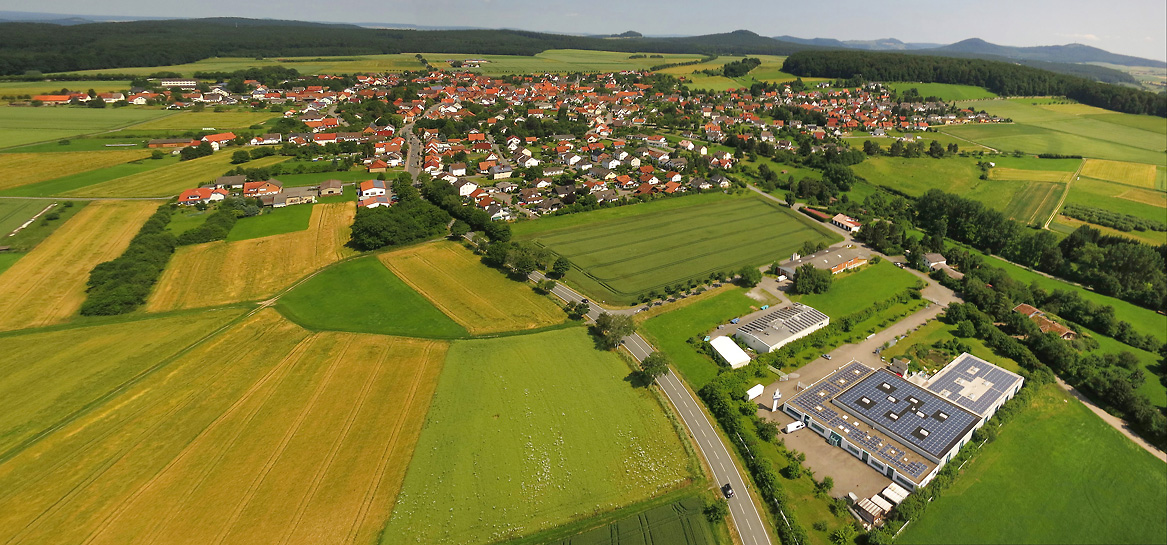
English: Location of Breuna in district Kassel...

English: Location of Breuna in district Kassel, Hesse, Germany Deutsch: Lage von Breuna im Landkreis Kassel, Hessen, Deutschland (Photo credit: Wikipedia)

I am just a bit overwhelmed.  Digging through the archives from Hessen has been quite an adventure.  Not only have I found a great deal of information about the family of my great-grandfather Isidore Schoenthal, but I’ve also been wading through the archives searching for records of my Hamberg ancestors—that is, the family of my great-great-grandmother Henrietta or Jhette Hamberg of Breuna, who married Levi Schoenthal, Isidore’s father.  These German records are amazing.  Unlike my experiences searching for records in Poland for my Brotman ancestors, I am just swamped with information about my German paternal ancestors from Hessen (and I haven’t even begun looking at the records for Isidore’s wife, my great-grandmother Hilda Katzenstein, whose family was also from Hessen).

I am still compiling and editing the Hamberg information, and I am ready to start writing more about what I know about the Schoenthals later this week.  But for now here’s a little bit of what I’ve learned about the Hamberg family.

As mentioned, they were from Breuna.  Breuna is another small town in the Kassel district of Hessen, not too far from Sielen (about 26 km), where the Schoenthals lived.  According to the town’s official website, as translated by Google Translate, Breuna is 758 years old.  I could not find much about its history, but according to the town website, it was under the control of various aristocratic families over the centuries.

Today the original small village of Breuna where my ancestors lived is incorporated into a larger town, also called Breuna, consisting of five districts, one of which is the smaller village of Breuna; another is Oberlistingen, where some of my other relatives not yet discussed lived.  The town’s website described the town as an “Arbeiter-Wohnsitz-Gemeinde” or “worker-resident community,” where most people commute to the larger cities for work.

The town’s website also states:

Particularly noteworthy are the natural, wooded, yet convenient position of the municipality. Pure nature with freeway access! The advantages of a rural environment without having to sacrifice the most important social and cultural institutions and the relative proximity to the North Hessian metropolis of Kassel, the beautiful half-timbered towns Hofgeismar, Wolf Hagen, the spa of Bad Arolsen and the East Westphalian town of Warburg.

The website goes on to point out that although once an agriculture-based economy, Breuna no longer is primarily agricultural.  There are only a few full-time farmers, and they focus on pigs, dairy, and grain.

The population of the larger Breuna town today is about 3700 people, with the smaller district of Breuna consisting of about 1500 people.

As for Breuna’s Jewish history, the Alemannia-Judaica reports that there were four Jewish families in Breuna in 1744 and 1776.  By 1833, there were 53 Jewish residents, and after that the Jewish population started to decline.  There were 29 in 1871, 40 in 1885, 33 in 1895, 23 in 1905, and 14 in 1910.  The overall population of the town was between 900 and 1000 during these years, so the Jewish population was quite a small percentage of the overall population. Most of the Jews were engaged in horse and cattle trading, and some were farmers.    There was a synagogue, a school, a mikvah, a chevra kadisha (burial society), and a cemetery.  There was still a small Jewish community in Breuna when the Nazis came to power in 1933.  Almost none of those who remained survived the Holocaust.

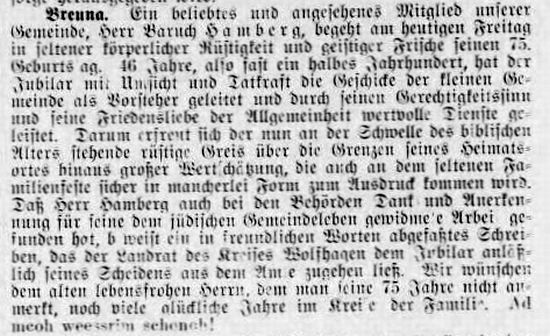
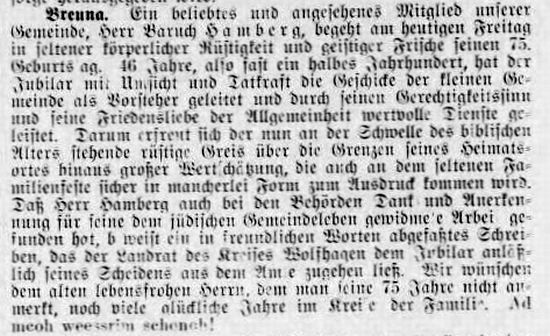
For close to fifty years, the leader of the Jewish community in Breuna was Baruch Hamberg, according to Alemannia-Judaica.  He was my second cousin, three times removed, as described below.   His 75th birthday celebration was written up in one of the local papers in an article describing his prudence and vigor and wishing him many years ahead.

Article about Baruch Hamberg's 75th birthday Jüdischen Wochenzeitung für Kassel, Kurhessen und Waldeck" vom 29. Mai 1931 http://www.alemannia-judaica.de/images/Images%20368/Breuna%20JuedWZKassel%2029051931.jpg

Article about Baruch Hamberg’s 75th birthday
Jüdischen Wochenzeitung für Kassel, Kurhessen und Waldeck” vom 29. Mai 1931
http://www.alemannia-judaica.de/images/Images%20368/Breuna%20JuedWZKassel%2029051931.jpg

How was Baruch related to me? From my research, I’ve learned that Henrietta Hamberg, my great-great-grandmother who married  Levi Schoenthal, was the daughter of Moses Hamberg and Guetchen Rosenberg.  According to at least one record, Moses was a cattle merchant. Moses and Guetchen had nine children (or at least that is how many I have located so far).  One family tree on Geni says that Moses was born in Burgsinn, Bavaria on June 12, 1777, but I’ve not found any definitive source to corroborate that.  That tree also says that Moses’ father was named Juda and that his mother was Rachel Simon, but I am still looking for corroboration of those facts as well.  One reason I am skeptical is that the Hessen archives have a transcription of Moses’ headstone, which indicates that he was born in 1785 and that his father’s name was Huna, not Juda.  On the other hand, the first son born to Moses and Guetchen was named Juda, and that would suggest that perhaps Moses’ father was named Juda.

UPDATE: I’ve now seen, thanks to Hans-Peter Klein, a birth registry for Moses which gives his father’s name as Juda Moses, his mother’s as Rachel Simon, and his birthdate as 1777.  Looking again at the headstone transcription, I now think it says he was 88 years old when he died, not 80, so 1777 as his birth year is consistent with the headstone.  I still cannot explain why it has his father’s name as Huna.

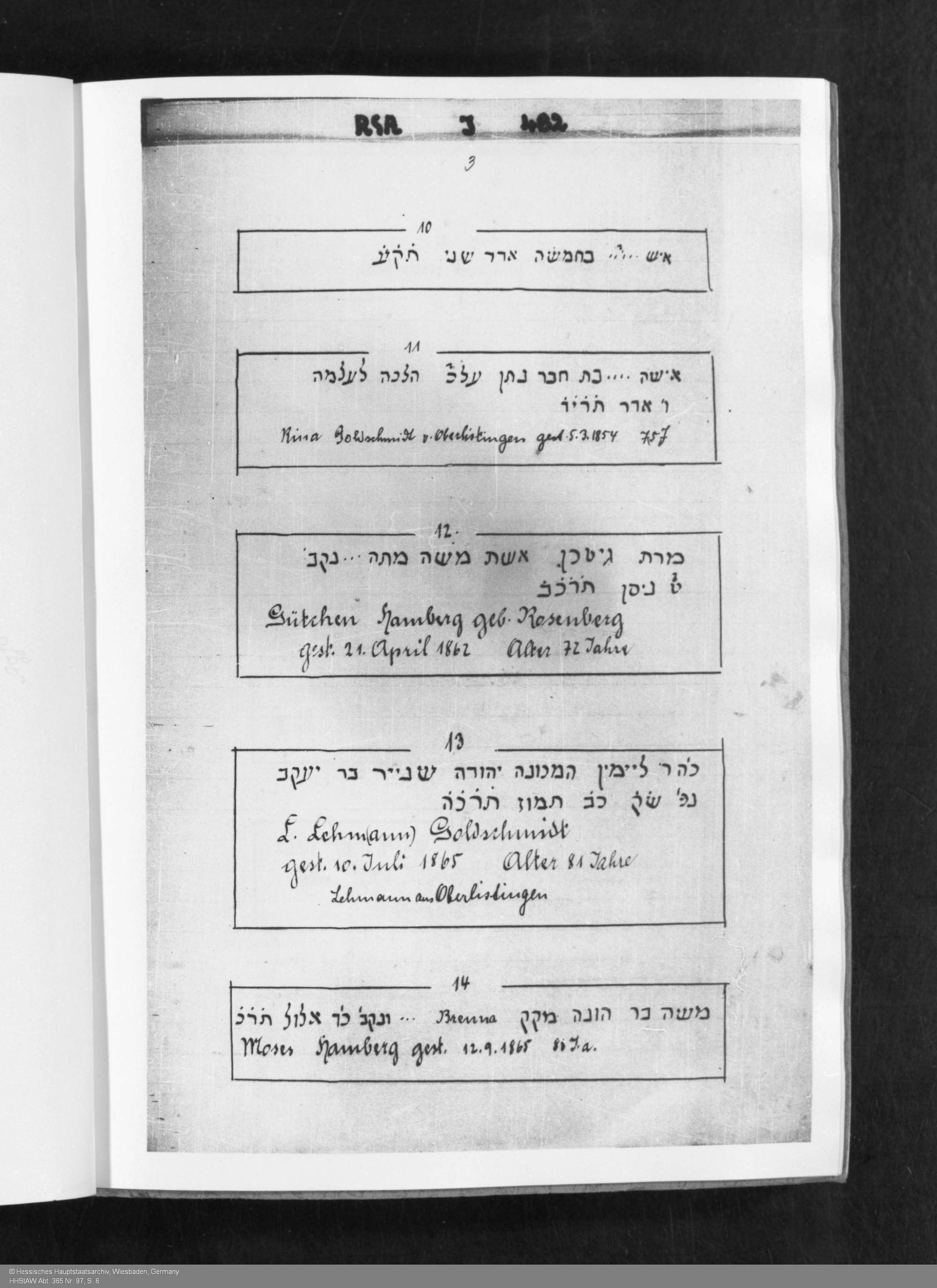
Headstone for Guetchen Rosenberg Hamberg (12) and Moses HambergHHStAW Abt. 365 Nr. 97, S. 6

Headstone inscription for Guetchen Rosenberg Hamberg (12) and Moses Hamberg HHStAW Abt. 365 Nr. 97, S. 6

The Geni tree also asserts that Moses had a brother named Samuel, and I have found many records for Samuel Hamberg and his family.  According to the death record I found for him, he died on December 11, 1857, at age 80, so he would have been born in 1777.

(UPDATE: the same record that listed Moses’ parents and birth year lists Samuel’s birthdate as July 13, 1780.  I can’t explain the discrepancy between the birth registry and the death record except to say that one is incorrect.)

Samuel married Kreschen Baruch, and they had five children.  Their first-born son was also named Juda, lending further weight to the possibility that Juda was the name of the father of both Moses and Samuel.  As you might imagine, having two men named Juda Hamberg in one small town can be quite confusing when looking at birth, marriage, and death records.

To keep them straight, the Breuna records refer to Moses’ son as Juda I, since he was born first (on October 10, 1812, according to the synagogue registry page for Moses and his sons).  Samuel’s son, Juda II, was born in 1820, according to the synagogue registry page for Samuel and his sons.

Eine Vervielfältigung oder Verwendung dieser Seite in anderen elektronischen oder gedruckten Publikationen und deren Veröffentlichung (auch im Internet) ist nur nach vorheriger Genehmigung durch das Hessische Hauptstaatsarchiv, Mosbacher Straße 55, 65187 Wiesbaden, Germany gestattet.

Synagogue Registry for Moses Hamberg and his sons  HHStAW Abt. 365 Nr. 96, S. 5

Synagogue Registry for Samuel Hamberg and his sons HHStAW Abt. 365 Nr. 96, S. 6

Synagogue Registry for Samuel Hamberg and his sons
HHStAW Abt. 365 Nr. 96, S. 6


Juda I was a horse dealer, and he married a woman named Dina Sauer.  They had five children.  Juda II was a merchant, and he married a woman named Breinchein Goldwein.  They had five children also; one of them was the afore-mentioned Baruch Hamberg who led the Breuna Jewish community for almost half a century.

You might wonder why I am bothering to report all this since neither Juda is a direct ancestor of mine.  Well, it’s some background to the small world story referred to in the title of this post.

Stepping back a bit, when I first started researching the Hambergs, the first place I went was to the Jewish Family Finder on JewishGen.org.  I searched for the surname Hamberg in Breuna to see if anyone else was researching that family, and sure enough, there was someone listed, though he’d not been active for many years.  There was no name disclosed, just a researcher ID number, so I sent a message to that researcher, not expecting a response, given how long it had been since that person had used JewishGen.

Then I saw the Geni page for Moses Hamberg, referred to above, and I sent a message to the Profile Manager on that page.  Little did I know that I had in fact sent two messages to the same person since the Profile Manager on Geni was the same person as the researcher listed on the Family Finder on JewishGen.  That person, a man named Rob, contacted me by email later that day, and we began to exchange information.  We exchanged information about the Hambergs and tried to sort out how we were related. (Rob pointed out that someone had made changes to his Geni information since he’d last looked at it, which is one reason I don’t like Geni—complete strangers can go in and change your tree without leaving any sources or explanations for the change.)  We are still working on that, and it’s somewhat confusing because of the two men named Juda Hamberg discussed above.  Rob and I are either fourth or fifth cousins, depending on whether he is a descendant of Moses Hamberg or Samuel Hamberg.  At the moment I think he is the great-grandson of Baruch Hamberg, the renowned leader of the Breuna Jewish community, and thus a descendant of Samuel.

But in addition to exploring the family history, Rob and I also exchanged current information about ourselves.  I mentioned that I lived in western Massachusetts, and Rob said he lived in eastern Massachusetts.  He mentioned the town where he lived (Arlington), and I responded that I also had once lived in Arlington over thirty years ago.  He then said he also had been living in Arlington that far back, and in fact once we exchanged street addresses, we realized that we had lived less than a mile from each other.

Corner of Park Avenue and Mass Avenue in Arlington By John Phelan (Own work) [CC BY 3.0 (http://creativecommons.org/licenses/by/3.0)], via Wikimedia Commons

Corner of Park Avenue and Mass Avenue in Arlington
By John Phelan (Own work) [CC BY 3.0 (http://creativecommons.org/licenses/by/3.0)%5D, via Wikimedia Commons

I then mentioned that we had very good friends who had also lived for a few years in Arlington, but had since moved to a nearby town, and I mentioned their names.  Rob emailed me back, saying that I had to call him because the coincidences were getting just too crazy.  It turns out that our friends have been close friends with Rob and his family for over twenty years.  We had undoubtedly all been at the same family celebrations for our mutual friends, including their daughter’s wedding just last year.

As Rob and I spoke on the phone, I had goosebumps, and I have them again as I write down this story.  Here was someone I had once lived near and with whom I shared good friends and who I might have even met or at least passed by in town or at a wedding.  But we never knew we were cousins, linked as descendants of the Hambergs of Breuna.  Isn’t it a strange and small world?  I am now looking forward to having a chance to share all these crazy coincidences with Rob and his wife and our mutual friends over dinner sometime in the near future.