
My last post before Thanksgiving about Louis Adler stirred a lot of interest. Many wondered why he got into so much legal trouble: was it discrimination? Was it economic desperation? Was it just his nature? We don’t know.
Two readers went above and beyond and did their own research, looking for answers. Linda Stufflebean, a fellow genealogy blogger who writes the blog Empty Branches on the Family Tree, tried to find more information about Louis’ wife Edna Anderson. Although she found a birth record for a Hetna Brandes born in Copenhagen around the same time period that Edna was born, neither of us could find anything that connected Hetna to Edna. So Edna’s background remains a mystery. I went back and searched everything again and still have no immigration record for Edna nor anything else before her marriage to Louis Adler.
Another reader, John Shriver, decided to look for more news articles about Louis. He subscribes to two newspaper services I don’t follow–newspaperarchives.com and oldnews.com–and sent me several articles from the 1930s and later that I could not find in the databases to which I have access: newspapers.com and genealogybank.com The last article I had found about Louis, as reported in that earlier blog post, told of his arrest for possession and transportation of alcohol in April 1931.
Apparently Louis was convicted of those charges because the earliest article that John found was dated May 24, 1932, and reports on Louis Adler’s release from prison after eleven months. On a positive note, the article described Louis as a “prominent Leavenworth man” and as “one of the most likable and best behaved prisoners ever to serve in the local jail.”
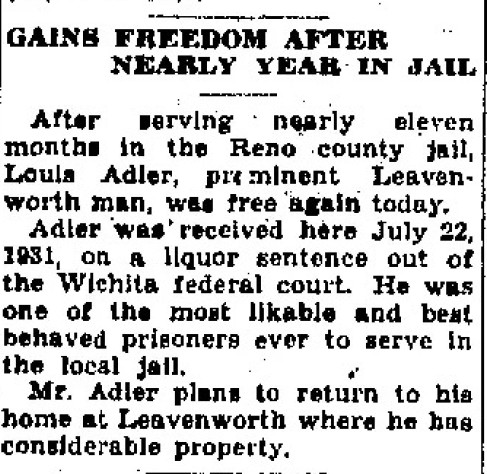
“Gains Freedom After Nearly Year in Jail,” Hutchinson (KS) News, May 24, 1932, p.11
But Louis did not avoid controversy for long. In 1934 he became embroiled in a political and legal battle involving garbage pickup services in Leavenworth. Louis had made an agreement with the city to pick up the city garbage for a year for one dollar. When there were numerous complaints that the garbage was not all being collected and creating a health hazard, Louis offered to buy whoever could find any uncollected garbage “a $50 suit of clothes.”

“Charges Are Hurled in a Leavenworth Rumpus,” Lawrence (KS) Daily Journal-World, February 9, 1934, p. 1
I could not understand why Louis would agree to pick up all that garbage for $1 a year until I read the last two paragraphs of the article: he was using the garbage to feed his hogs! But when he realized that there were objects like glass and cans in the garbage, making it unsuitable to use as hog feed, perhaps he stopped picking up the garbage. Or maybe this was just the case of a disgruntled commissioner who had lost the garbage contract to Louis. Once again, it’s hard to know what was really going on with Louis.
The next article about Louis that John Shriver located is dated August 5, 1937, and is about a fire that destroyed a desiccating plant in Leavenworth that seems to have belonged to Louis Adler.

“Wants Plant Rebuilt Elsewhere,” Lawrence (KS) Journal-World, August 5, 1937, p. 6
I had no idea what a desiccating plant was, but Google defines it as a plant “involved in the processing of animal carcasses into products like fertilizer, hides, or rendered fats.” Since Louis raised hogs and perhaps other farm animals, it would make sense that he had a facility for processing their carcasses. It looks like Louis once again raised the ire of the local community just three years after the garbage controversy.
Louis was not directly involved in the next article, dated March 20, 1939, but his wife and an employee named Lange were. Lange was a security guard Louis hired to protect his property; he was killed by intruders while trying to protect Edna.

“New Job Costs His Life,” Lawrence (KS) Daily Journal, March 20, 1939, p. 1
The final article that John Shriver found that concerned Louis Adler was dated March 9, 1940, and it also did not directly involve Louis. I learned something new in studying this article–that Kansas continued to ban alcohol sales even after federal prohibition ended. It was the last state in the country to lift the ban–in 1948!
Anyway, although neither Louis nor Edna was charged with possession or sales of alcohol in this article, it seems to suggest that the authorities suspected that such illegal activity was being conducted on their property.

“Two Are Arraigned,” Lawrence (KS) Daily Journal-World, March 9, 1940, p. 1
I love that last sentence: “They found Mrs. Adler churning butter in the kitchen of the house but a search disclosed no liquor.”
As we saw, Louis Adler died on February 1, 1942, just about two years after that last article. John did not find an obituary or any other relevant article after the 1940 article above. Perhaps Louis’ life settled down and he was able to live in peace for those last couple of years.
 Brotmanblog: A Family Journey