
In two recent posts I shared the sad story of Charles Hamberg and his life in Columbia, South Carolina, which ended with his suicide in 1879. His son Samuel was only eleven when his father died. Samuel’s mother Lena had died two years earlier. Charles’ cousin Amalia Hamberg administered his estate, and then somehow Charles’ son Samuel came to live in western Pennsylvania where he was adopted by his second cousin, my great-grandfather’s brother, Henry Schoenthal.

Henry Schoenthal and family 1880 census
Year: 1880; Census Place: Washington, Washington, Pennsylvania; Roll: 1202; Family History Film: 1255202; Page: 596A; Enumeration District: 271
In 1886 when Samuel was then eighteen years old, he was working as a clerk at 5 East Beau Street in Washington and living at the corner of Beau and Lincoln in that town, according to the 1886 directory for Washington, Pennsylvania. According to that same source, my great-grandfather Isidore Schoenthal, who had arrived in Washington in 1881, was living at 203 East Beau Street that same year; looking at Google Maps, I see that 203 East Beau Street is located at the corner of Lincoln and Beau.
[Thanks to Lara of Lara’s Jewnealogy, I now know how to use Google Maps more effectively. See her great post here.]
Thus, Samuel Hamberg was probably living with my great-grandfather. I imagine that they lived and maybe even worked together, my great-grandfather watching over his younger second cousin. Perhaps Samuel helped my great-grandfather learn English and adjust to American ways.
By 1889, Samuel, now 21 years old, had moved to Philadelphia. He is listed in the directory for that year as Samuel T. Hamberg, a manager, residing at “134 E. Orthodox, FKD.” FKD stands for Frankford, a neighborhood in northeast Philadelphia about six miles from the center of the city. I wondered what had taken him there.
It took me a very long time to find out, but when I finally decided, after exhausting traditional genealogy sources, to Google “Samuel T. Hamberg” as a last ditch effort to learn more, I found these two entries in Google Books:
P.W. Bedford, Pharmaceutical Record and Weekly Market Review, Volume 10, April 21, 1890, p. 163, found here (list of graduates of the Philadelphia College of Pharmacy).
26th Annual Report of the Alumni Association of the Philadelphia College of Pharmacy (1890), found here.

Class of 1890, Philadelphia College of Pharmacy
Alumni Association Report, p. 194
Samuel T. Hamberg, the boy who had lost both his parents before his twelfth birthday, had graduated from the four-year program at the Philadelphia College of Pharmacy in 1890 when he was 22 years old. The Philadelphia College of Pharmacy was the first pharmacy school in the United States and still exists today.
Not only had Samuel graduated from this prestigious institution, but a further search into both of the above sources revealed that his middle name was Tilden,[1] that he had written his thesis on nitroglycerin, that he had played the guitar to open the commencement exercises as part of a musical ensemble (perhaps his musical adoptive brother Lionel Schoenthal with whom he’d lived in Washington had given him music lessons), and that he had been selected to be the Class Poet. The poem he read at the school’s commencement exercises in 1890 is filled with references to professors and specific memories of the school years, but this particular verse seemed a more personal statement:
Sorrows and losses may be borne,
Be baffled and dismayed,
Feel the sharp pang of many a thorn
By our own follies made.
But hope and effort may improve
And help us to thankful be,
It surely did in this case
It helped us—in a degree.
(Samuel Tilden Hamberg, 1890, as published in the Alumni Report, cited above, p.124.)
Samuel Tilden Hamberg certainly had suffered sorrows and losses, though not by his “own follies made.” But it seems with the love of his family in Washington, Pennsylvania, he had in fact borne those sorrows and losses and succeeded in coming through them as a grateful and successful young man.
![Philadelphia College of Pharmacy See page for author [CC BY 4.0 (http://creativecommons.org/licenses/by/4.0)], via Wikimedia Commons](https://brotmanblog.com/wp-content/uploads/2016/05/philadelphia_college_of_pharmacy_and_science_front_of_build_wellcome_v0029143.jpg)
Philadelphia College of Pharmacy
See page for author [CC BY 4.0 (http://creativecommons.org/licenses/by/4.0)%5D, via Wikimedia Commons
Samuel T. Hamberg married Jane E. Tracey on November 20, 1898, at the Zion Episcopal Church in Philadelphia. At the time they married, Samuel had been residing in Camden, New Jersey, according to the marriage record. His wife had been living in Philadelphia where she was born in December, 1869. Jane, or Jennie as she was generally identified on most records, was the daughter of Edwin Tracey (often spelled Tracy) and Jane Irwin. Edwin was a Philadelphia native and a shoemaker according to the 1880 census; his wife Jane was born in Ireland. Jennie was the seventh of nine children.

Marriage record of Samuel Hamberg and Jane Tracey November 20, 1898, Zion Protestant Episcopal Church, Philadelphia
Historical Society of Pennsylvania; Philadelphia, Pennsylvania; Collection Name: Historic Pennsylvania Church and Town Records; Reel: 978
In 1900, Samuel and Jennie were living in Philadelphia in the household of Jennie’s brother Albert Tracy along with Jennie’s mother Jane and her three sisters. Samuel was working as a hospital supplies salesman. I know this is the correct Samuel Hamberg because his birth place is given as South Carolina, his father’s as Germany, his mother’s as South Carolina. (I found it interesting that Samuel reported the birth places of his birth parents, Charles and Lena, not those of his adoptive parents.)

Samuel Hamberg 1900 census
Year: 1900; Census Place: Philadelphia Ward 29, Philadelphia, Pennsylvania; Roll: 1472; Page: 12A; Enumeration District: 0748; FHL microfilm: 1241472
On September 4, 1900, Samuel and Jennie had their first child, a son named Charles, presumably named for Samuel’s father Charles.
The family must have soon thereafter moved to Camden, New Jersey, for Samuel is listed as a salesman in the 1901 Camden directory. Samuel and Jennie are also listed in the 1902 and 1903 Camden directories at 3010 Westfield Street; Samuel is still listed as a salesman. A second child was born that year, Frances D. Hamberg, born in January, 1903, in New Jersey. Samuel and Jennie were still living at the same address in 1904 and in 1905.
Then things start getting a little confusing. In 1906 Samuel T. Hamberg is listed in the Philadelphia directory as a salesman residing at 27 North 60th Street in that city. There is no listing for him in the Camden directory for that year. But the following year Samuel is listed as a salesman in the Camden directory, residing at 126 Dudley Street. Then in 1908, the listing is only in Jennie’s name—Jennie Hamberg at 126 Dudley Street.
Meanwhile in October 1907, a third child had been born to Samuel and Jennie—Edwin F. Hamberg. Had Samuel and Jennie separated in 1906, reconciled and had a third child in 1907, and then separated again in 1908? Jennie is again listed alone at 126 Dudley in Camden in 1909, this time with an occupation, dressmaker.
But where was Samuel in 1908 and 1909? He is not listed in the Camden directory. There are two Samuel Hambergs listed in Philadelphia in 1909, but they are father and son and listed as pawnbrokers, so neither of them seems to be the right Samuel. There are no Samuel Hambergs listed in the directories for those years for Pittsburgh or Washington, Pennsylvania, or Baltimore.
In 1910, Samuel reappears on the 1910 census in Baltimore, Maryland, living as a boarder and working as a pharmacist in a drugstore. I know this is my Samuel because he is Samuel T. Hamberg, born in South Carolina, father born in Germany, mother in South Carolina. But why is he in Baltimore? He is still listing himself as married, so maybe he went to Baltimore to find work. Since he had been working as a salesman while living in Camden, maybe he wanted to return to being a regular pharmacist.

Samuel Hamberg 1910 census Line 85
Year: 1910; Census Place: Baltimore Ward 4, Baltimore (Independent City), Maryland; Roll: T624_553; Page: 3B; Enumeration District: 0036; FHL microfilm: 1374566
Jennie and the three children were still living at 126 Dudley in Camden in 1910. According to the census, they were living with Jennie’s sister Clara Campbell and her mother Jane Tracy. Like Samuel, Jennie still reported herself as married. Although Jennie reported no occupation on the 1910 census, the 1910 and 1911 Camden directories list her as a dressmaker.
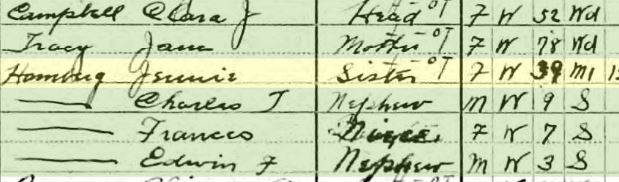
Jennie Hamberg and children 1910 census
Year: 1910; Census Place: Camden Ward 12, Camden, New Jersey; Roll: T624_874; Page: 13A; Enumeration District: 0080; FHL microfilm: 1374887
Samuel is listed in the 1911 Baltimore directory, but then he again disappears. I couldn’t find him in any newspaper article or any directory after 1911 during the decade of the 1910s.
Jennie, however, continued to be listed in the Camden directories from 1910 through 1916. In 1915, she and her children are listed on the New Jersey census, once again living with her sister Clara and her mother Jane; Samuel is not part of their household.
Jennie Tracey Hamberg died from heart disease on March 4, 1917. She was only 47 years old, and she left behind three children. Charles was not yet sixteen, Frances not yet fourteen, and Edwin not yet ten years old. Like their father Samuel, they lost their mother at a young age.


Jennie Hamberg burial record
Fernwood Cemetery, Yeardon, PA
Historical Society of Pennsylvania; Philadelphia, Pennsylvania; Collection Name: Historic Pennsylvania Church and Town Records
So where was their father? I could not find him on the 1920 census or anywhere during the 1920s until I searched for “Samuel T. Hamberg” in Google. And along with the links noted above relating to his education as a pharmacist, I found several links indicating that in 1920 Samuel was in Pittsburgh working for the state of Pennsylvania as a temporary investigator doing fair price work. Even knowing this additional information, I could not locate Samuel on the 1920 census or in any directory in the 1920s.

Herman P. Miller, Snull’s Legislative Handbook and Manual of the State of Pennsylvania, 1920, p. 144, found here.
But Samuel T. Hamberg does reappear on the 1930 census. He is listed as Sam T. Hamberg, 62 years old (the correct age), married at age 30 (the correct age), widowed (Jennie was dead), born in South Carolina, father born in Germany, mother in South Carolina (all correct). Clearly this is the right person. He was now living in Philadelphia, working as a novelty salesman, and living with his “sister” Cecelia Link. What had happened to his pharmacy career? His work as a state investigator? And who was Cecelia Link?

Samuel Hamberg 1930 census
Year: 1930; Census Place: Philadelphia, Philadelphia, Pennsylvania; Roll: 2125; Page: 14A; Enumeration District: 0777; Image: 969.0; FHL microfilm: 2341859
Samuel did not have any sisters except for his adoptive sister Hilda Schoenthal, the daughter of Henry Schoenthal. Cecelia was twenty years younger than Samuel, according to the 1930 census, born in Pennsylvania, single, and working as a telephone operator. Cecelia answered the enumerator’s questions as indicated by the H on the line where her name is. Who was she, and why was she living with Samuel?
I found a Celia Link living with her mother and two sisters (and a brother-in-law) in Pittsburgh on the 1920 census. Celia was forty years old, single, and working as a telephone operator. It seemed like an unlikely coincidence that there were two women with just about the same name, both born in Pennsylvania, and both working as telephone operators. (Remember that Samuel was living in Pittsburgh in 1920.)
So I looked for more about this Celia Link. The 1916 Pittsburgh directory had her listed as Cecelia Link working as a telephone operator, so now we had the exact same name. The 1910 census has her again as Celia, living with her parents, working as a telephone operator, and 33 years old. Going back yet another ten years, the 1900 census lists her as Cecilia, age 22, with a birth date of March 1878, and no occupation.
Then I found her death certificate. Cecelia Link died of chronic myocarditis on May 6, 1934, at “abt age 48,” according to her sister, the informant. Assuming that Cecelia was 22 in 1900, she would have been 56 in 1934. Even in 1920, she reported to be 40, making her 54 in 1934. She was therefore only about ten years younger than Samuel, not twenty. Note also that she was born in Washington, Pennsylvania.
![Cecilia Link death certificate Ancestry.com. Pennsylvania, Death Certificates, 1906-1963 [database on-line]. Provo, UT, USA: Ancestry.com Operations, Inc., 2014. Original data: Pennsylvania (State). Death certificates, 1906–1963. Series 11.90 (1,905 cartons). Records of the Pennsylvania Department of Health, Record Group 11. Pennsylvania Historical and Museum Commission, Harrisburg, Pennsylvania.](https://brotmanblog.com/wp-content/uploads/2016/05/cecilia-link-death-cert.jpg)
Cecilia Link death certificate
Ancestry.com. Pennsylvania, Death Certificates, 1906-1963 [database on-line]. Provo, UT, USA: Ancestry.com Operations, Inc., 2014.
Original data: Pennsylvania (State). Death certificates, 1906–1963. Series 11.90 (1,905 cartons). Records of the Pennsylvania Department of Health, Record Group 11. Pennsylvania Historical and Museum Commission, Harrisburg, Pennsylvania.
But Cecelia died in 1934 back in Pittsburgh. What happened to Samuel before and after her death? And where were his children?
More questions to answer.
[1] There is no earlier indication that Samuel’s middle name was Tilden. Did he adopt this middle name himself? In 1868 when Samuel Hamberg was born in Columbia, South Carolina, Samuel Tilden was probably not a nationally known figure. He was from New York State and a supporter of the Union during the Civil War. After the war he was active in reforming the Democratic party. Would Charles Hamberg have known of him and named his son for him? Unlikely.
But Samuel Tilden was the Democratic party’s nominee in the 1876 Presidential election; the results of the election were disputed when several states turned into multiple sets of return. The Presidency was determined by a partisan commission established by Congress, and Tilden lost to Rutherford B. Hayes, even though he had won the popular vote. I think it is more likely that Samuel Hamberg adopted Tilden’s name as his middle name sometime as a young adult after Tilden was more of a household name. Tilden died in 1886, and the first use I’ve seen of the middle initial T by Samuel Hamberg was while he was in pharmacy school in the late 1880s. For more on Samuel Tilden, see here and here and here.
 Brotmanblog: A Family Journey