
Why was this seder different from all other seders?
There were so many reasons, starting with the fact that it took place at our daughter and son-in-law’s home in Brooklyn. And it was a much smaller crowd than we usually have. It was just the seven of us—our older daughter and her husband and their two children, our younger daughter, my husband, and myself. The other relatives and friends who usually attend were not able to join us this year.
It was a beautiful seder. My daughter took special care to create a festive seder table. My son-in-law made delicious and allergen-safe charoset. We brought in food from our favorite kosher restaurant. We all felt at home and comfortable, and there were lots of laughs and stories and good food and wine and even some tears. We used our usual Haggadahs and the silly stuffed toys to represent the plagues, and, of course, there were wine and grape juice spills on the white tablecloth, afikomen hidden and found, and macaroons and candy fruit slices to end the meal.

Because we were in a new place with a smaller group, we had a chance to have a different experience and a new perspective on the holiday. The fact that I wasn’t hosting meant more opportunities for me to reflect and observe than I usually have when I am worried about getting everything ready and coordinating when to heat and cook all the food. And I think all of us were reminded that the holiday carries its beauty and its meaning wherever you are and with all who are there—be it seven or seventy.
Of course, the events in the Middle East and here in America also put the holiday in a very different context this year, and there were times that the words in the Haggadah resonated in new ways and with greater power. What struck me most powerfully was how the Haggadah is both universal and particularistic in its messages. The central message is certainly specific to Jews in most ways—the story of our liberation from slavery and oppression to freedom. But within that message is also the more universalistic message that all people deserve to be free from slavery and oppression. We are told not to oppress the stranger because we know what it is like to be a stranger. We are told to welcome all who are hungry to our table—not just Jews, but anyone who is hungry.
The part of the seder this year that moved me the most, however, was the story of the ten plagues. We read this section every single year, but I had never actually focused on what it says. It’s not just to remember that God sent ten plagues to convince Pharoah to free the Jewish slaves—blood, frogs, lice, flies, murrain, boils, locusts, darkness, and the slaying of the first born. The Haggadah instructs us to diminish the wine in our cups as we recite each of these plagues so that we diminish our own joy as we remember the pain inflicted upon the Egyptians.

Lawrence Alma-Tadema, CC BY-SA 2.5 <https://creativecommons.org/licenses/by-sa/2.5>, via Wikimedia Commons
In other words, we are supposed to empathize with the Egyptians. I cannot help but see the parallels to what is happening now in Gaza. As Jews we are reminded that even those who oppress us deserve our sympathy when they suffer pain. To be a good Jew, a good person, means to feel not just our own pain but also the pain of others.
Our seder table this year in Brooklyn also reflected these particularistic and universal lessons of the Haggadah. We had all the traditional symbols—the shankbone, the egg, the charoset, the moror, the parsley for dipping in salt water, the matzah, Elijah’s Cup—the symbols of suffering and of liberation. But we also had some non-traditional symbols.
Two we have incorporated for years now to reflect the central role that women have played and continue to play in Jewish history and life: Miriam’s Cup and an orange. Miriam’s Cup reminds us that women played a role in our liberation from Egypt. And the orange comes from a story about something that was said when the liberal Jewish movements were considering changes that would give women the same rights as men to stand on the bimah and read Torah. Apparently, one opponent of those changes stated, “A woman belongs on the bimah like an orange belongs on the seder plate.” So now we have an orange on our seder plate every year because, yes, women belong on the bimah and in all aspects of Jewish practice.
But this year we added two new symbols to the seder table: olives, at the suggestion of our children’s rabbi in Brooklyn, to express our desire for peace with the Palestinians, and, at the suggestion of my younger grandchild, soy sauce to reflect that there are other cultures in the world in addition to ours.
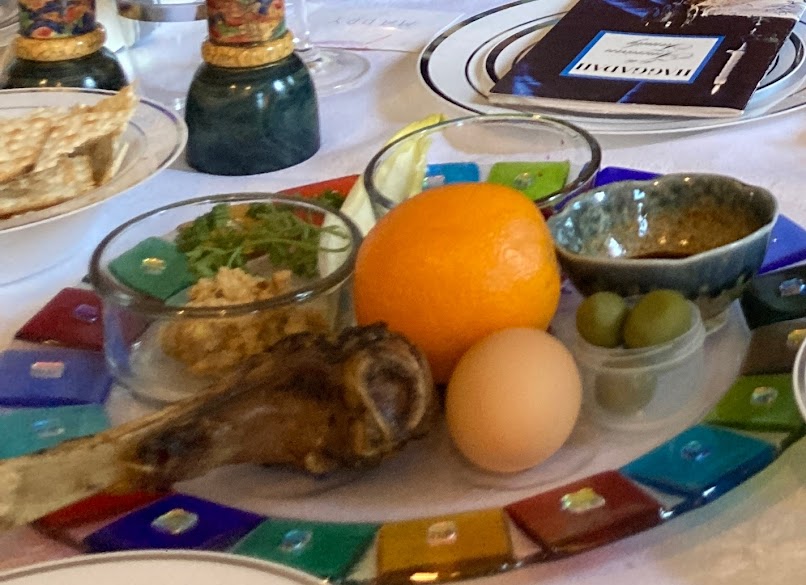
Our seder might not fit with everyone’s traditions or values, but it most certainly reflected ours. It was beautiful, powerful, moving, and memorable.


Thanks Amy for this wonderful description of your family’s seder. I always try to universalize the seder because of the different religious and non-religious backgrounds of my family. We will need to do more of that this year when we gather on Friday for a “non-school night” seder.
LikeLiked by 1 person
Thank you! And I think more and more families require these more universalistic approaches. Enjoy your seder!
LikeLike
Sounds like a wonderful seder, Amy. We, too, found the themes of Pesach almost too relevant. It rings so true now that as good Jews, we must recognize how peace for all, not just us, is the true message of Passover and the result we must strive for.
LikeLiked by 1 person
I agree 100%, Matt! Thank you.
LikeLike
Sorry to have missed it! Sounds great!!
LikeLiked by 1 person
It was wonderful! And you were missed.
LikeLike
Iâm happy you had a good Seder, sorry about the bars on the window and door.  We too had a good Seder at our temple with our wonderful rabbi and his husband.  Unfortunately our congregation is quite old and so many either are afraid to affiliate or just donât care.  Weâre enjoying our new home and look forward to Elizabeth retiring.  View two nights ago from our deck, the full moon. We wish you a healthy happy year ( E and I are married 22 years on Friday)BruceÂ
Sent from the all new AOL app for iOS
LikeLiked by 1 person
Happy Passover and happy anniversary! No reason to be sorry about the bars—the ones on the door are more decorative than protective, and even the ones on the window add visual interest.
LikeLike
The children had wonderful suggestions to add to the table. I am always so impressed how everything at the seder table has meaning. It gives us reason to sit back and ponder each one.
LikeLiked by 1 person
It truly does. Thanks, GP!
LikeLiked by 1 person
You moved me with this posting Amy. I would add an orange, olive and soy if I had a sedar. Sadly I did not openly but in my heart yes 🙂
LikeLiked by 1 person
Thanks, Sharon—I hope you will have one next year.
LikeLike
You always have such a beautiful way of describing and expressing your feelings, and it always touches my soul. Your explanation of the additions on your Seder table especially caught my attention. I knew about the cup for Elijah, but hadn’t heard of one for Miriam. The Orange made me happy. The olives brought tears to my eyes. Your grandson’s suggestion of soy sauce brought a smile to my lips and hope for a better future to my heart. Thank you for continuing to be a bright light in my corner of the world.
LikeLiked by 1 person
Thank you so much, Elizabeth, for your heartfelt response.
LikeLike
Sounds like a special and very meaningful Seder…your words are moving. Chag Pesach sameach!
LikeLike
Thank you, Teresa!
LikeLike
Thank you for describing your family Seder, Amy. I think it reflects so much culture, wisdom, and familial connection. I’m sure it was a blessed occasion. And how nice you got to relax a bit and let someone else do much of the preparation.
LikeLiked by 1 person
Thanks, Eilene—it was all of that!
LikeLiked by 1 person
BEAUTIFUL story — i am a GOLDSCHLAGER by birth- my dad was NATHAN I.GOLDSCHLAGER-THANK YOU FOR SHARING.
LikeLiked by 1 person
Hi Eileen! Where are your Goldschlagers from? My grandfather from Iasi, Romania.
LikeLike
We all need to reflect on our role we play in this world, to show compassion with deeds to all those who suffer, lack food and shelter, and need to be free.
LikeLiked by 1 person
Yes, I agree. Even those who hate us.
LikeLiked by 1 person
Amy, this is so lovely. We, (my Larry who organized) always universalized. Of course, Susannah Heschel, daughter Abraham Joshua, gave us the orange to symbolize the very inclusivity we’re mandated to enact, but still battle for.We too added olives. I love the idea of soy sauce! We added Miriam’s cup to Joshua’s cup, and we sang Debbie Friedman’s rousing song. We shared, too, reduced numbers, expansive gratitude, compassion for the suffering of all innocents, prayers for shalom.
LikeLiked by 1 person
Thanks for sharing your traditions, Sue! I think we would feel very comfortable at each other’s seders. What is the debbie Friedman song that you sing? And I never knew that it was Susanna Heschel who started the tradition of the orange!
LikeLike
Hi Amy, I am humbled by your description of your Pessach in New York.
I like the way your Grandson had his own idea with the Asian soy sauce
and how comfortable and relaxing your traditions are.
LikeLiked by 1 person
Thanks, Shirley!
LikeLike