
One of the things that I have found touching in researching many of the lines in my family is the way that families stayed together even after settling in the United States. Although family members would sometimes move away as their children grew up and the job opportunities changed, brothers and sisters and cousins and others tended to all end up near each other when they first migrated. In the case of the Schoenthal family, it’s even more striking since almost all of them ended up in a relatively small city, Washington, Pennsylvania.
![Washington, PA 1897 By Thaddeus Mortimer Fowler & James B. Moyer [Public domain], via Wikimedia Commons](https://brotmanblog.com/wp-content/uploads/2015/10/old_fairgrounds_washington_pa_1897.png)
Washington, PA 1897
By Thaddeus Mortimer Fowler & James B. Moyer [Public domain], via Wikimedia Commons
According to the Beers biography referred to here, “Henry Schoenthal attended the school of his native village up to his fourteenth year, at the same time learning his father’s trade [shoemaking], beginning when only ten and one-half years old, and working at the same until he was fifteen years old. For two years after this he took private literary instruction, and in the year 1859 was admitted into the Jewish Seminary in Cassel, Germany, an institution where young men were educated to become teachers in Jewish schools, and leaders of the service in the synagogue. At the end of the third year he passed an examination, and then taught school for three years in one place [Trendelburg].”[1] His role as a teacher is also mentioned on the Alemannia-Judaica page for Trendelburg.
Despite being quite educated and having what would appear to be a good position, Henry must have decided that there were greater opportunities in America where his uncle Simon Goldsmith and his family had moved in 1845. Henry, still using the name Hienemann, sailed on the S.S. Hansa from Bremen, Germany, arriving in New York City on June 18, 1866.

Henry Schoenthal 1866 ship manifest, line 85
Year: 1866; Arrival: New York, New York; Microfilm Serial: M237, 1820-1897; Microfilm Roll: Roll 267; Line: 1; List Number: 679
As the Beers biography reports, Henry settled in Washington, Pennsylvania. “Selecting as his abiding place in the land of his adoption the thriving town of Washington, this county, he clerked for three years in the clothing store of [his first cousin] Jacob Goldsmith, at the sign of the “Golden Eagle,” in the room now occupied by C. A. House as a music store.” Henry’s cousin had been well-established in Washington since at least 1854 as this August 23, 1854 article from the Washington Reporter (p. 2) reports:

On September 23, 1867, Henry’s younger brother Simon, born February 14, 1849, arrived in New York City on the S.S. D.H. Wagen, listing his occupation as a bookbinder and his destination as Pennsylvania. Sailing with Simon was their sister Amalie, born Malchen on January 1, 1847, in Sielen. She also was headed to Pennsylvania.

Simon Schoenthal and Amalie Schoenthal 1867 ship manifest, lines 230 and 231
Year: 1867; Arrival: New York, New York; Microfilm Serial: M237, 1820-1897; Microfilm Roll: Roll 286; Line: 1; List Number: 1004
The Beers biography continues, “Then in 1869, Mr. Schoenthal bought out the stationery business of Rev. James McFarland, at the “Green Tree Corner,” and has ever since conducted a prosperous and lucrative trade in books, stationery, notions, etc., at the same stand.”

Advertisement
Date: Wednesday, June 7, 1871 Paper: Washington Reporter (Washington, Pennsylvania) Volume: LXIII
In 1870, Henry (now using Henry) and Simon were living together in Washington in what appears to be a hotel. Henry was a book merchant, and Simon a bookbinder.

Henry and Simon Schoenthal 1870 census, lines 20 and 21
Year: 1870; Census Place: Washington, Washington, Pennsylvania; Roll: M593_1463; Page: 150B; Image: 290; Family History Library Film: 552962

Henry was also actively involved in the cultural life in Washington, bringing music to the people who lived there:

In 1870, their sister Amalie Schoenthal was living in Pittsburgh with their uncle Simon Goldsmith, who had relocated to Pittsburgh by then. His daughter Hannah had married Joseph Benedict, and they had a five month old baby Jacob at the time of the 1870 census. Joseph was in the retail business (no product identified), and his father-in-law Simon was listed as a retired tailor. Amalie’s occupation was reported as a “domestic.” I don’t know whether that means she was working as a servant for her cousin or in the household of someone else. I am curious as to who Eliza Brocksmith and her baby Jacob were, also listed in the household, but I’ve not yet found the connection. Perhaps she was Joseph’s sister.
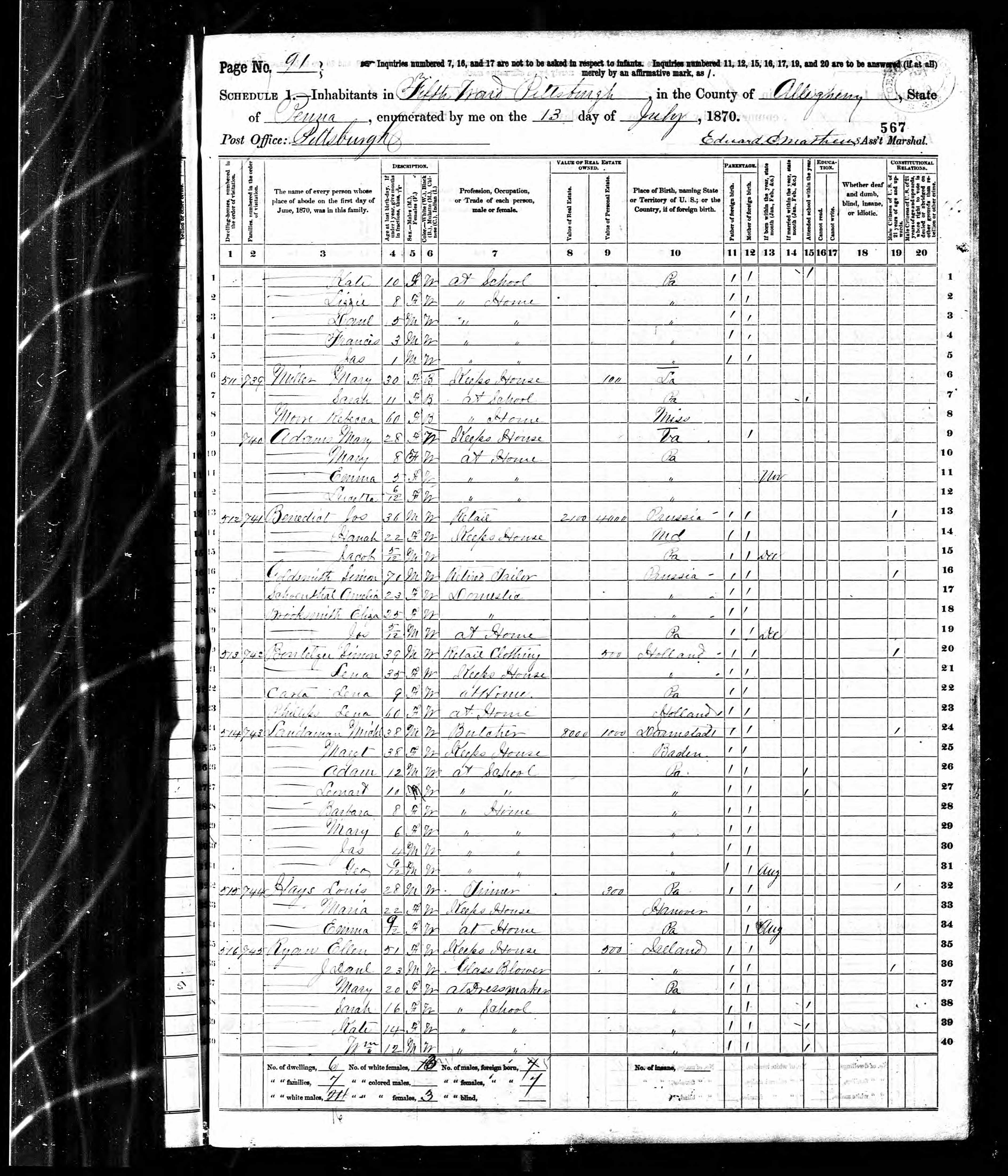
Amalie Schoenthal with Simon Goldsmith and the Benedict family 1870 census
Year: 1870; Census Place: Pittsburgh Ward 5, Allegheny, Pennsylvania; Roll: M593_1295; Page: 567A; Image: 439; Family History Library Film: 552794
Meanwhile, another sibling, Nathan arrived not long after the 1870 census. Nathan, who was born August 6, 1854 in Sielen, was only sixteen years old when he sailed on the Frankfurt from Bremen to New York, arriving July 16, 1870. He also settled in Washington, Pennsylvania, with his two older brothers.

Nathan Schoenthal 1870 ship manifest line 167
Year: 1870; Arrival: New York, New York; Microfilm Serial: M237, 1820-1897; Microfilm Roll: Roll 332; Line: 1; List Number: 683
In 1872, Henry returned to Germany where on May 8, 1872, he married Hewa (Helen) Lilienfeld of Gudensberg, the daughter of Meyer Lilienfeld and Malchen Engelbert. Gudensberg is another town in the Kassel district of Hessen located about 55 km from Sielen. I would love to know how that marriage was arranged. Henry had been in the US for six years at that point and was 29 years old. Had his parents made this arrangement for him?

Henry Schoenthal and Hewa Lilienfeld marriage record
HHStAW Abt. 365 Nr. 386, S. 37
Henry and his new bride returned to the United States on May 24, 1872, sailing from Bremen on the Danae. Strangely, Helen was listed under her birth name, Lilienfeld, not Schoenthal. There are also two entries for Amalie Mannsbach, an eighteen year old, listed in between Helen(e) and Henry. (I assume there were not two women with that name, but an error in the manifest. Or maybe there were two cousins with the same name and of the same age.) Since Henry’s brother Simon married a woman named Rose Mansbach in 1872, I am wondering whether Amalie became Rose in the US and whether Henry was bringing this young woman back for his younger brother. But right now that is just speculation.

Henry Schoenthal and Helene Lilienfeld 1872 ship manifest lines 95 to 98
Year: 1872; Arrival: New York, New York; Microfilm Serial: M237, 1820-1897; Microfilm Roll: Roll 359; Line: 1; List Number: 484
Meanwhile, a fifth Schoenthal sibling had arrived in western Pennsylvania while Henry was in Germany, getting married. Felix, born Seligmann Schoenthal on December 15, 1856, in Sielen, arrived on May 11, 1872, according to the passport application he filed in 1919. Although I scanned the entire ship manifest for the ship that arrived on that date from Bremen, I could not find his name. Felix also asserted on his passport application that he was naturalized in the Court of Common Pleas in Pittsburgh on August 17, 1878. In 1880, he was living with his wife of two years, Maggie (or Margaret), in West Newton, Pennsylvania, and working as a clerk in the paper mill. West Newton is about 32 miles east of Washington and about 25 miles southeast of Pittsburgh, so he was not too far from his siblings.

Felix Schoenthal 1880 US census
Year: 1880; Census Place: West Newton, Westmoreland, Pennsylvania; Roll: 1204; Family History Film: 1255204; Page: 8C; Enumeration District: 109
A sixth Schoenthal sibling also had arrived from Germany by 1880—Julius. He, however, has proven to be more difficult to pin down. I have been unable to locate a passenger manifest that includes him, and if it weren’t for the fact that the Beers biography mentioned a brother named Julius who lived in Washington, DC, I probably would not have assumed that the Julius Schoenthal that I found in DC was related to my Schoenthal family. When I found Julius on the 1880 census, the only clue I had to support the conclusion that he was related was the fact that, like Levi Schoenthal, he was a shoemaker.

Julius Schoenthal 1880 US census
Year: 1880; Census Place: Georgetown, Washington, District of Columbia, District of Columbia; Roll: 121; Family History Film: 1254121; Page: 9A; Enumeration District: 012; Image: 0498
I didn’t have a German birth record for Julius so I assumed he was born before 1846 when the Breuna birth records that are available online began. Things got even more confusing when I tried to find information about when Julius arrived in the US and what he was doing in the 1870s. What a hodge-podge of confusing and conflicting clues.
First, the 1910 census reports that Julius arrived in 1869, but the 1900 census said he arrived in 1875. According to the District of Columbia, Select Marriages, 1830-1921, database on Ancestry, Julius married Minnie Dahl on March 15, 1874, in DC., so I knew Julius had to have been in the US by 1874 and that the 1900 census could not be right. Then I found an entry for a Julius Schoenthal in the U.S., Civil War Pension Index: General Index to Pension Files, 1861-1934, on Ancestry that indicated that Julius had filed a claim for a pension in 1897 as an invalid; it also indicated that Julius had served in the Signal Corps, but there were no dates of service indicated on the index card in that database.

Julius Schoenthal pension index card
U.S., Civil War Pension Index: General Index to Pension Files, 1861-1934
I was confused. If Julius arrived in 1869 or 1875, how could he have served in the Civil War, which ended in 1865?
I decided to look for news articles, hoping I’d find something to shed light on when Julius had immigrated, and I found an article dated September 14, 1914, from the Washington Evening Star (p. 12) that added one more fact to the mix, bewildering me even further.

If Julius had served in the Franco-Prussian War in 1870-1871, how could he have served in the US Civil War? Had he immigrated to the US, enlisted in the US Army, and then returned to Germany to serve in that country’s army against France? I thought maybe I should order his service file from the National Archives, but it was fairly expensive, so I decided to hold off and see what else I could find.
I turned once again to the genealogy village and the Ancestry.com Facebook group to see if there was someone who was more expert with the U.S., Civil War Pension Index: General Index to Pension Files, 1861-1934 database. I was very fortunate to get tremendous help from a member there named Lillian. First, she informed me that the so-called Civil War Pension Index covers more than just Civil War veterans, a fact that had not been clear to me when I read the database description. Then Lillian pointed me to a document on Fold3, a genealogy website primarily focused on military records. That document stated that Julius had enlisted in the US Army in 1873, eight years after the Civil War ended.
I’d seen this document earlier, but had dismissed it for a couple of reasons. First, it said that Julius was born in Berlin. That seemed not likely to be the right person since all of my great-grandfather’s other siblings were born in Sielen, not anywhere close to Berlin. Secondly, it said he enlisted from Chicago. I couldn’t imagine that my Julius would have enlisted from Chicago since no one else in the family was there, so I had dismissed this record. Looking a second time at Lillian’s suggestion, I saw that Julius had been discharged in Washington, DC, on June 5, 1874, making it more likely that this could be my Julius. But I was and am not 100% certain that it is.
It would make more sense, however, for Julius to have enlisted in 1873, not during the Civil War. Maybe he had arrived in 1869 and had returned home to fight for Germany in the Franco-Prussian War. Or maybe the 1910 census does not accurately record his arrival date and Julius had arrived after serving in the Franco-Prussian War, perhaps in 1872, and then enlisted in the US Army from Chicago. He married Minnie Dahl, who was born in Germany, but I don’t know where he met her. Assuming it was in Washington, that might explain why they settled there once he was discharged from the army in 1874 less than two months after they were married.

English: Pres. U.S. Grant (between 1870 and 1880) Français : Le président américain Ulysses Grant (Photo prise entre 1870 and 1880) (Photo credit: Wikipedia)
Lillian found one more piece of evidence that may provide more answers. On May 12, 1873, a man named Julius Schoenthal wrote a letter to then US President Ulysses S. Grant, and that letter is in the Ulysses S. Grant Presidential Collection at Mississippi State University. I have ordered a copy of the letter and hope to receive it within a week or so. I am hoping that perhaps it will be the right Julius Schoenthal and that it will reveal something about his life before being discharged from the army and marrying Minnie Dahl. Maybe I will find some clue, some evidence that ties him to my Schoenthals and explains some of the confusing and conflicting evidence I’ve found so far. And now I am curious enough about Julius that I broke down and ordered his pension file, but found someone who could retrieve it for me for a more reasonable price.
Assuming that Julius was in fact my great-grandfather’s brother, it would mean that by 1880 five of the seven surviving sons and one of the three daughters of Levi Schoenthal and Jette Hamberg had left Sielen, Germany, and moved to the United States. All but Julius were living in western Pennsylvania in 1880. As the Beers biography points out, by 1880, Henry and Helen Schoenthal had had three children, “Madaline, born March 16, 1873, died in infancy; Hilda, born June 25, 1874; Lionel, born April 14, 1877.” Amalie and her husband Elias Wolfe had had three: Maurice (1873), Florence (1875), and Lionel (Lee) (1877). I assume the two Lionels were named for their grandfather Levi Schoenthal, who had died back in Sielen in 1874. Simon and his wife Rose had had five children in the 1870s: Ida (1873), Harry (1873), Gertrude (1875), Louis (1877—probably also named for Levi), and Maurice (1878). Julius and his wife Minnie had four children in the 1870s: Leo (1875—also probably for Levi), Rosalia (1876), Sylvester (1878), and Moretto (1879). Thus, in one decade the Schoenthal siblings had produced fifteen new American born children.

Levi Schoenthal death record March 1874
HHStAW Abt. 365 Nr. 773, S. 9
In the next decade, my great-grandfather Isidore would arrive as well as his mother and two other sisters. There would be only one Schoenthal left in Germany, at least for a while. Almost all the descendants of Levi and Henrietta (Hamberg) Schoenthal would be born in the United States.
[1] Text taken from page 1057 of:
Beers, J. H. and Co., Commemorative Biographical Record of Washington County, Pennsylvania (Chicago: J. H. Beers & Co., 1893).
Transcribed March 1997 by Neil and Marilyn Morton of Oswego, IL as part of the Beers Project.
Published March 1997 on the Washington County, PA USGenWeb pages at http://www.chartiers.com/.


![Passenger manifest for Simon Goldschmidt, Fanny Schoenthal and Eva Goldschmidt Ancestry.com. Baltimore, Passenger Lists, 1820-1964 [database on-line]. Provo, UT, USA: Ancestry.com Operations Inc, 2006. Original data: Selected Passenger and Crew Lists and Manifests. National Archives, Washington, D.C.](https://brotmanblog.com/wp-content/uploads/2015/09/passenger-manifest-for-simon-goldschmidt-fanny-schoenthal-and-eva-goldschmidt.jpg)



 Brotmanblog: A Family Journey