Keep it or Throw it Away? Why we save things

I tend to be a saver.  Not an out-of-control packrat, but a saver.  I save books, photographs, letters, papers, cards, report cards, etc.  I also saved almost all the clothes that my children wore as babies and toddlers, regardless of the condition.  I just couldn’t part with the memory of each of them being so little.  The clothes were tangible evidence, more so than photographs, that they were once tiny babies.

When my grandson was born, I went down to the basement to see if any of the baby clothes I’d saved were usable.  For the most part, they weren’t.  Things were stained, stretched out, out of style—not what you’d put on a new baby.  So I had to decide what to do.  Throw them away? Put them back in the boxes?  I weeded through them, saving the ones that triggered particular memories: the purple corduroy outfit that both girls wore when they were toddlers, the Snoopy outfit that my older daughter wore almost every day when her sister was born and we were both too tired to fight with her about what to wear; sweaters my mother had knit, a few special party dresses.  The ones that were badly stained and not wearable I threw away.  All the rest I put back in the boxes anyway, not having the heart to throw them away just yet.

Now I am glad that I did keep some of these things.  One of the pictures Jody sent me a couple of weeks ago was this picture:

booties

Imagine—these booties are almost 100 years old.  My aunt Elaine was born in 1917, my uncle Maurice in 1919.  Someone saved these and pinned a label to them to identify them for posterity as the booties of Elaine and Maurice.  There were not a lot of material objects passed on from my grandparents, but here is one that says so much.  They, too, cherished their babies, wanted to preserve the memories of them as tiny babies, and held on to something tangible to keep those memories alive.  And it worked—I now can imagine those babies and my grandparents as new parents, probably as overwhelmed, exhausted and delirious as all new parents, but also in love with those babies.

So I guess I won’t be getting rid of the baby clothes yet.  Maybe some time in the 2080s, a great-grandchild will find a box with a sweater, a Snoopy outfit, a purple corduroy jacket, and imagine the children who once wore them.

Enhanced by Zemanta

Pete Seeger

Video

Pete Seeger, American folk singer

Pete Seeger, American folk singer (Photo credit: Wikipedia)

I woke this morning to the very sad news that my lifelong hero, Pete Seeger, had died at age 94.  Others will write more complete obituaries, but I wanted to write about my lifelong relationship with Pete.

It started with my very first album as a small child.  It’s the one depicted below with Pete singing one of my favorite childhood songs.

So my relationship with Pete started before I could even read.  His songs were the soundtrack to my early childhood.

When I was a little older, I found my parents’ copy of The Weavers album from their Carnegie Hall concert and listened to it over and over.  Here’s one of my favorites from when I was probably eight or nine years old:

As an adolescent, Pete was there to be my conscience.  First, during the Civil Rights movement, we all sang “We Shall Overcome” at camp in 1963.

And, of course, “If I Had a Hammer:”

And then in 1965 I got to see Pete in Concert at Carnegie Hall as part of an anti-war concert.

Sing In For Peace 1965

Sing In For Peace 1965

It was my first Carnegie Hall concert, my first anti-war concert (I was 13), and an unforgettable experience seeing not only Pete Seeger but all the other great folk singers of the day.  I am so grateful that my parents took me with them to experience this.  I will never forget it.  I saw Pete in concert a number of times after that, usually with Arlo Guthrie, but that first time was so magical.

Pete wrote and sang many anti-war songs, but my favorite will always and forever be this one:

I sang this all through my teenage years and after.  I sang it to my children when they were little, trying to instill in them Pete’s message—that war is cruel and pointless and that only love and peace will sustain and save us.

I could post many more, but these are the ones that resonate for me today and every day.

Thank you, Pete Seeger, for always doing the right thing and for being the conscience for all of us.

Pete Seeger, Pamela Means, Magpie; Clearwater ...

Pete Seeger, Pamela Means, Magpie; Clearwater Festival 2008; Croton on Hudson NY; June 22, 2008 (Photo credit: Wikipedia)

Enhanced by Zemanta

Update: My Grandfather’s Arrival

Statue of Liberty National Monument, Ellis Isl...

Statue of Liberty National Monument, Ellis Island and Liberty Island, Manhattan, in New York County (Photo credit: Wikipedia)

Yesterday I received eight new documents, and I will report on them all over the next couple of days.  But for me, the most exciting document is my grandfather’s naturalization application.  It is always touching to see a document written in the handwriting of someone who means a lot to you, so that alone would have made it exciting.  It’s also exciting to see the names of my grandmother and aunt and uncle on his petition.  It’s exciting to see his distinctive signature.

But what made these pages particularly exciting is that they resolved a question that has been unanswered for a long time.  A number of years ago my brother tried to find the ship manifest for our grandfather Isadore at Ellis Island.  He was able to locate the manifests for David, Betty, Moritz and Gisella, but not Isadore.  When I started my own research almost two years ago, I also tried to find something that documented when Isadore arrived in New York, but found only the same information that Ira had found.  I had given up and moved on to other things.

When I returned to researching the Goldschlagers a few weeks ago, I once again looked, figuring that with my improved research skills and newer research tools, maybe I would finally find a ship manifest for my grandfather, but once again, nothing turned up.  I resigned myself to the idea that I would never find a record for his arrival.

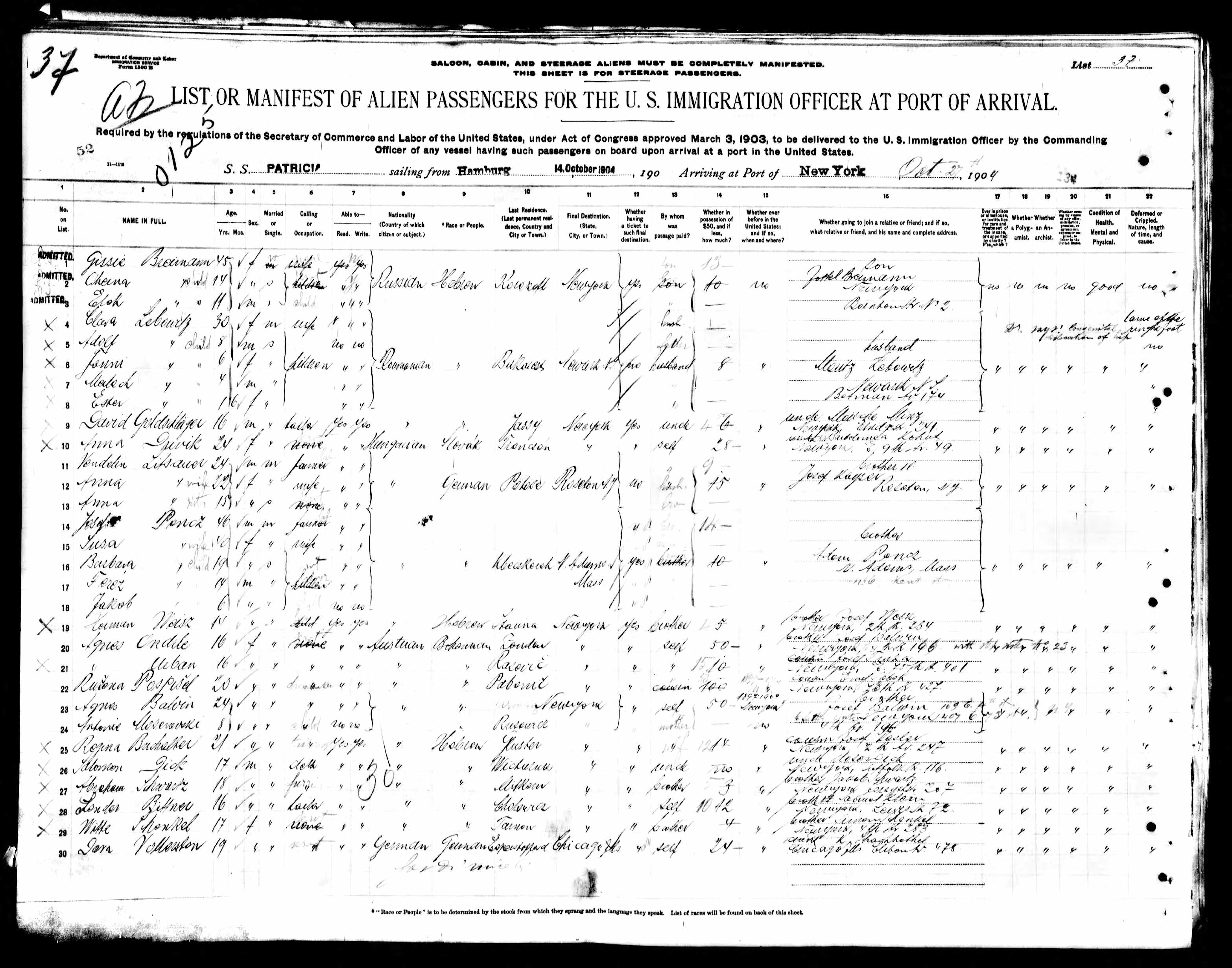
Then the other day, as I wrote in my post entitled “Isadore and David Goldschlager: More than Brothers,” I realized that there were two ship manifests for David Goldschlager: one dated October 27, 1904, and the other dated November 4, 1910.  I also realized that it was the later one that was accurate.  Every other document said David had arrived in 1910: his naturalization papers, several census reports, and his wife’s naturalization papers.  It also made sense that David had waited with his mother and sailed with her to America.

That left me thinking that the David Goldschlager on the 1904 manifest was not David, but Isadore, my grandfather.  That manifest was for a ship called the Patricia, sailing from Hamburg, and arriving in the United States on October 27, 1904.  I was hoping that Isadore’s naturalization papers would reveal what ship brought my grandfather to America.  I hoped that I had finally found the evidence of how and when Isadore traveled to his new home.

Well, I opened the naturalization papers today, holding my breath, scanning quickly to see if the answer was revealed.  And there it was: Isadore wrote that he arrived on October 28, 1904, on the Patricia, sailing from Hamburg.  Isadore had in fact used his younger brother’s name to escape from Romania.

Isadore Goldschlager naturalization papers page 1

Isadore Goldschlager naturalization papers
page 1

page 2

page 2

page 3

page 3

I was always told that he left Romania to avoid the draft.  He turned sixteen in August, 1904, and was presumably then draft age.  David, on the other hand, was a year younger and would not turn sixteen until 1905.  Perhaps Isadore took David’s passport to get out of Romania.  Or maybe he just used his name.  (That leaves me wondering how David managed to stay safe until he left in 1910, but I am afraid we will never know the answer to that question.)

When I told my mother what I had found, she said that she was not surprised that her father figured out a way to get out of the country.  He was a very clever and resourceful man who knew how to get what he wanted.  He used his wits to survive.  As one of his namesakes who never knew him likes to say, “If at all possible, lie.” It seems that that approach may have saved our grandfather’s life and enabled his three children, his nine grandchildren, his fourteen great-grandchildren, and the ever-increasing number of great-great grandchildren to come into this world.

Thank you, Grandpa, for being so clever and for escaping Romania, and thank you, David, for letting him borrow your name.

SS Patricia, the ship that brought my grandfather to America

SS Patricia, the ship that brought my grandfather to America

Enhanced by Zemanta

Passenger Ship Manifests and The Heartrending Stories They Tell

English: Ellis Island's Immigrant Landing Stat...

English: Ellis Island’s Immigrant Landing Station, February 24, 1905. (Photo credit: Wikipedia)

One of my favorite documents to locate is a ship manifest listing one of our ancestors as a passenger, bringing them from Europe to America. I have read and seen enough about these ships and the hardships that the passengers endured to know that these were not pleasant cruises across the Atlantic Ocean. People suffered from disease, malnutrition, terrible hygienic conditions, and frequently even death. Yet I tend to romanticize these journeys, despite the facts. I imagine how frightened but also how excited these travelers must have been, thrown together with other people from all different countries and of all different backgrounds, all of whom were dreaming of a better life in the United States. The stories told by ship manifests I’ve found do much to break down that romantic ideal.

I was only able to find two ship manifests for the Brotman immigrants. The first exciting find was the manifest for the Obdam, the ship that brought Bessie, Hyman and Tillie to New York in January, 1891. Their names were listed as Pessel, Chaim and Temy Brodmann. One column lists how many pieces of luggage each passenger brought, and for Bessie, Hyman and Tillie, they brought only two pieces of luggage. Imagine fitting the clothing of three people plus any other possessions you wanted to keep with you into just two pieces of luggage. When we go away for a weekend, we often need more than that for just two of us. Hyman was only 8, Tillie 6, and somehow they endured this long voyage at sea with their mother. When I fast-forward to how American they became as adults, I find it remarkable.

The Obdam 1891

The Obdam 1891

The only other ship manifest I located for the Brotman family is one I believe is for Max, but cannot tell for sure. It lists a Moshe (?) Brodmann as a ten year old boy, traveling with one bag, on a ship called the City of Chicago in 1890. This very well could be Max, but there is no other Brodmann or anyone else with a similar name traveling with him. If I have a hard time imagining Hyman and Tillie coming with their mother, it is really unfathomable to imagine a ten year old boy traveling alone across the ocean. None of the names above or on the page following his sound like possible relatives, friends or even neighbors since for the most part they are listed as coming from Russia, not Austria. If that is in fact our Max, I imagine that this must have been an incredible experience—frightening, even horrifying, and lonely. Perhaps an experience like that explains how these children then endured the working and living conditions they found in the United States. They had already survived much worse.

I’ve had no luck yet locating a manifest that includes Joseph or Abraham Brotman, but I will keep looking.

On the Goldschlager side, I’ve had more success. I have found a ship manifest for Moritz, Gisella, David and Betty, each of whom came separately, but nothing for my grandfather Isadore. These manifests also tell interesting and some heart-breaking stories. David came in 1904 on the Patricia, which departed out of Hamburg. (Perhaps like his brother, David also walked out of Romania to get to Hamburg.) This manifest contains far more information than the two above. First, it asks for information about who paid for the ticket and the name, address and relationship of any relative or friend the passenger was joining at their destination. David said his uncle paid his passage and that he was going to join that uncle in New York. From what I can decipher, it looks like the uncle’s name was Moishe Minz.
David Goldschlager ship manifest

David Goldschlager ship manifest

I have searched many times and ways to figure out who this person was and how he was an uncle to David. Was he a brother-in-law of Moritz or of Gisella/Gittel/Gussie? Since his last name is neither Goldschlager or Rosensweig (Gisella’s maiden name), I assume he is not a brother. Or perhaps he is a half-brother. Whoever he was, I cannot find him yet. I also find it puzzling that David listed this uncle and not his brother Isadore. Perhaps because Isadore himself was still just a minor, he would not have been a satisfactory person to list as the connection for David in the United States. The other interesting bit of information gleaned from this manifest is the amount of money David was carrying with him: six dollars. He was 16 years old, traveling alone, with six dollars to his name.

The next to arrive was Isadore and David’s father, Moritz. He arrived in August 1909 on the ship La Touraine out of Havre. His occupation is listed as a tailor, and his age as 46 years old. This manifest did not ask who you were meeting in the United States, but instead who you were leaving behind in your old place of residence. Moritz listed his wife, Gisella Goldschlager. So by August 1909, the three males in the family had emigrated from Iasi, and Gisella and her daughter Betty were left behind. This seems consistent with the pattern in the Brotman family: Joseph came first, then his two sons from his first marriage, and then his wife and younger children.
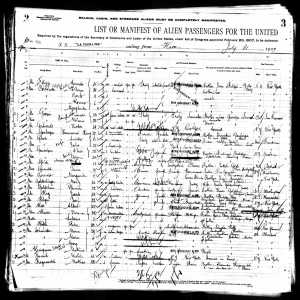
Moritz Goldschlager ship manifest

Moritz Goldschlager ship manifest

Betty’s arrival story is more complicated and very sad. On the ship manifest filed at Ellis Island, Betty had listed her father as the person she was joining in New York. Betty arrived in April 4, 1910, on the ship Kaiserin Auguste Victoria. However, she was detained at Ellis Island for a short time. On a document titled “Record of Detained Aliens,” the cause given for detention simply says “to father.”
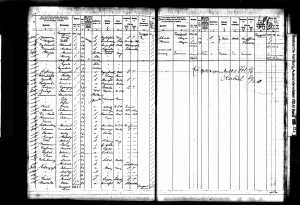
Betty Goldschlager Detention of Aliens

Betty Goldschlager Detention of Aliens

According to his headstone, her father Moritz died on April 3, 1910, the day before Betty arrived on the Kaiserin August Victoria. It is hard to believe that her father died the day before she arrived, but if the records and headstone are accurate, that is what happened.
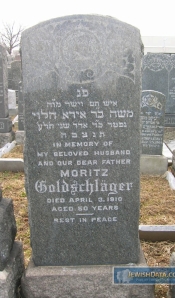
Moritz Goldschlager headstone

Moritz Goldschlager headstone

Betty must have been kept at Ellis Island until another person could meet her. On that form for detained aliens, she listed an aunt, Tillie Srulowitz, under “Disposition,” which I interpret to mean that Betty was released to her aunt on April 4 at 3 pm. (More about Tillie Srulowitz in my next post.)

This story breaks my heart. Moritz had only been in the United States since August, just eight months, when he died. He did not live to see his daughter or his wife again. He was only fifty years old. I don’t have his death certificate yet, but will see if I can obtain it and learn why he died. Imagine how Isadore and David must have felt—waiting four to five years to see their father, only to lose him eight months later. And imagine how Betty must have felt—coming to America, taking that awful voyage, only to be greeted with the news that her father had died just before she arrived.

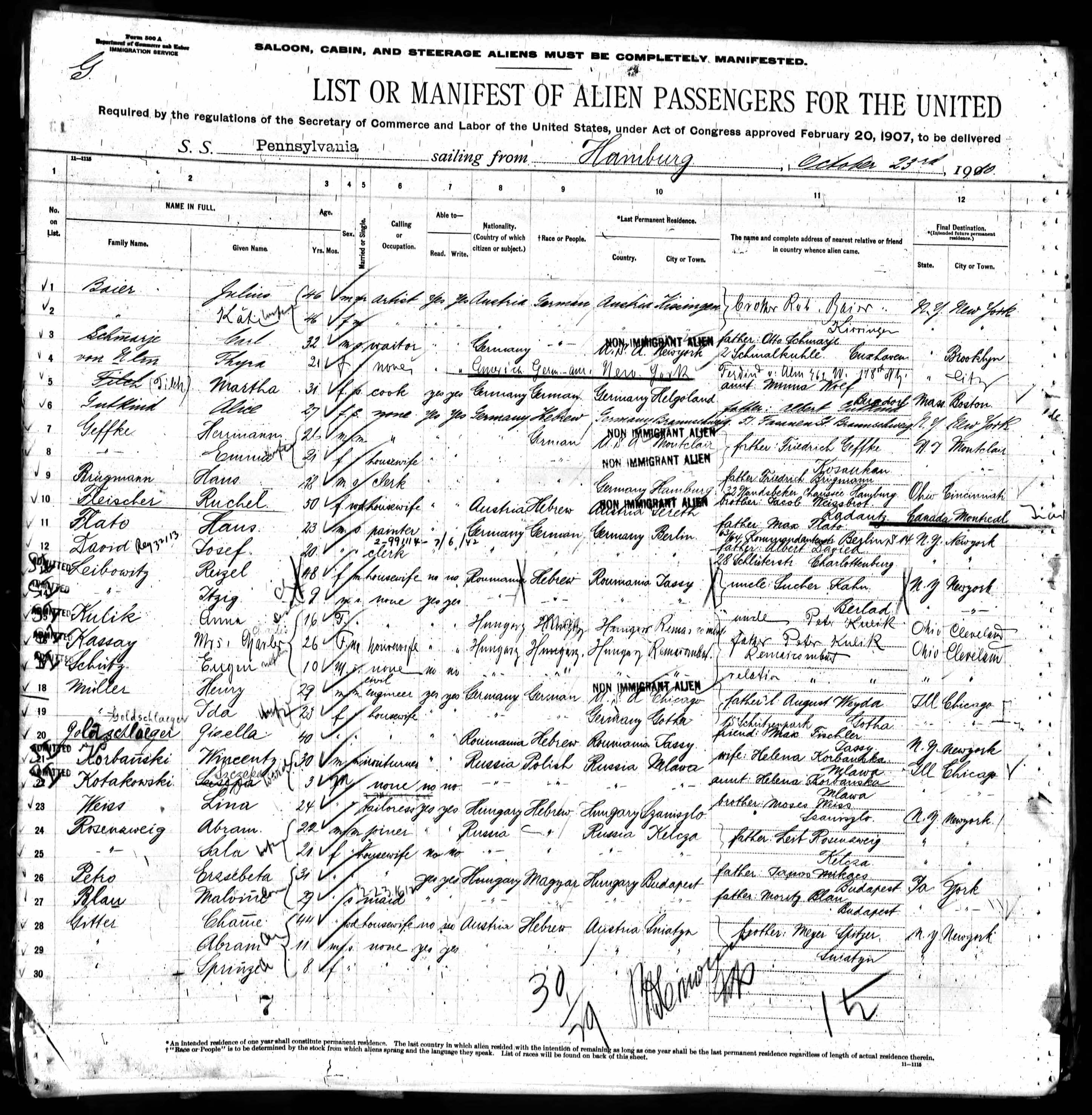
And finally, think about his wife Gisella. She arrived in NYC in November, 1910, seven months after her husband had died. Did she know what was awaiting her? She sailed on the ship Pennsylvania out of Hamburg; the ship manifest does not list who was waiting for her, only the name of someone who resided in her old home, a friend named Max Fischler.
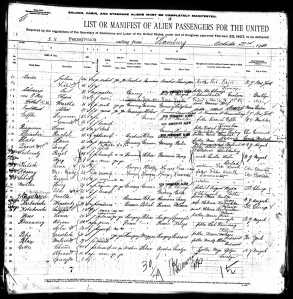
Gisella Goldschlager ship manifest

Gisella Goldschlager ship manifest

But the record from Ellis Island indicates that she had expected to join her husband Morris Goldschlager, but was instead released to her son Isadore. I have no idea how immigrants communicated with their relatives back in Europe in those days or how quickly news could travel from place to place, but since the ship manifest indicates that the ship sailed from Hamburg on October 23, 1910, over six months after Moritz had died, Gisella must not have known that he had died, or why would she have listed him as the person receiving her in New York when she got to Ellis Island? It appears that Gisella did not know until she arrived in New York that her husband had died the previous April. It is heart-breaking to imagine what her reunion with her sons and daughter must have been like under those circumstances.

EDITED: Some of the facts in this post have been updated with subsequent research.  See my post of January 22, 2014, entitled “Update: My Grandfather’s Arrival.”   Also, this one.

English: Immigrants entering the United States...

English: Immigrants entering the United States through Ellis Island, the main immigrant entry facility of the United States from 1892 to 1954. Español: Inmigrantes entran a los Estados Unidos a traves de la Isla Ellis, el mayor lugar de entrada a los Estados Unidos entre 1892 y 1954. (Photo credit: Wikipedia)

Enhanced by Zemanta

A World Apart, part 5: Relationships between Jews and non-Jews in Galicia

My reading this time related largely to the relationships between the Jews and non-Jews in Galicia, socially, politically and otherwise.  Margoshes began this section by claiming that at least in the region where he lived near Radomishla, the Jews were economically and politically often more powerful than most of the non-Jewish population.   I would never have expected that at all; I assumed that the Jews were oppressed politically and economically.  Instead, Margoshes asserted that in area from Rzeslow to Tarnow to Krakow, the peasants lived under the dominance of the Jewish estate holders.  He wrote, “During the period between the 1880s and [World War I], this part of Galicia was a true paradise for Jews in some respects.” (p. 99; emphasis added)

According to Margoshes, in this region, anti-Jewish persecution and acts were unknown, and Jews and gentiles lived peacefully together.  If a peasant struck or even just insulted a Jew, the courts would punish the peasant by placing him in jail for at least two days.  Peasants would tip their hats to Jewish estate-holders when they were driving (oxen or horses, I assume) on the road and when they entered their homes.  (There is no mention of how the peasants treated and were treated by poor Jews, just the wealthier Jews, who in many instances were the employers of these peasants.)

Margoshes explains the political context for this by pointing out that in 1846 there had been a widespread revolt of the peasants against the wealthy Polish lords and landholders and that even forty years later, the politically powerful Polish aristocracy which controlled the government had not forgiven the peasants for the violence, deaths and damages caused by that uprising.  Thus, in a dispute between a peasant and a Jew, the government would generally side with the Jew.

Margoshes also attributed much of the peacefulness of the region to the Austro-Hungarian gendarmes who were responsible for keeping law and order in the Empire as part of the imperial army.  These soldiers lived in the area in barracks and frequently visited the estates to insure that all animals were registered and that everything was being managed according to the requirements of the Empire.

That did not mean that there were no disputes or problems between the peasants and their Jewish employers.  Margoshes described a number of incidents of theft by the peasants who worked at his father-in-law’s estate.  He wrote, “A Jewish estate-holder and his household had to have eyes in the back of their heads in order to make sure that the workers were not stealing from him….” (p. 127).  He also made the offensive generalization that it was part of the “inborn nature” of the peasants to steal: “he had to steal whenever the opportunity presented itself, especially from the Jewish estate-holder.  For a peasant, the smallest stolen article was an asset.”

In one story about the workers at his father-in-law’s estate in Zgursk, moreoever, Margoshes also revealed that the relationships between the Polish peasants who worked on the estate and their Jewish employers were not always quite so amicable.  There were at times hundreds of workers on the estate, and many of them boarded there.  Margoshes himself admits that their living conditions were substandard: “everyone found a place to sleep in one of the three stables atop hay and straw and that was it.  No pillows or sleepwear were provided and…a blanket used to cover horses served as a cover.” (p. 96) The estate did provide three meals a day that Margoshes described as generous.   Margoshes’ mother-in-law and father-in-law were the task masters who oversaw all the work on the estate, and his father-in-law was known to be rather cold and strict.

Margoshes described one time that his father-in-law lost his temper with some of the workers who in his view were not working hard enough and began beating them with a paddle.  In response, these workers and a number of others went on strike and refused to return to the fields. It took an intervention from the mother of the father-in-law to persuade the workers to return to work the next day.  Margoshes described this as if it were a one-time incident, and perhaps it was, but it does reveal that there was some abuse of the peasants by at least this powerful Jew, his own father-in-law.

Thus, although Margoshes initially described the relationship between the gentile peasants and the Jews as peaceful and amicable, these incidents of theft and abusiveness suggest that there was in fact a great deal of resentment and anger among the peasants towards the Jews. Perhaps he was deluding himself when he wrote that it was a “true paradise” for Jews in this region during that time.

According to Margoshes, the wealthy Jews also had good relationships with the wealthy Polish lords and landowners, called pritsim or porits in the singular.  He described his relationship with a neighboring porits  as “very friendly, although from a distance.” (p. 103) They would help each other out with favors, but were not social friends.  Margoshes did not think that this relationship was unusual.  He said that he “never heard of a case in the entire region of a porits who had negative relations with a Jew or where he insulted a Jew or harmed him in any way,” (p. 104) although he did then go on to mention one polits who refused to trade with Jews.

There was also, according to Margoshes, peaceful co-existence between the Catholic priests and the Jewish population.  Although he commented that “[p]riests, especially Catholic priests, cannot ever really be friends of the Jews” because “it is almost against [their]religion to love people of another faith,” (p.111), he reported that nevertheless for the most part there was little conflict between the priests and the Jewish estate holders.  He described a church law that prohibited Catholics from working as servants in Jewish homes, but pointed out that it was rarely enforced since the peasants needed employment and often worked in Jewish homes. Margoshes even developed a friendship with one of the local priests, but he severed that relationship when the priest tried to persuade Margoshes to come and see his church—not to convert, but just to go inside the church.  Obviously, this “friendship” was a superficial one based on necessity, and feelings of distrust and difference outweighed any sense of real connection.  Margoshes made it clear that it would not have been acceptable for him, as a Jew, to be seen in a Catholic church.

By the time I finished reading this section, I realized that Margoshes had had a very unrealistic view of the relationships between the Jews and non-Jews in Galicia during the late 19th century.  First, his viewpoint is entirely based on the experiences of the wealthy Jewish estate-holders.  The non-Jewish peasants may have seemed respectful and accepting of their Jewish employers, but beneath the surface there was likely a great deal of resentment and anger.  The priests and non-Jewish estate-holders also may have been willing to live peacefully side-by-side with the wealthy Jews, but there certainly was not a true acceptance or friendship in these relationships.  The gendarmes may have been keeping the peace, but beneath the surface the Jews were still the outsiders who were not integrated into the gentile world.

Moreover, Margoshes does not at all provide a picture of what life was like for the Jews who were not wealthy estate-holders.  Were their relationships with the peasants, priests, and wealthy Polish landowners as “peaceful”?  Or were they the targets of all the repressed resentment and anger that the gentiles felt towards the wealthy Jews?

It occurred to me after reading these chapters that Margoshes was writing in 1936.  He had no idea what was going to happen in Poland during the Holocaust. I wonder whether his naiveté about how the gentiles felt about the Jews was widespread in Poland during the 1930s and 1940s.  If only they had been more realistic, perhaps more of them would have left sooner.

Which brings me to another question: if things were so great in the 1880s and 1890s for wealthy Jews in Poland, why did Margoshes and so many others, including Joseph and Bessie, leave?

A World Apart, Part 1: Life in Galicia in the late 19th Century

As I mentioned a few weeks ago, I ordered a book on what life was like in Galicia in the late 19th century.  The book is A World Apart: A Memoir of Jewish Life in Nineteenth Century Galicia by Joseph Margoshes. (The book was written in Yiddish in 1936, but translated into English in 2010 by Rebecca Margolis and Ira Robinson.)  Margoshes was born in 1866 in Lemberg (Lvov/Lviv), which is now part of Ukraine.  According to the introduction to the book, he was born into a family with a “distinguished rabbinical ancestry” and “received a traditional Jewish education in Bible and Talmud, as well as grounding in the German language and European culture.” (p.vii)  As an adult, he spent several years administering agricultural estates in western Galicia, the region where our family most likely lived.  He emigrated to America at the turn of the century and became a well-known writer for the Yiddish press in New York City.

He wrote A World Apart as a memoir not only of his life, but of the culture and world he left behind.  The book is considered to be an important documentation of what life was like in Galicia during that time period.  As Margoshes himself wrote in his forward to the book, “I have lived in a different generation and under completely different circumstances from my own children and many of my friends and acquaintances.  I thus hope that it might interest them to read the memoirs of my past.” (p.3)

Since the author lived in Galicia and left Galicia during the years that Joseph and Bessie, Abraham, Max, Hyman and Tillie lived in and left Galicia, I hope to be able to get a better picture of what their world was like.  I’ve only read the first thirty-five pages or so, but can already report some sense of that world.  What struck me most about the first segment of the book was its portrayal of a diverse Jewish society.  In my mind I had an image of Fiddler on the Roof where everyone was relatively indifferent to secular education and the secular world and completely immersed in Jewish life.  Margoshes immediately breaks down that image.

In fact, Jewish society in Galicia was not unlike Jewish society in Israel or the US today with a wide range of subgroups with varying degrees of religious observance— from the Hasidim to what we might now call Modern Orthodox to very assimilated or what Margoshes refers to as “German” Jews.  By that he does not mean that they were from Germany, but rather that they had abandoned traditional Hasidic garb, wore modern clothes, did not keep kosher, and spoke German more than Yiddish.  Margoshes family itself had representatives across the spectrum.  His father was descended from a long line of scholarly rabbis and considered themselves “maskils” or members of the Haskalah or Enlightenment Movement, which promoted not only Jewish education but also secular education, much as the Modern Orthodox movement does today in the US.  They were deeply observant, but not cut off from the outside world, unlike the Hasidim who lived much more insular lives and were not interested at all in secular education.  On the other hand, Margoshes’ maternal grandfather was a highly educated cloth merchant who traveled to Vienna for business and raised thirteen children, only two of whom were religious.  His sons were all “Germans,” and his daughters were well-educated and read the German classics.

Margoshes’ mother, however, was one of the two children who were religious, although she was well-educated.  Her first marriage ended when her husband began to dress and act “German-style.”  She then married Margoshes’ father, who was himself a maskil —religious, but not Hasidic.  (Interestingly, Margoshes’ father was a widower whose first wife was his niece, an indication of how liberally families allowed marriage among close relatives, as Joseph and Bessie reputedly were.)

After providing this family background, Margoshes describes events surrounding a major rift in the Galician Jewish society.  His father had originally belonged to an association of educated but religious Jews (maskilim) called the Shomer Yisrael Society.  In the late 1860s, however, his father left the Shomer Yisrael Society because it had become far too assimilationist.  For example, the Society submitted a proposal to the Imperial Ministry in Vienna that would restrict who could be a rabbi recognized by the state to those with more “German” tendencies and that would also impose reforms to the education provided in the Jewish schools, such as requiring German language classes and limiting Talmud classes to those twelve or older.  The Ministry was in favor of these proposals, as it favored modernization of the Jewish society.  Margoshes’ father and others were vehemently opposed and aligned themselves with the Hasidim to fight the proposal.  They formed an opposition group called Machzikei Hadas to organize their opposition to the Shomer Yisrael Society.

Margoshes wrote in detail about the long political battle between these two groups and how the maskilim and Hasidim worked together to fight the assimilationist Shomer Yisrael Society.  He also describes the overall status of Jewish society in the Galician world:  “In that era, the leaders of the province of Galicia were adopting a more liberal outlook.  Jews were granted full rights as citizens and they were allowed to vote as well as to be elected to the Galician Landtag and the Austrian Reichsrat.” (p. 18) The battle between the two groups became therefore also a battle for political representation of the Jewish citizens in the secular governments, not just a battle over religious practice and education.

In order for Machzikei Hadas to function as a legitimate association and publish newsletters legally, it had to obtain state permission.  The Shomer Yisrael Society engaged in political maneuvering to prevent this, but ultimately Machzikei Hadas was able to obtain approval and publish a newspaper after some political maneuvering of its own. Their ultimate coup was in 1879 when they were able to elect the Krakow Rabbi, a Hasid, to the Austrian Reichsrat, the first rabbi to be elected to such a position. As Margoshes wrote, “The election of the Krakow Rabbi to the Austrian Reichsrat made a tremendous impression on the entire Jewish world, and Galician Jews anticipated salvation.  It gave them enormous pleasure to see even a single Rabbi achieve the major honor of sitting among so many great personages.” (p. 24)

As I read these pages, it raised several questions and thoughts for me.  First, I was struck by the fact that Jews even then (and before then) fought among themselves over issues of observance versus assimilation, rather than trying to unite against the non-Jewish majority who controlled the laws and the government.  I thought of that old joke about the Jew found after being stranded on a deserted island for several years.  His rescuers noticed he had built two structures and asked him what they were.  His response:  “This one is my shul, and that is the “other” shul.”  We always need some group of other Jews with whom to disagree and debate, don’t we?

Second, I was surprised by the fact that at least at that time, Jews were not necessarily poor or poorly treated by the Austrian people or government.  Perhaps more will be revealed as I read further, or perhaps Margoshes’ family were more elite and comfortable than most others.

Finally, his description of the various segments of the Jewish society made me wonder where on the spectrum our great-grandparents lived.  Were they Hasidic, maskilim, or “German” in the way they lived their lives? Were they educated in worldly matters? Did Joseph wear payes and a streimel or did he dress in modern clothes? My guess is that they were not Hasidic, not even very observant, but only because I know that my grandmother was not religious (though she did have a kosher home), but I really don’t know.  She was born here, and perhaps Joseph and Bessie changed and assimilated once they settled in America.

To be continued, as I continue to read….


Jewish Naming Patterns

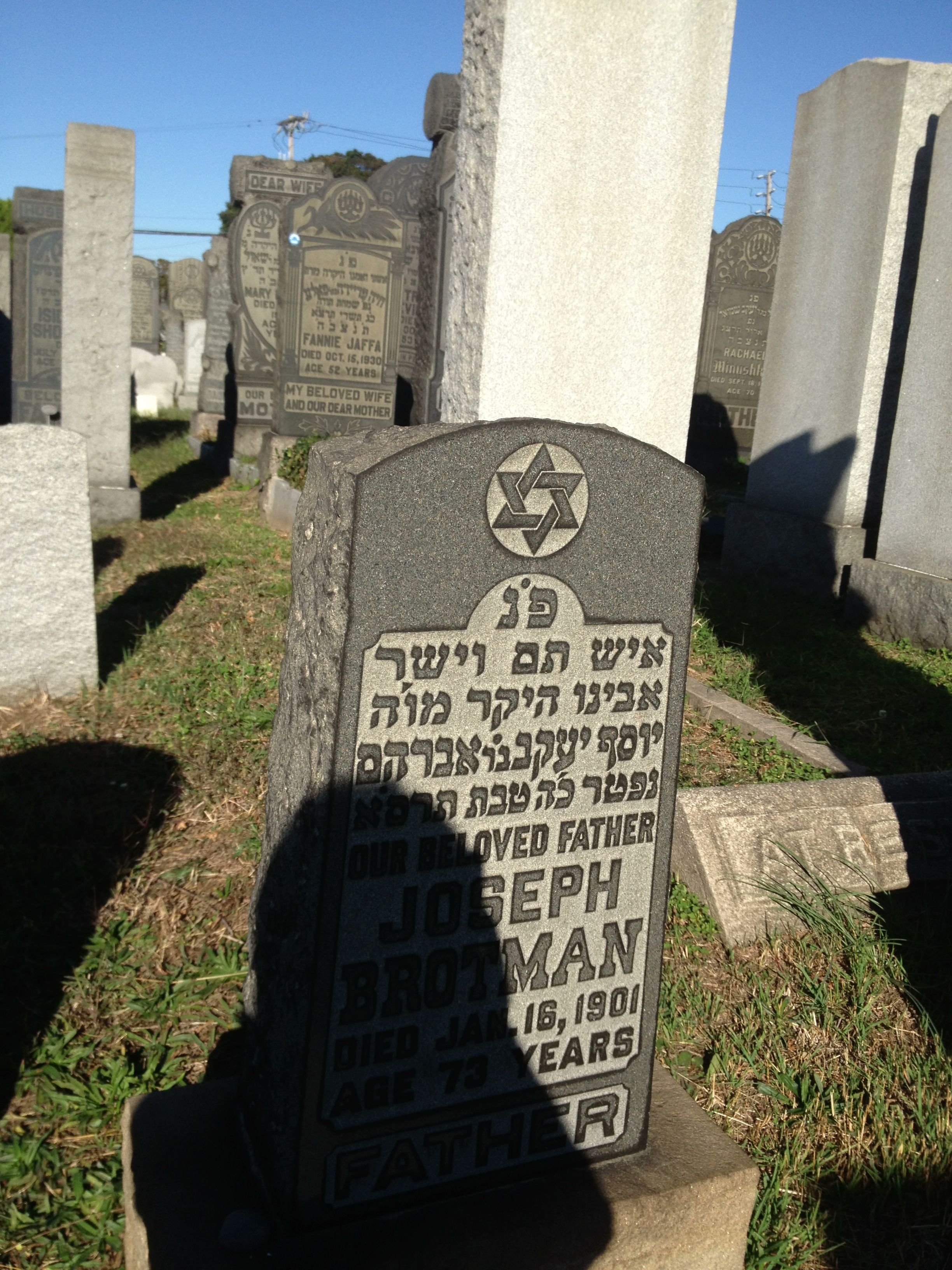
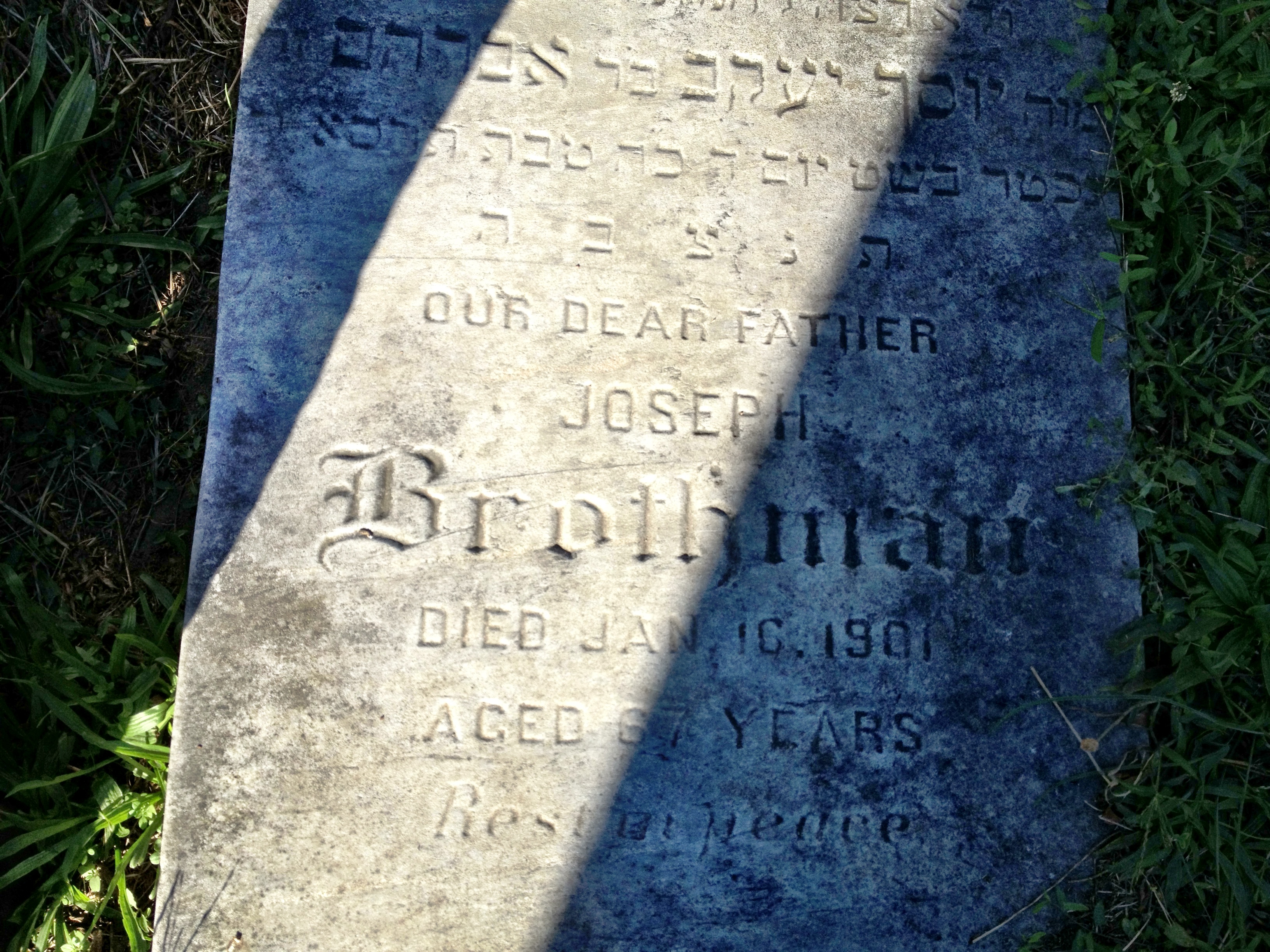
Most people know that in Jewish tradition, a child is often named after a relative who is no longer alive.[1]  It is also Jewish practice to identify a person in Hebrew with his or her father’s first name added to that person’s own first name.  For example, on his headstone Joseph’s name appears in Hebrew as Yosef Yakov ben Avraham, meaning that his father’s name was Abraham.  These naming patterns are a great help to genealogical research since often you can find names recurring through several generations, providing a means of establishing family relationships.

For example, we know that Bessie’s Hebrew name was Pessel and that her mother was named Gittel.  Bessie named her daughter Gussie for her own mother—in Hebrew, Gussie’s name was Hannah Gittel.  Then, in turn, I was named for Gussie’s mother, Bessie—in Hebrew, Pessel.  I then named my older daughter Rebecca Grace for my grandmother; her Hebrew name is Rivka Gittel.  So both Gittel and Pessel are names that recur through the generations and perhaps go back even further and perhaps will stretch further into the future.

Similarly, my brother Ira was named for our grandfather Isadore, whose Hebrew name was Ira.  Isadore’s father was Moritz/Moshe, and Isadore was named for Moshe’s father Ira.  Isadore in turn named his son Maurice for his father, and Maurice named his son James Ian and one of his daughters Robin Inez, the I being for Maurice’s father Isadore.  So the M’s and the I’s keep recurring in our family.  My younger daughter Madeline (Mazal Ahava) was named in part for my uncle Maurice (as well as for my husband’s uncle Murray), and there are several other M’s in the family among the fifth generation.
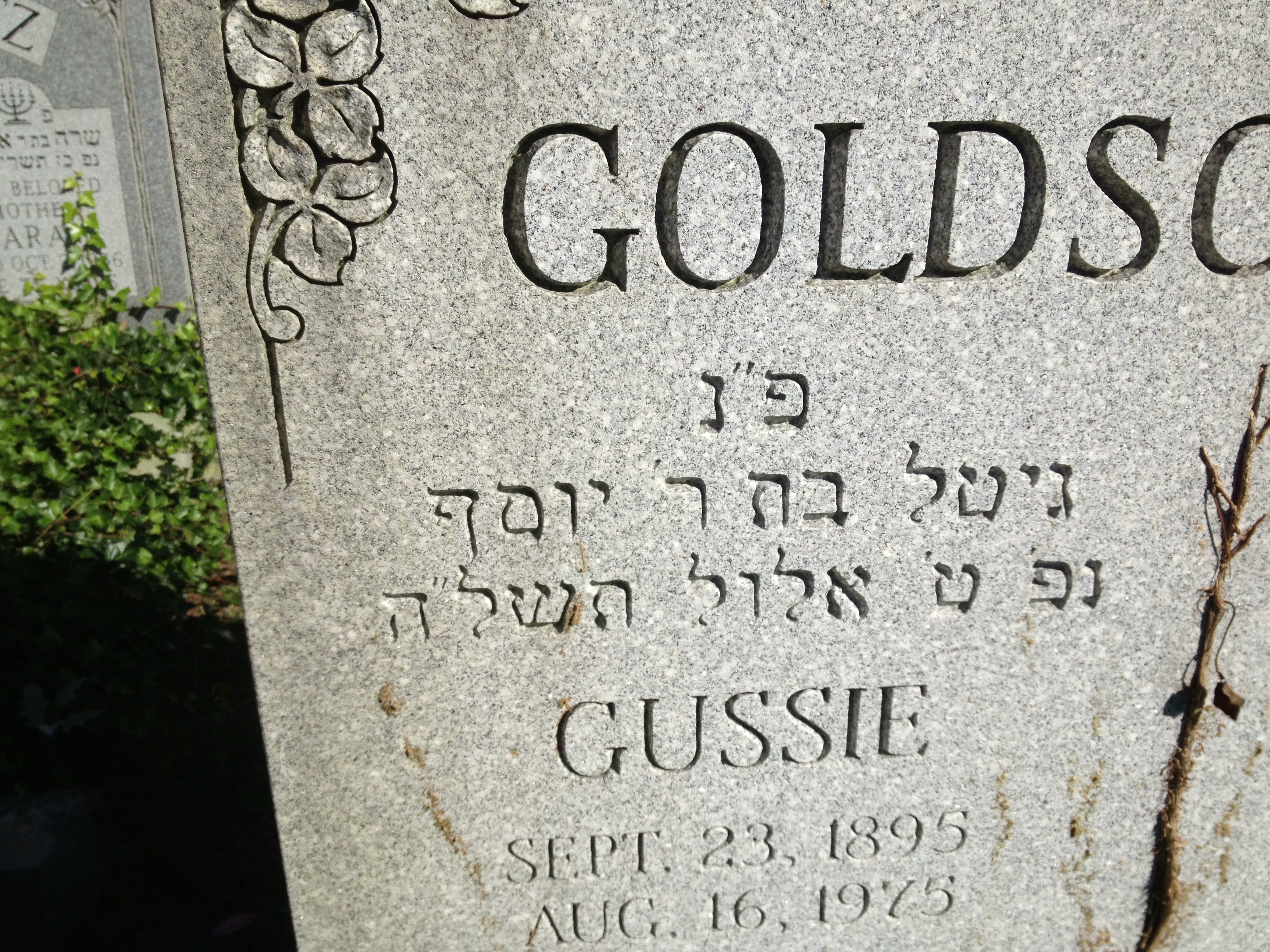
I am sure each of you can find similar recurring patterns in your own branches of the family.  There certainly are many B/P names and J names that run throughout our family tree.   Some of them undoubtedly are for Bessie/Pessel and Joseph or one of their descendants.

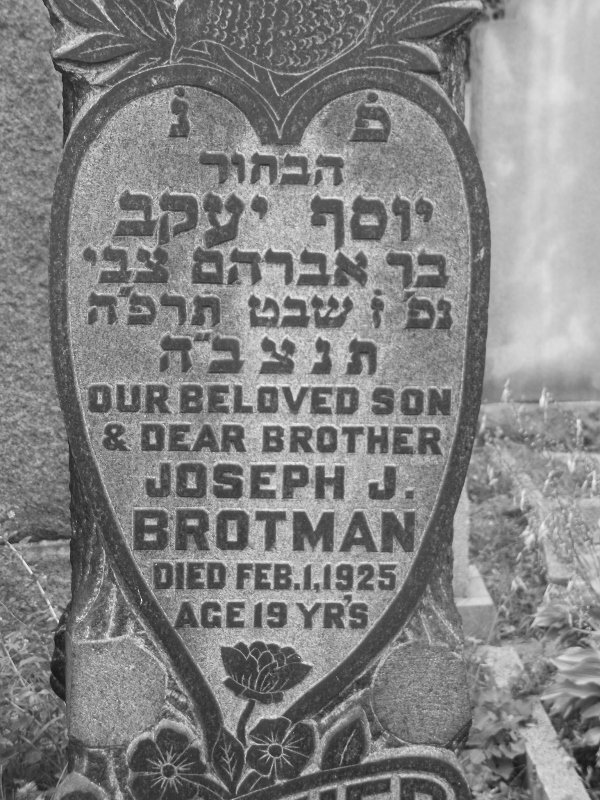
Why do I bring this up now? Well, after receiving Abraham’s death certificate and being bewildered by the fact that it records his parents’ names as Harry and Anna, I consulted with my mentor Renee.  She asked me several questions that reassured me that the death certificate is most likely incorrect.  First, she said look for naming patterns.  That reminded me that Abraham’s oldest son was named Joseph Jacob—Yosef Yakov on his headstone.Image  If Abraham’s father was named Harry, then why would he have named his son Joseph and not Harry? In fact, there are no Harrys or H names among Abraham’s children or grandchildren.

In addition, Renee pointed out that Abraham’s full name on his headstone is Avraham Zvi ben Yosef Yakov.  Zvi is a Hebrew name that means “deer” and in Yiddish was usually translated into Hersh or some Americanized version: Harry, Herbert, or (as in the case of my husband) Harvey.  Renee also pointed out that Abraham’s American name was Abraham H. Brotman.  She said it was extremely unlikely that his father’s name would have been Harry or Hersh/Zvi also (unless, of course, his father had died before Abraham was born, which does not seem likely).  By looking at the naming patterns, I am now convinced that it is unlikely that Abraham’s father’s name was Harry and that the death certificate is not correct and the headstone is.  Perhaps the Zvi/H in his name was for his maternal grandfather. Maybe that’s how it ended up on his death certificate.

So, cousins, do you know who you were named for? Do you know what your Hebrew name is? What your parents’ Hebrew names are? It would be really helpful and interesting to me and perhaps to others to know this information as it may open other doors for more research.  If you are willing to share that information, please let me know by using the comment box below so that we can all share this information.  Thank you!


[1][1] At least that has been the tradition among Ashkenazi East European Jews.  German Jews apparently did not always adhere to this tradition.  For example, my father’s name is the same as his father, John Nusbaum Cohen, and until he was an adult, he used “junior” after his name.  Moreoever, his sister’s name was the same as their mother—Eva.

Mt Zion and Mt Hebron

[This is the second part of my post about the weekend in New York. If you haven’t read the post about the Lower East Side, that is Part One. This is Part Two.]

Before I write about my trip to Mt Zion and Mt Hebron cemeteries, let me tell you that I have never been someone who understood why people go to cemeteries, and it always seemed a little creepy to me. I don’t believe in an afterlife, and it seemed to me that you could remember those who had died without standing over the place where their bodies were buried.

I initially saw a cemetery trip this time as a way of doing more research. Then when I realized that Joseph was not buried near any of his children or his wife, I felt badly. It was likely no one had been there for a hundred years. Did that matter? Joseph didn’t know, so why did I care? I am not sure, but somehow I felt compelled to pay him honor. In fact, once I received the photos of the headstone and footstone from Charlie Katz, I no longer needed to go for research. I was going for some emotional reason that was mysterious even to me. The trip to Mt Hebron, which is only ten minutes away from Mt Zion, then seemed like an obvious addition to the trip to Mt Zion.

So off we went on Sunday morning, first to Mt Zion. It is one of the oldest Jewish cemeteries in New York City, and the graves are very close together with almost no open land left. I knew from Charlie Katz that it would be hard to find Joseph’s gravesite. The stones are so close together that it is very difficult to walk between and around them, and without Charlie’s directions, we might never have found it. But then suddenly we spotted it.

Image

Image

I stood there, not really knowing what to do or to think. I thought of his life, thanked him silently for bringing his family here, tried to imagine what he looked like. Did he have red hair? No idea. Then I left on the headstone one of the beach rocks I had collected the prior weekend. I had decided to bring a piece of something I loved to leave at the graves, and the beach is the place that always makes me the happiest. I left feeling that I had at least done something to honor his memory.

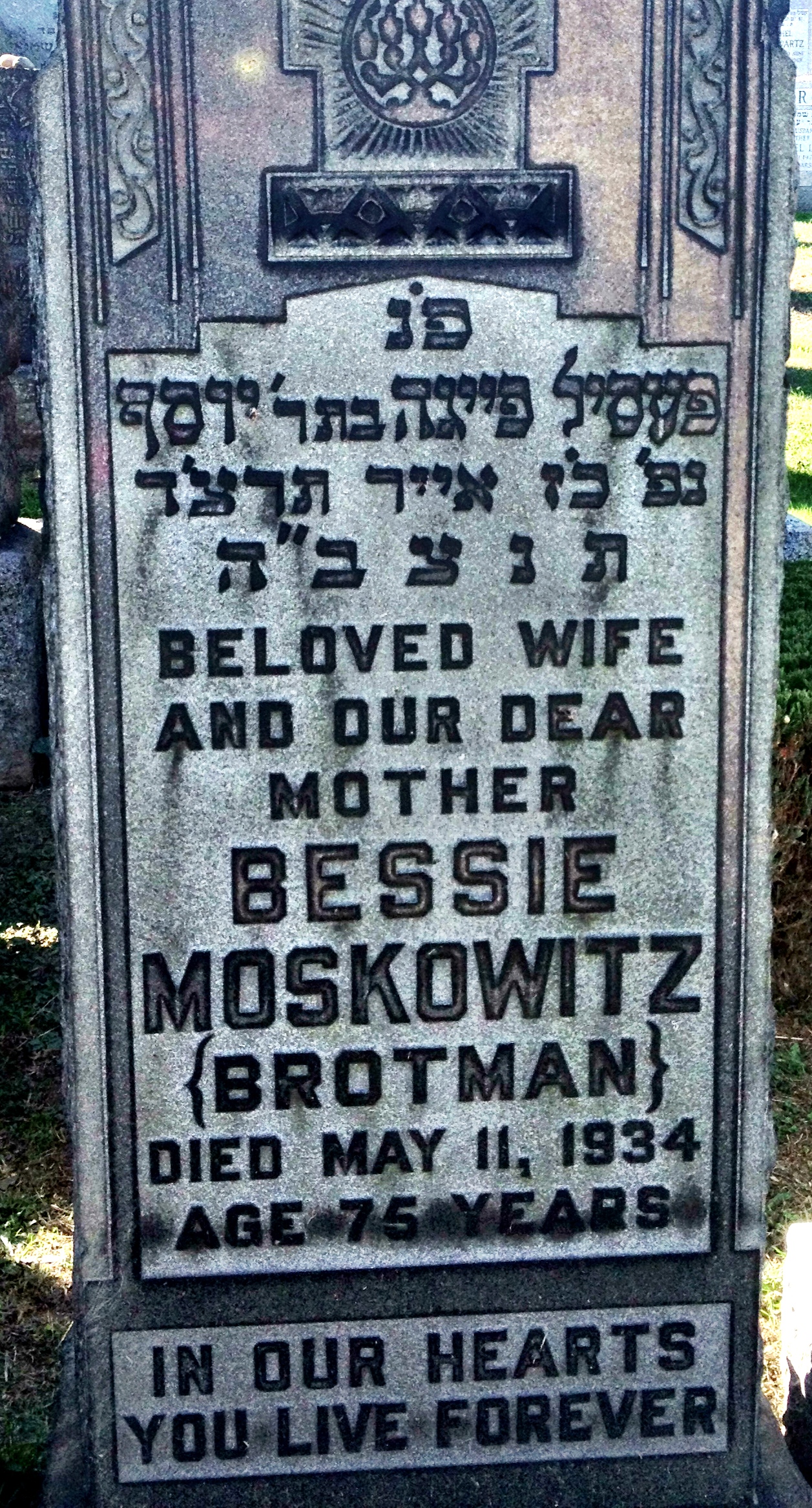
Then we went on to Mt Hebron, a much larger and much less crowded cemetery. The section where Bessie is buried is across the road from the section where my grandparents and Sam are buried. [What I didn’t know then is that Frieda is also buried there, but that’s a story for another post.] I saw Philip’s headstone right away, but did not realize that Bessie’s was right behind it, as you can see in the photo below.

Image

It took some counting and looking, but finally Harvey spotted it. I felt the same way standing at Bessie’s grave—grateful and wistful. I found myself drawn to her name—both in Hebrew and in English—and rubbed my hand over the name Bessie, saying, “That’s my name.” I also was very touched to see that the Brotman name was included on her headstone, not just Moskowitz.

Image

I left one of my beach rocks there as well and then walked across the street to the other section.

In that section I first saw Sam Brotman’s headstone. I never met Sam, and I really felt badly about that, given that he lived until I was 22 years old. I left a beach rock on his stone, saying, “I am sorry I never met you.”

Image

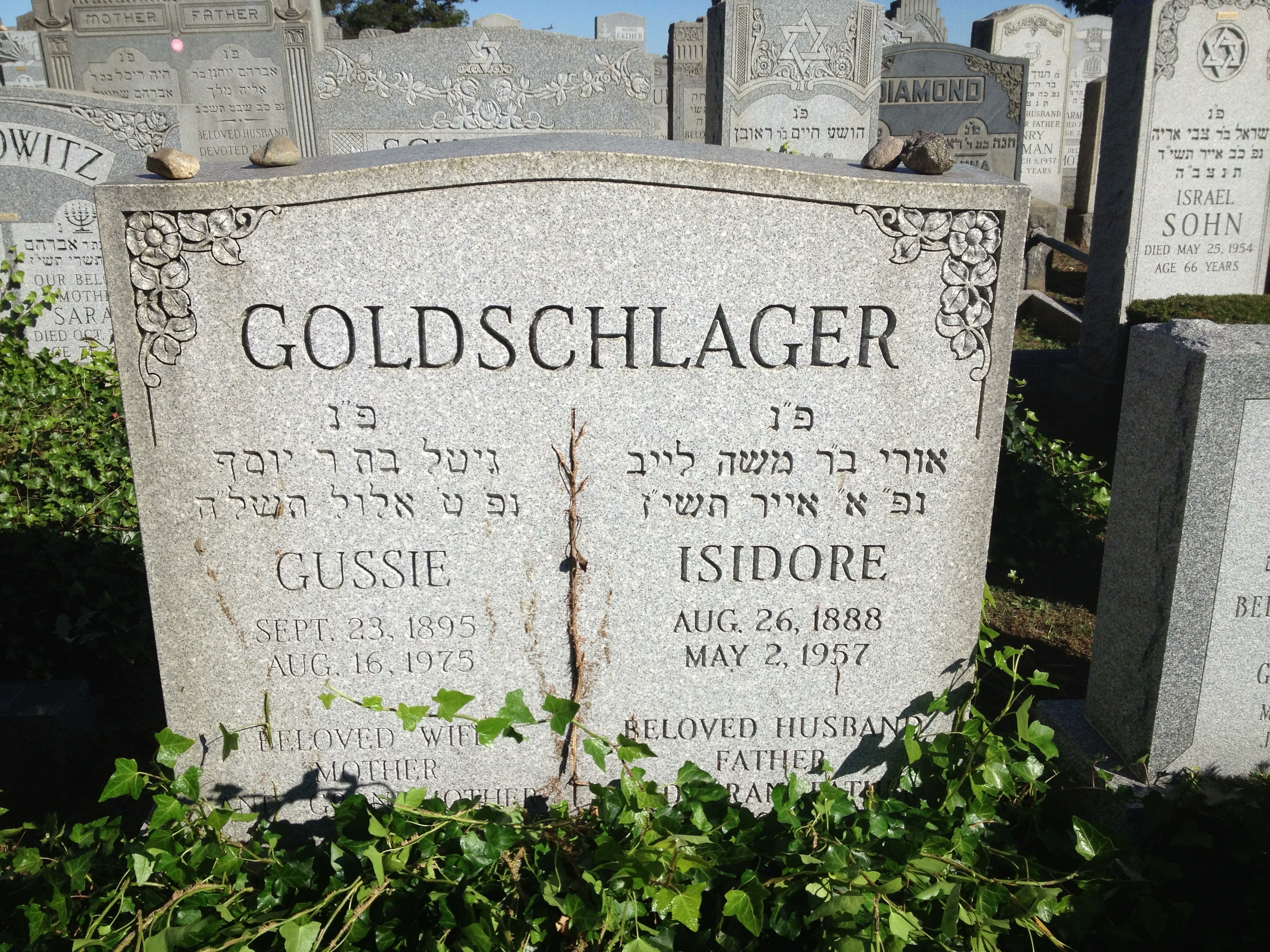
In the row behind Sam’s grave I found my grandparents’ grave. The headstone was covered with ivy, which looked pretty but made reading the inscriptions impossible. I gently tore away the ivy so I could see the stones.

Image

My grandfather died when I was almost five, so I have only the vaguest memories of him, but have heard lots of stories about him—how funny he was, how smart he was (he knew several languages), and how opinionated. He walked across Romania to escape oppression and poverty. I wish I had had a chance to know him better. There was a rock left on his headstone when we arrived. Who could have been there? I don’t think it could have been anyone recently, but perhaps it had been there for many years. I placed mine next to it and rubbed his name.

Image

Seeing my grandmother’s headstone was the most difficult for me. She lived until I was 23, and when I was a little girl I loved her very much. She was fun and loving with her grandchildren, despite having had a difficult and often sad life. I have thought of her so many times while doing this research and learning what her life was like, but standing there, thinking of her, I suddenly was overcome with emotion and found myself sobbing, thinking of her and her life and the memories I have of her. As I did with Bessie and Isadore, I found myself rubbing my hand over her name, Gussie, feeling some unexpected emotion in doing so. I left my beach rock, specially selected for her, and wished I had asked her more questions while I could have.

Image
Apparently, I was wrong. Going to the cemetery can bring you closer to those who are gone.

The Lower East Side

The Lower East Side

I just returned from a wonderful weekend in NYC.  Although seeing my grandson Nate (and his parents and his great-grandparents) was the best part of the weekend, I also had an opportunity to do two things I’ve wanted to do for a while: go to the Lower East Side and see where the Brotmans lived in the early 1900s and go to the cemeteries where my great-grandparents and grandparents are buried.  I am going to divide those two experiences into two posts rather than one.  This one will be about the trip to the Lower East Side.

On Saturday morning Harvey and I left our hotel down near Wall Street and walked north through the financial district and Chinatown, under the Brooklyn, Manhattan and Williamsburg bridges, to the Lower East Side. As we crossed streets like Grand, Henry, and Delancey, I tried to imagine what that neighborhood would have been like on a Shabbat morning a century ago.  Now it is a mix of various ethnic groups, but I was surprised to see a number of Orthodox and ultra-Orthodox men dressed for shul, walking past us.  I hadn’t expected to see any sign of a Jewish community surviving there.  As we passed two men dressed in Satmar garb (big furry hats, long black coats, beards and payes), I wondered, “Did Joseph dress anything like that? Were they at all observant? Did they go to shul? Or were they completely non-religious once they got to the US?’  I know that my grandmother had a kosher kitchen at first, but gave that up by the time I knew her.  She was not at all religious, and I know that my grandfather was also not at all religious.  What about your grandparents? Do you know how observant any of them were?

We crossed under the Williamsburg Bridge and then down Broome Street to where it intersected Ridge Street.  Joseph and Bessie lived at 81 Ridge Street in 1900; it is where they lived with Max, Hyman, Tilly, Gussie, Frieda and Sam.   It is also where Joseph died in 1901.  The picture below shows the corner of Broome and Ridge:

Image

We walked down Ridge to where 81 once stood.  There is now a school there, as you can see :Image

Although I was sad that there was no longer a tenement building there, I thought that having a school there was the best possible alternative.  Education helped our predecessors and all of us get to where we are today, so replacing what was probably a run-down tenement building with a modern new school seems appropriate.

Across the street at 80 Ridge is a newer building also, so obviously the original buildings are all gone.

Image

I took these pictures at the corner of Ridge and Rivington where there was an older building.  Perhaps that was more like the one where our family lived.

ImageImage

As we walked up and down the street, I tried to imagine my grandmother being a little girl, living there.  I thought of her being just five years old when her father died, and how awful that must have been for them all.  And I thought of poor baby Samuel who was four months old and would never know his father.  It must have been a sad and very hard time for them all.

New York City is a remarkable place.  The layers of history are all there, and you can feel them as you walk from neighborhood to neighborhood.  Ridge Street is a nice street with clean and newer apartment buildings.  You wouldn’t know today that it once was a crowded street with tenements filled with new immigrants, speaking Yiddish, and struggling to survive in what was supposed to be a place with streets lined with gold.  As we walked past Asian and Latino residents who themselves are likely immigrants or the children of immigrants, I realized how that experience continues to make New York the rich, fascinating and challenging city that it is.  I may have left the New York area long ago, but it still calls out to me as my home.  I am sure the same is true for many of you, whether you are living in Ohio, Virginia, South Carolina, California, Georgia, Connecticut, Massachusetts—or New Jersey or Long Island.

Isn’t it also interesting how some of the fifth generation children have returned to New York City themselves?

WHY

I wrote about how I started doing this research and what resources—human and otherwise—I’ve used to do it.  But I’ve given a lot of thought also to WHY.  Why am I doing this?  Why spend all this time, energy, money, etc. doing this?  What is it for?

Part of it is the fun and the excitement of hunting down information and then actually finding it.  Part of it is the reward of learning that I am connected to all these other people I never knew—that we shared ancestors and DNA and a history together, even if we’ve never met. And I hope that part of those rewards will be meeting you all in real space, not just cyberspace.

But it is more than that.  Someone involved in genealogy research told me that most people do not get involved with this kind of project until they are in their sixties.  I turned sixty last summer when I first started doing this.  Sadly, by the time we’re sixty, our grandparents are long gone, so our principal sources of information about our ancestors are not around to help.  But why do we get interested in our sixties? Obviously, as we start to face our own mortality, we must yearn for a sense of purpose.   Will anyone remember us in 100 years? That leads to—where did we come from? Who were the people who preceded us that we no longer remember? We’re all part of a long line of family history, and at some point many of us yearn to figure out what that history was.

I never, ever thought about my great-grandparents until I started this project.  I knew I was named for Bessie, my great-grandmother, but I never wondered what she was like, what was her life like, why did my parents choose to name me for someone who died when my mother wasn’t yet four years old.  I still don’t know the answers to all those questions, but I know more than I did a year ago.  She was a brave woman who married a man with at least two children from a prior marriage, both of whom were young boys in 1881 when she married him.  She had at least five children of her own with him, and probably others who died very young.  She left everything she knew to come with her young children to America, and then she lost her husband not long after doing so.  She picked herself up, remarried and helped raise more children.  She lost a leg to diabetes.  I know she loved animals because the one clear memory my mother has of her was that she played with kittens in her grandmother’s bathroom as a very young child.

And Joseph?  I have learned to admire him as well.  He came to the US before Bessie, establishing himself as a coal dealer.  He worked very hard at back breaking work to support his family and died just four months after his youngest child Sam was born.  From his footstone inscription, we know that his children and wife loved him and appreciated the hard work he did to bring them to the US and support them when they got here.

So what does all that mean to me? It means I came from people who were strong, brave, hard-working and dedicated to their family—all traits I admire and aspire to myself.  They obviously raised children who adapted well to America and made successes of themselves.  Those children, our grandparents, raised Americans, our parents, who moved to the suburbs, owned businesses, became professionals.  And then there is us—the fourth generation.  We are spread all over the US, we are involved in all different types of careers, we are the American dream.  Wouldn’t our great-grandparents who were raised in a shtetl and escaped poverty and anti-Semitism be amazed at who we are today?

So why? Because we need to know how we got here, why our lives are what they are.  We need to be grateful for those who left Europe, avoided the pogroms and Hitler, and gave us all the opportunity to live in freedom and to pursue our own dreams.