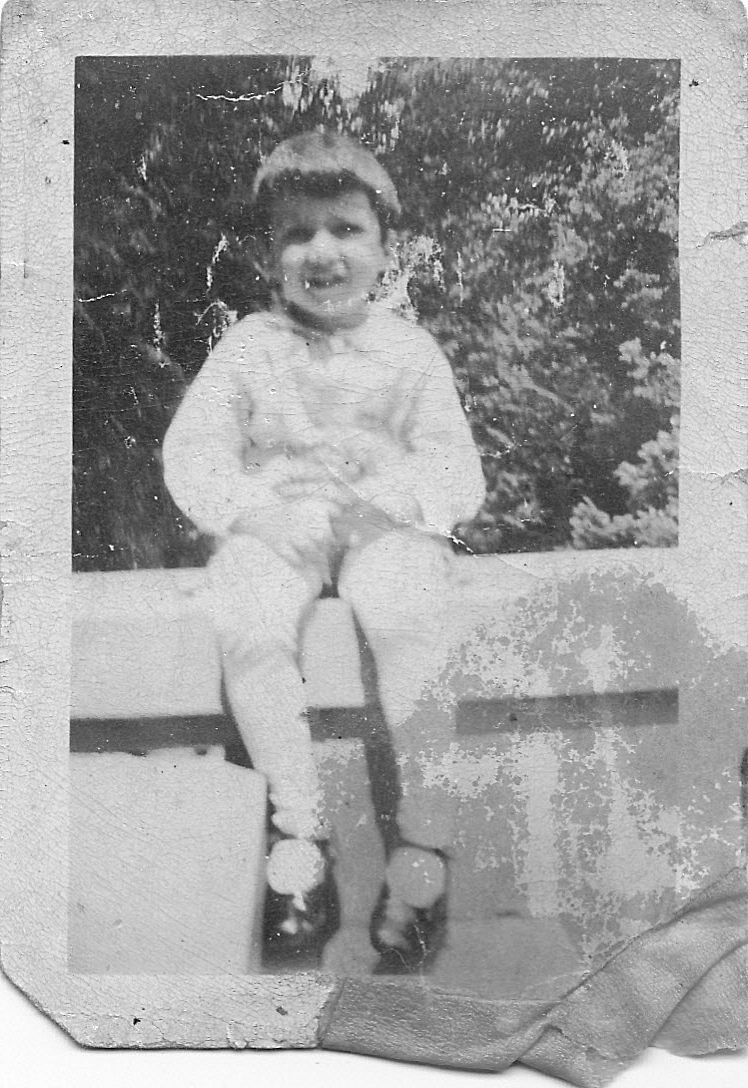
Number Thirteen, the Caboose: Abraham Cohen 1866-1944

Caboose 995 at the Transportation Museum.

Caboose 995 at the Transportation Museum. (Photo credit: Wikipedia)

Of the thirteen children born to my great-great-grandparents Jacob and Sarah Cohen, only one was still alive in 1928.  He was also the only one to live through not only the 1930s, but into the 1940s as well.  He was one of only three to live into his seventies and the only one to live past 75 years old.  He was also the last born, the baby of the family, Abraham.  Like all his siblings, he had a life that had plenty of heartbreak.

Abraham was born on March 29, 1866.  His oldest sibling, Fanny, was twenty years old when he was born and was married that same year.  Joseph, his oldest brother, was married two years later.  But in 1870 Abraham had ten older siblings still living in his household at 136 South Street.  His first real heartbreak occurred when he was thirteen and his mother Sarah died in 1879.  Fortunately he still had six siblings living at home as well as his father. By the time he was fourteen in 1880, he was already working in his father Jacob’s store.

On February 9, 1886, Abraham married Sallie McGonigal, daughter of James and Sarah McGonigal, in Camden, New Jersey.  Their first child, Sallie, was born in 1886.  I do not have a birth record for her, but sadly, I do have her death certificate.  Sallie died on November 1, 1892, when she was six and a half years old from scarlet fever. She was buried in at Old Cathedral Catholic Cemetery in Philadelphia.

Sallie Cohen death certificate

Sallie Cohen death certificate

Assuming that the child Sallie was born then in April or May, 1886, either she was born very premature or Sallie was already pregnant when they married. Abraham and Sallie would both have been only twenty when they married, although their marriage record listed their birth years as 1864, not 1866.  I am speculating here, but since they were married out of state and under age and since it seems likely that Sallie was pregnant and since Sallie was apparently Catholic and Abraham was Jewish, I am going to venture a guess that their parents did not approve of the relationship.

But Abraham and Sallie’s marriage survived.  They had a second child, Leslie Joseph Cohen, who was born on May 20, 1889.[1] In December, 1891, they had a third child, Ethel, who only lived four weeks.  She died from convulsions on January 27, 1892.

Ethel Cohen death certificate

Ethel Cohen death certificate

Then ten months later, they lost Sallie to scarlet fever. Sometime after those deaths, the family moved from where they had been living at 622 Annapolis Street to 707 Wharton Street, where they remained for many years.

The young couple weathered those terrible tragedies and had a fourth child, Raymond, on February 15, 1894.  He died eight months later from gastroenteritis and was also buried in Old Cathedral Catholic Cemetery with his sisters Sallie and Ethel.

Raymond Cohen death certificate

Raymond Cohen death certificate

In the space of just over two years Abraham and Sallie had lost three young children.  Three years later, Abraham and Sallie lost another male baby to premature birth on October 11, 1897; he was stillborn.  Interestingly, that baby was buried at Mt Zion cemetery.  Would a Catholic cemetery not accept a stillborn baby?

Stillborn baby Cohen death certificate

Stillborn baby Cohen death certificate

In 1900, Abraham, Sallie and their one surviving child, Leslie, were still living at 707 Wharton Street, and Abraham was working as …. a pawnbroker, of course.

Abraham Cohen and family 1900 census

Abraham Cohen and family 1900 census

Unless I missed the birth and death of other children, it seems that after not having any children for over ten years, Abraham and Sallie had one more baby.  Arthur was born on December 9, 1907, according to the Pennsylvania birth index. Assuming that Sallie was born in 1866, she was over 40 years old when he was born.  In the 1910 census, Abraham, Sallie, Leslie, and Arthur were all living at 2433 North 17th Street; in addition, Sallie’s sister, Mary McGonigal, was living with them as well as a servant whose duties were described as “nurse girl.”  I assume she was taking care of Arthur.  Abraham was still working as a pawnbroker.  Leslie was nineteen and an apprentice machinist.  Arthur was two years old.

Abraham Cohen 1910 census

Abraham Cohen 1910 census

In 1917 Leslie registered for the draft.  He was working as a machinist at Remington Arms in Eddystone, Pennsylvania, where his Aunt Hannah’s husband, Martin Wolf, was also employed during that period.

Leslie Cohen World War I draft registration

Leslie Cohen World War I draft registration


Leslie served in the military from 1917 to 1919, according to one record.[2]  He served in Aero Squadron 490, as seen on his headstone below.  I was able to track down a detailed five page document from Gorrell’s History of the American Expeditionary Forces Air Service, 1917-1919,  describing the service of  Leslie’s squadron during World War I by using the Fold3.com website.

490 Squadron report, p. 1

490 Squadron report, p. 1

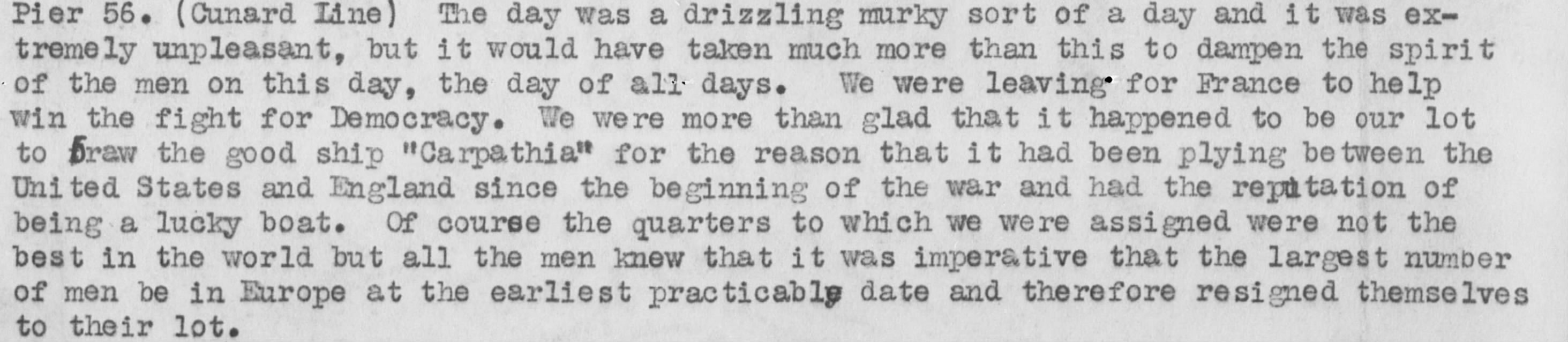
I cannot capture all the details of his squadron’s service, but in brief, the squadron trained in San Antonio, Texas; they then traveled by train and boat from there to Long Island City in New York to await their orders to ship overseas.   They received those orders and shipped out of New York to England on November 22, 1917.

leslie service partial quote

The report details the rather uncomfortable conditions the men encountered while traveling from New York to Halifax to Liverpool, England over a sixteen day period, although they did not face any danger from enemy forces while traveling.  They arrived in Liverpool on December 8, 1917, and then left for France on December 13, 1917, where they were first stationed at Saint Maixent and then at Romorantin.  In both locations, the squadron was engaged in building barracks and other buildings for the soldiers.  They also built over sixteen miles of railroad.  The report described in detail the facilities at their second location and the work that was done.  It ends after the Armistice was signed, saying that the squadron was awaiting their orders to return to the United States.  Leslie J. Cohen is listed three times in the course of the report on the roster of men who served with the 490 Squadron, including on the final page shown below.

Leslie J. Cohen on roster

Leslie J. Cohen on roster

(M990;Publication Title: Gorrell’s History of the American Expeditionary Forces Air Service, 1917-1919
Publisher: NARA
National Archives Catalog ID: 631392
National Archives Catalog Title: Gorrell’s History of the American Expeditionary Forces Air Service, compiled 07/05/1917 – 08/31/1919, documenting the period 05/26/1917 – 03/31/1919
Record Group: 120
Short Description: NARA M990. Historical narratives, reports, photographs, and other records that document administrative, technical, and tactical activities of the Air Service in the American Expeditionary Forces during World War I.
Roll: 0021
Series: E
Series Description: Squadron Histories)

Back home in Philadelphia, Abraham’s wife  Sallie died on March 14, 1919, and surprisingly was buried not with her children at Old Cathedral Catholic Cemetery, but at Holy Cross Cemetery in Yeadon, Pennsylvania. The family was residing at 5926 Cobbs Creek Parkway when she died, which was only a mile from Holy Cross Cemetery; nevertheless, Cathedral Cemetery, where so many of her children were buried, was only three miles away.  I wonder why she was not buried with her children.  Sallie died from influenza, pneumonia and bronchitis.  This was the time of the deady Spanish flu epidemic that killed millions of people worldwide.  Sally was about  fifty years old when she died, and her son Arthur was only eleven years old.

Sallie McGonigal Cohen death certificate 1919

Sallie McGonigal Cohen death certificate 1919

As of January 10, 1920, when the next census was taken, Abraham, now a widower, was still living at 5926 Cobbs Creek Parkway with his sons Leslie and Arthur, his sister-in-law Mary McGonigal, and a servant.  Abraham was still a pawnbroker; Leslie was a machinist in the shipyard, having returned from military service.  Arthur was in school.

Sometime later in 1920, Abraham married Elizabeth Beisswagner Grady, whose husband Robert Grady had died in 1918 and, interestingly, is also buried at Holy Cross Cemetery in Yeadon, Pennsylvania.  Had Abraham met her at the cemetery? At the church? Elizabeth had several children from her first marriage, though all would have been adults by 1920.  Abraham was 54 when they married, Elizabeth was 46.

In 1927, Leslie reenlisted in the army, and on the 1930 census he is listed as a soldier in the US Army, stationed at Fort Hancock in Middletown Township, New Jersey.  He served from August 23, 1927 until August 22, 1930, when he was honorably discharged.

Leslie Cohen 1930 census

Leslie Cohen 1930 census

In the 1931 directory for the city of Richmond, Virginia, Leslie is listed with his wife Emma L. and was employed as a machinist.  Thus, sometime between the date of the 1930 census and the date of the Richmond directory, he had gotten married and moved to Richmond. He was later admitted to the Veterans Administration Hospital in Virginia on October 24, 1932, and released on February 3, 1933.  I cannot tell from the record why he was admitted or why he stayed for over three months in the hospital.  The hospital record also indicated that he was married to an Elizabeth L. Cohen (presumably a mistake; other records corroborate that her name was Emma), living in Washington, DC.

Leslie Cohen VA Hospital record

Leslie Cohen VA Hospital record

Meanwhile, back in Philadelphia, Abraham, Elizabeth, and Arthur were living at 5530 Walnut Street according to the 1930 census.  Abraham was still working as a pawnbroker, and Arthur was working as a porter at a gas station.  Abraham, who was now 64 years old, had outlived all his siblings at this point as well as his first wife and several of his children.  I find it interesting that neither of his two sons became pawnbrokers, given the Cohen family’s overall involvement in that industry.

Abraham’s second wife Elizabeth died on August 4, 1939, from heart disease.  They had been living on Spruce Street, where Abraham is listed as living alone on the 1940 census.  He was still working as a pawnbroker at age 74.  Elizabeth was buried with her first husband Robert Grady at Holy Cross Cemetery in Yeadon.

Abraham died on April 29, 1944, when he was 78 years old.  He also was buried at Holy Cross Cemetery in Yeadon with his first wife Sallie.  His death certificate was subject to a coroner’s inquest for some reason, but the inquest found that he died from arteriosclerosis.

Abraham death certificate 1944

Abraham death certificate 1944

abraham cohen amended death cert


The only strange thing about his death certificate is the description of his occupation: elevator operator.  After a lifelong career as a pawnbroker, why would Abraham have become an elevator operator?  The informant on his death certificate was Bernard Sluizer, Abraham’s brother-in-law, the widower of Abraham’s sister Elizabeth. Bernard would die just four months later.  Why would Bernard have been the informant? Well, all of Abraham’s siblings had died many years earlier, as had all their spouses except for Bernard and Jonas’ wife Sarah. Leslie was living in Richmond, Virginia.  I don’t know where Arthur was at that time.

Leslie and his wife Emma continued to live in Richmond, Virginia during the 1930s and 1940s.  According to the 1940 census, Emma was almost twenty years older than Leslie.  She is reported to have been 67 in 1940 while he was 48.  Leslie also appears never to have returned to his skilled position as a machinist.  On various Richmond directories throughout this period, his occupation is described as a helper, one time specifying at a Blue Plate Foods.  It is obviously hard to make too many inferences, but given his hospitalization and his low skilled employment afterward, it would seem that Leslie might have been disabled in some way after his second service in the army.   Leslie died on May 13, 1966, and is buried at Fort Harrison National Cemetery in Richmond, Virginia.

Leslie Joseph Cohen headstone

As for Arthur, I just am not sure.  There were two Arthur Cohens living in the Philadelphia area who were born in Pennsylvania in or about 1907, according to the 1940 census.  Both were married. One was working as a manager in a bottling company, the other as a mechanic in a garage.  Since Arthur was working in a gas station in 1930, I am inclined to think that it is more likely that he was the second Arthur, who was married to a woman named Claire.  They were living in Upper Darby, a Philadelphia suburb in 1940, but had been living in Philadelphia in 1935, according to the 1940 census.  If this is the right Arthur Cohen, it seems that he and Claire moved out to California at some point, living in Burbank in the 1970s and 1980s, and then to Las Vegas thereafter where Claire died on June 11, 1998.  I am still not positive I have the correct Arthur, so will continue to look for more records or documents to corroborate my hunch.

Thus, there are some loose ends here.  I don’t know the full story of Leslie and his wife Emma, but if the ages on the 1940 census are correct, it seems very unlikely that there were any children.  Arthur’s story is even more unfinished.  Without a marriage record or a death certificate, it’s impossible to be sure that I have found the right person.  I also do not have any idea whether Arthur had children.

Looking back over Abraham’s life is painful.  He lost so much—his mother when he was just 13, his father nine years later, and all his siblings between 1911 and 1927.    Three of his children died when they were very young, and he outlived two wives.  One son had moved away to Richmond, Virginia, possibly disabled in some way.  The other one seems to have disappeared or moved out west at some point.  I have this sad image of Abraham as a man in his seventies, living alone, working as an elevator operator, and having only his brother-in-law Bernard Sluizer around as his family (and perhaps many nieces and nephews as well).

I hope I am wrong.

************

That brings to an end, for now, the long story of the thirteen children of Jacob and Sarah Cohen, my great-great-grandparents.  I will reflect on what I’ve learned about them and try and synthesize it all in my next post.


[1]   Leslie’s birth year changed from record to record.  Sometimes it was 1891, sometimes 1892, sometimes 1893.  The record closest to his birth year was the 1900 census, which indicated that he was then 11 years old, giving him a birth year of 1889.  However, on the 1910 census, his age was 19, meaning he was born in 1891.  His two draft registrations also vary.  His headstone says 1892.  They all say his birthday was May 20, regardless of the year.

[2] Ancestry.com. U.S. National Homes for Disabled Volunteer Soldiers, 1866-1938 [database on-line]. Provo, UT, USA: Ancestry.com Operations Inc, 2007.

Original data: Historical Register of National Homes for Disabled Volunteer Soldiers, 1866-1938; (National Archives Microfilm Publication M1749, 282 rolls); Records of the Department of Veterans Affairs, Record Group 15; National Archives, Washington, D.C.

Jonas Cohen, Sr., 1863-1902:  Another Tragic Accident and a Life Cut Short

The twelfth child of Jacob and Sarah Cohen was Jonas Cohen, sharing the name with his uncle, Jonas H. Cohen.  Jonas was born on August 15, 1863, and spent his childhood at 136 South Street.  When he was sixteen, he was already working as a clerk in the pawnshop, according to the 1880 census.

On February 21, 1892, he married Sarah Weil in New York City.[1]  Jonas and Sarah were living at 776 South 20th Street in 1895, and Jonas was working as a pawnbroker.  Their son, Jonas Cohen, Jr., was born on June 28 that same year.  In 1900, Jonas, Sarah, and their son were living at 2216 North Carmac Street; Sarah’s older brother Henry, who was also a pawnbroker and apparently in business with Jonas, was also living with them at that address.

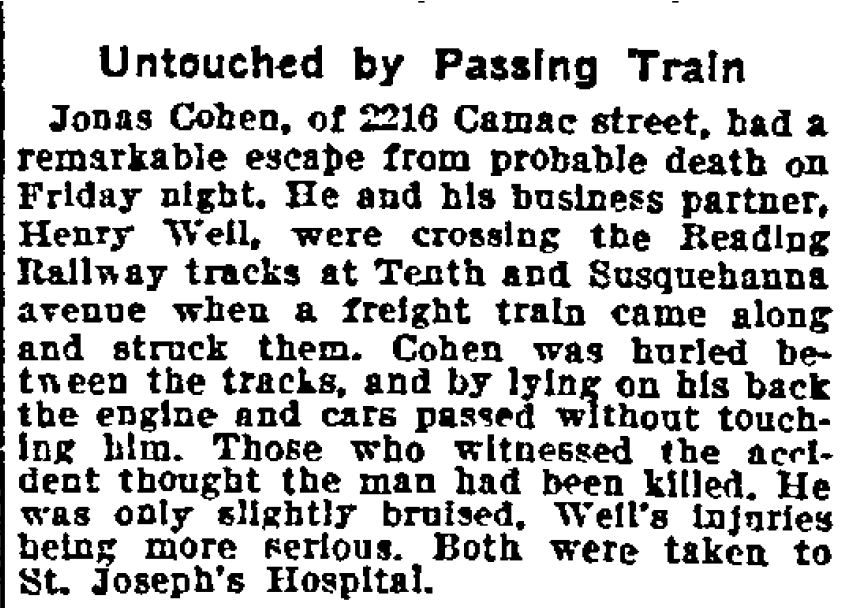
Less than two years later, tragedy struck the family.

jonas news article

(“Untouched by Passing Train,” Sunday, October 20, 1901, Philadelphia Inquirer (Philadelphia, PA)   Volume: 145   Issue: 112   Section: Third   Page: 11)

Although the paper reported that Weil’s injuries were more serious, Henry Weil survived the accident.  Unfortunately, his business partner and brother-in-law, my great-granduncle Jonas Cohen, ultimately did not.  Over three months later, on February 10, 1902, Jonas Cohen died from “traumatic delirium from injuries” sustained from an accident with the Pennsylvania Railroad, according to his death certificate.  He would have been 36 years old just eleven days after he died.  He left behind his young wife Sarah and his son Jonas, Jr., who was not yet seven years old.

Jonas Cohen death certificate 1902

Jonas Cohen death certificate 1902

Sarah apparently never remarried and lived with her father and/or her brothers for most of the rest of her life.  In 1910, she and Jonas, Jr., were living with Simon Weil, her father, and three of her brothers, Henry, Aaron, and Monroe, and Monroe’s wife Maude at 2524 Broad Street.  Sarah had been born and married in New York City, but at some point her father and at least several of her siblings had all moved to Philadelphia.  Sarah’s brothers Henry, Aaron, and Monroe were all pawnbrokers by 1910.  Her father had been in the dry goods business in New York.  Had Sarah’s husband Jonas lured them all to Philadelphia by offering to go into the pawn business with them?

In 1917 Sarah and her son were still living at 2524 Broad Street, and Jonas, Jr., had joined the pawnbroker business, now called Weil Brothers, located at 16th Street and Jackson, according to his World War I draft registration.  His uncle Monroe was also working for Weil Brothers, though at a different address.  The city directory for 1918 lists both Henry and Aaron Weil also as working for Weil Brothers and living at 2524 Broad Street.

The same was true in 1920.  Sarah and her son were living at 2524 Broad Street with her father Simon and her brothers Henry and Aaron. (Monroe and his wife had moved on and had a place of their own.)  Her brothers were working as pawnbrokers, and her son Jonas was a seaman in the United States Navy.

By 1930, Simon Weil had died, but his children Henry, Aaron, and Sarah continued to live together at the same address, and Jonas, Jr., now 36 years old and out of the Navy, continued to live with them as well.  All three men described their occupation as “money lender.”  By 1940, Jonas had married and moved out, but Henry, Aaron and Sarah, now all around 70 years old, were still living together at 2524 Broad Street.  Henry and Aaron had never married; Sarah had never remarried.  They had been living together as adults since at least 1910, and probably from the time Jonas, Sr., had died in 1902.  Had the awful accident that had led to Jonas’ death also scarred all of them in some way, making it hard for any of them to separate and move on with their adult lives?

The Weil Siblings 1940 census

The Weil Siblings 1940 census

Jonas, Jr., however, did leave and start a life of his own.  In 1936, he married Sally Coleman.  In 1940, they were living at 2201 Venango Street[2], and Jonas was still working as a pawnbroker.

Jonas, Jr. and Sally Cohen 1940 census

Jonas, Jr. and Sally Cohen 1940 census

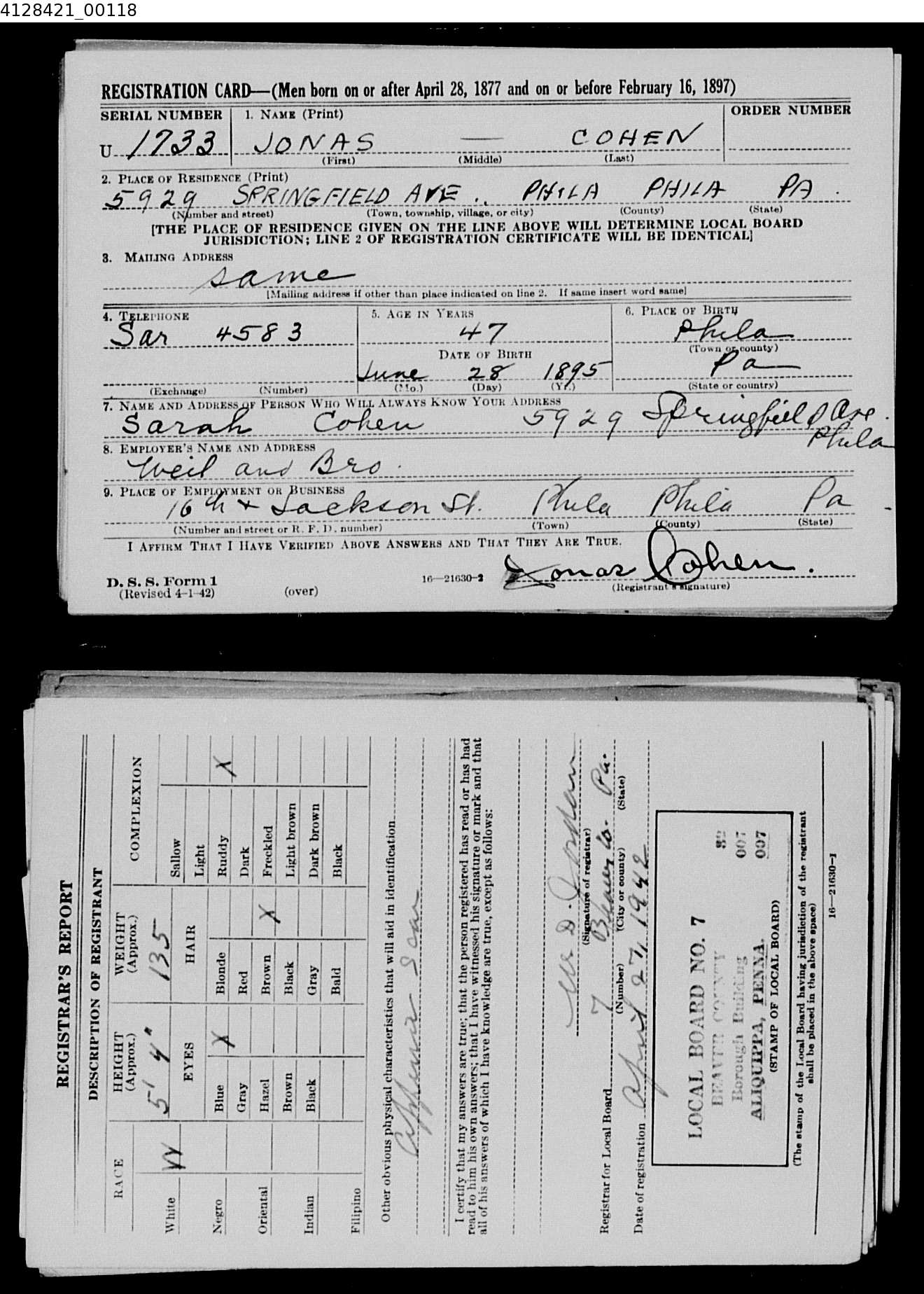
On his World War II draft registration he was living at 5929 Springfield Avenue, and his emergency contact was Sarah Cohen of the same address.  Unless Sally’s real name was Sarah, this would seem to refer to Jonas’ mother, not his wife, but I cannot be sure. Perhaps both his mother and his wife were living with him at that address.

Jonas Cohen, Jr. World War II draft registraiton

Jonas Cohen, Jr. World War II draft registraiton

Henry Weil died in 1945, or at least that is the date on the funeral bill paid by his brother Aaron.  It looks like he was cremated.  I could not find a death record for Aaron, but presumably he lived at least until 1945 since he paid that bill and since his death certificate is not in the database that runs up through 1944.  Neither Aaron nor Henry is buried at Mt. Sinai; their brother Monroe and his wife Maude Weil lived until 1953 and 1959, respectively, and are buried at Mt. Sinai. Perhaps Aaron and Henry were buried in New York at Union Field Cemetery like their father and presumably their mother.

Sarah died on June 18, 1959, and was buried at Mt Sinai next to Jonas, her husband of only ten years who had died almost 60 years earlier.  She was 89 years old, according to burial records.  Her sister Florence Weil Blaufeld had ordered her interment.

Sarah and Jonas Cohen’s son, Jonas, Jr., lived to be 90 years old.  He died on March 3, 1986, and is buried next to his parents at Mt. Sinai.  I could not find an obituary to help determine whether he ever had children or what he did from 1942 until 1986.  However, his interment order was authorized by someone named Sally Cohen.


[1] I thought that perhaps Sarah Weil was somehow related to Lewis Weil, who had married Jonas’ sister Rachel, but I cannot find a connection.  Even though Sarah’s father was named Simon, and Lewis’ brother was named Simon, even though both had ancestral roots in Germany, I could not find any definitive familial tie.

[2] My father was also living on Venango Street in 1940 with his mother and sister, according to the 1940 census.  I wonder if he knew that his father’s first cousin Jonas was living down the street.

The Eleventh Child of Jacob and Sarah Cohen:  My Great-Grandfather Emanuel (FINALLY!)

About a month ago, my father (who reads the blog regularly) asked me when I was going to get to his grandparents.  Although I wanted to get there also, my linear mind would not let me “skip ahead.”  I knew that if I did, I’d get too caught up in my direct ancestors and not want to return to all the “lateral” relatives.  So I have stuck, more or less, to my plan and taken each of Jacob and Sarah’s children in birth order.  (Yes, I had to skip Reuben and Arthur while waiting to hear from descendants, but otherwise, I went in order.)  There are still two more children to do after my great-grandfather, Jonas and Abraham, so I still have to resist the temptation to move on to my great-grandmother’s Seligman line.  Also, I still have to return to Jacob’s brother Moses and his family and also some of Jacob and Sarah’s grandchildren whom I’ve yet to research or discuss.

But for now, I finally get to talk about my father’s grandfather Emanuel and his family.  Sadly, my father never knew Emanuel because he died just a few months after my father was born.  There is no one else left for me to ask about Emanuel since there are no other descendants still alive who would remember him.  But my father knew his grandmother, Emanuel’s wife Eva May Seligman, very well, and he remembers other family members as well, although he has not seen or been in touch with them for more than 60 years.  And I never knew any of his Cohen relatives other than my aunt, Eva H. Cohen, who died in 2011.  I never met my father’s father or his uncles or his cousins.

Thus, most of what I know about Emanuel and his sons and their families is based on the same kind of resources I’ve relied upon in all my other research, sprinkled with some family stories from my father or indirectly from my aunt as my brother remembers them.  As I was writing this post, my father also sent me copies of pages from a  family bible that revealed some other dates of births, marriages, and deaths.  There is also a suitcase filled with photographs and papers in my parents’ garage that I have not yet had a chance to examine.  I hope to get to that suitcase soon, but it may have to wait until after the summer.

That means that right now I have no pictures of my Cohen great-grandparents and only a few of my grandfather.  I have none of his brothers or their children.  Of course, it is in part because of this lack of knowledge that I started doing this work in the first place.  I knew so little about any of my grandparents, less about my great-grandparents, and nothing about my great-great-grandparents.  Now I am working hard to fill in those gaps.

So let me start to tell the story of my great-grandparents Emanuel and Eva Seligman Cohen, and eventually I will have to come back and add some pictures and other materials, assuming some exist in that suitcase.

My great-grandfather Emanuel was the eleventh child of Jacob and Sarah Cohen, born June 10, 1862, during the Civil War.  (The family bible has a different date—June 14, 1860, but given that I have eight other sources indicating he was born in 1862, including his death certificate, I will stick with the 1862 date.)   In 1870, when he was eight years old, he was living with his parents and ten of his twelve siblings at 136 South Street in Philadelphia. I imagine that his childhood was a happy one.  His father’s business was successful, and he was surrounded by siblings.  His oldest sister Fanny was married when Emanuel was only four, and he had nieces who were only a little older than he was in addition to all his siblings.  His brother Lewis was only two years older and his brother Jonas two years younger.  It must have been quite a household.

Jacob Cohen and family 1870 US census

Jacob Cohen and family 1870 US census

By 1880, his life had changed.  His mother Sarah had died in 1879, and only five of his siblings were still living at home: two of his older sisters, Hannah and Elizabeth, and his three brothers closest to him in age, Lewis, Jonas, and Abraham.  Emanuel was working as a clerk in one of the pawnshops.  He was eighteen years old.

Jacob Cohen and family 1880 US census

Jacob Cohen and family 1880 US census

On January 27,  1886, Emanuel married my great-grandmother, Evalyn Seligman, who was later known as Eva May and as Bebe by her grandchildren after my aunt called her that when she was a toddler.  I don’t know how my great-grandparents met.  He was 24, she was 20.  In 1886, they were living at 404 South Second Street, and Emanuel was working for his father’s pawnbroker business.  Their first child, Herbert S. Cohen, was born on either January 28 (family bible) or March 5, 1887 (Philadelphia birth index). On this one, I will rely on the bible as the entry was made by Herbert’s mother, Eva May, who would best know when her child was born.  Their second child, Maurice Lester Cohen, was born on February 27, 1888 (both sources agree here), and the family was living at 1313 North 8th Street, and Emanuel was working at 901 South 4th Street.

On October 17 (bible) or 22, 1889, two and a half year old Herbert died from typhoid fever, as had several of his little cousins.  Just two weeks later, a third son, Stanley Isaac, was born on November 4, 1989.  How terrible it must have been for my great-grandparents to be mourning one child while another was born.  How did they find a way to celebrate that birth and manage through those difficult, early weeks of infancy while their hearts were broken?

Herbert Cohen death certificate 1889

Herbert Cohen death certificate 1889

In 1890, the family was still living at 1313 North 8th Street, and Emanuel was still working as a pawnbroker at 901 South 4th Street.  They were still there in 1893 because when Emanuel’s uncle, Jonas H. Cohen, died in January, 1893, the funeral took place at Emanuel and Eva May’s residence.  I wonder why, of all the nephews and nieces of Jonas, Emanuel was the one to have the funeral at his home.

funeral at emanuels

(“Mortuary Notice,” Thursday, January 26, 1893, Philadelphia Inquirer (Philadelphia, PA)   Volume: 128   Issue: 26   Page: 6)

By 1895, the family had moved.  Emanuel’s brother Isaac had also lost his wife Emma in 1893, and as of 1895, Emanuel and his family had moved into Isaac’s house at 1606 Diamond Street, presumably to help Isaac take care of his teenage son, Isaac W. On December 6, 1895, my grandfather, John Nusbaum Cohen, was born, completing Emanuel and Eva’s family.  Emanuel continued to work at the 901 South 4th Street pawnshop.
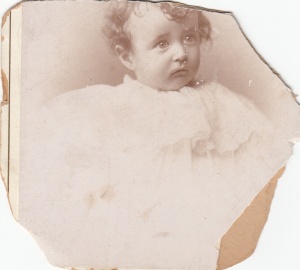
John Cohen as a baby

John Nusbaum Cohen about 1896

As I wrote about previously, Isaac was sixteen years older than Emanuel, so I am not sure why, of all the siblings, he chose to live with his much younger brother Emanuel.  I think it says a lot about what kind of people Emanuel and Eva May were, taking in these two family members while also raising three boys of their own.  Emanuel and Eva had also been the ones who opened their home for the funeral for Emanuel’s uncle Jonas. According to the 1900 census, they did, however, also have two servants helping them in the home so perhaps it was not as onerous as it might seem; perhaps they were the best situated to do these things.

Emanuel Cohen and family 1900 census

Emanuel Cohen and family 1900 census

I would imagine that the 1890s were overall not an easy decade for the extended Cohen family.  First, the family patriarch, Jacob, died on April 24, 1888, just two months after Maurice was born. His brother Jonas H. Cohen, the last of Hart and Rachel’s children, died five years later on 1893. Also, a number of Jacob’s young grandchildren died during this decade, including many of Reuben and Sallie’s children and also Benjamin Levy, Maria’s son. His brother Isaac had lost his wife Emma. On the other hand, there were many children born, many siblings married, and business overall seemed to be thriving for the family pawnshops.

As of 1905, Emanuel and his family had moved down the street to 1441 Diamond Street.  On the 1910 census, they are listed as living at 1431 Diamond Street, and Isaac, Emanuel’s brother, was still part of the household, along with Eva, all three of Emanuel’s sons, and two servants. Maurice, who was 22, was working as a salesman for a clothing business; Stanley (20) and John (14) were not employed outside the home.

Emanuel Cohen and family 1910 census

Emanuel Cohen and family 1910 census

In the 1913 and 1914 city directories Emanuel is listed as a pawnbroker at 1800 South 15th Street.  His brother Isaac died in 1914, and as of 1917 the family had moved again, this time to 2116 Green Street.

His oldest son Maurice married Edna Mayer on January 19, 1915.  Their son Maurice Lester, Jr., was born January 30, 1917.   According to the 1917 city directory, they were living at 4248 Spruce Street, and Maurice was working at the South Philadelphia Loan Office; on his draft registration that same year he described himself as self-employed as a broker.

Maurice Cohen World War I draft registration

Maurice Cohen World War I draft registration


On the 1920 census they were still living on Spruce Street, and Maurice’s occupation was pawnbroker.

Maurice Cohen and family 1920 census

Maurice Cohen and family 1920 census

In 1917 Stanley was still living at home and was the proprietor of a pawnshop at 2527 South 13th Street, according to his World War I draft registration.  In the 1917 city directory he is listed as working at the South Philadelphia Money Loan Office, the same business where his brother Maurice was working and presumably the shop located at 2526 South 13th Street.  He is also listed at the same business in 1921, living at 2114 [sic?] Green Street.

Stanley Cohen World War I draft registration

Stanley Cohen World War I draft registration

In 1917 my grandfather John was also living at home at 2116 Green Street and employed as an advertising salesman for the Morning Bulletin, according to his World War I draft registration.

John Cohen Sr. World War I draft registration

John Cohen Sr. World War I draft registration

According to the 1918 city directory, John was in the United States Navy at that time.  I have not yet found anything more specific about his military service.

In 1920, Emanuel, Eva (listed incorrectly as Edith), Stanley, John, and two servants were living at 2116 Green Street.

Emanuel Cohen and family 1920 census

Emanuel Cohen and family 1920 census

Interestingly, in the 1921 city directory, Emanuel’s business was now classified as watches and jewelry.  Had he left the pawnbroker business between 1920 and 1921, or was this just another way of describing his business?

I didn’t think I would be able to find the answer, but then, to be honest, I stumbled upon it.  I had found my grandfather John’s 1921 passport application almost a year ago and found it interesting that he was applying for a passport to go to Cuba for up to twelve months. I also found the similarity between his signature and my father’s signature rather remarkable.
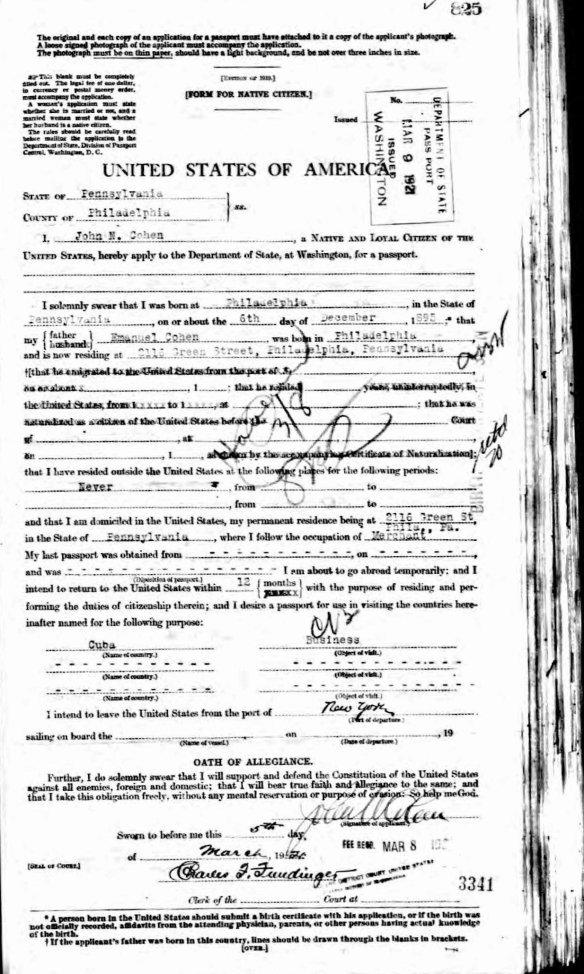
John Cohen passport app cropped

John N. Cohen passport application 1921

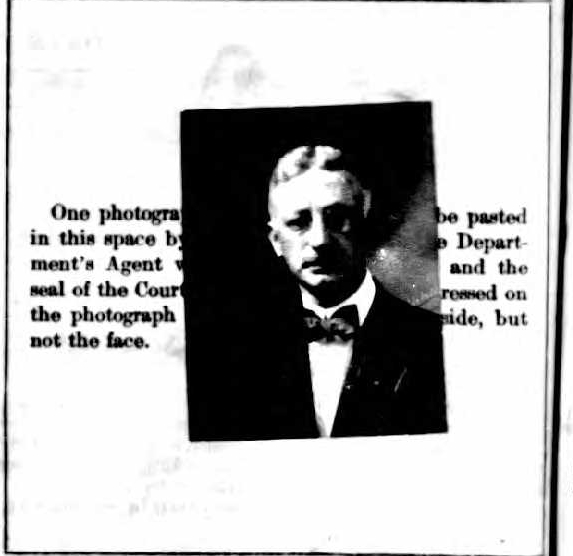
I had noticed that the page facing his application had a photograph of someone else, the person whose application preceded his in the database.  So I went to the following page to see if his photograph appeared on that page, and sure enough it did.  It also had a physical description of my grandfather: 5’ 6” tall, with a high forehead, straight nose, grey eyes, regular mouth, round chin, dark brown hair, dark complexion, and an oval face.
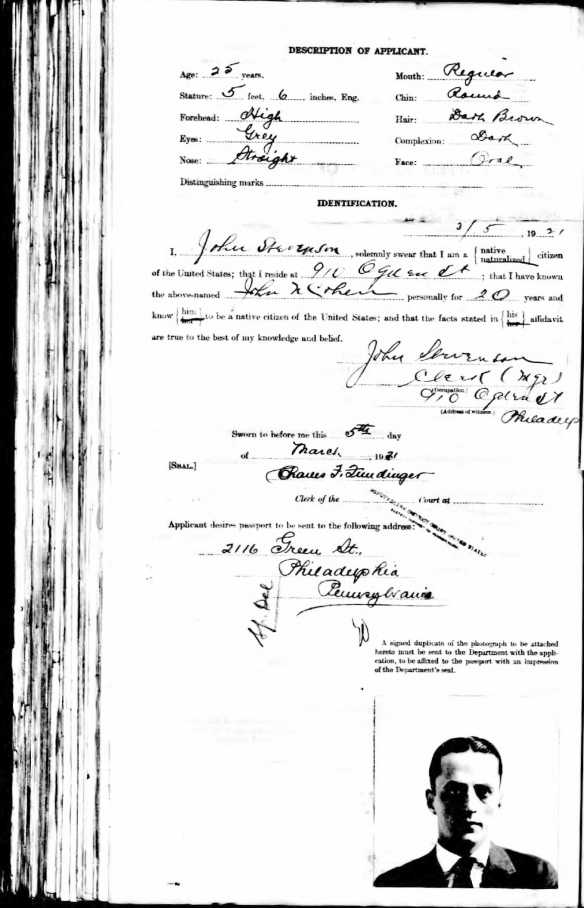
John N Cohen passport application page 2

John N Cohen passport application page 2

What I had not noticed the first time I studied this document was the letter that appears on the facing page—a letter signed by my great-grandfather Emanuel, certifying that his son, John N. Cohen, was going to represent the interests of the “Commodore” in Cuba.  The letter was on the stationery of the Commodore, located at 13th Street and Moyamensing Avenue, with the slogan “Our Policy One Price for All.”  I had never heard this business mentioned or seen it named on any other document.

Letter by Emanuel Cohen  March 5, 1921

Letter by Emanuel Cohen May 21, 1921

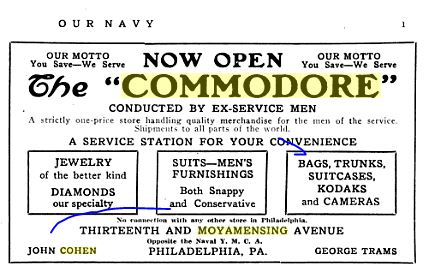
After some work on newspapers.com, genealogybank.com and Google, I finally found an advertisement for the business:

The Commodore ad from Our Navy, vol. 13

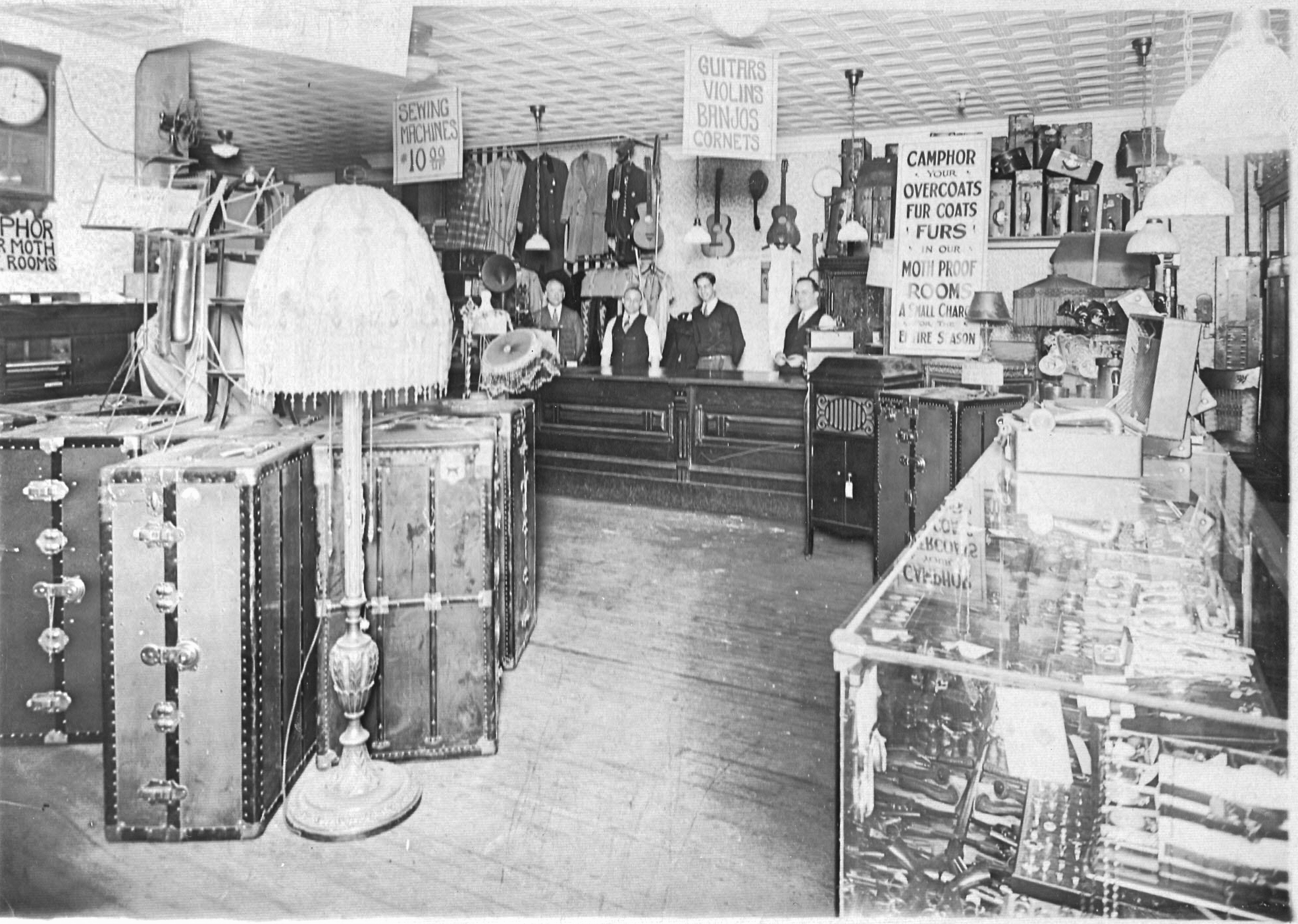
This was a business owned or at least managed by my grandfather when he returned from the Navy to provide merchandise to veterans at a fair price. I found this ad interesting in several ways.  First, I love that he sold suits “both snappy and conservative.” I also found it interesting that the ad proclaims that it has “no connection with any other store in Philadelphia.”  Was this my grandfather’s way of asserting his independence from the family pawnshop business?  Or was this some trademark issue involving a store with a similar name?  (I did see ads for a furniture store advertising a living room set as The Commodore.)  My father had never heard the store referred to by this name, but said he did recall that his father had a Navy friend whom he referred to as the Commodore who was his connection to the Navy Yard in Philadelphia.  My father does remember visiting the store years later when his grandmother was managing it and selling only jewelry, not men’s clothing, snappy or otherwise.

The years between 1920 and 1930 were years of growth for Emanuel and Eva’s sons.  In 1922, Maurice and Edna had a second son, Emanuel.  On January 5, 1923, Stanley married Bessie Craig, who was fourteen years younger than Stanley. Their daughter Marjorie was born two years later in 1925.

My grandparents, John Nusbaum Cohen, Sr., and Eva Schoenthal, were married on January 7, 1923, according to the family bible. (I assume they were married outside Pennsylvania since there is no marriage record in the Pennsylvania index for them) My aunt, Eva Hilda Cohen, was born January 13, 1924, and my father John, Jr., was born two years later.  My father recalls that the family was also living on Green Street in 1924 when his sister was born and at 6625 North 17th Street when he was born.  (There were no city directories available online for the years between 1922 and 1926.)  (The fact that there were two Emanuels, two Maurices, three Evas, and two Johns in their family must have created some confusion, though Maurice, Jr, was called Junior and Emanuel II was called Buddy. My father was always called Johnny.)

This is the only picture I have of my grandparents together.  They were certainly a handsome couple.  And they were certainly wearing  “snappy” clothing!  I am struck by the Star of David that my grandmother is wearing; they were not religious people, but obviously she felt a strong enough Jewish connection to be wearing such a large star.
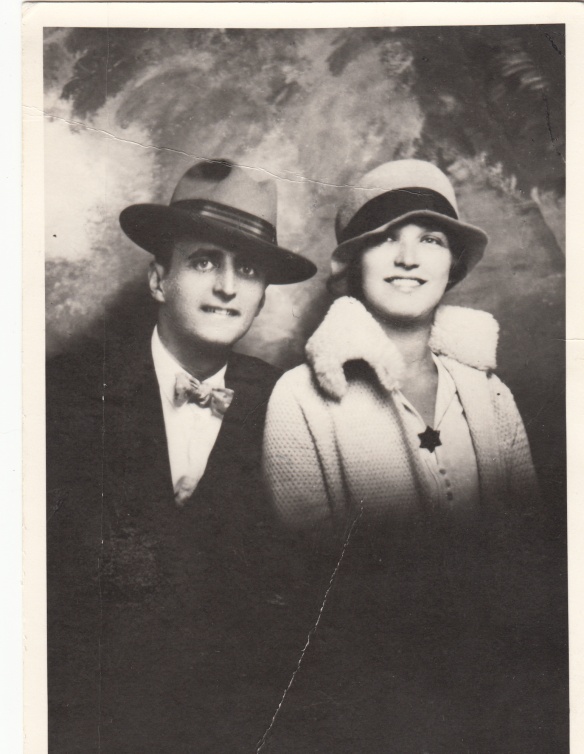
John and Eva Cohen  c. 1930

John and Eva Cohen, My Paternal Grandparents
c. 1930

Eva Hilda Cohen

Eva Hilda Cohen

I have always loved this picture of my father; his face really has not changed in many ways.  He still has those beautiful, piercing blue eyes.

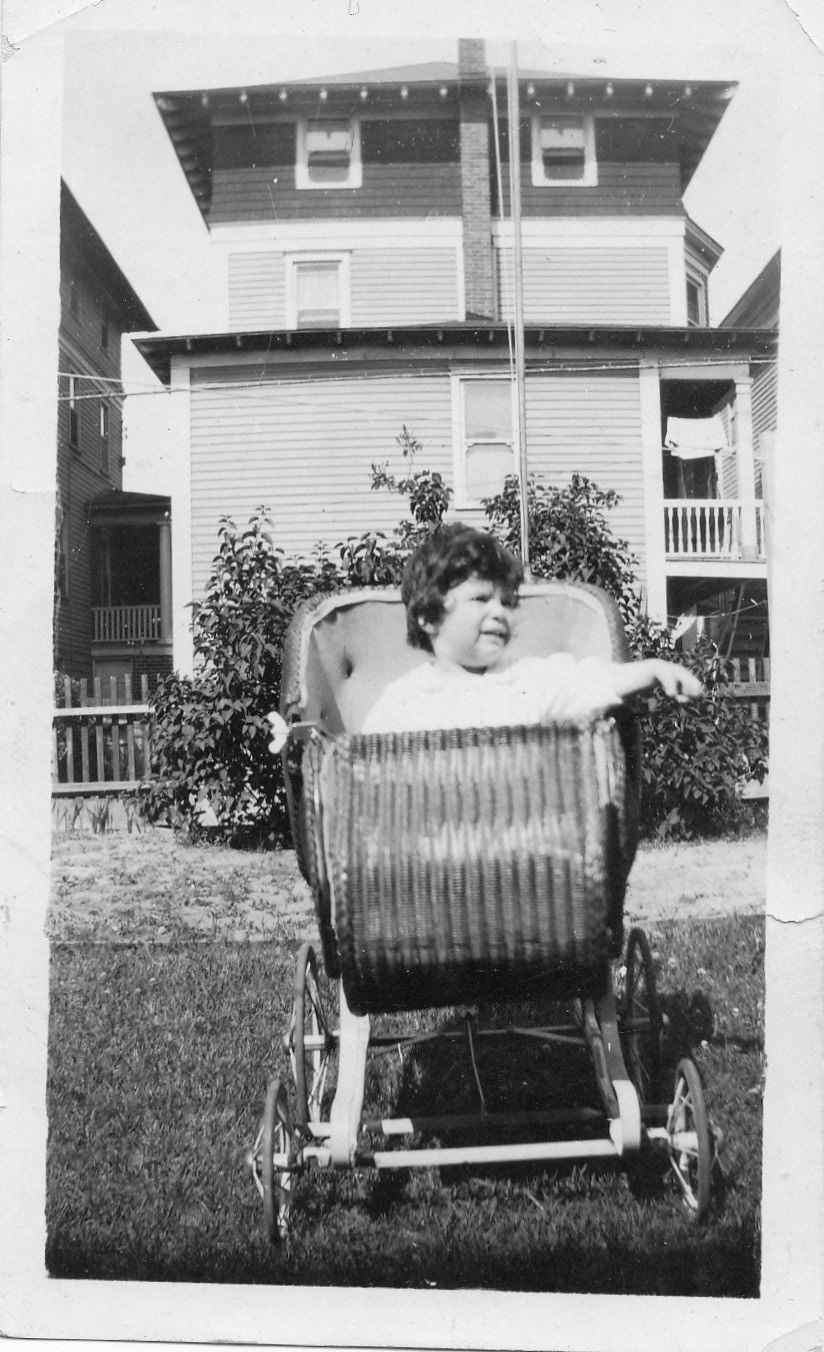
My father at 9 months old

My father at 9 months old

Reverse of John Jr at 8 months but 9 months

The reverse side of the photo above—inscribed “Taken a about 9 months, Johnny”

Another wonderful picture, capturing my father as a happy little toddler.

John Jr


Although the next photograph is badly damaged, I am including it in large part to show the inscription on the back, “Johnny Boy.”  My father said that his grandmother Eva May was the one to label the photographs, just as she was the one who made the entries for her children and grandchildren in the family bible.  I like to think that I have inherited her role as a family historian and photograph archivist.

Johnny Boy reverse of John Jr as child

“Johnny Boy”

John Jr little boy


This photograph below captures my aunt as a young girl.  She was a strong and independent person who always stood up for herself and knew what she wanted.


Eva Hilda Cohen

My Aunt, Eva Hilda Cohen

If the 1920s were years of growth, they were also years of loss.  On February 21, 1927, my great-grandfather Emanuel died after a cholecystectomy (gall bladder removal, according to my ever-reliable medical consultant).  It looks like the principal cause of death was pneumonia and either anemia or a hernia.  It also says he suffered from diabetes mellitus.  He was only 64 years old.

Emanuel Cohen death certificate 1927

Emanuel Cohen death certificate 1927

These were also years of loss for the larger Cohen family; by the time Emanuel died in 1927, he had lost all but two of his siblings, Hannah and Abraham, and Hannah would die just a few months later.  Although Jonas had died in 1902, Hart and Fanny in 1911, and Isaac in 1914, between 1923 and 1927 the family lost eight siblings: Joseph (1923), Elizabeth (1923), Lewis (1924), Maria (1925), Rachel (1925), Reuben (1926), and then Emanuel and Hannah in 1927.  Of the thirteen children of Jacob and Sarah Cohen, only one remained after Emanuel and Hannah died, the baby Abraham.

The next decade, the 1930s, were also very challenging years for Eva, Emanuel’s widow, and her three sons. According to the 1930 census, Stanley was now working as a broker. My grandfather John listed his occupation as a clothing and jewelry merchant on the 1930 census, perhaps still working at The Commodore; he and his family were still living at 6625 North 17th Street at that time, which was about fifteen miles north of the Commodore location.

My grandparents, my aunt and my father on the 1930 census

My grandparents, my aunt and my father on the 1930 census

I could not find Maurice on the 1930 census, unless he is the Maurice L. Cohen listed as living with a wife Celia, a son Lester, and a daughter Nannette.  I dismissed this household many times, but since I cannot find him elsewhere and since his son’s middle name was Lester and his other son was Emanuel, which could have been heard by a census taker as Nanette, I suppose, I am inclined to think that this is probably Maurice’s listing, but perhaps not.  At any rate, I was able to find Maurice’s death certificate.  He died from a self-inflicted gunshot wound to the head on August 14, 1931; family lore is that he had been suffering from cancer.  He was only 43 years old, and his sons were fourteen and nine years old when he died.

Maurice Cohen death certificate 1931

Maurice Cohen death certificate 1931

Some years after Maurice’s death, his widow Edna moved to southern California.  According to the 1940 census, she and her two sons, Maurice, Jr., and Emanuel, now called Philip, were living in Los Angeles, although the census indicates they were all still living in Philadelphia in 1935.  My father recalls going to camp with both of his cousins in 1938, so I assume it was sometime after that that Edna and her sons moved away.  My father said he never saw them again.

Edna Cohen and sons 1940 census

Edna Cohen and sons 1940 census

Maurice was not the only one to face serious medical problems during this time period.  My grandfather John contracted multiple sclerosis also during this period.  My grandmother, a sensitive and fragile person, was herself hospitalized and unable to care for her husband or her children, and so John, Sr., and his two children were taken care of by his mother, Emanuel’s widow, Eva May Seligman Cohen.  Once again my great-grandmother opened her heart and her doors to care for family members as she had done over 25 years earlier for her brother-in-law Isaac and his son.

In 1936, my grandfather was admitted to a Veteran’s Administration facility in Coatesville, Pennsylvania, over forty miles away from Philadelphia.  He lived the rest of his life until he died on May 2, 1946.  He was 50 years old.

John Cohen, Sr. 1940 census

John Cohen, Sr. 1940 census

My great-grandmother continued to care for his children, my father and his sister, until she died on October 31, 1939, from heart disease.  My father and aunt then lived with various other relatives until their mother was able to care for them again.

Eva May Seligman Cohen death certificate

Eva May Seligman Cohen death certificate

Stanley, Maurice and John’s brother, did not face the terrible health issues faced by his brothers.  In 1940 he was working as a pawnbroker, and according to his World War II draft registration in 1942, he was self-employed, calling his business Stanley’s Loan Office.

Stanley Cohen World War II draft registration

Stanley Cohen World War II draft registration

In the 1950s, Stanley and Bessie moved to Atlantic City, where he lived for the rest of his life. Bessie died in April, 1983, and Stanley died in July, 1987.  He was 97 years old.  I have located where his daughter was last residing and hope to find a way to contact her.

As for Maurice’s family, I don’t know very much about what happened to them after they moved to California.  Edna died in 1979, and Maurice, Jr., in 1988.  Both were still living in California when they died.  Emanuel Philip was harder to track down, but I eventually found him as Bud Colton in the California death index.  How, you might wonder, did I know that Bud Colton was the same person as Emanuel Cohen? Well, the death index listed his father’s surname as Cohen and his mother’s birth name as Mayer.  In addition, he was always called Buddy by the family.  Colton is fairly close to Cohen in pronunciation, and there was some family lore that he had in fact changed his name to something else.  Bud served in the army during World War II as Bud Colton.  He married Helga Jorgensen in April, 1957, when he was 34 and she was 49.  Bud died in February, 1995, and is buried as a veteran at Los Angeles National Cemetery.  I did not find any children of either Bud or Maurice, Jr.; although I found a few Maurice Cohens in the California marriage index, only one of those marriages seemed to have resulted in a child, and her birth certificate revealed that her father Maurice Cohen was not the one related to me.  The other two Maurice Cohen marriages would have been fairly late in Maurice’s life (if in fact it was the same Maurice Cohen), and I found no evidence of any children from those marriages.  Given the age of Helga when she married Bud, it also seems unlikely that that marriage resulted in any children.

It is rather sad that we know so little about my father’s paternal first cousins, but this was all I could find up to this point.  I will keep looking and hope that more information will turn up.  Perhaps in that mysterious suitcase I will find more pictures, more documents, more answers.  Nevertheless, I know a great deal more now than I once did about my great-grandparents Emanuel and Eva Cohen and my paternal grandfather John Nusbaum Cohen.

Below is the headstone for my great-grandparents Emanuel and Eva May and for my grandfather, John N. Cohen, Sr., who were buried at Mt. Sinai Cemetery in Philadelphia.  Maurice is also buried there, one section over.

headstone for emanuel, eva and john n cohen


To Reveal or Not: More Thoughts on the Ethics of Genealogy

My post yesterday prompted a lot of comments both here on the blog and also in two genealogy groups I follow on Facebook, Tracing the Tribe, which is a Jewish genealogy group, and the Ancestry.com group.  I am very grateful for all the thoughts and discussion, and I have a better idea of where to draw the line between revealing and not revealing information.   I will try to summarize the viewpoints articulated by those who participated in these discussions.

Generally speaking, there are two different views.  One view is that telling the truth is an important principle in reporting the results of genealogy research.  Genealogy is a form of history, and without all the details, we are distorting history.  If we delete information, we are not giving a full picture of a family’s history.  In fact, we are whitewashing the information and creating a picture that presents people as perfect when in reality people are always flawed, make mistakes, endure hardships, suffer from illnesses, marital problems, financial problems, and so on.  What is the point of history if it is not truthful?

On the other hand, many people argue that there is a need to respect the privacy and feelings of others and thus to keep certain information that may hurt someone or embarrass them from being disclosed, both publicly and to those it might hurt or embarrass.  Several people mentioned the traditional Jewish principles of not doing anything to shame or embarrass another and of  lashon hara—not to say anything about anyone, whether true or false, whether flattering or insulting.  My rabbi and dear friend Rabbi Herbert Schwartz also reminded me that even God did not reveal the truth all the time and that lying is sometimes better than truth-telling when the feelings of others are involved.

IAJGS

IAJGS (Photo credit: Wikipedia)

One person pointed me to the website for the IAJGS (International Association of Jewish Genealogical Societies)  and its statement of ethical principles for genealogists.  Among the guidelines they espouse is one that suggests that information that is more than 75 years old may be disclosed.  Quoting from the IAJGS website:

Regarding the “right to privacy” versus the “freedom of information” area of potential conflict:

  • Data more than 75 years old should be regarded as sufficiently historical to be available, without restriction.
  • More recent data should be evaluated in the light of sensitivities of the living versus the importance of disseminating information.
  • Generally, a request from an individual that certain information about themselves or close relatives be kept private should be respected.
  • It if is decided not to publish any particular piece of information, there should be a clear statement to that effect so that the reader is not misled by the omission.

Ethics statement approved by the IAJGS Board of Directors 2 November 2002

The website also includes the Ten Commandments in Genealogy written by Rabbi Malcolm Stern.  These include the following:

9. The sensitivities of living people must be respected and the memory of the deceased likewise, but for the latter it is permitted to record the objective facts about them.

All parties seem to agree that anything about a living person should not be disclosed.  I agree whole-heartedly with that point of view, and I only provide information about anyone living if they consent first.  I keep the details of my family tree on password-protected pages for that reason, i.e., that they include living descendants.

So where do I come out on this debate?  As I said, my views are more clear now than they were before, but they are not yet truly defined.  I agree with both views.  I honor the principle of truth.  As someone who loves history and who is educated in the law, I believe that knowing the truth is important to each of us personally and to our society as a whole.  But I also embrace the need to avoid harming another person if at all possible.  I would hate to think that something I write causes pain to another, but I also know that that pain is rooted in the truth I’ve revealed, not simply in the fact that I have revealed it.

For me that means that, as we lawyers like to say, it depends.  It depends on the circumstances.  Here are some of the circumstances I will and do consider before writing about something that might be upsetting to another person:

  1. Are these documented facts or just allegations? If the latter, I must indicate that they are only allegations or perhaps not even report them at all.  If it was information from a newspaper article, I will quote that source; if it is something that I was told by a relative, I would not report it unless I could find sufficient corroboration.
  2. How long ago did these events occur? I like the 75 year rule adopted by the IAJGS, meaning anything before 1940 would be considered generally publishable if documented.  For me, I might even use a 100 year rule, meaning anything before 1914 is publishable if documented.  However, even in those circumstances, I might still hesitate to reveal the information if there is some other reason not to do so.  For example, if a living descendant asks me not to do so (see #4 below) or if the facts are relatively insignificant.
  3. If I do reveal those older facts, I may also take steps to protect the identity of any living descendants of that person.  For example, if someone who lived 120 years ago committed a crime, is it necessary to reveal the names of his or her children or grandchildren in a blog post about that person? By making it less obvious who the descendants are, it will be harder for others to make that connection. If a descendant, say, a great-grandchild, looks hard enough, they might find out that their great-grandparent committed a crime, but if they look that hard, they also likely would have found it the same way I did—from publicly available records.
  4. For information that is more recent than 75 years, I would only reveal that information if I am sure that either there are no living direct descendants or if I am in touch with living descendants and am able to discuss the facts with them and get their permission to write about it on the blog.  I do not generally think it is my role to tell someone something that may upset them; I am not a psychologist and am not able to deal with the reactions I might cause.  But if I know that that person already knows the information, then I am more willing to let them know that I have learned about it from some public source and then to talk to them about it.  If I can’t find the living descendants, then I would not reveal information that is more recent than 1940.
  5. If a descendant asks me not to write about something on the blog, I will not do so.  Yes, that may distort history, but this is personal history, family history—not the kind that changes society or reveals the truth about how political decisions are made.  This is not a cover-up that will affect many people, if any, outside of one particular family.

Do these principles/guidelines make sense? I am still struggling with this, and I know that not everyone will agree.  The truth-seekers will not be happy with me for holding back some information; those who do not believe in revealing upsetting information will not be happy that I will reveal that information in certain circumstances.  I know that my thoughts and my practice will evolve over time, and I know that I will continue to struggle and to seek counsel from all of you.

Thank you to everyone who commented, both here and on Facebook, and for helping me think through this difficult issue.


Genealogy Ethics: What and Who Do You Tell the Things You Learn?

question

question (Photo credit: cristinacosta)

This past Sunday the New York Times ran an article about a reporter who learned that his great-great-grandfather, a New York City police officer, had killed a man under questionable circumstances, but had never gone to trial.  The reporter tracked down the descendant of the victim and told him the story.  That descendant had never known that his great-grandfather had been killed.  I found this story interesting, but it also raised a number of questions about the ethics of uncovering a family secret.  What lines should I draw when I learn something that might be upsetting to a descendant?

It doesn’t even have to be something involving criminal conduct.  It could be learning about financial troubles, medical issues, family issues—all of which can be discovered in public sources like newspapers, census reports, vital records, wills, court documents, and other records that anyone, whether related or not, can find.  Does the fact that these are publicly available facts make a difference in terms of disclosure and privacy?

Is there some point in time when revealing that information is clearly appropriate?  Is there some point in time when those events are not remote enough in time?  Does it matter whether the family involved never even asked you to do the research versus a situation where they asked but had no knowledge of the troubling information? Are there times you definitely should reveal information? Are there times that you definitely should not?  What about putting things on a publicly accessible source such as a blog? What are the proper lines in that context?

I am seriously interested in these questions and what others think about them.  Whether you are a genealogy person or not, I would really like to know what you think.  Please leave your thoughts here.  I really think this issue merits serious discussion.


The Genealogy Village: An Update on Maria Cohen and William Levy

Over three weeks ago, I blogged about Maria Cohen, Jacob and Sarah’s seventh child, and her life.  She had married William Levy, and they had had four sons, one of whom committed suicide as a teenager, and two others who predeceased her, Lewis, who died when he was 38 in 1915 only five years after marrying Emma Fogle, and Jacob, who died the following year when he also was only 38.  Only one son, Isaac, survived her.

At the time I wrote the blog, I could not find any records for Maria or William after 1900, except as names on their sons’ death certificates.  I did not know when either of them died.  In addition, although I had a death certificate for their son Lewis and was able to find his headstone through FindAGrave, I was confused by the fact that the headstone referred to Lewis and his wife Emma as father and mother, but I had no record of any child born to Lewis and Emma.  I put those questions aside after much searching, figuring I would return.

So I returned to Maria and William after the updates to the Pennsylvania death certificate database earlier this week.   First, I called Adath Jeshurun cemetery in Philadelphia to see if Maria and William were buried there.  Since all three of the sons who had died were buried there, I assumed that Maria and William would have been also, and that hunch paid off.  The very helpful woman at Adath Jeshurun gave me the dates that Maria and William died and were buried.

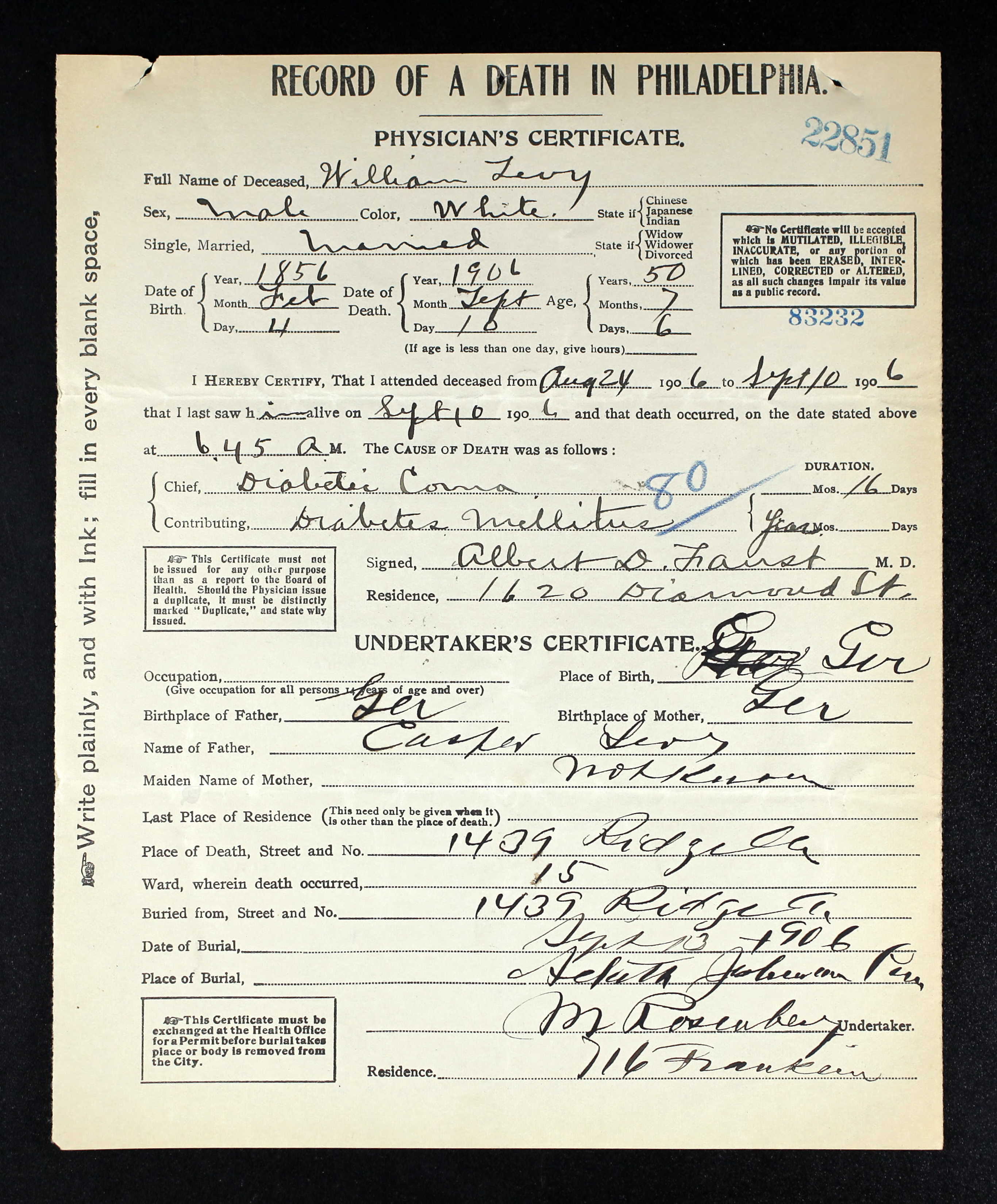
William had died September 10, 1906 when Maria was only 49 and had already lost her son Benjamin.  She would lose two more sons in the next ten years.  Maria herself died March 24, 1925.  I now had their dates of death, but still no death certificates.  Even with the new update, I could not find a death certificate for either William or Maria even though both had died before 1944.  I was bewildered.

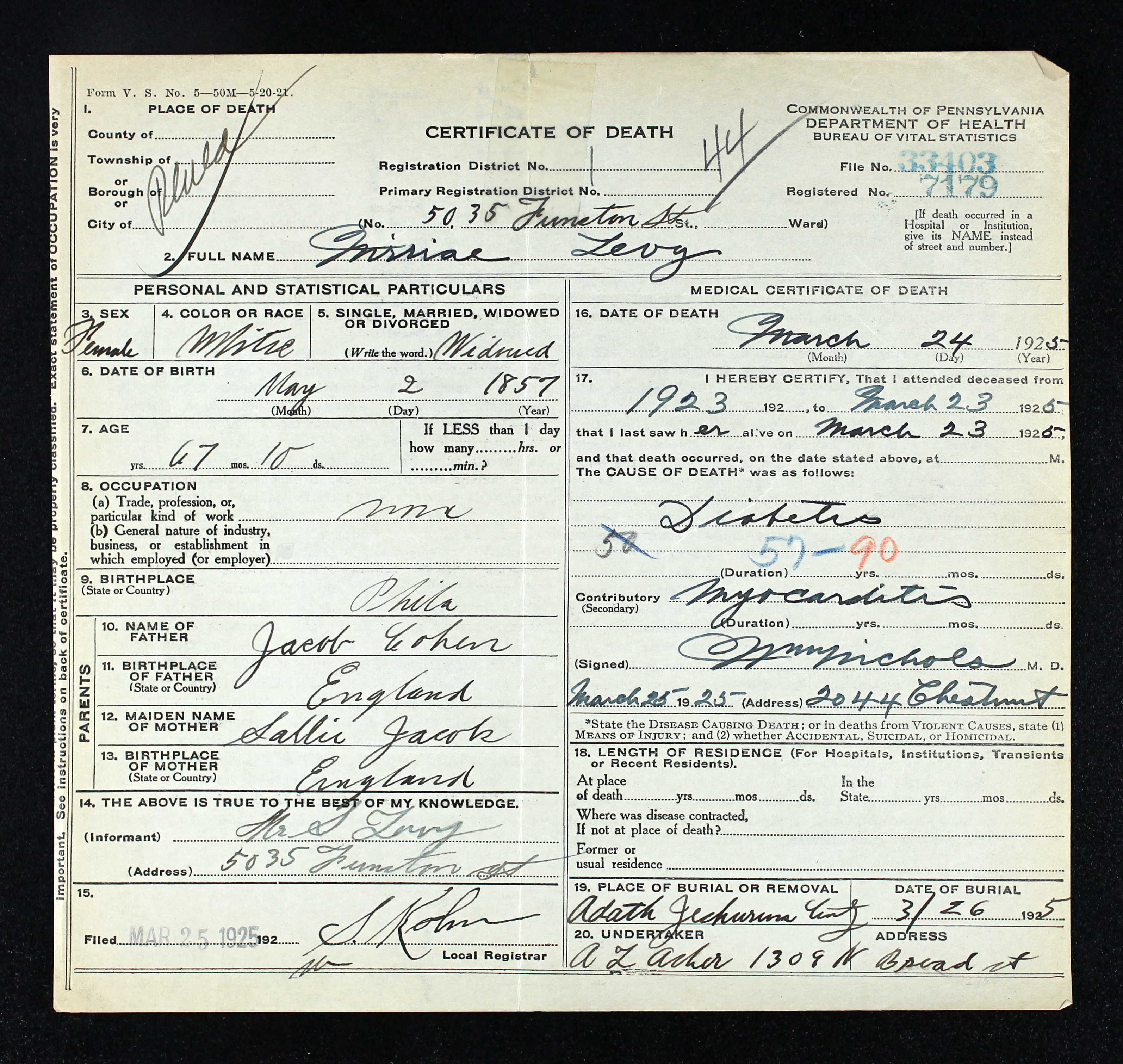
I then searched for all people named Levy who died in 1925 and finally found Maria—spelled Mrriac in the ancestry.com index.  What?? Mrriac?? No wonder I couldn’t find it.  But it was clearly Maria—daughter of Jacob Cohen and “Sallie Jacob.”  She had died from diabetes and myocarditis and had been living at 5035 Funston Street in Philadelphia at the time of her death.  The informant on the certificate was Mr. S. Levy of the same address.  Since her only surviving child was her son Isaac Harry Levy, I had no idea who S. Levy was, unless he was the son of Lewis and Emma Levy.

Maria Cohen death certificate 1925

Maria Cohen death certificate 1925

I still could not find William Levy’s death certificate nor could I figure out how to find Lewis and Emma’s child.  I turned to others for help.  There is a Pennsylvania Genealogy group on Facebook and also a Tracing the Tribe group focused on Jewish genealogy.  I posted my questions on both groups, and within a few minutes, someone on the TTT group suggested I search the Pennsylvania death index by William’s date of death instead of by his name, and tada! There it was.  William also had died from diabetes.

William Levy death certificate 1906

William Levy death certificate 1906

But that still left me without an answer to the next question: who was the child of Emma and Lewis Levy?  Another half hour later I had that answer as well.  Somehow someone else with fresh eyes found Emma Levy, a widow, on the 1920 census, living with an eight year old daughter named Henrietta as well as two relatives named Fogel.  This was obviously the right Emma, and I now knew her daughter’s name.

Emma Levy 1920 census

Emma Levy 1920 census

They also appeared together on the 1930 census, but on the 1940 census, Henrietta was gone.  Now I need to find her married name.  Two kind people from the Pennsylvania group are continuing to help me.

I still do not know who Mr. S. Levy was on Maria’s death certificate, nor do I know what happened to Henrietta. I also have not found Maria on the 1920 census.  But with the help of others, I am able to put some closure on the sad life of Maria and William Levy.

Pennsylvania, I love you!

OK, perhaps a bit of an overstatement, but yesterday morning I woke up to read online that the Pennsylvania death certificates up through 1944 were now available on ancestry.com.  (Previously, only those up through 1924 were available.)  As soon as I’d had my breakfast, I started searching for all my previously researched Cohen relatives who died between 1925 and 1944 to find their death certificates.  Within a half an hour I had found eleven of them.  Although they did not contain any amazing revelations, I was able to learn when and why several of my relatives had died.

I have updated the relevant blog posts for Hannah Cohen, Lewis Weil, Rachel Cohen, Martin A. Wolf and his wife Marie Morgan, Laura Wolf, Harry Frechie, and Samuel Rosenblatt, Jr.  I also have certificates for Reuben Cohen, Sr., Emanuel Cohen, and Abraham Cohen which will be discussed in later posts.  The only one of these that I was particularly interested in was that of Samuel Rosenblatt, Jr., who had died when he was only twenty and was his parents’ only child; he died of leukemia.  Laura and Martin A. Wolf, siblings and the children of Hannah and Martin Wolf, also died at relatively young ages—in their 40s, Laura of diabetes and Martin A. of ulcerative colitis.

If you are interested in seeing the certificates, I have posted them at the relevant blog posts as linked to above.

It was good to put some closure on some of those lives, although sad to be reminded again of how many of my ancestors died so young.  Thank you to the Commonwealth of Pennsylvania for opening up your records so that family histories can be told.

A Distributed Denial of Service Attack on Ancestry.com and other Genealogy Sites


Ancestry.com

There was an attack on ancestry.com by hackers yesterday, taking down the entire site and all of its associated sites including FindAGrave, newspapers.com, and many of the databases shared by JewishGen.  That means I could not access my tree or do more research except on the FamilySearch website.  Although I have my tree backed up on my computer, I had not backed it up in the last week or so (stupidity on my part), so it was not up to date.

What have I learned from this?  I am too dependent on ancestry.com for storing my family history information.  Yes, I do download copies of all the photographs and most of the documents to my computer, and they are also accessible through FamilyTreeMaker, the family tree software I have on my computer.  All my blog posts are also stored in Word format on my computer as well as on WordPress, the host of this blog.  But what if my hard drive is destroyed? What if WordPress is attacked?  How do we protect our photographs and documents as safely as possible?  I can’t imagine losing everything that I have worked so hard to find and collect, so if others out there have suggestions, please let me know.

Ancestry.com

Ancestry.com (Photo credit: Wikipedia)

Ancestry.com was up very briefly this morning, so I was able to update my hard drive version of my tree with Family Tree Maker.  But it is down again now, and I am just wondering how much at risk my saved files and research are and will be in the future.


An Important Clue Buried in A Wedding Announcement

As I was finishing up my research on Sallie R. Cohen and her life, I found this article in the Philadelphia Inquirer about her wedding:

Sallie R. Cohen and Ellis Abrams wedding story

Sallie R. Cohen and Ellis Abrams wedding story

(“Matrimony Notice,”  Tuesday, May 22, 1900,Philadelphia Inquirer (Philadelphia, PA) Volume: 142 Issue: 142 Page: 2)

Not only does this provide further evidence of the social and economic success of Reuben and Sallie Cohen, it also provides a very important clue to one of my biggest questions about the Cohen clan.  Remember the two Hart Cohens that had me confused a few weeks ago—one in Philadelphia and one in Washington, DC? After much searching and thinking I had developed a strong hunch that they were first cousins and that Jacob Cohen of Philadelphia and Moses Cohen, Sr., of Washington were brothers, both sons of my great-great-great grandparents Hart Levy Cohen and Rachel Jacobs.  I am in touch with Moses Cohen’s descendant Scott, and we are awaiting DNA test results to see whether he and my brother share enough DNA to conclude that we are all in fact descended from Hart Levy Cohen.

But now I have another fairly persuasive bit of evidence linking the Moses Cohen family in DC to my Philadelphia Cohens.  If you can read the announcement, you will see that one of the bridesmaids is Grace Cohen of Washington, DC.  Grace Cohen was the daughter of Moses Cohen, Jr., and his wife Henrietta.  She was born in 1877, two years before Sallie R. Cohen, daughter of Reuben Cohen, and was  thus her second cousin, assuming that Jacob and Moses were brothers and thus their respective sons, Reuben and Moses, Jr., were first cousins.

This is the kind of almost accidental discovery that just makes my day.  It’s the kind of thing that I could easily have missed or read and not thought about carefully.  Although the DNA test results may provide more scientific evidence that DC Moses and my great-great grandfather Jacob were brothers, this little tidbit in a wedding announcement is certainly fairly persuasive evidence on its own.

Maria Cohen 1856-?: A Hard Story to Find, A Harder One to Tell

It took me a long time to find the story of Maria Cohen, the seventh[1] child of my great-grandparents, Jacob and Sarah, and once I did, I wished I hadn’t. Things started easily enough, as I was able to find a record in the Philadelphia marriage index identifying her husband as William Levi. They married on December 15, 1875.  I was able to find them on both the 1880 and 1900 census reports with their sons Lewis, Jacob, and Isaac, but on both there were entries that were inconsistent with the facts I know about Maria.  On the 1880 census, it says her parents were born in Germany, and in 1900 it says her parents were born in Russia, when I know that her parents were in fact both born in England.

Had the census taker received erroneous information or did I have the wrong Maria?  Certainly her sons’ names, Lewis, Jacob and Isaac, were all names that ran in the Cohen family.  The age given for Maria on the census reports seemed close enough.  In 1880 Maria would have been 24; the census says she was 21 with two sons ages two and one.  If she really married in 1875, that means she would have been only 16 when she married, which seems unlikely.  In 1900, Maria would have been 44; the 1900 census reports it as 40.  I am accustomed to census errors, and these were not any worse than others I’ve seen.

So this could be the right Maria Cohen, but I cannot be absolutely sure because after 1900 she and her husband disappear from the records.  I cannot find Maria or William Levi on the 1910, 1920, or 1930 census.  Perhaps they both died between 1900 and 1910, but I also cannot find any death records or burial records for either of them. At first I thought perhaps they all changed their names, but after a lot of looking I was able to find death records for three of their four sons, and that is where this story gets harder to tell.

The first record I found was for their oldest son Lewis, who died on May 4, 1915, from heart disease at age 38.

Lewis C. Levy death certificate

Lewis C. Levy death certificate

His wife Emma Fogle, whom he had only married five years before in 1910, lived another almost 50 years, but was buried beside him at Adath Jeshurun cemetery and apparently never remarried.  Since the headstone is marked “father” and “mother,” there must have been at least one child born during that brief marriage, but so far I have not been able to locate that child.

Lewis and Emma Levy headstone

Lewis and Emma Levy headstone

This morning, after much looking, I found a death certificate for Maria and William’s second son Jacob, who also died at a young age.  He died only a year and half after his brother Lewis on December 22, 1916, from tuberculosis. He also was 38 when he died.  The death certificate reveals that he had been residing at the Norristown State Hospital for the Insane when he died and had been there for just over ten years.  He also was buried at Adath Jeshurun.

Jacob Levy death certificate

Jacob Levy death certificate

I was already feeling sad for Maria and William for losing two sons before either reached forty years of age when the story got even worse.

In searching for records for Maria, William and their sons this morning, I was surprised to see a death record for a Benjamin Levy, son of William Levy.  It was the first time I knew that Maria and William had had a fourth son, Benjamin, born in 1881.  Since he was born in 1881, he was not on the 1880 census.  Since he died in 1897, he was not on the 1990 census.  I had missed him completely in doing my initial research of Maria and her family.  I gasped when I found his death certificate and saw his cause of death: “found drowned.”

Benjamin Levy death certificate

Benjamin Levy death certificate

I looked to see if I could find any other information and found this story, quoted in its entirety from the Philadelphia Inquirer dated March 18, 1897.

The body of the young man which was found on Monday in the Delaware River at the foot of Callowhill street was that of Benjamin Levy, aged 16, who lived at 1580 Fontaine Street, and who has been missing since January 9. It is thought that he committed suicide.

Before going away, he said to his brother: “Good-bye, Jake, forever.  I’m going to jump overboard.”  He was not seen alive afterwards.  It is believed he drowned himself because he had been rebuked for drinking.
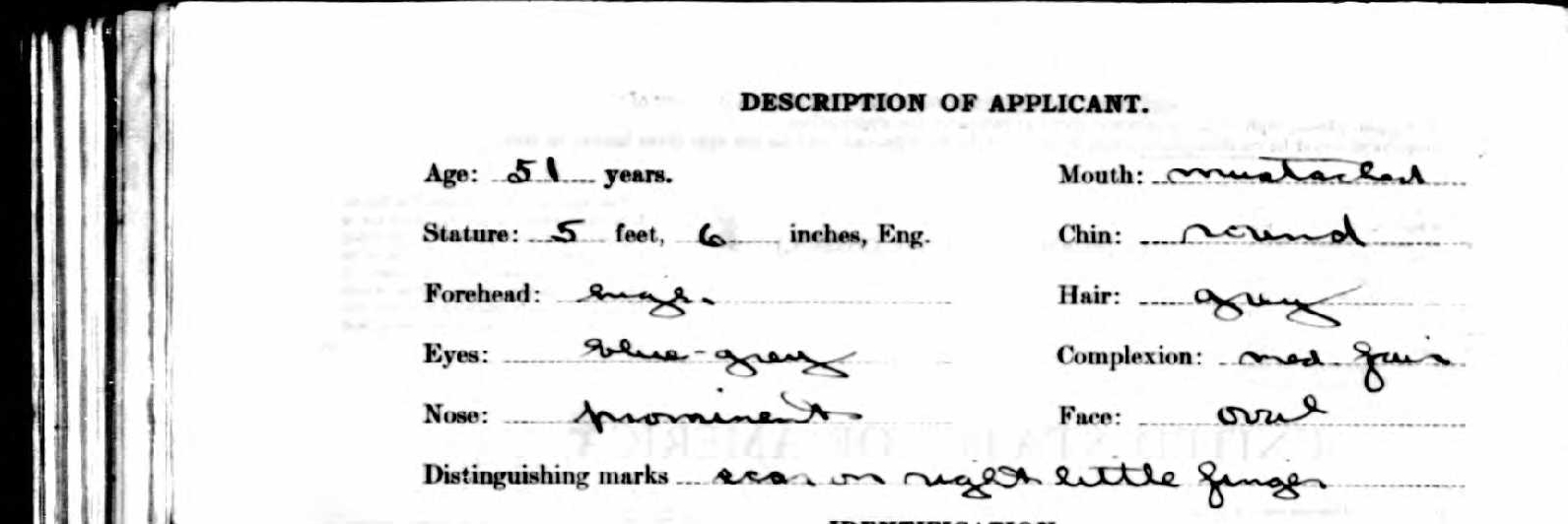
(“A Young Suicide,” Thursday, March 18, 1897,Philadelphia Inquirer (Philadelphia, PA)   Volume: 136   Issue: 77   Page: 10 )

Benjamin had been missing for two months when his body was found.  I cannot begin to imagine how his family felt.  Could it possibly be that just getting scolded for drinking led him to commit suicide? Or was there something else behind the story? Was there underlying mental illness, as was the case with his older brother Jacob?

Although the death certificate for Jacob said that he had been hospitalized since October, 1896, ten years, one month and 28 days before his death, this news story about Benjamin seemed to indicate that Jacob was still home when Benjamin committed suicide in March, 1897.  One has to wonder whether Jacob’s mental illness was precipitated or at least exacerbated by his little brother’s death and thus whether Jacob’s death certificate was off by a year in describing his stay at the state hospital.  Did Jacob feel guilty, knowing that his younger brother had talked about suicide but Jacob had not being able to stop him? How did Maria and William cope with these two traumas?

It was less than twenty years later that their son Lewis died in 1915, with Jacob dying a year later in 1916.  Only Isaac remained, their youngest son.  Fortunately, Isaac’s story is not tragic.  In 1909, he had married Rose Hicks, who was a few years older than Isaac and had a son William from a previous marriage. Although marrying an older divorced woman with a child might have been somewhat unusual back then, given what this family had been through, that must have been small potatoes to them.  In 1910, he and Rose were living at 133 Walnut Street in 1910 with several boarders, and Isaac, now using the name Harry, was working at a pawnshop.

Isaac "Harry" Levy and Emma Levy 1910 census

Isaac “Harry” Levy and Emma Levy 1910 census

In fact, it was his uncle Lewis Cohen’s pawnshop, as revealed in Harry’s World War I draft registration (and as confirmed by an address check for Lewis Cohen in 1917).

Isaac "Harry" Levy draft registration World War I

Isaac “Harry” Levy draft registration World War I

Harry, Rose, and Rose’s son William as well as her nephew were living on Reno Street in 1920, and Harry and Rose continued to live in Philadelphia at least until 1942 when Harry’s draft registration for World War II continues to provide a Philadelphia address at 222 North 52nd Street.  Harry was working for the WPA in Philadelphia at that time.

Isaac "Harry" Levy World War 2 draft registration

Isaac “Harry” Levy World War 2 draft registration

It does not appear that Harry and Rose had any biological children of their own.  I cannot yet find any record for Harry or Rose after 1942, nor have I yet had any luck locating any records for Maria or William after the 1900 census.   I plan to contact Adath Jeshurun cemetery in Philadelphia to see if they have records for Harry/Isaac, Rose, Maria or William Levy.  Since the other members of the family were all buried at that cemetery, I am hoping that I will be able to get at least some greater information about the others.

Genealogical research is filled with twists and turns.  I spent many hours this week, focused on Maria Cohen and her family with William Levy, and until this morning I had found almost nothing except their marriage record and  those two census reports.  I went to sleep feeling that I would never know the rest of the story.  Then with just a few lucky keystrokes this morning, I opened the door to a terribly tragic family story.  I almost wish that I hadn’t.  Careful what you wish for, as they say.  I hope I can put some closure on Maria’s life.  Only time, persistence, and lots of good luck will tell.


[1] Reuben was the sixth child, but I am skipping over him for now as I wait to hear from one of his descendants.

Enhanced by Zemanta