Going Back East: My Schoenthal Great-grandparents and their Family 1924-1942

Happy New Year! I am still on vacation, but had this post 90% ready before we left, so with a cloudy morning I was able to get it finished.  Here is the remainder of the story of my Schoenthal great-grandparents; I have one more post almost done which will wrap up the story of my grandmother and her brothers.

….

By the mid-1920s, my grandmother Eva Schoenthal and her brother Harold had left Denver and moved east.  My grandmother had married my grandfather John Nusbaum Cohen and moved to Philadelphia in 1923. She had two children by the end of 1926.

My aunt Eva Hilda Cohen and my grandmother Eva Schoenthal Cohen, c. 1925
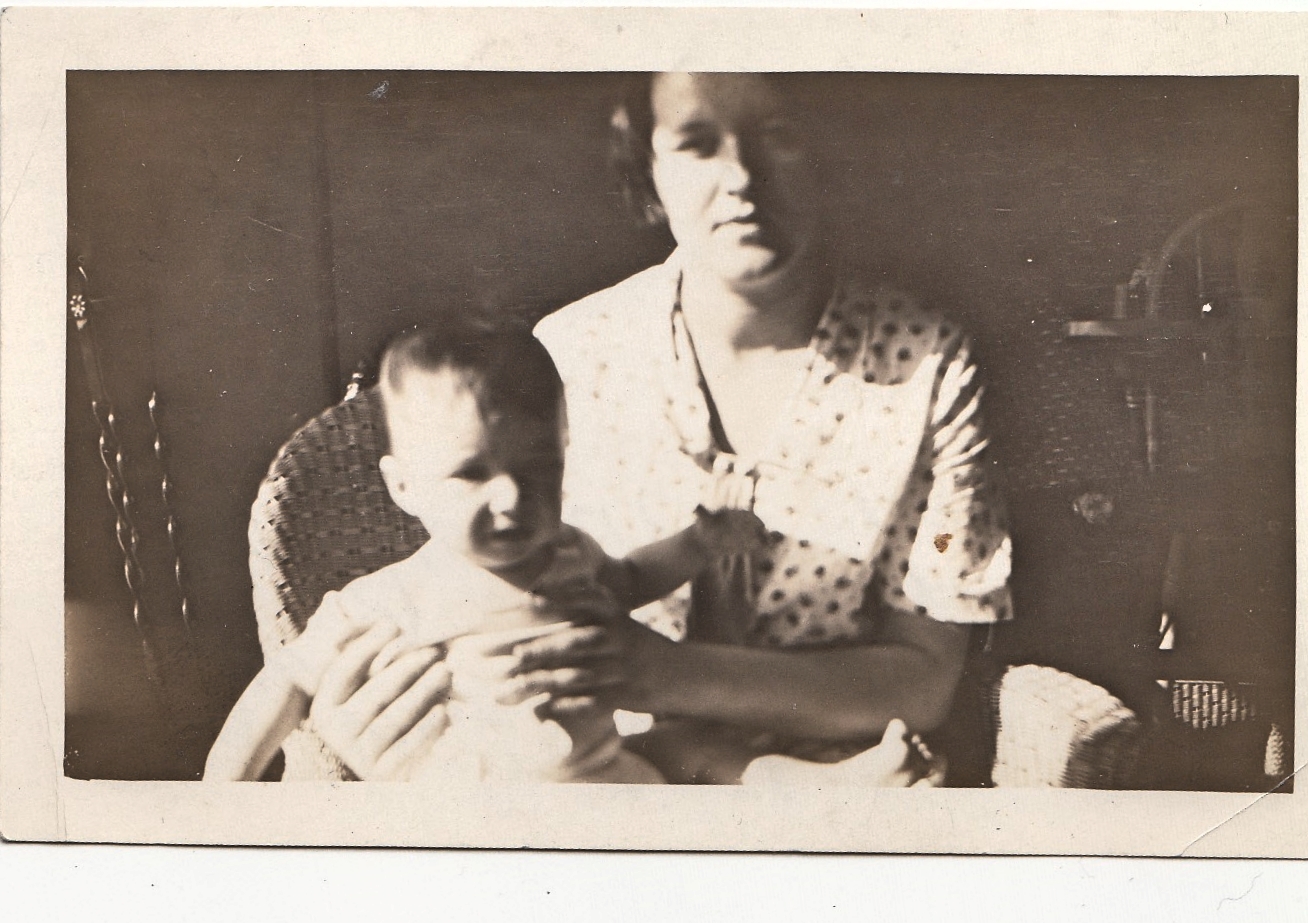
My aunt Eva Hilda Cohen and my grandmother Eva Schoenthal Cohen, c. 1925


My father and his mother, Eva Schoenthal Cohen, c. 1927

My father and his mother, Eva Schoenthal Cohen, c. 1927


My great-uncle Harold was in college at Columbia University, studying architecture; he would graduate in 1927.

The rest of the Schoenthal family was still in Denver, where as seen in the 1924 and in 1925 Denver directories, they were still in the same occupations in which they’d been employed earlier in the decade: my great-grandfather Isidore was still working for Carson Crockery; Lester was still a traveling salesman, and Gerson was a salesman for the Sunland Sales Cooperative Association.

Ancestry.com. U.S. City Directories, 1822-1995 [database on-line]. Provo, UT, USA: Ancestry.com Operations, Inc., 2011.

Ancestry.com. U.S. City Directories, 1822-1995 [database on-line]. Provo, UT, USA: Ancestry.com Operations, Inc., 2011. 1925 Denver directory

In 1926, however, my great-grandparents and their son Gerson and his wife Gratice were the only family members listed in the Denver directory.  Lester is not listed in the Denver directory and does not reappear in a directory in the Ancestry database again until 1929, when he is listed in the Richmond, Indiana directory as a manufacturer’s agent; his wife is now listed as Grace. By that time Lester and Juliet Grace had moved back and forth between Denver and Indiana twice.  It’s hard to know whether Lester kept moving for jobs or because he and his wife couldn’t decide whether to be closer to her family or his.

1929 Directory, RIchmond, Indiana Ancestry.com. U.S. City Directories, 1822-1995 [database on-line]. Provo, UT, USA: Ancestry.com Operations, Inc., 2011.

1929 Directory, Richmond, Indiana Ancestry.com. U.S. City Directories, 1822-1995 [database on-line]. Provo, UT, USA: Ancestry.com Operations, Inc., 2011.

On June 15, 1928, my great-uncle Gerson  was divorced from Gratice.

Ancestry.com. Colorado, Divorce Index, 1851-1985 [database on-line]. Provo, UT, USA: Ancestry.com Operations, Inc., 2015.

Ancestry.com. Colorado, Divorce Index, 1851-1985 [database on-line]. Provo, UT, USA: Ancestry.com Operations, Inc., 2015.

Also around this time, my great-grandparents left Denver and followed their two youngest children back to the east.  They settled in Montclair, New Jersey, where their son Harold was working as a designer after completing his undergraduate degree at Columbia.  They were all living together at 16 Forest Street in Montclair in 1929, 1930, and 1931, according to the city directories for those years, yet they are not listed in the 1930 US census at that address or elsewhere.  The enumerator did include other people who were living at that address (presumably an apartment building), but not my relatives.  According to those directories, Isidore was working at The China Shop and Harold was a designer.  A later news article about Harold indicated that in 1931 he was working at the interior design firm Schulz and Behrle.

Hilda (Katzenstein) Schoenthal, Eva Schoenthal Cohen, Eva Hilda Cohen, and Harold Schoenthal

Hilda (Katzenstein) Schoenthal, Eva Schoenthal Cohen, Eva Hilda Cohen, and Harold Schoenthal


My grandparents, Eva (Schoenthal) and John Cohen, and their two children were living at 6625 17th Street in Philadelphia, according to the 1930 US census; my aunt was six, my father three and a half.  My grandfather was a clothing and jewelry merchant. But not long after the 1930 census, my grandparents’ lives changed dramatically.   My grandfather was diagnosed with MS, and in the aftermath of that diagnosis, my grandmother suffered a breakdown and was unable to care for her children. My grandmother ended up living with her parents and brother Harold in Montclair, New Jersey.  Her children were living with their ailing father and his mother, my great-grandmother Eva Mae Seligman Cohen, in Philadelphia, as I wrote about here and here.

As for Lester, he and his wife  were living in Richmond, Indiana, in 1930.  Lester was a traveling salesman and Juliet (listed on the 1930 census as Grace) an office manager for an insurance company, according to the 1930 census.  A year later, they had moved again.  In 1931, Lester and his wife (listed here as Julia G.) were living in Dayton, Ohio.  Lester was still a salesman. They are not, however, in the 1932 Dayton directory.  I do not know where they were until in 1935, when, according to the 1940 US census, they were living in Montclair, NJ, where my great-grandparents and great-uncle Harold were also living.

Thus, by 1930, Gerson was the only Schoenthal left in Denver. Gerson must have visited his family back East around 1930. That is my father in the photograph, and he appears to be about three or four years old in that picture.

Dad Uncle Gerson Eva

My father, his uncle Gerson Schoenthal, and his sister Eva Hilda Cohen


Although Gerson is listed in the 1930, 1931 , and 1932 Denver directories, like his parents and brother Harold in Montclair, NJ, he seems to have been missed by the census enumerator. Gerson is also missing from the Denver directories in 1934 and 1935, and when he reappears in the 1936 directory for Denver, he is listed with a wife named Maude.

Maude Sheridan was born in May 11, 1883, in Salt Creek Township, Kansas.  Her father died when she was just a young child, and she and her mother lived in Kansas until at least 1905.  By 1910, she and her mother had moved to Colorado Springs, where they were living with Maude’s father’s brother, Patrick Sheridan, a leather retailer.  Maude was working as a public school teacher.  She became a school principal in Colorado Springs, Colorado, around 1912, and had great success there.  In 1916, she signed a long term contract with Colorado Agricultural College, and she and her mother were living in Fort Collins, Colorado, in 1920.  Maude was working as a college instructor.

Maude Sheridan principal


By 1930 Maude had left her education career and was the owner of a restaurant in Alamosa, Colorado.  She was still single and no longer living with her mother.  Then sometime between 1930 and 1936, Maude married my great-uncle Gerson Schoenthal.  In 1936, she would have been 53, he would have been 44.

Meanwhile, back in Montclair, New Jersey, in 1935, my great-grandfather was continuing to work for The China Shop, and his son Harold continued to work as a designer, living with his parents at 16 Forest Street in Montclair and working in Newark. My grandmother was also living with her parents in Montclair. Lester and Grace also continued to live in Montclair where Lester worked as a salesman.  All of them were still in Montclair for the rest of the 1930s, although my great-grandparents and Harold moved to 97 North Fullerton Avenue by 1937.

Upper Montclair NJ

Upper Montclair NJ (Photo credit: Wikipedia)

In 1939, my grandmother moved back to Philadelphia to live with her children, who were then sixteen and thirteen.  Their father was in a long term care facility by that time, and their paternal grandmother Eva Seligman Cohen had died on   October 31,  1939.  According to the 1940 census, my grandmother was working as a saleswoman in the wholesale china business at that time.

Her parents and brother Harold were still living in Montclair where in 1940 my great-grandfather was retired and Harold was working as a designer in the interior decorating business.  Lester and Juliet had moved once again, this time to Upper Darby, Pennsylvania, where according to the 1940 census, Lester was working as a refrigeration engineer for a wholesale refrigeration business.

As for Gerson, for a long time I could not find him on the 1940 census.  Then when Ancestry added the Social Security Applications and Claims Index to its database collection, the mystery was solved.  This is what I saw:

Ancestry.com. U.S., Social Security Applications and Claims Index, 1936-2007 [database on-line]. Provo, UT, USA: Ancestry.com Operations, Inc., 2015. Original data: Social Security Applications and Claims, 1936-2007.

Ancestry.com. U.S., Social Security Applications and Claims Index, 1936-2007 [database on-line]. Provo, UT, USA: Ancestry.com Operations, Inc., 2015.
Original data: Social Security Applications and Claims, 1936-2007.

Obviously, Gerson had changed his name to Gary Sheridan sometime between the 1938 Denver directory and the 1940 US census.  And for some reason he had changed his mother’s birth name (and his middle name) from Katzenstein to Kay.  Why? To sound less Jewish, I’d assume. Or maybe to sound less German as Europe and eventually the US were at war against Germany. Sheridan had been Maude’s birth name, and Gerson kept his initials the same, but otherwise he’d taken on a whole different identity.

Once I knew his new name, I found Gerson a/k/a Gary and his wife Maude on the 1940 census.  He was working as a salesman for the American Automobile Association, and Maude was working a manager of a tea room in Denver.

Year: 1940; Census Place: Denver, Denver, Colorado; Roll: T627_488; Page: 8A; Enumeration District: 16-148

Year: 1940; Census Place: Denver, Denver, Colorado; Roll: T627_488; Page: 8A; Enumeration District: 16-148

In early 1941, my great-grandparents moved to Philadelphia to help my grandmother with her children and lived next door to them on Venango Street.  My great-grandmother Hilda Katzenstein Schoenthal died not long after on August 17, 1941; she had only been living in Philadelphia for seven months when she died, according to her death certificate.  She was 77 years old and died from pneumonia.

Hilda Katzenstein Schoenthal death certificate Ancestry.com. Pennsylvania, Death Certificates, 1906-1963 [database on-line]. Provo, UT, USA: Ancestry.com Operations, Inc., 2014. Original data: Pennsylvania (State). Death certificates, 1906–1963. Series 11.90 (1,905 cartons). Records of the Pennsylvania Department of Health, Record Group 11. Pennsylvania Historical and Museum Commission, Harrisburg, Pennsylvania.

Hilda Katzenstein Schoenthal death certificate
Ancestry.com. Pennsylvania, Death Certificates, 1906-1963 [database on-line]. Provo, UT, USA: Ancestry.com Operations, Inc., 2014.
Original data: Pennsylvania (State). Death certificates, 1906–1963. Series 11.90 (1,905 cartons). Records of the Pennsylvania Department of Health, Record Group 11. Pennsylvania Historical and Museum Commission, Harrisburg, Pennsylvania.

My great-grandfather Isidore died a year later on July 10, 1942; he was 83 when he died; he also died from pneumonia.

Isidore Schoenthal death certificate 1942 Ancestry.com. Pennsylvania, Death Certificates, 1906-1963 [database on-line]. Provo, UT, USA: Ancestry.com Operations, Inc., 2014. Original data: Pennsylvania (State). Death certificates, 1906–1963. Series 11.90 (1,905 cartons). Records of the Pennsylvania Department of Health, Record Group 11. Pennsylvania Historical and Museum Commission, Harrisburg, Pennsylvania.

Isidore Schoenthal death certificate 1942
Ancestry.com. Pennsylvania, Death Certificates, 1906-1963 [database on-line]. Provo, UT, USA: Ancestry.com Operations, Inc., 2014.
Original data: Pennsylvania (State). Death certificates, 1906–1963. Series 11.90 (1,905 cartons). Records of the Pennsylvania Department of Health, Record Group 11. Pennsylvania Historical and Museum Commission, Harrisburg, Pennsylvania.

When I think about my great-grandfather’s life, I am left with many questions.  He was the second youngest child in a large family and the youngest son.  Of those who emigrated from Germany, he was among the last members of his family to arrive. He watched, one by one, as his older brothers and sisters moved away. Then he finally came to the US himself with his mother and younger sister Rosalie.  He lived in the small town of Washington, Pennsylvania, for the first 25 years of his years in the US, a town where his older brother Henry was a recognized leader both in the business and Jewish community.  Isidore had most of his siblings relatively close by once again.

Then suddenly in his late 40s he moved far away from his entire family, taking his wife and his four children far from everything they knew to start again in order to give his son Gerson a healthier place to live. He started over working in the china business. And then he started over one more time when he returned to the east coast twenty years later to be closer to his two youngest children.  In the end he and his wife Hilda ended up helping to care for his daughter and his grandchildren, including my father.  By the time my great-grandfather died, he had lost every one of his nine siblings as well as his wife and his parents.


Cologne, after bombing of World War II By U.S. Department of Defense. Department of the Army. Office of the Chief Signal Officer. [2] [Public domain], via Wikimedia Commons HTML Attribution not legally required

Cologne, after the bombing of World War II
By U.S. Department of Defense. Department of the Army. Office of the Chief Signal Officer. [2] [Public domain], via Wikimedia Commons

My father recalls him as a very quiet man. He has a vivid memory of his grandfather Isidore crying when he learned of the bombing of Cologne by the Allies in May, 1942, during World War II.  My father had assumed that Isidore had lived in Cologne, and although his brother Jacob had lived in that city, there is nothing to indicate that Isidore had ever lived anywhere but Sielen when he lived in Germany.  Perhaps it was more the notion that his homeland was at war with his adopted country and that the land of his birth and his childhood was being devastated by Allied bombing that made him cry. Perhaps he had visited Jacob in Cologne and remembered what a beautiful city it was. Or maybe he was just crying for the memories of his nine siblings and his parents, living in Germany, when he was a child.

My father said that his grandfather didn’t talk about it, just sat with tears running down his face. He died just two months later. I will always wonder what stirred beneath the surface of this man who had led what seemed to be a quiet life but with so many twists and turns and so many losses.

In Part III, I will follow up with what happened to Lester, Gerson, Harold, and my grandmother Eva after 1942.

My Grandmother’s Family in Denver, and A New Year’s Wish

When I last wrote about my great-grandfather Isidore Schoenthal, he and my great-grandmother Hilda (Katzenstein) and their four children, Lester, Gerson, Harold, and my grandmother Eva had moved from Washington, Pennsylvania, to Denver, Colorado, around 1907, when my grandmother was just three, and her brothers were nineteen (Lester), fifteen (Gerson), and six (Harold).  They moved out west because Gerson had severe allergies and asthma and the doctors had recommended a drier climate than western Pennsylvania. My great-grandfather, who had been a glass and china merchant in Pennsylvania, became a salesman and then a store manager for the Carson Crockery Company out in Denver.

I wasn’t sure what kind of Jewish community existed in Denver in the early 20th century, but I learned from a newspaper search that my great-grandparents had joined a synagogue, Temple Emanuel, when they relocated, as evidenced first by this article listing my great-uncle Gerson as a member of the 1908 confirmation class:


Gerson Schoenthal confirmation 1908 Denver Post


Temple Emanuel in Denver has in fact a long and distinguished history, as described in their website:

Temple Emanuel is the oldest Jewish congregation in the state of Colorado, founded in 1874. It is the largest Jewish congregation between Kansas City and the West Coast. It had its early beginnings in a burial and prayer society that was organized in 1866. By 1874, two years before Colorado became a state, the congregation was officially incorporated by 22 members. Within the first year membership was almost doubled and on September 28, 1875, its first synagogue was dedicated. This was located at what is now the corner of 19th and Curtis streets. Early in 1876, the congregation engaged its first full-time rabbi.

The congregation grew and prospered with the community. It soon outgrew its original home. By 1882 a new synagogue was erected at 24th and Curtis Streets. Even though this structure was gutted by fire in 1897, the building still stands today. After the fire, the congregation decided to build at another location because many of its members no longer lived near Temple. The location at 16th Avenue and Pearl streets was chosen. In January of 1899, our third home was dedicated. In 1924 this building was doubled in size.

By Jeffrey Beall (Own work) [CC BY-SA 3.0 (http://creativecommons.org/licenses/by-sa/3.0)], via Wikimedia Commons

Temple Emanuel on Pearl Street, Denver.  By Jeffrey Beall (Own work) [CC BY-SA 3.0 (http://creativecommons.org/licenses/by-sa/3.0)%5D, via Wikimedia Commons

Denver thus had a thriving Jewish community by the time my great-grandparents arrived in the early 20th century.  According to several sources, one reason for the surge in the Jewish population of Denver was that it had become a popular location for tuberculosis treatment.  Just as my family moved there because of Gerson’s asthma, many others were attracted to the dry climate as a possible cure for tuberculosis.  (Some may recall the story of my cousin Ben Brotman who went to Denver for treatment and ultimately died there.)

Many Orthodox Jews settled in Denver seeking a cure for tuberculosis, the “white plague.” Two Jewish institutions were founded to respond to their needs and other sufferers of consumption from around the country. The National Jewish Hospital for Consumptives was opened in 1899. Its name was changed in 1985 to the National Jewish Center for Immunology and Respiratory Medicine. It is now the National Jewish Medical and Research Center, with a worldwide reputation in the research and treatment of allergy and pulmonary diseases. The Jewish Consumptives Relief Society was established just outside of Denver in 1904 to serve the religious needs of suffering Orthodox Jews.

The B'nai B'rith Building at National Jewish H...

The B’nai B’rith Building at National Jewish Hospital in Denver, Colorado. (Photo credit: Wikipedia)


One of the most well-known Jewish residents of Denver was Golda Meir:

The Golda Meir House Museum is where the future Israeli Prime Minister (1898-1978) lived with her sister and brother-in-law Shayna and Sam Korngold and niece Judith during 1913 and 1914, after she ran away from parents’ home in Milwaukee—she learned that they had a husband picked out for her…and that married women were not allowed to teach there. In her 1975 autobiography, My Life, she states, “It was in Denver that my real education began…” The Korngold house was considered a social and intellectual haven by numerous Jewish immigrants from Russia (Golda’s family had left Kiev in 1906), most of whom had traveled out west for medical treatment. In this environment, Goldie discussed politics, met her future husband Morris Meyerson and developed her future political philosophy. She became deeply involved with Zionism and made the decision to emigrate to what was then Palestine.

English: , Israeli PM. עברית: ראש הממשלה הרביע...

English: , Israeli PM. עברית: ראש הממשלה הרביעית של ישראל. Português: , Primeira Ministra Israelense Türkçe: İsrail’in dördüncü başbakanı Golda Meir. (Photo credit: Wikipedia)

Golda was only a teenager when she moved to Denver, not much younger than my great-uncle Gerson and only three years older than my great-uncle Harold.  I wonder if she or the Korngolds ever crossed paths with my relatives.

In 1910, my great-grandfather continued to work as the manager of the crockery store. Lester, now 22, was in the US Navy, working at a hospital, and Gerson, 18, was working as a clerk in an office, according to the census record. Both were still living at home with their parents.

My grandmother and her brother Harold made the local newspaper in 1910; they are the adorable little girl and boy in Picture #3 below:

Denver Post,

Denver Post, July 27, 1910, p. 9


In 1915, when he was fourteen, my great-uncle Harold was busy with the Boy Scouts:

JPG Denver Rocky Mountain News article - Harold Schoenthal with pic BSA 1915-page-002

Denver Rocky Mountain News, November 20, 1915, p. 12

Boy Scouts continued to be a big part of his life, as I found several news articles listing him as a member of the Scouts.

Meanwhile, in December 1915, his sister, my grandmother Eva, then eleven years old, played the Old Woman Who Lived in a Shoe in the Temple Emanuel Hanukkah play.  She is the girl in the bonnet on the far left, top row:

Grandma Eva 1915 Denver Post photo

Grandma Eva 1915 Denver Post cast listing

Denver Post, December 5, 1915, p. 34


While Harold and Eva were still growing up, the other family members were busy working.  My great-grandfather Isidore and his middle son Gerson were employed in various ways during the 1910s, while Lester spent much of those years in the Navy.  In 1913 Gerson was a clerk for the Sam Lang Importing Company, and my great-grandfather Isidore now seemed to be in the insurance business.  (Interestingly, his brother Henry, who had also been a merchant for many years, had also turned to the insurance business after 1910.) The following year, 1914, Isidore was a bookkeeper for Court Place Liquor Company.  But in 1915, Isidore is listed once again working for the Carson Crockery Company as a foreman, and Gerson was a salesman for the Sam Lang Importing Company.  Even Harold, now fifteen, had a separate listing in the 1916 Denver directory, but without an occupation listed  as he was still in school.

Schoenthals 1916 directory p 1

1916 Denver directory Ancestry.com. U.S. City Directories, 1822-1995 [database on-line]. Provo, UT, USA: Ancestry.com Operations, Inc., 2011.

1916 Denver directory

Harold was confirmed at Temple Emanuel in the spring of 1916; he was fifteen.

JPG Denver Post article - Harold Schoenthal confirmation 1916-page-002

Denver Post, June 9, 1916, p. 8


On June 30, 1917,  Lester Schoenthal married Juliet Grace Beck, sometimes referred to in later documents as Grace and sometimes as Julia.  Although Juliet was from Richmond, Indiana, and Lester from Denver, they were married in Deadwood, South Dakota, by an Episcopal rector.  Lester, no longer in the Navy, had been living at home and working as a traveling salesman for the Carson Crockery Company, according to the 1917 Denver city directory.  Perhaps he had met Juliet while traveling for work.

Lester Schoenthal and Juliet Beck marriage record Ancestry.com. South Dakota, Marriages, 1905-2013 [database on-line]. Provo, UT, USA: Ancestry.com Operations Inc, 2005. Original data: South Dakota Department of Health. South Dakota Marriage Index, 1905-1914, 1950-2013 and South Dakota Marriage Certificates, 1905-1949. Pierre, SD, USA: South Dakota Department of Health.

Lester Schoenthal and Juliet Beck marriage record
Ancestry.com. South Dakota, Marriages, 1905-2013 [database on-line]. Provo, UT, USA: Ancestry.com Operations Inc, 2005.
Original data: South Dakota Department of Health. South Dakota Marriage Index, 1905-1914, 1950-2013 and South Dakota Marriage Certificates, 1905-1949. Pierre, SD, USA: South Dakota Department of Health.

She was the daughter of Charles Benton Beck and Inez Cockayne, both of whom were born and raised in Indiana.  Her father was a salesman in a retail store in Richmond, Indiana, in 1910, and perhaps Lester had worked with him as the representative of Carson Crockery. Juliet was only 18 and had already been married briefly when she married Lester in 1917.

But why were they married in Deadwood, South Dakota? It’s true that Deadwood was a thriving town back then.  It had grown from a frontier town with a lot of gambling and prostitution at the time of the Black Hills gold rush in the 1870s to a well-settled town of over 3,000 by the time Lester and Juliet were married there.  The railroad by then connected Deadwood to the east and west, but that still doesn’t explain why they would have gotten married there. Deadwood is almost 400 miles from Denver and almost 1200 miles from Richmond, Indiana.  Did Lester and Juliet elope? Perhaps my great-grandparents didn’t approve of Lester marrying someone who wasn’t Jewish and/or Juliet’s parents didn’t approve of her marrying someone who was?  It sure seemed a long distance to go to get married in a place where neither family lived, especially in the era before planes and destination weddings.

Bella Union Saloon in Deadwood, South Dakota

Bella Union Saloon in Deadwood, South Dakota (Photo credit: Wikipedia)


Lester and Juliet settled in Colorado Springs after the wedding where, according to the 1918 directory for that city, Lester was working as a manager for the Boss Rubber Company.

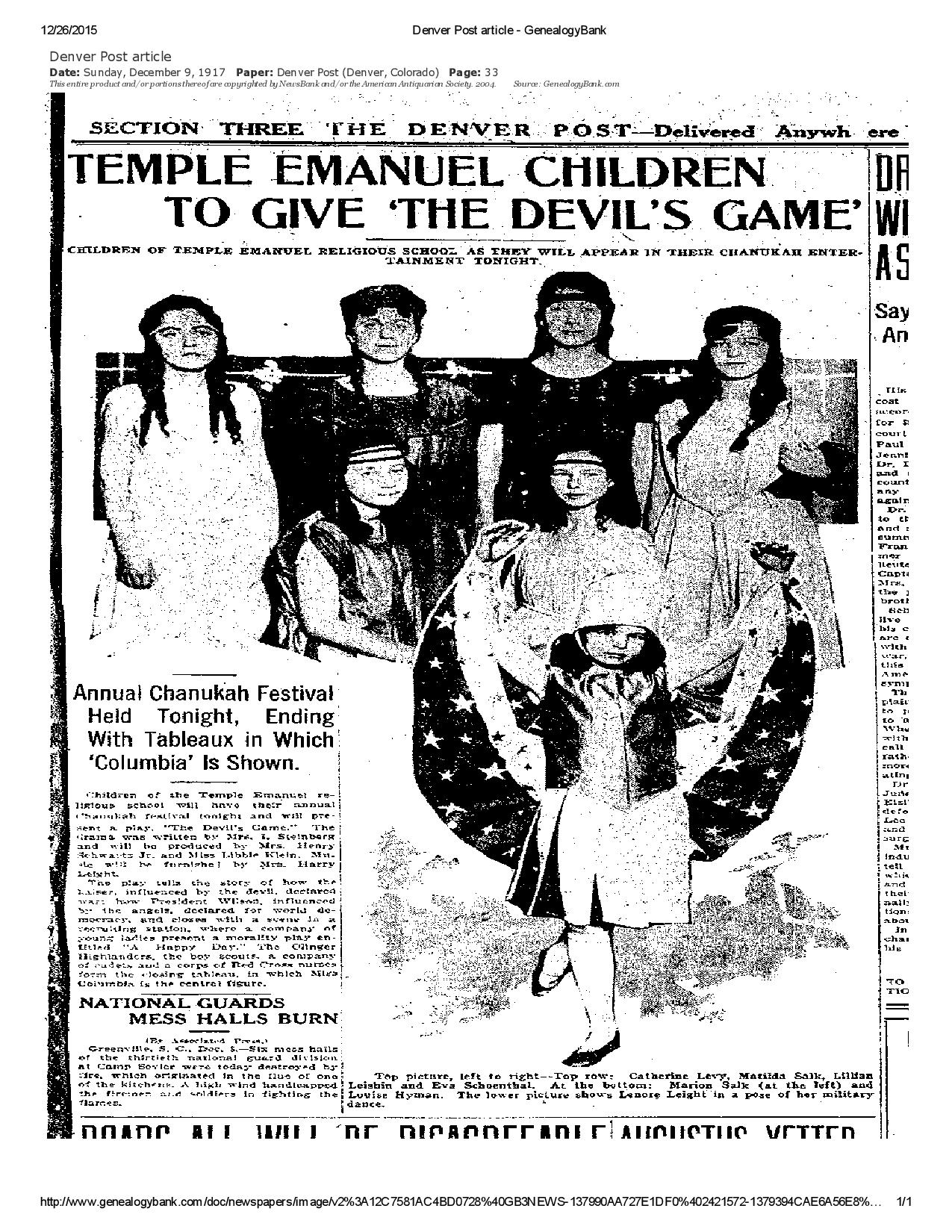
My grandmother continued to participate in dramatic performances for the synagogue, taking part in the Hanukkah production again in December, 1917.  She is depicted here on the far right of the top row. She was then thirteen.

JPG Denver Post article -Eva SChoenthal 1917 in Hanukah play-page-001

In June, 1919, she followed in the footsteps of Gerson and Harold and was confirmed at Temple Emanuel:

JPG Denver Rocky Mountain News article - Eva Schoenthal confirmation-page-001

In 1919,  Lester and his wife had moved from Colorado Springs to Denver, where he was now working as a salesman for the Frankel Carbon & Ribbon Manufacturing.  His brother Gerson was a buyer for the Golden Eagle, and his father Isidore is listed as a clerk for the Carson Crockery Company. Lester was living with his parents at 1029 13th Avenue in Denver where they had been living for several years, but Gerson had moved out and was living at 530 St. Paul Street.


Schoenthals in the 1919 Denver directory Ancestry.com. U.S. City Directories, 1822-1995 [database on-line]. Provo, UT, USA: Ancestry.com Operations, Inc., 2011.

Schoenthals in the 1919 Denver directory
Ancestry.com. U.S. City Directories, 1822-1995 [database on-line]. Provo, UT, USA: Ancestry.com Operations, Inc., 2011.

In 1920, my great-grandparents had only their two youngest children living at home: my great-uncle Harold, who was now eighteen, and my grandmother Eva, who was fifteen, as of the date of the census. According to the census, Isidore was a manager for the crockery company (I assume the 1919 directory was mistaken in listing him as a clerk).

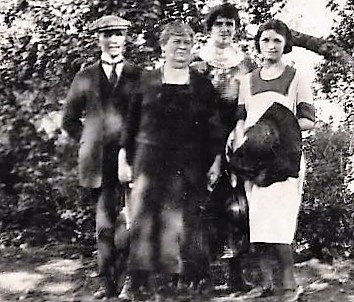
Isidore, Hilda, and Eva Schoenthal (woman in back unknown) about 1920

Isidore, Hilda, and Eva Schoenthal (woman in back unknown) about 1920

As for their oldest son, Lester, as of the 1920 census, he and Juliet had moved to Richmond, Indiana, where they were living with Juliet’s parents and siblings.  Lester was working as a representative for a rubber company. His father-in-law, Charles Beck, was now the postmaster in Richmond.

I have two listings for Gerson on the 1920 census.  On one, which is dated January 10, 1920, Gerson was listed at 530 St. Paul Street as he was in the 1919 Denver directory, and he was married to a woman named Gratice.  Gratice was born in Iowa, and her parents, Frank and Maude Johnson, were born in Missouri.  They had moved to Colorado by 1900 when Gratice was three.


Gerson Schoenthal 1920 census with Gratice

Gerson Schoenthal 1920 census with Gratice ear: 1920; Census Place: Denver, Denver, Colorado; Roll: T625_162; Page: 10B; Enumeration District: 288; Image: 947


But there is a second listing for Gerson on the 1920 census that is not dated.  On that record Gerson was living on 19th Street in Denver in a large lodging house, was working as a commercial salesman, and was listed as single.  I would have assumed that this was an earlier record since he was not yet married, but since the census record listing him with Gratice at that address is dated January 10, 1920, it would seem unlikely that the undated census was taken before January 10.  Plus since he was living at 530 St. Paul Street in the 1919 directory and as of January 10, 1920, it seems unlikely that Gerson had moved from 530 St. Paul Street to 19th Street and then back to St. Paul Street by January 10.   At any rate, Gerson was married to Gratice in subsequent years, so the January 10, 1920 record appears to be accurate. I’ve no idea what to make of the other census record.

Gerson Schoenthal in 1920 census, single Year: 1920; Census Place: Denver, Denver, Colorado; Roll: T625_160; Page: 12B; Enumeration District: 165; Image: .

Gerson Schoenthal in 1920 census, single
Year: 1920; Census Place: Denver, Denver, Colorado; Roll: T625_160; Page: 12B; Enumeration District: 165; Image: .


The family continued to have a role at Temple Emanuel even after all of the children had been confirmed, as indicated by this brief article that mentions that my great-uncle Harold led junior congregation services there in April, 1921:

Harold Schoenthal leading services 1921 Denver


In 1922, my great-grandfather continued to work for the Carson Crockery Company as a department manager, and Gerson was working as a commercial traveler for the Sun-Maid Raisin Growers (a product I add to my cereal every morning).  Lester and Juliet had returned from Indiana to Denver, and he was working as a manufacturer’s agent; his wife Juliet (Julia G here) was working as stenographer.  Even my grandmother was included in the listing.  Only Harold was missing; he must have left for college at that point.  Harold started his college studies at the University of Colorado and finished at Columbia University, where he studied architecture.


1922 Denver directory

1922 Denver directory Ancestry.com. U.S. City Directories, 1822-1995 [database on-line]. Provo, UT, USA: Ancestry.com Operations, Inc., 2011.

1922 was an important year for my grandmother.  She graduated from East Denver High School that year where she had been part of the Progressive Club (a music group, not a political group, as I had initially thought), a Big Sister, and a member of the Drama Club.  I guess her roles in the Hanukkah plays were just a small part of her teenage acting career.

Eva Schoenthal high school yearbook picture

Eva Schoenthal high school yearbook picture Ancestry.com. U.S., School Yearbooks, 1880-2012 [database on-line]. Provo, UT, USA: Ancestry.com Operations, Inc., 2010. Original data: Various school yearbooks from across the United States.

It was after graduating from high school in 1922 that my grandmother went on a trip to Philadelphia to visit her relatives there and met my grandfather, John Nusbaum Cohen, who followed her back to Colorado to court her.  They were married in Denver on January 7, 1923.  Eva was only 18 years old, and my grandfather was 27. She moved back east with him to Philadelphia where their first child, my aunt Eva Hilda (for her two grandmothers, not really as a “junior”), was born on January 13, 1924.  My father was born almost three years later.   My grandmother, although the youngest, was the first of her siblings to have children, and her children were the only grandchildren her parents ever knew.  (Harold would eventually have a child, but she was not born until long after both of my great-grandparents had died.)


John and Eva Cohen c. 1930

John and Eva Cohen
c. 1930

As the 1920s moved on to the 1930s, much was going to change for my grandmother and her family.  I will pick up with that part of the story after I return from a short break away from blogging.

In the meantime, happy New Year to you all.  May 2016 bring everyone peace and good health and happiness.  And may the world find some way to preserve our planet, to create a world where our children and grandchildren can be safe at home and at school and elsewhere, and to protect all its people from terrorism and despots and demagogues and from prejudice and hatred and fear.   We all wish for that, don’t we? There must be a way we can get there without all the rancor and stupidity and fear-mongering that seems to dominate our air waves and our political process.  At least I hope we can.