By early 1946, both Otto and Hal Katz had returned home from service in World War II, and life began to return to normal. Otto returned to his job at the Kenneth Miller Company (later Custom Bed Covers), where he worked for the rest of his career, eventually buying the company.
Otto married Edith Alexander on June 27, 1948. Edith, like Otto, was a refugee from Nazi Germany. She was born on September 30, 1923, in Rehlingen, Germany, a town in the Saar Basin near the border of Germany and France. She came to the US with her parents Max and Lina Alexander and her siblings on March 5, 1937, and settled in New York. On the 1940 census, Edith was living with her parents and siblings in the Bronx.
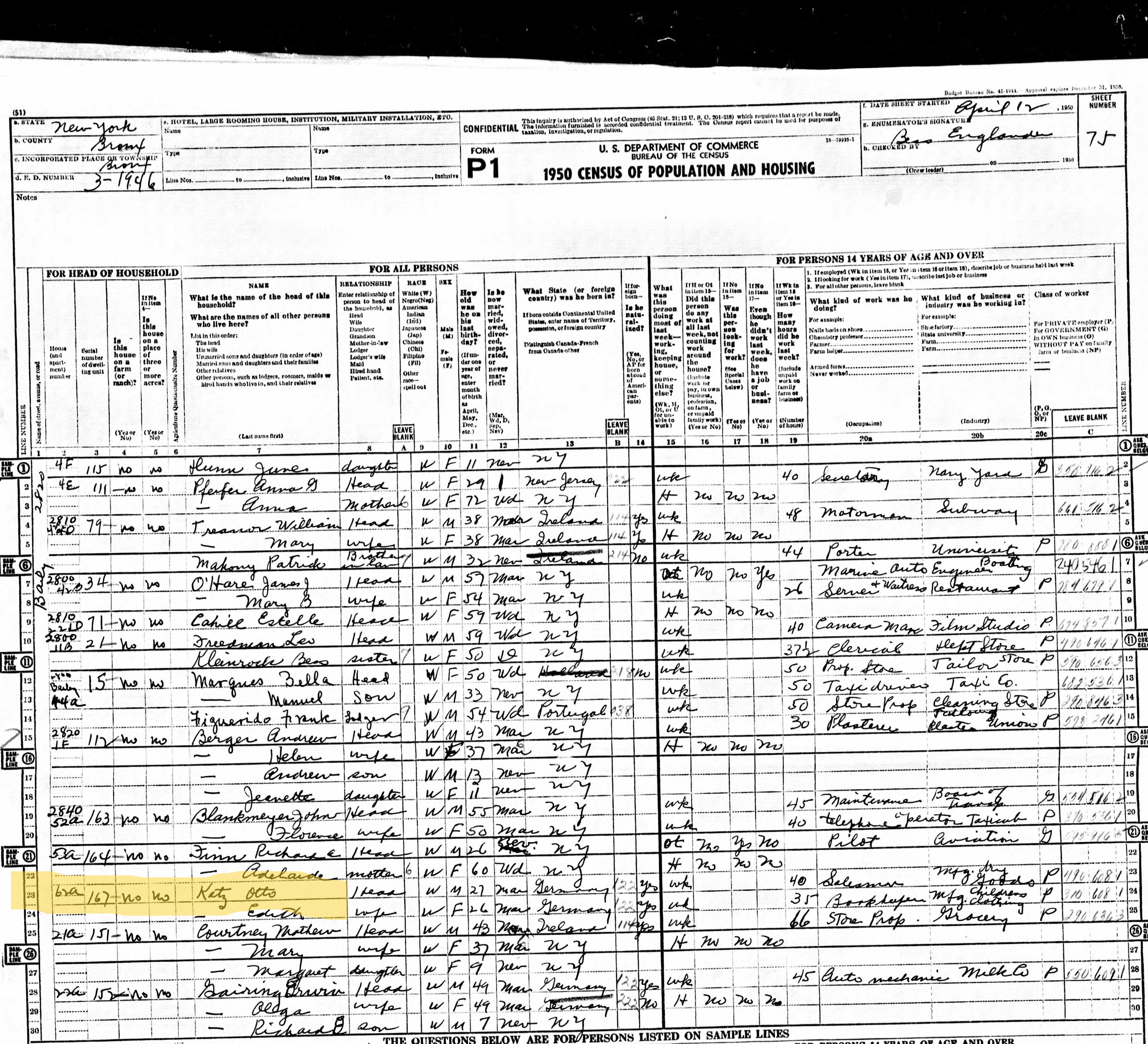
In 1950, Otto and Edith were living in the Bronx; Otto’s occupation as listed on the 1950 census is a salesman for a dry goods manufacturer, and Edith was working as a bookkeeper for a children’s clothing manufacturer. Edith and Otto would have two children, Judy and Steven.
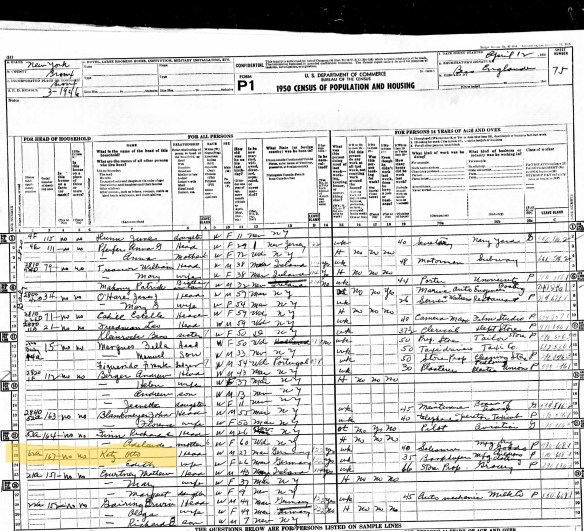
Otto and Edith Katz, 1950 US census, National Archives at Washington, DC; Washington, D.C.; Seventeenth Census of the United States, 1950; Year: 1950; Census Place: New York, Bronx, New York; Roll: 860; Page: 75; Enumeration District: 3-1946, Ancestry.com. 1950 United States Federal Census
Meanwhile, in 1950 Moritz, Clara, Hal, and Ilse were still living in Washington Heights. Moritz and Clara were working in the sweet shop they owned, as was their son Hal. Ilse was working as an x-ray technician in a laboratory. Her daughter Karin told me that Ilse had become an x-ray technician after turning down a scholarship to Columbia because she could not afford not to work full time. The family also had one lodger living with them.
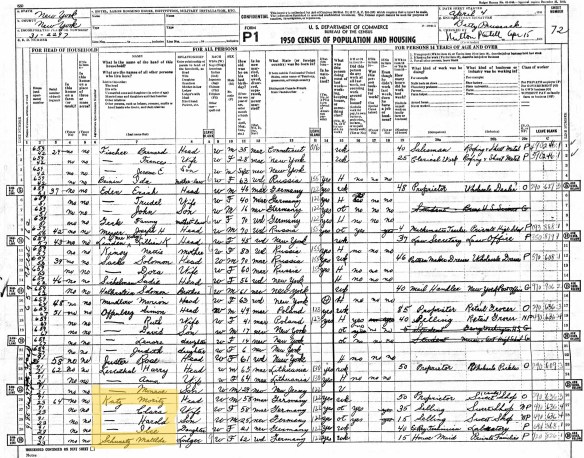
Moritz Katz and family 1950 US census, National Archives at Washington, DC; Washington, D.C.; Seventeenth Census of the United States, 1950; Year: 1950; Census Place: New York, New York, New York; Roll: 3572; Page: 72; Enumeration District: 31-2297, Ancestry.com. 1950 United States Federal Census
Hal decided he wasn’t ready to go to college, so he enrolled in a technical course in radio technology with RCA, thinking that there would be a good future in servicing radios. Then a co-worker applied to interview with General Electric (GE), and Hal went along and was interviewed and offered a job in Syracuse, New York. He didn’t really like New York City, so was happy to move upstate.
After Hal had been in Syracuse for few months, GE opened a plant in Utica, New York, and asked Hal if he’d be willing to transfer there. He had no ties to Syracuse, so he agreed to move to Utica. During that time he became seriously involved with Kate Weil, a woman he’d known since high school and a fellow refugee from Nazi Germany. Kate, born Kaethe, was born on November 14, 1929, in Karlsruhe, Germany, to Max Weil and Carola Hess. She and her family arrived from Germany on March 18, 1938, when she was eight years old. In 1940, Kate and her family were living in the Bronx; by 1950, they had moved to Washington Heights, and Kate was working for an insurance company.
Hal and Kate were married on June 29, 1952, and lived in Utica, New York, where their two children Jeff and Sandy were born. Hal enrolled in courses at Utica College, a branch of Syracuse University, and earned a degree in engineering. By 1965, they had relocated to Phoenixville, Pennsylvania, a town not far from Philadelphia, and Hal has lived there ever since and worked for GE for his entire career.
Ilse, the youngest child of Clara and Moritz, married Herbert Goldsmith in New York City on May 19, 1950. Herbert, born Hans Goldschmidt, was the son of Sally Goldschmidt and Johanna Blumenthal; he was born on January 4, 1920, in Hain-Gruendau, Germany, and like Ilse, had escaped Nazi Germany. He arrived in New York on October 27, 1938, listing his occupation as an upholsterer. He was only eighteen years old.
Hans/Herbert’s parents were able to get him and his sister Kaete out of Germany, but were unable to save themselves. As Karin, their granddaughter, explained it, among the obstacles her grandparents faced were delays caused when they had to change their names to meet Hitler’s requirements that all Jewish men add Israel to their names and all Jewish women add Sarah to theirs. That change slowed down their attempts to get the necessary papers. Karin told me that her grandmother Johanna was learning English and even wrote one letter in English to her son in America. But it was all for naught. Sally and Johanna Goldschmidt were eventually sent to the Minsk ghetto and died there, two more innocent victims of the Nazi death machine. But fortunately their son Herbert and his sister Kaete survived.
Herbert settled in New York and first worked in an upholstery shop and then established his own shop in the Bronx and then later in Washington Heights, where he met Ilse Katz. Ilse and Herbert had two children, Karin and Robert. By 1958, they were living in Fairlawn, New Jersey. Ilse had been forced to quit her job as a x-ray technician when she became pregnant, as was common in those days. She never worked in that field again but Karin told me that her mother did work at various part-time jobs and ultimately had a career as a unemployment insurance claims examiner for the state of New Jersey.
As for Moritz and Clara, they lived in New York City for the rest of their lives, but traveled extensively once their three children were all married; they visited Clara’s brother Max and Moritz’s sister Johanna in South America and also went to Switzerland and Israel.
Here are two family photographs taken during the 1950s sent to me by Judy Katz. First, a photograph of Clara with her son Hal:

Clara and Hal Katz, 1950s. Courtesy of the family
This second photograph was taken in 1958 at the wedding of Werner Rothschild, Clara’s nephew. In the back row from left to right are Otto and Edith Katz, Hal and Kate Katz, and Herbert and Ilse Katz Goldsmith. In the front row is Hattie Erdreich, a first cousin of Moritz Katz on his mother’s side, then Moritz and Clara’s granddaughters Judy and Karin, and then Moritz and Clara (Rothschild) Katz.

Katz family at Audrie and Werner Rothschild’s wedding in December 1958. Courtesy of the family
I asked the family of Moritz and Clara for some of their memories of the couple. Their granddaughter Judy wrote, “We loved our grandparents. Karin and I occasionally got to “work” in the chocolate store, unloading chocolates onto a tray for the display case. At bedtime, when we were in bed, my grandmother would give us a sleeping pill (a chocolate, probably a lentil). When we woke up, we would jump on our grandfather to wake him up. He would pretend to be sleeping through it. My grandfather had the bluest eyes, and always smiled. He kidded around a lot.”
Karin, another granddaughter, shared that Moritz was very knowledgeable about plants and enjoyed gardening when he visited her family in New Jersey. She wrote, “He once planted the pit of a peach in our back yard, and it grew into a tree producing a lot of peaches!”
As for Clara, Judy wrote, “My grandmother was more serious; we used to tell her that she was like a sergeant, and she would say to us, ‘Don’t be a silly-billy.’ ” But Judy also remembers Clara as very sweet and loving. Karin wrote that Clara “was very dependent on Moritz, very proper, and cared a lot about how she dressed, how things fit, and cleanliness.” She also remembered that Clara baked very well and knitted to earn money; Karin loved her potatoes.
Steven Katz, one of Clara’s grandsons, also remembered her baking; he wrote, “My grandmother “invented “ (by accident) a crumb cake without yeast… it was dense, with crumbs on top. So yummy.” Karin also commented that Moritz and Clara were very kind to her father Herbert–even before he started dating their daughter Ilse. Karin said that Clara always invited him for Shabbat dinner, and he would bring challah and flowers.
Both Karin and Judy commented on the fact that Moritz was a heavy smoker and smoked Camel cigarettes, and both observed that he ultimately died from a heart attack. Judy had specific memories surrounding his death on February 5, 1967, at the age of 72. She wrote:
In January (possibly 1/27/67) my grandfather had a heart attack, in the apartment. It was during a blizzard. He was taken to Columbia Presbyterian Hospital, where he seemed to be recovering. I stayed in my grandparents’ apartment with my grandmother for about a week. In the early morning of Sunday, February 5, 1967 he died (age 72). The funeral was that day. (Uncle Hal was in NYC (visiting his parents) when he died).
All of the cousins were brought to our (my parents) apartment, which was walking distance from 190th Street, and I took care of the kids while the rest of the family went to the funeral. I was 15. My grandmother was devastated. She and my grandfather adored each other.
Clara outlived him by over five and half years; she was 81 when she died in New York on October 1, 1972. Here is one more photograph of Clara:
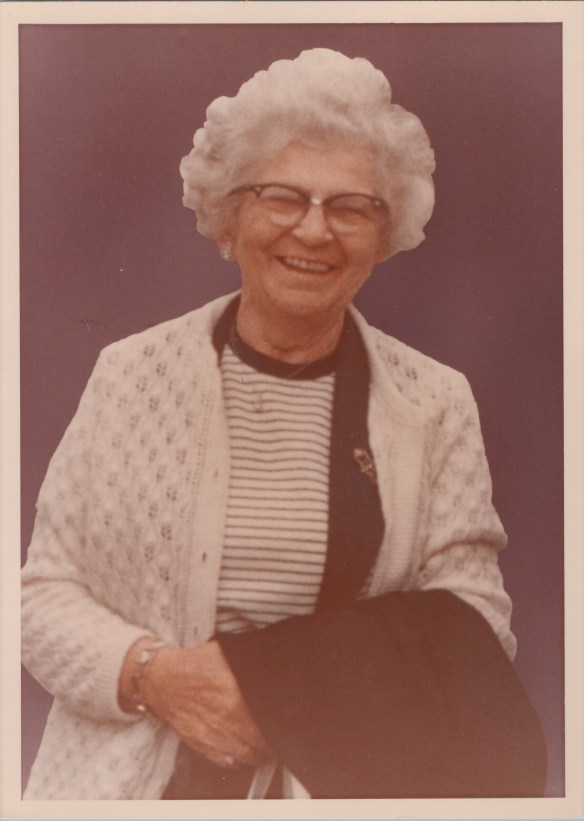
Clara Rothschild Katz Courtesy of the family
Here is a photograph of the headstones for Moritz and Clara:
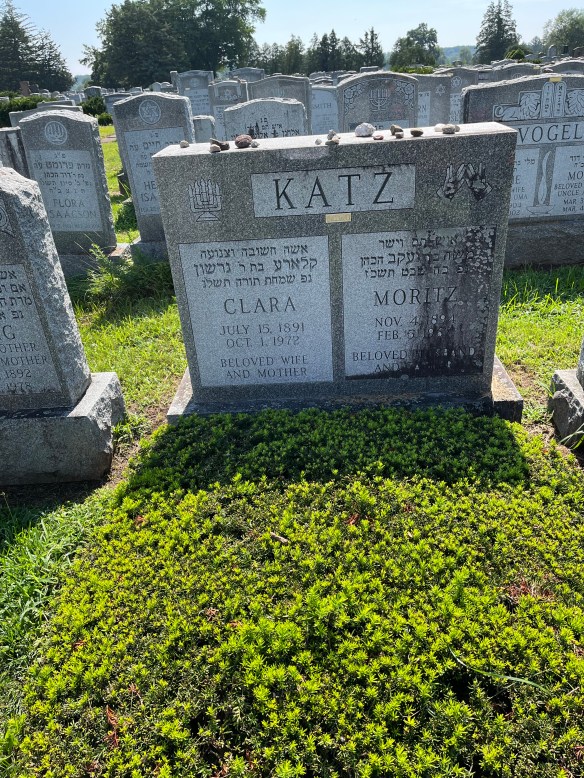
Gravestones for Moritz and Clara Katz Courtesy of the family
Moritz and Clara’s oldest child Otto Katz was 94 when he died on February 10, 2017; his wife Edith had predeceased him on December 20, 2008, at age 85. Otto’s obituary described him this way: “Honest and righteous Jewish man. Former shipping clerk and President of Custom Bed Covers. Longtime volunteer at the Physical Therapy Department of the Allen Pavillion. Awesome bridge player. Loyal and loving uncle, cousin and friend to many. Great teller of jokes that cannot be repeated.”
Ilse Katz Goldsmith died almost two years after her brother Otto; she was ninety when she died on December 20, 2018. Her husband Herbert outlived her, living to age 101 and dying on July 6, 2021.
Hal Katz lost his wife Kate on June 29, 2018; she was 88. According to her obituary, “s]he worked as a teacher at the Kimberton Farms School and a substitute teacher for the Phoenixville Area School District. She was an active member of Congregation B’nai Jacob in Phoenixville, PA. She served on the board of Phoenixville Area Childrens Learning Center. She was a prolific knitter for her friends near and far.”
Otto and Edith, Ilse and Herbert, and Kate were survived by their children and grandchildren and by their remarkable brother/brother-in-law/husband, Hal Katz, whose light continues to bring great joy to his family and who has given me much joy as well. His sense of humor, his modesty, and his obvious zest for life are all inspiring.
When I asked Hal what he thought was the meaning of life, having experienced so much over the last century, he said he had one word: family.
Isn’t that the truth?
Thank you to Hal, Sandy, Judy, Steve, and Karin for zooming with me and sharing their memories, and special thanks to Judy for all her help in sending me the interviews she did with Otto and Hal, the family photographs, and several family documents. Without all their input, my stories about the family of Clara Rothschild Katz would have been far less interesting and far too superficial.















 Brotmanblog: A Family Journey