Two Tragedies in 1894 for the Family of Ernst Nusbaum

If the 1880s were years of general growth and prosperity for Ernst Nusbaum and his family, the 1890s were years of loss.  Once again, the Nusbaum/Dreyfuss family lost a young member of the family to suicide.

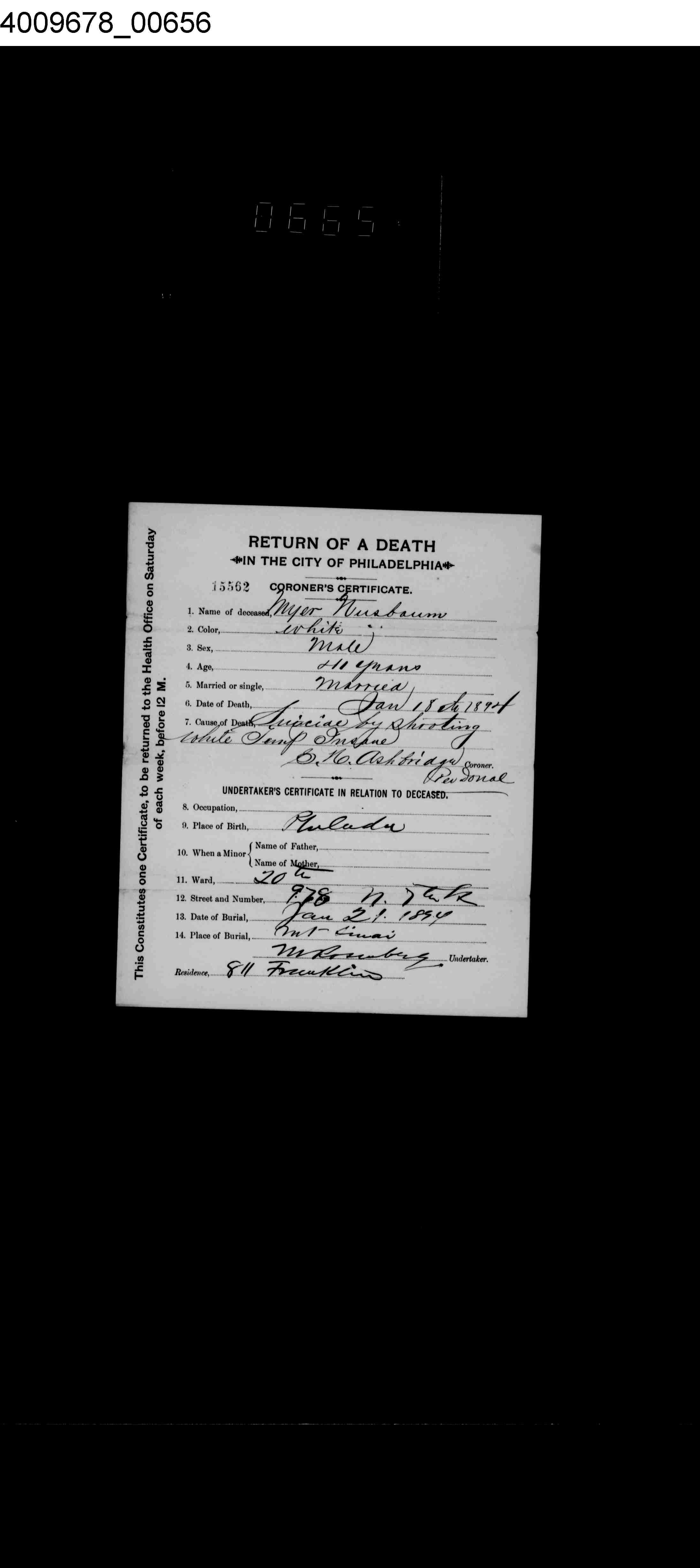
On January 18, 1894, Myer Nusbaum, 41 years old and the father of two young teenagers, took his own life.

myer nusbaum suicide  jan 19 1894 phil inquirer page 1

myer suicide part 2

myer suice part 3

myer suicide part 4

myer suicide part 5

Philadelphia Inquirer, January 19, 1894, p. 1

The Philadelphia Times also reported on this tragic death here: Myer_Nusbaum_Suicide_Philadelphia_Times_p_4_1_19_1894

Here was a man of a steady and upstanding reputation, a bookkeeper for a clothing company who had been employed in one place for over twenty years, a man who was well-liked and active in his community, a man with a wife and two teenaged children.  What was this “grip” that caused him so much pain that he felt he had no alternative but to end his life?

From what I can gather from various sources on line, the grip was a term for what we would today call influenza or the flu.  I’ve had the flu.  Probably all of you have had the flu at some time or another.  It’s awful.  You feel terrible.  Your head hurts, your body aches, you have respiratory symptoms, sometimes stomach symptoms.  It can last for many days.  But most people don’t become suicidal.

Although the headline on the Philadelphia Times story about Myer says, “Another Grip Tragedy,” I would imagine that even back in the 1890s, most people did not intentionally end their lives while suffering from the flu. Somehow I have to believe that Myer’s illness was something more than influenza, but it just was not diagnosed. The Inquirer story says he had been suffering for seven weeks; I have never heard of the flu lasting that long, but maybe it did back then.  He must have been suffering terribly to have been driven to such an extreme.  Imagine his poor fifteen year old son Jacob, watching his father die in his arms, and his wife Rosalie and sixteen year old daughter Corinne having to identify his body at the hospital.

UPDATE:  My cousin Jessica, an expert in disease and disaster control, sent me a link to an article about the flu pandemic of the 1890s, the so-called Russian flu.  It included this quote:  “Influenza was also considered to be a major cause of nervous and psychological disorders by acting as a “devitalizing agent.” Descriptions of influenza sequelae included “depression,” “shattered nerves,” “neurasthenia,” and “despondency.” During 1890, for example, an unprecedented 140 melancholics afflicted with influenza “poison” were admitted to Scotland’s Royal Edinburgh Asylum. Coroners also cited influenza as a reason for “temporary insanity” in cases of suicide. Across Europe, rates of suicide (mostly male) and attempted suicide (mostly female) rose during the 1890s. In England and Wales, there was a 25 percent increase in suicides between 1889 and 1893. Paris witnessed a 23 percent rise during 1889–1890 compared with the average, and there were also increased rates in Germany and Switzerland.”  Thus, Myer Nusbaum was not alone in suffering severe depression as a result of the flu.  You can read more about the Russian flu here.

Myer Nusbaum death cert suicide

“Pennsylvania, Philadelphia City Death Certificates, 1803-1915,” index and images, FamilySearch (https://familysearch.org/pal:/MM9.1.1/JK96-L2H : accessed 11 March 2015), Myer Nusbaum, 18 Jan 1894; citing 15562, Philadelphia City Archives and Historical Society of Pennsylvania, Philadelphia; FHL microfilm 1,871,367.


1894 ended as tragically as it began.  Almost eleven months to the day after Myer died, on December 16, 1894, his father Ernst died from injuries sustained in a fall.  Ernst was 78 years old; the last of the Nusbaum siblings in America was gone.  And not from disease or old age, but from an accidental fall.  Somehow that just seems unfair; he had been able to adjust to life in America, had been a successful businessperson, had bounced back from bankruptcy and the Depression of the 1870s, and had raised six children with his wife Clarissa, and his life had ended because of a fall.

Ernst Nusbaum death cert

Pennsylvania, Philadelphia City Death Certificates, 1803-1915,” index and images, FamilySearch (https://familysearch.org/pal:/MM9.1.1/VKDH-3ZJ : accessed 11 March 2015), Ernst Nusbaum, 16 Dec 1894; citing page 284 certificate # 11892, Philadelphia City Archives and Historical Society of Pennsylvania, Philadelphia; FHL microfilm 1,011,822.


As for the rest of the family, Arthur Nusbaum and his wife Henrietta had two more children in the 1890s: Clare, born in 1894, and Helen, born in 1895.  There were now six children in the family, and they were living at 2559 North 16th Street.  Arthur was involved in clothing sales in the 1890s and as reported on the 1900 census.  Their son Sidney, now 21, was also a clothing salesman, and Horace, who was 15, was working as an upholsterer.

Fanny Nusbaum and her husband Jacob Hano continued to live in New York City in the 1890s.  Fanny and Jacob had five sons (Samuel having died in 1884), all still at home during that decade and in 1900.  In 1891, they were living at 119 East 111th Street in East Harlem, and Jacob was a printer and book manufacturer.  In 1892 they were living at 948 Fleetwood Avenue, which I cannot locate in New York City today, but by 1898 they were living at 803 Edgecombe Avenue, even further uptown, near 171st Street on what is now Amsterdam Avenue.  On the 1900 census, the family is living at 203 West 134th Street, and the oldest son, Louis, now 22, was employed as a salesman.  The other four were still at home.  There was also a servant living in the home.

Edgar Nusbaum and his wife Viola continued to live 2029 North 11th Street in Philadelphia in the early 1890s, and Edgar was working as a clerk.  By 1897, however, the family had moved to 1520 North 12th Street, and Edgar was working as a publisher like his brother-in-law Jacob Hano.  On the 1900 census, however, Edgar listed his occupation as clerk once again.  Their daughter Selena, now 19, was working as a dressmaker.  Viola’s sister and a boarder were also living with them.

Henrietta Nusbaum and her husband Frank Newhouse had been living with Ernst and Clarissa, her parents, in 1890 at 2028 Mt. Vernon Street, and Frank was working as a tailor.  They were still living at that address as of the 1900 census with Clarissa, now a widow, and Frank’s occupation was a traveling salesman.  Neither Clarissa nor Henrietta were working outside the home, and there were two domestic servants living with them.

Frank Nusbaum and his wife Dolly and their daughter Loraine were living at 811 Windsor Square in 1891.  By 1896, Frank was selling insurance, and they were living at 637 North 33rd Street; a year later they were living at 3223 Wallace Street.  In 1900, the family was living at yet another location, 3206 Manton Avenue, and Frank was still an insurance broker.

As for the widow of Myer Nusbaum, Rosalie Aub Nusbaum, she and their children Corinne and Jacob (called Jack on the 1900 census) were living at 5020 Cedar Street in 1900.  Jack was working as a salesman, now almost 21 years old, and his mother and sister were at home.  There was also a boarder living with them as well as one domestic servant.

Thus, somehow the family survived the two tragedies of 1894 and entered the 20th century, all but Fanny still living in Philadelphia, all still working and living their lives.


Ernst Nusbaum and Family in the 1880s: Years of Growth and Movement

There is one more line of the Nusbaum clan to complete, that of John’s younger brother Ernst.  Since it’s been two months since I last wrote about Ernst and his family, I thought I would first summarize what he and his family were doing in 1880 and where they had been before then.  Then we can bring Ernst and his family up to the 20th century.  Today I will discuss the 1880s.  I’ve included a series of Google Maps to show how much this family moved around in the 1880s.

Ernst is the Nusbaum sibling who may have lived in Philadelphia first and never lived anywhere else after settling there by 1851 when his first child Arthur was born.  Ernst was married to Clarissa Arnold, and in the 1850s he was a clothing merchant in Philadelphia with his firm,  Nusbaum, Arnold, and Nirdlinger.  Between 1851 and 1861, he and Clarissa had six children: Arthur, Myer, Fanny, Edgar, Henrietta, and Frank.  During the 1860s, Ernst continued to work in the clothing business with Nusbaum, Arnold, and Nirdlinger, and his children continued to grow.

The next decade presented serious financial challenges for Ernst and his family.  His company declared bankruptcy in 1870, and for much of the decade I could not find a listing that showed what Ernst was doing for a living.  Meanwhile, his oldest children were entering the workforce and getting married.  Between 1876 and 1879, Arthur married Henrietta Hilbronner, Fannie married Jacob Hano, Myer married Rosalie Aub, and Edgar married Viola Barritt.  Several grandchildren were born as well.  By 1880, only Henrietta and Frank, the two youngest children, were still living at home.

In 1880, Ernst was 64 and working as a cloak manufacturer, according to the 1880 census.  Until 1884, he and Clarissa continued to live in the same home where they had lived for many years and raised their children at 2105 Green Street.  In 1884 they were now listed as living at 2028 Mt. Vernon Street where they would remain throughout the decade.  Ernst was also continuing to work in the cloaks business throughout these years.

After his brother John died in 1889, Ernst was the only Nusbaum sibling left in the United States.  He and Clarissa continued to live in the same home, and he continued to work in the cloaks business into the 1890s when he was in his seventies.

As for the children of Ernst and Clarissa in the 1880s, their oldest child Arthur and his wife Henrietta had four children between 1877 and 1895: Florence (1877), Sidney (1879), Horace (1885), and Stella (1889).  In 1880 Arthur, Clarissa, and the two oldest children were living with Henrietta’s parents at 938 North 7th Street, and Arthur was working as a clothing cutter, presumably for his father-in-law, who was a clothing manufacturer.  In 1883 and 1884, Arthur is listed as a tailor, still living at his in-laws residence at 938 North 7th Street.  In 1885, he is listed at 1338 Franklin Avenue as he is in 1887, working as a salesman, and in 1888 he is living at 1814 Franklin with no occupation specified.  In 1890 they had moved again, now living at 1732 Gratz Street, and Arthur was working as a cutter.

Myer, the second child of Ernst and Clarissa, and his wife Rosalie Aub had two children, Corinne (1878) and Jacob (1879).  In 1880 Myer was working as a bookkeeper for a clothing company.  The family was living at 979 North 7th Street.  In 1885 his residence as listed as 1825 North 8th Street; Myer continued to work as a bookkeeper.  But in the 1889 and 1890 directories his residence is again 979 North 7th Street, as it was also in 1891.  In each, his occupation is bookkeeping.

Fanny, the third child, and her husband Jacob Hano had six children between 1877 and 1891: Louis (1877), Ernest (1880), Samuel (1883), Myer (1885), Alfred (1890), and Clarence (1891).  Six boys.  Wow.  Although I am no longer surprised to see a Jewish child named for someone living, the fact that Fanny gave a son not only the same name as her father while he was still alive (his middle name was even Nusbaum), but also gave another son the same name as her brother did surprise me.

Fanny and Jacob had been living in Youngstown, Ohio, in 1880, where Jacob had declared bankruptcy in 1878, but Jacob was working once again as a clothier in 1880 in Youngstown.  By 1884, however, Fanny and Jacob and their children had moved back to Philadelphia to 1823 Poplar Street, and Jacob was working as a salesman.  By 1889, however, the Hano family had relocated again, this time to New York City, where Jacob was a book dealer.  The family was living at 967 Park Avenue in Manhattan in 1889.  Fanny and Jacob never again returned to live in the Philadelphia area, but stayed in greater New York.

Although Edgar Nusbaum and his wife Viola Barritt had not been living together according to the 1880 census, they had a daughter named Selena, born in 1881.  On the 1881 Philadelphia directory, Edgar is still listed at his parents’ residence at 2105 Green Street, working as a salesman, but by 1882 he had moved out to 1331 Girard Avenue and was working as a clerk. A year later he is listed as a bookkeeper living at 1922 Van Pelt, in 1884 as a clerk living at 1318 South Broad Street, and he is missing from the 1885 and 1887 directories.  Edgar reappears in 1888, living at yet another address (2029 North 11th Street), where they finally seemed to settle down for a number of years.

(I cannot imagine moving as often as these people seemed to move.  I’ve lived in only two places in the last 30 years and in only five places total my whole adult life (and only three places as a child).  These people seemed to move every year or so.  I guess they had less “stuff” so moving was easier.)

Henrietta, the fifth of the children of Ernst and Clarissa, married Frank Newhouse in 1883 in Philadelphia.  Frank was from Philadelphia, one of eleven children, and in 1860 when he was six years old, his household included a governess and three domestic servants as well as the nine children then alive and two adults.  His father Joseph Newhouse, a German native, gave his occupation as “gentleman” on the 1860 census.  He had real estate worth $40,000 as well as personal property also worth $40,000.

Frank and Henrietta (Nusbaum) Newhouse were living at 2028 Mt. Vernon Street in 1884, the same address where Henrietta’s parents were living at that time.  Frank and Henrietta would live with Ernst and Clarissa at that address for many years.  Although Frank’s occupation was given as salesman in some of the directories and as late as 1889, in 1890 he is listed as part of the firm of Rice and Newhouse, tailors. Since all the other entries said he was a salesman, I thought the 1890 listing seems anomalous and perhaps wrong. But I checked the 1892 directory, and it still has Frank working at Rice and Newhouse and still identifies the business as tailoring.  Frank and Henrietta did not have any children.

Finally, the youngest of Ernst and Clarissa’s children was Frank Nusbaum, born in 1861. He’d been living at home in 1880, working as a clerk, and was still living with his parents in 1884 and 1885.  By 1885 his occupation had changed to bookkeeper. He married Dolly Hills in Philadelphia in 1887 when he was 26.  Unfortunately, I have not been able to find out anything about Dolly’s background.  The closest match was a Dollie Hill living on a farm in Pennsvylania with her family in 1870, but I could not find that Dollie on a later record.  Frank and Dolly had one child, Loraine, born in 1889. Frank and Dolly lived at 2017 Vine Street in 1888 and 1889.  Frank was at first working as a clerk and then as a salesman.

Here is one last map showing where each member of the family was living in the late 1880s (other than Fanny,  who was in New York):

Thus, the 1880s were a fruitful time for the family of Ernst and Clarissa (Arnold) Nusbaum.  Their children were all married, and there were a number of grandchildren born.  All but one of their children were living in Philadelphia, and most of the men were involved in the clothing trade, either as manufacturers, tailors, or salesmen.  After the hardships of the 1870s, life must have seemed pretty good for Ernst, Clarissa, and their children.  Unfortunately, the 1890s would not be as easy a decade.


Tuberculosis Continues to Ravage the Family: The Children of Fanny Wiler and Clara Wiler

In 1910, the three sons of Fanny Wiler were still living with their father Joseph Levy and stepmother Bella Strouse Levy as well as their half-sister Miriam, who had married Arthur Hanff.  Alfred, Leon, and Monroe Levy were all single and all employed in sales.  Alfred was in lumber sales, and Leon and Monroe were selling clothing.

Five years later Monroe succumbed to the same awful disease that had taken the life of his cousin Leon Simon the year before: tuberculosis.  Like Leon Simon, Monroe had been living at a sanitarium, the Dermady Cottages Sanitarium in Morton, Pennsylvania, ten miles outside of Philadelphia.  Monroe had been there since November 24, 1913, and he died on October 28, 1916, almost three years later. Like his cousin Leon, he did not have a family member sign the death certificate as the informant; in Monroe’s case, it was the undertaker who took on that responsibility.    Monroe was 42 years old.  He was buried at Rodeph Shalom cemetery, another young man whose life was cut short by TB.

Ancestry.com. Pennsylvania, Death Certificates, 1906-1963 [database on-line]. Provo, UT, USA: Ancestry.com Operations, Inc., 2014. Original data: Pennsylvania (State). Death certificates, 1906–1963. Series 11.90 (1,905 cartons). Records of the Pennsylvania Department of Health, Record Group 11. Pennsylvania Historical and Museum Commission, Harrisburg, Pennsylvania.

Ancestry.com. Pennsylvania, Death Certificates, 1906-1963 [database on-line]. Provo, UT, USA: Ancestry.com Operations, Inc., 2014.
Original data: Pennsylvania (State). Death certificates, 1906–1963. Series 11.90 (1,905 cartons). Records of the Pennsylvania Department of Health, Record Group 11. Pennsylvania Historical and Museum Commission, Harrisburg, Pennsylvania.

His two older brothers fared much better. Leon J. Levy married Minnie Howell in Philadelphia in 1910, apparently after the 1910 census had been taken.  Minnie was a Pennsylvania native and was 35 when she married Leon; he was 38.  On his World War I draft registration, Leon recorded his occupation as the manager of Walter D. Dalsimer, which was a dry goods and clothing merchant in Philadelphia.  In 1920, he was still the manager of a clothing store, and Minnie was working as a chiropodist.  Minnie’s parents were living with them at 5214 Spruce Street.  There were no children.

On February 11, 1929, Leon died from complications from an intestinal obstruction that led to general peritonitis and a ruptured and gangrenous appendix.  He was not yet 57 years old.  His brother Alfred J. Levy was the informant on the death certificate.  Leon’s wife Minnie died just three years later from coronary thrombosis and hypertension.  She was also only 57 years old.  They are both buried at Arlington Cemetery in Drexel Hill, Pennsylvania, a non-sectarian cemetery.


Ancestry.com. Pennsylvania, Death Certificates, 1906-1963 [database on-line]. Provo, UT, USA: Ancestry.com Operations, Inc., 2014. Original data: Pennsylvania (State). Death certificates, 1906–1963. Series 11.90 (1,905 cartons). Records of the Pennsylvania Department of Health, Record Group 11. Pennsylvania Historical and Museum Commission, Harrisburg, Pennsylvania

Ancestry.com. Pennsylvania, Death Certificates, 1906-1963 [database on-line]. Provo, UT, USA: Ancestry.com Operations, Inc., 2014.
Original data: Pennsylvania (State). Death certificates, 1906–1963. Series 11.90 (1,905 cartons). Records of the Pennsylvania Department of Health, Record Group 11. Pennsylvania Historical and Museum Commission, Harrisburg, Pennsylvania

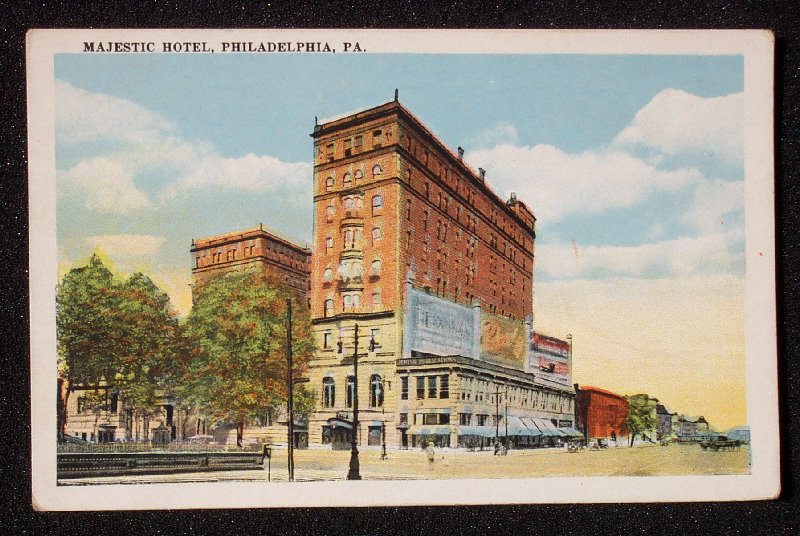
The oldest of Fanny Wiley and Joseph Levy’s sons, Alfred, married Josephine B. May in 1916.  He owned his own business, A. J. Lumber Company, and in 1917 was living in the Majestic, a grand hotel catering to the wealthy in those days.  Alfred and Josephine were still living there in 1918 as well, and on the 1920 census, they were still living there.  Alfred was then 51 years old, and his wife Josephine is listed as 22.  That means she was 18 when she married him, and he was 47.  (This family certainly liked to marry people who were significantly older or younger than they were.)  Alfred continued in the lumber business for many years.  In 1930 census, he was now 62, Josephine was 33, and there were no children, so it does not appear that the couple had any children.


Ten years later, Alfred was listed a widower on the 1940 census; he was living with his sister Miriam and her family, and he was still engaged in the lumber business.  Two years later, Alfred Levy died from liver cancer at 74 on November 15, 1942.  Contrary to the 1940 census, the death certificate indicates that Alfred was divorced, not a widower, at the time of his death. Since I cannot find a death certificate for Josephine, I assume that the death certificate is more accurate.[1] His last residence was with his sister Miriam and her husband Arthur Hanff, the informant on his certificate.


Ancestry.com. Pennsylvania, Death Certificates, 1906-1963 [database on-line]. Provo, UT, USA: Ancestry.com Operations, Inc., 2014. Original data: Pennsylvania (State). Death certificates, 1906–1963. Series 11.90 (1,905 cartons). Records of the Pennsylvania Department of Health, Record Group 11. Pennsylvania Historical and Museum Commission, Harrisburg, Pennsylvania

Ancestry.com. Pennsylvania, Death Certificates, 1906-1963 [database on-line]. Provo, UT, USA: Ancestry.com Operations, Inc., 2014.
Original data: Pennsylvania (State). Death certificates, 1906–1963. Series 11.90 (1,905 cartons). Records of the Pennsylvania Department of Health, Record Group 11. Pennsylvania Historical and Museum Commission, Harrisburg, Pennsylvania

Like his brother Monroe, Alfred was buried at Rodeph Shalom cemetery.

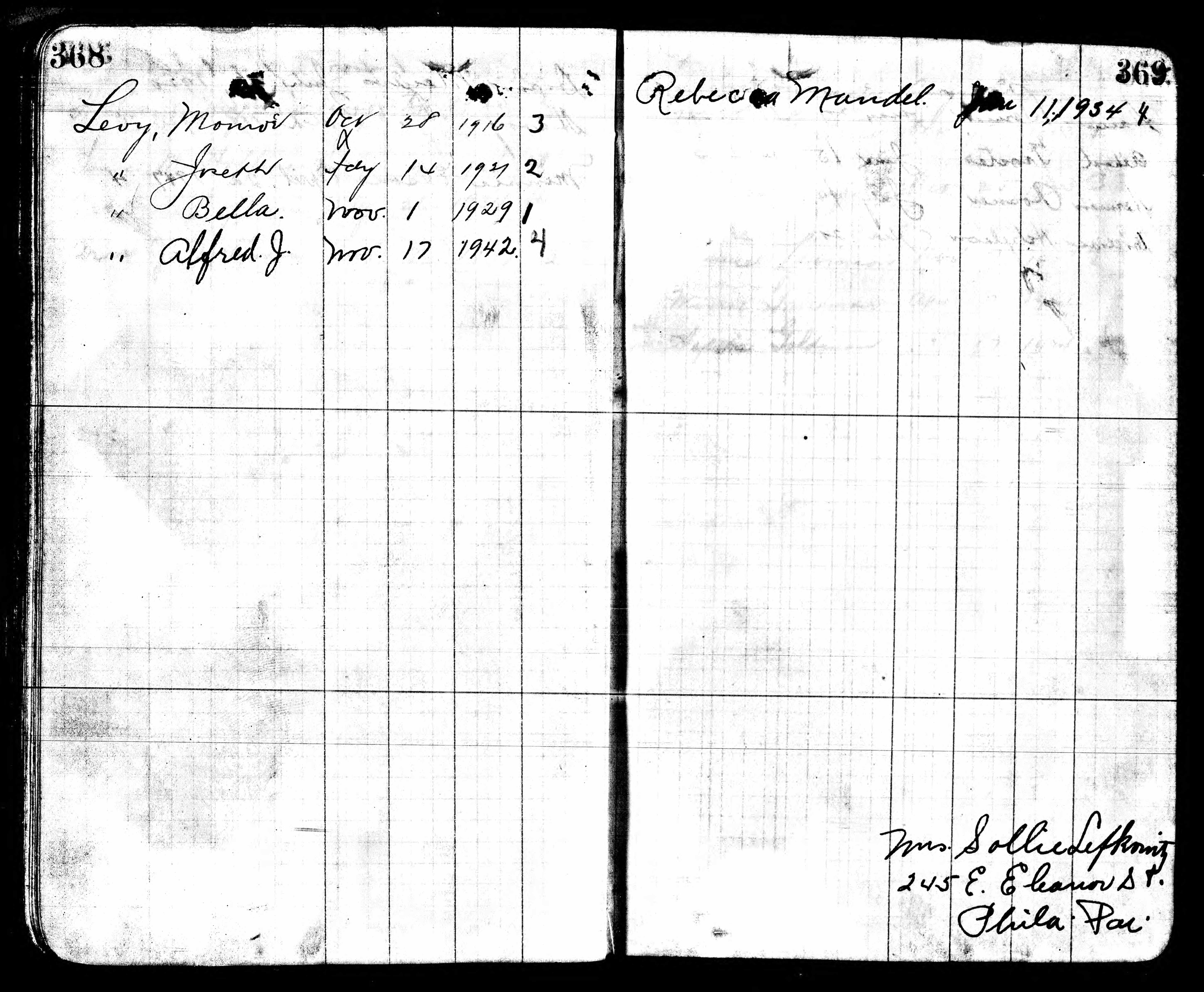
Burial plots for Joseph, Alfred and Monroe Levy

Historical Society of Pennsylvania; Historic Pennsylvania Church and Town Records; Reel: 1112 Description Organization Name : Rodeph Shalom Cemetery Records


Thus, none of Fanny Wiley and Joseph Levy’s sons had children, and there are no descendants.  From the three oldest children of Caroline Dreyfuss and Moses Wiler, there would be only one great-grandchild: Lester Strouse, the son of Flora Simon.  Lester was the only grandchild (of two) of Eliza Wiler and Leman Simon to survive to adulthood.  Fanny Wiler had no grandchildren.  Simon Wiler had no children.

Which brings me to Clara Wiler Meyers, the youngest child of Caroline Dreyfuss and Moses Wiler and the mother of thirteen children, eleven of whom survived to adulthood.  As of 1910, none of those children had married, although nine of the eleven were already in their 20s and 30s.  Only two of the eleven had moved out of the house.  In the next ten years most of those children moved out and on with their adult lives.  In addition, there were several losses.

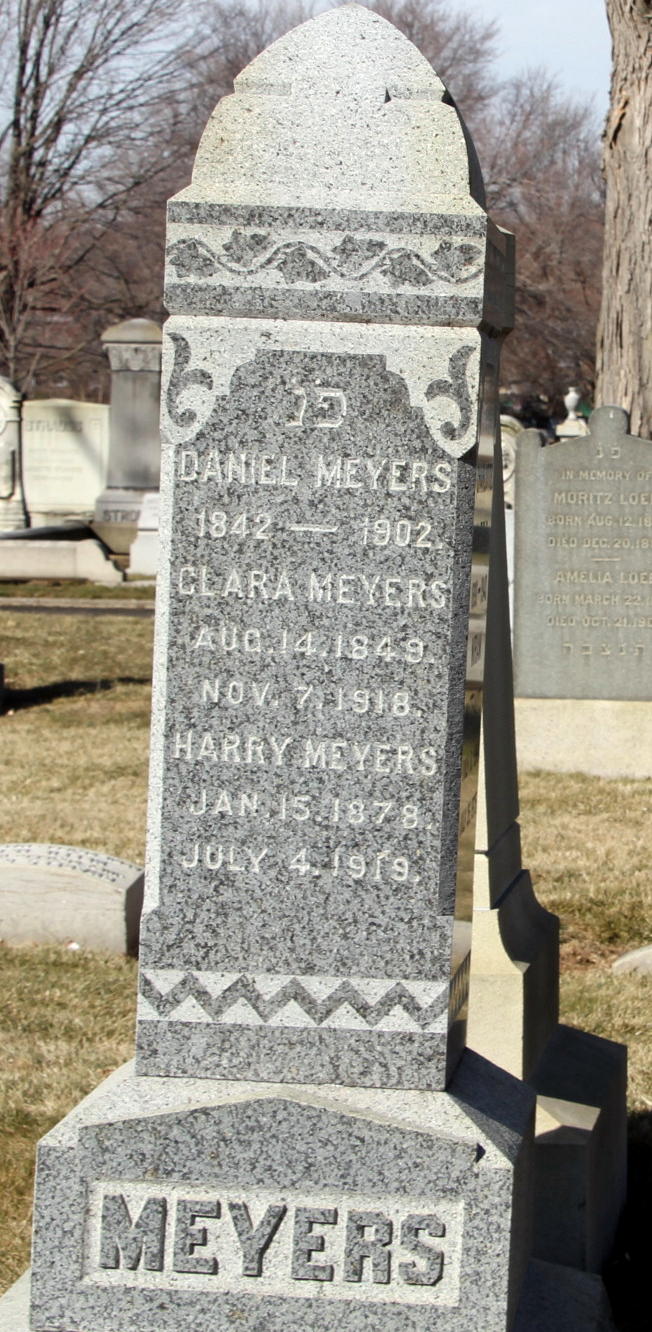
First, Clara Wiler Meyers, the mother of all those children and widow of Daniel Meyers, died on November 7, 1918, from fatty myocarditis.  She was living at 1905 Diamond Street, an address where at one time or another during the 1910s several of her children resided.  Clara was 68 years old when she died.  She had outlived one child, Bertha, and her husband, Daniel.  She had weathered the financial and legal problems he had faced in the late 1890s.  She had given birth to thirteen babies, one stillborn, and she had raised eleven of those babies to adulthood.  Like so many women of her times, she did remarkable things but things that history would not have noticed.


Ancestry.com. Pennsylvania, Death Certificates, 1906-1963 [database on-line]. Provo, UT, USA: Ancestry.com Operations, Inc., 2014. Original data: Pennsylvania (State). Death certificates, 1906–1963. Series 11.90 (1,905 cartons). Records of the Pennsylvania Department of Health, Record Group 11. Pennsylvania Historical and Museum Commission, Harrisburg, Pennsylvania.

Ancestry.com. Pennsylvania, Death Certificates, 1906-1963 [database on-line]. Provo, UT, USA: Ancestry.com Operations, Inc., 2014.
Original data: Pennsylvania (State). Death certificates, 1906–1963. Series 11.90 (1,905 cartons). Records of the Pennsylvania Department of Health, Record Group 11. Pennsylvania Historical and Museum Commission, Harrisburg, Pennsylvania.

Leon, her oldest surviving child, had moved out before 1910 and was working as optician and living at 1904 Somerset Street in 1911; the following year he was living and working on Market Street.  On his World War I draft registration form in 1917, Leon’s address was now 1905 Diamond Street,[2] the address where his mother was living, and he now described his occupation as a self-employed optometrist [3]working in Pottstown, Pennsylvania, almost 50 miles from Philadelphia, where his younger brother Franklin had been an optician/optometrist since at least 1914.  In the 1918 directory which covered Pottstown, Leon is listed at the same business address as his younger brother Franklin, working as the manager of the optometry practice and residing at the YMCA.  The strangest thing about his draft registration is Leon’s entry for his nearest relative: Bessie H. Meyers, address unknown.  Had Leon married since 1910? How could he be married to someone whose address he did not know? And doesn’t the name look more like MYERS than MEYERS?

Registration State: Pennsylvania; Registration County: Philadelphia; Roll: 1907649; Draft Board: 29

Registration State: Pennsylvania; Registration County: Philadelphia; Roll: 1907649; Draft Board: 29


The 1920 census may answer some of those questions.  Leon is listed as divorced and living in the household of his younger sister Charlotte and her husband, J.A. Field, at 1905 Diamond Street back in Philadelphia, along with his younger brother Milton.  Leon’s occupation is reported to be drug salesman.  What happened to being an optometrist?

By 1923 Leon had moved to Bethlehem, Pennsylvania, and resumed practicing optometry, as discussed below, after his brother Samuel died.  Leon is also listed in the Bethlehem directory with the same occupation in 1927.  Leon Meyers died from colon cancer at age 55 on February 14, 1930.  His brother Clarence was the informant on his death certificate.  His marital status was single, not divorced or widowed, so it would seem Leon had never married.  I still don’t know who Bessie Meyers was.


Ancestry.com. Pennsylvania, Death Certificates, 1906-1963 [database on-line]. Provo, UT, USA: Ancestry.com Operations, Inc., 2014. Original data: Pennsylvania (State). Death certificates, 1906–1963. Series 11.90 (1,905 cartons). Records of the Pennsylvania Department of Health, Record Group 11. Pennsylvania Historical and Museum Commission, Harrisburg, Pennsylvania.

Ancestry.com. Pennsylvania, Death Certificates, 1906-1963 [database on-line]. Provo, UT, USA: Ancestry.com Operations, Inc., 2014.
Original data: Pennsylvania (State). Death certificates, 1906–1963. Series 11.90 (1,905 cartons). Records of the Pennsylvania Department of Health, Record Group 11. Pennsylvania Historical and Museum Commission, Harrisburg, Pennsylvania.

Leon’s next oldest brother Samuel followed in his steps professionally, becoming an optometrist.  In 1912, Samuel was an optician in Philadelphia, living at 1906 Diamond Street, across the street from his mother and siblings Leon and Charlotte and Milton. By 1917, he had moved to Bethlehem, Pennsylvania, and was married to Mary Potts Hamilton, another Philadelphian.  They would have both been in their thirties when they married.  Samuel was an optometrist in Bethlehem, according to both the 1920 census and the 1920 Bethlehem directory.  There were no children.

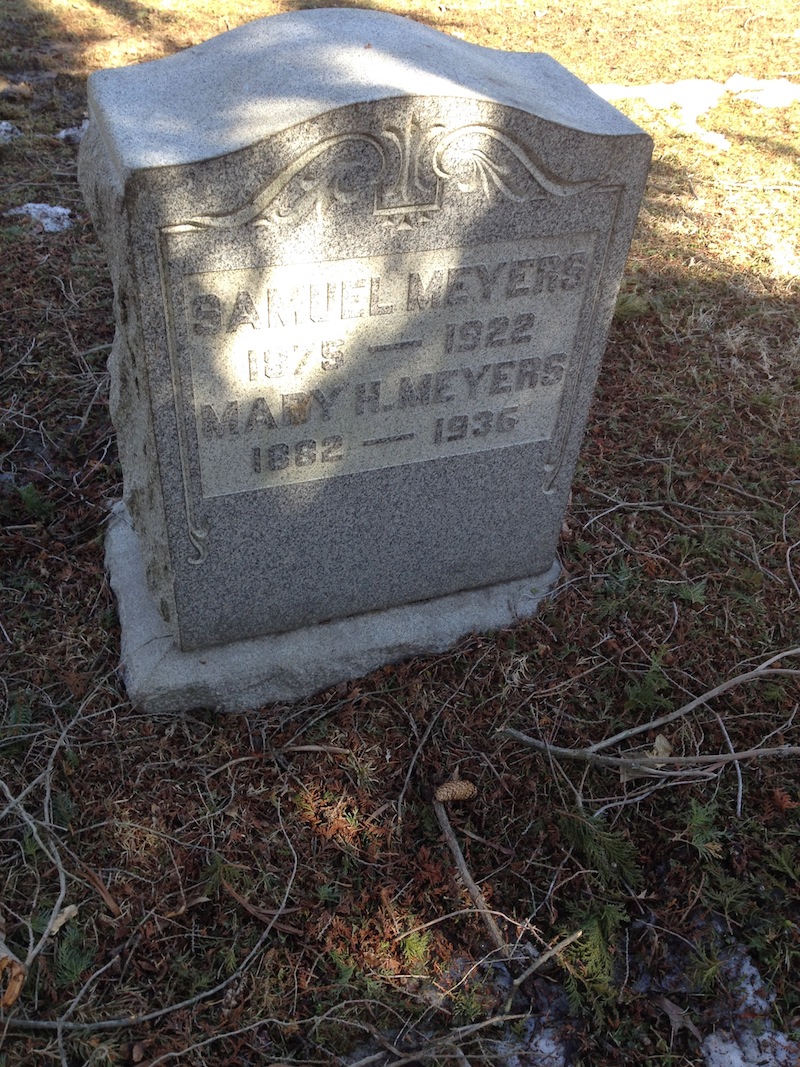
Samuel died May 10, 1922, from tubercular peritonitis, an infection caused by the same bacteria that causes tuberculosis but that manifests outside of the lungs (at least that’s what I think I understood from what I read online).  Another family member thus succumbed to the deadly bacteria that causes TB.  Samuel was 46 years old.  It would seem that Leon moved to Bethlehem after Samuel died, perhaps to take over his optometry practice.  Samuel’s widow Mary lived another 14 years, and Samuel and Mary Hamilton Meyers are both buried at Arlington Cemetery in Drexel Hill, Pennsylvania.

Harry Meyers, the next brother, also died young.  He was a tailor, and in 1912 he was living at 1906 Diamond Street, the same address as his brother Samuel that year and across the street from his mother and Leon, who were at 1905 Diamond Street.  On his World War I draft registration, Harry was living at 1905 Diamond Street and said he was an unemployed tailor.  He gave his mother’s name as his closest relative.  Harry died a year after his mother on July 4, 1919.  Like his brother Samuel and his cousins Leon Simon and Monroe Levy, he died from tuberculosis.  He had been sick for over five years, according to his death certificate, having been treated since January, 1914.  That would explain why he was unemployed in September, 1918, when he registered for the draft.   Harry was 41 when he died.  He never married; he had no descendants.


Thus, two of Clara’s three oldest children died from tuberculosis before they were fifty years old. Leon, the oldest, made it to 55.  These three oldest sons did not leave behind any descendants.  Fortunately, the family’s luck changed with the remaining siblings, all but two of whom lived until at least 1956.  For these siblings, I will write about their lives until 1920 and then will write a separate post for the future years.

Isadore was the fourth brother, and he had been working as a traveling salesman in 1910, selling men’s clothing.  In 1915 he married Elsie Goodman, also a native Philadelphian and the daughter of a salesman, Beno Goodman.  Elsie and Isadore had a baby boy on May 1, 1916, who died that same day from atelectasis, a complete or partial collapse of the lungs.  This is often associated with premature birth.

Ancestry.com. Pennsylvania, Death Certificates, 1906-1963 [database on-line]. Provo, UT, USA: Ancestry.com Operations, Inc., 2014. Original data: Pennsylvania (State). Death certificates, 1906–1963. Series 11.90 (1,905 cartons). Records of the Pennsylvania Department of Health, Record Group 11. Pennsylvania Historical and Museum Commission, Harrisburg, Pennsylvania.

Ancestry.com. Pennsylvania, Death Certificates, 1906-1963 [database on-line]. Provo, UT, USA: Ancestry.com Operations, Inc., 2014.
Original data: Pennsylvania (State). Death certificates, 1906–1963. Series 11.90 (1,905 cartons). Records of the Pennsylvania Department of Health, Record Group 11. Pennsylvania Historical and Museum Commission, Harrisburg, Pennsylvania.

In 1918 when he registered for the draft, Isadore’s occupation was a manufacturer.  He and Elsie were living at 812 North 15th Street, and they had a son born that year, Robert.  On the 1920 census, they were living on Camac Street, and Isadore’s younger brother Milton was also living with them.  They also had a servant living with them.  On June 19, 1920, not long after the census was taken, Elsie and Isadore had another son, David.

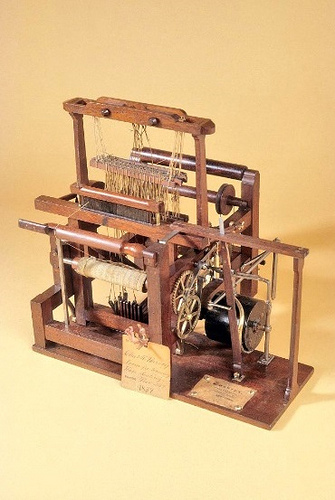
The brother who followed Isadore in birth order was Maxwell or Max.  In 1910 Max had been employed as a draftsman for a machine works company.  In 1912 Max was, like his older brothers, living at 1905 Diamond Street with his mother, and he continued to work as a draftsman.  In 1917 Max married Henrietta Klopfer, a Pennsylvania native and daughter of a millinery merchant.  On his World War I draft registration, Max reported his occupation to be a mechanical engineer for Newton Machine Tool Works in Philadelphia.  He and Henrietta were living at 1311 Ruscomb Street in Philadelphia. On September 17, 1918, their son Donald was born.  Their second child Dorothy was born five years later on September 3, 1923.   Here is a photo of one of the many machines made by Newton Machine Tool Works.


The sixth son was Benjamin Franklin Meyers.  (I do love that name.)  He was one of the earliest of the children to move away from home; in 1910, he was living in Trenton, New Jersey, working as a watchmaker.  He remained in New Jersey during the next decade, and he married Leona Faulcher, a Richmond, Virginia, native and daughter of a machinist who had been living in Camden, New Jersey in 1900 and 1910.  They were married as of September 1918 when Benjamin registered for the draft, and they were living in Collingswood, New Jersey.  Benjamin was now involved with aircraft production for the Victor Talking Machine Company, the company famous for the Victrola phonographs.  In September 1918, just when Benjamin was registering for the draft, the company converted to the production of aircraft parts as part of the war effort.

By Norman Bruderhofer (Collection of John Lampert-Hopkins) [CC BY-SA 2.5 (http://creativecommons.org/licenses/by-sa/2.5)], via Wikimedia Commons

By Norman Bruderhofer (Collection of John Lampert-Hopkins) [CC BY-SA 2.5 (http://creativecommons.org/licenses/by-sa/2.5)%5D, via Wikimedia Commons

In 1920, Benjamin and Leona were living with her parents in Collingswood along with her two sisters and their husbands.  Interestingly, Benjamin was now working as an optometrist like several of his brothers.  Benjamin and Leona would have two daughters in the 1920s, Margaret and Clara, the second obviously named for Benjamin’s mother, Clara Wiler Meyers.

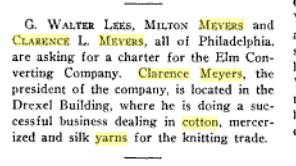
Clarence was the next son in line after Benjamin.  In 1910 when he was 24, he was already engaged in the cotton yarns business, an industry to which he dedicated his entire career.  Despite being the seventh child, he was the first to marry.  He married Estelle Seidenbach in 1911; she was just 21, and he was 24.  She was also a Philadelphia native; her father was already retired at age 50 in 1900, according to the census.  In 1912, they were living at 2251 North Park Avenue.  On October 23, 1919, their daughter Nancy was born.  On the 1920 census, the family was still residing at 2251 North Park Avenue, and Clarence was still a cotton yarns merchant.  Googling his name brings up a number of results regarding his business and the patents they owned and/or developed.

Here’s one little news item from the November 1919 Underwear and Hosiery Review:

The Underwear & Hosiery Review, Volume 2 (Google eBook) Front Cover Knit Goods Publishing Corporation, 1919 - Hosiery industry

The Underwear & Hosiery Review, Volume 2 (Google eBook)
Knit Goods Publishing Corporation, 1919 – Hosiery industry


Next in line was Franklin, born just a year after Clarence.  He was, like some of his older brothers, an optometrist.  In 1912, he was also still living with his family at 1906 Diamond Street. By 1914, he named his occupation as an optician in Pottstown, Pennsylvania, but by 1918 when he registered for the draft, he gave his occupation as optometrist.  At that time he was living and working in Pottstown, Pennsylvania, and was still single.  Sometime between 1918 and 1920, however, Franklin married Mae Gross, a native of Bloomsburg, Pennsylvania, and daughter of a clothing salesman.  Bloomsburg is 114 miles northwest of Pottstown, so it would be interesting to know how these two met.  In 1920, they were living in Pottstown, where Franklin continued to practice optometry.  They would have one child, Carolyn, born in 1922.

Finally, after having eight boys in a row, Clara and Daniel had a daughter, Miriam, born in 1892, five years after Franklin was born.  In 1910, Miriam had been only eighteen and was still at home.  In 1914, she married Abram Strauss.  He was born in Reynoldsville, Pennsylvania, in 1887; he was 27, and Miriam was 21 when they married.  Abram was a physician, and in 1916 he and Miriam were living at 600 Butler Avenue in Philadelphia.  Their first child, Daniel, was born that year.  They were still living at 600 Butler as of June, 1917, when Abram registered for the draft.  In 1920, Abram, Miriam and Daniel were living at 1848 North 16th Street, and Abram’s mother Mary, sister Helena, and aunt Clara were also living with them.  Only Abram and his sister were working outside the home.  By the next year Miriam, Abram, and Daniel were living at 1836 North 17th Street.  I am not sure how many of those in the 1920 household moved with them.  Miriam and Abram also had another child Richard in September, 1921.

The penultimate child of Clara Wiler and Daniel Meyers was Charlotte or Lottie, born a year after Miriam.  She married J. Albert Field in 1914 when she was 21; he was 33.  He was an assistant manager of a department store and the son of a salesman born in Northern Ireland and a woman born in New York.  In September 1918 when he registered for the draft, Albert and Miriam were living at 1905 Diamond Street, and Albert was a manager at John Wanamaker’s Department Store.  They were still living there in 1920, as mentioned above, along with Miriam’s oldest brother Leon and her youngest brother Milton.


Which brings me to Milton, the youngest of the children, born in 1896, so only fourteen in 1910.  He was living with his mother and siblings in 1918 when he registered for the draft and was working for his brother Clarence in the cotton yarns business. Milton served in the Navy from December 1917 until December 1918 during World War I. He was living at 1905 Diamond in 1920, as stated above, and working with Clarence.

Thus, by 1920, Clara Wiler Meyers and two of her adult children, Samuel and Harry, had died.  Several of the other sons had gone into optometry; one son was an engineer, one was a clothing manufacturer, one was a cotton yard manufacturer, and one was working in the production of aircraft parts. One daughter had married a doctor, and one a department store manager.  All of the children alive in 1920 other than Leon and Milton had married between 1910 and 1920; there were also a number of grandchildren born during the decade.  So although there were some terrible losses during this decade, for many members of the family the decade brought both some professional and personal successes.  Certainly Clara’s family overall fared better than the families of her siblings Fanny and Eliza.

Here is a Google Street View shot of 1905 Diamond Street today:

I will bring the Caroline Dreyfuss story to an end in my next post before moving on to the last of the extended Dreyfuss/Nusbaum clan, the family of Ernst Nusbaum.


[1] I did find a Josephine Levy, born in Pennsylvania, living in New York City on the 1940 census, of the approximate age.  She was listed as married, but living as a lodger and not with a husband.  That could be Alfred’s ex-wife, but I can’t be sure.

[2] This is the same address found on Simon Wiler’s death certificate in 1911.  I cannot (yet) explain whether that is a coincidence or not.

[3] It appears that before the 20th century, the term “optician” was used to refer both to those who made glasses and those who evaluated eyesight for the need for those glasses.  According to Wikipedia, “Although the term optometry appeared in the 1759 book A Treatise on the Eye: The Manner and Phenomena of Vision by Scottish physician William Porterfield, it was not until the early twentieth century in the United States and Australia that it began to be used to describe the profession.”    All of the Meyers brothers who started out as opticians eventually switched from the term optician to the term optometrist to describe their occupation.

Those Wily Wilers: Where were They in 1900?

Remember Fanny Wiler, the daughter of Caroline Dreyfuss and Moses Wiler, the one I could not find and thought might have been married to a man who killed himself and a child in a fire? Well, I still had not had any luck finding the real Fanny Wiler despite several more hours of going back over my research and looking more deeply into the sources.   Although I was doing pretty well with the rest of her family up through 1880, they also proved to be elusive as they approached the 20th century.

In 1880, Caroline and Moses Wiler were living in Philadelphia, and Moses had retired from his career as a merchant.  Their son Simon, then 37, was still living with his parents and working as a salesman.  Their daughter Eliza and her husband Leman Simon had moved to Pittsburgh where Leman was in the liquor business, and they had five children, Joseph, Flora, Nellie, Minnie, and Leon. While going back over my research, I discovered that Eliza and Leman had had one other child, Isadore, born in July, 1871, who died at 28 months on August 16, 1873.  I cannot decipher the cause of death.  Can anyone tell what it says?

UPDATE:  My expert says it says “Inflammation Brain.” Apparently doctors are trained to read each other’s awful handwriting.

Isadore A Simon death certificate FHL

“Pennsylvania, Philadelphia City Death Certificates, 1803-1915,” index and images, FamilySearch (https://familysearch.org/pal:/MM9.1.1/JKQ7-78S : accessed 6 February 2015), Isadore A Simon, 16 Aug 1873; citing , Philadelphia City Archives and Historical Society of Pennsylvania, Philadelphia; FHL microfilm 2,021,999.


When I last wrote about Eliza and Leman Simon, I was a bit puzzled by the seemingly impossibly close birth dates of Minnie and Leon, their youngest two children.  Two census reports indicated that Minnie was born in 1877, no earlier than August 1877 and possibly as late as December 1877, and Leon’s death certificate said he was born on June 13, 1878.  It just seemed very unlikely that Leon was born ten months (at most) after Minnie, but it was, of course, entirely possible.

But I went back to look again and realized that while Minnie was listed with the family on the 1880 census, Leon was not.  Further research uncovered this bill from his funeral, indicating that his birth date was June 13, 1881, not 1878, which makes a lot more sense.  Thus, the death certificate was most likely inaccurate (and there are other questions about that document, but I will get to that later).

Leon Simon funeral bill

Historical Society of Pennsylvania; Historic Pennsylvania Church and Town Records


Caroline and Moses Wiler’s youngest child, Clara, and her husband Daniel Meyers, a clothing merchant, were living in Philadelphia with their five children (as of 1880), Bertha, Leon, Samuel, Harry, and Isadore.

Thus, in 1880, I could account for Caroline Dreyfuss and Moses Wiler and three of their four children (all but Fanny) and their ten grandchildren.  Then things start getting a bit more difficult.  Although I found burial records for Caroline indicating that she had died on December 21, 1885, and was buried at Mt. Sinai cemetery in Philadelphia, I cannot locate a death certificate for her in the Philadelphia City Death Certificates 1803-1915 database on familysearch.org.  On the other hand, I was able to locate a death certificate for her husband Moses in that database; he died almost exactly two years later on December 26, 1887, and was also buried at Mt. Sinai.

Moses Wiler death certificate

“Pennsylvania, Philadelphia City Death Certificates, 1803-1915,” index and images, FamilySearch (https://familysearch.org/pal:/MM9.1.1/J6S6-XY5 : accessed 6 February 2015), Moses Simon, 27 Jan 1897; citing cn 15654, Philadelphia City Archives and Historical Society of Pennsylvania, Philadelphia; FHL microfilm 1,869,753.


Moses Wiler was residing at 1638 Franklin Street at the time of his death in 1887, and that is the same address listed for his son-in-law Leman Simon in the 1887 Philadelphia directory.  I don’t know whether Moses had moved in with Leman, Eliza, and their children, or vice versa.  Since Leman and Eliza had been listed in the 1884 directory for Pittsburgh, it could be that they had moved back to Philadelphia sometime around or after Caroline’s death to be with Moses.  Leman’s occupation is listed as “salesman” in that 1887 Philadelphia directory without any indication of whether he was still selling liquor.

Assuming that Eliza and Leman returned to Philadelphia around 1885 or so, their children would have been still relatively young: Joseph 21, Flora 19, Nellie 11, Minnie 7, and Leon 4.  Certainly the youngest three would still have been living at home.  Joseph appears to have been in Pittsburgh until at least 1886, as there is a Joseph L. Simon listed there, selling cigars and tobacco products, a business line that was being practiced by other members of the family during that time, including Joseph’s great-uncle John Nusbaum.  After that, however, he does not appear in the Pittsburgh directory as far as I can tell.

Eliza and Leman’s daughter Flora married Nathan Strouse in Philadelphia in 1888 when she was 22 and he was 46. Their son Lester Nathan Strouse was born on December 15 of that year.  In the 1890 Philadelphia directory, Nathan was listed as associated with Strouse, Loeb, and Company, clothiers.

Leman and Eliza were still living at 1638 Franklin until 1890 when they are listed at 1821 Franklin Street.  Joseph also is listed in the 1890 directory at that address, so he must have been living with his parents at that time along with the three younger children, Nellie, Minnie, and Leon.  Joseph was working as a clerk.  He may have moved out by 1892 because there are two Joseph Simons listed as salesman in the Philadelphia directory for that year, though I cannot be completely certain either is the correct Joseph Simon.

In 1897, Leman and Eliza (Wiler) Simon were living at 1537 Montgomery Street.  Eliza died of apoplexy on August 18, 1897.  She was 55 years old.  Leman continued to live at 1537 Montgomery Street through 1899, according to the Philadelphia directory of that year, which listed him once again as a salesman.

Eliza Simon death certificate 1897

“Pennsylvania, Philadelphia City Death Certificates, 1803-1915,” index and images, FamilySearch (https://familysearch.org/pal:/MM9.3.1/TH-266-11571-16485-19?cc=1320976 : accessed 6 February 2015), 004009659 > image 190 of 1791; Philadelphia City Archives and Historical Society of Pennsylvania, Philadelphia.


Now things get very sticky.  I had a very hard time locating the family of Eliza and Leman Simon on the 1900 census.  The only one I am certain about is Flora and her husband Nathan Strouse and son Lester Strouse.  On the 1900 census, Flora, Nathan, and Lester were living at 913 North 16th Street, and Nathan was 57 years old and did not provide an occupation for the census.  Living with them was a 30 year old woman named Nettie Dreifuss, born in 1870 in Illinois whose parents were born in Germany and Pennsylvania, as were Flora’s parents.  She is identified as the niece of the head of the household, Nathan.

Flora and Nathan Strouse 1900 census

I first wondered whether this was Nellie, Flora’s sister.  But Nellie was born in 1874 in Pennsylvania, not 1870 in Illinois, and she was Nathan’s sister-in-law, not his niece.  I then spent most of a day trying to find out whether Nathan had a sister who married a Dreifuss.  He did have several sisters: Rebecca, who never married; Gussie, who married Joseph DeYoung and had one daughter Harriet; Henrietta, who married Leopold Lewis and had two daughters, Minnie and Fanny; and Rachel, who married Ed Henrinan (?), but apparently was divorced and had no children.  I thought that perhaps it was one of Henrietta and Leopold Lewis’ daughters, but neither was named Nettie, and I located both elsewhere on the 1900 census.  So the “niece” did not appear to be Nathan’s niece.

If Nettie Dreifus was not Nathan’s niece, was she Flora’s niece? None of Flora’s siblings was married in 1900; none of them had had children.   I still don’t know who Nettie was.  But her name was Dreifuss, Caroline Wiler’s birth name.  Could this be a daughter of a Dreifuss/Dreyfuss brother whom I’ve yet to find?  That’s a research path I will need to pursue further.

But at least I knew where Flora and her family were living in 1900.  Her father and her siblings proved much more elusive.  I had a very hard time locating Leman Simon and his son Leon on the 1900 census, but I believe that this is Leman and Leon living together at 1514 Brown Street as Leon, Sr., and Leon, Jr.

Leman and Leon 1900 census

Why do I think this is Leman? Because he is a 64 year old widow born in Germany who immigrated in 1866 and who was working as a salesman.  Although my records show that Leman would have been 65 and that he immigrated in 1856, the numbers are close enough, given the general unreliability of census data.  In addition, Leon, Jr. fits with my Leon roughly also: born in 1880 in Pennsylvania to parents born in Germany and working as a clerk.  Again, it’s not perfect.  Leon was born in 1881, and his mother Eliza was born in Pennsylvania. So I am not at all positive that this is Leman and Leon, but they are the closest matches I can find on the 1900 census.

Despite using as many resources and wildcard searches as I could imagine, I cannot find Joseph at all on the 1900 census.  I even had assistance from Antoinette from the Facebook Pennsylania Genealogy group, but neither of us could find him.  There is a Joseph L. Simon living at 2137 North 18th Street in the 1901 Philadelphia directory, the same address that is given for Le(h)man Simon for that year, so I assume that is the right Joseph, working as a clerk with his father working as a salesman.  But Joseph is not listed at that address in the 1900 census nor is Leman, so they must have moved there in 1901.

As for Minnie and Nellie, I think I found them on the 1900 census, but cannot be 100% sure.  I found a Minnie Simon and a “Millie” Simon living at 2628 Diamond Street on the 1900 census.  Both are listed as boarders.  Minnie is listed as a single woman born in 1877 in Pennsylvania with a mother born in Pennsylvania and a father born in Germany; that matches Minnie correctly.  No occupation is given.

Year: 1900; Census Place: Philadelphia Ward 32, Philadelphia, Pennsylvania; Roll: 1473; Enumeration District: 0809; FHL microfilm: 1241473

Year: 1900; Census Place: Philadelphia Ward 32, Philadelphia, Pennsylvania; Roll: 1473; Enumeration District: 0809; FHL microfilm: 1241473

I was quite certain that this was Minnie, but it took me a while to think that “Millie” was Nellie because although they are both at the same address, Minnie is listed as a boarder in the household of Bertha Lipper, and Millie is listed as the head of household in a boarding house at the exact same address with sixteen boarders.  “Millie” was a single woman born in 1874 in Pennsylvania whose parents are listed as born in Germany, both mother and father.  Although Nellie’s mother was born in Pennsylvania, not Germany, the age and marital status are correct, and the name is quite similar.  Once again, I cannot be completely certain that this is Nellie, but I am pretty sure.  I think it was really one large boarding house where the two sisters were living.  I am not sure why “Millie” was also described as a head of household.

Thus, if my hunches here are all correct about Leman Simon and his children, only Joseph Simon was really missing from the 1900 census.  Leman was living as a boarder with his son Leon; Nellie was living as a boarder with her sister Minnie.  Flora was married and living with her husband Nathan Strouse and son Lester and a mysterious niece.  When I mapped out where they all were living, I realized that Flora was living just a few blocks from where Leman and Leon might have been living, but Minnie and Nellie were about two miles further north.  If Joseph was already living at 2137 North 18th Street sometime during that year, he was less than a mile from Minnie and Nellie.

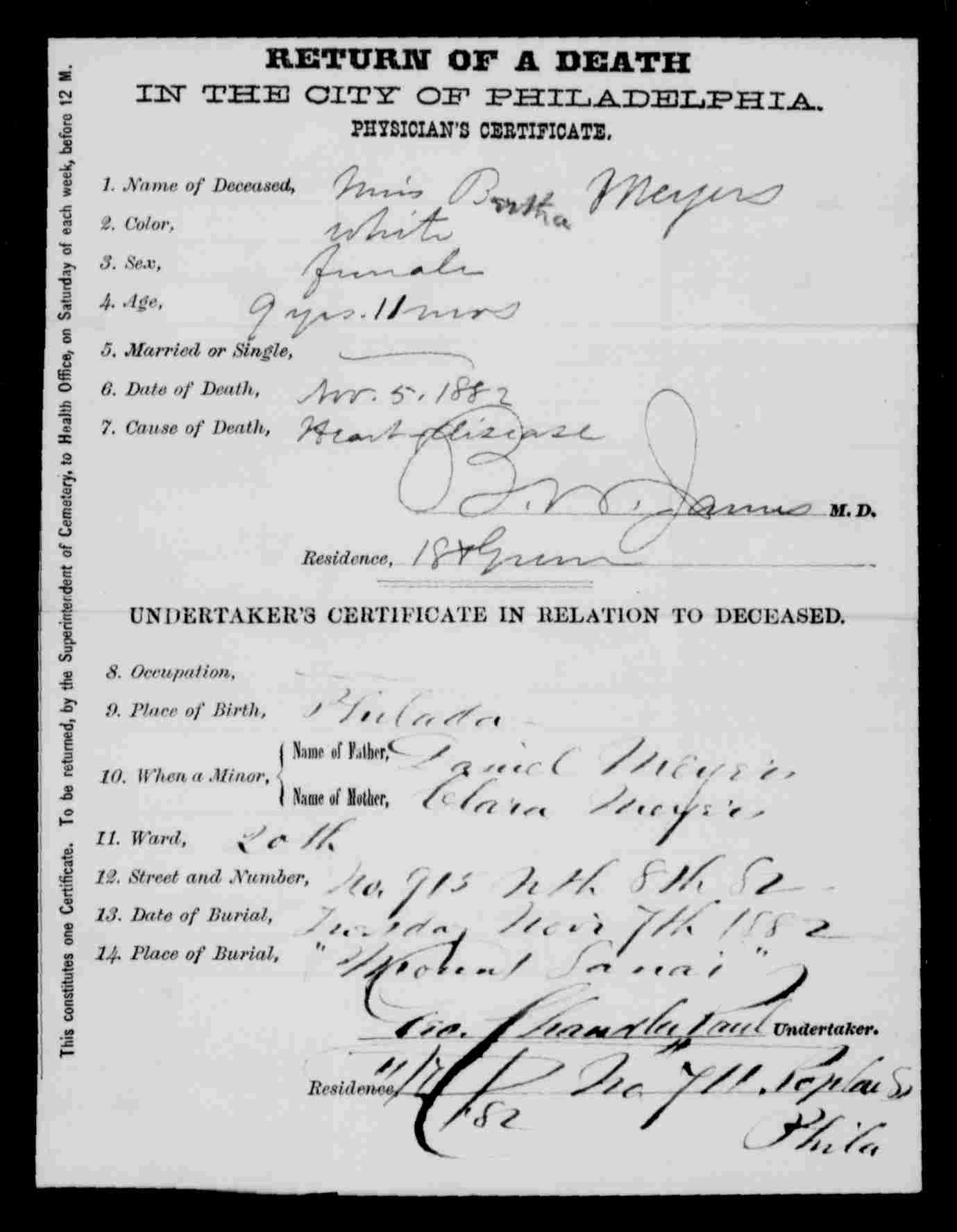
As for the other children of Caroline Dreyfuss and Moses Wiler, Simon, Fanny, and Clara, Simon was working as a clerk in a hotel where he also resided in 1900 at 152 North 7th Street. He was single and 56 years old.  Clara and her husband Daniel Meyers were now living at 920 North Franklin Street.  Clara and Daniel had had five children as of 1880; between 1880 and 1896 they had had eight more children, including one stillbirth.  But in 1882, they lost their first born child Bertha to heart disease.  She was only nine years old.

"Pennsylvania, Philadelphia City Death Certificates, 1803-1915," index and images, FamilySearch (https://familysearch.org/pal:/MM9.3.1/TH-267-11083-70387-38?cc=1320976 : accessed 6 February 2015), 004058695 > image 726 of 994; Philadelphia City Archives and Historical Society of Pennsylvania, Philadelphia.

“Pennsylvania, Philadelphia City Death Certificates, 1803-1915,” index and images, FamilySearch (https://familysearch.org/pal:/MM9.3.1/TH-267-11083-70387-38?cc=1320976 : accessed 6 February 2015), 004058695 > image 726 of 994; Philadelphia City Archives and Historical Society of Pennsylvania, Philadelphia.

Thus, as of 1900, Clara Wiler and Daniel Meyers had eleven surviving children, all of them still living at home.

And, of course, Fanny Wiler still remained unaccounted for.  Or was she? Stay tuned…


Thank you, Dayton, Ohio, Lancaster, Pennsylvania, Annapolis, Maryland, and TTT on Facebook

Dayton-ohio-skyline

Dayton-ohio-skyline (Photo credit: Wikipedia)

In my post about the descendants of Leopold Nusbaum, one of the unanswered questions was what happened to Cora Frank Lehman and her daughter Dorothy Gattman after Cora’s second husband Joseph Lehman died in 1959.  I could not find any answers—until I looked to Dayton, Ohio, for help.

First, some background: Cora Frank was the third child of Francis Nusbaum Frank, the only child of Leopold Nusbaum to survive to adulthood.  Cora had married Jacques Gattman in Philadelphia in 1903 and had had one child, Dorothy, in 1905.  Then in 1906, Jacques died at age 31 from a stroke.  Cora had married her second husband, Joseph Lehman of Dayton, Ohio, in 1913, and then moved with him to Dayton.  Dorothy grew up and went to high school in Dayton, but I had no luck finding any record for her after 1925, when she was listed in the Dayton, Ohio, directory as a student.

Cora and Joseph were still living in Dayton at the time of the 1930 census and the 1940 census and were listed in Dayton directories in the 1950s.

I was able to find Joseph Lehman’s death in 1959 on the Ohio Deaths database on ancestry.com, but I could not find his burial place.  I was also unable to find any record for Cora after the 1959 Dayton directory.  I thought she must have left Dayton after Joseph died, but I had no idea where she went.  She was not in the Pennsylvania database for death certificates, which runs through 1963, nor was she in the Ohio Deaths database, which runs until 2007.  I thus thought she had left Ohio and either lived past 1963 in Pennsylvania, where she’d been born and raised, or gone wherever her daughter Dorothy had gone.

But where had Dorothy gone?  Since I had no marriage record for her, I had no surname.  I tried searching every way I could to find her, but had no luck.

That’s when I decided to look for assistance in Dayton.  I contacted the Jewish Genealogical Society of Dayton for some information, and two women there, Marcia and Molly, co-presidents of the society, helped me locate where Joseph and Cora were buried—in the cemetery for Temple Israel in Dayton, one of three Jewish cemeteries in Dayton.  Molly also found in the cemetery records Cora’s date of death—April 14, 1967.  But unfortunately they were not able to find an obituary or any other document that revealed where Cora died or what happened to her daughter Dorothy.

But Molly gave me one other piece of invaluable advice.  She suggested I contact Ellen at Temple Israel.   I emailed Ellen, and she emailed me back first with information about where Joseph and Cora were buried in the cemetery and, most importantly, Cora’s address when she died in 1967: the Beaux Arts Hotel in New York City.  I was so excited and immediately tried locating Cora and Dorothy in New York City.  But I had no luck since I still didn’t know Dorothy’s surname.

But while I was having no luck, Ellen had continued to search, and forty minutes after her first email, I received an email saying that she had found Cora Lehman’s obituary:

Cora Frank Gattman Lehman obituary

Cora Frank Gattman Lehman obituary


And there it was:  Mrs. Albert Rosenstein! That had to be Dorothy. And now I knew that at least in 1967, she was living in New York City at the Beaux Art Hotel at 310 East 44th Street.

Now that I had Dorothy’s married name, I was able to find Dorothy and Albert Rosenstein on the 1930 census.  This was clearly the right Dorothy—right age (27), right birthplace (Pennsylvania), and right birthplaces for her parents (Pennsylvania and Mississippi). Dorothy and Albert were living in Lancaster, Pennsylvania, and further research revealed that Albert was born and raised in Lancaster, had graduated from the US Naval Academy at Annapolis, and was in the art wares business.


Embed from Getty Images

Ellen at Temple Israel in Dayton was also able to find this photograph of Dorothy’s confirmation class.  We could not figure out from the list of names on the back which one is Dorothy.  If anyone has any clue as to whether this list is in any order that would help identify Dorothy, please let me know.

1919 Confirmation Class of Temple Israel, Dayton, Ohio, courtesy of Temple Israel

1919 Confirmation Class of Temple Israel, Dayton, Ohio, courtesy of Temple Israel

Dorothy Gattman class names-page-001

But I was not yet done.  I didn’t know whether Albert and Dorothy had had any children.  I had to find them on the 1940 census.  Once again I hit a roadblock.  I could not find them.  Although I found entries for them in the Lancaster directories up through 1939, there was no 1940 directory on line, and they did not appear in the 1941 directory.  Where had they gone?

Using the address listed in both the 1930 US census and the 1939 Lancaster directory, 71 Spencer Street, Lancaster, Pennsylvania, I searched for that address on the 1940 census.  There were Rosensteins living at that address, but not Albert and Dorothy.  Instead, Albert’s parents Morris and Sara Rosenstein were living at 71 Spencer Street.  Where were Albert and Dorothy? Why were his parents living in the house that Albert and Dorothy had owned in 1930 and lived in just a year earlier? Morris and Sara had lived at a different address in 1930.

Although I found an Albert Rosenstein living at 162 West 56th Street in the 1940 New York City telephone book, there was no Albert Rosenstein living at that address in the 1940 US census report.  I did find one Albert Rosenstein in New York City on the 1940 census, but he was single, born in New York, about four years younger than my Albert would have been in 1940, and a dress salesman.  On the other hand, he was living at 162 West 55th Street, just one digit off from the address where an Albert Rosenstein was listed in the 1940 telephone book.  So…was this a different Albert Rosenstein from my Albert Rosenstein?  I think so, but then where were my Albert and Dorothy Rosenstein in 1940?  I still am not 100% sure.

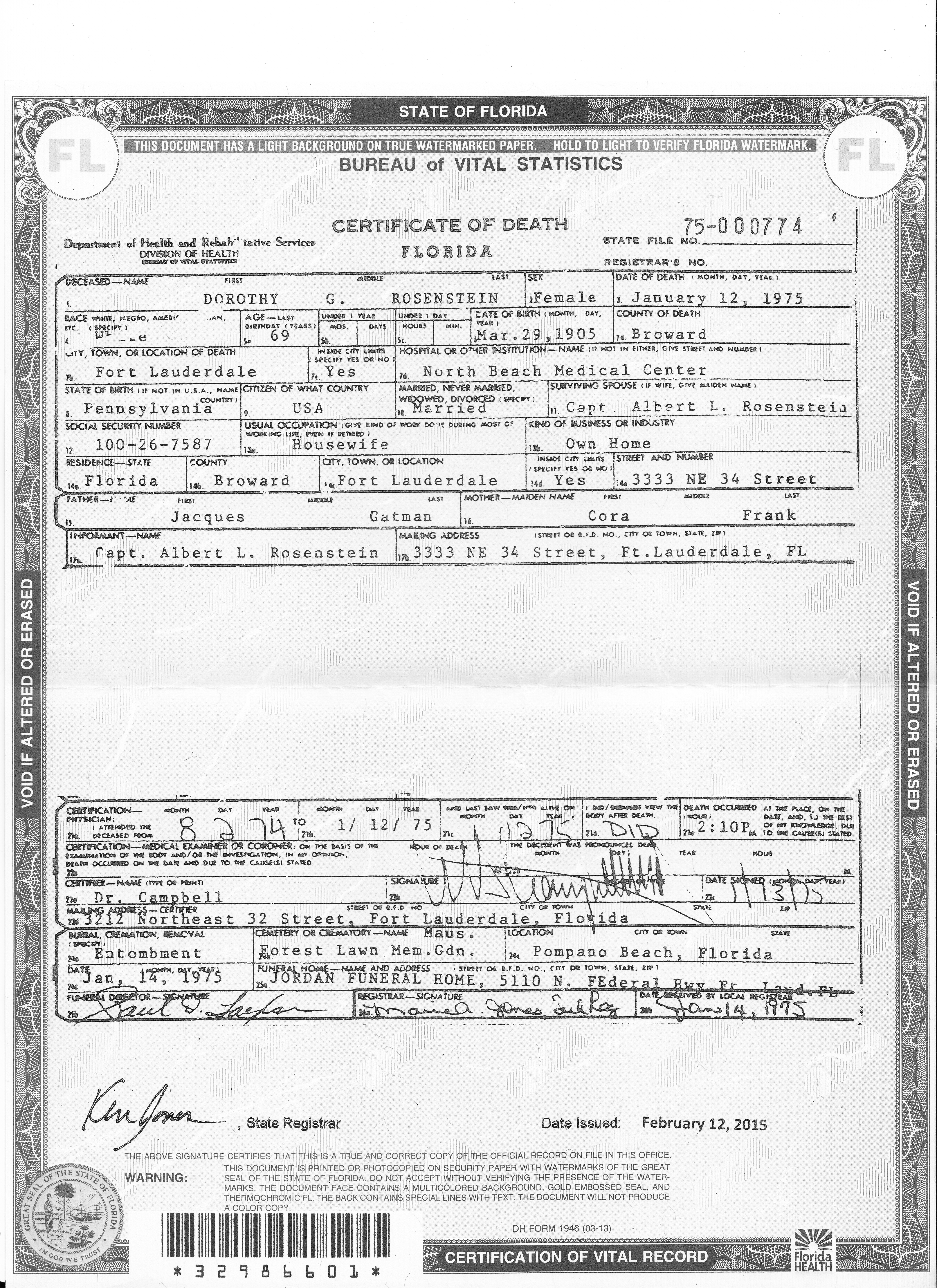
I was, however, able to find death records for both Dorothy and Albert.  Dorothy died on January 12, 1975, and Albert died on June 25, 1979.  They are buried at Forest Lawn Gardens Memorial Park in Pompano Beach, Florida.  I was able to locate a photograph of their headstone on FindAGrave:


I had no idea who Phyllis Rosenstein was.  She was eleven years younger than Albert, five years younger than Dorothy, so clearly not their child.  There was no sister named Phyllis living with Albert’s parents in 1920 or 1930, so I did not think she was his sister.  His only brother, Louis, was married to a woman named Blanche.  So who could Phyllis have been?

With the help of the Tracing the Tribe group on Facebook, I learned that Phyllis was Albert’s second wife.  He married her on February 10, 1976, when he was 77 years old.  I have to say that I am not sure Dorothy would be so thrilled having Albert’s second wife buried with them under the same headstone, but maybe I am just old fashioned.

I called the cemetery to see if perhaps they had any obituaries or other relevant records, but they did not.  Thus, there were still some loose ends here. Where were Dorothy and Albert between 1939 and 1975? Did they have any children?

The Tracing the Tribe group on Facebook again provided me with some great assistance.   One of the TTT members found a 2014 bulletin from Congregation Shaarei Shomayim in Lancaster which listed Dorothy G. Rosenstein and Albert Rosenstein on its January yahrzeit list. (A yahrzeit is the anniversary of a death on the Jewish calendar when relatives light a candle and say kaddish in memory of the deceased.)  I checked a Jewish calendar, and while Dorothy’s yahrzeit could fall in January, Albert’s would not.  I emailed the synagogue, and another helpful person, Martha, responded telling me that both Albert and Dorothy had yarhzeit plaques there (though the January yahrzeit was for Albert’s uncle with the same name, there was a separate one of my Albert).  Martha, however, had no record indicating who had paid for those plaques  or whether there were any children or other descendants of Albert and Dorothy.

I still did not know if Albert and Dorothy had had children, though it now seemed unlikely.  Then the TTT group helped me again.  Since Albert was a 1922 graduate of the Naval Academy, I had thought perhaps he’d been sent overseas in 1940.  Although the US had not entered World War II as of 1940, I did find a military record indicating that Albert had been activated in 1932 and was discharged in 1959.  At the suggestion of a TTT member, I wrote to the US Naval Academy Alumni Association to see if they had any records.  Last night I received an email from the US Naval Academy Alumni Association, Memorial Affairs representative which included two items: the obituary for Captain Albert Rosenstein and his photograph and biography from the yearbook from 1922, the year he graduated from the Academy.

US Naval Academy alumni magazine Shipmate, October 1979

US Naval Academy alumni magazine Shipmate, October 1979

It does seem that my hunch was correct—that Albert was serving in the Navy during World War II and thereafter for many years.  I am now searching for more information about his military record.  And the obituary also answered one more question.  It does not appear that he and Dorothy had any children, or at least none who survived him.

It’s amazing to me how much I was eventually able to learn about Dorothy and Albert when just a week ago I thought I never would find out anything about her. I would never have gotten this far without the generous assistance of those three women in Dayton, Ohio: Ellen, Molly, and Marcia.  Thank you all very much!  And thank you as well to Timothy from the USNA Alumni Association, Martha from Congregation Shaarei Shomayim, and to my many wonderful colleagues at the Tracing the Tribe Facebook group.  Once again—it took a village.

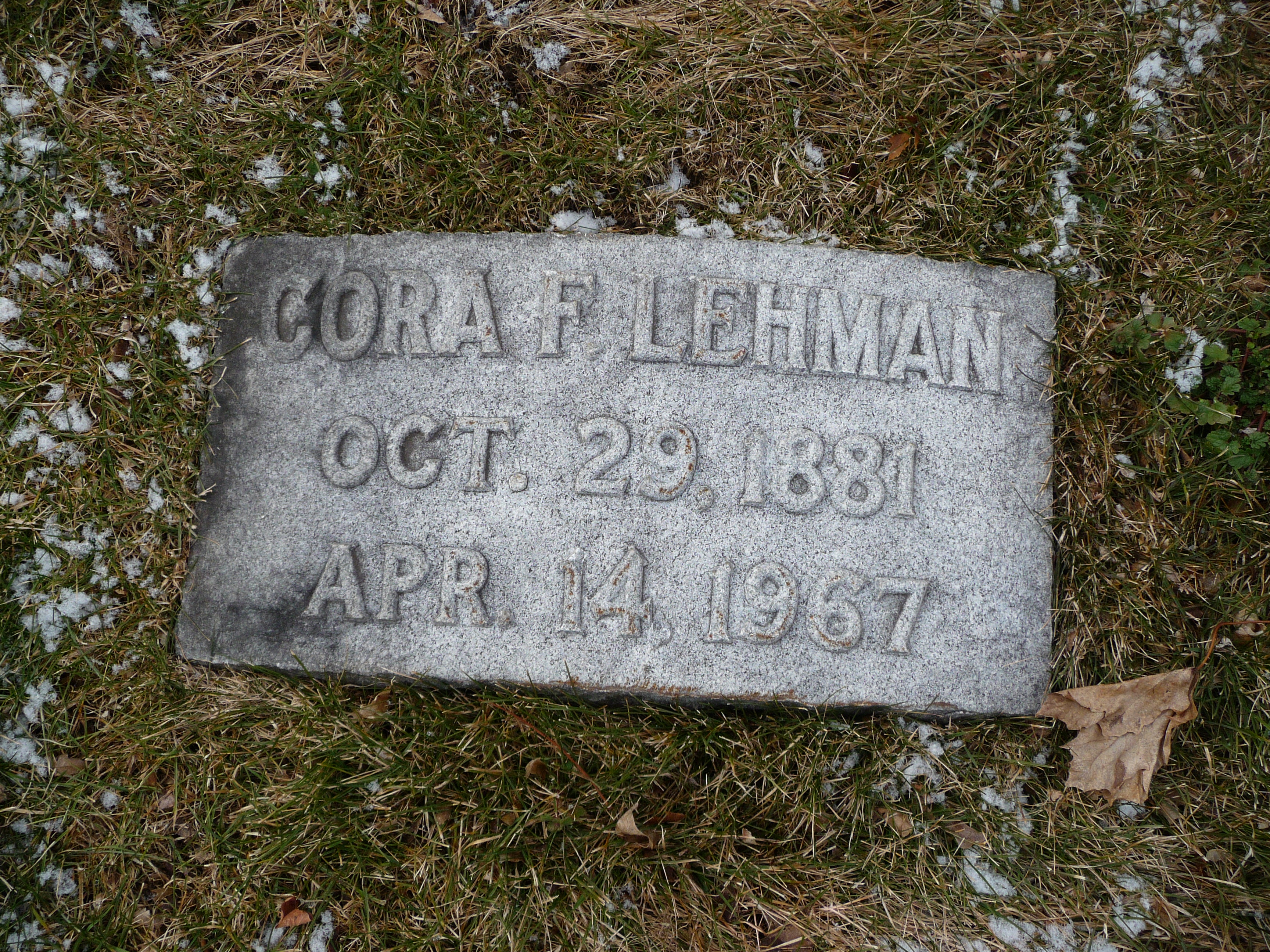
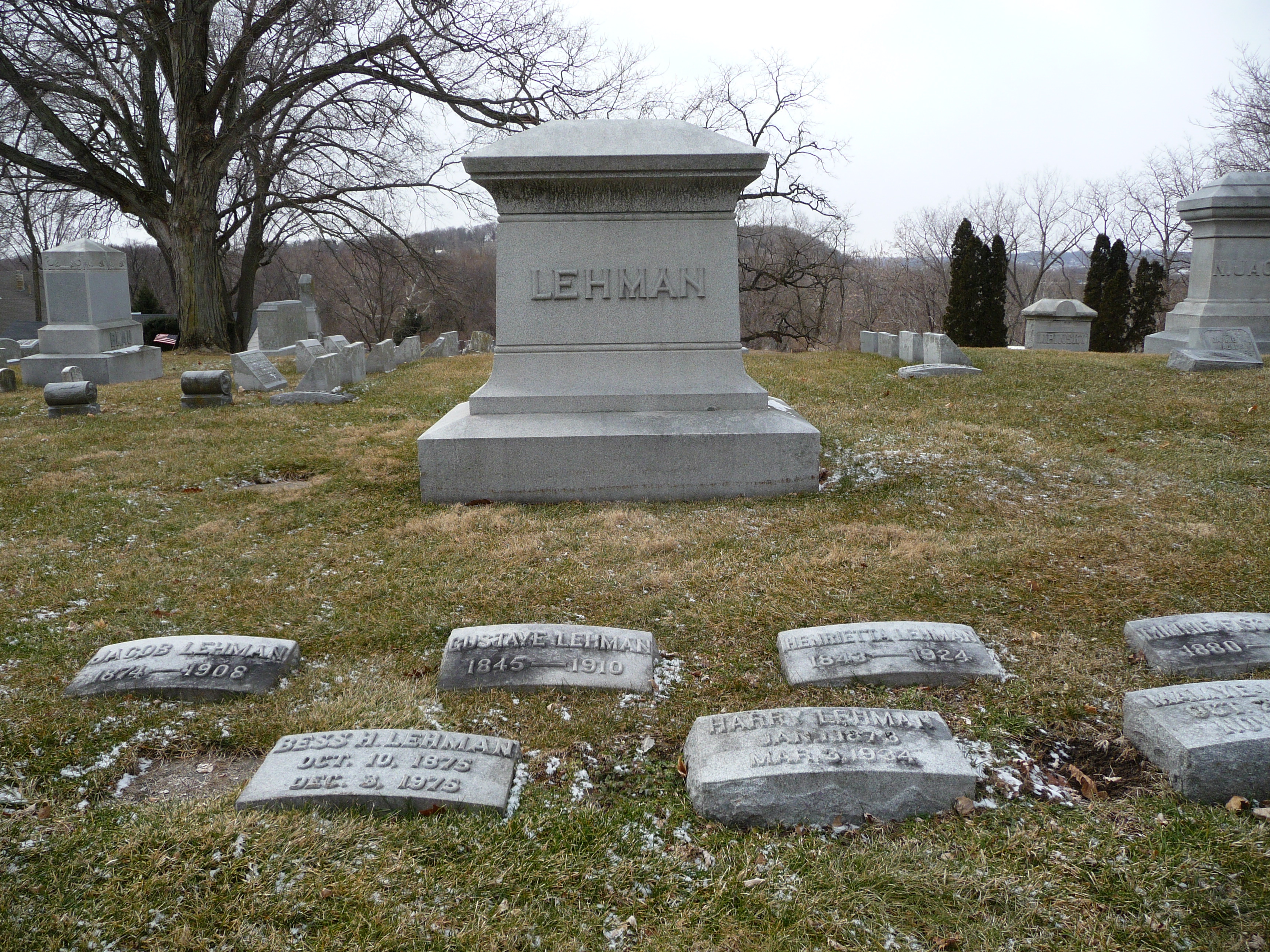
Ellen from Temple Israel in Dayton also sent me these photos of the headstones of Joseph and Cora Frank Lehman.

Cora Frank Lehman headstone Joseph Lehman headstone lehman headstone

UPDATE:  Here are the death certificates for Dorothy and Albert.  Dorothy’s confirms that she was in fact the daughter of Cora Frank.

Death certificates_0001

Death certificates_0002

The Grandchildren of John and Jeanette Nusbaum: First Cousins, Four Times Removed

When I last wrote about the direct descendants of my three-times great-grandparents, John and Jeanette (Dreyfuss) Nusbaum, I left off saying that I would return to their surviving grandchildren in a later post.  Having already written about the children of their daughter Frances Nusbaum Seligman, Eva, James, and Arthur, there were four other grandchildren to discuss: the two children of Gustavus and Miriam Nusbaum Josephs, Florence and Jean, and the two children of Simon and Dora Rutledge Nusbaum, Nellie Rogers and John Bernard Nusbaum.  I was hoping that I’d be able to find answers to some remaining questions before posting, but I’ve run into a few tough ones.

Florence Joseph’s story is still incomplete as I hit a brick wall around 1925, but I will share what I do know.  Florence married Louis Siegel in 1903 when she was 23 years old.  Louis, the son of Abraham Siegel and Minnie Rosenthal, was born in Philadelphia on January 11, 1870, making him ten years older than Florence.  In 1910, Florence and Louis were living in New York City, and Louis was working as a traveling salesman, selling athletic goods.

Sometime thereafter, Louis must have become ill.  He died on September 30, 1915, at the State Hospital for the Insane in Norristown, Pennsylvania.  According to his death certificate, he had been ill for three years and had been hospitalized since November 19, 1913.  His cause of death was general paralysis of the insane or paresis.  He was only 43 years old.

Although I only have one document to support this, it appears that in 1913, Florence and Louis had had a child, a daughter Marion.  On the 1920 census, Florence Siegel was living with her father Gustavus Josephs and her brother Jean Josephs, both of whom were working at a mill as manufacturers, presumably of fabrics, as discussed in an earlier post.  Included in the household was a seven year old girl named Marion Siegel.  Although she is described as the daughter of the head of household, it seems apparent that Marion was Florence’s daughter, given her age and her surname.

Gustavus Josephs 1920 census

When her father Gustavus died in May 1924, Florence continued to live in the home at 2020 North Park Avenue; she is listed as a dressmaker in the 1925 Philadelphia directory residing at that address.  Unfortunately, that is the last document I have for Florence.  I cannot find a marriage record or a death record for her, nor can I find any definitive document for her daughter Marion.

There were two other Marion Siegels in the Philadelphia area, but after tracing them both, I had to accept that neither was the right Marion.  One, Marion Siegele, even had a mother named Florence, but that Florence was married to Harry Siegele and that Marion was born in 1918.  The second Marion Siegel seemed more likely, but I was able to find her parents and brother, and they were again not Florence and Louis Siegel.  Maybe my Marion died outside of Pennsylvania before 1930 (she would have been about 17 years old at the time of the census), maybe her mother remarried and Marion took the new husband’s surname.  But I have searched for every Florence and Marion living together as mother and daughter on the 1930 census, and I’ve come up empty.

In searching for Florence and Marion Siegel, however, I did find this obituary of Gustavus Josephs that reveals more about his military service in the Civil War as a musician:

Philadelphia Inquirer May 25, 1924 p. 18

Philadelphia Inquirer May 25, 1924 p. 18

Although I did hit some roadblocks researching Florence, I had better luck with her brother Jean.  Jean was much younger than his sister Florence.  He was born in 1893 and presumably named for his recently deceased grandfather, John Nusbaum.  In fact, Jean’s middle initial is N, perhaps for Nusbaum.  As noted above, Jean worked with his father Gustavus as a mill owner and listed himself as a self-employed manufacturer on his World War I draft registration in 1917.  He married Ruth Breidenbach on March 4, 1920.  Ruth was the daughter of Lazarus and Sophia Breidenback, and her father was an engraver in Philadelphia.  Ruth was born on March 11, 1900, in Pennsylvania.

By 1930, Ruth and Jean had two children, Janet and Jean, Jr.  Jean was still a manufacturer, and the census report for 1930 is more specific as to what he was manufacturing: draperies.  The family was living at 1531 Lindley Avenue in Philadelphia.  The following year Jean and Ruth had a third child, Jay.

In 1940, Jean and Ruth were still living at 1531 Lindley with their three children, and Jean’s occupation was recorded as general manager, textile manufacturer.  Less than a year later, on February 4, 1941, Jean Josephs died from an intestinal obstruction and peritonitis.  He was 47 years old, and his children were still living at home.  Jean’s widow Ruth was 40 years old

Ruth remarried in 1946.  Just six years later, Ruth was widowed once again when her second husband died from heart failure at age 47 on October 3, 1952.  By that time her children were grown.

As for the two children of Simon and Dora Nusbaum, Nellie Rogers Nusbaum was Dora’s daughter from her first marriage.  In about 1921, Nellie married Ellis B. Healy, who owned the Santa Fe Book and Stationery Company.  Nellie’s life was cut short on May 9, 1932, when she died giving birth to her daughter.

simon nusbaum daughter obit

The Santa Fe New Mexican, May 9, 1932

In 1940, Nellie’s widower Ellis and her young daughter were living in Santa Fe with a servant and a lodger.  Ellis listed his occupation as an office supply merchant.  By 1942, Ellis must have remarried as he is listed as “Healy EB (Mildred)” in the 1942 Santa Fe directory, indicating that he had a wife named Mildred.  He still owned the Santa Fe Book and Stationery Company.  He and Mildred were still listed together in 1960.

Although Nellie was not the biological child of Simon Nusbaum, and I do not know whether he ever adopted her legally as she was still listed as his stepdaughter on the 1920 census, she must have adopted his name since her name on her headstone is Nellie Nusbaum Healy.  She is buried at Fairview Cemetery in Santa Fe.

Simon and Dora’s other child, John Bernard Nusbaum, was only sixteen when his father died in 1921.   In 1930, he married Esther Maltby.  They settled in Albuquerque, New Mexico, where John was the vice-president of the Albuquerque Stationery Company.   John was listed as the manager of the stationery store in 1940 and continued to be associated with the company at least as late as 1954.  John and Esther had two daughters.  John died on July 25, 1976, in Albuquerque, but is buried at Fairview Cemetery in Santa Fe where both of his parents are buried.  His wife Esther died in 2002 and is buried there as well.  I have tried contacting some of their descendants, but have not had any responses.

So I am going to focus on finding a descendant of these four cousins of mine in order to fill in some of the gaps and tie up those loose ends.


There Were No Survivors: A Tragic Ending to a Family with Plenty of Tragedy

Some families seem to suffer more misfortune than others.  This is one of those families.  It is the story of the family of Mathilde Dreyfuss, sister of my three-times great-grandmother Jeanette, and her family.  Her first husband was  John Nusbaum’s brother Maxwell Nusbaum, making this particular line related to me both on my Dreyfuss side and my Nusbaum side.  That is, Mathilde and Maxwell’s children are my double first cousins, four times removed.

As I have written, Maxwell Nusbaum and Mathilde Dreyfuss had two children, a daughter Flora born in 1848 and a son Albert born in 1851.  Less than seven months after Albert’s birth, Maxwell died in the 1851 Great Fire in San Francisco.  By 1856 Mathilde had married Moses Pollock, with whom she had three more children, Emanuel, Miriam, and Rosia.  The family lived in Harrisburg for many years, but by 1866 had relocated to Philadelphia.

In the 1870s, the Pollocks were living in Philadelphia where Moses was a dry goods merchant.  Their youngest child Rosia died in 1871 when she was just five months old.

Rosie Pollock daughter of Moses and Mathilde death cert 1871

Pennsylvania, Philadelphia City Death Certificates, 1803-1915,” index and images, FamilySearch (https://familysearch.org/pal:/MM9.1.1/JK3P-DBS : accessed 22 January 2015), Rosie Pollock, 26 Feb 1871; citing 1075, Philadelphia City Archives and Historical Society of Pennsylvania, Philadelphia; FHL microfilm 2,020,735.

Mathilde’s daughter Flora had married Samuel Simon, one of the three brothers to marry into the Nusbaum/Dreyfuss clan, and they had two children in the 1870s, Meyer (mostly likely named for his grandfather Maxwell) and Minnie.  By 1880, Flora and Samuel had moved to Elkton, Maryland, where Samuel was running a hotel.  Meanwhile, Moses and Mathilde (Dreyfuss Nusbaum) Pollock were still in Philadelphia, and the other surviving children—Albert Nusbaum and Emanuel and Miriam Pollock—were still living at home with them, according to the 1880 census. Moses was in the cloak business, Albert was in the liquor trade, and Emanuel was in the dry goods business.  Moses’ line of trade seemed to change to trimmings or finishings during the 1880s and 1890s with various directories listing his businesses as plaiting, laces, embroidery, school bags, and accordion pleating.

Mathilde’s family was struck by tragedy again on September 1, 1885, when Miriam Pollock, just 26 years old, died from consumption or tuberculosis.  Mathilde had lost her first husband to a fire, her daughter Rosia at five months, and then her daughter Miriam at 26.  Sometimes life is just not fair.

miriam pollock death cert FHL 2070682

“Pennsylvania, Philadelphia City Death Certificates, 1803-1915,” index and images, FamilySearch (https://familysearch.org/pal:/MM9.1.1/JFSV-LHQ : accessed 22 January 2015), Miriam Pollock, 01 Sep 1885; citing , Philadelphia City Archives and Historical Society of Pennsylvania, Philadelphia; FHL microfilm 2,070,682.


Then Moses Pollock died on December 5, 1894 of encephalomalacia, defined in Wikipedia as “localized softening of the brain substance, due to hemorrhage or inflammation.”  Like so many other family members, he was buried at Mt. Sinai cemetery in Philadelphia.  He was 69 years old.

Moses Pollock death cert

“Pennsylvania, Philadelphia City Death Certificates, 1803-1915,” index and images, FamilySearch (https://familysearch.org/pal:/MM9.1.1/JKS4-32N : accessed 22 January 2015), Moses Pollock, 05 Dec 1894; citing cn 11116, Philadelphia City Archives and Historical Society of Pennsylvania, Philadelphia; FHL microfilm 1,872,200.

Both Albert Nusbaum and Emanuel Pollock had continued to live with their parents throughout the 1880s and 1890s, and in 1900, they and their mother were still living together at the same address, 934 North Eighth Street.  Mathilde, now widowed twice in addition to losing two children, was working outside the house as a manufacturer of bags—presumably, the school bags listed as one of the items Moses was selling on the last directory entry before his death.  Albert was still a liquor salesman, and Emanuel was selling bicycles.  In addition, Meyer Simon, Flora’s son and Mathilde’s grandson, now 30 years old, was also living with them and was working with his grandmother in the bag manufacturing business as a manager.

Mathilde’s daughter Flora Nusbaum and her husband Samuel Simon, meanwhile, had left Elkton, Maryland, and moved to Baltimore by 1885.  Samuel was in the liquor business, as was his brother Moses, who was married to Paulina Dinkelspiel, Flora’s first cousin.[2]  My hunch is that they were business together.

In 1900, Samuel was still in the liquor business in Baltimore, but his brother Moses had died the year before.  Samuel and Flora still had their daughter Minnie living at home with them, but their son Meyer, as noted above, was living in Philadelphia with his grandmother and uncles Albert and Emanuel and managing the bag manufacturing business.

Although Meyer Simon was listed as single on the 1900 census, the 1910 census reported him as married for 12 years. I figured that this must have been a mistake, especially since he was still living at his grandmother’s address even in the 1901 directory.  It seemed he could not have been married for 12 years in 1910.

But then I found something strange.  After some further research and review, I found in the Pennsylvania, Marriages 1709-1940 data base on familysearch.org a marriage between Meyer Simon and Tillie Perry on September 18, 1897, in Allegheny, Pennsylvania. Meyer’s wife’s name on the 1910 census was Matilda, so I knew this was the correct marriage.  Matilda or Tillie Perry was the daughter of William and Matilda Perry; she was born in Philadelphia in 1876 and baptized in the Episcopal church in 1878. But if Meyer and Matilda were married in 1897, why was Meyer listed as single on the 1900 census, and where was Matilda?[3]

I found Matilda Perry on the 1900 census living with her parents in Philadelphia, and that census report stated that she was married and had been married for three years, which is consistent with the marriage record I found on familysearch. Had Meyer and Matilda married and then lived separately for at least three years?  It seems strange, but perhaps they could not yet afford a place of their own. Or perhaps they were temporarily separated.  Or perhaps the religious differences had made it difficult for those families to support the marriage.    After all, Meyer listed his marital status as single.  I suppose it is also possible that he had kept the marriage a secret from his family.  After all, they were married in Allegheny, not in Philadelphia or in Baltimore where their families lived. Allegheny was a city across the river from Pittsburgh that merged with Pittsburgh in 1907.   It would have been therefore over 300 miles from Philadelphia and about 250 miles from Baltimore.

Thus, as of 1900, Mathilde Dreyfuss Nusbaum Pollock was a widow, living in Philadelphia with her two sons, Albert and Emanuel.  Her daughter Flora was living with her husband Samuel Simon in Baltimore with their daughter Minnie, and their son Meyer was married, but not yet living with his wife Matilda.

The decade that followed must have been a very painful one.  First, on March 21, 1904, Mathilde Pollock died.  She was 79 years old.  The death certificate says she died of old age, which shows you how perspectives on aging and longevity have changed.  It also says that she died from “senile pneumonia,” a term for which I could find no easily understood definition for my non-medical brain to grasp, but which I gather is a form of pneumonia that affects the elderly.  (Feel free to provide a more scientifically accurate definition.)  The death certificate also says that Mathilde had ascites, another term not easily defined but which Wikipedia defines as “gastroenterological term for an accumulation of fluid in the peritoneal cavity.”   Don’t even get me started on trying to understand where the peritoneal cavity is, but from what I read, ascites seems to have something to do with liver disease, often cirrhosis.

Mathilde Pollock death cert

Mathilde’s death was followed three years later by the death of her son Emanuel Pollock on February 16, 1907.  He was only fifty years old and died of tuberculosis.  Three years after that his half-brother Albert Nusbaum died on August 28, 1910 from apoplexy brought on by arteriosclerosis.  He was 59 years old.  Mathilde and both of her sons were buried at Mt. Sinai cemetery.

That left only Flora Nusbaum Simon as the surviving child of Mathilde Dreyfuss Nusbaum Pollock.  She had lost both of her parents and all four of her siblings.  She was also the only child who had children of her own as none of her siblings ever married or had children. Flora and Samuel appear to have relocated from Baltimore to Philadelphia by 1905, the year after her mother died, as Samuel appears in the Philadelphia directory living at 2225 North 13th Street, the same address where the family is listed in the 1910 and 1920 census reports.

Flora’s brother Albert had been living with them at that address in April when the 1910 census was taken, just four months before he died.  Neither Samuel nor Albert nor anyone else in the household was employed at that time, yet they still had a servant living in the home.  Minnie, Flora and Samuel’s daughter, was 27 and single, living with her parents and uncle.  It feels like it must have been a very sad time for the family.

Flora and Samuel’s son Meyer and his wife Matilda were living about two miles away at 2200 Susquehanna Avenue in 1910.  Meyer was a clothing salesman.  There were two boarders living with them, but no children. When Meyer registered for the World War I draft in 1917, he and Matilda were living at 3904 North Marshall Street, two and a half miles north of his parents and his sister.  Meyer was employed as a clothing salesman for Harry C. Kahn and Son, according to his draft registration.

On February 18, 1919, Flora Nusbaum Simon suffered yet another loss when her husband Samuel Simon died from a cerebral hemorrhage at age 79.  She and her daughter Minnie were living together in 1920 at their home at 2225 North 13th Street.  Flora herself died almost four years to the day after her husband Samuel on February 20, 1923.  She was 74 years old and died from chronic interstitial nephritis.  She had outlived all of her siblings by over 13 years.  She, like all the rest of them, was buried at Mt. Sinai cemetery with her husband Samuel.

Ancestry.com. Pennsylvania, Death Certificates, 1906-1963 [database on-line]. Provo, UT, USA: Ancestry.com Operations, Inc., 2014.

Ancestry.com. Pennsylvania, Death Certificates, 1906-1963 [database on-line]. Provo, UT, USA: Ancestry.com Operations, Inc., 2014.

After her mother Flora died, Minnie Simon lived with her brother Meyer and his wife Matilda in the house on North 13th Street where Flora had died, number 2336, across the street from where they had lived for many years at 2225.  Meyer was employed as a clothing salesman, and his niece Matilda (a fifth Matilda in his life) was also living with them.  Meyer lost his sister Minnie six years later when she died from liver cancer on December 14, 1936; she was 63 years old.

Meyer was the only member of his family left.  He had no siblings, no nieces or nephews on his side.  It must have been just too much for him when his wife Matilda then died on April 27, 1940, at age 63 from cerebral thrombosis and chronic nephritis.  Two years later on June 2, 1942, Meyer took his own life.  He was found on the second floor of his home at 2336 North 13th Street with a gunshot wound to his head.  He had no survivors.  Although Meyer was buried with his family at Mt. Sinai, he was not buried with his wife Matilda.  She was buried at a non-denominational cemetery instead (Northwood); because she was not Jewish, she could not be buried at Mt. Sinai.  How sad.

meyer simon death cert pre inquest

Ancestry.com. Pennsylvania, Death Certificates, 1906-1963 [database on-line]. Provo, UT, USA: Ancestry.com Operations, Inc., 2014.

Meyer Simon death cert coroner's inquest

Ancestry.com. Pennsylvania, Death Certificates, 1906-1963 [database on-line]. Provo, UT, USA: Ancestry.com Operations, Inc., 2014.

This story fills me with such sadness.  How lonely Meyer must have been.  He’d lost his grandparents, his parents, his aunts and uncles, his sister, and his wife.  And there were no children or nieces or nephews left to comfort him. Certainly there were other Nusbaum cousins nearby in Philadelphia, but it must not have been enough.

From the start of the story of the life of Meyer’s grandmother Mathilde Dreyfuss, this family suffered such tragedy: Maxwell’s death in the Great Fire of San Francisco and two daughters who died young.  Of Mathilde’s four children who grew to adulthood, only Flora married and had children, and there were no grandchildren to carry on the family line after Flora and Samuel Simon and their two children Meyer and Minnie died.   There are no living descendants of Mathilde Dreyfuss or Maxwell Nusbaum.  No one likely remembers their names.  Except now they have been found and can be remembered for the tough lives they lived and for the courage and hope they must have had when they arrived in Pennsylvania in the middle of the 1800s.


[1] Isaac died without any children in 1870, so unfortunately that was the end of that sibling’s line.

[2] Flora’s father Maxwell Nusbaum was the brother of Paulina Dinkelspiel’s mother, Mathilde Nusbaum Dinkelspiel.

[3] Poor Meyer had at least four Mathilde/Matildas in his life: his mother, his wife, his mother-in-law, and one of his aunts.  And today I don’t know one woman named Mathilde or Matilda or Tillie.

Children Losing Parents: The Family of Leopold Nusbaum

I’ve written quite a bit about how terrible it makes me feel when I read about parents losing their children.  The number of babies and young children who died from disease or accidents before the mid-20th century is appalling.  But in the story of the family of Leopold Nusbaum, I saw a different type of tragedy recur a number of times: young children losing a parent.  That pattern began with Leopold Nusbaum’s own daughter. Leopold Nusbaum had died in 1866, predeceased by his four year old son Adolph and survived by his widow Rosa and daughter Francis. Francis was only sixteen when her father died.

Francis had married Henry Frank in 1870, and in 1880 they were living with her mother Rosa and their three children, Leopold (named for his grandfather), Senie and Cora, in Lewistown, Pennsylvania, where Henry was a merchant.  Their fourth child David Henry Frank was born in April 1884.  By 1884 the family had returned to Philadelphia, where Henry was in the cloak manufacturing business with a firm called E. Rubel and Company.  The family was residing at 1234 Marshall Street.  Rosa Nusbaum, Francis’ mother, died February 16, 1887, in Philadelphia.

By 1889 Henry was with a new firm, Patterson, Frank, and Company, still manufacturing cloaks.  By 1894 he had his own firm, H.N. Frank & Co., and the family had relocated to 1633 Franklin Avenue.  The children were now growing up: Leopold was 23, Senie was 18, Cora was 17, and David just ten years old.  By 1899 they had relocated again to 2351 Park Avenue, and Leopold was now a salesman in his father’s business.

The 20th century saw the children of Francis Nusbaum and Henry Frank beginning to move on as adults.  In 1901, Senie married Joseph H. Hinlein.

Senie Frank marriage announcement

Joseph Hinlein was a widower; his wife Clara Falk Hinlein had died at age 29 from an aneurysm in June, 1900, leaving Joseph with three young children: Florette, Stanley, and Milton.  When Senie Frank married Joseph Hinlein, she thus had an instant family.[1]  Joseph Hinlein was a manufacturer.  In 1900 the census merely says he was a manufacturer, but in 1910 it says braids and in 1920 ladies’ trimmings.  I assume the braids were decorative trimmings for women’s clothing.

There are some very strange things about the census records for Joseph and his children.  For one thing, Joseph’s birthplace varies widely from census to census: Germany (1900), Pennsylvania (1910), Wisconsin (1920 and 1930), and Ohio (1940).  His passport application in 1946 lists Prairie du Chien, Wisconsin as his place of birth as does a ship manifest from 1928 for a trip he took with Senie.   Was this evidence of the unreliability of the census reports or of Joseph himself?  A little more digging, and I found Joseph on the 1870 census when he was just a baby, living with his parents in Prairie du Chien, Wisconsin.  That census indicated that Joseph and his parents were born in Bavaria.   Did Joseph forget where he was born in 1920 and thereafter? Or was he lying to be more American? Or perhaps the census taker in 1870 was mistaken or misunderstood where the baby in the home was born.

But there are other strange things about the Hinlein family and the census.  Although Milton is consistently reported as born in September 1895, Stanley is reported as born in 1893 on the 1900 census, but on every document after that his birth year is generally about 1900.  When I found his World War I draft registration, I thought—Aha! That will have his birthdate.  But it was blank except for his name.

Registration State: Pennsylvania; Registration County: Philadelphia; Roll: 1907759; Draft Board: 36

Registration State: Pennsylvania; Registration County: Philadelphia; Roll: 1907759; Draft Board: 36

And Florette’s age is also mysterious.  On the 1900 census it says she was born in December 1898 and only a year old.  But in 1910 she is seventeen years old, meaning a birth year of 1892 or 1893.  Every other census is consistent with the earlier birth year, and her Social Security death index entry and her headstone say she was born in 1892.  Plus she married in 1913; it seems more likely that she was 21 than 15 when she married.  When I examined the 1900 census more closely, although it clearly says December 1898, the “1” for her age could easily have been a “9.”  Maybe the census taker changed the birth year when he thought that she was one, not nine, years old.

Florette Hinlein 1900 census

Florette Hinlein 1900 census

During the 1910s, the three Hinlein children were moving out on their own.  As mentioned above, Florette married in 1913; her husband Jerome Lehman was from New Jersey, and Florette and Jerome settled in Newark, New Jersey where Jerome, a graduate of Princeton, was working in his father’s food business in 1917, according to his World War I draft registration.  Jerome and Florette had one child, a daughter who was born in 1915.[2]  By 1920 they were living in West Orange, New Jersey, and Jerome was now the vice-president of the grocery business.

Florette’s brother Stanley graduated from Princeton University in 1922 (when he was either 22 or 29, depending on which birth year is correct) and also married Beatrice Silverman in Philadelphia that year.  Stanley followed his father Joseph into the braid manufacturing business.  He and Beatrice settled in the Philadelphia area and had a daughter in 1925.

The third Hinlein child was Milton.  He married Reta Greenwald in 1919.  They also settled in Philadelphia.  I need help deciphering Milton’s occupation on the 1920 census.  I think it says “—- trimmings,” so I assume he also like his brother went into his father’s business.  Milton and Reta would have three children in the 1920s.

Milton Hinlein 1920 census

Milton Hinlein 1920 census

Senie’s younger sister Cora Frank had married just two years after Senie.  She married Jacques Jacob Gattman in Philadelphia in 1903.  Jacques was born in 1875 in Mississipppi where his father, a native New Yorker, was a banker.  By 1894, however, the family had relocated to Philadelphia, as Jacques’ father is listed in the Philadelphia directory for that year as a malt merchant.  On the 1900 census, Jacques is living with his parents and working as a salesman.

After marrying in 1903, Cora and Jacques settled in Philadelphia and had a daughter Dorothy in 1905.  Then at age 31, Jacques died from cerebral apoplexy or a stroke on January 19, 1906.  Cora was a 29 year old widow with a baby less than a year old. Her daughter Dorothy, like her Hinlein stepcousins, lost a parent at a very young age.  Cora and Dorothy moved back into Henry and Francis Nusbaum Frank’s home at 2351 Park Avenue, where Cora is listed as residing in the 1908 and 1909 directories as well as on the 1910 census.

Cora remarried in 1913.  Her second husband was Joseph Gustav Lehman.  I immediately thought that there had to be some connection between Joseph Lehman and Jerome Lehman, who married Florette Hinlein, Cora’s stepniece, that same year.  I have yet to find that connection, however. As noted above, Jerome Lehman was born in New Jersey in 1896, and his father Leser Lehman was also born in New Jersey.  Joseph Lehman, on the other hand, was born in Ohio in 1876, and his father Gustav was born in Germany in about 1845. Could there be a connection? Of course.  But I have yet to find it.

Joseph Lehman was 37 when he married Cora; she was 36.  They settled with Cora’s daughter Dorothy in Dayton, Ohio, where Joseph had lived his whole life.  His father Gustav was a dealer in hides, and in 1900 Joseph was working as a bookkeeper.  By 1910 his father had died, and Joseph and his brother Jacob had taken over the hides business.  After marrying Cora in 1913, Joseph became the secretary of the Hewitt Soap Company, according to his World War I draft registration in 1917.  The 1920 census lists his occupation as secretary of a steel company.   The transition from hides to steel is a telling one, revealing the shifts in the US economy by 1920.

Cattle hides

Cattle hides


Dorothy, now a teenager, was living with Joseph and Cora.  Unfortunately, I have been unable to locate Dorothy after 1926 when she was listed as Dorothy Gattmann and as a student in the Dayton city directory.  I cannot find her as Dorothy Lehman or Dorothy Gattmann.  I assume that she married and changed her name, but I don’t know where she lived or who she married.

David Frank, the youngest of the children of Henry and Francis Nusbaum Frank, also was married by 1910.  He married Rhea Heilbron, who was from Reading, Pennsylvania.  They had been married a year at the time of the 1910 census and were living in Philadelphia.  David was working as an inspector in a suit factory.  By 1920 they had relocated to New York City where David was now working as a wholesale merchant in “waists” or women’s clothing.  David and Rhea did not have any children.

The last of the Frank children to marry was the oldest, Leopold Frank.  In 1910 when he was 38 he was living at home and working with his father in the clothing business.  On his passport application dated April 25, 1914, he described himself as single and residing in Philadelphia and a cloak and suit manufacturer.  I cannot locate him on the 1920 census (perhaps he was overseas), but on a June, 1921, ship manifest he is listed as residing at 601 West 115th Street in New York City.  Then, in 1925, Leopold shows up on the NY State census, living with his brother David and sister-in-law Rhea and married to a woman named Nellie.  David and Leopold were both working as dress salesman.  For a long time I could not figure out when Leopold had married Nellie or anything about her life before 1925.

But then I looked over everything again and found some clues.  Also living with David, Rhea, Leopold and Nellie Frank in 1925 was a nineteen year old young man named Raphael Austrian, identified as the nephew of the head of household, that is, David’s nephew.  At first glance I had assumed that this was Rhea’s sibling’s child since the last name, Austrian, did not match any of David’s siblings.  But when I later searched for some history for Nellie on familysearch.org, looking for a woman born around 1885 in Hungary, the first name on the search results list was a Nellie Austrian from the 1905 NY State census.  I almost dismissed this listing because it said Nellie was married.  But when I looked back again at the 1925 NY census and saw Raphael Austrian again, it clicked.  Nellie Austrian was the woman now married to Leopold Frank, and she had a son Raphael who was the nephew of David Frank, the head of household listed in the 1925 census.

David and Rhea Frank's household on the 1925 NYS census

David and Rhea Frank’s household on the 1925 NYS census

So I went back to research Nellie as Nellie Austrian.  On the 1905 census, I found that Nellie was married to an American-born publisher named Julian Austrian.  Further searching for Julian Austrian (thank goodness for some unusual names) revealed that he was born in Reading, Pennsylvania in 1876. In 1900, he was still single and living in Reading.   I was then able to find him and Nellie and Raphael on the 1910 census living in New York City and also on the 1915 NYS census.  Julian’s World War I draft registration reported his occupation as editor and publisher of the F. Stallknecht Publishing Company, and googling that name revealed that they were engaged in the business of trade publications, for example, for the fur trade.

But on October 31, 1919, Julian died of heart failure back home in Berks County, Pennsylvania.  He was just 42 years old.  Once again, there was a young widow, and once again, there was a young child who lost a parent.  Like Francis Nusbaum who lost her father Leopold when she was 16, like the Hinlein children who lost their mother Clara when they were younger than ten years old, like Dorothy Gattman who lost her father Jacques before she could even know him, young Raphael Austrian lost his father when he was only fifteen years old.

In 1920, a year after Julian Austrian died, Raphael and his mother Nellie were living in New York City with a woman named “Diona” Wolkenstein, listed as Nellie’s sister, and from that census entry I finally learned what Nellie’s birth name was, Wolkenstein.  Nellie herself was now listed as a publisher.

I then searched the NYC marriage records for a bride named Nellie Austrian and found one entry for September 30, 1922.  Although the groom’s name was not included in the index, this obviously had to be Nellie’s marriage to Leopold Frank.  Even after marrying Leopold Frank on September 30, 1922, she continued to use the name Nellie Austrian in her listings in the New York City directory as a publisher.  Looking back again at the 1925 census, I now realized that David and Rhea Frank not only had Leopold and Nellie and Raphael living with them; Nellie’s sister “Diona” (indexed as “Siona” here, but more likely “Ilona”) Wolkerstein was also living in the household.

By 1925, all four of the children of Francis Nusbaum and Henry Frank were thus finally on their own.  Senie was living in Philadelphia with her husband Joseph Hinlein, and her three stepchildren were all married and out of the house.  Cora and her husband Joseph Lehman were living in Dayton, Ohio, and her daughter Dorothy was a student.  David Frank and his brother Leopold Frank and their wives were living in New York City where David and Leopold were apparently working together in the dress business.

Their father, Henry Frank, died June 18, 1925, of heart disease.  He is buried at Mt. Sinai cemetery.

Ancestry.com. Pennsylvania, Death Certificates, 1906-1963 [database on-line]. Provo, UT, USA: Ancestry.com Operations, Inc., 2014.

Ancestry.com. Pennsylvania, Death Certificates, 1906-1963 [database on-line]. Provo, UT, USA: Ancestry.com Operations, Inc., 2014.

The 1930s and after

By 1930 Francis Nusbaum Frank, now a widow, had moved in with her daughter Senie and son-in-law Joseph Hinlein in Cheltenham, outside of Philadelphia.  Her daughter Cora and her husband were still in Dayton, Ohio, and Joseph was now in the airplane parts business (maybe the same as the 1920 company, but I cannot tell).  The 1933 directory lists him as the treasurer of the United Aircraft Company, as does the 1936 directory.  Cora’s daughter Dorothy Gattman was no longer living with her mother and stepfather.

As of 1930, David and Rhea Frank were still living in New York City, and David was still in the women’s clothing business. In 1930 Leopold Frank and his wife Nellie were also still in New York; Nellie was still a publisher, and Leopold, like his brother David, was still selling women’s clothing.

In November, 1935, David Frank died at age 53; he was residing in Philadelphia at the time and is buried at Mt. Sinai cemetery.  I’ve been unable to locate a death certificate for him or an obituary, but according to two family trees on ancestry, he died in Atlantic City.  Rhea Frank returned to her home town of Reading, Pennsylvania,[3] where she died seven years later in October, 1941; she was also 53.  They are buried together at Mt. Sinai.

After losing her youngest child David in 1935, Francis Nusbaum Frank died on September 13, 1938, of a stroke.  She was 86 years old.  Like the other family members, she was buried with her husband Henry at Mt. Sinai.

Ancestry.com. Pennsylvania, Death Certificates, 1906-1963 [database on-line]. Provo, UT, USA: Ancestry.com Operations, Inc., 2014.

Ancestry.com. Pennsylvania, Death Certificates, 1906-1963 [database on-line]. Provo, UT, USA: Ancestry.com Operations, Inc., 2014.

In 1940, Senie and Joseph Hinlein were living with their son Stanley Hinlein and his family in Cheltenham.  Joseph Hinlein died in 1950 at 81, and Senie died the following year on May 22, 1951.  She was 74 and died of heart disease.  She and Joseph are buried at Mt. Sinai cemetery in Philadelphia.  Their three children all lived long lives; Florette died in 1993 at 100 years old.  Stanley died in 1983 at 90, and Milton died in 1982 at 87.

Cora and Joseph Lehman were still in Dayton in 1940, and Joseph was the treasurer of an aircraft company.  The last record I have for them is a record of Joseph’s death on June 14, 1959.  Cora was still alive at that point, but I have no further record for her or for her daughter Dorothy Gattman.

Leopold Frank and his wife Nellie seem to have disappeared after 1930.  I cannot find either of them on the 1940 census.  I know that Nellie’s son Raphael was married and living on Long Island in 1940, but I cannot find a trace of his mother or stepfather.

Looking back at the family line that began with Leopold and Rosa Nusbaum, I see a family with a lot of tragedies.  Leopold and Rosa lost their young son Adolph when he was just a little boy.  Their daughter Francis had four children.  The oldest three all had either children or stepchildren who had lost a parent when those children were still quite young.  Both Leopold and Senie married people who had lost a young spouse, and Cora suffered the loss of her first husband at a very young age. (David had no children.)  By 1940, there were no biological descendants of Leopold and Rosa living other than Dorothy Gattman, who I cannot locate.  The family lines of the Hinlein children, who were raised in large part by Senie Frank and whose children undoubtedly saw her as their grandmother, did continue on, and I am hoping to find some of those descendants to fill in some of the gaps left in this story.


[1] Senie and Joseph did not have any biological children together.

[2] Since I have not yet been able to get permission from living descendants, for privacy reasons I am not disclosing the names of those born in or after 1915.

[3] Since Rhea Heilbron, David’s wife, was also from Reading, Pennsylvania, I wonder whether she was friendly with the Austrian family and thus introduced Nellie to Leopold after Julian died.


The Dinkelspiel Descendants in the 20th Century

In my last post, I covered four of the five children of Paula Dinkelspiel and Moses Simon.  The remaining child was their fourth child, Flora, born in 1868.  Flora Simon married Charles Mayer in 1889.  Charles was born in Lancaster, Pennsylvania, in 1857, the son of Jacob Mayer and Mathilde Shoyer.  The family had moved to Philadelphia by the time Charles was three.  His father was a merchant on the 1860 census and in the wholesale liquor business on the 1870 census, but by 1880 and thereafter, he listed his occupation as a dentist.  He was a man with eleven children, and that made me wonder how he became a dentist while raising such a large family.

Most early “dentists” were actually barbers, blacksmiths, or apothecaries.  Sometimes physicians would do extractions.  Infection control was minimal, as was anesthesia.  According to the American Dental Association website, the first dental school in the world was established in 1841 in Baltimore.  Alabama enacted the first law to regulate the practice of dentistry also in 1841, but it was never enforced.  The American Dental Association was founded in 1857.  Pennsylvania had three dental schools by 1880, the newest being that established by the University of Pennsylvania.

Perhaps Jacob Mayer attended one of these, although I do not know when he would have had the time.  The earliest reference I could find to a Pennsylvania law regulating the practice of dentistry was this April, 16, 1879 article from the Harrisburg Telegraph, describing a bill being considered by the state legislature.

Harrisburg Telegraph April 16, 1879 p.1

Harrisburg Telegraph April 16, 1879 p.1

The bill was passed on a second reading, according to a May 16, 1879, article in the same paper (p.1).  Here is a description of that bill as reported the next day:

Harrisburg Telegraph May 17, 1879, p. 4

Harrisburg Telegraph May 17, 1879, p. 4

Thus, by the time Jacob Mayer was practicing dentistry, there was some state regulation of the practice.

At any rate, his son Charles did not follow him in to this practice.  By 1875 when he was eighteen, Charles was working as a salesman, though still living at home.  In the 1879 Philadelphia directory, he is listed as a bookkeeper, and on the 1880 census, he is a clerk, but in the 1880 directory, his occupation is salesman.  He was still living at home with his parents at this time.

After marrying Flora Simon in 1889, Charles and Flora remained in Philadelphia for a few more years and  Charles continued to work as a salesman.  Their first child Jerome was born in 1890, and their second child Madeline was born in 1892.  A third child, Evelyn, was born in October, 1895 according to the 1900 census (although her headstone says 1894), but I am not sure whether she was born in Philadelphia or in Lancaster because by 1896, the family had relocated to Lancaster, where Charles had been born almost forty years earlier.  He is listed in the 1896 Lancaster directory as the proprietor of the Parisian Cloak and Suit Company.  The family remained in Lancaster until at least 1901, when Charles is still listed as the proprietor of the same company.

"Downtown Lancaster, Pennsylvania 1874" by Author unknown. From the personal collection of historian Ronald C. Young of Brownstown, Pennsylvania. Published in the Lancaster Sunday Newspaper in November 2008. - http://articles.lancasteronline.com/local/5/229862/mon2. Licensed under Public Domain via Wikimedia Commons - http://commons.wikimedia.org/wiki/File:Downtown_Lancaster,_Pennsylvania_1874.jpg#mediaviewer/File:Downtown_Lancaster,_Pennsylvania_1874.jpg

“Downtown Lancaster, Pennsylvania 1874” by Author unknown. From the personal collection of historian Ronald C. Young of Brownstown, Pennsylvania. Published in the Lancaster Sunday Newspaper in November 2008. – http://articles.lancasteronline.com/local/5/229862/mon2. Licensed under Public Domain via Wikimedia Commons – http://commons.wikimedia.org/wiki/File:Downtown_Lancaster,_Pennsylvania_1874.jpg#mediaviewer/File:Downtown_Lancaster,_Pennsylvania_1874.jpg

By 1904, however, the family had returned to Philadelphia, and Charles is listed as affiliated with the A.J.S. Bowers Company, also known as the Philadelphia Cloak and Suit Company.  He listed his occupation on the 1910 census as a clothing manufacturer and continued to be associated with A.J.S. Bowers.  By 1914, however, he had started his own business, Charles S. Mayer & Co, and on the 1920 census described his business as a manufacturer of ladies’ dresses.

The three children of Flora and Charles Mayer, all now in their twenties, were still living at home with their parents in 1920.  Jerome was working as a salesman of ladies’ dresses, presumably in his father’s business.  Madeline was a primary school teacher, and so was her sister Evelyn.

Madeline married Gustave Winelander in 1925. Gustave was a 1914 graduate of the University of Pennsylvania with a B.S. in Chemistry.  He served in the US military forces during World War I and then was working as a chemist in 1918 according to the 1918 Philadelphia directory.  The 1920 census records that he and his father Max had their own extract business, and from later census and directory listings I determined that he was selling flavoring extracts used in baking.   Gustave and Madeline would have one daughter, Joan.

Flora and Charles Mayer’s youngest child, Evelyn, married Irving Frank sometime in or before 1922, as their son Irving was born in York, Pennsylvania, in January, 1922.  Irving, Senior, was born in New York City in 1893, but by 1903 he and his parents and siblings had relocated to Lancaster, Pennsylvania, where his younger sister Mildred was born.  In 1910, his father was a milliner, like Flora’s uncle, Joseph Simon.  Since York was only 26 miles from Lancaster, perhaps the two hat merchants knew each other.

Irving attended Lehigh University in 1912 and 1913, as a civil engineering major.  On his World War I draft registration, he listed his occupation as a manager at M. Frank in Lancaster, but by 1920 he was living in York with his aunt and uncle, working as a clerk in a department store.  Maybe he met Evelyn while working there when she was visiting her aunt and uncle, Joseph and Emilie Simon.  After marrying sometime thereafter, Irving and Evelyn settled in York, as Irving is listed a buyer there in the 1925 York directory.  By 1927, however, he was the proprietor of the Fashion Millinery in Lancaster, joining the same trade as his father and Evelyn’s uncle Joseph Simon.

Jerome, Madeline, and Evelyn’s mother Flora Simon Mayer died August 20, 1927, and was buried at Mt. Sinai cemetery in Philadelphia.  She died of bronchial pneumonia.  She was only 59 years old.

Ancestry.com. Pennsylvania, Death Certificates, 1906-1963 [database on-line]. Provo, UT, USA: Ancestry.com Operations, Inc., 2014.

Ancestry.com. Pennsylvania, Death Certificates, 1906-1963 [database on-line]. Provo, UT, USA: Ancestry.com Operations, Inc., 2014.

After Flora died, her husband Charles and her son Jerome continued to live together and work together in the women’s clothing business at least until 1930.  Sometime between 1930 and 1940, Jerome married Mabel Bamberger Sichel, who had a daughter Marion from an earlier marriage.  On the 1940 census, Jerome, Mabel, and Marion are living in the same house on Diamond Street that Jerome had lived in with his parents and sisters, and his father Charles and Mabel’s mother Rose Bamberger were living with them as well.  Jerome was working in the cheese business.

Irving  Frank remained a milliner in Lancaster for many years, at least until the early 1940s.  He died November 14, 1946, and was residing in York at that time. He was only 53 years old.  He was buried at Prospect Hill cemetery in York where Joseph, Emilie, and Moses Joseph Simon were buried.


Charles Mayer outlived his wife Flora by almost thirty years, dying at the age of 98 on July 7, 1955.  He was buried with her at Mt. Sinai cemetery.  His son Jerome died in December 1966 and is also buried at Mt. Sinai with his wife Mabel, who died in 1973.  Jerome’s sister Madeline died in 1968; her husband Gustave lived until 1989 when he was 95 years old; they also are buried at Mt. Sinai in Philadelphia.

For longevity, however, the prize goes to Evelyn Mayer Frank, who died in 2002 at the age of 107.  She is buried with her husband Irving in the Prospect Hill cemetery in York, Pennsylvania.  Imagine the changes she saw in her world between her birth in 1894 and her death in 2002.  I hope that her descendants and her siblings’ descendants had many opportunities to learn from her experiences and to hear her stories.


No More Dinkelspiels

My three-times-great-grandfather John Nusbaum had one sister who settled in the US (or at least she is the only one I’ve found): Mathilde Nusbaum, who married Isaac Dinkelspiel in Germany and immigrated with him to Harrisburg, Pennsylvania. As I have already discussed, Mathilde died in 1878, and her husband Isaac Dinkelspiel died in 1889.  Their son Adolph died in 1896, and he had no children who survived him.  That left Mathilde and Isaac’s two daughters, Paulina and Sophia, to continue the family line, although not the Dinkelspiel name.  Sadly, Adolph Dinkelspiel was the last member of my family to have this rather unique and interesting name.

This post will focus on the family of Paulina Dinkelspiel. Paulina had married one of the three Simon brothers, Moses, and in 1880 they were living in Baltimore with their children: Joseph, Francis, Leon, Flora, and Nellie, ranging in age from eighteen down to eight years old. Moses was in the retail liquor business.  Moses remained in the liquor business throughout the 1880s and 1890s until he died on February 12, 1899, at age 64.  His wife Paulina Dinkelspiel Simon died five years later on March 29, 1904.  She was 63.

Paulina Dinkelspiel Simon death certificate

Paulina Dinkelspiel Simon death certificate


The terms of Paulina Dinkelspiel Simon’s will were disclosed in a news story in the April 16, 1904, edition of the Baltimore Sun, page 8.  She left her house and its contents to her daughter Nellie.  Her granddaughter Madeline Mayer (daughter of Flora Simon Mayer, to be discussed in my next post) was given $500, and the rest of the estate was divided evenly among her five surviving children, Joseph, Francis, Leon, Flora, and Nellie.  It is interesting that she singled out one child and one grandchild over the others.

Baltimore Sun April 16, 1904, p 8

Baltimore Sun April 16, 1904, p 8

Paulina was buried at Oheb Shalom cemetery in Baltimore along with her husband Moses, her parents Isaac and Mathilde (Nusbaum) Dinkelspiel, and the two children who predeceased her and Moses, Albert and Miriam.

Paulina and Moses Simon’s oldest child Joseph Simon had married Emilie Baernstein in July, 1889, in Baltimore, where she was born and raised.  By 1902, Joseph and Emilie had moved to York, Pennsylvania, where Joseph purchased a millinery shop.

York Daily, January 13, 1902.

York Daily, January 13, 1902.

Joseph and Emilie had a son Moses Joseph Simon, born in 1902, who died in May, 1908.  Unfortunately, I could not locate a death certificate for Moses, so I do not know the cause of death.  All I could locate was this notice of his funeral in the York Daily newspaper and his headstone.

York Daily May 4, 1908 p. 5

York Daily May 4, 1908 p. 5


Joseph and Emilie did not have any other children. They were members of the Hebrew Reformed Congregation in York and supporters of the local symphony orchestra. Joseph worked as a milliner in York for many years until his death in April 1928.  Emilie lived another twelve years.  After Joseph died, she relocated to Baltimore, where she died in 1940.  They were buried with their son Moses at the Prospect Hill Cemetery in York, Pennsylvania.

simon-joseph-0 headstone simon-amelia-0

(Emilie’s official name appears to have been Amelia.)


simon-moses-0

(All headstone images found at http://usgwarchives.net/pa/york/1picts/cemeteries/prospect-hill-york-city/main/prospect-hill-s.htm )

Joseph’s younger brother Francis Simon, known as Frank, was working as a clerk in 1895, and in 1900 he was living with his mother and younger sister Nellie, still listing his occupation as a clerk.  Like his brother Joseph, Frank married a woman born and raised in Baltimore, Bertha May.  According to the 1930 census, Frank married Bertha when he was 40 years old and she was 34, or in 1904.  They did not have any children.  In 1910, Frank and Bertha were living with Bertha’s father and her sister Tillie and brother-in-law Joseph Wurtzburger and their children.  Frank was working as the treasurer of a mercantile business.  In 1920 Frank and Bertha were living on their own, and neither was employed.  Frank was 54, and Bertha was 50. In the 1922 Baltimore directory, however, Frank is listed as being in the soft drinks business.  The 1930 census again lists them without occupations.

Frank died January 31, 1932, and is buried at the Baltimore Hebrew cemetery; Bertha was living with her widowed sister, Tillie Wurtzburger, at the time of the 1940 census.  Her sister Tillie died in 1945, and Bertha died in June, 1951, at the age of 81.

The third child of Paulina Dinkelspiel and Moses Simon was Leon Simon, born in 1866, two years after Frank.  By 1895 Leon had his own company, L. Simon and Co., listed in the Baltimore directory as a cloak manufacturing company.  He married Helen Wolf the following year in Harrisburg, Pennsylvania.  Helen was born in Harrisburg, and her father William was a real estate agent there, according to the 1880 census.  Perhaps Frank’s mother Paulina had known the Wolf family when she was growing up in Harrisburg.

Leon and Helen had two sons, William Wolf Simon, born in 1897, and Mervyn Moses Simon, born in 1900: the first named for Helen’s father and the second for Leon’s father, who had died the year before.  Leon had no occupation listed on the 1900 census, but the 1902 Baltimore directory still listed him with L. Simon and Co.  On the 1910 census, however, his occupation appears to read “General Manager Furniture Business;” in the 1914 directory, his firm name now appears as Salontz & Simon, so it would seem that his cloak business no longer existed. I found a listing in a 1904 Pittsburgh directory for the Baltimore firm of Salontz & Simon in the fur business category.  The 1920 census is consistent with this, as it gives his occupation as a manufacturer of furs.  In 1930 he was still in the fur business, though now his occupation is described as a fur retail merchant. The 1940 census also described him as a retail furrier.

By Doug Coldwell (Own work) [CC BY-SA 3.0 (http://creativecommons.org/licenses/by-sa/3.0) or GFDL (http://www.gnu.org/copyleft/fdl.html)], via Wikimedia Commons

By Doug Coldwell (Own work) [CC BY-SA 3.0 (http://creativecommons.org/licenses/by-sa/3.0) or GFDL (http://www.gnu.org/copyleft/fdl.html)%5D, via Wikimedia Commons

All through these decades, Leon and Helen’s two sons lived with them, and they worked in their father’s fur business once they were old enough.  Neither son ever married.  Leon died on August 29, 1941, and his son Mervyn died the following year on August 27, 1942.  He was only 42 years old.  I have ordered a death certificate for Mervyn to determine his cause of death.

UPDATE: Here is Mervyn’s death certificate.

Mervyn Simon death certificate

William Simon, the older brother, continued to live with his mother at least until 1956 when both are listed at the same address in the Baltimore directory.  (No occupation was listed.)  Helen Wolf Simon died November 29, 1965, and William died less than a year later on October 4, 1966.  All four members of the family are buried at Baltimore Hebrew Congregation.

I am going to skip the fourth child Flora for now and move on to the fifth child, Nellie Simon, the one who inherited the house from her mother Paulina Dinkelspiel Simon.  I had a lot of trouble figuring out what happened to Nellie after her mother died in 1904.  In 1900 she had been living with her mother and brother Frank; she was 27 years old and had no occupation listed. She is also listed in the 1902 directory at the same address at 844 North Howard Street, again with no occupation listed.  Since her mother bequeathed that house to Nellie when she died in 1904, I expected to find Nellie living there in 1910.  But I could not find her there, and although there was another Nellie Simon working as a hairdresser in Baltimore in the 1910s, the address was not the same.

One tree on ancestry.com listed Nellie as married to an Adolph Feldstein, but I could not find any direct sources to corroborate that marriage.  I was able to find Adolph and Nellie S. Feldstein on the 1910 census as well as the 1920 and 1930 census reports living in Philadelphia.  The facts about that Nellie seemed consistent with my Nellie Simon: her age, parents’ birth places, and her birth place were all right, although the latter two census reports had her place of birth as Maryland instead of Pennsylvania.  I still felt uncertain until I found a bill from the funeral home in charge of Nellie’s funeral in 1958.  The document listed Horace A. Stern as the person responsible for the bill.  Although at first the name did not ring a bell, a quick search of my own family tree revealed that Horace Stern was married to the granddaughter of Nellie’s sister Flora.  That was enough to convince me that the Nellie who had married Adolph Feldstein was in fact Nellie Simon, the youngest child of Paulina Dinkelspiel and Moses Simon and the grandchild of Mathilde Nusbaum and Isaac Dinkelspiel.

Nellie and Adolph Feldstein did not have any children.  Adolph worked in his father’s business manufacturing “haircloth.”  I had never heard this term before, but a quick look on the internet revealed that according to the Merriam-Webster dictionary online, it is “any of various stiff wiry fabrics especially of horsehair or camel hair used for upholstery or for stiffening in garments.”   Adolph was the secretary and treasurer of the company in the 1910s, and he continued to work in the business throughout the 1920s and the 1930s until his death by suicide in 1937.  As mentioned above, Nellie lived another twenty years, passing away in 1958.

Hair Cloth Loom

Hair Cloth Loom

It’s interesting that three of these siblings were all involved in the clothing trade, although different aspects of it: hats, furs, and haircloth.  (I am not really sure how Frank supported himself and his wife.)  It’s also interesting that three of the five children of Paulina Dinkelspiel and Moses Simon did not have children who survived them.  Joseph’s one child passed away as a little boy, and Frank and Nellie married but never had children. Leon did have two sons who grew to adulthood, but his sons never married or had children, so there were no descendants to carry on his family line.  Only Flora, the remaining sibling, had grandchildren and further generations of descendants.  I will discuss her and her descendants in my next post.