Four Weddings and a Funeral: More Twists and Turns

My last post covered the migration of several Nusbaum/Dreyfuss family members to Peoria, Illinois in the 1860s. Meanwhile, back in Pennsylvania, the rest of the Nusbaum/Dreyfuss clan was growing during the 1860s.  In Philadelphia, two of the Nusbaum brothers and two of the Dreyfuss sisters were seeing their families grow and their children grow.  Other family members were still in Harrisburg. By the end of the decade, even more of the family would have relocated to Philadelphia.

The Civil War was having at least some minor financial impact on the family.  For example, John Nusbaum was liable for $26.79 in income tax to the federal government in 1862 under the terms of the Internal Revenue Act of 1862 That law was enacted to raise money to help pay for the expenses incurred by the Union in fighting the Civil War.  It was the first progressive income tax imposed by the federal government.  For anyone whose income exceeded $600 a year, a tax was imposed based on the level of income.

For John Nusbaum, whose income was valued at $892.96 in 1862, that meant a tax of $26.79.  According to one inflation calculator, $892.96 in 1862 would be worth about $20,000 in 2014.     For someone with stores in Philadelphia and Peoria (and possibly still some interest in a store in Harrisburg) and who reported $6000 in real estate and $20,000 in personal property in 1860,[1] that does not seem like a lot of income, but I have no idea how that was determined back then.

Ancestry.com. U.S. IRS Tax Assessment Lists, 1862-1918 [database on-line]. Provo, UT, USA: Ancestry.com Operations Inc, 2008.

Ancestry.com. U.S. IRS Tax Assessment Lists, 1862-1918 [database on-line]. Provo, UT, USA: Ancestry.com Operations Inc, 2008.

By 1863 John and Jeanette (Dreyfuss) Nusbaum, my three-times great-grandparents, had seen their two older sons move to Peoria, but they still had one son, Julius, and two daughters at home in 1863: Frances, my great-great-grandmother, who was eighteen, and Miriam, who was only five years old in 1863.  Plus 1863 had started off with another new baby in the family.  Lottie Nusbaum was born on January 1, 1863.  Jeanette would have been almost 46 years old, and her first born child Adolphus was going on 23.

I have to admit that I have some questions about whether Lottie was actually the child of John and Jeanette.  Jeanette must have been close to the end of her child-bearing years.  They had not had a child in five years.  Could Lottie have been a child of one of their sons, raised as the child of her actual grandparents?  Or a child they adopted?  I have no way of knowing.  Lottie had no children, so even if I could figure out some way to use DNA to answer my doubts, there are no descendants to use for DNA testing.

On Lottie’s death certificate, the informant was Mrs. E. Cohen, that is, my great-grandmother Eva Seligman Cohen, Lottie Nusbaum’s niece and Frances Nusbaum Seligman’s daughter.  Eva filled in the father’s name as John, but put unknown for the mother’s maiden name.  Eva certainly knew her grandmother Jeanette’s name.  (Eva is the one who held and maintained the family bible for many years.) Did she not know her grandmother’s maiden name? Was she too grief-stricken to remember? Or was she suggesting that Jeanette was not in fact Lottie’s real mother?  I do not know, and there is no one left to ask.  But it did not do anything to resolve my doubts about the identity of Lottie’s parents.   Maybe I am too skeptical.  Maybe she was just a menopause baby. Maybe John and Jeanette were missing their boys so much that they decided to have one more child. Or maybe not.  What do you all think?

Lottie Nusbaum death certificate  Ancestry.com. Pennsylvania, Death Certificates, 1906-1963 [database on-line]. Provo, UT, USA: Ancestry.com Operations, Inc., 2014.

Lottie Nusbaum death certificate
Ancestry.com. Pennsylvania, Death Certificates, 1906-1963 [database on-line]. Provo, UT, USA: Ancestry.com Operations, Inc., 2014.

In any event, just as John and Jeanette were emptying their household of their sons, they had a new baby to raise.  The family was still living at 433 Vine Street in 1862, according to the Philadelphia city directory, but in 1864 they are listed at 455 York Avenue.  That address is about two and a half miles north of Vine Street, and as I’ve discussed earlier, Jews began to move north in Philadelphia as their socioeconomic status improved.

By 1865, John and Jeanette’s house on York Avenue was a little emptier.  By that time Julius had joined his brothers in Peoria, and on March 28, 1865, my great-great-grandmother Frances married Bernard Seligman.  For several years they lived in Philadelphia, and Bernard was apparently in business with his brothers-in-law in a firm called Nusbaum Brothers and Company.  They had four children between 1866 and 1869, including my great-grandmother Eva.  Then in 1870, Bernard returned full time to Santa Fe with Frances and their children where Frances and Bernard lived for almost all of the rest of their lives, as discussed in my Seligman blog posts.

Nusbaum Brothers and Company 1867 Philadelphia Directory  Ancestry.com. U.S. City Directories, 1821-1989 [database on-line]. Provo, UT, USA: Ancestry.com Operations, Inc., 2011.

Nusbaum Brothers and Company 1867 Philadelphia Directory
Ancestry.com. U.S. City Directories, 1821-1989 [database on-line]. Provo, UT, USA: Ancestry.com Operations, Inc., 2011.

John’s brother Ernst was also in Philadelphia during the early 1860s.  He was a clothier, working at 55 North Third Street and living at 626 North 6th Street.  He and his wife Clarissa had another child in 1861, Frank, bringing their family up to six children ranging in age from newborn to ten years old.  So both Ernest, who was 45 when Frank was born, and John, who was 49 when Lottie was born, had new babies in their homes in the 1860s.

Jeanette (Dreyfuss) Nusbaum also had a sibling living in Philadelphia.  Her sister Caroline (Dreyfuss) Wiler had also moved from Harrisburg to Philadelphia by 1860.  She and her husband Moses Wiler were living at 466 North 4th Street in 1862 with their four children, who ranged in age from Eliza who was twenty to Clara who was twelve.  Moses was in the cloak business.

The following year the Wiler household became a bit smaller when Eliza Wiler married Leman Simon on September 9, 1863, in Philadelphia.  Yes, Leman Simon.  Do you remember that name? He was the brother of Moses Simon, who married Paulina Dinkelspiel and started the migration of Nusbaums to Peoria.  So once again, my family tree groans and twists a bit.  Eliza and Paulina were already related, at least by marriage.  Eliza’s mother Caroline Dreyfuss was the sister-in-law of John Nusbaum, Paulina Dinkelspiel’s uncle.  Sometimes these people make me want to pull out my hair!  Imagine, I am casually researching Eliza, and I see her husband’s name and think, “Leman Simon.  Hmmm, that sounds familiar.”

So by 1863 the Simons, Nusbaums, Dinkelspiels, and Dreyfusses were all somehow interrelated, often in more than one way.

But it gets worse.

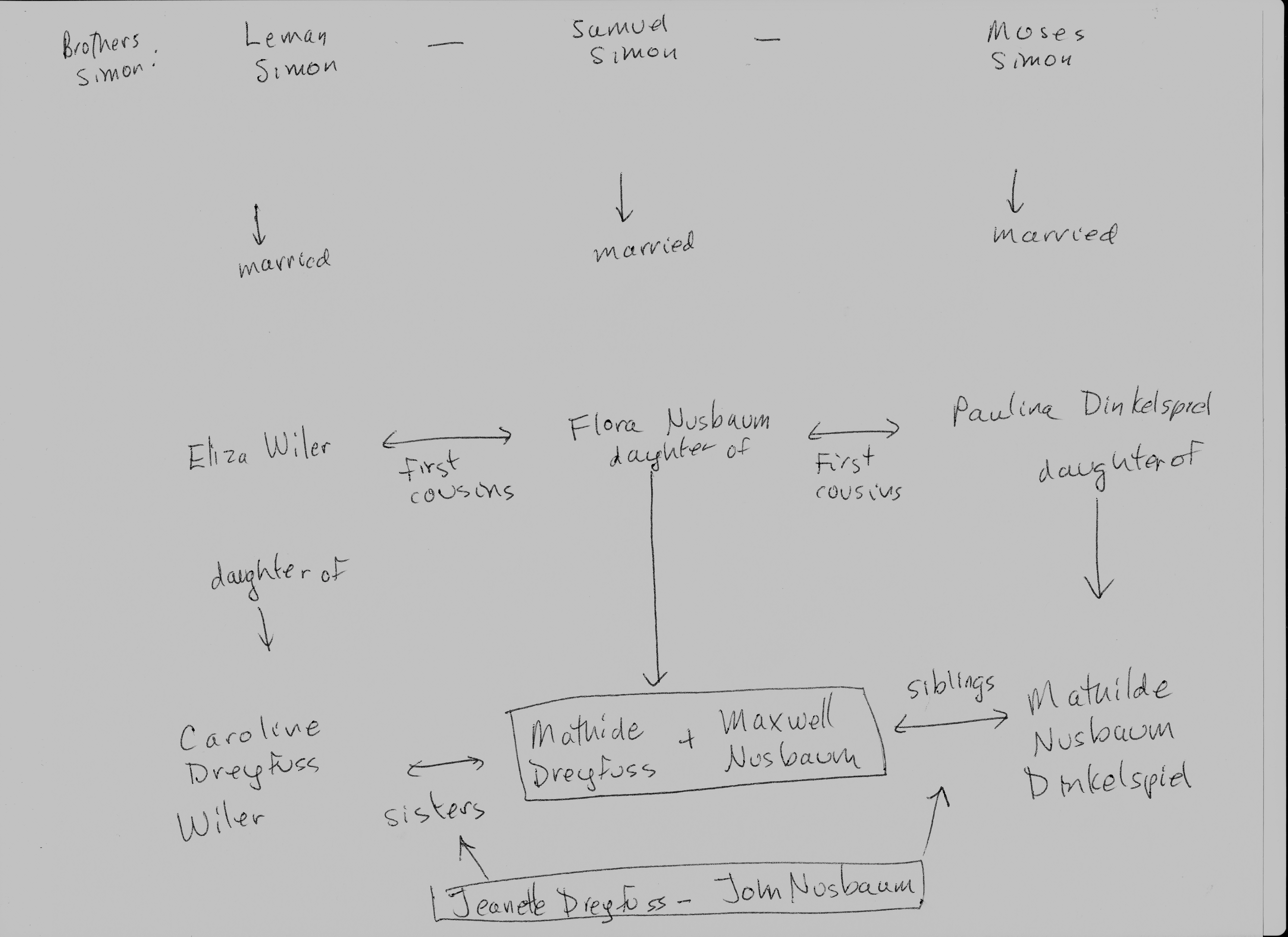
By 1866, Moses Pollock and Mathilde (Dreyfuss Nusbaum) Pollock had also moved to Philadelphia from Harrisburg. In 1868, Flora Nusbaum, the daughter of Mathilde Dreyfuss and Maxwell Nusbaum and step-daughter of Moses Pollock, married Samuel Simon.  I have mentioned this before because Flora Nusbaum is my double first cousin four times removed since both of her parents were siblings of one of my three times great-grandparents, Flora’s father being John Nusbaum’s brother, her mother being Jeanette Dreyfuss Nusbaum’s sister.  Now Flora was marrying her first cousin Paulina’s brother-in-law Samuel Simon, who was also her cousin Eliza’s brother-in law.

Groan…. Maybe this chart will help.
chart_NEW

So all three Simon brothers were now married to someone in the clan: Samuel to Flora Nusbaum, Leman to Eliza Wiler, and Moses to Paulina Dinkenspiel.

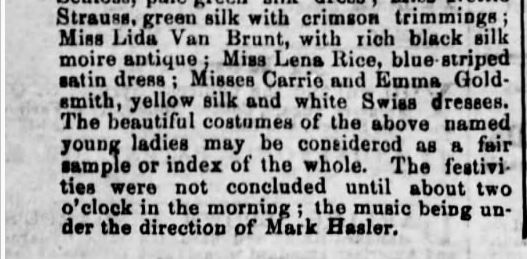
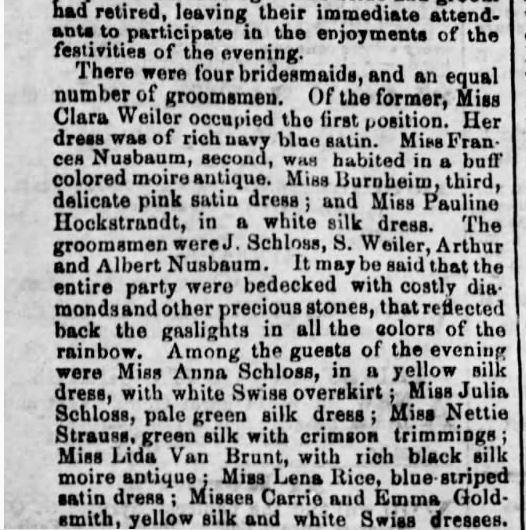
The wedding of Samuel Simon to Flora Nusbaum (Pollock) seems to have been a celebration worthy of all that interconnectedness.  Here is an article from the Harrisburg Telegraph of October 20, 1868, republishing an article from the Philadelphia Sunday Mercury that described their Philadelphia wedding.  It’s really worth reading to get the full flavor of both the wedding and “social media” in the 1860s.

flora pollock wedding part 1

flora pollock wedding part 2

flora pollock part 3

The strangest part of this article is not the detailed description of the lavish, extravagant wedding celebration, but the reporter’s mistaken assertion that Flora was not Jewish.  Certainly her parents were both Jewish, and even her stepfather Moses Pollock was Jewish.  The reporter’s statement that “the pure religion of love had broken down all sectarian barriers” seems a bit strange for a wedding announcement, even if it had been an interfaith wedding.  But why would the reporter have thought Flora wasn’t Jewish?

The overlapping branches of the family were well represented in the bridal party: Clara Wiler and Simon Wiler, the children of Moses and Caroline (Dreyfuss) Wiler; Frances Nusbaum, the daughter of John and Jeanette (Dreyfuss) Nusbaum; Arthur Nusbaum, son of Ernst and Clara Nusbaum; and Albert Nusbaum, son of Maxwell and Mathilde (Dreyfuss) Nusbaum and brother of the bride.  I do not know who the Schloss family is or the Goldsmiths, at least not yet, but I fear more double twists yet to be uncovered.

So the extended family was doing quite well, and there were lots of new families being formed and babies born, but unfortunately there also was one big loss in the 1860s.  Leopold Nusbaum, who was still living in Harrisburg in the 1860s, died on December 24, 1866.  He was buried at Mt. Sinai Cemetery in Philadelphia.  His widow Rosa and sixteen year old daughter Francis moved shortly thereafter to Philadelphia, where they moved in with John and Jeanette Nusbaum, whose household had been reduced by two when Julius moved to Peoria and Frances married.

Below is a photo I found while searching for old images of Harrisburg.  I was so excited when I saw the name on the store at the far upper right—Leo Nusbaum!  Although this photo was dated 1889, Leopold Nusbaum’s name was still on the store even though he had died almost 25 years earlier.

Harrisburg Market Square with Leo Nusbaum store

Harrisburg Market Square with Leo Nusbaum store http://explorepahistory.com/displayimage.php?imgId=1-2-EC

The only Nusbaum family members left in Harrisburg by the end of the 1860s were Mathilde (Nusbaum) Dinkenspiel, her husband Isaac, and their daughter Sophia.  Their daughter Paulina (Dinkenspiel) Simon was living in Baltimore, and their son Adolph was in Peoria.  Their youngest child Sophia married Herman Marks, a Prussian born clothing merchant, in 1869, and they settled in Harrisburg as well.  Perhaps they were the ones to keep Mathilde’s brother’s name on the store.

Thus, by the end of the 1860s, most of the extended family was living in Philadelphia, with a small number living in Peoria, a few in Harrisburg, and a few in Baltimore.


[1] $600 in 1860 would be worth about $17,000 today, and $20,000 in 1860 would be worth about $571,000 today.  Not too shabby for someone who had come to America around 1840.

The Nusbaum and Dreyfuss Families Settle into America: 1850-1860

Market Square, Harrisburg in 1860

Market Square, Harrisburg in 1860  http://pahousearchives.org/?p=digitallibrary/digitalcontent&id=92

As I wrote in my last post about the Nusbaums, the 1850s were for the most part a decade of growth for the Nusbaum and Dreyfuss families although there were two tragedies during that decade.  I have already written about the tragic death of Maxwell Nusbaum in the 1851 Great Fire in San Francisco.  Maxwell died trying to protect the property of another merchant, and his death left his wife Mathilde Dreyfuss Nusbaum with two very young children, Flora and Albert.  Mathilde remarried a few years later, marrying Moses Pollock, with whom she had two more children in 1856 and 1859, Emanuel and Miriam.  Moses was employed as a merchant in Harrisburg, according to the 1860 census.  Since Mathilde was my three-times great-grandmother Jeanette’s sister, her children with Maxwell were cousins both maternally and paternally.

Because the Nusbaum and Dreyfuss families were so entwined, it seems appropriate to discuss them together rather than as two separate lines in my family.  Why return to Harrisburg (and Peoria) twice? (Nothing against those two cities; it just seems to make sense to discuss the two families together.)

In the 1850s a number of the Nusbaum/Dreyfuss siblings were living in Harrisburg, Pennsylvania.  In 1860, Mathilde Nusbaum (sister of Maxwell, John, Leopold and Ernst) and her husband Isaac Dinkelspiel were still living in Harrisburg with their three children, now all adolescents: Paulina (19), Adolph (17), and Sophie (12).  Isaac was working as an “agent,” which I assume means he was an agent in the Nusbaum merchant business.  His son Adolph was working as a clerk, again presumably for the Nusbaum family business.

Mathilde Nusbaum Dinkelspiel’s brother Leopold Nusbaum had also moved to Harrisburg during the 1850s, leaving Blythe, Pennsylvania where he had been a butcher.  Perhaps they moved in the aftermath of his family’s personal tragedy.  Their son Adolph, born in 1848, died on June 6, 1852.  He was only four years old.  He died from acute gastritis.  The death certificate says it was “accompanied by” a word I cannot decipher.  Can anyone read it?  He was buried at Mikveh Israel cemetery in Philadelphia.  I found it interesting that the family, though living in Harrisburg, buried their child in Philadelphia.  Perhaps the Jewish cemetery in Harrisburg had not yet opened.[1]

UPDATE:  My medical consultant says that the other cause of death is cerebritis, meaning a brain infection or abscess.

Death certificate of Adolph Nusbaum, son of Leopold and Rosa Nusbaum

Death certificate of Adolph Nusbaum, son of Leopold and Rosa Nusbaum

Leopold and his wife Rosa had a second child, Francis, who was born in 1850.  Although Francis is listed as a boy on both the 1850 census and the 1860 census, by 1870 she is identified as female and is so thereafter.[2] Her name, however, is almost always spelled as Francis, and I suppose that must have confused the first two census takers as ordinarily Francis is a boy’s name and Frances is the way it is spelled for a girl.  At any rate, it is pretty clear that Francis was a girl even in 1850 and 1860.

Leopold seems to have given up on being a butcher when he moved to Harrisburg.  According to the 1860 census, he, like his brothers John and Ernest, was now a merchant.  Also listed as living with Leopold, Rosa, and Francis on the 1860 census was “A. Dinkelspiel,” presumably Adolph Dinkelspiel, Leopold’s nephew, Mathilde’s son.  Since Adolph was also listed in his parents’ household, my guess is that he may have been living with Leopold and working as a clerk in his store, but that his parents had also counted him as part of their household.

Leopold and Rosa Nusbaum and family 1860 census

Leopold and Rosa Nusbaum and family 1860 census

In addition to the two Nusbaum siblings Leopold and Mathilde (Dinkelspiel), Harrisburg was also the home of Caroline Dreyfuss Wiler for some part of the 1850s.  Caroline, the sister of Jeanette Dreyfuss Nusbaum and Mathilde Dreyfuss Nusbaum Pollock, was married to Moses Wiler.  They had four children, Eliza (1842), Simon (1843), Fanny (1846), and Clara (1849). Simon was born in Philadelphia, and Clara was born in Gettysburg (nothing more specific than Pennsylvania is given for Eliza or Fanny), so Caroline and Moses must have been moving around quite a bit within Pennsylvania during the 1840s.  I assume he was a peddler and thus the family kept moving until he could open a more permanent business.

Although they are listed as living in Harrisburg in 1850, by 1860 they were living in Philadelphia with their four children, at that point three teenagers and one eleven year old.  Moses was working as a merchant, apparently doing quite well.  He had $8000 worth of real estate and $22,000 worth of personal assets; they also had a 27 year old servant living with them.

Moses and Caroline Dreyfuss WIler and family 1860 census

Moses and Caroline Dreyfuss WIler and family 1860 census

John Nusbaum, my three-times great-grandfather, had also moved to Philadelphia by 1860.  In fact, their fifth child, Miriam, was born in Philadelphia on October 30, 1858, so the family must have relocated from Harrisburg by that time.  According to the 1859 Philadelphia directory, John Nusbaum and his family were living at 433 Vine Street, and his place of business was located nearby at 132 North Third Street in Philadelphia.

John and Ernst Nusbaum in the 1859 Philadelphia direcotry

John and Ernst Nusbaum in the 1859 Philadelphia direcotry

John and Jeanette and all five of their children were living, like the Wilers, in the 12th Ward of Philadelphia.[3]  John was occupied as a merchant and had $6000 in real estate and $20,000 in personal property, so like his brother-in-law Moses Wiler, he was doing quite well.  In fact, the Nusbaums had two servants living with them at that time.  My great-great-grandmother Frances, the future wife of Bernard Seligman, was fourteen years old in 1860, and her brothers were 12, 17, and 18, plus there was two year old Miriam, so it must have been quite a handful for those two servants—four adolescents and a toddler.[4]

John Nusbaum and family 1860 census

John and Jeanette Dreyfuss Nusbaum and family 1860 census


John and Jeanette not only had Jeanette’s sister Caroline and her family living nearby, they also had John’s brother Ernst and his family living about a mile away.  According to the 1859 Philadelphia directory (see above), Ernst Nusbaum was living at 521 Buttonwood and working at 55 North Third Street, down the block from his brother John.  Ernst had been living in Philadelphia since at least 1851 since his first child Arthur was born on December 31 of that year.  In 1852, he and his wife Clarissa Arnold and their infant son were living at 191 North 10th Street, and Ernst was working as a merchant at 70 ½ North Third Street.  By 1854 they had moved to Buttonwood Street, and in the 1859 directory Ernst is listed as a clothier doing business with Simon W. Arnold (Clarissa’s brother) and Jacob Nirdlinger.

Ernst Nusbaum 1859 Philadelphia directory

Ernst Nusbaum 1859 Philadelphia directory

On the 1860 census, Ernst’s occupation is listed as “M’s Tailor,” or what I assume is men’s tailor.  Was that his role in the clothing business with his brother-in-law Simon?  Or was it more that they were selling men’s clothing?  Ernst had $20,000 in personal assets and two servants living in the home in addition to his wife Clara and their five children: Arthur (1851), Myer (1852), Fanny (1856), Edgar (1858), and Henrietta (1860 and just two months old at the time of the census).  Unlike his brother John, Ernst had a household of young children in 1860, five children under ten years old.

Ernst and Clarissa Arnold Nusbaum 1860 census

Ernst and Clarissa Arnold Nusbaum 1860 census

Thus, whether in Harrisburg or Philadelphia, the Dreyfuss sisters and their husbands and the Nusbaum siblings and their spouses were all adjusting to life in America, and their families were growing.  Although they suffered two very tragic losses early in the decade of the 1850s, by 1860 it appears that all were doing well.

The next decade would bring changes as the next generation entered adulthood and the country faced the Civil War.

[1] I am awaiting a book on the Jewish history of Harrisburg and should know more once it arrives.

[2] Thus, my reference to two sons in my prior post was mistaken.

[3] The Nusbaum businesses were located about a mile north of where my Cohen relatives were operating their pawnshop business during this same time period.  It would be interesting to know how often their paths crossed even before Flora Cohen married Jacob Weil in 1908.

[4] The ten year gap between Julius and Miriam makes me wonder whether there weren’t other children born during that time who did not survive.

Thanksgiving: More Gifts, More Gratitude

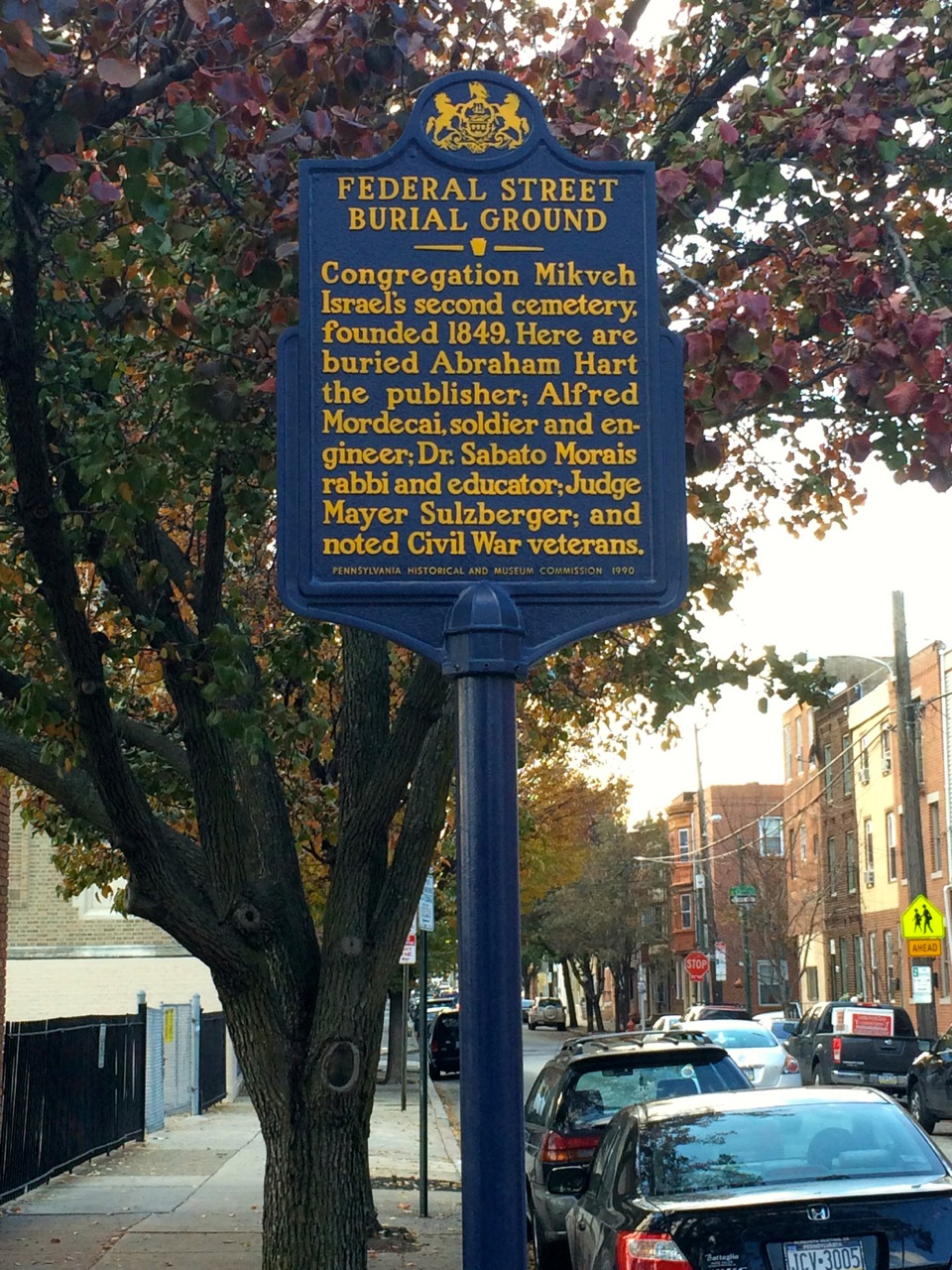
cemetery sign for Mikveh Israel

It’s been a week or so of amazing gifts.  First there was the package from Gau-Algesheim with the records and book relating to my Seligmann ancestors and the amazing help I received from Ralph Baer and Matthias Steinke with translation of these items.

Then a day or so after the Gau-Algesheim package arrived, I received a gift from my third cousin once removed Todd Graham.  Todd is the great-great-great-grandson of Jacob Cohen, my great-great-grandfather.  Todd wrote to tell me that he had been to the Federal Street cemetery in Philadelphia where many of our mutual Cohen ancestors are buried and that he had taken photographs.  He asked if I wanted to see the photos, and I said of course.  So here are the photographs I received from Todd.

First is a photograph of where our ancestor Hart Levy Cohen is buried.  There is no stone visible, and the rabbi at the cemetery explained to Todd that they believed that the stone had sunk beneath the surface and was buried underground.  I have written to the rabbi and asked whether there is anything we can do to uncover the stone or to mark the gravesite in some other way.

Burial Site of Hart Levy Cohen

Burial Site of Hart Levy Cohen

This photo shows where Hart’s children Lewis and Elizabeth are buried.  Again, the stones are not visible, but this is the location of their graves.


Burial sites for Elizabeth Cohen and Lewis Cohen (Hart's children)

Burial sites for Elizabeth Cohen and Lewis Cohen (Hart’s children)

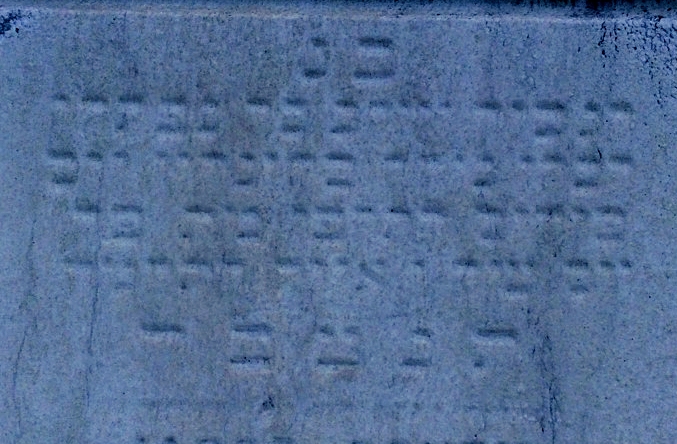
Todd also took photographs of the stone for Jacob and Sarah Cohen.  Although I had a photo of this stone before from Rabbi Albert Gabbai, I am hoping that these will be easier to read so that I can learn what the Hebrew inscription says.

Jacob and Sarah Cohen monument Jacob Cohen headstone by Todd Jacob Cohen monument by Todd jacob headstone edit 1


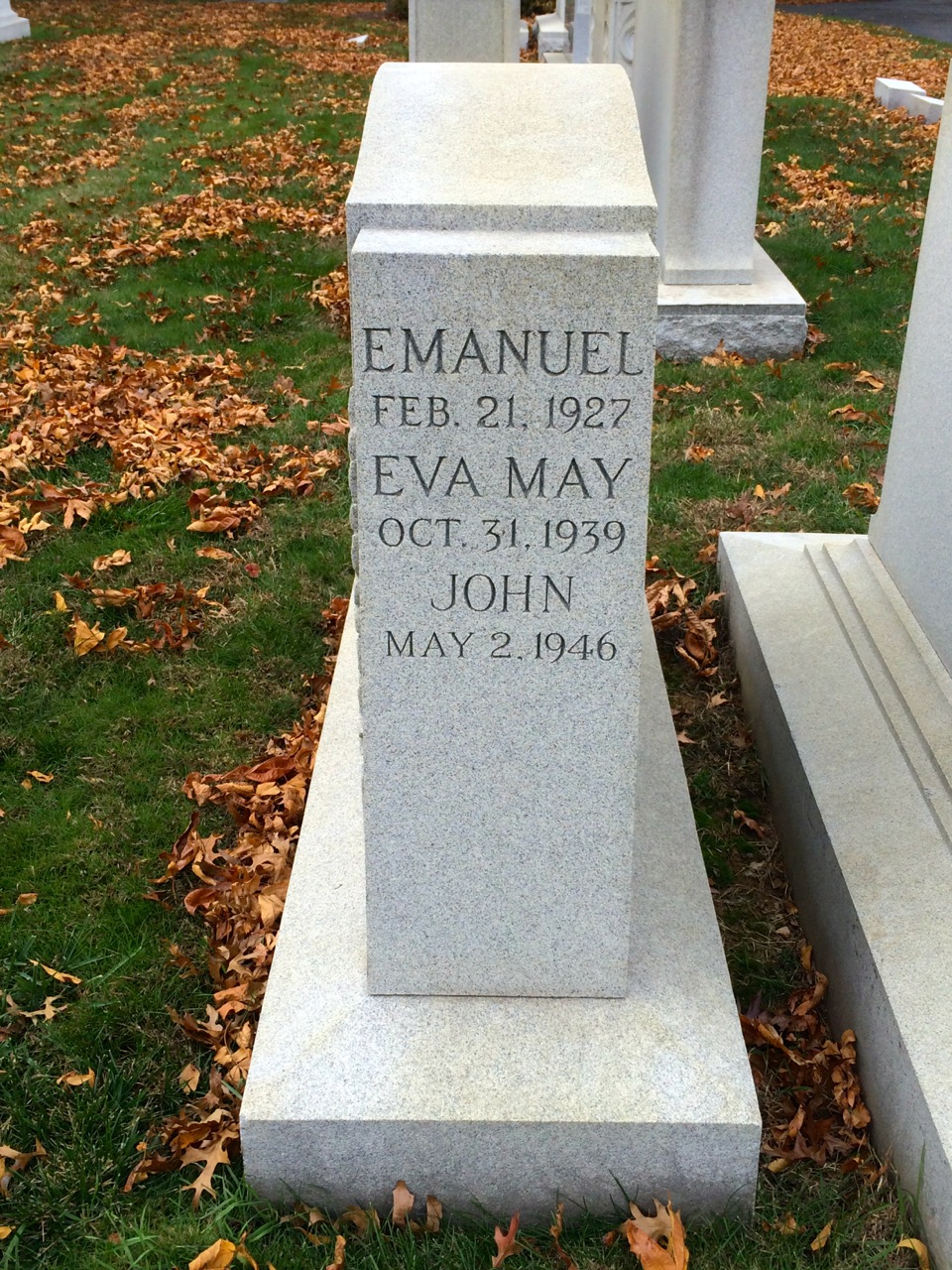
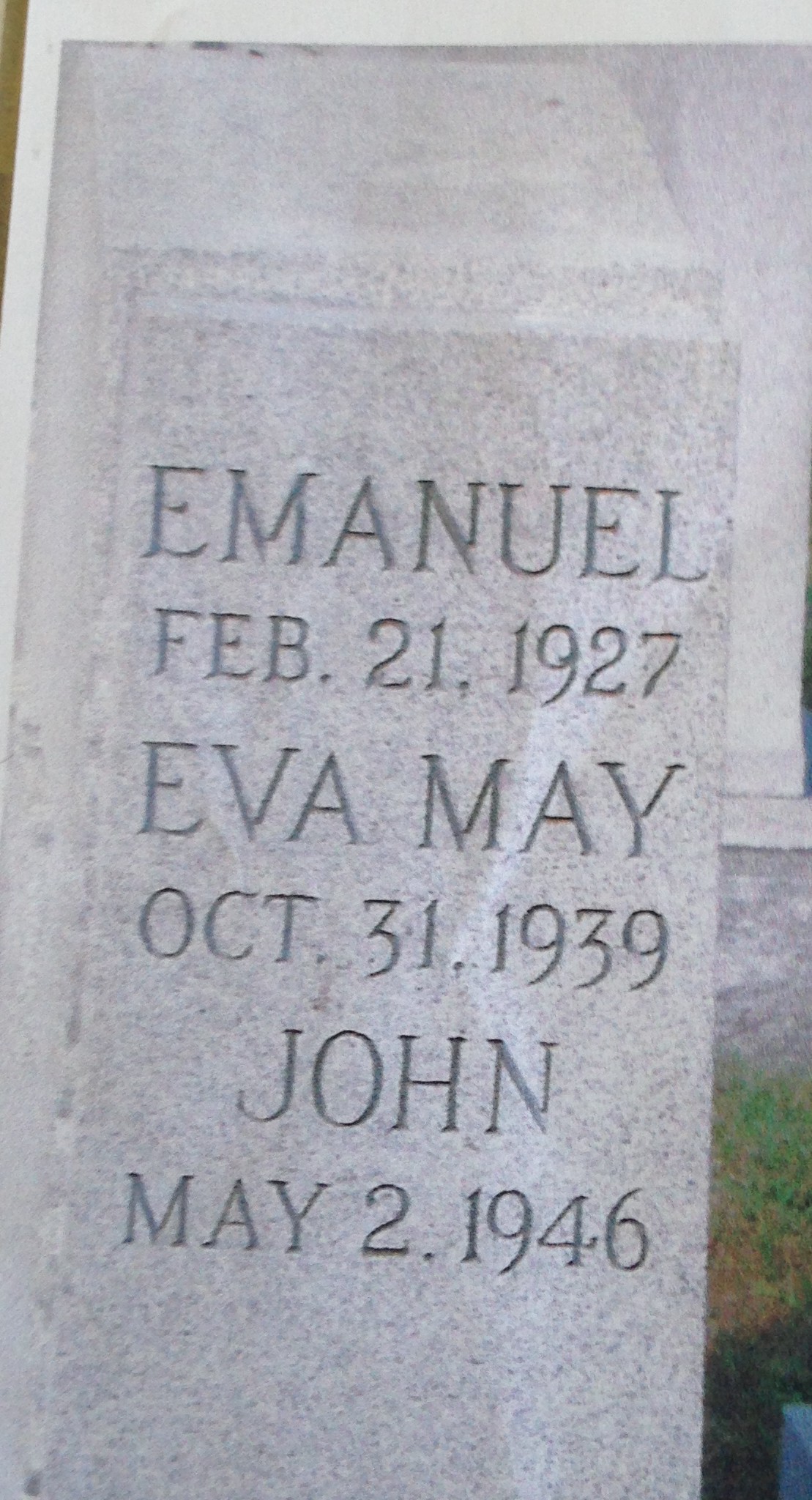
Todd also found the stones for three of Jacob’s children.  First, a new photograph of the headstone for my great-grandparents Emanuel and Eva (Seligman) Cohen and my grandfather John Nusbaum Cohen, Sr.

Headstone for Emanuel, Eva and John Cohen

Headstone for Emanuel, Eva and John Cohen

Side of Emanuel Eva and John by Todd

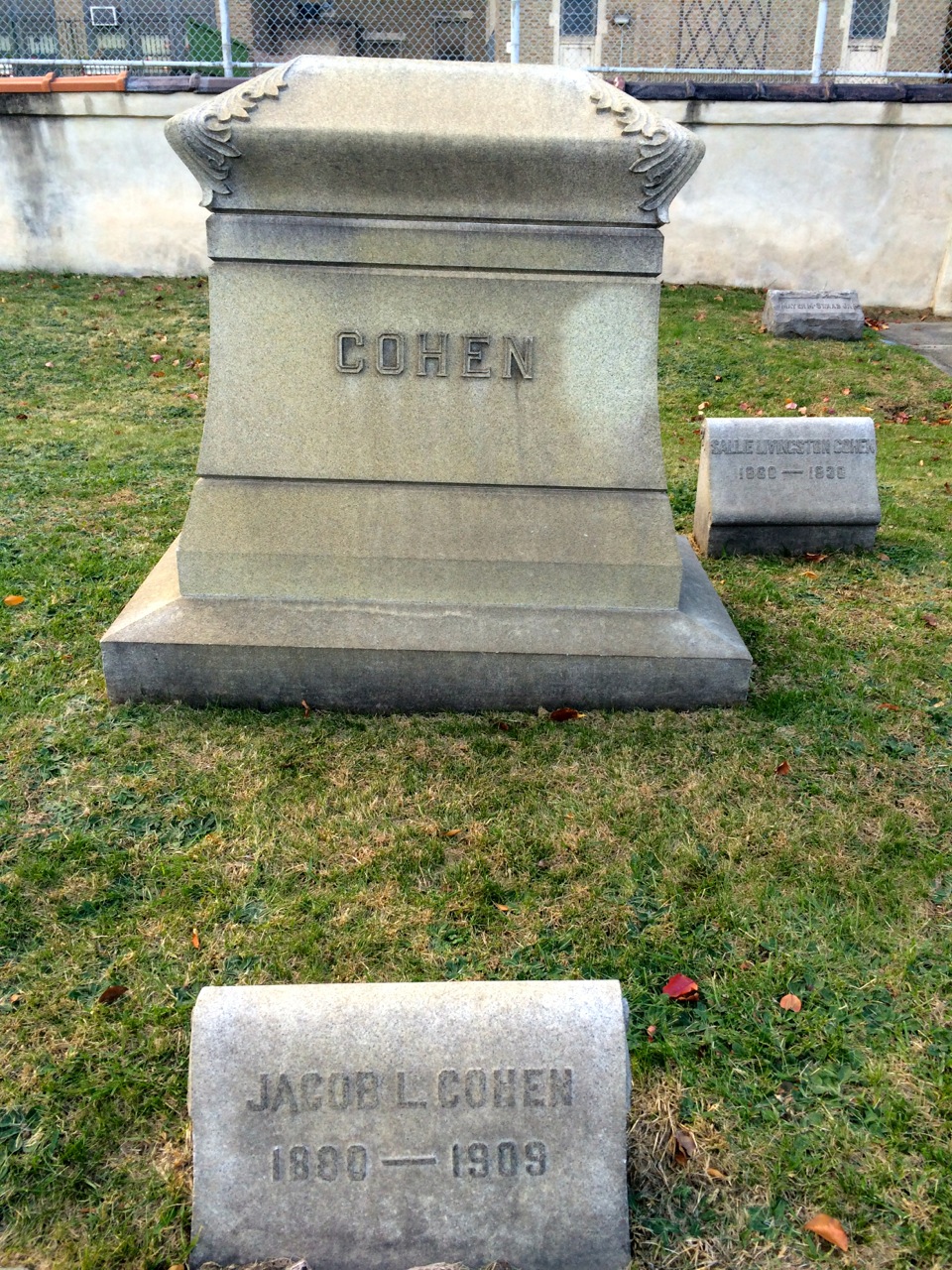
Next are photographs of the headstones for Emanuel’s brother Reuben and his wife Sallie Livingston Cohen and of their son Jacob Livingston Cohen.

Reuben and Sallie Livingston Cohen

Reuben and Sallie Livingston Cohen

Jacob Livingston Cohen

Jacob Livingston Cohen


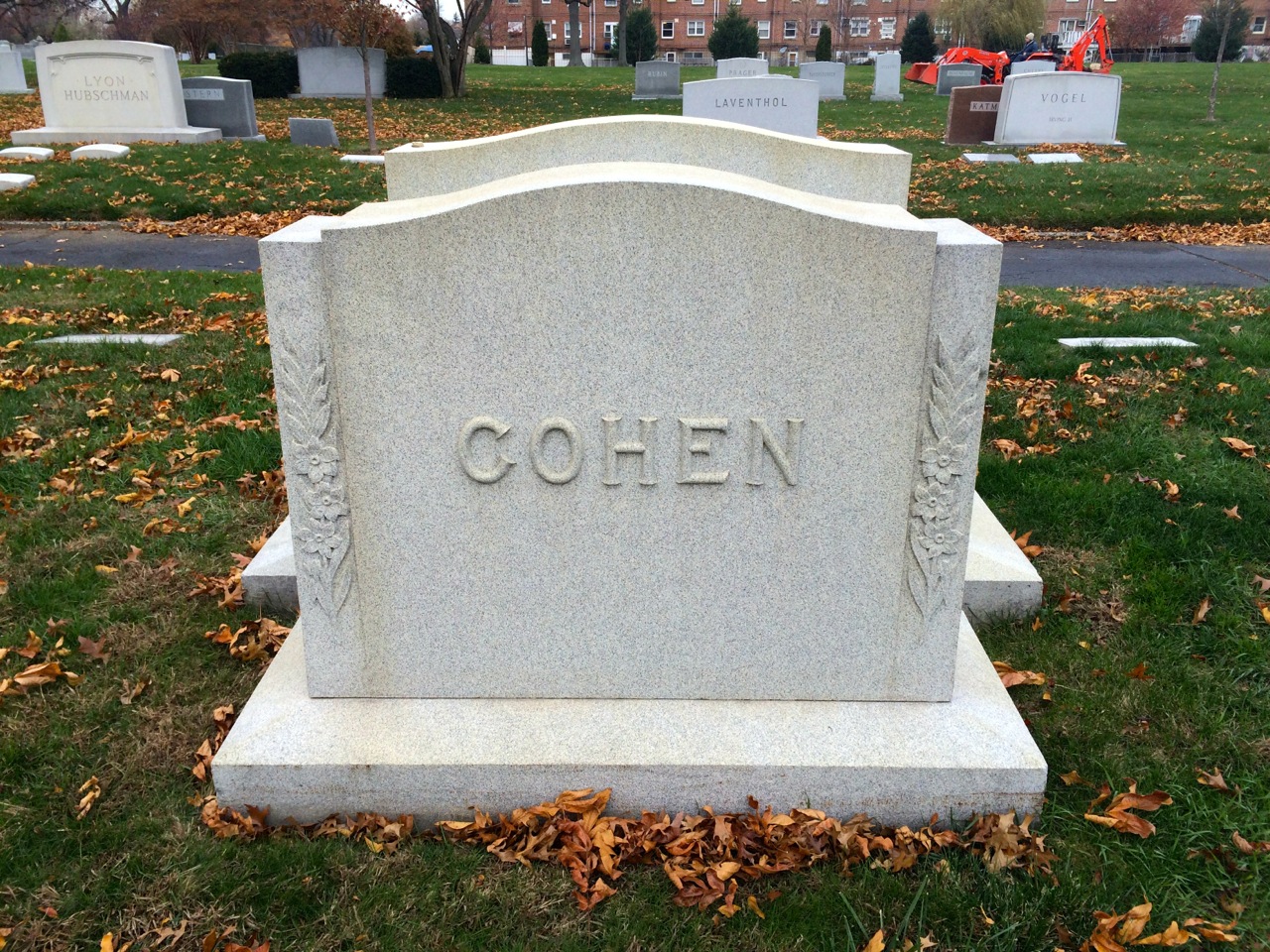
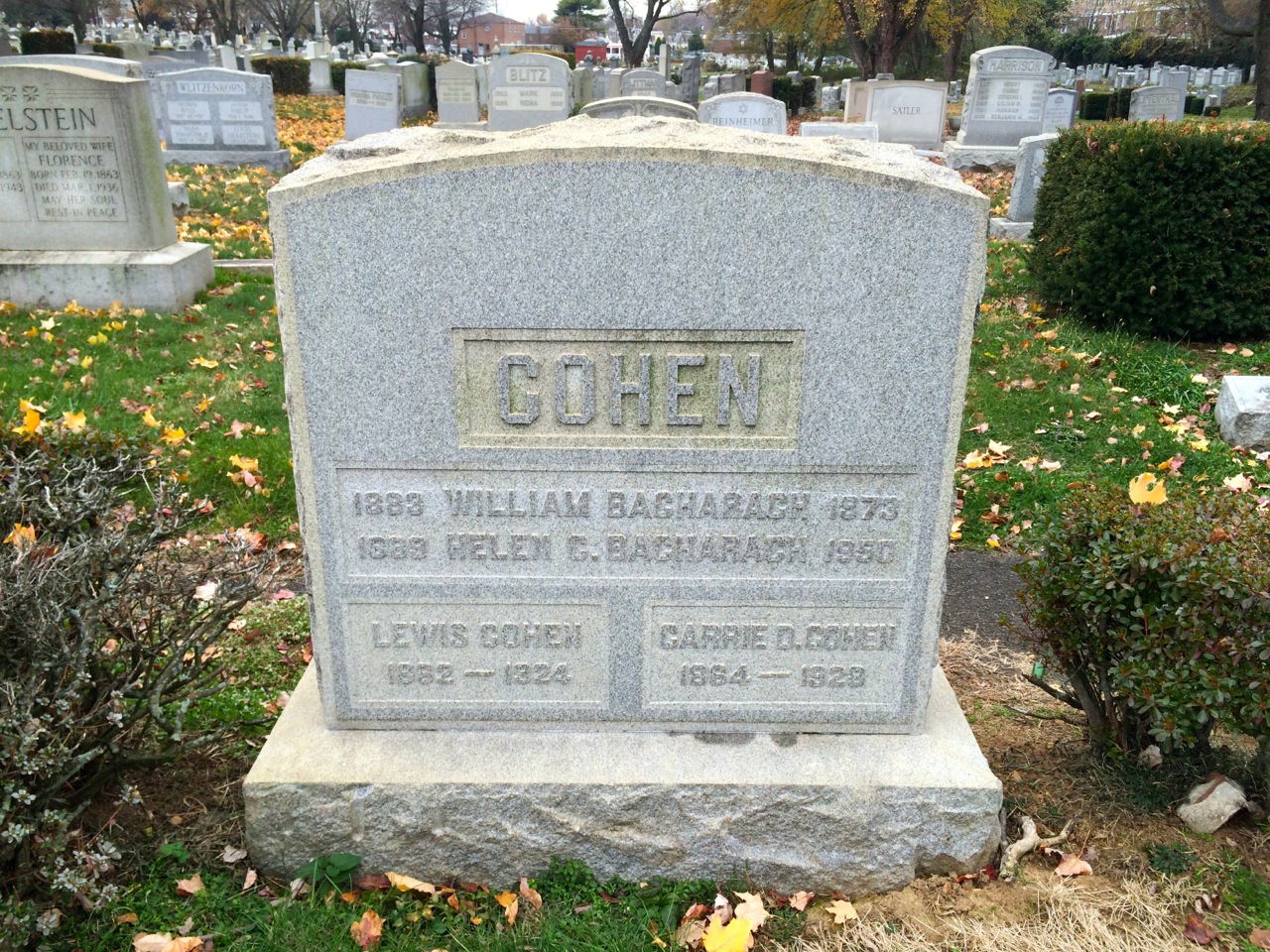
And finally, this is a photograph of the headstone for Todd’s great-great-grandparents Lewis and Carrie (Dannenbaum) Cohen and his grandparents William and Helen (Cohen) Bacharach.  Lewis Cohen was also the brother of my great-grandfather Emanuel Cohen.

Bacharach and Cohen headstone

Bacharach and Cohen headstone

Thank you so much, Todd, for these photographs, and I hope that we can do something to honor the graves of Hart, Lewis, and Elizabeth Cohen.

There is one more gift I want to acknowledge, and it came totally unsolicited and from a total stranger.  About two weeks ago I received a comment on the blog from someone who had found a set of matches on a website selling vintage items.  The matches were for a business called Selinger Associates at an address in Washington, DC.  Kimberly Crosson, the woman who commented on the blog, had purchased these matches and was now asking me whether this business was connected to the Selingers on my blog.  I was skeptical at first, I must admit.  I thought it was some kind of scam or spam.  But I emailed Kim and found out that not only was she not looking to make money, she was incredibly kind-hearted and generous and just wanted to get the matches to someone in the family—for no charge.

I checked the address and found that this was Eliot Selinger’s business.  Then I tracked down a descendant of Eliot Selinger and asked him if he was interested in the matches, and he was, so I put him in touch with Kim so that she could send him the matches.  I asked only for some pictures of the matches, so here is what Kim sent to me.  You can tell these are from a different era once you see the picture on the matches.

Selinger matches cover Selinger matches reverse


So once again, let me express my thanks to all these generous people, especially Todd and Kim for these photos, but to all who have helped and continue to help me with my research. I could never have done all this on my own.

And now I will be taking a short break from blogging for Thanksgiving.  May you all have a wonderful Thanksgiving, and thank you all for supporting me and providing me with so much help as I continue to learn about the lives of my ancestors.


Caps for Sale: Peddlers and Merchants

As I wrote in my last post, by 1852 or before, five of the eight children of Amson and Voegele Nusbaum had settled in Pennsylvania.  Two of the siblings had settled in Harrisburg, one in Lewistown, one in Blythe, and one in Philadelphia.  According to the 1850 census, John Nusbaum was a merchant in Harrisburg, and his brother-in-law Isaac Dinkelspiel was a peddler there, married to John’s sister Mathilde.  Leopold Nusbaum was a butcher in Blythe, Maxwell was a merchant in Lewistown, and Ernst was a merchant in Philadelphia.

It is not surprising to me that Ernst would have settled in Philadelphia, which, as I have written about in the context of my Cohen ancestors, had a fairly large German Jewish community by the mid 1800s.  But why were John Nusbaum and Isaac Dinkelspiel and their families in Harrisburg?  Even more surprising, what were Leopold and Maxwell doing in relatively small towns like Lewistown and Blythe?  What would have taken these new German Jewish immigrants away from the big cities and to smaller towns and cities in Pennsylvania?

The choice of Harrisburg is not really that surprising.  By the time John Nusbaum arrived in the US, perhaps as early as 1840 or even before but certainly by 1850, Harrisburg had been the Pennsylvania state capital for many years already, i.e., since 1812.  It had been settled in the early 18th century and because of its location on the Susquehanna River where there was an opening between the mountains, it had developed into an important trading post for trade and expansion to the west.  By the 1830s the railroad and the Pennsylvania Canal passed through Harrisburg, further increasing its economic importance for westward expansion.  By 1840 the population of Harrisburg was almost six thousand people.  By comparison, the population of Philadelphia in 1840 was over 93,000 people.


Capitol. (Harrisburg, Pennsylvania.), by A. G....

Capitol. (Harrisburg, Pennsylvania.), by A. G. Keet (Photo credit: Wikipedia)

Jewish immigrants began to arrive in Harrisburg in the 1840s, primarily from Germany and England.  The first synagogue, Ohev Sholom, was begun in 1853, first as an Orthodox congregation, and then in 1867 it became a Reform congregation.   The Jewish population, however, was not very large.  There were sixteen members of the congregation in 1853, and even as late as 1900 there were only 35 members.

So how would my three-times great-grandfather John Nusbaum have ended up here?  I do not know for sure, but I can speculate that like many German Jewish immigrants, he arrived in Harrisburg as a peddler and, once finding a strong and stable economic base there, eventually opened his own store.  Harrisburg was obviously an important location for trade not only for its residents but also for those who stopped there as they moved westward in the United States.  It was likely an ideal location for a merchant.  Unlike his three-times great-granddaughter (and her immediate relatives), he must have been a very able entrepreneur.

This pathway to economic success—from peddler to merchant—was quite common among German Jewish immigrants.  According to Hasia Diner in “German Jews and Peddling in America,” (hereinafter “Peddling”) located here:

In Nashville, 23 percent of the adult male Jews in 1860 peddled, as did 25 percent of those in Boston between 1845 and 1861. In Easton, Pennsylvania, a town which occupied the strategic meeting point of the Delaware and Lehigh Rivers, 46 percent peddled in 1840, but just five years later, the number jumped to 70 percent. By 1850 the number had dropped to 55 percent, still a significant figure for any one occupation among a relatively small number of people. Of the 125 Jewish residents in Iowa in the 1850s, 100 peddled around the state, as did two-thirds of all the Jews in Syracuse, New York in that same decade before the Civil War.

See also  Rudolf Glanz, “Notes on Early Jewish Peddling in America,” Jewish Social Studies ( Indiana University Press, Vol. 7, No. 2, April,  1945)  located here.

In a different article, “German Immigrant Period in the United States,” (hereinafter “German Immigrant”) located here in the Jewish Women’s Archive, Hasia Diner explained why peddling was so widespread among German Jewish immigrants.

Americans in the hinterlands had little access to finished goods of all sorts, since few retail establishments existed outside the large cities. Jewish men overwhelmingly came to these remote areas as peddlers, an occupation that required little capital for start-up and that fit the life of the single man. In the large regional cities, Jewish immigrant men would load themselves up with a pack of goods, weighing sometimes as much as one hundred pounds, and then embark on a journey by foot, or eventually, if a peddler succeeded, by horse and wagon.

In “German Immigrant,” Diner opined that because many of these German Jewish immigrants came as single men, they were not tied down to families in a particular location when they first arrived and could thus take on the itinerant life of the peddler.  In her “Peddling” article, Diner further explained the popularity of peddling, pointing out that many of these German Jewish men came from families in Germany where their fathers had been peddlers.  That was certainly true for John Nusbaum and his brothers; their father Amson had been a peddler.  This was an occupation with which they were familiar.  Diner also stated that the Jewish German immigrants had networks of families and friends who could extend credit and help them get started on a peddling business.

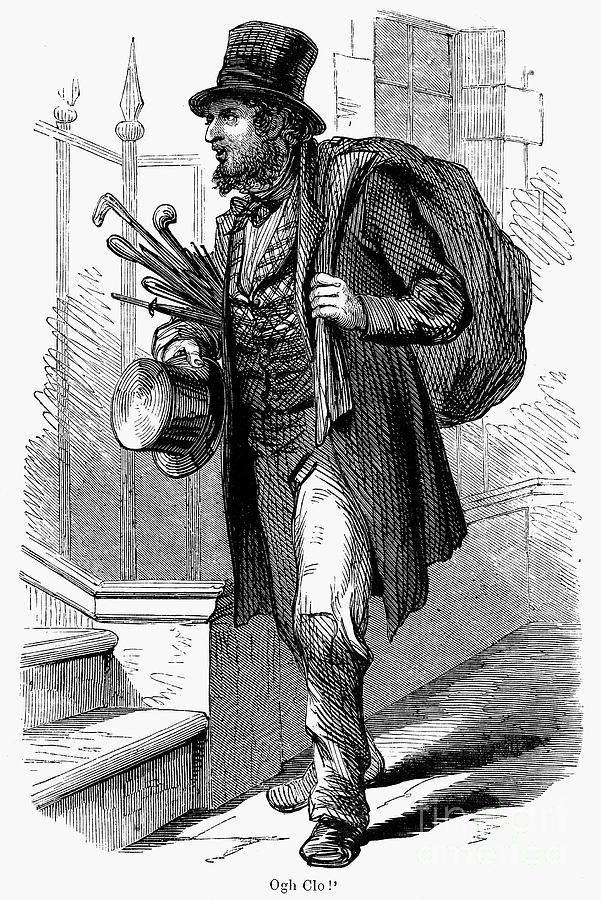
19th century etching of a peddler by Granger found at http://fineartamerica.com/featured/1-peddler-19th-century-granger.html

19th century etching of a peddler by Granger found at http://fineartamerica.com/featured/1-peddler-19th-century-granger.html

In “Peddling,” Diner provided this vivid description of the life of the peddler:

The peddlers operated on a weekly cycle. They left their base on Sunday or Monday, depending on how far they had to go. They would, if necessary, take the railroad or canal barges to get to their territories.  They peddled all week and on Friday headed back to the town from which they had gotten their goods. Here on the Jewish Sabbath and, depending on geography, on Sundays as well, they rested, experiencing fellowship with the other immigrant Jewish peddlers who also operated out of this town. The peddlers engaged with the settled Jewish families, some of whom either operated boarding houses for peddlers or merely extended home hospitality to the men during their brief respites off the road. On the weekends the peddlers could partake of Sabbath religious services and consume some of the good food associated with Jewish holy time, food prepared in the distinctive manners of the various central European regions. Saturday night, after sundown, when the restrictions of the Sabbath lifted, the peddlers came to the shopkeepers and or other creditors to whom they owed money, paid up from the goods they had sold that week, and then filled up their bags, ready for another week on the road.

Rudolf Glanz wrote in “Notes on Early Jewish Peddling in America,” Jewish Social Studies ( Indiana University Press, Vol. 7, No. 2, April,  1945) located here, that these that peddlers played a crucial role in the economic growth and population growth in the unsettled parts of the United States in the 19th century because they provided the pioneers with access to goods that they otherwise would not have had.  This freed the pioneers from having to carry or manufacture these products themselves as they migrated west, thus enabling them to survive and adapt to the frontier conditions.  Glanz, pp. 121-122.  Diner described in “Peddling” the types of goods these peddlers generally sold:

The peddlers did not sell food or fuel. Rather they sold a jumble of goods that might be considered quasi-luxuries. In their bags they carried needles, threads, lace, ribbons, mirrors, pictures and picture frames, watches, jewelry, eye glasses, linens, bedding, and other sundry goods, sometimes called “Yankee notions.” They carried some clothing and cloth, as well as patterns for women to sew their own clothes, and other items to be worn. At times they carried samples of clothes and shoes, measured their customers, and then on return visits brought the finished products with them. When the peddlers graduated from selling from packs on their backs to selling from horse and wagon, they offered more in the way of heavy items, such as stoves and sewing machines.

As Diner points out, often these peddlers were the first Jews in a particular town or village.  Once a peddler had saved enough money to start a permanent store and become a merchant, they would often pick one of these towns where they had had success as peddlers, gotten to know the residents, and established a rapport and a reputation.  Both Diner and Glanz discuss this evolution from peddler to merchant.   According to Diner in “Peddling,” most peddlers did not peddle for long periods, but were able to become storeowners, marry, and start families within a reasonably short period of time. Most became at least moderately successful, and some became the owners of some of the biggest department stores in the US, such as Gimbel’s and Macy’s.

My hypothesis is that John Nusbaum also started out as a peddler.  He must have started from Philadelphia or perhaps New York as a single man and peddled goods through Pennsylvania until he accumulated enough capital and was able to settle in Harrisburg, a prime location for a merchant for the reasons stated above.  Perhaps it was only once he had done so that he married Jeanette and started a family in the 1840s.

When his brother-in-law Isaac Dinkelspiel arrived with his wife Mathilde Nusbaum Dinkelspiel sometime later, it would have made sense for them to settle in Harrisburg.  Since Isaac also started out as a peddler, as seen on the 1850 census, as a married peddler with children, it is not surprising that they would have moved to a place where Mathilde would have had family nearby while her husband Isaac was on the road.  In addition, it is very likely that John was supplying Isaac with the products he was peddling.  According to Diner, it was Jewish merchants who supplied the peddlers with the goods that they then carried out to the less settled regions to sell to those who lived there.  Jewish peddlers needed Jewish merchants for their inventory, and Jewish merchants benefited from the increased market they could reach through the peddlers.

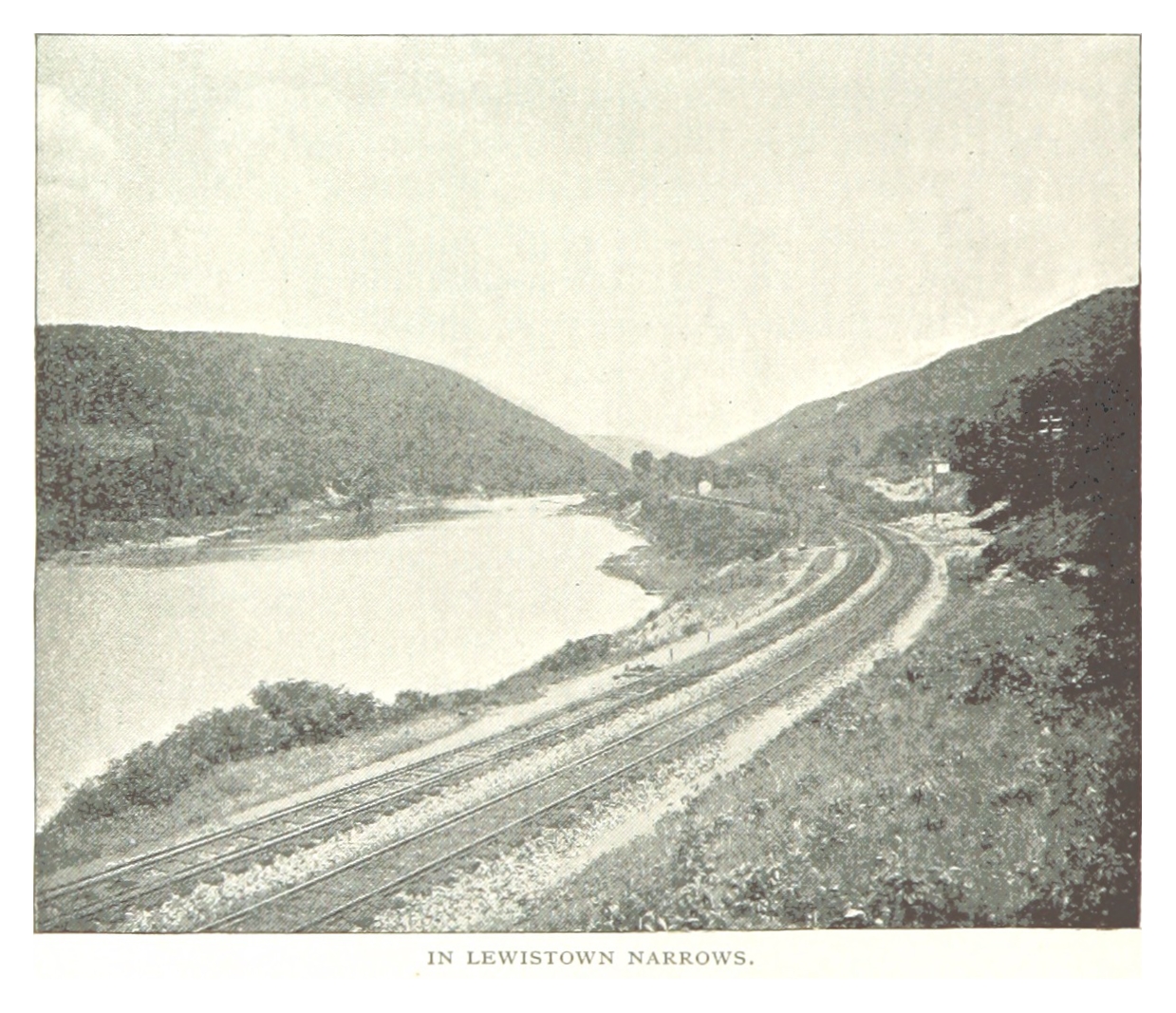
Maxwell, John’s youngest brother, was also a merchant by 1850, but he was in Lewistown, sixty miles from Harrisburg and about 160 miles from Philadelphia.  What was he doing there? Unlike Harrisburg, it was not the state capital, and unlike Philadelphia, it was not a major seaport city.  But it was by 1850 itself an important trading center based on its location near the Pennsylvania Canal and the railroads.  Mifflin County, where Lewistown is located, had a population of close to 15,000 people in 1850 so it was not an insignificant location.  I assume that Maxwell, arriving after his brother John, had also started as a peddler, selling the wares he obtained from his brother, and traveling around the state, until he was able to save enough money and establish a store in his own territory, close enough to his brothers, but not so close as to compete for business.

According to the JewishGen KehillaLinks page for Lewistown, Pennsylvania, found here , the Mifflin County Historical Society had no records of Jews before 1862, but obviously Maxwell was already there. In fact, there was a street named for him:

A map of Lewistown in 1870 shows that Nathan Frank had a store at Brown and Market Streets, listed in a business directory of the time as Franks — Dry Goods, Carpets, Clothing, Furnishings, Goods, Etc.”  Spruce Street was at that time listed as Nusbaum Street and in April, 1880 M. Nusbaum — Clothing & Gents Furnishings was advertised. By 1907 however Nusbaum & Co. was no longer listed in the directory.

The biggest mystery to me is why Leopold Nusbaum ended up in Blythe as a butcher. Blythe is sixty miles from Harrisburg and a hundred miles from Philadelphia.  Like Lewistown, it was also located near railroads and the canals.  I cannot find anything about its population in 1850, but even today its population is under a thousand.  Schuykill County, where Blythe is located, however, had an overall population of over sixty thousand in 1850, which was a doubling of its 1840 population.  Something must have been happening there, but I’ve not yet been able to figure out why its population exploded in that ten year period.  Perhaps that explains why Leopold was living there with his wife Rosa and two young sons in 1850.  But why was he a butcher? Certainly he could not have been a kosher butcher; even today the Jewish population of Blythe is 0%.  At any rate, by 1860, as we will see, Leopold and his family had left Blythe and moved to Harrisburg, where Leopold also followed in his brother’s footsteps and became a merchant.

Thus, the Nusbaum story is not unlike the story of many of those German Jewish immigrants who came to the US, started off as peddlers, and then became merchants, owning stores all over the United States. It must have taken a lot of hard work and a courageous spirit to move to this new country, carrying a heavy pack hundreds of miles through undeveloped territory, dealing with strangers who spoke a strange language, on your own and alone for most of the week.  It must have taken much determination and persistence to do this week after week, maybe for a few years or more, until you had made enough money to find one town to settle in and establish a store.  And then it must have been a hard life, living as perhaps the only Jewish family in that town far away from other family members and other Jews.  In my posts to follow, I will trace the lives of my Nusbaum peddler and merchant relatives and how they progressed in America.


The Nusbaums Come to America

PA Harrisburg 1855

PA Harrisburg 1855 (Photo credit: Wikipedia)

I am having a hard time finding a place to start the rest of the story of my Nusbaum ancestors.  I just keep going in circles and hitting walls.  I have been able to locate most of the children of Amson and Voegele Nusbaum in the US, but for some have not been able to find very much about them.  I am still searching and hoping more will turn up, but the Nusbaums seem so far to have stayed pretty much under the radar, unlike the Seligmans for sure and even more so than the Cohens, about whom I found a number of newspaper articles.

So I will start with what I have and hope that as I go along, I will find more and learn more about the elusive Nusbaums.  From the report compiled by Rolf Hofmann based on the research of Angelika Brosig, I know that Amson and Voegele had eight children.  Guetel, the oldest, reportedly born in 1805, I have not had any luck finding either in Germany or in the United States.  I assume she married in Germany since she would have been in her mid-thirties by the time her other siblings left Germany in the 1840s.  Without access to marriage records or death records in Schopfloch, I have hit a dead end on Guetel.  At least for now.

I also have had no luck finding anything about Amson and Voegele’s fifth child, Sara, for what I assume are the same reasons.  Sara, born July 8, 1812, according to Angelika Brosig’s research, also was probably married before her siblings left Schopfloch.  Neither Guetel nor Sara appear in the Nusbaum family bible that belongs to my father, so I have to assume that they did not ever move to the United States.

On the other hand, I was able to find all five of Amson and Voegel’s sons in the United States without too much trouble, and I even was able to find their other daughter, Madel or Mathilde.  She was born on July 20, 1806, according to Angelika Brosig. My search for Mathilde was more successful than those for her two sisters because once again I was very fortunate to find someone who is related to me (and to Mathilde) by marriage.

I had posted a question on JewishGen seeking help in researching my Nus(s)baum ancestors from Schopfloch, and I received an email from a fellow researcher, Ned Lewison, who said that he doubted that he had anything helpful, but that one of his relatives, Isaac Dinkelspiel, also with ancestral ties to Schopfloch, had married someone named Mathilde Nusbaum, and that they had lived in Harrisburg, Pennsylvania.  (He also said that another relative had married another Nusbaum, but more on that in a later post.)  I knew right away that that could not be just coincidence since I already knew that John Nusbaum had settled also in Harrisburg.  Further research (to be described later) confirmed that Mathilde Nusbaum Dinkelspiel was John’s sister.

So I know of six Nusbaum children who came to the United States: Mathilde, Leopold, Isaac, John, Ernst, and Maxwell.  The earliest record I have found that might relate to my Nusbaum ancestors is an entry for a John Nussbaum on the 1840 census living in Harrisburg, Pennsylvania.

Unfortunately, the 1840 census does not provide a lot of information.  It only lists the male heads of household with check marks indicating the numbers of males and females within certain age ranges living in that household.  The entry for John Nussbaum has check marks for one male between 30 and 40 years old, one female between 20 and 30 years old, and one female between five and ten years old.  My three-times great-grandfather John Nusbaum would have been 36 in 1850, his wife Jeanette would have been 33, and they did not yet have any children that I am aware of.  In fact, the family bible lists their marriage date as July 1, 1841 and their first child, Adolphus, born in 1842.

Could this be my ancestor on the 1840 census?  I am not sure.  His wife’s age could be wrong, the family bible could be wrong about the marriage date, but who was the five to ten year old daughter?  Could John have had another wife and a child before Jeanette? I cannot be sure.  There are no birth records or death records on file in Pennsylvania before 1877 except for scattered church records and some local civil records.  There are some marriage records, but they are not complete, and I cannot find any Nusbaum marriage recorded that early.  I do know, however, that John was in Harrisburg by 1850. So maybe this is my ancestor on the 1840 census, maybe not.  I have written to the local historical society in Harrisburg and hope to get some answers.

I cannot find any of the other Nusbaum siblings on the 1840 census.  The next document I have that may relate to my Nusbaum ancestors is an immigration record for Leopold, John’s older brother. Since I only so far have the index entry and not the full ship manifest, this is also not a very helpful record.  According to the index, a Leopold Nussbaum, aged 35, arrived from Germany to New York on June 9, 1847. The family bible does not have a birthdate for Leopold (though it does have his date of death).  The Brosig records indicated that Leopold (Loew) was born on April 26, 1808, and the census records for Leopold in America conflict with each other, but suggest he was born between 1810 and 1812.  I do not know for sure, therefore, whether this is the same Leopold Nussbaum, and perhaps seeing the full ship manifest will tell me more.  But 1847 seems to be a reasonable date for the arrival of Leopold.

Although I have not been able to find any immigration records for any of the other Nusbaum siblings, I know that by 1850 four of them were already in the US because they appear on the 1850 census.  John was living in Harrisburg’s South Ward and working as a merchant.  He and his wife (listed as Shamet here) had four children: Adolphus (8), Simon (6), Frances (my great-great-grandmother, 4), and Julius (2), all born in Pennsylvania.[1]  They also had eight other unrelated adults living with them, two servants and six whose occupation was given as “clerk,” presumably in John’s store.  So by 1850 John Nusbaum was quite comfortably settled in Harrisburg.

John Nusbaum 1850 census Harrisburg, PA

John Nusbaum 1850 census Harrisburg, PA

As I indicated above, his older sister Mathilde was also living in Harrisburg with her husband Isaac Dinkelspiel.  Isaac was working as a peddler, and he and Mathilde had three children: Paulina (8), Adolph (6), and Sophia (2).  Since all three children were listed as born in Germany, this would suggest that Isaac and Mathilde had been in the United States for less than two years at the time of the 1850 census.  Mathilde and her husband Isaac had no servants living with them and presumably were not yet as comfortable as her brother John and his family, who may have been in Harrisburg for ten years at that point.

Mathilde and Isaac Dinkelspiel 1850 US census Harrisburg, PA

Mathilde and Isaac Dinkelspiel 1850 US census Harrisburg, PA

I did not find a definite listing for Leopold Nusbaum on the 1850 census, but I believe that this listing for L. Nussbaum is the right person.

L. Nusbaum 1850 census Lewistown, PA

L. Nusbaum 1850 census Blythe, PA

L. Nusbaum is listed as a butcher, 38 years old (which would give him a birth year of 1812), and married to Rosannah, both born in Germany, with two children: Adolph (2) and Francis (seven months), as well as a non-related person, perhaps a servant. Both children were born in Pennsylvania, meaning that Leopold and Rosannah had been in Pennsylvania since at least 1847, consistent with the ship manifest. They were living in Blythe, Pennsylvania, a town about seventy miles from Harrisburg.

Why do I believe this is Leopold? Because I know from later documents that Leopold’s wife was Rosa and that he had a son named Francis and a son named Adolph.   Both John and Leopold had children named Adolph/us and Francis/Frances.   Perhaps the two Adolphs were for Amson, the two Francis/Frances for Voegele. (Mathilde and Isaac Dinkelspiel also had a child named Adolph.)

The fourth sibling listed on the 1850 census is Maxwell (Meier) Nusbaum, the youngest of the Nusbaum siblings, born September 14, 1819.  In 1850, he was living with his wife Mathilde Dreyfuss Nusbaum and their two year old daughter Flora in Lewistown, Pennsylvania, which is about sixty miles from Harrisburg. Flora might also have been named for Voegele.  Maxwell was a merchant, and he had a clerk living in his household.  His wife Mathilde was the sister of Jeanette Dreyfuss Nusbaum, the wife of Maxwell’s brother John Nusbaum.  (More on the Dreyfuss family in a later post.)

Maxwell Nusbaum 1850 US census Lewistown, PA

Maxwell Nusbaum 1850 US census Lewistown, PA

Although I cannot find Ernst Nusbaum on the 1850 census, I did find a listing for an Ernest Nusbaum, a merchant in Philadelphia, on the 1852, 1854, and 1859 city directories for Philadelphia.  Given the name and the occupation and the fact that Ernst and his family show up on the 1860 census living in Philadelphia, I think it is reasonable to assume that Ernst was in Philadelphia by 1852. (Unfortunately, the 1860 census did not include street address information so I cannot compare it to the 1850s directories.)

Ernest Nusbaum in the 1852 Philadelphia city directory

Ernest Nusbaum in the 1852 Philadelphia city directory located at https://archive.org/details/mcelroysphiladel1852amce

As for Isaac Nusbaum, the remaining sibling who emigrated to the US, I have no record for him before 1865 in Peoria, Illinois.  I do not know when he arrived or where he was in 1850.

Thus, what I know with a reasonable degree of certainty is that by 1850 (1852 for Ernst), John, Mathilde, Leopold, Maxwell, and Ernst Nusbaum had settled in Pennsylvania, John and Mathilde in Harrisburg, Leopold in Blythe, Maxwell in Lewistown, and Ernst in Philadelphia.  What were they doing living in these places spread out miles from each other? In my next post I will address that question.

Nusbaum 1850 map

Google Maps


[1] The family bible says that Adolphus was born in Newville, Pennsylvania, which is about 32 miles from Harrisburg.  Simon, Frances, and Julius were all born in Harrisburg.

I Am My Own Grandma, or It’s A Small World After All

No, it’s not quite that incestuous or circular, but it’s pretty confusing.

Here’s the story, and I will try to keep this simple.  Or as simple as I can.

Almost two years ago I received a message out of the blue from a fellow ancestry.com member named Nancy Hano.  Attached to her message was a photograph of my grandfather and great-grandparents’ headstone, i.e., John Nusbaum Cohen, Sr., and Emanuel and Eva Cohen.

headstone for emanuel, eva and john n cohen

Courtesy of Nancy Hano

Nancy had seen my tree on ancestry.com and  wanted to know whether these were my relatives, and if so, she thought we might be related because her grandparents, Samuel and Louise Lydia Cohen, were buried nearby.  After some back and forth and some looking at each other’s trees, we concluded that her Cohens and my Cohens were not genetically related.

However, we did find a different connection.  With the help of Nancy’s cousin, Gil Weeder, we found that Samuel Cohen and Louise Lydia Hano had a daughter named Flora.  Flora had married a man named Jacob Weil.  Jacob Weil was the son of Lewis Weil and Rachel Cohen.  Rachel Cohen was the sister of my great-grandfather Emanuel Cohen.  So in fact, Nancy and Gil were related to be my marriage—their relative Flora had married my relative Jacob Weil.

Lydia and Samuel Cohen and granddaughter Helen

Louise Lydia Hano and Samuel Cohen with their granddaughter Helen c. 1913 Courtesy of Gil Weeder

We exchanged pictures and information, and we all continued to do our own research.

Fast forward to this past week, almost two years later.  I am now researching my Nusbaum relatives.  As I was putting together lists of the descendants of my Nusbaum ancestors, I saw the name Jacob Hano appear as the husband of one of my relatives, Fanny Nusbaum, the daughter of Ernst Nusbaum, who is my 4x great-uncle, brother of John Nusbaum.

Since the Hanos, like the Cohens and the Nusbaums, were Pennsylvania Jews, I wondered whether there was a connection.  So I did some research on Jacob Hano, and I soon found out that he was the brother of the Louise Lydia Hano who had married Samuel Cohen, Nancy and Gil’s ancestors.  That is, Jacob Hano was Flora Cohen’s uncle, the same Flora Cohen who married Jacob Weil,the son of Rachel Cohen.

Florrie C Weil sitting room as a child

Home of Samuel Cohen and Louisa Lydia Hano
Courtesy of Gil Weeder

Are you still with me? There’s a quiz at the end.  (No, not really.)

Thus, Nancy, Gil and I are related both through my Nusbaum family and through my Cohen family.

Did they all know each other? Jacob Hano married my relative Fanny Nusbaum in 1877.   My great-grandparents Emanuel Cohen and Eva May Seligman (a Nusbaum) were married in 1886. Flora Cohen  wasn’t married to my relative Jacob Weil until 1908, over twenty years later.   So…here’s one possible scenario:

Eva May Seligman Cohen’s sister-in-law Rachel Cohen Weil says to Eva, “Do you know a nice Jewish girl for my son Jacob?”

Eva says, “Well, my mother’s first cousin Fanny is married to a man named Jacob Hano.  His sister Louise Lydia is married to Samuel Cohen.  A very nice family, also happened to be named Cohen.  They have a daughter Flora.  Perhaps Jacob would like to meet her?”

Flora Cohen and Jacob Weil with their daughter Maizie and unknown other

Flora Cohen and Jacob Weil with their daughter Maizie and unknown other Courtesy of Nancy Hano/Gil Weeder

And poof!  My Nusbaum and Cohen relatives are married to each other, and Gil and Nancy and I get all excited about a new connection, and my family tree starts twisting around on its own axis so badly that it just might fall down!

To state it most succinctly, my father’s maternal first cousin three times removed, Fanny Nusbaum, was married to Jacob Hano, who was the uncle of the wife (Flora Cohen) of my father’s paternal first cousin once removed, Jacob Weil.

This is a simple family tree that illustrates ...

This is a simple family tree that illustrates the definitions of various types of cousins (e.g. “second cousin twice removed”). (Photo credit: Wikipedia)


English: The usual European kinship system wit...

English: The usual European kinship system with English text. Note that “Thrice-removed” on the chart more commonly occurs as “Three times removed”… Deutsch: Das gebräuchliche europäische Verwandschaftssystem (Photo credit: Wikipedia)

My Seligman Great-Great-Grandparents:  Two Pioneers Who Made A Difference with Integrity and Kindness

By the 1890s, my great-great-grandparents were “empty nesters.”  Their daughter Eva, my great-grandmother, was married to Emanuel Cohen and raising her family in Philadelphia.  (I’ve written about my Cohen great-grandparents here.) Their son James was working as a draftsman for the Department of Interior in Salt Lake City, Utah; he would marry Ruth V.B. Stevenson in 1893 in Salt Lake City, and have two children, Morton Tinslar Seligman, born July 1, 1895, in Salt Lake City, and Beatrice Grace Seligman, born December 4, 1898, also in Salt Lake City.  By 1900, however, James, Ruth and the children had moved to Santa Fe, where they were living next door to Bernard and Frances.  James was working as a clerk in a dry goods store, presumably the Seligman store.

Bernard Seligman and James Seligman and families 1900 US census

Bernard Seligman and James Seligman and families 1900 US census  Year: 1900; Census Place: Santa Fe Ward 4, Santa Fe, New Mexico; Roll: 1002; Enumeration District: 0126; FHL microfilm: 1241002

Arthur, the youngest child of Bernard and Frances, had returned to Santa Fe after college in Philadelphia, and in 1896, he married a widow named Frankie E. Harris in Cleveland, Ohio.

Marriage certificate of Arthur Seligman and Frankie E. Harris

Marriage certificate of Arthur Seligman and Frankie E. Harris Cuyahoga County Archive; Cleveland, Ohio; Cuyahoga County, Ohio, Marriage Records, 1810-1973; Volume: Vol 42-43; Page: 489; Year Range: 1892 Sep – 1896 Jul

Frankie had an eight year old daughter Richie from her first marriage who became a part of the Seligman family.  In fact for her ninth birthday on August 3, 1897, Bernard and Frances hosted a birthday party for Richie and 42 of her friends in their Santa Fe home.

Ritchie Harris birthday snip

City News Items Date: Tuesday, August 3, 1897 Paper: New Mexican (Santa Fe, NM) Volume: 34 Issue: 138 Page: 4

(This same “gossip column” also reported that Arthur and James Seligman and some friends were going on a two week fishing trip soon after this birthday party.)

Arthur and Frankie had a son together just a year later; Otis Perry Seligman was born on February 14, 1898, in Santa Fe.  Thus, by 1900, Bernard and Frances had four grandchildren living in Santa Fe plus three more grandsons living in Philadelphia, including my grandfather John Nusbaum Cohen.

On the professional side, I could not find any specific references to Bernard’s political activities or his business activities during the 1890s although the 1900 census listed his occupation as a dry goods merchant.  In 1894 he seems to have taken an extended trip to Europe, including to Germany and to Italy.

Traveling Seligmans 1894

Saturday Small Talk Date: Saturday, October 27, 1894 Paper: New Mexican (Santa Fe, NM) Volume: 31 Issue: 214 Page: 4

From this clipping it is hard to know whether or not he was traveling with Frances.  I also wonder who the relatives were in Italy and who he was visiting on the Rhine.  Was this purely for pleasure or was it a business trip?  I don’t know.

At some point after this trip, however, Bernard and Frances moved back to Philadelphia.   Bernard was living in Philadelphia when he died on February 3, 1903, at age 65 from myocarditis.  He was residing at 1606 Diamond Street at the time.

Bernard Seligman death certificate

When I looked back to see where my great-grandmother Eva was living at that time, I was hardly surprised to see that she, her husband Emanuel Cohen, and their three sons were also living at 1606 Diamond Street as of the 1900 census.  In fact, in 1900, Emanuel’s brother Isaac and nephew were also living at 1606 Diamond Street after the death of Isaac’s wife.  Thus, Eva and Emanuel Cohen, my great-grandparents, were housing not only their three children, but also at least four other family members, Eva’s parents and Emanuel’s brother and nephew.

According to his obituary, Bernard (and presumably Frances) had moved back to Philadelphia three years before his death, to “recuperate from over-work.”  The obituary goes on to say that Bernard had been doing well until sometime in the prior year when he had a “severe stroke of paralysis which weakened him considerably.”  The paper noted, however, that he had been improving and that no one thought that he was near death.  The obituary described his death as “shocking” and reported that the day before his death he had appeared fine and had even sent a dispatch relating to business matters to his son Arthur.

bernardseldeathnmex

“A Good and True Man Called Hence,” Santa Fe New Mexican, February 3, 1903, p. 1

The obituary recounts all of Bernard’s many accomplishments, both political and business, and describes him as follows:

“Mr. Seligman was a pioneer in New Mexico, and during his residence of over forty years in this city and territory, was one of the most progressive, shrewdest and brightest businessmen and citizens of the commonwealth.  He was a man of the strongest integrity and keen perception and high courage, public spirited and thoroughly posted on public affairs, indeed a valuable and good citizen in every sense of the word, a loving husband and a kind and indulgent, yet at the same time, a firm and sensible father.  He was a prominent and important factor in the building up of the commercial, educational, civic, moral, and material interests in this city and county and of the entire territory.  A good and true man has gone to the great beyond.”

What can I possibly add to that? Only that I wish that I had known him.  I stand a bit taller knowing that I am descended from Bernard Seligman.

Just two years later, my great-great-grandmother Frances Nusbaum Seligman also died.  She died in Philadelphia on July 27, 1905, at age 59.

Frances Seligman death certificate

She had been living at 1431 Diamond Street at the time of her death.  Again, I checked to see where my great-grandparents Eva and Emanuel Cohen were living, and 1905 Philadelphia directory, their address was, not surprisingly, 1431 Diamond Street, and they still had their three sons and Isaac living with them in 1910 as well.

Frances was described in her obituary in very loving terms:

“She was a beautiful and accomplished woman, as good as she was beautiful and as beautiful as she was good, and of a most lovable and gentle disposition.  She was an exemplary wife, a fond and good mother, and a dutiful and loving daughter.  Indeed she was all that is implied in the phrase ‘a thoroughly good and moral woman.’  … She will be especially remembered by the poor people of [Santa Fe], to whom she was particularly kind.  Many and many truly charitable deeds have been put to her credit.”

The obituary further commented:

“From the moment of her arrival to within a few years ago, when she commenced to spend most of her time in Philadelphia, she was a social leader, admired, respected and popular.  She was a woman without guile and always ready to lend a helping hand in social as well as in charitable work.”

frances seligman obit July-27-1905 new mexican

(“Gentle, Good Woman Gone,” Santa Fe New Mexican, July 27, 1905, p. 1)

While I was impressed and proud when I read my great-great-grandfather’s obituary, I was very moved and emotional in reading about my great-great-grandmother Frances.  The words “good,” “gentle,” and “kind” are the same words that I have heard my father and my cousin Marjorie use to describe their grandmother, Eva Seligman Cohen, the daughter of Frances Nusbaum and Bernard Seligman.  She seems to have inherited or learned those very traits from her parents, two people who left the city of Santa Fe a better place by the time and the effort that they spent in caring for their community while they lived there.  As I will describe, their surviving children also left their mark, my great-grandmother Eva by her kindness and caring for others, and her two brothers James and especially Arthur by their service to Santa Fe and New Mexico.

bernard

Bernard Seligman

francis

Frances Nusbaum Seligman

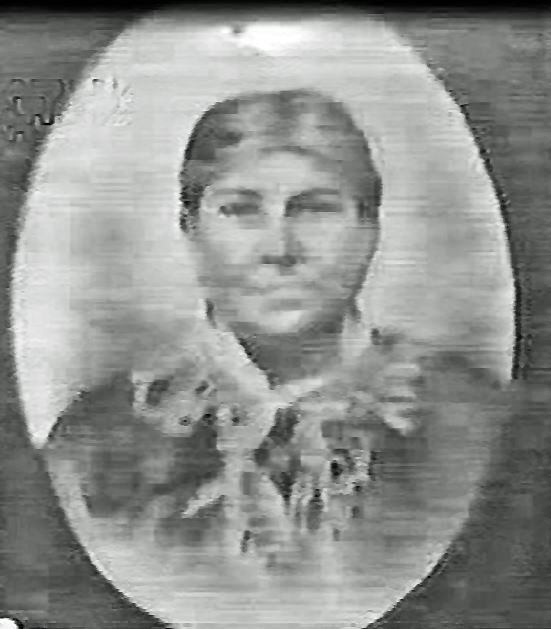
These two photos were given to me by my cousin Arthur Scott.  They were taken from a video made by his sister of family photos in their home.  The one of my great-great-grandmother Frances is so far the only photograph I have of her.


Bernard Seligman: His Political Career and His Family 1870-1890

I want to thank my cousin Arthur “Pete” Scott for all his help with finding newspaper clippings (including some of the ones appearing in this post) and other information to try and fill in the timeline  for Bernard and the other Seligmans. He has also contributed a great deal of information about our family at the Voces de Santa Fe website.  Like my father, Pete is a great-grandson of Bernard Seligman and thus my second cousin once removed.


I have been having a hard time tracking the whereabouts of my great-great-grandfather Bernard in the 1870s.  Although I know that Bernard and his family had moved back to Santa Fe sometime before their youngest child Arthur was born in June, 1871, it seems that Bernard was in and out of town during the 1870s.  In 1873, he withdrew from the Seligman Brothers partnership:

Date: Thursday, January 2, 1873 Paper: Santa Fe Daily New Mexican (Santa Fe, NM) Page: 1

Date: Thursday, January 2, 1873 Paper: Santa Fe Daily New Mexican (Santa Fe, NM) Page: 1

The firm of S. Seligman and Brother was dissolved, and a new firm owned by Sigmund and Adolph Seligman and Julius Nusbaum was created named Seligman Bros. and Company.  Who was Julius Nusbaum?  He was Bernard’s brother-in-law, the brother of Frances Nusbaum, Bernard’s wife.

Daily New Mexican, January 13, 1873

Daily New Mexican, January 13, 1873


I cannot find an explanation for Bernard’s withdrawal, and he certainly was involved in the business again in later years. He had applied for a passport on April 3, 1873, and he served as a representative to the Vienna Exposition  of 1873, so maybe that prompted his withdrawal.

Bernard Seligman passport application 1873

Bernard Seligman passport application 1873


Maybe it’s my modern skepticism that is coloring my perception, but it also seems possible that Bernard withdrew only in name, placing his wife’s brother in the firm in his stead.  Was this done for political purposes to avoid at least the appearance of any conflicts of interest?

Henry Tobias, author of The History of the Jews of New Mexico (University of New Mexico Press, 1990), writing about New Mexico in the 1880s and 1890s, described Bernard Seligman as “probably the most political of all the Santa Fe Jews” during that era (Tobias, p. 117).   Ralph Emerson Twitchell, author of Old Santa Fe: The Story of New Mexico’s Ancient Capital (Rio Grande Press, 1925), wrote, “A public speaker of great force and convincing power, [Bernard Seligman] found time to engage in the public affairs of the country of his adoption and was elected and appointed to many positions of profit and trust.”  (Twitchell, p. 477)  Twitchell also pointed out that Bernard “was a linguist of rare ability; speaking with fluency the English, German, French, Spanish, Italian, and Hebrew idioms.” (Ibid.) Bernard must have been well suited for a career in politics and government in bilingual New Mexico.

Tobias wrote that Bernard became a member of the territorial legislature in 1880. (Tobias, p. 117) Both Bernard’s obituary  (“A Good and True Man called Home,” Santa Fe New Mexican, February 3, 1903, p. 1)  and Twitchell (p. 477 ) also state that Bernard served several terms in the Legislative Assembly for New Mexico.  Another source reported that Bernard was instrumental in the passage of the mechanic’s lien law while he served in the territorial government, a law considered to be very important at that time. (George B. Anderson, History of New Mexico: Its Resources and Its People, Vol. 2 (Pacific States Pub. Co. 1907)).

One newspaper clipping shows that Bernard was the Democratic Party’s nominee for Santa Fe County Commissioner in 1884.(Las Vegas Daily Gazette., October 22, 1884, Image 2, at http://chroniclingamerica.loc.gov/lccn/sn90051703/1884-10-22/ed-1/seq-2/#date1=1873&index=5&rows=20&words=Bernard+Seligman&searchType=basic&sequence=0&state=New+Mexico&date2=1903&proxtext=bernard+seligman&y=4&x=6&dateFilterType=yearRange&page=1 ).  Twitchell wrote that Bernard was chairman of the board of the Santa Fe County Commission for three terms, presumably in the mid-1880s. (Twitchell, p. 477)

Bernard and the Santa Fe County Commission ran into some legal trouble when a local resident and attorney, Thomas Catron, sued the Commission, alleging fraud.  Catron claimed that in 1886 the Commission had issued warrants to raise money for a new courthouse that would increase the county debt beyond the limits set by a new federal statute; he alleged that to avoid that new limitation, the Commission had falsely stated the issuance date of the warrants so that they predated the effective date of that new law. Bernard Seligman is named in the case as the chair of the Commission at the time of this alleged fraud.  The Supreme Court of the Territory of New Mexico found that Catron had stated sufficient facts, if proven, to support a claim against the Commission and remanded the case for trial.  Unfortunately, I cannot find any report on the final outcome of the case on the merits.[1]  Given Bernard’s future political success, perhaps Catron lost the case.

Bernard also encountered some controversy when the Governor of the New Mexico Territory, Edmund Ross, named him as his choice to be the treasurer of the territory. Thomas Catron was again involved in the fight against Bernard. Catron was himself a political leader in New Mexico, having served as Attorney General and US Attorney for the territory and later serving as one of its first US Senators when New Mexico became a state.

English: Thomas Benton Catron, Senator of the ...

English: Thomas Benton Catron, Senator of the United States from New Mexico (Photo credit: Wikipedia)

In July, 1886, the Santa Fe New Mexican reported that Governor Ross might appoint Bernard as treasurer:

Bernard Seligman medicine man to be treasurer

Date: Friday, July 16, 1886 Paper: New Mexican (Santa Fe, NM) Page: 2

I am curious about the reference to Bernard as a “medicine man;” I have no idea what it means in this context.

Governor Ross did in fact appoint Bernard Seligman to be territorial treasurer, but that appointment was then resisted by a man who claimed to be the sitting treasurer, Antonio Ortiz y Salazar, who refused to turn over his office to Seligman. Ortiz, represented by the same Thomas Catron who was suing Bernard for fraud in his role as County Commissioner, argued that the governor had not had authority to appoint Seligman because there was no vacancy to fill as Ortiz still held the seat and had not resigned or died.

Seligman brought a mandamus action against Ortiz, seeking to have him hand over the incidents of the treasurer’s office.  Seligman claimed that the oath taken by Ortiz when sworn in for a second term in 1884 was void because of some irregularities.  Ortiz responded that he had been properly sworn into office in 1882 for his first term, and thus he still had a valid claim to the treasurer’s office despite the governor’s appointment of Seligman.  The trial court judge disagreed and ruled that Seligman’s appointment was valid and that Ortiz had to give up his seat.  Ortiz requested a rehearing, and on review, a different judge reversed the first court’s decision and ruled in favor of Ortiz, concluding that the appointment of Seligman as treasurer was not valid because Ortiz still properly held the seat.

Seligman v Ortiz treasurer-page-001

Date: Thursday, August 19, 1886 Paper: Santa Fe Weekly New Mexican and Livestock Journal (Santa Fe, NM) Page: 4

Henry Tobias saw this incident as an example of the resentment some New Mexico residents felt about the success of the Jewish merchants in New Mexico.  In response to his appointment of Seligman, Ross was advised by one prominent resident that there were already too many Jews in Santa Fe politics and government.  (Tobias, pp. 119-120.)


Edmund G. Ross. Library of Congress descriptio...

Edmund G. Ross. Library of Congress description: “Hon. E. G. Ross of Kansas” (Photo credit: Wikipedia) Governor of New Mexico Territory 1885-1889

In December 1886, Governor Ross made a statement explaining his choice of my great-great-grandfather that upset some residents of the territory because of the insulting and discriminatory assumptions underlying that statement:

governor ross appoints bernard seligman-page-001

Date: Wednesday, December 29, 1886 Paper: Santa Fe Daily New Mexican (Santa Fe, NM) Page: 2

Perhaps there was prejudice on both sides: anti-Mexican prejudice by Ross and anti-Semitic prejudice on the part of those opposing the appointment of my great-great-grandfather.

Several sources, however, state that Bernard Seligman did serve as territorial treasurer: his obituary, Twitchell, and Tobias all refer to the fact that he served as treasurer. The Legislative Blue Book of the Territory of New Mexico (1911) lists Bernard Seligman as territorial treasurer from 1886 through 1891.     None of these sources explain, however, what happened that allowed Seligman to continue in office after the court decision in favor of Ortiz in 1889.

Thus, for much of the 1880s Bernard was pursuing his political career. However, he also must have been somewhat involved in the Seligman Brothers business.  This news clipping dated April 8, 1889, certainly suggests that Bernard was active in the business:

bernard trip back east 1889

New Mexican (Santa Fe, NM), Monday, April 8, 1889 , Volume: 26, Issue: 41,Page: 4

Meanwhile, at home his children were growing up.  In 1881, my great-grandmother Eva, then fifteen years old, left Santa Fe for Philadelphia where she went to Swarthmore[2] and later married my great-grandfather Emanuel Cohen in 1886.   Her younger brother James also went to Swarthmore, where he was a member of the class of 1888 and a member of the literary society.

Eva Cohen in the Swarthmore Bulletin

James Seligman in Swarthmore register 1920

Bernard and Frances’ next child, Minnie, also followed in her siblings’ footsteps and enrolled at Swarthmore as did her younger Arthur.  Although Arthur was two years younger than Minnie, they both enrolled at Swarthmore the same year—1885-1886.  In that year James, Minnie and Arthur were all students at Swarthmore, James a sophomore in the college and Arthur and Minnie as juniors in the preparatory school.  I am not sure where Eva was living that year as she appears to have finished her studies at Swarthmore in 1884 and did not marry Emanuel until 1886.

With at least three of their children living in Philadelphia and Bernard busy with politics, I wonder whether Frances had also returned to Philadelphia to be closer both to her Nusbaum family and her children and whether Eva was also living with her mother there.  Although Eva and Frances are listed on the 1885 New Mexico Territorial Census, so are the other three children, despite the fact that those three were enrolled at school in Philadelphia that same year.  The news clipping above reported that Frances had stayed behind in Philadelphia “with friends” in 1889 when Bernard had returned to Santa Fe.

The family suffered a tragic loss on January 14, 1887, when Minnie, only seventeen years old, died from meningitis while in Philadelphia.  The address on the death certificate was 829 North 5th Street, Philadelphia.  Although I cannot find where the other Nusbaums were living in 1887, earlier Philadelphia directories list several members of the extended Nusbaum family living at residences nearby on North 6th Street and North Marshall Street.


Minnie Seligman death certificate 1887

Minnie Seligman death certificate 1887

This note in a Quaker publication says that Minnie died at the home of a relative:

friends' intelligencer 44 p 59

Friends’ Intelligencer United with the Friends’ Journal, Volume 44 (Google eBook), p. 59

Minnie was buried in Philadelphia at Mt Sinai cemetery, the same cemetery where her infant sister Florence had been buried in 1867 and where her uncle Sigmund Seligman had been buried in 1876 and where her parents and her sister Eva would later be buried.  Although the family may have left Philadelphia for Santa Fe almost twenty years before, it is pretty clear to me that the ties back to Philadelphia remained very strong for the family of Bernard Seligman.


[1] Catron v. Board of Commissioners, 21 P. 60 (N.M. 1889)

[2] Swarthmore had a preparatory school as well as a college in those days, and my great-grandmother and her siblings all attended the preparatory school and then most attended the college for at least some time as well.


Sigmund Seligman: “A Beloved Friend to Humanity and an Uncompromising Lover of His Country”

"La Ciudad de Santa Fe." Engraving f...

“La Ciudad de Santa Fe.” Engraving from “Report of Lt. J. W. Abert of his Examination of New Mexico in the Years 1846-1847.” (Photo credit: Wikipedia)


My great-great-uncle Sigmund Seligman must have been an impressive human being.  Born in 1830, he came by himself to the US from a small town in Germany before he was even twenty years old.  Although I have no records of his arrival or where he might have settled first (although other facts suggest he first settled in Philadelphia), historical sources report that by 1849 he had settled in Santa Fe, first working as a photographer there and then joining up with Charles Clever to start the trading business that became Seligman and Clever and eventually Seligman Brothers, a business that flourished and eventually supported not only Sigmund, but also his two brothers, Bernard and Adolph, and their families.


By 1857, he had applied for US citizenship in Philadelphia, and by 1860 he reported on the US census that he had $20,000 worth of personal property and the same in 1870.  According to two different websites I found for converting 1860 dollars to today’s money, that amount would be the equivalent of over $400,000 today.  Not too bad for a thirty year old entrepreneur.

I found a number of interesting news articles about Sigmund, including one dated June 6, 1871, that announced Sigmund’s return to Santa Fe after being away for a year “in the states and Germany.”  I would love to know what took Sigmund back to Germany in 1870-1871.  There must have still been family members there, but I have no idea who he might have been visiting.  Maybe he was looking for a wife—as Parish had said, many men traveled back east or to Germany to find a Jewish woman to marry.  If that was the purpose of Sigmund’s travels, he seems not to have been successful as he never married.

Sigmund Welcome Home 1871-page-001

Santa Fe Daily New Mexican June 6, 1871, p.1


I assume that his travels in the states included Philadelphia, where his brother Bernard and his family were living during at least some part of that time.  Perhaps Bernard was traveling back and forth, as I suggested in an earlier post, to keep an eye on the business while Sigmund was away. Sigmund had applied for a US passport on April 26, 1870, in Philadelphia, presumably for this trip.  Written across the letter are the words “Nat Dis Court Santa Fe, New Mexico, December 15, 1856. Paid.”   I don’t know what the December 15, 1856 date refers to, but I assume that Sigmund applied for this passport in order to take his trip back to Germany.  He also had become a US citizen on April 26, 1870, also in Philadelphia, signed by the same notary who wrote in support of his passport application.

Sigmund Seligman passport application

Sigmund Seligman passport application 1870 National Archives and Records Administration (NARA); Washington D.C.; Passport Applications, 1795-1905; Collection Number: ARC Identifier 566612 / MLR Number A1 508; NARA Series: M1372; Roll #: 165.

Sigismund Seligman naturalization affidavit

National Archives and Records Administration (NARA); Washington D.C.; Passport Applications, 1795-1905; Collection Number: ARC Identifier 566612 / MLR Number A1 508; NARA Series: M1372; Roll #: 165.


A year is a long time to leave a thriving business, and Sigmund reportedly received a “hearty welcome from his numerous friends” when he returned.  (Santa Fe Daily New Mexican (Santa Fe, NM), June 6, 1871, p. 1)  Sigmund was apparently quite well liked.  In an editorial dated May 21, 1875, the Santa Fe New Mexican singled out Sigmund for his generosity and civic-mindedness based on his support of a project to provide sprinklers for the streets of Santa Fe to control the dust that tended to develop there on what I assume were dirt roads.

Sigmund praised for sprinklers-page-001

(Santa Fe New Mexican, May 21, 1875, p. 1)

Unfortunately, Sigmund’s life was cut short when he was only 46 years old on October 4, 1876.  He died at Fort Craig, New Mexico, a site that is 181 miles from Santa Fe, so quite a distance; it was a US Army fort, the largest in the Southwest.  As his obituary described it, he was in a “far off portion of the Territory.”


English: Former officers' quarters, Fort Craig...

English: Former officers’ quarters, Fort Craig, New Mexico, USA (Photo credit: Wikipedia)


He died of apoplexy, according to one death record, and his obituary indicated that he died “from a sudden and resistless stroke of disease.”  According to MedlinePlus, “When the word apoplexy (with no organ specified) is used alone, it often refers to stroke symptoms that occur suddenly. Such symptoms can be caused by bleeding into the brain or by a blood clot in a brain blood vessel. Conditions such as subarachnoid hemorrhage or stroke are sometimes called apoplexy.”  http://www.nlm.nih.gov/medlineplus/ency/article/000328.htm

The public reaction to his death was described in expressive terms in Sigmund’s obituary in the Santa Fe New Mexican dated October 10, 1876.  The paper reported, “At no time in the history of our citizens has there been a more spontaneous outpouring of the people to show a becoming respect to the memory of a departed fellow-citizen and friend.”  A Jewish “burial service” was read by Lehman Spiegelberg, another Santa Fe merchant, and Sigmund was buried at Odd Fellows cemetery in Santa Fe on October 9, 1876. A eulogy was given by Edmund F. Dunne, “portraying in most affecting, generous and glowing terms the many virtues and excellent qualities of the deceased as a brother, friend, citizen and correct man of business.” The paper described him as “a beloved friend to humanity and an uncompromising lover of his country, her institutions and laws.”

sigmund obit full page from voces

Obituary of Sigmund Seligman 1876 Daily New Mexican page one Personal collection of Arthur Scott http://www.vocesdesantafe.org/index.php/explore-our-history/historical-documents2/item/301-the-daily-new-mexican-ocotober-10-1876


There was only one thing that puzzled me about this obituary.  It does not mention Bernard or his family at all.  In fact, the paper describes Adolph as “the surviving brother” as if there was no other.    Since Arthur Seligman, Bernard’s son was born in Santa Fe in 1871 and since Bernard appears as living there on both the 1870 and 1880 US census reports as well as serving on the Board of Trustees of the Santa Fe Academy in 1878, I would have assumed that Bernard would have been in Santa Fe in 1876.


Although Sigmund was initially buried in Santa Fe, his body was moved to Philadelphia in April, 1877, six months after his death, where he was buried at Mt Sinai cemetery, the same cemetery where his brother Bernard would later be buried as well as other members of Bernard’s family.  Putting this information together with Bernard’s absence from Sigmund’s funeral makes me wonder whether Bernard had in fact moved back to Philadelphia between 1876 and 1877 and decided to have his brother buried in a proper Jewish cemetery rather than in Santa Fe’s Odd Fellows cemetery.

Sigmund Seligman death record, Philadelphia

Sigmund Seligman death record, Philadelphia “Pennsylvania, Philadelphia City Death Certificates, 1803-1915,” index and images, FamilySearch (https://familysearch.org/pal:/MM9.3.1/TH-266-11110-64044-12?cc=1320976 : accessed 29 Sep 2014), 004000970 > image 141 of 448; citing Department of Records.


I am sorry that I do not have any photographs of Sigmund.  He must have been an interesting man—adventurous, courageous, generous, respected, and well-liked by his fellow Santa Fe citizens.  His life may have been short, but by going to Santa Fe, he not only made a good life for himself, he helped out his community, and he provided a good foundation for his two younger brothers and their families.


Jews on the Santa Fe Trail 1848-1871:  My Great-Great-Grandfather Bernard Seligman and his Brothers


Sign for Santa Fe National Historic Trail.

Sign for Santa Fe National Historic Trail. (Photo credit: Wikipedia)


My great-great-grandfather Bernard Seligman was born on November 23, 1837 in Gau-Algesheim, Germany.  When I learned about the small town in Germany where my great-great-grandfather Bernard Seligman was born, I was not surprised that he had decided to move away when he reached adulthood.  Gau-Algesheim was itself a very small town, and the Jewish population was tiny—perhaps 60-80 people during the 1840s and 1850s when Bernard was growing up.  The opportunities for a young Jewish man must have been very limited—socially and economically.  My research of the town indicated that by 1900 the Jewish population had declined dramatically.  My great-great-grandfather and his brothers were therefore not unlike many others who moved out of their small hometown to seek greater opportunities.

Before leaving Germany, Bernard received what was described as a “first class education in the public and commercial schools of his native land where he also gained considerable actual business experience while employed a wholesale establishment there.”[1]  According to a book written in 1925 by Ralph Emerson Twitchell, then the official state historian for New Mexico, Bernard Seligman had been associated with the Rothschild banking house in Frankfort-on-the-Main before coming to the US.[2]

Bernard was not the first of the Seligman brothers to arrive in the United States. His older brother Sigismund or Sigmund, born in 1830 in Gau-Algesheim, had arrived in Santa Fe in 1849.  At first, Sigmund found work as a photographer, running a daguerreotype portrait studio for a few years.[3]  But within a few years he and another recent German immigrant named Charles Clever “formed a business partnership … under the firm name and style of Seligman and Clever, engaging in general merchandizing and freighting over the old [Santa Fe] Trail.”[4]

This photo is claimed to be the oldest photograph of Santa Fe, taken about 1855.  You can see the sign for Seligman and Clever on the right.  At one time one of the streets in this photograph was called Seligman Street.


Sigmund’s younger brother Bernard, my great-great-grandfather, arrived in the United States on March 23, 1857, coming aboard the ship Mercury and landing in New York.  On the record for the passenger manifest it says that his occupation was a merchant.[5] Twitchell wrote that Bernard initially settled near Philadelphia and worked for a cotton manufacturing business.[6]  He is said to have arrived in Santa Fe in 1858, taking a position in his brother Sigmund’s business, according to Bernard’s obituary. [7]

When Sigmund’s partner Charles Clever resigned from the business a few years later to become a lawyer, Bernard became a partner with his brother Sigmund in the business, and it was renamed S. Seligman and Bro.  Some years later a third brother, Adolph, born in 1845, also settled in Santa Fe and joined his brothers’ business in the 1860s.[8]

As described by William J. Parish in “The German Jew and the Commercial Revolution in Territorial New Mexico 1850-1900,” New Mexico Historical Review, Vol. 35, p. 1 (1960), until the arrival of Jewish German immigrants like the Seligmans, the trade conditions in the New Mexico territory were quite rudimentary, a few small stands relying upon traveling merchants to provide them with merchandise.  According to Parish, heavy taxes and the high cost and risk of travel made many reluctant to deal in the region.  Storekeepers could not rely on these traveling merchants to supply an adequate inventory of goods.  Thus, few merchants established permanent roots in the area.

English: "Arrival of the caravan at Santa...

English: “Arrival of the caravan at Santa Fe” — Copy of original lithograph ca. 1844 (Photo credit: Wikipedia)

These conditions provided a substantial opportunity for Jewish German immigrants like my ancestors, the Seligmans. Beginning in the 1840s around the time that Sigmund immigrated, there were a number of recent Jewish German immigrants who brought a thriving economic base to Santa Fe and other New Mexican cities based on transporting goods from the eastern United States over the Santa Fe trail to the New Mexican territory recently acquired by the US after the Mexican War ended.[9]

As postulated by Parish, German Jews came to the US with a particularly good background to take advantage of these entrepreneurial opportunities.  Parish discusses how historically Jews in Western Europe, although foreclosed from entering many trades, had been allowed to take on the role of the moneylender, a livelihood to which Christians had an aversion and, in some cases, a religious opposition, thus leaving that unpopular job for their Jewish neighbors.  Although this created some hostility and resentment (as seen, of course, in The Merchant of Venice and the character of Shylock), it also provided Jewish men with the opportunity to develop skills in banking, business, and capitalism.  Jewish immigrants brought these skills with them to the US wherever they settled, and, as Parish points out, those who came to New Mexico had a profound impact on the fledgling economy that existed there.

This is a photograph of my great-great-grandfather Bernard Seligman (far left) with two other Santa Fe merchants,  Zadoc Staab and Lehman Spiegelberg,  and  two Kiowa Indian scouts.

Bernard Seligman and other merchants

Freighters on the Santa Fe Trail, Bernard Seligman, Zadoc Staab, Lehman Spiegelberg and Kiowa Indian scouts Palace of the Governors Photo Archives, New Mexico History Museum, Santa Fe


The growth of the economy is illustrated by the growth in the number of Jewish merchants in Santa Fe from 1850 to 1870.  In 1850 there were eight such merchants; by 1860 that number had doubled to sixteen.[10]  By 1870 it had doubled again to 32; clearly, my relatives had arrived at the right place at the right time.[11]  These merchants were not transient traveling merchants.  They established permanent businesses and stayed in the community.

Twitchell provided this vivid description of the scale of the Seligman brothers’ business:

“A Fair exemplar of the magnitude of the business of this firm is recorded in the fact that one caravan, conducted by firm, loaded at the Missouri river eighty-three wagons of merchandise consigned to the firm at Santa Fé, each wagon carrying not less than three tons of high class freight.  Another record in the books of the firm shows the payment of $30,000 in transportation charges on one caravan alone, all of the merchandise having been disposed of to New Mexican buyers within the brief period of three weeks after arrival in Santa Fé[. N]early three quarters of a century disclose an aggregate of more than fifteen millions of dollars.”[12]


Thus, by the 1860s, the Seligman Brothers’ business was thriving.  They and the other Jewish merchants had brought a reliable source of goods to Santa Fe for the first time.

These merchants, however, were not involved in any of the traditional practices of Jewish life.  According to Henry J. Tobias, the author of The History of the Jews in New Mexico, although these men identified as Jews, there was no evidence of any regular Jewish observance in Santa Fe during those early days—no evidence of a synagogue or any form community prayer or celebration, no observance of dietary laws.[13]  The Jewish population was less than five percent of one percent of the overall population at that time, and the Jews had to adapt to living in a culture where they were such a tiny segment of the community.

Most of the Jewish residents in the 1860s were single men, although a few women and families were starting to arrive.  In 1860 there was a celebration of Yom Kippur at the home of Levi Spiegelberg, another Jewish merchant, who had recently married a Jewish woman from Germany.  Tobias speculated that perhaps the arrival of Spiegelberg’s bride, one of only two Jewish women in the town at that time, made the others nostalgic for the traditions from back home and thus inspired this day long observance of fasting and prayer.[14]

After the Civil War[15] and after his younger brother Adolph had arrived in Santa Fe, Bernard moved back east to Philadelphia for several years.  Parish pointed out that there were no Jewish single women in Santa Fe in the 1850s and 1860s, and that while some Jewish men intermarried, most went back east to find a Jewish woman to marry.[16]  Sigmund never married, and Adolph did not marry until he was in his 60s, but Bernard went back east and found a Jewish woman from Pennsylvania, my great-great-grandmother Frances Nusbaum.  She was born in Harrisburg, Pennsylvania, in 1845, but by 1860 she and her family had moved to Philadelphia.  Bernard and Frances married on March 28, 1865, and my great-grandmother Eva (named Evalynn at birth) was born the following year on May 27, 1866 in Philadelphia.  According to the Philadelphia city directories for 1867, Bernard was in business with his Nusbaum in-laws at that time.

On August 17, 1867, Bernard and Frances had a second daughter, Florence; the baby only lived five weeks and died on September 26, 1867.  She was buried at Mt. Sinai cemetery in Philadelphia, along with many of the Nusbaum family members (and also many of my Cohen relatives).  A third child, James Leon Seligman, was born on August 11, 1868, and then another daughter, Minnie, was born on October 31, 1869.  All of these children were born in Philadelphia, and Bernard, Frances and the three surviving children are all listed in the 1870 census as living in Philadelphia in the 13th Ward. Bernard is also listed in 1871 in the Philadelphia directory.

Bernard, however, must have been traveling back and forth between Santa Fe and Philadelphia because he is also listed in Santa Fe on the 1870 census, living with his brother Sigmund and two clerks.  Bernard is listed as owning $25,000 worth of real estate and $20,000 in personal property. (Strangely, Sigmund only claimed $20,000 in personal property and no real estate, despite being the founder of the store and the full time resident.)

At some point, however, in 1871, Bernard and Frances and their children relocated to Santa Fe, and their last child, Arthur Seligman, was born on June 14, 1871, in Santa Fe, the first family member to be born in that city.  According to Twitchell, Frances Nusbaum Seligman was one of only eight women living in Santa Fe at that time who did not come from a Spanish background.  Twitchell described my great-great-grandmother as “a woman of rare beauty, great intelligence and charming personality.”[17]  Although I will write about the Nusbaum family at a later time, for now I can say that they were a large and successful Philadelphia family with a German Jewish background; it must have been very difficult for Frances to leave her family behind and move all the way to Santa Fe, a frontier town far different from Philadelphia.

My great-grandmother Eva was only five years old when she made that cross-country trip with her parents and her siblings, leaving Philadelphia temporarily behind. She lived there for ten years, and when she was fifteen years old, she returned to Philadelphia for college and married my great-grandfather Emanuel Cohen when she was twenty.  She lived in Philadelphia for the rest of her life.  But most of the Seligman family developed and maintained deep roots in Santa Fe, ties that still exist today for many of their descendants.


In my posts to follow, I will first write about the years that my great-grandmother lived in Santa Fe, 1871-1881, and about her family.  Then I will write about the years that followed, including the story of my great-great-uncle Arthur Seligman and his career as a political leader and ultimately governor of New Mexico.


Santa Fe Trail around 1845 plus connecting tra...

Santa Fe Trail around 1845 plus connecting trading routes to commercial hubs and ports in the USA (Photo credit: Wikipedia)


[1] “A Good and True Man Called Home,” Santa Fe New Mexican, February 3, 1903.


[2] Ralph Emerson Twitchell, Old Santa Fe: The Story of New Mexico’s Ancient Capital (The Rio Grande Press 1925), pp 476-478.  I found a few errors in Twitchell’s account of Bernard Seligman, including the birth year of his brother Sigmund and the birth places of his first three children.  I cannot independently verify some of his other assertions, unfortunately, but report them here as they were reported in Twitchell’s book.


[3] Arthur Scott, “My Grandfather’s Birthplace on the Santa Fe Plaza,” found at http://www.vocesdesantafe.org/index.php/explore-our-history/santa-fe/item/1090-my-grandfathers-birthplace-on-the-santa-fe-plaza

[4] Twitchell, p. 477.  It is important to note that there was an entirely separate Seligman family that settled in Bernalillo, New Mexico around the same time that my Seligman ancestors were settling in Santa Fe.  As far as I can tell, there is no familial relationship between the two families and the “other” Seligmans came from a different region in Germany, but one never knows.  Henry Tobias and Sarah Payne, “Jewish Pioneers of New Mexico: The Seligman Family” (The New Mexico Jewish Historical Society, 2005).


[5] United States Germans to America Index, 1850-1897,” index, FamilySearch (https://familysearch.org/pal:/MM9.1.1/KDWS-R3N : accessed 20 Sep 2014), Bernhard Seligmann, 23 Mar 1857; citing Germans to America Passenger Data file, 1850-1897, ARC identifier 1746067; Ship Mercury, departed from Havre, arrived in New York, New York, New York, United States, National Archives and Records Administration, Washington D.C.)


[6] Twitchell, p. 477.  Bernard’s obituary claimed that he had come to Santa Fe directly after immigrating, but it makes sense that he would have spent some time in the east since he arrived in NY in 1857 and is said to have arrived in Santa Fe in 1858.  Also, perhaps it was that initial stay in Philadelphia that caused him to return to Philadelphia some years later and to meet and marry my great-great-grandmother.


[7] “A Good and True Man Called Home,” Santa Fe New Mexican, February 3, 1903.


[8] Arthur Scott, “Seligman Brothers—Pioneer Jewish Entrepreneurs of Santa Fe and the New Mexico Territory,” http://www.newmexicohistory.org/people/seligman-brothers-pioneer-jewish-entrepreneurs-of-santa-fe-and-the-new-mexi


[9] Parish; also,  Gunther Paul Barth, Instant Cities: Urbanization and the Rise of San Francisco and Denver


(Oxford University Press, 1975), pp. 71-73.


[10] Parish, p. 15.  See also Henry J. Tobias, A History of the Jews of New Mexico (Univ. N. Mex. Press. 1990), p. 40-41.


[11] Parish, p. 15


[12] Twitchell, p.477.


[13] Tobias, pp. 43-44.


[14] Tobias, pp. 42-43.


[15]  During the Civil War, Bernard served as a captain and quarter master for the Union Army.   Arthur Scott, “Seligman Brothers—Pioneer Jewish Entrepreneurs of Santa Fe and the New Mexican Territory,” at http://www.newmexicohistory.org/people/seligman-brothers-pioneer-jewish-entrepreneurs-of-santa-fe-and-the-new-mexi   See also Tobias, p. 54.


[16] Parish, p. 23, 129.


[17] Twitchell, p. 477.