Some Stories from Santa Fe

While I have been researching the Dreyfuss clan and all their heartaches, a few other items have come up in my research that are worth blogging about before I move on to the last line of the Nusbaum clan (and more heartache).  I have a number of exciting discoveries relating to my Seligman relatives, some new cousins, some new stories, and some DNA work to write about.  Today I want to share two stories that my cousin Pete, the grandson of Arthur Seligman and great-grandnephew of Simon Nusbaum, shared with me from the website to which he contributes, Voces de Santa Fe.

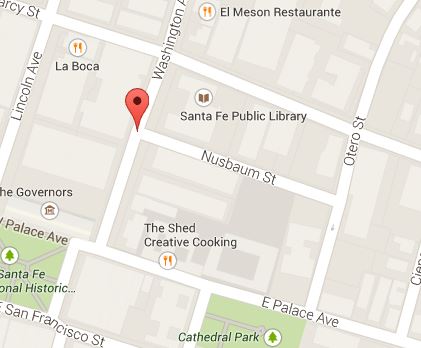
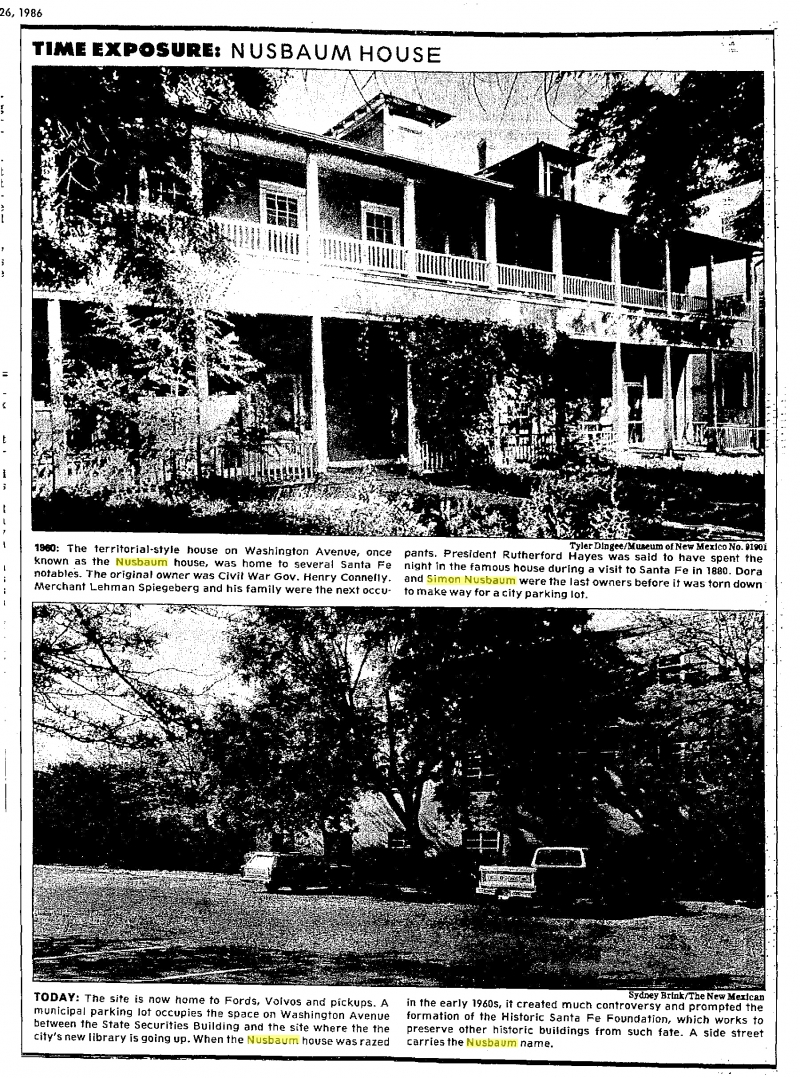
The first is a story about Simon Nusbaum, the son of John Nusbaum and brother of Frances Nusbaum, our mutual ancestors.  Simon was my great-great-granduncle, the one who settled in Santa Fe after years in Peoria, and who became the postmaster there and the deputy treasurer of the New Mexico territory.  Pete’s story is about Simon and the house that he owned and its history.

Santa Fe New Mexican May 26, 1986

Santa Fe New Mexican May 26, 1986

See also Voces de Santa fe here.

It’s very sad to me that the house no longer exists, but I am happy to report that Nusbaum Street does still exist.  One more thing to add to my travel plans: a walk down Nusbaum Street.

Pete’s second story is about his grandfather Arthur Seligman, my great-granduncle.  When Arthur was the governor of New Mexico, the elevator that goes into the depths of Carlsbad Caverns National Park was completed, and the governor was referred to as the “father of the elevator.”  Arthur’s story tells the story behind this remarkable engineering accomplishment and our ancestor’s role in implementing it.


Here is a photograph from Pete’s personal collection of the day that the elevator was officially opened.  Governor Seligman is in the front row wearing a black coat and a bow tie. To his right is his wife, Mrs. Franc E. Seligman; to his left is his step-daughter, Richie Seligman (Mrs. John March); Harold Albright, Director of the NPS; Wilbur Lyman, Secretary of Interior; and US Senator, Bronson Cutting.

Courtesy of Arthur "Pete" Scott

Courtesy of Arthur “Pete” Scott

The link below will take you to the whole article that Pete wrote about this event and the elevator.

carlsbad_caverns_park_1932

Carlsbad Caverns National Park

Carlsbad Caverns National Park (Photo credit: Wikipedia)

Thank you, Pete, for sharing these pictures and stories with me and with my readers.


Four Degrees of Separation from FDR

That’s my great-granduncle Arthur Seligman, son of my great-great-grandparents Frances Nusbaum and Bernard Seligman, standing with the then governor of New York who would soon be President of the United States, Franklin Delano Roosevelt.  This was taken while FDR was campaigning in New Mexico in September, 1932.

FDR with Arthur Seligman

(Was FDR really that tall, or were all those politicos from the West really that short?)

(I just looked it up.  FDR was 6′ 2″.  Those guys must have been at least 8″ shorter.  I am not surprised my relative was short; we are not a tall family.  But all three of them together?  Didn’t they feed people well out West?)

And I once thought I was the member of my family who’d gotten closest to a future US President when I shook Jimmy Carter‘s hand very early in his run for President.  At the time, I’d never heard anything about him and never thought he’d end up as President.  I was just being polite to a man who’d come to speak at the school I was attending. And no one took our photograph.

Thanks to my cousin Pete for sharing this.  More about the photo can be found here.

The Children of John and Jeanette Nusbaum from 1890 to 1925

John Nusbaum died in 1889, leaving behind his widow Jeanette and their six children: Adolphus in Peoria, Simon and Frances both in Santa Fe, Julius in Iowa, and Miriam and Lottie both in Philadelphia.  By 1925 Jeanette and all six children were gone.  This post will describe their lives in the decades between 1890 and 1925.

Jeanette and Lottie: In 1890, Jeanette Dreyfuss Nusbaum was a widow, living in Philadelphia with her daughter Lottie.   In 1900, Jeanette and Lottie were still living together in Philadelphia.  According to the 1900 census, they were living as boarders in the home of another German-born widow named Jenette Oberdorf and her children. Lottie was working as a stenographer, according to two Philadelphia directories in the 1890s.

Miriam and Gustavus: In 1890, Miriam and her husband Gustavus Josephs had one surviving child, Florence, who was now ten years old. Their son Jean was born in 1893.  After researching more about Gustavus, I learned that he had served in the Civil War as a musician.  According to Wikipedia, “The rank of Musician was a position held by military band members, particularly during the American Civil War. The rank was just below Corporal, and just above Private. In some units it was more or less equal to the rank of Private.  During the American Civil War, military leaders with the Union and Confederate Armies relied on military musicians to entertain troops, position troops in battle, and stir them on to victory — some actually performing concerts in forward positions during the fighting.”

Perhaps Gustavus is one of the musicians depicted in one of these videos:


He did not, however, pursue music as a profession after the war.  On the 1880 census, he listed his occupation as an embroiderer, and on various city directories in the 1880s he had been listed as a salesman.  In 1894 and 1896, he is listed as being in the curtains business, and in 1897 he is listed in business with Laurence Frank in the cotton goods business under the firm name Josephs and Frank Co.  Then in 1898 he is still in the cotton goods business, but with a new partner, Louis Wertheimer.

On the 1900 census, Gustavus and Miriam were living with their two children, Florence, now nineteen, and Jean, just six years old.  The 1900 census asked women how many children they had had and how many were still living.  For Miriam, the census reported that she had only had two children, both of whom were still living.  This was obviously not true, as Miriam and Gustavus had had two other children, Milton and Gertrude, who had died.  Was this just bad information given by someone who did not know the facts?  Or were Miriam and Gustavus just in denial?

Gustavus’ occupation on the 1900 census was listed as manufacturing without specifying the type of goods.  The 1901 directory, however, indicates that he was in the upholstered goods business.  Then in 1905 he listed his occupation on the directory as “silks.”  It appears that he was still in the silk business as of the 1910 census, but I cannot quite make out the word that follows “silk.”  I believe it says “silk winder.”  According to the Hall Genealogy website list of old occupations, a silk winder “Wound the silk from the silkworm cocoons onto bobbins.”

Interestingly, by 1914 Gustavus had returned to the embroidery business, or perhaps that was what he’d been doing even in 1910 as a silk winder.  He is listed as an embroiderer thereafter in subsequent directories as well, although on the 1920 census he is listed as a manufacturer in the mill industry.  I am not quite sure what to make of Gustavus’ career path.  Were these really all related businesses or even the same business? He certainly seemed to be involved with fabrics throughout in one way or another.

English: A man sitting cross-legged on a stoop...

English: A man sitting cross-legged on a stoop and embroidering a piece of silk. (Photo credit: Wikipedia)

Adolphus and Fanny: In 1890, the oldest child of John and Jeanette, Adolphus Nusbaum, was still living in Peoria with his wife Fanny, but he was no longer in business with his brother younger brother Julius. The last Peoria directory to include Julius was the one published in 1887.  Adolphus is listed with only a residential address in the 1890 and 1891 Peoria directories, but beginning with the 1895 directory, he is listed as being in the feed business.  He was still in the feed business as of the 1900 census and the 1900 Peoria directory.

Then on February 8, 1902, Adolphus died “20 miles from Chicago while en route to Chicago,” according to the Nusbaum family bible.  I did not know what this could possibly mean, and I was even more confused when I found a Philadelphia death certificate for Adolphus, given that the last address I had for him was in Peoria.

adolph nusbaum

adolph nusbaum death rec inquest pending

Why did Philadelphia issue a death certificate?  Why was there a Philadelphia address given as the residence?  And why was there an inquest pending? I am still searching for an answer to the last two questions and some answer as to the results of the inquest, but I found some answers in this article from the February 9, 1902, Chicago Daily Tribune:

Chicago Daily Tribune, February 9, 1902, p. 4

Chicago Daily Tribune, February 9, 1902, p. 4

But this article also raised more questions.  As far as I know, in 1902, Adolphus did not have a brother in Philadelphia, unless Julius had relocated there at that time.  Simon was still living in Santa Fe.  And what had Adolphus been doing in Washington?  He must have been traveling by train.  Did he have a heart attack or stroke while traveling? Was his wife Fanny with him?  I don’t know.  It’s also interesting that despite having lived in Peoria since he was barely in his 20s and having married a woman who had been living in Indiana in 1863, Adolphus was buried at Mt. Sinai cemetery in Philadelphia with the other members of the extended family, including his father John.

UPDATE on the coroner’s report can be found here.

Frances and Bernard: In 1890, two of the children of John and Jeanette continued to live in Santa Fe, my great-great-grandmother Frances Nusbaum Seligman and her brother Simon Nusbaum.  Frances was busy with her charitable and social activities in Santa Fe.  Her children Eva, James, Minnie and Arthur all went off to Swarthmore in Philadelphia in the 1880s, where Minnie died at age eighteen in 1887, as I’ve written about previously.  Frances herself died in July, 1905, two years after her husband Bernard.  She was 59 years old.  As I described when writing about Frances and Bernard, both were warmly praised and well-loved by the Santa Fe community.  Both were buried, however, back in Philadelphia at Mt. Sinai cemetery.

It must have been terrible for Jeanette to lose her son Adolphus in 1902 and her daughter Frances 1905, not that many years after losing her husband John as well as so many grandchildren.  Jeanette herself died on January 12, 1908, from edema of her lungs, according to the death certificate.  She was 90 years old.  She was buried along with her husband, her children Frances and Adolphus, and numerous grandchildren and other relatives at Mt. Sinai cemetery in Philadelphia.

Ancestry.com. Pennsylvania, Death Certificates, 1906-1963 [database on-line]. Provo, UT, USA: Ancestry.com Operations, Inc., 2014.

Ancestry.com. Pennsylvania, Death Certificates, 1906-1963 [database on-line]. Provo, UT, USA: Ancestry.com Operations, Inc., 2014.

Julius: As for Julius Nusbaum, who had once been Adolphus’ business partner in Peoria, as noted above he was last listed in the Peoria directory in 1887 and then disappeared from Peoria.  He next surfaced in 1900 in Grinnell, Iowa, living alone as a single man and working as a tobacco merchant. Grinnell is over two hundred miles from Peoria and over a thousand miles from Philadelphia.

Restored Rock Island Line station in Grinnell,...

Restored Rock Island Line station in Grinnell, built in 1892. Now a restaurant. (Photo credit: Wikipedia)

What had taken him to Iowa and when had he gotten there? Had he gone into the tobacco business for the same reasons that his father John had gone into the cigar business in the mid-1880s?  In 1891 Julius is listed in the Waterloo, Iowa directory as a cigar dealer, and on the 1905 Iowa State Census he is living in Grinnell.  It does not thus seem like he was living in Philadelphia in 1902 when Adolphus and Fannie came to visit.  Was the newspaper just wrong about that detail, or was the 1905 directory wrong? Certainly Adolphus had other family members to visit in Philadelphia, including his mother Jeanette, his sister Lottie, and his sister Miriam and her family.

Julius is not listed in either the 1904 or the 1906 Waterloo, Iowa business directory, and  I cannot find him on the 1910 census anywhere, so I do not know whether he was still living in Iowa at that point. But by 1920 he had returned to Philadelphia, listing his occupation on the 1920 census as a retired cigar merchant and living as a boarder.  Living in the same residence with him in 1920 also as a boarder was a 62 year old widow named Fannie Nusbaum who had been born in Germany; this was obviously Adolphus’ widow, Julius’ sister-in-law.

I could create all kind of romantic stories about Julius and Fannie, but they would be speculative for sure.  Julius had lived with Adolphus and Fannie in Peoria and had been in business with his brother.  Suddenly after working together for over twenty years, Julius left Peoria and moved to Iowa, where he presumably knew no one and where he started an entirely new business selling cigars.  Then Adolphus died in 1902, and I can’t find Julius or Fannie anywhere on the 1910 US census or in city directories.  Ten years later, Julius and Fannie ended up living together in Philadelphia.  Where were they both in 1910?  Of course, it could be completely innocent: a devoted brother taking care of the widow of his older brother.  And it probably was.  I’ve likely read too many novels and seen too many movies.  I have no evidence of any such scandalous events.  I am sure the story is far less interesting than all that.

Simon: Meanwhile, back in Santa Fe, the other Nusbaum brother, Simon, had settled in as part of the community by 1890.  The Santa Fe New Mexican reported in September 1889 that he had returned from a month’s vacation and “looked like a new man,” having gained twenty pounds.  There was no further explanation for the comment, but perhaps Simon had had a rough time after losing his father in January of 1889.  After that, his life seems to have taken a positive turn.  Having served first as a clerk and then as assistant postmaster in Santa Fe, Simon was appointed by President McKinley to be the postmaster there in May, 1898.

His appointment was enthusiastically approved by the press and the people of Santa Fe.  On May 5, 1898, the Santa Fe New Mexican opined on page 2, “As good a piece of news as Santa Fe has received for some time was that of the appointment of Simon Nusbaum to be postmaster of this city.  This appointment was one that had been strongly recommended by the best and leading citizens of this city and indeed by all those desiring a competent official and a honest and proper man in that important office.  Mr. Nusbaum’s political support was also very powerful….He is a skilled accountant and book-keeper, in fact one of the best in the southwest.  He … had held several positions of trust and importance in big business establishments, in this territory and in eastern cities.”

The Santa Fe newspaper also quoted from the Peoria Evening Star, which said, “Years ago Nusbaum & Co. were the great dry goods firm of this city.  One of the members was Simon Nusbaum.  He was a smart, active, pushing man….”  Santa Fe New Mexican, May 19, 1898, p. 2.

Simon was still a single man at that point.  In 1899 he reportedly bought a fruit farm near Tesuque, New Mexico, apparently for a very good price.

Santa Fe New Mexican, September 28, 1899, p. 4

Santa Fe New Mexican, September 28, 1899, p. 4

He later began breeding high bred Belgian hares in partnership with one of his clerks at the post office.

Santa Fe New Mexican, December 6, 1900, p.4

Santa Fe New Mexican, December 6, 1900, p.4

Although Simon was still single as of the 1900 census, he married Dora Rutledge in 1903. It was the first marriage for Simon, who was 57 years old.  Dora was only forty.  She had a daughter from an earlier marriage, Nellie Rogers, who was born in 1897.   Simon and Dora’s son John Bernard Nusbaum, was born on May 15, 1904.  On the 1910 census, Simon was now the assistant New Mexico Territorial Treasurer, and he and Dora and the children must have been living in a boarding house because they had seven lodgers living with them.  In fact, the 1920 census reveals that Simon and Dora were the owners of that boarding house, which was being managed by Dora.  Simon was now 76 years old and Dora was 49.

1916-1925: Years of Loss

When Jeanette Nusbaum died in 1908 at age 90, she had outlived two of her children, Adolphus and Frances, and many of her grandchildren, as well as her husband John.  Four of her children had survived her: Simon, Julius, Miriam and Lottie.  By 1925, all of those children would be gone.  On February 13, 1916, Miriam died of heart disease.  She was 57 years old and survived by her husband Gustavus and two children, Florence, who was 36, and Jean, who was 23.  Gustavus died eight year later at age 75 of pectoris angina.

Ancestry.com. Pennsylvania, Death Certificates, 1906-1963 [database on-line]. Provo, UT, USA: Ancestry.com Operations, Inc., 2014.

Ancestry.com. Pennsylvania, Death Certificates, 1906-1963 [database on-line]. Provo, UT, USA: Ancestry.com Operations, Inc., 2014.

Simon Nusbaum died on February 25, 1921.  He was 76.  Unlike his siblings, he was not buried at Mt Sinai in Philadelphia, but in Santa Fe, where he had lived the last forty or so years of his life.  He was survived by his wife Dora, stepdaughter Nellie, and son John, who was only 16 years old.  Thanks to my cousin Pete, I have a copy of Simon’s obituary.  It reports that Simon had had a stroke in September, 1920 and had not been himself since, but that prior to the stroke, he had been “able to walk around as briskly as he had for decades, and he was a familiar figure in the plaza and sitting on the swing in front of his apartment house on Washington Avenue.”  Here is the full obituary:

simon obit santa fe new mexican feb 25 19221

(Santa Fe New Mexican, February 25, 1921)

I winced at the references to “bad Indians” and “red chiefs,” trying to keep in mind that this was 1921.  I was intrigued by the references to Simon’s time living in Missouri and South Dakota, as I have seen no documentation of his time in either place.  He was still in Philadelphia in 1860 when he was 17, and he was in Peoria starting in 1863 until 1877.  By 1880 he was in Santa Fe.  So perhaps he had spent those years in between in Missouri and South Dakota.

The image of Simon as the postmaster sorting the mail in his nightgown at midnight is wonderful.

Just two years later, Simon’s brother Julius Nusbaum died in Philadelphia on January 3, 1923.  He was 74 years old and died from “Dil of heart, superinduced by acute indigestion.”  I googled this phrase and found that it was often used as description of a cause of death in the early 20th century, but I could not find any medical dictionary that explained what this meant.  Dilation of the heart refers to an enlarged heart that cannot adequately pump blood, what we might refer to today as heart failure.  But I have no idea what “superinduced by acute indigestion” means or whether that is today considered even medically accurate.  Perhaps my medical consultant will fill me in.

Update here.

Ancestry.com. Pennsylvania, Death Certificates, 1906-1963 [database on-line]. Provo, UT, USA: Ancestry.com Operations, Inc., 2014.

Ancestry.com. Pennsylvania, Death Certificates, 1906-1963 [database on-line]. Provo, UT, USA: Ancestry.com Operations, Inc., 2014.

 Finally, the last of the children of John and Jeanette Nusbaum, Lottie died on December 23, 1925, of nephritis and diabetes.  She was 64 years old.  Both Julius and Lottie did not have any children.

Lottie Nusbaum death cert

Thus, as of 1925, all six children of John and Jeanette were gone. Three of them had no children to survive them, Adolphus, Julius, and Lottie.  The other three siblings had together six surviving children: the three surviving children of Frances Nusbaum and Bernard Seligman, Eva, James, and Arthur; the two surviving children of Miriam Nusbaum and Gustavus Josephs, Florence and Jean; and the son of Simon Nusbaum and Dora Rutledge, John Bernard Nusbaum.  If I include Simon’s stepdaughter Nellie, who was after all referred to as his daughter in his obituary, that would make seven surviving children.  And there were the four grandchildren who had died as children, Florence and Minnie Seligman and Milton and Gertrude Josephs.

I have already written about the surviving Seligman children, my great-grandmother Eva and her brothers James and Arthur.  In a later post, I will follow up on the other surviving grandchildren of Jeanette Dreyfuss and John Nusbaum, Florence and Jean Josephs and Nellie and John Nusbaum and their families.


John Nusbaum 1814-1889: The Family Patriarch

By 1880, my three-times great-grandparents, Jeanette (Dreyfuss) and John Nusbaum, and their extended families had not only grown in size but spread across a wider swath of the northeastern United States.  Some were still in Harrisburg or Philadelphia, but others were in Peoria, Baltimore, and Pittsburgh.  Although many were still dry goods merchants, the younger generations were also involved in various aspects of the liquor trade.  The family had endured the economic crisis of the 1870s, seeing some bankruptcies and the closings of several stores and businesses.  A number of young children had died, and by 1880, of the siblings of John and Jeanette Dreyfuss, only Ernst and John were still alive on the Nusbaum side, while Jeanette’s two sisters Caroline and Mathilde were both still living.

The next two decades brought with it more changes, more weddings, more new children, and sadly more deaths.  In my next series of Nusbaum/Dreyfuss posts I will try to bring the various branches up to the 20th century, focusing first on my direct ancestors, John and Jeanette and their children and grandchildren.

As I’ve written, in 1880 John and Jeanette were listed on the census in two different locations, living thousands of miles apart.  John was living with their daughter Frances and her husband Bernard Seligman (my great-great-grandparents) in Santa Fe along with his son Simon.  Jeanette, on the other hand, was living in Philadelphia with their daughter Miriam and her husband Gustavus Josephs along with Lottie Nusbaum, the youngest child of John and Jeanette, and Milton Josephs, the young son of Miriam and Gustavus who would die from bronchial pneumonia just a few months after the 1880 census was taken.  These must have been very hard times for my ancestors, and I will never know whether John moved to Santa Fe for financial reasons or because of marital problems.  I will never know whether he was there for a month or a year.

English: A Areal map of Santa Fe, New Mexico d...

English: A Areal map of Santa Fe, New Mexico during the Railroad era in 1882. (Photo credit: Wikipedia)

But I do know that John is listed in the 1881 Philadelphia directory as residing at 1129 Master Street, the same address where the Josephs family and Jeanette and Lottie were living on the 1880 census.  Whether John was actually back or not is hard to say for sure, but he does not appear again on any Philadelphia directory until 1886, when he is listed as being in the “segar” business and living at 524 North 11th Street, the same address given for his daughter Lottie.  Although Gustavus and his family are not listed in the 1881 directory, they show up in the 1884 directory still living on Master Street, so it would seem that sometime between 1881 and 1886, John and Lottie and presumably Jeanette had moved to their own home on North 11th Street.

I found it puzzling that John, after over forty years in the dry goods business, had entered the cigar business.  But his store had gone bankrupt, and perhaps this seemed to be a good way to make a fresh start in the 1880s.  John was already in his 70s by 1886, so it is even more surprising that he was starting in a new trade instead of just retiring.  I did some reading about the tobacco industry and learned that the John Bonsack invented the cigarette rolling machine in 1881, leading to a widespread increase in cigarette smoking (previously, tobacco was either chewed, smoked in a pipe, or hand rolled into a cigar or cigarette).   I don’t know whether this technological development had any effect on John’s decision to sell cigars, and I don’t know whether he sold only cigars or also cigarettes, but the timing does seem to be enough for me to think this was not just coincidental.  In 1887, John again is listed at the same residence and as being in the “segar” business.

English: Trade card of a cigar dealer after a ...

English: Trade card of a cigar dealer after a photograph of Napoleon Sarony, using Oscar Wilde’s popularity during his American trip of 1882 (Photo credit: Wikipedia)

Meanwhile, the children of John and Jeanette were also finding their way in the 1880s.  Adolphus and Julius were still in Peoria, working in the dry goods business, now called Nusbaum Bros.  Since Julius had been one of his father’s creditors in the bankruptcy proceedings, perhaps the business was now owned by the brothers instead of their father.  Julius was living with his brother Adolphus and sister-in-law Fannie, who had no children.

Simon, meanwhile, had remained in Santa Fe and was still unmarried and living with his sister, my great-great-grandmother Frances Nusbaum Seligman, and her family in 1885 according to the New Mexico Territorial Census of that year.   In 1887 Simon was appointed to be a clerk in the US post office in Santa Fe, a position he continued to hold for many years, being promoted to assistant postmaster by 1889 and ultimately to postmaster in 1898.

Miriam and Lottie, the remaining two children of John and Jeanette, were living in Philadelphia.  Miriam and her husband Gustavus had a third child in 1882, Gertrude, after losing Milton in 1880.  Their second child Florence was then two years old.  On November 28, 1888, Gertrude died from diphtheria (croupus form, according to the death certificate). She had just celebrated her sixth birthday less than a month before.  Eight year old Florence was once again an only child.  The family had lost yet another young child.  For Miriam and Gustavus to lose two young children in the space of eight years must have been completely devastating.

gertrude josephs death certificate

As for Lottie, John and Jeanette’s youngest child, she was just seventeen in 1880 and still living at home, as she did throughout the decade.

The decade drew near a close on another sad note for the family when my three-times great-grandfather John Nusbaum died on January 24, 1889.  He was 74 years old.  According to his death certificate, he died from lobular heart disease, chronic cystitis, and diabetes.  Notice also that the residential address on both Gertrude Josephs’ and John Nusbaum’s death certificates is the same: 1617 North 13th Street.

John Nusbaum death certificate

John Nusbaum was born in Schopfloch, Germany, in 1814, the sixth child of Amson Nusbaum and Voegele Welsch.  He had been one of the pioneers in the family, coming to Pennsylvania in the 1840s, probably starting as a peddler and then establishing himself as a merchant first in Harrisburg and then in Philadelphia.  He had seen much success and some failure in his business; he had helped out his siblings and their widows when his brothers Maxwell and Leopold died.  He and Jeanette had been the common link that brought together many connections between the Nusbaum, Dreyfuss, Dinkelspiel, Wiler, and Simon families.  I imagine that it must have been very hard for the family to lose him.  Sadly, I cannot find one obituary or death notice for him.

John Nusbaum’s name lived on in other ways, however. Four years after he died, his daughter Miriam and her husband Gustavus had one last child on July 26, 1893, five years after they had lost Gertrude and eleven years since Miriam had last given birth.  They named their son Jean, I assume in honor of Miriam’s father.

Two years later in 1895, John Nusbaum’s granddaughter Eva Seligman Cohen had a fourth son whom she and her husband Emanuel Cohen named John Nusbaum Cohen.  He was my grandfather, named for his great-grandfather.  Eva must have known her grandfather John Nusbaum very well, not only when she was a young child living in Philadelphia and not only when he had lived with her family for some period of time in Santa Fe, but also because she had moved to Philadelphia for college and then settled there after marrying my great-grandfather in 1886.  She must have seen a great deal of him in those last few years of his life.

John Nusbaum Cohen c. 1894

John Nusbaum Cohen c. 1895

When Simon Nusbaum married at a late age, he and his wife also named a son for Simon’s father.  John Bernard Nusbaum was born on May 15, 1904, in Santa Fe. (I assume that the Bernard was for Simon’s brother-in-law Bernard Seligman, who had died the year before.)

And, of course, John Nusbaum’s name lives on today through my father, John Nusbaum Cohen, Jr.  It’s a legacy that my three-times great-grandfather well deserved.  We may not have a photograph to remember his face, but we will always remember his name.


The Struggles of My Three-times Great-grandparents in the 1870s

The 1870s were not an easy decade for my three-times great-grandparents, John and Jeanette Nusbaum.  Like Jeanette’s sisters Caroline and Mathilde and their families, the Nusbaums confronted some of the effects of the economic depression affecting the country.[1]

By 1870 John and Jeanette only had two children living at home with them, Miriam, now 12, and Lottie, who was seven.  Adolphus, Simon, and Julius, their three sons, were all living in Peoria, and Frances was married and living in Santa Fe with her husband Bernard Seligman and their three children, Eva, my great-grandmother, James, and Minnie.  In 1871, Frances and Bernard’s son Arthur was born, giving John and Jeanette a fourth grandchild.[2]

In 1872, Adolphus married Fannie Fox in Laporte, Indiana, but they settled together in Peoria.  Until at least 1873, Adolphus and his brother Simon remained proprietors of the Union Mill Distillery, and their younger brother Julius continued to work as a clerk in their father’s store in Peoria.

But something changed by 1876, and in the Peoria directory for that year, although Adolphus was still listed as a distiller and Julius is still a clerk at John Nusbaum’s store, Simon was now in a different firm, Kingsland and Nusbaum, a firm engaged in the wholesale and commercial sales of liquor.  Had there been a falling out between Simon and Adolphus, or had Simon just formed a separate business to distribute the liquor distilled by his brother’s company?


http://www.gettyimages.com/detail/121333164

As I started studying the occupations of the younger generation of men in the extended Nusbaum-Dreyfuss-Simon clan, I was struck by the fact that whereas the older generation was involved primarily in the sale of clothing and other “dry goods,” the younger generation was definitely more into “wet goods.”  Albert Nusbaum, Leman Simon, and Adolphus and Simon Nusbaum were all now in the liquor trade.  In addition, Moses Simon ended up in the liquor business as well.  Was this a sign of the times? Were people drinking more because of the economic conditions, thus making this an attractive business for the entrepreneurial cousins?  Or was it more that once one cousin had success, the others figured they’d go into that line of business as well?

Apparently, Peoria was once known as the “Whiskey Capital of the World” and had over 24 breweries and 73 distilleries during the period between 1837 and 1919.  The 1860s and 1870s were the high point of Peoria’s liquor production and distribution, so it is not surprising that Adolphus and Simon became involved in the liquor business.  As for Albert, Leman, and Moses, it would appear that they followed the trend that the Nusbaum brothers had started.  Interestingly, this is also a period when the movement for prohibition of alcohol also started gaining momentum, making the liquor business a risky venture in the long term.  But for the 1870s, it might have been a wise business move.

The three Nusbaum brothers remained in Peoria throughout the 1870s, although by 1880, as we will see, Simon had relocated. Meanwhile, back in Philadelphia, their parents must have been having some problems.  The 1877 census had John listed as living at the same address at 943 North 6th Street in Philadelphia, but without an occupation.  John was now 63 years old, and at first I thought that he had simply retired.  But the 1877 Peoria directory also had a listing for John Nusbaum, and this is the first time that it includes a residential listing.  Was this a mistake? Or was John spending part of his time in Peoria? Had John’s Philadelphia store closed?

Perhaps these two news clippings from 1878 can shed some light on what was going on:

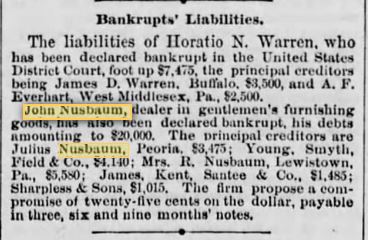
John Nusbaum bankrupt Aug 23 1878 Phil Times p 4

Philadelphia Times, August 23, 1878, p. 4

John N bankruptcy October 1878 p 1

Philadelphia Times October 31, 1878 p. 1

John was bankrupt, in debt for $20,000, and his principal creditors included two of his relatives: his son Julius, who was working at the Peoria store, and his sister-in-law Rose, widow of his brother Leopold, who had moved to Lewistown, Pennsylvania, after living with John and Jeanette during the period after Leopold died in 1866.  The bankruptcy settlement allowed John to pay them a quarter of what he owed them.

I wish I could find out more about this, and perhaps there is some way of finding some documents about the bankruptcy proceedings.  If anyone has any suggestions, let me know.  It just seems odd that Julius, who was working in his father’s store in Peoria, was owed almost $3500.  And how did John become indebted to his widowed sister-in-law for over $3500? But obviously John was having financial problems, another family member feeling the impact from the economic crisis of the 1870s.

John was again listed without an occupation in the 1879 Philadelphia directory, and although he is listed as being in the dry goods business again in the 1880 Philadelphia directory, there also appears to be something else going on.  On the 1880 US census, John Nusbaum is listed as living in Santa Fe, New Mexico with his daughter Frances Nusbaum Seligman and her family.  John’s son and Frances’ brother Simon is also living with the family (as is Bernard’s brother Adolph).  John’s occupation is described as “retired merchant,” and Simon is a bookkeeper.  Why did Simon leave Peoria? What had happened to his liquor business? And what was John doing in Santa Fe…without his wife?

Seligman and Nusbaums on 1880 US census santa fe

John and Simon Nusbaum with Bernard and Frances Seligman in Santa Fe 1880 US census

Jeanette was not with John nor were their two younger daughters. Rather, Jeanette, along with her youngest daughter Lottie, was listed in the 1880 census living at her other daughter Miriam’s house at 1120 Master Street in Philadelphia.  Miriam had married Gustav Josephs on March 20, 1878.  Gustav was listed as being in the handkerchief business in the 1880 Philadelphia directory and in the embroidery business on the 1880 census, so my guess is he either sold or made embroidered handkerchiefs at that time.  Gustav and Miriam had had a son Milton, who was born on December 28, 1878.  Yes, I realize that that means that Milton was born just nine months after his parents were married, but that certainly happens.  These are dates from the family bible, and while perhaps not as official as a government record, for my money and from my experience, the family bible has proven to be at least as reliable if not more reliable than many government records.

So Jeanette was in Philadelphia while John was in Santa Fe.   Since John was retired, it does not appear that this was a business decision.  Did the experience of bankruptcy lead him to leave Philadelphia for some time? Was there tension between Jeanette and John due to financial stress?

Jeanette Nusbaum 1880 US census in Philadelphia

Jeanette Nusbaum 1880 US census in Philadelphia

I do not know, but I do know that by 1881, John was back in Philadelphia where he would live the remainder of his days.  In 1881 he also was living at 1120 Master Street and thus presumably reunited with Jeanette, living in the home of Miriam and her husband Gustav.

Gustav and Miriam had had a second child, Florence, born on July 28, 1880, but just a few months later, the family suffered a sad loss. On November 17, 1880, Gustav and Miriam’s toddler son Milton died from marasmus.  Marasmus is a severe form of malnutrition caused by a lack of protein and calories.  Poor little Milton essentially starved to death.  He was one month short of his second birthday.  Today this is something we think of as a third world problem, but here he was, the grandson of a once-successful merchant, living in one of the biggest cities in the US at the time.  It’s hard to imagine how this could have happened.

IMPORTANT UPDATE: Please see my next post here.  Milton did not die from marasmus, but from pneumonia.

Milton Joseph on the Federal Mortality Schedule 1880

Milton Joseph (third from bottom) on the Federal Mortality Schedule 1880

Thus, the 1870s were a tough decade for my three-times great-grandparents, both personally and professionally. By 1880 John had also lost another sibling in addition to Leopold, who had died in 1866, and Isaac, who had died in 1870.  But that will wait for another post.

But not all the news was bad news.  Two more of their children had married, Adolphus and Miriam, and John and Jeanette had two new grandchildren, Florence Josephs, Miriam’s daughter, and Arthur Seligman, Frances’ son, the grandson who would one day be the governor of New Mexico.  There definitely were better days ahead for the Nusbaum family.

tunnel-336693_1280


[1] My brother told me that titling my posts “The Long Depression” was not a way to entice readers, so I’ve changed it a bit for this one.  I am not sure that does much more to make this into uplifting reading, but these were tough times.

[2] That does not count Florence Seligman, who was born in August, 1867 and died a few weeks later, as I’ve written about previously.

Goodbye for now, Santa Fe

Gau-Algesheim. Langgasse.

Gau-Algesheim. Langgasse. (Photo credit: Wikipedia) Where They Started

I’ve now completed my research of the American Seligmans, or at least those I know to be related to me.  I have added a page with a family tree and descendant chart to the blog that you can find by clicking on the label in the menu box at the top of the page.

For a number of reasons, this has been the easiest branch of the family tree to research.  First, I was fortunate to find my cousin Arthur “Pete” Scott, who is the great-grandson of Bernard Seligman and the grandson of Arthur Seligman.   He had already done a lot of work on the family history in New Mexico and was very generous in sharing his research and photographs with me.  He also had published a great deal of it on the web at vocesdesantafe.com.

Secondly, Bernard and Arthur Seligman were public figures—men who were often written about during their lives in newspapers and after their lives by historians.  Their fame made it much easier for me to find sources and information to learn about their lives and the lives of their families.  (Although it was easier to find information, it also was a lot more work to read it, digest it, and analyze it all.)

Bernard Seligman and other merchants

My great-great-grandfather Bernard on the fronteir

Also, there were not a lot of descendants to trace.  Sigmund Seligman never married, James Seligman in England had no children, and Bernard only had three children who lived to adulthood—my great-grandmother Eva and her two brothers James and Arthur.[1]  Eva’s family I had already researched in doing the Cohen branch, James had only one child who lived to adulthood, and Arthur had one biological child and a stepdaughter.  So compared to the thirteen children of Jacob Cohen, some of whom had over ten children themselves, this was a much smaller family to research.

I still do have work to do, tracing the German Seligmanns and seeing if I can learn what happened to them.  That is a task I will continue to work on, but it will be slowed by the inaccessibility of German records and my inability to read German.  I am ordering copies of the records I posted about here, but I hope to be able to learn more.  Once I know more, I will write about it on the blog.

But for now I will move on from the Seligmans in my writing and begin the next branch of my father’s father’s family, the Nusbaums.  As far as I know, there are no famous people on this branch, but time will tell.  I am hoping that my cousin Pete will be able to help me here as well since he also is a descendant of Frances Nusbaum Seligman.  I have already learned some interesting things about the Nusbaums and am eager to learn more.

Arthur Seligman, Marjorie, and Eva May Cohen, 1932 Atlantic City

Governor Arthur Seligman, Marjorie, and his sister, my great-grandmother Eva May Seligman Cohen, 1932 Atlantic City

Before I move on from the Seligmans, however, I have a few concluding thoughts about this branch of my family tree.  Unlike my Cohen, Goldschlager, Rosenzweig, and Brotman branches, the Seligmans were in the public eye and not able to lead the private lives that my other relatives lived and that most of us live.  They were subject to much scrutiny—Bernard was a wealthy merchant and public servant, Arthur a mayor and governor, and Morton a Navy hero.  Their actions and character were criticized at times, but each in his own way managed to rise above that criticism.   They were loyal, decent and honest men who served their communities with honor.

What the Seligmans share with the rest of my ancestors is the story of Jewish immigrants in general—whether they came in 1850 or 1890 or 1910, whether they came from Germany or England or Romania or Galicia.  All came here for a better life, all were brave enough to leave their homes and their families, all took a risk that living in America would be better for them, their families, and their descendants.  Some may have come with more than others, some succeeded more than others, but all were undoubtedly better off here than they would have been had they stayed in Europe.  With hindsight we know what would have been their fate if they had still been in Europe in the 1930s and 1940s, as was the fate of some of my German Seligmann relatives who did not leave Europe in time.

Once again, I feel grateful for the risks that my ancestors all took and for their courage and hard work, which made it possible for me to be here today, remembering them all.


Bernard Seligman

My great-great-grandfather Bernard Seligman, born in Gau-Algesheim, a pioneering leader in Santa Fe, and father of a US governor


[1] Adolph did have children, and I’ve traced all of his descendants, but out of privacy concerns have not written about them since many of his grandchildren are still living, and I have not been in touch with them.


The Life of Otis Perry Seligman: The “Scandal in Santa Fe” as told by his son

As I mentioned in an earlier post, Arthur Seligman’s son Otis ran into trouble with the law in 1932 when he was indicted for embezzling money from the First National Bank of Santa Fe, where he worked as an assistant cashier and where his father, the governor of New Mexico, was the president.  It could have been a scandal that cost his father the election, but it did not.

Rather than retelling the story in my words, I am going to let Arthur Scott, my cousin and the son of Otis Seligman, tell his father’s story.  His biography of his father is found on the vocesdesantafe website here, and I am also linking to it in pdf format at Otis_P_seligman  I will quote just a bit here to establish the background:

On September 12, 1932 Time Magazine noted “A Federal Grand Jury indicted Otis Perry Seligman, cashier of the First National Bank of Santa Fe, N. Mex. for an alleged shortage of $25,941 in his accounts. Said his father, Governor Arthur Seligman, president of the bank, after making good the shortage: “He will have to take his medicine.” Nine other bank employees were also indicted. The total amount missing was reported by Bank Examiners as $72, 941.23.

He and eight others pled guilty. One pled not guilty. Otis was sentenced to a total of 30 years but the sentences ran concurrently so that the maximum time served would be five years. In addition he was fined $10,000 payable to the US prior to release. He received the harshest sentence because, as an assistant cashier, he was considered a supervisor and officer of the bank.

On September 8, 1932 he and six others were sentenced to terms in Leavenworth Federal Penitentiary in Leavenworth, Kansas. Two were given suspended sentences and one (Trujillo) was tried, found guilty and sent to La Tuna Federal Prison in Texas. My father began serving his sentence in Leavenworth on October 8, 1932. His father, mother, wife, and group of friends saw him off at the Albuquerque train station while he was in custody of US Marshals.

I hope that you will all read the whole essay to get the full picture of Otis Perry Seligman.  There are also some wonderful photographs included with the essay.  It is a powerful essay written with heart but with objective eyes.  To get a sense of the impact this had on the family of Otis Seligman, I also recommend reading Pete’s essay about his mother’s life at Doris_Lillian_Gardiner

Otis Perry Seligman was a man who made mistakes.  He, his wife, and his children all paid for those mistakes, and yet their story is a story of forgiveness.

A Life of Service and Success: Arthur Seligman, Part III

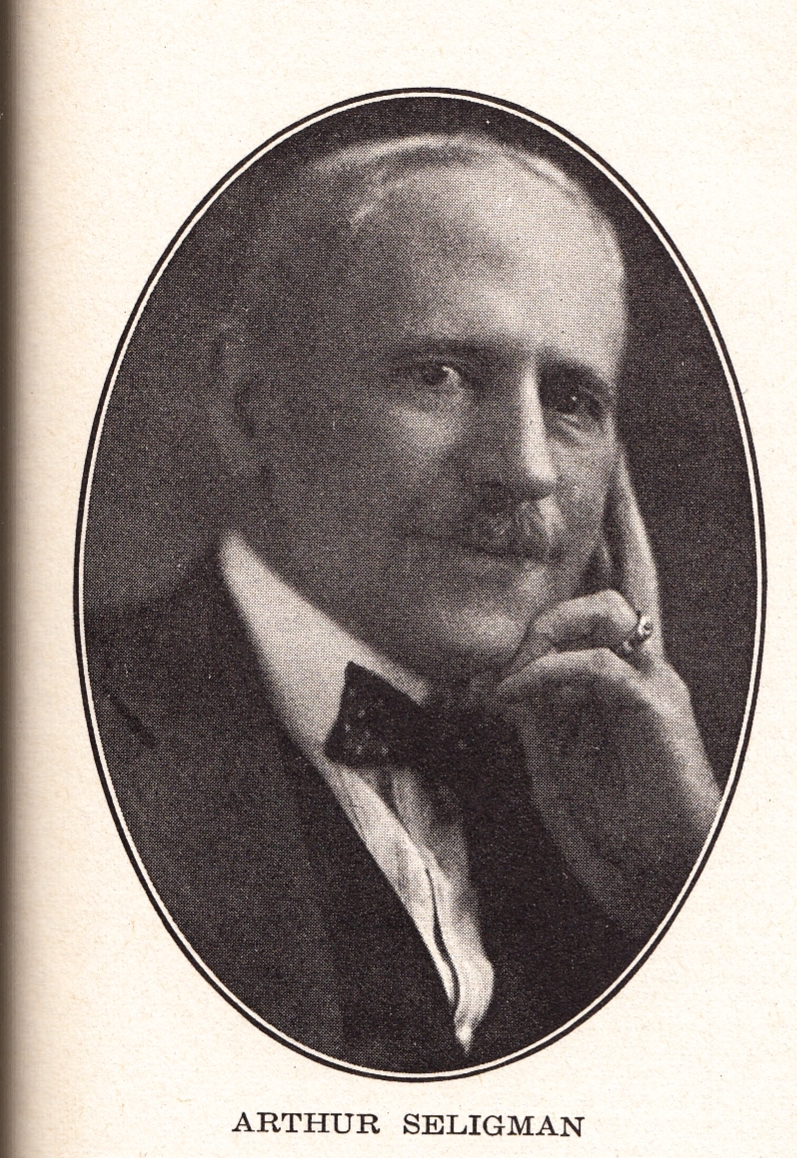
Arthur Seligman, c. 1925 from Twitchell, p. 479

Arthur Seligman, c. 1925 from Twitchell, p. 479

On September 25, 1933, less than a year into his second term as governor of New Mexico, my great-great-uncle Arthur Seligman died suddenly and unexpectedly of a heart attack.  After lying in state in the state capitol, he was buried on September 27, 1933, in the Fairview Cemetery in Santa Fe.  My great-grandmother Eva, his sister, traveled from Philadelphia to attend his funeral as she had done in January, 1931, for his first inauguration.  (“Late Governor Lies in State at the Capitol,” Las Vegas Daily Optic (September 27, 1933), pp. 1, 5)

Although certainly Arthur Seligman had his political enemies, the opinions expressed about him in numerous sources recognized that he was an effective leader, an able businessperson, and a successful politician.

The Clovis New-Journal wrote on September 26, 1933, p.2:

Deming headlight obit-page-001

To select just a few highlights from this editorial (which is hard to read, but I thought worth reproducing for those who want to try), the Clovis opined:

No man has ever had a more comprehensive understanding of the politics of this state than he, nor has any man ever attained the leadership that linked more completely the eastern and western sides.  This he accomplished through what often brought him criticism as a Democrat—a guiding hand in both democratic and progressive republican ranks….

He was a tireless man; one who drove himself at a terrific pace, and to this very fact may be charged his death….He worked until midnight nearly every night, and was at his office again by 10 o’clock in the morning, ever driving himself to the utmost of his strength.

The Deming Headlight also praised him, writing on September 29, 1933, p. 2:

deming obit

In the Dictionary of American Biography, he is described as follows:

Suave, fastidious in dress, aristocratic in taste but democratic in policy, always prominent in social life, he sought and attained a large measure of power through business and political channels. Intensely loyal to his numerous friends and an enemy to be feared, for more than a quarter of a century he had few peers in Democratic circles of the Southwest. The strong position of the Democratic party in New Mexico at the time of his death was largely due to his long, shrewd, and able leadership.

Dumas Malone, ed., Dictionary of American Biography (Charles Scribner & Sons 1935), located at http://www.mocavo.com/Dictionary-of-American-Biography-Volume-16/114492/584

The Jewish Telegraphic Agency provided a deeper and more personal look at the life of Arthur Seligman:

A mild manner man was Arthur Seligman, pioneer builder of his native state, New Mexico, one-time Mayor of one of its leading cities, Santa Fe, and since 1931 its Governor. His sudden and untimely death last Monday came as a shock to all who knew him.

Stately in appearance, democratic in demeanor, firm in his convictions, determined in his action, Seligman was not only New Mexico’s favorite son, but also an exemplary figure in American civic and political life. His rise to the highest position of honor and responsibility in the State where he lived virtually all his life, the state to which he contributed so many lasting monuments, was reflective of the esteem in which he was held by his fellow citizens. Though always gentle, he invariably dealt emphatically with those who would practice abuse in public office. In the government of his state he had no time for those who would see in political activity an opportunity for personal gain. He viewed public service as a privilege coming with American citizenship and felt that every one should accept this service in the spirit of a sacred trust. ….

Jewish Telegraphic Agency

Jewish Telegraphic Agency (Photo credit: Wikipedia)


The JTA also commented on Arthur’s religious identity:

Though distant from Jewish communal life. Seligman always evinced a deep interest in the affairs of his people. He kept in touch with Jewish activity and cooperated in many causes. There are only a handful of Jews in New Mexico, yet when he was candidate for the office of governor he had the Ku-Klux-Klan to deal with. These conducted a whispering campaign against him. This was his first encounter with anti-Semitism and upset him quite a bit. However, his standing in the community and his splendid record of achievement were too much for the Kluxers. His election as the first Jew to hold that office in New Mexico also helped to crush the Kluxers in the State. His sudden death last Monday is a distinct loss for he was a credit to his country and his people.

I had wondered whether there was any anti-Semitism underlying the attacks against him, and although I certainly did not find anything in the newspaper articles that expressly suggested that as a motivation behind those who criticized him, given the times and the location, there undoubtedly must have been many in New Mexico who were uncomfortable at best with the idea of a Jewish governor.  Despite that, Seligman was twice elected to the office.

Addressing the question of Arthur’s religious affiliation, Henry J. Tobias wrote in A History of the Jews in New Mexico (University of New Mexico Press 1990), pp. 160-161:

Though clearly of Jewish parentage, Governor Seligman’s religion at the time of his death is a matter of some debate.  Frankie Lacker Seligman, the governor’s wife, belonged to the Episcopal church, and the son born to them in 1898 [Otis] was christened there. … Upon his death, an Episcopal service for the dead was read at the House of Representatives.  At the Fairview Cemetery, however, the Masonic ritual was performed.  Given the uncertainty of the governor’s religious identity, it would be presumptuous to define it for him.  His family background and early life, however, place his career clearly within the framework of the history of the Jews of New Mexico.

Cover of "A History of the Jews in New Me...

Cover of A History of the Jews in New Mexico

Although he was not an observant Jew and did not marry a Jewish woman or raise his children as Jews, he is still always identified as Jewish on various lists and other sources.  (E.g., City of Albuquerque website  here ; Wikipedia article on Arthur Seligman at http://en.wikipedia.org/wiki/Arthur_Seligman ; list of Jewish governors in Jews in American Politics (Louis Sandy Maisel, Ira N. Forman, Donald Altschiller, Charles Walker Bassett, editors) (2001), p. 465.  As is often the case, it doesn’t matter what you do or believe or who you marry.  Once a Jew, always a Jew in the eyes of the much of the world.

Flag of City of Santa Fe

Flag of City of Santa Fe (Photo credit: Wikipedia)

Having now read so much about him after years of only knowing that I had some distant relative who had once been the governor of New Mexico, I now have great admiration for what he accomplished in his life.  He had the benefit of growing up as the son of a very successful merchant, his father Bernard, who also was his role model for public service.  His mother Frances Nusbaum Seligman was known as a gentle, kind and good woman.  He had three older siblings who must have doted on him; clearly his older sister Eva and he were very devoted to each other, traveling across the country to be with each other.  He had the benefit of a Swarthmore education and a business education.  There is no question that Arthur Seligman’s story is one that started with many advantages; it’s not a rags to riches story or the story of an immigrant achieving the American dream.

But it is nevertheless a remarkable life.  He could have taken the easy way—lived on the family’s wealth and remained a merchant or a banker and had a very comfortable life.  But he chose instead to serve his city as mayor, his party as chair, and his state as governor.  He faced some hostile opposition and apparently attacks by the KKK; he was referred to as Little Arthur in some news reports, mocking his small stature.  He was accused of being a greedy banker, undoubtedly a disguised anti-Semitic remark.  Yet he defeated his well-known Republican opponents, including one former governor, twice in races for the governor’s seat despite being a Jewish man from a state with almost no Jewish population.

As governor he somehow both cut the size of government and the tax rate while also instituting some important social reforms like vocational education and unemployment relief.  He faced a potentially violent strike by miners and a personal threat of kidnapping his granddaughter.  If he had not died in September, 1933, he might have been named a US Senator from New Mexico.  Who knows how far he could have gone or what else he might have accomplished?

Flag of New Mexico

Flag of New Mexico (Photo credit: Wikipedia)

Arthur Seligman’s story is the story of a man whose father came from a tiny town in Germany to a frontier town in New Mexico and became a successful American merchant.  It is the story of a boy who must have been grateful for the opportunities that America, New Mexico, and Santa Fe had afforded his family.  He took those opportunities and returned the gifts by working hard for the city, state, and country that had given so much to him and his family.


Arthur Seligman, Governor of New Mexico: Part II

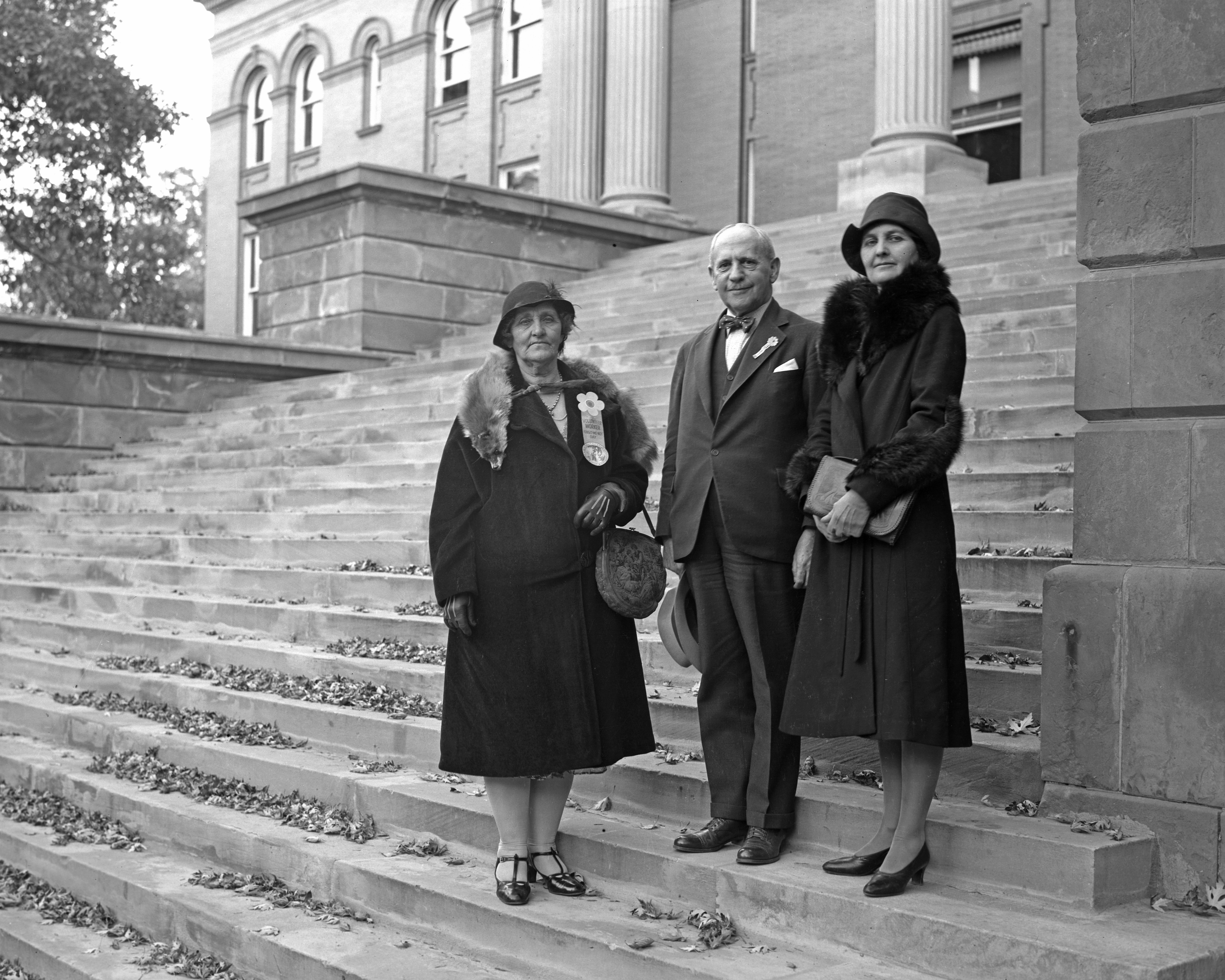
Governor Arthur Seligman and his wife Franc and stepdaughter Richie courtesy of Arthur Scott

Governor Arthur Seligman and his wife Franc and stepdaughter Richie on the statehouse steps 1932
courtesy of Arthur Scott

In 1929, my great-great-uncle Arthur Seligman was the president of the First National Bank of Santa Fe and the chairman of the New Mexico State Democratic Committee.  He was 58 years old, father of two grown children, and a grandfather.  Some men might have decided that they had accomplished enough and been satisfied.  But Arthur Seligman still had things he wanted to do.

In April, 1930, Arthur was again named chairman of the New Mexico State Democratic Committee.  His message to the party was that he would work hard to ensure that the party was organized and successful and that he anticipated support both from Democrats and from independent voters. (“Demos’ Chief Gets on Job; Has Big Task,” The Gallup Independent (April 18, 1930), p.1)

headline elected state chairman april 1930

(Albuquerque Journal (April 15, 1930), p. 1

When the New Mexico Democratic Party started to consider who should be their candidate for governor in 1930, Arthur Seligman was a leading contender for the nomination.  Arthur, however, insisted many times that he was not a candidate and was committed to being chairman of the committee and not a candidate. (“Seligman Awaits Action of Party,” Clovis News-Journal (September 2, 1930) p.1; “Seligman’s Statement,” Las Vegas Daily Optic (September 3, 1930), p. 2; “Seligman in Demand,” Albuquerque Journal (September 18, 1930, p. 4)  Despite these objections, he ultimately was nominated and accepted that nomination.

In accepting the nomination, Arthur pledged to “clean out the ‘political parasites and political barnacles” in the state capital, to establish economy in public business and to remedy the present chaotic and demoralized condition of the taxation system in the state.”  (“Oust Political Barnacles, Seligman,” Albuquerque Journal (October 2, 1930), p. 1)

barnacles headline

His Republican opponent was Judge Clarence M. Botts.  The campaign was a tough one, and several newspapers in New Mexico were quite vocal about their opposition to Seligman as governor.  For example, The Roswell Daily Record characterized the Republicans as progressive and the Democrats as reactionary, saying:

Mr. Arthur Seligman has made it plain that he purposes, if elected, to retrench and economize.  His party, in their platform, has made it clear that expenses shall be cut in the maintenance of our system of education.  To do that school terms must be shortened or the salaries of teachers reduced…. The Democratic candidate has never been known as public spirited.  He has never been active in any matter for the public interest that did not have a profit—a very definite profit—for himself.

(“Seligman Settles His Taxes for 28 Cents on the Dollar; Bond Issue,” The Roswell Daily Record (October 13, 1930), p. 3)

The article then suggests that Seligman deprived the state of revenue when Seligman Brothers was delinquent in taxes and Seligman obtained a settlement allowing the company to pay only a portion of what was due.

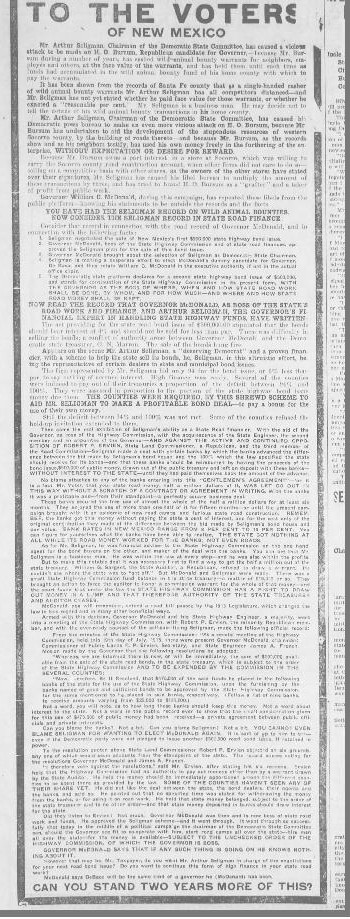
Then there was this nasty editorial from the New Mexico State Tribune, reprinted in the Las Vegas Daily Optic on October 29, 1930:

too bad las vegas optic-page-001

Other newspapers were solidly behind Seligman’s candidacy. The Gallup Independent wrote this in an editorial they ran on October 24, 1930:

With Arthur Seligman in the governor’s chair, there will be no groping in the dark, no learning as he goes—at the expense of the people who pay the taxes.  This keen-minded and alert business executive knows the state government as you know your own back yard. …Mr. Seligman’s business acumen is a known quantity; no chance has been taken on that.  Finances are his “meat.” And he can’t be “kidded” or bluffed, either openly or covertly, when it comes to financial or economic matters. …

There will be no need for draperies behind the governor’s chair when Seligman sits in it.  The voice will be the voice of Seligman and the hand will be the hand of Seligman, too.  He is too wary and experienced to be misled by cajolery of would-be political bosses or to be alarmed at their threats. … Around Santa Fe, he is greeted on the streets with the familiar name of “Pete.” The door of his private office in the bank is never closed except when he is not there.

The editorial also lists all his accomplishments, both political and business, which are too numerous for me to quote here.

(“Candidate Arthur Seligman,” The Gallup Independent (October 24, 1930), p. 8)

The Clovis News-Journal also endorsed Arthur for governor:

Mr. Arthur Seligman, the Democratic nominee for governor, is one of the best posted men in the state at the present time.  He has lived here all his life and knows its needs and financial problems.  He is the type of an executive who can deal with the problems.  He is the type of a man who can also deal with a legislative body and get what legislation the state needs.  He will not be bound or fettered by political ties or responsible to any group as [his opponent] Mr. Botts would be to the old guard who have placed him on the ticket, who is a political conservative like they are and not inclined to initiate any movements for progressive measures.

The state is living ahead of its income, its extravagances must be checked, candidates should be elected who will drive out the crooks and grafters and it looks as if the state would call upon the Democrats to do the job.

A continuation of the Republican party in power would be a continuation of the reactionary crowd now in control…What is needed at this hour is a clean-up by putting Democrats in control until the Republicans regenerate themselves and come to learn that government should be for the people and not a clique of representatives of corporate self-seeking interests.

(“Consider the Leaders,” Clovis News-Journal (September 27, 1930), p. 2 (quoting from the Albuquerque Journal))

Reading these editorials, I had to chuckle.  Both sides claim to be progressive, whatever that might have meant to them at the time.  The Republicans criticize the Democrats for wanting to cut expenses and reduce teacher salaries; today the parties would be switched on that position.  The Democrats accuse the Republicans of being corporate controlled, an argument still made by Democrats today.  Some labels have changed, but anyone who thinks that partisanship started in the 21st century only has to read these old newspapers to know otherwise. (See also “Forward with Botts or Backwards with Seligman, Is the Issue, Says Governor Dillon,” The Roswell Daily Record (October 29, 1930), p. 1 (calling Seligman reactionary on education and on road improvements))

In the end, Arthur Seligman defeated his Republican opponent Judge C. M. Botts, by over seven thousand votes, 62,214 to 54,827. (“Complete Vote Recent Election in New Mexico,” The Roswell Daily Record (November 20, 1930), p. 1).  He became the first Jewish and non-Hispanic governor of New Mexico. (Suzanne Stamatov, “Arthur Seligman,” at http://newmexicohistory.org/people/seligman-arthur)

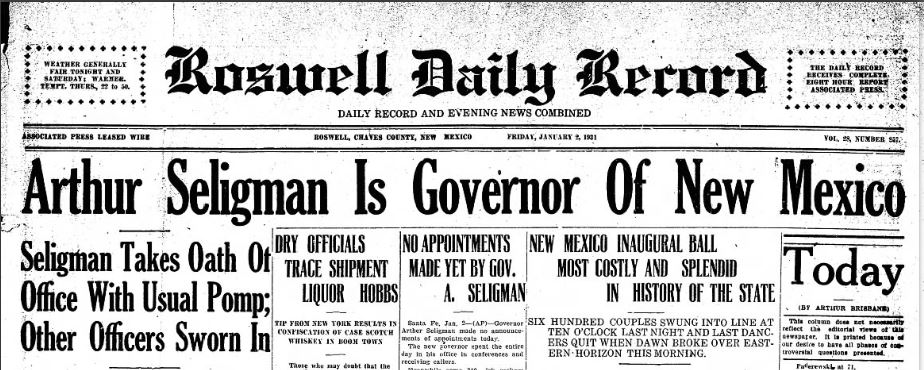
headline elected governor

(Roswell Daily Record (January 2, 1931), p.1)

One of the governor-elect’s first announcements was that he did not want an inaugural ceremony.

low cost inaugural-page-001

He lost that battle, and there was a full inaugural ceremony as well as a lavish inaugural ball.

Inauguration enhanced

Inaugural Ceremony January 1, 1931 Governor Seligman and his wife Franc are seated front center 

In his inaugural address he made several points revealing his views on the role of government:

The governor of the state, alone, can not produce the desired results. The legislature is not sufficient unto itself to accomplish them. The people of the state are the power behind the government. They are in fact the government. Those whom they elect are merely the administrative officers. When an administration takes the people into its confidence and councils there need be no fear of failure to accomplish that which is desired….

(as quoted in Suzanne Stamatov, “Arthur Seligman,” at http://newmexicohistory.org/people/seligman-arthur )

He also expressed his views on government spending:

No state should obligate itself to expend more money than can be reasonably expected from its citizens without hardship….In brief, New Mexico must live within her income and it is my intention, insofar as it is possible for me to do so, to see that she does.

Ibid.

Of course, this was before FDR’s New Deal and the radical changes it precipitated in the views of many on the role of government in providing for its citizens and in promoting the economy.

The night after the ceremony was the inaugural ball, attended by six hundred couples. Among the guests was my great-grandmother Eva Seligman Cohen, who traveled all the way to New Mexico to celebrate with her younger brother. As reported by the Roswell Daily Record on January 2, 1931:

The ball was without parallel in New Mexico history for its splendor and the inaugural gowns presented a mighty costly fashion show in a settling resplendent in the atmosphere of Old Spain, Mexico and New Mexico.

The Roswell paper said this about my great-grandmother:

Mrs. Eva Seligman Cohen of Philadelphia, sister of Governor Seligman, who was accompanied by Mr. Joe Goodall, representative of El Paso at the inaugural, wore a light blue lace combination gown….

The article described in detail the gowns that many of the women wore to the ball, all full length “in keeping with the present fashion mode and long white gloves predominated.”

The article continued:

In the main ball room an eleven piece negro orchestra from Albuquerque played dance mustic and in the lecture lounge which was converted into an additional dance room the La Fonda Mexican orchestra played.  The supper room was decorated in southern smilax and evergreens, with cut flowers in cedar baskets.

(“New Mexico Inaugural Ball Most Costly and Splendid in History of the State,” Roswell Daily Record (January 2, 1931), p. 1; for more details on the inaugural ball, see “Elaborate Preparations for Big Inaugural Ball at Fonda,” Santa Fe New Mexican (January 1, 1931))

During his first term as governor, Arthur fought to reduce taxes and the size of government. (“A Paring Policy,” The Roswell Daily Record (October 31, 1930), p. 7) The country was suffering from the poverty and unemployment of the Great Depression, and New Mexico was suffering as well.  Arthur instituted the first program for unemployment relief in New Mexico and also a vocational education program to help those most affected by the Depression.  He also accepted federal aid to create jobs in road construction and created a state park system which also provided employment opportunities for New Mexicans.  (Stamatov, op. cit.; Ron Hamm, New Mexico Territorial Era Caricatures (Sunstone Press 2014), pp, 170-171)

He also created a centralized purchasing agent for the state highway department, reformed the tax collection system, and established a state labor relations commissioner.  (“Democratic State Chairman Barker Claims Nearly All Pledges Have Been Fulfilled,” The Roswell Daily Record (July 28, 1931, at p.1)  He also reduced taxes, as promised. (“Real Tax Reduction,” Clovis News-Journal (March 21, 1931), p.2)

Although he had the responsibility of governing the state of New Mexico on his shoulders, Arthur did not forget his family.  In September, 1931, he traveled to Philadelphia for the funeral of his nephew, Maurice Cohen, my grandfather’s brother.  (Roswell Daily Record (September 22, 1931), p. 8)

As his first term was drawing to an end in 1932, he easily secured nomination for a second term from the Democratic Party. (“Democrats Boost Seligman for Renomination,” The Roswell Daily Record (August 1, 1932), p. 4)

renomination headline

(Albuquerque Journal (September 27, 1932), p. 1)
He also was elected to be a delegate to the Democratic Convention in Chicago that summer, the convention that first nominated Franklin Roosevelt as a candidate for President.  (“A Popular Victory,” The Deming Headlight (May 27, 1932), p. 3; “Hockenhull May Stay in Clovis to Run State,” Albuquerque Journal (June 24, 1932), p. 10)

Arthur was gone from New Mexico for two weeks, and during that time he visited his family in Philadelphia, including his sister Eva, my great-grandmother.  They spent time together in Atlantic City along with Eva’s granddaughter, my cousin Marjorie.
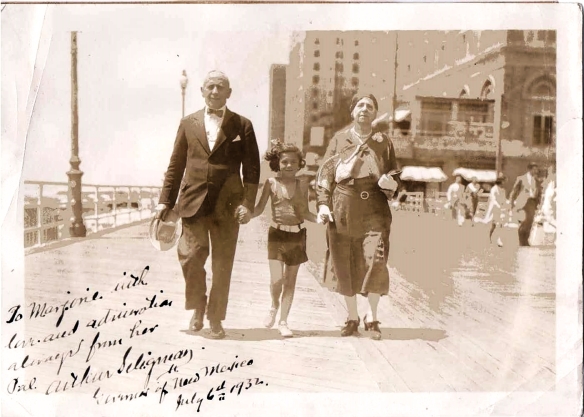
Arthur Seligman, Marjorie, and Eva May Cohen, 1932 Atlantic City

Arthur Seligman, Marjorie, and Eva May Cohen, 1932 Atlantic City

In September, 1932, Arthur and Franc’s son Otis was charged with embezzlement of the First National Bank of Santa Fe, where he was employed as assistant cashier and where Arthur remained president while also serving as governor.  I will address these charges and their consequences in a later post, but for now will simply observe that this scandal in his family apparently had no significant effect on Seligman’s campaign for re-election.

Less than two months after the indictment of his son, Arthur Seligman was once again elected governor in November, 1932.  He defeated his Republican opponent, former governor Richard C. Dillon, by an even larger margin this time, 83,612 votes to 67,406.  (“Final Election Canvassing Sheets Show Big Total,” Clovis News-Journal (November 30, 1932, p. 1)

1932 headline

(Albuquerque Journal (November 9, 1932), p. 1)

In his second inaugural address Governor Seligman repeated themes from his first two years earlier, again calling for a smaller government budget and tax reform.  He also called for laws improving mine safety, election reform, tenure for qualified teachers and general improvement of the state’s schools, and increased regulation of utilities, among other recommendations.  (“Governor Drafts Legislative Program,” Clovis News-Journal (January 11, 1933), p. 1)

Early in his second term, there was much talk and speculation about the possibility that Arthur Seligman would become a US Senator from New Mexico.  The sitting Senator, Sam Bratton, had been appointed to a federal judgeship by President Roosevelt and would resign his seat at the end of the current Congressional term in June, and newspapers reported rumors that Seligman would resign as governor and then be appointed to fill the Senate seat by his lieutenant governor, who would replace him as governor. [1] (See, e.g., “Expect Seligman Will Take Vacant Position,” Las Vegas Daily Optic (June 1, 1933), p. 4; “Just One Candidate,” Las Vegas Daily Optic (May 20, 1933), p. 7; “Taos Democrats Want Seligman for Senate, Juan Vigil Reports,” Albuquerque Journal (May 19, 1933), p. 1)

Asel sen sf chron may 30 1933 page 1

(San Francisco Chronicle (May 30, 1933), p.1)

(He might have been short, but hardly rotund!)

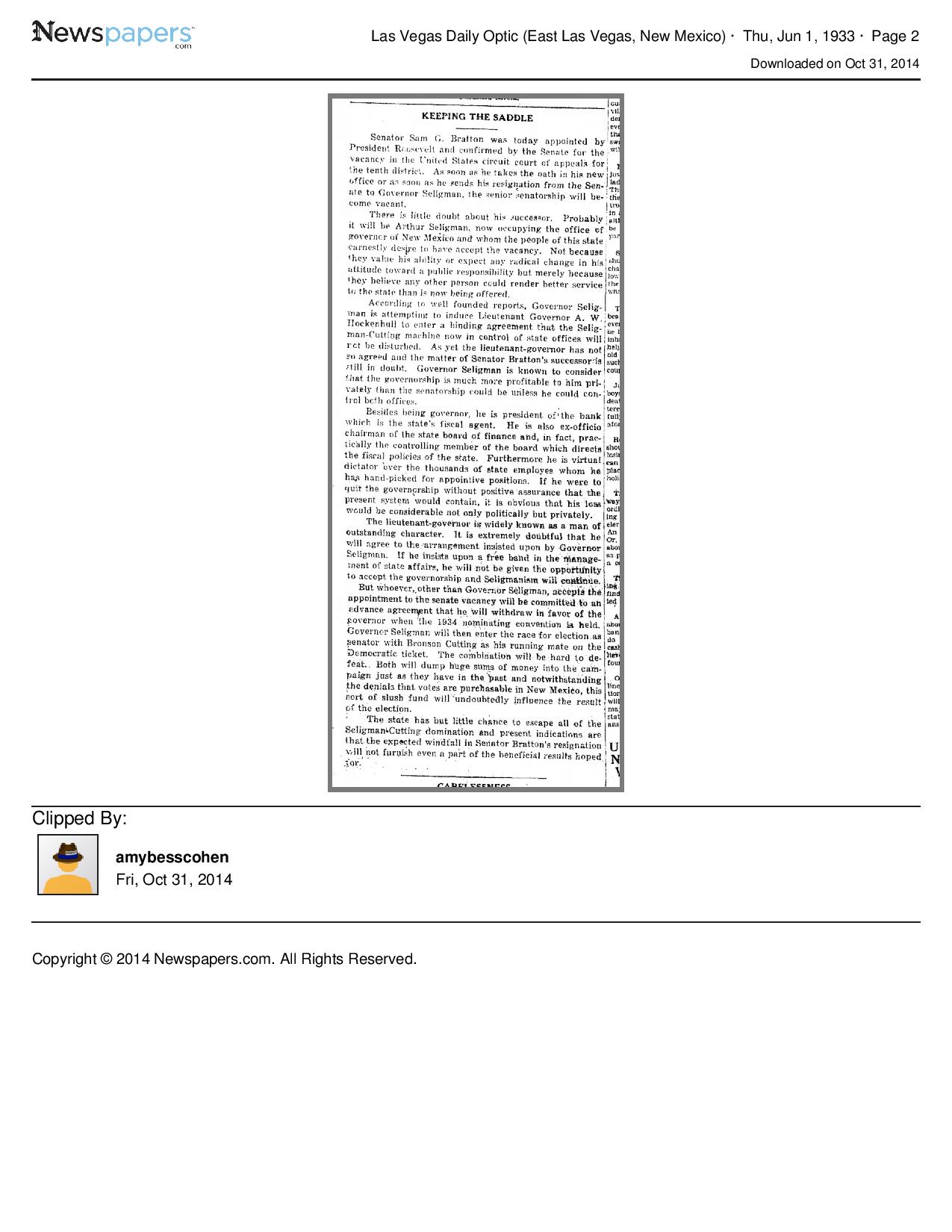
And although there was a lot of support for Seligman becoming Senator, there was also some opposition:

Anti Seligman as Senator editorial-page-001

By July, 1933, the question of who would succeed Bratton as Senator was still unresolved and seemingly complicated by political matters. (“Lieut Governor Denies Reports of Statements,” Clovis News-Journal (July 17, 1933), p. 1)

In August, 1933, the Seligman family paid the price of being in the public eye when Joan Seligman, Arthur and Franc’s six year old granddaughter (the daughter of their son Otis and his wife Doris) was the target of a kidnapping threat.  (“Kidnap Threat against Grand-daughter of Governor Seligman, Reported Today,” Clovis News-Journal (August 15, 1933), p. 1)

In early September, the governor had to deal with a strike by miners, requiring him to call out the National Guard to prevent violence.  (“Says Sending of Guard to Gallup Avoided Trouble,” Clovis News-Journal (September 2, 1933), p.1)  The miners charged he sent the troops to break their strike and filed suit for an injunction against the use of the National Guard.  (“Miners Charge He is Using Troops to Break Strike,” Clovis News-Journal (September 5, 1933), p.1; “Suit Asks Guard Be Enjoined from Martial Law Plan,” Las Vegas Daily Optic, September 11, 1933, p.3)  The strike and some violent attacks were still ongoing as of September 22, 1933. (“Miner Sprayed Pickets with Searing Fluid,” Las Vegas Daily Optic (September 22, 1933), pp. 1, 4)

Perhaps all this stress in August and September and the political pressures resulting from the impending empty Senate seat proved too much for Arthur Seligman.   Arthur suffered a fatal heart attack on September 25, 1933, less than halfway through his second term.  Apparently he had been diagnosed with a heart problem and had been advised to rest or jeopardize his health.

seligman death from overwork-page-001

His family and his state were in shock.  He was only 62 years old and had just delivered a speech to a group of bankers before complaining of chest pain and then dying.

The newspapers around the state and the country reported on his untimely death, many praising him for his lifelong service to New Mexico and for his business acumen and success.  My next post will look at the reactions to his death and  at assessments of his political career and his life.

English: Seal of New Mexico

English: Seal of New Mexico (Photo credit: Wikipedia)

[1] Interestingly, since Seligman did not survive to take the seat, it was filled on October 10, 1933, by Carl Atwood Hatch, who served as a US Senator from New Mexico until 1949.  He is best known as the sponsor of the Hatch Act, which limits political activity by federal employees.  It was not until after Arthur Seligman had died that Hatch’s name was put forward as a replacement for Senator Bratton. (“Ask Governor to Select Hatch for Place in Senate,” Clovis News-Journal (September 28, 1933); Seligman had died only three days earlier.

Arthur Seligman, My Great-great Uncle, Part I:  Child of Immigrant to a Business and Political Leader

Arthur Seligman 1903 courtesy of Arthur Scott

Arthur Seligman 1903 courtesy of Arthur Scott

My great-grandmother’s younger brother Arthur was the youngest child of Bernard and Frances Seligman, my great-great-grandparents, and the only one who was born in Santa Fe. He rose to the highest heights in New Mexico, elected twice to serve as the governor.  His story is another remarkable one—the story of the son of a German Jewish immigrant who less than 80 years after his father first arrived in America was elected governor in a state with a very small Jewish population.

There are many sources outlining Arthur’s life as well as many primary sources. I relied in part on Ralph Emerson Twitchell, Old Santa Fe: The Story of New Mexico’s Ancient Capital (Rio Grande Press 1925), pp. 477-478; the article on Arthur Seligman on the National Governor’s Association website; the article in The Dictionary of American Biography; and the vocesdesantafe website for much of the general background, but also used many primary sources such as newspaper articles, census reports, and school and city directories to fill in the details.

Arthur was born on June 14, 1871.  He grew up in Santa Fe and made several trips as a young child on the Santa Fe Trail back East with his mother to visit her family.  He attended public school in Santa Fe, and then in 1885 he, along with his older sister Minnie and brother James, traveled across the country to Philadelphia where Arthur, Minnie, and James attended Swarthmore, as had their older sister Eva, my great-grandmother, before them.  Arthur then attended Pierce Business College in Philadelphia.

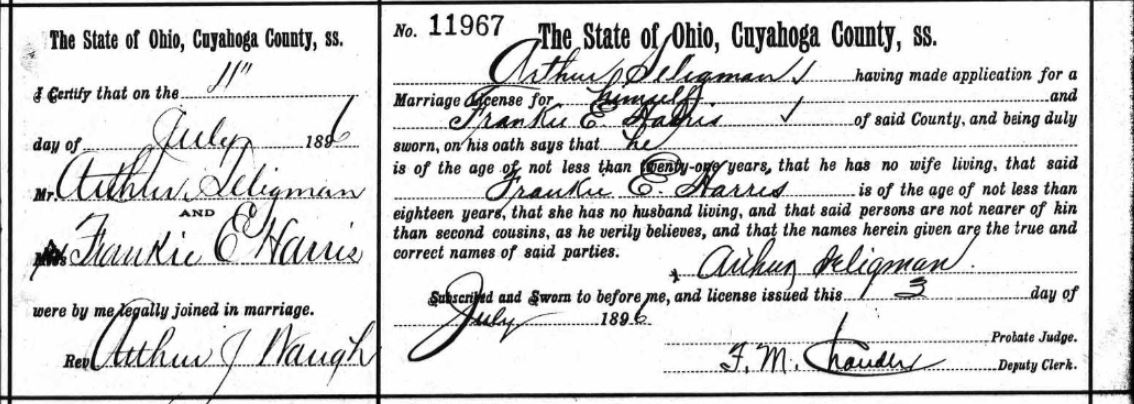
When he returned to Santa Fe after college, he worked as a clerk and then as a bookkeeper at his family’s business, Seligman Brothers.  In 1896 when he was 25, he married Frankie E. Harris, usually referred to as Franc.

Cuyahoga County Archive; Cleveland, Ohio; Cuyahoga County, Ohio, Marriage Records, 1810-1973; Volume: Vol 42-43; Page: 489; Year Range: 1892 Sep - 1896 Jul

Cuyahoga County Archive; Cleveland, Ohio; Cuyahoga County, Ohio, Marriage Records, 1810-1973; Volume: Vol 42-43; Page: 489; Year Range: 1892 Sep – 1896 Jul

She was four years his senior and a widow with an eight year old daughter named Richie Harris.  Although they were married in Ohio where Franc had been living, they moved to Santa Fe after they married, and Richie took Arthur’s surname as her own.  It’s not clear whether Arthur ever legally adopted Richie since she is identified as his step-daughter on the 1900 and 1910 census reports. I am curious as to how Arthur met Franc, but so far I have not been able to find an answer.

On February 14, 1898, Arthur and Franc’s son Otis Perry Seligman was born.  On the 1900 census, Arthur listed his occupation as “merchant dry goods.”  When the Seligman Brothers business incorporated in 1903, Arthur was named treasurer and secretary of the corporation with his older brother James serving as president and general manager.  On the 1910 census, he still listed his occupation as a dry goods merchant.

But at the same time that he was helping to run the business, Arthur was also very involved in local politics.  As early as 1893 when he was 22, Arthur was already  serving as a clerk in the local elections that year. (“Election Proclamation,” Santa Fe New Mexican (March 23, 1893), p. 4).  In 1896 he was elected to be a delegate to the state Democratic Party convention in Santa Fe.  (“Democratic Primaries,” Santa Fe New Mexican (May 25, 1896), p. 4)  That same year he was also nominated as a candidate on the Populist ticket at their convention in Santa Fe.  (“Populists in Council,” Santa Fe New Mexican (October 28, 1896), p. 4)
In 1900 Arthur was a candidate for county commissioner on the Democratic ticket. (“Personal Mention,” Santa Fe New Mexican (October 26, 1900), p. 4)  He ended up defeating his Republican opponent in a close race where most Democrats on the ticket lost in the election.  (“The Official Count,” Santa Fe New Mexican (November 13, 1900), p.4) In fact, the race was so close that his opponent challenged the results.  (“Election Contests,” Santa Fe New Mexican (December 13, 1900), p. 4) His opponent claimed that Arthur had used intimidation to discourage his opponent’s supporters from voting.

aseligman election challenge 1900

(“Election Contests,” Santa Fe New Mexican (December 13, 1900), p. 4

Although I could not find a follow-up article regarding this challenge, I assume it was unsuccessful.  Arthur served on the County Commission for many years and was soon its chairman.

In 1903 he also served as treasurer of the New Mexico commission to prepare for the St. Louis World’s Fair. (“World’s Fair Commission,” Albuquerque Daily Citizen (June 3, 1903), p.5)  In 1905 he was serving as the chairman of the Santa Fe County Commission.  In that capacity he was active in arguing in favor of statehood for New Mexico. (“They Want Their Debts All Paid,” Albuquerque Citizen (December 11, 1905), p. 6)  He was a delegate to the New Mexico Democratic Convention in 1906. (“Aftermath of Democratic Convention,” Albuquerque Citizen (September 14, 1906), pp. 1, 5)

In April, 1910, Arthur was elected mayor of Santa Fe by 193 votes.  (“Democrats Take All in Santa Fe, Arthur Seligman Mayor by a Majority of 193,” Santa Fe New Mexican (April 6, 1910), p. 8) Two years later, however, he was defeated by his Republican opponent for mayor, Celso Lopez.  (“Twenty-One Towns Elect Officers,” The Kenna Record (April 12, 1912), p. 8)

New Mexico become a state on January 6, 1912, and Arthur became involved in statewide politics.  When the chairman of the state Democratic Party resigned in January 1912, Arthur was named as a potential replacement.  (“Democratic State Chairman to Resign,” Santa Fe New Mexican (January 31, 1912), p. 5)  A later article, however, indicates that Arthur did not then serve as chairman, but as secretary of the Democratic Party in New Mexico in 1912. (“Congressman H.B. Fergusson Renominated by Democrats,” Las Cruces Sun-News (September 13, 1912), p. 1).  In 1912 he was also serving on the Natural Resources Commission (Ancestry.com. Polk’s Arizona and New Mexico pictorial state gazetteer and business directory : 1912-1913. [database on-line]. Provo, UT: The Generations Network, Inc., 2005).   He also served as Road Commissioner and was responsible for some important improvements to the roads and bridges in New Mexico.  (See, e.g., “Road Bond Deal Finally Closed by Treasurer,” Albuquerque Journal (July 8, 1915), p. 3; there are many other articles about Seligman’s role on the Road Commission on newspapers.com and on genealogybank.com; see also Twitchell, op.cit.)

In September, 1916, he was elected chairman of the State Democratic Party.  (“New Mexico State News,” Estrella (September 16, 1916), p. 3).  The Democrats did well in the 1916 election in New Mexico, and the Albuquerque Journal praised Arthur’s work as chair:

democratic state chair praised 1916

(“Arthur Seligman’s Work,” Albuquerque Journal (November 12, 1916), p. 6).

The election was not without some controversy, however, as the Republicans ran a rather nasty ad attacking Arthur Seligman:

Western_Liberal__Oct_27__1916__p__7-page-001

(Western Liberal (October 27, 1916), p. 7)

The ad insinuated that Seligman had schemed to advance his own interests and that of the banks in the context of a bond issue to finance road improvements when he was serving as Road Commissioner.  Although I cannot find any more about these claims and cannot even understand much of what the ad is alleging, it does not appear that this ad hurt Seligman himself or the Democratic candidates in the 1916 election.

In 1920, Arthur was still serving as Chairman of the Democratic Party Committee, but apparently faced some opposition to his continued service.  (“M’Adoo in Favor With Democrats,” The Deming Headlight (June 4, 1920), p. 1)  However, he defeated that opposition and continued serve as state chairman after the convention.  (“Arthur Seligman Chosen Chairman for Another Term,” Albuquerque Journal (August 27, 1920), p. 1)

Despite his heavy involvement in political matters, Arthur still listed his occupation as a dry good merchant on the 1920 census.  Franc’s daughter Richie, meanwhile, had married John Whittier March and had had a son George in 1919.  Franc and Arthur’s son Otis was working as a bank clerk in 1920 and living with his parents in 1920. In June 1921 Otis married Doris Gardiner.

The Seligman Family in the 1920s

The Seligman Family in the 1920s Arthur, Doris (Otis’ wife), Mary Ann Gardiner (Doris’ mother) , Franc, and Otis Courtesy of Arthur Scott

The 1920s brought even greater political success to Arthur.  By 1921, there was talk that he might be a candidate for governor in 1922.  (“Governorship Race May Be Largely Battle of Santa Fe for Both Parties,” Albuquerque Journal (December 21, 1921), p. 1).  Although he was not nominated as a gubernatorial candidate in 1922, he was promoted to the national Democratic Committee representing New Mexico.  In turn, he resigned as state party chair and was praised by many for his long service on behalf of Democrats in New Mexico although one delegate spoke against him.  (“Arthur Seligman Boosted to National Committee,” Albuquerque Journal (February 24, 1922), p. 1)

Strangely, I could not find many news articles mentioning Arthur Seligman between 1923 and 1929 on either newspapers.com or genealogybank.com, although he was still serving as the New Mexico national committeeperson for the Democratic Party during those years according to the few news articles that mentioned him.  (E.g., “Santa Fe is for Al Smith,” Estrella (May 12, 1928), p. 3)

Meanwhile, his business career was changing as well.  In 1925, he was not only running Seligman Brothers, he was also president of the First National Bank of Santa Fe.  (“New Mexico State Items,” Estrella (June 20, 1925), p. 2)  Ralph Emerson Twitchell wrote that Arthur had been vice-president of the bank since 1912 and became president in 1924.  In the 1928 Santa Fe directory, he is listed only as president of the bank with someone named Evelyn Conway now running Seligman Brothers.

By 1929, Arthur Seligman was already a very successful man both in politics and in business, but he was not done yet, and in 1930 when he was 59 years old, he achieved what would probably have been amazing to his parents, both of whom had died many years before—he was elected governor of New Mexico.

More on that in my next post.

Arthur Seligman, c. 1925 from Twitchell, p. 479

Arthur Seligman, c. 1925 from Twitchell, p. 479