In Memory of My Cousin Sue

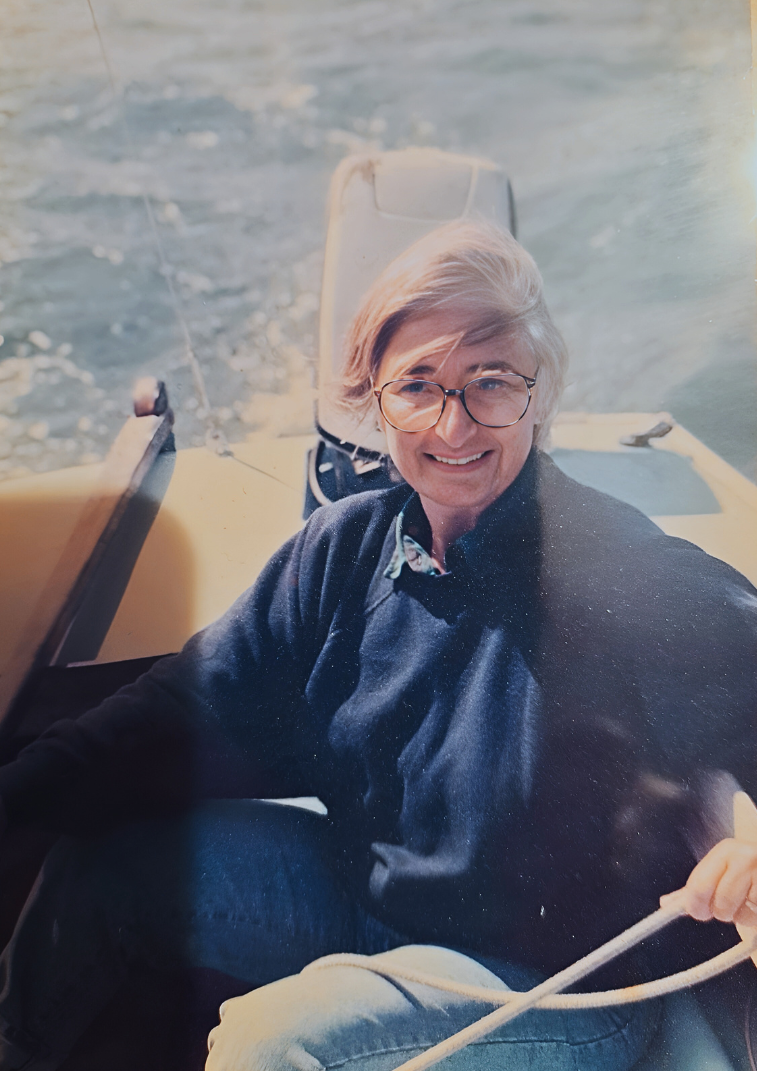
My cousin Sue, sailing. Courtesy of Lisa Wartur

I lost a dear cousin on August 25, 2025, my cousin Sue (Leyner) Wartur (1938-2025). Sue was my third cousin and also my half second cousin, once removed, making us double cousins. Sue’s grandfather Julius Goldfarb was my maternal grandmother’s first cousin. And Sue’s grandmother Ida Hecht Goldfarb was the daughter of Taube Brotman Hecht, my grandmother’s half-sister. Sue and I were doubly bonded by our mutual family trees.

Ida Hecht Goldfarb and Sue Leyner, July 1938. Courtesy of Sue Leyner Wartur.

I didn’t know Sue until March 2016 when I found Sue’s daughter Lisa while searching for descendants of my grandmother’s Goldfarb cousins. Lisa connected me with her mother, and immediately I felt like I had known both Sue and Lisa all my life.

We were bonded by more than just genetics. Although we never met in person, Sue and I exchanged many emails over the nine and a half years we knew each other. It didn’t matter that we never met in person (though I wish we had) because through those emails, we learned a lot about each other and developed an affection and a bond that you wouldn’t imagine two people who never met could share. We had one magical zoom in October 2023—seeing Sue’s face and hearing her voice made that bond even deeper.

Sue shared with me many photographs and stories about her beloved grandparents and all her cousins and their times together at the beach house owned by her grandparents. Over the years we learned that not only did we share DNA and a love of family history, but we also shared a love of the beach (Sue’s on Long Island, mine here on Cape Cod), a love for Italy, a passion for words and writing, and a devotion to Judaism. We agreed on politics and on the need for hope in a world filled with reasons for despair.

Sue adored above all else her husband Larry and her daughter Lisa. Here are some of Lisa’s favorite photographs of her mother.

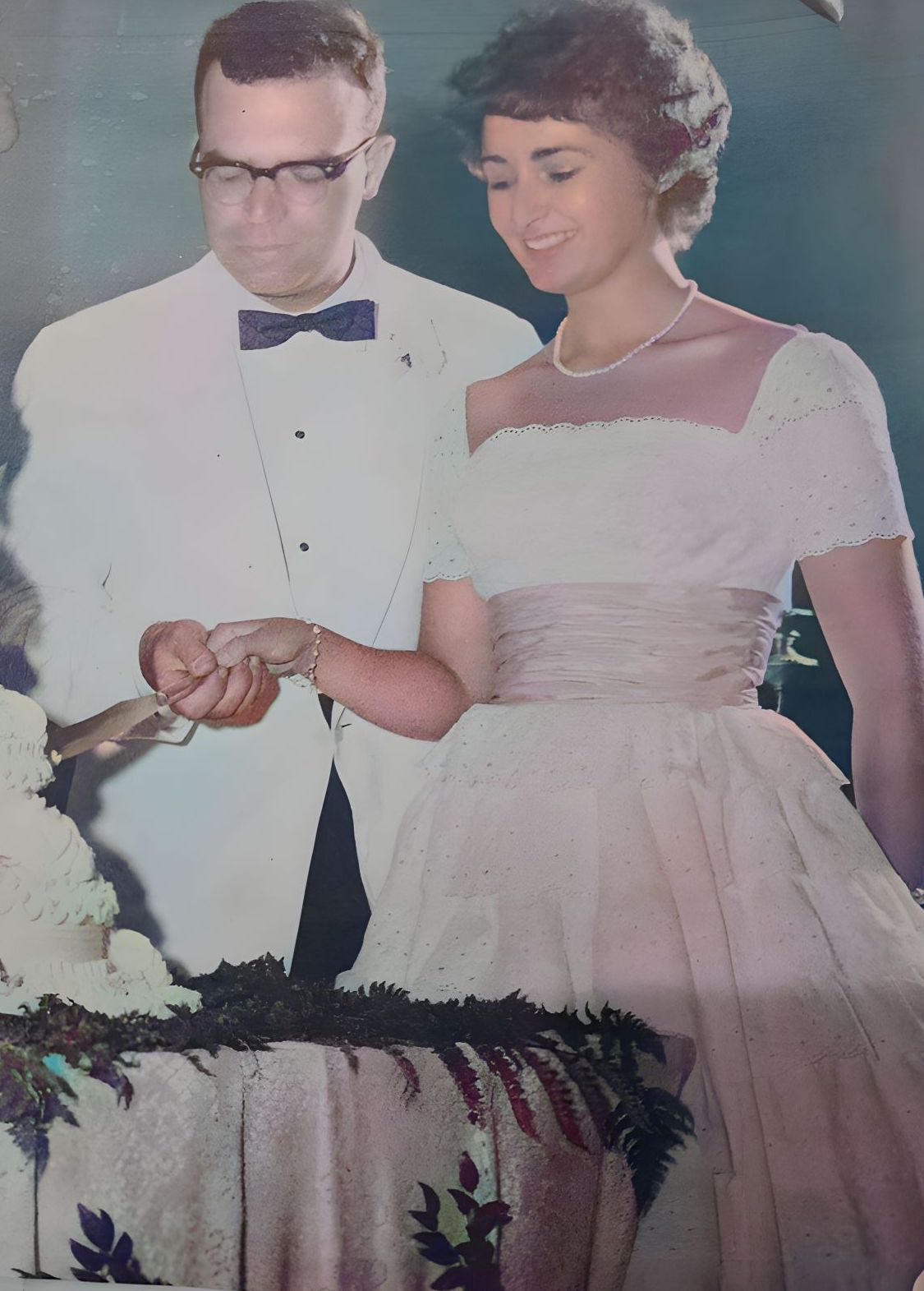
Sue and Larry Wartur on the wedding day in 1959

Sue and Lisa

Lisa, Larry and Sue

Sue’s emails often made me laugh—-her sense of humor and of the absurd was delightful and insightful. And over those nine years we shared some heartbreaks as well. The illness and death of her beloved husband Larry, the deaths of both of my parents, and finally her own health struggles.

When Sue was diagnosed with pancreatic cancer in March, she was determined to fight to survive and went through a long series of treatments. And then, just days after her oncologist had announced that despite all the odds, Sue was cancer-free, Sue collapsed while at synagogue and died a couple of days later from a brain aneurysm. The cruel irony of that has left all who loved her shocked and heartbroken.

Although I couldn’t get to Long Island for the funeral, I was able to watch it through the magic of the internet. It was one of the most moving and beautiful funerals I’ve seen because it was so filled with love and sadness. But mostly love. Everyone who spoke had obviously been forever touched by Sue and loved her deeply. Even the rabbi cried when talking about Sue.

I did not know Sue for most of her life, a life that was filled with so many accomplishments, adventures, and love. Please read the obituary below to learn more about her remarkable life. I can’t tell you how moved I was to see that Lisa, Sue’s daughter and my wonderful cousin, included me among the cousins who were mourning Sue.

https://www.easthamptonstar.com/obituaries/202593/susan-leyner-wartur

Sue, your memory will always be a blessing for me, and I know it will be a blessing for Lisa, Steven, Debrah, and all those family members, friends, former students, and others who loved and adored you.

Sue at the beach, her favorite place. Photo courtesy of her daughter Lisa Wartur

Shanah Tovah: Hopes for a Good Year

Rosh Hashanah, the Jewish New Year, starts next week, and I am trying hard to find some way to be optimistic going into the new year, but I have to admit that I am struggling. I won’t go into all the reasons I am in despair about the future of our country and our world. But I think we all can agree that there is far too much anger and hatred out there. Far too much greed, far too much war.

So as I sit in services next week and contemplate the past year and the year ahead, I will try my best to focus on all the good things in my life—my family, my friends, my cats, my congregation, my community, the beauty of Cape Cod, all the music and art and movies and television shows that lift my spirits, move me, make me laugh, make me think. The times I laughed so hard I cried, and the times I cried and felt empathy and compassion for those who are suffering. All the people who read my blog and my books and helped me with my research, and all the cousins I’ve found who have shared stories with me this year and in past years.

I am deeply grateful for all those things. And I will hope and pray that those thoughts will carry me forward into the coming year with the hope that things will get better. If we all have as much love and compassion for the stranger as we do for those closest to us, we can make the world a better place.

May you all have a sweet and healthy new year.

Shanah tovah.

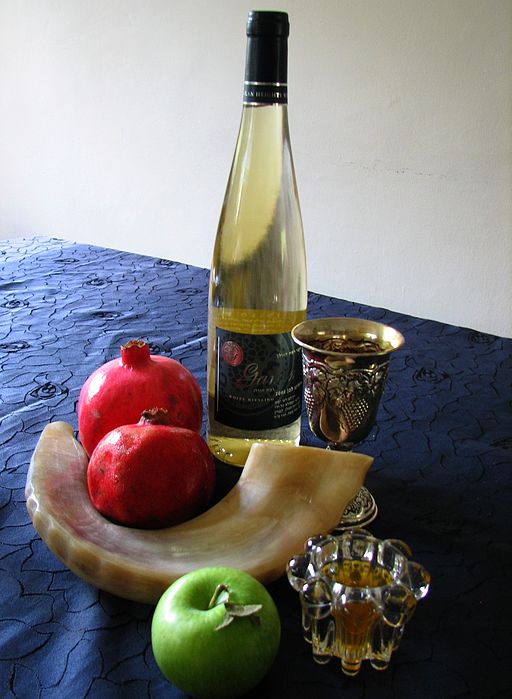
By Gilabrand (Own work) [CC BY-SA 3.0 (http://creativecommons.org/licenses/by-sa/3.0)%5D, via Wikimedia Commons


No blog next week in observance of the holiday, but I will be back in October.

What I Learned From My Great-Great-Grandmother’s Will

I am back from a break after a great visit with our kids and then a week to recover! Before I return to the story of the family of Malchen Rothschild (as I am still waiting to speak with her great-grandson Julio), I have an update about how I discovered my great-great-grandmother’s will.

Earlier this summer Teresa of Writing My Past wrote about full-text searching on FamilySearch. I had never known about this tool but was tempted to see what I could find. I followed the link that Teresa provided on her blog and entered “John Nusbaum Cohen” to see what would come up.

Lo and behold, it immediately retrieved what turned out to be the last will and testament of my great-great-grandmother Frances Nusbaum Seligman. Frances was the daughter of John Nusbaum, my three-times great-grandfather, and the wife of Bernard Seligman, my great-great-grandfather—-two of my pioneer ancestors who came to the US as young men from Germany in the mid-19th century. Both John Nusbaum and Bernard Seligman became successful merchants, John in Philadelphia and Bernard in Santa Fe. But neither came here as a wealthy man.

So I was amazed when I read this will to see just how much property—-jewelry, cash, and other property—Frances owned at the time of her death in Philadelphia on July 27, 1905. She was only 59 when she died, and she left behind three surviving children (two had died before adulthood): my great-grandmother Eva Seligman Cohen and her brothers James Seligman and Arthur Seligman. In addition, Frances had siblings and grandchildren, all of whom are named in her will, as well as other family members and friends.

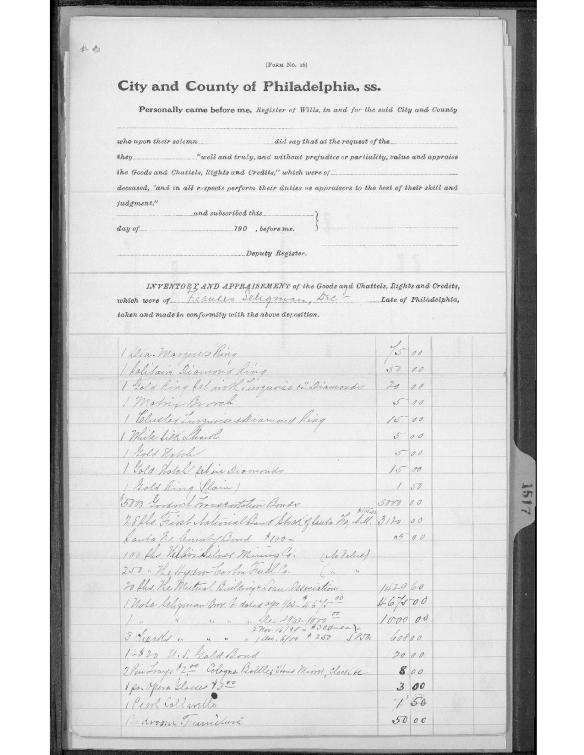
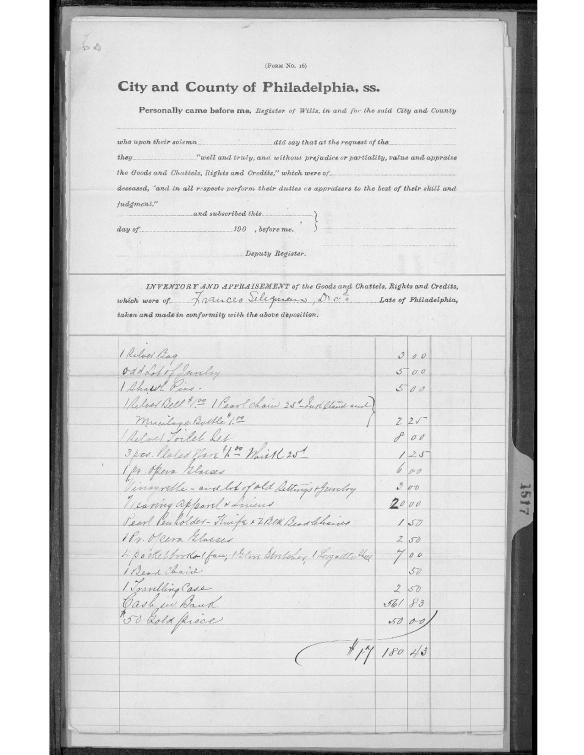
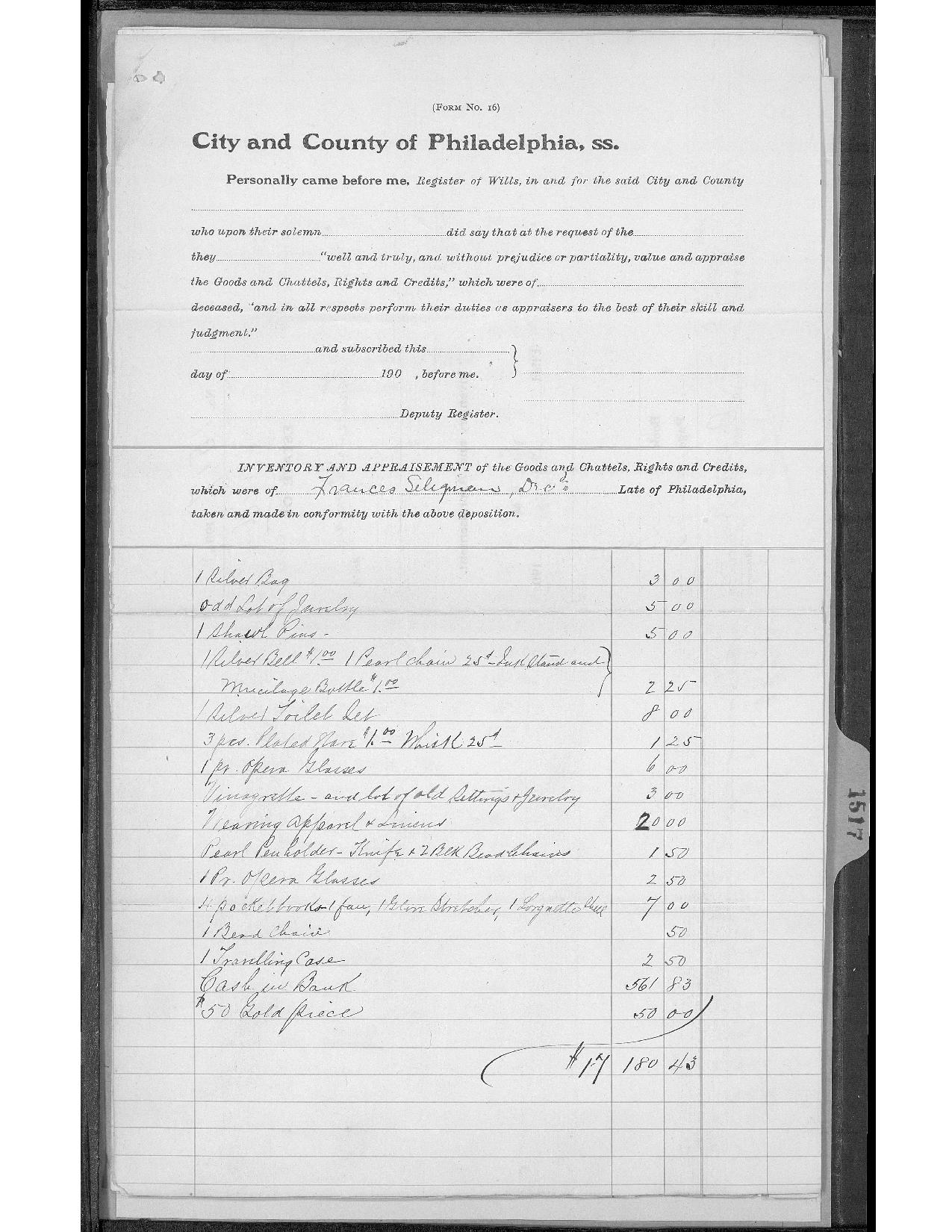
There  were two inventories of Frances’ property. The bulk of her property was inventoried in September 1905 and included stock, cash, jewelry, and other personal items.1

The total value of these properties came to $17,180.43, or approximately $617,000 in today’s dollars. Of course, many of these items, especially the jewelry, may have appreciated far beyond the value they had in 1905 and beyond what the inflation calculators consider.

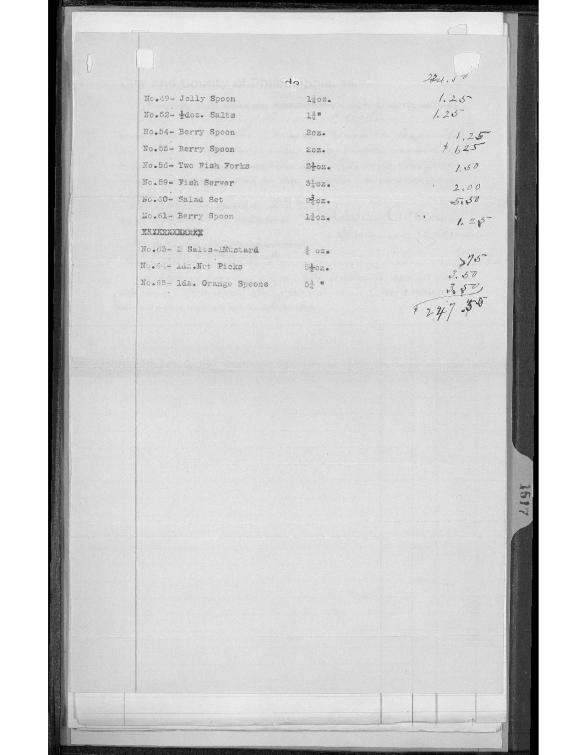
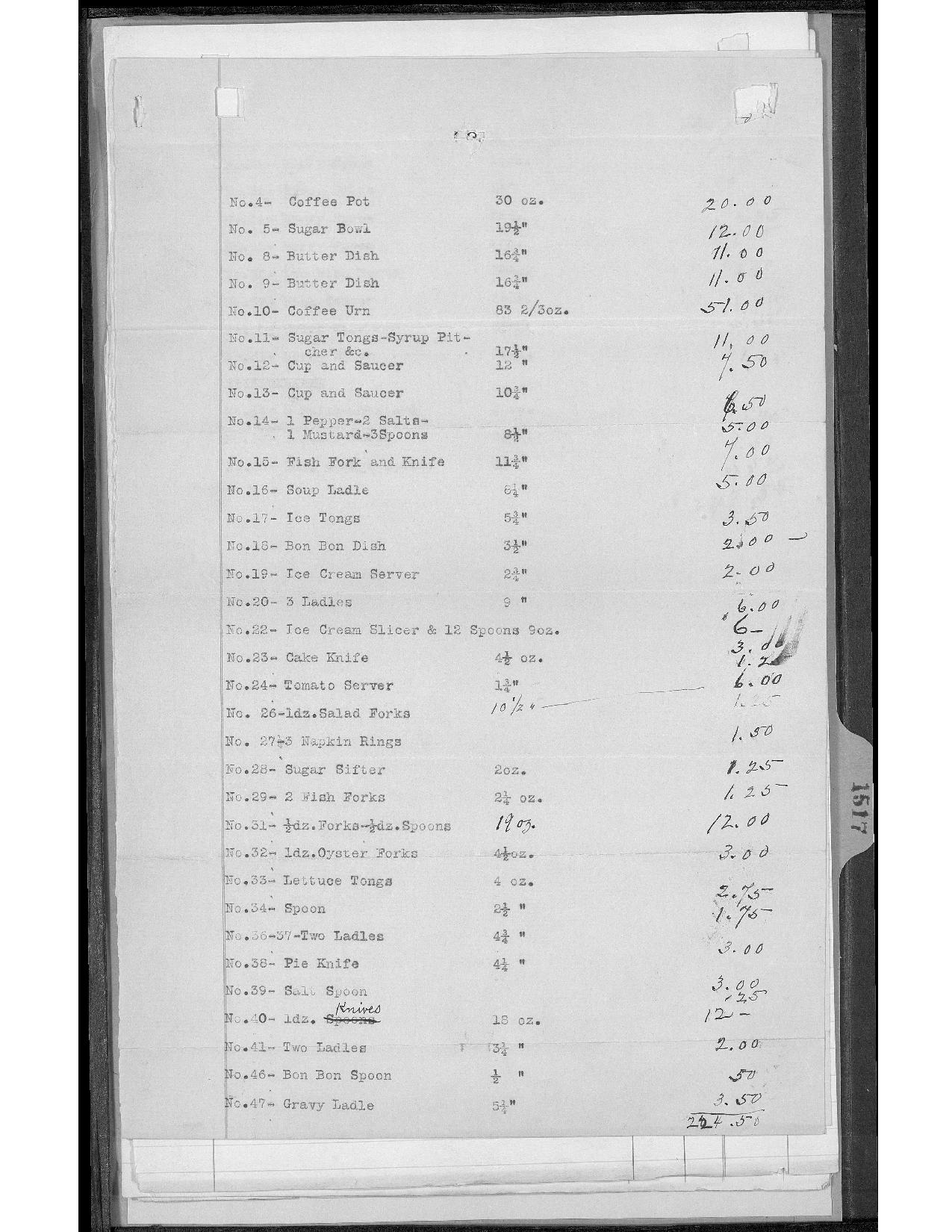
The second inventory was of Frances’ kitchenware and dishware:
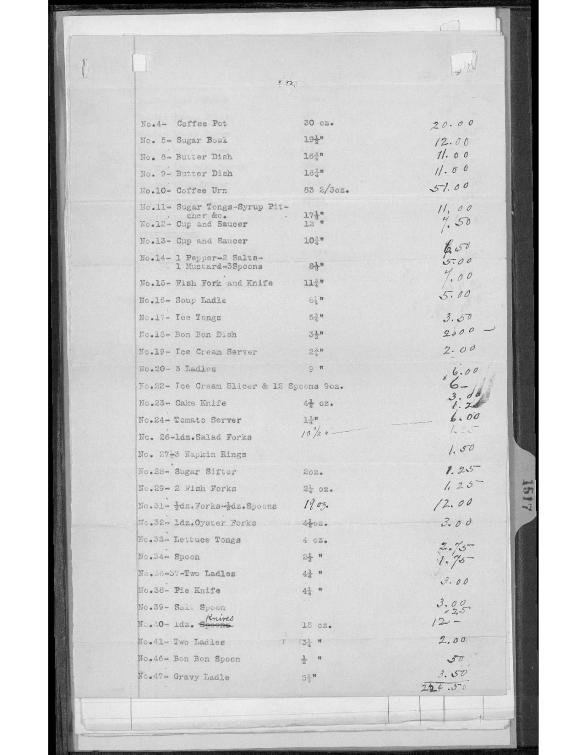
 

The value of these goods was appraised in 1906 as $247.55. In today’s dollars that would be approximately $9000.

The documents do not include any appraisal of any real estate although, as we will see, Frances owned some real estate in Santa Fe.

Frances’ will detailed with great specificity where all this personal and other property was to go. Her original will is eight typed pages plus there is a one page handwritten codicil. I loved reading this will because it names so many of the relatives I’ve written about on my blog. It was fascinating to see how inclusive Frances was in deciding who would get portions of her estate. The following images are the pages from the will with my comments about some or all of the provisions on that page.

In the Third Clause below, Frances divided $1250 among her four siblings. But Simon, Julius, and Miriam each got $250 whereas Lottie received $500. Did she love Lottie more than the others? Or did Lottie have greater need? Lottie never married, so unlike Miriam who had a husband to support her and Simon and Julius who were men, Lottie may in fact have had greater need.
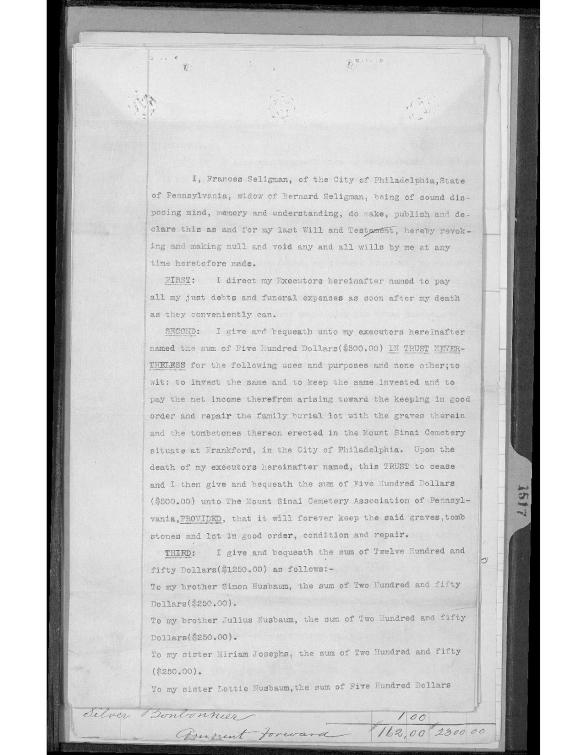
There is a similar seemingly favorable bias in terms of Frances’ distribution to her three living children, Eva, James, and Arthur. Eva was to receive all of her mother’s linen and wearing apparel. Well, I guess the sons couldn’t wear her clothes. But then in the Fifth Clause above, Frances bequeathed a whole lot of jewelry to Eva: “my diamond bracelet, my diamond star with chain attached thereto, my watch studded with diamonds, one of the large diamonds from my thirteen stone diamond ring, my set of silver containing one dozen knives, one dozen large spoons, one dozen small spoons, one large soup ladle and one dozen silver forks.”

What did James get? “One diamond from my thirteen stone diamond ring and a silver coffee pot.” And Arthur: “the other large diamond from my thirteen stone diamond ring, and a silver coffee pot.”

Wow, did they get shafted or what! Even Emanuel Cohen, my great-grandfather and Eva’s husband, got “the centre diamond in my diamond cluster pin.” And he was married to Eva, who was already getting all those diamonds!

Frances then gave other jewelry items to her daughters-in-law and to her grandchildren. My grandfather John Nusbaum Cohen got “four stones from my diamond cluster pin.”

The will goes on to identify specific pieces of jewelry for other family members—aunts, uncles, nephews, nieces, brothers-in-law, and even August Seligman, the younger brother of Bernard Seligman, a brother who never left Germany. Did August get the “silver knife, fork and spoon marked S.S.”? Perhaps his great-grandson Wolfgang knows. I will have to ask him.

And then at the end of that Fifth Clause below, the will provides, “All the remainder of my jewelry, not otherwise disposed of by this will, it is my desire that my daughter, Eva May Cohen, distribute as she may see proper.”
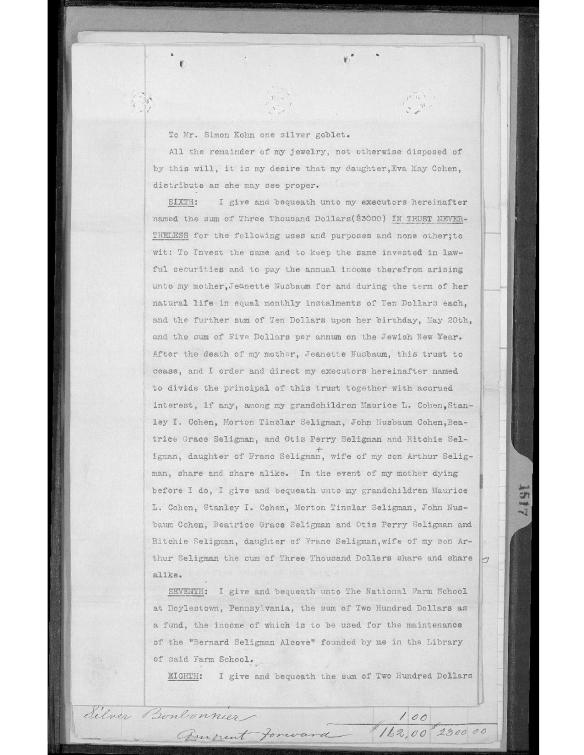
Before I go on, I need to point out that I do not have one piece of jewelry or anything else that once belonged to Frances Nusbaum Seligman, my great-great-grandmother. Not one thing. Even though all those diamonds were bequeathed to my great-grandmother Eva Seligman Cohen, I have no idea where they went once Eva died. She raised my father and his sister from the time they were quite young when both their parents were hospitalized, yet my father did not have one thing—-not one spoon or even a coffee pot—-that had belonged to his beloved grandmother. I have no idea where it all went. Perhaps it was sold during the Depression. Perhaps the other three grandchildren of Eva Seligman Cohen received it, but that seems unlikely. In any event, it’s gone.

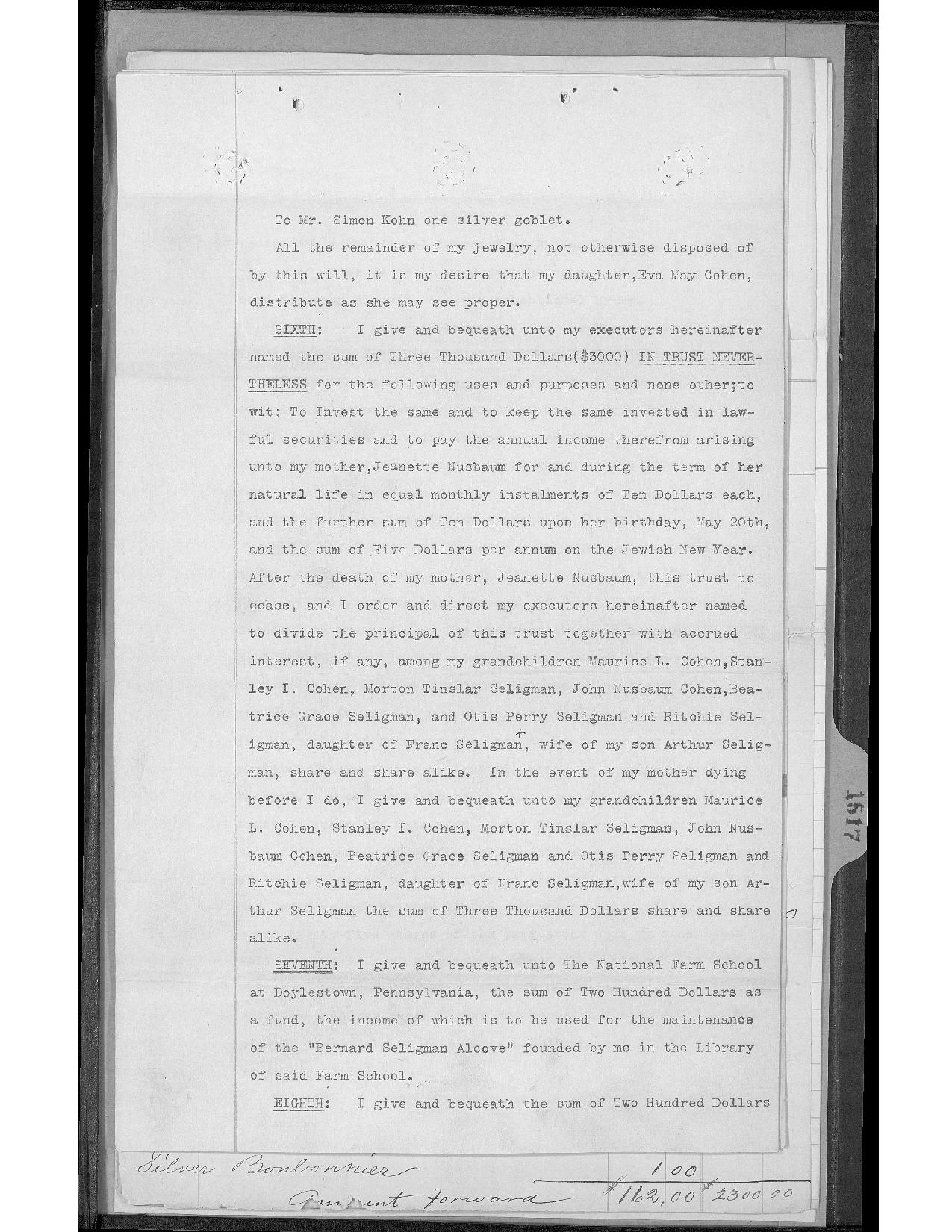
Having cleared the air on that, I am now looking at the Sixth Clause (see above). It provides in part for a $3000 trust for Frances’ mother Jeanette Dreyfus Nusbaum, my three-times great-grandmother, who was still living when Frances drew up this will in 1905. I love that Frances provided for her mother and even specified that she receive ten dollars on her birthday (May 20) and five dollars at the Jewish New Year in addition to the ten dollar regular monthly payments under this provision. It shows me how caring Frances was and also how much being Jewish was still an important part of the family’s life. Jeanette was 87 when the will was executed, and she outlived her daughter Frances, dying on January 12, 1908, at the age of 90.

There are then several bequests to various charitable organizations, and then we come to the Eleventh Clause (below), in which Frances requires that a trust be created from fifty shares of her stock in Seligman Brothers in Santa Fe, the dividends from which were to be paid to “my daughter Eva May Cohen, for and during her natural life, for her sole and separate use, not to be in any way or manner whatever liable to the contracts, debts, or engagements of her husband.” I am so impressed that Frances had the wisdom to set aside money that would be only for her daughter and not under the control of Eva’s husband. How progressive is that!

The provision further provides that Eva’s children would inherit that stock upon her death as well as Eva’s brothers James and Arthur. Sadly, Seligman Brothers itself did not survive long enough to benefit those beneficiaries as it closed for business by 1930.

Nevertheless, once again Frances favored Eva in the will.

The Twelfth Clause refers to a house and lot in Santa Fe to be shared by all three of Frances’ children. (I don’t see that property included in the inventories mentioned above so the estate was worth more than estimated above.) In 1904 when Frances executed this will that was the location of the oldest hotel in Santa Fe, the Exchange Hotel. I have no idea what it was worth at that time, but it certainly added something substantial to the overall value of Frances Nusbaum Seligman’s estate.

Below are the final provisions in the original will.

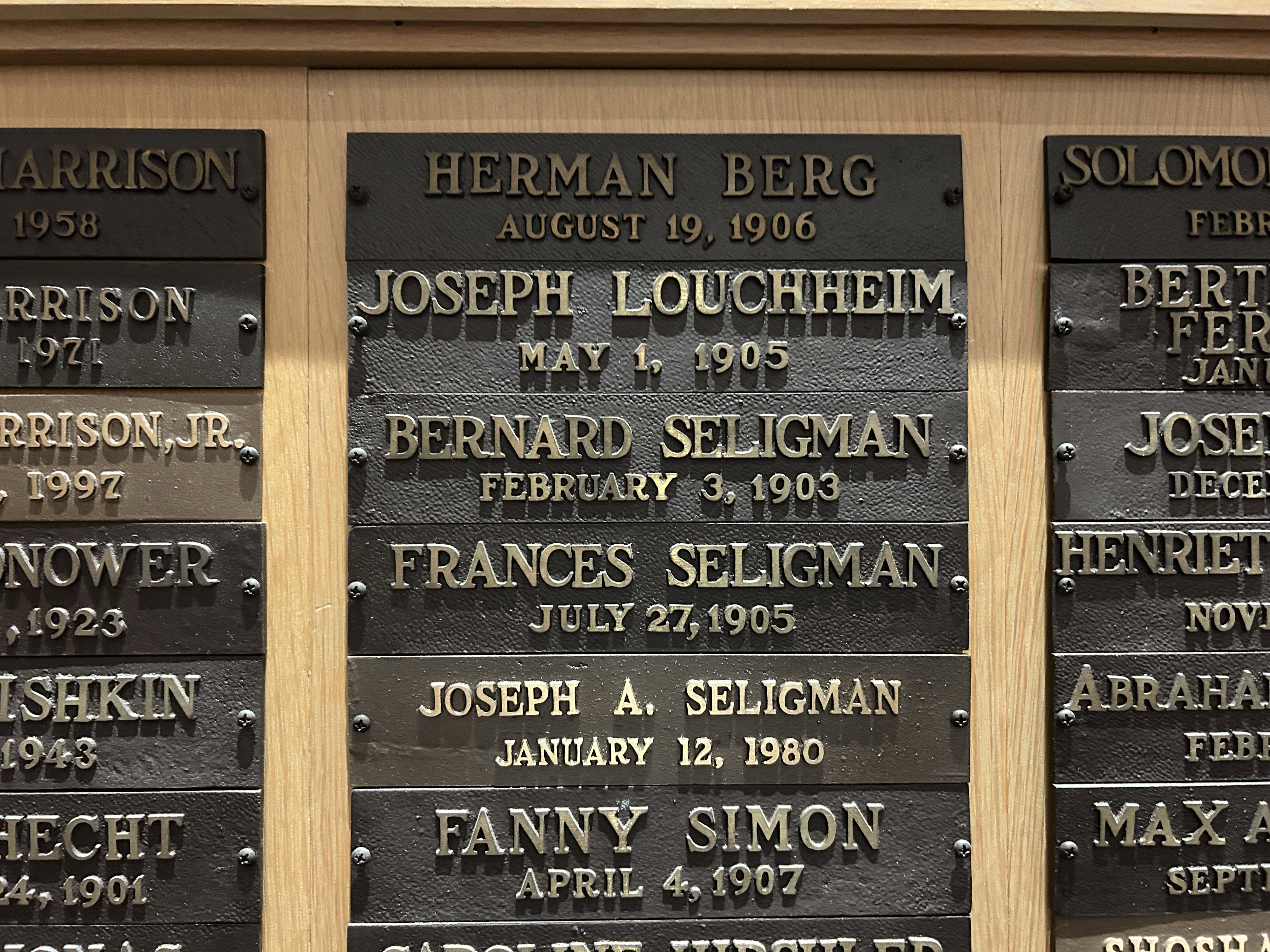
There is also a handwritten codicil to the will dated February 18, 1905. It includes additional specific bequests of various items of personal property and also provides that $200 was to be given to Congregation Keneseth Israel for the purpose of “placing the names of my husband Bernard Seligman and my own, together with the dates of our respective deaths, upon the memorial tablet on the North-East Wall of the Synagogue.” We all want to be remembered, don’t we?

I wrote to Congregation Keneseth Israel, now located in the suburbs of Philadelphia, asking about my great-great-grandparents’ plaque, and I was quite moved and relieved to learn that it still exists on their memorial wall in their suburban location. Their executive director Brian Rissinger kindly sent me this image of the plaques:

Finding this will was such a gift. It gave me insights into my great-great-grandmother Frances Nusbaum and her relationships with her children, grandchildren, siblings, and others. And it reminded me how extraordinary her life was—-growing up as the daughter of a successful merchant in Philadelphia only to fall in love with a young immigrant from Germany who had lived in Santa Fe. After marrying him and having four children in Philadelphia, she moved with him and their children to Santa Fe, living in what was then a small but growing pioneer town with very few Jews and even fewer Jewish women. And her will demonstrated that she cared deeply about her Jewish identity. She must have been so resilient and so devoted to make that adjustment to life in Santa Fe. I wrote about Frances and Bernard in my family history novel, Santa Fe Love Song for anyone who wants to know more about them..

Frances was described in her obituary in these terms:

“She was a beautiful and accomplished woman, as good as she was beautiful and as beautiful as she was good, and of a most lovable and gentle disposition. She was an exemplary wife, a fond and good mother, and a dutiful and loving daughter. Indeed she was all that is implied in the phrase ‘a thoroughly good and moral woman.’ … She will be especially remembered by the poor people of [Santa Fe], to whom she was particularly kind. Many and many truly charitable deeds have been put to her credit.”

Everything in her will reflected those same qualities.

I was deeply touched by the relationship between Frances and her daughter Eva, my great-grandmother. Frances had lost two daughters; her daughter Florence had died when she was just a month old, and her daughter Minnie had died when she was seventeen. Thus, Eva, her first born child, was her only surviving daughter, and that must have made Frances cherish her even more.

That Eva was deeply loved by her mother also sheds light on the woman she became. In learning about Eva from my father and from my research, I grew to appreciate what a strong and compassionate woman she was. Like her mother Frances, she lost one son as a baby and a second son predeceased her by committing suicide. Like her mother, Eva was uprooted from Philadelphia to Santa Fe, but returned to Philadelphia for college and lived the rest of her life there after marrying my great-grandfather Emanuel Cohen. Being so far from her parents and brothers back in Santa Fe must have been as difficult for her as it had been for her mother to leave her family behind in Philadelphia to move to Santa Fe.

Despite all those losses and difficulties, Eva clearly had a big heart. She took a widowed brother-in-law and his son into her home for many years, she took her parents into her home when they returned to Philadelphia to retire, and, most importantly to me, she took my father and aunt into her home and provided them with comfort, love, and security when their parents were unable to care for them.

The love between Frances and Eva, between mother and daughter, shines through in this will. And I am so grateful to Teresa for alerting me to the full-text search on FamilySearch so that I could find it.



  1. All the documents included in this post were located using the full-text search on FamilySearch. They are cited there as follows: Philadelphia, Philadelphia, Pennsylvania, United States records,” images,
    FamilySearch (https://www.familysearch.org/ark:/61903/3:1:S3HT-D4WP-CQ?
    view=fullText : Aug 30, 2025), images 189-206 of 315. 

New for 2025!

Happy New Year to all my friends, family, and readers! I hope you all had a joyful and safe New Year’s Eve.

My first big news of 2025 is that my newest family history novel will be released at the end of January just thirty days from now. It’s titled Simon’s Story and was inspired by the story of my three-times great-grandfather’s younger brother Simon Goldschmidt. Although Simon’s life was the spark that led me to write this novel, the book itself is fiction wrapped around the skeleton of Simon’s life.

As described on Amazon, “Simon … came to the United States from Germany, a poor Jewish man whose first wife had died, leaving him with young children. After he remarried, he and his new wife and the children came to the United States. But Simon had a secret that he kept from his children. His daughter Hannah struggled all her life to understand her mysterious and aloof father. Why was he so cold, so withdrawn? What made him the way he was?”

The book is available for pre-order on Kindle now and you can find the link here. The paperback version will also be sold on Amazon and will be available on January 31, 2025.

I hope you will consider reading Simon’s Story, and if you enjoy it, please let me know and also please leave a review on Amazon.

Happy Hanukkah, Happy Kwanzaa, and Merry Christmas!

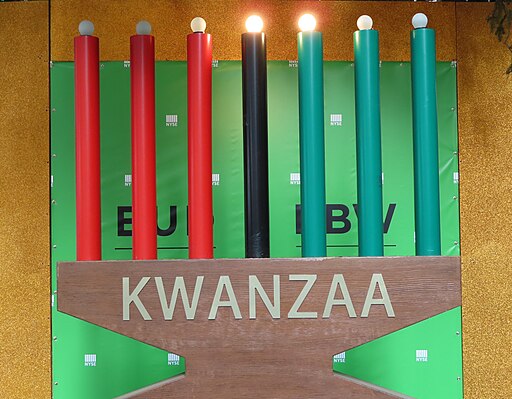
Happy Hanukkah, happy Kwanzaa, and merry Christmas to all my friends, family, and readers! No matter which holiday you celebrate (assuming you celebrate any of them), this will be a week of celebration. I don’t remember there ever being a time where Hanukkah began on the evening of Christmas Day. And Kwanzaa starts on the first day of Hanukkah, the day after Christmas.

While those celebrating Christmas will be honoring the birth of Jesus, gathering around their trees, singing carols, going to church, and opening gifts, we Jews will be honoring the Maccabees who rescued the Temple and rededicated it, thinking of the miracle of the oil, lighting the first candle on the menorah, playing with dreidels and also opening gifts. We will be eating latkes and sufganiyot (doughnuts); Christians will have their traditional Christmas meals (seven fishes or ham or some other festive meal) and Christmas cookies. Those celebrating Kwanzaa light candles in a kinara and have  traditional foods and music and rituals inspired by their African heritage and the seven values the holiday honors. While all of our traditions are different, we will all share a time that brings more light into the darkest time of the year.

And we certainly all need more light right now. Regardless of your political beliefs, there is no question that there is far too much anger, hatred, war, disease, and suffering in the world. The divisions here in the US and in Europe and in the Middle East and throughout the world have made this past year a very scary time.

Let’s hope that whatever joy and light our celebrations bring to our individual families and homes this week can somehow be transformed into love and peace throughout the world.

Christmas Hanukkah Kwanzaa Solstice!

Happy Thanksgiving!

I want to wish all my family, friends, and readers a happy Thanksgiving. Although it would be easy to focus on all our fears and worries, I am going to try and focus during this holiday on all the things for which I am so grateful—including my family, friends and readers! So thank you to all of you who are reading this blog and who follow along as I continue my genealogy adventures.

In particular, I am grateful that my children, grandchildren, and brother will be traveling to the Cape to be with us for this holiday. We know that traveling on Thanksgiving is a major hassle, and we are deeply appreciative of the efforts they are all making so that we can be together.

And I am so grateful that I get to live in this gorgeous part of the world with the person who is the love of my life.

Thank you to you all! See you next week when I return to regularly scheduled programming.

Mourning A Loss

I had a blog post ready for today, but right now that all seems irrelevant. Who cares about the past when the present and the future feel so dark? I know that my parents, my grandparents, and my great-grandparents would be horrified by what has happened to their country. The country I was taught to love, to honor, to respect.

So forgive me if right now I sound angry. I am angry. I guess I am in that stage of grief. I went through denial last night until I heard Pennsylvania had gone for Trump. Pennsylvania—where I wrote over a hundred letters to voters. Pennsylvania—where my father was born and raised, as was his father and his grandfather, and where my ancestors Jacob Cohen and John Nusbaum came in the 1840s to find new opportunities and freedom from oppression. How could Pennsylvania betray us all?

And yes, this is the grief speaking. I have lost a loved one—that loved one is my long-held belief that Americans are basically good, smart, caring people who believe in freedom, justice, and democracy. I am angry with my fellow Americans who betrayed those ideals by voting for Trump. Maybe I will eventually move on to the bargaining stage. But not right now.

Right now these feelings are too raw, too new. I need to sit shiva for this painful loss before I can move on. So please—don’t tell me to accept and move on. Would you say that to someone sitting shiva for a parent or spouse? Would you tell them to move on in those seven days after the funeral? No. You wouldn’t.

And don’t tell me that I need to mend fences and reach out to those who didn’t vote for Harris. Would you tell a mourner to forgive the person who murdered their loved one? Certainly not while they are sitting shiva. No. That would be cruel.

And I certainly do not want to hear from anyone, family or friend or stranger, who voted for Trump or who didn’t vote at all. I can’t forgive you right now, and hearing from you will only increase my pain. I will delete any comments that say anything in defense of your opinion, your vote.

Right now I am in pain. And I feel nothing but despair and anger and grief. I am in mourning. And like any mourner, I only want support, empathy, and understanding of my grief.

Wishes for A Sweet and Peaceful Year Ahead: Rosh Hashanah 5785

It is once again time to think back on the last year and forward to the next. I am hoping that you all have had a good year personally even though it has been a very difficult year for the world.

There has been so much tragedy this year—some caused by our fellow human beings, some by natural forces. Watching the devastation here and across the world and fearing that our planet will be destroyed by war, floods, earthquakes, drought, and hatred is heartbreaking and horrifying. Sometimes it does all feel hopeless. If you live any place ravaged by war or in the path of any of the natural disasters, I hope you are safe and that life improves in the coming year.

I hold on to hope because I still believe that we humans are capable of creating a world that is filled with love, not hate, good, not evil, peace, not war. If we at least each make it true for ourselves in our own relationships and our own lives, maybe it will spread.

Shanah tova! May it be a year of peace, love, and good health for everyone across our world.

By Gilabrand (Own work) [CC BY-SA 3.0 (http://creativecommons.org/licenses/by-sa/3.0)%5D, via Wikimedia Commons

Passover 2024: Our Seder

Why was this seder different from all other seders?

There were so many reasons, starting with the fact that it took place at our daughter and son-in-law’s home in Brooklyn. And it was a much smaller crowd than we usually have. It was just the seven of us—our older daughter and her husband and their two children, our younger daughter, my husband, and myself. The other relatives and friends who usually attend were not able to join us this year.

It was a beautiful seder. My daughter took special care to create a festive seder table. My son-in-law made delicious and allergen-safe charoset. We brought in food from our favorite kosher restaurant. We all felt at home and comfortable, and there were lots of laughs and stories and good food and wine and even some tears. We used our usual Haggadahs and the silly stuffed toys to represent the plagues, and, of course, there were wine and grape juice spills on the white tablecloth, afikomen hidden and found, and macaroons and candy fruit slices to end the meal.

Because we were in a new place with a smaller group, we had a chance to have a different experience and a new perspective on the holiday. The fact that I wasn’t hosting meant more opportunities for me to reflect and observe than I usually have when I am worried about getting everything ready and coordinating when to heat and cook all the food. And I think all of us were reminded that the holiday carries its beauty and its meaning wherever you are and with all who are there—be it seven or seventy.

Of course, the events in the Middle East and here in America also put the holiday in a very different context this year, and there were times that the words in the Haggadah resonated in new ways and with greater power. What struck me most powerfully was how the Haggadah is both universal and particularistic in its messages. The central message is certainly specific to Jews in most ways—the story of our liberation from slavery and oppression to freedom. But within that message is also the more universalistic message that all people deserve to be free from slavery and oppression. We are told not to oppress the stranger because we know what it is like to be a stranger. We are told to welcome all who are hungry to our table—not just Jews, but anyone who is hungry.

The part of the seder this year that moved me the most, however, was the story of the ten plagues. We read this section every single year, but I had never actually focused on what it says. It’s not just to remember that God sent ten plagues to convince Pharoah to free the Jewish slaves—blood, frogs, lice, flies, murrain, boils, locusts, darkness, and the slaying of the first born. The Haggadah instructs us to diminish the wine in our cups as we recite each of these plagues so that we diminish our own joy as we remember the pain inflicted upon the Egyptians.

Lawrence Alma-Tadema, CC BY-SA 2.5 <https://creativecommons.org/licenses/by-sa/2.5&gt;, via Wikimedia Commons

In other words, we are supposed to empathize with the Egyptians. I cannot help but see the parallels to what is happening now in Gaza. As Jews we are reminded that even those who oppress us deserve our sympathy when they suffer pain. To be a good Jew, a good person, means to feel not just our own pain but also the pain of others.

Our seder table this year in Brooklyn also reflected these particularistic and universal lessons of the Haggadah. We had all the traditional symbols—the shankbone, the egg, the charoset, the moror, the parsley for dipping in salt water, the matzah, Elijah’s Cup—the symbols of suffering and of liberation. But we also had some non-traditional symbols.

Two we have incorporated for years now to reflect the central role that women have played and continue to play in Jewish history and life: Miriam’s Cup and an orange. Miriam’s Cup reminds us that women played a role in our liberation from Egypt. And the orange comes from a story about something that was said when the liberal Jewish movements were considering changes that would give women the same rights as men to stand on the bimah and read Torah. Apparently, one opponent of those changes stated, “A woman belongs on the bimah like an orange belongs on the seder plate.” So now we have an orange on our seder plate every year because, yes, women belong on the bimah and in all aspects of Jewish practice.

But this year we added two new symbols to the seder table: olives, at the suggestion of our children’s rabbi in Brooklyn, to express our desire for peace with the Palestinians, and, at the suggestion of my younger grandchild, soy sauce to reflect that there are other cultures in the world in addition to ours.

Our seder might not fit with everyone’s traditions or values, but it most certainly reflected ours. It was beautiful, powerful, moving, and memorable.


The Magic of Old Photos and Modern Technology: Memories of Parkchester

While I am on the subject of old photographs, I wanted to share a heartwarming story that started with one old  photograph.

The photo was one I found mixed in with a bunch of old black and white photographs that had been my parents. I could immediately identify my very young parents in the photo. My mother is the woman in the back with the sleeveless white top. Standing behind her, the man in the suit and tie with dark hair is my father. When I looked more closely at the photo, I realized that my grandmother, Gussie Brotman Goldschlager, is standing to the left of my mother (on my mother’s right), and then all the way in the back left corner almost at the door with only his eyes and nose showing is my grandfather, Isadore Goldschlager.

Who are these people??

But I did not recognize one other person in the photo. Who were all those people with my parents and grandparents? I had no one to ask since my grandparents and my parents are no longer living, nor are any of their peers. But I was determined to try and find out. First I distributed the photo by email to all my Goldschlager and Brotman relatives. Did anyone recognize anyone in the photo? No one did. These did not appear to be my relatives.

I then had what turned out to be a brilliant idea. My grandparents and my parents all lived in Parkchester, a community of apartment buildings in the Bronx that was built in the early 1940s. My mother and her parents had moved there when she was about eleven in 1941 or 1942. Then after my parents married in 1951, my parents had an apartment there also. It was my first home. I hypothesized that the photograph might have been taken in Parkchester in the early 1950s. We moved away in 1957, and my parents looked really, really young here—it may have been taken even before I was born in 1952.

I searched to see if there was a Facebook group for people who once lived in Parkchester, and sure enough, there is one. I posted the photograph there, saying that the photograph was probably taken in the early 1950s and asking if anyone recognized anyone in the photograph. I received numerous comments about living in Parkchester in those years, but no one knew anyone in the photo.

Until, that is, a woman named Gail (Lipman) Amsterdam responded and said that her grandparents, her father, and several other people she knew were in the photograph. And even more incredible—she herself was the little girl sitting on the floor in the front of the photograph. I was totally blown away. Gail is sitting on her grandmother’s lap, and her grandfather is sitting behind her. Gail’s father, Sid Lipman, is the man in the center with the glasses. We assume that her mother either took the picture or was in the kitchen when it was taken.

I learned that Gail had lived in the same building and on the same floor as my grandparents when she was a little girl and that she remembers them. She described them as kind and lovely people. And even more amazing—she remembers my grandparents’ cat and described him perfectly! She even remembers that his name was Rajah. She told me that my grandmother used to let her “borrow” Rajah and take him back to her apartment to play with her. I had a serious case of chills and tears as I read the email in which she shared this with me.  Here was someone I never met who remembered my grandparents and Rajah, who eventually became our cat when my grandmother no longer could care for him. It felt magical.

Rajah (cleverly misspelled by me at ten years old!)

Then I asked Gail about the other people in the photograph. She identified everyone else except for one woman. I told her that I was going to try and locate any relatives of those people because they also might enjoy seeing the photo. Gail said that all the people she knew in the photograph were deceased and that as far as she knew there were no living descendants. One couple did have a son, but in researching the family, I learned that that son had died in the last few years and had had no children or spouse who survived him.

As for the other three adults in the photo, one was Gail’s mother’s best friend, Helen Frankenstein Kaiserman (the woman holding Gail’s doll on her lap), and the two men standing on the right in the rear were Helen’s brothers Morris and Jerome Frankenstein. According to Gail, none of those three had children. Helen had been briefly married but was divorced by the time Gail knew her, and Gail believed that Jerome and Morris had never married.

But I was curious to learn more about the three siblings—Morris, Jerome, and Helen. I just couldn’t accept that there were no living relatives in this family. I turned to Ancestry and began to research the family and soon found them on the 1930 and 1940 census along with their parents and two other siblings. Maybe the other siblings had had children who might be interested in the photo?

In the course of doing that research, however, I stumbled upon an Ancestry tree that had Morris, Jerome, and Helen included. That tree was owned by a researcher named Renate Valencia, and I was surprised to see that according to her tree, Morris had married and had had children. Since his widow and children were still living, their names did not show up on the tree, so I decided to send Renate a message through Ancestry to learn more.

I didn’t have to wait long to hear from her. She was very excited to hear about the photograph and knew that her husband Steve, Morris’ son, would be delighted to see a photograph of his father, uncle, and aunt. Gail was surprised and happy to learn that in fact Morris had married and had had children. I connected Gail and Renate to each other, and they have been exchanging memories and asking and answering questions about the people in the photograph.

Renate sent me this link to a documentary about Parkchester, and it brought back many memories of visiting my grandmother there, going to Macy’s, playing in the playgrounds, chasing pigeons near the fountain, and taking the bright red elevator up to my grandmother’s apartment where once upon a time Gail had lived across the hall. Gail and I may have even ridden in that elevator at the same time, not knowing that all these years later we would connect through the magic of the internet and an old photograph.

All of this would never have been possible without the magic of photographs and the tricks of the internet. Without Facebook and Ancestry, I never would have found Gail or Renate. I never would have learned about the people in that photograph. Now I just wish that I could tell my parents and my grandparents this story and learn more about their memories of that evening and of the people in the photograph.

Can you imagine what all those people in the photograph would think if they knew that seventy or so years after that photograph was taken, three strangers would spend time remembering them all and sharing a magical experience like this? I still get the chills and a bit teary when I think about it.