Update: The Strolowitz/Adler Family, My Grandfather’s Cousins

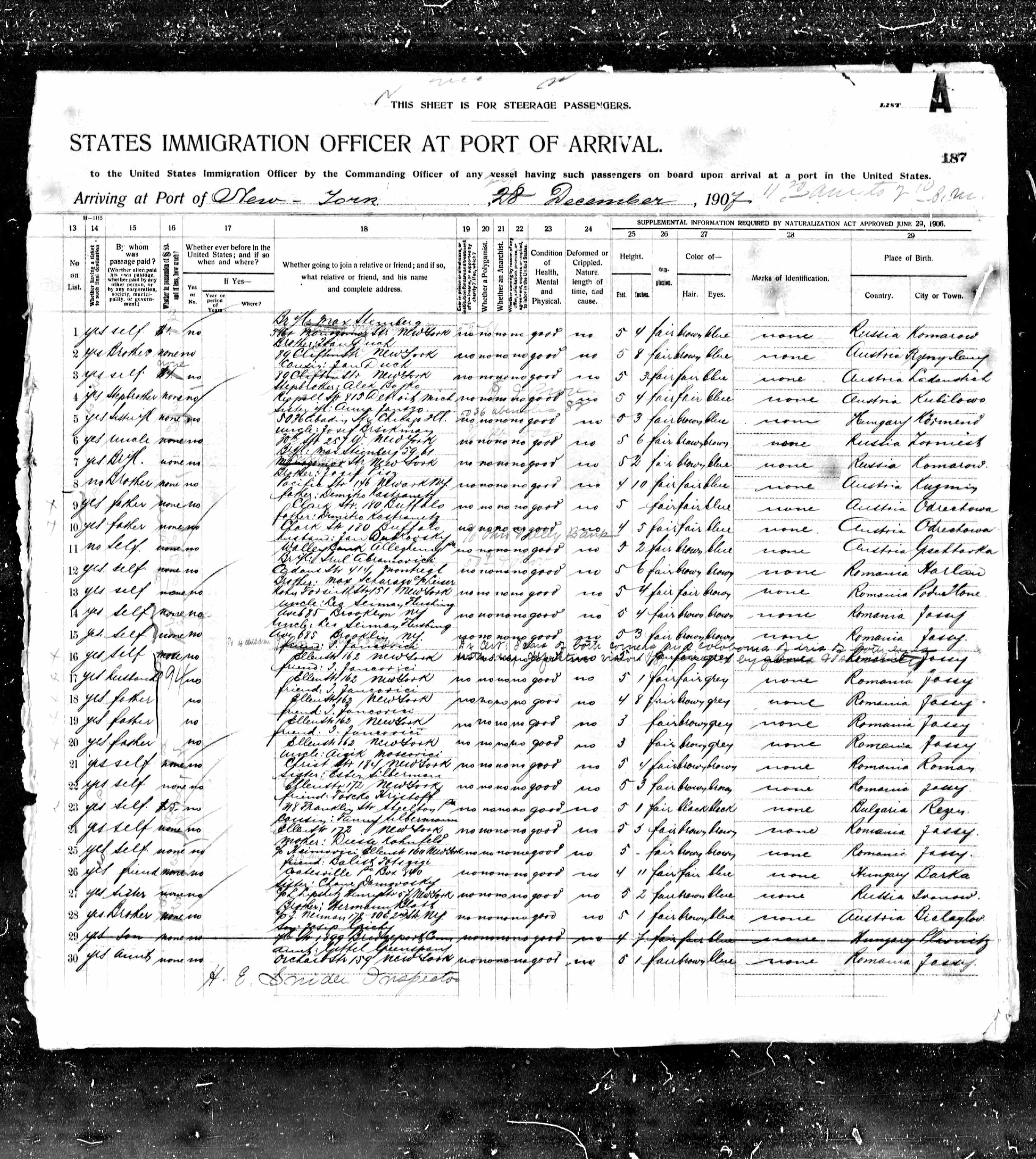
As I have written, in 1910, after my great-grandfather died the day before his daughter Betty arrived and before my great-grandmother and her son David arrived, Betty and her brother Isadore lived with their aunt Tillie Rosensweig Strolovitz and her seven children on East 109th Street in New York City.  Tillie had arrived with her husband Itic Yankel Srulovici and their three youngest children, Beckie, Pincus and Leah, in late December, 1907.  Their four oldest children had left Iasi, Romania, before them: Isidor in 1901, Bertha and Bella in 1906, and David in January, 1907.
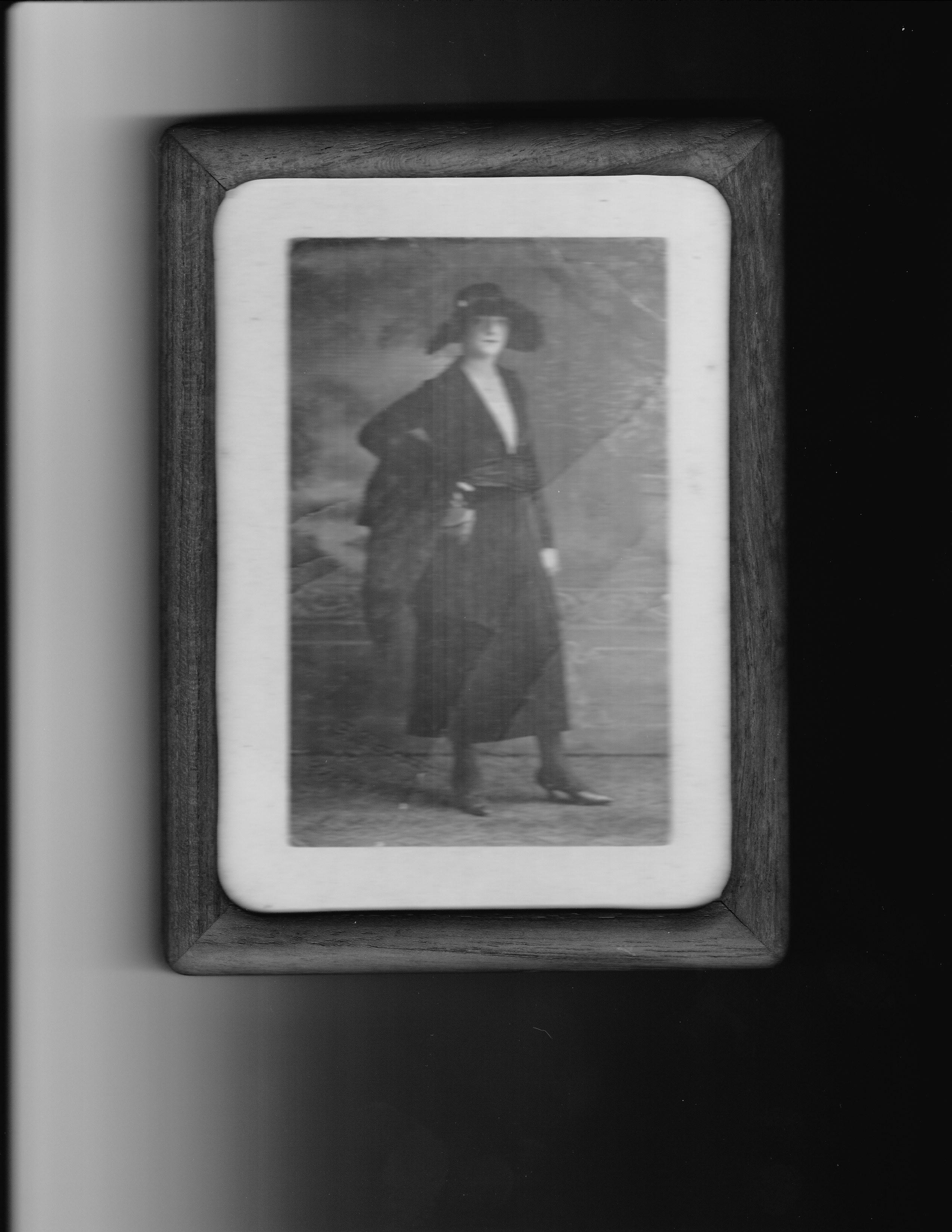
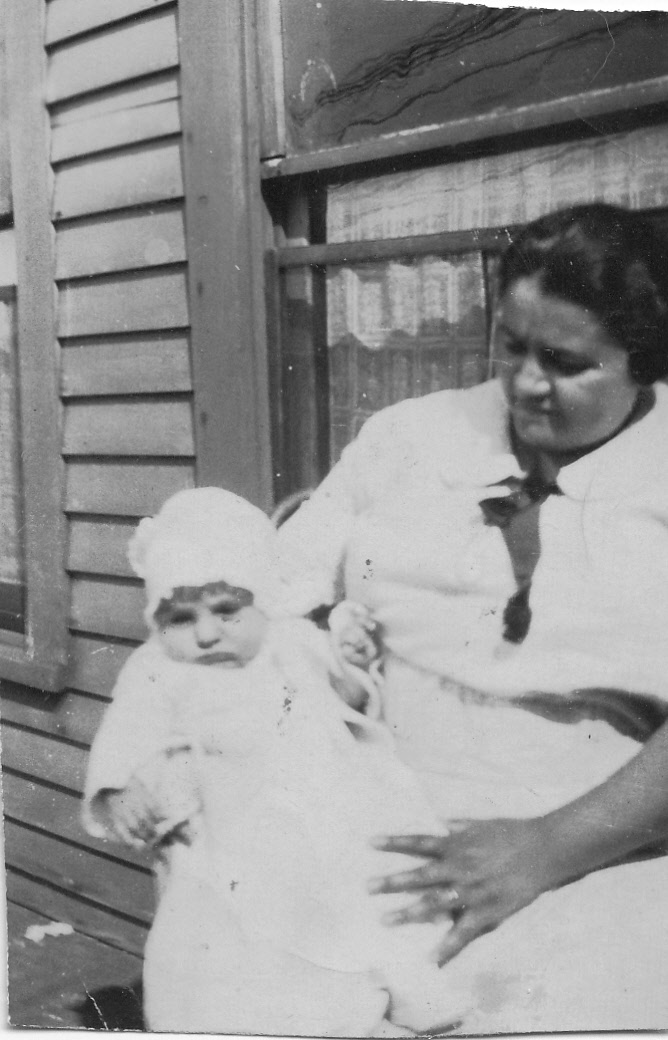
Leah Adler c. 1920

Leah Adler c. 1920

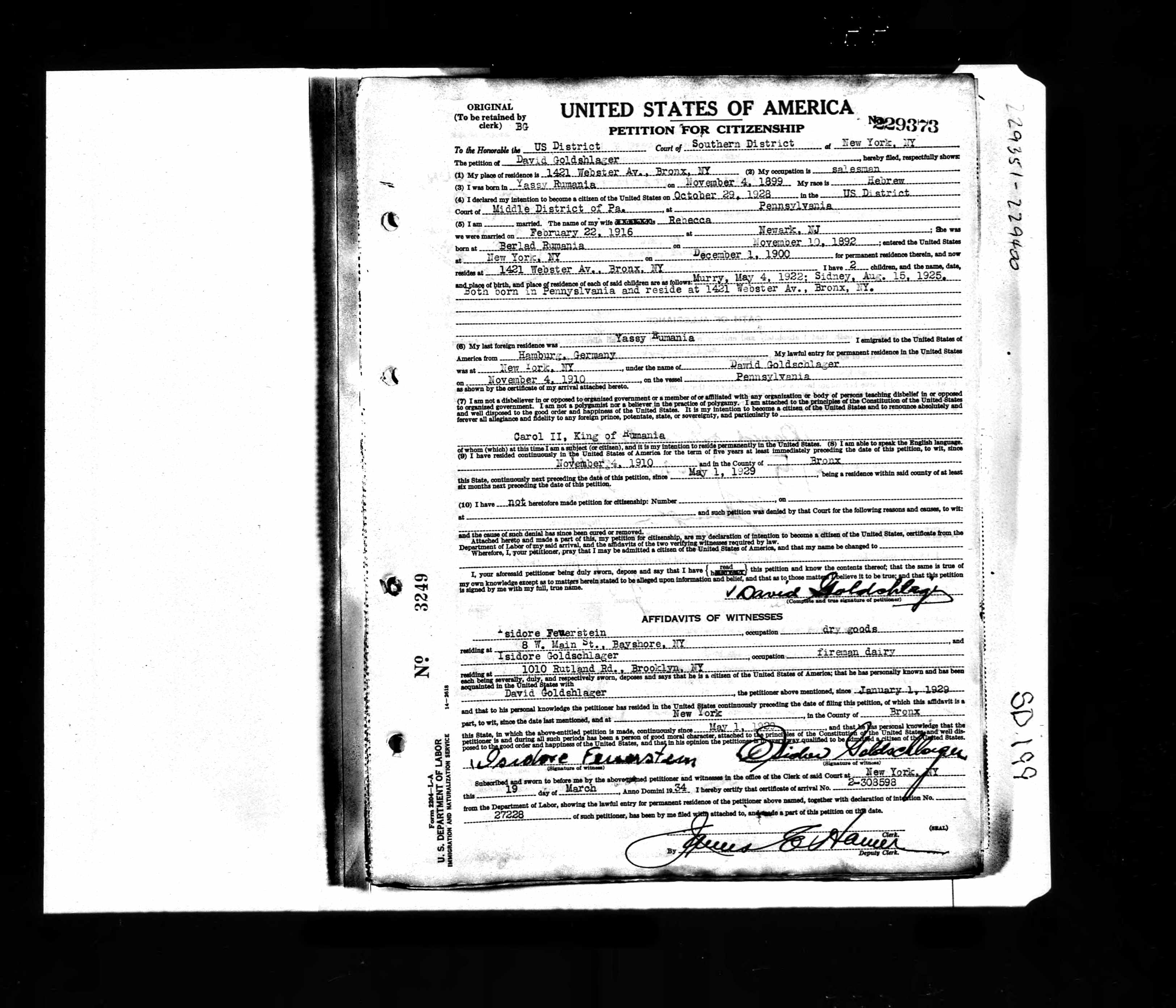
Although I have not yet found a ship manifest for Isidor, the oldest child, I do now have manifests for all the other members of the family, having just located David’s last night.  Among the many documents I received this week were David’s naturalization papers, which provided his date of arrival and the name of the ship.  Although his first name was partially torn off the paper, with a little trick of the trade I learned from Renee, I was able to obtain a copy of the ship manifest as well.  David is listed as “…vid Stubowicz” on the manifest, yet another variation on the family name.  He named his brother, Israel (presumably Isidor) Stubowicz, as the person paying for his ticket and meeting him in New York.   Interestingly, although David’s certificate of arrival has his name as Strubewicz, his petition for naturalization was made under the name David Adler.
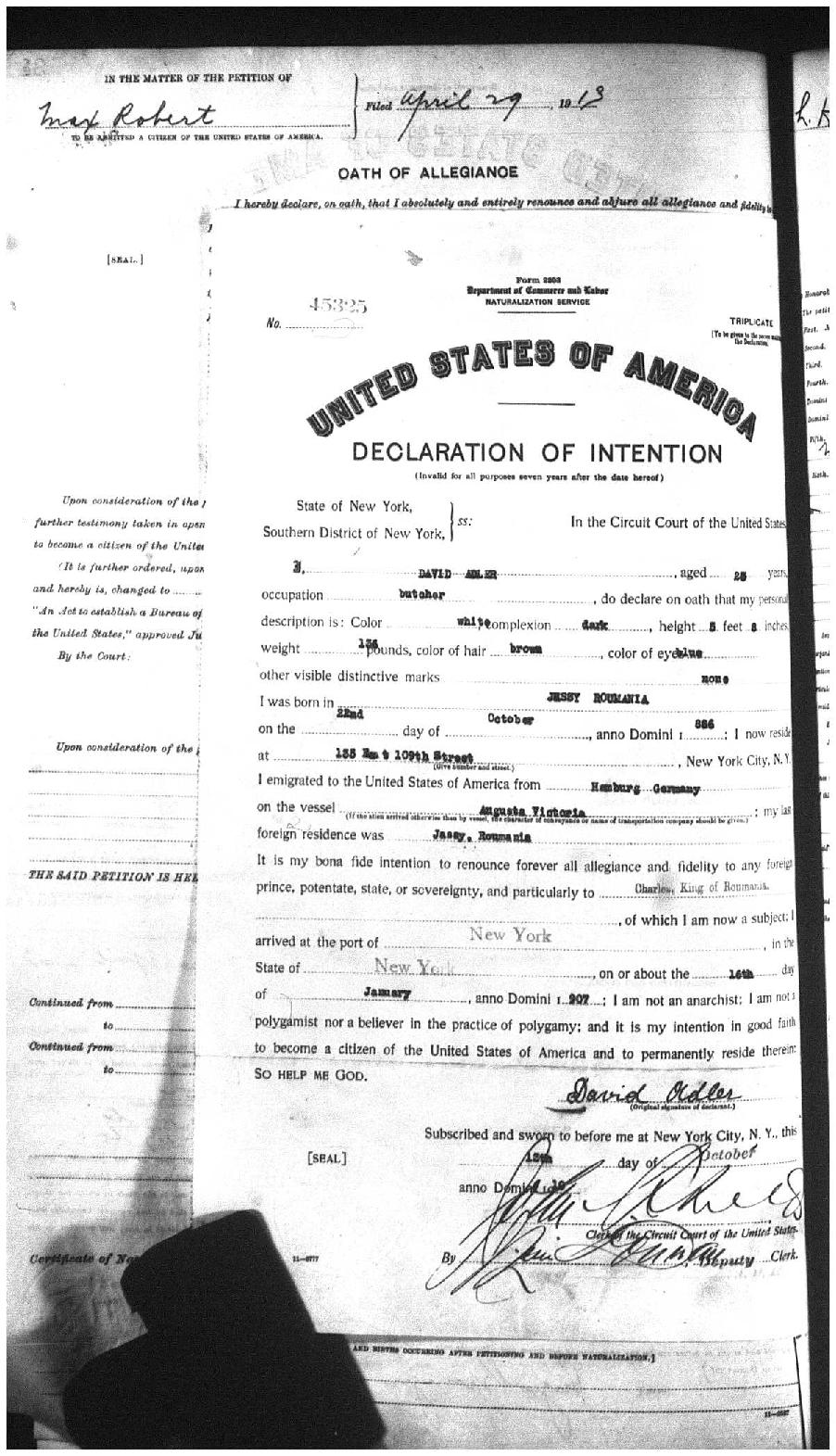
David Adler petition for naturalization

David Adler petition for naturalization

I had already found the manifests for Bertha and Bella and for Tillie, Jacob and the other children, and interestingly, every member of the family used some variation of Srulovici/Strubowicz/Strolovitz on the manifests, not Adler.  It appears that the Adler name was not used officially by the family until after they came to the United States.  Whether Isidor had already adopted it and then the others eventually followed I do not know.  In 1910, we know that only David and Isidor were using Adler, but as already discussed, eventually every member of the family was using it at least part of the time.
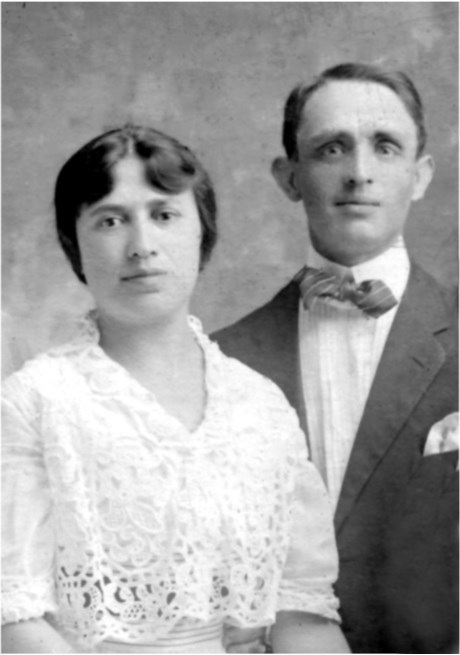
David Adler and his wife Bertha

David Adler and his wife Bertha

In addition to David’s naturalization papers, I received several other documents related to the Adler family.  (For simplicity sake, I will refer to them as the Adlers, except where the Strolowitz name is relevant for a particular reason.)  I had hoped to find something that would help me learn what had happened to Jacob. To recap what I already knew and did not know, I had not found any record of Itic Yankel after the ship manifest of 1907, and family lore said that he had never left Ellis Island.  The ship manifest, however, indicated that he was admitted, after being briefly detained for a doctor’s examination of his eyes.  There is no record of deportation.  I thought perhaps that he had died shortly thereafter, and I ordered the death certificate of the only Jacob Adler I could find who might fit in terms of age and year of death.  I now have that certificate, but unfortunately it was not for the correct Jacob Adler.  The certificate is for a Jacob Adler from Germany who had been in the US since 1880 at the time of his death in 1910.  So I still have no answers to the question of what happened to Jacob, Tillie’s husband.  I am awaiting his immigration papers from the National Archives and hope that they will provide some clues.

I had requested several other documents in order to confirm what I assumed was true: that Tillie was the sister of my great-grandmother Gisella Rosensweig and that Itic Yankel Srulovici and Jacob Adler were the same person and the father of all of the seven children.  Not surprisingly, they all do confirm one or both of those facts.  First, Tillie’s death certificate lists her parents as David and Esther Rosenzweig (no maiden name for Esther, unfortunately), my great-great grandparents, confirming that Tillie was my great-grandmother Gisella’s sister.  Her death certificate was witnessed by her son David, signing as Strulowitz, confirming that Yankel Srulovici was his father and not some other husband named Adler.  (Tillie is also a Strulowitz on the certificate.)
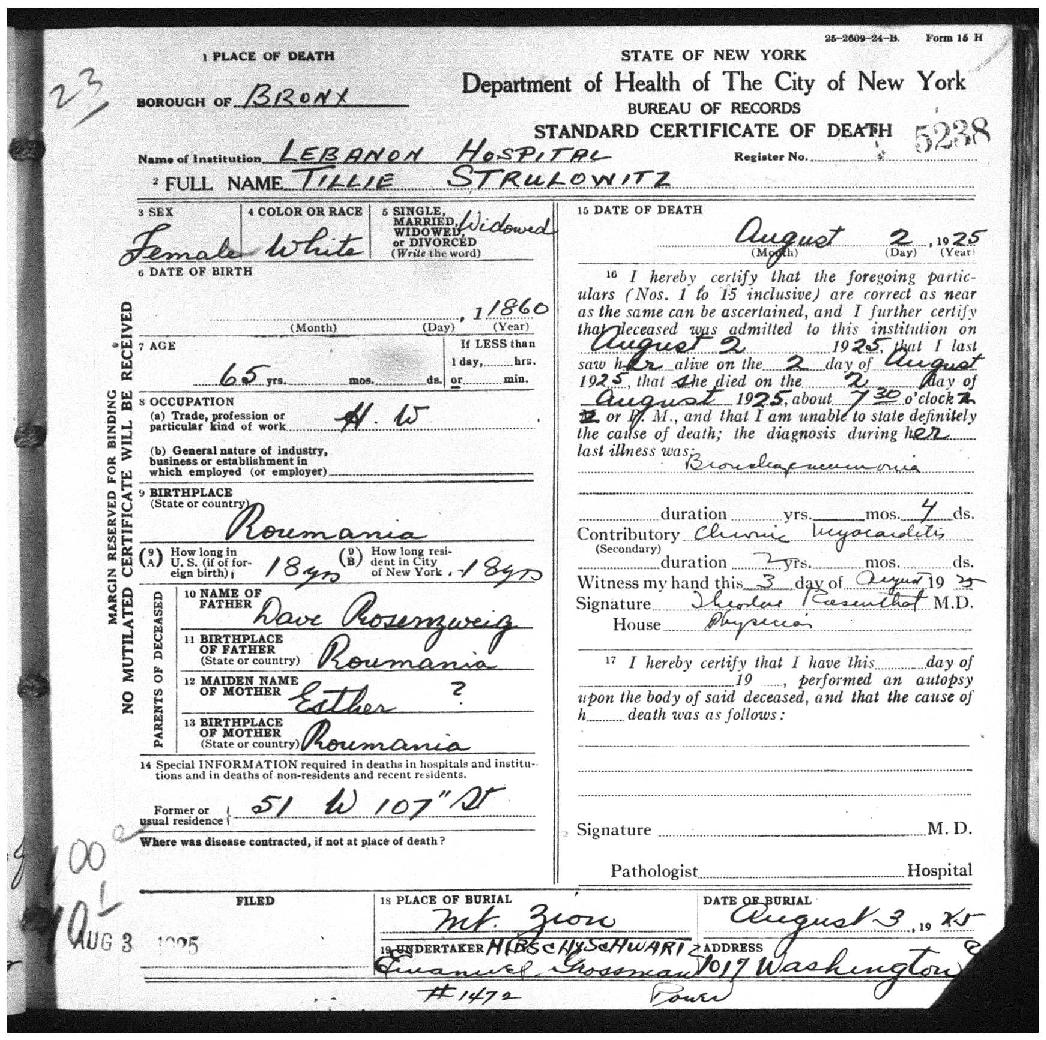
Tillie Strulowitz death certificate

Tillie Strulowitz death certificate

Second, Isidor’s death certificate confirms that he died young—in 1915 of liver cancer at age 31. Although he is identified as Isidor Adler, his parents’ names are given as Tillie Rosenzweig and Jacob Strulowitz. Bertha’s marriage certificate gives her parents’ names also that way, with Bertha also now using Strulowitz.  On the other hand, Leah’s marriage certificate uses Adler and lists her father’s name as simply Jacob (and her mother as Tillie Rosensweig). Finally, David’s death certificate gives his father’s name as Jacob Adler (and David’s name as David Adler), and his mother’s as Tillie Rosensweig.  Certainly this is enough documentation to prove that Jacob Adler and Yankel Srulovici were the same person and the father of the seven children.

Isidor Adler death certificate

Isidor Adler death certificate

Thus, many open questions were answered by these latest documents, but there remains still the question of what happened to Jacob Srulovici/Strolovitz/Strulowitz/Adler after he arrived at Ellis Island.

In addition, the marriage certificate of Bertha contains the signature of a Gustav Rosenzweig as a witness to the marriage.  Could this be Tillie and Gisella’s brother? Or a nephew? Cousin? And thus begins yet another search for a possible member of the extended Goldschlager-Rosensweig family.
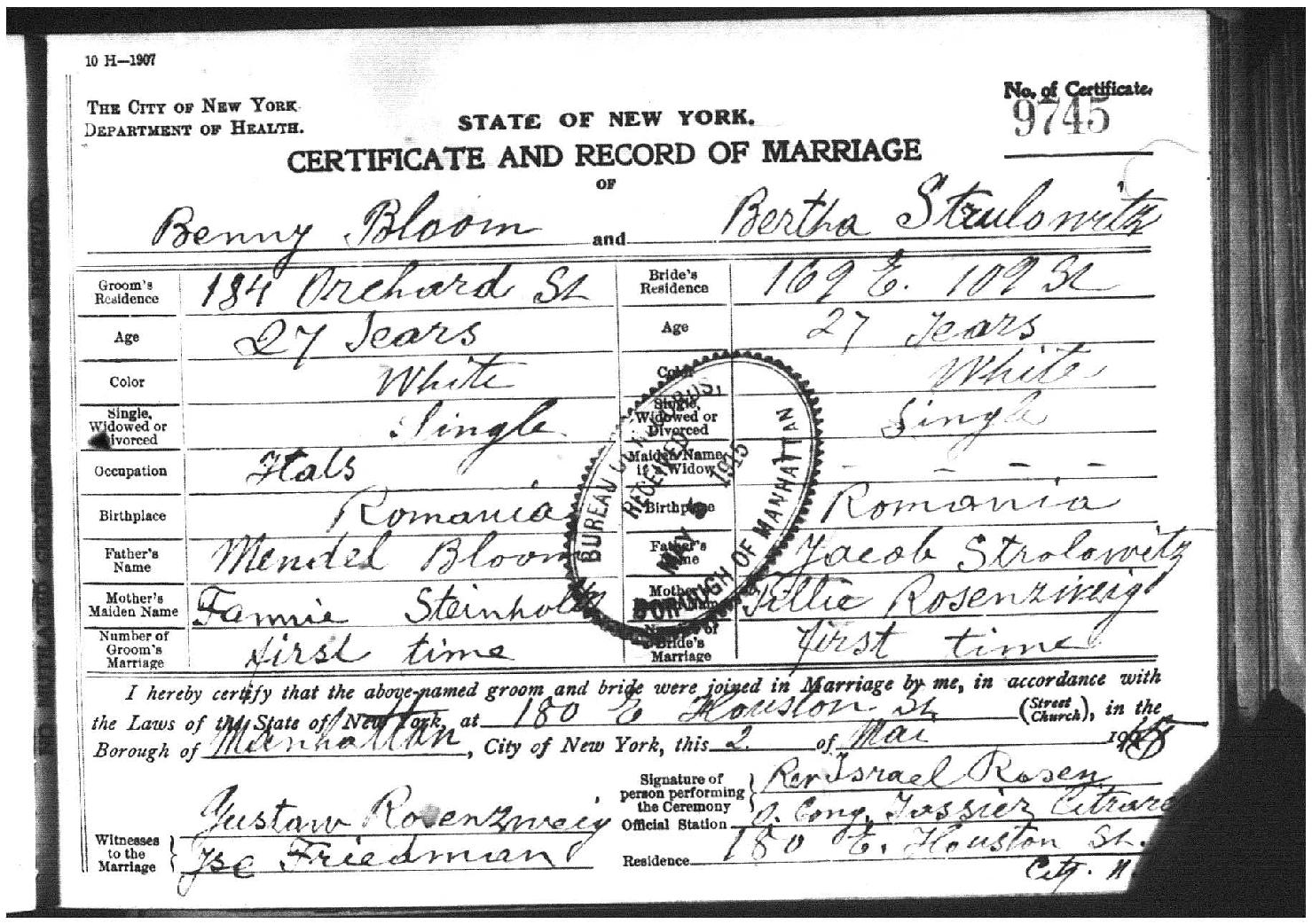
Bertha Strulowitz marriage certificate witnessed by Gustav Rosensweig

Bertha Strulowitz marriage certificate witnessed by Gustav Rosensweig

Enhanced by Zemanta

Update: My Grandfather’s Arrival

Statue of Liberty National Monument, Ellis Isl...

Statue of Liberty National Monument, Ellis Island and Liberty Island, Manhattan, in New York County (Photo credit: Wikipedia)

Yesterday I received eight new documents, and I will report on them all over the next couple of days.  But for me, the most exciting document is my grandfather’s naturalization application.  It is always touching to see a document written in the handwriting of someone who means a lot to you, so that alone would have made it exciting.  It’s also exciting to see the names of my grandmother and aunt and uncle on his petition.  It’s exciting to see his distinctive signature.

But what made these pages particularly exciting is that they resolved a question that has been unanswered for a long time.  A number of years ago my brother tried to find the ship manifest for our grandfather Isadore at Ellis Island.  He was able to locate the manifests for David, Betty, Moritz and Gisella, but not Isadore.  When I started my own research almost two years ago, I also tried to find something that documented when Isadore arrived in New York, but found only the same information that Ira had found.  I had given up and moved on to other things.

When I returned to researching the Goldschlagers a few weeks ago, I once again looked, figuring that with my improved research skills and newer research tools, maybe I would finally find a ship manifest for my grandfather, but once again, nothing turned up.  I resigned myself to the idea that I would never find a record for his arrival.

Then the other day, as I wrote in my post entitled “Isadore and David Goldschlager: More than Brothers,” I realized that there were two ship manifests for David Goldschlager: one dated October 27, 1904, and the other dated November 4, 1910.  I also realized that it was the later one that was accurate.  Every other document said David had arrived in 1910: his naturalization papers, several census reports, and his wife’s naturalization papers.  It also made sense that David had waited with his mother and sailed with her to America.

That left me thinking that the David Goldschlager on the 1904 manifest was not David, but Isadore, my grandfather.  That manifest was for a ship called the Patricia, sailing from Hamburg, and arriving in the United States on October 27, 1904.  I was hoping that Isadore’s naturalization papers would reveal what ship brought my grandfather to America.  I hoped that I had finally found the evidence of how and when Isadore traveled to his new home.

Well, I opened the naturalization papers today, holding my breath, scanning quickly to see if the answer was revealed.  And there it was: Isadore wrote that he arrived on October 28, 1904, on the Patricia, sailing from Hamburg.  Isadore had in fact used his younger brother’s name to escape from Romania.

Isadore Goldschlager naturalization papers page 1

Isadore Goldschlager naturalization papers
page 1

page 2

page 2

page 3

page 3

I was always told that he left Romania to avoid the draft.  He turned sixteen in August, 1904, and was presumably then draft age.  David, on the other hand, was a year younger and would not turn sixteen until 1905.  Perhaps Isadore took David’s passport to get out of Romania.  Or maybe he just used his name.  (That leaves me wondering how David managed to stay safe until he left in 1910, but I am afraid we will never know the answer to that question.)

When I told my mother what I had found, she said that she was not surprised that her father figured out a way to get out of the country.  He was a very clever and resourceful man who knew how to get what he wanted.  He used his wits to survive.  As one of his namesakes who never knew him likes to say, “If at all possible, lie.” It seems that that approach may have saved our grandfather’s life and enabled his three children, his nine grandchildren, his fourteen great-grandchildren, and the ever-increasing number of great-great grandchildren to come into this world.

Thank you, Grandpa, for being so clever and for escaping Romania, and thank you, David, for letting him borrow your name.

SS Patricia, the ship that brought my grandfather to America

SS Patricia, the ship that brought my grandfather to America

Enhanced by Zemanta

The Schwartz Family

As I wrote yesterday, in trying to fill the holes in David Goldschlager’s story, I ended up researching his wife Rebecca’s family and their story.  Although her family is not technically related to mine except through marriage, now that I am in touch with her grandson Richard (and now, her nephew Jon), I feel connected to this story and touched by it as well.

As I wrote in the last post, I was curious as to why David and Rebecca left New York City sometime after 1920, when David’s mother and sister were living with them, and moved to Scranton, Pennsylvania.  Their son, Murray, was born there,[1] and they were living in Scranton as late as 1928 because that is where David was living when he filed his naturalization application.  By 1930, however, they had returned to New York and were living in the Bronx, where they lived until they retired and moved to Arizona to live near Murray and his wife Edna and their grandson Richard.

I hypothesized that Rebecca’s family lived in Scranton because I could not figure out what else would have drawn David away from his family and place of employment.  As I wrote last, I started digging around for Rebecca’s family, and after learning her maiden name was Schwar(t)z from her naturalization form, I was able to locate the ship manifest for Rebecca and her family on the SS Astoria, sailing from Glasgow, Scotland in March, 1903.

Schwarz Family on the SS Astoria 1903

Schwarz Family on the SS Astoria 1903

The family was from Romania, and Rebecca was one of seven children on the manifest, traveling with her mother Louise.  Rebecca was the oldest child, thirteen years old, followed by Etta (11), Annette (9), Rosa (7), Sophie (4), Abram (2), and Henrie (9 months old).  Henrie’s name had a line drawn through it, and in the left margin next to Henrie’s name, it looks like the word “died” followed by some other illegible words were written.  It looked like Henrie, the baby, had died on board.  Imagine being the mother of seven young children, caring for them on this long, uncomfortable voyage, and losing one of your children while at sea.[2]

The manifest also identified who was meeting the family in the United States: their husband and father S. Schwarz of Newark, New Jersey.  By searching the 1910 US census, I was able to locate the Schwartz family in Newark.  Rebecca’s father’s name was Solomon, and he was employed as a hat finisher in a hat factory.  He and Louise (Lizzie, on this census) were living with their six children who had survived the trip from Romania plus two more born in New Jersey, Meyer and Jennie.  Rebecca was now 20 and, like her father, working as a hat finisher in a hat factory.

The Schwartz Family in Newark (Rebecca standing in the rear middle)

The Schwartz Family in Newark (Rebecca standing in the rear middle)

Is this how she met David? As a hat maker? Did the factory where she and her father worked have a connection to the factory where David was working? David had been working as a hatter since at least 1915, as indicated on the 1915 NYS census. On his World War I draft registration dated June 5, 1917 (after he and Rebecca were married), David listed his employment as a hatter for Sam Burk at 419 Lafayette Street, New York.  Who knows? Maybe there was a hatmakers union meeting where Rebecca and/or her father met David.  At any rate, they were married in Newark in 1916, but lived in New York City as of the 1920 census.

Rebecca and Sidney Goldschlager

Rebecca and Sidney Goldschlager

Meanwhile, the Schwartz family had suffered another tragedy.  On the 1920 census, I noticed that although Etta, Annette, Rosie, Sophie, Abram (now Abie), and Jennie were still listed as living at home, there was no entry for Meyer, who had been only six years old in 1910.  I had to assume that something had happened to Meyer, and I learned from Jon Schwartz, one of Solomon’s grandsons, that Meyer had died from a ruptured appendix in 1913 when he was not yet nine years old.  As Jon said, his father Abram (who became Arnold) was the only son of Solomon and Louise to survive to adulthood.

In 1930, most of the Schwartz family was still living under one roof: Solomon, Louise, Annette, Sophie, Arnold (formerly Abram), and Jeanette (formerly Jennie).  I don’t know where Etta and Rosie were, perhaps they were married.  Sadly, Solomon Schwartz died three years later at age 71.  Louise died in 1948.  I have not yet traced what happened to the Schwartz children after their father died, although by 1933, even the youngest child would have been in her twenties.  I am hoping to learn more from Jon, who is Arnold’s son and who I was able to contact by finding his family tree on ancestry.

One other interesting fact that I did learn from Jon is that Solomon Schwartz had lived in Iasi before marrying Louise, who was from Berlad.  He then moved to Berlad where their first seven children were born before they emigrated to the United States.  Maybe that led to the connection between Rebecca and David? Maybe the Schwartz family in Iasi knew the Goldschlager family, and perhaps when Solomon was looking for a match for his oldest daughter Rebecca, he reached out to people from the American Iasi community and found David, a fellow hatter, newly arrived from America and the same age as his daughter. There is likely no one alive who knows how David and Rebecca met, so all we can do is speculate, creating stories to fill the gaps between the data we can find through these documents.

Meanwhile, despite all these discoveries, I still don’t know why David and Rebecca ended up in Scranton, Pennsylvania.  So far all I know is that there were two hat companies in Scranton at the time, the Lackawanna Hat Company and the Keystone Hat Company.  There were also two families named Goldschlager living in Scranton at that time.  So maybe these Scranton Goldschlagers were also our relatives?

Washington Avenue, Scranton, Pennsylvania, Uni...

Washington Avenue, Scranton, Pennsylvania, United States. (Photo credit: Wikipedia)

The research continues….


[1] It appears that Sidney was born in Newark, NJ, in 1925, according to his mother’s naturalization form and the 1940 US census.  However, on David’s naturalization, it says both sons were born in Pennsylvania.  The 1930 census says both were born in New York, which must be wrong.  So perhaps they were living in Newark when Sidney was born and then returned to Scranton, assuming that Rebecca and the 1930 census are correct as to where Sidney was born.

[2] According to Jonathan Schwartz, one of the grandchildren of Solomon and Louise Schwartz, Henrie never left Europe, but this seems inconsistent with this manifest as well as a separate document listing passengers on the SS Astoria for this voyage.  Henrie’s name appears on both.  Maybe the family could not bear the truth and created a story that Henrie continued to live in Romania.

Enhanced by Zemanta

Isadore and David Goldschlager: More than Brothers?

Yesterday I decided to try and fill some of the gaps in David Goldschlager’s history.  I had his birth record from Iasi, saying he was born November 4, 1889, a year after my grandfather, and the ship manifest from the Patricia saying that he had arrived on October 27, 1904.  But then there was a big gap.  He did not appear on the 1905 New York State census, although I had found Isadore, living alone in Manhattan.  Nor did David appear on the 1910 census, although both Isadore and Betty were living with their aunt Tillie Strolovitz and her seven children.  But where was David? It made no sense to me that he was not living with his family in either 1905 or 1910.  He first shows up on an official census in 1915, when he was living with his mother Gittel/Gisella and his siblings Isadore and Betty.

Also, I was curious as to how and why he ended up living in Pennsylvania when Murray was born in 1922.  I had not yet found a marriage record for David and Rebecca, although I knew they were married by 1917 because David so reported on his draft registration card filed that year.  Also, the 1920 census had them living in Manhattan.  I also knew that David had been working as a hat maker since at least 1915 because that was his occupation listed on the 1915 New York census, as it was also on his draft registration and the 1920 census and each one thereafter.  So what took him to Scranton?

I thought perhaps that Rebecca was from Scranton, so I started searching for her records.  I did not know her maiden name, and I could not find any record of their marriage in the NYC marriage index.  I was stumped.  But then I found her naturalization papers, and they were a goldmine of information.  From these papers I learned that Rebecca’s maiden name was Schwar(t)z, that she was born in Berlad, Romania, on April 29, 1889, that she had arrived in March, 1903 on the SS Astoria via Glasgow, and that she had married David Goldschlager on February 20, 1916, in Newark, New Jersey.  I also confirmed that their son Murray was born in Scranton, PA, and that Sidney was born in Newark, New Jersey.

Rebecca Goldschlager's naturalization papers

Rebecca Goldschlager’s naturalization papers

From there, I was able to find Rebecca’s family on the SS Astoria ship manifest and find the names of her mother and many siblings and the name of her father Solomon Schwartz, who was meeting them and resided in Newark, New Jersey.  When I followed up with census reports for the Schwartz family in Newark, I learned that Solomon was, like David, also a hat maker.  Perhaps David had met Solomon in the circles of the hatmaking trade, and Solomon had then introduced David to his daughter Rebecca? It now made sense why David had gotten married and at one point lived in Newark, but why Scranton? I am still trying to figure that out.

Rebecca’s family’s story is itself worth telling, and I will in my next post.  But for me personally, the bigger story comes back to David and Isadore.  While reviewing Rebecca’s naturalization papers, I noticed that it said that David had himself arrived in New York on November 4, 1910, not October 27, 1904, as reported on the ship manifest for the SS Patricia.  I thought either that it was a clerical mistake or a memory mistake and dismissed it.  But then I looked back at a few of the census reports for David and Rebecca and noticed that on those reports as well, his arrival date was reported as 1910, not 1904.  I had also earlier dismissed that as an error.  But now I was starting to wonder—how likely was it that the same 1910 date was reported so many times and yet wrong?

I went back to look at the naturalization papers I had for David and saw that those also reported his arrival date as November 4, 1910.  Now I was really puzzled.  When I first found David’s naturalization papers, I had not focused on this, nor did I realize then that there is a second page to the naturalization papers.  I turned to the next page and found this:

David Goldschlager Naturalization Record

David Goldschlager Naturalization Record

First thing I noticed was that my grandfather Isadore had signed David’s application with his very distinctive and florid signature; the second witness was Isidor Feuerstein, Betty Goldschlager’s husband.  Then I looked more closely at the information provided on the form.  It clearly said that David had arrived on the SS Pennsylvania from Hamburg on November 4, 1910.  Now I was convinced that the 1904 date must be wrong.

I searched for the manifest for the SS Pennsylvania arriving in NYC on that date, and sure enough I found David’s name, indicating that he was being met in New York City by his father Moritz Goldschlager.  Only then did my slow brain react and realize that this was the very same ship that Gittel/Gisella, David’s mother, sailed on when she arrived in New York.  I went back to double-check, and sure enough, it was the same exact ship.  I don’t know why Gittel and David were not listed together on the manifest.  If they had been, I would have noticed this long ago.  But clearly it makes sense that David and his mother came together, both arriving in New York, expecting to be met by Moritz, only to be met instead by Isadore, who had to tell them that Moritz had died in April, seven months before.

So then why was there a 1904 ship manifest for a sixteen year old named David Goldschlager from Jassy, Romania?  Well, I see three possibilities.  One, there were two David Goldschlagers about the same age in Jassy.  That certainly is a possibility, although I have not found another David Goldschlager from Romania (there is one from Austria) on any of the census reports in New York.  Two, David went back to Romania and then returned again with his mother in 1910.  That is also possible, but would he have left so soon after arriving that he was gone by the time of the 1905 census?

Three, and the possibility that makes perhaps the most sense and that brought tears to my eyes, the David Goldschlager who arrived in 1904 was really my grandfather, Isadore Goldschlager.  Isadore was 16 on October 27, 1904 (David was actually only fifteen).  Isadore did arrive in 1904 according to several census reports.  And Isadore was trying to avoid the draft, so very well might have had to use an assumed name to get out of Romania.  And I have not been able to locate any other ship manifest that has Isadore’s name on it.  He may have walked out of Romania, but he certainly did not walk across the Atlantic Ocean.

After much searching, I have just an hour ago located the index number for Isadore’s naturalization papers from 1917.  I have added them to the list of documents I am ordering, and it is the document I am most anxious to see.  Perhaps it will reveal when Isadore arrived and on what ship.  Maybe it will reveal that Isadore did, in fact, arrive under his brother’s name.

If so, I have to rewrite some of the Goldschlager family history.  It would mean that Isadore was here alone for five years before his father arrived in 1909.  It would mean that he was here alone to deal with his father’s death in April, 1910, and to comfort his sister Betty, who arrived the following day.  It would mean that he alone had to tell his mother and his brother that their husband and father had died when they arrived at Ellis Island in November, 1910, seven months after Moritz had died.  It’s far too much pain and suffering for me to imagine one very young man enduring.

UPDATE:  See my post updating the research on this page.

Isadore age 27

Isadore age 27

Enhanced by Zemanta

My Grandfather and Alma Gluck

In a recent conversation with my mother about her father, my grandfather Isadore Goldschlager, she said that one of the things that my grandfather remembered fondly about Iasi was the music.  From the photograph of the house where he was born, you can see a cathedral towering in the background.  My mother wondered whether that was where her father heard the music he loved.

One of the other stories my mother recalled was that my grandfather used to say that he babysat for Alma Gluck.  I knew nothing in detail about Alma Gluck, except that she was a famous opera singer and recording star, so I decided to do some research and see if I could figure out a link between my grandfather and Alma Gluck.

Alma Gluck

Cover of Alma Gluck

In reading a number of biographies online, I first learned that Alma Gluck was born Reba Fiersohn, daughter of Leon and Zara Fiersohn in 1884 in Romania; some sources say she was born in Bucharest, but others say she was born in Iasi.  Perhaps her family and the Goldschlager family were friends or at least acquaintances.   Since my grandfather was born in 1888 in Iasi, he obviously did not literally babysit for Alma Gluck herself since she was four years older; he must have babysat for her child.

Reba Fiersohn arrived in the United States in 1890, brought to the United States by her older sister Cecile, according to a biography from the Jewish Women’s Archive.  They lived in the Lower East Side, where Reba went to school and then worked as an office clerk.  On May 25, 1902, she married Bernard Glick, with whom she had a daughter, Abigail Marcia, who was born on June 9, 1903.  In 1906, Reba was discovered by an associate of her husband and began training to become an opera singer.  She debuted with the Metropolitan Opera in 1909 and became a very successful concert performer and recording star under the name Alma Gluck.  She traveled throughout the United States and was considered the most successful recording star of the time.

Here is one of her best known recordings, Carry Me Back to Old Virginny.  You can find several others online.

She divorced Bernard Glick in 1912 and subsequently in 1914 married Efrem Zimbalist, the violinist, with whom she traveled, performed and recorded.  She and Zimbalist had two children, Maria, born in 1915, and Efrem, Jr., the actor, director and writer.  Although she continued to tour and record for a few more years, her voice had become strained, and she retired in 1924.  Alma Gluck died in 1938 from cirrhosis of the liver.

English: Russian-born American composer, condu...

English: Russian-born American composer, conductor and violinist Efrem Zimbalist (1890-1985) with his wife American opera singer Alma Gluck (1884-1938) (Photo credit: Wikipedia)

So where in this story might my grandfather fit? My best guess is that he babysat for Abigail, Alma Gluck’s child with her first husband Bernard.  As noted above, Abigail was born in 1903; my grandfather arrived some time in 1903 or early 1904.  In 1905 he was living alone at 2213 Second Avenue in New York, working as a grocery store clerk.  He was seventeen years old at the time.  That same year, according to the 1905 New York State census, Bernard and Reba Glick were living with their two year old daughter Abigail at 2 St. Nicholas Terrace in New York.  Bernard was an insurance agent, and Reba, the future star, was doing housework.  Could Isadore have been babysitting for little Abigail? St. Nicholas Terrace is crosstown from where my grandfather was living, about a half hour walk according to Google Maps.  It does not seem likely that the Glicks knew Isadore from the neighborhood, unless the store where he was working was located in their neighborhood north of Morningside Park.  Unfortunately, that’s a fact I will not be able to determine.

In 1909, Isadore was living at 440 East (?) 147th Street, according to the ship manifest for his father Moritz.  Google Maps could not find such an address in Manhattan, only in the Bronx, so perhaps it was 440 West 147th Street, about a mile north of where the Glicks had been living in 1905 and on the same side of Manhattan.  In 1910, Isadore was living with his aunt Tillie Strolovitz and her children on East 109th Street, back on the East Side.  The Glick family was living at 325 West 93rd Street, two and half miles away crosstown from where Isadore was living.  Again, unless there was some other connection—from back in Iasi or some Romanian community connection, it is not obvious how Isadore would have ended up babysitting for Abigail.

By 1912, Reba Fiersohn Glick had become the famous Alma Gluck, divorced from Bernard and traveling around the country.  One source reported that she fought Bernard for custody of Abigail and prevailed after a bitter court battle.  I cannot find where Abigail or either of her parents were living in 1915, but since by that time her mother was famous, wealthy and remarried, Abigail herself was twelve, and Isadore was 27 and working full time as a milkman, I doubt very much that he was babysitting for Abigail in 1915 or thereafter.

So is there any truth to the story that my grandfather babysat for Alma Gluck?  I, of course, am inclined to believe my grandpa—who wouldn’t? And it is entirely possible that he had a connection through ties in Iasi to the family of Reba Fiersohn.  He was a new immigrant when Abigail was just a toddler and himself alone and just a teenager.  Perhaps there was some outreach from former residents of his home city who arranged for him to earn some money as a babysitter for the future Alma Gluck, even if he was living crosstown.  We will never know with any certainty, but I believe that my grandfather babysat for little Abigail.

If he did, I wonder whether he knew how famous Abigail herself became.  Abigail Glick grew up to become a well-known writer under the name Marcia Davenport.  Among other works, she wrote the novel East Side, West Side, which became the basis of the well-known movie by the same name.  She was on the staff of The New Yorker for several years and wrote a very well-regarded biography of Mozart.  She also wrote an autobiography entitled Too Strong for Fantasy.  I have just ordered a copy—maybe she will talk about the young teenage boy who babysat for her when she was a young child? Unlikely, given all the other much more glamorous and interesting things that happened to her in her life, but I will be reading it with an eye open for any such reference.

We may never know a lot of things with absolute certainty.  Sometimes we just have to accept the versions of the truth we have learned.

Enhanced by Zemanta

The Wonderful Generosity of Genealogists

I have been working the last couple of days on the search for what happened to the husband of my great-great aunt, Tillie Rosensweig Srulovic/Strolowitz/Strulowitz/Adler.  The last record I have of him is on the manifest for the ship that brought him along with Tillie and their three youngest children to the United States in December, 1907.  On the manifest, as previously discussed, his name is Itic Yankel Srulovici.  There are notations on the manifest that indicate that although he first was considered in good health, a later notation written over that finding indicates that he had scars on his corneas and coloboma in both irises.  However, the record also indicated that he was examined by a Doctor Snider and is stamped “admitted,” though it also indicates that the family was held for several days and a bond had to be posted for their release.

ship manifest 1907

ship manifest 1907

page 2 of manifest

page 2 of manifest

I did some research on the history of Ellis Island, and apparently there was a contagious eye condition, trachoma, that was commonly a basis for refusing entry to an immigrant.  Perhaps when the inspectors saw something strange about Itic’s eyes, they decided to hold him for further examination.  Reading this the first time, however, I wasn’t sure how to interpret the “admitted”—did that mean he was admitted after the exam? Was it possible they had deported him? And if he stayed, when did he become Jacob Adler, and when did he die?

And why is there no record of him after leaving Ellis Island?  In my emails with Itic’s great-granddaughter Jean, she said that family lore is that her great-grandfather never left Ellis Island.   Did that mean he had died on Ellis Island? Had he been deported?  I could not determine how to figure this out.

Immigrants just arrived from Foreign Countries...

Immigrants just arrived from Foreign Countries–Immigrant Building, Ellis Island, New York Harbor. (Half of a stereo card) (Photo credit: Wikipedia)

And that’s where the generosity of genealogists comes in.  I posted an inquiry on the JewishGen discussion list, asking for opinions and help in figuring out what had happened to Itic/Jacob.  And within less than an hour, I started receiving responses and continue to receive very helpful responses.  I have said this before, but I continue to be amazed and touched by how helpful, supportive and generous with their time and energies these experienced genealogists are.  Renee Steinig continues be an incredible source of support—with ideas, suggestions, and documents that she finds for me on her own time.  Others also have gone out of their way, including Bette (whose last name I don’t even know but who has helped me before on other questions), Phyllis Kramer, Marian Smith, Don Solomon, Sally Bruckheimer, David Crook, Diane Jacobs, Adelle Gloger, and several more.

And so what have I Iearned? Well, most of these people advised me that it is very unlikely that he was deported.  If the document is marked “admitted,” then he was admitted.  There would be some notation in the file if he had been deported.  Several people gave me websites and search engines to use to see if I could find a death record or gravesite where Itic/Jacob appeared.  So far I have not found any record other than the the death certificate for a Jacob Adler who died in 1910, but I can’t find a gravesite for that person.  I hope to have the death certificate by the end of next week, so perhaps if it identifies him as Tillie’s husband, we will have an answer.

I also was advised to request a document from the National Archives and was even provided with the document identification information by someone who was looked it up on an index I wouldn’t otherwise have been able to access.  I called the National Archives, and I am now waiting for them to call me back.  So I am hoping that by the end of next week I will have some documentation that may fill out the story and tell us what happened to Tillie’s husband, Gisella’s brother-in-law.

I could never have gotten as far on this journey without all this help.  Thank you again to every person who has provided me with help.  I look forward to paying it forward to another new genealogy researcher some day soon.  I can never pay all of you back for what you have given me.

Enhanced by Zemanta

First Cousins: The Grandchildren of David and Esther Rosensweig

Immigrants just arrived from Foreign Countries...

Immigrants just arrived from Foreign Countries–Immigrant Building, Ellis Island, New York Harbor. (Half of a stereo card) (Photo credit: Wikipedia)

Genealogy research can be both very frustrating and very exhilarating.  Sometimes you feel like you have hit a wall and can get no further.  Every stone you turn leads nowhere.  People don’t respond to requests for information, documents have been lost or destroyed, and you feel like you will never find anything new.  Then there are the times that are exhilarating.  You find a document that tells a story and reveals a relative you never knew about.  You contact a long lost cousin and make a new friend.  You put together pieces of a puzzle and see a picture of your family that touches you in ways you never anticipated.

Yesterday was one of those exhilarating days.  I had found an email address for someone I thought could be one of Leah Adler’s grandsons and had taken a chance that it was the right person and that he would respond.  It was a long shot—we are fairly distant cousins—third cousins—and it was very unlikely that my name and background would mean much to him.  Well, I hit the jackpot!  He forwarded my email to his sister Jean, who is herself someone with 30 years of experience in genealogy.  Jean wrote to me right away, and we have since exchanged several emails and lots of information.  Through this contact, I have been able to learn a lot more about my great-grandmother’s sister Tillie and her family.

Some might wonder why I care so much about these individuals and their lives.  Well, these were my grandfather’s first cousins.  He and his brother David were close in age to Isidor, Bertha, Bella, David, Pincus and Becky, and his sister Betty would have been close in age to Leah.  These could have been their playmates as children in Iasi.  They all had the same grandparents, David and Esther Rosensweig.  Tillie and Ghitla both named sons for their father David.

Moreover, Tillie took in my grandfather and his sister in 1910 when she herself was a single mother already caring for her seven children.  My grandfather and his sister must have been mourning their father, who had died in April, 1910, and awaiting their mother, who arrived in November.  (One mystery: I cannot find David Goldschlager on any 1910 census, though he shows up living with his mother and siblings in 1915.)

So what have I learned from Jean about my grandfather’s aunt and her children? For one thing, it now seems quite clear that Itic Yankel Srulivici and Jacob Adler were one and the same person.  Jean said that family lore in her family is that Jacob never left Ellis Island.  The ship manifest does indicate that he was admitted in 1907, but perhaps something happened after that to block his ability to leave Ellis Island.  The ship manifest does indicate that he was examined by a doctor and had scars on his corneas and coloboma of both irises.  Could that have been enough to block his entry and have him deported?  I have ordered a death certificate for a Jacob Adler who died in 1910, and I have asked my Romanian researcher to look for a record for Itic in Romania.

Jean was also able to confirm much of the information that I had found in public documents: that Bertha had been briefly married, that David died in the 1930s, and that her mother Teddy had married Abner Cohen.  She also told me that Bertha had been killed in an accident in the 1960s, that Bella had married Baer Rothschild and had had no children, and that Beckie, who became Ray as an adult, had married Ben Seamon and had four children, including a daughter Thelma with whom Jean had corresponded in the late 1970s and who had filled Jean in on many of these details.  Sadly, Thelma was also killed in a freak accident in 2000.

It seems no one knows what happened to Isidor, and I have sent for one death certificate that might be his from 1915.  If it is in fact his death certificate, it would mean he died very young, as did his brother Pincus.  The Adler family had more than their fair share of tragedies—losing Jacob, Isidor, Pincus and David at such young ages and losing Bertha and Thelma to freak accidents.  As with my grandfather as well as his brother David Goldschlager, it seems that Leah and her siblings also did not like discussing their past or their childhood family.  Perhaps the hardships of leaving Iasi where they had lived as children, coming to America as immigrants, and fighting to survive the poverty and the language and cultural differences left them all with scars that made it too painful to recall the past.

I don’t know anything about what their childhoods were like in Iasi.  I’ve read enough to know that there was terrible anti-Semitism in Romania during those years and also terrible poverty.  But children often are immune to those external factors in many ways because they know nothing else.  I’d like to think that the Goldschlager-Rosensweig-Srulivici children as young children had some joyfulness in their lives.  I’d like to imagine that Isadore, David and Betty Goldschlager and Isidor, Bertha, Bella, David, Beckie, Pincus and Leah Srulivic/Adler were all young cousins who played together and grew up together in Iasi, just as I was fortunate enough to grow up with my first cousins Jeff and Jody, who lived less than 20 minutes away from us during my childhood. All my first cousins—Jeff, Jody, Beth, Suzie, Robin and Jamie (Jim)– added so much laughter and joy to my life as a child, and I would hope that the same was true for my grandfather, his siblings and his first cousins.

Isadore and Gussie’s nine grandchildren 

Jeff and Jim 1971

Jeff and Jim 1971

jody julie and ira 1963

jody julie and ira 1963

Beth 1954

Beth 1954

Julie, Robin, Amy, Suzie, and Ira 1962

Julie, Robin, Amy, Suzie, and Ira 1962

Elaine Jeff and Amy 1953

Amy and Jeff (with Elaine) 1953

Enhanced by Zemanta

Family resemblances

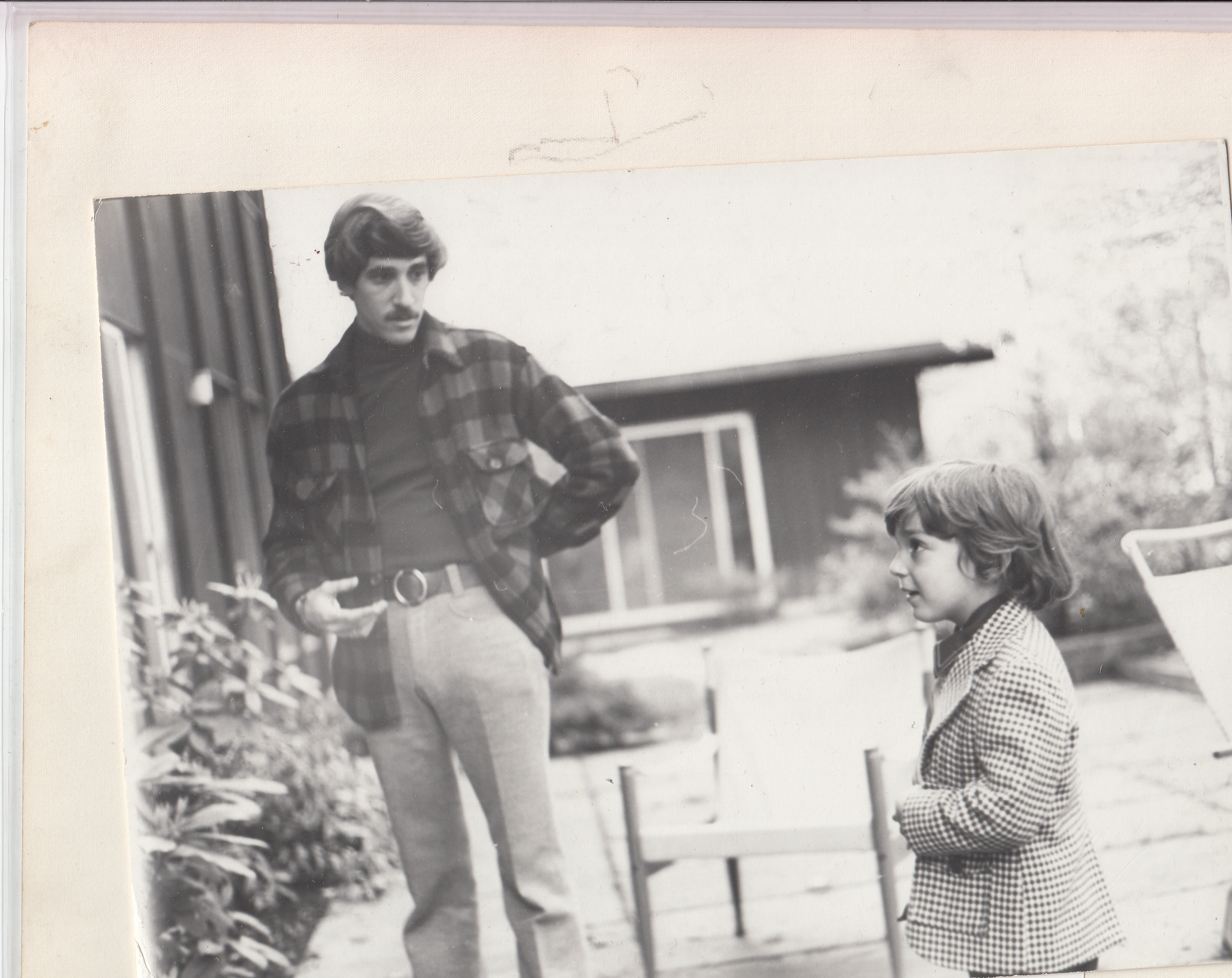
I have a lot to report about the Adler family research, but no time to write a lot tonight.  So instead I am going to post these two photographs.  One is of my grandfather Isadore Goldschlager; the other is of his nephew Murray, David Goldschlager’s son.

The genes are amazing, aren’t they?

ImageImage

More answers about the Adler Strolovitz family

Picking up from where I left off with the Adler/Strolowitz family, I had located what had happened toTillie and to all of the children except Isidor and Beckie Adler.  David had married Bertha, had a daughter Tessie, and died in 1936.   Pincus had died as a young man, and Tillie had died in 1925.  Leah had married Benjamin Schwartz, with whom she had two children, Ira and Theodora.  I was even able to find living descendants of David and of Leah and have contacted two of them.

But I still did not have a certain answer to two important questions: was Tillie really related to Gisella and Moritz Goldschlager, my great-grandparents? And why did she and her children seem to use both Adler and some form of Strolovitz as their surnames? And what had happened to their father(s)?

Information to help answer both questions was found in a ship manifest.  Renee showed me how to use a search tool to locate people who came through Ellis Island, Steve Morse’s One-Step website.  With her help, I was able to find the ship manifest document displayed below:

ship manifest 1907

ship manifest 1907

Itic passenger manifest page 2

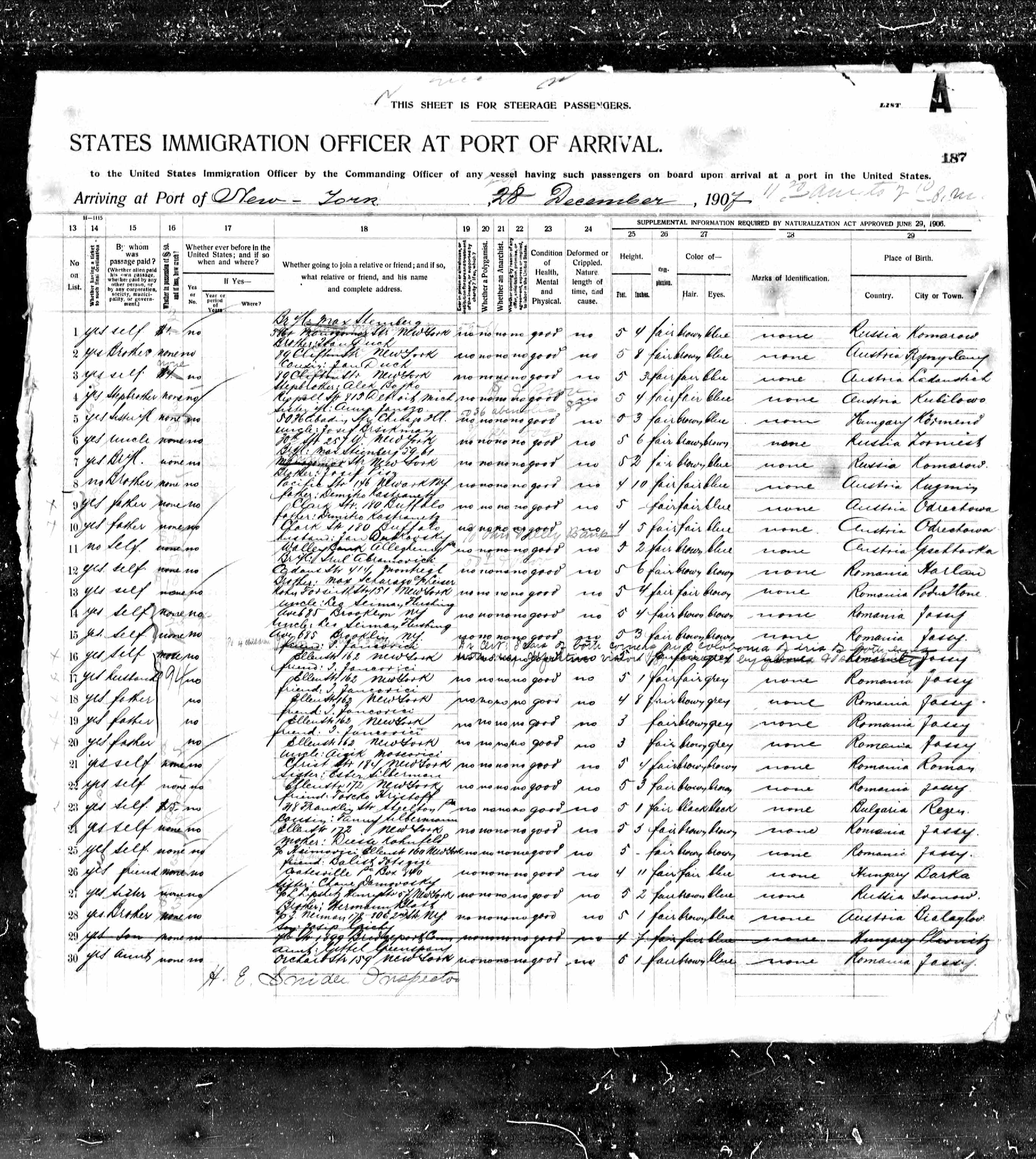
This manifest for the SS Saratow, sailing from Rotterdam on December 14, 1907, includes the names of not only Tillie (Tilla) and three of her children, Rivke (Beckie), Pinkie (Pincus) and Lea(h), but also the name of her husband, Itic Yankel Srulovici, or Isaac Jacob Strolovitz.  Since Yankel is a Yiddishization of Jacob, this would seem to indicate that Jacob  Adler was in fact the same person as Itic Srulovici and thus likely the father of all seven of Tillie’s children.  I am still looking for more records to confirm this, including Itic’s death certificate, Tillie’s death certificate, and the death certificates of their children.  I’ve asked Renee for her opinion and also posted a question on the JewishGen discussion list, and the responses I’ve gotten also seem to agree that Itic and Jacob were one and the same person.

But that’s not all that I was able to learn from this manifest.  If you look in the column asking for the name of someone you know from the place you have left, you will see the name Moritz Goldschlager of Jassy, Romania, my great-grandfather.  He is listed as the uncle to all the children of Itic and Tillie.  What is a bit confusing is that he is listed as Itic’s brother-in-law and Tillie’s brother.  That would seem inconsistent with the fact that Tillie’s maiden name was Rosensweig, as indicated on Pincus Adler’s death certificate, so I need more documentation, but it still seems more likely that Tillie was Gisella’s sister and Moritz’s sister-in-law.

This one document thus brought me that much closer to answering those two important questions.  It did not, however, explain where the Adler came from or what happened to Itic after he left Ellis Island.  Perhaps he died before the 1910 census.  There is only one possible listing in the NYC death register that could be him: a Jacob Adler who died in 1910.  Obviously, I need to obtain a copy of that document to see if it is the same person as Itic Yankel Srulovici.

The other puzzle is why did the family split in their use of the name Adler and Strolovitz.  I asked Renee and the JewishGen discussion list about the use of dual names and received some interesting responses.  Perhaps Adler was Itic’s mother’s maiden name, and when the older male members of the family started working in NYC, Adler might have been an easier name to use than Srulovici.  As the rest of the family grew, they too adopted this easier to pronounce and spell surname.  Or perhaps the older males changed their names to avoid the draft when they left Romania.  One responder said it was not uncommon for men to use false passport information in order to be able to leave and avoid the draft.

I am hoping that Marius Chelcu, the researcher I have used before in Iasi, will find some Romanian records that help to explain where the name Adler came from and with more certainty how Tillie was related to Moritz and Gisella Goldschlager.

Enhanced by Zemanta

The Adler Strolowitz family continued

Although I still don’t have answers to all the questions about the Strolowitz/Adler family, I have made a lot of progress finding the descendants of Tillie Strolowitz Adler and her children, with a lot of assistance from Renee Steinig, who continues to teach me and to amaze me with her ability to find people through various search methods.  So here’s a summary and a description of the process used to find most of these people, including several living descendants who I am now trying to contact.

I’ve not had any success finding Tillie’s son Isidor yet aside from the entry in the 1910 census.  There are numerous Isidor Adlers listed in the NYC marriage index and many also in the US and NY census reports, but I cannot with any degree of certainty identify the right one.  Some are too old or were married and had children before 1910, when the right Isidor was still single and living with his mother.  Some are not from Romania or born in the United States.  I am beginning to think that Isidor either died young or maybe even returned to Romania.  I have found one death record for an Isidor Adler who died April 23, 1915, and the age looks right, so I will send for that death certificate.

I’ve had better luck locating the second son, David Adler.  After a careful process of elimination, I believe that Tilllie’s son David married a woman named Bertha (maiden name not yet found).  Since David also had a sister named Bertha, this created some confusion for me.  David and Bertha had a daughter Tessie, born in 1927 (possibly named for Tillie, who had died in 1925).  Renee found a memorial written about Tessie Adler on the Findagrave.com site, and the date of birth corroborated that this is the correct Tessie.  Tessie and her husband Harry had two sons, David, possibly named for his grandfather David Adler, and Ira.  I am now in touch with Ira, who confirmed that he is Tessie’s son and that she was David’s daughter and Tillie’s granddaughter.

The Strolowitz daughters were much trickier to find, as women tend to be.  Once they get married, they are much harder to find, unless I can find a marriage record which gives me their husband’s name.  I first focused on Bertha, figuring that it was a less common name than Beckie, Bella or Lizzie.  I found a marriage record for Bertha Strulovitz to Benny Bloom in May, 1914.  I then did a census search and found a Bertha and Bernard Bloom living on East 109th Street in 1915.  The “Bernard” threw me, as did the fact that Bertha was 27, meaning she would have been born in 1888, not 1885, as reported on the 1910 census.  But while scanning the page to look for their entry, I saw a listing in the same building for a Tillie Stralowitch and her children, David, Bella, Beckie, Peter (Pincus?) and Lizzie.  This was obviously Tillie Strolowitz, living in the same building as in 1910, with her married daughter Bertha and her new husband Bernard or Ben in their own apartment.  So far, so good.  It also made sense that Bertha was born in 1888, not before David, who was 28 in the 1915 census and thus older than Bertha.  That could explain why David and Isidor were Adlers, while the rest of the children were Strolowitz.  Perhaps Mr. Adler died right after David was born, Tillie remarried to Strolowitz and within a year had Bertha?  Phew!  They acted fast back then!  (Remember Harry Coopersmith…)

But after that, I could not find any references for Bertha Bloom at all.  I was stumped.  I couldn’t find any more references for Tillie Strolowitz either, no matter how I spelled it.  Finally, I decided to look for Tillie Adler, and there she was in the 1920 census, listed as Tillie Adler, living with her three daughters, Bertha, Bella and Leah (Lizzie?) on East 107th Street.  The ages and names matched, but why were they now using Adler? So much for my earlier hypothesis.  Maybe Mr. Adler was the father of all these children? Maybe Mr. Adler and Mr. Strolovitz were the same person? And what happened to Bertha’s husband? Why was she living with her mother?  She is listed as married, not single, on the 1920 census, but not living with Bloom.

In 1925 Tillie, Bertha and Bella were all still living together on East 107th Street under the surname Adler.  There was no question about marital status on this form, but apparently Bertha was still legally married because in 1926 she applied for citizenship.  On the naturalization form she signed as “Bertha Adler known as Bertha Strulovici and Bertha Bloom,” and listed her spouse as Benjamin Bloom.  Her brother David Adler signed as a witness for her.

By 1930, Tillie had died, and Bertha and Bella had moved in with David Adler and his wife Bertha and daughter Tessie.  Imagine—two Bertha Adlers living in one household.  The census taker must have been confused because he listed Bertha, David’s sister, as his mother.  On this census, Bertha (the sister) is now listed as divorced, finally.

In 1940, Bertha was no longer living with David, but now was living with her sister Leah on Grant Avenue in the Bronx.  Leah was married to Benjamin Schwartz, an optometrist, and had two children, Ira and Theodora.  Renee helped me locate Theodora, who is now living in Atlanta where her parents eventually moved and died.

No further luck finding out what happened to Bella or Bertha after 1940, but at least we know what happened to Tillie, David, and Leah, and have located the next generation of third cousins, the great-great grandchildren of David and Esther Rosensweig.

More discoveries in the next post, including some of the most interesting ones of all.  But for now, back to the research.

Enhanced by Zemanta