Something fun

One day a while back my brother asked me whether I thought Uncle Sam looked like our grandmother.  I said that I saw a family resemblance among all four of Bessie and Joseph’s children for whom we had photos.  (Poor Frieda—there does not seem to be any picture of her.  Maybe Harry took off with them all…)  To me, they all resembled Bessie.  Here are some close-up head shots of Bessie and the four children.

Bessie Brotman

Bessie Brotman


Hyman Brotman

Hyman Brotman


Tillie

Tillie


Gussie Brotman

Gussie Brotman


Sam Brotman

Sam Brotman

I did not see as much resemblance between Max and the other children, not surprisingly since he had a different mother.

Max Brotman

Max Brotman

That made me wonder whether Max looked more like Joseph than the other children, or did he look like his mother? (And sadly, we have no pictures of Abraham.  It would be nice to be able to compare Abraham and Max.  Morty and Paula, if you are still reading, do you have any photos of your grandfather??)  We have no photo of Joseph, so it’s all speculation.

So I thought maybe if we combined a picture of Max and Hyman we’d have some clue as to what Joseph looked like.  Totally unscientific, I know, and also illogical, but when you are searching, anything seems like a possibility.  So here’s a picture that morphs Max and Hyman.

max and hyman morphed

max and hyman morphed

Here’s Hyman and Sam morphed—a much closer resemblance:

Sam and Hyman morphed

Sam and Hyman morphed


Then I went a step further and combined Tillie and Gussie—the results are striking.  The two sisters had a strong resemblance.

Tillie and Gussie morphed

Tillie and Gussie morphed

Finally I combined all four of Bessie and Joseph’s children (Hyman, Tillie, Gussie and Sam) and all five of Joseph’s children for whom I have pictures (Max, Hyman, Tillie, Gussie and Sam).

Hyman, Tillie, Gussie and Sam

Hyman, Tillie, Gussie and Sam

Max, Hyman, Tillie, Gussie and Sam morphed

Max, Hyman, Tillie, Gussie and Sam morphed


Obviously these prove nothing, except perhaps that I am easily amused!  What do you think?

Galicia Mon Amour: A Conversation

I just finished watching a video called “Galicia Mon Amour.”  It is a recording of a conversation between Daniel Mendelsohn and Leon Wieseltier.  Mendelsohn’s book, The Lost, which I read a number of years ago, is one of the most moving books I’ve read; in it he recounts his journey to find out what happened to members of his family who had not left Galicia before the Holocaust.  It is beautifully written, well-researched, and deeply tragic.  I read it long before I started doing my own genealogical research, but it likely was one of the sources of inspiration for my journey.[1]

Leon Wieseltier’s book Kaddish is also excellent, but I have to admit much of it was a bit too scholarly and dry for my taste, except for the parts where he reflects on his own family and experiences.  I admit to skimming a lot of the more academic parts of the book.

At any rate, when I saw a recommendation for the video on the digest I receive daily from Gesher Galicia, I decided to try and make the time to watch the video.  (It’s about two hours long.)  You can find a link to the video here.

In the video Mendelsohn interviews Wieseltier about his recent trip to Galicia.  (The interview takes place in January, 2007; Wieseltier’s trip was in 2006.)  Both Mendelsohn and Wieseltier had family that came from eastern Galicia in what is now Ukraine from towns near the city of Lviv, known by the Jews as Lemberg.  Both had taken trips back to the region to research and visit the places where their relatives had lived.  Although Mendelsohn’s direct ancestors had immigrated to the United States before the Holocaust like ours did, he had many relatives who remained behind about whom he had known very little.[2]  Wieseltier’s parents, on the other hand, were Holocaust survivors and came to the United States after World War II.  All the rest of his family was killed in the Holocaust.

One audience member asked at the end of the interview whether there were differences between those who were grandchildren of immigrants and those who were children of Holocaust survivors.  Were the survivors from the wealthier families who saw no reason to leave in the 19th century and the earlier immigrants from the poorer families who had no reason to stay?  Although Wieseltier dismissed this as an overgeneralization, which I am sure it is, it nevertheless is an interesting sociological question.  Remembering Margoshes’ memoirs and the fact that there were so many wealthy Jews, I thought that it made some sense that only those who had nothing to lose would have taken the risk of leaving the world they knew.  This may suggest that Joseph and Bessie were not among the wealthier segments of the Galician Jewish community.

Wieseltier described his own family as being among the more prosperous, educated and aristocratic clans in their area and confirmed the impression left by Margoshes that the Jewish world in Galicia was very diverse and that there were many who were wealthy, well-educated, and sophisticated.  He described Cracow as the “Jerusalem of the North” and the Galitzianers as the princes of the Jewish world.  Mendelsohn concurred, saying that although there was also a lot of poverty, there was a large bourgeoisie and a large wealthy class.  He said that Emperor Franz Joseph, who was the head of the Austro-Hungarian Empire from 1848 until 1916, was admired and even loved by the Jews for his enlightened leadership and treatment of the Jewish citizens, also described in Margoshes’ memoirs.

One observation that I found particularly interesting was Mendelsohn’s comment that he always thought of Jews as living in tenements until he went to Galicia.   He believed that Jews, wherever they lived, lived urban lives, and he was surprised by how wrong he was when he saw the rural areas where they had lived in Galicia.  He described the countryside as beautiful—with mountain, streams, rivers.  Wieseltier used the word “paradise” to describe it.

A lot of their conversation focused on the reasons to make a trip to Galicia.  Both said quite emphatically that this is not a place to go for typical tourist reasons; for Mendelsohn it was partly to find out what happened there and to visit the places where his family had lived. Wieseltier said he went not only out of grief, but also out of pride. He talked movingly of standing where his mother had once stood and leaving a copy of his book in the empty field as a symbol of Jewish survival.  Both talked about the absence of Jewish life there now and how the Polish people themselves realize how much has been lost by the destruction of the Jews and their culture.  Wieseltier said that you won’t find Jewish life there so you must bring your Judaism with you if you go.

There is also discussion of the Holocaust, of the camps, of anti-Semitism, but overall the theme was more about remembering the world that was there in a realistic and accurate way and cherishing that culture and the people.  Wieseltier himself is quite skeptical of genealogy (“It’s amazing how much you can’t learn from genealogy.”).  Although Mendelsohn obviously values genealogical research highly, he did not really push Wieseltier to elaborate on this point.  I think, however, that Wieseltier was expressing some doubts about all those who, like me, are trying to trace some names and dates to make a connection, perhaps without any purpose or perspective.  He said that our parents and grandparents were ours “by luck,” just as the fact that we have two legs or brown eyes, and that what is more important is who we are ourselves and what we do with our lives.  I think that that is an important perspective for me to remember as I continue to look for our family in Galicia.


[1] We were fortunate enough to hear Mendelsohn read from and talk about the book many years back when it was first published.  That made his story even that much more personal.

[2][2][2] I am sure that that is true for the Brotman family as well, although I do not know specifically of any family members who died in the Holocaust.

Joseph and Bessie’s newest great-great-great granddaughter

I am delighted to report that we have a new little girl in the family.  Janis, daughter of Darren and Sara, granddaughter of Peter and Shelley, great-granddaughter of Leo and Mildred, great-great granddaughter of Tillie and Aaron, and great-great-great granddaughter of Bessie and Joseph Brotman, was born two weeks ago.  I don’t have any other details or any pictures, but thought I would share the happy news with the family.

Mazel tov to Darren, Sara, Peter and Shelley, and to Noah and Leo, the big brothers!

Update: Janis was born on December 6, 2013.  How about a picture, Peter? 🙂

Can anyone identify these men?

Judy sent me the photo below (THANK YOU!) and asked whether anyone could help her identify the men in the picture.  We think the man to the far left is Max, but are not sure.   Does anyone recognize the other two men? Can you confirm that that is Max?  You may need to enlarge the page view on your browser to see the photo clearly as it is rather small.

Image


Judy thinks the picture might have been taken near Wingdale, New York.  It would have been some time before 1946.

Can you help?

I know that I have asked for help before, and many of you have responded by sending some pictures and other documents.  Those contributions have really been helpful in learning about our family and the various personalities and relationships.  For example, one wedding picture helped us figure out that Judy and I were both talking about the same Uncle Sam.  One bar mitzvah picture showed that as of 1957,  Gussie’s children and Hyman’s children were still connected.  One hand-written family tree helped to confirm that Abraham’s children and Max’s children had met.

But now I am asking you all to try and find pictures, letters, journals, any documents that may also shed light on our grandparents and great-grandparents as well as our parents and ourselves.  I know that somewhere some of you must have old family pictures like I had.  Maybe you have a wedding album or bar mitzvah album, a box of random old photos or letters.  Maybe someone even has a photo of Frieda or Joseph or another relative, but you had no idea who they were.  Maybe there’s an old newspaper clipping or a birth certificate or draft card or some other document buried in your attic or basement.

I know that you are all busy, and I know that the thought of digging through dusty, musty boxes and albums is not that pleasant.  I just am asking that you perhaps make a resolution for 2014 that you will spend one or two hours seeing if you can find anything.  If you don’t have a scanner, you can mail whatever you have to me, and I will scan it.  I promise to return all the originals once I have scanned them.  If you can scan documents, that would be wonderful also.

No one likes a nag, and I don’t want to be one, but we will all benefit from your efforts.  I hope you will consider spending a little time engaged in a hunt for these things.  From my own experience, I can tell you that I have found great joy and satisfaction in looking at the faces of our relatives in those old pictures.  I hope you will also.

Looking forward: Skiing on the Blue Trails

Having looked back to see what I have learned, I have also gained some insight into to what I still want to learn and what I need to do to get there.

There are a number of unresolved questions.  For me, the most important issue remains determining where our family lived in Galicia.  I am currently assuming that our family came from Dzikow Tarnobrzeg, but it’s only based on two forms completed by Hyman, one referring to Jeekief as his birthplace, the other referring to Giga as his birthplace.  Hyman’s forms had so many inconsistencies in terms of birth date and other facts that I do not want to rely too heavily on it being Dzikow Tarnobrzeg since, as my last post said, forms are not necessarily reliable.  Plus I am speculating that Jeekief/Giga is a phonetic spelling of Dzikow.  Plus there was another Dzikow in Galicia.  But I have to start somewhere, so that’s my current focus.

I am just starting to work with the sources available for documents from Galicia, and I need to devote a lot more time to learning how to search and how to interpret those forms.  I am networking with some other researchers who are also searching in that region or who are also searching for the surname Brotman.  So far nothing relevant has turned up.  I plan to take an online course in May that may help me become a better researcher with respect to these resources and documents.

The second goal I have for my research is trying to locate any other children or siblings of Joseph and/or Bessie.  My brother recalls that my aunt thought that Joseph had four older children in the United States—that is, four who were older than the five children he had with Bessie.  We have found two of those four—Abraham and Max.  There is another Brotman family from Passaic, New Jersey, that I am trying to learn more about.  From what I can tell, it seems there were two brothers, Jacob and Benjamin, who could possibly be sons of Joseph, born after Abraham but before Max.  I have been in touch with relatives of theirs, but as with the Brotmanville Brotmans, I can’t seem to find anything that links their family to ours.  I need to learn the name of the Passaic brothers’ parents before I can begin to determine if there is a connection.  I have the same goal with Brotmanville Brotmans, but without more research of European records for Moses Brotman, I cannot get any further.

So those are my two research goals: go further back in time to learn more about Joseph and Bessie’s families and to find links to other possible families in the United States or elsewhere.

I think that this process has a learning curve similar to learning many other new skills.  It reminds me of learning to ski.  At first it goes very slowly; you don’t know what you are doing and figure that you never will.  You find yourself on the ground as much as you are moving on the skis.  It seems like you will never make progress.  Then suddenly you figure it out—you know how to get down a novice trail pretty easily.  You even start to look like you are skiing, and you think, “Wow, I am actually making progress.  I am skiing.”

But then you decide to try a steeper trail, a blue trail.  If you are a skier like I was, you suddenly find you are stuck somewhere on that trail, staring down and thinking, “Whoa! That’s really scary.  I can’t do that!” And you feel like a beginner all over again.  You start falling, your turns get more awkward, and you look like a klutz compared to everyone else.  You start to think that maybe you will never get off those easy green trails.[1]

That’s what I feel like now.  I am standing at the top of a steeper trail, knowing that getting to the bottom will take a lot longer than it did with the green trail.   I don’t expect to find as many pieces of evidence as quickly as I did while looking for US documents.  But I have to start down this trail—I can’t just stay at the top or return to the green trails.  I need to jump off and start the next part of the adventure.  The rewards may not come as quickly, but when they do, I will once again have that feeling of accomplishment.

I hope you will follow me as I go.  I am not sure what I will find or whether I will find anything, but I am ready to try.


[1][1] I have to admit that as a skier, I never actually made much progress getting off the green trails.  I am hoping that I can get further in my genealogy skills than I ever got with skiing.  At least I won’t have to worry about breaking any bones.

Looking back on the first six months: Seven lessons learned by doing genealogy

As my semester has drawn to an end, as the year draws to an end, I want to take some time to reflect on what I have learned in the last six months or so since I began this project in earnest and what I still want to learn and to accomplish as we start a new year.

So first, what have I learned?

1.  I’ve learned that I had two great-uncles whom I’d never known about.  For at least two months of my research, I was sure that Joseph and Bessie had only had five children: Hyman, Tillie, Gussie, Frieda and Sam.  When I kept running into a Max Brotman married to Sophie with children named Rosalie and Renee, I just figured Hyman had changed his name to Max.  My mother didn’t know about her cousins Joseph, Saul and Manny, but she had met Rosalie and Renee, and I was sure they were Hyman’s daughters.  My mother knew that Hyman’s wife’s name was Sophie.  So instead of looking harder, I just assumed Max was Hyman and that the other Hyman Brotman married to a Sophie was not my relative.  Only when I was able to find Max’s granddaughter Judy and Hyman’s grandson Bruce did I learn that Max and Hyman were BOTH my great-uncles, that both had married women named Sophie, and that Rosalie and Renee were the daughters of Max, not Hyman.  That was a HUGE turning point for me and a big lesson.  Lesson learned? Don’t trust memory alone, and don’t assume that documents are wrong just because family memories conflict with those documents.

Herman and Sophie with sons 1920

Herman and Sophie with sons 1920

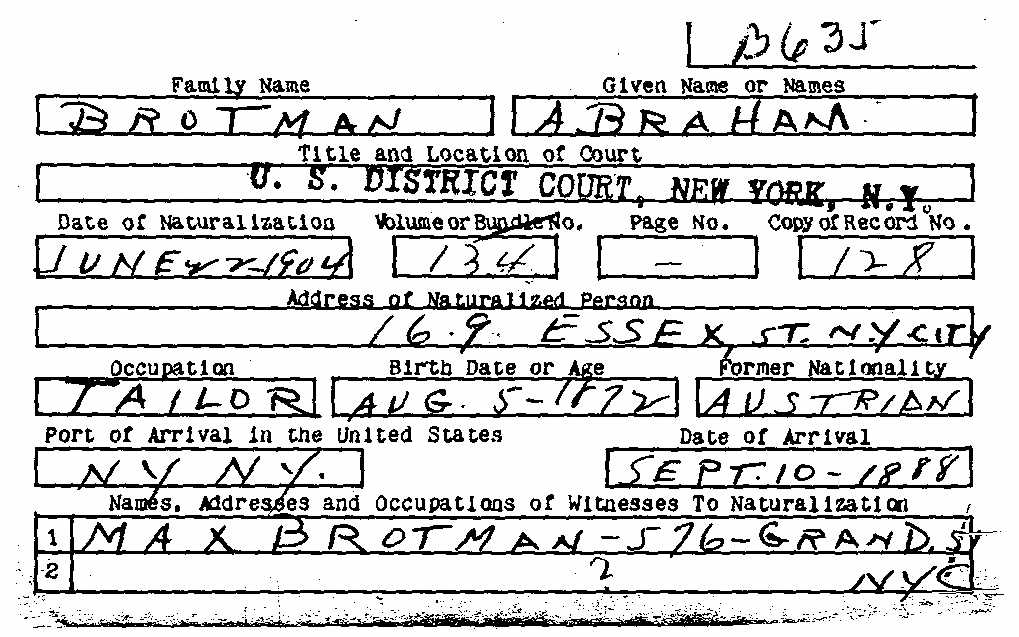
2. The second new great-uncle was Abraham, and finding him was also somewhat of a lucky break.  I ran across many Brotmans in my research, but most I assumed were not our relatives because I could not find any document linking them to our relatives and because no one in our family had ever heard of them.  I can’t even remember all the details, but I recall that it was my brother Ira who found Abraham’s naturalization papers—I think (I am sure he will remember and correct me if I am wrong) it was in the course of looking into the Brotmanville Brotmans.  When I saw Max’s name on those papers, I did not assume it was the same Max.  (There were many Max Brotmans living in NYC at that time.)  Once I checked the address for the Max on Abraham’s card against the address I had for Max on the census form from that same time period, I knew it was in fact “our” Max.  That led me on the search that brought me to Abraham’s headstone and death certificate, indicating that his father was also Joseph Jacob Brotman.  Lesson learned? Don’t dismiss any clue.  You never know where one document may lead you, even if in a direction you never expected.

Naturalization of Abraham Brotman Max as Witness

Naturalization of Abraham Brotman
Max as Witness

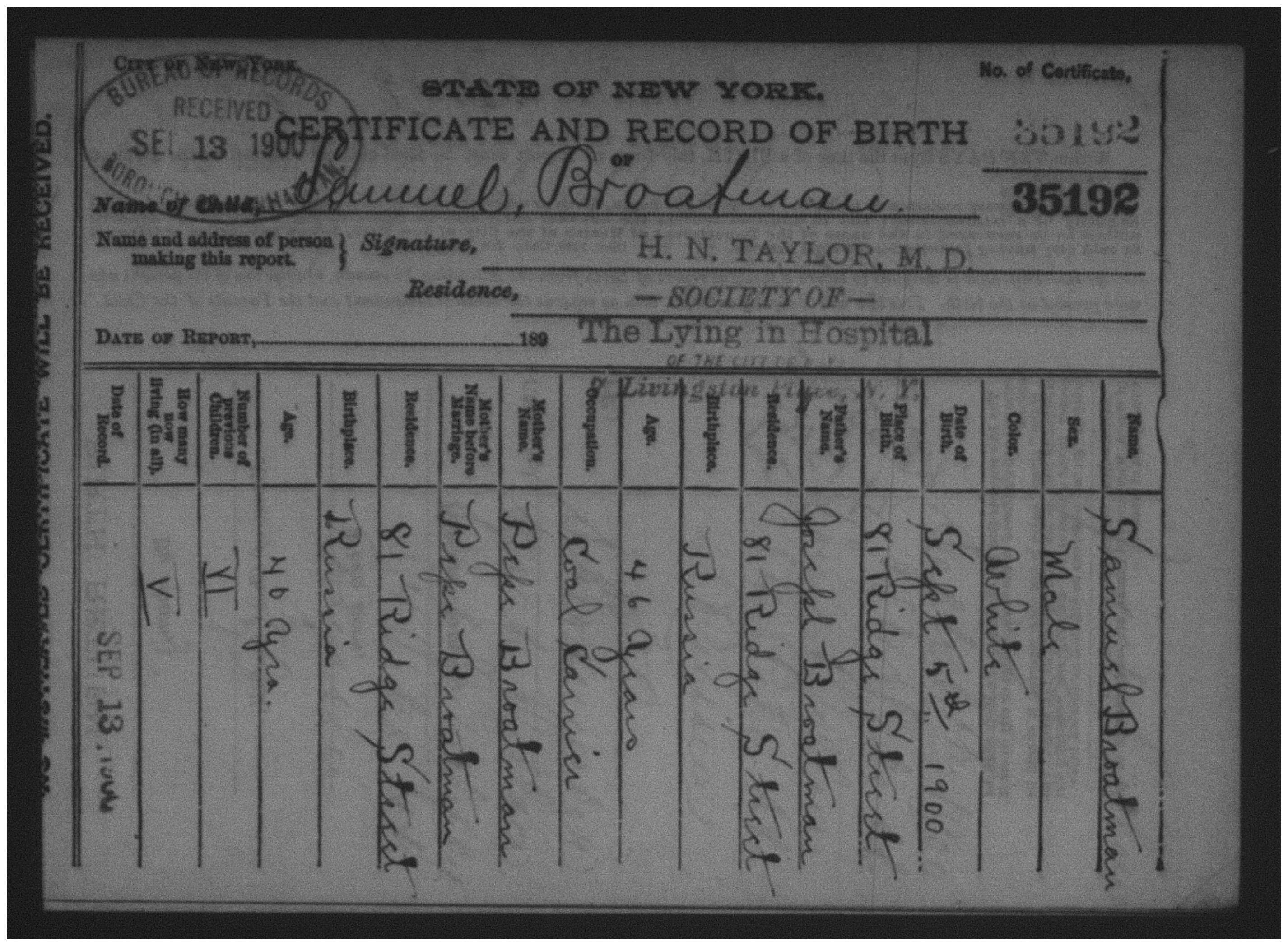
3.  Contrary to Lesson #1 and Lesson #2, I have also learned that often you cannot trust documents.  Documents lie.  People lie.  People give bad information, and bureaucrats transcribe information inaccurately.  People who transcribe handwritten documents for indexing purposes make errors.  In particular, our relatives were entirely inconsistent when it came to birth dates and birth places.  I now know why one relative found it so easy to lie about her age.  It was family tradition.  So lesson #3: Don’t assume that because it is written on some “official document” that it is reliable in any way.

Sam's Birth Certificate Joseph was NOT 42!

Sam’s Birth Certificate
Joseph was NOT 46!

4. One of my most rewarding accomplishments was finding out what happened to Frieda Brotman. Now we know who she married and how she died and even the name of her infant son Max, who only lived one day.    We even know what happened to her husband Harry Coopersmith after she died.  I never thought I’d be able to track down her story.  That experience is what will keep me going as I continue to look for the answers to more questions.  Lesson #4: Do not give up.  Do not give up. Do NOT give up!

Frieda Brotman Coopersmith death certificate

5. There are more helpful and supportive people in the world than there are mean or evil people.  I know we hear all the time about all the evil in the world, and there is far too much of it.  And even if not evil, there are also many people who are rude, incompetent and unhelpful.  We all know that.  But we often forget that there are also many, many more people who are kind, helpful and competent.  In my six months of doing this research, I have gotten help from many strangers—government employees who patiently helped me find a document, FHL volunteers who helped me track down a document request I had made, JewishGen and GesherGalicia members and other genealogists who have gone far out of their way to teach me how to find documents and how to connect with other researchers, who have photographed gravestones and given me directions to gravestones, who have translated documents for me, who have helped me find a clue when I was sure I had hit a brick wall.  I cannot tell you how much these people have touched me and changed my views on human nature.

I want to express special thanks and deep appreciation to Renee Steinig, who contacted me many months ago in response to my cry for help on GesherGalicia and who has truly been my teacher and is now my friend as I have gone from being a total newbie to a fairly competent novice with her guidance. She is the one who found the obituary of Renee that led to me finding Judy.  She is the one who suggested I post an inquiry on a bulletin board that led me to Bruce.  When I look back, in fact, I know it was Renee who got me to where I am today.  Thank you, Renee, for everything.

Lesson #5: If you ask for help, there will be generous and kind people who will reach out and help you.  Don’t do this alone.

6. I have also learned that I have many second cousins and second cousins once and twice removed—people I would never have discovered if I had not started down this path.  This has been probably the biggest gift of all from doing this research.  What a wonderful and interesting group of people I have gotten to know—by email, by phone, by pictures and stories.  When I look at the pictures and see the distinctive Brotman cheekbones shared by so many of you and your parents and your children, it gives me such a great sense of connection.  This may be the best lesson I’ve learned: everyone is looking for connections, everyone is looking to find their place in time and in the world.  I am so glad to have made these connections with so many of you, people who never even knew my name until this fall but whom I now consider not just cousins, but friends.

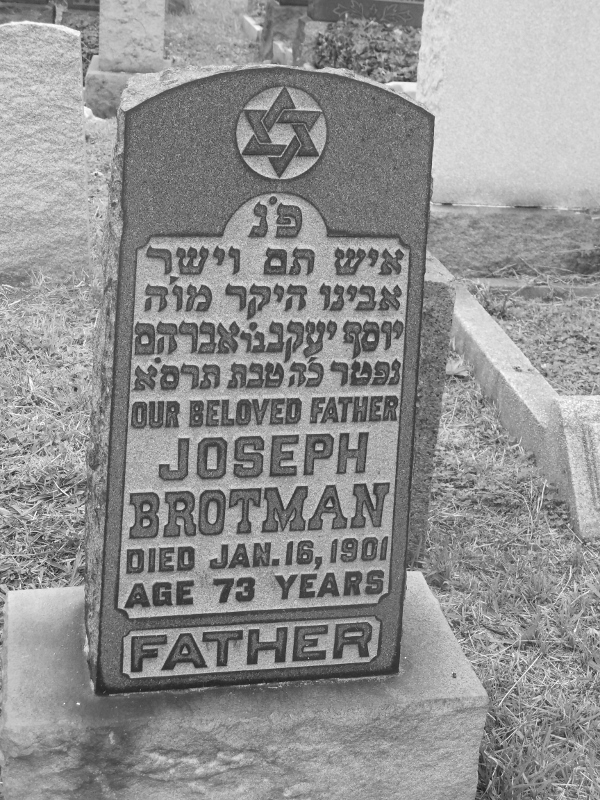
7. Finally, and in some ways the point of this whole adventure, I have really learned more than I ever could have hoped about my great-grandparents and their children and how they lived in the United States.  Joseph and Bessie were nothing but names to me six months ago; now they are flesh and blood people, my flesh and blood.  Their drive and courage is an inspiration to me, as it must have been to their own children.  After all, Abraham, Hyman and Tillie all named a son for their father Joseph, and perhaps some of the great-grandchildren were named for him as well.  I was so blessed to have been named for Bessie, as were some of you.  Bessie and Joseph—they are the real heroes of this story.  That’s the real lesson.

Joseph's headstone

Joseph’s headstone

Bessie Brotman

Bessie Brotman

Next post: Looking forward to the next six months

Blog Stuff

I have made a change in the privacy settings on the blog.  As you know, the blog is a public blog.  When we first started the blog, I did not know whether anyone would ever read it at all, inside or outside of the family, but over the last few months, I have found that I am seeing some visits from people outside of the family.  For me, this is a good thing. Most of these other readers are also doing genealogy work.  I want feedback, I want interaction with others who are doing genealogy research so that I can do a better job, and I want to be able to share my experiences and what I’ve learned about doing this research with others doing similar work.  So I am happy to have as many readers as are interested in checking in.

On the other hand, I have always been and will continue to be careful about protecting the privacy of the members of my family.  For that reason, I have not included birth dates or any other information about living individuals aside from occasional references to a name, usually by first name only.  All the information I have about deceased individuals is available from public records (and a frightening amount of information is also publicly available about living individuals).  In today’s internet environment, our ideas about privacy have had to shift (and that’s without even considering whether or not the NSA is reading our email or listening to our phone calls).  Nevertheless, I do want to respect the privacy interests of my relatives as best I can.

In order to ensure that I continue to protect the privacy of my relatives, I’ve made one new adjustment to the blog.  The family trees are no longer publicly available. The trees do not have much personal information anyway, but I decided that no one outside the family needs to have access to that information.  In order to access those trees, you will now need a password.  I am happy to share that password with anyone who is on the family tree.  If you want the password, please email me directly.  In the future, if I have a post that I consider to be directed only to family members, I will also protect it with that same password.

It’s sad that we cannot be more trusting, but I guess better safe than sorry.

Thank you.

The American Immigrant Experience: The Brotman Story

I’ve been looking over the data I have for all the people on our family tree, starting with Joseph through the children born in the 21st century.  By looking at the various ways our family members have supported themselves, we can see a snapshot of the American immigrant story.

On Gussie’s birth certificate in 1895, Joseph’s employment is listed as a wood and coal dealer. According to the 1900 US census, Joseph worked as a coal agent in the Lower East Side. His death certificate also listed his employment as coal agent; on Sam’s birth certificate he is described as a coal carrier.  As you can imagine, this was hard and dirty work. In an article on the coal industry in Michigan, a son recalled how is father would look after working at a coal yard in Michigan: “Dad would use twine to tie his pants and cuffs so not so much coal would get on his skin. He looked like a clown with his pants blowing out, neckerchief around his neck….The dust would crawl up his pant legs—he’d soak his feet up to his knees every night.”  Another son of a man who delivered coal recalled how black the water would be in the tub after his father took a bath.

In a website devoted to the history of a coal company based in Camden, New Jersey, there is the following description of the type of work Joseph did:

“The man would arrive in a wagon with sacks of coal neatly stacked on top. He would climb onto the wagon and move the sacks to the edge ready for unloading. His face and hands would be completely black from coal dust and he wore a cap or head cloth, which hung down his back. He would grab hold of a sack at the top, turn round, bend forward and pull it onto his back. He then had to walk quite a few yards to the coal cellar, maybe down some steps and then ‘pour’ the coal out of the bag.”

At that same time, Joseph’s older children were also working.  In the 1900 census, Hyman is listed as working as a buttonhole maker and Tilly as a flower maker, obviously both working in the sweatshops described in Streets.  They were both just teenagers at the time.  (That same census reported that neither Joseph nor Hyman could read, write or speak English at that time.)

Joseph’s children, however, were able to free themselves from these oppressive and backbreaking forms of employment.

Hyman was still working as a buttonhole maker in 1917 according to his draft registration papers and his naturalization papers, but soon thereafter left the sweatshops. In 1920 he was working as a chauffeur.  In 1925 he was working in Jersey City as a confectioner, and in 1930 he was working as a storekeeper in a cigar store (perhaps for Max?) and apparently supporting not only his wife and children, but also his father-in-law and his brother-in-law and his wife.  In 1940 his occupation is listed as a bookseller in a bookshop, and in 1942 he simply listed himself as self-employed on his draft registration card.  We know from his grandchildren and from my mother that at some point he owned a liquor store in Hoboken.  So Hyman went from being a poor boy on the Lower East Side, working in a sweatshop and not speaking or reading English, to an independent business owner over the course of his adult life.

Max, a conductor on the railroad in 1900, had his own cigar business by 1910, which continued to be his source of income through the 1940s. Tillie also left the sweatshop world after she married, and she and her husband Aaron owned a grocery store in Brooklyn.  Gussie, who helped Tillie and Aaron by caring for their children while they ran their grocery store, married Isadore, who worked at a dairy company as a milkman.  Abraham worked as a tailor for almost all of his working life and in a restaurant in Brooklyn later in his life.  Frieda was working as a “finisher” in the feather business, which I assume was in the garment industry, in 1920, not too long before she married.  Sam worked as a stock clerk, then in the Brooklyn Navy Yard, and ultimately as a cab driver in New York City.

Thus, by 1920 or so, all of Joseph’s children had left the Lower East Side and had found occupations that took them out of the sweatshops.   Three of them became independent business owners, and the others found work in various trades that did not involve breathing in coal dust and carrying heavy loads of coal to tenement buildings.

The next generation continued that trend.  Joseph’s grandchildren became professionals and business owners: teachers, a lawyer, a pharmacist, advertising firms, real estate investment, and retail stores.   When I look at the list of occupations of Joseph’s great-grandchildren, my generation, born in the 1940s through the 1960s, that trend continues.  Although there are fewer of us who own our own businesses, consistent with the decline of the small family-owned business throughout the country, there are still a number of entrepreneurs.  We are also lawyers (fifteen of us, including descendants, their spouses and our children), doctors, teachers of all types, and school administrators.  We are involved in business, finance, sales, banking, the computer industry, and the arts.

Our children, those born in the 1970s through the 1990s, continue in these fields and others—there are a number working in the creative arts and the music industry as well as medicine and the health care, finance, law, business, and the restaurant industry.  You name the field—we probably have someone related to us working in the field.

As for the next generation, those who are still  at home going to school, maybe even still in diapers, we’d like to hope that the possibilities are limitless.  Yes, the world is a more competitive place, houses are much more expensive relative to income than they were for us, the cost of a college education is beyond what anyone would consider reasonable, and the economy is tougher and tighter than it was for many of us when we first entered the job market.

But if a 50-something year old man could drag coal from tenement to tenement to support his family, if our grandparents could rise from sweatshops to become storeowners and tradespeople, if our parents could go the next step and become professionals and business owners, then certainly we cannot be anything but grateful and appreciative and hopeful.  After all, it was only 125 or so years ago that our ancestors first stepped off the boat and into the streets of New York City with nothing to their names, speaking a foreign language, and risking all they had known to take a chance that this life could be better than what they had known.

This Made My Day!

Yesterday was one of those winter days where I didn’t leave the house all day.  I read the paper, did the crossword puzzle, and played on the computer.  It was quiet, relaxing, but not exciting.  Then late yesterday afternoon, I received an email from Judy, Max’s granddaughter, that made my day.  Attached to the email was a document that Judy’s sister, Susan, had found while going through some old papers.  It’s a family tree sketched out by hand by Renee Brotman Haber, one of Max Brotman’s daughters and Roz, Susan and Judy’s mother.

Take a look at it:

Image

If you now compare this to the family tree on the blog for Abraham and his descendants, you will immediately realize that Renee had written out the family tree of her father’s brother Abraham.  Judy and Susan don’t know when she did it or where, but this is definitely written by Renee and it is definitely Abraham’s family.

Paula Newman, Abraham’s granddaughter, commented on the blog a couple of months ago that she believed she had met Rosalie and Dick Jones in Florida years ago when she was there with her parents.  Rosalie was Renee’s sister, and Judy said that both families used to go to Florida every year at Christmas time.  Perhaps it was during one of those vacations that Paula’s family met with Renee and Rosalie’s families and provided Renee with the information she sketched out on the family tree.

This is the third piece of evidence that supports the conclusion that Abraham and Max were brothers and that Abraham, like Max, was Joseph’s son from his first marriage.  First, we have the fact that Max was the witness on Abraham’s naturalization papers.  Second, we have the fact that Abraham’s Hebrew name was Avraham ben Yosef Yaakov, named for his grandfather Avraham whose son was Yosef Yaakov.  (Recall that Joseph’s Hebrew name was Yosef Yaakov ben Avraham.  Also, Abraham named his son Yosef Yaakov shortly after Joseph died, as did Hyman and Tillie.) And now we have evidence that Renee met or spoke with Abraham’s daughter or granddaughter to write down this family tree.  I don’t know how they found each other, or , more sadly, how they had all lost each other beforehand and then afterwards.

I guess you can tell how much this all means to me that receiving this document made me so happy.  Who cares about snow and sleet and cold when there is a new discovery linking our families!!

This should also be an inspiration to the rest of you to look for things like this—old letters, cards, postcards, pictures. You never know what you will find. Come on, make my day!