Is there a Yelp for Genealogy Resources?

The always helpful and amazing Renee did it again.  I asked her for help finding Nathan and Gertrude Mintz and their daughter Susanne, and within hours she had located an obituary for Gertrude, naming her daughter Susan and granddaughters and great-grandchild.  A second obituary for Susan’s husband revealed another great-grandchild.  So now I have some living descendants to track down and contact.  I’ve already reached out to one, but have not yet heard back.  Perhaps we will be able to learn what happened to Harry, Zusi and Nathan after Hyman died and the family seems to have split apart or disappeared.

I would like to be able to find this kind of information myself.  I asked Renee how she had found these materials, and once again it was two resources to which I do not subscribe or have access: Geni.com and PeopleFinders.  It’s all quite overwhelming.  There are so many different sources and websites. There are an amazing number of free resources: Familysearch.org, FindAGrave.com, fultonhistory.com, JRI-Poland, stevemorse.org, italiangen.org, Google, Facebook, the White Pages, for example. JewishGen.org and Gesher Galicia are free, but if you want full access, you need to pay or make a contribution. All of these sites are tremendously helpful, especially for finding people before 1940, but to find people after that date requires access to other resources since the census reports and vital records dated after 1940 are not publicly available.  To find someone after 1940 or so requires access to obituaries, phone books, newspaper articles, marriage announcements, and other more modern databases.

There are also a very large number of paid sites.  Each time I’ve asked Renee how she found a source, usually a wedding announcement or an obituary, I’ve checked out that database or website and subscribed to a few.  For example, newspapers.com and genealogybank.com are two sites to which I have subscribed but that have been almost useless to me.  I don’t know whether I am using them incorrectly or just unlucky, but I’ve found almost nothing of value on those sites.   So I’ve become a little reluctant to plop down my credit card for more sites without figuring out whether they are worth the investment.

Some of the sites are not that expensive—$25 a year; others are far more expensive.  For example, Geni.com, the site Renee used this time, costs $125 a year.  They do offer a free 14-day trial, however, so I might at least try that.  There are also so many other sites—Intelius, PeopleFinders—the list goes on and on.  I am confused and overwhelmed.  Do I really need any of these? Do I need all of them?  Where do I draw the line?

Maybe somewhere there is a source that rates these sources for genealogy research value.  Maybe some of the genealogists who are reading this post can point me to that source or provide me with some guidance.  What are the best sources for locating obituaries, wedding announcements and other information relating to people living after 1940? Why have both newspapers.com and genealogybank.com proven to be so useless to me?  Is Geni.com worth the price?

Let me know what you think.  Thanks!

Enhanced by Zemanta

Crowd Sourced Genealogy

In yesterday’s New York Times, A.J. Jacobs wrote a mostly facetious article about the phenomenon of crowd sourced genealogy, “Are You My Cousin?”  Crowd sourced genealogy refers to the practice used by some people doing family research where on websites like Geni a researcher can link his or her tree with other trees once a

Image representing Geni as depicted in CrunchBase

Image by None via CrunchBase

common relative is found.  As Jacobs points out, many experienced genealogists have expressed concern about this practice because the trees that are being connected may not be well-researched or accurate.  As a result, people end up incorporating those mistakes into their own trees, and then those mistakes can be repeated over and over again as new people begin linking to these inaccurate trees.

Although ancestry.com is not set up like Geni to promote the idea of one World Family Tree, their site also allows researchers to view other family trees which list people with the same names and dates as those on their own tree.  When I first started using ancestry.com, I relied on this tool to add names to my family tree on my father’s side.  I soon, however, realized that it was a dangerous practice.  I thought I had found some English cousins because we shared a relative named Boomer Cohen.  I contacted them and was very excited—only to be very disappointed and embarrassed when I learned that their Boomer Cohen was not the same as my Boomer Cohen.  Who would have thought there were two women with that name?

I’ve run into other problems with relying on the family trees I find on ancestry.com.  Often trees were created without any documentation, so I can’t double-check to be sure they are accurate.  When I was researching Harry Coopersmith, my great-aunt Frieda’s husband, I found Harry on a tree with parents who did not match the parents I had found after research and with documentation.  It had Harry’s children correctly and his birth and death dates, but the wrong parents.  I contacted the tree owner, Harry’s grandson, and asked him about it because I assumed he was right and I was wrong.  But it turned out he had linked to someone else’s tree with a different Harry Coopersmith and assumed it was his grandfather.  He was very happy (and probably embarrassed) when I was able to provide him with the correct information and the documents to back it up.

As a result, I am very skeptical of sites like Geni and the whole notion of crowd sourced genealogy.  Not that I have stopped looking at those other trees on ancestry—I always do, and I have found many helpful people by doing so.  For example, I found Becky Schwartz Goldschlager’s nephew Jon by finding his family tree on ancestry.  But I have learned to use these trees very carefully.  In fact, when I return to researching my father’s family lines, I will need to go back and pare some limbs from those trees unless and until I can find documentation to back them up.

Jacobs also expressed skepticism, but seems to be overall in favor of crowd sourced genealogy.  As I said, his article is mostly facetious, pointing out the ridiculously long and convoluted paths that connected him to Albert Einstein and Gwynneth Paltrow, among others.  Although the idea of finding hundreds of celebrities and famous people to whom I have some very attenuated connection is somewhat intriguing, it’s not what I am after by engaging in genealogy research.  I want to know more about my real ancestors — who they were, where they lived, and how they lived.  I don’t need to know my great-great-uncle’s wife’s brother’s daughter’s husband’s cousin’s mother’s stepfather was Abraham Lincoln.  What good would that do me?

English: Abraham Lincoln, the sixteenth Presid...

English: Abraham Lincoln, the sixteenth President of the United States. Latviešu: Abrahams Linkolns, sešpadsmitais ASV prezidents. Српски / Srpski: Абрахам Линколн, шеснаести председник Сједињених Америчких Држава. (Photo credit: Wikipedia)

Enhanced by Zemanta

Research update: Bad News, Good News, Bad News

As you may recall, on October 31, I sent a request to the USCIS  for the naturalization papers for Max Brotman in the hope that they would reveal where Max and thus the other family members were born in Galicia.  According to the automated message on the USCIS phone, it could take at least 90 days to get a response.  Well, I figured the news wasn’t going to be good when I received a response yesterday only 35 days after making my request.  And it wasn’t—they had no records for a Max Brotman who fit the dates I had submitted.  In fact, all their naturalization records start in 1906, and I should have known that Max was naturalized before 1906 since he was the witness for Abraham in 1904.

I then went back to ancestry.com and rechecked my search of their naturalization records where I had been able to find records for both Abraham and Hyman.  I checked and rechecked pages and pages of indices, searching for anything that might relate.  I found one for a Max Bratman born in Germany who worked as a conductor for the railroad and emigrated in 1882, but dismissed it because the name, place of birth, and date of immigration seemed wrong.

Max "Bratman" Naturalization Card

Max “Bratman” Naturalization Card

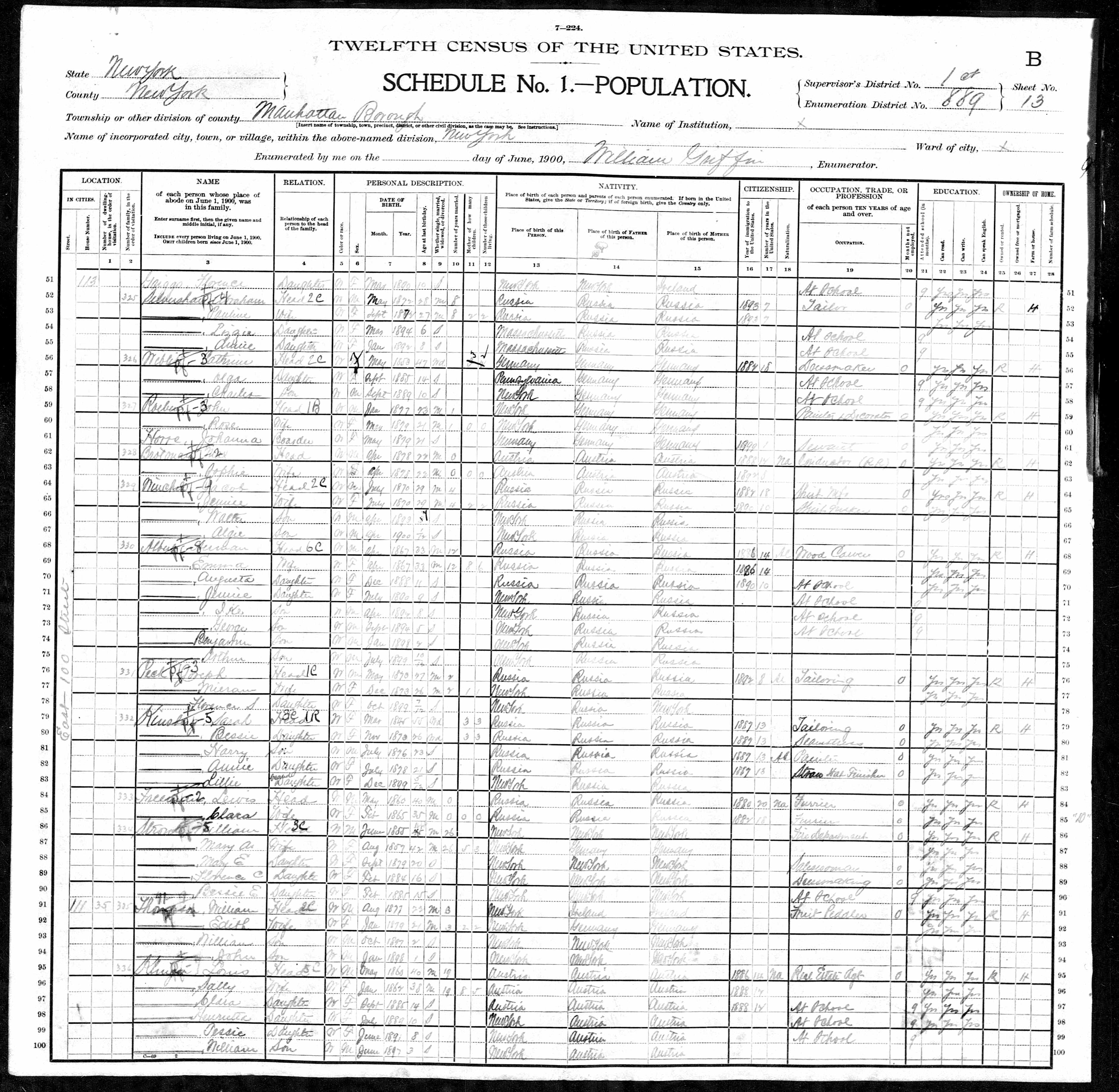
Then I went back to the records I already have for Max, including several census reports, his marriage certificate and his death certificate.  While reading through the 1900 census, I noticed that it said Max was a conductor.  At that time he and Sophie were just married (the census was taken in June; they had married in April) and were living at 113 East 100th Street in Manhattan.  When I saw the entry that he was a conductor, I knew it rang a bell, but at that point I could not remember where else I had seen it.

1900 US Census Report for Max and Sophie Brotman

1900 US Census Report for Max and Sophie Brotman

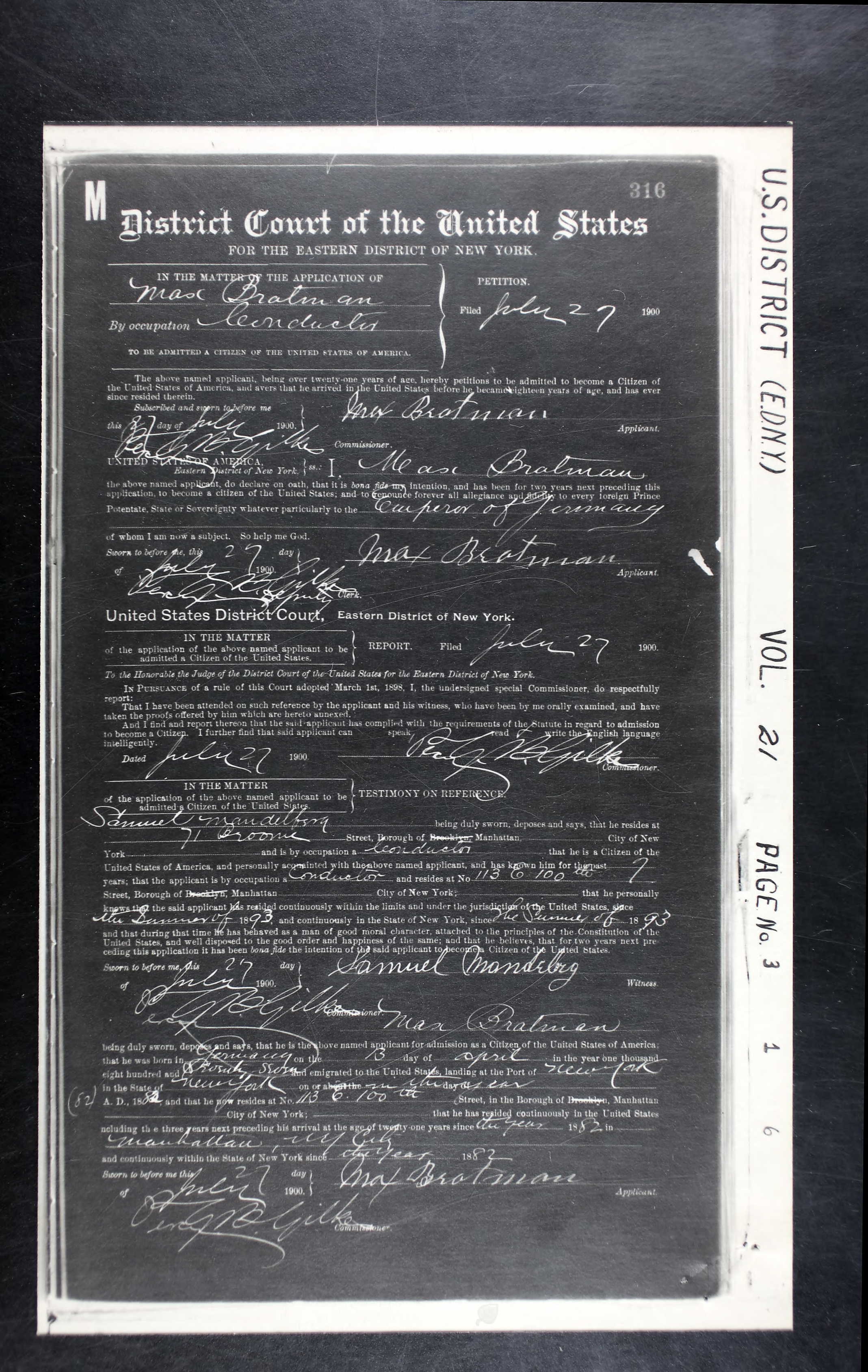
I began to search through the naturalization records again and could not find any reference to a Max Brotman who was a conductor.  I started thinking that I was losing my mind! Then I remembered that there had been a Max BrAtman and searched for him, and lo and behold, found the naturalization card again for the conductor.  I looked at the address on that form and sure enough, Max Bratman was living at 113 East 100th Street in Manhattan in 1900 when he filed this application.  Obviously this was the same person, our Max, but why did he spell his name wrong? Why did he say he was born in Germany and emigrated in 1882? The birth dates also did not exactly line up, but I am used to the fact that no one ever reported their birthday consistently.

When I looked at the handwritten application, I saw that the signature was definitely Max BrOtman, not BrAtman.

Max Brotman naturalization petition

Max Brotman naturalization petition

My guess is that the clerk who filled out the card just could not decipher the handwriting.  As for the wrong date, I have no guess except that Max was confused, wasn’t clear, or was trying to make it seem he’d been in the US for more than just 12 years.  As for why Germany? I wish I knew.  I know from Joseph Margoshes’ book that secularized, modern Jews were referred to as “German” in Galicia. Perhaps that’s why Max said Germany.  Perhaps the clerk thought he was German because of his name, accent and use of Yiddish and suggested it to him and Max just agreed? I have no clue.

The census form was filled out just a month earlier than the naturalization form.  The census says his place of birth was Austria as does every other document listing Max’s place of birth.  The census says he emigrated in 1888, which is also consistent with almost all the other forms.  It would have made little sense for Max to have emigrated in 1882 when he was only four years old.  So once again, we have evidence that forms are unreliable, that our ancestors were not too reliable, and that much must be left to conjecture and speculation.

So where does that leave us in terms of identifying where our family lived in Galicia? Hanging on the thin thread of Hyman’s own unreliable documents, our best guess is Dzikow near Tarnobrzeg.  I contacted Stanley Diamond who manages the archives of documents for JRI-Poland, and he sent me a list of all the records of all Brotmans and Brots from that area.  They are almost all of people born after 1900, and Stanley said that the records for that area are rather limited.  He said it would probably take a trip to archives in a few cities in Poland to learn if there is anything else and that that is probably a long shot.

And thus, my cousins and friends, I think that for now I have hit a wall. I am still waiting for Tillie’s death certificate and Hyman’s marriage certificate, but I am not putting any hope into finding out more information about their place of birth from those documents. I am in touch with a researcher in Poland, and I am hoping to travel there perhaps in 2015, but for now I guess we have to accept that the best we can do is hang our hopes on Hyman’s references to Jeekief and Giga and assume that Dzikow near Tarnobrzeg is our ancestral home.

A Brief Introduction to Genealogical Research

Some of you might be interested in how to do genealogical research yourselves, so I thought I’d provide a very brief introduction for those who might want to try.

I would start (and did start) with ancestry.com.   You can get a short free trial subscription (14 days) just to see if you are intrigued. (And no, I don’t get a kickback from ancestry if you subscribe!) Ancestry provides digital copies of many documents including all US census reports up through the 1940  census (the later census reports are not yet available), except for the 1890 census which was destroyed in a fire. (That is particularly frustrating and sad for people researching ancestors who arrived in the 1880s.  We will likely never know where Joseph, Abraham and Max first settled, although it appears that all three arrived sometime between 1888 and 1890. )

Ancestry also has many other records available in digital form: some naturalization papers, some draft registration forms, some yearbooks, phone books, directories, and ship manifests.  Many records, however, are not directly accessible through ancestry.  For example, NYC birth, death and marriage certificates are not viewable through ancestry; you may find a record that indicates some of the information found on such certificates, but not the entire certificate.  For that, you have to order a digital copy or a photocopy elsewhere.

I have found the Family History Library to be a great resource for this.  The FHL is run by the Mormon Church in Salt Lake City; apparently the Mormons are trying to collect the names of anyone who ever lived as part of a religious mission to save everyone’s souls.  Fortunately, you don’t have to be a Mormon or support their mission in order to be able to use their services.  I guess the Church sees helping others find their relatives to be part of that overall mission.

At any rate, to request documents from the FHL, you need to find the NYC certificate number[1] and then the FHL film number.  Sometimes ancestry.com will have the certificate numbers, but usually I go to another website, http://www.germangenealogygroup.com/records-search/, to locate the certificate number.  It provides an index of NYC birth, death, and marriage certificates, but only for those years for which NYC has made them accessible to the general public.  For example, death certificates only run up to 1948; birth certificates are even more limited in terms of availability.  (I assume this is for privacy reasons, just as with the census reports.)  If, however, the certificate you are seeking falls within the date range, you can find the certificate number and dates through the germangenealogy website.

Once I have that information, I then go to another website, http://stevemorse.org/vital/filmnotes.html, where I can enter the information into the appropriate boxes, and then obtain FHL film number.  That website also includes a link to the FHL Photoduplication Request form.  By filling out that form with the numbers I now have, I can make a request to FHL for the certificates I am seeking.  There is a limit of five per month, and it can take several weeks to receive them, but it is free.  Amazing, it is free!

For other documents, for example, more recent death certificates and other documents like Social Security applications or immigration papers, the process can be more complicated, involving notarized documents, some fees, and much longer waits.  But starting with ancestry.com and using the FHL process can give you a good start on finding out more about your ancestors.  I found most of the documents that I have used in my research and reported here through those two sources and have only turned to the less efficient means of obtaining information more recently.

Of course, there have been lots of other sources of information: all of you who gave me clues and information, my mentor Renee and other experienced genealogists who helped me dig up clues, and many other websites like http://www.jewishgen.org/ and Findagrave.com.  There are still lots of other sources I have yet to explore, but those will require more time and more training before I can use them very effectively.


[1] This website only indexes NYC documents and some Nassau/Suffolk County documents.  For other locations in New York State and other states, you need to check the appropriate website for vital records for that county or state.

Max Brotman: When was he born?

Here’s another example of the inconsistency of records when it comes to birthdays.  On the 1900 US Census, Max gave his birthday as April, 1878.[1]  [Edited: On his naturalization application in 1900, he listed his birthdate as April 1877.] On the 1910 Census, he reported being thirty years old, meaning he was born around 1880.  On his draft registration in 1918, he gave his birthday as July 7, 1878.  On the 1920 Census, he said he was 45, making his birth year 1875.  In 1930, he said he was 50, meaning he was born in 1880.  In 1940, he claimed to be 60, again meaning he was born in 1880.  On his draft registration in 1942, he put his birthday as March 26, 1880. [2]

Today I received his death certificate.[3]  It has his birthdate as July 27, 1882!  He just kept getting younger (like we all wish we could, I suppose).  Since Hyman was born in either 1882 or 1883 and had a different mother than Max, it seems unlikely that Max was born in 1882.  I am going to assume that the earliest documents are more reliable (when he had less incentive to make himself younger) so that 1878 is the mostly likely year of birth.  As to the month? Who knows? Could be March, April, or July.  As I said in an earlier post, birthdays were not a big deal to Jews in Europe, so maybe he never knew the month, but wouldn’t people know what year they were born? We know Joseph’s age is equally mysterious—he could have been born any time between 1825 and 1855, depending on which document you read.  And Hyman also had two different birth years on his records.

The other inconsistency in these records is the year of immigration for Max.  The 1900 Census says he came in 1888; the 1910 and 1920 say it was 1890.  Finally, the 1930 Census says it was 1893.  I have applied for a copy of his naturalization records (which take 90 days to process, so it will be at least another two months before I get it), so perhaps those will be more accurate. [Edited: The naturalization application said 1882, when Max was at most five years old.]

Sometimes I wonder whether there was a certain level of paranoia among immigrants—people who had faced such hostility and oppression at the hand of the governments of the countries where they were born.  Maybe they just didn’t want to give the US government too much personal information.   Or maybe census takers just weren’t very careful note takers or very good listeners. Or maybe our relatives just liked to lie about their ages.


[1] All the documents are consistent with respect to his place of birth being Austria, though none specifies the town or city. [Edited: The naturalization application said Germany.]

[2] These documents are available on ancestry.com.  If anyone is interested, I can download them and post them on the blog.

[3] More on his death certificate tomorrow.  I want to scan it and won’t get a chance tonight.

How This Started

I’ve been asked what got me started on doing this research.  I’d like to claim some life-changing event or spiritual moment got me started, but to be honest, it was a television program, Who Do You Think You Are.  That program showed celebrities researching and learning about their ancestors, and as I saw how moved these people were learning about an ancestor they’d never met, I decided that I wanted to learn more myself. 

I started by joining ancestry.com and made a lot of progress with my paternal side, but very little on my maternal side.  I hit a wall and put it all aside, figuring I’d never find more.  Then this past summer I received an email from someone who’d seen my ancestry tree and thought we might be related through my maternal grandfather, Isadore Goldschlager.  My interest was sparked again, and that contact gave me a contact in Romania who was able to find documents about my grandparents and great-grandparents, including the name of my great-great-grandparents, names my mother had not known.  The fact that my great-great-grandfather was named Ira, the same name as my brother, even though my mother had never known her great-grandfather’s name, gave me the chills and made me realize how rich and rewarding this research and these discoveries could be.

So I turned to the Brotman side, and this time I turned to third parties for help, asking questions on ancestry.com, geni, JewishGen, anywhere I could.  I learned how to find and order birth, marriage and death certificates and other documents, and one of my mentors found the obituary of Renee Haber, which was how I found David Ruzicka. I also found David Haber through ancestry.com, and he helped me find Judy.  Someone on JewishGen/GesherGalicia contacted Bruce Brotman in response to my inquiry, and slowly but surely the pieces came together.  It wasn’t until then that I realized that there was a brother named Max; my mother only remembered the names Hyman, Tilly, Frieda and Sam.  Yet she remembered Renee and Rosalie, thinking they were Hyman’s daughters, so I knew I had the right people.  And then my brother found Abraham’s naturalization papers with Max’s name on them.  When I was able to confirm by the address that it was the same Max, the hunt to verify that Abraham was another brother began.

There have been so many dead ends and false starts, but also so many amazing moments on this journey so far. I have encountered so many kind and generous people—not only the Brotman cousins themselves, but the helpers on the other sites and the man who volunteered to go to Mt Zion cemetery to take pictures of Joseph and Abraham’s headstones (and then also took those of Abraham’s wife and son Joseph on his own, just to be nice). 

I am not done. There are still many unanswered questions. Most importantly, I am still trying to find out where our family came from in Galicia and what their lives were like there. 

So stay tuned…who knows what and who else I will find?