The Devastating Effects of Terrorism

Today I am honored and moved to share an essay written by my fourth cousin, once removed, Miki Katzenstein Dror. Miki is the daughter of Arie Katzenstein1, an Israeli who was killed by terrorists on February 10, 1970, at the Munich airport while he was traveling with his father Heinz on business.

As I wrote here and here, Arie sacrificed his own life by throwing his body on a grenade, thus saving the lives of many others, including his father, who had fled to Israel from Nazi Germany in the 1930s. Miki and her two siblings were just young children at the time. Because of this horrible act of terror, they grew up without their beloved and courageous father.

Arye Katzenstein Courtesy of his family

As Miki wrote almost a year a half ago, the city of Munich decided to create a memorial to honor the memory of her father Arie and the others who were injured and terrorized on that day in 1970. On February 10, 2025, Miki and her siblings and other family members traveled to Munich to participate in the dedication of that memorial.

This video, in Hebrew but with English subtitles, includes interviews with Miki and her siblings and more information about Arie Katzenstein’s tragic murder. This video in German shows what the memorial looks like and also some images from the ceremony itself, including images of Miki and her brother and sister speaking at the ceremony. It also has some historic footage from coverage of the attack in 1970. Richard Bloomfield has provided me with this translation of the text of the second video.

55 years ago, members of a Palestinian terrorist organization tried to hijack an El Al Israeli airline plane. The victims and the heroes of the attack were commemorated today at the former tower.

Three golden clocks symbolize the times of the three detonations on February 10, 1970. They are located in front of the tower of the former airport in Munich-Riem. The artist Alicja Kwade created the work of art. At today’s inauguration of the memorial, Arie Katzenstein’s three children commemorated their father, who, through his courage, saved the lives of others exactly 55 years ago by throwing himself on a hand grenade. Palestinian terrorists had attacked the passengers during a stopover in Munich, killing the German-Israeli Katzenstein and injuring others. The captain of the aircraft also put up a courageous fight. The extent of the terrorist act had been clearly underestimated, said the mayor of Munich.

[The mayor] “However, I also find it shameful that it has taken half a century for us to finally publicly commemorate the terrible attack here in Munich on February 10, 1970. For this, I apologize. I am glad that we have finally found a worthy way to commemorate it.”

Brainlab, which is now located at the former tower, the city and the family worked closely together.

[Arie’s son] “It will remind people who come here of what happened. And it will make them think.”

A memorial plaque and a website [https://munich1970.de/en/] provide information about the attack. This is to keep the memory of the victims and heroes of Munich-Riem alive.

Here’s a photograph of the memorial:

I asked Miki if she would share with me and my readers her thoughts and feelings about the dedication and the memorial itself. This is what she wrote:

Finally, after fifty-five years, our heroic father was commemorated at the site of his murder in Munich, Germany.

On the afternoon of February 10, 1970, EL AL Flight 435 landed in Munich on its way to London. While waiting for the connecting flight, a squad of three terrorists attacked the passengers by firing pistols and throwing hand grenades.

Our father, the late Arie Katzenstein, who flew with his late father Heinz, for business, threw himself at one of the hand grenades that were thrown at the passengers, thus saving many others, but was killed on the spot.

At his death, he left behind a young widow and three small children between the ages of three months and six years: Miki Dror, Tami Meirovich and Ofer Katzenstein.

About a decade after his death, our mother received a letter from the President of Israel at the time, the late Yitzhak Navon, in which he wrote, among other things, that the State of Israel would cherish the memory of our father among its other heroes. Unfortunately, this promise was never kept, despite our many inquiries on the subject.

On the other hand, about five years ago, representatives of the Munich municipality contacted us, following a request from our German friends. They announced that the municipality intended to commemorate our father at the site of the attack – the old airport in Munich–Riem. As the Germans are using a newer airport these days, the old one is used as a big convention center and a high-tech park. From that moment on, a long process of conversations, meetings and discussions began between us and the Munich municipality regarding the manner of commemoration. At an early point, the high-tech company Brainlab joined the effort. Its offices are currently located in the area where the attack took place.

The company expressed its most generous consent to the existence of the memorial site on its premises and funded a work of art by the famous internationally acclaimed artist Alicja Kwade, to be displayed there.

On February 10, 2025, exactly fifty-five years after the murder of our father, the inauguration ceremony was held in the presence of the President of the Bavarian Parliament, Mrs. Ilse Aigner, the Mayor of Munich, Mr. Dieter Reiter, Founder of Brainlab, Mr. Stefan Viltsmeier, the Consul General of Israel in Munich, Ms. Talia Lador, the artist Alicja Kwade, family members of our Germans friends, other families of the victims and many, many more.

From left to right: Ms. Talia Lador, Consul of Israel to Munich; Mrs. Ilse Aigner, President of Bavarian Parliament; Ofer Katzenstein; Tami Katzenstein; Mr. Dieter Reiter, Mayor of Munich; Miki Katzenstein Dror;  and Mr. Stefan Viltsmeier, founder of Brainlab

During the ceremony, the German dignitaries gave moving speeches, and we, his three children, spoke about our father, his absence, and the long journey that had brought us to this day. In addition, we thanked the German government and their ambassador in Israel for their support in the struggle for the release of the Israeli hostages from Gaza and asked that they not give up until the last of the abductees was brought home.

The Katzenstein family attending the memorial dedication in Munich, February 10, 2025

The singing of opera singers Hagar Sharvit and Noa Beinart and pianist Amiel Bushkevich did not leave a dry eye.

We arrived to the ceremony with a full family lineup, including all of our father’s grandchildren, but unfortunately our mother Bilha, who passed away not long ago, did not get to attend this exciting event. At the end of the ceremony, we read Kaddish, and laid flowers, an Israeli flag, and a scarf of the Hapoel Haifa soccer team – which our father loved so much.

Ofer Katzenstein saying Kaddish at the memorial site for his father Arie Katzenstein

For us, this is a moment of partial closure and unparalleled excitement. After so many years of action, our father’s sacrifice is finally officially recognized.

Now, we have a place where we can come to with our families, relate to, and remember. We couldn’t have asked for more.

We would like to take this opportunity to thank everyone who has helped us over the past few years to get to know our father better, to speak about him and to spread his heroic deeds.

And finally, I’m writing this post on the day that Hamas, the terror organization, released the bodies of Kfir and Ariel Bibas, two babies who were taken to Gaza as hostages more than a year ago. So sad that after 55 years it seems as if nothing has changed, and terror still strike Jews, in Israel and in the world.

When I received the email from Miki sharing this essay, I also was struck by the fact, as Miki observed, that this was the same day that the bodies of the two Bibas children were returned to Israel—two beautiful, innocent babies who were murdered by Hamas after they and their parents were kidnapped by Hamas on October 7, 2023. After first sending the wrong remains, Hamas later released the actual remains of their mother, Shiri Bibas. Their father Yarden Bibas survived his capture and confinement and was released back to Israel, but without his wife and children. Like the children of Arie Katzenstein and so many others, Yarden Bibas has had his family destroyed by terrorism.

Terrorism against Jews began centuries ago with the pogroms that chased some of my ancestors out of Europe, continued with the murder of six million Jews, including many of my relatives, during the Holocaust, and tragically continues to this very day with the nightmare of October 7, 2023, and its aftermath.

And it isn’t only Jews who have suffered because of the hatred, violence, and terror inflicted on one group by another. We still are seeing across the globe the bloodshed and tragedy that hatred produces.

How many more children will grow up without a parent? How many more parents will have to mourn their children? Will we ever learn?

May the memory of Arie Katzenstein be for a blessing, as well as the memories of Kfir, Ariel, and Shiri Bibas, and all the other victims of October 7. And may we someday finally learn, to paraphrase Martin Luther King, that only love can drive out hatred, only light can drive out darkness.


  1. Sometimes transliterated from Hebrew as Aryeh or Arye. 

Guest Post: My Cousin Miki Katzenstein’s Trip to Jesberg and Munich—Retrieving History and Honoring the Past

A few months ago I wrote about how I had connected with my cousin Miki Katzenstein Dror from Israel. Miki is a daughter of Aryeh Katzenstein, who was murdered in a terrorist attack in Munich, Germany, in 1970, when he was just 32 and Miki was a young child. Aryeh gave his life to save the lives of others, including the life of his father, Heinz Katzenstein. The city of Munich is now planning to install a memorial to Aryeh on the grounds where the attack occurred in collaboration with a corporation called BrainLab, which now owns the land where Aryeh was killed.

In preparation for this memorial, Miki and her brother Ofer and their spouses recently traveled to Germany to meet with the people there who are working on the memorial. In addition, Miki made a trip to Jesberg, the small village where our mutual Katzenstein ancestors once lived and where Miki’s grandfather Heinz Katzenstein lived until he left for Palestine in the 1930s. I asked Miki if she would share her thoughts on her visit to her grandfather’s childhood home in Jesberg and also on her trip to Munich, and she has graciously done so. All photos are also courtesy of Miki.

Miki wrote:

For many years I dreamed of traveling to Germany with my grandfather, Heinz Katzenstein, to see the districts of his childhood. I hadn’t heard much about his childhood in Germany, except for the simple facts he told me; he said that he was born in Kassel, immigrated to Palestine in 1933, and had managed to return to Germany in 1936 to take his parents and siblings to his new home. My grandfather often returned to Germany to go to Baden-Baden, but always refused to travel with me to the region where he grew up. I thought it was because it would have been hard for him to see again the home he ran away from so many years ago.

After my grandfather passed away, it became clear to me that although he always talked about Kassel, he actually was born and raised in the village of Jesberg, a really small village about a 40-minute drive from Kassel. Maybe it was easier for him to talk about a more well-known city. I became even more curious, and when the municipality of Munich invited us in June 2023 to preparatory meetings for the establishment of the memorial site for my late father, Aryeh Katzenstein, I decided to combine a roots trip to Jesberg with the meetings in Munich.

I started the preparations with the help of my cousin Amy Cohen, whose blog I found when I was looking for information about Jesberg online. Thanks to her, I met a lovely man named Heinz Hildebrandt, who volunteered to guide me in the village along with his wife Erika. I told him a little about our family, and he told me not to worry – he would already know what to show me. We set a date, and I waited anxiously. In the meantime, I had a lot of preparatory work for the meetings in Munich, and time was running out.

On June 16th my husband and I took off to Frankfurt; from there we went to Kassel and walked around the city for two days. On June 18, we met with the Hildebrandt family in Jesberg at 9 am, as prearranged. I will never forget the Jesberg welcome. Heinz and his wife Erica, Mrs. Regina Ochs, Herald England, Mayor Heiko Mans, and Pastor Reinhard Keller all accompanied us for the visit, and we ended up staying with them until six in the evening. Hans-Peter Klein and his friend Irina also came especially to meet us. It was one of the most exciting days of my life.

Miki and her husband with the mayor of Jesberg

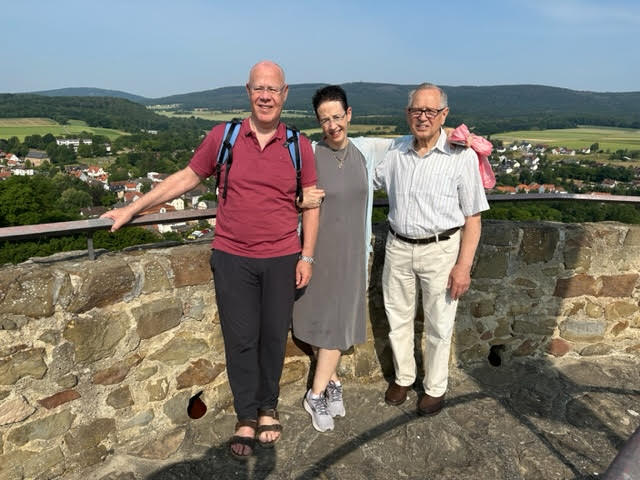
Amy, my cousin, had given me a piece of advice: imagine the life your grandfather lived in the village while visiting there. This is what I did: we saw the tower overlooking the village and the surrounding agricultural area, we saw the well-kept village and all the Jewish houses that remained mostly in their original form, including the ancient synagogue that is now used as a residence. 

Overlooking Jesberg with Miki, her husband, and their guide Heinz Hildebrandt

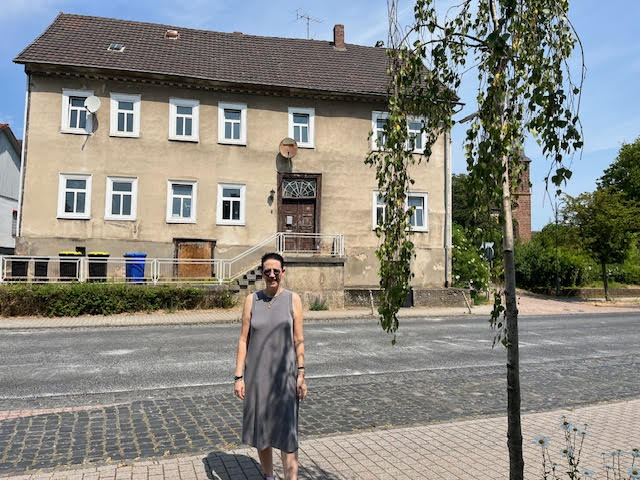
We even managed to enter the house where my grandfather was born and raised, thanks to the current owner, Michael Jung. It was very emotional for me; the house is in need of repairs and is about to be completely renovated. But I could easily see its beauty, size, and even glory. The ceiling is spectacular. In some ways the house reminded me of my grandfather’s home in Haifa, with all the wooden hand-crafted furniture.

Miki standing in front of the house where her grandfather lived in Jesberg

We said Kaddish at the well-preserved grave of Levi Katzenstein and Jeanette Bendheim, my grandfather’s grandparents, and we saw a gravestone for the victims of the First World War from which the name of our relative Max Katzenstein had been erased during the Nazi era; his name was returned to that memorial a few decades ago. A fascinating presentation was prepared for us that dealt with the history of the Jewish families in the village and in the region, especially the story of our Katzenstein family. It amazes me to think that if my grandfather could have remained in Jesberg undisturbed, my children would have been the 11th generation in the village.

The grave of Levy Katzenstein, Miki’s great-great-grandfather

World War I memorial in Jesberg where you can see that Max Katzenstein’s name was removed and then later restored

My grandfather loved Germany all his life and missed it endlessly. There wasn’t a year he didn’t go there. It also became clear to me from records Mrs. Ochs shared that a year before his death he even came to Jesberg, but without me.

The second part of this busy week was no less emotionally difficult. We went to Munich for three days where we met my brother and sister-in-law who came from Israel and were hosted by the people of the municipality, whom we were very happy to meet after about three years of seeing them only on the small screens of Zoom in our conference calls. The program was very busy, and the terrible heat and the fact that there was no air conditioning made it very difficult. The truth is that even there we were shocked by the welcome we received.

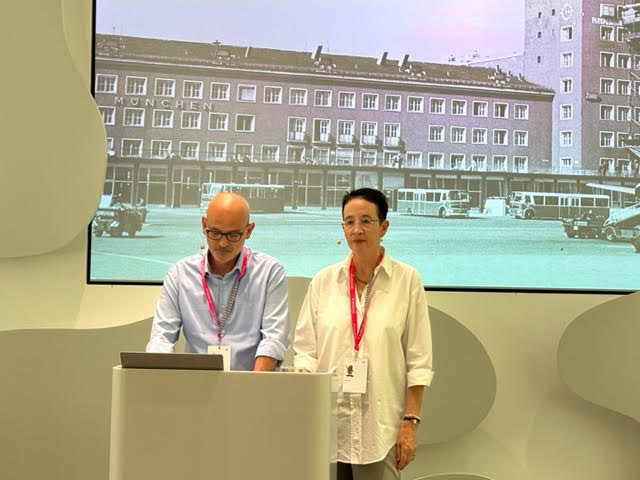
The project to commemorate my father, which started from a humble initiative of family friends, Michael Weidenhiller and Werner Haberkorn, has developed into a huge project that combines our family, the municipality of Munich, and the high-tech company BrainLab. We were invited to lunch with the mayor of Munich, with the head of the Jewish community in Munich, and with the Israeli consulate there. We visited BrainLab’s amazing offices and met with the CEO, Stefan Fieldsmeier, his employees, and the artist chosen to create the artwork that will be erected on the site. We participated in a press conference where the launch of the project was announced, and millions of German residents were exposed to it.

Miki at the press conference in Munich

The site where the memorial to Aryeh Katzenstein will be installed

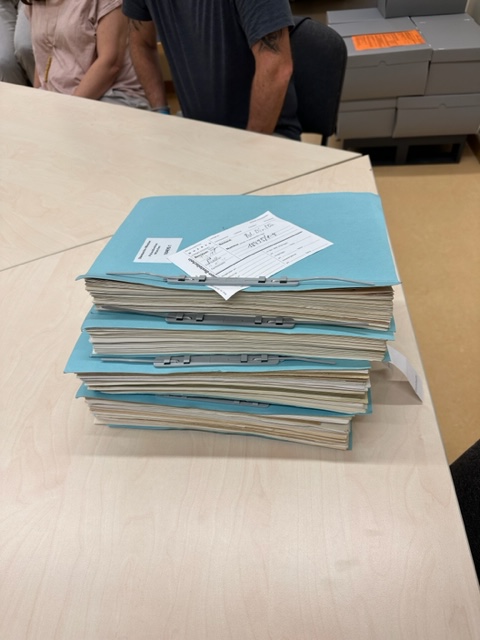
The highlight for me and my brother was the visit that was organized for us at the municipal archives, where we were exposed for the first time to four huge files of evidence that were prepared for the trial of the three terrorists who murdered my late father. Those files were never used because the terrorists were released without a trial three months later when a Pan Am jet was hijacked and the German government agreed to release those three terrorists in exchange for the safe release of the three hundred passengers on that plane.

The files from the Munich Archives about the 1970 terrorist attack

[For more on this exchange and its historical significance, here is one writer’s views.]

Our faithful translator translated for us from German into Hebrew the testimonies of my grandfather, who was interrogated right after the terrorist incident while he was injured in the hospital, of Hana Maron, the Israeli actress who was seriously injured in the attack, of Uri Cohen, the heroic captain who fought the terrorists with his bare hands, and the bus driver who drove the passengers from the terminal to the plane.

The pictures were very difficult to see but important. We saw drawings of the terminal and timeline of the chain of events. We read what they found with my father after his death: coins, a horseshoe-shaped gold necklace that I really remember as a child, a list my mother sent with him of things to buy in Germany including Pantene diaper cream and decorations for a Purim party they were planning to throw for their friends, and a picture of us – his three children.

We left with tears in our eyes and a heavy heart. On the other hand, we now know much more than we knew before the visit, we met lovely people who tried to help with infinite sensitivity, and we are waiting for the launch of the memorial website, which will be in 2024.


Thank you, Miki, for sharing this with me and my readers. We will always remember the story of your father and the lessons we all must learn about the destructive consequences of hatred in all forms.


Arye Katzenstein

I have researched and written about hundreds of relatives (maybe thousands?) over the almost ten years that I’ve been writing this blog. And aside from my own direct ancestors, of those many, many cousins and great-aunts and great-uncles going back over two hundred years, there are only a small number whose stories are so compelling and unforgettable that when I see their name, I immediately remember the details of their lives.

One of those cousins is my fourth cousin Arye Katzenstein, whose heroic story I wrote about here. During a terrorist attack at the Munich Airport on February 10, 1970, Arye threw himself on a grenade released by the Palestinian terrorists and sacrificed his own life so that he could save the life of his father, Heinz Katzenstein, and the lives of all the other travelers. He was only 32 years old.

So when I received a comment on my blog from a woman named Miki saying her father was Arye Katzenstein, I gasped. I’d had no idea that Arye had had children when he was killed. I immediately wrote to Miki and learned that after more than fifty years, the city of Munich is finally providing a memorial for Arye on the grounds where the attack occurred. The land is now owned by a private company, BrainLab, and together with that company, the city, and the family of Arye Katzenstein, a proper memorial is being established. BrainLab has commissioned an art work by Alicia Kwade, an internationally known artist, and the family is creating a website and informational materials for the site, which will be dedicated sometime in 2024.

From Miki, I learned a great deal more about her father and his family and his life. As I already knew, Arye was born in Haifa (then Palestine, now Israel) on November 23, 1937, after his parents fled from Nazi Germany. But I learned from Miki that he had spent time in Germany as a student. In 1959 he came to Munich to study veterinary medicine, but later returned to study engineering. He had married his wife Bilha on October 22, 1961, and their first child, my cousin Miki, was born in Munich a few years later. The family returned to Israel before the 1967 war and had two more children there, a son and another daughter.

Thus, Arye left behind not only his parents and siblings, but also his wife and three very young children. It’s hard to imagine the pain and suffering that his death must have caused his loved ones. But his legacy is one of heroism and courage.

Miki shared with me several photographs of her family. First is a photograph of her father Arye as a young man traveling in Europe.

Arye Katzenstein Courtesy of his family

This is a photograph taken at Arye and Bilha’s wedding. Bilha is third from our left, then Arye next to her. Next to Arye are his parents Mania (Miriam) Dorf and Heinz Katzenstein.

Wedding of Arye Katzenstein Courtesy of the family

This chilling photograph is of Arye’s notebook taken after the terrorist attack that killed him. It was returned to the family by El Al after Arye’s death.

Arye Katzenstein notebook returned to family by El Al Courtesy of the family

This photograph was taken on the 53rd yahrzeit (anniversary) of Arye’s death in 2023, just a month ago. Arye’s gravestone reads: “Here lies our dear, noble spirited Arye Katzenstein, son of Miriam and Jacob Hacohen, who sacrificed his live during the attack on El Al passengers.”

Gravestone of Arye Katzenstein Courtesy of the family

The stones for Miki’s grandparents appear below:

Gravestones of Heinz and Miriam Katzenstein Courtesy of the family

Finally, Miki shared with me this photograph of her family—her husband, her children, and herself. I don’t usually include photographs of living people, but in this case I do so to honor the memory of Arye Katzenstein and to recognize the resilience of his family and the hope for a better future where all of us can live in peace and without fear of terrorism.

Miki Katzenstein Dror and family Courtesy of the family