Adding another Dimension to the Story: What Newspapers Can Reveal

Before moving on to the next decade of the Cohen saga, I decided to spend some time searching through old newspapers online, seeing if I could find some birth, marriage or death announcement that might be helpful.  I was surprised to find some real news stories about my ancestors which add some additional dimensions to their life stories.

First, it seems that Jacob, my great-great grandfather, had a couple of interactions with law enforcement—never as the accused (as far as I found), but as a victim and/or witness to crimes.    One time Jacob was able to identify the man who had stolen a watch and chain and had pawned the chain to Jacob.[1]  The second incident involved Jacob purely as a victim of a crime when one of his servants, Eliza, stole a watch and chain worth about $50 from his home. [2]

Jacob’s grandson, also named Jacob Cohen, continued this tradition in 1899 when he also ended up with stolen goods in his possession as a pawnbroker. The thieves had broken into a house and stolen $1000 worth of household items, including some rugs that they had pawned to Jacob.   Jacob was able to identify the men who had pawned the rugs and thus assisted the police in capturing them.[3]

I am not sure what to make of these three stories, except to observe that (1) being a pawnbroker, one runs the risk of receiving stolen property, and (2) both Jacobs were observant witnesses and willing to assist the police in stopping crime.

I was also able to find several articles reporting that Jacob (among others) had obtained a pawnbroker’s license and several ads taken out by his son Isaac regarding the probate of Jacob’s estate.

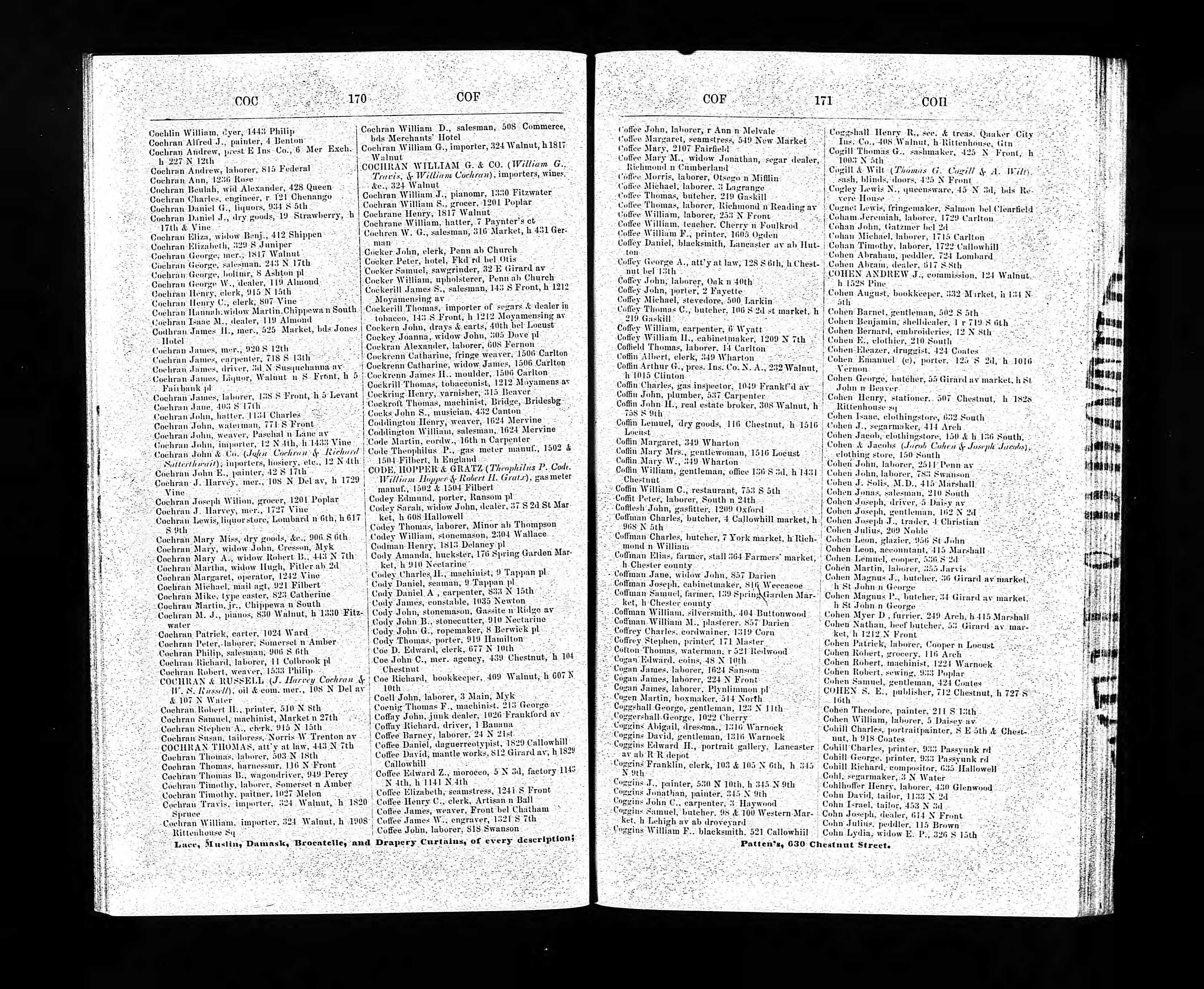
The other article that I found quite interesting reported on a street argument or fight among several of my relatives, including Reuben Cohen, Lazarus Jacobs, and Reuben Jacobs.  Apparently an argument started at seven in the morning among what the article refers to as “barkers connected with the South Street clothing stores,” which “created considerable excitement in the neighborhood, with their jargon.” Four men were arrested, including my three relatives, who were taken to the alderman to “keep the peace.”  This article was dated Wednesday, July 10, 1867.[4]  In 1860, Joseph Jacobs, the brother of Lazarus and father of Reuben, had been a business partner in a clothing store Jacobs and Cohen with Jacob Cohen, father of Reuben Cohen.  I noticed in the 1868 Philadelphia directory that Jacob’s business was then called Hamberg and Co., presumably for his son-in-law Ansel Hamberg.  Had Jacob and Joseph had a parting of the ways? Were they now competitors? Were the cousins fighting over business at 7 in the morning? Or was this just a quarrel among young men that had nothing to do with the family businesses?

Although none of these articles revealed any significant clues or information about my relatives, they add a human dimension to the facts and data I can find in the census reports and vital records.  These were all real people with real problems.  Times may have changed, but people always have and always will deal with the forces of and the flaws of human nature.


[1] Hearings at the Central, Philadelphia Inquirer, December 4, 1869, p. 2.  Located at http://www.genealogybank.com/gbnk/newspapers/doc/v2:110C9BFA1F116650@GBNEWS-1131D42D94DDFEC8@2404036-1131D42DDDBB7728@1-1131D43073B916C0@Hearings+at+the+Central/?search_terms=cohen%7Cjacobs_dlid=DL0114052113460322139&s_ecproduct=SUB-Y-5595-R-OB&s_ecprodtype=RENEW-A-I&s_trackval=&s_siteloc=&s_referrer=&s_subterm=Subscription%20until%3A%2011%2F07%2F2014&s_docsbal=%20&s_subexpires=11%2F07%2F2014&s_docstart=&s_docsleft=&s_docsread=&s_username=amybesscohen@gmail.com&s_accountid=AC0113110721363014323&s_upgradeable=nos_dlid=DL0114052113505122638&s_ecproduct=SUB-Y-5595-R-OB&s_ecprodtype=RENEW-A-I&s_trackval=&s_siteloc=&s_referrer=&s_subterm=Subscription%20until%3A%2011%2F07%2F2014&s_docsbal=%20&s_subexpires=11%2F07%2F2014&s_docstart=&s_docsleft=&s_docsread=&s_username=amybesscohen@gmail.com&s_accountid=AC0113110721363014323&s_upgradeable=no

[2] At the Central, Philadelphia Inquirer, February 15, 1873, p.2.  Located at http://www.genealogybank.com/gbnk/newspapers/doc/v2:110C9BFA1F116650@GBNEWS-111FE4E816403290@2405205-111FE4E85086AEB0@1-111FE4E9E3B265B0@At+the+Central/?search_terms=cohen%7Cjacobs_dlid=DL0114052113480522392&s_ecproduct=SUB-Y-5595-R-OB&s_ecprodtype=RENEW-A-I&s_trackval=&s_siteloc=&s_referrer=&s_subterm=Subscription%20until%3A%2011%2F07%2F2014&s_docsbal=%20&s_subexpires=11%2F07%2F2014&s_docstart=&s_docsleft=&s_docsread=&s_username=amybesscohen@gmail.com&s_accountid=AC0113110721363014323&s_upgradeable=no

[3] Rugs Gave the Clue, Philadelphia Inquirer, May 28, 1899, p. 13.  Located at http://www.genealogybank.com/gbnk/newspapers/doc/v2:110C9BFA1F116650%40GBNEWS-11499C1A1A4C6430%402414803-11499C1EE5C8F558%4020-11499C2C9B7C3D58%40Rugs+Gave+the+Clue+Police+Hint+They+Have+Captured+Two+Important+Fugitives/?search_terms=%22rugs%20gave%20the%20clue%22%7Ccohen%7Cjacob

[4] City Intelligence, Police Affairs, Philadelphia Inquirer, July 10, 1867. p. 2.  Located at http://www.genealogybank.com/gbnk/newspapers/explore/USA/Pennsylvania/Philadelphia/?lname=cohen&fname=jacob&kwinc=&kwexc=&dateType=range&formDate=&formDateFlex=10&rgfromDate=1850&rgtoDate=1890&processingtime=&group=&pg=3

Who Knew?  My Great-Great Grandmother’s Family, the Jacobs

One of the great surprises I’ve encountered in doing genealogy work is that I have many more surnames in my family than I ever knew.  I knew about Goldschlager and Brotman, on my mother’s side, and I knew about Cohen, Schoenthal, Seligman and Katzenstein, on my father’s side. But I never knew that I was also a Rosenzweig until I found my great-grandmother Ghitla’s maiden name, and now I know that I am also descended from the Jacobs family on my father’s side.  My great-great grandmother was Sarah Jacobs, married to Jacob Cohen.  My great-great-great grandmother was Rachel Jacobs, married to Hart Levy Cohen.  Although I have not yet found any familial connection between Rachel and her mother-in-law Sarah, I have found some evidence of Rachel’s parents and siblings.

First, I noticed that a man named Lazarus Jacobs was living with Rachel and Jacob Cohen in Philadelphia in 1860.  Then yesterday while researching the Cohens in the 1860s, I found a Philadelphia directory that listed Jacob’s business partner as Joseph Jacobs.  I assumed this was another of Rachel’s relatives, but was not sure how they might be related.

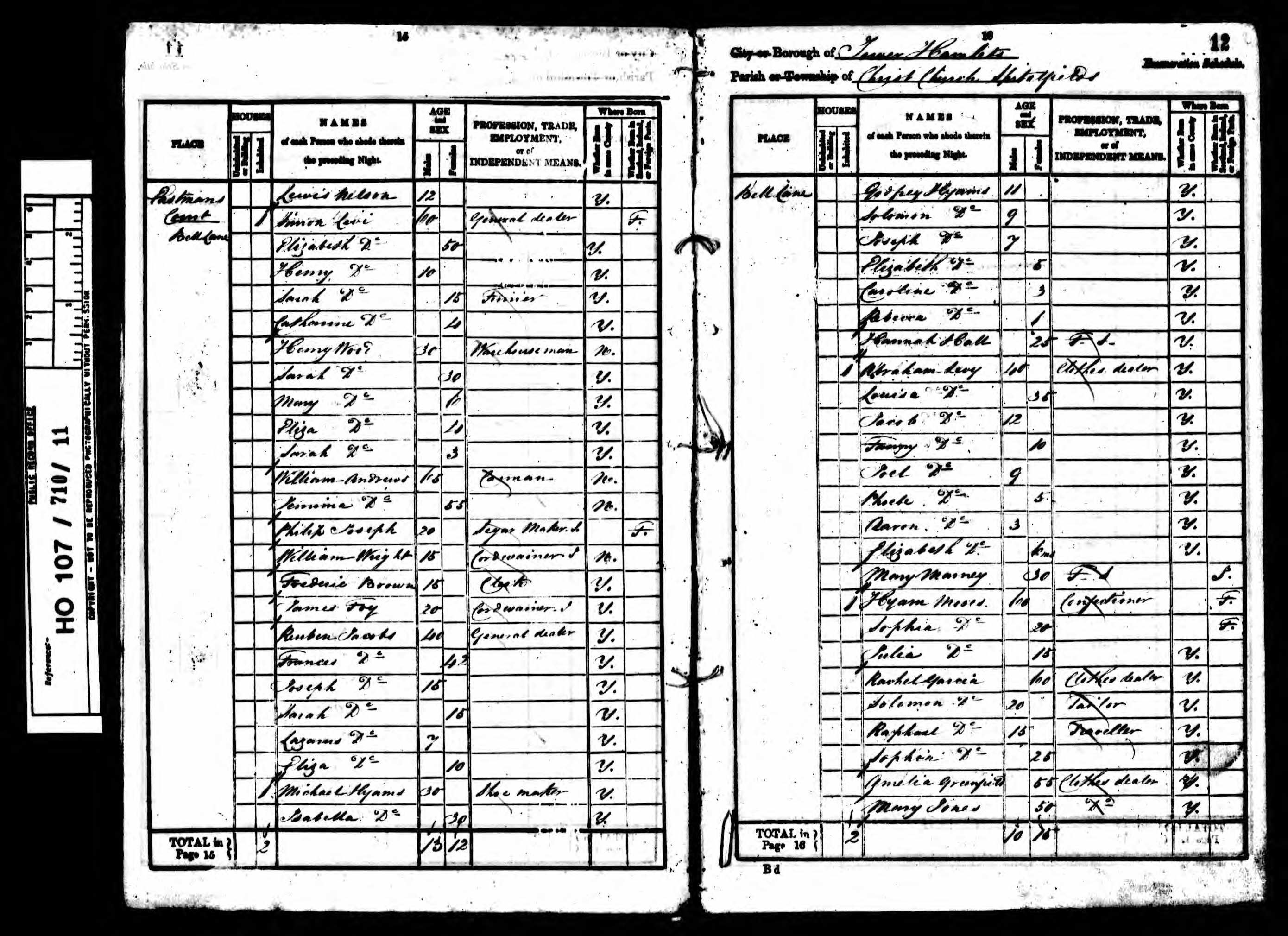
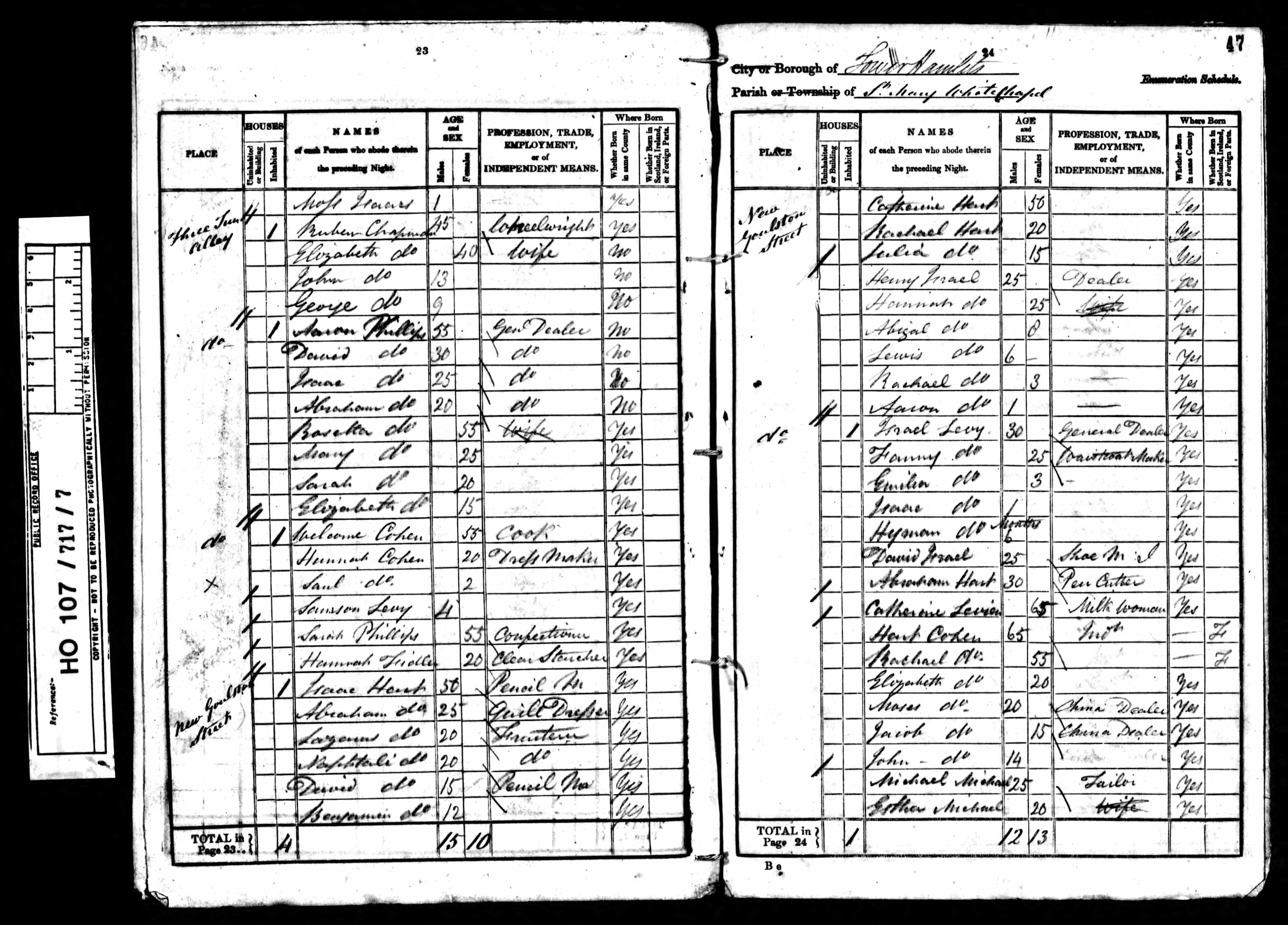
After some further searching, I found Joseph Jacobs on the 1841 England census, living with his parents Reuben and Frances and his siblings Rachel, my great-great-grandmother, and Lazarus, the younger brother who was living with Jacob and Rachel in 1860.

Reuben Jacobs and family 1841 England Census

Reuben Jacobs and family 1841 England Census

Joseph married his wife, Rachael, in 1847, whose maiden name may also have been Jacobs.  (The BMDIndex has two Rachels on the registry page for Joseph Jacobs, so until I can obtain the actual records, I am not sure if she was Rachel Levy or Rachael Jacobs.)

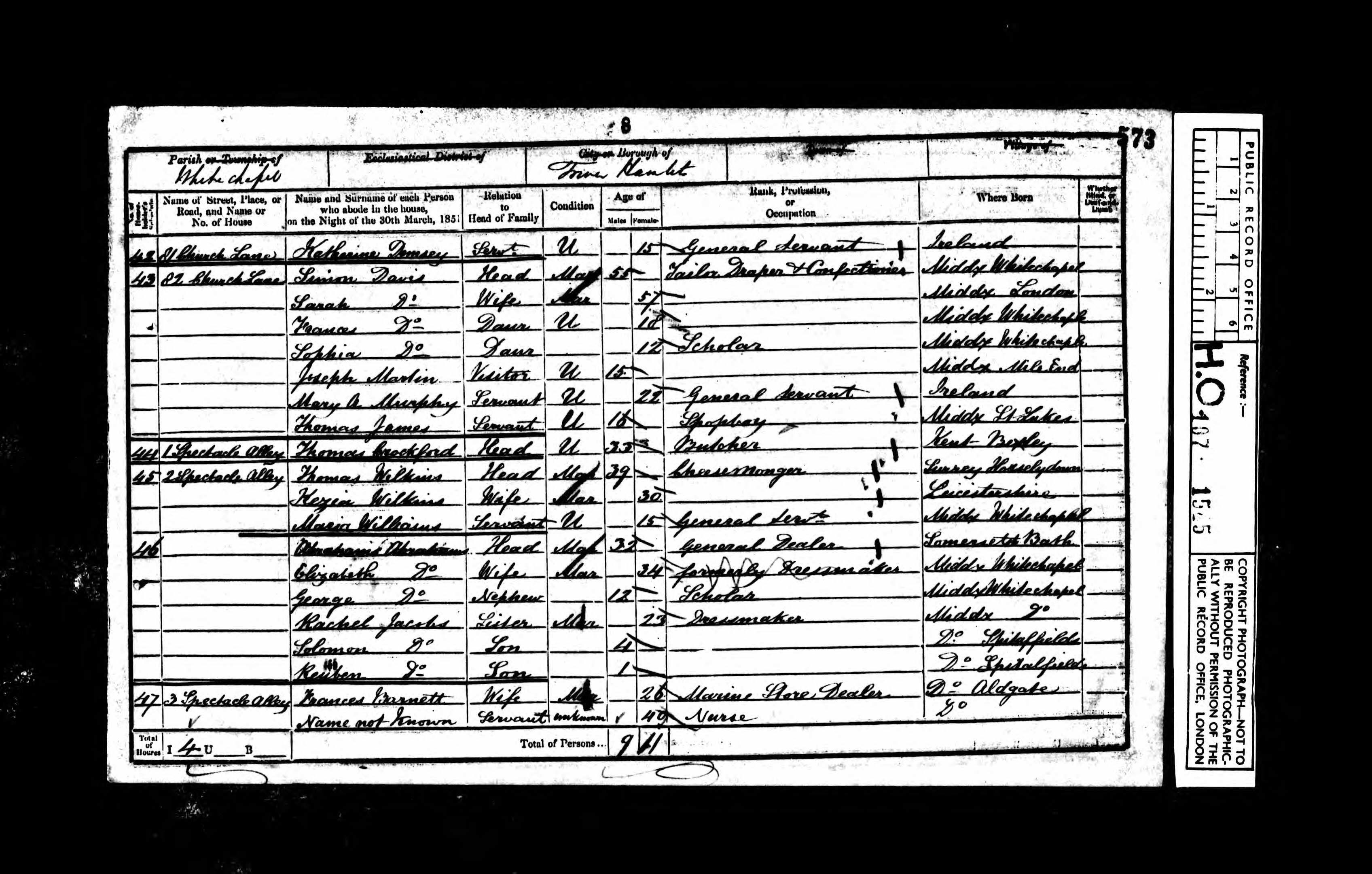
Joseph and Rachel had a son, Solomon, born in 1848, and a son Reuben, born in 1850.  Both were living with Rachel on the 1851 England census.  Rachel was listed as the sister of the head of household, whose name was Abraham Abrahams; his wife’s name was Elizabeth.  I cannot find a Rachel Abrahams on the marriage registry on the BMDIndex, and although I did find an Abraham Abrahams married to an Elizabeth Levy, I also wonder whether the census taker took down Abraham’s name incorrectly since there is also an Abraham Jacobs married to an Elizabeth.

Rachel Jacobs and children 1851 England census

Rachel Jacobs and children 1851 England census

At any rate, the bigger question is— where was Joseph?

My guess was that he was in the US, preparing to move the family to Philadelphia.  I could not find him, however, on the 1850 US census nor could I find him on a ship manifest for that time period.  I did, however, find a Joseph Jacobs on the 1851 England census as a visitor in Birmingham, England; he was listed as born in Middlesex, London, and his occupation was as a general dealer, so my guess is that Joseph was simply away on business the day the census was taken.

Joseph Jacobs 1851 England census  a visitor

Joseph Jacobs 1851 England census
a visitor

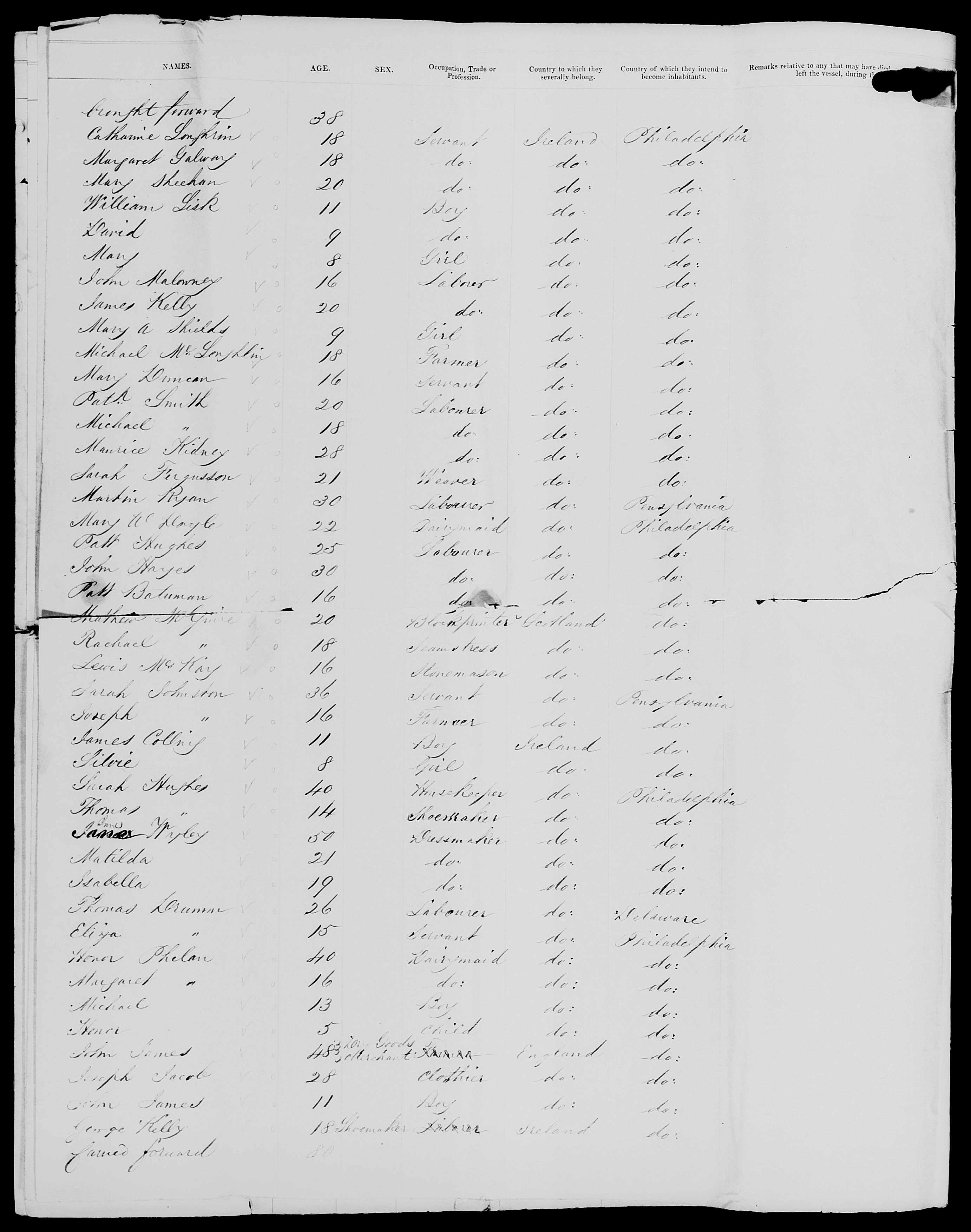
Joseph and his family left England and, like Joseph’s sister Rachel, settled in Philadelphia.  It appears that Rachel Jacobs and her three children, Solomon (4), Reuben (2) and Emanuel, who was described as an infant, left in 1853 along with her brother-in-law, fourteen year old Lazarus (L. Jacobs on the manifest).

Rachel Jacobs and children 1853 ship manifest

Rachel Jacobs and children 1853 ship manifest “Pennsylvania, Philadelphia Passenger Lists, 1800-1882”, index and images, FamilySearch (https://familysearch.org/pal:/MM9.1.1/K8CH-1V8 : accessed 20 May 2014), Jacobs, 1853.

Her husband Joseph may not have left until 1854.

Joseph Jacobs ship manifest 1854

Joseph Jacobs ship manifest 1854 “Pennsylvania, Philadelphia Passenger Lists, 1800-1882”, index and images, FamilySearch (https://familysearch.org/pal:/MM9.1.1/K8CC-N1Z : accessed 20 May 2014), Joseph Jacob, 1854

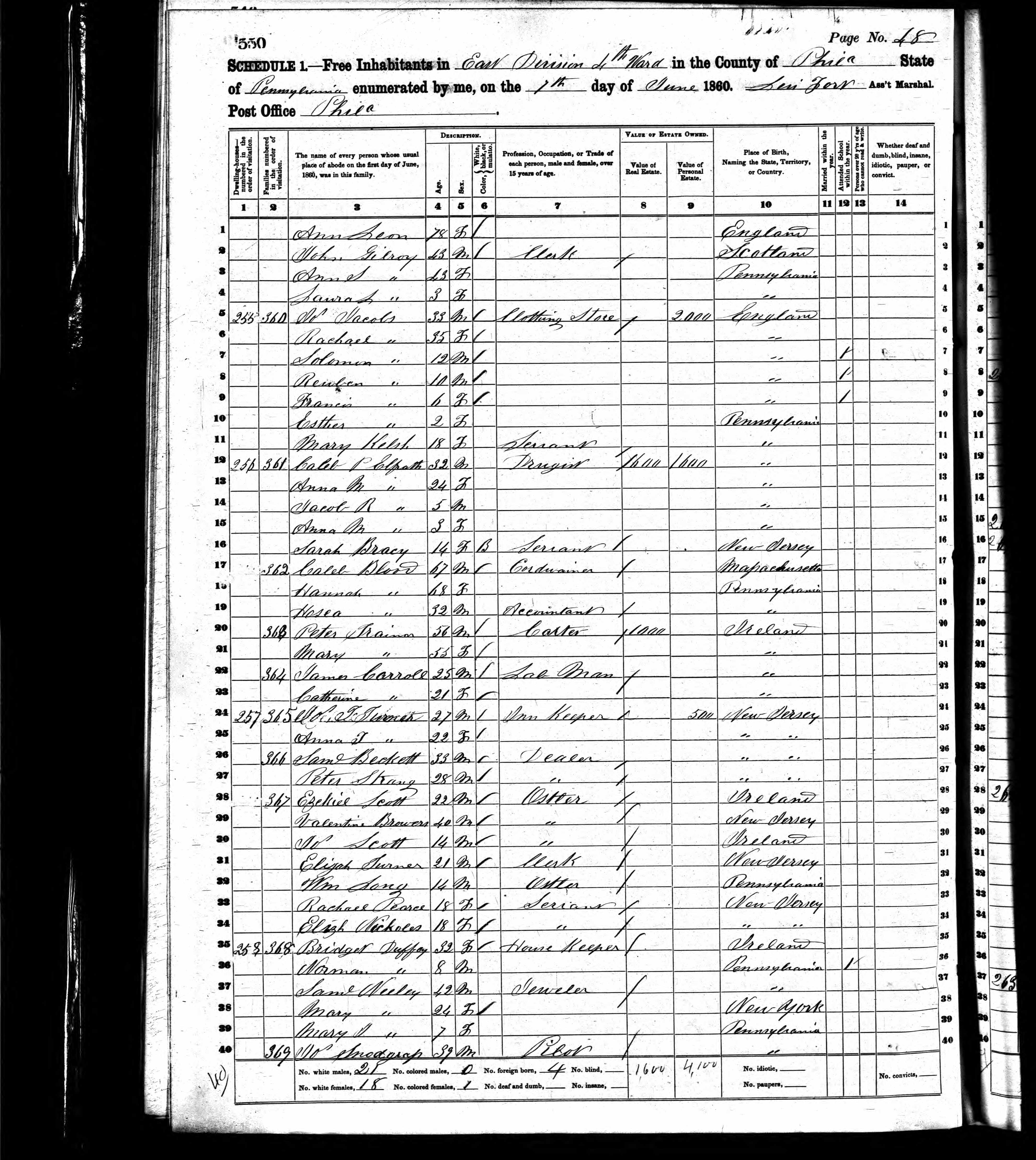
These dates make sense because according to the 1860 US census, their daughter Frances or Fanny was born in England and was six at the time of the census in 1860, but their daughter Esther was born in Pennsylvania and was already two years old in 1860.


Joseph Jacobs and family 1860 US census

Joseph Jacobs and family 1860 US census

What seems inconsistent, however, is that Frances/Fanny is not on the ship manifest with either her mother Rachel or her father Joseph.  Perhaps the 1860 census was incorrect, and Frances was born shortly after arriving in the US, but the 1870 census also has her listed as born in England, so more likely she just wasn’t included on the ship manifest. Emanuel Jacobs, however, although listed on the ship manifest, is not included in the 1860 census.  In fact, a later born child was named Emanuel, born in 1866.  So was “Emanuel” on the manifest really Frances? Or did the first Emanuel die?

Sadly, it was the latter.  Emanuel died on May 3, 1860, of heart disease, according to the US Federal Census Mortality Schedule.  The Philadelphia death certificate identifies his father as Joseph Jacobs residing at 150 South Street, so this is definitely the right child since that is where the Jacobs family was living in 1860.  The certificate also says that Emanuel had been in Philadelphia for 2 and 2/3 years, meaning since sometime in 1857 (which seems incorrect unless they lived elsewhere between 1853 and 1857), and although I cannot decipher the age very well, I think it says he was 8+ years, meaning he was born sometime either in 1851 or 1852, which would explain why he was not on the 1851 census, but was on the 1853 manifest.  Apparently, the second Emanuel, born in 1866, was named for the deceased older brother.

Emanuel Jacobs death certificate May 3, 1860

Emanuel Jacobs death certificate May 3, 1860

That does not explain where Frances was, however, when the rest of the family was sailing to Philadelphia.

In 1860 Joseph Jacobs and his family lived at 150 South Street in Philadelphia, not more than a few houses from my great-grandparents who lived at 136 South Street.  He was in business with his brother-in-law, Jacob Cohen, my great-great-grandfather. Although I will track what happened to Joseph and to Lazarus after 1860 as well as research Joseph, Sarah, and Lazarus’ parents in England, for now I will return to the Cohen family and finish their story before returning to my newly discovered family line, the Jacobs.  The tree just keeps on growing.

Enhanced by Zemanta

Hart Levy Cohen and Family 1860 to 1870: A Decade of Transition

By 1860, all my Cohen relatives were settled into life in the US, having been here for about ten years.  Hart Levy Cohen, my three-times great grandfather, was living in Philadelphia with his three of his adult children, Elizabeth, Lewis and Jonas, and his son Jacob was living with his wife Sarah and their nine children, three servants, and one of Sarah’s brothers, Lazarus Jacobs.  The other son Moses was living in the Washington, DC, area with his wife Adeline and their five children.  Much would change between 1860 and 1870.

First, the decade started off with two major losses.  Moses Cohen died on October 2, 1860, leaving behind his widow and five young children.  Although the death record I found stated his birth year as 1828, other records would have given him an earlier year of birth, probably around 1823, making him only 37 or so when he died. He was buried in Washington Hebrew Cemetery.

Just three months later, the family suffered another loss when the family patriarch, Hart Levy Cohen, died at the age of 88.  According to his death certificate, he died on December 29, 1860, of old age.  He was buried on December 31, 1860, at Mikveh Israel Cemetery, where many of his descendants would also be buried.

Hart Levy Cohen death certificate

Hart Levy Cohen death certificate

Hart Levy Cohen burial at Mikveh Israel Cemetery December 31, 1860

Hart Levy Cohen burial at Mikveh Israel Cemetery December 31, 1860

One has to wonder whether the death of his son Moses accelerated his demise, although living to 88 in the mid-19th century must have been quite an accomplishment.  Here was a man who had moved from Amsterdam to London as a young man, worked as a dealer in goods, and raised five children before losing his wife and moving to Philadelphia as a man in his 70s.  He had adjusted to two huge migrations and lived a long life.  I wish I knew more about what he was like and who his own (and thus my) ancestors were.  A photograph would also be wonderful.  But I feel fortunate to have found him at all and to have been able to learn something about this man, my great-great-great grandfather.

This was also a tumultuous time in American history.  In February 1861, the Southern states formed the Confederate State of America, and in April 1861, with the attack on Fort Sumter in Charleston, South Carolina, the Civil War began and lasted until April, 1865, when the Confederacy surrendered to the Union Army in Appomattox, Virginia.  Although I cannot find a military record I could verify as being for any of Hart’s sons, I found my great-great grandfather Jacob Cohen’s draft registration, depicted below.  Jacob was listed as having been born in London, living at 136 South Street, where he lived for all or almost all of his years in Philadelphia, and working as a storekeeper.

Jacob Cohen Civil War draft registration 1863

Jacob Cohen Civil War draft registration 1863

I also found a record indicating that a Lewis Cohen enlisted in the Union Army on April 23, 1861, just as the war had started, serving as a private in Company H, Pennsylvania 22nd Infantry Regiment.  The record notes that Lewis mustered out on August 7, 1861. There is also a second record for a Lewis Cohen indicating the he served a private in Company F, Regiment 122 of the Pennsylvania Infantry.   I will have to keep searching to see if I can find any further military records to verify that one of these two Lewis Cohens was in fact my ancestor.  I could not locate any military record for the youngest brother, Jonas, which seems a little strange since he would certainly have been of draft age, being only 32 when the war broke out in 1861.

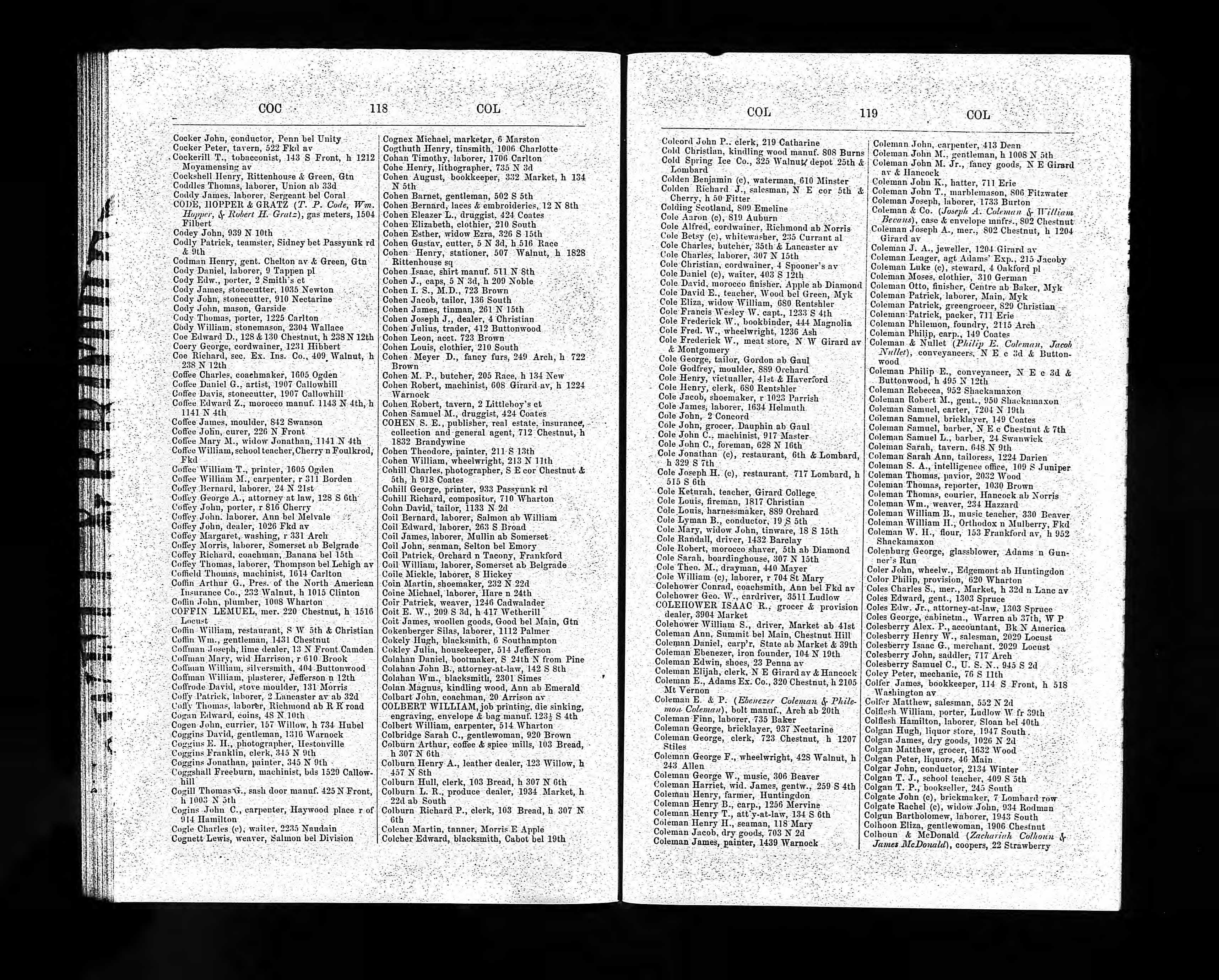
Since both Jonas and Jacob are listed in the Philadelphia directory for 1861 whereas Lewis is not, it may be that Jonas and Jacob never did active duty during the Civil War.  In 1861, Jonas was listed as a salesman, living at 210 South Street.  In that same directory, his brother Jacob is listed as having a clothing store at 150 South Street and residing at 136 South Street, which may be where Jonas worked. The store was called Jacobs and Cohen and was owned by my great-great grandfather Jacob and his partner, Joseph Jacobs. I will write more about Joseph Jacobs in a subsequent post.

Cohens in the 1861 Philadelphia city directory

Cohens in the 1861 Philadelphia city directory

The business must have both changed and grown by 1870.  On the 1870 census, Jacob’s occupation is described as a “broker,” and the city directories from that point forward more specifically describe him as a pawnbroker.  His son Isaac was also described as a broker on the 1870 census, and his sons Hart and Reuben were both described as “clerk in store,” presumably their father’s store.  This was the beginning of a long and extensive family business as pawnbrokers.

Jacob Cohen and family 1870 US census

Jacob Cohen and family 1870 US census

The business was not the only thing that was growing between 1860 and 1870.  Jacob and Sarah’s family had also grown between 1860 and 1870.  In addition to the nine children they had already had by 1860, Jacob and Sarah had four more between 1860 and 1870: Lewis (1862), Emanuel (1863), Jonas (1864), and finally Abraham in 1866.  Sarah Jacobs Cohen had given birth to at least thirteen children between 1846 and 1866; given infant mortality rates, there could have been a few more squeezed into the “off” years.  By the time her last baby was born, Sarah was already a grandmother, but was not yet forty years old.  She’d been having babies for twenty years.  It’s a good thing Jacob’s business was successful.  But much as I empathize with Sarah and all those pregnancies, childbirths, and the exhaustion that comes with every new baby, plus all the work involved in raising thirteen children, I am really glad that she did not stop.  Their child Emanuel, her eleventh child, grew up to be my great-grandfather.

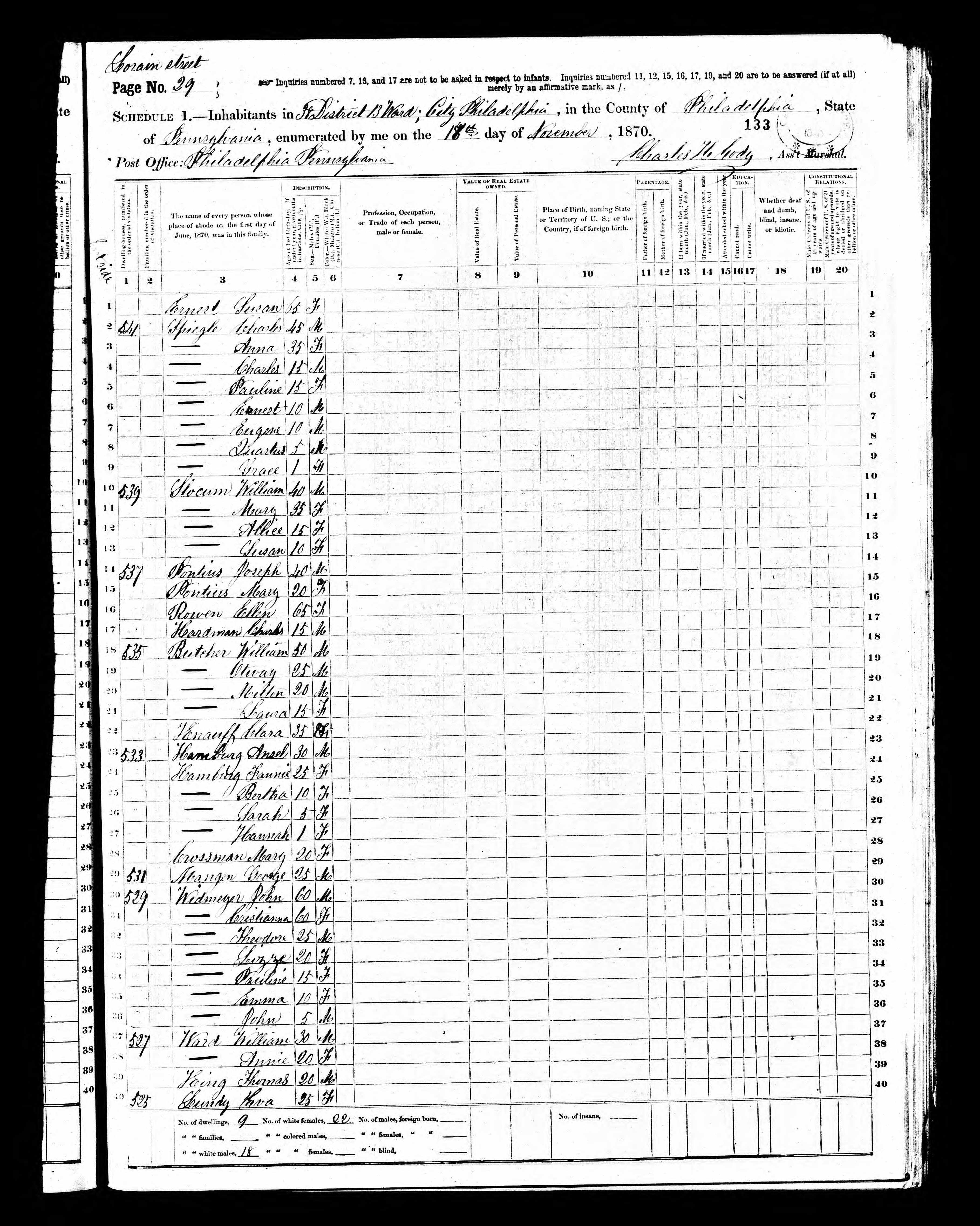
Meanwhile, Jacob and Sarah’s two oldest children, Fanny (Frances) and Joseph, were already on their own by 1870.  Fanny, the only child born in England, had married Ansel Hamberg in 1866, according to the 1870 census, and in 1870, she and Ansel were living with their three daughters, Bertha (1866), Sarah (1867), and Hannah (1869).  Like her father Jacob, Fanny’s husband was employed as a pawnbroker.  Had he and Jacob met in the trade? Did they work together?  It appears from the city directories that Ansel was working at a different address, but perhaps there was some connection between the two stores.
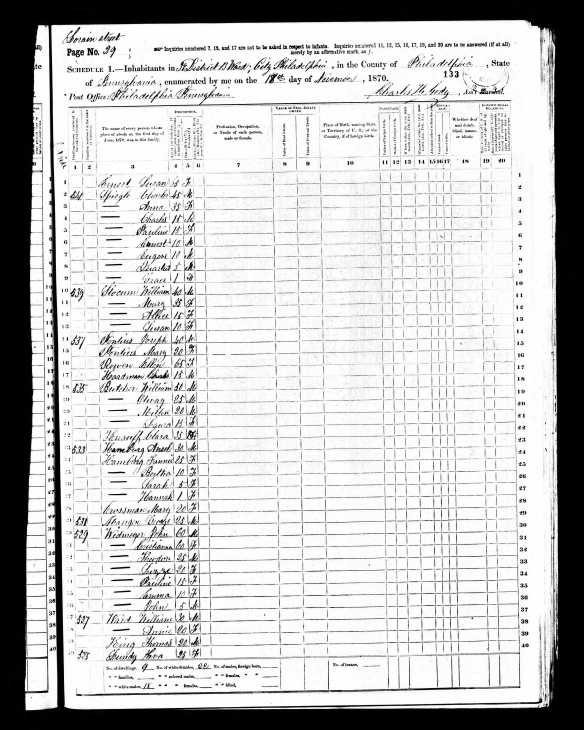
Fanny and Ansel Hamberg and family 1870 census

Fanny and Ansel Hamberg and family 1870 census

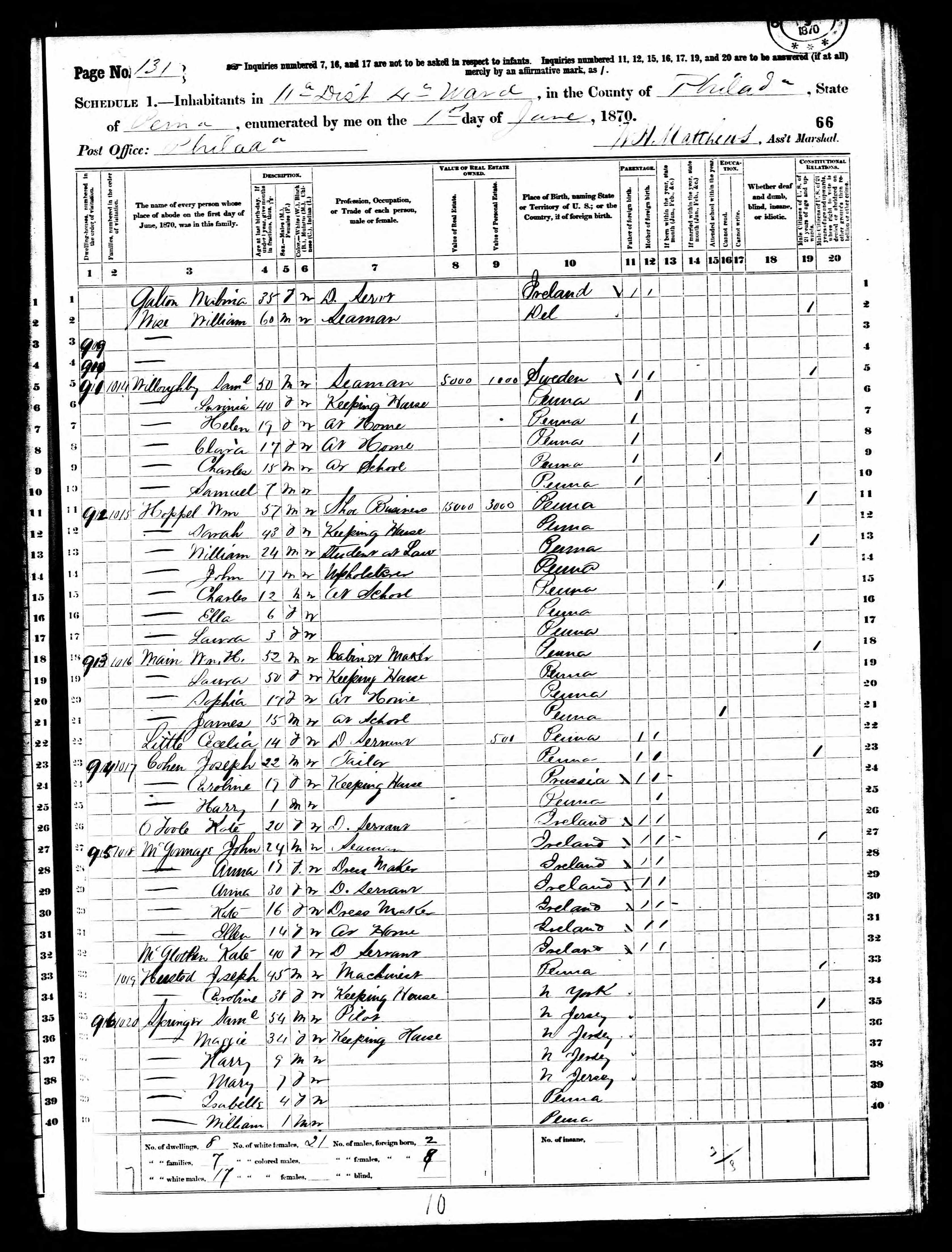
Fanny’s younger brother Joseph was still living at home and working in the clothing business at 225 S. 2d Street, not too far from his family’s home in 1868.  By 1870, Joseph was married, and he and his wife Caroline had a one year old son Harry.  Joseph was working as a tailor, according to the 1870 census and he and Caroline were living in the same ward and district as his family and had a domestic servant living with them.

Joseph and Caroline Cohen and family 1870 US census

Joseph and Caroline Cohen and family 1870 US census

Like their brother Jacob, his siblings Lewis, Elizabeth and Jonas were also working in the retail business during the 1860s. In 1862 Lewis and Elizabeth were both listed in the Philadelphia city directory as clothiers living at 210 South Street.

Lewis Cohen and Elizabeth Cohen in the 1862 Philadelphia directory

Lewis Cohen and Elizabeth Cohen in the 1862 Philadelphia directory

In 1863 Jonas and Lewis were listed next to each other in the Pennsylvania Septennial Census as salesmen.  In 1867, 1868, 1870 and 1871, Elizabeth was listed as a clothier in the yearly Philadelphia city directory, and Lewis was listed as a salesman in 1868 and as a pawnbroker in 1871 (Jonas was not listed in either directory).  Both Elizabeth and Lewis were living at 119 South 2d Street, not far from where their nephew Joseph was working.

I could not find Lewis, Jonas or Elizabeth on the 1870 census, but apparently that census was terribly flawed, resulting in a second count in some major cities, including Philadelphia.  Even with a second count, it seems that the census taker missed those three Cohens.

Down in Washington, DC, Moses’ family had to adjust to his untimely death in 1860, leaving behind four children under ten in addition to his twenty year old son Moses, Jr.  Moses, Sr.’s widow Adeline supported the children by working as a merchant, selling second hand clothing, according to Washington, DC, city directories in 1867, 1868 and 1870.  By the time of the 1870 census, Adeline was still living with the four younger children, Hart, Rachael, Jacob, and John, but Hart was employed as a pawnbroker and Jacob as a clerk.  On the census Adeline is described as “keeping house,” so perhaps by that time her sons were supporting her.
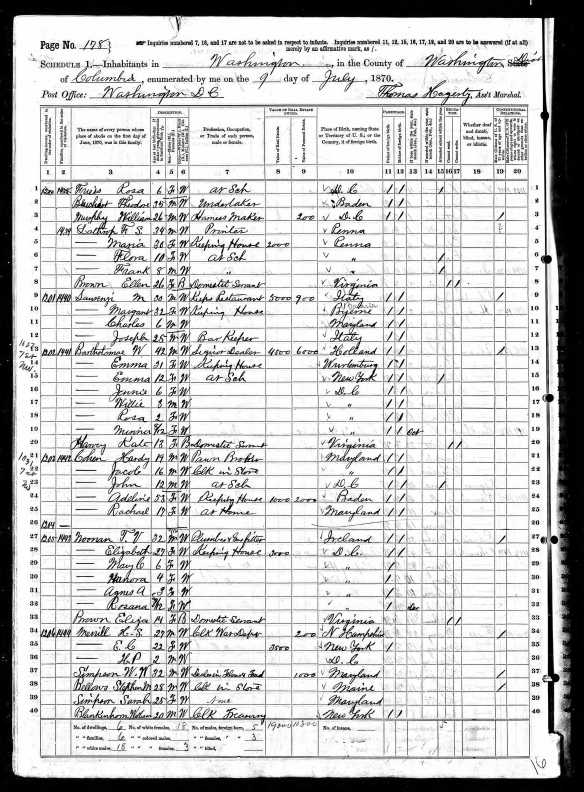
Adeline Cohen and family 1870 US census

Adeline Cohen and family 1870 US census

Adeline and Moses’ oldest child, Moses, Jr., married Henrietta (Yetta) Loeb on August 16, 1862.  According to his 1863 Civil War draft registration, he was, like his cousins in Philadelphia, working as a clothier. Tax rolls for 1864 and 1865 list him as a “retail dealer.”  On the 1870 census, he was working as a clothier, and he and Henrietta had three children, Augusta (six), Myer (four), and Jacob (four months).
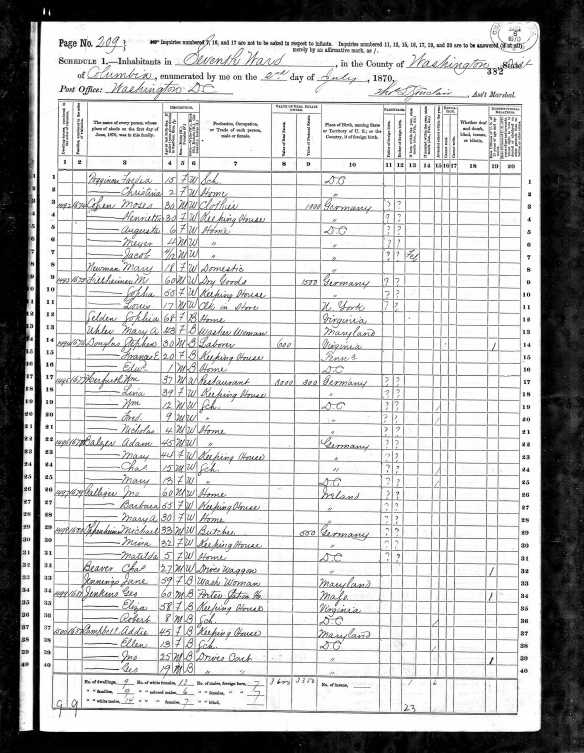
Moses Cohen, Jr. and family 1870 US census

Moses Cohen, Jr. and family 1870 US census

Thus, by 1870, although Hart and his son Moses had passed away, their families were thriving.  Hart’s four children in Philadelphia were all gainfully employed as merchants, starting in the clothing industry and eventually some of them becoming pawnbrokers.  Similarly, Moses, Sr.’s widow and children were also involved in the clothing and pawnbroker businesses in Washington, DC.  Jacob, my great-great grandfather, was well-established with an ongoing business in Philadelphia, and his children were following in his footsteps.  He and Sarah still had many young children at home in 1870, including my great-grandfather Emanuel.  The family was still living in Ward 4, but that would start to change as the next generation started to go out on their own, as we will see when we follow the family from 1870 to 1880.

That, also, would be a decade of transition for the family as Hart’s grandchildren became adults.  These grandchildren were almost all first-generation Americans, not immigrants.  Their story is an American story from start to finish.

 

Enhanced by Zemanta

All Things Considered, I’d Rather Be in Philadelphia

W.C. Fields, who was born in Philadelphia, used to make fun of his birthplace as a staid and boring place by threatening to have the line, “All things considered, I’d rather be in Philadelphia,” as the epitaph on his gravestone.  (Apparently, that threat was never carried out.)  Philadelphia has often been overshadowed by New York to its north and by Washington to its south.  I remember traveling to Philadelphia to visit my relatives when I was a child, my siblings and I fidgeting in the back seat of the car as my father fought through the traffic on the ugly New Jersey Turnpike.

English: W.C. Fields

English: W.C. Fields (Photo credit: Wikipedia)

My grandmother Eva Cohen and her second husband Frank Crocker lived in what I remember as a small apartment in Philadelphia, and somehow it was always hot and humid whenever we visited.  I was only nine when my grandmother died, so my memories are somewhat vague, but I do remember watching a baseball game with Poppy Frank, as we called him, discussing the merits of Sandy Koufax versus Don Drysdale (the Phillies were obviously playing the Dodgers that particular visit).  We would sit and visit for a while, have lunch or dinner, and then pile back in the car, suffer through the Jersey Turnpike again, fidgeting and bickering in the backseat.  So I guess I could relate to W.C. Fields’ sentiments about his hometown.  Somehow I associated Philadelphia with long car rides, being tortured by my siblings, and hot, humid weather.  I wish I could remember more about my grandmother, but as a child, I was focused on childish things. Well, and baseball.  As I wrote before, I remember her as beautiful, reserved, and very dignified, a true gentle-woman in both senses of the word.

So given my somewhat skewed views of the City of Brotherly Love, I did wonder why my Cohen relatives (and in fact all of my father’s lines) ended up in Philadelphia.  They sailed into New York City—why did they leave the Greatest City in the World to go to its poor stepsibling to the south? I asked my father, who was born and raised in Philadelphia, this question the other day, and he said something about William Penn and how Philadelphia was a Quaker city and probably more tolerant of Jews.

I decided to do some research to answer a couple of questions: What was Philadelphia like for Jews in the 1840s and 1850s when the Cohens arrived? Where did they live in the city, and what were the socioeconomic conditions like in those areas? What drew them there instead of New York or some other American city?

I found a wonderful resource, a book by Robert P. Swierenga, a historian who has published several books about the Dutch in the United States.  The book I relied on is titled The Forerunners: Dutch Jewry in the North American Diaspora (Wayne State University Press 1994), and in it Swierenga traced the immigration of Dutch Jews to America and their settlements in several US cities, including Philadelphia.  I read the chapter on Philadelphia and learned not only about the Dutch Jews who settled there, but more generally about the history of Jews in Philadelphia.  After reading this chapter, I better understand why the Cohen family decided to settle there.

Philadelphia had one of the earliest Jewish communities in the United States.  In 1776 it had the third largest Jewish population of American cities, after New York and Charleston; there were 300 Jews living in Philadelphia at that time.  That number grew to 200 families by 1778 as Jews sought refuge there during the Revolutionary War.  The population was largely Sephardic, and the first synagogue was formed in 1782, Congregation Mikveh Israel, an Orthodox Sephardic synagogue.  Once the war ended, however, many of the Jews returned to their prior homes, and by 1790 there were only 25 Jewish families or about 150 people.  (Swierenga, pp. 118-119)

English: Former home of Mikveh Israel Synagogu...

Former home of Mikveh Israel Synagogue

There was a growing number of non-Sephardic Jews settling in Philadelphia after the Revolution, however, as immigrants from Germany, Poland and the Netherlands began to arrive, and in 1790 these people formed a new synagogue, Rodeph Shalom, which would adhere to Ashkenazi practices.  Rodeph Shalom was the first Ashkenazi synagogue in North America, and most of its first congregants were Dutch.  (Swierenga, pp. 119-120)

Rodeph Shalom Synagogue on the NRHP since Augu...

Rodeph Shalom Synagogue on the NRHP since August 7, 2007. At 607–615 North Broad St., in the Poplar neighborhood of Philadelphia. (Photo credit: Wikipedia)

The Jewish population really started to grow in the early 19th century.  In 1820, there were 450 Jews in Philadelphia; in 1830 there were 730.  By 1840, there were 1500, and then there was a huge surge to 6000 by 1850 and to 10,000 by 1860.  This, of course, was the period my Cohen relatives began to arrive in Philadelphia—between about 1848 and 1851.  In fact, according to Swierenga, a substantial number of these Jewish immigrants were Dutch Jews.  (p. 120)

In his discussion of Dutch Jews, Swierenga included not only those who came directly from the Netherlands (meaning primarily Amsterdam), but also those, like my ancestors, who had emigrated from Amsterdam to England before coming to America.  Based on his research, he concluded that for the most part the Dutch Jews who came to Philadelphia tended to come directly from Amsterdam whereas those who had first stopped in London tended to end up in New York.  Swierenga found that in 1850 and 1860 there were only two Dutch Jewish families in Philadelphia who had had children born in England. (Swierenga, p. 125)  Was he counting my relatives? Hart Levy Cohen’s children were born in England, but did they count as “children?” On the other hand, Jacob’s daughter Fannie was born in England, and although his later children were born in the US, his family must have been one of those two families.

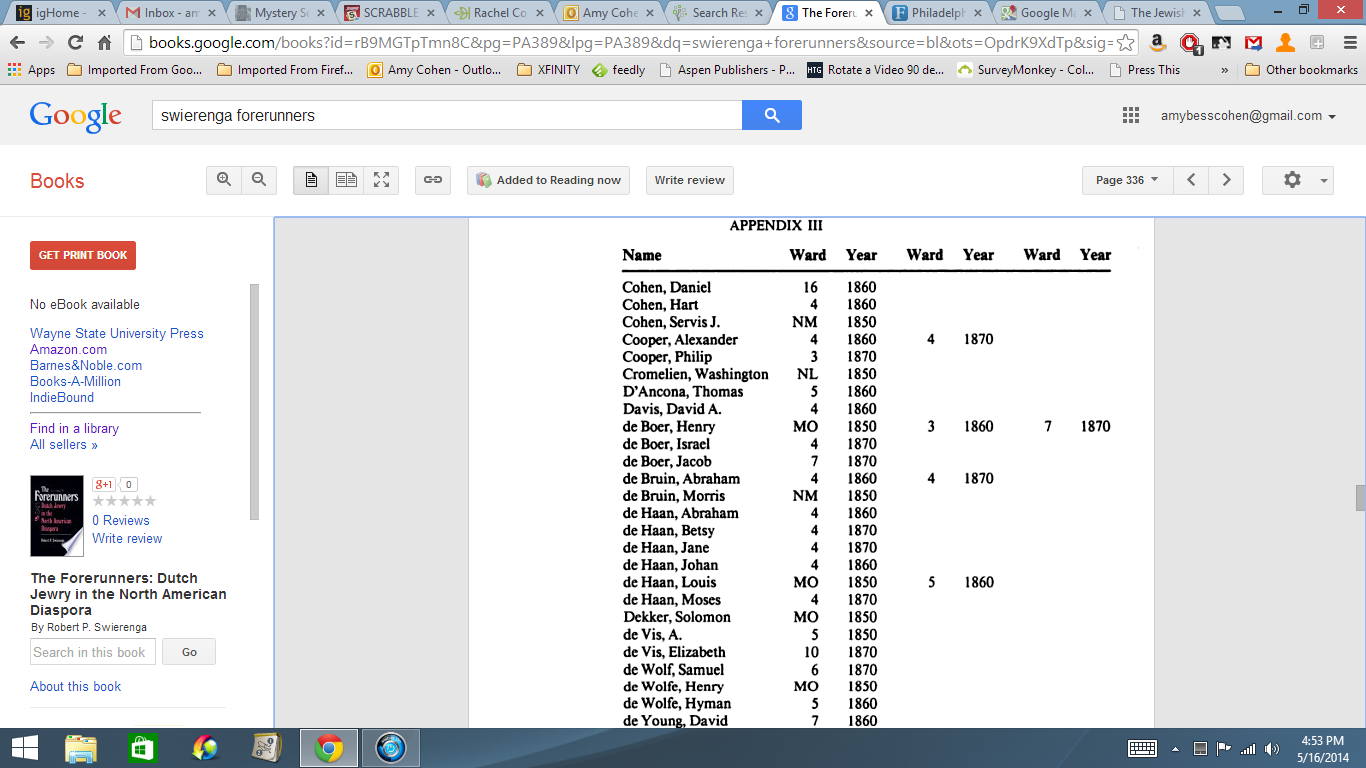
In fact, this screenshot from Appendix III in Swierenga’s book, captioned “Dutch Jewish Household Heads and Working Adults in Philadelphia 1850, 1860 and 1870,” shows that Swierenga did count Hart Cohen as one of those Dutch Jews.

Appendix III from Swierenga. The Forerunners

Appendix III from Swierenga. The Forerunners

Based on this data as compared to his findings that there was a greater number of Dutch Jewish families in New York with children born in England, Swierenga reached the following conclusion: “Clearly, the Dutch Jews in Philadelphia had been better off economically in the Netherlands, and they immigrated earlier than those settling in New York, who out of economic necessity spent a longer sojourn in London.  For the Philadelphia Dutch Jews, a London stopover or two-stage migration was not as necessary or desirable.” (p. 126)

I found this observation very interesting. Obviously, my ancestors did make that two-stage migration.  Did they do that because they could not afford to get directly to the US, or did they originally plan to stay in London?  Does this mean that Hart and Rachel were not as well-off as many of the other young couples who left Amsterdam at the end of the 18th century?

The Dutch Jewish community was located in the south side of Philadelphia. With the large wave of German immigrants in the 1840s, the Dutch Jews had moved south to Wards 1 through 5, and primarily Wards 4 and 5, located between what is now Broad Street and the Delaware River and South Street to the south and 2d Street to the north.  Swierenga described these two wards as slums.  Ward 4 is where Jacob and his family lived for many years at 136 South Street.   Was he living in a slum with his large family and three servants? It seems unlikely.  The neighborhood must have been somewhat economically diverse to attract what Swierenga himself had described as a fairly comfortable Dutch Jewish population.  (pp. 139-146)

This growing community of Dutch Jews eventually decided to form their own synagogue and leave Rodeph Shalom, which had become increasingly made up of congregants who had emigrated from Germany.  Also, Rodeph Shalom and Mikveh Israel as well as a third synagogue, Beth Israel, were all located in the north side of Philadelphia.  (Swierenga, pp. 127-129) Thus, in 1852 the Dutch Jewish families formed their own synagogue, B’nai Israel, on the south side where Jacob and Rachel were living in 1850. (pp. 130-145)

Between the 1850s and 1880, however, the Dutch Jews increasingly left the south side of Philadelphia and moved to neighborhoods further north.  Those who remained could not support their own synagogue, and B’nai Israel was closed in 1879.  By the end of the 19th century, the Dutch Jewish community had integrated into the larger Jewish community and had disappeared as a separate cultural subgroup.  (pp. 135, 320)  As I move forward from 1860 in tracing my Cohen relatives, I will keep in mind this shift to see whether or not they were a part of that trend.

After reading this material and understanding more about the history of the Jewish community in Philadelphia in the first half of the 19th century, I better understand why my ancestors chose Philadelphia.  It had a distinct Dutch Jewish community, which might have been very attractive to them after the Chut experience as outsiders in London.  It had a long history of a diverse but cooperative overall Jewish population.  And perhaps, like today, it seemed less overwhelming and more affordable than New York City.

I now read, “All things considered, I’d rather be in Philadelphia” in a whole new light.

Enhanced by Zemanta

Mystery Solved—I think

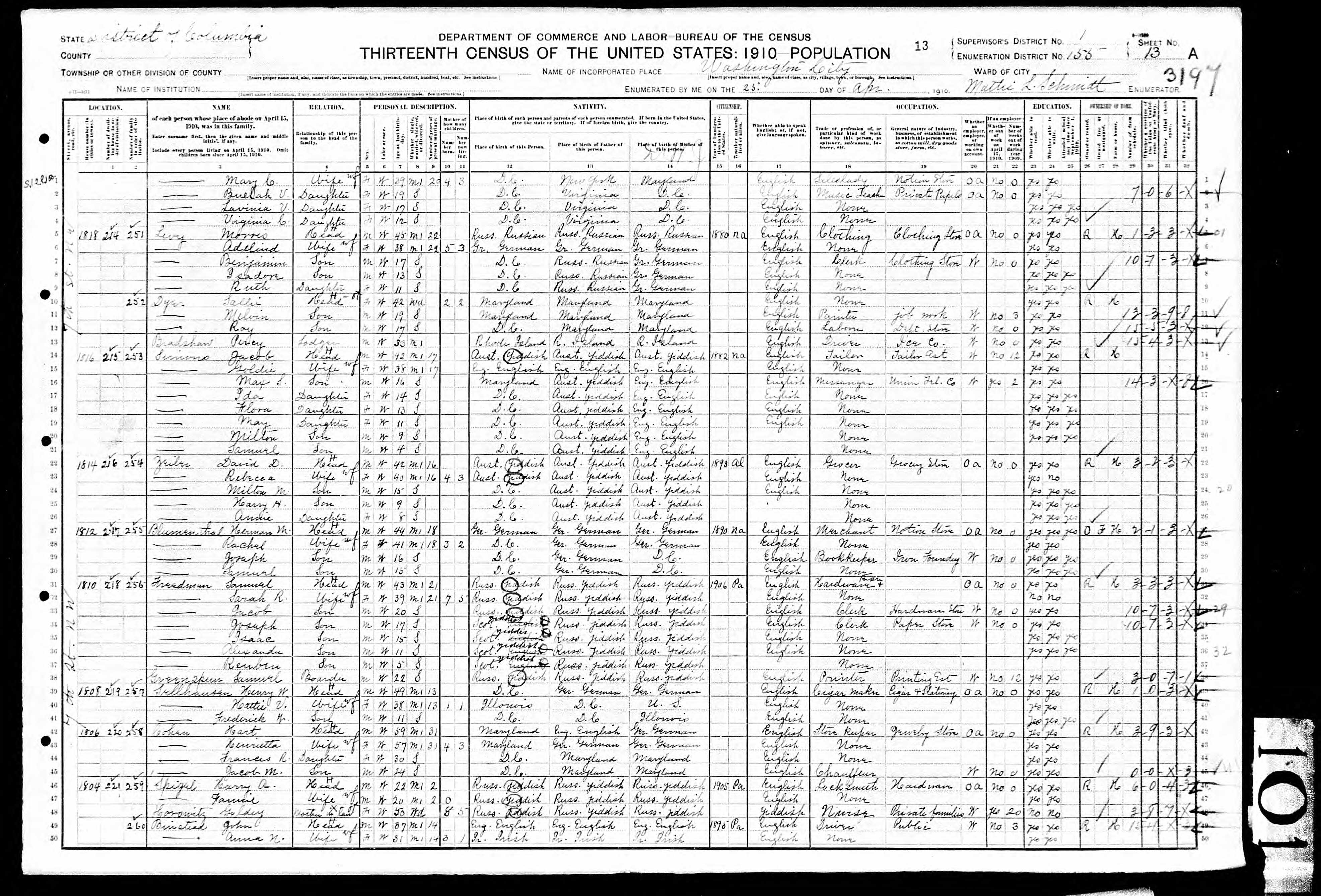
As I wrote yesterday, I was somewhat befuddled by the existence of two men named Hart Cohen, born around the same time (1850-1851), both married to women named Henrietta whose birth names started with B.  Although one Hart was born in Philadelphia and the other in Maryland, at first I (along with many other ancestry.com members) thought they were the same person and had their families intertwined on my family tree.  After spending much time sifting through census reports and other documents, I was finally convinced that there were in fact two Hart Cohens married to two different Henriettas, one living in the Washington, DC, area his whole life and the other living in Philadelphia his whole life except at the very end of his life.  Philadelphia Hart died in Washington, DC, in 1911, thus making the situation even more confusing.  But there were in fact two separate men, not one man living a double life.

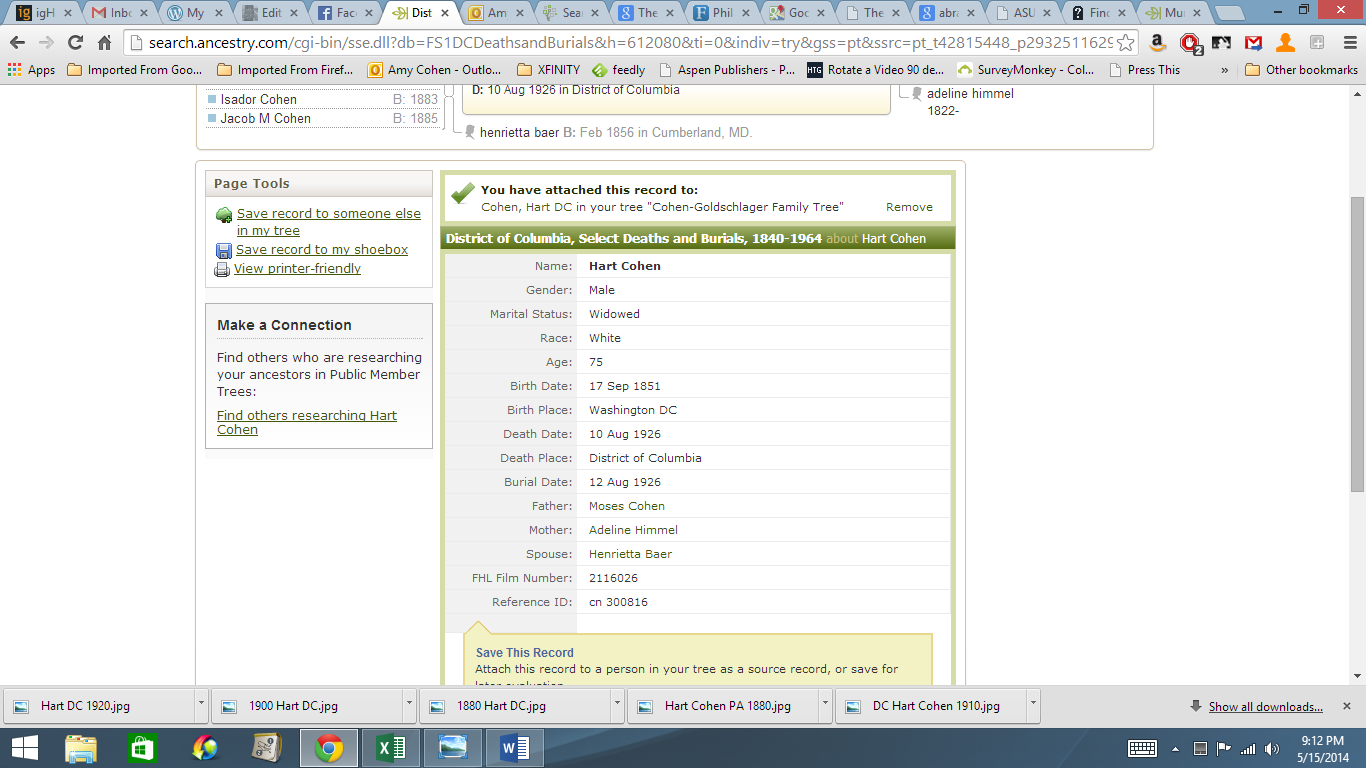
But was this more than coincidence? Was there any connection between them aside from all those coincidences?  I went to sleep last night unsure about the answer to that question, but the last document I found before my post was a death record for DC Hart which revealed his parents’ names: Moses Cohen and Adeline Himmel.  Further research revealed that Moses was born in England, Adeline in Germany, and that they had had a son born in Germany named Moses before emigrating to Maryland and having DC Hart.

Hart Cohen DC death record 1926

Hart Cohen DC death record 1926

I woke up this morning, determined to find some link between Moses Cohen, DC Hart’s father, and Jacob Cohen, my great-great grandfather and the father of Philadelphia Hart.  After some searching, I first found Adeline’s death record and saw that she had died in 1895, already a widow, in Washington, DC, and was buried in Washington.  I then tried to figure out when Moses, her husband, had died, and found a number of  Washington, DC. city directory listings in which Adeline Cohen was described as the widow of Moses.  The earliest one I found was dated 1867, meaning that Moses had already died by that time.

1867 Washington DC city directory Adeline Cohen as widow of Moses

1867 Washington DC city directory Adeline Cohen as widow of Moses

In fact, in 1870, Adeline was living with DC Hart and her other children in Washington.

Adeline living with her children 1870 US census

Adeline living with her children 1870 US census


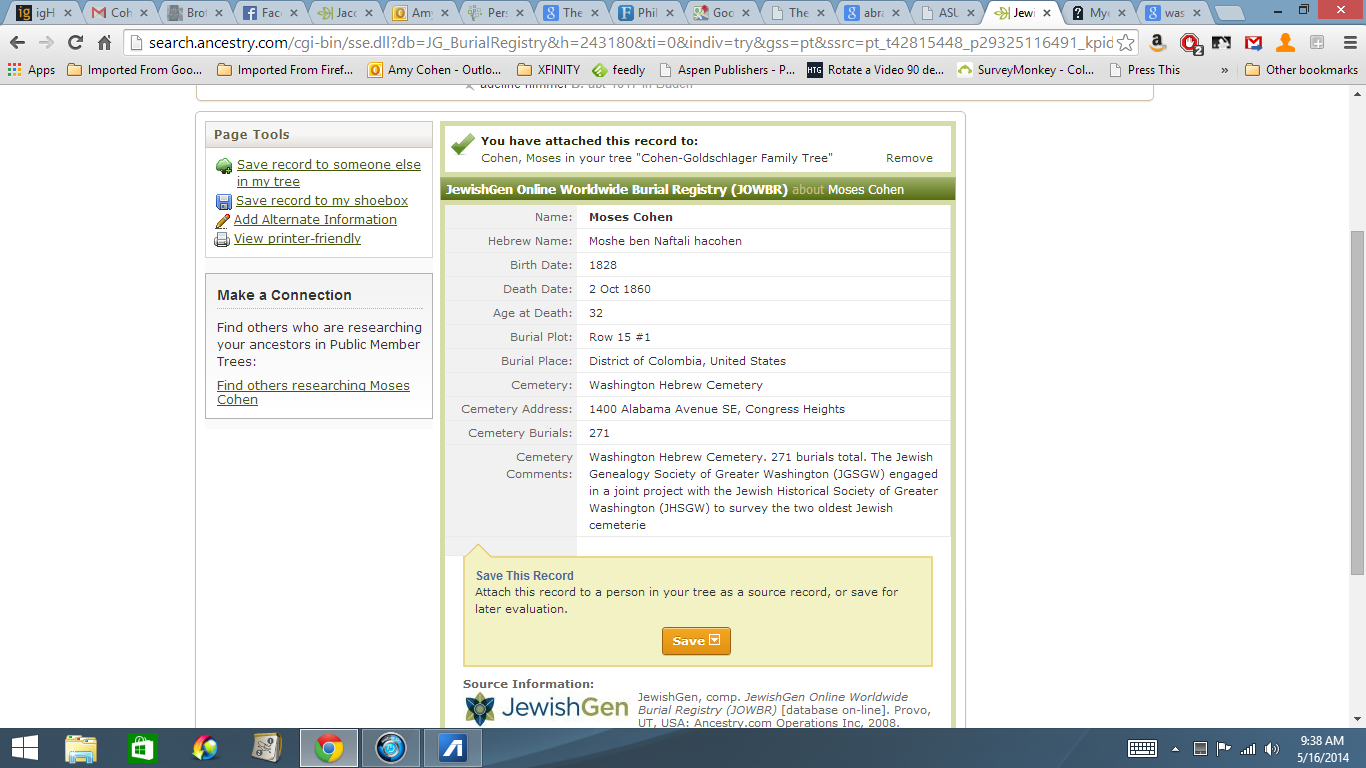
That gave me an outer limit for when Moses, Sr., had died, and by placing a date limit on his death, I was able to uncover this record on ancestry.com:

Moses Cohen death record 1860

Moses Cohen death record 1860

Notice his father’s Hebrew name: Naftali ha Cohen.  This rang a bell, and I went back to my earlier research and found that on my great-great grandfather Jacob Cohen’s marriage record his father’s Hebrew name was recorded as Naftali Hirts ha Cohen.

Jacob and Sarah Cohen's marriage record

Jacob and Sarah Cohen’s marriage record

This was one coincidence too many and enough for me to conclude that Moses, Sr. and Jacob were in fact brothers, that Moses had not stayed in England as I had concluded early on in my Cohen research, but had come to America just as all his other siblings had.  I now also think that it is possible that the “Mordecia” [sic] listed as living with Jacob on the 1850 US census was probably his brother Moses, who had also emigrated in 1848 from England.

Jacob Cohen and family 1850 US census

Jacob Cohen and family 1850 US census

His wife Adeline and son Moses, Jr., must have arrived sometime later, though I have not yet located a record revealing when they came.  I will need to track down a few more documents to be sure—death certificates for Moses and Jacob and also photographs of their headstones.

But assuming my hunches are correct, Philadelphia Hart and DC Hart were first cousins, sharing a name, sharing an occupation (pawnbroker/jewelry store owner), having wives with the same first name, and sharing a grandfather for whom they were both named, my three-times great-grandfather, Hart Levy Cohen.  The only real coincidence was that they both had wives named Henrietta.

I just love when the pieces come together.  It is what makes this so much fun.  Digging around in the muck, being totally confused and overwhelmed, and then that AHA! moment when suddenly it all makes sense.

Enhanced by Zemanta

Did My Great-Grandfather’s First Cousin Live Two Separate Lives?

I have started tracking down the lives of the children of Jacob and Sarah Cohen, my great-great-grandparents, and all was going pretty well until I started to research their son Hart.  It seems he might have been living two lives, one in Philadelphia, one in Washington, DC.   Or perhaps not.  Here’s what I have found; see if you have any ideas on how to resolve this one.

The first mention of Hart, obviously named for his grandfather Hart Levy Cohen who was still alive when he was born, is on the 1860 US census, listing little Hart as nine years old, so born in 1850 or 1851, depending on whether his birthday was before or after June 7th, the date in 1860 when the census was taken.  Since he was not listed on the 1850 census taken on July 25, 1850, he was obviously born sometime between July 25, 1850 and June 7, 1851 if he was actually nine on June 7, 1860.

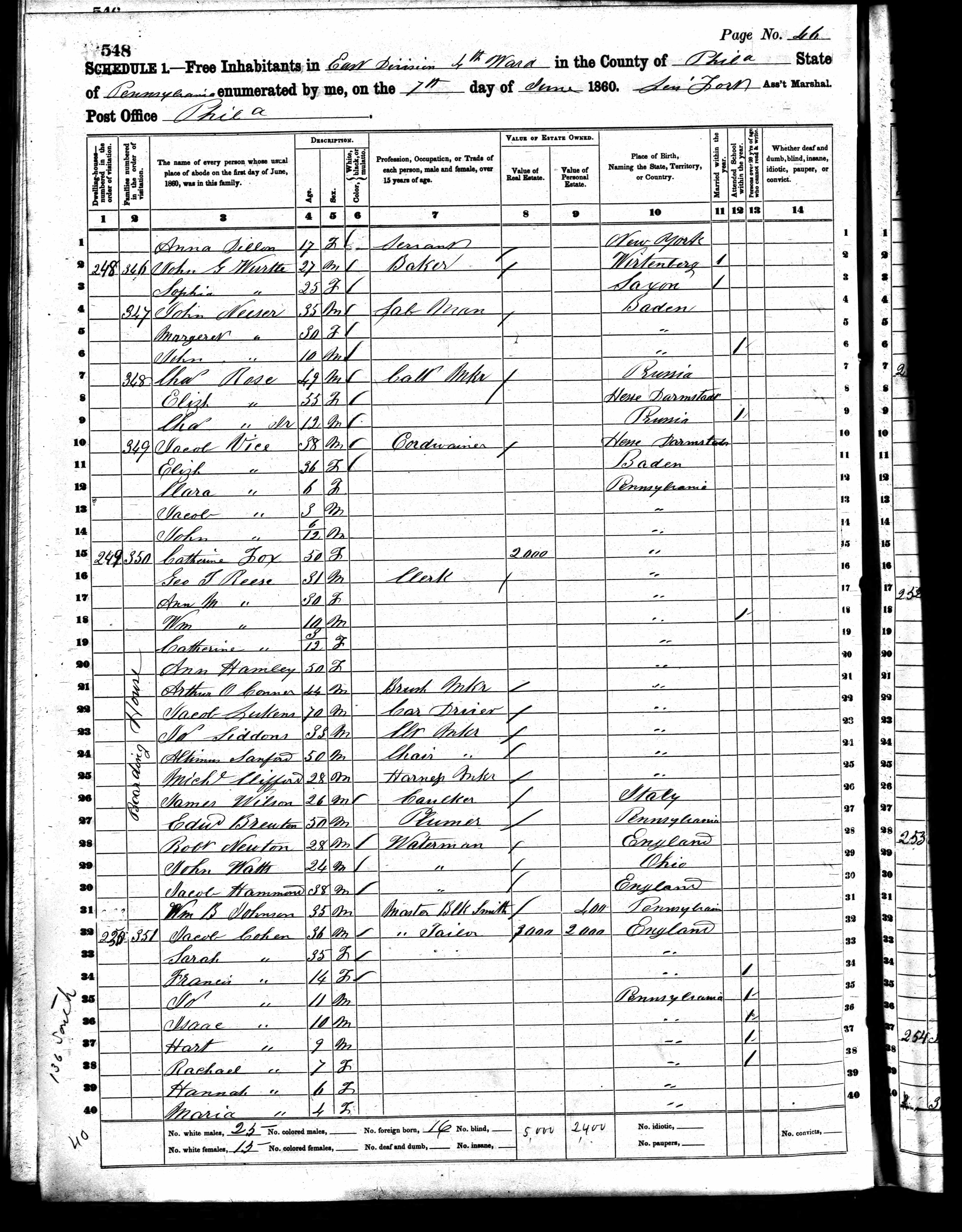
Jacob and Sarah Cohen and family 1860 US census

Jacob and Sarah Cohen and family 1860 US census

Things start getting weird in 1870.  I found two census reports for Jacob and Sarah and their children for 1870, one taken in June, one in November.  The second one is labeled “Second Enum” for second enumeration so for some reason the census taker went to the neighborhood twice.  What’s odd is that Hart is listed as 20 on the June version and 19 on the November version.  I’ve seen age mistakes so often that this did not faze me in the least, but it does not help pin down Hart’s precise birth date.

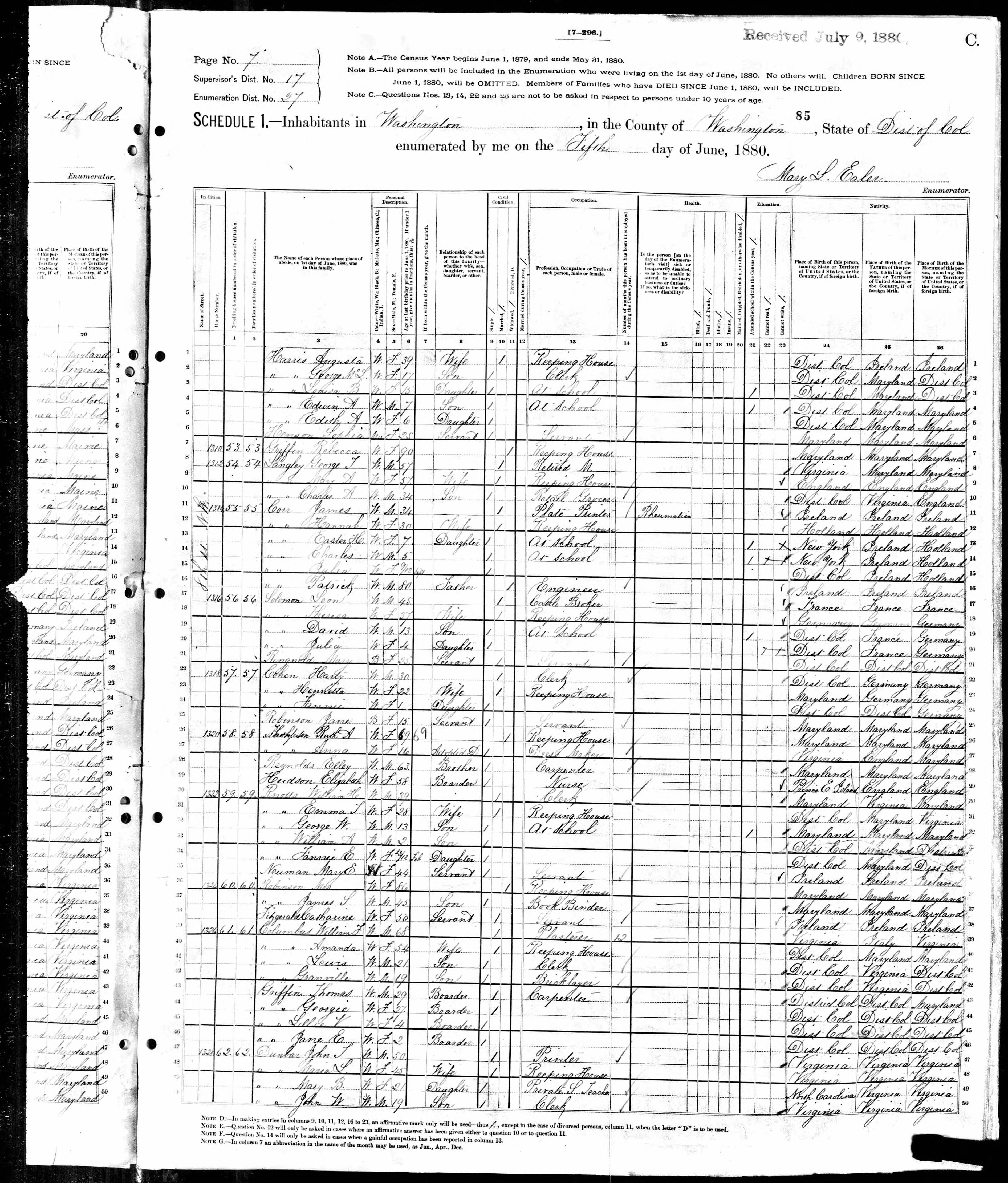
It is the 1880 census, however, that really threw me.  In 1880 there are also two census reports for Hart Cohen born in 1850 or 1851.  One is clearly the right Hart:  He was living in Philadelphia, working as a storekeeper, and was born in Pennsylvania of parents born in England. He is 30 years old, giving him a birth year of 1850 or 1851.  This Hart was married to a woman named Henreta or probably Henrietta and had three children, Jacob (6), Sarah (5), and Julia (4).  If Hart and Henrietta had a six year old child, then presumably they would have been married no later than 1873, and in fact I was able to find a record of a marriage of Hart Cohen to a Henrietta Brunswick in Philadelphia on February 12, 1873 in the Pennsylvania marriage index.

Hart Cohen and family Philadelphia 1880 US census

Hart Cohen and family Philadelphia 1880 US census

All seemed to be making sense until I found another 1880 census report for a Hart and Henrietta Cohen residing in Washington, DC. This Hart was also 30 years old.  I was ready to dismiss this as just as bizarre coincidence since this Hart was listed as having parents who were born in Germany.  His own birthplace was given as Washington, DC.  This seemed like it had to be a different person.  The DC Hart and Henrietta had one child, a daughter named Fanny who was only a year old.

Hart Cohen and family Washington, DC 1880 US census

Hart Cohen and family Washington, DC 1880 US census

I have a city directory for Philadelphia listing Hart Cohen as a pawnbroker in 1886, so I was convinced that the DC Hart was just a fluky coincidence of someone with the same name and age as my Hart marrying a woman also named Henrietta.  The 1890 census was destroyed by fire, so I had to skip ahead to 1900 to see if I could follow up on the two Hart and Henrietta Cohens.

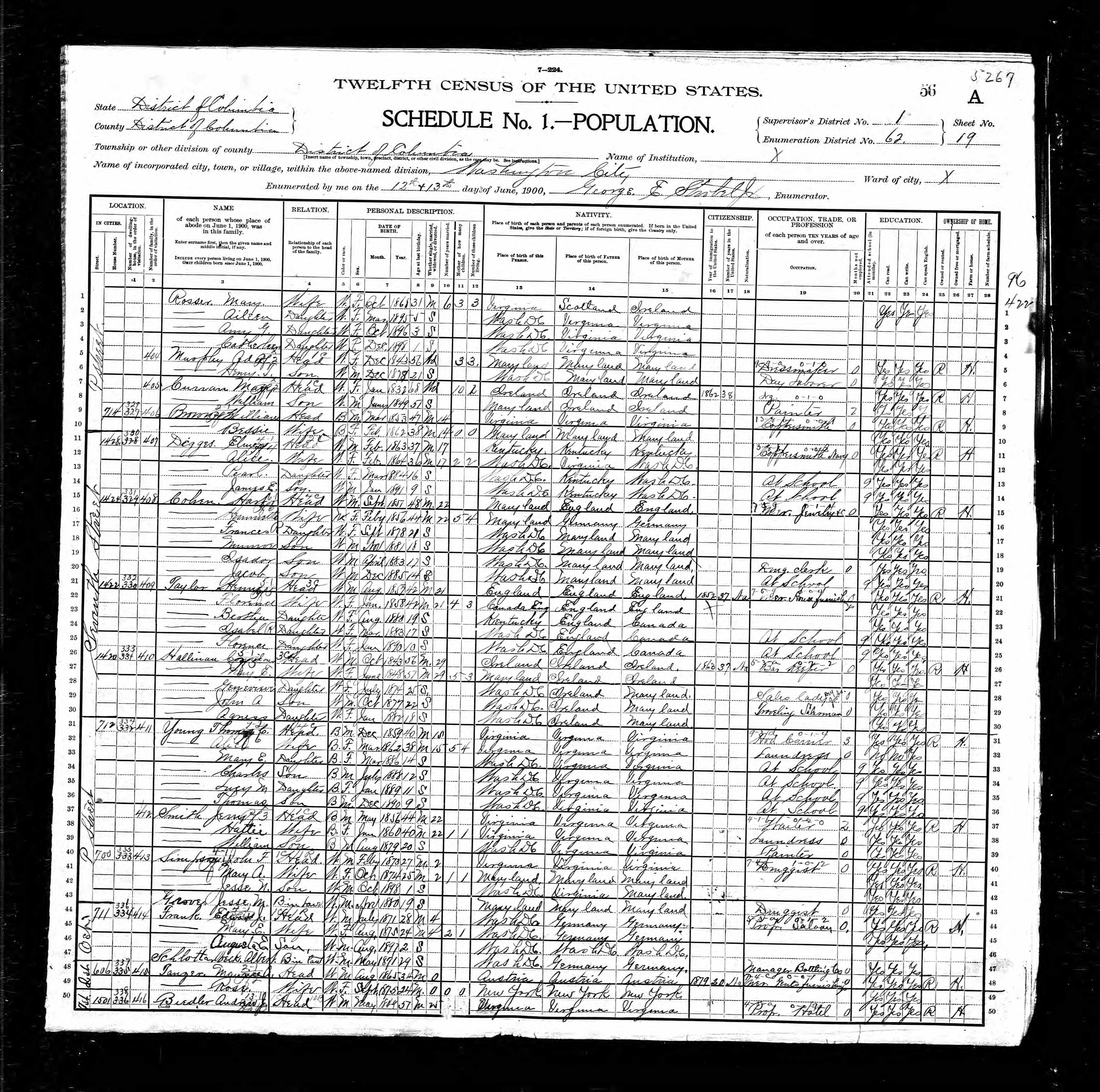
I could not find the Philadelphia Hart and Henrietta on either the 1900 or the 1910 census, but I did find the DC Hart and Henrietta on both.  The 1900 census for the DC Hart provided a more specific birthdate—September, 1851—and had his birth place as Maryland, but this census listed his parents’ birthplace as England, not Germany as on the 1880 census. DC Hart was working in a jewelry store, a retail business not unlike those of my ancestors, so that seemed strange as well. Hart and Henrietta now had four children, Frances, Munroe, Isador and Jacob.  But this Jacob was only 14 in 1900 so could not be the same Jacob who was 6 in 1880 and thus born in 1874.  Once again I felt pretty certain that this was still not the same Hart Cohen who was Jacob and Sarah’s son.  Despite the fact that his parents were now reported to be English-born, that he was a jeweler, that he married a woman named Henrietta and that he was also 30 years old, I again said that this was just a coincidence.

Hart Cohen and family in Washington, DC 1900 US census

Hart Cohen and family in Washington, DC 1900 US census

On the 1910 census report for the DC Hart and Henrietta,  Hart still had a jewelry store and was married to Henrietta and living with Frances and Jacob, two of their children.  His birthplace was listed as Maryland, and now his parents’ birthplaces were reported as England for his father and Germany for his mother.  This also seemed to suggest that this was not the Philadelphia Hart.

Hart Cohen and family Washington, DC 1910 US Census

Hart Cohen and family Washington, DC 1910 US Census

But because I could not find the Philadelphia Hart on the 1900 or the 1910 census, I was a bit perplexed.  Could he have died? Had he moved to DC?   Even if that were the case, it would not explain the two 1880 census reports.  Was he living a double life, having two wives both named Henrietta, one in Philadelphia and one in DC, and two different sets of children?

I decided to search for a death record for any Hart Cohen born around 1850, and I found one dated January 3, 1911.  Since this   record was from the District of Columbia Selected Deaths and Burials database, I assumed that this related to the DC Hart especially since the report said that the deceased was living in DC at the time of his death, but on a closer look I saw that it said that he had been born and was buried in Philadelphia.

I then found a second record in the Philadelphia Death Certificates Index that made it quite clear that this was the Philadelphia Hart, not the DC Hart: it listed his parents’ names as Jacob Cohew (sic) and Rachel Jacobs, both of whom were born in England.

Pennsylvania Death Certificates Index

Pennsylvania Death Certificates Index


Further research revealed that Hart’s body had been moved from its original burial location twice by two of his children, Jesse Cohen and Sarah Cohen Jonas, ending in a move in 1944 to a location in Mt Sinai Cemetery where both his son Jacob H. Cohen and a Ralph Brunswick were also buried.  Since the Henrietta who married Jacob was born Henrietta Brunswick, this seemed (no pun intended) to be the final nail in the coffin establishing that the Jacob who died in January, 1911, was the Philadelphia Hart, son of Jacob and Sarah Cohen, my great-great grandparents.

If that conclusion is correct, then Philadelphia Hart was actually living in Washington, DC, at the time of his death in January, 1911, just nine months after the 1910 census recorded DC Hart (and no other Hart) living with his wife Henrietta and two children Frances and Jacob at 1806 4th Street.  Philadelphia Hart’s residence at his time of death was reported as 1737 N. 15th Street in Washington.  He was also a widower, and I was able to locate a death record for a Henrietta B. Cohen who was born in Lengnau, Switzerland and died in November, 1902.  Had he moved to DC after Henrietta died? If so, why? And what, if any connection, might there be to the “other” Hart and Henrietta?

The other Hart, the DC Hart, was still alive in 1920 and living with his daughter Frances in the District of Columbia.  He also was a widower at this time and retired.  The census report lists his and his parents’ birthplaces as DC, but that is clearly wrong, at least for his parents, whose birthplaces had previously been reported at various times as England and Germany.

Hart Cohen Washington, DC 1920 US Census

Hart Cohen Washington, DC 1920 US Census

My next find was a record of DC Hart’s death. He died August 10, 1926, in Washington, DC.  His parents’ names were listed on this record: Moses Cohen and Adeline Himmel.  His wife’s name was Henrietta Baer.  So not only did both Philadelphia Hart and  DC Hart marry women named Henrietta, they both married Henriettas  with a birth name that started with a B.  It is no wonder that I was confused, and there are numerous trees on ancestry.com that have mixed together the two Hart and Henrietta Cohen families.

Screenshot (3)

When I saw the name Moses Cohen as DC Hart’s father, it stopped me in my tracks.  Could this be my great-great grandfather Jacob’s brother Moses, the one I thought had stayed behind in England? So far I have not been able to find whether there is a connection.  Although I did find a ship manifest with a Moses Cohen emigrating from England to New York in 1848, the same year Jacob left England, I have no idea whether this is the right Moses Cohen.  Tracking Moses Cohen and Adeline Himmel, I know that they had a son also named Moses before Hart and that Moses the younger was born in Baden, Germany around 1839.  Adeline was born in Germany, and Moses must have gone there, married her, had Moses his son, and then moved sometime between 1839 and 1850 to the United States and settled in Maryland where DC Hart was born.

If this was in fact Moses, the son of Hart Levy Cohen, my three times great grandfather, it would explain why Moses named his son Hart.  It might also explain why Philadelphia Hart was living for some time in Washington.  Perhaps he wanted to be closer to his cousin DC Hart and his family.  On the other hand, if there is no connection, then it is just a very, very strange series of coincidences.

What do you think?


Enhanced by Zemanta

Hart Cohen and Family 1851-1860: Philadelphia

Philadelphia, circa 1860, from the Library of Congress Prints and Photographs Division

By 1860, almost all my Cohen relatives had left England and moved to Philadelphia.  Only Moses Cohen remained behind.  My great-great grandfather Jacob Cohen had emigrated from England to Philadelphia in 1848 with his wife Sarah and his daughter Fannie.  Although I am not certain as to when Lewis, the oldest brother, left England, these naturalization papers dated October 27, 1848, appear to be his, meaning that he had left England earlier than Jacob.

UPDATE:  I now believe that Moses also had left England around 1848.  See my subsequent post.

Lewis H Cohen naturalization ED PA 1848

Lewis H Cohen naturalization ED PA 1848

I have located one 1846 ship manifest from England to New York with the name Lewis Cohen on it.  The ship manifest is for the passenger ship Ward Chipman, sailing from Liverpool to New York, arriving in New York on August 12, 1846.

Lewis Cohen ship manifest 1846

Lewis Cohen ship manifest 1846

Neither the ship manifest  nor the naturalization papers have enough detail for me to be absolutely certain that either or both relate to my relative, but from the 1860 US census I know that by 1860 Lewis was definitely in Philadelphia, living with his father and siblings.

Hart, Elizabeth, Lewis and Jonah Cohen 1860 US census

Hart, Elizabeth, Lewis and Jonah Cohen 1860 US census

Just last night I located the ship manifest for Hart, Elizabeth and Jonah.  They left England together on the ship Julia Richmond and arrived in New York in September, 1851.  Jonah was identified as a dealer, and the manifest indicates that they were coming with only one box.

Hart, Jonas and Elizabeth Cohen ship manifest September 1, 1851

Hart, Jonas and Elizabeth Cohen ship manifest September 1, 1851

Interestingly, I also found a document that indicates that Hart may have made a trip to the Netherlands in June, 1851 from England.  Although the name is only listed as “HL Cohen” and gives his occupation as “schoenmaker,” or shoemaker, it does give his birthplace as Amsterdam, so it could very well have been Hart.  Perhaps he was visiting his birthplace one more time before crossing the Atlantic.  Perhaps he was taking Rachel’s body to be buried there.  Once I locate Rachel’s death record, I may know more about this trip.

H L Cohen arrival in England June 17, 1851

H L Cohen arrival in England June 19, 1851

Thus, by 1860, all of the then living descendants of Hart and Rachel Cohen aside from Moses were living in Philadelphia. (I am assuming that Jonas and the John listed in 1841 were the same person.)  By 1860 my great-grandparents Jacob and Sarah had had many children.  As I have already written, by 1850 they had three children, Fanny, who was born in 1846 in England, and Joseph and Isaac, born in Philadelphia in 1848 and 1850, respectively.  In the next decade, Sarah gave birth to six more children: Hart (1851), Rachel (1853), Reuben (1854), Maria (1856), Hannah (1857) and Elizabeth (1858). All of the children except the youngest three were in school.  That made a grand total of nine children born between 1846 and 1858, and there were several more born in the next decade as well, including my great-grandfather Emanuel.  I find it interesting that contrary to the traditional Jewish practice of naming a child after a deceased relative, Jacob named a son Hart in 1851 before his father Hart had died and named a daughter Elizabeth while his sister Elizabeth was still alive.  Rachel presumably was named for Jacob’s mother who had died before 1853.

Although Jacob’s occupation is listed as a tailor on the 1860 US census, this seems inconsistent with the earlier census in 1850 when he was a dealer in second hand goods and with the 1841 English census when he was working as a china dealer.  Perhaps the census taker heard “dealer” as “tailor”?  Since Jacob also had the most assets of anyone else listed on this page of the census, $1000 in real estate and $2000 in personal property, it seems more likely that he was a merchant than a tailor.  He also had three servants living in the household: Eliza Mackey, Mary McDonough, and Margaret Gallagher.  There was also a 24 year old man named Lazarus Jacobs living with the family; this might have been a cousin through Jacob’s mother and/or his wife Sarah since both were Jacobs by birth.  Jacob thus had nine children, an adult relative, three servants as well as his wife Sarah and himself to support in 1860.  Could he have been making such a good living as a tailor?

Jacob and Sarah Cohen and family 1860 US census

Jacob and Sarah Cohen and family 1860 US census

Interestingly, Lewis and Jonah were also listed as tailors on the 1860 census.  They were living in the same district as Jacob, the 4th Ward, East Division, and the census appears to have been taken by the same census taker, although the signature is hard to decipher.  Were their accents so difficult for this census taker to understand? Or were these three brothers really tailors?  Lewis, Jonah, Elizabeth and their father Hart were all living together and had $1000 in personal assets, more in line with the shop owners on the census pages than the tailors, but perhaps the three Cohen brothers were all very successful tailors. However, according to the 1863 Pennsylvania Septennial Census, a census taken of all taxable residents, Lewis and Jonas were then engaged in sales and Jacob was listed as a dealer, not as tailors, so I am still inclined to think that the 1860 census taker heard “dealer” as “tailor” for all the Cohen men.

Lewis and Jonas Cohen on the 1863 PA Septennial Census

Lewis and Jonas Cohen on the 1863 PA Septennial Census

Jacob Cohen PA Septicentennial Census 1863

Jacob Cohen PA Septicentennial Census 1863

As I puzzled over this particular question of whether or not they were tailors, I became curious about the neighborhood they lived in and the socioeconomic character of that neighborhood. This led me to wonder about the history of Jews in Philadelphia and to ask why this family settled in Philadelphia, not New York, despite having sailed into New York when immigrating to this country. I am now doing some preliminary research into those questions and will report back on what I learn.

What has struck me as particularly interesting as I research and report on the immigration of my Cohen ancestors to Philadelphia is how different it feels from the immigration of my mother’s family, the Brotmans, Goldschlagers and Rosenzweigs.  Unlike the rather desperate conditions that my mother’s family faced in their home countries and the poverty they experienced after coming to the US, my Cohen ancestors left England not because they were oppressed or poor but for better conditions and opportunities here in America.  Although I am sure they faced some anti-Semitism and some isolation as Chuts and were not wealthy but at best middle class merchants, they came to America for less drastic reasons and with far more advantages than my mother’s relatives.  Not only were they more economically secure, they came speaking English.  They did not have to struggle to understand a new language, which must have made their adjustment far easier than it did for my Galician and Romanian ancestors who spoke no English when they arrived.

By 1860, the Cohens were settled in America and some of them were already or soon to be American citizens.  They were here a good 40 years before the Brotmans and some of the Rosenzweigs and about 50 years or more before many of the Goldschlagers and the other Rosenzweigs.   My father’s other lines also arrived here far earlier than my mother’s family.  My parents represent in many ways a merger of the two distinct waves of Jewish immigration to America.  When they were growing up, there was still a distinct class line between the older Jews from Western Europe and the newer Jews from Eastern Europe.  Today we don’t even think about those distinctions, except in historical terms.  But the two groups started differently and arrived under different conditions, creating for many years an economic and cultural gap between them.


Enhanced by Zemanta

Hart Cohen and family 1841-1851: Before the Move to America

be

By 1851, the time of the second English census, my great-great grandfather Jacob Cohen had already moved with his family to Philadelphia.  Much of the rest of his family of origin, however, was still in London.  According to the 1851 census, Hart, my three-times great grandfather, was now a widower and 75 years old, living with two of his children, Elizabeth, now listed as 28 despite having been listed as 20 ten years earlier, and Jonas, who was 22.  Jonas was not even listed as living with the family in 1841 when he would have been only 12 years old.   All three were listed as general dealers and living at 55 Landers Buildings in Spitalfields parish in Tower Hamlets.

Hart, Elizabeth and Jonas Cohen 1851 England Census

Hart, Elizabeth and Jonas Cohen 1851 England Census

Although I thought this might indicate a move to a new neighborhood, my research revealed that Landers Buildings were on Middlesex Street, which was just one blog from New Goulston Street where the family had been living in 1841.  The English genealogy site Genuki indicates that Spitalfields was a district within the parish of Whitechapel for at least some point in London’s history.

I do not know when Rachel, my three-times great grandmother died.  My search of the BMDIndex, the English index of births, marriages and deaths that began to be registered in 1837, revealed quite a few Rachel Cohens who died between 1841 and 1851.  I have ordered one certificate on a hunch that it might be the right one, but I need to do more investigating before I know for certain when she died.

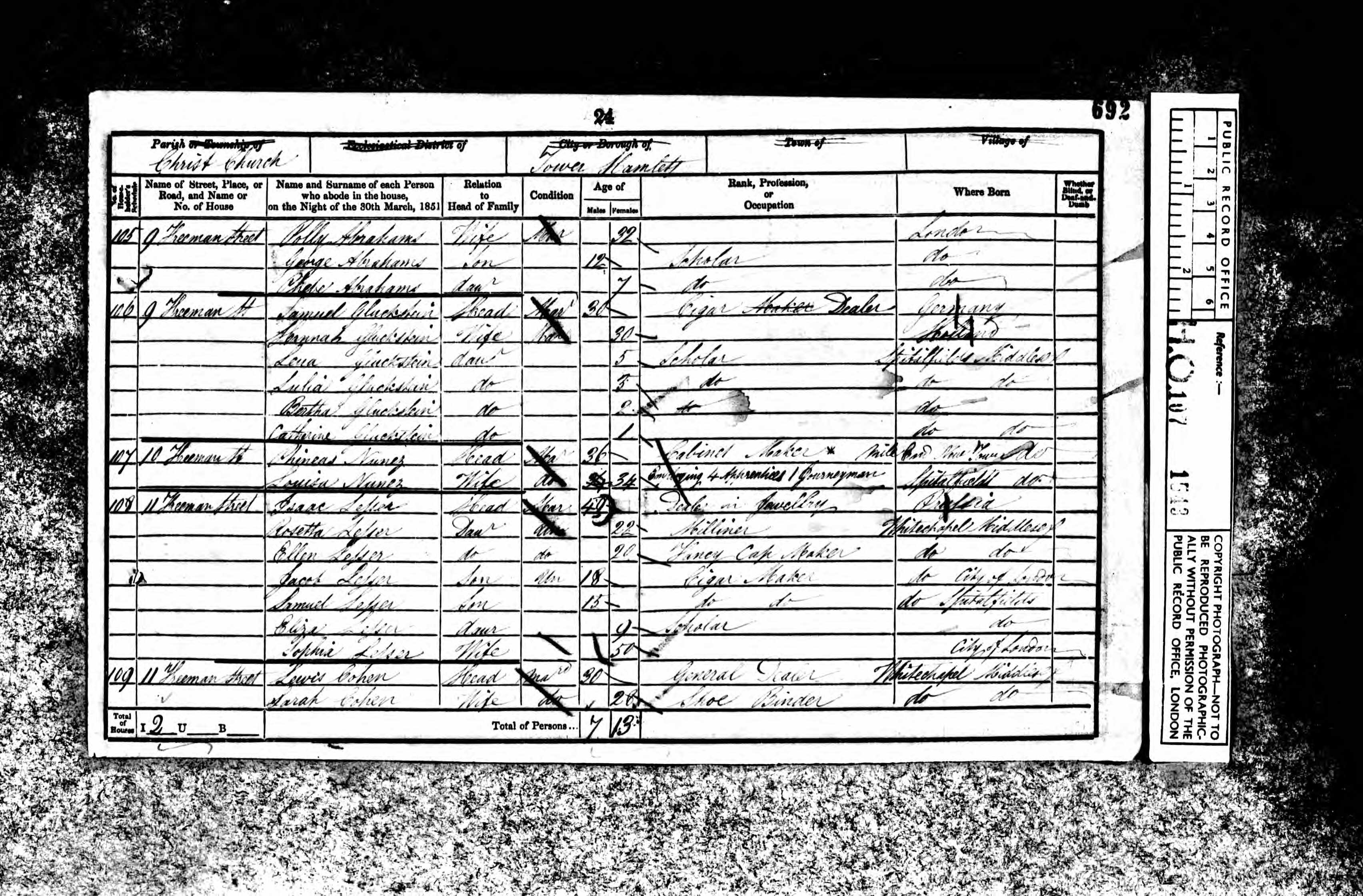
Hart’s son, Moses, now 30 years old, had married Clara Michaels in the fall of 1843, according to the BMDIndex.  I need to obtain a copy of the actual record to be sure, but on the 1851 census, Moses Cohen was married to a woman named Clara and had three daughters, Judith (6), Hannah (2), and Sophia (six months).  He was employed as a general dealer and living at 35 Cobbs Yard in the parish of Christchurch in Tower Hamlets.

UPDATE:  I now know that Moses in fact had left England with Jacob in 1848.  This is not the correct Moses.

Moses Cohen and family 1851 census

Moses Cohen and family 1851 census

This neighborhood is about three miles west of where Moses had been living with his parents in 1841. Moses must have been fairly comfortable as they also had a servant living with them, although the Charles Booth Poverty Map depicted this area as poor in 1898.

The oldest son, Lewis, has been more difficult to track.  He was not living with the family in 1841 nor was he living with his father and younger siblings in 1851.  I would not even have known that he existed except for the fact that he appears on the 1860 US census reports living with his siblings Elizabeth and Jonas and his father Hart and on the 1880 census living with Elizabeth and Jonas.  So where was he in 1841? 1851?  According to those two US census reports, he was born in 1820, so would have been Hart and Rachel’s second child after Elizabeth.  He might have been living independently in 1841, married, or perhaps just not home.  The FamilySearch website indicates that the 1841 census had many holes; if someone was not staying at a home that night, they were not included in the census for that household.  I found three Lewis Cohens on the 1841 Census, but none of them was a good fit.  One was too old, one was living with different parents, and one was not born in England.  But since the 1841 was the first true census taken in England, I assumed that perhaps Lewis was just not among those counted.
The 1851 English census did not provide any greater information on Lewis.   There were several Lewis Cohens again, but only one who was a possible fit: he was born in Middlesex County in Spitalfields, Christchurch, around 1821 and was married to a woman named Sarah.  They were living with Sarah’s mother, Ann Solomon.

Lewis Cohen 1851 census (not sure this is the correct Lewis)

Lewis Cohen 1851 census (not sure this is the correct Lewis)

I have found a marriage for this Lewis and Sarah in 1848 on the BMD Index and will write away for the record, but since Lewis was single in 1860 according to the US census, if this is the right Lewis, either Sarah had died or divorced him between 1851 and 1860.  I searched for a death record for a Sarah Cohen who died between 1851 and 1860, and there were several on the BMD Index.  I am not sure how to determine which ones might be relevant, but will order any that appear to be possibilities once I know that this was the correct Lewis.

UPDATE:  I know now that Lewis had in fact emigrated from England to the US in 1846.  This is not the correct Lewis.

The other possibility is that Lewis had immigrated to the US before the 1851 census or even the 1841 census.  I cannot find him on either the 1840 or 1850 US census, but I did find some immigration records for a Lewis H. Cohen who was naturalized in Philadelphia in 1848.

Lewis H Cohen naturalization ED PA 1848

Lewis H Cohen naturalization ED PA 1848

Since Lewis is listed on the 1860 US census as Lewis H. Cohen, I am inclined to think that this is the right person.  If so, then I also may have found a passenger ship manifest for Lewis, arriving in the US in 1846, which would have made him the first Cohen to immigrate to the US, not my great-great grandfather Jacob.  I need to check further into this, but it seems quite possible that the reason Lewis is not on the 1851 census in England is that he was already in the US.  But then why can’t I find him on the 1850 US census either?

The other mystery child of Hart and Rachel Cohen is the son identified on the 1841 census as John, the youngest child on that census whose age was given as 14, giving him a birth year of 1827.  In my initial research on the family, I thought that John had become Alfred J. Cohen, who was also born in 1827.  Alfred married Mary A. Cohen and remained in England where eventually they had seven children.

In reviewing my earlier work from last year, however, I am now doubtful that this was in fact the child of Hart and Rachel. Although I will order a marriage record for Alfred to be sure, I now think that the John in the 1841 census was actually Jonas, the youngest son of Hart and Rachel and the son who was living with Hart in 1851 in London and in 1860 in Philadelphia.  My reasoning is that Jonas was not listed on the 1841 census when he would have been only twelve years old.  Where else would he have been if not living with his parents? Also, since Jacob’s age was off by a few years on the 1841 census, it seems quite possible that there was an error in “John’s” age and also his name.  Jonas is close enough to John, at least the first syllable, so a census taker might have just recorded it or heard it incorrectly.  On the US census reports, Jonas’ age jumps around, making it difficult to pinpoint a correct year of birth.  Although I am going to order whatever vital records I can for Alfred and for Jonas, right now my hunch is that Jonas and John were the same person, the youngest son of Hart and Rachel Cohen, born sometime between 1825 and 1830.

UPDATE:  It seems quite clear to me now that “John” was Jonas.

So I have a lot of unanswered questions about my Cohen ancestors between 1841 and 1851. When did Rachel, my three-times great grandmother die?  Where was Lewis in 1841? Did he marry in England?  Did he in fact immigrate to the US in 1846? If so, why isn’t he on the 1850 US census? Are John and Jonas the same person, or were there in fact two sons younger than Jacob?

It will take some time to get the records that may help to answer these questions, so while I am waiting for those documents,  I will move on to the next decade and the story of my Cohen ancestors in the United States.


Hart Cohen and Family Between 1841 and 1851: My Great-Great Grandfather Jacob Cohen

English: Liberty Bell

English: Liberty Bell (Photo credit: Wikipedia)

As reported previously, in 1841 Hart Cohen and his wife Rachel were living with four of their children, Elizabeth, Moses, Jacob and John, on New Goulston Street in the Whitechapel section of London, presumably part of the Chut community and living fairly comfortably with the two older sons working as china dealers.  There was also at least one other son, an older son Lewis, and possibly another younger son, Jonas, although I am now thinking that John was in fact Jonas, but more on that later.  By 1860, only Moses (and John if there was in fact a son named John) was living in England; all the rest were in Philadelphia. I will try to trace in chronological order the major events and moves made by these family members.

In order to get a complete picture of the family and their lives in England, I will need to get copies of the vital records, including their birth certificates and marriage certificates.  I am now trying to learn how to do that.  I have received some extremely helpful tips and information from another of my favorite genealogy bloggers, Alex Cleverley of the blog Root to Tip.  Alex is a very experienced English genealogist, and with the help she has given me, I will now order the records I need.  Unfortunately it appears that there is no fast and easy access to these documents so for now I will have to rely on the 1851 census, a few other secondary sources, and later census reports and infer a number of facts from those documents.  As I receive other documentation, I will report what I find.

I will start with Hart and Rachel’s son Jacob because he is my direct ancestor, my great-great grandfather, and thus the one I have the greatest interest in tracking.  According to the 1841 census, Jacob was 15 that year, giving him a birth year of 1826.

Hart Cohen and family 1841 English census

Hart Cohen and family 1841 English census

This appears, however, to be inaccurate based on later census reports from the United States and from a passenger manifest, all of which indicate a birth year of 1824 or 1825.  That would have made Jacob 16 or 17 in 1841.

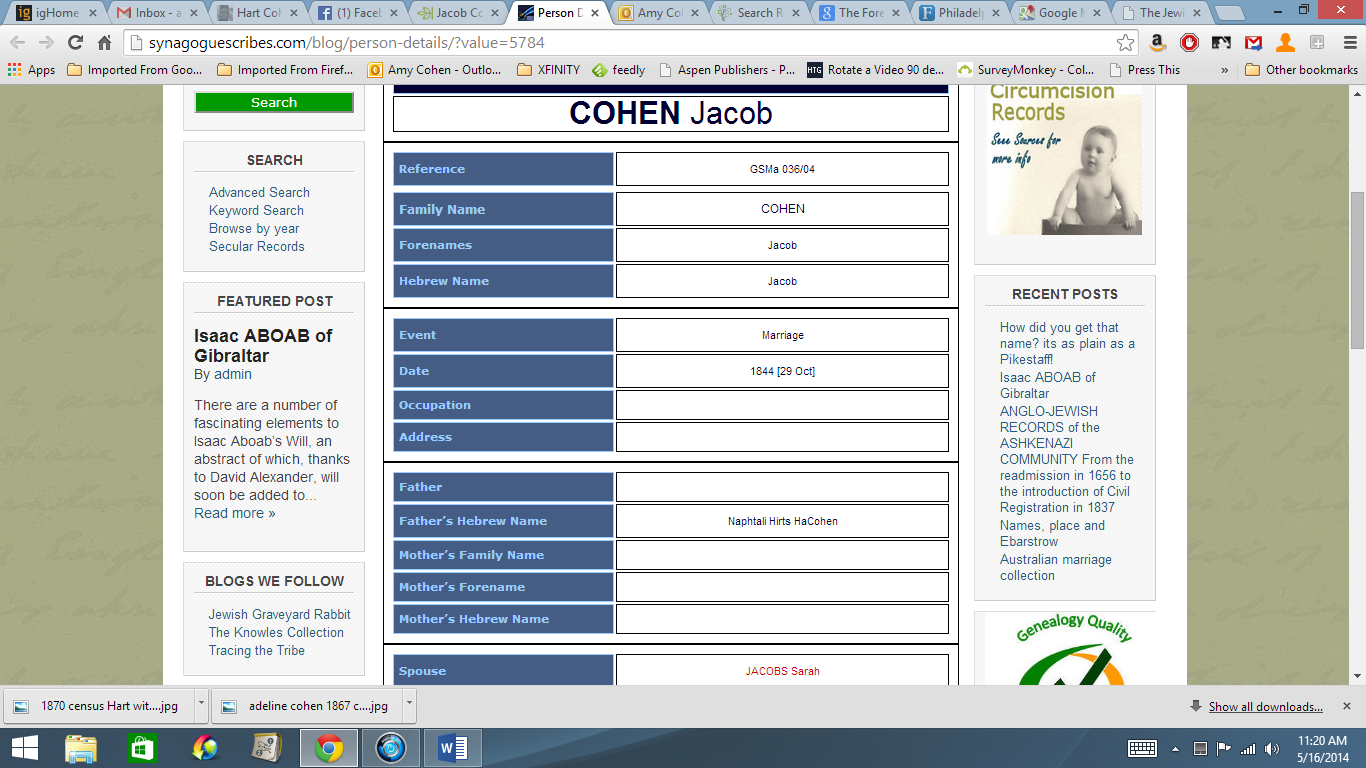
This also seems more consistent with the fact that Jacob may have married his wife Rachel Jacobs (possibly a relative of his mother, whose birth name was also Jacobs) on October 24, 1844.  Without an actual marriage certificate I cannot be completely sure, but I found a marriage record on SynagogueScribes for Jacob Cohen, son of Naphtali Hirts HaCohen, to Sarah Jacobs, at the Great Synagogue of London on that date.  The Hebrew name is not identical to what I had earlier found for Hart, Jacob’s father, but it is very close.  I know that Sarah’s maiden name was Jacobs based on the death certificates of two of their children, Isaac and Frances.  Thus, I feel fairly confident that this is in fact their marriage record as transcribed by SynagogueScribes.

COHEN
Forenames Jacob
Hebrew Name Jacob
Event Marriage
Date 1844 [29 Oct]
Occupation
Address
Father
Father’s Hebrew Name Naphtali Hirts HaCohen
Mother’s Family Name
Mother’s Forename
Mother’s Hebrew Name
Spouse JACOBS Sarah

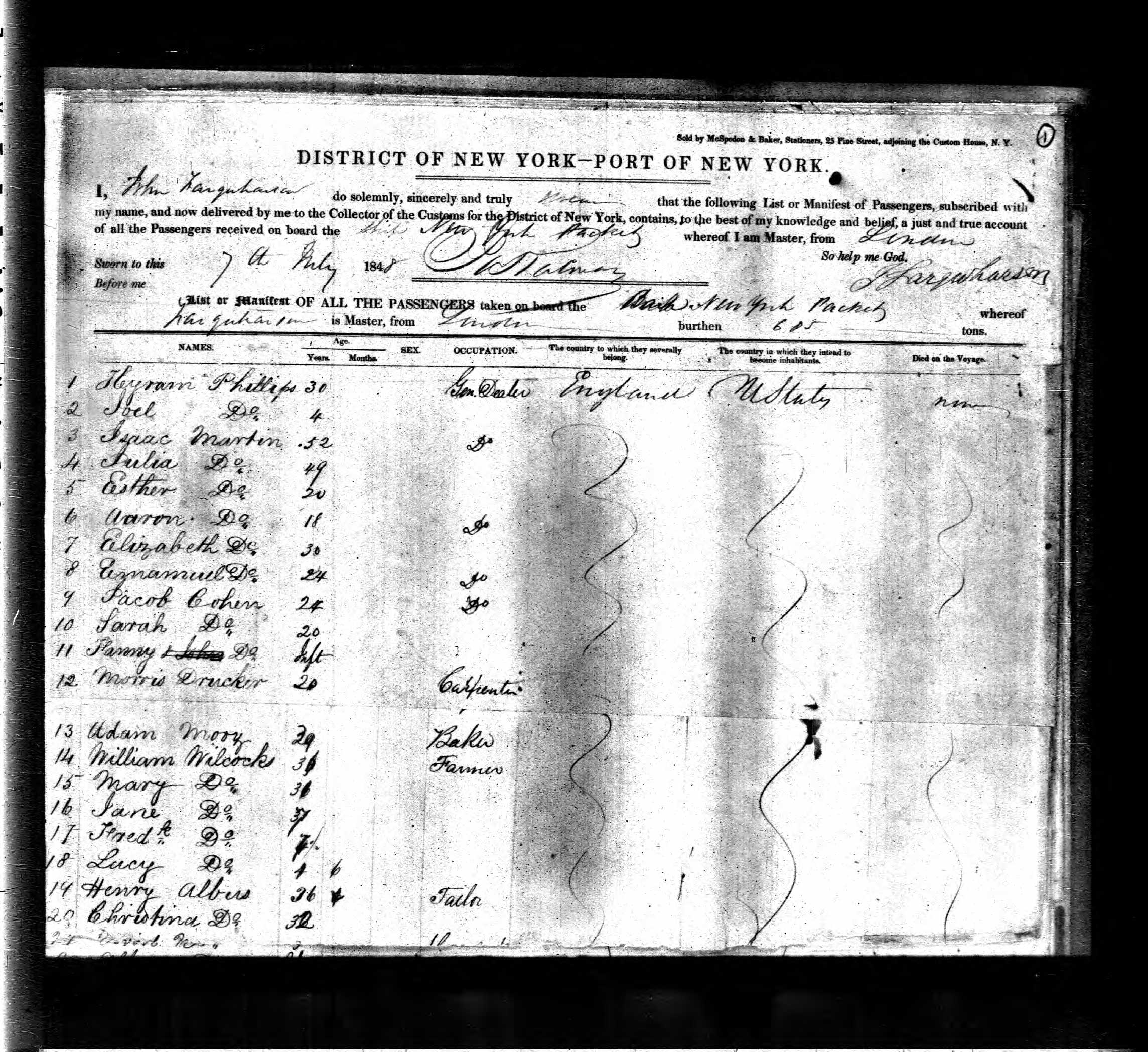
Frances, or Fanny, was Jacob and Sarah’s first child, born around 1847, as inferred from later US census reports.   Within a year of Fanny’s birth, Jacob and Sarah left London and moved to Philadelphia.  On July 7, 1848, Jacob, Sarah and Fanny, an infant, arrived in New York aboard the ship New York Packing.  Jacob’s age was given as 24, consistent with a birth year of 1824, and Sarah was 20, giving her a birth year of 1828.  Jacob’s occupation was given as “General dealer,” as were many other men on the manifest.

Jacob and Sarah Cohen ship manifest 1848

Jacob and Sarah Cohen ship manifest 1848

Jacob was the first of Hart and Rachel’s children to leave London and move to the US.  His siblings and eventually his father began arriving several years later.  I found this interesting, given that Jacob was not the oldest son, but the fourth child and third son.  Why did he go first?  What drew him away from his family and to America with his young wife and baby?  I also found it revealing about my direct line that both Hart and Jacob were the sons who left their families behind and moved to a foreign country.  As far as I can tell, Hart arrived alone and without his family when he immigrated to England, just as his son Jacob did fifty years later when he left England and moved to the US.  I can’t say I inherited this willingness to take risks and move far from home, having never lived more than four hours from where I was born, but I like the idea that my ancestors were such risk-takers and so independent.

I don’t know whether Jacob and his family stayed very long in New York after arrival, but by 1850, Jacob and Sarah were living in Philadelphia.  It was not easy finding Jacob and Sarah on the 1850 US census.  I tried searching for all Jacob Cohens, Sarah Cohens, Fanny Cohens, and variations on each name and wild card searches on each name, but came up empty for a family that fit my relatives.  Then I decided to search just by first names for a Jacob with a wife named Sarah and a daughter Fanny and found them listed as “Coyle,” not “Cohen,” another instance of a mistaken name on a census report.  I am quite certain that these are my relatives despite the Irish surname because all the other facts fit closely enough—names, ages, places of birth for Jacob, Sarah and Francis.  Jacob’s occupation is described as “Dealer in 2d HG,” which I interpret to mean a dealer in second hand goods.  The only inconsistency is that Francis is listed as male, not female, but later census reports correct that mistake and list her as female.


Jacob Cohen and family 1850 US census

Jacob Cohen and family 1850 US census

By 1850, Jacob and Sarah had two additional children born in Pennsylvania.  Joseph was two years old, so presumably born shortly after Jacob and Sarah had arrived in the US in 1848, meaning Sarah was pregnant when they left England.  Isaac was six months old, so presumably born in January, 1850, since the 1850 census was dated July 25, 1850.

There were also two other men living in the household, both twenty years old: Mordecia (Mordecai?) Coyle (Cohen?) and Alexander Kelly.  Unfortunately, the1850 census did not identify the relationship of each individual to the head of household as later census reports did, so I do not know who these two men were.  Mordecai might very well have been a relative since he shared the same surname with the family.  But how might he have been related? None of Jacob’s siblings were old enough to have had a twenty year old son, and Jacob did not have a younger brother named Mordecai.  Also, the census indicates that Mordecai was born in Pennsylvania, meaning that his parents would have been in the US in 1830.  Perhaps Hart had a brother who had emigrated from Holland or Amsterdam or England that early? Or was Mordecai not even related to Jacob?  I have done some preliminary searching for other records for Mordecai, but so far have not had any success.

Thus, by 1850 my great-great grandfather was settled in Philadelphia, a young man with a young wife and three little children, working as a dealer in second hand goods.  His parents and his siblings were all still back in London, but between 1850 and 1860, that would change, and Jacob’s family both in his household and in Philadelphia would expandd many times over.

My next post will describe what the rest of Hart’s family was doing between 1841 and 1860, by which time most of the Cohens had arrived in Philadelphia.


Enhanced by Zemanta

My Ancestor was a Chut: More on Dutch and English Jews

The Chuts” Synagogue Sandy’s Row London

After I wrote my last post saying I was going to put aside for now any attempt to find my four times great-grandfather’s family in Holland, I decided to look more generally into the question of why a Dutch Jew would have emigrated from Holland to England in the late 18th century.  After all, life seemed to be pretty good for the Jews in Amsterdam at that point.  They had acquired full legal rights as citizens, many were comfortable both socially and economically, and England was in fact still forty years away from giving Jews the same legal rights as Christian residents.  Why would someone have left Amsterdam to move to London?

Su Leslie of Shaking the Tree mentioned in a comment that she had seen some episodes of the British version of Who Do You Think You Are involving famous British Jews and recalled that there had been discussion of an immigration of Jews from Holland to England in the late 18th century.  I decided to search on line for more information and learned that there was in fact a whole community of Dutch Jews who settled in London during that time.  My research led me to several websites discussing this community, including the Bishopsgate Institute website describing a recent oral history project about this community being sponsored by the Institute and created under the direction of Rachel Lichtenstein, a well-known writer and artist.  According to this site:

The oldest Ashkenazi synagogue in London, Sandys Row in Spitalfields, was established by Dutch Jewish immigrants in 1854, who began arriving in the city from the 1840s onwards. They came in search of a better life, rather than fleeing persecution like the thousands of Ashkenazi Jews who came after them in the 1880s from the Pale of Settlements.  Mostly from Amsterdam, many settled in a small quarter of narrow streets in Spitalfields known as the Tenterground. Here they continued to practise the trades they had bought with them from Holland, which were predominately cigar making, diamond cutting and polishing, and slipper and cap making. Many small workshops were established in the area and businesses were passed on within generations of families.

With their own practises and customs, many of which were different from other Ashkenazi Jewish groups, they became a distinctive, tight knit community of about a thousand people. To the frustration of the more established Anglo-Jewish population living in the area at the time, ‘the Chuts’ (as they were known locally) refused to join any of the existing synagogues…

Sandys Row Synagogue

Sandys Row Synagogue (Photo credit: FarzanaL)

So my four times great grandfather Hart Levy Cohen was a Chut—a term I’d never heard before and a community I’d never known about before.  Other sites confirmed this information and also provided some other details.  Wikipedia provided this explanation for the name “Chuts.”

The origin of the name Chuts is uncertain. A popular assumption is that it derives from the Dutch word goed (meaning “good”) and is imitative of the foreign-language chatter that others heard. It is also Hebrew חוץ for “outside” or “in the street” and may have been applied to the Dutch Jews of London either because they were socially isolated or because many were street vendors. Another possibility is that the Hebrew word would have appeared increasingly in Amsterdam synagogue records as more and more emigrated to London, and others who followed would have “gone chuts” (i.e., emigrated).

Sandys Row Synagogue, London

Sandys Row Synagogue, London (Photo credit: nicksarebi)

The About Jewishness website revealed where in London the Chuts lived:

They settled mostly in a small system of streets in Spitalfields known as the Tenterground, formerly an enclosed area where Flemish weavers stretched and dried cloth on machines called tenters (hence the expression “on tenterhooks”). By the 19th century, the site had been built upon with housing, but remained an enclave where the Dutch immigrants lived as a close-knit and generally separate community. Demolished and rebuilt during the twentieth century, the area is now bounded by White’s Row, Wentworth Street, Bell Lane and Toynbee Street (formerly Shepherd Street).

I looked up these streets on the map of London and was not surprised that this area is very close to New Goulston Street where my ancestors were living in 1841.

The About Jewishness site also provided some insight into what happened to this community and perhaps why my ancestors left London and moved to the US.  According to this site, “the successful introduction of machinery for the mass-production of cigarettes ultimately led to the collapse of the cigar-making economy on which the Chuts community depended. Many Chuts returned to improved conditions in Amsterdam, some emigrated further afield to places such as Australia and the USA, some assimilated into other Jewish families, and some eventually lost their Jewish identity altogether.”

In addition, the huge influx of Eastern European Jewish immigrants in the late 19th century caused tensions between the older established Chuts community and the newer immigrants, most of whom were poor, not as well skilled, and not used to living in a big city.  Interestingly, the Chuts community had traditions and practices that made them different both from the older Sephardic community and from the newer Eastern European Ashkenazi community.  Again, from the About Jewishness site:

[T]he Chuts were treated with suspicion by other Jews because the former had developed specific customs and practices, many of their families having lived in Amsterdam since the first synagogues were established there in the early years of the 17th century. Uniquely in Amsterdam, Ashkenazim (so-called “German Jews”) and Sephardim (so-called “Spanish Jews”) lived in close proximity for centuries, resulting in a cultural blend not found elsewhere. Most remarkably, the Dutch Jews were well accustomed to the sea, and ate seafoods considered not kosher by other Jewish communities.

From this information, it seems reasonable to infer a couple of things.  First, it seems that despite the fact that the Amsterdam Jewish community was fairly well-established, there must have been those, my ancestor Hart among them, who believed that there was greater opportunity for financial success in London.  These Dutch Jews decided to emigrate in order to achieve greater economic security.  Secondly, it seems that at some point many of those Dutch Jews either left or assimilated into the greater Jewish or non-Jewish society.  Some may have left because economic conditions were not as good as they had hoped; others may have left because as a “Chut,” they were not well integrated into the world of London’s Jews.  With different traditions, different practices, different synagogues, they may have felt isolated and disrespected.  I don’t know specifically what motivated my ancestors first to leave Amsterdam and then to leave London, but I’d imagine it was a combination of these factors.

Once again I am finding out new things about my own history and about Jewish history by doing genealogy.  I never knew about the Chuts, and I certainly never knew I was descended from one.  I have written to Rachel Lichtenstein to learn more about her project and will report back with whatever else I learn.

Also, in researching more about the Dutch Jews in general, I came across a genealogy blog I’d not seen before written by Kerry Farmer called Family History Research.  Kerry had a post from two years ago about searching for a Dutch Jewish ancestor using information she was able to obtain from a book compiling information about marriages performed at the Great Synagogue in London, Harold and Miriam Lewin’s Marriage Records of the Great Synagogue- London 1791-1885.  I was very excited when I read this post and contacted Kerry, who generously looked up Hart Levy Cohen and Rachel Jacobs’ wedding for me in the Lewin book.  She was able to provide me with the information she found there:

(Groom) Cohen Hart Levy

(Groom’s father) Leib Katz

(Groom’s patronymic) Hertz b. Leib Katz

(Groom’s address) Not listed

(Bride) Jacobs Rachel

(Bride’s father) Yaakov

(Bride’s patronymic) Rechel b. Yaakov

She also suggested that I contact the owners of the Akevoth site to see if this additional information would help in locating the records of my ancestors, and I have done that.  Now I will wait to see if they can provide any further assistance.

So yesterday I was ready to put aside the search for my Dutch ancestors, and then, with the help of Su Leslie and Kerry Farmer, I was able to make some progress in understanding who they were and why they left Amsterdam and why they left London.  Once again I am humbled by and grateful for the generosity of the genealogy community.  Su and Kerry are from New Zealand and Australia, respectively, and they have helped me in my search to find a Dutch Jew who lived in England and moved to America.  What a small world it is when you find such wonderful, helpful and knowledgeable people.


Enhanced by Zemanta