The Genealogy Village: An Update on Maria Cohen and William Levy

Over three weeks ago, I blogged about Maria Cohen, Jacob and Sarah’s seventh child, and her life.  She had married William Levy, and they had had four sons, one of whom committed suicide as a teenager, and two others who predeceased her, Lewis, who died when he was 38 in 1915 only five years after marrying Emma Fogle, and Jacob, who died the following year when he also was only 38.  Only one son, Isaac, survived her.

At the time I wrote the blog, I could not find any records for Maria or William after 1900, except as names on their sons’ death certificates.  I did not know when either of them died.  In addition, although I had a death certificate for their son Lewis and was able to find his headstone through FindAGrave, I was confused by the fact that the headstone referred to Lewis and his wife Emma as father and mother, but I had no record of any child born to Lewis and Emma.  I put those questions aside after much searching, figuring I would return.

So I returned to Maria and William after the updates to the Pennsylvania death certificate database earlier this week.   First, I called Adath Jeshurun cemetery in Philadelphia to see if Maria and William were buried there.  Since all three of the sons who had died were buried there, I assumed that Maria and William would have been also, and that hunch paid off.  The very helpful woman at Adath Jeshurun gave me the dates that Maria and William died and were buried.

William had died September 10, 1906 when Maria was only 49 and had already lost her son Benjamin.  She would lose two more sons in the next ten years.  Maria herself died March 24, 1925.  I now had their dates of death, but still no death certificates.  Even with the new update, I could not find a death certificate for either William or Maria even though both had died before 1944.  I was bewildered.

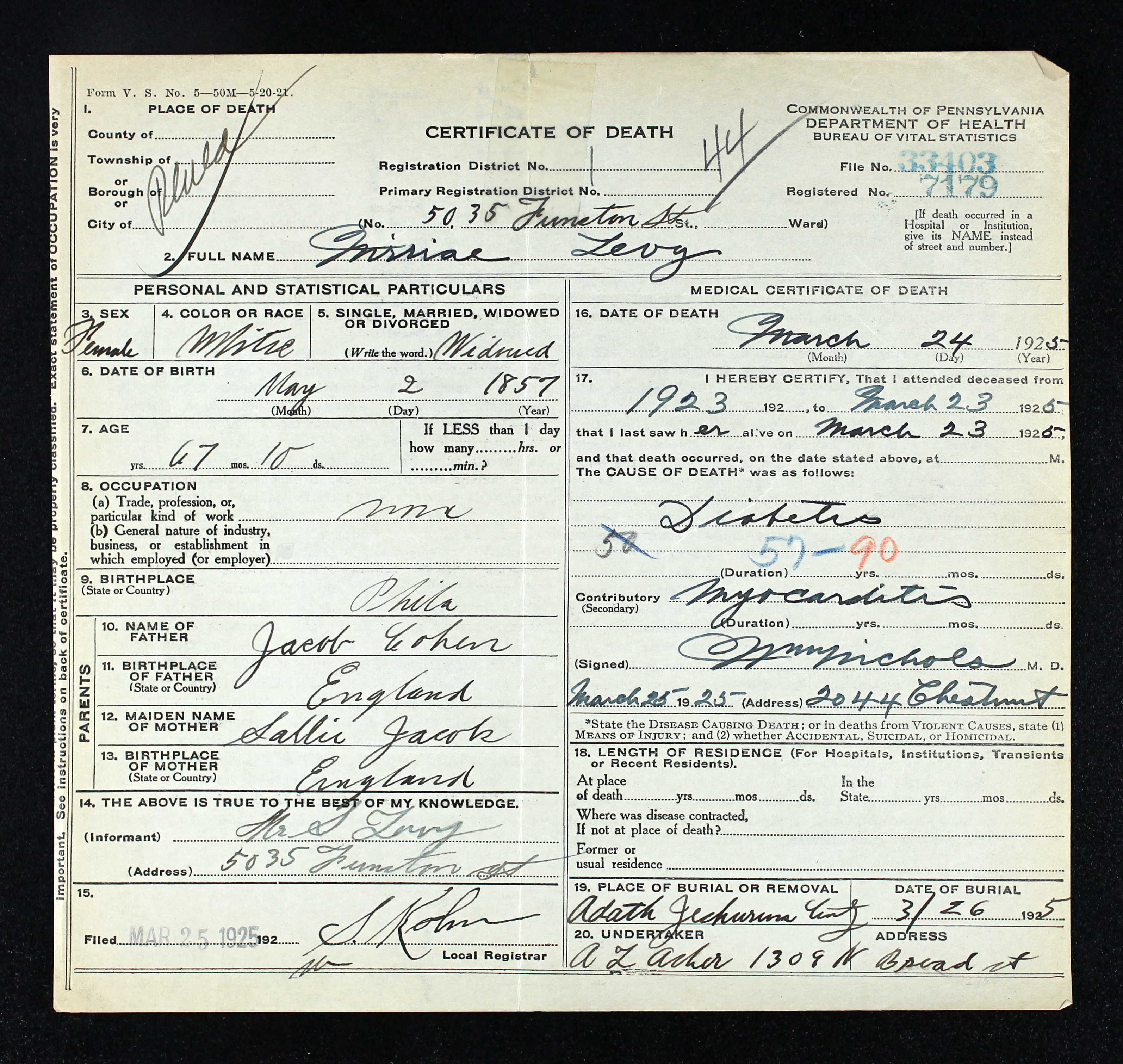
I then searched for all people named Levy who died in 1925 and finally found Maria—spelled Mrriac in the ancestry.com index.  What?? Mrriac?? No wonder I couldn’t find it.  But it was clearly Maria—daughter of Jacob Cohen and “Sallie Jacob.”  She had died from diabetes and myocarditis and had been living at 5035 Funston Street in Philadelphia at the time of her death.  The informant on the certificate was Mr. S. Levy of the same address.  Since her only surviving child was her son Isaac Harry Levy, I had no idea who S. Levy was, unless he was the son of Lewis and Emma Levy.

Maria Cohen death certificate 1925

Maria Cohen death certificate 1925

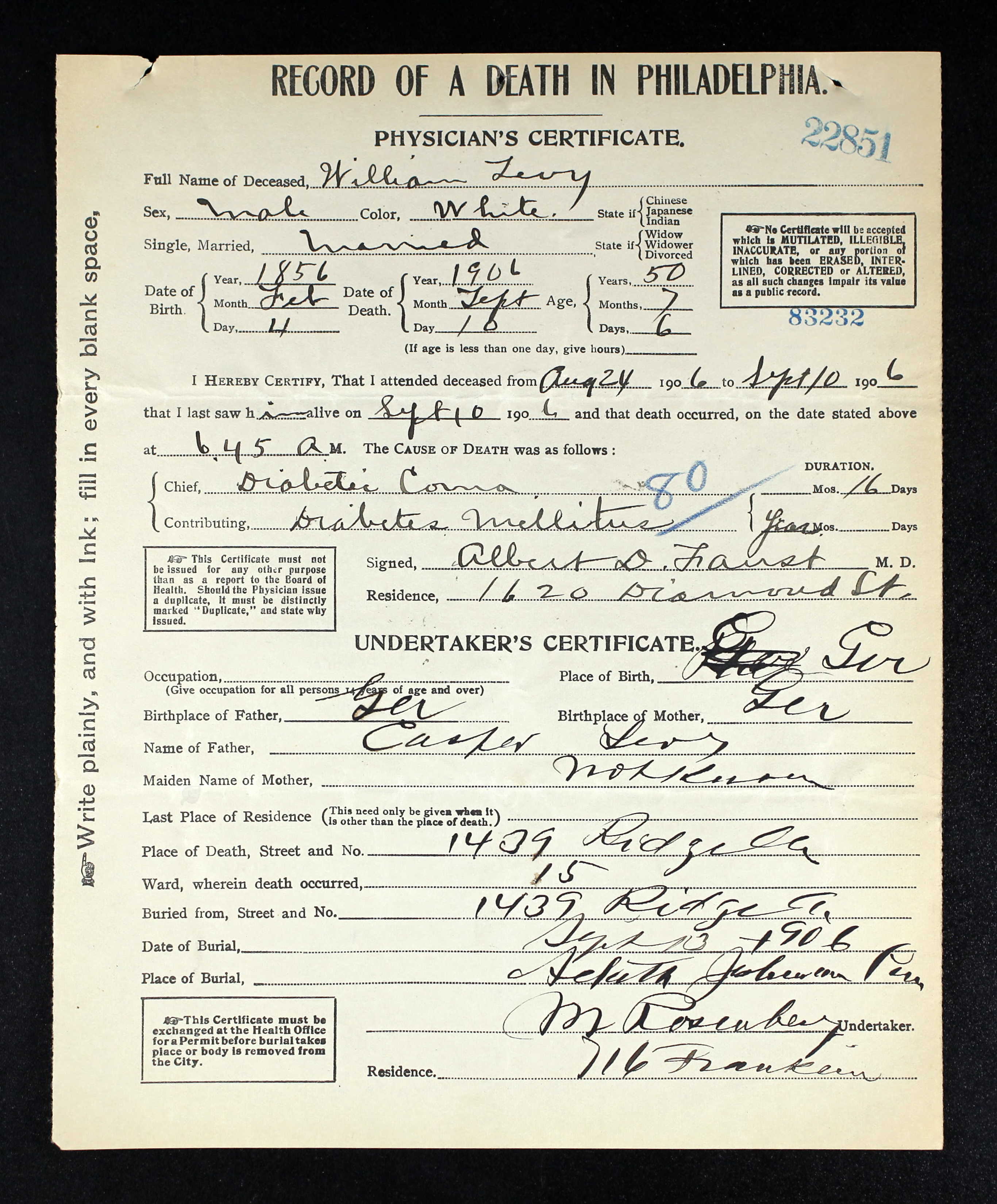
I still could not find William Levy’s death certificate nor could I figure out how to find Lewis and Emma’s child.  I turned to others for help.  There is a Pennsylvania Genealogy group on Facebook and also a Tracing the Tribe group focused on Jewish genealogy.  I posted my questions on both groups, and within a few minutes, someone on the TTT group suggested I search the Pennsylvania death index by William’s date of death instead of by his name, and tada! There it was.  William also had died from diabetes.

William Levy death certificate 1906

William Levy death certificate 1906

But that still left me without an answer to the next question: who was the child of Emma and Lewis Levy?  Another half hour later I had that answer as well.  Somehow someone else with fresh eyes found Emma Levy, a widow, on the 1920 census, living with an eight year old daughter named Henrietta as well as two relatives named Fogel.  This was obviously the right Emma, and I now knew her daughter’s name.

Emma Levy 1920 census

Emma Levy 1920 census

They also appeared together on the 1930 census, but on the 1940 census, Henrietta was gone.  Now I need to find her married name.  Two kind people from the Pennsylvania group are continuing to help me.

I still do not know who Mr. S. Levy was on Maria’s death certificate, nor do I know what happened to Henrietta. I also have not found Maria on the 1920 census.  But with the help of others, I am able to put some closure on the sad life of Maria and William Levy.

Pennsylvania, I love you!

OK, perhaps a bit of an overstatement, but yesterday morning I woke up to read online that the Pennsylvania death certificates up through 1944 were now available on ancestry.com.  (Previously, only those up through 1924 were available.)  As soon as I’d had my breakfast, I started searching for all my previously researched Cohen relatives who died between 1925 and 1944 to find their death certificates.  Within a half an hour I had found eleven of them.  Although they did not contain any amazing revelations, I was able to learn when and why several of my relatives had died.

I have updated the relevant blog posts for Hannah Cohen, Lewis Weil, Rachel Cohen, Martin A. Wolf and his wife Marie Morgan, Laura Wolf, Harry Frechie, and Samuel Rosenblatt, Jr.  I also have certificates for Reuben Cohen, Sr., Emanuel Cohen, and Abraham Cohen which will be discussed in later posts.  The only one of these that I was particularly interested in was that of Samuel Rosenblatt, Jr., who had died when he was only twenty and was his parents’ only child; he died of leukemia.  Laura and Martin A. Wolf, siblings and the children of Hannah and Martin Wolf, also died at relatively young ages—in their 40s, Laura of diabetes and Martin A. of ulcerative colitis.

If you are interested in seeing the certificates, I have posted them at the relevant blog posts as linked to above.

It was good to put some closure on some of those lives, although sad to be reminded again of how many of my ancestors died so young.  Thank you to the Commonwealth of Pennsylvania for opening up your records so that family histories can be told.

Reuben Cohen 1854-1926: You Really Do Not Want to Read This

As I wrote in an earlier post, I skipped over Reuben Cohen, my great-great-grandparents’ sixth child and fifth son, in order to wait for some information from one of Reuben’s direct descendants.  I have to admit that I had other reasons as well.  My initial research indicated that Reuben and his wife Sallie Livingston had twelve children.  The thought of researching another huge family was a bit overwhelming.  In addition, my preliminary research had uncovered a number of very sad stories about those children, and I just did not have the heart to research, write, or even think about them after researching the story of Reuben’s older brother Hart.  Little did I know that his sisters, whose lives I’d not previously researched very far, also had more than their fair share of heartbreak as well.

Once I returned to the story of Reuben and did more research, I learned that his story was worse than I had even originally thought. His life started out well.  He was born in April, 1854, and grew up at 136 South Street with his parents and siblings. By the time he was sixteen he was working as a clerk in a store, presumably his father’s pawnshop.  In 1878 when he was 24, he married Sallie Livingston, and in 1880 they were living at 1725 Bainbridge Street and already had two children, Sallie R., who was a year old, and Jacob, who was a month old.  Reuben was working as a pawnbroker at 635 South 17th Street in 1881.

Reuben Cohen 1880 census

Reuben Cohen 1880 census

Originally I thought that the 1880s must have been fairly happy years for Reuben and Sallie, as Reuben continued to work as a pawnbroker and their family continued to grow.  In addition to Sallie R. and Jacob, I originally found that five more children were born between 1881 and 1890:  Minnie (1882), Hortense (1887), Rae (1887), Reuben, Jr. (1888), and Arthur (1890). The family continued to live at 1725 Bainbridge Street.

Then in 1891, tragedy struck.  Little Hortense, only three years old, was run over and killed by a cable car owned by the Philadelphia Traction Company.

Hortense Cohen death certificate

Hortense Cohen death certificate

The company had only been in business since 1883. I found this gruesome description of the accident in the June 14, 1891 edition of the Philadelphia Inquirer:

[According to a witness who saw the accident], the child, who was with two other children, started across the street to reach the house of her grandmother, Mrs. Livingstone, at 607 South Ninth Street, with whom she had been living. When she had crossed the tracks she saw a carriage coming, and she made an attempt to run back.  The child got bewildered, and as she reached the middle of the track the car struck her. The front wheel jammed the head against the track. It required the united efforts of [three police officers] to lift the car off the child’s head.

(“Killed by a Cable Car Little Hortense Cohen Becomes Bewildered and is Run Down,” Sunday, June 14, 1891, Philadelphia Inquirer (Philadelphia, PA),  Volume: 124   Issue: 165   Page: 5) The conductor and gripman were arrested.  Little Hortense was taken to the hospital where she died.

This story raises so many hard questions.  What was a three year old child doing alone without an adult? Who were the other two children, and how old were they? Were they her siblings? What a terrible impact this must have had on them as well as the rest of the family.  And why was Hortense living with her grandmother?  Were any of the other children living with Mrs. Livingston?  I don’t have any answers to these questions.

Obviously, times were different.  There were no helicopter parents, and children were much more likely to be left to their own devices than children are allowed to be today.  Also, cable cars were a recent addition to the city streets, and perhaps parents and children were not yet aware of the dangers they presented, nor were these companies likely regulated to any degree to prevent such accidents from occurring.  But one thing must have been true even in those days: the absolute horror the family must have endured after losing a child in such a terrible way.

Somehow the family went on.  My original research found that two more children were born in the next few years:  Lewis in 1892 and Penrose in 1894.  The family moved from their Bainbridge Street home sometime after Hortense’s death. In 1893 Reuben’s store was at 625 South 17th Street, and he and his family were residing at 623 South 17th Street.  They remained in that residence for many years.  In 1895 Violet was born, and in 1896 Irene was born, bringing the number of children living in the family to eleven.

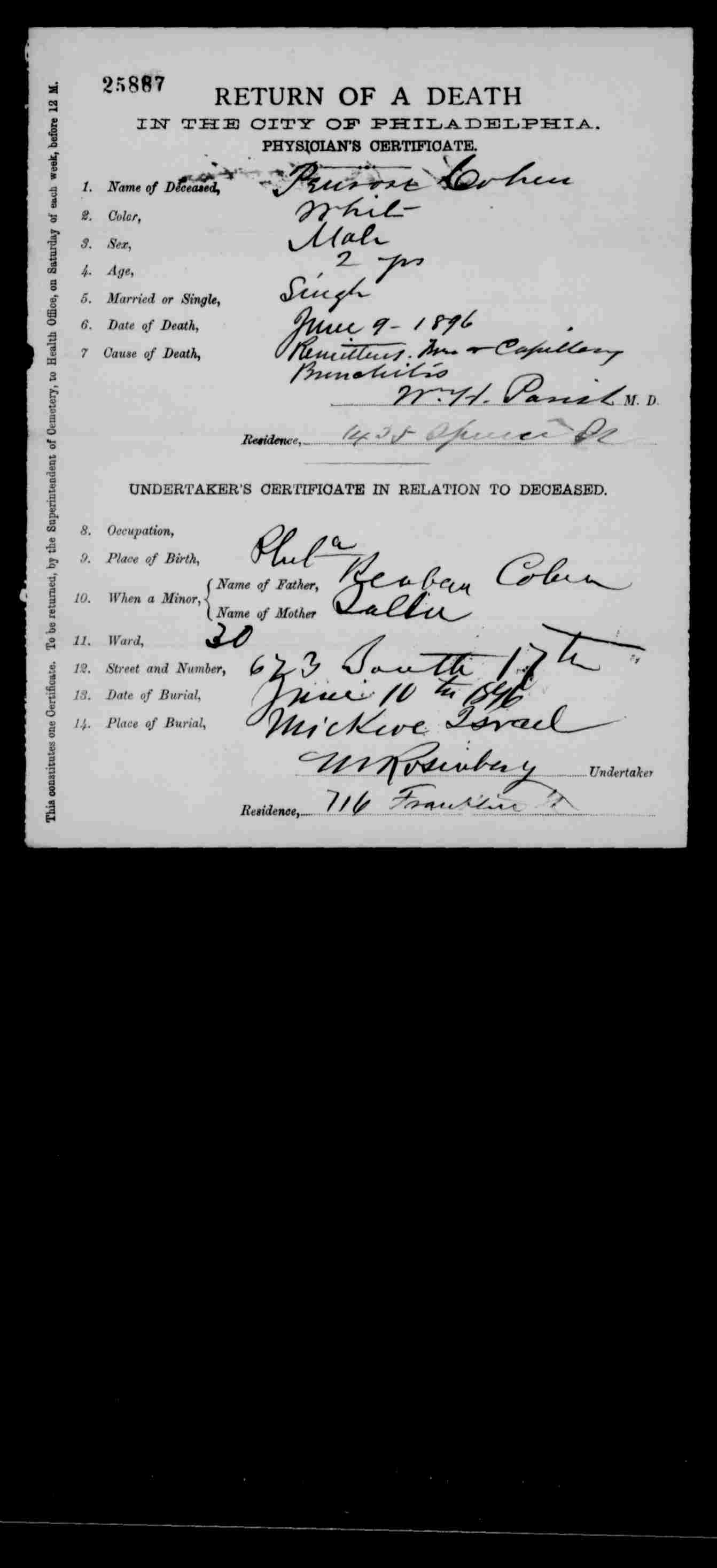
Then another tragedy occurred in 1896.  Two year old Penrose died from some form of capillary bronchitis.  Perhaps someone can help me decipher and interpret the rest of the description of his cause of death.  As if the family had not suffered enough, a year and a half later baby Irene, only a year old, died also from capillary bronchitis.  The family had lost three young children between 1891 and 1897.  The last child, Simon, was born in 1898, bringing the number of children to nine out of the twelve that I first thought had been born to Reuben and Sallie.

Penrose Cohen death certificate

Penrose Cohen death certificate

Irene Cohen death certificate

Irene Cohen death certificate

I wish I could say that that was the end of Reuben and Sallie’s heartbreak, but I cannot.  There was a period of relative calm.  In 1900 the family was living in Cape May, New Jersey, at the time of the census.

Reuben Cohen and family at 208 Ocean Street 1900 US census

Reuben Cohen and family at 208 Ocean Street 1900 US census

They were living back in Philadelphia by 1902, so I do not know whether the time in Cape May was a long stay or perhaps just a shorter stay for the summer.  I do know from one of Reuben’s descendants that Reuben owned a home in Cape May built in 1864 at 208 Ocean Street that eventually became the home of his son Arthur and his descendants.  It seems that during Reuben’s life this was not the year-round home, but perhaps just a summer home.  Reuben must have been quite successful to have two residences.  I found the house currently listed for sale on Trulia.com,with a description of the house and many exterior and interior pictures, such as this one.

208 Ocean Street, Cape May, NJ

208 Ocean Street, Cape May, NJ

1900 also was a good year for the family in other ways.  Their daughter Sallie R. was married that year to Ellis Samuel Abrams in what appears to have been quite a society event. There had been a large engagement party the year before at Reuben and Sallie’s home where an orchestra played throughout the evening “behind a bower of palm trees.”  The guest list was very long and included many of the aunts, uncles, and cousins I have written about on the blog: the Wolfs, the Sluizers, the Hambergs, and, of course, many Cohens.(“Melange of Events,”  Sunday, December 31, 1899, Philadelphia Inquirer (Philadelphia, PA) Volume: 141 Issue: 184 Page: 14)   Before the wedding took place on May 21, 1900, the Philadelphia Inquirer published a drawing of Sallie R., announcing the upcoming nuptials.  Clearly the Cohen family was part of the elite of Philadelphia Jewish society.

Sallie Cohen

Sallie Cohen

But all the business success in the world was not worth the personal losses that the family suffered. In 1907, Sallie R.’s young husband Ellis died from acute appendicitis.  He was 30 years old, and they had only been married for seven years.  They had had two children, Dorothy, born around 1905, and Simon, born around 1907.

Ellis Abrams death certificate

Ellis Abrams death certificate

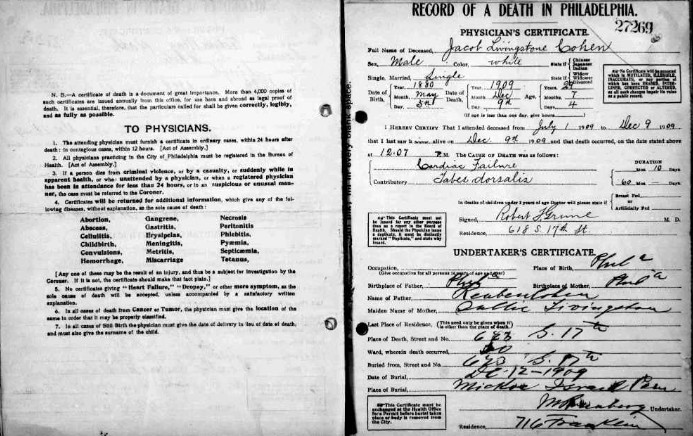
Then, two years later, in 1909, Reuben and Sallie’s son Jacob died of cardiac failure secondary to tabes dorsalis, or late stage syphilis.  He was only 29 years old when he died.  From his death certificate it appears that he had been sick and under a doctor’s care for five months before he died in December, 1909.

Jacob Livingston Cohen death certificate

Jacob Livingston Cohen death certificate

And then, just four years later in 1913, Jacob’s older sister Sallie R., Ellis’ widow, Reuben and Sallie Livingston’s oldest child, died at age 34 from nephritis, kidney disease.  That left Sallie R. and Ellis’ two children, Dorothy and Simon, orphaned at ages eight and six, respectively.

Sallie J. Cohen death certificate

Sallie J. Cohen death certificate

On the 1920 census, both children were living with their grandparents, Reuben and Sallie.  So far, I have had no luck finding out what happened to them next.

Reuben Cohen and family 1920 census

Reuben Cohen and family 1920 census

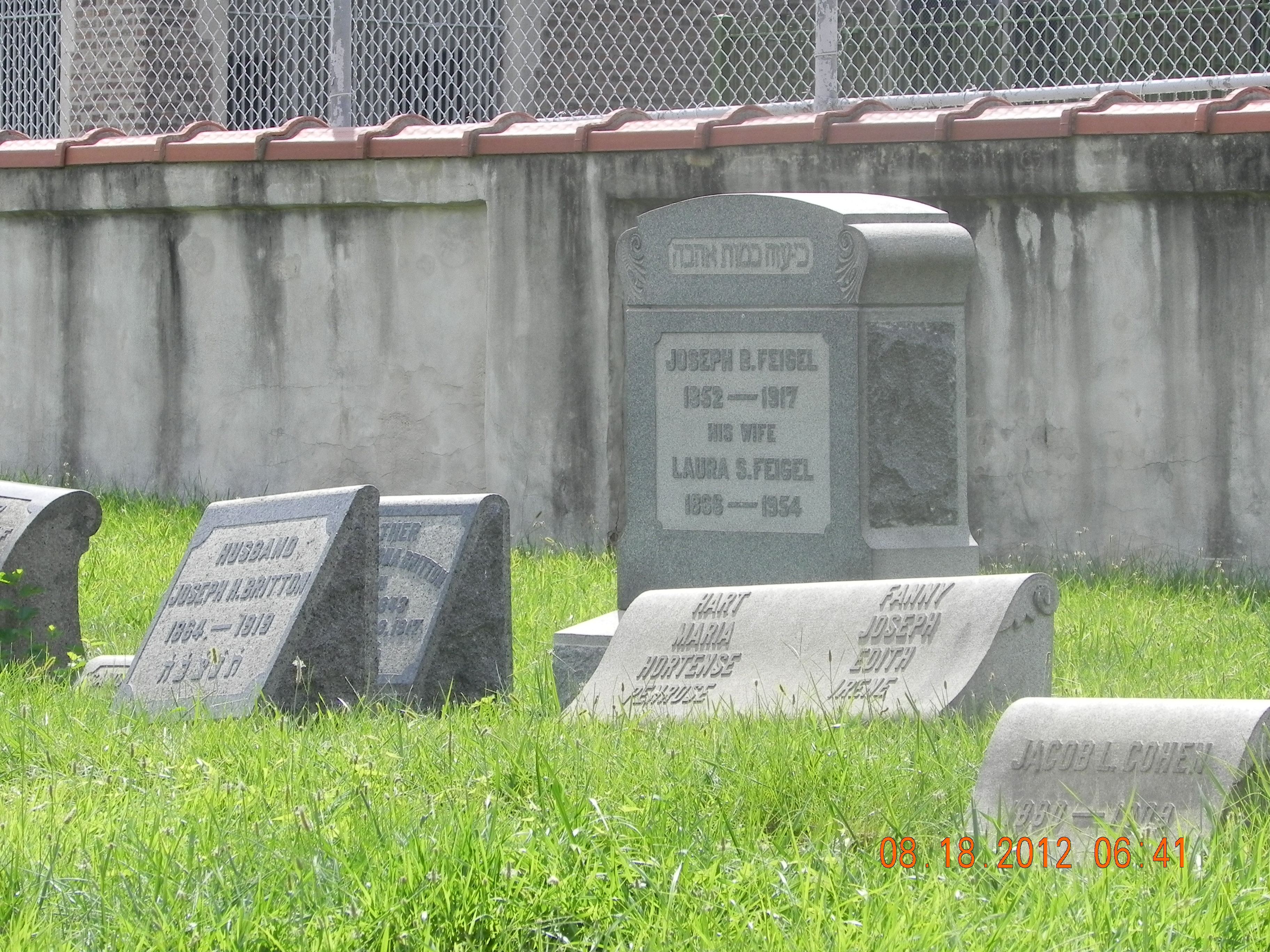
But what I did find was even more disturbing.  In doing some last minute checks for additional documents on Sallie J. and Jacob, I found their headstones on FindAGrave.  And to the left behind Jacob’s headstone, I spotted a headstone with eight names on it.  Some were familiar:  Hortense, Penrose, Irene.  But five were new to me: Maria, Fanny, Joseph, Hart, and Edith.  Who were they? When I saw it, I sighed so loudly that my husband wondered what was wrong.  I took a deep breath and then started looking for these other five children.

Since none of these names had appeared on either the 1880 census or the 1900 census (and since the 1890 census was destroyed by fire), I assumed that they were born after the 1880 census and died before 1900 census.  Eventually I found all five of these children, all of whom died before they were four years old.

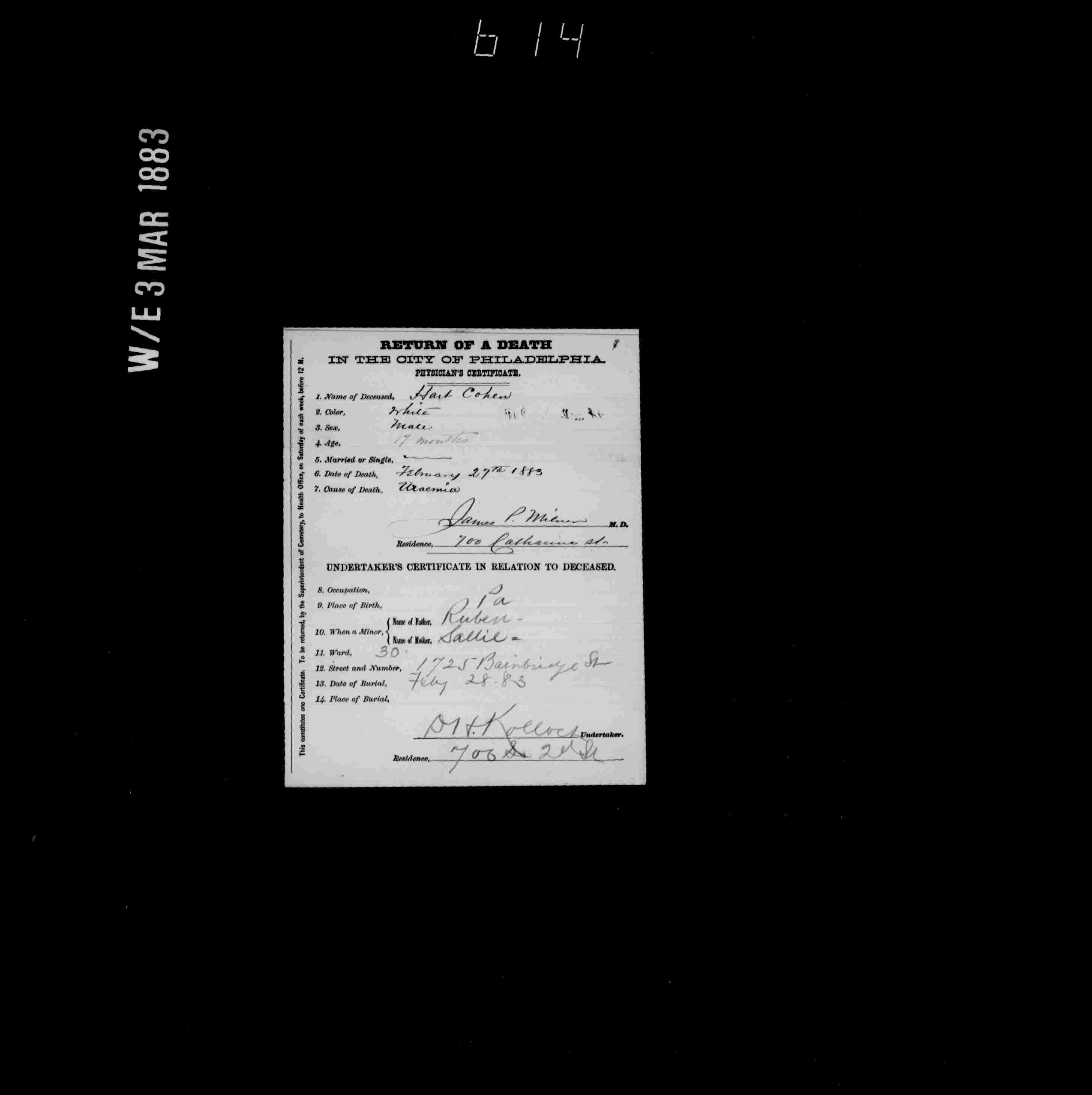
As I mentioned above, I had originally thought that the 1880s were a happy decade for Reuben and his family, but this additional research revealed the opposite.  After Sallie R. and Jacob were born, the third child, Hart, was born in 1881.  He died February 27, 1883, when he was seventeen months old from uremia.  In between Minnie was born in 1882.

Hart Cohen death certificate

Hart Cohen death certificate

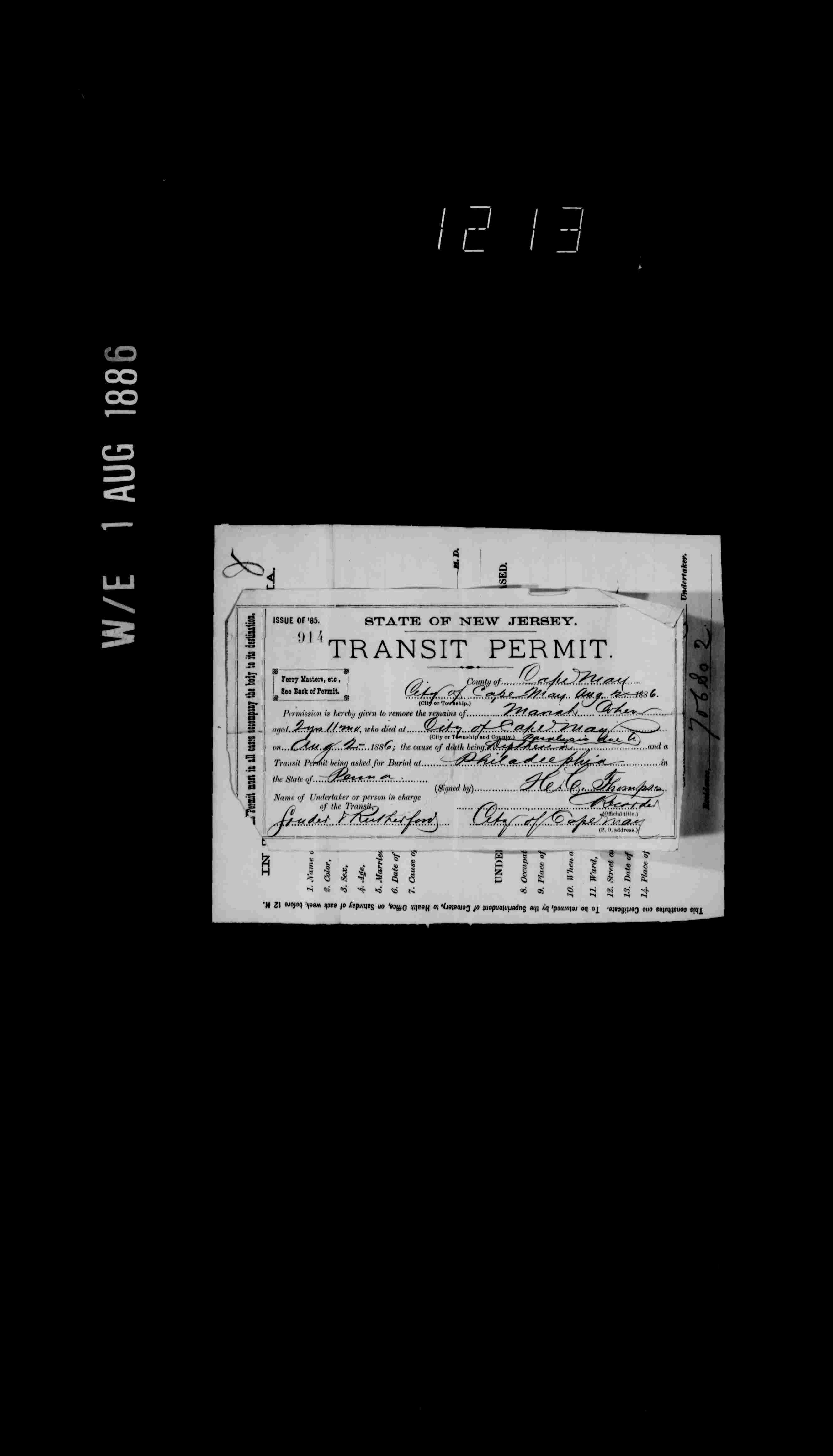
The next child, Maria, was born in September, 1883, meaning Sallie was pregnant with Maria when Hart died.  Maria died in Cape May, New Jersey on August 2, 1886, just shy of three years old, from paralysis caused by diphtheria (also evidence that the family had been spending summers in Cape May for quite some time before 1900).

Maria Cohen death certificate

Maria Cohen death certificate

But in between Minnie and Maria, Reuben and Sallie had had two other children, both of whom died before they were a year old.  In January, 1884, Fanny was born, and six months later in July, 1884, she died from enterocolitis.  On April 17, 1885, Joseph was born, and he died on August 9, 1885, not yet four months old.  Thus, in each year from 1883 through 1886, Reuben and Sallie buried one of their children. Perhaps that is why some of the children were living with Sallie’s mother?

Fanny Cohen death certificate

Fanny Cohen death certificate

Then came the tragic accident involving three year old Hortense in June, 1891.  What I had not known before I found the additional names on the headstone is that in July, 1891, the very next month, Sallie had given birth to Edith.  Perhaps that was some relief, but only for a very brief time because Edith died less than a year later on April 24, 1892, from “Diptheritic Laryngitis.”  I am not sure what that means, but it seems like it must be some complication from diphtheria. And then, as described above, Penrose died in 1896 and Irene in 1897.

Finally, there were the untimely deaths of Jacob L. and Sallie R. as adults.  So between 1883 and 1913, Reuben and Sallie had lost ten of their seventeen children and also had two young grandchildren who were left without either a mother or a father. Aside from Hortense, who died from an accident, all the other young children died from an illness that today would likely have been either prevented by a vaccine (diphtheria) or treated with antibiotics or somehow otherwise controlled by medicine.  Reading about all these babies’ deaths made me aware once again of how grateful we all should be for the developments of 20th century medicine.

How did Reuben and Sallie go on? It is unfathomable.  But they did. Did they find strength in the seven children who survived? Or did these deaths leave them bitter, angry, depressed? How does a marriage survive all that stress? Did they find strength in religion? In their large extended family? I do not know; I only know that in the last few days as I researched this family’s saga, I also was spending time with my newborn grandson and my four year old grandson, both of whom are so precious to me, not to mention their parents and other grandparents, aunts, uncles, cousins, and great-grandparents.  Seeing either grandson cry over even the smallest pain or disappointment breaks my heart.  I found myself so disturbed by reading about Reuben and Sallie’s children that I was not sure that I could bear to write this story down. But then I had to do it, if only so that those little children could be perhaps more than just names on a headstone.  Someone should know that they lived and were loved.

Reuben and Sallie had seventeen children (at least—perhaps others lived who have not been recorded somewhere).  They were married for many years.  Somehow there was enough love to keep them together so that they could continue to raise the children who survived, including their two grandchildren from Sallie R.

Reuben died on December 31, 1926; he was 72 years old.  His wife Sallie died four years later in 1930 when she also was 72.  There were seven children left who survived them, and almost all of them lived long lives, but I will leave their stories for a later post.

Maria Cohen 1856-?: A Hard Story to Find, A Harder One to Tell

It took me a long time to find the story of Maria Cohen, the seventh[1] child of my great-grandparents, Jacob and Sarah, and once I did, I wished I hadn’t. Things started easily enough, as I was able to find a record in the Philadelphia marriage index identifying her husband as William Levi. They married on December 15, 1875.  I was able to find them on both the 1880 and 1900 census reports with their sons Lewis, Jacob, and Isaac, but on both there were entries that were inconsistent with the facts I know about Maria.  On the 1880 census, it says her parents were born in Germany, and in 1900 it says her parents were born in Russia, when I know that her parents were in fact both born in England.

Had the census taker received erroneous information or did I have the wrong Maria?  Certainly her sons’ names, Lewis, Jacob and Isaac, were all names that ran in the Cohen family.  The age given for Maria on the census reports seemed close enough.  In 1880 Maria would have been 24; the census says she was 21 with two sons ages two and one.  If she really married in 1875, that means she would have been only 16 when she married, which seems unlikely.  In 1900, Maria would have been 44; the 1900 census reports it as 40.  I am accustomed to census errors, and these were not any worse than others I’ve seen.

So this could be the right Maria Cohen, but I cannot be absolutely sure because after 1900 she and her husband disappear from the records.  I cannot find Maria or William Levi on the 1910, 1920, or 1930 census.  Perhaps they both died between 1900 and 1910, but I also cannot find any death records or burial records for either of them. At first I thought perhaps they all changed their names, but after a lot of looking I was able to find death records for three of their four sons, and that is where this story gets harder to tell.

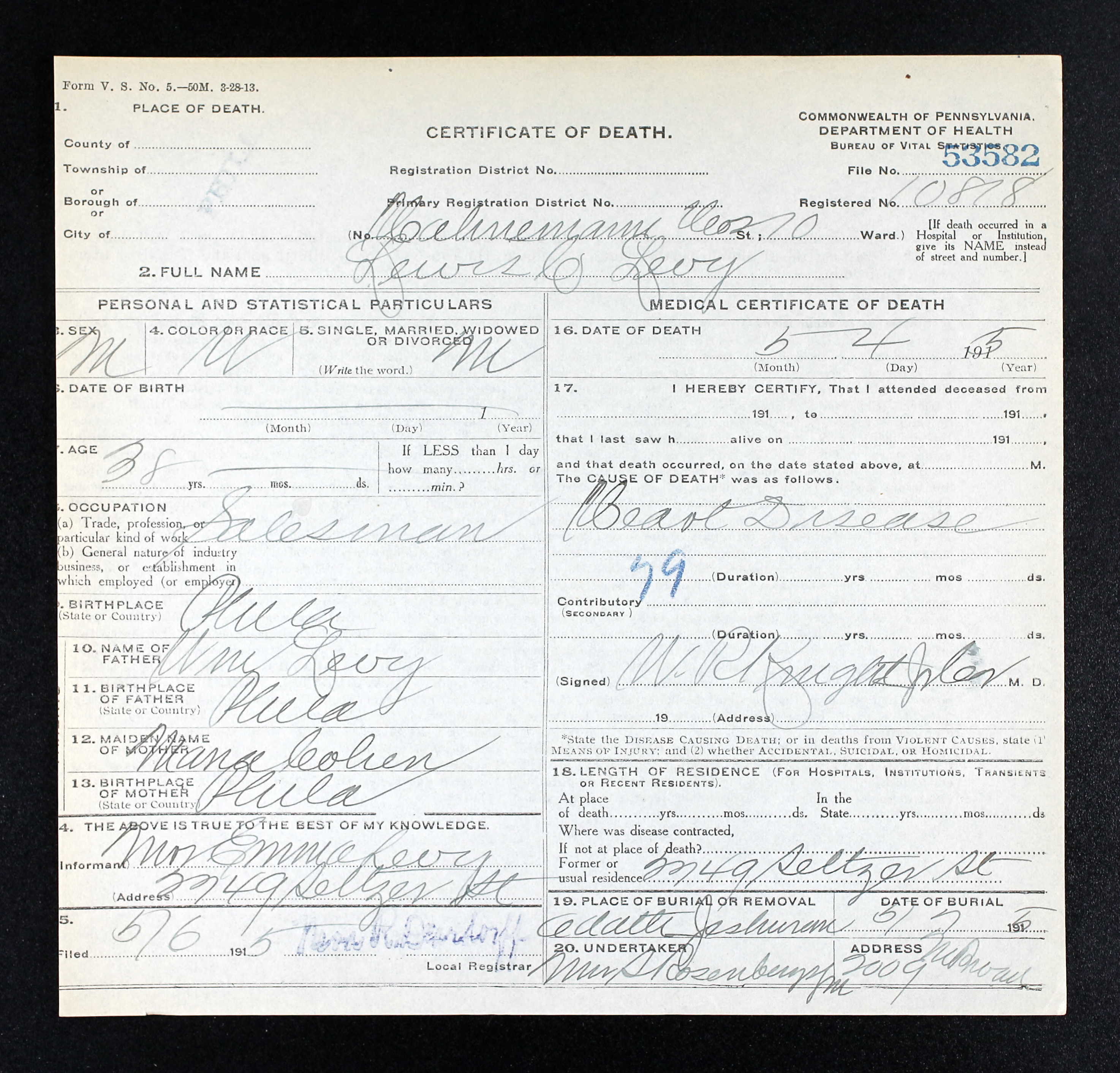
The first record I found was for their oldest son Lewis, who died on May 4, 1915, from heart disease at age 38.

Lewis C. Levy death certificate

Lewis C. Levy death certificate

His wife Emma Fogle, whom he had only married five years before in 1910, lived another almost 50 years, but was buried beside him at Adath Jeshurun cemetery and apparently never remarried.  Since the headstone is marked “father” and “mother,” there must have been at least one child born during that brief marriage, but so far I have not been able to locate that child.

Lewis and Emma Levy headstone

Lewis and Emma Levy headstone

This morning, after much looking, I found a death certificate for Maria and William’s second son Jacob, who also died at a young age.  He died only a year and half after his brother Lewis on December 22, 1916, from tuberculosis. He also was 38 when he died.  The death certificate reveals that he had been residing at the Norristown State Hospital for the Insane when he died and had been there for just over ten years.  He also was buried at Adath Jeshurun.

Jacob Levy death certificate

Jacob Levy death certificate

I was already feeling sad for Maria and William for losing two sons before either reached forty years of age when the story got even worse.

In searching for records for Maria, William and their sons this morning, I was surprised to see a death record for a Benjamin Levy, son of William Levy.  It was the first time I knew that Maria and William had had a fourth son, Benjamin, born in 1881.  Since he was born in 1881, he was not on the 1880 census.  Since he died in 1897, he was not on the 1990 census.  I had missed him completely in doing my initial research of Maria and her family.  I gasped when I found his death certificate and saw his cause of death: “found drowned.”

Benjamin Levy death certificate

Benjamin Levy death certificate

I looked to see if I could find any other information and found this story, quoted in its entirety from the Philadelphia Inquirer dated March 18, 1897.

The body of the young man which was found on Monday in the Delaware River at the foot of Callowhill street was that of Benjamin Levy, aged 16, who lived at 1580 Fontaine Street, and who has been missing since January 9. It is thought that he committed suicide.

Before going away, he said to his brother: “Good-bye, Jake, forever.  I’m going to jump overboard.”  He was not seen alive afterwards.  It is believed he drowned himself because he had been rebuked for drinking.

(“A Young Suicide,” Thursday, March 18, 1897,Philadelphia Inquirer (Philadelphia, PA)   Volume: 136   Issue: 77   Page: 10 )

Benjamin had been missing for two months when his body was found.  I cannot begin to imagine how his family felt.  Could it possibly be that just getting scolded for drinking led him to commit suicide? Or was there something else behind the story? Was there underlying mental illness, as was the case with his older brother Jacob?

Although the death certificate for Jacob said that he had been hospitalized since October, 1896, ten years, one month and 28 days before his death, this news story about Benjamin seemed to indicate that Jacob was still home when Benjamin committed suicide in March, 1897.  One has to wonder whether Jacob’s mental illness was precipitated or at least exacerbated by his little brother’s death and thus whether Jacob’s death certificate was off by a year in describing his stay at the state hospital.  Did Jacob feel guilty, knowing that his younger brother had talked about suicide but Jacob had not being able to stop him? How did Maria and William cope with these two traumas?

It was less than twenty years later that their son Lewis died in 1915, with Jacob dying a year later in 1916.  Only Isaac remained, their youngest son.  Fortunately, Isaac’s story is not tragic.  In 1909, he had married Rose Hicks, who was a few years older than Isaac and had a son William from a previous marriage. Although marrying an older divorced woman with a child might have been somewhat unusual back then, given what this family had been through, that must have been small potatoes to them.  In 1910, he and Rose were living at 133 Walnut Street in 1910 with several boarders, and Isaac, now using the name Harry, was working at a pawnshop.

Isaac "Harry" Levy and Emma Levy 1910 census

Isaac “Harry” Levy and Emma Levy 1910 census

In fact, it was his uncle Lewis Cohen’s pawnshop, as revealed in Harry’s World War I draft registration (and as confirmed by an address check for Lewis Cohen in 1917).

Isaac "Harry" Levy draft registration World War I

Isaac “Harry” Levy draft registration World War I

Harry, Rose, and Rose’s son William as well as her nephew were living on Reno Street in 1920, and Harry and Rose continued to live in Philadelphia at least until 1942 when Harry’s draft registration for World War II continues to provide a Philadelphia address at 222 North 52nd Street.  Harry was working for the WPA in Philadelphia at that time.

Isaac "Harry" Levy World War 2 draft registration

Isaac “Harry” Levy World War 2 draft registration

It does not appear that Harry and Rose had any biological children of their own.  I cannot yet find any record for Harry or Rose after 1942, nor have I yet had any luck locating any records for Maria or William after the 1900 census.   I plan to contact Adath Jeshurun cemetery in Philadelphia to see if they have records for Harry/Isaac, Rose, Maria or William Levy.  Since the other members of the family were all buried at that cemetery, I am hoping that I will be able to get at least some greater information about the others.

Genealogical research is filled with twists and turns.  I spent many hours this week, focused on Maria Cohen and her family with William Levy, and until this morning I had found almost nothing except their marriage record and  those two census reports.  I went to sleep feeling that I would never know the rest of the story.  Then with just a few lucky keystrokes this morning, I opened the door to a terribly tragic family story.  I almost wish that I hadn’t.  Careful what you wish for, as they say.  I hope I can put some closure on Maria’s life.  Only time, persistence, and lots of good luck will tell.


[1] Reuben was the sixth child, but I am skipping over him for now as I wait to hear from one of his descendants.

Enhanced by Zemanta

My Great-Great Grandmother Rachel Jacobs Cohen: Her Death Certificate

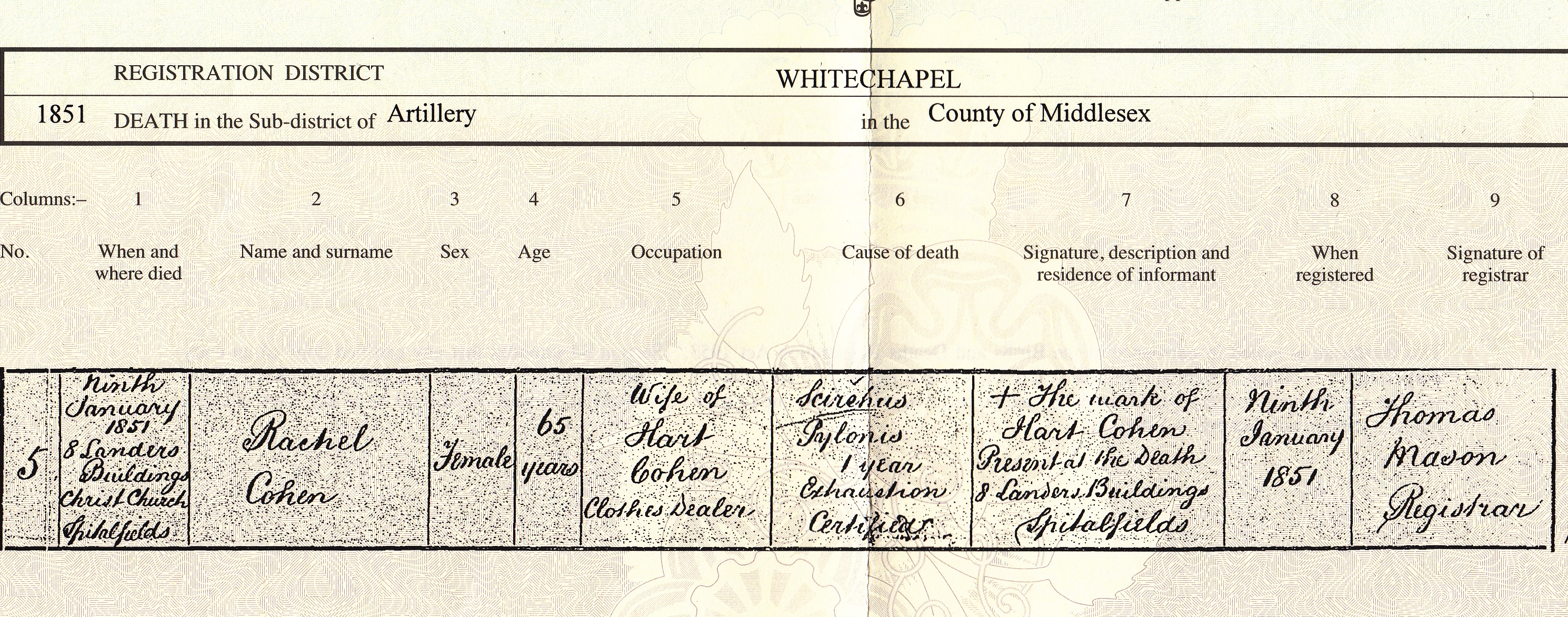
I have received a certified copy of my great-great grandmother’s death certificate from the General Register Office in London.  This is my first English vital record, and I was quite excited to receive it.  It amazes me that I can obtain a record that is over 150 years old from a foreign country just by clicking on the keys of a computer.  Below is a scan of the document and also a cropped version to highlight the actual text on the certificate.

Rachel Jacobs Cohen  death certificate

Rachel Jacobs Cohen death certificate

rachel jacobs cohen death cert 1851 cropped

There are a number of things that interest me about the information on this document.  First is Rachel’s date of death, January 9, 1851.  When I had searched through the BMD Index for this certificate, there were a number of Rachel Cohens who might have been the right person.  I guessed that it was this one based on the date.  Although Lewis and Jacob, Rachel’s sons, had left for the US in 1846 and 1848, respectively, Rachel’s husband and other children, Elizabeth and Jonas, did not leave until 1851.  I had a hunch that they did not leave because Rachel was ill and not able to make the journey, so they waited until after she died.

As the certificate shows, Rachel’s cause of death was “scirehus paylonis” and exhaustion, and it seems she had been ill for a year.  As best I can tell, scrirehus paylonis would be translated to schirrous pylonis or cancer of the stomach.  (My medical expert should feel free to correct this.)  I found some English writings on line in which that term was used to refer to what we would call stomach cancer.

The certificate also indicates where the family was living—in Landers Buildings in Christchurch, Spitalfields, in the Registration District of Whitechapel, County of Middlesex.  It also confirms that Hart Levy Cohen was a clothes dealer.

Perhaps most interesting and surprising to me is that Hart signed the certificate with a mark, an X, not with a signature.  Was he not able to sign his name? Was he illiterate? It’s so hard for me to imagine not being able to read and write that I found this shocking and disturbing.


Enhanced by Zemanta

Isaac Cohen 1850-1914: A Harder Story to Tell

The third child of my great-great grandparents was Isaac.  He was born on February 4, 1850, in Philadelphia, the first of their children both conceived and born in the US.  Until at least 1872 when he was 22 years old, he lived at home with his parents at 136 South Street and was working as a clerk in one of the family pawnshops.

He was living at a different address as of 1873, 923 Parrish Street, which was two and a half miles north of his family home, continuing the northward movement of the family.  I assume that sometime in 1873 he had married his wife, Emma Cordelia van Horn, since he was no longer living at home.  Emma was born in 1853 in Pennsylvania, the daughter of William van Horn and granddaughter of I.B. Merkel, according to documents relating to her death, but so far I have not been able to find out more about her family or to locate a William van Horn with a daughter named Emma.  I was surprised to see just how many William H. van Horns there were in Philadelphia alone.

Like his older brother Joseph (as well as many of his younger brothers) and his father, Isaac was a pawnbroker.  For his whole career he worked at a pawnshop at 830 North 10th Street, a block away from his residence in 1873 on Parrish Street.   On July 9, 1879, Isaac and Emma’s son, Isaac Wilbert Cohen, was born, and in 1880 the family was living at 636 North 11th Street, only a few blocks away from the store on 10th Street.  The 1880s seem to have been fairly uneventful.  Isaac continued to work at the same location throughout the decade, according to the city directories.  Emma and little Isaac were at home.

Isaac Cohen and son living with Emanuel Cohen and family 1880 census

Isaac Cohen and family 1880 census

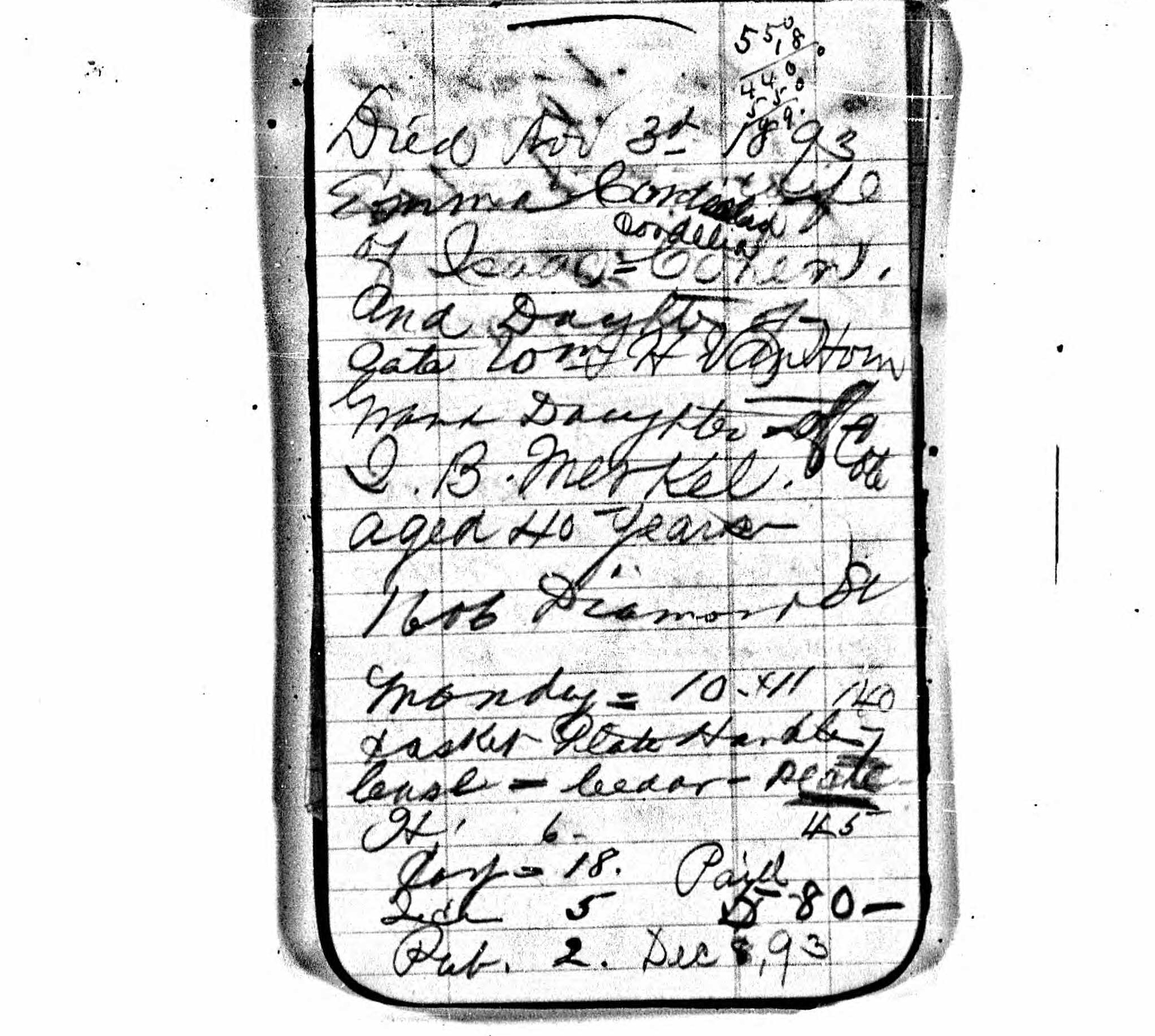
Then in 1893, tragedy struck, and Isaac’s life was never the same.  His wife Emma died on November 3, 1893, when she was only forty years old and her son was only fourteen years old.  Emma died from “Septic Peritonitis from Suppurative Salpingitis,” according to her death certificate.  As explained to me by my brother, suppurative salpingitis means she had pus in her fallopian tubes, a condition today known as pelvic inflammatory disease.  In Emma’s case it led to a septic condition in her abdomen which killed her.

Emma Cohen death certificate 1893

Emma Cohen death certificate 1893

Emma Cohen funeral notes 1893

Emma Cohen funeral notes 1893

It was from the funeral notes above that I learned Emma’s father’s and grandfather’s names.

When she died, Emma and Isaac had been living at 1606 Diamond Street, so the family had moved again, about two miles north from 11th Street and Isaac’s store on 10th Street.  After Emma died, Isaac and his son remained at 1606 Diamond Street, and as of 1895, Isaac’s much younger brother, my great-grandfather Emanuel, was also living at 1606 Diamond Street.  Emanuel was thirteen years younger than Isaac, 32 in 1895, and was himself married and the father of three sons, including my grandfather John, who was born in 1895.  On the 1900 census, Isaac and his son were still living with Emanuel and his family, with Emanuel listed as the head of household.

Isaac Cohen and son living with Emanuel Cohen and family 1900 census

Isaac Cohen and son living with Emanuel Cohen and family 1900 census

I found this somewhat puzzling.  Had Emanuel moved his family to Isaac’s home to help take care of his widower brother and motherless nephew?  Or had Isaac taken in Emanuel to help him out?  I assume it’s more likely the former—that Isaac need help with caring for his teenage son and that my great-grandmother Eva was willing to help raise him as well as her three sons, who would have been young boys during the 1890s.  Isaac had twelve siblings, some much closer to him in age.  Why would he have ended up living with Emanuel, his much younger brother and not one of the others?

Isaac was the first member of the Cohen family to marry someone who was not Jewish.  Emma had been buried in a non-Jewish cemetery, West Laurel Hill in Bala Cynwyd, Pennsylvania, outside Philadelphia.  Had his other siblings been upset that he married outside the faith?

Isaac’s stay in Emanuel’s household continued for almost twenty years.  In 1910, he was still living with Emanuel, Eva, and their sons, now at 1441 Diamond Street, and still working as a pawnbroker.  His son Isaac Wilbert had married Gertrude Mann the year before and was living in his own place.  Why had Isaac stayed with Emanuel and not moved with his son?  To give the newlyweds their own space? Again, it does seem a bit strange, but I suppose that after fifteen years of living with his brother and family, Isaac at age 60 was content to stay put.

Isaac Cohen with Emanuel and family 1910 census

Isaac Cohen with Emanuel and family 1910 census

But then Isaac suffered another terrible loss.  On March 3, 1914, his son Isaac Wilbert Cohen died from lobar pneumonia.  According to the death certificate, Isaac Wilbert had suffered from myocarditis, another family member succumbing to heart problems.  He was only 34 and had been married only five years when he died.  He had no children.

Isaac Wilbert Cohen death certificate

Isaac Wilbert Cohen death certificate

Isaac Cohen, my great-grandfather’s brother, himself died just a few months later on September 15, 1914, from acute peritonitis secondary to pancreatic cancer.

Isaac Cohen death certificate

Isaac Cohen death certificate

He was 64 years old and had lost his wife 21 years before and his only child just six months before.  It seems like he endured far too many losses far too soon.  I hope that he found comfort living with my great-grandparents and my grandfather and great-uncles.  I wish that I knew more about his life and his story.

Like his wife, Isaac was buried at West Laurel Hill cemetery along with his son Isaac Wilbert.


Enhanced by Zemanta

Changing of the Guard: 1870 to 1893

Mikveh Israel Cemetery, Philadelphia

Mikveh Israel Cemetery, Philadelphia (Photo credit: Wikipedia)

As we move forward from 1870, the grandchildren of Hart and Rachel Cohen were becoming adults and forming businesses and families of their own.  The generation of Hart and Rachel’s children—Elizabeth, Lewis, Moses, Jacob and Jonas—was growing older and passing on the legacy of the family to this next generation.  Today’s post will focus on those five children, my great-great grandfather and his siblings.  Subsequent posts will focus on the grandchildren and their families, in particular my great-grandfather Emanuel and his family.

In 1871, Elizabeth was still working as a clothier, according to the Philadelphia city directory.  Lewis continued to work as a pawnbroker and Jonas a clothing salesman through the 1870s, according to the city directories.  In 1880, the three siblings were still living with each other at 713 May Street, a location north and west of the neighborhood where the family had long lived near 136 South Street.

Lewis, Elizabeth and Jonas Cohen 1880 US census

Lewis, Elizabeth and Jonas Cohen 1880 US census

In 1870, their brother Jacob continued to live at 136 South Street with his wife Sarah and eleven of his thirteen children, ages five through twenty-one.  He also continued to work as a pawnbroker, and his sons Isaac and Reuben were also working in the business in 1870.  By 1880 much would have changed.  Most importantly, Jacob’s wife, my great-great grandmother Sarah, died on November 19, 1879, of erysipelas, a bacterial infection similar to cellulitis.  She, like her father-in-law Hart, was buried in Mikveh Israel cemetery.  She was 53 years old, had moved from London to Philadelphia with her husband and first child, and had then given birth to twelve more children, some of whom were still young teenagers when she died.

Sarah Jacobs Cohen death certificate 1879

Sarah Jacobs Cohen death certificate 1879

On the 1880 census, Jacob was a widower, still working as a pawnbroker, and living with five of his children, ages 14 through 23.  All but one of them, Lizzie who was 19, was working either as a salesperson or a clerk in a store, presumably their father’s store.  The eight other children were married and out of the house, some of them also working as pawnbrokers. His son-in-law Ansel Hamberg, Fannie’s husband, was also working as a pawnbroker, again presumably still in business with Jacob.   Jacob’s business was still supporting many people.  Obviously, with all those children working in the store, it must have been quite an establishment.

Jacob Cohen and family 1880 US census

Jacob Cohen and family 1880 US census

In the decade that followed that census, all of Hart and Rachel’s children passed away, except for Jonas, the youngest, who died in 1893. First, Elizabeth died on June 28, 1883, of what looks like “atrophy muscular,”  which I assume, from reading online, was some form of a motor neuron disease.  She was about 65 years old.  She was buried in Mikveh Israel cemetery, like her father and her sister-in-law, Sarah.

Elizabeth Cohen death record 1883

Elizabeth Cohen death record 1883

Less than a year later, on March 6, 1884, her brother Lewis died of an abscess of the lung.  His age was given as 68 on his death certificate, and he also was buried at Mikveh Israel cemetery.

Lewis Cohen death certificate 1884

Lewis Cohen death certificate 1884

On April 21, 1888, my great-great-grandfather Jacob died as well, also in his sixties.  He, too, was buried at Mikveh Israel, with his wife Sarah, his father and his siblings.  According to his death certificate, he died from “uremia from Bright’s disease of the kidneys (probably  auto ? kidneys).”  (If someone can decipher the word after “probably,” please comment below.)  Bright’s disease was defined in Wikipedia as follows:  “Bright’s disease is a historical classification of kidney diseases that would be described in modern medicine as acute or chronic nephritis. The term is no longer used, as diseases are now classified according to their more fully understood causes.”

Jacob Cohen 1888 death certificate

Jacob Cohen 1888 death certificate


The last of Jacob and Sarah’s children, the youngest, Jonas, died on January 23, 1893, and was also buried at Mikveh Israel.  He also was in his early 60s when he died.  His cause of death was given as pneumonia.

Jonas Cohen 1893 death certificate

Jonas Cohen 1893 death certificate

So all five of Jacob and Sarah’s children died before reaching seventy years of age, whereas their father lived to be 88.  (Their brother Moses had died before reaching forty; although I’ve yet to locate a death certificate for Moses, according to the 1860 census taken just months before he died, he was “insane from intemperance.”)  They all died from different causes—atrophy muscular, a lung abscess, kidney disease, and pneumonia.  Their mother died from a bacterial infection. I would think most of these would be treatable today and that, given better medical treatment, they all could have lived a long life like Hart Levy Cohen had. Looking at how young they all were when they died makes me realize just how remarkable it was for Hart to live to be almost 90 years old back in the 19th century.  And how lucky we all are to live in the 21st century.


Enhanced by Zemanta

The Legacy of Rebecca Rosenzweig: Her Son, Irwin Elkins

Iriwin Elkins 1960

Iriwin Elkins 1960

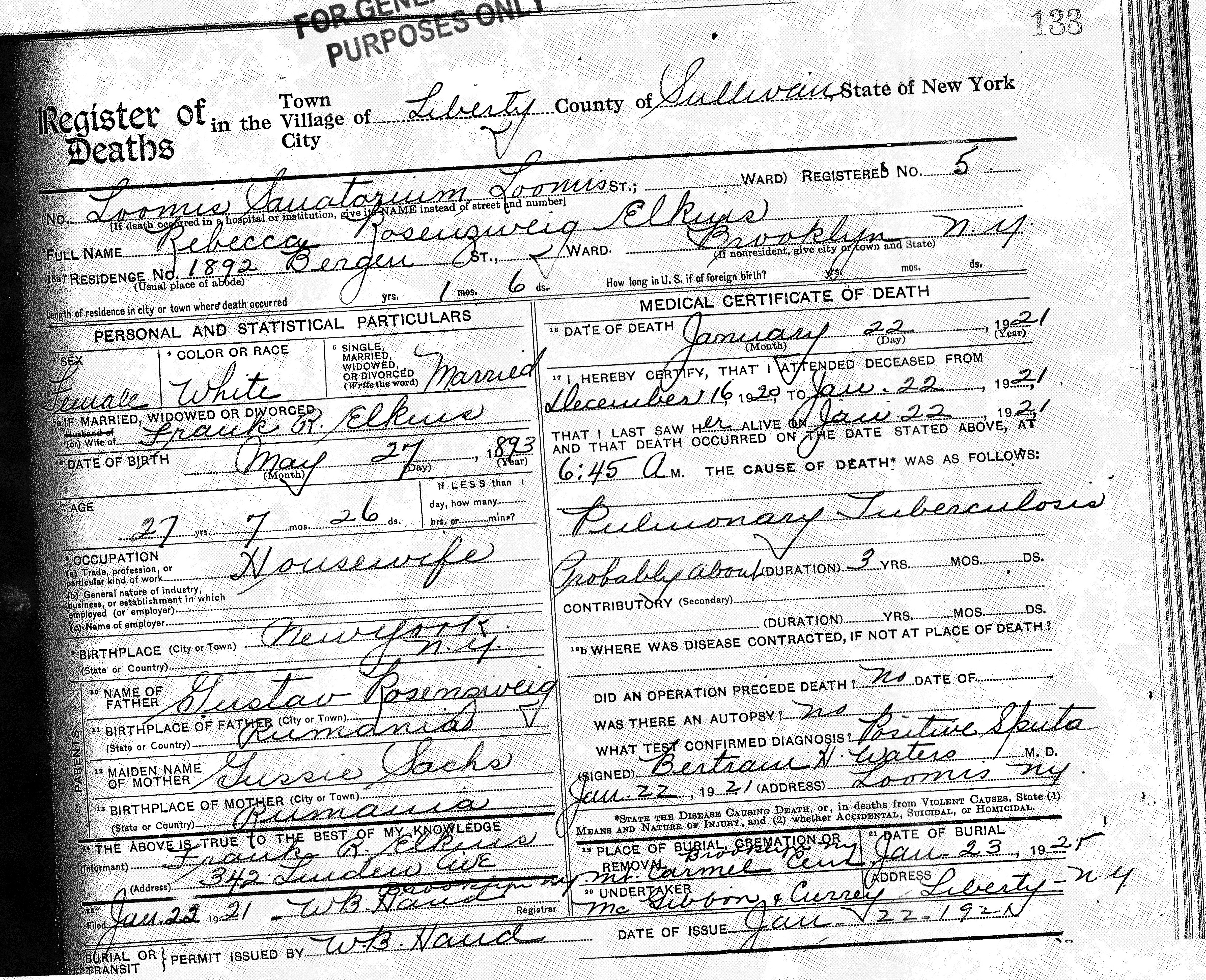
I recently connected with Richard Elkins, the grandson of Rebecca Rosenzweig Elkin.  Rebecca died in 1921 at age 27, when her son Irving was less than two years old.  Irving grew up to be Irwin Elkins, who married Muriel, with whom he had two sons, Michael and Richard.  Richard was kind enough to share with me some stories about Irwin’s life.  With his permission, I am including some of what he shared with me in his own words.

First, some background.  Rebecca Rosenzweig, my grandfather’s first cousin and the daughter of Gustave and Gussie Rosenzweig, married Frank Elkin in 1914.  Her son Irving was born in 1919.  After Rebecca died in 1921, Frank married Frances Reiner in 1922 and moved to Boston. Frank and Frances had a son named Stanley, who was born in 1925.  In 1930 Frank was back in Brooklyn with Frances and the boys, but sometime thereafter they returned to the Boston area, where they settled permanently.  I had assumed that Irving had stayed with Frank and his new wife during the 1920s, but Richard informed me otherwise.

“When Rebecca Rosenzweig passed away in 1921, Irwin Elkin moved into the home of Gustave and Gussie Rosenzweig, where he resided for eight years until 1929.  Irving adored his Grandma Rosenzweig, and Grandma Rosenzweig adored my Dad. My Dad thought of Gussie as his mother. My Dad said Gussie was a fabulous cook.   My Dad never spoke about Gustave.”

Perhaps the reason that Irwin never spoke about Gustave was that by 1921, Gustave and Gussie were divorced or at least no longer living together.  If Irwin’s years with his grandmother were from 1921 to 1929, he was living with just Gussie, Ray, and Lizzie.

One of Irwin’s favorite stories about his years living with his grandmother was this one, according to Richard:  “There was a large family gathering at Gustave and Gussie’s home, and Gussie discovered that she did not have enough food to feed the entire clan.  Gussie pulled my Dad aside and told him to tell all the other children that when Gussie asked who wanted chicken for dinner, all the children were to say, ”No, thank you,” because they were not hungry.  That way there would be enough food for the adults. When everyone sat down at the table, Gussie asked who wants chicken for dinner?  All the children dutifully said no thank they were not hungry and were excused from the table.  After the dinner was served and completed, Gussie then announced, ‘Any child who did not eat my chicken dinner will get no dessert!’ “

Richard also shared this story about his uncle, Jack Rosenzweig: “The only other story I recall about my Dad growing up in the Rosenzweig household is someone my Dad referred to as Uncle Jack who had a wild sense of humor.  Jack worked behind the counter in the post office.  One day my Dad walked into the post office to see Jack and Jack told my Dad he went to Yankee Stadium and met with legend Babe Ruth.  Jack then tossed to my Dad a baseball with Babe Ruth’s autograph on it.  There was just one problem.  The autograph was written in purple indelible ink that was the same color ink that Jack used to address packages for postal customers.”

Irwin’s time with the Rosenzweig family ended in 1929.  Richard wrote: “In 1929 Irwin was told to pack up his belongings. Frank arrived from Boston, picked up Irwin, and they went back to Boston on the train. My Dad was aware that Frank had remarried and had met Frances (Fan) Reiner. What my Dad did not know, until he arrived at his new home, is that he had a kid brother named Stanley who was six years younger than he was. That fact had been withheld from him while Irwin was living in the Rosenzweig household.”

I asked Richard if he knew why Frank and Frances had moved to Boston rather than stay in NYC.  He wrote:

“Although Francis Fan Reiner was born in New Jersey, her extended family lived in Boston. … The second move back to Boston occurred because Frank changed professions. He met a couple who were twenty years younger than he was named Joseph Cohen and his wife Rene Cohen.  They opened up a business called Debonair Frocks located on Kneeland Street that was in the high rent fashion district in Boston.  Frank was the salesman who traveled throughout New England.”

Richard also told me that his father graduated from Boston English High School and was accepted into the MIT School of Engineering.  He could not afford the $600 per year tuition and instead went to Northeastern University, which had awarded him a football and baseball scholarship and the opportunity to work on a paid co-op job.  According to Richard, “Frank and Fanny Elkins were very unhappy that Irwin wanted to study engineering in college. They believed it was a useless profession. They would invite family and friends over to convince my Dad that the future was in clothing, not engineering.  People need things to wear, they don’t need mechanical engineers.”

Irwin soon proved them wrong.  Richard wrote:

“When World War II broke out with the bombing of Pearl Harbor, my Dad had just graduated Northeastern and tried to enlist as a fighter pilot.  He was rejected for two reasons.  He stood 6’4 and weighed 200 pounds which made him too large to fly.  He also had his degree in mechanical and aeronautical engineering that made him too valuable to serve in the armed forces. My Dad was assigned to be a civilian contractor working for Bethlehem Steel at the Fore River Ship Yard in Quincy, Massachusetts.  His responsibility was to oversee the construction of light cruisers and destroyers, take them to sea on shakedown cruises, and sign off on their seaworthiness before turning over the ships to the War Department.

“It was my Dad’s crew of engineers at the Fore River Shipyard who perfected the “Davit” that was first invented in 1928.  It’s the device that holds a ship’s lifeboats in place that would lower the lifeboat by hand cranking the boat down into the water.  My Dad was the lead engineer who re-designed the Davit into a fully automated self-contained hydraulic system that would first lower the two arms holding the lifeboat from their vertical position – while keeping the lifeboat level – into a horizontal position for boarding. The Davit hydraulics would then resume lowering the lifeboat into a fully locked horizontal position at which point a second set of hydraulics would automatically lower the lifeboat while maintaining its level stability even if the weight distribution in the boat was not balanced. The end result was an automated steady descent onto the water regardless of the surf conditions or high winds. 

“If you want to see first-hand the engineering legacy of Irwin “Tiny” Elkins, then take a vacation cruise on a Princess, Carnival, Disney, or Royal Caribbean ship.  Look closely at the hydraulics on the Davit’s holding up the lifeboats. Nothing has changed in the past seventy years. The survivors of cruise ship disasters like the Concordia in Italy can thank the Rosenzweig family genes for that innovated engineering solution.”

Irwin Elkins with Piper Cub 1958

Irwin Elkins with Piper Cub 1958

Richard also shared these recollections of his father:

“My Dad was physically a large man and a wonderful athlete.  Growing up we skied together, played tennis, and golfed.  In a batting cage he could outdo me with little effort.   Whenever anyone asked my Dad why such a large person like him was called “Tiny,” his standard response was “I was an incubator baby, and the nurse in charge turned the heat up too high.”  Whenever he was asked why he did not have a middle name, his standard response was, “My parents were so poor they could not afford one for me.” Whenever someone asked him why he was so tall, his standard response was “So if I cut off my legs, will it make you feel any better?” In his business dealings he often told his customers, “It will be done my way and don’t worry about it. If I’m wrong, I’ll deal with it after I’m dead.” If someone did something that my Dad considered to be stupid, my Dad would point to his head and say “That’s using your toukis.”

Finally, I asked Richard whether his father ever reconnected with the Rosenzweig family.  He shared this story:

“In 1969 a woman and her son walk into my Dad’s office in Brattleboro.  When my Dad asks if he can help her, she introduces her son named Steven Rosenthal who will be a student at Windham College in nearby Putney. My Dad replies, why is that of interest to me? She informs my Dad that her name is Rebecca Kurtz Rosenthal. She was named after my Dad’s mother Rebecca Rosenzweig. Her mother was Sarah Rosenzweig, the sister of Rebecca Rosenzweig.  To say that my Dad was completely stunned at this unannounced visit is an understatement.”

Irwin Elkins reunited with his cousins Rebecca Kurtz and Ben Kurtz and others in Florida 1992

Irwin Elkins reunited with his cousins Rebecca Kurtz and Ben Kurtz and others in Florida 1992

The following year Richard himself met the Rosenzweig family:

“In 1970 at a family reunion in Long Island, New York, at the home of Rebecca Kurtz Rosenthal and her husband Sam Rosenthal, I arrived with my parents.  Other than Rebecca and her husband Sam, none of the Rosenzweig family knew that my Dad would be attending the reunion.  When we walked into the backyard Rebecca introduced my Dad to all of her family.  I distinctly remember a flood of tears because the entire Rosenzweig clan had not seen Irwin in over forty years.”

“Rebecca’s and Sam’s son, Steven, introduced me to a woman he called “My Great Aunt Lizzie.” She must have been Lizzie Rosenzweig. She knew the name of the cemetery where Rebecca was buried. When my Dad asked her what his mother died from, Lizzie replied that she succumbed to a flu pandemic in 1921 that devastated NYC. Lizzie also informed my Dad that he had two older brothers named Milton and David who also died from the same pandemic that took his mother’s life. “

“When the emotions settled down several hours later, Lizzie told my Dad a comical story about when Frank showed up at the Rosenzweig household to court Rebecca, Lizzie’s parents would lock all the other sisters into their parent’s bedroom.  However, they were allowed to put their ear to the door and listen.”

Rebecca’s death certificate indicates that Rebecca in fact died from tuberculosis at a sanitarium in Liberty, New York, where she had been a patient for a little over a month before her death. rebecca elkin death certificate I also found the death certificates for Rebecca and Frank’s two other sons.  The first born was Milton, born on December 14, 1914, just nine months after Rebecca and Frank were married.  He died just five months later on May 16, 1915.  It seems he had been sick for two months, in other words, since he was really just an infant.

Milton Elkin death certificate

Milton Elkin death certificate

The second child was Daniel (not David).  He was born October 31, 1916, and died December 16, 1917, when he was just over a year old, from broncho pneumonia.

Daniel Elkin death certificate

Daniel Elkin death certificate

Although the family lore was that Rebecca and the two boys died during the flu pandemic of 1921, that appears not to be true.  It would appear instead that Milton died over a year before Daniel was even born, and that Daniel died two years before Irving was born and four years before Rebecca died.  Maybe the family remembered it differently because it was just too painful to imagine Rebecca and Frank losing one child after another and then Frank losing Rebecca when Irving was not yet two years old.  It is too painful to imagine.

I am deeply appreciative of Richard’s willingness to share his family stories.  They preserve not only the memory of his grandmother Rebecca, who never saw her son grow up; they also preserve the memory of that son, Richard’s father, Irwin Elkins, who despite losing his mother at such a young age, grew up to be a man with a great sense of humor, a wonderful father, a successful businessperson, and an inspired engineer.  The resilience of the human spirit is remarkable.


Enhanced by Zemanta

Sometimes You Win, Sometimes You Lose

I have had some incredible luck  following my hunches when ordering vital records about people who I think are my family members—finding Frieda Brotman’s death certificate and marriage certificates, for example, or finding Susie Mintz and Gustave Rosenzweig and Tillie Strolowitz and their relatives.  But lest anyone think that all my hunches have worked out, I want to give you three recent examples where I just guessed wrong.

The first example involves Gussie Rosenzweig, Gustave’s wife.  Recently I was able to obtain her death certificate and saw that her son Jack had listed her as a widow with a husband named Ben.  I was very puzzled by this as Gussie had not been listed as living with any man in the most recent census reports before she died.  Had she married sometime in the 1920s or 1930s and been widowed in between census reports?  I did a search and found only one Gussie Rosenzweig who had married a man named Benjamin.  I ordered that certificate, and this is what I received:

Rosenzweig - Rosenberg Marriage page 1

Clearly, this is not the right Gussie.  This Gussie was only 27 in 1934, whereas our Gussie would have been in her 70s; this Gussie had different parents who had come from Hungary.  So I still have no idea whether there ever was a Ben who married Gussie after she and Gustave split up.  Strike one.

The next bad guess involved a search for the other children of Gussie and Gustave who did not survive infancy.  I had seen on Rebecca’s birth certificate in 1893 that Gussie and Gustave had had five children, four living at Rebecca’s birth.  Somehow I miscounted and thought there was a missing child, although now when I go back and re-read my blog post, it seems pretty obvious that I had found all four living children (Lillie, Sarah, Abraham, and Rebecca) and the one deceased child (David).  But I thought I had found another—Samuel Rosenzweig—and sent for that death certificate.  Not surprisingly, he was not the child of Gustave and Gussie, as you can see below.  Strike two.

Rosenzweig, Samuel Death

The last example of my bad hunches involved a man named Paskel Rosenzweig who came from Iasi in 1900.  I thought that he might be another Rosenzweig sibling and decided to research his life in the US.  I was able to determine that he had changed his name to Charles and ordered a death certificate, hoping it would show that he was the sibling of Gustave, Tillie, Ghitla and Zusi, but as you can see below, he was not.  Strike three.

Rosenzweig, Charles Death page 1

Perhaps he was a cousin, but it would require some further digging into Romanian documents to see if Charles’ father was related to my great-great grandfather David Rosenzweig.  For now I will accept that my hunch is unproven, if not yet proven wrong.

There are other examples of times I made a bad guess.  Fortunately for the most part these bad guesses are not costly, as the documents usually came for free from the Family History Library.  But even so, every time I open a document, either electronically or in hard copy, my heart is beating, hoping it will provide an important clue or confirm a hunch.  When it does not, it is very disappointing.  Inevitable—what are the odds I will always find the right person?—but nevertheless, disappointing.


Enhanced by Zemanta

More Mysteries: Can you help with handwriting analysis?

When I order a death certificate, I am hoping it will help me put some matters to rest (OK, pun intended), give me some closure, provide some answers.  More often than not, however, these so-called vital records raise more ghosts and mysteries than answers.

Two cases in point: the death certificates of Gustave Rosenzweig and his first wife Gussie Rosenzweig, the parents of my grandfather’s first cousins Abraham, Jack, Joe, Lillie, Sarah, Rebecca, Lizzie, and Rachel, among others.

First, let’s look at Gustave’s death certificate.  It confirms a number of things that make me certain that this is the right Gustave. He was born in Romania.  At the time of his death, he was married to Selma and living at 49 Wadsworth Avenue in Manhattan.  He died on October 16, 1944; his birth date is given as October 7, 1859, which is not exactly the date provided by his Romanian birth record of June 10, 1856, but close enough.  He was a retired painter, which is consistent with his occupation both in Romania and in New York.  The only clear mistake here is that although it has his father’s name correct (David), it has his mother’s name as Leah, instead of Esther.  Again, I’ve seen worse mistakes on death certificates, so I am comfortable dismissing that error.  Overall, this is a fairly reliable record of Gustave’s life and death.

Gustave Rosenzweig death certificate 1944

Gustave Rosenzweig death certificate 1944

Gustav Rosenzweig death cert 1

But here’s where it opens a new door and a mystery.  Here’s where I need some help.  At the bottom of the certificate is the signature of Gustave’s daughter as the informant, and I cannot read the last name.  The first initial appears to be an L, meaning this could be either Lillie or Lizzie.  But what is the surname?  Dorsie? Dorne? Dorme? Dorsue?  If I could decipher this, it might help me find either Lillie or Lizzie, both of whom I’ve had trouble tracking down.  If anyone can help me read this writing, I’d much appreciate it.  Remember you can click on the image below to enlarge it.

mystery signature

Now to Gussie Rosenzweig’s death certificate.  Again, the information here makes me certain that this is the correct Gussie, the mother of my grandfather’s first cousins and Gustave’s first wife.  Gussie was born in Romania to Isadore Sachs (Itzic Zacu) and Muriel Klein (Mirel), which is consistent with her birth record and marriage record from Romania.  She was residing at 2112 Dean Street in Brooklyn at the time of her death on December 23, 1935.  She was reported to be 75 years old at her death, giving her a birth year of 1860, close to the 1864 given on her Romanian birth record.  It looks like Gussie must have died a fairly gruesome death, having been hospitalized since November 5, 1935, suffering from gangrene of her foot, caused by diabetes.  Her son John hired the undertaker, as indicated on the reverse of the death certificate.

Gussie Rosenzweig Death certificate 1935

Gussie Rosenzweig Death certificate 1935

Rosenzweig, Gussie Death page 1

So what is the mystery here? Gussie is identified as widowed, and her husband’s name is…Benjamin? Who could Benjamin be? Had Gussie had remarried after she and Gustave divorced? (They are not living together on any census after 1910.)  In 1915 the children were living with Gussie.  (I have yet to find Gustave on the 1915 NYS census.)

Rosenzweigs 1915

Rosenzweigs 1915

The 1920 census is confusing; I have two pages for Gustave—one as a painter living in Manhattan as a boarder in East Harlem, one in Brooklyn with the Rosenzweig children.  I have to believe that the Brooklyn Gustave is really Gussie, as she is listed as unemployed and divorced.

Gustave Rosenzweig in Manhattan 1920

Gustave Rosenzweig in Manhattan 1920

Rosenzweigs 1920 census

Rosenzweigs 1920 census


The 1925 census shows her living with “Rose,” who I assume by the age (22) is Ray/Rachel.  The NYS census does not indicate her marital status, but there is no Benjamin living with them.

Gussie Rosenzweig 1925 NYS census

Gussie Rosenzweig 1925 NYS census

The 1930 census has her again living with Ray, but lists her marital status as married.  Again, there is no husband, no Benjamin living with her.

Gussie Rosenzweig 1930 census

Gussie Rosenzweig 1930 census

I checked the NYC marriage index for any brides named Gussie Rosenzweig who married between 1915 and 1935 and found three.  One did marry a man named Ben Rosenberg on January 27, 1935, less than a year before our Gussie died.  Could she have gotten married at that point? If so, why wouldn’t she have changed her name to Rosenberg?  Or did John, her son, not want her listed as divorced so he made up a husband who predeceased her?  I will order the marriage certificate for Ben Rosenberg and Gussie Rosenzweig, but somehow I doubt that that is the same Gussie Rosenzweig.  Stranger things have happened, of course.

And here’s the final mystery.  Both Gustave and Gussie are buried at Mt Zion Cemetery, not in the same section, but nevertheless in the same cemetery.  Neither Selma, Gustave’s widow at the time of his death, nor Benjamin, the alleged widower of Gussie at the time of her death, is buried there.  Gustave and Gussie’s son Harry who died as a teenager in 1913 is buried there, however, so perhaps in death Harry brought his parents back together.


Enhanced by Zemanta