Pet Photo Gallery

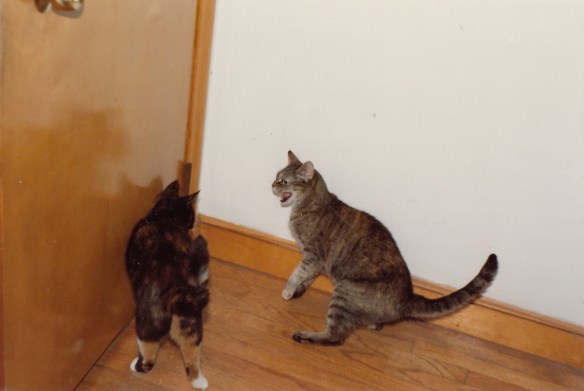
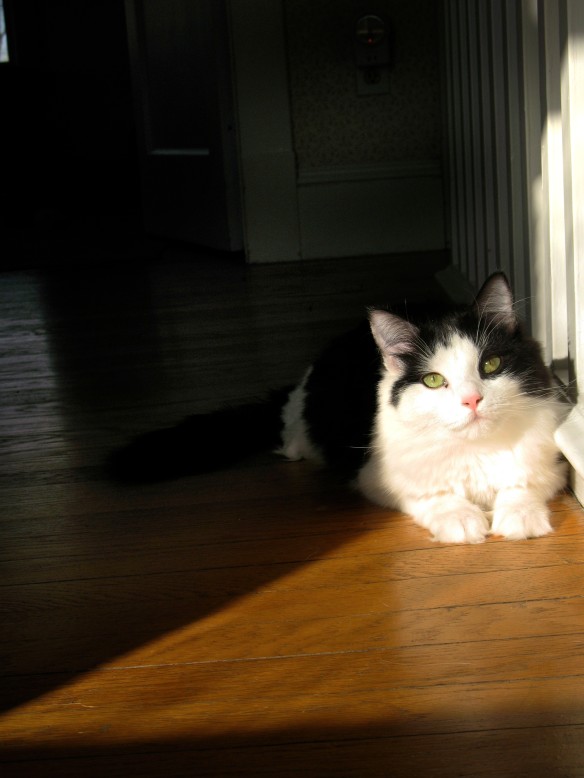
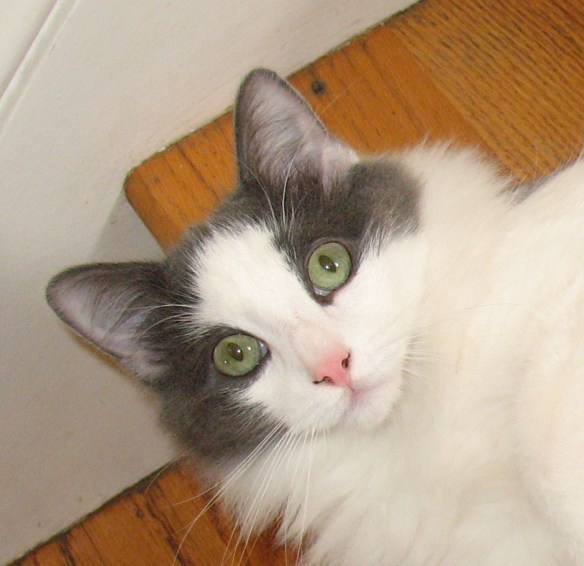
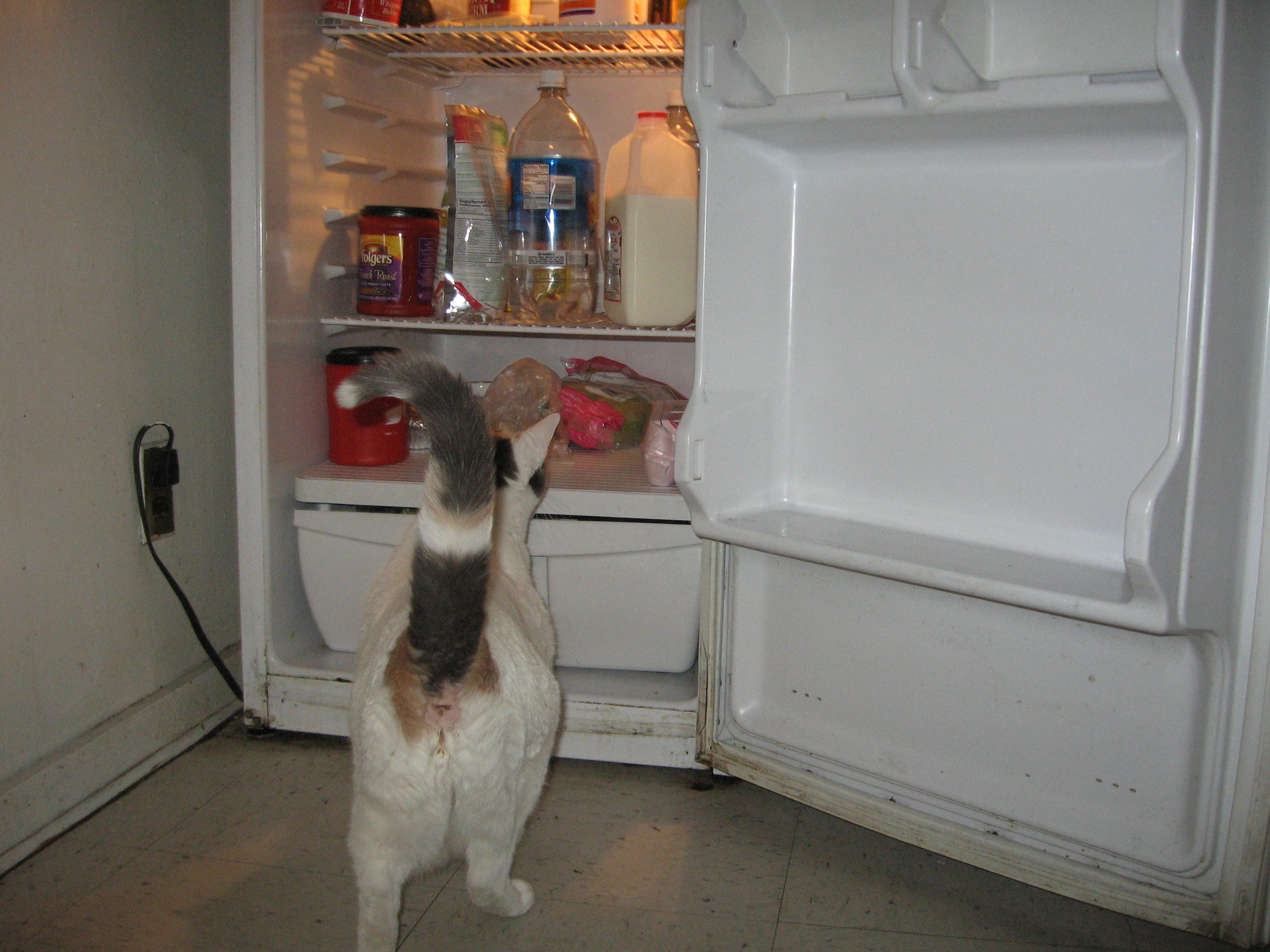
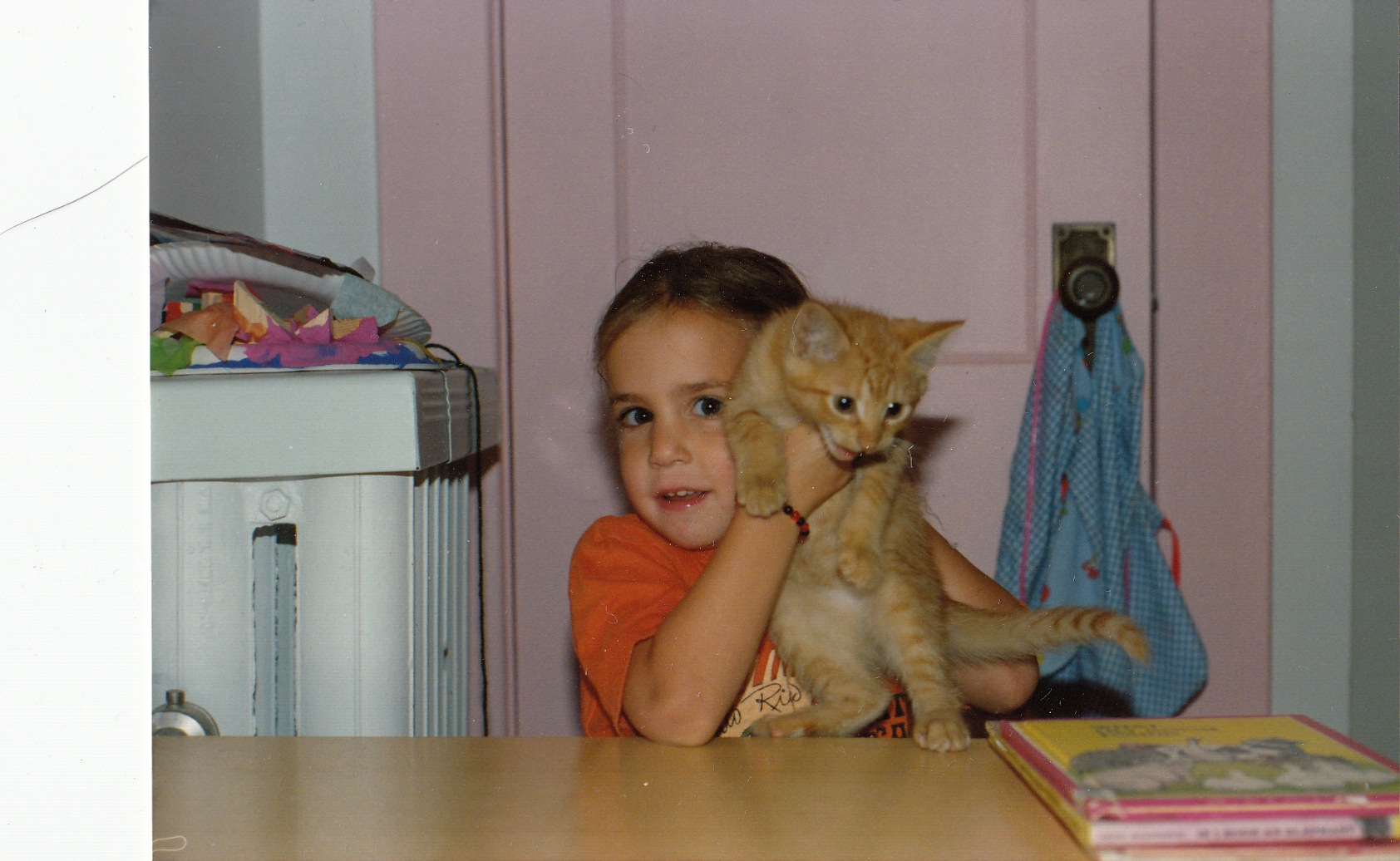
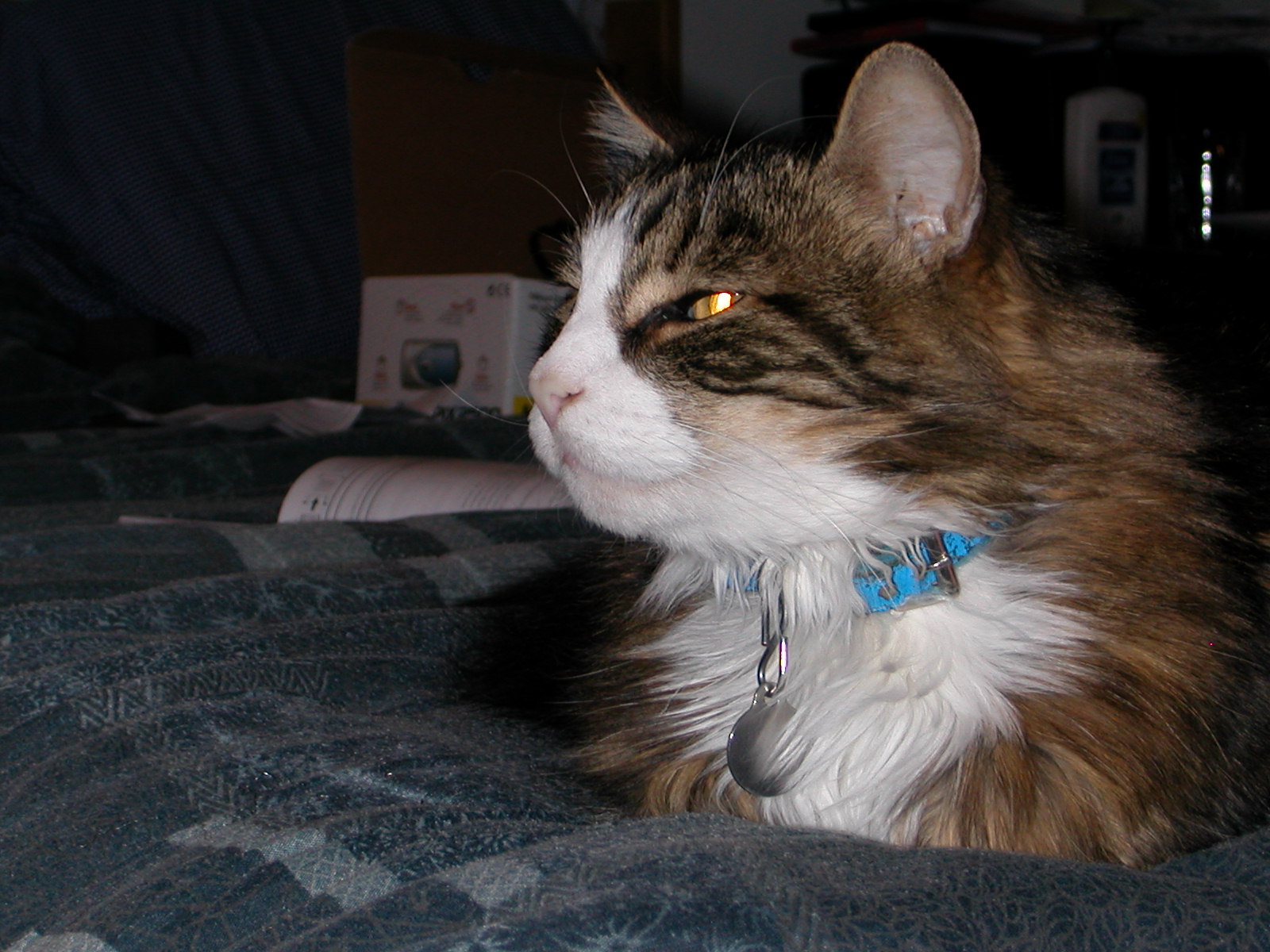
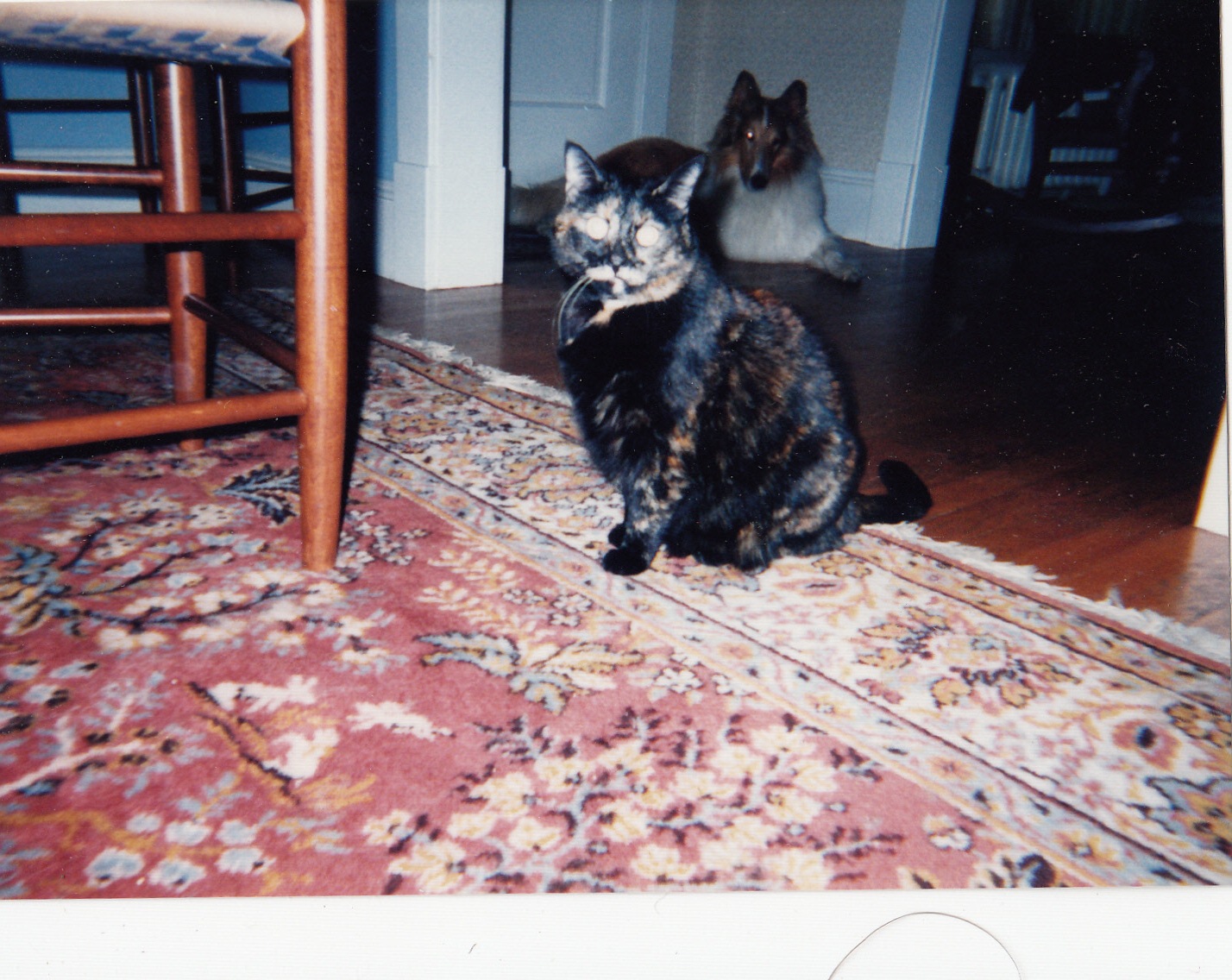
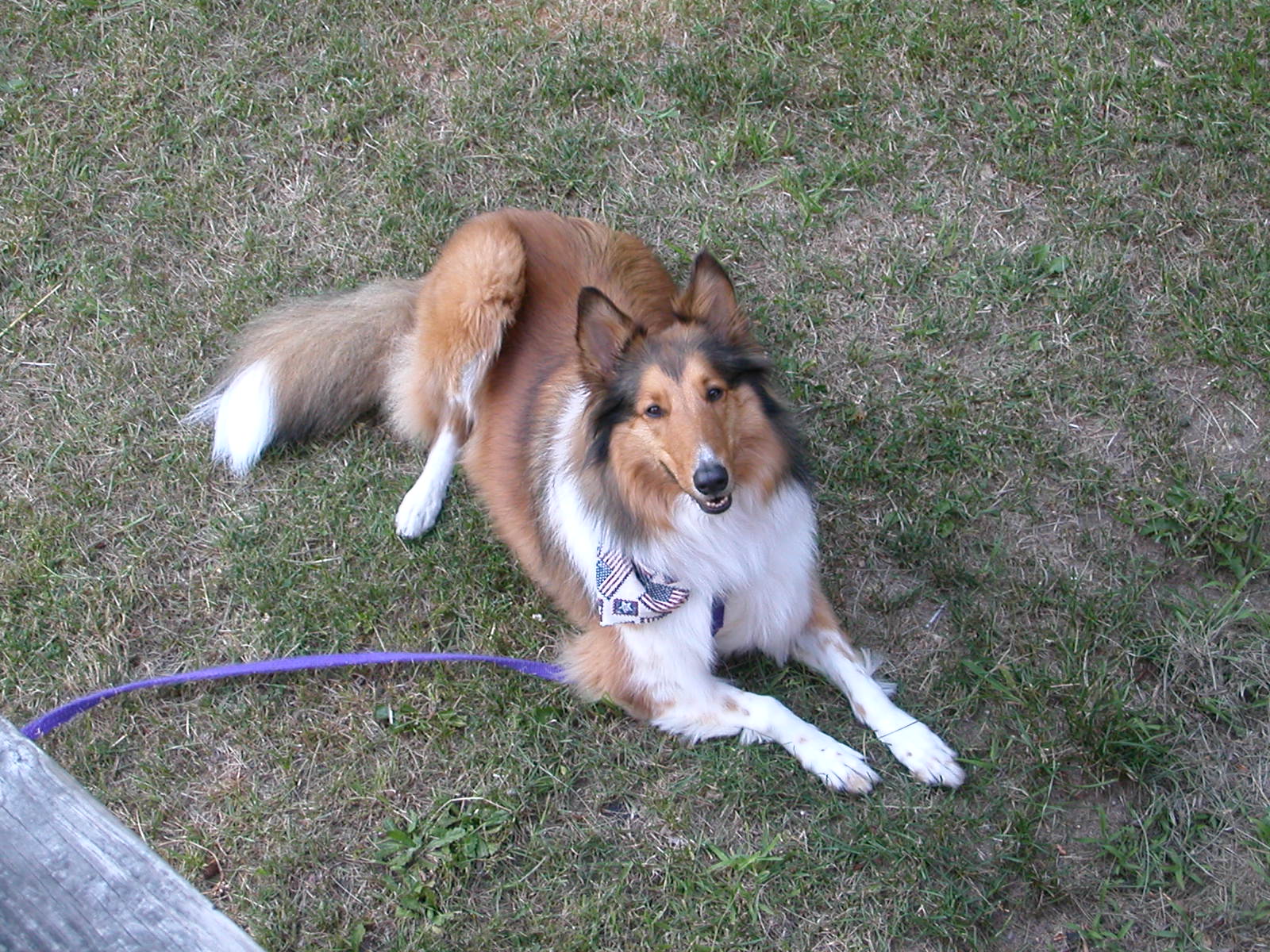
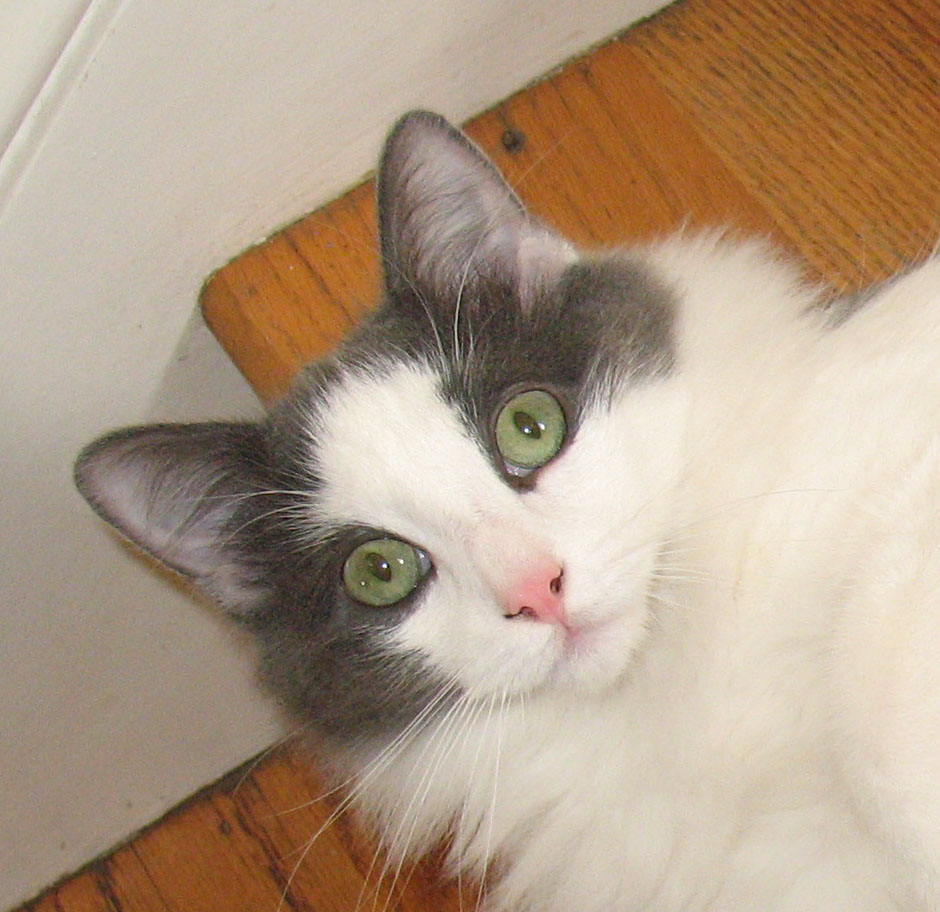
It seemed a lot of people enjoyed my post about our family pets, and some have shared pet stories with me by email or in the comments.  My sister also sent me some photos of two of her dogs, Pablo and Roxanne, as well as some of my parents’ cat Honey.

IMG_0023

IMG_0011

Pablo

IMG_0334

Roxanne

IMG_0250

Honey

IMG_0270 IMG_0434 IMG_0471 IMG_0227


If anyone else wants to add more pets to the “family tree,” just send me a photo, and I will add it here.

Thanks!


Enhanced by Zemanta

The rest of the family: Four legged variety

I was inspired by a post on one of my favorite genealogy blogs, The Family Kalamazoo, a while back.  Currentdescendent, the blog owner and author, posted a series of photographs of her family’s dogs going back over a hundred years.  I am a huge animal lover and have had cats and dogs all my life.  My parents are both big animal lovers also, as were my grandparents Gussie and Isadore.  My mother even remembers playing with a kitten at her grandmother Bessie Brotman’s apartment when my mother was a very little girl.  My uncle Maurice Goldschlager was also a big animal lover; I remember that his last home was filled with cats, dogs, even a horse, I believe.

Unlike Currentdescendent, I do not have photographs of family pets going back that far.  But I want to share what I have because these pets are a big part of my family’s story.  I know from talking to many of my cousins on both sides of my mother’s family that they also are big animal lovers.  I’d love to build a family tree of pet photos, so send them along if you want to share them.

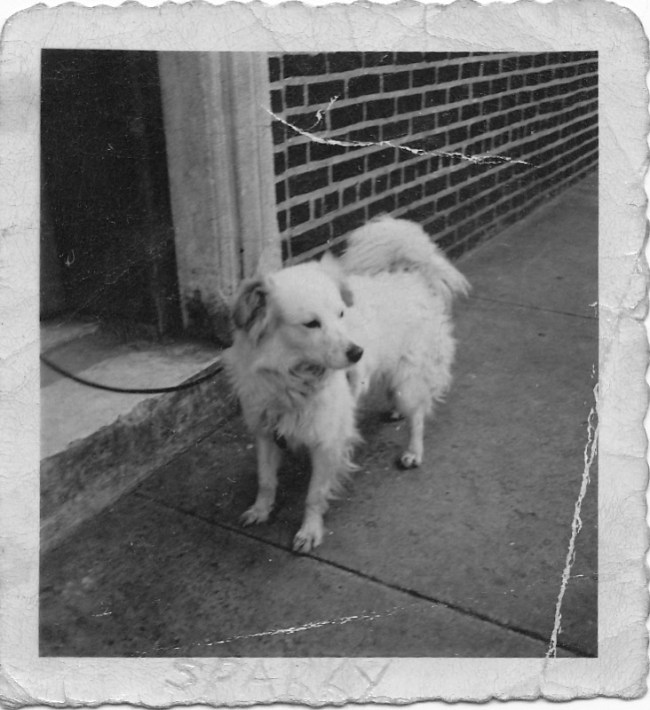
But for now, these are the pets who lived with my immediate family, starting with my mother’s childhood pet, her dog Sparky.
Image

On the back of this photo my mother wrote,”The Cutest Thing in the World.”  My mother still gets teary-eyed when she sees this picture of her beloved dog.  Obviously he gave her a tremendous amount of joy and love when she was a little girl growing up in Brooklyn.

When I turned nine, I got my very first camera, and the very first photograph I ever took is this one:

Image

As you can see, this is my cat Pixie.  He was my first ever pet, and we got him when I was about two years old.  He was not a cat that everyone could love.  He tended to hiss and growl quite a bit, but never at me.  He let me carry him around like a doll and place him in my doll carriage.  As I grew up, he slept with me every night.  He truly had nine lives—surviving rat poison and being injured either by a car or animal.  He lived until I went away to college, and to this day I believe he died of a broken heart because I had left him behind.

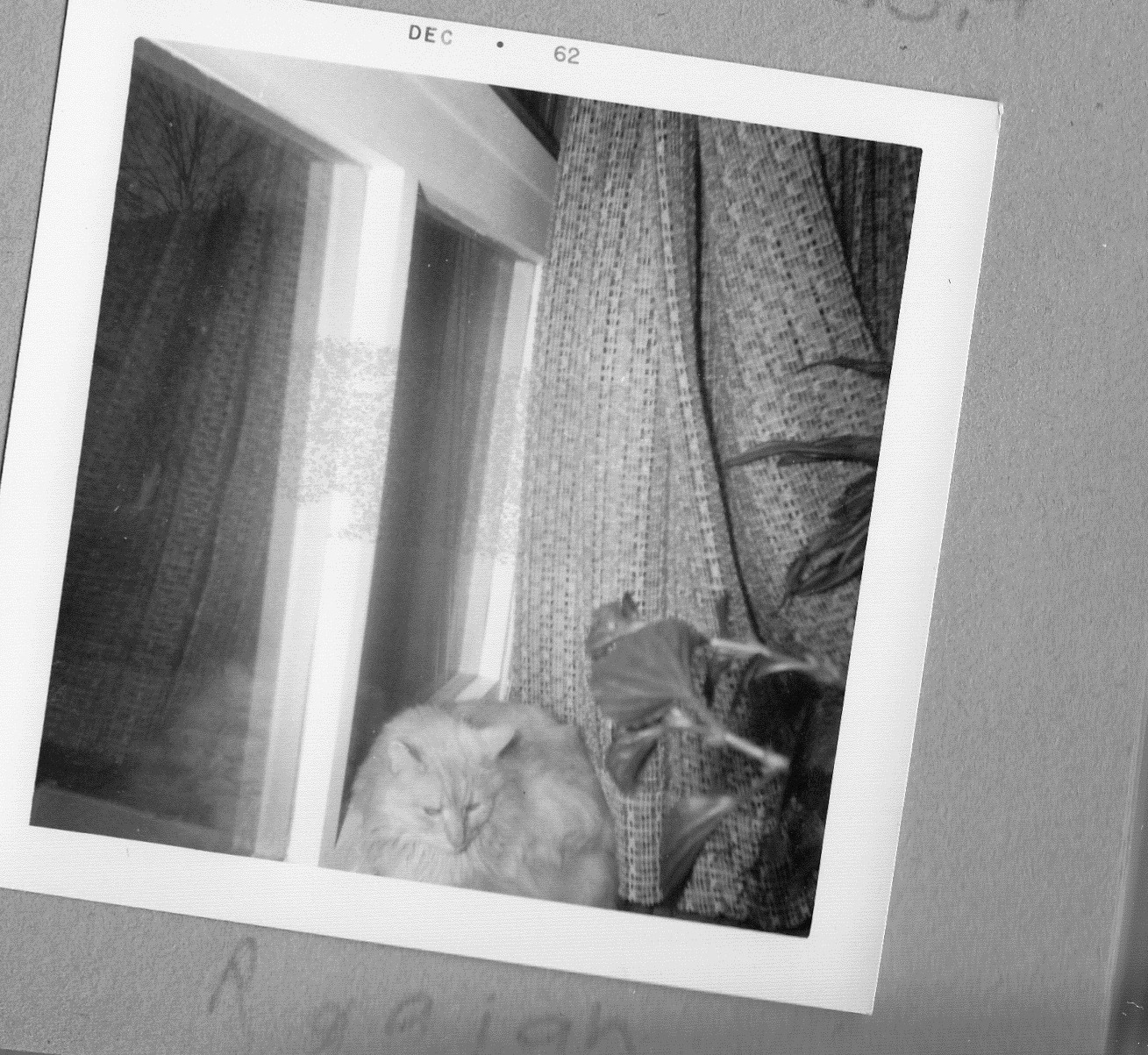
I don’t have pictures of two cats who only lived with us a short time: Fearless and Cleopatra, and I don’t really remember them.  According to my parents, one jumped out of our window in Parkchester, never to return, and one ran away when we moved to the suburbs.  Our next cat, however, was originally my grandmother’s cat, the elegant long-haired tabby, Rajah.Image
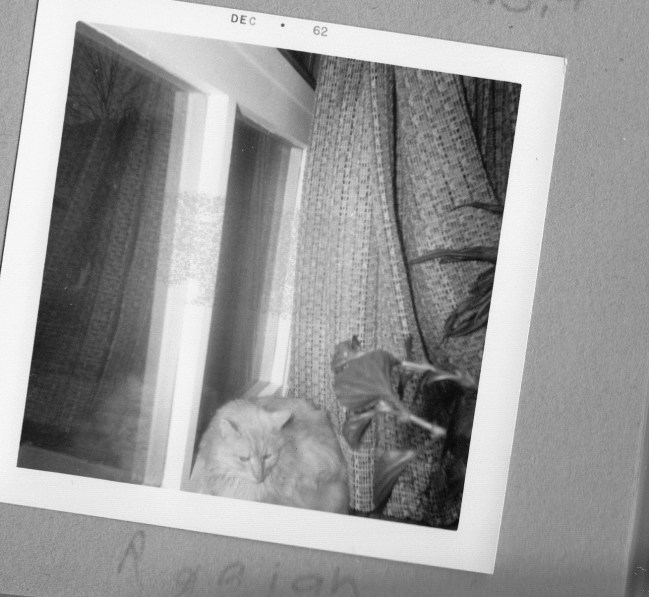
(Note the creative spelling of his name.)  He was Pixie’s cousin–their mothers were littermates who had belonged to friends of my parents.  My parents took Pixie and gave Rajah to my grandmother.  Rajah was as sweet as Pixie was snarly.  He was a gorgeous and very smart cat who somehow put up with my grandmother washing his face with a wet washcloth.  When we were little and would visit my grandmother, he would always hide under the furniture.  But when we adopted him when my grandmother for some reason no longer wanted to care for him, he became a friendly and loving pet.  As he aged, he got a little senile and would insist on drinking water from an eye cup my mother kept in her bathroom.  He lived to be eighteen years old.

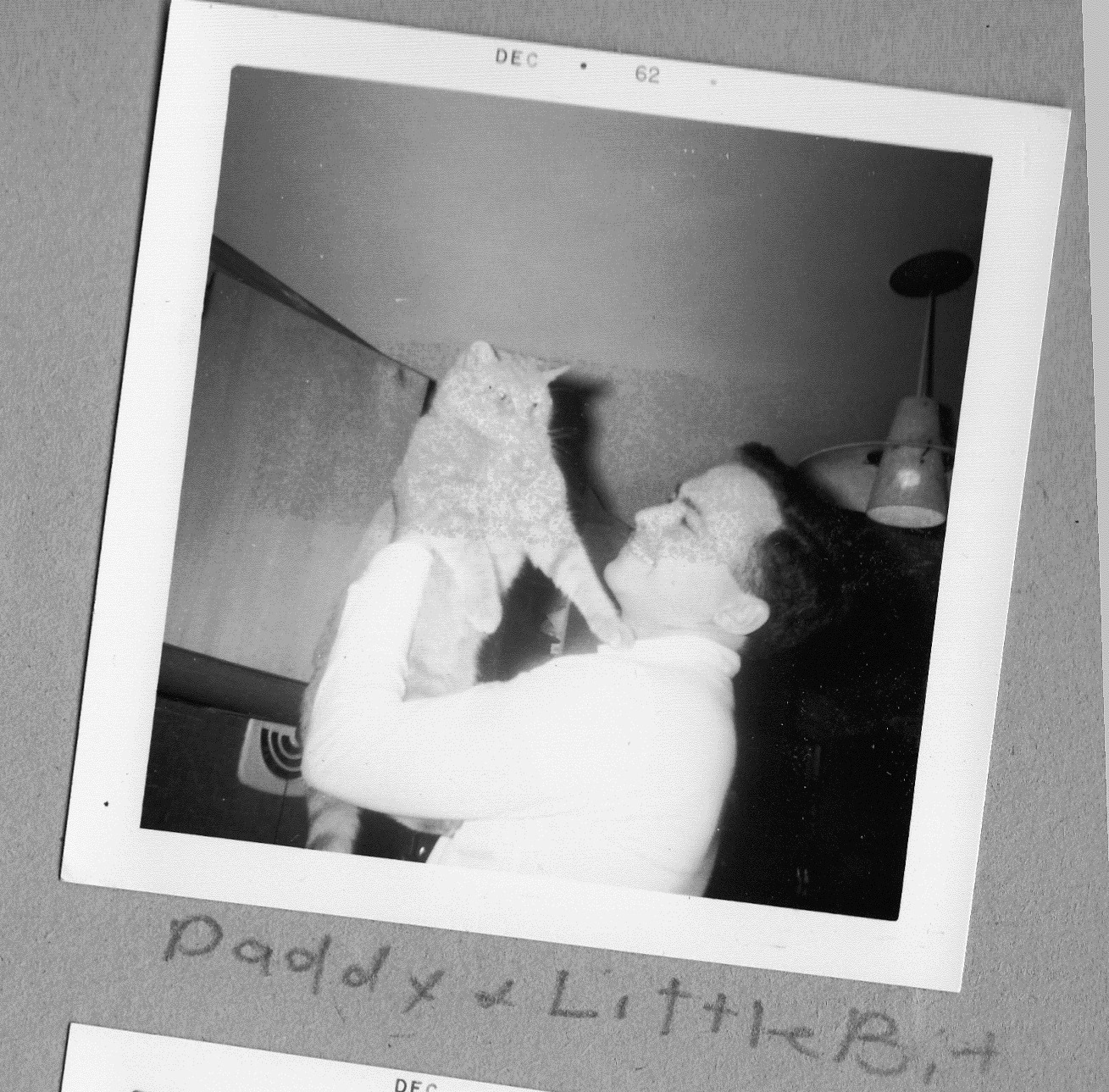
But two cats were not enough for me, so for my sixth birthday I wanted a kitten.  That kitten was Little Bit.Image


I wanted to call him Lucky, but my parents didn’t really like that name for some reason, so we compromised on Little Bit of Luck.  For a long time I called him Lucky, and they called him Little Bit.  Eventually I gave in, and he became Little Bit.  He was a funny and not too bright cat who didn’t have a mean bone in his body.  He was just a dumb, lovable creature who had to find his place with two much more dominant cats, with Pixie being without a question the alpha cat of the bunch.

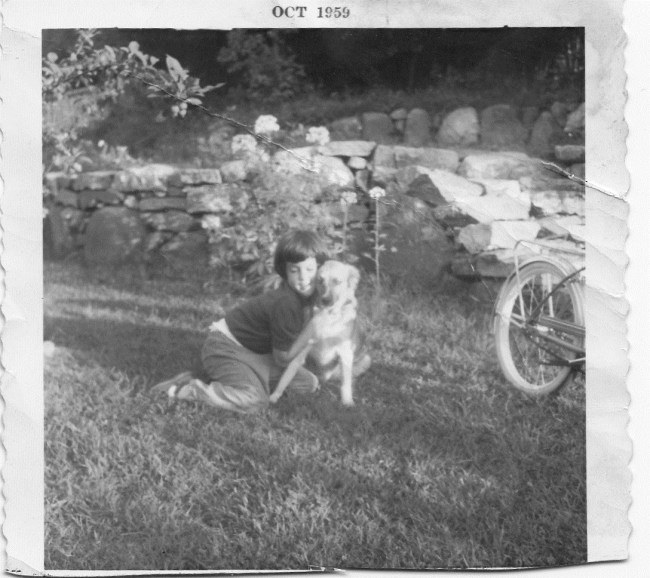
But even with three cats in a small three bedroom ranch house, I was not content.  I wanted a dog, and I just kept asking for a dog.  After much persistence and a trip to the animal shelter, my parents agreed and we adopted our first dog, Colleen.  She was not a particularly pretty dog—just a mutt, and she was probably a few years old when we got her.  But she was my first dog, and I thought she was gorgeous.
Image

That’s me, hugging her to death in our backyard in 1959.  Our family was complete: three cats and a dog.  For most of my childhood, those were our family pets.  Colleen proved to be a wonderful dog, and she followed me everywhere.  We were very lackadaisical back then, and my parents would just open the door and three cats and a dog would run out and roam the neighborhood.  Colleen developed a reputation in the neighborhood for scavenging for food at other people’s houses.  Once she reportedly ate the food right off someone’s outdoor grill.  She once followed me all the way to a friend’s house in a different neighborhood.  My father came to pick me up in the car and figured Colleen would just find her way home.  But Colleen thought I was still in the house and refused to leave, so my father had to go back to get her.

We were very lucky for a long time that nothing bad happened to our roaming pets, but our luck ran out in April, 1964, when Colleen was hit by a truck right in front of my eyes.  She died at the vet’s office a few hours later, and I was bereft.  She’d been my companion for five years, those Wonder Years from seven to almost twelve, and I was heartbroken.

My parents could not stand my sadness as well as their own and that of my siblings, so they almost immediately went back to the dog shelter and brought home another dog for the family.  Although it took me a while to bond with this new dog, eventually I loved her  dearly as well. Here she is probably not long after we got her with Pixie and my cousin June Marie behind us.Image
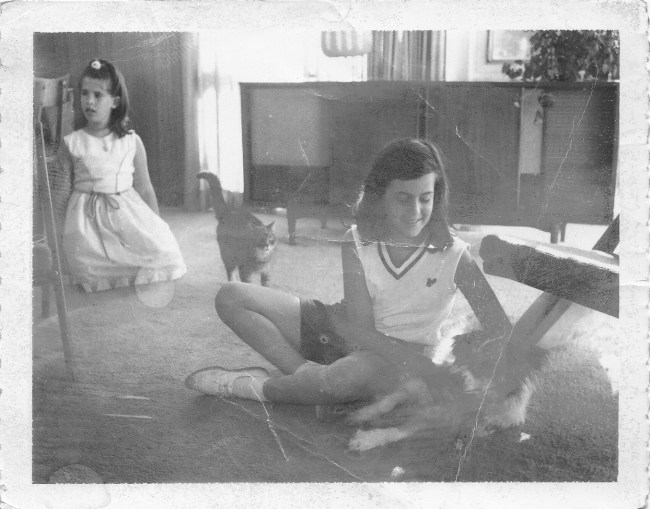
Velvet was also a mutt, but she had collie-like markings with some setter or something else mixed in.  She was also a few years old when we got her, and she became a devoted pet like Colleen.  We all used to chuckle at the way she would cross her front legs in a very ladylike way.  By the time we got her, I was moving on from the innocence of childhood to the preoccupations of adolescence, and so she spent more time with my younger siblings than she did with me.

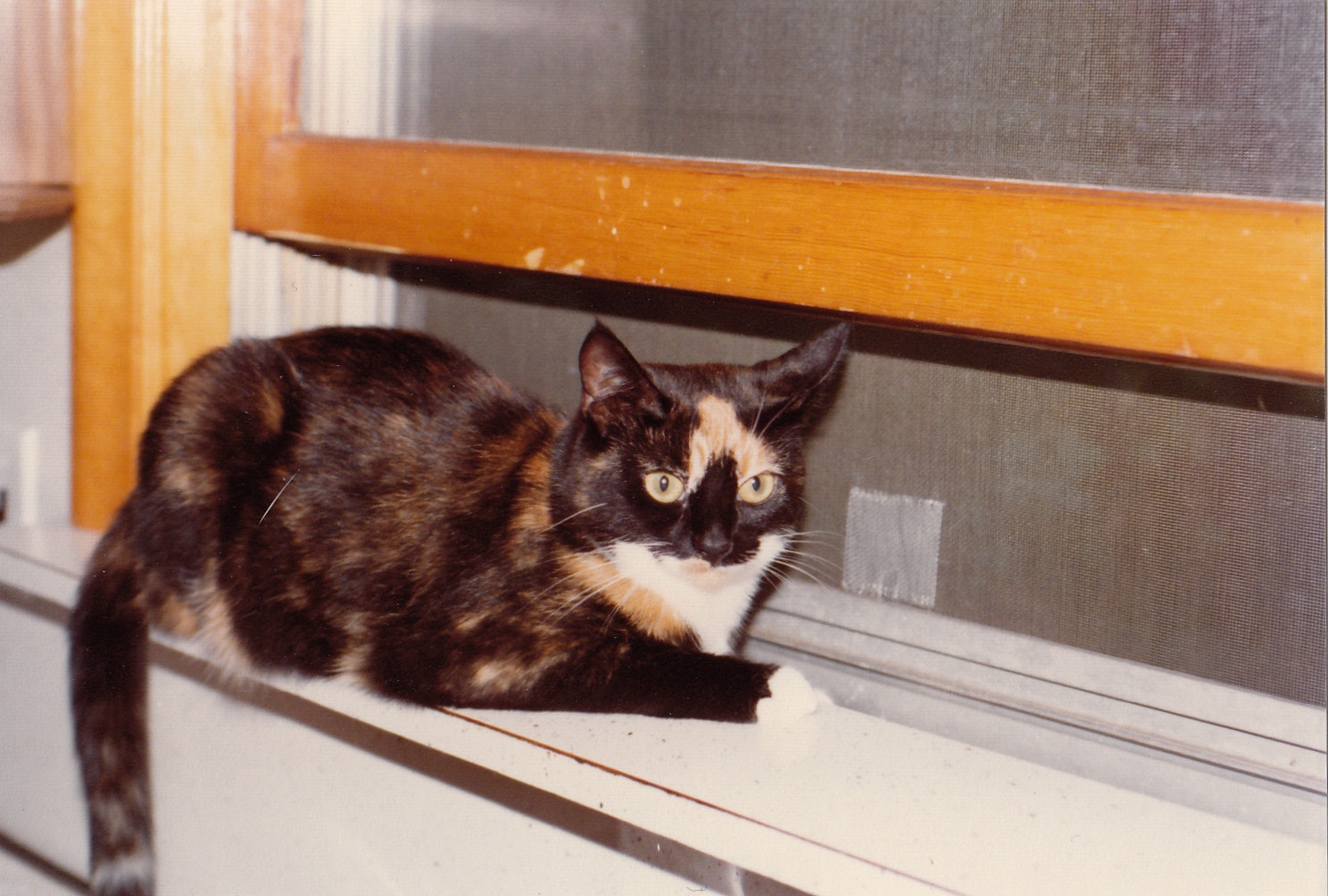
When I was in junior high school, we lost Little Bit to feline leukemia at a fairly young age.  Sometime thereafter we got another cat Phoebe, who was a calico with an attitude—proud, smart, and independent.

phoebe

After Pixie died, my parents adopted Missy—-a truly neurotic but gorgeous cat who was half Siamese and half tabby with the silliest half mustache under her nose.  She was a jumpy, anxious cat, but because she was beautiful, my mother decided to let her get pregnant.  We’d always spayed and neutered all our pets, but somehow Missy escaped the knife.  She did get pregnant and had four kittens: Louie, Susie, Bulldog, and Charlie, but my parents could only find a home for Charlie, so we ended up keeping Louis, Susie and Bulldog (who was renamed Taurus to make it sound more classy).  No way were we taking our kittens to the shelter! So there we were with a dog (Velvet), three adult cats (Rajah, Phoebe, and Missy) and three kittens.  Or six cats within a short period of time.  I was mostly gone at this point—in college and thereafter.  But I loved those kittens dearly.  We lost Louie at a very young age, but Susie and Taurus lived fairly long lives.  I will have to add pictures of Missy and her brood at some later point.

My parents went on to have more cats and now have Honey as their sole pet, the others all being long gone.  But beginning in 1975 I started having my own home with my own pets.  Our first cat was Kahlua, inspired not by her looks but by the ingredient in my then favorite drink, a Black Russian.  Kahlua was not the prettiest or the smartest or the sweetest cat, but she was our first cat together, and we loved her.
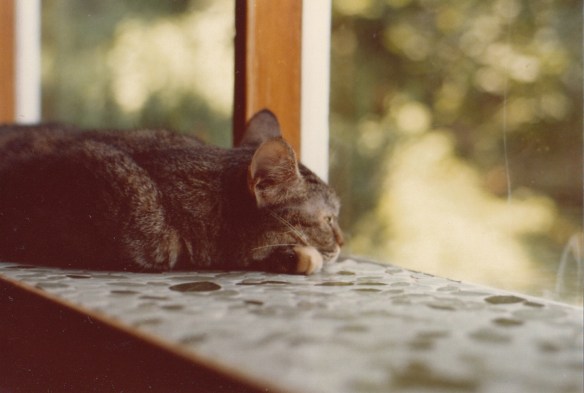
Kahlua

A few years later we adopted Blaze, a kitten from a litter of one of my Connecticut cousins’ cats.  She was gorgeous and affectionate and funny, and I was heartbroken when she disappeared one day, never to return.  I posted signs everywhere, called everywhere, but never could find her.  Somehow I still had not learned that cats are not safe roaming around the streets of suburbia.  I was so devastated that we did not get a second cat for a long time after that.  Instead we had human babies, who kept our lives busy and filled with love.

blaze

Blaze and Kahlua

Blaze and Kahlua

Kahlua lived as a solo pet for many years until our own children clamored for a kitten.  We adopted Wheatie, who looked just like Little Bit to me, and my younger daughter Maddy dragged him around just as I had dragged Pixie around three decades earlier.  But we still had not learned our lesson, and Wheatie was killed by a car as a young cat, and we were once again heartbroken.
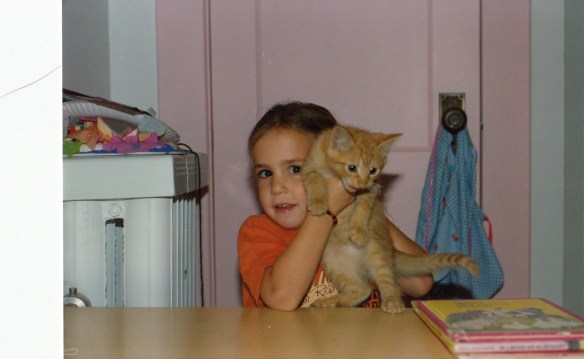
Maddy and Wheatie
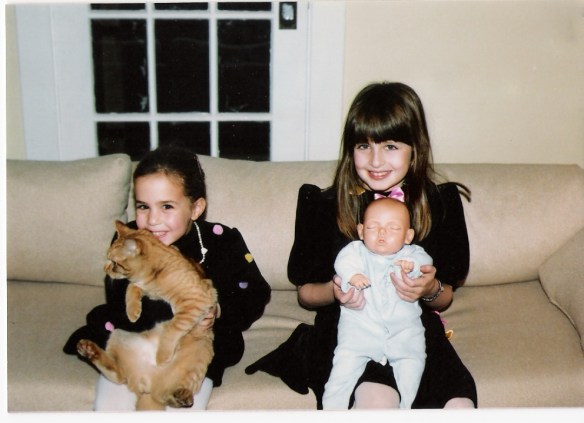
Maddy and Wheatie

1987

1987

But then we got Sneakers.  And he was the best cat we ever had (until the two we now have who rival Sneakers in personality and sweetness).  I picked him out at a vet’s office that had a litter they were trying to find homes for, and I picked him because he walked right up to me.  I knew he was a people cat, unlike Kahlua, and I knew he would be great with my kids.  And he was.  He was playful all his life and affectionate and smart and clean and independent.  When I taught at night, I would come home to nap first, and I would place him next to me; his purring would put me to sleep.  He regularly slept with Maddy, cuddled up around her head.  Once he disappeared for a week, and that was when we finally stopped letting our cats outside.  I knew I would never forgive myself if we lost Sneakers.  He would frequently bolt out the door, and we would all race outside, chasing him around the yard and the neighborhood  until we caught him and brought him home.  Sheakers lived a good long life, and he was a true gentleman until the end.

Sneakers

Sneakers

sneakersMaddy and Sneakers

When Kahlua died also at a ripe old age, we got Lily, who, to be honest, was not really a people cat.  She did not like to be held, and she preferred her own company most of the time.

Lilly


And then we got a dog.  Just as I had wanted a dog as a child, Maddy wanted a dog and kept asking for a dog until we finally agreed.  I’d been reluctant because dogs are a lot more work than cats, and we were both working full time and had little time for anything besides our kids and cats.  But inside I also missed having a dog.  And so I started looking until I saw an ad for a year old collie.  Having grown up watching Lassie religiously, I’d always wanted a collie.  One cold January morning in 1994, Harvey and I drove to Ware, about 20 miles away, and met Zapper.  He was a big and beautiful collie, living in a small apartment with a couple and their three children under five years old.  The wife did not want to keep the dog, but the husband was heartbroken to give him away.  We assured him that we would take good care of him, and we did.  He was a wonderful dog—sweet, protective, playful, smart and so beautiful.  Aside from barking way too much and jumping up on people until we trained him not to, he never did anything wrong.  Except get sick far too young.  He was only seven when he died.
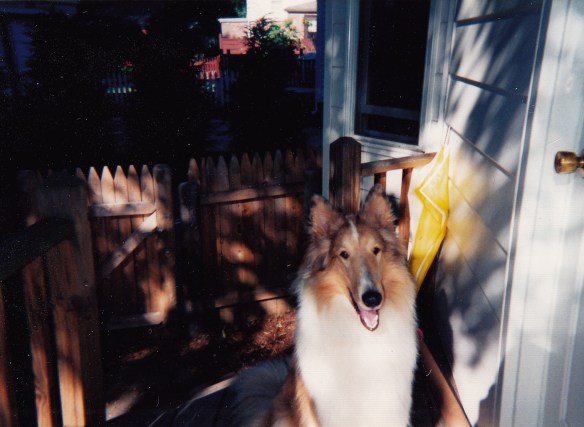
Zapper

Zapper

Around the same time we lost Zap, we also lost a cat we had for only a short time named Simon.  He was the funniest cat I’ve ever had—he just was mischievous and would sit in the funniest positions.  He made me laugh every day until the day he ate some lilies we had the house.  We never knew that they were poisonous to cats, and Simon died within a day of getting into those flowers.  Between Simon and Zapper, I wasn’t sure I’d ever get another pet again.

But I did.  Six months later I saw an ad for a female collie who was at the local pound.  We went to see her–she was skinny, dirty and hyper as could be.  Maddy and Harvey (Rebecca was off at college) thought I was crazy, but I wanted her and knew she would be a great dog.  And she is.  She is now almost fourteen and has been with us for almost thirteen years.  She was a bit wild and skittish at first, but soon settled into be the best dog in the world.  Like Zapper, she is sweet and smart and playful, and she doesn’t bark or jump on people.  She just wants to be with her people and be loved.  She’s deaf now and has trouble walking, but she is still a magnificent dog.

Cassie

Cassie

When Sneakers and Lily were both gone, we decided that we would adopt two cats from the same litter so that they would have each other for company.  By this time (2008), our kids were grown and out of the house, and we did not want a solo cat to be lonely all day while we were working.  So we adopted Smokey and Luna.  I can’t even begin to describe how much I love these two cats.  Smokey thinks he is Cassie’s baby and still tries to nurse on the poor old dog, who loves him and plays with him and tolerates anything he does.  Luna is like Sneakers—a people cat from day one.  She is a cuddler, constantly purring, and doesn’t know how to hiss as far as we can tell (nor does Smokey).  These two have never been outside and never will.  I will keep them safe for as long as I can.  They are my babies.

smokey luna sibling love

Luna

Luna

Smokey

Smokey

So now you know that I will one day be that crazy cat lady.  Or maybe I already am….

Enhanced by Zemanta

Gratitude

I am sitting in North Truro on the Outer Cape, looking out at the bay and Provincetown.  The Pilgrim Monument stands tall above

English: The Pilgrim Monument in Provincetown,...

English: The Pilgrim Monument in Provincetown, Massachusetts from the north. The Pilgrim Monument Museum can be seen in the foreground. (Photo credit: Wikipedia)

everything else on the horizon, reminding us that this was the place where the Pilgrims first landed before making a permanent settlement in Plymouth, just across the bay.  I have often walked near the steps where those first immigrants first walked on American soil.  I have spent time trying to imagine what it must have looked like back then—before all the roads and houses and cars and tourists were here, when it was just open land, sea, forests, dunes, and the local tribe who lived here first.  How magnificent it must have seemed, how frightening as well.

My own ancestors made their pilgrimages over two centuries later, and their first visions of America must have been far different from those of the Pilgrims—a crowded, dirty city, thousands of people, noisy streets, a jumble of different languages they could not understand.  It must have been magnificent, but in a far different way, and certainly it was just as frightening.

I woke this morning, filled with gratitude. This has been a transitional week for me.  I have not had much time to focus on research, and I am also in a holding pattern, waiting for documents and for some clues from relatives to help me make some breakthroughs.  I’ve been busy with the end of the semester tasks, and I’ve been concerned about a dear friend.  But this morning I am taking a moment to be grateful.  My friend is feeling better. My students left me some wonderful gifts, including a large poster signed by them, wishing me well on my retirement.  My exams are written, and the students are preparing to take them.  And I am in the place I love best with the person I love best, staring at a scene that always brings me comfort and perspective. So I am grateful.

When I think about my life compared to the lives of my ancestors, of those who came to America back in the late 19th, early 20th century, how could I not be grateful? I get to travel to places out of choice, to see those places for pleasure, to experience the beauty in the world for the sake of that experience.  They traveled because they had to—to escape from a difficult place and to attempt to create a better life somewhere else.  I get to live where I want to live.  In all my adult life, I have only lived in five different homes.  One thing that has struck me as I’ve done my research is how often my ancestors moved.  One cousin explained this by saying that every time a landlord raised the rent, the family would move, often not paying any rent due because they had no money.  When I have moved, it has always been out of choice—to a bigger home, for a better job, for a better location—not because I had to move.

My ancestors probably never knew the concept of leisure time.  Life was hard work all the time.  Although my grandparents were able to take some time away in the country during the summers when my mother was a young child, those were short vacations, a brief respite away from the hot city.  I have the luxury now of retiring and choosing every day how I will spend my time:  Will it be yoga or the elliptical at the gym today? Will I take a class or tutor a child?  Will I write my book or research my family? Should I do the NYTimes crossword puzzle or read a book?  I still cannot fully grasp what that will be like on a daily basis, but I am so grateful that I will have that opportunity to figure out how to spend my time.

Often I take all my freedom for granted and forget how lucky I am.  But today, sitting here, looking at the Pilgrim Monument, thinking of those Pilgrims and of my own ancestral pilgrims, I am filled with gratitude for all that those pilgrims and Pilgrims did, for all that I have, and for all the people I love.DSCN0396


Enhanced by Zemanta

Assessment time

It’s time for my periodic review of what I have learned and where I am going in my research.  I keep a Word document with lists of things I need to do, but sometimes I need to step back and see the whole picture, then step forward and see the details.

English: Forest trees Part of the forest which...

English: Forest trees Part of the forest which is a bit more mature than some of the other parts along the path here. (Photo credit: Wikipedia)

On the Brotman side, I think I am in fairly good shape.  I have found descendants of all but one of Joseph and Bessie Brotman’s children, although I am not in touch with all of the descendants.  The only missing link is Sophie Brotman; I’ve had absolutely no luck finding any records for her.  I don’t know when she arrived, whether she married and, if so, who she married, where she lived, where she died.  And sadly, I don’t think I ever will.  There is no one left alive to ask about Sophie; none of the descendants I’ve spoken with know anything about her.  Perhaps one of Abraham’s descendants might know something, so I will contact Paula, the one Abraham descendant I’ve been in touch with, and see if she has ever heard of an aunt named Sophie.

Bessie

Bessie

The big research area remaining for me on the Brotman side is finding out whether we are related to any other Brotmans, in particular the Brotmans who settled in Brotmanville.  I am in touch with a few of Moses Brotman’s descendants, and one is a genealogist, so we plan to collaborate and see whether we can find the connection between our families.  If we can, that may also lead me to other clues about where in Galicia Joseph and Bessie lived and to clues about other family members.

Moses Brotman

Moses Brotman—Joseph’s brother?

On the Goldschlager branch, I think I am also in fairly good shape.  I have found the descendants of Moritz, my great-grandfather, and of Betty and David Goldschlager, my grandfather’s siblings, and I know about the lives of Betty and David and their children.  I’d love to go back and research Moritz Goldschlager’s family, but since his parents died when he was a young child, there does not seem to be too much more I can learn.  My Romanian researcher did not find anything more related to my Goldschlager relatives, so I may have reached the brick wall with respect to that line.

Moritz Goldschlager

Moritz Goldschlager

On the other hand, the Rosenzweig branch, my great-grandmother Ghitla’s family, still has a number of unanswered questions.  I have been able to learn a great deal about most of the children of David and Esther Rosenzweig, my great-great-grandparents, but Zusi Rosenzweig remains a mystery.  Her descendants were not responsive to my inquiries, so I may have to find another way to get closure on Zusi and her son Nathan and her husband Harry Mintz.  I’ve had better luck with Tillie Rosenzweig Strolowitz Adler and her children and grandchildren and have been in touch with two of her great-grandchildren.  There are still some loose ends there, but for the most part I have been able to find a fair amount about the children of Tillie and Jankel and even about their grandchildren and great-grandchildren.

Ghitla Rosenzweig Goldschlager

Ghitla Rosenzweig Goldschlager

As for the family of Gustave and Gussie Rosenzweig, I still have some open questions, mostly about the daughters Lillie, Lizzie and Ray.  This week I spoke with one of Sarah’s granddaughters, and I am hoping that she will also be able to help me find out more about her grandmother’s sisters, but as of right now, I have not been able to find any of the descendants of Lillie, Lizzie or Ray.

So that’s where I am in this journey to find my mother’s family.  I feel as though I am seeing the light at the end of the tunnel, though there is still plenty of tunnel to get through.

Tunnel

What do I do now besides continue to search for answers to the remaining questions?  I have a number of thoughts.

For one, I want to continue to build the relationships I’ve made with all my new cousins on both sides of my mother’s family—the Brotmans and the Goldschlager/Rosenzweigs.  Having found them, I don’t want to lose them again.  Facebook and email make this so much easier, but it will still take effort.  I also want to see if I can organize a meeting for the Rosenzweig/Goldschlager cousins like we had for the Brotmans earlier this month.

I also want to pull all my research together into a format that will make it more easily accessible.  I’d like to tell the story of the Brotmans, Goldschlagers and Rosenzweigs as a chronological story so that someone can pick it up and get the whole story without having to jump from blog post to blog post, searching for the next discovery.  That is a larger project, and I don’t even know how to start it, but that is what I see as my ultimate goal—to write the book that tells the stories so that our descendants will have it and know who their ancestors were.

And then there is the next huge research task: my father’s side.  That will be a very different research experience.  His family has been in this country for about fifty years longer than my mother’s family.  They came from Germany and from England.  They settled and lived in other places: Philadelphia, western Pennsylvania, New Jersey, New Mexico, among other places.  There will be a lot more American and European records available, which will make the task both easier and harder.  I’ve already traced one of my father’s lines back to the 1750s or so in Amsterdam, a full century earlier than I’ve been able to trace any of my mother’s relatives.  I look forward to this research with some trepidation because of the size of the task ahead.  But I am also excited by the idea that I have more discoveries, more stories, more understanding of my family and of myself ahead of me.


Enhanced by Zemanta

Hyman and Sophie Brotman’s Sons: A Family Album


Sophie and Hyman Brotman

Sophie and Hyman Brotman

One of the benefits of getting to meet six of my Brotman second cousins was that I was able to obtain a lot more photographs of my Brotman relatives.  All six of the living grandchildren of Sophie and Hyman Brotman, my grandmother’s older brother, were able to attend our “reunion”—the three children of Saul and Vicky Brotman and the three children of Manny and Freda Brotman.  Sadly, the two daughters of Joseph Brotman, Hyman and Sophie’s oldest son, have passed away.  But I now have a good collection of pictures of Hyman, Sophie, their three sons, and their grandchildren.

Hyman Brotman was born in Galicia and arrived with  his mother, my great-grandmother Bessie,  and his sister Tillie in 1891 when he was about eight years old.  He lived on Ridge Street with his family until he married Sophie Weiss on March 12, 1904.  Hyman and Sophie had three sons.  Joseph Jacob was born on February 4, 1905, and was named for Hyman’s father, my great-grandfather Joseph Jacob Brotman.  Their second son, Saul, was born on April 27, 1907, and their third son Emanuel or Manny was born on May 9, 1910.

Hyman worked at various occupations, including as a chauffeur and in the sweatshops of NYC, but in the early 1920s he and his family moved to Hoboken, NJ, where he opened a liquor store.  My mother has childhood memories of visiting her uncle and aunt in Hoboken, though by that time the three boys were all grown, and sadly she has no memories of her cousins.

Hyman, Bruce and Sophie in the Hoboken liquor store

Bruce, Hyman and Sophie in the Hoboken liquor store


As their children reported, all three Brotman brothers were very close and very athletic.  They were all excellent swimmers and loved competing against each other, always arguing over who was the fastest.

Saul Sophie Joe and Manny

Saul Sophie Joe and Manny

Joe married Perle Gorlin on May 1, 1935, and they lived in Queens where Joe was employed as a salesman for Abbott Laboratories, according to the 1940 census. Joe was a pharmacist in New York, but later moved to Florida where he became involved in commercial real estate.

Joe and Perle Brotman 1940 census

Joe and Perle Brotman 1940 census

Joe and Perle had two daughters, Barbara, born in 1939 and probably named for Bessie, who had died just five years earlier, and Merle or Miki, born in 1941.  Here are some photos of Joe and Perle and other family members:

Perle, Joe and Sophie Brotman

Perle, Joe and Sophie Brotman


Hyman (second from left) and Joe (far right) and two unknown men

Hyman (second from left) and Joe (far right) and two unknown men

Joe and Saul Brotman

Joe and Saul Brotman

From Front Center, Clockwise: Joel, Herman, Sophie, Joe, Perle, Manny, Freda, Denny, Saul , and Vicky Brotman

From Front Center, Clockwise: Joel, Herman, Sophie, Joe, Perle, Manny, Freda, Denny, Saul , and Vicky Brotman

Saul Brotman was an excellent athlete, especially in swimming and handball.  He graduated from Hoboken High School and started college at the New Jersey College of Pharmacy in 1926; he then transferred to and graduated from Panzer College, which has since merged with Montclair State University in New Jersey.  He later got a master’s from Rutgers University.

1932 Panzer College yearbook

1932 Panzer College yearbook

Saul at Panzer College

Saul at Panzer College

Saul

Saul

Saul

Saul

In a comment posted in response to an earlier blog post, Bruce wrote the following about how his parents Saul and Vicky met:

In Manhattan Beach (Brooklyn) there was a beach club, Manhatten Private. It had pools, handball courts, tennis and other sports. My parents were playing handball, my parents were both fine athletes, but not with each other. The ball from my mom’s court was accidently hit toward my dad’s court some distance away. My mom called to my dad saying “ball please”. Dad picked it up and threw it to mom. He then turned to his cousin, with whom he was playing and said “I’m going to marry that girl”. That was about 1940 or 41 I guess. He asked her out several times but she refused. On December 7 1941 my cousin Mel was born. Somehow my father found out and went to the hospital. (Mel was mom’s older brother Al’s first child). Mom asked dad what he was doing there – he said that he thought she might need some help, noting that Pearl Harbor had just been attacked. She apparently knew at that moment that she loved him. The rest is history.”

Vicky Horowitz Brotman

Vicky Horowitz Brotman

Saul and Vicky were married in 1942.

Saul served in the US Army during World War II and won a handball championship while serving in the army. After the war, he became a teacher in New Jersey, where he coached many state championship teams.  After 32 years as a teacher,  he left teaching after being assaulted by the parent of one of his students.  Saul then became the pension director for a union.

Saul in the army

Saul in the army

Saul and Vicky 1940s

Saul and Vicky 1940s

Saul and Vicky had three sons, Bruce, Ronald and Lester.

les bruce ron

Les, Bruce and Ron

Bruce, Ron and Les Brotman

Bruce, Ron and Les Brotman

Saul, Bruce and Vicky at Bruce's bar mtizvah

Saul, Bruce and Vicky at Bruce’s bar mtizvah

Saul remained a great athlete all his life.  In fact, Bruce told me that when Saul was in his seventies, Bruce challenged him to a game of handball, thinking that he could easily beat his father. Instead, Saul soundly defeated his much younger son;  he won four straight games, with Bruce unable to score a single point in any of the four games.

Saul and Bruce

Saul and Bruce

Saul and Vicky

Saul and Vicky

Manny, the youngest of Hyman and Sophie’s sons, was also an excellent athlete like his older brothers.

Manny (far left) at camp in 1925

Manny (far left) at camp in 1925

manny 1926

Manny November 1928

Manny November 1928


Like his brother Saul, he began college at the New Jersey College of Pharmacy, but he transferred to the University of Iowa, from which he graduated.

Manny with his fraternity brothers at U Iowa

Manny with his fraternity brothers at U Iowa

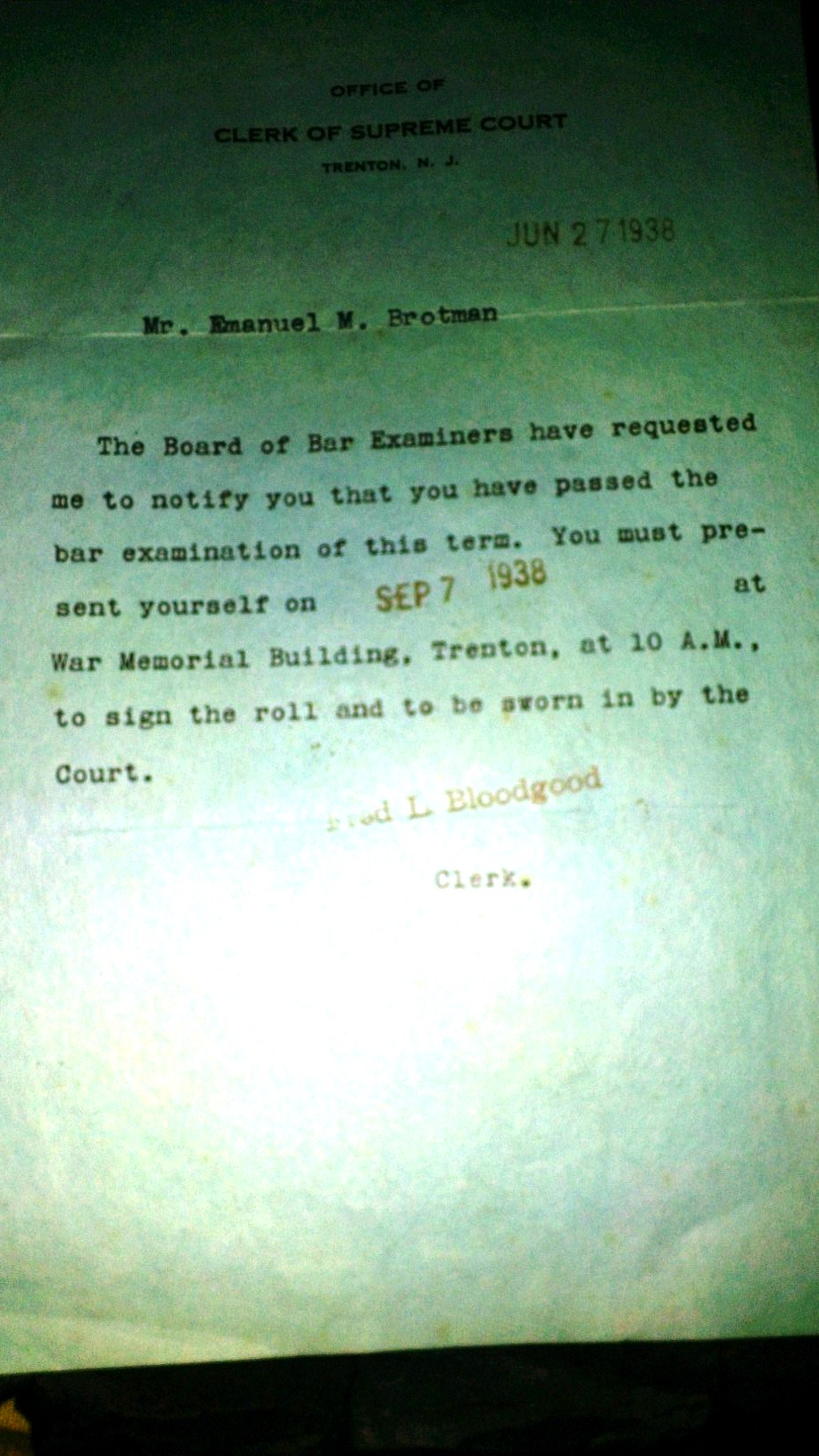
He also graduated from John Marshall Law School (New Jersey), which was later taken over by Seton Hall University. Manny became a member of the New Jersey bar in 1938.

Letter informing Manny that he has passed the New Jersey bar exam

Letter informing Manny that he has passed the New Jersey bar exam

Manny married Freda Feinman on December 22,  1940.

Freda and Manny's wedding invitation 194?

Freda and Manny’s wedding invitation 1940

Manny and Freda 1940s

Manny and Freda 1940s

Manny enlisted in the US Army in 1944 during World War II.

Manny Brotman

Manny Brotman

Manny practiced law for some time, but then joined J.I. Kislak Mortgage Corporation, a subsidiary of J.I. Kislak, Inc.  J.I.Kislak, Inc. was a residential and commercial Realtor, originally based in Hoboken and then in Jersey City, and Kislak Mortgage was primarily a residential mortgage banking company, one of the largest in NJ at the time, based in Newark.  He was president and then chairman of Kislak Mortgage for many years, was president of the Mortgage Bankers Association of NJ, and a long-time board member and two-term Treasurer of the Mortgage Bankers Association of America, where he received the Distinguished Service award. Kislak Realty, a commercial mortgage firm, where he became the president.  He was often quoted as an expert on veteran’s housing and housing in general in various newspaper articles.  Here is one example of an article that ran in several newspapers across the country:  Lebanon_Daily_News_July_10__1971_Lebanon__PA_Manny_Brotman

Manny and Freda had three children: Joel, Denny and Bonnie.  Here are some pictures of Manny and his family:

Manny, Joel and Freda

Manny, Joel and Freda

Denny, Bonnie and Freda

Denny, Bonnie and Freda

The Feinman and Brotman families June 16, 1932

The Feinman and Brotman families June 16, 1937

From left to right: Aron Feinman, Hyman Brotman, Mary Feinman, Sophie Brotman, Manny Brotman, Sam Feinman, Freda Feinman, Saul Brotman (according to the back of this photograph)


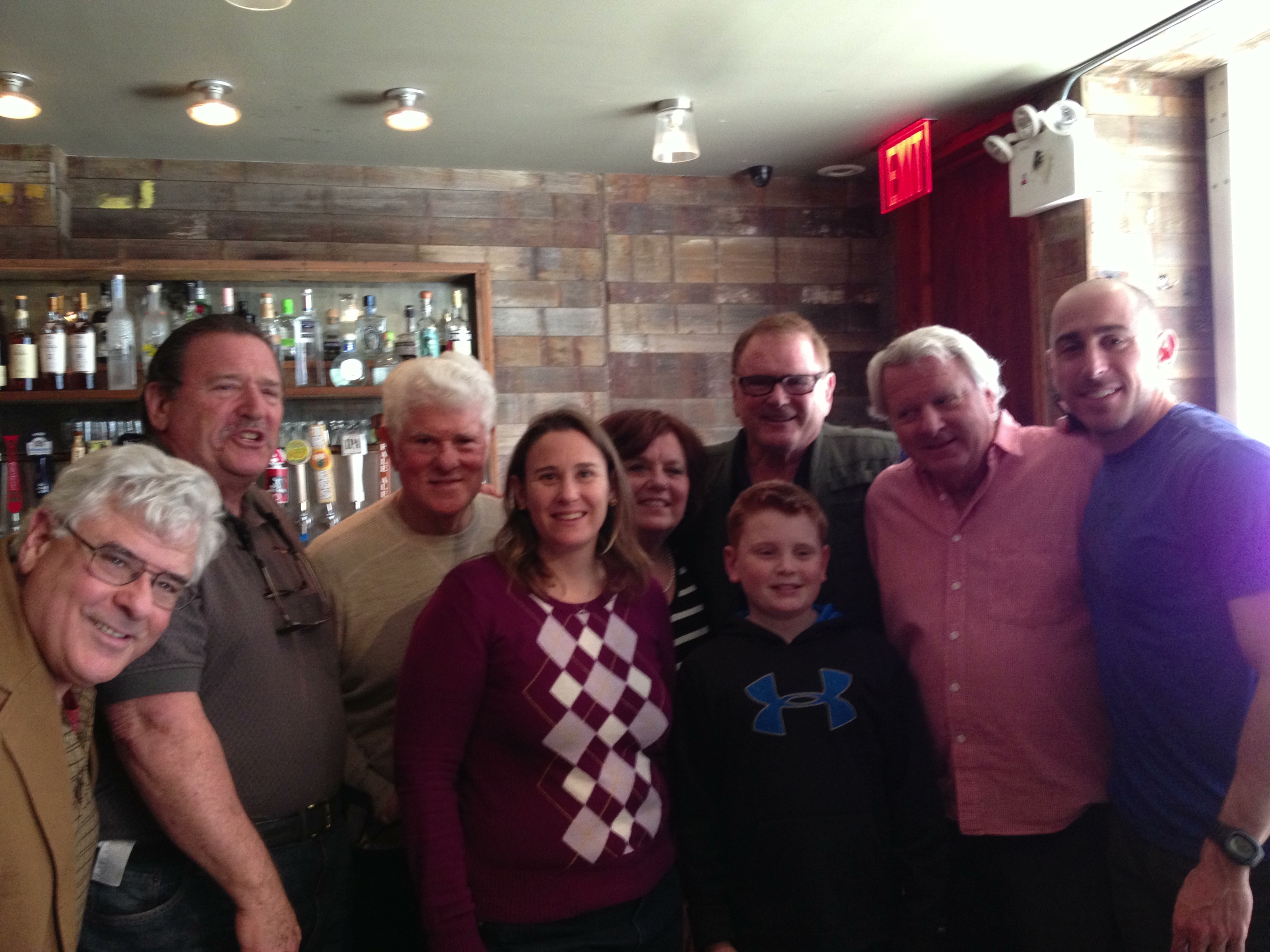
I did not know Hyman or Sophie or any of their sons, but I was very fortunate to meet six members of the next generation, my second cousins Bruce, Ron, Les, Joel, Denny, and Bonnie.  They all made the effort to come to New York City, some from as far away as Florida and Ohio.  I really enjoyed meeting and talking to each one of them and getting a chance to meet some of their children, four of whom also showed up during the course of the weekend.

What a wonderful tribute to their grandparents and parents that these cousins and their children cared enough about the extended family, including some second cousins they’d never met,  to make such a united effort to come to New York so that we could all be together.


Saul and Manny's descendants

Six of Hyman and Sophie’s grandchildren and three of their great-grandchildren


Enhanced by Zemanta

April 17

My cousin Jeff would have been 68 years old today, and it is over ten years ago that he died.  I’ve written about him before—my oldest cousin, the one whom we all adored, the leader of our pack.  I am older now than he ever got to be.  He did not get to see his children graduate from high school or college, and he will not get to see them get married or have children.  He was cheated, and so were all of us who loved him.  So for Jeff, a photo collage of pictures, some that I’ve posted before, some that are new to the blog.  These give me comfort, and I hope that they will for all of us who miss him.

Jeff was an active child from day one, always into mischief.  I remember my aunt’s story about finding him on top of her high dresser when he was just a toddler.  Somehow he had climbed from his crib all the way to the top and was sitting there when she found him.

Gussie and Jeff 1946

Gussie and Jeff 1946

Jeff and Gussie c. 1946

Jeff and Gussie c. 1946

Jeff 1947 Jeff 1947 Jeff 1949 Jeff 1951

Elaine and Jeff 1949

Elaine and Jeff 1949

These next two pictures of Jeff make him look far more angelic than he ever was!

Jeff Lehrbaum 1952

Jeff Lehrbaum 1952

Jeff 5 years old

Jeff 5 years old

Jeff and Beth c. 1954

Jeff and Beth c. 1954

One of my favorites—I am sitting with two of my favorite people, my Aunt Elaine and my cousin, her son Jeff.

Elaine Jeff and Amy 1953

My cousin Robin sent me these three.  They were taken when Jeff came to visit them in West Hartford the summer after he graduated from high school.  I was so sad that summer, knowing that Jeff would be moving far away (to upstate New York from where both our families lived in White Plains).

Sue and Jeff 1964

Sue and Jeff 1964

Jeff in West Hartford 1964Jeff 1964 in West Hartford


Jeff 1965

Jeff 1965

Jeff at Horizons 1965 or 1966

Jeff at Horizons 1965 or 1966

Jeff and Jim 1971

Jeff and Jim 1971 oldest cousin to youngest cousin


Jeff remained a big part of our lives even after he went to college and when he moved to Philadelphia after college, married and had children.  I did not see him as often as when we were kids, but he was always there at family events, and he remained the leader of our pack and always will be.


Enhanced by Zemanta

The Legacy of Rebecca Rosenzweig: Her Son, Irwin Elkins

Iriwin Elkins 1960

Iriwin Elkins 1960

I recently connected with Richard Elkins, the grandson of Rebecca Rosenzweig Elkin.  Rebecca died in 1921 at age 27, when her son Irving was less than two years old.  Irving grew up to be Irwin Elkins, who married Muriel, with whom he had two sons, Michael and Richard.  Richard was kind enough to share with me some stories about Irwin’s life.  With his permission, I am including some of what he shared with me in his own words.

First, some background.  Rebecca Rosenzweig, my grandfather’s first cousin and the daughter of Gustave and Gussie Rosenzweig, married Frank Elkin in 1914.  Her son Irving was born in 1919.  After Rebecca died in 1921, Frank married Frances Reiner in 1922 and moved to Boston. Frank and Frances had a son named Stanley, who was born in 1925.  In 1930 Frank was back in Brooklyn with Frances and the boys, but sometime thereafter they returned to the Boston area, where they settled permanently.  I had assumed that Irving had stayed with Frank and his new wife during the 1920s, but Richard informed me otherwise.

“When Rebecca Rosenzweig passed away in 1921, Irwin Elkin moved into the home of Gustave and Gussie Rosenzweig, where he resided for eight years until 1929.  Irving adored his Grandma Rosenzweig, and Grandma Rosenzweig adored my Dad. My Dad thought of Gussie as his mother. My Dad said Gussie was a fabulous cook.   My Dad never spoke about Gustave.”

Perhaps the reason that Irwin never spoke about Gustave was that by 1921, Gustave and Gussie were divorced or at least no longer living together.  If Irwin’s years with his grandmother were from 1921 to 1929, he was living with just Gussie, Ray, and Lizzie.

One of Irwin’s favorite stories about his years living with his grandmother was this one, according to Richard:  “There was a large family gathering at Gustave and Gussie’s home, and Gussie discovered that she did not have enough food to feed the entire clan.  Gussie pulled my Dad aside and told him to tell all the other children that when Gussie asked who wanted chicken for dinner, all the children were to say, ”No, thank you,” because they were not hungry.  That way there would be enough food for the adults. When everyone sat down at the table, Gussie asked who wants chicken for dinner?  All the children dutifully said no thank they were not hungry and were excused from the table.  After the dinner was served and completed, Gussie then announced, ‘Any child who did not eat my chicken dinner will get no dessert!’ “

Richard also shared this story about his uncle, Jack Rosenzweig: “The only other story I recall about my Dad growing up in the Rosenzweig household is someone my Dad referred to as Uncle Jack who had a wild sense of humor.  Jack worked behind the counter in the post office.  One day my Dad walked into the post office to see Jack and Jack told my Dad he went to Yankee Stadium and met with legend Babe Ruth.  Jack then tossed to my Dad a baseball with Babe Ruth’s autograph on it.  There was just one problem.  The autograph was written in purple indelible ink that was the same color ink that Jack used to address packages for postal customers.”

Irwin’s time with the Rosenzweig family ended in 1929.  Richard wrote: “In 1929 Irwin was told to pack up his belongings. Frank arrived from Boston, picked up Irwin, and they went back to Boston on the train. My Dad was aware that Frank had remarried and had met Frances (Fan) Reiner. What my Dad did not know, until he arrived at his new home, is that he had a kid brother named Stanley who was six years younger than he was. That fact had been withheld from him while Irwin was living in the Rosenzweig household.”

I asked Richard if he knew why Frank and Frances had moved to Boston rather than stay in NYC.  He wrote:

“Although Francis Fan Reiner was born in New Jersey, her extended family lived in Boston. … The second move back to Boston occurred because Frank changed professions. He met a couple who were twenty years younger than he was named Joseph Cohen and his wife Rene Cohen.  They opened up a business called Debonair Frocks located on Kneeland Street that was in the high rent fashion district in Boston.  Frank was the salesman who traveled throughout New England.”

Richard also told me that his father graduated from Boston English High School and was accepted into the MIT School of Engineering.  He could not afford the $600 per year tuition and instead went to Northeastern University, which had awarded him a football and baseball scholarship and the opportunity to work on a paid co-op job.  According to Richard, “Frank and Fanny Elkins were very unhappy that Irwin wanted to study engineering in college. They believed it was a useless profession. They would invite family and friends over to convince my Dad that the future was in clothing, not engineering.  People need things to wear, they don’t need mechanical engineers.”

Irwin soon proved them wrong.  Richard wrote:

“When World War II broke out with the bombing of Pearl Harbor, my Dad had just graduated Northeastern and tried to enlist as a fighter pilot.  He was rejected for two reasons.  He stood 6’4 and weighed 200 pounds which made him too large to fly.  He also had his degree in mechanical and aeronautical engineering that made him too valuable to serve in the armed forces. My Dad was assigned to be a civilian contractor working for Bethlehem Steel at the Fore River Ship Yard in Quincy, Massachusetts.  His responsibility was to oversee the construction of light cruisers and destroyers, take them to sea on shakedown cruises, and sign off on their seaworthiness before turning over the ships to the War Department.

“It was my Dad’s crew of engineers at the Fore River Shipyard who perfected the “Davit” that was first invented in 1928.  It’s the device that holds a ship’s lifeboats in place that would lower the lifeboat by hand cranking the boat down into the water.  My Dad was the lead engineer who re-designed the Davit into a fully automated self-contained hydraulic system that would first lower the two arms holding the lifeboat from their vertical position – while keeping the lifeboat level – into a horizontal position for boarding. The Davit hydraulics would then resume lowering the lifeboat into a fully locked horizontal position at which point a second set of hydraulics would automatically lower the lifeboat while maintaining its level stability even if the weight distribution in the boat was not balanced. The end result was an automated steady descent onto the water regardless of the surf conditions or high winds. 

“If you want to see first-hand the engineering legacy of Irwin “Tiny” Elkins, then take a vacation cruise on a Princess, Carnival, Disney, or Royal Caribbean ship.  Look closely at the hydraulics on the Davit’s holding up the lifeboats. Nothing has changed in the past seventy years. The survivors of cruise ship disasters like the Concordia in Italy can thank the Rosenzweig family genes for that innovated engineering solution.”

Irwin Elkins with Piper Cub 1958

Irwin Elkins with Piper Cub 1958

Richard also shared these recollections of his father:

“My Dad was physically a large man and a wonderful athlete.  Growing up we skied together, played tennis, and golfed.  In a batting cage he could outdo me with little effort.   Whenever anyone asked my Dad why such a large person like him was called “Tiny,” his standard response was “I was an incubator baby, and the nurse in charge turned the heat up too high.”  Whenever he was asked why he did not have a middle name, his standard response was, “My parents were so poor they could not afford one for me.” Whenever someone asked him why he was so tall, his standard response was “So if I cut off my legs, will it make you feel any better?” In his business dealings he often told his customers, “It will be done my way and don’t worry about it. If I’m wrong, I’ll deal with it after I’m dead.” If someone did something that my Dad considered to be stupid, my Dad would point to his head and say “That’s using your toukis.”

Finally, I asked Richard whether his father ever reconnected with the Rosenzweig family.  He shared this story:

“In 1969 a woman and her son walk into my Dad’s office in Brattleboro.  When my Dad asks if he can help her, she introduces her son named Steven Rosenthal who will be a student at Windham College in nearby Putney. My Dad replies, why is that of interest to me? She informs my Dad that her name is Rebecca Kurtz Rosenthal. She was named after my Dad’s mother Rebecca Rosenzweig. Her mother was Sarah Rosenzweig, the sister of Rebecca Rosenzweig.  To say that my Dad was completely stunned at this unannounced visit is an understatement.”

Irwin Elkins reunited with his cousins Rebecca Kurtz and Ben Kurtz and others in Florida 1992

Irwin Elkins reunited with his cousins Rebecca Kurtz and Ben Kurtz and others in Florida 1992

The following year Richard himself met the Rosenzweig family:

“In 1970 at a family reunion in Long Island, New York, at the home of Rebecca Kurtz Rosenthal and her husband Sam Rosenthal, I arrived with my parents.  Other than Rebecca and her husband Sam, none of the Rosenzweig family knew that my Dad would be attending the reunion.  When we walked into the backyard Rebecca introduced my Dad to all of her family.  I distinctly remember a flood of tears because the entire Rosenzweig clan had not seen Irwin in over forty years.”

“Rebecca’s and Sam’s son, Steven, introduced me to a woman he called “My Great Aunt Lizzie.” She must have been Lizzie Rosenzweig. She knew the name of the cemetery where Rebecca was buried. When my Dad asked her what his mother died from, Lizzie replied that she succumbed to a flu pandemic in 1921 that devastated NYC. Lizzie also informed my Dad that he had two older brothers named Milton and David who also died from the same pandemic that took his mother’s life. “

“When the emotions settled down several hours later, Lizzie told my Dad a comical story about when Frank showed up at the Rosenzweig household to court Rebecca, Lizzie’s parents would lock all the other sisters into their parent’s bedroom.  However, they were allowed to put their ear to the door and listen.”

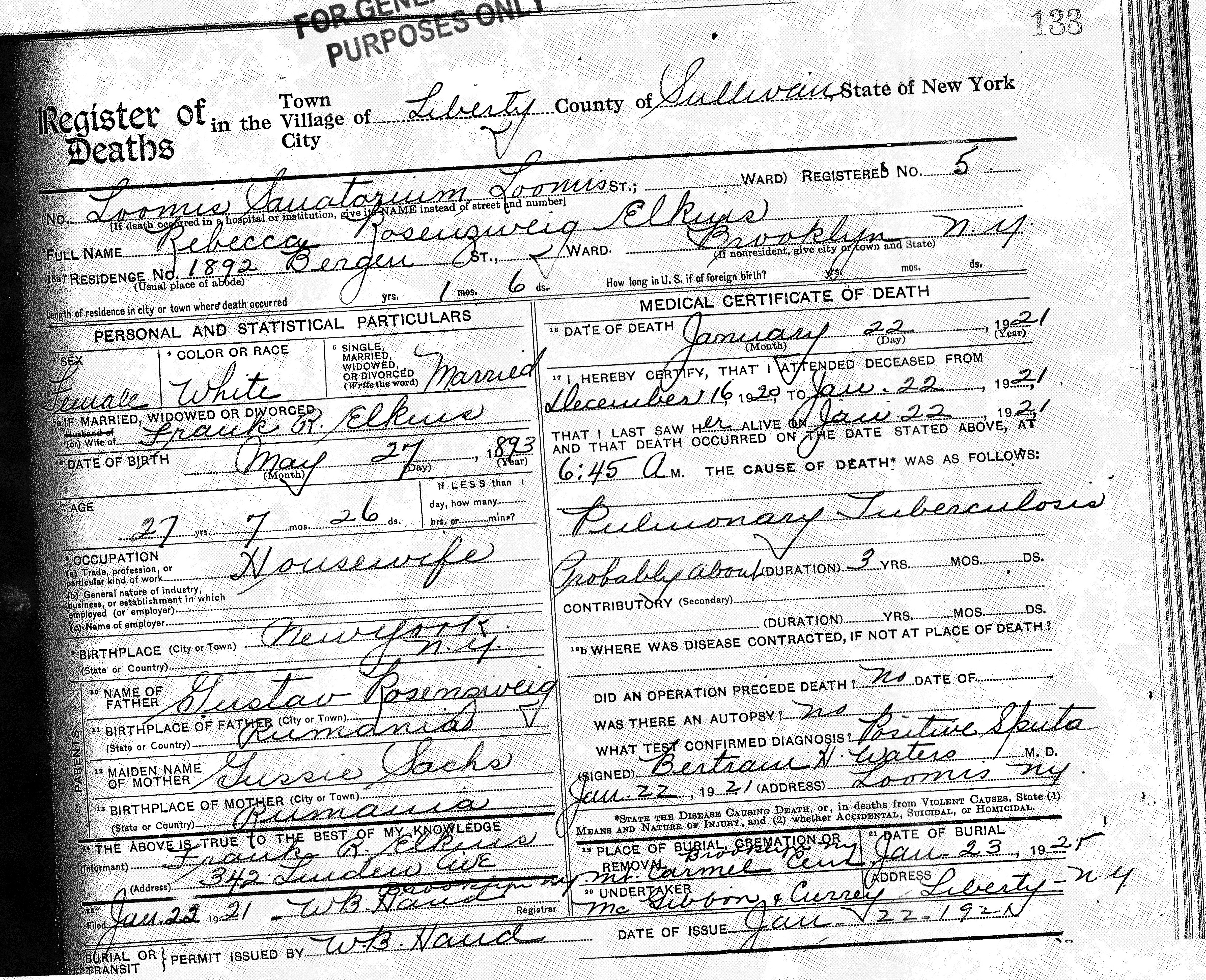
Rebecca’s death certificate indicates that Rebecca in fact died from tuberculosis at a sanitarium in Liberty, New York, where she had been a patient for a little over a month before her death. rebecca elkin death certificate I also found the death certificates for Rebecca and Frank’s two other sons.  The first born was Milton, born on December 14, 1914, just nine months after Rebecca and Frank were married.  He died just five months later on May 16, 1915.  It seems he had been sick for two months, in other words, since he was really just an infant.

Milton Elkin death certificate

Milton Elkin death certificate

The second child was Daniel (not David).  He was born October 31, 1916, and died December 16, 1917, when he was just over a year old, from broncho pneumonia.

Daniel Elkin death certificate

Daniel Elkin death certificate

Although the family lore was that Rebecca and the two boys died during the flu pandemic of 1921, that appears not to be true.  It would appear instead that Milton died over a year before Daniel was even born, and that Daniel died two years before Irving was born and four years before Rebecca died.  Maybe the family remembered it differently because it was just too painful to imagine Rebecca and Frank losing one child after another and then Frank losing Rebecca when Irving was not yet two years old.  It is too painful to imagine.

I am deeply appreciative of Richard’s willingness to share his family stories.  They preserve not only the memory of his grandmother Rebecca, who never saw her son grow up; they also preserve the memory of that son, Richard’s father, Irwin Elkins, who despite losing his mother at such a young age, grew up to be a man with a great sense of humor, a wonderful father, a successful businessperson, and an inspired engineer.  The resilience of the human spirit is remarkable.


Enhanced by Zemanta

Passover wishes and thoughts


Passover Seder Plate

Passover Seder Plate (Photo credit: Wikipedia)


As we approach the first night of Passover on Monday evening, I am feeling a bit overwhelmed, as I usually am this time of year.  There is the cleaning, shopping, cooking, and all the other details that go into preparing the house for Passover and for the seder.  I am also feeling torn because there are so many things I want to do in connection with my research and the blog.  I have lots of photos to scan and post, both from my Brotman relatives and my Rosenzweig relatives, stories that need to be written, documents to request, people to contact.  But I do not have time.  So while the kugel is baking and before I start turning over the dishes and pots and pans for the holiday, I thought I’d take a few minutes to ponder what Passover means to me this year.


Passover was once my favorite holiday of the year.  I loved the seder because as a child, it was my only formal exposure to Jewish history and Jewish rituals.  I grew up in a secular home.  We did not belong to a synagogue, I did not go to Hebrew school, and there were no bar or bat mitzvahs celebrated in our family when we were children.  It was just fine with me, but I was also very curious about what it meant to be Jewish.  Passover gave me a taste of what being Jewish meant and could mean.  My Uncle Phil, my Aunt Elaine’s husband, had grown up in a traditional Jewish home, and although he was not terribly religious either, he wanted to have a seder.


So every year we had a seder, first only at my aunt’s house, and then my mother started doing a second seder at our house.  My uncle, the only one who knew Hebrew, would chant all the blessings and sing all the songs, and the rest we would read in English from the Haggadah for the American Family (not Maxwell House).  I was enchanted—I loved the music, the stories and all the rituals. I looked forward to it every year.


As an adult, I began my own exploration of what it means to be Jewish.  I married a man from a traditional family, and he wanted to keep the traditions and rituals that were part of his childhood.  I also wanted to learn more and do more.  I took classes, I read, I got involved with the synagogue, and over time the Jewish holidays and rituals and prayers and services became second nature to me and provided me with meaning and comfort and joy.

Passover has become just one small part of my Jewish life and identity now, and over time, it has lost its magic.  It no longer is my favorite holiday of the year.  The matzoh gives me indigestion, the chore of changing the dishes and pots and pans has become tiresome, and the seder is so familiar that it no longer feels fresh and new and exciting.


If I look at it through my grandson’s eyes, I can feel some of that old excitement, but he is still too young to ask questions or to understand the stories.  He just likes the songs and looking for the afikomen and being with his family, which is more than enough for now.  This picture, one of my favorite pictures ever, captures some of that feeling.  From generation to generation, traditions are being preserved.

L'dor v'dor  Harvey and Nate

L’dor v’dor Harvey and Nate


But this Passover I will try to take the time to think about things a little differently.  I will think not just about Moses and the Israelites crossing the Red Sea and going from slavery to freedom.  I will think about all my maternal ancestors who made their own Exodus by leaving poverty and oppression and prejudice and war in Romania and Galicia to come to the place where they hoped to find streets lined with gold.


I will think of my grandfather Isadore, the first Goldschlager to come, leading the way for his father, his mother, his sister and his brother.  I will think of how he traveled under his brother David’s name to escape from the army and come to America.


I will think of his aunt, Zusi Rosenzweig, who met him at the boat at Ellis Island.  I will think of his uncle Gustave Rosenzweig, who was the first Rosenzweig to come to the United States back in about 1888, with his wife Gussie and infant daughter Lillie, a man who stood up for his extended family on several occasions. And I will think of his aunt Tillie Rosenzweig Strolowitz, who came to the US with her husband and her children, who lost her husband shortly after they arrived in the US.  I will remember how she took in my grandfather and his sister Betty when their father, Moritz, died, and their own mother and brother David had not yet arrived.


And I will think about my great-grandfather Joseph Brotman, who came here alone in about 1888 from Galicia, whose sons Abraham and David from his first marriage came next, and whose son Max as just a ten year old boy may have traveled to America all alone.  I will think of Bessie, my great-grandmother for whom I am named, who brought two small children, Hyman and Tillie, on that same trip a few years later, and who had three more children with Joseph between 1891 when she arrived and 1901, when Joseph died.  The first of those three children was my grandmother Gussie Brotman, who married my grandfather Isadore Goldschlager after he spotted her on Pacific Street while visiting his Rosenzweig cousins who lived there as well.


All of these brave people, like the Israelites in Egypt before them, pulled up their stakes, left their homes behind, carrying only what they could carry, to seek a better life.  I don’t know how religious any of them were or whether they saw themselves as brave, as crossing a Red Sea of their own.  But when I sit and listen to the blessings and the traditional Passover songs this year, I will focus on my grandson and see in him all the courage and determination his ancestors had to have so that he could be here, free to live as he wants to live and able to ask us, “Ma Nish Ta Na Ha Leila Ha Zeh?” Why is this night different?


Why is this night different from all other nights? It isn’t because we are free; it’s because on Passover we remember what it was like not to be free and to be grateful for the gifts of those who enabled us to be free.

Happy Passover to all, and thank you to all my  Brotman, Goldschlager and Rosenzweig relatives for making this such an exciting journey for me.


Enhanced by Zemanta

Max and Irving: The Sons of Abraham Rosenzweig

Abraham Rosenzweig was the oldest son of Gustave and Gussie Rosenzweig and my grandfather Isadore’s first cousin.  He was born in New York City on February 12, 1889, apparently the first of their children born in the US.  He served in the Navy before and during World War I, and he worked for a bakery after the war and thereafter.

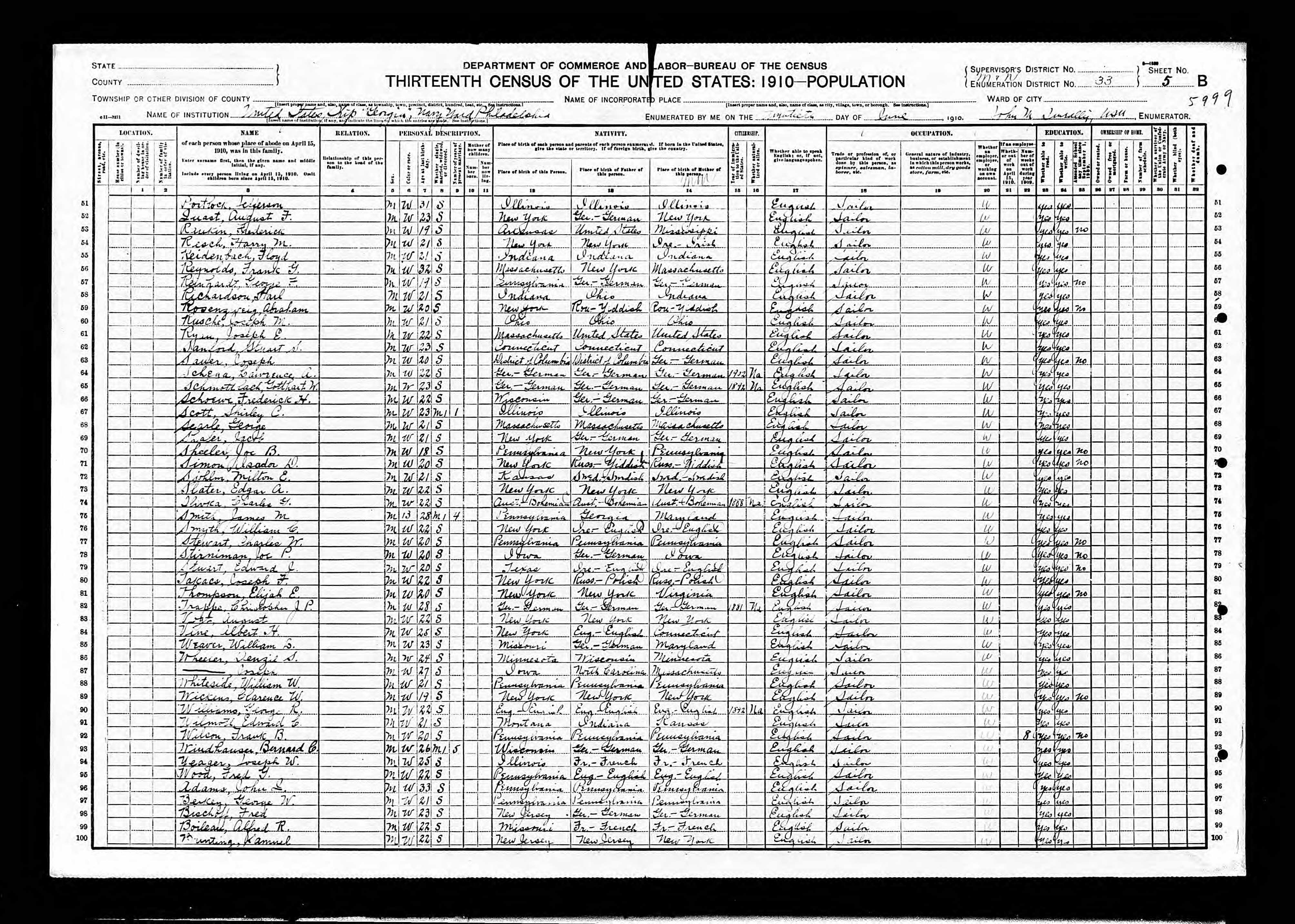
Although I do not have any documentation for Abraham’s marriage, it seems that he probably married in Pennsylvania.  Rebecca Fagles, his wife, was born in Pennsylvania, and Abraham was stationed on the USS Georgia in Philadelphia in 1910.

Abraham Rosenzweig 1910 census US Navy

I assume that that was when and where they met and that they married around 1915 because although Abraham was living with his family and single as of the 1915 census, his first son Maxwell was born April 2, 1916.  Abraham and Rebecca’s second son Irving was born April 26, 1919, and in 1920, they were all living in Brooklyn, according to the 1920 US census.

UPDATE: I was able to find the marriage of Reba Fagles and Abraham Rosenzweig in 1915 on the Philadelphia marriage index.  I am assuming that that is the record for Abraham and Rebecca.

Abraham Rosenzweig and family 1920 census

Abraham Rosenzweig and family 1920 census

Abraham and Rebecca, known as Abe and Beck, lived in Brooklyn for the rest of their lives, where they raised their two sons, Max and Irving.  Max married Sylvia Herrick and had two sons, Joseph and Gerald.

Max and Sylvia Ross

Max and Sylvia Ross

Irving married Irene Rubenstein/Robbins and had two daughters, Jane and Arlene.  Gerry remembers his grandparents very well since he grew up in Brooklyn where they lived.  He remembers that his grandmother Beck served untoasted English muffins and used memorial candle holders as glasses.  Gerry named his two children for his grandparents, his son for Abe and his daughter for Beck.  Abe died in 1961, and Beck died in 1970.

Abe, Sylvia, Ray (Abe's sister) and Beck

Abe, Sylvia, Ray (Abe’s sister) and Beck

Here are some photographs of Max and Irving and one with their aunt Ray, an aunt I’ve otherwise been unable to locate.

Max and Irving Rosenzweig/Ross

Max and Irving Rosenzweig/Ross

Max and Irving with their aunt Ray

Max and Irving with their aunt Ray

I was able to get some background information about the lives of Max and Irving from Gerry and Arlene.

Max and Sylvia settled in Brooklyn, where Max first was in the egg and poultry business and then in the business of reconditioning steel drums for storing oil.  At some time after World War II while doing business with the army, Max changed his last name from Rosenzweig to Ross, believing that he would have more success with a name that was not obviously Jewish.  Sometime thereafter Irving also changed his last name to Ross for similar reasons and also because their mother Beck did not like the idea of the two brothers having different last names.

Arlene told me that her father Irving had met her mother Irene when her uncle Max went to Sylvia’s house while they were dating and brought his younger brother Irving with him.  One of Sylvia’s friends was there and arranged for Irving to meet her younger sister Irene.  For Irving, it was love at first sight, but not for Irene.  For a year, Irving pursued her.  Irene had joined the Navy, one of the first ten women to become a WAVE, and Irving, himself in the US Army, placed an ad in the Stars and Stripes to find her and to get her attention.  Eventually, Irene agreed to date him and fell in love with him as well.

They were married in 1945, and according to Arlene, to his dying day, her father would do anything to make Irene happy.  Irving and Irene  Irene and Irving lived at 41 Kew Gardens Road, Queens, and their two daughters were born at Kew Gardens General Hospital.  Irving owned a share in a successful hardware business.

In 1957, Irving and Irene and their daughters went to visit Irene’s parents, who had moved to the Miami, FL, area.  Irene was so taken with life in South Florida that within days after returning to Brooklyn, Irving sold his share in the hardware business and bought three tickets to Miami for Irene and his daughters, coming down a few months later himself once his business matters were resolved.  He was, as Arlene said, determined to make Irene as happy as possible.

Within five years, Irving, a man who never graduated from high school, had obtained a license to sell insurance and had established a very successful insurance brokerage business.  He was able to provide his family with a large, custom-built house and a comfortable lifestyle.  Irving and Irene remained in the Miami area thereafter and only occasionally would they return to the New York area.

Sadly, their lives would be marked by tragedy.  In 1968, Irving was admitted to Baptist Hospital in Miami for congestive heart failure.  While he was being admitted, Irene and Arlene went to get something to eat, and while driving down North Kendall Drive, where Baptist Hospital is still located, they were hit head-on by a minibus going northbound on U.S. 1, South Dixie Highway.  The minivan had defective brakes and  had skidded across the median.  Both Irene and Arlene suffered severe injuries, and Arlene underwent numerous surgeries and was laid up for a substantial time after the accident.  For some period of time all three members of the family shared one hospital room.

Arlene and Irving Ross August1968

Arlene and Irving Ross August1968

Not long after the accident, Irving was diagnosed with inoperable cancer and died at age 51 on August 5, 1970.  Irene was only 49 when he died.  She had to go to work to support herself and her children and became a purchasing agent at Florida International University, where she worked for many years.  She died January 16, 2009, at age 88.

Irene Ross in 2006

Irene Ross in 2006

Arlene Ross

Arlene Ross

Max also died at a prematurely young age.  His wife Sylvia had a number of medical problems, and while accompanying her for treatment at Massachusetts General Hospital in November, 1975, Max had an aneurysm and died.  He was only 59 years old. Sylvia lived more than twenty years after Max died.

Sylvia Ross

Sylvia Ross

The two sons of Abraham and Rebecca, Max and Irving, thus had many parallels in their lives.  Both were big strong men over six feet tall, both had changed their name to Ross, both had had two children and long marriages to women to whom they were devoted, and both had died before they were sixty years old. Gerry said he speaks to his father daily and has every day since he died in 1975; Arlene also spoke adoringly of her father.  I could tell in speaking with both Gerry and Arlene that each of them loved their fathers dearly and want their memories preserved.   I hope this blog will help to do that.

Enhanced by Zemanta

Family Photo Album:  Joe and Sadie and Their Daughters Irene and Mildred

Joe and Sadie and their daughters

Joe and Sadie and their daughters

Photographs can capture so much—a moment in time, a relationship, the style of an era, a mood, an emotion.  Even family snapshots can reveal a lot.  These pictures of Joe and Sadie and their daughters capture a family.  Thank you to the next generation for sharing these pictures of their mothers and grandparents.

These pictures from the early 1940s  of Irene, in her early 20s, and Mildred, a teenager, are so touching.  They show two beautiful sisters who seem close to each other and to their parents.  They both look like they have so much ahead of them.

Ariela described her mother Irene as very outgoing and social like her father Joe, someone who would strike up conversations with total strangers.    Ariela said that Irene loved to dance and ski and sail as a young woman and that she loved jewelry and clothes and other beautiful objects.  She loved dressing up and attending parties, and you can see that love of life and people in her face in these pictures of her as a young woman.

Irene 1941 Rockaway Pkwy

Irene 1941 Rockaway Pkwy

Irene, Joe and Mildred 1941

Irene, Joe and Mildred 1941

Tragically, Mildred’s life was cut short when she died in 1951 at only 25 years old, leaving behind her young husband and fifteen-month old child.  I am hoping to learn more about her, but from these pictures it looks like she was also a young woman who loved life and people and was adored by her sister and her parents.

Mildred

Mildred

Sadie and Mildred 1942

Sadie and Mildred 1942

Mildred 1941

Mildred 1941

Mildred and friend 1943

Mildred and friend 1943

Mildred Rosenzweig and Seymour Sundick 1947

Mildred Rosenzweig and Seymour Sundick 1947


Ron and his mother MIldred Sundick at his first birthday, a few months before she died

Ron and his mother MIldred Sundick at his first birthday, a few months before she died

This is one of my favorite pictures in this group of photos.  It shows both Mildred and Irene surrounding a baby carriage.  Although we cannot see the baby, the descendants of Mildred and Irene and I thought that it is likely that the baby is Ariela, based on the hairstyles dating it in the 1940s and the adoring look on Irene’s face, looking down at what must be her baby.

Mildred and Irene looking at Ariela 1947

Mildred and Irene looking at Ariela 1947

You can also see that same adoring look on Irene’s face many years later as she looks lovingly at her daughter Ariela.

Irene and Ariela

Irene and Ariela

And here is one of Irene with her grandson Aron.  Same loving look—on both of their faces.

Aron and his grandmother Irene

Aron and his grandmother Irene

Here are some photos of Joe and Sadie in the 1940s:

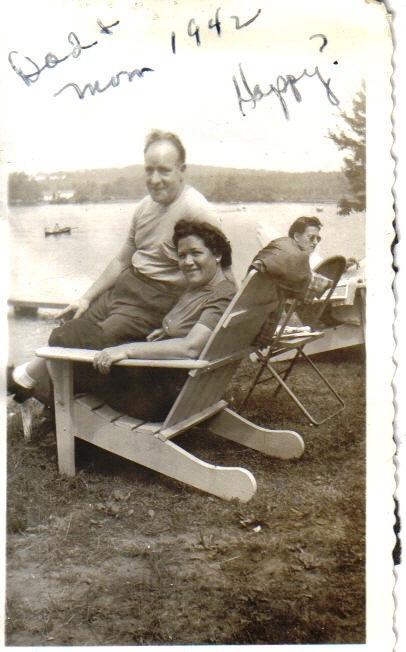
Sadie in cloth coat Joe on boat dock Lake 1942 Joe and Sadie on Chair 1942 Joe and Sadie in Lake 1942 Joe 1941

Here are some from the 1950s and after of Joe, Sadie and Irene:

Irene Joe Sadie in color Sadie and Irene Sadie


This photo  is of Irene and her husband Leo Kohl with her parents Joe and Sadie.

Leo Joe Sadie and Irene

Leo Joe Sadie and Irene

Ariela told me that her mother was madly in love with Leo and missed him dearly until the day she died.  Irene died less than a year and a half ago at age 91.

As I said, photographs capture so much.  These capture a family over time, a family where children adored their parents and vice versa, a family that endured a terrible tragedy, but that survived and thrived and found love and joy in their lives again