My Seligman Great-Great-Grandparents:  Two Pioneers Who Made A Difference with Integrity and Kindness

By the 1890s, my great-great-grandparents were “empty nesters.”  Their daughter Eva, my great-grandmother, was married to Emanuel Cohen and raising her family in Philadelphia.  (I’ve written about my Cohen great-grandparents here.) Their son James was working as a draftsman for the Department of Interior in Salt Lake City, Utah; he would marry Ruth V.B. Stevenson in 1893 in Salt Lake City, and have two children, Morton Tinslar Seligman, born July 1, 1895, in Salt Lake City, and Beatrice Grace Seligman, born December 4, 1898, also in Salt Lake City.  By 1900, however, James, Ruth and the children had moved to Santa Fe, where they were living next door to Bernard and Frances.  James was working as a clerk in a dry goods store, presumably the Seligman store.

Bernard Seligman and James Seligman and families 1900 US census

Bernard Seligman and James Seligman and families 1900 US census  Year: 1900; Census Place: Santa Fe Ward 4, Santa Fe, New Mexico; Roll: 1002; Enumeration District: 0126; FHL microfilm: 1241002

Arthur, the youngest child of Bernard and Frances, had returned to Santa Fe after college in Philadelphia, and in 1896, he married a widow named Frankie E. Harris in Cleveland, Ohio.

Marriage certificate of Arthur Seligman and Frankie E. Harris

Marriage certificate of Arthur Seligman and Frankie E. Harris Cuyahoga County Archive; Cleveland, Ohio; Cuyahoga County, Ohio, Marriage Records, 1810-1973; Volume: Vol 42-43; Page: 489; Year Range: 1892 Sep – 1896 Jul

Frankie had an eight year old daughter Richie from her first marriage who became a part of the Seligman family.  In fact for her ninth birthday on August 3, 1897, Bernard and Frances hosted a birthday party for Richie and 42 of her friends in their Santa Fe home.

Ritchie Harris birthday snip

City News Items Date: Tuesday, August 3, 1897 Paper: New Mexican (Santa Fe, NM) Volume: 34 Issue: 138 Page: 4

(This same “gossip column” also reported that Arthur and James Seligman and some friends were going on a two week fishing trip soon after this birthday party.)

Arthur and Frankie had a son together just a year later; Otis Perry Seligman was born on February 14, 1898, in Santa Fe.  Thus, by 1900, Bernard and Frances had four grandchildren living in Santa Fe plus three more grandsons living in Philadelphia, including my grandfather John Nusbaum Cohen.

On the professional side, I could not find any specific references to Bernard’s political activities or his business activities during the 1890s although the 1900 census listed his occupation as a dry goods merchant.  In 1894 he seems to have taken an extended trip to Europe, including to Germany and to Italy.

Traveling Seligmans 1894

Saturday Small Talk Date: Saturday, October 27, 1894 Paper: New Mexican (Santa Fe, NM) Volume: 31 Issue: 214 Page: 4

From this clipping it is hard to know whether or not he was traveling with Frances.  I also wonder who the relatives were in Italy and who he was visiting on the Rhine.  Was this purely for pleasure or was it a business trip?  I don’t know.

At some point after this trip, however, Bernard and Frances moved back to Philadelphia.   Bernard was living in Philadelphia when he died on February 3, 1903, at age 65 from myocarditis.  He was residing at 1606 Diamond Street at the time.

Bernard Seligman death certificate

When I looked back to see where my great-grandmother Eva was living at that time, I was hardly surprised to see that she, her husband Emanuel Cohen, and their three sons were also living at 1606 Diamond Street as of the 1900 census.  In fact, in 1900, Emanuel’s brother Isaac and nephew were also living at 1606 Diamond Street after the death of Isaac’s wife.  Thus, Eva and Emanuel Cohen, my great-grandparents, were housing not only their three children, but also at least four other family members, Eva’s parents and Emanuel’s brother and nephew.

According to his obituary, Bernard (and presumably Frances) had moved back to Philadelphia three years before his death, to “recuperate from over-work.”  The obituary goes on to say that Bernard had been doing well until sometime in the prior year when he had a “severe stroke of paralysis which weakened him considerably.”  The paper noted, however, that he had been improving and that no one thought that he was near death.  The obituary described his death as “shocking” and reported that the day before his death he had appeared fine and had even sent a dispatch relating to business matters to his son Arthur.

bernardseldeathnmex

“A Good and True Man Called Hence,” Santa Fe New Mexican, February 3, 1903, p. 1

The obituary recounts all of Bernard’s many accomplishments, both political and business, and describes him as follows:

“Mr. Seligman was a pioneer in New Mexico, and during his residence of over forty years in this city and territory, was one of the most progressive, shrewdest and brightest businessmen and citizens of the commonwealth.  He was a man of the strongest integrity and keen perception and high courage, public spirited and thoroughly posted on public affairs, indeed a valuable and good citizen in every sense of the word, a loving husband and a kind and indulgent, yet at the same time, a firm and sensible father.  He was a prominent and important factor in the building up of the commercial, educational, civic, moral, and material interests in this city and county and of the entire territory.  A good and true man has gone to the great beyond.”

What can I possibly add to that? Only that I wish that I had known him.  I stand a bit taller knowing that I am descended from Bernard Seligman.

Just two years later, my great-great-grandmother Frances Nusbaum Seligman also died.  She died in Philadelphia on July 27, 1905, at age 59.

Frances Seligman death certificate

She had been living at 1431 Diamond Street at the time of her death.  Again, I checked to see where my great-grandparents Eva and Emanuel Cohen were living, and 1905 Philadelphia directory, their address was, not surprisingly, 1431 Diamond Street, and they still had their three sons and Isaac living with them in 1910 as well.

Frances was described in her obituary in very loving terms:

“She was a beautiful and accomplished woman, as good as she was beautiful and as beautiful as she was good, and of a most lovable and gentle disposition.  She was an exemplary wife, a fond and good mother, and a dutiful and loving daughter.  Indeed she was all that is implied in the phrase ‘a thoroughly good and moral woman.’  … She will be especially remembered by the poor people of [Santa Fe], to whom she was particularly kind.  Many and many truly charitable deeds have been put to her credit.”

The obituary further commented:

“From the moment of her arrival to within a few years ago, when she commenced to spend most of her time in Philadelphia, she was a social leader, admired, respected and popular.  She was a woman without guile and always ready to lend a helping hand in social as well as in charitable work.”

frances seligman obit July-27-1905 new mexican

(“Gentle, Good Woman Gone,” Santa Fe New Mexican, July 27, 1905, p. 1)

While I was impressed and proud when I read my great-great-grandfather’s obituary, I was very moved and emotional in reading about my great-great-grandmother Frances.  The words “good,” “gentle,” and “kind” are the same words that I have heard my father and my cousin Marjorie use to describe their grandmother, Eva Seligman Cohen, the daughter of Frances Nusbaum and Bernard Seligman.  She seems to have inherited or learned those very traits from her parents, two people who left the city of Santa Fe a better place by the time and the effort that they spent in caring for their community while they lived there.  As I will describe, their surviving children also left their mark, my great-grandmother Eva by her kindness and caring for others, and her two brothers James and especially Arthur by their service to Santa Fe and New Mexico.

bernard

Bernard Seligman

francis

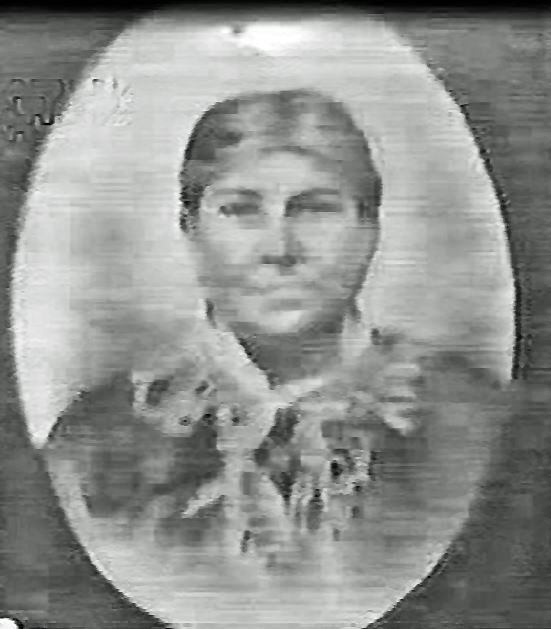
Frances Nusbaum Seligman

These two photos were given to me by my cousin Arthur Scott.  They were taken from a video made by his sister of family photos in their home.  The one of my great-great-grandmother Frances is so far the only photograph I have of her.


Bernard Seligman: His Political Career and His Family 1870-1890

I want to thank my cousin Arthur “Pete” Scott for all his help with finding newspaper clippings (including some of the ones appearing in this post) and other information to try and fill in the timeline  for Bernard and the other Seligmans. He has also contributed a great deal of information about our family at the Voces de Santa Fe website.  Like my father, Pete is a great-grandson of Bernard Seligman and thus my second cousin once removed.


I have been having a hard time tracking the whereabouts of my great-great-grandfather Bernard in the 1870s.  Although I know that Bernard and his family had moved back to Santa Fe sometime before their youngest child Arthur was born in June, 1871, it seems that Bernard was in and out of town during the 1870s.  In 1873, he withdrew from the Seligman Brothers partnership:

Date: Thursday, January 2, 1873 Paper: Santa Fe Daily New Mexican (Santa Fe, NM) Page: 1

Date: Thursday, January 2, 1873 Paper: Santa Fe Daily New Mexican (Santa Fe, NM) Page: 1

The firm of S. Seligman and Brother was dissolved, and a new firm owned by Sigmund and Adolph Seligman and Julius Nusbaum was created named Seligman Bros. and Company.  Who was Julius Nusbaum?  He was Bernard’s brother-in-law, the brother of Frances Nusbaum, Bernard’s wife.

Daily New Mexican, January 13, 1873

Daily New Mexican, January 13, 1873


I cannot find an explanation for Bernard’s withdrawal, and he certainly was involved in the business again in later years. He had applied for a passport on April 3, 1873, and he served as a representative to the Vienna Exposition  of 1873, so maybe that prompted his withdrawal.

Bernard Seligman passport application 1873

Bernard Seligman passport application 1873


Maybe it’s my modern skepticism that is coloring my perception, but it also seems possible that Bernard withdrew only in name, placing his wife’s brother in the firm in his stead.  Was this done for political purposes to avoid at least the appearance of any conflicts of interest?

Henry Tobias, author of The History of the Jews of New Mexico (University of New Mexico Press, 1990), writing about New Mexico in the 1880s and 1890s, described Bernard Seligman as “probably the most political of all the Santa Fe Jews” during that era (Tobias, p. 117).   Ralph Emerson Twitchell, author of Old Santa Fe: The Story of New Mexico’s Ancient Capital (Rio Grande Press, 1925), wrote, “A public speaker of great force and convincing power, [Bernard Seligman] found time to engage in the public affairs of the country of his adoption and was elected and appointed to many positions of profit and trust.”  (Twitchell, p. 477)  Twitchell also pointed out that Bernard “was a linguist of rare ability; speaking with fluency the English, German, French, Spanish, Italian, and Hebrew idioms.” (Ibid.) Bernard must have been well suited for a career in politics and government in bilingual New Mexico.

Tobias wrote that Bernard became a member of the territorial legislature in 1880. (Tobias, p. 117) Both Bernard’s obituary  (“A Good and True Man called Home,” Santa Fe New Mexican, February 3, 1903, p. 1)  and Twitchell (p. 477 ) also state that Bernard served several terms in the Legislative Assembly for New Mexico.  Another source reported that Bernard was instrumental in the passage of the mechanic’s lien law while he served in the territorial government, a law considered to be very important at that time. (George B. Anderson, History of New Mexico: Its Resources and Its People, Vol. 2 (Pacific States Pub. Co. 1907)).

One newspaper clipping shows that Bernard was the Democratic Party’s nominee for Santa Fe County Commissioner in 1884.(Las Vegas Daily Gazette., October 22, 1884, Image 2, at http://chroniclingamerica.loc.gov/lccn/sn90051703/1884-10-22/ed-1/seq-2/#date1=1873&index=5&rows=20&words=Bernard+Seligman&searchType=basic&sequence=0&state=New+Mexico&date2=1903&proxtext=bernard+seligman&y=4&x=6&dateFilterType=yearRange&page=1 ).  Twitchell wrote that Bernard was chairman of the board of the Santa Fe County Commission for three terms, presumably in the mid-1880s. (Twitchell, p. 477)

Bernard and the Santa Fe County Commission ran into some legal trouble when a local resident and attorney, Thomas Catron, sued the Commission, alleging fraud.  Catron claimed that in 1886 the Commission had issued warrants to raise money for a new courthouse that would increase the county debt beyond the limits set by a new federal statute; he alleged that to avoid that new limitation, the Commission had falsely stated the issuance date of the warrants so that they predated the effective date of that new law. Bernard Seligman is named in the case as the chair of the Commission at the time of this alleged fraud.  The Supreme Court of the Territory of New Mexico found that Catron had stated sufficient facts, if proven, to support a claim against the Commission and remanded the case for trial.  Unfortunately, I cannot find any report on the final outcome of the case on the merits.[1]  Given Bernard’s future political success, perhaps Catron lost the case.

Bernard also encountered some controversy when the Governor of the New Mexico Territory, Edmund Ross, named him as his choice to be the treasurer of the territory. Thomas Catron was again involved in the fight against Bernard. Catron was himself a political leader in New Mexico, having served as Attorney General and US Attorney for the territory and later serving as one of its first US Senators when New Mexico became a state.

English: Thomas Benton Catron, Senator of the ...

English: Thomas Benton Catron, Senator of the United States from New Mexico (Photo credit: Wikipedia)

In July, 1886, the Santa Fe New Mexican reported that Governor Ross might appoint Bernard as treasurer:

Bernard Seligman medicine man to be treasurer

Date: Friday, July 16, 1886 Paper: New Mexican (Santa Fe, NM) Page: 2

I am curious about the reference to Bernard as a “medicine man;” I have no idea what it means in this context.

Governor Ross did in fact appoint Bernard Seligman to be territorial treasurer, but that appointment was then resisted by a man who claimed to be the sitting treasurer, Antonio Ortiz y Salazar, who refused to turn over his office to Seligman. Ortiz, represented by the same Thomas Catron who was suing Bernard for fraud in his role as County Commissioner, argued that the governor had not had authority to appoint Seligman because there was no vacancy to fill as Ortiz still held the seat and had not resigned or died.

Seligman brought a mandamus action against Ortiz, seeking to have him hand over the incidents of the treasurer’s office.  Seligman claimed that the oath taken by Ortiz when sworn in for a second term in 1884 was void because of some irregularities.  Ortiz responded that he had been properly sworn into office in 1882 for his first term, and thus he still had a valid claim to the treasurer’s office despite the governor’s appointment of Seligman.  The trial court judge disagreed and ruled that Seligman’s appointment was valid and that Ortiz had to give up his seat.  Ortiz requested a rehearing, and on review, a different judge reversed the first court’s decision and ruled in favor of Ortiz, concluding that the appointment of Seligman as treasurer was not valid because Ortiz still properly held the seat.

Seligman v Ortiz treasurer-page-001

Date: Thursday, August 19, 1886 Paper: Santa Fe Weekly New Mexican and Livestock Journal (Santa Fe, NM) Page: 4

Henry Tobias saw this incident as an example of the resentment some New Mexico residents felt about the success of the Jewish merchants in New Mexico.  In response to his appointment of Seligman, Ross was advised by one prominent resident that there were already too many Jews in Santa Fe politics and government.  (Tobias, pp. 119-120.)


Edmund G. Ross. Library of Congress descriptio...

Edmund G. Ross. Library of Congress description: “Hon. E. G. Ross of Kansas” (Photo credit: Wikipedia) Governor of New Mexico Territory 1885-1889

In December 1886, Governor Ross made a statement explaining his choice of my great-great-grandfather that upset some residents of the territory because of the insulting and discriminatory assumptions underlying that statement:

governor ross appoints bernard seligman-page-001

Date: Wednesday, December 29, 1886 Paper: Santa Fe Daily New Mexican (Santa Fe, NM) Page: 2

Perhaps there was prejudice on both sides: anti-Mexican prejudice by Ross and anti-Semitic prejudice on the part of those opposing the appointment of my great-great-grandfather.

Several sources, however, state that Bernard Seligman did serve as territorial treasurer: his obituary, Twitchell, and Tobias all refer to the fact that he served as treasurer. The Legislative Blue Book of the Territory of New Mexico (1911) lists Bernard Seligman as territorial treasurer from 1886 through 1891.     None of these sources explain, however, what happened that allowed Seligman to continue in office after the court decision in favor of Ortiz in 1889.

Thus, for much of the 1880s Bernard was pursuing his political career. However, he also must have been somewhat involved in the Seligman Brothers business.  This news clipping dated April 8, 1889, certainly suggests that Bernard was active in the business:

bernard trip back east 1889

New Mexican (Santa Fe, NM), Monday, April 8, 1889 , Volume: 26, Issue: 41,Page: 4

Meanwhile, at home his children were growing up.  In 1881, my great-grandmother Eva, then fifteen years old, left Santa Fe for Philadelphia where she went to Swarthmore[2] and later married my great-grandfather Emanuel Cohen in 1886.   Her younger brother James also went to Swarthmore, where he was a member of the class of 1888 and a member of the literary society.

Eva Cohen in the Swarthmore Bulletin

James Seligman in Swarthmore register 1920

Bernard and Frances’ next child, Minnie, also followed in her siblings’ footsteps and enrolled at Swarthmore as did her younger Arthur.  Although Arthur was two years younger than Minnie, they both enrolled at Swarthmore the same year—1885-1886.  In that year James, Minnie and Arthur were all students at Swarthmore, James a sophomore in the college and Arthur and Minnie as juniors in the preparatory school.  I am not sure where Eva was living that year as she appears to have finished her studies at Swarthmore in 1884 and did not marry Emanuel until 1886.

With at least three of their children living in Philadelphia and Bernard busy with politics, I wonder whether Frances had also returned to Philadelphia to be closer both to her Nusbaum family and her children and whether Eva was also living with her mother there.  Although Eva and Frances are listed on the 1885 New Mexico Territorial Census, so are the other three children, despite the fact that those three were enrolled at school in Philadelphia that same year.  The news clipping above reported that Frances had stayed behind in Philadelphia “with friends” in 1889 when Bernard had returned to Santa Fe.

The family suffered a tragic loss on January 14, 1887, when Minnie, only seventeen years old, died from meningitis while in Philadelphia.  The address on the death certificate was 829 North 5th Street, Philadelphia.  Although I cannot find where the other Nusbaums were living in 1887, earlier Philadelphia directories list several members of the extended Nusbaum family living at residences nearby on North 6th Street and North Marshall Street.


Minnie Seligman death certificate 1887

Minnie Seligman death certificate 1887

This note in a Quaker publication says that Minnie died at the home of a relative:

friends' intelligencer 44 p 59

Friends’ Intelligencer United with the Friends’ Journal, Volume 44 (Google eBook), p. 59

Minnie was buried in Philadelphia at Mt Sinai cemetery, the same cemetery where her infant sister Florence had been buried in 1867 and where her uncle Sigmund Seligman had been buried in 1876 and where her parents and her sister Eva would later be buried.  Although the family may have left Philadelphia for Santa Fe almost twenty years before, it is pretty clear to me that the ties back to Philadelphia remained very strong for the family of Bernard Seligman.


[1] Catron v. Board of Commissioners, 21 P. 60 (N.M. 1889)

[2] Swarthmore had a preparatory school as well as a college in those days, and my great-grandmother and her siblings all attended the preparatory school and then most attended the college for at least some time as well.


Sigmund Seligman: “A Beloved Friend to Humanity and an Uncompromising Lover of His Country”

"La Ciudad de Santa Fe." Engraving f...

“La Ciudad de Santa Fe.” Engraving from “Report of Lt. J. W. Abert of his Examination of New Mexico in the Years 1846-1847.” (Photo credit: Wikipedia)


My great-great-uncle Sigmund Seligman must have been an impressive human being.  Born in 1830, he came by himself to the US from a small town in Germany before he was even twenty years old.  Although I have no records of his arrival or where he might have settled first (although other facts suggest he first settled in Philadelphia), historical sources report that by 1849 he had settled in Santa Fe, first working as a photographer there and then joining up with Charles Clever to start the trading business that became Seligman and Clever and eventually Seligman Brothers, a business that flourished and eventually supported not only Sigmund, but also his two brothers, Bernard and Adolph, and their families.


By 1857, he had applied for US citizenship in Philadelphia, and by 1860 he reported on the US census that he had $20,000 worth of personal property and the same in 1870.  According to two different websites I found for converting 1860 dollars to today’s money, that amount would be the equivalent of over $400,000 today.  Not too bad for a thirty year old entrepreneur.

I found a number of interesting news articles about Sigmund, including one dated June 6, 1871, that announced Sigmund’s return to Santa Fe after being away for a year “in the states and Germany.”  I would love to know what took Sigmund back to Germany in 1870-1871.  There must have still been family members there, but I have no idea who he might have been visiting.  Maybe he was looking for a wife—as Parish had said, many men traveled back east or to Germany to find a Jewish woman to marry.  If that was the purpose of Sigmund’s travels, he seems not to have been successful as he never married.

Sigmund Welcome Home 1871-page-001

Santa Fe Daily New Mexican June 6, 1871, p.1


I assume that his travels in the states included Philadelphia, where his brother Bernard and his family were living during at least some part of that time.  Perhaps Bernard was traveling back and forth, as I suggested in an earlier post, to keep an eye on the business while Sigmund was away. Sigmund had applied for a US passport on April 26, 1870, in Philadelphia, presumably for this trip.  Written across the letter are the words “Nat Dis Court Santa Fe, New Mexico, December 15, 1856. Paid.”   I don’t know what the December 15, 1856 date refers to, but I assume that Sigmund applied for this passport in order to take his trip back to Germany.  He also had become a US citizen on April 26, 1870, also in Philadelphia, signed by the same notary who wrote in support of his passport application.

Sigmund Seligman passport application

Sigmund Seligman passport application 1870 National Archives and Records Administration (NARA); Washington D.C.; Passport Applications, 1795-1905; Collection Number: ARC Identifier 566612 / MLR Number A1 508; NARA Series: M1372; Roll #: 165.

Sigismund Seligman naturalization affidavit

National Archives and Records Administration (NARA); Washington D.C.; Passport Applications, 1795-1905; Collection Number: ARC Identifier 566612 / MLR Number A1 508; NARA Series: M1372; Roll #: 165.


A year is a long time to leave a thriving business, and Sigmund reportedly received a “hearty welcome from his numerous friends” when he returned.  (Santa Fe Daily New Mexican (Santa Fe, NM), June 6, 1871, p. 1)  Sigmund was apparently quite well liked.  In an editorial dated May 21, 1875, the Santa Fe New Mexican singled out Sigmund for his generosity and civic-mindedness based on his support of a project to provide sprinklers for the streets of Santa Fe to control the dust that tended to develop there on what I assume were dirt roads.

Sigmund praised for sprinklers-page-001

(Santa Fe New Mexican, May 21, 1875, p. 1)

Unfortunately, Sigmund’s life was cut short when he was only 46 years old on October 4, 1876.  He died at Fort Craig, New Mexico, a site that is 181 miles from Santa Fe, so quite a distance; it was a US Army fort, the largest in the Southwest.  As his obituary described it, he was in a “far off portion of the Territory.”


English: Former officers' quarters, Fort Craig...

English: Former officers’ quarters, Fort Craig, New Mexico, USA (Photo credit: Wikipedia)


He died of apoplexy, according to one death record, and his obituary indicated that he died “from a sudden and resistless stroke of disease.”  According to MedlinePlus, “When the word apoplexy (with no organ specified) is used alone, it often refers to stroke symptoms that occur suddenly. Such symptoms can be caused by bleeding into the brain or by a blood clot in a brain blood vessel. Conditions such as subarachnoid hemorrhage or stroke are sometimes called apoplexy.”  http://www.nlm.nih.gov/medlineplus/ency/article/000328.htm

The public reaction to his death was described in expressive terms in Sigmund’s obituary in the Santa Fe New Mexican dated October 10, 1876.  The paper reported, “At no time in the history of our citizens has there been a more spontaneous outpouring of the people to show a becoming respect to the memory of a departed fellow-citizen and friend.”  A Jewish “burial service” was read by Lehman Spiegelberg, another Santa Fe merchant, and Sigmund was buried at Odd Fellows cemetery in Santa Fe on October 9, 1876. A eulogy was given by Edmund F. Dunne, “portraying in most affecting, generous and glowing terms the many virtues and excellent qualities of the deceased as a brother, friend, citizen and correct man of business.” The paper described him as “a beloved friend to humanity and an uncompromising lover of his country, her institutions and laws.”

sigmund obit full page from voces

Obituary of Sigmund Seligman 1876 Daily New Mexican page one Personal collection of Arthur Scott http://www.vocesdesantafe.org/index.php/explore-our-history/historical-documents2/item/301-the-daily-new-mexican-ocotober-10-1876


There was only one thing that puzzled me about this obituary.  It does not mention Bernard or his family at all.  In fact, the paper describes Adolph as “the surviving brother” as if there was no other.    Since Arthur Seligman, Bernard’s son was born in Santa Fe in 1871 and since Bernard appears as living there on both the 1870 and 1880 US census reports as well as serving on the Board of Trustees of the Santa Fe Academy in 1878, I would have assumed that Bernard would have been in Santa Fe in 1876.


Although Sigmund was initially buried in Santa Fe, his body was moved to Philadelphia in April, 1877, six months after his death, where he was buried at Mt Sinai cemetery, the same cemetery where his brother Bernard would later be buried as well as other members of Bernard’s family.  Putting this information together with Bernard’s absence from Sigmund’s funeral makes me wonder whether Bernard had in fact moved back to Philadelphia between 1876 and 1877 and decided to have his brother buried in a proper Jewish cemetery rather than in Santa Fe’s Odd Fellows cemetery.

Sigmund Seligman death record, Philadelphia

Sigmund Seligman death record, Philadelphia “Pennsylvania, Philadelphia City Death Certificates, 1803-1915,” index and images, FamilySearch (https://familysearch.org/pal:/MM9.3.1/TH-266-11110-64044-12?cc=1320976 : accessed 29 Sep 2014), 004000970 > image 141 of 448; citing Department of Records.


I am sorry that I do not have any photographs of Sigmund.  He must have been an interesting man—adventurous, courageous, generous, respected, and well-liked by his fellow Santa Fe citizens.  His life may have been short, but by going to Santa Fe, he not only made a good life for himself, he helped out his community, and he provided a good foundation for his two younger brothers and their families.


One Lovely Blog Award—A Nice Start to the New Year


My new year started off on Thursday morning in just the right way.  First, my daughter texted me to tell me that her baby, my grandson Remy, had slept through the night for the first time.  Then I checked my email and saw there was a new post from one of my favorite bloggers, Pancho of The People of Pancho.  She’d been nominated for The One Lovely Blog Award and was very excited.  I was excited for her because I really enjoy her blog about her family research and about her childhood growing up in the Panama Canal Zone.

But imagine my surprise as I read through her blog post to see that she had in turn nominated me for The One Lovely Blog Award!  I am so honored and flattered to have received this nomination.  So Pancho, thank you so much for this nomination and for starting my year off with this great ego boost!

Now part of the deal in accepting this nomination is that there are certain rules to follow.  Here are the rules for this award:


  1. Thank the person who nominated you and link to that blog. (Thanks again, Pancho!)
  2. Share seven things about yourself.
  3. Nominate 15 bloggers you admire (or as many as you can think of!).
  4. Contact your bloggers to let them know that you’ve tagged them for the One Lovely Blog Award


So… seven things about me? In no particular order, here are seven rather random thoughts about who I am:


  1. My family is the center of my life, and not just my dead ancestors! My living and breathing family—those who have known me since birth and childhood and those I’ve only known since adulthood. I have been married for 38 years to the guy I met working at a day camp back in 1973. I still am amazed by how wonderful a man he is.  My children and grandchildren give me endless joy.  I am writing this blog for them, whether they realize it or not. SONY DSC
  2. I taught law for 32 years—copyright, trademark, antitrust, and contracts law. I retired last spring, and so far retirement has been wonderful! I have more time to pursue genealogy, and I am exploring various volunteer projects that give me a chance to work with children and use my teaching skills.
  3. I love animals, especially cats and dogs. I have never met a cat I didn’t like. They are all beautiful to me. I love dogs also, but not as much as I love cats. Except my dog. I love her as much as my cats.smokey luna sibling love
  4. The Outer Cape in Massachusetts—the location of the towns of Wellfleet, Truro, and Provincetown—is my favorite place in the world. No place else is as beautiful to me. Put me on the beach in the National Seashore or overlooking Cape Cod Bay, and my mind immediately clears. IMG_0341
  5. I am a die-hard Red Sox fan and have been for 39 years…ever since 1975 when the Red Sox lifted me out of the doldrums and stress of my first year of law school. This year might have been the hardest season ever to be a Sox fan, from last to first to last again. Go Sox….2015?
    English: Boston Red Sox Cap Logo

    English: Boston Red Sox Cap Logo (Photo credit: Wikipedia)


  6. Reading has been my favorite pastime since I was very young. I am always reading something for pleasure. My tastes are pretty eclectic, but mostly I read novels, biographies, and memoirs. I thank my mother for getting me hooked on books at a very early age. My favorite two books from childhood are The Phantom Tollbooth by Norton Juster and Charlotte’s Web by E.B. White.  The first taught me that books could create a whole imagined world where anything can happen; the second taught me that books could make me care enough about well-developed and well-written characters—even a spider—that I would cry over them.  I still cannot think about the ending of Charlotte’s Web without getting choked up.
    Cover of "The Phantom Tollbooth"

    Cover of The Phantom Tollbooth

    Charlotte's Web

    Charlotte’s Web (Photo credit: Wikipedia)


  7. Since I first started reading books on my own as a child, I have always been inspired by good writing. I have always, always, wanted to write. Work, family, and life got in the way.  This blog has been a gift for me—I finally get to write what I want to write the way I want to write it.  Thank you to all my readers and followers for giving me an audience and the encouragement and the inspiration to keep on writing.  I share this nomination with you all.


And now my turn to recognize some of the blogs that have inspired me and that teach me something about genealogy, about writing, and/or about life.  First, Pancho already recognized three of my favorite blogs: Bernfeld Family of Galicia & More,  The Genealogy Girl, and Shaking the Tree.  I  would also have  nominated these three as all are wonderfully written, very expressive, and very well-researched genealogy blogs.  All three touch me and help me all the time.

I would also re-nominate The People of Pancho for all those reasons and also Jana’s Genealogy and Family History Blog, though I know that Jana nominated Pancho thus must herself have been nominated.  So those are five genealogy blogs that I would also have  nominated even though they’ve already been nominated.  But I will spread the wealth and nominate a different group of fifteen.

These are in no particular order, but the first group are all genealogy blogs that I enjoy reading, find helpful, are amazingly well-researched and well written.

1.  Root to Tip

2. The Family Kalamazoo

3. The Lives of My Ancestors

4. The Legal Genealogist

5. Genealogy Sisters

6. Moore Genealogy

7. Genealogy Lady

8. One Rhode Island Family

To demonstrate that I do have interests outside of genealogy, here are seven non-genealogy blogs that I enjoy:

9. wmtc:  formerly, We Move to Canada, a blog originally (not surprisingly) about Laura Kaminker’s move to Canada from the US, but now much more than that: politics, books, travel, personal reflections, dogs, baseball, you name it—all clearly and beautifully written and often very provocative.

10. The Joy of Sox:  the very first blog I ever read—all about the Red Sox.  Allan Wood’s latest book about the Red Sox, Don’t Let Us Win Tonight,  has made me an even bigger fan.

11. BJJ, Law, and Living–the thoughts and experiences of the blog owner, who is a recent law graduate and mother

12.  Wellfleet Today—the ins and outs and ups and downs of running a B&B in Wellfleet, Massachusetts.  Amazing photographs.

13. Rex Parker Does the New York Times Crossword Puzzle—ever since I discovered this site a few years ago, I no longer have to wait 24 hours to find out what obscure answers I missed, and I also get to read all the rantings of Rex and his followers.

14. Over the Monster–another Red Sox blog

15. The TTABlog–a blog I followed regularly while teaching trademark law.  Although I am retired and no longer reading it regularly, I want to recognize it because it was tremendously helpful to me while I was teaching.

So those are my fifteen nominations.  Now I have to go tell them all they’ve been nominated.  I hope they are as pleased as I was by my nomination.


Looking back:  The Cohen Family from Amsterdam to England to Philadelphia and Washington and beyond


Amsterdam coat of arms

Two months ago I wrote a summary of my perspective on the descendants of Jacob and Sarah Jacobs Cohen and their thirteen children, including my great-grandfather Emanuel Cohen.  I wrote about the way they managed to create a large network of pawnshops that provided support for the generations to come.  Many of the Philadelphia Cohens stayed in the pawnshop business into the 20th century.  The generation that followed, those born in the 20th century, began to move away from the pawn business and from Philadelphia.  Descendants began to go to college and to become professionals.  Today the great-great-grandchildren of Jacob and Sarah live all over the country and are engaged in many, many different fields.  Few of us today can imagine living with twelve siblings over a pawnshop in South Philadelphia.  We can’t fathom the idea of losing child after child to diseases that are now controlled by vaccinations and medicine.  We take for granted the relative luxurious conditions in which we live today.

File:Flag of Philadelphia, Pennsylvania.svg

Philadelphia flag


The story of the Cohen family in Washington is much the same in some ways, different in other ways.  Jacob’s brother Moses and his wife Adeline also started out as immigrants in the pawnshop business , first in Baltimore and then Washington.  But unlike Jacob who lived to see his children become adults, Moses Cohen died at age 40 when his younger children were still under ten years old.  Adeline was left to raise those young children on her own as she had likely raised her first born son, Moses Himmel Cohen, on her own until she married Moses Cohen, Sr.  When I look at what those children accomplished and what their children then accomplished, I am in awe of what Adeline was able to do.   For me, the story of the DC Cohens is primarily the story of Adeline Himmel Cohen for it was she, not Moses, who raised the five children who thrived here in the US.  She somehow instilled in those children a drive to overcome the loss of their father, to take risks, to get an education, and to make a living.

Her son Moses, Jr., an immigrant himself, had nine children; his son, Myer, became a lawyer.  To me it is quite remarkable that a first generation American, the son of a Jewish immigrant, was able to go to law school in the late 19th century.  Myer himself went on to raise a large family, including two sons who became doctors and one who became a high ranking official at the United Nations in its early years after World War II.  Moses, Jr.’s other children also lived comfortable lives, working in their own businesses and raising families.  These were first generation Americans who truly worked to find the American dream.

Adeline and Moses, Sr.’s other three children who survived to adulthood, Hart, JM, and Rachel Cohen, all took a big risk and moved, for varying periods of time, to Sioux City, Iowa.  Even their mother Adeline lived out on the prairie for some years.  JM stayed out west, eventually moving to Kansas City; he was able to send his two daughters to college, again something that struck me as remarkable for those times.  His grandchildren were very successful professionally.  Hart, who lost a son to an awful accident, had a more challenging life.  His sister Rachel also had some heartbreak—losing one young child and a granddaughter Adelyn, but she had two grandsons who both appear to have been successful.

Three of the DC Cohen women married three Selinger brothers or cousins.  Their children included doctors, a popular singer, and a daughter who returned to England several generations after her ancestors had left.  The family tree gets quite convoluted when I try to sort out how their descendants are related, both as Cohens and as Selingers.

There were a number of heart-breaking stories to tell about the lives of some of these people, but overall like the Philadelphia Cohens, these were people who endured and survived and generally succeeded in having a good life, at least as far as I can tell.  The DC Cohens, like the Philadelphia Cohens, have descendants living all over the United States and elsewhere and are working in many professions and careers of all types.

flag of Washington, DC

Looking back now at the story of all the Cohens,  all the descendants of Hart Levy Cohen and Rachel Jacobs, I feel immense respect for my great-great-great grandparents.  They left Amsterdam for England, presumably for better economic opportunities than Amsterdam offered at that time.  In England Hart established himself as a merchant, but perhaps being a Dutch Jew in London was not easy, and so all five of Hart and Rachel’s children came to the US, Lewis, Moses, Jacob, Elizabeth, and Jonas, again presumably for even better opportunities than London had offered them.  Eventually Hart himself came to the US, uprooting himself for a second time to cross the Atlantic as a man already in his seventies so that he could be with his children and his grandchildren.  Rachel unfortunately did not survive to make that last move.

Flag of the City of London.svg

The flag of the City of London

Arriving in the US by 1850 in that early wave of Jewish immigration gave my Cohen ancestors a leg up over the Jewish immigrants who arrived thirty to sixty years later, like my Brotman, Goldschlager, and Rosenzweig ancestors.  Of course, the Cohens had the advantage of already speaking English, unlike my Yiddish speaking relatives on my mother’s side.  They also had the advantage of arriving at a time when there wre fewer overall immigrants, Jewish immigrants in particular and thus faced less general hostility than the masses of Jewish, Italian, and other immigrants who arrived in the 1890s and early 20th century.  Also, my Cohen relatives may not have been wealthy when they arrived, but Hart and his children already had experience as merchants and were able to establish their own businesses fairly quickly.  Thus, by the time my mother’s ancestors started arriving and settling in the Lower East Side of NYC or in East Harlem, working in sweatshops and struggling to make ends meet, my father’s ancestors were solidly in the middle and upper classes in Philadelphia, Washington, Sioux City, Kansas City, Detroit, and Baltimore.

When I look at these stories together, I see the story of Jewish immigration in America.  I see a first wave of Jews, speaking English, looking American, and living comfortably, facing a second wave who spoke Yiddish, looked old-fashioned, and lived in poverty.  No wonder there was some tension between the two groups.  No wonder they established different synagogues, different communities, different traditions.

A recent study suggests that all Ashkenazi Jews were descended from a small group of about 350 ancestors.  We all must share some DNA to some extent.  We are really all one family.  But we have always divided ourselves and defined our subgroups differently—Orthodox, Conservative, Reform; Galitizianer or Litvak; Sephardic or Ashkenazi; Israeli or American; so on and so forth.  We really cannot afford to do that in today’s world; we never really could.  Today very few of us make distinctions based on whether our ancestors came in 1850 or 1900 because we are all a mix of both and because we have blurred the economic and cultural distinctions that once were so obvious.  But we still have a long way to go to eradicate the divisions among us and to overcome the prejudices that continue to exist regarding those who are different, whether Jewish or non-Jewish.


Update: Adelyn Selinger’s Death Certificate

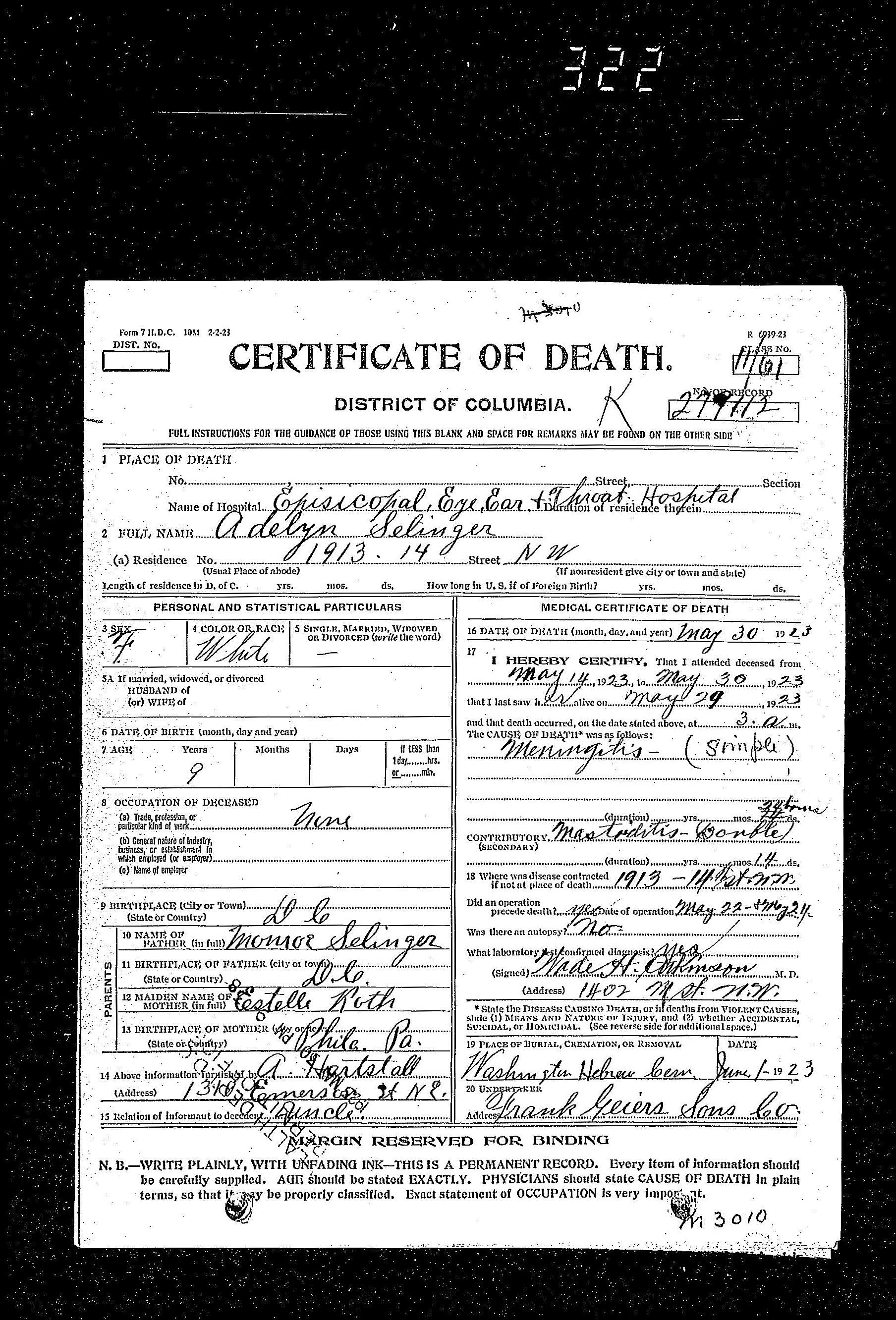
Today I received the death certificate for Adelyn Selinger, the nine year old daughter of Monroe and Estelle Selinger, granddaughter of Frederick Selinger and Rachel Cohen.  I have updated the appropriate post, but will include it here as well.

Adelyn Singer death certificate May 30, 1923

Adelyn Singer death certificate May 30, 1923

Adelyn died of meningitis and mastoiditis, a bacterial infection of the mastoid bone, which is located behind the ear.  According to WebMD, these infections are usually caused by a middle ear infection that has not been successfully treated.  Once again, I am grateful for modern medicine and all that pink amoxycillin my kids took for ear infections.

Notice also that the informant on the death certificate was Aaron Hartstall, Adelyn’s uncle, her father’s brother-in-law.  I assume that her parents. grandparents, and aunt were too distraught to provide the details for the death certificate.

The Cohens: Questions Left to Answer

Now that I have gone through all the lines descending from Hart Levy Cohen and Rachel Jacobs through their children and grandchildren up to current descendants, I have to look back and see what I missed.  What are the big questions and small questions that remain unanswered?  Otherwise, I may leave some things unsolved and accept gaps in my research.  So this blog post is my attempt to outline those unanswered questions as a way to remind myself not to be too self-satisfied with what I have done.

File:Questionmark.svg


Overall, I am quite amazed by how much I was able to find.  It really helped that (1) there were generations in the US going back as far as 1848 because US records are much more accessible to me and (2) that most of my Cohen relatives lived in Pennsylvania, a state that has made many of its records available online.  It also helped that both the Philadelphia Inquirer and the Washington Evening Star covered society happenings like parties, engagements, and weddings because it was through those resources that I was able to find a lot of the married names of the Cohen women.

So what is there left to research?  First and foremost, I would love to be able to find the parents and grandparents and other ancestors of Hart Levy Cohen.  I don’t know that I will ever be able to do this, given how little luck I had at the archives in Amsterdam and also given that surnames were not adopted by Jews until the early 1800s.  But new records are uncovered all the time, so I will not give up hope yet.  Related to that, of course, is finding the ancestors for my great-great-great grandmother Rachel Jacobs.

As for the next generation after Hart and Rachel, the big questions left unanswered relate to Hart and Rachel’s son Moses.  Although I do not have DNA proof that the Moses who married Adeline Himmel was their son, I am confident that he was based on the weight of the circumstantial evidence.  Maybe a descendant of Isadore Baer Cohen will come along, but even without that, I am convinced that this was the right Moses.  Rather, the real unanswered question for me is when and where did Moses meet and marry Adeline Himmel?  When did she come to the United States from Baden?  I have no evidence yet relating to either of these questions.

The remaining questions are not as important to me in terms of the overall story of the family.  They almost all relate to the absence of death records.  Among those for whom I have no death records are: Joseph Cohen’s daughter Fannie; Abraham’s son Arthur; Harry Selinger, Augusta and Julius Selinger’s son; Rachel Cohen Selinger; Aaron Hartstall; Monroe Selinger; JM Cohen’s son Arthur; Hart DC’s son Jacob Cohen; Estelle Spater Cole, Sol’s wife; Gary Cole, Jacob G. Cole’s son; and Lewis Cohen, son of Reuben Cohen, Sr.

Then there are a number of people for whom I have a date of death from an index, but no death certificate, like Simon L.B Cohen—why did he die so young?  There are also many for whom I have a marriage record from an index, but no marriage certificate.  I am not sure how important it is to see the actual document where I am otherwise certain of the identity of the individuals who married or died, but eventually if those documents become available, I should obtain them.

And there are also a few cases where I could not determine whether a person had any children—such as Violet Cohen, daughter of Reuben Cohen, Sr.; Jonas Cohen, Jr.; and Morton and Kathryn Selinger. I was unable to find out whether Caroline Hamberg married Robert Daley or anyone else. Finally, there are the two children of Sallie R. Cohen who were orphaned after Sallie and her husband Ellis Abrams died; I do not know what happened to them.

Listing all those names makes me feel like there is so much more to do, but I also have to remind myself of how much I’ve already done.  I realize that this is perhaps not the most exciting blog post for those reading it, but it will serve as an important post for me to return to when I need to remember the questions that I still have to answer.

My next post will be more reflective; I need to step back, look at the story of my Cohen relatives, and think about what I have learned about them and about history and about myself by doing this research.

A wonderful email from a Selinger cousin

Yesterday I received an email from Ann Griffin Selinger, whose husband was John Reynolds Selinger, Sr.  John Selinger was the son of Maurice Selinger, Sr., and the grandson of Julius Selinger and Augusta Cohen, the oldest child of Moses, Jr, and Henrietta Cohen.  I was so touched by the stories that Ann had to share about her husband John and his family that I asked her whether I could quote from her email on the blog and share these memories of her family.  She graciously gave me permission to do so, and so here they are with just a few side comments by me.  Ann’s language is italicized, whereas mine is in regular font.

My husband, was John Reynolds Selinger, 1933-2007, born in Washington, DC as was his brother, Maurice Arthur Selinger, Jr.  For a time we lived in Chevy Chase, Maryland and one day we received a visit from Eliot Selinger who apparently lived around the corner from us with his family. We had exchanged mail a few times without meeting, but never looked into whether we were related.  He told us at the time that he thought we were related and that his father and John’s grandfather were brothers – Frederick and Julius.  We had been under the obviously false impression that Julius had no siblings.  

Interestingly, Mildred Selinger, Dr. Maurice A. Selinger’s wife, having lived in Washington her whole adult life, lived with us just before she died in 1981.  I see that Eliot died a year later.  He must have knocked on our door just before he died.


The comment about Julius and Frederick Selinger being brothers  was a very important revelation for me because it confirmed what I had suspected.  I assume that Alfred Selinger was also, given that he lived with Julius and traveled with Julius and Augusta before marrying Augusta’s sister Fanny.

Here is a bittersweet story about Eleanor Selinger, the daughter of Julius and Augusta  who married Henry Abbot and moved to England as discussed here.

Years earlier, John and I were in England and he said he would like to see if he could find his Aunt Eleanor.  
We were successful and made arrangements to have tea with her in her apartment just before we left London.  When she opened the door, John was astonished to notice she looked exactly like his Dad who had died over ten years before.  We had a lovely visit.  She shared that she loved to play cards, but had a hard time see the cards now.  So the next day we had some “jumbo faced” cards sent over to her from Harrod’s – a fun idea.  She called us to say she was so flustered when the delivery man said he was from Harrod’s that she had a hard time buzzing him in.  Very sweet – a wonderful connection that pleased my husband very much.  We flew home the next day and then received word a day later that she had died.
 

Ann also told me more about the accomplishments of Dr. Maurice Selinger, her husband’s father, who along with his brother Jerome were probably the first doctors in the extended Cohen family, as discussed here.

Dr. Maurice Selinger, my father-in-law, who died before John and I were married, served in World War I and World War II as a physician.  He was a very dedicated doctor who gave his all to medicine and his patients.  He was very highly regarded in the Washington medical world.  He was instrumental in bringing three hospitals together (Garfield, Emergency, and one other – can’t remember) to form the new Washington Hospital Center. I remember just after we were married going to a diabetes center in Maryland that was dedicated to Dr. Selinger.  I know nothing more about that.  Amazing what you don’t pay attention to when you are young.
They lived in a lovely home on California Street, NW – should look up the number, that is now the Embassy of Venezuela.

Washington Hospital Center   "WHCExtGarden". Via Wikipedia - http://en.wikipedia.org/wiki/File:WHCExtGarden.JPG#mediaviewer/File:WHCExtGarden.JPG

Washington Hospital Center
“WHCExtGarden”. Via Wikipedia – http://en.wikipedia.org/wiki/File:WHCExtGarden.JPG#mediaviewer/File:WHCExtGarden.JPG

And finally this story about John’s father Maurice and his grandfather Julius and the Selinger’s jewelry store on F Street discussed here.

John always told the story that when his father was a young boy he would earn his allowance by winding the clocks on F Street that were installed by his grandfather, Julius.  They also put the clock in the tower of the old National Savings and Trust Building downtown.  Years later, John became a banker and worked as a Vice President in that same bank.


National Savings and Trust Building, Washington, DC "15th, New York, & Pennsylvania Avenue, NW" by AgnosticPreachersKid - Own work. Licensed under Creative Commons Attribution-Share Alike 3.0 via Wikimedia Commons - http://commons.wikimedia.org/wiki/File:15th,_New_York,_%26_Pennsylvania_Avenue,_NW.jpg#mediaviewer/File:15th,_New_York,_%26_Pennsylvania_Avenue,_NW.jpg

National Savings and Trust Building, Washington, DC
“15th, New York, & Pennsylvania Avenue, NW” by AgnosticPreachersKid – Own work. Licensed under Creative Commons Attribution-Share Alike 3.0 via Wikimedia Commons – http://commons.wikimedia.org/wiki/File:15th,_New_York,_%26_Pennsylvania_Avenue,_NW.jpg#mediaviewer/File:15th,_New_York,_%26_Pennsylvania_Avenue,_NW.jpg


There is nothing better than hearing and preserving these family stories.  They take the facts and inferences I make from government documents come to life and fill them with the love and respect that these people deserve.  Thank you so much, Ann, for sharing these with me.  I can’t tell you how much it meant to me.


Rachel Cohen and her Descendants: The Last Chapter of the Family of Hart Levy Cohen

Finally, I come to the youngest child of Moses Sr. and Adeline Cohen, Rachel Cohen.  This line is the last line of the extended family tree of Hart Levy and Rachel Jacobs Cohen, my great-great-great grandparents.  Although there are still quite a few unanswered questions in the Cohen saga, once I write about Rachel and her family, I will have covered all of the known descendants of Hart and Rachel, including both the Philadelphia branch and the Washington branch of the family, as best I can at this point.  I will reflect on the DC branch and on the overall Cohen family once I’ve written about Rachel.

On January 10, 1880, Rachel, as I wrote earlier, had married Frederick Selinger of Hurben, Germany, the presumed older brother or cousin of both Julius and Alfred Selinger, who married Rachel’s nieces Augusta and Fannie Cohen, respectively.

When I last wrote about Frederick and Rachel, I thought that they had had only two children, Fannie and Monroe, but further research uncovered that there may have been another child.  There is a record for a male child born in Washington, DC, on January 9, 1881, whose parents were “Rachael Cohen” and “Frederick Sclinger”—clearly an erroneous transcription of Selinger.  There is also a death record for a three year old child named Reuben Sellinger dated December 12, 1884, so born in 1881.  Although I do not have the death certificate for that child, it certainly seems that this must have been the same child born to Rachel and Frederick in 1881.  I am going to see if I can obtain the death certificate to learn what happened to Reuben.  Rachel and Frederick did have two children who lived to adulthood, Fannie, born in 1882, and Monroe, born in 1888.

As I researched more deeply into the story of Rachel and Frederick, I also learned that Frederick was not always in the furniture business.  In fact, in 1880 when he married Rachel, he was listed only as working as a clerk in a store.  The 1882 DC city directory gives more insight into what type of store; it says he was a pawnbroker.  The 1886 directory adds to this by listing Rachel Selinger as a pawnbroker and Frederick as a clerk.

Tradition symbol of pawnbrokers--three connect...

Tradition symbol of pawnbrokers–three connected balls (Photo credit: Wikipedia)

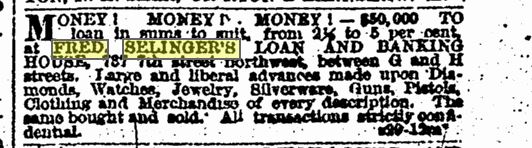
Remembering that Moses and Adeline Cohen had at times been pawnbrokers, I now think that Frederick was working in what was at first his mother-in-law’s business (Adeline was living with the newly married couple in 1880) and then his wife’s business.  The 1887 and 1888 directories also list Rachel as the pawnbroker and Frederick merely as a clerk.  Rachel is one of the very rare married women I have found as working outside the home and listed separately in a directory.  This is even more surprising given that Rachel had a child born in 1882 and in 1888 and had lost a child in 1884.  On the other hand, I found numerous ads which refer only to Fred Selinger as the pawnbroker.

F selinger ad march 17 1882 f selinger ad may 14 1884

In 1890, Rachel, Frederick and their family were living in Sioux City where her brothers JM and Hart as well as her mother were then living.  The 1890 Sioux City directory lists Rachel as the owner of a general store and Frederick as the manager.  The 1892 directory does not list Rachel, but lists Frederick as working as clerk for JM Cohen, his brother-in-law.  The 1892 directory lists JM as a broker, meaning a real estate broker, which is the occupation given for him on the 1890 Sioux City directory.

By 1895, Rachel, Frederick and family had returned to Washington, DC, residing at 1424 7th Street, NW.  Frederick was working in a clothing store, according to the 1895 directory.  The 1896 directory has Rachel listed as in the clothing business with Frederick as a clerk.  By 1898 they had moved to 1502 7th Street, NW.  Again, Rachel is listed as in the clothing business, and Frederick is listed as a clerk.  On the 1900 census, Rachel is listed without an occupation, and Frederick is listed as a merchant of dry goods.  The 1900 directory included him in the category of second hand clothing.  There was no listing of Rachel in the 1900 directory or in the 1901 directory, which still had Frederick at 1502 7th Street in the clothing business.

Then in 1904 there is a change; Frederick is now in the furniture business, but in 1905 Rachel appears again in the directory in the clothing business; Frederick has no occupation listed.  They were still at the same address.  In 1906, 1907, and 1908, Rachel’s business is given as men’s furnishings, and Frederick is listed as a clerk. Their two children Monroe and Fannie are also listed as clerks in some of these years.

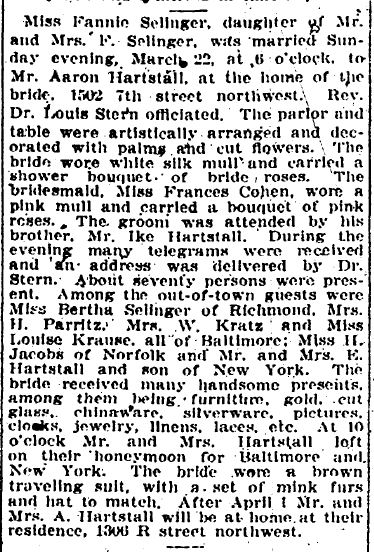
Rachel and Frederick’s daughter, Fannie, married Aaron Hartstall in 1908; Aaron was a paperhanger. The Washington Star of March 24, 1908, included this report of the wedding

:Fannie Selinger Hartstall marriage evening star March 24, 1908 p 7


Although the erratic pattern of Rachel and Frederick’s occupations made me wonder about their financial situation, it would appear from this description of the wedding that they were able to afford a fairly expensive celebration for their daughter’s wedding.

Aaron and Fannie Hartstall’s son Morton was born on January 20, 1910. Aaron continued to work as a paperhanger throughout the next three decades.

In 1910, Frederick and Rachel were now living at 317 R Street NW, and Frederick was in the furniture business, according to the census.  No occupation was given for Rachel.  Their son, Monroe, who was 22 in 1910 and living at home, was working as a clerk for the government at that time. Given his occupation as described on later documents, I believe he was a clerk for the US Post Office, or what we now call the US Postal Service.

Frederick was no longer selling furniture in 1911; he was now, like his son, a clerk at the post office.  Both were living at 317 R Street; I assume Rachel was as well.

In 1912, Monroe married Estelle Roth of Philadelphia in Philadelphia, as described in this article from the Washington Evening Star:


Monroe Selinger wedding 1912 evening Star July 10, p. 7

The young couple settled in Washington, DC.  In the 1912 DC directory, Monroe is listed as a post office clerk and residing at 126 Randolph Place; his father is listed at the same address in the directory.  Rachel’s name is not included in the listing.

In 1914, Monroe and Estelle had their first child Adelyn, and they were now living at 31, 1430 NW.  Three years later their son Eliot was born.    Monroe was working for the US Post Office, according to both his World War I draft registration and the 1917 directory, which gave his address now as 1440 Oak Street NW, the same address listed for his father Frederick. Monroe was also at the same address and still working for the post office on the 1920 census. By 1921, however, he had left the post office and was working as a clerk for the O’Donnell Drug Company.

I could not find Rachel on the 1920 census, but I did find Frederick living as a lodger at 103 Maryland Avenue right near the US Capitol and working as a clerk at the post office like his son Monroe. Rachel was not listed with him.  In the DC directory for 1921, Frederick was listed as a clerk for Sanitary Grocery and residing at 103 Maryland Avenue.  I do not know where Rachel was or for how long she and Frederick may have been living apart.

Then tragedy struck on May 30, 1923, when Monroe and Estelle’s daughter Adelyn died; she would have been only nine years old.  I have ordered her death certificate and will report on her cause of death once I receive it.

UPDATE:  I’ve received Adelyn’s death certificate.  She died of meningitis and mastoiditis, a bacterial infection of the mastoid bone, which is located behind the ear.  According to WebMD, these infections are usually caused by a middle ear infection that has not been successfully treated.  Once again, I am grateful for modern medicine and all that pink amoxycillin my kids took for ear infections.

Notice also that the informant on the death certificate was Aaron Hartstall, Adelyn’s uncle, her father’s brother-in-law.  I assume that her parents. grandparents and aunt were too distraught to provide the details for the death certificate.

Adelyn Singer death certificate May 30, 1923

Adelyn Singer death certificate May 30, 1923

Rachel still did not appear in the 1924 directory, but Frederick did.  He is listed as “bg mgr” of Washington Salvage Company and residing at 1913 14th Street NW. I also could not find Monroe in the 1924 directory.

By 1928, Monroe had switched to the clothing business, and he, Estelle, and Eliot, their remaining child, had moved to 1465 Girard Avenue, NW.

Frederick is listed in that 1928 directory as the manager of North Capital Salvage, residing at 733 North Capital Street, NE, and then, in 1929, both he and Rachel are listed at that address, both working for North Capital Service.  On the 1930 census, they are still at that address, and Frederick is listed as the owner of a general store.  Perhaps North Capital Service was the name of that store.   Rachel and Frederick were by this time almost eighty years old, living together and working together.  Three years later in 1933, they were listed as living together at 1438 Meridian Place, NW, without any occupations.

That was the last listing I found that includes Rachel.  In 1934, only Frederick is listed at that address, and on the 1940 census, Frederick is listed as a widower, living with his daughter Fannie Hartstall.  Although I have not yet found a death record, Rachel must have died in either 1933 or 1934.  She would have been 79 or 80 years old.

The extended family lost two other members during that time period.  Aaron Hartstall, Fannie Selinger Hartstall’s husband, who had continued to work as a paperhanger throughout this entire time, is listed on the 1938 Washington Directory, but must have died between 1938 and 1940 because Fannie is listed as a widow on the 1940 census.  Aaron would have been about 62 years old. Fannie continued to live at 705 Allison Street, NW, where she and Aaron had lived for many years; in 1940, her father Frederick and her brother-in-law Isaac Hartstall were living with her.

Fannie not only lost her husband and her mother during this period; she also lost her brother Monroe. Although Monroe is listed on the 1935 DC directory as a salesman for the People’s Army and Navy, he does not appear again.  I cannot find him or his family on the 1940 census.   The November 29, 1949 announcement in the Washington Post of his son Eliot’s engagement referred to him as “the late Monroe Selinger,” so Monroe must have passed away sometime between 1935 and 1949.  In fact, Eliot and his mother Estelle were living in Hartford, Connecticut, in 1945, after Eliot completed his military service, so it would appear that his father had died before 1945. He would have been only 61 years old. Unfortunately I have not been able to find a death record or an obituary for Monroe Selinger or Aaron Hartstall or Rachel Cohen Selinger.

Meanwhile, the next generation had become adults by 1930.  Morton Hartstall, the son of Aaron and Fannie, was twenty years old in 1930, and he was then working as a clerk for the Chamber of Commerce.  In 1931 he was still working for the Chamber of Commerce and still living at home.  By 1934 he had changed jobs again and was working as a salesman for a store called Goldenberg’s.  He was still at home on Allison Street with his parents.

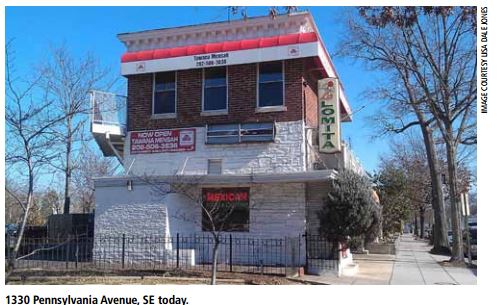
On January 20, 1935, Morton married Kathryn Wolfe, who was also a Washington, DC, native. I was fortunate to find an article online about this history of a building located at 1330 Pennsylvania Avenue, NE, that mentions Morton and his livelihood and the restaurant he owned at that location for a few years in the 1930s:

Morton Hartstall 1330 Penn Ave restaurant1330 Penn Ave pic

http://chrs.org/wp-content/uploads/2013/04/13-04_CHRSnews-REV2.pdf at page 13

(The article goes on to describe the rest of the history of the building, which is still being used as a restaurant today.)  In 1940 Morton and Kathryn were living with her parents in Washington, DC; Morton was now the owner of a “cleaning shop,” and Kathryn was a stenographer for Social Security.

Morton Hartstall 1940 census

Morton Hartstall 1940 census

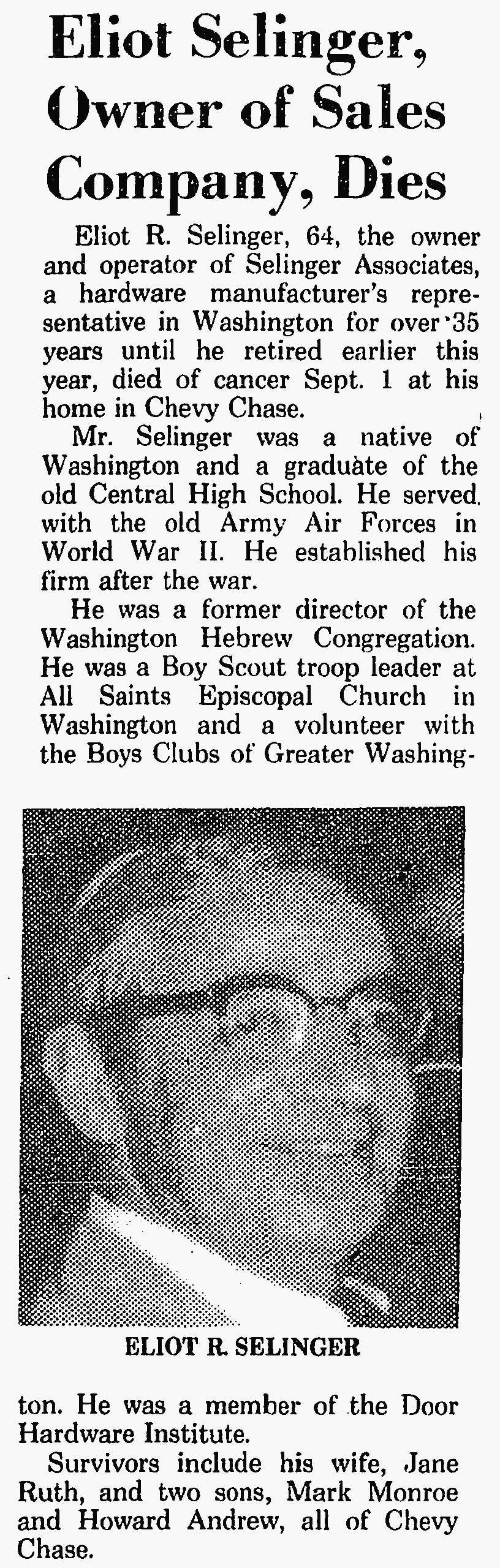
As for Eliot Selinger, the only other grandchild of Rachel and Frederick Selinger to survive to adulthood, one record says that he served in the US military from March 16, 1943, until May 7, 1943.  I wonder whether his release in May was related to his father’s death.  As stated above, he and his mother were living in Hartford in 1945, but returned to Washington in 1946.  He was engaged to Jane Ruth Simon in 1949, and they had two children.  Eliot was the owner of Selinger Associates, a hardware manufacturer’s representative, a business he established in Washington after the war.

I do not know when Frederick Selinger died.  He was 83 in 1940, the date of the last record I have for him.  His daughter Fannie died in January, 1967.  She was 84.  Both lived far longer than their spouses.

Unfortunately, Fannie’s son Morton did not live as long as his mother did, but rather like his father, he died before he turned seventy. He died in April, 1977, when he was 67 years old.  His wife Kathryn was still alive in 1995; I have no later record for her.  I do not know whether Morton and Kathryn had any children.

Morton’s first cousin Eliot also was not blessed with longevity, but sadly like his father Monroe, he died before he turned 70.   He died on September 1, 1982, and was only 64 years old.  His wife Jane died June 13, 2008.  They are buried at Washington Hebrew cemetery and were members of Washington Hebrew Congregation.

Eliot Selinger obit 1982


Looking back over the life of Rachel Cohen Selinger and her children, I see a life that seems to have had some ups and downs.  Frederick changed jobs fairly often, they moved fairly often, and they may have even lived separately for some period of time.  They lost a child early in their marriage.  On the other hand, they worked together and lived together for many years, ending up together until Rachel died in 1934.

Their two children who survived to adulthood, Fannie and Monroe, seem to have had more consistent patterns in their lives.  Fannie was married to Aaron for many years, and he worked at the same location as a paperhanger for all of that time.  Their son Morton owned a couple of businesses of his own.

Monroe worked as a postal clerk for several years and then became involved in clothing sales.  He and his wife Estelle lost a young child, as his parents had many years earlier, but their surviving child, Eliot, owned a successful business in Washington for many years and had two children who survive him.

With that, I have now tracked as best I can all of the descendants of Hart Levy Cohen and Rachel Jacobs, my great-great-great grandparents.  It has been quite a journey, and before I move on to my next line, the Seligmans, I need to spend some time looking back and thinking about the bigger picture and the lessons I’ve learned from studying my father’s father’s father’s family.


Hart Cohen of DC: The Rest of the Story

It’s been a week since I last posted anything new about the DC Cohen family.  I had last written about Solomon Monroe Cohen and his family, the son of Moses, Jr., and Henrietta Cohen.  Although I will continue to try and fill the gaps left in the research of the children of Moses, Jr. and Henrietta Cohen, I am now going to move on to the other children of Moses, Sr., and Adeline Cohen, first focusing on their son Hart, who was born in 1851 in Maryland.

It was this Hart (whom I’ve referred to as Hart DC) who had me confused because of the similarities between some of his biographical facts and those of his first cousin, my great-grandfather Emanuel’s brother, Hart Cohen of Philadelphia.  They had the same name, were born the same year, and were both married to women named Henrietta. It was this Hart who led me to the discovery of the DC branch of the Cohen family. Hart and his wife Henrietta Baer had four children: Frances, Munroe, Isadore, and Jacob.   Their son Munroe was killed in an awful accident while working as a brakeman on the railroad in Kingston, New York, in 1903.  Isadore had married Frances David in 1907, so in 1910, Hart and Henrietta had two children living at home, Frances (32) and Jacob (25). Jacob was working as a chauffeur, and Hart was working in a jewelry store. On August 8, 1914, Hart’s wife Henrietta Baer Cohen died; she was only 62.

Isadore and Frances had had a son Monroe born in 1910, presumably named for Isadore’s brother. In 1916, they had another son, Burton.  In 1917, Isadore was working as a department manager for a hotel according to his World War I draft registration.

Isadore Baer Cohen World War I draft registration

Isadore Baer Cohen World War I draft registration

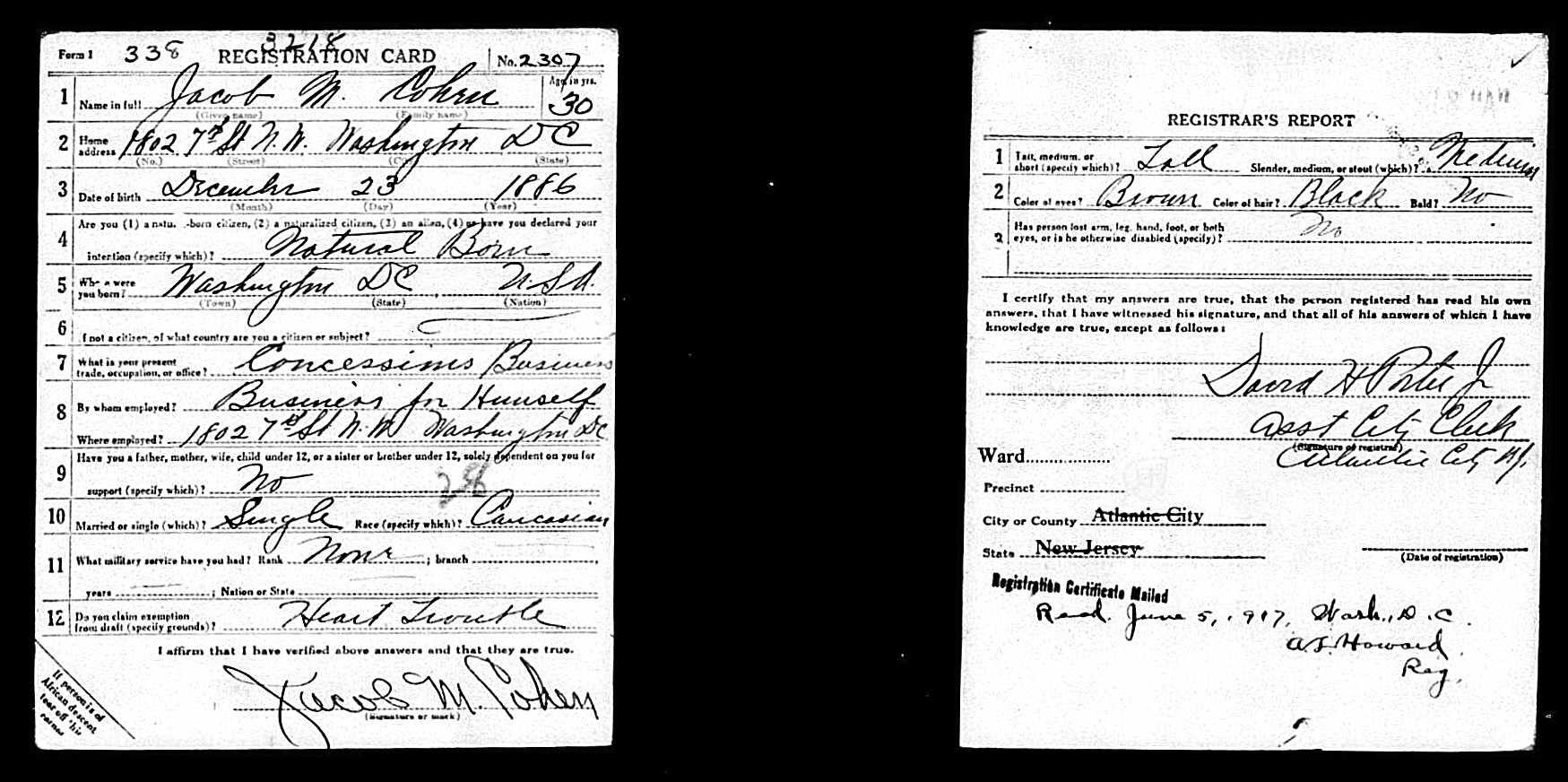
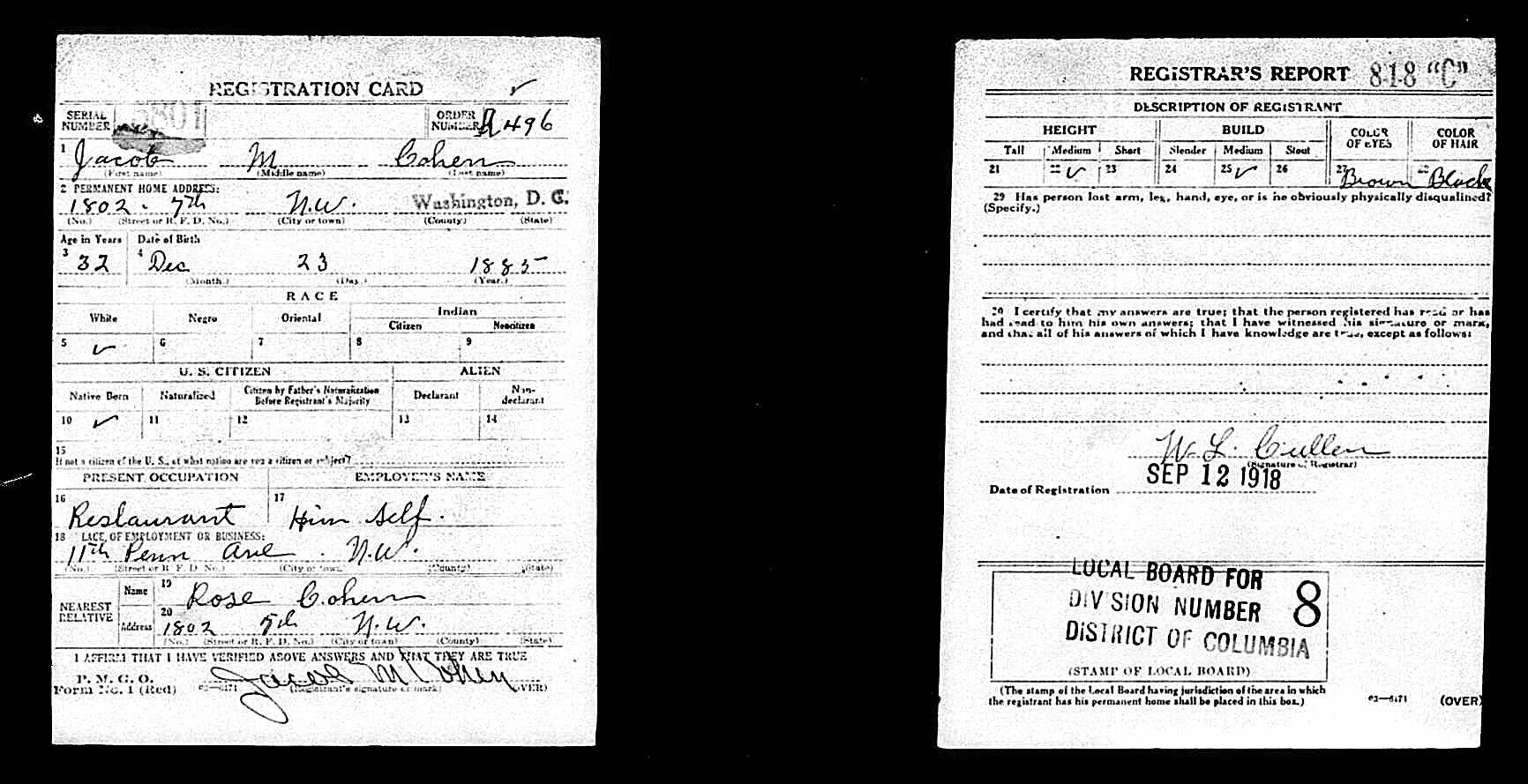
I found two World War I draft registrations for Jacob.  The earlier one, dated June, 1917, listed Jacob’s business as the concessions business and said he suffered from heart trouble.  His marital status was single, and he was living with his father and his sister Frances at 1802 7th Street NW in Washington.  The second one, dated September 1918, had a number of changes:  he was working in the restaurant business and was self-employed, he was married, and there was no mention of heart trouble.

Jacob M. Cohen World War I registration (first)

Jacob M. Cohen World War I registration (first)

Jacob M. Cohen World War I registration (second)

Jacob M. Cohen World War I registration (second)

According to the Philadelphia marriage index, Jacob had married Rose Serge in Philadelphia in 1918.  He was 33, and she was thirty when they married.   In 1918, they were living at 1802 7th Street with Jacob’s father and sister Frances.

In 1920, Hart and his daughter Frances were still living at 1802 7th Street, but Jacob and Rose had moved to their own place in Washington.  Jacob was still in the restaurant business.  Isadore and his family were also still living in Washington, and Isadore was still in the hotel business.

On August 10, 1926, Hart died at the age of 75.  His daughter Frances continued to live in the same residence at 1802 7th Street, now living alone and working as a retail merchant in the dry goods business, a business she had been working in since at least 1915.  She would continue to work in that business until her death in February, 1941, at age 62, the same age her mother had been when she died.  Frances’ death notice said that she had died suddenly. She was buried at Washington Hebrew Cemetery.  There is no mention of her brother Jacob in her death notice, only mention of her brother Isadore.  Frances never married or had children.

Ancestry.com. Historical Newspapers, Birth, Marriage, & Death Announcements, 1851-2003 [database on-line]. Provo, UT, USA: Ancestry.com Operations Inc, 2006.

Ancestry.com. Historical Newspapers, Birth, Marriage, & Death Announcements, 1851-2003 [database on-line]. Provo, UT, USA: Ancestry.com Operations Inc, 2006.

In 1930 Jacob and Rose were living in Philadelphia, where Jacob was the manager of a restaurant.  I could not find Jacob or Rose on the 1940 census, nor can I find a death record for Jacob, but given that he was not listed in his sister’s obituary and that he had had a history of heart trouble, my guess is that he had died before the 1940 census. He would have been younger than 55 years old when he died.  He and Rose did not have any children.

Although I could not find Rose on the 1940 census, she was still alive in 1949, as I found her on a ship manifest traveling to Hawaii. According to the ship manifest Rose was living at 41 Emory Street in Jersey City, New Jersey, in 1949. Rose had lived in Jersey City as a child, and 41 Emory Street is where her mother had been living in 1925 and where two of her sisters were living in 1930. Obviously, Rose had returned to her hometown after Jacob died.  She was still alive in 1952 when her sister Minnie died, but after that I cannot find any mention or record for her.  I tried contacting the funeral home that had handled other deaths in the Serge family, Wien and Wien in New Jersey, but sadly their records for the Jersey City funeral home were burned in a fire fifteen years ago.  I also called the cemetery where Minnie is buried to see if they have any records for Jacob or Rose Cohen, but have not heard back from them.
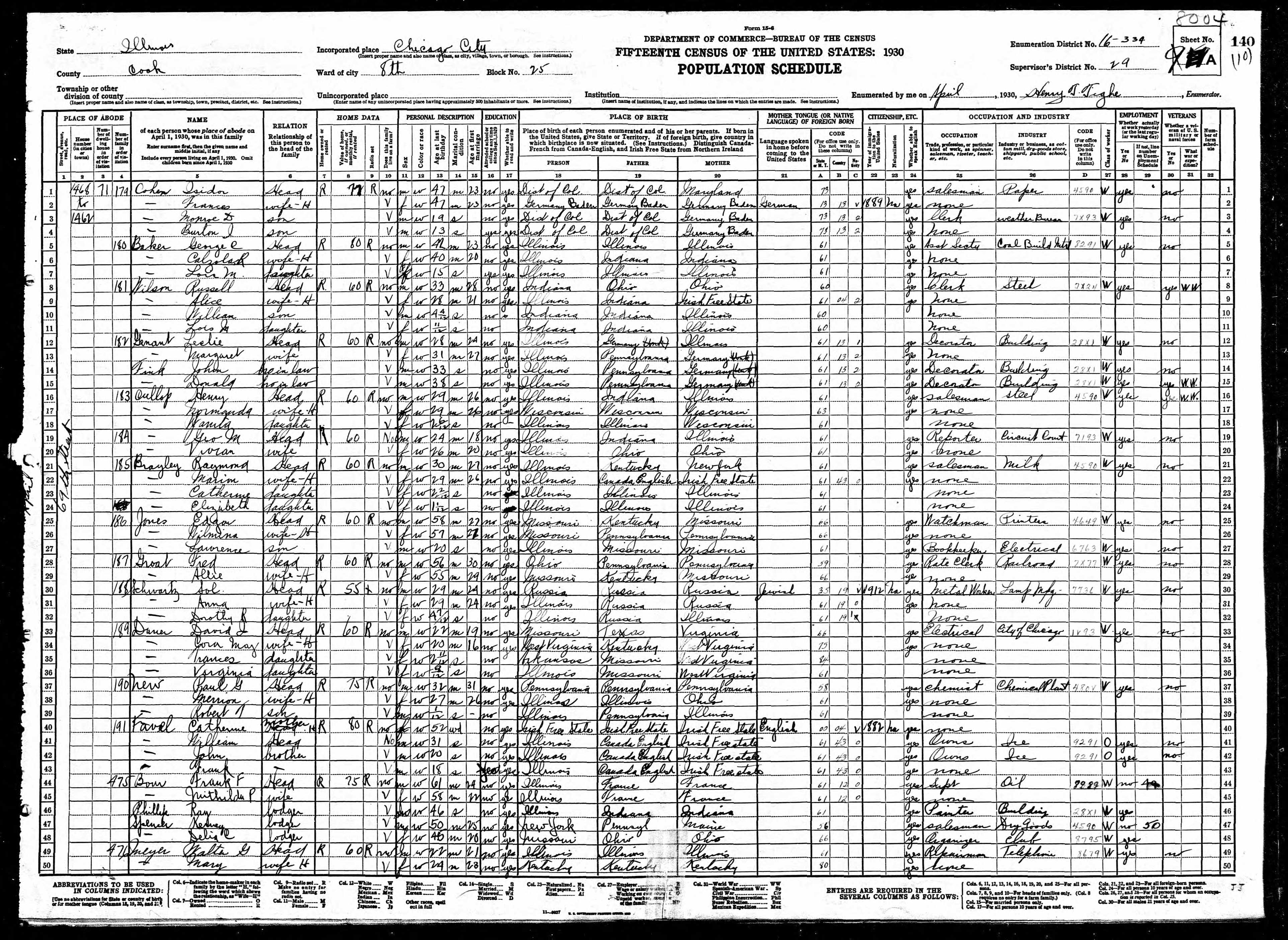
As for Isadore, in 1930, he and his family were living in Chicago, where Isadore was working as a salesman in the paper industry.  His son Monroe was a clerk in the weather bureau there.  I wonder what prompted the move to Chicago and the career change for Isadore.

Isadore Baer Cohen and family 1930 census

Isadore Baer Cohen and family 1930 census

In 1940, the family was still living together in Chicago, and Isadore was a book salesman. Both Monroe and Burton had changed their surname from Cohen to Coulter, though their parents were still using Cohen.   Although Monroe was now 30 and Burton 24, there is no occupation listed for either of them on the 1940 census.

Isadore Baer Cohen and family 1940 census

Isadore Baer Cohen and family 1940 census

By 1942, Isadore had retired, according to his draft registration.  He gave Burton’s name as his contact person, which I found interesting since his wife Frances was still alive at that time.

Isadore Baer Cohen World War II draft registration

Isadore Baer Cohen World War II draft registration

Sometime between 1942 and 1949, Isadore and Frances moved to California, where Frances died in 1949.  Isadore died in 1958 when he was 77 years old.  He lived a much longer life than any of his siblings or his mother.  His father Hart was the only other one to live past seventy.

According to his obituary in the Chicago Tribune of September 8, 1996, Isadore’s son Monroe Coulter had enlisted in the Army Air Corps before World War II and was an electrical engineer.  He married Fannie Simon on November 25, 1942, in Chicago and appears to have settled in Illinois. They had two children.   Monroe worked on the Air Force missile program and retired from the military in 1970 with the rank of lieutenant colonel.  He was living in Itasca, Illinois, when he died on September 6, 1996, and is buried at Shalom Memorial Park in Arlington Heights, Illinois.

His brother Burton moved to California in the 1950s.  He was married and had two children.  In 1952 he was working as the deputy county assessor in Alhambra, California, according to a directory for that city. Then, according to Sacramento city directories,  from at least 1959 through 1966 he lived in Sacramento and worked as an appraiser for the California Department of Equalization, a state agency responsible for administering the state tax laws.   Burton died in Los Angeles, California in 1978.  He was only 61 years old and thus was another family member who did not live to see seventy.

The family line of Hart and Henrietta Cohen thus is somewhat limited.  Of the four children of Hart and Henrietta, only Isadore lived past seventy, and only Isadore had children. Frances never married, and Jacob married, but did not have children. Munroe, Jacob, and Frances all died at relatively young ages, as did their mother Henrietta.  Although Munroe died in an accident, I do not know what led to the early deaths of Henrietta, Frances and Jacob, but will see if I can find out.

I am hoping that one of Isadore’s descendants will be able to provide a Y-DNA test to provide evidence of the genetic link between Moses Cohen, Sr., and my great-great-grandfather Jacob Cohen, but I am having some trouble making contact with them.  They are the only direct male genetic descendants of Moses Cohen, Sr. and thus my only option for finding that genetic connection between Moses and Jacob.  Maybe one of them will find this blog post and find me.