Another mystery! Looking for theories from the rest of you

After learning the name of Frieda Brotman’s husband, I was curious as to what happened to Harry Coopersmith after losing his young wife and infant son. Also, I wondered how long they had been married and whether or not Max had been born prematurely. I looked up Harry Coopersmith in the index of NYC marriages and found two for whom no bride was listed. I ordered both certificates, hoping one would be for the marriage of Harry Coopersmith and Frieda Brotman. They arrived yesterday, and imagine my confusion when BOTH certificates were for Harry and Frieda.

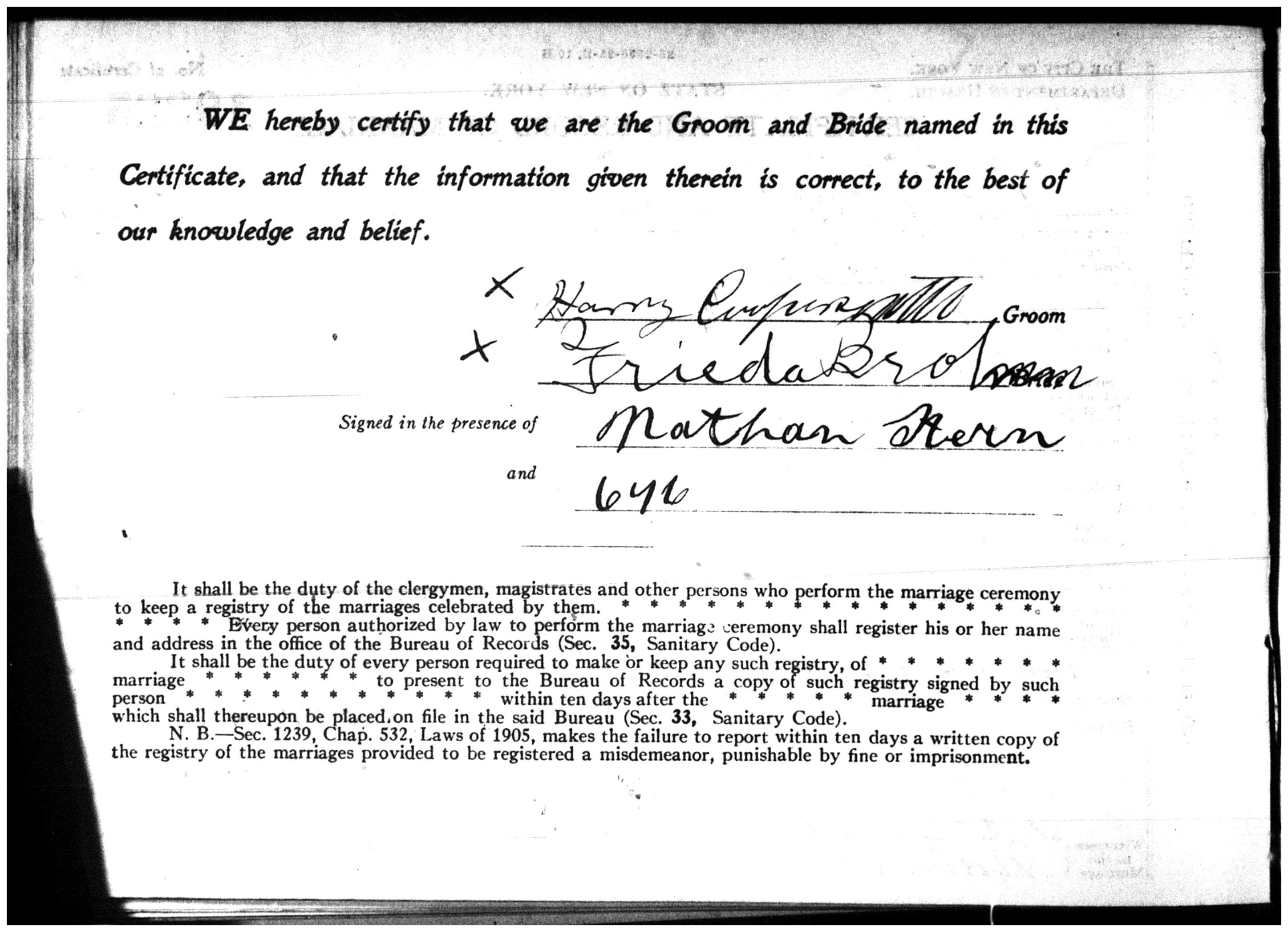
The first one is dated May 28, 1923. The marriage ceremony took place at City Hall in NYC, and the officiant was the Assistant City Clerk. It has Frieda’s home address wrong—it was 646 E. 6th Street, not 446 E. 6th Street. It was witnessed by L.B. Waterman and Nathan Stern and signed by Nathan Stern. The front of the form seems to have been filled out by someone in the clerk’s office, not Frieda, Harry or Mr. Stern, since their signatures all are in very different handwriting than that on the front. Also, Frieda would have known her own address. But this is certainly our Frieda—parents’ names are Joseph and Bessie Brotman. [Notice also that her age is wrong; in 1923 she was 26, not 20. Perhaps she lied about her age because Harry was younger than she was?]

ImageImage

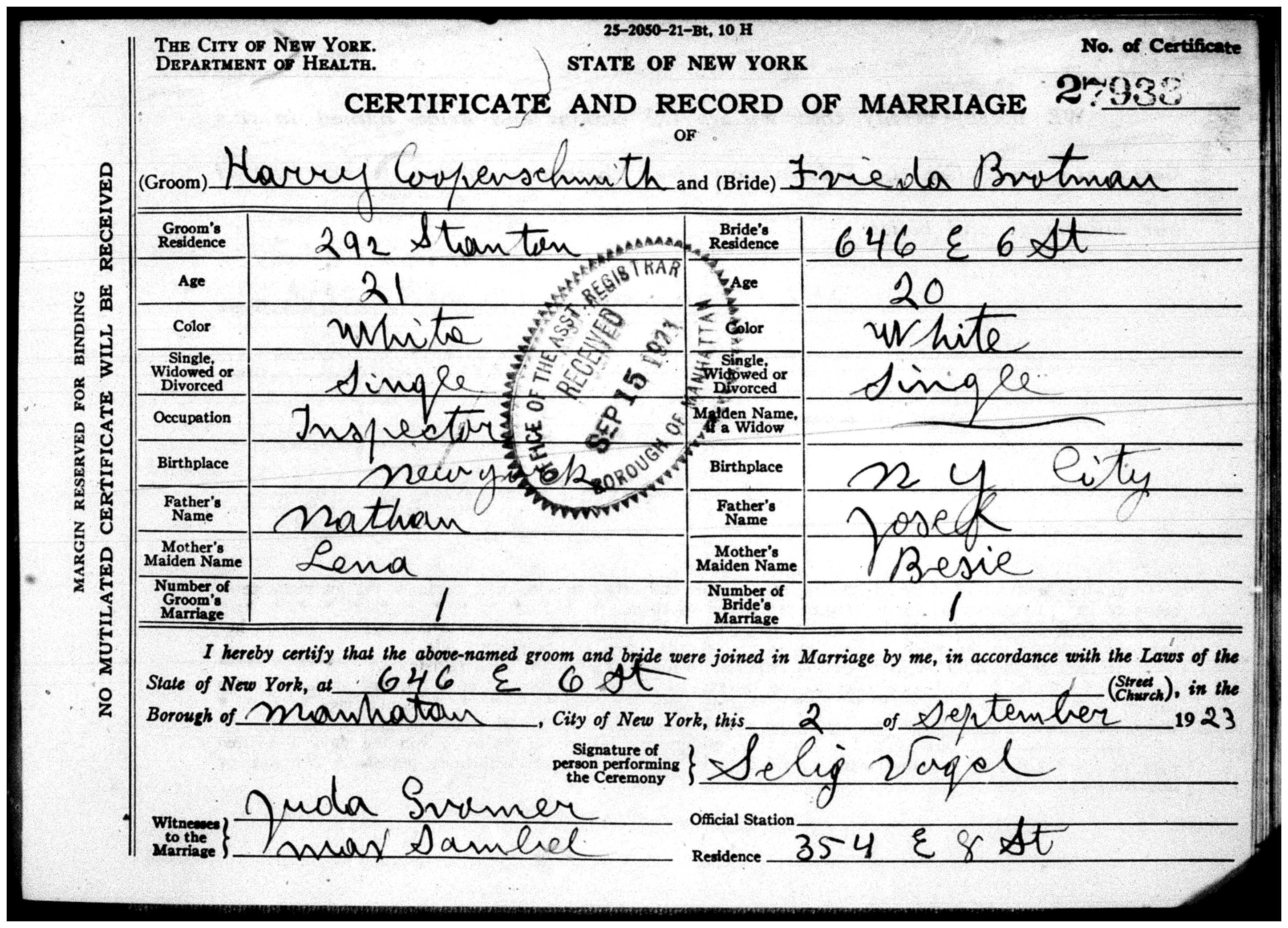
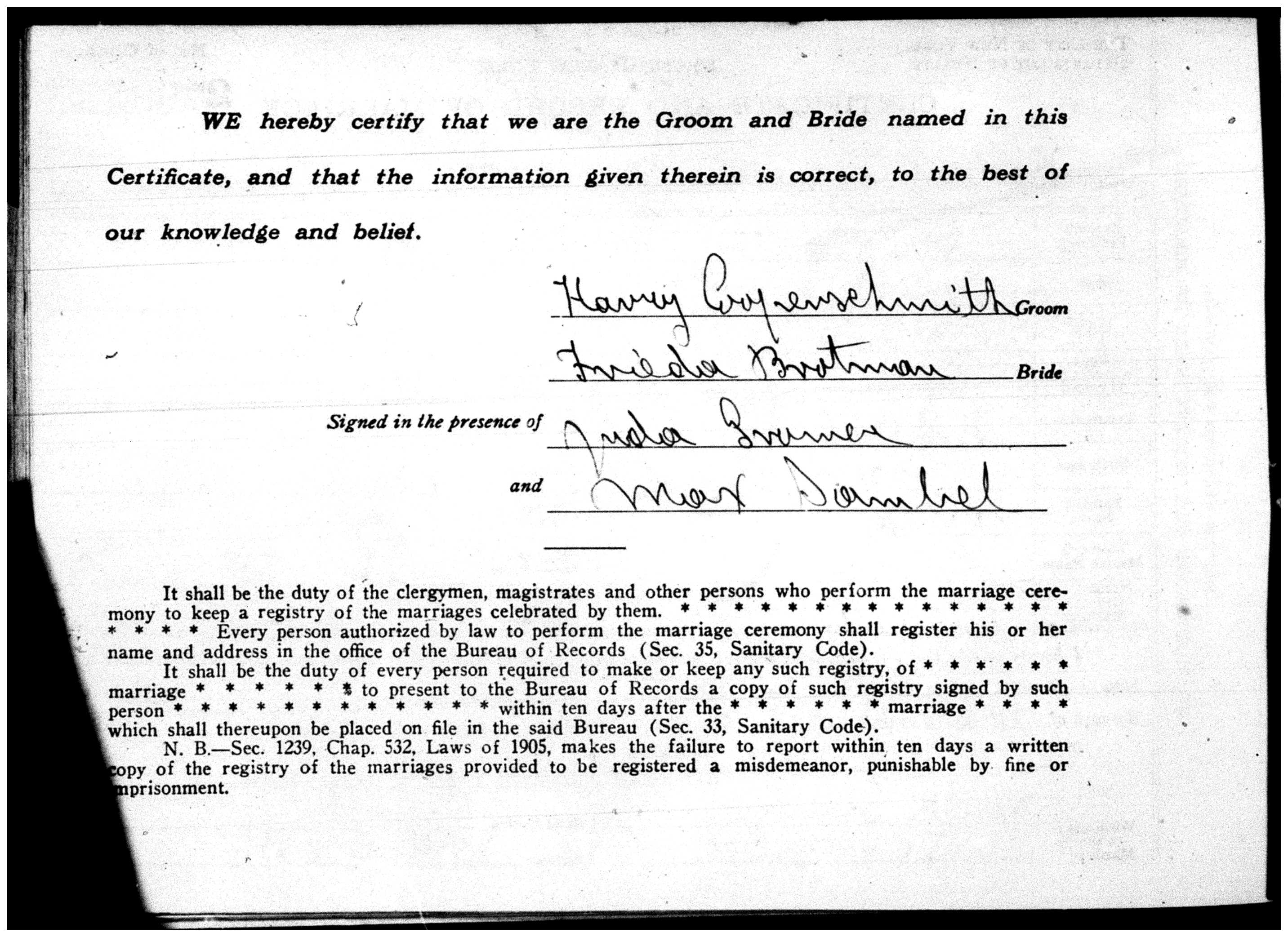
The second one is dated September 2, 1923, a little over three months later. This one appears to have been filled out by someone else, not the clerk. It now has Frieda’s correct address (but not her correct age), but Bessie is spelled incorrectly. I can’t tell whether the handwriting matches any of the signatures on the back (I guess I need the FBI, Bruce!), but what’s odd is that all those signatures seem to match, as if one person signed for Harry, Frieda and the witnesses Max Sambel and Juda Kramer (?). This time the ceremony took place at Bessie and Philip’s apartment at 646 E. 6th Street, and the officiant was Selig Vogel. There is only one Selig Vogel in the 1930 US Census, and he was a rabbi. So obviously this was a religious ceremony, presumably meant to “validate” the earlier civil ceremony.
ImageImage

So…why did they get married twice? Was the first one a secret marriage? Why did they decide to have a religious ceremony the second time, and why did they wait three months? If Max was a full term baby, Frieda would have been about a month pregnant by September 2, 1923 —would she have even known she was pregnant that early back then before EPT? If so, were they then ready to “go public” and have a public ceremony? If Max was born prematurely, which was one possible cause of his death, then maybe Frieda wasn’t even pregnant yet. And who filled out and signed the forms? And who are Max Sambel and Juda Kramer (if that’s what it says)?

I would love to hear the speculations of the rest of you. Leave your thoughts in the comments space below. Meanwhile, I will go see what else I can learn about what happened to Harry and who those other witnesses might have been.
Mt Zion and Mt Hebron

[This is the second part of my post about the weekend in New York. If you haven’t read the post about the Lower East Side, that is Part One. This is Part Two.]

Before I write about my trip to Mt Zion and Mt Hebron cemeteries, let me tell you that I have never been someone who understood why people go to cemeteries, and it always seemed a little creepy to me. I don’t believe in an afterlife, and it seemed to me that you could remember those who had died without standing over the place where their bodies were buried.

I initially saw a cemetery trip this time as a way of doing more research. Then when I realized that Joseph was not buried near any of his children or his wife, I felt badly. It was likely no one had been there for a hundred years. Did that matter? Joseph didn’t know, so why did I care? I am not sure, but somehow I felt compelled to pay him honor. In fact, once I received the photos of the headstone and footstone from Charlie Katz, I no longer needed to go for research. I was going for some emotional reason that was mysterious even to me. The trip to Mt Hebron, which is only ten minutes away from Mt Zion, then seemed like an obvious addition to the trip to Mt Zion.

So off we went on Sunday morning, first to Mt Zion. It is one of the oldest Jewish cemeteries in New York City, and the graves are very close together with almost no open land left. I knew from Charlie Katz that it would be hard to find Joseph’s gravesite. The stones are so close together that it is very difficult to walk between and around them, and without Charlie’s directions, we might never have found it. But then suddenly we spotted it.

Image

Image

I stood there, not really knowing what to do or to think. I thought of his life, thanked him silently for bringing his family here, tried to imagine what he looked like. Did he have red hair? No idea. Then I left on the headstone one of the beach rocks I had collected the prior weekend. I had decided to bring a piece of something I loved to leave at the graves, and the beach is the place that always makes me the happiest. I left feeling that I had at least done something to honor his memory.

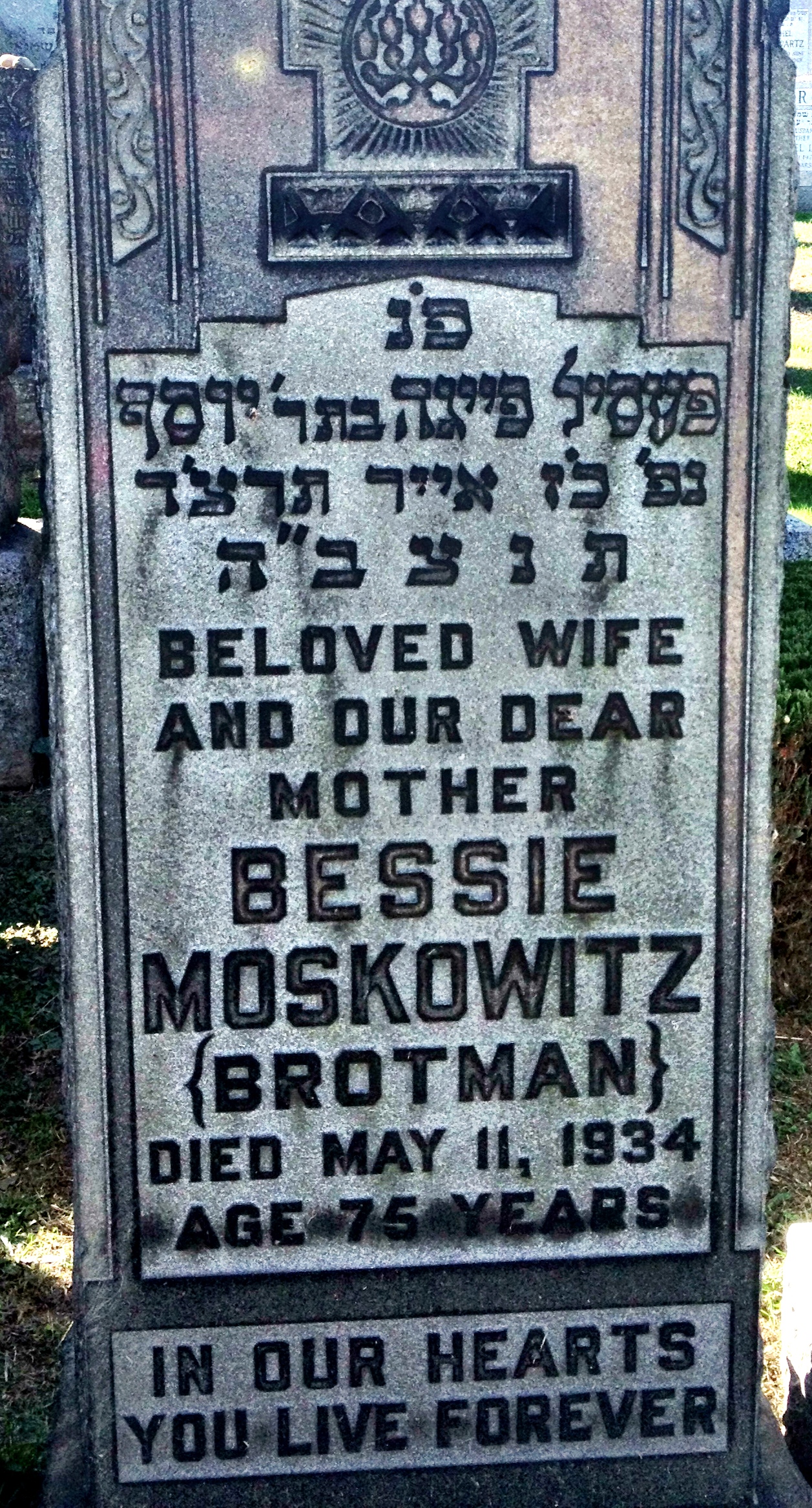
Then we went on to Mt Hebron, a much larger and much less crowded cemetery. The section where Bessie is buried is across the road from the section where my grandparents and Sam are buried. [What I didn’t know then is that Frieda is also buried there, but that’s a story for another post.] I saw Philip’s headstone right away, but did not realize that Bessie’s was right behind it, as you can see in the photo below.

Image

It took some counting and looking, but finally Harvey spotted it. I felt the same way standing at Bessie’s grave—grateful and wistful. I found myself drawn to her name—both in Hebrew and in English—and rubbed my hand over the name Bessie, saying, “That’s my name.” I also was very touched to see that the Brotman name was included on her headstone, not just Moskowitz.

Image

I left one of my beach rocks there as well and then walked across the street to the other section.

In that section I first saw Sam Brotman’s headstone. I never met Sam, and I really felt badly about that, given that he lived until I was 22 years old. I left a beach rock on his stone, saying, “I am sorry I never met you.”

Image

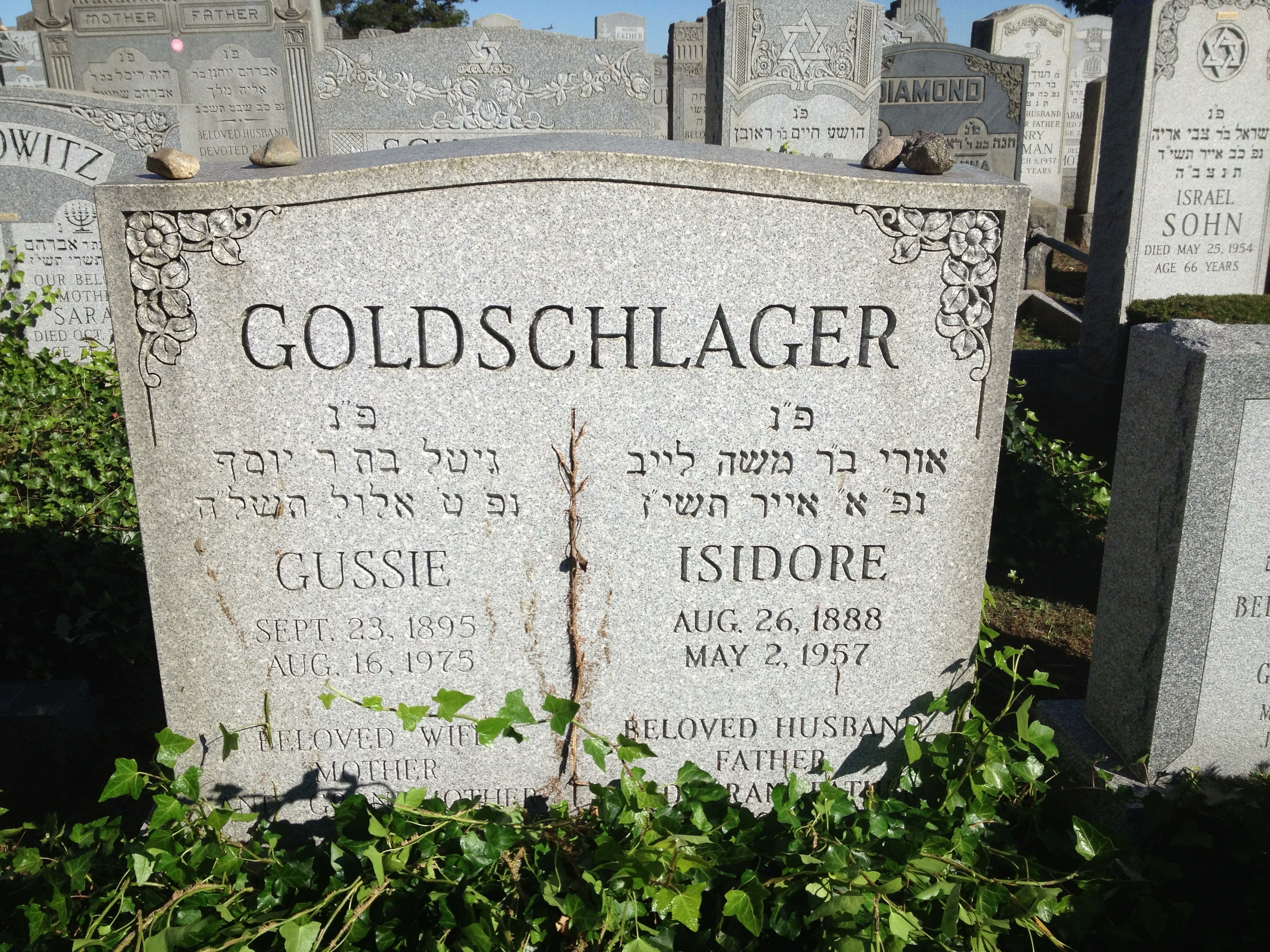
In the row behind Sam’s grave I found my grandparents’ grave. The headstone was covered with ivy, which looked pretty but made reading the inscriptions impossible. I gently tore away the ivy so I could see the stones.

Image

My grandfather died when I was almost five, so I have only the vaguest memories of him, but have heard lots of stories about him—how funny he was, how smart he was (he knew several languages), and how opinionated. He walked across Romania to escape oppression and poverty. I wish I had had a chance to know him better. There was a rock left on his headstone when we arrived. Who could have been there? I don’t think it could have been anyone recently, but perhaps it had been there for many years. I placed mine next to it and rubbed his name.

Image

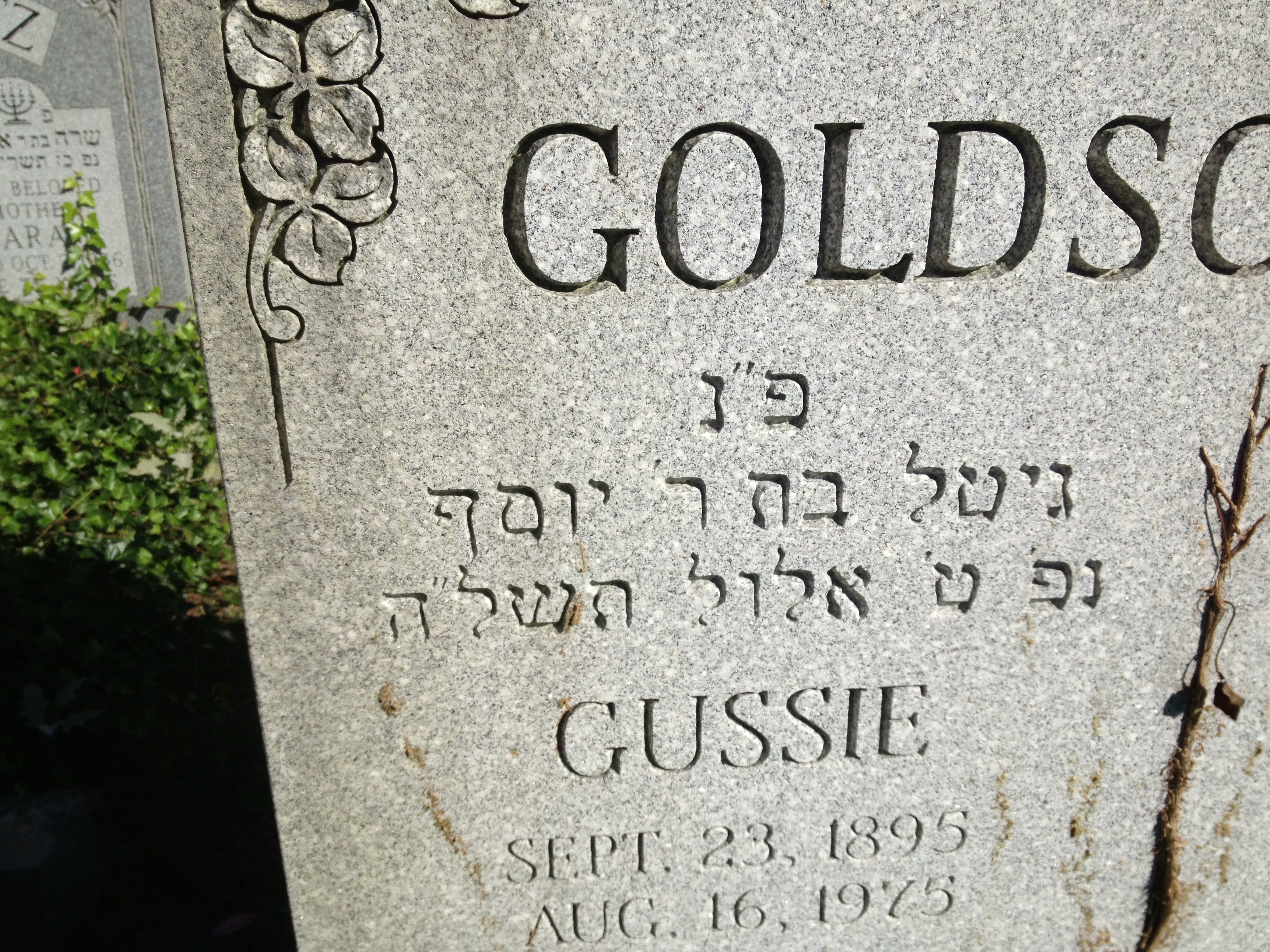
Seeing my grandmother’s headstone was the most difficult for me. She lived until I was 23, and when I was a little girl I loved her very much. She was fun and loving with her grandchildren, despite having had a difficult and often sad life. I have thought of her so many times while doing this research and learning what her life was like, but standing there, thinking of her, I suddenly was overcome with emotion and found myself sobbing, thinking of her and her life and the memories I have of her. As I did with Bessie and Isadore, I found myself rubbing my hand over her name, Gussie, feeling some unexpected emotion in doing so. I left my beach rock, specially selected for her, and wished I had asked her more questions while I could have.

Image
Apparently, I was wrong. Going to the cemetery can bring you closer to those who are gone.

WHY

I wrote about how I started doing this research and what resources—human and otherwise—I’ve used to do it.  But I’ve given a lot of thought also to WHY.  Why am I doing this?  Why spend all this time, energy, money, etc. doing this?  What is it for?

Part of it is the fun and the excitement of hunting down information and then actually finding it.  Part of it is the reward of learning that I am connected to all these other people I never knew—that we shared ancestors and DNA and a history together, even if we’ve never met. And I hope that part of those rewards will be meeting you all in real space, not just cyberspace.

But it is more than that.  Someone involved in genealogy research told me that most people do not get involved with this kind of project until they are in their sixties.  I turned sixty last summer when I first started doing this.  Sadly, by the time we’re sixty, our grandparents are long gone, so our principal sources of information about our ancestors are not around to help.  But why do we get interested in our sixties? Obviously, as we start to face our own mortality, we must yearn for a sense of purpose.   Will anyone remember us in 100 years? That leads to—where did we come from? Who were the people who preceded us that we no longer remember? We’re all part of a long line of family history, and at some point many of us yearn to figure out what that history was.

I never, ever thought about my great-grandparents until I started this project.  I knew I was named for Bessie, my great-grandmother, but I never wondered what she was like, what was her life like, why did my parents choose to name me for someone who died when my mother wasn’t yet four years old.  I still don’t know the answers to all those questions, but I know more than I did a year ago.  She was a brave woman who married a man with at least two children from a prior marriage, both of whom were young boys in 1881 when she married him.  She had at least five children of her own with him, and probably others who died very young.  She left everything she knew to come with her young children to America, and then she lost her husband not long after doing so.  She picked herself up, remarried and helped raise more children.  She lost a leg to diabetes.  I know she loved animals because the one clear memory my mother has of her was that she played with kittens in her grandmother’s bathroom as a very young child.

And Joseph?  I have learned to admire him as well.  He came to the US before Bessie, establishing himself as a coal dealer.  He worked very hard at back breaking work to support his family and died just four months after his youngest child Sam was born.  From his footstone inscription, we know that his children and wife loved him and appreciated the hard work he did to bring them to the US and support them when they got here.

So what does all that mean to me? It means I came from people who were strong, brave, hard-working and dedicated to their family—all traits I admire and aspire to myself.  They obviously raised children who adapted well to America and made successes of themselves.  Those children, our grandparents, raised Americans, our parents, who moved to the suburbs, owned businesses, became professionals.  And then there is us—the fourth generation.  We are spread all over the US, we are involved in all different types of careers, we are the American dream.  Wouldn’t our great-grandparents who were raised in a shtetl and escaped poverty and anti-Semitism be amazed at who we are today?

So why? Because we need to know how we got here, why our lives are what they are.  We need to be grateful for those who left Europe, avoided the pogroms and Hitler, and gave us all the opportunity to live in freedom and to pursue our own dreams.

How This Started

I’ve been asked what got me started on doing this research.  I’d like to claim some life-changing event or spiritual moment got me started, but to be honest, it was a television program, Who Do You Think You Are.  That program showed celebrities researching and learning about their ancestors, and as I saw how moved these people were learning about an ancestor they’d never met, I decided that I wanted to learn more myself. 

I started by joining ancestry.com and made a lot of progress with my paternal side, but very little on my maternal side.  I hit a wall and put it all aside, figuring I’d never find more.  Then this past summer I received an email from someone who’d seen my ancestry tree and thought we might be related through my maternal grandfather, Isadore Goldschlager.  My interest was sparked again, and that contact gave me a contact in Romania who was able to find documents about my grandparents and great-grandparents, including the name of my great-great-grandparents, names my mother had not known.  The fact that my great-great-grandfather was named Ira, the same name as my brother, even though my mother had never known her great-grandfather’s name, gave me the chills and made me realize how rich and rewarding this research and these discoveries could be.

So I turned to the Brotman side, and this time I turned to third parties for help, asking questions on ancestry.com, geni, JewishGen, anywhere I could.  I learned how to find and order birth, marriage and death certificates and other documents, and one of my mentors found the obituary of Renee Haber, which was how I found David Ruzicka. I also found David Haber through ancestry.com, and he helped me find Judy.  Someone on JewishGen/GesherGalicia contacted Bruce Brotman in response to my inquiry, and slowly but surely the pieces came together.  It wasn’t until then that I realized that there was a brother named Max; my mother only remembered the names Hyman, Tilly, Frieda and Sam.  Yet she remembered Renee and Rosalie, thinking they were Hyman’s daughters, so I knew I had the right people.  And then my brother found Abraham’s naturalization papers with Max’s name on them.  When I was able to confirm by the address that it was the same Max, the hunt to verify that Abraham was another brother began.

There have been so many dead ends and false starts, but also so many amazing moments on this journey so far. I have encountered so many kind and generous people—not only the Brotman cousins themselves, but the helpers on the other sites and the man who volunteered to go to Mt Zion cemetery to take pictures of Joseph and Abraham’s headstones (and then also took those of Abraham’s wife and son Joseph on his own, just to be nice). 

I am not done. There are still many unanswered questions. Most importantly, I am still trying to find out where our family came from in Galicia and what their lives were like there. 

So stay tuned…who knows what and who else I will find? 


A simple and righteous man: Our great-grandfather

Aside

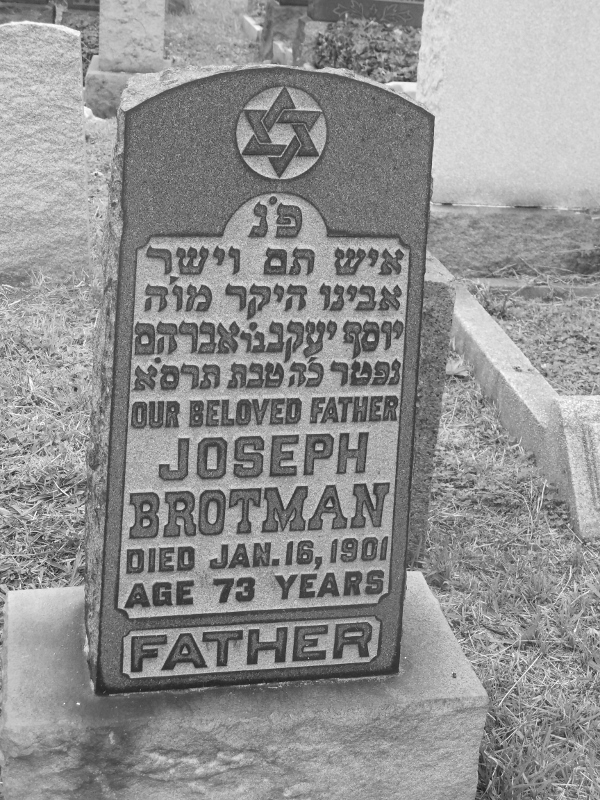
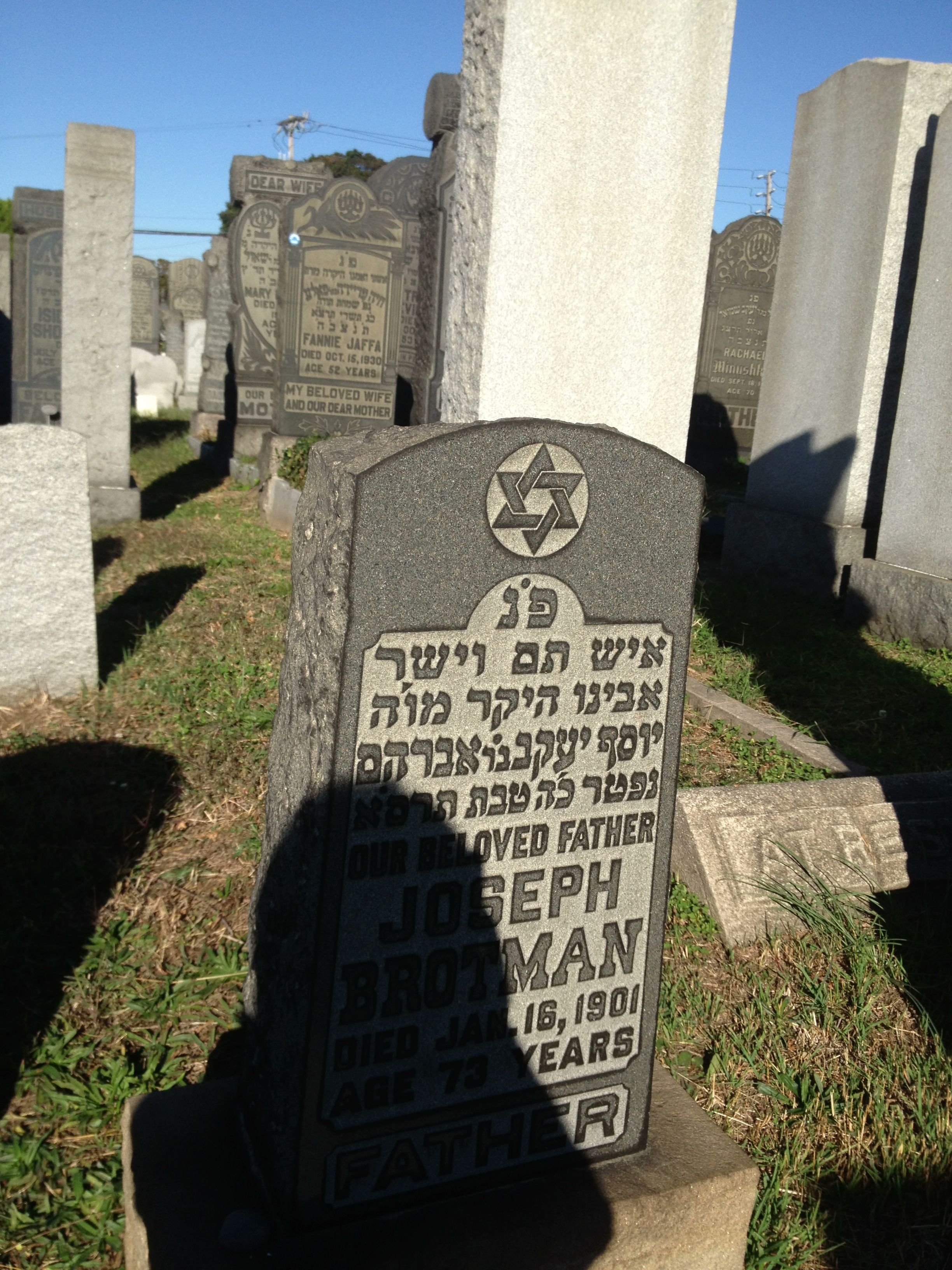
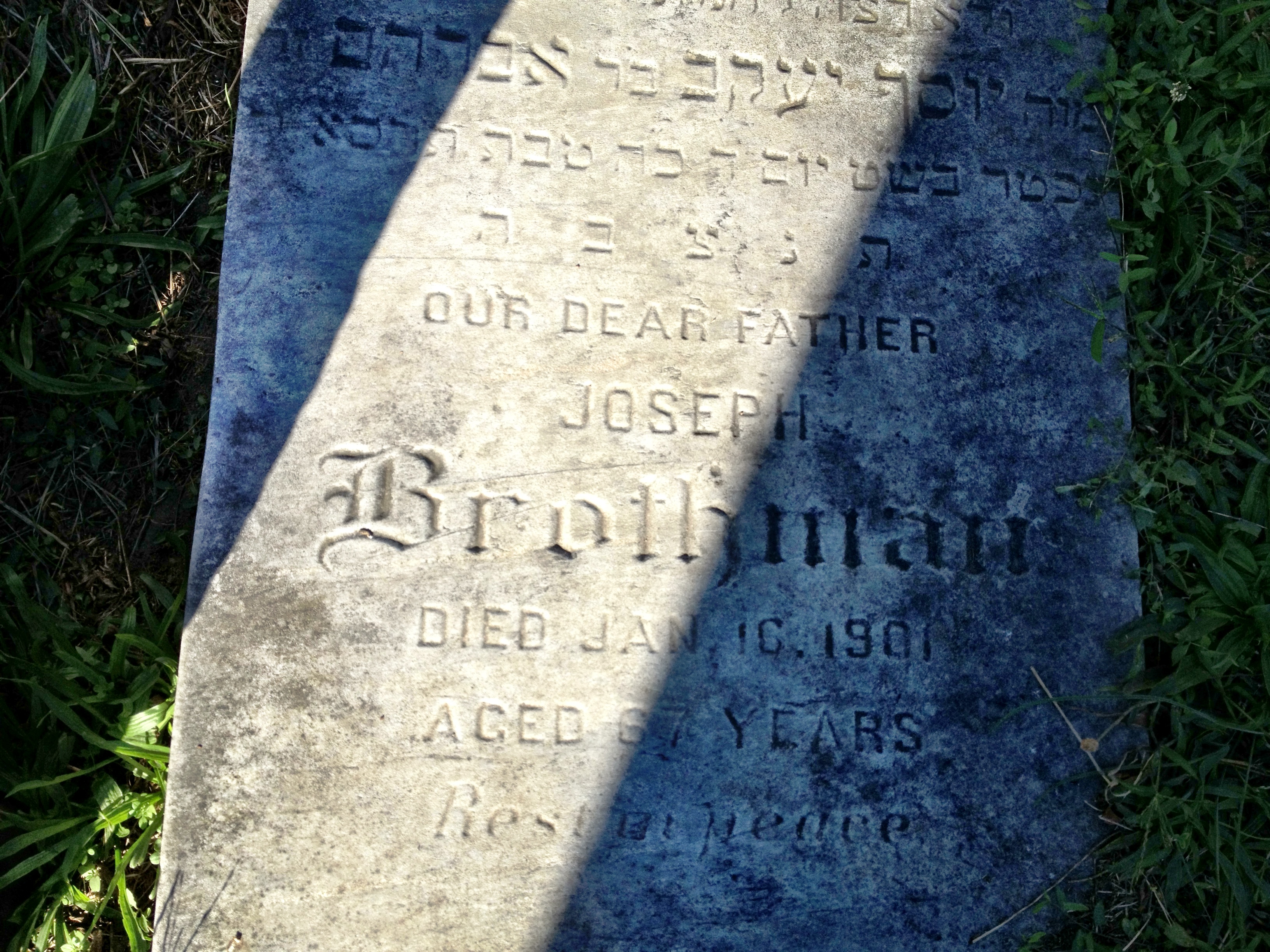
Below are two photos, one of Joseph’s headstone, one of his footstone.  (I did not take these; a very kind stranger volunteered to do so.  I do, however, plan to visit the grave next weekend.)  Although I don’t know much Hebrew, using a translator program I think that the headstone says, “Here lies a Simple and righteous man, Our beloved father Yosef Yaakov ben Avraham, Deceased [Hebrew date].”

The footstone inscription is longer and harder to translate, but I think that it says something like, “Here lies a simple man who woke and toiled doing crushing work in order to support his home, to see and satisfy a dream as a gift to other people,  Yosef Yaakov ben Avraham, Deceased  [Hebrew date].

Like I said, I relied on a translation program, so I am using some poetic license to put this into English.  If there is anyone who has any fluency in Hebrew, please correct me!!

Edited: After consulting with a rabbi and working at this again, I think the footstone says, “Here lies a simple man who toiled doing crushing work to support his home and rejoiced in pleasing others.”

At any rate, I found the inscriptions very touching.  At the very least we know his family saw him as a plain, hardworking man who worked to support his home and provide for their dreams in the new world.

ImageImage