Finding the Ruby Slippers and Getting Back Home to Where It Started: The Brotmans

[for my aunt, Elaine Goldschlager Lehrbaum, 1917-1995]

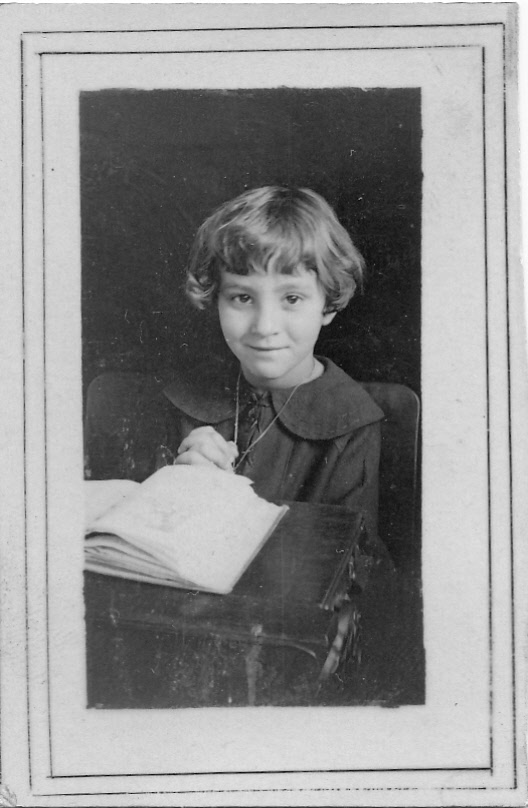
Elaine 1933

Elaine 1933

Many of you who are more recent followers of the Brotmanblog may wonder why the blog is called the Brotmanblog.  In the past several months I have barely mentioned the name Brotman because I have been focused on searching for my grandfather’s family, the Goldschlagers and Rosenzweigs.  But if you go back to the beginning of the blog, you will see that my original search focused on my grandmother’s family, the Brotmans.  That’s where I started my genealogy adventures.  It made sense.  My grandmother Gussie Brotman Goldschlager, my mother’s mother, was the grandparent I knew best, the only grandparent I knew as an adult.  She was the only grandparent my husband ever met, though she died a year before we were married.  It was only natural that I would start my journey trying to learn as much as I could about her and her siblings and her parents.  Once I had found as much as I could find about the Brotmans, I then moved on to my grandfather’s family.  The next chapter will be my father’s family.  But it all started with the Brotmans.

Why do I bring that up now? Because this weekend I will finally get to meet a number of the Brotman cousins I only learned about through doing this research.  There will be over thirty of us gathering in NYC to meet and eat and to visit the Lower East Side, where our grandparents and great-grandparents (and for some, great-great grandparents or parents) lived in New York.  We will walk to 81/85 Ridge Street where the Brotmans first lived, now a public school, once a tenement building, and then we will tour the Tenement Museum to learn more about what life was like for all of them.

If you have not read any of my posts about the Brotmans, I have provided links here and below to some that will capture the essence of their lives.  Even if you once did read them, you may want to re-read them if you are joining us this weekend and want to remember some of the details and themes I wrote about months ago.  The Brotman story is the classic Jewish American immigration story, a story of poverty and heartbreak as a family moved from Galicia to NYC in the late 1880s to a story of assimilation and success as the future generations built businesses, moved beyond the Lower East Side, became professionals, and moved to the suburbs after World War II.  My Brotman great-grandparents were hard-working realists who did what they needed to do to survive.

Although I was able to piece together a fair amount about their lives through census reports and other documents and through some stories my mother remembered about her grandparents, aunts, uncles and mother, at first there was no one else besides my mother and my brother to whom I could turn for information.  My cousins shared stories about their grandparents, but they also knew little about the early lives of their grandparents and had no one left to ask either.  So mostly I relied on documentation to learn what I could.  I was able to put together a fairly complete history of the Brotman family in America and decided to move on to my grandfather’s family.

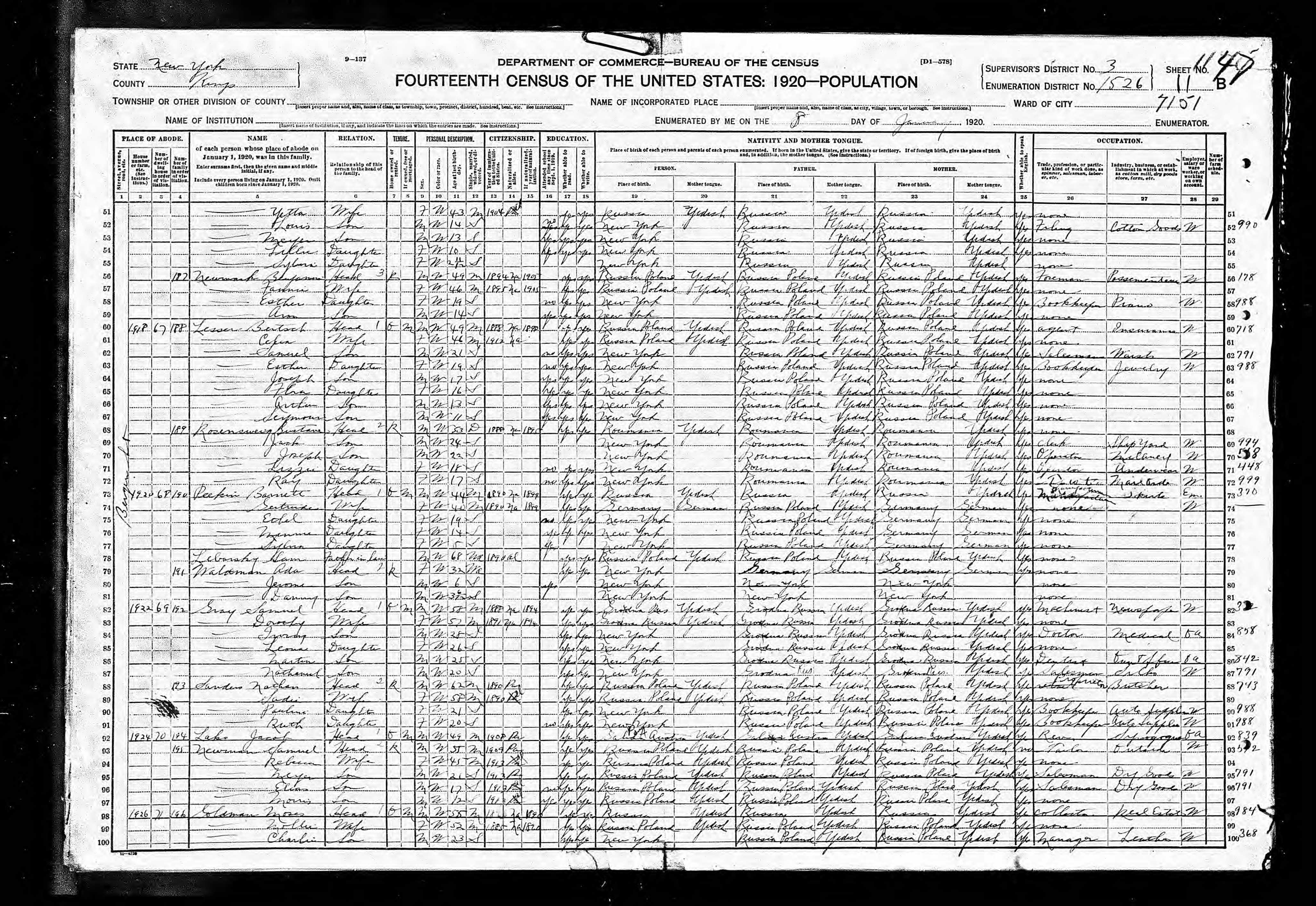
Then, like a gift of manna from heaven, about a month ago my cousin Jody sent me some notes that her husband Joel had taken from a conversation he’d had with my Aunt Elaine years ago about her family.  I’ve referred to one part of those notes before—the story of how my grandmother Gussie met my grandfather Isadore on Pacific Street in Brooklyn, where my grandmother was living and where my grandfather’s cousins the Rosenzweigs were living in 1915.  In the next day or two I’d like to share a few more tidbits from Aunt Elaine, via Joel’s notes.

But before I do, I want to point out that these notes are incredibly accurate.  Although the conversation Joel had with my aunt must have taken place in the early 1980s, my aunt’s memory for details was astonishing.  For example, she refers to the fact that Hyman’s son Emanuel worked for Kislack Realty.  I checked with Manny’s children, and they confirmed that in fact  Manny was President of J.I.Kislak Mortgage Corporation in Newark, NJ., which was a subsidiary of J.I.Kislak, Inc., a large residential and commercial Realtor based in Jersey City.kislack realty Also, my aunt knew that David Brotman worked in the coat industry, that Max was in the cigar business, and that Abraham worked for a deli in Coney Island.

All of these are facts that are backed up by my research.Brotman brothers trades

On the Goldschlager side as well, my aunt’s facts are corroborated by the information I found in my research.  David Goldschlager lived in Scranton, PA, for some time and was in the hat business.  Betty married a man in the dry goods business and moved to Arizona. goldschlager siblings I point out how accurate this information is to demonstrate how remarkable my aunt’s memory was and also so that you will trust the other statements she made and their accuracy when I report on those in upcoming posts.

In some ways finding these notes was frustrating.  If I had found them last summer, much of the time I spent trying to figure out who Max was or whether Abraham was related to us or whether there were any other children would have been unnecessary.  My aunt knew it all, and it is in these notes.

But as Glinda the Good Witch tells Dorothy at the end of The Wizard of Oz (the movie) when she reveals to Dorothy that the ruby slippers could take her home and the Scarecrow asks  why Glinda had not told Dorothy that from the beginning:

Glinda : Because she wouldn’t have believed me. She had to learn it for herself.
Tin Man: What have you learned, Dorothy?
Dorothy: Well, I – I think that it – that it wasn’t enough just to want to see Uncle Henry and Auntie Em. And that it’s that – if I ever go looking for my heart’s desire again, I won’t look any further than my own backyard, because if it isn’t there, I never really lost it to begin with. Is that right?
Glinda: That’s all it is!

And then when the Tin Man, Lion and Scarecrow all say that they should have helped Dorothy figure it out, Glinda replies:

She had to find it out for herself.

And so I did as well.  If I had started with Aunt Elaine’s notes, I never would have worked as hard to learn how to research and find these things for myself.  I would never have felt the amazing sense of satisfaction I’ve gotten from putting pieces together and from finding cousins who could help me put those pieces together.

Having my aunt confirm through these notes what I have learned and what I have done is a real gift. She was someone I adored and miss dearly.  It’s like having her here with me again, hearing her say, “You see, Amy Kugel, I always knew you could do anything you wanted.  And I knew some day you would want to know more about your history, your family.”  But, as Glinda told Dorothy, she knew I had to find it out for myself.
 

Elaine 1926
Elaine 1926

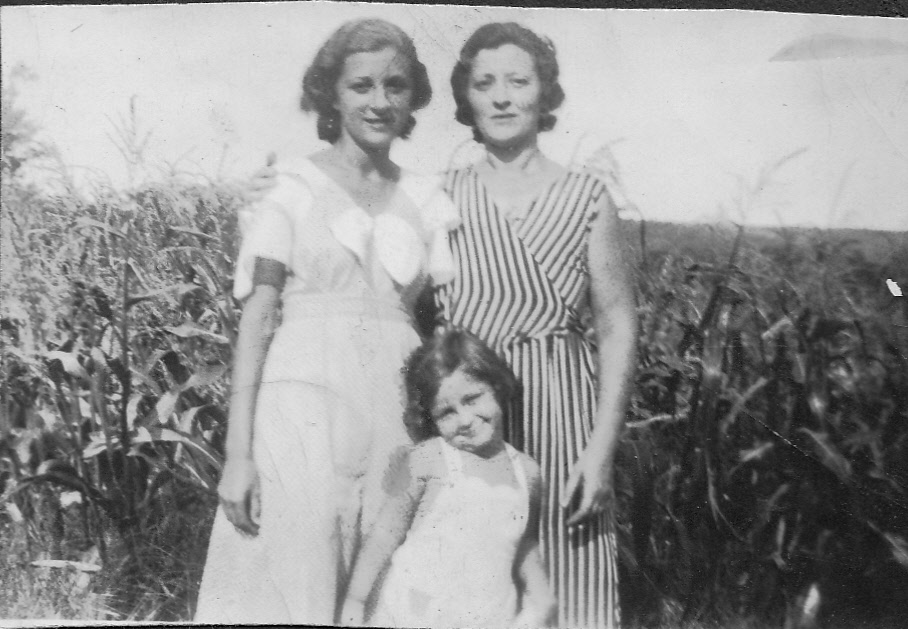
Elaine Gussie Florence 1933

Elaine Gussie Florence 1933

Elaine high school graduation

Elaine high school graduation

Elaine and Phil 1941

Elaine and Phil 1941

Sam with Gussie and Elaine 1945

Sam with Gussie and Elaine 1945

Elaine and Jeff 1949

Elaine and Jeff 1949

Elaine Jeff and Amy 1953

Aunt Elaine with Jeff and me

Phil and Elaine

Phil and Elaine

Enhanced by Zemanta

Turn, Turn, Turn: A New Brotman-Goldschlager-Rosenzweig Has Arrived!

Michael Paul Lammlin

Michael Paul Lammlin

Life does in fact turn, turn, turn.  One day you are sad about someone who passed away, and the next you are rejoicing in the birth of a new baby.  I am delighted to announce the birth of Michael Paul Lammlin, brother of Joshua Lammlin, son of David and Marissa Lammlin. Michael is the grandson of Beth and Steven Robin. Beth is my first cousin.

Michael was born on March 13, 2014, at 5:34 pm, weighing 8 lbs., 1 oz., 19 1/2 inches long.  And he carries on the Brotman tradition of red hair!  (His father David also has red hair, so we cannot take all the credit.)

Michael was named for his great-grandfather, Maurice Goldschlager, my uncle, my mother’s brother.  He joins a number of other cousins named for my uncle, who was adored by us all.

On his maternal side, Michael is the great-grandson of Maurice and Lynn Goldschlager and the great-great-grandson of Isadore Goldschlager and Gussie Brotman.  Going even further back, Michael is the great-great-great grandson of Moritz Goldschlager and Ghitla Rosenzweig Goldschlager and the great- great-great-grandson of Joseph and Bessie Brotman.  He is thus related to all my cousins who are the descendants of David and Esther Rosenzweig, Ira and Beila Goldschlager, Abraham and Yetta Brotman, or Joseph and Gittel Broat Brotman, his great- great-great-great grandparents.

Mazel tov to Marissa, David and Josh, to Beth and Steven, and to all of us! The family continues to grow.

Enhanced by Zemanta

Women are Difficult, Part Two: Rebecca Rosenzweig

I am continuing to search for my grandfather’s first cousins, and I am struggling to find the daughters of Gustave Rosenzweig.  I have tracked Lillian up to 1910 and Sarah up through 1940. My next target was Rebecca, the second oldest daughter.  This is what I have found so far, although I need documentation to confirm some of my conclusions.

Rebecca was born May 27, 1893, in New York (birth certificate on order, but I am quite certain I have found the correct one based on the report on FamilySearch, which includes her parents’ names), and she was living with her family until at least 1910, according to the 1900, 1905,and 1910 census reports.  That is all that I can be certain about at this point.  She is not living with her family in 1915 or thereafter.

Gustave Rosenzweig and family 1900 census

Gustave Rosenzweig and family 1900 census

Gustave Rosenzweig family on the 1905 NYS census

Gustave Rosenzweig family on the 1905 NYS census

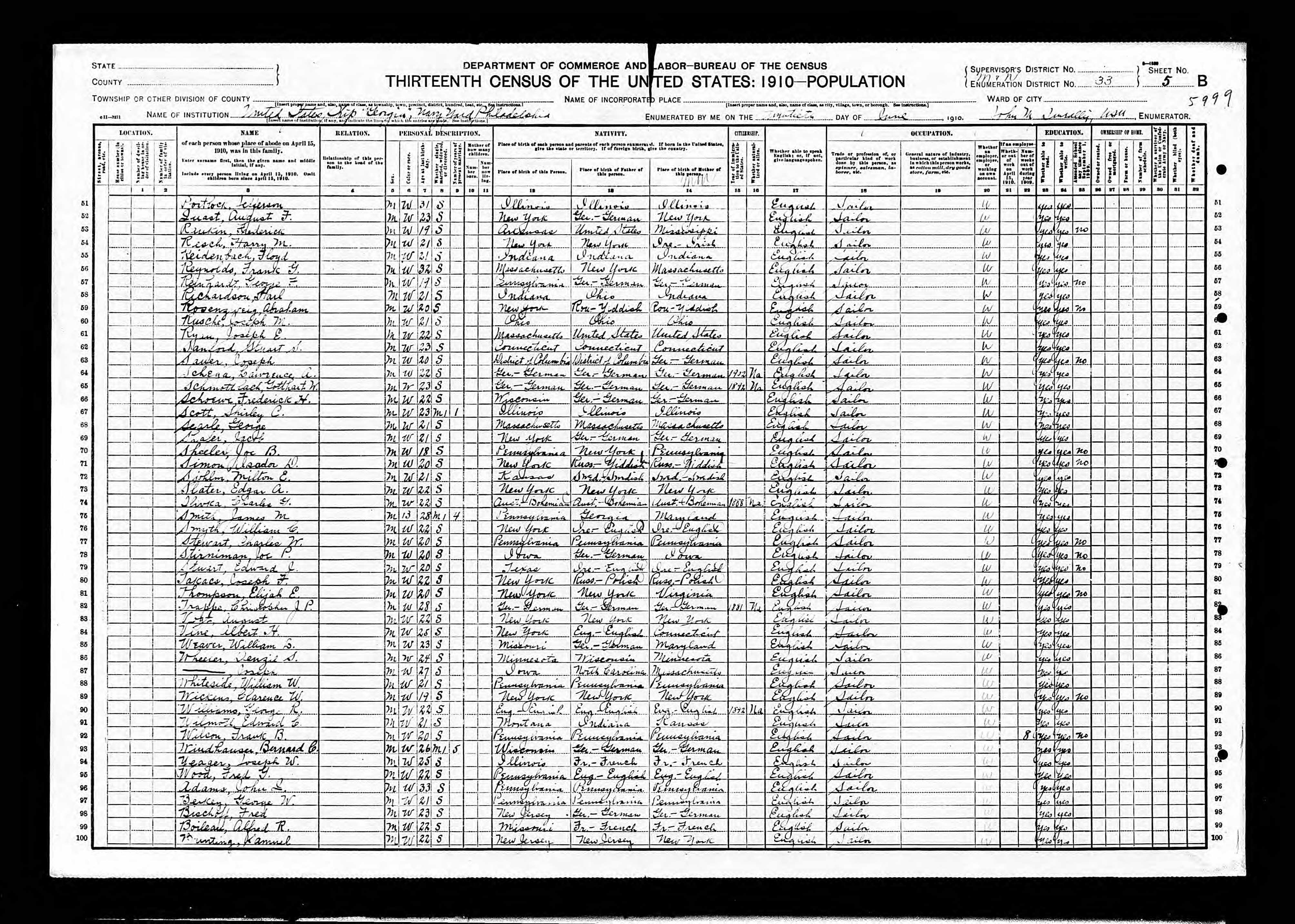
Gustave Rosenzweig and family 1910 census

Gustave Rosenzweig and family 1910 census

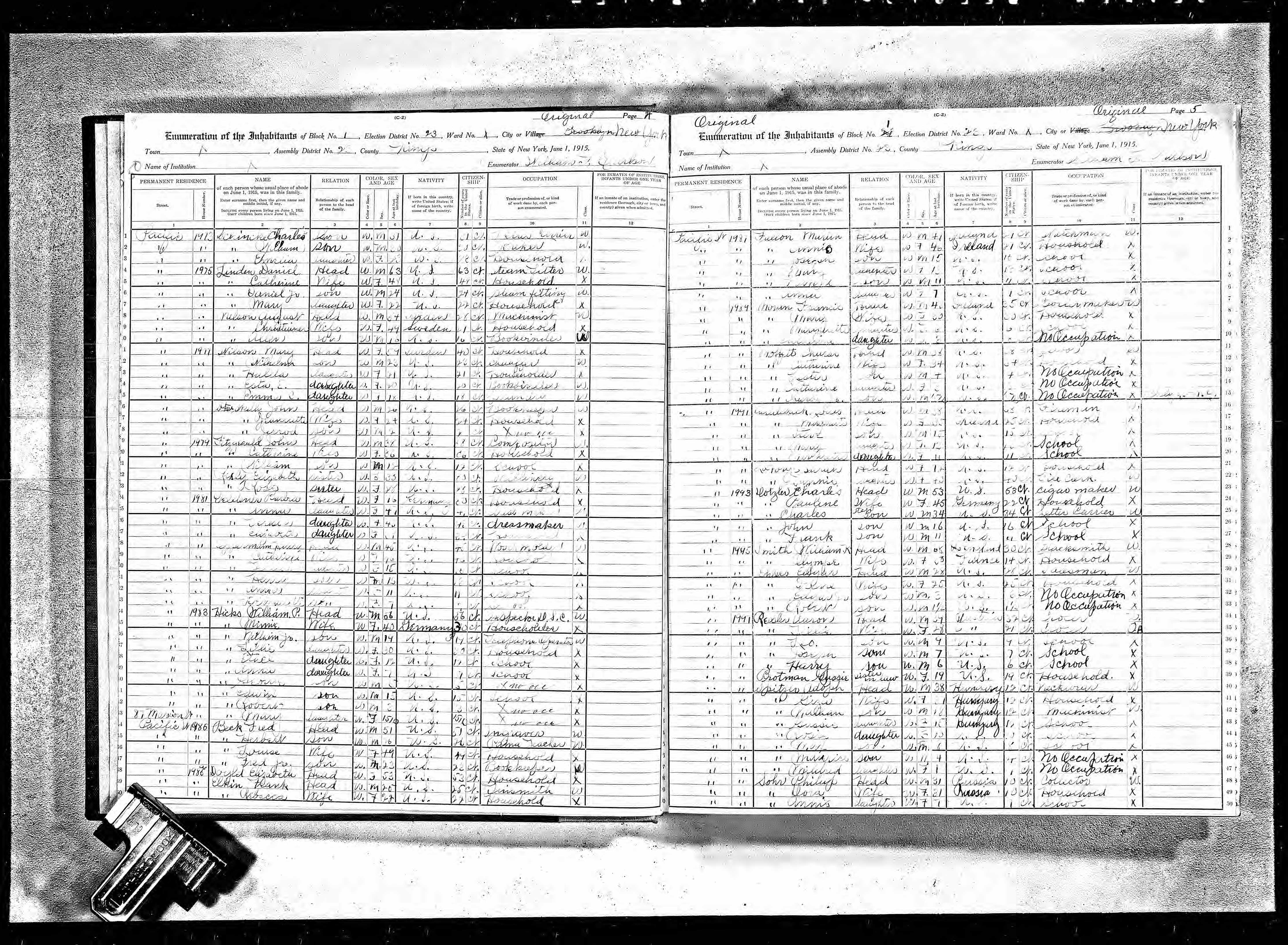
When I did a search for a Rebecca Rosenzweig on the NYC marriage index for the years between 1910 and 1915, there was only one potential person, a woman who married a man named Frank R. Elkin on March 22, 1914.  I have not yet received the certificate for this marriage, but I am fairly certain that this is the correct Rebecca.  She and Frank appear on the 1915 census, living at 1985 Pacific Street in Brooklyn.

Frank and Rebecca Elkin 1915 at 1985 Pacific Street

Frank and Rebecca Elkin 1915 at 1985 Pacific Street

On the same census one page earlier are the Rosenzweig family, living 1918 Pacific Street.

Rosenzweigs 1915

Rosenzweigs 1915

In 1915, Frank was employed as a tinsmith.

(Also listed on the same page as Rebecca and Frank Elkin is my grandmother Gussie Brotman, living at 1991 Pacific Street with her sister Tillie Ressler and her family; perhaps Rebecca was the cousin who introduced my grandfather, her cousin, to my grandmother, her neighbor?)

Gussie living with TIllie 1915

Gussie living with TIllie 1915

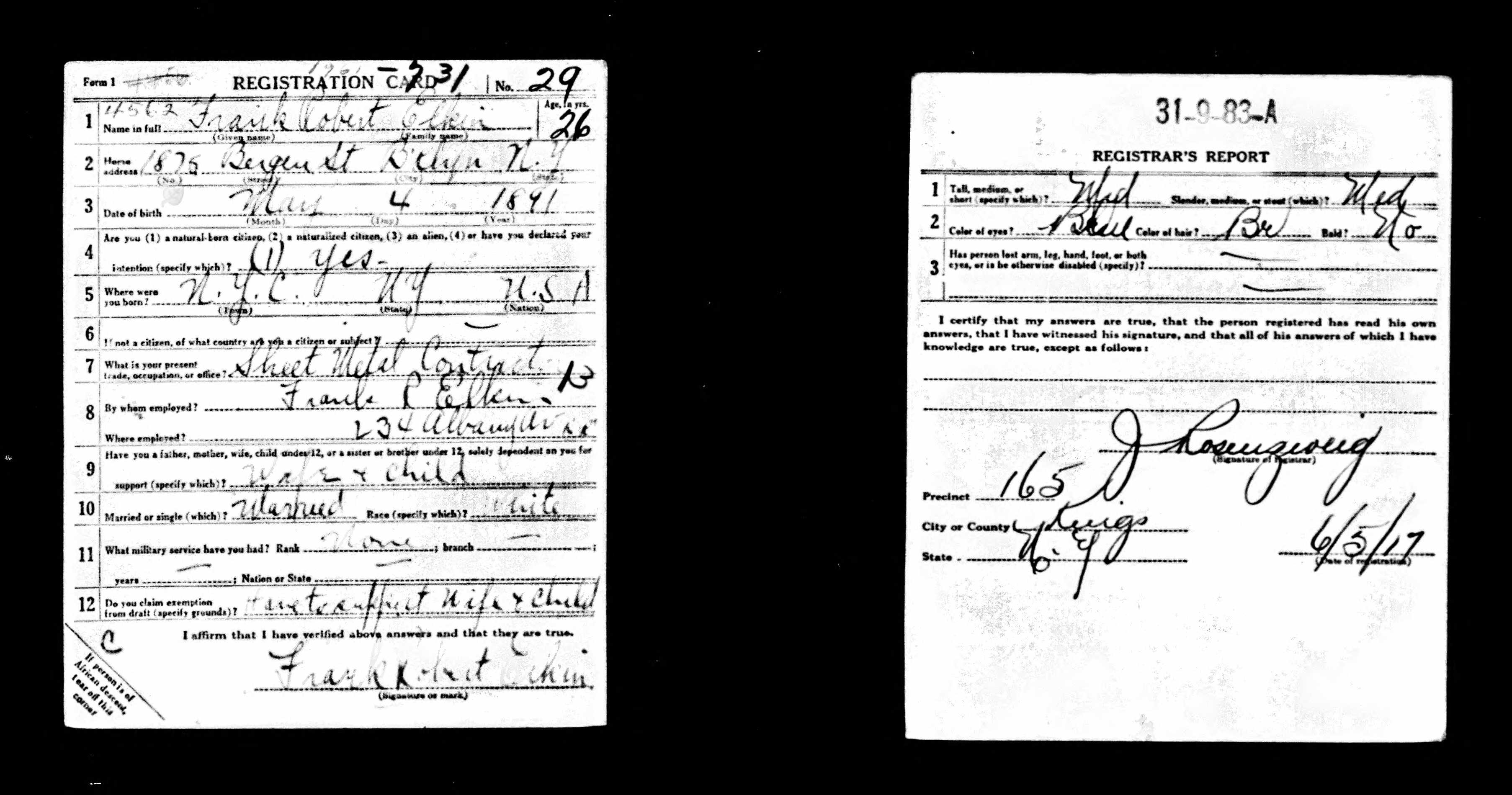
In 1917 Frank Robert Elkin was employed doing sheet metal and had a wife and child, according to his World War I draft registration form.

Frank Elkin World War I draft registration

Frank Elkin World War I draft registration

(Interestingly, the registrar of his draft board was someone named J. Rosenzweig.)  They were living at 1875 Bergen Street.  Frank gave his birth date as May 4, 1891 and his birth place as New York, New York.  I could not search for a child born after 1914 since the NYC birth index to which I have access only goes up to 1902.

When I searched for Frank and Rebecca Elkin on the 1920 census, a number of things confused me.

Elkin Family 1920 census

Elkin Family 1920 census

First, the birth place for Rebecca’s parents is given as Minsk, Russia, not Romania.  I would not be troubled by this since there are often errors on the census, but this one is so specific in identifying not just the country, but the city, which I had not seen on a census report before.  Could I have the wrong Rebecca? Only the marriage certificate will tell me for sure, but I still think that I have the right one.  Rebecca and Frank were now living at 1892 Bergen Street, and the Rosenzweig family was also now living on Bergen Street at Number 1918.  Could it just be coincidence that both the Elkins and the Rosenzweigs had moved from Pacific Street to Bergen Street?

Rosenzweigs 1920 census

Rosenzweigs 1920 census

Frank was now working as a steam fitter in a shipyard, according to this report.  Perhaps this was his war time employment, working at the Brooklyn Navy Yard.

The second puzzling thing about the 1920 census report is that although it does list a child living with Frank and Rebecca, a boy named Irving, he was only 8 months old at the time of the census, or born in May, 1919.  (The census was dated January 7, 1920.)  Obviously, Irving was not alive when Frank filled out his draft registration in 1917, so who was the child he referred to on his registration back then?

I searched the death index (which runs to 1948, unlike the birth index) and found an entry for a one year old child named Daniel Elkin who died on December 16, 1917.  I will have to obtain that record to be sure, but I fear that the child Frank referred to on his draft registration in 1917 died later that same year.

After the 1920 census I could not find any record for Rebecca Elkin.  There were two Frank Elkins on the 1930 census—one living in Brooklyn and one in the Bronx.  After some confusion based on the fact that both Franks seemed to have sons named Irving, I was finally able to sort through the facts for both, looking backward to see where each had come from before 1930, and concluded that the Brooklyn Frank Elkin was the same one who had been married to Rebecca.

Frank Elkin with his parents 1930 census

Frank Elkin with his parents 1930 census

That Frank was living with his parents and siblings on Linden Boulevard in Brooklyn that year, working as a salesman at an electrical supply company.  His father Louis was listed as the head of household, and living with Louis in addition to Frank was Louis’ wife Ida, his two other sons Matthew and Edward and a daughter Celia and a daughter-in-law Fannie as well as two grandsons, Irwin, age 11, and Stanley, age 4.  I cannot tell from the census who was Fannie’s husband—Frank, Matthew or Edward—or who were the parents of Irwin and Stanley.  They could be cousins or brothers; they are only identified as Louis’ grandsons.

My hunch is that Irwin is the same child as Irving, Rebecca and Frank’s son born in 1919.  He would have been eleven in 1920 when the census was taken.  My other hunch is that Rebecca had either died or was institutionalized; I cannot find her on the 1930 census at all, nor can I find a death record for her.  I don’t know whether Stanley was her son or her nephew.  Unfortunately, I also could not find either Frank or Rebecca on the 1925 census, nor can I find Frank or Irving/Irwin on the 1940 census.  There are a number of Irving Elkins born around the right time, but I have not yet had a chance to narrow down those possibilities.

So pending receipt of the marriage certificate for Rebecca and Frank Elkin and the death certificate for Daniel Elkin, I am putting on hold further research about Frank and Irving.  I want to be certain that I have the right Rebecca before I go further into the lives of the men I assume to have been her husband and son.

And on that note, let me leave you all in suspense. I will be out of town for the next week and unable to do much research.  I will, however, try to post some tidbits and photos I’ve been saving up.

Enhanced by Zemanta

Blog Update

Just a quick note to let you know that I have updated the page for David and Esther Rosenzweig’s Descendants to include the newly found children and other descendants of Gustave and Gussie Rosenzweig.  There is also an updated family tree (see the link) and some new photos, so check it out when you get a chance.  The page is found by clicking on the appropriate title at the top of the blog page under the main title.

Enjoy!

Enhanced by Zemanta

Brotmans, Resslers, Rosenzweigs, and Goldschlagers: All Roads Meet on Pacific Street in Brooklyn

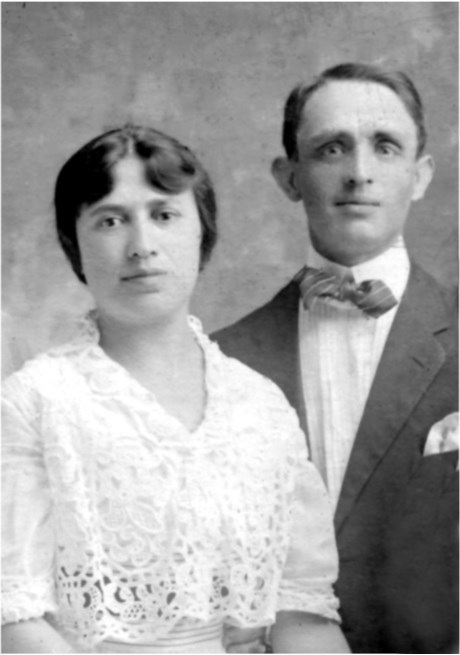
Gussie and Isadore

Gussie and Isadore

This is probably the most moving discovery yet for me personally.  I am so excited that I don’t know where to start.  This story involves the Brotman family and the Ressler family AND the Rosenzweig family and the Goldschlager family.  It’s the final piece of the puzzle about how my grandparents met.  It came as a posthumous gift from my much beloved Aunt Elaine, who truly was not only our family matriarch, but also our family historian.  Aunt Elaine, you always wanted to tell me these stories, and I was too young and dumb to care.  I know you would be so happy that I am finally interested and recording them for all time.

Fortunately, someone was interested in her stories back then.  It seems that not only did my brother listen to my aunt, so did my cousin Jody’s husband Joel, my aunt’s son-in-law.  He interviewed her about the family and took careful notes.  Jody and Joel just found his notes while going through some boxes in their house, and Jody emailed them to me.  There is so much information in there that it will take me a while to digest it all and write it up for the blog.  Joel’s notes cover stories and anecdotes about the family and reveal some new things as well as things we now know but that I did not know a year ago.  But here’s the story that made me say out loud, “Oh, my God!”  And then to stop and sit in amazement.

You may recall that a while back I wrote a post about how various members of my family met their spouses, including my grandmother and grandfather.  I wrote:  “My grandfather Isadore supposedly saw my grandmother sitting in the window of her sister Tillie’s grocery store in Brooklyn and was taken by her beauty.”  That was the family story passed down the generations.

When I wrote about this story recently, what I couldn’t figure out was what my grandfather was doing in Brooklyn.  He had always lived in East Harlem since arriving in New York and did not live or work in Brooklyn in 1915. So what would have brought him to Brooklyn from East Harlem when he first saw my grandmother?

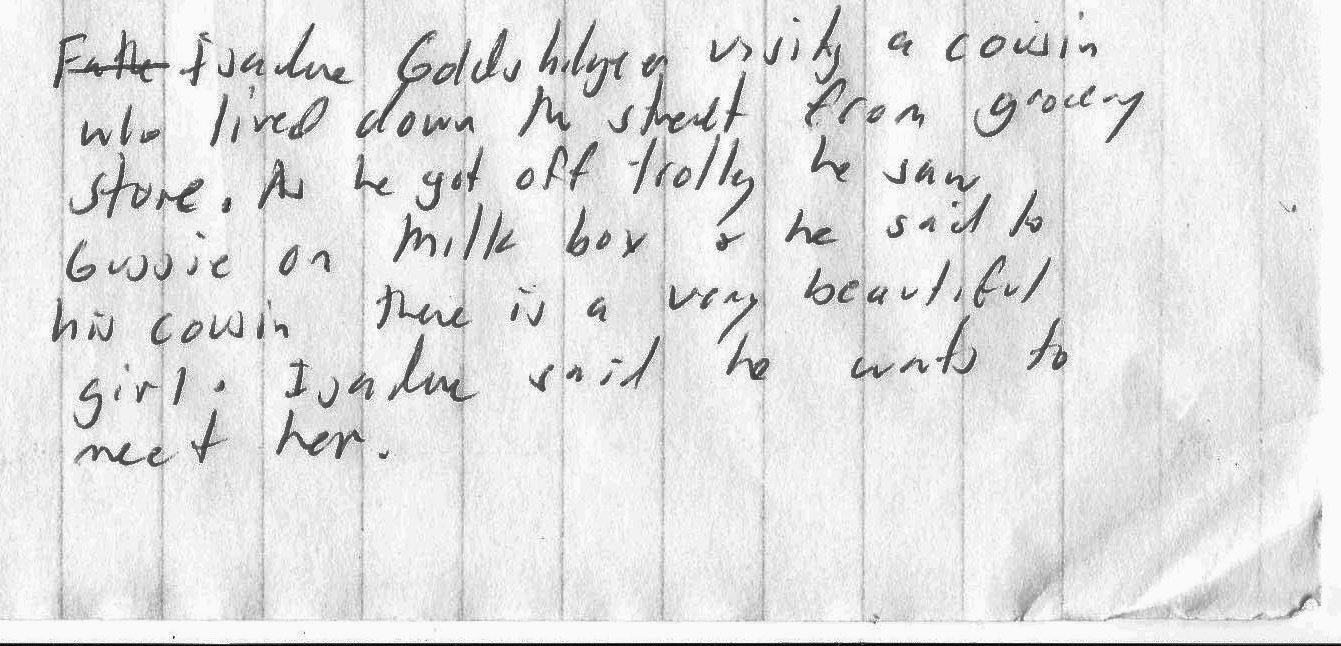
The answer is revealed in the notes Jody and Joel just sent me.  The story begins with my aunt telling Joel that my grandmother Gussie Brotman used to go to her sister Tillie’s grocery store after school.Gussie at Tillie's storeIn case you cannot read that, it says, “After school on Friday Gussie would go to Tillie’s house in Brooklyn at her grocery store.”

In 1915 Tillie and Aaron were living at 1997 Pacific Street in Brooklyn.    As Joel’s notes continue:

Isadore sees Gussie

“Isidore Goldschlager visiting a cousin who lived down the street from the grocery store. As he got off the trolley he saw Gussie on milk box and said to his cousin there is a very beautiful girl.  Isadore said he wants to meet her.” (emphasis added)

 In  1915, the Rosenzweigs were living at 1914 Pacific Street, right down the block from 1997 Pacific Street where Tillie and Aaron Ressler lived. When I wrote that post back on February 5, I did not yet know about Gustave Rosenzweig and his family.  I had no idea that my grandfather had cousins living in Brooklyn on the same street where my grandmother was living.

Rosenzweigs 1915

Rosenzweigs 1915

Gussie living with TIllie 1915

Gussie living with TIllie 1915

So the cousin that my grandfather was visiting was one of the sons of Gustave Rosenzweig.  In 1915, Abraham was 26, Jacob  was 21, and Joseph was 17.  Abraham and Jacob were in the Navy, and Joseph was working as a driver’s helper.  My grandfather was 27 in 1915, so my guess is that he was hanging out with Abraham, who was closest to him in age.

Isadore age 27

Isadore age 27

I have wondered whether my grandfather ever saw these cousins once they all got to NYC, whether he knew them well.  Well, obviously he did.  If he had not been close to them, he would never have come to Brooklyn.  He would never have seen that beautiful red haired woman sitting on the milk box.  And this would never have happened:

Isadore Goldschlager and Bessie Brotman  marriage certificate

Isadore Goldschlager and Gussie Brotman
marriage certificate

Isadore and Gussie marriage cert 2And if that hadn’t happened, then my Aunt Elaine and my Uncle Maurice and my mother would never have been born, and then all my first cousins and my siblings and I would never have been born.

That little stroll down Pacific Street brought the Rosenzweig/Goldschlager family together with the Brotman family and thus created my family.  How could this not be my favorite story ever?

This is another one of those moments when all the time spent studying census reports pays off.  If I had not found the 1915 census reports for the Resslers and the Rosenzweigs, I would never have known they lived down the street from each other.  If I hadn’t looked at all those other documents, I would never have learned about my grandfather’s cousins and his uncle Gustave.  If I hadn’t started this blog, Jody and Joel might never have found these notes in their boxes of papers and provided the last piece of the puzzle. If Joel hadn’t listened to his mother-in-law, we wouldn’t have her memories and stories to tie it all together.  It should remind us all to ask questions and take notes and listen to our parents, our aunts and uncles, and our grandparents  so that we can learn everything we can while we can.

Thank you, Jody and Joel.  Thank you, Aunt Elaine.  Thank you, Uncle Gustave, for moving to Brooklyn.  Thank you, Aunt Tillie, for taking my grandmother to Brooklyn. And thank you, Abraham Rosenzweig, for taking my grandfather for that walk down Pacific Street so that he could meet and marry my grandmother.

Enhanced by Zemanta

Joseph Rosenzweig: Update

I am delighted to say that I have been in touch with three of Joseph Rosenzweig’s grandchildren and that they have confirmed that he was indeed the son of Gustave Rosenzweig, my great-great uncle, my great-grandmother Ghitla Rosenzweig Goldschlager’s brother.  I am very happy that I am able to share with them the information I have learned about their great-grandfather and all his relatives, and I am looking forward to learning more from them and about them.

Image

Joseph Rosenzweig, Gustave’s youngest son

Ron, one of the grandsons, sent me this picture of his grandfather Joseph.  It made me smile—he looks so happy and fun-loving.

This is perhaps one of the greatest rewards of doing family history research: finding people who share that history and being able to connect and share with them.  I learned that first from finding my Brotman cousins and have now had the same experience finding my Goldschlager and Rosenzweig cousins.

Enhanced by Zemanta

Vital Records—American versus Romanian

Romanian flag

Romanian flag (Photo credit: Tudor Girba)

American flag

American flag (Photo credit: Wikipedia)

The other Romanian records I received last week from Marius Chelcu are the birth and marriage records of Gustave Rosenzweig, my great-great uncle, the man who stood up for and posted a bond of Jankel Srulovici, the man who met his nephew Isidor or Srul Srulovici at Ellis Island, and the man who signed as a witness for his niece Bertha at her wedding in 1915.  Although I’ve not yet found any record linking him directly to my grandfather or his siblings, I have to believe that he also helped out my grandfather when he first arrived and probably also helped when my great-grandfather died in 1910 right before his wife and other children arrived.

So I have a great feeling of fondness for Uncle Gustave, and I was very happy that Marius was able to find these records.  There were six pages of documents: a birth record, a record to prove that Gustave and his wife were not related under the Romanian Civil Code, and four pages of marriage records.  Marius explained that these last four are essentially the same, as marriage laws required that there be three announcements of the marriage. (I am not sure what the fourth represents.)  Marius only provided one translation of these four pages, however, so they need to be reviewed more carefully.  I wish I knew Romanian, but looking over these documents I can pick out many words because of their similarity to English, French or Italian.  But it is still hard to compare them, given the handwriting as well as the unfamiliar words.

The birth record is not like the records I posted about yesterday, which were actual birth records for David and Rebecca Srulovici, filed at the time of their birth.  Gustave’s record was created at the time of his wedding in June, 1884, to substitute for a missing birth record.  On this document, four witnesses, including his father David Rosenzweig and his father-in-law to be, Itzic Zacu, attest to the fact of Gustave’s birth as Ghidale on June 10, 1856.  This document was important to me for several reasons: it provides not only information about Gustave’s birth date but also the birth year of my great-great grandfather David Rosenzweig.  The record gives David’s age as 60 in 1884, meaning he was born around 1824.  Also, it appears that Itzic Zacu knew Ghidale from birth or at least was willing to attest to that fact, perhaps indicating a close relationship between the Rosenzweig and Zacu families.

Gustave Rosenzweig birth record

Gustave Rosenzweig birth record

translation of birth record

translation of birth record

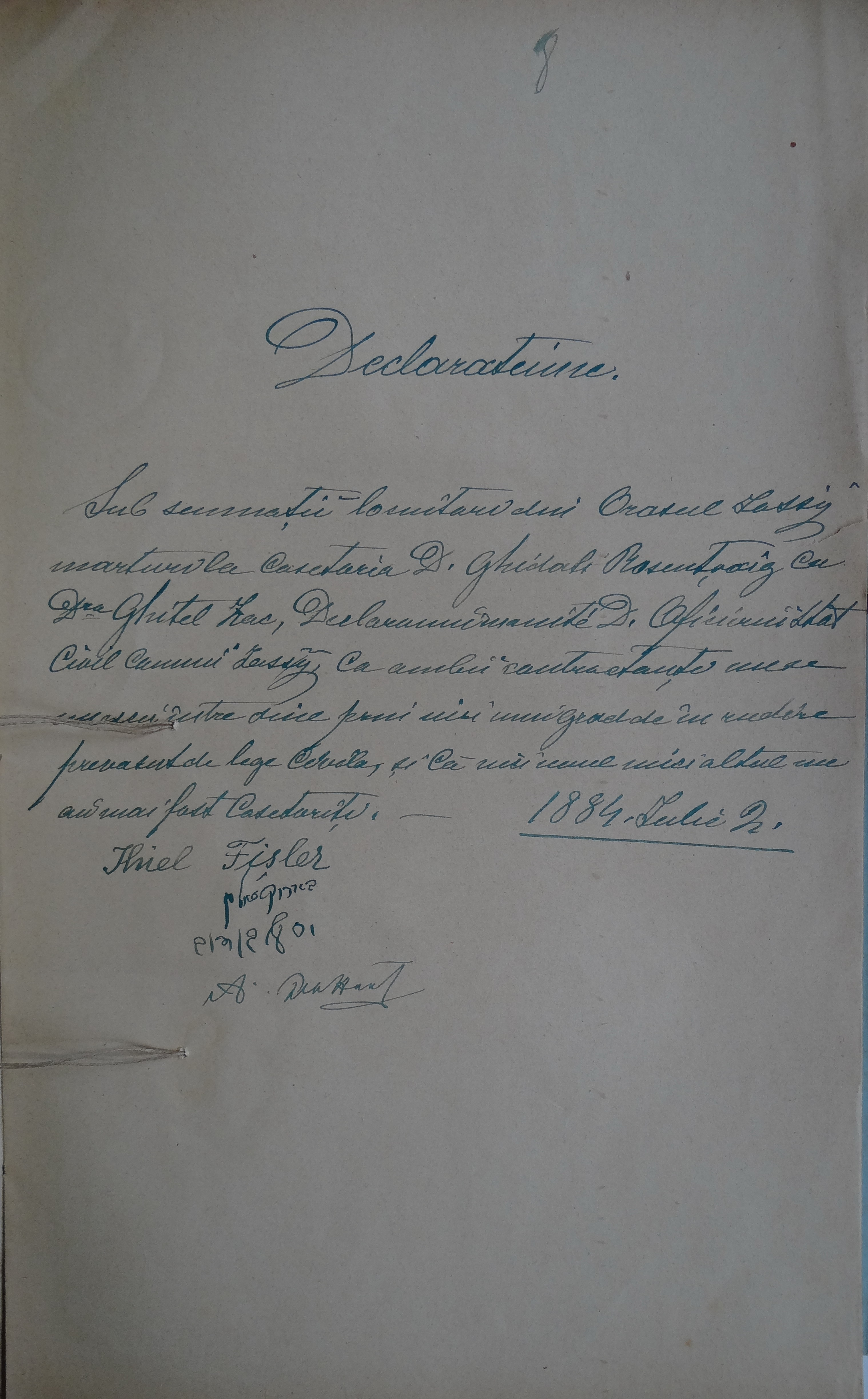
The second document is entitled “Testimony,” according to the translation provided by Marius.  The translation simply reports that Ihiel Fisler, a witness to the wedding, attested to the fact that Ghidale and his bride Ghitla Zacu were not related under the Civil Code.  The actual document, however, has four signatures, two written in Yiddish or Hebrew, two in the Latin alphabet.  I have tried to decipher the ones written in the Hebrew alphabet, but would love some help if anyone knows Hebrew script better than I do.

testimony for Gustave and Gussie

testimony for Gustave and Gussie

translation of testimony

translation of testimony

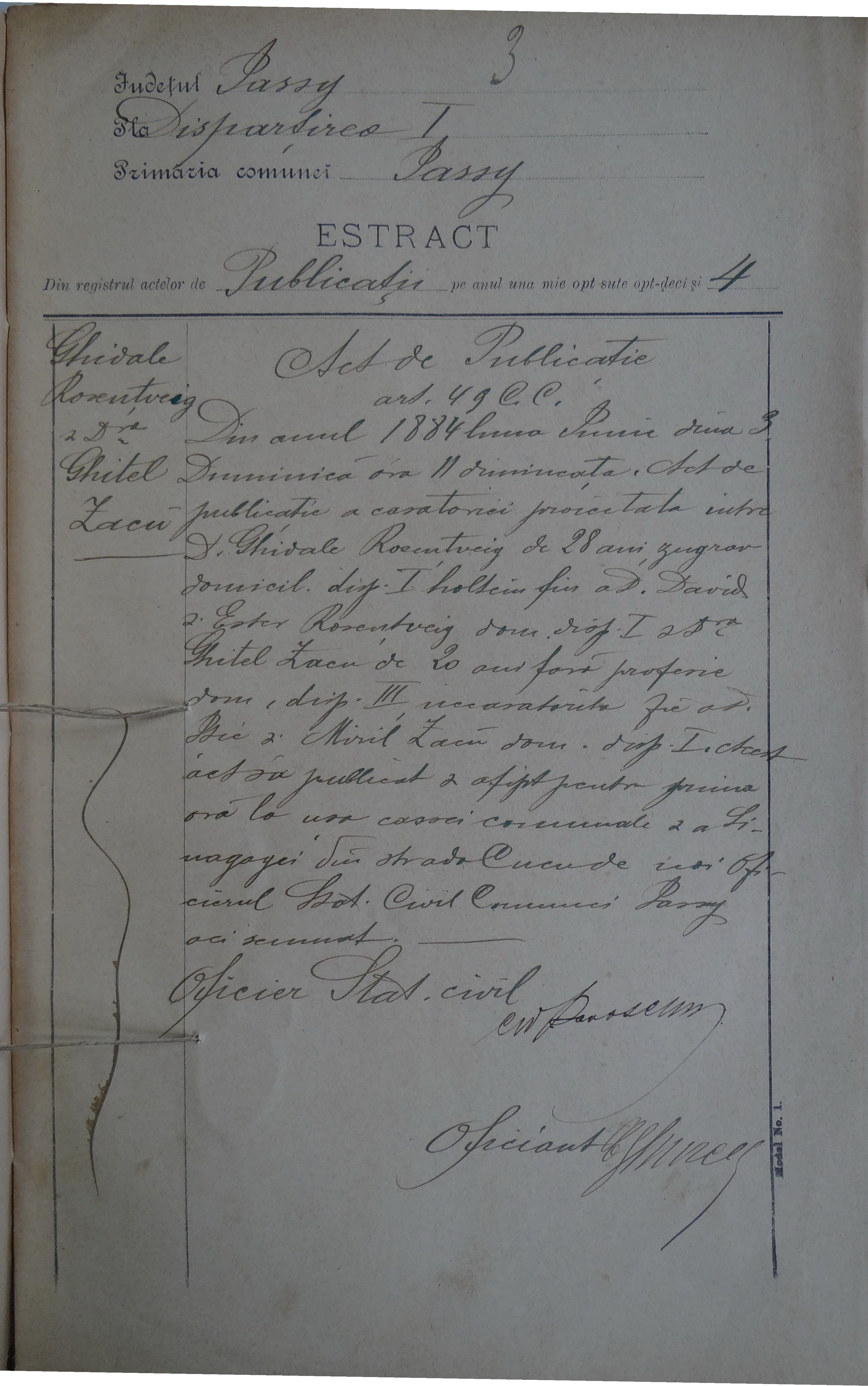
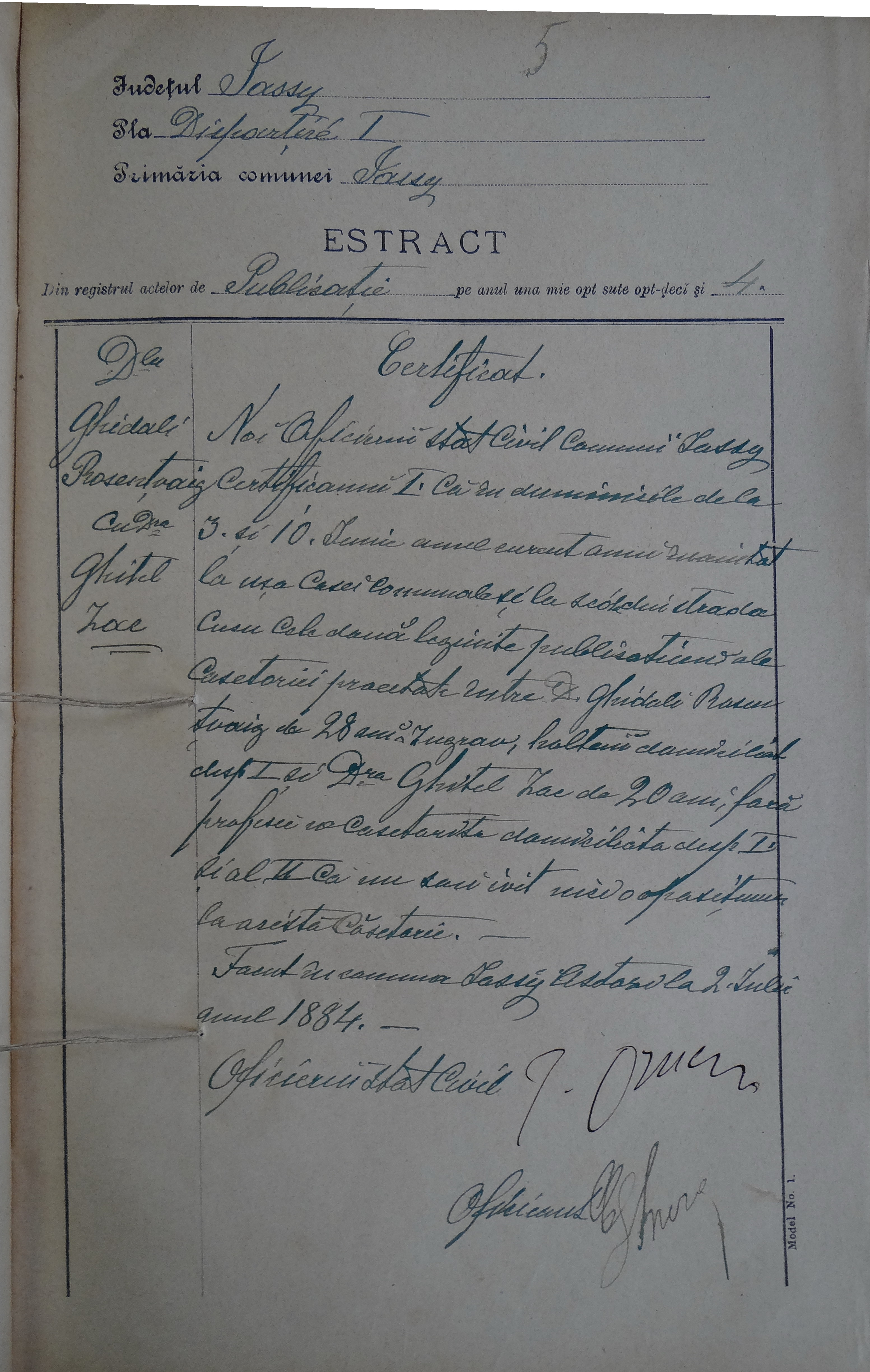
The remaining pages are the four pages of the marriage record itself, each one repeating what the other said, that is, that Ghidale Rosenzweig, 28 years old, son of David and Esther Rosenzweig, a painter by occupation, wanted to marry Ghitla Zacu, 20 years old, daughter of Itzic and Mirel Zacu, on June 1, 1884.  Unfortunately, the translation Marius provided contains an error; it had the date as September 2, 1887, even though I could see the date was June (Iunie) 1, 1884 myself.  I may ask him to provide a translation of each document separately, as it seems to me that there are some differences.  Take a look and let me know what you think.

Gustave and Gussie Rosenzweig marriage record

Gustave and Gussie Rosenzweig marriage record

Ghidale Rosentzveig with Ghitil Zacu_Marriage Record_1884_3 Ghidale Rosentzveig with Ghitil Zacu_Marriage Record_1884_2 Ghidale Rosentzveig with Ghitil Zacu_Marriage Record_1884_5

translation of marriage record

translation of marriage record

When I reviewed these dates against the other records I have for the birthdates of Gustave and Gussie and their children, I was somewhat puzzled.  According to the 1900 census, Lillie, their first born, was born in July, 1884, a month after the wedding.  I realize that women did get pregnant before marriage even back then, but Gussie would have been eight months pregnant in June, 1884; why would they have waited so long? But then again the same census has Gustave’s birth year as 1861 and Gussie’s as 1862, not 1856 and 1864, as the Romanian records suggest.  And it says Lillie arrived in the US in 1884, whereas Gustave’s naturalization papers clearly indicate that they arrived in 1887.

Does it seem likely that Lillie was born a month after her parents’ wedding?  I went back to look at the 1905 census, and there Lillie or Lillian is listed as 21, giving her a birth year of 1884 as well. On the other hand, on the 1910 census, she is listed as 24 years old, making her birth year 1886, which makes more sense.  Unfortunately, I’ve not yet found any other record for Lillie either after 1910 or before 1900, so I have no further evidence to corroborate either date.  Perhaps Marius will find her Romanian birth record or perhaps I will find more American records.  But which should I trust?  What do you think?

UPDATE: This story on the blog Genealogy Tip of the Day relates to my question.

Enhanced by Zemanta

Romanian birth records

I have received a number of different records from Marius Chelcu, the man who has been doing research for me in Iasi, Romania.  Among those records are the birth records for five of the children of Jankel Srulovici and Tillie Rosenzweig, my great-great aunt.  I now have birth records for Isidore, or Srul, their oldest child, for Bertha, or Bruha, their second child, for David, their third child, and one for Rebecca/Ray, their fourth child.  I also have one for a son who died in infancy, Zissu.  Unfortunately, Marius was unable to find a birth record for either Pincus or Leah.

First, the birth record for Isidore, or Srul, indicates that his birth date was June 9, 1883, and that his parents were Iancu Itzic Strulovici, age 38, and Bruha Thela Strulovici, age 36.  This birth year is consistent with Isidore’s age on the 1910 US census, so it would be appear to be the right child and the right parents.

Isidore (Srul) Strolowitz Adler's birth certificate

Isidore (Srul) Strolowitz Adler’s birth certificate

Strul Strulovici_Birth record_1883-page-001This record provides corroboration that Jankel Srulovici, here named Iacob Itzic Strulovici, was in fact Isidore’s father and that there was no first husband named Adler. The same is true on David, Bertha, and Rebecca’s birth records: Iacob Itzik Strulovici is their father.  There is no indication on any of these  birth records of anyone named Adler, and it thus does seem that the Adler name was chosen by the family sometime after arriving in NYC for reasons that are not yet clear.

If the ages of Jacob and Tillie are correct on Isidore’s birth record, they were born in 1845 and 1847, respectively, contrary to the 1851 and 1860 on their American death records.

The record for their next child, Bertha, has a date of birth of February 16, 1885, and her parents’ names as Iacob Itzic Strulovici, age 39, and Tilla Strulovic, age 36.  Two things raise questions for me here as to whether this is the same mother named in Srul’s birth record.  First, the mother is still 36 years old.  That alone would not concern me, given how inaccurate the ages on these records appear to me.  But her name is different.  Certainly Bruha Tella could be the same person as Tilla, but the child’s name was also Bruha.  Given Jewish naming patterns, it seems quite unlikely that Bruha would give her daughter her own name.  It seems more likely that Bruha had died between 1883 and 1885 and that Iacob had then married Tilla, the mother of Bruha.  But obviously I cannot be sure.

Bertha (Bruha) Strolowitz Adler birth record

Bertha (Bruha) Strolowitz Adler birth record

Bruha Strulovici_Birth record_1885-page-001


The next record  is for David, born on October 22, 1886, in Iasi, to Iacob Itzic Strulovici, 41, and Tela Strulovici, still 36.  Perhaps Tillie just didn’t want to age and she was the mother of all three children?

David Strulovici birth record

David Strulovici birth record

translation of David Strulovici birth record

translation of David Strulovici birth record

Next is the record for Zissu Strulovici, who was born April 1, 1891 and died six days later on April 7, 1891.  At his birth Iacob is listed as 45 and Tillie as 40.  Tillie had finally gotten older than 36.

Zissu Strulovici birth record

Zissu Strulovici birth record

Zissu Strulovici_Birth record_1891-page-001

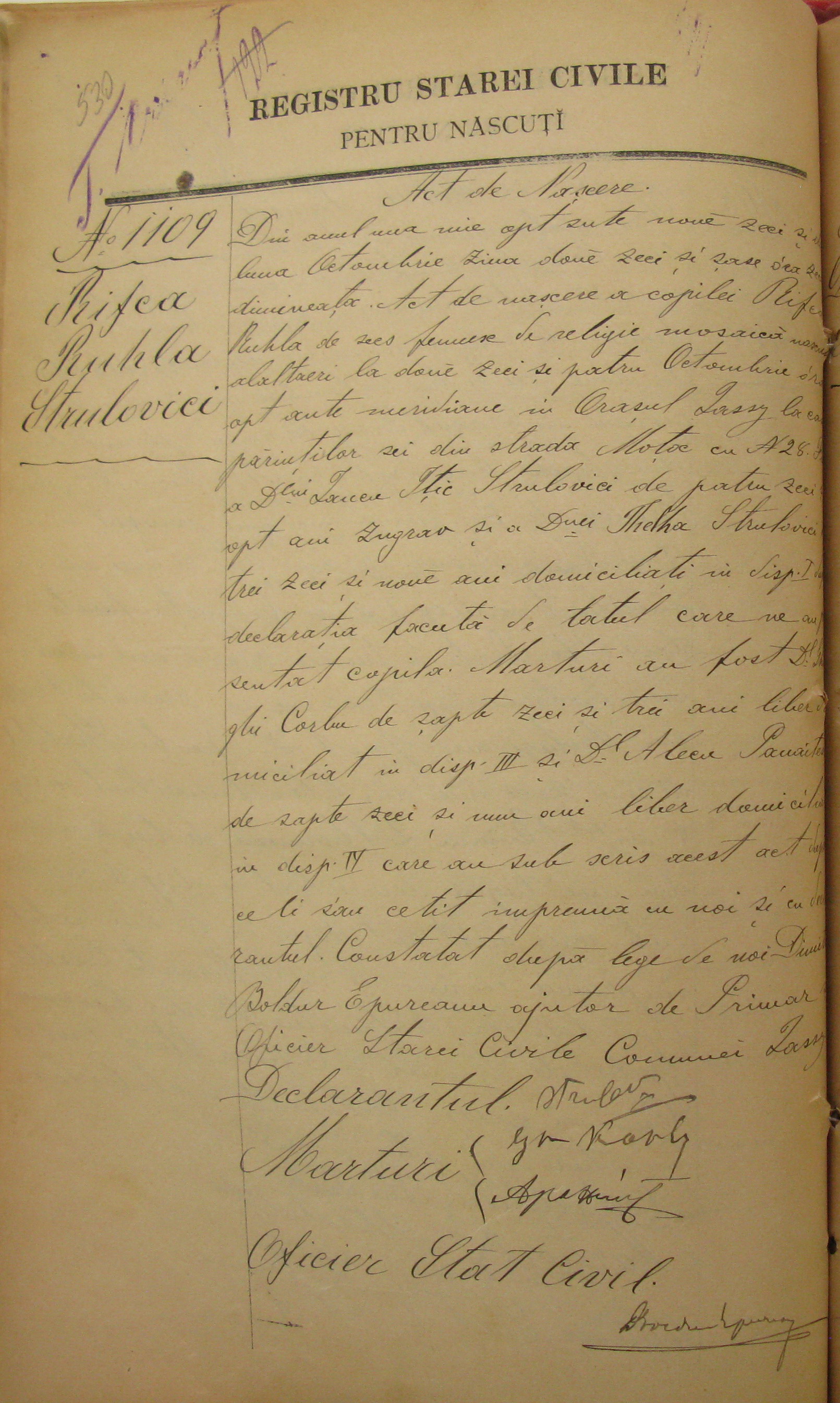
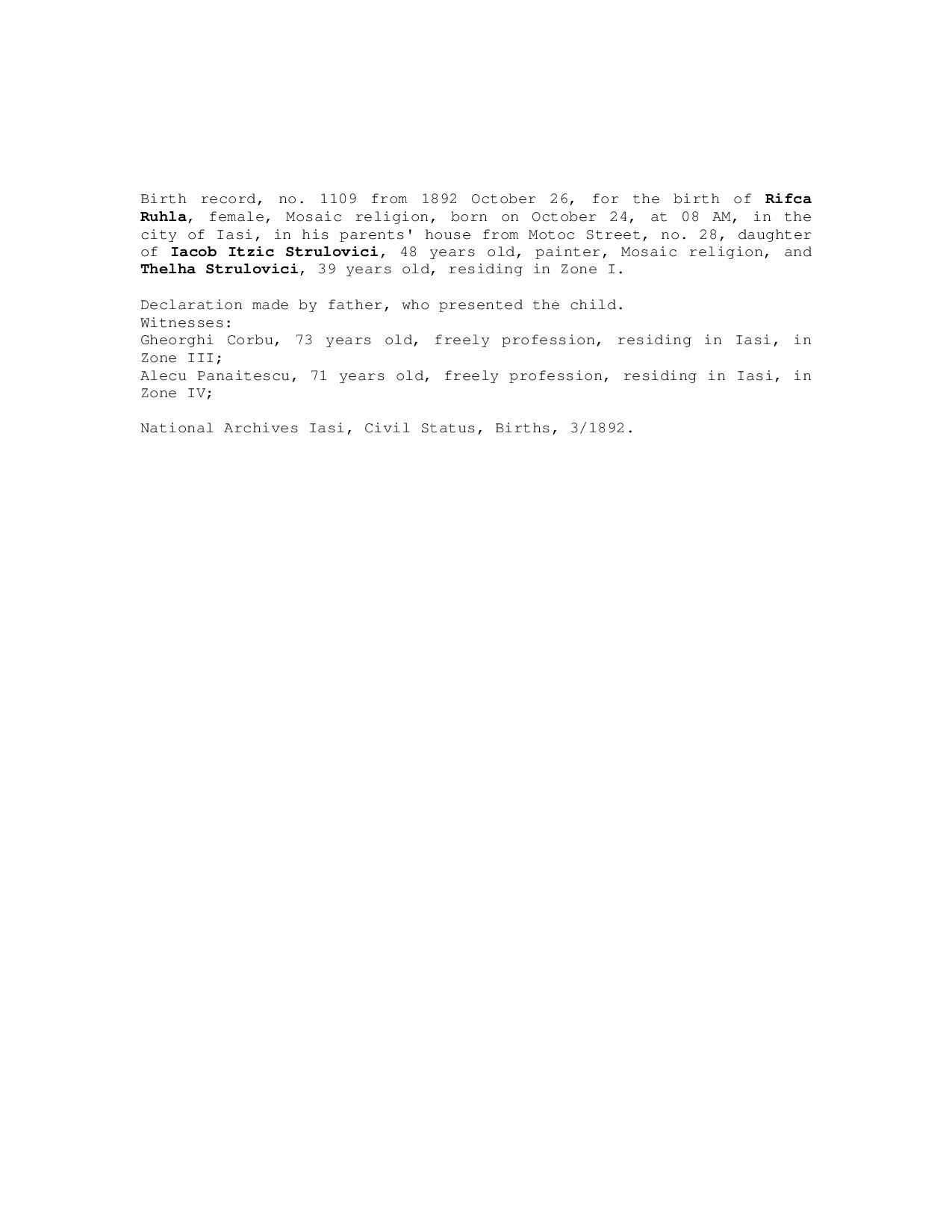
But when Rebecca was born on October 24, 1892,  her father was 48 and her mother 39.  So the best we can say about the accuracy of the Romanian records is that they are consistently inconsistent.

Rifca Ruhla Strulovici birth record

Rifca Ruhla Strulovici birth record


translation of Rifca's birth record

translation of Rifca’s birth record

Assuming then that Jacob was really 48 in 1892, he would have been 63 when he arrived in NYC in December, 1907, eight years older than the 55 he claimed on the manifest and at Ellis Island for his immigration hearing.  Given the typical lifespan back then and the fact that he was reported to be senile by the doctor who examined him at Ellis Island, it does make it seem even more likely that he died not long after being admitted to the US.

I was also interested to see on Isidore, Bertha and David’s birth records that Jacob signed his name in Hebrew or Yiddish.  I can decipher the “Yaakov Itzic Srulov—“ .  It also appears that his older brother Joseph was a witness and signed as “Strulov” on David’s record.  On Rebecca’s birth record six years later, it seems that Jacob signed his name as “Strulov” and not in Hebrew letters, as did the other two witnesses.  It also seems that Strulov could have been written by the same person, presumably Jacob, on both documents as the writing is very similar.

I find great comfort in seeing these documents.  It’s wonderful to have a record of events that happened in the family so long ago, and it gives me hope that all the work I’ve done will survive as well.  It is also very moving to imagine my grandfather’s cousins as babies, their births being recorded for all time by their parents.  Given what I’ve learned about how the lives of these children unfolded and ended, it is particularly poignant to think of them as innocent babies, unaware of their struggles ahead.

Enhanced by Zemanta

Zusi Rosenzweig: Some answers, more questions

About ten days ago I wrote about the documentation that confirmed that Zusi Rosenzweig—also known as Sonsa, Ceci, Cecile, Celie, Susie and Susan Mintz—was my great-grandmother’s sister and the aunt who met my grandfather Isadore at Ellis Island in 1904.  I also knew that she had married a man named Harry Mintz in December 1896, but it appeared that Harry had died by the time of 1900 census since Zusi, as Sonsa Mintz, was listed as a widow on the 1900 census, living with Jake and Rachel Reitman.

I also believed that I had found evidence that Zusi had had a son Nathan, born in December, 1897, but had not further evidence of him until he was living with Zusi at the time of the 1915 census.  I believed Nathan had married a woman named Gertrude in 1930 and had had a daughter named Susanne in 1932, one year after his mother Zusi/Susie had died.

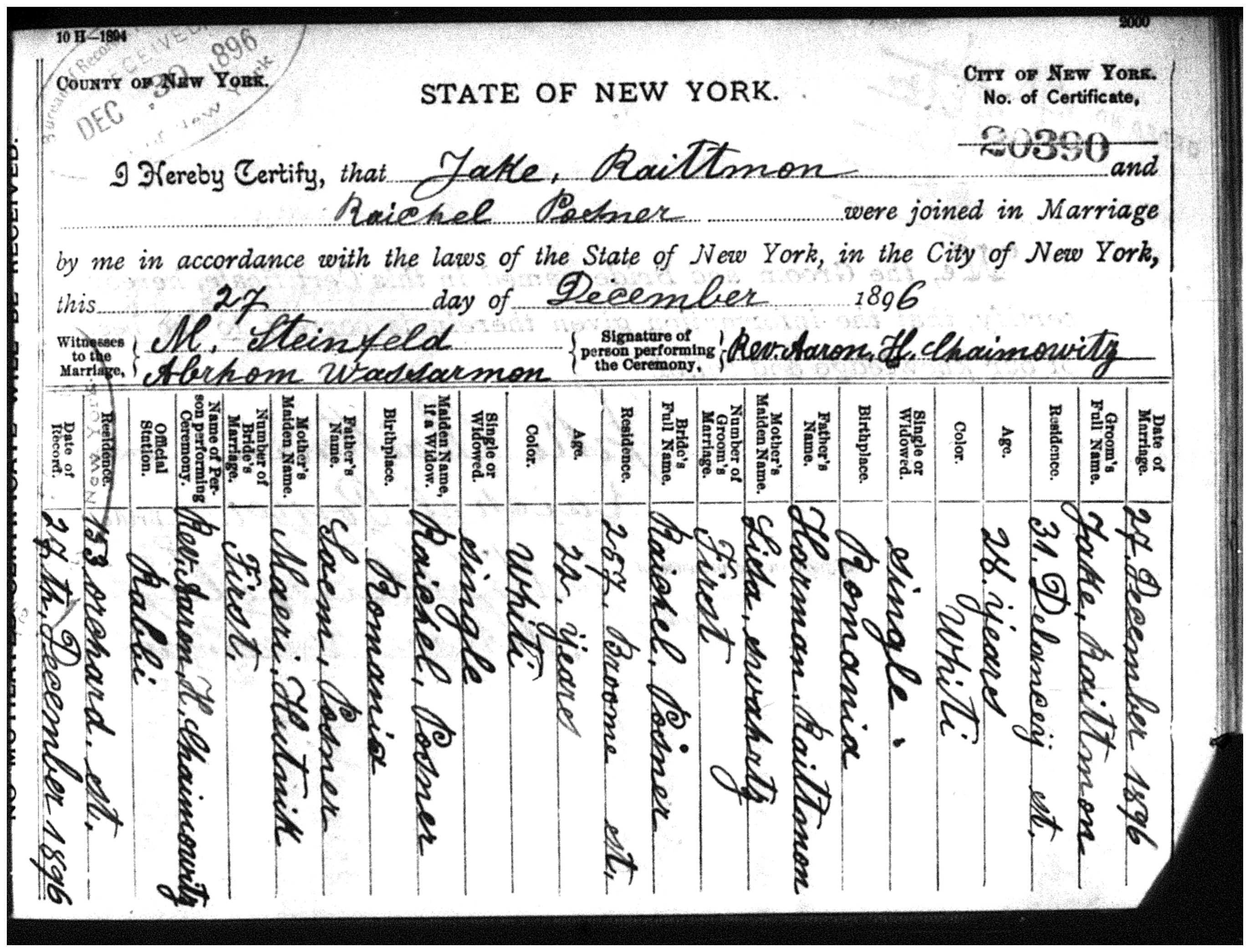
Although I was able to research fairly deeply into Jake and Rachel Reitman from the public records, I could not find any familial link between Zusi and either Jake and Rachel.  On Jake and Rachel’s marriage certificate, their parents’ names are all revealed, and no one has a surname that I can link to the Rosenzweig/Goldschlager/Strolowitz family.  I still don’t know if Sonsa Mintz is in fact Zusi, and if it was, I have no idea why she was living with the Reitmans.

Jake and Rachel Reitman marriage certificate

Jake and Rachel Reitman marriage certificate

I had ordered three more documents: a birth certificate for Nathan Mintz, a marriage certificate for Nathan and Gertrude Mintz, and a death certificate for a Harry Mintz who died in 1924, thinking that perhaps Harry had just “disappeared” and had not died between 1897 and 1900.  Today I received those documents, plus one more.  For the most part, these documents did in fact confirm my hunches.  The Nathan Mintz born in December, 1897, was the child of “Zussie” Rosenzweig, born in Romania, and her husband “Herman” Mintz.

Nathan Mintz birth certificate

Nathan Mintz birth certificate

The Nathan Mintz who married Gertrude in 1930 was the same: son of Susan “Rosenberg” and Harry Mintz.

Nathan and Gertrude marriage certificate

Nathan and Gertrude marriage certificate

Thus, Susanne is Zusi’s granddaughter and her namesake.  The death certificate for Harry Mintz dated 1924 neither confirmed nor contradicted what information I had because it is not the same Harry; this one had only been in the US for four years, was older, from Poland, and married to a woman named Ida.

Harry Mintz death

Harry Mintz death

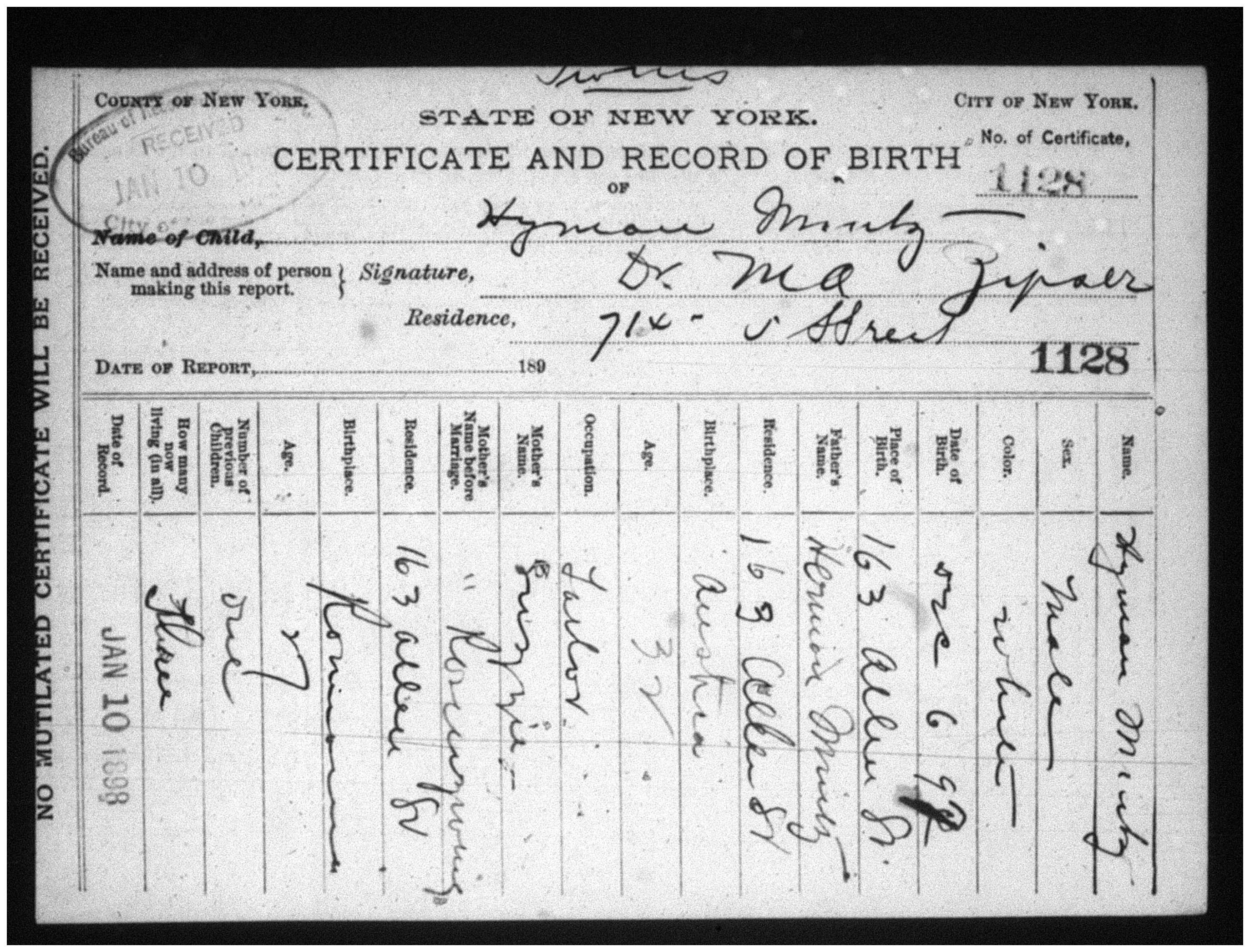
But there were some surprises in the documents; first, I received a second birth certificate for a baby Mintz born in December, 1897, Nathan’s twin, Hyman: same parents, same birth date, same doctor.

Hyman Mintz birth certificate

Hyman Mintz birth certificate

I immediately wondered why I had not seen any future references to Hyman and suspected the worst.  I checked the death index, and Hyman Mintz died in January, 1898, a month old infant.

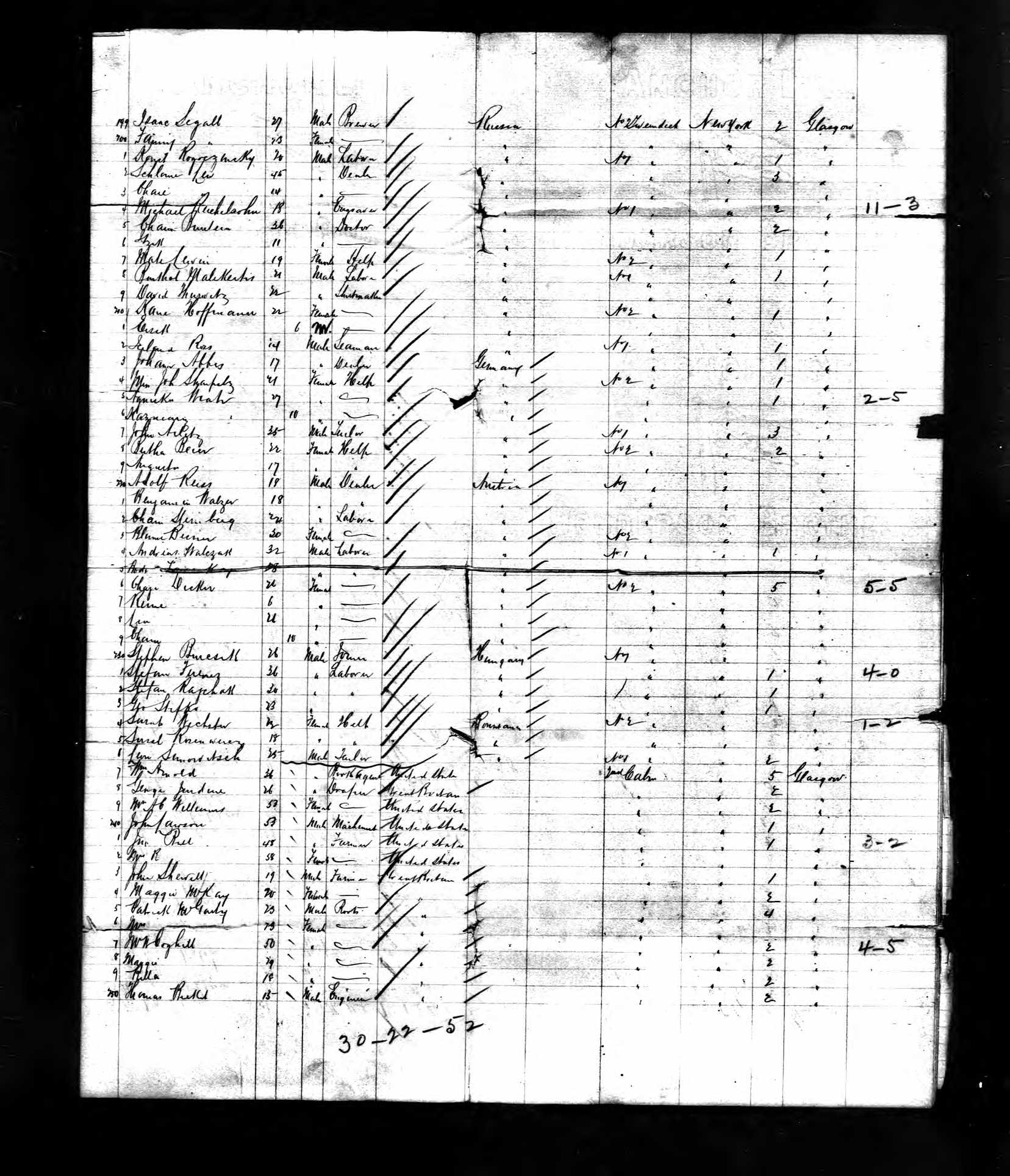
Moreover, the New York City birth certificate form asked how many children were born to this mother before this delivery and how many of those children were still living.  On both Nathan and Hyman’s birth certificates, it says that Zusi had had one prior child and that three were still living.  So who was this first child, and where was she or he living? Zusi and Harry had only been married twelve months when the twins were born, so they could not have had a prior child (well, at least one conceived since they had married).  Zusi had been a 24 year old widow when she married Harry; she must have had a child with her first husband, perhaps in Romania before immigrating to the US.  She was only a teenager when she emigrated.  I have what I think could be the ship manifest listing Zusi as a passenger on the Ethopia, arriving in New York City on September 30, 1890; there is no child with her.

Ship Manifest as Susel Rosenzweig

Ship Manifest as Susel Rosenzweig

Did she leave her child behind in Iasi for her family to raise? Why did she return to her maiden name if she’d been married? Perhaps there never was a marriage?  I can guess, speculate, but not know for certain.

So what do we know and what don’t we know about this woman who met my grandfather at Ellis Island? We know she married Harry Mintz, had twin sons Nathan and Hyman, but only Nathan survived.  Nathan grew up, married Gertrude, and had a daughter in 1932 named Susanne.  Zusi died in 1931. What we don’t know is what happened to Harry or what happened to her first child.  We don’t know where Zusi and Nathan were between 1898 and 1915. And we don’t know whether Nathan and Gertrude had additional children, whether Susanne had children, whether there are any living descendants of the elusive Zusi Rosenzweig.

Enhanced by Zemanta

Family resemblance?

I know that often the mind plays tricks,  and you see things that aren’t there but that you hope are there.  When a baby is born, some people will say, “Oh, he looks just like his mother, ” and others will say, “Oh, he looks just like his father.”  Since we all have certain common physical traits–two eyes, a nose and a mouth, it’s not that hard to find a similarity with anyone  if you look hard enough for it and want to see it badly enough.

So I need some help from objective eyes.  Here are two photographs, one of my great-grandmother Ghitla Rosenzweig Goldschlager, and the other of Gustave Rosenzweig, who I believe to be her brother.  The more I look at these two faces, the more I am struck by the similarity—in particular, the shape and deep-seatedness of the eyes and the nose.  What do you think?

Ghitla Rosenzweig Goldschlager

Ghitla Rosenzweig Goldschlager

Gustave Rosenzweig

Gustave Rosenzweig

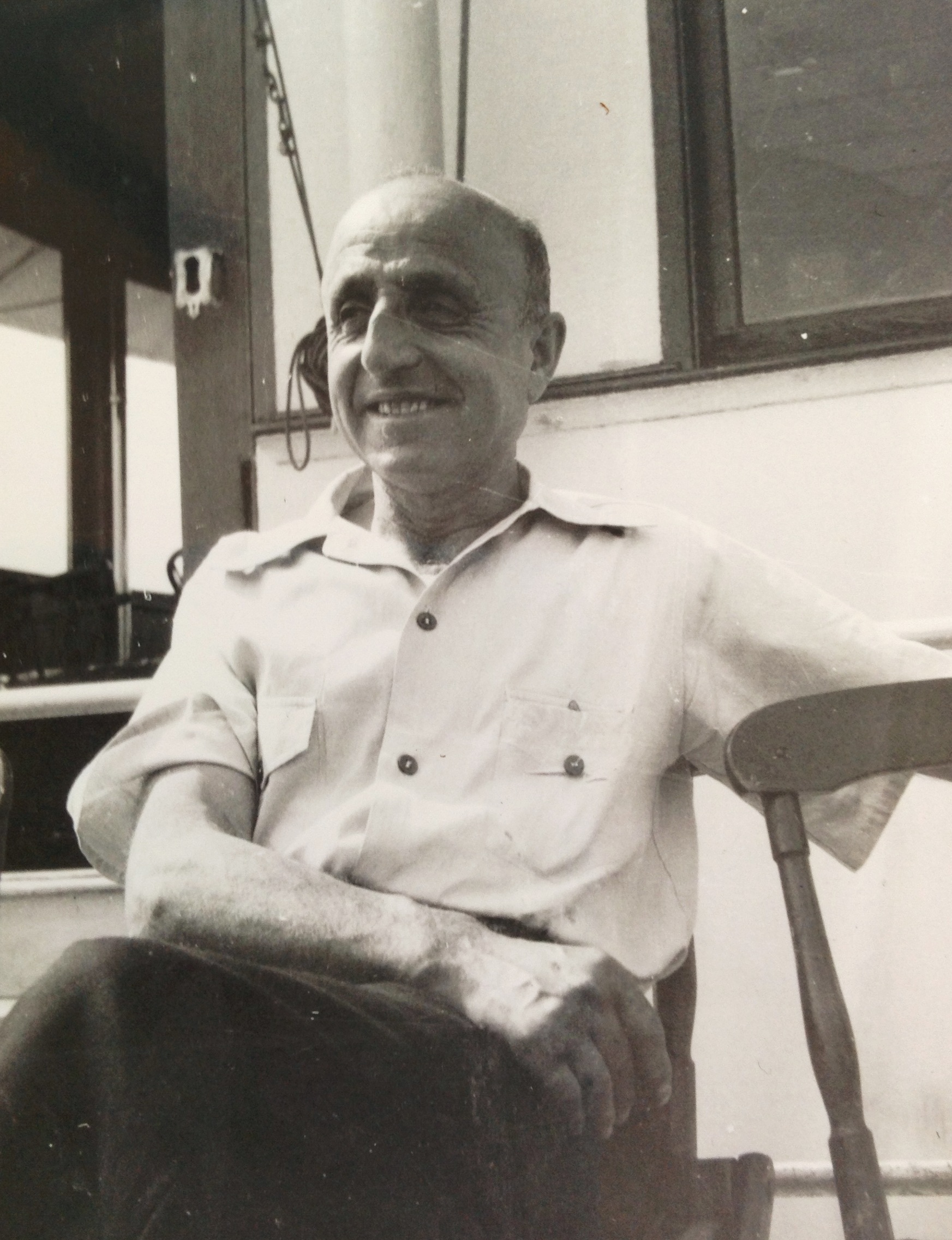
I also find the same eyes in my grandfather, Ghitla’s son, and in Murray Leonard, her great-nephew, and in David Adler, her nephew, Tillie’s son:

Isadore Goldschlager

Isadore Goldschlager

David Adler and his wife Bertha

David Adler and his wife Bertha

Murray_Leonard_Lacey_Busby_Hadwin_Layla_Hadwin_11_JAN_2014

Murray Leonard

So it is just me?  Or do the Rosenzweig descendants share this common trait of deep-set, down-turned eyes? Do you see that trait in your family if you also are a descendant of Tillie, Ghitla, Zusi or Gustav?

Enhanced by Zemanta