
A World Apart, Part 2: Life in Galicia

In the segment of the book I read last night, Margoshes described his childhood and in particular two aspects of it: his education and the role of the synagogue in his life.  One thing that had not been clear to me in the first part of the book is that Margoshes and his family dressed in traditional Hasidic clothing.  That is, even though they considered themselves maskilim and not Hasidic, they dressed like Hasidim and not in modern clothing.

Here is what Margoshes has to say about his teachers in Lemberg, where he lived until he was fourteen: “I don’t have much to recount about the [teachers] I had in my youth.  One thing I realize now is that they knew very little themselves and were therefore incapable of accomplishing anything substantial with their students, even though their pupils included boys with good heads on their shoulders.”  (p. 39)  Some of his teachers were worse than incompetent—they were psychologically and physically abusive, though no one would have thought of it that way back then.  Margoshes reports that there was an understanding among the boys at the school that they would not report what the teachers were doing to them.  Only when a servant noticed a huge bruise on Margoshes’ leg from a teacher’s painful pinching did his parents learn of the abuse and have him change schools (though not have the teacher removed or disciplined).  Although Margoshes did have one teacher whom he found effective and knowledgeable, overall his experience in school was not a positive force in his life.

The school was for boys only; there is no discussion of what girls his age would be doing while he was in school.  Margoshes did have two girls who became his friends when he would visit their house to pick up papers for his father.  He would sit and play cards with them while he waited, but he never told his family about the friendships because apparently playing cards and being friends with girls would not have been considered acceptable behavior.

Other than these two girls, Margoshes only discusses male friends—boys he would read and discuss books with in an area where they would gather in front of the synagogue, books that he describes as Haskalah books.  He does not explain what that means, but from what I can infer, these were books written in Hebrew that went beyond traditional prayer or holy books and discussed broader issues and views of the world.  There were 15-20 boys who would gather every night to do this.  Margoshes wrote, ”Above everything, we would talk a lot and wonder at the young people of Lemberg who had thrust themselves into the wide world several years earlier.  … [This] was our ideal, and we all aspired to reach those heights.”  (p. 47) Interestingly, although these boys knew Yiddish, Hebrew, and some German, they did not know Polish, the language of their country, and had no desire to learn it.  “Our spirits were focused on ideals and we had no interest in practical life.” (p. 48)

The institution that played a huge part in the daily life of Margoshes and his community was the synagogue or “kloyz,” as they called it.  Men attended the kloyz twice a day every day and drew people from across the region.  Poor people as well as wealthy people prayed at the Lemberg Kloyz. There were many wealthy men in the community, and the kloyz was also where they made business connections.  Overall, however, it was more a place for religious and social gathering and played a central role in the lives of these people.  Margoshes wrote, “I loved the Kloyz with all of my heart and always felt at home there; after all, I was there twice a day over several years for prayers.” (p. 51) He considers it the place where the best times of his childhood took place.

When he was fourteen and after his father had died, Margoshes and his family moved to Tarnow, a city where there were over 15,000 Jews (somewhat smaller than Lemberg). Sadly for Margoshes, he did not find a similar community of boys in Tarnow who were interested in reading Haskalah books.  His traditional education continued with one of the most respected rabbis in Tarnow, but his intellectual life and interest in more worldly matters seems to have been limited after the move away from Lemberg.

Although the descriptions of his education and religious life were interesting, I found this whole section of the book somewhat frustrating.  Margoshes grew up in a relatively wealthy home (they had servants, after all) and a home where he was encouraged to receive a traditional education.  But the book nowhere reveals up to this point what life was like for those who were not so fortunate.  What did the girls do while the boys were at school? What about children from poor families? Did they get any education? Margoshes is rightly proud of his accomplished family, but it would be more interesting to me (and I assume others) if he had revealed more about the rest of his society.  Perhaps that will come now in the next section which describes his marriage and presumably a more adult perspective.

Maybe Joseph and Bessie were among the educated and wealthy Jews in their community, but it seems more likely that they were not.  I am hoping that Margoshes at some point talks about the lives of people from different social and economic backgrounds.
A World Apart, Part 1: Life in Galicia in the late 19th Century

As I mentioned a few weeks ago, I ordered a book on what life was like in Galicia in the late 19th century.  The book is A World Apart: A Memoir of Jewish Life in Nineteenth Century Galicia by Joseph Margoshes. (The book was written in Yiddish in 1936, but translated into English in 2010 by Rebecca Margolis and Ira Robinson.)  Margoshes was born in 1866 in Lemberg (Lvov/Lviv), which is now part of Ukraine.  According to the introduction to the book, he was born into a family with a “distinguished rabbinical ancestry” and “received a traditional Jewish education in Bible and Talmud, as well as grounding in the German language and European culture.” (p.vii)  As an adult, he spent several years administering agricultural estates in western Galicia, the region where our family most likely lived.  He emigrated to America at the turn of the century and became a well-known writer for the Yiddish press in New York City.

He wrote A World Apart as a memoir not only of his life, but of the culture and world he left behind.  The book is considered to be an important documentation of what life was like in Galicia during that time period.  As Margoshes himself wrote in his forward to the book, “I have lived in a different generation and under completely different circumstances from my own children and many of my friends and acquaintances.  I thus hope that it might interest them to read the memoirs of my past.” (p.3)

Since the author lived in Galicia and left Galicia during the years that Joseph and Bessie, Abraham, Max, Hyman and Tillie lived in and left Galicia, I hope to be able to get a better picture of what their world was like.  I’ve only read the first thirty-five pages or so, but can already report some sense of that world.  What struck me most about the first segment of the book was its portrayal of a diverse Jewish society.  In my mind I had an image of Fiddler on the Roof where everyone was relatively indifferent to secular education and the secular world and completely immersed in Jewish life.  Margoshes immediately breaks down that image.

In fact, Jewish society in Galicia was not unlike Jewish society in Israel or the US today with a wide range of subgroups with varying degrees of religious observance— from the Hasidim to what we might now call Modern Orthodox to very assimilated or what Margoshes refers to as “German” Jews.  By that he does not mean that they were from Germany, but rather that they had abandoned traditional Hasidic garb, wore modern clothes, did not keep kosher, and spoke German more than Yiddish.  Margoshes family itself had representatives across the spectrum.  His father was descended from a long line of scholarly rabbis and considered themselves “maskils” or members of the Haskalah or Enlightenment Movement, which promoted not only Jewish education but also secular education, much as the Modern Orthodox movement does today in the US.  They were deeply observant, but not cut off from the outside world, unlike the Hasidim who lived much more insular lives and were not interested at all in secular education.  On the other hand, Margoshes’ maternal grandfather was a highly educated cloth merchant who traveled to Vienna for business and raised thirteen children, only two of whom were religious.  His sons were all “Germans,” and his daughters were well-educated and read the German classics.

Margoshes’ mother, however, was one of the two children who were religious, although she was well-educated.  Her first marriage ended when her husband began to dress and act “German-style.”  She then married Margoshes’ father, who was himself a maskil —religious, but not Hasidic.  (Interestingly, Margoshes’ father was a widower whose first wife was his niece, an indication of how liberally families allowed marriage among close relatives, as Joseph and Bessie reputedly were.)

After providing this family background, Margoshes describes events surrounding a major rift in the Galician Jewish society.  His father had originally belonged to an association of educated but religious Jews (maskilim) called the Shomer Yisrael Society.  In the late 1860s, however, his father left the Shomer Yisrael Society because it had become far too assimilationist.  For example, the Society submitted a proposal to the Imperial Ministry in Vienna that would restrict who could be a rabbi recognized by the state to those with more “German” tendencies and that would also impose reforms to the education provided in the Jewish schools, such as requiring German language classes and limiting Talmud classes to those twelve or older.  The Ministry was in favor of these proposals, as it favored modernization of the Jewish society.  Margoshes’ father and others were vehemently opposed and aligned themselves with the Hasidim to fight the proposal.  They formed an opposition group called Machzikei Hadas to organize their opposition to the Shomer Yisrael Society.

Margoshes wrote in detail about the long political battle between these two groups and how the maskilim and Hasidim worked together to fight the assimilationist Shomer Yisrael Society.  He also describes the overall status of Jewish society in the Galician world:  “In that era, the leaders of the province of Galicia were adopting a more liberal outlook.  Jews were granted full rights as citizens and they were allowed to vote as well as to be elected to the Galician Landtag and the Austrian Reichsrat.” (p. 18) The battle between the two groups became therefore also a battle for political representation of the Jewish citizens in the secular governments, not just a battle over religious practice and education.

In order for Machzikei Hadas to function as a legitimate association and publish newsletters legally, it had to obtain state permission.  The Shomer Yisrael Society engaged in political maneuvering to prevent this, but ultimately Machzikei Hadas was able to obtain approval and publish a newspaper after some political maneuvering of its own. Their ultimate coup was in 1879 when they were able to elect the Krakow Rabbi, a Hasid, to the Austrian Reichsrat, the first rabbi to be elected to such a position. As Margoshes wrote, “The election of the Krakow Rabbi to the Austrian Reichsrat made a tremendous impression on the entire Jewish world, and Galician Jews anticipated salvation.  It gave them enormous pleasure to see even a single Rabbi achieve the major honor of sitting among so many great personages.” (p. 24)

As I read these pages, it raised several questions and thoughts for me.  First, I was struck by the fact that Jews even then (and before then) fought among themselves over issues of observance versus assimilation, rather than trying to unite against the non-Jewish majority who controlled the laws and the government.  I thought of that old joke about the Jew found after being stranded on a deserted island for several years.  His rescuers noticed he had built two structures and asked him what they were.  His response:  “This one is my shul, and that is the “other” shul.”  We always need some group of other Jews with whom to disagree and debate, don’t we?

Second, I was surprised by the fact that at least at that time, Jews were not necessarily poor or poorly treated by the Austrian people or government.  Perhaps more will be revealed as I read further, or perhaps Margoshes’ family were more elite and comfortable than most others.

Finally, his description of the various segments of the Jewish society made me wonder where on the spectrum our great-grandparents lived.  Were they Hasidic, maskilim, or “German” in the way they lived their lives? Were they educated in worldly matters? Did Joseph wear payes and a streimel or did he dress in modern clothes? My guess is that they were not Hasidic, not even very observant, but only because I know that my grandmother was not religious (though she did have a kosher home), but I really don’t know.  She was born here, and perhaps Joseph and Bessie changed and assimilated once they settled in America.

To be continued, as I continue to read….


Miracles

There has been more than enough media attention paid to the fact that Hanukkah coincides with Thanksgiving this year.  There have been menu suggestions, historical comparisons, mathematical calendar explanations, and rabbinic messages regarding the coincidence.  It’s all been fun and interesting, but in the end nothing too serious since it only will happen this year for any of us living today and for hundreds of generations to come.  (Apparently the next time it happens will be almost 80,000 years from now.)  It’s a once in many lifetimes coincidence with no deeper hidden meaning.  And yet here I am, looking for meaning.

Aside from planning to have latkes with the turkey, I hadn’t given this whole thing much thought myself, but now that the two events are about to occur, I have been thinking about what this means to me.  Both holidays celebrate freedom and specifically freedom of religion.  The Pilgrims left England and came to the New World to be able to practice their own form of Christianity; the Maccabees fought the Syrian army in order to be able to practice Judaism. When we light the menorah, we not only celebrate the miracle of the oil lasting eight days. we also celebrate the miracle that we have survived—not only then, but every time before and after that time when some army, some nation, some maniac tried to exterminate the Jewish people.  It is indeed a miracle that we, the Jewish people, are here.

Although Thanksgiving has no particular miracle associated with it (aside from the miracle that at least for a short time, the settlers were not trying to kill the natives who lived here first), we celebrate the miracle of America—its bounty, its beauty, and its identity as a place of refuge not only for the Pilgrims, but for all the immigrants who came later to escape religious, political or economic oppression.  This year when we eat the turkey and light the candles, I will be grateful not only for what I have now, but for all those who came before me.  I will think of Joseph and Bessie and be grateful for their courage and determination.  It is in many ways a miracle that they were able to come here with their children and survive with few resources or skills other than hard work, determination, hope, and love.  I am so thankful for all they did and for everything their descendants—my grandparents and my parents —have done to provide me with the life I live today.  It is indeed a miracle that we, all of our family members, all of the descendants, are here.

Of course, this year I am also grateful to have found all of you, my long-lost cousins, and for all my relatives everywhere.  Enjoy this crazy coincidence of Thanksgivukah in whatever way you celebrate it, and let’s hope for continuing miracles in our lives and the lives of all people everywhere.  It is indeed a miracle that we are here.

Jewish Naming Patterns

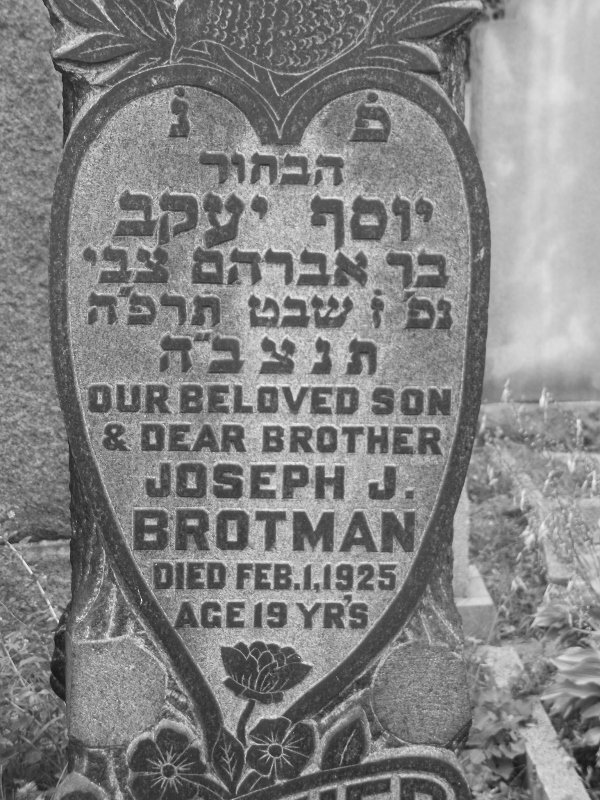
Most people know that in Jewish tradition, a child is often named after a relative who is no longer alive.[1]  It is also Jewish practice to identify a person in Hebrew with his or her father’s first name added to that person’s own first name.  For example, on his headstone Joseph’s name appears in Hebrew as Yosef Yakov ben Avraham, meaning that his father’s name was Abraham.  These naming patterns are a great help to genealogical research since often you can find names recurring through several generations, providing a means of establishing family relationships.

For example, we know that Bessie’s Hebrew name was Pessel and that her mother was named Gittel.  Bessie named her daughter Gussie for her own mother—in Hebrew, Gussie’s name was Hannah Gittel.  Then, in turn, I was named for Gussie’s mother, Bessie—in Hebrew, Pessel.  I then named my older daughter Rebecca Grace for my grandmother; her Hebrew name is Rivka Gittel.  So both Gittel and Pessel are names that recur through the generations and perhaps go back even further and perhaps will stretch further into the future.

Similarly, my brother Ira was named for our grandfather Isadore, whose Hebrew name was Ira.  Isadore’s father was Moritz/Moshe, and Isadore was named for Moshe’s father Ira.  Isadore in turn named his son Maurice for his father, and Maurice named his son James Ian and one of his daughters Robin Inez, the I being for Maurice’s father Isadore.  So the M’s and the I’s keep recurring in our family.  My younger daughter Madeline (Mazal Ahava) was named in part for my uncle Maurice (as well as for my husband’s uncle Murray), and there are several other M’s in the family among the fifth generation.

I am sure each of you can find similar recurring patterns in your own branches of the family.  There certainly are many B/P names and J names that run throughout our family tree.   Some of them undoubtedly are for Bessie/Pessel and Joseph or one of their descendants.

Why do I bring this up now? Well, after receiving Abraham’s death certificate and being bewildered by the fact that it records his parents’ names as Harry and Anna, I consulted with my mentor Renee.  She asked me several questions that reassured me that the death certificate is most likely incorrect.  First, she said look for naming patterns.  That reminded me that Abraham’s oldest son was named Joseph Jacob—Yosef Yakov on his headstone.Image  If Abraham’s father was named Harry, then why would he have named his son Joseph and not Harry? In fact, there are no Harrys or H names among Abraham’s children or grandchildren.

In addition, Renee pointed out that Abraham’s full name on his headstone is Avraham Zvi ben Yosef Yakov.  Zvi is a Hebrew name that means “deer” and in Yiddish was usually translated into Hersh or some Americanized version: Harry, Herbert, or (as in the case of my husband) Harvey.  Renee also pointed out that Abraham’s American name was Abraham H. Brotman.  She said it was extremely unlikely that his father’s name would have been Harry or Hersh/Zvi also (unless, of course, his father had died before Abraham was born, which does not seem likely).  By looking at the naming patterns, I am now convinced that it is unlikely that Abraham’s father’s name was Harry and that the death certificate is not correct and the headstone is.  Perhaps the Zvi/H in his name was for his maternal grandfather. Maybe that’s how it ended up on his death certificate.

So, cousins, do you know who you were named for? Do you know what your Hebrew name is? What your parents’ Hebrew names are? It would be really helpful and interesting to me and perhaps to others to know this information as it may open other doors for more research.  If you are willing to share that information, please let me know by using the comment box below so that we can all share this information.  Thank you!


[1][1] At least that has been the tradition among Ashkenazi East European Jews.  German Jews apparently did not always adhere to this tradition.  For example, my father’s name is the same as his father, John Nusbaum Cohen, and until he was an adult, he used “junior” after his name.  Moreoever, his sister’s name was the same as their mother—Eva.