Hart Cohen and Family Between 1841 and 1851: My Great-Great Grandfather Jacob Cohen

English: Liberty Bell

English: Liberty Bell (Photo credit: Wikipedia)

As reported previously, in 1841 Hart Cohen and his wife Rachel were living with four of their children, Elizabeth, Moses, Jacob and John, on New Goulston Street in the Whitechapel section of London, presumably part of the Chut community and living fairly comfortably with the two older sons working as china dealers.  There was also at least one other son, an older son Lewis, and possibly another younger son, Jonas, although I am now thinking that John was in fact Jonas, but more on that later.  By 1860, only Moses (and John if there was in fact a son named John) was living in England; all the rest were in Philadelphia. I will try to trace in chronological order the major events and moves made by these family members.

In order to get a complete picture of the family and their lives in England, I will need to get copies of the vital records, including their birth certificates and marriage certificates.  I am now trying to learn how to do that.  I have received some extremely helpful tips and information from another of my favorite genealogy bloggers, Alex Cleverley of the blog Root to Tip.  Alex is a very experienced English genealogist, and with the help she has given me, I will now order the records I need.  Unfortunately it appears that there is no fast and easy access to these documents so for now I will have to rely on the 1851 census, a few other secondary sources, and later census reports and infer a number of facts from those documents.  As I receive other documentation, I will report what I find.

I will start with Hart and Rachel’s son Jacob because he is my direct ancestor, my great-great grandfather, and thus the one I have the greatest interest in tracking.  According to the 1841 census, Jacob was 15 that year, giving him a birth year of 1826.
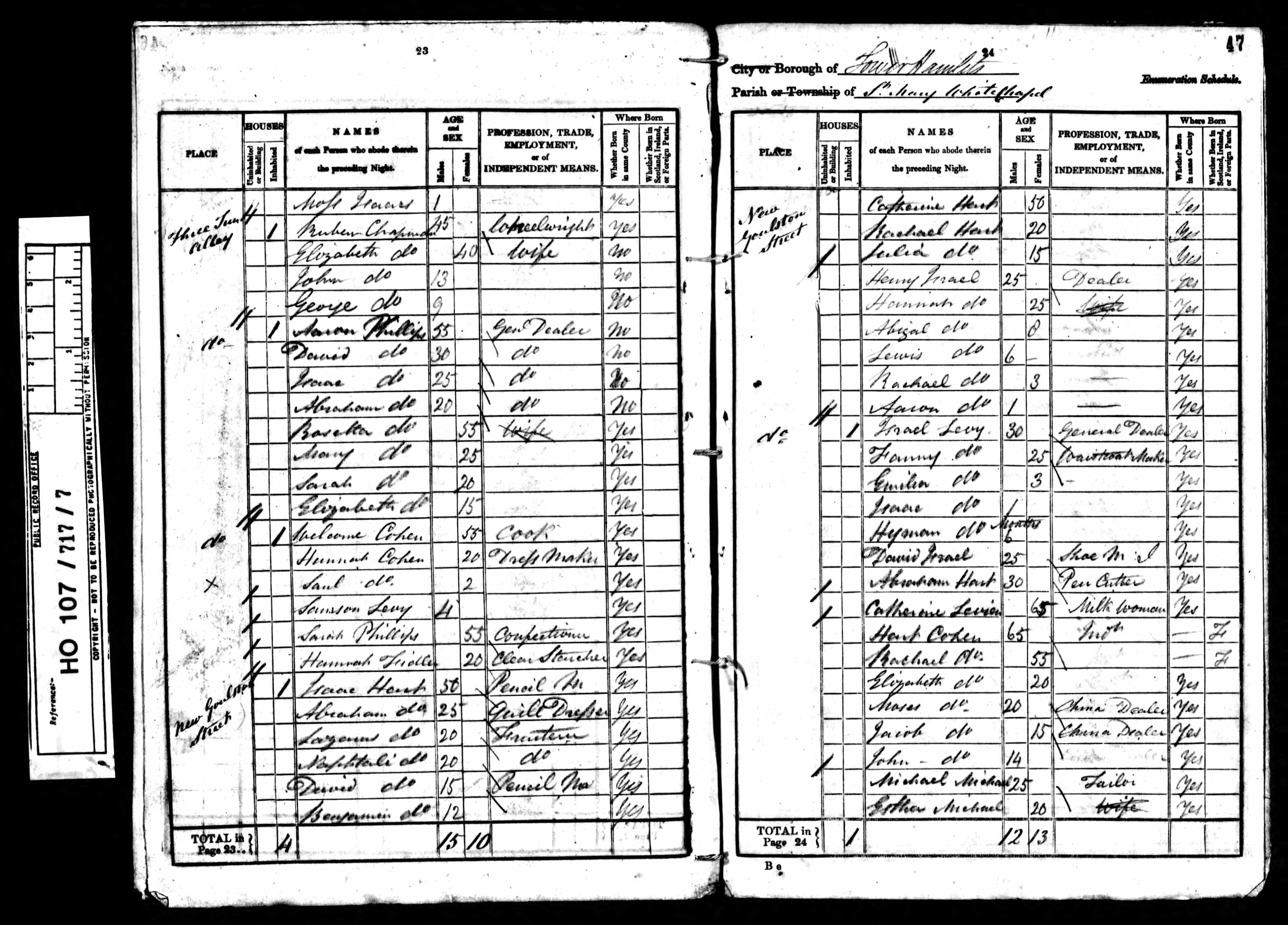
Hart Cohen and family 1841 English census

Hart Cohen and family 1841 English census

This appears, however, to be inaccurate based on later census reports from the United States and from a passenger manifest, all of which indicate a birth year of 1824 or 1825.  That would have made Jacob 16 or 17 in 1841.

This also seems more consistent with the fact that Jacob may have married his wife Rachel Jacobs (possibly a relative of his mother, whose birth name was also Jacobs) on October 24, 1844.  Without an actual marriage certificate I cannot be completely sure, but I found a marriage record on SynagogueScribes for Jacob Cohen, son of Naphtali Hirts HaCohen, to Sarah Jacobs, at the Great Synagogue of London on that date.  The Hebrew name is not identical to what I had earlier found for Hart, Jacob’s father, but it is very close.  I know that Sarah’s maiden name was Jacobs based on the death certificates of two of their children, Isaac and Frances.  Thus, I feel fairly confident that this is in fact their marriage record as transcribed by SynagogueScribes.

COHEN
Forenames Jacob
Hebrew Name Jacob
Event Marriage
Date 1844 [29 Oct]
Occupation
Address
Father
Father’s Hebrew Name Naphtali Hirts HaCohen
Mother’s Family Name
Mother’s Forename
Mother’s Hebrew Name
Spouse JACOBS Sarah

Frances, or Fanny, was Jacob and Sarah’s first child, born around 1847, as inferred from later US census reports.   Within a year of Fanny’s birth, Jacob and Sarah left London and moved to Philadelphia.  On July 7, 1848, Jacob, Sarah and Fanny, an infant, arrived in New York aboard the ship New York Packing.  Jacob’s age was given as 24, consistent with a birth year of 1824, and Sarah was 20, giving her a birth year of 1828.  Jacob’s occupation was given as “General dealer,” as were many other men on the manifest.
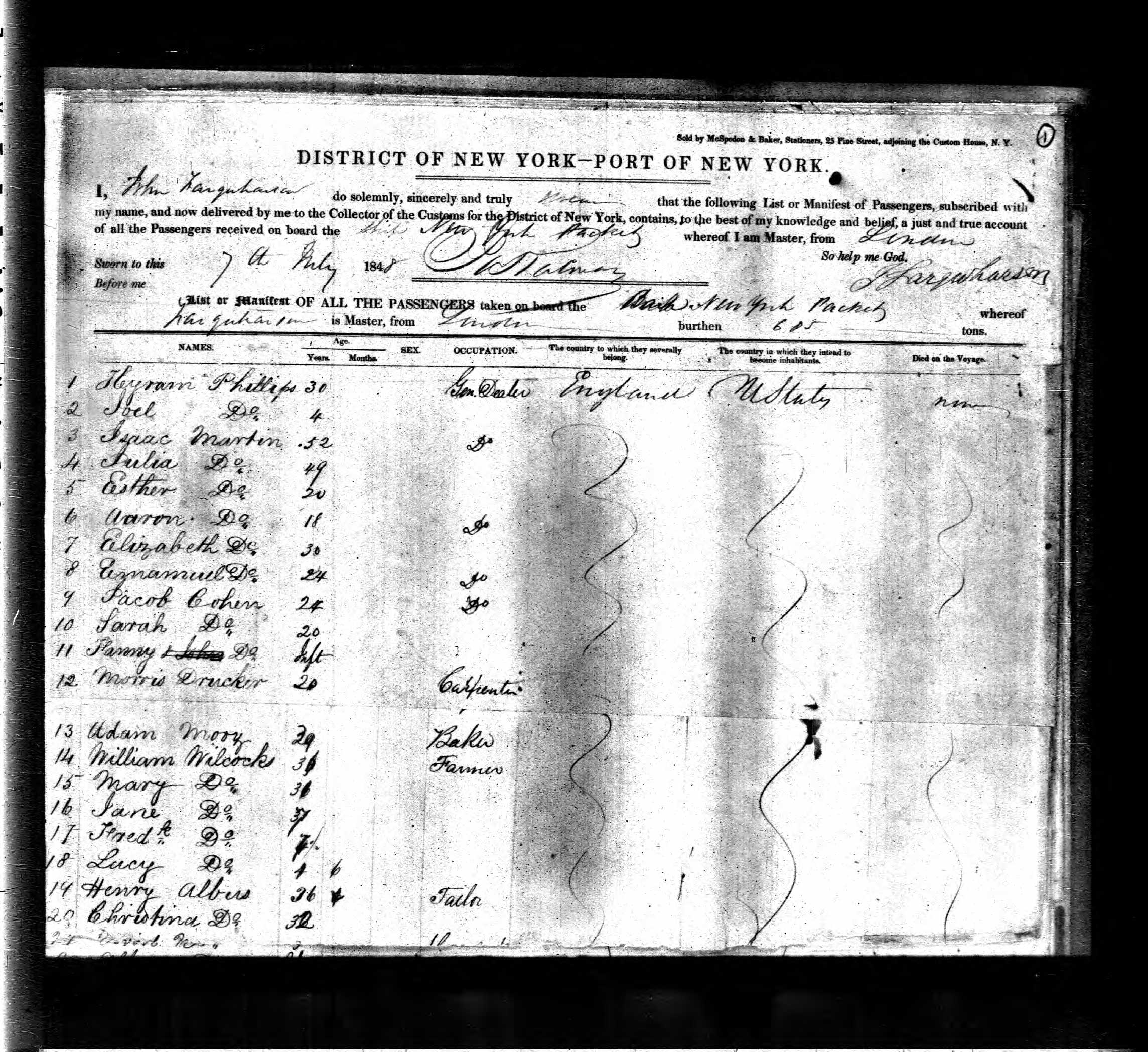
Jacob and Sarah Cohen ship manifest 1848

Jacob and Sarah Cohen ship manifest 1848

Jacob was the first of Hart and Rachel’s children to leave London and move to the US.  His siblings and eventually his father began arriving several years later.  I found this interesting, given that Jacob was not the oldest son, but the fourth child and third son.  Why did he go first?  What drew him away from his family and to America with his young wife and baby?  I also found it revealing about my direct line that both Hart and Jacob were the sons who left their families behind and moved to a foreign country.  As far as I can tell, Hart arrived alone and without his family when he immigrated to England, just as his son Jacob did fifty years later when he left England and moved to the US.  I can’t say I inherited this willingness to take risks and move far from home, having never lived more than four hours from where I was born, but I like the idea that my ancestors were such risk-takers and so independent.

I don’t know whether Jacob and his family stayed very long in New York after arrival, but by 1850, Jacob and Sarah were living in Philadelphia.  It was not easy finding Jacob and Sarah on the 1850 US census.  I tried searching for all Jacob Cohens, Sarah Cohens, Fanny Cohens, and variations on each name and wild card searches on each name, but came up empty for a family that fit my relatives.  Then I decided to search just by first names for a Jacob with a wife named Sarah and a daughter Fanny and found them listed as “Coyle,” not “Cohen,” another instance of a mistaken name on a census report.  I am quite certain that these are my relatives despite the Irish surname because all the other facts fit closely enough—names, ages, places of birth for Jacob, Sarah and Francis.  Jacob’s occupation is described as “Dealer in 2d HG,” which I interpret to mean a dealer in second hand goods.  The only inconsistency is that Francis is listed as male, not female, but later census reports correct that mistake and list her as female.


Jacob Cohen and family 1850 US census

Jacob Cohen and family 1850 US census

By 1850, Jacob and Sarah had two additional children born in Pennsylvania.  Joseph was two years old, so presumably born shortly after Jacob and Sarah had arrived in the US in 1848, meaning Sarah was pregnant when they left England.  Isaac was six months old, so presumably born in January, 1850, since the 1850 census was dated July 25, 1850.

There were also two other men living in the household, both twenty years old: Mordecia (Mordecai?) Coyle (Cohen?) and Alexander Kelly.  Unfortunately, the1850 census did not identify the relationship of each individual to the head of household as later census reports did, so I do not know who these two men were.  Mordecai might very well have been a relative since he shared the same surname with the family.  But how might he have been related? None of Jacob’s siblings were old enough to have had a twenty year old son, and Jacob did not have a younger brother named Mordecai.  Also, the census indicates that Mordecai was born in Pennsylvania, meaning that his parents would have been in the US in 1830.  Perhaps Hart had a brother who had emigrated from Holland or Amsterdam or England that early? Or was Mordecai not even related to Jacob?  I have done some preliminary searching for other records for Mordecai, but so far have not had any success.

Thus, by 1850 my great-great grandfather was settled in Philadelphia, a young man with a young wife and three little children, working as a dealer in second hand goods.  His parents and his siblings were all still back in London, but between 1850 and 1860, that would change, and Jacob’s family both in his household and in Philadelphia would expandd many times over.

My next post will describe what the rest of Hart’s family was doing between 1841 and 1860, by which time most of the Cohens had arrived in Philadelphia.


Enhanced by Zemanta

My Ancestor was a Chut: More on Dutch and English Jews

The Chuts” Synagogue Sandy’s Row London

After I wrote my last post saying I was going to put aside for now any attempt to find my four times great-grandfather’s family in Holland, I decided to look more generally into the question of why a Dutch Jew would have emigrated from Holland to England in the late 18th century.  After all, life seemed to be pretty good for the Jews in Amsterdam at that point.  They had acquired full legal rights as citizens, many were comfortable both socially and economically, and England was in fact still forty years away from giving Jews the same legal rights as Christian residents.  Why would someone have left Amsterdam to move to London?

Su Leslie of Shaking the Tree mentioned in a comment that she had seen some episodes of the British version of Who Do You Think You Are involving famous British Jews and recalled that there had been discussion of an immigration of Jews from Holland to England in the late 18th century.  I decided to search on line for more information and learned that there was in fact a whole community of Dutch Jews who settled in London during that time.  My research led me to several websites discussing this community, including the Bishopsgate Institute website describing a recent oral history project about this community being sponsored by the Institute and created under the direction of Rachel Lichtenstein, a well-known writer and artist.  According to this site:

The oldest Ashkenazi synagogue in London, Sandys Row in Spitalfields, was established by Dutch Jewish immigrants in 1854, who began arriving in the city from the 1840s onwards. They came in search of a better life, rather than fleeing persecution like the thousands of Ashkenazi Jews who came after them in the 1880s from the Pale of Settlements.  Mostly from Amsterdam, many settled in a small quarter of narrow streets in Spitalfields known as the Tenterground. Here they continued to practise the trades they had bought with them from Holland, which were predominately cigar making, diamond cutting and polishing, and slipper and cap making. Many small workshops were established in the area and businesses were passed on within generations of families.

With their own practises and customs, many of which were different from other Ashkenazi Jewish groups, they became a distinctive, tight knit community of about a thousand people. To the frustration of the more established Anglo-Jewish population living in the area at the time, ‘the Chuts’ (as they were known locally) refused to join any of the existing synagogues…

Sandys Row Synagogue

Sandys Row Synagogue (Photo credit: FarzanaL)

So my four times great grandfather Hart Levy Cohen was a Chut—a term I’d never heard before and a community I’d never known about before.  Other sites confirmed this information and also provided some other details.  Wikipedia provided this explanation for the name “Chuts.”

The origin of the name Chuts is uncertain. A popular assumption is that it derives from the Dutch word goed (meaning “good”) and is imitative of the foreign-language chatter that others heard. It is also Hebrew חוץ for “outside” or “in the street” and may have been applied to the Dutch Jews of London either because they were socially isolated or because many were street vendors. Another possibility is that the Hebrew word would have appeared increasingly in Amsterdam synagogue records as more and more emigrated to London, and others who followed would have “gone chuts” (i.e., emigrated).

Sandys Row Synagogue, London

Sandys Row Synagogue, London (Photo credit: nicksarebi)

The About Jewishness website revealed where in London the Chuts lived:

They settled mostly in a small system of streets in Spitalfields known as the Tenterground, formerly an enclosed area where Flemish weavers stretched and dried cloth on machines called tenters (hence the expression “on tenterhooks”). By the 19th century, the site had been built upon with housing, but remained an enclave where the Dutch immigrants lived as a close-knit and generally separate community. Demolished and rebuilt during the twentieth century, the area is now bounded by White’s Row, Wentworth Street, Bell Lane and Toynbee Street (formerly Shepherd Street).

I looked up these streets on the map of London and was not surprised that this area is very close to New Goulston Street where my ancestors were living in 1841.

The About Jewishness site also provided some insight into what happened to this community and perhaps why my ancestors left London and moved to the US.  According to this site, “the successful introduction of machinery for the mass-production of cigarettes ultimately led to the collapse of the cigar-making economy on which the Chuts community depended. Many Chuts returned to improved conditions in Amsterdam, some emigrated further afield to places such as Australia and the USA, some assimilated into other Jewish families, and some eventually lost their Jewish identity altogether.”

In addition, the huge influx of Eastern European Jewish immigrants in the late 19th century caused tensions between the older established Chuts community and the newer immigrants, most of whom were poor, not as well skilled, and not used to living in a big city.  Interestingly, the Chuts community had traditions and practices that made them different both from the older Sephardic community and from the newer Eastern European Ashkenazi community.  Again, from the About Jewishness site:

[T]he Chuts were treated with suspicion by other Jews because the former had developed specific customs and practices, many of their families having lived in Amsterdam since the first synagogues were established there in the early years of the 17th century. Uniquely in Amsterdam, Ashkenazim (so-called “German Jews”) and Sephardim (so-called “Spanish Jews”) lived in close proximity for centuries, resulting in a cultural blend not found elsewhere. Most remarkably, the Dutch Jews were well accustomed to the sea, and ate seafoods considered not kosher by other Jewish communities.

From this information, it seems reasonable to infer a couple of things.  First, it seems that despite the fact that the Amsterdam Jewish community was fairly well-established, there must have been those, my ancestor Hart among them, who believed that there was greater opportunity for financial success in London.  These Dutch Jews decided to emigrate in order to achieve greater economic security.  Secondly, it seems that at some point many of those Dutch Jews either left or assimilated into the greater Jewish or non-Jewish society.  Some may have left because economic conditions were not as good as they had hoped; others may have left because as a “Chut,” they were not well integrated into the world of London’s Jews.  With different traditions, different practices, different synagogues, they may have felt isolated and disrespected.  I don’t know specifically what motivated my ancestors first to leave Amsterdam and then to leave London, but I’d imagine it was a combination of these factors.

Once again I am finding out new things about my own history and about Jewish history by doing genealogy.  I never knew about the Chuts, and I certainly never knew I was descended from one.  I have written to Rachel Lichtenstein to learn more about her project and will report back with whatever else I learn.

Also, in researching more about the Dutch Jews in general, I came across a genealogy blog I’d not seen before written by Kerry Farmer called Family History Research.  Kerry had a post from two years ago about searching for a Dutch Jewish ancestor using information she was able to obtain from a book compiling information about marriages performed at the Great Synagogue in London, Harold and Miriam Lewin’s Marriage Records of the Great Synagogue- London 1791-1885.  I was very excited when I read this post and contacted Kerry, who generously looked up Hart Levy Cohen and Rachel Jacobs’ wedding for me in the Lewin book.  She was able to provide me with the information she found there:

(Groom) Cohen Hart Levy

(Groom’s father) Leib Katz

(Groom’s patronymic) Hertz b. Leib Katz

(Groom’s address) Not listed

(Bride) Jacobs Rachel

(Bride’s father) Yaakov

(Bride’s patronymic) Rechel b. Yaakov

She also suggested that I contact the owners of the Akevoth site to see if this additional information would help in locating the records of my ancestors, and I have done that.  Now I will wait to see if they can provide any further assistance.

So yesterday I was ready to put aside the search for my Dutch ancestors, and then, with the help of Su Leslie and Kerry Farmer, I was able to make some progress in understanding who they were and why they left Amsterdam and why they left London.  Once again I am humbled by and grateful for the generosity of the genealogy community.  Su and Kerry are from New Zealand and Australia, respectively, and they have helped me in my search to find a Dutch Jew who lived in England and moved to America.  What a small world it is when you find such wonderful, helpful and knowledgeable people.


Enhanced by Zemanta

Hart Levy Cohen and A Very Brief History of Jews in London

In my research so far, Hart Levy Cohen is the earliest verified ancestor I have found.  There are some others on other lines on my father’s side that are earlier, but not yet verified.  But I am quite certain that Hart was my three-times great grandfather based on the census reports I have been able to locate in both English and American records.

The earliest reference I have to Hart is a transcription of his wedding record from the Great Synagogue of London. I found this on a website called Synagogue Scribes, which provides a free, searchable database of transcriptions of the information from marriage and other records from the Ashkenazi synagogues in London.  According to this site, Hart Levy Cohen, whose Hebrew name was Hirts and whose father’s Hebrew name was Leib, married Rachel Jacobs on January 29, 1812.  I was thrilled when I first found this record because it provided me with not only my three-times great grandmother’s name, but also because it revealed my four-times great-grandfather’s first name.  It also revealed that by 1812 Hart was living in England.[1]

The Great Synagogue of London: This engraving ...

The Great Synagogue of London

The earliest actual record I have for Hart is the 1841 English census, which lists Hart, his wife Rachael (sp?), and four of his children, Elizabeth, Moses, John and Jacob.[2]  Jacob was my great-great grandfather. According to the census, Hart was then 65 years old, giving him a birth year of 1776.  Rachel was 55, giving her a birth year of 1786.  Elizabeth and Moses were both listed as twenty years old, Jacob was 15, and John was 14.  All of the children were listed as born in England, but Rachel and Hart were listed as foreign born.  Hart’s occupation was described as “Ind’t,” meaning he was of independent means, and Moses and Jacob were both described as china dealers.

Hart Cohen and family 1841 English census

Hart Cohen and family 1841 English census

The family was residing on New Goulston Street in the St. Mary Whitechapel parish of Middlesex County in East London.  Scanning through the names and occupations of other residents of that street and nearby streets, I noticed that many of the names were Jewish and that many of the residents were merchants of some sort or tradespeople.  I knew nothing about the history of Jews in London, and thus studying this census led me to research that history in order to learn more about the neighborhood where my ancestors lived in the early 19th century.  That, in turn, led me to read more about the history of Jews in England overall and specifically in London.

Although I cannot do justice to the long and complicated history of the Jews in England here, a very brief overview may suffice.  According to a number of sources, Jews had first settled in England during the reign of William I in the 11th century, but were expelled from England in 1290 by an edict of King Edward I, and there was no Jewish community thereafter until the 17th century when a community of Sephardic Jews from Spain arrived, although many of these Jews hid their religious identities.  Eventually for political and economic reasons, the English acquiesced in the growth of the Jewish community, although there was still a great deal of anti-Semitism.  Jews were not allowed to be citizens and were denied many of the legal rights of non-Jewish English citizens.

In the 18th century, the Sephardic community grew both in size and in wealth and became quite successful, but Jews were still denied full legal rights.  There was a short lived naturalization law passed in 1754 to enable Jewish men to become citizens, but it was repealed one year later due to widespread popular opposition.  It was not until 1833 that Jewish men were emancipated and given full legal rights as English citizens.

Meanwhile, there was also a growing Ashkenazi community during the 18th and 19th centuries, referred to as “Dutch Jews.”  My three-times great grandfather Hart Levy Cohen would have been one of those Dutch Jews, probably arriving at the end of the 18th century.   According to the Jewish Encyclopedia, “the bulk of the Ashkenazic community consisted of petty traders and hawkers, not to speak of the followers of more disreputable occupations.”  They settled in East London in the parish of Whitechapel, as did my ancestor Hart.  Whitechapel in the 1840s was described in Wikipedia as “classic “Dickensian” London, with problems of poverty and overcrowding.”

It would appear from the 1841 census listing, however, that Hart and his family were not among those poor.  Hart appears to have been retired, and his two sons were china dealers.  Perhaps their particular section of Whitechapel was not as poor as other sections.  For example, their street was very close to the Petticoat Market, a clothing manufacturing center that catered to the well-to-do of London.

File:Thomas Rowlandson - Rag Fair or Rosemary Lane - Google Art Project.jpg

Petticoat Market in the early 19th century

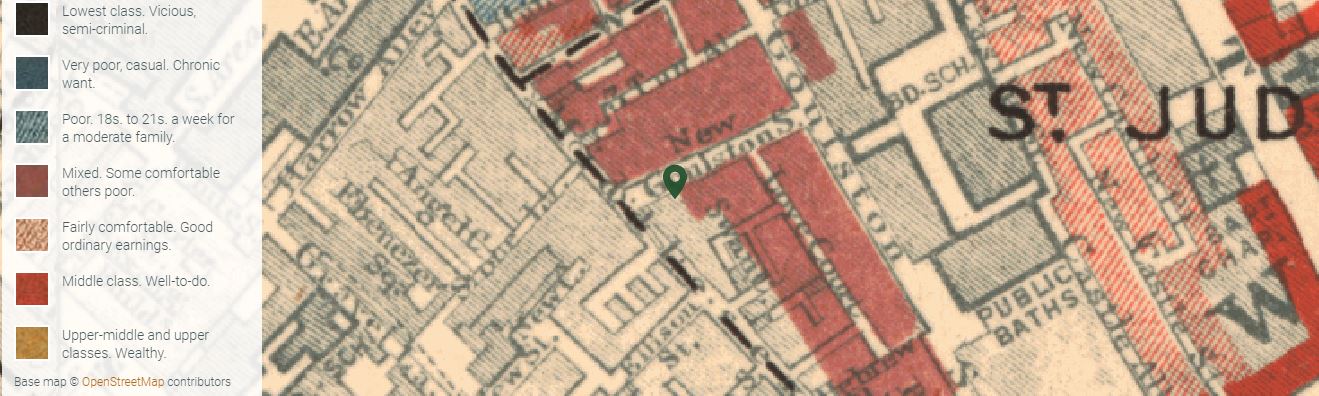
UPDATE:  Thanks to the help of my fellow blogger Su Leslie from Shaking the Tree, another of my very favorite genealogy blogs, I was able to find a map prepared by Charles Booth in the late 19th century that shows street by street the economic standing of the residents.  He rated each street on a seven level scale from poorest to upper class.  New Goulston Street appears to be purple on his map, meaning it was a mixed neighborhood with some poor residents and some comfortable residents.  That also seems consistent with my scan of the census of their street.

Charles Booth poverty map of London, New Goulston Street marked in center
https://booth.lse.ac.uk/map/18/-0.0757/51.5160/100/0?marker=533621.0,181427.0

In the later part of the 19th century, there was a tremendous influx of poor European Jewish immigrants to London, just as there was in New York and other American cities, coming to escape the oppression, violence and poverty in East Europe. There was also a large immigration of poor people from Ireland during this same period. The Whitechapel neighborhood became even more poverty-stricken, and crime became rampant, including widespread prostitution.  It was also during this period that Jack the Ripper, the serial killer, committed a string of murders and caused widespread terror.

By this time, however, most of my Cohen relatives had left England and come to the United States.  Only two of Hart’s six children remained in England by 1860.  Why did they leave? And why did Hart come to England from Holland in the first place? Those are questions that I want to answer if I can as I dig more deeply into my Cohen ancestors.


[1] I also thought I had found earlier records for Hart in tax records from 1798, but I now think that those records were for a different person because I found a record dated 1768 at the same address, also for a man named Hart Cohen.  These records require deeper investigation.


[2] There were six children altogether.  Lewis and Jonah are not accounted for on this census.  Lewis would have been 21, so perhaps was not living at home, but I have not yet found him elsewhere.  Jonah would have been 12, so I cannot account for the fact that he is not listed, except to note that this was the first English attempt for a comprehensive census and undoubtedly mistakes were made.


Enhanced by Zemanta