
It’s remarkable to me that before I started doing any of this research, I did not even know my grandfather’s father’s name (or his mother’s name). I still know very little about his life and nothing about his personality, but I know enough to make me sad that I don’t, and likely never will, know more.
From records that my researcher in Iasi was able to find last summer, I know that my great-grandfather was born Moses Lieb in Iasi, Romania in 1855. His parents were Ira and Beila Goldschlager. From the birth record created for his marriage, I know that witnesses testified to his birth and to the fact that his father Ira died in 1859 and that his mother Beila died in 1861.

Moses Leib Goldschlager birth record
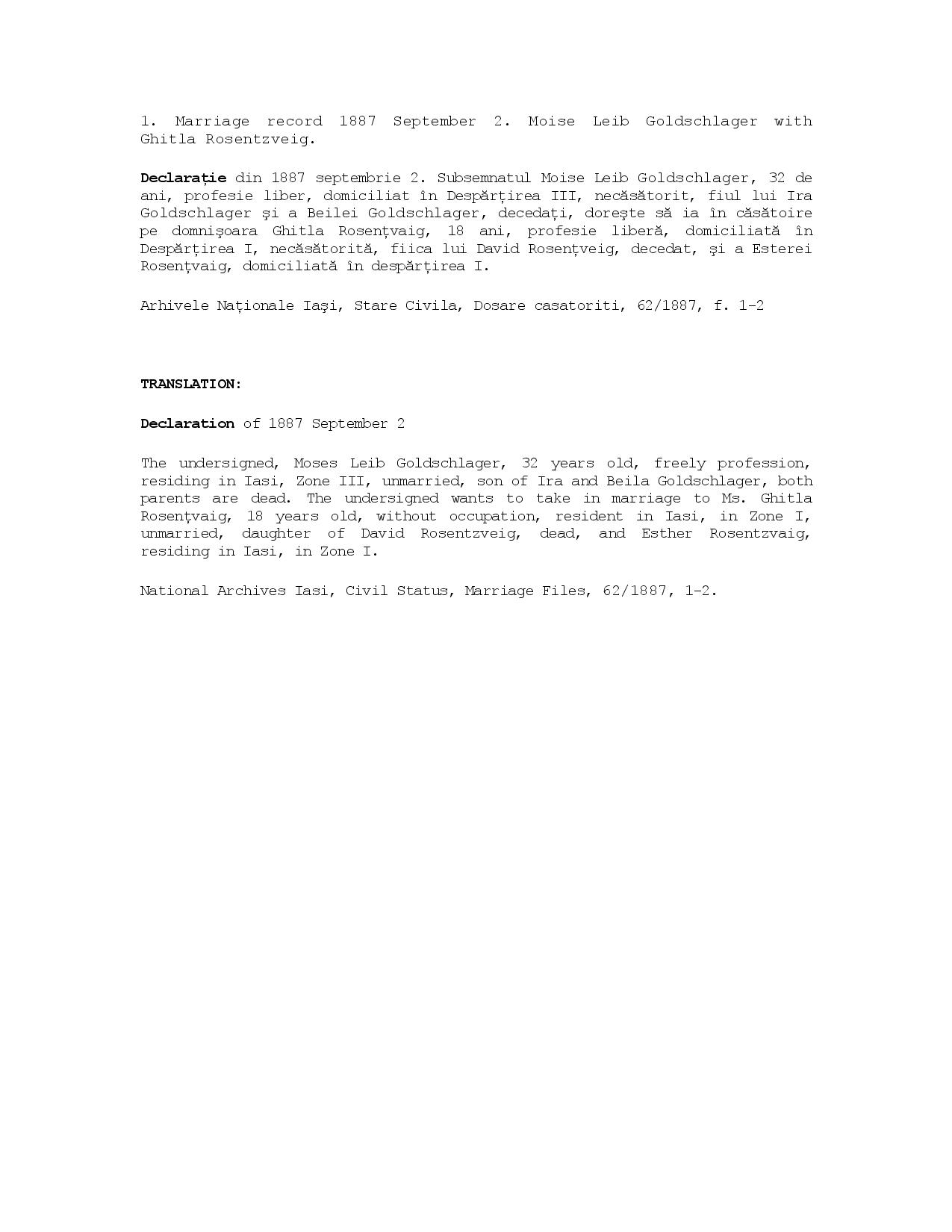
Moses birth record transcribed and translated page 1

page 2
In other words, my great-grandfather was an orphan by age six. I have no idea who took care of him after that. Perhaps it was one of the several witnesses on this record, men who were old enough to have been a guardian to him. I have no idea what his childhood was like or how or why his parents both died when he was so young.
The next event for which I have any record is Moses’ marriage record dated September 2, 1887, when he was 32 years old. Was this his first marriage? Thirty-two seems old for that generation to be married for the first time, but so far no earlier record has shown up. Perhaps he was married before; perhaps he even had children in that first marriage. I don’t know. I don’t know what he was doing between 1855 and 1887, how he survived, where he lived, how he made a living. But in 1887 he married my great-grandmother, Ghitla Rosentzweig, eighteen years old according to the marriage record, daughter of David and Esther Rosentzweig. Her father also had died by the time she was married, but her mother was still alive and living in Iasi. On the marriage record Moses’ occupation is reported as “freely profession,” as translated by my researcher. I asked him what this means, and he said he believed it meant self-employed. Since my great-grandmother is listed as “without occupation,” I assume that Moses had some occupation, but it is not identified.

Moses Leib Goldschlager and Ghitla Rosentzvaig marriage record
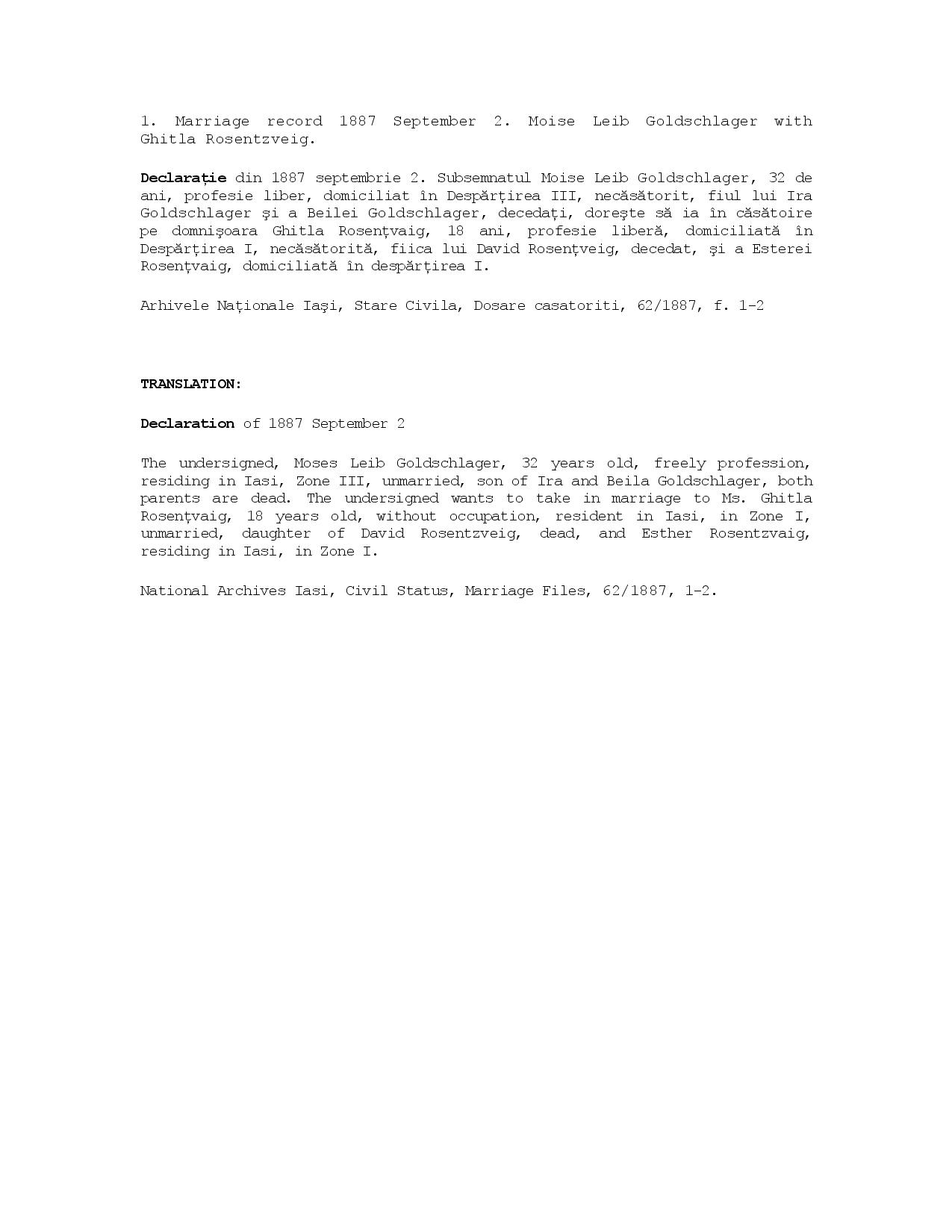
Transcription and translation of marraige record
Their first child, my grandfather Isadore, was born in August, 1888, almost a year after Moses and Ghitla were married. On his birth record, it says that Moses, now 33, was a lamplighter. I assume this meant that he lit the gas lamps on the public streets.
UPDATE February 2, 2014: I just learned today that he lit the lamps in the theater!! And that he was a very dapper dresser. Thank you, Gayle, Betty’s granddaughter, who reported this information to me.
Interestingly, Ghitla is now reported to be 22, not 19. (I guess Romanian record keepers faced the same inconsistent age reports as American census takers.) My grandfather’s name is spelled Ire here, obviously named for Moses’ father Ira Goldschlager.

Ira aka Isidor Goldschlager birth record
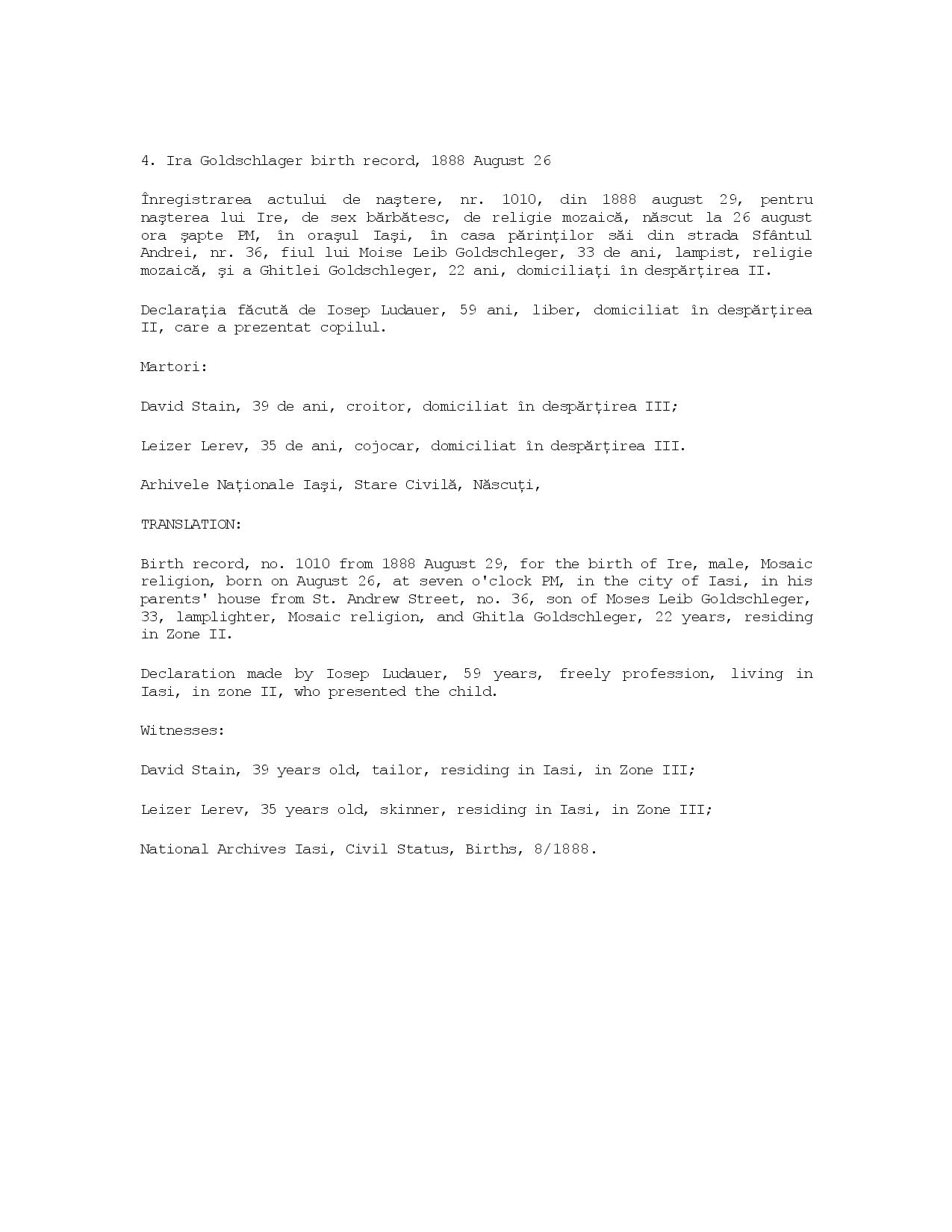
transcription and translation
Moses and Ghitla’s second child David was born the following year on November 4, 1889. David was presumably named for Ghitla’s father, David. Moses’ occupation is once again described as “freely profession,” and he is now 34, Ghitla 23. The Goldschlager family was residing at the same house as the year before at 26 St. Andrew Street in Iasi, depicted below.

David Goldschlager birth record
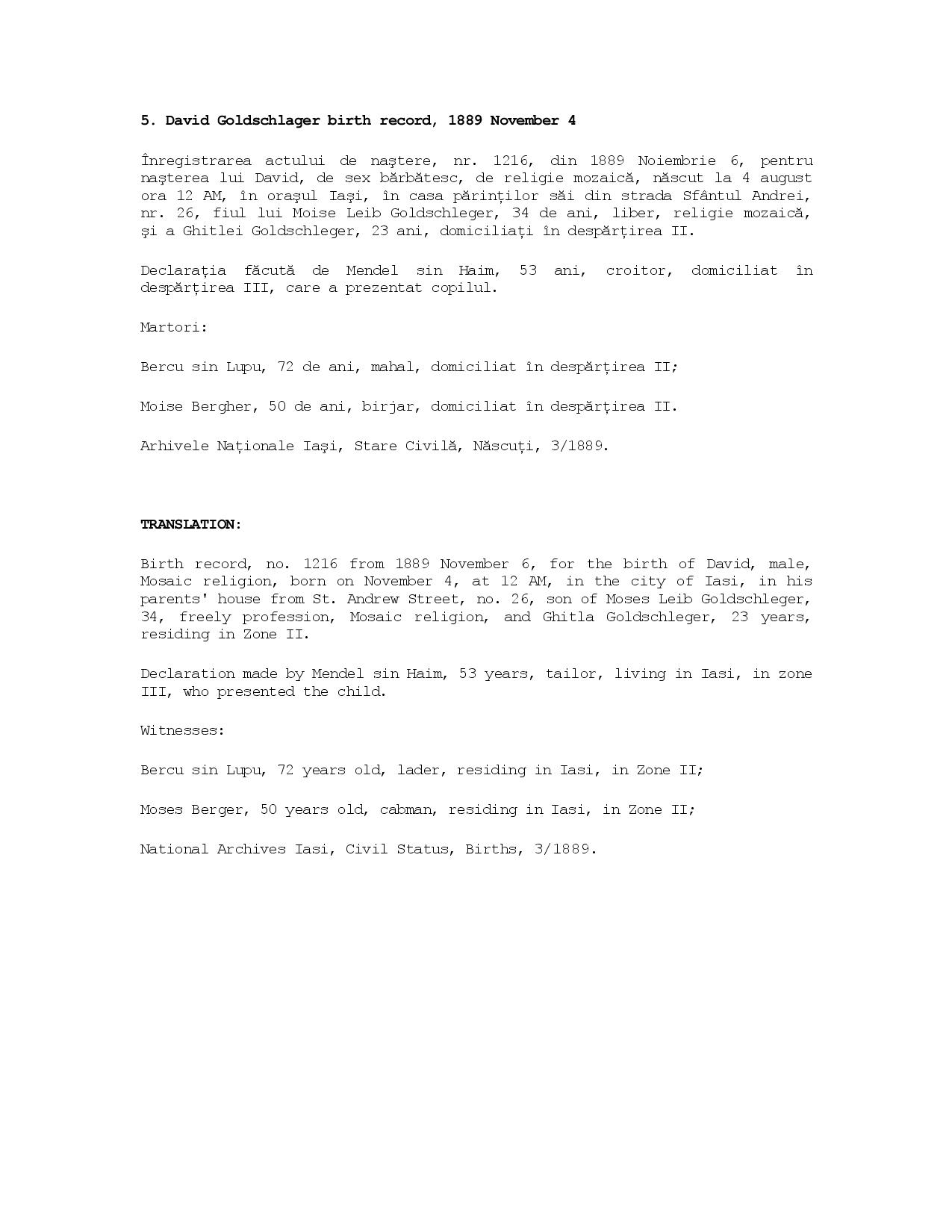
transcription and translation

The Goldschlager home at 26 St Andrew Street, Iasi

The next record I have for Moses is the ship manifest for when he left Romania and came to the United States. He sailed from Le Havre on July 31, 1909, to New York. On the manifest his name is given as Moritz Goldschlager with his occupation listed as a tailor. It says he was 46 years old, which is about eight years younger than it should be. It gives his nationality as Roumanian and his “race or people” as Roumanian, but then written over it is “Hebrew.” Moses/Moritz named his wife Gisella Goldschlager of Jassy as the nearest relative from the country he was leaving and named his son Isidor, my grandfather, of 440 East 147th Street, New York, as the person he was joining at his destination. The manifest also reveals that Moses was only 5’3” tall and had auburn hair and blue eyes. That is probably the closest I will ever get to a picture of him.

Ship Manifest of Moritz Goldschlager
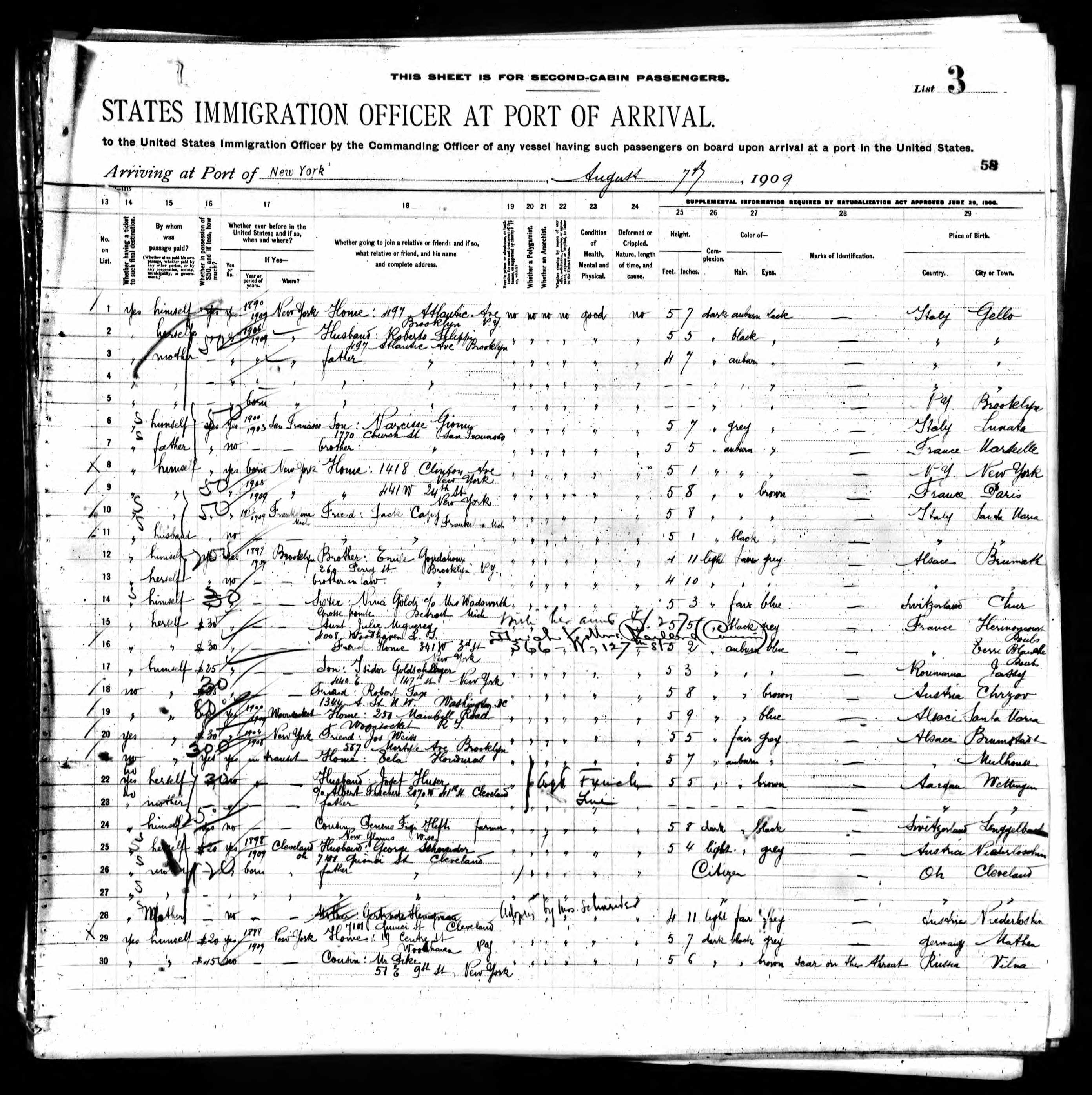
page 2
UPDATE: I just realized that the 440 East 147th Street must be 110 East 117th Street, as that was the address that my grandfather have given for his aunt Zusia Mintz as the person meeting him when he came to NYC. Plus 440 East 147th Street is in the Bronx, not Manhattan.
I wonder when he became Moritz, just as I wonder when my grandfather became Isidor (or Isadore; it seemed to change back and forth). Were these names they used in Romania, or were they adopted to come to America? I assume the former—that Moses and Ira were Hebrew names, Moritz and Isidor secular names, but I don’t know for sure.
Moritz arrived in the United States in August, 1909, and then sadly, the next and last record I have for him is his death certificate, which I just received the other day. As I’ve written earlier, Moritz died on April 3, 1910, just eight months after he arrived in New York, a day before his daughter Betty arrived, and seven months before his wife and his son David arrived from Romania. They all arrived apparently without knowing Moritz had died, as they all listed him as the person meeting them at arrival.
I had wondered about his cause of death, and although I know that there is some question about the reliability of death certificates before the professionalization of the medical examiner’s office in the late 1920s, my great-grandfather died in a hospital according to his death certificate, and his death certificate is signed by a medical doctor, not a coroner. According to the certificate, my great-grandfather died from tuberculosis after being admitted to Harlem Hospital on April 2, 1910. I wonder how long he had been sick before coming to the hospital.

Moritz Goldschlager death certificate
The certificate also provides some other information and, as often is the case, some misinformation. It says that Moritz was a peddler, that he was married, and that he was 53 years old, which is closer to the truth than the age listed on the ship manifest. It says his father’s name was Isidor Goldschlager, which, if true, means that my great-great-grandfather also used Isidor as his secular name and his Hebrew name was Ira. But the certificate also says that Moritz’s mother’s name was Ghisela and then something that is not legible. I assume that my grandfather was the informant and that he was confused and gave his mother’s name instead of his father’s mother’s name.
Finally, the death certificate indicates where Moritz and Isadore had been living—173-175 East 109th Street. According to the 1910 census, this is the same street where Tillie Strolovitz and her seven children were living in 1910, just a few blocks away. That census is dated April 24, 1910, just 21 days after Moritz had died, 20 days after Betty had arrived. Isadore and Betty had moved in and were living with their aunt and cousins by that time, obviously taken in by their aunt Tillie shortly after their father’s death.
And that is all I know about Moses ben Ira, Moritz Goldschlager. He lost his both his parents by the time he was six years old; he married at age 32, had three children, and worked for at least a while as a lamplighter and perhaps as a tailor in Iasi before emigrating in 1909. He lived for less than a year in New York as a peddler before succumbing to tuberculosis at Harlem Hospital before he ever saw his wife, his younger son, or his daughter again.
Sometimes when I put together these missing links to people I never knew and who no one alive today ever knew, it makes me feel incredibly rewarded and happy. Sometimes, as with Moritz, it leaves me feeling sad. What kind of life did he have with so much misery at the beginning and then at the end? I can only hope that in between he found happiness and some comfort with his wife and three children.

Moritz Goldschlager headstone
These lost ancestors are part of what motivates me to do this research. Someone should know that they lived, they suffered, they loved and were loved, and they died. Moritz had at least two namesakes: Isadore’s son, my uncle Maurice, also named Moses Lieb, and David’s son Murray, also Moses Lieb. If we count the children who were then named for my uncle Maurice as namesakes of Moritz’s namesake, then there are several more, including my daughter Madeline. I’d like to think that that adds more meaning to his life—knowing that his name does live on and that his life is now remembered and documented.


 Brotmanblog: A Family Journey