A Life of Service and Success: Arthur Seligman, Part III

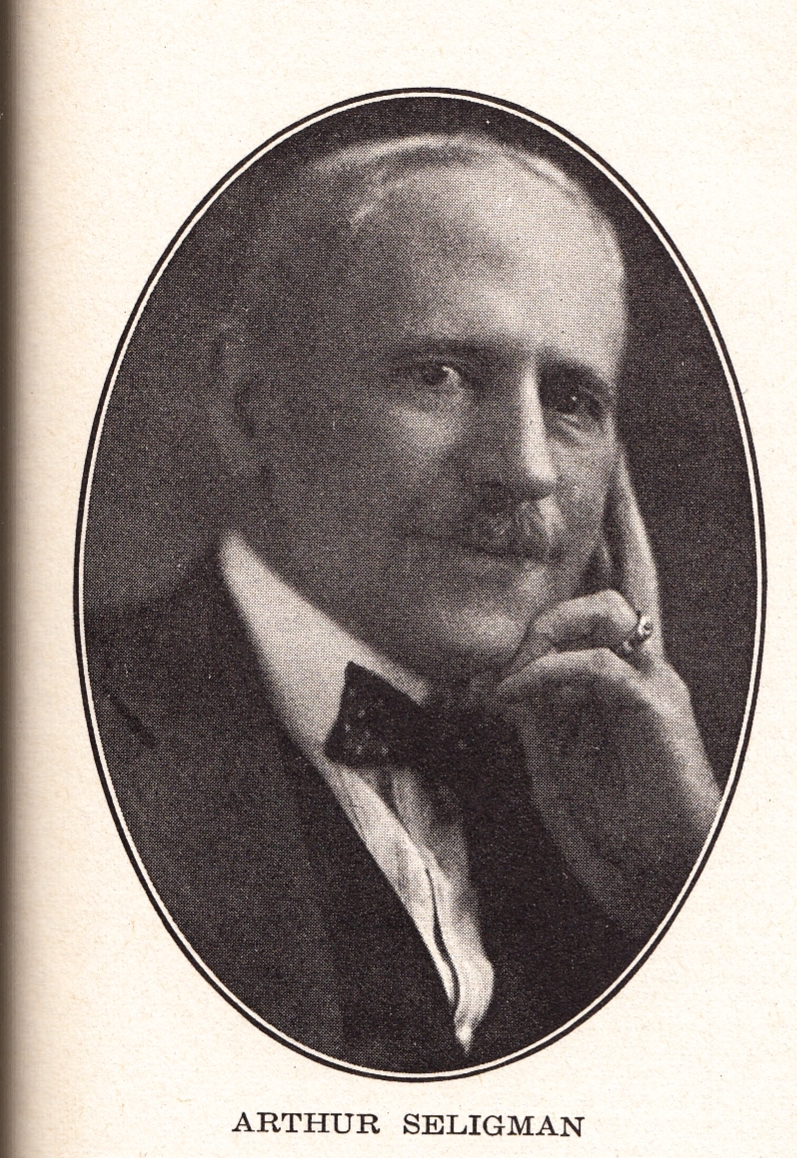
Arthur Seligman, c. 1925 from Twitchell, p. 479

Arthur Seligman, c. 1925 from Twitchell, p. 479

On September 25, 1933, less than a year into his second term as governor of New Mexico, my great-great-uncle Arthur Seligman died suddenly and unexpectedly of a heart attack.  After lying in state in the state capitol, he was buried on September 27, 1933, in the Fairview Cemetery in Santa Fe.  My great-grandmother Eva, his sister, traveled from Philadelphia to attend his funeral as she had done in January, 1931, for his first inauguration.  (“Late Governor Lies in State at the Capitol,” Las Vegas Daily Optic (September 27, 1933), pp. 1, 5)

Although certainly Arthur Seligman had his political enemies, the opinions expressed about him in numerous sources recognized that he was an effective leader, an able businessperson, and a successful politician.

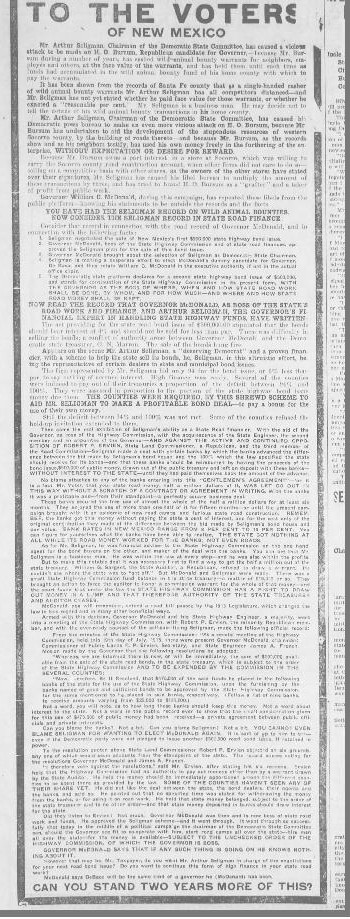
The Clovis New-Journal wrote on September 26, 1933, p.2:

Deming headlight obit-page-001

To select just a few highlights from this editorial (which is hard to read, but I thought worth reproducing for those who want to try), the Clovis opined:

No man has ever had a more comprehensive understanding of the politics of this state than he, nor has any man ever attained the leadership that linked more completely the eastern and western sides.  This he accomplished through what often brought him criticism as a Democrat—a guiding hand in both democratic and progressive republican ranks….

He was a tireless man; one who drove himself at a terrific pace, and to this very fact may be charged his death….He worked until midnight nearly every night, and was at his office again by 10 o’clock in the morning, ever driving himself to the utmost of his strength.

The Deming Headlight also praised him, writing on September 29, 1933, p. 2:

deming obit

In the Dictionary of American Biography, he is described as follows:

Suave, fastidious in dress, aristocratic in taste but democratic in policy, always prominent in social life, he sought and attained a large measure of power through business and political channels. Intensely loyal to his numerous friends and an enemy to be feared, for more than a quarter of a century he had few peers in Democratic circles of the Southwest. The strong position of the Democratic party in New Mexico at the time of his death was largely due to his long, shrewd, and able leadership.

Dumas Malone, ed., Dictionary of American Biography (Charles Scribner & Sons 1935), located at http://www.mocavo.com/Dictionary-of-American-Biography-Volume-16/114492/584

The Jewish Telegraphic Agency provided a deeper and more personal look at the life of Arthur Seligman:

A mild manner man was Arthur Seligman, pioneer builder of his native state, New Mexico, one-time Mayor of one of its leading cities, Santa Fe, and since 1931 its Governor. His sudden and untimely death last Monday came as a shock to all who knew him.

Stately in appearance, democratic in demeanor, firm in his convictions, determined in his action, Seligman was not only New Mexico’s favorite son, but also an exemplary figure in American civic and political life. His rise to the highest position of honor and responsibility in the State where he lived virtually all his life, the state to which he contributed so many lasting monuments, was reflective of the esteem in which he was held by his fellow citizens. Though always gentle, he invariably dealt emphatically with those who would practice abuse in public office. In the government of his state he had no time for those who would see in political activity an opportunity for personal gain. He viewed public service as a privilege coming with American citizenship and felt that every one should accept this service in the spirit of a sacred trust. ….

Jewish Telegraphic Agency

Jewish Telegraphic Agency (Photo credit: Wikipedia)


The JTA also commented on Arthur’s religious identity:

Though distant from Jewish communal life. Seligman always evinced a deep interest in the affairs of his people. He kept in touch with Jewish activity and cooperated in many causes. There are only a handful of Jews in New Mexico, yet when he was candidate for the office of governor he had the Ku-Klux-Klan to deal with. These conducted a whispering campaign against him. This was his first encounter with anti-Semitism and upset him quite a bit. However, his standing in the community and his splendid record of achievement were too much for the Kluxers. His election as the first Jew to hold that office in New Mexico also helped to crush the Kluxers in the State. His sudden death last Monday is a distinct loss for he was a credit to his country and his people.

I had wondered whether there was any anti-Semitism underlying the attacks against him, and although I certainly did not find anything in the newspaper articles that expressly suggested that as a motivation behind those who criticized him, given the times and the location, there undoubtedly must have been many in New Mexico who were uncomfortable at best with the idea of a Jewish governor.  Despite that, Seligman was twice elected to the office.

Addressing the question of Arthur’s religious affiliation, Henry J. Tobias wrote in A History of the Jews in New Mexico (University of New Mexico Press 1990), pp. 160-161:

Though clearly of Jewish parentage, Governor Seligman’s religion at the time of his death is a matter of some debate.  Frankie Lacker Seligman, the governor’s wife, belonged to the Episcopal church, and the son born to them in 1898 [Otis] was christened there. … Upon his death, an Episcopal service for the dead was read at the House of Representatives.  At the Fairview Cemetery, however, the Masonic ritual was performed.  Given the uncertainty of the governor’s religious identity, it would be presumptuous to define it for him.  His family background and early life, however, place his career clearly within the framework of the history of the Jews of New Mexico.

Cover of "A History of the Jews in New Me...

Cover of A History of the Jews in New Mexico

Although he was not an observant Jew and did not marry a Jewish woman or raise his children as Jews, he is still always identified as Jewish on various lists and other sources.  (E.g., City of Albuquerque website  here ; Wikipedia article on Arthur Seligman at http://en.wikipedia.org/wiki/Arthur_Seligman ; list of Jewish governors in Jews in American Politics (Louis Sandy Maisel, Ira N. Forman, Donald Altschiller, Charles Walker Bassett, editors) (2001), p. 465.  As is often the case, it doesn’t matter what you do or believe or who you marry.  Once a Jew, always a Jew in the eyes of the much of the world.

Flag of City of Santa Fe

Flag of City of Santa Fe (Photo credit: Wikipedia)

Having now read so much about him after years of only knowing that I had some distant relative who had once been the governor of New Mexico, I now have great admiration for what he accomplished in his life.  He had the benefit of growing up as the son of a very successful merchant, his father Bernard, who also was his role model for public service.  His mother Frances Nusbaum Seligman was known as a gentle, kind and good woman.  He had three older siblings who must have doted on him; clearly his older sister Eva and he were very devoted to each other, traveling across the country to be with each other.  He had the benefit of a Swarthmore education and a business education.  There is no question that Arthur Seligman’s story is one that started with many advantages; it’s not a rags to riches story or the story of an immigrant achieving the American dream.

But it is nevertheless a remarkable life.  He could have taken the easy way—lived on the family’s wealth and remained a merchant or a banker and had a very comfortable life.  But he chose instead to serve his city as mayor, his party as chair, and his state as governor.  He faced some hostile opposition and apparently attacks by the KKK; he was referred to as Little Arthur in some news reports, mocking his small stature.  He was accused of being a greedy banker, undoubtedly a disguised anti-Semitic remark.  Yet he defeated his well-known Republican opponents, including one former governor, twice in races for the governor’s seat despite being a Jewish man from a state with almost no Jewish population.

As governor he somehow both cut the size of government and the tax rate while also instituting some important social reforms like vocational education and unemployment relief.  He faced a potentially violent strike by miners and a personal threat of kidnapping his granddaughter.  If he had not died in September, 1933, he might have been named a US Senator from New Mexico.  Who knows how far he could have gone or what else he might have accomplished?

Flag of New Mexico

Flag of New Mexico (Photo credit: Wikipedia)

Arthur Seligman’s story is the story of a man whose father came from a tiny town in Germany to a frontier town in New Mexico and became a successful American merchant.  It is the story of a boy who must have been grateful for the opportunities that America, New Mexico, and Santa Fe had afforded his family.  He took those opportunities and returned the gifts by working hard for the city, state, and country that had given so much to him and his family.
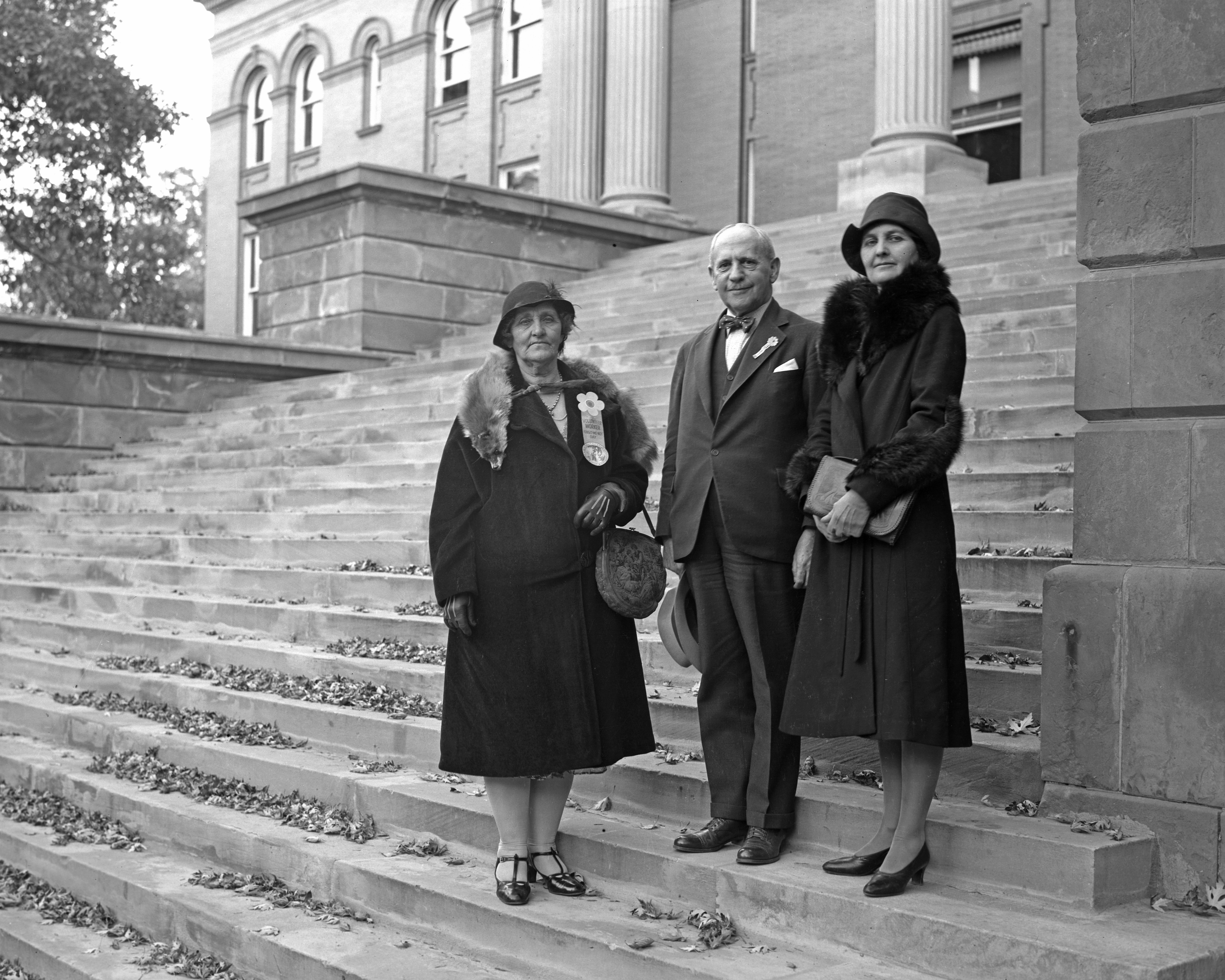



Arthur Seligman, Governor of New Mexico: Part II

Governor Arthur Seligman and his wife Franc and stepdaughter Richie courtesy of Arthur Scott

Governor Arthur Seligman and his wife Franc and stepdaughter Richie on the statehouse steps 1932
courtesy of Arthur Scott

In 1929, my great-great-uncle Arthur Seligman was the president of the First National Bank of Santa Fe and the chairman of the New Mexico State Democratic Committee.  He was 58 years old, father of two grown children, and a grandfather.  Some men might have decided that they had accomplished enough and been satisfied.  But Arthur Seligman still had things he wanted to do.

In April, 1930, Arthur was again named chairman of the New Mexico State Democratic Committee.  His message to the party was that he would work hard to ensure that the party was organized and successful and that he anticipated support both from Democrats and from independent voters. (“Demos’ Chief Gets on Job; Has Big Task,” The Gallup Independent (April 18, 1930), p.1)

headline elected state chairman april 1930

(Albuquerque Journal (April 15, 1930), p. 1

When the New Mexico Democratic Party started to consider who should be their candidate for governor in 1930, Arthur Seligman was a leading contender for the nomination.  Arthur, however, insisted many times that he was not a candidate and was committed to being chairman of the committee and not a candidate. (“Seligman Awaits Action of Party,” Clovis News-Journal (September 2, 1930) p.1; “Seligman’s Statement,” Las Vegas Daily Optic (September 3, 1930), p. 2; “Seligman in Demand,” Albuquerque Journal (September 18, 1930, p. 4)  Despite these objections, he ultimately was nominated and accepted that nomination.

In accepting the nomination, Arthur pledged to “clean out the ‘political parasites and political barnacles” in the state capital, to establish economy in public business and to remedy the present chaotic and demoralized condition of the taxation system in the state.”  (“Oust Political Barnacles, Seligman,” Albuquerque Journal (October 2, 1930), p. 1)

barnacles headline

His Republican opponent was Judge Clarence M. Botts.  The campaign was a tough one, and several newspapers in New Mexico were quite vocal about their opposition to Seligman as governor.  For example, The Roswell Daily Record characterized the Republicans as progressive and the Democrats as reactionary, saying:

Mr. Arthur Seligman has made it plain that he purposes, if elected, to retrench and economize.  His party, in their platform, has made it clear that expenses shall be cut in the maintenance of our system of education.  To do that school terms must be shortened or the salaries of teachers reduced…. The Democratic candidate has never been known as public spirited.  He has never been active in any matter for the public interest that did not have a profit—a very definite profit—for himself.

(“Seligman Settles His Taxes for 28 Cents on the Dollar; Bond Issue,” The Roswell Daily Record (October 13, 1930), p. 3)

The article then suggests that Seligman deprived the state of revenue when Seligman Brothers was delinquent in taxes and Seligman obtained a settlement allowing the company to pay only a portion of what was due.

Then there was this nasty editorial from the New Mexico State Tribune, reprinted in the Las Vegas Daily Optic on October 29, 1930:

too bad las vegas optic-page-001

Other newspapers were solidly behind Seligman’s candidacy. The Gallup Independent wrote this in an editorial they ran on October 24, 1930:

With Arthur Seligman in the governor’s chair, there will be no groping in the dark, no learning as he goes—at the expense of the people who pay the taxes.  This keen-minded and alert business executive knows the state government as you know your own back yard. …Mr. Seligman’s business acumen is a known quantity; no chance has been taken on that.  Finances are his “meat.” And he can’t be “kidded” or bluffed, either openly or covertly, when it comes to financial or economic matters. …

There will be no need for draperies behind the governor’s chair when Seligman sits in it.  The voice will be the voice of Seligman and the hand will be the hand of Seligman, too.  He is too wary and experienced to be misled by cajolery of would-be political bosses or to be alarmed at their threats. … Around Santa Fe, he is greeted on the streets with the familiar name of “Pete.” The door of his private office in the bank is never closed except when he is not there.

The editorial also lists all his accomplishments, both political and business, which are too numerous for me to quote here.

(“Candidate Arthur Seligman,” The Gallup Independent (October 24, 1930), p. 8)

The Clovis News-Journal also endorsed Arthur for governor:

Mr. Arthur Seligman, the Democratic nominee for governor, is one of the best posted men in the state at the present time.  He has lived here all his life and knows its needs and financial problems.  He is the type of an executive who can deal with the problems.  He is the type of a man who can also deal with a legislative body and get what legislation the state needs.  He will not be bound or fettered by political ties or responsible to any group as [his opponent] Mr. Botts would be to the old guard who have placed him on the ticket, who is a political conservative like they are and not inclined to initiate any movements for progressive measures.

The state is living ahead of its income, its extravagances must be checked, candidates should be elected who will drive out the crooks and grafters and it looks as if the state would call upon the Democrats to do the job.

A continuation of the Republican party in power would be a continuation of the reactionary crowd now in control…What is needed at this hour is a clean-up by putting Democrats in control until the Republicans regenerate themselves and come to learn that government should be for the people and not a clique of representatives of corporate self-seeking interests.

(“Consider the Leaders,” Clovis News-Journal (September 27, 1930), p. 2 (quoting from the Albuquerque Journal))

Reading these editorials, I had to chuckle.  Both sides claim to be progressive, whatever that might have meant to them at the time.  The Republicans criticize the Democrats for wanting to cut expenses and reduce teacher salaries; today the parties would be switched on that position.  The Democrats accuse the Republicans of being corporate controlled, an argument still made by Democrats today.  Some labels have changed, but anyone who thinks that partisanship started in the 21st century only has to read these old newspapers to know otherwise. (See also “Forward with Botts or Backwards with Seligman, Is the Issue, Says Governor Dillon,” The Roswell Daily Record (October 29, 1930), p. 1 (calling Seligman reactionary on education and on road improvements))

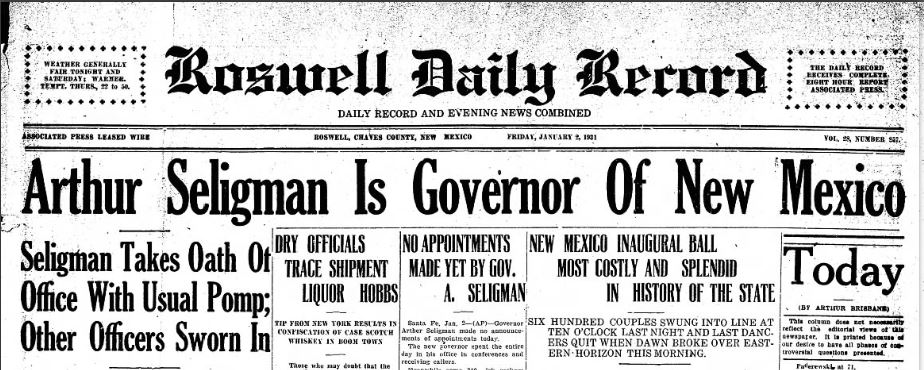
In the end, Arthur Seligman defeated his Republican opponent Judge C. M. Botts, by over seven thousand votes, 62,214 to 54,827. (“Complete Vote Recent Election in New Mexico,” The Roswell Daily Record (November 20, 1930), p. 1).  He became the first Jewish and non-Hispanic governor of New Mexico. (Suzanne Stamatov, “Arthur Seligman,” at http://newmexicohistory.org/people/seligman-arthur)

headline elected governor

(Roswell Daily Record (January 2, 1931), p.1)

One of the governor-elect’s first announcements was that he did not want an inaugural ceremony.

low cost inaugural-page-001

He lost that battle, and there was a full inaugural ceremony as well as a lavish inaugural ball.


Inauguration enhanced

Inaugural Ceremony January 1, 1931 Governor Seligman and his wife Franc are seated front center 

In his inaugural address he made several points revealing his views on the role of government:

The governor of the state, alone, can not produce the desired results. The legislature is not sufficient unto itself to accomplish them. The people of the state are the power behind the government. They are in fact the government. Those whom they elect are merely the administrative officers. When an administration takes the people into its confidence and councils there need be no fear of failure to accomplish that which is desired….

(as quoted in Suzanne Stamatov, “Arthur Seligman,” at http://newmexicohistory.org/people/seligman-arthur )

He also expressed his views on government spending:

No state should obligate itself to expend more money than can be reasonably expected from its citizens without hardship….In brief, New Mexico must live within her income and it is my intention, insofar as it is possible for me to do so, to see that she does.

Ibid.

Of course, this was before FDR’s New Deal and the radical changes it precipitated in the views of many on the role of government in providing for its citizens and in promoting the economy.

The night after the ceremony was the inaugural ball, attended by six hundred couples. Among the guests was my great-grandmother Eva Seligman Cohen, who traveled all the way to New Mexico to celebrate with her younger brother. As reported by the Roswell Daily Record on January 2, 1931:

The ball was without parallel in New Mexico history for its splendor and the inaugural gowns presented a mighty costly fashion show in a settling resplendent in the atmosphere of Old Spain, Mexico and New Mexico.

The Roswell paper said this about my great-grandmother:

Mrs. Eva Seligman Cohen of Philadelphia, sister of Governor Seligman, who was accompanied by Mr. Joe Goodall, representative of El Paso at the inaugural, wore a light blue lace combination gown….

The article described in detail the gowns that many of the women wore to the ball, all full length “in keeping with the present fashion mode and long white gloves predominated.”

The article continued:

In the main ball room an eleven piece negro orchestra from Albuquerque played dance mustic and in the lecture lounge which was converted into an additional dance room the La Fonda Mexican orchestra played.  The supper room was decorated in southern smilax and evergreens, with cut flowers in cedar baskets.

(“New Mexico Inaugural Ball Most Costly and Splendid in History of the State,” Roswell Daily Record (January 2, 1931), p. 1; for more details on the inaugural ball, see “Elaborate Preparations for Big Inaugural Ball at Fonda,” Santa Fe New Mexican (January 1, 1931))

During his first term as governor, Arthur fought to reduce taxes and the size of government. (“A Paring Policy,” The Roswell Daily Record (October 31, 1930), p. 7) The country was suffering from the poverty and unemployment of the Great Depression, and New Mexico was suffering as well.  Arthur instituted the first program for unemployment relief in New Mexico and also a vocational education program to help those most affected by the Depression.  He also accepted federal aid to create jobs in road construction and created a state park system which also provided employment opportunities for New Mexicans.  (Stamatov, op. cit.; Ron Hamm, New Mexico Territorial Era Caricatures (Sunstone Press 2014), pp, 170-171)

He also created a centralized purchasing agent for the state highway department, reformed the tax collection system, and established a state labor relations commissioner.  (“Democratic State Chairman Barker Claims Nearly All Pledges Have Been Fulfilled,” The Roswell Daily Record (July 28, 1931, at p.1)  He also reduced taxes, as promised. (“Real Tax Reduction,” Clovis News-Journal (March 21, 1931), p.2)

Although he had the responsibility of governing the state of New Mexico on his shoulders, Arthur did not forget his family.  In September, 1931, he traveled to Philadelphia for the funeral of his nephew, Maurice Cohen, my grandfather’s brother.  (Roswell Daily Record (September 22, 1931), p. 8)

As his first term was drawing to an end in 1932, he easily secured nomination for a second term from the Democratic Party. (“Democrats Boost Seligman for Renomination,” The Roswell Daily Record (August 1, 1932), p. 4)

renomination headline

(Albuquerque Journal (September 27, 1932), p. 1)
He also was elected to be a delegate to the Democratic Convention in Chicago that summer, the convention that first nominated Franklin Roosevelt as a candidate for President.  (“A Popular Victory,” The Deming Headlight (May 27, 1932), p. 3; “Hockenhull May Stay in Clovis to Run State,” Albuquerque Journal (June 24, 1932), p. 10)

Arthur was gone from New Mexico for two weeks, and during that time he visited his family in Philadelphia, including his sister Eva, my great-grandmother.  They spent time together in Atlantic City along with Eva’s granddaughter, my cousin Marjorie.

Arthur Seligman, Marjorie, and Eva May Cohen, 1932 Atlantic City

Arthur Seligman, Marjorie, and Eva May Cohen, 1932 Atlantic City

In September, 1932, Arthur and Franc’s son Otis was charged with embezzlement of the First National Bank of Santa Fe, where he was employed as assistant cashier and where Arthur remained president while also serving as governor.  I will address these charges and their consequences in a later post, but for now will simply observe that this scandal in his family apparently had no significant effect on Seligman’s campaign for re-election.

Less than two months after the indictment of his son, Arthur Seligman was once again elected governor in November, 1932.  He defeated his Republican opponent, former governor Richard C. Dillon, by an even larger margin this time, 83,612 votes to 67,406.  (“Final Election Canvassing Sheets Show Big Total,” Clovis News-Journal (November 30, 1932, p. 1)

1932 headline

(Albuquerque Journal (November 9, 1932), p. 1)

In his second inaugural address Governor Seligman repeated themes from his first two years earlier, again calling for a smaller government budget and tax reform.  He also called for laws improving mine safety, election reform, tenure for qualified teachers and general improvement of the state’s schools, and increased regulation of utilities, among other recommendations.  (“Governor Drafts Legislative Program,” Clovis News-Journal (January 11, 1933), p. 1)

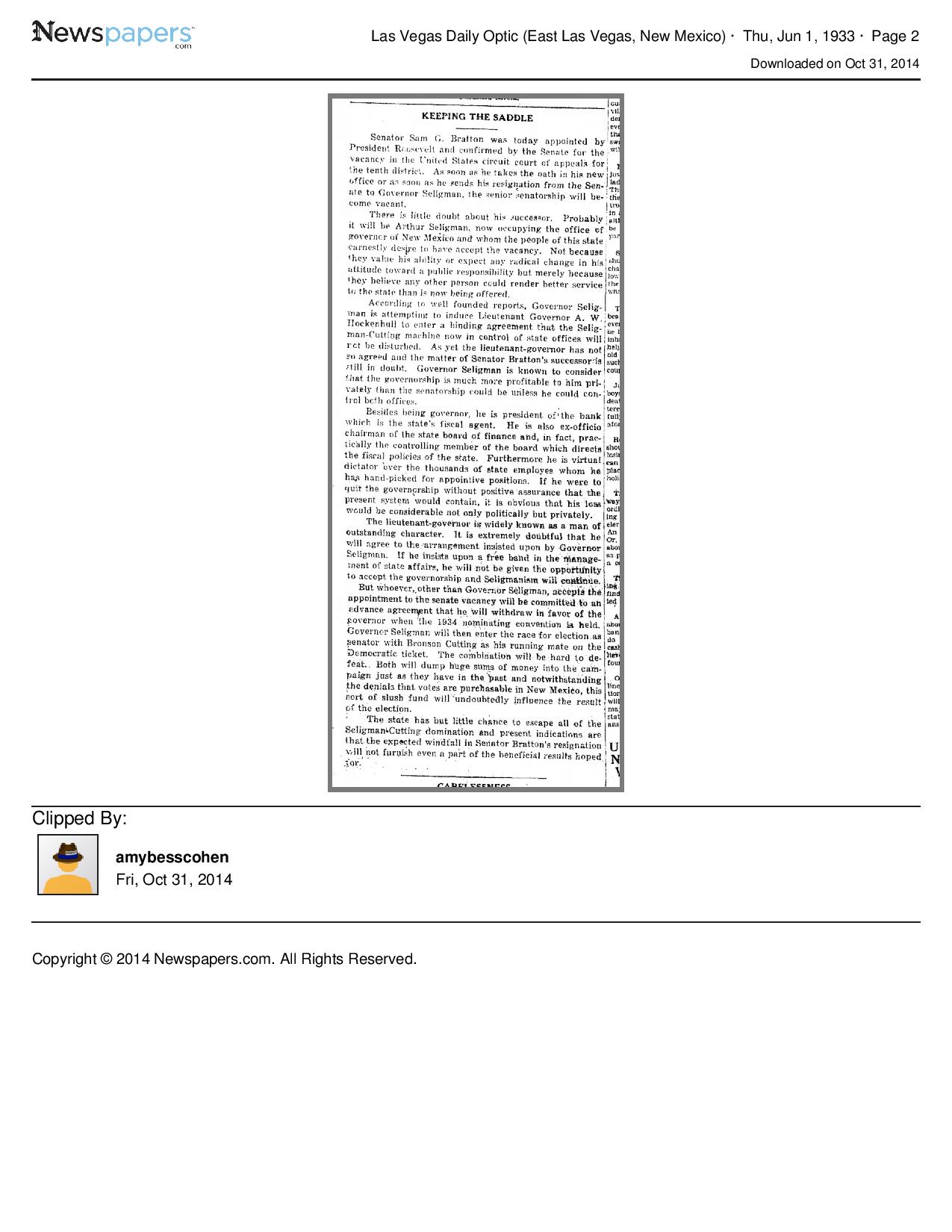
Early in his second term, there was much talk and speculation about the possibility that Arthur Seligman would become a US Senator from New Mexico.  The sitting Senator, Sam Bratton, had been appointed to a federal judgeship by President Roosevelt and would resign his seat at the end of the current Congressional term in June, and newspapers reported rumors that Seligman would resign as governor and then be appointed to fill the Senate seat by his lieutenant governor, who would replace him as governor. [1] (See, e.g., “Expect Seligman Will Take Vacant Position,” Las Vegas Daily Optic (June 1, 1933), p. 4; “Just One Candidate,” Las Vegas Daily Optic (May 20, 1933), p. 7; “Taos Democrats Want Seligman for Senate, Juan Vigil Reports,” Albuquerque Journal (May 19, 1933), p. 1)

Asel sen sf chron may 30 1933 page 1

(San Francisco Chronicle (May 30, 1933), p.1)

(He might have been short, but hardly rotund!)

And although there was a lot of support for Seligman becoming Senator, there was also some opposition:

Anti Seligman as Senator editorial-page-001

By July, 1933, the question of who would succeed Bratton as Senator was still unresolved and seemingly complicated by political matters. (“Lieut Governor Denies Reports of Statements,” Clovis News-Journal (July 17, 1933), p. 1)

In August, 1933, the Seligman family paid the price of being in the public eye when Joan Seligman, Arthur and Franc’s six year old granddaughter (the daughter of their son Otis and his wife Doris) was the target of a kidnapping threat.  (“Kidnap Threat against Grand-daughter of Governor Seligman, Reported Today,” Clovis News-Journal (August 15, 1933), p. 1)

In early September, the governor had to deal with a strike by miners, requiring him to call out the National Guard to prevent violence.  (“Says Sending of Guard to Gallup Avoided Trouble,” Clovis News-Journal (September 2, 1933), p.1)  The miners charged he sent the troops to break their strike and filed suit for an injunction against the use of the National Guard.  (“Miners Charge He is Using Troops to Break Strike,” Clovis News-Journal (September 5, 1933), p.1; “Suit Asks Guard Be Enjoined from Martial Law Plan,” Las Vegas Daily Optic, September 11, 1933, p.3)  The strike and some violent attacks were still ongoing as of September 22, 1933. (“Miner Sprayed Pickets with Searing Fluid,” Las Vegas Daily Optic (September 22, 1933), pp. 1, 4)

Perhaps all this stress in August and September and the political pressures resulting from the impending empty Senate seat proved too much for Arthur Seligman.   Arthur suffered a fatal heart attack on September 25, 1933, less than halfway through his second term.  Apparently he had been diagnosed with a heart problem and had been advised to rest or jeopardize his health.

seligman death from overwork-page-001

His family and his state were in shock.  He was only 62 years old and had just delivered a speech to a group of bankers before complaining of chest pain and then dying.

The newspapers around the state and the country reported on his untimely death, many praising him for his lifelong service to New Mexico and for his business acumen and success.  My next post will look at the reactions to his death and  at assessments of his political career and his life.

English: Seal of New Mexico

English: Seal of New Mexico (Photo credit: Wikipedia)

[1] Interestingly, since Seligman did not survive to take the seat, it was filled on October 10, 1933, by Carl Atwood Hatch, who served as a US Senator from New Mexico until 1949.  He is best known as the sponsor of the Hatch Act, which limits political activity by federal employees.  It was not until after Arthur Seligman had died that Hatch’s name was put forward as a replacement for Senator Bratton. (“Ask Governor to Select Hatch for Place in Senate,” Clovis News-Journal (September 28, 1933); Seligman had died only three days earlier.

Arthur Seligman, My Great-great Uncle, Part I:  Child of Immigrant to a Business and Political Leader

Arthur Seligman 1903 courtesy of Arthur Scott

Arthur Seligman 1903 courtesy of Arthur Scott

My great-grandmother’s younger brother Arthur was the youngest child of Bernard and Frances Seligman, my great-great-grandparents, and the only one who was born in Santa Fe. He rose to the highest heights in New Mexico, elected twice to serve as the governor.  His story is another remarkable one—the story of the son of a German Jewish immigrant who less than 80 years after his father first arrived in America was elected governor in a state with a very small Jewish population.

There are many sources outlining Arthur’s life as well as many primary sources. I relied in part on Ralph Emerson Twitchell, Old Santa Fe: The Story of New Mexico’s Ancient Capital (Rio Grande Press 1925), pp. 477-478; the article on Arthur Seligman on the National Governor’s Association website; the article in The Dictionary of American Biography; and the vocesdesantafe website for much of the general background, but also used many primary sources such as newspaper articles, census reports, and school and city directories to fill in the details.

Arthur was born on June 14, 1871.  He grew up in Santa Fe and made several trips as a young child on the Santa Fe Trail back East with his mother to visit her family.  He attended public school in Santa Fe, and then in 1885 he, along with his older sister Minnie and brother James, traveled across the country to Philadelphia where Arthur, Minnie, and James attended Swarthmore, as had their older sister Eva, my great-grandmother, before them.  Arthur then attended Pierce Business College in Philadelphia.

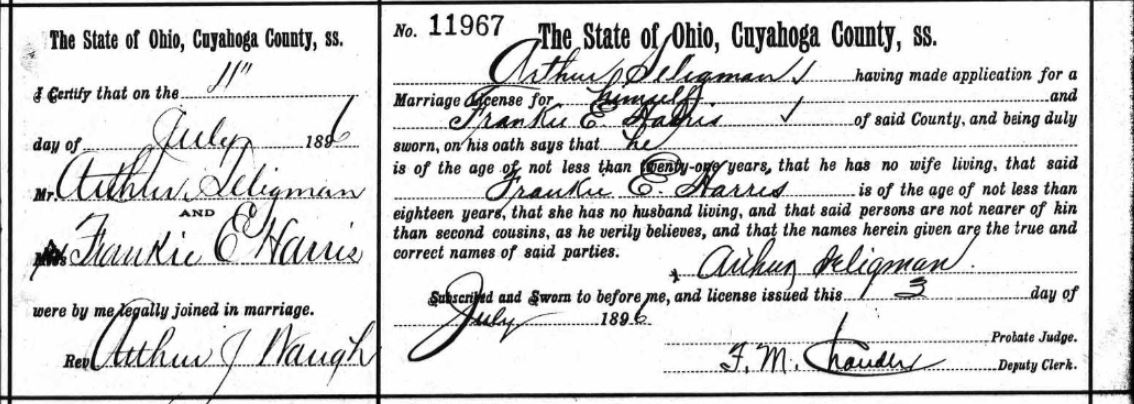
When he returned to Santa Fe after college, he worked as a clerk and then as a bookkeeper at his family’s business, Seligman Brothers.  In 1896 when he was 25, he married Frankie E. Harris, usually referred to as Franc.

Cuyahoga County Archive; Cleveland, Ohio; Cuyahoga County, Ohio, Marriage Records, 1810-1973; Volume: Vol 42-43; Page: 489; Year Range: 1892 Sep - 1896 Jul

Cuyahoga County Archive; Cleveland, Ohio; Cuyahoga County, Ohio, Marriage Records, 1810-1973; Volume: Vol 42-43; Page: 489; Year Range: 1892 Sep – 1896 Jul

She was four years his senior and a widow with an eight year old daughter named Richie Harris.  Although they were married in Ohio where Franc had been living, they moved to Santa Fe after they married, and Richie took Arthur’s surname as her own.  It’s not clear whether Arthur ever legally adopted Richie since she is identified as his step-daughter on the 1900 and 1910 census reports. I am curious as to how Arthur met Franc, but so far I have not been able to find an answer.

On February 14, 1898, Arthur and Franc’s son Otis Perry Seligman was born.  On the 1900 census, Arthur listed his occupation as “merchant dry goods.”  When the Seligman Brothers business incorporated in 1903, Arthur was named treasurer and secretary of the corporation with his older brother James serving as president and general manager.  On the 1910 census, he still listed his occupation as a dry goods merchant.

But at the same time that he was helping to run the business, Arthur was also very involved in local politics.  As early as 1893 when he was 22, Arthur was already  serving as a clerk in the local elections that year. (“Election Proclamation,” Santa Fe New Mexican (March 23, 1893), p. 4).  In 1896 he was elected to be a delegate to the state Democratic Party convention in Santa Fe.  (“Democratic Primaries,” Santa Fe New Mexican (May 25, 1896), p. 4)  That same year he was also nominated as a candidate on the Populist ticket at their convention in Santa Fe.  (“Populists in Council,” Santa Fe New Mexican (October 28, 1896), p. 4)

In 1900 Arthur was a candidate for county commissioner on the Democratic ticket. (“Personal Mention,” Santa Fe New Mexican (October 26, 1900), p. 4)  He ended up defeating his Republican opponent in a close race where most Democrats on the ticket lost in the election.  (“The Official Count,” Santa Fe New Mexican (November 13, 1900), p.4) In fact, the race was so close that his opponent challenged the results.  (“Election Contests,” Santa Fe New Mexican (December 13, 1900), p. 4) His opponent claimed that Arthur had used intimidation to discourage his opponent’s supporters from voting.

aseligman election challenge 1900

(“Election Contests,” Santa Fe New Mexican (December 13, 1900), p. 4

Although I could not find a follow-up article regarding this challenge, I assume it was unsuccessful.  Arthur served on the County Commission for many years and was soon its chairman.

In 1903 he also served as treasurer of the New Mexico commission to prepare for the St. Louis World’s Fair. (“World’s Fair Commission,” Albuquerque Daily Citizen (June 3, 1903), p.5)  In 1905 he was serving as the chairman of the Santa Fe County Commission.  In that capacity he was active in arguing in favor of statehood for New Mexico. (“They Want Their Debts All Paid,” Albuquerque Citizen (December 11, 1905), p. 6)  He was a delegate to the New Mexico Democratic Convention in 1906. (“Aftermath of Democratic Convention,” Albuquerque Citizen (September 14, 1906), pp. 1, 5)

In April, 1910, Arthur was elected mayor of Santa Fe by 193 votes.  (“Democrats Take All in Santa Fe, Arthur Seligman Mayor by a Majority of 193,” Santa Fe New Mexican (April 6, 1910), p. 8) Two years later, however, he was defeated by his Republican opponent for mayor, Celso Lopez.  (“Twenty-One Towns Elect Officers,” The Kenna Record (April 12, 1912), p. 8)

New Mexico become a state on January 6, 1912, and Arthur became involved in statewide politics.  When the chairman of the state Democratic Party resigned in January 1912, Arthur was named as a potential replacement.  (“Democratic State Chairman to Resign,” Santa Fe New Mexican (January 31, 1912), p. 5)  A later article, however, indicates that Arthur did not then serve as chairman, but as secretary of the Democratic Party in New Mexico in 1912. (“Congressman H.B. Fergusson Renominated by Democrats,” Las Cruces Sun-News (September 13, 1912), p. 1).  In 1912 he was also serving on the Natural Resources Commission (Ancestry.com. Polk’s Arizona and New Mexico pictorial state gazetteer and business directory : 1912-1913. [database on-line]. Provo, UT: The Generations Network, Inc., 2005).   He also served as Road Commissioner and was responsible for some important improvements to the roads and bridges in New Mexico.  (See, e.g., “Road Bond Deal Finally Closed by Treasurer,” Albuquerque Journal (July 8, 1915), p. 3; there are many other articles about Seligman’s role on the Road Commission on newspapers.com and on genealogybank.com; see also Twitchell, op.cit.)

In September, 1916, he was elected chairman of the State Democratic Party.  (“New Mexico State News,” Estrella (September 16, 1916), p. 3).  The Democrats did well in the 1916 election in New Mexico, and the Albuquerque Journal praised Arthur’s work as chair:

democratic state chair praised 1916

(“Arthur Seligman’s Work,” Albuquerque Journal (November 12, 1916), p. 6).

The election was not without some controversy, however, as the Republicans ran a rather nasty ad attacking Arthur Seligman:

Western_Liberal__Oct_27__1916__p__7-page-001

(Western Liberal (October 27, 1916), p. 7)

The ad insinuated that Seligman had schemed to advance his own interests and that of the banks in the context of a bond issue to finance road improvements when he was serving as Road Commissioner.  Although I cannot find any more about these claims and cannot even understand much of what the ad is alleging, it does not appear that this ad hurt Seligman himself or the Democratic candidates in the 1916 election.

In 1920, Arthur was still serving as Chairman of the Democratic Party Committee, but apparently faced some opposition to his continued service.  (“M’Adoo in Favor With Democrats,” The Deming Headlight (June 4, 1920), p. 1)  However, he defeated that opposition and continued serve as state chairman after the convention.  (“Arthur Seligman Chosen Chairman for Another Term,” Albuquerque Journal (August 27, 1920), p. 1)

Despite his heavy involvement in political matters, Arthur still listed his occupation as a dry good merchant on the 1920 census.  Franc’s daughter Richie, meanwhile, had married John Whittier March and had had a son George in 1919.  Franc and Arthur’s son Otis was working as a bank clerk in 1920 and living with his parents in 1920. In June 1921 Otis married Doris Gardiner.

The Seligman Family in the 1920s

The Seligman Family in the 1920s Arthur, Doris (Otis’ wife), Mary Ann Gardiner (Doris’ mother) , Franc, and Otis Courtesy of Arthur Scott

The 1920s brought even greater political success to Arthur.  By 1921, there was talk that he might be a candidate for governor in 1922.  (“Governorship Race May Be Largely Battle of Santa Fe for Both Parties,” Albuquerque Journal (December 21, 1921), p. 1).  Although he was not nominated as a gubernatorial candidate in 1922, he was promoted to the national Democratic Committee representing New Mexico.  In turn, he resigned as state party chair and was praised by many for his long service on behalf of Democrats in New Mexico although one delegate spoke against him.  (“Arthur Seligman Boosted to National Committee,” Albuquerque Journal (February 24, 1922), p. 1)

Strangely, I could not find many news articles mentioning Arthur Seligman between 1923 and 1929 on either newspapers.com or genealogybank.com, although he was still serving as the New Mexico national committeeperson for the Democratic Party during those years according to the few news articles that mentioned him.  (E.g., “Santa Fe is for Al Smith,” Estrella (May 12, 1928), p. 3)

Meanwhile, his business career was changing as well.  In 1925, he was not only running Seligman Brothers, he was also president of the First National Bank of Santa Fe.  (“New Mexico State Items,” Estrella (June 20, 1925), p. 2)  Ralph Emerson Twitchell wrote that Arthur had been vice-president of the bank since 1912 and became president in 1924.  In the 1928 Santa Fe directory, he is listed only as president of the bank with someone named Evelyn Conway now running Seligman Brothers.

By 1929, Arthur Seligman was already a very successful man both in politics and in business, but he was not done yet, and in 1930 when he was 59 years old, he achieved what would probably have been amazing to his parents, both of whom had died many years before—he was elected governor of New Mexico.

More on that in my next post.

Arthur Seligman, c. 1925 from Twitchell, p. 479

Arthur Seligman, c. 1925 from Twitchell, p. 479

Seligman Brothers Company 1849-1928: The Rise and Fall of an American Business

Pete's copy of Santa Fe


Although not a human member of my family tree, Seligman Brothers Company was a tremendous factor influencing the history of my Seligman family.  Because this business was such a huge part of the family history, I decided to devote a separate post to the history and development of the business over time.


As described here, Sigmund Seligman had started the business in 1849 with Charles Clever.  Then Clever had left to pursue a career in law, and Bernard had joined with his brother in the business. Later, their younger brother Adolph joined the business.  Bernard withdrew, at least in name, for a while, and after Sigmund died in 1876, Adolph took over running the company.  The business thrived, using the Santa Fe Trail to bring goods from the East to Santa Fe and the surrounding territory.


Sign for Santa Fe National Historic Trail.

Sign for Santa Fe National Historic Trail. (Photo credit: Wikipedia)


The Santa Fe New Mexican ran an article on January 21, 1903, discussing the history of the business.  The article described the way business had operated before the Santa Fe Railway system connected Santa Fe to other markets by train beginning in the 1880s:


“[A]ll goods brought into New Mexico were freighted by wagons drawn by oxen, mules and horses over the famous Santa Fe Trail from Kansas City.  Santa Fe was then the business center of the territory.  This was the distributing point for the entire region.  Money was plentiful, there were no banks…. Gambling and speculation consequently ran riot. Goods were freighted in once a year and mails were received from the east once a month….”  (“The Oldest Firm in the Southwest,” Santa Fe New Mexican, January 21, 1903, p. 1)


English: "Arrival of the caravan at Santa...

English: “Arrival of the caravan at Santa Fe” — Copy of original lithograph ca. 1844 (Photo credit: Wikipedia)


Marc Simmons, an expert on the history of the Santa Fe Trail, wrote, “Before the first bank was chartered in Santa Fe in 1870, Seligman Bros., in addition to its mercantile activities, engaged in private banking.  … The firm also helped finance construction of the Denver and Rio Grande Railroad.”  http://www.santafetrail.org/publications/wagon-tracks/pdf/V.%203%2088-89.pdf


Logo

Logo (Photo credit: Wikipedia)


Another article written in the Santa Fe New Mexican in 1915 gave more detail about the early nature of the business:


“In the early years of its existence the old firm was engaged in a general merchandise business and bought and sold everything needed by the Indians and the Spanish and American settles of that period.  There was much bartering with the Indians and early settlers, as there was comparatively little actual money in the country and goods of all kinds were traded for skins, blankets, goods of all kinds, whatever the people had to offer and which could be turned into money in the markets of the East by the venturesome traders.” (“New Store at the End of the Santa Fe Trail Recalls the Ancient and Honorable History of Seligman Bros. Institution,” Santa Fe New Mexican, March 29, 1915)


The store moved in 1856 and then returned to its original location in 1890.  The 1903 article pointed out that although the store had originally carried a wide range of items including not just dry goods, but also groceries, hardware and crockery, after the move in 1890 it had limited its inventory to dry goods (clothing, hats, shoes, boots, carpets and “kindred lines”).


The 1915 article described the growth of Seligman Brothers wholesale business after the arrival of the railroad and the growth that followed:


“While Seligman Brothers carried on a retail business, the rapid development of the surrounding country and the establishment of stores in the new settlements formed in the outlying districts made it necessary that an immense stock be carried from which to supply the needs of the country merchants. This led to the building up of a wholesale business which in its day and generation was a marvel to the jobbers and manufacturers of the more populous trading centers of the East and North who could not understand how it was that a single concern in the sparsely populated country around Santa Fe could possibly need stocks of goods aggregating a quarter million of dollars in value, yet Seligman Brothers had, in fact, nearly always had, that much money invested in merchandise in order to be able to take of the country merchants who depended up them for supplies.” (“New Store at the End of the Santa Fe Trail Recalls the Ancient and Honorable History of Seligman Bros. Institution,” Santa Fe New Mexican, March 29, 1915)


English: Comparison map showing the Santa Fe T...

English: Comparison map showing the Santa Fe Trail and the Atchison. Scanned from: Santa Fe Railroad (1922), By the Way – A condensed guide of points of interest along the Santa Fe lines to California, Rand McNally and Company, Chicago, Illinois. Category:Atchison Category:Historical maps of the United States Category:Railroad maps (Photo credit: Wikipedia)


Thus, Seligman’s was successful on both a retail and a wholesale level. As I wrote in my last post, in 1903 Adolph Seligman withdrew from Seligman and Brothers, and the business was then incorporated as Seligman Brothers Company.  Bernard’s older son James became a stockholder and the president and general manager of the business with Bernard’s younger son Arthur, also a stockholder, serving as the treasurer and secretary.   The 1903 Santa Fe New Mexican article reported on the change in ownership and the withdrawal of Adolph from the business, observing that “the business of the corporation will be continued is all respects as heretofore” and that “The firm of Seligman Bros. is the oldest in the southwest.  It is well and favorably known through the section and has a high reputation for fair dealing and honesty.  The members are progressive and up-to-date, and there is no doubt that it will command a high percentage of the favor of the public and secure a large share of business.  It has done so for fifty years and indications are that it will do so for many years to come.”  (“The Oldest Firm in the Southwest,” Santa Fe New Mexican, January 21, 1903, p. 1)


The 1915 article reported on another relocation of the business and, like the article written twelve years earlier, predicted continuing growth and success for the business.  (“New Store at the End of the Santa Fe Trail Recalls the Ancient and Honorable History of Seligman Bros. Institution,” Santa Fe New Mexican, March 29, 1915)


Despite that optimism, it appears that the 1920s were not very good for the business.  A few ads indicate that things perhaps were not going as well as they once had.


1920 Seligman Bros. ad

1920 Seligman Bros. ad


Seligman Bros ad May 5, 1922 Santa Fe New Mexican

Seligman Bros ad May 5, 1922 Santa Fe New Mexican


Although I do not have any source explaining specifically why or when the business closed, in 1928 it was still listed in the Santa Fe city directory, but with a woman named Evelyn Conway as its general manager.  James and Arthur had moved on to different lines of business, as I will discuss.  By 1930 Seligman Brothers Company was no longer listed in the directory and presumably was out of business.  Perhaps competition from those other stores had had an impact on Seligman’s business.  Whatever the cause, it is sad that after more than seventy-five years as one of the first and most important businesses in Santa Fe, the store disappeared forever.[1]


Thanks once again to my cousin Arthur “Pete” Scott, who provided me with most of the news clippings discussed in this post. For more on the history of the buildings where Seligman Brothers was located from 1849-1926, see his article here.  There are also additional photographs located at that site.  In addition, Pete wrote an article about the history of the company, located here.


[1] William Seligman,son of Adolph Seligman, did continue for at least some time the family tradition in the dry goods business in Santa Fe.  He operated a store in Santa Fe under the name Seligman’s from at least 1948-1959.  In 1960, the store was listed in the Santa Fe Directory as simply Willie’s Shop for Men.  (“New Haberdashery to Open at La Fonda,” Santa Fe New Mexican, November 30, 1958.)  I do not know how much longer the store stayed in business.  There is no business called Seligman’s currently listed in the Santa Fe business directory.


My Seligman Great-Great-Grandparents:  Two Pioneers Who Made A Difference with Integrity and Kindness

By the 1890s, my great-great-grandparents were “empty nesters.”  Their daughter Eva, my great-grandmother, was married to Emanuel Cohen and raising her family in Philadelphia.  (I’ve written about my Cohen great-grandparents here.) Their son James was working as a draftsman for the Department of Interior in Salt Lake City, Utah; he would marry Ruth V.B. Stevenson in 1893 in Salt Lake City, and have two children, Morton Tinslar Seligman, born July 1, 1895, in Salt Lake City, and Beatrice Grace Seligman, born December 4, 1898, also in Salt Lake City.  By 1900, however, James, Ruth and the children had moved to Santa Fe, where they were living next door to Bernard and Frances.  James was working as a clerk in a dry goods store, presumably the Seligman store.

Bernard Seligman and James Seligman and families 1900 US census

Bernard Seligman and James Seligman and families 1900 US census  Year: 1900; Census Place: Santa Fe Ward 4, Santa Fe, New Mexico; Roll: 1002; Enumeration District: 0126; FHL microfilm: 1241002

Arthur, the youngest child of Bernard and Frances, had returned to Santa Fe after college in Philadelphia, and in 1896, he married a widow named Frankie E. Harris in Cleveland, Ohio.

Marriage certificate of Arthur Seligman and Frankie E. Harris

Marriage certificate of Arthur Seligman and Frankie E. Harris Cuyahoga County Archive; Cleveland, Ohio; Cuyahoga County, Ohio, Marriage Records, 1810-1973; Volume: Vol 42-43; Page: 489; Year Range: 1892 Sep – 1896 Jul

Frankie had an eight year old daughter Richie from her first marriage who became a part of the Seligman family.  In fact for her ninth birthday on August 3, 1897, Bernard and Frances hosted a birthday party for Richie and 42 of her friends in their Santa Fe home.

Ritchie Harris birthday snip

City News Items Date: Tuesday, August 3, 1897 Paper: New Mexican (Santa Fe, NM) Volume: 34 Issue: 138 Page: 4

(This same “gossip column” also reported that Arthur and James Seligman and some friends were going on a two week fishing trip soon after this birthday party.)

Arthur and Frankie had a son together just a year later; Otis Perry Seligman was born on February 14, 1898, in Santa Fe.  Thus, by 1900, Bernard and Frances had four grandchildren living in Santa Fe plus three more grandsons living in Philadelphia, including my grandfather John Nusbaum Cohen.

On the professional side, I could not find any specific references to Bernard’s political activities or his business activities during the 1890s although the 1900 census listed his occupation as a dry goods merchant.  In 1894 he seems to have taken an extended trip to Europe, including to Germany and to Italy.

Traveling Seligmans 1894

Saturday Small Talk Date: Saturday, October 27, 1894 Paper: New Mexican (Santa Fe, NM) Volume: 31 Issue: 214 Page: 4

From this clipping it is hard to know whether or not he was traveling with Frances.  I also wonder who the relatives were in Italy and who he was visiting on the Rhine.  Was this purely for pleasure or was it a business trip?  I don’t know.

At some point after this trip, however, Bernard and Frances moved back to Philadelphia.   Bernard was living in Philadelphia when he died on February 3, 1903, at age 65 from myocarditis.  He was residing at 1606 Diamond Street at the time.

Bernard Seligman death certificate

When I looked back to see where my great-grandmother Eva was living at that time, I was hardly surprised to see that she, her husband Emanuel Cohen, and their three sons were also living at 1606 Diamond Street as of the 1900 census.  In fact, in 1900, Emanuel’s brother Isaac and nephew were also living at 1606 Diamond Street after the death of Isaac’s wife.  Thus, Eva and Emanuel Cohen, my great-grandparents, were housing not only their three children, but also at least four other family members, Eva’s parents and Emanuel’s brother and nephew.

According to his obituary, Bernard (and presumably Frances) had moved back to Philadelphia three years before his death, to “recuperate from over-work.”  The obituary goes on to say that Bernard had been doing well until sometime in the prior year when he had a “severe stroke of paralysis which weakened him considerably.”  The paper noted, however, that he had been improving and that no one thought that he was near death.  The obituary described his death as “shocking” and reported that the day before his death he had appeared fine and had even sent a dispatch relating to business matters to his son Arthur.

bernardseldeathnmex

“A Good and True Man Called Hence,” Santa Fe New Mexican, February 3, 1903, p. 1

The obituary recounts all of Bernard’s many accomplishments, both political and business, and describes him as follows:

“Mr. Seligman was a pioneer in New Mexico, and during his residence of over forty years in this city and territory, was one of the most progressive, shrewdest and brightest businessmen and citizens of the commonwealth.  He was a man of the strongest integrity and keen perception and high courage, public spirited and thoroughly posted on public affairs, indeed a valuable and good citizen in every sense of the word, a loving husband and a kind and indulgent, yet at the same time, a firm and sensible father.  He was a prominent and important factor in the building up of the commercial, educational, civic, moral, and material interests in this city and county and of the entire territory.  A good and true man has gone to the great beyond.”

What can I possibly add to that? Only that I wish that I had known him.  I stand a bit taller knowing that I am descended from Bernard Seligman.

Just two years later, my great-great-grandmother Frances Nusbaum Seligman also died.  She died in Philadelphia on July 27, 1905, at age 59.

Frances Seligman death certificate

She had been living at 1431 Diamond Street at the time of her death.  Again, I checked to see where my great-grandparents Eva and Emanuel Cohen were living, and 1905 Philadelphia directory, their address was, not surprisingly, 1431 Diamond Street, and they still had their three sons and Isaac living with them in 1910 as well.

Frances was described in her obituary in very loving terms:

“She was a beautiful and accomplished woman, as good as she was beautiful and as beautiful as she was good, and of a most lovable and gentle disposition.  She was an exemplary wife, a fond and good mother, and a dutiful and loving daughter.  Indeed she was all that is implied in the phrase ‘a thoroughly good and moral woman.’  … She will be especially remembered by the poor people of [Santa Fe], to whom she was particularly kind.  Many and many truly charitable deeds have been put to her credit.”

The obituary further commented:

“From the moment of her arrival to within a few years ago, when she commenced to spend most of her time in Philadelphia, she was a social leader, admired, respected and popular.  She was a woman without guile and always ready to lend a helping hand in social as well as in charitable work.”

frances seligman obit July-27-1905 new mexican

(“Gentle, Good Woman Gone,” Santa Fe New Mexican, July 27, 1905, p. 1)

While I was impressed and proud when I read my great-great-grandfather’s obituary, I was very moved and emotional in reading about my great-great-grandmother Frances.  The words “good,” “gentle,” and “kind” are the same words that I have heard my father and my cousin Marjorie use to describe their grandmother, Eva Seligman Cohen, the daughter of Frances Nusbaum and Bernard Seligman.  She seems to have inherited or learned those very traits from her parents, two people who left the city of Santa Fe a better place by the time and the effort that they spent in caring for their community while they lived there.  As I will describe, their surviving children also left their mark, my great-grandmother Eva by her kindness and caring for others, and her two brothers James and especially Arthur by their service to Santa Fe and New Mexico.

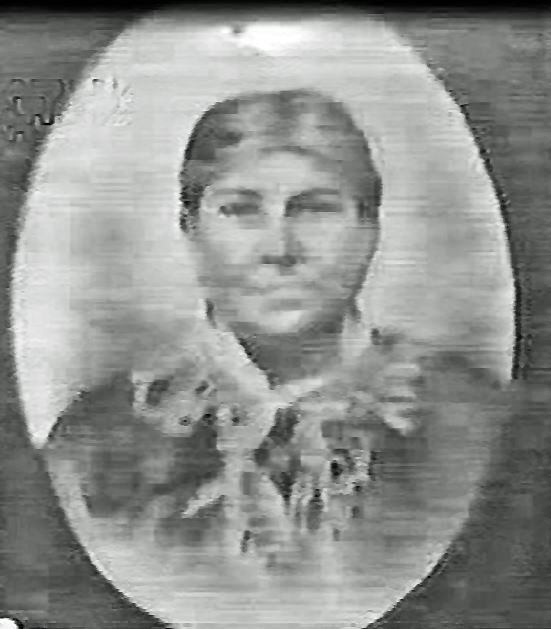
bernard

Bernard Seligman

francis

Frances Nusbaum Seligman

These two photos were given to me by my cousin Arthur Scott.  They were taken from a video made by his sister of family photos in their home.  The one of my great-great-grandmother Frances is so far the only photograph I have of her.


Bernard Seligman: His Political Career and His Family 1870-1890

I want to thank my cousin Arthur “Pete” Scott for all his help with finding newspaper clippings (including some of the ones appearing in this post) and other information to try and fill in the timeline  for Bernard and the other Seligmans. He has also contributed a great deal of information about our family at the Voces de Santa Fe website.  Like my father, Pete is a great-grandson of Bernard Seligman and thus my second cousin once removed.


I have been having a hard time tracking the whereabouts of my great-great-grandfather Bernard in the 1870s.  Although I know that Bernard and his family had moved back to Santa Fe sometime before their youngest child Arthur was born in June, 1871, it seems that Bernard was in and out of town during the 1870s.  In 1873, he withdrew from the Seligman Brothers partnership:

Date: Thursday, January 2, 1873 Paper: Santa Fe Daily New Mexican (Santa Fe, NM) Page: 1

Date: Thursday, January 2, 1873 Paper: Santa Fe Daily New Mexican (Santa Fe, NM) Page: 1

The firm of S. Seligman and Brother was dissolved, and a new firm owned by Sigmund and Adolph Seligman and Julius Nusbaum was created named Seligman Bros. and Company.  Who was Julius Nusbaum?  He was Bernard’s brother-in-law, the brother of Frances Nusbaum, Bernard’s wife.

Daily New Mexican, January 13, 1873

Daily New Mexican, January 13, 1873


I cannot find an explanation for Bernard’s withdrawal, and he certainly was involved in the business again in later years. He had applied for a passport on April 3, 1873, and he served as a representative to the Vienna Exposition  of 1873, so maybe that prompted his withdrawal.

Bernard Seligman passport application 1873

Bernard Seligman passport application 1873


Maybe it’s my modern skepticism that is coloring my perception, but it also seems possible that Bernard withdrew only in name, placing his wife’s brother in the firm in his stead.  Was this done for political purposes to avoid at least the appearance of any conflicts of interest?

Henry Tobias, author of The History of the Jews of New Mexico (University of New Mexico Press, 1990), writing about New Mexico in the 1880s and 1890s, described Bernard Seligman as “probably the most political of all the Santa Fe Jews” during that era (Tobias, p. 117).   Ralph Emerson Twitchell, author of Old Santa Fe: The Story of New Mexico’s Ancient Capital (Rio Grande Press, 1925), wrote, “A public speaker of great force and convincing power, [Bernard Seligman] found time to engage in the public affairs of the country of his adoption and was elected and appointed to many positions of profit and trust.”  (Twitchell, p. 477)  Twitchell also pointed out that Bernard “was a linguist of rare ability; speaking with fluency the English, German, French, Spanish, Italian, and Hebrew idioms.” (Ibid.) Bernard must have been well suited for a career in politics and government in bilingual New Mexico.

Tobias wrote that Bernard became a member of the territorial legislature in 1880. (Tobias, p. 117) Both Bernard’s obituary  (“A Good and True Man called Home,” Santa Fe New Mexican, February 3, 1903, p. 1)  and Twitchell (p. 477 ) also state that Bernard served several terms in the Legislative Assembly for New Mexico.  Another source reported that Bernard was instrumental in the passage of the mechanic’s lien law while he served in the territorial government, a law considered to be very important at that time. (George B. Anderson, History of New Mexico: Its Resources and Its People, Vol. 2 (Pacific States Pub. Co. 1907)).

One newspaper clipping shows that Bernard was the Democratic Party’s nominee for Santa Fe County Commissioner in 1884.(Las Vegas Daily Gazette., October 22, 1884, Image 2, at http://chroniclingamerica.loc.gov/lccn/sn90051703/1884-10-22/ed-1/seq-2/#date1=1873&index=5&rows=20&words=Bernard+Seligman&searchType=basic&sequence=0&state=New+Mexico&date2=1903&proxtext=bernard+seligman&y=4&x=6&dateFilterType=yearRange&page=1 ).  Twitchell wrote that Bernard was chairman of the board of the Santa Fe County Commission for three terms, presumably in the mid-1880s. (Twitchell, p. 477)

Bernard and the Santa Fe County Commission ran into some legal trouble when a local resident and attorney, Thomas Catron, sued the Commission, alleging fraud.  Catron claimed that in 1886 the Commission had issued warrants to raise money for a new courthouse that would increase the county debt beyond the limits set by a new federal statute; he alleged that to avoid that new limitation, the Commission had falsely stated the issuance date of the warrants so that they predated the effective date of that new law. Bernard Seligman is named in the case as the chair of the Commission at the time of this alleged fraud.  The Supreme Court of the Territory of New Mexico found that Catron had stated sufficient facts, if proven, to support a claim against the Commission and remanded the case for trial.  Unfortunately, I cannot find any report on the final outcome of the case on the merits.[1]  Given Bernard’s future political success, perhaps Catron lost the case.

Bernard also encountered some controversy when the Governor of the New Mexico Territory, Edmund Ross, named him as his choice to be the treasurer of the territory. Thomas Catron was again involved in the fight against Bernard. Catron was himself a political leader in New Mexico, having served as Attorney General and US Attorney for the territory and later serving as one of its first US Senators when New Mexico became a state.

English: Thomas Benton Catron, Senator of the ...

English: Thomas Benton Catron, Senator of the United States from New Mexico (Photo credit: Wikipedia)

In July, 1886, the Santa Fe New Mexican reported that Governor Ross might appoint Bernard as treasurer:

Bernard Seligman medicine man to be treasurer

Date: Friday, July 16, 1886 Paper: New Mexican (Santa Fe, NM) Page: 2

I am curious about the reference to Bernard as a “medicine man;” I have no idea what it means in this context.

Governor Ross did in fact appoint Bernard Seligman to be territorial treasurer, but that appointment was then resisted by a man who claimed to be the sitting treasurer, Antonio Ortiz y Salazar, who refused to turn over his office to Seligman. Ortiz, represented by the same Thomas Catron who was suing Bernard for fraud in his role as County Commissioner, argued that the governor had not had authority to appoint Seligman because there was no vacancy to fill as Ortiz still held the seat and had not resigned or died.

Seligman brought a mandamus action against Ortiz, seeking to have him hand over the incidents of the treasurer’s office.  Seligman claimed that the oath taken by Ortiz when sworn in for a second term in 1884 was void because of some irregularities.  Ortiz responded that he had been properly sworn into office in 1882 for his first term, and thus he still had a valid claim to the treasurer’s office despite the governor’s appointment of Seligman.  The trial court judge disagreed and ruled that Seligman’s appointment was valid and that Ortiz had to give up his seat.  Ortiz requested a rehearing, and on review, a different judge reversed the first court’s decision and ruled in favor of Ortiz, concluding that the appointment of Seligman as treasurer was not valid because Ortiz still properly held the seat.

Seligman v Ortiz treasurer-page-001

Date: Thursday, August 19, 1886 Paper: Santa Fe Weekly New Mexican and Livestock Journal (Santa Fe, NM) Page: 4

Henry Tobias saw this incident as an example of the resentment some New Mexico residents felt about the success of the Jewish merchants in New Mexico.  In response to his appointment of Seligman, Ross was advised by one prominent resident that there were already too many Jews in Santa Fe politics and government.  (Tobias, pp. 119-120.)


Edmund G. Ross. Library of Congress descriptio...

Edmund G. Ross. Library of Congress description: “Hon. E. G. Ross of Kansas” (Photo credit: Wikipedia) Governor of New Mexico Territory 1885-1889

In December 1886, Governor Ross made a statement explaining his choice of my great-great-grandfather that upset some residents of the territory because of the insulting and discriminatory assumptions underlying that statement:

governor ross appoints bernard seligman-page-001

Date: Wednesday, December 29, 1886 Paper: Santa Fe Daily New Mexican (Santa Fe, NM) Page: 2

Perhaps there was prejudice on both sides: anti-Mexican prejudice by Ross and anti-Semitic prejudice on the part of those opposing the appointment of my great-great-grandfather.

Several sources, however, state that Bernard Seligman did serve as territorial treasurer: his obituary, Twitchell, and Tobias all refer to the fact that he served as treasurer. The Legislative Blue Book of the Territory of New Mexico (1911) lists Bernard Seligman as territorial treasurer from 1886 through 1891.     None of these sources explain, however, what happened that allowed Seligman to continue in office after the court decision in favor of Ortiz in 1889.

Thus, for much of the 1880s Bernard was pursuing his political career. However, he also must have been somewhat involved in the Seligman Brothers business.  This news clipping dated April 8, 1889, certainly suggests that Bernard was active in the business:

bernard trip back east 1889

New Mexican (Santa Fe, NM), Monday, April 8, 1889 , Volume: 26, Issue: 41,Page: 4

Meanwhile, at home his children were growing up.  In 1881, my great-grandmother Eva, then fifteen years old, left Santa Fe for Philadelphia where she went to Swarthmore[2] and later married my great-grandfather Emanuel Cohen in 1886.   Her younger brother James also went to Swarthmore, where he was a member of the class of 1888 and a member of the literary society.

Eva Cohen in the Swarthmore Bulletin

James Seligman in Swarthmore register 1920

Bernard and Frances’ next child, Minnie, also followed in her siblings’ footsteps and enrolled at Swarthmore as did her younger Arthur.  Although Arthur was two years younger than Minnie, they both enrolled at Swarthmore the same year—1885-1886.  In that year James, Minnie and Arthur were all students at Swarthmore, James a sophomore in the college and Arthur and Minnie as juniors in the preparatory school.  I am not sure where Eva was living that year as she appears to have finished her studies at Swarthmore in 1884 and did not marry Emanuel until 1886.

With at least three of their children living in Philadelphia and Bernard busy with politics, I wonder whether Frances had also returned to Philadelphia to be closer both to her Nusbaum family and her children and whether Eva was also living with her mother there.  Although Eva and Frances are listed on the 1885 New Mexico Territorial Census, so are the other three children, despite the fact that those three were enrolled at school in Philadelphia that same year.  The news clipping above reported that Frances had stayed behind in Philadelphia “with friends” in 1889 when Bernard had returned to Santa Fe.

The family suffered a tragic loss on January 14, 1887, when Minnie, only seventeen years old, died from meningitis while in Philadelphia.  The address on the death certificate was 829 North 5th Street, Philadelphia.  Although I cannot find where the other Nusbaums were living in 1887, earlier Philadelphia directories list several members of the extended Nusbaum family living at residences nearby on North 6th Street and North Marshall Street.


Minnie Seligman death certificate 1887

Minnie Seligman death certificate 1887

This note in a Quaker publication says that Minnie died at the home of a relative:

friends' intelligencer 44 p 59

Friends’ Intelligencer United with the Friends’ Journal, Volume 44 (Google eBook), p. 59

Minnie was buried in Philadelphia at Mt Sinai cemetery, the same cemetery where her infant sister Florence had been buried in 1867 and where her uncle Sigmund Seligman had been buried in 1876 and where her parents and her sister Eva would later be buried.  Although the family may have left Philadelphia for Santa Fe almost twenty years before, it is pretty clear to me that the ties back to Philadelphia remained very strong for the family of Bernard Seligman.


[1] Catron v. Board of Commissioners, 21 P. 60 (N.M. 1889)

[2] Swarthmore had a preparatory school as well as a college in those days, and my great-grandmother and her siblings all attended the preparatory school and then most attended the college for at least some time as well.


Sigmund Seligman: “A Beloved Friend to Humanity and an Uncompromising Lover of His Country”

"La Ciudad de Santa Fe." Engraving f...

“La Ciudad de Santa Fe.” Engraving from “Report of Lt. J. W. Abert of his Examination of New Mexico in the Years 1846-1847.” (Photo credit: Wikipedia)


My great-great-uncle Sigmund Seligman must have been an impressive human being.  Born in 1830, he came by himself to the US from a small town in Germany before he was even twenty years old.  Although I have no records of his arrival or where he might have settled first (although other facts suggest he first settled in Philadelphia), historical sources report that by 1849 he had settled in Santa Fe, first working as a photographer there and then joining up with Charles Clever to start the trading business that became Seligman and Clever and eventually Seligman Brothers, a business that flourished and eventually supported not only Sigmund, but also his two brothers, Bernard and Adolph, and their families.


By 1857, he had applied for US citizenship in Philadelphia, and by 1860 he reported on the US census that he had $20,000 worth of personal property and the same in 1870.  According to two different websites I found for converting 1860 dollars to today’s money, that amount would be the equivalent of over $400,000 today.  Not too bad for a thirty year old entrepreneur.

I found a number of interesting news articles about Sigmund, including one dated June 6, 1871, that announced Sigmund’s return to Santa Fe after being away for a year “in the states and Germany.”  I would love to know what took Sigmund back to Germany in 1870-1871.  There must have still been family members there, but I have no idea who he might have been visiting.  Maybe he was looking for a wife—as Parish had said, many men traveled back east or to Germany to find a Jewish woman to marry.  If that was the purpose of Sigmund’s travels, he seems not to have been successful as he never married.

Sigmund Welcome Home 1871-page-001

Santa Fe Daily New Mexican June 6, 1871, p.1


I assume that his travels in the states included Philadelphia, where his brother Bernard and his family were living during at least some part of that time.  Perhaps Bernard was traveling back and forth, as I suggested in an earlier post, to keep an eye on the business while Sigmund was away. Sigmund had applied for a US passport on April 26, 1870, in Philadelphia, presumably for this trip.  Written across the letter are the words “Nat Dis Court Santa Fe, New Mexico, December 15, 1856. Paid.”   I don’t know what the December 15, 1856 date refers to, but I assume that Sigmund applied for this passport in order to take his trip back to Germany.  He also had become a US citizen on April 26, 1870, also in Philadelphia, signed by the same notary who wrote in support of his passport application.

Sigmund Seligman passport application

Sigmund Seligman passport application 1870 National Archives and Records Administration (NARA); Washington D.C.; Passport Applications, 1795-1905; Collection Number: ARC Identifier 566612 / MLR Number A1 508; NARA Series: M1372; Roll #: 165.

Sigismund Seligman naturalization affidavit

National Archives and Records Administration (NARA); Washington D.C.; Passport Applications, 1795-1905; Collection Number: ARC Identifier 566612 / MLR Number A1 508; NARA Series: M1372; Roll #: 165.


A year is a long time to leave a thriving business, and Sigmund reportedly received a “hearty welcome from his numerous friends” when he returned.  (Santa Fe Daily New Mexican (Santa Fe, NM), June 6, 1871, p. 1)  Sigmund was apparently quite well liked.  In an editorial dated May 21, 1875, the Santa Fe New Mexican singled out Sigmund for his generosity and civic-mindedness based on his support of a project to provide sprinklers for the streets of Santa Fe to control the dust that tended to develop there on what I assume were dirt roads.

Sigmund praised for sprinklers-page-001

(Santa Fe New Mexican, May 21, 1875, p. 1)

Unfortunately, Sigmund’s life was cut short when he was only 46 years old on October 4, 1876.  He died at Fort Craig, New Mexico, a site that is 181 miles from Santa Fe, so quite a distance; it was a US Army fort, the largest in the Southwest.  As his obituary described it, he was in a “far off portion of the Territory.”


English: Former officers' quarters, Fort Craig...

English: Former officers’ quarters, Fort Craig, New Mexico, USA (Photo credit: Wikipedia)


He died of apoplexy, according to one death record, and his obituary indicated that he died “from a sudden and resistless stroke of disease.”  According to MedlinePlus, “When the word apoplexy (with no organ specified) is used alone, it often refers to stroke symptoms that occur suddenly. Such symptoms can be caused by bleeding into the brain or by a blood clot in a brain blood vessel. Conditions such as subarachnoid hemorrhage or stroke are sometimes called apoplexy.”  http://www.nlm.nih.gov/medlineplus/ency/article/000328.htm

The public reaction to his death was described in expressive terms in Sigmund’s obituary in the Santa Fe New Mexican dated October 10, 1876.  The paper reported, “At no time in the history of our citizens has there been a more spontaneous outpouring of the people to show a becoming respect to the memory of a departed fellow-citizen and friend.”  A Jewish “burial service” was read by Lehman Spiegelberg, another Santa Fe merchant, and Sigmund was buried at Odd Fellows cemetery in Santa Fe on October 9, 1876. A eulogy was given by Edmund F. Dunne, “portraying in most affecting, generous and glowing terms the many virtues and excellent qualities of the deceased as a brother, friend, citizen and correct man of business.” The paper described him as “a beloved friend to humanity and an uncompromising lover of his country, her institutions and laws.”

sigmund obit full page from voces

Obituary of Sigmund Seligman 1876 Daily New Mexican page one Personal collection of Arthur Scott http://www.vocesdesantafe.org/index.php/explore-our-history/historical-documents2/item/301-the-daily-new-mexican-ocotober-10-1876


There was only one thing that puzzled me about this obituary.  It does not mention Bernard or his family at all.  In fact, the paper describes Adolph as “the surviving brother” as if there was no other.    Since Arthur Seligman, Bernard’s son was born in Santa Fe in 1871 and since Bernard appears as living there on both the 1870 and 1880 US census reports as well as serving on the Board of Trustees of the Santa Fe Academy in 1878, I would have assumed that Bernard would have been in Santa Fe in 1876.


Although Sigmund was initially buried in Santa Fe, his body was moved to Philadelphia in April, 1877, six months after his death, where he was buried at Mt Sinai cemetery, the same cemetery where his brother Bernard would later be buried as well as other members of Bernard’s family.  Putting this information together with Bernard’s absence from Sigmund’s funeral makes me wonder whether Bernard had in fact moved back to Philadelphia between 1876 and 1877 and decided to have his brother buried in a proper Jewish cemetery rather than in Santa Fe’s Odd Fellows cemetery.

Sigmund Seligman death record, Philadelphia

Sigmund Seligman death record, Philadelphia “Pennsylvania, Philadelphia City Death Certificates, 1803-1915,” index and images, FamilySearch (https://familysearch.org/pal:/MM9.3.1/TH-266-11110-64044-12?cc=1320976 : accessed 29 Sep 2014), 004000970 > image 141 of 448; citing Department of Records.


I am sorry that I do not have any photographs of Sigmund.  He must have been an interesting man—adventurous, courageous, generous, respected, and well-liked by his fellow Santa Fe citizens.  His life may have been short, but by going to Santa Fe, he not only made a good life for himself, he helped out his community, and he provided a good foundation for his two younger brothers and their families.


Jews on the Santa Fe Trail 1848-1871:  My Great-Great-Grandfather Bernard Seligman and his Brothers


Sign for Santa Fe National Historic Trail.

Sign for Santa Fe National Historic Trail. (Photo credit: Wikipedia)


My great-great-grandfather Bernard Seligman was born on November 23, 1837 in Gau-Algesheim, Germany.  When I learned about the small town in Germany where my great-great-grandfather Bernard Seligman was born, I was not surprised that he had decided to move away when he reached adulthood.  Gau-Algesheim was itself a very small town, and the Jewish population was tiny—perhaps 60-80 people during the 1840s and 1850s when Bernard was growing up.  The opportunities for a young Jewish man must have been very limited—socially and economically.  My research of the town indicated that by 1900 the Jewish population had declined dramatically.  My great-great-grandfather and his brothers were therefore not unlike many others who moved out of their small hometown to seek greater opportunities.

Before leaving Germany, Bernard received what was described as a “first class education in the public and commercial schools of his native land where he also gained considerable actual business experience while employed a wholesale establishment there.”[1]  According to a book written in 1925 by Ralph Emerson Twitchell, then the official state historian for New Mexico, Bernard Seligman had been associated with the Rothschild banking house in Frankfort-on-the-Main before coming to the US.[2]

Bernard was not the first of the Seligman brothers to arrive in the United States. His older brother Sigismund or Sigmund, born in 1830 in Gau-Algesheim, had arrived in Santa Fe in 1849.  At first, Sigmund found work as a photographer, running a daguerreotype portrait studio for a few years.[3]  But within a few years he and another recent German immigrant named Charles Clever “formed a business partnership … under the firm name and style of Seligman and Clever, engaging in general merchandizing and freighting over the old [Santa Fe] Trail.”[4]

This photo is claimed to be the oldest photograph of Santa Fe, taken about 1855.  You can see the sign for Seligman and Clever on the right.  At one time one of the streets in this photograph was called Seligman Street.


Sigmund’s younger brother Bernard, my great-great-grandfather, arrived in the United States on March 23, 1857, coming aboard the ship Mercury and landing in New York.  On the record for the passenger manifest it says that his occupation was a merchant.[5] Twitchell wrote that Bernard initially settled near Philadelphia and worked for a cotton manufacturing business.[6]  He is said to have arrived in Santa Fe in 1858, taking a position in his brother Sigmund’s business, according to Bernard’s obituary. [7]

When Sigmund’s partner Charles Clever resigned from the business a few years later to become a lawyer, Bernard became a partner with his brother Sigmund in the business, and it was renamed S. Seligman and Bro.  Some years later a third brother, Adolph, born in 1845, also settled in Santa Fe and joined his brothers’ business in the 1860s.[8]

As described by William J. Parish in “The German Jew and the Commercial Revolution in Territorial New Mexico 1850-1900,” New Mexico Historical Review, Vol. 35, p. 1 (1960), until the arrival of Jewish German immigrants like the Seligmans, the trade conditions in the New Mexico territory were quite rudimentary, a few small stands relying upon traveling merchants to provide them with merchandise.  According to Parish, heavy taxes and the high cost and risk of travel made many reluctant to deal in the region.  Storekeepers could not rely on these traveling merchants to supply an adequate inventory of goods.  Thus, few merchants established permanent roots in the area.

English: "Arrival of the caravan at Santa...

English: “Arrival of the caravan at Santa Fe” — Copy of original lithograph ca. 1844 (Photo credit: Wikipedia)

These conditions provided a substantial opportunity for Jewish German immigrants like my ancestors, the Seligmans. Beginning in the 1840s around the time that Sigmund immigrated, there were a number of recent Jewish German immigrants who brought a thriving economic base to Santa Fe and other New Mexican cities based on transporting goods from the eastern United States over the Santa Fe trail to the New Mexican territory recently acquired by the US after the Mexican War ended.[9]

As postulated by Parish, German Jews came to the US with a particularly good background to take advantage of these entrepreneurial opportunities.  Parish discusses how historically Jews in Western Europe, although foreclosed from entering many trades, had been allowed to take on the role of the moneylender, a livelihood to which Christians had an aversion and, in some cases, a religious opposition, thus leaving that unpopular job for their Jewish neighbors.  Although this created some hostility and resentment (as seen, of course, in The Merchant of Venice and the character of Shylock), it also provided Jewish men with the opportunity to develop skills in banking, business, and capitalism.  Jewish immigrants brought these skills with them to the US wherever they settled, and, as Parish points out, those who came to New Mexico had a profound impact on the fledgling economy that existed there.

This is a photograph of my great-great-grandfather Bernard Seligman (far left) with two other Santa Fe merchants,  Zadoc Staab and Lehman Spiegelberg,  and  two Kiowa Indian scouts.

Bernard Seligman and other merchants

Freighters on the Santa Fe Trail, Bernard Seligman, Zadoc Staab, Lehman Spiegelberg and Kiowa Indian scouts Palace of the Governors Photo Archives, New Mexico History Museum, Santa Fe


The growth of the economy is illustrated by the growth in the number of Jewish merchants in Santa Fe from 1850 to 1870.  In 1850 there were eight such merchants; by 1860 that number had doubled to sixteen.[10]  By 1870 it had doubled again to 32; clearly, my relatives had arrived at the right place at the right time.[11]  These merchants were not transient traveling merchants.  They established permanent businesses and stayed in the community.

Twitchell provided this vivid description of the scale of the Seligman brothers’ business:

“A Fair exemplar of the magnitude of the business of this firm is recorded in the fact that one caravan, conducted by firm, loaded at the Missouri river eighty-three wagons of merchandise consigned to the firm at Santa Fé, each wagon carrying not less than three tons of high class freight.  Another record in the books of the firm shows the payment of $30,000 in transportation charges on one caravan alone, all of the merchandise having been disposed of to New Mexican buyers within the brief period of three weeks after arrival in Santa Fé[. N]early three quarters of a century disclose an aggregate of more than fifteen millions of dollars.”[12]


Thus, by the 1860s, the Seligman Brothers’ business was thriving.  They and the other Jewish merchants had brought a reliable source of goods to Santa Fe for the first time.

These merchants, however, were not involved in any of the traditional practices of Jewish life.  According to Henry J. Tobias, the author of The History of the Jews in New Mexico, although these men identified as Jews, there was no evidence of any regular Jewish observance in Santa Fe during those early days—no evidence of a synagogue or any form community prayer or celebration, no observance of dietary laws.[13]  The Jewish population was less than five percent of one percent of the overall population at that time, and the Jews had to adapt to living in a culture where they were such a tiny segment of the community.

Most of the Jewish residents in the 1860s were single men, although a few women and families were starting to arrive.  In 1860 there was a celebration of Yom Kippur at the home of Levi Spiegelberg, another Jewish merchant, who had recently married a Jewish woman from Germany.  Tobias speculated that perhaps the arrival of Spiegelberg’s bride, one of only two Jewish women in the town at that time, made the others nostalgic for the traditions from back home and thus inspired this day long observance of fasting and prayer.[14]

After the Civil War[15] and after his younger brother Adolph had arrived in Santa Fe, Bernard moved back east to Philadelphia for several years.  Parish pointed out that there were no Jewish single women in Santa Fe in the 1850s and 1860s, and that while some Jewish men intermarried, most went back east to find a Jewish woman to marry.[16]  Sigmund never married, and Adolph did not marry until he was in his 60s, but Bernard went back east and found a Jewish woman from Pennsylvania, my great-great-grandmother Frances Nusbaum.  She was born in Harrisburg, Pennsylvania, in 1845, but by 1860 she and her family had moved to Philadelphia.  Bernard and Frances married on March 28, 1865, and my great-grandmother Eva (named Evalynn at birth) was born the following year on May 27, 1866 in Philadelphia.  According to the Philadelphia city directories for 1867, Bernard was in business with his Nusbaum in-laws at that time.

On August 17, 1867, Bernard and Frances had a second daughter, Florence; the baby only lived five weeks and died on September 26, 1867.  She was buried at Mt. Sinai cemetery in Philadelphia, along with many of the Nusbaum family members (and also many of my Cohen relatives).  A third child, James Leon Seligman, was born on August 11, 1868, and then another daughter, Minnie, was born on October 31, 1869.  All of these children were born in Philadelphia, and Bernard, Frances and the three surviving children are all listed in the 1870 census as living in Philadelphia in the 13th Ward. Bernard is also listed in 1871 in the Philadelphia directory.

Bernard, however, must have been traveling back and forth between Santa Fe and Philadelphia because he is also listed in Santa Fe on the 1870 census, living with his brother Sigmund and two clerks.  Bernard is listed as owning $25,000 worth of real estate and $20,000 in personal property. (Strangely, Sigmund only claimed $20,000 in personal property and no real estate, despite being the founder of the store and the full time resident.)

At some point, however, in 1871, Bernard and Frances and their children relocated to Santa Fe, and their last child, Arthur Seligman, was born on June 14, 1871, in Santa Fe, the first family member to be born in that city.  According to Twitchell, Frances Nusbaum Seligman was one of only eight women living in Santa Fe at that time who did not come from a Spanish background.  Twitchell described my great-great-grandmother as “a woman of rare beauty, great intelligence and charming personality.”[17]  Although I will write about the Nusbaum family at a later time, for now I can say that they were a large and successful Philadelphia family with a German Jewish background; it must have been very difficult for Frances to leave her family behind and move all the way to Santa Fe, a frontier town far different from Philadelphia.

My great-grandmother Eva was only five years old when she made that cross-country trip with her parents and her siblings, leaving Philadelphia temporarily behind. She lived there for ten years, and when she was fifteen years old, she returned to Philadelphia for college and married my great-grandfather Emanuel Cohen when she was twenty.  She lived in Philadelphia for the rest of her life.  But most of the Seligman family developed and maintained deep roots in Santa Fe, ties that still exist today for many of their descendants.


In my posts to follow, I will first write about the years that my great-grandmother lived in Santa Fe, 1871-1881, and about her family.  Then I will write about the years that followed, including the story of my great-great-uncle Arthur Seligman and his career as a political leader and ultimately governor of New Mexico.


Santa Fe Trail around 1845 plus connecting tra...

Santa Fe Trail around 1845 plus connecting trading routes to commercial hubs and ports in the USA (Photo credit: Wikipedia)


[1] “A Good and True Man Called Home,” Santa Fe New Mexican, February 3, 1903.


[2] Ralph Emerson Twitchell, Old Santa Fe: The Story of New Mexico’s Ancient Capital (The Rio Grande Press 1925), pp 476-478.  I found a few errors in Twitchell’s account of Bernard Seligman, including the birth year of his brother Sigmund and the birth places of his first three children.  I cannot independently verify some of his other assertions, unfortunately, but report them here as they were reported in Twitchell’s book.


[3] Arthur Scott, “My Grandfather’s Birthplace on the Santa Fe Plaza,” found at http://www.vocesdesantafe.org/index.php/explore-our-history/santa-fe/item/1090-my-grandfathers-birthplace-on-the-santa-fe-plaza

[4] Twitchell, p. 477.  It is important to note that there was an entirely separate Seligman family that settled in Bernalillo, New Mexico around the same time that my Seligman ancestors were settling in Santa Fe.  As far as I can tell, there is no familial relationship between the two families and the “other” Seligmans came from a different region in Germany, but one never knows.  Henry Tobias and Sarah Payne, “Jewish Pioneers of New Mexico: The Seligman Family” (The New Mexico Jewish Historical Society, 2005).


[5] United States Germans to America Index, 1850-1897,” index, FamilySearch (https://familysearch.org/pal:/MM9.1.1/KDWS-R3N : accessed 20 Sep 2014), Bernhard Seligmann, 23 Mar 1857; citing Germans to America Passenger Data file, 1850-1897, ARC identifier 1746067; Ship Mercury, departed from Havre, arrived in New York, New York, New York, United States, National Archives and Records Administration, Washington D.C.)


[6] Twitchell, p. 477.  Bernard’s obituary claimed that he had come to Santa Fe directly after immigrating, but it makes sense that he would have spent some time in the east since he arrived in NY in 1857 and is said to have arrived in Santa Fe in 1858.  Also, perhaps it was that initial stay in Philadelphia that caused him to return to Philadelphia some years later and to meet and marry my great-great-grandmother.


[7] “A Good and True Man Called Home,” Santa Fe New Mexican, February 3, 1903.


[8] Arthur Scott, “Seligman Brothers—Pioneer Jewish Entrepreneurs of Santa Fe and the New Mexico Territory,” http://www.newmexicohistory.org/people/seligman-brothers-pioneer-jewish-entrepreneurs-of-santa-fe-and-the-new-mexi


[9] Parish; also,  Gunther Paul Barth, Instant Cities: Urbanization and the Rise of San Francisco and Denver


(Oxford University Press, 1975), pp. 71-73.


[10] Parish, p. 15.  See also Henry J. Tobias, A History of the Jews of New Mexico (Univ. N. Mex. Press. 1990), p. 40-41.


[11] Parish, p. 15


[12] Twitchell, p.477.


[13] Tobias, pp. 43-44.


[14] Tobias, pp. 42-43.


[15]  During the Civil War, Bernard served as a captain and quarter master for the Union Army.   Arthur Scott, “Seligman Brothers—Pioneer Jewish Entrepreneurs of Santa Fe and the New Mexican Territory,” at http://www.newmexicohistory.org/people/seligman-brothers-pioneer-jewish-entrepreneurs-of-santa-fe-and-the-new-mexi   See also Tobias, p. 54.


[16] Parish, p. 23, 129.


[17] Twitchell, p. 477.


The Seligmans: My New Mexican Ancestors—An Introduction

State flag of New Mexico copyright friendly picture

Flag of New Mexico

Although my parents did not talk very much about their ancestors or families when I was a child, one of the claims my father often made with pride was that his great-uncle had been the governor of New Mexico.  I used to find this both amusing and irrelevant.  A seemingly distant relative who died 20 years before I was born?  Why would I care about that? And New Mexico? How could we possibly have a relative—a Jewish relative—who came from New Mexico? We were from New York and Philadelphia—we were not from the Southwest; we were not cowboys.  Who was this relative, and how in the world did he get to be a governor?  It all seemed rather preposterous—like saying we were descended from Napoleon or George Washington.

Not that I doubted that my father was telling the truth. It just seemed unimportant to me—until I started to delve into my family’s history.  As I started to research and read about this side of my family, I realized how remarkable and interesting a story it is and what a uniquely American story it is.  But before I get to that story, I need to begin at the end and explain how the story of the New Mexican Seligmans is part of my family’s story.

I have written quite a bit about my great-grandparents, Emanuel and Eva M. Cohen, and in particular about my great-grandmother Eva.  You may recall that it was Emanuel and Eva who took in Emanuel’s brother Isaac and his teenage son when Isaac’s wife died.  It was Emanuel and Eva who opened their home for Emanuel’s uncle Jonas’ funeral.  And it was Eva who took care of my father and his sister for almost ten years when my grandparents were both unable to do so.  Both my father and his cousin Marjorie have described Eva as the sweetest, most loving, and kindest woman.

Eva was a Seligman, the daughter of Bernard Seligman and Frances Nusbaum.  She was born in 1866 in Philadelphia, but moved with her parents to Santa Fe, New Mexico when she was a young girl.  She returned east to go to Swarthmore College outside of Philadelphia, and while there, she met Emanuel Cohen and married him in 1886 when she was only twenty years old.

Eva Cohen in the Swarthmore Bulletin

Eva Cohen in the Swarthmore Bulletin 1885-1886

https://archive.org/details/annualcatalogueo1885swar


Marriage announcement of Emanuel Cohen and Eva Seligman

Marriage announcement of Emanuel Cohen and Eva Seligman

(Matrimony Notice,  Friday, February 5, 1886, Jewish Messenger (New York, NY)   Volume: 59   Issue: 6   Page: 6)

Together she and Emanuel had four sons, one of whom, Herbert, died as a toddler.  Their son Maurice ended his own life after suffering from cancer, and their son John, my grandfather, was disabled by multiple sclerosis as a young man when my father was just a little boy.  So Eva endured more than her fair share of tragedy, yet somehow she remained a positive and loving person who seemed to have an incredible ability to care for others.

One of my great disappointments was not having a photograph of Eva.  She wrote inscriptions on many of the photographs I have of my father and his sister, but she must have been taking many of the pictures and thus is not in any of those in my family’s collection.  I suppose that is consistent with what I know about her—someone who was focused on others and not on herself.

My father and his cousin Marjorie are the only surviving grandchildren of Eva and Emanuel Cohen, and my siblings and I are the only great-grandchildren.  In the last few weeks, I’ve been very fortunate to receive from Marjorie’s maternal cousin Lou a number of photographs of Marjorie and others, and I was thrilled to be able to see the face of the woman with whom I’d had such wonderful conversations this summer.  Below are several photographs of Marjorie as a child and as a young woman, including some with and of  her parents Stanley and Bess Cohen.

Stanley Cohen World War I

Stanley Cohen World War I


Marjorie and her mother Bess Craig Cohen

Marjorie and her mother Bess


Set Marjorie and Stan

Marjorie and her father Stanley

Stanley Cohen 1928

Stanley Cohen 1928

Marjorie 1933

Marjorie 1933

Marjorie and Bess 1933

Marjorie and Bess 1933

Marjorie Cohen

Marjorie Cohen with Pete-page-001

Marjorie with Pete from Our Gang

Marjorie and her parents Stanley and Bess Cohen at her graduation from Trinity (DC), c. 1947

Marjorie and her parents at her graduation from Trinity (DC), c. 1947

Marjorie as a student at NY Dramatic Arts Academy

Marjorie as a student at NY Dramatic Arts Academy

Marjorie model 2-page-001


Marjorie and her father Stanley 1981

Marjorie and her father Stanley 1981

Included in that group of photographs was a photograph that Lou had labeled as Bess and Stanley 1923, but when I showed it to my father, he said that it was his parents, John and Eva (Schoenthal) Cohen.  When I compared it to the only other photograph I have of my grandparents together, it was obvious that this was John and Eva, not Stanley and Bess.  I was delighted to have another picture of my grandparents.

Eva Schoenthal and John Cohen, Jr. 1923

Eva (Schoenthal) and John Cohen, Jr. 1923


John and Eva Cohen  c. 1930

John and Eva Cohen
c. 1930

Also mixed into the group of photos from Marjorie’s cousin Lou were a few taken in Atlantic City during the summer of 1932 that finally allow me to see the face of my great-grandmother Eva Seligman Cohen.  I will post those in a later post.

Assessment time

It’s time for my periodic review of what I have learned and where I am going in my research.  I keep a Word document with lists of things I need to do, but sometimes I need to step back and see the whole picture, then step forward and see the details.

English: Forest trees Part of the forest which...

English: Forest trees Part of the forest which is a bit more mature than some of the other parts along the path here. (Photo credit: Wikipedia)

On the Brotman side, I think I am in fairly good shape.  I have found descendants of all but one of Joseph and Bessie Brotman’s children, although I am not in touch with all of the descendants.  The only missing link is Sophie Brotman; I’ve had absolutely no luck finding any records for her.  I don’t know when she arrived, whether she married and, if so, who she married, where she lived, where she died.  And sadly, I don’t think I ever will.  There is no one left alive to ask about Sophie; none of the descendants I’ve spoken with know anything about her.  Perhaps one of Abraham’s descendants might know something, so I will contact Paula, the one Abraham descendant I’ve been in touch with, and see if she has ever heard of an aunt named Sophie.

Bessie

Bessie

The big research area remaining for me on the Brotman side is finding out whether we are related to any other Brotmans, in particular the Brotmans who settled in Brotmanville.  I am in touch with a few of Moses Brotman’s descendants, and one is a genealogist, so we plan to collaborate and see whether we can find the connection between our families.  If we can, that may also lead me to other clues about where in Galicia Joseph and Bessie lived and to clues about other family members.

Moses Brotman

Moses Brotman—Joseph’s brother?

On the Goldschlager branch, I think I am also in fairly good shape.  I have found the descendants of Moritz, my great-grandfather, and of Betty and David Goldschlager, my grandfather’s siblings, and I know about the lives of Betty and David and their children.  I’d love to go back and research Moritz Goldschlager’s family, but since his parents died when he was a young child, there does not seem to be too much more I can learn.  My Romanian researcher did not find anything more related to my Goldschlager relatives, so I may have reached the brick wall with respect to that line.

Moritz Goldschlager

Moritz Goldschlager

On the other hand, the Rosenzweig branch, my great-grandmother Ghitla’s family, still has a number of unanswered questions.  I have been able to learn a great deal about most of the children of David and Esther Rosenzweig, my great-great-grandparents, but Zusi Rosenzweig remains a mystery.  Her descendants were not responsive to my inquiries, so I may have to find another way to get closure on Zusi and her son Nathan and her husband Harry Mintz.  I’ve had better luck with Tillie Rosenzweig Strolowitz Adler and her children and grandchildren and have been in touch with two of her great-grandchildren.  There are still some loose ends there, but for the most part I have been able to find a fair amount about the children of Tillie and Jankel and even about their grandchildren and great-grandchildren.

Ghitla Rosenzweig Goldschlager

Ghitla Rosenzweig Goldschlager

As for the family of Gustave and Gussie Rosenzweig, I still have some open questions, mostly about the daughters Lillie, Lizzie and Ray.  This week I spoke with one of Sarah’s granddaughters, and I am hoping that she will also be able to help me find out more about her grandmother’s sisters, but as of right now, I have not been able to find any of the descendants of Lillie, Lizzie or Ray.

So that’s where I am in this journey to find my mother’s family.  I feel as though I am seeing the light at the end of the tunnel, though there is still plenty of tunnel to get through.

Tunnel

What do I do now besides continue to search for answers to the remaining questions?  I have a number of thoughts.

For one, I want to continue to build the relationships I’ve made with all my new cousins on both sides of my mother’s family—the Brotmans and the Goldschlager/Rosenzweigs.  Having found them, I don’t want to lose them again.  Facebook and email make this so much easier, but it will still take effort.  I also want to see if I can organize a meeting for the Rosenzweig/Goldschlager cousins like we had for the Brotmans earlier this month.

I also want to pull all my research together into a format that will make it more easily accessible.  I’d like to tell the story of the Brotmans, Goldschlagers and Rosenzweigs as a chronological story so that someone can pick it up and get the whole story without having to jump from blog post to blog post, searching for the next discovery.  That is a larger project, and I don’t even know how to start it, but that is what I see as my ultimate goal—to write the book that tells the stories so that our descendants will have it and know who their ancestors were.

And then there is the next huge research task: my father’s side.  That will be a very different research experience.  His family has been in this country for about fifty years longer than my mother’s family.  They came from Germany and from England.  They settled and lived in other places: Philadelphia, western Pennsylvania, New Jersey, New Mexico, among other places.  There will be a lot more American and European records available, which will make the task both easier and harder.  I’ve already traced one of my father’s lines back to the 1750s or so in Amsterdam, a full century earlier than I’ve been able to trace any of my mother’s relatives.  I look forward to this research with some trepidation because of the size of the task ahead.  But I am also excited by the idea that I have more discoveries, more stories, more understanding of my family and of myself ahead of me.


Enhanced by Zemanta