Streets: A Memoir of the Lower East Side by Bella Spewack, Part I

I am now reading another memoir, Streets: A Memoir of the Lower East Side.  The author, Bella Spewack, had quite an interesting life.  She moved with her mother, Fanny Cohen, from Transylvania to NYC in 1902 when she was just three years old.  Fanny Cohen was just a teenager herself and had been abandoned by Bella’s father shortly after Bella was born.  They arrived in NYC with no resources, no money, no relatives to help them, and yet somehow Bella grew up to be a successful journalist first and then a very successful Broadway playwright along with her husband, Sam Spewack.  They are perhaps best known for the Tony award-winning play, Kiss Me Kate.

Bella wrote Streets in the 1920s while living in Berlin with her husband as foreign correspondents, but like A World Apart, it was not published until relatively recently (1995).  I chose to read this book to get an idea of what life was like for our family when they were living on the Lower East Side in the 1890s and early 20th century.

Whereas A World Apart failed to convey what life was like for poor Jews living in Galicia, Spewack does not shy away from depicting the hardships endured by Jewish immigrants living on the Lower East Side in the first two decades of the 20th century.  In the first chapter, Spewack describes how her mother scratched together a living in the early years after they first arrived in New York.  Like many young immigrant women, Fanny started by looking for employment as a house servant right after she arrived in the US. Fanny and Bella lived behind a restaurant those first days and shared a bed with two strangers.   When after some time, Fanny finally secured a position as a servant, she found the man of the house at her bedside in the middle of the night.  Fanny left and returned to the restaurant and started looking again.  Her second position was in Canarsie (Brooklyn), where she lasted somewhat longer until Fanny intervened to protect a girl living in that home from sexual assault.

My eyes opened wide when I read that they then returned to the Lower East Side and stayed with a woman they called the Peckacha who lived on Ridge Street. (The woman had a pock-marked face, and I assume that’s what the nickname meant.) This would have been in 1902, the year after Joseph died, when Bessie and the children were living on Ridge Street.  Since Frieda was then five and Gussie was seven, it is entirely possible that little Bella knew our family.  Of course, since there were probably thousands of people living on Ridge Street, it’s also possible and probably likely that they never met, but it made reading this section more meaningful for me as it helped me imagine what life was like for those other two little girls, my grandmother and her little sister.  Unfortunately, Bella’s experience with the Peckacha and her children was not a pleasant one.   The children would pick on her, both verbally and physically, while Fanny was out working.

Bella described Attorney Street, the street one block west of Ridge as like Orchard Street, “a market where fruit and vegetable dealers sell to the street and store vendors.  Cases, bulging with oranges or apples and watermelon, line the streets, while men with live, dirty hands darted among them with eyes that took in everything.  People live on these streets as well, rotting in their cases with the overripe fruits.” (p. 8)
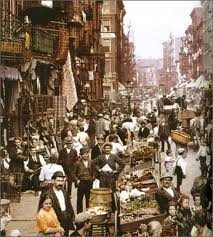
lower east side

Fanny soon decided that she would prefer working in a factory to being a house servant.  Her next job was working as an operator in a ladies’ shirtwaist factory for $7.50 a week.  Bella and Fanny moved to Cannon Street where they lived with a widow named Pincus.  Bella went to a day nursery while her mother was at work.  The nursery was located in the basement of a building on Cannon Street, which Bella described as “gloomy but much warmer than the rooms all of us had just left.”  Overall, Bella’s experience at the day nursery sounded positive, with pleasant caretakers, but the days were very long, stretching past seven at night, and the space was overcrowded with too many babies and young children.

Unfortunately, once again Bella experienced some abuse.  Fanny trusted Mrs. Pincus, her landlady, to get Fanny up and to the nursery, and Mrs. Pincus ended up hitting and pinching Bella, once leaving her with such a huge bruise that Bella had to admit to her mother that Mrs. Pincus was abusing her. These experiences finally led Fanny to decide that she needed to find a place of her own where she would take in boarders to help pay the rent and provide her with some income.  She found a place in a new building on Cannon Street near Rivington Street, a three room apartment (bedroom, kitchen and dining room) with its own bathroom, and took in several boarders.

In the foreword to the book, Ruth Limmer provided a description of early tenement houses: “horrific five- and six- story dwellings that…lacked toilets, running water, fire escapes, and landlord-supplied hear and cooking stoves.” (p. xix)  By 1903, however, newer buildings had been built that were somewhat of an improvement.  “Now each apartment had, in addition to its windowed “front room”…another room that opened onto an air shaft, and interior windows were cut into the walls in order to permit a flow of air.  Little by little, the apartments were fitted with piping for illuminating gas. And instead of backyard privies, families got to share indoor toilets, two per four-apartment floor.  The law also required that fire escapes be affixed to all buildings.”  (p. xix)  The tenements were built on lots originally intended for single family dwellings ( 25 feet by 100 feet), but they housed over twenty families plus boarders in each building.

les interior

I imagine that this is like the apartment that Fanny and Bella were renting in 1903 and likely also what the Brotmans were living in on Ridge Street.  The census from 1900 did not list boarders as living in the Brotman household; perhaps Joseph’s income as a coal carrier/dealer was sufficient to support the family, though I doubt their standard of living would be acceptable to any of us today.

inside tenement

Bella described the many boarders, both men and women, who shared their small space, men sleeping in the kitchen, women in the living room and bedroom with Bella and Fanny.  You can imagine the goose bumps I got when I read that two of the young girls living with them at the beginning were named Frieda and Gussie.  Obviously, those girls were not our Frieda and Gussie, and those were common names for Jewish girls at that time, but nevertheless, once again the book made me realize that I was reading not about some foreign land or a work of fiction, but a work that reflects what life must have been like for the Brotman family living on Ridge Street in 1900.

More to come….

Tillie’s Death Certificate

I received Tillie’s death certificate yesterday, and as I expected, it did not contain any new information about where our family lived in Galicia.  It does, however, confirm that she was the daughter of Joseph and Bessie Brotman (not that I had any doubts) and was born in Austria. Of course, it has a different birthdate from other documents; some documents say she was born in 1884, some 1887, and this one says 1882. The ship manifest which lists her as a passenger in 1891 has her age as six years old, giving her a birth year of 1884 or 1885.  The month of her birth is also inconsistent. The 1900 census said her birthday was in February; the death certificate says August.

Tillie Ressler's death certificate

Tillie Ressler’s death certificate

Interestingly, the death certificate itself has two different ages listed for Tillie at her death.  On the left side (filled out by her son Joseph, as far as I can tell), it says she was born in 1882 and was 73 years old at the time of her death, i.e., February 1956, which would be consistent with a birthday of August 23, 1882.  It also says she was a resident of NYC for 71 of those years, however, meaning she arrived when she was two years old, i.e, in 1884.  Well, we know she came in 1891, so that can’t be correct. On the right side, typed in by the hospital, it says her approximate age was 70 years old at the time of her death, meaning she would have been born in 1886.  So…let’s compromise and say she was born in February, 1884, which is what her own parents told the census taker in 1900.

What the certificate really confirmed for me, however, is what an excellent memory my mother has.  She had just told me over Thanksgiving that Tillie had lived on the Grand Concourse with her sons Joe and Harry and that she had died at a hospital on Welfare Island.  I have to say that when I saw both those facts confirmed in the death certificate, I was very impressed (though not surprised) that my mother had remembered such specific details, especially since I often can’t remember things that happened much more recently.

I was curious about Bird S. Coler Hospital where Tillie died because my mother had very sad memories of visiting her aunt there.  It had opened in 1952 as a public hospital on Welfare Island (now called Roosevelt Island) as a rehabilitation and long-term nursing facility, so it was a relatively new hospital at the time Tillie was there.  It still exists today, now called Coler-Goldwater Specialty Hospital and Nursing Facility, and still functions as a public chronic care facility.

I am now just waiting for Hyman and Sophie’s marriage certificate, and I think I will have all the American “vital records” that exist for Joseph and Bessie and their seven children.

Max Brotman: Who was his mother?

Yesterday I received Max Brotman’s death certificate from the City of Mount Vernon.  It has been quite a task tracking down this document.  Although I knew from Judy and the picture of his headstone that he had died in 1946, I could not find any record of his death certificate.  There is a public index of NYC death certificates that runs through 1948, so if he had died in 1946, it should have been there.  But it wasn’t.  Death certificates dated after 1948 from NYC are much harder to obtain; to get Abraham’s I had to use snail mail (!) and a notarized form and fee and self-addressed envelope sent to the NYC Department of Vital Records.  I was hoping that I could just obtain Max’s electronically through the Family History Library, which is faster, easier and free.  Unfortunately, the FHL does not have non-NYC certificates, and I could not find Max in the NYC register.

I was fortunate to find a volunteer in NYC who checked the paper records and found a reference indicating that Max, a NYC resident, had died “upstate.”   But where upstate?  It’s a big state! I recalled that Max had had a summer home in Congers, NY, and since he died in late May, I thought that perhaps he had died while up there. Image I contacted the town registrar in Congers, sent them a written request, check, and envelope, but they sent it back, saying that they had no record for Max Brotman.

So I was stumped.  I asked Renee, my mentor, for advice, and she suggested calling the cemetery where he was buried to see if they had a record for where he had died.  I called Beth David Cemetery on Long Island, and sure enough, they did have such a record and were willing to divulge where he died without a written letter, check and envelope.  They said he had died in Mount Vernon, New York, not far from where I grew up.

I asked Judy if she had any idea what he might have been doing in Mount Vernon at the time of his death.  She didn’t know.  I wrote to Mount Vernon (yes, a notarized letter, check and envelope), and finally received the long-sought-after document yesterday.Image

So what does it say? Well, it explains what he was doing in Mount Vernon.  He was a patient at the Mount Vernon Convalescent Home, where he was suffering from liver cancer.  It looks like he was there for three weeks, as the doctor who signed the certificate had cared for him from May 6 through May 27 when he died.

What else does it report? It lists Joseph Brotman as his father (phew!), but Adda Browman as his mother.  That conflicted with his marriage certificate which said his mother’s name was Chaye. Image And Browman? Is that just a misspelling of Brotman? Or was her maiden name really Browman? I consulted with Renee, and she said that Chaye was often Americanized to Ida, which is close to Adda.  (She said immigrants tended to Americanize even the names of ancestors who never left Europe.)  So maybe Adda is Chaye? Or maybe Richard Jones, who was Max’s son-in-law and the informant on the certificate, misunderstood or was misunderstood.  I don’t know and probably won’t know until I can learn how to research records from Europe.

The good news is that it’s just one more bit of evidence confirming that Max was Joseph’s son.  The bad news is that the document brings us no closer to knowing the town in Galicia from which they all came.

Another mystery! Looking for theories from the rest of you

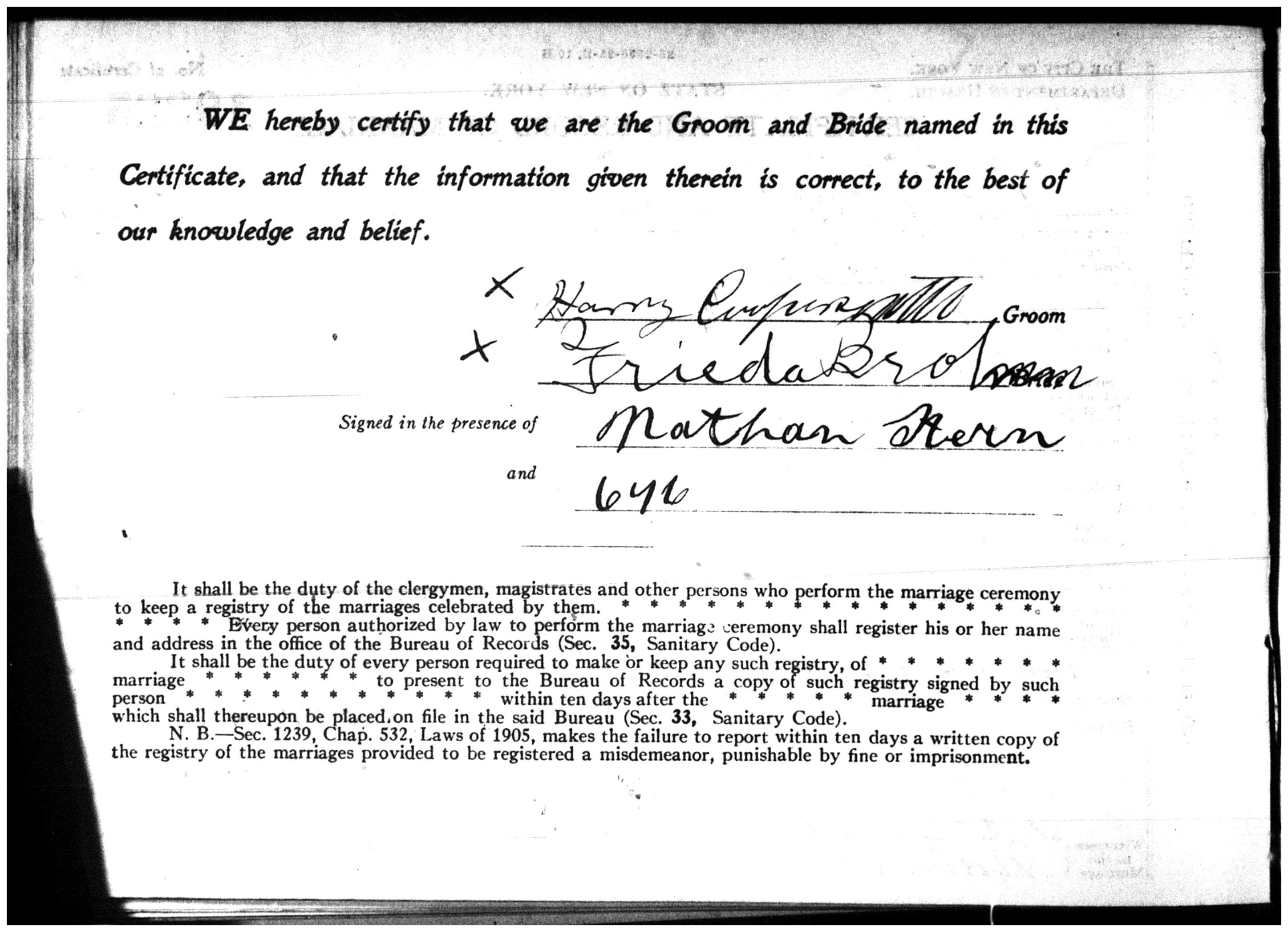
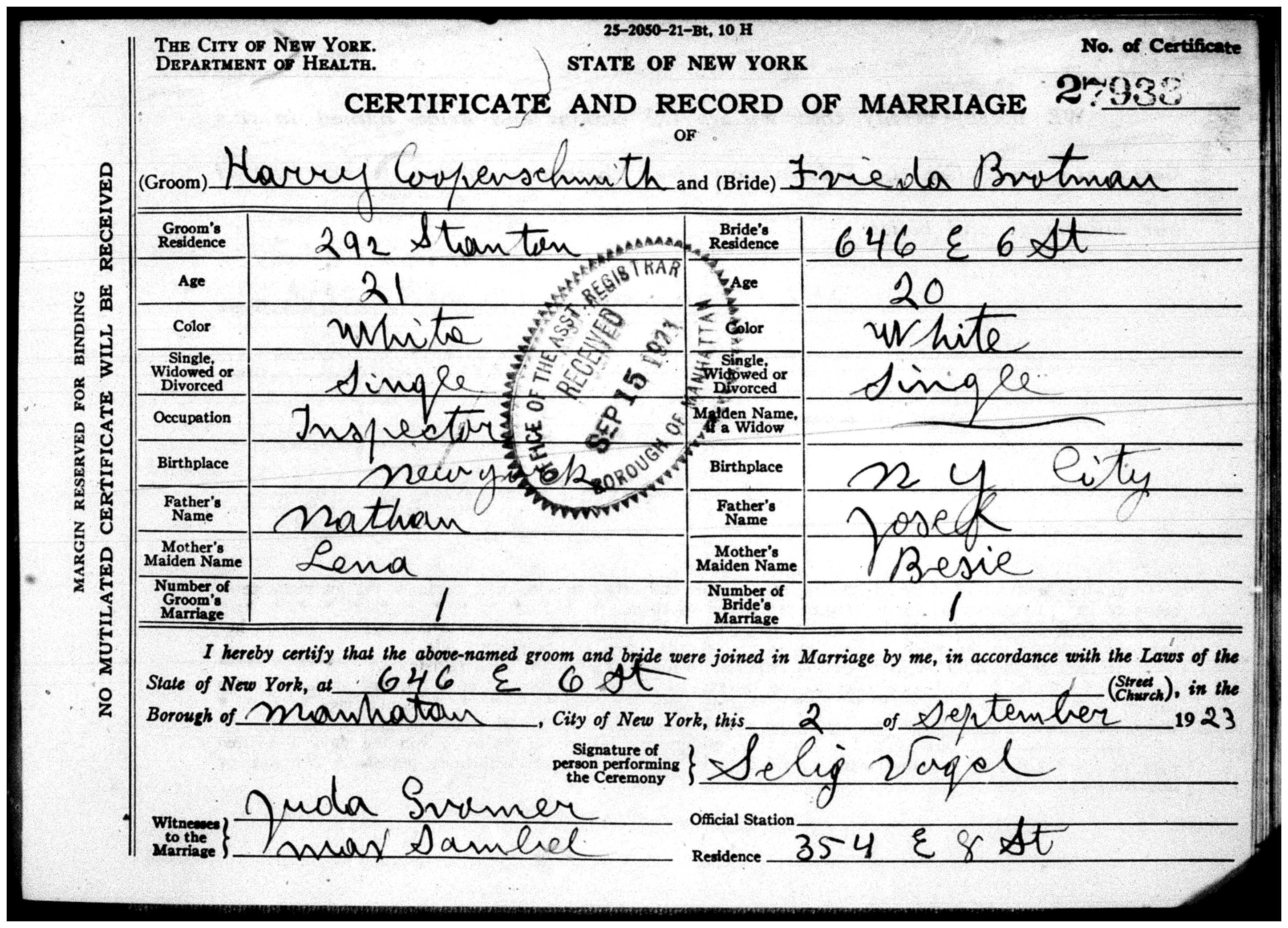
After learning the name of Frieda Brotman’s husband, I was curious as to what happened to Harry Coopersmith after losing his young wife and infant son. Also, I wondered how long they had been married and whether or not Max had been born prematurely. I looked up Harry Coopersmith in the index of NYC marriages and found two for whom no bride was listed. I ordered both certificates, hoping one would be for the marriage of Harry Coopersmith and Frieda Brotman. They arrived yesterday, and imagine my confusion when BOTH certificates were for Harry and Frieda.

The first one is dated May 28, 1923. The marriage ceremony took place at City Hall in NYC, and the officiant was the Assistant City Clerk. It has Frieda’s home address wrong—it was 646 E. 6th Street, not 446 E. 6th Street. It was witnessed by L.B. Waterman and Nathan Stern and signed by Nathan Stern. The front of the form seems to have been filled out by someone in the clerk’s office, not Frieda, Harry or Mr. Stern, since their signatures all are in very different handwriting than that on the front. Also, Frieda would have known her own address. But this is certainly our Frieda—parents’ names are Joseph and Bessie Brotman. [Notice also that her age is wrong; in 1923 she was 26, not 20. Perhaps she lied about her age because Harry was younger than she was?]

ImageImage

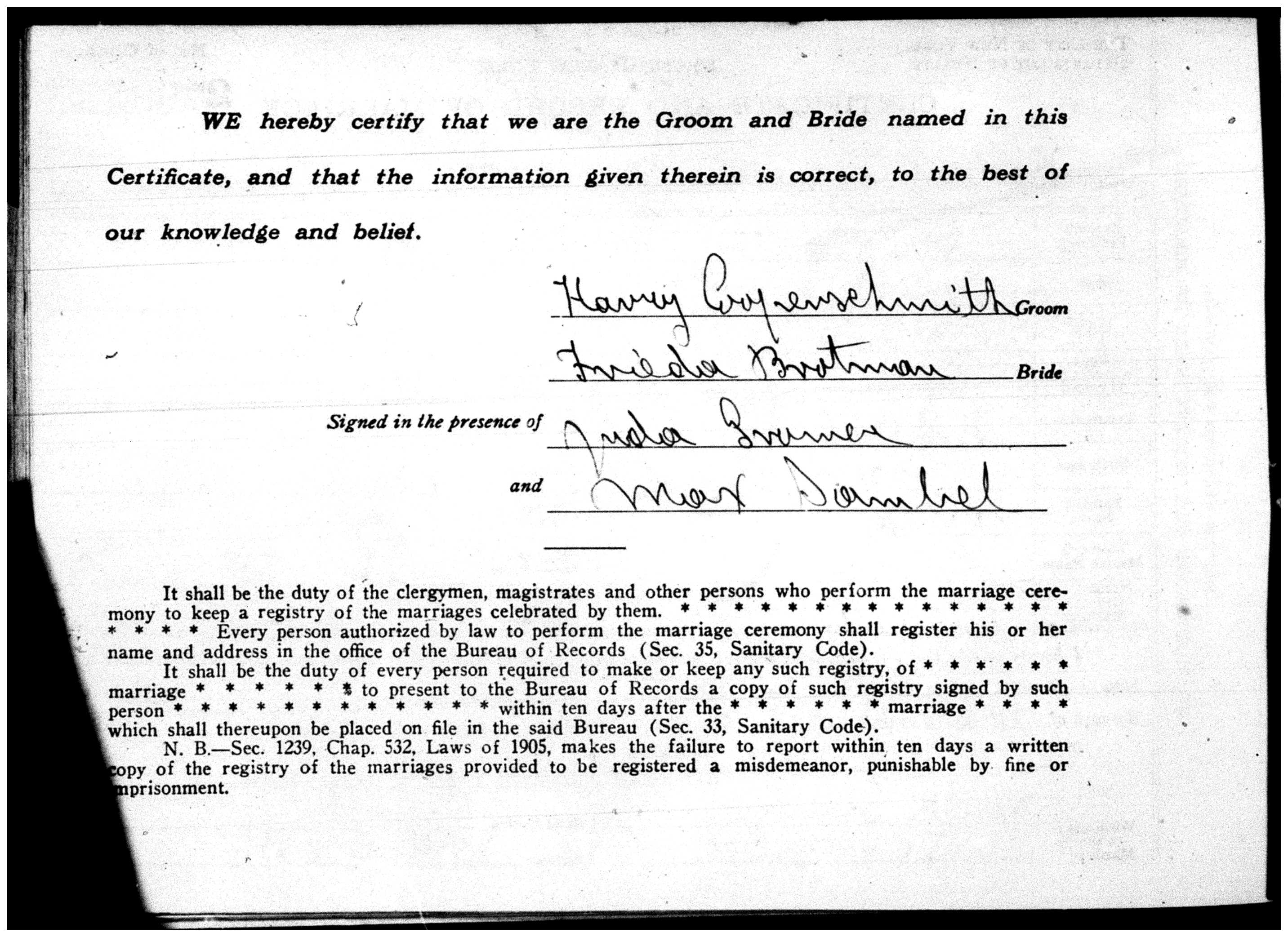
The second one is dated September 2, 1923, a little over three months later. This one appears to have been filled out by someone else, not the clerk. It now has Frieda’s correct address (but not her correct age), but Bessie is spelled incorrectly. I can’t tell whether the handwriting matches any of the signatures on the back (I guess I need the FBI, Bruce!), but what’s odd is that all those signatures seem to match, as if one person signed for Harry, Frieda and the witnesses Max Sambel and Juda Kramer (?). This time the ceremony took place at Bessie and Philip’s apartment at 646 E. 6th Street, and the officiant was Selig Vogel. There is only one Selig Vogel in the 1930 US Census, and he was a rabbi. So obviously this was a religious ceremony, presumably meant to “validate” the earlier civil ceremony.

ImageImage

So…why did they get married twice? Was the first one a secret marriage? Why did they decide to have a religious ceremony the second time, and why did they wait three months? If Max was a full term baby, Frieda would have been about a month pregnant by September 2, 1923 —would she have even known she was pregnant that early back then before EPT? If so, were they then ready to “go public” and have a public ceremony? If Max was born prematurely, which was one possible cause of his death, then maybe Frieda wasn’t even pregnant yet. And who filled out and signed the forms? And who are Max Sambel and Juda Kramer (if that’s what it says)?

I would love to hear the speculations of the rest of you. Leave your thoughts in the comments space below. Meanwhile, I will go see what else I can learn about what happened to Harry and who those other witnesses might have been.

The Lower East Side

The Lower East Side

I just returned from a wonderful weekend in NYC.  Although seeing my grandson Nate (and his parents and his great-grandparents) was the best part of the weekend, I also had an opportunity to do two things I’ve wanted to do for a while: go to the Lower East Side and see where the Brotmans lived in the early 1900s and go to the cemeteries where my great-grandparents and grandparents are buried.  I am going to divide those two experiences into two posts rather than one.  This one will be about the trip to the Lower East Side.

On Saturday morning Harvey and I left our hotel down near Wall Street and walked north through the financial district and Chinatown, under the Brooklyn, Manhattan and Williamsburg bridges, to the Lower East Side. As we crossed streets like Grand, Henry, and Delancey, I tried to imagine what that neighborhood would have been like on a Shabbat morning a century ago.  Now it is a mix of various ethnic groups, but I was surprised to see a number of Orthodox and ultra-Orthodox men dressed for shul, walking past us.  I hadn’t expected to see any sign of a Jewish community surviving there.  As we passed two men dressed in Satmar garb (big furry hats, long black coats, beards and payes), I wondered, “Did Joseph dress anything like that? Were they at all observant? Did they go to shul? Or were they completely non-religious once they got to the US?’  I know that my grandmother had a kosher kitchen at first, but gave that up by the time I knew her.  She was not at all religious, and I know that my grandfather was also not at all religious.  What about your grandparents? Do you know how observant any of them were?

We crossed under the Williamsburg Bridge and then down Broome Street to where it intersected Ridge Street.  Joseph and Bessie lived at 81 Ridge Street in 1900; it is where they lived with Max, Hyman, Tilly, Gussie, Frieda and Sam.   It is also where Joseph died in 1901.  The picture below shows the corner of Broome and Ridge:

Image

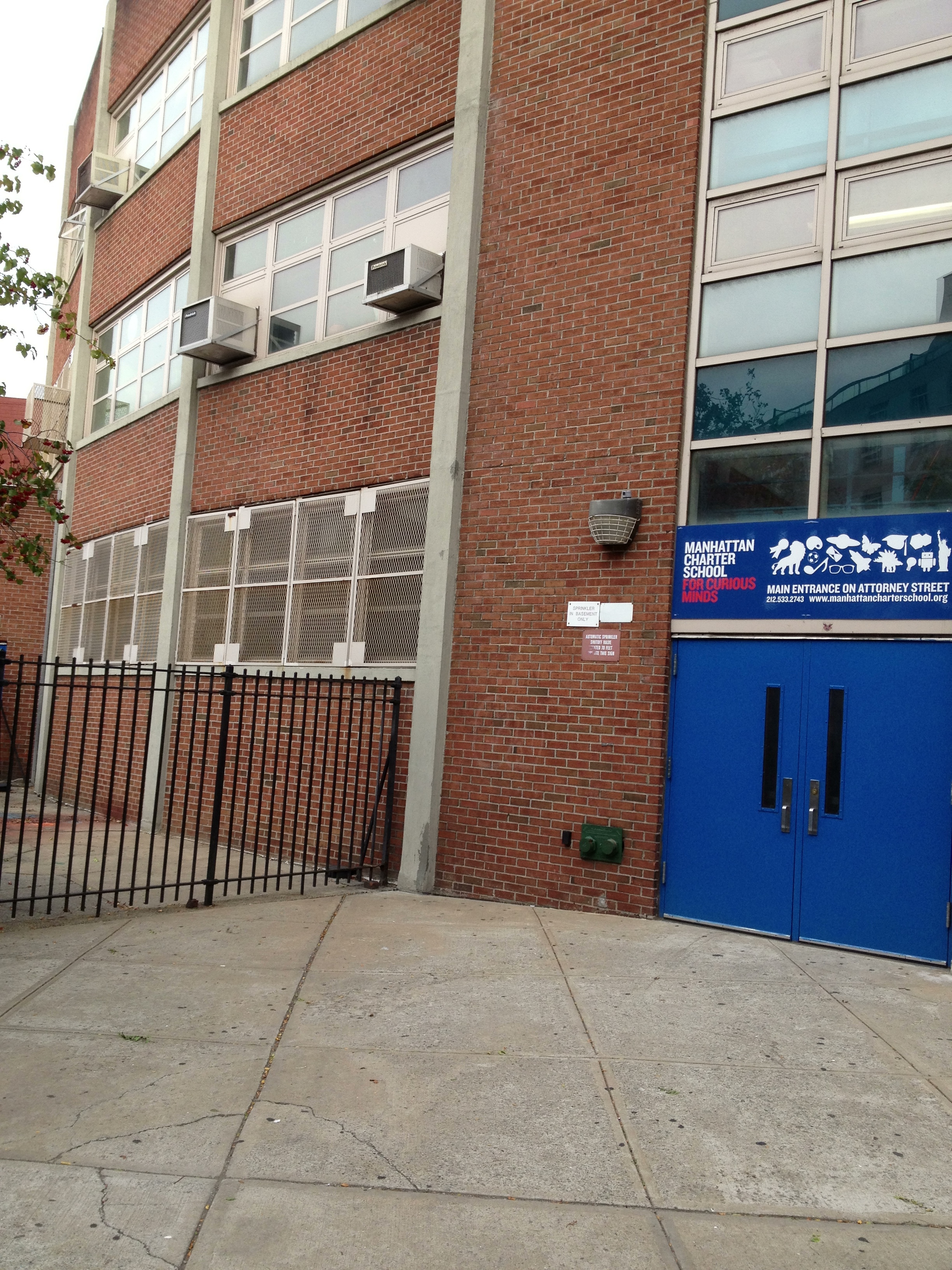
We walked down Ridge to where 81 once stood.  There is now a school there, as you can see :Image

Although I was sad that there was no longer a tenement building there, I thought that having a school there was the best possible alternative.  Education helped our predecessors and all of us get to where we are today, so replacing what was probably a run-down tenement building with a modern new school seems appropriate.

Across the street at 80 Ridge is a newer building also, so obviously the original buildings are all gone.

Image

I took these pictures at the corner of Ridge and Rivington where there was an older building.  Perhaps that was more like the one where our family lived.

ImageImage

As we walked up and down the street, I tried to imagine my grandmother being a little girl, living there.  I thought of her being just five years old when her father died, and how awful that must have been for them all.  And I thought of poor baby Samuel who was four months old and would never know his father.  It must have been a sad and very hard time for them all.

New York City is a remarkable place.  The layers of history are all there, and you can feel them as you walk from neighborhood to neighborhood.  Ridge Street is a nice street with clean and newer apartment buildings.  You wouldn’t know today that it once was a crowded street with tenements filled with new immigrants, speaking Yiddish, and struggling to survive in what was supposed to be a place with streets lined with gold.  As we walked past Asian and Latino residents who themselves are likely immigrants or the children of immigrants, I realized how that experience continues to make New York the rich, fascinating and challenging city that it is.  I may have left the New York area long ago, but it still calls out to me as my home.  I am sure the same is true for many of you, whether you are living in Ohio, Virginia, South Carolina, California, Georgia, Connecticut, Massachusetts—or New Jersey or Long Island.

Isn’t it also interesting how some of the fifth generation children have returned to New York City themselves?