The Goat, the Photographer, and the Daughter: The Children of Julius Schoenthal, Part I

Although I have written about Julius Schoenthal up to his death in 1919, I ended that post saying that I would return later to write about his children and other descendants.  So here I am.  Just to recap, Julius was the Schoenthal sibling who spent most of his years in the US in Washington, DC, as opposed to western Pennsylvania.  He had served both in the German army and the US army, had worked as a shoemaker like his father Levi, and had had four children with his wife Minnie Dahl: Leo, Rosalia, Sylvester, and Moretta, all born between 1875 and 1879.

His wife Minnie died in 1899.  All of their children were married by 1905, and although the three sons remained in Washington, DC, Rosalia (called Rose) and her husband Joseph Pach settled in Uniontown, Alabama, where Julius died, presumably while visiting them, in 1919.

I will discuss each child and his family separately beginning with 1920.  Today I will discuss Leo and Rose; the next post will cover Sylvester and Moretta.

Leo Schoenthal

In 1920, Leo Schoenthal was working as the chief inspector for the DC Division of Weights and Measures, where he had been working for many years.  He and his wife Fannie (nee Pach, sister of Joseph Pach, Rose’s husband) were living on Westminster Street in DC with their daughter Minnie (17) and five boarders.

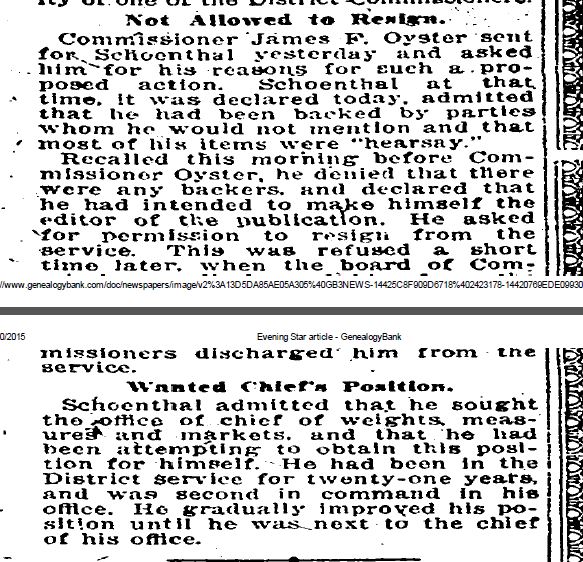
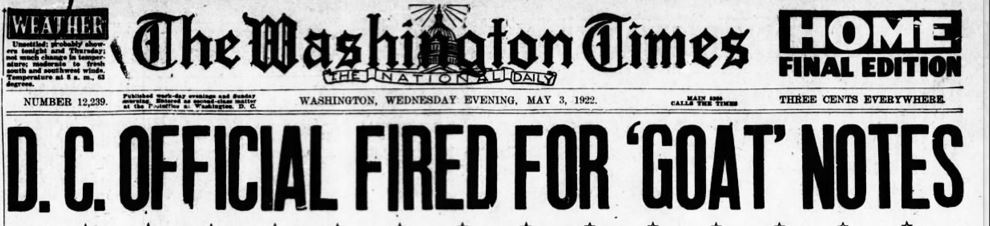
Leo’s long and distinguished career with the Division of Weights and Measures came to an unfortunate end in May 1922.  According to the two news articles reprinted below, Leo had been disappointed when the Commissioner of the Division, James F. Oyster, had passed him over for a promotion to superintendent of the division.  Leo himself admitted that he was dissatisfied with that decision.  It then seems that Leo, who was planning to start a publication called The Goat allegedly to discuss suffrage issues, wrote a series of notes that made serious accusations regarding Commissioner Oyster; the content of those notes was not revealed in either of the news articles although apparently they included attacks on his “integrity, morals, and personality” as well as charges of irregularities in the operations of the office.  The notes were found torn into pieces in Leo’s trash basket in his office, and although he claimed that he never intended to publish them, he was dismissed from his position.  Leo also said that he had planned to resign his position anyway after he had been passed over for the superintendent’s position.
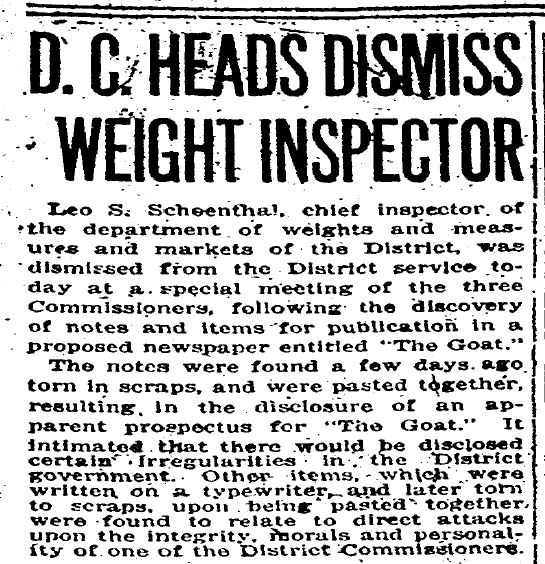
Leo Schoenthal fired 1922 pt 1


Washington Evening Star, May 3, 1922, p. 18
Washington Evening Star, May 3, 1922, p. 18


Headline Leo Schoenthal fired

Leo Schoenthal fired Washington Times 1922

Washington Times, May 3, 1922, pp. 1,2

Washington Times, May 3, 1922, pp. 1,2

Thus, after 29 years with the Division, Leo was fired seemingly without much opportunity to defend himself.  The article from the Washington Times ended with these words: “The discharged chief was declared to be one of the most capable men in the weights and measures office.” What a sad way for Leo to end such a distinguished tenure in that office.

But Leo apparently bounced back.  In the 1923 directory for Washington, DC, Leo listed his occupation as “Westminster Press.”  Although I cannot find any specific information about this business, I assume it was a printing business owned and managed by Leo, based on information from the obituaries of both Leo and his wife Fannie (see below).  I also assume they named it for the street where many of the Schoenthals had once lived in Washington, including Hilda, their cousin, daughter of Henry Schoenthal.

1914 directory for Washington, DC Ancestry.com. U.S. City Directories, 1822-1995 [database on-line]. Provo, UT, USA: Ancestry.com Operations, Inc., 2011.

1914 directory for Washington, DC
Ancestry.com. U.S. City Directories, 1822-1995 [database on-line]. Provo, UT, USA: Ancestry.com Operations, Inc., 2011.

Five years later on September 13, 1928, when he was just 53 years old, Leo Schoenthal died suddenly while on vacation at a resort in Atlantic City.  He was buried at Washington Hebrew Cemetery.

Washington Evening Star, September 14, 1928, p. 9

Washington Evening Star, September 14, 1928, p. 9

In his will, Leo left his estate to his wife Fannie.

Ancestry.com. Washington, D.C., Wills and Probate Records, 1737-1952 [database on-line]. Provo, UT, USA: Ancestry.com Operations, Inc., 2015.

Ancestry.com. Washington, D.C., Wills and Probate Records, 1737-1952 [database on-line]. Provo, UT, USA: Ancestry.com Operations, Inc., 2015.

He wrote:

I give, devise, and bequest to my wife, Fannie Pach Schoenthal, all my property, real and personal, of whatever nature possessed.

I am not forgetful of the best interests of my daughter, Minnie Pauline Schoenthal, but feel confident that my wife will always be mindful of the best interests of my daughter, and I leave it to my wife’s judgment and discretion to give to my daughter any part of my estate she sees fit and able to give.

Three months later on December 2, 1928, the Washington Evening Star announced Minnie’s engagement to Myron Hess, the son of Fred and Marcianna Hess of Atlantic City.  According to the 1920 census, Myron was then working in his father’s photography business in Atlantic City.

Washington Star, December 2, 1928 p. 64

Washington Star, December 2, 1928 p. 64

Minnie Pauline Schoenthal married Myron Samuel Hess on January 6, 1929, at her mother’s home in Washington, DC, on Garfield Street.  The article below describes it as a small but elegant wedding attended only by the relatives of the bride and groom.

Washington Evening Star, January 13, 1929, p.46

Washington Evening Star, January 13, 1929, p.46

So who were those out of towners named as guests at the wedding?

Gus Oestreicher, who gave away the bride, was the husband of Sarah Stern, Hannah Schoenthal’s oldest child.  Sarah was Minnie’s first cousin, once removed.

Mr. and Mrs. Lehman Goldman were Flora Wolfe and her husband.  Flora was the daughter of Amalie Schoenthal and also Minnie’s first cousin, once removed.

Mrs. Jennie Arnold was also the daughter of Hannah Schoenthal and thus also Minnie’s first cousin, once removed.

Mrs. Julius Afferbacker was, I believe, Mrs. Julius Averbach or Bernice Arnold, Jennie Arnold’s daughter, and thus Minnie’s second cousin.

The others must either have been the groom’s relatives or  Fannie Pach’s relatives or people I have not yet found.  But even this small list gave me a sense of how connected the overall Schoenthal clan continued to be as of 1929.  Jennie, Flora, and Sarah were my grandmother Eva Schoenthal’s first cousins as was Leo Schoenthal.  Minnie was her first cousin, once removed.  But it does not appear that my grandmother attended this wedding.  Of course, by 1929 my grandmother had two young children and was living in Philadelphia and also had spent her childhood far away from the Schoenthal clan on the East Coast.  Nevertheless, it is a bit sad that she and her parents were not at this wedding (or at least not included on the list reported in the newspaper).

Minnie moved to Margate, New Jersey, near Atlantic City, after marrying Myron where he continued to work in the family photography business.  They would have two daughters during the 1930s, and in 1940 they were still living in Margate and Myron was still in the photography business.  Here is a photograph taken by Fred Hess & Son Photographers.

8904309974_6d80a1024e_n

Strolling the Boardwalk at Atlantic City by Fred Hess & Son. Date unknown, but looks like the 1920s. https://www.flickr.com/photos/28025169@N08/

Leo’s widow Fannie Pach Schoenthal took over Westminster Press after Leo died.  On the 1930 census she was living alone in Washington, DC, and listed her occupation as president of a printing business.  By 1940 she appears to have left Westminster Press; she was still living on Garfield Street, but now with five lodgers in her home.  Her occupation was listed as a lodging house keeper.  On October 19, 1946,   Fannie died unexpectedly from a heart attack while she was at the Wardman Park Hotel in DC (a place I have stayed in Washington); she was seventy years old.

Washington Evening Star, October 21, 1946, p, 8

Washington Evening Star, October 21, 1946, p, 8

Minnie Schoenthal Hess’s husband Myron died four years later on November 6, 1950, a month before his 52nd birthday.  His daughters were just teenagers when he died. In 1955, five years after Myron died, Minnie remarried; her second husband was A. Jay Trilling, who owned a paint company.  He died in 1983. Minnie lived to age 95, passing away on August 15, 1998. According to her obituary, she took over Myron’s photography business after he died.

TRILLING, HESS, SCHOENTHAL, MINNIE, who came to Margate as a bride in 1929 and lived in the same house in Marven Gardens for sixty-five years, died at Manor Care Nursing Home in Potomac, Maryland, on August 15, after a long illness. She was 95.

Mrs. Trilling was born in Washington, D.C. and moved to Atlantic City when she married Myron Hess. She took over as head of Fred Hess & Son Photography Studio following the death of Mr. Hess in 1950. In 1955 she married A. Jay Trilling, president of Trilling Paint Co. and former president of the Greater Atlantic City Chamber of Commerce as well as president of Temple Beth Israel. He died in 1983.

Mrs. Trilling served as president of the Women’s Division of the Chamber of Commerce, president of the Exchangettes, and she was a member of Soroptomist International, Beth Israel Sisterhood, Betty Bacharach Auxiliary, and the Ladies’ Auxiliary of the Children’s Seashore Home. She was a member for 77 years of the Order of the Eastern Star. Mrs. Trilling was especially proud that she was responsible for the beautification and restoration of Marven Gardens in the late 70’s.

(“Press of Atlantic City, The”, New Jersey, GenealogyBank.com (http://www.genealogybank.com/doc/obituaries/obit/0FB5351CB13A6EA1-0FB5351CB13A6EA1 : accessed 14 December 2015) TRILLING, HESS, SCHOENTHAL, MINNIE)

Thus, both Minnie and her mother Fannie became widows at a young age, and both took over their husbands’ business after their husbands died.   They were not only survivors; they were women who took on the responsibility of running a business to support their families.

Rosalia or Rose Schoenthal Pach

As noted above, in 1920 Rose and her husband Joseph Pach lived in Uniontown, Alabama.  Joseph was a dry goods merchant there. By 1930, however, they had returned to Washington, DC.  Joseph was now a commercial traveler selling ginger ale.  I wonder if they returned after Leo died to be closer to the rest of the family.  Rose and Joseph did not have any children, and perhaps they were lonely with no family close by in Uniontown; or maybe Joseph’s store wasn’t doing well.  In 1940, they were still living in DC, and Joseph was now a wholesale wine dealer.  On June 13, 1941, Joseph Pach died suddenly at home; he was sixty years old. (His sister Fannie Pach Schoenthal, Leo’s wife, also died unexpectedly in 1946.)

Rose died almost ten years later on January 23, 1951. She was 74.  Rose and Joseph had not had any children, so there were no descendants.  When Rose died, she had already lost not only her parents and her husband, but also all three of her brothers and at least two of her sisters-in-law.  There seemed to be a fair number of “sudden” or “unexpected” deaths in the family.

More on the younger two brothers in my next post.


Henry Schoenthal: His Final Years and His Legacy

Although I have completed as best I can the stories of five of the children of my great-great-grandparents Levi and Henriette (Hamberg) Schoenthal (Hannah, Amalie, Felix, Julius and Nathan), I still need to complete the stories of Henry, Simon, and, of course, my great-grandfather Isidore.[1]  In addition, there were two siblings living in Germany whose stories I’ve yet to tell, Jakob and Rosalie.  First, I want to return to Henry, the brother who led the way for the others.

As I wrote here, after living for over 40 years in Washington, Pennsylvania, Henry Schoenthal moved with his wife Helen (nee Lilienfeld) to New York City in 1909 to be closer to their son Lionel. Lionel had moved to NYC to work as a china buyer, first working for one enterprise, but eventually working for Gimbels department store.  Lionel was married to Irma (nee Silverman), and they had a daughter Florence, born on March 22, 1905.

In 1910, Henry and Helen’s other son Meyer had married Mary McKinnie, the daughter of a wealthy industrialist from Colorado. Meyer and Mary had met while Mary was a student at a girl’s boarding school, Washington Seminary, in Washington, Pennsylvania.  After marrying, they were living in Los Angeles, and Meyer was working for an investment company.

Hilda Schoenthal, Henry and Helen’s daughter, was working as a stenographer in Washington, DC, in 1911. She was living on the same street as her uncle Julius Schoenthal and cousin Leo Schoenthal, the 900 block of Westminster Avenue.


1911 directory for Washington, DC Ancestry.com. U.S. City Directories, 1822-1995 [database on-line]. Provo, UT, USA: Ancestry.com Operations, Inc., 2011.

1911 directory for Washington, DC
Ancestry.com. U.S. City Directories, 1822-1995 [database on-line]. Provo, UT, USA: Ancestry.com Operations, Inc., 2011.

According to her obituary (see below), Hilda moved to DC to work for a patent attorney.    In 1914, she was working as a bookkeeper for Karl P. McElroy, who appears to have been the patent attorney, as her brother Meyer later worked for him as well, as noted below in his obituary.

1914 directory for Washington, DC Ancestry.com. U.S. City Directories, 1822-1995 [database on-line]. Provo, UT, USA: Ancestry.com Operations, Inc., 2011.

1914 directory for Washington, DC
Ancestry.com. U.S. City Directories, 1822-1995 [database on-line]. Provo, UT, USA: Ancestry.com Operations, Inc., 2011.

In 1915, Henry and Helen were still living with Lionel (called Lee on this census, as he often was in other documents and news articles), Irma, and Florence on Riverside Drive in New York City.  Lee was still working as a buyer, and no one else was employed outside the home.  Lee’s draft registration for World War II shows that in 1918 he was still working for Gimbels, living on Riverside Drive.

Lionel (Lee) Schoenthal World War I draft registration Registration State: New York; Registration County: New York; Roll: 1786675; Draft Board: 141

Lionel (Lee) Schoenthal World War I draft registration
Registration State: New York; Registration County: New York; Roll: 1786675; Draft Board: 141


Thanks to the assistance of the Heinz History Center in Pittsburgh, I was able to obtain a copy of a letter that Henry Schoenthal wrote to his granddaughter Florence in December, 1918, when she was almost fourteen years old:

Henry letter to Florence 1918 1

Henry letter to Florence 1918 2


My darling Florence, I told you yesterday that I was mad at you, but I aint. Beg pardon, I mean I am not. I love you just as much as ever, but I would have been so happy if you had stayed a few days with us.  Of course I will have to send word to President Wilson that you went home and that you could not come to see him.  Maybe after a while when we have a home of our own here you will come and stay with us for quite a while.  We will show you that Washington, for natural beauty, beats any city you saw in the many foreign countries you have visited. Will you write me a little letter? Lovingly yours, Grandpa.

I love the teasing tone of this sweet letter to his granddaughter; it shows yet another facet of this interesting great-great-uncle of mine.  His diaries from his early years in Washington were all very serious, and the speech he gave on a return trip to Washington, PA, in 1912 revealed his spiritual and sentimental side.  Here we get to see some of his sense of humor and the affection he felt for his only grandchild, Florence, who probably like most teenagers was anxious to get home to her friends rather than spend more time with her grandparents.

I was at first a bit confused as to where Henry was living when he wrote this letter.  He refers to the natural beauty of Washington, but it’s not clear whether he is referring to Washington, PA, or Washington, DC.  I concluded, however, that he meant DC because his daughter Hilda was living there and perhaps he and Helen were planning to relocate there.  Also, the reference to seeing President Wilson makes no sense unless he and Helen were in DC.

Not long after the writing of this letter, the Schoenthal family suffered a sad loss. Henry’s son Meyer was living with his wife Mary in Blythe, California, working as a lumber merchant, when he registered for the draft on September 12, 1918.  Just three months later, Mary died on December 24, 1918.  She was only 31 years old.  They had been married for just eight years.  There were no children.


On the 1920 census, Meyer is listed as a widow, living alone, and still working in the lumber business. He had moved from Blythe to Palo Verde, California.

If Henry and Helen Schoenthal did move to DC for a period of time, by 1920 they had returned to NYC and were again living with their son Lee and his family on Riverside Drive, according to the 1920 census record.  Lee was still working as a buyer.  Hilda Schoenthal, their daughter, was still living in Washington DC, but was now working as a law clerk for the patent attorneys, according to the 1920 census.

On October 19, 1921, Meyer L. Schoenthal married for a second time.  His second wife was Caroline S. Holgate (sometimes spelled Carolyn).  By that time Meyer was considered a “prominent lumber dealer” and was president of the Blythe, California, chamber of commerce; his new bride was also “prominent socially” and had been president of the Sunshine Society in Blythe.

Riverside Daily Press article - Meyer Schoenthal 2d marriage 1921-page-001

Riverside Daily Press, October 20, 1921, p. 8


Caroline was also apparently a talented soprano, as I found numerous articles referring to her performances at various social events.  Here’s just one example.

Riverside Daily Press article -Mrs Meyer Schoenthal soprano-page-002

Riverside Daily Press article -Mrs Meyer Schoenthal soprano-page-003

Riverside Daily Press, January 28, 1924, p. 9


Perhaps she also sang at the celebration of the 50th wedding anniversary  of her new in-laws, Henry and Helen Schoenthal, which took place on May 8, 1922, in Atlantic City, New Jersey, although they were not among the guests listed in this news item.

Henry Helen SChoenthal 50th anniversary celebration 1922

Washington DC Evening Star, May 7, 1922, p.31

For that occasion,  Lionel/Lee Schoenthal wrote these very loving lines of verse in honor of his parents:

SchoenthalFamilyScans-page-002

Lionel (Lee) Schoenthal 1922

Lionel (Lee) Schoenthal 1922 passport photograph National Archives and Records Administration (NARA); Washington D.C.; NARA Series: Passport Applications, January 2, 1906 – March 31, 1925; Roll #: 1829; Volume #: Roll 1829 – Certificates: 117226-117599, 09 Feb 1922-10 Feb 1922


(I haven’t transcribed the poem or translated the German lines here, but you can always click and zoom if you want to read it.)

Sadly, three years later, the Schoenthal family lost both Henry and his son Lionel.  Henry died on October 22, 1925, from heart and kidney disease.  He was 82 years old and had lived a good and long life for a man of his generation.  After training as a Jewish teacher and scholar in Germany, he had immigrated from Sielen, Germany, to Washington, Pennsylvania,the first of his siblings to do so .  Later, he had brought his young bride Helen Lilienfeld from Gudensberg, Germany, to Pennsylvania, and they had raised three children together after losing one as a baby.  In Washington, PA, he’d been a successful businessman and respected citizen.  When his son Lionel moved to New York City, Henry and his wife Helen moved there also to be near his son and his only grandchild, Florence.  He had lived there for the last sixteen years of his life, working for some of that time as an insurance salesman, as indicated on his death certificate.  He was buried at Westchester Hills Cemetery in Hastings-on-Hudson, less than fifteen miles from where my parents are living. Perhaps one day I will pay him a visit.

Schoenthal, Henry death page 1


The family must have been in complete shock when Lee Schoenthal died of pneumonia on December 5, 1925,  just six weeks after his father had died; Lee was only 48 years old, and his daughter Florence was only 20 years old when he died.

Schoenthal, Lee death page 1


Here is part of a long and detailed obituary from the December 10, 1925 issue of The Pottery, Glass, and Brass Salesman (p. 153):

SchoenthalFamilyScans-page-003

I will transcribe some of the content:

Lee Schoenthal, supervisor of the china, glassware and allied departments of Gimbel Brothers’ associated stores, passed away at his home in New York City early on Saturday morning, December 5, following an acute illness of two weeks.  [There is then a detailed description of Lee’s poor health, referring to his dedication to his job and overwork as contributing factors to his death.] …

Lee Schoenthal was born in Washington, Pa., April 12, 1877.  His father and mother, who were born in Germany, had come to this country some years before and Henry Schoenthal—Lee’s father—had built up a nice retail business in Washington.  Lee attended the schools of his native town and then his parents, themselves highly cultured, made the effort to give their son a collegiate training, sending him to Washington and Jefferson College, located in Washington.  During his college career he stood well in his classes and was particularly noted for his musical accomplishments, being leader of the college orchestra for several years.  As a matter of fact, it is entirely possible that if he had devoted himself wholeheartedly to music instead of to commerce he might have become a musical celebrity.  …

Some twenty years ago Mr. Schoenthal came to New York to “seek his fortune.” [Then follows a detailed description of Lee’s business career, first with the Siegel-Cooper Company and then with Gimbels.]…

Mr. Schoenthal, for a man of his comparative youth, probably developed more men as successful buyers of china and glassware than anyone else in the country.  He had that rare gift of imparting knowledge and that quality of the really big man of business that he never feared to impart all information he could to those who worked with him.  Modest to a degree, he could not help being conscious of his compelling influence and ability, so the thought never entered his mind that he might be jeopardizing his own position by teaching others all they could absorb from his store of knowledge and wisdom.

[The obituary then describes Lee’s interests outside of work, in particular his love of music, but also art and architecture.] Himself a deeply religious Jew of the modernist type, he could talk more familiarly of the history of the Catholic cathedrals and their adornments than many men of the Christian faith.

[Finally, the obituary described his family life: his happy marriage, his talented daughter, and his devotion to his parents, for whom he had provided a home for many years.]

The obituary thus focused not only on Lee’s distinguished business career, but also on his broad intellectual and cultural interests, his musical talents, and his religious and personal life.  It described him as a “deeply religious Jew of the modernist type” and as a man devoted to his family.  His family must have been very proud of him.

Both deaths were noted in Meyer Schoenthal’s home paper in Riverside, California:

Lionel Schoenthal death re Meyer 1925


Two years later on October 19, 1927, Florence Schoenthal, the grandchild of Henry and Helen Schoenthal and daughter of Lee Schoenthal, married Verner Bickart Callomon in New York City.  Verner Callomon was the son of a German Jewish immigrant, Bernhardt Callomon, who had settled in Pittsburgh and worked for Rodef Shalom synagogue there, the same synagogue to which Henry Schoenthal had once belonged.  Verner was a doctor, and his career was described as follows by the Rauh Jewish Archives at the Heinz History Center in Pittsburgh:

Verner Callomon (1892-1977) graduated with honors from the University of Pennsylvania in 1915 with a degree in medicine. He served as a junior lieutenant in World War I and returned to Pittsburgh to practice internal medicine. He was a pulmonary disease specialist and researcher at Allegheny General Hospital and Montefiore Hospital for nearly 60 years and was the chief of medicine at both institutions at different times during his long career. His research contributed to changes in the treatment of pneumonia. He was known both for his professionalism and for his compassion. In order to visit weather-bound patients, he rowed down Liberty Avenue during the 1936 St. Patrick’s Day flood and secured an Army jeep during the November 1950 snowstorm.

As far as I can tell, Florence and Verner settled in Pittsburgh after they married since that is where Verner is listed in the 1929 directory for Pittsburgh and also were their first child was born in 1929.

(The Rauh website also includes links to several articles about the Callomon family.  Of particular interest to me was the oral history interview with Jane Callomon, one of the children of Florence (Schoenthal) and Verner Callomon, on file at the University of Pittsburgh Library (“Pittsburgh and Beyond: The Experience of the Jewish Community,” National Council of Jewish Women, Pittsburgh Section, Oral History Collection at the University of Pittsburgh).)

In 1927, following her husband’s death, Helen Lilienfeld Schoenthal moved to Washington, DC, from NYC to live with her daughter Hilda.  They were living at 3532 Connecticut Avenue NW in 1927, and Hilda was still working for K.P. McElroy, now as a bookkeeper and notary public.

Meyer Schoenthal continued to prosper in California and was elected a vice-president of the California Association of Commercial Secretaries in 1928 (“Fresno Chosen Next Meeting Place California Commercial Secretaries,” Riverside Daily Press, January 14, 1928, p, 2) ; in 1929 he and his wife Caroline took an eleven-week trip to the East Coast, visiting not only his sister and mother in Washington, DC, but also his birthplace, Washington, PA, and many other locations.

Riverside Daily Press, August 5, 1929, p. 4

Riverside Daily Press, August 5, 1929, p. 4

Riverside Daily Press article - Meyer Schoenthal road trip 1929-page-003

Although Meyer and Caroline were still living in Riverside, California, on April 2, 1930, when the census was taken, by September, 1930, they had moved east permanently:

Riverside Daily Press, September 8, 1930, p. 7

Riverside Daily Press, September 8, 1930, p. 7


Note that Meyer was going to work for the same business that had long employed his sister Hilda, K.P. McElroy.

In 1930, Hilda and her mother were living in the Broadmoor Apartments at 3601 Connecticut Avenue. By 1932, Meyer and his wife had moved in with them, as listed in the 1932 directory for Washington, DC, and he and his wife were still living there with them in 1937.   Both Hilda and Meyer were working for K.P. McElroy, Hilda as his personal secretary, Meyer as the office manager.

Ancestry.com. U.S. City Directories, 1822-1995 [database on-line]. Provo, UT, USA: Ancestry.com Operations, Inc., 2011.

Ancestry.com. U.S. City Directories, 1822-1995 [database on-line]. Provo, UT, USA: Ancestry.com Operations, Inc., 2011.

In April 1930, Florence Schoenthal Callomon appeared in a production of C.B. Fernald’s “The Mask and the Face” at the Y Playhouse in New York City; a noted Shakespearean actor led the cast, B. Iden Payne.  Florence was a woman of many talents, it appears.  She also was an artist who had worked as an advertising illustrator for Gimbels before she married. I cannot find Verner or Florence on the 1930 census in either Pittsburgh or NYC, but regardless of where she was living, I am not sure how she pulled off appearing in this production since she had a one year old child at the time.


On October 10, 1937, the family matriarch Helen Lilienfeld Schoenthal died.  She was almost 89 years old (despite the headline on her obituary, she was one month short of her 90th year).  She was buried with her husband at Westchester Hills Cemetery:

Washington Evening Star, October 11, 1937, p. 12

Washington Evening Star, October 11, 1937, p. 12


Riverside Daily Press, October 18, 1937, p. 3

Riverside Daily Press, October 18, 1937, p. 3

From the second obituary in the Riverside Daily Press, it appears that Meyer and Caroline Schoenthal had by October 1937 moved to their own place at 2700 Rodman Road in DC.

By 1940, Meyer and Caroline were living as lodgers in a home with thirteen other residents at 2700 Quebec Street; Meyer, 56 years old, was still working for the patent firm.  His sister Hilda, now 65, was also still working at the patent firm and still living at 3601 Connecticut Avenue.

Florence Schoenthal Callomon and her husband Verner Callomon were living in Pittsburgh in 1940; Verner was a doctor in private practice.  They now had two children.

Hilda Schoenthal died on June 6, 1962.  She was 87 years old.

Washington Evening Star, June 6, 1962, p. 41

Washington Evening Star, June 6, 1962, p. 41


According to her obituary, sometime after 1940 she had left K.P. McElroy, her longtime employer, to work for Gulf Oil in their patent department.  If times had been different, I have a feeling that Hilda would have become a patent lawyer herself. On the personal side, she seems to have had an active social life with many friends and relatives with whom she traveled and socialized, according to several news items from the society pages of the Washington Evening Star.  Hilda was buried at Westchester Hills Cemetery, where her parents were interred.

Less than a year later, on February  16, 1963, the last remaining child of Henry and Helen Schoenthal,  Meyer Lilienfeld Schoenthal, died.  He was 79.

Washington Evening Star, February 18, 1963, p. 24

Washington Evening Star, February 18, 1963, p. 24


He died from a heart attack; unlike his sister Hilda and his parents, he was buried in Massachusetts, where his wife Carolyn/Caroline was born.  She outlived him by 20 years, dying in January, 1983, when she was 84.

The obituary revealed a few things that I otherwise would not have known about Meyer: that he had helped build a “noted nature trail” in the Southwest and that he was a philatelist (stamp collector).  It is interesting that, like his sister Hilda, he had gone to work at Gulf Oil Corporation after working for many years for K.P. McElroy.

The only surviving descendants of Henry Schoenthal after 1963 were his granddaughter Florence Schoenthal Callomon and her children.  Florence died in 1994 when she was 89 years old.  According to the Rauh Archives, she had been “a member and officer of many Pittsburgh and Pennsylvania organizations, including the Western Pennsylvania Women’s Golf Association, the Women’s Committee of The Carnegie Museum of Art, the Pittsburgh Symphony Association and the Rodef Shalom Sisterhood, among others.” From the oral history interview their daughter Jane referenced above, it is clear that both Florence and Verner were involved in many aspects of the Pittsburgh community.

Thus, Henry and Helen Schoenthal left quite a legacy.  Their three children all were successful in their careers and ventured far beyond little Washington, PA, where they’d been born: Hilda to DC, Lionel/Lee to NYC, and Meyer to California and then to DC.  Things came almost full circle when Florence Schoenthal Callomon, their granddaughter, returned to western Pennsylvania where her German immigrant grandparents had settled and where her father and aunt and uncle had been born and raised.  Pittsburgh is where Florence and her husband Verner raised their children and where those children stayed as even as adults.

I’d imagine that my great-great-uncle Henry would have been very proud of his three children and his granddaughter for all that they accomplished.  Even in 1912 he knew how blessed he had been in his life when he addressed his friends in Washington, PA, and told them:

I gratefully acknowledge that God has been very gracious unto me and that he has blessed me beyond my merits.

I feel very blessed to have been able to learn so much about my great-great-uncle Henry and his family, and I hope someday to be able to connect with his descendants.


[1]   Two of twelve children of Levi Schoenthal and Henriette Hamberg did not survive to adulthood.  Of the other ten, eight immigrated to the United States, including my great-grandfather.  One of the siblings remained in Germany, Jakob, and Rosalie returned to Germany to marry after a few years in the US.

The Schoenthals Come to America: 1866-1880

One of the things that I have found touching in researching many of the lines in my family is the way that families stayed together even after settling in the United States.  Although family members would sometimes move away as their children grew up and the job opportunities changed, brothers and sisters and cousins and others tended to all end up near each other when they first migrated.  In the case of the Schoenthal family, it’s even more striking since almost all of them ended up in a relatively small city, Washington, Pennsylvania.

Washington, PA 1897 By Thaddeus Mortimer Fowler & James B. Moyer [Public domain], via Wikimedia Commons

Washington, PA 1897
By Thaddeus Mortimer Fowler & James B. Moyer [Public domain], via Wikimedia Commons

As I mentioned in my last post, my great-great-uncle Henry Schoenthal was the first sibling of my great-grandfather Isidore to emigrate from Germany to the United States. His aunt Fanny Schoenthal Goldsmith had preceded him with her husband Simon in 1845.  Henry was the second oldest child and the oldest son of Levi Schoenthal and Henrietta Hamberg, born on May 20, 1843, in Sielen.  His German name was Hienemann, named for Levi’s father, Hienemann Schoenthal, but he changed it to Henry after settling in the United States.

According to the Beers biography referred to here, “Henry Schoenthal attended the school of his native village up to his fourteenth year, at the same time learning his father’s trade [shoemaking], beginning when only ten and one-half years old, and working at the same until he was fifteen years old. For two years after this he took private literary instruction, and in the year 1859 was admitted into the Jewish Seminary in Cassel, Germany, an institution where young men were educated to become teachers in Jewish schools, and leaders of the service in the synagogue. At the end of the third year he passed an examination, and then taught school for three years in one place [Trendelburg].”[1]    His role as a teacher is also mentioned on the Alemannia-Judaica page for Trendelburg.

Despite being quite educated and having what would appear to be a good position, Henry must have decided that there were greater opportunities in America where his uncle Simon Goldsmith and his family had moved in 1845. Henry, still using the name Hienemann, sailed on the S.S. Hansa from Bremen, Germany, arriving in New York City on June 18, 1866.

Henry Schoenthal 1866 ship manifest, line 85 Year: 1866; Arrival: New York, New York; Microfilm Serial: M237, 1820-1897; Microfilm Roll: Roll 267; Line: 1; List Number: 679

Henry Schoenthal 1866 ship manifest, line 85
Year: 1866; Arrival: New York, New York; Microfilm Serial: M237, 1820-1897; Microfilm Roll: Roll 267; Line: 1; List Number: 679

As the Beers biography reports, Henry settled in Washington, Pennsylvania. “Selecting as his abiding place in the land of his adoption the thriving town of Washington, this county, he clerked for three years in the clothing store of [his first cousin] Jacob Goldsmith, at the sign of the “Golden Eagle,” in the room now occupied by C. A. House as a music store.”  Henry’s cousin had been well-established in Washington since at least 1854 as this August 23, 1854 article from the Washington Reporter (p. 2) reports:

Jacob Goldsmith ad 1854

On September 23, 1867, Henry’s younger brother Simon, born February 14, 1849, arrived in New York City on the S.S. D.H. Wagen, listing his occupation as a bookbinder and his destination as Pennsylvania.  Sailing with Simon was their sister Amalie, born Malchen on January 1, 1847, in Sielen. She also was headed to Pennsylvania.

Simon Schoenthal and Amalie Schoenthal 1867 ship manifest, lines 230 and 231 Year: 1867; Arrival: New York, New York; Microfilm Serial: M237, 1820-1897; Microfilm Roll: Roll 286; Line: 1; List Number: 1004

Simon Schoenthal and Amalie Schoenthal 1867 ship manifest, lines 230 and 231
Year: 1867; Arrival: New York, New York; Microfilm Serial: M237, 1820-1897; Microfilm Roll: Roll 286; Line: 1; List Number: 1004

The Beers biography continues, “Then in 1869, Mr. Schoenthal bought out the stationery business of Rev. James McFarland, at the “Green Tree Corner,” and has ever since conducted a prosperous and lucrative trade in books, stationery, notions, etc., at the same stand.”

Advertisement Date: Wednesday, June 7, 1871 Paper: Washington Reporter (Washington, Pennsylvania) Volume: LXIII

Advertisement
Date: Wednesday, June 7, 1871 Paper: Washington Reporter (Washington, Pennsylvania) Volume: LXIII

In 1870, Henry (now using Henry) and Simon were living together in Washington in what appears to be a hotel.  Henry was a book merchant, and Simon a bookbinder.

Henry and Simon Schoenthal 1870 census, lines 20 and 21 Year: 1870; Census Place: Washington, Washington, Pennsylvania; Roll: M593_1463; Page: 150B; Image: 290; Family History Library Film: 552962

Henry and Simon Schoenthal 1870 census, lines 20 and 21
Year: 1870; Census Place: Washington, Washington, Pennsylvania; Roll: M593_1463; Page: 150B; Image: 290; Family History Library Film: 552962

Simon book bindery 1870

Henry was also actively involved in the cultural life in Washington, bringing music to the people who lived there:

Henry Schoenthal music


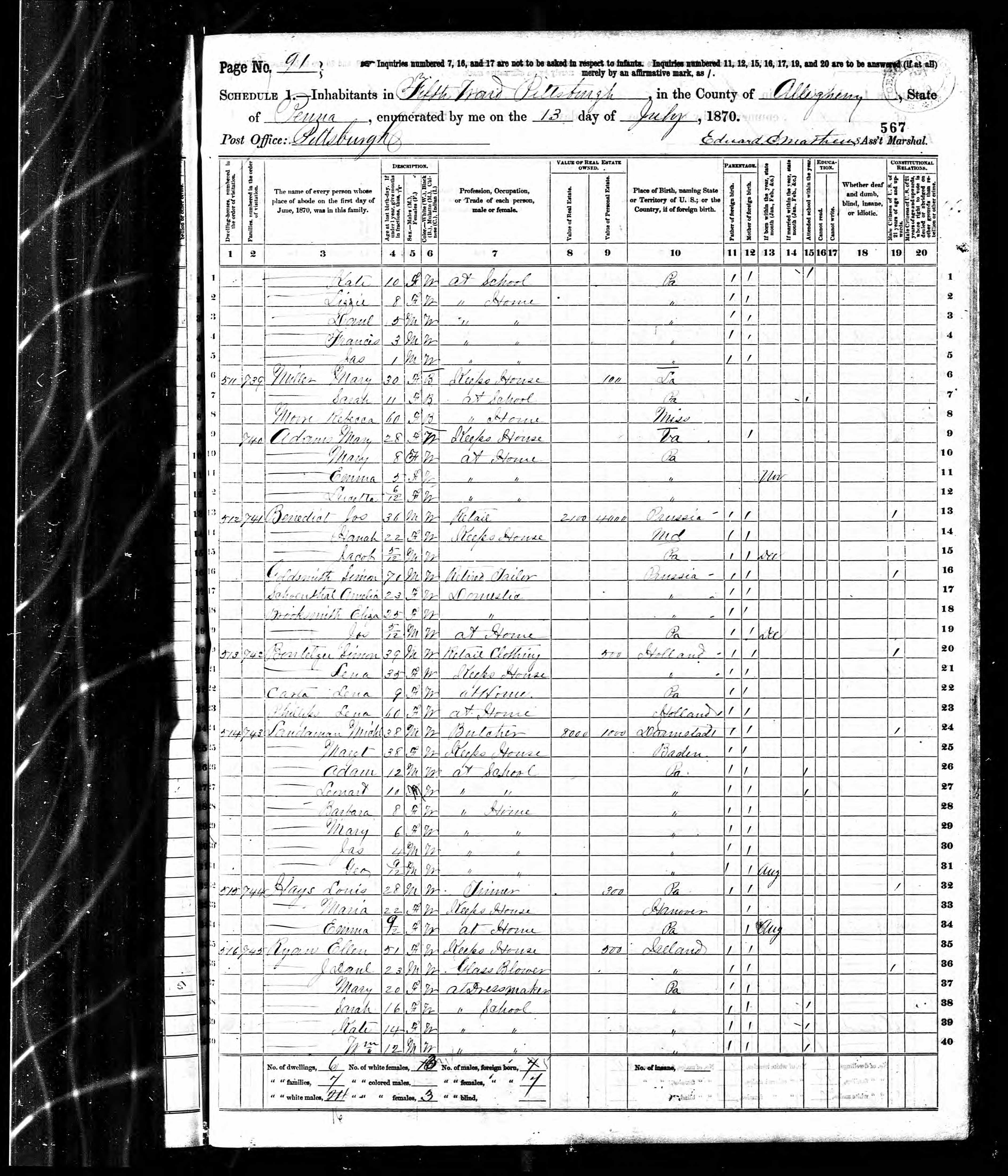
In 1870, their sister Amalie Schoenthal was living in Pittsburgh with their uncle Simon Goldsmith, who had relocated to Pittsburgh by then.  His daughter Hannah had married Joseph Benedict, and they had a five month old baby Jacob at the time of the 1870 census.  Joseph was in the retail business (no product identified), and his father-in-law Simon was listed as a retired tailor.  Amalie’s occupation was reported as a “domestic.”  I don’t know whether that means she was working as a servant for her cousin or in the household of someone else.  I am curious as to who Eliza Brocksmith and her baby Jacob were, also listed in the household, but I’ve not yet found the connection.  Perhaps she was Joseph’s sister.

Amalie Schoenthal with Simon Goldsmith and the Benedict family 1870 census Year: 1870; Census Place: Pittsburgh Ward 5, Allegheny, Pennsylvania; Roll: M593_1295; Page: 567A; Image: 439; Family History Library Film: 552794

Amalie Schoenthal with Simon Goldsmith and the Benedict family 1870 census
Year: 1870; Census Place: Pittsburgh Ward 5, Allegheny, Pennsylvania; Roll: M593_1295; Page: 567A; Image: 439; Family History Library Film: 552794

Meanwhile, another sibling, Nathan arrived not long after the 1870 census.  Nathan, who was born August 6, 1854 in Sielen, was only sixteen years old when he sailed on the Frankfurt from Bremen to New York, arriving July 16, 1870.  He also settled in Washington, Pennsylvania, with his two older brothers.

Nathan Schoenthal 1870 ship manifest line 167 Year: 1870; Arrival: New York, New York; Microfilm Serial: M237, 1820-1897; Microfilm Roll: Roll 332; Line: 1; List Number: 683

Nathan Schoenthal 1870 ship manifest line 167
Year: 1870; Arrival: New York, New York; Microfilm Serial: M237, 1820-1897; Microfilm Roll: Roll 332; Line: 1; List Number: 683

In 1872, Henry returned to Germany where on May 8, 1872, he married Hewa (Helen) Lilienfeld of Gudensberg, the daughter of Meyer Lilienfeld and Malchen Engelbert.  Gudensberg is another town in the Kassel district of Hessen located about 55 km from Sielen.  I would love to know how that marriage was arranged.  Henry had been in the US for six years at that point and was 29 years old.  Had his parents made this arrangement for him?

Henry Schoenthal and Hewa Lilienfeld marriage record HHStAW Abt. 365 Nr. 386, S. 37

Henry Schoenthal and Hewa Lilienfeld marriage record
HHStAW Abt. 365 Nr. 386, S. 37

Henry and his new bride returned to the United States on May 24, 1872, sailing from Bremen on the Danae.  Strangely, Helen was listed under her birth name, Lilienfeld, not Schoenthal.  There are also two entries for Amalie Mannsbach, an eighteen year old, listed in between Helen(e) and Henry.  (I assume there were not two women with that name, but an error in the manifest.  Or maybe there were two cousins with the same name and of the same age.)  Since Henry’s brother Simon married a woman named Rose Mansbach in 1872, I am wondering whether Amalie became Rose in the US and whether Henry was bringing this young woman back for his younger brother.  But right now that is just speculation.

Henry Schoenthal and Helene Lilienfeld 1872 ship manifest lines 95 to 98 Year: 1872; Arrival: New York, New York; Microfilm Serial: M237, 1820-1897; Microfilm Roll: Roll 359; Line: 1; List Number: 484

Henry Schoenthal and Helene Lilienfeld 1872 ship manifest lines 95 to 98
Year: 1872; Arrival: New York, New York; Microfilm Serial: M237, 1820-1897; Microfilm Roll: Roll 359; Line: 1; List Number: 484

Meanwhile, a fifth Schoenthal sibling had arrived in western Pennsylvania while Henry was in Germany, getting married.  Felix, born Seligmann Schoenthal on December 15, 1856, in Sielen, arrived on May 11, 1872, according to the passport application he filed in 1919.  Although I scanned the entire ship manifest for the ship that arrived on that date from Bremen, I could not find his name.  Felix also asserted on his passport application that he was naturalized in the Court of Common Pleas in Pittsburgh on August 17, 1878. In 1880, he was living with his wife of two years, Maggie (or Margaret), in West Newton, Pennsylvania, and working as a clerk in the paper mill.  West Newton is about 32 miles east of Washington and about 25 miles southeast of Pittsburgh, so he was not too far from his siblings.

Felix Schoenthal 1880 US census Year: 1880; Census Place: West Newton, Westmoreland, Pennsylvania; Roll: 1204; Family History Film: 1255204; Page: 8C; Enumeration District: 109

Felix Schoenthal 1880 US census
Year: 1880; Census Place: West Newton, Westmoreland, Pennsylvania; Roll: 1204; Family History Film: 1255204; Page: 8C; Enumeration District: 109

A sixth Schoenthal sibling also had arrived from Germany by 1880—Julius.  He, however, has proven to be more difficult to pin down.  I have been unable to locate a passenger manifest that includes him, and if it weren’t for the fact that the Beers biography mentioned a brother named Julius who lived in Washington, DC, I probably would not have assumed that the Julius Schoenthal that I found in DC was related to my Schoenthal family.  When I found Julius on the 1880 census, the only clue I had to support the conclusion that he was related was the fact that, like Levi Schoenthal, he was a shoemaker.

Julius Schoenthal 1880 US census Year: 1880; Census Place: Georgetown, Washington, District of Columbia, District of Columbia; Roll: 121; Family History Film: 1254121; Page: 9A; Enumeration District: 012; Image: 0498

Julius Schoenthal 1880 US census
Year: 1880; Census Place: Georgetown, Washington, District of Columbia, District of Columbia; Roll: 121; Family History Film: 1254121; Page: 9A; Enumeration District: 012; Image: 0498

I didn’t have a German birth record for Julius so I assumed he was born before 1846 when the Breuna birth records that are available online began. Things got even more confusing when I tried to find information about when Julius arrived in the US and what he was doing in the 1870s.  What a hodge-podge of confusing and conflicting clues.

First, the 1910 census reports that Julius arrived in 1869, but the 1900 census said he arrived in 1875.  According to the District of Columbia, Select Marriages, 1830-1921, database on Ancestry, Julius married Minnie Dahl on March 15, 1874, in DC., so I knew Julius had to have been in the US by 1874 and that the 1900 census could not be right.  Then I found an entry for a Julius Schoenthal in the U.S., Civil War Pension Index: General Index to Pension Files, 1861-1934, on Ancestry that indicated that Julius had filed a claim for a pension in 1897 as an invalid; it also indicated that Julius had served in the Signal Corps, but there were no dates of service indicated on the index card in that database.

Julius Schoenthal pension index card U.S., Civil War Pension Index: General Index to Pension Files, 1861-1934

Julius Schoenthal pension index card
U.S., Civil War Pension Index: General Index to Pension Files, 1861-1934

I was confused.  If Julius arrived in 1869 or 1875, how could he have served in the Civil War, which ended in 1865?

I decided to look for news articles, hoping I’d find something to shed light on when Julius had immigrated, and I found an article dated September 14, 1914, from the Washington Evening Star (p. 12) that added one more fact to the mix, bewildering me even further.

Julius Schoenthal news article re Germany WW I

If Julius had served in the Franco-Prussian War in 1870-1871, how could he have served in the US Civil War?  Had he immigrated to the US, enlisted in the US Army, and then returned to Germany to serve in that country’s army against France?  I thought maybe I should order his service file from the National Archives, but  it was fairly expensive, so I decided to hold off and see what else I could find.

I turned once again to the genealogy village and the Ancestry.com Facebook group to see if there was someone who was more expert with the U.S., Civil War Pension Index: General Index to Pension Files, 1861-1934 database.  I was very fortunate to get tremendous help from a member there named Lillian.  First, she informed me that the so-called Civil War Pension Index covers more than just Civil War veterans, a fact that had not been clear to me when I read the database description.  Then Lillian pointed me to a document on Fold3, a genealogy website primarily focused on military records.  That document stated that Julius had enlisted in the US Army in 1873, eight years after the Civil War ended.

I’d seen this document earlier, but had dismissed it for a couple of reasons.  First, it said that Julius was born in Berlin.  That seemed not likely to be the right person since all of my great-grandfather’s other siblings were born in Sielen, not anywhere close to Berlin.  Secondly, it said he enlisted from Chicago.  I couldn’t imagine that my Julius would have enlisted from Chicago since no one else in the family was there, so I had dismissed this record.  Looking a second time at Lillian’s suggestion, I saw that Julius had been discharged in Washington, DC, on June 5, 1874, making it more likely that this could be my Julius.  But I was and am not 100% certain that it is.

It would make more sense, however, for Julius to have enlisted in 1873, not during the Civil War.  Maybe he had arrived in 1869 and had returned home to fight for Germany in the Franco-Prussian War.  Or maybe the 1910 census does not accurately record his arrival date and Julius had arrived after serving in the Franco-Prussian War, perhaps in 1872, and then enlisted in the US Army from Chicago.  He married Minnie Dahl, who was born in Germany, but I don’t know where he met her.  Assuming it was in Washington, that might explain why they settled there once he was discharged from the army in 1874 less than two months after they were married.

English: Pres. U.S. Grant (between 1870 and 18...

English: Pres. U.S. Grant (between 1870 and 1880) Français : Le président américain Ulysses Grant (Photo prise entre 1870 and 1880) (Photo credit: Wikipedia)

Lillian found one more piece of evidence that may provide more answers.  On May 12, 1873, a man named Julius Schoenthal wrote a letter to then US President Ulysses S. Grant, and that letter is in the Ulysses S. Grant Presidential Collection at Mississippi State University.  I have ordered a copy of the letter and hope to receive it within a week or so.  I am hoping that perhaps it will be the right Julius Schoenthal and that it will reveal something about his life before being discharged from the army and marrying Minnie Dahl.  Maybe I will find some clue, some evidence that ties him to my Schoenthals and explains some of the confusing and conflicting evidence I’ve found so far. And now I am curious enough about Julius that I broke down and ordered his pension file, but found someone who could retrieve it for me for a more reasonable price.

Assuming that Julius was in fact my great-grandfather’s brother, it would mean that by 1880 five of the seven surviving sons and one of the three daughters of Levi Schoenthal and Jette Hamberg had left Sielen, Germany, and moved to the United States.  All but Julius were living in western Pennsylvania in 1880. As the Beers biography points out, by 1880, Henry and Helen Schoenthal had had three children, “Madaline, born March 16, 1873, died in infancy; Hilda, born June 25, 1874; Lionel, born April 14, 1877.”  Amalie and her husband Elias Wolfe had had three: Maurice (1873), Florence (1875), and Lionel (Lee) (1877).  I assume the two Lionels were named for their grandfather Levi Schoenthal, who had died back in Sielen in 1874. Simon and his wife Rose had had five children in the 1870s: Ida (1873), Harry (1873), Gertrude (1875), Louis (1877—probably also named for Levi), and Maurice (1878).  Julius and his wife Minnie had four children in the 1870s: Leo (1875—also probably for Levi), Rosalia (1876), Sylvester (1878), and Moretto (1879).  Thus, in one decade the Schoenthal siblings had produced fifteen new American born children.

Levi Schoenthal death record March 1874 HHStAW Abt. 365 Nr. 773, S. 9

Levi Schoenthal death record March 1874
HHStAW Abt. 365 Nr. 773, S. 9


In the next decade, my great-grandfather Isidore would arrive as well as his mother and two other sisters.  There would be only one Schoenthal left in Germany, at least for a while.  Almost all the descendants of Levi and Henrietta (Hamberg) Schoenthal would be born in the United States.


[1] Text taken from page 1057 of:

Beers, J. H. and Co., Commemorative Biographical Record of Washington County, Pennsylvania (Chicago: J. H. Beers & Co., 1893).

Transcribed March 1997 by Neil and Marilyn Morton of Oswego, IL as part of the Beers Project.

Published March 1997 on the Washington County, PA USGenWeb pages at http://www.chartiers.com/.

Thanksgiving: More Gifts, More Gratitude

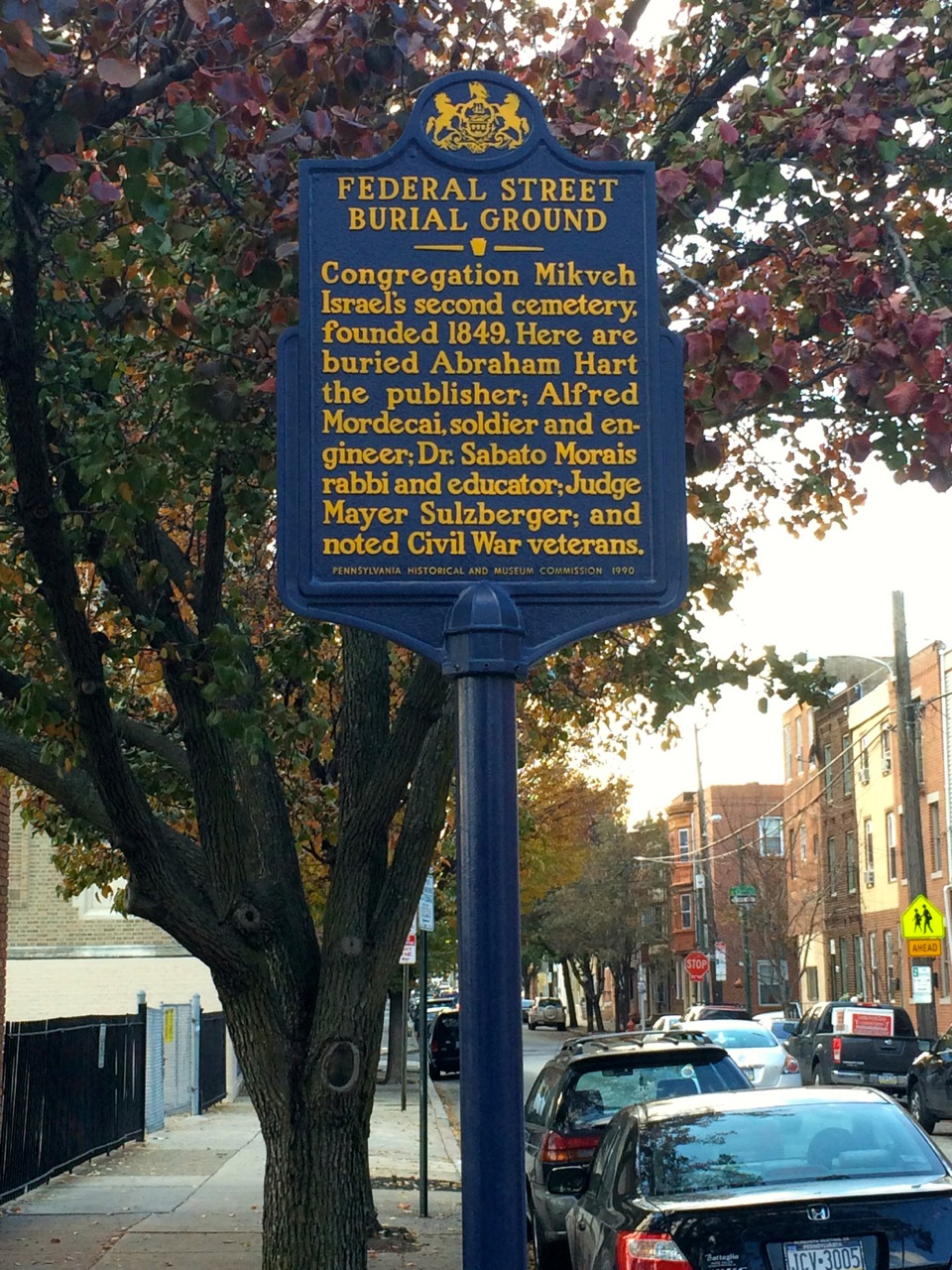
cemetery sign for Mikveh Israel

It’s been a week or so of amazing gifts.  First there was the package from Gau-Algesheim with the records and book relating to my Seligmann ancestors and the amazing help I received from Ralph Baer and Matthias Steinke with translation of these items.

Then a day or so after the Gau-Algesheim package arrived, I received a gift from my third cousin once removed Todd Graham.  Todd is the great-great-great-grandson of Jacob Cohen, my great-great-grandfather.  Todd wrote to tell me that he had been to the Federal Street cemetery in Philadelphia where many of our mutual Cohen ancestors are buried and that he had taken photographs.  He asked if I wanted to see the photos, and I said of course.  So here are the photographs I received from Todd.

First is a photograph of where our ancestor Hart Levy Cohen is buried.  There is no stone visible, and the rabbi at the cemetery explained to Todd that they believed that the stone had sunk beneath the surface and was buried underground.  I have written to the rabbi and asked whether there is anything we can do to uncover the stone or to mark the gravesite in some other way.

Burial Site of Hart Levy Cohen

Burial Site of Hart Levy Cohen

This photo shows where Hart’s children Lewis and Elizabeth are buried.  Again, the stones are not visible, but this is the location of their graves.


Burial sites for Elizabeth Cohen and Lewis Cohen (Hart's children)

Burial sites for Elizabeth Cohen and Lewis Cohen (Hart’s children)

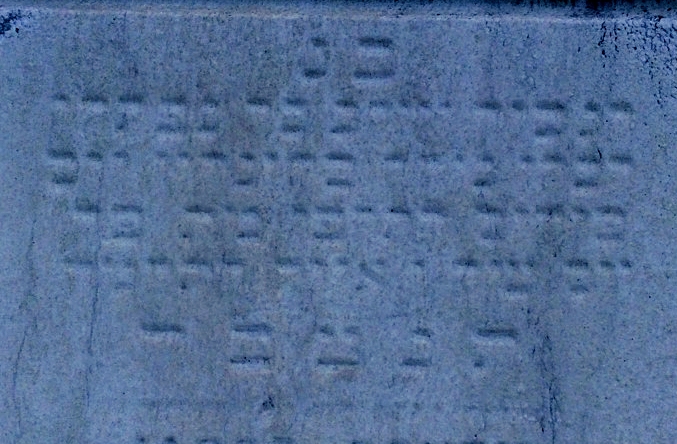
Todd also took photographs of the stone for Jacob and Sarah Cohen.  Although I had a photo of this stone before from Rabbi Albert Gabbai, I am hoping that these will be easier to read so that I can learn what the Hebrew inscription says.

Jacob and Sarah Cohen monument Jacob Cohen headstone by Todd Jacob Cohen monument by Todd jacob headstone edit 1


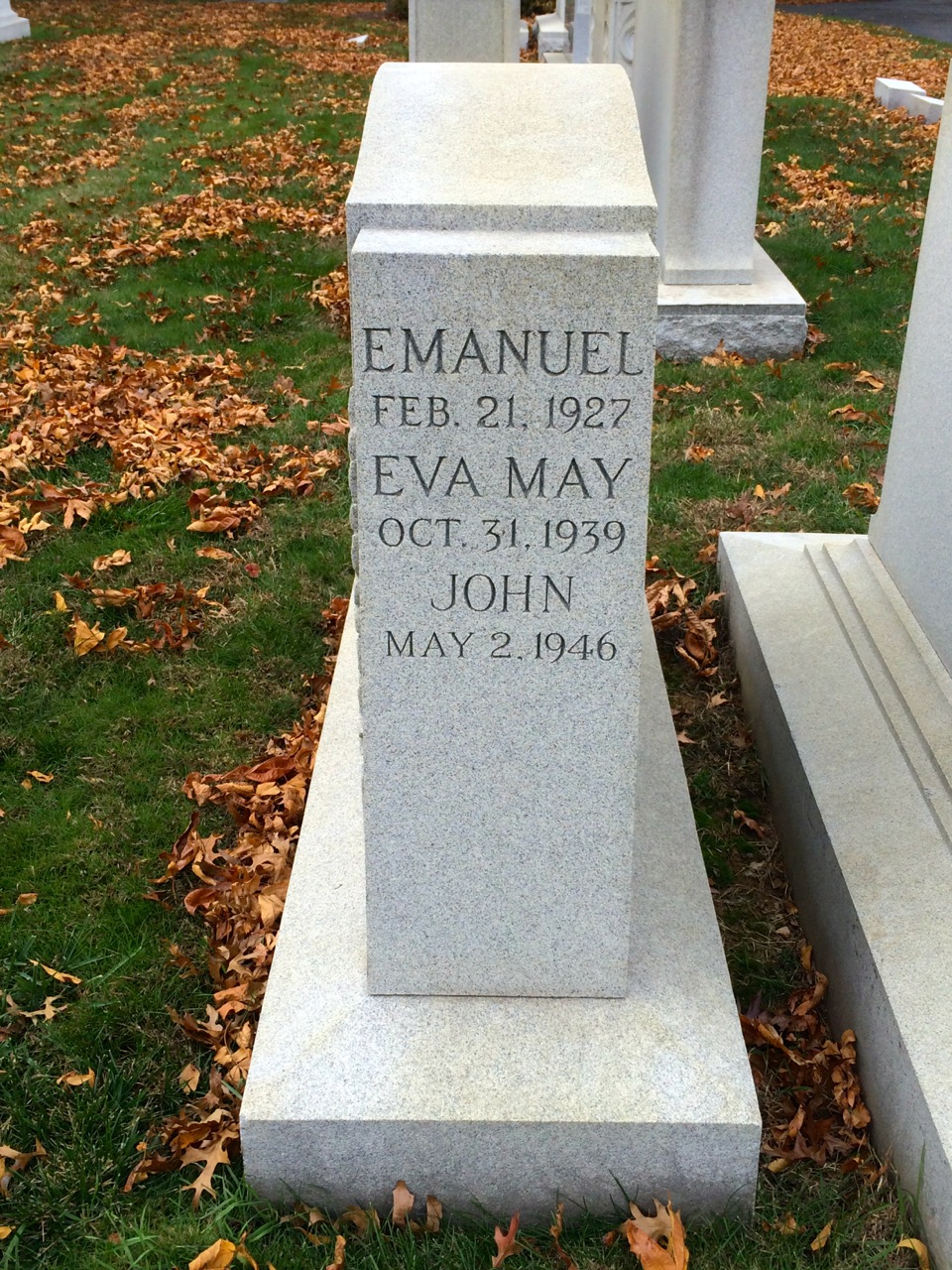
Todd also found the stones for three of Jacob’s children.  First, a new photograph of the headstone for my great-grandparents Emanuel and Eva (Seligman) Cohen and my grandfather John Nusbaum Cohen, Sr.

Headstone for Emanuel, Eva and John Cohen

Headstone for Emanuel, Eva and John Cohen

Side of Emanuel Eva and John by Todd

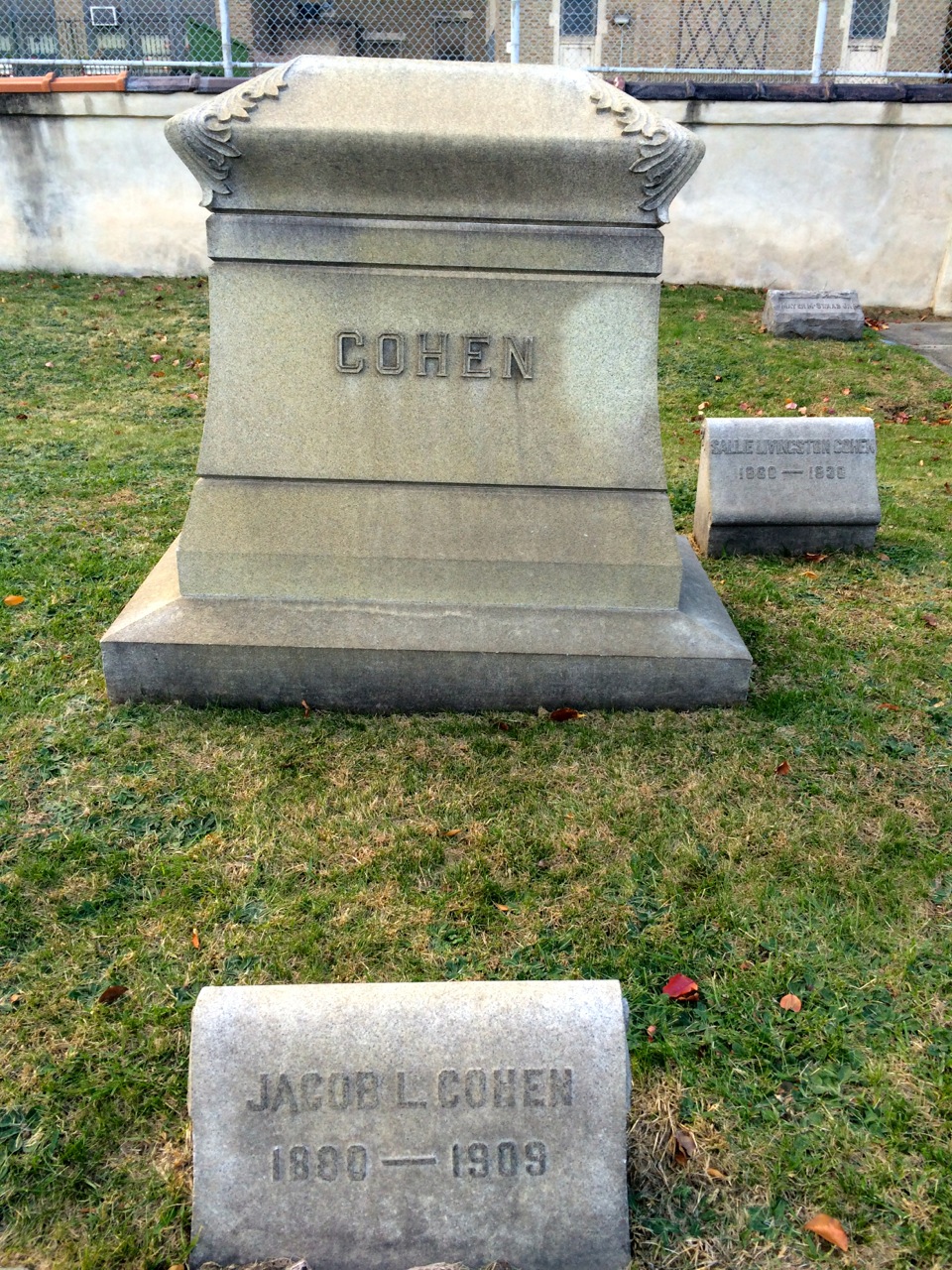
Next are photographs of the headstones for Emanuel’s brother Reuben and his wife Sallie Livingston Cohen and of their son Jacob Livingston Cohen.

Reuben and Sallie Livingston Cohen

Reuben and Sallie Livingston Cohen

Jacob Livingston Cohen

Jacob Livingston Cohen


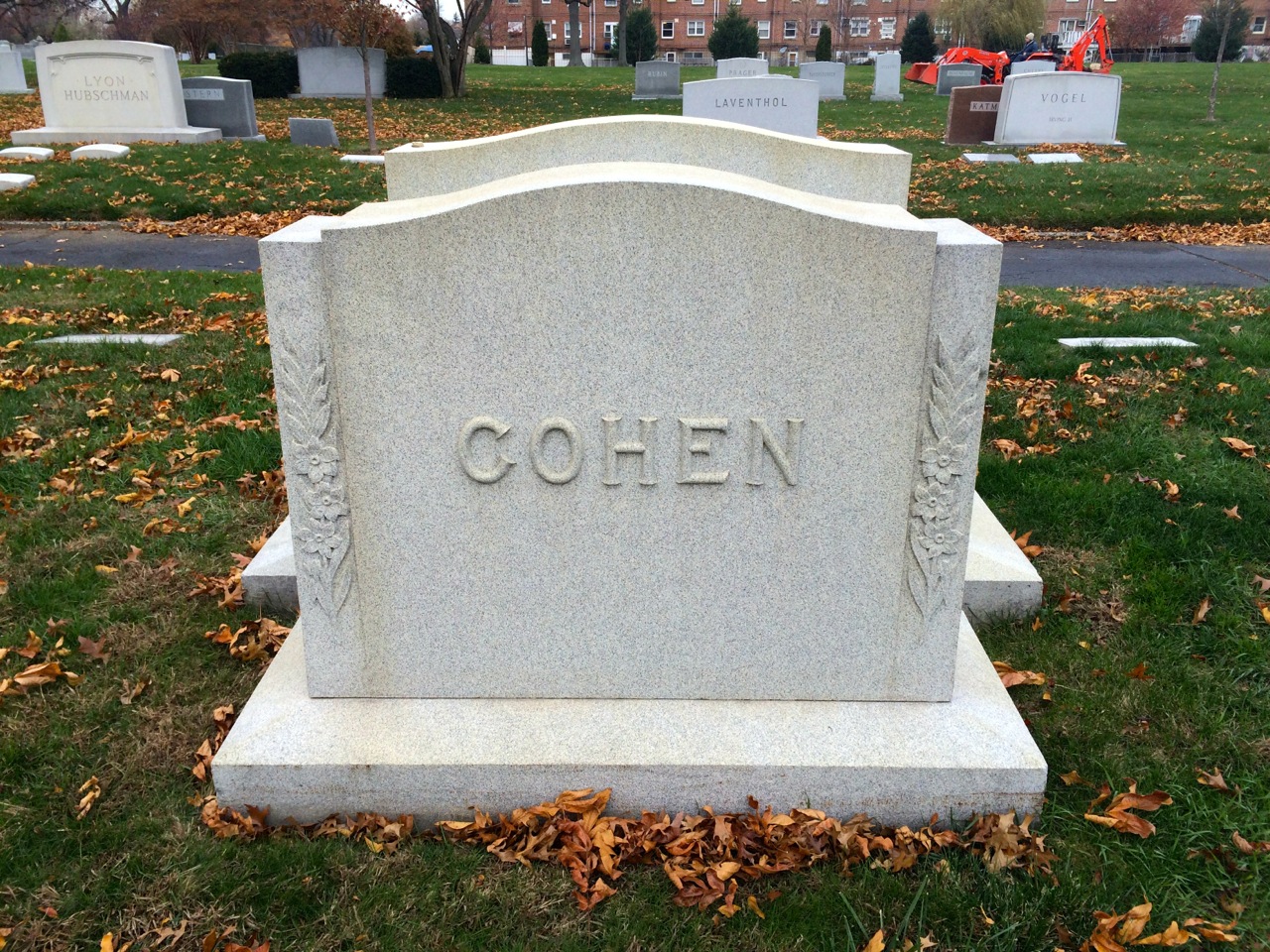
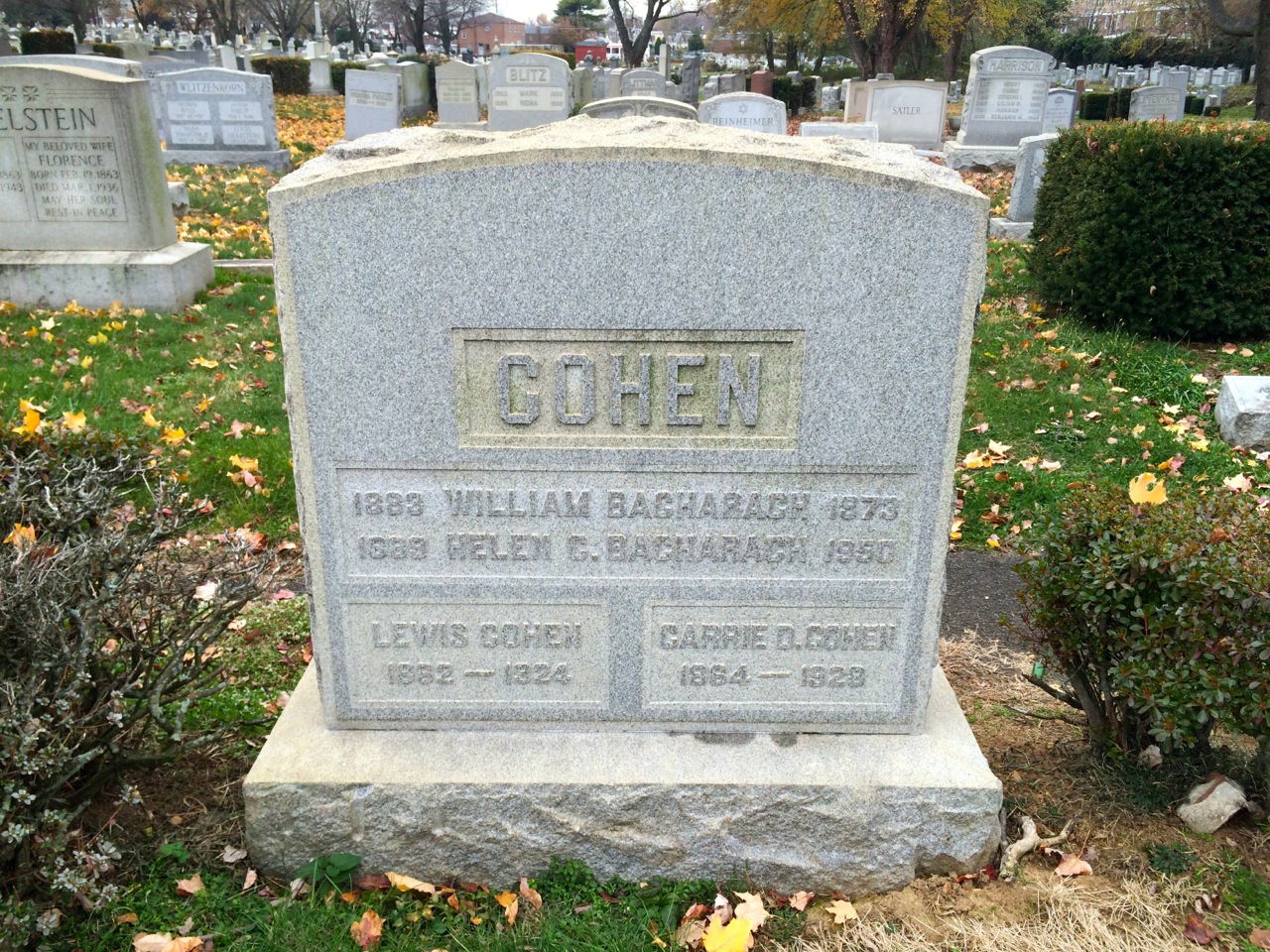
And finally, this is a photograph of the headstone for Todd’s great-great-grandparents Lewis and Carrie (Dannenbaum) Cohen and his grandparents William and Helen (Cohen) Bacharach.  Lewis Cohen was also the brother of my great-grandfather Emanuel Cohen.

Bacharach and Cohen headstone

Bacharach and Cohen headstone

Thank you so much, Todd, for these photographs, and I hope that we can do something to honor the graves of Hart, Lewis, and Elizabeth Cohen.

There is one more gift I want to acknowledge, and it came totally unsolicited and from a total stranger.  About two weeks ago I received a comment on the blog from someone who had found a set of matches on a website selling vintage items.  The matches were for a business called Selinger Associates at an address in Washington, DC.  Kimberly Crosson, the woman who commented on the blog, had purchased these matches and was now asking me whether this business was connected to the Selingers on my blog.  I was skeptical at first, I must admit.  I thought it was some kind of scam or spam.  But I emailed Kim and found out that not only was she not looking to make money, she was incredibly kind-hearted and generous and just wanted to get the matches to someone in the family—for no charge.

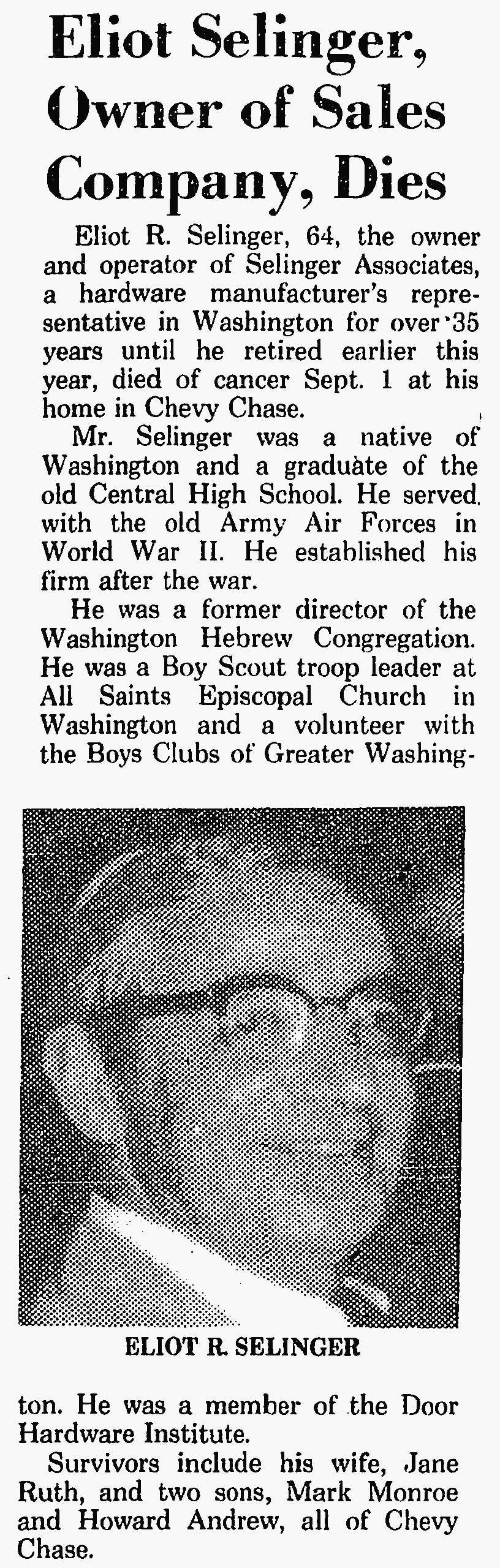
I checked the address and found that this was Eliot Selinger’s business.  Then I tracked down a descendant of Eliot Selinger and asked him if he was interested in the matches, and he was, so I put him in touch with Kim so that she could send him the matches.  I asked only for some pictures of the matches, so here is what Kim sent to me.  You can tell these are from a different era once you see the picture on the matches.

Selinger matches cover Selinger matches reverse


So once again, let me express my thanks to all these generous people, especially Todd and Kim for these photos, but to all who have helped and continue to help me with my research. I could never have done all this on my own.

And now I will be taking a short break from blogging for Thanksgiving.  May you all have a wonderful Thanksgiving, and thank you all for supporting me and providing me with so much help as I continue to learn about the lives of my ancestors.


Update: Adelyn Selinger’s Death Certificate

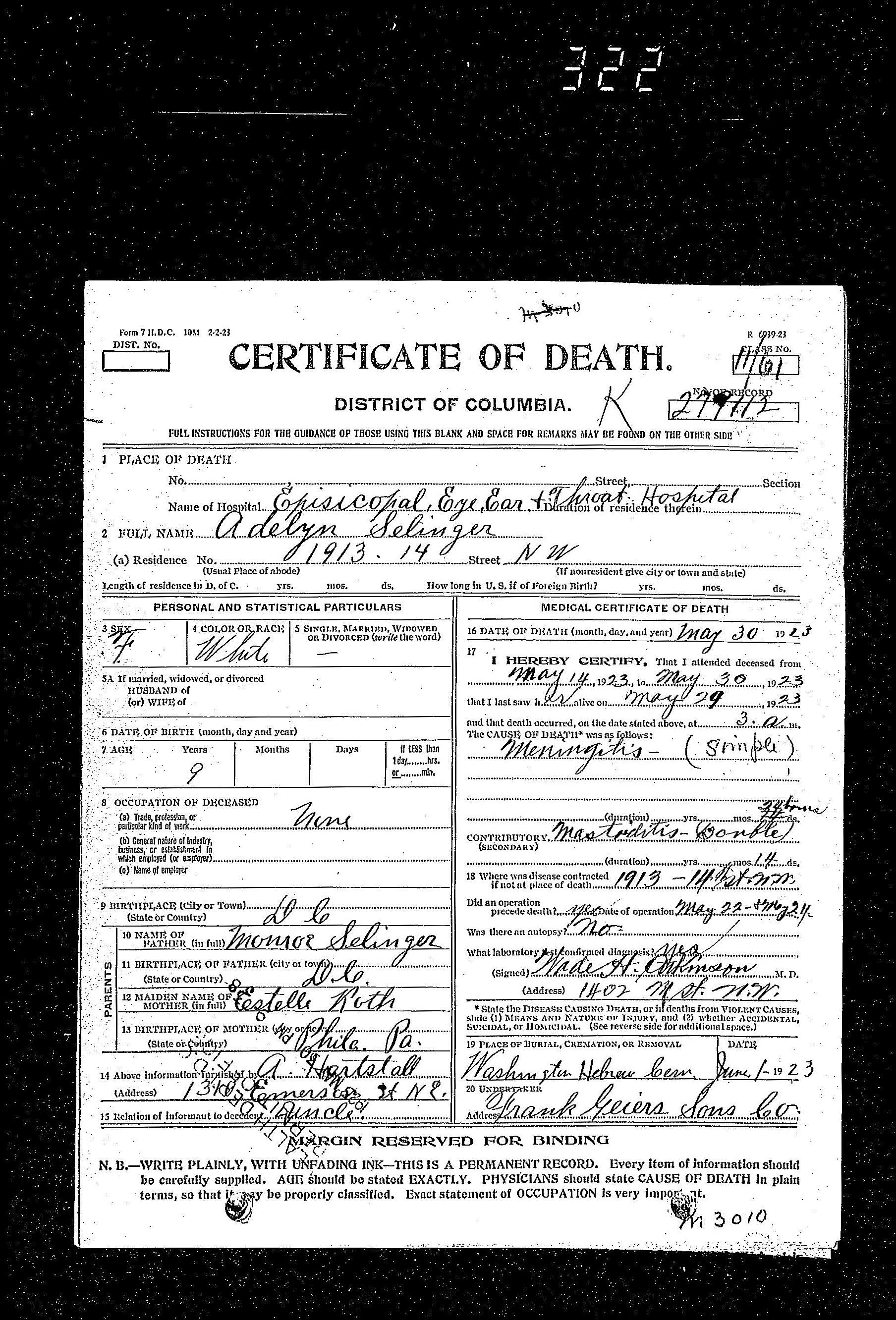
Today I received the death certificate for Adelyn Selinger, the nine year old daughter of Monroe and Estelle Selinger, granddaughter of Frederick Selinger and Rachel Cohen.  I have updated the appropriate post, but will include it here as well.

Adelyn Singer death certificate May 30, 1923

Adelyn Singer death certificate May 30, 1923

Adelyn died of meningitis and mastoiditis, a bacterial infection of the mastoid bone, which is located behind the ear.  According to WebMD, these infections are usually caused by a middle ear infection that has not been successfully treated.  Once again, I am grateful for modern medicine and all that pink amoxycillin my kids took for ear infections.

Notice also that the informant on the death certificate was Aaron Hartstall, Adelyn’s uncle, her father’s brother-in-law.  I assume that her parents. grandparents, and aunt were too distraught to provide the details for the death certificate.

The Cohens: Questions Left to Answer

Now that I have gone through all the lines descending from Hart Levy Cohen and Rachel Jacobs through their children and grandchildren up to current descendants, I have to look back and see what I missed.  What are the big questions and small questions that remain unanswered?  Otherwise, I may leave some things unsolved and accept gaps in my research.  So this blog post is my attempt to outline those unanswered questions as a way to remind myself not to be too self-satisfied with what I have done.

File:Questionmark.svg


Overall, I am quite amazed by how much I was able to find.  It really helped that (1) there were generations in the US going back as far as 1848 because US records are much more accessible to me and (2) that most of my Cohen relatives lived in Pennsylvania, a state that has made many of its records available online.  It also helped that both the Philadelphia Inquirer and the Washington Evening Star covered society happenings like parties, engagements, and weddings because it was through those resources that I was able to find a lot of the married names of the Cohen women.

So what is there left to research?  First and foremost, I would love to be able to find the parents and grandparents and other ancestors of Hart Levy Cohen.  I don’t know that I will ever be able to do this, given how little luck I had at the archives in Amsterdam and also given that surnames were not adopted by Jews until the early 1800s.  But new records are uncovered all the time, so I will not give up hope yet.  Related to that, of course, is finding the ancestors for my great-great-great grandmother Rachel Jacobs.

As for the next generation after Hart and Rachel, the big questions left unanswered relate to Hart and Rachel’s son Moses.  Although I do not have DNA proof that the Moses who married Adeline Himmel was their son, I am confident that he was based on the weight of the circumstantial evidence.  Maybe a descendant of Isadore Baer Cohen will come along, but even without that, I am convinced that this was the right Moses.  Rather, the real unanswered question for me is when and where did Moses meet and marry Adeline Himmel?  When did she come to the United States from Baden?  I have no evidence yet relating to either of these questions.

The remaining questions are not as important to me in terms of the overall story of the family.  They almost all relate to the absence of death records.  Among those for whom I have no death records are: Joseph Cohen’s daughter Fannie; Abraham’s son Arthur; Harry Selinger, Augusta and Julius Selinger’s son; Rachel Cohen Selinger; Aaron Hartstall; Monroe Selinger; JM Cohen’s son Arthur; Hart DC’s son Jacob Cohen; Estelle Spater Cole, Sol’s wife; Gary Cole, Jacob G. Cole’s son; and Lewis Cohen, son of Reuben Cohen, Sr.

Then there are a number of people for whom I have a date of death from an index, but no death certificate, like Simon L.B Cohen—why did he die so young?  There are also many for whom I have a marriage record from an index, but no marriage certificate.  I am not sure how important it is to see the actual document where I am otherwise certain of the identity of the individuals who married or died, but eventually if those documents become available, I should obtain them.

And there are also a few cases where I could not determine whether a person had any children—such as Violet Cohen, daughter of Reuben Cohen, Sr.; Jonas Cohen, Jr.; and Morton and Kathryn Selinger. I was unable to find out whether Caroline Hamberg married Robert Daley or anyone else. Finally, there are the two children of Sallie R. Cohen who were orphaned after Sallie and her husband Ellis Abrams died; I do not know what happened to them.

Listing all those names makes me feel like there is so much more to do, but I also have to remind myself of how much I’ve already done.  I realize that this is perhaps not the most exciting blog post for those reading it, but it will serve as an important post for me to return to when I need to remember the questions that I still have to answer.

My next post will be more reflective; I need to step back, look at the story of my Cohen relatives, and think about what I have learned about them and about history and about myself by doing this research.

A wonderful email from a Selinger cousin

Yesterday I received an email from Ann Griffin Selinger, whose husband was John Reynolds Selinger, Sr.  John Selinger was the son of Maurice Selinger, Sr., and the grandson of Julius Selinger and Augusta Cohen, the oldest child of Moses, Jr, and Henrietta Cohen.  I was so touched by the stories that Ann had to share about her husband John and his family that I asked her whether I could quote from her email on the blog and share these memories of her family.  She graciously gave me permission to do so, and so here they are with just a few side comments by me.  Ann’s language is italicized, whereas mine is in regular font.

My husband, was John Reynolds Selinger, 1933-2007, born in Washington, DC as was his brother, Maurice Arthur Selinger, Jr.  For a time we lived in Chevy Chase, Maryland and one day we received a visit from Eliot Selinger who apparently lived around the corner from us with his family. We had exchanged mail a few times without meeting, but never looked into whether we were related.  He told us at the time that he thought we were related and that his father and John’s grandfather were brothers – Frederick and Julius.  We had been under the obviously false impression that Julius had no siblings.  

Interestingly, Mildred Selinger, Dr. Maurice A. Selinger’s wife, having lived in Washington her whole adult life, lived with us just before she died in 1981.  I see that Eliot died a year later.  He must have knocked on our door just before he died.


The comment about Julius and Frederick Selinger being brothers  was a very important revelation for me because it confirmed what I had suspected.  I assume that Alfred Selinger was also, given that he lived with Julius and traveled with Julius and Augusta before marrying Augusta’s sister Fanny.

Here is a bittersweet story about Eleanor Selinger, the daughter of Julius and Augusta  who married Henry Abbot and moved to England as discussed here.

Years earlier, John and I were in England and he said he would like to see if he could find his Aunt Eleanor.  
We were successful and made arrangements to have tea with her in her apartment just before we left London.  When she opened the door, John was astonished to notice she looked exactly like his Dad who had died over ten years before.  We had a lovely visit.  She shared that she loved to play cards, but had a hard time see the cards now.  So the next day we had some “jumbo faced” cards sent over to her from Harrod’s – a fun idea.  She called us to say she was so flustered when the delivery man said he was from Harrod’s that she had a hard time buzzing him in.  Very sweet – a wonderful connection that pleased my husband very much.  We flew home the next day and then received word a day later that she had died.
 

Ann also told me more about the accomplishments of Dr. Maurice Selinger, her husband’s father, who along with his brother Jerome were probably the first doctors in the extended Cohen family, as discussed here.

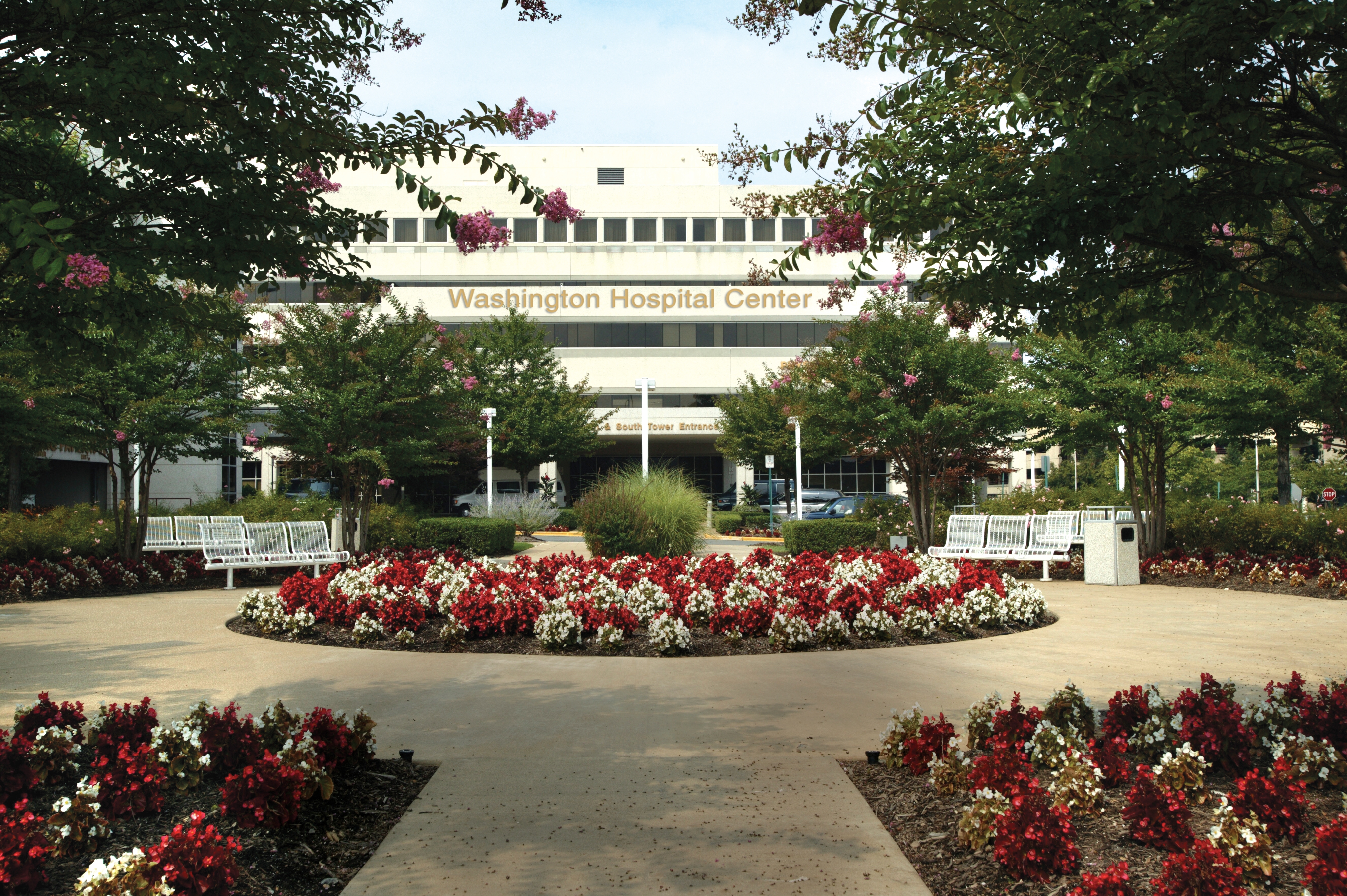
Dr. Maurice Selinger, my father-in-law, who died before John and I were married, served in World War I and World War II as a physician.  He was a very dedicated doctor who gave his all to medicine and his patients.  He was very highly regarded in the Washington medical world.  He was instrumental in bringing three hospitals together (Garfield, Emergency, and one other – can’t remember) to form the new Washington Hospital Center. I remember just after we were married going to a diabetes center in Maryland that was dedicated to Dr. Selinger.  I know nothing more about that.  Amazing what you don’t pay attention to when you are young.
They lived in a lovely home on California Street, NW – should look up the number, that is now the Embassy of Venezuela.

Washington Hospital Center   "WHCExtGarden". Via Wikipedia - http://en.wikipedia.org/wiki/File:WHCExtGarden.JPG#mediaviewer/File:WHCExtGarden.JPG

Washington Hospital Center
“WHCExtGarden”. Via Wikipedia – http://en.wikipedia.org/wiki/File:WHCExtGarden.JPG#mediaviewer/File:WHCExtGarden.JPG

And finally this story about John’s father Maurice and his grandfather Julius and the Selinger’s jewelry store on F Street discussed here.

John always told the story that when his father was a young boy he would earn his allowance by winding the clocks on F Street that were installed by his grandfather, Julius.  They also put the clock in the tower of the old National Savings and Trust Building downtown.  Years later, John became a banker and worked as a Vice President in that same bank.


National Savings and Trust Building, Washington, DC "15th, New York, & Pennsylvania Avenue, NW" by AgnosticPreachersKid - Own work. Licensed under Creative Commons Attribution-Share Alike 3.0 via Wikimedia Commons - http://commons.wikimedia.org/wiki/File:15th,_New_York,_%26_Pennsylvania_Avenue,_NW.jpg#mediaviewer/File:15th,_New_York,_%26_Pennsylvania_Avenue,_NW.jpg

National Savings and Trust Building, Washington, DC
“15th, New York, & Pennsylvania Avenue, NW” by AgnosticPreachersKid – Own work. Licensed under Creative Commons Attribution-Share Alike 3.0 via Wikimedia Commons – http://commons.wikimedia.org/wiki/File:15th,_New_York,_%26_Pennsylvania_Avenue,_NW.jpg#mediaviewer/File:15th,_New_York,_%26_Pennsylvania_Avenue,_NW.jpg


There is nothing better than hearing and preserving these family stories.  They take the facts and inferences I make from government documents come to life and fill them with the love and respect that these people deserve.  Thank you so much, Ann, for sharing these with me.  I can’t tell you how much it meant to me.


Rachel Cohen and her Descendants: The Last Chapter of the Family of Hart Levy Cohen

Finally, I come to the youngest child of Moses Sr. and Adeline Cohen, Rachel Cohen.  This line is the last line of the extended family tree of Hart Levy and Rachel Jacobs Cohen, my great-great-great grandparents.  Although there are still quite a few unanswered questions in the Cohen saga, once I write about Rachel and her family, I will have covered all of the known descendants of Hart and Rachel, including both the Philadelphia branch and the Washington branch of the family, as best I can at this point.  I will reflect on the DC branch and on the overall Cohen family once I’ve written about Rachel.

On January 10, 1880, Rachel, as I wrote earlier, had married Frederick Selinger of Hurben, Germany, the presumed older brother or cousin of both Julius and Alfred Selinger, who married Rachel’s nieces Augusta and Fannie Cohen, respectively.

When I last wrote about Frederick and Rachel, I thought that they had had only two children, Fannie and Monroe, but further research uncovered that there may have been another child.  There is a record for a male child born in Washington, DC, on January 9, 1881, whose parents were “Rachael Cohen” and “Frederick Sclinger”—clearly an erroneous transcription of Selinger.  There is also a death record for a three year old child named Reuben Sellinger dated December 12, 1884, so born in 1881.  Although I do not have the death certificate for that child, it certainly seems that this must have been the same child born to Rachel and Frederick in 1881.  I am going to see if I can obtain the death certificate to learn what happened to Reuben.  Rachel and Frederick did have two children who lived to adulthood, Fannie, born in 1882, and Monroe, born in 1888.

As I researched more deeply into the story of Rachel and Frederick, I also learned that Frederick was not always in the furniture business.  In fact, in 1880 when he married Rachel, he was listed only as working as a clerk in a store.  The 1882 DC city directory gives more insight into what type of store; it says he was a pawnbroker.  The 1886 directory adds to this by listing Rachel Selinger as a pawnbroker and Frederick as a clerk.

Tradition symbol of pawnbrokers--three connect...

Tradition symbol of pawnbrokers–three connected balls (Photo credit: Wikipedia)

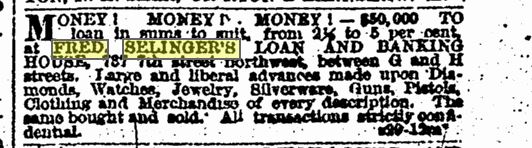
Remembering that Moses and Adeline Cohen had at times been pawnbrokers, I now think that Frederick was working in what was at first his mother-in-law’s business (Adeline was living with the newly married couple in 1880) and then his wife’s business.  The 1887 and 1888 directories also list Rachel as the pawnbroker and Frederick merely as a clerk.  Rachel is one of the very rare married women I have found as working outside the home and listed separately in a directory.  This is even more surprising given that Rachel had a child born in 1882 and in 1888 and had lost a child in 1884.  On the other hand, I found numerous ads which refer only to Fred Selinger as the pawnbroker.

F selinger ad march 17 1882 f selinger ad may 14 1884

In 1890, Rachel, Frederick and their family were living in Sioux City where her brothers JM and Hart as well as her mother were then living.  The 1890 Sioux City directory lists Rachel as the owner of a general store and Frederick as the manager.  The 1892 directory does not list Rachel, but lists Frederick as working as clerk for JM Cohen, his brother-in-law.  The 1892 directory lists JM as a broker, meaning a real estate broker, which is the occupation given for him on the 1890 Sioux City directory.

By 1895, Rachel, Frederick and family had returned to Washington, DC, residing at 1424 7th Street, NW.  Frederick was working in a clothing store, according to the 1895 directory.  The 1896 directory has Rachel listed as in the clothing business with Frederick as a clerk.  By 1898 they had moved to 1502 7th Street, NW.  Again, Rachel is listed as in the clothing business, and Frederick is listed as a clerk.  On the 1900 census, Rachel is listed without an occupation, and Frederick is listed as a merchant of dry goods.  The 1900 directory included him in the category of second hand clothing.  There was no listing of Rachel in the 1900 directory or in the 1901 directory, which still had Frederick at 1502 7th Street in the clothing business.

Then in 1904 there is a change; Frederick is now in the furniture business, but in 1905 Rachel appears again in the directory in the clothing business; Frederick has no occupation listed.  They were still at the same address.  In 1906, 1907, and 1908, Rachel’s business is given as men’s furnishings, and Frederick is listed as a clerk. Their two children Monroe and Fannie are also listed as clerks in some of these years.

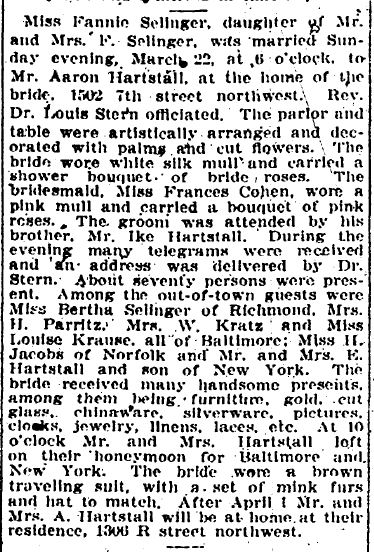
Rachel and Frederick’s daughter, Fannie, married Aaron Hartstall in 1908; Aaron was a paperhanger. The Washington Star of March 24, 1908, included this report of the wedding

:Fannie Selinger Hartstall marriage evening star March 24, 1908 p 7


Although the erratic pattern of Rachel and Frederick’s occupations made me wonder about their financial situation, it would appear from this description of the wedding that they were able to afford a fairly expensive celebration for their daughter’s wedding.

Aaron and Fannie Hartstall’s son Morton was born on January 20, 1910. Aaron continued to work as a paperhanger throughout the next three decades.

In 1910, Frederick and Rachel were now living at 317 R Street NW, and Frederick was in the furniture business, according to the census.  No occupation was given for Rachel.  Their son, Monroe, who was 22 in 1910 and living at home, was working as a clerk for the government at that time. Given his occupation as described on later documents, I believe he was a clerk for the US Post Office, or what we now call the US Postal Service.

Frederick was no longer selling furniture in 1911; he was now, like his son, a clerk at the post office.  Both were living at 317 R Street; I assume Rachel was as well.

In 1912, Monroe married Estelle Roth of Philadelphia in Philadelphia, as described in this article from the Washington Evening Star:


Monroe Selinger wedding 1912 evening Star July 10, p. 7

The young couple settled in Washington, DC.  In the 1912 DC directory, Monroe is listed as a post office clerk and residing at 126 Randolph Place; his father is listed at the same address in the directory.  Rachel’s name is not included in the listing.

In 1914, Monroe and Estelle had their first child Adelyn, and they were now living at 31, 1430 NW.  Three years later their son Eliot was born.    Monroe was working for the US Post Office, according to both his World War I draft registration and the 1917 directory, which gave his address now as 1440 Oak Street NW, the same address listed for his father Frederick. Monroe was also at the same address and still working for the post office on the 1920 census. By 1921, however, he had left the post office and was working as a clerk for the O’Donnell Drug Company.

I could not find Rachel on the 1920 census, but I did find Frederick living as a lodger at 103 Maryland Avenue right near the US Capitol and working as a clerk at the post office like his son Monroe. Rachel was not listed with him.  In the DC directory for 1921, Frederick was listed as a clerk for Sanitary Grocery and residing at 103 Maryland Avenue.  I do not know where Rachel was or for how long she and Frederick may have been living apart.

Then tragedy struck on May 30, 1923, when Monroe and Estelle’s daughter Adelyn died; she would have been only nine years old.  I have ordered her death certificate and will report on her cause of death once I receive it.

UPDATE:  I’ve received Adelyn’s death certificate.  She died of meningitis and mastoiditis, a bacterial infection of the mastoid bone, which is located behind the ear.  According to WebMD, these infections are usually caused by a middle ear infection that has not been successfully treated.  Once again, I am grateful for modern medicine and all that pink amoxycillin my kids took for ear infections.

Notice also that the informant on the death certificate was Aaron Hartstall, Adelyn’s uncle, her father’s brother-in-law.  I assume that her parents. grandparents and aunt were too distraught to provide the details for the death certificate.

Adelyn Singer death certificate May 30, 1923

Adelyn Singer death certificate May 30, 1923

Rachel still did not appear in the 1924 directory, but Frederick did.  He is listed as “bg mgr” of Washington Salvage Company and residing at 1913 14th Street NW. I also could not find Monroe in the 1924 directory.

By 1928, Monroe had switched to the clothing business, and he, Estelle, and Eliot, their remaining child, had moved to 1465 Girard Avenue, NW.

Frederick is listed in that 1928 directory as the manager of North Capital Salvage, residing at 733 North Capital Street, NE, and then, in 1929, both he and Rachel are listed at that address, both working for North Capital Service.  On the 1930 census, they are still at that address, and Frederick is listed as the owner of a general store.  Perhaps North Capital Service was the name of that store.   Rachel and Frederick were by this time almost eighty years old, living together and working together.  Three years later in 1933, they were listed as living together at 1438 Meridian Place, NW, without any occupations.

That was the last listing I found that includes Rachel.  In 1934, only Frederick is listed at that address, and on the 1940 census, Frederick is listed as a widower, living with his daughter Fannie Hartstall.  Although I have not yet found a death record, Rachel must have died in either 1933 or 1934.  She would have been 79 or 80 years old.

The extended family lost two other members during that time period.  Aaron Hartstall, Fannie Selinger Hartstall’s husband, who had continued to work as a paperhanger throughout this entire time, is listed on the 1938 Washington Directory, but must have died between 1938 and 1940 because Fannie is listed as a widow on the 1940 census.  Aaron would have been about 62 years old. Fannie continued to live at 705 Allison Street, NW, where she and Aaron had lived for many years; in 1940, her father Frederick and her brother-in-law Isaac Hartstall were living with her.

Fannie not only lost her husband and her mother during this period; she also lost her brother Monroe. Although Monroe is listed on the 1935 DC directory as a salesman for the People’s Army and Navy, he does not appear again.  I cannot find him or his family on the 1940 census.   The November 29, 1949 announcement in the Washington Post of his son Eliot’s engagement referred to him as “the late Monroe Selinger,” so Monroe must have passed away sometime between 1935 and 1949.  In fact, Eliot and his mother Estelle were living in Hartford, Connecticut, in 1945, after Eliot completed his military service, so it would appear that his father had died before 1945. He would have been only 61 years old. Unfortunately I have not been able to find a death record or an obituary for Monroe Selinger or Aaron Hartstall or Rachel Cohen Selinger.

Meanwhile, the next generation had become adults by 1930.  Morton Hartstall, the son of Aaron and Fannie, was twenty years old in 1930, and he was then working as a clerk for the Chamber of Commerce.  In 1931 he was still working for the Chamber of Commerce and still living at home.  By 1934 he had changed jobs again and was working as a salesman for a store called Goldenberg’s.  He was still at home on Allison Street with his parents.

On January 20, 1935, Morton married Kathryn Wolfe, who was also a Washington, DC, native. I was fortunate to find an article online about this history of a building located at 1330 Pennsylvania Avenue, NE, that mentions Morton and his livelihood and the restaurant he owned at that location for a few years in the 1930s:

Morton Hartstall 1330 Penn Ave restaurant1330 Penn Ave pic

http://chrs.org/wp-content/uploads/2013/04/13-04_CHRSnews-REV2.pdf at page 13

(The article goes on to describe the rest of the history of the building, which is still being used as a restaurant today.)  In 1940 Morton and Kathryn were living with her parents in Washington, DC; Morton was now the owner of a “cleaning shop,” and Kathryn was a stenographer for Social Security.

Morton Hartstall 1940 census

Morton Hartstall 1940 census

As for Eliot Selinger, the only other grandchild of Rachel and Frederick Selinger to survive to adulthood, one record says that he served in the US military from March 16, 1943, until May 7, 1943.  I wonder whether his release in May was related to his father’s death.  As stated above, he and his mother were living in Hartford in 1945, but returned to Washington in 1946.  He was engaged to Jane Ruth Simon in 1949, and they had two children.  Eliot was the owner of Selinger Associates, a hardware manufacturer’s representative, a business he established in Washington after the war.

I do not know when Frederick Selinger died.  He was 83 in 1940, the date of the last record I have for him.  His daughter Fannie died in January, 1967.  She was 84.  Both lived far longer than their spouses.

Unfortunately, Fannie’s son Morton did not live as long as his mother did, but rather like his father, he died before he turned seventy. He died in April, 1977, when he was 67 years old.  His wife Kathryn was still alive in 1995; I have no later record for her.  I do not know whether Morton and Kathryn had any children.

Morton’s first cousin Eliot also was not blessed with longevity, but sadly like his father Monroe, he died before he turned 70.   He died on September 1, 1982, and was only 64 years old.  His wife Jane died June 13, 2008.  They are buried at Washington Hebrew cemetery and were members of Washington Hebrew Congregation.

Eliot Selinger obit 1982


Looking back over the life of Rachel Cohen Selinger and her children, I see a life that seems to have had some ups and downs.  Frederick changed jobs fairly often, they moved fairly often, and they may have even lived separately for some period of time.  They lost a child early in their marriage.  On the other hand, they worked together and lived together for many years, ending up together until Rachel died in 1934.

Their two children who survived to adulthood, Fannie and Monroe, seem to have had more consistent patterns in their lives.  Fannie was married to Aaron for many years, and he worked at the same location as a paperhanger for all of that time.  Their son Morton owned a couple of businesses of his own.

Monroe worked as a postal clerk for several years and then became involved in clothing sales.  He and his wife Estelle lost a young child, as his parents had many years earlier, but their surviving child, Eliot, owned a successful business in Washington for many years and had two children who survive him.

With that, I have now tracked as best I can all of the descendants of Hart Levy Cohen and Rachel Jacobs, my great-great-great grandparents.  It has been quite a journey, and before I move on to my next line, the Seligmans, I need to spend some time looking back and thinking about the bigger picture and the lessons I’ve learned from studying my father’s father’s father’s family.


Hart Cohen of DC: The Rest of the Story

It’s been a week since I last posted anything new about the DC Cohen family.  I had last written about Solomon Monroe Cohen and his family, the son of Moses, Jr., and Henrietta Cohen.  Although I will continue to try and fill the gaps left in the research of the children of Moses, Jr. and Henrietta Cohen, I am now going to move on to the other children of Moses, Sr., and Adeline Cohen, first focusing on their son Hart, who was born in 1851 in Maryland.

It was this Hart (whom I’ve referred to as Hart DC) who had me confused because of the similarities between some of his biographical facts and those of his first cousin, my great-grandfather Emanuel’s brother, Hart Cohen of Philadelphia.  They had the same name, were born the same year, and were both married to women named Henrietta. It was this Hart who led me to the discovery of the DC branch of the Cohen family. Hart and his wife Henrietta Baer had four children: Frances, Munroe, Isadore, and Jacob.   Their son Munroe was killed in an awful accident while working as a brakeman on the railroad in Kingston, New York, in 1903.  Isadore had married Frances David in 1907, so in 1910, Hart and Henrietta had two children living at home, Frances (32) and Jacob (25). Jacob was working as a chauffeur, and Hart was working in a jewelry store. On August 8, 1914, Hart’s wife Henrietta Baer Cohen died; she was only 62.

Isadore and Frances had had a son Monroe born in 1910, presumably named for Isadore’s brother. In 1916, they had another son, Burton.  In 1917, Isadore was working as a department manager for a hotel according to his World War I draft registration.

Isadore Baer Cohen World War I draft registration

Isadore Baer Cohen World War I draft registration

I found two World War I draft registrations for Jacob.  The earlier one, dated June, 1917, listed Jacob’s business as the concessions business and said he suffered from heart trouble.  His marital status was single, and he was living with his father and his sister Frances at 1802 7th Street NW in Washington.  The second one, dated September 1918, had a number of changes:  he was working in the restaurant business and was self-employed, he was married, and there was no mention of heart trouble.

Jacob M. Cohen World War I registration (first)

Jacob M. Cohen World War I registration (first)

Jacob M. Cohen World War I registration (second)

Jacob M. Cohen World War I registration (second)

According to the Philadelphia marriage index, Jacob had married Rose Serge in Philadelphia in 1918.  He was 33, and she was thirty when they married.   In 1918, they were living at 1802 7th Street with Jacob’s father and sister Frances.

In 1920, Hart and his daughter Frances were still living at 1802 7th Street, but Jacob and Rose had moved to their own place in Washington.  Jacob was still in the restaurant business.  Isadore and his family were also still living in Washington, and Isadore was still in the hotel business.

On August 10, 1926, Hart died at the age of 75.  His daughter Frances continued to live in the same residence at 1802 7th Street, now living alone and working as a retail merchant in the dry goods business, a business she had been working in since at least 1915.  She would continue to work in that business until her death in February, 1941, at age 62, the same age her mother had been when she died.  Frances’ death notice said that she had died suddenly. She was buried at Washington Hebrew Cemetery.  There is no mention of her brother Jacob in her death notice, only mention of her brother Isadore.  Frances never married or had children.

Ancestry.com. Historical Newspapers, Birth, Marriage, & Death Announcements, 1851-2003 [database on-line]. Provo, UT, USA: Ancestry.com Operations Inc, 2006.

Ancestry.com. Historical Newspapers, Birth, Marriage, & Death Announcements, 1851-2003 [database on-line]. Provo, UT, USA: Ancestry.com Operations Inc, 2006.

In 1930 Jacob and Rose were living in Philadelphia, where Jacob was the manager of a restaurant.  I could not find Jacob or Rose on the 1940 census, nor can I find a death record for Jacob, but given that he was not listed in his sister’s obituary and that he had had a history of heart trouble, my guess is that he had died before the 1940 census. He would have been younger than 55 years old when he died.  He and Rose did not have any children.

Although I could not find Rose on the 1940 census, she was still alive in 1949, as I found her on a ship manifest traveling to Hawaii. According to the ship manifest Rose was living at 41 Emory Street in Jersey City, New Jersey, in 1949. Rose had lived in Jersey City as a child, and 41 Emory Street is where her mother had been living in 1925 and where two of her sisters were living in 1930. Obviously, Rose had returned to her hometown after Jacob died.  She was still alive in 1952 when her sister Minnie died, but after that I cannot find any mention or record for her.  I tried contacting the funeral home that had handled other deaths in the Serge family, Wien and Wien in New Jersey, but sadly their records for the Jersey City funeral home were burned in a fire fifteen years ago.  I also called the cemetery where Minnie is buried to see if they have any records for Jacob or Rose Cohen, but have not heard back from them.

As for Isadore, in 1930, he and his family were living in Chicago, where Isadore was working as a salesman in the paper industry.  His son Monroe was a clerk in the weather bureau there.  I wonder what prompted the move to Chicago and the career change for Isadore.

Isadore Baer Cohen and family 1930 census

Isadore Baer Cohen and family 1930 census

In 1940, the family was still living together in Chicago, and Isadore was a book salesman. Both Monroe and Burton had changed their surname from Cohen to Coulter, though their parents were still using Cohen.   Although Monroe was now 30 and Burton 24, there is no occupation listed for either of them on the 1940 census.

Isadore Baer Cohen and family 1940 census

Isadore Baer Cohen and family 1940 census

By 1942, Isadore had retired, according to his draft registration.  He gave Burton’s name as his contact person, which I found interesting since his wife Frances was still alive at that time.

Isadore Baer Cohen World War II draft registration

Isadore Baer Cohen World War II draft registration

Sometime between 1942 and 1949, Isadore and Frances moved to California, where Frances died in 1949.  Isadore died in 1958 when he was 77 years old.  He lived a much longer life than any of his siblings or his mother.  His father Hart was the only other one to live past seventy.

According to his obituary in the Chicago Tribune of September 8, 1996, Isadore’s son Monroe Coulter had enlisted in the Army Air Corps before World War II and was an electrical engineer.  He married Fannie Simon on November 25, 1942, in Chicago and appears to have settled in Illinois. They had two children.   Monroe worked on the Air Force missile program and retired from the military in 1970 with the rank of lieutenant colonel.  He was living in Itasca, Illinois, when he died on September 6, 1996, and is buried at Shalom Memorial Park in Arlington Heights, Illinois.

His brother Burton moved to California in the 1950s.  He was married and had two children.  In 1952 he was working as the deputy county assessor in Alhambra, California, according to a directory for that city. Then, according to Sacramento city directories,  from at least 1959 through 1966 he lived in Sacramento and worked as an appraiser for the California Department of Equalization, a state agency responsible for administering the state tax laws.   Burton died in Los Angeles, California in 1978.  He was only 61 years old and thus was another family member who did not live to see seventy.

The family line of Hart and Henrietta Cohen thus is somewhat limited.  Of the four children of Hart and Henrietta, only Isadore lived past seventy, and only Isadore had children. Frances never married, and Jacob married, but did not have children. Munroe, Jacob, and Frances all died at relatively young ages, as did their mother Henrietta.  Although Munroe died in an accident, I do not know what led to the early deaths of Henrietta, Frances and Jacob, but will see if I can find out.

I am hoping that one of Isadore’s descendants will be able to provide a Y-DNA test to provide evidence of the genetic link between Moses Cohen, Sr., and my great-great-grandfather Jacob Cohen, but I am having some trouble making contact with them.  They are the only direct male genetic descendants of Moses Cohen, Sr. and thus my only option for finding that genetic connection between Moses and Jacob.  Maybe one of them will find this blog post and find me.


820 F Street: Follow Up


File:International Spy Museum.JPG

The 800 block of F Street, NW, Washington, DC
Photo by AgnosticPreachersKid at en.wikipedia


In my post yesterday about Selinger’s jewelry store at 820 F Street in Washington, DC, I had asked about that location and what might have been reflected in the windows of the store.  My ever-reliable medical consultant/cemetery photographer is now also my Washington architectural researcher.  He sent me this link that provided this information about the history of one of the buildings on that block, the Adam House, that may have housed the Selinger store:

“The building, built in 1878, was originally leased to J. Bradley Adams, its namesake. Adams, a book salesman and stationer, later owned the building. The building housed an impressive amount of retail establishments and offices throughout the years. The building is done in a High Victorian Italianate style, with friezes and ornate moldings, as well as a gable with the year the structure was built (either 1876 or 1878, it’s unclear).”

http://dcist.com/2011/01/looking_back_adams_buildinginternat.php#photo-1

My brother also found this website, which includes the same photograph of Selinger’s jewelry store and dates it as taken in 1920[1], after World War I, when there was suddenly a surplus of military watches available for sale to the public.  On this page, I also found an ad for Selinger’s from the Washington Post in May, 1920, reinforcing the conclusion that the photo was taken in 1920.  Neither of these pages indicates who took the photograph or for what purpose.  (I had originally thought that the photograph was a family photograph, but it appears not to have been.)

UPDATE: My cousin and fellow genealogist Jean Cohen found this information about the Selinger photograph from the Library of Congress at http://www.loc.gov/pictures/item/npc2008009720/

Title: Selinger front, 820 F, N.W., [Washington, D.C.]
Date Created/Published: [ca. 1920]
Medium: 1 negative : glass ; 8 x 6 in.
Reproduction Number: LC-DIG-npcc-29219 (digital file from original)
Rights Advisory: No known restrictions on publication.
Call Number: LC-F82- 4412 [P&P]
Repository: Library of Congress Prints and Photographs Division Washington, D.C. 20540 USA
Notes:
Title from unverified data provided by the National Photo Company on the negative or negative


The Library of Congress page also states that the photograph was a gift from Herbert A. French in 1947.  Herbert French was a  photographer as well as the owner of the National Photo Company; he donated his entire collection to the Library of Congress, including the photograph of Selinger’s.


1920_selinger_watch


The ad says that the store was located at the corner of 9th and F Street, so it might have been in the Warder Building,  which was built in 1892  near the Adams House.


969 NORTH ELEVATION (FRONT)


Both buildings are today used to house the International Spy Museum.


Int  Spt Museum 820 F St


The building across the street, seen in the reflection of the Selinger’s window, is the Donald W. Reynolds Center for American Art and Portraiture, part of the Smithsonian.  It was originally the building for the US Patent Office.


Old Patent Office Building, Washington D.C.

Old Patent Office Building, Washington D.C. (Photo credit: Wikipedia)

F Street NW, view from Patent Office - Washing...

F Street NW, view from Patent Office – Washington, D.C. (Photo credit: Wikipedia)

Thank you to my brother Ira for finding most of these sources.


[1] For those who may wonder, a photograph taken in 1920 would no longer have a valid US copyright and is thus in the public domain.  Shorpy’s may be selling copies of it, but that does not include or suggest a copyright still exists on the photo.