The Fusgeyers, Part IV: Romania Today

St_Andrew_Str_no_26_0002

Where my grandfather was born in 1888 in Iasi, Romania

As noted in my last post, the population of Jews in Romania has declined precipitously over the last one hundred years as a result of emigration before World War I and thereafter and also as a result of the murder of about 300,000 of them during the Holocaust.  From a peak of 800,000 after World I, there are now just a few thousand Jews living in Romania today. What is it like in Romania today, and, more specifically, what is it like to be a Jew living in Romania today? What  legacy is there in Romania from the once substantial Jewish community, and what do current residents know or remember of the Jewish communities and of the Fusgeyer movement that led many of those Jewish residents out of Romania?  Beyond the cold, hard statistical facts, what is left of Jewish Romania?

I have consulted only two sources of information to answer these questions, so my views are based on limited information and possibly inaccurate.  But those two sources left somewhat different impressions, so perhaps the truth lies somewhere in between.  Jill Culiner’s book, Finding Home, paints a rather gray and dismal picture of life in Romania in general and specifically of the Jewish legacy there.  Stuart Tower, author of The Wayfarers, has a more positive impression of Romania today and of its people as seen in the photographs he took first in the 1980s and then in 2005 and also from what he shared with me by email.  Culiner and Tower visited different cities and towns for the most part, but there was some overlap; both visited Barlad and Sinaia within a few years of each other.  Both ultimately paint a picture of a country that once had many thriving Jewish communities but that now has virtually no Jewish communities and few residents who remember the communities that once were there.

Tower based his book around the town of Barlad; it is where the three Americans, grandfather, father and son, go to learn about their ancestral roots and meet the rabbi there who tells them the story of the Barlad Fusgeyers.  Tower’s story is fictional, and he told me that he’d never actually met a rabbi in Barlad, but both Culiner’s book and Tower’s book talk about a very small Jewish community continuing to exist in that city and the beautiful synagogue that still stands there.  In Tower’s novel, the rabbi describes a community of thirty people who still keep kosher and observe shabbat, but who have trouble forming a regular minyan.  The elderly rabbi’s children have all moved away, and he knows that he will be the last rabbi in Barlad (spelled Birlad in the novel).

Culiner started her Romanian travels in Adjud, where she got off the train and began her Fusgeyer-inspired walk.  Her description of Adjud is disheartening:

Here, fields lie flat under a grueling sun, and cars, trucks and buses roar with giddy impunity over pot-holed, uneven main roads.  Under thirsty-looking trees outside the station, lining the street are unlovely lean-tos, modern bars and patios. All claim to be discos, all pump loud American music into the hot air.

Culiner, p, 35.

Culiner also said that “there were no buildings left from the pre-Communist era and certainly nothing of beauty.” (Culiner, p. 35)  Her encounters with the local people are no more heart-warming.  No one could tell her where there was a hotel or room to stay in, and she described the people she saw as “exhausted..expressionless, resigned.”  Culiner, p.36.  No one in town remembered  that there ever was a Jewish community there or a synagogue, although there had been a community of about a thousand Jews there in 1900.  The man who showed her where the non-Jewish cemetery was located demanded an exorbitant fee for his troubles.  By the end of this first chapter, I was already feeling rather depressed about her experience and about  life in Romania.

In contrast, here are some of Tower’s photos of the Romanian countryside that left me with a different impression.  Thank you to Stuart Tower for giving me permission to post these:

Recently%2520Updated%25201112 Recently%2520Updated%25201113 Casa Elena in Voronets Fall foliage in the Bicaz Gorge Romania%25202005%2520262 Romania%25202005%2520263 Romania%25202005%2520264

Culiner’s experience at her second stop, Podu Turcului, was not any better.  The townspeople warned her that her plans to walk through Romania were dangerous and that she would be better off visiting more modern cities elsewhere.  There were no Jews left in this town, and no one there remembered there ever being a synagogue, although there was a Jewish cemetery.  Only one man acknowledged that there once was a Jewish community there, a workman who had been curious about the Jews while in school and had learned where the Jewish residents had once lived in town, now just a neighborhood of faceless housing from the Communist era.  This man told Culiner that he had been unable to learn more about the Jewish community in his town because discussing such matters was prohibited during the Communist era.

Culiner and her companion next arrived in Barlad, a city of 79,000 people, the city where Tower’s characters stayed and learned about the Fusgeyers and were in awe of the beautiful synagogue.  Culiner is less enthusiastic.  Her first impression of the city is its “potholed, deteriorated sidewalks” and the “[r]are trees [that] gasp out their life in the dense cloud of exhaust fumes, providing little shelter from the pitiless sun.” (Culiner, p. 55) Culiner once again encountered skepticism about her plans and ignorance about the Jewish history of the city.  She was particularly disappointed that in this city where the Fusgeyer movement began, no one seemed to remember anything about them.  Even she, however, was impressed with the synagogue, to an extent:

Despite its rather austere, unassuming exterior, the synagogue is magnificent.  Dating from 1788, the walls and ceilings are decorated with paintings of birds, flowers, leaves and imagined scenes of Jerusalem.  Yet, despite its beauty, there is a strange feeling of loss, the aura of a building struggling to exist in a world that has little place for it.  It has become a relic.

Culiner, p. 58.

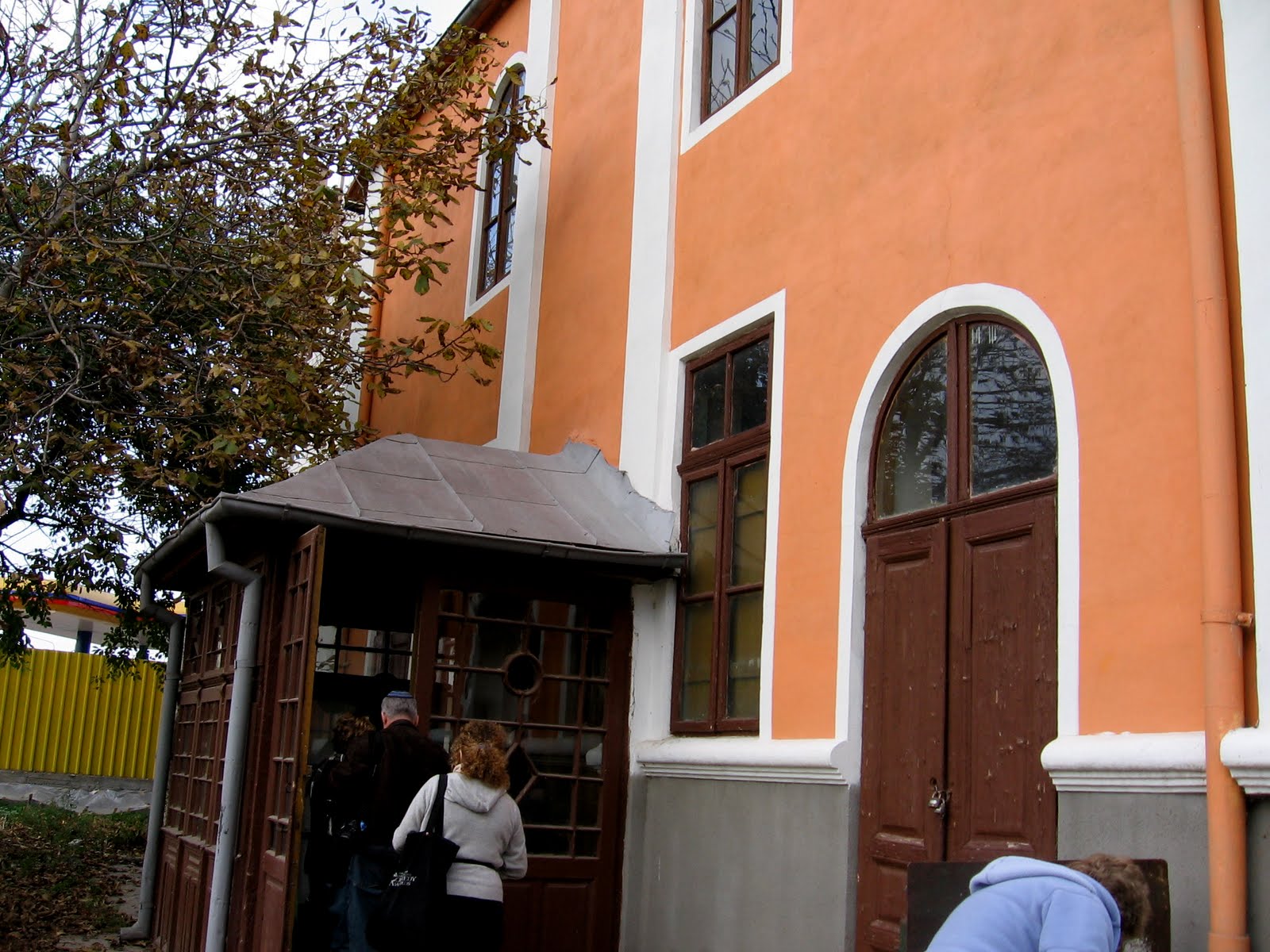
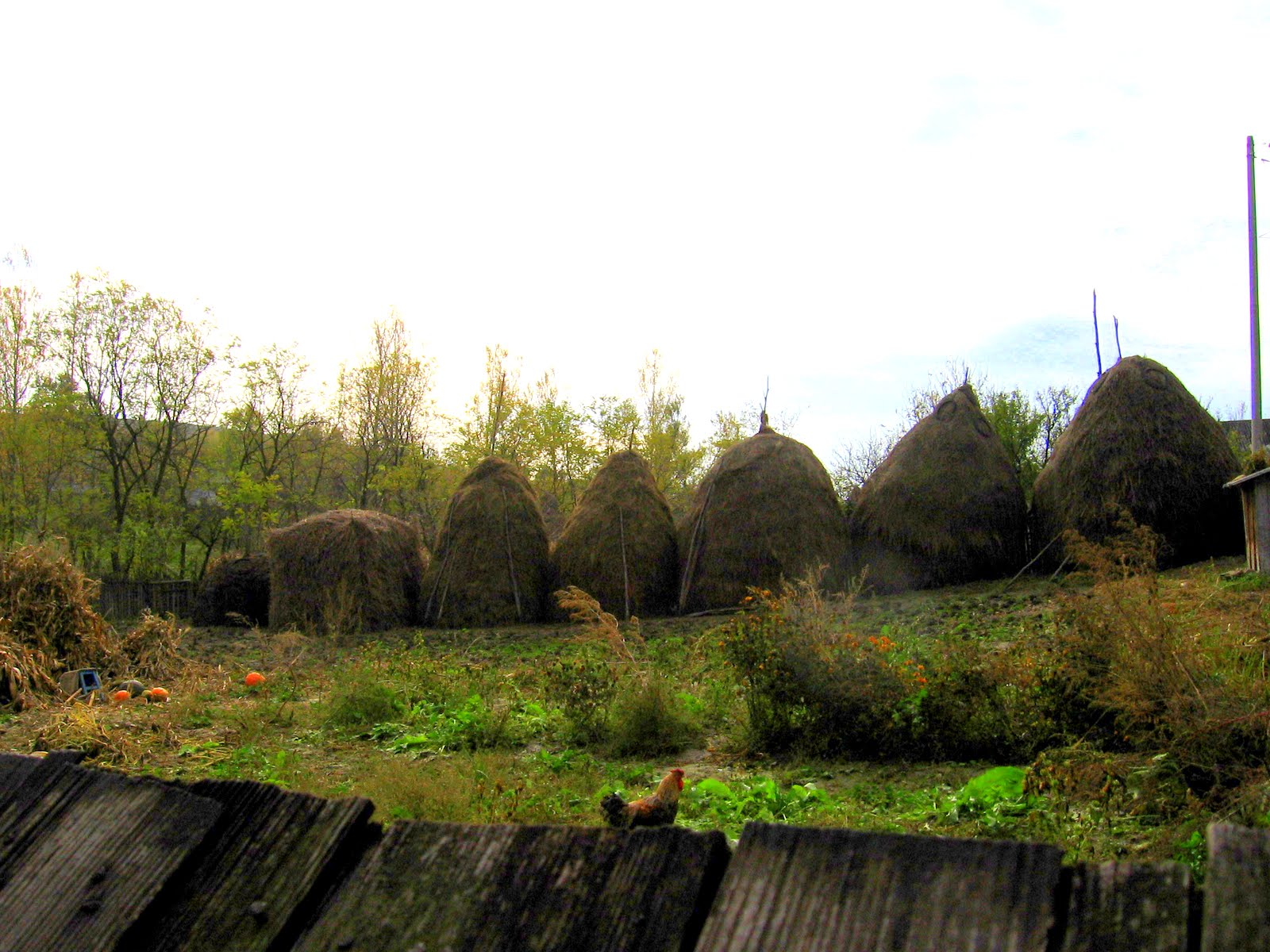
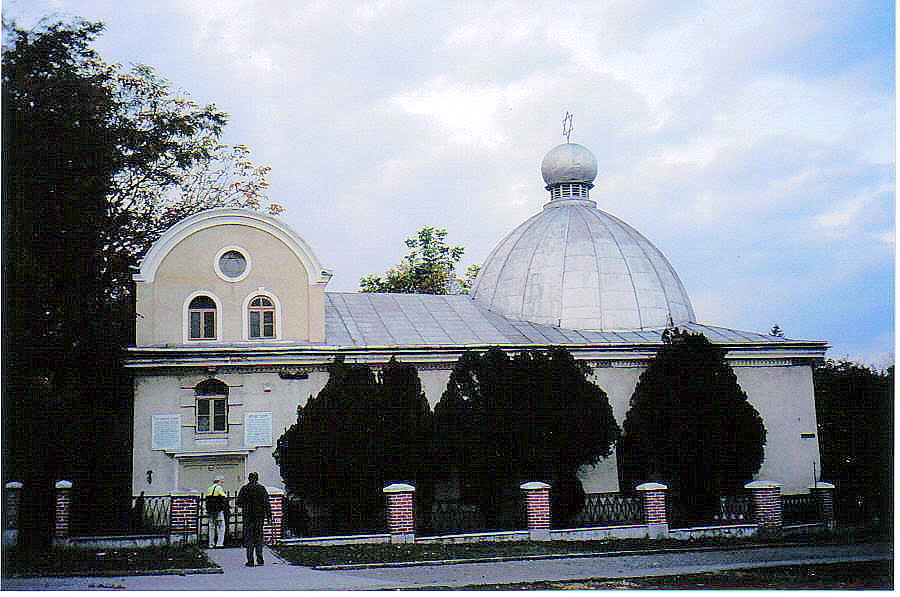
Although Tower also described a dying Jewish community in his novel, there was still some life, some people who cared in Barlad.  Culiner saw the glass as half-empty whereas Tower saw it as half-full.  Here are some pictures of the Barlad synagogue and some other towns visited by Tower that show a far less dismal impression of  in Romania.  All photos courtesy of Stuart Tower.

Synagogue in Barlad courtesy of Stuart Tower

Synagogue in Barlad  Photos courtesy of Stuart Tower

President Alexander Coitru

Stuart Tower reading from The Wayfarers at the Barlad Synagogue

Stuart Tower reading from The Wayfarers at the Barlad Synagogue

birlad shul interior

Romanian countryside

Romanian countryside

Romanian woman

Romanian woman

Romania%25202005%2520090 Romania%25202005%2520175

17th Century wooden synagogue in Piatra Neamts

17th Century wooden synagogue in Piatra Neamts

Piatra Neamts Sinagogaodd haystack, neighboring farm Troop Popa Tarpesht villagers and their War Lord

Culiner’s experiences in the towns and cities she visited after Barlad were not much different from her first three stops: ignorance and indifference to the history of the Jewish communities in those towns, ugly scenery, and disappointment.  She did meet some friendly and helpful people along the way, including some who were Jewish or were descended from Jews, but for the most part she found most Romanians at best ignorant and at worst rude and even hostile.

In Focsani, no one seemed to be able to help her find the synagogue, sending her on a wild goose chase only to find it right near her hotel.   On the other hand, Focsani had a fairly active Jewish community (relatively speaking), as the synagogue regularly drew about twenty people for shabbat services and more on major holidays.  Culiner was bewildered by the fact that the non-Jewish residents did not even know where the synagogue was located despite its central location.

In Kuku, Culiner met a friendly, helpful woman who likely lived in a building that was once the hostel where the Fusgeyers stayed while traveling through that town, but that woman also knew nothing about where the Jewish community had gone or about the Fusgeyers.   In Ramnicu Sarat, Culiner spent time with a woman whose mother was Jewish and who remembered the days of an active and close Jewish community.  The woman told Culiner that the Communists had demolished the synagogue that had once stood in the town.  She also talked about being unable to be openly Jewish during the Communist era.

Similarly, in Buzau she talked to a Jewish man who refused to take her inside the synagogue because he was ashamed of its condition; there were not enough Jews left in the town to make a minyan and not enough money to maintain the building.  This man told her that “the greatest threat is that all will be forgotten.” Culiner, p.122.   In Campina, another Jewish man told her, “The Jews will die out.  We will go to the cemetery.  And no one will replace us.” Culiner, p. 144.

Only in Sinaia did Culiner find anything of beauty in the countryside, but again not without some negative observations. She wrote: “The scenery is a slice out of a romantic painting and Watteau would have delighted in the mossy banks, the majestic spread of trees, although he might have taken artistic liberty, ignored the discarded shoes and packaging stuffed into vegetation, the tattered plastic and ripped shreds of fabric caught on branches in the river.”  Culiner, p. 146.  Tower’s photographs of Sinaia reveal all the beauty without the observations of garbage mentioned by Culiner.

Peles Castle, Sinaia and surrounding countryside

Peles Castle, Sinaia and surrounding countryside

cottage on the grounds Romania%25202005%2520042 Romania%25202005%2520044 October snowfall, near Peles

Before I read Culiner’s book, I had been giving serious thought to an eventual trip to Romania, in particular to Iasi.  After reading her book, I put that thought on the far back burner.  Her book left me with a vision of an ugly country filled with ugly people who hated Jews.  After looking at Tower’s photos and corresponding with him about his travels in Romania, I am reconsidering my decision to put a visit there on the back burner.  Just as I would like to visit Galicia to honor my Brotman family’s past, I would like to visit Iasi—to see where my grandfather was born and spent his first sixteen years, to honor his past and the lives of his family—-the Rosenzweigs and the Goldschlagers.  I have no illusions about what I will find there.  I know not to expect a lively Jewish community or even any Jewish community.  It’s all about walking where they walked and remembering their travails and their courage.  Maybe the scenery is not as idyllic as in some of Tower’s photos.  Maybe the people are not as colorful and friendly as they seem in his photos.  But that, after all, is not the point, is it?

Culiner did not visit Iasi, our ancestral town in Romania, on her trip, but Tower did, and I thought I would end this post by posting his pictures of Iasi and some of its people as well as those taken by my Romanian researcher Marius Chelcu.  Maybe someday I will get to be there in person and walk down St Andrew’s Street where my grandfather was born and pay tribute.

If we don’t, who will? Will we allow the story of the Fusgeyers and of the Jews of Romania to be forgotten for all time? That, in some ways, is the message of both Tower’s book and Culiner’s book: we need to learn and retell the story of our ancestors so that those stories and those people will not be forgotten.


Stuart Tower’s photos of Iasi

1670 Synagogue in Iasi

1670 Synagogue in Iasi

Traian Hotel, Iasi

Hotel

Father of Yiddish Theater

Father of Yiddish Theater, plaque in Iasi

National Theater, Iasi

National Theater, Iasi

Gypsy wagon, near Iasi (Yash) Astoria Hotel, Iasi Yash) Iasi street Recently%2520Updated%25201108 Lady/Man (?) walking toward Yash (Iasi) Gypsy family (Iasi), wanted food and money Iasi (yash) Ladies of Iasi (Yash)


Marius Chelcu’s photos of Iasi:

St_Andrew_Str_no_26_0003 St_Andrew_Str_no_26_0001 Near St Andrew Str_11 Near St Andrew Str_10 Near St Andrew Str_4 Near St Andrew Str_5 Near St Andrew Str_6 Near St Andrew Str_7 Near St Andrew Str_8 Near St Andrew Str_2

Photos taken near St Andrew Street where the Goldschlagers lived

Photos taken near St Andrew Street where the Goldschlagers lived


Enhanced by Zemanta

The Fusgeyers, Part II: How They Did It

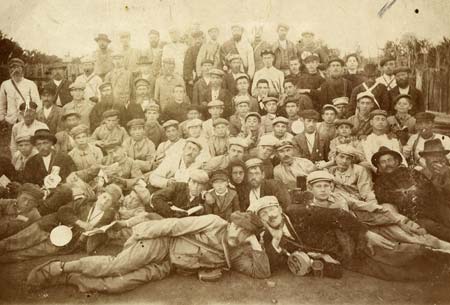
A Group of Fusgeyers from Iasi, c. 1900 http://epyc.yivo.org/content/photos/14_q_RM-RUMANI-4_lg.jpg

Yesterday’s post described some of the reasons that Jews like my grandfather and his relatives decided to leave Romania in the early years of the 20th century: rampant anti-Semitism, poverty, violence, false accusations, and laws depriving Jews of access to education and to most means of earning a living as well as denying them the legal rights of citizens.  Thousands of Jews left Romania between 1900 and 1910, many of them on foot, including my grandfather.  In both The Wayfarers by Stuart Tower and Finding Home by Jill Culiner, there are vivid descriptions of how these people managed to accomplish the task of walking about 1500 miles to cross the border from their homes in eastern Romania to Hungary or Galicia, where many then caught trains that would eventually bring them to the ports where they could sail to the United States.

Both Tower and Culiner relied heavily on the unpublished manuscript written by Jacob Finkelstein around 1942, describing his personal experience as a member of the first group of Fusgeyers.  Finkelstein’s memoir appears to be the most important primary source regarding the Fusgeyers, and Culiner begins most of her chapters with an excerpt from that manuscript.  The first group of Fusgeyers walked out of Romania in 1900, traveling by foot from Barlad to Predeal and crossing into Hungary.  As detailed in both Tower’s and Culiner’s books and as described by Finkelstein, that first group was an outgrowth of a club of young people in Barlad who put on theatrical works to raise money for charitable causes.  Members of the group decided that they could use their talents to raise money to pay for their travels out of Romania.  They raised some initial money through donations and from fees collected from those who wished to join them, and eventually there were seventy-five men and three women who joined the group and left Barlad in April, 1900.

The Gheorghe Rosca Codreanu Lyceum in Barlad (...

Barlad, Romania

Română: Timisul de Jos,Predeal,Brasov,Romania.

Română: Timisul de Jos,Predeal,Brasov,Romania. (Photo credit: Wikipedia)

One person was selected to be the leader of the group, and others were appointed to various roles: treasurer, medical care, scouts, and security.  They had flyers printed to distribute in the towns they planned to visit, and the people of Barlad provided not only financial support, but food and supplies to the group.  The group then walked from town to town across Romania, often being treated very well; in some places people provided them with food, shelter, and generous donations.  The group would stage musical performances to raise money.  Many newspapers publicized the movement, bringing even more donations and larger audiences to greet and support the Fusgeyers.  Moreover, this first group inspired new groups to form and to leave their homes as well.  My grandfather, who loved music and was smart and funny, might very well have been one of the Fusgeyers who left Iasi in 1904.

Sometimes, however, the group met up with hostility.  In Ramnicu Sarat, the police confiscated the passports of that first Barlad group, telling them to keep themselves from being noticed.  The passports were, however, returned once they left the town.  The group was threatened with arrest if they entered the town of Mizil, so they stayed out, sleeping in tents in the rain instead, and they were told to avoid the next town as well, resulting in another night of sleeping in the rain.  There was even trouble within the group; money was wrongfully taken by one of the group representatives.  Overall, however, at least according to Finkelstein, his group’s experience was a huge success—enabling not only that group to escape, but also inspiring thousands of other Romanians to do the same.

I cannot capture or describe all the details of the experiences of the Fusgeyers.  All I have as primary material in Finkelstein’s memoir, but Stuart Tower’s book takes the skeleton of facts provided by Finkelstein and builds from those facts a novelized version of that experience that helps to bring to life the Fusgeyers’ trek through Romania.  He developed characters and storylines that add an extra layer of humanity to this basic story.

The Wayfarers (Paperback) ~ Stuart Tower (Author) Cover Art


When I was doing some additional research about the Fusgeyers yesterday, I happened upon a website that described plans to turn Tower’s novel into a documentary about the Fusgeyers.  I did not realize it at first, but the website was a page on Kickstarter, a crowd-sourced fundraising site that helps people raise funds for private projects—in the arts and otherwise.  The Kickstarter page for The Wayfarers movie had not yet attracted any donors.  I made a small donation and also left a comment for the contact person of the page, Ron Richard, explaining my interest and expressing my concern that there had not yet been any other donations for the project.

I have heard back now both from Ron Richard and from Stuart Tower, the author of The Wayfarers.  Tower sent me some wonderful photographs of Romania from a Fusgeyer tour he ran in 2005, and I am hoping to get permission to post some of those photos here.  If any of you would also like to help Ron Richard and Stuart Tower make this film about the Romanian Fusgeyers, please check out their Kickstarter site at  https://www.kickstarter.com/projects/1552736981/the-wayfarers-the-story-of-the-fusgeyers?ref=live  It may be the best opportunity many of us have to see Romania and to understand better the experiences of our ancestors.

Jill Culiner’s book takes a different approach to exploring the Fusgeyer experience.  After reading Finkelstein’s memoir, she decided to re-enact the walk of the Fusgeyers, also walking from Berlad to Predeal, but not with a large group, just with one companion.   Her experiences doing this provide a chilling post-script to the story of the Jews in Romania, one that I found moving and haunting even re-reading it.  I will post more about her book and her experiences tomorrow.


Enhanced by Zemanta

Galicia Mon Amour: A Conversation

I just finished watching a video called “Galicia Mon Amour.”  It is a recording of a conversation between Daniel Mendelsohn and Leon Wieseltier.  Mendelsohn’s book, The Lost, which I read a number of years ago, is one of the most moving books I’ve read; in it he recounts his journey to find out what happened to members of his family who had not left Galicia before the Holocaust.  It is beautifully written, well-researched, and deeply tragic.  I read it long before I started doing my own genealogical research, but it likely was one of the sources of inspiration for my journey.[1]

Leon Wieseltier’s book Kaddish is also excellent, but I have to admit much of it was a bit too scholarly and dry for my taste, except for the parts where he reflects on his own family and experiences.  I admit to skimming a lot of the more academic parts of the book.

At any rate, when I saw a recommendation for the video on the digest I receive daily from Gesher Galicia, I decided to try and make the time to watch the video.  (It’s about two hours long.)  You can find a link to the video here.

In the video Mendelsohn interviews Wieseltier about his recent trip to Galicia.  (The interview takes place in January, 2007; Wieseltier’s trip was in 2006.)  Both Mendelsohn and Wieseltier had family that came from eastern Galicia in what is now Ukraine from towns near the city of Lviv, known by the Jews as Lemberg.  Both had taken trips back to the region to research and visit the places where their relatives had lived.  Although Mendelsohn’s direct ancestors had immigrated to the United States before the Holocaust like ours did, he had many relatives who remained behind about whom he had known very little.[2]  Wieseltier’s parents, on the other hand, were Holocaust survivors and came to the United States after World War II.  All the rest of his family was killed in the Holocaust.

One audience member asked at the end of the interview whether there were differences between those who were grandchildren of immigrants and those who were children of Holocaust survivors.  Were the survivors from the wealthier families who saw no reason to leave in the 19th century and the earlier immigrants from the poorer families who had no reason to stay?  Although Wieseltier dismissed this as an overgeneralization, which I am sure it is, it nevertheless is an interesting sociological question.  Remembering Margoshes’ memoirs and the fact that there were so many wealthy Jews, I thought that it made some sense that only those who had nothing to lose would have taken the risk of leaving the world they knew.  This may suggest that Joseph and Bessie were not among the wealthier segments of the Galician Jewish community.

Wieseltier described his own family as being among the more prosperous, educated and aristocratic clans in their area and confirmed the impression left by Margoshes that the Jewish world in Galicia was very diverse and that there were many who were wealthy, well-educated, and sophisticated.  He described Cracow as the “Jerusalem of the North” and the Galitzianers as the princes of the Jewish world.  Mendelsohn concurred, saying that although there was also a lot of poverty, there was a large bourgeoisie and a large wealthy class.  He said that Emperor Franz Joseph, who was the head of the Austro-Hungarian Empire from 1848 until 1916, was admired and even loved by the Jews for his enlightened leadership and treatment of the Jewish citizens, also described in Margoshes’ memoirs.

One observation that I found particularly interesting was Mendelsohn’s comment that he always thought of Jews as living in tenements until he went to Galicia.   He believed that Jews, wherever they lived, lived urban lives, and he was surprised by how wrong he was when he saw the rural areas where they had lived in Galicia.  He described the countryside as beautiful—with mountain, streams, rivers.  Wieseltier used the word “paradise” to describe it.

A lot of their conversation focused on the reasons to make a trip to Galicia.  Both said quite emphatically that this is not a place to go for typical tourist reasons; for Mendelsohn it was partly to find out what happened there and to visit the places where his family had lived. Wieseltier said he went not only out of grief, but also out of pride. He talked movingly of standing where his mother had once stood and leaving a copy of his book in the empty field as a symbol of Jewish survival.  Both talked about the absence of Jewish life there now and how the Polish people themselves realize how much has been lost by the destruction of the Jews and their culture.  Wieseltier said that you won’t find Jewish life there so you must bring your Judaism with you if you go.

There is also discussion of the Holocaust, of the camps, of anti-Semitism, but overall the theme was more about remembering the world that was there in a realistic and accurate way and cherishing that culture and the people.  Wieseltier himself is quite skeptical of genealogy (“It’s amazing how much you can’t learn from genealogy.”).  Although Mendelsohn obviously values genealogical research highly, he did not really push Wieseltier to elaborate on this point.  I think, however, that Wieseltier was expressing some doubts about all those who, like me, are trying to trace some names and dates to make a connection, perhaps without any purpose or perspective.  He said that our parents and grandparents were ours “by luck,” just as the fact that we have two legs or brown eyes, and that what is more important is who we are ourselves and what we do with our lives.  I think that that is an important perspective for me to remember as I continue to look for our family in Galicia.


[1] We were fortunate enough to hear Mendelsohn read from and talk about the book many years back when it was first published.  That made his story even that much more personal.

[2][2][2] I am sure that that is true for the Brotman family as well, although I do not know specifically of any family members who died in the Holocaust.

Streets: Conclusion (Bella’s adolescence)

The rest of the book was harder to read.  As Bella turned twelve and became less innocent, she became more aware of the squalor and ugliness of her world.  She wrote, “I was now twelve and acutely conscious of the sordidness of the life about me.  To escape, I hid behind my books and built up a life of my own in the public school I attended on East Broadway and at the settlement house on Madison Street.” (p. 66)

Her mother married one of the long time boarders and soon was pregnant.  Although their first year of marriage seemed fine to Bella, after the baby was born and soon developed a medical condition that left him scarred and covered with sores, her stepfather abandoned her mother, who was already pregnant with another child. They never saw him again. (There is no explanation of her brother’s condition, but it seemed to continue for several years so was not just a short-term childhood illness like measles or chicken pox.)

Supporting an extra child as a single parent created enough of an additional financial burden for Fanny that she and her children had to move to a less desirable street in the Lower East Side, Goerck Street.  Bella described it as a “tough block” where there were several bars, a lumberyard, and a garbage heap.  There were frequent bottle fights.   Most of the residents of the street were Galician Jews, but there were also Hungarian, German and Russian Jews as well as many Italian immigrants.

Fanny and her children moved their belongings to the new tenement with a pushcart, taking several trips to do so. Bella described the new building as follows:

“Our house, like the others, had four families on each floor, two to the rear and two to the front.  There were two windows to the front room which either faced the street or the yard, one window in the kitchen that faced an extremely narrow, lightless airshaft, and in the bedroom a tiny square window that faced the hall. … Separating the front room from the kitchen is what my mother called a ‘blind window.’  It was simply a square hole, framed by woodwork, which allowed some of the front light to filter into the kitchen and stop at the entrance to the bedroom.” (p. 82)

In this small, dark and airless space, Fanny and Bella found cockroaches and rats.  As before, Fanny took in numerous boarders to help her pay the rent and also took on sewing jobs to supplement her income.

Bella graduated from grade school and was determined to go to high school, unlike many of her classmates and friends who had to go to work in one of the factories in order to help support their families.  Fanny was fully supportive of Bella’s desire to go on to high school, even though she was told by many that she was foolish and should make Bella get a job instead.  Bella enrolled at George Washington High School in Manhattan, about two miles away from the Lower East Side, and was excited to be continuing her education.

Bella, however, did also take on a part-time job, working Sundays as a trimmer at a man’s coat shop on their street.  Her mother also received financial assistance and other support from the United Hebrew Charities and worked long, long hours sewing to earn extra income.   When the second baby was born in May, 1913, the charity covered her rent for the time that Fanny could not work. In return, however, the charity wanted Fanny to consider sending Bella to work full time.  Fanny resisted, and Bella continued to go to high school.  Bella resented having to justify her desire to continue school to the charity.

Bella, however, was now much more aware of the precariousness of their financial condition, and it was often a struggle to pay the rent, which was often paid late and in partial payments.  When she was not at school, Bella took care of her two baby brothers while her mother continued to work as much as possible, taking in sewing work.

Bella’s feelings at this time are poignantly conveyed in the memoir:

“I looked at the sleeping tenements and down at the street strewn with garbage and wet newspapers. Was this living?… It was all so hopeless.  When would it end?”  (pp. 103-104)

Although Bella still loved school and had friends with whom she had some good times, it is apparent that she no longer felt the somewhat joyful attitude she had had as a child.  Although it does seem that their financial condition was worse than it might have been earlier, the poverty and squalor she described must also have been very much present in the neighborhood where she lived when she was younger.   It is likely that as Bella was exposed to more of the outside world through school and books, she also became much more discerning and outraged by the conditions of her own world.

When Fanny finally was unable to pay the rent one month in 1914 and received an eviction notice, Bella offered to quit school.  Fanny refused to consider it, saying that Bella was “going to be a lady. Not like me, a schnorrer!” (p.110) Fanny swallowed her pride and begged the United Hebrew Charities for assistance.  They agreed to give her fourteen dollars, which she used to move her family out of the Lower East Side and up to First Avenue and 49th Street (where the UN now sits).  The charity also provided her with some sewing work.

Thus, Fanny and her children left the Lower East Side and moved to what was then called the Dead End neighborhood, an area of slums that were torn down in the 1920s.  This was not a move up, but a move to a cheaper neighborhood.

The last chapter focuses on Bella’s experiences while living in that neighborhood, a more mixed neighborhood where she had many non-Jewish neighbors.  The accommodation was comparable to what they had had on the Lower East Side, a three room tenement apartment.  Fanny was heavily dependent on United Hebrew Charities for support and grew increasingly despondent over her situation and over the health of her older son. At one point her relationship with Bella was so fraught with tension that Fanny lost her temper and began hitting Bella quite violently.  Bella realized that she needed to get away and spent the summer before her senior year working at a boy’s school in the Catskills as a chamber maid and waitress.

Bella somehow managed to graduate from high school while also holding down various part-time jobs, including working in another factory, tutoring, and helping her mother with extra sewing work.  She also continued to take care of her little brothers.  Right after she graduated from George Washington High School in June, 1917, whatever was left of Bella’s childhood innocence ended abruptly when her sickly little brother died from whatever medical condition had burdened him since infancy.  That is where Bella abruptly ends her memoirs as well.

In an afterword written by Lois Raeder Elias[1], who knew Bella for over thirty years, Elias commented that although Bella ultimately found great personal and financial success, saw the world, and knew many important and impressive people, she was permanently scarred and haunted by her years of poverty, growing up on the Lower East Side.  She never felt financially secure and lived always in fear of poverty.

If the chapters about Bella’s early childhood left me feeling somewhat hopeful about how our family lived on the Lower East Side, the rest of the book left me feeling incredibly sad.  How did our grandparents and great-grandparents cope with these conditions? How did Max, Hyman, and Tillie, all of whom were born in Europe, manage to pull themselves out of poverty and become a cigar dealer, a liquor store owner, and a grocery store owner in one generation?  How did all our grandparents manage to support and raise their children, who all somehow managed to achieve comfortable middle class or better lives in good neighborhoods in NYC and its suburbs?

Reading this book filled me with renewed respect and gratitude for our great-grandparents and grandparents.  We should never forget what they accomplished and what a gift that has been for all of us.

Bessie

Bessie


[1] There was a surprise gift inside this book when I received it.  I had ordered the book from a third party vendor through amazon.com, and inside the book I found a handwritten note by Lois Raeder Elias to friends named Sheila and Alan.  The note reads,”At last we have received copies of Bella’s memoirs. We thought they would never come.  This one is for you.  I hope you enjoy it.  I’ll talk to you this weekend.  On to Turkey! Love,  Arthur and Lois.”

I hope that Sheila and Alan, whoever they were, appreciated this book.  I fear that they just passed it on without ever noticing the card left inside by their friends, Arthur and Lois.

Streets: A Memoir of the Lower East Side by Bella Spewack, Part II (up to age 12)

It was interesting to read about Bella’s childhood and developing American and Jewish identity growing up in the Lower East Side.  Not surprisingly, there was a wide range in the level of religious observance among the Jews on the Lower East Side.  Some Jews were very observant. Bella described the household of one of her childhood friends as follows:

“It was a decidedly quiet house—and more so on Friday and Saturday when religious observance forbade everything that would tend to introduce noise.  On Friday before sundown, the four girls of the family would comb their hair, the mother helping the youngest who had to wear hers in curls.  Before going to bed each would draw a cap over the freshly combed and plaited hair.  In the morning, the cap was removed but no comb touched the hair until Sunday morning.”  (p. 53)

On the other hand, Bella and Fanny seemed to live a very secular life.  A few pages after this passage, Bella described how she spent her Friday nights.  She would meet all her girlfriends and play loud and active games of tag and other outdoor games.  Bella also wrote that she felt “no everyday kinship with the synagogue” and “had an idea that it belonged to the menfolk only.”  (p. 47)   She wrote that she only went to the synagogue on holidays.

Bella in fact experienced real confusion over her religious identity and at one point decided that she wanted to be Christian, not Jewish, much to her mother’s dismay.  This desire seemed to have been rooted in Bella’s perception that Christians were more refined: they were gloves, had clean nails, and spoke perfect English.  Some of it may also have been rooted in her experiences with anti-Semitism, such as the time she and her mother were lost, walking in a strange neighborhood, and were accosted by a group of boys who called them sheenies and grabbed and poked at them.

Most of Bella’s childhood years, however, were spent focused on her friends, books, and school.  In the introduction to the book, Ruth Limmer wrote that the schools Bella attended “were both ideal and wretched—wretched in their overcrowding (class size was forty-five to fifty); ideal…in that they were rigid in their demand that the students seriously attend to learning English.”  (p. xx)

The mission of the schools was to Americanize the children of the immigrants (of all backgrounds) by immersing them in English literature, American and British history, physical training and athletics, and culture. Limmer asserted that as a result, parents often became dependent on their children, who spoke English and who were much more comfortable with the American way of doing things.

The schools also tried to instill values, including discipline and obedience.   Limmer wrote: “The routines began when they arrived at school each morning.  No horsing around.  They were required to line up in order of height on sex-segregated lines and, at the bell, were marched silently to their classrooms.”  (p. xxii)  Bella’s description of her day at school is consistent with Limmer’s overview:

“At school, there was first the assembly period when doors rolled back and mediocre schoolrooms became a vast auditorium.  You marched in with your class holding yourself straight and stiff, turning square corners with military exactitude.  You looked out furtively from beneath your lashes to see if your teacher… noticed that your shoulders were back and your stomach in.” (p. 66)

The students would then salute the flag and listen to readings from the Bible every day, apparently a common practice in the NYC public schools until after World War II, a practice that certainly conflicts with Constitutional principles as we understand them today.

Bella was also a regular visitor to the city’s public libraries and spent her school vacations at the library, reading as much as she could.

Seward Park Library

Seward Park Library

Obviously, she was well-served by those crowded schools and those libraries, as she grew up to be not only capable of communicating in English, but to be a very successful professional writer who contributed to the American culture in which she had been immersed.

Bella’s life was very much confined to her neighborhood; she was at least ten years old before she did much venturing outside of the Lower East Side.  Once she and a friend tried to walk to Andrew Carnegie’s house uptown, but got no further than Fourteenth Street, where they were mesmerized by the department store and its escalator.  Another time she participated in a play with other immigrant children organized by the neighborhood settlement house, another agency engaged in Americanizing immigrant children.  The group of children performing the play went as far uptown as 96th Street, which Bella said was as far from the Lower East Side as any of them had ever been.

Otherwise, Bella and her friends stayed in their neighborhood, where she engaged in common childhood activities, including piano lessons and a sewing club.  There is no mention of religious education.  Overall, Bella’s childhood, despite the poverty and those incidents of abuse and anti-Semitism, was a happy one up through age twelve.  She was a smart, studious girl, but one who had many friends and who knew how to have fun.

Perhaps Bella was looking back with rose-colored glasses, but I’d like to take away from her depiction of her childhood a better feeling about my grandmother’s childhood in the Lower East Side with her siblings.  Yes, they did not have an easy life, and losing their father so young must have been terrible.  But they had their sisters and brothers and a mother whom they all adored.  I hope that like Bella, my grandmother also enjoyed school, played games, and had a network of similarly situated friends with whom to share some of the joys of childhood.

Streets: A Memoir of the Lower East Side by Bella Spewack, Part I

I am now reading another memoir, Streets: A Memoir of the Lower East Side.  The author, Bella Spewack, had quite an interesting life.  She moved with her mother, Fanny Cohen, from Transylvania to NYC in 1902 when she was just three years old.  Fanny Cohen was just a teenager herself and had been abandoned by Bella’s father shortly after Bella was born.  They arrived in NYC with no resources, no money, no relatives to help them, and yet somehow Bella grew up to be a successful journalist first and then a very successful Broadway playwright along with her husband, Sam Spewack.  They are perhaps best known for the Tony award-winning play, Kiss Me Kate.

Bella wrote Streets in the 1920s while living in Berlin with her husband as foreign correspondents, but like A World Apart, it was not published until relatively recently (1995).  I chose to read this book to get an idea of what life was like for our family when they were living on the Lower East Side in the 1890s and early 20th century.

Whereas A World Apart failed to convey what life was like for poor Jews living in Galicia, Spewack does not shy away from depicting the hardships endured by Jewish immigrants living on the Lower East Side in the first two decades of the 20th century.  In the first chapter, Spewack describes how her mother scratched together a living in the early years after they first arrived in New York.  Like many young immigrant women, Fanny started by looking for employment as a house servant right after she arrived in the US. Fanny and Bella lived behind a restaurant those first days and shared a bed with two strangers.   When after some time, Fanny finally secured a position as a servant, she found the man of the house at her bedside in the middle of the night.  Fanny left and returned to the restaurant and started looking again.  Her second position was in Canarsie (Brooklyn), where she lasted somewhat longer until Fanny intervened to protect a girl living in that home from sexual assault.

My eyes opened wide when I read that they then returned to the Lower East Side and stayed with a woman they called the Peckacha who lived on Ridge Street. (The woman had a pock-marked face, and I assume that’s what the nickname meant.) This would have been in 1902, the year after Joseph died, when Bessie and the children were living on Ridge Street.  Since Frieda was then five and Gussie was seven, it is entirely possible that little Bella knew our family.  Of course, since there were probably thousands of people living on Ridge Street, it’s also possible and probably likely that they never met, but it made reading this section more meaningful for me as it helped me imagine what life was like for those other two little girls, my grandmother and her little sister.  Unfortunately, Bella’s experience with the Peckacha and her children was not a pleasant one.   The children would pick on her, both verbally and physically, while Fanny was out working.

Bella described Attorney Street, the street one block west of Ridge as like Orchard Street, “a market where fruit and vegetable dealers sell to the street and store vendors.  Cases, bulging with oranges or apples and watermelon, line the streets, while men with live, dirty hands darted among them with eyes that took in everything.  People live on these streets as well, rotting in their cases with the overripe fruits.” (p. 8)

lower east side

Fanny soon decided that she would prefer working in a factory to being a house servant.  Her next job was working as an operator in a ladies’ shirtwaist factory for $7.50 a week.  Bella and Fanny moved to Cannon Street where they lived with a widow named Pincus.  Bella went to a day nursery while her mother was at work.  The nursery was located in the basement of a building on Cannon Street, which Bella described as “gloomy but much warmer than the rooms all of us had just left.”  Overall, Bella’s experience at the day nursery sounded positive, with pleasant caretakers, but the days were very long, stretching past seven at night, and the space was overcrowded with too many babies and young children.

Unfortunately, once again Bella experienced some abuse.  Fanny trusted Mrs. Pincus, her landlady, to get Fanny up and to the nursery, and Mrs. Pincus ended up hitting and pinching Bella, once leaving her with such a huge bruise that Bella had to admit to her mother that Mrs. Pincus was abusing her. These experiences finally led Fanny to decide that she needed to find a place of her own where she would take in boarders to help pay the rent and provide her with some income.  She found a place in a new building on Cannon Street near Rivington Street, a three room apartment (bedroom, kitchen and dining room) with its own bathroom, and took in several boarders.

In the foreword to the book, Ruth Limmer provided a description of early tenement houses: “horrific five- and six- story dwellings that…lacked toilets, running water, fire escapes, and landlord-supplied hear and cooking stoves.” (p. xix)  By 1903, however, newer buildings had been built that were somewhat of an improvement.  “Now each apartment had, in addition to its windowed “front room”…another room that opened onto an air shaft, and interior windows were cut into the walls in order to permit a flow of air.  Little by little, the apartments were fitted with piping for illuminating gas. And instead of backyard privies, families got to share indoor toilets, two per four-apartment floor.  The law also required that fire escapes be affixed to all buildings.”  (p. xix)  The tenements were built on lots originally intended for single family dwellings ( 25 feet by 100 feet), but they housed over twenty families plus boarders in each building.

les interior

I imagine that this is like the apartment that Fanny and Bella were renting in 1903 and likely also what the Brotmans were living in on Ridge Street.  The census from 1900 did not list boarders as living in the Brotman household; perhaps Joseph’s income as a coal carrier/dealer was sufficient to support the family, though I doubt their standard of living would be acceptable to any of us today.

inside tenement

Bella described the many boarders, both men and women, who shared their small space, men sleeping in the kitchen, women in the living room and bedroom with Bella and Fanny.  You can imagine the goose bumps I got when I read that two of the young girls living with them at the beginning were named Frieda and Gussie.  Obviously, those girls were not our Frieda and Gussie, and those were common names for Jewish girls at that time, but nevertheless, once again the book made me realize that I was reading not about some foreign land or a work of fiction, but a work that reflects what life must have been like for the Brotman family living on Ridge Street in 1900.

More to come….

A World Apart: Conclusion

I finished Joseph Margoshes’ A World Apart last night, and I did find the answer to why he left Galicia.  When the lease his father-in-law had for the Yozefov estate expired after ten years, he was unable to obtain an extension, as it was leased to a different Jewish man.  Margoshes took the assets he had and obtained a lease on a different estate for himself and his wife, but he ran into difficulties and ended up in substantial debt.  When that lease expired in 1898, his father-in-law paid off Margoshes’ debt, and Margoshes and his wife and children left to seek better opportunities in America.

His father-in-law also ran into some difficulties when the lease on his estate in Zgursk expired and he, too, was unable to obtain an extension.  Margoshes described a long-running feud between his father-in-law and the people of Rzhokov, a small and poor shtetl across the Vistula River from Kielkov where the Shtiglitz (Margoshes’ in-laws) had family.  According to Margoshes, in the 1860s there was a huge dispute when one of these relatives died, a very wealthy man named Reb Yisroel Kielkover.  Reb Yisroel had not only provided work for many of the poor Jewish residents of Rzhokov, he had also provided charitable support, including free food and liquor.  Despite his generosity, when he died, the people of Rzhokov led by a man named Yankle Leiman refused to allow Reb Yisroel to be buried in the cemetery (which was used by residents of Kielkov as well as Rzhokov) unless his estate provided substantial financial support to raise the standard of living for the poor Jewish residents of Rzhokov.

Margoshes’ father-in-law and others were outraged and came to Rzhokov to demand that they be allowed to bury Reb Yisroel.  A violent fight broke out between the two groups of Jews, ultimately settled when Reb Yisroel’s side agreed to provide about half the money demanded by the group led by Leiman.  Margoshes’ father-in-law then brought criminal proceedings against Leiman for blackmail, resulting in Leiman spending three months in jail.   The money was never paid to the residents of Rzhokov, and the charitable support ended as well.  Margoshes wrote that the people of the shtetl remained very poor and without adequate buildings for a shul or mikvah.  He blamed this result on their excessive greed.

The feud continued for many years,ultimately exploding when Margoshes’ father-in-law had to obtain a new lease when his lease on Zgursk expired.  The estate he wanted to lease was, perhaps not coincidentally, leased at that time to Yankel Leiman and was about to expire.  Shtiglitz essentially swooped in and struck a deal with the Polish landowner to get the next lease, depriving Leiman of the opportunity to extend.  When Shtiglitz arrived to take over the estate, he and his family found that Leiman and his people had, as an act of revenge, vandalized the manor house and other buildings, much as today people who lose their homes to foreclosure often vandalize their homes before moving out.  Nevertheless, Margoshes’ father-in-law stayed and was able to make a great deal of money for the years he leased this property.

The father-in-law, however, ultimately paid a price for his bad temper and greed.  When he became angry with a worker on the new estate for not working hard enough, Shtiglitz accidentally killed the man by kicking him in self-defense, according to Margoshes.  Shtiglitz went to trial and was sentenced to two years of hard labor for second degree murder.  He only served a year, and Margoshes dismissed the significance of this by commenting that it only cost him about 10,000 gulders.  There was no expression of remorse or sadness for the dead worker.

Margoshes there ends his memoirs without any comment or conclusions about these matters or about life in Galicia in general.  My own conclusions about the book, however, are mixed.  It was interesting to learn more about Jewish life in Galicia, but overall the book was not what I expected.  I was hoping for a depiction of what life was like not only for wealthy Jews, but also for those Jews who were not as fortunate.  Aside from the first section of the book, there is no discussion of how religion played a part in the lives of any of these people; instead, the focus is almost entirely on how wealthy Jews lived and made a living.  As I’ve written in prior posts, Margoshes comes across as a rich young man who had little empathy or interest in the lives of those who were less fortunate.   He seems deluded into thinking that life for the Jews was a paradise during these times, despite the poverty of many Jews, the underlying resentment of the peasants, and the obvious anti-Semitism of the wealthy Polish landowners.

Given his description of his childhood as a boy from a religious home whose favorite activities were reading and discussing books and given that he became a Yiddish writer and journalist in the United States, I would have expected more insight, more soul-searching from a seventy year old man writing his memoirs in 1936.

A World Apart, part 5: Relationships between Jews and non-Jews in Galicia

My reading this time related largely to the relationships between the Jews and non-Jews in Galicia, socially, politically and otherwise.  Margoshes began this section by claiming that at least in the region where he lived near Radomishla, the Jews were economically and politically often more powerful than most of the non-Jewish population.   I would never have expected that at all; I assumed that the Jews were oppressed politically and economically.  Instead, Margoshes asserted that in area from Rzeslow to Tarnow to Krakow, the peasants lived under the dominance of the Jewish estate holders.  He wrote, “During the period between the 1880s and [World War I], this part of Galicia was a true paradise for Jews in some respects.” (p. 99; emphasis added)

According to Margoshes, in this region, anti-Jewish persecution and acts were unknown, and Jews and gentiles lived peacefully together.  If a peasant struck or even just insulted a Jew, the courts would punish the peasant by placing him in jail for at least two days.  Peasants would tip their hats to Jewish estate-holders when they were driving (oxen or horses, I assume) on the road and when they entered their homes.  (There is no mention of how the peasants treated and were treated by poor Jews, just the wealthier Jews, who in many instances were the employers of these peasants.)

Margoshes explains the political context for this by pointing out that in 1846 there had been a widespread revolt of the peasants against the wealthy Polish lords and landholders and that even forty years later, the politically powerful Polish aristocracy which controlled the government had not forgiven the peasants for the violence, deaths and damages caused by that uprising.  Thus, in a dispute between a peasant and a Jew, the government would generally side with the Jew.

Margoshes also attributed much of the peacefulness of the region to the Austro-Hungarian gendarmes who were responsible for keeping law and order in the Empire as part of the imperial army.  These soldiers lived in the area in barracks and frequently visited the estates to insure that all animals were registered and that everything was being managed according to the requirements of the Empire.

That did not mean that there were no disputes or problems between the peasants and their Jewish employers.  Margoshes described a number of incidents of theft by the peasants who worked at his father-in-law’s estate.  He wrote, “A Jewish estate-holder and his household had to have eyes in the back of their heads in order to make sure that the workers were not stealing from him….” (p. 127).  He also made the offensive generalization that it was part of the “inborn nature” of the peasants to steal: “he had to steal whenever the opportunity presented itself, especially from the Jewish estate-holder.  For a peasant, the smallest stolen article was an asset.”

In one story about the workers at his father-in-law’s estate in Zgursk, moreoever, Margoshes also revealed that the relationships between the Polish peasants who worked on the estate and their Jewish employers were not always quite so amicable.  There were at times hundreds of workers on the estate, and many of them boarded there.  Margoshes himself admits that their living conditions were substandard: “everyone found a place to sleep in one of the three stables atop hay and straw and that was it.  No pillows or sleepwear were provided and…a blanket used to cover horses served as a cover.” (p. 96) The estate did provide three meals a day that Margoshes described as generous.   Margoshes’ mother-in-law and father-in-law were the task masters who oversaw all the work on the estate, and his father-in-law was known to be rather cold and strict.

Margoshes described one time that his father-in-law lost his temper with some of the workers who in his view were not working hard enough and began beating them with a paddle.  In response, these workers and a number of others went on strike and refused to return to the fields. It took an intervention from the mother of the father-in-law to persuade the workers to return to work the next day.  Margoshes described this as if it were a one-time incident, and perhaps it was, but it does reveal that there was some abuse of the peasants by at least this powerful Jew, his own father-in-law.

Thus, although Margoshes initially described the relationship between the gentile peasants and the Jews as peaceful and amicable, these incidents of theft and abusiveness suggest that there was in fact a great deal of resentment and anger among the peasants towards the Jews. Perhaps he was deluding himself when he wrote that it was a “true paradise” for Jews in this region during that time.

According to Margoshes, the wealthy Jews also had good relationships with the wealthy Polish lords and landowners, called pritsim or porits in the singular.  He described his relationship with a neighboring porits  as “very friendly, although from a distance.” (p. 103) They would help each other out with favors, but were not social friends.  Margoshes did not think that this relationship was unusual.  He said that he “never heard of a case in the entire region of a porits who had negative relations with a Jew or where he insulted a Jew or harmed him in any way,” (p. 104) although he did then go on to mention one polits who refused to trade with Jews.

There was also, according to Margoshes, peaceful co-existence between the Catholic priests and the Jewish population.  Although he commented that “[p]riests, especially Catholic priests, cannot ever really be friends of the Jews” because “it is almost against [their]religion to love people of another faith,” (p.111), he reported that nevertheless for the most part there was little conflict between the priests and the Jewish estate holders.  He described a church law that prohibited Catholics from working as servants in Jewish homes, but pointed out that it was rarely enforced since the peasants needed employment and often worked in Jewish homes. Margoshes even developed a friendship with one of the local priests, but he severed that relationship when the priest tried to persuade Margoshes to come and see his church—not to convert, but just to go inside the church.  Obviously, this “friendship” was a superficial one based on necessity, and feelings of distrust and difference outweighed any sense of real connection.  Margoshes made it clear that it would not have been acceptable for him, as a Jew, to be seen in a Catholic church.

By the time I finished reading this section, I realized that Margoshes had had a very unrealistic view of the relationships between the Jews and non-Jews in Galicia during the late 19th century.  First, his viewpoint is entirely based on the experiences of the wealthy Jewish estate-holders.  The non-Jewish peasants may have seemed respectful and accepting of their Jewish employers, but beneath the surface there was likely a great deal of resentment and anger.  The priests and non-Jewish estate-holders also may have been willing to live peacefully side-by-side with the wealthy Jews, but there certainly was not a true acceptance or friendship in these relationships.  The gendarmes may have been keeping the peace, but beneath the surface the Jews were still the outsiders who were not integrated into the gentile world.

Moreover, Margoshes does not at all provide a picture of what life was like for the Jews who were not wealthy estate-holders.  Were their relationships with the peasants, priests, and wealthy Polish landowners as “peaceful”?  Or were they the targets of all the repressed resentment and anger that the gentiles felt towards the wealthy Jews?

It occurred to me after reading these chapters that Margoshes was writing in 1936.  He had no idea what was going to happen in Poland during the Holocaust. I wonder whether his naiveté about how the gentiles felt about the Jews was widespread in Poland during the 1930s and 1940s.  If only they had been more realistic, perhaps more of them would have left sooner.

Which brings me to another question: if things were so great in the 1880s and 1890s for wealthy Jews in Poland, why did Margoshes and so many others, including Joseph and Bessie, leave?

A World Apart, part 4: The Rich and the Poor in Galicia

In my last post, I wrote about Margoshes’ marriage to the daughter of Mordecai Shtiglitz, the manager and lessor of a substantial estate in Zgursk, not far from Radomishla.  After checking Google maps, I realized that Radomishla is only about 60 miles from Dzikow where our family might have lived, so Margoshes and Joseph and Bessie may have lived quite near each other in the 1880s.  Whether their lifestyle was anything like his we do not know, but it made reading his story even more compelling to me.

After Margoshes married, there was a three year period of what he called “kest.”  According to the glossary provided in the book, kest referred to the practice where the family of the groom provided financial support to the groom and bride after the wedding to enable the groom to study without having to worry about earning a living.  Margoshes and his new wife lived with his in-laws, both of whom worked very hard to manage and oversee the estate.  Margoshes, however, spent the early days of his marriage being idle, reading and eating a lot of fruit. At one point his father-in-law arranged for him to oversee the cutting down of trees for lumber on a nearby property where the Polish owner needed assistance and agreed to allow Margoshes to keep the profits in exchange for overseeing the labor.  Margoshes did not do any of the physical labor himself, but would ride out to make sure that the work was being done.  He hired a Jewish man to help him supervise the work.  After a short period of time, Margoshes decided not to pursue the lumber business any further.  He wrote that he found it tedious and that his father-in-law and wife found it beneath his dignity.  He sold the business to someone else and returned to his “kest” lifestyle.

About a year and half after he was married, Margoshes and his wife moved to Yozefov, a 450 acre estate about a mile away from Zgursk, where his wife’s sister and her husband had lived.  The land was owned by a non-religious Jew who had leased the land to Margoshes’ father-in-law as a place where his older daughter and her husband could live and work.  When the older daughter’s husband died, Margoshes and his wife were essentially told that they had to move to Yozefov and take over managing the estate.  Margoshes lived there for ten years and, as he described it, was his own boss for the first time.  The financial arrangement, however, put Margoshes in a risk-free situation.  His father-in-law covered the expenses and took the profits, but Margoshes and his wife were able to live without cost in exchange for overseeing the estate.  When the lease was up after ten years, Margoshes still had the original dowry from when he married plus the livestock and equipment from Yozefov which he then used to set up his own business.

In this section of the book, there is a little more light shed on how “the other half lived.”  First, it is clear that there were many Jews who were not wealthy at all. As described by Margoshes, “Jewish economic life in Galicia was always uncertain.  People who had done well for years and lived an upper class existence suddenly became paupers due to unforeseen circumstances.” (p. 58) Margoshes  observed many poor Jews while living in Zgursk: “…itinerant paupers were constantly wandering through.  A day rarely passed that 10-15 poor Jews did not appear in the manor yard.  These vagrants would often wander in whole families: man and wife, several children, and sometimes even infants at the breast. Every poor person …received a generous portion of hot food, and a big piece of bread for the road, along with two kreuzer in alms.  They were just not allowed to spend the night in the manor yard; their ranks included a lot of undesirable people and thieves.  They were sent away to the nearby inn, or if space was short, to the [poor house] in Radomishla.” (p. 67)

Margoshes claimed that he was the only person in the region with the ability or desire to read books in Hebrew, German or Polish, and when his brother-in-law Mikhl wanted to learn, there was no one but Margoshes to teach him.  Margoshes found Radomishla to be more sophisticated than other towns and shtetls nearby.  In the other towns, the Jews had cows as the source of most of their income.  They would milk and feed the cows themselves and tend to their own gardens to provide a meager living for their families.  (Margoshes’ tone in describing these hard-working farmers is blatantly condescending.)  In contrast, he found the Jews in Radomishla to be far more successful merchants who engaged in trade and did not own or take care of cows. There were timber traders, cattle dealers, and many money lenders—many people who were extremely wealthy.  Although Margoshes recognized that there were also poor people in Radomishla, he claimed that there were not as destitute as poor people in the other towns and shtetls.

Often I feel really annoyed by Margoshes.  He was what we might call today a very entitled young man—someone whose family was wealthy and who never really had to do any physical labor at all and barely any other hard work of any kind.  He was handed everything on a silver platter, yet has the nerve to express disdain for those who were less fortunate.  I may react this way in part because I imagine that our ancestors, Joseph and Bessie, were probably among those poor farmers Margoshes was looking down at from up on his high horse as the fortunate son and son-in-law of two wealthy men. I am still hoping that somewhere in his story, Margoshes developed some perspective and some empathy for those who were less fortunate.

Link

Here’s a map that shows where Joseph Margoshes lived from birth through the early years of his marriage.  You may have to zoom out once to see the three locations: Lviv, Tarnow and Radomishla.