Where they lived: East Harlem in the Early 20th Century

One of things that puzzled me when I started looking at the census reports for the Goldschlagers between 1905

English: Looking from 96th Street in the south...

English: Looking from 96th Street in the south, northward along Second Avenue towards Spanish Harlem. (Photo credit: Wikipedia)

and 1915 was where they were living.  I had always assumed that my grandfather, like my Brotman ancestors, had settled in the Lower East Side when he arrived in New York.  I thought that was where all poor Jewish immigrants had settled in the late 19th and early 20th century.  Yet at the time of the 1905 census, my grandfather was living at 2213 Second Avenue, near the intersection with 115th Street, in the neighborhood we know as East Harlem or Spanish Harlem.  He was living by himself (at age 17) in a building with some families with Jewish names but mostly families with Italian names.  What was he doing there? Why was he living up there and not on the Lower East Side?

When Moritz arrived, they remained in East Harlem on 109th Street, and after Moritz died, Betty and Isadore moved in with Tillie on 109th Street.  In 1915, all of the surviving Goldschlagers were still living on 109th Street.  Eventually, Isadore moved to Brooklyn, and David, Betty and their mother moved to the Bronx, until Betty and Gisella moved to Bayshore, Long Island in the 1930s.  But why had they started and stayed in East Harlem?

330 East 109th Street today

Some quick research revealed that East Harlem was a huge Jewish community in the early years of the 20th century, but that that community had disappeared and was for the most part forgotten.  As David W. Dunlap wrote in The New York Times in 2002, “On the map of the Jewish diaspora, Harlem is Atlantis. That it was once the third largest Jewish settlement in the world after the Lower East Side and Warsaw — a vibrant hub of industry, artistry and wealth — is all but forgotten. It is as if Jewish Harlem sank 70 years ago beneath the waves of memory, beyond recall.”  Dunlap then described the many signs that Jews once lived in East Harlem in the churches that were once synagogues.

Former Temple Israel Jewish synagogue, now Mt. Olivet Baptist Church. Detail: Star of David.

Mount Olivet Baptist Church in East Harlem, originally Temple Israel

The neighborhood had been rural until the subway and elevated trains arrived around 1880.  Soon after tenement buildings were constructed, and immigrants moved in, first German and Irish immigrants, then Jewish and Italian immigrants.  According to Wikipedia, there were 90,000 Jews living in East Harlem in 1917; however, the neighborhood was predominantly Italian and came to be known as Italian Harlem or Little Italy.  That is consistent with my study of the names in the 1905 census.

Photograph shows 105th Street between Madison and Park avenues in 1929, with traces of Jewish Harlem, including the Hebrew Home for the Aged in Harlem <i>(left)</i> and the synagogue called Beth Hamridash Hagadol of Harlem.

My mother remembers that her father spoke several languages and was quite fluent in Italian.  He must have learned Italian living in East Harlem in his first ten years in New York.   He was not a religious person and had left Romania at least in part to escape the anti-Semitism there.  Perhaps living in a mixed neighborhood made him feel more American, although obviously there was a well-established Jewish community there as well with many synagogues and other institutions.   Maybe it was cheaper than the Lower East Side, maybe the Lower East Side was already filled beyond overcrowding, or maybe East Harlem was a better neighborhood, not a cheaper neighborhood.  I don’t know what drew my grandfather there or why he stayed.

It’s always good to learn something new.  Now I know not only something new about my family, but also something new about the history of New York City and the Jewish immigrants who settled there.

2287 1st Avenue, East Harlem, New York.

2287 1st Avenue, East Harlem, New York. (Photo credit: Wikipedia)

Enhanced by Zemanta

My Great-Grandfather Moritz (Moses ben Ira) Goldschlager

It’s remarkable to me that before I started doing any of this research, I did not even know my grandfather’s father’s name (or his mother’s name).  I still know very little about his life and nothing about his personality, but I know enough to make me sad that I don’t, and likely never will, know more.

From records that my researcher in Iasi was able to find last summer, I know that my great-grandfather was born Moses Lieb in Iasi, Romania in 1855.  His parents were Ira and Beila Goldschlager.  From the birth record created for his marriage, I know that witnesses testified to his birth and to the fact that his father Ira died in 1859 and that his mother Beila died in 1861.

Moses Leib Goldschlager birth record

Moses Leib Goldschlager birth record

Moses birth record transcribed and translated

Moses birth record transcribed and translated page 1

page 2

page 2

In other words, my great-grandfather was an orphan by age six.  I have no idea who took care of him after that.  Perhaps it was one of the several witnesses on this record, men who were old enough to have been a guardian to him.  I have no idea what his childhood was like or how or why his parents both died when he was so young.

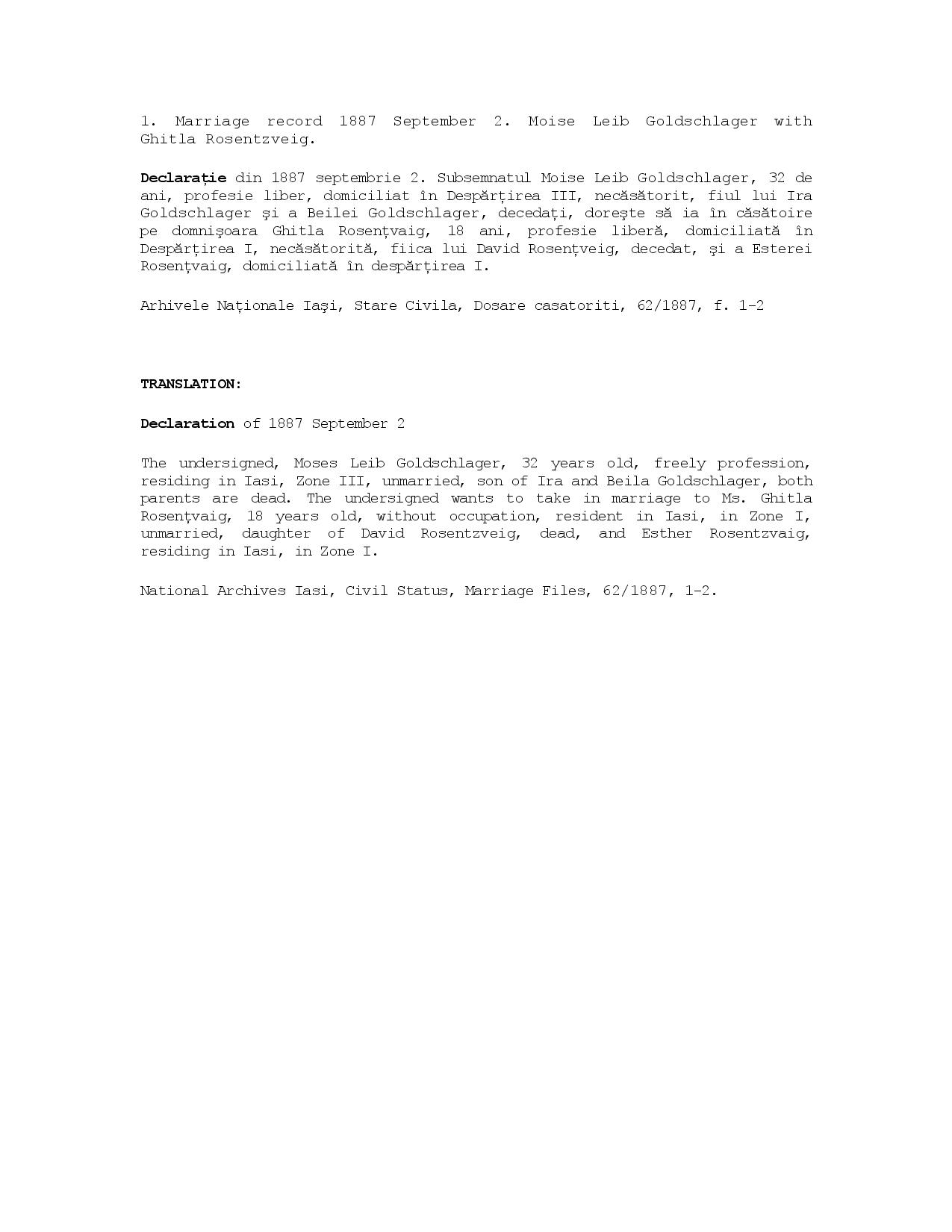
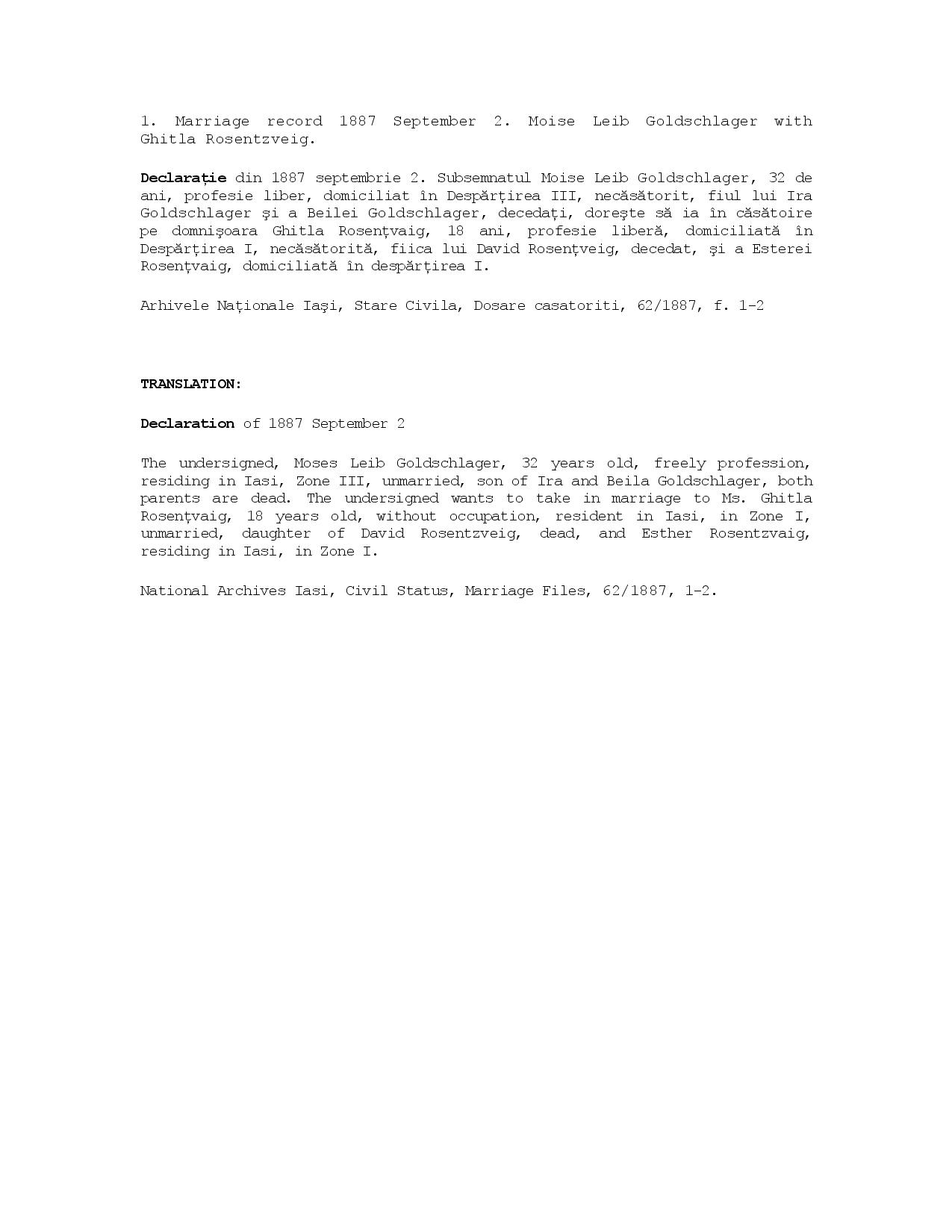
The next event for which I have any record is Moses’ marriage record dated September 2, 1887, when he was 32 years old.  Was this his first marriage? Thirty-two seems old for that generation to be married for the first time, but so far no earlier record has shown up.  Perhaps he was married before; perhaps he even had children in that first marriage.  I don’t know.  I don’t know what he was doing between 1855 and 1887, how he survived, where he lived, how he made a living.  But in 1887 he married my great-grandmother, Ghitla Rosentzweig, eighteen years old according to the marriage record, daughter of David and Esther Rosentzweig.  Her father also had died by the time she was married, but her mother was still alive and living in Iasi.  On the marriage record Moses’ occupation is reported as “freely profession,” as translated by my researcher.  I asked him what this means, and he said he believed it meant self-employed.  Since my great-grandmother is listed as “without occupation,” I assume that Moses had some occupation, but it is not identified.
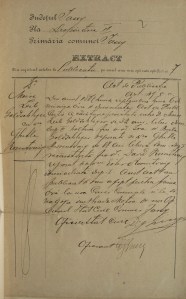
Moses Leib Goldschlager and Ghitla Rosentzvaig marriage record
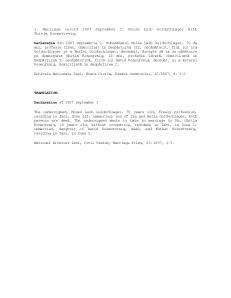
Moses Leib Goldschlager and Ghitla Rosentzvaig marriage record

Transcription and translation of marraige record

Transcription and translation of marraige record

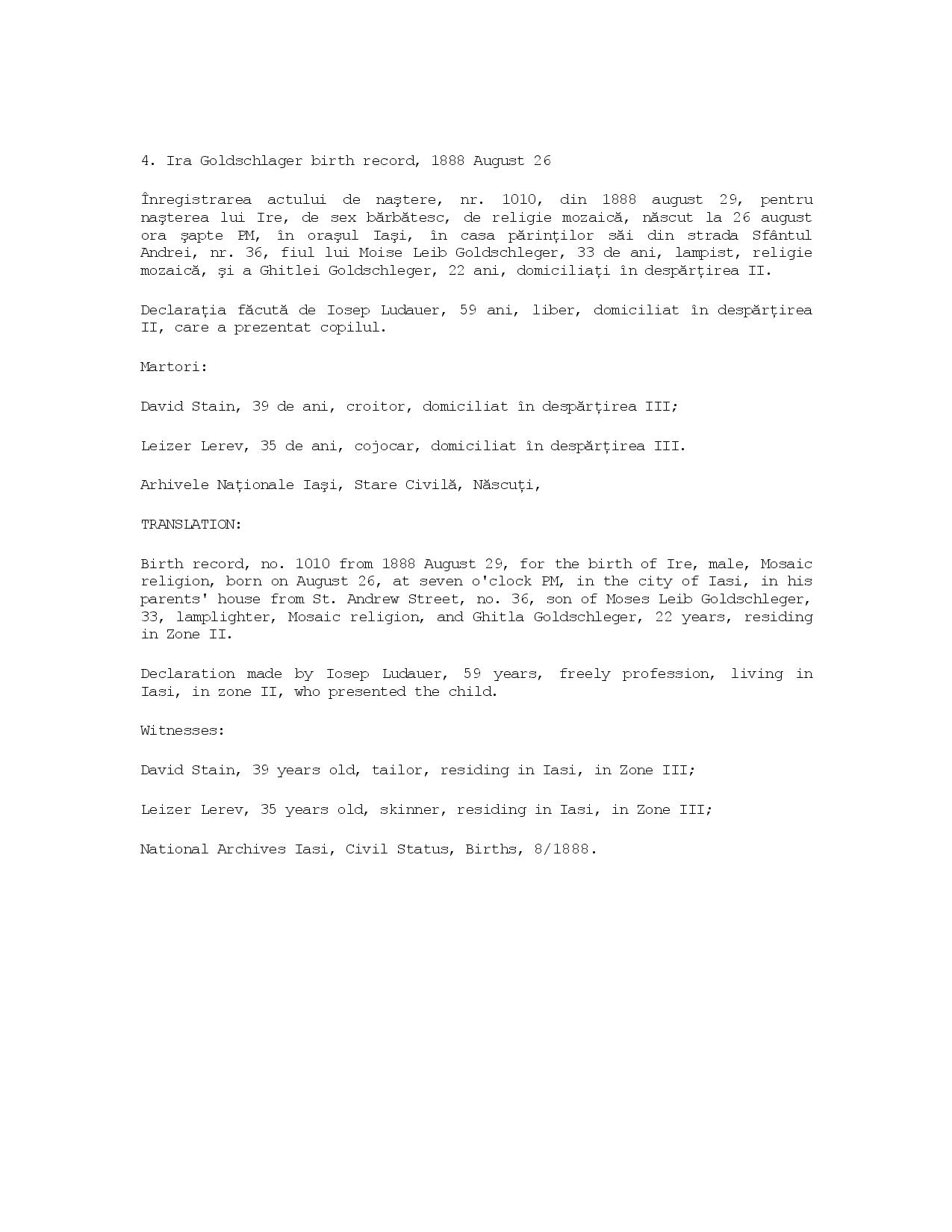
Their first child, my grandfather Isadore, was born in August, 1888, almost a year after Moses and Ghitla were married.  On his birth record, it says that Moses, now 33, was a lamplighter.  I assume this meant that he lit the gas lamps on the public streets.

UPDATE February 2, 2014:  I just learned today that he lit the lamps in the theater!! And that he was a very dapper dresser.  Thank you, Gayle, Betty’s granddaughter, who reported this information to me.

Interestingly, Ghitla is now reported to be 22, not 19.  (I guess Romanian record keepers faced the same inconsistent age reports as American census takers.)  My grandfather’s name is spelled Ire here, obviously named for Moses’ father Ira Goldschlager.
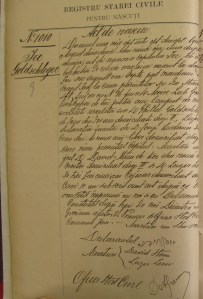
Ira aka Isidor Goldschlager birth record
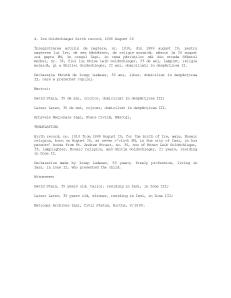
Ira aka Isidor Goldschlager birth record

transcription and translation

transcription and translation

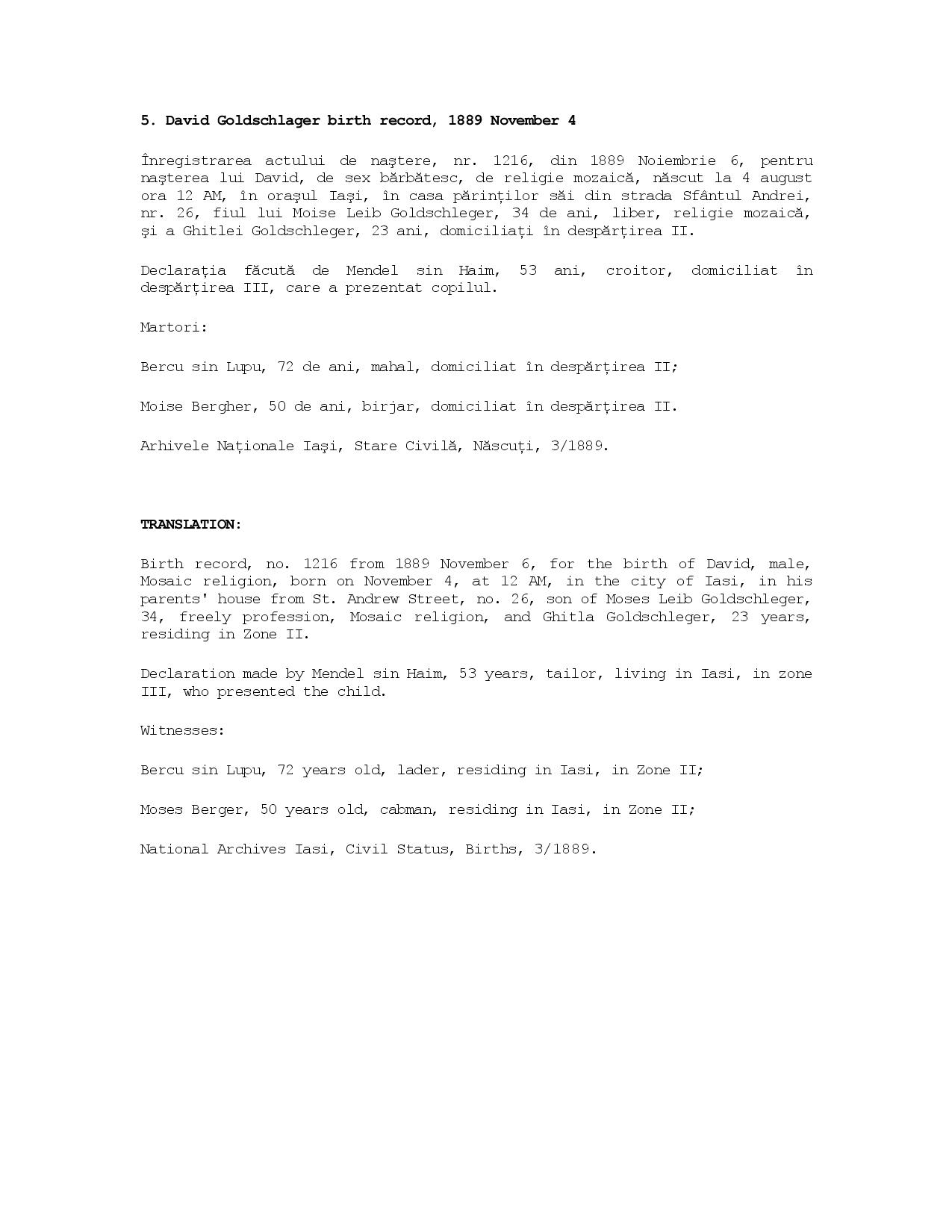
Moses and Ghitla’s second child David was born the following year on November 4, 1889. David was presumably named for Ghitla’s father, David.  Moses’ occupation is once again described as “freely profession,” and he is now 34, Ghitla 23.  The Goldschlager family was residing at the same house as the year before at 26 St. Andrew Street in Iasi, depicted below.

David Goldschlager birth record

David Goldschlager birth record

transcription and translation

transcription and translation

The Goldschlager home at 26 St Andrew Street, Iasi

The Goldschlager home at 26 St Andrew Street, Iasi

St_Andrew_Str_no_26_0001

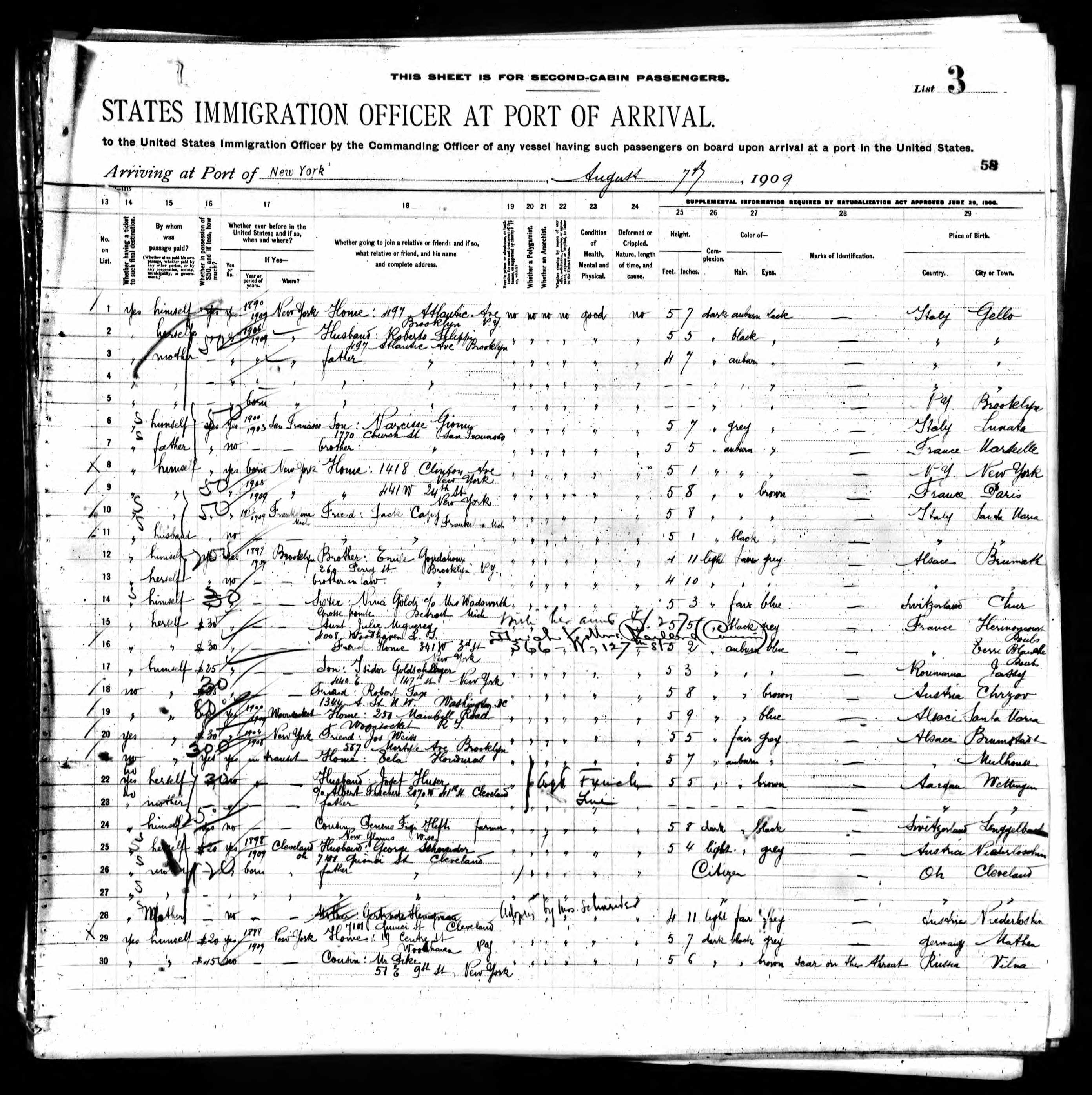
The next record I have for Moses is the ship manifest for when he left Romania and came to the United States.  He sailed from Le Havre on July 31, 1909, to New York.  On the manifest his name is given as Moritz Goldschlager with his occupation listed as a tailor.  It says he was 46 years old, which is about eight years younger than it should be.  It gives his nationality as Roumanian and his “race or people” as Roumanian, but then written over it is “Hebrew.”  Moses/Moritz named his wife Gisella Goldschlager of Jassy as the nearest relative from the country he was leaving and named his son Isidor, my grandfather, of 440 East 147th Street, New York, as the person he was joining at his destination.  The manifest also reveals that Moses was only 5’3” tall and had auburn hair and blue eyes.  That is probably the closest I will ever get to a picture of him.

Ship Manifest of Moritz Goldschlager

Ship Manifest of Moritz Goldschlager

page 2

page 2

UPDATE: I just realized that the 440 East 147th Street must be 110 East 117th Street, as that was the address that my grandfather have given for his aunt Zusia Mintz as the person meeting him when he came to NYC.  Plus 440 East 147th Street is in the Bronx, not Manhattan.

I wonder when he became Moritz, just as I wonder when my grandfather became Isidor (or Isadore; it seemed to change back and forth).  Were these names they used in Romania, or were they adopted to come to America? I assume the former—that Moses and Ira were Hebrew names, Moritz and Isidor secular names, but I don’t know for sure.

Moritz arrived in the United States in August, 1909, and then sadly, the next and last record I have for him is his death certificate, which I just received the other day.  As I’ve written earlier, Moritz died on April 3, 1910, just eight months after he arrived in New York, a day before his daughter Betty arrived, and seven months before his wife and his son David arrived from Romania.  They all arrived apparently without knowing Moritz had died, as they all listed him as the person meeting them at arrival.

I had wondered about his cause of death, and although I know that there is some question about the reliability of death certificates before the professionalization of the medical examiner’s office in the late 1920s, my great-grandfather died in a hospital according to his death certificate, and his death certificate is signed by a medical doctor, not a coroner.  According to the certificate, my great-grandfather died from tuberculosis after being admitted to Harlem Hospital on April 2, 1910.  I wonder how long he had been sick before coming to the hospital.

Moritz Goldschlager death certificate

Moritz Goldschlager death certificate

The certificate also provides some other information and, as often is the case, some misinformation.  It says that Moritz was a peddler, that he was married, and that he was 53 years old, which is closer to the truth than the age listed on the ship manifest.  It says his father’s name was Isidor Goldschlager, which, if true, means that my great-great-grandfather also used Isidor as his secular name and his Hebrew name was Ira.  But the certificate also says that Moritz’s mother’s name was Ghisela and then something that is not legible.  I assume that my grandfather was the informant and that he was confused and gave his mother’s name instead of his father’s mother’s name.

Finally, the death certificate indicates where Moritz and Isadore had been living—173-175 East 109th Street.  According to the 1910 census, this is the same street where Tillie Strolovitz and her seven children were living in 1910, just a few blocks away.  That census is dated April 24, 1910, just 21 days after Moritz had died, 20 days after Betty had arrived.  Isadore and Betty had moved in and were living with their aunt and cousins by that time, obviously taken in by their aunt Tillie shortly after their father’s death.

And that is all I know about Moses ben Ira, Moritz Goldschlager.  He lost his both his parents by the time he was six years old; he married at age 32, had three children, and worked for at least a while as a lamplighter and perhaps as a tailor in Iasi before emigrating in 1909.  He lived for less than a year in New York as a peddler before succumbing to tuberculosis at Harlem Hospital before he ever saw his wife, his younger son, or his daughter again.

Sometimes when I put together these missing links to people I never knew and who no one alive today ever knew, it makes me feel incredibly rewarded and happy.  Sometimes, as with Moritz, it leaves me feeling sad.  What kind of life did he have with so much misery at the beginning and then at the end? I can only hope that in between he found happiness and some comfort with his wife and three children.
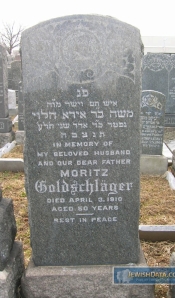
Moritz Goldschlager headstone

Moritz Goldschlager headstone

These lost ancestors are part of what motivates me to do this research.  Someone should know that they lived, they suffered, they loved and were loved, and they died.  Moritz had at least two namesakes: Isadore’s son, my uncle Maurice, also named Moses Lieb, and David’s son Murray, also Moses Lieb.  If we count the children who were then named for my uncle Maurice as namesakes of Moritz’s namesake, then there are several more, including my daughter Madeline.  I’d like to think that that adds more meaning to his life—knowing that his name does live on and that his life is now remembered and documented.

Enhanced by Zemanta

The Sisters Rosensweig[1]

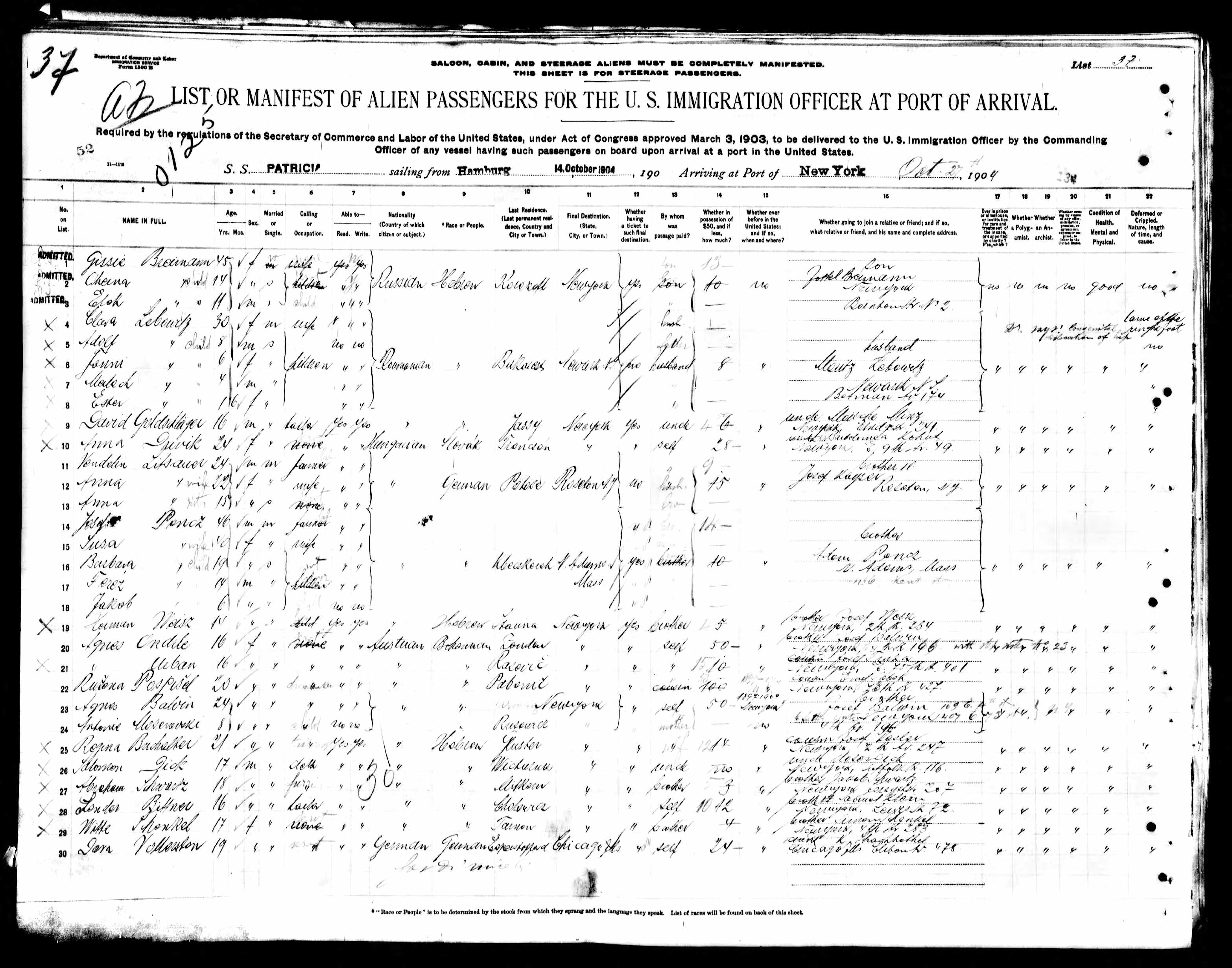
One of the things that confused me about the ship manifest for David Goldschlager, before I knew that it was really my grandfather Isadore on the ship using his brother’s name, was that David did not list his brother Isadore as the person meeting him in New York.  Instead, he listed an uncle whose name appeared to be Morishe (?) Mintz.  I had no idea who this was, and I could not turn up anyone on any document who might have been this mysterious uncle.  Also, if Isadore had arrived first, why wasn’t he meeting his brother David?

Isadore Goldschlager ship manifest (under David's name)

Isadore Goldschlager ship manifest (under David’s name)

Once I established that in fact Isadore was the one who had arrived on the Patricia in October, 1904, I went back to look more closely at the manifest and to search again for Uncle M. Mintz, with no luck.  I did, however, find a separate document that I had not seen before relating to Isadore’s (“David’s”) arrival at Ellis Island, a Record of Detained Aliens, shown below.

Record of Detained Aliens Isadore listed as David Goldschlager

Record of Detained Aliens
Isadore listed as David Goldschlager

I am familiar with this type of document now because I had seen the one issued for Gisella Goldschlager, who had listed her husband Moritz as the person meeting her.  Because her husband had died, she was apparently detained and released to her son Isadore instead.  It appears that the same type of occurrence detained my grandfather.  On the document it says the cause of detention was “to uncle,” and then in the next column for “Disposition,” it says “Aunt Zusie (?)  Mintz, 177 East 111th Street, New York City.”  From this I surmised that something prevented Uncle Mintz from meeting Isadore and that instead his wife Zusie had picked him up instead.

That led to a search for the aunt and uncle.  I could not find any M  Mintz on the 1900 census from Romania who could fit.  I searched the NYC marriage index and also had no luck—until I searched for all men named Mintz who had married between 1880 and 1904.  I checked every one of them to see what their bride’s names were and was excited when I found a bride named Zusia ROSENSWEIG married to a Harry Minz in 1896.  Could this be a third Rosensweig sister?

If so, she would have been the youngest sister, about 14 years younger than Tillie, ten years younger than Ghitla/Gisella.  Why would she have left Romania first and not her older sisters? Her sisters did not arrive until 1907 and 1910, respectively, when they were already married and had children.  But Zusia was still single, and thus more able to pick up and leave earlier, as did her nephew Isadore at age sixteen.

Harry and Zusia were married in 1896, so I looked again on the 1900 census using the name Harry with a wife with a name that could be Zusia.  No luck.  I decided to look just for an S or Z Mintz and found a Sonsa Mintz, a widow, living with Jason and Rachel Reitman and their one year old daughter Clara.  Sonsa was identified as a cousin of the head of household and as a widow.  Assuming that this is the same woman who had married Harry Mintz, it means that her husband died less than four years after they were married.  It obviously would explain why he was unable to meet Isadore/David at the boat in 1904. I have not located a death certificate for Harry, however, nor do I know for sure yet that Sonsa is the same person as Zusia or really the sister of Tillie and Gisella.

Unfortunately, I cannot find a Sonsa, Zusia, Susan, or Susie Mintz in any later census.  I did find a reference for a Susie Mintz who died in the Bronx in 1931 and is buried in New Jersey, but I do not know if this is the same person.  I will order the death certificate to see, but at the moment I have no other records for Sonsa Mintz after 1900.  I assume she may have remarried, but I did not find a marriage record either.

The only other possible record relating to the third Rosensweig sister is a ship manifest listing an eighteen year old girl named Sural Rosensweig from Romania, arriving in New York on September 30, 1890.  The age and name are close enough that it could be the same person, but I cannot know for sure.  (On the 1900 census, Sonsa Rosensweig’s birthdate is April, 1874, and her arrival date is 1891, whereas on the manifest her birth year would have been 1872 and arrival year 1890.)

Although I’ve hit a wall so far with Sonsa and with Harry, her husband, I did look to see if I could figure out how Sonsa was a cousin to the Reitmans.  Was it through Harry? Through Jacob or through his wife Rachel? Although I was able to find a number of records for the Reitmans, up through their great-grandchildren, I have not yet figured out the relationship.  They, like Sonsa, were from Romania, but beyond that, I have no clues.  I have sent an email to one of the great-grandchildren, but it seems quite unlikely that they would know anything about a woman named Sonsa Mintz who lived with their great-grandparents in 1900.

I will have to hope that the 1896 marriage certificate for Harry Mintz and the 1931 death certificate for Susie Mintz have some clues.


[1] With apologies to Wendy Wasserstein.  No connection to her play is intended….

Enhanced by Zemanta

The Schwartz Family: Updates, Documents and Pictures

First, a few comments about my last post about the Schwartz family.  My mother pointed out to me that David Goldschlager’s wife Rebecca was always called Becky, not Rebecca. Richard, her grandson, confirmed this, so from now on I will refer to her as Becky.  Also, both my mother and Richard described Becky as a warm, outgoing person with a wonderful laugh (and a great apple strudel, according to Richard.)  Looking at the wonderful pictures below, I can see that Becky came from a large, but close family, and that despite losing two brothers and overcoming the adjustments to living in America, there must have been happy times in their childhood here.

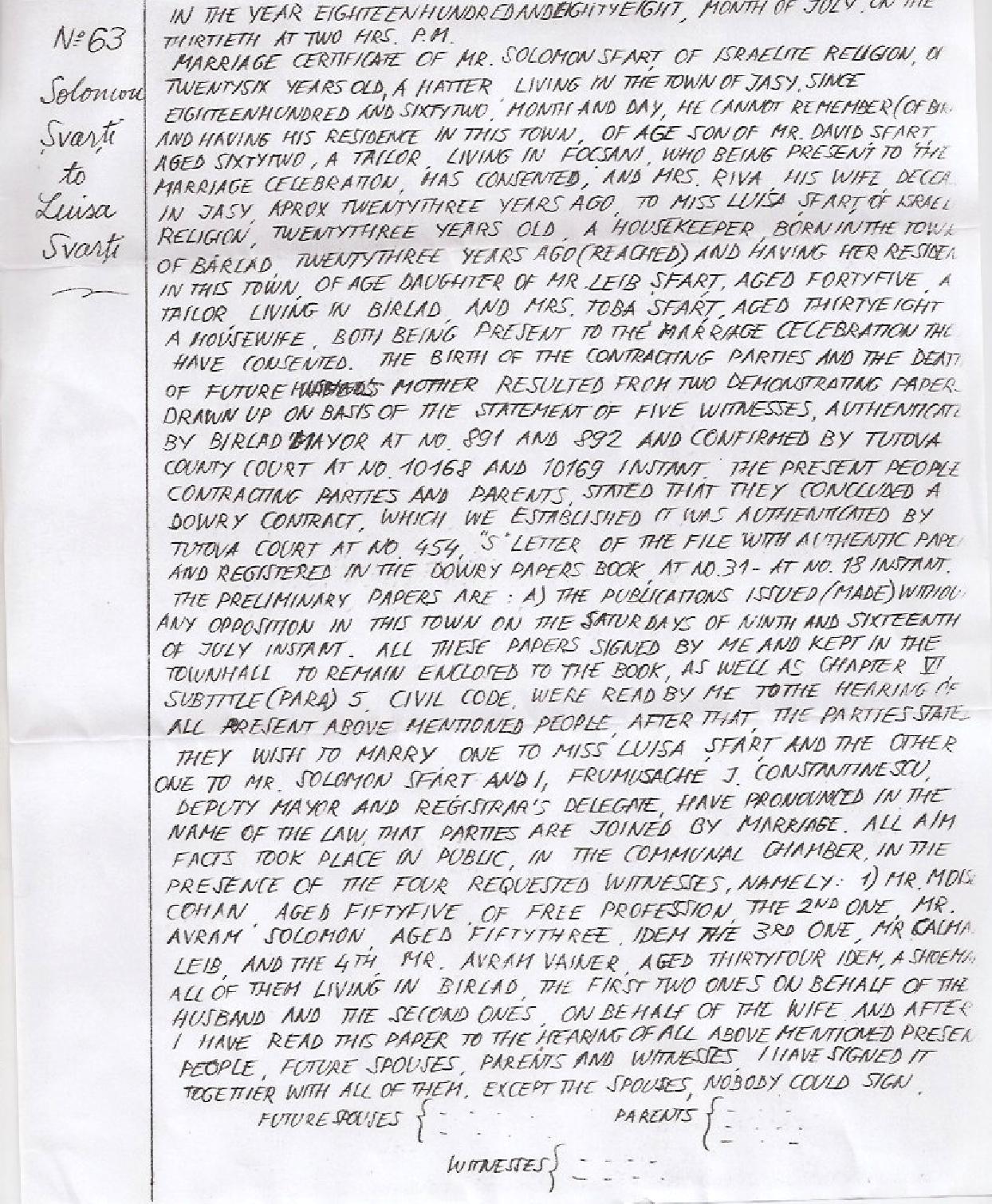
Thanks to Jon Schwartz, Becky’s nephew, I have some wonderful documents and photographs to share of the Schwartz family.  First, Jon has shared the marriage certificate of his grandparents Solomon Schwartz and Louise Schwartz, or Solomon Svarti to Luisa Svarti in Romanian.  Here is the English translation:

Marriage record for Solomon and Louise Schwartz 1888

Marriage record for Solomon and Louise Schwartz 1888

Two things are interesting here.  First, Jon wonders whether his grandparents were cousins since both had the surname Sfarti before they married, just as we believe that Joseph and Bessie Brotman were related, both sharing the same surname before marriage.  It was apparently not uncommon for families to arrange marriages between cousins.  Also, note that Solomon was from Jassy (Iasi), and Luisa from Berlad.  According to Google Maps, the two cities are about 80 miles apart and would take even today two hours to travel between.  It seems unlikely that Solomon met Luisa without some prior arrangement so a family connection makes sense.

It’s also interesting that Solomon came from Iasi.  Perhaps he knew the Goldschlager family growing up, which might explain how David Goldschlager ended up marrying Solomon’s daughter Becky.  What makes this seem a bit more possible is the fact that Solomon was a hatter even in Romania.  Although David was born after Solomon had married and left Iasi, it is interesting that David, a hatter from Iasi, ended up marrying the daughter of Solomon, a hatter from Iasi.

Jon also sent me the birth certificate, both in Romanian and in English, for Rebecca (Becky), Solomon and Luisa’s first child, born in April, 1889, ten months after their wedding.  Here is the English version below:

Rebecca Schwartz birth certificate translated

Rebecca Schwartz birth certificate translated

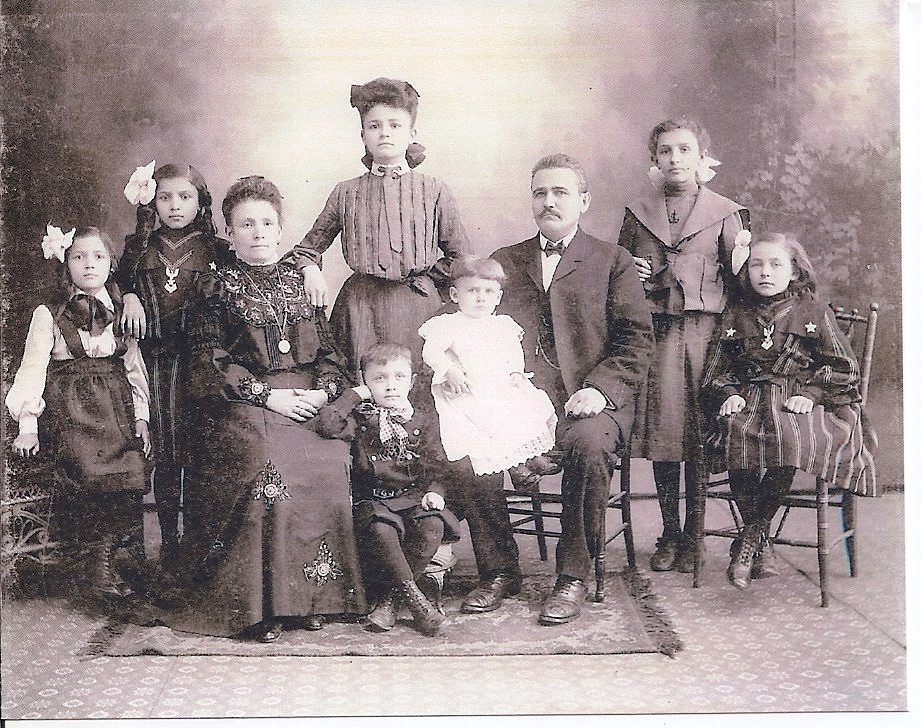
Jon also has some wonderful photographs of his father’s parents and siblings.  My favorite is this one, depicting the Schwartz family probably a year or so after they arrived in Newark.

The Schwartz family c. 1905

The Schwartz family c. 1905

From left to right, they are Sophie, Annette, Louise (sitting), Becky, Abram, Solomon, Meyer, Etta and Rose.

Jon thought that the baby was Jennie, the Schwartz’s youngest child born in 1907, but since the picture does not include the other child born in the US, Meyer, who was born in 1904, I think the baby is Meyer.  Also, the ship manifest said Abram was two at the time they left Romania(1903), and in this picture Abram (the little boy leaning on his mother’s knee) looks too young for him to be six or seven, which he would have been when Jennie was a baby in 1907.  I would date this picture between 1904 and 1905, and I believe that the baby is Meyer, the poor little boy who died of a burst appendix when he was nine years old.

The other Schwartz children all grew to adulthood, Abram becoming Arnold, the only brother among six sisters.  He had a painting business for some time, but when it failed during the Depression, he became a route salesman. He had two sons, Stephen and Jonathan. The sisters all married except for Sophie, and all but Jeanette had children.  Here are two pictures of the Schwartz sisters, courtesy of their nephew Jon.

Rose Schwartz

Rose Schwartz

Schwartz sisters 1956

Schwartz sisters 1956

Sophie (aka Sherry), Jeannette, Rebecca, Etta, Rose, Annette

Enhanced by Zemanta

Update: The Strolowitz/Adler Family, My Grandfather’s Cousins

As I have written, in 1910, after my great-grandfather died the day before his daughter Betty arrived and before my great-grandmother and her son David arrived, Betty and her brother Isadore lived with their aunt Tillie Rosensweig Strolovitz and her seven children on East 109th Street in New York City.  Tillie had arrived with her husband Itic Yankel Srulovici and their three youngest children, Beckie, Pincus and Leah, in late December, 1907.  Their four oldest children had left Iasi, Romania, before them: Isidor in 1901, Bertha and Bella in 1906, and David in January, 1907.

Leah Adler c. 1920

Leah Adler c. 1920

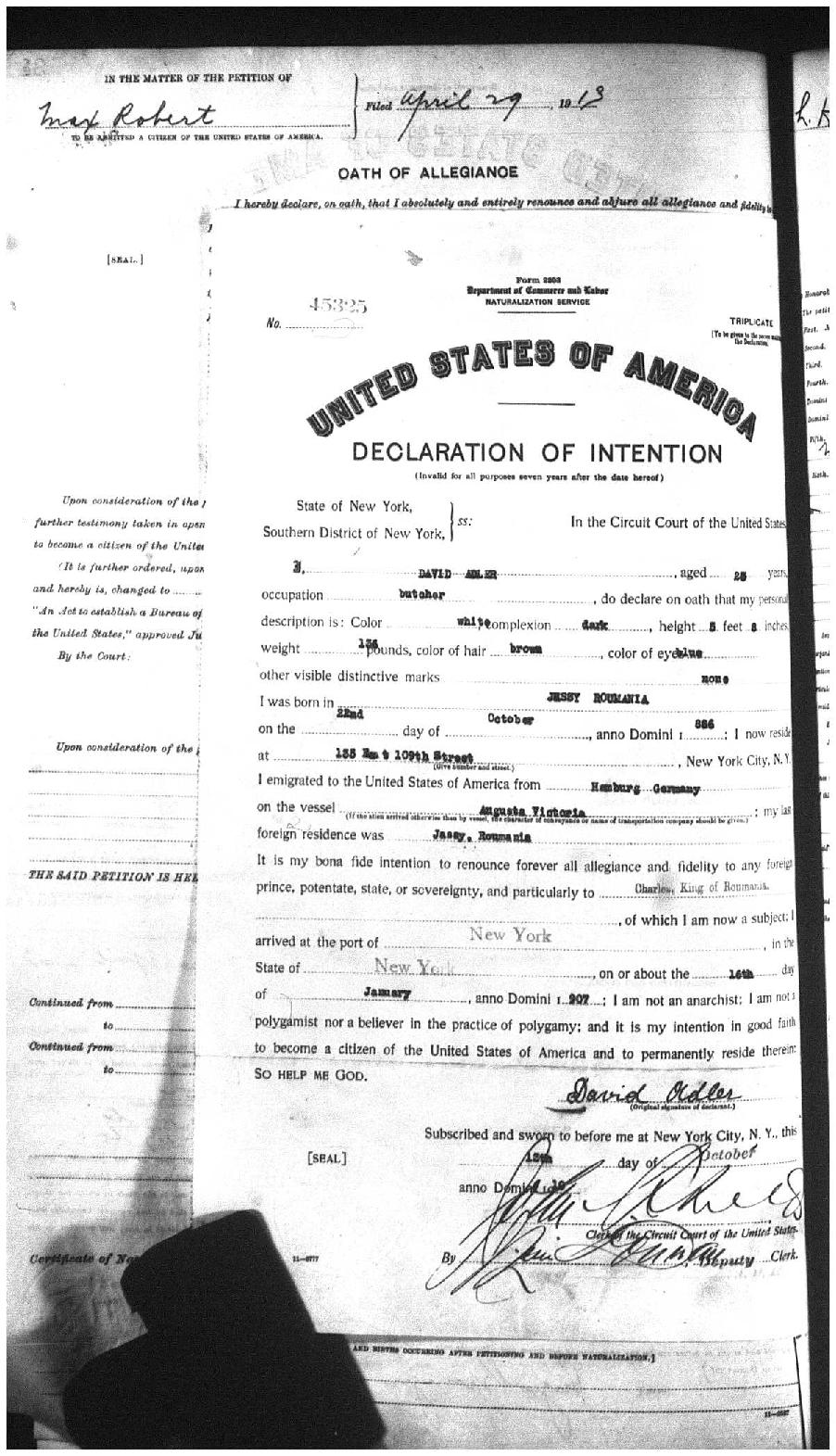
Although I have not yet found a ship manifest for Isidor, the oldest child, I do now have manifests for all the other members of the family, having just located David’s last night.  Among the many documents I received this week were David’s naturalization papers, which provided his date of arrival and the name of the ship.  Although his first name was partially torn off the paper, with a little trick of the trade I learned from Renee, I was able to obtain a copy of the ship manifest as well.  David is listed as “…vid Stubowicz” on the manifest, yet another variation on the family name.  He named his brother, Israel (presumably Isidor) Stubowicz, as the person paying for his ticket and meeting him in New York.   Interestingly, although David’s certificate of arrival has his name as Strubewicz, his petition for naturalization was made under the name David Adler.

David Adler petition for naturalization

David Adler petition for naturalization

I had already found the manifests for Bertha and Bella and for Tillie, Jacob and the other children, and interestingly, every member of the family used some variation of Srulovici/Strubowicz/Strolovitz on the manifests, not Adler.  It appears that the Adler name was not used officially by the family until after they came to the United States.  Whether Isidor had already adopted it and then the others eventually followed I do not know.  In 1910, we know that only David and Isidor were using Adler, but as already discussed, eventually every member of the family was using it at least part of the time.

David Adler and his wife Bertha

David Adler and his wife Bertha

In addition to David’s naturalization papers, I received several other documents related to the Adler family.  (For simplicity sake, I will refer to them as the Adlers, except where the Strolowitz name is relevant for a particular reason.)  I had hoped to find something that would help me learn what had happened to Jacob. To recap what I already knew and did not know, I had not found any record of Itic Yankel after the ship manifest of 1907, and family lore said that he had never left Ellis Island.  The ship manifest, however, indicated that he was admitted, after being briefly detained for a doctor’s examination of his eyes.  There is no record of deportation.  I thought perhaps that he had died shortly thereafter, and I ordered the death certificate of the only Jacob Adler I could find who might fit in terms of age and year of death.  I now have that certificate, but unfortunately it was not for the correct Jacob Adler.  The certificate is for a Jacob Adler from Germany who had been in the US since 1880 at the time of his death in 1910.  So I still have no answers to the question of what happened to Jacob, Tillie’s husband.  I am awaiting his immigration papers from the National Archives and hope that they will provide some clues.

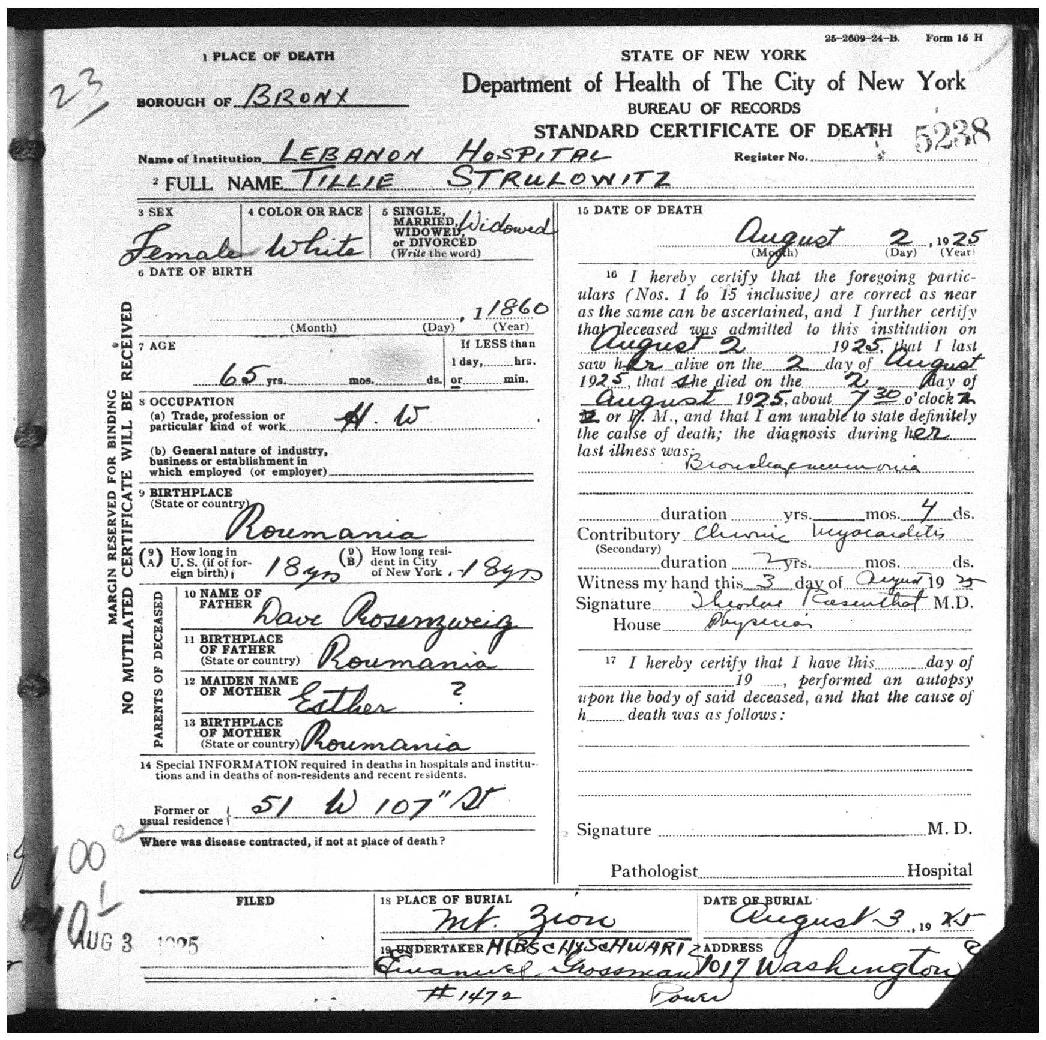
I had requested several other documents in order to confirm what I assumed was true: that Tillie was the sister of my great-grandmother Gisella Rosensweig and that Itic Yankel Srulovici and Jacob Adler were the same person and the father of all of the seven children.  Not surprisingly, they all do confirm one or both of those facts.  First, Tillie’s death certificate lists her parents as David and Esther Rosenzweig (no maiden name for Esther, unfortunately), my great-great grandparents, confirming that Tillie was my great-grandmother Gisella’s sister.  Her death certificate was witnessed by her son David, signing as Strulowitz, confirming that Yankel Srulovici was his father and not some other husband named Adler.  (Tillie is also a Strulowitz on the certificate.)

Tillie Strulowitz death certificate

Tillie Strulowitz death certificate

Second, Isidor’s death certificate confirms that he died young—in 1915 of liver cancer at age 31. Although he is identified as Isidor Adler, his parents’ names are given as Tillie Rosenzweig and Jacob Strulowitz. Bertha’s marriage certificate gives her parents’ names also that way, with Bertha also now using Strulowitz.  On the other hand, Leah’s marriage certificate uses Adler and lists her father’s name as simply Jacob (and her mother as Tillie Rosensweig). Finally, David’s death certificate gives his father’s name as Jacob Adler (and David’s name as David Adler), and his mother’s as Tillie Rosensweig.  Certainly this is enough documentation to prove that Jacob Adler and Yankel Srulovici were the same person and the father of the seven children.

Isidor Adler death certificate

Isidor Adler death certificate

Thus, many open questions were answered by these latest documents, but there remains still the question of what happened to Jacob Srulovici/Strolovitz/Strulowitz/Adler after he arrived at Ellis Island.

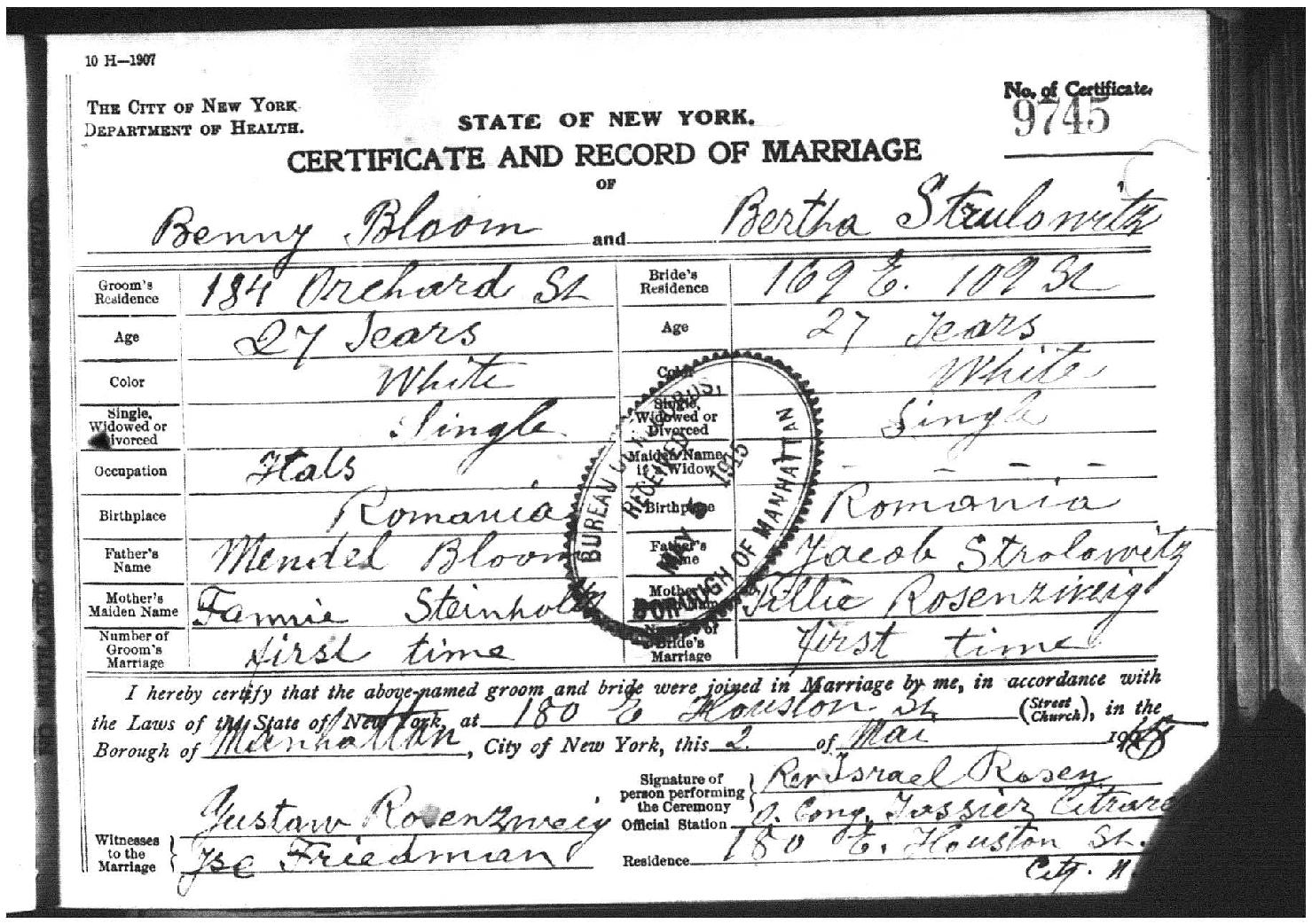
In addition, the marriage certificate of Bertha contains the signature of a Gustav Rosenzweig as a witness to the marriage.  Could this be Tillie and Gisella’s brother? Or a nephew? Cousin? And thus begins yet another search for a possible member of the extended Goldschlager-Rosensweig family.

Bertha Strulowitz marriage certificate witnessed by Gustav Rosensweig

Bertha Strulowitz marriage certificate witnessed by Gustav Rosensweig

Enhanced by Zemanta

Update: My Grandfather’s Arrival

Statue of Liberty National Monument, Ellis Isl...

Statue of Liberty National Monument, Ellis Island and Liberty Island, Manhattan, in New York County (Photo credit: Wikipedia)

Yesterday I received eight new documents, and I will report on them all over the next couple of days.  But for me, the most exciting document is my grandfather’s naturalization application.  It is always touching to see a document written in the handwriting of someone who means a lot to you, so that alone would have made it exciting.  It’s also exciting to see the names of my grandmother and aunt and uncle on his petition.  It’s exciting to see his distinctive signature.

But what made these pages particularly exciting is that they resolved a question that has been unanswered for a long time.  A number of years ago my brother tried to find the ship manifest for our grandfather Isadore at Ellis Island.  He was able to locate the manifests for David, Betty, Moritz and Gisella, but not Isadore.  When I started my own research almost two years ago, I also tried to find something that documented when Isadore arrived in New York, but found only the same information that Ira had found.  I had given up and moved on to other things.

When I returned to researching the Goldschlagers a few weeks ago, I once again looked, figuring that with my improved research skills and newer research tools, maybe I would finally find a ship manifest for my grandfather, but once again, nothing turned up.  I resigned myself to the idea that I would never find a record for his arrival.

Then the other day, as I wrote in my post entitled “Isadore and David Goldschlager: More than Brothers,” I realized that there were two ship manifests for David Goldschlager: one dated October 27, 1904, and the other dated November 4, 1910.  I also realized that it was the later one that was accurate.  Every other document said David had arrived in 1910: his naturalization papers, several census reports, and his wife’s naturalization papers.  It also made sense that David had waited with his mother and sailed with her to America.

That left me thinking that the David Goldschlager on the 1904 manifest was not David, but Isadore, my grandfather.  That manifest was for a ship called the Patricia, sailing from Hamburg, and arriving in the United States on October 27, 1904.  I was hoping that Isadore’s naturalization papers would reveal what ship brought my grandfather to America.  I hoped that I had finally found the evidence of how and when Isadore traveled to his new home.

Well, I opened the naturalization papers today, holding my breath, scanning quickly to see if the answer was revealed.  And there it was: Isadore wrote that he arrived on October 28, 1904, on the Patricia, sailing from Hamburg.  Isadore had in fact used his younger brother’s name to escape from Romania.

Isadore Goldschlager naturalization papers page 1

Isadore Goldschlager naturalization papers
page 1

page 2

page 2

page 3

page 3

I was always told that he left Romania to avoid the draft.  He turned sixteen in August, 1904, and was presumably then draft age.  David, on the other hand, was a year younger and would not turn sixteen until 1905.  Perhaps Isadore took David’s passport to get out of Romania.  Or maybe he just used his name.  (That leaves me wondering how David managed to stay safe until he left in 1910, but I am afraid we will never know the answer to that question.)

When I told my mother what I had found, she said that she was not surprised that her father figured out a way to get out of the country.  He was a very clever and resourceful man who knew how to get what he wanted.  He used his wits to survive.  As one of his namesakes who never knew him likes to say, “If at all possible, lie.” It seems that that approach may have saved our grandfather’s life and enabled his three children, his nine grandchildren, his fourteen great-grandchildren, and the ever-increasing number of great-great grandchildren to come into this world.
Thank you, Grandpa, for being so clever and for escaping Romania, and thank you, David, for letting him borrow your name.

SS Patricia, the ship that brought my grandfather to America

SS Patricia, the ship that brought my grandfather to America

Enhanced by Zemanta

The Schwartz Family

As I wrote yesterday, in trying to fill the holes in David Goldschlager’s story, I ended up researching his wife Rebecca’s family and their story.  Although her family is not technically related to mine except through marriage, now that I am in touch with her grandson Richard (and now, her nephew Jon), I feel connected to this story and touched by it as well.

As I wrote in the last post, I was curious as to why David and Rebecca left New York City sometime after 1920, when David’s mother and sister were living with them, and moved to Scranton, Pennsylvania.  Their son, Murray, was born there,[1] and they were living in Scranton as late as 1928 because that is where David was living when he filed his naturalization application.  By 1930, however, they had returned to New York and were living in the Bronx, where they lived until they retired and moved to Arizona to live near Murray and his wife Edna and their grandson Richard.

I hypothesized that Rebecca’s family lived in Scranton because I could not figure out what else would have drawn David away from his family and place of employment.  As I wrote last, I started digging around for Rebecca’s family, and after learning her maiden name was Schwar(t)z from her naturalization form, I was able to locate the ship manifest for Rebecca and her family on the SS Astoria, sailing from Glasgow, Scotland in March, 1903.

Schwarz Family on the SS Astoria 1903

Schwarz Family on the SS Astoria 1903

The family was from Romania, and Rebecca was one of seven children on the manifest, traveling with her mother Louise.  Rebecca was the oldest child, thirteen years old, followed by Etta (11), Annette (9), Rosa (7), Sophie (4), Abram (2), and Henrie (9 months old).  Henrie’s name had a line drawn through it, and in the left margin next to Henrie’s name, it looks like the word “died” followed by some other illegible words were written.  It looked like Henrie, the baby, had died on board.  Imagine being the mother of seven young children, caring for them on this long, uncomfortable voyage, and losing one of your children while at sea.[2]

The manifest also identified who was meeting the family in the United States: their husband and father S. Schwarz of Newark, New Jersey.  By searching the 1910 US census, I was able to locate the Schwartz family in Newark.  Rebecca’s father’s name was Solomon, and he was employed as a hat finisher in a hat factory.  He and Louise (Lizzie, on this census) were living with their six children who had survived the trip from Romania plus two more born in New Jersey, Meyer and Jennie.  Rebecca was now 20 and, like her father, working as a hat finisher in a hat factory.

The Schwartz Family in Newark (Rebecca standing in the rear middle)

The Schwartz Family in Newark (Rebecca standing in the rear middle)

Is this how she met David? As a hat maker? Did the factory where she and her father worked have a connection to the factory where David was working? David had been working as a hatter since at least 1915, as indicated on the 1915 NYS census. On his World War I draft registration dated June 5, 1917 (after he and Rebecca were married), David listed his employment as a hatter for Sam Burk at 419 Lafayette Street, New York.  Who knows? Maybe there was a hatmakers union meeting where Rebecca and/or her father met David.  At any rate, they were married in Newark in 1916, but lived in New York City as of the 1920 census.

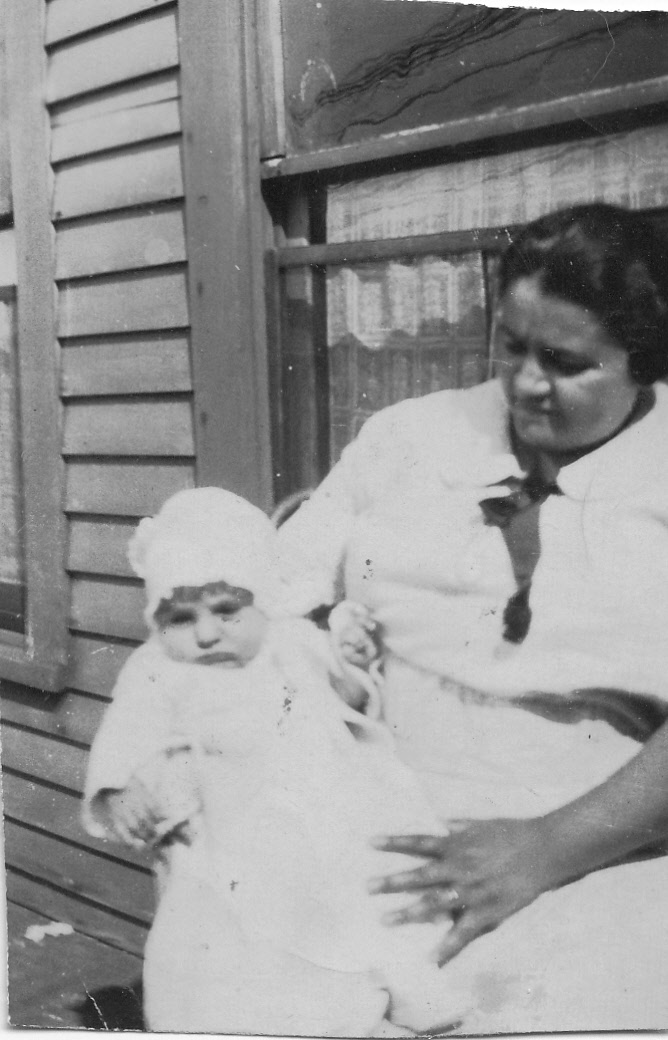
Rebecca and Sidney Goldschlager

Rebecca and Sidney Goldschlager

Meanwhile, the Schwartz family had suffered another tragedy.  On the 1920 census, I noticed that although Etta, Annette, Rosie, Sophie, Abram (now Abie), and Jennie were still listed as living at home, there was no entry for Meyer, who had been only six years old in 1910.  I had to assume that something had happened to Meyer, and I learned from Jon Schwartz, one of Solomon’s grandsons, that Meyer had died from a ruptured appendix in 1913 when he was not yet nine years old.  As Jon said, his father Abram (who became Arnold) was the only son of Solomon and Louise to survive to adulthood.

In 1930, most of the Schwartz family was still living under one roof: Solomon, Louise, Annette, Sophie, Arnold (formerly Abram), and Jeanette (formerly Jennie).  I don’t know where Etta and Rosie were, perhaps they were married.  Sadly, Solomon Schwartz died three years later at age 71.  Louise died in 1948.  I have not yet traced what happened to the Schwartz children after their father died, although by 1933, even the youngest child would have been in her twenties.  I am hoping to learn more from Jon, who is Arnold’s son and who I was able to contact by finding his family tree on ancestry.

One other interesting fact that I did learn from Jon is that Solomon Schwartz had lived in Iasi before marrying Louise, who was from Berlad.  He then moved to Berlad where their first seven children were born before they emigrated to the United States.  Maybe that led to the connection between Rebecca and David? Maybe the Schwartz family in Iasi knew the Goldschlager family, and perhaps when Solomon was looking for a match for his oldest daughter Rebecca, he reached out to people from the American Iasi community and found David, a fellow hatter, newly arrived from America and the same age as his daughter. There is likely no one alive who knows how David and Rebecca met, so all we can do is speculate, creating stories to fill the gaps between the data we can find through these documents.

Meanwhile, despite all these discoveries, I still don’t know why David and Rebecca ended up in Scranton, Pennsylvania.  So far all I know is that there were two hat companies in Scranton at the time, the Lackawanna Hat Company and the Keystone Hat Company.  There were also two families named Goldschlager living in Scranton at that time.  So maybe these Scranton Goldschlagers were also our relatives?

Washington Avenue, Scranton, Pennsylvania, Uni...

Washington Avenue, Scranton, Pennsylvania, United States. (Photo credit: Wikipedia)

The research continues….


[1] It appears that Sidney was born in Newark, NJ, in 1925, according to his mother’s naturalization form and the 1940 US census.  However, on David’s naturalization, it says both sons were born in Pennsylvania.  The 1930 census says both were born in New York, which must be wrong.  So perhaps they were living in Newark when Sidney was born and then returned to Scranton, assuming that Rebecca and the 1930 census are correct as to where Sidney was born.

[2] According to Jonathan Schwartz, one of the grandchildren of Solomon and Louise Schwartz, Henrie never left Europe, but this seems inconsistent with this manifest as well as a separate document listing passengers on the SS Astoria for this voyage.  Henrie’s name appears on both.  Maybe the family could not bear the truth and created a story that Henrie continued to live in Romania.

Enhanced by Zemanta

Isadore and David Goldschlager: More than Brothers?

Yesterday I decided to try and fill some of the gaps in David Goldschlager’s history.  I had his birth record from Iasi, saying he was born November 4, 1889, a year after my grandfather, and the ship manifest from the Patricia saying that he had arrived on October 27, 1904.  But then there was a big gap.  He did not appear on the 1905 New York State census, although I had found Isadore, living alone in Manhattan.  Nor did David appear on the 1910 census, although both Isadore and Betty were living with their aunt Tillie Strolovitz and her seven children.  But where was David? It made no sense to me that he was not living with his family in either 1905 or 1910.  He first shows up on an official census in 1915, when he was living with his mother Gittel/Gisella and his siblings Isadore and Betty.

Also, I was curious as to how and why he ended up living in Pennsylvania when Murray was born in 1922.  I had not yet found a marriage record for David and Rebecca, although I knew they were married by 1917 because David so reported on his draft registration card filed that year.  Also, the 1920 census had them living in Manhattan.  I also knew that David had been working as a hat maker since at least 1915 because that was his occupation listed on the 1915 New York census, as it was also on his draft registration and the 1920 census and each one thereafter.  So what took him to Scranton?

I thought perhaps that Rebecca was from Scranton, so I started searching for her records.  I did not know her maiden name, and I could not find any record of their marriage in the NYC marriage index.  I was stumped.  But then I found her naturalization papers, and they were a goldmine of information.  From these papers I learned that Rebecca’s maiden name was Schwar(t)z, that she was born in Berlad, Romania, on April 29, 1889, that she had arrived in March, 1903 on the SS Astoria via Glasgow, and that she had married David Goldschlager on February 20, 1916, in Newark, New Jersey.  I also confirmed that their son Murray was born in Scranton, PA, and that Sidney was born in Newark, New Jersey.

Rebecca Goldschlager's naturalization papers

Rebecca Goldschlager’s naturalization papers

From there, I was able to find Rebecca’s family on the SS Astoria ship manifest and find the names of her mother and many siblings and the name of her father Solomon Schwartz, who was meeting them and resided in Newark, New Jersey.  When I followed up with census reports for the Schwartz family in Newark, I learned that Solomon was, like David, also a hat maker.  Perhaps David had met Solomon in the circles of the hatmaking trade, and Solomon had then introduced David to his daughter Rebecca? It now made sense why David had gotten married and at one point lived in Newark, but why Scranton? I am still trying to figure that out.

Rebecca’s family’s story is itself worth telling, and I will in my next post.  But for me personally, the bigger story comes back to David and Isadore.  While reviewing Rebecca’s naturalization papers, I noticed that it said that David had himself arrived in New York on November 4, 1910, not October 27, 1904, as reported on the ship manifest for the SS Patricia.  I thought either that it was a clerical mistake or a memory mistake and dismissed it.  But then I looked back at a few of the census reports for David and Rebecca and noticed that on those reports as well, his arrival date was reported as 1910, not 1904.  I had also earlier dismissed that as an error.  But now I was starting to wonder—how likely was it that the same 1910 date was reported so many times and yet wrong?

I went back to look at the naturalization papers I had for David and saw that those also reported his arrival date as November 4, 1910.  Now I was really puzzled.  When I first found David’s naturalization papers, I had not focused on this, nor did I realize then that there is a second page to the naturalization papers.  I turned to the next page and found this:

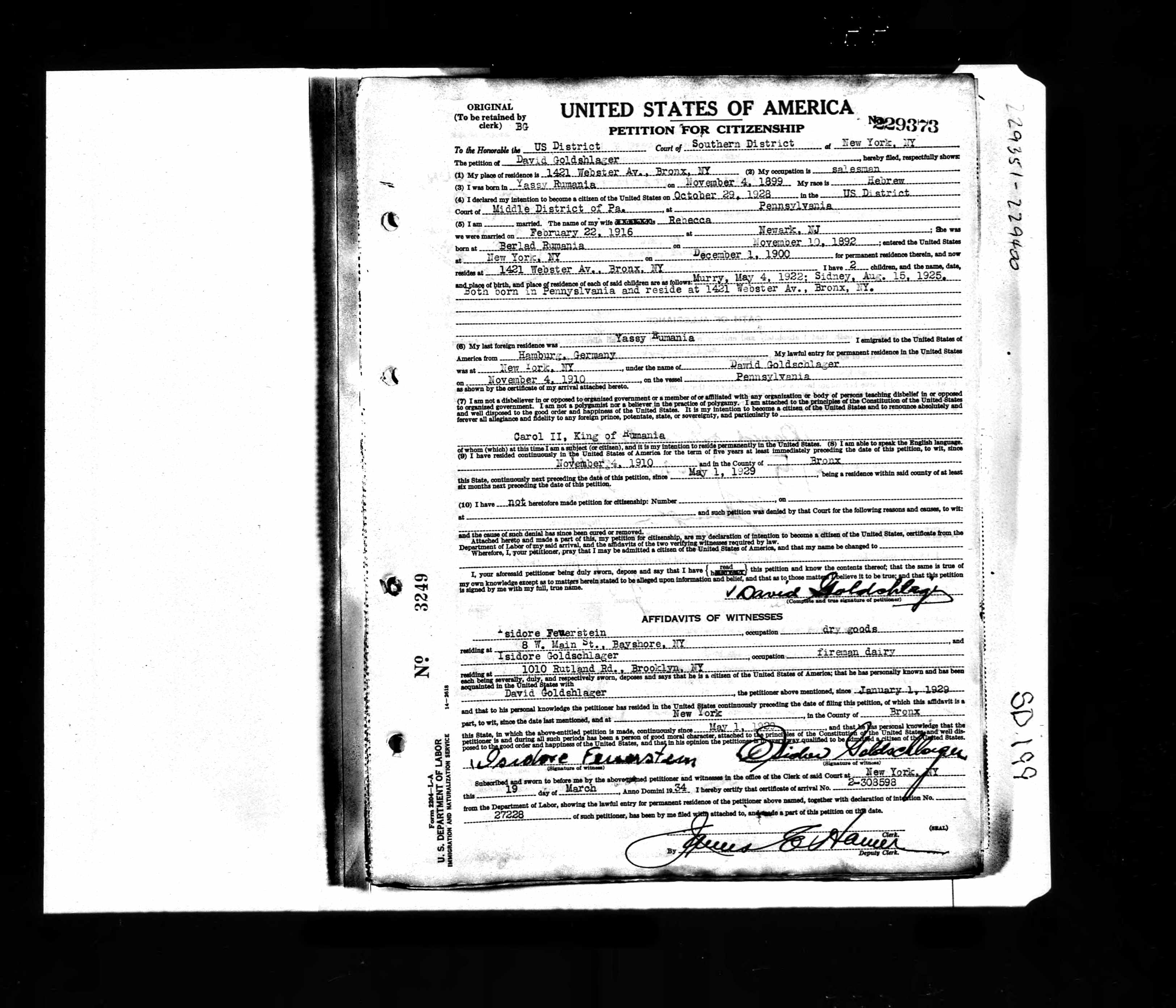
David Goldschlager Naturalization Record

David Goldschlager Naturalization Record

First thing I noticed was that my grandfather Isadore had signed David’s application with his very distinctive and florid signature; the second witness was Isidor Feuerstein, Betty Goldschlager’s husband.  Then I looked more closely at the information provided on the form.  It clearly said that David had arrived on the SS Pennsylvania from Hamburg on November 4, 1910.  Now I was convinced that the 1904 date must be wrong.

I searched for the manifest for the SS Pennsylvania arriving in NYC on that date, and sure enough I found David’s name, indicating that he was being met in New York City by his father Moritz Goldschlager.  Only then did my slow brain react and realize that this was the very same ship that Gittel/Gisella, David’s mother, sailed on when she arrived in New York.  I went back to double-check, and sure enough, it was the same exact ship.  I don’t know why Gittel and David were not listed together on the manifest.  If they had been, I would have noticed this long ago.  But clearly it makes sense that David and his mother came together, both arriving in New York, expecting to be met by Moritz, only to be met instead by Isadore, who had to tell them that Moritz had died in April, seven months before.

So then why was there a 1904 ship manifest for a sixteen year old named David Goldschlager from Jassy, Romania?  Well, I see three possibilities.  One, there were two David Goldschlagers about the same age in Jassy.  That certainly is a possibility, although I have not found another David Goldschlager from Romania (there is one from Austria) on any of the census reports in New York.  Two, David went back to Romania and then returned again with his mother in 1910.  That is also possible, but would he have left so soon after arriving that he was gone by the time of the 1905 census?

Three, and the possibility that makes perhaps the most sense and that brought tears to my eyes, the David Goldschlager who arrived in 1904 was really my grandfather, Isadore Goldschlager.  Isadore was 16 on October 27, 1904 (David was actually only fifteen).  Isadore did arrive in 1904 according to several census reports.  And Isadore was trying to avoid the draft, so very well might have had to use an assumed name to get out of Romania.  And I have not been able to locate any other ship manifest that has Isadore’s name on it.  He may have walked out of Romania, but he certainly did not walk across the Atlantic Ocean.

After much searching, I have just an hour ago located the index number for Isadore’s naturalization papers from 1917.  I have added them to the list of documents I am ordering, and it is the document I am most anxious to see.  Perhaps it will reveal when Isadore arrived and on what ship.  Maybe it will reveal that Isadore did, in fact, arrive under his brother’s name.

If so, I have to rewrite some of the Goldschlager family history.  It would mean that Isadore was here alone for five years before his father arrived in 1909.  It would mean that he was here alone to deal with his father’s death in April, 1910, and to comfort his sister Betty, who arrived the following day.  It would mean that he alone had to tell his mother and his brother that their husband and father had died when they arrived at Ellis Island in November, 1910, seven months after Moritz had died.  It’s far too much pain and suffering for me to imagine one very young man enduring.

UPDATE:  See my post updating the research on this page.

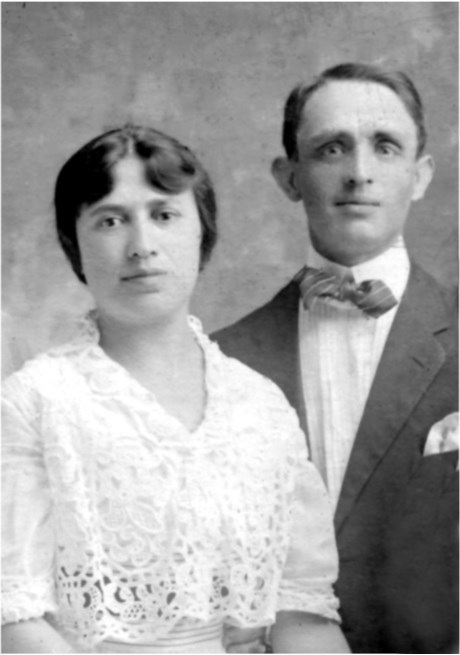
Isadore age 27

Isadore age 27

Enhanced by Zemanta

My Grandfather and Alma Gluck

In a recent conversation with my mother about her father, my grandfather Isadore Goldschlager, she said that one of the things that my grandfather remembered fondly about Iasi was the music.  From the photograph of the house where he was born, you can see a cathedral towering in the background.  My mother wondered whether that was where her father heard the music he loved.

One of the other stories my mother recalled was that my grandfather used to say that he babysat for Alma Gluck.  I knew nothing in detail about Alma Gluck, except that she was a famous opera singer and recording star, so I decided to do some research and see if I could figure out a link between my grandfather and Alma Gluck.

Alma Gluck

Cover of Alma Gluck

In reading a number of biographies online, I first learned that Alma Gluck was born Reba Fiersohn, daughter of Leon and Zara Fiersohn in 1884 in Romania; some sources say she was born in Bucharest, but others say she was born in Iasi.  Perhaps her family and the Goldschlager family were friends or at least acquaintances.   Since my grandfather was born in 1888 in Iasi, he obviously did not literally babysit for Alma Gluck herself since she was four years older; he must have babysat for her child.

Reba Fiersohn arrived in the United States in 1890, brought to the United States by her older sister Cecile, according to a biography from the Jewish Women’s Archive.  They lived in the Lower East Side, where Reba went to school and then worked as an office clerk.  On May 25, 1902, she married Bernard Glick, with whom she had a daughter, Abigail Marcia, who was born on June 9, 1903.  In 1906, Reba was discovered by an associate of her husband and began training to become an opera singer.  She debuted with the Metropolitan Opera in 1909 and became a very successful concert performer and recording star under the name Alma Gluck.  She traveled throughout the United States and was considered the most successful recording star of the time.

Here is one of her best known recordings, Carry Me Back to Old Virginny.  You can find several others online.

She divorced Bernard Glick in 1912 and subsequently in 1914 married Efrem Zimbalist, the violinist, with whom she traveled, performed and recorded.  She and Zimbalist had two children, Maria, born in 1915, and Efrem, Jr., the actor, director and writer.  Although she continued to tour and record for a few more years, her voice had become strained, and she retired in 1924.  Alma Gluck died in 1938 from cirrhosis of the liver.

English: Russian-born American composer, condu...

English: Russian-born American composer, conductor and violinist Efrem Zimbalist (1890-1985) with his wife American opera singer Alma Gluck (1884-1938) (Photo credit: Wikipedia)

So where in this story might my grandfather fit? My best guess is that he babysat for Abigail, Alma Gluck’s child with her first husband Bernard.  As noted above, Abigail was born in 1903; my grandfather arrived some time in 1903 or early 1904.  In 1905 he was living alone at 2213 Second Avenue in New York, working as a grocery store clerk.  He was seventeen years old at the time.  That same year, according to the 1905 New York State census, Bernard and Reba Glick were living with their two year old daughter Abigail at 2 St. Nicholas Terrace in New York.  Bernard was an insurance agent, and Reba, the future star, was doing housework.  Could Isadore have been babysitting for little Abigail? St. Nicholas Terrace is crosstown from where my grandfather was living, about a half hour walk according to Google Maps.  It does not seem likely that the Glicks knew Isadore from the neighborhood, unless the store where he was working was located in their neighborhood north of Morningside Park.  Unfortunately, that’s a fact I will not be able to determine.

In 1909, Isadore was living at 440 East (?) 147th Street, according to the ship manifest for his father Moritz.  Google Maps could not find such an address in Manhattan, only in the Bronx, so perhaps it was 440 West 147th Street, about a mile north of where the Glicks had been living in 1905 and on the same side of Manhattan.  In 1910, Isadore was living with his aunt Tillie Strolovitz and her children on East 109th Street, back on the East Side.  The Glick family was living at 325 West 93rd Street, two and half miles away crosstown from where Isadore was living.  Again, unless there was some other connection—from back in Iasi or some Romanian community connection, it is not obvious how Isadore would have ended up babysitting for Abigail.

By 1912, Reba Fiersohn Glick had become the famous Alma Gluck, divorced from Bernard and traveling around the country.  One source reported that she fought Bernard for custody of Abigail and prevailed after a bitter court battle.  I cannot find where Abigail or either of her parents were living in 1915, but since by that time her mother was famous, wealthy and remarried, Abigail herself was twelve, and Isadore was 27 and working full time as a milkman, I doubt very much that he was babysitting for Abigail in 1915 or thereafter.

So is there any truth to the story that my grandfather babysat for Alma Gluck?  I, of course, am inclined to believe my grandpa—who wouldn’t? And it is entirely possible that he had a connection through ties in Iasi to the family of Reba Fiersohn.  He was a new immigrant when Abigail was just a toddler and himself alone and just a teenager.  Perhaps there was some outreach from former residents of his home city who arranged for him to earn some money as a babysitter for the future Alma Gluck, even if he was living crosstown.  We will never know with any certainty, but I believe that my grandfather babysat for little Abigail.

If he did, I wonder whether he knew how famous Abigail herself became.  Abigail Glick grew up to become a well-known writer under the name Marcia Davenport.  Among other works, she wrote the novel East Side, West Side, which became the basis of the well-known movie by the same name.  She was on the staff of The New Yorker for several years and wrote a very well-regarded biography of Mozart.  She also wrote an autobiography entitled Too Strong for Fantasy.  I have just ordered a copy—maybe she will talk about the young teenage boy who babysat for her when she was a young child? Unlikely, given all the other much more glamorous and interesting things that happened to her in her life, but I will be reading it with an eye open for any such reference.

We may never know a lot of things with absolute certainty.  Sometimes we just have to accept the versions of the truth we have learned.

Enhanced by Zemanta

The Wonderful Generosity of Genealogists

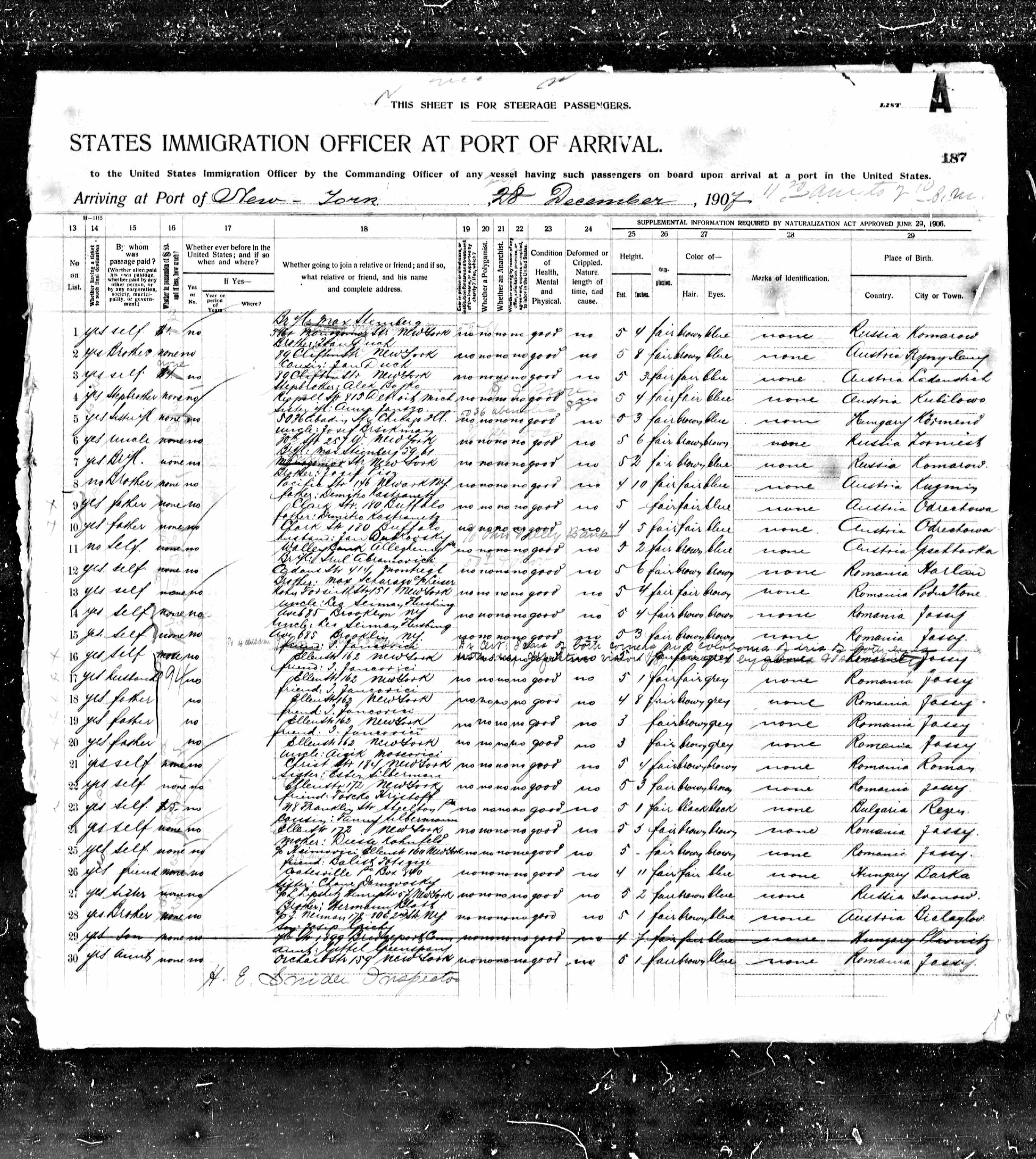
I have been working the last couple of days on the search for what happened to the husband of my great-great aunt, Tillie Rosensweig Srulovic/Strolowitz/Strulowitz/Adler.  The last record I have of him is on the manifest for the ship that brought him along with Tillie and their three youngest children to the United States in December, 1907.  On the manifest, as previously discussed, his name is Itic Yankel Srulovici.  There are notations on the manifest that indicate that although he first was considered in good health, a later notation written over that finding indicates that he had scars on his corneas and coloboma in both irises.  However, the record also indicated that he was examined by a Doctor Snider and is stamped “admitted,” though it also indicates that the family was held for several days and a bond had to be posted for their release.

ship manifest 1907

ship manifest 1907

page 2 of manifest

page 2 of manifest

I did some research on the history of Ellis Island, and apparently there was a contagious eye condition, trachoma, that was commonly a basis for refusing entry to an immigrant.  Perhaps when the inspectors saw something strange about Itic’s eyes, they decided to hold him for further examination.  Reading this the first time, however, I wasn’t sure how to interpret the “admitted”—did that mean he was admitted after the exam? Was it possible they had deported him? And if he stayed, when did he become Jacob Adler, and when did he die?

And why is there no record of him after leaving Ellis Island?  In my emails with Itic’s great-granddaughter Jean, she said that family lore is that her great-grandfather never left Ellis Island.   Did that mean he had died on Ellis Island? Had he been deported?  I could not determine how to figure this out.

Immigrants just arrived from Foreign Countries...

Immigrants just arrived from Foreign Countries–Immigrant Building, Ellis Island, New York Harbor. (Half of a stereo card) (Photo credit: Wikipedia)

And that’s where the generosity of genealogists comes in.  I posted an inquiry on the JewishGen discussion list, asking for opinions and help in figuring out what had happened to Itic/Jacob.  And within less than an hour, I started receiving responses and continue to receive very helpful responses.  I have said this before, but I continue to be amazed and touched by how helpful, supportive and generous with their time and energies these experienced genealogists are.  Renee Steinig continues be an incredible source of support—with ideas, suggestions, and documents that she finds for me on her own time.  Others also have gone out of their way, including Bette (whose last name I don’t even know but who has helped me before on other questions), Phyllis Kramer, Marian Smith, Don Solomon, Sally Bruckheimer, David Crook, Diane Jacobs, Adelle Gloger, and several more.

And so what have I Iearned? Well, most of these people advised me that it is very unlikely that he was deported.  If the document is marked “admitted,” then he was admitted.  There would be some notation in the file if he had been deported.  Several people gave me websites and search engines to use to see if I could find a death record or gravesite where Itic/Jacob appeared.  So far I have not found any record other than the the death certificate for a Jacob Adler who died in 1910, but I can’t find a gravesite for that person.  I hope to have the death certificate by the end of next week, so perhaps if it identifies him as Tillie’s husband, we will have an answer.
I also was advised to request a document from the National Archives and was even provided with the document identification information by someone who was looked it up on an index I wouldn’t otherwise have been able to access.  I called the National Archives, and I am now waiting for them to call me back.  So I am hoping that by the end of next week I will have some documentation that may fill out the story and tell us what happened to Tillie’s husband, Gisella’s brother-in-law.

I could never have gotten as far on this journey without all this help.  Thank you again to every person who has provided me with help.  I look forward to paying it forward to another new genealogy researcher some day soon.  I can never pay all of you back for what you have given me.

Enhanced by Zemanta