A Call to Israel!

Just to show that I never give up, I thought I’d report on a phone call I made this morning to Shmuel Brotman of Kiryat Tivon in Israel.   Renee, my mentor, made the suggestion that I look for any Brotmans who had lived in Dzikow by checking both JRI-Poland and the database at Yad Vashem.  Both sources found one family, the family of Shmuel and Zipporah Brotman, who had resided in Dzikow/Tarnobrzeg.  It looked like the entire family had died in the Holocaust, but Renee suggested I contact the person who had submitted the names to Yad Vashem, Shmuel’s daughter-in-law Chana Brotman.

I then had to track down Chana Brotman.  I knew from the Yad Vashem submission that she had lived in Kiryat Tivon in 1997 when she submitted the names of Shmuel and his family, and so I made a request on both the JewishGen website and on Gesher Galicia for help in locating the family.  By this morning I had several responses, including two that gave me phone numbers, one for Chana and one for her son Shmuel.  The person who provided me with Shmuel’s number had just spoken with him and said he was awaiting my call.

I jotted down some notes and then called Shmuel.  He’s about my age and fluent in English.  He was very happy to help me, and we spent about half an hour, comparing notes and trying to figure out whether there is a connection between our families.

At the moment I still don’t know what the connection is, but it seems likely that there is one.  His grandfather Shmuel Brotman was born around 1888 in Dzikow, and his great-grandfather’s name was Moshe.  I don’t yet know where Moshe Brotman was born.  He could even be the same Moses Brotman who ended up in Brotmanville.  We still have to sort more things out.

He did tell me that he has done some research and believes that the Brotman family originally came from Georgia in the former Soviet Union and left to escape the pogroms.  He believes they changed their name to Brotman to get across the border.  According to Shmuel, some Brotmans went to the US, some to Romania, and some to Poland, including his family.  Whether our ancestors were also part of that family I don’t yet know, but it is a possibility.

So just as I was about to give up hope of finding more traces of our family, I received a glimmer of hope this morning from Israel.  No matter where this goes, it was another one of those uplifting experiences where strangers helped me find someone and that someone ended up being welcoming and hopeful that we are related.

Research update: Bad News, Good News, Bad News

As you may recall, on October 31, I sent a request to the USCIS  for the naturalization papers for Max Brotman in the hope that they would reveal where Max and thus the other family members were born in Galicia.  According to the automated message on the USCIS phone, it could take at least 90 days to get a response.  Well, I figured the news wasn’t going to be good when I received a response yesterday only 35 days after making my request.  And it wasn’t—they had no records for a Max Brotman who fit the dates I had submitted.  In fact, all their naturalization records start in 1906, and I should have known that Max was naturalized before 1906 since he was the witness for Abraham in 1904.

I then went back to ancestry.com and rechecked my search of their naturalization records where I had been able to find records for both Abraham and Hyman.  I checked and rechecked pages and pages of indices, searching for anything that might relate.  I found one for a Max Bratman born in Germany who worked as a conductor for the railroad and emigrated in 1882, but dismissed it because the name, place of birth, and date of immigration seemed wrong.

Max "Bratman" Naturalization Card

Max “Bratman” Naturalization Card

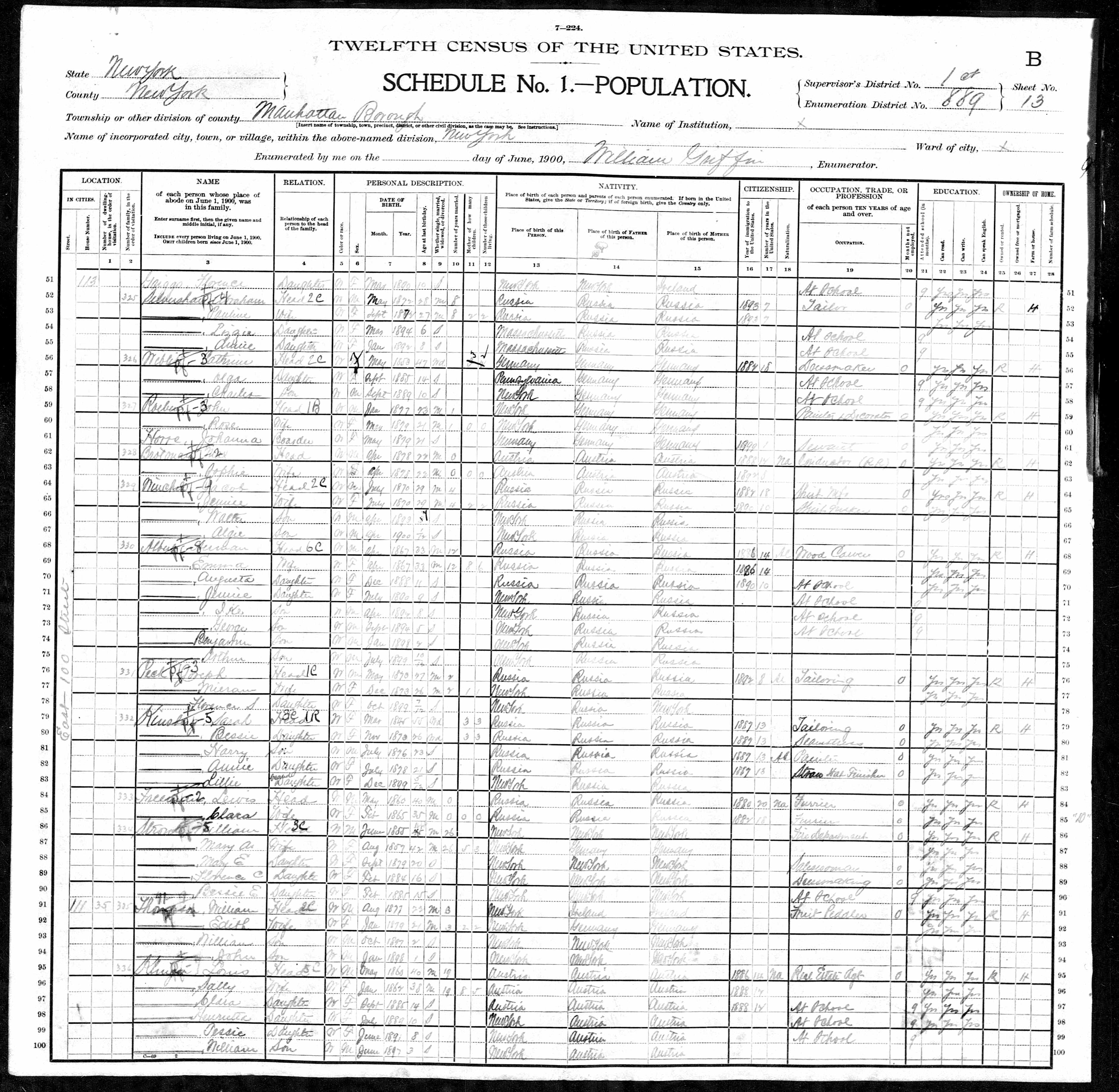
Then I went back to the records I already have for Max, including several census reports, his marriage certificate and his death certificate.  While reading through the 1900 census, I noticed that it said Max was a conductor.  At that time he and Sophie were just married (the census was taken in June; they had married in April) and were living at 113 East 100th Street in Manhattan.  When I saw the entry that he was a conductor, I knew it rang a bell, but at that point I could not remember where else I had seen it.

1900 US Census Report for Max and Sophie Brotman

1900 US Census Report for Max and Sophie Brotman

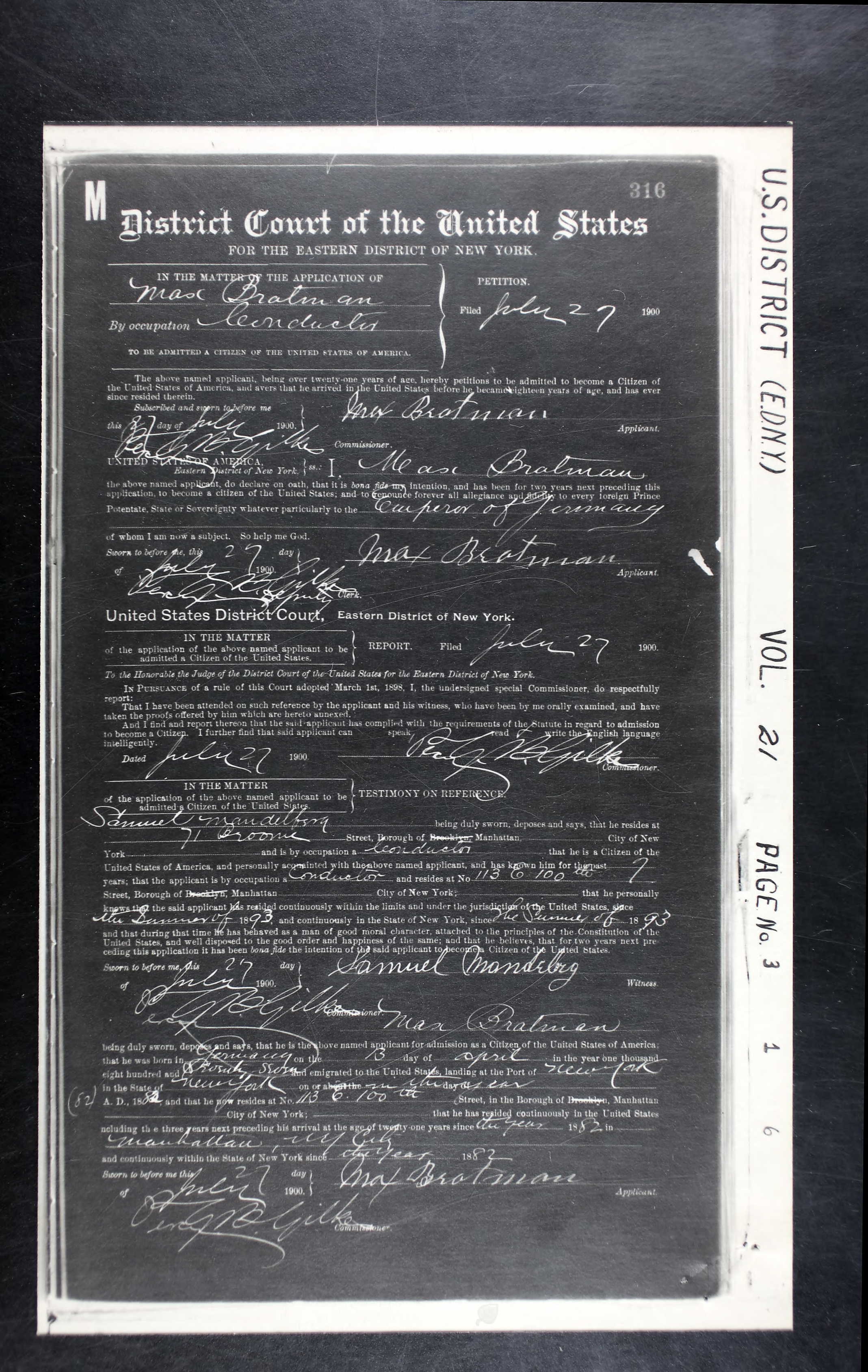
I began to search through the naturalization records again and could not find any reference to a Max Brotman who was a conductor.  I started thinking that I was losing my mind! Then I remembered that there had been a Max BrAtman and searched for him, and lo and behold, found the naturalization card again for the conductor.  I looked at the address on that form and sure enough, Max Bratman was living at 113 East 100th Street in Manhattan in 1900 when he filed this application.  Obviously this was the same person, our Max, but why did he spell his name wrong? Why did he say he was born in Germany and emigrated in 1882? The birth dates also did not exactly line up, but I am used to the fact that no one ever reported their birthday consistently.

When I looked at the handwritten application, I saw that the signature was definitely Max BrOtman, not BrAtman.

Max Brotman naturalization petition

Max Brotman naturalization petition

My guess is that the clerk who filled out the card just could not decipher the handwriting.  As for the wrong date, I have no guess except that Max was confused, wasn’t clear, or was trying to make it seem he’d been in the US for more than just 12 years.  As for why Germany? I wish I knew.  I know from Joseph Margoshes’ book that secularized, modern Jews were referred to as “German” in Galicia. Perhaps that’s why Max said Germany.  Perhaps the clerk thought he was German because of his name, accent and use of Yiddish and suggested it to him and Max just agreed? I have no clue.

The census form was filled out just a month earlier than the naturalization form.  The census says his place of birth was Austria as does every other document listing Max’s place of birth.  The census says he emigrated in 1888, which is also consistent with almost all the other forms.  It would have made little sense for Max to have emigrated in 1882 when he was only four years old.  So once again, we have evidence that forms are unreliable, that our ancestors were not too reliable, and that much must be left to conjecture and speculation.

So where does that leave us in terms of identifying where our family lived in Galicia? Hanging on the thin thread of Hyman’s own unreliable documents, our best guess is Dzikow near Tarnobrzeg.  I contacted Stanley Diamond who manages the archives of documents for JRI-Poland, and he sent me a list of all the records of all Brotmans and Brots from that area.  They are almost all of people born after 1900, and Stanley said that the records for that area are rather limited.  He said it would probably take a trip to archives in a few cities in Poland to learn if there is anything else and that that is probably a long shot.

And thus, my cousins and friends, I think that for now I have hit a wall. I am still waiting for Tillie’s death certificate and Hyman’s marriage certificate, but I am not putting any hope into finding out more information about their place of birth from those documents. I am in touch with a researcher in Poland, and I am hoping to travel there perhaps in 2015, but for now I guess we have to accept that the best we can do is hang our hopes on Hyman’s references to Jeekief and Giga and assume that Dzikow near Tarnobrzeg is our ancestral home.

Tillie’s Story

Image

Although I have no memory of meeting Aunt Tillie, I heard her name all the time when I was growing up. (I don’t know which spelling she preferred; sometimes it is Tilly, sometimes Tillie.  I have used both spellings throughout the blog.)  She was very close to my grandmother Gussie, and my mother and her sister and brother adored her.    She was described to me as a lot of fun: vivacious, outgoing, funny and loving.  It seems she was the one who provided a lot of the happy experiences for my mother and her siblings growing up.

Like my grandmother, she had a tough life.  She was born in 1884 and came to the US with Bessie and Chaim when she was 6 or 7 (census reports are in conflict; some say 1890, some say 1891).  In 1900 when she was sixteen, she was living on Ridge Street with her parents, her brother Hyman, and her two little sisters, Gussie, who was five, and Frieda, was three.  When her father Joseph died a year later, my guess is that Tillie must have become a second parent to Gussie, Frieda and the infant Sam.

In 1905 when she was 22, Tillie married Aaron Ressler.  At the time she was still living on Ridge Street with her mother and siblings.  Aaron was 26 at the time and was also living in the Lower East Side.  By 1910, Tillie and Aaron had three sons, Leo, Joseph, and Harry, all under five.  They were living at 94 Broadway in Brooklyn, where they owned a grocery store at 100 Broadway.  In addition, Gussie had moved in with them, choosing to live with Tillie instead of moving in with Bessie after she had married Phillip Moskowitz.  (Bessie and Phillip were still living on the Lower East Side in 1910, so moving to Brooklyn must have been a big deal for twelve year old Gussie.) Gussie helped take care of the boys while Aaron and Tillie worked in the store.  Family lore has it that my grandfather spotted my grandmother while she was sitting in the window of Tillie and Aaron’s store.

Life must have seemed pretty good for the Ressler family in 1910.  By 1918, however, things had changed.  On Aaron’s draft registration form of that year, he reported that he was not employed and was suffering from locomotor ataxia, a condition that causes pain and loss of muscle control and movements.  The 1920 census did report that Aaron worked at a grocery store, although it also said he worked at home.  They no longer lived on Broadway, but on Ralph Avenue in Brooklyn.  Aaron died six years later in February, 1926, leaving behind Tillie and three sons aged 20, 19, and 17.

Tillie continued to run the grocery store for some time after Aaron died. I cannot find any record of Tillie and her two younger sons in the 1930 census, but in 1940 she was living on the Grand Concourse in the Bronx with Joe and Harry (Leo had married Mildred and moved to Connecticut by then).  According to the census, she had also lived at this same address in 1935, so at some point Tillie had left Brooklyn as a widow with two almost grown sons and moved all the way to the Bronx.  She never remarried and died at age 72 in 1956 after suffering from painful arthritis.  My mother remembers that she was treated with cortisone, perhaps excessively, and ended up dying in a public hospital on Welfare Island in NYC, where my grandmother would go to see her every week.

I don’t know why she moved to the Bronx, perhaps to make a fresh start.  My mother remembers that Aunt Tillie lived in an apartment on the then-glamorous Grand Concourse with her two adult sons, Joe and Harry.  I don’t know how she supported herself after Aaron died, but somehow she did.  My mother was born after Aaron died, and so she only knew Tillie as a widow, yet she remembers Tillie as a happy, upbeat person who would bring my mother baked goods (and once a large easel) that she carried on the subway from the Bronx to Brooklyn on her weekly trips. Tillie was the one who held the family together—the one who encouraged my aunt Elaine to go stay with Leo and Mildred in Connecticut to broaden her horizons, who took my mother to baseball games, who could occasionally get my shy grandmother to socialize. When my sister was born in 1955, Tillie brought treats not only for my mother, but also for the other new mothers who were sharing the same hospital room.   She was a woman who was born in Europe, but spoke English like an American, who brought up three sons, took care of her sisters and brothers, and was one of the most positive influences on my mother and her siblings. She was strong and positive despite all the hardships she had faced.  I wish I had had a chance to know her.

Jewish Naming Patterns

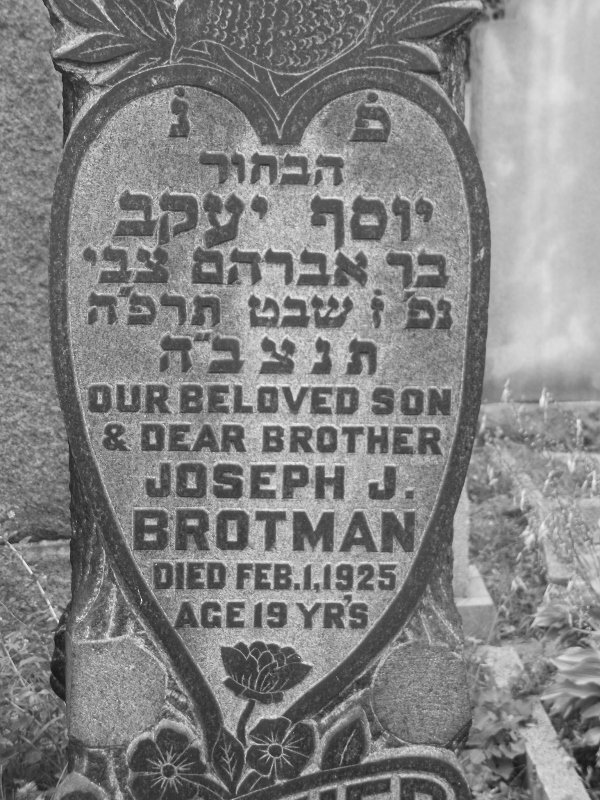
Most people know that in Jewish tradition, a child is often named after a relative who is no longer alive.[1]  It is also Jewish practice to identify a person in Hebrew with his or her father’s first name added to that person’s own first name.  For example, on his headstone Joseph’s name appears in Hebrew as Yosef Yakov ben Avraham, meaning that his father’s name was Abraham.  These naming patterns are a great help to genealogical research since often you can find names recurring through several generations, providing a means of establishing family relationships.

For example, we know that Bessie’s Hebrew name was Pessel and that her mother was named Gittel.  Bessie named her daughter Gussie for her own mother—in Hebrew, Gussie’s name was Hannah Gittel.  Then, in turn, I was named for Gussie’s mother, Bessie—in Hebrew, Pessel.  I then named my older daughter Rebecca Grace for my grandmother; her Hebrew name is Rivka Gittel.  So both Gittel and Pessel are names that recur through the generations and perhaps go back even further and perhaps will stretch further into the future.

Similarly, my brother Ira was named for our grandfather Isadore, whose Hebrew name was Ira.  Isadore’s father was Moritz/Moshe, and Isadore was named for Moshe’s father Ira.  Isadore in turn named his son Maurice for his father, and Maurice named his son James Ian and one of his daughters Robin Inez, the I being for Maurice’s father Isadore.  So the M’s and the I’s keep recurring in our family.  My younger daughter Madeline (Mazal Ahava) was named in part for my uncle Maurice (as well as for my husband’s uncle Murray), and there are several other M’s in the family among the fifth generation.

I am sure each of you can find similar recurring patterns in your own branches of the family.  There certainly are many B/P names and J names that run throughout our family tree.   Some of them undoubtedly are for Bessie/Pessel and Joseph or one of their descendants.

Why do I bring this up now? Well, after receiving Abraham’s death certificate and being bewildered by the fact that it records his parents’ names as Harry and Anna, I consulted with my mentor Renee.  She asked me several questions that reassured me that the death certificate is most likely incorrect.  First, she said look for naming patterns.  That reminded me that Abraham’s oldest son was named Joseph Jacob—Yosef Yakov on his headstone.Image  If Abraham’s father was named Harry, then why would he have named his son Joseph and not Harry? In fact, there are no Harrys or H names among Abraham’s children or grandchildren.

In addition, Renee pointed out that Abraham’s full name on his headstone is Avraham Zvi ben Yosef Yakov.  Zvi is a Hebrew name that means “deer” and in Yiddish was usually translated into Hersh or some Americanized version: Harry, Herbert, or (as in the case of my husband) Harvey.  Renee also pointed out that Abraham’s American name was Abraham H. Brotman.  She said it was extremely unlikely that his father’s name would have been Harry or Hersh/Zvi also (unless, of course, his father had died before Abraham was born, which does not seem likely).  By looking at the naming patterns, I am now convinced that it is unlikely that Abraham’s father’s name was Harry and that the death certificate is not correct and the headstone is.  Perhaps the Zvi/H in his name was for his maternal grandfather. Maybe that’s how it ended up on his death certificate.

So, cousins, do you know who you were named for? Do you know what your Hebrew name is? What your parents’ Hebrew names are? It would be really helpful and interesting to me and perhaps to others to know this information as it may open other doors for more research.  If you are willing to share that information, please let me know by using the comment box below so that we can all share this information.  Thank you!


[1][1] At least that has been the tradition among Ashkenazi East European Jews.  German Jews apparently did not always adhere to this tradition.  For example, my father’s name is the same as his father, John Nusbaum Cohen, and until he was an adult, he used “junior” after his name.  Moreoever, his sister’s name was the same as their mother—Eva.

Max Brotman: Who was his mother?

Yesterday I received Max Brotman’s death certificate from the City of Mount Vernon.  It has been quite a task tracking down this document.  Although I knew from Judy and the picture of his headstone that he had died in 1946, I could not find any record of his death certificate.  There is a public index of NYC death certificates that runs through 1948, so if he had died in 1946, it should have been there.  But it wasn’t.  Death certificates dated after 1948 from NYC are much harder to obtain; to get Abraham’s I had to use snail mail (!) and a notarized form and fee and self-addressed envelope sent to the NYC Department of Vital Records.  I was hoping that I could just obtain Max’s electronically through the Family History Library, which is faster, easier and free.  Unfortunately, the FHL does not have non-NYC certificates, and I could not find Max in the NYC register.

I was fortunate to find a volunteer in NYC who checked the paper records and found a reference indicating that Max, a NYC resident, had died “upstate.”   But where upstate?  It’s a big state! I recalled that Max had had a summer home in Congers, NY, and since he died in late May, I thought that perhaps he had died while up there. Image I contacted the town registrar in Congers, sent them a written request, check, and envelope, but they sent it back, saying that they had no record for Max Brotman.

So I was stumped.  I asked Renee, my mentor, for advice, and she suggested calling the cemetery where he was buried to see if they had a record for where he had died.  I called Beth David Cemetery on Long Island, and sure enough, they did have such a record and were willing to divulge where he died without a written letter, check and envelope.  They said he had died in Mount Vernon, New York, not far from where I grew up.

I asked Judy if she had any idea what he might have been doing in Mount Vernon at the time of his death.  She didn’t know.  I wrote to Mount Vernon (yes, a notarized letter, check and envelope), and finally received the long-sought-after document yesterday.Image

So what does it say? Well, it explains what he was doing in Mount Vernon.  He was a patient at the Mount Vernon Convalescent Home, where he was suffering from liver cancer.  It looks like he was there for three weeks, as the doctor who signed the certificate had cared for him from May 6 through May 27 when he died.

What else does it report? It lists Joseph Brotman as his father (phew!), but Adda Browman as his mother.  That conflicted with his marriage certificate which said his mother’s name was Chaye. Image And Browman? Is that just a misspelling of Brotman? Or was her maiden name really Browman? I consulted with Renee, and she said that Chaye was often Americanized to Ida, which is close to Adda.  (She said immigrants tended to Americanize even the names of ancestors who never left Europe.)  So maybe Adda is Chaye? Or maybe Richard Jones, who was Max’s son-in-law and the informant on the certificate, misunderstood or was misunderstood.  I don’t know and probably won’t know until I can learn how to research records from Europe.

The good news is that it’s just one more bit of evidence confirming that Max was Joseph’s son.  The bad news is that the document brings us no closer to knowing the town in Galicia from which they all came.

Max Brotman: When was he born?

Here’s another example of the inconsistency of records when it comes to birthdays.  On the 1900 US Census, Max gave his birthday as April, 1878.[1]  [Edited: On his naturalization application in 1900, he listed his birthdate as April 1877.] On the 1910 Census, he reported being thirty years old, meaning he was born around 1880.  On his draft registration in 1918, he gave his birthday as July 7, 1878.  On the 1920 Census, he said he was 45, making his birth year 1875.  In 1930, he said he was 50, meaning he was born in 1880.  In 1940, he claimed to be 60, again meaning he was born in 1880.  On his draft registration in 1942, he put his birthday as March 26, 1880. [2]

Today I received his death certificate.[3]  It has his birthdate as July 27, 1882!  He just kept getting younger (like we all wish we could, I suppose).  Since Hyman was born in either 1882 or 1883 and had a different mother than Max, it seems unlikely that Max was born in 1882.  I am going to assume that the earliest documents are more reliable (when he had less incentive to make himself younger) so that 1878 is the mostly likely year of birth.  As to the month? Who knows? Could be March, April, or July.  As I said in an earlier post, birthdays were not a big deal to Jews in Europe, so maybe he never knew the month, but wouldn’t people know what year they were born? We know Joseph’s age is equally mysterious—he could have been born any time between 1825 and 1855, depending on which document you read.  And Hyman also had two different birth years on his records.

The other inconsistency in these records is the year of immigration for Max.  The 1900 Census says he came in 1888; the 1910 and 1920 say it was 1890.  Finally, the 1930 Census says it was 1893.  I have applied for a copy of his naturalization records (which take 90 days to process, so it will be at least another two months before I get it), so perhaps those will be more accurate. [Edited: The naturalization application said 1882, when Max was at most five years old.]

Sometimes I wonder whether there was a certain level of paranoia among immigrants—people who had faced such hostility and oppression at the hand of the governments of the countries where they were born.  Maybe they just didn’t want to give the US government too much personal information.   Or maybe census takers just weren’t very careful note takers or very good listeners. Or maybe our relatives just liked to lie about their ages.


[1] All the documents are consistent with respect to his place of birth being Austria, though none specifies the town or city. [Edited: The naturalization application said Germany.]

[2] These documents are available on ancestry.com.  If anyone is interested, I can download them and post them on the blog.

[3] More on his death certificate tomorrow.  I want to scan it and won’t get a chance tonight.

Another day, another death certificate, and more confusion

Sometimes I wonder why we have death certificates.  Just about every single one I have seen has raised more questions than it has provided answers.  I’ve been told by an expert genealogist that death certificates are notoriously unreliable because usually the person providing the information is a close relative still in shock and mourning the death of a loved one.  No wonder Hyman’s said he was born in Philadelphia and Bessie’s said her mother’s name was Bessie.  And so on.

All that leads me to today’s mysterious death certificate, that of Abraham Brotman of Brooklyn.  You may recall that Abraham’s headstone revealed that his Hebrew name was Abraham ben Yosef Yaakov, just as Joseph’s revealed that his was Yosef Yaakov ben Abraham, providing me with the additional clues that helped me conclude that Abraham was Joseph’s son and Max’s brother.Image

(You may also recall that Max was the witness on Abraham’s naturalization application.)

Naturalization of Abraham Brotman Max as Witness

Naturalization of Abraham Brotman
Max as Witness

I had ordered Abraham’s death certificate in order to obtain more confirmation of those relationships as well as to get some information about the place where they were all from in Galicia.

Unfortunately, Abraham’s death certificate confirmed nothing and just added to the confusion.  His birth place is listed as Russia, despite the fact that every census report and his naturalization papers list his birth place as Austria.  His parents’ names are listed as Harry and Anna.

Image

I emailed Abraham’s grandchildren, Paula Newman and Morty Grossman (whose mother Ethel provided the information on the certificate), but neither of them knows anything about Abraham’s parents.  So now what? Do I assume that it’s just another mistake on the death certificate? Is it more likely that the headstone is right than the death certificate? Since the place of birth is wrong, why should I trust any of the information on the death certificate? Perhaps Ethel Grossman was thinking of her mother’s parents, not her father’s parents?   Abraham’s wife Bessie Brotman was born in Russia, so maybe her parents were Harry and Anna? Grrrr…now I am ordering another death certificate to see who HER parents were.  But why would I trust that one either?

Very frustrating! So no new information and just more confusion.

I can’t wait to see what misinformation Max’s death certificate provides.  That should be arriving in a day or so.

Rosalind Haber and Dan Dombey’s wedding photos

Thanks to Naomi, we have some new pictures to add to the blog.  I will also post these to Max’s page, but thought I’d also post them this way so that everyone sees them.  I already posted about the photo of the groomsmen including Sam Brotman, but here are several more.

First, the bride and groom, Rosalind and Dan. Notice the two young people in the background to the left—that’s cousins Tom Jones, son of Rosalie and Dick Jones, and Judy Haber Ruzicka, daughter of Renee and Charles and the bride’s sister.

Image

Here are the bride’s parents, Renee Brotman Haber and Charles Haber.

Image

And here are the bride’s aunt and uncle, Rosalie Brotman Jones and Dick Jones.Image

Finally, here’s one of the Haber family, including Renee, Charles, Susan and Judy, and the Dombey family.

Image

I tried to look at the faces in the background of these pictures to see if any other Brotman family members are shown, but no one besides those mentioned looked familiar to me.  Do any of you recognize any of those faces?

One Uncle Sam mystery solved

It seemed that there were multiple Uncle Sams remembered by different cousins.  Judy remembers one who was the life of the party at family gatherings and known for eating flowers.  Bonnie C. remembers one who drove her to the airport in Florida when she visited her father there.  Denny remembers one who lived in Arizona and wore a white cowboy hat.  And then there was the Uncle Sam who visited my grandparents every Friday night and never left New York City, lived alone, and was a cab driver.  I’ve often wondered whether Uncle Sam had multiple lives and personalities or whether there were just a number of a different people named Sam Brotman.

Well, we have now resolved at least one of those mysteries.  Below is a photo from Rosalind Haber’s wedding in 1956 (with more to follow in a subsequent post[1]) showing some of the groomsmen from the wedding.  I asked Judy who these men were, and she identified them as her father Charles Haber’s brothers Jack, Sol, and Abe, another Haber, and Charles’ nephew Jack Simon. Mixed in with all those Habers standing to the right in the middle row with the silver hair and those distinctive Brotman cheeks is none other than the Sam Brotman who Judy remembers from family events!

Image

I showed the photo to my parents, and they confirmed that that is the same Sam Brotman who lived in the Bronx and visited my grandparents every Friday night, bringing a strawberry shortcake every single time.

Here’s a photo of Sam with my grandmother and my aunt Elaine; you can see that it is the same face.

Image

So how could the same person be perceived so differently? My parents remember Sam as a quiet, shy loner who rarely spoke at family dinners.  Judy remembers him as funny and outgoing.  Could he have just been quiet in the context of my grandparents’ home and himself when he was with the Habers? He must have been quite close to Renee and Charles to have been made a groomsman at their daughter’s wedding.  Perhaps they brought out the best in him.

Now if we could only figure out who those OTHER two Sams were….


[1] Thanks to Naomi Ratner and Ron White for sending me these photos!

Research update

I am once again in a holding pattern, waiting for a few more documents to arrive: Max’s naturalization papers (which take 90 days for USCIS to process, so another 75 days to wait for those), Max’s death certificate, Abraham’s death certificate, and a few others from the Family History Library in Salt Lake City. My principal research goal right now is to find out where our family came from in Galicia.

I’ve been trying to search for European records, but that is much more complicated than searching for US documents. JewishGen.com offers a course online that provides instruction on how to do that, and I plan to take that course when it is next offered in May, 2014. That’s a long way off for someone who is as impatient a researcher as I am. I am meanwhile making inquiries of other researchers who are researching Galicia and searching several genealogy websites, but so far, I’ve still come up empty.
So I figured that while I was waiting, I would learn what I can about life in Galicia in the 19th century and life on the Lower East Side in the late 19th, early 20th centuries. I’ve ordered some books and will provide whatever information or reviews I find interesting and helpful once I have read them. If anyone has any recommendations on books on either of those topics, please provide them in the comment box below.

Meanwhile, I would still love some pictures (hint, hint!) from other members of the family.

Hope you all are well, and I will report back when I get some new documents or have anything else to report.