Category Archives: Miscellaneous information and updates
Morton Tinslar Seligman 1895-1967: A Hero’s Life Subject to Ongoing Questions
9
Did my cousin Morton Tinslar Seligman leak classified information to a reporter during World War II?
In my last post, I summarized the background to the story of Chicago Tribune reporter Stanley Johnston and his article about the Battle of Midway that revealed that the US Navy had had advance knowledge of the names and locations of various Japanese ships, helping the US Navy to secure victory in that battle. One of the key issues in that story was the question of how Johnston had obtained that information and whether he had obtained it from my cousin, Morton T. Seligman, from a secret dispatch from Admiral Nimitz. Michael Sweeney and Patrick Washburn’s excellent monograph on this topic, “ ‘Aint Justice Wonderful’ The Chicago Tribune’s Battle of Midway Story and the Government’s Attempt at an Espionage Indictment in 1942,” Journalism & Communication Monographs (2014), provides a thorough and carefully researched analysis of this matter.
As I wrote last time, the first government document mentioned in the Sweeney and Washburn article that names my cousin Morton T. Seligman as a possible source of Johnston’s access to classified information was a July 14, 1942 memorandum to the Attorney General and the Secretary of the Navy by William D. Mitchell, the chief prosecutor for the government’s case against the Tribune and its employees. Mitchell’s memorandum claimed that two unnamed officers had seen Commander Morton Seligman writing down a list of the Japanese ships located in the area near Midway. The Mitchell memorandum then noted that Seligman had stated that he did not remember making such a list, but that he might have done so. Sweeney and Washburn, p. 48.
In their research of this matter, Professors Sweeney and Washburn found that Seligman was also mentioned in files from the Tribune’s own internal investigation, files Sweeney and Washburn obtained from the Tribune and its attorneys, Kirkland and Ellis. According to Sweeney and Washburn, “only one officer is repeatedly mentioned in its internal investigation documents as being linked to Johnston—Commander Morton Seligman….Aboard the Barnett, the two of them had bunks that opened onto a common room and the Barnett’s mess set up coffee urns there that made it a popular place for men to gather.” Ibid. at 53.
According to Sweeney and Washburn, “[e]xtensive notes in the legal archive [of the Tribune] make it clear that Seligman shared sensitive information with Johnston aboard the Barnett, but memory problems cause by battle injuries on the Lexington may have prevented him from remembering the details. The memoranda underscore Johnston’s desire to avoid harming the career of any naval officer and they make it clear that he specifically tried to cover for Seligman.” Ibid., at pp. 53-54.
The Tribune/Kirkland Ellis files contained information indicating that Seligman had called the Tribune at least three times between July 17 and August 11, including twice in the days shortly after his meeting with Mitchell. The memoranda describing these phone calls, cited as “Dear Howard, Memorandum” and “Maloney-Seligman Phone Conversation” in the Kirkland and Ellis files, are probably the most damning evidence against Seligman in the Sweeney and Washburn article, albeit quite circumstantial and not originating with Seligman.
In the memoranda describing these phone calls, Seligman is depicted as anxious about the investigation, having been questioned by the Navy and then by the FBI several times in June while he was in the hospital recuperating from his injuries. He called the Tribune to speak with Johnston, and according to these memoranda, was assured by both a Tribune editor and by Johnston that his name had not been revealed to any of the authorities and that they would protect him. According to the memoranda, Seligman told the Tribune that he had told the FBI that he could not remember the Nimitz dispatch or any of the other details they were investigating as a result of his injuries and their effect on his memory. Ibid. at 55. The impression left is that Seligman had revealed something to Johnston or that he feared he had, but could not remember the details.
A final memorandum from the Kirkland and Ellis files dated August 11 that has no named author or recipient and that does not even name Seligman specifically but refers to “S,” a person who appears to be Seligman, also refers to Seligman’s memory problems and his statement that he neither remembered seeing the Nimitz dispatch nor discussing the planned Japanese attack on Midway. Sweeney and Washburn at pp.55-56.

The Gothic Revival Tribune Tower in Chicago (Photo credit: Wikipedia)
When the case went to the grand jury in August, 1942, Seligman was one of eight naval officers who testified, but I cannot find anything that describes his testimony or whether he was questioned about the Nimitz dispatch or about providing Johnston with any other information. On August 19, 1942, the grand jury concluded that there was not enough evidence to indict the Tribune or its employees, and the case was closed. Ibid., pp. 64-69.
Over 30 years later, a naval officer named Robert E. Dixon, who had been a lieutenant commander aboard the Lexington during the Battle of the Coral Sea and then had been aboard the Barnett after the battle, apparently confided to a newspaper editor named Robert Mason that Seligman had arranged to have decoded copies of Japanese radio transmissions delivered and that Seligman had regularly shown these messages to Johnston. Dixon also told Mason that he had seen Johnston taking extensive notes on these decoded messages. Dixon claimed he did not then immediately report this because Seligman was his superior officer. He claimed, however, that he did disclose all of this to the FBI once Johnston’s Midway story appeared in print. Ibid., pp. 71-72.
This conversation, revealed by Mason in a letter to the editor in 1982 to a naval publication called Proceedings, is not corroborated by any other document in the FBI files or elsewhere uncovered by Sweeney and Washburn and thus remains a hearsay statement by Mason in 1982 about what he claims he was told by Dixon in 1975 about what Dixon claims he saw Johnston and Seligman doing aboard the Barnett in 1942. It may in fact be true, but it is hardly very persuasive evidence at this point. Sweeney and Washburn themselves pose the question in their conclusion: “Did the FBI and Navy believe Dixon or did they believe Seligman? Did they know what Seligman had done or merely suspect it?” Ibid., p. 73. We will probably never know the answer to either question.
There thus remain even now numerous questions about how Johnston got the information and whether Seligman revealed it to him deliberately. Since Seligman clearly was suffering from memory impairment in June and July of 1942, one has to assume that he was also suffering from some impairment in May while aboard the Barnett. If he did reveal the information, it might have been due to carelessness resulting from his medical condition. Even if he revealed it deliberately, it might have been due to some confusion caused by the shock and the injuries he had just suffered. Johnston, who was apparently known even by the Tribune to have been investigated by several governments in Europe for some questionable behavior as a journalist there before he came to the US, might have taken advantage of Seligman’s trust and his impairments to get this information from him. Ibid., at pp.18-21.
Another possibility is that Seligman revealed the information to Johnston off the record, assured that Johnston would not reveal it. One of the quotes from a conversation that Seligman had with Maxwell, a Tribune editor, is consistent with this theory. According to one of the memoranda from the Kirkland and Ellis files, Maxwell stated that Seligman had said to him, “I told [Stanley Johnston] he’d get me in trouble if he used anything we talked about.” Sweeney and Washburn, p. 55. Thus, perhaps Seligman had confided in Johnston, but with the express agreement that it was all off the record and not to be disclosed publicly. Johnston’s disclosure might have been in bad faith or he might have assumed that the Navy censors would block any classified information; it’s not clear whether Johnston knew that the article was not going to be submitted to the Navy for clearance before publication.
Since all the principal actors in the story are no longer alive, all we can do is speculate about the actual events. I certainly do not know what happened, and I admit to some bias in favor of my long-lost cousin. But everything else in his record reflects integrity and honor. He was a man who had already served in the Navy for over twenty years. He had risked his own life a number of times in the course of that service. Why would he ever have done anything deliberately that could be seen as a betrayal of the Navy, an institution to which he had devoted his life, and of the United States during wartime? It makes no sense to me.

From Pinfeather, US Navy Cruise Book (1943) for US Naval Air Station Bunker Indiana, p. 3 , at http://www.fold3.com/image/303178517/
After his hospital stay, Morton Seligman continued his naval service. He was assigned to the Naval Air Station in Peru, Indiana, where he was welcomed as a war hero. Nothing in the press coverage suggests that there was any public knowledge of the accusations made against him. (“Captain Seligman Will Command U.S. Navy Base,” The Kokomo Tribune (September 19, 1942), p. 1; “Lexington Officer to Command Air Post,” Washington Evening Star (September 26, 1942), p.13.)
His service there was marked by further heroic efforts. In May, 1943, there had been a major flood in Kokomo, Indiana, and Commander Seligman was commended for his help in rescuing citizens from th flood waters. The Kokomo mayor praised his leadership, saying, “The commander and his boys, without sleep or rest, braved the dark and cold throughout many long hours until the job was done.” (“Flood Rescue Brings Praise for Coronadan,” San Diego Union (June 24, 1943), p. 1, Section B)
Not long after the flood, Seligman must have returned to San Diego where he was assigned to the post of executive officer of the Alameda Naval Air Station in Long Beach, California. (“Flood Rescue Brings Praise for Coronadan,” San Diego Union (June 24, 1943), p. 1, Section B; photograph, Long Beach Independent, August 31, 1943)

Long Beach Independent, August 31, 1943
As of November 1, 1944, he was retired from the Navy and was granted a retirement promotion to Captain. Morton lived the rest of his life in the San Diego area with his wife Adela. Morton Tinslar Seligman died from a stroke on July 9, 1967; he was 72 years old. He was survived by his wife and his mother; he had no children.

San Diego Union, July 11, 1967, p. A9
When I look back at Morton’s life, I feel a deep sense of sadness. He was a man who dedicated his life to service and faced incredible dangers; he lost his sister at a young age, he lived far from his family from the time he was 18 years old, and his first marriage ended in divorce. The Navy must have been the most important part of his life as an adult. Some might say he got away with leaking classified information; I would say he got away with nothing. He suffered both physically and professionally after the Battle of the Coral Sea. The premature end to his military career at age 49 must have been very painful for him. Since there is no evidence of any malicious intent on his part, I believe that he paid a big price for acts that were perhaps caused by injuries he suffered in the line of duty or by the betrayal or carelessness of a reporter he thought he could trust. Whatever the truth, he deserved better after his many years of faithful service.
Morton Tinslar Seligman: A Heroic Career Ending in Accusations and Controversy, Part II
As I wrote last time, my cousin Morton Tinslar Seligman was a naval hero, both in wartime and in peacetime. He served in World War I, clearing mines from the North Sea and earning a Navy Cross for his efforts. He risked his life in an attempt to rescue two Navy pilots who were killed in a plane crash during peace time. He again risked his life during the Battle of the Coral Sea in May, 1942, serving as executive officer of the USS Lexington and being among the last two to leave the ship when it was destroyed by the Japanese. For his efforts, he was again recognized by the Navy and was awarded a Gold Star in lieu of a second Navy Cross.
According to various reports, he also suffered severe injuries in the course of the Coral Sea battle as the Lexington exploded around him.[1] Stanley Johnston, who would later play a critical role in the events that damaged Seligman’s career, was a reporter who had been aboard the Lexington with him during the battle. According to an article in the Albuquerque Journal on June 18, 1942, Johnston had written in the Chicago Tribune that Commander Seligman had several times been “blown through open doors and out of scuttle holes like a cork out of a bottle.” (“Commander Morton Seligman of Santa Fe, Lexington Hero,” Albuquerque Journal (June 18, 1942), p. 1.)[2]

English: The Aircraft Carrier USS Lexington on fire during the Battle of Coral Sea, Public domain photo from history.navy.mil (Photo credit: Wikipedia)
After the Lexington sank, Commander Seligman was assigned to two different ships. First, he was on the USS Astoria as of May 13, 1942. [3] As of May 16, 1942, he was assigned to the USS Barnett, [4] a ship that also carried the war correspondent for the Chicago Tribune Stanley Johnston, the same reporter who had described Commander Seligman’s heroism aboard the Lexington.[5] These facts are not disputed and can be seen from the documents depicted below:

Morton Seligman on the USS Barnett
National Archives at College Park; College Park, Maryland, United States; Muster Rolls of U.S. Navy Ships, Stations, and Other Naval Activities, 01/01/1939 – 01/01/1949; Record Group: 24, Records of the Bureau of Naval Personnel, 1798 – 2007; Series ARC ID: 594996; Series MLR Number: A1 135
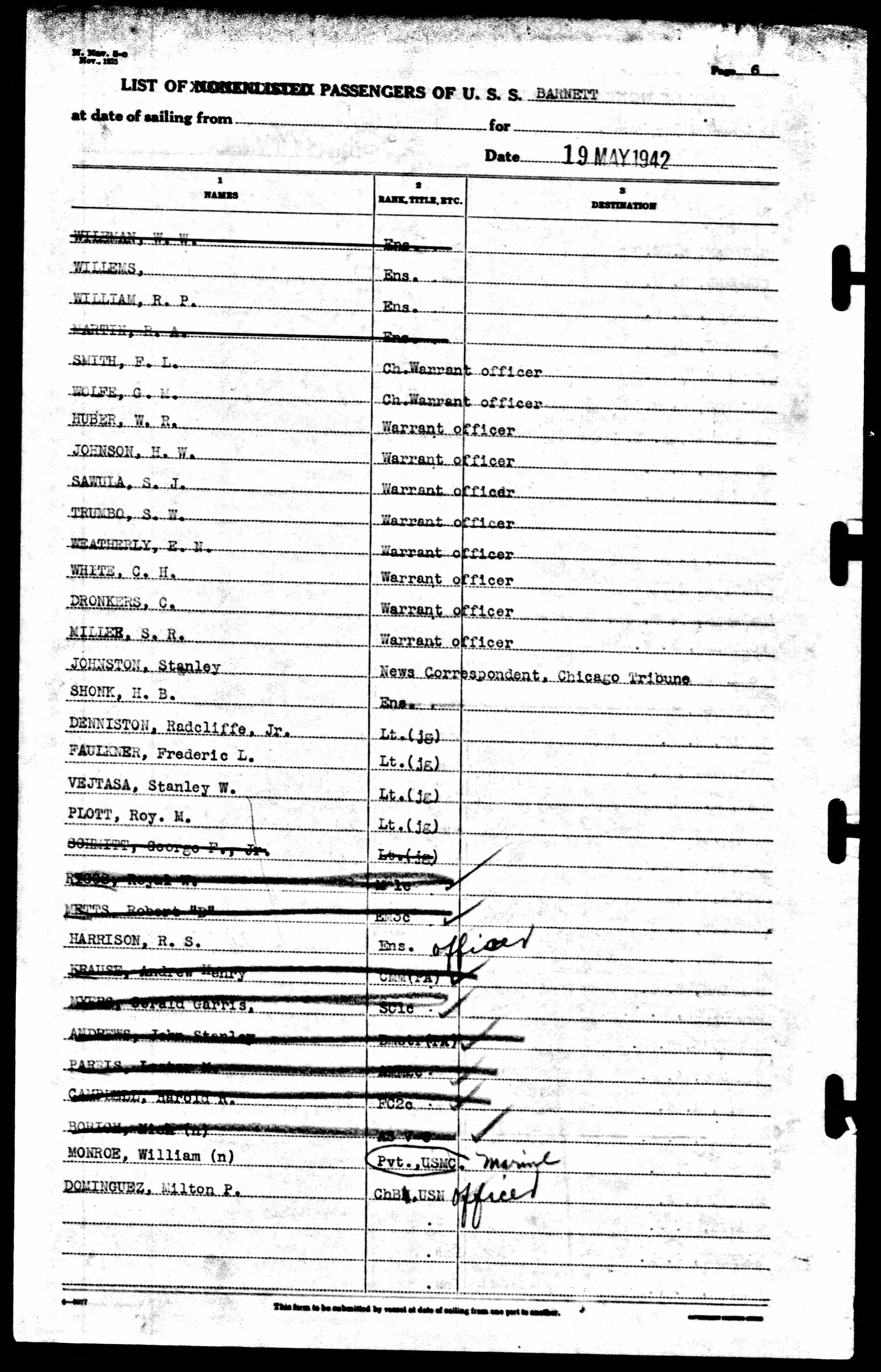
Stanley Johnston on the USS Barnett
At some point before June 7, Stanley Johnston obtained information revealing that the Navy had been able to decrypt Japanese code and learn the location of various Japanese ships. Breaking the code had helped the US Navy during the Battle of the Coral Sea, but more importantly, would help during the Battle of Midway, which took place during the first week of June, 1942, one month after the Battle of the Coral Sea.
The Battle of Midway is considered to be one of the most significant battles of World War II and a turning point in the war against the Japanese. According to the official Naval History and Heritage website, “The Battle of Midway, fought over and near the tiny U.S. mid-Pacific base at Midway atoll, represents the strategic high water mark of Japan’s Pacific Ocean war. Prior to this action, Japan possessed general navalsuperiority over the United States and could usually choose where and when to attack. After Midway, the two opposing fleets were essentially equals, and the United States soon took the offensive.” One of the key factors leading to the United States’ success in this battle was the Navy’s ability to read Japanese coded communications and learn their strategy and ship locations.[6]

English: PACIFIC OCEAN (May 2, 2011) In commemoration of the Battle of Midway, fought June 4-7, 1942. The U.S. Navy effectively destroyed Japan’s naval strength by sinking four of its aircraft carriers. It is considered one of the most important naval battles of World War II. Sailors assigned to the aircraft carrier USS Nimitz (CVN 68) created posters for a Battle of Midway Remembrance Dinner. (U.S. Navy photo illustration/Released) (Photo credit: Wikipedia)
After the Battle of Midway was successfully concluded, Stanley Johnston wrote a first page article for the Chicago Tribune, describing the victory and alluding, albeit somewhat indirectly, to the fact that the Navy had been able to break Japanese coded communications to learn the locations and identity of the Japanese ships. The Navy and President Roosevelt himself were livid about the fact that the newspaper had revealed this government secret, and an investigation was conducted to bring a legal action based on the 1917 Espionage Act against Johnston, a Tribune editor, and the Tribune itself. Just as the grand jury was to begin proceedings, however, the Navy decided that it did not want to pursue the matter if doing so would result in more disclosures that would jeopardize the war effort. Without the critical testimony of Navy witnesses regarding the impact of the disclosure on the US war effort, the case before the grand jury was weakened, and ultimately the grand jury failed to issue an indictment against the Tribune or its employees.[7]
One key question raised during the investigation and afterwards by journalists and naval historians was the question of how Johnston had obtained the information about the Japanese ships and about the code-breaking in the first place. Many concluded that Commander Seligman had been the source of the information. At least one writer suggested that Seligman had intentionally leaked the information to Johnston; others just concluded that Seligman, whether intentionally or not, had provided Johnston with access to the information. Whatever their view of his state of mind, the majority of sources concluded that Seligman, whether directly or indirectly, was the key source of Johnston’s information about the code-breaking that revealed the names and locations of the Japanese ships. [8]
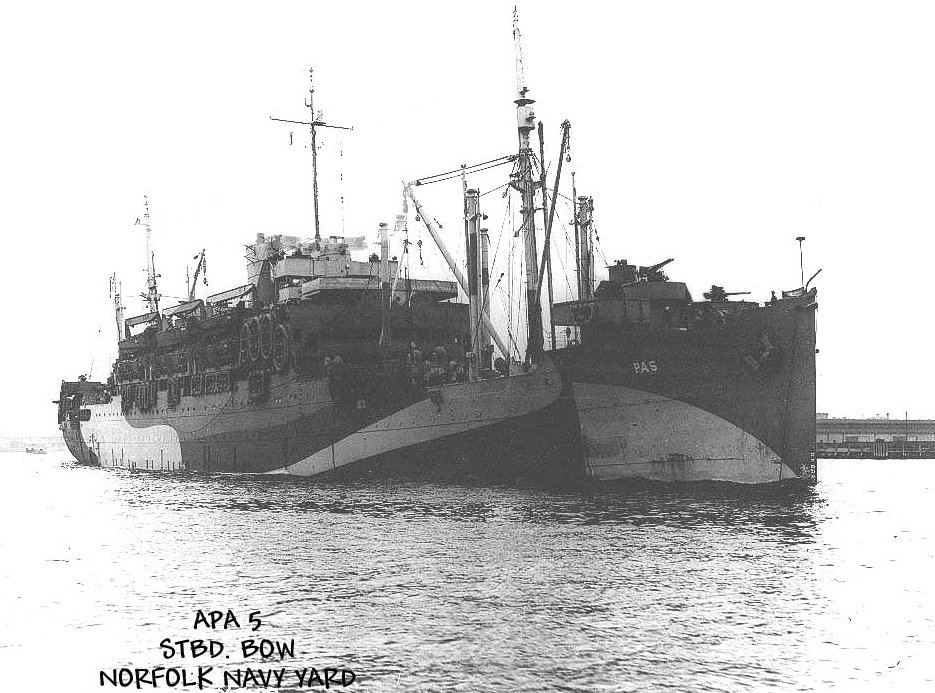
USS Barnett
The most recent and most comprehensive and scholarly analysis of how Johnston obtained the information is in the 2014 article by two Ohio University professors, Michael Sweeney and Patrick Washburn, “ ‘Aint Justice Wonderful’– The Chicago Tribune’s Battle of Midway Story and the Government’s Attempt at an Espionage Act Indictment in 1942,” Journalism & Communication Monograph (2014). I was very fortunate to be able to obtain a copy of this article from Professor Sweeney and will do my best to summarize their findings regarding Morton Seligman’s role in this matter. I am not attempting to review all the writings on this issue, but the Sweeney and Patrick article itself summarizes much of the literature and cites to all the important sources, both primary and secondary, and I am largely relying on it though I have read some of the other sources as well.
First, some background: Stanley Johnston, the Tribune’s war correspondent, was “the only journalist at the Battle of the Coral Sea….No American journalist was at the crucial Battle of Midway in the following month.” Sweeney and Washburn, p. 18. The Navy required any reporter in the war zone to be accredited, which included signing an agreement requiring the reporter to conform to the security regulations regarding what could and what could not be revealed to the public and what had to pass through Navy censors before publication. Although Johnston did not sign such an agreement because he shipped out on the USS Lexington before he had a chance, no one disputes that he was aware of these restrictions and agreed to follow them. Ibid., p. 21.
As stated above, Seligman was on the Barnett as of May 16, 1942, along with Johnston, and the ship arrived in San Diego on June 2, 1942. A few days later Johnston was back in Chicago at the Tribune and was there to report on the Battle of Midway, which took place between June 4 and June 7, 1942. Ibid., p. 22-26. On June 6, Johnston wrote an article that identified which Japanese ships had been destroyed during the battle, information that was not publicly available according to the Navy, and known by no more than ten men in the Navy. The Navy became immediately suspicious about Johnston’s knowledge of these facts. In addition, the headline to the story (apparently written by someone other than Johnston) suggested that the Navy had obtained advance notice of the Japanese battle plans, saying “Navy Had Word of Jap Plan to Strike at Sea.” The Navy also realized that the Tribune had not submitted the article to the Navy for clearance before publication. Ibid., 27-28.[9]
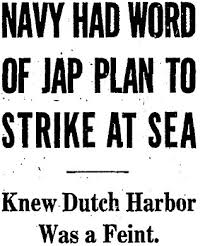
Chicago Tribune June 7, 1942
An internal investigation by the Navy led to the discovery that Johnston’s article was strikingly similar to a coded dispatch that Admiral Nimitz had sent to the Navy’s Pacific fleet outlining Japan’s plan to attack Midway and the list of Japanese ships that would be involved in that attack. Ibid., p. 29. On June 8, Johnston met with the Navy and was interrogated about his sources. Johnston insisted that he had learned these facts while on the Lexington and the Barnett just by overhearing conversations among the crew. He denied ever seeing the Nimitz dispatch or any written list of Japanese ships. After the first meeting, however, Johnston changed his story when he next was questioned by the Navy, claiming that he had found a writing with the list of Japanese ships and had copied it. He explained why he had not initially admitted this by saying he had not wanted to get any of the brave servicemen aboard the ship into any trouble. Ibid., pp. 33-34.
Meanwhile, the commanding officer of the Barnett, W.B. Phillips, reported to the Navy that one of the Lexington commanders on the ship told the Barnett’s communications officer that he had been authorized to show decoded messages to Johnston. Phillips said the Lexington officers had thought that these disclosures were permissible since Johnston had been a witness to the Coral Sea battle and was already familiar with naval operations as a result. Ibid., pp. 34-35. The specific officer or officers were apparently not named by Phillips.
The Navy’s investigation was followed by an investigation by the Justice Department and the FBI, as directed by President Roosevelt. Johnston was interviewed again, this time by William D. Mitchell, Attorney General under Hoover who was appointed by the Attorney General, Nicholas Biddle, to lead the prosecution of the case. Johnston again insisted that he had obtained the information from conversations on board the ship. Ibid., p. 45. He downplayed the importance of the written list of ships that he had mentioned in his second interview with the Navy a month earlier. Mitchell asked him to explain the striking similarity between his report and the Nimitz dispatch, and Johnston said he had no idea how that happened and denied seeing any secret dispatch. Mitchell was unpersuaded and believed that Johnston must have seen the Nimitz dispatch. Ibid., pp. 45-48.

William D. Mitchell, former US Attorney General
In a July 14, 1942 memorandum to the Attorney General and the Secretary of the Navy, Mitchell wrote that two officers, who remain unnamed, saw Commander Morton Seligman working at a table in the quarters he shared with Johnson, writing down a list of the Japanese ships. The Mitchell memorandum then noted that Seligman stated that he did not remember making such a list, but that he might have done so. Ibid., p. 48. This is the first mention of Seligman in the Sweeney and Washburn article, and it suggests that Seligman was questioned by Mitchell sometime on or before July 14, 1942, but nothing more specific is provided in the text or in the footnotes about that interview or about the two unnamed officers. Thus, by mid-July, Morton Seligman had become a key part of the government’s investigation.
In the third part of the story, I will address more specifically what Sweeney and Washburn found out about my cousin Morton Seligman’s role in this matter of state secrecy versus freedom of the press.
[1] Michael S. Sweeney and Patrick S. Washburn, “Aint Justice Wonderful” The Chicago Tribune’s Battle of Midway Story and the Government’s Attempt at an Espionage Act Indictment in 1942”, Journalism & Communication Monograph“(2014), at 53-55;
[2] Other newspapers also carried the story. E.g., “Morton Seligman Emerged as Hero of Last Hours of Lexington,” Clovis News-Journal, June 18, 1942, p.1.
[3] National Archives at College Park; College Park, Maryland, United States; Muster Rolls of U.S. Navy Ships, Stations, and Other Naval Activities, 01/01/1939 – 01/01/1949; Record Group: 24, Records of the Bureau of Naval Personnel, 1798 – 2007; Series ARC ID: 594996; Series MLR Number: A1 135
[4] Ancestry.com. U.S. World War II Navy Muster Rolls, 1938-1949 [database on-line]. Provo, UT, USA: Ancestry.com Operations Inc, 2011.
Original data: Muster Rolls of U.S. Navy Ships, Stations, and Other Naval Activities, 01/01/1939-01/01/1949; A-1 Entry 135, 10230 rolls, ARC ID: 594996. Records of the Bureau of Naval Personnel, Record Group Number 24. National Archives at College Park, College Park, MD. National Archives at College Park; College Park, Maryland, United States; Muster Rolls of U.S. Navy Ships, Stations, and Other Naval Activities, 01/01/1939 – 01/01/1949; Record Group: 24, Records of the Bureau of Naval Personnel, 1798 – 2007; Series ARC ID: 594996; Series MLR Number: A1 135.
[5] National Archives at College Park; College Park, Maryland, United States; Muster Rolls of U.S. Navy Ships, Stations, and Other Naval Activities, 01/01/1939 – 01/01/1949; Record Group: 24, Records of the Bureau of Naval Personnel, 1798 – 2007; Series ARC ID: 594996; Series MLR Number: A1 135. One source claims that Johnston had even been with Seligman aboard the Lexington and assisting him during those last critical moments before the ship sank in the Coral Sea. “Editorial: The Battle of Midway—A Secrets Storm,” Chicago Tribune, August 11, 2013, at http://articles.chicagotribune.com/2013-08-11/opinion/ct-edit-midway-20130811_1_tribune-tower-secrets-u-s-navy ;
[6] “Battle of Midway, 4-7 June 1942: Overview and Special Image Selection,” at http://www.history.navy.mil/photos/events/wwii-pac/midway/midway.htm ; Battle of Midway from Wikipedia at http://en.wikipedia.org/wiki/Battle_of_Midway . See also “Midway: The Story that Never Ends,” by Thomas B. Allen (June 2007) at http://www.usni.org/magazines/proceedings/2007-06/midway-story-never-ends
[7] Michael S. Sweeney and Patrick S. Washburn, “Aint Justice Wonderful” The Chicago Tribune’s Battle of Midway Story and the Government’s Attempt at an Espionage Act Indictment in 1942”, Journalism & Communication Monograph“(2014), at 65-71. See also “Midway: The Story that Never Ends,” by Thomas B. Allen (June 2007) at http://www.usni.org/magazines/proceedings/2007-06/midway-story-never-ends (“fearing disclosure of code-breaking secrets in an espionage trial, the Department of Justice quietly closed the case.”). Allen also wrote that the impact of disclosing this information was substantial: “Pearl Harbor code breakers believed that the damage had already been done. A key code, Japanese Fleet General-Purpose System, was changed on 15 August, only two months after an earlier change. Other alterations were made in “virtually all Japanese codes and ciphers,” and it took cryptanalysts nearly four months of around-the-clock work to crack the new version and once again penetrate the Japanese navy’s operational radio traffic.” Ibid., citing and quoting from Edwin T. Layton, USN (Ret.), with Captain Roger Pineau, USNR (Ret.), and John Costello, And I Was There: Pearl Harbor and Midway—Breaking the Secrets (New York: William Morrow and Co., 1985), p. 453.
Much has been written about the aftermath of the Tribune’s publication of Johnston’s article and the reporting of government secrets. In fact, the issue has taken on new relevance in recent times after Edward Snowden’s disclosures of the NSA’s surveillance activities and the publication of those disclosures by the press. It is far beyond the scope of this blog to try and describe that aspect of the matter; my focus is on the alleged role that my cousin Morton Seligman had in the matter and its effect on him and his career. For an excellent analysis of the other issues as raised by the case, see Sweeney and Washburn, op. cit.
[8] See, e.g., Carey Shenkman, “70 Years Later, Still Playing Politics with the Freedom of the Press, June 18, 2014, at http://www.huffingtonpost.com/carey-shenkman/freedom-of-the-press_b_5503196.html ; “Editorial: The Battle of Midway—A Secrets Storm,” Chicago Tribune, August 11, 2013 at http://articles.chicagotribune.com/2013-08-11/opinion/ct-edit-midway-20130811_1_tribune-tower-secrets-u-s-navy ; Grant Sanger, MD, “Freedom of the Press or Treason?,” Proceedings Magazine, September, 1977 at http://www.usni.org/magazines/proceedings/1977-09/freedom-press-or-treason ; “Midway: The Story that Never Ends,” by Thomas B. Allen (June 2007) at http://www.usni.org/magazines/proceedings/2007-06/midway-story-never-ends ; “Stemming the Tide of Japanese Expansion,” at http://www.microworks.net/pacific/intelligence/stemming_tide.htm . The author with the harshest view of Seligman is Capt. Lawrence B. Brennan, U.S. Navy (Ret’d), whose anger undermines any sense of objectivity to his conclusions. Brennan, “Spilling the Secret—Morton T. Seligman, U.S. Navy (Retired), U.S. Naval Academy Class of 1919,” Naval Historical Foundation, February 28, 2013, at http://www.navyhistory.org/2013/02/spilling-the-secret-captain-morton-seligman/#fn-9595-2 . The most recent scholarship on this issue is found in the 2014 monograph of Professors Michael Sweeny and Patrick Washburn, cited and discussed above in note 7 and in the text.
[9] The failure to submit the story for clearance was an important element in the investigation and case against the Tribune, but is beyond the scope of my interest here. For more on that, I recommend reading the full article by Sweeney and Washburn.
Related articles

Gau-Algesheim and the Seligmans: My Great-great-grandfather’s Birthplace and What I Learned

Coat of arms of Gau-Algesheim (Photo credit: Wikipedia)
From several documents and historical references, I know that Bernard Seligman, my great-great-grandfather, and his brothers Adolph and Sigmund were born in a small town close to the Rhine River called Gau-Algesheim in what was then the Hesse Darmstadt region of Germany. Today it is located in the Mainz-Bingen district in the Rheinland-Pfalz state in Germany. Gau-Algesheim is about 15 miles southwest of Mainz and 40 miles southwest of Frankfort, Germany. Its population in 2012 was under seven thousand people, and it is less than five miles square in area.[1] From the photographs posted on the town’s official website, it appears to be a very charming and scenic location. There are wineries nearby, and tourism appears to be an important source of revenue for the town.[2]
What was Gau-Algesheim like almost 200 years ago when my ancestors were living there? How long had my Seligman ancestors been there, and were there any family members who remained behind after Bernard and his brothers left? How long had there been Jews living in Gau-Algesheim, and are there any left today? These were the questions that interested me the most about my great-great-grandfather’s birthplace.
There is a book about the history of Jews in Gau-Algesheim written by Ludwig Hellriegel in 1986, Die Geschichte der Gau-Algesheimer Juden, but unfortunately there is no copy available online, and the closest hard copy is in the New York Public Library. I tried to borrow it through my university’s interlibrary loan program, but was it was not available for lending. Thus, I’ve had to piece together bits of information from Wikipedia, JewishGen.org, the Gau-Algesheim website, and http://www.alemannia-judaica.de to get some answers to my questions, relying on Google Translate in order to read the sources written in German. What follows is a very brief skeletal history of Gau-Algesheim overall and in particular of the history of Jewish life there based on these limited secondary sources.
Gau-Algesheim has ancient roots. There is evidence of graves dating back as far as 1800 BCE, and evidence of a settlement during Roman times as well. In the 700s a church and a monastery were established. Gau-Algesheim was part of the Holy Roman Empire in the Middle Ages, and during that time was under the control of various different officials and jurisdictions within the Empire and often the subject of disputes and battles for control. See http://en.wikipedia.org/wiki/Gau-Algesheim http://www.gau-algesheim.de/category/stadt-gau-algesheim/geschichte/ It was part of Napoleon’s empire until 1812, and then eventually became part of the nation state of Germany in the mid-19th century.

Gau-Algesheim. Rathaus am Marktplatz. (Photo credit: Wikipedia)
Its Jewish history dates back to at least the 14th century. By the 14th century, the town had developed into a commercial center. Many merchants and artisans lived in the town, including herring merchants, blacksmiths, bakers, barbers, coopers, tailors, and shopkeepers. The monasteries owned a lot of the land, and there was also a fairly large class of nobility. By 1334, there must have been a Jewish community in Gau-Algesheim because in that year a head tax was imposed upon the Jewish residents. According to Wikipedia, Jews were required to pay this additional tax because they were considered the property of the crown and under its protection.[3] There was also a Jewish cemetery in existence during the 14th century. However, this community must have been a very small minority, and the Jews were certainly considered outsiders by the Catholic majority. In 1348 there was a flu pandemic in the region, and Jews were accused of poisoning the water, such accusations then leading to pogroms across the region.

Gau-Algesheim. Langgasse. (Photo credit: Wikipedia)
My sources do not reveal anything about Jewish life in Gau-Algesheim between 1400 and 1800, but the population in 1790 was reportedly only nineteen (it’s not clear whether this refers to people or households, but I assume it refers to total people). In 1808 there were three Jewish families, and in 1819 only six Jewish families. In 1857, the Jewish population was fifty people, and the Jewish population peaked in Gau-Algesheim in 1880 when it reached eighty people or 2.6% of the total population of the town, according to the alemannia-judaica website. (JewishGen puts the 1880 population at only 66.[4]) According to alemannia-judaica, a synagogue is not mentioned as being in the town until 1838. It was described as very old and in poor condition in 1850 and was rebuilt in 1861 and renovated again in 1873-1874. There was also a mikveh and a religious school, although it seems that there was a joint school with the nearby town of Bingen. (Bingen, by comparison, had 542 Jews in 1880, amounting to almost eight percent of its overall population; it was only six miles away from Gau-Algesheim. By further comparison, Mainz had a Jewish population of about 3,000 in 1900, and Frankfurt had almost 12,000 Jews in 1900.)[5]

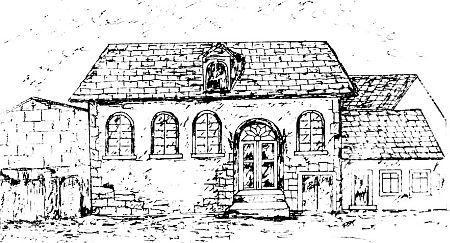
Drawing of the former synagogue in Gau-Algesheim http://www.alemannia-judaica.de/images/Images%2056/Gau%20Algesheim%20Synagoge%20010.jpg
The tiny size of the Jewish population in Gau-Algesheim in the 19th century in the years when my ancestors were living there surprised me. How did my family end up there? And why did they leave? I don’t know the answers to the first question at all and can only speculate about the second and will write more generally about it in a later post. But what I want to focus on for now is what happened to the Jewish community in Gau-Algesheim after my great-great-grandfather Bernard and his brothers left in the middle of the 19th century.

The former synagogue http://www.alemannia-judaica.de/images/Images%20185/Gau-Algesheim%20Synagoge%20290.jpg
It appears that my ancestors were not the only Jews to leave Gau-Algesheim. By 1900, the Jewish population had declined to 27 people; in 1931 there were only 31 Jewish residents. Presumably many of these Jews had immigrated to another country, and many may have moved to the larger cities in Germany. In the Reichstag elections of 1933, the Nazi Party only received 26.6% of the vote in Gau-Algesheim with the Center Party carrying almost half the vote. Unfortunately, that did not reflect the overall vote in Germany, and the Nazi Party took control of the country, soon dissolving the Reichstag and all other political parties, ultimately leading to World War II and the Holocaust. Whatever Jews were left in Gau-Algesheim before World War II either left the town or were killed by the Nazis.
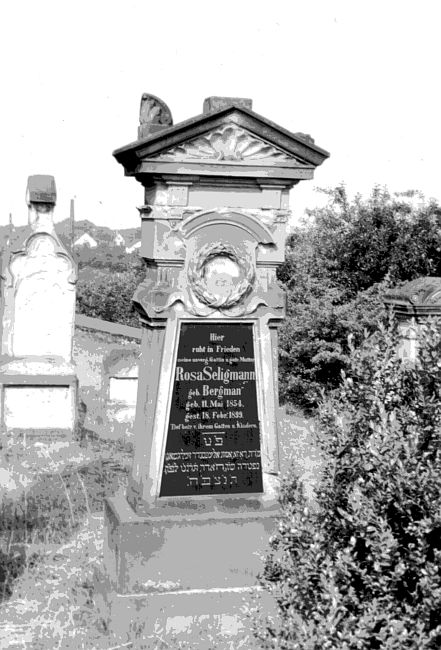
There is no Jewish community there today. The Jewish cemetery remains, however, although it was desecrated during the Holocaust and has been vandalized several times since then. In 2006, Walter Nathan, whose father was born in Gau-Algesheim, visited the cemetery and was so disturbed by the condition of the cemetery that he decided to work to have it restored and to create a memorial to those who were buried there and also to those who had been killed in the Holocaust. On November 9, 2008, on the 70th anniversary of Kristallnacht, the memorial was dedicated by Nathan and many members of his extended family.[6] Included in the headstones remaining in the cemetery was this one for a woman named Rosa Gebmann Seligmann who was born in 1853 and died in 1899 and married someone who was probably my relative.
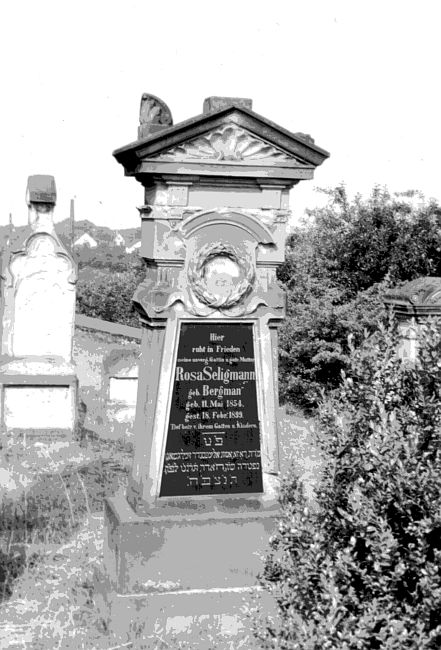
With the help of two members of the Tracing the Tribe Facebook group, I can provide this translation of the German and the Hebrew on the headstone. The German says, “Here rests in peace my unforgettable wife and good mother Rosa Seligman, nee Bergman, born May 11, 1854, died Feb.1 8, 1899. Deeply missed by her husband and children. The Hebrew at the bottom says, “Here is buried Mrs. Roza wife of Alexander Seligman Died (on the) holy Shabbos 8(th day of) Adar 5659 by the small count. May her soul be bound in the bonds of life.”
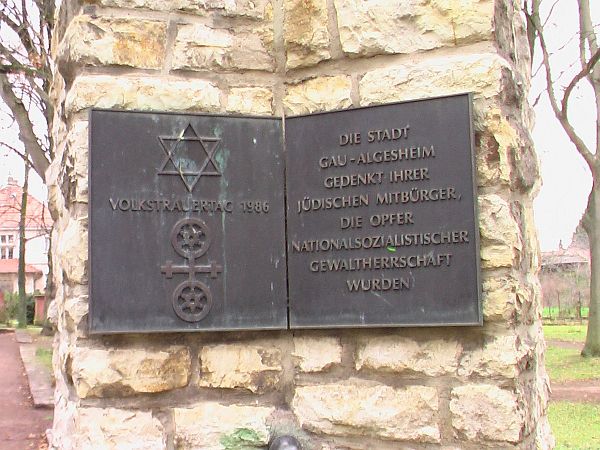
There is also a plaque in town commemorating the Jewish citizens of Gau-Algesheim who were killed by the Nazis. It says, as translated by Google Translate, “The city of Gau-Algesheim commemorates their Jewish fellow citizens who were victims of Nazi violence and domination.”
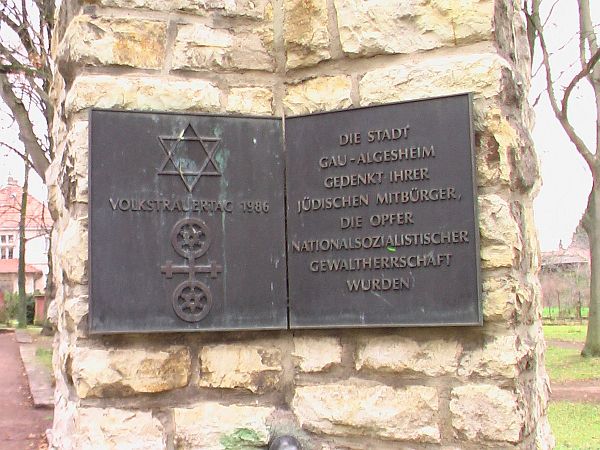
There is another plaque hanging on the wall of the cemetery listing the Jews born in Gau-Algesheim who were murdered during the Holocaust according to Memorial Book: Victims of the Persecution of Jews under the National Socialist Tyranny in Germany 1933 – 1945. It says, “Standing in this sacred place our hearts turn to the memory of those who fell victim to the violence of the Nazis, and we vow to keep their memory alive. In solemn testimony of the unbroken faith that connects us with them, their names are referred to in profound awe. We say the Kaddish—the prayer for the dead— and remember the terrible tragedy of the Jewish people.”
Among the names listed on this second plaque were these individuals: Bettina Elisabeth Arnfeld born Seligmann (1875), Johanna Bielefeld born Seligmann (1881), Anna Goldmann born Seligmann (1889), and Moritz Seligmann (1881),.[7]
On the JewishGen.org site, I found two more Seligmanns born in Gau-Algesheim: Jacob Seligmann, born April 8, 1869, who became a resident of Neunkirche and emigrated in 1935 to Luxembourg, and Laura Seligmann Winter, born June 9, 1870, who was also a resident of Neunkirche and immigrated to Luxembourg in 1935. [8]
These may have been my relatives. Given the small size of the Jewish community that lived in Gau-Algesheim, I have to assume that at least some if not all of those named Seligmann were related to my great-great-grandfather Bernard and were thus related to me. When I saw those names, I was stunned. Because I have not found where my Brotman relatives lived in Galicia, because I have not found any Goldschlagers from Iasi who were killed in the Holocaust, because my Cohen relatives left Europe long before Hitler was even born, I had not ever before seen the names of possible relatives who were victims of the Holocaust. But Bettina, Johanna, Anna, Moritz, Jacob, and Laura Seligmann—they were likely the nieces and nephew or the cousins of Bernard, Sigmund, Adolph and James Seligman. They were likely my family.
Now I need to see what I can learn about them and what happened to them. I need to be sure that their names are not forgotten. This is what I know so far from the Yad Vashem names database:
Bettina Elizabeth Seligmann Arnfeld, born March 17, 1875, was residing in Muelheim Ruhr, Dusseldorf, Rhine Province, and was deported to Theresienstadt on July 21, 1942, and she died there on January 23, 1943.
Johanna Seligmann Bielefeld, born March 13, 1881, was living in Mainz during the war. She died in Auschwitz.
Anna Seligmann Goldmann, born November 30, 1889, was living in Halle der Saale, Merseburg, Saxony Province. She was deported from there May 30, 1942. Her husband Hugo Goldmann, born in 1885, and their daughter Ruth Sara, born in 1924, were also deported that same day. They were all murdered.
Moritz Seligmann, born in 1881, was not listed in the Yad Vashem database. On the memorial plaque placed at the cemetery in Gau-Algesheim the only notation after his name is Verschollen, which means “missing, lost without a trace,” according to one source.
Jacob Seligmann, despite escaping Germany in 1935 and moving to Luxemburg, did not escape the Nazis. He was killed in 1941 in Luxemburg, according to the Yad Vashem website.
Laura Seligmann Winter, who may have been Jacob’s sister, was a widow; on August 28, 1940, she also was killed in Luxemburg.
I will continue to look for more records that will tell something about the lives of these people and their families so that they can be remembered not only for how they died but also for how they lived.

“Dachau never again” by Forrest R. Whitesides – Own work. Licensed under Creative Commons Attribution-Share Alike 3.0 via Wikimedia Commons – http://commons.wikimedia.org/wiki/File:Dachau_never_again.jpg#mediaviewer/File:Dachau_never_again.jpg
[1] See http://en.wikipedia.org/wiki/Gau-Algesheim
[2] See http://www.gau-algesheim.de/category/stadt-gau-algesheim/geschichte/
[3] See http://en.wikipedia.org/wiki/Leibzoll
[4] See http://data.jewishgen.org/wconnect/wc.dll?jg~jgsys~community~-1774383
[5] See http://fr.wikipedia.org/wiki/Synagogue_de_Bingen_am_Rhein_(1905-1938)
[6] See http://www.iit.edu/magazine/spring_2009/article_1.shtml#top
[8] [8] http://www.bundesarchiv.de/gedenkbuch/directory.html
The Seligmans: My New Mexican Ancestors—An Introduction

Flag of New Mexico
Although my parents did not talk very much about their ancestors or families when I was a child, one of the claims my father often made with pride was that his great-uncle had been the governor of New Mexico. I used to find this both amusing and irrelevant. A seemingly distant relative who died 20 years before I was born? Why would I care about that? And New Mexico? How could we possibly have a relative—a Jewish relative—who came from New Mexico? We were from New York and Philadelphia—we were not from the Southwest; we were not cowboys. Who was this relative, and how in the world did he get to be a governor? It all seemed rather preposterous—like saying we were descended from Napoleon or George Washington.
Not that I doubted that my father was telling the truth. It just seemed unimportant to me—until I started to delve into my family’s history. As I started to research and read about this side of my family, I realized how remarkable and interesting a story it is and what a uniquely American story it is. But before I get to that story, I need to begin at the end and explain how the story of the New Mexican Seligmans is part of my family’s story.
I have written quite a bit about my great-grandparents, Emanuel and Eva M. Cohen, and in particular about my great-grandmother Eva. You may recall that it was Emanuel and Eva who took in Emanuel’s brother Isaac and his teenage son when Isaac’s wife died. It was Emanuel and Eva who opened their home for Emanuel’s uncle Jonas’ funeral. And it was Eva who took care of my father and his sister for almost ten years when my grandparents were both unable to do so. Both my father and his cousin Marjorie have described Eva as the sweetest, most loving, and kindest woman.
Eva was a Seligman, the daughter of Bernard Seligman and Frances Nusbaum. She was born in 1866 in Philadelphia, but moved with her parents to Santa Fe, New Mexico when she was a young girl. She returned east to go to Swarthmore College outside of Philadelphia, and while there, she met Emanuel Cohen and married him in 1886 when she was only twenty years old.

Eva Cohen in the Swarthmore Bulletin 1885-1886
https://archive.org/details/annualcatalogueo1885swar

Marriage announcement of Emanuel Cohen and Eva Seligman
(Matrimony Notice, Friday, February 5, 1886, Jewish Messenger (New York, NY) Volume: 59 Issue: 6 Page: 6)
Together she and Emanuel had four sons, one of whom, Herbert, died as a toddler. Their son Maurice ended his own life after suffering from cancer, and their son John, my grandfather, was disabled by multiple sclerosis as a young man when my father was just a little boy. So Eva endured more than her fair share of tragedy, yet somehow she remained a positive and loving person who seemed to have an incredible ability to care for others.
One of my great disappointments was not having a photograph of Eva. She wrote inscriptions on many of the photographs I have of my father and his sister, but she must have been taking many of the pictures and thus is not in any of those in my family’s collection. I suppose that is consistent with what I know about her—someone who was focused on others and not on herself.
My father and his cousin Marjorie are the only surviving grandchildren of Eva and Emanuel Cohen, and my siblings and I are the only great-grandchildren. In the last few weeks, I’ve been very fortunate to receive from Marjorie’s maternal cousin Lou a number of photographs of Marjorie and others, and I was thrilled to be able to see the face of the woman with whom I’d had such wonderful conversations this summer. Below are several photographs of Marjorie as a child and as a young woman, including some with and of her parents Stanley and Bess Cohen.

Stanley Cohen World War I
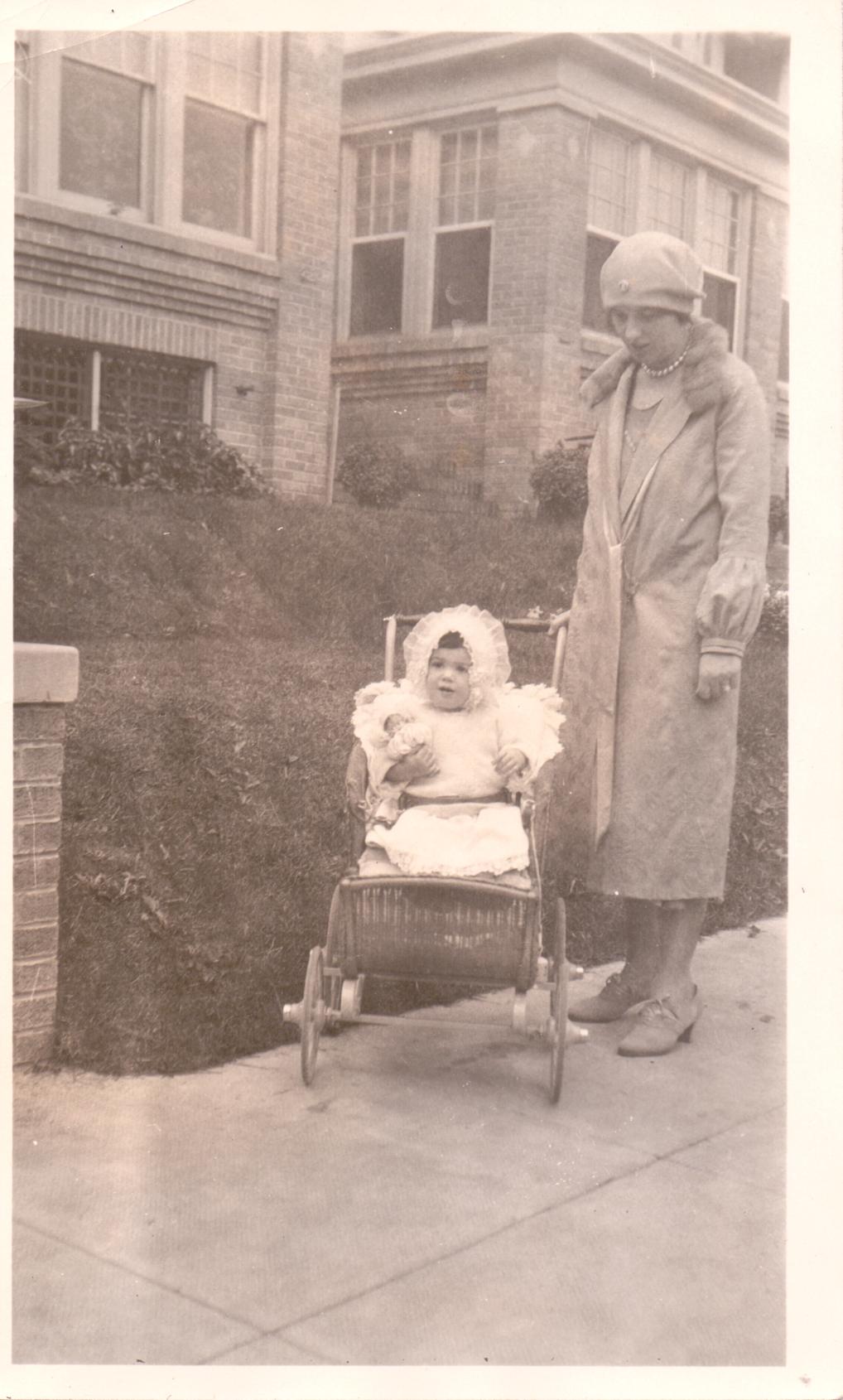
Marjorie and her mother Bess

Marjorie and her father Stanley

Stanley Cohen 1928

Marjorie 1933

Marjorie and Bess 1933


Marjorie with Pete from Our Gang
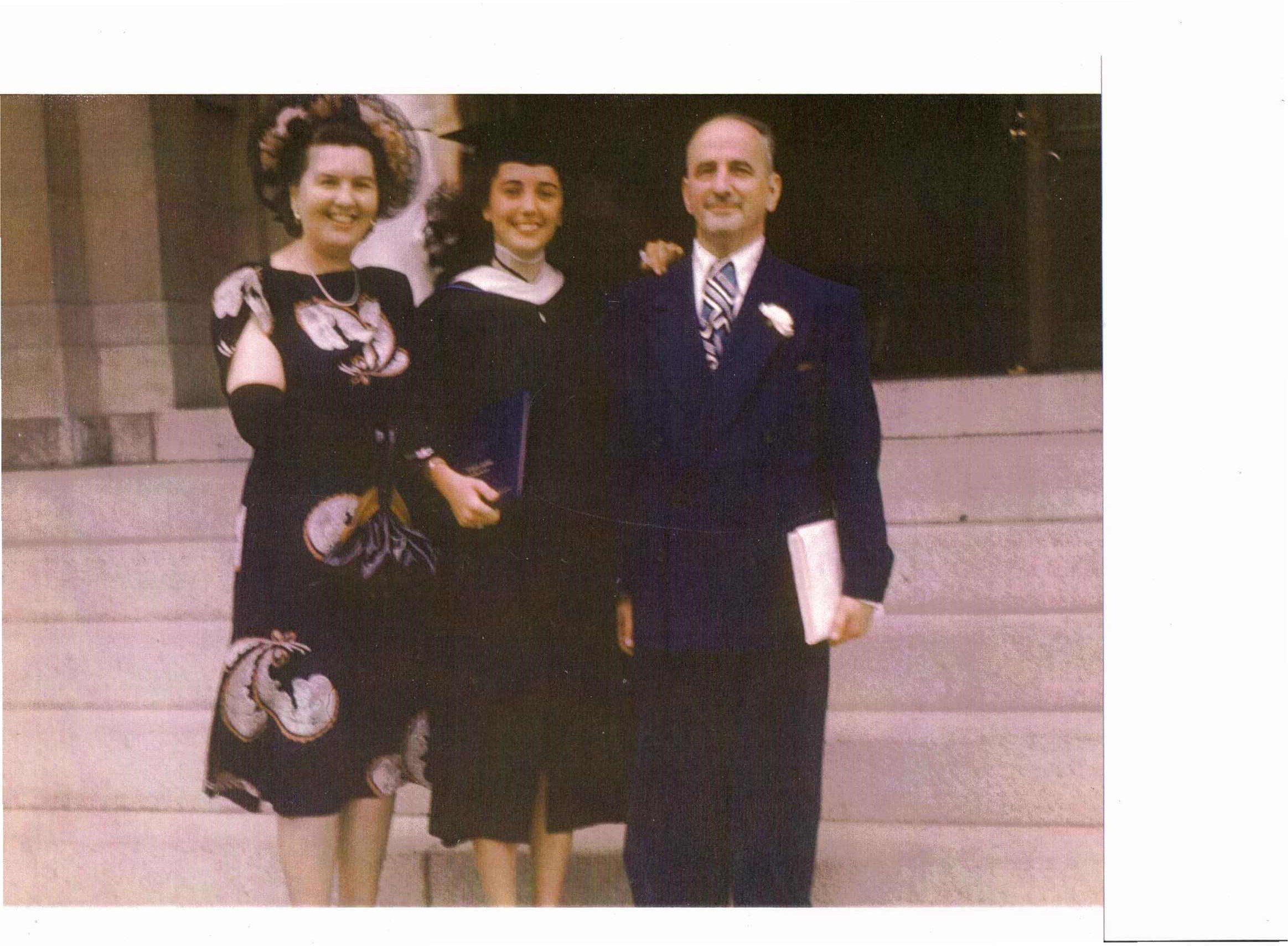
Marjorie and her parents at her graduation from Trinity (DC), c. 1947
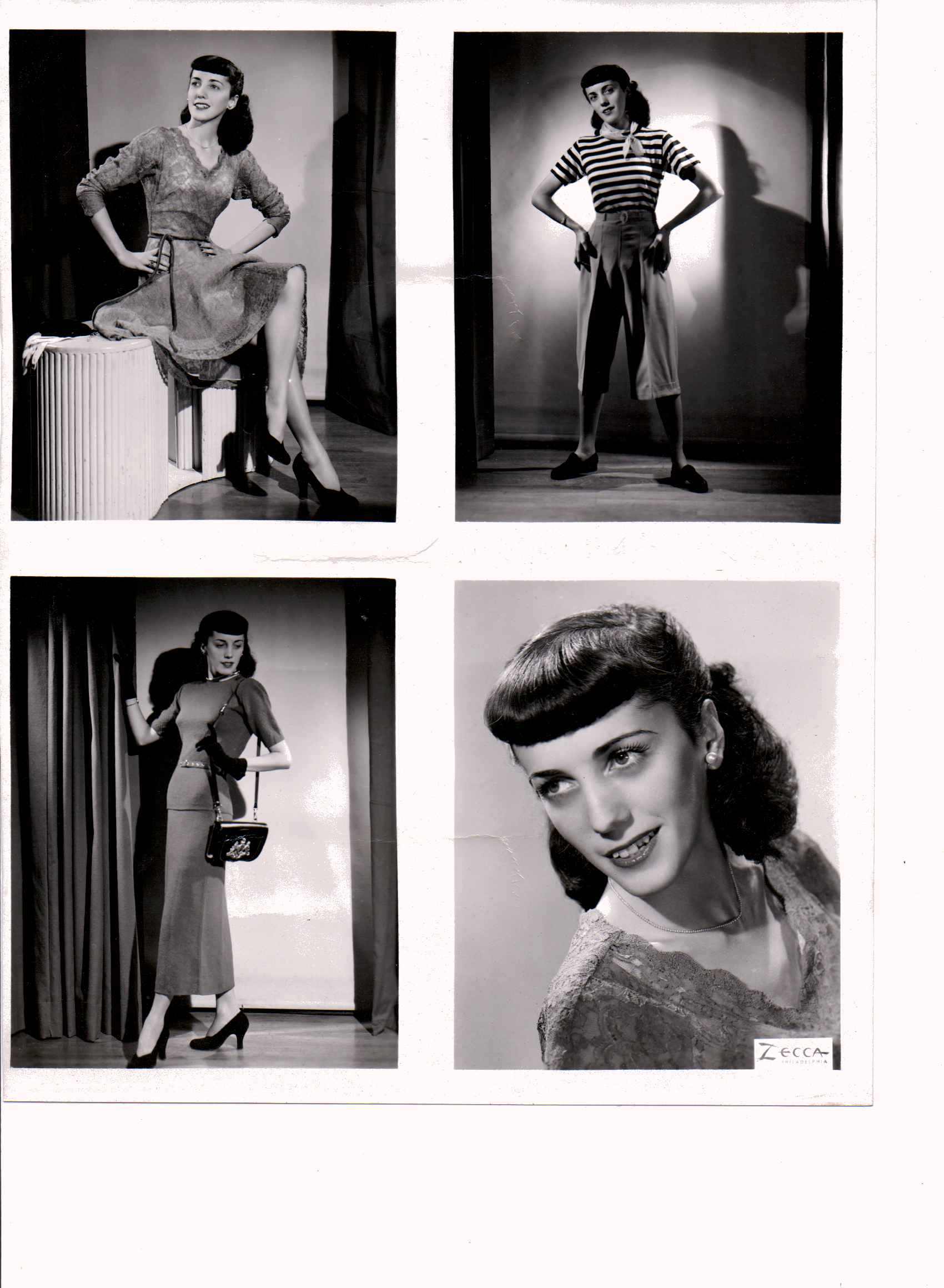
Marjorie as a student at NY Dramatic Arts Academy

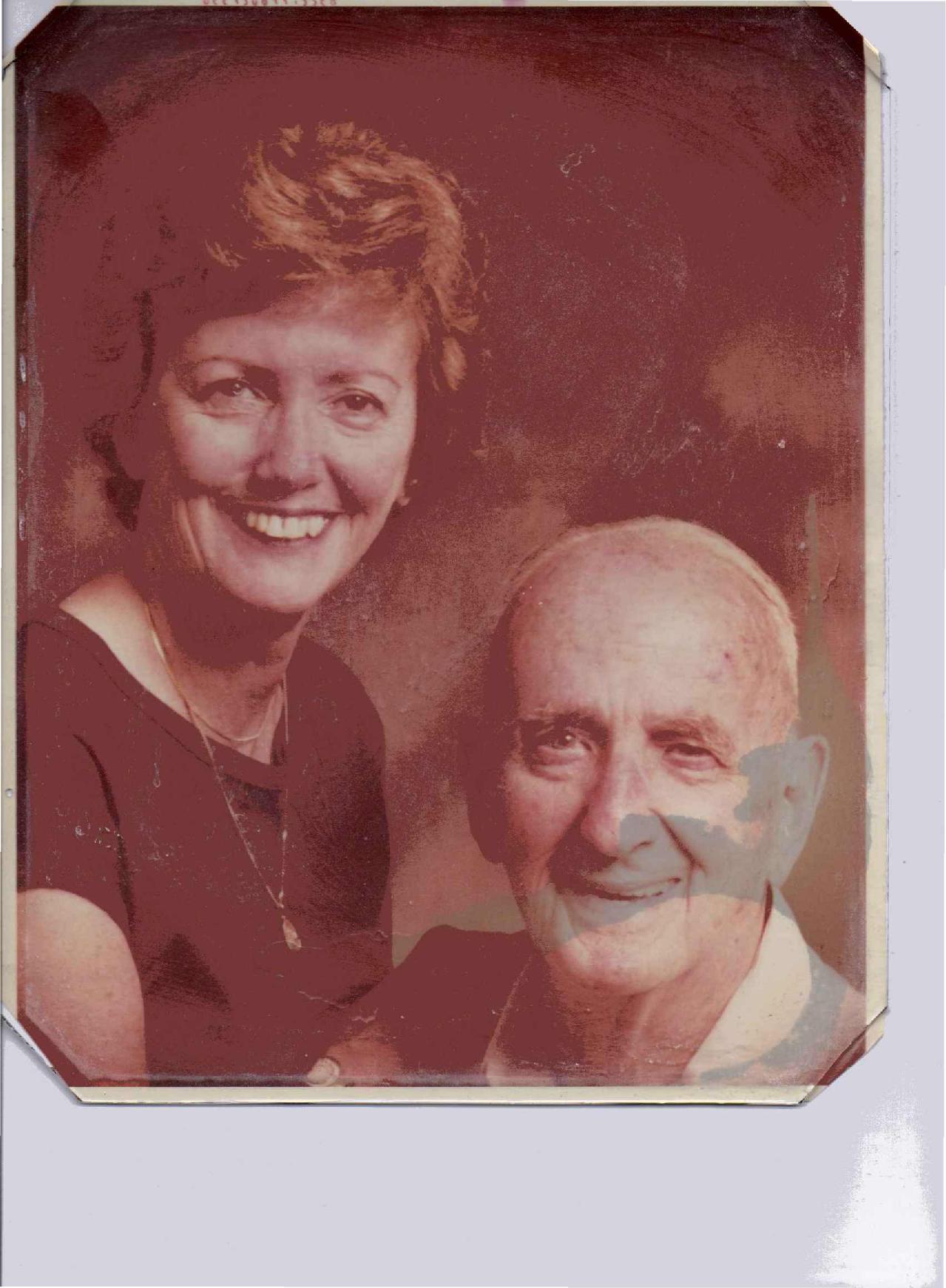
Marjorie and her father Stanley 1981
Included in that group of photographs was a photograph that Lou had labeled as Bess and Stanley 1923, but when I showed it to my father, he said that it was his parents, John and Eva (Schoenthal) Cohen. When I compared it to the only other photograph I have of my grandparents together, it was obvious that this was John and Eva, not Stanley and Bess. I was delighted to have another picture of my grandparents.

Eva (Schoenthal) and John Cohen, Jr. 1923

John and Eva Cohen
c. 1930
Also mixed into the group of photos from Marjorie’s cousin Lou were a few taken in Atlantic City during the summer of 1932 that finally allow me to see the face of my great-grandmother Eva Seligman Cohen. I will post those in a later post.
Related articles


Update: Adelyn Selinger’s Death Certificate
Today I received the death certificate for Adelyn Selinger, the nine year old daughter of Monroe and Estelle Selinger, granddaughter of Frederick Selinger and Rachel Cohen. I have updated the appropriate post, but will include it here as well.
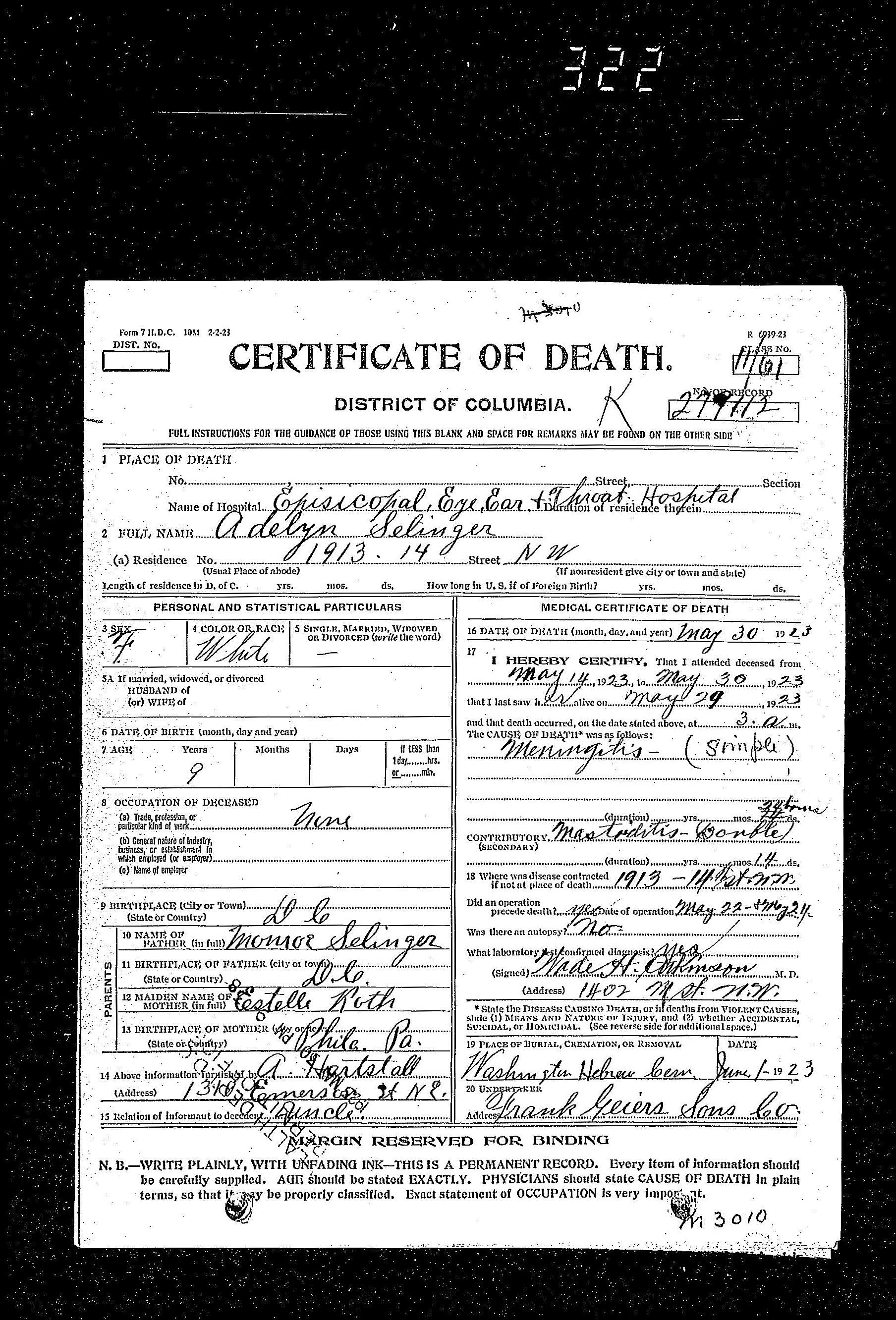
Adelyn Singer death certificate May 30, 1923
Adelyn died of meningitis and mastoiditis, a bacterial infection of the mastoid bone, which is located behind the ear. According to WebMD, these infections are usually caused by a middle ear infection that has not been successfully treated. Once again, I am grateful for modern medicine and all that pink amoxycillin my kids took for ear infections.
Notice also that the informant on the death certificate was Aaron Hartstall, Adelyn’s uncle, her father’s brother-in-law. I assume that her parents. grandparents, and aunt were too distraught to provide the details for the death certificate.
Hart Cohen of DC: The Rest of the Story
It’s been a week since I last posted anything new about the DC Cohen family. I had last written about Solomon Monroe Cohen and his family, the son of Moses, Jr., and Henrietta Cohen. Although I will continue to try and fill the gaps left in the research of the children of Moses, Jr. and Henrietta Cohen, I am now going to move on to the other children of Moses, Sr., and Adeline Cohen, first focusing on their son Hart, who was born in 1851 in Maryland.
It was this Hart (whom I’ve referred to as Hart DC) who had me confused because of the similarities between some of his biographical facts and those of his first cousin, my great-grandfather Emanuel’s brother, Hart Cohen of Philadelphia. They had the same name, were born the same year, and were both married to women named Henrietta. It was this Hart who led me to the discovery of the DC branch of the Cohen family. Hart and his wife Henrietta Baer had four children: Frances, Munroe, Isadore, and Jacob. Their son Munroe was killed in an awful accident while working as a brakeman on the railroad in Kingston, New York, in 1903. Isadore had married Frances David in 1907, so in 1910, Hart and Henrietta had two children living at home, Frances (32) and Jacob (25). Jacob was working as a chauffeur, and Hart was working in a jewelry store. On August 8, 1914, Hart’s wife Henrietta Baer Cohen died; she was only 62.
Isadore and Frances had had a son Monroe born in 1910, presumably named for Isadore’s brother. In 1916, they had another son, Burton. In 1917, Isadore was working as a department manager for a hotel according to his World War I draft registration.

Isadore Baer Cohen World War I draft registration
I found two World War I draft registrations for Jacob. The earlier one, dated June, 1917, listed Jacob’s business as the concessions business and said he suffered from heart trouble. His marital status was single, and he was living with his father and his sister Frances at 1802 7th Street NW in Washington. The second one, dated September 1918, had a number of changes: he was working in the restaurant business and was self-employed, he was married, and there was no mention of heart trouble.
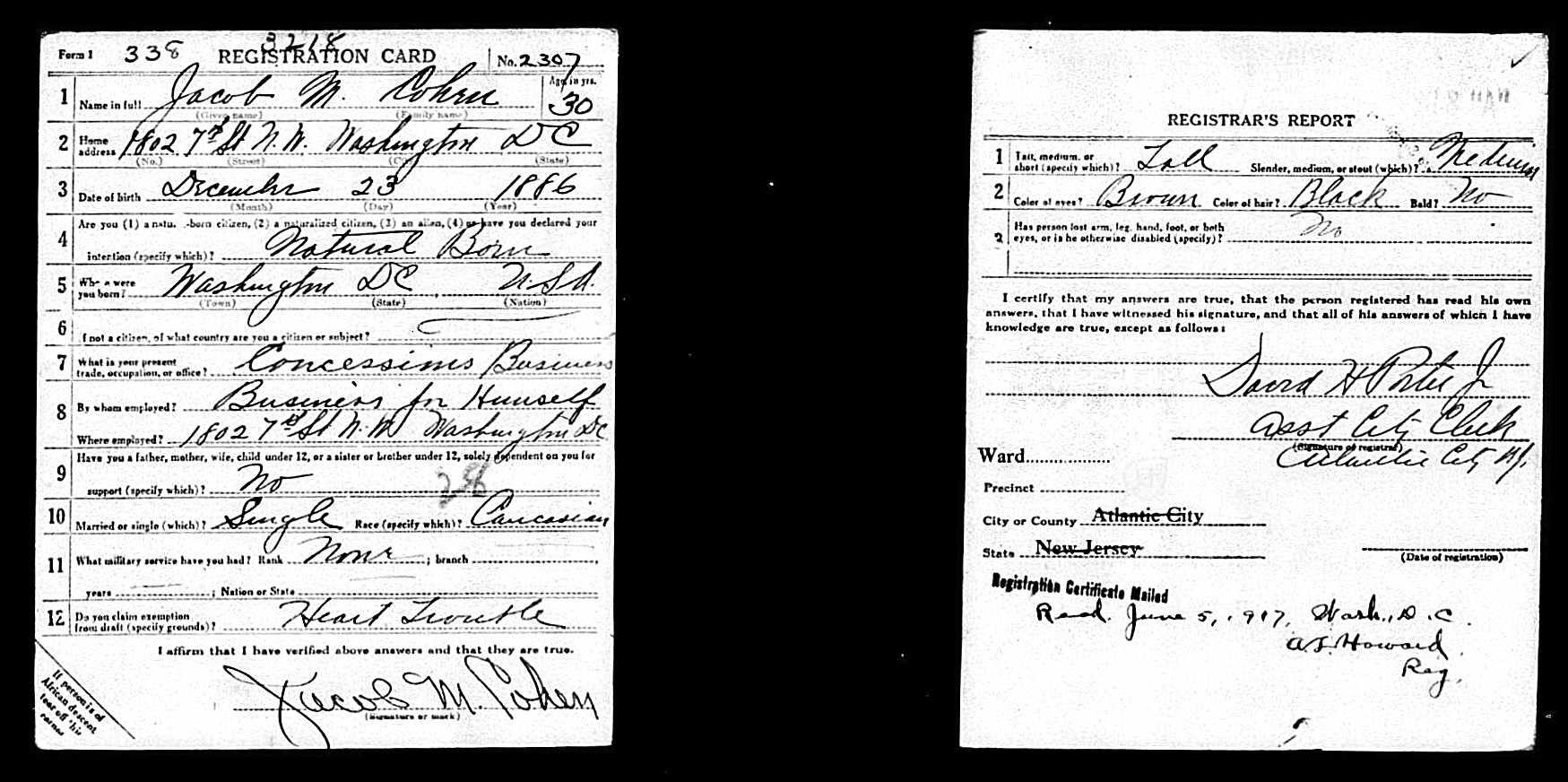
Jacob M. Cohen World War I registration (first)
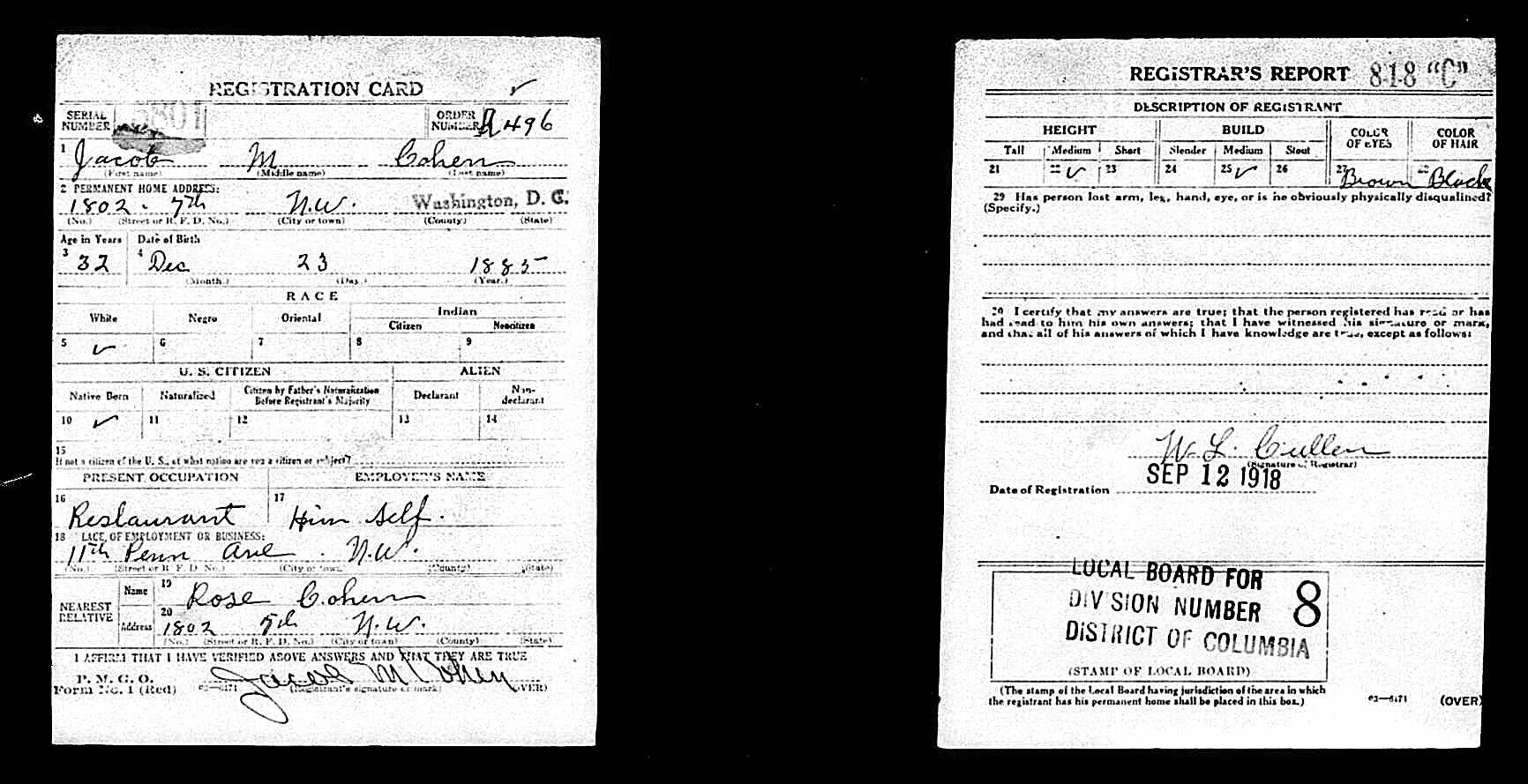
Jacob M. Cohen World War I registration (second)
According to the Philadelphia marriage index, Jacob had married Rose Serge in Philadelphia in 1918. He was 33, and she was thirty when they married. In 1918, they were living at 1802 7th Street with Jacob’s father and sister Frances.
In 1920, Hart and his daughter Frances were still living at 1802 7th Street, but Jacob and Rose had moved to their own place in Washington. Jacob was still in the restaurant business. Isadore and his family were also still living in Washington, and Isadore was still in the hotel business.
On August 10, 1926, Hart died at the age of 75. His daughter Frances continued to live in the same residence at 1802 7th Street, now living alone and working as a retail merchant in the dry goods business, a business she had been working in since at least 1915. She would continue to work in that business until her death in February, 1941, at age 62, the same age her mother had been when she died. Frances’ death notice said that she had died suddenly. She was buried at Washington Hebrew Cemetery. There is no mention of her brother Jacob in her death notice, only mention of her brother Isadore. Frances never married or had children.
![Ancestry.com. Historical Newspapers, Birth, Marriage, & Death Announcements, 1851-2003 [database on-line]. Provo, UT, USA: Ancestry.com Operations Inc, 2006.](https://brotmanblog.com/wp-content/uploads/2014/08/frances-cohen-death-notice.jpg)
Ancestry.com. Historical Newspapers, Birth, Marriage, & Death Announcements, 1851-2003 [database on-line]. Provo, UT, USA: Ancestry.com Operations Inc, 2006.
Although I could not find Rose on the 1940 census, she was still alive in 1949, as I found her on a ship manifest traveling to Hawaii. According to the ship manifest Rose was living at 41 Emory Street in Jersey City, New Jersey, in 1949. Rose had lived in Jersey City as a child, and 41 Emory Street is where her mother had been living in 1925 and where two of her sisters were living in 1930. Obviously, Rose had returned to her hometown after Jacob died. She was still alive in 1952 when her sister Minnie died, but after that I cannot find any mention or record for her. I tried contacting the funeral home that had handled other deaths in the Serge family, Wien and Wien in New Jersey, but sadly their records for the Jersey City funeral home were burned in a fire fifteen years ago. I also called the cemetery where Minnie is buried to see if they have any records for Jacob or Rose Cohen, but have not heard back from them.
As for Isadore, in 1930, he and his family were living in Chicago, where Isadore was working as a salesman in the paper industry. His son Monroe was a clerk in the weather bureau there. I wonder what prompted the move to Chicago and the career change for Isadore.
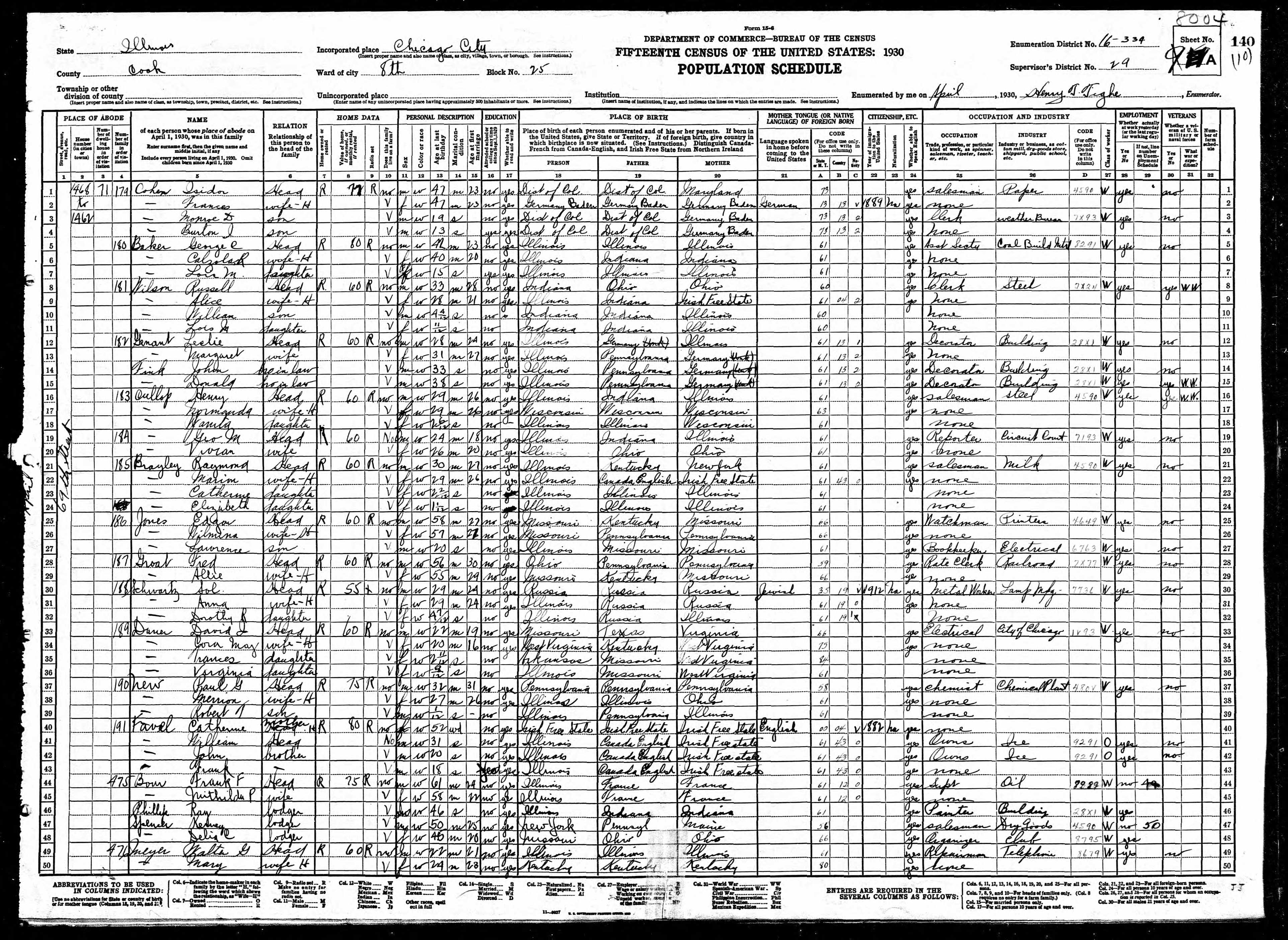
Isadore Baer Cohen and family 1930 census
In 1940, the family was still living together in Chicago, and Isadore was a book salesman. Both Monroe and Burton had changed their surname from Cohen to Coulter, though their parents were still using Cohen. Although Monroe was now 30 and Burton 24, there is no occupation listed for either of them on the 1940 census.

Isadore Baer Cohen and family 1940 census
By 1942, Isadore had retired, according to his draft registration. He gave Burton’s name as his contact person, which I found interesting since his wife Frances was still alive at that time.

Isadore Baer Cohen World War II draft registration
Sometime between 1942 and 1949, Isadore and Frances moved to California, where Frances died in 1949. Isadore died in 1958 when he was 77 years old. He lived a much longer life than any of his siblings or his mother. His father Hart was the only other one to live past seventy.
According to his obituary in the Chicago Tribune of September 8, 1996, Isadore’s son Monroe Coulter had enlisted in the Army Air Corps before World War II and was an electrical engineer. He married Fannie Simon on November 25, 1942, in Chicago and appears to have settled in Illinois. They had two children. Monroe worked on the Air Force missile program and retired from the military in 1970 with the rank of lieutenant colonel. He was living in Itasca, Illinois, when he died on September 6, 1996, and is buried at Shalom Memorial Park in Arlington Heights, Illinois.
His brother Burton moved to California in the 1950s. He was married and had two children. In 1952 he was working as the deputy county assessor in Alhambra, California, according to a directory for that city. Then, according to Sacramento city directories, from at least 1959 through 1966 he lived in Sacramento and worked as an appraiser for the California Department of Equalization, a state agency responsible for administering the state tax laws. Burton died in Los Angeles, California in 1978. He was only 61 years old and thus was another family member who did not live to see seventy.
The family line of Hart and Henrietta Cohen thus is somewhat limited. Of the four children of Hart and Henrietta, only Isadore lived past seventy, and only Isadore had children. Frances never married, and Jacob married, but did not have children. Munroe, Jacob, and Frances all died at relatively young ages, as did their mother Henrietta. Although Munroe died in an accident, I do not know what led to the early deaths of Henrietta, Frances and Jacob, but will see if I can find out.
I am hoping that one of Isadore’s descendants will be able to provide a Y-DNA test to provide evidence of the genetic link between Moses Cohen, Sr., and my great-great-grandfather Jacob Cohen, but I am having some trouble making contact with them. They are the only direct male genetic descendants of Moses Cohen, Sr. and thus my only option for finding that genetic connection between Moses and Jacob. Maybe one of them will find this blog post and find me.
Ray and Leah: Two Beautiful Portraits
When I published the photograph of Ray Strolowitz Adler several days ago, my cousin Jean emailed me to say that she was struck by the similarity between that photograph and one she had sent me months ago of her grandmother Leah Strolowitz Adler, Ray’s younger sister. Looking at both photographs more carefully, you can see that they were taken at the same studio with Leah and Ray standing in similar poses. You can definitely see the family resemblance between the two sisters.

Leah Strolowitz Adler

Ray Strolowitz Adler
In rescanning the photo of Leah, Jean took it out of the frame and found this inscription on the back.

If both photos were in fact taken at the same time in 1918, this would have been after Ray was married and a few years before Leah married.
I wonder if all the siblings had these portraits done. Unfortunately, the others may have been lost forever. It always surprises me when I see studio portraits of the recent immigrants who could not have had a lot of extra money to spend on luxuries, yet so many of them did have these photographs done. I am so glad they did, and I am so lucky that their descendants were willing to share these two with me.
Related articles


How Genealogy Research Works: Solomon Monroe Cohen as A Sample Case

English: City seal of Detroit, Michigan. (Photo credit: Wikipedia)
I’ve had remarkable luck tracking most of the descendants of Moses Cohen, Jr., even with the women who are usually so much harder to track because of the change in their names when they marry. But when it came to the youngest son of Moses, Jr., and Henrietta Cohen, Solomon Monroe Cohen, I hit a few obstacles. There are a few things that remain unresolved, but I’ve made a lot of progress. I thought this would be a good example of just how much luck, persistence, and serendipity it takes to find records about a family member.
As reported in an earlier post, as of 1910, Solomon had married Estelle Spater of Detroit and settled in that city, working as the manager of a mail order business. They had had two sons, Ralph born in 1907 and Theodore born in 1910. Theodore had died in 1912 of complications from cerebral palsy.
In 1911 according to a Detroit city directory, Solomon was the general manager of Peoples Outfitting Company, where he was still employed in 1917 according to his World War I draft registration; he described his position as manager of the advertising staff and married to “Stella S. Cohen.”

Sol M Cohen World War I draft registration
The 1920 census has him living with Estelle and Ralph, working at a furniture business. So far my research was moving along easily, just using ancestry.com to find the census report and the Detroit directories.
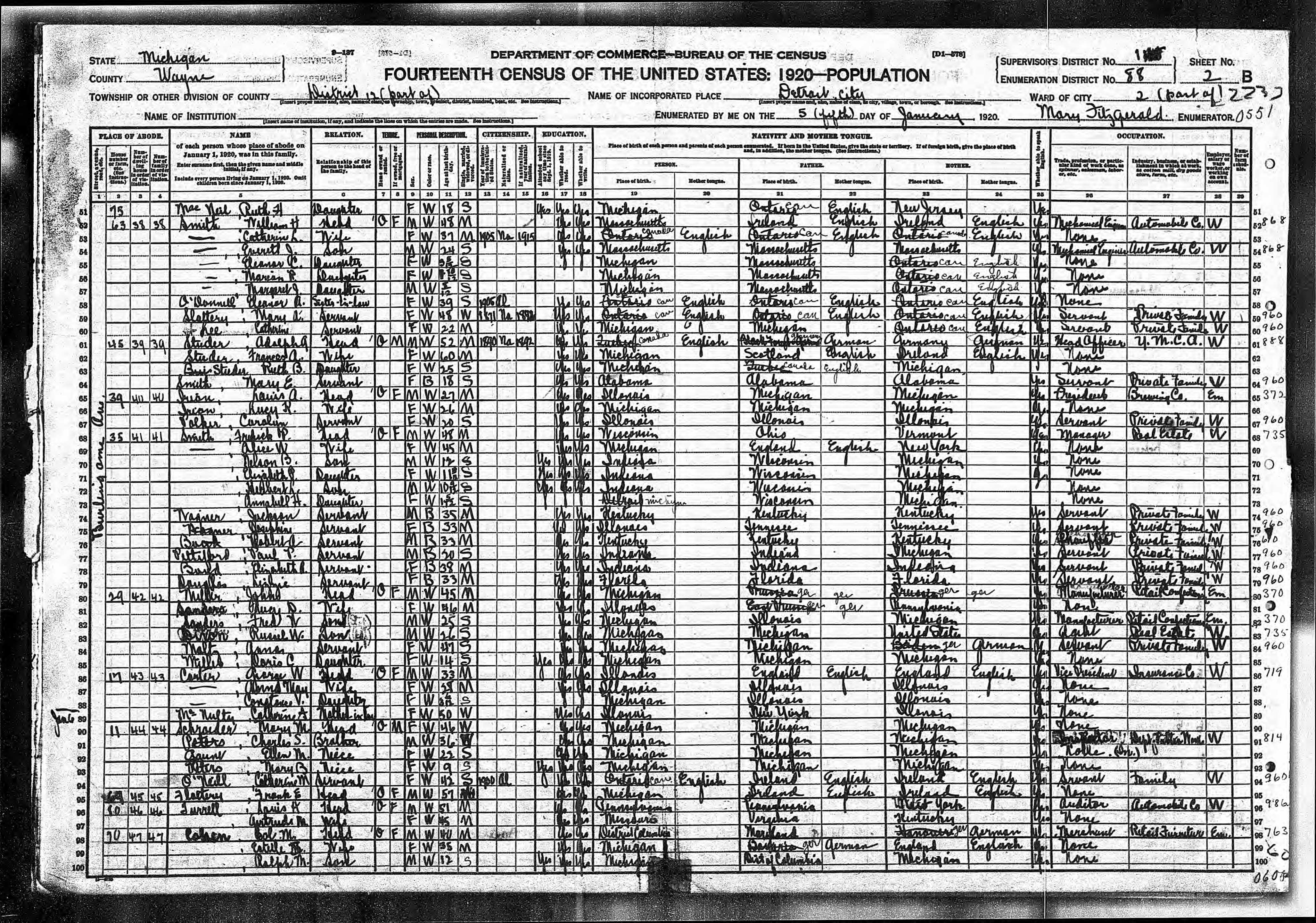
Solomon Cohen and family 1920 census
Then things got more complicated. I could not (and still cannot find) Solomon or Estelle or Ralph on the 1930 census despite using wildcard search techniques, different databases, with and without date restrictions for births, with and without geographic restrictions.
I decided to focus my search on Ralph, figuring that there might be more recent records. I lucked out and found a marriage license application on familysearch.org for a Ralph Cole to marry Lois Hollander in 1938, and it was indexed with Ralph’s parents’ names, Sol M. Cole and Estelle Spater.
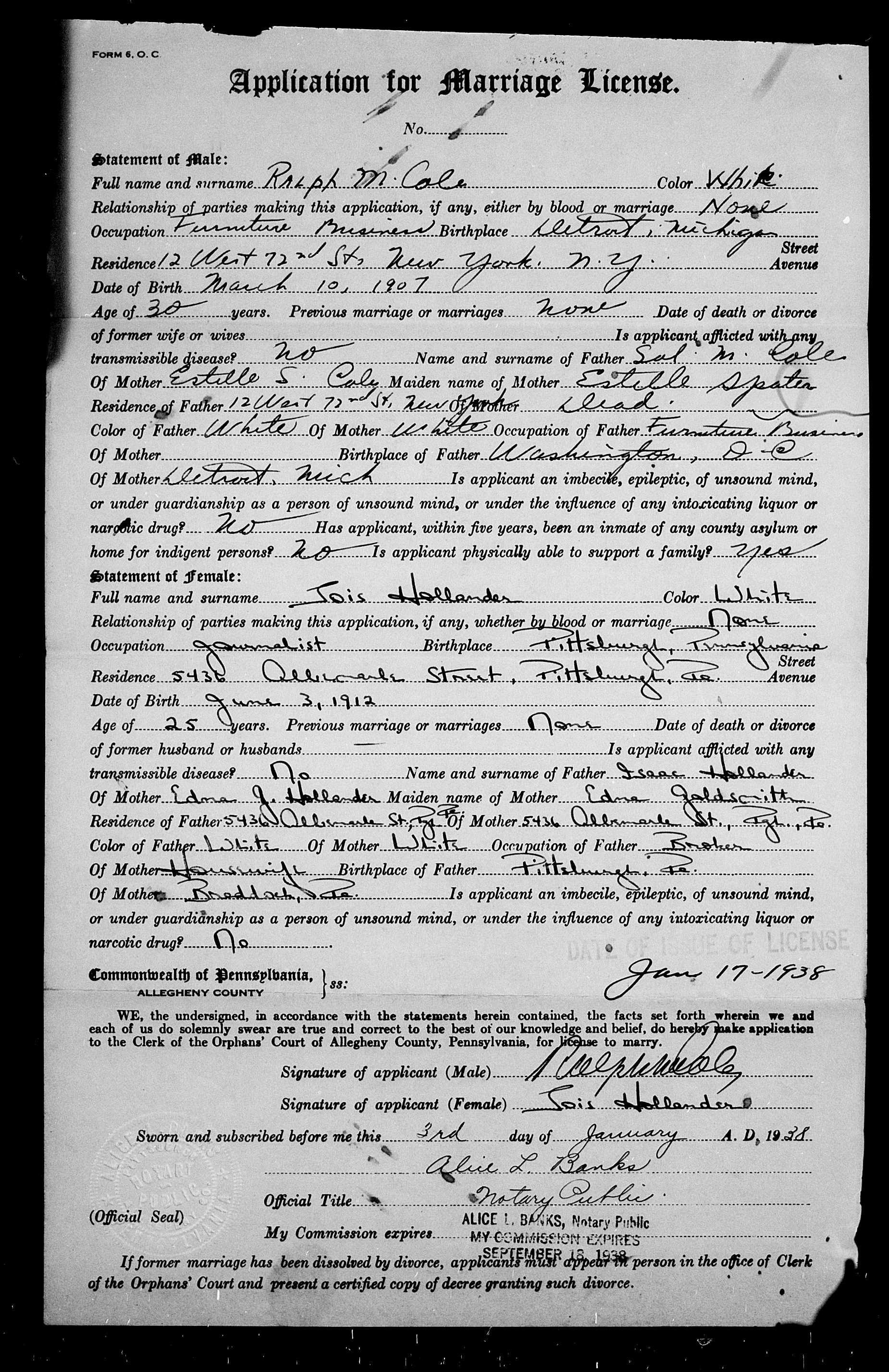
Ralph Cole and Lois Hollander marriage license
It also indicated that Ralph was born in Detroit in 1907 and that he was in the furniture business, so I knew I had the correct Ralph. From that application I learned that Sol had changed his name from Cohen to Cole, as had Ralph. I also learned that Estelle had already died by the time of the application, January 3, 1938. Finally, I learned that Sol was then living in New York City, not Detroit. By finding just that one document, I’d gained a lot more information about the family.
Armed with all this new information, I went back and searched again for Solomon and Estelle and Ralph in 1930, but again I could not find any of them. But as I was searching, I decided to broaden the search beyond the US on the long shot that perhaps they had left the country in 1930. I did not find them, but on familysearch.org I found a Robert Cole, born in Detroit, Michigan in 1917, whose parents were Solomon Monroe Cole and Estelle Spater. I actually found four documents for him, all Brazilian immigration documents for different years for his business travel. Here are two:
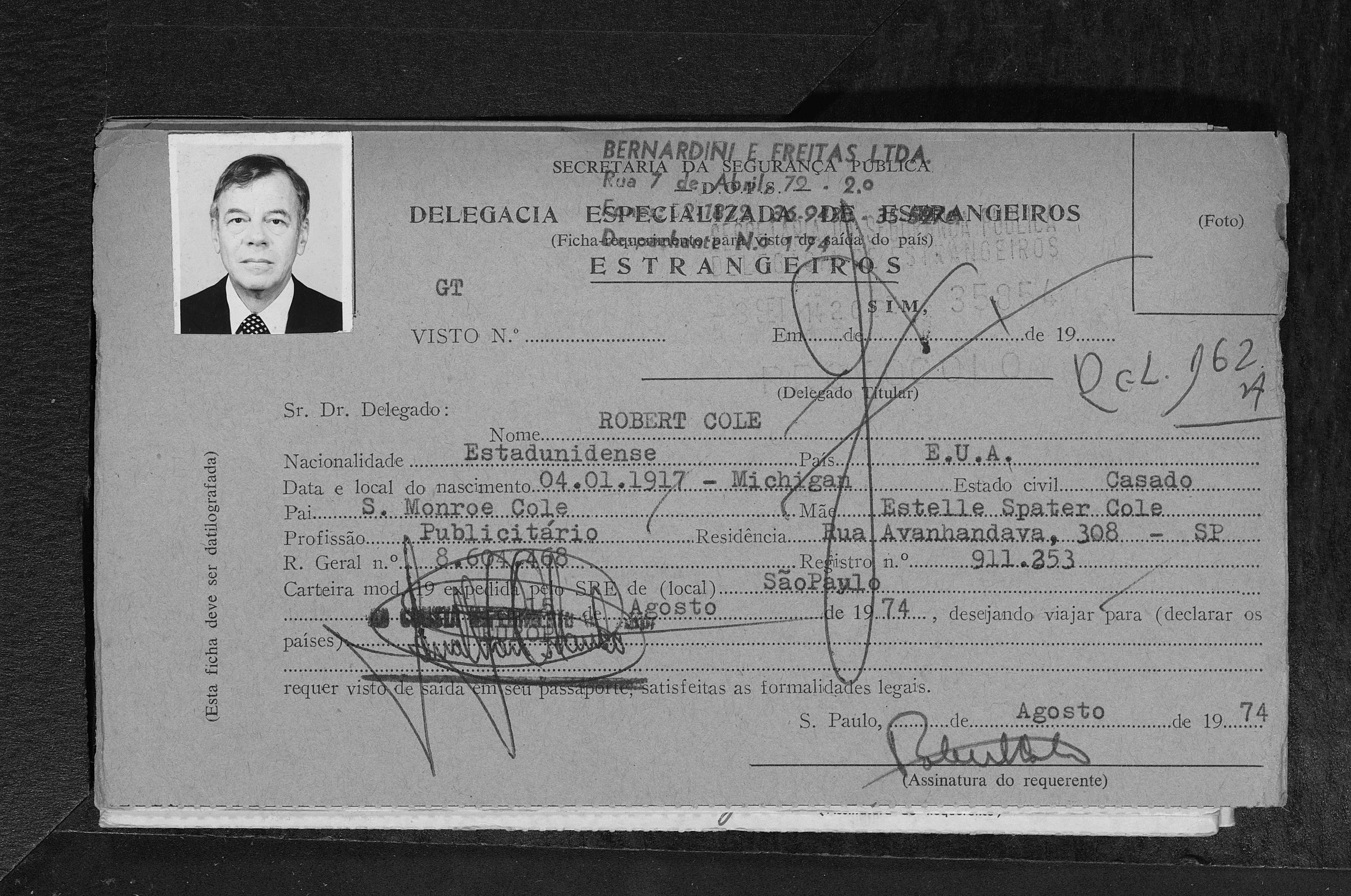
Robert Cole Brazilian immigration documents

I went back to the 1920 census again to see if I had missed a child named Robert in the household of Solomon and Estelle, but he was not there. Just Ralph. I checked the next page; no Robert Cole. If he was born in 1917, where was he? I could not find him with or without his family in 1930 nor could I find him on the 1940 census, again using many different possible locations and variations on his name. I even searched for all Roberts born in Detroit in 1917, but came up empty.
Then two days ago I went back once again to the 1920 census and decided to look at each page in the enumeration district where Sol, Estelle and Ralph Cohen were listed. They were listed at the very bottom of page 4; Robert was not on page 5. But this time I went on to page 6, and there he was at the top of that page, listed as part of the Newcombe household, but the name and age were Robert Cohen, three years old. Obviously the census reporter had skipped a page and put Robert two pages after the rest of his family and then the indexer had treated him as the son of the family at the bottom of page 5, instead of the Cohen family on page 4. I can’t tell you how much time I spent on that wild goose chase caused by one simple mistake in the census.
By using the city directory database on ancestry.com, I found all four members of the now-Cole family living in Columbus, Ohio, at the same address in a 1935 directory for that city. I’d been searching for them in Detroit and was surprised when they turned up in Columbus instead. I never would have thought to look at Columbus, Ohio, without some reason to think they had moved there. Ralph was listed as a salesman; he would have been 28; Robert was listed as a student; he would have been eighteen. Sol was listed as a manager, his spouse listed as Stella.
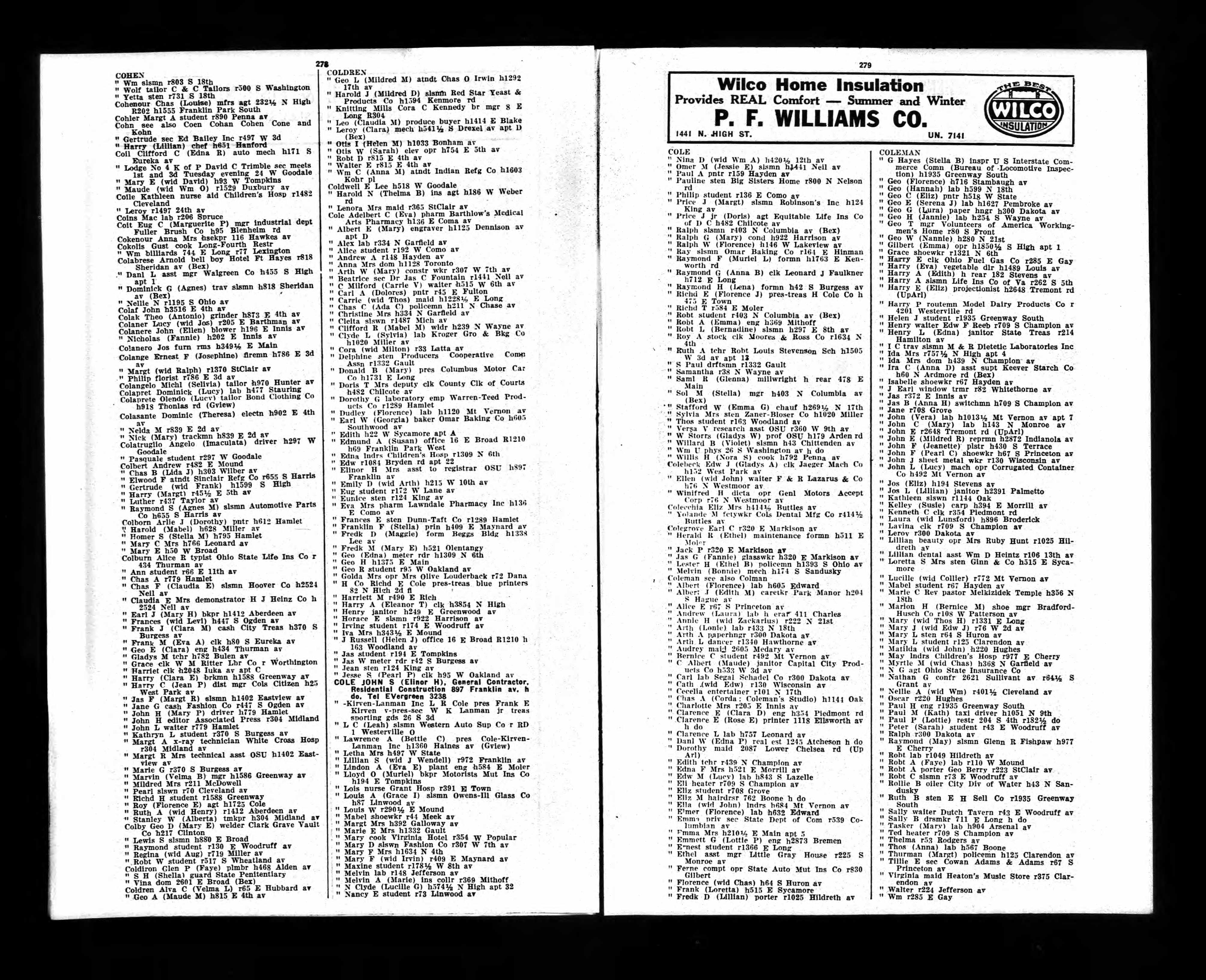
Coles on the 1935 Columbus, Ohio directory
But were they still in Detroit in 1930? Or were they already in Columbus by then? When had they left Detroit? I found Robert Cole on the Social Security Death Index and saw that he had died in Jupiter, Florida, so I searched for and found his obituary. According to Robert’s obituary, he attended Grosse Point Academy outside Detroit before attending Brown University. Since he probably graduated from high school in 1934 or 1935, the family probably had not been in Columbus for very long as of the time of that directory. Also, I had found several yearbook entries for Ralph Cole at the University of Michigan and knew that he had graduated in 1928, so I assumed that the Coles were still residents of Michigan during that time period.
![1928 University of Michigan yearbook Ancestry.com. U.S. School Yearbooks [database on-line]. Provo, UT, USA: Ancestry.com Operations, Inc., 2010.](https://brotmanblog.com/wp-content/uploads/2014/08/ralph-cole-yearbook-pic-cropped.jpg)
1928 University of Michigan yearbook
Ancestry.com. U.S. School Yearbooks [database on-line]. Provo, UT, USA: Ancestry.com Operations, Inc., 2010.
Then yesterday I decided once more to try the 1930 census, figuring that if I could find an address where they had lived in Detroit close to 1930, it would turn up. I had already searched for Sol Cohen and Sol Cole in Detroit directories between 1920 and 1935 and had had no luck. So this time I figured I’d search for any Cole in Detroit in the city directory database. I found that there were in fact Detroit directories in the ancestry.com database for the years 1930 and 1931. Since no Sol Cole or Cohen had come up when I searched those, I searched for any Cole, found the directory pages that included anyone named Cole, downloaded those pages for 1930 and 1931, zoomed in, and sure enough Sol was in both. Ancestry.com must have used an optical character reader to create the index of those directories, and looking at the indices for those two reveals the inadequacy of that method. It’s mostly gibberish. Obviously the small typeface and blurry image is too much of a challenge for an OCR.
Anyway, I was now very excited because I had evidence that Sol was still in Detroit in 1930 and 1931, and I had his address and his place of employment. He was the vice president and general manager of Weil and Company. Further research revealed that Weil and Company was a home furnishing store, selling furniture and home appliances.
Now armed with the home address for Sol, 5440 Cass Avenue in Detroit, I turned to stevemorse.org to find the right enumeration district in the 1930 census for that address in Detroit. I found the right district, I even found the right pages with the listing of residents at that address. It was the Belcrest Hotel, a large residential hotel that catered to wealthy residents, according to Wikipedia. There were many residents, but not one was named Sol Cole or Sol Cohen. The closest were Max and Sadie Cohn. So where were the Coles? I’ve concluded that they either moved there after the census was taken in 1930 or that for some reason they just were missed by the census taker.

“BelcrestDetroit” by Andrew Jameson – Own work. Licensed under Creative Commons Attribution-Share Alike 3.0 via Wikimedia Commons – http://commons.wikimedia.org/wiki/File:BelcrestDetroit.jpg#mediaviewer/File:BelcrestDetroit.jpg
So as of 1931 the family was still in Detroit, but by 1935 they were in Columbus. Perhaps the family moved to Columbus in the 1930s for economic reasons. It was the Depression, and Sol may have had to move to earn a living. Maybe Weil and Company went out of business or Sol lost favor with its owner, Mrs. M.C. Weil. Or maybe they sent him to Columbus to expand the business. I noticed that many members of Estelle’s Detroit family—her Spater brothers—also left their home town before 1940. Maybe things were particularly bad in Detroit.
Knowing that Sol was living in New York City in 1938, as seen on Ralph’s marriage license application, I was able to locate a death record for him in New York City on June 11, 1938, only six months after the date on that application. I have not found a death record for Estelle, but I know she died between 1935 and January, 1938. I have ordered Sol’s death certificate so perhaps that will tell me where he, and possibly Estelle, are buried.
I have not found Robert on the 1940 census, but Ralph did show up on the 1940 census, living in Indianapolis with his wife Lois and working as the head buyer in a department store.

According to his obituary in the July 22, 1998 issue of the Indianapolis Jewish Post, he worked for 32 years for William H. Block and Company and retired in 1971. He then was active as a volunteer for several organizations in the Indianapolis community as well as assistant business manager of Indianapolis Business Development Board for ten years after retiring. His wife Lois died in April 14, 1997; according to her obituary in the April 23, 1997 issue of the Indianapolis Jewish Post, she had graduated from Wellesley College and had worked as a journalist for four years and had also been active in many community organizations. Ralph Cole died the following year on July 17, 1998 at age 91. Ralph and Lois had two children.
Robert Cole died ten years later on February 28, 2008. He also was 91. He had retired to Jupiter, Florida. His obituary in the Palm Beach Post of March 4, 2008, reported that he had been Executive Vice President at McCann Erickson, the global advertising agency, where he worked for 28 years and been in charge of Latin American operations. After he retired, he volunteered for the International Executive Services Corp. Robert also had two children.
I am left with just a few more questions.
- Why did the Cole family move to Columbus in the 1930s?
- Why was Solomon in New York City in 1938, as stated on Ralph’s marriage application? How long had he lived there?
- When did Estelle die, and where are Sol and Estelle buried?
Fortunately, I am in touch with a couple of Sol and Estelle’s descendants and am hoping that perhaps together we can find the answers to those remaining questions.
As you can see, it took a lot of false starts, dead ends, jumps and turns, and a lot of different sources to learn the story of Solomon Monroe Cohen/Cole and his family. That’s what makes this both so much fun and so challenging.

Skyline along the Detroit International Riverfront (Photo credit: Wikipedia)
Related articles

My Cousin, the Musical Star
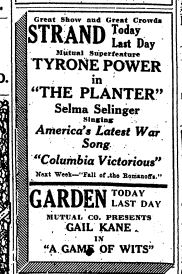 When I spoke with my cousin Ellen Kleinfeld last week, she asked me whether I knew that there had been an opera singer in the family. I said that I had not yet run across any family members who were opera singers. She thought the cousin’s name was Sylvia, but wasn’t sure. I told her that I would keep researching and would let her know if I found anyone that might fit that description. I was skeptical of the claim that we had a singing star in the family, knowing how family myths can grow beyond the basic facts, but I figured I’d keep my eyes open for anyone who might be this musical “Sylvia.”
Well, it did not take long to find her, and it was not because I was looking for her specifically. The fourth child of Moses, Jr. and Henrietta Cohen after Augusta, Myer, and Jacob was Fannie Cohen. As written earlier, Fannie married Alfred Selinger, the assumed relative of Julius Selinger, who had married her older sister Augusta. Fannie and Alfred had one child, a daughter Selma. Selma was the mysterious singer my cousin Ellen had heard about as Sylvia.
Selma, who was born in 1894, was already performing as a singer at a Fourth of July celebration in Washington, DC, by 1905, when she was only eleven years old, and she is mentioned as a singer in numerous articles in the Washington area newspapers over the next 20 years.[1]
On September 14, 1912, Selma married William Danforth, who was an actor who worked under the stage name Billy L. Wilson, according to his passport application. Three years later they had a daughter Mildred, but the marriage did not last. An article from the Eau Claire (Wisconsin) Leader on April 10, 1917, told of a trip that Billy L. Wilson was making to Australia with his vaudeville partner, Joe F. Willard. The article said that Billy and Joe had been on B.F. Keith‘s vaudeville circuit in the eastern and southern parts of the US. (This is the same B.F. Keith who had married Ethel Chase, the sister-in-law of Ruth Cohen Chase, Selma’s first cousin, in 1913, six months before he died. Ethel Chase later married Ruth and Selma’s other cousin, Jerome Selinger. Perhaps Selma met Billy also through Ruth’s connection to B.F. Keith, or maybe Billy introduced Ethel to B.F. Keith.)
Apparently being on the road was not good for the marriage between Selma and Billy, and by 1920, they were divorced. She and Mildred were living with her parents, Fannie and Alfred. Alfred was working as a tailor, and Selma gave her occupation as a stenographer for a concert business. Throughout this time, however, Selma had continued to perform.[2] I could only find one photograph of Selma, however, despite all the news coverage, and it is not a very clear photo.

Selma Selinger New York Times 1919
On June 6, 1920, Selma sang at an event where a young man named Earl I. Klein was also performing and at later events he performed as her accompanist.[3] Earl also had been a musician since an early age, performing as a pianist and a violinist at numerous events since 1907, when he was thirteen. He had attended the Columbia Conservatory of Music.[4] What may have started as a professional relationship turned romantic, and on July 15, 1921, Selma married Earl Klein, and the two continued to perform together for some time thereafter. Selma also sang on some radio broadcasts in the early 1920s.
Unfortunately, I could not find any coverage of Selma and Earl’s careers after 1922. By 1930, however, it seemed that both may have ended their musical careers. On the 1930 census, Earl’s occupation is listed as the manager of a taxi company, and Selma has no occupation listed. In 1940, Earl was selling insurance, and Selma again had no occupation listed. Selma’s parents, Fannie and Alfred Selinger, were living with them, as was Selma’s daughter Mildred. (Fannie and Alfred must have also had a place in St. Petersburg, Florida, as they are listed in the city directories for that city in 1924 and 1934.)
Selma lost her mother, Fannie Cohen Selinger, on August 21, 1940, and her father Alfred Selinger died seven years later on October 11, 1947. Her husband Earl died of a heart attack on June 9, 1957. Earl was buried in Washington Hebrew Cemetery where Selma’s parents Fannie and Alfred are buried as well as her grandparents Moses, Jr. and Henrietta Cohen.


(Photos courtesy of Ira Todd Cohen and Jane and Scott Cohen)
Sometime thereafter Selma remarried a man named Theodore C. Lewis. Selma died on January 2, 1973, in Silver Spring, Maryland. The Washington Post published the obituary below, describing some of the highlights of her musical career.
![The Washington Post, Times Herald (1959-1973) [Washington, D.C] 03 Jan 1973:](https://brotmanblog.com/wp-content/uploads/2014/08/selma-selinger-obit.jpg)
The Washington Post, Times Herald (1959-1973) [Washington, D.C] 03 Jan 1973:
Interestingly, Selma was not buried where her long time husband Earl is buried, and I still have not found where she is buried, though I am checking with the cemetery where her third husband is buried, Fort Lincoln.
UPDATE: I just got confirmation that Selma is buried next to her third husband, Theodore Lewis, at Fort Lincoln cemetery. Poor Earl–buried with the Cohen family, his in-laws, while his wife is buried elsewhere.
Selma’s daughter Mildred married a musician, Maurice or Maury Hall. They lived in Las Vegas and then in North Hollywood, California.
Thus, one family “myth” has been validated. Although Selma did not sing in a traditional opera setting, she was a professional soprano who sang both popular and classical musical works. In the days before radio and recordings were widespread, hiring musicians for entertainment was much more common. I can visualize these society gatherings and charitable and patriotic events where my cousin Selma sang to the delight of her audience, sometimes accompanied by her husband Earl.
I leave you with two links to click on to hear two songs that Selma sang (not, however, sung by her in these recordings). Although Selma sang everything from “Madame Butterfly” to Handel’s Oratorio “Judas Maccabeas” to Kol Nidre at these performances, I particularly enjoyed searching for these two songs that were popular during World War I, as they reminded me of a time many, many years ago I sat with my father and a family friend as they discussed World War I songs. I was probably about thirteen and could not for the life of me figure out why these two men were talking about (and singing) songs written before they were born. As Mel Brooks said in The 2000 Year Old Man, we mock the things we are to be.

Cover of The 2000 Year Old Man


[1] For example, for some early performances, see The Washington Evening Star, July 3, 1905, p. 3; “Dr. Simon Guest of Honor, Washington Evening Star, June 2, 1908, p. 9; “Eastern Star Entertainments,” April 15, 1909, Washington Evening Star, p. 15; Washington Evening Star, May 9, 1909, p. 65; “Have Lively Debate,” Washington Evening Star, April 6, 1910, p. 2; “Casino,” Washington Evening Star, April 9, 1913.
[2] See “Jewish Women Hear their New Protégé,” Washington Evening Star, January 13, 1916, p. 24 (as Selma Selinger Danforth); “Grotto Will Entertain,” Washington Evening Star, January 13, 1916, p. 24; “Arab Patrol Host to 1,500 Guests,” Washington Evening Star, April 29, 1916, p. 9; Washington Evening Star, December 9, 1917, p. 54 (‘…Miss Selma Selinger sang several patriotic solos which were so well received that she had to respond with several encores.”); “Liberty Loan Boosted at Patriotic Rally,” Washington Evening Star, April 7, 1918, p. 20.1 This is just a sampling; there were also mentions in the Washington Herald and the Washington Post.
[3] See Washington Evening Star, June 6, 1920, p. 53; “Florida Society,” Washington Evening Star, January 9, 1921, p. 25; Washington Evening Star, November 5, 1922, p. 63.
[4] Washington Evening Star, July 5, 1908, p. 26. Also, numerous other articles about Earl Klein’s performances can be found by searching genealogybank.com for Earl Klein in the District of Columbia.
 Brotmanblog: A Family Journey