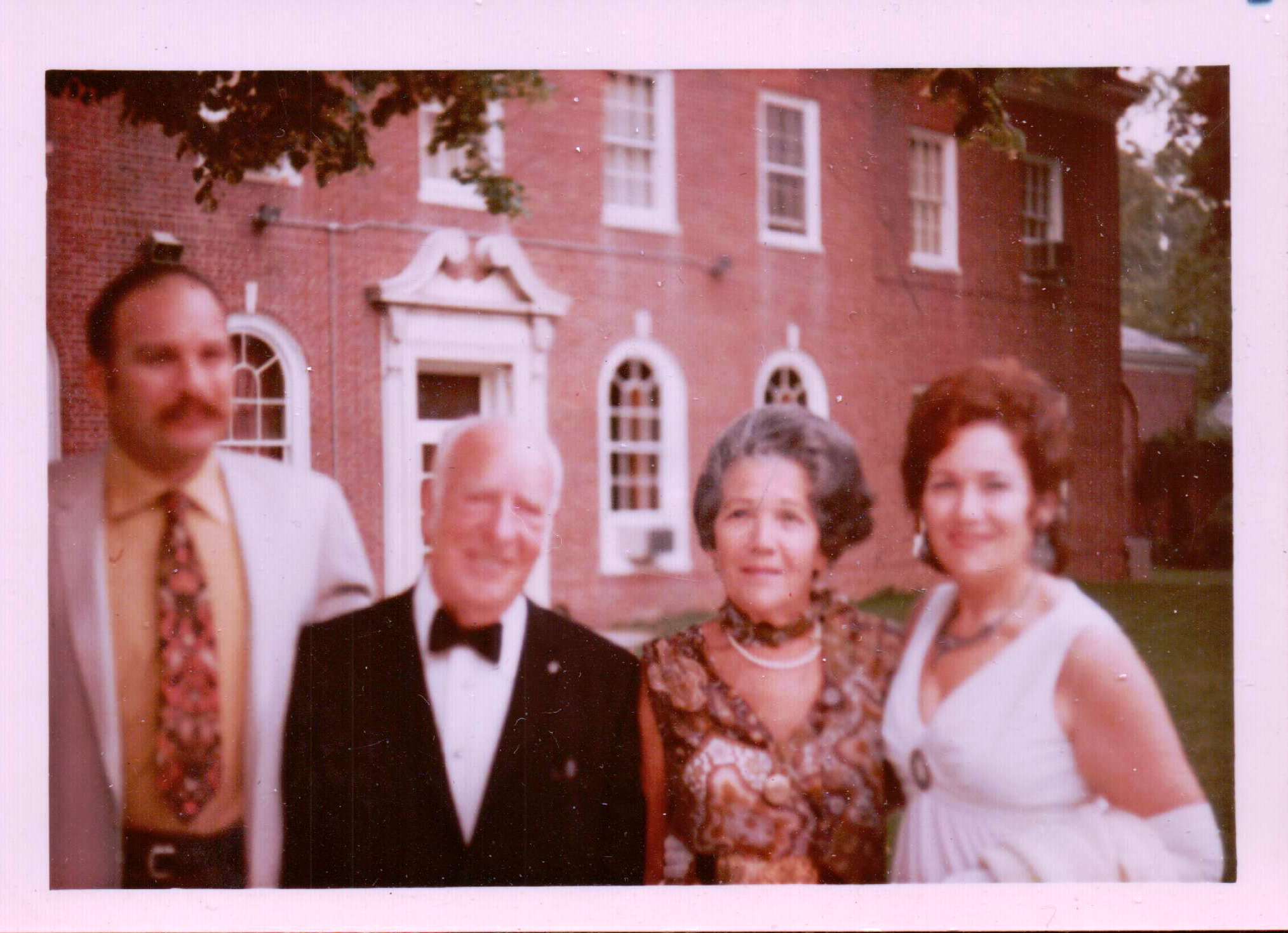
A Little More on Reuben and Sallie Cohen

Reuben Cohen

Reuben Cohen

Since ancestry.com was still not fully functional and I thus could not get access to many of the documents I need to complete the story of the children of Reuben and Sallie Cohen, I spent time  looking for news articles about the family on genealogybank.com, a site that has remained untouched by the attack on ancestry.  Here are a few interesting additional little peeks into their lives.

First, I was excited to find the picture above of Reuben Cohen published in the Philadelphia Inquirer on April 1, 1917, in honor of his birthday. (Sunday, April 1, 1917, Philadelphia Inquirer (Philadelphia, PA)   Volume: 176   Issue: 91   Section: News   Page: 2)  It’s always good to be able to visualize what someone looked like, and since I have not been able to locate many photographs of any of these relatives, this was an exciting find.

Reuben and Sallie were also at least twice the victims of crimes.  In 1885 Reuben was the victim of an assault and battery while trying to stop a thief.  He was commended by the judge for his conduct. The accused was sentenced to eighteen months in prison for stealing a $7 roll of cloth.  It’s not clear whether he stole it from Reuben’s store or whether Reuben was just trying to aid in his arrest. I also found it disturbing that the defendant’s race was mentioned for no possible relevant reason other than the blatant racism of those times. (” Civil and Criminal. Suits and Prosecutions from the Court Reports,”  Wednesday, November 11, 1885 Philadelphia Inquirer (Philadelphia, PA) Volume: CXIII Page: 3 )

reuben assault story


Then in 1903 Reuben and Sallie were themselves the victims of theft when a household employee of theirs stole a diamond ring in a “grip” belonging to Sallie when she asked him to carry it for her when she returned to Philadelphia from Cape May.  The accused admitted the theft and also admitted that he had been stealing from the Cohens for some time.  (“Says He Stole Jewelry,” Sunday, August 30, 1903, Philadelphia Inquirer (Philadelphia, PA)   Volume: 149   Issue: 61   Section: First   Page: 6)


jewelry stolen


Finally, I was puzzled by this news item, describing a donation by Reuben to the Episcopal Church in Cape May of a silver plate to be used for communion.

church donation

Why was Reuben making a gift to the church?  Although Sallie may not have been Jewish, it does seem that they raised their children as Jews for here is an article announcing the confirmation of their son Arthur at Mickve Israel synagogue. (“A Minute’s Chat,” Wednesday, February 25, 1903, Philadelphia Inquirer (Philadelphia, PA) Volume: 148 Issue: 56 Page: 8 )

arthur confirmation

In addition, Reuben, Sallie, and all of the ten children who predeceased them are all buried in Mickve Israel cemetery.  Was this just a generous gift to an important institution in Cape May? Or were the Cohens also church members? Perhaps I can do some research of the church records to find out more.

There were also other articles about anniversary parties, trips to Cape May, and other family events and celebrations. This series of news stories reveals a little more of Reuben’s character and of his social and financial standing in the Philadelphia and Cape May communities.  It also reveals that despite all the heartbreak his family endured, they also continued to prosper socially and economically and apparently to enjoy life.

Pet Photo Gallery

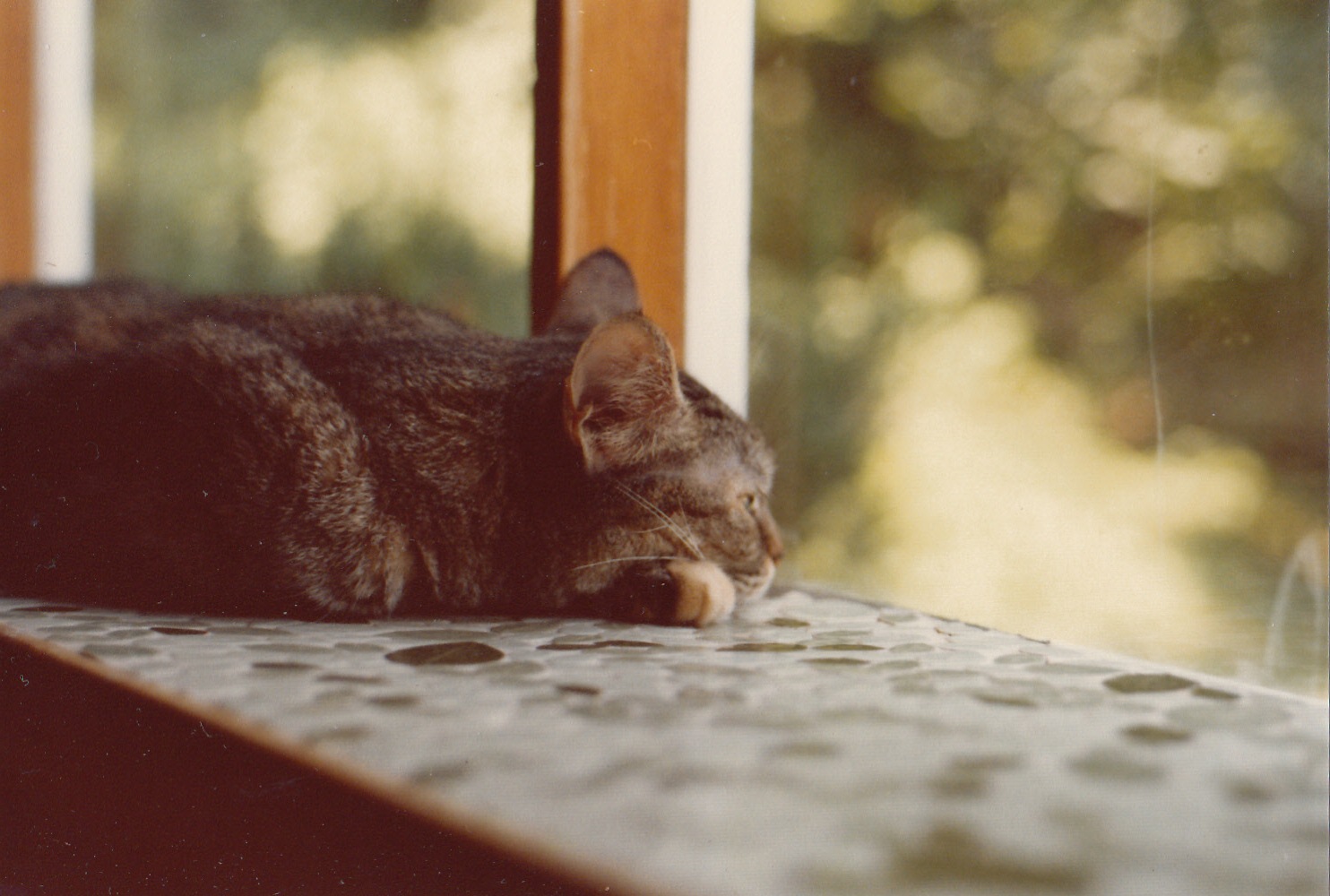
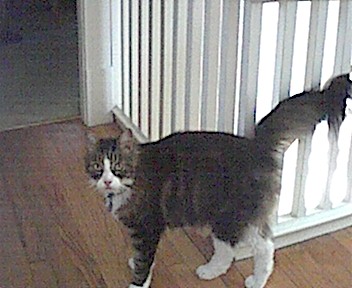
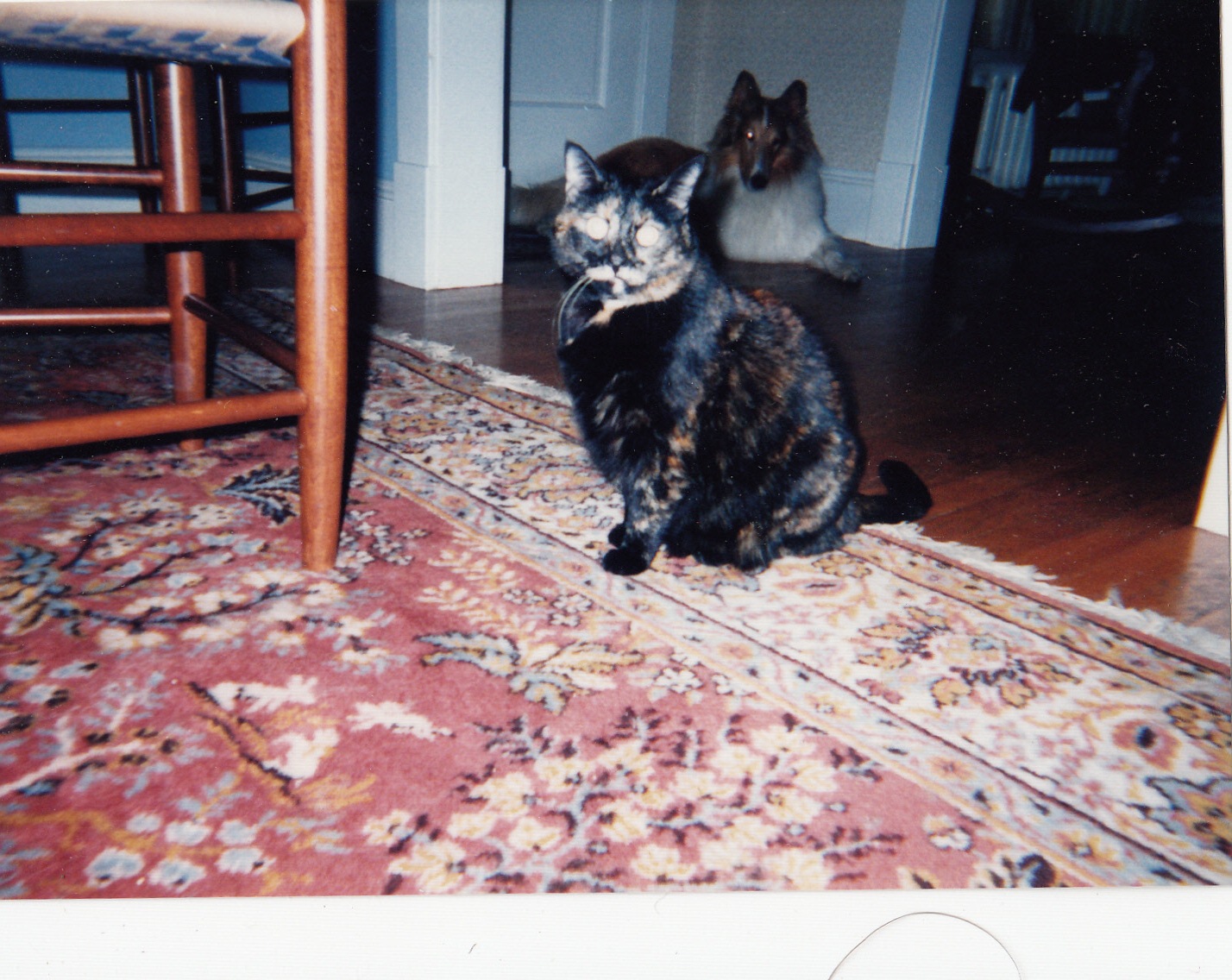
It seemed a lot of people enjoyed my post about our family pets, and some have shared pet stories with me by email or in the comments.  My sister also sent me some photos of two of her dogs, Pablo and Roxanne, as well as some of my parents’ cat Honey.

IMG_0023

IMG_0011

Pablo

IMG_0334

Roxanne

IMG_0250

Honey

IMG_0270 IMG_0434 IMG_0471 IMG_0227


If anyone else wants to add more pets to the “family tree,” just send me a photo, and I will add it here.

Thanks!


Enhanced by Zemanta

The rest of the family: Four legged variety

I was inspired by a post on one of my favorite genealogy blogs, The Family Kalamazoo, a while back.  Currentdescendent, the blog owner and author, posted a series of photographs of her family’s dogs going back over a hundred years.  I am a huge animal lover and have had cats and dogs all my life.  My parents are both big animal lovers also, as were my grandparents Gussie and Isadore.  My mother even remembers playing with a kitten at her grandmother Bessie Brotman’s apartment when my mother was a very little girl.  My uncle Maurice Goldschlager was also a big animal lover; I remember that his last home was filled with cats, dogs, even a horse, I believe.

Unlike Currentdescendent, I do not have photographs of family pets going back that far.  But I want to share what I have because these pets are a big part of my family’s story.  I know from talking to many of my cousins on both sides of my mother’s family that they also are big animal lovers.  I’d love to build a family tree of pet photos, so send them along if you want to share them.

But for now, these are the pets who lived with my immediate family, starting with my mother’s childhood pet, her dog Sparky.

Image

On the back of this photo my mother wrote,”The Cutest Thing in the World.”  My mother still gets teary-eyed when she sees this picture of her beloved dog.  Obviously he gave her a tremendous amount of joy and love when she was a little girl growing up in Brooklyn.

When I turned nine, I got my very first camera, and the very first photograph I ever took is this one:

Image

As you can see, this is my cat Pixie.  He was my first ever pet, and we got him when I was about two years old.  He was not a cat that everyone could love.  He tended to hiss and growl quite a bit, but never at me.  He let me carry him around like a doll and place him in my doll carriage.  As I grew up, he slept with me every night.  He truly had nine lives—surviving rat poison and being injured either by a car or animal.  He lived until I went away to college, and to this day I believe he died of a broken heart because I had left him behind.

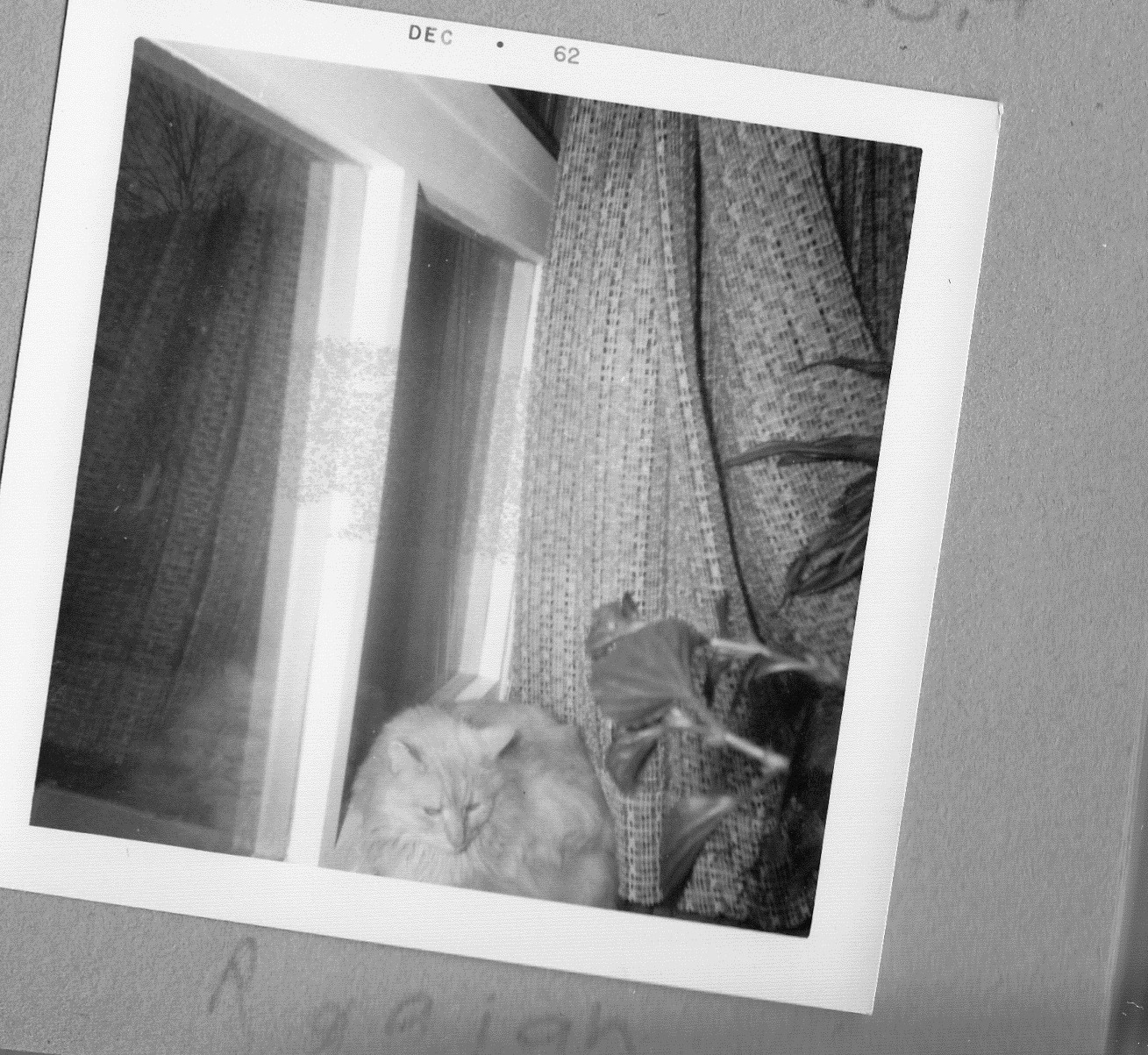
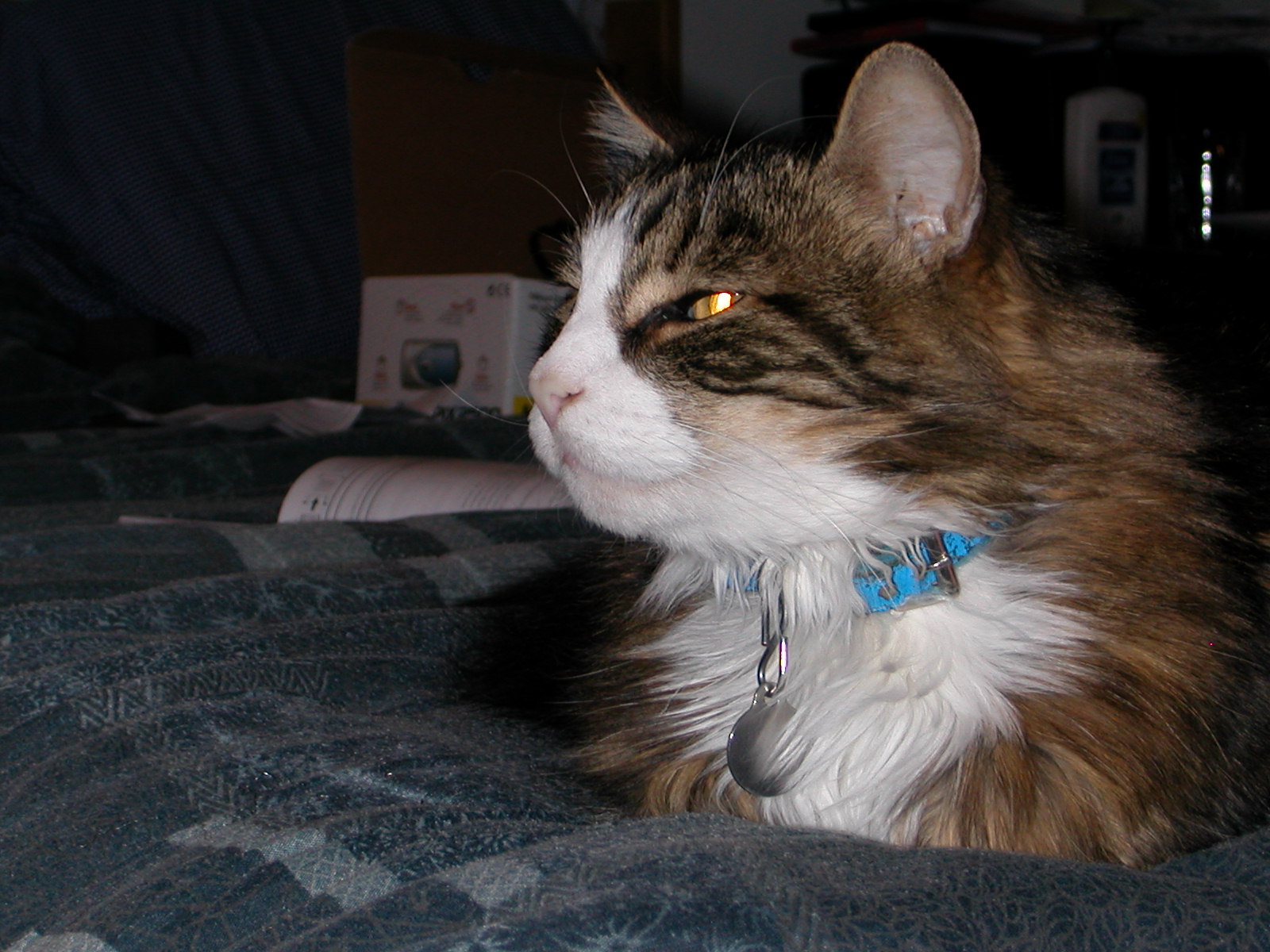
I don’t have pictures of two cats who only lived with us a short time: Fearless and Cleopatra, and I don’t really remember them.  According to my parents, one jumped out of our window in Parkchester, never to return, and one ran away when we moved to the suburbs.  Our next cat, however, was originally my grandmother’s cat, the elegant long-haired tabby, Rajah.Image

(Note the creative spelling of his name.)  He was Pixie’s cousin–their mothers were littermates who had belonged to friends of my parents.  My parents took Pixie and gave Rajah to my grandmother.  Rajah was as sweet as Pixie was snarly.  He was a gorgeous and very smart cat who somehow put up with my grandmother washing his face with a wet washcloth.  When we were little and would visit my grandmother, he would always hide under the furniture.  But when we adopted him when my grandmother for some reason no longer wanted to care for him, he became a friendly and loving pet.  As he aged, he got a little senile and would insist on drinking water from an eye cup my mother kept in her bathroom.  He lived to be eighteen years old.

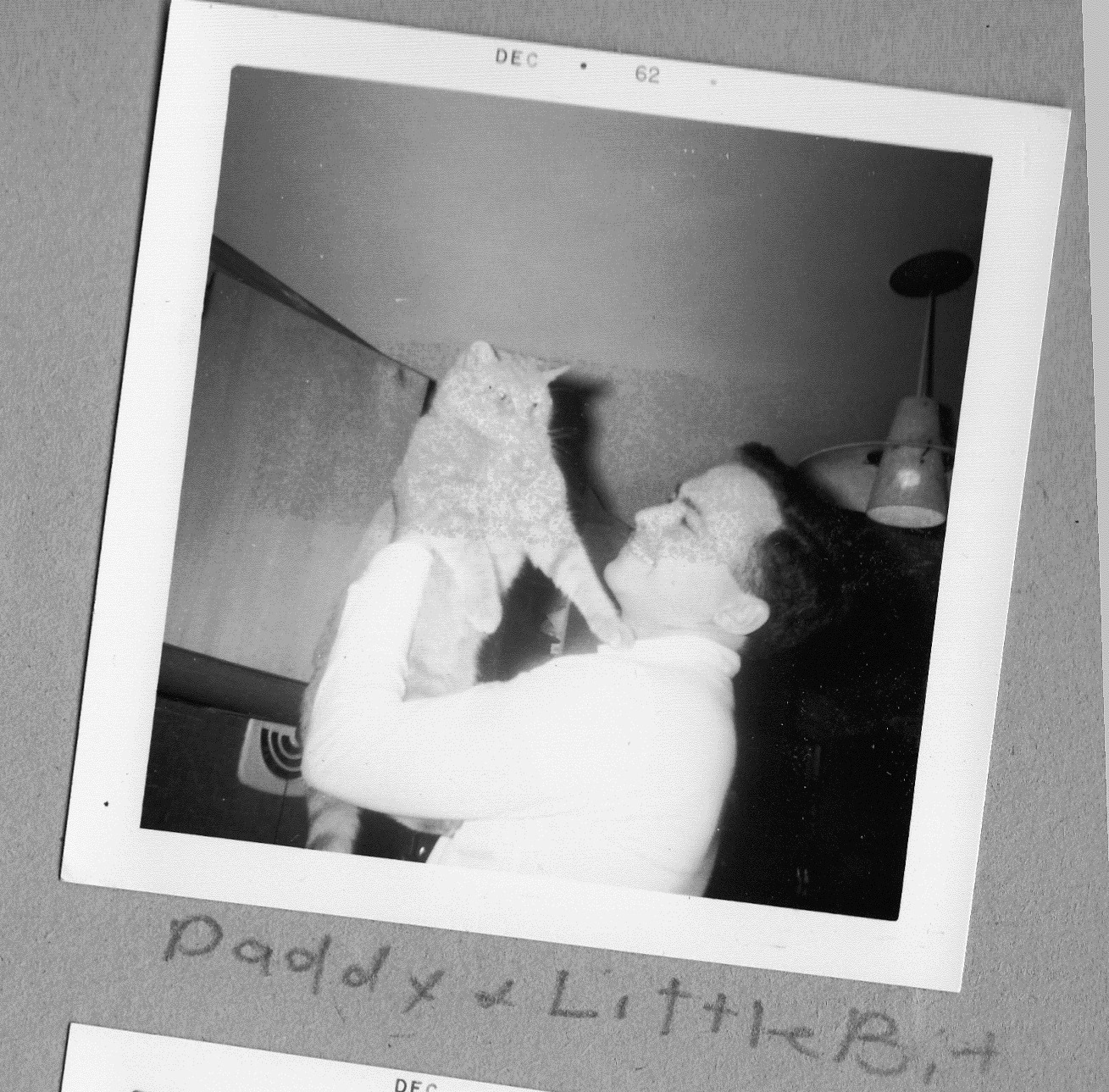
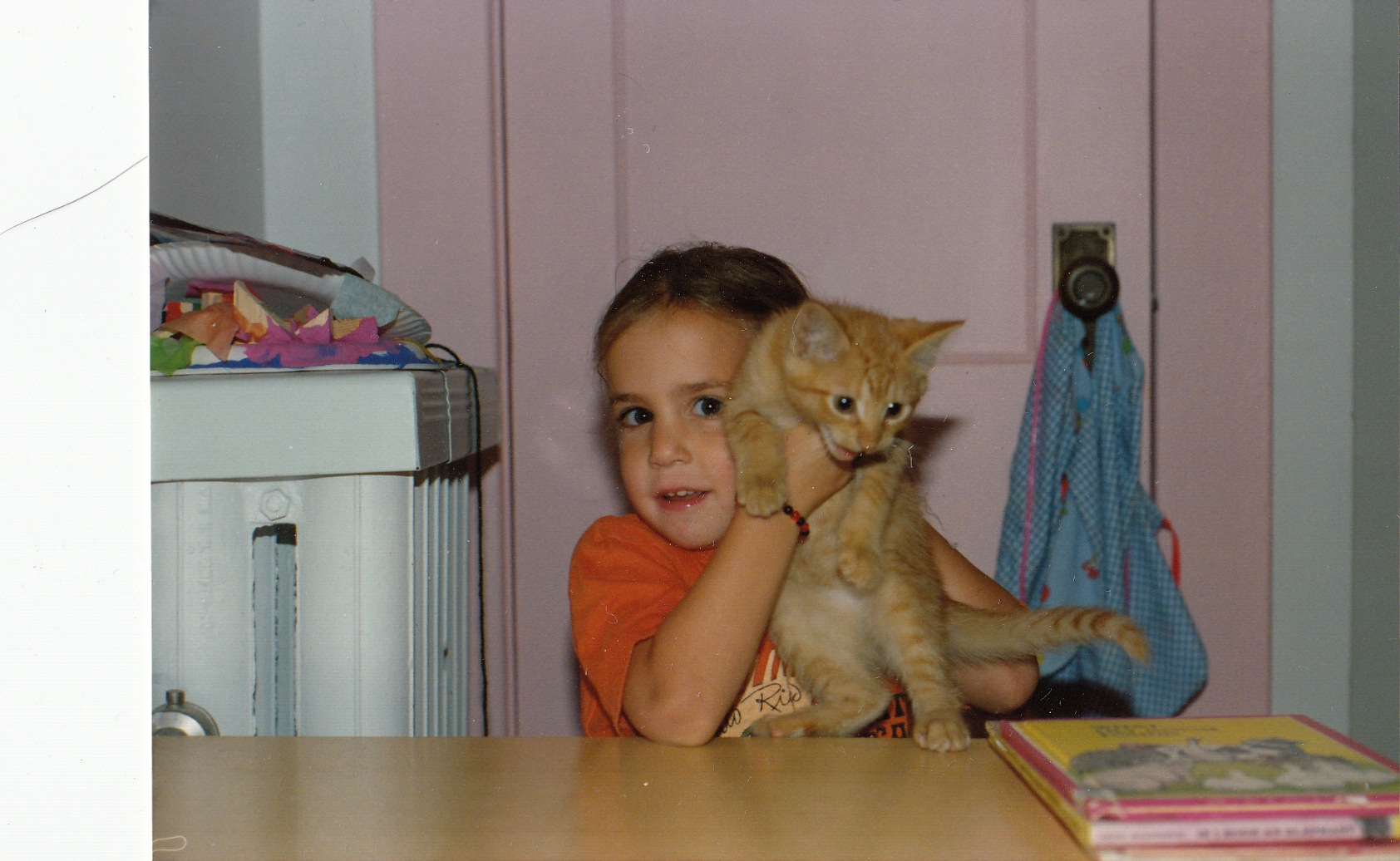
But two cats were not enough for me, so for my sixth birthday I wanted a kitten.  That kitten was Little Bit.Image


I wanted to call him Lucky, but my parents didn’t really like that name for some reason, so we compromised on Little Bit of Luck.  For a long time I called him Lucky, and they called him Little Bit.  Eventually I gave in, and he became Little Bit.  He was a funny and not too bright cat who didn’t have a mean bone in his body.  He was just a dumb, lovable creature who had to find his place with two much more dominant cats, with Pixie being without a question the alpha cat of the bunch.

But even with three cats in a small three bedroom ranch house, I was not content.  I wanted a dog, and I just kept asking for a dog.  After much persistence and a trip to the animal shelter, my parents agreed and we adopted our first dog, Colleen.  She was not a particularly pretty dog—just a mutt, and she was probably a few years old when we got her.  But she was my first dog, and I thought she was gorgeous.

Image

That’s me, hugging her to death in our backyard in 1959.  Our family was complete: three cats and a dog.  For most of my childhood, those were our family pets.  Colleen proved to be a wonderful dog, and she followed me everywhere.  We were very lackadaisical back then, and my parents would just open the door and three cats and a dog would run out and roam the neighborhood.  Colleen developed a reputation in the neighborhood for scavenging for food at other people’s houses.  Once she reportedly ate the food right off someone’s outdoor grill.  She once followed me all the way to a friend’s house in a different neighborhood.  My father came to pick me up in the car and figured Colleen would just find her way home.  But Colleen thought I was still in the house and refused to leave, so my father had to go back to get her.

We were very lucky for a long time that nothing bad happened to our roaming pets, but our luck ran out in April, 1964, when Colleen was hit by a truck right in front of my eyes.  She died at the vet’s office a few hours later, and I was bereft.  She’d been my companion for five years, those Wonder Years from seven to almost twelve, and I was heartbroken.

My parents could not stand my sadness as well as their own and that of my siblings, so they almost immediately went back to the dog shelter and brought home another dog for the family.  Although it took me a while to bond with this new dog, eventually I loved her  dearly as well. Here she is probably not long after we got her with Pixie and my cousin June Marie behind us.Image

Velvet was also a mutt, but she had collie-like markings with some setter or something else mixed in.  She was also a few years old when we got her, and she became a devoted pet like Colleen.  We all used to chuckle at the way she would cross her front legs in a very ladylike way.  By the time we got her, I was moving on from the innocence of childhood to the preoccupations of adolescence, and so she spent more time with my younger siblings than she did with me.

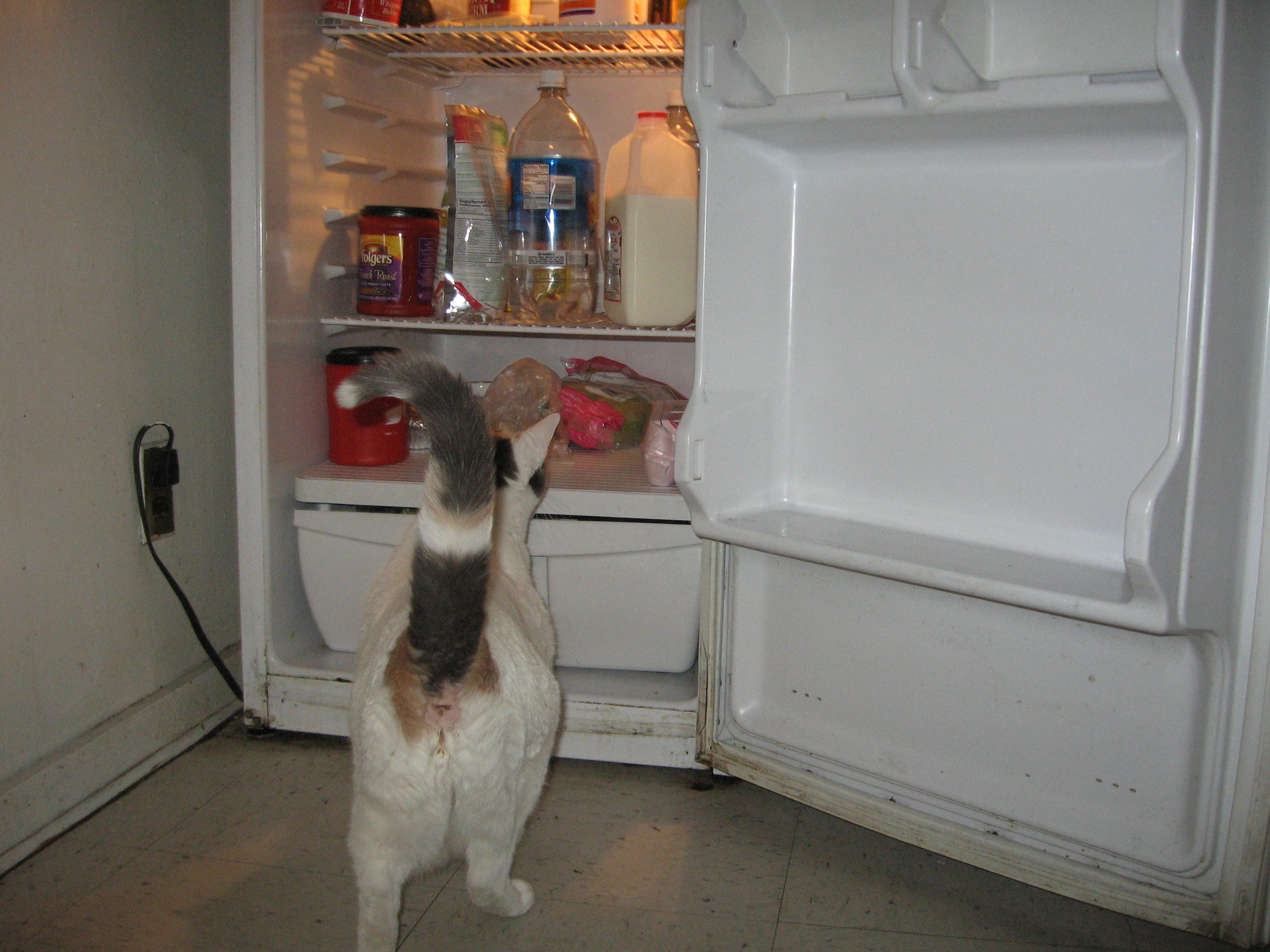
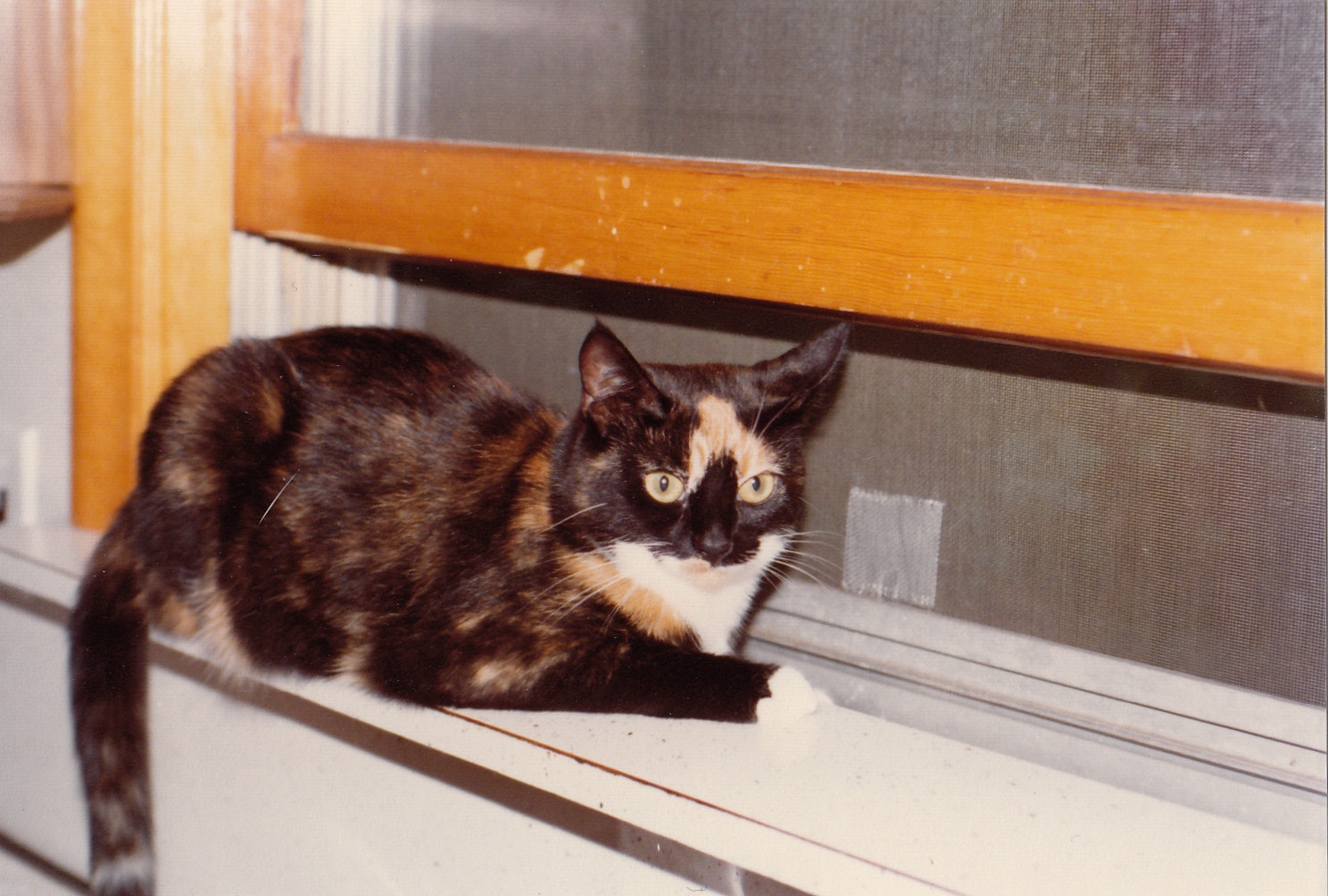
When I was in junior high school, we lost Little Bit to feline leukemia at a fairly young age.  Sometime thereafter we got another cat Phoebe, who was a calico with an attitude—proud, smart, and independent.

phoebe

After Pixie died, my parents adopted Missy—-a truly neurotic but gorgeous cat who was half Siamese and half tabby with the silliest half mustache under her nose.  She was a jumpy, anxious cat, but because she was beautiful, my mother decided to let her get pregnant.  We’d always spayed and neutered all our pets, but somehow Missy escaped the knife.  She did get pregnant and had four kittens: Louie, Susie, Bulldog, and Charlie, but my parents could only find a home for Charlie, so we ended up keeping Louis, Susie and Bulldog (who was renamed Taurus to make it sound more classy).  No way were we taking our kittens to the shelter! So there we were with a dog (Velvet), three adult cats (Rajah, Phoebe, and Missy) and three kittens.  Or six cats within a short period of time.  I was mostly gone at this point—in college and thereafter.  But I loved those kittens dearly.  We lost Louie at a very young age, but Susie and Taurus lived fairly long lives.  I will have to add pictures of Missy and her brood at some later point.

My parents went on to have more cats and now have Honey as their sole pet, the others all being long gone.  But beginning in 1975 I started having my own home with my own pets.  Our first cat was Kahlua, inspired not by her looks but by the ingredient in my then favorite drink, a Black Russian.  Kahlua was not the prettiest or the smartest or the sweetest cat, but she was our first cat together, and we loved her.

Kahlua

A few years later we adopted Blaze, a kitten from a litter of one of my Connecticut cousins’ cats.  She was gorgeous and affectionate and funny, and I was heartbroken when she disappeared one day, never to return.  I posted signs everywhere, called everywhere, but never could find her.  Somehow I still had not learned that cats are not safe roaming around the streets of suburbia.  I was so devastated that we did not get a second cat for a long time after that.  Instead we had human babies, who kept our lives busy and filled with love.

blaze

Blaze and Kahlua

Blaze and Kahlua

Kahlua lived as a solo pet for many years until our own children clamored for a kitten.  We adopted Wheatie, who looked just like Little Bit to me, and my younger daughter Maddy dragged him around just as I had dragged Pixie around three decades earlier.  But we still had not learned our lesson, and Wheatie was killed by a car as a young cat, and we were once again heartbroken.

Maddy and Wheatie

Maddy and Wheatie

1987

1987

But then we got Sneakers.  And he was the best cat we ever had (until the two we now have who rival Sneakers in personality and sweetness).  I picked him out at a vet’s office that had a litter they were trying to find homes for, and I picked him because he walked right up to me.  I knew he was a people cat, unlike Kahlua, and I knew he would be great with my kids.  And he was.  He was playful all his life and affectionate and smart and clean and independent.  When I taught at night, I would come home to nap first, and I would place him next to me; his purring would put me to sleep.  He regularly slept with Maddy, cuddled up around her head.  Once he disappeared for a week, and that was when we finally stopped letting our cats outside.  I knew I would never forgive myself if we lost Sneakers.  He would frequently bolt out the door, and we would all race outside, chasing him around the yard and the neighborhood  until we caught him and brought him home.  Sheakers lived a good long life, and he was a true gentleman until the end.

Sneakers

Sneakers

sneakersMaddy and Sneakers

When Kahlua died also at a ripe old age, we got Lily, who, to be honest, was not really a people cat.  She did not like to be held, and she preferred her own company most of the time.

Lilly


And then we got a dog.  Just as I had wanted a dog as a child, Maddy wanted a dog and kept asking for a dog until we finally agreed.  I’d been reluctant because dogs are a lot more work than cats, and we were both working full time and had little time for anything besides our kids and cats.  But inside I also missed having a dog.  And so I started looking until I saw an ad for a year old collie.  Having grown up watching Lassie religiously, I’d always wanted a collie.  One cold January morning in 1994, Harvey and I drove to Ware, about 20 miles away, and met Zapper.  He was a big and beautiful collie, living in a small apartment with a couple and their three children under five years old.  The wife did not want to keep the dog, but the husband was heartbroken to give him away.  We assured him that we would take good care of him, and we did.  He was a wonderful dog—sweet, protective, playful, smart and so beautiful.  Aside from barking way too much and jumping up on people until we trained him not to, he never did anything wrong.  Except get sick far too young.  He was only seven when he died.

Zapper

Zapper

Around the same time we lost Zap, we also lost a cat we had for only a short time named Simon.  He was the funniest cat I’ve ever had—he just was mischievous and would sit in the funniest positions.  He made me laugh every day until the day he ate some lilies we had the house.  We never knew that they were poisonous to cats, and Simon died within a day of getting into those flowers.  Between Simon and Zapper, I wasn’t sure I’d ever get another pet again.

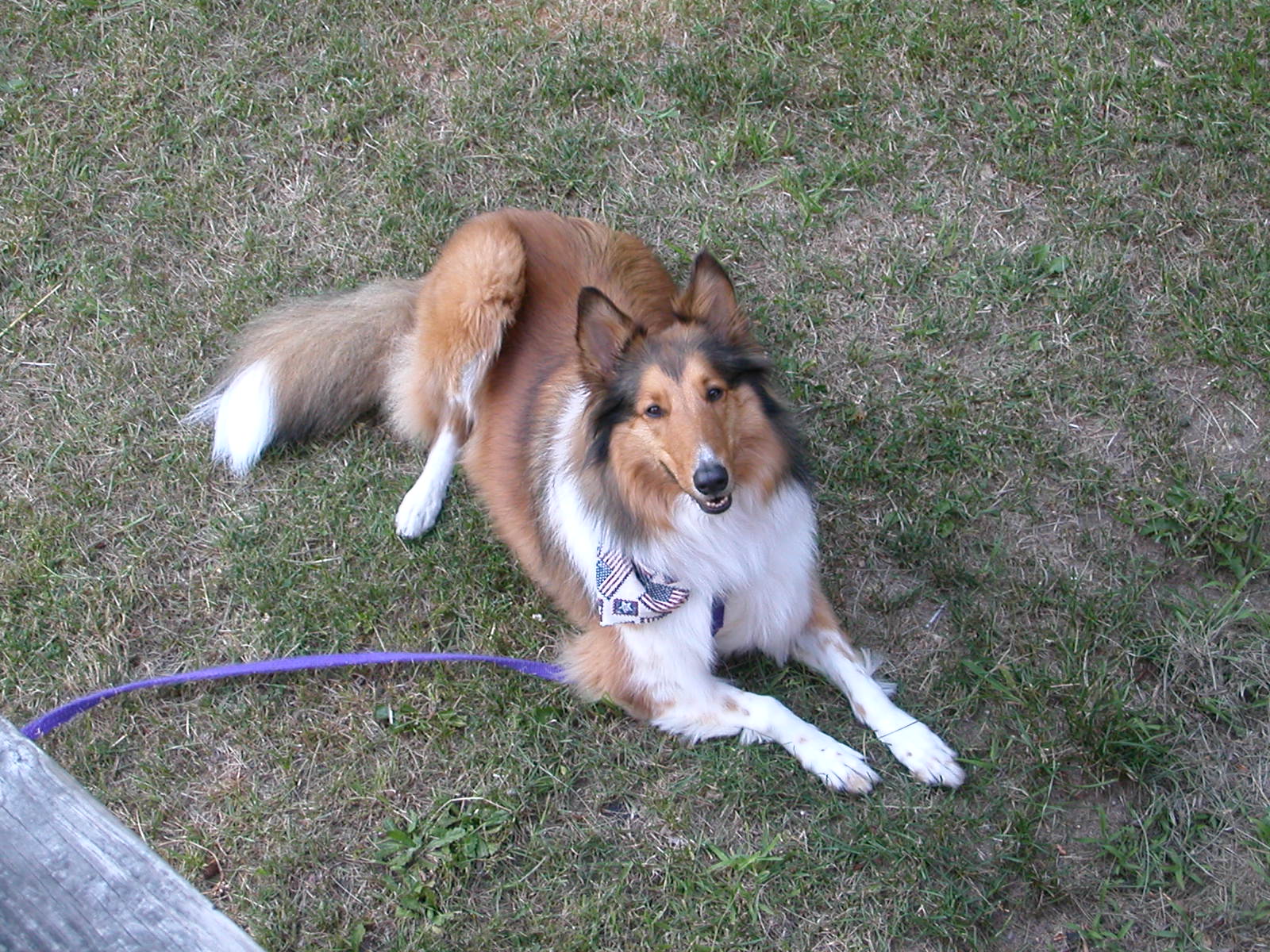
But I did.  Six months later I saw an ad for a female collie who was at the local pound.  We went to see her–she was skinny, dirty and hyper as could be.  Maddy and Harvey (Rebecca was off at college) thought I was crazy, but I wanted her and knew she would be a great dog.  And she is.  She is now almost fourteen and has been with us for almost thirteen years.  She was a bit wild and skittish at first, but soon settled into be the best dog in the world.  Like Zapper, she is sweet and smart and playful, and she doesn’t bark or jump on people.  She just wants to be with her people and be loved.  She’s deaf now and has trouble walking, but she is still a magnificent dog.

Cassie

Cassie

When Sneakers and Lily were both gone, we decided that we would adopt two cats from the same litter so that they would have each other for company.  By this time (2008), our kids were grown and out of the house, and we did not want a solo cat to be lonely all day while we were working.  So we adopted Smokey and Luna.  I can’t even begin to describe how much I love these two cats.  Smokey thinks he is Cassie’s baby and still tries to nurse on the poor old dog, who loves him and plays with him and tolerates anything he does.  Luna is like Sneakers—a people cat from day one.  She is a cuddler, constantly purring, and doesn’t know how to hiss as far as we can tell (nor does Smokey).  These two have never been outside and never will.  I will keep them safe for as long as I can.  They are my babies.

smokey luna sibling love

Luna

Luna

Smokey

Smokey

So now you know that I will one day be that crazy cat lady.  Or maybe I already am….

Enhanced by Zemanta

The Fusgeyers, Part IV: Romania Today

St_Andrew_Str_no_26_0002

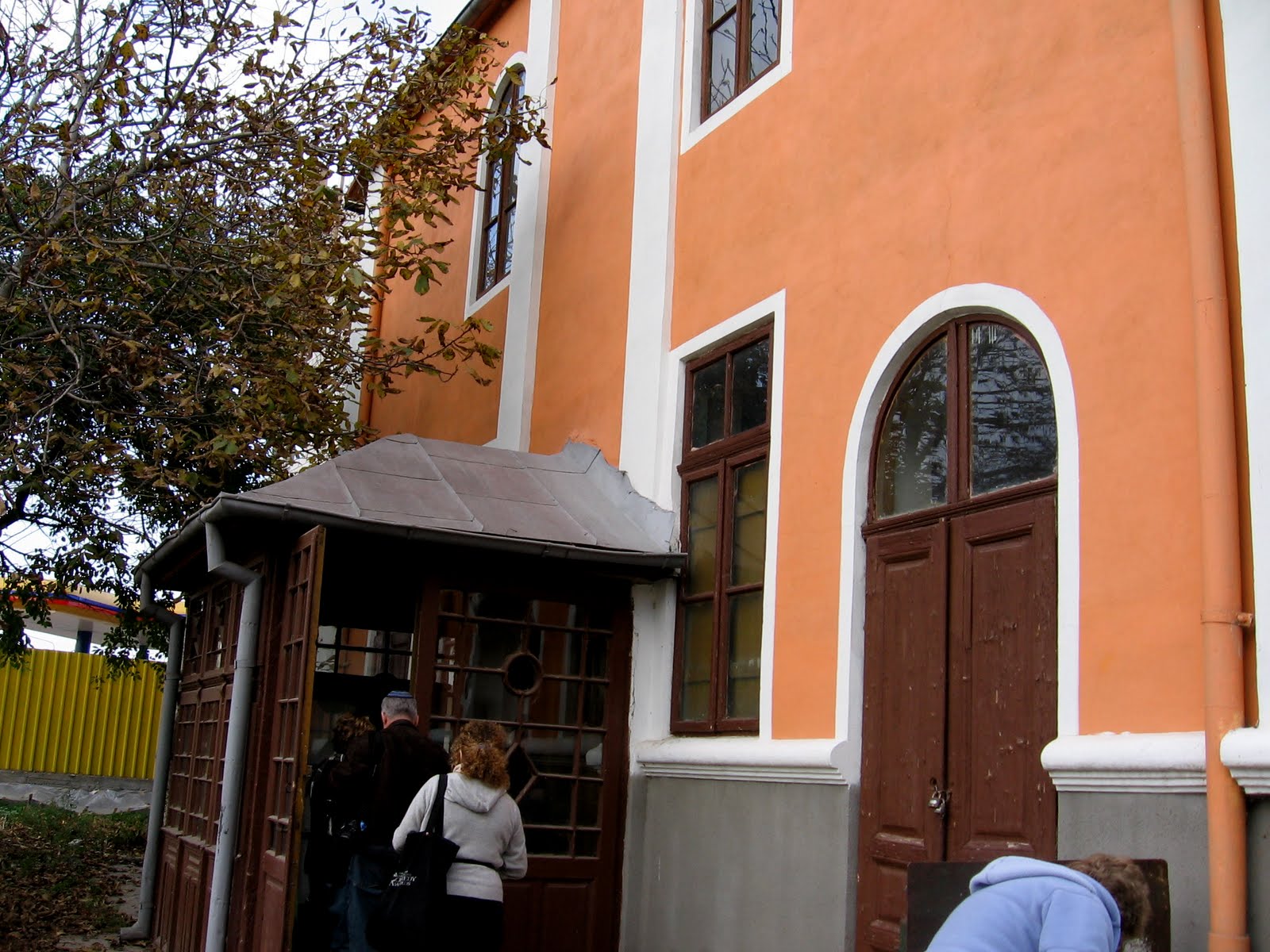
Where my grandfather was born in 1888 in Iasi, Romania

As noted in my last post, the population of Jews in Romania has declined precipitously over the last one hundred years as a result of emigration before World War I and thereafter and also as a result of the murder of about 300,000 of them during the Holocaust.  From a peak of 800,000 after World I, there are now just a few thousand Jews living in Romania today. What is it like in Romania today, and, more specifically, what is it like to be a Jew living in Romania today? What  legacy is there in Romania from the once substantial Jewish community, and what do current residents know or remember of the Jewish communities and of the Fusgeyer movement that led many of those Jewish residents out of Romania?  Beyond the cold, hard statistical facts, what is left of Jewish Romania?
I have consulted only two sources of information to answer these questions, so my views are based on limited information and possibly inaccurate.  But those two sources left somewhat different impressions, so perhaps the truth lies somewhere in between.  Jill Culiner’s book, Finding Home, paints a rather gray and dismal picture of life in Romania in general and specifically of the Jewish legacy there.  Stuart Tower, author of The Wayfarers, has a more positive impression of Romania today and of its people as seen in the photographs he took first in the 1980s and then in 2005 and also from what he shared with me by email.  Culiner and Tower visited different cities and towns for the most part, but there was some overlap; both visited Barlad and Sinaia within a few years of each other.  Both ultimately paint a picture of a country that once had many thriving Jewish communities but that now has virtually no Jewish communities and few residents who remember the communities that once were there.

Tower based his book around the town of Barlad; it is where the three Americans, grandfather, father and son, go to learn about their ancestral roots and meet the rabbi there who tells them the story of the Barlad Fusgeyers.  Tower’s story is fictional, and he told me that he’d never actually met a rabbi in Barlad, but both Culiner’s book and Tower’s book talk about a very small Jewish community continuing to exist in that city and the beautiful synagogue that still stands there.  In Tower’s novel, the rabbi describes a community of thirty people who still keep kosher and observe shabbat, but who have trouble forming a regular minyan.  The elderly rabbi’s children have all moved away, and he knows that he will be the last rabbi in Barlad (spelled Birlad in the novel).

Culiner started her Romanian travels in Adjud, where she got off the train and began her Fusgeyer-inspired walk.  Her description of Adjud is disheartening:

Here, fields lie flat under a grueling sun, and cars, trucks and buses roar with giddy impunity over pot-holed, uneven main roads.  Under thirsty-looking trees outside the station, lining the street are unlovely lean-tos, modern bars and patios. All claim to be discos, all pump loud American music into the hot air.

Culiner, p, 35.

Culiner also said that “there were no buildings left from the pre-Communist era and certainly nothing of beauty.” (Culiner, p. 35)  Her encounters with the local people are no more heart-warming.  No one could tell her where there was a hotel or room to stay in, and she described the people she saw as “exhausted..expressionless, resigned.”  Culiner, p.36.  No one in town remembered  that there ever was a Jewish community there or a synagogue, although there had been a community of about a thousand Jews there in 1900.  The man who showed her where the non-Jewish cemetery was located demanded an exorbitant fee for his troubles.  By the end of this first chapter, I was already feeling rather depressed about her experience and about  life in Romania.

In contrast, here are some of Tower’s photos of the Romanian countryside that left me with a different impression.  Thank you to Stuart Tower for giving me permission to post these:

Recently%2520Updated%25201112 Recently%2520Updated%25201113 Casa Elena in Voronets Fall foliage in the Bicaz Gorge Romania%25202005%2520262 Romania%25202005%2520263 Romania%25202005%2520264

Culiner’s experience at her second stop, Podu Turcului, was not any better.  The townspeople warned her that her plans to walk through Romania were dangerous and that she would be better off visiting more modern cities elsewhere.  There were no Jews left in this town, and no one there remembered there ever being a synagogue, although there was a Jewish cemetery.  Only one man acknowledged that there once was a Jewish community there, a workman who had been curious about the Jews while in school and had learned where the Jewish residents had once lived in town, now just a neighborhood of faceless housing from the Communist era.  This man told Culiner that he had been unable to learn more about the Jewish community in his town because discussing such matters was prohibited during the Communist era.

Culiner and her companion next arrived in Barlad, a city of 79,000 people, the city where Tower’s characters stayed and learned about the Fusgeyers and were in awe of the beautiful synagogue.  Culiner is less enthusiastic.  Her first impression of the city is its “potholed, deteriorated sidewalks” and the “[r]are trees [that] gasp out their life in the dense cloud of exhaust fumes, providing little shelter from the pitiless sun.” (Culiner, p. 55) Culiner once again encountered skepticism about her plans and ignorance about the Jewish history of the city.  She was particularly disappointed that in this city where the Fusgeyer movement began, no one seemed to remember anything about them.  Even she, however, was impressed with the synagogue, to an extent:

Despite its rather austere, unassuming exterior, the synagogue is magnificent.  Dating from 1788, the walls and ceilings are decorated with paintings of birds, flowers, leaves and imagined scenes of Jerusalem.  Yet, despite its beauty, there is a strange feeling of loss, the aura of a building struggling to exist in a world that has little place for it.  It has become a relic.

Culiner, p. 58.

Although Tower also described a dying Jewish community in his novel, there was still some life, some people who cared in Barlad.  Culiner saw the glass as half-empty whereas Tower saw it as half-full.  Here are some pictures of the Barlad synagogue and some other towns visited by Tower that show a far less dismal impression of  in Romania.  All photos courtesy of Stuart Tower.

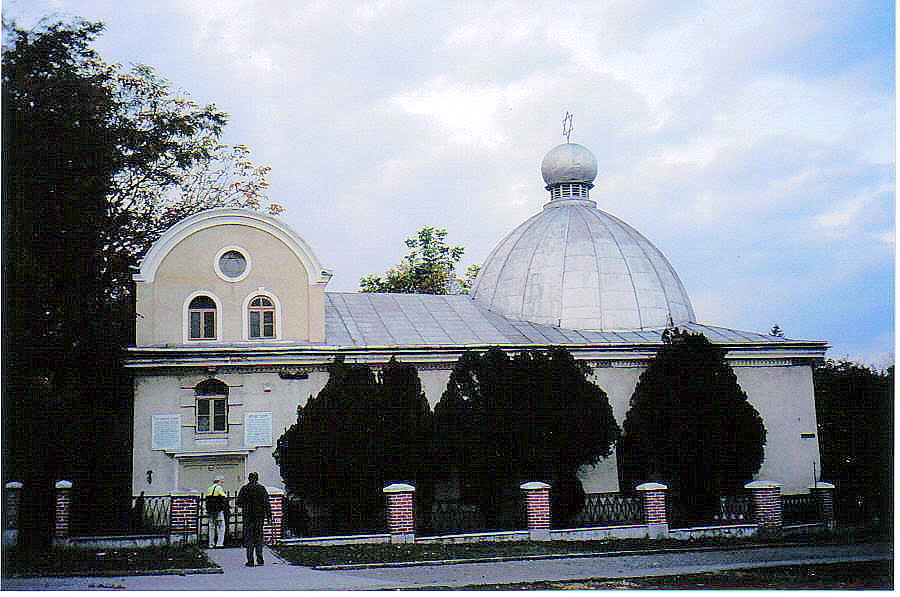
Synagogue in Barlad courtesy of Stuart Tower

Synagogue in Barlad  Photos courtesy of Stuart Tower

President Alexander Coitru

Stuart Tower reading from The Wayfarers at the Barlad Synagogue

Stuart Tower reading from The Wayfarers at the Barlad Synagogue

birlad shul interior

Romanian countryside

Romanian countryside

Romanian woman

Romanian woman

Romania%25202005%2520090 Romania%25202005%2520175

17th Century wooden synagogue in Piatra Neamts

17th Century wooden synagogue in Piatra Neamts

Piatra Neamts Sinagogaodd haystack, neighboring farm Troop Popa Tarpesht villagers and their War Lord

Culiner’s experiences in the towns and cities she visited after Barlad were not much different from her first three stops: ignorance and indifference to the history of the Jewish communities in those towns, ugly scenery, and disappointment.  She did meet some friendly and helpful people along the way, including some who were Jewish or were descended from Jews, but for the most part she found most Romanians at best ignorant and at worst rude and even hostile.

In Focsani, no one seemed to be able to help her find the synagogue, sending her on a wild goose chase only to find it right near her hotel.   On the other hand, Focsani had a fairly active Jewish community (relatively speaking), as the synagogue regularly drew about twenty people for shabbat services and more on major holidays.  Culiner was bewildered by the fact that the non-Jewish residents did not even know where the synagogue was located despite its central location.

In Kuku, Culiner met a friendly, helpful woman who likely lived in a building that was once the hostel where the Fusgeyers stayed while traveling through that town, but that woman also knew nothing about where the Jewish community had gone or about the Fusgeyers.   In Ramnicu Sarat, Culiner spent time with a woman whose mother was Jewish and who remembered the days of an active and close Jewish community.  The woman told Culiner that the Communists had demolished the synagogue that had once stood in the town.  She also talked about being unable to be openly Jewish during the Communist era.

Similarly, in Buzau she talked to a Jewish man who refused to take her inside the synagogue because he was ashamed of its condition; there were not enough Jews left in the town to make a minyan and not enough money to maintain the building.  This man told her that “the greatest threat is that all will be forgotten.” Culiner, p.122.   In Campina, another Jewish man told her, “The Jews will die out.  We will go to the cemetery.  And no one will replace us.” Culiner, p. 144.

Only in Sinaia did Culiner find anything of beauty in the countryside, but again not without some negative observations. She wrote: “The scenery is a slice out of a romantic painting and Watteau would have delighted in the mossy banks, the majestic spread of trees, although he might have taken artistic liberty, ignored the discarded shoes and packaging stuffed into vegetation, the tattered plastic and ripped shreds of fabric caught on branches in the river.”  Culiner, p. 146.  Tower’s photographs of Sinaia reveal all the beauty without the observations of garbage mentioned by Culiner.

Peles Castle, Sinaia and surrounding countryside

Peles Castle, Sinaia and surrounding countryside

cottage on the grounds Romania%25202005%2520042 Romania%25202005%2520044 October snowfall, near Peles

Before I read Culiner’s book, I had been giving serious thought to an eventual trip to Romania, in particular to Iasi.  After reading her book, I put that thought on the far back burner.  Her book left me with a vision of an ugly country filled with ugly people who hated Jews.  After looking at Tower’s photos and corresponding with him about his travels in Romania, I am reconsidering my decision to put a visit there on the back burner.  Just as I would like to visit Galicia to honor my Brotman family’s past, I would like to visit Iasi—to see where my grandfather was born and spent his first sixteen years, to honor his past and the lives of his family—-the Rosenzweigs and the Goldschlagers.  I have no illusions about what I will find there.  I know not to expect a lively Jewish community or even any Jewish community.  It’s all about walking where they walked and remembering their travails and their courage.  Maybe the scenery is not as idyllic as in some of Tower’s photos.  Maybe the people are not as colorful and friendly as they seem in his photos.  But that, after all, is not the point, is it?

Culiner did not visit Iasi, our ancestral town in Romania, on her trip, but Tower did, and I thought I would end this post by posting his pictures of Iasi and some of its people as well as those taken by my Romanian researcher Marius Chelcu.  Maybe someday I will get to be there in person and walk down St Andrew’s Street where my grandfather was born and pay tribute.

If we don’t, who will? Will we allow the story of the Fusgeyers and of the Jews of Romania to be forgotten for all time? That, in some ways, is the message of both Tower’s book and Culiner’s book: we need to learn and retell the story of our ancestors so that those stories and those people will not be forgotten.


Stuart Tower’s photos of Iasi

1670 Synagogue in Iasi

1670 Synagogue in Iasi

Traian Hotel, Iasi

Hotel

Father of Yiddish Theater

Father of Yiddish Theater, plaque in Iasi

National Theater, Iasi

National Theater, Iasi

Gypsy wagon, near Iasi (Yash) Astoria Hotel, Iasi Yash) Iasi street Recently%2520Updated%25201108 Lady/Man (?) walking toward Yash (Iasi) Gypsy family (Iasi), wanted food and money Iasi (yash) Ladies of Iasi (Yash)


Marius Chelcu’s photos of Iasi:

St_Andrew_Str_no_26_0003 St_Andrew_Str_no_26_0001 Near St Andrew Str_11 Near St Andrew Str_10 Near St Andrew Str_4 Near St Andrew Str_5 Near St Andrew Str_6 Near St Andrew Str_7 Near St Andrew Str_8 Near St Andrew Str_2

Photos taken near St Andrew Street where the Goldschlagers lived

Photos taken near St Andrew Street where the Goldschlagers lived


Enhanced by Zemanta

Hyman and Sophie Brotman’s Sons: A Family Album


Sophie and Hyman Brotman

Sophie and Hyman Brotman

One of the benefits of getting to meet six of my Brotman second cousins was that I was able to obtain a lot more photographs of my Brotman relatives.  All six of the living grandchildren of Sophie and Hyman Brotman, my grandmother’s older brother, were able to attend our “reunion”—the three children of Saul and Vicky Brotman and the three children of Manny and Freda Brotman.  Sadly, the two daughters of Joseph Brotman, Hyman and Sophie’s oldest son, have passed away.  But I now have a good collection of pictures of Hyman, Sophie, their three sons, and their grandchildren.

Hyman Brotman was born in Galicia and arrived with  his mother, my great-grandmother Bessie,  and his sister Tillie in 1891 when he was about eight years old.  He lived on Ridge Street with his family until he married Sophie Weiss on March 12, 1904.  Hyman and Sophie had three sons.  Joseph Jacob was born on February 4, 1905, and was named for Hyman’s father, my great-grandfather Joseph Jacob Brotman.  Their second son, Saul, was born on April 27, 1907, and their third son Emanuel or Manny was born on May 9, 1910.

Hyman worked at various occupations, including as a chauffeur and in the sweatshops of NYC, but in the early 1920s he and his family moved to Hoboken, NJ, where he opened a liquor store.  My mother has childhood memories of visiting her uncle and aunt in Hoboken, though by that time the three boys were all grown, and sadly she has no memories of her cousins.

Hyman, Bruce and Sophie in the Hoboken liquor store

Bruce, Hyman and Sophie in the Hoboken liquor store


As their children reported, all three Brotman brothers were very close and very athletic.  They were all excellent swimmers and loved competing against each other, always arguing over who was the fastest.

Saul Sophie Joe and Manny

Saul Sophie Joe and Manny

Joe married Perle Gorlin on May 1, 1935, and they lived in Queens where Joe was employed as a salesman for Abbott Laboratories, according to the 1940 census. Joe was a pharmacist in New York, but later moved to Florida where he became involved in commercial real estate.

Joe and Perle Brotman 1940 census

Joe and Perle Brotman 1940 census

Joe and Perle had two daughters, Barbara, born in 1939 and probably named for Bessie, who had died just five years earlier, and Merle or Miki, born in 1941.  Here are some photos of Joe and Perle and other family members:

Perle, Joe and Sophie Brotman

Perle, Joe and Sophie Brotman


Hyman (second from left) and Joe (far right) and two unknown men

Hyman (second from left) and Joe (far right) and two unknown men

Joe and Saul Brotman

Joe and Saul Brotman

From Front Center, Clockwise: Joel, Herman, Sophie, Joe, Perle, Manny, Freda, Denny, Saul , and Vicky Brotman

From Front Center, Clockwise: Joel, Herman, Sophie, Joe, Perle, Manny, Freda, Denny, Saul , and Vicky Brotman

Saul Brotman was an excellent athlete, especially in swimming and handball.  He graduated from Hoboken High School and started college at the New Jersey College of Pharmacy in 1926; he then transferred to and graduated from Panzer College, which has since merged with Montclair State University in New Jersey.  He later got a master’s from Rutgers University.

1932 Panzer College yearbook

1932 Panzer College yearbook

Saul at Panzer College

Saul at Panzer College

Saul

Saul

Saul

Saul

In a comment posted in response to an earlier blog post, Bruce wrote the following about how his parents Saul and Vicky met:

In Manhattan Beach (Brooklyn) there was a beach club, Manhatten Private. It had pools, handball courts, tennis and other sports. My parents were playing handball, my parents were both fine athletes, but not with each other. The ball from my mom’s court was accidently hit toward my dad’s court some distance away. My mom called to my dad saying “ball please”. Dad picked it up and threw it to mom. He then turned to his cousin, with whom he was playing and said “I’m going to marry that girl”. That was about 1940 or 41 I guess. He asked her out several times but she refused. On December 7 1941 my cousin Mel was born. Somehow my father found out and went to the hospital. (Mel was mom’s older brother Al’s first child). Mom asked dad what he was doing there – he said that he thought she might need some help, noting that Pearl Harbor had just been attacked. She apparently knew at that moment that she loved him. The rest is history.”

Vicky Horowitz Brotman

Vicky Horowitz Brotman

Saul and Vicky were married in 1942.

Saul served in the US Army during World War II and won a handball championship while serving in the army. After the war, he became a teacher in New Jersey, where he coached many state championship teams.  After 32 years as a teacher,  he left teaching after being assaulted by the parent of one of his students.  Saul then became the pension director for a union.

Saul in the army

Saul in the army

Saul and Vicky 1940s

Saul and Vicky 1940s

Saul and Vicky had three sons, Bruce, Ronald and Lester.

les bruce ron

Les, Bruce and Ron

Bruce, Ron and Les Brotman

Bruce, Ron and Les Brotman

Saul, Bruce and Vicky at Bruce's bar mtizvah

Saul, Bruce and Vicky at Bruce’s bar mtizvah

Saul remained a great athlete all his life.  In fact, Bruce told me that when Saul was in his seventies, Bruce challenged him to a game of handball, thinking that he could easily beat his father. Instead, Saul soundly defeated his much younger son;  he won four straight games, with Bruce unable to score a single point in any of the four games.

Saul and Bruce

Saul and Bruce

Saul and Vicky

Saul and Vicky

Manny, the youngest of Hyman and Sophie’s sons, was also an excellent athlete like his older brothers.

Manny (far left) at camp in 1925

Manny (far left) at camp in 1925

manny 1926

Manny November 1928

Manny November 1928


Like his brother Saul, he began college at the New Jersey College of Pharmacy, but he transferred to the University of Iowa, from which he graduated.

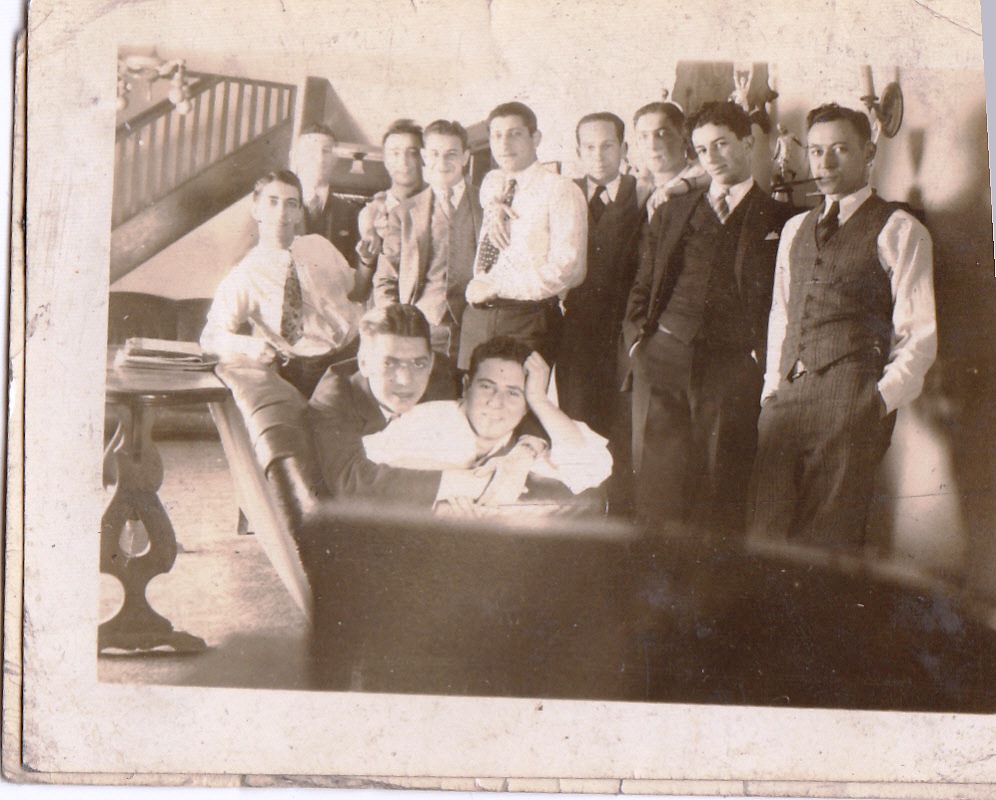
Manny with his fraternity brothers at U Iowa

Manny with his fraternity brothers at U Iowa

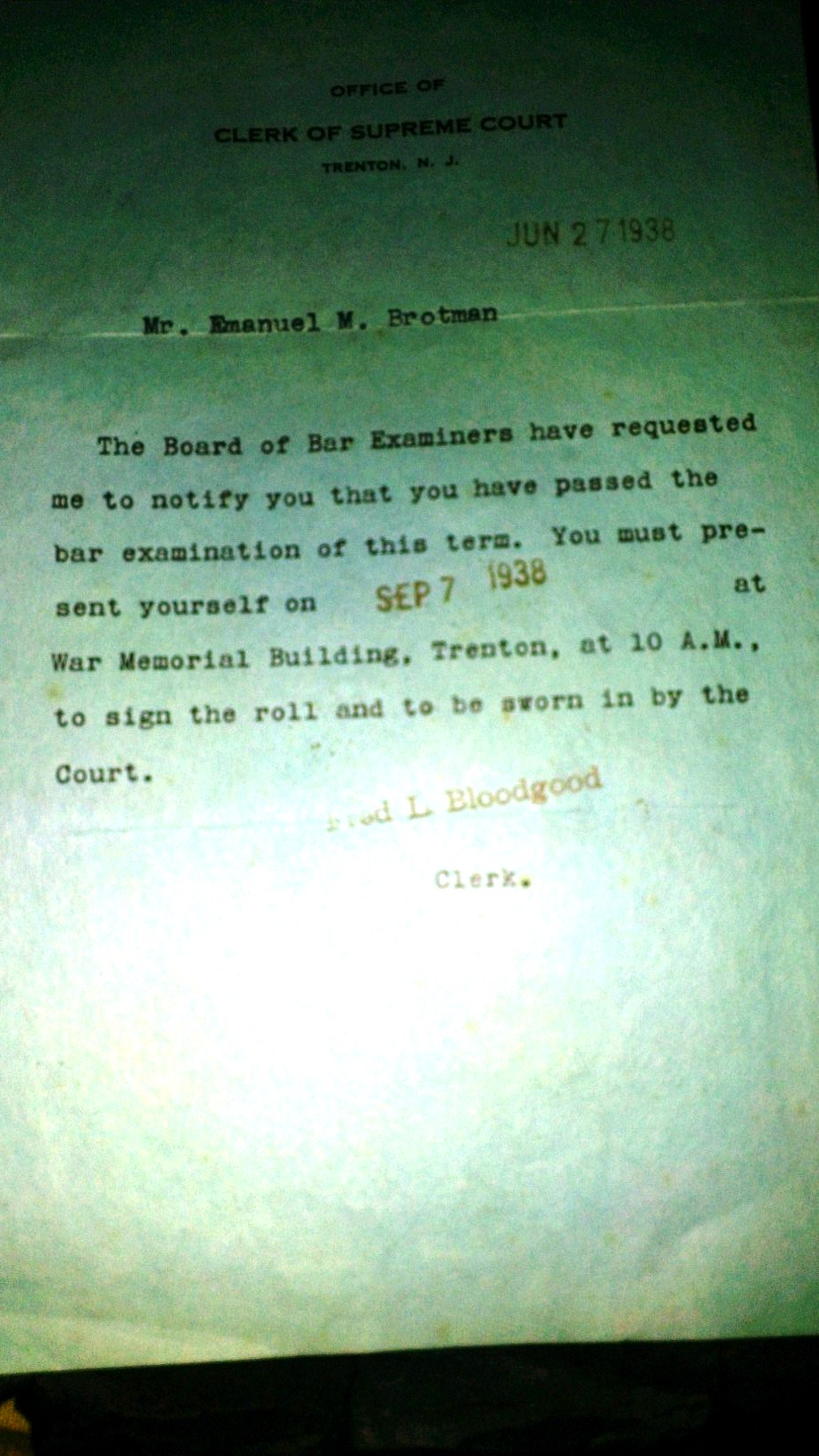
He also graduated from John Marshall Law School (New Jersey), which was later taken over by Seton Hall University. Manny became a member of the New Jersey bar in 1938.

Letter informing Manny that he has passed the New Jersey bar exam

Letter informing Manny that he has passed the New Jersey bar exam

Manny married Freda Feinman on December 22,  1940.

Freda and Manny's wedding invitation 194?

Freda and Manny’s wedding invitation 1940

Manny and Freda 1940s

Manny and Freda 1940s

Manny enlisted in the US Army in 1944 during World War II.

Manny Brotman

Manny Brotman

Manny practiced law for some time, but then joined J.I. Kislak Mortgage Corporation, a subsidiary of J.I. Kislak, Inc.  J.I.Kislak, Inc. was a residential and commercial Realtor, originally based in Hoboken and then in Jersey City, and Kislak Mortgage was primarily a residential mortgage banking company, one of the largest in NJ at the time, based in Newark.  He was president and then chairman of Kislak Mortgage for many years, was president of the Mortgage Bankers Association of NJ, and a long-time board member and two-term Treasurer of the Mortgage Bankers Association of America, where he received the Distinguished Service award. Kislak Realty, a commercial mortgage firm, where he became the president.  He was often quoted as an expert on veteran’s housing and housing in general in various newspaper articles.  Here is one example of an article that ran in several newspapers across the country:  Lebanon_Daily_News_July_10__1971_Lebanon__PA_Manny_Brotman

Manny and Freda had three children: Joel, Denny and Bonnie.  Here are some pictures of Manny and his family:

Manny, Joel and Freda

Manny, Joel and Freda

Denny, Bonnie and Freda

Denny, Bonnie and Freda

The Feinman and Brotman families June 16, 1932

The Feinman and Brotman families June 16, 1937

From left to right: Aron Feinman, Hyman Brotman, Mary Feinman, Sophie Brotman, Manny Brotman, Sam Feinman, Freda Feinman, Saul Brotman (according to the back of this photograph)


I did not know Hyman or Sophie or any of their sons, but I was very fortunate to meet six members of the next generation, my second cousins Bruce, Ron, Les, Joel, Denny, and Bonnie.  They all made the effort to come to New York City, some from as far away as Florida and Ohio.  I really enjoyed meeting and talking to each one of them and getting a chance to meet some of their children, four of whom also showed up during the course of the weekend.

What a wonderful tribute to their grandparents and parents that these cousins and their children cared enough about the extended family, including some second cousins they’d never met,  to make such a united effort to come to New York so that we could all be together.


Saul and Manny's descendants

Six of Hyman and Sophie’s grandchildren and three of their great-grandchildren


Enhanced by Zemanta

Family Photo Album:  Joe and Sadie and Their Daughters Irene and Mildred

Joe and Sadie and their daughters

Joe and Sadie and their daughters

Photographs can capture so much—a moment in time, a relationship, the style of an era, a mood, an emotion.  Even family snapshots can reveal a lot.  These pictures of Joe and Sadie and their daughters capture a family.  Thank you to the next generation for sharing these pictures of their mothers and grandparents.

These pictures from the early 1940s  of Irene, in her early 20s, and Mildred, a teenager, are so touching.  They show two beautiful sisters who seem close to each other and to their parents.  They both look like they have so much ahead of them.

Ariela described her mother Irene as very outgoing and social like her father Joe, someone who would strike up conversations with total strangers.    Ariela said that Irene loved to dance and ski and sail as a young woman and that she loved jewelry and clothes and other beautiful objects.  She loved dressing up and attending parties, and you can see that love of life and people in her face in these pictures of her as a young woman.

Irene 1941 Rockaway Pkwy

Irene 1941 Rockaway Pkwy

Irene, Joe and Mildred 1941

Irene, Joe and Mildred 1941

Tragically, Mildred’s life was cut short when she died in 1951 at only 25 years old, leaving behind her young husband and fifteen-month old child.  I am hoping to learn more about her, but from these pictures it looks like she was also a young woman who loved life and people and was adored by her sister and her parents.

Mildred

Mildred

Sadie and Mildred 1942

Sadie and Mildred 1942

Mildred 1941

Mildred 1941

Mildred and friend 1943

Mildred and friend 1943

Mildred Rosenzweig and Seymour Sundick 1947

Mildred Rosenzweig and Seymour Sundick 1947


Ron and his mother MIldred Sundick at his first birthday, a few months before she died

Ron and his mother MIldred Sundick at his first birthday, a few months before she died

This is one of my favorite pictures in this group of photos.  It shows both Mildred and Irene surrounding a baby carriage.  Although we cannot see the baby, the descendants of Mildred and Irene and I thought that it is likely that the baby is Ariela, based on the hairstyles dating it in the 1940s and the adoring look on Irene’s face, looking down at what must be her baby.

Mildred and Irene looking at Ariela 1947

Mildred and Irene looking at Ariela 1947

You can also see that same adoring look on Irene’s face many years later as she looks lovingly at her daughter Ariela.

Irene and Ariela

Irene and Ariela

And here is one of Irene with her grandson Aron.  Same loving look—on both of their faces.

Aron and his grandmother Irene

Aron and his grandmother Irene

Here are some photos of Joe and Sadie in the 1940s:

Sadie in cloth coat Joe on boat dock Lake 1942 Joe and Sadie on Chair 1942 Joe and Sadie in Lake 1942 Joe 1941

Here are some from the 1950s and after of Joe, Sadie and Irene:

Irene Joe Sadie in color Sadie and Irene Sadie


This photo  is of Irene and her husband Leo Kohl with her parents Joe and Sadie.

Leo Joe Sadie and Irene

Leo Joe Sadie and Irene

Ariela told me that her mother was madly in love with Leo and missed him dearly until the day she died.  Irene died less than a year and a half ago at age 91.

As I said, photographs capture so much.  These capture a family over time, a family where children adored their parents and vice versa, a family that endured a terrible tragedy, but that survived and thrived and found love and joy in their lives again

Family Photo Album: Joe and Sadie Rosenzweig

I love photographs.  Even blurry black and white snapshots can capture and reveal moments and feelings in ways that words never can.  Thanks to the efforts and care of Joe and Sadie’s grandchildren, I can now put faces to the cold hard data that I had found about their grandparents and their mothers.  I will also add some of these to the posts I’ve already written, but I thought I would also post them here so that they can be seen all in one place also.

The first one is a favorite of mine because for the first time I can see the faces of three of the Rosenzweig brothers, Abraham, Joseph and Jack (in that order from left to right).  It’s remarkable how strong the family resemblance is.  Gerry, Abraham’s grandson, said that this photo was taken at a Mason’s Lodge, date unknown.  I don’t know very much about the Masons, but it seems that all three Rosenzweig brothers were members as was Frank Elkins.  I guess I should learn more about this organization.

Abraham Joseph and John (Jack) Rosenzweig

Abraham Joseph and John (Jack) Rosenzweig

The rest of the pictures I will try to place in chronological order.  First is a picture of Joe as a young man.

Joe Rosenzweig

Joe Rosenzweig

He looks so handsome and so well-dressed.  I wonder what the occasion was for this photo.  Was it a wedding picture? Perhaps one of the grandchildren can tell us.

The next image is not actually a photograph, but a page from a Dallas, TX, telephone directory from 1934.  One of the grandchildren had mentioned to me that Joe and Sadie lived in Texas for a while during the Depression.  I had previously seen this directory come up on a search, but had no idea why Joe and Sadie from Brooklyn would be in Texas, so dismissed it as a different couple.  Obviously, this is the same Joe and Sadie Rosenzweig.  I would love to know what Russian-born Sadie and Brooklyn-born Joe thought of Dallas.  They must really have been fish out of water.

Dallas Phone Directory 1934

Dallas Phone Directory 1934

The next image is a photo, but from a page from the 1942 Tilden High School yearbook.  The photo is of Mildred Rosenzweig, Joe and Sadie’s younger daughter.  It’s a lovely photo, but what is really poignant here is the text beside her picture.  Mildred was active in many school organizations, including Arista, the NYC Honor Society.  She saw herself becoming a vocalist.  And the quote reads in part, “Some day we’ll say…’we knew her when.’” Knowing that Mildred died less than ten years later, leaving behind her young husband and toddler son, makes that comment particularly bittersweet.

Tilden High School 1942 Mildred Rosenzweig

Tilden High School 1942 Mildred Rosenzweig

Here is a photo from around the same era of Sadie with their older daughter, Irene.  Irene is dressed in her uniform.  She was a member of the United States Cadet Nurse Corps, as you can see from the card below.

Sadie and Irene Rosenzweig

Sadie and Irene Rosenzweig

Irene Rosenzweig Nursing Corps

Irene Rosenzweig Nursing Corps

In 1947, Mildred Rosenzweig married Seymour Sundick.  Here is their wedding picture as well as a picture of Joe taken at the wedding.  Obviously he had a very good time at the wedding!

mildred rosenzweig and seymour sundick

Mildred Rosenzweig and Seymour Sundick 1947

Joe Rosenzweig at Mildred's wedding 1947


Here’s is another picture of Mildred from around the same period, looking very happy.

Mildred

Mildred

And finally here are a few pictures from some later years.  First, another picture of Sadie with her daughter Irene.  And then finally a picture of Joe and a picture of Sadie with Ron, their grandson, Mildred’s son.

Sadie and Irene

Sadie and Irene

Joe Sadie and Ron

Joe Sadie and Ron

I never met any of these people (though I do hope to meet Ron someday soon), but looking at these pictures helps me to understand why Joe and Sadie were so well loved by their entire family.

Enhanced by Zemanta

One Mystery (Sort of) Solved and Another Started

About a week ago I posted several mystery photos-–pictures that included people I could not identify, including this one:

possibly Rebecca Rosenzweig with Max and Irving

What I did not know was that on the back of this photo were two inscriptions in Yiddish, depicted below:

yiddish on back of photo 2 yiddish on back of photo

I tried to decipher it, but had no luck (especially since I don’t know Yiddish and have trouble reading Hebrew cursive!).  I sent it to a friend who knows Yiddish, and he was able to translate much of it, but could not decipher the names.

I then sent it to a service provided by the Jewishgen.org website called Viewmate.  You can post text or even photos and ask others to help translate or identify the subjects in the photograph.  Within a few hours, I received a response from a volunteer named Sara.  She told me that the inscriptions translated to read,

“”By my right hand is Yitzhak’s son.” “By my left hand is Chaimke’s son.”

Joseph’s granddaughter Ariela believed that the picture was of Abraham’s wife Rebecca with her two grandsons, and that is consistent with the translation of the inscriptions.  Abraham and Rebecca had two sons, Max H. and Irving.  My guess is that “Chaimke,” a nickname for Chaim, is Max H., the H presumably for Hyman or Harry or some other H name standing in for Chaim; “Yitzhak” likely refers to Irving.

But what are the names of the two grandsons in the photograph? That I still do not know.  I am now searching for the children of Max and Irving so that I can fully solve the mystery of who is in the photo.

One door opens as another closes…

Enhanced by Zemanta

The Story behind the Photograph

Florence Cohen

Florence Goldschlager Cohen

A while back I posted about this photograph of my mother, a photograph I’d never seen before.  My cousin Robin had sent it to me, but neither of us knew when it was taken.  It looked like a professional photograph, and I could not figure out who took it or why my mother was sitting for a formal photograph.

I finally got around to asking my mother about the photo a few weeks ago.  At first she could not recall when it was taken.  What she remembered was that she had purchased the sweater while visiting her brother and sister-in-law in West Hartford.  My Aunt Lynn had taken her shopping, and my mother remembered what a good time they had and how much she enjoyed visiting with them for a long weekend.  She thought that perhaps the photograph was taken by my Uncle Maurice.

But I pointed out to her that it looked like a professional photograph.  I asked her when she had cut her hair short since I knew that it was long when she graduated from high school in 1948 and short by the time she married my father three years later.  She could not remember the exact year, but said that she had cut it after an interview with the Barbizon School of Modeling.  The people there had suggested that she cut her hair, and so my mother did, much to my grandmother’s dismay.  She recalled that she must have visited my aunt and uncle shortly thereafter and purchased the sweater then.  She then went back to the Barbizon School to have a professional photograph taken.  Although she never pursued a modeling career, that photograph certainly is evidence that she could have.

Enhanced by Zemanta

Mystery Photos

I love when people send me photos, especially photos of people I’ve researched but never met.  Sometimes they send me photos that include people who they themselves cannot identify.  Today I have a number of these mystery photos, and I am hoping maybe someone else—in the family or outside of the family— can identify these people.

First is a photo I received from David Strolowitz Adler’s grandson Ira.  It’s a photo of his grandparents David and Bertha Adler, but he cannot identify the other three women in this photograph.  I sent it to Leah Adler’s granddaughter Jean, and she showed it to her mother Teddy, but neither of them could identify the other women either.  Perhaps they are Bertha’s sisters?

bertha david etal3

The second photograph I received from Ron, Joe Rosenzweig’s grandson.  The photo includes Joe and Sadie Rosenzweig, but Ron and his cousin Ariela were not able to identify the other two couples.

Joe and Sadie with unknown others

Ron also sent me this third photograph, which Ariela thinks might be Rebecca, Abraham Rosenzweig’s wife, and their two sons Max and Irving.

possibly Rebecca Rosenzweig with Max and Irving

If anyone recognizes any of these people, please let me know.

Enhanced by Zemanta