Moses and Mathilde’s Granddaughter Frances Alexander: A Genealogy Adventure Takes Me to Canada

As we saw in the last post about the family of Moses Rothschild, Mathilde Rothschild died in 1931, and her daughter-in-law Rose Katz Rothschild died in 1933. There were also some weddings and some births for the children of the three oldest children of Moses and Mathilde, Samuel, Rudolph, and Albert.

Now we turn to Moses and Mathilde’s fourth child Theresa Rothschild Alexander and her children and their lives in the 1930s. This post focuses primarily on my challenges in finding out what happened to Theresa’s daughter Frances during this decade and thereafter.

In 1930, Theresa was living in the Bronx with her husband Max Alexander, who was in his own real estate business, and their two sons, Herbert (19) and Albert (14) as well as Max’s sister Esther.1 I will follow up with their lives after the 1930s in a later post.

But Theresa and Max’s daughter Frances, who would have been 24 in 1930, was not listed as living in the household, nor for a long time could I find her elsewhere. Looking for Frances led me down many a rabbit hole and provided me with a good reminder of how tricky genealogy research can be, even when you are looking for someone who lived fairly recently in the United States.

I searched for a death record, a marriage record, and elsewhere on the 1930 census, but for a long time could not find Frances. There were several other women close to her in age with the same or similar names, but I couldn’t establish that any of them was the daughter of Max and Theresa Alexander. The closest one I could find was a Frances H. Alexander who married a Joseph Jacobs, but I could only find a listing on the marriage license index and no actual marriage record. And the index didn’t provide the names of the bride’s parents. The marriage license index showed that the license was taken out on July 6, 1926, when Frances would have been only twenty years old.2

I was more certain that this was the right Frances when I found her birth certificate and saw the her middle name was Harriet, consistent with the middle initial on the listing on the marriage license index. I wasn’t positive, but pretty persuaded that Frances had married Joseph Jacobs.

But…then I found a Frances H. Alexander who married Jerome Walton in 1933. Had Frances never married Joseph Jacobs, just taken out a license?3

But when I searched for Frances and Jerome Walton on FamilySearch, I located a record there that revealed that the Frances H. Alexander who married Jerome Walton was the daughter of William Alexander and Helen Harkness, not Max Alexander and Theresa Rothschild. Also, that Frances was born in 1913, not 1907 like my Frances.4 So I eliminated Jerome Walton as a possible husband for Frances and focused back on Joseph Jacobs as the likely candidate.

Joseph Jacobs was born on November 6, 1902, in the Bronx to Max and Sarah Jacobs.5 In 1920, Joseph and his parents and siblings were living at 2020 Morris Avenue in the Bronx.6 When I saw Morris Avenue, it rang a bell. I went back to see where Frances Alexander and her family were living in 1920, and sure enough, they were at 2033 Morris Avenue.7 Frances and Joseph were neighbors! I was now more confident that my Frances Alexander had married Joseph Jacobs.

My next step was looking for Joseph Jacobs with a wife named Frances on the 1930 census, and sure enough, I found them living in the Bronx with a daughter named Joan. Joseph was working as an engineer. Joan Jacobs was born in the Bronx on July 13, 1927.8 But Joseph, Frances, and Joan disappeared after the 1930 census. I could not find them on the 1940 census nor could I find them anywhere else. Where had they disappeared to? Had they had any other children?

My big breakthrough came when I found an obituary for Frances’ brother Albert that listed “a sister Francis Jacobs of Canada” as one of his survivors.9 (More on Albert to come in a later post.) Not only did that give me the confirmation that my Frances (or Francis—both spellings appear to have been used) had married Joseph Jacobs, it told me where she was living at least in 1993 when her brother Albert died. I switched my search for Frances and her family from the US to Canada.

And sure enough I soon found an obituary for Frances Jacobs in the Montreal Gazette of June 19, 1998, that reported that Frances had died on June 17, 1998, in Montreal.10 The obituary provided the names of Frances’ survivors, including her daughter Joan and son-in-law Martin Samuels, but also two other children, a son Peter and a daughter Maggie. I then found an obituary for Frances’ husband Joseph Jacobs, who died on April 5, 1983, in Montreal.11 So I knew that Frances and Joseph had moved to Montreal at some point, but when?

That question was answered when I found an obituary for Frances and Joseph’s daughter Joan Jacobs Samuels, who died on August 16, 2021. The Montreal Gazette ran a long and detailed obituary for Joan on August 21, 2021, that reported that Joan “had moved with her family to Montreal in 1933.”12

Interestingly, I had earlier been confused by Joseph Jacob’s 1942 World War II draft registration, which listed 2033 Morris Avenue in the Bronx as his mailing address, but gave a Westmount, Quebec address in Canada as his place of residence. I had assumed that he was temporarily living in Canada for business, but otherwise still a US resident living in the Bronx. Now, after finding that 2021 obituary for their daughter Joan and looking more closely, I realize that he gave 2033 Morris Avenue, his in-law’s address, as his mailing address for purposes of his required registration with the US military. But they were living in Westmount, a section of Montreal.
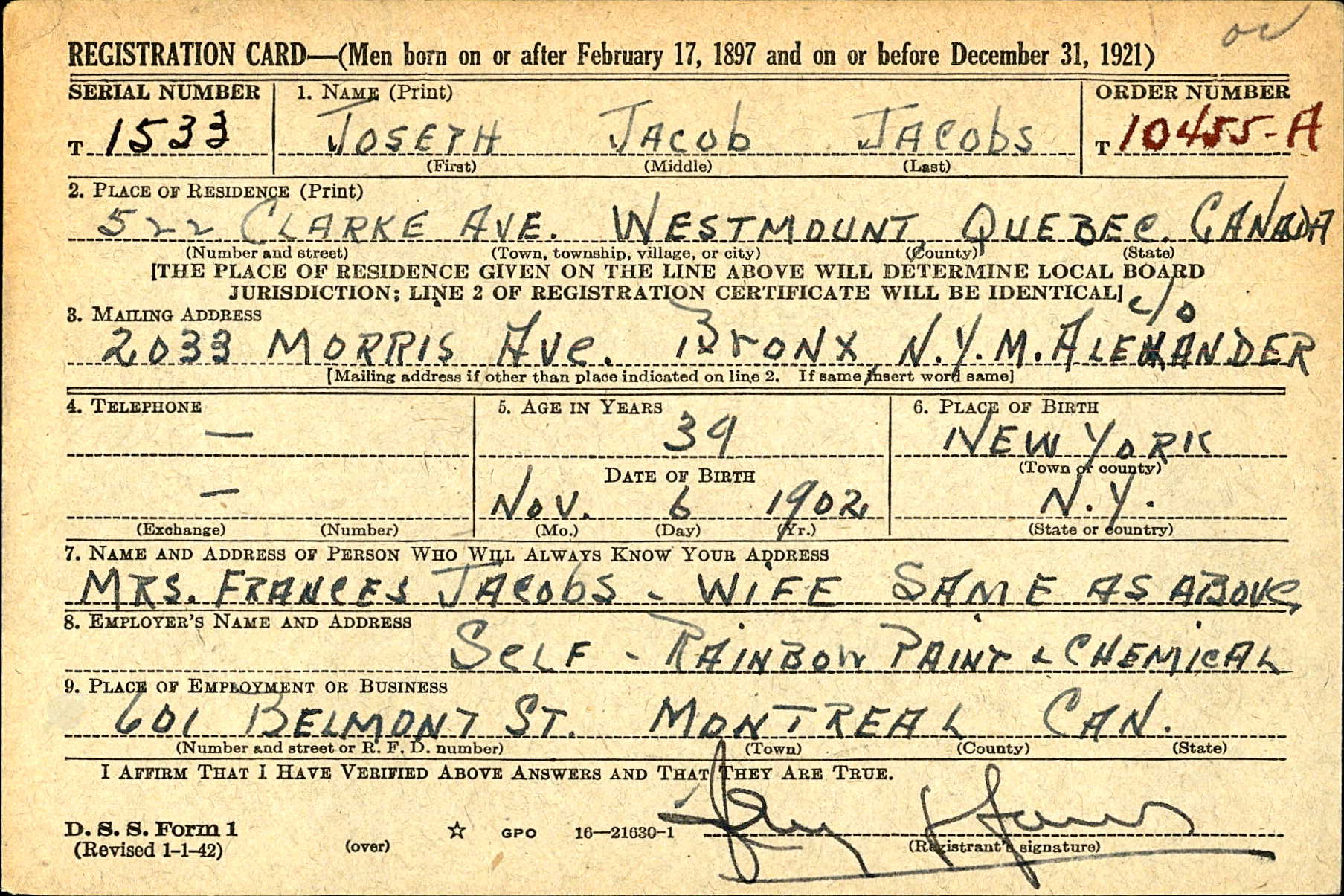
Joseph Jacobs World War II draft registration, National Archives at St. Louis; St. Louis, Missouri; Wwii Draft Registration Cards For New York City, 10/16/1940 – 03/31/1947; Record Group: Records of the Selective Service System, 147, Ancestry.com. U.S., World War II Draft Cards Young Men, 1940-1947

So Frances and Joseph had moved to the Montreal area with Joan in 1933, where they would have two more children, Peter and Maggie. As we saw above, Joseph died in 1983, Frances in 1998, and Joan in 2021.Joan Jacobs was predeceased by her husband Martin Samuels, who died on December 23, 2003.13 Joan was survived by her children and grandchildren and her brother Peter and sister Maggie.

Sadly, Maggie Jacobs died on November 4, 2024, just days before I found the family of Frances Alexander and Joseph Jacobs. She is survived by her brother Peter and her nieces and nephews and their children.

It took some doing, but I am so glad I persisted and located my Canadian cousins.


  1. Max Alexander and family, 1930 US census, Year: 1930; Census Place: Bronx, Bronx, New York; Page: 1A; Enumeration District: 0609; FHL microfilm: 2341221, Ancestry.com. 1930 United States Federal Census 
  2. Francis H Alexander, Gender Female, Marriage License Date 6 Jul 1926, Marriage License Place Bronx, New York City, New York, USA, Spouse Joseph N Jacobs, License Number 4383, New York City Municipal Archives; New York, New York; Borough: Bronx, Ancestry.com. New York, New York, U.S., Marriage License Indexes, 1907-2018 
  3. Frances H Alexander, Gender Female, Marriage Date 19 Jul 1933, Marriage Place Kings, New York, USA, Spouse, Jerome M Walton, Certificate Number 10142, Ancestry.com. New York, New York, U.S., Extracted Marriage Index, 1866-1937 
  4. “New York, New York City Marriage Records, 1829-1938”, , FamilySearch (https://www.familysearch.org/ark:/61903/1:1:Q2CD-FHZF : Sat Mar 09 21:15:06 UTC 2024), Entry for Jerome Maury Walton and Frances H Alexander, 19 July 1933. 
  5. Joseph Jacobs, World War II Draft Registration, National Archives at St. Louis; St. Louis, Missouri; Wwii Draft Registration Cards For New York City, 10/16/1940 – 03/31/1947; Record Group: Records of the Selective Service System, 147, Ancestry.com. U.S., World War II Draft Cards Young Men, 1940-1947. Max Jacobs, Naturalization Petition, The National Archives and Records Administration; Washington, D.C.; Petitions For Naturalization From the U.s. District Court For the Southern District of New York, 1897-1944; Series: M1972; Roll: 178, Archive Roll Descriptions: (Roll 0178) Petition No· 29218-Petition No· 29480, Ancestry.com. New York, U.S., Naturalization Records, 1882-1944 
  6. Max Jacobs and family, 1920 US census, Year: 1920; Census Place: Bronx Assembly District 8, Bronx, New York; Roll: T625_1141; Page: 14A; Enumeration District: 416, Ancestry.com. 1920 United States Federal Census 
  7. Max Alexander and family, 1920 US census, Year: 1920; Census Place: Bronx Assembly District 8, Bronx, New York; Roll: T625_1141; Page: 10B; Enumeration District: 416, Ancestry.com. 1920 United States Federal Census 
  8. Joseph Jacobs and family, 1930 US census, Year: 1930; Census Place: Bronx, Bronx, New York; Page: 1B; Enumeration District: 0689; FHL microfilm: 2341224, Ancestry.com. 1930 United States Federal Census 
  9. “Alexander, Albert E.,” Rochester (NY) Democrat and Chronicle, September 17, 1994, p. 5. 
  10. Montreal Gazette, June 19, 1998, p. 60. 
  11. Montreal Gazette, April 7, 1983, p. 31. 
  12. Montreal Gazette, August 21, 2021, p. CS18. 
  13. Montreal Gazette, December 26, 2023, p. 86. 

Levi Rothschild’s Daughters Thekla Rothschild Weinberg and Frieda Rothschild Phillipsohn: One Survived, One Did Not

This is the story of the last two children of Levi Rothschild and Clara Jacob who lived to adulthood, their daughters Thekla and Frieda. Both have heartbreaking stories though Thekla survived and Frieda did not.

The fifth child of Levi and Clara, their daughter Thekla, married Manuel Edward Weinberg on August 19, 1907, in Borken. Manuel was born in Lichenroth, Germany, to Lazarus Weinberg and Karoline Oppenheimer on October 11, 1880.

Thekla Rothschild and Manuel Weinberg marriage record, Hessisches Hauptstaatsarchiv; Wiesbaden, Deutschland; Bestand: 920; Laufende Nummer: 843, Ancestry.com. Hesse, Germany, Marriages, 1849-1930

Thekla and Manuel had a son Hans Herbert Weinberg born in Frankfurt, Germany, on November 2, 1908.1

After Kristallnacht in November 1938, Manuel Weinberg was imprisoned at Buchenwald for a short time,2 and that may have motivated the family to leave Germany. By 1940 if not before, the family had left Germany for France, and according to Yad Vashem, Thekla’s husband Manuel was deported in 1940 to the internment camp near Toulouse, France known as the Recebedou camp.3

According to one website, the camp of Recebedou was created in July 1940 to receive refugees and those who had been evacuated. It was turned into a hospital camp in February 1941. But conditions in the camp deteriorated over time due to the lack of adequate medical care and a shortage of food. By late 1941, there were 739 interns, many of whom were over 60 and ill; 118 of them died in the winter of 1941-1942. Manuel Weinberg was one of those who died; he died on March 4, 1942.4

I don’t know for certain whether Thekla or their son Herbert, as he came to be known, were also interned at Recebedou because there are no documents I can find that indicate that they were. However, I do know that they must have been in France because Herbert and his wife, Edith Seckbach, had a daughter Yvonne born in Toulouse, France sometime in 1943.5  I could not find a marriage record for Herbert and Edith, but according to other records, Edith was born in Wiesbaden, Germany, in about 1918. 6

Wherever they were in France, somehow Thekla, Herbert, Edith, and their baby daughter survived. A document on Ancestry’s collection of Munich, Vienna and Barcelona Jewish Displaced Persons and Refugee Cards, 1943-1959 (JDC) indicates that as of November 1942, Thekla, Herbert, Edith, and Yvonne were in Vigo, Spain, which is almost seven hundred miles from Toulouse, France. How they got there in the midst of the war is a story I do not know.

Ancestry.com. Munich, Vienna and Barcelona Jewish Displaced Persons and Refugee Cards, 1943-1959 (JDC)

From Vigo they went to Madrid as of December 26, 1943. The Refugee Card lists two people as the “parents,” which I assume really means sponsors in this situation. One was Walter Hirschmann, Thekla’s nephew, the son of her sister Betti Rothschild Hirschmann.7 The other, Jacob Bleibtreu, was a banker and later a governor of the New York Stock Exchange who had immigrated to the US from Germany as a young man in 1909. He also was on the Greater New York Army and Navy Committee of the Jewish Welfare Board. Perhaps he knew Walter from the banking and broker business and agreed to help rescue his aunt and other family members.8

On March 23, 1944, Thekla, Herbert, Edith, and Yvonne all arrived in Philadelphia after sailing from Lisbon, Portugal. The ship manifest shows that they all had last been residing in Madrid, Spain, and were heading to Montreal, Canada under the sponsorship of the Joint Distribution Committee. Herbert reported that he was a chemist by occupation.

Thekla Weinberg and family passenger manifest, The National Archives at Washington, D.C.; Washington, D.C.; Series Title: Passenger Lists of Vessels Arriving at Philadelphia, Pennsylvania; NAI Number: 4492386; Record Group Title: Records of the Immigration and Naturalization Service, 1787-2004; Record Group Number: 85; Series: T840; Roll: 177, Ancestry.com. Pennsylvania, U.S., Arriving Passenger and Crew Lists, 1798-1962

Herbert’s wife Edith must not have lived very long after their voyage from Portugal to Philadelphia because on September 8, 1946, Herbert married his second wife, Anna or Anya Grodzky, in Hochelaga, Quebec, Canada. Anna was born in Russia on June 18, 1910, and was a beautician. Herbert is listed as a widower on their marriage record and as a chemist by trade.

Hans Herbert Weinberg marriage to Anna Grodsky, Marriage Sep 8 1946 Westmount, Québec, Canada, Groom Herbert Hans Weinberg, Groom’s birth 1908 Germany, Bride Anna Goodsky, Certificate number upd46-128967, Quebec Marriage Returns, 1926-1997, found at https://www.myheritage.com/research/record-10723-1831907/herbert-hans-weinberg-and-anna-goodsky-in-quebec-marriage-returns

The family all settled in Montreal, where Thekla died on March 11, 1962, at the age of 76.9 Herbert lost his second wife Anna on July 9, 1976.10 He died February 12, 2001, at the age of 92, and was survived by his third wife Sally Lazoff Bailen.11

I have not found any further information about Herbert’s daughter Yvonne despite searching everywhere I could and receiving help from members of Tracing the Tribe. I don’t know whether she died, married, or moved from Canada and changed her name. There just is no trace of her after a mention in her stepmother Anna’s obituary in 1976. She is not mentioned in her father’s obituary in 2001.12

Although Thekla Rothschild Weinberg survived the Holocaust, she lost her husband, her homeland, and, as we will now see, her sister Frieda to the Holocaust.

Frieda was born May 31, 1993, in Borken, Germany.  As we saw, she first married Leonard Marxsohn and was widowed and then married Paul Phillipsohn, with whom she had a daughter Hannelore, born December 3, 1926.

Unfortunately, I have no happy ending for Frieda, Paul, or Hannelore. On June 11, 1942, they were all deported to Theriesenstadt. None of them survived. According to Yad Vashem, Paul died on December 20, 1942. I have no exact dates for Frieda or Hannelore, only that they also died in about 1942.13

Thus ends the story of Levi Rothschild’s family. Although most of them survived the Holocaust and made it to the US, Israel, or Canada, they were scattered across the globe, and their lives were all forever changed. The family members who were killed must have left holes in their hearts forever.


  1. Hans Herbert Kaufmann Weinberg, Gender männlich (Male), Record Type Inventory, Birth Date 02 Nov 1908 (2 Nov 1908), Birth Place Frankfurt am Main,
    Last Residence Frankfurt am Main, Residence Place Frankfurt am Main, Father
    Edmund Weinberg, Mother Thekla Weinberg, Spouse Edith Seckbach, Notes Inventories of personal estates of foreigners and especially German Jews
    Reference Number 02010101 oS, Document ID 70370883, Arolsen Archives, Digital Archive; Bad Arolsen, Germany; Lists of Persecutees 2.1.1.1, Ancestry.com. Free Access: Europe, Registration of Foreigners and German Persecutees, 1939-1947 
  2. Arolsen Archives, 1 Incarceration Documents / 1.1 Camps and Ghettos / 1.1.5 Buchenwald Concentration Camp / 1.1.5.3 Individual Documents male Buchenwald / Individual Files (male) – Concentration Camp Buchenwald / Files with names from SYS and further sub-structure / Files with names from WECK /, Personal file of WEINBERG, EMANEL, born on 11-Oct-1880, Reference Code, 01010503 002.042.476, Number of documents, 1, found at https://collections.arolsen-archives.org/en/document/7388346 
  3. Yad Vashem entries for Manuel Weinberg, found at  https://collections.yadvashem.org/en/names/13545516 and at https://collections.yadvashem.org/en/names/3229127 
  4. See Note 3, supra. 
  5. Yvonne Miriam Weinberg, passenger manifest, The National Archives at Washington, D.C.; Washington, D.C.; Series Title: Passenger Lists of Vessels Arriving at Philadelphia, Pennsylvania; NAI Number: 4492386; Record Group Title: Records of the Immigration and Naturalization Service, 1787-2004; Record Group Number: 85; Series: T840; Roll: 177, Ancestry.com. Pennsylvania, U.S., Arriving Passenger and Crew Lists, 1798-1962 
  6. Edith Weinberg, passenger manifest, The National Archives at Washington, D.C.; Washington, D.C.; Series Title: Passenger Lists of Vessels Arriving at Philadelphia, Pennsylvania; NAI Number: 4492386; Record Group Title: Records of the Immigration and Naturalization Service, 1787-2004; Record Group Number: 85; Series: T840; Roll: 177, Ancestry.com. Pennsylvania, U.S., Arriving Passenger and Crew Lists, 1798-1962. See also Edith Weinberg geb. Seckbach, Arolsen Archives, Digital Archive; Bad Arolsen, Germany; Lists of Persecutees 2.1.1.1, Description Reference Code: 02010101 oS,
    Ancestry.com. Free Access: Europe, Registration of Foreigners and German Persecutees, 1939-1947 
  7. It was Walter’s name on this card that led me to discover that he was the child of Betti and Emanuel Hirschmann. 
  8. “Jacob Bleibtreu, Former Governor of New York Stock Exchange, 90,” The New York Times, December 6, 1976. 
  9. Thekla Weinberg death notice, The Montreal Star, Montreal, Quebec, Canada, Mon, Mar 12, 1962, Page 16. 
  10. Anna (Anya) Weinberg death notice, The Montreal Star, Montreal, Quebec, Canada, Sat, Jul 10, 1976, Page 10. 
  11. Marriage of Herbert Weinberg to Sally Lazoff, Nov 15 1980, Côte St Luc, Québec, Canada, Groom Herbert Weinberg, Groom’s birth Nov 5 1908, Germany, Groom’s age 72, Bride Sally Lazoff, Bride’s birth Aug 15 1917, Québec, Canada, Bride’s age 63, Groom’s father Manuel Weinberg, Groom’s father’s birth Germany, Groom’s mother Thekla Rothschild, Groom’s mother’s birth Germany, Bride’s father Gedaliah Lazoff
    Bride’s father’s birth Russia, Bride’s mother Telia Brasgold, Bride’s mother’s birth Russia
    Certificate number upd80-141452, Quebec Marriage Returns, 1926-1997, found at https://www.myheritage.com/research/record-10723-2419633/herbert-weinberg-and-sally-lazoff-in-quebec-marriage-returns. Herbert Weinberg death notice, The Gazette
    Montreal, Quebec, Canada, Mon, Feb 12, 2001, Page 35. 
  12. Anna (Anya) Weinberg death notice, The Montreal Star, Montreal, Quebec, Canada, Sat, Jul 10, 1976, Page 10. Herbert Weinberg death notice, The Gazette, Montreal, Quebec, Canada, Mon, Feb 12, 2001, Page 35. 
  13. See Yad Vashem entries at https://collections.yadvashem.org/en/names/11607287 for Frieda, https://collections.yadvashem.org/en/names/14969310 for Paul, and https://collections.yadvashem.org/en/names/11607287 for Hannelore. 

Sitta Blumenfeld Spier and Her Daughter Gisela—A Story of Survival and Hope in the Midst of Despair and Death

Although three of the four surviving children of Gerson Blumenfeld II—Friedrich, Katinka, and Mina/Meta—and all their children escaped from Germany to the US and avoided being murdered by the Nazis, the fourth surviving child, Sitta Blumenfeld Spier, and her husband Siegfried Spier and their two children Manfred and Gisela were not as fortunate. As explained by Gisela’s son Simeon Spier in the eulogy he wrote for his mother, “[Siegfried] tried frantically to get the family out of Germany but since he was a wounded veteran from World War I – he had been awarded the Iron Cross for bravery and still had a bullet lodged in his lung – he was considered a health risk and emigration to other countries was not possible.”1

What a cruel irony—because he was wounded fighting for Germany, Siegfried could not escape German persecution twenty years later.

Sitta, Siegfried, Manfred, and Gisela were all deported to the concentration camp at Theriesenstadt on September 7, 1942.2 Manfred was sixteen and Gisela thirteen at that time. Gisela was “allowed” to participate as an athlete in games filmed by the Nazis for propaganda purposes—to show how “humanely” the camp prisoners were being treated.3 You can read more about the propaganda film created by the Nazis and see a clip from it here.

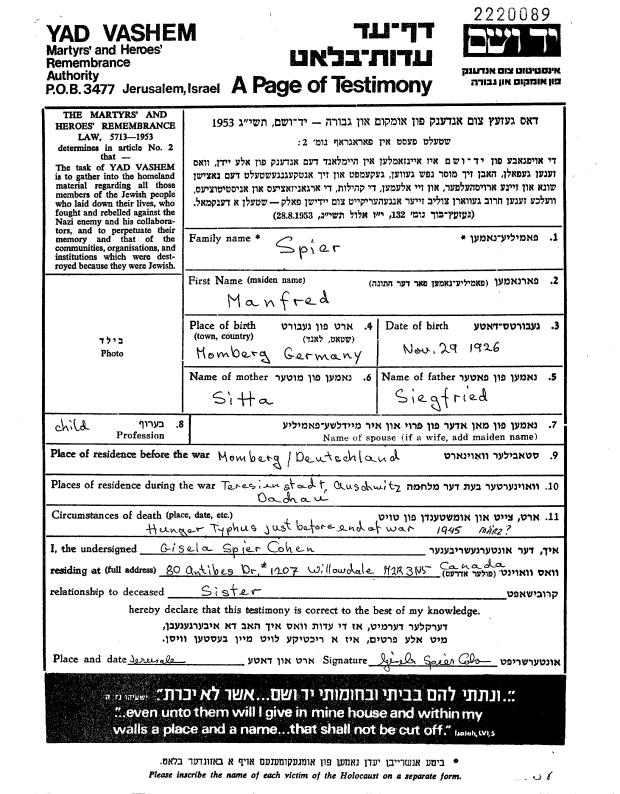
By October, 1944, all four members of Sitta’s family had been transported from Theriesenstadt to Auschwitz where Sitta and Siegfried were immediately sent to the gas chambers. Manfred was transferred several days later to the Dachau concentration where he died from starvation and typhus on April 18, 1945, just a few weeks before Germany surrendered and the war in Europe ended. He was nineteen years old.4

Manfred Spier Page of Testimony at Yad Vashem, found at https://yvng.yadvashem.org/nameDetails.html?language=en&itemId=1879134&ind=1

The only member of Sitta’s family to survive was her daughter Gisela. She was sent from Auschwitz on October 12, 1944,5 to the concentration camp in Flossenburg, Germany, a camp where prisoners worked as slave labor to build fighter planes and other equipment for the German military. The US Holocaust Museum and Memorial  provided this description of conditions at Flossenburg:

The conditions under which the camp authorities forced the prisoners to work and the absence of even rudimentary medical care facilitated the spread of disease, including dysentery and typhus. In addition to the dreadful living conditions, the prisoners suffered beatings and arbitrary punishments.

About 30,000 people died there, but somehow Gisela survived.

On April 29, 1945, as the Allied forces were approaching Flossenburg, the Nazis began to evacuate the camp and transport the prisoners elsewhere. Gisela was transferred from Flossenburg to the Mauthausen concentration camp,6 where she was liberated by the Allies on May 5, 1945. She was sixteen years old and weighed 46 pounds when she was freed.7

In his eulogy for his mother, Gisela’s son Simeon Spier wrote this description of Gisela’s life after she was liberated in May, 1945.8

She travelled with a friend she met in a displaced persons camp to Paris.  They were on one of the first trains to arrive in Paris at Gare de l’Est after the war’s end and were mobbed by frantic people looking for word of loved ones.  It was at that time she realized she had survived an atrocity of epic proportions.

She searched for her brother through refugee organizations.  She found out he had died of hunger and exhaustion at Dachau.  She saw 2 men on the streets of Paris wearing Magen David.  She asked them why they were wearing Stars of David now that the war was over. They told her they were part of a brigade building the Jewish state in Palestine.  They told her if she wanted to go to Palestine there was a boat leaving from the port of Marseille in several days.

With no family left, she set off to Marseille and boarded the ship, the Mataroa, to Palestine.  Since Jewish immigration to Palestine was illegal under the British Mandate, she was detained by the British army upon reaching Palestine.  She was imprisoned in Atlit ….  The Jewish underground broke her free from Atlit.  Her name was changed to escape British authorities.  She became Yael Blumenfeld – Gisela to Gazella to Yaela to Yael.  Blumenfeld for her mother’s maiden name.  She said when she became Yael Blumenfeld, she finally felt free.

She lived in the youth village of Ben Shemen, joined the Palmach army and fought in the Israeli War of Independence.  She was a decorated veteran of the 1948 war.

In 1950, Gisela came to New York with the help of her mother’s siblings and then got a job in Montreal as a secretary for a synagogue. She met her husband Israel Cohen in Canada, where they were married in 1956.9

Gisela and Israel had three children, each named for one of Gisela’s family members who had been killed in the Holocaust— a daughter Sitta, named in memory of Gisela’s mother Sitta Blumenfeld Spier, a son Simeon, named in memory of Gisela’s father Siegfried Spier, and a daughter Michall, named in memory of Gisela’s brother Manfred. The family lived in Montreal and later in Toronto.10

Once her children were grown, Gisela devoted a great deal of her time and energy to Holocaust education, including regularly traveling back to Momberg and other towns in Germany, to educate German children about what had happened to her family and many other Jewish families.11

Here is a very moving video of Gisela produced by the Sarah and Chaim Neuberger Holocaust Education Centre at the UJA Federation of Greater Toronto as part of Gisela’s efforts to provide education about the Holocaust. I highly recommend you watch this eight-minute interview so that you can see and hear this remarkable woman.

Gisela died on February 19, 2016, in Toronto. She was 87 years old and had endured and experienced so much. Simeon ended his eulogy for his mother Gisela in words that bring tears to my eyes each time I re-read them.12

My mother was overwhelmed by the good fortune her life had brought her after suffering such unbearable loss early in life.  As her life neared its end, she became at peace with herself having lived a full life bearing witness to history’s most brutal atrocity.

Death, to her meant two things. She would be re-united with her family and the ability to have a real grave with a tombstone – something her family never had.  She had always mourned that according to Jewish tradition, a son must say Kaddish at the grave of his parents and that no one had been able to say Kaddish for her parents and brother.  Today, we will go to the cemetery and say Kaddish at her grave – for her, her mother, father, and brother.  And for this, we are all very happy.

Gisela Spier Cohen was survived by her three children and her grandchildren. Her life exemplified courage and persistence and hope against all odds. I feel so moved and honored to be able to share her story and that of her family.

Special thanks to my cousin Simeon Spier for allowing me to quote extensively from the beautiful eulogy he wrote for his mother.


  1. “In Loving Memory of Yael Gisela Spier Cohen,” by Simeon Spier, published February 28, 2016, found here
  2. See the entries at Yad Vashem at the links in the text. 
  3. Obituary for Gisela Spier Cohen in Oberhesslische Press, March 23, 2016, found at https://www.op-marburg.de/Landkreis/Ostkreis/Zeitzeugin-verstirbt-fern-ihres-Geburtsortes 
  4. Manfred Spier, Nationality: German or Austrian, Birth Date: 29 Nov 1925, Birth Place: Momberg, Prior Residence: Momberg, Street Address: Marburg a. d. L, Arrival Date: 10 Oct 1944, Arrival Country: Germany, Death Date: 18 Apr 1945, Prisoner Number: 115317, Arrival Notes: 10 Oct 1944 from Auschwitz, Disposition Notes: died 18 Apr 1945, Description: prisoner German or Austrian Jew, Page: 5440/Bg.
    Original Notes (desc. / arr. / dis.): Sch. DR. J./ 10 Oct 1944 v. Au./ gest. 18 Apr 1945, JewishGen volunteers, comp. Germany, Dachau Concentration Camp Records, 1945 
  5. Gizela Spier, Nationality: German, Born: 29 Nov 1928, Prisoner Number: 54367
    Classification: Jew, Arrival: 12 Oct 1944, Record Source: Reel 2, Image #: 269, Page #: 1000, JewishGen Volunteers. Germany, Flossenbürg Concentration Camp Records, 1938-1945 
  6. Gisela Spier, Date of Birth: 29 Nov 1928, Nationality: German. Prisoner Number: 54,367, Category: Jew, Town/Camp: Freiberg, Factory: Hildebrandt, Transferred from (camp name): Auschwitz, Date transferred: 12 Oct 1944, Transferred to (camp name): Mauthausen, Date transferred: 29 Apr 1945, Ancestry.com. Germany, Women in Flossenbürg Branch Camps (Hans Brenner Book Lists), 1944-1945 
  7. See Note 1, supra. 
  8. See Note 1, supra. 
  9. See Note 1, infra. 
  10. See Note 1, supra. 
  11. See Note 1, supra. See also Note 3, supra. 
  12. See Note 1, supra. 

A Survivor’s Story

Regina Goldschmidt Rosenberger, the daughter of Julius Goldschmidt, granddaughter of Jacob Meier Goldschmidt, and great-granddaughter of Meyer Goldschmidt, was my third cousin, twice removed, and I first wrote about her here and here, but now need to update those posts.

The earlier post established that Regina was born in Frankfurt on March 7, 1900, and married Siegfried Rosenberger on March 10, 1921, in Frankfurt, and had two children in the 1920s. In my second post about Regina, I wrote:

I don’t know a great deal about what happened to Regina, her husband Siegfried Rosenberger, and their two children during the Holocaust. It appears that at least until 1937 they were still living in Frankfurt and that after the war, according to Roger Cibella and David Baron, their two children were both married in the Netherlands and had children born there. Eventually they all immigrated to Canada where Regina died in February 1992…

And that was all I knew. Until a couple of weeks ago when I received an email from a sixth cousin named Mark Isenberg. I had first heard from Mark a few years back when he contacted David and Roger regarding his research establishing that his paternal four-times great-grandfather Joseph Falk Neuwahl and Roger’s and my four-times great-grandfather Jacob Falk Goldschmidt were probably brothers.

This time Mark was writing about his relationship to Siegfried Rosenberger, husband of Regina Goldschmidt. Siegfried was Mark’s third cousin, once removed, on his maternal side. Mark had seen my blog post quoted above and kindly alerted me to the fact that Siegfried and Regina’s daughter Ruth had done an interview with the Shoah Foundation in 1997. I’ve now watched the two and a half hours of her testimony and can report in much greater detail what happened to Regina, Siegfried, and their two daughters Ruth and Margo during the Holocaust. All the information below except where otherwise noted comes from that testimony of Ruth Rosenberger Steinert.1

Ruth Rosenberger was born in Frankfurt on December 6, 1922. Her sister Margo was born almost exactly two years later on December 19, 1924. Ruth described their childhood in Frankfurt in idyllic terms. They lived in a very large apartment with a nanny, cook, and other servants, and were surrounded by their Goldschmidt grandparents, aunt, uncle, and cousins, having regular shabbat dinners with the extended family as well as holidays. Their father Siegfried was a successful stockbroker. He was very proud of being a German and of his service to Germany in World War I, for which he was awarded the Iron Cross.  Their mother Regina lived a good life, playing tennis daily, socializing with friends, and overseeing the household staff. The family was very observant, and Ruth and Margo went to an Orthodox day school in Frankfurt. Watching Ruth talk about her childhood was very moving; she so well expressed how safe and loved she felt.

Khal Adath Jeshurun synagogue in Frankfurt, the synagogue attended by the Goldschmidt family. https://www.kajinc.org/about/history

Everything was destroyed once the Nazis came to power. Ruth said that until 1936, she and her sister were fairly unaware of what was happening because the adults did not talk about the Nazis in front of the children. She knew that there were restrictions, mentioning as an example that they were not allowed to sit on the park benches, but she nevertheless felt safe.

But after 1936, it became impossible to hide what was happening from the children. Her father lost his stockbroker business because Jews were no longer allowed to engage in business. Ruth talked about how devastated her father was when they came and stripped away the telephones he needed for the business. The nanny, cook, and other servants had to leave the household because non-Jews were no longer allowed to work for Jews. Their mother Regina became terribly depressed.

Fortunately, Siegfried was able to secure another job with an international metals company called Lissauer. The position required him to travel to France and to Holland and enabled the family to continue to live fairly comfortably. As Ruth described it, this job ultimately saved their lives. Siegfried would never have left Germany despite all the oppression and fear. But in September 1938 while traveling for work in Paris, he was unable to return to Germany. Finally he agreed that the family should leave Germany, and through his business connections, he was able to obtain papers for them to immigrate to the Netherlands.

Ruth, not yet sixteen years old, took charge of packing and getting them ready to leave. They took a train to Paris, and Ruth put on lipstick so that she would look older. When they got to the French-German border at Emmerich, the German border guards gave them trouble with their papers, but fortunately a cousin was able to straighten matters out, and the next day they arrived in Paris. They remained in Paris for a few days, and then the whole family spent about ten days at the beach in the Netherlands. Ruth remembered it as a wonderful time and one of the very last times all four of them were together as a family.

Siegfried returned to Paris for work and would travel back and forth to Amsterdam. Regina and her daughters were living in a very nice apartment on the canal in Amsterdam. Margo attended high school, and Ruth spent a year at an art academy, learning design.  For a year life was fairly normal.

As one uncle had said to the family when they arrived in Paris, they had, however, gone from “the rain into the storm” because war was brewing, and no place was really safe. After the war started in September 1939 and then Holland and France were occupied by the Nazis in the spring of 1940, Siegfried could no longer travel to Amsterdam. From that point on, things went downhill.

Ruth recalled standing on a corner in Amsterdam with a crowd of other people from the neighborhood as the Germans marched into Amsterdam.

Nazi troops and supporters in front of De Bijenkorf, Dam Square, Amsterdam, The Netherlands, 1941 (crop of original 1941 public domain photo). 47thPennVols, CC0, via Wikimedia Commons

But even on that dark day, the family found a silver lining. A man named Benot Hess was also standing on that corner and engaged Regina and daughters in conversation. Hess was married to a non-Jewish Swedish woman, and because Sweden was neutral during the war, he was given some extra protection based on that marriage. Hess and his wife became close friends with the Rosenberger women—like family, according to Ruth. He made sure that they had enough money by helping Ruth obtain work, sewing and then manufacturing travel kits and other items. The products sold well, giving the family an economic cushion.

By 1942, however, conditions worsened. Jews were required to wear the yellow stars with Jood to mark them as Jews. Ruth said that they lived in a constant state of angst for all their waking hours. Eventually they were forced to move into what Ruth described as a ghetto where all Jews were forced to live, and SS men on trucks barreled through the neighborhood every night, coming to arrest people and take them to Westerbork, the detention camp outside of Amsterdam.

At that point, they had to make a choice: stay and see what would happen or go into hiding. Ruth favored going into hiding, but her mother was not willing, and Margo did not want to leave their mother. For some time they remained safe from deportation as both Ruth and Margo had positions assigned by the Judenrat (the Jewish council) that kept them protected. Once the SS came to their apartment, and Ruth managed to convince them that they were not Jewish. She claimed that because of her light hair and coloring and straight nose, she was able to fool them.

But when the SS arrived a second time, Ruth was not successful, and in March 1943, Regina Goldschmidt Rosenberger was arrested and taken to Westerbork. Ruth described it as the worst moment in her life, watching her mother being taken away. She said that at that time they did not know about the death camps, only about what were being referred to as work camps. Soon thereafter Margo lost her position with the Judenrat and was also taken to Westerbork where she joined her mother.

Ruth contacted her father to see if he could arrange false identification papers for her, which he was able to accomplish, and Ruth went to Bussum, a town in Holland, and hid with a family there for the duration of the war. She was almost caught once when the SS came to look for hidden Jews, but again was smart enough and lucky enough to convince them that she was not Jewish.

Meanwhile, Regina and Margo had been taken from Westerbork to Terezin. Once again, Benot Hess came to their rescue. He also was imprisoned at Terezin, and when he learned that Regina and Margo were to be placed on the next train to Auschwitz, he intervened, using the Honduran passports that Siegfried had obtained for them, and Regina and Margo were taken off the list.

Jewish prisoners’ cell, Terezin (c) A Cohen 2015

When the war ended in Europe in April 1945, Ruth was reunited with her mother and sister, and they all moved to Bussum. Margo married her fiancé, Robert Engel, who had been at Westerbork throughout the war period, and Ruth met and married Otto Steinert. In 1950, Otto was offered a job in Canada through the family’s connections to another family, and Ruth and Otto and soon thereafter Regina, Margo, and her husband all moved to Canada.

Siegfried was never reunited with the family. He remained in Paris, where he died not long after the war. Regina Goldschmidt Rosenberger lived a long life, dying in Canada in February 1992 when she was almost 92 years old.

Her two daughters also lived long lives. Ruth Rosenberger Steinert died at the age of 93 on December 22, 2013, in Montreal. Her sister Margo Rosenberger Engel died just this past June 30, 2020, in Toronto; she was 95. They are survived by their children and grandchildren and great-grandchildren.

Watching Ruth’s testimony was a moving, inspiring, and heartbreaking experience. Despite everything she had experienced—all the losses, the fear, the separation, the loneliness—she remained a strong, optimistic, and loving woman who spoke about her parents, her husband, her sister, her children and grandchildren with so much affection and warmth. She was not going to be defeated by what happened around her—not while it was happening and not afterwards. How blessed we are to have this testimony to remember what happened and to inspire us all.


  1. Steinert, Ruth. Interview 35432. Visual History Archive, USC Shoah Foundation, 1997. Accessed 1 October 2020.