One for the Road: How I Found Another Brotman

This will be my last post before we leave on our trip.  I wanted to leave on a high note with a new discovery—a Brotman line I’d not discovered until the last week or so.  Perhaps this is a good omen for what I might find when in Poland.  I might post a bit while away—depends on internet access, time, and energy.  But I will report on the trip either as it unfolds or after I return, so stay tuned.

*********

In my last post I reported on the conflicting results of my search through the records of the families of Moses and Abraham Brotman of Brotmanville, New Jersey.  I was looking for any shred of evidence that might reveal where they, and thus perhaps my great-grandparents, had lived in Europe.  What I found was that some records said Moses was born in Austria, some said Russia.  Same for Abraham.  And not one record named a town or city.  Thus, I had not gotten any closer to any answers.

But while reviewing the documents I had and checking and double-checking my tree, I did find something somewhat anomalous.  In doing my initial research of Moses’ family, I had not been able to find them on the 1920 census, as I mentioned in my last post.  In trying to find the family, I had searched for each of the children separately, and I had found a Joseph Brotman living in Davenport, Iowa, according to the 1915 Iowa state census.  I admit that I had not looked very carefully (BIG mistake) and had jumped to the conclusion that Moses’ son Joseph had been shipped out to Iowa to live with another family since I couldn’t find Moses or Ida or any of the siblings listed on that census.  (This is one reason I keep my tree private on Ancestry—I’d hate to mislead someone else while I am doing preliminary research.)

But in now reviewing my original preliminary research, this just struck me as strange.  So I went back to look more carefully.  First, I pulled up the census record for Joseph.  Instead of being a list or register as with other census reports, Iowa had separate cards for each resident.  Here is the one for Joseph Brotman:

Joseph Brotman 1915 Iowa census  Ancestry.com. Iowa, State Census Collection, 1836-1925 [database on-line]. Provo, UT, USA: Ancestry.com Operations Inc, 2007. Original data: Microfilm of Iowa State Censuses, 1856, 1885, 1895, 1905, 1915, 1925 as well various special censuses from 1836-1897 obtained from the State Historical Society of Iowa via Heritage Quest

Joseph Brotman 1915 Iowa census
Ancestry.com. Iowa, State Census Collection, 1836-1925 [database on-line]. Provo, UT, USA: Ancestry.com Operations Inc, 2007.
Original data: Microfilm of Iowa State Censuses, 1856, 1885, 1895, 1905, 1915, 1925 as well various special censuses from 1836-1897 obtained from the State Historical Society of Iowa via Heritage Quest

You can see why I made that initial mistake.  He was born the right year (1902) and the right place (New Jersey).  He was Jewish, his father was born in Austria, mother in Russia.  All those facts certainly seemed to suggest that he was the son of Moses and Ida Brotman.  So I had entered this record for Joseph on to my tree in Ancestry.

But this time I took the next step—were there other Brotmans in Davenport on that census? First I saw a Lillian Brotman.  I thought, “Hmmm, maybe two siblings were sent to Iowa?” Remember—Moses had a daughter named Lillian, as did Abraham.  So I looked at Lillian’s entry in the 1915 census.

Lillian Brotman 1915 Iowa census  Ancestry.com. Iowa, State Census Collection, 1836-1925 [database on-line]. Provo, UT, USA: Ancestry.com Operations Inc, 2007. Original data: Microfilm of Iowa State Censuses, 1856, 1885, 1895, 1905, 1915, 1925 as well various special censuses from 1836-1897 obtained from the State Historical Society of Iowa via Heritage Quest.

Lillian Brotman 1915 Iowa census
Ancestry.com. Iowa, State Census Collection, 1836-1925 [database on-line]. Provo, UT, USA: Ancestry.com Operations Inc, 2007.
Original data: Microfilm of Iowa State Censuses, 1856, 1885, 1895, 1905, 1915, 1925 as well various special censuses from 1836-1897 obtained from the State Historical Society of Iowa via Heritage Quest.

She was living at the same address as Joseph, was also born in New Jersey, and had a father born in Austria, a mother in Russia.  Like Joseph, she had been in Iowa for three years.  So I thought that this had to be Joseph’s sister.  But this Lillian was 16 years old, and Moses’ daughter Lillian was born in 1892, so she would have been 23 in 1915. Could it be Abraham’s daughter Lillian? She was the right age, but somehow that just didn’t make much sense.

I decided to go through the cards in the census by flipping backwards from Joseph’s card and then found several other Brotmans at the same address: Albert (2), Eva (37), and May (10).  May also had been born in New Jersey, Albert in Iowa, and Eva in Russia. Who were these people? Were they related to MY Brotmans in some way? I assumed Eva was the mother of these four children, but who was the father? And where was he?

So I searched for the family by using Eva’s names and the names of the children, and I found them on the 1910 census living in Philadelphia.  The husband’s name was Bennie, wife Eva (32), and four children: Lily (11), Florence (10), Joe (8), and May (6).  These ages lined up with the ages of the children on the Iowa census five years later, but the census record said these children were born in Pennsylvania, not New Jersey. The father, Bennie, was 33, born in Austria with parents born in Russia, and had immigrated in 1894, according to the census.  He was a cutter in a clothing business.  He and his wife had been married for 12 years or since 1898.

Bennie Brotman 1910 census

Bennie Brotman 1910 census Source Citation Year: 1910; Census Place: Philadelphia Ward 1, Philadelphia, Pennsylvania; Roll: T624_1386; Page: 11B; Enumeration District: 0019; FHL microfilm: 1375399

Bennie Brotman 1910 census
Source Citation
Year: 1910; Census Place: Philadelphia Ward 1, Philadelphia, Pennsylvania; Roll: T624_1386; Page: 11B; Enumeration District: 0019; FHL microfilm: 1375399

What had happened to their daughter Florence? And where had they been in 1900? Were they related to my Brotmans? I first searched for their missing daughter, and I found an entry in the Iowa, Select Deaths and Burials 1850-1990 database:

Name: Flora Brotman
Gender: Female
Marital Status: Single
Age: 13
Birth Date: 1900
Birth Place: Philadelphia
Death Date: 23 Aug 1913
Death Place: Davenport, Iowa
Burial Date: 24 Aug 1913
Father: Ben Brotman
Mother: Eva Siegel
FHL Film Number: 1480948
Reference ID: p186 r59


This document provided me with Eva’s birth name and Flora’s birthplace.  I thought that the family must have been living in Philadelphia in 1900 if that is where Flora was born, but I could not find them on the 1900 census living in Philadelphia.  I searched again for Flora, and this time found a birth record—not in Philadelphia or even in Pennsylvania, as the death record and 1910 census had reported.  Rather, she was born in, of all places, Pittsgrove, Salem County, New Jersey, on July 19, 1900, to Benj. Brotman (born in Austria) and Eva Sigel (born in Russia).  Once I saw Pittsgrove, my heart beat a little faster.  This more and more seemed like a member of the Brotmanville Brotman family—someone I had not ever located or researched before.  Who was he? How was he related, if at all, to Moses and Abraham?

Name: Flora Brotman
Gender: Female
Birth Date: 19 Jul 1900
Birth Place: PIT, Salem County, New Jersey
Father’s name: Benj Brotman
Father’s Age: 24
Father’s Birth Place: Aug.
Mother’s name: Eve Sigel
Mother’s Age: 22
Mother’s Birth Place: Russia
FHL Film Number: 494247


I searched for them on the 1900 census again, but this time in Pittsgrove, New Jersey.  It took some doing, but finally found Benjamin listed as Bengeman Brotman, listed at the very bottom of the same page as Moses Brotman, just a few households away.  The census reported that he was 24, a cutter, and married for one year.  It stated that he and his parents were born in Austria, that he had immigrated in 1888, and that he was a naturalized citizen.  At the top of the next page were the listings for his wife Eva and daughter Lilly, just a year old.  The other children had not yet been born.

Bengeman Brotman 1900 US census

Bengeman Brotman 1900 US census

Ben Brotman's family 1900 census Year: 1900; Census Place: Pittsgrove, Salem, New Jersey; Roll: 993; Page: 18B; Enumeration District: 0179; FHL microfilm: 1240993

Ben Brotman’s family 1900 census
Year: 1900; Census Place: Pittsgrove, Salem, New Jersey; Roll: 993; Page: 18B; Enumeration District: 0179; FHL microfilm: 1240993


From this census, I knew that Benjamin Brotman had lived in Pittsgrove right near Moses Brotman, had married Eva Siegel and had had at least two children in Pittsgrove before moving to Philadelphia, where they were living in 1910.  By 1913, the family was living in Davenport, Iowa, where their daughter Flora died.  But where was Benjamin in 1915 when the Iowa census was taken? And was he related to Moses Brotman?

Looking one more time, I found him listed in the 1914 Davenport, Iowa, directory as a peddler, living with his wife Eva at the same address where she and the children were listed in the 1915 Iowa census. I also found him in the 1915 directory at that address, but with no occupation listed, and in the 1918 directory at a new address, 1323 Ripley, the same address given for his son Joseph, listed as a chauffeur, and his daughter Lillian, listed as a bookkeeper. A very similar series of entries appears in the 1919 directory. In both Benjamin still had no occupation listed.  If he was living in Davenport in 1914, 1915, 1918 and 1919, why wasn’t he in the Iowa census?

One more search of the I0wa 1915 census produced this result:

Benjamin Brotman 1915 Iowa census Ancestry.com. Iowa, State Census Collection, 1836-1925 [database on-line]. Provo, UT, USA: Ancestry.com Operations Inc, 2007. Original data: Microfilm of Iowa State Censuses, 1856, 1885, 1895, 1905, 1915, 1925 as well various special censuses from 1836-1897 obtained from the State Historical Society of Iowa via Heritage Quest.

Benjamin Brotman 1915 Iowa census
Ancestry.com. Iowa, State Census Collection, 1836-1925 [database on-line]. Provo, UT, USA: Ancestry.com Operations Inc, 2007.
Original data: Microfilm of Iowa State Censuses, 1856, 1885, 1895, 1905, 1915, 1925 as well various special censuses from 1836-1897 obtained from the State Historical Society of Iowa via Heritage Quest.

At first, I didn’t know why this card was separated from the family’s cards.  Looking at this card, however, revealed the reason: Benjamin is described as an invalid, and under “Remarks” it says, “Tuberculosis Hospital.”  He was not living with his family. Benjamin was sick with the dreadful disease that caused suffering for so many and their families.  Perhaps that is also what killed his daughter Flora.  Of note on this card is that his birthplace was Austria and that he had been in the US for 27 years, that is, since 1888, consistent with the 1900 census though not the 1910 census.  Also, as with the other members of the family, Ben had been in Iowa for three years or since about 1912.

But what happened to Ben after 1915? Did he recover? Is that why he appears in the 1918 and 1919 directories? On the 1920 census Ben is listed with Eva and three of their surviving children, Lillian, Joseph, and Albert, and a new son Merle, only four years old.  It would seem that Ben had not only recovered, but had returned home and fathered another child.

Benjamin Brotman 1920 census Year: 1920; Census Place: Rock Island Precinct 4, Rock Island, Illinois; Roll: T625_402; Page: 16A; Enumeration District: 128; Image: 1078

Benjamin Brotman 1920 census
Year: 1920; Census Place: Rock Island Precinct 4, Rock Island, Illinois; Roll: T625_402; Page: 16A; Enumeration District: 128; Image: 1078

The family was living in Rock Island, Illinois, right across the Mississippi River from Davenport, Iowa.  Ben was not employed, but Lillian was a bookkeeper and Joseph a salesman at a general store.  Their daughter May was listed on the 1920 census as an inmate at the Institution for Feeble-Minded Children in Glenwood, Iowa, over 300 miles away from Rock Island.  She was still there ten years later according to the 1930 census.

English: Downtown Davenport, Iowa looking acro...

English: Downtown Davenport, Iowa looking across the Mississippi River from Rock Island, Illinois (Photo credit: Wikipedia)

As I followed the family forward into the 1920s, Benjamin seemed to have died or disappeared.  In the 1921 Rock Island directory, Eva Brotman is listed as a widow. And in the Illinois, County Marriages 1810-1934 database on FamilySearch, I found a marriage listing for Eva Brotman and Abe Abramovitz on July 26, 1923, in Rock Island.  In 1930, Eva was living with her second husband Abe and her two youngest sons, Albert (listed incorrectly as Abe) and Merle (listed incorrectly as Muriel), who were then 18 and 15, respectively.  They were all still living together ten years later, according to the 1940 census.
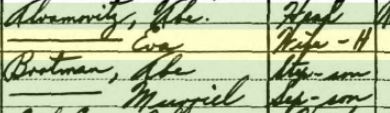
Eva Siegel Brotman Abromovitz and sons 1930 census Year: 1930; Census Place: Rock Island, Rock Island, Illinois; Roll: 553; Page: 5B; Enumeration District: 0084; Image: 716.0; FHL microfilm: 2340288

Eva Siegel Brotman Abromovitz and sons 1930 census
Year: 1930; Census Place: Rock Island, Rock Island, Illinois; Roll: 553; Page: 5B; Enumeration District: 0084; Image: 716.0; FHL microfilm: 2340288

It seemed I had reached the end of the line for Benjamin Brotman, but I had no death record, and I still had no idea whether he was related to me or to the Brotmanville Brotmans.  I kept searching for a death record, and instead I found this:

Ben Brotman World War I draft registration Registration State: Colorado; Registration County: Denver; Roll: 1544482; Draft Board: 1

Ben Brotman World War I draft registration
Registration State: Colorado; Registration County: Denver; Roll: 1544482; Draft Board: 1

A World War I registration for a Ben Brotman born in 1876, no birthplace listed, living in Denver, Colorado.  I might not have given it much thought but for the name given as his nearest relative: Moses Brotman of Alliance, New Jersey, his father.  Moses Brotman of Alliance is the Brotmanville Moses Brotman (Alliance was the name of the community where the Brotmans settled, part of Pittsgrove, now called Brotmanville.).  This Ben Brotman was his son. The age fit exactly—the Ben Brotman living in Pittsgrove in 1900 was 24, thus born in 1876, just like the Ben Brotman living in Colorado in 1918, son of Moses. I had no child listed for Moses named Benjamin, and if this was in fact his son, he was born before Moses married Chaya/Ida/Clara Rice.  That is, this could be Abraham’s full brother from Moses’ first wife, whose name I did not know.

But could I be sure that this was the Ben Brotman who had lived in Pittsgrove, then Philadelphia, then Davenport, Iowa? And if so, what was he doing in Colorado in 1918 when this draft registration was filed? After all, Ben Brotman, Eva’s husband, had been listed in the 1918 and 1919 Davenport directories.

The draft registration listed the Colorado Ben Brotman as a porter at Oakes Home in Denver.  I googled that name and found that Oakes Home in Denver was an institution for patients suffering from tuberculosis.   Was Ben really an employee there or was he a patient?  There is no indication on his draft registration that he was in poor health and not able to serve in the military.  Had he gone there as a patient and recovered sufficiently to be employed but not yet enough to return to Iowa?

As you might imagine, I was now more than a bit confused.  If this was the same Ben, had he then returned to Iowa at some point in 1918, been there in 1919 and 1920, and then died by 1921, as Eva’s listing in the 1921 Rock Island directory suggested? I needed to find his death certificate, and I had no luck searching online in Iowa, Illinois, or Colorado.  As I’ve done before, I turned to the genealogy village for assistance.

I went to the Tracing the Tribe group on Facebook and found a number of people who volunteered to help me.  One person found an entry on Ancestry from the JewishGen Online World Burial Registry for a Bera Brotman who died on January 4, 1922, who was born about 1877, and who was buried at the Golden Hills Cemetery in Lakewood, Colorado.  It seemed like a long shot.  Was Bera even a man? The birth year was close enough, but if Eva was a widow in 1921, the death date was too late.  There was a phone number for a contact person at the cemetery listed on the entry, so I called him.

Name: Bera Brotman
Birth Date: abt 1877
Death Date: 4 Jan 1922
Age at Death: 45
Burial Plot: 10-097
Burial Place: Lakewood, Colorado, United States
Comments: No gravestone
Cemetery: Golden Hill Cemetery
Cemetery Address: 12000 W. Colfax
Cemetery Burials: 3839
Cemetery Comments: Contact: Neal Price (303) 836-2312

The contact person checked the cemetery records and confirmed the information listed on JOWBR, but gave me one more bit of critical information: Bera’s last residence was the Jewish Consumptive Relief Society in Denver.  By googling the JCRS, I found that JewishGen had a database of records from there, and when I searched for Ben Brotman on the JCRS database, I found this record:
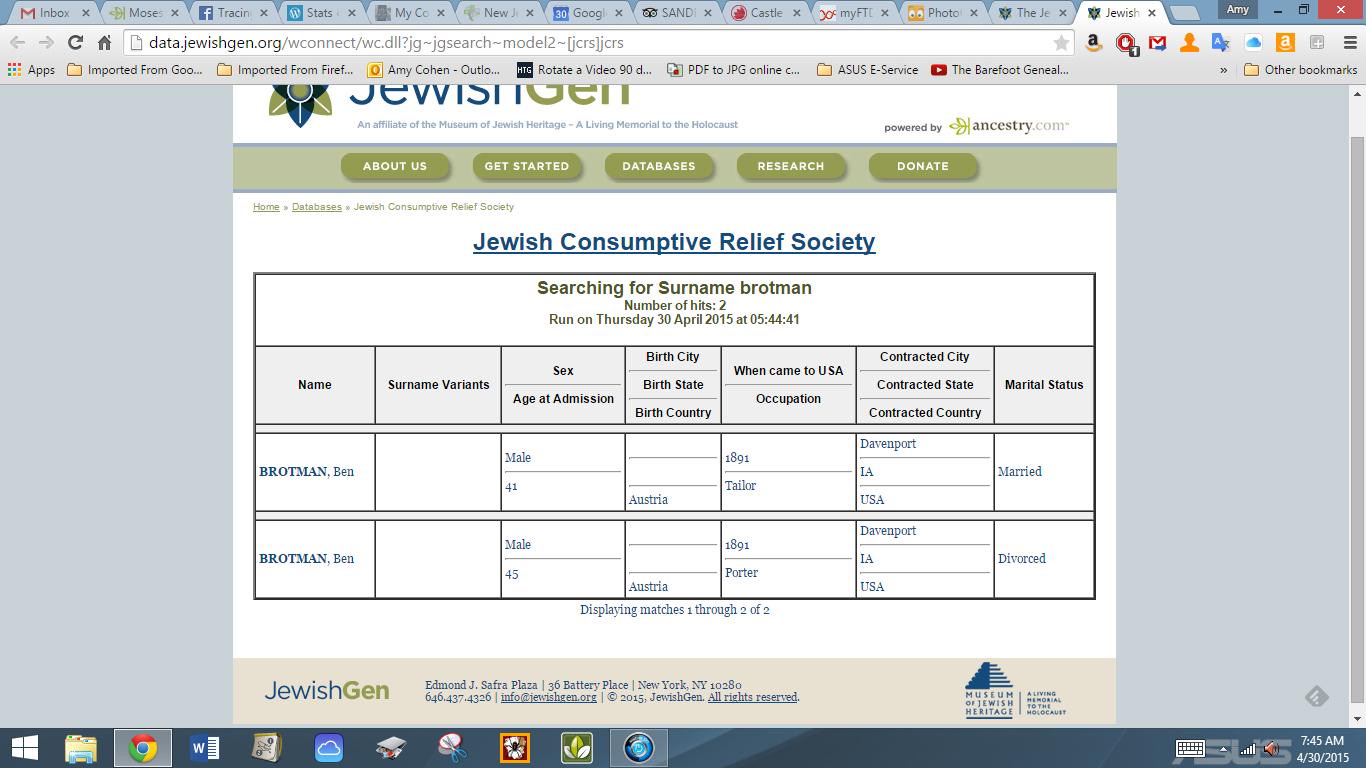
JCRS record for Ben Brotman from JewiishGen

JCRS record for Ben Brotman from JewiishGen

This Ben Brotman had to be the one who had been at one time living in Pittsgrove, New Jersey, and then had moved to Davenport, Iowa.  This was the Ben who had married Eva and had six children.  He had twice been a patient at the JCRS.  First, he’d been admitted when he was 41 or in 1917, when he listed his status as married, and then he’d been admitted again when he was 45 or in 1921, when he listed his status as divorced.  The pieces were starting to come together.  Perhaps Ben had in fact been in Denver in 1917, recovered enough to register for the draft there in 1918, then returned to his family in Davenport sometime in 1918 through 1920.  He then had to return to the JCRS in Denver in 1921, where he died in January, 1922.  By 1921 he and Eva had divorced, and Eva had listed herself as a widow in the directory, as many divorced women did in those days when divorce was stigmatizing.

I emailed the cemetery contact person and explained that I thought Bera was really Ben, and he agreed to change the records.  But I still had some nagging doubts.  Was the Ben Brotman who had died in Colorado in January, 1922, and who had lived in Davenport also the one who was the son of Moses Brotman, as indicated on the draft registration?  I needed the death certificate to be sure, and perhaps it would also tell me where Ben was born, helping to answer the question that had started me down this path in the first place.

I ordered the death certificate, and it finally arrived just the other day.

Benjamin Brotman death certificate

Benjamin Brotman death certificate

Ben Brotman died on January 4, 1922, of pulmonary tuberculosis at the J.C.R.S Sanitorium.  He was 45 years old and born in 1876, and he had been a tailor.  He had contracted TB in Davenport, Iowa, and had had it for ten years, or since 1912, which would mean around the time the family had moved to Iowa.  (That makes me wonder even more whether his daughter Flora had also died of TB, since she died in 1913.)  The doctor at JCRS who signed the death certificate said that he had attended Ben since September 7, 1921, which must have been when he was admitted the second time.  The certificate stated that Ben had been a Denver resident for three months and 28 days, indicating that he had been elsewhere before returning in September.  It also reported his marital status as divorced.  Finally, his place of birth was given as Austria, and his parents were also reported to have been born in Austria.

And then the answer I’d been seeking: his father’s name was Moses.  This was then most definitely the same Benjamin Brotman I had traced from Pittsgrove to Philadelphia to Davenport to Denver to Rock Island and back to Denver.  This was the son of Moses Brotman, my great-grandfather’s brother.

And then the (hopefully accurate) big revelation:  his mother’s name was Lena.  For the first time I had a record of the name of Moses’ wife prior to Ida/Chaya/Clara Rice.  Lena.  She very well might have been the mother of Abraham Brotman.  I don’t know.  There is a big gap between Abraham’s presumed birth year of 1863 and Benjamin’s birth year of 1876.  There must have been other children in between, I’d think.  Or perhaps Lena was Benjamin’s mother, and Abraham’s mother was an even earlier wife of Moses. But since both Abraham and Benjamin named their first daughters Lillian and at around the same time, I think that both of these girls were named for their grandmother Lena, who must have died before 1884 when Moses married his second wife Chaya.

I made one more look back at the records I had for Moses and for Abraham and realized that I had not re-checked the 1895 New Jersey census.  Since it only listed names, not ages or birthplaces, I had not thought it important in my search for where they’d lived in Europe.  Moses and his family are listed on the page before Abraham and his family on that census.   Abraham is listed with Minnie and their first three children, Joseph, Samuel, and Kittella (presumably Gilbert).

Abraham Brotman 1895 NJ census Ancestry.com. New Jersey, State Census, 1895 [database on-line]. Provo, UT, USA: Ancestry.com Operations Inc, 2007. Original data: New Jersey Department of State. 1895 State Census of New Jersey. Trenton, NJ, USA: New Jersey State Archives. 54 reels.

Abraham Brotman 1895 NJ census
Ancestry.com. New Jersey, State Census, 1895 [database on-line]. Provo, UT, USA: Ancestry.com Operations Inc, 2007.
Original data: New Jersey Department of State. 1895 State Census of New Jersey. Trenton, NJ, USA: New Jersey State Archives. 54 reels.

Moses is listed with Clara and the five children they had had by 1895: Sadie, Katie, Lillie, Samuel, and “Abraham.”[1] But also listed with Moses is a name I had overlooked during my preliminary research: Bennie.  He was listed in the 5-20 year old category, and if this was the Ben Brotman of Iowa and Denver, he would have been 19 years old in 1895.  There he was—Benjamin Brotman, the son I had overlooked and who very well could have been the full brother of Abraham Brotman.

Moses Brotman 1895 NJ census Ancestry.com. New Jersey, State Census, 1895 [database on-line]. Provo, UT, USA: Ancestry.com Operations Inc, 2007. Original data: New Jersey Department of State. 1895 State Census of New Jersey. Trenton, NJ, USA: New Jersey State Archives. 54 reels.

Moses Brotman 1895 NJ census
Ancestry.com. New Jersey, State Census, 1895 [database on-line]. Provo, UT, USA: Ancestry.com Operations Inc, 2007.
Original data: New Jersey Department of State. 1895 State Census of New Jersey. Trenton, NJ, USA: New Jersey State Archives. 54 reels.

What I don’t know and will likely never know is why Ben and Eva left New Jersey. Why did he go to Davenport, Iowa?[2]  The whole story is rather sad. He doesn’t even have a headstone at the Golden Hills cemetery.  I have identified some of his descendants, and perhaps when I return, I will try and contact them.

Although I was very excited to find this lost Brotman, unfortunately I still don’t have any record identifying a specific town or city where the Brotmanville Brotmans lived in Europe.  But soon I will head off to Tarnobrzeg, Poland, the town I still think is the most likely ancestral home of my great-grandparents Joseph and Bessie Brotman.


[1] I found this very strange—did Moses really have another son named Abraham? The Abraham listed on the 1895 New Jersey census was five years old or younger, meaning he was born in 1890 or later.  Samuel was born in 1889, but must not yet have turned five; Lily was born in 1892.  The only other child born between 1890 and 1894 was Isaac (who became Irving), not Abraham, so I assume this entry on the 1895 census was a mistake and that “Abraham” was really Isaac.

[2] In doing this research I kept tripping over another Brotman family—a family living in Rock Island that owned the theaters in town.  However, they do not appear to be related.  The patriarch of that family, Jacob Brotman, was born in 1848 in Minsk, Russia, and had lived in London before emigrating to the US sometime after 1901.   Since Joseph and Moses were born around the same time but somewhere in Galicia, it seems unlikely that Jacob was a close relative.  But anything is possible.

Where Am I? Where Am I Going? Tarnobrzeg


Polski: Tarnobrzeg, Panorama nocna osiedla Ser...

Polski: Tarnobrzeg, Panorama nocna osiedla Serbinow (Photo credit: Wikipedia)

It’s time to take stock and figure out where I am and where I have been and, of course, where I am going next.  I have “finished” my research on the Dreyfuss and Nusbaum families, and when I say “finished,” I know that as with all my family lines, I am never finished.  I always have more to do—whether it is trying to go back further in time or trying to connect with descendants.  There are a number of unanswered questions, as there always are and always will be.  I will write up something to bring some closure to what I know about these two family lines within the next several days.  But for today, I just want to think about where I am more generally.

I have now done many of my father’s paternal lines.  Starting with the Cohens, I’ve also covered the Seligmans, the Schoenfelds, the Nusbaums, and the Dreyfusses (Dreyfi?), and, of course, all the other names that came with later generations: Sluizer, Weil, Selinger, Bacharach,  Wiler, Simon, Meyers, Dinkelspiel, Hano, and so on.   I’ve also missed a few lines.  I haven’t yet focused on the line that starts with Hart Levy Cohen’s wife, Rachel Jacobs, or with Jacob Cohen’s wife, Sara Jacobs.  I haven’t looked at all at the line that begins with Voegele Welsch, wife of Amson Nusbaum.  And I am sure there are other maternal lines I need to explore.  Of course, those are often the hardest because the names have disappeared from the family, and each of those ancestors dates back close to 200 years ago.  But eventually I will get there.

And next I will explore my father’s maternal lines, the Schoenthals and Katzensteins: more German Jews who came to Pennsylvania in the 1840s or so.  Who knows what stories, what adventures, what heartbreaks I will discover along the way.

But before I turn to the Schoenthal and Katzenstein families, I have several other questions to research and address.  The Seligmann family tree continues to grow both backwards in time and horizontally, thanks to my cousin Wolfgang and all the research he has done.  Their stories continue to fascinate and also horrify me.  I am also in touch with the daughter of Fred and Ilse Michel, and she has shared stories and photographs with me.

There are also lingering questions regarding the Goldschlagers, now that I’ve found two other families with that name and roots in Romania.  We are hoping to hire a Romanian researcher to help us learn more.

And finally, there are those ever elusive Brotmans.  Although I am not putting any more hope (or much time) into using DNA as a tool to find my Brotman ancestors, I still have hope that something will turn up.  Just this past week someone contacted me, asking about Chaye Fortgang, Joseph Brotman’s first wife and the mother of the first four Brotman children, Abraham, Sophie, David, and Max.  He has Fortgang family from Grebow, a town less than ten miles from Tarnobrzeg and also the town that David and Abraham Brotman gave as their home on the ship manifest when immigrating to the US.  Perhaps by researching the Fortgang family, I will also learn about Joseph Brotman and his family.  In addition, I am focused on the Brotmanville Brotmans, hoping that that line will lead to more answers.

English: Gmina Grębów COA Polski: Herb gminy G...

English: Gmina Grębów COA Polski: Herb gminy Grębów (Photo credit: Wikipedia)

In addition, I will be visiting Tarnobrzeg in person in just about a month.  We will be hiring a guide who also does genealogy research, and we will be joined by my newly-found cousin Phyllis, the niece of Frieda, the woman who matched my mother as a close cousin through DNA testing.  Phyllis and I have chosen to believe that our grandmothers were in fact first cousins, and we are hoping to find some evidence to corroborate it.  So although I am not writing about it on the blog, much of my time right now is spent researching for this trip.  Once I am there, I will share my experiences on the blog, so stay tuned.

Photograph of Tarnobrzeg Main Square.

Photograph of Tarnobrzeg Main Square. (Photo credit: Wikipedia)


This is NOT a test even if it looks and sounds like one!

As promised, here is a chart to illustrate one possible way that my mother Florence, Elaine and Frieda are all connected.

New PDF Chart showing relationships of Moses Joseph Bessie et al-page-001


There are a LOT of unknowns and assumptions here.

First, we are assuming that Joseph Brotman and Bessie Brot were first cousins, as family lore says.  If so, then one of Joseph’s parents was a sibling to one of Bessie’s parents.  On this chart, I am assuming that Joseph’s father Abraham was a sibling to Bessie’s mother Gittel Brot because I don’t think Abraham would have named a son Joseph if he had a living brother named Joseph.

Second, we are assuming based on DNA results that Joseph Brotman and Moses Brotman were brothers, making their children first cousins and their grandchildren, here Florence and Elaine, second cousins.  The DNA results seem to support that assumption.

Third, we are assuming that Florence and Frieda are also second cousins based on the DNA results, meaning that Gussie Brotman and Sabina Brod were first cousins, meaning that one of Gussie’s parents and one of Sabina’s parents were siblings.  Here, I am making the assumption that Bessie Brot, Gussie’s mother, was the sister of Sabina’s mother, but it could be that Bessie was Sabina’s father’s sister.  I don’t know whether Brod was a name Sabina got from her mother or her father because in Galicia in those times, the state often treated Jewish children as illegitimate if their parents had only a Jewish marriage ceremony and thus assigned the mother’s name to the children instead of the father’s.  So either is possible here.

So what does this all mean? Well, hold on because this is where it gets a bit slippery. Taking the above chart as true (which is still very speculative), it means that Elaine, Florence, and Frieda are all third cousins since they all have the same great-great-grandparents, i.e., whoever were the parents of Abraham Brotman and Gittel Brot.  (I don’t know whether Brotman and Brot were two versions of the same name or two completely different names in the family; both exist as surnames so they could be as unrelated as someone named Rosen is to someone named Rosenberg, for example.)

BUT Elaine and Florence are also second cousins (as well as third cousins) since they are the children of first cousins (Louis and Gussie) and the grandchildren of siblings (Moses and Joseph Brotman).  AND the same is true for Florence and Frieda: they are second cousins because they are the children of first cousins (Gussie and Sabina) and the grandchildren of siblings (Bessie and the parent of Sabina).

Cousin_tree

So my mother is a second cousin to both Elaine and Frieda (since her grandparents were first cousins), BUT Elaine and Frieda are not second cousins, only third cousins.  Their grandparents (Moses Brotman and Sabina’s parent) were not first cousins, just second cousins.

That is consistent with the DNA results which showed my mother as a second cousin to Elaine and also to Frieda but showed Elaine and Frieda as likely third to fifth cousins.

I have no idea whether that is a help or not.  In fact, I think I am more confused now than before.  Please tell me if that makes no sense.  Ask me questions.  Test my thinking.  Please.

And a big THANK YOU to my new cousin Phyllis for helping me sort through all of this!

Brotman Update! The Trials and Tribulations of DNA Testing

Animation of the structure of a section of DNA...

Animation of the structure of a section of DNA. The bases lie horizontally between the two spiraling strands. (Photo credit: Wikipedia)


I am now delving into a part of genealogy research that is the hardest thing I’ve yet done in this project: DNA testing.  I am not and never was a science or math person.  My head starts spinning when I see too many numbers and/or scientific terms.  Reading about DNA results is like reading Russian or Chinese for me.  The words are not at all familiar, and the numbers have no meaning in the world in which I am used to operating.  Terms like SNP, centimorgan, autosomal, and others I can’t even keep in my head at all mean little or nothing to me, even after reading several articles and websites defining the terms.

I say all this by way of disclaimer.  Everything I am writing about today is foreign to me, and I am still trying to get help to be able to comprehend these test results more fully and to figure out what I can learn from them.

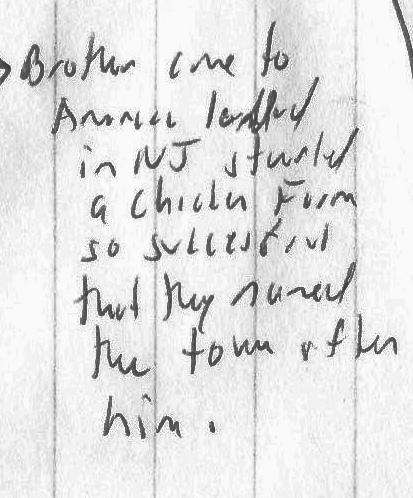
Having said all that, here’s the story.  Those who have followed this blog for a long time know that one of my brick walls was trying to find out whether my Brotman great-grandparents, Joseph and Bessie, were related to the Brotmans who settled in southern New Jersey in the 1890s and founded the town that is called Brotmanville.  My Aunt Elaine had told my cousin Jody and her husband Joel that Joseph had had a brother who moved to New Jersey where the town was named after him. Through my research and contacts with members of the Brotmanville Brotman family, I learned that Moses Brotman, a contemporary of Joseph Brotman, also had a father named Abraham and also was from Galicia, as was Joseph.  The Brotmanville Brotmans believed that Moses was from Przemyl, which is about 100 miles from Tarnobrzeg.  But none of us had any documentation of the family in Galicia or anything more than anecdotal evidence of a connection or birthplace.

brotmanville

My aunt’s story about Brotmanville

So last spring I decided to try DNA testing to see if I could break through this brick wall.  My first thought was to do a Y-DNA test on a male descendant of Moses and a male descendant of Joseph.  It had to be a father-son-grandson-great-grandson connection to get a reliable Y chain as Y DNA is only passed from fathers to sons.  I found one great-grandson of Moses Brotman who qualified and also asked one of my second cousins who was a direct male descendant of Joseph. We had the tests done by Family Tree DNA or FTDNA.  It took about three months for both test results to return, and it showed that my Moses descendant Larry and my Joseph descendant Bruce shared 34 of 37 markers on their Y-DNA.

English: A DNA microarray. Français : Une puce...

English: A DNA microarray. Français : Une puce à ADN. (Photo credit: Wikipedia)

I had no clue what that meant.  According to a woman who works for FTDNA, it meant that there is a high likelihood of “some genetic connection,” especially since the two lines share the same surname, Brotman. By “some genetic connection,” she meant that at some point in time the NY Brotmans had a common ancestor with the Brotmanville Brotmans.  It might have been as recently as Abraham Brotman, the father of Joseph and perhaps the father of Moses, or it might have been centuries ago.  The fact that Bruce and Larry have 34 out of 37 markers that were identical indicates that there is some family tie—but those three different markers suggest that there were mutations.  Those mutations might have occurred between Bruce and his father or his father and his grandfather or even earlier.  Or they might have been on Larry’s side.  There was no way to know from the Y DNA results alone.

So my contact at FTDNA suggested that the next step would be to try a different DNA test called an autosomal DNA test, which is better at predicting the degree of connection—i.e., would better tell us whether Joseph and Moses were brothers, both sons of the same Abraham Brotman.  My contact at FTDNA said that if we could get two of the grandchildren of Joseph and Moses to take the autosomal test, it would tell us if they are likely second cousins.

As I understand it (and remember the disclaimer above), autosomal DNA is DNA we inherit from both of our parents.  We got an X from our mothers and either a Y or an X from our fathers to determine our sex.  The other 22 pairs of chromosomes are also made up of genetic material we get from both parents, and those 22 pairs are our autosomal DNA.  But it is not obvious which half of each pair came from which parent.  This is where I start getting that deer in headlights look and feel.

But what I’ve been told and what I’ve read indicates that autosomal DNA testing is quite useful in figuring out the degree of relationship between two people.  So I asked Elaine, Moses’ granddaughter, and my mother, Joseph’s granddaughter, if they would take the autosomal DNA test through FTDNA, called the Family Finder test.  If the test showed that they were second cousins, we would have fairly strong evidence that their grandfathers, Moses and Joseph, were brothers.  My mother and Elaine agreed to take the test, and once again we waited for results.

English: The structure of DNA showing with det...

English: The structure of DNA showing with detail showing the structure of the four bases, adenine, cytosine, guanine and thymine, and the location of the major and minor groove. (Photo credit: Wikipedia)

Those results came in about a week ago.  First, I got Elaine’s results, and then a few days later, I received my mother’s results.  And they matched!  FTDNA predicts their relationship to be second cousins!  Of course, this is not definitive proof.  DNA testing is just a prediction, but at this degree of closeness, it is considered quite strong evidence, especially with the anecdotal evidence behind it, that is, the shared surnames, the shared father’s name, my aunt’s story, etc.  Elaine and my mother share 334 centimorgans.  That seems to suggest close cousins.

And then there was more.  Although Elaine and my mother were each other’s closest matches, my mother had a second very close match to a woman named Frieda.  She shared 292 centimorgans with Frieda, and Frieda was another predicted second cousin.  But Elaine was not a close match to Frieda, although she was listed as a possible third to fifth cousin.  So who was this Frieda?  The FTDNA page listed Brod as one of her ancestral names and one of her ancestral towns as Radomysl nad Sanem, which is about 20 miles from Tarnobrzeg, where I believe Joseph and Bessie lived.

I emailed the person in charge of Frieda’s results, her niece Phyllis, and we have now started trying to figure out how Frieda is related to my mother.  Since Frieda is listed as a likely second cousin, she could have shared a great-grandparent with my mother.  But since Frieda is not as close a match to Elaine, they did not share a great-grandparent. That could mean that Frieda and my mother are both the great-granddaughters of  the parents of Bessie Brot/Brotman whereas my mother and Elaine are both the great-granddaughters of  the parents of Joseph Brotman and Moses Brotman.

And since Bessie was Joseph’s first cousin, that could explain why Elaine is a more distant cousin than my mother is to Frieda but still related to both.  Elaine is not directly descended from Bessie’s line, but is directly descended from Moses Brotman, who would also have been Bessie’s first cousin if Moses and my great-grandfather Joseph were brothers.  Elaine would have some of the same genetic material as Frieda as a third cousin, but not as much as she has with my mother, her presumed second cousin.

Screenshot (24)

A screenshot of the chromosome browser showing where on my mother’s chromosomes Elaine and Frieda match her DNA

Have I lost you yet?  I am trying to create a chart and will post it once I am sure I have it right.

This was incredible news for me.  First, finding the connection between Elaine and my mother was corroborating evidence of our tie to the Brotmanville Brotmans.  Second, finding Frieda gives me an opening to find out more about Bessie and Joseph and where they lived.

But I am once again at a stumbling block.  Phyllis knows only that her great-grandmother, Frieda’s grandmother, was named Sabina Brod and was from Radomysl nad Sanem.  She does not know anything more about Sabina’s family—who her parents were or who her siblings were.  Sabina moved to Germany with her husband in the early 20th century and died there in the 1930s.  As far as Phyllis knew, Sabina had no relatives who were in the US.  Neither Phyllis nor I have found any definite records of our Brod or Brodman or Brotman relatives in Galicia.

So for now all we have is the DNA results.   And I am struggling to understand them and to learn more from them.  And it is a struggle for me.  If there is anyone out there reading this who is comfortable with this type of data, I’d love an advisor who can assist me.

But for now it feels like I have found another opening into the mystery of my Brotman ancestors.  I feel one step closer to knowing where they lived and who their families were.

English: DNA replication or DNA synthesis is t...

English: DNA replication or DNA synthesis is the process of copying a double-stranded DNA molecule. This process is paramount to all life as we know it. (Photo credit: Wikipedia)


Brotman Research: Where I am

Having reached the conclusion last week that I was not going to be able to get any further specific information about where in Galicia my Brotman relatives lived and then realizing that even if Tarnobrzeg was the ancestral home that the records there are very limited and too recent to be of much help, yesterday I went back to look over what I have learned and what is left to be learned about my Brotman relatives.

I have learned an incredible amount.  I know much more about my great-grandparents Joseph and Bessie Brotman and about the life they lived in the Lower East Side.  I have found all five of their children—Hyman, Tillie, Gussie, Frieda and Sam– and know what happened to them: who they married, who their children were, where and when, and in most cases, why they died.  I know what they did for a living and where they lived.  I even have been able to trace what happened to their grandchildren and who they married and the names of their children.  I have seen pictures of almost all these people, except Joseph, Abraham, David, and Frieda.   It’s been an incredible experience, so much more rewarding than I ever expected less than a year ago when I first starting dipping my toe into the waters of genealogy.

I’ve also been able to locate three of Joseph’s four children from his first marriage to a woman likely named Chaye Fortgang.  I have found Abraham, Max and David, but not Sophie.  I have also been able to learn a great deal about their lives, occupations, families, and homes and have located their living descendants.  Although there are a few missing holes in David’s life story and a number of years for which I can find no records, I know that he married a woman named Annie Salpeter and that they did not have children.  I know that he came to America with his older brother Abraham and that he died in 1946 of hypertension.  Only Sophie is missing from the picture, but given that I do not know either what her Yiddish name was in Galicia or her married name in the United States, I am not sure what else I can do to locate her.

There are many unanswered questions, but most of them relate to their life in Galicia—where did they live, what did Joseph do for a living, what happened to his first wife? These questions I cannot answer, and that makes me sad.  Also, when did Joseph arrive in the US?  I cannot find him on a ship manifest, but will keep looking.   I will also try and fill the holes in David’s story and look for Sophie, but overall, I think I have to say that I have reached the end of my search for the Brotman family.[1]

So what does that mean? Obviously, I hope to continue to develop my ties to my new cousins (and my old cousins, of course), and I also hope that they will help to fill out the personal side of the stories of their parents and grandparents.  It will make the family story so much more meaningful and interesting if people contribute stories or profiles or letters or pictures that bring to life their relatives.  I cannot do that on my own.  I didn’t know Abraham, Max, Hyman, or Tillie—but those of you who are their grandchildren certainly did.  I also didn’t know any of Joseph’s grandchildren aside from my mother and her siblings, but my second cousins—their children—must have memories and stories that they want to survive.  Let me know, and I will be happy to interview you or help you write something you’d like to share.

Thank you to all the Brotman cousins who helped me get this far—for answering my emails and my questions, for sending me pictures and telling me stories, for providing me with names and contact information, for sharing whatever you were comfortable sharing.  It’s been an amazing experience to share with you all, my Brotman family.

The rest of my personal journey to find my family will continue with the Goldschlager and Rosenzweig lines and eventually my paternal lines: the Cohens, Schoenthals, Seligmans, Katzensteins, Nusbaums, and so on!


[1] There remains, of course, a possibility of a tie to the Brotmanville Brotmans, but my research has hit a brick wall there as well.  Without being able to trace back to Joseph’s parents and grandparents and Moses Brotman’s parents and grandparents, I will never know whether Joseph and Moses were siblings, cousins, or not related at all.  Brotman is and was a much more common name than I had anticipated, and we could be related distantly to all of them or none of them.  Without better European records, there is just no way of knowing.

Enhanced by Zemanta

Another Addition to the Brotman Family Tree: David Brotman and his wife Annie

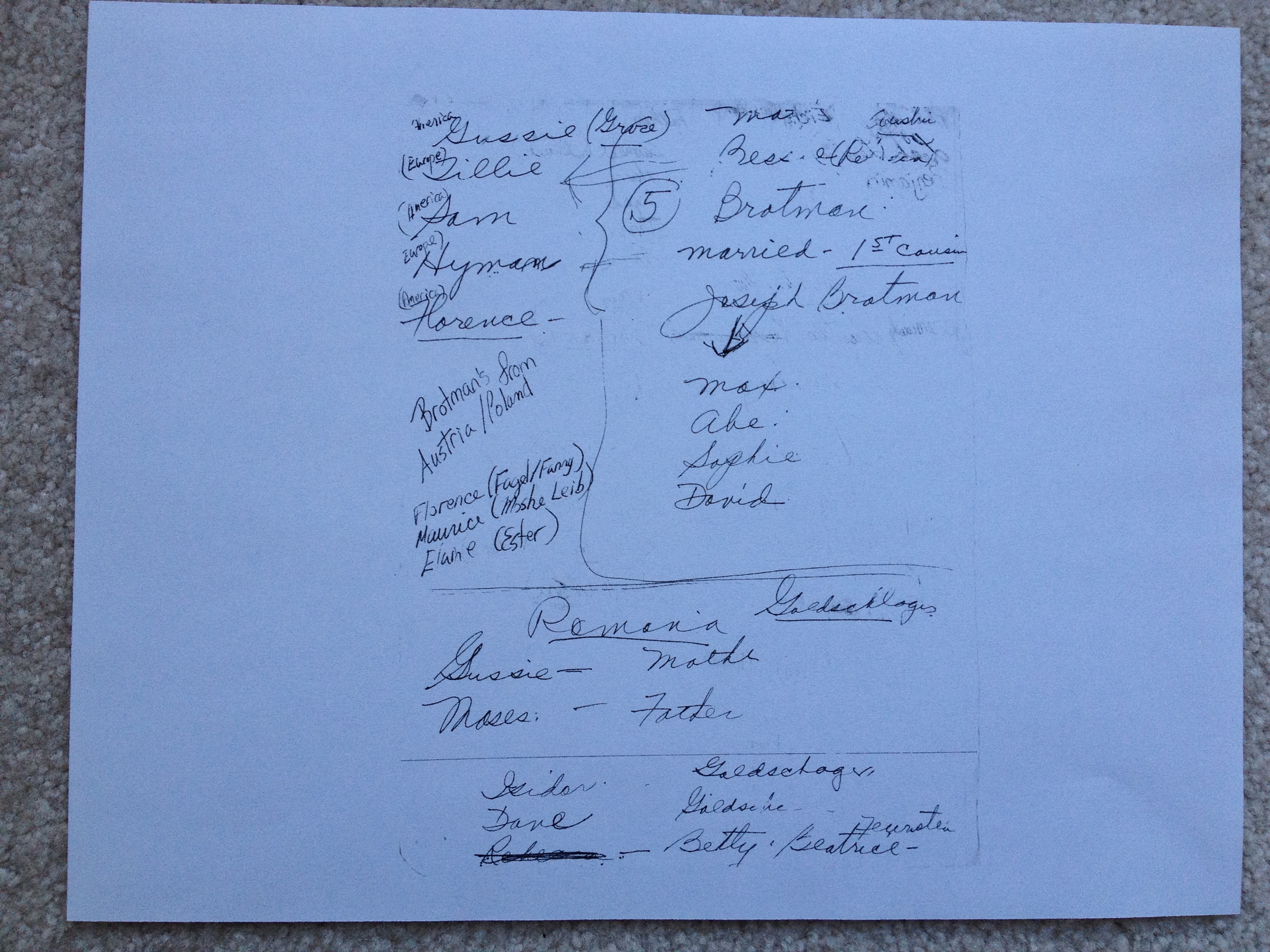
Family Tree drawn by Elaine Goldschlager Lehbraum

Family Tree drawn by Elaine Goldschlager Lehbraum

As you may recall, a couple of weeks ago my cousin Jody made a big discovery: handwritten notes that her mother had made of Joseph Brotman’s children.  It included all the children we already knew about: Bessie’s children Hyman, Tillie, Gussie, Frieda (Florence in her notes) and Sam, as well as the two sons we knew of from Joseph’s first marriage, Abraham and Max.   My brother had recalled that our aunt had said Joseph had had four children from his first marriage, but we did not know the names of the two remaining children, and I had traced every possible Brotman I could find to see if there was a link.  I had hit many dead ends and found nothing that linked these other Brotmans to our family.

My aunt’s notes were a huge discovery because for the first time we had evidence of the names of those two missing children: David and Sophie.  As I wrote when Jody first sent me the tree, I was able to locate a David Brotman from Austria who was a possible match for Joseph’s missing son, but I needed to check further and obtain some documentation in order to be sure.

Well, those documents arrived the other day, and I was so excited to see that on David’s marriage certificate in 1897, he listed his father’s name as Joseph Brotman and his mother’s as Chaye Fortgang.

David Brotman and Annie Salpeter marriage certificate

David Brotman and Annie Salpeter marriage certificate

You may recall that Max had also listed his mother’s name as Chaye on his marriage certificate, so this confirmed that Joseph’s first wife was named Chaye, but now we know her surname as well.

Max Brotman marriage certificate

Max Brotman marriage certificate

In addition, the marriage certificate gave David’s current address as 85 Ridge Street—the same address where Joseph and Bessie were living in 1895 when Gussie was born, according to her birth certificate.

Gussie birth certificate

Gussie birth certificate

This confirmed for me that David was Joseph’s son, Max and Abraham’s full brother, half-brother to Hyman, Tillie, Gussie, Frieda and Sam, and our great-uncle.  I am still in a state of amazement that I was able to find him.  Thank you, Aunt Elaine, for leaving behind this great clue to our family.

Once I had this information confirming the relationship, I located whatever census reports and other records I could find for David and his wife, Annie Salpeter.  I found them on census reports for 1900, 1905, 1910, and 1920.  David was a tailor according to the first three census reports, and he and Annie were living on the Lower East Side until at least 1910. At times Annie’s brother Morris lived with them as well as a cousin Meier, but there were no children listed on any of these census reports.

At the time of his World War I draft registration in 1917, David and Annie had left the Lower East Side and were living at 143 Manhattan Avenue in Brooklyn, which was also their address on the 1920 census report, when David’s occupation was given as a cloak dealer in a “cloak house.”  Annie and David were now 44 years old and still had no children living with them, so I assume that they never had children. So there are no more second cousins to find and probably no pictures of David and Annie.  (But I’ve learned never to say never.)

I’ve yet to find David and Annie on the 1930 or 1940 censuses, but I am still looking.  It seems unlikely that they had left Brooklyn.  I was able to locate a 1946 death certificate for a David Brotman married to Anna living at 10 Sumner Avenue in Brooklyn, and I believe this is the same David, despite the fact that the death certificate has his father’s name as Isaac.  I’ve learned enough to know that death certificates are notoriously unreliable.  I will continue to see if I can find anything about David and Annie after 1920.

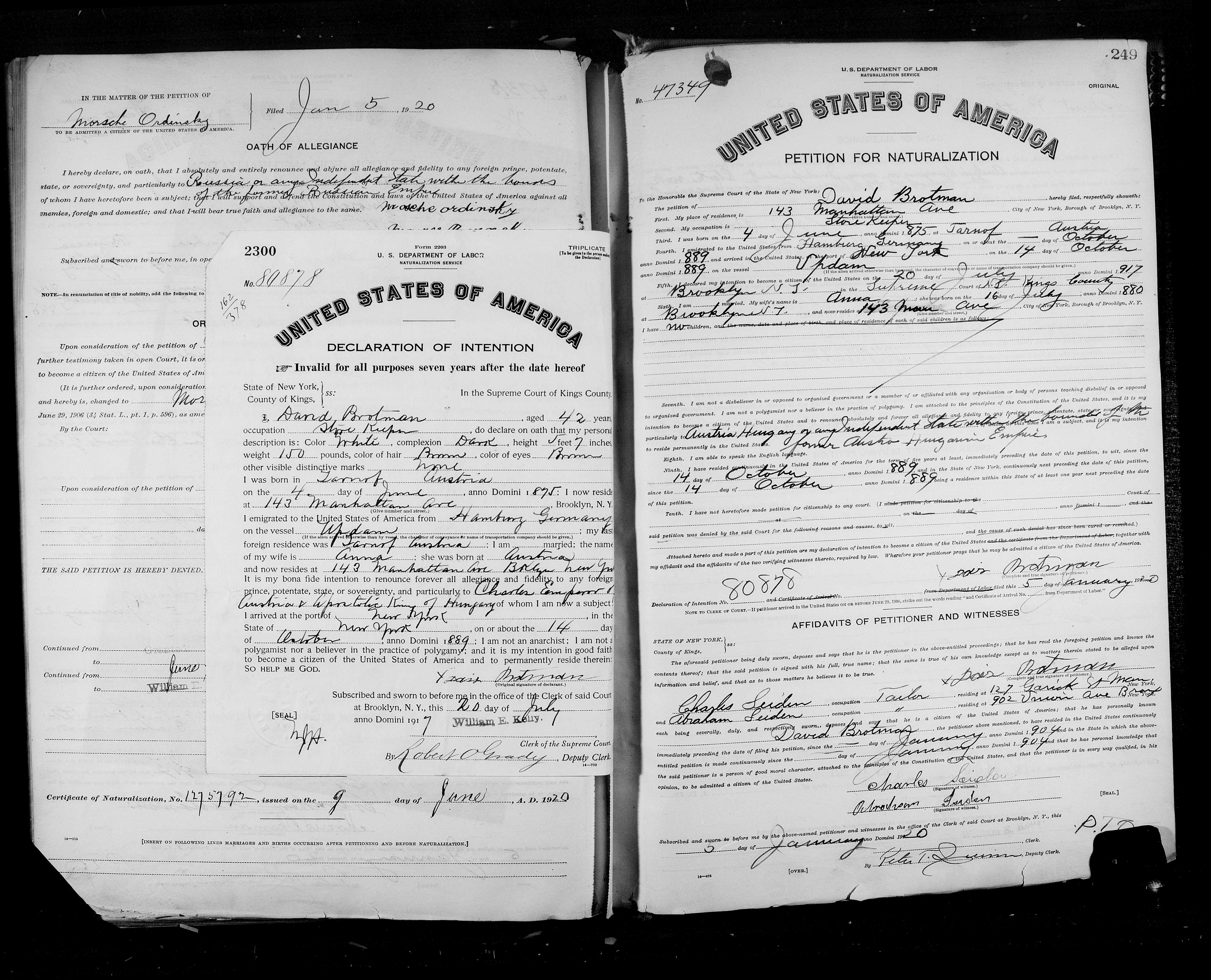
I do have David’s petition for naturalization in 1920, and it indicates that he had arrived in NYC on October 14, 1889, on the “Updam” from Tarnof, Austria.

David Brotman petition for naturalization 1920

David Brotman petition for naturalization 1920

Tarnof could be Tarnow, a city about fifty miles north of Tarnobrzeg/Dzikow and even further from Czchow, the two areas that I have been focusing on as the Brotman hometown based on Hyman’s listing of “Jeekief” and “Giga” on his documents.  But Tarnof could also be Tarnobrzeg, the larger town that is near Dzikow.  So did this new information help our search for our hometown in Galicia or did it just make it more confusing?

That led me to search for the ship manifest for David, now that I knew when he arrived and on what ship.  With some help from Renee, I located a September 4, 1889,  German ship manifest for the Portia, sailing to Rotterdam, listing Dawid Brodmann as a passenger.  I was excited to see that David was traveling with his older brother, Abe Brodmann. I had not previously been able to find Abraham on a ship manifest, so this was another exciting discovery.

David and Abe Brodmann on the Portia 1889

David and Abe Brodmann on the Portia 1889

On the Portia ship manifest, Abe and David are listed as coming from “Grambow, Russland,” not Austria at all, let alone Tarnow, Tarnobrzeg, Dzikow or Czchow.  I would have found this an indication that these were not the right boys, but there is a town right near Tarnobrzeg called Grebow, and according to a 1914 map, Tarnobrzeg was very close to the Russian border. So perhaps our family lived in Grebow? Or maybe that is where Joseph lived with Chaye and then moved to Dzikow when he married Bessie?

On the manifest for the Obdam, sailing from Rotterdam to New York arriving on September 19, 1889, David and Abe are listed as coming from Austria, not Russia, which appears to be correct.

David and Abe Brodman on the Obdam to New York 1889

David and Abe Brodman on the Obdam to New York 1889

There is obviously some confusion and conflict here, but it’s another clue and another place to look for the Brotman home in Galicia. I already have contacted several people researching this area to see if I can uncover more clues.

I have a few more leads to follow to fill in the gaps in David’s life story, and maybe they will even lead me to Sophie, the only remaining child of Joseph to locate.  There is also some potential evidence that will link our family to the Brotmanville Brotmans, but again, I need to do more research before it is worth speculating about that connection.

Enhanced by Zemanta

Galicia Mon Amour: A Conversation

I just finished watching a video called “Galicia Mon Amour.”  It is a recording of a conversation between Daniel Mendelsohn and Leon Wieseltier.  Mendelsohn’s book, The Lost, which I read a number of years ago, is one of the most moving books I’ve read; in it he recounts his journey to find out what happened to members of his family who had not left Galicia before the Holocaust.  It is beautifully written, well-researched, and deeply tragic.  I read it long before I started doing my own genealogical research, but it likely was one of the sources of inspiration for my journey.[1]

Leon Wieseltier’s book Kaddish is also excellent, but I have to admit much of it was a bit too scholarly and dry for my taste, except for the parts where he reflects on his own family and experiences.  I admit to skimming a lot of the more academic parts of the book.

At any rate, when I saw a recommendation for the video on the digest I receive daily from Gesher Galicia, I decided to try and make the time to watch the video.  (It’s about two hours long.)  You can find a link to the video here.

In the video Mendelsohn interviews Wieseltier about his recent trip to Galicia.  (The interview takes place in January, 2007; Wieseltier’s trip was in 2006.)  Both Mendelsohn and Wieseltier had family that came from eastern Galicia in what is now Ukraine from towns near the city of Lviv, known by the Jews as Lemberg.  Both had taken trips back to the region to research and visit the places where their relatives had lived.  Although Mendelsohn’s direct ancestors had immigrated to the United States before the Holocaust like ours did, he had many relatives who remained behind about whom he had known very little.[2]  Wieseltier’s parents, on the other hand, were Holocaust survivors and came to the United States after World War II.  All the rest of his family was killed in the Holocaust.

One audience member asked at the end of the interview whether there were differences between those who were grandchildren of immigrants and those who were children of Holocaust survivors.  Were the survivors from the wealthier families who saw no reason to leave in the 19th century and the earlier immigrants from the poorer families who had no reason to stay?  Although Wieseltier dismissed this as an overgeneralization, which I am sure it is, it nevertheless is an interesting sociological question.  Remembering Margoshes’ memoirs and the fact that there were so many wealthy Jews, I thought that it made some sense that only those who had nothing to lose would have taken the risk of leaving the world they knew.  This may suggest that Joseph and Bessie were not among the wealthier segments of the Galician Jewish community.

Wieseltier described his own family as being among the more prosperous, educated and aristocratic clans in their area and confirmed the impression left by Margoshes that the Jewish world in Galicia was very diverse and that there were many who were wealthy, well-educated, and sophisticated.  He described Cracow as the “Jerusalem of the North” and the Galitzianers as the princes of the Jewish world.  Mendelsohn concurred, saying that although there was also a lot of poverty, there was a large bourgeoisie and a large wealthy class.  He said that Emperor Franz Joseph, who was the head of the Austro-Hungarian Empire from 1848 until 1916, was admired and even loved by the Jews for his enlightened leadership and treatment of the Jewish citizens, also described in Margoshes’ memoirs.

One observation that I found particularly interesting was Mendelsohn’s comment that he always thought of Jews as living in tenements until he went to Galicia.   He believed that Jews, wherever they lived, lived urban lives, and he was surprised by how wrong he was when he saw the rural areas where they had lived in Galicia.  He described the countryside as beautiful—with mountain, streams, rivers.  Wieseltier used the word “paradise” to describe it.

A lot of their conversation focused on the reasons to make a trip to Galicia.  Both said quite emphatically that this is not a place to go for typical tourist reasons; for Mendelsohn it was partly to find out what happened there and to visit the places where his family had lived. Wieseltier said he went not only out of grief, but also out of pride. He talked movingly of standing where his mother had once stood and leaving a copy of his book in the empty field as a symbol of Jewish survival.  Both talked about the absence of Jewish life there now and how the Polish people themselves realize how much has been lost by the destruction of the Jews and their culture.  Wieseltier said that you won’t find Jewish life there so you must bring your Judaism with you if you go.

There is also discussion of the Holocaust, of the camps, of anti-Semitism, but overall the theme was more about remembering the world that was there in a realistic and accurate way and cherishing that culture and the people.  Wieseltier himself is quite skeptical of genealogy (“It’s amazing how much you can’t learn from genealogy.”).  Although Mendelsohn obviously values genealogical research highly, he did not really push Wieseltier to elaborate on this point.  I think, however, that Wieseltier was expressing some doubts about all those who, like me, are trying to trace some names and dates to make a connection, perhaps without any purpose or perspective.  He said that our parents and grandparents were ours “by luck,” just as the fact that we have two legs or brown eyes, and that what is more important is who we are ourselves and what we do with our lives.  I think that that is an important perspective for me to remember as I continue to look for our family in Galicia.


[1] We were fortunate enough to hear Mendelsohn read from and talk about the book many years back when it was first published.  That made his story even that much more personal.

[2][2][2] I am sure that that is true for the Brotman family as well, although I do not know specifically of any family members who died in the Holocaust.

A World Apart: Conclusion

I finished Joseph Margoshes’ A World Apart last night, and I did find the answer to why he left Galicia.  When the lease his father-in-law had for the Yozefov estate expired after ten years, he was unable to obtain an extension, as it was leased to a different Jewish man.  Margoshes took the assets he had and obtained a lease on a different estate for himself and his wife, but he ran into difficulties and ended up in substantial debt.  When that lease expired in 1898, his father-in-law paid off Margoshes’ debt, and Margoshes and his wife and children left to seek better opportunities in America.

His father-in-law also ran into some difficulties when the lease on his estate in Zgursk expired and he, too, was unable to obtain an extension.  Margoshes described a long-running feud between his father-in-law and the people of Rzhokov, a small and poor shtetl across the Vistula River from Kielkov where the Shtiglitz (Margoshes’ in-laws) had family.  According to Margoshes, in the 1860s there was a huge dispute when one of these relatives died, a very wealthy man named Reb Yisroel Kielkover.  Reb Yisroel had not only provided work for many of the poor Jewish residents of Rzhokov, he had also provided charitable support, including free food and liquor.  Despite his generosity, when he died, the people of Rzhokov led by a man named Yankle Leiman refused to allow Reb Yisroel to be buried in the cemetery (which was used by residents of Kielkov as well as Rzhokov) unless his estate provided substantial financial support to raise the standard of living for the poor Jewish residents of Rzhokov.

Margoshes’ father-in-law and others were outraged and came to Rzhokov to demand that they be allowed to bury Reb Yisroel.  A violent fight broke out between the two groups of Jews, ultimately settled when Reb Yisroel’s side agreed to provide about half the money demanded by the group led by Leiman.  Margoshes’ father-in-law then brought criminal proceedings against Leiman for blackmail, resulting in Leiman spending three months in jail.   The money was never paid to the residents of Rzhokov, and the charitable support ended as well.  Margoshes wrote that the people of the shtetl remained very poor and without adequate buildings for a shul or mikvah.  He blamed this result on their excessive greed.

The feud continued for many years,ultimately exploding when Margoshes’ father-in-law had to obtain a new lease when his lease on Zgursk expired.  The estate he wanted to lease was, perhaps not coincidentally, leased at that time to Yankel Leiman and was about to expire.  Shtiglitz essentially swooped in and struck a deal with the Polish landowner to get the next lease, depriving Leiman of the opportunity to extend.  When Shtiglitz arrived to take over the estate, he and his family found that Leiman and his people had, as an act of revenge, vandalized the manor house and other buildings, much as today people who lose their homes to foreclosure often vandalize their homes before moving out.  Nevertheless, Margoshes’ father-in-law stayed and was able to make a great deal of money for the years he leased this property.

The father-in-law, however, ultimately paid a price for his bad temper and greed.  When he became angry with a worker on the new estate for not working hard enough, Shtiglitz accidentally killed the man by kicking him in self-defense, according to Margoshes.  Shtiglitz went to trial and was sentenced to two years of hard labor for second degree murder.  He only served a year, and Margoshes dismissed the significance of this by commenting that it only cost him about 10,000 gulders.  There was no expression of remorse or sadness for the dead worker.

Margoshes there ends his memoirs without any comment or conclusions about these matters or about life in Galicia in general.  My own conclusions about the book, however, are mixed.  It was interesting to learn more about Jewish life in Galicia, but overall the book was not what I expected.  I was hoping for a depiction of what life was like not only for wealthy Jews, but also for those Jews who were not as fortunate.  Aside from the first section of the book, there is no discussion of how religion played a part in the lives of any of these people; instead, the focus is almost entirely on how wealthy Jews lived and made a living.  As I’ve written in prior posts, Margoshes comes across as a rich young man who had little empathy or interest in the lives of those who were less fortunate.   He seems deluded into thinking that life for the Jews was a paradise during these times, despite the poverty of many Jews, the underlying resentment of the peasants, and the obvious anti-Semitism of the wealthy Polish landowners.

Given his description of his childhood as a boy from a religious home whose favorite activities were reading and discussing books and given that he became a Yiddish writer and journalist in the United States, I would have expected more insight, more soul-searching from a seventy year old man writing his memoirs in 1936.

A World Apart, part 5: Relationships between Jews and non-Jews in Galicia

My reading this time related largely to the relationships between the Jews and non-Jews in Galicia, socially, politically and otherwise.  Margoshes began this section by claiming that at least in the region where he lived near Radomishla, the Jews were economically and politically often more powerful than most of the non-Jewish population.   I would never have expected that at all; I assumed that the Jews were oppressed politically and economically.  Instead, Margoshes asserted that in area from Rzeslow to Tarnow to Krakow, the peasants lived under the dominance of the Jewish estate holders.  He wrote, “During the period between the 1880s and [World War I], this part of Galicia was a true paradise for Jews in some respects.” (p. 99; emphasis added)

According to Margoshes, in this region, anti-Jewish persecution and acts were unknown, and Jews and gentiles lived peacefully together.  If a peasant struck or even just insulted a Jew, the courts would punish the peasant by placing him in jail for at least two days.  Peasants would tip their hats to Jewish estate-holders when they were driving (oxen or horses, I assume) on the road and when they entered their homes.  (There is no mention of how the peasants treated and were treated by poor Jews, just the wealthier Jews, who in many instances were the employers of these peasants.)

Margoshes explains the political context for this by pointing out that in 1846 there had been a widespread revolt of the peasants against the wealthy Polish lords and landholders and that even forty years later, the politically powerful Polish aristocracy which controlled the government had not forgiven the peasants for the violence, deaths and damages caused by that uprising.  Thus, in a dispute between a peasant and a Jew, the government would generally side with the Jew.

Margoshes also attributed much of the peacefulness of the region to the Austro-Hungarian gendarmes who were responsible for keeping law and order in the Empire as part of the imperial army.  These soldiers lived in the area in barracks and frequently visited the estates to insure that all animals were registered and that everything was being managed according to the requirements of the Empire.

That did not mean that there were no disputes or problems between the peasants and their Jewish employers.  Margoshes described a number of incidents of theft by the peasants who worked at his father-in-law’s estate.  He wrote, “A Jewish estate-holder and his household had to have eyes in the back of their heads in order to make sure that the workers were not stealing from him….” (p. 127).  He also made the offensive generalization that it was part of the “inborn nature” of the peasants to steal: “he had to steal whenever the opportunity presented itself, especially from the Jewish estate-holder.  For a peasant, the smallest stolen article was an asset.”

In one story about the workers at his father-in-law’s estate in Zgursk, moreoever, Margoshes also revealed that the relationships between the Polish peasants who worked on the estate and their Jewish employers were not always quite so amicable.  There were at times hundreds of workers on the estate, and many of them boarded there.  Margoshes himself admits that their living conditions were substandard: “everyone found a place to sleep in one of the three stables atop hay and straw and that was it.  No pillows or sleepwear were provided and…a blanket used to cover horses served as a cover.” (p. 96) The estate did provide three meals a day that Margoshes described as generous.   Margoshes’ mother-in-law and father-in-law were the task masters who oversaw all the work on the estate, and his father-in-law was known to be rather cold and strict.

Margoshes described one time that his father-in-law lost his temper with some of the workers who in his view were not working hard enough and began beating them with a paddle.  In response, these workers and a number of others went on strike and refused to return to the fields. It took an intervention from the mother of the father-in-law to persuade the workers to return to work the next day.  Margoshes described this as if it were a one-time incident, and perhaps it was, but it does reveal that there was some abuse of the peasants by at least this powerful Jew, his own father-in-law.

Thus, although Margoshes initially described the relationship between the gentile peasants and the Jews as peaceful and amicable, these incidents of theft and abusiveness suggest that there was in fact a great deal of resentment and anger among the peasants towards the Jews. Perhaps he was deluding himself when he wrote that it was a “true paradise” for Jews in this region during that time.

According to Margoshes, the wealthy Jews also had good relationships with the wealthy Polish lords and landowners, called pritsim or porits in the singular.  He described his relationship with a neighboring porits  as “very friendly, although from a distance.” (p. 103) They would help each other out with favors, but were not social friends.  Margoshes did not think that this relationship was unusual.  He said that he “never heard of a case in the entire region of a porits who had negative relations with a Jew or where he insulted a Jew or harmed him in any way,” (p. 104) although he did then go on to mention one polits who refused to trade with Jews.

There was also, according to Margoshes, peaceful co-existence between the Catholic priests and the Jewish population.  Although he commented that “[p]riests, especially Catholic priests, cannot ever really be friends of the Jews” because “it is almost against [their]religion to love people of another faith,” (p.111), he reported that nevertheless for the most part there was little conflict between the priests and the Jewish estate holders.  He described a church law that prohibited Catholics from working as servants in Jewish homes, but pointed out that it was rarely enforced since the peasants needed employment and often worked in Jewish homes. Margoshes even developed a friendship with one of the local priests, but he severed that relationship when the priest tried to persuade Margoshes to come and see his church—not to convert, but just to go inside the church.  Obviously, this “friendship” was a superficial one based on necessity, and feelings of distrust and difference outweighed any sense of real connection.  Margoshes made it clear that it would not have been acceptable for him, as a Jew, to be seen in a Catholic church.

By the time I finished reading this section, I realized that Margoshes had had a very unrealistic view of the relationships between the Jews and non-Jews in Galicia during the late 19th century.  First, his viewpoint is entirely based on the experiences of the wealthy Jewish estate-holders.  The non-Jewish peasants may have seemed respectful and accepting of their Jewish employers, but beneath the surface there was likely a great deal of resentment and anger.  The priests and non-Jewish estate-holders also may have been willing to live peacefully side-by-side with the wealthy Jews, but there certainly was not a true acceptance or friendship in these relationships.  The gendarmes may have been keeping the peace, but beneath the surface the Jews were still the outsiders who were not integrated into the gentile world.

Moreover, Margoshes does not at all provide a picture of what life was like for the Jews who were not wealthy estate-holders.  Were their relationships with the peasants, priests, and wealthy Polish landowners as “peaceful”?  Or were they the targets of all the repressed resentment and anger that the gentiles felt towards the wealthy Jews?

It occurred to me after reading these chapters that Margoshes was writing in 1936.  He had no idea what was going to happen in Poland during the Holocaust. I wonder whether his naiveté about how the gentiles felt about the Jews was widespread in Poland during the 1930s and 1940s.  If only they had been more realistic, perhaps more of them would have left sooner.

Which brings me to another question: if things were so great in the 1880s and 1890s for wealthy Jews in Poland, why did Margoshes and so many others, including Joseph and Bessie, leave?

A World Apart, part 4: The Rich and the Poor in Galicia

In my last post, I wrote about Margoshes’ marriage to the daughter of Mordecai Shtiglitz, the manager and lessor of a substantial estate in Zgursk, not far from Radomishla.  After checking Google maps, I realized that Radomishla is only about 60 miles from Dzikow where our family might have lived, so Margoshes and Joseph and Bessie may have lived quite near each other in the 1880s.  Whether their lifestyle was anything like his we do not know, but it made reading his story even more compelling to me.

After Margoshes married, there was a three year period of what he called “kest.”  According to the glossary provided in the book, kest referred to the practice where the family of the groom provided financial support to the groom and bride after the wedding to enable the groom to study without having to worry about earning a living.  Margoshes and his new wife lived with his in-laws, both of whom worked very hard to manage and oversee the estate.  Margoshes, however, spent the early days of his marriage being idle, reading and eating a lot of fruit. At one point his father-in-law arranged for him to oversee the cutting down of trees for lumber on a nearby property where the Polish owner needed assistance and agreed to allow Margoshes to keep the profits in exchange for overseeing the labor.  Margoshes did not do any of the physical labor himself, but would ride out to make sure that the work was being done.  He hired a Jewish man to help him supervise the work.  After a short period of time, Margoshes decided not to pursue the lumber business any further.  He wrote that he found it tedious and that his father-in-law and wife found it beneath his dignity.  He sold the business to someone else and returned to his “kest” lifestyle.

About a year and half after he was married, Margoshes and his wife moved to Yozefov, a 450 acre estate about a mile away from Zgursk, where his wife’s sister and her husband had lived.  The land was owned by a non-religious Jew who had leased the land to Margoshes’ father-in-law as a place where his older daughter and her husband could live and work.  When the older daughter’s husband died, Margoshes and his wife were essentially told that they had to move to Yozefov and take over managing the estate.  Margoshes lived there for ten years and, as he described it, was his own boss for the first time.  The financial arrangement, however, put Margoshes in a risk-free situation.  His father-in-law covered the expenses and took the profits, but Margoshes and his wife were able to live without cost in exchange for overseeing the estate.  When the lease was up after ten years, Margoshes still had the original dowry from when he married plus the livestock and equipment from Yozefov which he then used to set up his own business.

In this section of the book, there is a little more light shed on how “the other half lived.”  First, it is clear that there were many Jews who were not wealthy at all. As described by Margoshes, “Jewish economic life in Galicia was always uncertain.  People who had done well for years and lived an upper class existence suddenly became paupers due to unforeseen circumstances.” (p. 58) Margoshes  observed many poor Jews while living in Zgursk: “…itinerant paupers were constantly wandering through.  A day rarely passed that 10-15 poor Jews did not appear in the manor yard.  These vagrants would often wander in whole families: man and wife, several children, and sometimes even infants at the breast. Every poor person …received a generous portion of hot food, and a big piece of bread for the road, along with two kreuzer in alms.  They were just not allowed to spend the night in the manor yard; their ranks included a lot of undesirable people and thieves.  They were sent away to the nearby inn, or if space was short, to the [poor house] in Radomishla.” (p. 67)

Margoshes claimed that he was the only person in the region with the ability or desire to read books in Hebrew, German or Polish, and when his brother-in-law Mikhl wanted to learn, there was no one but Margoshes to teach him.  Margoshes found Radomishla to be more sophisticated than other towns and shtetls nearby.  In the other towns, the Jews had cows as the source of most of their income.  They would milk and feed the cows themselves and tend to their own gardens to provide a meager living for their families.  (Margoshes’ tone in describing these hard-working farmers is blatantly condescending.)  In contrast, he found the Jews in Radomishla to be far more successful merchants who engaged in trade and did not own or take care of cows. There were timber traders, cattle dealers, and many money lenders—many people who were extremely wealthy.  Although Margoshes recognized that there were also poor people in Radomishla, he claimed that there were not as destitute as poor people in the other towns and shtetls.

Often I feel really annoyed by Margoshes.  He was what we might call today a very entitled young man—someone whose family was wealthy and who never really had to do any physical labor at all and barely any other hard work of any kind.  He was handed everything on a silver platter, yet has the nerve to express disdain for those who were less fortunate.  I may react this way in part because I imagine that our ancestors, Joseph and Bessie, were probably among those poor farmers Margoshes was looking down at from up on his high horse as the fortunate son and son-in-law of two wealthy men. I am still hoping that somewhere in his story, Margoshes developed some perspective and some empathy for those who were less fortunate.