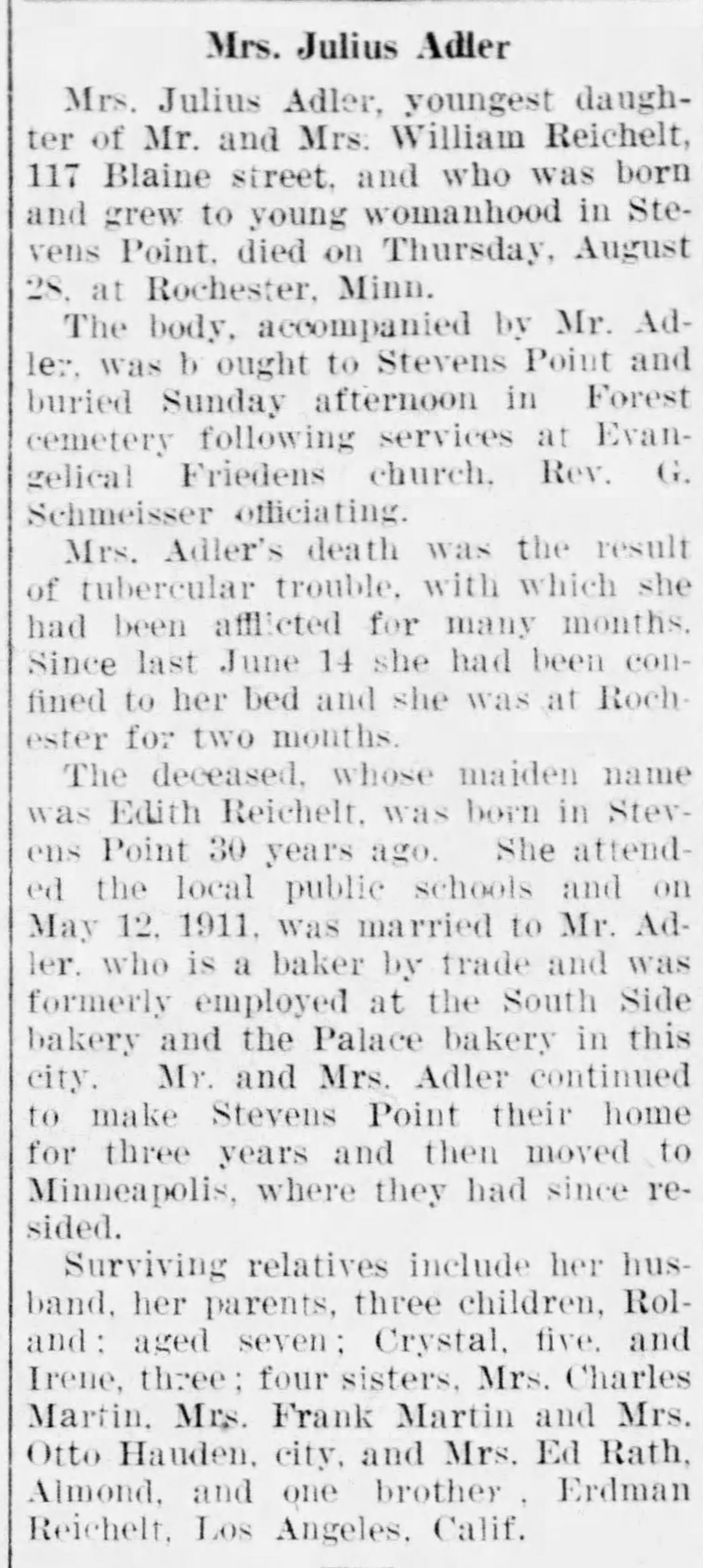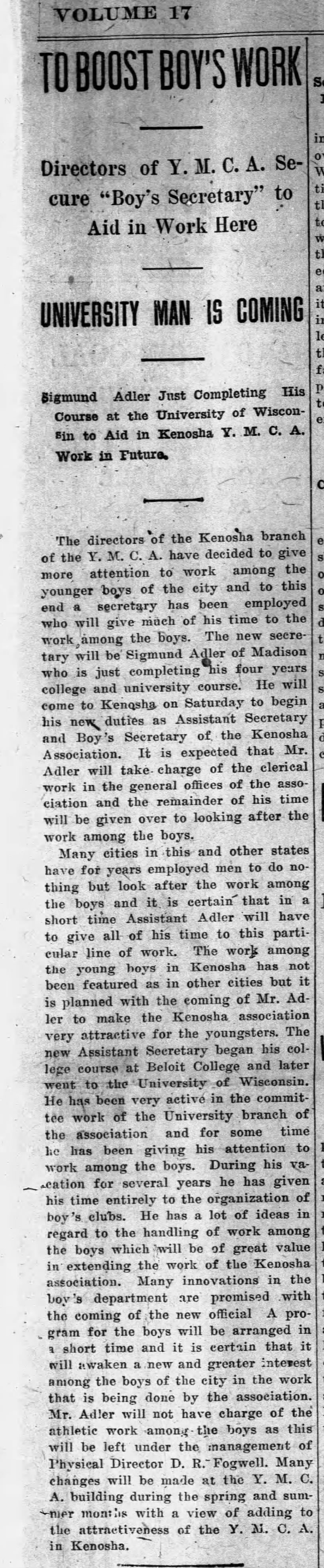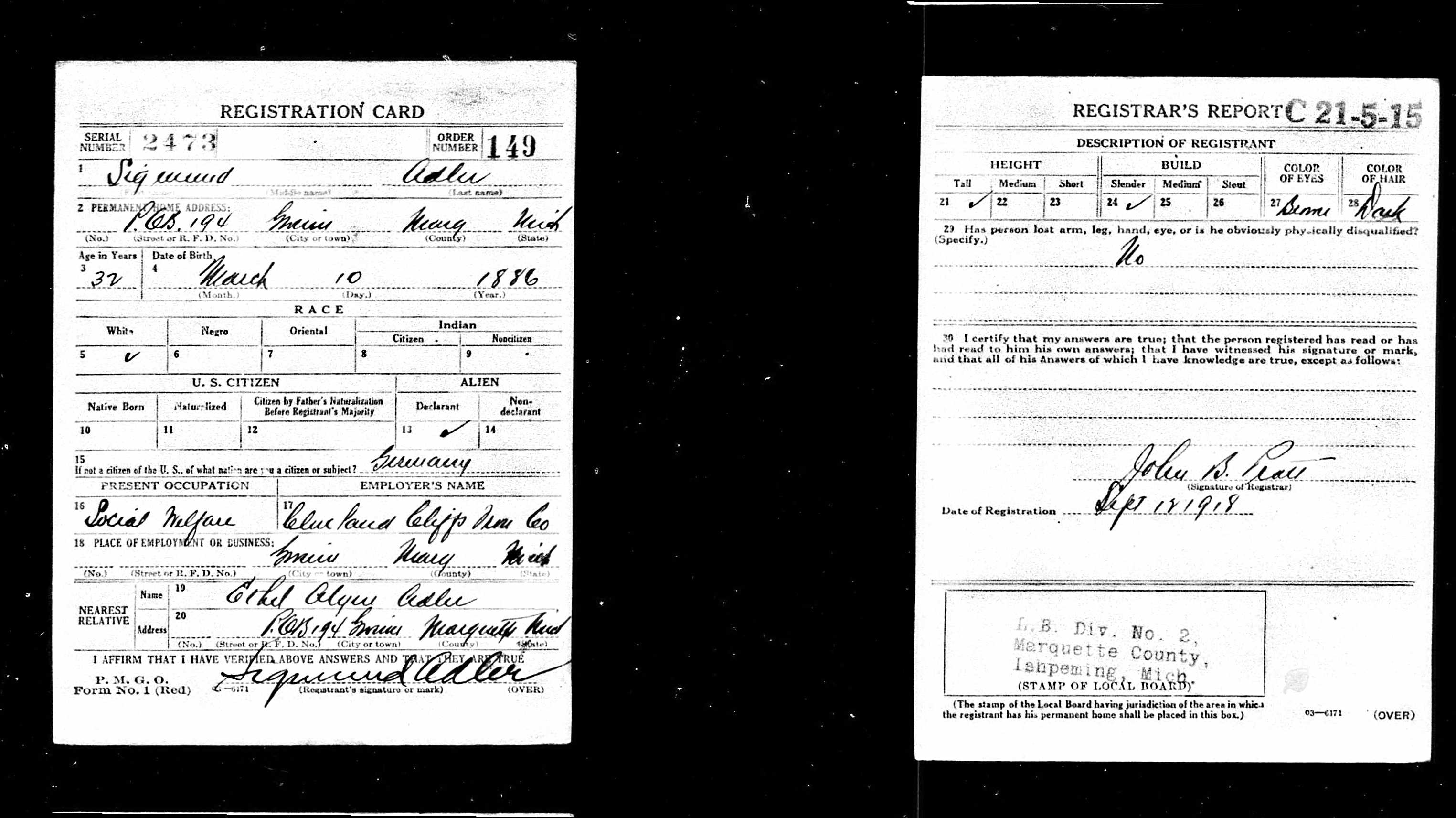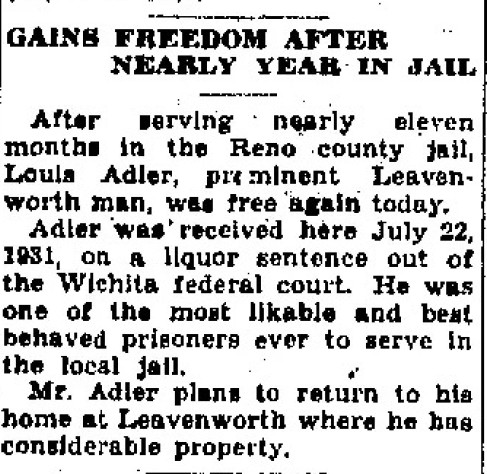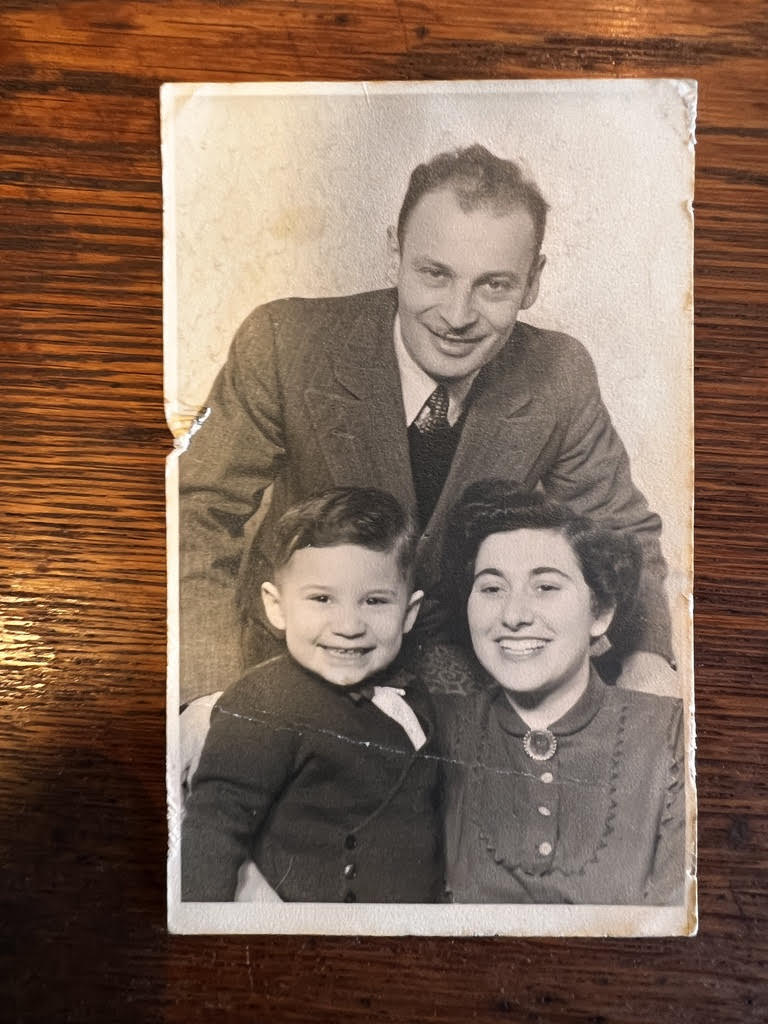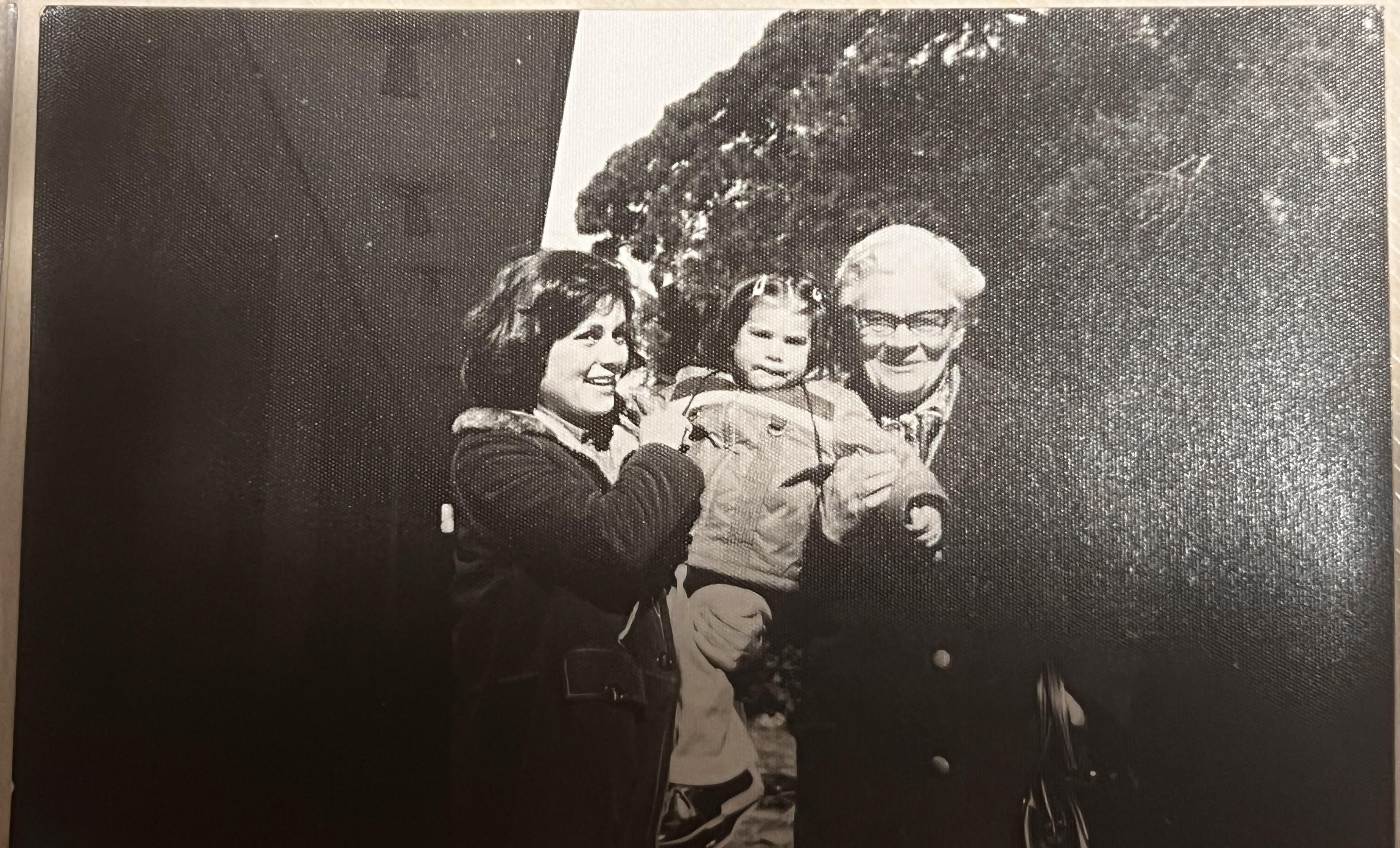
Louis Adler, A Man with Many Legal Troubles

Sara Rothschild Adler’s first child was her son Louis, born on December 4, 1884, in Niedermeier, Germany. Louis was just a teenager when he left home and immigrated to the United States. I could not find a passenger ship manifest for Louis despite hours of searching, but according to the 1910 census1 he arrived in 1900 when he was going on sixteen years old. Louis also provided that year of arrival in a document he filed on February 11, 1918, to register as an “alien enemy” during World War I.2 In fact, he was quite specific in saying he arrived on the Kaiser William in New York on April 22, 1900. Even with that information, however, I could not find him on a ship manifest on any ship arriving within two years before or after 1900.

Louis Adler, 1918 Alien Enemy registration, Arrival Date 22 Apr 1900, Arrival Place New York, Ship Kaiser William, District Court, Kansas, National Archives at Kansas City; Kansas City, MO, USA; Record Group: Records of United States Attorneys and Marshals, 1821-1994; Record Group Number: Rg 118; Catalog: Enemy Alien Registration Affidavits, 1917-1921; Catalog Number: 286181, Ancestry.com. Kansas, Permits and Registration of Alien Enemy Residents, 1918.

But a few months before filing that February 11, 1918, document, Louis filed a different document required by his “alien enemy” status. In that document dated December 13, 1917, he stated that he had arrived in the US on April 21, 1901. (That’s why I searched for two years before and after 1900.)

Louis Adler 1917 Alien Enemy registration, National Archives at Kansas City; Kansas City, MO, USA; Record Group: Records of United States Attorneys and Marshals, 1821-1994; Record Group Number: Rg 118; Catalog: Enemy Alien Registration Affidavits, 1917-1921; Catalog Number: 286181, List of Permits Issued to Alien Enemies 1918, Ancestry.com. Kansas, Permits and Registration of Alien Enemy Residents, 1918

Also, his naturalization registration dated September 14, 1921, lists April 1, 1901, as Louis’ date of arrival. And on the 1930 US census his date of arrival is also 1901.

Louis Adler naturalization card, The National Archives at Kansas City; Kansas City, Missouri; Naturalization Index for the Western District of Missouri, compiled 1930 – 1950, documenting the period ca. 1848 – ca. 1950; Record Group Title: Records of the District Courts of the United States; Record Group Number: RG 21, Surname Range: Aach – Amonia, Ancestry.com. Missouri, U.S., Western District Naturalization Index, 1840-1990

Just to add to the confusion, the 1920 US census reports his arrival as 1903,3 and a 1925 Kansas census reports his arrival in 18954 when he would have been eleven! (Louis also was inconsistent with how he reported his date of naturalization so perhaps we just should assume he was an unreliable reporter.)

In any event, Louis Adler likely arrived in New York from Germany in April of either 1900 or 1901 when he was either fifteen or sixteen years old. I have no evidence of where he first lived on arrival.

But on March 24, 1906, Louis Adler obtained a license to marry Edna Anderson in Kansas City, Missouri.5 According to the 1910 census6 and almost every subsequent US census record on which Edna appears, she was born in Denmark in about 1877-1878 and arrived in the US in 1903. I do not have any records that reveal more precisely where or when she was born, who her parents were, or when she arrived in the US.

In 1910, Louis and Edna were still living in Kansas City, and Louis was working in a butcher shop. They also had a boarder living with them.

Louis Adler 1910 US census, Year: 1910; Census Place: Kansas Ward 9, Jackson, Missouri; Roll: T624_787; Page: 16a; Enumeration District: 0119; FHL microfilm: 1374800, Enumeration District: 0119; Description: Kansas City, Old Ward 9 (part) Precinct 10, New Ward 9 (part)
Ancestry.com. 1910 United States Federal Census

By December 14, 1917, when Louis filed the first document (see 1917 document above) to register as an “alien enemy”  to obtain a permit to do business, Louis and Edna had moved from Kansas City to Leavenworth, Kansas, and Louis now was self-employed as a dairy farmer. The registration affidavit he filed a few months later in February 1918 (see above) also indicated that he was a “dairyman” living in Leavenworth.

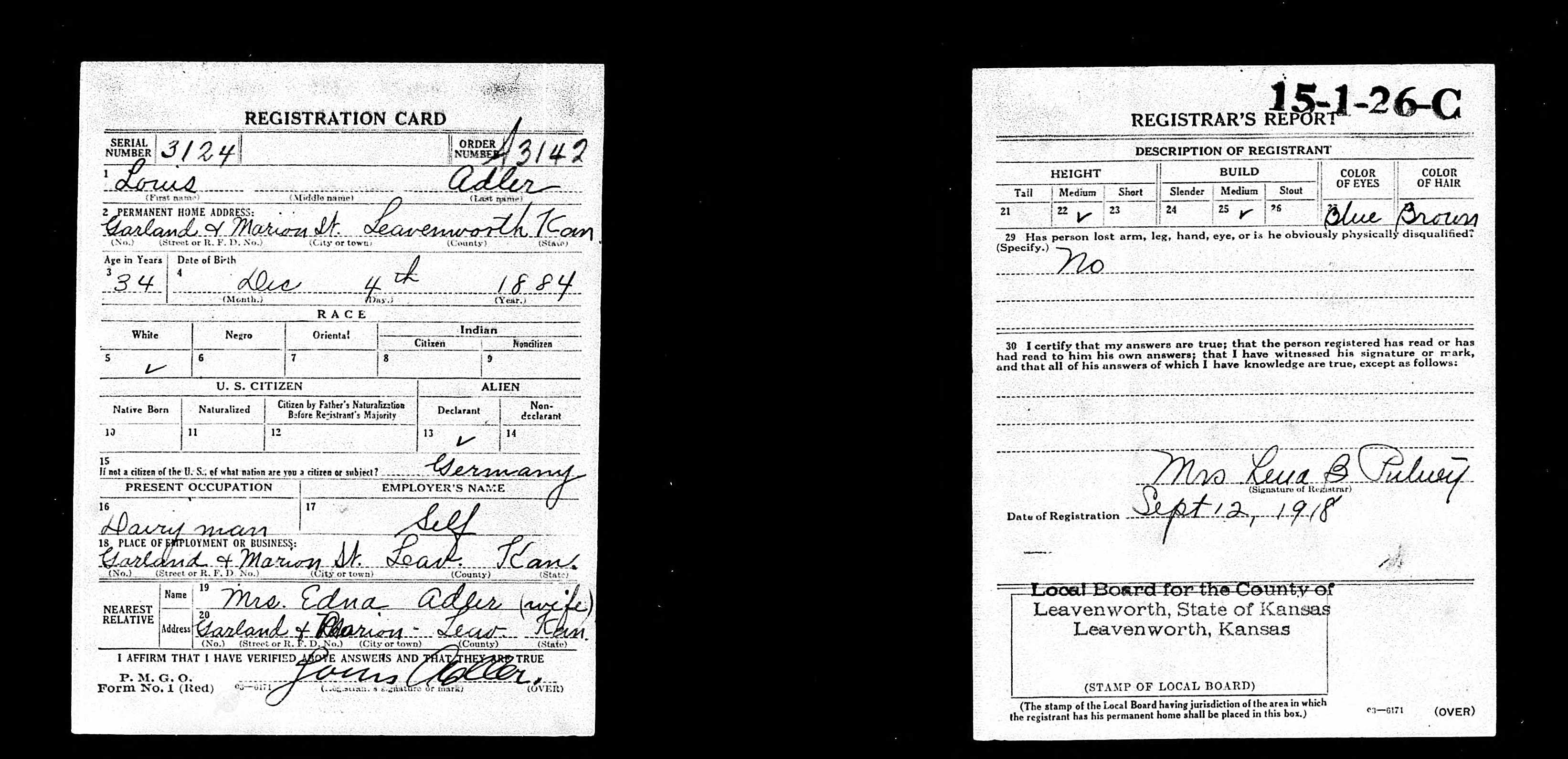
Louis (despite being an alien enemy) registered for the US draft on September 12, 1918, listing Edna as his wife and his occupation as dairyman.

Louis Adler, World War I draft registration, Registration State: Kansas; Registration County: Leavenworth County, Draft Card: A, Ancestry.com. U.S., World War I Draft Registration Cards, 1917-1918

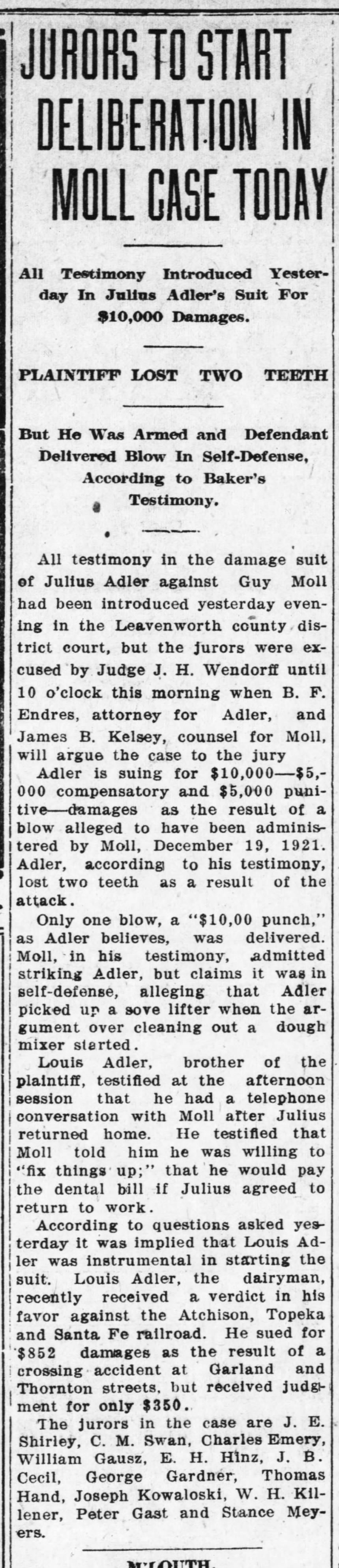
In looking for more information about Louis, I ran across numerous newspaper articles dated between 1918 and 1924 in which Louis was involved in either a legal dispute or a criminal charge. It seems he was a man who couldn’t escape conflicts.

Louis’ public problems seemed to start in July 1918 when his truck was hit by a train while he was taking two calves and a pig to the market in Kansas City. His truck was badly damaged and one of the calves was killed, but Louis escaped without injury. I did not find any articles following up on this incident.

“Train Hits Louis Adler,” The Leavenworth (Kansas) Post, July 25, 1918

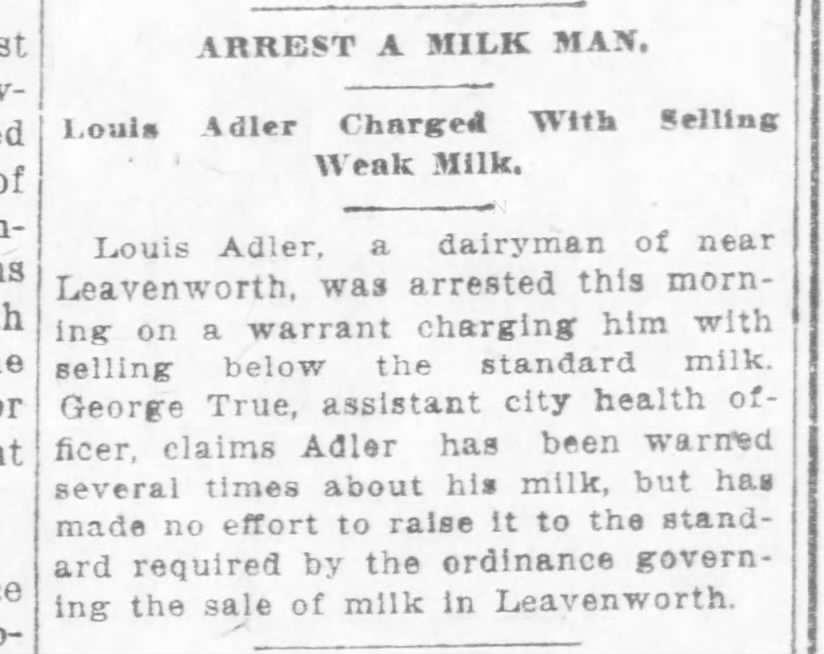
But a year later on July 9, 1919, Louis was arrested and charged with selling milk that did not meet the standards required for the sale of milk in Leavenworth.

“Arrest a Milk Man,” Leavenworth (Kansas) Tribune, July 9, 1919

This would not be the last time he was accused of this behavior. In fact over and over again, Louis’ legal problems made the newspapers, often on the front page.

Less than a year later he was again charged with selling substandard milk. According to an article in the February 4, 1920, Leavenworth Tribune, Louis had been convicted on the earlier charge but released on a technicality because the ordinance regulating the sale of milk had been too vague. That ordinance had since been amended to provide more clarity. The February 4, 1920, article reported that “[f]our samples bought after the milk had been sold by Adler and while it was in bottles sealed by him showed, after straining, to have contained a quantity of dirt, according to [the inspector].”6 Yuck…

Louis’ troubles continued in June 1920 when he was sued by a local garage owner for non-payment of a bill for repairs to his truck. The headline on the article first discussing this lawsuit read, “Adler In Trouble Again.” Louis was ultimately held liable for payment of the bill.7

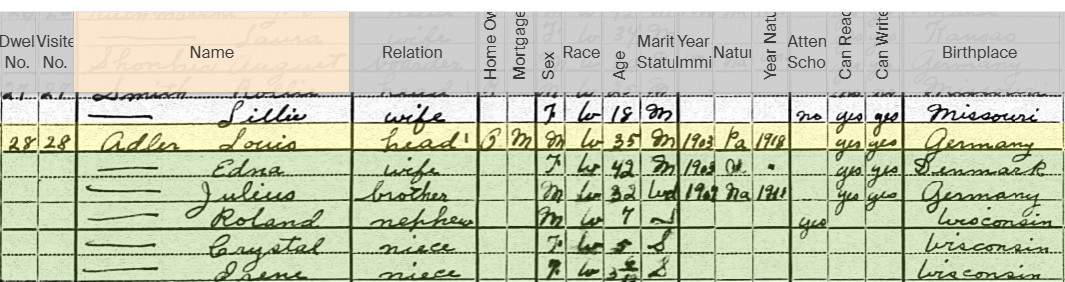
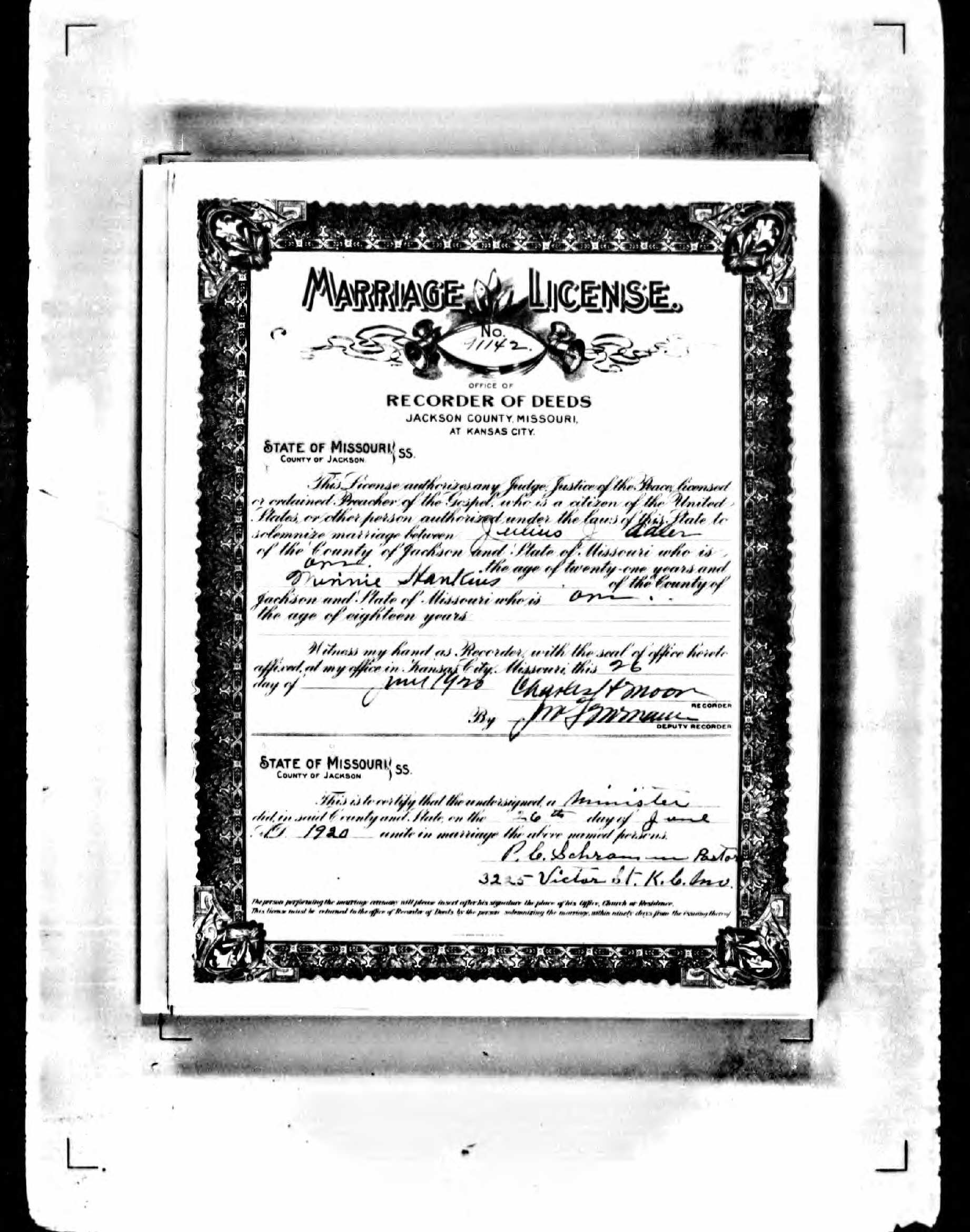
Meanwhile, the 1920 US census showed Louis and Edna in Leavenworth and owning a dairy farm where both were working. They had no children of their own, but living with them, as described on the census report, were Louis’ “brother” Julius and his three children. Julius was a widower and a baker born in about 1887. This really puzzled me. Who was Julius? I had no brother named Julius for Louis. I was intrigued. But that’s a story for another post.

Louis Adler 1920 US census, Year: 1920; Census Place: Leavenworth Ward 6, Leavenworth, Kansas; Roll: T625_537; Page: 2A; Enumeration District: 109, Ancestry.com. 1920 United States Federal Census

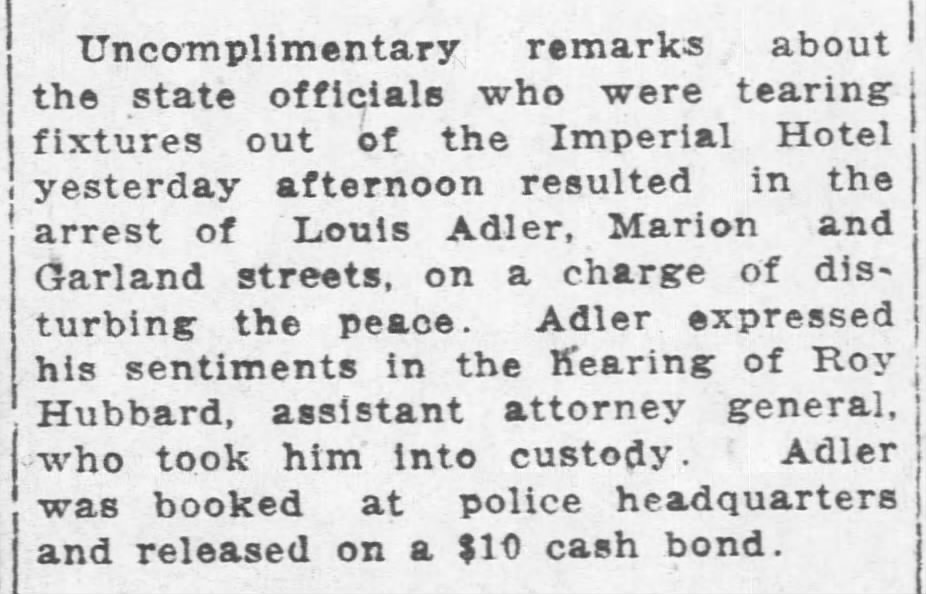
Louis continued to have legal problems in 1921. In January he was arrested for disturbing the peace because he made “uncomplimentary remarks” about officials who were removing fixtures from a local hotel A subsequent article described his behavior as “loud and boisterous.” Ultimately Louis pled guilty, was sentenced to ten days in jail and subjected to a ten dollar fine; both penalties were then suspended by the judge.8

The Leavenworth (Kansas) Times, January 20, 1921, p. 6

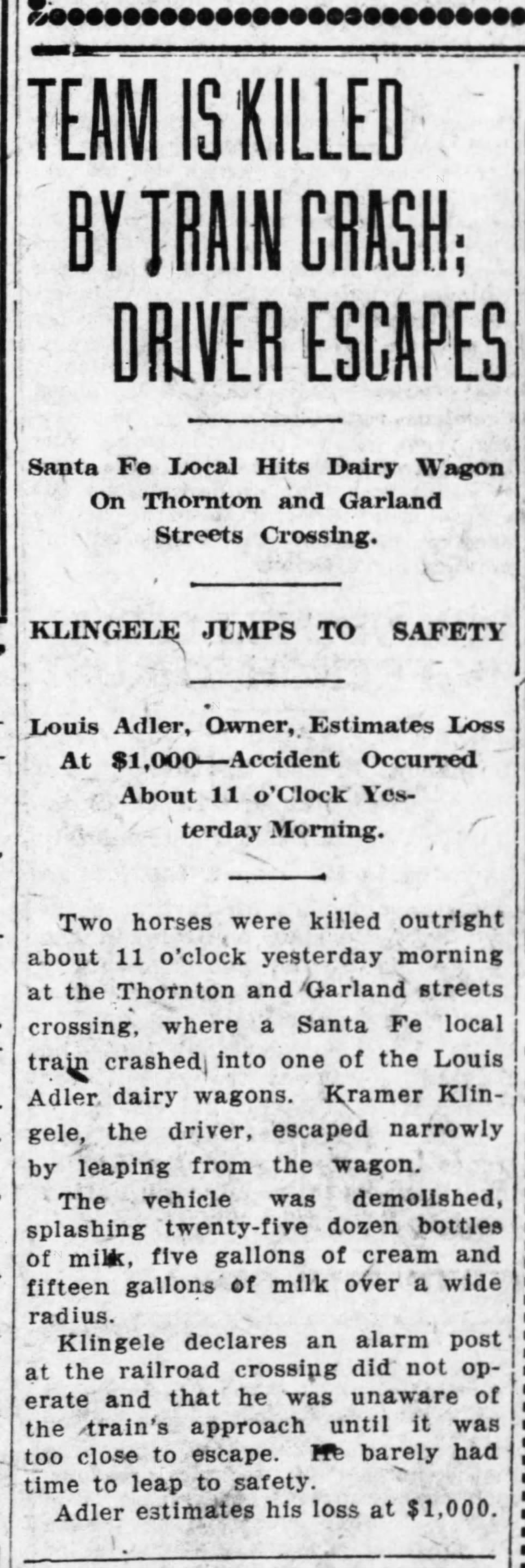
In April 1921, there was another train collision with a vehicle owned by Louis Adler. Louis was not driving this time; one of his hired drivers was. As the article in the April 24, 1921 Leavenworth Times reported:

“Team is Killed by Train Crash, Driver Escapes,” The Leavenworth (Kansas) Times, April 24, 1921, p. 2

Louis sued the railroad and ultimately received a verdict in his favor and a judgment of $350.9

On September 14, 1921, despite all these lawsuits and arrests, Louis became a naturalized citizen of the United States (after claiming on earlier census reports that he was already naturalized).10 But his legal problems did not end. In March 1922, he was sued by a man who had purchased a cow from Louis and claimed that Louis had misrepresented how much milk the cow would produce. Louis lost this case and was found liable for $150 to the plaintiff.11 In July 1922, the Adlers were both sued by an ice cream company that claimed the Adlers owed $274.25 for milk and flour it sold to them.12

Things got worse when Louis was found guilty of violating Prohibition laws in March 1924. One article described him as the “king of the bootleggers” after two police raids found liquor on his property. A first raid uncovered 78 gallons of corn whiskey and a later one fifty gallons of corn whiskey.

The (Leavenworth, Kansas) Chronicle, March 14, 1924, p. 1

A subsequent article in the Leavenworth Chronicle described Louis as a “wholesale moonshiner” and a “persistent violator of the prohibitionary law.” He was fined $1500 and sentenced to eighteen months in jail. As the article so glibly commented, he “may, on conviction, be away from the giddy whirl of society for a long, long time.”13

Louis appealed his conviction, but it was upheld by the Kansas Supreme Court with respect to the possession of alcohol.14

The court concluded:15

The defendants were also convicted of having intoxicating liquor in their possession. Thirteen five-gallon containers of whisky were found hidden in a barn on the Adler premises, which were claimed by them, however, to have been leased to some one else—a claim which the jury were warranted in discrediting. Other five-gallon bottles of whisky were also found along a fence under garbage cans in the street abutting on the Adler place, and in a neighboring ditch. The contention is made that there was no evidence of any of this liquor having been in the possession of the defendants, and particularly of Mrs. Adler. There was evidence fairly open to interpretation as showing an effort on the part of both to bribe the officers to abandon the raid and let them alone, after liquor had been discovered in the barn, and this with other circumstances warranted the verdict rendered.

I don’t know whether or how much time Louis spent in prison for this conviction.

And he didn’t learn his lesson! Despite this conviction, Louis continued to be involved in some aspects of bootlegging. In April 1931 he went on trial in federal court on charges of possession and transportation of liquor after authorities allegedly found fifty gallons of liquor in his car. Louis claimed he’d been framed because he had information that a group of men including the Leavenworth chief of police were selling liquor.16

I did not locate any later articles about Louis Adler after the 1931 arrest for possession and transportation of alcohol. Maybe that arrest really marked the end of his legal troubles or, more likely, maybe I just can’t find any more articles because the newspaper databases I use do not have Leavenworth papers for the years between 1925-1942.

Louis Adler died on February 1, 1942;17 he was 57 years old. Despite all the newspaper coverage of his life in earlier years, I could not locate one obituary for him. Sometime before 1950 his widow Edna remarried; her second husband was George W. Edwards.18 Edna died on May 14, 1959, in Leavenworth, Texas. She is buried in the same cemetery as both her husbands, Mount Muncie Cemetery in Lansing, Kansas. Her name on her headstone has both of her husbands’ surnames: Edna Adler Edwards.19

I wish I knew more about Louis Adler and why he was so often embroiled in legal troubles. Was it resentment on his part after being treated as an “alien enemy” during World War I? Or was he targeted because he was a German immigrant? Or because he was Jewish? Or was he just a difficult person, one who had left home as a troubled teenager? Whatever the reasons for all his troubles, it is noteworthy that his wife Edna stayed with him to the bitter end.


I will be taking the next two weeks off from blogging, but will be back during the first week of December. Wishing you all a happy Thanksgiving a bit early!


  1. Louis Adler, Age in 1910 26, Birth Date 1884, Birthplace Germany, Home in 1910 Kansas Ward 9, Jackson, Missouri, USA, Immigration Year 1900, Relation to Head of House Head, Marital Status Married, Father’s Birthplace Germany, Mother’s Birthplace Germany, Native Tongue English, Occupation Butcher, Enumeration District Number 0119, Years Married 4, Enumerated Year 1910, Year: 1910; Census Place: Kansas Ward 9, Jackson, Missouri; Roll: T624_787; Page: 16a; Enumeration District: 0119; FHL microfilm: 1374800, Ancestry.com. 1910 United States Federal Census 
  2. On April 6, 1917, after the US entered World War I against Germany, President Woodrow Wilson invoked the Alien Enemies Act of 1798 to require all male German immigrants over the age of fourteen to register as an “alien enemy.” They were photographed and fingerprinted and in some cases detained. See Wilson’s speech here https://millercenter.org/the-presidency/presidential-speeches/april-6-1917-proclamation-1364. See also Tim Balk, “A History of the Alien Enemies Act of 1798,” The New York Times, March 21, 2025, at https://www.nytimes.com/2025/03/21/us/politics/trump-alien-enemies-act-history.html 
  3. Louis Adler, 1920 US census, Year: 1920; Census Place: Leavenworth Ward 6, Leavenworth, Kansas; Roll: T625_537; Page: 2A; Enumeration District: 109, Ancestry.com. 1920 United States Federal Census 
  4. Louis Adler, 1925 Kansas Census, Kansas State Historical Society; Topeka, Kansas; 1925 Kansas Territory Census; Roll: KS1925_76; Line: 19, Ancestry.com. Kansas, U.S., State Census Collection, 1855-1925 
  5. Louis Adler, Marriage Date 24 Mar 1906 Marriage Place Jackson, Kansas City, Missouri, USA, Spouse Edna Anderson, Missouri State Archives; Jefferson City, MO, USA; Missouri Marriage Records [Microfilm], Year or Year Range: 1905-1906, Ancestry.com. Missouri, U.S., Marriage Records, 1805-2002 
  6. “Milkman is Arrested,” Leavenworth (Kansas) Tribune, February 4, 1920, p. 8. 
  7. “Adler in Trouble Again,” Leavenworth (Kansas) Tribune, June 22, 1920, p. 1; “Judgment of $75 in Repairs,” The Leavenworth (Kansas) Times, June 23, 1920. 
  8. “Adler Finds Friend in Mr. Roy Hubbard,” Leavenworth (Kansas) Tribune, January 25, 1921, p. 1. 
  9. “Jury Deliberates More Than Hour; Adler Gets $350,” The Leavenworth (Kansas) Times, February 16, 1922, p. 10 
  10. Louis Adler, Naturalization Age 36, Record Type Naturalization, Birth Date 4 Dec 1884, Arrival Date 1 Apr 1901, Arrival Place New York, Naturalization Date 14 Sep 1921, Naturalization Place Leavenworth, Kansas, USA, Naturalization Courthouse District Court, The National Archives at Kansas City; Kansas City, Missouri; Naturalization Index for the Western District of Missouri, compiled 1930 – 1950, documenting the period ca. 1848 – ca. 1950; Record Group Title: Records of the District Courts of the United States; Record Group Number: RG 21, Ancestry.com. Missouri, U.S., Western District Naturalization Index, 1840-1990 
  11. “Ten Jurors Sit in Damage Suit,” The Leavenworth (Kansas) Times, March 14, 1922, p. 3; “Verdict Favors Martin Grabish in Damage Suit,” The Leavenworth (Kansas) Times, March 21, 1922, p. 2 
  12. “Company Files Suit Against Louis Adler,” The Leavenworth (Kansas) Times, July 7, 1922, p. 1 
  13. The (Leavenworth, Kansas) Chronicle, March 21, 1924, p. 1 
  14. Kansas v. Adler, Supreme Court of Kansas, 119 Kan. 757, 241 P. 119 (1926). A separate verdict for maintaining a “liquor nuisance” where liquor was kept and sold was overturned due to a legal technicality. 
  15. Ibid, at 759. 
  16. “Kansas Farmer Will Face Liquor Charges,” The (Manhattan, Kansas) Morning Chronicle, April 16, 1931, p. 1 
  17. Find a Grave, database and images (https://www.findagrave.com/memorial/182868544/louis-adler: accessed October 30, 2025), memorial page for Louis Adler (4 Dec 1884–1 Feb 1942), Find a Grave Memorial ID 182868544, citing Mount Muncie Cemetery, Lansing, Leavenworth County, Kansas, USA; Maintained by KAB (contributor 47294688). 
  18. Edna and George Edwards, 1950 US census, National Archives at Washington, DC; Washington, D.C.; Seventeenth Census of the United States, 1950; Year: 1950; Census Place: Leavenworth, Leavenworth, Kansas; Roll: 1825; Page: 22; Enumeration District: 52-43, Ancestry.com. 1950 United States Federal Census 
  19. Find a Grave, database and images (https://www.findagrave.com/memorial/182868648/edna-edwards: accessed October 30, 2025), memorial page for Edna Adler Edwards (1876–1959), Find a Grave Memorial ID 182868648, citing Mount Muncie Cemetery, Lansing, Leavenworth County, Kansas, USA; Maintained by KAB (contributor 47294688). 

Sara Rothschild Adler, Part I: Ten Children in Seventeen Years

Having completed the story of Malchen Rothschild Rosenblatt, I will now move on to the tenth child of Gelle Blumenfeld and Simon Rothschild, their daughter Sara. Fortunately her family has happier stories than those of some of her siblings.

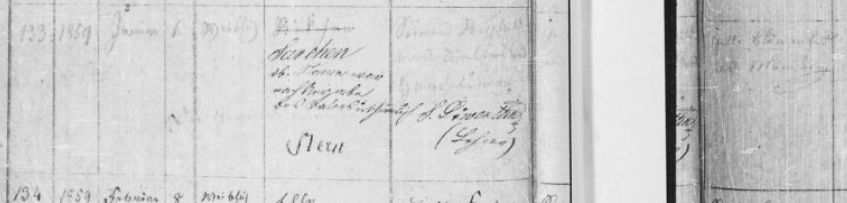
Sara Rothschild was born on either January 6, 1859, or January 3, 1860, in Waltersbrueck, Germany. Her marriage and death records indicate the January 3, 1860, date, but there was no record of her birth on that date in the archives for Waltersbrueck. The birth record below, however, appears to be for Sara (Sarchen) and shows a birth date of January 6, 1859. It’s difficult to read, but the baby’s name is Sarchen, and in very faint letters you can see that the father is Simon and the mother’s name is Gelle Blumenfeld of Momberg. You will need to click on the image and zoom in to see the writing.

Sara Rothschild birth record, Arcinsys Archives of Hessen, HHStAW Fonds 365 No 893, p. 30, found at https://digitalisate-he.arcinsys.de/hhstaw/365/893/00030.jpg

Sara married Moses Adler on December 26, 1883, in Waltersbrueck. He was the son of Selig Adler and Amalie Winkler and was born in Desenberg, Germany, on April 25, 1858. (Notice the January 3, 1860 birthdate for Sara.)

Sara Rothschild and Moses Adler marriage record, Hessisches Hauptstaatsarchiv; Wiesbaden, Deutschland; Bestand: 920; Laufende Nummer: 8409, Year Range: 1883, Ancestry.com. Hesse, Germany, Marriages, 1849-1930

Sara and Moses had ten children. Their first was Louis, born December 4, 1884, in Niedermeiser, Germany.

Louis Adler birth record, Hessisches Hauptstaatsarchiv; Wiesbaden, Deutschland; Bestand: 909; Signatur: 7410, Year Range: 1884, Ancestry.com. Hesse, Germany, Births, 1851-190

Then came Siegmund, born March 10, 1886, in Niedermeiser.

Siegmund Adler birth record, Hessisches Hauptstaatsarchiv; Wiesbaden, Deutschland; Bestand: 909; Signatur: 7412, Year Range: 1886, Ancestry.com. Hesse, Germany, Births, 1851-1901

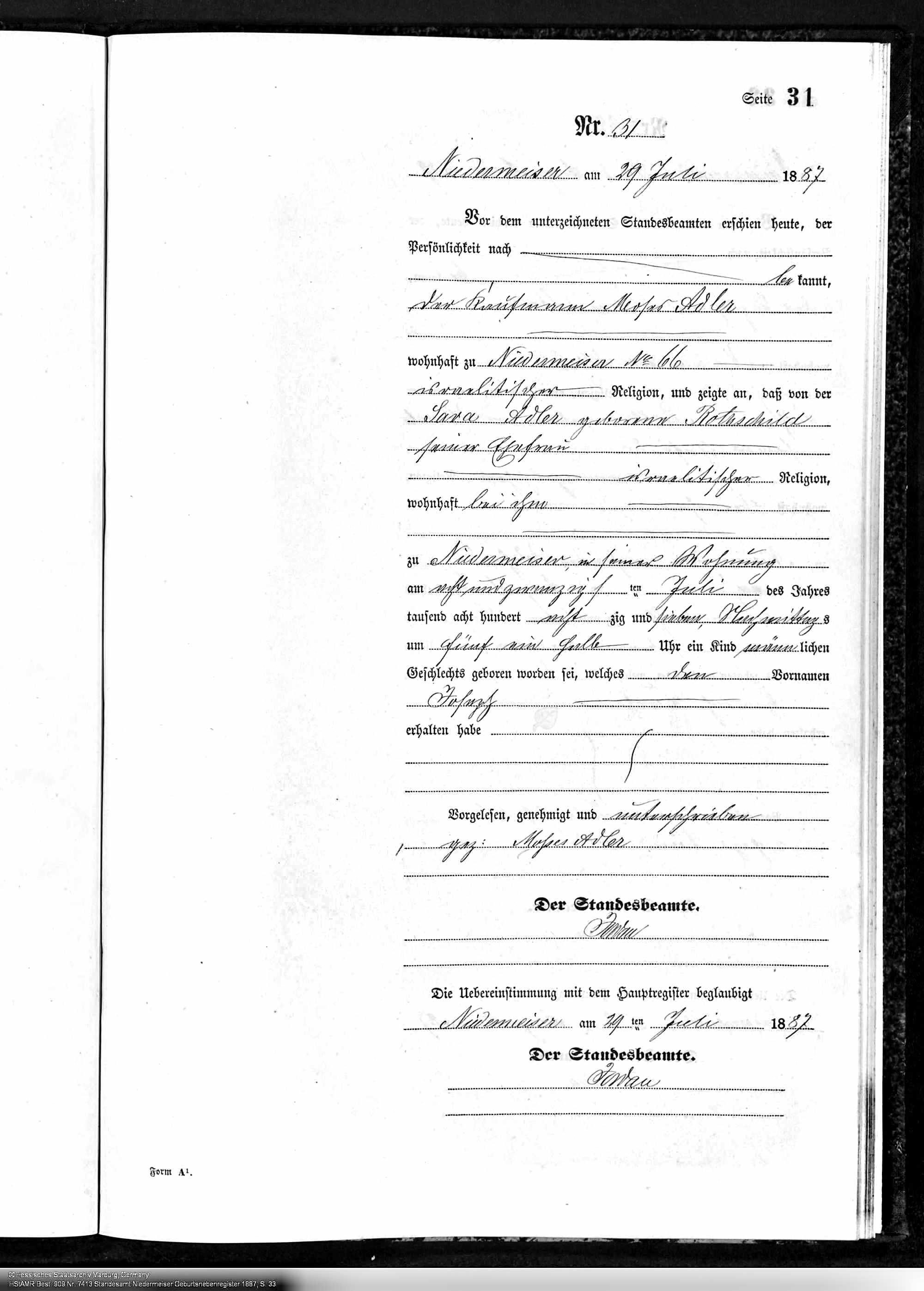
The third child was Joseph, born July 28, 1887, in Niedermeiser. Joseph proved to be a real challenge to track down later, as we will see.

Joseph Adler birth record, Hessisches Hauptstaatsarchiv; Wiesbaden, Deutschland; Bestand: 909; Signatur: 7413, Year Range: 1887, Ancestry.com. Hesse, Germany, Births, 1851-1901

After three sons, Sara and Moses next had a girl, Caroline (also known as Grete), born on August 13, 1889, in Niedermeiser.

Caroline Adler birth record, Hessisches Hauptstaatsarchiv; Wiesbaden, Deutschland; Bestand: 909; Signatur: 7415, Year Range: 1889, Ancestry.com. Hesse, Germany, Births, 1851-1901

Sara and Moses’ second daughter Malchen was born on March 15, 1891, in Niedermeiser.

Malchen Adler birth record, Hessisches Hauptstaatsarchiv; Wiesbaden, Deutschland; Bestand: 909; Signatur: 7417, Year Range: 1891, Ancestry.com. Hesse, Germany, Births, 1851-1901

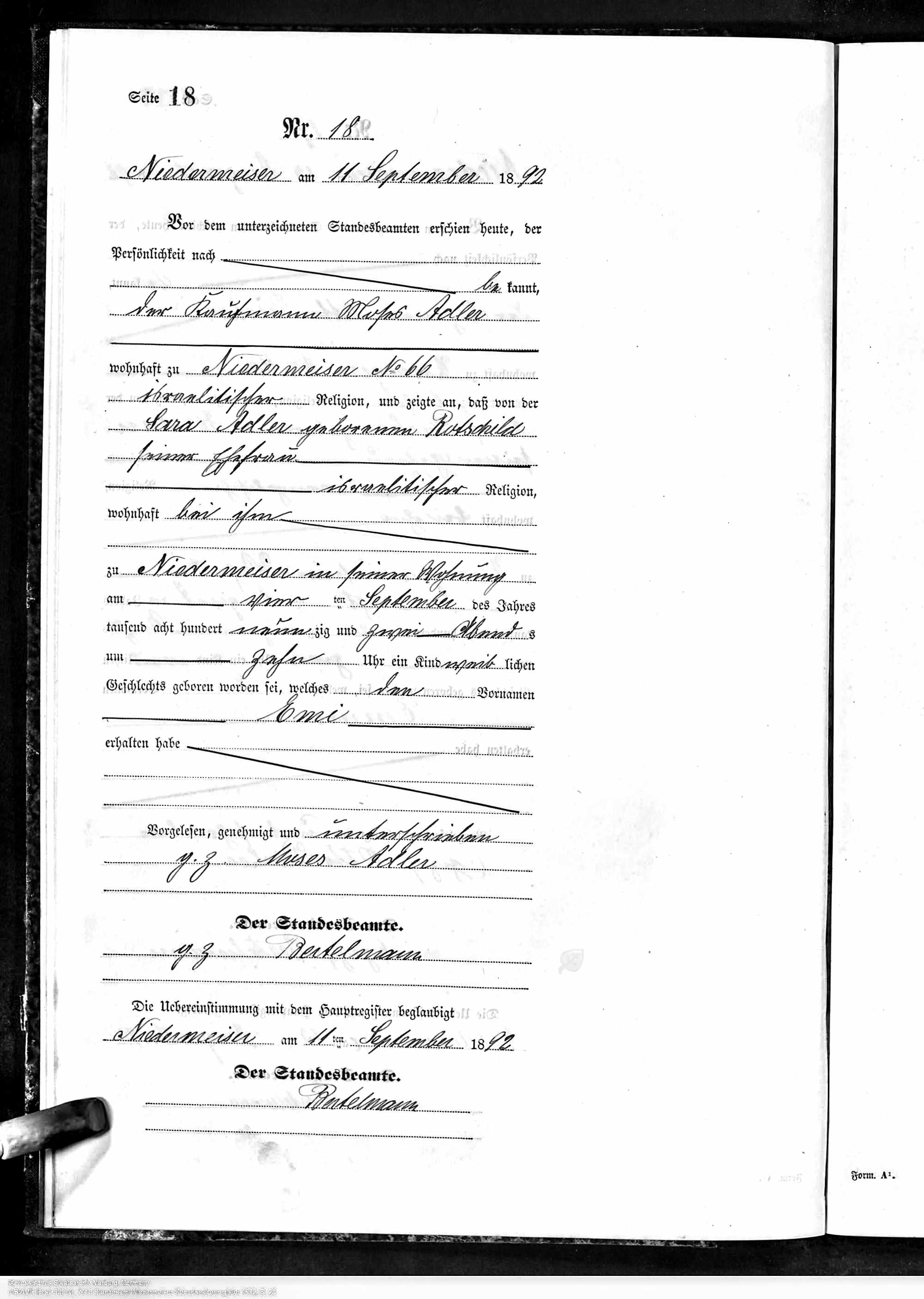
Then came another daughter, Emmi, born in Niedermeiser on September 4, 1892.

Emmi Adler birth record, Hessisches Hauptstaatsarchiv; Wiesbaden, Deutschland; Bestand: 909; Signatur: 7418, Year Range: 1892, Ancestry.com. Hesse, Germany, Births, 1851-1901

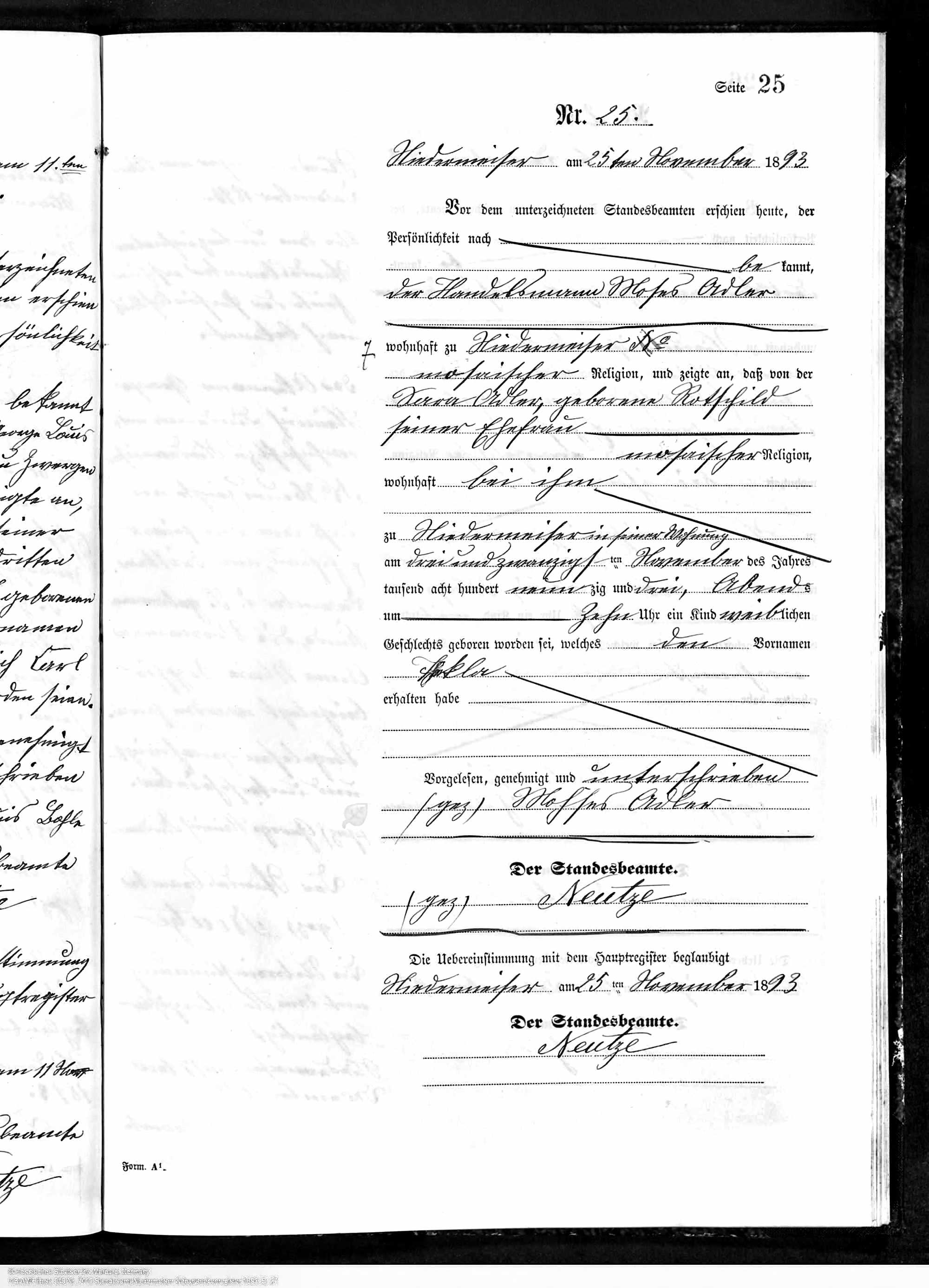
Their seventh child was Tekla, born November 23, 1893 in Niedermeiser. Tekla died when she was only twelve years old on June 17, 1906 in Grebenstein, Germany.

Tekla Adler birth record, Hessisches Hauptstaatsarchiv; Wiesbaden, Deutschland; Bestand: 909; Signatur: 7419, Year Range: 1893, Ancestry.com. Hesse, Germany, Births, 1851-1901

Tekla Adler death record, Hessisches Hauptstaatsarchiv; Wiesbaden, Deutschland; Personenstandsregister Sterberegister; Signatur: 3052; Laufende Nummer: 909, Year Range: 1906, Ancestry.com. Hesse, Germany, Deaths, 1851-1958

Another boy was born next. David (also known as Theodore) was born on July 2, 1895, in Niedermeiser.

David Adler birth record, Hessisches Hauptstaatsarchiv; Wiesbaden, Deutschland; Bestand: 909; Signatur: 7422, Year Range: 1895, Ancestry.com. Hesse, Germany, Births, 1851-1901

Then came Betty (also known as Jenny), born on September 20, 1898, in Grebenstein, so the family must have relocated to Grebenstein sometime between July 1895 and September 1898.

Betti Adler birth record, Hessisches Hauptstaatsarchiv; Wiesbaden, Deutschland; Signatur: 2954, Year Range: 1898, Ancestry.com. Hesse, Germany, Births, 1851-1901

Sara and Moses’ last child was Adolph/Adolf Adler, and he died when he was nine months old in Grebenstein on February 25, 1902. I couldn’t locate a birth record, but I can infer from his death record that he was probably born in May, 1901. UPDATE: Richard Bloomfield found in the Arcinsys Archives of Hessen a database of headstone inscriptions from the cemetery in Grebenstein that included information from Adolph’s headstone indicating that he was born on May 11, 1901.

Arcinsys Archives of Hessen, HHStAW, 365, 378, p. 6, found at https://digitalisate-he.arcinsys.de/hhstaw/365/378/00006.jpg

Adolf Adler death record, Hessisches Hauptstaatsarchiv; Wiesbaden, Deutschland; Personenstandsregister Sterberegister; Signatur: 3048; Laufende Nummer: 909, Year Range: 1902, Ancestry.com. Hesse, Germany, Deaths, 1851-1958

Of the ten children born to Sara Rothschild and Moses Adler, eight survived to adulthood: Louis, Siegmund, Joseph, Malchen, Caroline, Emmi, Tekla, David, and Betty Jenny. Miraculously, all eight survived the Holocaust, and all ended up in the United States. Some came long before Hitler came to power, some came after. But they all survived. I will tell all of their stories in the posts to come.


Lotte Nathan: Carrying and Passing on Family Trauma

Although I couldn’t find out what happened to Bertha Katzenstein Nathan Langebartels, I learned from her naturalization papers that Bertha had had a child with her first husband, Hermann Nathan, named Lotte. Lotte, according to the naturalization petition, was born on May 1, 1915, in Hamburg, Germany. She would have been only eleven years old when her mother and stepfather immigrated to the US in 1926, but she did not come with them. The naturalization petition stated that she “lives in Germany.” The petition also indicated that Friedrich and Bertha had last resided in Hamburg before coming to the United States. I hoped to find Lotte as another way of learning what happened to her mother.

Bertha Katzenstein Langebartels Weber petition for naturalization, The National Archives and Records Administration; Washington, D.C.; Petitions For Naturalization From the U.s. District Court For the Southern District of New York, 1897-1944; Series: M1972; Roll: 542
Description
Archive Roll Descriptions: (Roll 0542) Petition No· 124777-Petition No· 125042
Source Information
Ancestry.com. New York, U.S., Naturalization Records, 1882-1944

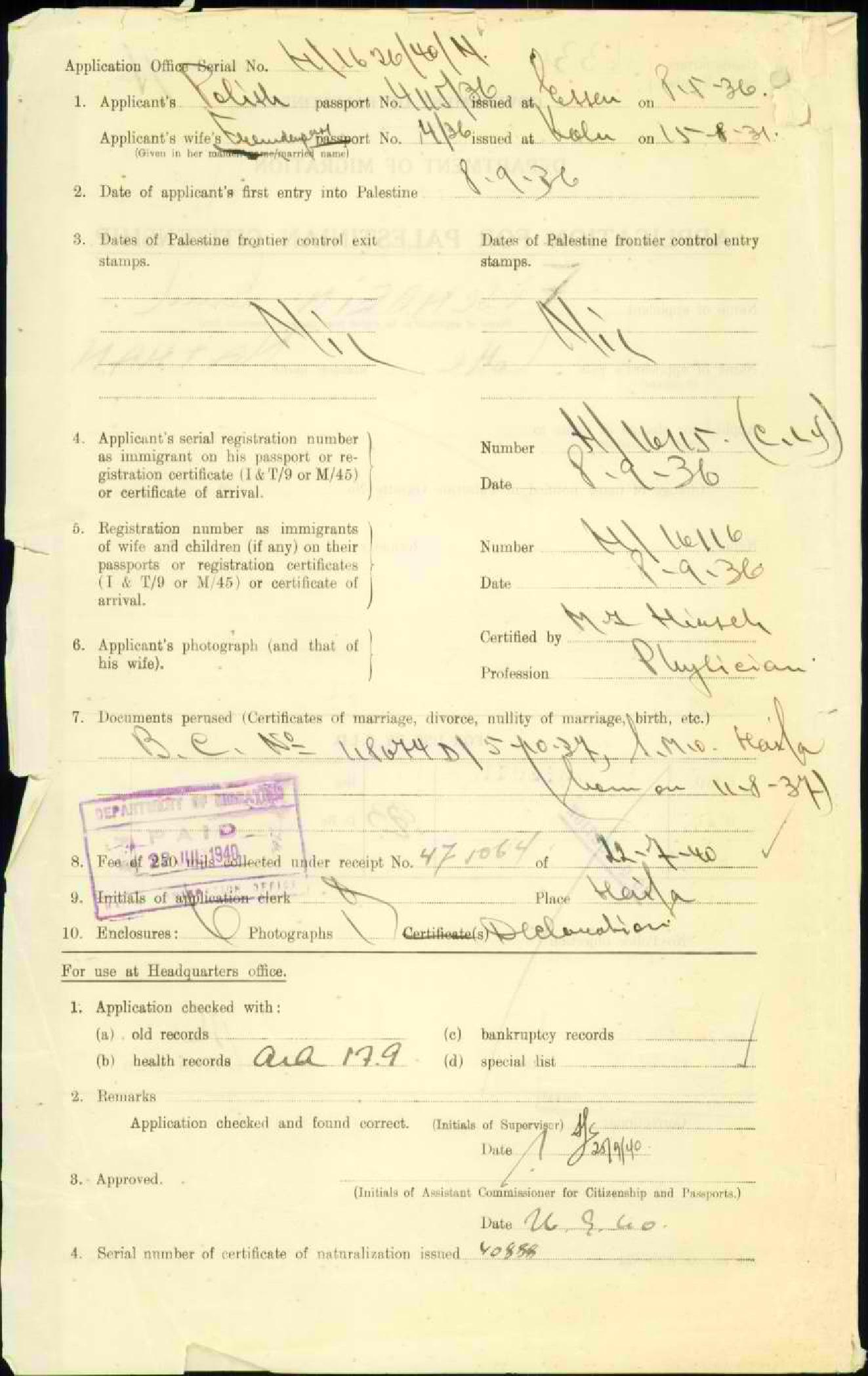
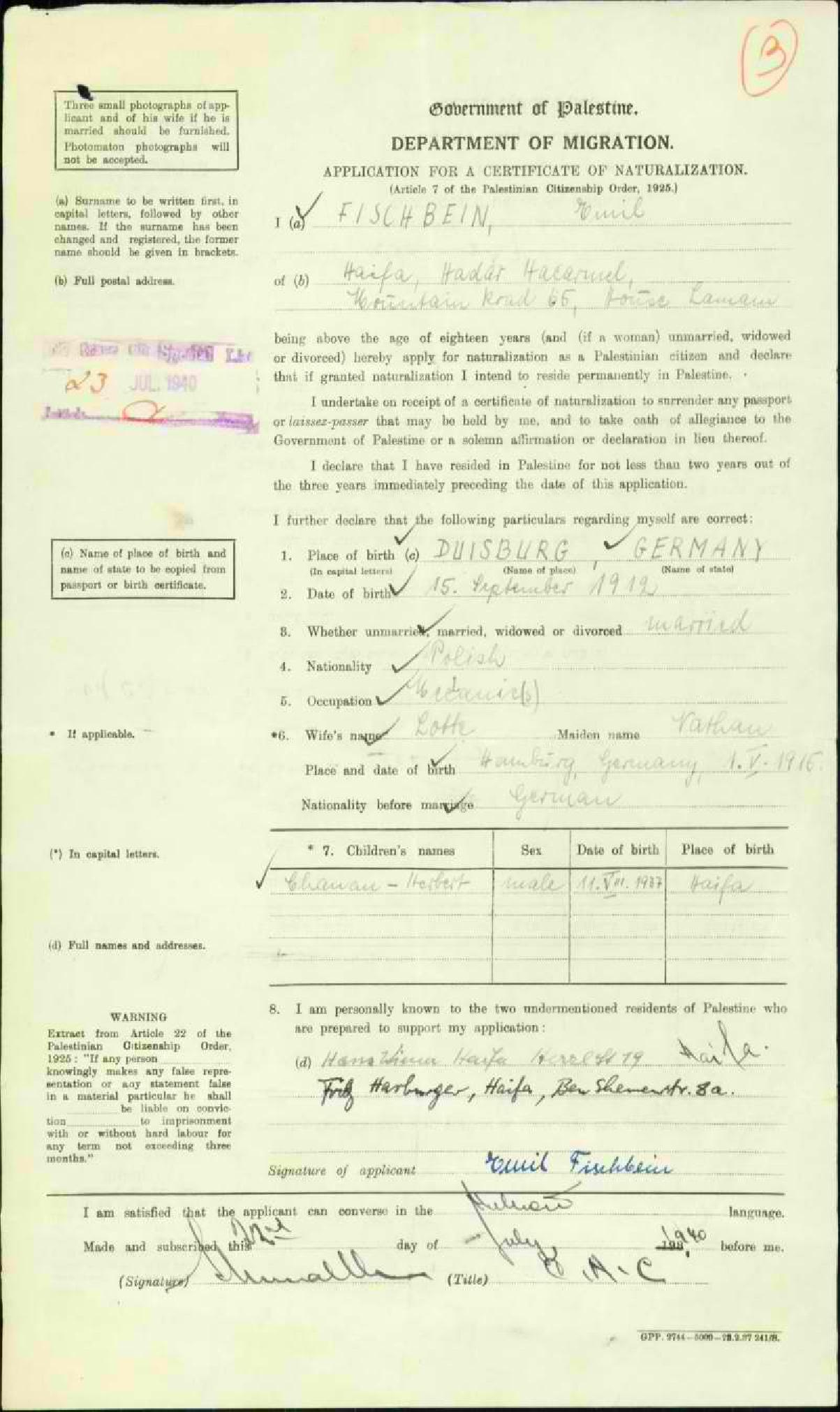
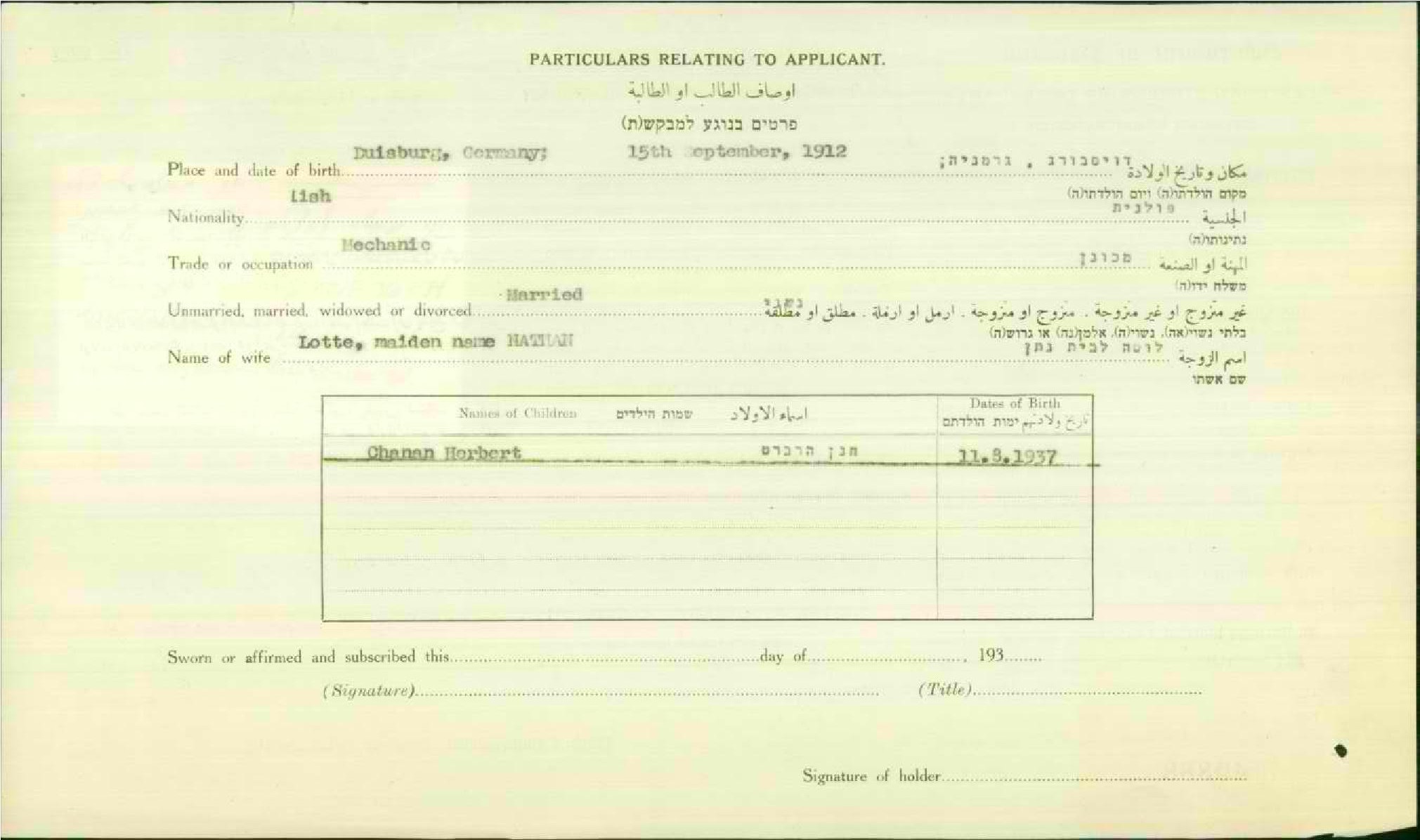
My hunch is that Lotte stayed behind with her father Hermann Nathan, but I can’t be certain. But I do know that sometime during or before 1936 Lotte married Emil Fischbein because on September 8, 1936, they left Germany and immigrated to Palestine as a married couple.1 Emil was born in Duisburg, Germany, on September 15, 1912, but was of Polish nationality, according to his Palestine immigration documents; one tree on MyHeritage created by his great-grandson Gil reports that Emil’s parents were Isaak and Esther Fischbein, both born in what is now Poland. German law at that time provided that children born to non-German parents were not considered German.

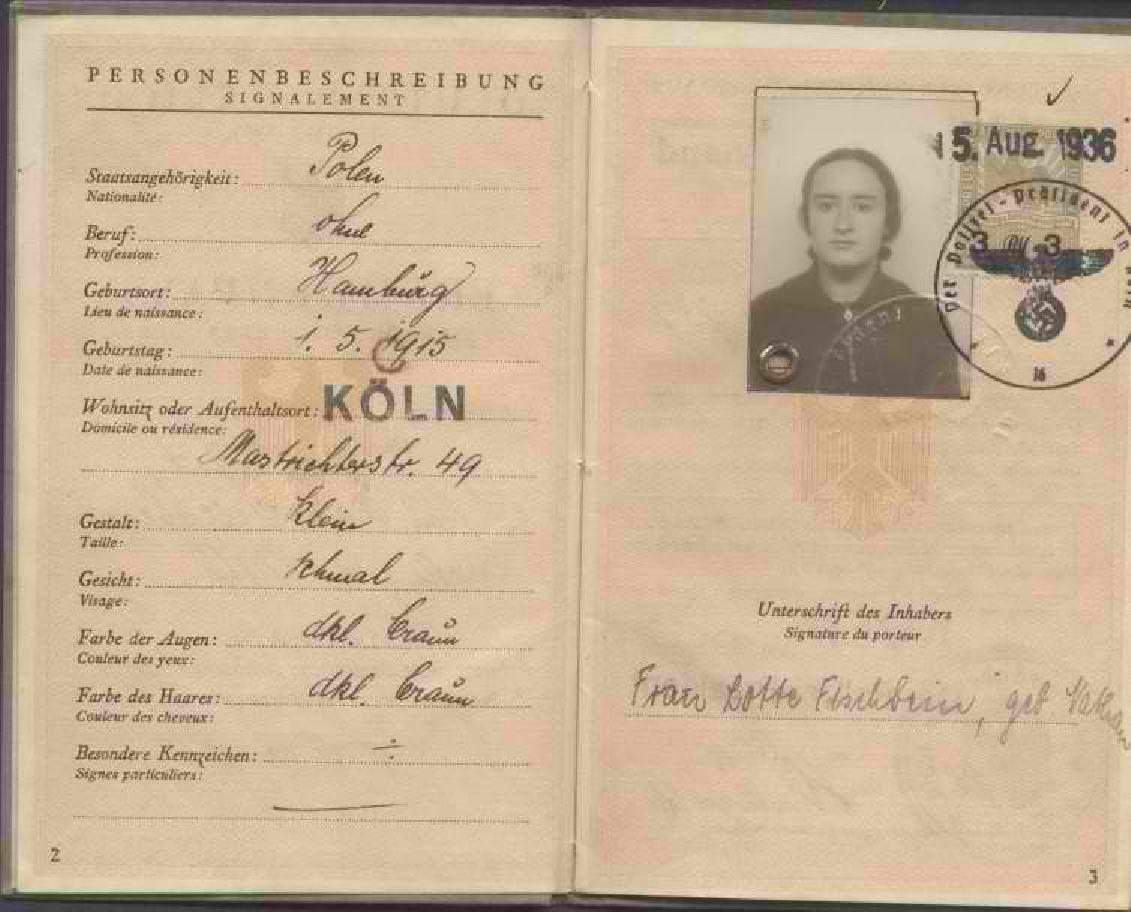
Emil and Lotte’s Palestine immigration documents also include Lotte’s passport,2 which was issued as a Fremdenpass, or a passport issued by the German government to non-Germans living in Germany. Lotte was not eligible for a regular German passport—either because she had married a “foreigner” or because she was Jewish. Jews whose citizenship had been revoked also were granted Fremdenpasses, not regular German passports.

Lotte’s passport was issued on August 15, 1931, from Koeln (Cologne), which suggests that she was living in the German state of North Rhine Westphalia in 1931, not in Hamburg where she was born and where her mother and stepfather had been living before going to the US. It also appears that Lotte’s father Hermann Nathan was not living in North Rhine Westphalia; he was born in Wittingen3 and in 1939 was living in Hildesheim, both of which are located in the German state of Lower Saxony. Emil, however, was born in Duisburg, which is in North Rhine Westphalia, so perhaps that is where they connected with each other.

By October 15, 1940, when Lotte and Emil obtained Palestinian citizenship, they were living in Haifa and had a son, Hanan, who was born on August 11, 1937, in Haifa.4 Through MyHeritage, I located one of their descendants to learn more about Lotte and her family. Gil is Lotte’s great-grandson; his grandfather was Hanan, the baby born in Haifa in 1937. He told me that family lore is that Lotte left Emil and Hanan when Hanan was a child and went to England with an English soldier.

Some trees on Ancestry and MyHeritage indicate that she married Ronald Francis George Buchanan and died in England in 1971. There is a death record on Ancestry for  Lotte Emma B. Buchanan born on May 1, 1915, the day Lotte Nathan was born; the index indicated that she died in the fall of 1971 in Nottingham, England.5 Another record on Ancestry indicates that she died on November 21, 1971, and was cremated in Nottinghamshire on November 24, 1971.6

Lotte Nathan Fischbein Buchanan had a family history and personal history that was difficult. Her grandmother Bertha Metz died from complications of childbirth just two weeks after giving birth to Lotte’s mother Bertha Katzenstein in New York. Bertha Katzenstein was then taken by her father Adolf to Germany, away from her mother’s family.

Then Lotte’s mother Bertha married Hermann Nathan and had Lotte in 1915, only to be divorced from Hermann in 1919 and to marry Friedrich Langebartels in 1921. In 1926 Bertha and Friedrich came to the US and were there at least long enough to file for US citizenship in 1927, leaving Lotte behind in Germany at eleven years old. I don’t know what happened to Bertha after 1927 or whether Lotte ever reunited with her mother.

We know that there is truth to the concept of generational trauma—how the traumas and tragedies suffered by earlier generations are passed down to the children, grandchildren, and so forth of those earlier generations. Bertha Katzenstein grew up without a mother and was taken from the US to Germany as a child by her father, far from her maternal relatives. We don’t know how that trauma affected her, but in some ways her daughter Lotte suffered a similar trauma when her mother Bertha divorced her father, remarried, and left Lotte behind after moving to the US with her second husband. And then Lotte inflicted a similar trauma on her son Hanan, leaving him behind when she remarried and moved to England.

How tragic it is that the scars of one generation can be so easily passed on to the later generations.


  1. Emil and Lotte’s application for citizenship in Palestine in 1940 was found at the Israel State Archives website, temporarily found at https://search.archives.gov.il/, after a cyberattack on their main site. 
  2. See Note 1, supra. 
  3. Hermann Nathan and Bertha Katzenstein marriage record, Year Range and Volume: 1913 Band 01, Ancestry.com. Hamburg, Germany, Marriages, 1874-1920 
  4. See Palestine immigration documents above. 
  5. Name Lottie Emma B Buchanan, Death Age 56, Birth Date 1 May 1915, Registration Date Oct 1971, [Nov 1971] [Dec 1971], Registration Quarter Oct-Nov-Dec, Registration District Nottingham, Inferred County Nottinghamshire, Volume 3c
    Page 1274, General Register Office; United Kingdom; Volume: 3c; Page: 1274, Ancestry.com. England & Wales, Civil Registration Death Index, 1916-2007 
  6. Name Lottie Emma Bertha Buchanan, Register Type Cremation, Death Date 21 Nov 1971, Burial or Cremation Date 24 Nov 1971, Burial or Cremation Place Nottinghamshire, Deceased Online; Kettering, England, UK; Deceased Online Burial Indexes, Ancestry.com. Web: UK, Burial and Cremation Index, 1576-2024 

Malchen Rothschild Rosenblatt’s Youngest Child, Siegmund

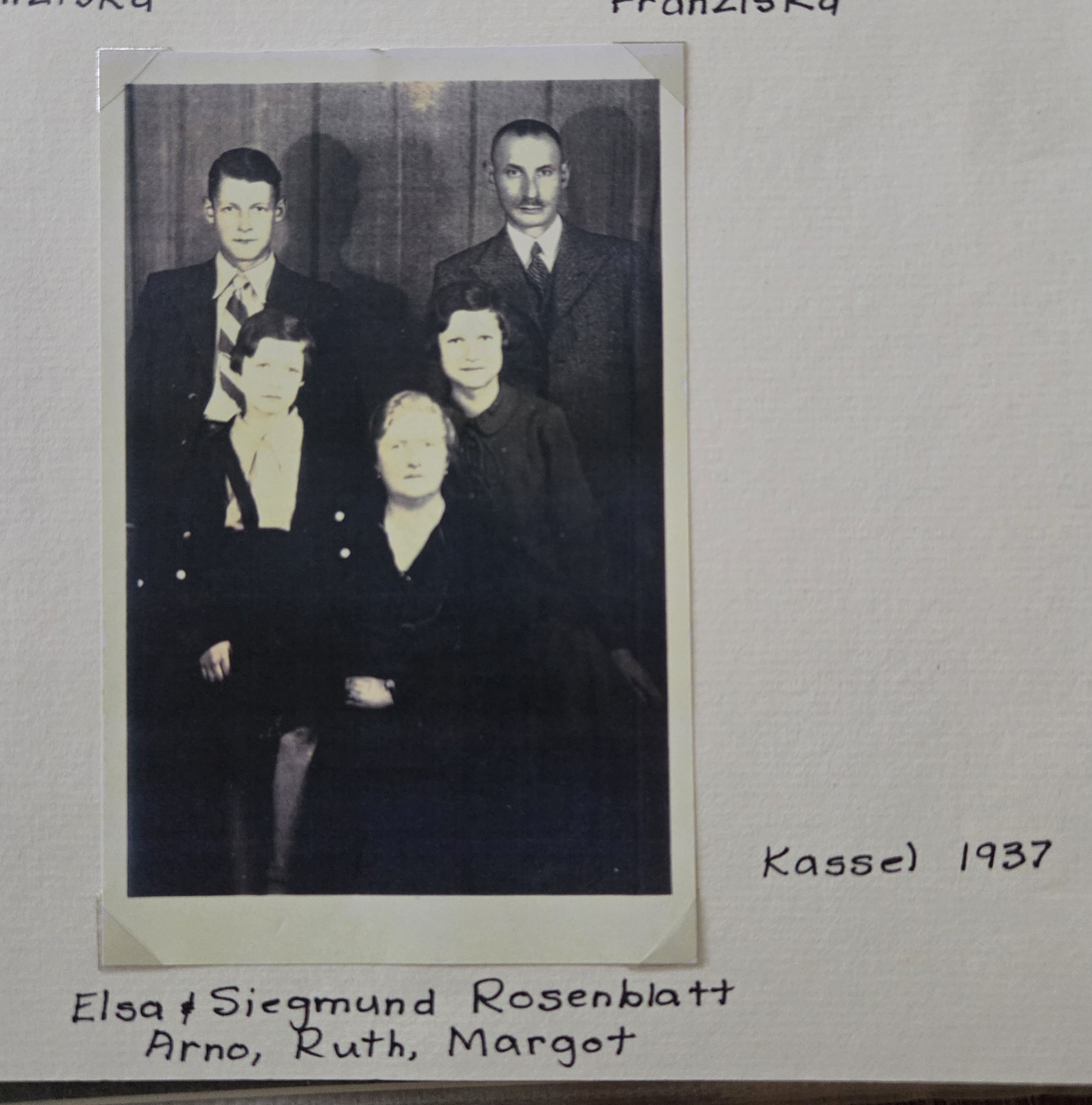
The other surviving son and the youngest child of Malchen Rothschild and Daniel Rosenblatt was their son Siegmund. Like his brother Felix, he escaped from Nazi Germany to Argentina with his wife Else Schwab and their three children, Arno, Ruth, and Margot.

I was very fortunate that Ellie Roden, a first cousin, once removed, of Siegmund’s wife Else, reached out to me through my blog. Ellie wrote that “Siegmund wanted all the family on both sides to leave Germany but before Kristallnacht many hoped and believed that the Nazi reign would end.”1 Unfortunately, as we have seen, Siegmund’s three sisters Julchen, Jette, and Auguste, did not heed that advice. According to Ellie, Siegmund, Else, and their children left Germany for Argentina in July 1937. They joined the same community, Colonia Avigdor, where Siegmund’s brother Felix had settled the year before. According to Siegmund’s great-niece Carmen, Siegmund and his family left Colonia Avigdor in about1955 and moved to Buenos Aires. After receiving compensation from the German government, they could afford to live in the city.2

Ellie shared these wonderful photographs of Siegmund and his family, first a photograph of Siegmund and Else and their children in 1937 before they left their home in Kassel, Germany:

Siegmund Rosenblatt and family in 1937, Kassel, Germany
Courtesy of Ellie Roden

This second photograph is undated, but is of Siegmund and Else. I assume it was taken in Argentina some years later.

Else Schwab and Siegmund Rosenblatt. Courtesy of Ellie Roden

The third photo may have been taken at the same event as the one above; it was taken in Buenos Aires:

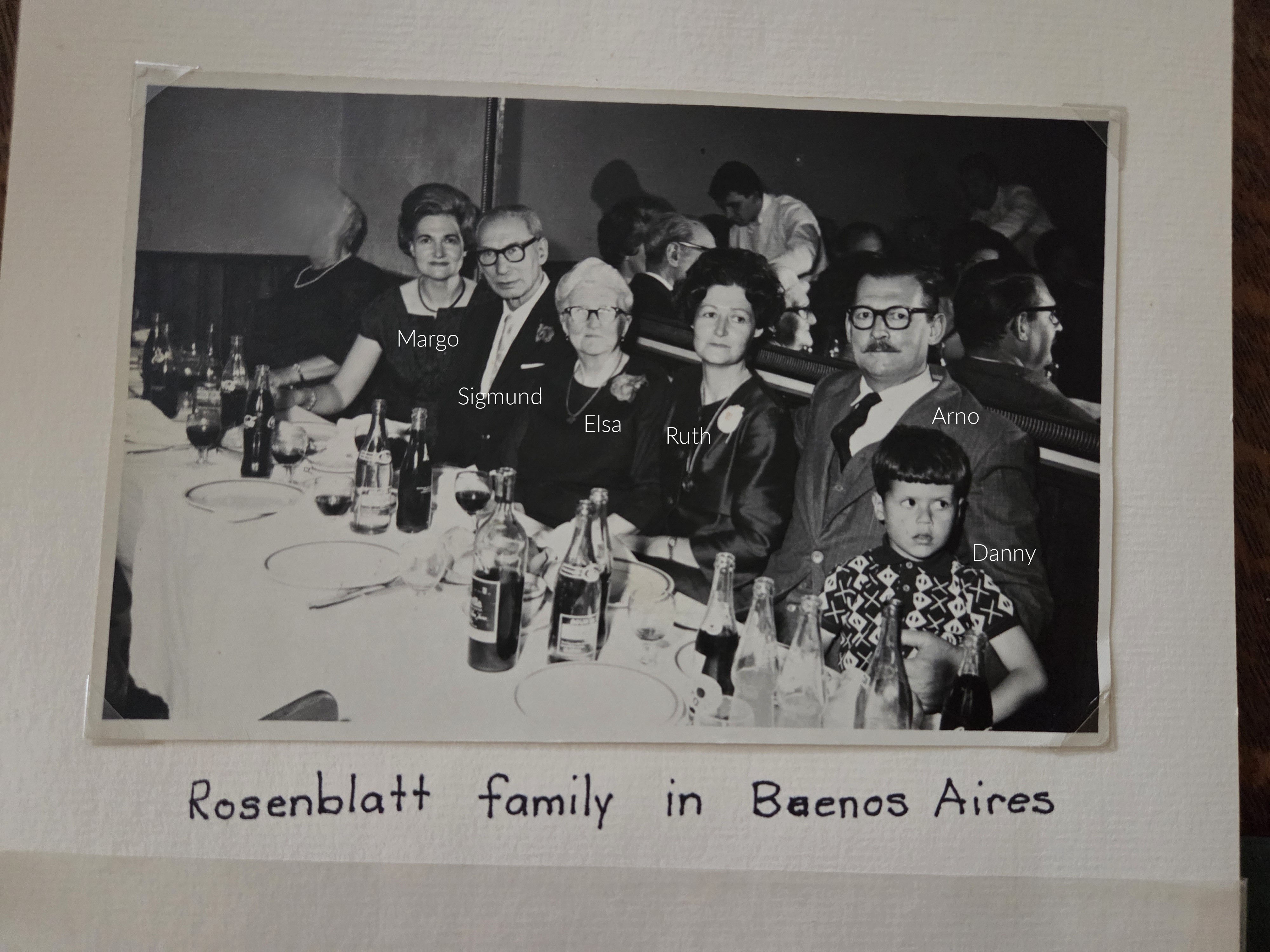
The Rosenblatt family in Buenos Aires: Margot, Siegmund, Else, Ruth, Arno, and Danny. Courtesy of Ellie Roden

I don’t have any records for the family’s life in Argentina, but Ellie was able to confirm that Arno, the oldest child, had a son named Danny, presumably named for his grandfather Daniel Rosenblatt; he must be the young boy in the photo above. Margot, the middle child, married someone named Kurt Oppenheimer; I don’t know whether they had children. And Ruth, the youngest child, may have married someone named Arno Kaufman. I don’t know whether they had children.

I was able to find burial records for Siegmund and Else and for two of their three children in the records for Argentina in the JOWBR at JewishGen.org. Siegmund died on November 3, 1982, and is buried in Buenos Aires.3 His wife Else died on August 11, 1984, and is buried in Buenos Aires.4 Their daughter Ruth Rosenblatt Kaufmann died on January 12, 1989, and is also buried in Buenos Aires.5 Finally, their son Arno Rosenblatt died on December 31, 2008, and is buried in Buenos Aires.6 I was not able to locate a burial record or any other record for Margot, but did locate one for her husband, Kurt Oppenheimer, which named her as his spouse. Kurt died on February 13, 2007, and is buried in the same cemetery as his in-laws.7

I am so grateful to my cousins Julio and Carmen and to Ellie Roden for sharing the photographs and information about the families of Malchen Rothschild Rosenblatt’s three sons, Felix, Julius, and Siegmund. Although the family of Malchen Rothschild and Daniel Rosenblatt suffered terrible losses during the Holocaust, it was uplifting to learn that there are still living descendants living in many countries around the world. I am so grateful for that.


I have now completed the stories of the children of Malchen Rothschild Rosenblatt and will move on to Malchen’s younger sister, Sara Rothschild Adler, and her family. But first a few updates on earlier posts.


  1. Email from Ellie Roden, August 13, 2025. 
  2. Email from Carmen Rosenblatt, September 17, 2025. 
  3. Burial record in the JOWBR database at JewishGen, found at https://www.jewishgen.org/databases/cemetery/jowbr.php?rec=J_ARGENTIN_0199329 
  4. Burial record in the JOWBR database at JewishGen, found at https://www.jewishgen.org/databases/cemetery/jowbr.php?rec=J_ARGENTIN_0199309 
  5. Burial record in the JOWBR database at JewishGen, found at https://www.jewishgen.org/databases/cemetery/jowbr.php?rec=J_ARGENTIN_0164434 
  6. Burial record in the JOWBR database at JewishGen, found at https://www.jewishgen.org/databases/cemetery/jowbr.php?rec=J_ARGENTIN_0199303 
  7. Burial record in the JOWBR database at JewishGen, found at https://www.jewishgen.org/databases/cemetery/jowbr.php?rec=J_ARGENTIN_0189236 

Malchen Rothschild Rosenblatt’s Descendants in the Colonia Avigdor in Argentina

As we saw, Malchen Rothschild and Daniel Rosenblatt’s daughters all were killed in the Holocaust. Their son Julius had died as a young man, leaving behind a young widow Julie Rosenblatt and their infant son Fredi. Julie and Fredi escaped to Uruguay, and thanks to Fredi’s son Julio, I’ve been able to learn and share much of their story.

Malchen and Daniel’s other two sons Felix and Siegmund escaped to Argentina, not Uruguay,1 and thanks to the magic of the internet, I am now in touch with Felix’s granddaughter in Argentina, Carmen. I found a photograph of the gravestone of Felix’s son Ludwig Rosenblatt (see below) on JewishGen and posted it on Tracing the Tribe, asking for a translation of the Hebrew inscription. A woman in the TTT group tagged Carmen when she saw my post, and Carmen, Ludwig Rosenblatt’s daughter, responded. Although Carmen doesn’t speak English and I don’t speak Spanish, we’ve managed to communicate, thanks to Google Translate and DeepL.

Carmen shared with me a lecture2 she delivered in 2018 to the Latin American Rabbinical Seminary about the community where her family has lived since 1936 when they immigrated from Germany to Argentina. It is in Spanish, and I’ve used DeepL to translate it and now will paraphrase and take excerpts from the translation to share the story of Carmen’s family and their community. Carmen also filled in other details through email.

As Carmen explained in her lecture, the German philanthropist Baron Maurice de Hirsch formed the Jewish Colonization Association (“JCA”) in the late 19th century to acquire land and create settlements in Argentina for Jews escaping persecution in Russia and Eastern Europe. When Hitler came to power in the 1930s, it became apparent that there was a need for more land and more places for German Jews to escape, so the JCA acquired additional land to create a new settlement called Colonia Avigdor, which is over 300 miles from Buenos Aires.

Thanks to the efforts of the JCA, Jewish families like Carmen’s were able to escape Nazi Germany. I asked Carmen what convinced her grandparents to leave Germany. She wrote that one night her grandfather’s car was confiscated by the Nazis in Zimmersrode, and when it was returned to him the next day, an official in the town told him: “Felix, this is getting very ugly for you Jews, take your family and leave Germany.” Felix replied, “How??? I have to sell my house, my things.” The official replied, “Leave everything, don’t sell anything… nobody is going to pay a Jew.” Felix contacted the JCA and asked for help to leave Germany and move to Argentina.

Carmen’s grandparents Felix and Minna (Goldwein) Rosenblatt and their sons were one of the ten families that first settled in Colonia Avigdor. They arrived in Buenos Aires, Argentina, with their sons Ludwig, then 17, and Siegfried, 20, and their daughter-in-law, Siegfried’s wife Jenny Feilmann, on January 25, 1936. As Carmen explained to me and in her lecture, because the JCA required a family to have five adults to qualify for the settlement program, Siegfried, although only twenty years old, had married Jenny at such a young age in order for the family to qualify.

After a few days in Buenos Aires, Felix, Minna, and their family traveled by train from Buenos Aires to Bovril, the closest train station to Avigdor. From there they traveled the last fifteen miles of the over 300 mile journey “by horse-drawn carts through trees and bushes in the woods along winding paths” to get to their new home. Carmen wrote that they were “full of hope that they would adapt to such a hard life and happy to set foot on land that promised above all FREEDOM and work to build a good future.”

Carmen’s description of their early lives cannot be paraphrased adequately; here is how DeepL translated her words:

Each of the settlers was allocated 75 hectares of land and a poorly constructed house made of mud-covered bricks with a dirt floor, two rooms, one kitchen, one veranda, and a bathroom at the back, about 10-15 meters away from the house. In each house, they found a bag of hard “cookies” (country bread), several days old… as well as some work tools, a few cows, some horses, some chickens… The next day, they got to work, first clearing the yards of wild trees, then the fields so they could plant them, building fences to divide them. It was very hard work, but as I said, they were happy because they had hope for progress. The women devoted themselves more to the tasks in the yard, tending to the chickens and other poultry, milking the cows for the milk they consumed, in addition to their household chores. They had to knead the bread in wood-fired ovens, whose mouths opened into the kitchen…

They say that at first, these women did these tasks crying practically all day (and at night too) because of the precarious conditions around them… there was no electricity, the lamps were kerosene… there were no refrigerators, no appliances whatsoever. And it should be emphasized that they came from an advanced civilization in Germany… Some, those who came from small towns, adapted more easily, but those who came from cities such as Berlin, Munich, Frankfurt, etc., of which there were many… found it extremely difficult, or simply could not get used to it…

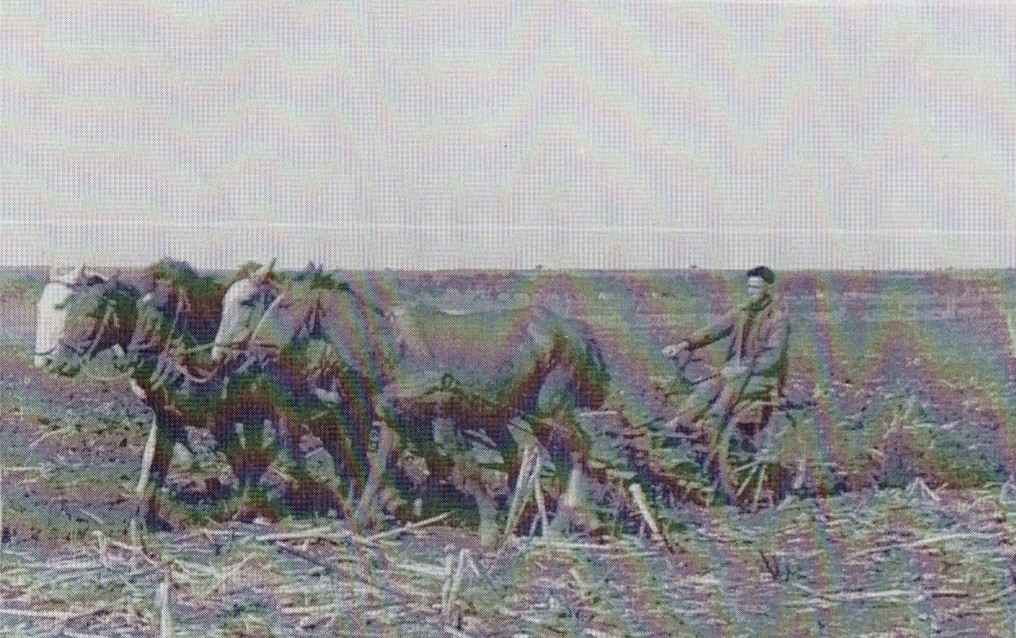
Colonists plowing the land
Courtesy of Carmen Rosenblatt

A colonist’s yard
Courtesy of Carmen Rosenblatt

Children coming to school
Courtesy of Carmen Rosenblatt

The community grew as more and more refugees came from Germany; eventually there were about 120 families. The settlers engaged in many forms of agricultural work: dairy, livestock, farming, gardening, and beekeeping. They established a cooperative to market their products. A school was established by the JCA, and there was a post office, a synagogue, a kosher butcher, and a Hebrew teacher. There was even a small hospital to provide health care to the settlers and a social center for dances, theaters, and orchestral performances. Land was also set aside for a cemetery.

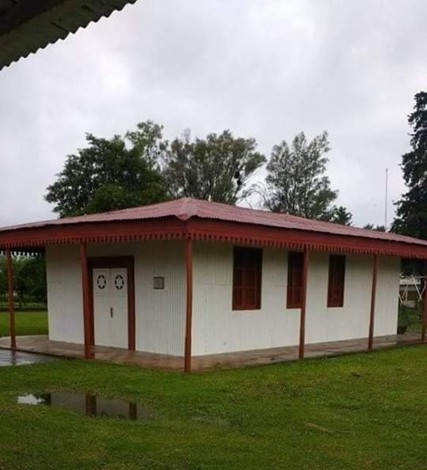
The synagogue in Colonia Avigdor
Courtesy of Carmen Rosenblatt

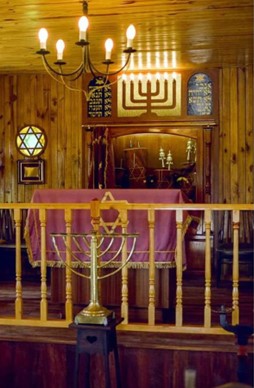
Interior of the synagogue
Courtesy of Carmen Rosenblatt

But conditions remained fairly primitive for a long time. It wasn’t until 1971 that there was electricity in the colony, and there were only dirt roads until 1987. Despite all these challenges, Felix and Minna and their children remained at Colonia Avigdor, working hard to achieve their dreams.

Their younger son Ludwig Rosenblatt married Ruth Plaut, another refugee from Germany, in 1944. They had two children, Carmen and her sister Alicia. Ludwig’s older brother Siegfried and his wife Jenny also had two daughters, Miriam and Lenore.

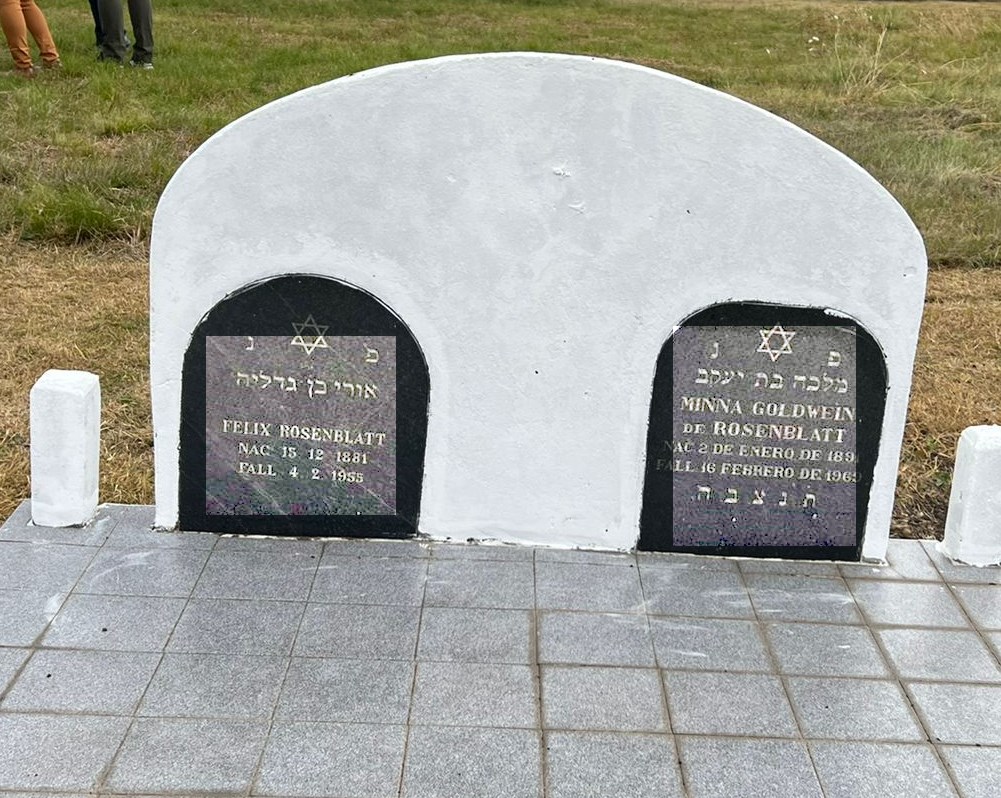
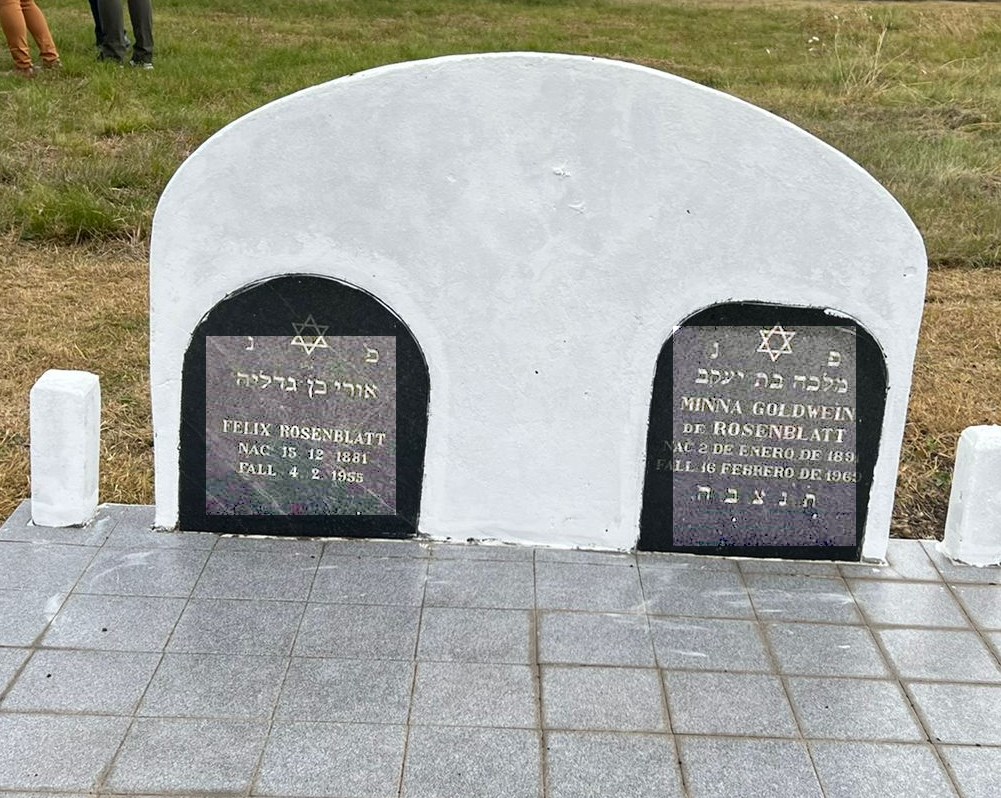
Felix Rosenblatt died on February 4, 1955, and is buried at the Centro Unión Israelita de Colonia Avigdor cemetery in Colonia Avigdor, Argentina, as is his wife Minna Goldwein Rosenblatt, who died on February 16, 1969. Here is a photograph of their gravestones.

Felix and Minna Rosenblatt headstones from JOWBR database, found at https://data.jewishgen.org/imagedata/jowbr/ARG-06046/WA0125.JPG

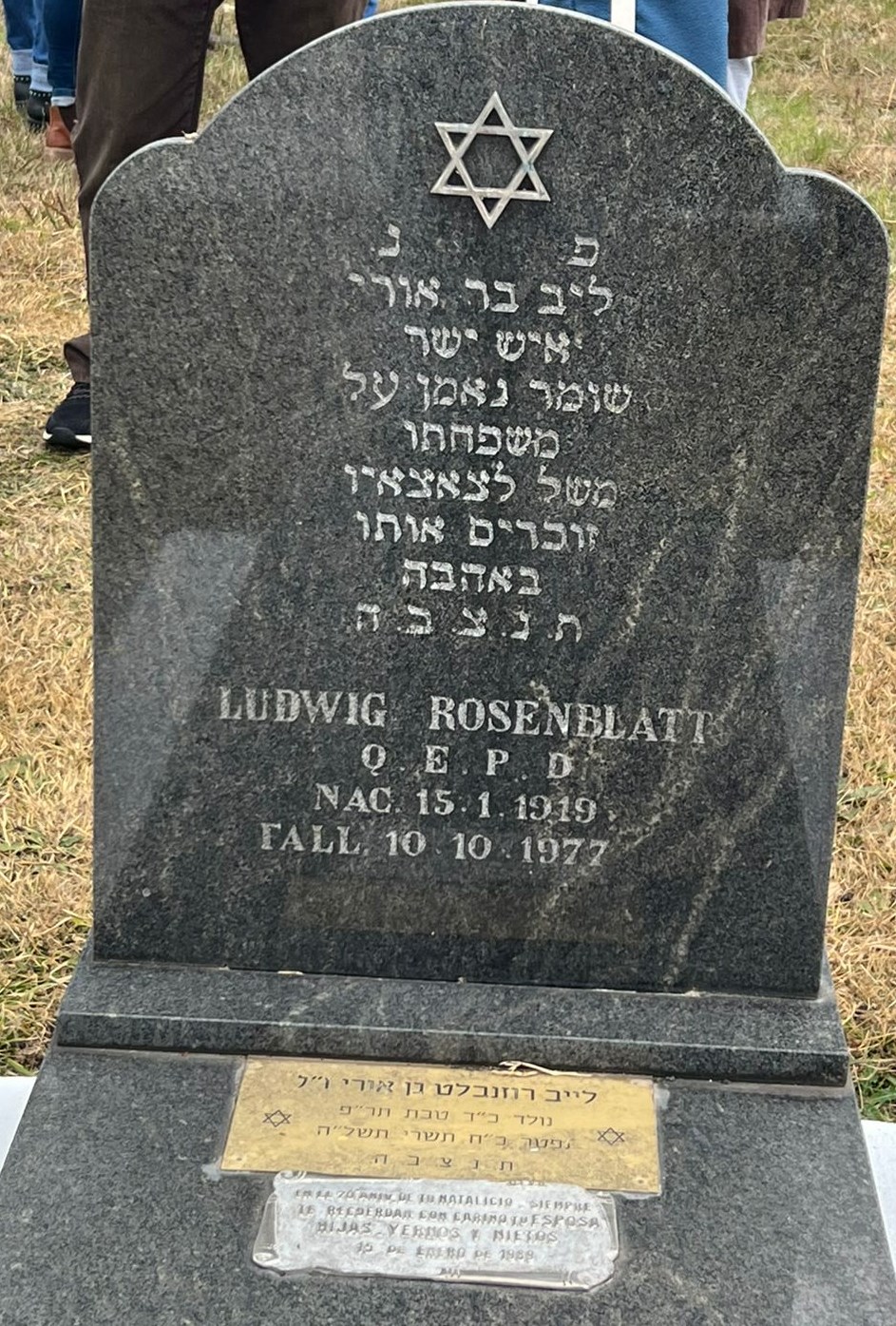
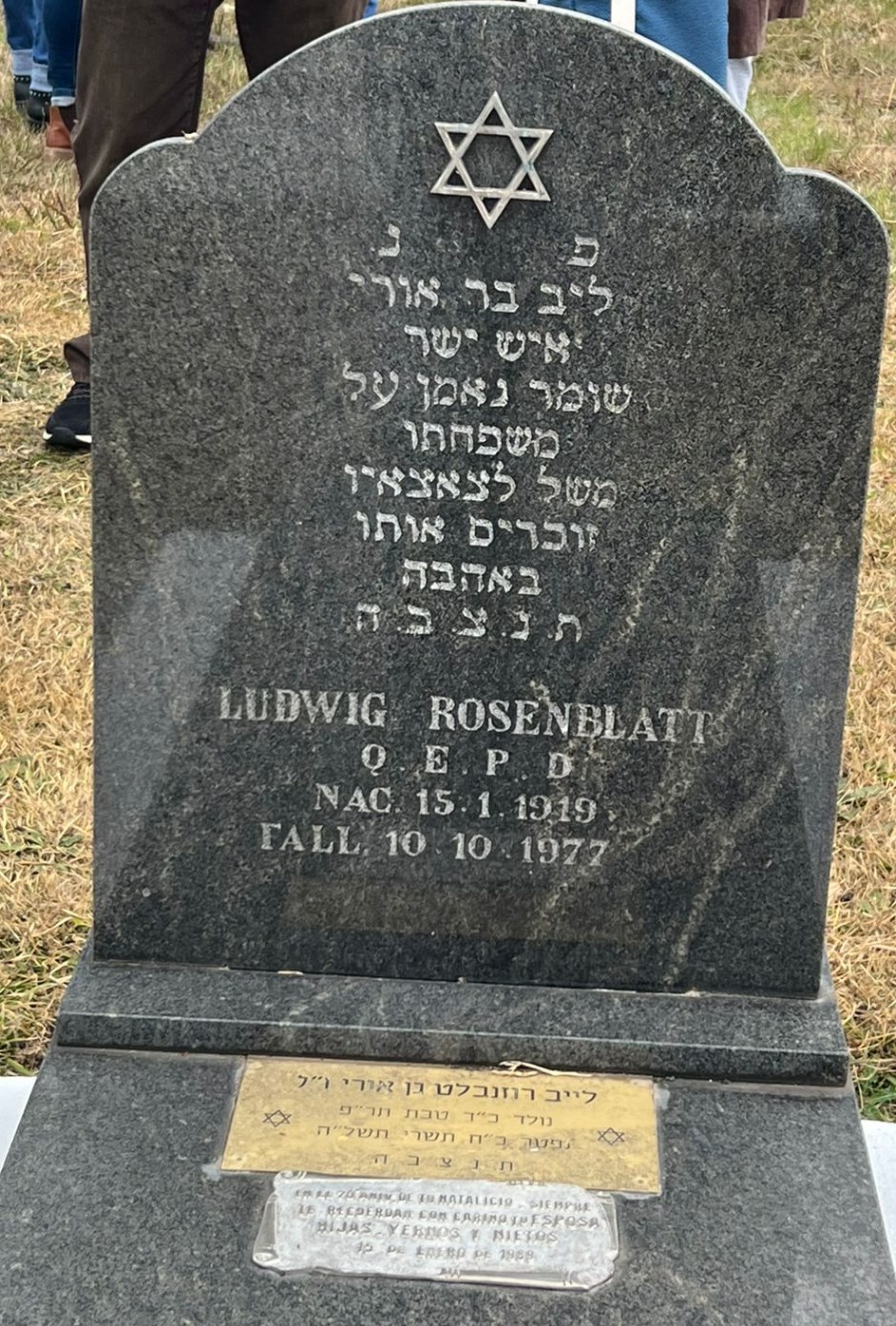
Their son and Carmen’s father Ludwig Rosenblatt died on October 10, 1977, and is buried at the same cemetery as his parents. He was only 57 when he died. As translated by the kind people at Tracing the Tribe, the Hebrew reads: “Here [lies] buried / Leib son of Uri / a reputable man / a faithful protector of / his family / an example for his descendants / [we] remember him with love / may his soul be bound in the bond of [eternal] life.”  The footstone engraving in Spanish mentions his wife, children, and grandchildren; it was placed there on the occasion of what would have been his 70th birthday on November 15, 1989.

Ludwig Rosenblatt headstone at JOWBR database, found at https://data.jewishgen.org/imagedata/jowbr/ARG-06046/WA0143.JPG

As for Siegfried Rosenblatt, Felix’s other son, he died on October 23, 2004, and is buried at Cementerio Israelita De San Vicente Cordoba, in Cordoba, Argentina; he was predeceased by his wife Jenny Feilmann who died on May 23, 1978, and is buried in the same cemetery.3 Their daughter Lenore, who was born on November 2, 1940, died on April 27, 2001.4

Carmen still lives in Colonia Avigdor with her husband Abraham Isaac Kogan, whom she married almost 58 years ago. They had two sons, one of whom passed away; the other still lives in Argentina, but not in Colonia Avigdor. Today there are only about twelve Jewish families left in Colonia Avigdor because many people left long ago to live in the cities. Carmen wrote, “These days, basic services such as electricity, water, roads, television, communications, etc. are practically comparable to those in cities… the precariousness has been overcome… but let’s not forget that since the founding of Avigdor in 1936, 82 years have passed… and the vast majority have left…”

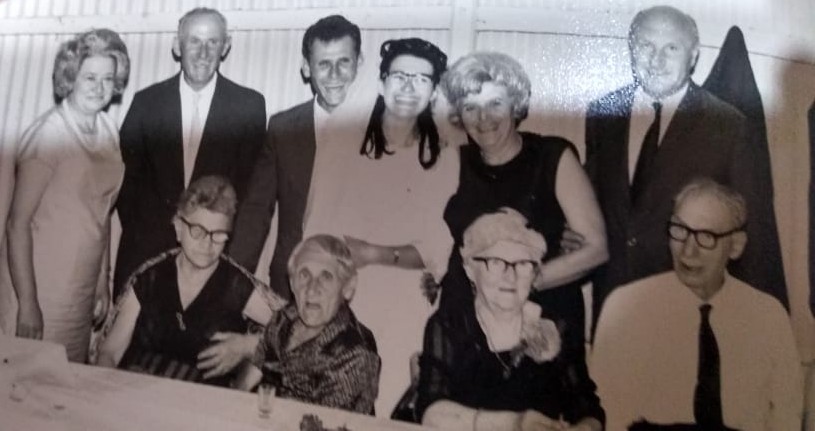
Carmen generously shared with me some photographs of her extended family. This photograph was taken at her wedding in 1967.

Photograph taken at Carmen Rosenblatt’s wedding to Abraham Kogan in 1967, courtesy of Carmen Rosenblatt. Standing from left to right: Ruth Plaut, Carmen’s mother; Ludwig Rosenblatt, Carmen’s father; Abraham Isaac Kogan; Carmen Alexander; Jenny Feilmann, wife of Siegfred Rosenblatt; Siegfried Rosenblatt, Carmen’s uncle Seated: Family friend,\; Minna Goldwein, Carmen’s grandmother; Else Schwab, wife of Sigmund Rosenblatt; Sigmund Rosenblatt, Carmen’s great-uncle.

This more recent photograph was taken in 1981 on the occasion of Carmen’s son’s bar mitzvah. I think it illustrates how Jewish traditions are similar all over the world. This photograph could have been taken at any bar mitzvah in the US in 1981, and it would have looked very much the same.

Abraham Kogan, Andres Kogan, Carmen Rosenblatt, Marcelo Kogan, 1981. Courtesy of Carmen Rosenblatt

Carmen’s story has given me a new perspective on the lives of those who escaped from Nazi Germany. It’s hard to imagine how they adapted to such a hard life—a precarious one, to use Carmen’s word. They were coming from a place where their ancestors had lived for centuries to a primitive place, far from any city, where people spoke a language they didn’t know, and they had to live according to the rules and subject to the authority of the JCA—and yet they were filled with hope and grateful for the chance to survive and live freely.

All this reminds me to be grateful for what I have and to empathize with all those around the world who are forced to abandon their homes in search of a safer and better life.


  1. Although they came from different villages in Germany and ended up in different countries in South America, the Rosenblatts in Uruguay and the Rosenblatts in Argentina have stayed in touch and even visited each other over the years. Julie Rosenblatt was a first cousin to Felix and Siegmund as well as their sister-in-law. 
  2. Carmen Rosenblatt, unpublished lecture, “Immigracion de Judio Perseguidos en Alemania, Colonizados en Los Campos de Colonio Avigdor (Entre Rios),” (September 2018). 
  3. See burial records at the JOWBR database at JewishGen, found at https://www.jewishgen.org/databases/cemetery/jowbr.php?rec=J_ARGENTIN_0036804 and at https://www.jewishgen.org/databases/cemetery/jowbr.php?rec=J_ARGENTIN_0036805 
  4. See burial records at the JOWBR database at JewishGen, found at https://www.jewishgen.org/databases/cemetery/jowbr.php?rec=J_ARGENTIN_0071081 

Zooming with My Cousin Julio Rosenblatt in Uruguay

Since it’s been a while since I wrote about the Blumenfeld clan, let me recap where I was. I was writing about the family of Malchen Rothschild, the ninth child of Gelle Blumenfeld and Simon Rothschild. Malchen and her husband Daniel Rosenblatt had seven children, one of whom died as a child (Betti) and one, Julius, who died in 1920 as a thirty-six year old newlywed whose wife Julie Rosenblatt had just recently given birth to their son, Manfred or Friedel/Fredi (hereinafter “Fredi.”)

Thus, when Hitler came to power in 1933, there were five living children of Malchen and Daniel: their daughters Julchen, Jette, and Auguste, and their sons Felix and Siegmund. Also living was their daughter-in-law Julie and their grandson Manfred/Fredi.

But as we saw, the three daughters were all killed by the Nazis as were some of their family members. Fortunately their two sons and their daughter-in-law Julie survived as did two of the children of Auguste. And that is where we will now pick up.

As I wrote in my last post about this family, I was able to find a descendant of Julius and Julie Rosenblatt, their grandson Julio, named for his grandfather Julius. I finally had a chance to zoom with Julio on September 10, and he was able to fill me on on the story of the surviving branches of Malchen and Daniel’s family.1

As noted above, Julio’s father Fredi was born just three months before his father Julius Rosenblatt died in December 1920. I asked Julio how his grandmother Julie Rosenblatt (wife and first cousin of Julius) coped with raising a baby without her husband. Julio told me that after Julius died, his grandmother moved from Zimmersrode where they’d been living back to Beisefoerth where her father and two of her brothers were still living. Julie and Fredi lived with them and, as Julio said, she not only raised her son but also took care of her father and brothers.

Here is a photograph taken in about 1931 of Fredi and some of his cousins in Beisefoerth. Fredi is the boy in the front, “driving” the motorcycle. The motorcycle belonged to his uncle Ferdinand Rosenblatt, his mother’s brother.

Lothar Rosenblatt, Claire Rosenblatt, Doris Rosenblatt and Fredi Rosenblatt on the motorcycle of Ferdinand Rosenblatt at Beiseförth in about 1931, 1932. Courtesy of Julio Rosenblatt

Once Hitler came to power, the family experienced antisemitism. When Fredi was fourteen or fifteen years old, boys threw rocks and apples at him. After Kristallnacht, Julie knew it was time to leave Germany.

This is a photograph of Fredi taken in Beisefoerth in 1938 the day before he left Germany.

Fredi Rosenblatt c. 1938 Courtesy of Julio Rosenblatt

Julio explained how his grandmother Julie and father Fredi ended up in Uruguay. Julie’s brother Ferdinand Rosenblatt had a sister-in-law, his wife Flori’s sister, who owned a well-known cafe in Frankfurt called Cafe Falk. The Uruguay Consul General Florencio Rivas was a regular customer at the cafe, and after the Nuremberg Laws were enacted, he offered to help the family get visas to immigrate to Uruguay.

Florencio Rivas not only helped the Rosenblatt family; he helped hundreds of German Jews survive the Holocaust. As The New York Times reported:2

While serving as consul general in Germany, Rivas harbored more than 150 Jews on embassy grounds during Kristallnacht in 1938, when Nazi-inspired mobs attacked synagogues and Jews. He then issued them all passports and visas ensuring passage to Uruguay.

Ferdinand Rosenblatt and his wife and son were the first Rosenblatts to leave Germany and go to Uruguay. Fredi left in 1938, and after Kristallnacht in November 1938, Julio’s grandmother Julie Rosenblatt joined them in Montevideo, Uruguay.

This photograph is of Ferdinand Rosenblatt and his wife Flori Goldschmidt. In the middle is their niece, Martha Rosenblatt.

Ferdinand Rosenblatt, Martha Rosenblatt, and Flory Goldschmidt. Courtesy of Julio Rosenblatt

I asked Julio about the family’s transition from Germany to Uruguay, and he told me that Uruguay has always been a very open and accepting country to immigrants. As The New York Times commented:3

Unlike Argentina and many other Latin American countries, Uruguay has been a liberal, secular democracy for much of its history. It became a republic in 1830 and has remained one, with the exception of right-wing dictatorships in the periods of 1932-38 and 1973-85. It separated church and state in 1917. And by 1890, it had enacted a ”policy of the open door,” encouraging immigration by issuing visas free of charge and even providing a hostel for new arrivals.

Julio said that his grandmother quickly found work as a maid in Montevideo and that his father Fredi worked making tapestries to cover furniture. They were welcomed and did not encounter any antisemitism. Julio clearly loves his country and feels deeply grateful that Uruguay took in his grandmother, father, and other relatives and gave them a place to be safe and to prosper.

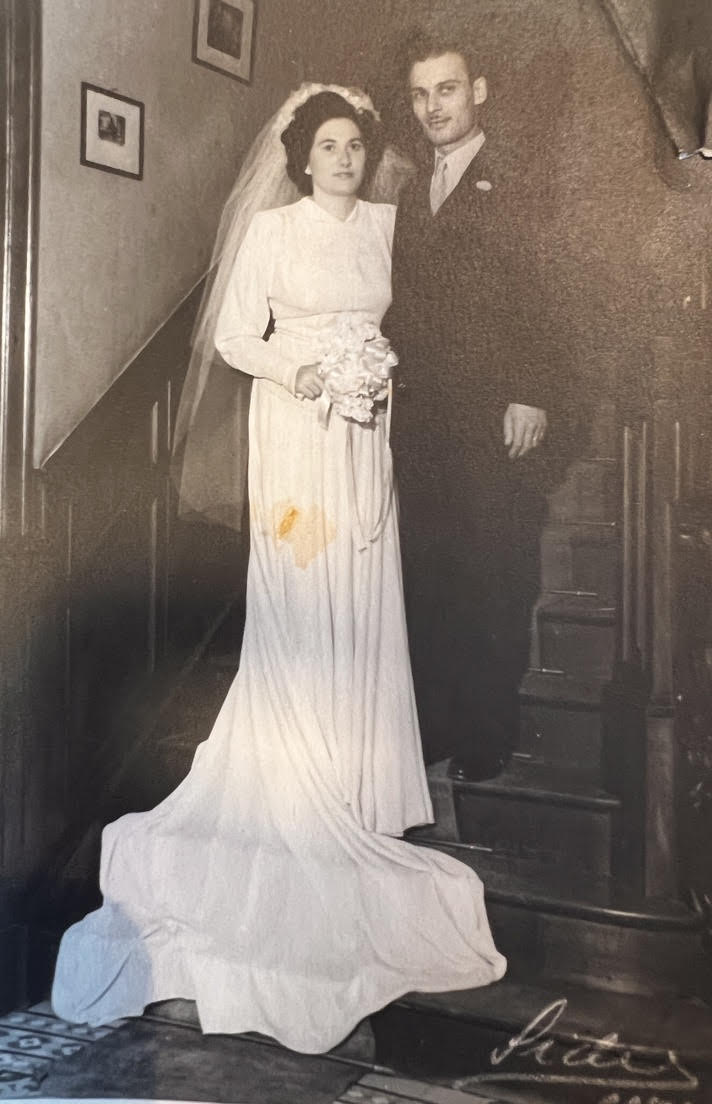
Fredi Rosenblatt married Erika Katz in 1949 in Uruguay. Here they are on their wedding day:

Erika Katz and Friedel Rosenblatt on their wedding day in 1949. Courtesy of Julio Rosenblatt

Erika Katz and Fredi Rosenblatt on their wedding day in 1949. Courtesy of Julio Rosenblatt

wedding of Fredi Rosenblatt and Erika Katz 1949. Courtesy of Julio Rosenblatt

Julio was the only child of Fredi Rosenblatt and Erika Katz. Here is a photo of him with his parents, taken in 1954.

Fredi Rosenblatt, top; Julio Rosenblatt and Erika Katz, bottom. Courtesy of Julio Rosenblatt

Julio is married to Ana Bogacz, and they have two children. This photograph is of Ana with her daughter Beatriz and Julio’s grandmother, Julie Rosenblatt Rosenblatt.

Ana Bogacz, Beatriz Rosenblatt, and Julie Rosenblatt Rosenblatt, in 1976. Courtesy of Julio Rosenblatt

Julio and Ana have two children. One lives in Uruguay and and the other in England. They also have three grandchildren, one in Uruguay and two in England. So Julius Rosenblatt, who died when his son Fredi was just a baby, and his wife, Julie Rosenblatt, have living great-grandchildren living across the world because Julie Rosenblatt Rosenblatt was smart enough and strong enough and lucky enough to leave Germany when she did.

Thank you to my cousin Julio for sharing his stories and these amazing photographs of his family. I am so glad we connected!


  1. The information about Julie Rosenblatt and her family in this post almost all came from her grandson Julio Rosenblatt during a Zoom on September 10, 2025. 
  2. Samuel Freedman, “A Treasure Hunt for Lost Memories,” The New York Times, August 16, 2003, p. A 15. 
  3. Ibid. 

What I Learned From My Great-Great-Grandmother’s Will

I am back from a break after a great visit with our kids and then a week to recover! Before I return to the story of the family of Malchen Rothschild (as I am still waiting to speak with her great-grandson Julio), I have an update about how I discovered my great-great-grandmother’s will.

Earlier this summer Teresa of Writing My Past wrote about full-text searching on FamilySearch. I had never known about this tool but was tempted to see what I could find. I followed the link that Teresa provided on her blog and entered “John Nusbaum Cohen” to see what would come up.

Lo and behold, it immediately retrieved what turned out to be the last will and testament of my great-great-grandmother Frances Nusbaum Seligman. Frances was the daughter of John Nusbaum, my three-times great-grandfather, and the wife of Bernard Seligman, my great-great-grandfather—-two of my pioneer ancestors who came to the US as young men from Germany in the mid-19th century. Both John Nusbaum and Bernard Seligman became successful merchants, John in Philadelphia and Bernard in Santa Fe. But neither came here as a wealthy man.

So I was amazed when I read this will to see just how much property—-jewelry, cash, and other property—Frances owned at the time of her death in Philadelphia on July 27, 1905. She was only 59 when she died, and she left behind three surviving children (two had died before adulthood): my great-grandmother Eva Seligman Cohen and her brothers James Seligman and Arthur Seligman. In addition, Frances had siblings and grandchildren, all of whom are named in her will, as well as other family members and friends.

There  were two inventories of Frances’ property. The bulk of her property was inventoried in September 1905 and included stock, cash, jewelry, and other personal items.1

The total value of these properties came to $17,180.43, or approximately $617,000 in today’s dollars. Of course, many of these items, especially the jewelry, may have appreciated far beyond the value they had in 1905 and beyond what the inflation calculators consider.

The second inventory was of Frances’ kitchenware and dishware:


The value of these goods was appraised in 1906 as $247.55. In today’s dollars that would be approximately $9000.

The documents do not include any appraisal of any real estate although, as we will see, Frances owned some real estate in Santa Fe.

Frances’ will detailed with great specificity where all this personal and other property was to go. Her original will is eight typed pages plus there is a one page handwritten codicil. I loved reading this will because it names so many of the relatives I’ve written about on my blog. It was fascinating to see how inclusive Frances was in deciding who would get portions of her estate. The following images are the pages from the will with my comments about some or all of the provisions on that page.

In the Third Clause below, Frances divided $1250 among her four siblings. But Simon, Julius, and Miriam each got $250 whereas Lottie received $500. Did she love Lottie more than the others? Or did Lottie have greater need? Lottie never married, so unlike Miriam who had a husband to support her and Simon and Julius who were men, Lottie may in fact have had greater need.

There is a similar seemingly favorable bias in terms of Frances’ distribution to her three living children, Eva, James, and Arthur. Eva was to receive all of her mother’s linen and wearing apparel. Well, I guess the sons couldn’t wear her clothes. But then in the Fifth Clause above, Frances bequeathed a whole lot of jewelry to Eva: “my diamond bracelet, my diamond star with chain attached thereto, my watch studded with diamonds, one of the large diamonds from my thirteen stone diamond ring, my set of silver containing one dozen knives, one dozen large spoons, one dozen small spoons, one large soup ladle and one dozen silver forks.”

What did James get? “One diamond from my thirteen stone diamond ring and a silver coffee pot.” And Arthur: “the other large diamond from my thirteen stone diamond ring, and a silver coffee pot.”

Wow, did they get shafted or what! Even Emanuel Cohen, my great-grandfather and Eva’s husband, got “the centre diamond in my diamond cluster pin.” And he was married to Eva, who was already getting all those diamonds!

Frances then gave other jewelry items to her daughters-in-law and to her grandchildren. My grandfather John Nusbaum Cohen got “four stones from my diamond cluster pin.”

The will goes on to identify specific pieces of jewelry for other family members—aunts, uncles, nephews, nieces, brothers-in-law, and even August Seligman, the younger brother of Bernard Seligman, a brother who never left Germany. Did August get the “silver knife, fork and spoon marked S.S.”? Perhaps his great-grandson Wolfgang knows. I will have to ask him.

And then at the end of that Fifth Clause below, the will provides, “All the remainder of my jewelry, not otherwise disposed of by this will, it is my desire that my daughter, Eva May Cohen, distribute as she may see proper.”

Before I go on, I need to point out that I do not have one piece of jewelry or anything else that once belonged to Frances Nusbaum Seligman, my great-great-grandmother. Not one thing. Even though all those diamonds were bequeathed to my great-grandmother Eva Seligman Cohen, I have no idea where they went once Eva died. She raised my father and his sister from the time they were quite young when both their parents were hospitalized, yet my father did not have one thing—-not one spoon or even a coffee pot—-that had belonged to his beloved grandmother. I have no idea where it all went. Perhaps it was sold during the Depression. Perhaps the other three grandchildren of Eva Seligman Cohen received it, but that seems unlikely. In any event, it’s gone.

Having cleared the air on that, I am now looking at the Sixth Clause (see above). It provides in part for a $3000 trust for Frances’ mother Jeanette Dreyfus Nusbaum, my three-times great-grandmother, who was still living when Frances drew up this will in 1905. I love that Frances provided for her mother and even specified that she receive ten dollars on her birthday (May 20) and five dollars at the Jewish New Year in addition to the ten dollar regular monthly payments under this provision. It shows me how caring Frances was and also how much being Jewish was still an important part of the family’s life. Jeanette was 87 when the will was executed, and she outlived her daughter Frances, dying on January 12, 1908, at the age of 90.

There are then several bequests to various charitable organizations, and then we come to the Eleventh Clause (below), in which Frances requires that a trust be created from fifty shares of her stock in Seligman Brothers in Santa Fe, the dividends from which were to be paid to “my daughter Eva May Cohen, for and during her natural life, for her sole and separate use, not to be in any way or manner whatever liable to the contracts, debts, or engagements of her husband.” I am so impressed that Frances had the wisdom to set aside money that would be only for her daughter and not under the control of Eva’s husband. How progressive is that!

The provision further provides that Eva’s children would inherit that stock upon her death as well as Eva’s brothers James and Arthur. Sadly, Seligman Brothers itself did not survive long enough to benefit those beneficiaries as it closed for business by 1930.

Nevertheless, once again Frances favored Eva in the will.

The Twelfth Clause refers to a house and lot in Santa Fe to be shared by all three of Frances’ children. (I don’t see that property included in the inventories mentioned above so the estate was worth more than estimated above.) In 1904 when Frances executed this will that was the location of the oldest hotel in Santa Fe, the Exchange Hotel. I have no idea what it was worth at that time, but it certainly added something substantial to the overall value of Frances Nusbaum Seligman’s estate.

Below are the final provisions in the original will.

There is also a handwritten codicil to the will dated February 18, 1905. It includes additional specific bequests of various items of personal property and also provides that $200 was to be given to Congregation Keneseth Israel for the purpose of “placing the names of my husband Bernard Seligman and my own, together with the dates of our respective deaths, upon the memorial tablet on the North-East Wall of the Synagogue.” We all want to be remembered, don’t we?

I wrote to Congregation Keneseth Israel, now located in the suburbs of Philadelphia, asking about my great-great-grandparents’ plaque, and I was quite moved and relieved to learn that it still exists on their memorial wall in their suburban location. Their executive director Brian Rissinger kindly sent me this image of the plaques:

Finding this will was such a gift. It gave me insights into my great-great-grandmother Frances Nusbaum and her relationships with her children, grandchildren, siblings, and others. And it reminded me how extraordinary her life was—-growing up as the daughter of a successful merchant in Philadelphia only to fall in love with a young immigrant from Germany who had lived in Santa Fe. After marrying him and having four children in Philadelphia, she moved with him and their children to Santa Fe, living in what was then a small but growing pioneer town with very few Jews and even fewer Jewish women. And her will demonstrated that she cared deeply about her Jewish identity. She must have been so resilient and so devoted to make that adjustment to life in Santa Fe. I wrote about Frances and Bernard in my family history novel, Santa Fe Love Song for anyone who wants to know more about them..

Frances was described in her obituary in these terms:

“She was a beautiful and accomplished woman, as good as she was beautiful and as beautiful as she was good, and of a most lovable and gentle disposition. She was an exemplary wife, a fond and good mother, and a dutiful and loving daughter. Indeed she was all that is implied in the phrase ‘a thoroughly good and moral woman.’ … She will be especially remembered by the poor people of [Santa Fe], to whom she was particularly kind. Many and many truly charitable deeds have been put to her credit.”

Everything in her will reflected those same qualities.

I was deeply touched by the relationship between Frances and her daughter Eva, my great-grandmother. Frances had lost two daughters; her daughter Florence had died when she was just a month old, and her daughter Minnie had died when she was seventeen. Thus, Eva, her first born child, was her only surviving daughter, and that must have made Frances cherish her even more.

That Eva was deeply loved by her mother also sheds light on the woman she became. In learning about Eva from my father and from my research, I grew to appreciate what a strong and compassionate woman she was. Like her mother Frances, she lost one son as a baby and a second son predeceased her by committing suicide. Like her mother, Eva was uprooted from Philadelphia to Santa Fe, but returned to Philadelphia for college and lived the rest of her life there after marrying my great-grandfather Emanuel Cohen. Being so far from her parents and brothers back in Santa Fe must have been as difficult for her as it had been for her mother to leave her family behind in Philadelphia to move to Santa Fe.

Despite all those losses and difficulties, Eva clearly had a big heart. She took a widowed brother-in-law and his son into her home for many years, she took her parents into her home when they returned to Philadelphia to retire, and, most importantly to me, she took my father and aunt into her home and provided them with comfort, love, and security when their parents were unable to care for them.

The love between Frances and Eva, between mother and daughter, shines through in this will. And I am so grateful to Teresa for alerting me to the full-text search on FamilySearch so that I could find it.


  1. All the documents included in this post were located using the full-text search on FamilySearch. They are cited there as follows: Philadelphia, Philadelphia, Pennsylvania, United States records,” images,
    FamilySearch (https://www.familysearch.org/ark:/61903/3:1:S3HT-D4WP-CQ?
    view=fullText : Aug 30, 2025), images 189-206 of 315. 

Malchen Rothschild Rosenblatt, Part III: How I Found Her Great-Grandson Julio

Although the three daughters of Malchen Rothschild and Daniel Rosenblatt were all murdered in the Holocaust, their two surviving sons Felix and Siegmund were able to escape Nazi Germany as was their daughter-in-law Julchen Rosenblatt Rosenblatt, the widow of their son Juda/Julius.

I did not have a great deal of information about Felix or Siegmund because they escaped to Argentina, and I have limited resources for research there. I could not find them or their children on the CEMLA website for ships going to Argentina. All I had were burial records for some of them from the Jewish Online Worldwide Burial Registry (JOWBR) at JewishGen.org.

But some of the bricks in this wall crumbled a bit. In looking at the Pages of Testimony for Thekla Rosenblatt and Julie Rosenblatt Wolf, I noticed that both were filed by someone named Julio Rosenblatt. No relationships were given by the submitter, and I had no one in my tree with that name. Julio submitted the pages fairly recently–in 2017–and he lived in Montevideo, Uruguay.

Thekla Rosenblatt page of testimony, found at https://collections.yadvashem.org/en/names/13324460

Julchen Rosenblatt Wolf page of testimony, found at https://collections.yadvashem.org/en/names/13324463

So I googled his name and found two links that helped me figure out who he is and how is he related to the other Rosenblatts and to me. The first page I found was an interview with Julio Rosenblatt of Uruguay that revealed that Julio is the author of several children’s books in the “Max y sus desafíos” series (translated either as Max and His Questions or Max and His Challenges). The books tell the story of Julio’s family in Nazi Germany. “Max” is Julio’s middle name, and he was named in memory of his grandmother’s brother Max. But who was his grandmother? The interview did not reveal.

So I kept digging. And then I found the second website about Julio Rosenblatt, Judische Leben in Beisefoerth, or Jewish Life in Beisefoerth, which was the town where Daniel Rosenblatt was born and where the first two of Daniel and Malchen’s children were born. Seeing that confirmed that I was on the right track. The website had a detailed telling of Julio’s trip to Beisefoerth and his search for his family history there. And from that page I learned Julio’s ancestry and how he is related to me. The page describes his trip to the Jewish cemetery in Haarhausen with Hans Peter Klein, the same man who took me there in 2017. This is what they saw there (see photo accompanying quote below):

Five generations of Julio Rosenblatt’s ancestors from Zimmersrode and Waltersbrück are buried there; the oldest grave of his four-times [sic] great-grandfather, Simon Rothschild from Waltersbrück, dates back to 1811. Julio and his wife Ana were particularly touched by the grave of his grandfather Julius Rosenblatt, who died in 1920 at the age of just 36 and just a few months after the birth of Fredi Rosenblatt, Julio’s father.

Now I know exactly who Julio is. He is my fifth cousin, the four-times great-grandson of Abraham Blumenfeld I and Geitel Katz, my four-times great-grandparents. His father was the baby born to Julius Rosenblatt and Julie Rosenblatt, Manfred; his great-grandmother was Malchen Rothschild Rosenblatt, his great-great-grandmother was Gelle Blumenfeld Rothschild, his great-great-great-grandfather was Moses Blumenfeld I, the older brother of my great-great-great-grandmother Breune Blumenfeld Katzenstein.

Julio’s paternal grandmother was Julie Rosenblatt, the widow and first cousin of Julius Rosenblatt. And Julie had a brother Max Rosenblatt who was killed in the Holocaust and became the name of the character in Julio’s books. But Julie survived and immigrated to Uruguay with her son Manfred (or Fredi), and Julio was born there.

I have gotten in touch with Julio and learned more about the Rosenblatts who survived the Holocaust in South America. Once again connecting with a cousin has allowed me the privilege of better understanding and appreciating my family history.

On top of that, a cousin of Sigmund Rosenblatt’s family, Ellie, found me through the blog, and she has been updating me on that branch of the family.


To be continued in September. My family will be visiting for the next two weeks, so I will see you after Labor Day!


Malchen Rothschild Rosenblatt, Part II: Who Shall Live and Who Shall Die

Of the five children of Malchen Rothschild and Daniel Rosenblatt who were still living when Hitler came to power in 1933, only two survived, the two sons Felix and Siegmund. Their three daughters—Julchen/Julie, Jette/Thekla, and Auguste–were all murdered by the Nazis.

Julchen/Julie and her husband Max Wolf were first deported from Kassel to the Riga ghetto on the December 9, 1941, transport that had deported so many other Rothschild family members. Julie and Max were then deported from Riga to Auschwitz on November 2, 1943, where they were murdered. Since their only child Edgar had died as a toddler, they had no direct descendants.

Julie Rosenblatt Wolf page of testimony, found at https://collections.yadvashem.org/en/names/13324463

Jette/Thekla Rosenblatt was also on the December 9, 1941, transport to Riga, where she did not survive. Since she had never married or had children, she also had no direct descendants.

Thekla Rosenblatt page of testimony, found at https://collections.yadvashem.org/en/names/13324460

Auguste’s husband Samuel Roth died on February 15, 1935, in Breitenbach. He was 52 years old.1 Auguste unfortunately had to face Nazi persecution without him. She was deported to the Sobibor death camp on June 1, 1942, and killed there two days later on June 3, 1942.

As for the four children of Auguste and Samuel, I only have the following information:

Irma Roth married Alfred Moses on December 19, 1934, in Berlin.

Irma Roth and Alfred Moses marriage record, Landesarchiv Berlin; Berlin, Deutschland; Personenstandsregister Heiratsregister, Register Year or Type: 1934 (Erstregister). Ancestry.com. Berlin, Germany, Marriages, 1874-1940

I found Alfred listed on the CEMLA website, immigrating to Argentina on December 30, 1939. I could not find a listing for Irma, but I assume she immigrated there as well since they are both buried together at the Cementerio Comunitario de Berazategui in Buenos Aires, Argentina. Alfred(o) died on March 28, 1980, and Irma died on May 30, 1999. I do not know whether they ever had children.

Alfred Moses CEMLA listing, at https://cemla.com/buscador/

Irma’s sister Friedel never married as far as I can tell. She was living in Luxembourg during World War II and was deported from there to the concentration camp at Argeles-sur-Mer in France. The camp at Argeles-sur-Mer was built by the French in 1939 to house refugees from the Spanish Civil War, and conditions were horrific. “The lack of lodging structures, as well as unsafe water supply and food scarcity, added to the exiled people’s poor health conditions caused the spreading of several diseases that, in turn, led to a dramatic increase in mortality among refugees.” Then during World War II, the camp was used to imprison Jews, gypsies, and other targets of Nazi persecution. Friedel Roth died as a prisoner there on June 11, 1941.

Friedel Roth death record, Hessisches Hauptstaatsarchiv; Wiesbaden, Deutschland; Personenstandsregister Sterberegister; Signatur: 598; Laufende Nummer: 926, Year Range: 1953, Ancestry.com. Hesse, Germany, Deaths, 1851-1958

Lothar Roth, the third child of Auguste Rosenblatt and Samuel Roth, also appears to have never married. The only record I could locate for him was a burial record in Buenos Aires, Argentina, indicating that he died there on July 27, 1992. I could not locate any birth or immigration or marriage record for him.

Auguste and Samuel’s youngest child Gretl was also murdered by the Nazis. I could not find any record of marriage for Gretl. She was deported from Berlin to Auschwitz on March 1, 1943, and was murdered there.

Thus, the three daughters of Malchen Rothschild and Daniel Rosenblatt and some of their children were victims of the Nazi killing machines.

But the two sons of Malchen and Daniel fared better than their sisters. For a long time I was up against a brick wall trying to find more about Felix and Siegmund Rosenblatt. I knew that they had gone to Argentina, but aside from burial records, I could learn nothing more.

And then I looked at the name of the submitter on the Pages of Testimony above for Julie and Thekla Rosenblatt: Julio Rosenblatt of Montevideo, Uruguay. I googled his name, and the bricks on that brick wall began to crumble.


  1. Samuel Roth death record, LAGIS Hessen Archives, TitelStandesamt Breitenbach am Herzberg Sterbenebenregister 1935 (HStAMR Best. 907 Nr. 927)AutorHessisches Staatsarchiv MarburgErscheinungsortBreitenbach am HerzbergErscheinungsjahr1935, p 6, found at https://dfg-viewer.de/show?id=9&tx_dlf%5Bid%5D=https%3A%2F%2Fdigitalisate-he.arcinsys.de%2Fhstam%2F907%2F927.xml&tx_dlf%5Bpage%5D=6 

Malchen Rothschild, Part I: A Large Family

Having now completed the stories of the family of Gerson Rothschild and Fanny Kupermann, it is time once again to see where I am in the overall Blumenfeld family. Gerson was the eighth of the eleven children of Gelle Blumenfeld and Simon Rothschild. And Gelle Blumenfeld was the third of the three children of Moses Blumenfeld I and Gidel Loeb. And Moses Blumenfeld was the older brother of my three-times great-grandmother Breine Blumenfeld Katzenstein. So seeing this in a visual format, this is where I am:

Here is a chart of where I am in the descendants of Moses Blumenfeld I:

That looks like a lot of progress, doesn’t it?

But this is where I am in the overall family of Abraham Blumenfeld I and Geitel Katz, my 4x-great-grandparents:

So I still have a long, long way to go. (One thing not reflected here is that I have already covered the family and descendants of my three-times great-grandmother Breine Blumenfeld Katzenstein, the third child of Abraham I and Geitel.)

Now I will move on to the ninth of the children of Gelle Blumenfeld and Simon Rothschild, their daughter, Malchen. She was born on March 3, 1857, in Waltersbrueck, Germany.

Malchen Rothschild birth record, Arcinsys Archives of Hessen, HHStAW Fonds 365 No 893, p. 28

On May 12, 1878, Malchen married Daniel Rosenblatt in Waltersbrueck. Daniel, the son of Feist Rosenblatt and Minna Heilbrunn, was born on December 20, 1851, in Beisefoerth, Germany (now known as Malsfeld, Germany).

Malchen Rothschild and Daniel Rosenblatt marriage record, Hessisches Hauptstaatsarchiv; Wiesbaden, Deutschland; Bestand: 920; Laufende Nummer: 8404, Year Range: 1878, Ancestry.com. Hesse, Germany, Marriages, 1849-1930

Malchen and Daniel had seven children.

Their first born was Julchen or Julie Rosenblatt; she was born February 3, 1879, in Beisefoerth.

Julchen Rosenblatt birth record, Hessisches Hauptstaatsarchiv; Wiesbaden, Deutschland; Bestand: 920; Laufende Nummer: 4410, Year Range: 1879, Ancestry.com. Hesse, Germany, Births, 1851-1901

The second child was Jette, born February 8, 1880, in Beisefoerth.

Jette Rosenblatt birth record, Arcinsys Archives of Hessen, HHStAW, 365, 66, pp. 76-77

Felix, the third child, was born December 15, 1881, but in Zimmersrode, so the family must have relocated from Beisefoerth by then.

Felix Rosenblatt birth record, Hessisches Hauptstaatsarchiv; Wiesbaden, Deutschland; Bestand: 920; Laufende Nummer: 9519, Year Range: 1881, Ancestry.com. Hesse, Germany, Births, 1851-1901

The fourth child was Auguste, born in Zimmersrode on February 6, 1883.

Auguste Rosenblatt birth record, Hessisches Hauptstaatsarchiv; Wiesbaden, Deutschland; Bestand: 920; Laufende Nummer: 9521, Year Range: 1883, Ancestry.com. Hesse, Germany, Births, 1851-1901

The fifth child, another boy, was Juda or Julius Rosenblatt, also born in Zimmersrode, on July 13, 1884.

Juda Rosenblatt birth record, Hessisches Hauptstaatsarchiv; Wiesbaden, Deutschland; Bestand: 920; Laufende Nummer: 9522, Year Range: 1884, Ancestry.com. Hesse, Germany, Births, 1851-1901

After Juda came Betty Rosenblatt, born January 8, 1887, in Zimmersrode. Sadly, Betty did not make it to her second birthday; she died on October 7, 1888, in Zimmersrode.

Betty Rosenblatt birth record, Hessisches Hauptstaatsarchiv; Wiesbaden, Deutschland; Bestand: 920; Laufende Nummer: 9525, Year Range: 1887, Ancestry.com. Hesse, Germany, Births, 1851-1901

Betty Rosenblatt death record, Hessisches Hauptstaatsarchiv; Wiesbaden, Deutschland; Personenstandsregister Sterberegister; Bestand: 9603; Laufende Nummer: 920, Year Range: 1888, Ancestry.com. Hesse, Germany, Deaths, 1851-1958

Finally, Malchen gave birth to her seventh child, Siegmund, on November 15, 1889, in Zimmersrode.

Siegmund Rosenblatt birth record, Hessisches Hauptstaatsarchiv; Wiesbaden, Deutschland; Bestand: 920; Laufende Nummer: 9527, Year Range: 1889. Ancestry.com. Hesse, Germany, Births, 1851-1901

Julchen, Jette, Felix, Auguste, Juda, and Siegmund all survived to adulthood. Finding records for some of their children has proven to be a challenge.

On July 3, 1905, Julchen Rosenblatt married Max Wolf in Zimmersrode. Max, the son of Loeb Bunum Wolf and Bertha Blach, was born on April 11, 1879, in Barchfeld, Germany.

Julchen Rosenblatt and Max Wolf marriage record, Hessisches Hauptstaatsarchiv; Wiesbaden, Deutschland; Bestand: 920; Laufende Nummer: 9567, Year Range: 1905, Ancestry.com. Hesse, Germany, Marriages, 1849-1930

Julchen and Max had one child, Edgar, who died on March 2, 1909, in Kassel, when he was only one year old.

Edgar Wolf death record, Hessisches Hauptstaatsarchiv; Wiesbaden, Deutschland; Personenstandsregister Sterberegister; Signatur: 5501; Laufende Nummer: 910,  Year Range: 1909, Ancestry.com. Hesse, Germany, Deaths, 1851-1958

As far as I have been able to determine, Julchen and Max did not have any other children.

Jette Rosenblatt, the second child, does not appear to have married or had children.

Felix Rosenblatt, the third child, married Minna Goldwein on March 17, 1914, in Ehrsten, Germany.  Minna was born in Meimbressen, Germany on January 2, 1891, to Jakob Goldwein and Bertha Frankenberg. (Minna is likely very distantly related to Manfred Goldwein, who married my cousin Margaret Sluizer.) I have no primary sources to prove that Felix and Minna had children, just unsourced family trees on Ancestry and on Geneanet and Geni/MyHeritage, but those trees and sites show that Felix and Minna had two children born in Zimmersrode: Siegfried, born January 23, 1915, and Ludwig, born November 15, 1919.

Felix Rosenblatt and Minna Goldwein marriage record, Hessisches Hauptstaatsarchiv; Wiesbaden, Deutschland; Signatur: 1808, Year Range: 1914, Ancestry.com. Hesse, Germany, Marriages, 1849-1930

Auguste Rosenblatt, the fourth child of Malchen Rothschild and Daniel Rosenblatt, married Samuel Roth on June 13, 1911. Samuel was born February 16, 1883, in Nieder-Ohmen, Germany. He was the son of Jakob Roth and Jettchen Stiebel. Auguste and Samuel had four children born in Breitenbach, Germany, according to various secondary sources, Holocaust documents, and a few primary sources for marriage or death: Irma, born May 26, 1912;1 Friedel, born December 15, 1913;2 Lothar, born January 15, 1915;3 and Gretl, November 12, 1919.4

Auguste Rosenblatt and Samuel Solly Roth marriage record, Hessisches Hauptstaatsarchiv; Wiesbaden, Deutschland; Bestand: 920; Laufende Nummer: 9573, Year Range: 1911, Ancestry.com. Hesse, Germany, Marriages, 1849-1930

Juda Rosenblatt married Julchen Rosenblatt on February 3, 1920. No, not his sister—this Julchen Rosenblatt was his first cousin. Julchen, Juda’s wife, was born on September 10, 1892, in Malsfeld (formerly Beisefoerth), Germany, to Levi Rosenblatt and Dorette Levi. Levi Rosenblatt was Daniel Rosenblatt’s brother.

Juda Rosenblatt and Julchen Rosenblatt marriage record, Hessisches Hauptstaatsarchiv; Wiesbaden, Deutschland; Bestand: 920; Laufende Nummer: 4473, Year Range: 1918-1924, Ancestry.com. Hesse, Germany, Marriages, 1849-1930

Tragically, Juda died just ten months later on December 15, 1920. He was only thirty-six years old. I believe that Juda and Julie had one child before Juda died: a son Manfred born on August 11, 1920. More on that to come in a subsequent post.

Juda Julius Rosenblatt death record, Hessisches Hauptstaatsarchiv; Wiesbaden, Deutschland; Personenstandsregister Sterberegister; Bestand: 9635; Laufende Nummer: 920, Year Range: 1920-1921, Ancestry.com. Hesse, Germany, Deaths, 1851-1958

Siegmund Rosenblatt, the youngest sibling, married Else Schwab in Schlitz, Germany, on February 9, 1920, six days after his brother Jude’s wedding. Else was born on November 1, 1896, in Schlitz, Germany, to Abraham Schwab and Franziska Strauss. Once again several unsourced trees and sites list Siegmund and Else with two or three children: Arno and Ruth and Margot. I have no primary sources for those children.

Siegmund Rosenblatt and Else Schwab marriage record, Hessisches Hauptstaatsarchiv; Wiesbaden, Deutschland; Bestand: 921; Laufende Nummer: 902, Year Range: 1915-1925, Ancestry.com. Hesse, Germany, Marriages, 1849-1930

Thus, as you can see, my research of many of the grandchildren of Malchen Rothschild and Daniel Rosenblatt rests largely on unsourced trees and websites. I am not sure where I could find more reliable information since the birth records for the towns and years where and when these grandchildren were born are not available online. But I will keep searching.

Sadly, Malchen Rothschild Rosenblatt died before any of those grandchildren had reached their teenage years. She was 65 when she died on January 11, 1923, in Kassel, Germany.5 She was survived by her husband Daniel, five of her seven children, and her grandchildren.

“Rosenblatt, Malchen née Rothschild (1923) – Haarhausen,” in: Jewish Gravesites <https://www.lagis-hessen.de/de/subjects/idrec/sn/juf/id/2330&gt; (accessed June 5, 2012)

Her gravestone reads:

Here rests

a capable housewife for her husband and children.

This is Malchen, daughter of Simon,

Wife of Gedaliah, son of Uri.

She died on Thursday, 23 Tevet,

and was buried on the 25th of the same [5] 683

after the small count.

Her soul is bound in the bond of life.

(German inscription below:)

Here rests

Malchen Rosenblatt

from Zimmersrode

born March 3, 1857, died January 11, 1923

Her husband Daniel Rosenblatt lived long enough to experience Nazi persecution and the beginning of World War II. He died on April 5, 1940, in Zimmersrode.

Daniel Rosenblatt death record, Hessisches Hauptstaatsarchiv; Wiesbaden, Deutschland; Personenstandsregister Sterberegister; Bestand: 9655; Laufende Nummer: 920, Year Range: 1940, Ancestry.com. Hesse, Germany, Deaths, 1851-1958

Notice that his death record has his name as Daniel “Israel” Rosenblatt, reflecting the Nazi requirement that all Jewish men add Israel as their middle name. He was 88 years old and died of a stroke.6

Malchen and Daniel were spared seeing what would happen to their three daughters and their families during the Holocaust.


  1. Irma Roth marriage record, Landesarchiv Berlin; Berlin, Deutschland; Personenstandsregister Heiratsregister, Ancestry.com. Berlin, Germany, Marriages, 1874-1940 
  2. Friedel Roth death record, Hessisches Hauptstaatsarchiv; Wiesbaden, Deutschland; Personenstandsregister Sterberegister; Signatur: 598; Laufende Nummer: 926, Ancestry.com. Hesse, Germany, Deaths, 1851-1958 
  3. Lothar or Lotario Roth burial record on JewishGen, JOWBR database, found at https://www.jewishgen.org/databases/cemetery/jowbr.php?rec=J_ARGENTIN_0200287&#160;
  4. Gretel Roth, Arolsen Archives; Bad Arolsen, Germany; Record Group 1 Incarceration Documents; Reference: 1.2.1.1, Ancestry.com. Germany, Incarceration Documents, 1933-1945 
  5. “Rosenblatt, Malchen née Rothschild (1923) – Haarhausen,” in: Jewish Gravesites <https://www.lagis-hessen.de/de/subjects/idrec/sn/juf/id/2330&gt; (accessed June 5, 2012) 
  6. Daniel Rosenblatt, Arolsen Archives, Digital Archive; Bad Arolsen, Germany; Lists of Persecutees 2.1.1.1, Description Reference Code: 02010101 oS, Ancestry.com. Free Access: Europe, Registration of Foreigners and German Persecutees, 1939-1947