Siegmund Rothschild: Escape from Nazi Germany

It’s been a few weeks since I wrote about the family of Gelle Blumenfeld Rothschild, given the breaks for some updates, Passover, and our trip to England. Today I return to Gelle’s story, specifically the story of her son Gerson Rothschild. In my last post about Gerson, we saw he died in 1930 and was survived by his wife Fanny Kugelmann and eight children.

In my next series of posts, I will write about the eight surviving children of my cousin Gerson Rothschild and his wife Fanny Kugelmann. Only three of those children survived the Holocaust, making this task a very painful one. But I can start with one of those three who survived, the oldest child of Gerson and Fanny, their son Siegmund.

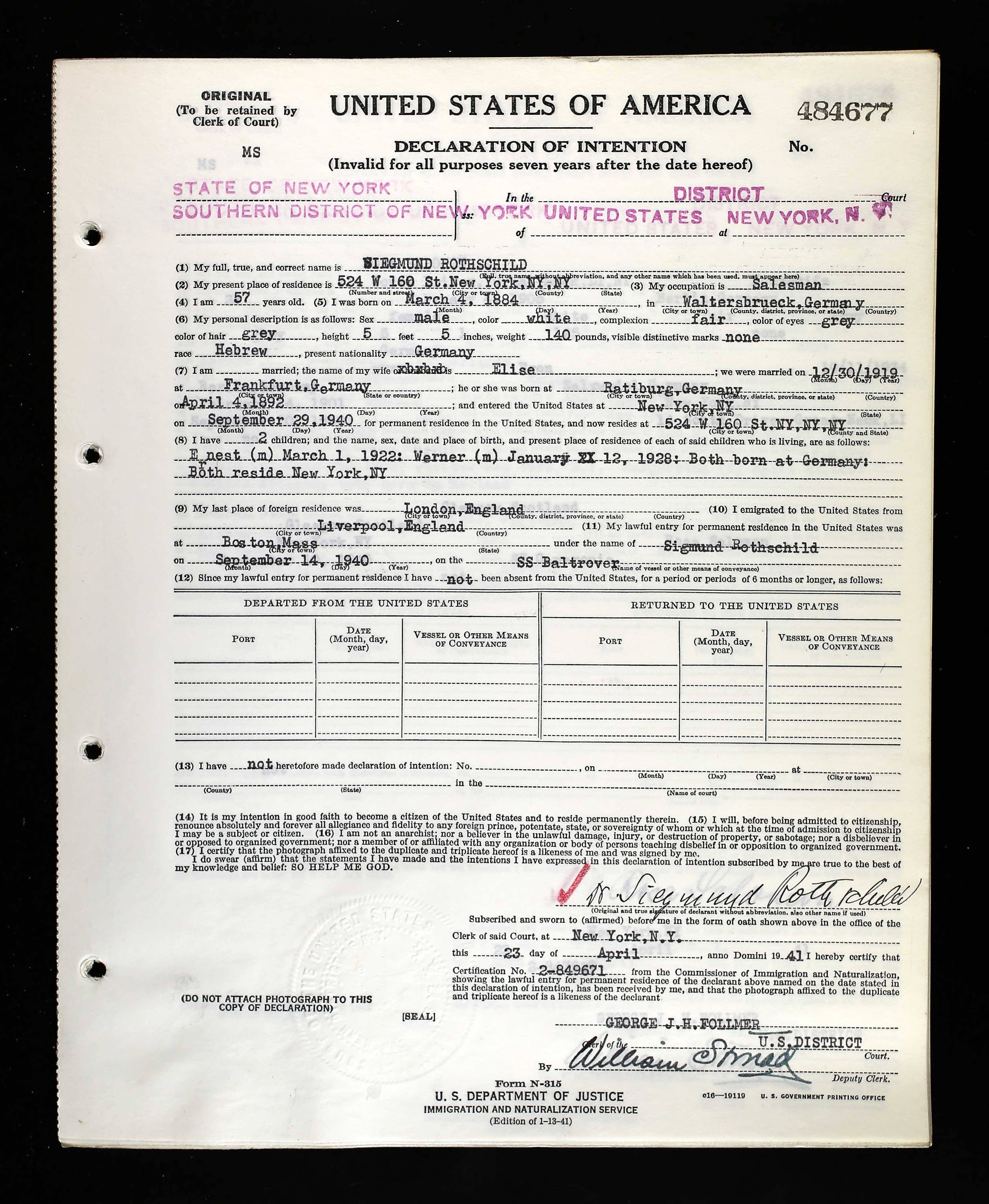
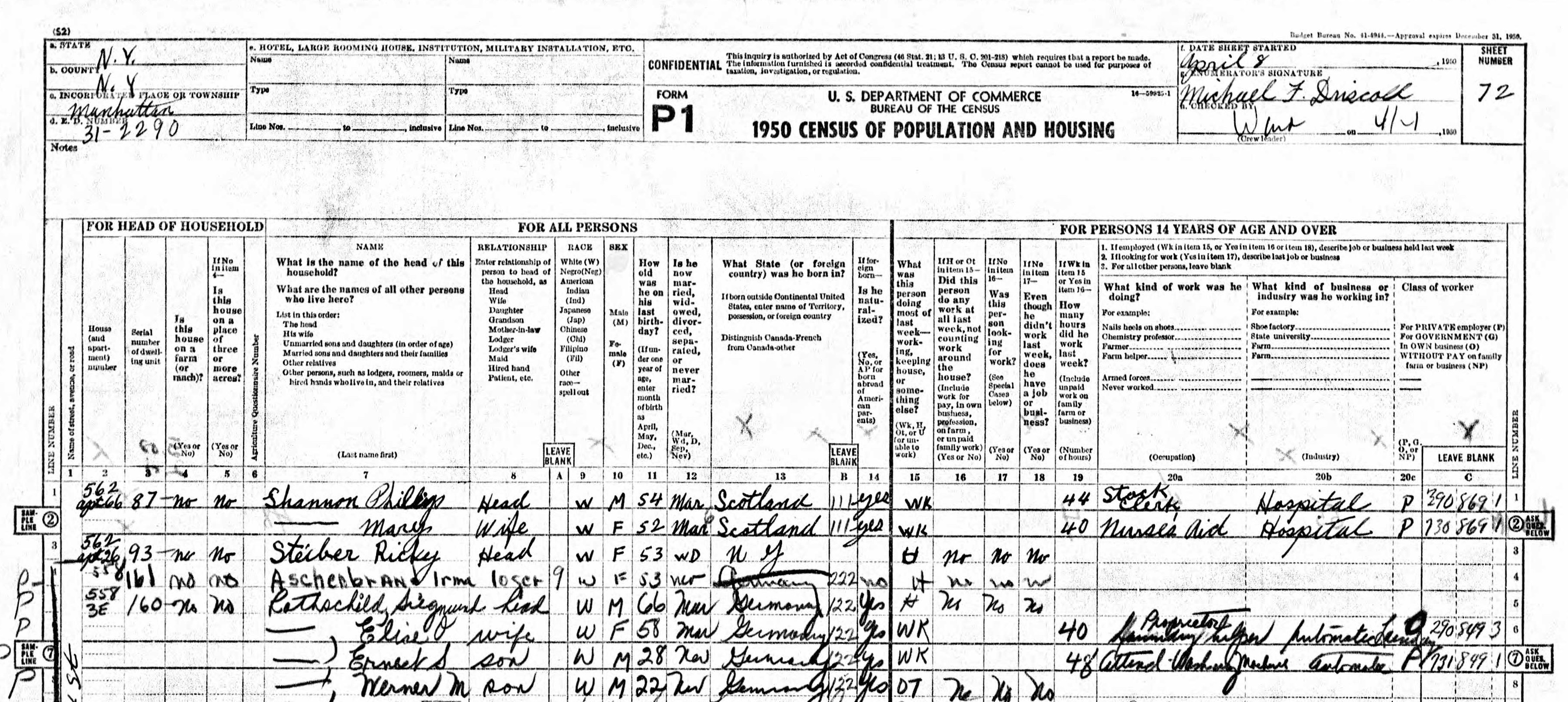
As we saw, Siegmund married Elise Olga Block on December 22, 1919, in Frankfurt, and they had two sons, Ernst, born March 1, 1922, and Werner, born January 12, 1928, both in Frankfurt. There is a wonderful resource about this family on the Projekt Judische Leben Frankfurt am Main website. Based in part on information obtained during a visit to Frankfurt by Werner Rothschild in 2019, the website details the family’s life before, during, and after the Nazi era. Much of the information in this post came from that website.

According to that website, Siegmund Rothschild moved to Frankfurt in 1911 and was known as “a valued historian with good contacts abroad and president of the liberal main synagogue in Frankfurt.”  He taught at Philanthropin, a free Reform Jewish school founded in 1804 in Frankfurt. An article from the Encyclopedia of Jewish History and Culture abstracted here states that the school was “one of the most significant German Jewish Reform projects in the first half of the 19th century.” Siegmund’s wife Elise also taught at Philanthropin on and off between 1913 and 1939.

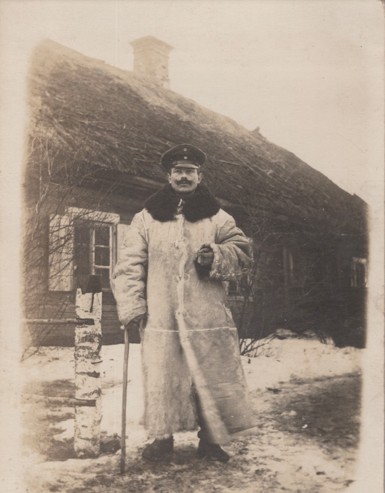
UPDATE: I learned from Siegmund’s grandson Alex that Siegmund fought for Germany during World War I. Here is a photo of him from that time.

Siegmund Rothschild c. 1915
Courtesy of the family

Siegmund and his family were living a good life in Frankfurt, identifying more as German than Jewish, until Hitler came to power in 1933. Siegmund’s son Werner recalled that one friend joined Hitler Youth and stopped talking to him. Another time while visiting family in Borken, he and his cousins were tormented by Hitler Youth.

Here is the family in January 1938:

Siegmund, Werner, Ernst, and Elise (Bloch) Rothschild, January 1938.

As for Ernst, the older son, according to the Projekt Judische Leben Frankfurt website, he had always dreamed of being a dentist, but under Nazi persecution he was not allowed to pursue the studies to reach that goal. Instead he ended up working as an apprentice in a leather dressing business after leaving school in 1937. But when that business was Aryanized in 1938, Ernst lost his job.

The family’s situation became even more dire in November 1938 with Kristallnacht.  As reported on the Projekt Judische Leben website, “For Werner… the worst day of his young life was the so-called “Reichskristallnacht.” He saw furniture fly out of the windows and buildings burn. Immediately afterwards, his father was picked up by the Gestapo. They gave [Siegmund] ten minutes to pack his things, then they deported him to Buchenwald. Fortunately, [Ernst] was not at home or he would have been arrested too.” Elise did everything she could to get Siegmund released; he was released in December 1938 with orders to leave Germany quickly.

The Projekt Judische Leben Frankfurt website continued, “Siegmund was a broken man when he came home and it took weeks and intensive care from his wife before he regained his strength. As soon as his health permitted, he traveled to England with his son Ernst, with ten Marks in his pocket. More was not allowed per person. The only contact there was with two of Elise’s brothers who had emigrated from Ratibor in 1935 and opened a dental practice in London.”

Meanwhile, Elise and Werner remained in Frankfurt until Elise arranged in 1939 for Werner to leave Germany as part of the Kindertransport program. Werner took the train alone to Hamburg and was forced to strip naked so that the Gestapo could check to be sure he wasn’t taking anything prohibited with him. In Hamburg he took a ship to England, where he  was placed in a youth hostel.1

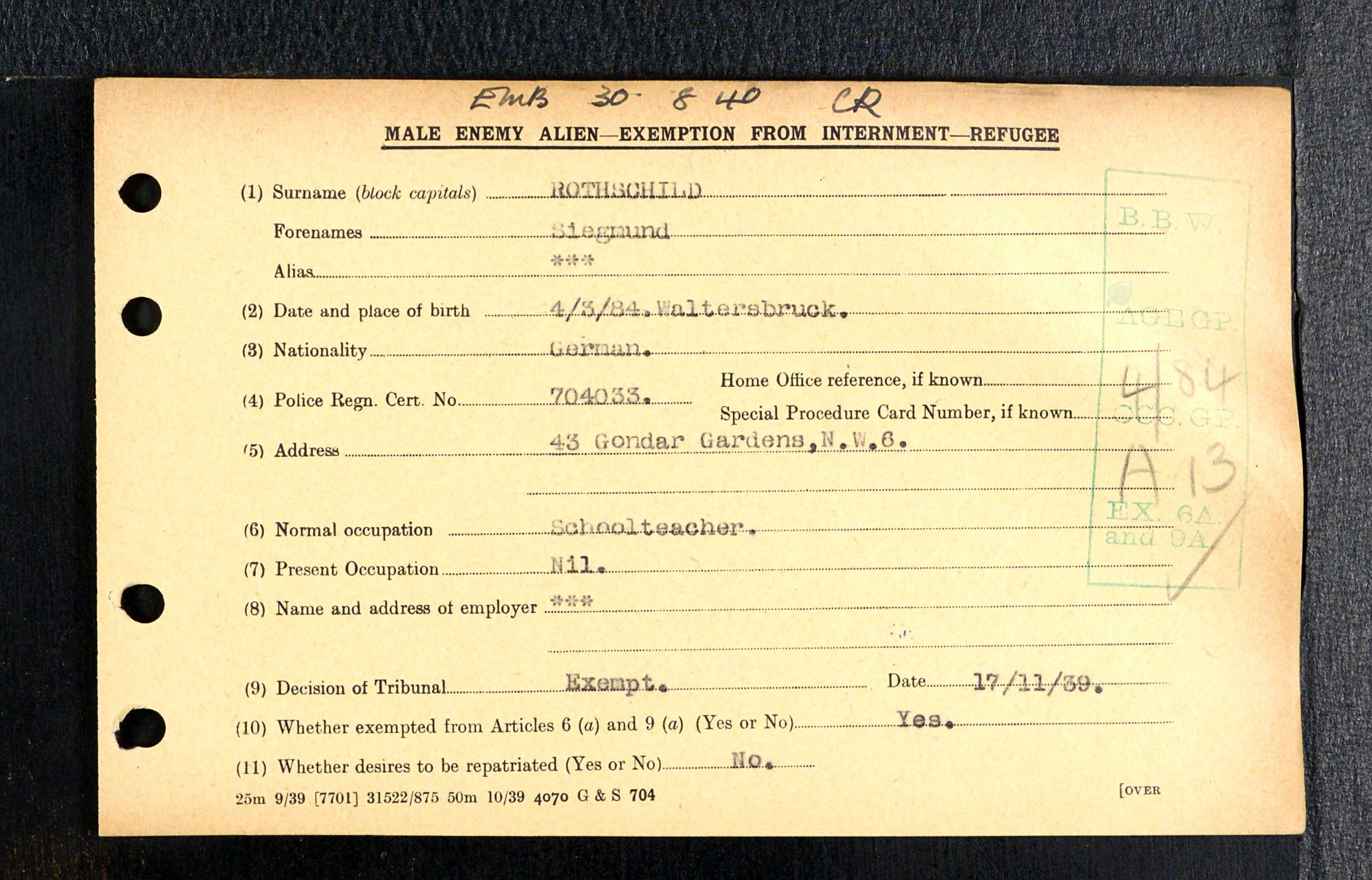
Once Elise also was able to escape to England, the family was reunited in London and Werner was able to attend school.   The 1939 England & Wales Register shows Siegmund and Elise living in London.2 But after the war started against Germany in September 1939, Ernst was interned as an enemy alien; Siegmund and Elise, however, were exempted from internship. Werner was just a child.

Siegmund Rothschild, The National Archives; Kew, London, England; HO 396 WW2 Internees (Aliens) Index Cards 1939-1947; Reference Number: HO 396/238, Piece Number Description: 238: Dead Index (Wives of Germans Etc) 1941-1947: Rosenber-Schitz, Ancestry.com. UK, World War II Alien Internees, 1939-1945

Elise Rothschild, The National Archives; Kew, London, England; HO 396 WW2 Internees (Aliens) Index Cards 1939-1947; Reference Number: HO 396/238, Piece Number Description: 238: Dead Index (Wives of Germans Etc) 1941-1947: Rosenber-Schitz, Ancestry.com. UK, World War II Alien Internees, 1939-1945

Ernst Rothschild, The National Archives; Kew, London, England; HO 396 WW2 Internees (Aliens) Index Cards 1939-1947; Reference Number: HO 396/193, Ancestry.com. UK, World War II Alien Internees, 1939-1945

Ernst was eventually released, and the family was finally able to immigrate to the United States in the summer of 1940, as we will see. Then they had to start their lives all over again. More on their life in the US in the next post.


  1. Werner Rothschild, Gender Male, Record Type Refugee List, Birth Date 12 Jan 1928, Residence Place Frankfurt, Document Date 22 Mär 1939 (22 Mar 1939)
    Permit Number 3813, United States Holocaust Memorial Museum; Washington, D.C.; Series: Selected Records Relating to Kindertransports; Record Group: RG-59.075; File Number: mh55-704.00000088, Ancestry.com. UK, Selected Records Relating to Kindertransport, 1938-1939 (USHMM) 
  2. Siegmund Rothschild, The National Archives; Kew, London, England; 1939 Register; Reference: RG 101/244E, Description Enumeration District: Akde, Ancestry.com. 1939 England and Wales Register 

Six Days in Merry Old England

We just returned from a wonderful trip to England where our daughter Maddy ran her eighth marathon and her first one outside of the United States. It was, as it always is,  a bit nerve-racking to think of her running 26.2 miles, especially alone and in a foreign country, but as always she came through, despite the unusually warm weather and the unknown city. We were delighted to see her at Mile 6 and then after she finished in St. James Park.

We are so grateful to Maddy for getting us to go to England, our first trip outside the country since COVID (and England was the last place we visited outside the US before COVID in 2019). We kept this tour focused on fun and new adventures, a tour of Notting Hill (and we’d watched the movie this winter together to refresh our memories) and a pub tour of SoHo.

Notting Hill tour:

Ben, our guide, in front of George Orwell’s house in Notting Hill

Banksy art in Notting Hill

Notting Hill—where parts of the Paddington Bear movies were filmed

Alas, Hugh Grant and Julia Roberts were not around…

SoHo pub tour:

Carlos, our guide, and most of the tour group enjoying one last beer

After Maddy left to return to Boston, we traveled north to Liverpool, fulfilling a definite bucket list item for me. I fell in love with the Beatles in February 1964 when I was eleven, and that love has never faded. Seeing where the four young teenagers lived and met and first played together was heartwarming and exciting. Little eleven year old Amy could not believe she played Paul’s piano or stood in the churchyard where Paul and John first met or met Pete Best’s nephew, who gave us a tour of the Casbah where the Beatles (with Pete, not Ringo) first played together as a band.

Mural dedicated to Ringo down the alley from where he grew up

St Peter’s Church where Paul first met John playing with the Quarrymen at a church festival

Did you know there was a real Eleanor Rigby? She is buried in the graveyard at St Peter’s where John was a choirboy and where he first met Paul

John’s childhood home

The kitchen in John’s home

Outside John’s home

Paul’s childhood home

Paul’s backyard and outhouse

Paul’s piano (which I played!) where he and John wrote many of their early songs

George’s childhood home

Alley where George lived

Gate to Strawberry Fields

There are stones with quotations from John’s songs throughout Strawberry Fields

Inside the Casbah on a tour with the nephew of Pete Best, the original drummer for the Beatles

The Casbah stage

If you know the lyrics to Penny Lane, you’ll know what this store is.

Some of you have likely seen some of these photos on Facebook, but I wanted to share these with those blog readers who may not be on Facebook with me.

Special thanks to my cousin Mark Morreau, who met us in Notting Hill and helped us navigate the Underground back to our hotel, and to our tour guides in London and Liverpool, Ben, Carlos, and Dave.

Another update: Alfred Meyer Survived The Holocaust

Almost five years ago I wrote about Alfred Meyer, son of Regina Goldschmidt and Aaron Meyer and my third cousin, twice removed. He was born in Frankfurt, Germany, on June 16, 1875, and that was almost all I knew about him. The only other records I could find for Alfred were two Holocaust era records on file at the Arolsen Archives. Both indicated that Alfred had left Germany for France on April 24, 1939, and was still there as of November 3, 1939. I couldn’t find any other records for him.

Had he ever married? Did he have children? I didn’t know. Had he died in the Holocaust? There were no records for him at Yad Vashem or at the US Holocaust Memorial and Museum. I was left without any further information.

Until, that is, a few weeks ago when I received an email from another researcher named Ofra Karo. Ofra and I had been in touch over a year ago about a different branch of my tree, but now she was writing to say that she had found additional information about Alfred Meyer. For one thing, she had found a marriage record for Alfred indicating that he had married Augustine Marguerite K/Brat in Paris, France on August 11, 1911.

Alfred Meyer marriage record, Archives de Paris; Paris, France; État-Civil 1792-1902, Certificate Number: 0553-0836, Paris, France, Births, Marriages, and Deaths, 1555-1929

At first I was skeptical. What was Alfred doing in France in 1911 if he was in Frankfurt in 1939? Was this the same Alfred Meyer? But after studying the marriage record and relying on my rusty high school French, I saw that this was indeed the same man—-son of Regina Goldschmidt and Aaron Meyer, born in Frankfurt, Germany, on June 16, 1875. And he was at that time residing in Paris. Given that Alfred was a grandson of Jacob Goldschmidt, whose family owned the international art and antiques business, it wasn’t really surprising that Alfred was living in Paris in 1911, perhaps working for the family’s business.

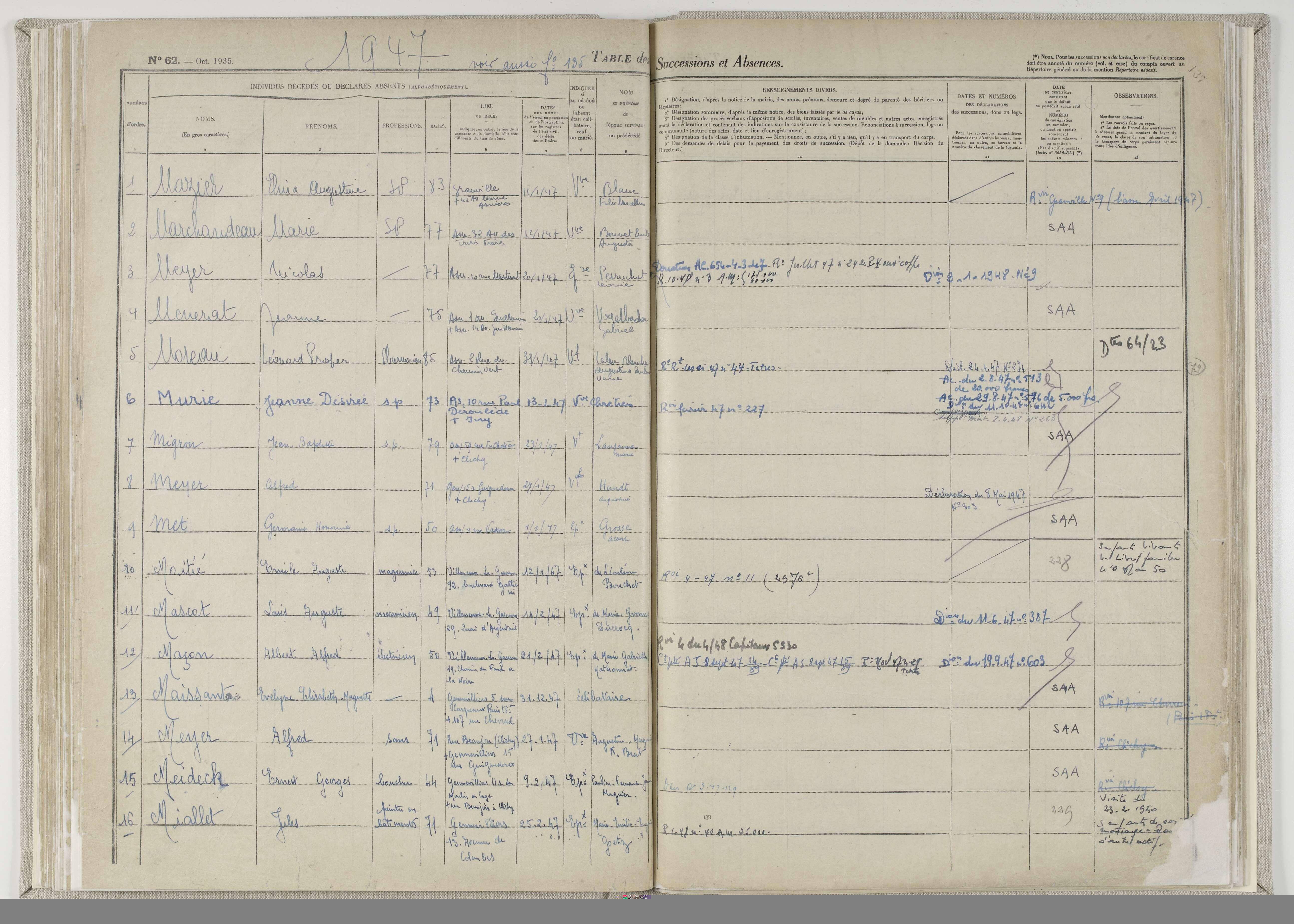
Ofra also directed me to a death record for Alfred. He had not died in the Holocaust, but had lived long enough to die after World War II. He died on January 27, 1947, in Gennevilliers, France, and had been residing in Clichy, France, a suburb of Paris just a few miles from where he died. He was 71 and a widower at the time of his death. No occupation was listed.1

Unfortunately, I have no other sources at this time for Alfred. Ofra found a tree on Ancestry that appears to be created by Alfred’s granddaughter and has many photos of family members. I tried to contact that tree owner through Ancestry without success, and I have looked to see if I could find her outside of Ancestry without success. Because I cannot confirm the information in that tree, I am not comfortable relying on it. If it is accurate, it does appear that Alfred had a son and has living descendants, but I cannot confirm that at this time.

At any rate, I do now know that Alfred did not die in the Holocaust. How he survived remains a mystery.


  1. There are two men named Alfred Meyer on this page—same age, same day of death, both with spouses with the first name Augustine. Ofra suggested that the one on Line 14 is a correction of the one on Line 8. That seems a reasonable assumption. 

Two Updates: Why Didn’t Mathilde Rothschild Leave Germany With Her Family? And How did Albert Alexander Meet His Wife?

Before I continue the stories of the children of Gerson Rothschild and Fanny Kugelmann, I have three updates to earlier posts that I’d like to share. All three are possible because other researchers and family members found this blog and contacted me. These are true gifts from the genealogy village. I am so grateful.

Some of you may recall that back in May 2024, I wrote about my relative Hirsch “Harry” Rothschild and his three children, all of whom escaped from Nazi Germany to the United States before World War II started. But unfortunately Harry’s wife Mathilde did not escape with her family and was ultimately murdered by the Nazis.

In my blog post about this family I wondered why Mathilde had not come with Harry and her children when they left Germany. Was she ill, I speculated? I had no answers.

Now I have more information about the family of Harry Rothschild. A man named Fredo Behrens recently contacted me after seeing my blog post. He lives in Oldenburg, Germany, and as he told me in his email, he worked for the “Nordwestdeutsches Museum für Industriekultur” in Delmenhorst for several years 25 years ago, where his area of responsibility was museum education, exhibitions and a regional “Topography of the Nazi Era.” He also is on the board of the “Friends and Supporters of the Jewish Community of Delmenhorst,” and heads the Delmenhorst City History Working Group. More specifically, he has done research into the history of the Jewish people of Delmenhorst, including the Rothschild family.1

Fredo told me about a monograph by Dr. Enno Meyer from 1985 entitled “Die Geschichte der Delmenhorster Juden 1695-1945”, or the History of the Jews of Delmenhorst 1695-1945. Dr. Meyer was the head of “Gesellschaft für christlich-jüdische Zusammenarbeit” (Society for Christian-Jewish Cooperation) for at least 30 years, according to Fredo. Fredo sent me both a copy of Dr. Meyer’s monograph (in German) and also a copy of an article that Fredo himself wrote about the Jews of Delmenhorst that excerpts parts of Meyer’s monograph and adds to it.2 I was able to use DeepL to translate Fredo’s work and learn more about the Rothschild family’s life in Delmenhorst.

According to the works of Meyer and Behrens, Dr. Harry Rothschild came to Delmenhorst from Hesse in 1914 and was the first Jewish doctor to practice in that town. By 1925, he was one of the top two taxpayers in the town. Harry was not active in the organized Jewish community, however, until after the Nazis came to power.3 According to Fredo’s research, the growing antisemitism in the early 1930s prompted Harry to become more involved. By 1933 he was chairman of the local Zionist organization and on the Jewish community board.

When the Nuremberg Laws were adopted and Jews were no longer allowed to employ Aryans, Harry and his Aryan cleaning woman petitioned the mayor for permission to continue their employment relationship, but their petition was rejected.4

Fredo kindly shared with me this photograph showing the street where the Rothschild family lived in Delmenhorst in 1930. The arrow points to where Harry Rothschild practiced medicine and lived before he left Germany in 1939.

Rothschild house and office in Delmenhorst, 1930, courtesy of Fredo Behrens: Jüdisches Leben in der Langen Straße nach 1933. In: Die Lange Straße in Delmenhorst : Biographie einer alten Straße ; Begleitveröffentlichung zur Ausstellung in den Museen der Stadt Delmenhorst auf der Nordwolle vom 24.6. – 2.9.2001. Hg. vom Stadtmuseum Delmenhorst. Isensee, Oldenburg 2001, p. 60

Then on October 10, 1937, Harry and a number of other Jewish residents of Delmenhorst were arrested by the Gestapo without warning or warrants. According to the observations of a fellow prisoner who became Harry’s cellmate, Harry was particularly humiliated by this experience and was called a “dirty stinking Jew” by one of the Gestapo agents. Harry and his cellmate were in solitary confinement, and Harry remained in prison until the spring of 1938. Harry’s condition had deteriorated greatly during his imprisonment.5

On November 10, 1938 in the aftermath of Kristallnacht, Harry was again arrested and was one of fourteen Jewish men who were arrested and sent to the concentration camp at Sachsenhausen.6

By that time all three of Harry and Mathilde’s children had left Germany for the United States. Harry left in the spring of 1939 and went to Cuba, and he was finally able to join his children in the US in December 1939.

But as we know, Mathilde did not come with him, and she was eventually deported to Minsk and died there. Dr. Meyer shed some light on this in his monograph, also quoted in Fredo Behren’s work. On page 85 of his history of the Delmenhorst Jews, Enno Meyer wrote that Mathilde had stayed behind to try and sell the family house; then when the war started in September 1939, she was trapped in Germany and could not leave.7

If only Mathilde had left with Harry and had not tried to sell the family’s home, this family’s story would have had a much happier ending. There may be more to this story that we will never know, but if this account is accurate, it shows how one decision affected an entire family’s fate during the Holocaust.

I want to thank Fredo Behrens again for providing me with the information and the photograph used in this post and for the work he does to preserve the Jewish history of Delmenhorst.


The second update came from two newly found cousins—my fifth cousin Charles Alexander and his daughter Kate. They also found me through my blog. Charles is the grandson of Theresa Rothschild Alexander, and I wrote about that family here. Check out the update there and learn how Charles’ parents, Albert Alexander and Mary Jane Deiches, actually met. My original speculation proved to be incorrect.

Also, I’ve added to that post a photo Charles gave me from his father’s yearbook. I am also adding it here since I could not place it properly in the original post.


Finally, the third update will have to wait until next week.


  1. Email from Fredo Behrens, March 25, 2025. 
  2. Fredo Behrens, “Jüdisches Leben in der Langen Straße nach 1933. In: Die Lange Straße in Delmenhorst : Biographie einer alten Straße; Begleitveröffentlichung zur Ausstellung in den Museen der Stadt Delmenhorst auf der Nordwolle vom 24.6. – 2.9.2001. Hg. vom Stadtmuseum Delmenhorst. Isensee, Oldenburg 2001. 
  3. Enno Meyer, “Die Geschichte der Delmenhorster Juden 1695-1945,” (1985), pp. 48, 55, 60, as cited in Behrens,  Note 2, supra. 
  4. Behrens, Note 2, supra, citing a letter dated November 14, 1936, response from the mayor dated December 3, 1936. Exhibition “Delmenhorst in National Socialism.   based on a letter dated September 24, 1955, affidavit from Wilhelm Schroers for Dr. Rothschild. Exhibition “Delmenhorst under National Socialism.” 
  5. Letter dated September 24, 1955, affidavit from Wilhelm Schroers for Dr. Rothschild. Exhibition “Delmenhorst under National Socialism.” as quoted in Behrens, Note 2, supra. 
  6. Behrens, Note 2, supra. 
  7. Enno Meyer, “Die Geschichte der Delmenhorster Juden 1695-1945,” (1985), p. 85, as cited in Behrens, Note 2, supra. 

Gerson and Fanny Rothschild’s Children: From A Large Family to Small Families

Gerson Rothschild’s wife Fanny gave birth to eleven children between 1883 and 1901, but three of those babies did not survive. Two died at birth, and one died at seven weeks. That left eight surviving children: Siegmund (1884), Katchen (1885), Max (1886), Auguste (1888), Jenny (1890), Clara (1891), Rosa (1893), and Amalie (1901). Two sons, six daughters.

But from such a large family, only one of those eight surviving children would have more than two children, and they all married at a later age than was typical of those times. They almost all married in their thirties. It made me wonder why these siblings delayed marriage and had so few children after coming from such a large family. Were they so close to each other that they didn’t want to leave home? Were the older ones helping to care for the younger ones? Did the fact that three babies did not survive make them wary of having more that one or two children? Or was it simply a matter of economics or the trend in the 1920s in Germany? I don’t know, but here are the facts.

Siegmund, the first born, was 35 when he married Elise Olga Block on December 22, 1919, in Frankfurt. Elise, the daughter of Max Block and Fanny Schaefer, was born in Ratiburg, Germany, on April 4, 1892.

Siegmund Rothschild and Elsa Block marriage record, Hessisches Hauptstaatsarchiv; Wiesbaden, Deutschland; Bestand: 903, Year Range: 1919, Ancestry.com. Hesse, Germany, Marriages, 1849-1930

Siegmund and Elise had two sons: Ernst, born March 1, 1922,1 and Werner, who is still living as far as I’ve been able to determine. Both were born in Frankfurt.

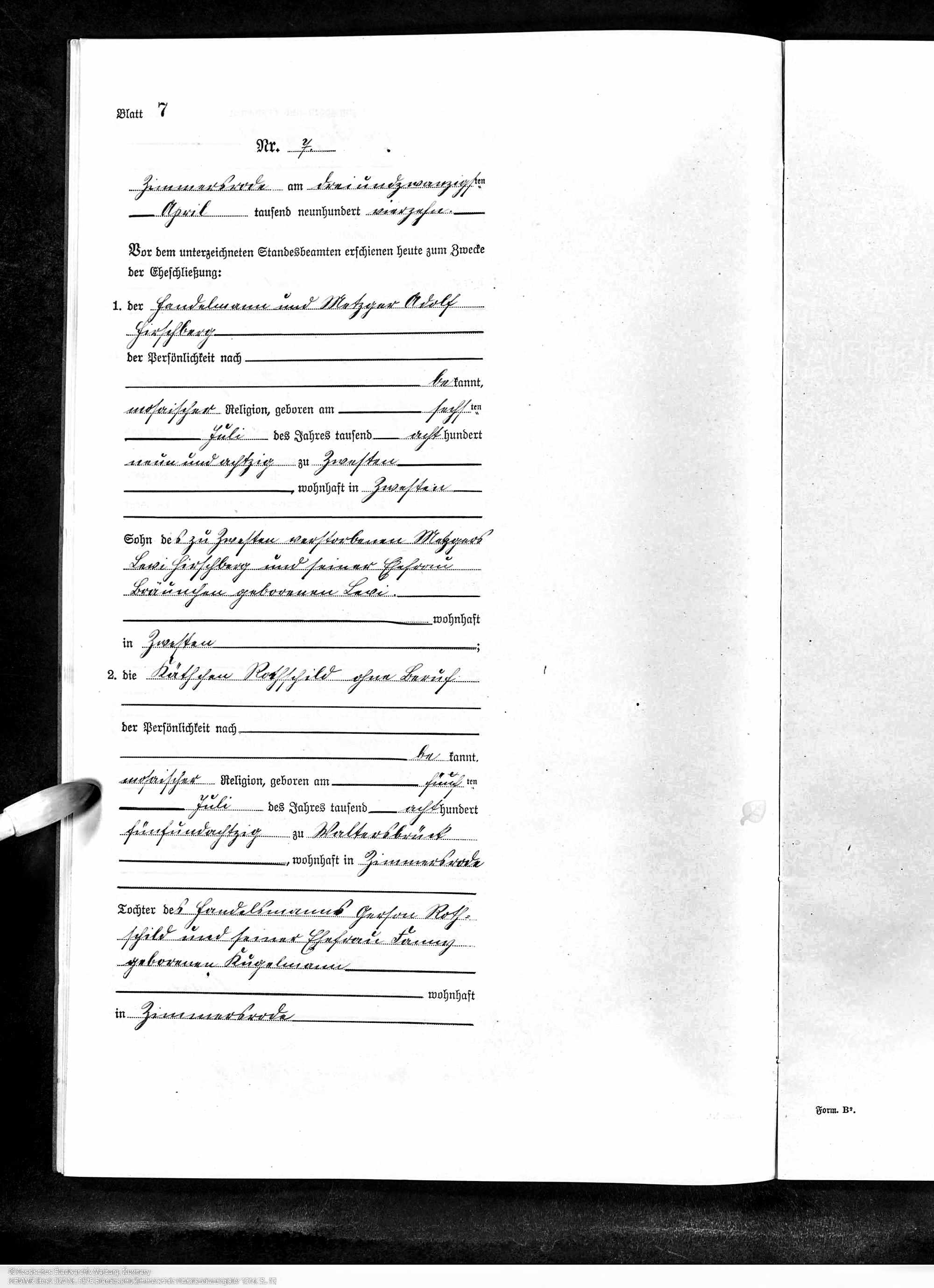
Katchen Rothschild was 28 when she married Adolf Hirshberg on April 23, 1914, in Zimmersrode. Adolf was born July 6, 1889, in Bad Zwesten, Germany, to Levi Hirshberg and Braunchen Levi.

Katchen Rothschild and Adolf Hirschberg marriage record, Hessisches Hauptstaatsarchiv; Wiesbaden, Deutschland; Bestand: 920; Laufende Nummer: 9576, Year Range: 1914, Ancestry.com. Hesse, Germany, Marriages, 1849-1930

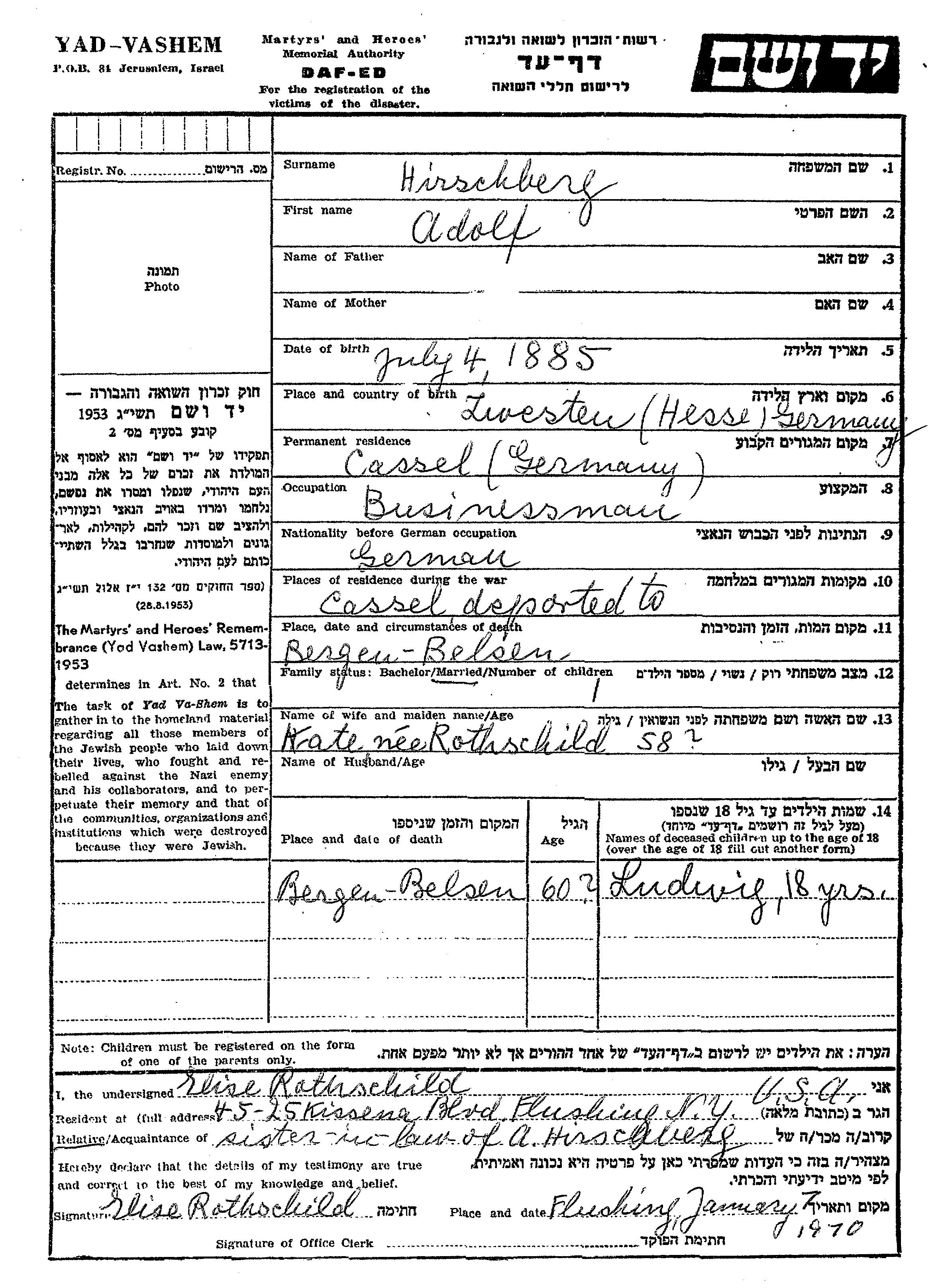
Katchen and Adolf had one child, a son Ludwig, born in Kassel, Germany, on February 1, 1920.2

Max Rothschild was 32 when he married Johanna Katz in Zimmersrode on October 19, 1919. Johanna was the daughter of Jacob Katz and Karoline Rosenblatt, and she was born Neuenhain, Germany, on May 1, 1892.

Max Rothschild and Johanna Katz marriage record, Hessisches Hauptstaatsarchiv; Wiesbaden, Deutschland; Bestand: 920; Laufende Nummer: 9581, Year Range: 1919-1920, Ancestry.com. Hesse, Germany, Marriages, 1849-1930

Max and Johanna had two sons: Erich, supposedly born on May 13, 1921, and Richard, supposedly born October 24, 1922, both in Zimmersrode.3

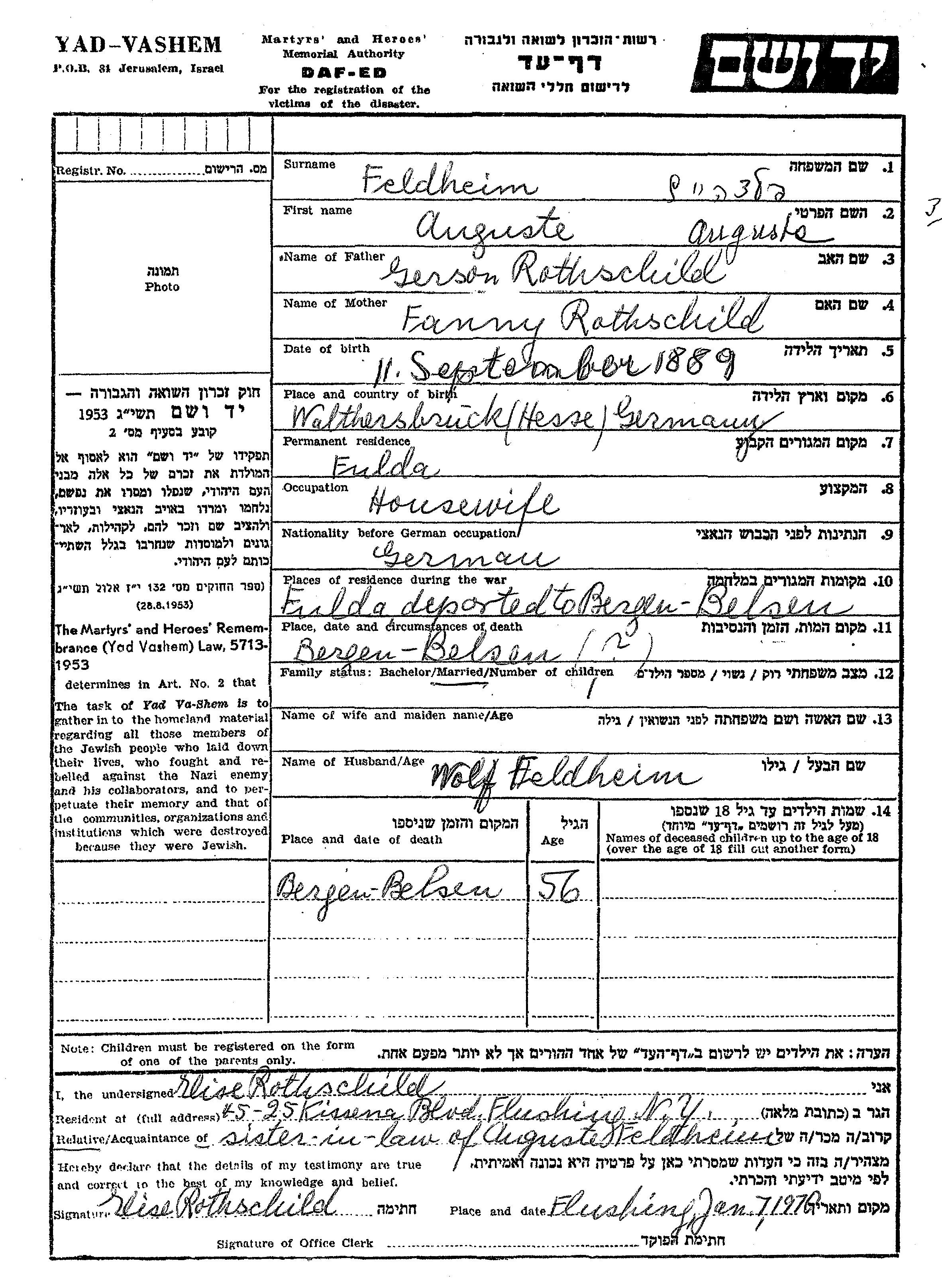
Auguste Rothschild was thirty when she married Wolf Feldheim on March 18, 1919, in Zimmersrode. Wolf was born April 4, 1875 in Graudenz, then part of Prussia, now part of Poland. His parents were Aron Feldheim and Lena London. Wolf had been previously married and had four young children when he married Auguste.

Auguste Rothschild and Wolf Feldheim marriage record, Hessisches Hauptstaatsarchiv; Wiesbaden, Deutschland; Bestand: 920; Laufende Nummer: 9581, Year Range: 1919-1920, Ancestry.com. Hesse, Germany, Marriages, 1849-1930

Auguste and Wolf had one son, Bruno, according to several trees, but I am still looking for a record that ties Bruno to Auguste and Wolf. I did find records for a Bruno Feldheim born in Fulda, Germany, on November 12, 1921, but those records do not identify Bruno as the son of Auguste and Wolf.4

Jenny Rothschild was thirty when she married Salomon Abraham on November 11, 1920, in Zimmersrode. Salomon was born in Durboslar, Germany, on August 14, 1891. I am still looking for a record to confirm the names of his parents.

Jeanette Rothschild and Salomon Abraham marriage record, Hessisches Hauptstaatsarchiv; Wiesbaden, Deutschland; Bestand: 920; Laufende Nummer: 9582, Year Range: 1920-1921, Ancestry.com. Hesse, Germany, Marriages, 1849-1930

Jenny and Salomon had two children, Walter, born September 13, 1921, in Zimmersrode5 and Herta, born August 26, 1928, born in Kassel.6

Clara Rothschild was thirty when she married Moritz Katz in Zimmersrode on November 1, 1921. Moritz was born on November 4, 1894, in Neuenhain, Germany. He was the son of Jakob Katz and Karoline Rosenblatt and the younger brother of Johanna Katz, who had married Clara’s brother Max.

Clara Rothschild and Moritz Katz marriage record, Hessisches Hauptstaatsarchiv; Wiesbaden, Deutschland; Bestand: 920; Laufende Nummer: 9582 Description Year Range: 1920-1921 Source Information Ancestry.com. Hesse, Germany, Marriages, 1849-1930

Clara and Moritz had three children: Otto, born September 5, 1922, in Neuenhain;7 Helmut (later Harold) born in Neuenhain in 1924,8 and Ilse, born on May 19, 1928, in Kassel, Germany.9 Since Harold may still be living, I will not report on his exact birth date.

The last two children of Gerson Rothschild and Fanny Kugelmann, their daughters Rosa and Amalie, married after 1930 and had children after Hitler came to power.  I will write about their husbands and children in a subsequent post.

Isn’t it interesting how late these eight children married and how few children they had after being from such a large family? I’d love to know more about their decisions, but alas, all I have is speculation.

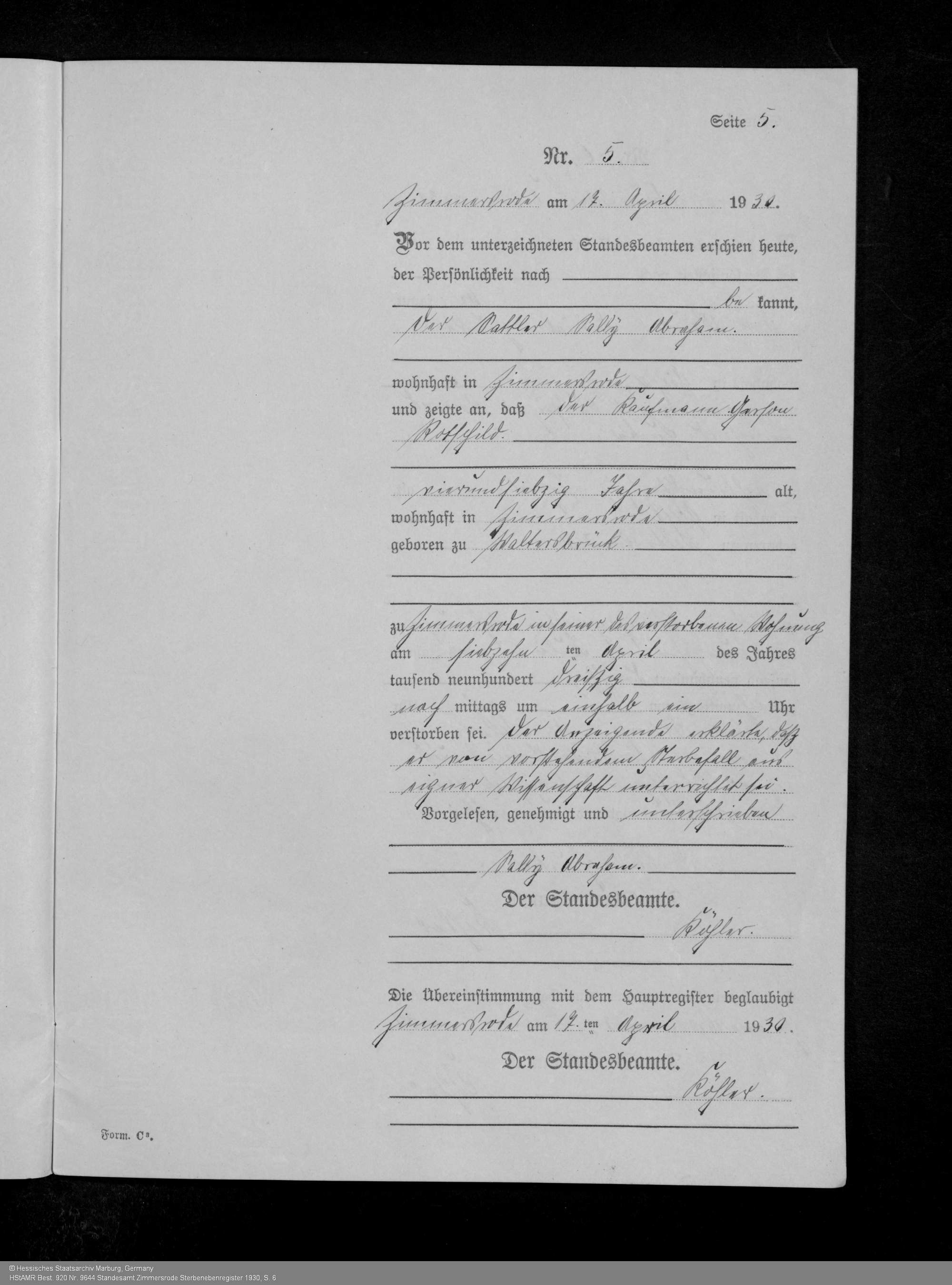
Their father Gerson Rothschild passed away on April 17, 1930, at the age of 74.

Gerson Rothschild death record, LAGIS Hessen Archives, HStAMR Best. 920 Nr. 9644 Standesamt Zimmersrode Sterbenebenregister 1930, S. 6

Gerson had lived to see all eight of his surviving children reach adulthood, and before he died, he saw the six oldest of those children marry and have children of their own. As of his death, Gerson had ten grandchildren. His daughter Rosa would later have one child and his daughter Amalie two, meaning that Gerson and Fanny at one time had thirteen grandchildren from their eight surviving children.

Gerson may have been blessed to die before Hitler came to power and before he would know what would happen to so many of those children and grandchildren.


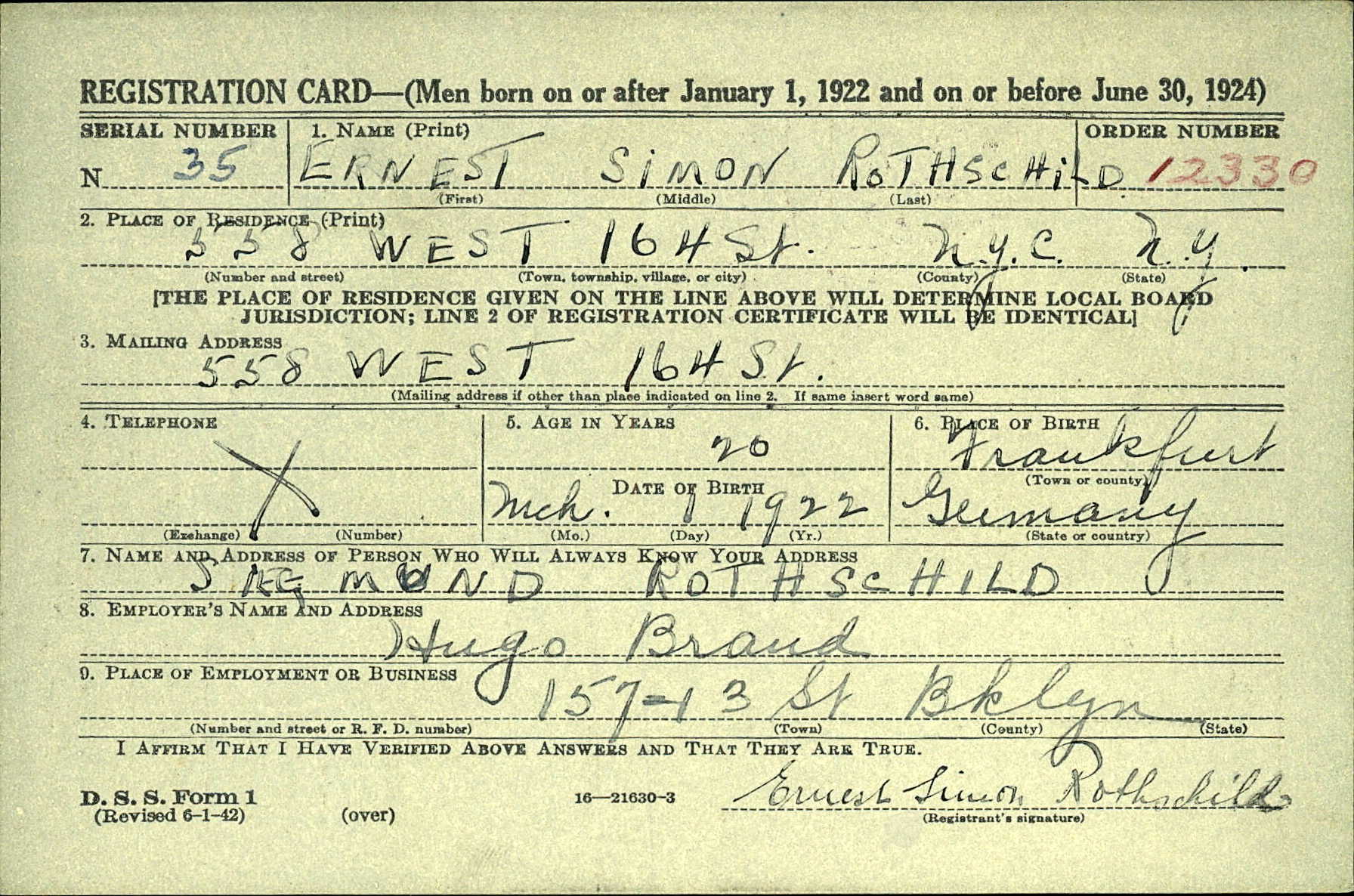
  1. Ernest Simon Rothschild, Race White, Age 23, Birth Date 1 Mar 1922, Birth Place Frankfort, Germany, Registration Date 30 Jun 1945, Registration Place New York City, New York, Employer Hugo Brand, Next of Kin Siegmund Rothschild,  National Archives at St. Louis; St. Louis, Missouri; Wwii Draft Registration Cards For New York City, 10/16/1940 – 03/31/1947; Record Group: Records of the Selective Service System, 147, Ancestry.com. U.S., World War II Draft Cards Young Men, 1940-1947 
  2. Ludwig Hirschberg J., Gender männlich (Male), Nationality Deutsch Juden
    Record Type Miscellaneous, Birth Date 01 Feb 1920 (1 Feb 1920), Birth Place Kassel
    Residence Place Kassel, Kassel, Notes Lists of judicial and official files concerning foreigners and German Jews, Reference Number 02010101 oS, Document ID 70443311, Arolsen Archives, Digital Archive; Bad Arolsen, Germany; Lists of Persecutees 2.1.1.1, Ancestry.com. Free Access: Europe, Registration of Foreigners and German Persecutees, 1939-1947 
  3. I could not find any actual birth records for Erich Rothschild or Richard Rothschild. There are no online birth records for Zimmersrode for 1921 or 1922. These dates, however, appear on numerous trees on Ancestry. I do not know how reliable that specific information is. I am still searching for birth records for these two sons, but I do have other records for them that place their birthdates as approximately in 1921 and 1922. I will discuss those other records in a later post. In addition, one tree included a third son, Fritz Simon Rothschild, but I have no records that support the existence of that son. 
  4. Bruno Feldheim, Palestine Immigration file, found at the Israel State Archives website at https://search.archives.gov.il/ 
  5. Walter Abraham, Birth Date 13 Sept 1921, Birth Place Zimmerrode, Residence Street Address 26 Johann-Georg-Strasse, Residence Place Berlin, [Halensee]
    Occupation Bãcker [Baker], Description Deportationen, URL https://collections.arolsen-archives.org/de/document/127213170 , Arolsen Archives; Bad Arolsen, Germany; Record Group 1 Incarceration Documents; Reference: 1.2.1.1, Ancestry.com. Germany, Incarceration Documents, 1933-1945 
  6. Herta Abraham, Birth Date 26 Aug 1926, Birth Place Kassel, Residence Kassel
    Camp Riga/Stutthof, Ancestry.com. Poland, German Jews at Stutthof Concentration Camp, 1940-1945 
  7. Otto Katz, Race White, Age 19, Birth Date 5 Sep 1922, Birth Place Neuenhaus [sic], Germany, Registration Date, 15 Feb 1942, Registration Place, New York City, New York, Employer Kenneth Miller, Next of Kin Clara Katz, National Archives at St. Louis; St. Louis, Missouri; Wwii Draft Registration Cards For New York City, 10/16/1940 – 03/31/1947; Record Group: Records of the Selective Service System, 147, Name Range: Katz, Bernard-Katz, Sam, Ancestry.com. U.S., World War II Draft Cards Young Men, 1940-1947 
  8. Helmut Katz [Harold Katz] Race White Age 18 Birth Date 1924, Birth Place Neuenhain, Germany, Registration Date 19 Dec 1942, Registration Place New York City, New York, Employer Student, Next of Kin Clara Katz, National Archives at St. Louis; St. Louis, Missouri; Wwii Draft Registration Cards For New York City, 10/16/1940 – 03/31/1947; Record Group: Records of the Selective Service System, 147, Ancestry.com. U.S., World War II Draft Cards Young Men, 1940-1947 
  9. This date came from Dennis Aron’s Ancestry tree, and Dennis obtained his information from Ilse’s brother, Harold Katz. I have no other source for this, but given that it came from her brother, for now I assume it is accurate. 

Eleven Babies in Eighteen Years

My cousin Gerson Rothschild’s wife Fanny Kugelmann gave birth to eleven children, starting in 1883 with the last one born eighteen years later in 1901. It is impossible for me to imagine what that was like.

Unfortunately, the first baby, a girl, died at birth (or was stillborn) on March 28, 1883:

Stillborn female child, Hessisches Hauptstaatsarchiv; Wiesbaden, Deutschland; Personenstandsregister Sterberegister; Bestand: 8460; Laufende Nummer: 920
Year Range: 1883, Ancestry.com. Hesse, Germany, Deaths, 1851-1958

The note on the death/birth record was translated by my cousin Richard Bloomfield and reads:

Mrs. Fanni Rothschild née Kugelmann of Jewish religion in the apartment of her husband, the merchant Gerson Rothschild of Jewish religion at Waltersbrück in house no. 2 on the eighth and twentieth of March this year in the afternoon at five o’clock birthed a child of female sex and that this child died in childbirth. Mrs. Waßmuth explained that she had been present at the confinement of Mrs. Fanni Rothschild.

A second child, Siegmund Rothschild, was born less than one year later on March 4, 1884, in Waltersbrueck:

Siegmund Rothschild birth record, Hessisches Hauptstaatsarchiv; Wiesbaden, Deutschland; Bestand: 920; Laufende Nummer: 8386, Year Range: 1884, Ancestry.com. Hesse, Germany, Births, 1851-1901

Sixteen months after Siegmund’s arrival, Fanny gave birth to Katchen Rothschild on July 5, 1885, also in Waltersbrueck:

Katchen Rothschild birth record, Hessisches Hauptstaatsarchiv; Wiesbaden, Deutschland; Bestand: 920; Laufende Nummer: 8387, Year Range: 1885, Ancestry.com. Hesse, Germany, Births, 1851-1901

Sixteen months after Katchen came another son, Max, born November 22, 1886, in Waltersbrueck:

Max Rothschild birth record, Hessisches Hauptstaatsarchiv; Wiesbaden, Deutschland; Bestand: 920; Laufende Nummer: 8388, Year Range: 1886, Ancestry.com. Hesse, Germany, Births, 1851-1901

Then Fanny gave birth to another daughter,  Guste or Auguste, in Waltersbrueck on September 11, 1888. Imagine that—-a gap of almost two years after Max. I wonder whether Fanny had miscarried at some point in between Max and Auguste.

Auguste Rothschild birth record, Hessisches Hauptstaatsarchiv; Wiesbaden, Deutschland; Bestand: 920; Laufende Nummer: 8390, Year Range: 1888, Ancestry.com. Hesse, Germany, Births, 1851-1901

Johanette (“Jenny”) Rothschild, Gerson and Fanny’s sixth child, was born on February 13, 1890, also in Waltersbrueck, seventeen months after Auguste:

Johannette Rothschild birth record, Hessisches Hauptstaatsarchiv; Wiesbaden, Deutschland; Bestand: 920; Laufende Nummer: 8392, Year Range: 1890, Ancestry.com. Hesse, Germany, Births, 1851-1901

Their seventh child Clara was born on July 15, 1891, in Waltersbrueck, seventeen months after Jenny:

Clara Rothschild birth record, Hessisches Hauptstaatsarchiv; Wiesbaden, Deutschland; Bestand: 920; Laufende Nummer: 8393, Year Range: 1891, Ancestry.com. Hesse, Germany, Births, 1851-1901

Number eight arrived May 16, 1893, almost two years after Clara; her name was Rosa. She was born in Zimmersrode where the family was now residing. Zimmersrode is a larger town about a mile and a half from Waltersbrueck.

Rosa Rothschild birth record, Hessisches Hauptstaatsarchiv; Wiesbaden, Deutschland; Bestand: 920; Laufende Nummer: 9531, Year Range: 1893, Ancestry.com. Hesse, Germany, Births, 1851-1901

Gerson and Fanny’s ninth child Thoni only lived seven weeks; she was born on April 27, 1895, in Zimmersrode, and died there on June 20, 1895:

Thoni Rothschild birth record, Hessisches Hauptstaatsarchiv; Wiesbaden, Deutschland; Bestand: 920; Laufende Nummer: 9533, Year Range: 1895, Ancestry.com. Hesse, Germany, Births, 1851-1901

Thoni Rothschild death record, Hessisches Hauptstaatsarchiv; Wiesbaden, Deutschland; Personenstandsregister Sterberegister; Bestand: 9610; Laufende Nummer: 920, Year Range: 1895, Ancestry.com. Hesse, Germany, Deaths, 1851-1958

Sadly, their tenth child, like their first child, died at childbirth, this time a boy. Richard also translated the note on this death record for me.

Male Child stillborn of Gerson Rothschild, Hessisches Hauptstaatsarchiv; Wiesbaden, Deutschland; Personenstandsregister Sterberegister; Bestand: 9614; Laufende Nummer: 920
Year Range: 1899, Ancestry.com. Hesse, Germany, Deaths, 1851-1958

Today the personally known tradesman Gerson Rothschild, residing in Zimmersrode, appeared before the undersigned registrar and reported that

The wife of the reporting person of Jewish religion, Fanny Rothschild, née Kugelmann, also of the Jewish religion, gave birth to a male child at two o’clock in the morning on March 28th of this year in the home of the reporting party, and that the child died during birth.

Read, approved and signed

Gerson Rothschild

In a rather creepy coincidence, this baby was delivered on March 28, 1899, exactly sixteen years to the day after Fanny lost her first child in childbirth on March 28, 1883.

Fortunately, Fanny had better fortune with her eleventh and final baby, Amalie Rothschild, born in Zimmersrode on April 26, 1901. I do not have a birth record for Amalie but found her birth date on records from the Nazi era.1

Fanny Kugelmann Rothschild was 43 years old when she gave birth to Amalie, her last child. She had been either pregnant or nursing a baby for almost twenty years. She had suffered losing two of those babies at birth and one at only seven weeks old. But her other eight children survived to adulthood—-until the rise of the Nazis.

Here’s a timeline showing the birth dates of Fanny and Gerson’s eleven babies:

March 28, 1883—March 4, 1884—July 5, 1885—November 22, 1886—September 11, 1888—February 13, 1890—July 15, 1891—May 16, 1893—April 27, 1895—March 28, 1899—April 26, 1901

More on this family in the posts to come.


  1. Amalie Rothschild Stiefel, Arolsen Archives, Digital Archive; Bad Arolsen, Germany; Lists of Persecutees 2.1.1.1, Ancestry.com. Free Access: Europe, Registration of Foreigners and German Persecutees, 1939-1947 

The Blumenfeld-Rothschild Brain Teaser

Here’s a good brain teaser for those of you who like puzzles, especially genealogy relationship puzzles:

Gerson Rothschild was the eighth child born to Gelle Blumenfeld and Simon Rothschild. He was born on May 1, 1855, in Waltersbrueck, Germany.

Gerson Rothschild birth record, Arcinsys Archives of Hesse, HHStAW Fonds 365 No 893, p. 27

Gerson married Frommet “Fanny” Kugelmann on September 13, 1881, in Waltersbrueck. She was born in Wohra, Germany, on September 11, 1857.

Gerson Rothschild marriage to Frommet Kugelmann, Hessisches Hauptstaatsarchiv; Wiesbaden, Deutschland; Bestand: 920; Laufende Nummer: 8407, Ancestry.com. Hesse, Germany, Marriages, 1849-1930

When I saw Frommet Kugelmann’s name, it rang a bell, but I wasn’t sure why. I searched my tree, and sure enough, I had a Frommet Kugelmann already on my tree. I wrote about her here. She had married Isaac Blumenfeld I, Gelle Blumenfeld’s older brother, and had died March 18, 1842, five days after giving birth to her son Abraham Blumenfeld III. She was about twenty years old when she died.

Frommet Kugelmann Blumenfeld death record, Lagis Hessen Archive, HHStAW Abt. 365 Nr. 630, S. 8

But was there a connection between the Frommet Kugelmann who had married Isaac Blumenfeld I and the Frommet Kugelmann who married Isaac’s nephew Gerson Rothschild, Gelle’s son? That was not immediately obvious.

From the marriage record for Gerson and his Frommet (to be referred to hereinafter as Fanny to keep them distinct), I knew that Fanny’s parents were Joseph Kugelmann and Male Katten. After searching for more information about Joseph Kugelmann, I learned that he was the son of Hiskias Kugelmann and Knentel Adorn.1 Flipping back to Isaac Blumenfeld’s wife Frommet, I saw that her parents were also Hiskias Kugelmann and Knentel Adorn.2 In other words, Joseph Kugelmann had named his daughter Frommet Fanny Kugelmann for his deceased sister Frommet Kugelmann, Isaac Blumenfeld’s wife.

Gerson and Fanny were thus related through the marriage of Gerson’s uncle Isaac to Fanny’s aunt and namesake, Frommet Kugelmann.

Gerson and Fanny would have eleven children, though two died at birth and one as an infant.

Here’s the brain teaser.

How were the children of Gerson Rothschild and Fanny Kugelmann related to Abraham Blumenfeld III, the son of Isaac Blumenfeld I and his first wife Frommet Kugelmann?

[Jeopardy! Music plays for thirty seconds…]


Here’s the answer:

They were his first cousins, once removed, on the Kugelmann side because their mother Fanny was Abraham III’s first cousin; Abraham III’s mother Frommet Kugelmann and Fanny’s father Joseph Kugelmann were siblings.

Here’s a chart showing that relationship, using one of Gerson and Fanny’s children (Max Rothschild) as an example:

But they were also related to Abraham III through the Blumenfeld side since Abraham’s father Isaac Blumenfeld I and Gerson’s mother Gelle Blumenfeld Rothschild were siblings, making Abraham and Gerson first cousins, thus making Max Rothschild and  Gerson and Fanny’s other children first cousins, once removed, to Abraham Blumenfeld III through that connection.

There is a third connection through Abraham Blumenfeld III’s marriage to Friedericke Rothschild—-but I will spare you that one.

OK, since you insist, here’s a chart for that one…

So once again, the family tree twists and groans from the weight of its interconnected branches, twigs, and leaves.

Coming up…the stories of the eleven children of Gerson and Fanny.


  1. Joseph Kugelmann death record, Hessisches Hauptstaatsarchiv; Wiesbaden, Deutschland; Personenstandsregister Sterberegister; Bestand: 9981; Laufende Nummer: 915, Description Year Range: 1900, Ancestry.com. Hesse, Germany, Deaths, 1851-1958 
  2. Frommet Kugelmann Blumenfeld death record, Sterberegister der Juden von Neustadt 1824-1875 (HHStAW Abt. 365 Nr. 630), p. 8. Arcinsys Archives of Hessen, at https://arcinsys.hessen.de/arcinsys/digitalisatViewer.action?detailid=v1900007&selectId=45915616 

Gelle Blumenfeld Rothschild’s Middle Children: Isaak, Gitel, and Betty

Returning now to the Blumenfeld branch of my family tree, it’s time to see where I am in that saga. I am still on the oldest child of my four-times great-grandparents Abraham Blumenfeld and Geitel Katz—-their son Moses I. I have completed the stories of Moses’ first two children, Abraham IIA and Isaac I, and have been working through the children of Moses’ youngest child, his daughter Gelle Blumenfeld Rothschild. I have so far covered the first four of Gelle’s twelve children: Seligmannq, Abraham, Levi, and Moses. Here’s a chart to show my slow progress through the Blumenfeld family. I’ve only gotten as far as that arrow on the upper left side.

Now I turn to the next group of Gelle’s children, and for better or worse, there is not a lot to say about the next three: Isaak, Gitel, and Betty, their fifth, sixth, and seventh children.

Isaak is an unsolved brick wall. He was born January 15, 1850, in Zimmersrode. But there is no further record of him. No marriage record, no death record. I have searched high and low, and I’ve noticed that no other researcher on Ancestry or MyHeritage or elsewhere has any dates for Isaak’s death. My hunch is that he died in infancy, perhaps at birth, but I have no record to prove it. Here, however, is his birth record:

Isaak Rothschild birth record, Arcinsys Archives in Hessen, HHStAW Fonds 365 No 893, p.23

I thought perhaps the note on the far right would reveal more about Isaak’s life, but unfortunately it does not. All it says is “war noch nicht eingetragen, geschieht nachtraeglich,” which translates as “was not yet registered, will happen later.”

The child born after Isaak was Gitel Rothschild. Sadly, for her I have both her birth and death records. She was born on January 7, 1852, in Zimmersrode, and died there just over a year later on February 11, 1853.

Gitel Rothschild birth record, Arcinsys Archives of Hessen, HHStAW Fonds 365 No 893, p. 24

Gitel Rothschild death record, Arcinsys Archives of Hessen, HHStAW Fonds 365 No 896, p 21

Following Gitel came Beschen or Betty, born on June 22, 1853, just a few months after her sister Gitel died.

Beschen Rothschild birth record, Arcinsys Archives of Hesse, HHStAW Fonds 365 No 893, p. 25

Fortunately, Betty survived to adulthood. On February 4, 1876, in Kassel, Germany, she married Isaac Rosenblatt, the son of Meier Rosenblatt and Hannchen Loewenberg. Isaac was born in Malsfeld, Germany, on December 31, 1846.

Beschen Rothschild and Isaac Rosenblatt marriage record, Hessisches Hauptstaatsarchiv; Wiesbaden, Deutschland; Bestand: 910, Ancestry.com. Hesse, Germany, Marriages, 1849-1930,

I did not find any records showing children for Betty and Isaac. Isaac died on November 13, 1916, in Kassel.1 Betty died there ten years later on February 28, 1926.

Beschen Rothschild death record, Hessisches Hauptstaatsarchiv; Wiesbaden, Deutschland; Personenstandsregister Sterberegister; Signatur: 5603; Laufende Nummer: 910, Ancestry.com. Hesse, Germany, Deaths, 1851-1958

Thus, there are no known descendants for Isaak, Gitel, or Betty Rothschild as far as I have been able to determine.

The story of Gelle Blumenfeld Rothschild’s ninth child Gerson is a more complete one but filled with tragedy. That story begins in my next post.


  1. Isaak Rösenblatt, [Isaak Rosenblatt] Death Age 69, Birth Date abt 1847,
    Death Date 13 Nov 1916, Death Place Kassel, Hessen (Hesse), Deutschland (Germany), Civil Registration Office Kassel I, Father Meier Rösenblatt Mother
    Hannihan Rösenblatt Certificate Number 1490, Hessisches Hauptstaatsarchiv; Wiesbaden, Deutschland; Personenstandsregister Sterberegister; Signatur: 5546; Laufende Nummer: 910, Ancestry.com. Hesse, Germany, Deaths, 1851-1958 

The Devastating Effects of Terrorism

Today I am honored and moved to share an essay written by my fourth cousin, once removed, Miki Katzenstein Dror. Miki is the daughter of Arie Katzenstein1, an Israeli who was killed by terrorists on February 10, 1970, at the Munich airport while he was traveling with his father Heinz on business.

As I wrote here and here, Arie sacrificed his own life by throwing his body on a grenade, thus saving the lives of many others, including his father, who had fled to Israel from Nazi Germany in the 1930s. Miki and her two siblings were just young children at the time. Because of this horrible act of terror, they grew up without their beloved and courageous father.

Arye Katzenstein Courtesy of his family

As Miki wrote almost a year a half ago, the city of Munich decided to create a memorial to honor the memory of her father Arie and the others who were injured and terrorized on that day in 1970. On February 10, 2025, Miki and her siblings and other family members traveled to Munich to participate in the dedication of that memorial.

This video, in Hebrew but with English subtitles, includes interviews with Miki and her siblings and more information about Arie Katzenstein’s tragic murder. This video in German shows what the memorial looks like and also some images from the ceremony itself, including images of Miki and her brother and sister speaking at the ceremony. It also has some historic footage from coverage of the attack in 1970. Richard Bloomfield has provided me with this translation of the text of the second video.

55 years ago, members of a Palestinian terrorist organization tried to hijack an El Al Israeli airline plane. The victims and the heroes of the attack were commemorated today at the former tower.

Three golden clocks symbolize the times of the three detonations on February 10, 1970. They are located in front of the tower of the former airport in Munich-Riem. The artist Alicja Kwade created the work of art. At today’s inauguration of the memorial, Arie Katzenstein’s three children commemorated their father, who, through his courage, saved the lives of others exactly 55 years ago by throwing himself on a hand grenade. Palestinian terrorists had attacked the passengers during a stopover in Munich, killing the German-Israeli Katzenstein and injuring others. The captain of the aircraft also put up a courageous fight. The extent of the terrorist act had been clearly underestimated, said the mayor of Munich.

[The mayor] “However, I also find it shameful that it has taken half a century for us to finally publicly commemorate the terrible attack here in Munich on February 10, 1970. For this, I apologize. I am glad that we have finally found a worthy way to commemorate it.”

Brainlab, which is now located at the former tower, the city and the family worked closely together.

[Arie’s son] “It will remind people who come here of what happened. And it will make them think.”

A memorial plaque and a website [https://munich1970.de/en/] provide information about the attack. This is to keep the memory of the victims and heroes of Munich-Riem alive.

Here’s a photograph of the memorial:

I asked Miki if she would share with me and my readers her thoughts and feelings about the dedication and the memorial itself. This is what she wrote:

Finally, after fifty-five years, our heroic father was commemorated at the site of his murder in Munich, Germany.

On the afternoon of February 10, 1970, EL AL Flight 435 landed in Munich on its way to London. While waiting for the connecting flight, a squad of three terrorists attacked the passengers by firing pistols and throwing hand grenades.

Our father, the late Arie Katzenstein, who flew with his late father Heinz, for business, threw himself at one of the hand grenades that were thrown at the passengers, thus saving many others, but was killed on the spot.

At his death, he left behind a young widow and three small children between the ages of three months and six years: Miki Dror, Tami Meirovich and Ofer Katzenstein.

About a decade after his death, our mother received a letter from the President of Israel at the time, the late Yitzhak Navon, in which he wrote, among other things, that the State of Israel would cherish the memory of our father among its other heroes. Unfortunately, this promise was never kept, despite our many inquiries on the subject.

On the other hand, about five years ago, representatives of the Munich municipality contacted us, following a request from our German friends. They announced that the municipality intended to commemorate our father at the site of the attack – the old airport in Munich–Riem. As the Germans are using a newer airport these days, the old one is used as a big convention center and a high-tech park. From that moment on, a long process of conversations, meetings and discussions began between us and the Munich municipality regarding the manner of commemoration. At an early point, the high-tech company Brainlab joined the effort. Its offices are currently located in the area where the attack took place.

The company expressed its most generous consent to the existence of the memorial site on its premises and funded a work of art by the famous internationally acclaimed artist Alicja Kwade, to be displayed there.

On February 10, 2025, exactly fifty-five years after the murder of our father, the inauguration ceremony was held in the presence of the President of the Bavarian Parliament, Mrs. Ilse Aigner, the Mayor of Munich, Mr. Dieter Reiter, Founder of Brainlab, Mr. Stefan Viltsmeier, the Consul General of Israel in Munich, Ms. Talia Lador, the artist Alicja Kwade, family members of our Germans friends, other families of the victims and many, many more.

From left to right: Ms. Talia Lador, Consul of Israel to Munich; Mrs. Ilse Aigner, President of Bavarian Parliament; Ofer Katzenstein; Tami Katzenstein; Mr. Dieter Reiter, Mayor of Munich; Miki Katzenstein Dror;  and Mr. Stefan Viltsmeier, founder of Brainlab

During the ceremony, the German dignitaries gave moving speeches, and we, his three children, spoke about our father, his absence, and the long journey that had brought us to this day. In addition, we thanked the German government and their ambassador in Israel for their support in the struggle for the release of the Israeli hostages from Gaza and asked that they not give up until the last of the abductees was brought home.

The Katzenstein family attending the memorial dedication in Munich, February 10, 2025

The singing of opera singers Hagar Sharvit and Noa Beinart and pianist Amiel Bushkevich did not leave a dry eye.

We arrived to the ceremony with a full family lineup, including all of our father’s grandchildren, but unfortunately our mother Bilha, who passed away not long ago, did not get to attend this exciting event. At the end of the ceremony, we read Kaddish, and laid flowers, an Israeli flag, and a scarf of the Hapoel Haifa soccer team – which our father loved so much.

Ofer Katzenstein saying Kaddish at the memorial site for his father Arie Katzenstein

For us, this is a moment of partial closure and unparalleled excitement. After so many years of action, our father’s sacrifice is finally officially recognized.

Now, we have a place where we can come to with our families, relate to, and remember. We couldn’t have asked for more.

We would like to take this opportunity to thank everyone who has helped us over the past few years to get to know our father better, to speak about him and to spread his heroic deeds.

And finally, I’m writing this post on the day that Hamas, the terror organization, released the bodies of Kfir and Ariel Bibas, two babies who were taken to Gaza as hostages more than a year ago. So sad that after 55 years it seems as if nothing has changed, and terror still strike Jews, in Israel and in the world.

When I received the email from Miki sharing this essay, I also was struck by the fact, as Miki observed, that this was the same day that the bodies of the two Bibas children were returned to Israel—two beautiful, innocent babies who were murdered by Hamas after they and their parents were kidnapped by Hamas on October 7, 2023. After first sending the wrong remains, Hamas later released the actual remains of their mother, Shiri Bibas. Their father Yarden Bibas survived his capture and confinement and was released back to Israel, but without his wife and children. Like the children of Arie Katzenstein and so many others, Yarden Bibas has had his family destroyed by terrorism.

Terrorism against Jews began centuries ago with the pogroms that chased some of my ancestors out of Europe, continued with the murder of six million Jews, including many of my relatives, during the Holocaust, and tragically continues to this very day with the nightmare of October 7, 2023, and its aftermath.

And it isn’t only Jews who have suffered because of the hatred, violence, and terror inflicted on one group by another. We still are seeing across the globe the bloodshed and tragedy that hatred produces.

How many more children will grow up without a parent? How many more parents will have to mourn their children? Will we ever learn?

May the memory of Arie Katzenstein be for a blessing, as well as the memories of Kfir, Ariel, and Shiri Bibas, and all the other victims of October 7. And may we someday finally learn, to paraphrase Martin Luther King, that only love can drive out hatred, only light can drive out darkness.


  1. Sometimes transliterated from Hebrew as Aryeh or Arye. 

A Brick Wall Tumbles: The Fates of August Felix Katzenstein and Julius Katzenstein, Orphaned Sons of Meier Katzenstein, Part II

Thanks to some new sources and documents and the help of my cousin Richard Bloomfield, I was able to fill in many of the holes in my earlier research about my cousin August Felix Katzenstein, as we saw in my prior post. August was one of the two surviving sons of Meier Katzenstein; his little half-brother Julius was the other surviving child. Both were orphaned after losing their mothers and then their father Meier.

Despite being orphaned at age eight, August had been raised by his relatives, the Bachenheimers, and had married their daughter Rosa when he was twenty-four. They had had two children, Margarete and Hans Jacob, and two grandchildren, and August had had a brilliant career as a teacher in a Jewish school until his retirement in 1936.

But then the entire family was wiped out by the Nazis—August, his wife Rosa, their two children, and their two grandchildren.

But what about August’s younger half-brother Julius Katzenstein, who was only five when he was orphaned? Had he survived? Did he also get killed by the Nazis? Who took care of him? After my cousin Miki Katzenstein Dror learned of a family in Israel descended from a man named Julius Katzenstein, she asked me if this could possibly be the same Julius Katzenstein. I knew the name was not uncommon, but I figured it was worth searching again for information about little Julius.

I turned to my friend Aaron Knappstein for some help, and after a long wait, Aaron somehow was able to locate records in the archives in Jesberg that revealed more about the life of my cousin Julius Katzenstein. The papers were part of a “certificate of inheritance” file that included the death record for Julius Katzenstein. Julius died on February 3, 1894. He was not yet fifteen years old.

Aaron kindly translated the document below. It reads as follows:

No. 6 – 04.02.1894

The death is announced by Selig Katzenstein, address: Uslar No. 15

Person who died:

Julius Katzenstein, merchant apprentice, 14 years, 11 months and 13 days old, Jewish, address: Uslar 15, born in Jesberg, son of the merchant Meyer Katzenstein and Bertha née Speyer, both dead.

Julius died the 3rd of February 1894 in Uslar No. 15, 10 PM

The second page of the document contains the following information, as translated by Aaron:

  • First wife of Meyer Katzenstein was Auguste née Wolff – she died the 19th of September 1876 – with her he had a son: August Katzenstein, born the 13th of September 1876
  • Second wife was Bertha née Speyer, she died the 8th of April 1881 and with her he had two children: Julius Katzenstein, born the 18th of March 1879 and Ida Katzenstein, born the 2nd of July 1880 – she died the 1st of April 1881.

Sadly, these documents proved that little Julius Katzenstein, the son of Meier Katzenstein and Bertha Speyer, had not lived to adulthood, but had died as a teenager.

What was most puzzling about this information, however, was where Julius had been living and with whom. Julius had lived in the town of Uslar, a town that was more than sixty miles from Jesberg and in a different state, Saxony, not Hesse. And he had been living with a man named Selig Katzenstein—-who was he? Was he a relative? He wasn’t on my family tree, and I had no clue whether he was related to my Katzenstein family. I searched for some familial connection, but could not find one.

I checked with David Baron, who is married to my cousin Roger Cibella and whose Katzenstein research I’ve often relied upon. I asked him if he knew of any connection between “our” Katzenstein family from Jesberg and Selig Katzenstein of Uslar.  He wrote that he had not been able to find any familial connection between our Katzenstein family and the Uslar Katzenstein family except through marriage.

This is what David had found: Selig Katzenstein of Uslar was the grandson of Joseph Katzenstein of Grebenstein. Joseph Katzenstein’s sister Lea Katzenstein of Grebenstein had married Meyer Goldschmidt of Oberlistingen. Are you still with me?

Meyer Goldschmidt was the brother of my three-times great-grandfather Seligmann Goldschmidt, whose daughter Eva Goldschmidt (my great-great-grandmother) married Gerson Katzenstein (my great-great-grandfather) of Jesberg. Gerson Katzenstein was the half-brother of Jacob Katzenstein, who was the grandfather of little Julius Katzenstein.

Now that is one crazy, twisted path from Julius to Selig Katzenstein, but given how small all these little towns were and the relatively small number of Jews living in each of those towns, maybe that was enough of a connection for Julius to end up living in Uslar with Selig. Maybe there is a slightly more direct path, but for now, that’s the best I can do.

Although I am glad I can now complete the story of Meier Katzenstein and his family, it has left me with a terribly empty feeling. They died so young: Meier, his two wives Auguste and Bertha, and two of his three children, Ida and Julius. The only child who managed to survive to adulthood was August, and he and his wife Rosa and their two children Margarete and Hans Jacob and their two grandchildren Klaus and Klara were all murdered by the Nazis.

There are thus no living descendants of Meier Katzenstein. I am glad to have knocked down this brick wall with the invaluable help of Aaron Knappstein and Richard Bloomfield, but I sure wish I had been able to find that somehow someone in this family line had survived.