The Seligmans: My New Mexican Ancestors—An Introduction

State flag of New Mexico copyright friendly picture

Flag of New Mexico

Although my parents did not talk very much about their ancestors or families when I was a child, one of the claims my father often made with pride was that his great-uncle had been the governor of New Mexico.  I used to find this both amusing and irrelevant.  A seemingly distant relative who died 20 years before I was born?  Why would I care about that? And New Mexico? How could we possibly have a relative—a Jewish relative—who came from New Mexico? We were from New York and Philadelphia—we were not from the Southwest; we were not cowboys.  Who was this relative, and how in the world did he get to be a governor?  It all seemed rather preposterous—like saying we were descended from Napoleon or George Washington.

Not that I doubted that my father was telling the truth. It just seemed unimportant to me—until I started to delve into my family’s history.  As I started to research and read about this side of my family, I realized how remarkable and interesting a story it is and what a uniquely American story it is.  But before I get to that story, I need to begin at the end and explain how the story of the New Mexican Seligmans is part of my family’s story.

I have written quite a bit about my great-grandparents, Emanuel and Eva M. Cohen, and in particular about my great-grandmother Eva.  You may recall that it was Emanuel and Eva who took in Emanuel’s brother Isaac and his teenage son when Isaac’s wife died.  It was Emanuel and Eva who opened their home for Emanuel’s uncle Jonas’ funeral.  And it was Eva who took care of my father and his sister for almost ten years when my grandparents were both unable to do so.  Both my father and his cousin Marjorie have described Eva as the sweetest, most loving, and kindest woman.

Eva was a Seligman, the daughter of Bernard Seligman and Frances Nusbaum.  She was born in 1866 in Philadelphia, but moved with her parents to Santa Fe, New Mexico when she was a young girl.  She returned east to go to Swarthmore College outside of Philadelphia, and while there, she met Emanuel Cohen and married him in 1886 when she was only twenty years old.

Eva Cohen in the Swarthmore Bulletin

Eva Cohen in the Swarthmore Bulletin 1885-1886

https://archive.org/details/annualcatalogueo1885swar


Marriage announcement of Emanuel Cohen and Eva Seligman

Marriage announcement of Emanuel Cohen and Eva Seligman

(Matrimony Notice,  Friday, February 5, 1886, Jewish Messenger (New York, NY)   Volume: 59   Issue: 6   Page: 6)

Together she and Emanuel had four sons, one of whom, Herbert, died as a toddler.  Their son Maurice ended his own life after suffering from cancer, and their son John, my grandfather, was disabled by multiple sclerosis as a young man when my father was just a little boy.  So Eva endured more than her fair share of tragedy, yet somehow she remained a positive and loving person who seemed to have an incredible ability to care for others.

One of my great disappointments was not having a photograph of Eva.  She wrote inscriptions on many of the photographs I have of my father and his sister, but she must have been taking many of the pictures and thus is not in any of those in my family’s collection.  I suppose that is consistent with what I know about her—someone who was focused on others and not on herself.

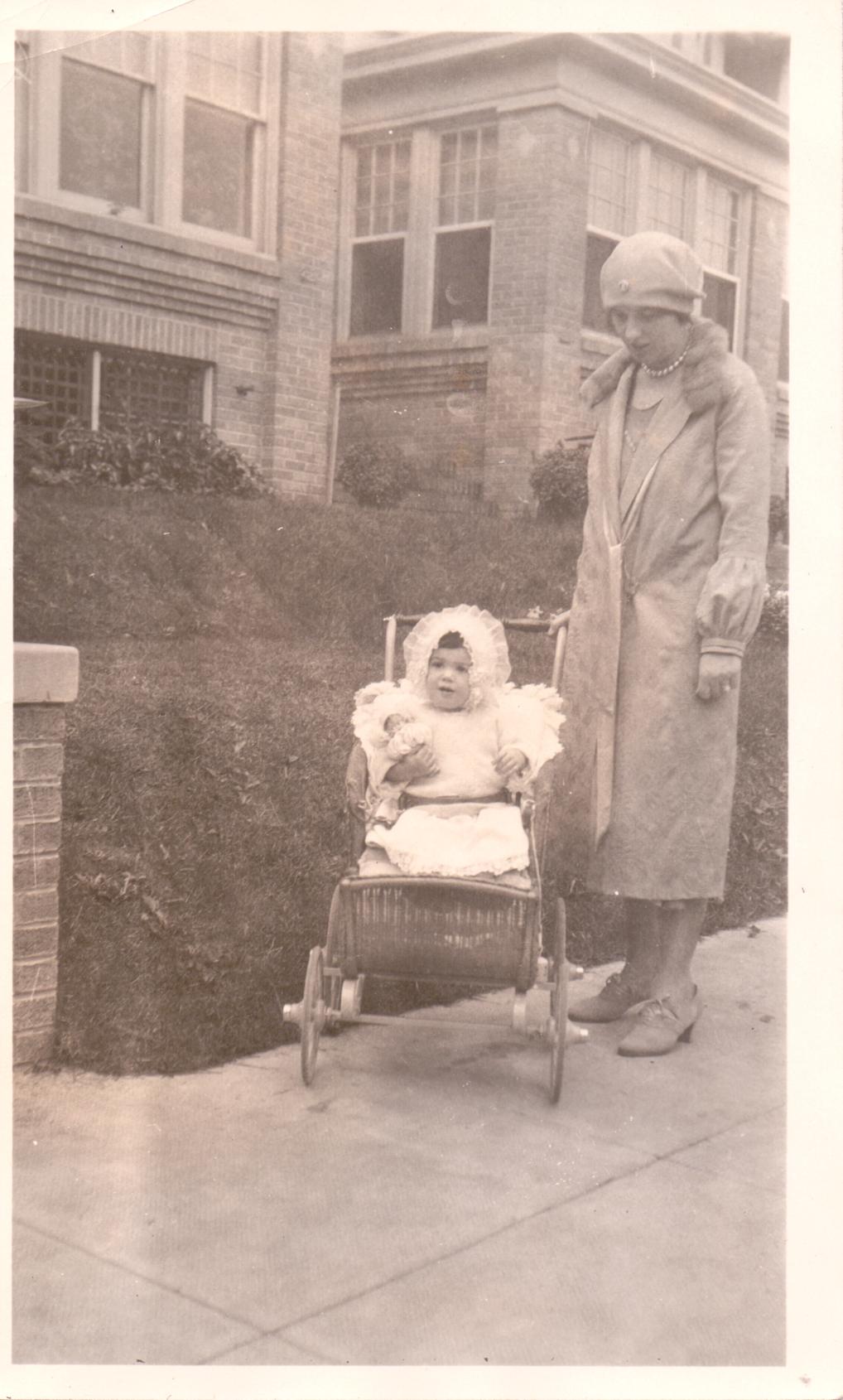
My father and his cousin Marjorie are the only surviving grandchildren of Eva and Emanuel Cohen, and my siblings and I are the only great-grandchildren.  In the last few weeks, I’ve been very fortunate to receive from Marjorie’s maternal cousin Lou a number of photographs of Marjorie and others, and I was thrilled to be able to see the face of the woman with whom I’d had such wonderful conversations this summer.  Below are several photographs of Marjorie as a child and as a young woman, including some with and of  her parents Stanley and Bess Cohen.

Stanley Cohen World War I

Stanley Cohen World War I


Marjorie and her mother Bess Craig Cohen

Marjorie and her mother Bess


Set Marjorie and Stan

Marjorie and her father Stanley

Stanley Cohen 1928

Stanley Cohen 1928

Marjorie 1933

Marjorie 1933

Marjorie and Bess 1933

Marjorie and Bess 1933

Marjorie Cohen

Marjorie Cohen with Pete-page-001

Marjorie with Pete from Our Gang

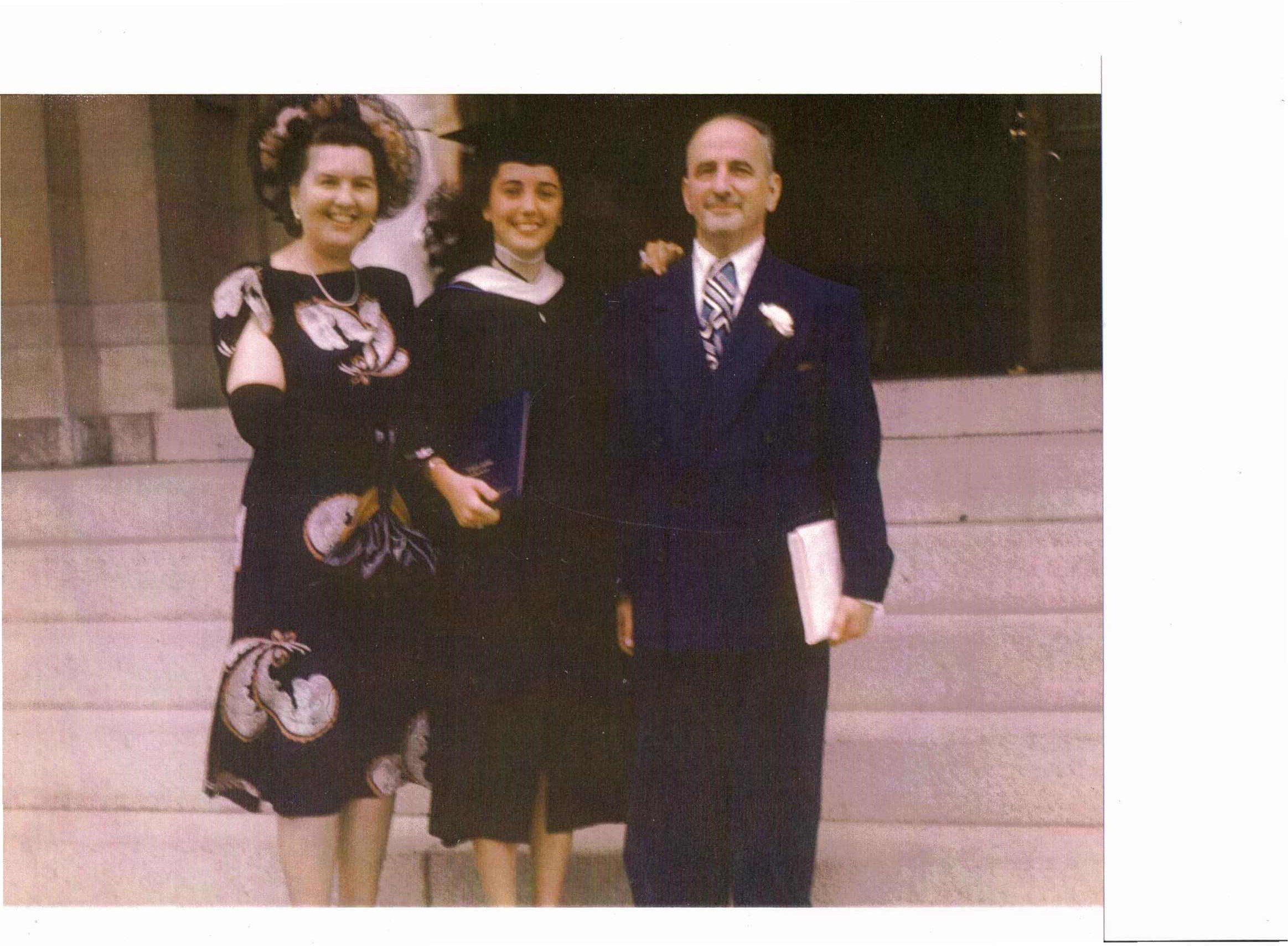
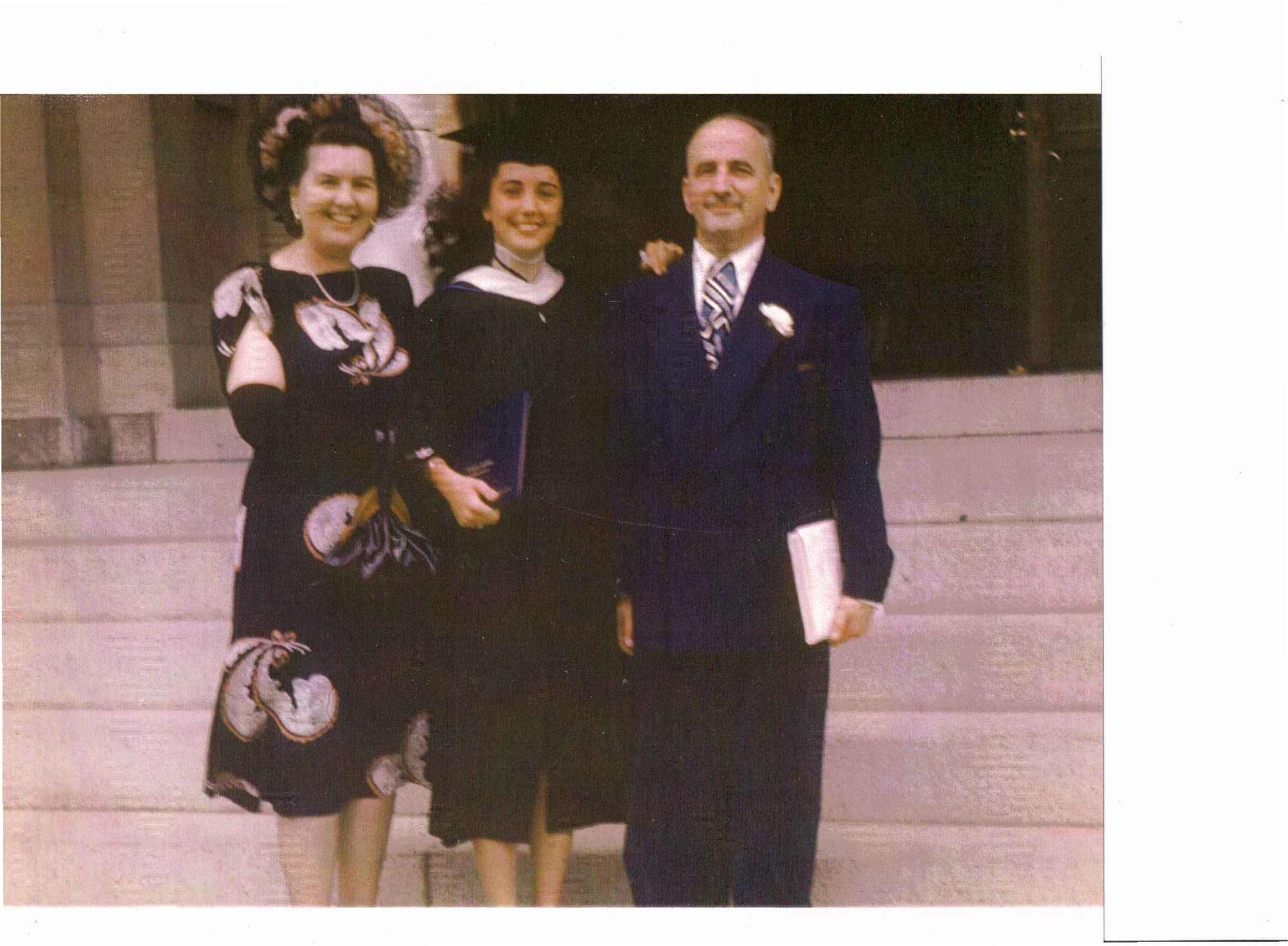
Marjorie and her parents Stanley and Bess Cohen at her graduation from Trinity (DC), c. 1947

Marjorie and her parents at her graduation from Trinity (DC), c. 1947

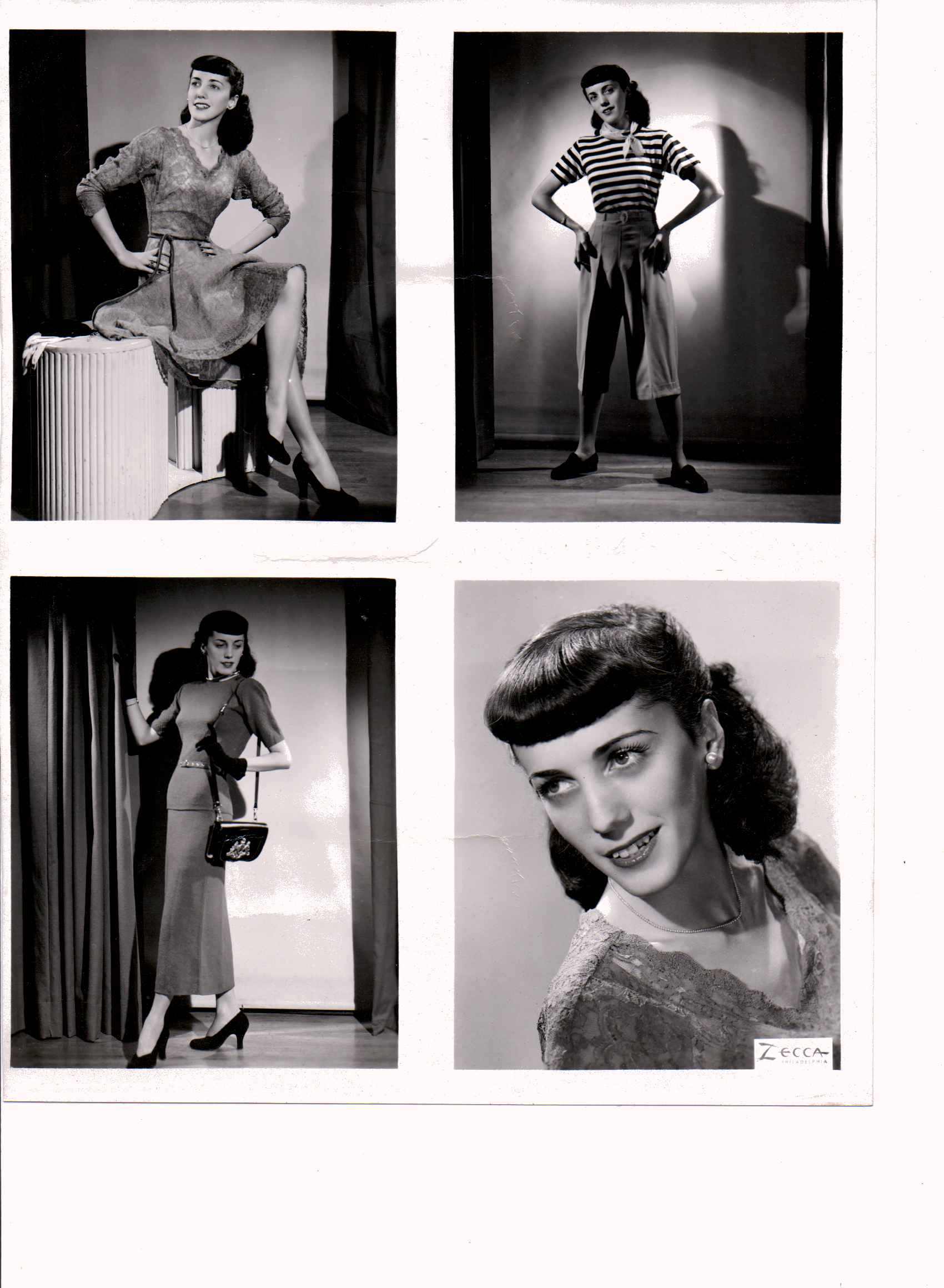
Marjorie as a student at NY Dramatic Arts Academy

Marjorie as a student at NY Dramatic Arts Academy

Marjorie model 2-page-001


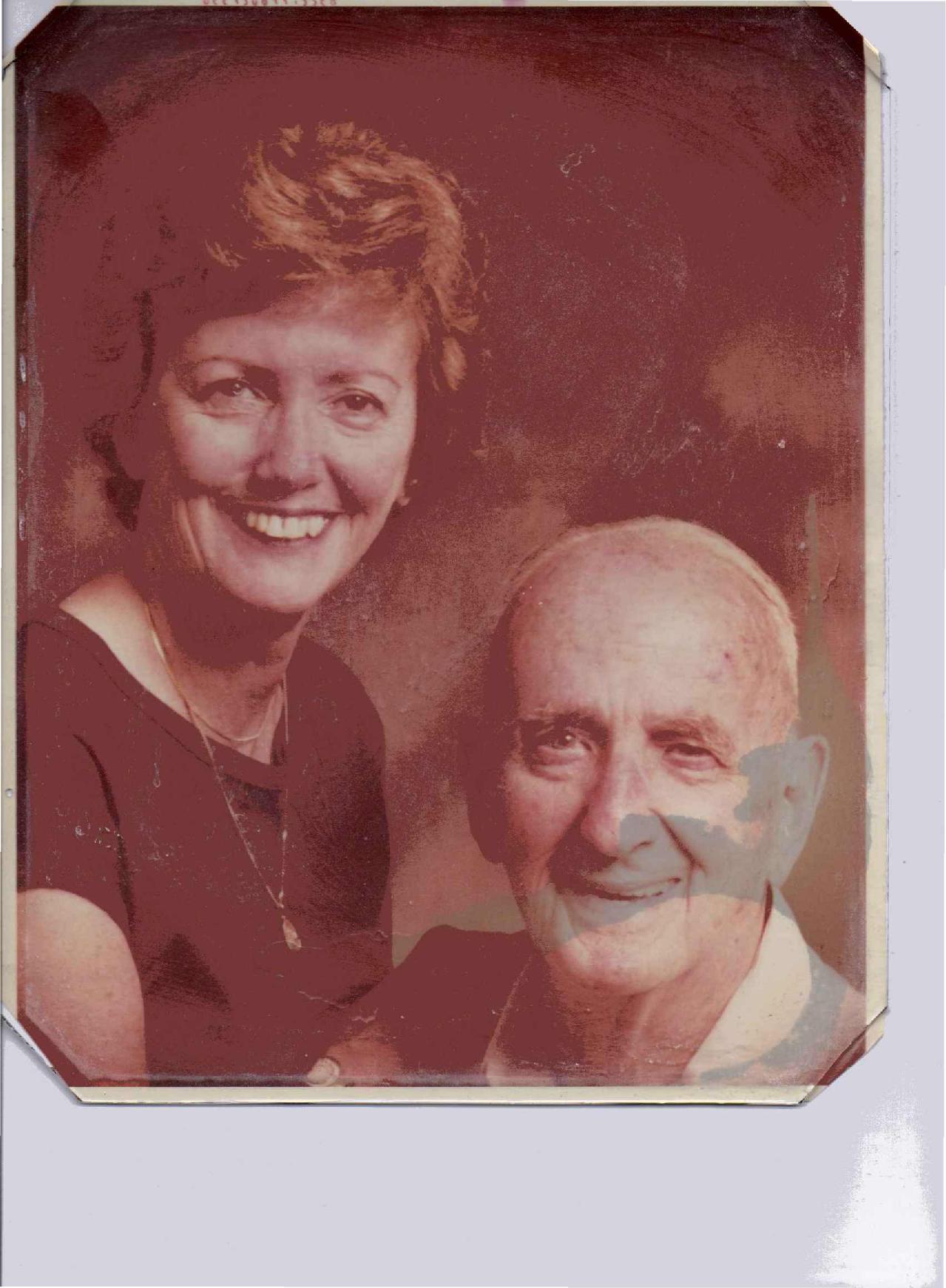
Marjorie and her father Stanley 1981

Marjorie and her father Stanley 1981

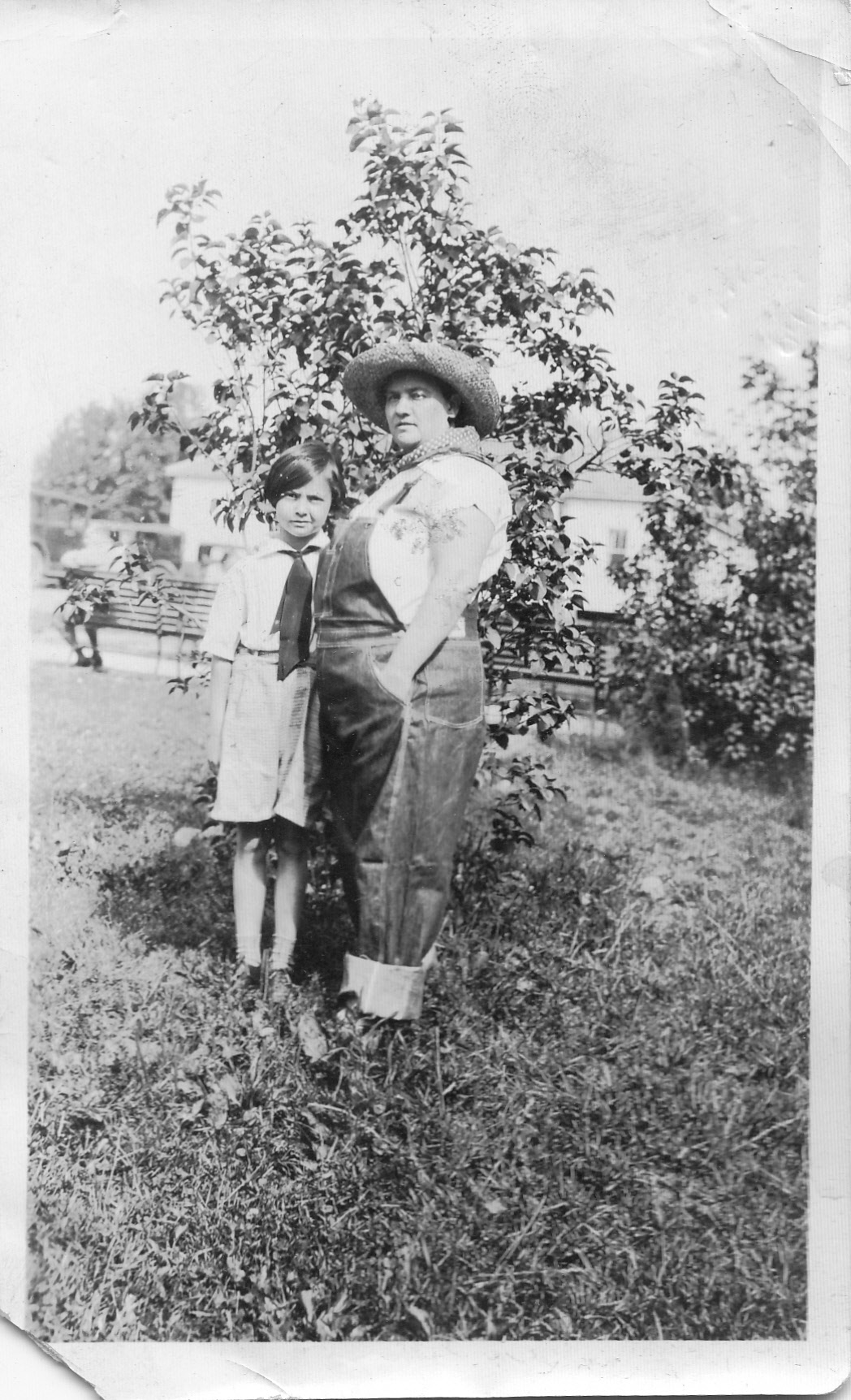
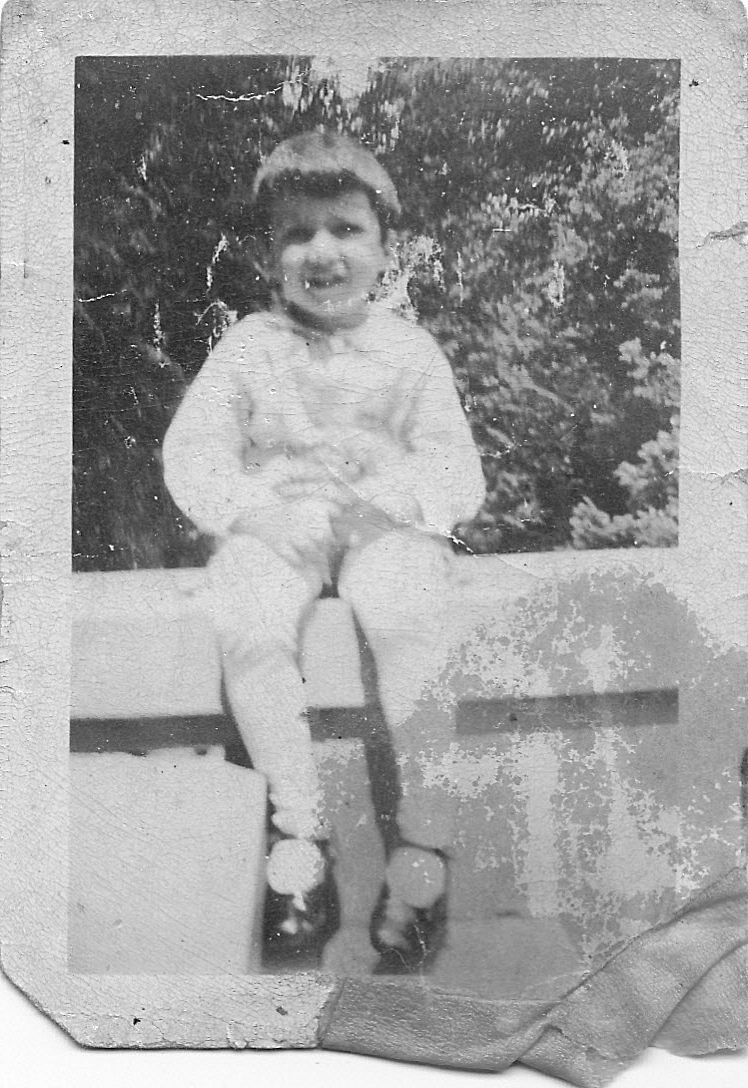
Included in that group of photographs was a photograph that Lou had labeled as Bess and Stanley 1923, but when I showed it to my father, he said that it was his parents, John and Eva (Schoenthal) Cohen.  When I compared it to the only other photograph I have of my grandparents together, it was obvious that this was John and Eva, not Stanley and Bess.  I was delighted to have another picture of my grandparents.

Eva Schoenthal and John Cohen, Jr. 1923

Eva (Schoenthal) and John Cohen, Jr. 1923


John and Eva Cohen  c. 1930

John and Eva Cohen
c. 1930

Also mixed into the group of photos from Marjorie’s cousin Lou were a few taken in Atlantic City during the summer of 1932 that finally allow me to see the face of my great-grandmother Eva Seligman Cohen.  I will post those in a later post.

Looking back:  The Cohen Family from Amsterdam to England to Philadelphia and Washington and beyond


Amsterdam coat of arms

Two months ago I wrote a summary of my perspective on the descendants of Jacob and Sarah Jacobs Cohen and their thirteen children, including my great-grandfather Emanuel Cohen.  I wrote about the way they managed to create a large network of pawnshops that provided support for the generations to come.  Many of the Philadelphia Cohens stayed in the pawnshop business into the 20th century.  The generation that followed, those born in the 20th century, began to move away from the pawn business and from Philadelphia.  Descendants began to go to college and to become professionals.  Today the great-great-grandchildren of Jacob and Sarah live all over the country and are engaged in many, many different fields.  Few of us today can imagine living with twelve siblings over a pawnshop in South Philadelphia.  We can’t fathom the idea of losing child after child to diseases that are now controlled by vaccinations and medicine.  We take for granted the relative luxurious conditions in which we live today.

File:Flag of Philadelphia, Pennsylvania.svg

Philadelphia flag


The story of the Cohen family in Washington is much the same in some ways, different in other ways.  Jacob’s brother Moses and his wife Adeline also started out as immigrants in the pawnshop business , first in Baltimore and then Washington.  But unlike Jacob who lived to see his children become adults, Moses Cohen died at age 40 when his younger children were still under ten years old.  Adeline was left to raise those young children on her own as she had likely raised her first born son, Moses Himmel Cohen, on her own until she married Moses Cohen, Sr.  When I look at what those children accomplished and what their children then accomplished, I am in awe of what Adeline was able to do.   For me, the story of the DC Cohens is primarily the story of Adeline Himmel Cohen for it was she, not Moses, who raised the five children who thrived here in the US.  She somehow instilled in those children a drive to overcome the loss of their father, to take risks, to get an education, and to make a living.

Her son Moses, Jr., an immigrant himself, had nine children; his son, Myer, became a lawyer.  To me it is quite remarkable that a first generation American, the son of a Jewish immigrant, was able to go to law school in the late 19th century.  Myer himself went on to raise a large family, including two sons who became doctors and one who became a high ranking official at the United Nations in its early years after World War II.  Moses, Jr.’s other children also lived comfortable lives, working in their own businesses and raising families.  These were first generation Americans who truly worked to find the American dream.

Adeline and Moses, Sr.’s other three children who survived to adulthood, Hart, JM, and Rachel Cohen, all took a big risk and moved, for varying periods of time, to Sioux City, Iowa.  Even their mother Adeline lived out on the prairie for some years.  JM stayed out west, eventually moving to Kansas City; he was able to send his two daughters to college, again something that struck me as remarkable for those times.  His grandchildren were very successful professionally.  Hart, who lost a son to an awful accident, had a more challenging life.  His sister Rachel also had some heartbreak—losing one young child and a granddaughter Adelyn, but she had two grandsons who both appear to have been successful.

Three of the DC Cohen women married three Selinger brothers or cousins.  Their children included doctors, a popular singer, and a daughter who returned to England several generations after her ancestors had left.  The family tree gets quite convoluted when I try to sort out how their descendants are related, both as Cohens and as Selingers.

There were a number of heart-breaking stories to tell about the lives of some of these people, but overall like the Philadelphia Cohens, these were people who endured and survived and generally succeeded in having a good life, at least as far as I can tell.  The DC Cohens, like the Philadelphia Cohens, have descendants living all over the United States and elsewhere and are working in many professions and careers of all types.

flag of Washington, DC

Looking back now at the story of all the Cohens,  all the descendants of Hart Levy Cohen and Rachel Jacobs, I feel immense respect for my great-great-great grandparents.  They left Amsterdam for England, presumably for better economic opportunities than Amsterdam offered at that time.  In England Hart established himself as a merchant, but perhaps being a Dutch Jew in London was not easy, and so all five of Hart and Rachel’s children came to the US, Lewis, Moses, Jacob, Elizabeth, and Jonas, again presumably for even better opportunities than London had offered them.  Eventually Hart himself came to the US, uprooting himself for a second time to cross the Atlantic as a man already in his seventies so that he could be with his children and his grandchildren.  Rachel unfortunately did not survive to make that last move.

Flag of the City of London.svg

The flag of the City of London

Arriving in the US by 1850 in that early wave of Jewish immigration gave my Cohen ancestors a leg up over the Jewish immigrants who arrived thirty to sixty years later, like my Brotman, Goldschlager, and Rosenzweig ancestors.  Of course, the Cohens had the advantage of already speaking English, unlike my Yiddish speaking relatives on my mother’s side.  They also had the advantage of arriving at a time when there wre fewer overall immigrants, Jewish immigrants in particular and thus faced less general hostility than the masses of Jewish, Italian, and other immigrants who arrived in the 1890s and early 20th century.  Also, my Cohen relatives may not have been wealthy when they arrived, but Hart and his children already had experience as merchants and were able to establish their own businesses fairly quickly.  Thus, by the time my mother’s ancestors started arriving and settling in the Lower East Side of NYC or in East Harlem, working in sweatshops and struggling to make ends meet, my father’s ancestors were solidly in the middle and upper classes in Philadelphia, Washington, Sioux City, Kansas City, Detroit, and Baltimore.

When I look at these stories together, I see the story of Jewish immigration in America.  I see a first wave of Jews, speaking English, looking American, and living comfortably, facing a second wave who spoke Yiddish, looked old-fashioned, and lived in poverty.  No wonder there was some tension between the two groups.  No wonder they established different synagogues, different communities, different traditions.

A recent study suggests that all Ashkenazi Jews were descended from a small group of about 350 ancestors.  We all must share some DNA to some extent.  We are really all one family.  But we have always divided ourselves and defined our subgroups differently—Orthodox, Conservative, Reform; Galitizianer or Litvak; Sephardic or Ashkenazi; Israeli or American; so on and so forth.  We really cannot afford to do that in today’s world; we never really could.  Today very few of us make distinctions based on whether our ancestors came in 1850 or 1900 because we are all a mix of both and because we have blurred the economic and cultural distinctions that once were so obvious.  But we still have a long way to go to eradicate the divisions among us and to overcome the prejudices that continue to exist regarding those who are different, whether Jewish or non-Jewish.


The Cohens: Questions Left to Answer

Now that I have gone through all the lines descending from Hart Levy Cohen and Rachel Jacobs through their children and grandchildren up to current descendants, I have to look back and see what I missed.  What are the big questions and small questions that remain unanswered?  Otherwise, I may leave some things unsolved and accept gaps in my research.  So this blog post is my attempt to outline those unanswered questions as a way to remind myself not to be too self-satisfied with what I have done.

File:Questionmark.svg


Overall, I am quite amazed by how much I was able to find.  It really helped that (1) there were generations in the US going back as far as 1848 because US records are much more accessible to me and (2) that most of my Cohen relatives lived in Pennsylvania, a state that has made many of its records available online.  It also helped that both the Philadelphia Inquirer and the Washington Evening Star covered society happenings like parties, engagements, and weddings because it was through those resources that I was able to find a lot of the married names of the Cohen women.

So what is there left to research?  First and foremost, I would love to be able to find the parents and grandparents and other ancestors of Hart Levy Cohen.  I don’t know that I will ever be able to do this, given how little luck I had at the archives in Amsterdam and also given that surnames were not adopted by Jews until the early 1800s.  But new records are uncovered all the time, so I will not give up hope yet.  Related to that, of course, is finding the ancestors for my great-great-great grandmother Rachel Jacobs.

As for the next generation after Hart and Rachel, the big questions left unanswered relate to Hart and Rachel’s son Moses.  Although I do not have DNA proof that the Moses who married Adeline Himmel was their son, I am confident that he was based on the weight of the circumstantial evidence.  Maybe a descendant of Isadore Baer Cohen will come along, but even without that, I am convinced that this was the right Moses.  Rather, the real unanswered question for me is when and where did Moses meet and marry Adeline Himmel?  When did she come to the United States from Baden?  I have no evidence yet relating to either of these questions.

The remaining questions are not as important to me in terms of the overall story of the family.  They almost all relate to the absence of death records.  Among those for whom I have no death records are: Joseph Cohen’s daughter Fannie; Abraham’s son Arthur; Harry Selinger, Augusta and Julius Selinger’s son; Rachel Cohen Selinger; Aaron Hartstall; Monroe Selinger; JM Cohen’s son Arthur; Hart DC’s son Jacob Cohen; Estelle Spater Cole, Sol’s wife; Gary Cole, Jacob G. Cole’s son; and Lewis Cohen, son of Reuben Cohen, Sr.

Then there are a number of people for whom I have a date of death from an index, but no death certificate, like Simon L.B Cohen—why did he die so young?  There are also many for whom I have a marriage record from an index, but no marriage certificate.  I am not sure how important it is to see the actual document where I am otherwise certain of the identity of the individuals who married or died, but eventually if those documents become available, I should obtain them.

And there are also a few cases where I could not determine whether a person had any children—such as Violet Cohen, daughter of Reuben Cohen, Sr.; Jonas Cohen, Jr.; and Morton and Kathryn Selinger. I was unable to find out whether Caroline Hamberg married Robert Daley or anyone else. Finally, there are the two children of Sallie R. Cohen who were orphaned after Sallie and her husband Ellis Abrams died; I do not know what happened to them.

Listing all those names makes me feel like there is so much more to do, but I also have to remind myself of how much I’ve already done.  I realize that this is perhaps not the most exciting blog post for those reading it, but it will serve as an important post for me to return to when I need to remember the questions that I still have to answer.

My next post will be more reflective; I need to step back, look at the story of my Cohen relatives, and think about what I have learned about them and about history and about myself by doing this research.

Wonderful Surprises and Gifts

I had two wonderful surprises this week.  Usually I am hunting down family members, hoping for a response.  Twice this week I heard from relatives who found me.

Lou, a relative by marriage, is a cousin of my cousin Marjorie.  He had visited Marjorie recently and heard about my contact with her.  He sent me two wonderful photographs of Marjorie.  One is posted here: a photograph of Marjorie and her parents, Bessie and Stanley Cohen, at her graduation from Trinity College in Washington, DC, probably around 1947.  I’d never seen a picture of any of these family members before, and it was so meaningful to be able to see Marjorie’s face after spending time getting to know her on the phone this summer.  I hope to be able to meet her in person in the coming months.  I also was excited to see what my great-uncle Stanley looked like and what his wife Bessie looked like.   It really helps to bring these people to life when you can put a face to the name.  Bessie and Stanley look so proud of their daughter, a college graduate back when most women did not even dream of going to college.  (The second photograph I will post when I get to my Seligman relatives as it depicts two of them.)

Bessie and Stanley Cohen with their daughter Marjorie at her graduation

Bessie and Stanley Cohen with their daughter Marjorie at her graduation

The second wonderful surprise came in the form of a comment on the blog from a descendant of Julius and Augusta Selinger, their great-grandson Cito.  He had just accidentally found the blog while searching for something else and was pleased to see and learn more about his family’s history.

He then sent me this wonderful photograph of his great-grandfather Julius’ jewelry store.  Although the photograph is not dated, if you look at it closely, you can read the larger sign in the window that says “Sale…Watches…$4,” and see at the bottom “Price during the War +15.”  I am not exactly sure what that means, but I assume that the reference is to World War I, dating the photograph during the second decade of the 20th century.

Selinger's Jewelry Store 820 F Street, Washington, DC

Selinger’s Jewelry Store 820 F Street, Washington, DC

That makes sense because the young woman to the right standing in the doorway is assumed by the family to be Eleanor Selinger, the daughter of Julius and Augusta who married Henry Abbot and moved to London in 1926.  Eleanor would have been about 22 years old in 1917 when the US entered World War I.  I love being able to see Eleanor’s face also.  She has such a searching, pensive look on her face—what was she thinking?  You can see the reflections of a crowd of people looking into the window as well as some of the buildings across the way.  The store was at 820 F Street in Washington, DC.  Perhaps some of you recognize that location?

Thanks to both Lou and Cito for generously sharing these photographs and for contacting me.  I am so happy that you both were able to find me.  I also received photographs from another family member this week, my cousin Jack, the great-grandson of Joseph Cohen, who was my great-grandfather Emanuel’s older brother.  I will post some of those photographs next week after I have a chance to scan them.

So it’s been a great week to be doing genealogy research.  I am feeling very fortunate for all the gifts that genealogy has provided to me.  Happy Labor Day Weekend, everyone!


Elizabeth Cohen’s Descendants: The Story Continued

In an earlier post, I detailed the difficult search for the story of Elizabeth Cohen and the lucky break I had in finding one little newspaper mention of a charitable donation that opened the door to the rest of her story: that she had first married Benjamin Heyman and had two children, Florence and Herbert, that Benjamin had died before Herbert was two years old, and that Elizabeth later married Bernard Sluizer with whom she had another child, Mervyn Sluizer.  That was where the post ended.

I have been very lucky again in finding one of Bernard and Elizabeth Sluizer’s great-granddaughters, Janet Elizabeth Sluizer (named for her great-grandmother, Elizabeth Cohen Sluizer).  I now know more about Bernard and about their descendants including some photographs that bring these names to life.  Bernard was the first born child of Meyer and Margaret (nee Lince) Sluizer, who were both born in Holland in the early 1830s.  The records conflict as to when they arrived in the US, but by 1860 they were certainly living in Philadelphia as Meyer filed a Declaration of Intent to become a citizen that year and Bernard was also born in Philadelphia in 1860.  Meyer was first a tobacconist and later became a china dealer, according to several Philadelphia directories.  He and Margaret had six more children, the last born in 1877.  Meyer died in 1880, leaving Margaret with many young children still at home.  Margaret lived to be 88, dying on August 20, 1921.

Bernard, who was twenty when his father died, was employed as a salesman in 1880, but no specific business was given on the 1880 census.  He remained a salesman of some kind at least until he married my great-grandaunt Elizabeth Cohen in 1892, when not surprisingly he became a pawnbroker.  As I’ve already written, Bernard took in Elizabeth’s two children from her prior marriage to Benjamin Heyman, and then in 1893, Bernard and Elizabeth had a child of their own, Mervyn.

Mervyn married Irma Wise in 1916 when he was 23 years old and she was 21.

Mervyn Sluizer, Sr.

Mervyn Sluizer, Sr.

Irma Wise Sluizer

Irma Wise Sluizer

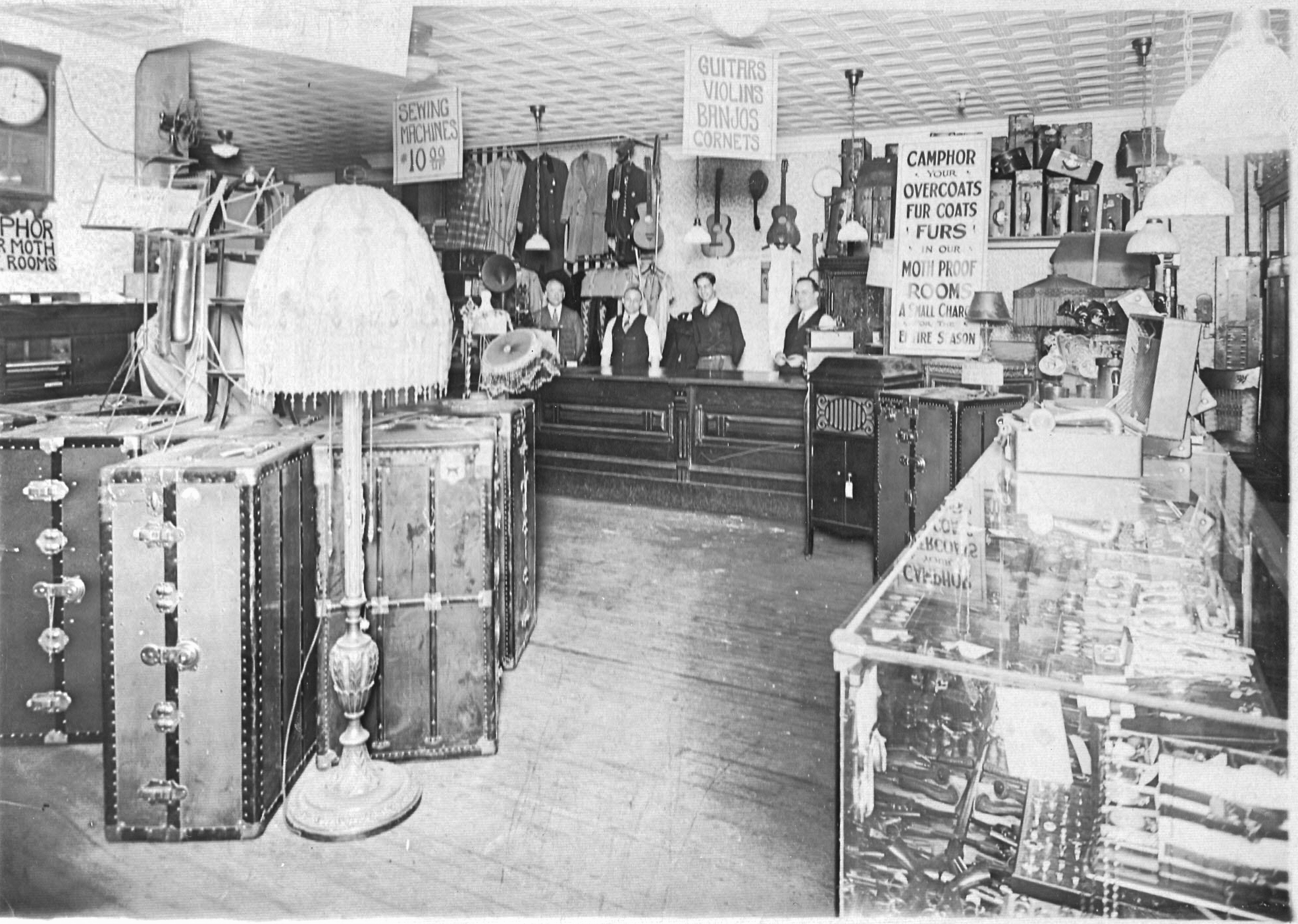
Mervyn also became a pawnbroker, working in his father’s store. Here is a wonderful photograph of Bernard (far left) and his son Mervyn (far right), working in his pawnshop.  This is the first photograph I have seen of one of the many family pawnshops.  I love the musical instruments in the background, the huge trunks in the foreground, and all the other signs and details that help convey a sense of what these stores were like.

Bernard Sluizer's pawnshop Bernard, far left; his son, Mervyn, Sr., far right

Bernard Sluizer’s pawnshop
Bernard, far left; his son, Mervyn, Sr., far right

Mervyn and Irma had two children, Mervyn, Jr., born in 1920, and Margaret, born in 1924.  Margaret must have been named for Mervyn’s grandmother, Bernard’s mother, Margaret.  It is a little surprising that Mervyn did not name his daughter for his mother, Elizabeth, who had died in 1923, instead of his grandmother, but perhaps it was just too close to the time she had died.  In 1930, Bernard, now a widower, was living with Mervyn, Irma, and their children.

Sometime between 1932 and 1935, Mervyn and Irma divorced, according to their granddaughter Jan Sluizer.  On the 1940 census, Irma was living with her two children, Mervyn, Jr. and Margaret.  Mervyn, Sr., had remarried by 1940 and was living with his new wife, Anne, and her two children from a prior marriage, Bernard and Sidney Riskin.  Mervyn Sr.’s father Bernard was also living with him and his new family.  Mervyn, Sr., and Anne moved to Atlantic City sometime after the census and were living there for several years.

Mervyn Sluizer's house in Atlantic City

Mervyn Sluizer’s house in Atlantic City

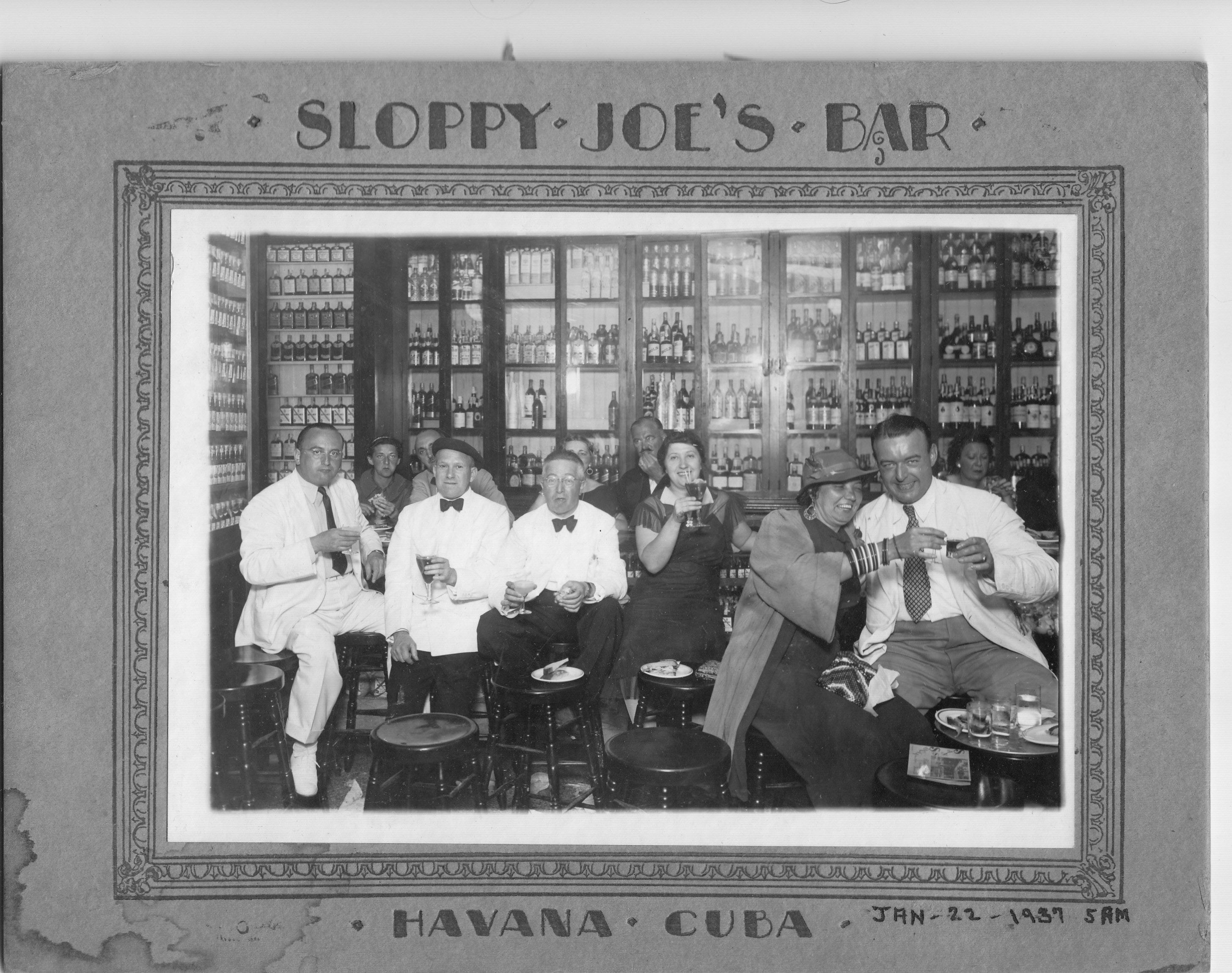
Mervyn, Sr. (far left) and Anne (center) in Havana, 1937

Mervyn, Sr. (far left) and Anne (center) in Havana, 1937

Mervyn Sluizer, Sr., third from right

Mervyn Sluizer, Sr., third from right

Anne and Mervyn Sluizer, Sr., far left

Anne and Mervyn Sluizer, Sr., far left

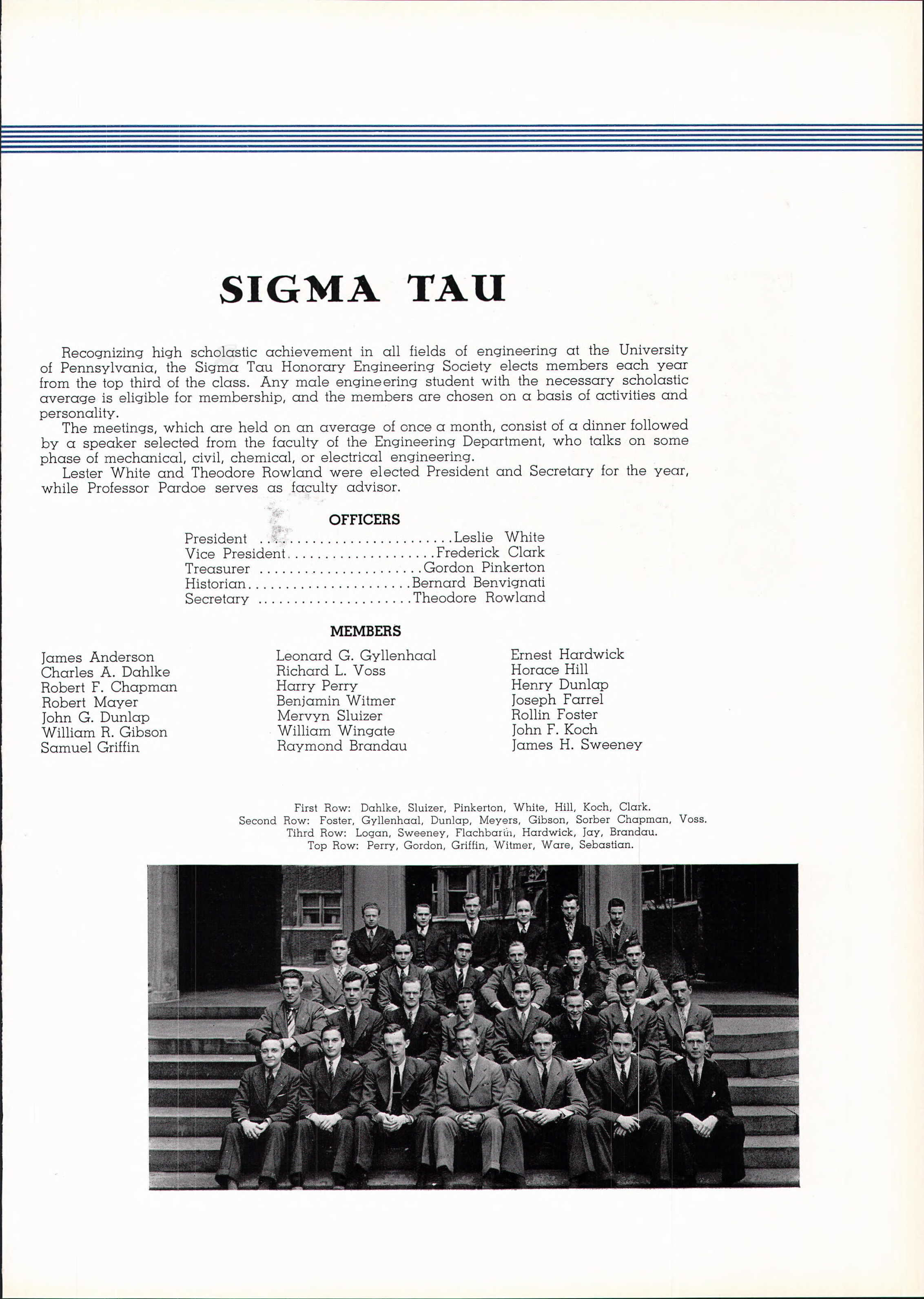
In 1941, Merv, Jr., graduated from the University of Pennsylvania, where he was an engineering student and a member of Sigma Tau, the engineering honor society.

1940 University of Pennsylvania Yearbook

1940 University of Pennsylvania Yearbook

Merv Penn 2

(Ancestry.com. U.S. School Yearbooks [database on-line]. Provo, UT, USA: Ancestry.com Operations, Inc., 2010.
Original data: Various school yearbooks from across the United States.)

His grandfather Bernard died in 1944, and six years later his father Mervyn, Sr., died also.  Mervyn, Sr., was only 57 years old.  Meanwhile, in 1942 Mervyn, Jr., had married Shirley Harkaway, whom he had met at the University of Pennsylvania.  Here is a picture of Shirley as a young child with her mother Ida,  as well as a picture of Ida as a child with her sisters:

Shirley Harkaway with her mother Ida Lutsky Harkaway

Shirley Harkaway with her mother Ida Lutsky Harkaway

Ida Lutsky, rear center, with her sisters

Ida Lutsky, rear, right, with her sisters


Mervyn, Jr. and Shirley had two children, including Jan, the cousin who has supplied me with all of the wonderful photos posted here.

Mervyn Sluizer, Jr.

Mervyn Sluizer, Jr.

Mervyn, Jr.’s sister Margaret also married and had three children.  Her husband, Dr. Manfred Goldwein, had been one of the children who had been taken out of Europe to England on the Kinder Transport to escape the Nazis; the rest of his family was killed in the Holocaust.  He became a medical doctor and one of the top rated doctors in Philadelphia.

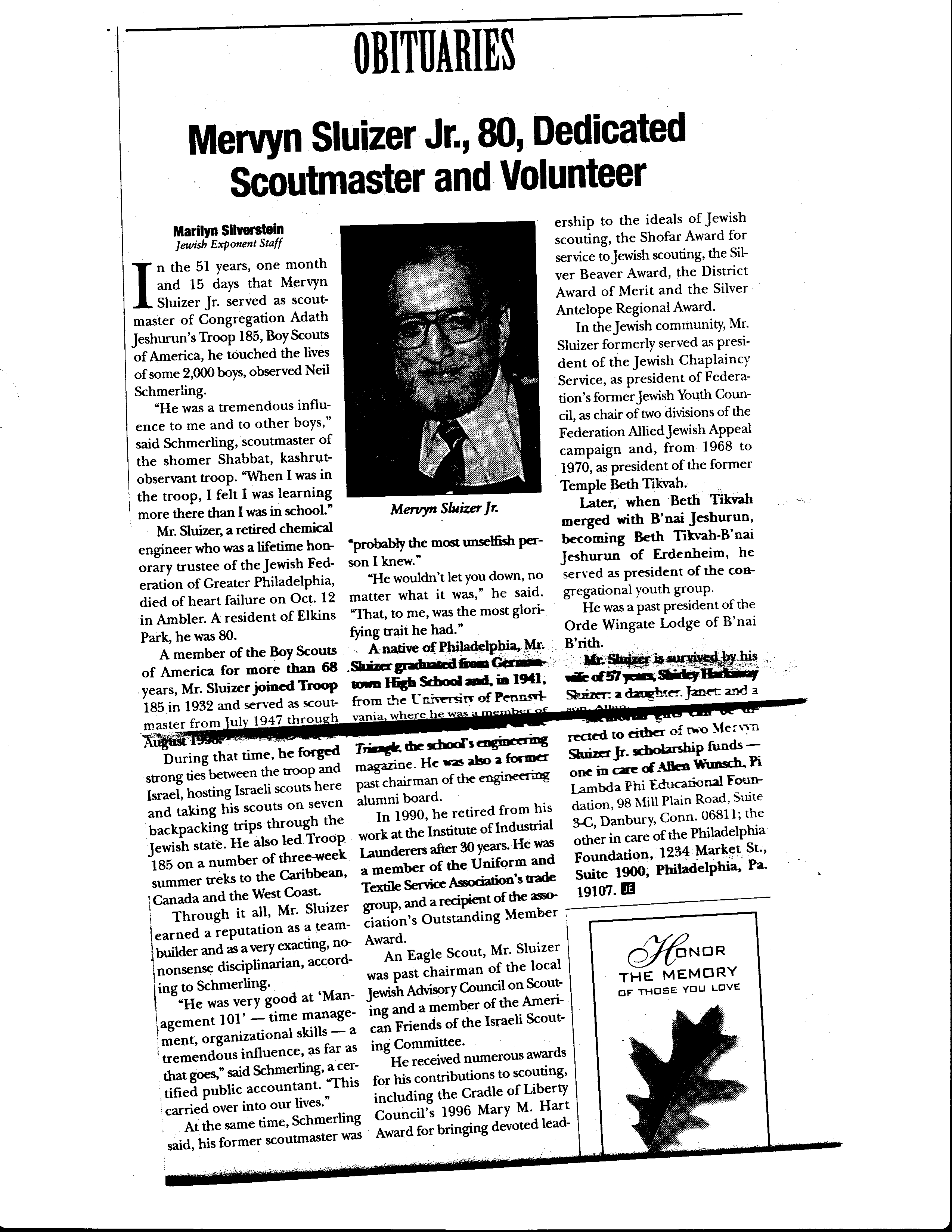
Jan also provided me with two newspaper articles about her father, Mervyn, Jr., including his obituary.  Both portray a man who was a lifelong volunteer in his community and one who had a special passion for the Boy Scouts. The first article, published by the Philadelphia Jewish Exponent in August, 1962, when Mervyn, Jr., was 42, described his history of service to his community.  According to this article, Mervyn, Jr., was active in the Allied Jewish Appeal in Philadelphia and had recently been named Chairman of its Metropolitan Division after serving as Vice Chairman and also playing an active role in the organization since 1948.  He also was active in B’Nai Brith and on the national board of trustees of his college fraternity.   He had been actively involved in scouting since he was a boy and was at that time the scoutmaster of Troop 185, which was affiliated with Adath Jeshurun synagogue.  Mervyn Jr.’s grandfather, August Wise, his mother’s father, had been one of the founding members of Adath Jeshurun.  Mervyn was himself a member of Beth Tikvah synagogue and served at one time as its president.

Mervyn Sluizer, Jr.

Mervyn Sluizer, Jr.

Philadelphia Jewish Exponent August 1962

Philadelphia Jewish Exponent August 1962

Irma Wise Sluizer (1895-1969)

Irma Wise Sluizer
(1895-1969)

Mervyn Sluizer, Jr., died on October 12, 2000.  He was eighty years old.  The obituary below, which appeared in the Philadelphia Jewish Exponent, also portrays a man who lived a full life, dedicated to service and to his profession as well as to his family.  There is a scholarship in his name created by alumni of his troop, Philadelphia Troop 185, to honor his memory and to provide financial support for Philadelphia area Boy Scouts pursuing higher education. It is specifically provided to Eagle Scouts, as Mervyn spent a great deal of time helping scouts achieve that difficult level of scouting.   There is also a second scholarship in his name sponsored by his fraternity at the University of Pennsylvania, Pi Lambda Phi.

Mervyn Sluizer, Jr. obituary

Mervyn Sluizer, Jr. obituary

My great-grandaunt Elizabeth Cohen, who died when her grandson Mervyn, Jr., was only three years old, would undoubtedly have been very proud that he grew up to be such a generous and decent man, a college educated professional, one of the first in the family, and a man who gave so much to his community.  He would have turned 94 just this past weekend on July 12.


Seeing the Forest: In Memory of Jacob and Sarah Cohen and All their Children


When doing genealogy research, I often find I get very focused on one person or one couple or sometimes one nuclear family and forget to think about the bigger picture, the extended family and their history.  This has been particularly true in researching my great-great grandparents Jacob and Sarah Cohen and their thirteen children.  Each one of those children was a story unto itself; each of their nuclear units told a complete story.  Doing the research for each of them brought me into their individual lives—their relationships, their careers, their children, their achievements, and their tragedies.

Leaf lamina. The leaf architecture probably ar...

Leaf lamina. The leaf architecture probably arose multiple times in the plant lineage (Photo credit: Wikipedia)

It was only when I got to child number eleven, my great-grandfather Emanuel, that I realized I had lost the bigger picture.  His life was not only about his adulthood—his wife and his children and grandchildren, but was also shaped by and always affected by what was happening with his extended family—his parents, his siblings, his nieces and nephews. It was then that I looked at the overall timeline to see what was happening outside his nuclear family as well as within it.

Now looking back and trying to get that bigger picture overall, I can make some fairly general observations about these thirteen children and their extended family.  First, they were all very interconnected in their work as well as their personal lives.  Almost all the men, including many of the brothers-in-law and sons-in-law, were pawnbrokers.  I don’t have a very good sense of how many separate stores there were in the Cohen pawnshop industry, but obviously there were enough to support more than a dozen families, including a family as large as that of Reuben Cohen, Sr., with his many children.  Yes, there were some trouble spots and some disputes undoubtedly, but this was a family that worked together and lived together, often within blocks of each other.  One project I have in mind at some point is creating a map to show where they all were living at a given point in time.  This was a family where almost everyone stayed in Philadelphia or perhaps New Jersey for multiple generations at least until the 1930s or 1940s.

Every tragedy—the deaths of so many young children, the premature deaths of so many young adults, the horrible accidents—must have rippled through the entire family in some way.  This was a family that suffered greatly over and over again—perhaps no more than any other of its time, but nevertheless, more than most of us can imagine today.  Almost every one of them lost at least one young child; some lost several.   Reuben and Sally lost ten children.  Some, like my great-grandparents and Reuben, not only lost a young child, but also lost adult children who died too young.

Yet this was also a family that triumphed.  Most of them lived fairly comfortably, if not luxuriously.  They moved to the northern sections of Philadelphia away from the increasingly poor sections where Jacob and Sarah had settled at 136 South Street.  Many had servants living with them, even when they had only a few or even no children.  These were not college-educated people.  Most did not even finish high school.  But they were savvy business people who, as far as I can tell, for the most part operated their businesses honestly but successfully, as the profile of Reuben Cohen described.  They saw themselves as money lenders, as the banks for those who could not borrow money from a traditional, established bank. Some were more successful than others, but overall this was a family that came to America in the 1840s and made a good life for themselves and their descendants.

Looking back on those times makes me wonder what happened.  How did this large, interconnected family lose touch with each other?  It’s not just my father’s immediate line that was disconnected; every Cohen descendant I’ve been able to locate says the same thing—that they had no idea about all these other cousins and Cohen relatives.  My father said he had no idea that his father had cousins.  I counted sixty-nine grandchildren born to Jacob and Sarah Cohen.  Even if you subtract the many who did not survive childhood, there were probably fifty—meaning that my grandfather had fifty living first cousins, mostly living in Philadelphia, yet my father did not know of any of them.

I suppose that that is how it is as families grow, children marry, grandchildren are born.  You no longer can fit everyone around the table even for special occasions.  Other families also need attention—the in-laws and all their relatives.  Especially back then, before the telephone and the automobile and certainly before the internet, Facebook, Google, email, and cellphones, it was just too hard and too expensive to stay in touch if someone was not in your immediate neighborhood and your day-to-day life.  We all know how hard it is to stay in touch even with all those modern means of communication.

So people moved away, grew apart, and lost touch.  At least now we can all benefit from knowing the bigger picture, from looking at our shared history, and knowing that even if we do not know each other, we are all part of the same tree.


Thanks to Rabbi Albert Gabbai of Mikveh Israel Congregation in Philadelphia, I now have photos of the headstones for Jacob and Sarah.

jacob headstone enhanced 2

Headstone for Jacob and Sarah Cohen

Jacob Cohen's headstone enhanced

They are not very legible, but you can clearly see Jacob’s name in English, and with the help of others, I’ve been told that the Hebrew includes Jacob’s name, Yaakov ben Naftali ha Cohen, and his date of death, 13 Iyar 5648, or April 24, 1888.  It also apparently has a reference to London as his birthplace.

Jacob headstone from FB

The side for Sarah (the second one above)  is almost completely eroded, so no one could decipher it.    Rabbi Gabbai also found the stone for Hart Levy Cohen, but he said it was nothing but a plain stone as all the engraving had eroded so he did not take a picture.  I wish that he had, but did not have the heart to ask him to go back to the cemetery.

All that is left is for us to remember them and their children and their grandchildren.


Filling in a Few Gaps, but Leaving Several to be Filled

Before I move on from the children and grandchildren and other descendants of my great-great-grandparents Jacob and Sarah Cohen, I need to go back and fill in a few gaps.  When I wrote about their first two children Fannie and Joseph, I did not research the children of those two family members completely.  I figured I would go through the lifespan of each of the children of Jacob and Sarah and pick up what happened to their grandchildren at some later point.  As I moved on to Fannie and Joseph’s siblings, however, I changed my approach and traced the children and even the grandchildren as far forward as I could.  Now I need to go back to Fannie’s children and Joseph’s children to complete my research and my recording of their stories.

First, Fannie. Fannie or Frances and her husband Ansel Hamberg had five daughters.  One, Rachel, had died of typhoid fever as a toddler, as I previously reported.  The others all lived to adulthood.  The oldest, Sarah or Sallie, married Harry Speare and moved to Atlantic City.  As far as I can tell, they did not have any children.  Sarah died March 7, 1918, when she was 51 years old, according to her death certificate.  She was buried with her parents at Mt Sinai Cemetery in Philadelphia.  Her husband Harry lived to be 98 years old and died in 1970; he is buried with Sallie at Mt Sinai.

Sarah Hamberg death certificate

Sarah Hamberg Speare death certificate

The next sister, Hannah, married Walter Durfor in 1907.  Walter was a meat inspector for the government in 1910, and they were living in Philadelphia with Walter’s brother, Howard, who was a chemical engineer.  Hannah and Walter also seem not to have had children as there are none appearing on either the 1910 or the 1930 census.  (I have not yet found them on the 1920 census.)  Walter continued to work as a meat inspector.  Hannah died from heart disease and kidney disease on December 12, 1935.  She was 64 years old.  Walter died on January 8, 1951.  They are buried at Fernwood Cemetery outside Philadelphia.

Hannah Hamberg Speare death certificate

Hannah Hamberg Durfor death certificate

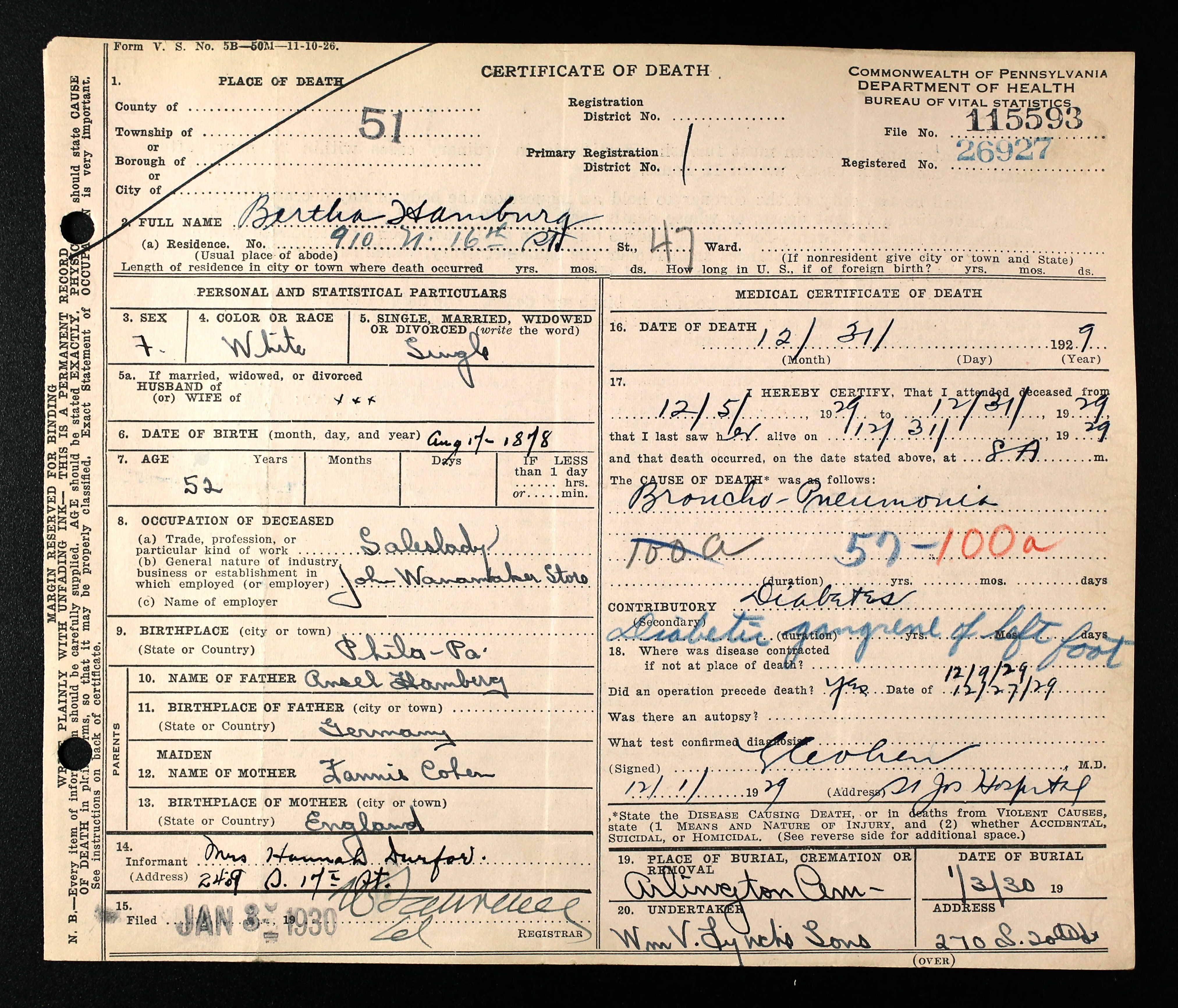
Bertha Hamberg never married or had children.  She was living with her mother up through the 1910 census at least, and in 1920 she was a boarder, living in what appears to be a rooming house and working as a saleswoman in a department store (John Wanamaker’s, according to her death certificate).   Bertha died just nine years later on December 31, 1929, from broncho-pneumonia.  She also suffered from diabetes, which had caused her left foot to develop gangrene.  She was only 52 years old.  Her sister Hannah Durfor was the informant on her death certificate.  She was buried at Arlington Cemetery in Drexel Hill, near Philadelphia.

Bertha Hamberg death certificate

Bertha Hamberg death certificate

Fannie and Ansel’s youngest daughter, Caroline, is still one I need to research more deeply.  Like her sister Bertha, she was still living at home as of 1910, also working as a saleswoman in a department store.  I had a hard time tracking what happened to her thereafter, but found a marriage record for a Caroline Hamberg to a Robert Daley, dated 1926.  She was then living with him in 1930 in Atlantic City.  I do not know if this was the correct Caroline (there was another who married a Thomas Smyth, but her death certificate was inconsistent with Caroline’s background and family information).  And I have not yet found anything else.

Thus, as far as I know right now, Fannie and Ansel do not have any living descendants as I could not find any grandchildren for them.

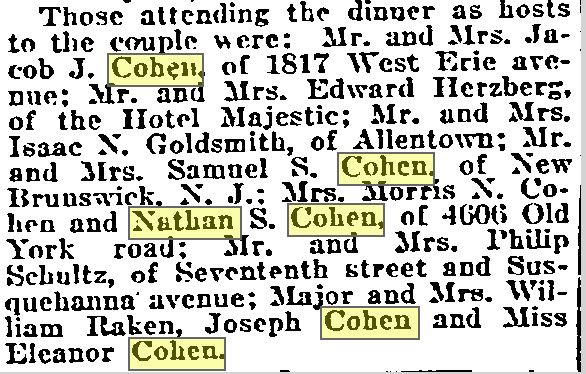
As for the children of Joseph Cohen and his wife Carrie Snellenburg, three of them predeceased their parents, as I discussed previously.  Hart died of typhoid fever as a young child, Meyer died in infancy, and Morris died in 1919 when he was 31 during the Spanish flu epidemic.   As for the seven who survived their parents, I had reasonably good success in tracking them, in large part because I found the article below about Joseph and Carrie’s 50th wedding anniversary celebration in 1919.  Joseph and Carrie Anniversary part 1 1919Joseph and Carrie anniversary part 2

(“Matrimony Notice,” Tuesday, February 18, 1919, Philadelphia Inquirer (Philadelphia, PA) Volume: 180 Issue: 49 Page: 3)

The list of their children with their addresses and married names was a huge clue that helped me locate all but two of their surviving children and three of their grandchildren.

First, their second child after Hart was Jacob.  Jacob married Aida Goldberg in 1899 and was in the wholesale jewelry business.  He and Aida had two children, Eleanor born in 1900 and Joseph born in 1902. I was able to get these two pictures of Adai courtesy of her grandson Jack.

ada goldberg and sisters

Ada Goldberg (second from left)

Ada Goldberg

Ada Goldberg

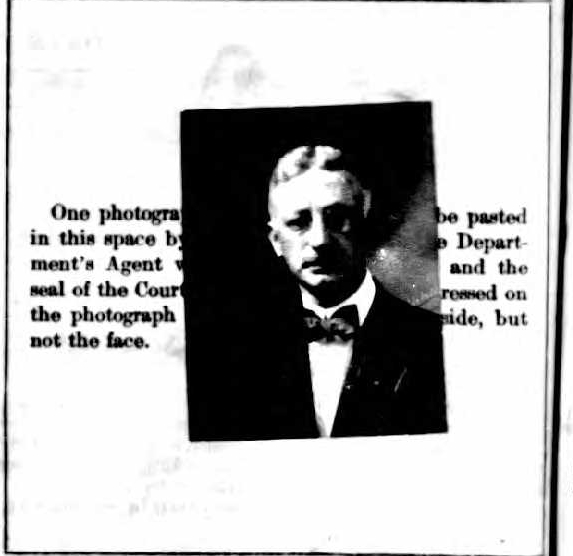
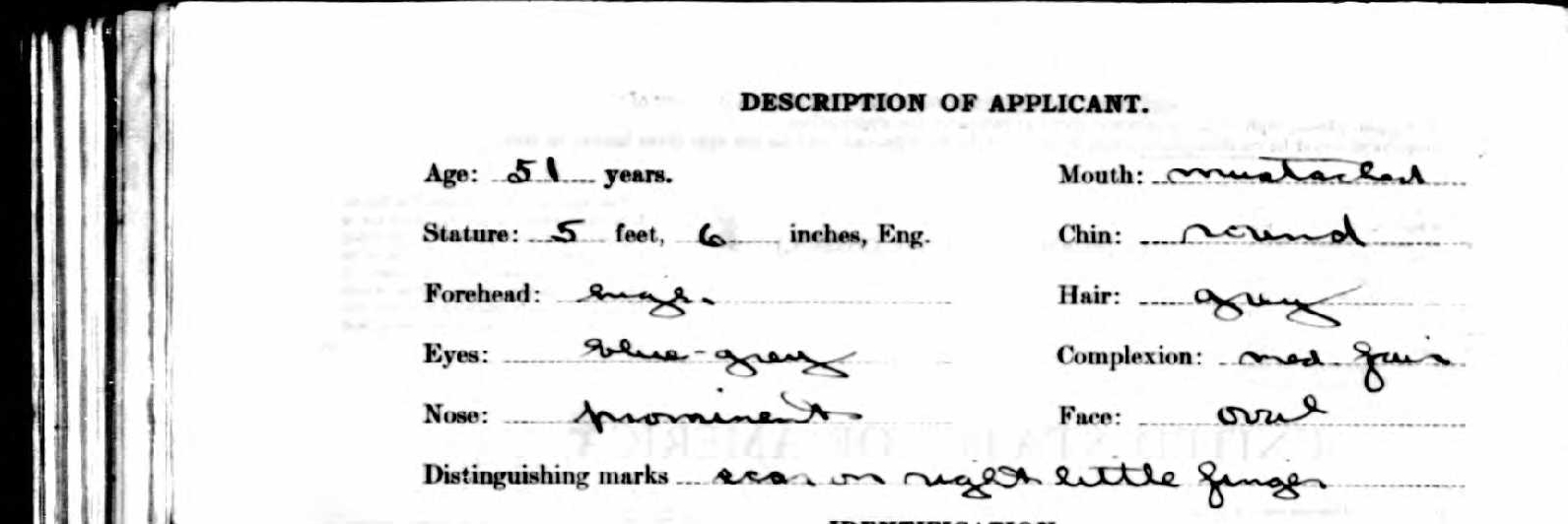
Jacob did some traveling to Europe for his diamond business, and fortunately I was able to find his passport application online which includes a picture and a physical description of him as of 1922.

Jacob J Cohen passport photo

Jacob J Cohen passport photo

Jacob J Cohen passport description

Jacob J Cohen passport description

Jacob died on April 10, 1933, from nephrostatic (?) pneumonia and a cerebral something (?). (UPDATE: Fellow genealogy blogger Alex from Root to Tip says it is hypostatic pneumonia and cerebral hemorrhage. Thanks, Alex!)  He was 62 years old, and it appears he had been under a doctor’s care for over a year and a half when he died.  His occupation was given as a diamond broker.

Jacob J Cohen death certificate

Jacob J Cohen death certificate

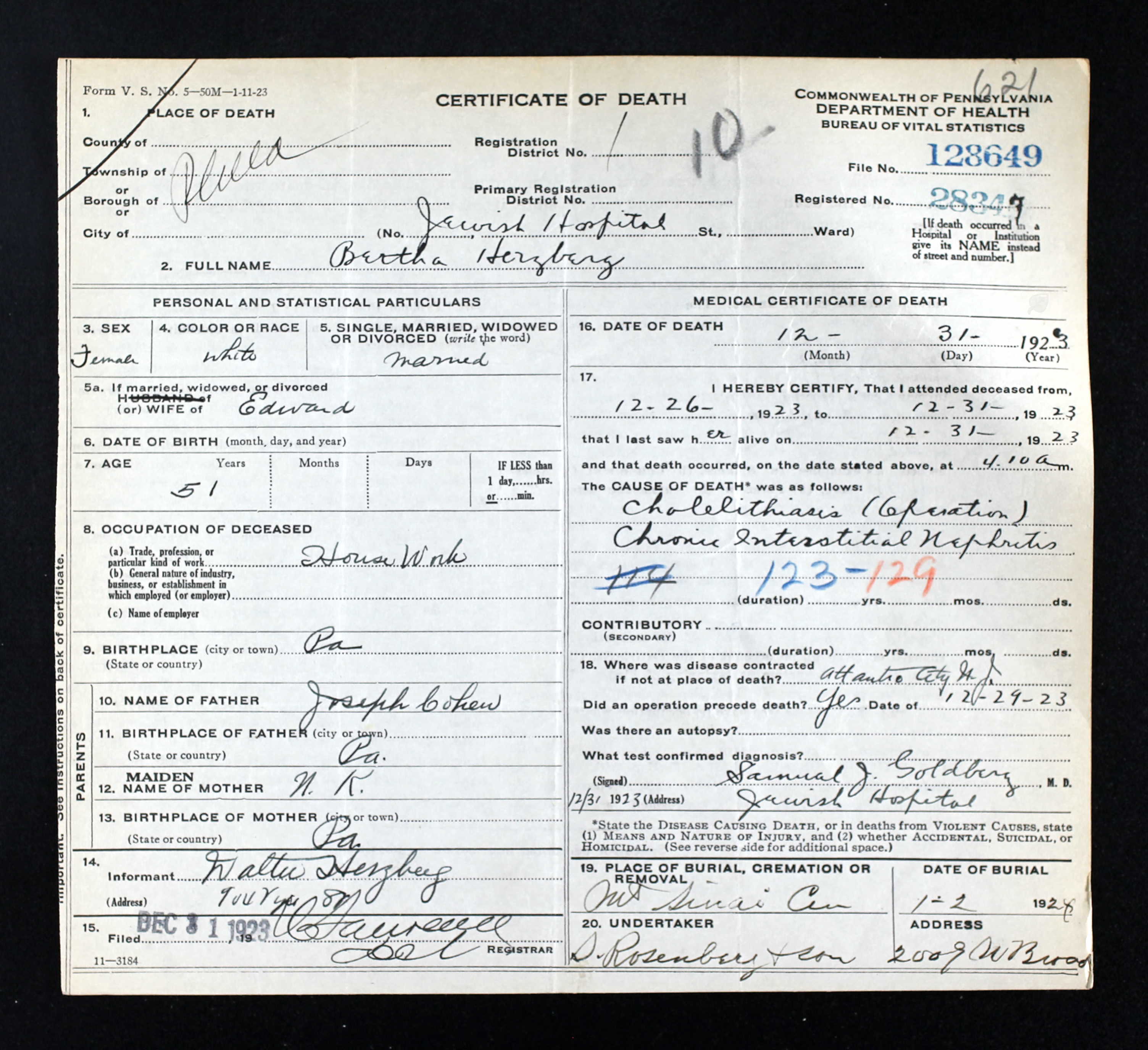
Jacob’s sister Bertha married Edward Herzberg in 1893.  They had a daughter Pauline, who was born in 1894.  Like his father-in-law and so many other Cohen relatives, Edward was a pawnbroker.  Pauline was married to Philip Schultz (the Mr. and Mrs. Philip Schultz at the anniversary party) in 1917.  Philip was also a pawnbroker.  Sadly, Bertha died December 31, 1923, when she was 51 years old.  She died after an operation for gall stones (cholelithiasis), but also suffered from kidney disease (chronic interstitial nephritis).  The informant on the certificate was Walter Herzberg, who appears from other records to have been Edward’s brother.    Edward remarried a woman named Hettie Kranzkopf.  He died from heart disease on December 27, 1934.

Bertha Cohen Herzberg death certificate

Bertha Cohen Herzberg death certificate

The story of the next sibling, Isaac, is a little more convoluted.  Isaac married Lilian Katz sometime between 1900 and 1907, when their son Jac(k) or John was born.  In 1910 they were living in Philadelphia, and Isaac was the proprietor of a “loan office,” or what I assume was a pawnshop.  By 1920, the family situation had changed.  Lilian and her son John were living in Pittsburgh with her parents, and her marital status was “divorced.”  Isaac was living in Philadelphia with his sister and brother-in-law, Julia and William Raken, and he was now an automobile dealer.  His marital status, however, was still given as married. Ten years later, it seems that Isaac and Lilian had reunited; Isaac was living in Pittsburgh with Lillian, John, and Lillian’s mother.  He was now employed as a real estate agent. They both gave their marital status as married.

I hope the reunion was a happy one, but it was not long-lived because two years later, on December 5, 1932, Isaac died from lobar pneumonia.  He was living in Pittsburgh at the time of his death, and Lillian was his informant so they were still together at the time he died.  Isaac was still employed as a real estate agent at the time of his death; he was 57 years old.

Isaac S Cohen death certificate

Isaac S Cohen death certificate

Lilian was still living with her mother in Pittsburgh as of 1940, but I have not been able to find what happened to Lillian after that.  Their son John married a woman named Ruth sometime before Isaac died, and they had one child born in 1931.

Nathan, the next sibling, also had some marital troubles.  He was single and living at home with his parents as of 1910 when he was 34 years old.  He was working as a clerk in a “loan office,” presumably his father’s pawnshop.  On his World War I draft registration, however, he was calling himself a self-employed jeweler and was still living at home with his parents. On Friday, July 4, 1919, the Philadelphia Inquirer ran an engagement announcement of Nathan Cohen and Sylvia Altman, and the marriage index also includes that couple.  By 1920, however, Nathan is listed as divorced on the census and is once again living with his parents.  Now he was working at a loan office again.  Perhaps the jewelry business failed like the marriage.

In 1925 Nathan married again; his new wife’s name was Nettie Strieff, and this marriage lasted at least ten years.  Nettie was 14 years younger than Nathan; she was 40 and he was 54 at the time of the 1930 census.  According to the census, Nathan had no occupation at that time.  The last record I found of them was a 1935 ship manifest listing them as passengers on a ship sailing from Hamburg, Germany, to New York.  I have not been able to locate them on the 1940 census, but I also have not found a death record for them.  I guess I have to keep searching.

That brings me to Sallie or Sallye Cohen, born in October, 1877.  I was able to find Sallye’s married name through the 50th wedding anniversary story about her parents.  By searching for Isaac Goldsmith, I was able to find a marriage record dated 1913 for Sallye Cohen and Isaac Goldsmith.  Sallye was 36 when she married Isaac, and they apparently did not have any children.  They lived in Allentown, Pennsylvania, where Isaac was first a real estate agent (1920) and later a real estate developer (1930).  As of 1935, they had moved to South Whitehall, Lehigh, Pennsylvania, and in 1940 Isaac must have been retired as no occupation is given on the census.  He and Sallye were 63 as of the date of the 1940 census. They are listed in the 1944 directory for Allentown, but I have not found any later records including any death certificates. My guess is that that means they lived past 1944, the last year that Pennsylvania death certificates are currently available.

The child I have had the worst time locating is the next one, Fannie.  Although she appeared on the census reports for 1900, 1910, and 1920, living with her parents, I cannot find her anywhere thereafter.  I cannot find her on a census report, on the marriage index, or on any death records or burial records.  She just disappeared.  She is not even listed as one of the hosts of the 1919 50th anniversary party for her parents, yet she was living with them both before and afterwards.  She was not working in either 1910 or 1920, even though she was 28 and 38, respectively, when those censuses were taken.  It’s another gap I just cannot fill at this point.

That brings me to Julia, born in 1884.  She married William E. Raken in 1912 when she was 28.  William was born in New Jersey and graduated from Jefferson Medical College in 1907.  After marrying Julia, he served in the army as a major during World War I from June 20, 1917, until August 30, 1919.  This article from the Philadelphia Inquirer in 1921 describes his military service:

Raken honor 1921


(“Gets Italian Honor,” Tuesday, October 4, 1921 Paper: Philadelphia Inquirer (Philadelphia, PA) Volume: 185 Issue: 96 Page: 6)

In 1920, Julia and William were living in Philadelphia with Isaac, Julia’s brother, as mentioned above.  Sometime between 1920 and 1929, however, Julia and William were divorced; William died on February 1, 1929, from heart disease and diabetes.  He was only 44 years old.

William Raken death certificate

William Raken death certificate

Julia apparently returned to her birth name, as she was buried as Julia Cohen in 1942 when she died at age 55.  I could not find her death certificate, only her burial record, so I do not know her cause of death.

Finally, the last of the children of Joseph and Carrie Cohen to survive their parents was Samuel S. Cohen, the twin of Morris Cohen who had died in 1918 from influenza.  Samuel’s story is fairly well-documented.  He was born August 22, 1887 in Cape May, New Jersey. In 1910, he was still living at home and working as a salesman in a department store.  In 1912 he married Tessie Wise. In 1914, their daughter Eva Carlyn was born. When Samuel registered for the draft in 1917, he, Tessie, and Eva were living in New Brunswick, New Jersey, where he was working as a merchant.

Samuel S Cohen World War I draft registration

Samuel S Cohen World War I draft registration

On the 1920 census he was more specific and said he was a clothing merchant. The New Brunswick city directory for 1926 reveals that Samuel was then a manager for Snellenburg Clothes Shop in that city (Snellenburg being his mother’s birth name and probably his middle name).  By 1940, they had moved to Highland Park, New Jersey, and Samuel was still in the clothing business.  His World War II draft registration states that he was self-employed.  The last record I have for Samuel is the 1944 New Brunswick, New Jersey, city directory, where he was still the manager of Snellenburg Clothing Shop in New Brunswick.  In the 1946 directory, Tessie is now listed as a widow, and she is the manager of the store.  Thus, Samuel must have died sometime between 1944 and 1946. He would have been less than sixty years old.  Tessie would continue to run the store until at least 1969, when she was listed as the president of the Snellenburg Clothing business. She would have been 79 years old.  She died February 14, 1973, when she was 83 years old.  Tessie and Samuel were survived by their only child, Eva, who had married Abram Silverman.  They had one child as well.

Looking back on all these people, the children of Fannie and Ansel Hamberg and of Joseph and Carrie Cohen, all grandchildren of Jacob and Sarah Cohen, all first cousins of my own grandfather, I am struck by a number of things.  First, very few of them lived to be sixty, and as far as I can tell based on my research thus far, none of them lived to be seventy.  Almost all who were married were survived by their spouse.  There were many who suffered from heart disease, diabetes, and/or kidney problems.  Second, it seemed that unlike some of their siblings (Reuben, for example) or Joseph and Carrie or their grandparents Jacob and Sarah, these Cohen cousins had very few children collectively and not one of them had more than two children.  They also tended to marry fairly late for those times, which obviously also contributed to the low birth rate.  There were many childless marriages and more than a few only children.  As far as I can tell, Fannie and Ansel Hamberg  had no grandchildren despite having had five children.  Joseph and his wife Carrie had five grandchildren, not as many as one would expect for a couple who had ten children.

There are still a number of holes I could not fill in researching the children and grandchildren of Jacob and Sarah.  As more records are made public over time, I am hopeful that eventually I will be able to fill them.  But for now, that completes my research and writing about the children and grandchildren of Jacob and Sarah Cohen, my great-great-grandparents.  My next post will reflect on the bigger picture, the forest I have not seen while focused on the leaves on the trees.


Number Thirteen, the Caboose: Abraham Cohen 1866-1944

Caboose 995 at the Transportation Museum.

Caboose 995 at the Transportation Museum. (Photo credit: Wikipedia)

Of the thirteen children born to my great-great-grandparents Jacob and Sarah Cohen, only one was still alive in 1928.  He was also the only one to live through not only the 1930s, but into the 1940s as well.  He was one of only three to live into his seventies and the only one to live past 75 years old.  He was also the last born, the baby of the family, Abraham.  Like all his siblings, he had a life that had plenty of heartbreak.

Abraham was born on March 29, 1866.  His oldest sibling, Fanny, was twenty years old when he was born and was married that same year.  Joseph, his oldest brother, was married two years later.  But in 1870 Abraham had ten older siblings still living in his household at 136 South Street.  His first real heartbreak occurred when he was thirteen and his mother Sarah died in 1879.  Fortunately he still had six siblings living at home as well as his father. By the time he was fourteen in 1880, he was already working in his father Jacob’s store.

On February 9, 1886, Abraham married Sallie McGonigal, daughter of James and Sarah McGonigal, in Camden, New Jersey.  Their first child, Sallie, was born in 1886.  I do not have a birth record for her, but sadly, I do have her death certificate.  Sallie died on November 1, 1892, when she was six and a half years old from scarlet fever. She was buried in at Old Cathedral Catholic Cemetery in Philadelphia.

Sallie Cohen death certificate

Sallie Cohen death certificate

Assuming that the child Sallie was born then in April or May, 1886, either she was born very premature or Sallie was already pregnant when they married. Abraham and Sallie would both have been only twenty when they married, although their marriage record listed their birth years as 1864, not 1866.  I am speculating here, but since they were married out of state and under age and since it seems likely that Sallie was pregnant and since Sallie was apparently Catholic and Abraham was Jewish, I am going to venture a guess that their parents did not approve of the relationship.

But Abraham and Sallie’s marriage survived.  They had a second child, Leslie Joseph Cohen, who was born on May 20, 1889.[1] In December, 1891, they had a third child, Ethel, who only lived four weeks.  She died from convulsions on January 27, 1892.

Ethel Cohen death certificate

Ethel Cohen death certificate

Then ten months later, they lost Sallie to scarlet fever. Sometime after those deaths, the family moved from where they had been living at 622 Annapolis Street to 707 Wharton Street, where they remained for many years.

The young couple weathered those terrible tragedies and had a fourth child, Raymond, on February 15, 1894.  He died eight months later from gastroenteritis and was also buried in Old Cathedral Catholic Cemetery with his sisters Sallie and Ethel.

Raymond Cohen death certificate

Raymond Cohen death certificate

In the space of just over two years Abraham and Sallie had lost three young children.  Three years later, Abraham and Sallie lost another male baby to premature birth on October 11, 1897; he was stillborn.  Interestingly, that baby was buried at Mt Zion cemetery.  Would a Catholic cemetery not accept a stillborn baby?

Stillborn baby Cohen death certificate

Stillborn baby Cohen death certificate

In 1900, Abraham, Sallie and their one surviving child, Leslie, were still living at 707 Wharton Street, and Abraham was working as …. a pawnbroker, of course.

Abraham Cohen and family 1900 census

Abraham Cohen and family 1900 census

Unless I missed the birth and death of other children, it seems that after not having any children for over ten years, Abraham and Sallie had one more baby.  Arthur was born on December 9, 1907, according to the Pennsylvania birth index. Assuming that Sallie was born in 1866, she was over 40 years old when he was born.  In the 1910 census, Abraham, Sallie, Leslie, and Arthur were all living at 2433 North 17th Street; in addition, Sallie’s sister, Mary McGonigal, was living with them as well as a servant whose duties were described as “nurse girl.”  I assume she was taking care of Arthur.  Abraham was still working as a pawnbroker.  Leslie was nineteen and an apprentice machinist.  Arthur was two years old.

Abraham Cohen 1910 census

Abraham Cohen 1910 census

In 1917 Leslie registered for the draft.  He was working as a machinist at Remington Arms in Eddystone, Pennsylvania, where his Aunt Hannah’s husband, Martin Wolf, was also employed during that period.

Leslie Cohen World War I draft registration

Leslie Cohen World War I draft registration


Leslie served in the military from 1917 to 1919, according to one record.[2]  He served in Aero Squadron 490, as seen on his headstone below.  I was able to track down a detailed five page document from Gorrell’s History of the American Expeditionary Forces Air Service, 1917-1919,  describing the service of  Leslie’s squadron during World War I by using the Fold3.com website.

490 Squadron report, p. 1

490 Squadron report, p. 1

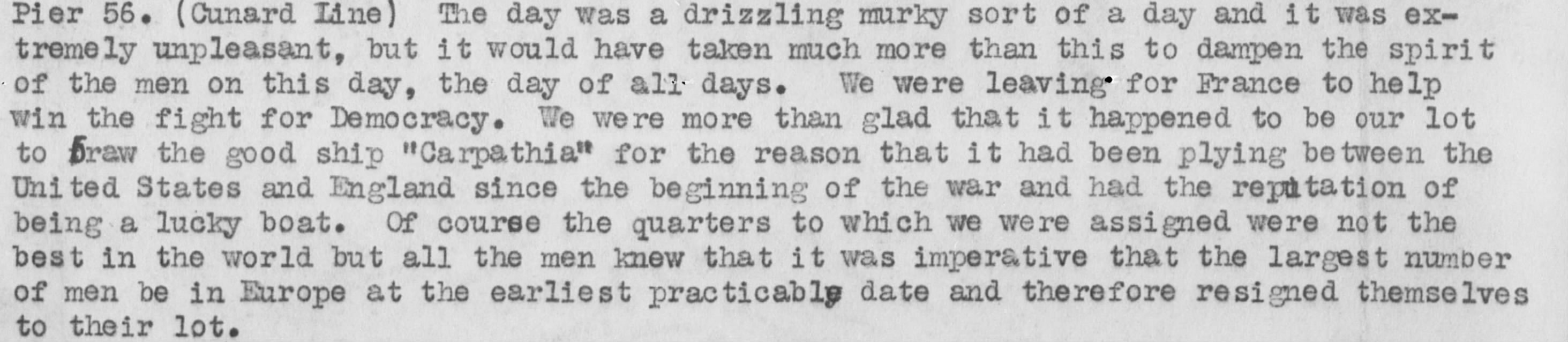
I cannot capture all the details of his squadron’s service, but in brief, the squadron trained in San Antonio, Texas; they then traveled by train and boat from there to Long Island City in New York to await their orders to ship overseas.   They received those orders and shipped out of New York to England on November 22, 1917.

leslie service partial quote

The report details the rather uncomfortable conditions the men encountered while traveling from New York to Halifax to Liverpool, England over a sixteen day period, although they did not face any danger from enemy forces while traveling.  They arrived in Liverpool on December 8, 1917, and then left for France on December 13, 1917, where they were first stationed at Saint Maixent and then at Romorantin.  In both locations, the squadron was engaged in building barracks and other buildings for the soldiers.  They also built over sixteen miles of railroad.  The report described in detail the facilities at their second location and the work that was done.  It ends after the Armistice was signed, saying that the squadron was awaiting their orders to return to the United States.  Leslie J. Cohen is listed three times in the course of the report on the roster of men who served with the 490 Squadron, including on the final page shown below.

Leslie J. Cohen on roster

Leslie J. Cohen on roster

(M990;Publication Title: Gorrell’s History of the American Expeditionary Forces Air Service, 1917-1919
Publisher: NARA
National Archives Catalog ID: 631392
National Archives Catalog Title: Gorrell’s History of the American Expeditionary Forces Air Service, compiled 07/05/1917 – 08/31/1919, documenting the period 05/26/1917 – 03/31/1919
Record Group: 120
Short Description: NARA M990. Historical narratives, reports, photographs, and other records that document administrative, technical, and tactical activities of the Air Service in the American Expeditionary Forces during World War I.
Roll: 0021
Series: E
Series Description: Squadron Histories)

Back home in Philadelphia, Abraham’s wife  Sallie died on March 14, 1919, and surprisingly was buried not with her children at Old Cathedral Catholic Cemetery, but at Holy Cross Cemetery in Yeadon, Pennsylvania. The family was residing at 5926 Cobbs Creek Parkway when she died, which was only a mile from Holy Cross Cemetery; nevertheless, Cathedral Cemetery, where so many of her children were buried, was only three miles away.  I wonder why she was not buried with her children.  Sallie died from influenza, pneumonia and bronchitis.  This was the time of the deady Spanish flu epidemic that killed millions of people worldwide.  Sally was about  fifty years old when she died, and her son Arthur was only eleven years old.

Sallie McGonigal Cohen death certificate 1919

Sallie McGonigal Cohen death certificate 1919

As of January 10, 1920, when the next census was taken, Abraham, now a widower, was still living at 5926 Cobbs Creek Parkway with his sons Leslie and Arthur, his sister-in-law Mary McGonigal, and a servant.  Abraham was still a pawnbroker; Leslie was a machinist in the shipyard, having returned from military service.  Arthur was in school.

Sometime later in 1920, Abraham married Elizabeth Beisswagner Grady, whose husband Robert Grady had died in 1918 and, interestingly, is also buried at Holy Cross Cemetery in Yeadon, Pennsylvania.  Had Abraham met her at the cemetery? At the church? Elizabeth had several children from her first marriage, though all would have been adults by 1920.  Abraham was 54 when they married, Elizabeth was 46.

In 1927, Leslie reenlisted in the army, and on the 1930 census he is listed as a soldier in the US Army, stationed at Fort Hancock in Middletown Township, New Jersey.  He served from August 23, 1927 until August 22, 1930, when he was honorably discharged.

Leslie Cohen 1930 census

Leslie Cohen 1930 census

In the 1931 directory for the city of Richmond, Virginia, Leslie is listed with his wife Emma L. and was employed as a machinist.  Thus, sometime between the date of the 1930 census and the date of the Richmond directory, he had gotten married and moved to Richmond. He was later admitted to the Veterans Administration Hospital in Virginia on October 24, 1932, and released on February 3, 1933.  I cannot tell from the record why he was admitted or why he stayed for over three months in the hospital.  The hospital record also indicated that he was married to an Elizabeth L. Cohen (presumably a mistake; other records corroborate that her name was Emma), living in Washington, DC.

Leslie Cohen VA Hospital record

Leslie Cohen VA Hospital record

Meanwhile, back in Philadelphia, Abraham, Elizabeth, and Arthur were living at 5530 Walnut Street according to the 1930 census.  Abraham was still working as a pawnbroker, and Arthur was working as a porter at a gas station.  Abraham, who was now 64 years old, had outlived all his siblings at this point as well as his first wife and several of his children.  I find it interesting that neither of his two sons became pawnbrokers, given the Cohen family’s overall involvement in that industry.

Abraham’s second wife Elizabeth died on August 4, 1939, from heart disease.  They had been living on Spruce Street, where Abraham is listed as living alone on the 1940 census.  He was still working as a pawnbroker at age 74.  Elizabeth was buried with her first husband Robert Grady at Holy Cross Cemetery in Yeadon.

Abraham died on April 29, 1944, when he was 78 years old.  He also was buried at Holy Cross Cemetery in Yeadon with his first wife Sallie.  His death certificate was subject to a coroner’s inquest for some reason, but the inquest found that he died from arteriosclerosis.

Abraham death certificate 1944

Abraham death certificate 1944

abraham cohen amended death cert


The only strange thing about his death certificate is the description of his occupation: elevator operator.  After a lifelong career as a pawnbroker, why would Abraham have become an elevator operator?  The informant on his death certificate was Bernard Sluizer, Abraham’s brother-in-law, the widower of Abraham’s sister Elizabeth. Bernard would die just four months later.  Why would Bernard have been the informant? Well, all of Abraham’s siblings had died many years earlier, as had all their spouses except for Bernard and Jonas’ wife Sarah. Leslie was living in Richmond, Virginia.  I don’t know where Arthur was at that time.

Leslie and his wife Emma continued to live in Richmond, Virginia during the 1930s and 1940s.  According to the 1940 census, Emma was almost twenty years older than Leslie.  She is reported to have been 67 in 1940 while he was 48.  Leslie also appears never to have returned to his skilled position as a machinist.  On various Richmond directories throughout this period, his occupation is described as a helper, one time specifying at a Blue Plate Foods.  It is obviously hard to make too many inferences, but given his hospitalization and his low skilled employment afterward, it would seem that Leslie might have been disabled in some way after his second service in the army.   Leslie died on May 13, 1966, and is buried at Fort Harrison National Cemetery in Richmond, Virginia.

Leslie Joseph Cohen headstone

As for Arthur, I just am not sure.  There were two Arthur Cohens living in the Philadelphia area who were born in Pennsylvania in or about 1907, according to the 1940 census.  Both were married. One was working as a manager in a bottling company, the other as a mechanic in a garage.  Since Arthur was working in a gas station in 1930, I am inclined to think that it is more likely that he was the second Arthur, who was married to a woman named Claire.  They were living in Upper Darby, a Philadelphia suburb in 1940, but had been living in Philadelphia in 1935, according to the 1940 census.  If this is the right Arthur Cohen, it seems that he and Claire moved out to California at some point, living in Burbank in the 1970s and 1980s, and then to Las Vegas thereafter where Claire died on June 11, 1998.  I am still not positive I have the correct Arthur, so will continue to look for more records or documents to corroborate my hunch.

Thus, there are some loose ends here.  I don’t know the full story of Leslie and his wife Emma, but if the ages on the 1940 census are correct, it seems very unlikely that there were any children.  Arthur’s story is even more unfinished.  Without a marriage record or a death certificate, it’s impossible to be sure that I have found the right person.  I also do not have any idea whether Arthur had children.

Looking back over Abraham’s life is painful.  He lost so much—his mother when he was just 13, his father nine years later, and all his siblings between 1911 and 1927.    Three of his children died when they were very young, and he outlived two wives.  One son had moved away to Richmond, Virginia, possibly disabled in some way.  The other one seems to have disappeared or moved out west at some point.  I have this sad image of Abraham as a man in his seventies, living alone, working as an elevator operator, and having only his brother-in-law Bernard Sluizer around as his family (and perhaps many nieces and nephews as well).

I hope I am wrong.

************

That brings to an end, for now, the long story of the thirteen children of Jacob and Sarah Cohen, my great-great-grandparents.  I will reflect on what I’ve learned about them and try and synthesize it all in my next post.


[1]   Leslie’s birth year changed from record to record.  Sometimes it was 1891, sometimes 1892, sometimes 1893.  The record closest to his birth year was the 1900 census, which indicated that he was then 11 years old, giving him a birth year of 1889.  However, on the 1910 census, his age was 19, meaning he was born in 1891.  His two draft registrations also vary.  His headstone says 1892.  They all say his birthday was May 20, regardless of the year.

[2] Ancestry.com. U.S. National Homes for Disabled Volunteer Soldiers, 1866-1938 [database on-line]. Provo, UT, USA: Ancestry.com Operations Inc, 2007.

Original data: Historical Register of National Homes for Disabled Volunteer Soldiers, 1866-1938; (National Archives Microfilm Publication M1749, 282 rolls); Records of the Department of Veterans Affairs, Record Group 15; National Archives, Washington, D.C.

Jonas Cohen, Sr., 1863-1902:  Another Tragic Accident and a Life Cut Short

The twelfth child of Jacob and Sarah Cohen was Jonas Cohen, sharing the name with his uncle, Jonas H. Cohen.  Jonas was born on August 15, 1863, and spent his childhood at 136 South Street.  When he was sixteen, he was already working as a clerk in the pawnshop, according to the 1880 census.

On February 21, 1892, he married Sarah Weil in New York City.[1]  Jonas and Sarah were living at 776 South 20th Street in 1895, and Jonas was working as a pawnbroker.  Their son, Jonas Cohen, Jr., was born on June 28 that same year.  In 1900, Jonas, Sarah, and their son were living at 2216 North Carmac Street; Sarah’s older brother Henry, who was also a pawnbroker and apparently in business with Jonas, was also living with them at that address.

Less than two years later, tragedy struck the family.

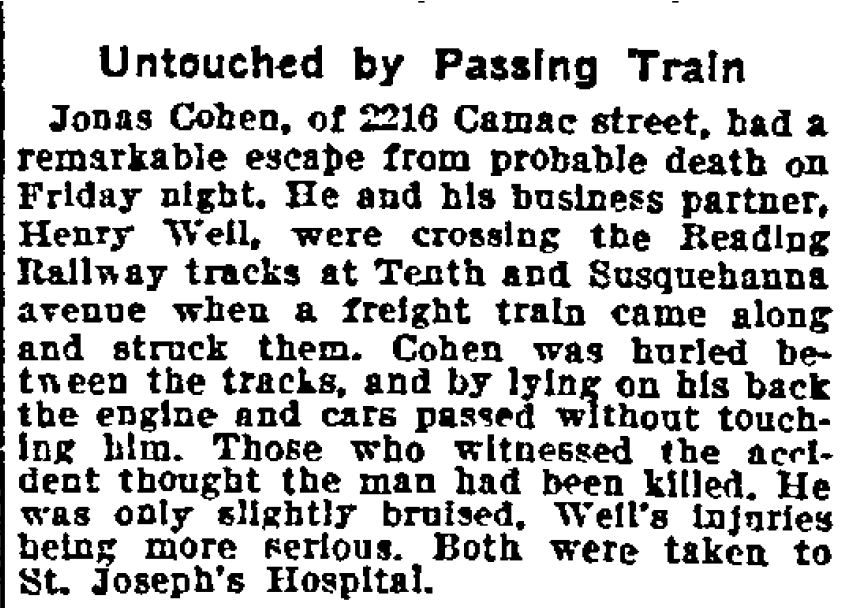
jonas news article

(“Untouched by Passing Train,” Sunday, October 20, 1901, Philadelphia Inquirer (Philadelphia, PA)   Volume: 145   Issue: 112   Section: Third   Page: 11)

Although the paper reported that Weil’s injuries were more serious, Henry Weil survived the accident.  Unfortunately, his business partner and brother-in-law, my great-granduncle Jonas Cohen, ultimately did not.  Over three months later, on February 10, 1902, Jonas Cohen died from “traumatic delirium from injuries” sustained from an accident with the Pennsylvania Railroad, according to his death certificate.  He would have been 36 years old just eleven days after he died.  He left behind his young wife Sarah and his son Jonas, Jr., who was not yet seven years old.

Jonas Cohen death certificate 1902

Jonas Cohen death certificate 1902

Sarah apparently never remarried and lived with her father and/or her brothers for most of the rest of her life.  In 1910, she and Jonas, Jr., were living with Simon Weil, her father, and three of her brothers, Henry, Aaron, and Monroe, and Monroe’s wife Maude at 2524 Broad Street.  Sarah had been born and married in New York City, but at some point her father and at least several of her siblings had all moved to Philadelphia.  Sarah’s brothers Henry, Aaron, and Monroe were all pawnbrokers by 1910.  Her father had been in the dry goods business in New York.  Had Sarah’s husband Jonas lured them all to Philadelphia by offering to go into the pawn business with them?

In 1917 Sarah and her son were still living at 2524 Broad Street, and Jonas, Jr., had joined the pawnbroker business, now called Weil Brothers, located at 16th Street and Jackson, according to his World War I draft registration.  His uncle Monroe was also working for Weil Brothers, though at a different address.  The city directory for 1918 lists both Henry and Aaron Weil also as working for Weil Brothers and living at 2524 Broad Street.

The same was true in 1920.  Sarah and her son were living at 2524 Broad Street with her father Simon and her brothers Henry and Aaron. (Monroe and his wife had moved on and had a place of their own.)  Her brothers were working as pawnbrokers, and her son Jonas was a seaman in the United States Navy.

By 1930, Simon Weil had died, but his children Henry, Aaron, and Sarah continued to live together at the same address, and Jonas, Jr., now 36 years old and out of the Navy, continued to live with them as well.  All three men described their occupation as “money lender.”  By 1940, Jonas had married and moved out, but Henry, Aaron and Sarah, now all around 70 years old, were still living together at 2524 Broad Street.  Henry and Aaron had never married; Sarah had never remarried.  They had been living together as adults since at least 1910, and probably from the time Jonas, Sr., had died in 1902.  Had the awful accident that had led to Jonas’ death also scarred all of them in some way, making it hard for any of them to separate and move on with their adult lives?

The Weil Siblings 1940 census

The Weil Siblings 1940 census

Jonas, Jr., however, did leave and start a life of his own.  In 1936, he married Sally Coleman.  In 1940, they were living at 2201 Venango Street[2], and Jonas was still working as a pawnbroker.

Jonas, Jr. and Sally Cohen 1940 census

Jonas, Jr. and Sally Cohen 1940 census

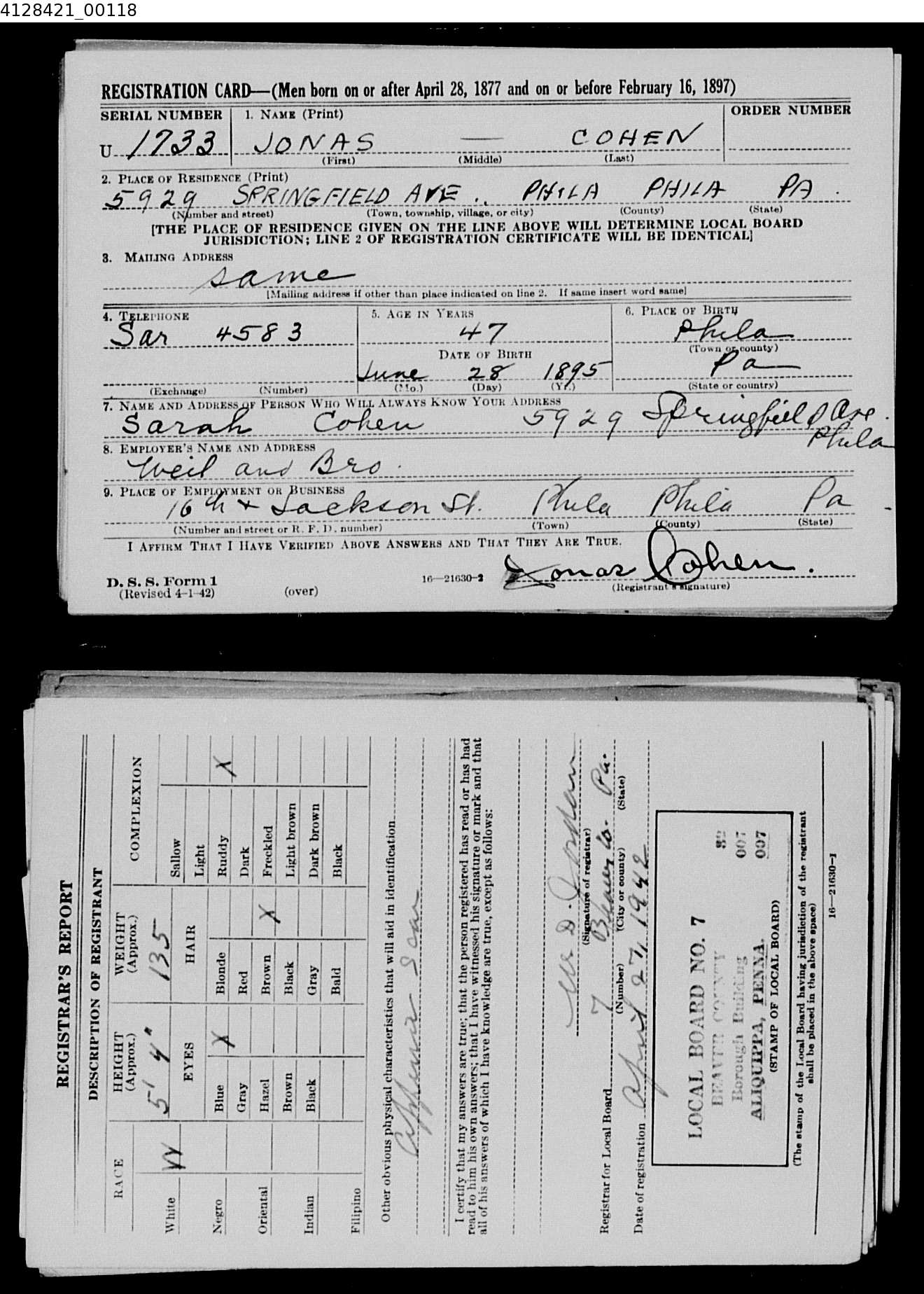
On his World War II draft registration he was living at 5929 Springfield Avenue, and his emergency contact was Sarah Cohen of the same address.  Unless Sally’s real name was Sarah, this would seem to refer to Jonas’ mother, not his wife, but I cannot be sure. Perhaps both his mother and his wife were living with him at that address.

Jonas Cohen, Jr. World War II draft registraiton

Jonas Cohen, Jr. World War II draft registraiton

Henry Weil died in 1945, or at least that is the date on the funeral bill paid by his brother Aaron.  It looks like he was cremated.  I could not find a death record for Aaron, but presumably he lived at least until 1945 since he paid that bill and since his death certificate is not in the database that runs up through 1944.  Neither Aaron nor Henry is buried at Mt. Sinai; their brother Monroe and his wife Maude Weil lived until 1953 and 1959, respectively, and are buried at Mt. Sinai. Perhaps Aaron and Henry were buried in New York at Union Field Cemetery like their father and presumably their mother.

Sarah died on June 18, 1959, and was buried at Mt Sinai next to Jonas, her husband of only ten years who had died almost 60 years earlier.  She was 89 years old, according to burial records.  Her sister Florence Weil Blaufeld had ordered her interment.

Sarah and Jonas Cohen’s son, Jonas, Jr., lived to be 90 years old.  He died on March 3, 1986, and is buried next to his parents at Mt. Sinai.  I could not find an obituary to help determine whether he ever had children or what he did from 1942 until 1986.  However, his interment order was authorized by someone named Sally Cohen.


[1] I thought that perhaps Sarah Weil was somehow related to Lewis Weil, who had married Jonas’ sister Rachel, but I cannot find a connection.  Even though Sarah’s father was named Simon, and Lewis’ brother was named Simon, even though both had ancestral roots in Germany, I could not find any definitive familial tie.

[2] My father was also living on Venango Street in 1940 with his mother and sister, according to the 1940 census.  I wonder if he knew that his father’s first cousin Jonas was living down the street.

The Eleventh Child of Jacob and Sarah Cohen:  My Great-Grandfather Emanuel (FINALLY!)

About a month ago, my father (who reads the blog regularly) asked me when I was going to get to his grandparents.  Although I wanted to get there also, my linear mind would not let me “skip ahead.”  I knew that if I did, I’d get too caught up in my direct ancestors and not want to return to all the “lateral” relatives.  So I have stuck, more or less, to my plan and taken each of Jacob and Sarah’s children in birth order.  (Yes, I had to skip Reuben and Arthur while waiting to hear from descendants, but otherwise, I went in order.)  There are still two more children to do after my great-grandfather, Jonas and Abraham, so I still have to resist the temptation to move on to my great-grandmother’s Seligman line.  Also, I still have to return to Jacob’s brother Moses and his family and also some of Jacob and Sarah’s grandchildren whom I’ve yet to research or discuss.

But for now, I finally get to talk about my father’s grandfather Emanuel and his family.  Sadly, my father never knew Emanuel because he died just a few months after my father was born.  There is no one else left for me to ask about Emanuel since there are no other descendants still alive who would remember him.  But my father knew his grandmother, Emanuel’s wife Eva May Seligman, very well, and he remembers other family members as well, although he has not seen or been in touch with them for more than 60 years.  And I never knew any of his Cohen relatives other than my aunt, Eva H. Cohen, who died in 2011.  I never met my father’s father or his uncles or his cousins.

Thus, most of what I know about Emanuel and his sons and their families is based on the same kind of resources I’ve relied upon in all my other research, sprinkled with some family stories from my father or indirectly from my aunt as my brother remembers them.  As I was writing this post, my father also sent me copies of pages from a  family bible that revealed some other dates of births, marriages, and deaths.  There is also a suitcase filled with photographs and papers in my parents’ garage that I have not yet had a chance to examine.  I hope to get to that suitcase soon, but it may have to wait until after the summer.

That means that right now I have no pictures of my Cohen great-grandparents and only a few of my grandfather.  I have none of his brothers or their children.  Of course, it is in part because of this lack of knowledge that I started doing this work in the first place.  I knew so little about any of my grandparents, less about my great-grandparents, and nothing about my great-great-grandparents.  Now I am working hard to fill in those gaps.

So let me start to tell the story of my great-grandparents Emanuel and Eva Seligman Cohen, and eventually I will have to come back and add some pictures and other materials, assuming some exist in that suitcase.

My great-grandfather Emanuel was the eleventh child of Jacob and Sarah Cohen, born June 10, 1862, during the Civil War.  (The family bible has a different date—June 14, 1860, but given that I have eight other sources indicating he was born in 1862, including his death certificate, I will stick with the 1862 date.)   In 1870, when he was eight years old, he was living with his parents and ten of his twelve siblings at 136 South Street in Philadelphia. I imagine that his childhood was a happy one.  His father’s business was successful, and he was surrounded by siblings.  His oldest sister Fanny was married when Emanuel was only four, and he had nieces who were only a little older than he was in addition to all his siblings.  His brother Lewis was only two years older and his brother Jonas two years younger.  It must have been quite a household.

Jacob Cohen and family 1870 US census

Jacob Cohen and family 1870 US census

By 1880, his life had changed.  His mother Sarah had died in 1879, and only five of his siblings were still living at home: two of his older sisters, Hannah and Elizabeth, and his three brothers closest to him in age, Lewis, Jonas, and Abraham.  Emanuel was working as a clerk in one of the pawnshops.  He was eighteen years old.

Jacob Cohen and family 1880 US census

Jacob Cohen and family 1880 US census

On January 27,  1886, Emanuel married my great-grandmother, Evalyn Seligman, who was later known as Eva May and as Bebe by her grandchildren after my aunt called her that when she was a toddler.  I don’t know how my great-grandparents met.  He was 24, she was 20.  In 1886, they were living at 404 South Second Street, and Emanuel was working for his father’s pawnbroker business.  Their first child, Herbert S. Cohen, was born on either January 28 (family bible) or March 5, 1887 (Philadelphia birth index). On this one, I will rely on the bible as the entry was made by Herbert’s mother, Eva May, who would best know when her child was born.  Their second child, Maurice Lester Cohen, was born on February 27, 1888 (both sources agree here), and the family was living at 1313 North 8th Street, and Emanuel was working at 901 South 4th Street.

On October 17 (bible) or 22, 1889, two and a half year old Herbert died from typhoid fever, as had several of his little cousins.  Just two weeks later, a third son, Stanley Isaac, was born on November 4, 1989.  How terrible it must have been for my great-grandparents to be mourning one child while another was born.  How did they find a way to celebrate that birth and manage through those difficult, early weeks of infancy while their hearts were broken?

Herbert Cohen death certificate 1889

Herbert Cohen death certificate 1889

In 1890, the family was still living at 1313 North 8th Street, and Emanuel was still working as a pawnbroker at 901 South 4th Street.  They were still there in 1893 because when Emanuel’s uncle, Jonas H. Cohen, died in January, 1893, the funeral took place at Emanuel and Eva May’s residence.  I wonder why, of all the nephews and nieces of Jonas, Emanuel was the one to have the funeral at his home.

funeral at emanuels

(“Mortuary Notice,” Thursday, January 26, 1893, Philadelphia Inquirer (Philadelphia, PA)   Volume: 128   Issue: 26   Page: 6)

By 1895, the family had moved.  Emanuel’s brother Isaac had also lost his wife Emma in 1893, and as of 1895, Emanuel and his family had moved into Isaac’s house at 1606 Diamond Street, presumably to help Isaac take care of his teenage son, Isaac W. On December 6, 1895, my grandfather, John Nusbaum Cohen, was born, completing Emanuel and Eva’s family.  Emanuel continued to work at the 901 South 4th Street pawnshop.
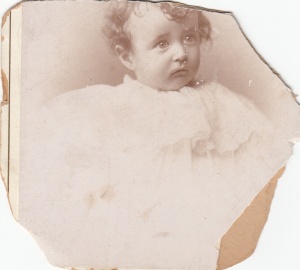
John Cohen as a baby

John Nusbaum Cohen about 1896

As I wrote about previously, Isaac was sixteen years older than Emanuel, so I am not sure why, of all the siblings, he chose to live with his much younger brother Emanuel.  I think it says a lot about what kind of people Emanuel and Eva May were, taking in these two family members while also raising three boys of their own.  Emanuel and Eva had also been the ones who opened their home for the funeral for Emanuel’s uncle Jonas. According to the 1900 census, they did, however, also have two servants helping them in the home so perhaps it was not as onerous as it might seem; perhaps they were the best situated to do these things.

Emanuel Cohen and family 1900 census

Emanuel Cohen and family 1900 census

I would imagine that the 1890s were overall not an easy decade for the extended Cohen family.  First, the family patriarch, Jacob, died on April 24, 1888, just two months after Maurice was born. His brother Jonas H. Cohen, the last of Hart and Rachel’s children, died five years later on 1893. Also, a number of Jacob’s young grandchildren died during this decade, including many of Reuben and Sallie’s children and also Benjamin Levy, Maria’s son. His brother Isaac had lost his wife Emma. On the other hand, there were many children born, many siblings married, and business overall seemed to be thriving for the family pawnshops.

As of 1905, Emanuel and his family had moved down the street to 1441 Diamond Street.  On the 1910 census, they are listed as living at 1431 Diamond Street, and Isaac, Emanuel’s brother, was still part of the household, along with Eva, all three of Emanuel’s sons, and two servants. Maurice, who was 22, was working as a salesman for a clothing business; Stanley (20) and John (14) were not employed outside the home.

Emanuel Cohen and family 1910 census

Emanuel Cohen and family 1910 census

In the 1913 and 1914 city directories Emanuel is listed as a pawnbroker at 1800 South 15th Street.  His brother Isaac died in 1914, and as of 1917 the family had moved again, this time to 2116 Green Street.

His oldest son Maurice married Edna Mayer on January 19, 1915.  Their son Maurice Lester, Jr., was born January 30, 1917.   According to the 1917 city directory, they were living at 4248 Spruce Street, and Maurice was working at the South Philadelphia Loan Office; on his draft registration that same year he described himself as self-employed as a broker.

Maurice Cohen World War I draft registration

Maurice Cohen World War I draft registration


On the 1920 census they were still living on Spruce Street, and Maurice’s occupation was pawnbroker.

Maurice Cohen and family 1920 census

Maurice Cohen and family 1920 census

In 1917 Stanley was still living at home and was the proprietor of a pawnshop at 2527 South 13th Street, according to his World War I draft registration.  In the 1917 city directory he is listed as working at the South Philadelphia Money Loan Office, the same business where his brother Maurice was working and presumably the shop located at 2526 South 13th Street.  He is also listed at the same business in 1921, living at 2114 [sic?] Green Street.

Stanley Cohen World War I draft registration

Stanley Cohen World War I draft registration

In 1917 my grandfather John was also living at home at 2116 Green Street and employed as an advertising salesman for the Morning Bulletin, according to his World War I draft registration.

John Cohen Sr. World War I draft registration

John Cohen Sr. World War I draft registration

According to the 1918 city directory, John was in the United States Navy at that time.  I have not yet found anything more specific about his military service.

In 1920, Emanuel, Eva (listed incorrectly as Edith), Stanley, John, and two servants were living at 2116 Green Street.

Emanuel Cohen and family 1920 census

Emanuel Cohen and family 1920 census

Interestingly, in the 1921 city directory, Emanuel’s business was now classified as watches and jewelry.  Had he left the pawnbroker business between 1920 and 1921, or was this just another way of describing his business?

I didn’t think I would be able to find the answer, but then, to be honest, I stumbled upon it.  I had found my grandfather John’s 1921 passport application almost a year ago and found it interesting that he was applying for a passport to go to Cuba for up to twelve months. I also found the similarity between his signature and my father’s signature rather remarkable.
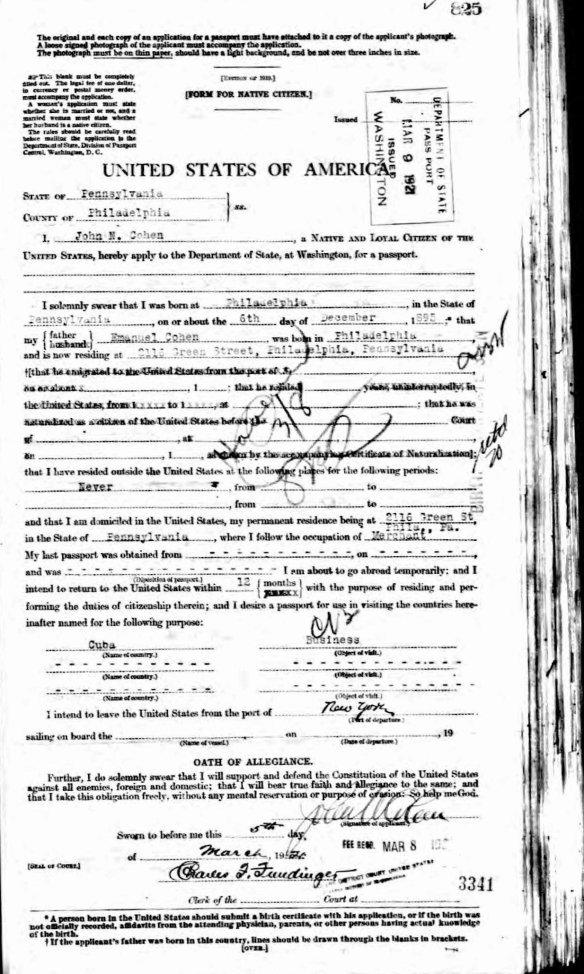
John Cohen passport app cropped

John N. Cohen passport application 1921

I had noticed that the page facing his application had a photograph of someone else, the person whose application preceded his in the database.  So I went to the following page to see if his photograph appeared on that page, and sure enough it did.  It also had a physical description of my grandfather: 5’ 6” tall, with a high forehead, straight nose, grey eyes, regular mouth, round chin, dark brown hair, dark complexion, and an oval face.
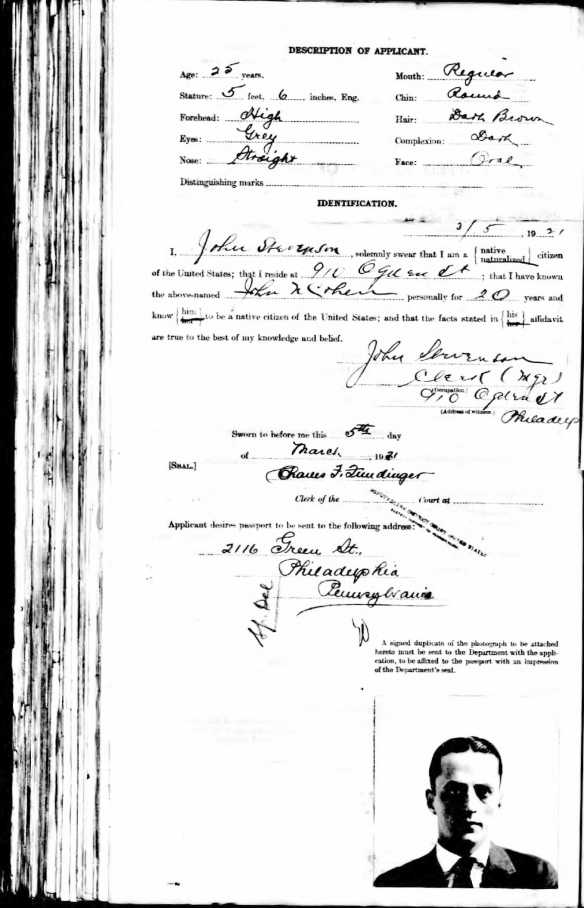
John N Cohen passport application page 2

John N Cohen passport application page 2

What I had not noticed the first time I studied this document was the letter that appears on the facing page—a letter signed by my great-grandfather Emanuel, certifying that his son, John N. Cohen, was going to represent the interests of the “Commodore” in Cuba.  The letter was on the stationery of the Commodore, located at 13th Street and Moyamensing Avenue, with the slogan “Our Policy One Price for All.”  I had never heard this business mentioned or seen it named on any other document.

Letter by Emanuel Cohen  March 5, 1921

Letter by Emanuel Cohen May 21, 1921

After some work on newspapers.com, genealogybank.com and Google, I finally found an advertisement for the business:

The Commodore ad from Our Navy, vol. 13

This was a business owned or at least managed by my grandfather when he returned from the Navy to provide merchandise to veterans at a fair price. I found this ad interesting in several ways.  First, I love that he sold suits “both snappy and conservative.” I also found it interesting that the ad proclaims that it has “no connection with any other store in Philadelphia.”  Was this my grandfather’s way of asserting his independence from the family pawnshop business?  Or was this some trademark issue involving a store with a similar name?  (I did see ads for a furniture store advertising a living room set as The Commodore.)  My father had never heard the store referred to by this name, but said he did recall that his father had a Navy friend whom he referred to as the Commodore who was his connection to the Navy Yard in Philadelphia.  My father does remember visiting the store years later when his grandmother was managing it and selling only jewelry, not men’s clothing, snappy or otherwise.

The years between 1920 and 1930 were years of growth for Emanuel and Eva’s sons.  In 1922, Maurice and Edna had a second son, Emanuel.  On January 5, 1923, Stanley married Bessie Craig, who was fourteen years younger than Stanley. Their daughter Marjorie was born two years later in 1925.

My grandparents, John Nusbaum Cohen, Sr., and Eva Schoenthal, were married on January 7, 1923, according to the family bible. (I assume they were married outside Pennsylvania since there is no marriage record in the Pennsylvania index for them) My aunt, Eva Hilda Cohen, was born January 13, 1924, and my father John, Jr., was born two years later.  My father recalls that the family was also living on Green Street in 1924 when his sister was born and at 6625 North 17th Street when he was born.  (There were no city directories available online for the years between 1922 and 1926.)  (The fact that there were two Emanuels, two Maurices, three Evas, and two Johns in their family must have created some confusion, though Maurice, Jr, was called Junior and Emanuel II was called Buddy. My father was always called Johnny.)

This is the only picture I have of my grandparents together.  They were certainly a handsome couple.  And they were certainly wearing  “snappy” clothing!  I am struck by the Star of David that my grandmother is wearing; they were not religious people, but obviously she felt a strong enough Jewish connection to be wearing such a large star.
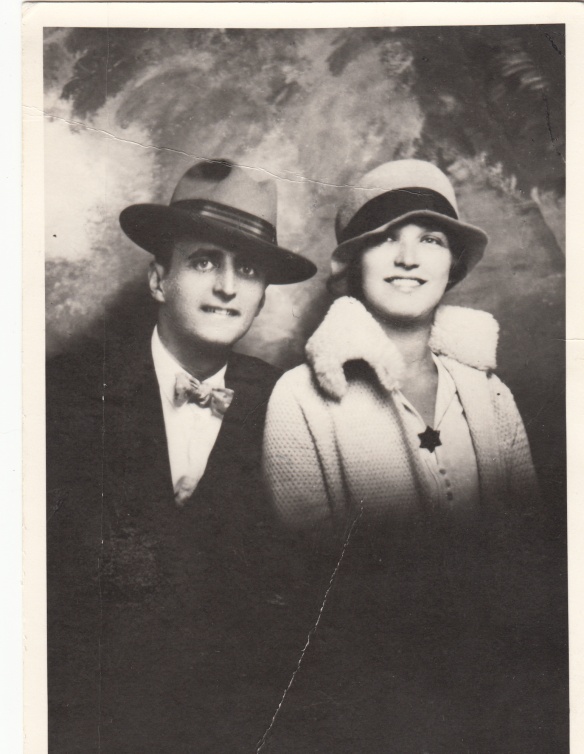
John and Eva Cohen  c. 1930

John and Eva Cohen, My Paternal Grandparents
c. 1930

Eva Hilda Cohen

Eva Hilda Cohen

I have always loved this picture of my father; his face really has not changed in many ways.  He still has those beautiful, piercing blue eyes.

My father at 9 months old

My father at 9 months old

Reverse of John Jr at 8 months but 9 months

The reverse side of the photo above—inscribed “Taken a about 9 months, Johnny”

Another wonderful picture, capturing my father as a happy little toddler.

John Jr


Although the next photograph is badly damaged, I am including it in large part to show the inscription on the back, “Johnny Boy.”  My father said that his grandmother Eva May was the one to label the photographs, just as she was the one who made the entries for her children and grandchildren in the family bible.  I like to think that I have inherited her role as a family historian and photograph archivist.

Johnny Boy reverse of John Jr as child

“Johnny Boy”

John Jr little boy


This photograph below captures my aunt as a young girl.  She was a strong and independent person who always stood up for herself and knew what she wanted.


Eva Hilda Cohen

My Aunt, Eva Hilda Cohen

If the 1920s were years of growth, they were also years of loss.  On February 21, 1927, my great-grandfather Emanuel died after a cholecystectomy (gall bladder removal, according to my ever-reliable medical consultant).  It looks like the principal cause of death was pneumonia and either anemia or a hernia.  It also says he suffered from diabetes mellitus.  He was only 64 years old.

Emanuel Cohen death certificate 1927

Emanuel Cohen death certificate 1927

These were also years of loss for the larger Cohen family; by the time Emanuel died in 1927, he had lost all but two of his siblings, Hannah and Abraham, and Hannah would die just a few months later.  Although Jonas had died in 1902, Hart and Fanny in 1911, and Isaac in 1914, between 1923 and 1927 the family lost eight siblings: Joseph (1923), Elizabeth (1923), Lewis (1924), Maria (1925), Rachel (1925), Reuben (1926), and then Emanuel and Hannah in 1927.  Of the thirteen children of Jacob and Sarah Cohen, only one remained after Emanuel and Hannah died, the baby Abraham.

The next decade, the 1930s, were also very challenging years for Eva, Emanuel’s widow, and her three sons. According to the 1930 census, Stanley was now working as a broker. My grandfather John listed his occupation as a clothing and jewelry merchant on the 1930 census, perhaps still working at The Commodore; he and his family were still living at 6625 North 17th Street at that time, which was about fifteen miles north of the Commodore location.

My grandparents, my aunt and my father on the 1930 census

My grandparents, my aunt and my father on the 1930 census

I could not find Maurice on the 1930 census, unless he is the Maurice L. Cohen listed as living with a wife Celia, a son Lester, and a daughter Nannette.  I dismissed this household many times, but since I cannot find him elsewhere and since his son’s middle name was Lester and his other son was Emanuel, which could have been heard by a census taker as Nanette, I suppose, I am inclined to think that this is probably Maurice’s listing, but perhaps not.  At any rate, I was able to find Maurice’s death certificate.  He died from a self-inflicted gunshot wound to the head on August 14, 1931; family lore is that he had been suffering from cancer.  He was only 43 years old, and his sons were fourteen and nine years old when he died.

Maurice Cohen death certificate 1931

Maurice Cohen death certificate 1931

Some years after Maurice’s death, his widow Edna moved to southern California.  According to the 1940 census, she and her two sons, Maurice, Jr., and Emanuel, now called Philip, were living in Los Angeles, although the census indicates they were all still living in Philadelphia in 1935.  My father recalls going to camp with both of his cousins in 1938, so I assume it was sometime after that that Edna and her sons moved away.  My father said he never saw them again.

Edna Cohen and sons 1940 census

Edna Cohen and sons 1940 census

Maurice was not the only one to face serious medical problems during this time period.  My grandfather John contracted multiple sclerosis also during this period.  My grandmother, a sensitive and fragile person, was herself hospitalized and unable to care for her husband or her children, and so John, Sr., and his two children were taken care of by his mother, Emanuel’s widow, Eva May Seligman Cohen.  Once again my great-grandmother opened her heart and her doors to care for family members as she had done over 25 years earlier for her brother-in-law Isaac and his son.

In 1936, my grandfather was admitted to a Veteran’s Administration facility in Coatesville, Pennsylvania, over forty miles away from Philadelphia.  He lived the rest of his life until he died on May 2, 1946.  He was 50 years old.

John Cohen, Sr. 1940 census

John Cohen, Sr. 1940 census

My great-grandmother continued to care for his children, my father and his sister, until she died on October 31, 1939, from heart disease.  My father and aunt then lived with various other relatives until their mother was able to care for them again.

Eva May Seligman Cohen death certificate

Eva May Seligman Cohen death certificate

Stanley, Maurice and John’s brother, did not face the terrible health issues faced by his brothers.  In 1940 he was working as a pawnbroker, and according to his World War II draft registration in 1942, he was self-employed, calling his business Stanley’s Loan Office.

Stanley Cohen World War II draft registration

Stanley Cohen World War II draft registration

In the 1950s, Stanley and Bessie moved to Atlantic City, where he lived for the rest of his life. Bessie died in April, 1983, and Stanley died in July, 1987.  He was 97 years old.  I have located where his daughter was last residing and hope to find a way to contact her.

As for Maurice’s family, I don’t know very much about what happened to them after they moved to California.  Edna died in 1979, and Maurice, Jr., in 1988.  Both were still living in California when they died.  Emanuel Philip was harder to track down, but I eventually found him as Bud Colton in the California death index.  How, you might wonder, did I know that Bud Colton was the same person as Emanuel Cohen? Well, the death index listed his father’s surname as Cohen and his mother’s birth name as Mayer.  In addition, he was always called Buddy by the family.  Colton is fairly close to Cohen in pronunciation, and there was some family lore that he had in fact changed his name to something else.  Bud served in the army during World War II as Bud Colton.  He married Helga Jorgensen in April, 1957, when he was 34 and she was 49.  Bud died in February, 1995, and is buried as a veteran at Los Angeles National Cemetery.  I did not find any children of either Bud or Maurice, Jr.; although I found a few Maurice Cohens in the California marriage index, only one of those marriages seemed to have resulted in a child, and her birth certificate revealed that her father Maurice Cohen was not the one related to me.  The other two Maurice Cohen marriages would have been fairly late in Maurice’s life (if in fact it was the same Maurice Cohen), and I found no evidence of any children from those marriages.  Given the age of Helga when she married Bud, it also seems unlikely that that marriage resulted in any children.

It is rather sad that we know so little about my father’s paternal first cousins, but this was all I could find up to this point.  I will keep looking and hope that more information will turn up.  Perhaps in that mysterious suitcase I will find more pictures, more documents, more answers.  Nevertheless, I know a great deal more now than I once did about my great-grandparents Emanuel and Eva Cohen and my paternal grandfather John Nusbaum Cohen.

Below is the headstone for my great-grandparents Emanuel and Eva May and for my grandfather, John N. Cohen, Sr., who were buried at Mt. Sinai Cemetery in Philadelphia.  Maurice is also buried there, one section over.

headstone for emanuel, eva and john n cohen