Emily Goldsmith, Author: “She opened her mouth in wisdom and the law of kindness is on her tongue.”

Emily Goldsmith was the fourth child of Abraham Goldsmith and Cecelia Adler to live to adulthood. She was born in Philadelphia on April 30, 1868.1  Her mother died on November 8, 1874, when Emily was only six years old.

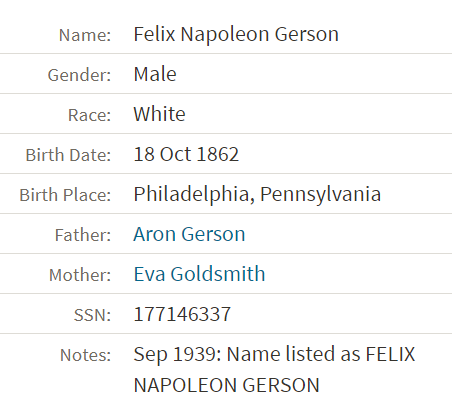
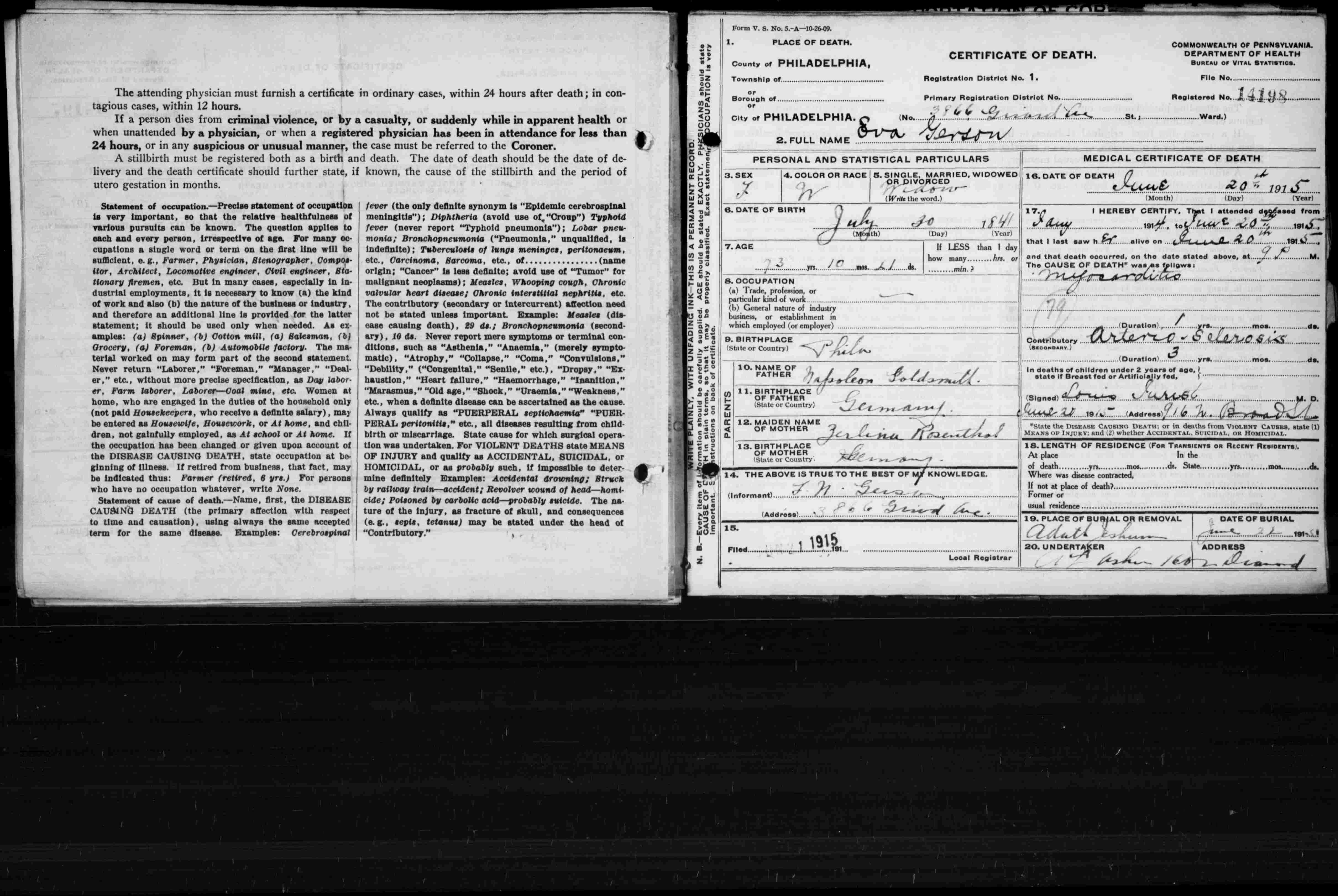
On January 28, 1892, Emily married Felix Napoleon Gerson, the son of Aron Gerson and Eva Goldsmith—who was not related to my Goldsmith family, as I wrote about here. According to his entry in Who’s Who in Pennsylvania, Felix went to Philadelphia public schools and then studied civil engineering; in the 1880s he served in the department of the Chief Clerk, Philadelphia & Reading Railway Company, and then in 1891 he changed careers and became the managing editor of Chicago Israelite.  In 1892, Felix became the managing editor of the Philadelphia Jewish Exponent.
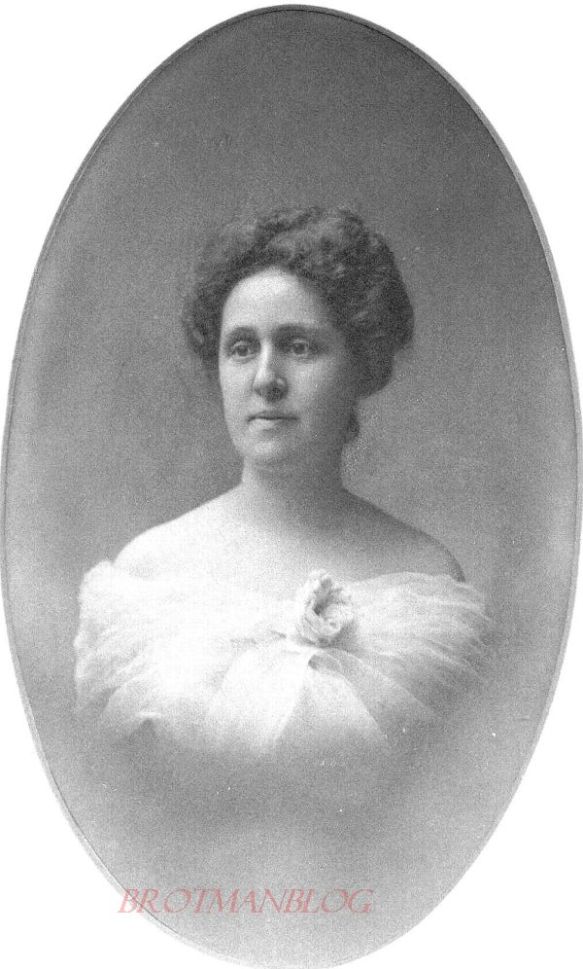
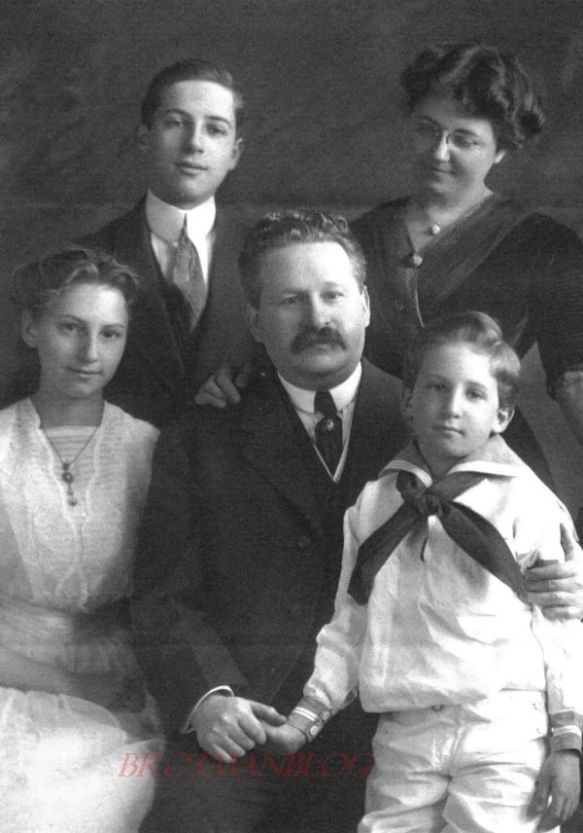
Emily GoldsmithGerson

Emily Goldsmith Gerson. Courtesy of the Goldsmith family

Emily and Felix’s first child Cecelia was born on October 27, 1892.2  She must have been named for her grandmother, Emily’s mother Cecelia Adler Goldsmith. A second daughter, Dorothy, was born on June 2, 1897.3

I was delighted to discover that Emily, like her older brother Milton, was an author of children’s stories, books, and plays. Beginning in the 1890s, Emily contributed children’s stories regularly to the Philadelphia Jewish Exponent where her husband Felix was the managing editor. I counted over twenty stories written by Emily that were published between 1895 and 1899.

For example, on April 17, 1896, (p. 5), the Jewish Exponent published Emily’s story, “Joseph’s Toy Theater,” about a little boy who received a toy theater as a gift and refuses to share it with his sister. When the puppets in the theater come to life at night, he hears them criticizing his selfishness and threatening to punish him. He then goes to his sister’s room and gives her one of the puppets from the theater. (The illustration below is by Alice B. Ewing and appeared when this story was republished in The Picture Screen, as discussed below.)

On October 9, 1896, (p. 5) the Jewish Exponent published “Helping Mother,” another of Emily’s short stories, this one about a little girl who helped her mother by playing on her own while her mother worked.

These and the other stories written by Emily Goldsmith Gerson and published in the Jewish Exponent are quite short and usually have some lesson teaching children about good behavior. In addition to her stories, Emily also wrote plays for children to perform for the Jewish holidays such as Purim and Hanukkah.4

In 1900, Emily, Felix, and their daughters were living in Philadelphia., and Felix was working as an editor. Emily did not report an occupation, but she continued to contribute her stories during the next decade.
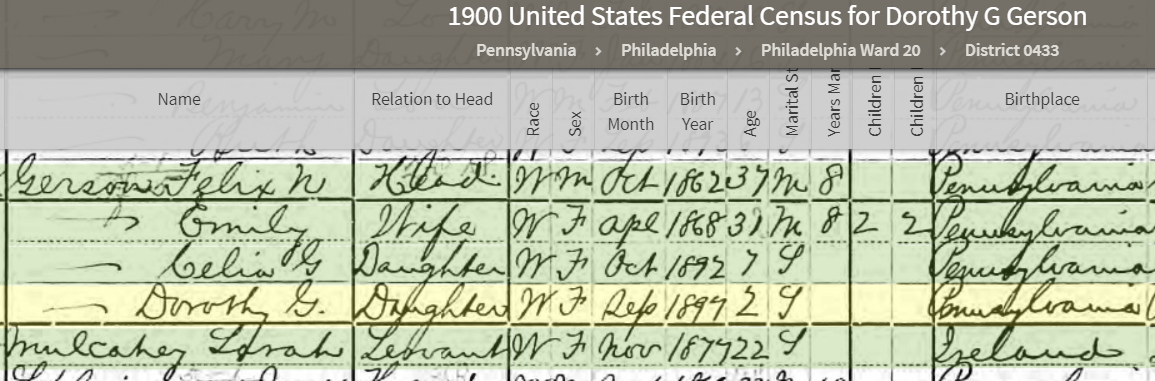
Emily and Felix Gerson and family 1900 US Census
Philadelphia Ward 20, Philadelphia, Pennsylvania; Page: 4; Enumeration District: 0433
Ancestry.com. 1900 United States Federal Census

Emily not only continued to write short stories for the Jewish Exponent; she also published books and plays for children. Her earliest published book was The Picture Screen, published by George W. Jacoby & Co. in 1904. According to this brief description in the list of suggested Christmas books in Book News, the book is a “unique juvenile consisting of stories told about the pictures on a big picture screen. A little girl’s mother tells her and her brother the tales while the little girl lies helpless with a sprained ankle.”5

The book reached an audience far beyond Philadelphia, as seen in this review that appeared in the Buffalo Enquirer on July 9, 1904 (p. 2):
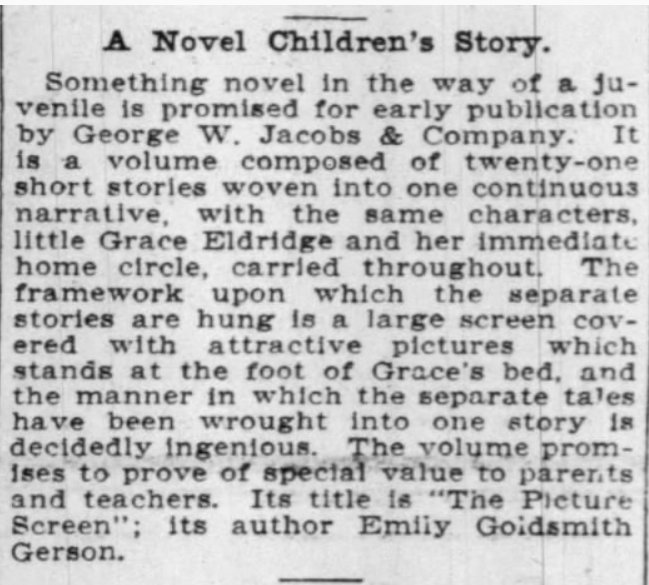
Buffalo Enquirer, July 9, 1904, p. 2.

I obtained a copy of the book, and it is as described in the reviews. Some of the stories the mother tells the children are stories Emily had previously published, including the one about Joseph and the toy theater that I described above. They all teach the children something about being a good person. The book was dedicated to Emily’s daughters, Cecelia and Dorothy.

Then in 1906, Emily published A Modern Esther and Other Stories for Jewish Children (Julius H. Greenstone, Philadelphia, 1906), another collection of short stories and two short plays; she dedicated the book to her father Abraham, who had died just a few years before. The title story is about a girl born somewhere in a shtetl in Europe, the daughter of the rabbi, who bravely goes to the local governor to stop the anti-Semitic attacks on her family and community. Many of the stories have a religious theme; for example, one is about a little girl discovering faith in God, and several are about God saving families from poverty or from illness. Often the stories are connected to a Jewish holiday. You can find this collection of Emily’s works online here.

The reviewer for the New York Times wrote that “the author’s object is not so much fiction as the encouragement of piety and the teaching of the simpler lessons of the faith to which she belongs, to show how pleasant and profitable it is—in the end—to do those things which are commanded, how faith and honest and kindness win their sure reward, and how wickedness is punished…..Naturally the stories are of extreme artlessness—-but all of us in our time have read stories of like artlessness not without eager ears and open eyes.”6

Emily also published several of her holiday plays for children, including Ten Years After, A Purim Play (1909), A Delayed Birthday, a play for Hanukkah published by Bloch Publishing Company in 1910, and The Purim Basket, another Purim play published by Bloch Publishing Company in 1914.

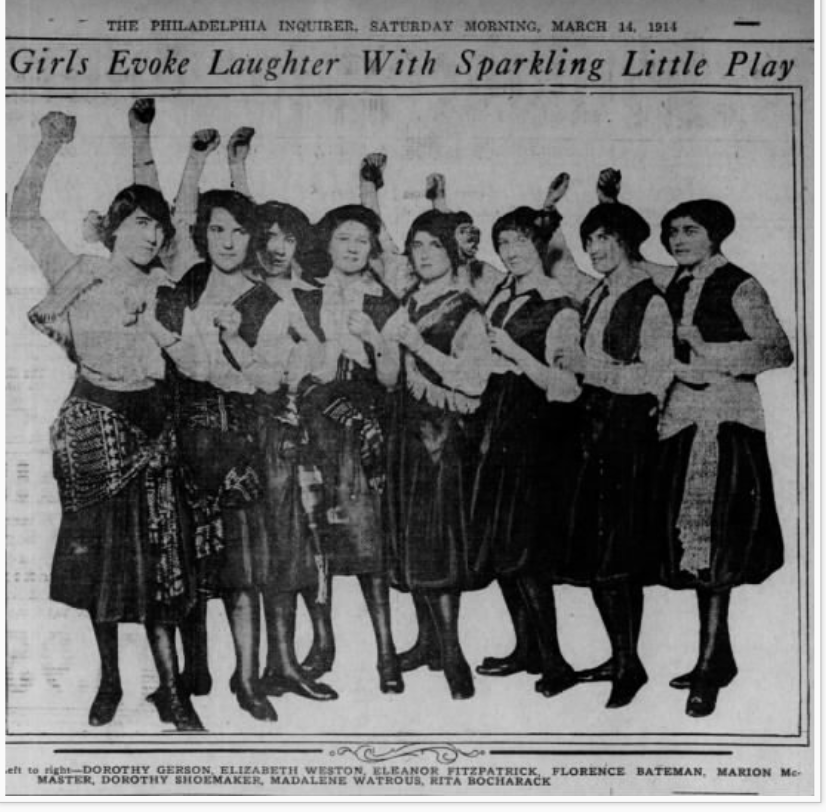
Emily’s daughter Dorothy seems to have enjoyed theater also. In March 1914, when she was sixteen, she appeared on stage in a production put on by the French department of Girls High School in Philadelphia.7 That is Dorothy on the far left.
Emily’s career as a children’s author was, however, cut short. She died from pancreatic and liver cancer on November 28, 1917.  She was only 49 years old and was survived by her husband Felix and her two daughters. She was also survived by her eight of her nine siblings, the other surviving children of Abraham Goldsmith.
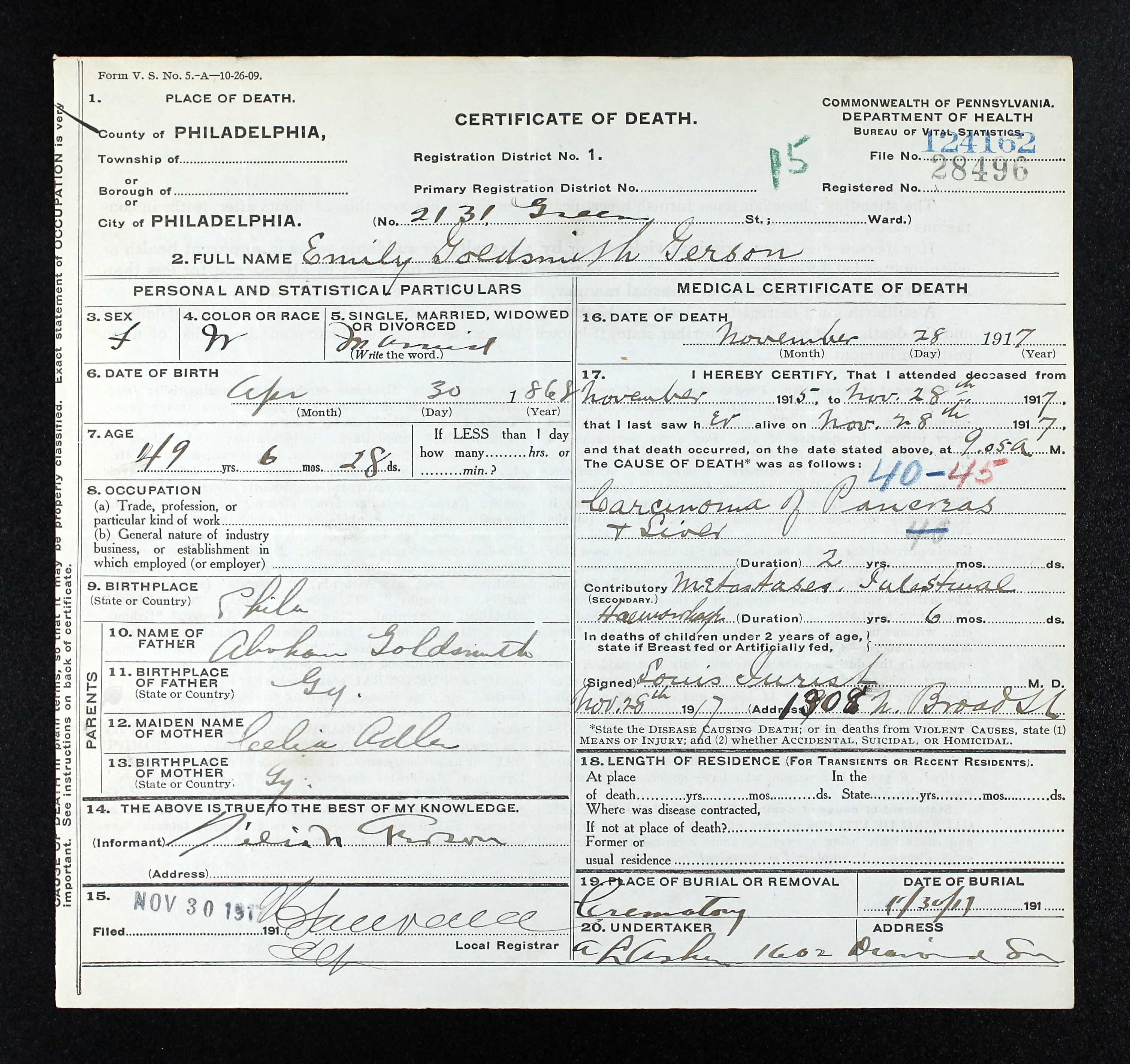
Emily Goldsmith Gerson death certificate
Pennsylvania Historic and Museum Commission; Pennsylvania, USA; Certificate Number Range: 121031-124420
Ancestry.com. Pennsylvania, Death Certificates, 1906-1966

But Emily was not forgotten. A camp for underprivileged Jewish girls was established in her memory, known as the Emily G. Gerson Farm.8  In 1920, her synagogue, Keneseth Israel in Philadlephia, dedicated a stained-glass window in her memory. In reporting on the dedication, the Dallas Jewish Monitor stated that Emily had been the first president of the Keneseth Israel Sisterhood and was “deeply interested in all things appertaining to the good and welfare of the Temple.”9

Stained glass window dedicated in memory of Emily Goldsmith Gerson in 1920 by Keneseth Israel Congregation as depicted in The Philadelphia Inquirer, December 5, 2004, p. C04

The window still exists and was depicted in the Philadelphia Inquirer on December 5, 2004, when it was being being exhibited at Congregation Keneseth Israel’s Judaica museum in Elkins Park, Pennsylvania.   The caption under the photograph of the window stated that it was presented with the inscription from Proverbs 31:26: “She opened her mouth in wisdom and the law of kindness is on her tongue.”10

The 1920 census reported that Emily’s widower Felix continued to work as a newspaper editor. Her daughters were also working. Cecelia, now 27, was a secretary in a doctor’s office, and Dorothy, 22, was a public school teacher.11

Later that year Cecelia married Malvin Herman Reinheimer in Philadelphia.12 Malvin was the son of Samuel Reinheimer and Julia Lebach and was born in Cameron, West Virginia, on January 26, 1891. His father was in the wholesale clothing business. Malvin graduated from Swarthmore College in 1912 where Cecelia had also been a student; perhaps she met him there. Malvin then graduated from the University of Pennsylvania School of Law in 1915 and was practicing law in 1920 and living in Philadelphia with his father and sisters. He had served stateside in the US military during World War I.13

On November 29, 1921, Cecelia and Malvin had their first child, a daughter they named Emily Gerson Reinheimer in memory of Cecelia’s mother Emily Goldsmith Gerson.14   A second child was born a few years later.

Meanwhile, Dorothy revealed that she had some of her mother’s writing talents when she won a prize for best limerick in 1921:
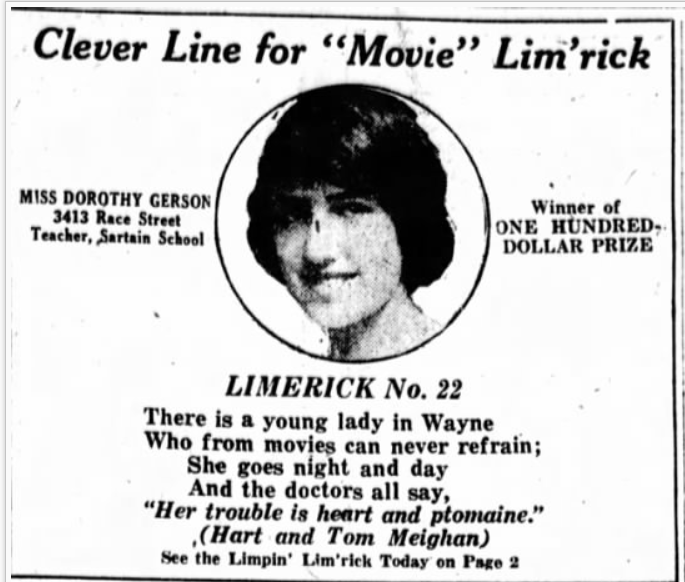
“Clever Line for ‘Movie’ Lim’rick,” Philadelphia Evening Ledger, January 13, 1921, p. 1.

The 1930 census record for Felix and Dorothy is a complete mystery. First, it has Dorothy listed as Felix’s wife and says Felix was 38 when in fact Felix was 68.  It says Felix was 31 when they first married, and Dorothy was 26. Then it says Felix was a salesman in a dress shop, and it has no occupation listed for Dorothy.  There were also four men lodging with them. How much of this can I trust? Is this a different Dorothy and Felix Gerson? Not likely—they were still living at 3415 Race Street, the same place they were living in 1920.

Felix Gerson and Dorothy Gerson 1930 census, image modified
Census Place: Philadelphia, Philadelphia, Pennsylvania; Page: 27A; Enumeration District: 0397
Ancestry.com. 1930 United States Federal Census

There is no indication from any other records that Felix had left his newspaper career or that Dorothy had stopped working. In fact, the 1930 Philadelphia city directory lists Dorothy as an advertising manager for Oppeheim Collins & Company and Felix as the president-manager of the Jewish Exponent.15 That 1930 census record indicated that Dorothy was the person providing the information to the enumerator—would she have lied about her relationship with her father, his age, and their occupations? Or was the enumerator just sloppy? I don’t know.

Fortunately, there was no confusion in the 1930 census record for Cecelia Gerson and her husband Malvin Reinheimer and their children. They were all living in Philadelphia where Malvin continued to practice law.16

After almost twenty years of being a widower, Felix remarried at age 73.  On August 31, 1936, he married Emma Brylawski, who was also an editor and journalist at the Jewish Exponent.17

Not long afterwards, in about May, 1937, Felix’s daughter Dorothy Gerson moved to Middletown, Connecticut, where she was working as an advertising manager for Wrubel’s Department Store, according to the Jewish Exponent of February 25, 1938.

The 1940 census records for Felix and his daughters show that Felix and his second wife Emma were living in Philadelphia without any listed occupation,18 that Dorothy was an advertising manager living in Middletown, Connecticut,19 and that Cecelia and her family were living in Philadelphia where Malvin was still working as an attorney.20

Cecelia lost her husband Malvin to renal failure and other illnesses on October 24, 1944; he was only 54 years old.21 Then she and her sister Dorothy lost their father Felix a year later on December 31, 1945; Felix was 83 years old.22 Eleven years later on August 12, 1956, Cecelia died at age 63 from lung cancer. She was survived by her two children and by her sister, Dorothy.23 Dorothy, who had returned to Philadelphia around 1950 and lived with her aunt Estelle Goldsmith, died at age 80 in January 1978.24

Emily Goldsmith Gerson’s story is in many ways such a sad one. She lost her mother Cecelia Adler Goldsmith when she was only six years old. She named her first child Cecelia in memory of her mother. Then she herself died young, ending a promising career as a children’s writer and leaving behind her own daughters. Cecelia, the daughter named for Emily’s mother, then later named her first child for her own mother, Emily. The family’s alternating naming pattern reveals Emily’s sad story. But she left behind her works and her descendants, and I hope that by telling her story I have honored her memory.


  1. Emily Goldsmith Gerson, death certificate. Pennsylvania Historic and Museum Commission; Pennsylvania, USA; Certificate Number Range: 121031-124420.
    Ancestry.com. Pennsylvania, Death Certificates, 1906-1966. Certificate Number: 124162. 
  2.  Ancestry.com. Pennsylvania, Death Certificates, 1906-1966 [database on-line]. Provo, UT, USA: Ancestry.com Operations, Inc., 2014. Original data: Pennsylvania (State). Death certificates, 1906–1963. Series 11.90 (1,905 cartons). Records of the Pennsylvania Department of Health, Record Group 11. Pennsylvania Historical and Museum Commission, Harrisburg, Pennsylvania 
  3.  Number: 161-05-1973; Issue State: Pennsylvania; Issue Date: Before 1951. Source Information Ancestry.com. U.S., Social Security Death Index, 1935-2014 
  4. The Jewish Exponent, March 4, 1898, p. 8 (Purim play). The Jewish Exponent, December 8, 1899 p. 9 (Hanukkah play). 
  5. Book News (1905, Philadelphia), p. 361. 
  6. “For Jewish Children,” The New York Times, March 31, 1906, p. 21. 
  7. “High School Girls Give Merry Play,” The Philadelphia Inquirer, March 14, 1914, p.2. 
  8. “Emily G. Gerson Farm Dedicated,” The Philadelphia Jewish Exponent, June 27, 1919, p. 2. 
  9. “Unveil Tribute to First President,” Dallas Jewish Monitor, June 25, 1920, p. 5. 
  10. “Hebrew Bible in Glass and Light,” The Philadelphia Inquirer, December 5, 2004, p. C04. 
  11. Felix Gersons and daughters, 1920 US Census, Census Place: Philadelphia Ward 24, Philadelphia, Pennsylvania; Roll: T625_1627; Page: 2A; Enumeration District: 688.
    Ancestry.com. 1920 United States Federal Census 
  12. Cecelia Gerson and Malvin Reinheimer marriage, Ancestry.com. Philadelphia, Pennsylvania, Marriage Index, 1885-1951. Original data: “Pennsylvania, Philadelphia Marriage Index, 1885–1951.” Index. FamilySearch, Salt Lake City, Utah, 2009. Philadelphia County Pennsylvania Clerk of the Orphans’ Court. “Pennsylvania, Philadelphia marriage license index, 1885-1951.” Clerk of the Orphans’ Court, Philadelphia, Pennsylvania. Marriage License Number: 432189. 
  13.  Ancestry.com. Pennsylvania, WWI Veterans Service and Compensation Files, 1917-1919, 1934-1948; Pennsylvania Historic and Museum Commission; Pennsylvania, USA; Certificate Number Range: 091401-093950; Ancestry.com. Pennsylvania, Death Certificates, 1906-1966. Ancestry.com. U.S., School Catalogs, 1765-1935 (Swarthmore, 1912; University of Pennsylvania, 1915). 
  14. Ancestry.com. U.S., Social Security Applications and Claims Index, 1936-2007 [database on-line]. Provo, UT, USA: Ancestry.com Operations, Inc., 2015. Original data: Social Security Applications and Claims, 1936-2007. SSN: 180129263 
  15. Philadelphia City Directory, 1930, Ancestry.com. U.S. City Directories, 1822-1995. 
  16. Malvin Reinheimer and family, 1930 US Census, Census Place: Philadelphia, Philadelphia, Pennsylvania; Page: 13A; Enumeration District: 1029. Ancestry.com. 1930 United States Federal Census 
  17.  Ancestry.com. New York, New York, Extracted Marriage Index, 1866-1937. Certificate Number: 24190. 
  18. Felix and Emma Gerson, 1940 US Census, Census Place: Philadelphia, Philadelphia, Pennsylvania; Roll: m-t0627-03692; Page: 12A; Enumeration District: 51-158. Ancestry.com. 1940 United States Federal Census 
  19. Dorothy Gerson, 1940 US Census, Census Place: Middletown, Middlesex, Connecticut; Roll: m-t0627-00512; Page: 13A; Enumeration District: 4-23. Ancestry.com. 1940 United States Federal Census 
  20. Malvin and Cecelia Reinheimer, 1940 US Census, Census Place: Philadelphia, Philadelphia, Pennsylvania; Roll: m-t0627-03754; Page: 1B; Enumeration District: 51-2169. Ancestry.com. 1940 United States Federal Census 
  21. Pennsylvania Historic and Museum Commission; Pennsylvania, USA; Certificate Number Range: 091401-093950. Ancestry.com. Pennsylvania, Death Certificates, 1906-1966. Certificate Number: 93778. 
  22.  Pennsylvania. Historic and Museum Commission; Pennsylvania, USA; Certificate Number Range: 108301-110850. Ancestry.com. Pennsylvania, Death Certificates, 1906-1966. Certificate Number: 110070. 
  23. Pennsylvania Historic and Museum Commission; Pennsylvania, USA; Certificate Number Range: 074701-077400. Ancestry.com. Pennsylvania, Death Certificates, 1906-1966. Certificate Number: 75270 
  24. Number: 161-05-1973; Issue State: Pennsylvania; Issue Date: Before 1951. Ancestry.com. U.S., Social Security Death Index, 1935-2014. Family source regarding her move back to Philadelphia. 

Always Something New for Me to Learn: The “Hidden” Databases on FamilySearch

After writing about the two oldest sons of Abraham Goldsmith and Cecilia Adler, I am glad to be able to turn to their daughter Rose. Rose was born on October 19, 1866, in Philadelphia, and as I wrote here, she married Sidney Morris Stern on May 25, 1892, when she was 26. Sidney was born January 14, 1861, in Philadelphia, and was the son of Morris Stern and Matilda Bamberger, who were German-born immigrants. His father was in the retail clothing business.  Sidney was a jeweler.

(Am I the only one who finds it amusing that Sidney the jeweler married someone whose surname was Goldsmith?)

UPDATE: Thanks to a question asked by my cousin Jennifer about Sidney’s mother Matilda Bamberger, I discovered another twist in my crazy family tree. In looking to answer Jennifer’s question, I realized that I had two women named Matilda Bamberger on my tree, both married to Morris Stern. They were obviously duplicates.  Looking more closely, I realized that Matilda and Morris Stern’s daughter Clara Stern was the mother of Julian Simsohn, who married Edwin Goldsmith’s daughter Cecile. In another words, Cecile married the nephew of her Aunt Rose’s husband Sidney.

That earlier post also reported that Rose and Sidney’s first child, Sylvan Goldsmith Stern, was born on March 2, 1893. Two years later Rose gave birth to twin boys, Allan Goldsmith Stern and Howard Eugene Stern, on August 6, 1895. I could not find Rose and her family on the 1900 census despite having their address in 1899, 1900, and 1901, but based on listings in the Philadelphia directories for those years,1 I know that she was living in Philadelphia with her husband Sidney and their two younger sons, Allan and Howard. Sidney was in the jewelry business with his brother Eugene.

However, their oldest son Sylvan, who was seven at the time, was not living with them in 1900. He was living at the Pennsylvania Institution for the Deaf and Dumb in Philadelphia; according to the census record, he could not read, write or speak English at that time. From later records I learned that Sylvan was completely deaf.

Sylvan Stern, 1900 US Census
Pennsylvania Institution for Deaf and Dumb, Philadelphia, Pennsylvania; Page: 1; Enumeration District: 1043
Ancestry.com. 1900 United States Federal Census

By 1910, however, Sylvan was living at home and could now read and write and was in school. The family continued to live in Philadelphia and was joined by Rose’s younger sister Estelle, who was working as a schoolteacher. Sidney listed his occupation as wholesale jeweler. They also had two servants living in the home, one doing “chamber work” and the other a cook:

Sidney and Rose Goldsmith Stern and family, 1910 US census
Philadelphia Ward 47, Philadelphia, Pennsylvania; Roll: T624_1413; Page: 6A; Enumeration District: 1193; FHL microfilm: 1375426
Ancestry.com. 1910 United States Federal Census

In 1915, when he was 22, Sylvan was living in Riverton, New Jersey, in a household with four other men: two men from Holland whom I presume were brothers, Peter and Anthony Hooydonk, a German immigrant named Ferdinand Frohlich, and a Pennsylvania native named John Peguesse.  All five men were in their early twenties and all were working in the florist business. Riverton is a small residential community about fifteen miles from Philadelphia across the Delaware River.

Sylvan Stern 1915 New Jersey census
New Jersey State Archive; Trenton, NJ, USA; State Census of New Jersey, 1915; Reference Number: L-06; Film Number: 8
Ancestry.com. New Jersey, State Census, 1915

While Sylvan was working in Riverton in 1915, his two younger brothers were in college: Allan was a sophomore at the University of Pennsylvania,2 and his twin Howard was a student at Cornell University.3

In 1917-1918, all three of Rose and Sidney’s sons registered for the World War I draft. Sylvan reported that he was living at 1613 Poplar Street in Philadelphia, but working as a nurseryman in Riverton, New Jersey, for Henry A. Dreer, Inc. He also reported that he was totally deaf.

Sylvan Stern, World War I draft registration Registration State: Pennsylvania; Registration County: Philadelphia; Roll: 1907959; Draft Board: 50 Description Draft Card: S Source Information Ancestry.com. U.S., World War I Draft Registration Cards, 1917-1918

Allan was living at the same address and reported that he was a college student, and Howard, also living at the same address, was employed as a farm laborer by Florex Gardens in North Wales, Pennsylvania, which is about 25 miles from Philadelphia. Allan served in the Army’s Bureau of Standards in Washington, DC, from March 15, 1918, until January 8, 1919, when he was honorably discharged.4  I did not find any record of military service for Sylvan or Howard.

Allan Stern World War I draft registration
Registration State: Pennsylvania; Registration County: Philadelphia; Roll: 1907959; Draft Board: 50. Ancestry.com. U.S., World War I Draft Registration Cards, 1917-1918

Howard Stern, World War I draft registration
Registration State: Pennsylvania; Registration County: Philadelphia; Roll: 1907959; Draft Board: 50.  Ancestry.com. U.S., World War I Draft Registration Cards, 1917-1918

In 1920, the whole family was still living at 1613 Poplar Street in Philadelphia. Sidney was retired at age 59, but his three sons were all employed. Sylvan and Howard were both working as florists in their own business, and Allan was employed as an electrical engineer. Rose’s sister Estelle was still living with them, now working as the director of a girls’ camp. 5

All three Stern brothers were married in the 1920s. First, on May 26, 1921, Sylvan Goldsmith Stern married Beatrice A. Osserman, the daughter of Simon E. Osserman and Dora Kessner in New York City. According to a source I found, Beatrice was, like Sylvan, deaf; she was born in New York City on October 30, 1899.  Her parents were immigrants from Russia/Latvia, and her father was in the real estate business in 1920.6  This news item from the Philadelphia Evening Ledger reported that one of the bridesmaids was Dorothy G. Gerson, Sylvan’s first cousin and the daughter of his mother’s sister, Emily Goldsmith Gerson.

Philadelphia Evening Ledger, May 23, 1921, p. 11

Sylvan and Beatrice had two children during the 1920s.

Howard Stern was the second son of Rose Goldsmith and Sidney Stern to marry; in 1926 he married Madeline Kind Kohn,7 another Philadelphia native; she was born on June 3, 1898, the daughter of Joseph Kohn and Clara Kind.8 Madeline’s father was a shirt manufacturer. Here is Madeline’s high school yearbook picture from 1916:

Madeline Kind Kohn,
U.S., School Yearbooks, 1880-2012″; Yearbook Title: Record Book of William Penn High School for Girls June Class, 1916; Year: 1916
Ancestry.com. U.S., School Yearbooks, 1900-1990

Howard and Madeline would have two children.

The last son to marry was Allan Stern, and his wife’s story is quite tragic. The Philadelphia, Pennsylvania Marriage Index on Ancestry reports that Allan married Gladys Fliegelman,9 daughter of Harry Fliegelman and Gussye Fridenberg, in 1928, but I learned an important lesson about that index while researching their marriage. More below.

Gladys was born on April 23, 1904, in Philadelphia.10  Two years later on June 30, 1906, her mother Gussye suffered complications after giving birth to a second child and died six weeks later on July 17, 1906, from parenchymatous nephritis or kidney disease.

Gussye Fliegeman death certificate
Pennsylvania Historic and Museum Commission; Pennsylvania, USA; Certificate Number Range: 065461-068420
Ancestry.com. Pennsylvania, Death Certificates, 1906-1966

Thus, Gladys lost her mother when she was just a toddler. Harry Fliegelman remarried in 1910, and in 1920, they were all living together in Philadelphia, where Harry was a furniture merchant.11

In 1924, Gladys graduated from the Philadelphia School of Design for Women; her photograph appeared in the Philadelphia Inquirer with some of her classmates. She is in the middle of the photograph on the right.

Gladys Fliegelman School of Design graduation,
The Philadelphia Inquirer, June 6, 1924, p, 17

And then I thought that Allan and Gladys were married in 1928, as the Ancestry.com database indicated. But I was confused when I found this will that she wrote on January 30, 1929:

Gladys Fliegelman Stern will
Probate Records (District of Columbia), 1801-1930; Author: District of Columbia. Register of Wills; Probate Place: District of Columbia, Washington, D.C.

Gladys refers to herself as “a single woman, at present, and entering into a marriage with Allan G. Stern of Washington, District of Columbia, on January 31, 1929.” Since the Ancestry database of Philadelphia marriages indicated that they were married in 1928, why did she describe herself as single on January 30, 1929?

And this is where I learned something new. In discussing something completely different on the Tracing the Tribe Facebook page, a member there named Sharon Roth pointed out that FamilySearch has images of the Philadelphia marriage licenses and certificates.  They are not indexed for searching, but once you know the marriage license number from the index on Ancestry or FamilySearch, you can find the underlying documents by searching through the database of images by date and number.

This was a database that I could not find when I searched the FamilySearch records listings, so I am not sure how I would have found it without Sharon’s help. You can find the two databases here and here. Thank you to Sharon and to Amberly of The Genealogy Girl for showing me how to find these databases through the catalog on FamilySearch so that I now can find all these “hidden” databases. Amberly had actually blogged about this over a year ago, but I’d forgotten about her tips.  You can learn more from her blog here.

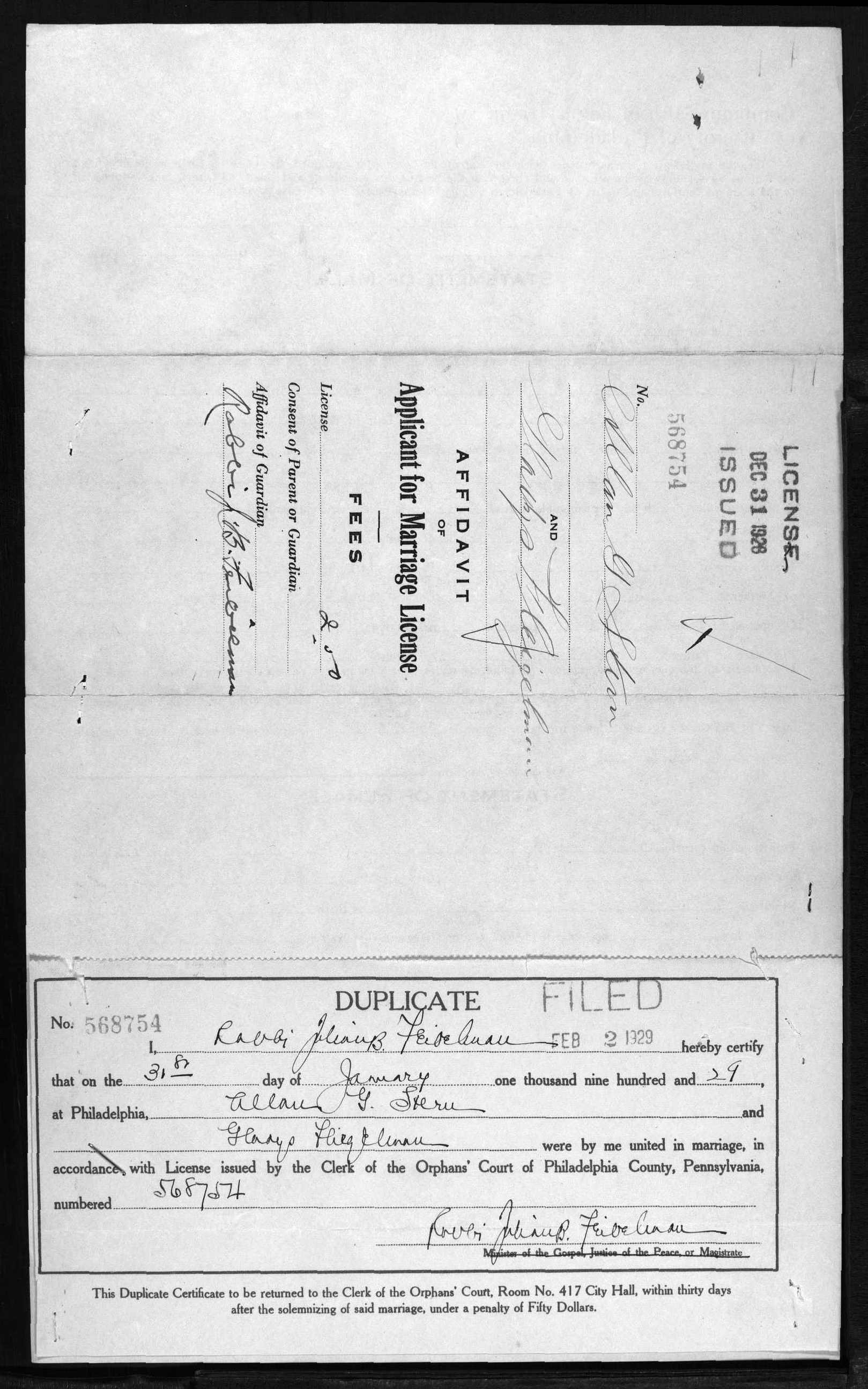
With this new information, I was able to find the license and the rabbi’s certificate of marriage for Allan and Gladys.  Now I know that although their marriage license was issued on December 31, 1928, they were not in fact married until January 31, 1929, the day after Gladys drew up her will.

Marriage record of Allan G. Stern and Gladys Fliegelmen, Pennsylvania, Philadelphia, marriage records, Marriages, 568600-568799, 1928, pp. 358-359. FamilySearch.org

Returning to the will, its contents strike me as somewhat odd. Gladys bequeathed all her property and income to any issue she might have at the time of her death; that is, whereas one might assume that her husband would inherit before her children, Gladys wanted her estate to go directly to her children. Moreover, her will provides that if she died without issue, her sister would inherit all her personal possessions. Allan would only inherit 25% of her income and only for as long as he did not remarry. Gladys’ sister and brother would receive the other 75% of her income and the principal when Allan died.

Now call me a romantic, but this seems like a rather unromantic way to start a marriage—leaving your husband such a limited part of your estate.

Tragically, this will took on far more significance not long after Allan and Gladys married.  On February 6, 1930, a week after their first anniversary, Gladys took her own life by jumping from the seventh floor of Emergency Hospital in Washington; she had been a patient in the hospital for six months after an earlier suicide attempt when she had jumped from the fourth floor of the apartment building where she and Allan had been living. In its article about this tragedy, the Philadelphia Inquirer described her as a poetess.12  An article from a different paper reported that she had been “despondent because of poor health.”13

Thus, the new decade began on a heartbreaking note for the family of Rose Goldsmith and Sidney Stern and their sons, especially for their son Allan.

I was not surprised that I could not find Allan on the 1930 census, although he is listed in the 1930 Washington, D.C., directory as an engineer for Fred S. Gichner, residing at 3100 Connecticut Avenue; in the 1931 directory he was still working at Fred S. Gichner, but now residing at 3405 Woodley Road.  On the 1930 census, I found a Gichner family living at 3405 Woodley Road so it would appear that Allan may have moved in with his employer’s family after his wife’s death, although he was not listed at either address on the 1930 census.14

The rest of the family of Rose Goldsmith and Sidney Stern all continued to live in Philadelphia in 1930.  Sidney was retired,15 Sylvan was now working as a packer in a sporting goods business,16 and Howard was practicing law.17

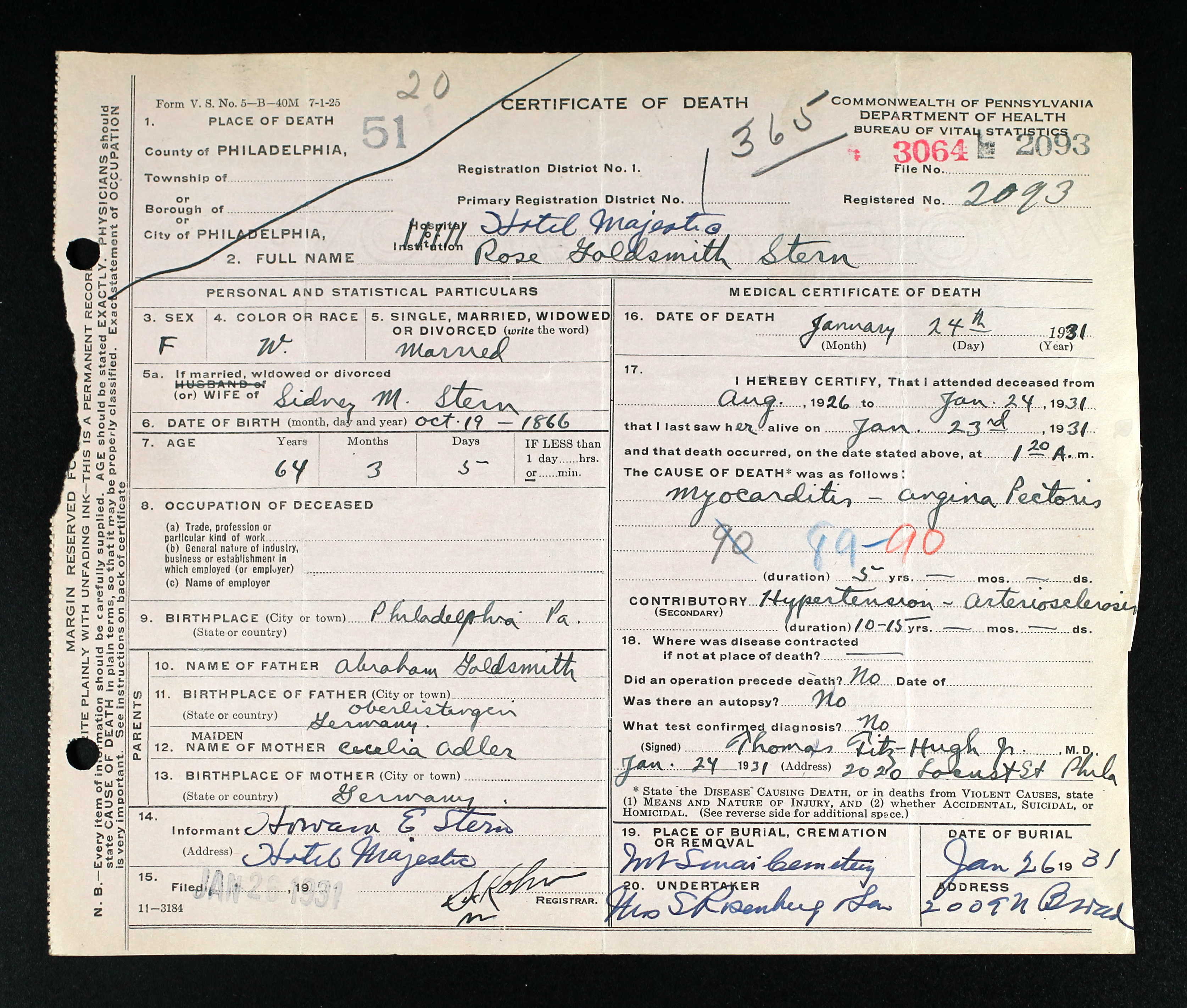
Sadly, my cousin Rose Goldsmith Stern died less than a year after her daughter-in-law Gladys. Rose was 64 when she died on January 24, 1931, from heart disease: hypertension and arteriosclerosis leading to myocarditis and angina pectoris. Her obituary reported that she died from a heart attack. It also stated that Rose had been the manager of the Beth Israel Association for the Deaf and the national chairwoman of the Council of Jewish Women.18

Rose Goldsmith Stern death certificate,
Pennsylvania Historic and Museum Commission; Pennsylvania, USA; Certificate Number Range: 001001-004000.  Ancestry.com. Pennsylvania, Death Certificates, 1906-1966

Rose was survived by her husband Sidney and her three sons and four grandchildren as well as seven of her siblings. Her husband Sidney continued to live in Philadelphia. In 1940 he was living in the Majestic Hotel where his sister-in-law Estelle Goldsmith and brother-in-law Edwin M. Goldsmith were also living.19 Sidney died on October 19, 1942, also of heart disease.20

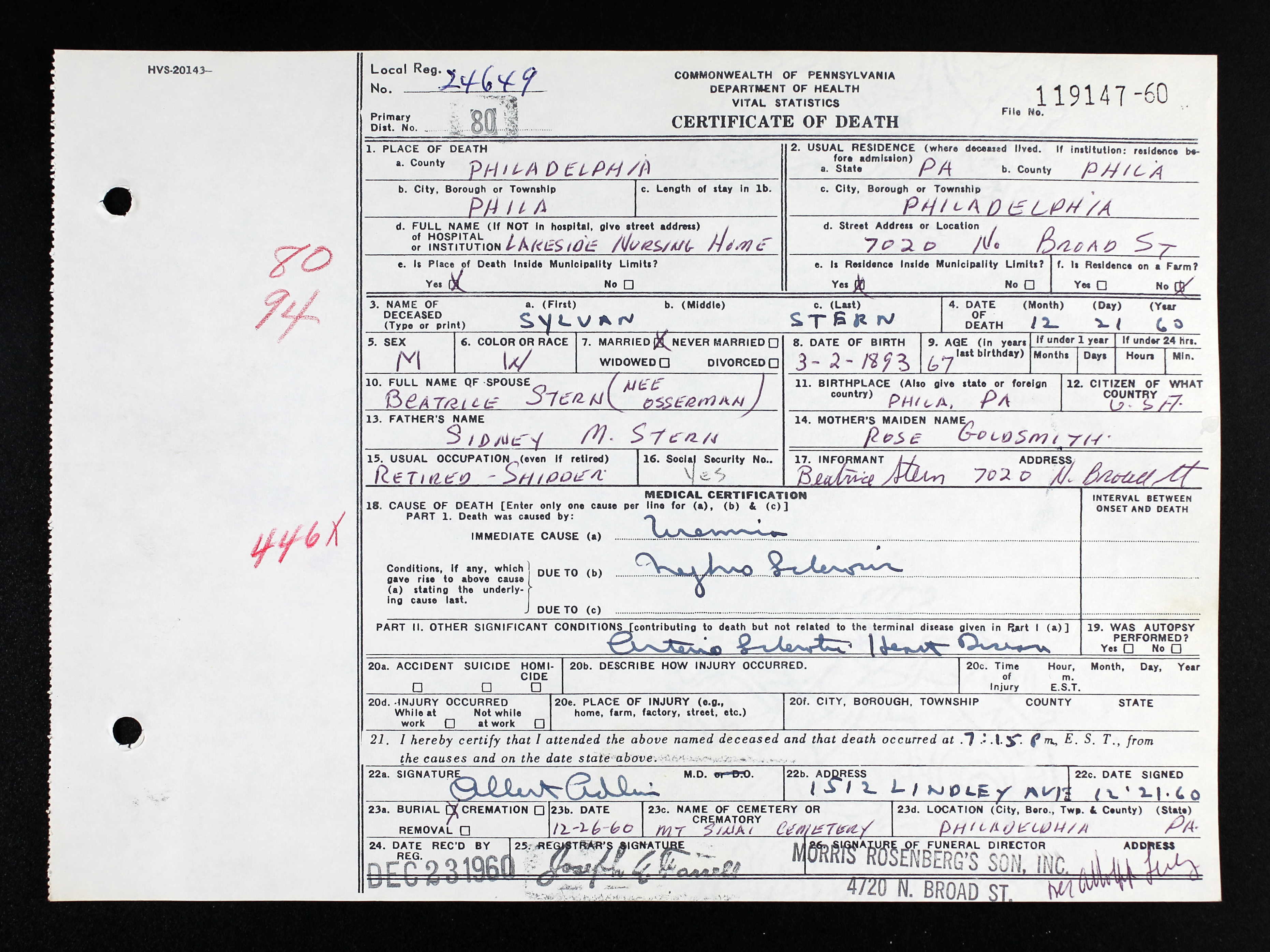
Sylvan Stern and his family continued to live in Philadelphia in 1940, and Sylvan was still working as a packer in a sporting goods store at that time.21 According to his 1942 draft registration, his employer was Edward K. Tryon Company.22 Sylvan died on December 21, 1960.  He was 67 years old. He was survived by his wife and children and his two brothers.

Ancestry.com. Pennsylvania, Death Certificates, 1906-1966

Allan Goldsmith Stern remarried several years after the death of his first wife Gladys.  In 1940 he and his second wife Margaret were living in Washington, D.C., where Allan was an engineer for an ornamental iron company, which his draft registration revealed was still Fred S. Gichner Iron Works.23  I could not find any other information about Margaret, but in 1956 Allan married for a third time; his third wife was Alma Hollander.24

Allan Stern died on June 9, 1964, from cancer, according to his obituary in the Washington Evening Star. The obituary reported that in addition to his long career at Fred S. Gichner, Allan had been a founding member of the Beth El Congregation of Maryland and had helped establish the Kaufman Camp for Underprivileged Children on Chesapeake Bay. He was survived by his wife Alma and his brother Howard.25

Howard Stern was the only of Rose Goldsmith’s sons to live beyond his 60s. In 1940 he was living with his family in Philadelphia and practicing law, which his draft registration in 1942 revealed was his own practice.26 Howard died on July 10, 1989, just a few weeks short of his 94th birthday. He was survived by his children.27

The family of Rose Goldsmith Stern certainly faced a number of challenges. But overall, they appear to have been a family that overcame those challenges, found professional success, and gave back to society in many ways.

Thank you once again to Sharon and to Amberly for their help!


  1. Philadelphia city directories, 1899, 1900, 1901, Ancestry.com. U.S. City Directories, 1822-1995. 
  2. University of Pennsylvania Yearbook, U.S., School Yearbooks, 1880-2012″; Yearbook Title: The Record; Year: 1915. Ancestry.com. U.S., School Yearbooks, 1900-1990 
  3. Cornell Yearbook, U.S., School Yearbooks, 1880-2012″; Yearbook Title: Cornellian; Year: 1916. Ancestry.com. U.S., School Yearbooks, 1900-1990 
  4.  Ancestry.com. Pennsylvania, WWI Veterans Service and Compensation Files, 1917-1919, 1934-1948. Original data: World War I Veterans Service and Compensation File, 1934–1948. RG 19, Series 19.91. Pennsylvania Historical and Museum Commission, Harrisburg Pennsylvania. “Allan G. Stern, Official of Gichner Iron Works,” Philadelphia Evening Star, June 10, 1964, p. 37. 
  5.   Family of Sidney Stern, 1920 US census, Census Place: Philadelphia Ward 47, Philadelphia, Pennsylvania; Roll: T625_1646; Page: 7A; Enumeration District: 1791. Ancestry.com. 1920 United States Federal Census 
  6. Simon Osserman and family, 1920 US Census, Year: 1920; Census Place: Manhattan Assembly District 21, New York, New York; Roll: T625_1224; Page: 1B; Enumeration District: 1445. Ancestry.com. 1920 United States Federal Census 
  7. Marriage of Howard Stern and Madeline Kind Kohn, Ancestry.com. Pennsylvania, Marriages, 1852-1968. Original data: Marriage Records. Pennsylvania Marriages. Various County Register of Wills Offices, Pennsylvania. Film Number: 004141829 
  8. Madeline Kind Kuhn Passport Application, National Archives and Records Administration (NARA); Washington D.C.; Roll #: 1494; Volume #: Roll 1494 – Certificates: 141500-141875, 12 Feb 1921-15 Feb 1921. 
  9. Marriage of Allan Stern and Gladys Fliegelman, Ancestry.com. Pennsylvania, Marriages, 1852-1968. Original data: Marriage Records. Pennsylvania Marriages. Various County Register of Wills Offices, Pennsylvania. Film Number: 004141829 
  10.  District of Columbia Deaths, 1874-1961,” database with images, FamilySearch (https://familysearch.org/ark:/61903/1:1:F7TK-SXY : accessed 1 May 2018), Gladys Stern, 06 Feb 1930, District of Columbia, United States; citing reference ID 325790, District Records Center, Washington D.C.; FHL microfilm 2,116,108. 
  11. Harry Fliegelman and family, 1920 US Census, Census Place: Philadelphia Ward 32, Philadelphia, Pennsylvania; Roll: T625_1633; Page: 4A; Enumeration District: 1065. Ancestry.com. 1920 United States Federal Census 
  12. “Poetess Dies in Plunge,” The Philadelphia Inquirer, February 7, 1930, p. 7. 
  13. “Woman Ends Life Because of Illness,” The Dayton Herald,” February 6, 1930, p. 33. 
  14. Washington, DC, City Directories, 1930, 1931, 1929, Ancestry.com. U.S. City Directories, 1822-1995. 
  15. Sidney and Rose Goldsmith Stern, 1930 US Census, Census Place: Philadelphia, Philadelphia, Pennsylvania; Page: 8B; Enumeration District: 0397. Ancestry.com. 1930 United States Federal Census 
  16. Sylvan Stern and family, 1930 US Census, Census Place: Philadelphia, Philadelphia, Pennsylvania; Page: 10B; Enumeration District: 1077. Ancestry.com. 1930 United States Federal Census. 
  17. Howard Stern and family, 1930 US Census, Census Place: Philadelphia, Philadelphia, Pennsylvania; Page: 20A; Enumeration District: 1029.
    Ancestry.com. 1930 United States Federal Census. 
  18. “Mrs. Rose Goldsmith Stern,” The Philadelphia Inquirer, January 25, 1931, p. 17. 
  19. Sidney Stern, 1940 US Census,  Census Place: Philadelphia, Philadelphia, Pennsylvania; Roll: m-t0627-03698; Page: 81A; Enumeration District: 51-384. Ancestry.com. 1940 United States Federal Census 
  20. Sidney Stern, death certificate, Pennsylvania Historic and Museum Commission; Pennsylvania, USA; Certificate Number Range: 085451-088100. Ancestry.com. Pennsylvania, Death Certificates, 1906-1966. Certificate Number: 86311 
  21. Sylvan Stern and family, 1940 US Census, Census Place: Philadelphia, Philadelphia, Pennsylvania; Roll: m-t0627-03752; Page: 12A; Enumeration District: 51-2119. Ancestry.com. 1940 United States Federal Census 
  22. Sidney Stern, World War II draft registration, The National Archives at St. Louis; St. Louis, Missouri; World War II draft cards (Fourth Registration) for the State of Pennsylvania; Record Group Title: Records of the Selective Service System, 1926-1975; Record Group Number: 147; Series Number: M1951. Source Information
    Ancestry.com. U.S., World War II Draft Registration Cards, 1942 
  23. Allan and Margaret Stern, 1940 US Census, Census Place: Washington, District of Columbia, District of Columbia; Roll: m-t0627-00563; Page: 66B; Enumeration District: 1-307, Ancestry.com. 1940 United States Federal Census.  Allan Stern, World War II draft registration, The National Archives at St. Louis; St. Louis, Missouri; World War II Draft Cards (Fourth Registration) for the State of Maryland; Record Group Title: Records of the Selective Service System, 1926-1975; Record Group Number: 147; Series Number: M1939. Source Information Ancestry.com. U.S., World War II Draft Registration Cards, 1942 
  24. “Alma Stern,” Washington (D.C.) Evening Star, September 23, 1979, p. 49. 
  25.  “Allan G. Stern, Official of Gichner Iron Works,” Philadelphia Evening Star, June 10, 1964, p. 37. 
  26. Howard Stern, World War II draft registration, The National Archives at St. Louis; St. Louis, Missouri; World War II draft cards (Fourth Registration) for the State of Pennsylvania; Record Group Title: Records of the Selective Service System, 1926-1975; Record Group Number: 147; Series Number: M1951. Source Information
    Ancestry.com. U.S., World War II Draft Registration Cards, 1942 
  27. Number: 167-32-5823; Issue State: Pennsylvania; Issue Date: 1956-1958. Ancestry.com. U.S., Social Security Death Index, 1935-2014.  

The Legacy of Edwin Goldsmith: Inventiveness and Creativity

The 1920s had been a good decade for my cousin Edwin Goldsmith, Sr., and his family, as we saw here. He patented six new inventions, continued to work for Friedberger-Aaron, and became active in the local politics of Longport, New Jersey, where his second home was located. His children were grown, and two were married.  He and his wife Jennie had three grandchildren by 1930, and another, Thomas Holmes Goldsmith, was born in 1931 to Henry and his wife Ida.1 In 1932, Edwin and Jennie’s youngest child, Edwin, Jr., married Helen R. Jacobs, another Philadelphia native;2 she was born October 23, 1909, to Henry and Annie Jacobs.3

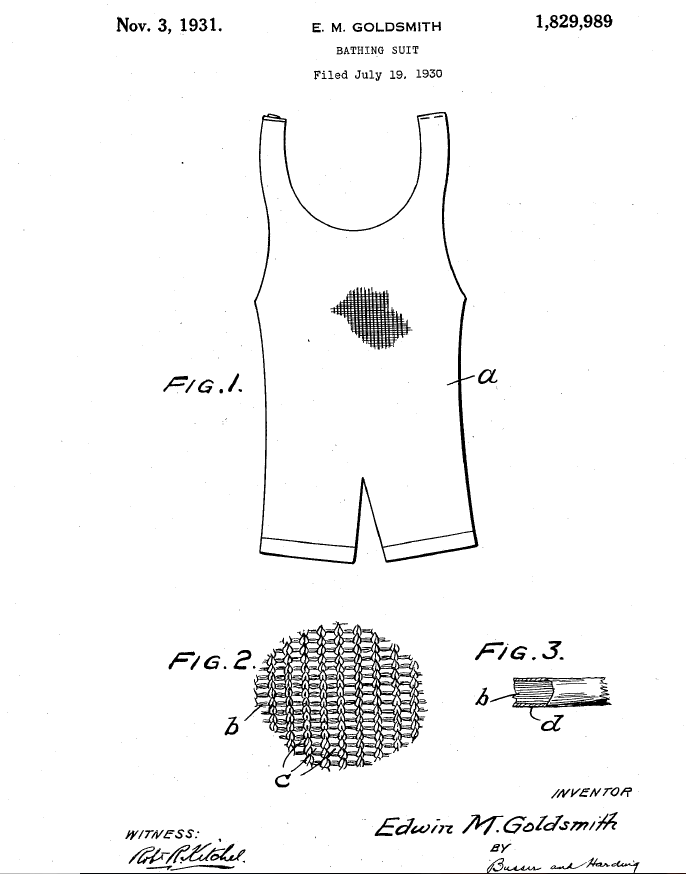
Edwin, Sr. obtained four more patents between 1931 and 1933. In 1931 he received a patent for his design of a bathing suit that would dry quickly.4  The patent description is interesting in that it reveals a bit about life before the development of man-made fabrics like nylon, polyester, and spandex:

Bathing suits of all materials from which such suits are now made…require a considerable time for drying. The user of a privately owned bathing suit frequently is not even temporarily residing near the bathing beach or pool and has no facilities for drying the suit immediately, after use, but must transport it in a more or less wet condition. In public bathing houses the time required to dry bathing suits is a serious item of expense, since it necessitates the provision of a large supply, because at any given time a large proportion of suits is undergoing drying and is out of use.

My guess is that Edwin’s interest in this problem stemmed from his experiences at their summer home in Longport, New Jersey. And isn’t it interesting to learn that many people did not wear their own bathing suits but used those belonging to a bathing house?

Edwin’s invention for a faster drying bathing suit involved using a material that was water permeable and “coated or impregnated with a water-repellant material not necessarily different from that used in the treatment of so-called waterproof garments, e.g., raincoats, to render them substantially impermeable to water.” The suit would then have multiple openings to allow the water to flow in and out of the suit like an open mesh.  I am not sure how commercially successful this design would have been as it sounds quite uncomfortable!

Edwin’s other three patents between 1931 and 1933 related to more mundane matters involving the business of Friedberger-Aaron, e.g., buttonhole tape and a means of mounting and display of articles for sale.

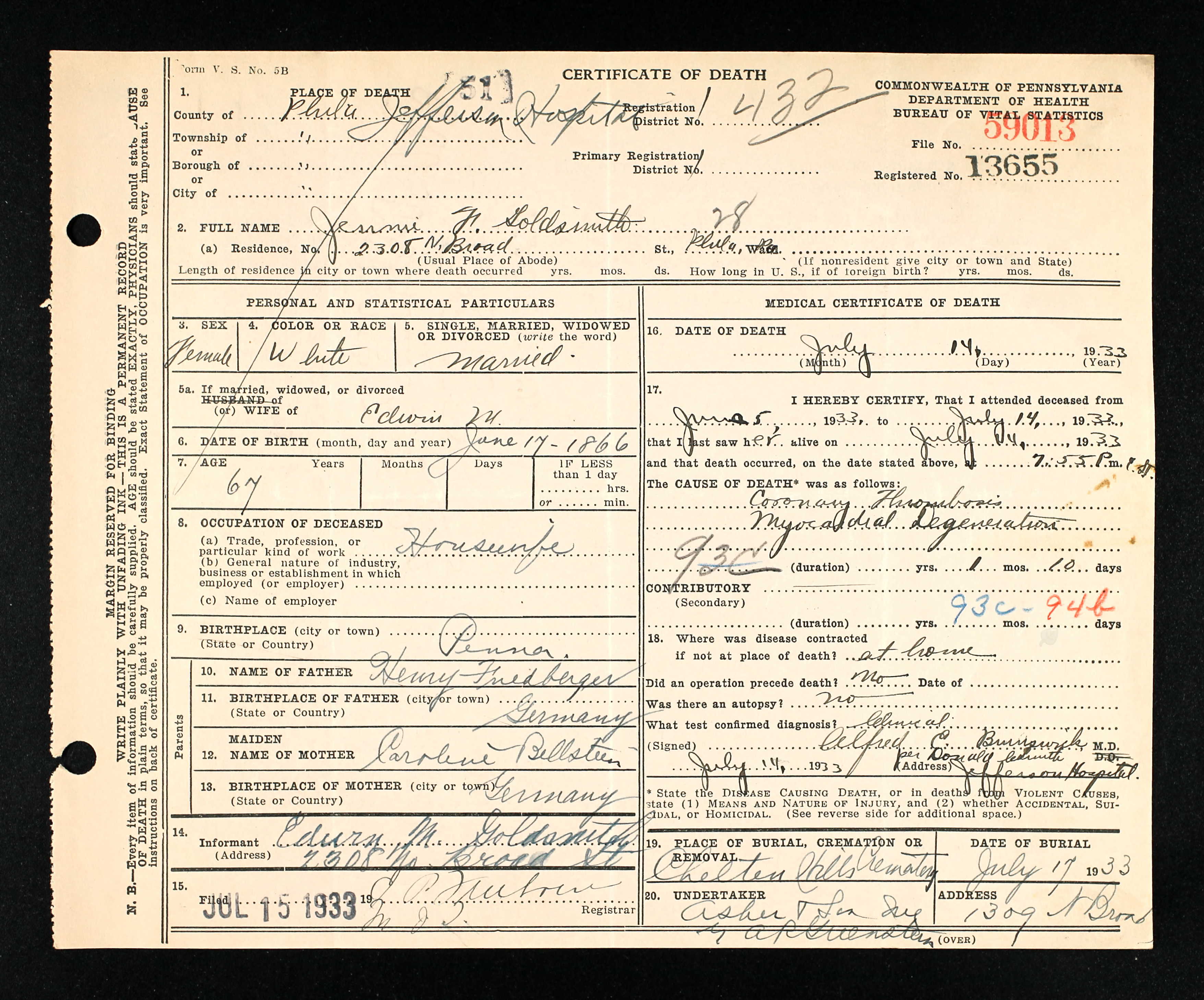
But the 1930s soon turned more difficult for the Goldsmith family. On July 14, 1933, Jennie Friedberger Goldsmith, Edwin Sr.’s wife, died from coronary thrombosis; she was 67 years old.

Jennie Friedberger Goldsmith death certificate
Pennsylvania Historic and Museum Commission; Pennsylvania, USA; Certificate Number Range: 059001-062000
Ancestry.com. Pennsylvania, Death Certificates, 1906-1966

After Jennie’s death, Edwin seemed to lose interest in inventing new products as his last patent was issued on October 3, 1933.  In 1940 Edwin was retired and living in the Majestic Hotel in Philadelphia where his younger sister Estelle Goldsmith and brother-in-law Sidney Stern were also living.5 He also continued to spend time in the Atlantic City area or at least continued to be listed in their 1941 directory.6

His older son Henry founded and owned a nylon netting company called Thomas Holmes Manufacturing, presumably named for his son Thomas Holmes Goldsmith. (Holmes was Ida Stryker’s grandmother’s birth name) and perhaps inspired by his father’s bathing suit patent.7  In 1940, Henry and his wife Ida and son Thomas were living with Ida’s parents, George and Ella Stryker.8

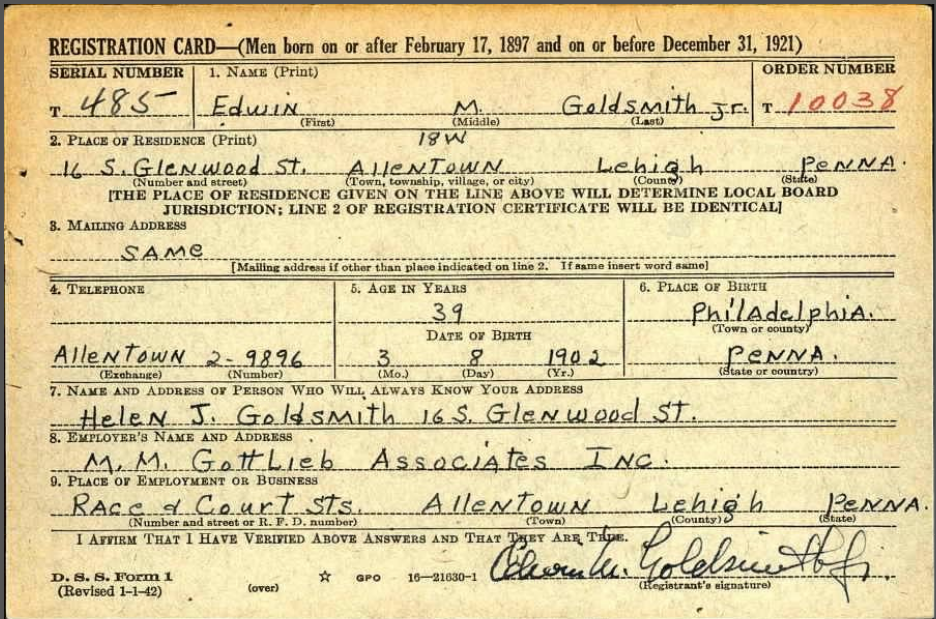
Henry’s younger brother Edwin M. Goldsmith, Jr. was also living in Philadelphia in 1940 with his wife Helen and her mother Annie Jacobs. Edwin was working as an industrial engineer.9 But by 1942, Edwin, Jr. and Helen had left Philadelphia and moved to Allentown, Pennsylvania, where Edwin was employed by M.M. Gottlieb, a clock manufacturing company. They are listed in the Allentown directories until 1945.10

Edwin Goldsmith, Jr. World War II draft registration
Draft Registration Cards for Pennsylvania, 10/16/1940 – 03/31/1947. 2,818 boxes. NAI: 5324575. Records of the Selective Service System, 1926–1975, Record Group 147. National Archives and Records Administration, St Louis, Missouri.

During this time Edwin, Jr. followed in his father’s footsteps and obtained a patent. He was awarded the patent, which he assigned to his employer M.M. Gottlieb, for the invention of a “new and useful ‘numeral clock.’” As described in the patent, “[o]ne of the objects of the present invention is a numeral clock which will be more positive in action and less subject to disturbance by vibrations or accidental jarring, and which may be readily adjusted or “set” whenever necessary, and which may be manufactured and assembled readily and at low cost, and which may be conveniently installed in a casing or housing.”11 Perhaps this was a very early version of a so-called “digital” clock?

Edwin Jr. and Helen also had a child during this decade.

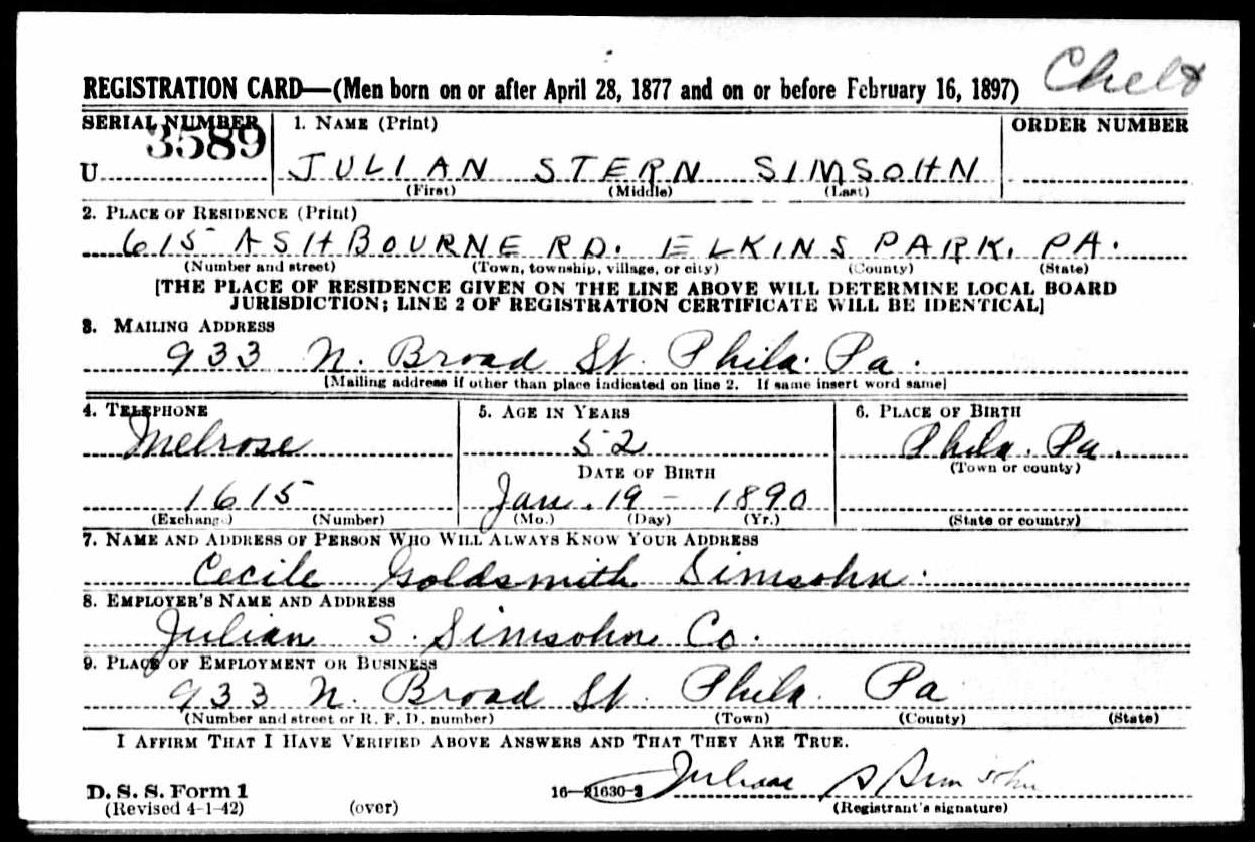
As for Henry and Edwin’s older sister Cecile Goldsmith and her husband Julian Stern Simsohn, I was unable to find them on the 1940 census, but according to Julian’s World War II registration, in 1942 they were living in Elkins Park, a suburb of Philadelphia, and Julian was working as a chemical engineer in his own firm.

Julian Simsohn, Sr, World War II draft registration
The National Archives at St. Louis; St. Louis, Missouri; World War II draft cards (Fourth Registration) for the State of Pennsylvania; Record Group Title: Records of the Selective Service System, 1926-1975; Record Group Number: 147; Series Number: M1951
Ancestry.com. U.S., World War II Draft Registration Cards, 1942

Their son Julian, Jr., was living at home in Elkins Park in 1940, according to his World War II draft registration, and was working for Thomas Holmes Manufacturing in Philadelphia, the company owned by his uncle Henry. Julian, Jr. served as a corporal in the US Army Air Forces in the Fourth Reconnaissance Group during World War II, including twenty months served overseas.12 I assume that Marjorie, who was still a teenager in 1940, was also living at home.

Julian Simsohn Jr. World War II draft registration
The National Archives in St. Louis, Missouri; St. Louis, Missouri; Record Group: Records of the Selective Service System, 147; Box: 2315
Source Information
Ancestry.com. U.S. WWII Draft Cards Young Men, 1940-1947

Cecile and Julian Simsohn’s older daughter Jean married Vincenzo Savarese on January 4, 1939, in Lenoir County, North Carolina. She was 21, he was 27. According to their marriage record, Vincenzo was born in Naples, Italy, and they were both residents of Philadelphia. In 1940 Jean and Vincenzo were living in Atlanta, Georgia, where Vincent was employed as a traveling salesman for a wholesale gift company.13

Marriage license of Jean Simsohn and Vincenzo Savarese,
Series: Marriage Licenses (1879 – 1961)
Source Information
Ancestry.com. North Carolina, Marriage Records, 1741-2011.

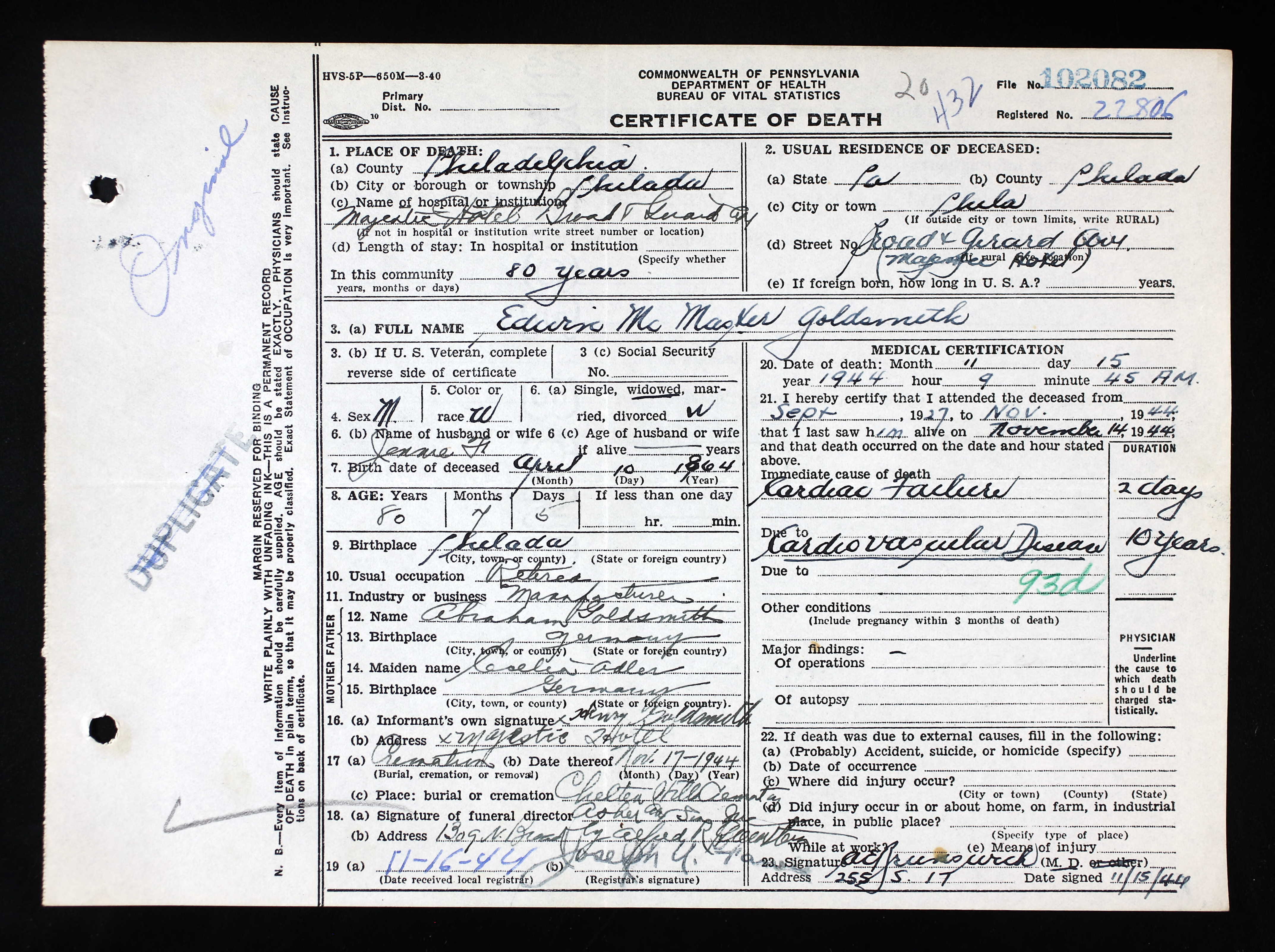
Edwin M. Goldsmith, Sr. died on November 14, 1944, in Philadelphia; he was eighty years old.  According to his death certificate, he had suffered from cardiovascular disease for ten years—that is, dating from around the time that his wife Jennie died. Edwin died from cardiac failure.

Edwin M Goldsmith, Sr., death certificate
Pennsylvania Historic and Museum Commission; Pennsylvania, USA; Certificate Number Range: 099801-102350
Ancestry.com. Pennsylvania, Death Certificates, 1906-1966

Edwin’s daughter Cecile died on March 30, 1946, less than two years after her father; she was only 57 and died from ovarian cancer. According to her obituary she was a graduate of the Philadelphia High School for Girls and Bryn Mawr College and had founded and directed a day camp for children; she had also been the treasurer and secretary of the Montgomery County branch of the Women’s International League for Peace and Freedom as well as the secretary of the Bamberger Seashore Home for Children in Longport, New Jersey. At the time of her death she was the president of Keneseth Israel Sisterhood. 14

Cecile Goldsmith Simsohn death certificate
Pennsylvania Historic and Museum Commission; Pennsylvania, USA; Certificate Number Range: 026851-029400
Ancestry.com. Pennsylvania, Death Certificates, 1906-1966

Edwin, Sr., would likely have been pleased by the creative endeavors of his granddaughter Jean Simsohn Savarese, daughter of his daughter Cecile Goldsmith Simsohn, and her husband Vincenzo.  In 1950 Jean and Vincenzo (known also as Vincent) developed a line of “oven-to-table” pots and pans.  According to an article in the August 25, 1950, Philadelphia Inquirer, Vincent had studied art appreciation in Italy before emigrating and came up with the design and was helped by another man to bring the design into practice.15

Marcia Strousse, “Coppersmith Puts Art in Kitchenware,” The Philadelphia Inquirer, August 25, 1950, p. 17.

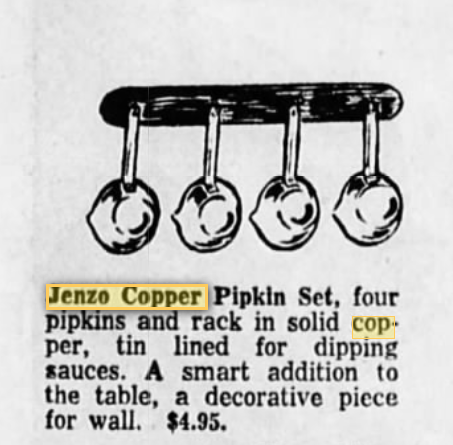
As described in the article, “Fashioned of solid copper lined with pure tin, the varied pieces are distinguished by their clean-cut articulate lines, a combination of old world charm and the effects of modern technology. Each is functionally designed with handles to aid in serving them right to the table.” Jean and Vincent called their company Jenzo, a combination of Jean and Enzo, Vincent’s nickname.  Based on the advertisements I found on newspapers.com, their products were sold all over the US during the 1950s. Here are just two examples.

Ad for Jenzo copperward at Hudson’s Department Store in Detroit
Detroit Free Press, December 14, 1951, p. 7.

Ad for Jenzo products, Bon Marche store, Asheville, North Carolina
Asheville Citizen, December 12, 1954, p. 40

In 1952 Edwin Goldsmith, Jr. joined his brother Henry at Thomas Holmes Manufacturing where he became vice president; he stayed there until his retirement in 1968.16

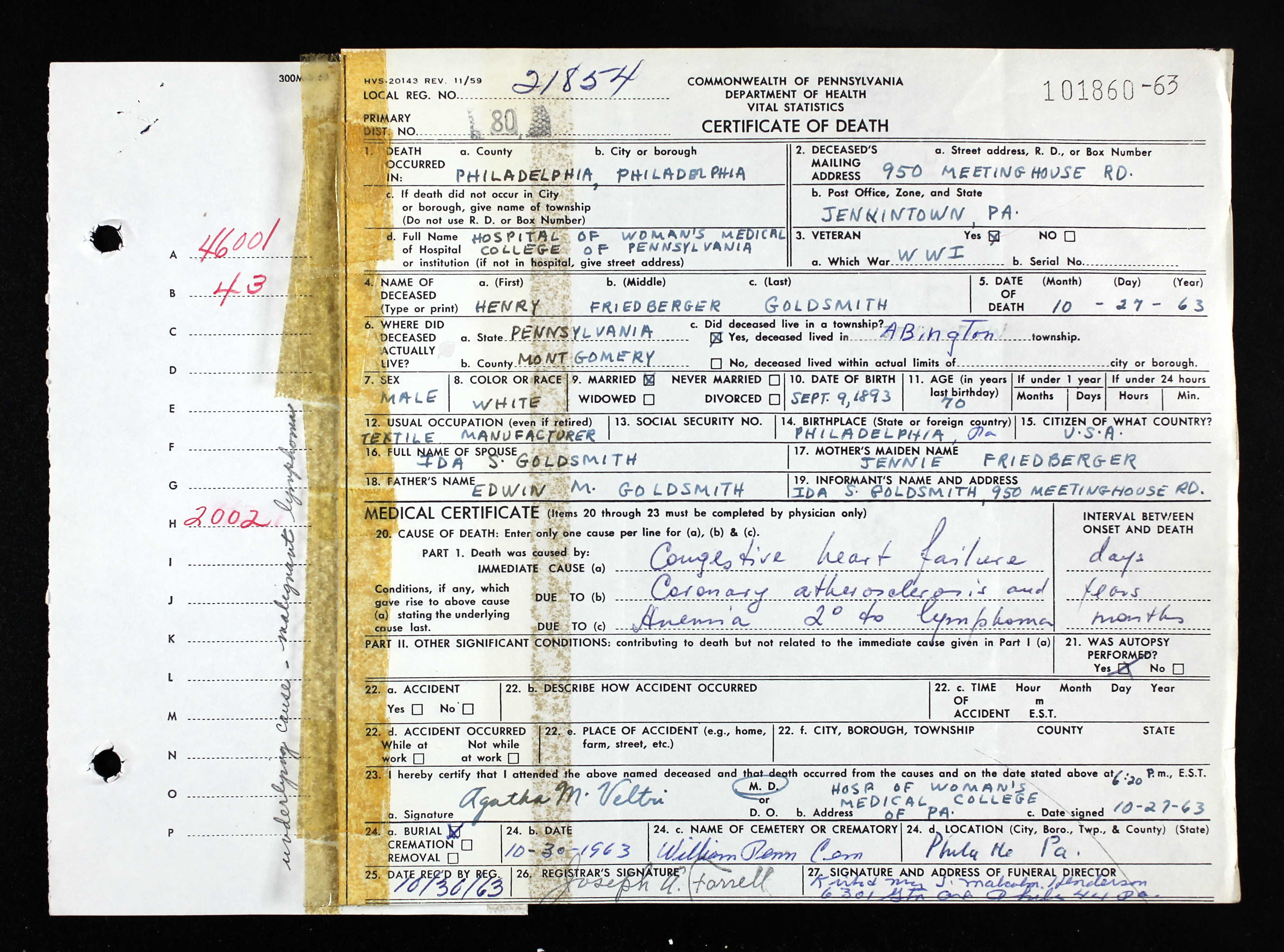
The 1960s brought some sad times for the family. Henry Goldsmith died from congestive heart failure on October 27, 1963; he was seventy years old. He was survived by his wife Ida and their son Thomas.

Henry F Goldsmith death certificate
Pennsylvania Historic and Museum Commission; Pennsylvania, USA; Certificate Number Range: 100201-103050
Ancestry.com. Pennsylvania, Death Certificates, 1906-1966

His nephew Julian Stern Simsohn, Jr. followed less than  two years later on February 4, 1965; he was only 46 years old and predeceased his father, Julian, Sr., who outlived his son by six years.17 Julian, Jr. never married; his will created a trust, the income of which was to be paid to his father for life, then to be paid to his two sisters, Jean and Marjorie.18 Jean died in 1999, Marjorie in 2006.  Their uncle Edwin M. Goldsmith, Jr. died in 1991.19

UPDATE: Thank you to my cousin Anthony who let me know that his grandparents Jean Simsohn and Vincent Savarese divorced in the 1960s and that Jean, who had converted to Catholicism, became a Poor Clare nun, living in a cloistered convent in Roswell, New Mexico for the rest of her life. Anthony also shared with me that Jean was able to have her marriage annulled; she took on the name Jane Frances after becoming a nun. Her ex-husband Anthony Savarese remarried, and his second wife was also named Jean, born Jean Gallagher. I had confused the two women in my research and had assigned the wrong birth and death dates to my cousin Jean Simsohn. I am so glad Anthony discovered my error and helped me set the record straight.

It was interesting to study Edwin Goldsmith Sr. and his family after studying his brother Milton and his family.  Two sons of Abraham Goldsmith and Cecelia Adler with such different interests and careers—Milton, the author, and Edwin, the inventor.

It was also interesting to see how Edwin’s children and even grandchildren inherited some of his skills and interest in design and invention. Both sons became engineers, one started a nylon netting company where both ended up working. One son followed in his father’s footsteps and obtained a patent for his invention. Edwin’s son-in-law Julian Simsohn was also an engineer. Edwin’s granddaughter Jean and her husband Vincenzo Savarese designed and developed an improved method of making pots and pans. And more recently, another grandson applied for a patent in 2012 for a benefit payments method, showing that the creative impulses that run through the family DNA have continued to influence and inspire Edwin’s descendants.20


  1.  Ancestry.com. U.S., Social Security Applications and Claims Index, 1936-2007 [database on-line]. Provo, UT, USA: Ancestry.com Operations, Inc., 2015. Original data: Social Security Applications and Claims, 1936-2007. 
  2.  Ancestry.com. Pennsylvania, Marriages, 1852-1968. Original data: Marriage Records. Pennsylvania Marriages. Various County Register of Wills Offices, Pennsylvania. Film Number: 004141719. 
  3.  Ancestry.com. U.S. Public Records Index, 1950-1993, Volume 1 [database on-line]. Provo, UT, USA: Ancestry.com Operations, Inc., 2010. Original data: Voter Registration Lists, Public Record Filings, Historical Residential Records, and Other Household Database Listings. 
  4. E.M. Goldsmith, Bathing suit, U.S. Patent No.1,828,989, November 3, 1931. 
  5. Edwin Goldsmith, 1940 US Census, Philadelphia, Philadelphia, Pennsylvania; Roll: m-t0627-03698; Page: 81A; Enumeration District: 51-384. Source Information
    Ancestry.com. 1940 United States Federal Census [database on-line]. Provo, UT, USA: Ancestry.com Operations, Inc., 2012. 
  6.  Atlantic City, New Jersey, City Directory, 1941. Source Information
    Ancestry.com. U.S. City Directories, 1822-1995 
  7. “H.F. Goldsmith, Nylon Executive,” The Philadelphia Inquirer, October 29, 1963, p. 38. 
  8. Household of George Stryker, 1940 U.S. Census, Philadelphia, Philadelphia, Pennsylvania; Roll: m-t0627-03752; Page: 9A; Enumeration District: 51-2125. Ancestry.com. 1940 United States Federal Census 
  9. Edwin Goldsmith, Jr. and family, 1940 US Census, Philadelphia, Philadelphia, Pennsylvania; Roll: m-t0627-03754; Page: 2A; Enumeration District: 51-2169. Ancestry.com. 1940 United States Federal Census 
  10.  Allentown, Pennsylvania, City Directory, 1942-1945. Source Information
    Ancestry.com. U.S. City Directories, 1822-1995. 
  11. E.M. Goldsmith, Jr., Clock, U.S. Patent No. 2,343,613, March 7, 1944. 
  12.  National Cemetery Administration. U.S. Veterans’ Gravesites, ca.1775-2006. Original data: National Cemetery Administration. Nationwide Gravesite Locator
  13. Vincenzo and Jean Savarese, 1940 US census, Atlanta, Fulton, Georgia; Roll: m-t0627-00732; Page: 85A; Enumeration District: 160-219. Ancestry.com. 1940 United States Federal Census. 
  14. “Mrs. Simsohn Dies, Long Ill,” The Philadelphia Inquirer, March 31, 1946, p. 7/ 
  15. Marcia Strousse, “Coppersmith Puts Art in Kitchenware,” The Philadelphia Inquirer, August 25, 1950, p. 17. 
  16. “Edwin Goldsmith, Retired Engineer,” The Philadelphia Inquirer, May 6, 1991, p. 18. 
  17. Julian Simsohn, Jr.: Number: 164-14-9523; Issue State: Pennsylvania; Issue Date: Before 1951. Ancestry.com. U.S., Social Security Death Index, 1935-2014. Original data: Social Security Administration. Social Security Death Index, Master File. Social Security Administration. Julian Simsohn, Sr.: Number: 183-14-3189; Issue State: Pennsylvania; Issue Date: Before 1951. Ancestry.com. U.S., Social Security Death Index, 1935-2014. Original data: Social Security Administration. Social Security Death Index, Master File. Social Security Administration. 
  18. “Trust Established In Area Man’s Will,” The Mercury (Pottstown, Pennsylvania), February 26, 1965, p. 3. 
  19.  Jean Simsohn aka Jane Frances Savarese death information from her grandson Anthony Savarese and obituary found at https://www.losaltosonline.com/archives/obituaries/article_1b522d2f-f33a-5a34-ab08-ba407f3532e3.html ; Marjorie Gerstle: Ancestry.com. U.S., Social Security Applications and Claims Index, 1936-2007. Original data: Social Security Applications and Claims, 1936-2007. Edwin M. Goldsmith, Jr.: Number: 186-01-0896; Issue State: Pennsylvania; Issue Date: Before 1951. Ancestry.com. U.S., Social Security Death Index, 1935-2014. Original data: Social Security Administration. Social Security Death Index, Master File. Social Security Administration.
  20. Edwin M. Goldsmith, Marcia W. Goldsmith, and Louis M. Heidelberger, Benefit Payment Method and System, U.S. Patent Application No. 13279377, published December 27, 2012 (abandoned). 

Elkton, Maryland, The Wedding Capital of the East

As seen in my last post, in 1920 Edwin M. Goldsmith, Sr., was the secretary-treasurer of his uncle’s textile company, Friedberger-Aaron, and also the owner of thirteen US patents. He and his wife Jennie and their two sons, Henry and Edwin, Jr., were living together in Philadelphia. They also maintained a residence in Longport, New Jersey, near Atlantic City. Their daughter Cecile and her husband Julian Stern Simsohn and their two children were also living in Philadelphia, and Julian was working as a chemical engineer. Cecile and Julian had a third child, a daughter named Marjorie Goldsmith Simsohn, born on August 12, 1921, in Philadelphia.1

Edwin continued to be a successful inventor during the 1920s. He added six more patents to his portfolio between 1921 and 1930. His first was for the design for a stuffed doll encased in a removable cover so that it could be washed:2

In addition to patenting several inventions relating to the packaging, display, and sale of the textile fabrics made by Friedberger-Aaron where Edwin continued to work as secretary-treasurer, he also developed an invention for a hair curler “which may be operated to receive, confine and release the hair with the greatest possible facility”3  and a product that combined soap and towel into one article.4 The latter was described by Edwin as follows:

… a sheet of readily destructible material, such as paper tissue, of a size and having absorptive qualities enabling it to be used as a towel, the sheet being folded into flat form, and means connected to the sheet and forming a closed container or receptacle containing a quantity of soap, preferably in powder form.

During the 1920s, Edwin also held elective offices in Longport, New Jersey, where his second home was located:

Asbury Park Press, May 9, 1928, p. 2.

Edwin and Jennie’s son-in-law Julian Simsohn was very active as a chemical engineer in Philadelphia during the 1920s, as seen in numerous ads for his services in not just the Philadelphia newspapers but also papers in Chicago, Pittsburgh, St. Louis, and  during those years. Here are two, one from the Philadelphia Evening Ledger and one I particularly liked which appeared in the Indianapolis Star:

Philadelphia Evening Ledger, September 20, 1928, p. 13.

Indianapolis Star, November 30, 1930, p. 25.

Here is a close up of the section in the cigar featuring Julian Simsohn:


Edwin and Jennie’s older son Henry, also a chemical engineer, had been working for a radiator manufacturer in 1920, and he continued to be listed with that company, G & O Mfg., in the 1921 and 1922 Philadelphia directories.5

I knew from the 1930 census that Henry married sometime before 1930, but I could not locate any record or other information about when he’d married until I found this list in the August 16, 1925 Philadelphia Inquirer of marriage licenses issued in one day in Elkton, Maryland:

“Elkton Marriages,” The Philadelphia Inquirer, August 16, 1925, p. 8.

Notice that it includes Henry F. Goldsmith and Ida P. Stryker of Longport, New Jersey, the town where Edwin’s family spent their summers. But why were so many people getting marriage licenses in one day from Elkton, Maryland? What was going on?

Well, according to this article by Marshall S. Berdan from the February 13, 2002 edition of the Washington Post, from about 1913 until 1938, Elkton, Maryland was a destination for those wishing to marry quickly. As the article explains:

It all started in 1913 when Delaware passed mandatory matrimonial waiting and public notification laws. Meanwhile Maryland — the “Free State” — imposed neither waiting period nor residency requirement. Those Delaware moralists should have just put up a sign reading “This Way to Elkton.”

As the most northeasterly county seat in Maryland, Elkton became the roadside chapel of choice for those who chose to marry in haste from throughout the Northeast. From just over 100 marriages per year at the turn of the century, tiny Elkton was soon cranking out well over 10,000 newlyweds a year — the vast majority from New York, New Jersey and Pennsylvania — during the 1920s and ’30s. It became known as “America’s Gretna Green.”

This blog also sheds light on why Elkton became a wedding destination.

But why would Henry Goldsmith and Ida Stryker have been in such a rush to marry and in a place like Elkton?

Well, I have two theories.  First, Ida Stryker was born in Philadelphia on February 26, 1908.6 She was only seventeen in August 1925; Henry, who was born in 1893, was 32, almost twice her age. I can’t imagine that her parents would have been happy to see their teenage daughter marry a man in his thirties.

Second, Ida was not Jewish.  Her parents, George Holmes Stryker and Ella Williams, were Episcopalian.7  Perhaps her parents or Henry’s parents did not approve of the interfaith marriage. But Henry and Ida did marry, and in fact they stayed married until Henry’s death in 1963.  Ida, who lived to be 96, never remarried.

In 1930, Henry and Ida were living in Philadelphia, and Henry was working as an executive in a textile company—and I believe that company was Friedberger-Aaron. It is unnamed on the census,8 and the page where the Goldsmiths are listed in the 1930 Philadelphia directory on Ancestry is barely legible, but on the page with Goldsmiths listed, I can see two entries with Friedberger-Aaron after the names, so I assume those are the listings for Edwin and Henry Goldsmith.9 Perhaps that meant that at least Henry’s family was on good terms with Henry and Ida. Henry and Ida had one child together, a son Thomas Holmes Goldsmith, born in 1931.

Henry’s sister Cecile and her husband Julian Simsohn continued to live in Philadelphia with their three children in 1930, and Julian continued to work as an engineer.10

Edwin and Jennie’s youngest child, Edwin M. Goldsmith, Jr., was just coming of age in the 1920s.  He had graduated from Central High School in Philadelphia and then graduated from Massachusetts Institute of Technology in 1923 with a degree in industrial engineering. 11 On the 1930 census he was living with his parents Edwin, Sr., and Jennie, in Longport, New Jersey,  and according to the census record, he was a radio salesman. His father continued to list textile manufacturing as his occupation.12

The 1920s were thus a good decade for the family of Edwin and Jennie Goldsmith. Their children were grown, and Edwin continued to find success with his inventions. The 1930s brought some changes to the family of Edwin Goldsmith, some happy, some sad.


  1.  Ancestry.com. U.S., Social Security Applications and Claims Index, 1936-2007. Original data: Social Security Applications and Claims, 1936-2007. SSN 169164752 
  2. E.M. Goldsmith, Doll, U.S. Patent No. 1,370,107, March 1, 1921. 
  3. E.M. Goldsmith, Hair Curler, U.S. Patent No. 1,493,195, May 6, 1924. 
  4. E.M. Goldsmith, Individual Washing and Drying Toilet Article, U.S. Patent No. 1,608,934, November 30, 1926 
  5.  Philadelphia, Pennsylvania, City Directory, 1921, 1922. Source Information
    Ancestry.com. U.S. City Directories, 1822-1995 
  6.  Ancestry.com. Pennsylvania, Birth Certificates, 1906-1910 [database on-line]. Lehi, UT, USA: Ancestry.com Operations, Inc., 2015. Original data: Pennsylvania (State). Birth certificates, 1906–1910. Series 11.89 (50 cartons). Records of the Pennsylvania Department of Health, Record Group 11. Pennsylvania Historical and Museum Commission, Harrisburg, Pennsylvania. Certificate No. 30149 
  7. Marriage record of George Stryker and Ella Williams, November 19, 1903, Philadelphia, PA.  Historical Society of Pennsylvania; Philadelphia, Pennsylvania; Reel: 343. Ancestry.com. Pennsylvania and New Jersey, Church and Town Records, 1669-2013 [database on-line]. Lehi, UT, USA: Ancestry.com Operations, Inc., 2011. Original data: Historic Pennsylvania Church and Town Records. Philadelphia, Pennsylvania: Historical Society of Pennsylvania. 
  8. Henry and Ida Goldsmith, 1930 US census, Philadelphia, Philadelphia, Pennsylvania; Page: 18A; Enumeration District: 1029.
    Ancestry.com. 1930 United States Federal Census. 
  9. Philadelphia, Pennsylvania, City Directory, 1930. Source Information
    Ancestry.com. U.S. City Directories, 1822-1995 
  10. Cecile and Julian Simsohn, 1930 US Census, Philadelphia, Philadelphia, Pennsylvania; Page: 12A;Enumeration District: 1030. Ancestry.com. 1930 United States Federal Census 
  11.  Philadelphia Inquirer, obituary for EDWIN GOLDSMITH, RETIRED ENGINEER, (https://www.genealogybank.com/doc/obituaries/obit/0FBAE6E80E61F93B-0FBAE6E80E61F93B : accessed 25 March 2018). 
  12. Edwin Goldsmith, Sr., and family, 1930 US Census, Longport, Atlantic, New Jersey; Page: 1A; Enumeration District: 0056. Ancestry.com. 1930 United States Federal Census 

Edwin M Goldsmith, Inventor

Edwin M. Goldsmith, the second son and third child of Abraham Goldsmith and Cecelia Adler, was born on April 10, 1864. 1 As we have seen, for many years he and his brother Milton worked together in their father’s clothing business in Philadelphia, A. Goldsmith & Sons. But in the 20th century and especially after their father died in 1902, their lives took separate and quite different directions.

Whereas Milton focused on his writing and worked in advertising in New York City, Edwin stayed in Philadelphia and became an inventor. Between 1900 and 1933 he was awarded 23 patents on a wide range of inventions. But like his brother Milton, he relied on a more conventional career for income, in his case working as an executive in a textile company.

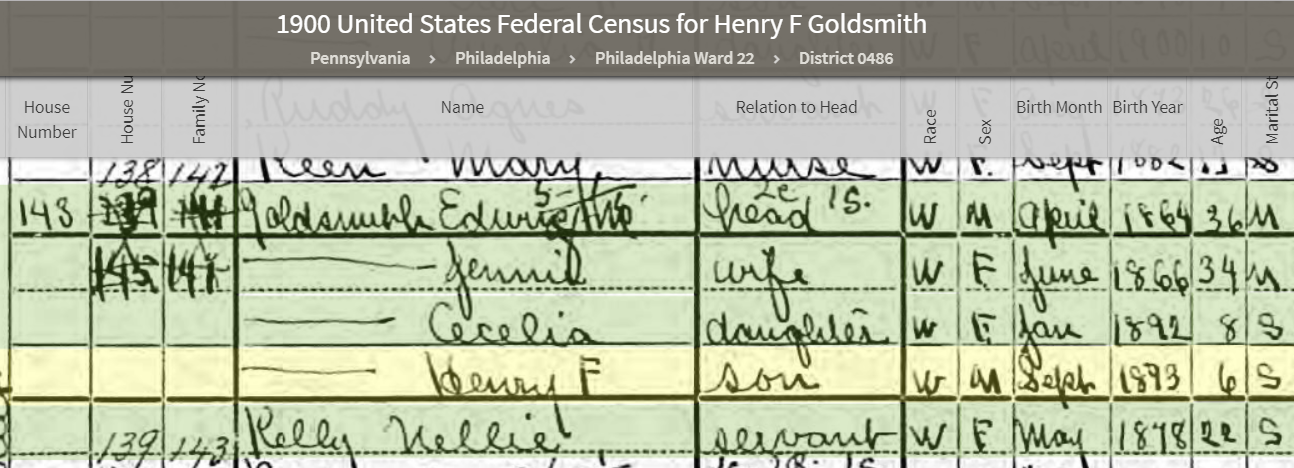
As I wrote earlier, Edwin Goldsmith married Sarah Virginia “Jennie” Friedberger in 1891. Edwin and Jennie had their first child, Cecile Adler Goldsmith, on January 28, 1892; she was named for Edwin’s mother. A second child, Henry Friedberger Goldsmith, named for Jennie’s father, was born on September 8, 1893. In 1900 Edwin and Jennie and their children were living in Philadelphia where Edwin continued to be a clothing merchant. Their third and final child, Edwin M. Goldsmith, Jr., was born on March 8, 1902, in Philadelphia.2

Edwin Goldsmith and family, 1900 US census
ear: 1900; Census Place: Philadelphia Ward 22, Philadelphia, Pennsylvania; Page: 7; Enumeration District: 0486
Description
Enumeration District: 0486; Description: Philadelphia City Pa, 22nd Ward, 10th Division, bounded by Hancock, Penn, Germantown Ave, Laurel, Bowman
Source Information
Ancestry.com. 1900 United States Federal Census

It was also in this first decade of the 20th century that Edwin began to obtain patents on many of his inventions. Between 1900 and 1906, he was awarded eight patents. One of his first patents was awarded for the design of a pencil, which Edwin described as follows:3

My invention consists of a lead or other pencil formed of a telescopic or collapsible barrel and means for connecting a length or piece of lead or marking material therewith whereby as said lead or material is worn away it may be exposed to present a fresh portion by the reduction in the length of the barrel, said piece having one end movably guided in the tip of the pencil and its other end rigidly held in the opposite end of the barrel whereby it cannot be detached through said tip.

In other words—a retractable pencil!

Among his other early inventions were a method for holding a cylindrical cake of soap to maximize the use of the soap;4 a savings-bank coin-operated clock; 5 a pencil sharpener designed to prevent the breaking of the point of the pencil;6 a device for carrying a pocketbook or purse;7 and the design of memorandum or account or other books that facilitated turning pages to get to a new leaf. 8 Obviously Edwin was interested and skilled in creating a wide array of products.

While working on these inventions, Edwin continued to work as a clothier, as seen in the 1905 Philadelphia city directory.9 But by 1910, he had changed occupations and reported on the 1910 census that he was a manufacturer of braids and lace. In the 1910 and 1911 Philadelphia directories10 (and in many thereafter), he was listed as the secretary-treasurer of Friedberger-Aaron Manufacturing Company, a textile company incorporated by Edwin’s uncle Simon Friedberger and his partner Max Aaron in 1899.11

Edwin Goldsmith and family, 1910 US Census,
Year: 1910; Census Place: Philadelphia Ward 22, Philadelphia, Pennsylvania; Roll: T624_1395; Page: 5A; Enumeration District: 0403; FHL microfilm: 1375408
Ancestry.com. 1910 United States Federal Census

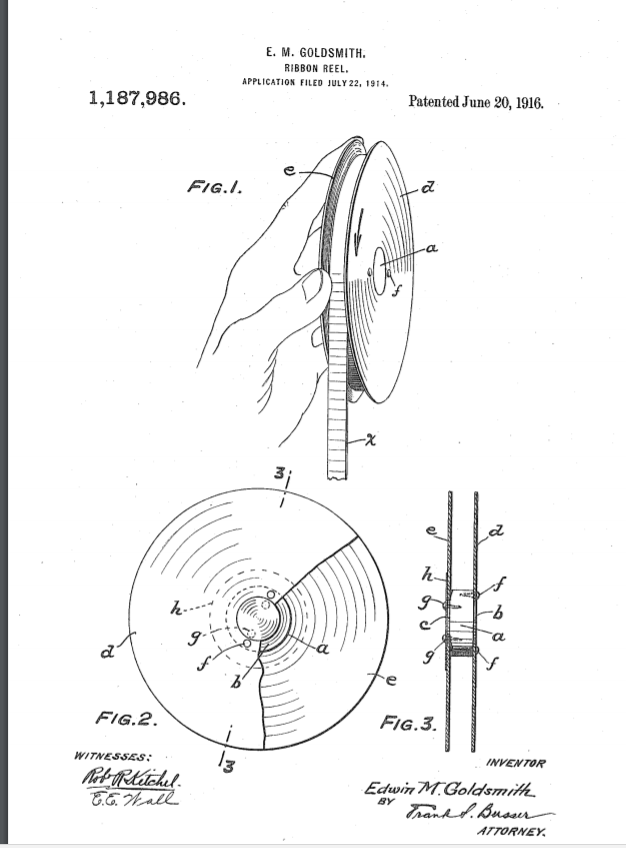
From that point on, some of his patented inventions were assigned to Friedberger-Aaron and many related to the display and/or sale of merchandise in their business. For example, in 1916, Edwin received a patent for a ribbon reel, which he described as follows:12

The object of my invention is to provide a reel for ribbons that may be readily manipulated to effect or facilitate the winding upon, or unwinding from, the reel of the ribbon, and to construct the same so inexpensively that it will be practicable to give the same away with the ribbon as an inducement for the latter’s purchase.

Some of his other inventions relating to the business of Friedberger-Aaron included a box for displaying and selling fabric so that the purchaser could see the fabric both before and after purchasing;13 a travel container for toiletries designed to use space efficiently;14 and a holder for containing and displaying silk and other fabrics.15

Beginning in about 1909, Edwin and his family started spending extended periods in the Atlantic City area. The Philadelphia Inquirer reported on June 13, 1909, that Edwin Goldsmith and his family were beginning an extended stay at the Hotel Rudolph in Atlantic City, a hotel opened in 1895 and located on the Boardwalk.16

In 1911, Edwin is listed in the Atlantic City directory in its Longport section.17 In 1915 he and his family were listed in the New Jersey census in Longport. The census was dated June 16, 1915, suggesting that Edwin’s family was in Longport for the summer.  Living with them were also a cook and a maid:

Edwin Goldsmith, Sr., and family, 1915 NJ Census
New Jersey State Archive; Trenton, NJ, USA; State Census of New Jersey, 1915; Reference Number: L-13; Film Number: 2
Township: Buena Vista – Weymouth
Ancestry.com. New Jersey, State Census, 1915

But their principal residence remained Philadelphia.  They are listed in several Philadelphia directories during the 1910s.18

Thank you to David Baron and Roger Cibella for sharing this photograph of Edwin Goldsmith and his family. From left to right, Cecile, Henry, Edwin, Jennie, and Edwin, Jr.:

EdwinMGoldsmith

Edwin Goldsmith and family, c. 1910

Edwin and Jennie’s older son Henry graduated from the University of Pennsylvania in 1914 and then from Massachusetts Institute of Technology in 1917, according to his obituary. 19 On June 15, 1917, Henry registered for the World War I draft:

Henry F. Goldsmith World War I draft registration
Registration State: Pennsylvania; Registration County: Philadelphia; Roll: 1907644; Draft Board: 24.  Ancestry.com. U.S., World War I Draft Registration Cards, 1917-1918

At that time Henry was employed by Midvale Steel Company and Worth Business Company as a chemical engineer doing expert work in their munitions departments. He later enlisted in the Navy Reserve Force on April 2, 1918, and was on active duty until March 8, 1919, in the Third Naval District in New York City. He was discharged on September 10, 1921 after an additional eighteen months of inactive duty.20

After the war, life returned to normal for the Goldsmith family. On July 23, 1920, the Philadelphia Evening Public Ledger reported that Edwin and his family were “passing the summer at their bungalow, in Longport, N.J.” 21 On the 1920 census, Edwin, Jennie, and their two sons Henry and Edwin, Jr., were listed as living in Philadelphia.  Strangely, Edwin was now listed as a chocolate manufacturer. But that must be an enumerator error, as the 1921 Philadelphia directory continued to list Edwin as the secretary-treasurer of Friedberger-Aaron.

That same directory lists Henry Goldsmith as a manager at G & O Manufacturing, a company that manufactured automobile radiators; the 1920 census listed Henry as a radiator salesman.22 Edwin, Jr. must have still been in school as he is listed without an occupation; he was eighteen in 1920.

Edwin Goldsmith and family 1920 US Census
Year: 1920; Census Place: Philadelphia Ward 28, Philadelphia, Pennsylvania; Roll: T625_1632; Page: 1A; Enumeration District: 885. Ancestry.com. 1920 United States Federal Census

Edwin and Jennie’s daughter Cecile was not living with them in 1920 because she had married Julian Stern Simsohn in 1916.23 Julian was born on January 19, 1890, in Philadelphia, and was the son of Joseph S Simsohn, a physician born in 1852 in either Romania or Germany (the records conflict) who immigrated to the United States in 1873. Julian’s mother Clara Stern was a native Philadelphian. 24 Julian had graduated from the University of Pennsylvania in 1911 with a degree in chemistry and is listed in their 1917 alumni directory as a consultant on water purification and boiler treatment and an inventor of photographic apparatus. Edwin must have been pleased to have a son-in-law who was also an inventor.25

UPDATE: It turns out that Julian was related by marriage to Cecile. His mother Clara had a brother Sidney who was married to Edwin’s sister Rose.  See more here.

From Julian’s registration for the draft in World War I we can see a clue as to how Cecile met Julian.  It appears that, like Cecile’s brother Henry, Julian was also working as a munitions expert for Midvale Steel Company:

Julian Stern Simsohn World War I draft registration
Registration State: Pennsylvania; Registration County: Philadelphia; Roll: 1907616; Draft Board: 13.  Ancestry.com. U.S., World War I Draft Registration Cards, 1917-1918

Cecile and Julian’s first child was born on November 19, 1917, a daughter named Jean Claire Simsohn. Two years later on December 10, 1918, their son Julian Stern Simsohn, Jr., was born. On the 1920 census they were all living in Philadelphia, and Julian Sr. was working as a chemical engineer.


Julian and Cecile Goldsmith Simsohn, 1920 census
Year: 1920; Census Place: Philadelphia Ward 28, Philadelphia, Pennsylvania; Roll: T625_1632; Page: 3B; Enumeration District: 886

Thus, by 1920 Edwin Goldsmith and his family were all doing well in Philadelphia. He had continued his work as an inventor, and he had a son Henry and a son-in-law Julian who were both chemical engineers.  Edwin and Jennie had two young grandchildren.  They all seemed to be living comfortably.

What would the next decade bring them?

To be continued.


  1.  Pennsylvania, Philadelphia City Births, 1860-1906,” database with images, FamilySearch (https://familysearch.org/ark:/61903/3:1:S3HY-6FXJ-86?cc=1951739&wc=M61X-4PF%3A251391701 : 21 May 2014), 004198957 > image 126 of 604; Department of Records. Their second child Hilda had died as a child, as discussed here. 
  2. National Archives and Records Administration (NARA); Washington D.C.; Roll #: 2288; Volume #: Roll 2288 – Certificates: 301350-301849, 01 Jun 1923-02 Jun 1923. Source Information Ancestry.com. U.S. Passport Applications, 1795-1925  
  3. E.M. Goldsmith, Lead or other pencil, U.S. Patent 659,026, October 2,1900. 
  4. E.M. Goldsmith, Soap and soap-holder, U.S. Patent 757397, April 12, 1904. 
  5. E. M. Goldsmith, Clock, U.S. Patent 822,598, June 5, 1906. 
  6. E.M. Goldsmith, Pencil-sharpener, U.S. Patent 755,480, March 22, 1904. 
  7. E.M. Goldsmith, Carrying device for pocket-books, etc., U.S. Patent 667,083, January 29, 1901. 
  8. E.M Goldsmith, Memorandum, order, diary, account, sample, or similar book, U.S. Patent 803,480, June 5, 1906. 
  9. 1905 Philadelphia Directory, Ancestry.com. U.S. City Directories, 1822-1995 [database on-line]. Provo, UT, USA: Ancestry.com Operations, Inc., 2011. 
  10. 1910 and 1911 Philadelphia directories, Ancestry.com. U.S. City Directories, 1822-1995 [database on-line]. Provo, UT, USA: Ancestry.com Operations, Inc., 2011. 
  11. Legal Notices, The Philadelphia Inquirer, April 27, 1899, p. 11. 
  12. E.M. Goldsmith, Ribbon Reel, U.S. Patent 1,187,986, June 20 1916. 
  13. E.M. Goldsmith, Combined braid-holder and bodkin-carrier, U.S. Patent 1,054,763, March 4, 1913. 
  14. E.M. Goldsmith, Container for toilet preparations, U.S. Patent 1,289,440, December 31, 1918. 
  15. E.M. Goldsmith, Holder for elastic and similar goods, U.S. Patent 1,183,003, May 16, 1915. 
  16. The Philadelphia Inquirer, June 13, 1909, p. 47. 
  17. Atlantic City, New Jersey, City Directory, 1911, Ancestry.com. U.S. City Directories, 1822-1995. 
  18. E.g. Philadelphia city directories, 1911, 1914, Ancestry.com. U.S. City Directories, 1822-1995. 
  19. “H.F. Goldsmith, Nylon Executive,” The Phladelphia Inquirer, October 29, 1963, p. 38. 
  20.  Ancestry.com. Pennsylvania, WWI Veterans Service and Compensation Files, 1917-1919, 1934-1948[database on-line]. Provo, UT, USA: Ancestry.com Operations, Inc., 2015. Original data: World War I Veterans Service and Compensation File, 1934–1948. RG 19, Series 19.91. Pennsylvania Historical and Museum Commission, Harrisburg Pennsylvania 
  21. Philadelphia Evening Public Ledger, July 23, 1920, p. 9. 
  22. Philadelphia city directory, 1921, Ancestry.com. U.S. City Directories, 1822-1995. 
  23.  Ancestry.com. Philadelphia, Pennsylvania, Marriage Index, 1885-1951 [database on-line]. Provo, UT, USA: Ancestry.com Operations, Inc., 2011. Original data:”Pennsylvania, Philadelphia Marriage Index, 1885–1951.” Index. FamilySearch, Salt Lake City, Utah, 2009. Philadelphia County Pennsylvania Clerk of the Orphans’ Court. “Pennsylvania, Philadelphia marriage license index, 1885-1951.” Clerk of the Orphans’ Court, Philadelphia, Pennsylvania. License No. 350555 
  24. E.g.,Julian Simsohn and parents, 1910 US Census, Year: 1910; Census Place: Philadelphia Ward 20, Philadelphia, Pennsylvania; Roll: T624_1394; Page: 6A; Enumeration District: 0334; FHL microfilm: 1375407. Ancestry.com. 1910 United States Federal Census. 
  25. Ancestry.com. U.S., School Catalogs, 1765-1935 [database on-line]. Provo, UT, USA: Ancestry.com Operations, Inc., 2012. 

Milton Goldsmith: A Victim of Conscience

In my last post we saw what my cousin Milton Goldsmith predicted for the 21st century; in this post, we will start to look at his life in the 20th century.

In 1900, Milton was recently married to Sophie Hyman of New York City, and the newlywed couple were living in Philadelphia where Milton continued to make a living as a clothing merchant. Their first child, Rosalind, was born on February 1, 1901, in Philadelphia,1 and a second daughter, Madeleine, followed on May 29, 1904, also in Philadelphia.2

By this time Milton had published his first novel, Rabbi and Priest (1891), as discussed here, as well as a second novel, A Victim of Conscience (1903).3

A Victim of Conscience takes place in the 1850s in a city that is unnamed but (based on the street names) is most likely Philadelphia. The main character is a recent German Jewish immigrant named Isaac Schwartz.  He has been in America for four years at the beginning of the novel and is living in dire poverty, desperate for a way to earn enough money to support his family. He finally decides to go to California to join the gold rush. There he encounters anti-Semitism and abuse and ultimately commits the crime that makes him a “victim of conscience.”

The principal theme of the book is atonement. Isaac seeks advice from a rabbi about how to atone for his crime and is discouraged by some of the rigidity of Jewish law. He then considers converting to Catholicism and studies with a priest, but ultimately decides that he can’t accept the notion that mere faith in Christ as his savior will provide salvation. In the end he learns that Judaism can provide a path to forgiveness and expiation for his sins.

The book’s focus is thus on Isaac’s struggle with his conscience and how religion affects that struggle. But the book is of more interest to me in the way that it reflects the way my cousin Milton understood his own family’s story—their life in Germany, their reasons for leaving Germany, and the life they found when they first settled in the US fifty years before he wrote this book. A few excerpts will illustrate what I mean.

Although I have no reason to assume that Milton was being at all autobiographical in describing the lives of some of his characters, I did wonder whether this description of Isaac’s life in Germany was based on his father Abraham’s life in Oberlistingen before emigrating:4

Isaac’s father, old Meyer Schwartz, was a power in his native village of D. He was in fair circumstances, and educated as far as education went in those days; for the Jews, rich and poor alike, were denied the privileges of the village schools, and were limited in their instruction to the teachings of their “Cheders ” and the scraps of information which they could impart one to the other. Old Schwartz was a profound Talmud scholar, and was deemed as wise as he was devout, which was no equivocal compliment, for he was pious indeed. … It was [his] ambition to make a Rabbi of [Isaac], but in spite of his earnest and painstaking instruction, Isaac never got beyond the general outlines of the law and the Talmud. Buying and selling afforded him more pleasure than poring over parchments, and, after a vain effort to keep him to his studies, old Schwartz reluctantly allowed him to follow his own inclinations.

Milton also provided some background for the reasons so many German Jews emigrated:5

In those days the Jews in Germany had few rights and many grievances. Harsh measures were devised, stringent laws enacted to drive them out of the country, or at least to restrict their increase. The possession and cultivation of land, the study of a profession, the following of the fine arts, were all interdicted. Buying and selling, borrowing and lending, were the only channels in which the Israelites were allowed to exercise their ingenuity, and grievous was their condition in consequence. Worse still, a Jew was not allowed to marry until some co-religionist in the community had died or had moved away.

His main character Isaac decides to emigrate because he wants to marry the woman he loves, Lena, and cannot stay in his home community and do so.

Milton also described the hard lives of the Jews who made a living as peddlers after coming to the US, as his father Abraham probably did:6

A number of peddlers were among the visitors, stalwart young fellows but lately arrived from Germany, who, with a heavy pack on their shoulders, or, if their means allowed, with horse and wagon, wandered through the State, hawking a varied assortment of merchandise, and seeking to master the American tongue while they accumulated American dollars. It was a hard experience, but a salutary one. For the pious Jews, peddling meant untold privations, a total abstinence of all food except eggs and such “Kosher” dried meats as they could carry with them. It meant a weary trudging through unfamiliar villages, over stony roads, amid hostile surroundings, from Sunday morning until Friday evening, and a short rest on the Sabbath in some synagogue town.

It was a career which might well have daunted the most enterprising youth, and yet thousands of “greenhorns ” adopted it, thrived at it, became wealthy through it. It was not considered degrading in those pioneer days, but eminently proper for a new arrival.

19th century etching of a peddler by Granger found at http://fineartamerica.com/featured/1-peddler-19th-century-granger.html

The book also sheds light on the lives of German Jewish families in Philadelphia during that time period—the level of observance of Jewish law, the economic and social conditions, and the relationship between the Jewish and non-Jewish communities. The book is likely more valuable today for what it reveals about its times than for its literary merit, but for me, it was a worthwhile read.

Thus, by 1903, Milton had published two novels and written many essays, short stories, and even a musical. He and his family must have decided that it was time to leave Philadelphia and move to New York City where he might have more opportunities to pursue his literary career.

You can download a free copy of A Victim of Conscience here.


  1. Pennsylvania, Philadelphia City Births, 1860-1906,” database with images, FamilySearch(https://familysearch.org/ark:/61903/1:1:VBYW-R9L : 9 March 2018), Rosalind Goldsmith, 01 Feb 1901; citing bk 1901 p 107, Department of Records; FHL microfilm 1,289,340. 
  2. Pennsylvania, Philadelphia City Births, 1860-1906,” database with images, FamilySearch (https://familysearch.org/ark:/61903/1:1:VBBL-N5K : 8 December 2014), Madeline Goldsmith, 29 May 1904; citing cn 22583, Department of Records; FHL microfilm 2,110,933. 
  3. Milton Goldsmith, A Victim of Conscience (Henry T. Coates & Co., 1903). 
  4. Ibid., p.6. 
  5. Ibid., p. 7. 
  6. Ibid., pp. 84-85. 

Milton Goldsmith Predicts the Future

After the publication of his first book Rabbi and Priest in 1891, Milton Goldsmith contributed a number of essays and short stories to the Philadelphia newspapers. My favorite is “In the Next Century”1 dated August 28, 1892, when he predicted—with tongue in cheek—what life would be like in the year 2000:

Here are a few highlights from this clever and humorous look at the future—or in our case, the past:

It is safe to assume that the world is but in its infancy, and that coming generations will show a vast mental and physical improvement over the present inhabitants of the globe. Our varied knowledge, the wonderful progress on which we are so prone to pride ourselves, will probably appear as absurd to our progeny as the fragmentary information of our forefathers appears to us. Knowledge will be universal, and the inhabitants of our continent will, in the next century, be intellectual giants.

Imagine yourselves transported to the year 2000….What a change greets our wondering eyes. Ignorance appears to be unknown. The child of 5 knows more than the college graduate of the present era. Let us examine the system that has wrought this improvement.  The guide of that year first leads us into the School for Infants. It is here that the babies are taught under the supervision of the government. Competent teachers are appointed the very young idea to shoot. For example, as soon as a child is old enough to drink milk from a bottle, it is taught at the same time the fundamental laws of suction and the principle of the air-pump. Experiments with valves, Torricelli vacuums, etc., form part of the curriculum.

An illustration of Torricelli’s vacuum
By Kilom691 (The New Student’s Reference Work) [Public domain], via Wikimedia Commons

How disappointed my cousin Milton would be. I am far past infancy yet I still didn’t know what a Torricelli vacuum was!

He continued with further examples of how babies and children would be instructed in gravity, zoology, geometry, trigonometry, and other mathematical and scientific concepts. Then he looked at medicine and health in the year 2000:

With a people of such mental caliber it is but natural that arts, science and inventions should prosper. The pleasure and comfort of man is greatly enhanced by the numerous devices invented for his welfare. Principal among these are the appliances for fostering the health of the community. Sickness is absolutely unknown. The medical fraternity, having discovered the germ of each disease, have at the same time provided an antidote for such germs. At the age of 2 months the child is vaccinated against tuberculosis. At the age of 3 months against cholera; at the age of four months against smallpox, and so on at regular intervals against all the diseases in the modern doctor books.

Here, Milton has done a better job of prognostication; we do have vaccines against smallpox and tuberculosis and many other diseases. But alas, we certainly have not eliminated all diseases.

Smallpox vaccine
By Photo Credit: James Gathany Content Providers(s): CDC [Public domain], via Wikimedia Commons

Milton went on to describe, with tongue in cheek, the extreme measures that would be taken to prevent the reintroduction of germs into society—“Before a mother kisses her child she cleans her teeth and lips with an antiseptic solution. All water is boiled, and all milk sterilized before it is taken.”

He then takes this notion and applies it to the way adults will behave in the year 2000.

When the boy or girl reaches the age when matrimony appears a consummation devoutly to be wished, there are no haphazard marriages as in former days.  The partner to be chosen is carefully examined by a psychologist, a pathologist and a phrenologist, and every peculiarity of mental or physical structure carefully noted.  Only such parties who are perfectly sound and whose peculiarities are fitted to one another, are allowed to mate. Such a thing as an unhappy marriage, or a divorce, are as a matter of course impossible. Sick or weakly offspring are unknown.

What would Milton think of couples meeting through online dating? Of our over 50% divorce rate? Of birth control and premarital sex?

He then discussed married life:

The intelligent groom knows that promiscuous kissing is injurious; that each kiss, acting upon the sensitive nerves of touch, are apt to create a depletion of nervo-vital force. He therefore limits his kisses to two a day. The lips are carefully disinfected before and after each osculations.  …. The groom retires promptly at 10 o’clock, as sufficient sleep is found to be more important than making love.

Imagine Milton watching some of the movies or television shows of our era. What would he think?

Finally, Milton reached his conclusions about life in the year 2000:

As a result of this wonderful system sickness is unknown in the community. People live to the normal age of 100 years and then die suddenly without a struggle. The remains are immediately cremated, the ashes disinfected and buried ten feet in the earth.

Taking it all in all one is almost glad that this happy time has not yet arrived, for though we may have more disease than the possible inhabitant of A.D. 2000, we have a great deal more fun.

Ah, Cousin Milton, how wrong you were! We are still having a lot of fun, probably more than your generation did, as we have fewer diseases, more leisure time, looser social mores, and all the amazing toys that modern science has given us.

I loved the satiric tone of his essay.  And I also loved the sense that while I am now looking backward to learn about the life that Milton led as a young man in the 19th century, in 1892 he was looking forward to the future to imagine what life would be like for his descendants in the 21st century.

By Tony Grist (Photographer’s own files) [CC0], via Wikimedia Commons

Milton’s creative output in the 19th century was not limited to short stories and essays. In December 1893, Milton’s burlesque entitled “Jay Cesar, Esq.”—which he wrote and acted in—was performed by the Stag Opera Comique Company in Philadelphia. According to the Philadelphia Inquirer, “it was a distinct success from every standpoint and from a social standpoint it was decidedly the leading event in Hebrew society this season so far.”  The performance consisted of two hours of “catchy airs, humorous songs, fantastic dances and whimsical dialogue.” 2

Milton was obviously a very talented young man.  The 20th century would find him leaving behind his life as a merchant and making a new career in a new city.  I wonder what he would have predicted for his own future when he wrote “In the Next Century” in 1892.


  1. Milton Goldsmith, “In the Next Century,” The Philadelphia Times, August 28, 1892, p. 19. 
  2. “Stags on Stage,” The Philadelphia Inquirer, December 29, 1893, p. 3. A full copy of the text of Jay Cesar can be found here. It is quite clever, and Milton is credited not only with the whole text, but also with some of the music. For other stories, essays, and other works by Milton Goldsmith during the 1890s, see, “Milton Goldsmith’s Lecture Before the Young Men’s Hebrew Association,” The Philadelphia Times, March 28, 1897, p, 9; Milton Goldsmith, “That Grateful Ghost,” The Philadelphia Times, March 5, 1893, p. 23; Milton Goldsmith, “Raps Told of Murder,” The Philadelphia Times, December 11, 1892, p. 23; Milton Goldsmith, “The Pride of the Circus,” The Philadelphia Times, August 14, 1892, p. 10; Milton Goldsmith, “The Three Responses,” The Philadelphia Times, March 27, 1892, p. 14. 

Milton Goldsmith: Rabbi and Priest

When I prepared this post, it didn’t occur to me that I would be publishing it on the day  that is both Good Friday and Erev Passover—the night of the first seder. But it couldn’t be a more appropriate day to post about a book that deals with the need for religious tolerance—written by my cousin Milton Goldsmith in 1891.

Happy Passover and Happy Easter to all!


Abraham Goldsmith’s oldest child was his son Milton, born to Abraham’s first wife Cecelia on May 22, 1861, in Philadelphia.1 I have been looking forward to researching and writing about Milton for a long time, ever since my father told me that he had once met one of his Goldsmith cousins and remembered that he had written children’s books. It took me a while to figure out which Goldsmith that was, but I believe that it must have been Milton.

From what I’ve written about Milton so far, you would not know about his literary interests and career.  From the late 1880s until at least 1900, public records listed his occupation as clothing merchant, and he worked in his father’s clothing store, A.Goldsmith & Sons, for many years.

But even during those years, Milton was engaged in other, more creative pursuits. According to one online biography, Milton graduated from Central High School in Philadelphia in 1877 and then studied literature, languages, and music at the University of Zurich for three years from 1877 until 1880 when he returned to Philadelphia.

His first full length novel was published by the Jewish Publication Society in 1891. It was an interesting choice of subject matter for the son of a very successful German-Jewish immigrant. Entitled Rabbi and Priest, it is the story of two Russian Jewish brothers who are separated during a pogrom; one eventually finds his way to Kiev where his uncle lives; he is educated in a yeshiva and grows up to be a rabbi.  The other is rescued by a Russian Countess and sent to a monastery where he grows up to be a priest.2

The book provides insight into the lives of poor Jews living in Russia in the 19th century and their attitudes, practices, and beliefs as well as the lives and views of the Christian populations. It also includes information about Russian history and the treatment of Jews there between 1850 and 1880, including details about pogroms and the attitudes of the czars and the Russian people. There are also insights into Milton Goldsmith’s own beliefs and attitudes, revealed by the character of Phillip Harris, a Russian Jew who immigrates to America and comes back to visit his former home in Kiev.

Milton Goldsmith explained in the preface to his book his reasons for writing this story:3

Towards the end of 1882, there arrived at the old Pennsylvania Railroad Depot in Philadelphia, several hundred Russian refugees, driven from their native land by the inhuman treatment of the Muscovite Government. Among them were many intelligent people, who had been prosperous in their native land, but who were now reduced to dire want. One couple, in particular, attracted the attention of the visitors, by their intellectual appearance and air of gentility, in marked contrast to the abject condition of many of their associates. Joseph Kierson was the name of the man, and the story of his sufferings aroused the sympathy of his hearers. The man and his wife were assisted by the Relief Committee, and in a short time were in a condition to provide for themselves.

The writer had the pleasure of meeting Mr. Kierson a few years later and elicited from him a complete recital of his trials and an account of the causes of the terrible persecution which compelled such large numbers of his countrymen to flee from their once happy homes.

His story forms the nucleus of the novel I now present to my readers. While adhering as closely as possible to actual names, dates and events, it does not pretend to be historically accurate. In following the fortunes of Mendel Winenki, from boyhood to old age, it endeavors to present a series of pictures portraying the character, life, and sufferings of the misunderstood and much-maligned Russian Jew.

In the description of Russia’s customs and characteristics, the barbarous cruelty of her criminal code and the nihilistic tendency of the times, the author has followed such eminent writers as Wallace, Foulke, Stepniak, Tolstoi and Herzberg-Fraenkel. The accounts of the riots of 1882 will be found to agree in historic details with the reports which were published at the time.

With this introduction, I respectfully submit the work to the consideration of an indulgent public.

MILTON GOLDSMITH

Philadelphia, April, 1891

Russian Jews in Philadelphia 1890

The themes that run through the book focus primarily on anti-Semitism and its roots, Jewish faith and identity, and the value of a more worldly and secular education. As to the first, Goldsmith wrote:4

The serf persecutes the Jew because he is himself persecuted by the nobility. There is no real animosity between the peasant and his Jewish neighbors. Our wretched state is the outgrowth of a petty tyranny, in which the serf desires to imitate his superiors. Let the people once enjoy freedom and they will cease to persecute the Hebrews, without whom they cannot exist.

I thought this was an insightful perspective for someone living in 1893—to understand that a group’s prejudice often has its roots in its own oppression and poverty and that freedom and prosperity for all is the best way to eliminate hate and discrimination.

But it is Goldsmith’s attitudes towards education and assimilation that I found most interesting, keeping in mind that he was a man who had spent three years in Switzerland, learning about literature, language, and music. First, he notes how Talmudic study sharpens the intellect of Jewish students:5

It was to this incessant study of the Scriptures that Israel owed its patience, its courage, its fortitude during centuries of persecution. It was this constant delving for truth which produced that bright, acute Jewish mind, which in days of fanaticism and intolerance, protected the despised people from stupefying mental decay.

But then he expresses concern for how Talmudic study fosters closed-mindedness and superstition, stating,”That this study often degenerated into a mere useless cramming of unintelligible ideas is easily understood, and its effects were in many cases the reverse of ennobling.”6

It is, however, when the character of Phillip Harris returns to Russia and speaks of life in America that Goldsmith’s personal views and experience are most clearly revealed.  In speaking with the people of his former community in Kiev, Philip asserts that Jews are on equal footing with Christians in America, and when questioned about the fact that he has shaved his beard and abandoned many traditional Jewish practices, he says:7

[I]t seems to me that a Jew can remain a Jew even if he neglect some of those ceremonials which have very little to do with Judaism pure and simple. Some are remnants of an oriental symbolism, others comparatively recent additions to the creed, which ought to give way before civilization. What possible harm can it do you or your religion if you shave your beard or abandon your jargon for the language of the people among whom you live? … Every effort to develop the Jewish mind is checked, not by the gentiles, but by the Jews themselves. … A knowledge of the history of the world, an insight into modern science, will teach us why and wherefore all our laws were given and how we can best obey, not the letter but the spirit of God’s commands.

Romanian Jewish journalist Sache Petreanu, an advocate of assimilation, cutting off the payot of an observant Jew (1899 caricature by Constantin Jiquidi)
Constantin_Jiquidi_-_Sache_Petreanu,_Foaia_Populară,_14_feb_1899

Phillip continued:8

You will all admit that you place more weight upon your ceremonials than upon your faith. You deem it more important to preserve a certain position of the feet, a proper intonation of the voice during prayers than to fully understand the prayer itself, and in spite of your pretended belief in the greatness and goodness of God, you belittle Him by the thought that an omission of a single ceremony, the eating of meat and milk together, the tearing of a tzitzith (fringe) will offend Him, or that a certain number of mitzvoth (good acts) will propitiate Him. Do you understand now what I mean when I say that superstition is not religion?

The character concludes by saying:.9

Worship God as your conscience dictates, continue in your ancient fashion if it makes you happy, but be tolerant towards him who, feeling himself mentally and spiritually above superstition, seeks to emancipate himself from its bonds and to follow the dictates of his own good common-sense

Goldsmith recognized that for those living in Russia where oppression and poverty made Jewish lives difficult, an adherence to these traditional practices was more understandable, for the rabbi responds to Phillip by saying, “Whether these observances are needed or are superfluous in a free country like America I shall not presume to say, but in Russia they are a moral and a physical necessity.”10

When poor Jews from Eastern Europe and Russia began to immigrate to the US in the 1880s and 1890s, they faced prejudice not only from the Christian majority here, but also from many Jews with German origins whose families had immigrated decades earlier and had assimilated into American life.11 I am proud of my cousin Milton Goldsmith for writing a book that tried to convey to Americans and perhaps in particular to American Jews the travails and obstacles faced by these new Russian Jewish immigrants. He does an excellent job of describing what their lives were like, why they were forced to emigrate, and why they were clinging to traditions and practices that American Jews might no longer feel necessary. And he also endorsed the need for and value of a liberal education and an open mind.

The book is not just a novel, but a lesson in tolerance, in the need for education, and in the power of faith when life seems too grim and hopeless to bear.

If you are interested in buying the book, it is available on Amazon as an e-book here.


  1. Pennsylvania, Philadelphia City Births, 1860-1906,” database with images, FamilySearch (https://familysearch.org/ark:/61903/1:1:VB16-KTZ : 8 December 2014), Milton Growsmith, 22 May 1861; citing bk 2 p 168, Department of Records; FHL microfilm 1,289,306. 
  2. Milton Goldsmith, The Rabbi and The Priest: A Story (Jewish Publication Society, 1891) 
  3. Goldsmith, Milton, Rabbi and Priest: A Story (pp. 6-8, Kindle edition). 
  4.  Goldsmith, Milton. Rabbi and Priest A Story (p. 30). Kindle Edition. 
  5.  Goldsmith, Milton. Rabbi and Priest A Story (p. 84). Kindle Edition. 
  6. Goldsmith, Milton. Rabbi and Priest A Story (p. 84). Kindle Edition. 
  7.  Goldsmith, Milton. Rabbi and Priest A Story (pp. 99-100). Kindle Edition. 
  8.  Goldsmith, Milton. Rabbi and Priest A Story (p. 102). Kindle Edition. 
  9.  Goldsmith, Milton. Rabbi and Priest A Story (p. 103). Kindle Edition. 
  10.  Goldsmith, Milton. Rabbi and Priest A Story (p. 104). Kindle Edition. 
  11. Irving Aaron Mandel, “Attitude of the American Jewish Community toward East-European Immigration As Reflected in the Anglo-Jewish Press 1880-1890,” American Jewish Archives, 1950. 

The Last Will and Testament of Abraham Goldsmith

As the 20th century began, the family of Abraham Goldsmith was doing quite well. His first four children with his first wife Cecelia were all married and living in Philadelphia; three of them had had children, giving Abraham seven grandchildren. His five younger children were still living at home with him and his second wife Frances and ranged in age from seventeen to thirty. All but Louis, the youngest, were employed outside the home. On February 1, 1901, Abraham was blessed with an eighth grandchild when his son Milton and his wife Sophie had their first child, a daughter they named Rosalind.1

Abraham, however, had been in poor health ever since suffering a stroke in about 1890, and he died on January 20, 1902, from “chronic softening of the brain.” From what I can gather from various internet sources, the condition is also known as encephalomalacia, and the softening of brain tissue is usually caused by a stroke, hemorrhage, infection, or injury. Abraham was 69 when he died. He left behind his wife Frances, his nine children, and eight grandchildren.

Abraham Goldsmith death certificate
“Pennsylvania, Philadelphia City Death Certificates, 1803-1915,” database with images, FamilySearch (https://familysearch.org/ark:/61903/3:1:S3HY-6737-JK6?cc=1320976&wc=9FRP-DP8%3A1073221502 : 16 May 2014), 004009534 > image 785 of 1754; Philadelphia City Archives and Historical Society of Pennsylvania, Philadelphia.

In the obituary in the Philadelphia Jewish Exponent,2 Abraham’s business was described as “one of the most prominent in its line in the United States.” He served on the boards of several financial institutions and was a member of two lodges. Abraham was not only an important business owner in Philadelphia, he was a leader and “rendered conspicuous service” in several charitable organization including being “president of the Orphans’ Guardians, a trustee of Keneseth Israel Congregation, director and vice president of the Jewish Hospital Association, and secretary of the United Hebrew Charities.”

Abraham’s funeral was “largely attended;” the rabbi “paid high tribute to [his] many virtues, his philanthropic instincts and sterling character, referring feelingly to the many acts of kindness and generosity which had endeared him to those whom he had aided during his lifetime, and to his tireless activity in all good work.”

Abraham Goldsmith obituary, The Philadelphia Exponent, January 24, 1902, p. 3.

The Philadelphia Times also published an obituary, describing Abraham as “one of the pioneer Israelites in this city” and listing his various charitable activities.3 The Philadelphia Inquirer described him as a “prominent business man of this city.”4

I found Abraham’s will quite interesting and transcribe it here in its entirety from the handwritten text:5

I Abraham Goldsmith of Philadelphia merchant do make publish and declare this to be my last will and testament, revoking all former wills ever made.

First: I give and bequeath to my son Milton my library and bookcase and the oil painting of his mother Cecelia Goldsmith.

Second: I give and bequeath to my son Edwin M my gold watch chain, masonic mark and my diamond stud.

Third: All other jewelry, coins, laces, and trinkets of my first wife shall be divided between my daughters Rose, Emily and Estelle as keepsakes by my executors in such manner as they shall think proper.

Fourth: Subject to the above provisions I give bequeath and devise to my executors and trustees all my estate real residual and ? for the purposes and upon the trusts here in [end of page 1] after expenses.

Pennsylvania probate record; Probate Place: Philadelphia, Pennsylvania
Source Information
Ancestry.com. Pennsylvania, Wills and Probate Records, 1683-1993 [database on-line]. Provo, UT, USA: Ancestry.com Operations, Inc., 2015.
Original data: Pennsylvania County, District and Probate Courts. Wills, No 277-299, 1902

Fifth: All just debts and funeral expenses to be paid.

Sixth: As much or all of my Real estate as my heirs and executors deem best to be disposed of at public and private sale as soon as convenient after my death and the executors to make good title without being compelled to give security for the proper application of the funds to be received and the money so received to be considered as invested in personal property prior to the sale.

Seventh: My property to be so divided that my wife shall receive her share absolutely and the ballance [sic] to be divided among my children share and share alike so that my children of age shall receive their share at once and those that are minors to receive their share on becoming of age.

Eight: That my wife shall be guardian [end of page 2] for the minor children during their minority, she receiving the income derived from the investments for their support and education until of age and no longer.

Ninth: That the executors and trustees for the minor children have full power to invest and call in and reinvest at their pleasure and at their discretion, the investments not to be confined to what are termed legal investments.

Tenth: That my Life Insurance which was held in trust, and endowments which may be coming to me from different Societies and Lodges, shall be considered as part of my personal property and to be distributed as per direction of my Will.

Eleventh: In case of death of anyone of anyone [sic] of my children during its minority or as long as they are unmarried, all expenses incurred during sickness and burial expenses shall first be paid out of the portion set aside for the minor child and the ballance [sic] remaining to be divided in equal parts between my wife [end of page 3] and the surviving children.

Twelfth: I constitute and appoint my sons Milton Goldsmith, Edwin M Goldsmith, and my friend Morris H. Pulaski my executors, and trustees of my minor children and I direct that no security shall be required of them in either capacity. In case either of them should die, resign or fail to act, then I direct some good friend of the family to be substituted in place of one so dying, resigning or failing to act. I wish the trust always full. The substituted trustee or trustees shall have all the power and discretion conferred [sic] upon the executors and trustees who I have named.

In witness whereof I have this day the fourth day of October One Thousand Eight hundred Eighty Seven set my hand and seal. Philadelphia Oct 4th 1884.

Abraham Goldsmith [witnessed and sealed]

To add some context to these bequests, here is the estate inventory filed with the will:

Note that the largest elements in his estate were the proceeds of his life insurance policies, one being over $10,000, another over $20,000, and that the personal items were worth far less. For example, the books left to Milton were worth $50, the watch, stud, and jewelry totaled $100. To put this in today’s dollars, I turned once again to an inflation calculator.  One hundred dollars in 1902 would be worth over $27,000 today; $20,000 would be worth over $558,000. Abraham’s estate’s total value, $58,422.25, would be equivalent to $1,631,049.62 in today’s dollars.

Abraham had claimed to have $45,000 in personal and real property on the 1880 US census.  He then suffered a serious financial setback in 1886 after his brother Levy died. But at the time of his death, Abraham’s estate was worth over $58,000, or more than $1.6 million dollars in today’s money. Pretty impressive for a man who came to America as an immigrant when he was just eighteen.

Based on those numbers and the inflation calculator, it appears that Abraham had a library worth about $13,500, which he left to his son Milton. That tells me something about both Abraham and Milton—two men who must have greatly valued books. In fact, as we will see, Milton and his brother Louis both had careers that involved books. I also loved that Abraham made sure that those things that had belonged to his first wife, Cecelia, went to her children, including an oil painting of Cecelia. How I wish I knew what had happened to that painting. Maybe one of Milton’s descendants still has it? I hope so.

Abraham wrote the will before he went through the financial crisis in his business in 1886 and before he suffered the debilitating stroke in about 1890. When Abraham wrote this will in 1884, his five youngest children were still quite young—less than ten years old—whereas Milton and Edwin, whom he named as his executors, were 23 and 20, respectively.   When Abraham died in 1902, Louis, his youngest child, was twenty—the same age Edwin had been when Abraham originally wrote the will and named Edwin as an executor. It’s interesting that Abraham never changed his will to reflect the changes in his financial situation, his physical condition, or the changing ages and circumstances of his children, including their marriages and their children. There is no provision for grandchildren in the will.

Sadly, six years after Abraham died, his second wife Frances Spanier Goldsmith died. She was only 52 years old and died after suffering a stroke (apoplexy). Her obituary in the Philadelphia Jewish Exponent reported that her death “proved a great shock to the many friends of the Goldsmith family in this city. Mrs. Goldsmith had not been seriously ill and had been out walking the day before her death, which was caused by a stroke of paralysis.”    Abraham also had suffered a stroke, and his first wife Cecelia had died from a stroke when only 35. What was it about their lives that made them all susceptible to strokes?

Frances Spanier Goldsmith death certificate
Pennsylvania Historic and Museum Commission; Pennsylvania, USA; Certificate Number Range: 006001-010000
Ancestry.com. Pennsylvania, Death Certificates, 1906-1966

Frances’ obituary further commented that “Mrs. Goldsmith possessed a host of friends, being widely beloved and esteemed for many loveable qualities.”

The Philadelphia Jewish Exponent, January 24, 1908, p. 11.

The Philadelphia community lost two well-regarded citizens with the deaths of Abraham and Frances (Spanier) Goldsmith, and their children lost beloved parents. But those children, by then all adults, lived interesting lives. The posts to follow will focus on Abraham’s nine surviving children and their lives in the 20th century.


  1. Pennsylvania, Philadelphia City Births, 1860-1906,” database with images, FamilySearch(https://familysearch.org/ark:/61903/1:1:VBYW-R9L : 9 March 2018), Rosalind Goldsmith, 01 Feb 1901; citing bk 1901 p 107, Department of Records; FHL microfilm 1,289,340. 
  2. Abraham Goldsmith obituary, The Philadelphia Exponent, January 24, 1902, p. 3. 
  3.  The Philadelphia Times, January 22, 1902, p. 7. 
  4. “Abraham Goldsmith Dead,” The Philadelphia Inquirer, January 22, 1902, p. 6. 
  5.  Pennsylvania probate record; Probate Place: Philadelphia, Pennsylvania. Source Information: Ancestry.com. Pennsylvania, Wills and Probate Records, 1683-1993. Wills, No 277-299, 1902. 

Surprise! Another Mystery Solved When I Least Expected It

Sometimes when you aren’t even looking, an answer to an earlier mystery pops up unexpectedly. That’s what happened when I started researching the marriages of Abraham Goldsmith’s four oldest children, all of whom were married in the 1890s.

First, Edwin Goldsmith married Sarah Virginia Friedberger in 1891.1 Sarah Virginia, who was known as Jennie, was born in Philadelphia on January 17, 1866, to Henry Friedberger and Caroline Bellstrom.2 Her father was in the wholesale millinery business.  Edwin and Jennie had their first child on January 28, 1892, and they named her Cecile, presumably for Edwin’s mother, Cecelia Adler, who had died so young.3 A second child, Henry Friedberger Goldsmith, named for Jennie’s father, was born on September 8, 1893.4 In 1900 Edwin and Jennie and their sons were living in Philadelphia where Edwin continued to be a clothing merchant.

Edwin Goldsmith and family, 1900 US census
Census Place: Philadelphia Ward 22, Philadelphia, Pennsylvania; Page: 7; Enumeration District: 0486
Ancestry.com. 1900 United States Federal Census

Then, two of Abraham’s older daughters married in 1892. Emily Goldsmith was married on January 28, 1892, to Felix N. Gerson.5 And her marriage to Felix N. Gerson led me down quite an interesting rabbit hole and to a surprise—a solution to an unsolved mystery. Remember the “other” Harry Goldsmith—Harry N. Goldsmith, son of Raphael Goldsmith, who was living with Eva Goldsmith Anathan in 1910? I had been completely befuddled because I could not figure out why this Harry N. Goldsmith was living with my cousin (and the cousin of my cousin Harry Goldsmith) when he seemed to have no familial connection to my Goldsmiths. Well, stay tuned. It’s a bumpy ride.

I searched for background information on Felix N. Gerson as the husband of my cousin Emily Goldsmith. I found him on both the 1870 and 1880 census, living in Philadelphia with his parents, Aaron and Eva Gerson.  His father was a furrier, born in Prussia, and his mother was born in Pennsylvania.6

Then I found Felix on the Social Security Applications and Claims Index, giving his birth date as October 18, 1862, and his full name as Felix Napoleon Gerson. But what really jumped out was that his mother’s birth name was Eva Goldsmith.  This was confirmed on the death certificate for Felix Gerson—his mother was Eva Goldsmith, born in Philadelphia.

Felix N. Gerson, Ancestry.com. U.S., Social Security Applications and Claims Index, 1936-2007. Original data: Social Security Applications and Claims, 1936-2007.

At first, I groaned. Oh, no, another intrafamily cousin marriage, I thought. Which Eva Goldsmith was this? So I searched for more information about Eva Goldsmith Gerson and found this record:

Eva Goldsmith Gerson death certificate
“Pennsylvania, Philadelphia City Death Certificates, 1803-1915,” database with images, FamilySearch (https://familysearch.org/ark:/61903/3:1:S3HY-6G1Q-6L2?cc=1320976&wc=9FTM-K68%3A1073210502 : 16 May 2014), 004009428 > image 216 of 538; Philadelphia City Archives and Historical Society of Pennsylvania, Philadelphia.

This Eva Goldsmith was the daughter of Napoleon Goldsmith and Zerlina Rosenthal. I knew immediately that those names looked familiar, but they were not part of my Goldsmith family.  Napoleon and Zerlina Goldsmith were the grandparents of that mysterious Harry N. (for Napoleon) Goldsmith who’d been living in 1910 with my cousin, the other Eva Goldsmith who’d married Nathan Anathan. Their son Raphael was Harry Napoleon Goldsmith’s father.

Napoleon and Zerlina Goldsmith were also the grandparents of Felix Napoleon Gerson, who married my cousin Emily Goldsmith. Felix’s mother Eva Goldsmith Gerson was the sister of Raphael Goldsmith. So Felix Napoleon Gerson and Harry Napoleon Goldsmith were first cousins, both named for their grandfather Napoleon.


Now’s where it gets a bit trickier. Felix Gerson married Emily Goldsmith. Emily Goldsmith Gerson and Eva Goldsmith Anathan were first cousins also; Emily’s father Abraham and Eva’s father Levy were brothers (and had been in business together.)  Still with me? Here comes the final twist.


When Harry Napoleon Goldsmith moved in with Eva Goldsmith Anathan around 1910, he was living with the first cousin of the wife of his first cousin. That is, Harry Napoleon Goldsmith was the first cousin of Felix Napoleon Gerson. Felix Napoleon Gerson was married to Emily Goldsmith, whose first cousin was Eva Goldsmith Anathan. Got it? Here’s a chart:


Now I knew how Harry Napoleon Goldsmith ended up living with my cousin Eva Goldsmith Anathan. They were connected by the marriage of their respective first cousins—Felix and Emily.

Of course, I wasn’t done digging yet. I needed to determine whether Napoleon Goldsmith or his wife Zerlina nee Rosenthal were somehow related to me directly, not just by these circuitous connections. After hours of digging, I’ve concluded that they were not. Or at least in no obvious way. Napoleon Goldsmith was born in Nassau, Germany in around 1803 and came to the US in 1836. By 1840 he was married and living with one child in Philadelphia. His wife Zerlina was also born in Germany in around 1813, but I don’t know where. Her mother Rachel Rosenthal also immigrated, perhaps in the 1830s with her husband Seller, but I am not certain about that. At any rate, I think it’s just coincidence that these two separate Goldsmith families ended up connected by marriage.

But the good news was that I’d figured out why there was another unrelated Harry Goldsmith living with my cousin Eva Goldsmith in 1910.

Let’s return then to Emily Goldsmith and her husband Felix Napoleon Gerson. According to his entry in Who’s Who in Pennsylvania,7 Felix went to Philadelphia public schools and then studied civil engineering; in the 1880s he served in the department of the Chief Clerk, Philadelphia & Reading Railway Company, and then in 1891 he changed careers and became the managing editor of Chicago Israelite.  In 1892, Felix became the managing editor of the Jewish Exponent of Philadelphia.

As noted above, he married my cousin Emily Goldsmith on January 28, 1892. Their wedding was a very small and modest affair.

“Married Quietly at Home,” The Philadlephia Times, January 29, 1892, p. 5

Given Abraham’s one-time prosperity, I was surprised that Emily’s wedding was so understated. But then I learned from Abraham’s obituary8 that in 1890 or so he had suffered a serious stroke that left him disabled and in poor health. As his children were moving on to adulthood, his health was in decline.

Emily and Felix’s first child Celia was born on October 27, 1892.9  She was also presumably named for her grandmother, Emily’s mother Cecelia Adler Goldsmith. A second daughter, Dorothy, was born on June 2, 1897.10 In 1900, Emily, Felix, and their daughters were living in Philadelphia., and Felix was working as an editor.

Emily and Felix Gerson and family 1900 US Census
Philadelphia Ward 20, Philadelphia, Pennsylvania; Page: 4; Enumeration District: 0433
Ancestry.com. 1900 United States Federal Census

Emily’s sister Rose Goldsmith married Sidney Morris Stern on May 25, 1892.11 Sidney was born January 14, 1861, in Philadelphia, and was the son of Morris Stern and Matilda Bamberger, who were German-born immigrants. His father was in the retail clothing business.12  Rose and Sidney’s first child, Sylvan Goldsmith Stern, was born on March 2, 1893.13 Two years later Rose gave birth to twin boys, Allan Goldsmith Stern and Howard Eugene Stern, on August 6, 1895.14 I could not find Rose and her family on the 1900 census despite having their address in 1899, 1900, and 1901.  They were living in Philadelphia during those years, and Sidney was in the jewelry business with his brother Eugene.

The next wedding in the family of Abraham Goldschmidt was that of his oldest child, Milton.  On Valentine’s Day, February 14, 1899, Milton married Sophie Hyman in New York City. 15 Sophie was the daughter of Nathan Hyman and Rose Friedberger. And Rose Friedberger was the sister of Henry Friedberger, whose daughter Jennie had married Milton’s brother Edwin in 1891. So Milton married his sister-in-law Jennie’s first cousin, Sophie Hyman.  Sophie’s father Nathan was a corset manufacturer.

“Weddings of A Day. Goldsmith-Hyman,” The New York Times, Februaru 15, 1899, p. 7

I found it interesting that although Sophie selected Milton’s sister Estelle to be her only attendant, Milton did not select either of his brothers—Edwin or Louis—to be his best man or one of the ushers. Instead he selected a first cousin, Samuel Goldsmith (son of Meyer Goldsmith) to be his best man. His mother and other sisters and brother Edwin are listed among those attending the wedding; Louis was not listed, but perhaps the list did not include everyone attending.

In 1900 Milton and Sophie were living in Philadelphia where Milton continued to work as a clothing merchant.16

Thus, by 1899, Abraham Goldsmith had four married children and seven grandchildren. In 1900, he was living with his second wife Frances and his remaining five children. Estelle, his youngest child from his first marriage to Cecelia Adler, was now thirty years old and working as a school teacher.  As for Abraham’s four children with Frances, Albert, now 22, was working as a salesman. Bertha was 21 and working as a “saleslady.” Perhaps they were both working in their father’s clothing store. Alice, 18, was a milliner, and Louis, 17, was still in school. Abraham’s mother-in-law Sarah Adler, his first wife’s mother, was also still living with them. Although the census lists her as a teacher, since she was 87 years old, that seems unlikely.

Abraham Goldsmith and family 1900 census
Philadelphia Ward 12, Philadelphia, Pennsylvania; Enumeration District: 0208
Ancestry.com. 1900 United States Federal Census

The 20th century would bring new challenges and new accomplishments for the family of my three-times-great-uncle Abraham Goldsmith.


  1.  Ancestry.com. Philadelphia, Pennsylvania, Marriage Index, 1885-1951. Original data: “Pennsylvania, Philadelphia Marriage Index, 1885–1951.” Index. FamilySearch, Salt Lake City, Utah, 2009. Philadelphia County Pennsylvania Clerk of the Orphans’ Court. “Pennsylvania, Philadelphia marriage license index, 1885-1951.” Clerk of the Orphans’ Court, Philadelphia, Pennsylvania. License No. 41318. 
  2.  Pennsylvania Historic and Museum Commission; Pennsylvania, USA; Certificate Number Range: 059001-062000, Source Information. Ancestry.com. Pennsylvania, Death Certificates, 1906-1966. Original data: Pennsylvania (State). Death certificates, 1906–1963. Series 11.90 (1,905 cartons). Records of the Pennsylvania Department of Health, Record Group 11. Pennsylvania Historical and Museum Commission, Harrisburg, Pennsylvania. 
  3.  Ancestry.com. U.S., Social Security Applications and Claims Index, 1936-2007. Original data: Social Security Applications and Claims, 1936-2007. 
  4. Ancestry.com. U.S., World War I Draft Registration Cards, 1917-1918. Original data: United States, Selective Service System. World War I Selective Service System Draft Registration Cards, 1917-1918. Washington, D.C.: National Archives and Records Administration. M1509, 4,582 rolls. Imaged from Family History Library microfilm. 
  5.  Ancestry.com. Pennsylvania, Marriages, 1852-1968. Original data: Marriage Records. Pennsylvania Marriages. Various County Register of Wills Offices, Pennsylvania. 
  6.  Year: 1870; Census Place: Philadelphia Ward 10 District 32, Philadelphia, Pennsylvania; Roll: M593_1395; Page: 549B; Family History Library Film: 552894. Source Information Ancestry.com. 1870 United States Federal Census. Year: 1880; Census Place: Philadelphia, Philadelphia, Pennsylvania; Roll: 1172; Page: 458C; Enumeration District: 191, Source Information Ancestry.com and The Church of Jesus Christ of Latter-day Saints. 1880 United States Federal Census 
  7.   John W. Leonard, ed.,Who’s who in Pennsylvania: A Biographical Dictionary of Contemporaries (L. R. Hammersly, 1908, 2d. ed.), p. 292. 
  8. Abraham Goldsmith obituary, The Philadelphia Exponent, January 24, 1902, p. 3. 
  9.  Ancestry.com. Pennsylvania, Death Certificates, 1906-1966 [database on-line]. Provo, UT, USA: Ancestry.com Operations, Inc., 2014. Original data: Pennsylvania (State). Death certificates, 1906–1963. Series 11.90 (1,905 cartons). Records of the Pennsylvania Department of Health, Record Group 11. Pennsylvania Historical and Museum Commission, Harrisburg, Pennsylvania. 
  10. Number: 161-05-1973; Issue State: Pennsylvania; Issue Date: Before 1951. Source Information Ancestry.com. U.S., Social Security Death Index, 1935-2014 
  11.  Ancestry.com. Philadelphia, Pennsylvania, Marriage Index, 1885-1951. Original data: “Pennsylvania, Philadelphia Marriage Index, 1885–1951.” Index. FamilySearch, Salt Lake City, Utah, 2009. Philadelphia County Pennsylvania Clerk of the Orphans’ Court. “Pennsylvania, Philadelphia marriage license index, 1885-1951.” Clerk of the Orphans’ Court, Philadelphia, Pennsylvania. License No. 51669. 
  12.  Ancestry.com. Pennsylvania, Death Certificates, 1906-1966 [database on-line]. Provo, UT, USA: Ancestry.com Operations, Inc., 2014. Original data: Pennsylvania (State). Death certificates, 1906–1963. Series 11.90 (1,905 cartons). Records of the Pennsylvania Department of Health, Record Group 11. Pennsylvania Historical and Museum Commission, Harrisburg, Pennsylvania. 
  13. Ancestry.com. U.S., Social Security Applications and Claims Index, 1936-2007 
  14. Ancestry.com. Pennsylvania, WWI Veterans Service and Compensation Files, 1917-1919, 1934-1948. Original data: World War I Veterans Service and Compensation File, 1934–1948. RG 19, Series 19.91. Pennsylvania Historical and Museum Commission, Harrisburg Pennsylvania. Ancestry.com. U.S., Social Security Applications and Claims Index, 1936-2007 
  15.  Ancestry.com. New York, New York, Extracted Marriage Index, 1866-1937. Certificate No. 3384. 
  16. Milton and Sophie Goldsmith, 1900 US Census, Philadelphia Ward 24, Philadelphia, Pennsylvania; Page: 13; Enumeration District: 0572, Ancestry.com. 1900 United States Federal Census.