What I Learned From My Great-Great-Grandmother’s Will

I am back from a break after a great visit with our kids and then a week to recover! Before I return to the story of the family of Malchen Rothschild (as I am still waiting to speak with her great-grandson Julio), I have an update about how I discovered my great-great-grandmother’s will.

Earlier this summer Teresa of Writing My Past wrote about full-text searching on FamilySearch. I had never known about this tool but was tempted to see what I could find. I followed the link that Teresa provided on her blog and entered “John Nusbaum Cohen” to see what would come up.

Lo and behold, it immediately retrieved what turned out to be the last will and testament of my great-great-grandmother Frances Nusbaum Seligman. Frances was the daughter of John Nusbaum, my three-times great-grandfather, and the wife of Bernard Seligman, my great-great-grandfather—-two of my pioneer ancestors who came to the US as young men from Germany in the mid-19th century. Both John Nusbaum and Bernard Seligman became successful merchants, John in Philadelphia and Bernard in Santa Fe. But neither came here as a wealthy man.

So I was amazed when I read this will to see just how much property—-jewelry, cash, and other property—Frances owned at the time of her death in Philadelphia on July 27, 1905. She was only 59 when she died, and she left behind three surviving children (two had died before adulthood): my great-grandmother Eva Seligman Cohen and her brothers James Seligman and Arthur Seligman. In addition, Frances had siblings and grandchildren, all of whom are named in her will, as well as other family members and friends.

There  were two inventories of Frances’ property. The bulk of her property was inventoried in September 1905 and included stock, cash, jewelry, and other personal items.1

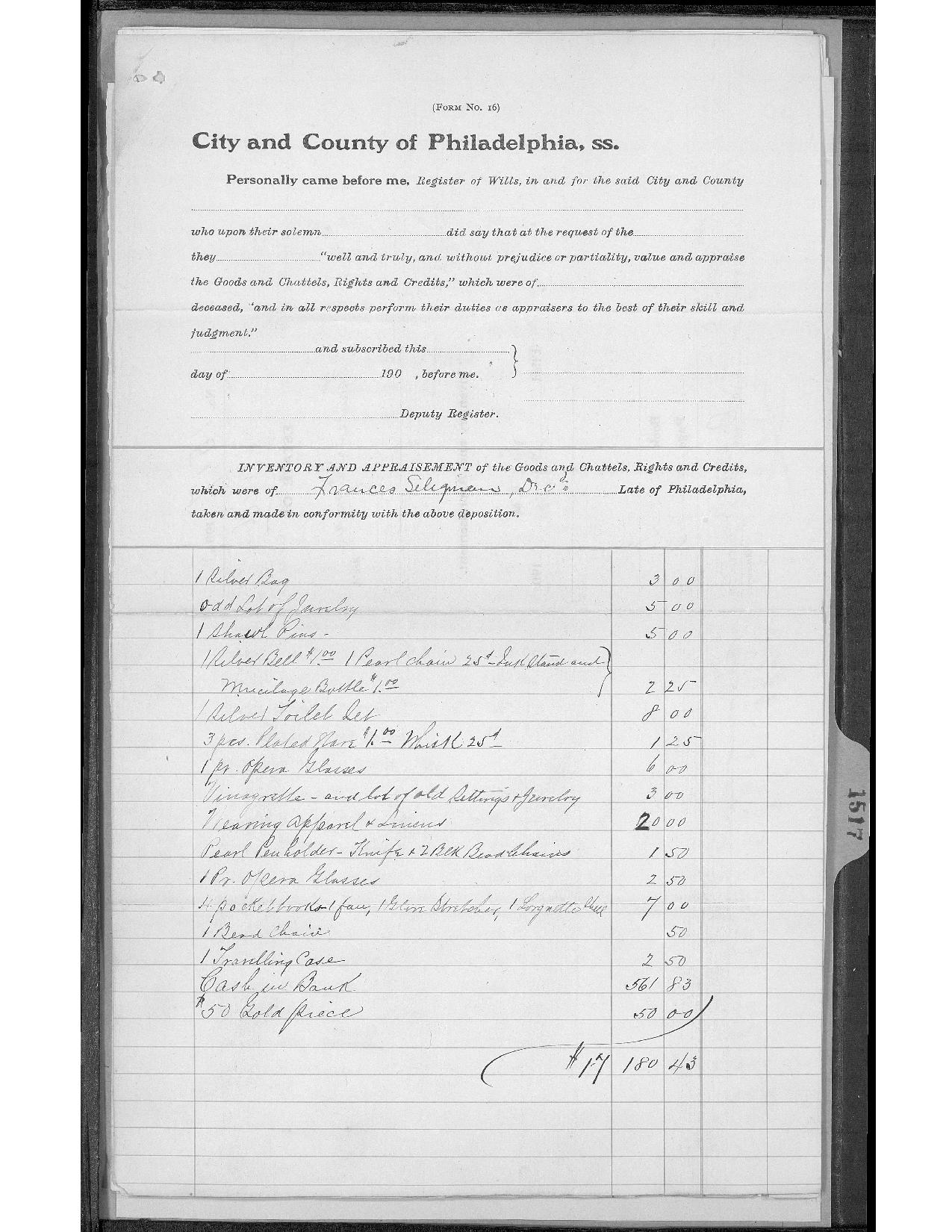
The total value of these properties came to $17,180.43, or approximately $617,000 in today’s dollars. Of course, many of these items, especially the jewelry, may have appreciated far beyond the value they had in 1905 and beyond what the inflation calculators consider.

The second inventory was of Frances’ kitchenware and dishware:
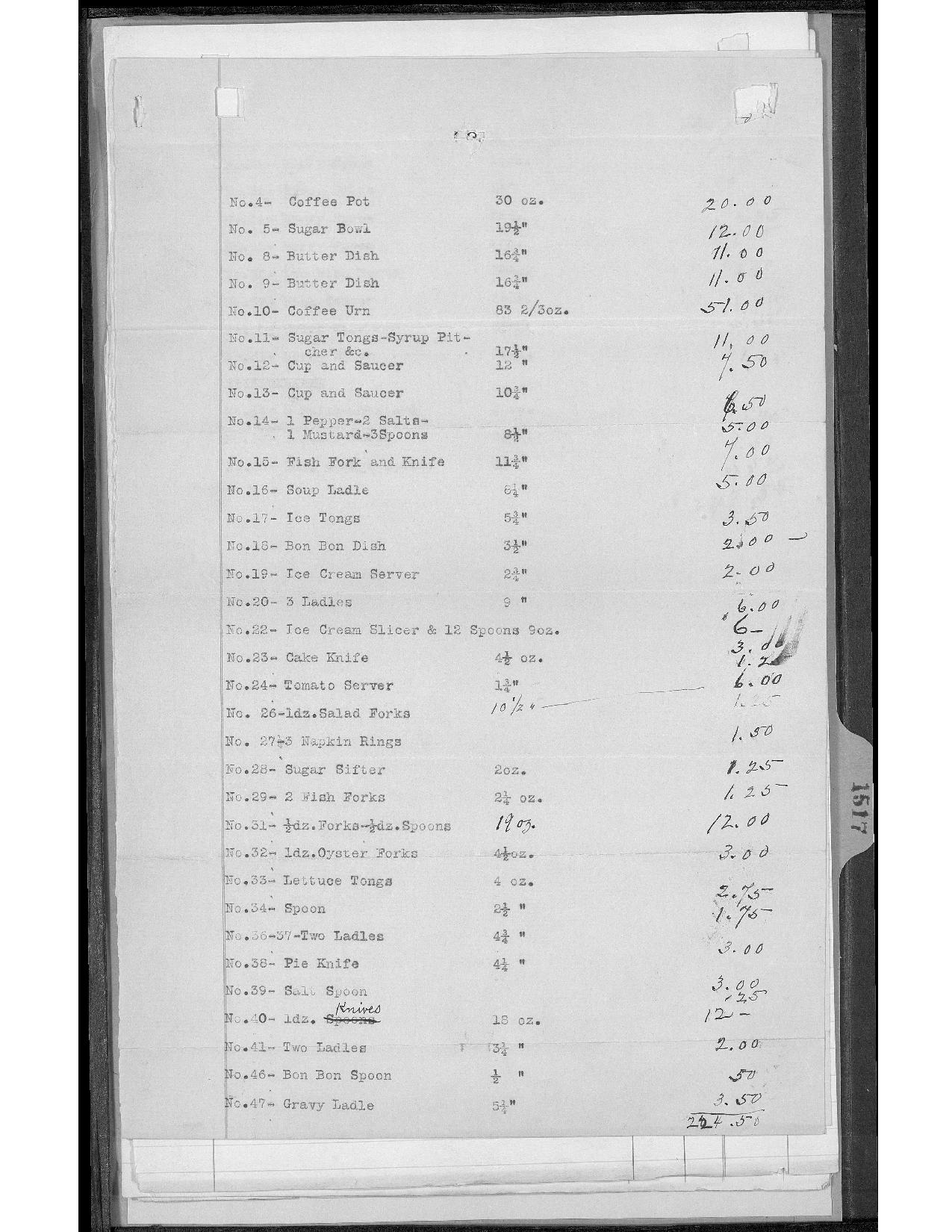
 

The value of these goods was appraised in 1906 as $247.55. In today’s dollars that would be approximately $9000.

The documents do not include any appraisal of any real estate although, as we will see, Frances owned some real estate in Santa Fe.

Frances’ will detailed with great specificity where all this personal and other property was to go. Her original will is eight typed pages plus there is a one page handwritten codicil. I loved reading this will because it names so many of the relatives I’ve written about on my blog. It was fascinating to see how inclusive Frances was in deciding who would get portions of her estate. The following images are the pages from the will with my comments about some or all of the provisions on that page.

In the Third Clause below, Frances divided $1250 among her four siblings. But Simon, Julius, and Miriam each got $250 whereas Lottie received $500. Did she love Lottie more than the others? Or did Lottie have greater need? Lottie never married, so unlike Miriam who had a husband to support her and Simon and Julius who were men, Lottie may in fact have had greater need.

There is a similar seemingly favorable bias in terms of Frances’ distribution to her three living children, Eva, James, and Arthur. Eva was to receive all of her mother’s linen and wearing apparel. Well, I guess the sons couldn’t wear her clothes. But then in the Fifth Clause above, Frances bequeathed a whole lot of jewelry to Eva: “my diamond bracelet, my diamond star with chain attached thereto, my watch studded with diamonds, one of the large diamonds from my thirteen stone diamond ring, my set of silver containing one dozen knives, one dozen large spoons, one dozen small spoons, one large soup ladle and one dozen silver forks.”

What did James get? “One diamond from my thirteen stone diamond ring and a silver coffee pot.” And Arthur: “the other large diamond from my thirteen stone diamond ring, and a silver coffee pot.”

Wow, did they get shafted or what! Even Emanuel Cohen, my great-grandfather and Eva’s husband, got “the centre diamond in my diamond cluster pin.” And he was married to Eva, who was already getting all those diamonds!

Frances then gave other jewelry items to her daughters-in-law and to her grandchildren. My grandfather John Nusbaum Cohen got “four stones from my diamond cluster pin.”

The will goes on to identify specific pieces of jewelry for other family members—aunts, uncles, nephews, nieces, brothers-in-law, and even August Seligman, the younger brother of Bernard Seligman, a brother who never left Germany. Did August get the “silver knife, fork and spoon marked S.S.”? Perhaps his great-grandson Wolfgang knows. I will have to ask him.

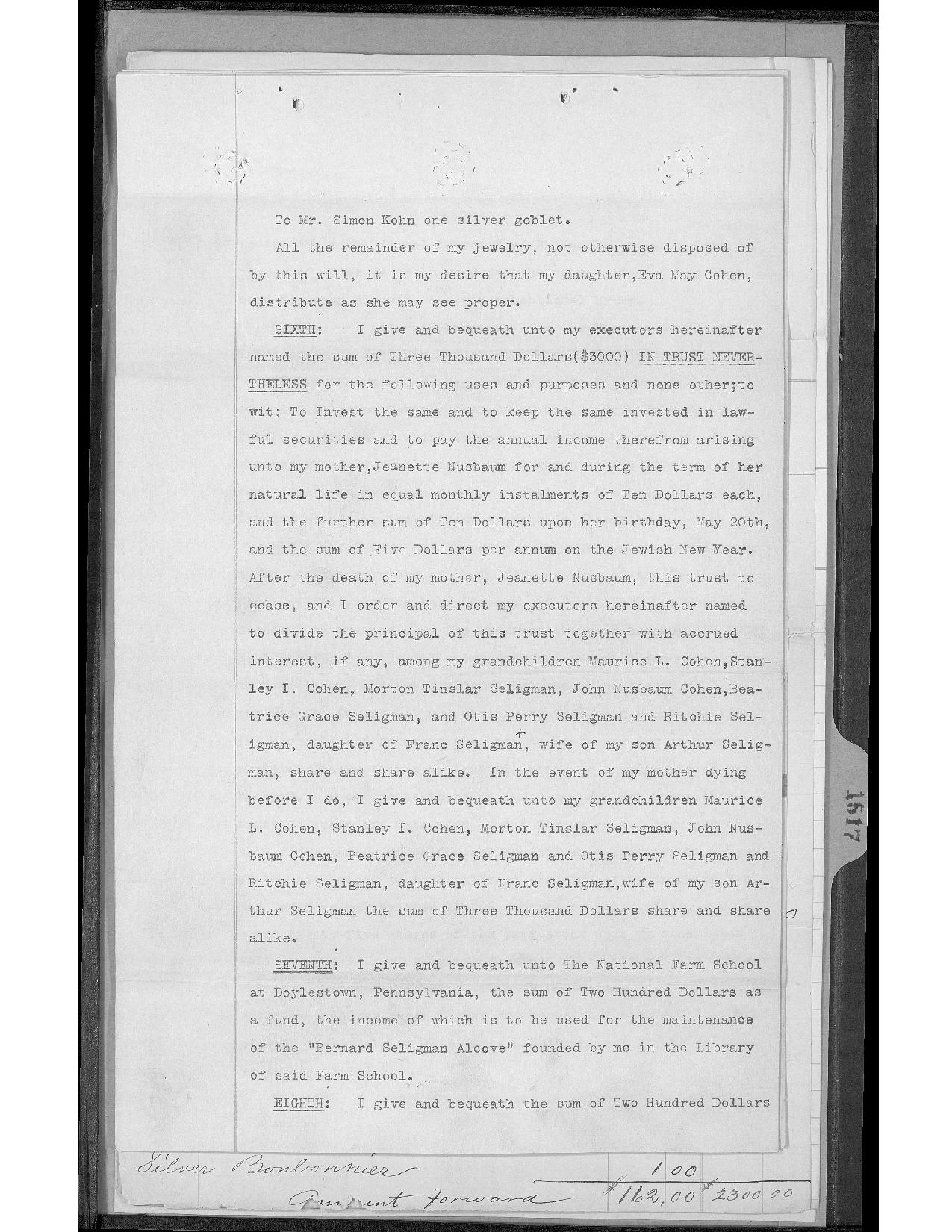
And then at the end of that Fifth Clause below, the will provides, “All the remainder of my jewelry, not otherwise disposed of by this will, it is my desire that my daughter, Eva May Cohen, distribute as she may see proper.”
Before I go on, I need to point out that I do not have one piece of jewelry or anything else that once belonged to Frances Nusbaum Seligman, my great-great-grandmother. Not one thing. Even though all those diamonds were bequeathed to my great-grandmother Eva Seligman Cohen, I have no idea where they went once Eva died. She raised my father and his sister from the time they were quite young when both their parents were hospitalized, yet my father did not have one thing—-not one spoon or even a coffee pot—-that had belonged to his beloved grandmother. I have no idea where it all went. Perhaps it was sold during the Depression. Perhaps the other three grandchildren of Eva Seligman Cohen received it, but that seems unlikely. In any event, it’s gone.

Having cleared the air on that, I am now looking at the Sixth Clause (see above). It provides in part for a $3000 trust for Frances’ mother Jeanette Dreyfus Nusbaum, my three-times great-grandmother, who was still living when Frances drew up this will in 1905. I love that Frances provided for her mother and even specified that she receive ten dollars on her birthday (May 20) and five dollars at the Jewish New Year in addition to the ten dollar regular monthly payments under this provision. It shows me how caring Frances was and also how much being Jewish was still an important part of the family’s life. Jeanette was 87 when the will was executed, and she outlived her daughter Frances, dying on January 12, 1908, at the age of 90.

There are then several bequests to various charitable organizations, and then we come to the Eleventh Clause (below), in which Frances requires that a trust be created from fifty shares of her stock in Seligman Brothers in Santa Fe, the dividends from which were to be paid to “my daughter Eva May Cohen, for and during her natural life, for her sole and separate use, not to be in any way or manner whatever liable to the contracts, debts, or engagements of her husband.” I am so impressed that Frances had the wisdom to set aside money that would be only for her daughter and not under the control of Eva’s husband. How progressive is that!

The provision further provides that Eva’s children would inherit that stock upon her death as well as Eva’s brothers James and Arthur. Sadly, Seligman Brothers itself did not survive long enough to benefit those beneficiaries as it closed for business by 1930.

Nevertheless, once again Frances favored Eva in the will.

The Twelfth Clause refers to a house and lot in Santa Fe to be shared by all three of Frances’ children. (I don’t see that property included in the inventories mentioned above so the estate was worth more than estimated above.) In 1904 when Frances executed this will that was the location of the oldest hotel in Santa Fe, the Exchange Hotel. I have no idea what it was worth at that time, but it certainly added something substantial to the overall value of Frances Nusbaum Seligman’s estate.

Below are the final provisions in the original will.

There is also a handwritten codicil to the will dated February 18, 1905. It includes additional specific bequests of various items of personal property and also provides that $200 was to be given to Congregation Keneseth Israel for the purpose of “placing the names of my husband Bernard Seligman and my own, together with the dates of our respective deaths, upon the memorial tablet on the North-East Wall of the Synagogue.” We all want to be remembered, don’t we?

I wrote to Congregation Keneseth Israel, now located in the suburbs of Philadelphia, asking about my great-great-grandparents’ plaque, and I was quite moved and relieved to learn that it still exists on their memorial wall in their suburban location. Their executive director Brian Rissinger kindly sent me this image of the plaques:
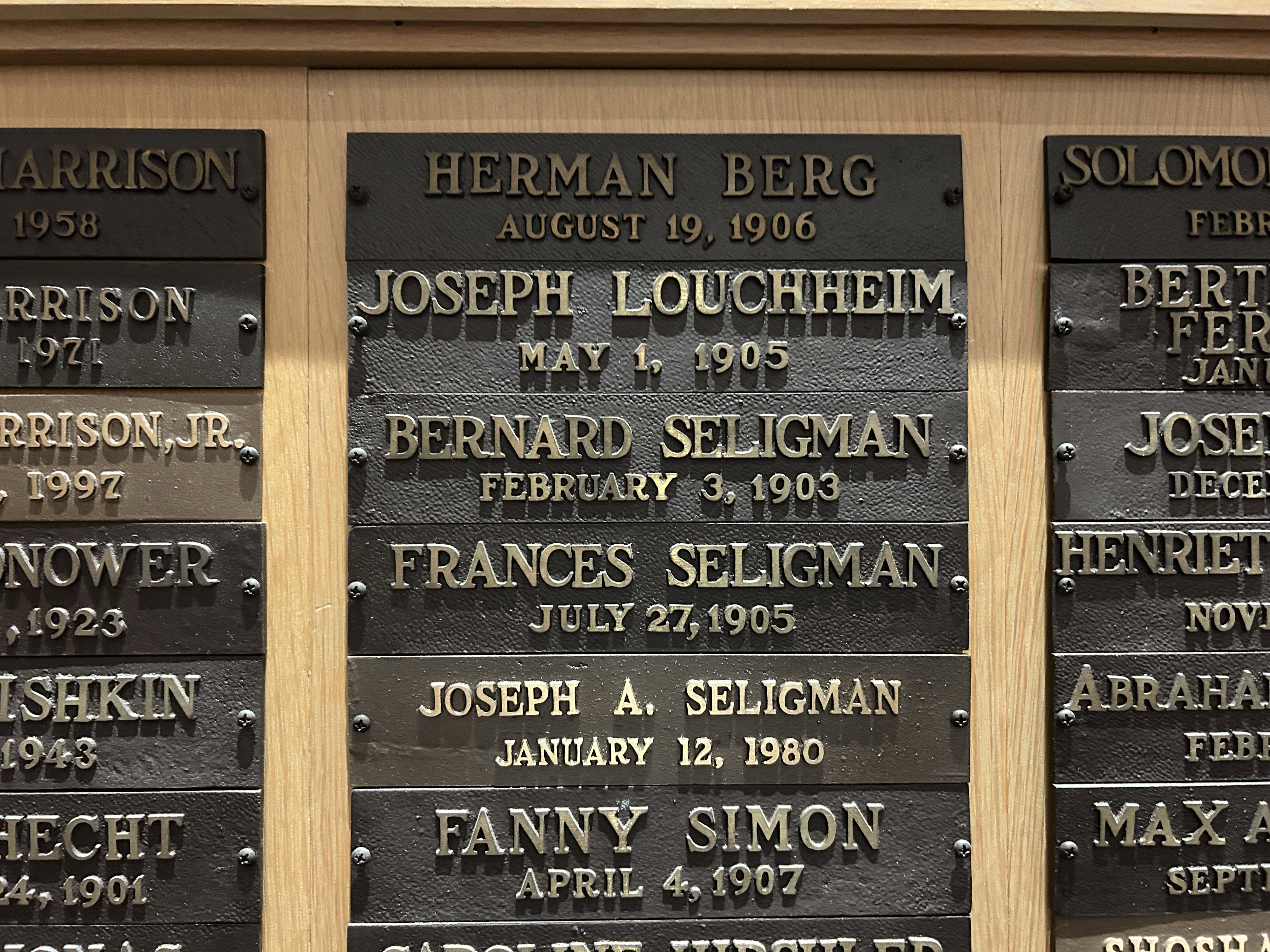
Finding this will was such a gift. It gave me insights into my great-great-grandmother Frances Nusbaum and her relationships with her children, grandchildren, siblings, and others. And it reminded me how extraordinary her life was—-growing up as the daughter of a successful merchant in Philadelphia only to fall in love with a young immigrant from Germany who had lived in Santa Fe. After marrying him and having four children in Philadelphia, she moved with him and their children to Santa Fe, living in what was then a small but growing pioneer town with very few Jews and even fewer Jewish women. And her will demonstrated that she cared deeply about her Jewish identity. She must have been so resilient and so devoted to make that adjustment to life in Santa Fe. I wrote about Frances and Bernard in my family history novel, Santa Fe Love Song for anyone who wants to know more about them..

Frances was described in her obituary in these terms:

“She was a beautiful and accomplished woman, as good as she was beautiful and as beautiful as she was good, and of a most lovable and gentle disposition. She was an exemplary wife, a fond and good mother, and a dutiful and loving daughter. Indeed she was all that is implied in the phrase ‘a thoroughly good and moral woman.’ … She will be especially remembered by the poor people of [Santa Fe], to whom she was particularly kind. Many and many truly charitable deeds have been put to her credit.”

Everything in her will reflected those same qualities.

I was deeply touched by the relationship between Frances and her daughter Eva, my great-grandmother. Frances had lost two daughters; her daughter Florence had died when she was just a month old, and her daughter Minnie had died when she was seventeen. Thus, Eva, her first born child, was her only surviving daughter, and that must have made Frances cherish her even more.

That Eva was deeply loved by her mother also sheds light on the woman she became. In learning about Eva from my father and from my research, I grew to appreciate what a strong and compassionate woman she was. Like her mother Frances, she lost one son as a baby and a second son predeceased her by committing suicide. Like her mother, Eva was uprooted from Philadelphia to Santa Fe, but returned to Philadelphia for college and lived the rest of her life there after marrying my great-grandfather Emanuel Cohen. Being so far from her parents and brothers back in Santa Fe must have been as difficult for her as it had been for her mother to leave her family behind in Philadelphia to move to Santa Fe.

Despite all those losses and difficulties, Eva clearly had a big heart. She took a widowed brother-in-law and his son into her home for many years, she took her parents into her home when they returned to Philadelphia to retire, and, most importantly to me, she took my father and aunt into her home and provided them with comfort, love, and security when their parents were unable to care for them.

The love between Frances and Eva, between mother and daughter, shines through in this will. And I am so grateful to Teresa for alerting me to the full-text search on FamilySearch so that I could find it.


  1. All the documents included in this post were located using the full-text search on FamilySearch. They are cited there as follows: Philadelphia, Philadelphia, Pennsylvania, United States records,” images,
    FamilySearch (https://www.familysearch.org/ark:/61903/3:1:S3HT-D4WP-CQ?
    view=fullText : Aug 30, 2025), images 189-206 of 315. 

Nusbaum Album: Santa Fe Photographs

I decided to move on from the Philadelphia photographs in the Nusbaum Album even though there were still many more of them in the album because it seemed to be unlikely that I would ever identify anyone.  I asked Ava to focus next on the six photographs taken in Sante Fe, hoping that they would more clearly be of my Santa Fe relatives.

Of those six, three were of young children, two were of adult men, and one was of a couple. My hope was that the couple would be Frances Nusbaum and Bernard Seligman, my great-great-grandparents, the children would be their children, and the two men would be other Seligmans or Nusbaums.


Once again there were no tax stamps on these photographs, so Ava concluded that they were taken either before August, 1864, or after August, 1866. Since Bernard and Frances didn’t move to Santa Fe until after 1868, I was hoping that the photographs fell into that later period. These photos also appear more than halfway into the album so were perhaps later than those 1863 to 1870 Philadelphia photographs Ava had already analyzed.

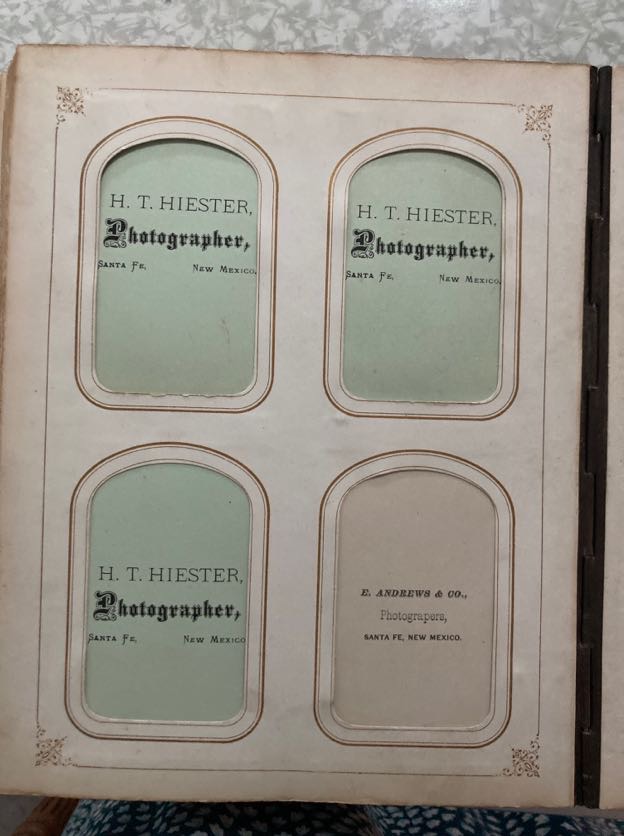
The three photographs of children were all taken by the same photographer, H.T. Hiester. Ava’s research of Hiester revealed that “Henry T. Hiester came to Santa Fe from Texas in the summer of 1871 at the request of Dr. Enos Andrews. Hiester was active in Santa Fe from 1871-1878. He had a studio in West Side Plaza from 1871-1874 and one on Main Street from September, 1874 to March, 1875.”1

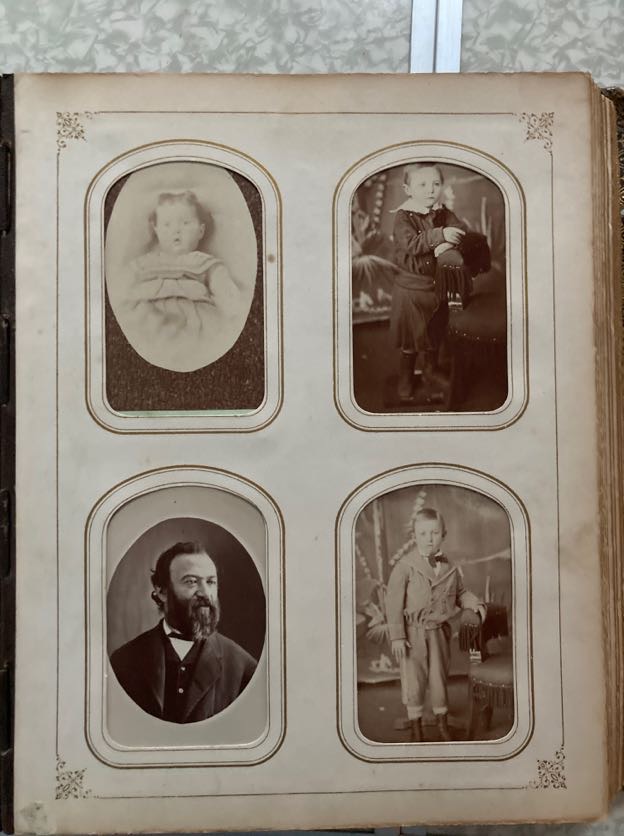
Although Ava believed that two of these photographs were taken at the same studio given that they have the same set, back drop, and chair, she concluded that they were not taken at the same time. She opined that they were both of the same child, possibly James Seligman, Bernard and Frances’ older son who was born in 1868 in Philadelphia. She thought the photo on the upper right could be James at three or four and the photo on the lower right James at six or seven.

The baby in the first photograph cannot be James Seligman since he was born in 1868 in Philadelphia before the family moved to Santa Fe. Thus, that baby has to be Arthur Seligman—if it is of one of the children of Bernard and Frances Seligman—as he was the only child of theirs born in Santa Fe, and he was in fact born in 1871, the year that Ava dated the photograph. Perhaps one of the other photographs is of James or perhaps is Arthur as he grew older.

I can see by looking at the coloring on the reverse of these three photos that they might have been taken years apart as they have faded in different ways. (It’s hard to see in the scan below, but they were slightly different shades.) But nevertheless, I can’t imagine why Frances and Bernard would have three photographs of one of their three living children and none of the other two—including my great-grandmother Eva Seligman Cohen, their oldest child. I was so disappointed that there was no photograph of her.

Moving on to the two men photographed in Santa Fe, the one on the same page as the three children (or the three photographs of the one child) was taken by a different Santa Fe photographer, Dr. Enos Andrews (1833-1910). Ava wrote that Andrews had a photography studio in Santa Fe from the end of the 1860s until the early 1870s. Based on her analysis of Santa Fe directory and census listings for Enos Andrews and other factors, Ava concluded this photograph was taken sometime between 1866 and 1871. Since she estimated that the man was about fifty years old, that would mean he was born between 1816 and 1821.2

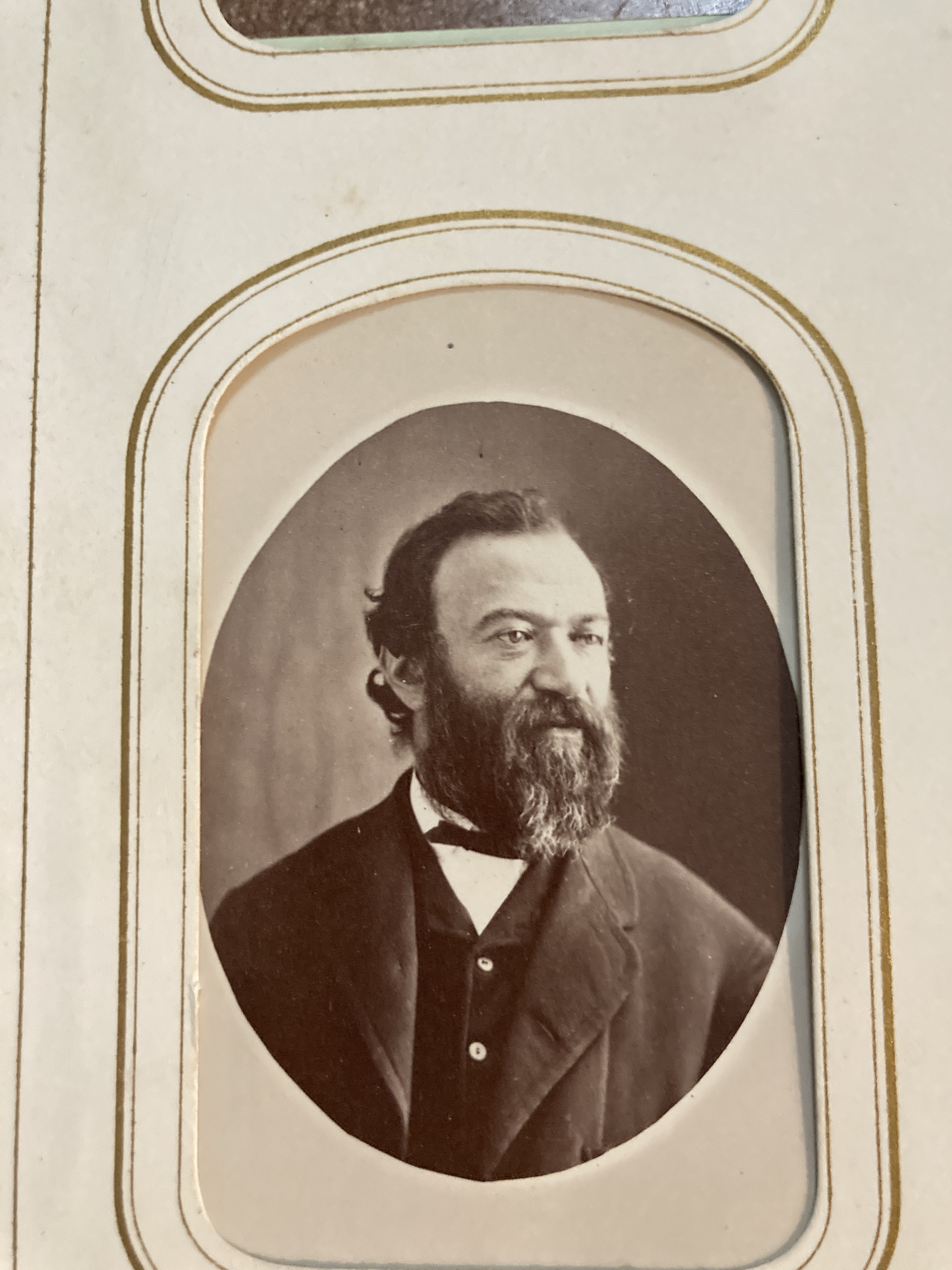
But who was he? Although the birth year might led me to believe it was John Nusbaum, who was born in 1818, Ava pointed out that in the late 1860s, John (as well as Frances and Bernard until at least 1868) was living in Philadelphia. But it was possible that John went to Santa Fe and had his photograph taken there. After comparing this photograph with the one we thought could be John Nusbaum on the first page, Ava and I both thought it could be the same man and both could be my three-times great-grandfather John Nusbaum.

What about the other photograph of a man taken in Santa Fe on the following page? That photo was taken by Nicholas Brown, who once partnered with Enos Andrews. Ava provided the following background on Nicholas Brown and his son William Henry Brown, who took the photograph of the couple on the same page.

Nicholas Brown (born 1830) was the father of William Henry Brown. Nicholas was active in Santa Fe in 1864-1865. In August of 1866, Nicholas announced the opening of a studio with his son, William. Between 1866 and 1867, William was in partnership with his father in Santa Fe and they advertised the studio as N. Brown & Son and N. Brown E Hijo (1860s in Mexico). At the end of 1870, William was in Mexico. At the beginning of 1871, Nicholas re-opened his studio in Santa Fe but this time it was located on West Side Plaza. Because there is no address on [the reverse of the Nicholas Brown photograph of the bearded man], I am placing this image before 1871.3

Ava dated this photograph as 1866-1867 and estimated the man’s age as 45 to 50, meaning he was born between 1816 and 1822.

I could speculate that maybe this is Bernard’s brother Sigmund Seligman, who lived in Santa Fe from at least 1860 until his death in 1874. Sigmund was born in 1829, so later than the 1816-1821 time frame Ava posited. Could this man be younger than fifty? Could he be in his forties? The beard does make it hard to tell. But it’s possible. So could this be Sigmund? Maybe. Maybe not. I have no idea. Maybe he was a friend of Bernard’s, not his brother. I have no way to know.

Finally, the last photograph from Santa Fe is the one of the couple taken by Nicholas Brown’s son, William Henry Brown. Ava dated this photograph far later than the one taken by Nicholas Brown because William was a partner in his father’s studio in Santa Fe from 1866-1867. By 1870, he was in Mexico. Then he returned to Santa Fe between 1880 and 1884 where he was a partner with George C. Bennett in a photographer studio on West Side Plaza. After 1884 William Henry Brown was no longer living or working in Santa Fe. Based on these facts, Ava dated this photograph at about 1882-1883.4

Ava thought that both the man and the woman were somewhere between 25 and 30 years old, meaning they were born between roughly 1852 and 1858, making them too young to be Bernard and Frances, who were born in 1838 and 1845, respectively. Thus, I have no idea who they are.

The fact that I could not identify the people in these Santa Fe photographs was disappointing. Ava reminded me again about the nature of CDVs—literally, “cartes de visite” or visiting cards. People gave them away, for example, when they came for a visit. And maybe they were taken while visiting and not in their hometown. That meant even those taken in Santa Fe or Philadelphia or elsewhere could be of people who didn’t live in those places. That meant the universe of people who might be in these photographs was anyone who lived during this time period. No wonder we couldn’t identify anyone with any degree of certainty without known photos of them.

The last portion of Ava’s work on this project was devoted to trying to identify the people in some of the photographs taken in Bingen and Mainz, Germany.


  1. Ava Cohn, Analysis of Nusbaum Album #3, January 24, 2024 
  2. See Note 1, supra. 
  3. See Note 1, supra. 
  4. See Note 1, supra. 

Nusbaum Album: Is this John Nusbaum? Is that Bernard Seligman?

After retaining Ava Cohn’s services to help me with the album of photos (“the Nusbaum album”) I’d obtained from an antique dealer in Santa Fe and selecting, with Ava’s advice, where to begin, I waited anxiously to see what Ava could tell me about the album and the first four photos we’d decided to start with, the ones on the very first page:

First page in the Nusbaum album

I had been staring at these over and over while waiting to hear back from Ava. Could the two on top be my three-times great-grandparents Jeanette Dreyfuss and John Nusbaum? Could the two on the bottom be my great-great-grandparents Bernard Seligman and Frances Nusbaum? I was hoping so. Wouldn’t that be a logical assumption to make?

But alas, I quickly learned that hopes and assumptions are not a reliable method for identifying photographs.

Ava started her analysis by providing some background on the album itself. She wrote, “The album was manufactured and sold by Henry Altemus Company of Philadelphia. Altemus and Company first published photographic albums in 1862 and remained in business until 1936….The album is one of Altemus’ larger albums, holding four cartes de visite (CDV) photographs per page.  The photographs are CDVs measuring 2 3/8” x 4.”1

One thing that Ava explained is that cartes de visite, as their name suggests, were used as calling cards. When someone visited, they would leave their photograph as a memento of that visit. That meant that, unlike a modern photograph album where most of the photographs are likely to be of family members and close friends, this album could include photographs of anyone who stopped in to visit the Nusbaums and the Seligmans.

Ava shared this poem that illustrates how CDVs were used:

Ashford, Brothers & Co, Album Filler Poem, c. 1865

Ava’s report continued with some observations about the photographs and some of the issues involved in analyzing them, including the fact that most of the photographs in the album show only heads or heads and shoulders of their subjects. Because Ava did not have the ability to see other details of what they were wearing, it would be more challenging to provide exact dating of the photographs.

Nevertheless, Ava was able to reach several conclusions about the dates when the photographs on the first page were taken. She concluded that the three from Philadelphia were taken in the Civil War era, but not between August, 1864, and August, 1866. As she explained, “Tax stamps were issued by Union states and were required to be placed on the backs of photographs from August, 1864 to August, 1866 to raise money for the war effort.”2 Since these photographs did not have tax stamps on them, they had to have been taken either before August, 1864, or after August, 1866.

With that time period in mind, Ava then focused on the specific photographers who took these first four photographs. Three of the photographs on the first page of the album were taken by Robert N. Keely; his address, as indicated on the back of these three photographs, was “N.W. cor. Fifth & Coates Sts., Philadelphia.” Ava found Keely listed in Philadelphia directories at that address or at nearby addresses throughout the 1850s and 1860s and into the 1870s.

Knowing that these three photographs were taken during that era, Ava then focused on the three individual photographs on that first page that were taken by Keely. First, she looked at this one:

Based on her estimate of his age (50 years old) and the possible dating of the photograph between 1863 and 1864, Ava concluded that the man in the photograph was likely born around 1813-1814. John Nusbaum, my three-times great-grandfather was born on November 26, 1814, according to the family bible. Ava and I speculated that the man in the photograph could be John Nusbaum, given those dates and given the placement of the photograph on the first page.

I was excited by this analysis, but also realized that nothing could be certain. Without another photograph of John, we had no truly definitive way of being sure this was in fact John Nusbaum. That was an important first lesson I learned from Ava’s work on the album.

Another photo taken by Keely that appears on the first page of the album is this one:

Philadelphia c 1863, born about 25 years, could be Bernard or a Nusbaum son

I had hoped this was Bernard Seligman. But Ava was not convinced. She dated this photograph in that same 1863-1864 time frame and found that the man was 20-25 years old, meaning the man was born roughly between 1838 and 1844; Bernard was born in 1837 so within some reasonable margin of error of that estimate. But Bernard and Frances didn’t marry until 1865. Would they have had their photographs taken before they were married?

Possibly, but there was another obstacle. When I shared the photographs I do have of Bernard as a young man and as an older man as well as the blurry still from a video taken of his supposed portrait, I could see similarities, but Ava was certain that the man in the album was not Bernard.


Bernard Seligman

So who was he? Maybe one of John and Jeanette’s sons? Adolphus was born in 1842, Simon in 1843, and Julius in 1848. It could be any one of them, but I have no photographs of any of them. So who knows… It would make sense that John and Jeanette would have put one of their sons on the first page, but I can’t be certain.

What about the two women on that first page? Were they Jeanette Dreyfuss Nusbaum and Frances Nusbaum Seligman? That will be discussed in the next post.


  1. Ava Cohn, Analysis of Nusbaum Album #1, December 16, 2023 
  2. See note 1, supra. 

The Nusbaum Album: An Introduction

Some of you may recall that last fall I received a call from an antique dealer in Santa Fe who had in her shop a photograph album with the names John Nusbaum and Frances Nusbaum engraved on the front and rear covers, respectively. I immediately knew that this album had belonged to my three-times great-grandfather John Nusbaum and his daughter Frances, my great-great-grandmother. Frances had married my great-great-grandfather Bernard Seligman and moved from Philadelphia to Sante Fe, where they raised their children, as I told in my family history novel, Santa Fe Love Song.

I agreed to purchase the album and when it arrived, I marveled at the collection of almost two hundred photographs of people I hoped were my relatives—or at least I hoped that some of them would be. But except for a handful of those photographs, there were no labels or names to identify the people in them. Almost all, however, had a photographers’ stamp that indicated where they were taken.

The largest group of photographs (43) were taken in Philadelphia, where John Nusbaum had settled after immigrating from Schopfloch, Germany, in about 1840. He had initially been a peddler traveling throughout Pennsylvania, but eventually settled in Philadelphia and established a dry goods store there. He married Jeanette Dreyfuss, another German immigrant, and had six children, my great-grandmother Frances being the third child and oldest daughter. Thus, I assumed many of the Philadelphia photographs were of John and his family as well as of other family members and friends. But who was who? I had no idea.

Not surprisingly, the next largest group of photographs were taken in Germany, including some taken in Mainz and some in Bingen, the two larger cities closest to Gau-Algesheim where Bernard Seligman and his siblings were born and raised. There were also photographs taken in other German cities, such as Stuttgart, Berlin, and Wiesbaden.

There were eight photographs taken in Santa Fe, where Frances Nusbaum had moved with her husband Bernard and their three older children in about 1870. Their youngest child Arthur Seligman was born in Santa Fe, but my great-grandmother Eva Seligman was born in 1866 in Philadelphia.

Three photographs were taken in Harrisburg, Pennsylvania, and several were taken in Lewistown, Pennsylvania, two locations where John and Jeanette’s siblings lived in Pennsylvania, so I assumed that those photographs were likely of those Nusbaum/Dreyfuss cousins. The remaining photographs were taken in other places such as New York City; Montgomery, Alabama; Wheeling, West Virginia; Peoria, Illinois; and St. Louis, Missouri.

Each page in the album has four slots for photographs. On the first four pages of the album, there are two photos, back-to-back, in each slot so that you cannot see the reverse of the photos without pulling them out of the slots. Then starting on the fifth page in the album, there are only four photos on each page, and the reverse of those photos shows through on the back of the slot on the back of the page.

What it took me a long time to realize is that all the photos squeezed into the back of those on the first four pages are photographs from Germany. I think that these photographs from Germany may have been added once all the other slots were filled. They likely belonged to Bernard Seligman and were added after he married Frances. I will get to these photographs in a later post, but my reason for mentioning this here is to indicate that I think that aside from those German photos, the others were probably placed by John, Jeanette, or Frances Nusbaum.

The photographs appear to be somewhat grouped together by the location where the photographs were taken and by photographer. The photographs seem to follow roughly this geographical order: Pennsylvania, including many from Philadelphia, but also Harrisburg and Lewistown; then two pages from Peoria, Illinois; then three pages of Santa Fe photographs; then some from New York City and other places; and then photographs from Germany (plus the ones on the reverse of the first few pages). There are also some that appear in random places within the album, but overall this is how the album is arranged.

Since I only had names on a handful of photographs and since I had no idea when the photographs were taken, I decided to retain the expert services of Ava Cohn, aka Sherlock Cohn, the Photo Genealogist. Long time readers of my blog know that I have had great success hiring Ava in the past to help me identify people in old photographs.

With the financial support of my brother and my cousins Marcia and Terry, I asked Ava to help me with this new project. I also agreed to sell the album after Ava and I were done with it to my cousin Jhette for the price I paid to the antique dealer; that way I had more money to hire Ava. Although I was sad to think that I would not be able to keep the album, I knew that Jhette, another descendant of Bernard Seligman and Frances Nusbaum, would take good care of it.

Because of the large number of photographs and my limited resources, I had to limit the scope of Ava’s work. I asked her only to date the photographs and to estimate the ages of the people in them. I was not asking her to do any identification of the people. I was hoping that with those two bits of dating information, I’d be able to deduce who the people were in the photographs—or at least narrow down the possibilities—by studying my family tree.

I also had to limit her work to about 20-25 of the almost two hundred photographs in the album. I decided to focus on those taken in Philadelphia, Santa Fe, Mainz, and Bingen because I knew that those would most likely be of my direct ancestors. As noted above, I figured that the Harrisburg, Peoria, and Lewistown photographs were of Nusbaum/Dreyfuss cousins. I had no idea who in the family (if anyone) lived in Berlin, Stuttgart, or Wiesbaden, Germany, or for that matter in St. Louis, Wheeling, or Montgomery. I knew of one branch that lived in New York, but not direct ancestors.

But because there were so many photographs taken in Philadelphia, I had to find some way to narrow down Ava’s work so that she could have the best chance of identifying the people in the photographs I chose. Based on her suggestions, we started with the photographs on the first page, figuring that those would most likely be the closest relatives if not the owners of the album; three of those were taken by the same photographer in Philadelphia. The fourth and the very first photograph in the album was taken in Harrisburg. There were two men and two women. In my wildest dreams, I was hoping that they were of John and Jeanette and Frances and Bernard.

Here are those first four photographs:

In my next two posts I will share what I learned from Ava about these four photographs and how I decided to choose the remaining 15-20 photographs for her to analyze. This will be a multipart series of posts devoted to the Nusbaum album.


Santa Fe Love Song: A Family History Novel

I am delighted to announce that my newest novel, Santa Fe Love Song, has been published and is available in both paperback and e-book format on Amazon here. Like my first novel, Pacific Street, Santa Fe Love Song was inspired by the lives of real people—in this case, my great-great-grandparents Bernard Seligman and Frances Nusbaum—and informed by my family history research. But as with my first book, Santa Fe Love Song is first and foremost a work of fiction.

Bernard Seligman, my great-great-grandfather

Frances Nusbaum Seligman, my great-great-grandmother

It is a double love story—a story of Bernard’s passion for his newly adopted home in New Mexico and of his deep love for a young woman in Philadelphia. How will he resolve the conflict between those two loves? That is the heart of the novel.

But this is also an adventure story because the first part of the book tells of Bernard’s arrival from Gau-Algesheim, Germany, his adjustment to life in Philadelphia, and then his challenging and exciting trip on the Santa Fe Trail when he moves out west to work with his brother Sigmund. On that trip Bernard faces many different obstacles and learns to love the American landscape. He transforms from a German Jewish immigrant into an American pioneer and businessman.

Upper left, Bernard Seligman with other merchants and Indians on the Santa Fe Trail

As with Pacific Street, I wrote Santa Fe Love Song with my children and grandchildren in mind. This time I also decided to get my grandsons involved in the project. Nate, 10, and Remy, 6, became my illustrators. As I told them stories about Bernard and Frances, they created drawings that told those stories visually. I am ever so grateful to my two wonderful grandsons for their work, and I hope that someday their grandchildren will cherish these books and the illustrations and honor the memories of their ancestors Bernard and Frances.

I hope that you also will find Santa Fe Love Song a worthwhile and enjoyable read. If you do, please leave a review on Amazon. Thank you! I appreciate all your support.

Seligman(n)s in the News

One of the great advantages I had when I was researching my Santa Fe Seligman family was the availability of numerous newspaper articles about members of the family. Because my great-great-grandfather Bernard Seligman and his son Arthur Seligman were both important business and political leaders in Santa Fe, there was extensive coverage of their lives—and not just their business and political lives, but also their personal lives. The news articles gave me great insights into their personalities and the way they were perceived in their communities.

Now my cousin Wolfgang Seligmann has uncovered more articles—not only about the Santa Fe Seligmans but also about their relatives abroad.

My favorite article of those uncovered by Wolfgang is this one, an obituary of my three-times great-grandmother Babette Schoenfeld Seligmann from the February 2, 1899 issue of the Santa Fe New Mexican.

Obituary of Babette Schoenfeld Seligmann, Santa Fe New Mexican, February 2, 1899

Death of Mrs. M[oritz] Seligman

Hon. Bernard Seligman received the sad intelligence today, that Mrs. M. Seligman, mother of Bernard and Adolf Seligman, of this city, died at Gau-Algesheim, Germany, January 15, 1899, at the advanced age of 89. She left seven children, two daughters and five sons, all living, in England, Germany and the United States.  Mrs. Seligman was a remarkable women in many ways, she brought up her children to be honorable and valuable citizens, as might be inferred from the honored career of the two sons who have for so long been esteemed members of this community, and who are so widely respected throughout New Mexico.  Mrs. Seligman was a woman of rugged and sterling good sense, and a just, affectionate parent, and the many friends of Messrs. Seligman in this territory will sympathize with them in their loss.

The Sante Fe New Mexican reporter could not have known Babette, so the descriptions must have come from her sons Bernard and Adolf.  They reveal so much about Babette’s personality and how she was perceived and loved by her sons.

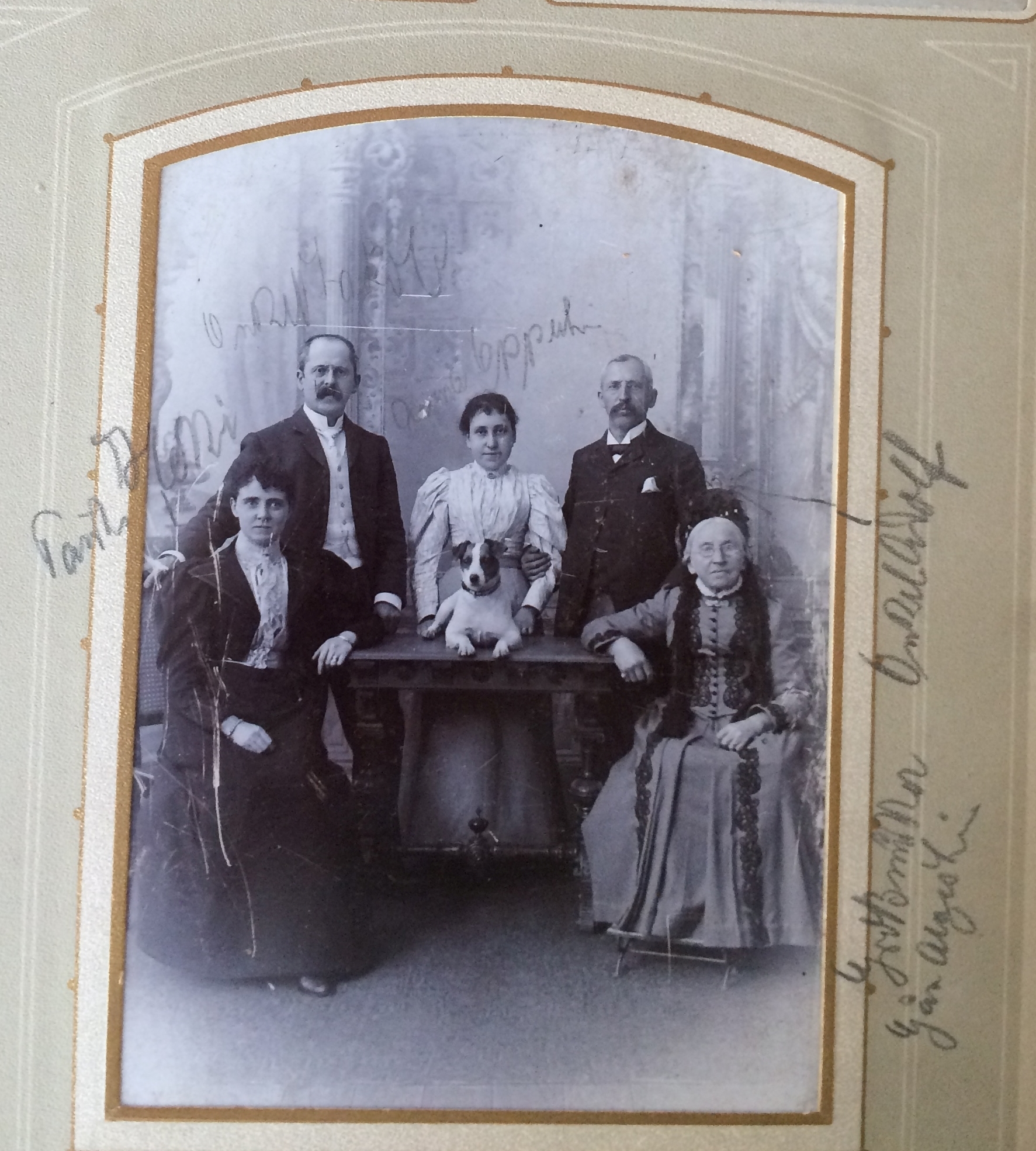
Here she is on the far right with two of her sons, James on the left, Adolf on the right, with her granddaughter Anna Oppenheimer in the center and her daughter-in-law Henrietta on the far left. (Sorry, I don’t know the name of the dog.)

Far right, Babette Schoenfeld Seligmann with two of her sons, Jakob/James and Adolf, James’ wife Henrietta, and in the center, granddaughter Anna Oppenheimer.

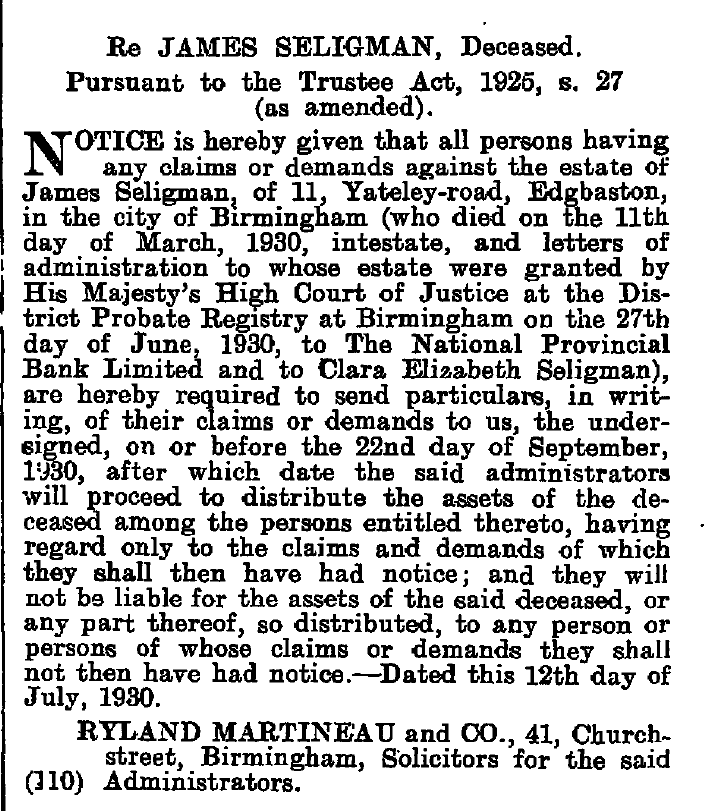
I thought this little news item that Wolfgang found was also interesting. It is an announcement of the dissolution of a London wine business owned by three of the Seligmann brothers: Wolfgang’s great-grandfather August Seligmann, his younger brother Hieronymus Seligmann, and the youngest sibling, James Seligman.   James, who was born Jakob, was the brother who left Germany for England and Scotland, unlike my great-great-grandfather Bernard and his brother Adolf, who went to New Mexico, or August and Hieronymus, who stayed in Germany.  The notice announced the takeover of the wine business in England by James alone as of the end of July, 1890.

London Gazette, March 20, 1891

I knew that James had been a wine merchant, but was not aware that his brothers were his partners initially. James was ultimately quite successful and, according to my cousin Lotte, owned hotels in Great Britain.

Wolfgang also found a notice in the July 15, 1930 issue of the London Gazette notifying those with possible claims against the estate of James Seligman of his death on March 11, 1930, and outlining what they needed to do to pursue those claims. It’s interesting that a man as successful as James died intestate (i.e., without a will).  The National Provisional Bank Limited and James’ widow Clara had been appointed administrators of his estate.  It was the settlement of James Seligman’s estate and the bank’s search for his heirs that led me to so many other Seligmann relatives.

London Gazette July 15, 1930

Two articles that Wolfgang sent were stories I’d not seen before about my great-uncle Arthur Seligman. The first is a profile of him published in the January 13, 1904, Santa Fe New Mexican (p. 9). The biographical information I have reported elsewhere so I will just quote a few excerpts from this article, written when Arthur was a County Commissioner in Santa Fe.

Describing the current status and success of the Seligman Brother’s mercantile business in Santa Fe, of which Arthur was then a director and secretary-treasurer, the article states, “Model methods, courteous treatment, absolutely fair dealing, and prompt service have characterized the business of the firm since 1856, and are today the mottoes of the two young men [Arthur and his younger brother James L. Seligman] conducting it.”

About Arthur specifically, the article states that he “is very popular in his home city.   [His success in the election as a County Commissioner] is good evidence that he is liked and respected where best known. It is a fact universally acknowledged that he has filled the important position of County Commissioner for the First District, for the past three years with marked ability, constant efficiency, and great benefit to the taxpayers and property owners, and that he has aided greatly in bringing about a very large and gratifying reduction in county expenses since taking office on the first of January, 1901.”

The article then goes on to praise his other roles and accomplishments, concluding by saying, “He is as enterprising, progressive and good a citizen as Santa Fe can boast of.”

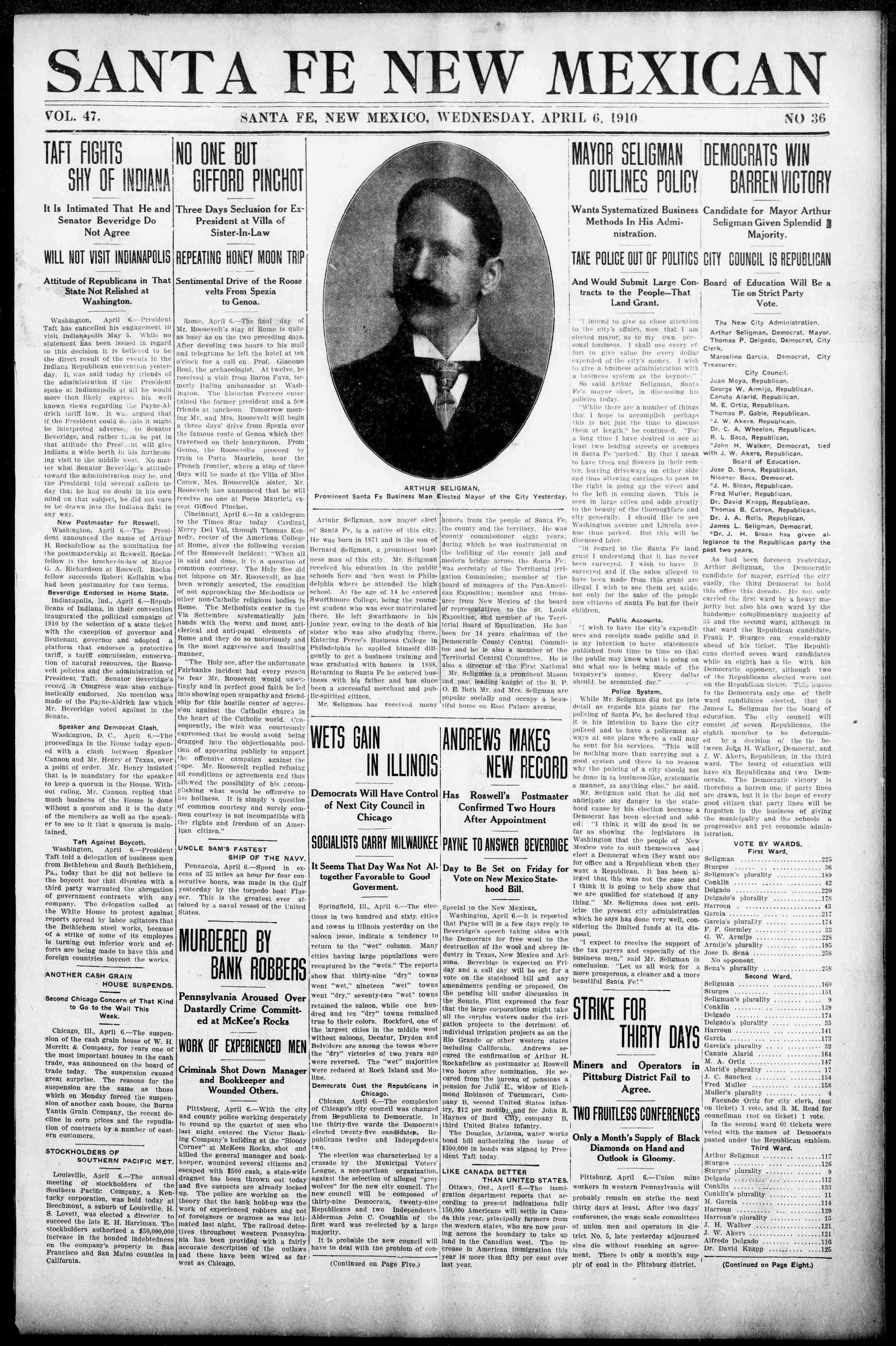
Six years later Arthur was elected mayor of Santa Fe and was featured on the front page of the April 6, 1910, issue of the Santa Fe New Mexican. The articles provide a biography and a description of his plans for Santa Fe during his upcoming term as mayor.

Santa Fe New Mexican, April 6, 1910, p. 1

Twenty years later, Arthur would be elected governor of New Mexico. Here he is attending the 1932 Democratic convention in Atlantic City, accompanied by my cousin Marjorie Cohen and my great-grandmother Eva Seligman Cohen, his sister.

Arthur Seligman, Marjorie, Cohen and Eva May Seligman Cohen, 1932 Atlantic City

Much thanks to my dear cousin Wolfgang for finding and sharing these articles about our relatives.


My Ancestral Town: Santa Fe, New Mexico

Sign for Santa Fe National Historic Trail.

Sign for Santa Fe National Historic Trail. (Photo credit: Wikipedia)

Over 160 years ago, three Jewish brothers from Gau-Algesheim, Germany, left their homeland as young men and somehow ended up on the frontier, traveling the Santa Fe Trail, bringing goods to the towns of the New Mexico territory just recently acquired by the US after the Mexican War, and eventually establishing a store on the plaza of Santa Fe: Seligman Brothers, a store that lasted over 70 years before closing in the 1920s.  One of those brothers was my great-great-grandfather, Bernard Seligman (born Bernhard Seligmann), father of my great-grandmother Evalyn (later Eval) as well as Arthur, who would become governor of New Mexico in 1930.

Santa Fe Trail around 1845 plus connecting tra...

Santa Fe Trail around 1845 plus connecting trading routes to commercial hubs and ports in the USA (Photo credit: Wikipedia)

I’ve written a great deal about my Seligmann ancestors—too many posts to try and provide links to here. (Just look in the Seligman category to see those posts.)  I’ve had great fortune in finding sources not only about the three Seligman brothers who came to Santa Fe, but also about their other siblings, their parents, their grandparents, their descendants, and many of their cousins.  And I’ve been especially blessed to find a number of current living descendants, including my cousin Pete Scott (grandson of Arthur Seligman), my cousin Wolfgang Seligmann, my cousin Angelika Oppenheimer, my cousin Steven Seligman, and so many others.    The Seligmann/Seligman line seems to have a strong interest in family history; perhaps this is where my own passion for genealogy comes from, my Seligman DNA.

So it should not be surprising that Santa Fe was a city I wanted to visit.  It’s a city where my family left a substantial mark and a city that left a substantial mark on them.  It’s a city with a long and rich history of its own, one of the oldest cities in the United States, and as I learned, one of the most beautiful.

My cousin Pete was born and raised in Santa Fe, and he has done a lot of research and writing about the history of the city including about our family’s history there.  He and his good friend Mike Lord have provided a wealth of information on their website Voces de Sante Fe, and Pete arranged for Mike to meet with us for one of the days that we would be spending in Santa Fe.

By the standards of most major US cities, Santa Fe is quite small.  We walked the whole plaza area many times, and most of the major sites in the city are in an area that is no bigger than about two miles square.  There are no skyscrapers, and the tallest building we saw in the central part of the city aside from the St. Francis Cathedral was our hotel, which is five stories high.

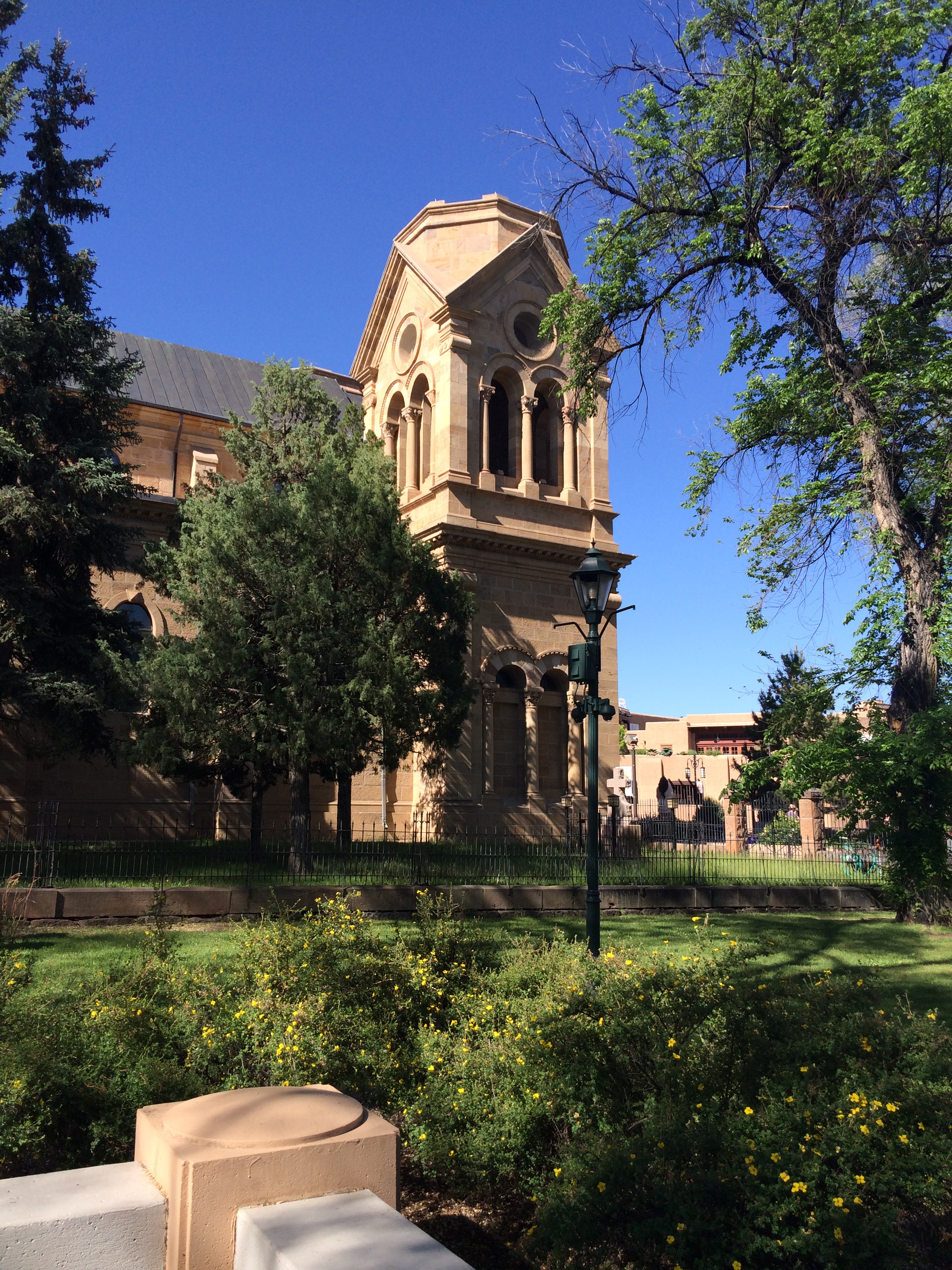
Below are various shots of the cathedral, which was built between 1869 and 1886:

St Francis Cathedral

St Francis Cathedral

20160526_152338365_iOS 20160529_030643043_iOS 20160529_030808930_iOS

The sky over Santa Fe feels wide open, and the uniformity of the color of the buildings gives the place an aesthetic unity that is both appealing and quite unreal.

20160527_164908171_iOS 20160527_164958541_iOS

20160526_152600649_iOS

When we met with Pete’s friend (and now our friend) Mike to learn about the history of Santa Fe, he likened Santa Fe to an adobe amusement park.  He pointed out that it was not until the 1950s that the uniform adobe look was mandated; historically there was a great deal more diversity to the architecture of the city, as you can see from this photo that Mike shared with us, dated in the 1890s.

Santa Fe 1890s

Santa Fe 1890s

For a city of this relatively small size, there is an incredible amount to see far beyond my genealogical interests.  We loved the Georgia O’Keefe Museum; not only did we get to see that her artistic style had evolved over the years and that that style had a much broader range than the works with which we were already familiar, we also learned about her fascinating life.  Having driven through the New Mexico landscape, we could understand what drew her and so many artists to this place.  Santa Fe has long been a place that has drawn artists to its light and its scenery and its independent spirit, and we enjoyed strolling through the galleries along Canyon Road and in the plaza area itself to see what today’s artists are creating.


http://www.gettyimages.com/detail/522010290

We also enjoyed seeing the miraculous staircase in the Loretto Chapel.  It was built in the late 1870s by a carpenter who claimed he could provide a way to reach the choir loft without taking up too much space in the church’s main level.  Somehow he built it without any central support.  It’s quite fascinating to see—almost like an optical illusion.

20160527_021305983_iOS

Loretto Chapel from our hotel room

20160526_154014010_iOS 20160526_154106183_iOS

Santa Fe’s long history was evidenced by what is claimed to be the oldest still-standing home in the US, the De Vargas Street house, as well as the first church in the US, the San Miguel Chapel.  Both date back to the early 1600s. The Spanish came to this area in the late 16th century, making it the earliest European settlement in the US west of the Mississippi River.

20160527_150758310_iOS 20160527_150829798_iOS 20160527_150854957_iOS 20160527_151008225_iOS

oldest house in the US

oldest house in the US

20160527_151220176_iOS 20160527_151245241_iOS

Among the earliest European settlers were what we now call Crypto Jews, that is, hidden Jews.  We went with Mike to see a very comprehensive exhibit about the Inquisition and the Crypto Jews at the New Mexico History Museum in the former Palace of Governors in Santa Fe.  When the Inquisition began in Spain in 1492, Jews were forced either to leave Spain, convert to Catholicism, or be punished, including by execution.   Some of the Jews left with Spanish colonists to go to Mexico, but because they were still within the realm of the Spanish empire, they still had to convert or face prosecution as infidels.

In the 1600s, some of those “conversos” who had gone to Mexico migrated to what would later become New Mexico, but even there they were still subject to the rules of the Inquisition.  Many, however, continued to follow Jewish laws and honor Jewish rituals, such as lighting candles on Friday nights, covering mirrors when someone died, abstaining from pork, and going to worship (at church) on Saturday instead of Sunday.

Thus, long before German Jewish merchants like my great-grandfather arrived in Santa Fe in the 19th century, there was a population of people with Jewish roots in Santa Fe and other places in New Mexico, even if they did not outwardly (or even internally) identify as Jews.

Of course, my principal historical interest was in those German Jewish merchants, the Seligmans as well as their fellow pioneers, the Spiegelbergs, the Staabs, and others.  What was Santa Fe like when they started arriving in the 1840s and 1850s?  It is hard to imagine what my great-great-grandfather and his brothers thought when they arrived in this place, having come from Germany where there were so many old and grand cities with towering cathedrals and castles.  And what did my great-great-grandmother Frances Nusbaum think when she moved from Philadelphia, itself already quite an established city, to be with her husband Bernard Seligman in Santa Fe?

English: "Arrival of the caravan at Santa...

English: “Arrival of the caravan at Santa Fe” — Copy of original lithograph ca. 1844 (Photo credit: Wikipedia)

Mike shared with us this photo of Santa Fe from 1855 that conveys just how primitive the town’s architecture was at the time that Bernard Seligman and his brothers arrived there.

Santa Fe 1855

Santa Fe 1855

And where did my ancestors live and work when they settled in this frontier town? When we were making our travel plans, I had asked Pete where we should stay in Santa Fe, whether there was a place with a connection to the Seligman history there.  He suggested La Fonda Hotel.  Although the current building was built in the 1920s, it sits on the site of the first hotel in Santa Fe, at one time called the Exchange Hotel.  The Exchange Hotel was the building on the other side of the Santa Fe Trail from Seligman Brothers on the plaza in Santa Fe.  Here is Pete’s post about La Fonda and the history of the hotels built on that site.

Old Fonda, courtesy of Pete Scott and Voces de Santa Fe

Old Fonda, courtesy of Pete Scott and Voces de Santa Fe

etching of santa fe

Etching of Santa Fe showing the Exchange Hotel and Seligman Brothers store on the Plaza

On this map dated 1912, you can see that the street to the right (east) of the Plaza running between San Francisco Street (where La Fonda and Seligman Brothers store are/were located) and Palace Avenue was then called Seligman Street.

Map of the City Plan, showing Street, Park and River Improvements Proposed to the City Planning Board.” N. L. King 1912 Thanks to Mike Lord for sending me this map.

Map of the City Plan, showing Street, Park and River Improvements Proposed to the City Planning Board.”
N. L. King
1912
Thanks to Mike Lord for sending me this map.

Thus, we decided to stay at La Fonda.  It was a wonderful hotel, and we are very grateful to Pete for his suggestion.  From the moment I walked into the lobby, I knew that I was in a very different part of the country.

La Fonda Hotel today

La Fonda Hotel today

20160527_020856388_iOS

View from the bar on the roof of the hotel

20160526_152600649_iOS 20160527_021136309_iOS

La Fonda lobby

La Fonda lobby

Below is the building located where Seligman Brothers’ store was once located, across the street from La Fonda:

location of Seligman's Store

location of Seligman’s Store as it looks today

I walked into the store that is currently located where Seligman Brothers’ store once stood, thinking about the fact that I was standing where my great-great-grandfather and his family had once sold dry goods to residents of the area.

20160529_013821140_iOS

Although census records indicate that the Seligmans at one point lived on Palace Avenue, there are no longer any visible signs in the city to show where Bernard Seligman and his family lived.

There is, however, a street that was named for his brother-in-law Simon Nusbaum, who had moved to Santa Fe around 1880 and lived with his sister Frances and her husband Bernard Seligman for some time before marrying and living in his own home, which sadly no longer exists.

20160526_171224269_iOS

In the New Mexico Statehouse, a quite grand and beautiful building built in 1966 and renovated in the 1990s, there is a gallery of portraits of all the governors of New Mexico from statehood in 1912 through today, and there on the wall was a portrait of my great-great-uncle, Arthur Seligman, governor from 1930 until his death in office in 1933.

20160527_154147244_iOS

Arthur Seligman portrait in State House

Arthur Seligman portrait in State House

Mike took us to see Arthur’s mud wagon in the New Mexico History Museum and drove us past the house where Arthur and his family had lived in Santa Fe.

Arthur Seligman's mud buggy

Arthur Seligman’s mud wagon

Arthur Seligman's home in Santa Fe

Arthur Seligman’s home in Santa Fe

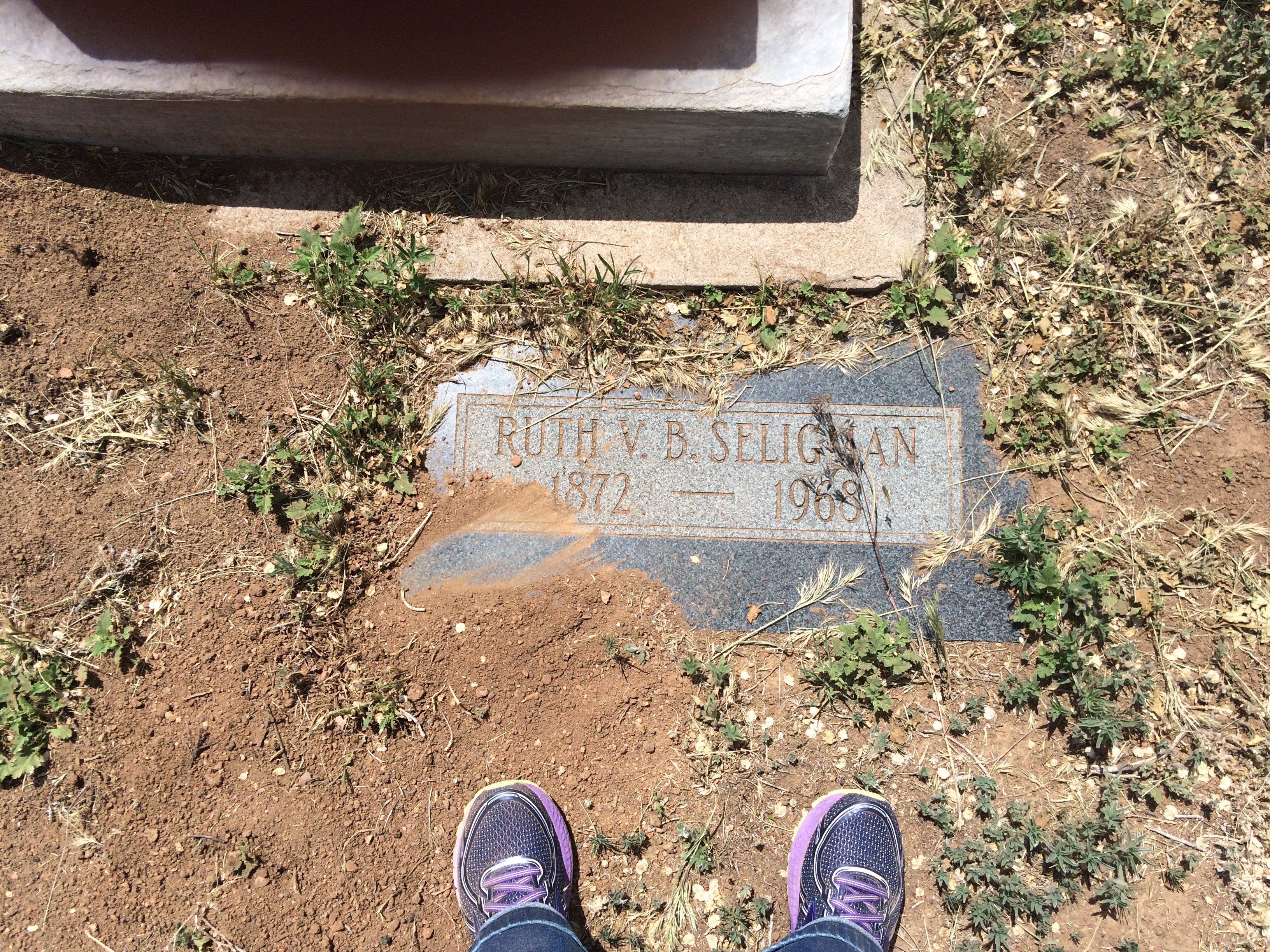
Then he took us to Fairview Cemetery, where many of my Seligman and Nusbaum relatives are buried.

20160527_200612447_iOS

20160527_200600324_iOS

Otis Seligman, son of Arthur and Franc Seligman

20160527_202238871_iOS

William Seligman, son of Adolf Seligman, and his wife Mae Leeper

20160527_203355211_iOS

20160527_203411793_iOS

James Seligman, my great-grandmother’s brother and son of Bernard Seligman and Frances Nusbaum

20160527_203415395_iOS

Beatrice Seligman, daughter of James Seligman

20160527_203406822_iOS

Ruth V.B. Seligman, wife of James Seligman

20160527_202608521_iOS

Simon Nusbaum, son of John Nusbaum, my 3x-great-grandfather and brother of Frances Nusbaum Seligman

20160527_202550324_iOS

Dora Nusbaum, Simon’s wife; their son John Bernard Nusbaum and his wife Esther Maltby

20160527_202540385_iOS

Nelle Nusbaum Healy, daughter of Simon Nusbaum

20160527_202556079_iOS

Although there was nothing on any of these stones to indicate that these were the graves of Jewish people, I left a stone on many of them, as is Jewish custom when visiting a grave to mark that someone was there to remember them.

Thus, our days in Santa Fe were a wonderful blend of history, art, architecture, and family history.  They call New Mexico the Land of Enchantment, and Santa Fe is an enchanting place even if you have no family ties to the place.  But for me, it was more than that.  Although at times it was hard to imagine what is now very much a tourist-filled place as the old settlement of native Americans, Spanish and Mexican settlers, and then later Anglo settlers like my ancestor, when I could time-travel in my mind to the years when my great-great-grandparents and their children roamed those same streets around the plaza, it was quite magical, and yes, enchanting.


Thoughts While Driving from Denver to Santa Fe:  A Northeasterner’s View of the Southwest

Before this trip, I’d never been to Colorado or New Mexico before.  I’d never seen the Rocky Mountains, and although I had been to Arizona, it was almost 20 years ago, and I didn’t get the same perspective that I had this time.  This time I found myself truly marveling at the landscape, the mountains, the desert, the overall expanse of land that exists in so much of the United States.

After all, I am a Northeasterner: born in the Bronx, raised in the suburbs of NYC, and a resident of New England since I was eighteen years old.  I’ve never lived in the country; I’ve never lived more than 90 miles from a major metropolitan area.  I now live a few miles from Springfield, Masschusetts, and about 25 miles from Hartford, Connecticut.  Although Springfield and Hartford aren’t huge cities, they are densely populated urban areas without much open space.

It’s true that from our home we can drive thirty minutes or less and be in fairly rural places—farms are nearby, and the mountains of Vermont and New Hampshire are just two hours away.  But even in those places, you don’t see miles and miles of empty road surrounded by undeveloped land with barely a sign or gas station or store to be seen.

So driving through Colorado and especially New Mexico was eye-opening for me.  We took I-25 south from Denver and headed to New Mexico.  Here we were on an interstate highway, the speed limit 75 miles an hour, and within a short distance from Denver, we began to see mountains.  I snapped photo after photo as we sped by, trying to capture the Rocky Mountains from the car.

20160524_183949615_iOS 20160524_190740985_iOS

20160524_203849284_iOS 20160524_213717579_iOS


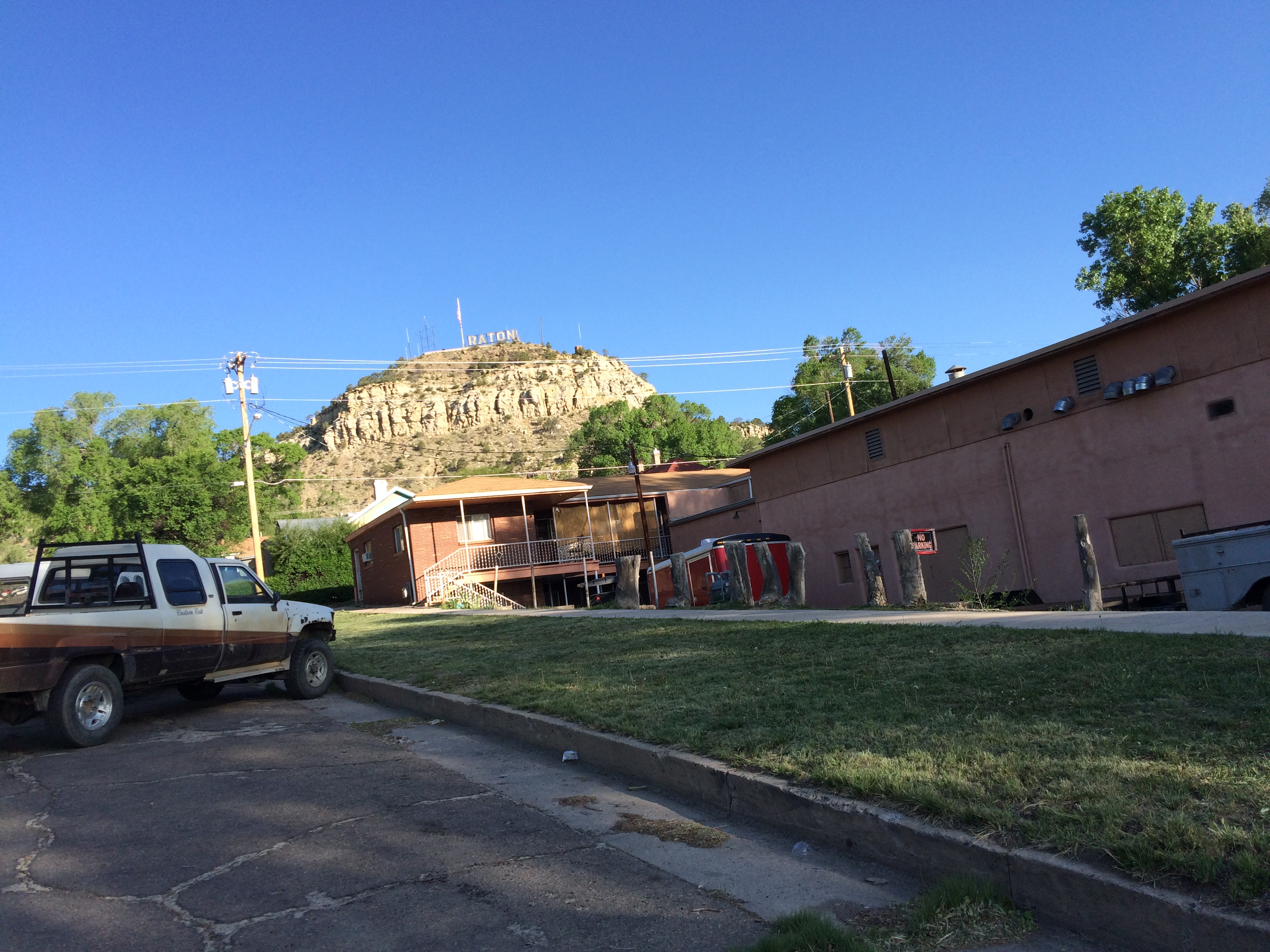
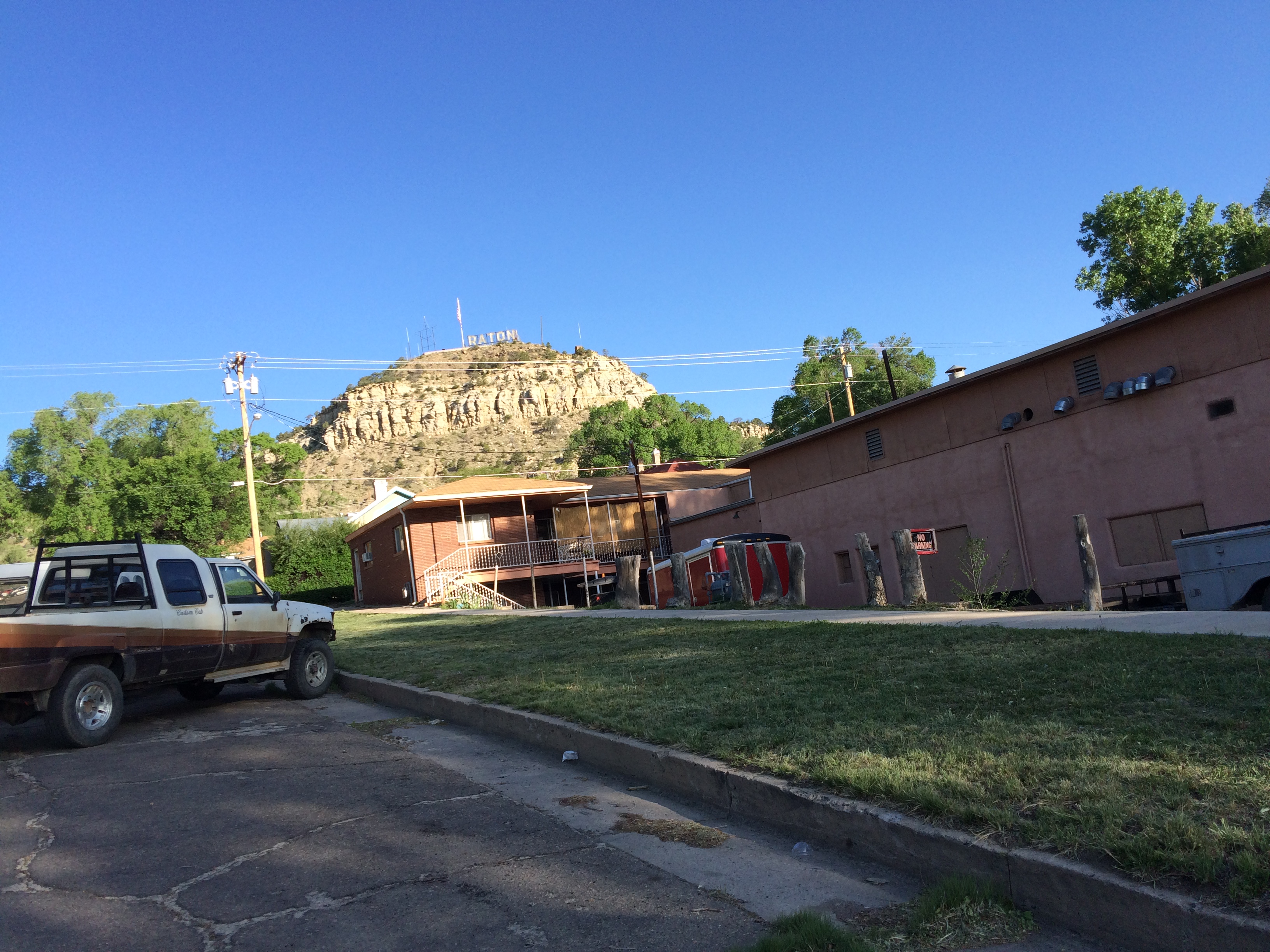
Fortunately, we decided not to take I-25 all the way to Santa Fe, but stopped overnight in Raton, New Mexico, the first town over the state line from Colorado, about three hours south of Denver.  It was not a scenic place.  We stayed in a Best Western right off the highway, and the highest rated restaurant in town on TripAdvisor and Yelp was the place right in the Best Western.  It was not good.  But it was edible.   There was no nightlife in Raton, so we rose early to get started on the rest of our journey.

Before we left Raton, however, I’d spotted a brochure for “Historic Raton” in the motel lobby and asked the person at the front desk how to get there.  She very pleasantly gave me directions, though I have to think she wondered why I wanted to see the town.  The town consisted of two parallel streets of buildings (with two or three cross streets) about maybe a quarter mile long.  And almost all the buildings were empty, boarded up, out of business.  It was depressing.

Raton

Raton

downtown raton

Downtown Raton

But it was important for us to see.  This was a town that had once been an important mining town, according to the brochure.  Even more recently those stores and building must have been occupied.  What did the people who lived in Raton now do for work, besides work at the Best Western and the few fast food places near the highway?  Is this why so many people in this country feel so disenfranchised, so angry? Sure, there is poverty in all kinds of places all over the country.  Springfield itself has a large population of people who are unemployed or underemployed, living in desperate conditions.  But a whole town of almost all empty buildings? What must it be like to live in such a place?

We left Raton with a sense of gratitude for all that we have and with a sense of embarrassment that we generally take so much for granted.

And then we ventured on towards Santa Fe.  This time we took Route 64, a two-lane road running southwest into New Mexico.  For the first forty miles or so, the road ran straight and flat through miles and miles of ranch land.  The endless fields of dry beige and green grass, speckled here and there with cattle, were mesmerizing.  We both just kept saying, “This is incredible! Look at how much land there is.”  I wish my little iPhone camera could capture the scope of open land we saw.  There were mountains in the distance, but overall the land was flat and wide as far as we could see.

20160525_133838331_iOS 20160525_134745252_iOS 20160525_140635804_iOS 20160525_141154474_iOS

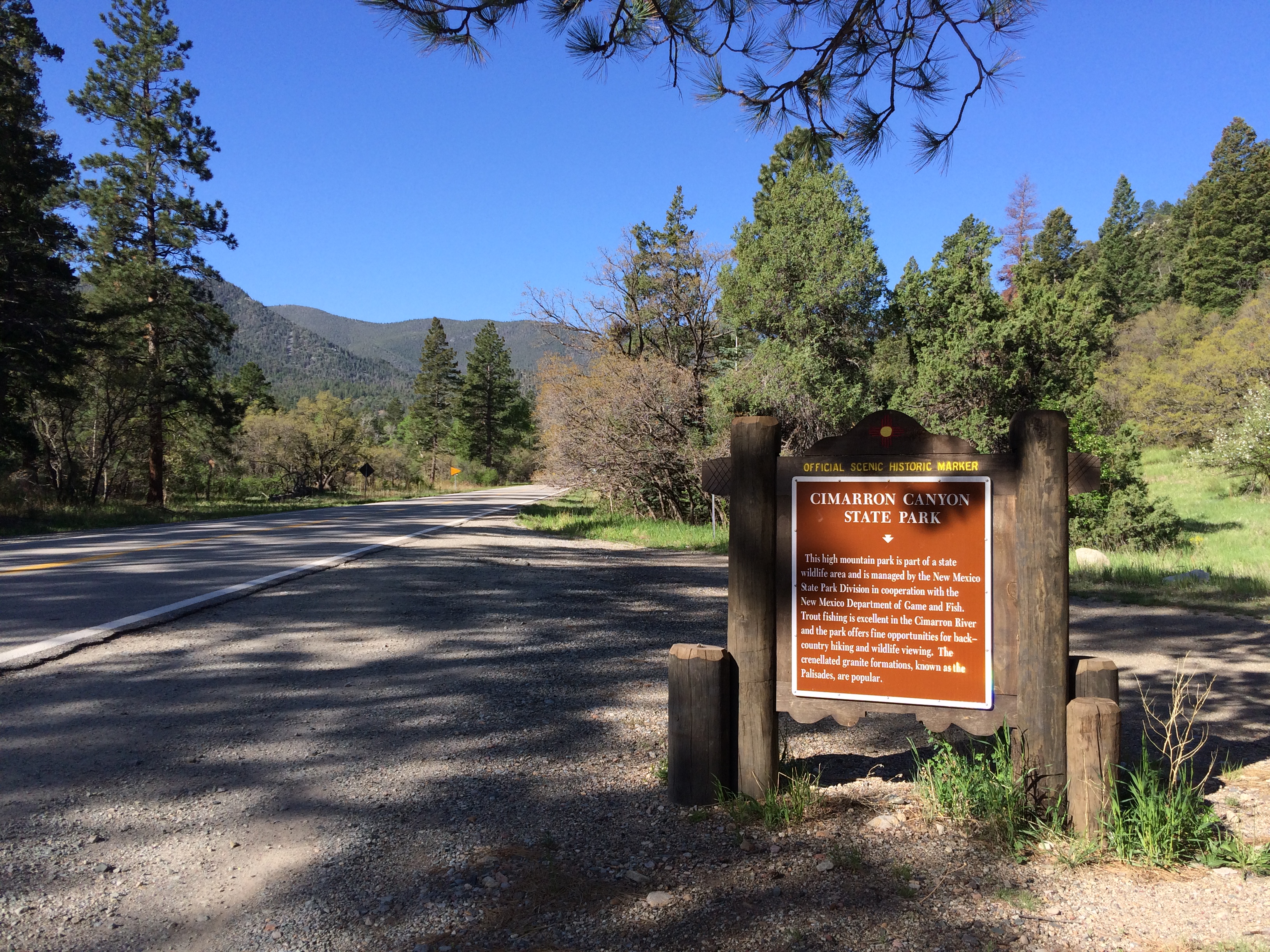
Then we entered the Cimarron Canyon area, and the terrain suddenly changed.  We were surrounded on both sides by walls of tall evergreen trees and then incredible stone formations above and in front of us as we followed the winding roads up and down and up and down the terrain.  It was like going from a huge empty room into a tiny dark hallway that twisted and turned so that you couldn’t see where it would end.  And it was gorgeous.  It was truly gorgeous.

Entering Cimarron Canyon

Entering Cimarron Canyon

20160525_142704356_iOS 20160525_143101662_iOS 20160525_143124185_iOS

And then it got better.  We passed through the canyon and emerged at the top of hill overlooking the Eagle Nest area with a large blue lake below us to the left and the mountains shadowing us to our right.  In just over sixty miles we had seen three very different types of terrain.  And barely a town or even many cars.  Who owned all those ranches? Who worked on them? Where did they live? We didn’t know.

20160525_144336328_iOS 20160525_144339466_iOS 20160525_144344554_iOS 20160525_144506423_iOS 20160525_144644707_iOS 20160525_144708507_iOS

From Eagle Nest we drove another thirty miles to Taos, passing through more open land and more mountain roads.  We stopped briefly in Taos to stretch our legs, but we knew we were coming back there after our stay in Santa Fe, so we did not take the time to look around.

Quick stop in Taos

Quick stop in Taos

After following Route 64 for about 100 miles (and for just over two hours), we picked up Route 68 in Taos to take the “low road” or “river road” to Santa Fe.  The first portion of Route 68 was awe-inspiring as we looked down at the Rio Grande and climbed high and twisted roads over the mountains and back down again.  In front of us and to our left we could see the white snow-covered peaks of the mountains while to our right we could see the deep gorge that the Rio Grande had carved into the land around it.

20160525_172606142_iOS 20160525_173012800_iOS 20160525_173018888_iOS 20160525_173044128_iOS 20160525_175017231_iOS 20160525_175022403_iOS

Finally, after passing through the rather non-scenic section of Route 68 near Espinola, we arrived in Santa Fe by lunch time.  And there we settled for the next four days, having now seen both how beautiful and inspirational our country can be and also how sad and empty it can be.


Coming Back Soon

As our vacation winds down, I am looking backwards at all I’ve seen and done and looking forward to writing about it.  Here’s a sneak preview of our adventures in Colorado and New Mexico.

First, I spent four days with three of my best friends in the world.  We met our freshman year in college and spent four years living in the same dorms, talking, laughing, debating, consoling, sharing, and confiding in each other.  Although it was hard to get together in the years we were all raising families, in the last ten years or so we have gotten together every couple of years.  We got together this time in Boulder, Colorado, where one of my friends now lives.  It was my first time in the Rockies, and we hiked and walked all over Boulder, ate great food, and enjoyed good company and beautiful views.  And as if not one day had passed since we graduated over 40 years ago, we talked and laughed and debated and consoled and shared and confided in each other.

20160520_170549732_iOS

20160521_183012098_iOS


20160519_222807641_iOS


Then I met up with my husband at the Denver airport, and we began our travels together.  We spent about 24 hours in Denver, and in that time we explored downtown Denver and then explored my genealogical roots in the city where my paternal grandmother spent much of her childhood. More on that to come.

20160524_152548004_iOS

20160524_151205779_iOS

From Denver we drove all the way to Santa Fe, New Mexico, stopping in Raton, New Mexico, for a night, and arriving in Santa Fe the next day by lunch time.  I had lots of thoughts during that drive as we observed a part of the United States I’d never seen before, some of it incredibly beautiful and awe-inspiring and other parts that made me appreciate the struggles that so many Americans experience day to day.  More on that to come as well.

Raton

Raton

20160525_143124185_iOS

And then we got to Santa Fe, the main destination of our trip.  Santa Fe is a city with an incredibly long and rich history, including my Seligman family’s own personal history there, about which I’ve written extensively.  Being in this place that had been the home of my great-great-grandfather and his family—and where they had contributed so much to its commercial and political development—-was very moving and exciting.  And then there is the art, the glorious landscapes, the architecture.

20160526_151032795_iOS

20160527_164958541_iOS

20160527_200612447_iOS

The last leg of our trip took us to Taos where I again was inspired to think about the history of this country as well as its amazing landscapes and vistas.  It’s no wonder that so many artists were inspired by the scenery and the light and the skies over New Mexico.

20160530_150420390_iOS

20160530_155656274_iOS

I will be writing about the trip in the days that follow, and then I will return to the story of my family.  I have much to do after all these days away from research and from blogging.  I have missed the work and my family, my cats, and my friends, but as always, it’s good to get a break, some new perspectives, and a chance to reflect on all the wonders that life brings.

Photo Analysis: Why You Should Ask an Expert

Sometimes you need to hire an expert to help with hard questions.  With the help of the genealogy village—my fellow bloggers and the members of the various Facebook groups and JewishGen—I have been able to find and learn more than I ever imagined.  But when it came to some of those mystery photos that bewildered and frustrated me, I decided it was time to find an expert, and the expert who came highly recommended—for good reason—is Ava Cohn, a/k/a Sherlock Cohn, the Photo Genealogist.

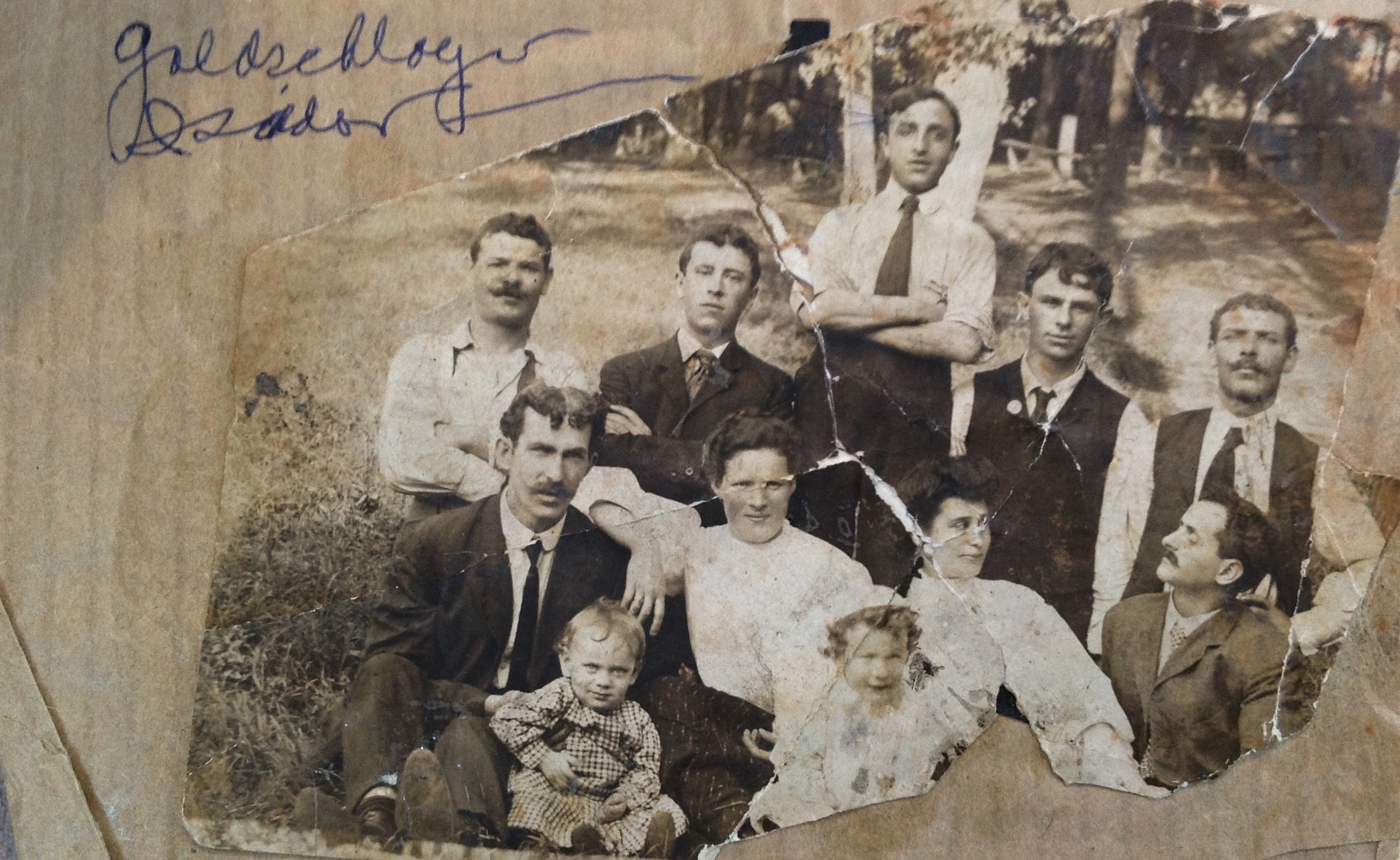
I had originally sent Ava this photo of my grandfather Isadore Goldschlager because I was curious about identifying the other people in the photograph.

Isadore Goldschlager and unknown others

Isadore Goldschlager and unknown others

But Ava and I discussed it, and she concluded that without more information and more photographs, it would be impossible to make much progress identifying total strangers who lived over a hundred years ago. I really appreciated Ava’s honesty, and when she asked if I had any other photographs that might be more amenable to her analysis, I looked back to consider some other options.

I sent her this photograph from Fred Michel’s album, which I had discussed here and here and here, but about which I remained somewhat mystified.

Uncle Adolf and Grandmother Gau Algesheim

I had concluded tentatively from my own analysis and comparison to other photographs and the inscriptions on the photograph that the older woman was probably my three-times great-grandmother Babetta Schoenfeld Seligmann, and the two men labeled Onkel Adolf and Onkel Jakob were probably Babetta’s sons, Adolf and James, brothers of my great-great grandfather Bernard Seligman.  Adolf, like my great-great-grandfather Bernard, had left Germany and settled in Santa Fe, New Mexico, and James had moved to Great Britain.  I had learned that James was not a common name for boys in Germany in the 19th century so it was likely that he was born Jakob and adopted the name James after emigrating.  Also, my cousin Lotte, who had met James Seligman when she was a young girl, thought that “Onkel Jakob” resembled the man she remembered as James Seligman.

But I was not at all sure who the two younger women were, especially the woman to the left in the photograph.  I’d asked on the blog if anyone could read the inscription near her picture, but no one was certain what it said.  The woman in the center appeared to be labeled Anna Oppenheimer, but I couldn’t understand why she would be in the photo.  Anna Oppenheimer was the daughter of Pauline Seligmann and Maier Oppenheimer and the granddaughter of Babetta.  But why of all the grandchildren would only she be in this photograph, especially since her mother was not included, just two of her uncles?

Ava studied the photograph as well as my blog posts, my family tree for the Seligmann family, and other photographs of the Seligmann family, and then sent me a detailed and thorough analysis of her own conclusions, which I found well-founded, fascinating, and persuasive.  With her permission, I am sharing some of her report.

I thought Ava’s analysis of the overall relationships among those in the photograph based on traditional posing in studio photographs of families was quite interesting:

In the mystery photograph, the family is posed in a typical family grouping of five individuals seated and standing around a large library table upon which is a dog, perhaps the family pet. The photo has been taken in a photographer’s studio with an appropriate backdrop for the time period. The two individuals on the left hand side appear to be a married couple while the elderly woman seated on the right could be mother or grandmother to one or more of the individuals in the photo. The man on the right, probably a son and the young woman in the center holding the dog could be related but are not married to each other.

Ava concluded that the photograph was taken in 1896-1897.  Here is part of the reasoning for her conclusion:

To establish a year for the photograph, I looked at the clothing worn. Since what we know of the family’s comfortable economic status, it is logical that they are wearing up-to-date fashions, for the most part. The elderly woman, as is customary for many older women, is not as fashionable as the two younger women. Her dress, with multiple small buttons down the bodice, is a typical style of the 1880s as is her bonnet. The other two women are wearing clothing from the latter half of the1890s, post 1895. By this point in time the enormous leg-o-mutton sleeves of the 1893-1895 time period have become less full with the vestige of fullness above the elbow.  The man on the left is wearing a high Imperial collar, common in the 1890s.

Ava agreed that it was reasonable to conclude that the elderly woman labeled “Grossmutter Gau Algesheim” was Babetta Schoenfeld Seligmann and that the man on the right, labeled Onkel Adolf, was her son Adolf Seligman, brother of Bernard and a resident of Santa Fe in the 1890s.  At that time Adolf was in his fifties (born in 1843) and unmarried.  Ava thought that the man labeled Onkel Adolf in the photo appeared to be in his mid-fifties. Ava did not think the woman in the center was Adolf’s wife, Lucy, since Lucy would have been only about fourteen in the mid-1890s and did not marry Adolf until 1902.


Onkle Adolf

Rather, Ava opined that the woman in the center was in fact Anna Oppenheimer as labeled.  She would have been nineteen or twenty in 1896-1897:

It appears that she is wearing a wedding or engagement ring in the photograph. The writer of the inscription has used Anna’s maiden name, Oppenheimer, as opposed to her married name, Anna Kaufman, so, along with the absence of Max Kaufman in the photograph, I believe that this photo was taken before her marriage to Max. Again, having a marriage certificate for Anna and Max could confirm why the writer used Anna’s maiden name here instead of her married name.

Unfortunately, I do not have a marriage record for Anna, and there is no record of any children born to her and her husband Max Kaufman so it is impossible to determine when exactly they married.

Anna Oppenheimer maybe

That left the two remaining people in the photograph: Onkel Jakob and the woman sitting on the left side of the picture whose name I could not decipher in the inscription.  Ava agreed that “Onkel Jakob” was James Seligman. So who was the other woman?

Ava believes that she was James/Jakob Seligman’s wife, Henrietta Walker Templeton, who was born in England in 1866 and married James Seligman in London in October 1887.  Ava read the inscription next to the woman to be “Tante Heni:”

Tante Glori


Heni is a nickname for Henrietta and clearly shows the relationship with the writer of the inscription because of the informal use of a nickname. Tante (Aunt) could be one by marriage not necessarily by blood. In the mystery photo Heni appears to be about age 30-31.

In addition, Ava interpreted the posing as indicative of a marital relationship between Jakob and the woman seated in front of him, saying, “The manner in which he is posed with his arm around the back of Heni’s chair suggests their relationship.”

This made perfect sense to me.  Ava speculated that perhaps James and Henrietta had come to Gau-Algesheim to celebrate their tenth anniversary with the Seligmann family, which would have been in 1897.  I also recalled that Lotte had mentioned in an email dated July 6, 2015, that James and his English wife (whom Lotte referred to as Hedy) had visited “the continent” once.  Lotte was born in 1921, so would not remember a visit in the 1890s, but the fact that James and his wife visited during Lotte’s lifetime in Germany makes it even more likely that they had in fact visited on earlier occasions.  Lotte also said that James returned after Henrietta’s death in 1928.

Ava even analyzed the dog in the photo.

Given that the same dog appears in both the mystery photograph and the one of Bettina Arnfeld nee Seligmann (born 1875), I thought I’d include that here. It is clearly the same dog. I had considered that the dog may have belonged to the photographer but given how calm he/she appears in the photographs, I believe he was a family pet. The photo of Bettina was taken roughly 3 years after this one, circa 1900. The photo of Bettina may have been an engagement picture as she and Adolf Arnfeld married in 1900.

Bettina Arnfeld nee Seligmann

Bettina Arnfeld nee Seligmann

Anna Oppenheimer maybe

Bettina Seligmann Arnfeld was the daughter of Hyronimus Seligmann, Babetta’s son and brother of Bernard, Adolf, and James, among others.  She was Anna Oppenheimer’s first cousin.  So whose dog was it? Certainly not James or Adolf since neither lived in Germany.  Perhaps the dog belonged to Babetta? She is the only common link between the two young women pictured with the dog.  Babetta died 1899; if Ava is correct and the photograph of Bettina was taken in 1900, perhaps Bettina inherited the dog from her grandmother?

I was quite satisfied and persuaded by Ava’s analysis of the family photograph.  But she didn’t stop there.  I had also supplied her with additional photographs to help with her analysis of the family photograph.  For example, I sent her this one, which I believed was a photograph of Babetta as a young woman.

Uncertain see ava report

I had based that conclusion on the fact that another photograph that I paired with the one of the woman was labeled Grossvatter and thus presumably was my three-times great-grandfather Moritz Seligmann.

Courtesy of the Family of Fred and Ilse Michel

Courtesy of the Family of Fred and Ilse Michel

But Ava disagreed about the identity of the young woman:

I did a comparison of the older photograph of a young woman that you supplied. This photograph is roughly dated circa 1859-1861 based on clothing and hairstyle as well as the type of image, most probably a daguerreotype popular in the 1850s and very early 1860s. The young woman appears to be in her teens and no more than 20 years of age. This eliminates the possibility that this earlier likeness is Babetta who would have been 49-51 years old. But there is a possibility given the provenance of the photograph and the resemblance to Babetta that this is one of her daughters, Pauline or Mathilde. It is unlikely to be her niece/stepdaughter, Caroline. Given that the photo was obtained from the Michel descendants, Pauline is the most likely candidate. Further research, documentation and comparison photographs would be needed to make a positive identification. 

Although I was quite disappointed to think that this was not Babetta, the more I considered Ava’s analysis and the more I looked at the photograph of the young woman and the one of Moritz, the more I realized my error.  The frames on the two photographs are quite different as is the style and the posing.  I had just jumped to the conclusion that because Suzanne had sent these two photographs in the same email that they were of a couple.  That’s why sometimes you need to hire an expert!

Finally, Ava also did an analysis of the wonderful photograph that my cousin Davita had sent of a man she said was her grandfather, Adolf Seligman, and his favorite sister, Minnie, riding camels in Egypt:

gramdfather Adolph and great aunt Minnie_rev

I was quite surprised but also persuaded by what Ava had to say about the identity of the people in this photograph; she is quite certain that the woman is in fact Henrietta Walker Templeton, and the more I studied the photograph, the more I agreed.

The Egypt photo is roughly dated based on her suit and hat as being taken in 1910. That would make Heni 44 years old. Her face has aged from the earlier photo and she’s put on a bit of weight, not uncommon approaching middle age.  She is very stylish in the 1897 photo and likewise in the 1910 one. In both, she has chosen an up-to-date suit rather than a dress. Her dark hair is the same style. Notice the “dip” in her bangs on the right side of her forehead. It’s the same as the earlier photo.  Her eyebrows, nose and mouth are the same as is the overall attitude captured by the photographer.

Tante Heni

Tante Heni


Minnie Seligmann

After I read Ava’s comment, I checked the emails that Lotte had sent me and saw that she had described James’ wife as “big and pompous.”  The woman Ava concluded was Henrietta certainly does have a certain air of superiority in both of the photographs.

Also, I have absolutely no record of any kind supporting the existence of a Seligmann sister named Minnie, so already had had questions about Davita’s description. Thus, I was open to the idea that it was not Minnie, but someone else.  I hadn’t considered Henrietta since I believed that the man was Adolf, as Davita said.  Why would Henrietta from England be riding a camel in Egypt with her brother-in-law Adolf, who lived in Santa Fe?

But Ava raised a question as to whether this was in fact Adolf. If the photograph was taken in 1910, why would Adolf, who had married in 1902 and had three children by 1910, be traveling to Egypt? The more I looked at the earlier photographs of Adolf and Jakob/James, the more I became convinced that the man on the camel is in fact James, not Adolf.  Ava also agreed that it seems quite likely that it is James, not Adolf, in the photograph, but that without more information, we can’t be entirely sure, especially since Davita, the source of the Egypt photograph, believed that it was her grandfather Adolf. (Adolf died before Davita was born, so she had never met him in person and only had this one photograph that she had been told was of her grandfather.)

Adolph Seligman in Egypt

James or Adolf?

Onkel Jakob

James Seligman

Onkle Adolf

Adolf Seligman

Thus, although without more photographs and/or records we cannot be 100% certain, I am persuaded that Ava’s conclusions are correct about the likely identities of the people in the group photograph, the portrait of the young woman, and the Egypt photograph.

It was well worth the fee I paid to have the benefit of Ava’s expertise.  I highly recommend her to anyone who has questions about an old photograph.  If you are interested, you can email Ava at Sherlock.cohn@comcast.net or check out her website at http://sherlockcohn.com/  You will probably have to wait quite a while because her services are very much in demand and she devotes a great deal of time to each project, but it will be worth the wait.

[I was not paid or required by my contract with Ava to advertise her services; I am writing this blog post as a service to others who might be interested.]


.