Whose Clothing Were They Wearing?

I recently posted these two photographs of two of the Strolowitz/Adler sisters, Rebecca (Ray) and Leah.

Leah Strolowitz Adler

Leah Strolowitz Adler

Ray Strolowitz Adler

Ray Strolowitz Adler

A number of people asked me questions about the photographs.  In particular, people were struck by the fact that two poor immigrant young women were dressed so well and were able to sit for a formal portrait.  The photograph was dated 1918, so Ray and Leah had only been in the US for about ten years.  They were both working as dressmakers.  How could they afford these luxuries like furs and hats and fancy shoes and a studio photograph?

I did some research online but did not find anything that indicated that photographers provided clothing for customers to wear, although there are many references to the props photographers kept in their studios to add interest to the photographs.  There is also this quote from a website that addresses the question of how to determine the date of a particular photograph:

“Your ancestor may have only owned one nice dress or suit that was used for all sorts of occasions. Perhaps they did not own a nice suit of clothing and borrowed one from the photographer.”

http://www.genealogytoday.com/articles/reader.mv?ID=1149

I also posted a question to the Tracing the Tribe group on Facebook about these issues and received numerous responses that were very helpful.  One commenter pointed out that since Leah and Ray were dressmakers, it was entirely possible that they made these outfits themselves.  The commenter recalled that her own ancestor was able to create fashionable dresses from older clothing and scraps by copying what she had seen in store windows.  Another commenter made the point that furs may not have been that expensive back then.  There was also discussion of the possibility that the furs and hats were props supplied by the photographer to supplement the clothing that belonged to the customers.  And some commenters believed that photographers did have clothing at their studios for the customers to wear.

As to the question of the cost of having a portrait taken, several people pointed out that having portraits done, regardless of your economic status, was very common.  Immigrants wanted to be able to send photographs back to the old country and to mark their own special occasions.  http://gary.saretzky.com/photohistory/resources/photo_in_nj_July_2010.pdf  This website points out that with improved photographic techniques, it was in fact not that expensive to have a formal photograph taken even for a family of limited means.  The early 20th century saw the development of postcard photographs in the size used like the ones of Leah and Ray, and the website states that they were a “cheaper, quicker format for producing prints, made photo portraits available to almost everyone.”

I was also able to locate some information about the photographer.  From the photographs I was able to find his name, Rothman, and address, 186 East 116th Street in New York.  By using the stevemorse.org tool for finding an address on a census, I was able to find Isadore Rothman, recent Russian immigrant, residing at 186 East 116th Street.  In 1916, Mr. Rothman was working for a different studio, Mantor Photographic Studio, according to the 1916 New York directory.  So perhaps Rothman was just starting out on his own when Ray and Leah came to have their pictures taken.  They also all lived in the East Harlem neighborhood.

Isadore Rothman on the 1920 census

Isadore Rothman on the 1920 census

So I don’t know the answer for sure, but it is possible that Leah and Ray made their outfits or borrowed them from the photographer or from someone else or a combination of both.   I guess we will never know.  And it is also possible that these photographs were not that expensive despite their seeming formality and quality.

UPDATE:  I just received this comment from Ava Cohn, an expert in using photographs in genealogical research.  She said, “Photographers did have props that were used in photos. By this time, however, the clothes were usually not part of what was “borrowed” from the photographer. As many have suggested, our Jewish ancestors were tailors in Europe and quite adept at pattern-making and sewing. There were also many companies that produced patterns and sewing one’s own clothes was both a business and a past-time. Studio photos were relatively inexpensive. …  And btw, if you are certain that your photos were taken in 1918, then Ray’s outfit is not the latest fashion. Her skirt length and shape are more typical of the 1916-1917 period.”  You can learn more about Ava Cohn and her services at her website, Sherlock Cohn.

Rachel Cohen and her Descendants: The Last Chapter of the Family of Hart Levy Cohen

Finally, I come to the youngest child of Moses Sr. and Adeline Cohen, Rachel Cohen.  This line is the last line of the extended family tree of Hart Levy and Rachel Jacobs Cohen, my great-great-great grandparents.  Although there are still quite a few unanswered questions in the Cohen saga, once I write about Rachel and her family, I will have covered all of the known descendants of Hart and Rachel, including both the Philadelphia branch and the Washington branch of the family, as best I can at this point.  I will reflect on the DC branch and on the overall Cohen family once I’ve written about Rachel.

On January 10, 1880, Rachel, as I wrote earlier, had married Frederick Selinger of Hurben, Germany, the presumed older brother or cousin of both Julius and Alfred Selinger, who married Rachel’s nieces Augusta and Fannie Cohen, respectively.

When I last wrote about Frederick and Rachel, I thought that they had had only two children, Fannie and Monroe, but further research uncovered that there may have been another child.  There is a record for a male child born in Washington, DC, on January 9, 1881, whose parents were “Rachael Cohen” and “Frederick Sclinger”—clearly an erroneous transcription of Selinger.  There is also a death record for a three year old child named Reuben Sellinger dated December 12, 1884, so born in 1881.  Although I do not have the death certificate for that child, it certainly seems that this must have been the same child born to Rachel and Frederick in 1881.  I am going to see if I can obtain the death certificate to learn what happened to Reuben.  Rachel and Frederick did have two children who lived to adulthood, Fannie, born in 1882, and Monroe, born in 1888.

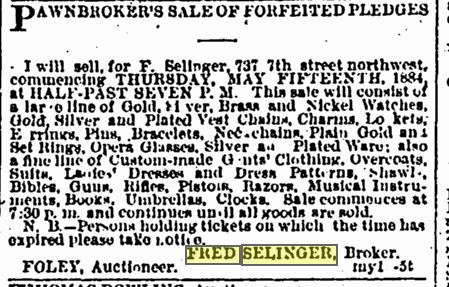
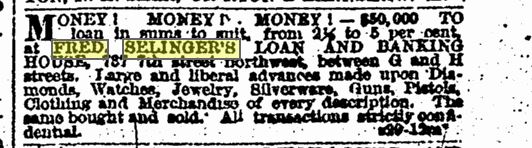
As I researched more deeply into the story of Rachel and Frederick, I also learned that Frederick was not always in the furniture business.  In fact, in 1880 when he married Rachel, he was listed only as working as a clerk in a store.  The 1882 DC city directory gives more insight into what type of store; it says he was a pawnbroker.  The 1886 directory adds to this by listing Rachel Selinger as a pawnbroker and Frederick as a clerk.

Tradition symbol of pawnbrokers--three connect...

Tradition symbol of pawnbrokers–three connected balls (Photo credit: Wikipedia)

Remembering that Moses and Adeline Cohen had at times been pawnbrokers, I now think that Frederick was working in what was at first his mother-in-law’s business (Adeline was living with the newly married couple in 1880) and then his wife’s business.  The 1887 and 1888 directories also list Rachel as the pawnbroker and Frederick merely as a clerk.  Rachel is one of the very rare married women I have found as working outside the home and listed separately in a directory.  This is even more surprising given that Rachel had a child born in 1882 and in 1888 and had lost a child in 1884.  On the other hand, I found numerous ads which refer only to Fred Selinger as the pawnbroker.

F selinger ad march 17 1882 f selinger ad may 14 1884

In 1890, Rachel, Frederick and their family were living in Sioux City where her brothers JM and Hart as well as her mother were then living.  The 1890 Sioux City directory lists Rachel as the owner of a general store and Frederick as the manager.  The 1892 directory does not list Rachel, but lists Frederick as working as clerk for JM Cohen, his brother-in-law.  The 1892 directory lists JM as a broker, meaning a real estate broker, which is the occupation given for him on the 1890 Sioux City directory.

By 1895, Rachel, Frederick and family had returned to Washington, DC, residing at 1424 7th Street, NW.  Frederick was working in a clothing store, according to the 1895 directory.  The 1896 directory has Rachel listed as in the clothing business with Frederick as a clerk.  By 1898 they had moved to 1502 7th Street, NW.  Again, Rachel is listed as in the clothing business, and Frederick is listed as a clerk.  On the 1900 census, Rachel is listed without an occupation, and Frederick is listed as a merchant of dry goods.  The 1900 directory included him in the category of second hand clothing.  There was no listing of Rachel in the 1900 directory or in the 1901 directory, which still had Frederick at 1502 7th Street in the clothing business.

Then in 1904 there is a change; Frederick is now in the furniture business, but in 1905 Rachel appears again in the directory in the clothing business; Frederick has no occupation listed.  They were still at the same address.  In 1906, 1907, and 1908, Rachel’s business is given as men’s furnishings, and Frederick is listed as a clerk. Their two children Monroe and Fannie are also listed as clerks in some of these years.

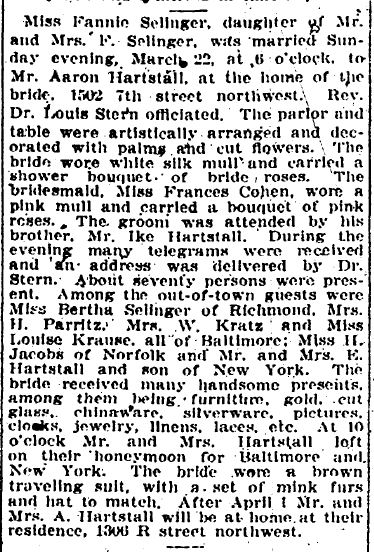
Rachel and Frederick’s daughter, Fannie, married Aaron Hartstall in 1908; Aaron was a paperhanger. The Washington Star of March 24, 1908, included this report of the wedding

:Fannie Selinger Hartstall marriage evening star March 24, 1908 p 7


Although the erratic pattern of Rachel and Frederick’s occupations made me wonder about their financial situation, it would appear from this description of the wedding that they were able to afford a fairly expensive celebration for their daughter’s wedding.

Aaron and Fannie Hartstall’s son Morton was born on January 20, 1910. Aaron continued to work as a paperhanger throughout the next three decades.

In 1910, Frederick and Rachel were now living at 317 R Street NW, and Frederick was in the furniture business, according to the census.  No occupation was given for Rachel.  Their son, Monroe, who was 22 in 1910 and living at home, was working as a clerk for the government at that time. Given his occupation as described on later documents, I believe he was a clerk for the US Post Office, or what we now call the US Postal Service.

Frederick was no longer selling furniture in 1911; he was now, like his son, a clerk at the post office.  Both were living at 317 R Street; I assume Rachel was as well.

In 1912, Monroe married Estelle Roth of Philadelphia in Philadelphia, as described in this article from the Washington Evening Star:
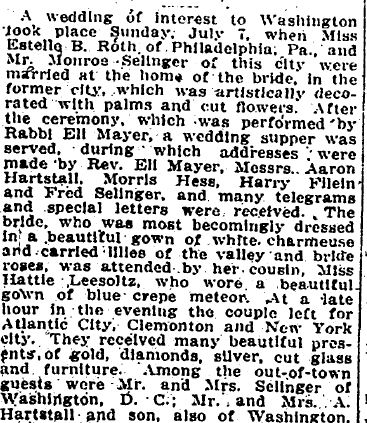
 

Monroe Selinger wedding 1912 evening Star July 10, p. 7

The young couple settled in Washington, DC.  In the 1912 DC directory, Monroe is listed as a post office clerk and residing at 126 Randolph Place; his father is listed at the same address in the directory.  Rachel’s name is not included in the listing.

In 1914, Monroe and Estelle had their first child Adelyn, and they were now living at 31, 1430 NW.  Three years later their son Eliot was born.    Monroe was working for the US Post Office, according to both his World War I draft registration and the 1917 directory, which gave his address now as 1440 Oak Street NW, the same address listed for his father Frederick. Monroe was also at the same address and still working for the post office on the 1920 census. By 1921, however, he had left the post office and was working as a clerk for the O’Donnell Drug Company.

I could not find Rachel on the 1920 census, but I did find Frederick living as a lodger at 103 Maryland Avenue right near the US Capitol and working as a clerk at the post office like his son Monroe. Rachel was not listed with him.  In the DC directory for 1921, Frederick was listed as a clerk for Sanitary Grocery and residing at 103 Maryland Avenue.  I do not know where Rachel was or for how long she and Frederick may have been living apart.

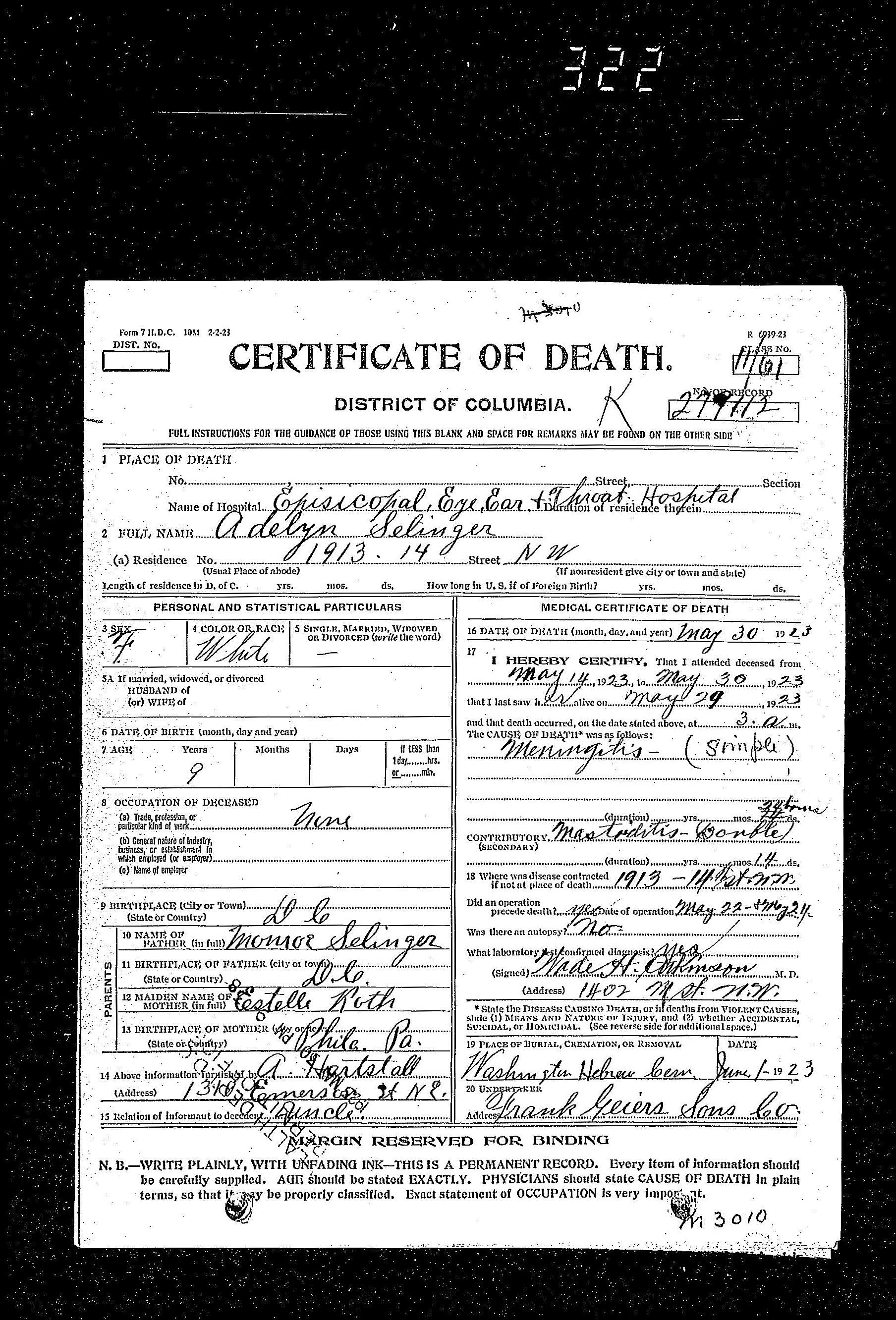
Then tragedy struck on May 30, 1923, when Monroe and Estelle’s daughter Adelyn died; she would have been only nine years old.  I have ordered her death certificate and will report on her cause of death once I receive it.

UPDATE:  I’ve received Adelyn’s death certificate.  She died of meningitis and mastoiditis, a bacterial infection of the mastoid bone, which is located behind the ear.  According to WebMD, these infections are usually caused by a middle ear infection that has not been successfully treated.  Once again, I am grateful for modern medicine and all that pink amoxycillin my kids took for ear infections.

Notice also that the informant on the death certificate was Aaron Hartstall, Adelyn’s uncle, her father’s brother-in-law.  I assume that her parents. grandparents and aunt were too distraught to provide the details for the death certificate.

Adelyn Singer death certificate May 30, 1923

Adelyn Singer death certificate May 30, 1923

Rachel still did not appear in the 1924 directory, but Frederick did.  He is listed as “bg mgr” of Washington Salvage Company and residing at 1913 14th Street NW. I also could not find Monroe in the 1924 directory.

By 1928, Monroe had switched to the clothing business, and he, Estelle, and Eliot, their remaining child, had moved to 1465 Girard Avenue, NW.

Frederick is listed in that 1928 directory as the manager of North Capital Salvage, residing at 733 North Capital Street, NE, and then, in 1929, both he and Rachel are listed at that address, both working for North Capital Service.  On the 1930 census, they are still at that address, and Frederick is listed as the owner of a general store.  Perhaps North Capital Service was the name of that store.   Rachel and Frederick were by this time almost eighty years old, living together and working together.  Three years later in 1933, they were listed as living together at 1438 Meridian Place, NW, without any occupations.

That was the last listing I found that includes Rachel.  In 1934, only Frederick is listed at that address, and on the 1940 census, Frederick is listed as a widower, living with his daughter Fannie Hartstall.  Although I have not yet found a death record, Rachel must have died in either 1933 or 1934.  She would have been 79 or 80 years old.

The extended family lost two other members during that time period.  Aaron Hartstall, Fannie Selinger Hartstall’s husband, who had continued to work as a paperhanger throughout this entire time, is listed on the 1938 Washington Directory, but must have died between 1938 and 1940 because Fannie is listed as a widow on the 1940 census.  Aaron would have been about 62 years old. Fannie continued to live at 705 Allison Street, NW, where she and Aaron had lived for many years; in 1940, her father Frederick and her brother-in-law Isaac Hartstall were living with her.

Fannie not only lost her husband and her mother during this period; she also lost her brother Monroe. Although Monroe is listed on the 1935 DC directory as a salesman for the People’s Army and Navy, he does not appear again.  I cannot find him or his family on the 1940 census.   The November 29, 1949 announcement in the Washington Post of his son Eliot’s engagement referred to him as “the late Monroe Selinger,” so Monroe must have passed away sometime between 1935 and 1949.  In fact, Eliot and his mother Estelle were living in Hartford, Connecticut, in 1945, after Eliot completed his military service, so it would appear that his father had died before 1945. He would have been only 61 years old. Unfortunately I have not been able to find a death record or an obituary for Monroe Selinger or Aaron Hartstall or Rachel Cohen Selinger.

Meanwhile, the next generation had become adults by 1930.  Morton Hartstall, the son of Aaron and Fannie, was twenty years old in 1930, and he was then working as a clerk for the Chamber of Commerce.  In 1931 he was still working for the Chamber of Commerce and still living at home.  By 1934 he had changed jobs again and was working as a salesman for a store called Goldenberg’s.  He was still at home on Allison Street with his parents.

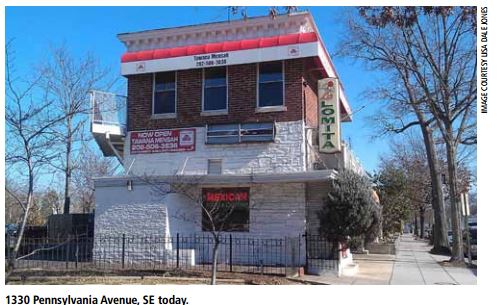
On January 20, 1935, Morton married Kathryn Wolfe, who was also a Washington, DC, native. I was fortunate to find an article online about this history of a building located at 1330 Pennsylvania Avenue, NE, that mentions Morton and his livelihood and the restaurant he owned at that location for a few years in the 1930s:

Morton Hartstall 1330 Penn Ave restaurant1330 Penn Ave pic

http://chrs.org/wp-content/uploads/2013/04/13-04_CHRSnews-REV2.pdf at page 13

(The article goes on to describe the rest of the history of the building, which is still being used as a restaurant today.)  In 1940 Morton and Kathryn were living with her parents in Washington, DC; Morton was now the owner of a “cleaning shop,” and Kathryn was a stenographer for Social Security.
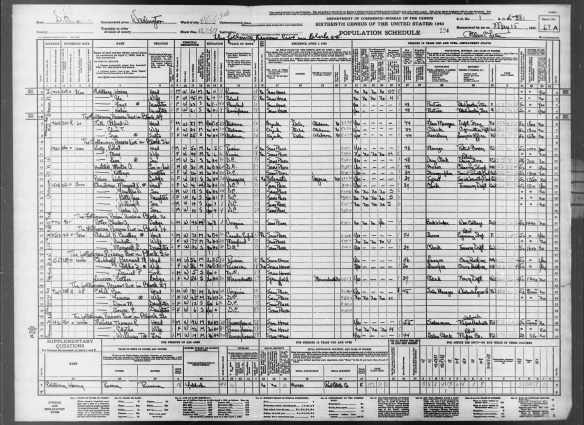
Morton Hartstall 1940 census

Morton Hartstall 1940 census

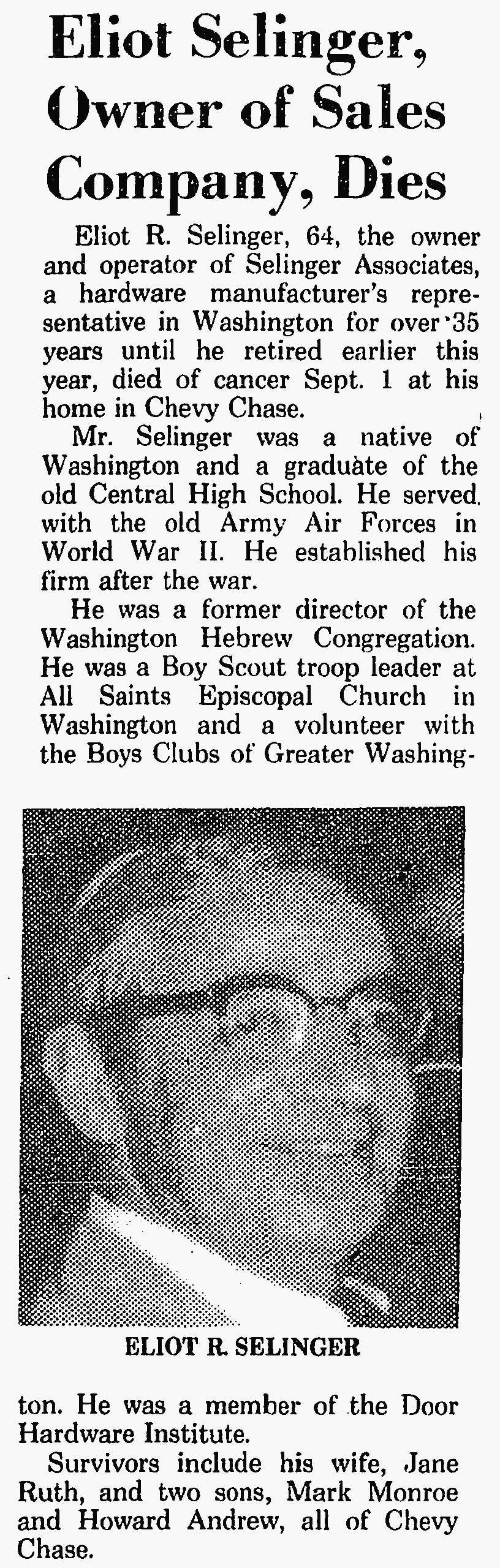
As for Eliot Selinger, the only other grandchild of Rachel and Frederick Selinger to survive to adulthood, one record says that he served in the US military from March 16, 1943, until May 7, 1943.  I wonder whether his release in May was related to his father’s death.  As stated above, he and his mother were living in Hartford in 1945, but returned to Washington in 1946.  He was engaged to Jane Ruth Simon in 1949, and they had two children.  Eliot was the owner of Selinger Associates, a hardware manufacturer’s representative, a business he established in Washington after the war.

I do not know when Frederick Selinger died.  He was 83 in 1940, the date of the last record I have for him.  His daughter Fannie died in January, 1967.  She was 84.  Both lived far longer than their spouses.

Unfortunately, Fannie’s son Morton did not live as long as his mother did, but rather like his father, he died before he turned seventy. He died in April, 1977, when he was 67 years old.  His wife Kathryn was still alive in 1995; I have no later record for her.  I do not know whether Morton and Kathryn had any children.

Morton’s first cousin Eliot also was not blessed with longevity, but sadly like his father Monroe, he died before he turned 70.   He died on September 1, 1982, and was only 64 years old.  His wife Jane died June 13, 2008.  They are buried at Washington Hebrew cemetery and were members of Washington Hebrew Congregation.
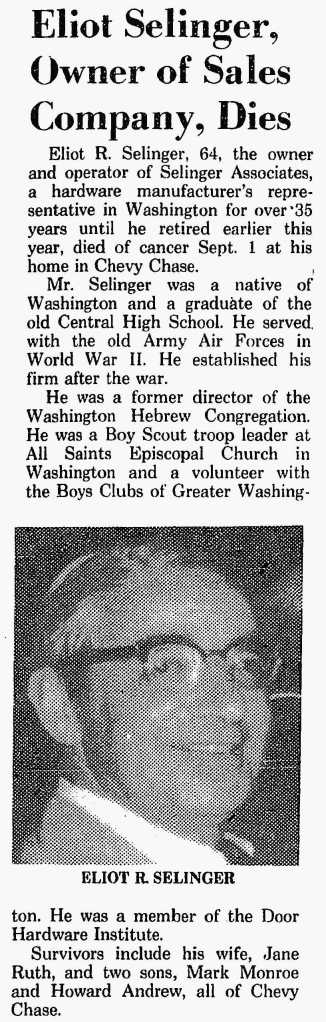
Eliot Selinger obit 1982


Looking back over the life of Rachel Cohen Selinger and her children, I see a life that seems to have had some ups and downs.  Frederick changed jobs fairly often, they moved fairly often, and they may have even lived separately for some period of time.  They lost a child early in their marriage.  On the other hand, they worked together and lived together for many years, ending up together until Rachel died in 1934.

Their two children who survived to adulthood, Fannie and Monroe, seem to have had more consistent patterns in their lives.  Fannie was married to Aaron for many years, and he worked at the same location as a paperhanger for all of that time.  Their son Morton owned a couple of businesses of his own.

Monroe worked as a postal clerk for several years and then became involved in clothing sales.  He and his wife Estelle lost a young child, as his parents had many years earlier, but their surviving child, Eliot, owned a successful business in Washington for many years and had two children who survive him.

With that, I have now tracked as best I can all of the descendants of Hart Levy Cohen and Rachel Jacobs, my great-great-great grandparents.  It has been quite a journey, and before I move on to my next line, the Seligmans, I need to spend some time looking back and thinking about the bigger picture and the lessons I’ve learned from studying my father’s father’s father’s family.



JM Cohen and Family: The Pioneering Spirit Lives On

The third child of Moses, Sr., and Adeline Cohen was Jacob M. Cohen, known as JM.  He was the one who had led many other members of the family at least temporarily to Sioux City, Iowa, where he was one of the leaders of the new and growing Jewish community and a pawnbroker and then became involved in the real estate business. He and his wife Belle Lehman Cohen had lost one child, Seba Maude, as a young child, and presumably a son Arthur, who just seemed to disappear, but I assume had died very young.

JM and Belle and their younger daughter Ruth had left Sioux City sometime before 1910 after their older daughter Fannie Sybil had moved to Kansas City, Missouri, with her husband Sigmund Stern.   Sybil, as she was known, had graduated from Wellesley College in 1901.  She and Sigmund had a daughter Judith born December 25, 1905 and a son Richard, born September 26, 1913.  Ruth, Sybil’s younger sister, had attended Smith College.  Ruth married Henry Stern, her brother-in-law Sigmund Stern’s younger brother, on January 30, 1911, when she was 27.

Ruth Cohen marriage license-page-001 Ruth Cohen marriage license-page-002

Sigmund Stern and his brothers Morris and Henry were very successful businessmen.  As described earlier, the three Stern brothers had originally settled in Sioux City after emigrating from Germany, and presumably that is where Sybil met Sigmund and Ruth met Henry.  The Stern brothers were smart investors, and in 1917 they founded an investment banking company that still exists today, now called Stern Brothers Valuation Advisers.  Here is what the company website has to say about the history of the firm and the Stern brothers who founded it:

“Our company traces its roots to the immigration of Morris, Henry and Sigmund Stern to the United States from Germany at the end of the 19th century.  The brothers had a vision for their lives that included the desire to succeed in business and create a better life for their families.  Morris and Sigmund settled in Sioux City, Iowa and went to work at a local department store.  They were ambitious and hoped to start their own business as soon as possible.  The brothers were able to raise enough money to buy inexpensive plots of land which they divided into small parcels and sold to farmers.  By 1917, they had accumulated approximately $300,000 from their land sales.  This became the seed money to found their investment banking firm – Stern Brothers & Co.”

http://www.sternbv.com/

Although on the 1910 census JM said he was retired, he listed his occupation as “investments” on the 1919 city directory for Kansas City.  On the 1920 census, his occupation was real estate agent.  Perhaps he was involved in his sons-in-law’s business.

JM’s wife Belle died on September 17, 1923, and JM died just six months later on March 28, 1924. The informant on JM’s death certificate was his son-in-law Sigmund Stern, who did not know either of JM’s parents’ names, but did know that his father had been born in England.

Belle Lehman Cohen death certificate

Belle Lehman Cohen death certificate

JM Cohen death certificate

JM Cohen death certificate

Both Belle and JM were buried back in Sioux City, Iowa, at Mt. Sinai cemetery, the cemetery they had worked to create only forty years earlier and where their daughter Seba Maude was also buried.

Belle Lehman Cohen headstone jacob M Cohen headstone

Unfortunately, the marriage between Ruth Cohen and Henry Stern was not successful, and by 1920 Henry listed his marital status as single on the census. He never remarried and was living with his brother Morris, who apparently never married, on the 1930 and 1940 census reports.  Although I could find Henry on these census reports, I could not find Ruth at all after the 1911 marriage record, whether I searched for her as Ruth Cohen or Ruth Stern.  I searched for all Ruths born in Iowa within a decade of her birth year and could not find a likely candidate on any census, nor could I find another marriage record or a death record or an obituary.  Like her brother Arthur, she just seemed to have disappeared.

Then by pure luck, while searching for information about one of Sybil’s descendants, I stumbled upon a news article about the will of Sigmund Stern in which his specific bequests to his family members were listed, including one to a Ruth Shaw of Hollywood, California, described as his sister-in-law.  I assumed that this was Ruth, Sybil’s sister, and started to search for her as Ruth Shaw in California.

At first I thought I had found her with her second husband, a man named Tracy N. Shaw who lived in Caspar, Wyoming, and then moved to California.  But after looking more closely at the records, it was clear that this was not my Ruth Shaw—wrong middle initial, wrong age, and wrong birth places for her parents.  I still have not found any records for the correct Ruth Shaw, except for two.  One was an entry in the California death index for Ruth J. Shaw, born June 8, 1883 (Ruth’s birthdate) in Iowa, died October 3, 1970, in Los Angeles.

Screenshot (11)


I asked for help on the Tracing the Tribe Facebook group about how to obtain a copy of the death certificate, and one very generous member volunteered to go to the local county clerk’s office in Norwalk, California, to look at the certificate.  She reported back to me the following information:

“Ruth Josephine Shaw born Jun 8, 1883, Iowa died Oct 3, 1970 8:30am usual residence & place of death: 3846 Aloha, LA Yrs. in CA & LA co: 25 yrs. housewife, 50 yrs., own home widow – no spouse name given father: J.M. Cohen, born Washington DC mother: Arabelle Lehman, Iowa name & address of informant: Richard Jay Stern 3600 Bellview Kansas City MO cremated: 10-7-1970 Chapel of Pines Funeral director: Pierce Bros., Hollywood cause of death: cerebral vascular accident – 10 days general athereosclerosis – 15 yrs.”

This is obviously the correct Ruth Shaw, but unfortunately Richard Stern, Ruth’s nephew, did not know Ruth’s second husband’s name.

I also found an entry in the 1940 census for a Ruth Shaw, born in Iowa, 57 years old (so the right age), divorced, living in Laurel Canyon, Los Angeles, without an occupation and with income from “another source.”  I have to believe that this is the right Ruth Shaw also.  The census indicated that she was living in New York City in 1935.  I’ve searched for a Ruth Shaw who fits these criteria in New York City, but have not found any records or references.

Ruth Shaw 1940 census

Ruth Shaw 1940 census

I have since also been fortunate to be in touch with a descendant of JM and Belle Cohen,  and she told me that Ruth had once written for Cosmopolitan Magazine before moving out to California.  She thought that Ruth’s second husband was named Brian Shaw, so I will continue looking for more information to fill in these gaps.

As for Ruth’s older sister Sybil, she and Sigmund were much easier to track.  They had a long marriage and seemed to have a very successful life.  They sent their children to elite private colleges, Judith to Wellesley College and Richard to Yale, where he was Phi Beta Kappa.  Both of their children returned to Kansas City after college.  Judith married Jules Coulter Rosenberger, Jr., on May 11, 1928, shortly after graduating from Wellesley, and they traveled to Europe in June for what I assume was a honeymoon trip.  Jules, like his brother-in-law Richard, was a graduate of Yale, class of 1926.  He then went on to Harvard Law School, where he graduated in 1929.

Jules was the son and only child of an important leader in the Kansas City legal and business community, Jules C. Rosenberger, Sr.  According to one source, his father was one of the “men who made Kansas City.”  Another source had this to say about Judith Stern’s father-in-law: “Jules C. Rosenberger is one of the leading and most successful members of the Kansas City bar.”  Carrie Westlake Whitney, Kansas City, Missouri: Its History and Its People 1808-1908, Volume 2 (Chicago; The S. J. Clarke Publishing Co., 1908), pp. 603-604.

Despite the fact that Judith was the daughter of a very wealthy banker and Jules the son of a very successful lawyer, for a long time I could not find one newspaper article, one record, one reference anywhere that revealed what happened to them after their marriage.  As a last act of desperation, I decided to enter “Jules Rosenberger Judith Wellesley Yale” into Google to see what came up, expecting nothing relevant.  But I lucked out—the first search result was for a Yale alumni publication reporting on the deaths of university graduates in the years 1943-1944.  Sadly, Jules was one of those alumni; he died on March 6, 1944, of a heart attack.

From the Yale Bulletin Obituary Record 1943-1944 http://mssa.library.yale.edu/obituary_record/1925_1952/1943-44.pdf

From the Yale Bulletin Obituary Record 1943-1944
http://mssa.library.yale.edu/obituary_record/1925_1952/1943-44.pdf

He was listed as Jules Coulter Randal, however, not as Jules Rosenberger.  The only reason Google picked this document up at all in its search was the fact that the obituary provided his parents’ names, and thus Rosenberger was included in the text.  So now I knew why I had not been able to find Judith and Jules—they had changed their surname to Randal.  Using the facts in the obituary and the name Randal instead of Rosenberger, I was then able to learn a lot more about Jules, Judith and their family.

After Jules graduated from Harvard Law, Jules and Judith moved to Buffalo, where Jules worked with a law firm then known as Donovan, Raichle, and Randal.  I found it interesting that Jules chose Buffalo as a place to live and practice law.  Both he and Judith were from Kansas City and from very successful families.  Maybe they did not want to live in the shadow of their families but instead wanted to strike out on their own.

By 1942, however, Jules and Judith and their two children had left Buffalo and moved to New York City, where Jules joined the Wall Street law firm, Guggenheimer and Untermeyer.  Within two years after moving from Buffalo, he died of a heart attack.  He was only forty years old and left behind two young children and his 38-year old widow Judith.  He was buried back in Kansas City.

Judith and the children continued, however, to live in New York City.  In 1949 she married Nicolai Berezowsky, the renowned Russian born composer and violinust.  Together they wrote an opera for children based on the character and story of Babar the Elephant.


Unfortunately, Nicolai died four years after they married in 1953 when he was only 53 years old.  In an article in the Kansas City Star on February 5, 1959, p. 16, Judith talked about her marriage to Berezowsky on the occasion of a performance of his Fourth Symphony in her hometown.  She said that they had met through a mutual friend in 1947 and married two years later.  She said, “The four years that followed, before his death, were extremely interesting years for me.  I wasn’t a musician at all, but I soon learned about composers and their music.”  The Babar opera was Berezowsky’s last musical work.

Twice Judith had lost a husband to a too-early death.  Somehow she soldiered on and  became very involved in society and charitable activities.  I was able to find several articles naming her as the organizer of charitable events, including these two from the New York Times.

Judith Stern Randal New York Times, April 8, 1962

Judith Stern Randal
New York Times, April 8, 1962

Judith Stern Randal New York Times March 21, 1970

Judith Stern Randal New York Times March 21, 1970

In 1986, she established the Judith S. Randal Foundation to provide funding to educational, arts, and environmental activities.  The Foundation continues to exist and to provide funding to various organizations today.

Judith lived a good long life after her two husbands died.  She died in New York City on May 27, 2001, when she was 95 years old.  She was survived by her two children.

Judith’s brother, Richard, was even easier to track. After graduating from Yale, he received an M.B.A from Harvard and then returned to Kansas City.  In 1940 when he was 27, he was living with his parents, Sybil and Sigmund, and like his father, he was working as an investment broker at the family business, Stern Brothers.

Sigmund Stern died December 31, 1955, from a heart attack; he was 77 years old.  His wife, Sybil Cohen Stern, died five years later on November 7, 1961, her 82nd birthday.  She died of kidney disease.  Richard was the informant on both his father’s and his mother’s death certificates.

Sigmund Stern death certificate 1955-page-001 Sybil Cohen death certificate-page-001

After his father died in 1955, Richard became president of the Stern Brothers investment banking firm.  He served as President and CEO from 1956 until 1986.   According to the company website:

“Richard J. Stern, son of Sigmund, was instrumental in building a company that became the eighth largest regional investment bank in the United States with total capital exceeding $60,000,000.  Stern Brothers has provided financing and financial services to institutions that gave Kansas City its identity.  Individual security offerings the firm helped launch reads like a who’s who of Kansas City business history: Russell Stover Candies; Frank Paxton Lumber; the Employers Reinsurance Corporation; Rival Manufacturing; Cook Paint & Varnish Co.; and Gas Service Co.  As time passed Richard transitioned the firm ultimately to its employees, which led to the creation of Stern Brothers Valuation Advisors.”

http://www.sternbv.com/

Richard J. Stern died like his father did on New Year’s Eve.  He died December 31, 2001, just six months after his sister Judith.  As far as I can tell, he never married or had children.   According to the company website, “Richard was very supportive of the Kansas City Art Institute, the Kansas City Symphony and the Lyric Opera.  So upon his death on December 31, 2001, a significant portion of his net worth was placed in the Richard J. Stern Foundation for the Arts.  The Foundation has total assets exceeding $40,000,000, which are used to support the Arts.”  http://www.sternbv.com/  If you Google Richard J. Stern and Kansas City, you will find a long list of arts institutions that are receiving funds from this foundation.

The story of JM Cohen and Belle is quite an extraordinary one.  As a young couple, they struck out on their own, moving to Iowa. They lost one and probably two young children.  JM and Belle then relocated to Kansas City, where both their daughters married Stern brothers, who were successful investment bankers. Their two grandchildren, Judith and Richard Stern, also lived long and productive lives.  Although Judith was widowed twice by the premature deaths of both her first and second husband, she not only survived—she seems to have led a good and active life and to have raised two children on her own in New York City. Richard took over his father and uncles’ business and ran it successfully for many years.  Both Judith and Richard created foundations to support the arts and other causes.  Obviously their grandparents’ independent spirit and community-mindedness was passed on to them both.

This was a family of people who were challenging to research because of the name changes and multiple marriages, but it made all the discoveries that much more exciting and surprising.  No wonder I am never bored when doing genealogy research.


Hart Cohen of DC: The Rest of the Story

It’s been a week since I last posted anything new about the DC Cohen family.  I had last written about Solomon Monroe Cohen and his family, the son of Moses, Jr., and Henrietta Cohen.  Although I will continue to try and fill the gaps left in the research of the children of Moses, Jr. and Henrietta Cohen, I am now going to move on to the other children of Moses, Sr., and Adeline Cohen, first focusing on their son Hart, who was born in 1851 in Maryland.
It was this Hart (whom I’ve referred to as Hart DC) who had me confused because of the similarities between some of his biographical facts and those of his first cousin, my great-grandfather Emanuel’s brother, Hart Cohen of Philadelphia.  They had the same name, were born the same year, and were both married to women named Henrietta. It was this Hart who led me to the discovery of the DC branch of the Cohen family. Hart and his wife Henrietta Baer had four children: Frances, Munroe, Isadore, and Jacob.   Their son Munroe was killed in an awful accident while working as a brakeman on the railroad in Kingston, New York, in 1903.  Isadore had married Frances David in 1907, so in 1910, Hart and Henrietta had two children living at home, Frances (32) and Jacob (25). Jacob was working as a chauffeur, and Hart was working in a jewelry store. On August 8, 1914, Hart’s wife Henrietta Baer Cohen died; she was only 62.
Isadore and Frances had had a son Monroe born in 1910, presumably named for Isadore’s brother. In 1916, they had another son, Burton.  In 1917, Isadore was working as a department manager for a hotel according to his World War I draft registration.

Isadore Baer Cohen World War I draft registration

Isadore Baer Cohen World War I draft registration

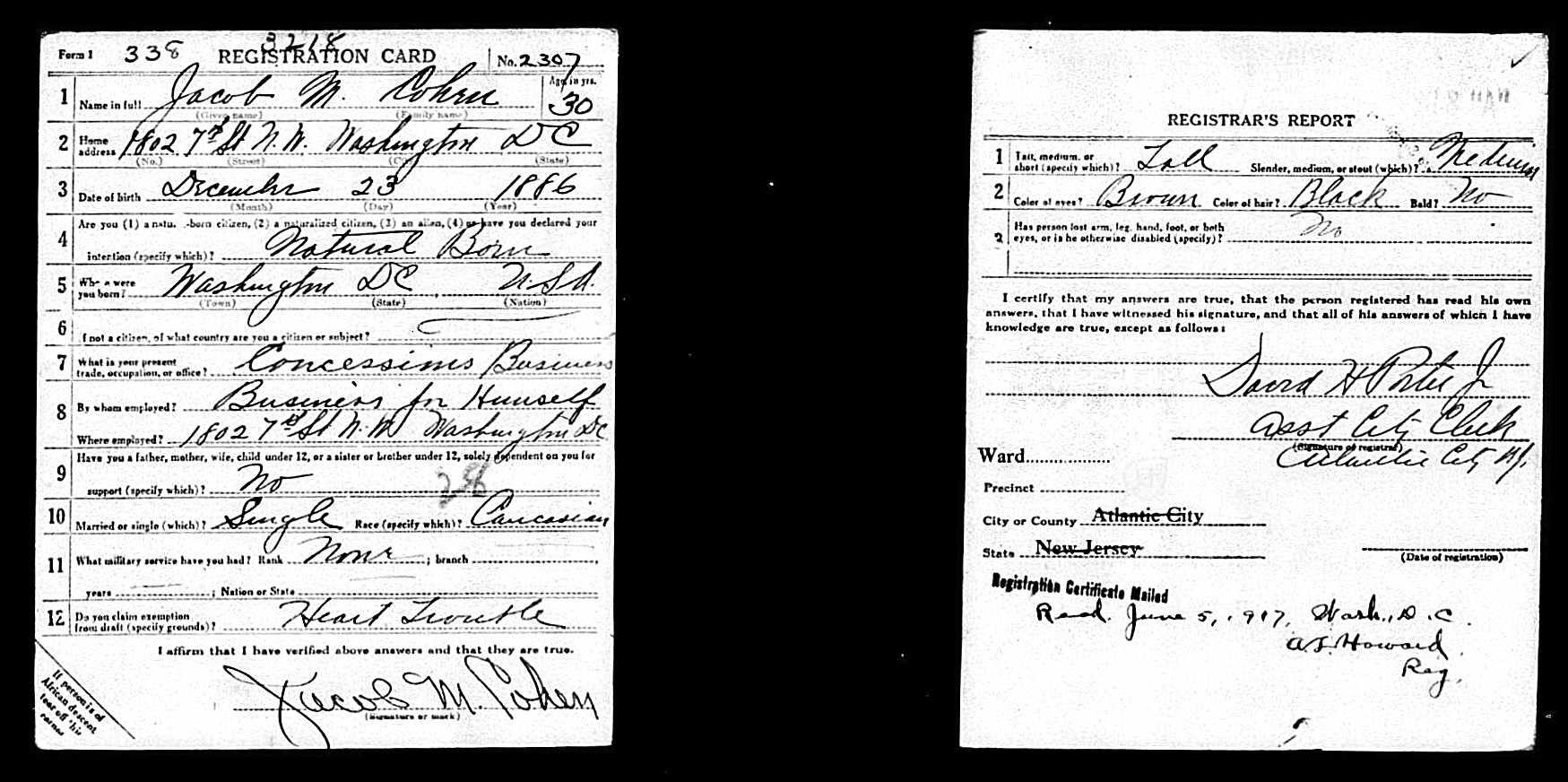
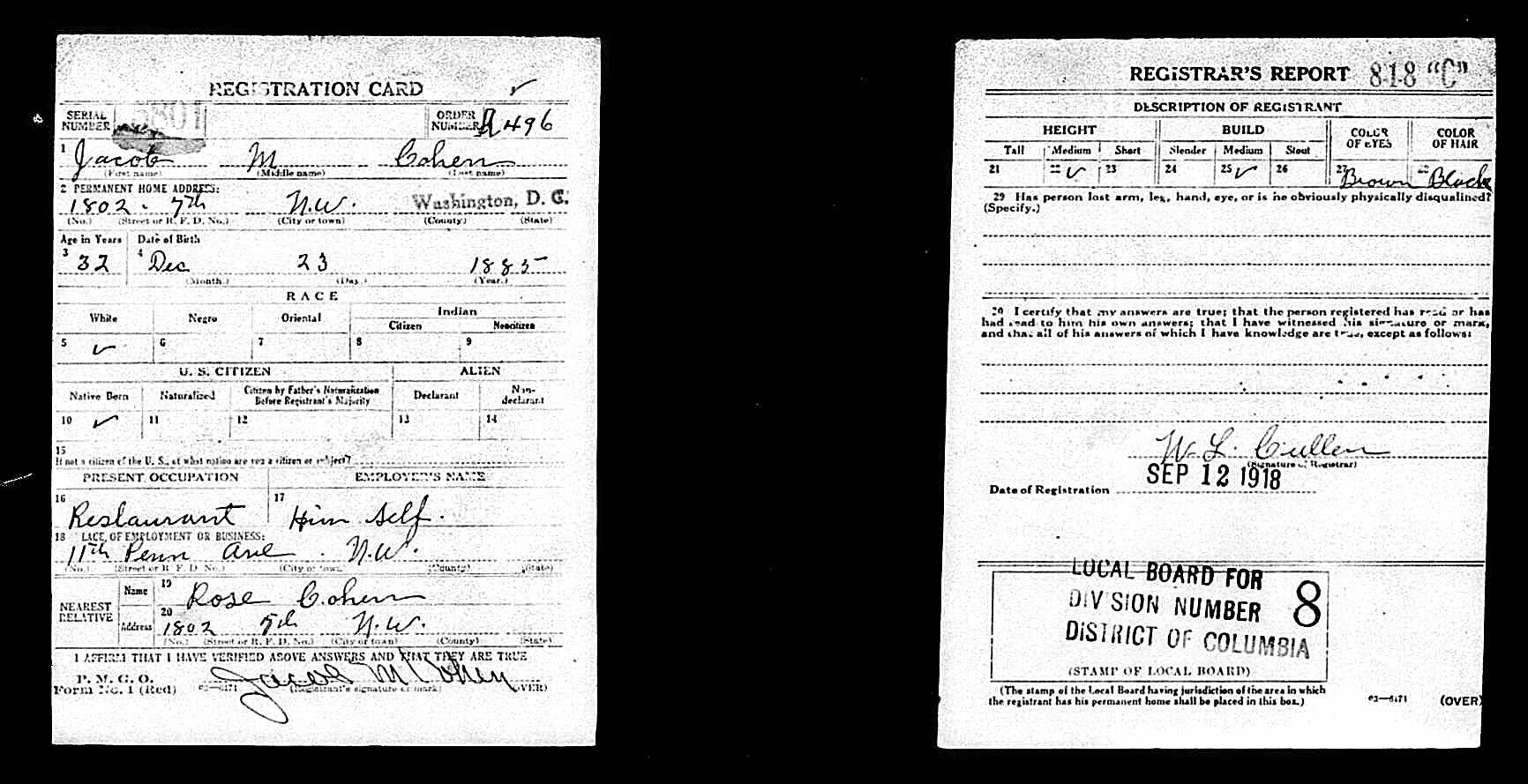
I found two World War I draft registrations for Jacob.  The earlier one, dated June, 1917, listed Jacob’s business as the concessions business and said he suffered from heart trouble.  His marital status was single, and he was living with his father and his sister Frances at 1802 7th Street NW in Washington.  The second one, dated September 1918, had a number of changes:  he was working in the restaurant business and was self-employed, he was married, and there was no mention of heart trouble.

Jacob M. Cohen World War I registration (first)

Jacob M. Cohen World War I registration (first)

Jacob M. Cohen World War I registration (second)

Jacob M. Cohen World War I registration (second)

According to the Philadelphia marriage index, Jacob had married Rose Serge in Philadelphia in 1918.  He was 33, and she was thirty when they married.   In 1918, they were living at 1802 7th Street with Jacob’s father and sister Frances.

In 1920, Hart and his daughter Frances were still living at 1802 7th Street, but Jacob and Rose had moved to their own place in Washington.  Jacob was still in the restaurant business.  Isadore and his family were also still living in Washington, and Isadore was still in the hotel business.

On August 10, 1926, Hart died at the age of 75.  His daughter Frances continued to live in the same residence at 1802 7th Street, now living alone and working as a retail merchant in the dry goods business, a business she had been working in since at least 1915.  She would continue to work in that business until her death in February, 1941, at age 62, the same age her mother had been when she died.  Frances’ death notice said that she had died suddenly. She was buried at Washington Hebrew Cemetery.  There is no mention of her brother Jacob in her death notice, only mention of her brother Isadore.  Frances never married or had children.

Ancestry.com. Historical Newspapers, Birth, Marriage, & Death Announcements, 1851-2003 [database on-line]. Provo, UT, USA: Ancestry.com Operations Inc, 2006.

Ancestry.com. Historical Newspapers, Birth, Marriage, & Death Announcements, 1851-2003 [database on-line]. Provo, UT, USA: Ancestry.com Operations Inc, 2006.

In 1930 Jacob and Rose were living in Philadelphia, where Jacob was the manager of a restaurant.  I could not find Jacob or Rose on the 1940 census, nor can I find a death record for Jacob, but given that he was not listed in his sister’s obituary and that he had had a history of heart trouble, my guess is that he had died before the 1940 census. He would have been younger than 55 years old when he died.  He and Rose did not have any children.

Although I could not find Rose on the 1940 census, she was still alive in 1949, as I found her on a ship manifest traveling to Hawaii. According to the ship manifest Rose was living at 41 Emory Street in Jersey City, New Jersey, in 1949. Rose had lived in Jersey City as a child, and 41 Emory Street is where her mother had been living in 1925 and where two of her sisters were living in 1930. Obviously, Rose had returned to her hometown after Jacob died.  She was still alive in 1952 when her sister Minnie died, but after that I cannot find any mention or record for her.  I tried contacting the funeral home that had handled other deaths in the Serge family, Wien and Wien in New Jersey, but sadly their records for the Jersey City funeral home were burned in a fire fifteen years ago.  I also called the cemetery where Minnie is buried to see if they have any records for Jacob or Rose Cohen, but have not heard back from them.

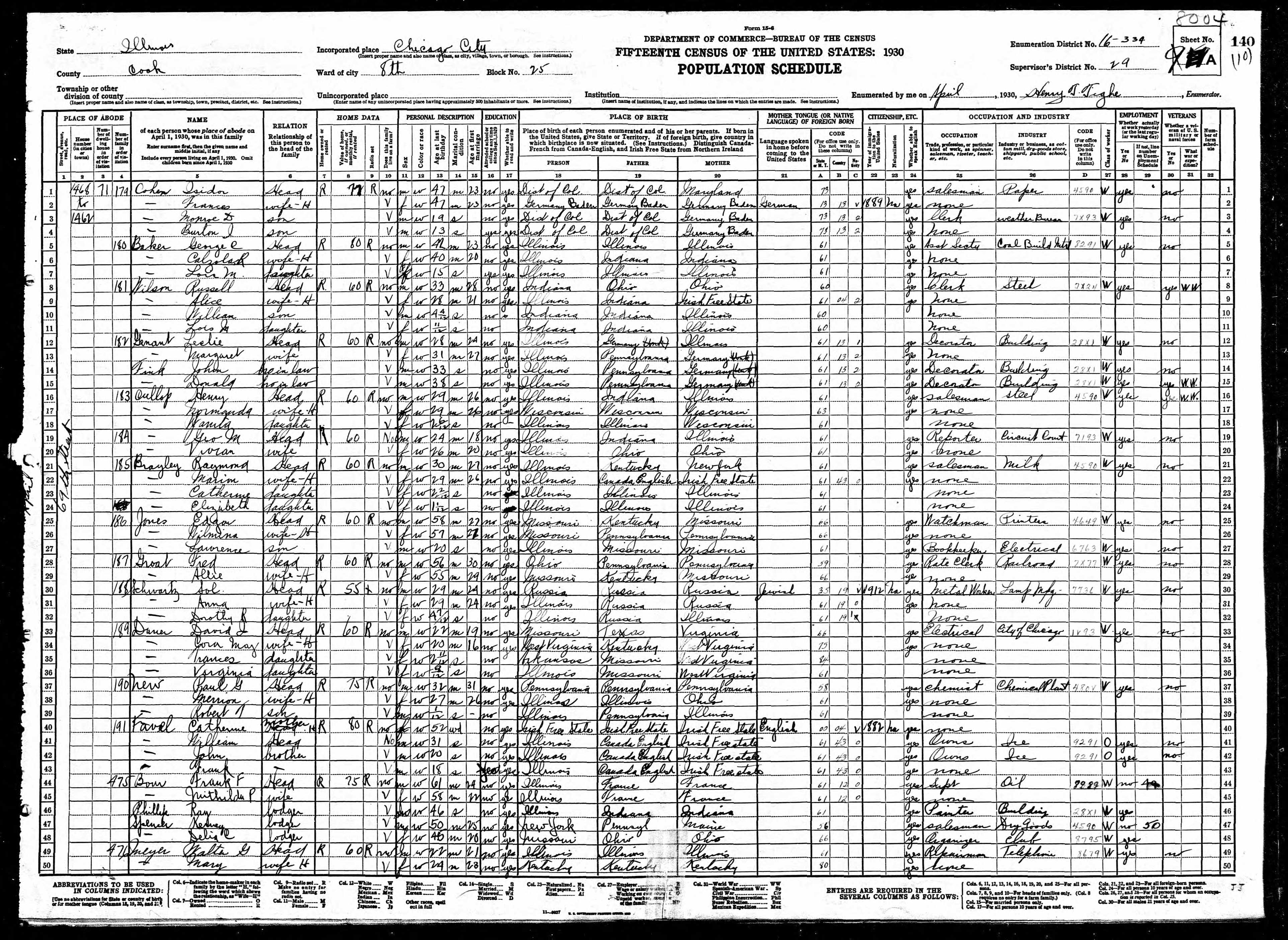
As for Isadore, in 1930, he and his family were living in Chicago, where Isadore was working as a salesman in the paper industry.  His son Monroe was a clerk in the weather bureau there.  I wonder what prompted the move to Chicago and the career change for Isadore.

Isadore Baer Cohen and family 1930 census

Isadore Baer Cohen and family 1930 census

In 1940, the family was still living together in Chicago, and Isadore was a book salesman. Both Monroe and Burton had changed their surname from Cohen to Coulter, though their parents were still using Cohen.   Although Monroe was now 30 and Burton 24, there is no occupation listed for either of them on the 1940 census.

Isadore Baer Cohen and family 1940 census

Isadore Baer Cohen and family 1940 census

By 1942, Isadore had retired, according to his draft registration.  He gave Burton’s name as his contact person, which I found interesting since his wife Frances was still alive at that time.

Isadore Baer Cohen World War II draft registration

Isadore Baer Cohen World War II draft registration

Sometime between 1942 and 1949, Isadore and Frances moved to California, where Frances died in 1949.  Isadore died in 1958 when he was 77 years old.  He lived a much longer life than any of his siblings or his mother.  His father Hart was the only other one to live past seventy.

According to his obituary in the Chicago Tribune of September 8, 1996, Isadore’s son Monroe Coulter had enlisted in the Army Air Corps before World War II and was an electrical engineer.  He married Fannie Simon on November 25, 1942, in Chicago and appears to have settled in Illinois. They had two children.   Monroe worked on the Air Force missile program and retired from the military in 1970 with the rank of lieutenant colonel.  He was living in Itasca, Illinois, when he died on September 6, 1996, and is buried at Shalom Memorial Park in Arlington Heights, Illinois.

His brother Burton moved to California in the 1950s.  He was married and had two children.  In 1952 he was working as the deputy county assessor in Alhambra, California, according to a directory for that city. Then, according to Sacramento city directories,  from at least 1959 through 1966 he lived in Sacramento and worked as an appraiser for the California Department of Equalization, a state agency responsible for administering the state tax laws.   Burton died in Los Angeles, California in 1978.  He was only 61 years old and thus was another family member who did not live to see seventy.

The family line of Hart and Henrietta Cohen thus is somewhat limited.  Of the four children of Hart and Henrietta, only Isadore lived past seventy, and only Isadore had children. Frances never married, and Jacob married, but did not have children. Munroe, Jacob, and Frances all died at relatively young ages, as did their mother Henrietta.  Although Munroe died in an accident, I do not know what led to the early deaths of Henrietta, Frances and Jacob, but will see if I can find out.

I am hoping that one of Isadore’s descendants will be able to provide a Y-DNA test to provide evidence of the genetic link between Moses Cohen, Sr., and my great-great-grandfather Jacob Cohen, but I am having some trouble making contact with them.  They are the only direct male genetic descendants of Moses Cohen, Sr. and thus my only option for finding that genetic connection between Moses and Jacob.  Maybe one of them will find this blog post and find me.


820 F Street: Follow Up


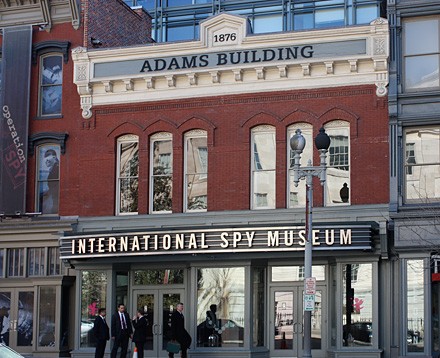
File:International Spy Museum.JPG

The 800 block of F Street, NW, Washington, DC
Photo by AgnosticPreachersKid at en.wikipedia


In my post yesterday about Selinger’s jewelry store at 820 F Street in Washington, DC, I had asked about that location and what might have been reflected in the windows of the store.  My ever-reliable medical consultant/cemetery photographer is now also my Washington architectural researcher.  He sent me this link that provided this information about the history of one of the buildings on that block, the Adam House, that may have housed the Selinger store:

“The building, built in 1878, was originally leased to J. Bradley Adams, its namesake. Adams, a book salesman and stationer, later owned the building. The building housed an impressive amount of retail establishments and offices throughout the years. The building is done in a High Victorian Italianate style, with friezes and ornate moldings, as well as a gable with the year the structure was built (either 1876 or 1878, it’s unclear).”

http://dcist.com/2011/01/looking_back_adams_buildinginternat.php#photo-1

My brother also found this website, which includes the same photograph of Selinger’s jewelry store and dates it as taken in 1920[1], after World War I, when there was suddenly a surplus of military watches available for sale to the public.  On this page, I also found an ad for Selinger’s from the Washington Post in May, 1920, reinforcing the conclusion that the photo was taken in 1920.  Neither of these pages indicates who took the photograph or for what purpose.  (I had originally thought that the photograph was a family photograph, but it appears not to have been.)

UPDATE: My cousin and fellow genealogist Jean Cohen found this information about the Selinger photograph from the Library of Congress at http://www.loc.gov/pictures/item/npc2008009720/

Title: Selinger front, 820 F, N.W., [Washington, D.C.]
Date Created/Published: [ca. 1920]
Medium: 1 negative : glass ; 8 x 6 in.
Reproduction Number: LC-DIG-npcc-29219 (digital file from original)
Rights Advisory: No known restrictions on publication.
Call Number: LC-F82- 4412 [P&P]
Repository: Library of Congress Prints and Photographs Division Washington, D.C. 20540 USA
Notes:
Title from unverified data provided by the National Photo Company on the negative or negative


The Library of Congress page also states that the photograph was a gift from Herbert A. French in 1947.  Herbert French was a  photographer as well as the owner of the National Photo Company; he donated his entire collection to the Library of Congress, including the photograph of Selinger’s.


1920_selinger_watch


The ad says that the store was located at the corner of 9th and F Street, so it might have been in the Warder Building,  which was built in 1892  near the Adams House.


969 NORTH ELEVATION (FRONT)


Both buildings are today used to house the International Spy Museum.


Int  Spt Museum 820 F St


The building across the street, seen in the reflection of the Selinger’s window, is the Donald W. Reynolds Center for American Art and Portraiture, part of the Smithsonian.  It was originally the building for the US Patent Office.


Old Patent Office Building, Washington D.C.

Old Patent Office Building, Washington D.C. (Photo credit: Wikipedia)

F Street NW, view from Patent Office - Washing...

F Street NW, view from Patent Office – Washington, D.C. (Photo credit: Wikipedia)

Thank you to my brother Ira for finding most of these sources.


[1] For those who may wonder, a photograph taken in 1920 would no longer have a valid US copyright and is thus in the public domain.  Shorpy’s may be selling copies of it, but that does not include or suggest a copyright still exists on the photo.


Wonderful Surprises and Gifts

I had two wonderful surprises this week.  Usually I am hunting down family members, hoping for a response.  Twice this week I heard from relatives who found me.

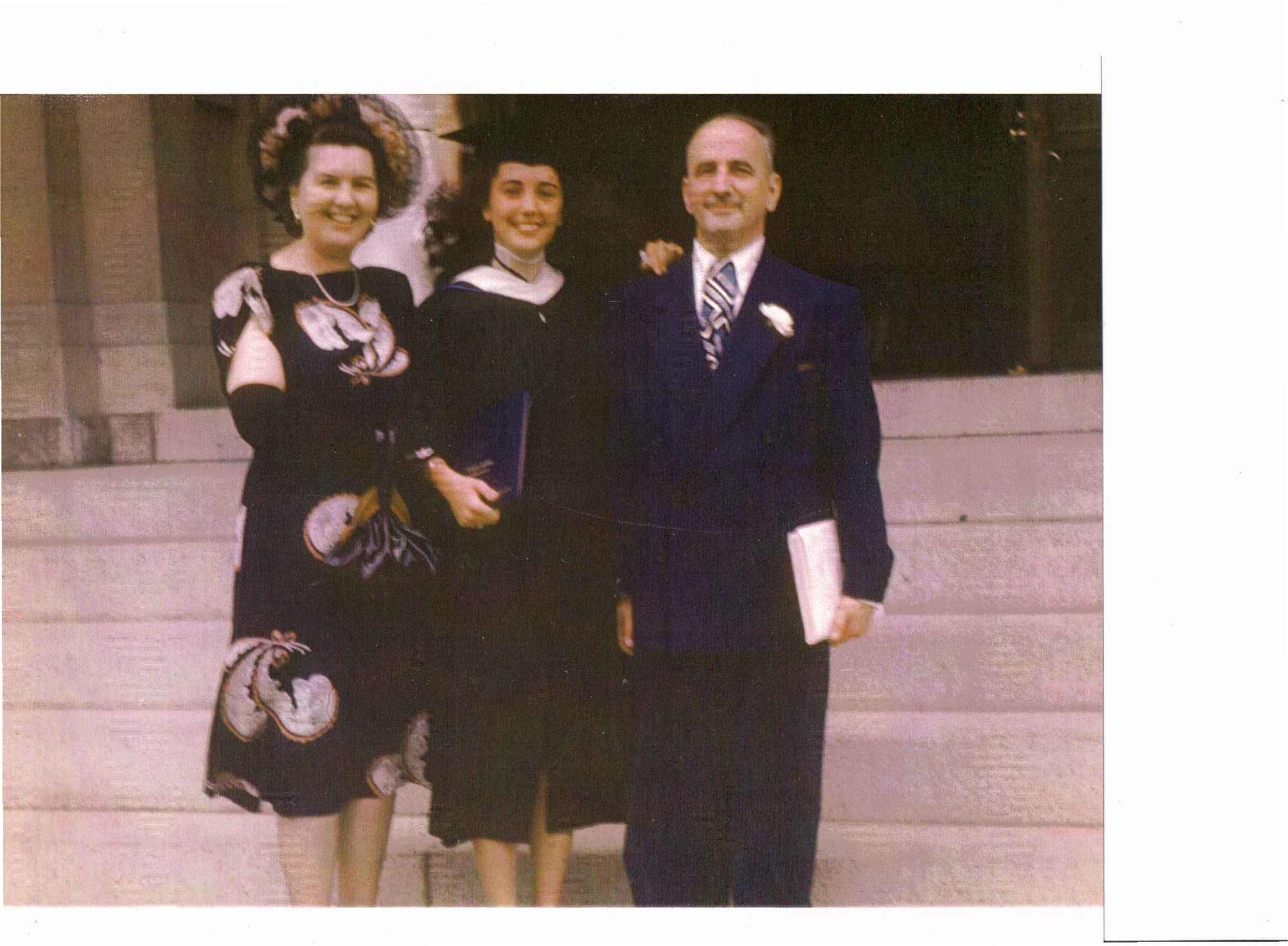
Lou, a relative by marriage, is a cousin of my cousin Marjorie.  He had visited Marjorie recently and heard about my contact with her.  He sent me two wonderful photographs of Marjorie.  One is posted here: a photograph of Marjorie and her parents, Bessie and Stanley Cohen, at her graduation from Trinity College in Washington, DC, probably around 1947.  I’d never seen a picture of any of these family members before, and it was so meaningful to be able to see Marjorie’s face after spending time getting to know her on the phone this summer.  I hope to be able to meet her in person in the coming months.  I also was excited to see what my great-uncle Stanley looked like and what his wife Bessie looked like.   It really helps to bring these people to life when you can put a face to the name.  Bessie and Stanley look so proud of their daughter, a college graduate back when most women did not even dream of going to college.  (The second photograph I will post when I get to my Seligman relatives as it depicts two of them.)

Bessie and Stanley Cohen with their daughter Marjorie at her graduation

Bessie and Stanley Cohen with their daughter Marjorie at her graduation

The second wonderful surprise came in the form of a comment on the blog from a descendant of Julius and Augusta Selinger, their great-grandson Cito.  He had just accidentally found the blog while searching for something else and was pleased to see and learn more about his family’s history.

He then sent me this wonderful photograph of his great-grandfather Julius’ jewelry store.  Although the photograph is not dated, if you look at it closely, you can read the larger sign in the window that says “Sale…Watches…$4,” and see at the bottom “Price during the War +15.”  I am not exactly sure what that means, but I assume that the reference is to World War I, dating the photograph during the second decade of the 20th century.

Selinger's Jewelry Store 820 F Street, Washington, DC

Selinger’s Jewelry Store 820 F Street, Washington, DC

That makes sense because the young woman to the right standing in the doorway is assumed by the family to be Eleanor Selinger, the daughter of Julius and Augusta who married Henry Abbot and moved to London in 1926.  Eleanor would have been about 22 years old in 1917 when the US entered World War I.  I love being able to see Eleanor’s face also.  She has such a searching, pensive look on her face—what was she thinking?  You can see the reflections of a crowd of people looking into the window as well as some of the buildings across the way.  The store was at 820 F Street in Washington, DC.  Perhaps some of you recognize that location?

Thanks to both Lou and Cito for generously sharing these photographs and for contacting me.  I am so happy that you both were able to find me.  I also received photographs from another family member this week, my cousin Jack, the great-grandson of Joseph Cohen, who was my great-grandfather Emanuel’s older brother.  I will post some of those photographs next week after I have a chance to scan them.

So it’s been a great week to be doing genealogy research.  I am feeling very fortunate for all the gifts that genealogy has provided to me.  Happy Labor Day Weekend, everyone!


Grandsons and Memories

The last five days were spent with my grandsons Nate and, for two of those days, Remy.  Nate came back to our house for three days, and I just had the best time with him, doing not much of anything special, but just enjoying him and seeing life through his eyes.  Being with my grandsons makes me think about how important those first few years of life are—how they form us, teach us about the world, and introduce us to relationships, love, trust, friendship, and family.

I was fortunate to get a box of old photographs from my cousin Jody a few weeks ago, and I spent one day last week scanning those photos, many of which will eventually get posted on the blog.  But for today, as I think about being with Nate and Remy, I want to recognize those people I spent most of my time with during the early years of my own life—my parents, my grandparents, my aunt and uncle, and my older cousin Jeff.  We all lived within a few minutes of each other in Parkchester, a large apartment complex in the Bronx, and I probably saw them every day or almost every day during those years.  We also spent summers together near Lake Mahopac, New York, on Long Pond.  They called me Kugel, or Amy Kugel, or sometimes just Kug–the only people who ever did.  (My mother still occasionally does.)

They made me feel loved, and they gave me a sense of family that has stayed with me all my life.  I can only hope that we are doing the same for Nate and Remy, even though we don’t live close enough to be with them as much as I was able to be with my grandparents at their ages.   Although I don’t have many specific concrete memories of those years, these photographs capture those magical years of my early life.

amy florence abt 1954

My mother

amy and john 1954 abt

My father

Amy Gussie and Isadore

My Grandparents

elaine and amy 1953

My Aunt Elaine

My cousin Jeff

My cousin Jeff

Jeff and Amy

Jeff

jeff gussie amy 1955 abt

Jeff, my grandmother, and me


Ray and Leah: Two Beautiful Portraits

When I published the photograph of Ray Strolowitz Adler several days ago, my cousin Jean emailed me to say that she was struck by the similarity between that photograph and one she had sent me months ago of her grandmother Leah Strolowitz Adler, Ray’s younger sister.  Looking at both photographs more carefully, you can see that they were taken at the same studio with Leah and Ray standing in similar poses.  You can definitely see the family resemblance between the two sisters.

Leah Strolowitz Adler

Leah Strolowitz Adler

Ray Strolowitz Adler

Ray Strolowitz Adler

In rescanning the photo of Leah, Jean took it out of the frame and found this inscription on the back.

back of photo sept 1918 cropped

If both photos were in fact taken at the same time in 1918, this would have been after Ray was married and a few years before Leah married.

I wonder if all the siblings had these portraits done.  Unfortunately, the others may have been lost forever.  It always surprises me when I see studio portraits of the recent immigrants who could not have had a lot of extra money to spend on luxuries, yet so many of them did have these photographs done.  I am so glad they did, and I am so lucky that their descendants were willing to share these two with me.

The Flat: A film by Arnon Goldfinger


The other night we watched a fascinating movie, The Flat. It is a documentary made by Arnon Goldfinger about what he learns about his grandparents after his grandmother dies and he and his family clean out their apartment in Tel Aviv. His grandparents had lived in Berlin until 1936 when they left for Israel. Goldfinger and his family, including his mother, had almost no knowledge of the grandparents’ lives before they left Germany.

I do not want to reveal too much about what they learn because each viewer should be able to experience the revelations as they are uncovered in the course of the film. But I will say that this is a film that anyone interested in family history and the ethical dilemmas that are created when you learn something surprising and perhaps troubling about the past should watch. What is our obligation to reveal the truths we learn to those left behind, even if they were innocent of the past actions of their family members? Why do people hide from the truth? Why do some of us ask questions and seek answers whereas others prefer to avoid uncovering the past?

But this is not only a film for genealogists. It is a film for everyone who has an interest in human nature. The film addresses important questions of identity and nationality. What makes people identify with a country, a religion, a family? How do we pick our friends? How does denial play into our sense of who we are?

Finally, this is also a film about our legacy. What will our families do and think after we are gone?  When the family throws out bag after bag after bag of the treasured belongings of the grandparents, I couldn’t help but think about the way we all collect objects—clothing, books, jewelry, letters, photographs—that our descendants will toss away with barely a thought. We have to leave something else behind besides these material things—our good name, our good deeds, our stories, and our love. All else will vanish.

Solomon Monroe Cohen/Cole: Post Script

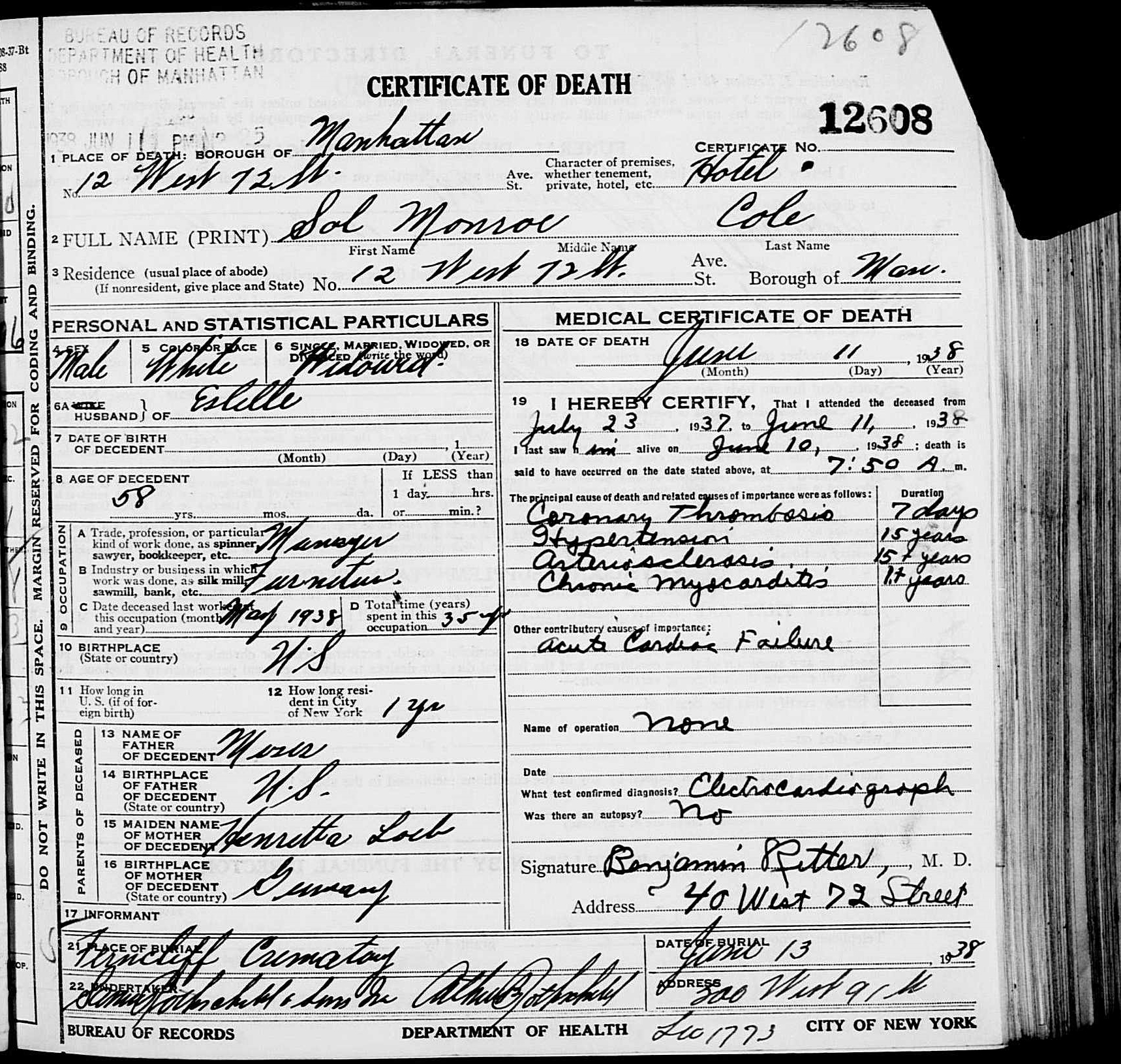
Yesterday I received a copy of the death certificate of Sol Cole, who died on June 11, 1938.

I learned a number of things from this document.  First, Sol died of heart disease when he was only 58 years old.  He had had hypertension and arteriosclerosis for fifteen years and myocarditis for over a year, and then for a week before he died, he suffered from coronary thrombosis and finally acute cardiac failure.  He had been under the same doctor’s care for close to a year and had been living in New York City for about the same period of time.

sol cole death cert page 1

He had been living at 12 West 72nd Street in what was then a hotel, located less than a block from Central Park.  The certificate indicates that he was working up until a month before he died as a manager in the furniture business, the same industry he had been working in for 35 years, starting in Detroit, then in Columbus, and ultimately in New York City.

sol cole death cert page 2

The certificate also corroborated the fact that Estelle had predeceased him, as he was a widower at the time of his death.  Sol’s remains were cremated by Ferncliff Crematory, and both of his sons, Ralph and Robert, signed a sworn statement to the New York City Department of Health that it had been their father’s wish to be cremated.  I called Ferncliff to see if they had any records for Estelle, but they did not; they only had records for Sol.  Although I cannot be certain, my hunch is that Sol moved to New York after Estelle died since there is no record of her death in New York City nor were her remains handled by the same institution.  I still do not know when or where Estelle died, but I will focus on Ohio as that is where I know she was living as of 1935.