Myer and Helen Wolf Cohen and their Children: The American Dream

Myer Cohen, Sr., was the second child of Moses, Jr. and Henrietta Cohen.  As described earlier, he was a lawyer, perhaps the first in the extended Cohen family.  He had married Helen Wolf, daughter of the esteemed Simon Wolf, and they had five children between the years 1891 and 1907.  In 1910, all five children were still living at home, and Myer was engaged in the general practice of law.

As reported earlier, their daughter Marjorie died in 1920 as a young woman.  According to the town clerk in Saranac Lake where Marjorie died in 1920, she died from tuberculosis; the clerk also confirmed that there were several hospitals in the area where TB patients went for treatment.

In 1921, Myer, Sr., was written up in Who’s Who in the Nation’s Capital (Consolidated Publishing Company, 1921) as follows:

Who's Who in the Nation's Capital (1921) found on Google Books

Who’s Who in the Nation’s Capital (1921) found on Google Books

Myer died in 1930, and Helen died in 1949.  They are buried at the Washington Hebrew Congregation cemetery.

Myer Cohen, Sr. headstone

Myer Cohen, Sr. headstone


Ruth, their oldest daughter, married Harold B. Chase, the son of Plimpton B. Chase and Anna Bird of Ohio, on October 29, 1913.  Ruth and Harold were the couple who traveled with Harold’s recently widowed sister Ethel Chase Keith to England and probably also introduced her to Ruth’s cousin Jerome Selinger, whom she later married. In following up on my research of Ruth and Harold, I found this New York Times article about their wedding and that of Ethel Chase and B.F. Keith:

BF Keith wedding-page-001


I wonder how Harold and Ruth felt about B.F. Keith and Ethel Chase stealing their thunder on their wedding day!

Harold had graduated from the University of Pennsylvania in 1911 and from Georgetown Law School in 1914, bringing another lawyer into Myer’s family, although it does not appear that Harold ever practiced law. ( See Abraham J. Baughman, Robert Franklin Bartlett, History of Morrow County, Ohio: A Narrative Account of Its Historical Progress, Its People, and Its Principal Interests, Volume 2 (1911) (Google eBook), p. 744)

Harold B Chase U Penn alumni directory 1917

Harold B Chase U Penn alumni directory 1917 Ancestry.com. U.S., School Catalogs, 1765-1935 [database on-line]. Provo, UT, USA: Ancestry.com Operations, Inc., 2012. Original data: Educational Institutions. American Antiquarian Society, Worcester, Massachusetts

In December 1915, Ruth and Harold had a daughter, Ann Beverly Chase.  In 1917 they were living in Toledo, Ohio, where Harold was then secretary and treasurer of Standard Steel Tube Company, a company owned in part by Harold’s father, who had acquired it in 1915.

In January, 1919, their three year old daughter Ann died of meningitis while the family was visiting Harold’s parents in St. Augustine, Florida, according to an obituary published in the St. Augustine Record of January 31, 1919.

Although the family was still living in Ohio in 1920, when their son Harold, Jr., was born, by 1922 Harold and Ruth had moved to Worcester, Massachusetts, where they were to live for the rest of their lives.  Harold was the owner and president of Chase Motor Cars, a car dealership, for many years, and both Harold and Ruth seem to have been quite active in a number of community organizations and clubs, according to various newspaper reports and documents.  Harold wrote an autobiography entitled Auto-biography: Recollections of a Pioneer Motorist, 1896 to 1911 (Pageant Press, 1955); unfortunately, it seems to be out of print and not available.

Harold, Sr., died in January, 1964, and Ruth, the daughter of Myer, Sr. and Helen Cohen, died in October, 1984. Ruth returned to the Washington area after Harold died.   Despite living for so many years in Worcester, both Harold and Ruth were buried in Ohio at Bloomfield Cemetery with their little daughter, Ann, as well as many members of Harold’s extended family.

Their son Harold, Jr., served in the US Air Force for many years in Colorado Springs, Colorado and then lived in Alexandria, Virginia; he died in 2006 and is buried at Arlington National Cemetery.

Myer and Helen’s second child, Edith, married Alexander Ceal Robeson on December 27, 1919.  Alexander, who was known as Zanny according to family members, was a lawyer in a general practice in Washington, DC, like his father-in-law Myer, according to the 1930 census and several city directories.  He was a 1916 graduate of George Washington Law School.  Edith and Zanny had one child, a son, Alexander C. Robeson, Jr., who was born April 13, 1923.  Zanny died July 26, 1972, in Washington, DC., and Edith died at age 90 in September, 1983.  Their son, who was intellectually challenged, lived as an adult in Innisfree Village in Crozet, Virginia, for some time; when Edith died, the family asked that donations be made to that institution in her memory.  Alexander, Jr., died December 15, 1996. His death notice said he was a retired weaver.    (Richmond Times-Dispatch (VA) – Wednesday, December 4, 1996)

Edith Cohen Robeson death notice 1983 Ancestry.com. Historical Newspapers, Birth, Marriage, & Death Announcements, 1851-2003 [database on-line]. Provo, UT, USA: Ancestry.com Operations Inc, 2006.

Edith Cohen Robeson death notice 1983 Ancestry.com. Historical Newspapers, Birth, Marriage, & Death Announcements, 1851-2003 [database on-line]. Provo, UT, USA: Ancestry.com Operations Inc, 2006.


Edith Cohen Robeson courtesy of Jane and Scott Cohen

Edith Cohen Robeson, photo courtesy of Jane and Scott Cohen

Roger Stahel Cohen was the fourth child and first son of Myer and Helen Cohen.

Roger Stahel Cohen as a young man, photo courtesy of Jane and Scott Cohen

Roger Stahel Cohen as a young man, photo courtesy of Jane and Scott Cohen

Unlike his father and brothers-in-law, he did not become a lawyer but instead became a doctor.  Roger went to Princeton University, graduating in 1919. The family said that he also served in World War I, but I have been unable to find a military record.  Since he was born in 1898, was already at age 19 at Princeton when the US entered the war in 1917, and was still at Princeton to graduate at age 21 in 1919, I had assumed he had been in school throughout the war. His tombstone in Arlington National Cemetery says that he served in World War I and World War II, achieving the rank of Commander (the family indicated the tombstone is incorrect and he achieved the rank of lieutenant commander), so somehow Roger must have taken time off from Princeton to serve and still manage to graduate when he was only 21 years old.

Roger Stahel Cohen headstone

Roger was living at home with his parents in 1920 and working as a law clerk, according to the 1920 census, but then went to George Washington University for medical school, graduating in 1924, according to his family.  After graduating from medical school, Roger married Lee Lenthal Towers on December 17, 1924. In 1926, he was a junior medical officer at St. Elizabeth’s Hospital, according to the Washington city directory for that year. The family has a graduation certificate for Roger Sr. from the University of Vienna showing that he studied there from October 3, 1927 to September 29, 1928.  According to family sources, Roger, Sr., said he studied under Sigmund Freud at the University of Vienna. By 1930 he was back in Washington, practicing psychiatry at Johns Hopkins Hospital in Baltimore, according to the 1930 census.

Meanwhile, Roger and Lee were also having children.  They had four children born between 1925 and 1931, and after a time in Baltimore, returned to the Washington, DC, area, where they settled and raised their family.  Roger was stationed for some time in San Francisco with the Navy during World War II, and the family has a 1959 letter from Dwight D. Eisenhower, appointing him to serve on the Board of Veterans Appeals. The family also told me that Roger and the family enjoyed vacationing in Point Lookout, Maryland, and at 13th Lake in upstate New York.  He loved photography and his grandchildren and combined the two loves, taking many pictures of his grandchildren.  Sadly, Roger died of a brain tumor on December 14, 1963, when he was only 65 years old.  His widow Lee continued to live in the DC area until she died in May, 1980.

Roger Stahel Cohen, Sr., photo courtesy of Jane and Scott Cohen

Roger Stahel Cohen, Sr., photo courtesy of Jane and Scott Cohen

Lee Towers Cohen  photo courtesy of Jane and Scott Cohen

Lee Towers Cohen
photo courtesy of Jane and Scott Cohen

The youngest child of Myer and Helen Cohen was Myer Cohen, Jr., born in 1907, almost ten years after Roger, the sibling closest to him in age.

Roger and Myer, Jr., c. 1909, photo courtesy of Jane and Scott Cohen

Roger and Myer, Jr., c. 1909, photo courtesy of Jane and Scott Cohen

Myer, Jr., was still living at home in 1920 and in 1930. Myer went to Swarthmore College, where he was an honors student, a member of the Wharton Club, the Philosophy Club,  and the Men’s Debate Club as well as on the staff of the yearbook, the Halcyon.  This is how he was described in that yearbook:

Myer Cohen Jr 1929 Halcyon yearbook

1929 Swarthmore College yearbook The Halcyon https://archive.org/stream/halcyon1929unse#page/84

1929 Swarthmore College yearbook The Halcyon
https://archive.org/stream/halcyon1929unse#page/84

After college, Myer made trips across the Atlantic in 1928, 1929, and 1930.  In 1932, he again traveled overseas, giving his residence as New Haven, Connecticut, where he was a graduate student at Yale.  I would think that these trips were related to his graduate work. Myer’s study of German must have been useful in his graduate studies. Myer received his Ph.D. from Yale in 1935 based on his dissertation, “Austria: An International Problem.”  I tried to locate a copy of it online, but could not find it.  It would be interesting to know what Myer’s thoughts were on what was happening in Europe at the time.

On August 21, 1933, Myer, Jr., married Elizabeth Elson, who was Russian born, but had immigrated to the United States in 1906 when she was two years old and had settled with her family in Chicago. Myer and Elizabeth were married in Chicago, and according to the 1940 census, in 1935 Myer and Elizabeth were residing in New Haven. After receiving his degree, Myer and Elizabeth relocated to San Francisco, where their two children were born, one born in 1937, the other in 1938.    According to the 1940 census, Myer was working as a private school teacher in San Francisco.

Although I cannot locate any military records for Myer, after World War II he definitely had a change of careers.  In 1945 he made the first of many trips to England; his residence was now Silver Spring, MD.  In 1946 he made at least two trips, one in June and one in October.  According to the airline manifest for the June trip, Myer was working for the UN BRA headquarters in Washington as the director of repatriation and (I think) relief division.

Ancestry.com. New York, Passenger Lists, 1820-1957 [database on-line]. Provo, UT, USA: Ancestry.com Operations, Inc., 2010. Original data: Passenger Lists of Vessels Arriving at New York, New York, 1820-1897. Microfilm Publication M237,

Ancestry.com. New York, Passenger Lists, 1820-1957 [database on-line]. Provo, UT, USA: Ancestry.com Operations, Inc., 2010.
Original data: Passenger Lists of Vessels Arriving at New York, New York, 1820-1897. Microfilm Publication M237,

Although I could not find an explanation for UN BRA, I found that acronym in several places with reference to the UNRRA, the United Nations  Relief  and Rehabilitation Administration, an organization involved in providing relief to refugees in Europe after the war.  I assume that Myer’s work was related to this endeavor.  The October trip in 1946 was on a flight from Berlin to Frankfurt to New York, and Myer’s address was now Chevy Chase, Maryland, and he was flying on a military permit.  Once again, his German studies must have come in handy.

In 1950, Myer again traveled to Europe, and the manifest for his flight from Zurich to New York has his address as “c/o I.R.O. Washington, DC,” and states that he was an O.I.R. director.   He was traveling with two other people involved with the same agency.  I could not find one definitive meaning for O.I.R or I.R.O, but given Myer’s work in 1946, this might be Office of International Relief and International Relief or Relations Organization.  I need to check further.  A later trip with Elizabeth to Europe in 1954 also lists their residence as Washington, DC.

Eventually, Myer rose to a fairly high level post within the United Nations. In 1962 he was the Director of Operations for the UN Special Fund, a fund created in 1958 by the UN General Assembly “in order to enlarge the scope of the UN programme of technical assistance in certain basic fields.”

UNDP Approves $1.5 Million Agreement to Expand Training Activities at International Institute of Seismology in Japan

UNDP Approves $1.5 Million Agreement to Expand Training Activities at International Institute of Seismology in Japan Ambassador Senjin Tsuruoka, Permanent Representative of Japan, is seen signing the agreement. At left is Mr. Myer Cohen, UNDP Assistant Administrator and Director of the Operations and Planning Bureau. At right is Mr. Tadayuki Monoyama, Second Secretary, Mission of Japan to the UN 27 March 1969 United Nations, New York http://www.unmultimedia.org/photo/detail.jsp?id=124/124433&key=89&query=undp&so=0&sf=date

In 1969 Myer, Jr., was the Assistant Administrator and Director of Operations and Planning for the UNDP, the United Nations Development Programme, an agency involved in assisting developing nations.

Special Fund to Aid in Land and Water Surveys in Northern Rhodesia

Special Fund to Aid in Land and Water Surveys in Northern Rhodesia An agreement laying down conditions for the surveying of the land and water resources of the Kafue River Basin in Northern Rhodesia was signed this morning at United Nations Headquarters by representatives of the UN Special Fund and the United Kingdom Government on behalf of the Federation of Rhodesia and Nyasaland. Signing the agreement are Mr. Paul G. Hoffman (left), Managing Director of the Special Fund, and Sir Patrick Dean, Permanent Representative of the United Kingdom to the United Nations. Looking on are (1eft to right) Mr. Roberto M. Heurtematte, Associate Managing Director of the Special Fund; Mr. Myer Cohen, Director of Operations, Special Fund; and Sri Ram Vasudev, Special Fund project officer. 23 February 1962 http://www.unmultimedia.org/photo/detail.jsp?id=167/167583&key=73&query=acess%20water&so=0&sf=date

Myer, Jr., and Elizabeth ultimately retired to Newtown, Pennsylvania, where Myer died on January 8, 2003, at the age of 95, and Elizabeth died on July 25, 2004.  She was a hundred years old.

Myer, Sr., and Helen Wolf Cohen must have been very proud of their children.  Although the family suffered some heartbreaks with the deaths of Marjorie and little Ann Chase and the challenges presented to Alexander Robeson, Jr., overall it was a family that prospered.  There were several lawyers and a psychiatrist in the family as well as a Ph.D and  UN official.  The family moved around a bit, but overall stayed close to their roots in the Washington, DC, area.  The family seems to have moved away from the strong Jewish involvement of Helen’s father Simon Wolf and Myer, Sr.’s father Moses Cohen, Jr., as they moved into mainstream America and achieved success in fields that seem quite distant from the family’s beginnings as peddlers and merchants and pawnbrokers.  In just two generations, the family had gone from struggling Jewish immigrants to full-fledged participants in the American dream.


The Children of Augusta Cohen and Julius Selinger


Julius and Augusta Cohen Selinger passport photos 1922

Julius and Augusta Cohen Selinger passport photos 1922

Moses, Jr., and Henrietta’s daughter Augusta celebrated her 25th wedding anniversary with her husband Julius Selinger in 1909, as described in my earlier post.  Their children were all still living at home as of 1910, but the next two decades would see them all finding their own independent paths.  Julius continued to work as a jeweler in his store, Selinger’s, and in 1922, he and Augusta along with their daughter Eleanor traveled to Germany, the British Isles, and France, apparently for health reasons, according to Julius’ passport application.  That application contains photographs of both Augusta and Julius, shown above.

Sydney, their oldest son, had become an optician as early as 1906 when he was 21 years old.  Although he was still living at home in 1910, on September 3, 1917 he married a woman named Grace Bloch.  Although I have not yet found an official marriage record,  I know from other records that Grace, Sydney’s wife, was born November 20, 1895 or 1896 in Danville, Pennsylvania, and I found this newspaper announcement of  the marriage of Sidney Selinger of Washington, DC, and a Ruth Bloch, daughter of Samuel Bloch,  in Danville, Pennsylvania.

Sydney and Grace Selinger marriage announcement 1917

Sydney and Grace Selinger marriage announcement 1917

(Sunday, September 9, 1917, Evening Star (Washington (DC), DC)   Page: 27)

I am not sure why the paper gave her name as Ruth, as every census report shows that Samuel Bloch’s daughter was named Grace.  But since they also spelled Sydney’s name incorrectly, I assume it was just an error.

Sydney and Grace did not have children, and they lived in Washington, DC, at least until 1940.  They both seemed to be working in the retail jewelry business in 1940, and even in 1930 Sydney listed his occupation as in the jewelry business, no longer as an optician, presumably in the family jewelry store, Selinger’s.  By 1956 Sydney and Grace had moved to Hollywood, Florida, where they lived for the rest of their lives.  Sydney died in May, 1967, and Grace three years later in May, 1970.

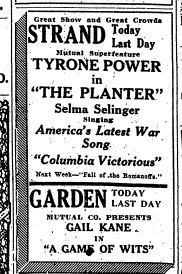
Selinger ad

Harry, the second son of Augusta and Julius Selinger, was in the Selinger’s jewelry business from at least 1910 when he was 22 until at least 1935, the date of the last record I have for him.  Harry claimed an exemption from the draft for unspecified physical reasons in 1917 and was still single at that time.  He married Mary Jessop on August 22, 1924, when he was 36; it appears that he and Mary did not have children either as there were none listed as living with them on the 1930 census when Mary was 43, six years older than Harry.  I could find no record of either Mary or Harry after 1935.

Both of the next two sons, Jerome and Maurice, became doctors.  I believe these may have been the first descendants of Hart Levy and Rachel Cohen to become doctors.  Both also served in World War I, as depicted in this picture of Jerome and Maurice in the Washington Evening Star in 1919.

Selinger brothers 1919 WW 1

(Sunday, January 5, 1919,Evening Star (Washington (DC), DC), Page: 62 )

Jerome served overseas from August 7, 1917 until March 1, 1919, serving as a doctor in a mobile hospital unit overseas.  Maurice also was already a doctor when he registered for the draft in 1917 and thus also must have served in a medical role during the war.  He graduated from Georgetown Medical School in 1915. (Wednesday, June 16, 1915, Evening Star (Washington (DC), DC)   Page: 11)

Jerome married a widow named Ethel Chase Keith in 1921. Ethel was born Ethel Bird Chase in Mt. Vernon, Ohio, on November 7, 1886, the daughter of Plimpton Beverly Chase and Anna Bird and a descendant of one of the oldest families in central Ohio. (Their home, the Beverly Mansion, is now used as an event venue.)

Ethel was a 1910 graduate of Bryn Mawr College. (Register of Alumnae and Former Students By Bryn Mawr College, Bryn Mawr, 1922, p. 28)      She had married Benjamin Franklin Keith in Washington, DC, on October 19, 1913, when she was 26, and he was 67.  Benjamin F. Keith was a widower, and he died the following year on March 26, 1914, just six months after marrying the much-younger Ethel Bird Chase.   Mr. Keith was a well-known entertainer and theater owner in Boston; the B.F. Keith Opera House was named in his memory (now just known as the Boston Opera House).

So how did Jerome meet Ethel, I wondered.  I found a passenger manifest dated August 23, 1914, just over five months after Keith’s death, listing Ethel Chase Keith as a passenger on a ship sailing from Liverpool, England, to Quebec, Canada.  At first I thought she was traveling alone, but then I noticed that the entries above hers were for a Harold B. Chase, born in Mt. Vernon, Ohio, obviously Ethel’s brother, and Harold’s wife Ruth Caroline Chase.

Ship manifest dated August 23, 1914 for the Megantic from Liverpool to Quebec

Ship manifest dated August 23, 1914 for the Megantic from Liverpool to Quebec

The names seemed familiar, so I checked my family tree, and sure enough, Myer Cohen, Sr., Jerome’s uncle, had a daughter Ruth who married a man named Harold Chase just about a year before in October 29, 1913, the same month that Ethel had married Benjamin F. Keith.  So Ethel must have either known Jerome already, as he was Ruth’s first cousin, or she was introduced to him by her brother and sister-in-law.  It appears that Ethel was living with Ruth and Harold at that time as well as traveling with them.  Unlike the case with  her first husband who was more than forty years older than she, this time Ethel married a man three years her junior.

Jerome and Ethel had two daughters, born in 1923 and 1928.  They lived in Huntington on Long Island, NY, then in Manhattan, and then in Fairfield County in Connecticut.  They were active in various charitable activities, and for some time Jerome was the health director for the town of New Canaan, Connecticut.  Jerome and Ethel did a great deal of traveling, according to the numerous passenger manifests.  According to Wikipedia, Ethel died in 1971.  Jerome lived until April, 1984, and was 94 when he died.

His younger brother and fellow doctor Maurice returned to Washington DC after World War I where he practiced medicine (a general practice, according to the 1930 census).  He was living with his parents and sister in 1920 and practicing medicine.  He married a woman named Mildred ( I have not yet located a marriage record for Maurice and Mildred).  Mildred was born December 23, 1899, in Easton, Pennsylvania, according to one ship manifest.  On the 1930 census they reported that they had been married for five years, so I am assuming they were married in 1925 or so.

Maurice Selinger and family 1930 census

Maurice Selinger and family 1930 census

They had two sons, one born in 1926 and the other in 1934.  In 1940, Maurice was still in a private medical practice, and in addition to his wife Mildred and their two sons, his father Julius was living with them.  Julius was now a widower, as Augusta had died in 1936 at age seventy.  Although I cannot find a death record for Julius, he was 87 in 1940, so I imagine that he died sometime in the next decade.  Maurice died on August 26, 1965, and was buried at Arlington National Cemetery.  His wife Mildred died March 27, 1981, and is buried beside him.

The youngest child and only daughter of Augusta and Julius was Eleanor.  Eleanor was still living at home in 1920, working as a bookkeeper at the jewelry store.  During the decade from 1910 to 1920, her comings and goings were recorded regularly in the Washington Evening Star—whether it was visiting her cousin Aimee Cohen in Baltimore or friends or other relatives, there were numerous society tidbits about her visits.  In 1922, she went with her parents to Europe, including England.  In 1924 she was still living at home and working as a bookkeeper.  In 1925 she traveled alone to England, and then I lost all evidence of her on ancestry.com.

Washington Star, January 16, 1916

Washington Star, January 16, 1916

I finally found a marriage record for her in familysearch.org; she married Henry Mortimer Abbot on March 25, 1926.  But then I could not find her as Eleanor Abbot.  A little more digging, and I finally realized that she and Henry were living in London.  Their marriage record said he was born in England, and the passenger manifest dated April 14, 1926, showed Eleanor and Henry Abbot traveling to England.  But then the 1928 directory for Washington, DC, listed Eleanor Abbot as residing in Washington without any listing for Henry.  I thought perhaps she had divorced Henry or perhaps he had died, but then there were many trips by Eleanor alone almost every other year through the 1920s and 1930s between England and the US.  I was quite perplexed.

Fortunately, I was able to find another family tree on ancestry.com which listed both Henry Abbot and Eleanor Selinger.  What was particularly interesting to me was that this tree revealed that Henry Abbot was originally Henry Auerbach, son of Hyams Auerbach and Helen Selinger.  Another Selinger? Helen Selinger was born in 1850 in Germany, according to that tree, making her a contemporary of Julius and Frederick Selinger, who were also born in Germany in the 1850s.  Could Helen be Julius’ sister or cousin? Had she arranged for her son to meet and marry Eleanor, his cousin? I don’t know the answer to those questions just yet, but I have a lead that may help me find out.

I contacted the owner of the Auerbach tree, and she wrote back to me telling me that Henry Auerbach/Abbot was her great-uncle, her father’s brother, and that she had visited Eleanor and Henry many times at their home in London and that they never had children.  She said that her father’s family, the Auerbach/Abbot family, was in the fur business and made many trips back and forth to the United States for business.  I asked her for more information about Henry and Eleanor and am awaiting her response.  Henry died in 1965, and Eleanor died in 1979.

Thus, the five children of Augusta Cohen and Julius Selinger all thrived as adults and seem to have had comfortable lives.  Three of their four sons stayed in Washington, DC, although Sydney eventually retired to Florida.  Two sons ended up in the family jewelry business, Sydney and Harry.  Two sons ended up as doctors, one in Washington and the other in New York and then Connecticut, and their daughter, a bookkeeper, ended up marrying an Englishman and moving to London.  Of the five children, only the two sons who were doctors had children, two each, so that Augusta and Julius had four grandchildren.  Two of their children, Jerome and Eleanor,  seem to have met their spouses through a family connection. Their parents, an immigrant and the daughter of an immigrant, must have been very proud of their children and their accomplishments.


Three Losses for the Family of Moses, Jr., and Henrietta Cohen 1918-1920

The years between 1910 and 1918 saw three major losses for the children of Moses, Jr. and Henrietta Cohen.  First, on March 20, 1918, Henrietta Loeb Cohen, Moses, Jr.,’s widow, died.  The Washington Evening Star ran this obituary:

Henrietta Loeb Cohen obituary March 21, 1918

Henrietta Loeb Cohen obituary March 21, 1918

(Thursday, March 21, 1918, Evening Star (Washington (DC), DC)   Page: 4)

It’s interesting that the obituary mentions only seven of Henrietta’s eight children, neglecting to mention Mabel.  Once again, there was an error in the number of children, as in Moses Jr.’s obituary, but this time it is more obvious who was omitted, the youngest child, the one with Down’s syndrome.  Was this something that was kept a secret, or was it just another error by the newspaper?

It certainly does not seem that Henrietta had forgotten her daughter Mabel.  She made a special provision for her in her will, ensuring that Mabel would be taken care of for the rest of her life:

Will of Henrietta Loeb Cohen

Will of Henrietta Loeb Cohen

(Tuesday, March 26, 1918 Paper: Evening Star (Washington (DC), DC) Page: 19) [Note the error in the headline—she was Mrs. Moses Cohen, not Mrs. Myer Cohen.]

Sadly, Mabel did not survive her mother for very long.  She died on September 25, 1918, just six months after her mother.  Mabel was only 35 years old.  Like her mother, she was buried in the Washington Hebrew Congregation cemetery.

The family suffered another terrible loss when Marjorie Cohen, the daughter of Myer Cohen, Sr., died on July 6, 1920, when she was only 23 years old.  I have not yet found a record or document that explains her death.

Although these losses must have been very painful for the family of Moses, Jr., and Henrietta, in many other ways those years were good to the family.  They did not lose one member to World War I, although three of Henrietta’s grandsons served in that war.  Three of the grandsons became doctors.  In the next series of posts, I will focus on each of the children and their offspring and the lives they lived, starting with the children of Augusta Cohen and her husband Julius Selinger, the jeweler.


Moses Cohen, Jr. and Henrietta Loeb Cohen headstone

Moses Cohen, Jr. and Henrietta Loeb Cohen headstone Photo courtesy of Ira Todd Cohen


What do those hands mean?

A few readers have asked me about the symbol on Moses Cohen, Sr.’s headstone:

Moses Cohen, Sr. headstone

Moses Cohen, Sr. headstone

The hands with the fingers separated is the traditional symbol of the Cohanim, the priestly tribe descended from Aaron. (Some may also remember it as the symbol used by Spock on Star Trek.)

The Cohanim hold their hands in that position when they perform the ritual of giving the priestly blessing to the congregation during certain services.  For more information on the symbol and the role of the Cohanim, here are a few links:


http://en.wikipedia.org/wiki/Priestly_Blessing

http://www.chabad.org/library/article_cdo/aid/762109/jewish/Raise-Your-Hand-If-Youre-A-Kohen.htm

http://judaism.about.com/od/shabbatprayersblessings/f/bless_kohanim.htm

Kohanim or Cohanim Hands – Priestly Blessing

The last link also discusses other traditional symbols found on Jewish headstones.

Fact versus Fiction


The story of Jacob M. Cohen II who allegedly stole jewelry from his father’s store, pawned it, and ran away to St. Louis generated some discussion among some of my readers.  I had speculated that he did it in the aftermath of the death of  his brother Munroe (or Monroe, as it is sometimes spelled in various accounts).  The discussions have caused me to go back and try to piece together the facts and to create a timeline.

The first news story about Munroe’s death was published on March 23, 1903, a Monday.  It said that Monroe died on Saturday, which would have been March 21, but that the accident that led to his death occurred on Thursday, which would have been March 19.  The second news story, dated March 24, said his body was returned to Washington for the funeral, which was to take place the next day, March 25, 1903.

The Kingston Daily Freeman, Volume 01, March 23 1903, Page 3

The Kingston Daily Freeman, Volume 01, March 23 1903, Page 3

The first news story I found about Jacob’s alleged crime was dated March 27, 1903, and said that “several days ago” Jacob had disappeared from his home and that his father thereafter discovered that jewelry was missing from his store.  The police had thought that Jacob would return for Monroe’s funeral, but he had not done so.  I inferred from this that Jacob had disappeared sometime after his brother died or at least after his accident on March 19, since “several” ordinarily means more than two but not more than seven.  If it had been more than a week, I would think that the newspaper would have said “over a week,” not “several days.”  Also, if the police thought Jacob would return for his brother’s funeral, they must have had reason to think that Jacob knew that his brother had died. Thus, I do not think that Monroe’s accident was precipitated by Jacob’s disappearance, as one skeptical reader suggested.  It seems possible, however, that Jacob’s disappearance was precipitated by his brother’s accident and death, as I speculated.

Jacob Cohen son of Hart 1903 arrested


(“Son’s Alleged Dishonesty” Date: Friday, March 27, 1903, Evening Star (Washington (DC), DC)   Page: 15)

I had forgotten to post one other article about the Jacob story in my post yesterday.  In this article, dated October 5, 1903, a few more details of Jacob’s activities were provided.  Jacob admitted stealing the jewelry, pawning it in Washington, spending the money in Baltimore, and then traveling to St. Louis, New Orleans, and Indian Territory before returning to St. Louis, where he was arrested.  He had gotten a job in a dairy in St. Louis and was there a week when he was arrested.  There had been a hearing in St. Louis, and Jacob was unable to provide the security needed for his release and thus was in the custody of a marshal to be returned to Washington.  One reader speculated that he had never actually stolen the jewelry, but had simply run away; the reader wondered whether his parents had created the story of the stolen jewelry to get the assistance of the police in locating their son.  It seems that Jacob’s admission is inconsistent with that speculation, but anything is possible.

Jacob confession pt 1

Jacob confession pt 2

(“Admits the Crime,” Monday, October 5, 1903, Evening Star (Washington (DC), DC), page: 11)


The final story, posted yesterday and dated October 20, 1903, detailed Jacob’s arrest and the items allegedly stolen.  One reader pointed out that in the final sentence of that article it states “it is thought” that Jacob’s parents would not press charges against him when he was returned to the city.  That would explain why I could not find any further reports of a trial or sentence in the case.  To me, this is also consistent with my speculation that Jacob acted out of grief or upset in the aftermath of his brother’s death.

Jacob son of Hart arrested in St Louis


(“Charged with Grand Larceny,” October 20, 1903, Washington Evening Star, p. 11)

Do I know for sure? Of course not.  Certainly most people do not engage in criminal behavior while grieving.  Maybe Jacob just wanted to run away and needed the money to do so.  Maybe he was angry with his parents for reasons completely unrelated to Monroe’s death.  Maybe he just was being a rebellious teenager.  Maybe he was crying out for attention.  Who knows?  The facts suggest he reconciled with and lived with his parents for years after this incident and was not in any other trouble.  I find it unlikely that these two incidents—Monroe’s death and Jacob’s disappearance—were not related.

What do you think?


The Twentieth Century for the Descendants of Moses and Adeline Cohen 1900-1910

The first decade of the twentieth century must have been a very difficult one for the extended Cohen family in Washington, DC.  First, on March 21, 1903, Hart’s son Munroe was killed in Kingston, New York, in a gruesome accident while working as a brakeman for the West Shore railroad. He was trying to couple two railcars when he slipped and fell between the cars.  He sustained serious injuries and died of shock resulting from those injuries, according to the Kingston Daily Freeman.  He was only 22 years old.  His body was returned to Washington, DC, where he was buried on March 24, 1903.

The Kingston Daily Freeman, Volume 01, March 23 1903, Page 3, found athttp://news.hrvh.org/cgi-bin/newshrvh?a=d&cl=search&d=kingstondaily19030323.2.32&srpos=1&e=-------20-PubMetakingstondaily-1----monroe+cohen-all

The Kingston Daily Freeman, Volume 01, March 23 1903, Page 3 found at http://news.hrvh.org/cgi-bin/newshrvh?a=d&cl=search&d=kingstondaily19030323.2.32&srpos=1&e=——-20-PubMetakingstondaily-1—-monroe+cohen-all

Monroe Cohen body 1903

It appears that at or around or perhaps right after the time of Munroe’s accident and subsequent death, his younger brother Jacob, then seventeen years old, stole about $700 worth of jewelry from his father’s store and pawned it to another pawnbroker.  As the article below indicates, the police were hoping he would return for his brother’s funeral, so it would seem that Jacob’s theft occurred close to the time of his brother’s death.

Jacob Cohen son of Hart 1903 arrested

(“Son’s Alleged Dishonesty” Date: Friday, March 27, 1903, Evening Star (Washington (DC), DC)   Page: 15)

It took six months for the police to track Jacob down, and when they did, they found him in St. Louis.  He was arrested and admitted to the crime and was then returned to Washington.

Jacob son of Hart arrested in St Louis

(“Charged with Grand Larceny,” October 20, 1903, Washington Evening Star, p. 11)

I have not found anything to indicate what happened next, but in 1910, Jacob was living with his parents in Washington, and working as a chauffeur.  I don’t know what could have motivated Jacob to steal the jewelry, but the fact that this occurred at the time his brother died makes me believe that it was related in some way to the grief he felt from his brother’s death.  It seems that Jacob had no further run-ins with the law and that his parents took him back into their home since he was living there as a 24 year old in 1910.

Unfortunately, that was not the end of the tragedies for the extended DC Cohen family in that first decade of the twentieth century.  Just a few months later, on January 24, 1904, Ella Cohen Greenberg, the daughter of Moses, Jr. and Henrietta Baer Cohen, died at age 29, leaving behind her husband Jacob and their eight year old daughter, Marjorie.  I do not have a death certificate (yet) for Ella, so I do not know why she died.  Jacob was remarried by 1909 to a woman named Hattie with whom he had a son, Theodore.

And then just nine months after Ella’s death, Moses, Jr. himself died on November 24, 1904.  He was 63 years old.  According to his obituary, his death was sudden, the result of a heart attack.  The obituary paints a portrait of a successful business man who was very active in his synagogue and in various other Jewish communal and charitable organizations.  It described him as a “pioneer Hebrew citizen” of Washington, DC, and as “highly esteemed” and “highly regarded.”  One interesting error in the obituary is that it says that he was the father of eight children, all of whom survived him.  Moses and Henrietta had had nine children, and Ella had predeceased him.  Had the newspaper just made an error, or had there been some falling out between Ella and her family?  I will assume the first since I have no basis for concluding otherwise, and Ella was included with an insert into the family portrait, which obviously was taken some time between her death and the death of her father nine months later.

Moses Jr obit part 1

moses jr obit part 2

(“Moses Cohen Dead,”  November 25, 1904, Washington Evening Star, p.3)

It’s ironic that despite emphasizing Moses’ Jewish identity in several places, the obituary’s subtitle describes him as a strong supporter of his “church.”

The other thing that I found interesting was Moses, Jr.’s headstone.  Unlike his father Moses, Sr.’s headstone, which was a very traditional Jewish headstone engraved mostly in Hebrew and with the symbol for the Cohanim, Moses, Jr’s headstone has no Hebrew at all. Given how involved he was in the Washington Hebrew Congregation as both an employee and a congregant, I found this surprising.  Perhaps it is a sign of assimilation that the family chose a headstone in English and not Hebrew.

Moses Cohen, Sr. headstone

Moses Cohen, Sr. headstone

Moses Cohen, Jr. headstone

Moses Cohen, Jr. headstone

But the decade was not completely sad.  The eight surviving children of Moses, Jr. and Henrietta were doing well, and the next generation was growing up.

  1. Augusta and Julius’s five children were young adults and teenagers, the three oldest all working as jewelers like their father.
  2. Myer Cohen and his wife Helen had one more child, Myer, Jr., born in 1907, and their children were also teenagers. Myer continued to practice law.
  3. Jacob and Ida Cohen and their two children, Aimee and Gerson, moved from New York City to Yonkers, New York. In 1905 and in 1910, Jacob was working as the manager of a dry goods store.
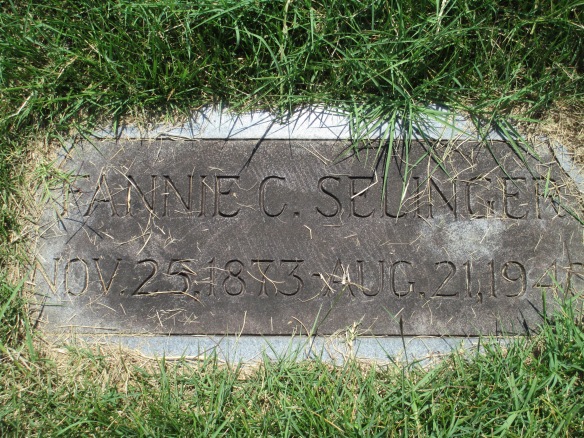
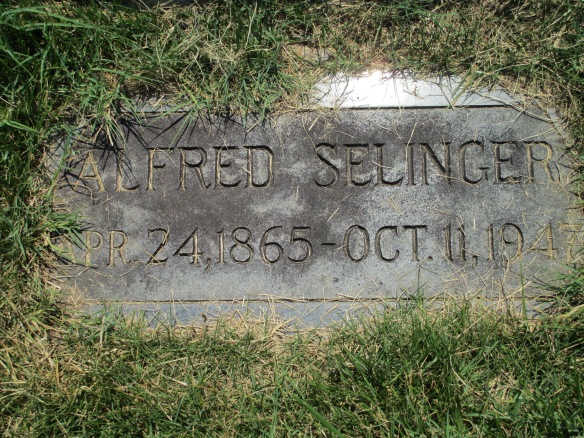
  4. Alfred Selinger, Fannie Cohen’s husband, was a tailor. Their daughter Selma was also a teenager in 1910.
  5. Florence and Harry Panitz were still living in Baltimore, and Harry was still a salesman. Their daughter Aline was still a young child.
  6. Grace Cohen married William Katz on January 20, 1901, and they had two children in the next decade: Hilda (1901) and Morton (1907). William was a manager in a furniture store, and the family was living in Washington, DC.
  7. Solomon, the youngest son of Moses, Jr., and Henrietta, married Estelle Spater in 1906, where the couple then resided. Solomon was employed as a manager of a mail order business.  Solomon and Estelle had a son Ralph born in 1908 and a son Theodore, born in 1910.  Sadly, Theodore died on November 21, 1912 when he was only two years old.
    Theodore P. Cohen death certificate

    Theodore P. Cohen death certificate

    When I found the death certificate for Theodore, I was confused by a number of things.  First, he died in Seneca, Lenawee County, Michigan, not Detroit, where his family lived.  I thought perhaps he had died in an accident, but the cause of death was indigestion.  I found that very puzzling, but then saw that a contributory cause was Little’s Disease.  I looked up Little’s Disease and learned that it was a form of cerebral palsy.  I am not sure how indigestion caused his death, but obviously it was related to his underlying condition.  I also found it very strange that his birth date was unknown, that there was no information about the birth place of either of his parents or his mother’s maiden name, and that the informant was neither of his parents.  My guess is that Theodore was in a hospital or home for children with similar conditions since it appears that he was not living with family.

  8. In 1910, Moses, Jr., and Henrietta’s youngest child, Mabel, was residing at the Maryland Asylum and Training School for the Feeble Minded in Baltimore; she was 27 and unable to read or write.

In June 1909, there was a large family celebration of the 25th anniversary of Augusta and Julius Selinger at their home.  From this description in the Washington Evening Star, one can get a sense of the lifestyle of the family during this decade.

Augusta and Julius 25th anniversary party

Augusta and Julius 25th anniversary party

(Sunday, June 20, 1909, Evening Star (Washington (DC), DC),   Page: 61)


As for Moses, Sr., and Adeline’s other children, JM and Belle Cohen were still living in Sioux City, Iowa, in 1905, but by 1910, they had moved to Kansas City, Missouri, where their daughter Fannie Sybil had moved sometime after marrying Sigmund Stern, a German-born immigrant who had arrived in the United States in 1892 as a fourteen year old and who was living in Sioux City in 1900, where he was residing as a lodger along with his two brothers, Henry and Morris, in what appears to be a boarding house.  Sigmund and his older brother Morris were both working as clothing merchants.   Sometime before 1906 Sigmund and Sybil, as she was known, had moved to Kansas City, as their daughter Judith was born there in 1906.  Although I cannot find a 1910 census report for Sigmund and Sybil Stern, Sybil’s parents JM and Belle and her sister Ruth were listed as living in Kansas City that year; JM was retired at age 57.

The other two children of Hart and Henrietta (aside from Munroe and Jacob M. II, discussed above) were Frances and Isadore.  In 1910, Frances was single and living with her parents and had no occupation.  Isadore had married Frances David in about 1907, according to the 1910 census, and their first child, Monroe, was born April 14, 1910.  Isadore was working as a clerk for the post office at that time.

As for Rachel and Frederick Selinger, they were still living in Washington with their son Monroe in 1910, and Frederick was still working in a furniture store.  Their daughter Fannie had married Aaron Hartstall sometime before 1910, and their son Morton was born January 20, 1910.  Aaron was employed as a paper hanger, and they also were living in Washington, DC.

So the family had grown in numbers and the children were growing to be adults in the first ten years of the twentieth century.  There had been some big losses and a fair number of births.  The next ten years would see additional growth and additional challenges as the family and the world faced World War I and the younger generation began to reach adulthood and have families of their own.


Jews in Iowa? Cohens on the Prairie 1880-1900

“Sioux Falls panorama 1908 1” by G.W. Fox – This image is available from the United States Library of Congress’s Prints and Photographs division under the digital ID pan.6a09880. Licensed under Public domain via Wikimedia Commons – http://commons.wikimedia.org/wiki/File:Sioux_Falls_panorama_1908_1.jpg#mediaviewer/File:Sioux_Falls_panorama_1908_1.jpg

Although the descendants of Moses and Adeline Cohen stayed close to Washington until 1880, in the next two decades many of them ventured further away.  I’ve already written about the children of Moses, Jr., four of whom left DC, three for NYC, and one for Baltimore.  But his siblings and their children ventured even further away, although for some it was just a temporary move.

The real adventurer seems to have been Jacob M. Cohen, apparently known as JM.  JM married a woman from Cuyahoga, Ohio, named Belle Lehman, on August 19, 1877.  Their first daughter, Fannie Sybil, was born in Washington, DC, in 1879, but sometime after 1880, JM and his wife and young daughter left town and moved west to the Dakota Territory where the second child, Seba Maude, was born in 1882.  I wish I knew what drew JM away from Washington and off to the prairie and how he met a woman from Ohio in the first place.  Was it a desire to be a pioneer or a desire to strike out on his own away from his family?  I don’t know, but I was certainly surprised to see “Dakota” as the birthplace of his second child.

Not long after Seba’s birth, the family must have moved again because a third daughter, Ruth Josephine, was born on June 8, 1883, in Sioux City, Iowa.  Sioux City seems to be where JM and Belle established deeper roots. They lived there until at least 1905, and their fourth child and only son Arthur was born there in 1885.  According to the 1885 Iowa state census, JM was working as a pawnbroker; in the 1888 directory for Sioux City, he is listed as being in real estate, but in 1900 his occupation on the census is a ticket broker.  Perhaps the census taker heard that incorrectly; perhaps he was still a pawnbroker.  Or maybe a real estate broker.

JM Cohen and family 1885 Iowa census

JM Cohen and family 1885 Iowa census

JM Cohen and family 1900 US census

JM Cohen and family 1900 US census

JM and Belle suffered a terrible loss when their daughter Seba died on January 2, 1886; she was not even four years old.

Seba Maude Cohen headstone

I fear that their son Arthur, born in 1885, also died young.   He does not appear on the 1895 census or the 1900 census when one would assume he would have been only ten and then fifteen years old and presumably living with his family.  On the other hand, I cannot find a death record for him in Iowa or elsewhere, nor is he buried where Seba and his parents were buried in Sioux City.

I wondered whether there were any other Jews in Sioux City at that time and was able to locate a book by Simon Glazer entitled The Jews in Iowa: A Complete History and Accurate Account of Their Religious, Social, Economical and Educational Progress in this State; a History of the Jews of Europe, North and South America in Modern Times, and a Brief History of Iowa, published in 1904 by Koch Brothers Printing Company and now available as a free e-book on Google.  According to Glazer, there were only 25 Jews in Sioux City in 1869, but by 1904 there were over two thousand, including my relatives. In fact, when the Jewish community decided to form a cemetery association, the Mt Sinai Cemetery Association, in 1884, JM Cohen, my cousin, was one of the founding members.  (Glazer, p. 295)  Moreover, that same year JM’s wife Belle was the leader of a movement among the Jewish women to create a fund-raising organization to help the poor and to raise money to build a house of worship. (Glazer, p. 296)  Despite this burst of energy in 1884, there was no formal congregation until 1898.  As described by Glazer:

“The Jewish spirit which kept them together was a mere ghost of little more consequence than a shadow. Everything they had gained during their childhood, everything their parents had imbued within them vanished form [sic] their memories, and nothing new could come and knock at their gates since no effort was endeavored prior to 1898, to form a congregation and engage the services of a minister.” (p. 297)

According to Glazer, “Their temple was built largely through the efforts of the ladies, and the man [sic] frankly admit that had it not been for the heroic efforts of the Jewish women no such place for Judaism in Sioux City would as yet have been made a matter of fact. Their first services were conducted at the Masonic Temple, which is, indeed, very complimentary to both, the Masons and the Jews.” (p. 300)

JM Cohen was listed by Glazer as one of the ten officers and leaders of Mt Sinai Congregation in those early days.

Mt Sinai Synagogue, Sioux CIty, Iowa From Wikimedia Commons, the free media repository

Glazer then described the influx of Russian and Eastern European Jews in the late 1880s and thereafter and the divisions between the older assimilated population which had established Mt Sinai, the Reform congregation, and the newcomers who were more Orthodox.  He concluded his chapter on Sioux City by saying, “The Jewry of Sioux City is as yet in its infancy, but it has plenty of mettle to make itself a stronghold of both Orthodox and Reform Judaism in the northwest.” (p. 302)

So my cousin Jacob M. Cohen was a pioneer.  He left the comforts of a well-established Jewish community in Washington, DC, where his older brother Moses, Jr., was a leader in the Washington Hebrew Congregation, a well-established synagogue, and went out to the prairie lands of the Midwest (the northwest in 1904 when Glazer was writing) to become a Jewish leader there.

JM also succeeded in getting two of his siblings and his mother Adeline to move to Iowa, if for only a short time. Adeline, who was born in Baden, Germany, had immigrated to Baltimore, raised four children on her own when her husband Moses died in 1860, and supported them herself in Washington, DC.  Adeline again uprooted herself and left a safe, settled urban world to live in Iowa.   In 1888 she was living with JM in Sioux City, according to the city directory.  I don’t know how long she lived there, but she did return to Washington, DC, by 1894.

Title : Sioux City, Iowa, City Directory, 1888 Source Information Ancestry.com. U.S. City Directories, 1821-1989

Title : Sioux City, Iowa, City Directory, 1888
Source Information
Ancestry.com. U.S. City Directories, 1821-1989

In that same 1888 Sioux City directory is a listing for Hart Cohen as well, JM’s older brother.  The first half of the 1880s for Hart and his wife Henrietta brought two more children to their family, Isadore Baer, born in 1883, and Jacob M. II, born in 1885, in addition to Frances, who was born in 1878, and Munroe, born in 1880.  Hart, like his brother JM, was a pawnbroker, and like his first cousin Hart in Philadelphia, he was charged in 1885 with receipt of stolen goods in the course of his business; he was acquitted of the charges in 1886.


Hart DC Cohen arrested 1885 snip

(“A Pawnbroker Arrested,” Wednesday, March 25, 1885, Critic-Record (Washington (DC), DC),Issue: 5,187, Page: 3)

Letter from Washington. A Pawnbroker Acquitted - Measures to Avert a Flood in the Potomac Date: Friday, February 12, 1886  Paper: Sun (Baltimore, MD)   Volume: XCVIII   Issue: 76   Page: 4

Letter from Washington. A Pawnbroker Acquitted – Measures to Avert a Flood in the Potomac
Date: Friday, February 12, 1886 Paper: Sun (Baltimore, MD) Volume: XCVIII Issue: 76 Page: 4

It might have been in the aftermath of these criminal proceedings that Hart decided to join his brother JM in Sioux City.  He was there at least until 1895, as on the 1895 Iowa census he and his entire family are included.  His occupation at that time was described as a jeweler.

Hart Cohen and family 1895 Iowa census

Hart Cohen and family 1895 Iowa census

By 1900, however, Hart and his family had returned to Washington, DC, where he was still working as a jeweler.  His children were now all at least teenagers, ranging in age from 14 (Jacob) to Frances (21), and perhaps he felt like he had gotten his life in order and could return to his hometown.  They were living at 1424 Seventh Street, NW, in 1900.

Hart Cohen and family 1900 census

Hart Cohen and family 1900 census

JM even lured his sister Rachel to come to Iowa for some time.  Rachel had been newly married to Frederick Selinger in 1880, and in 1882 they had their first child, Fannie Selinger, in Washington, DC.  Their second child, Monroe, was born in 1888 in Washington as well, but in 1891 when Frederick applied for a passport, they were living in Sioux City, Iowa.  (Interestingly, the witness on the application was Myer Cohen of Washington, DC, his wife’s nephew, son of her brother Moses, Jr.)

Frederick Selinger passport application 1891

Frederick Selinger passport application 1891

Frederick is also listed in directories for Sioux City from 1890 through 1892.  Like Hart and Adeline, however, Rachel and Frederick returned to Washington, DC, where in 1900 the family was living at 1502 Seventh Street, NW.

Frederick and Rachel Selinger and family 1900 census

Frederick and Rachel Selinger and family 1900 census

Thus, by 1900, the great experiment of living out in Sioux City had ended for all of the DC Cohens except for JM and his family, who would never return to Washington, DC.  All the rest of the Moses Cohen family—from Adeline (until her death in 1895) to Moses, Jr., to Hart, to Rachel– were living within five or six blocks of each other in the Northwest section of Washington, DC, in 1900.

The twentieth century was about to begin, and with it came new challenges and new family members.  The story will continue…


Why I Have Been Quiet about Israel

I have never been afraid to express my opinion.  I welcome reasonable discussions and debate about almost anything—food, movies, books, baseball, politics, world affairs, religion, you name it.  I have strong feelings about almost anything and everything, and I usually am not at all hesitant to say what I am thinking.  I like to think that I listen to what others have to say and that I try and be informed about as much as I can before formulating my own opinion.  My values have not changed much at all in the course of my life, so I know my starting point based on those values, but my mind has been changed many times on many issues by listening and reading what others have to say.

But this time I am lost.  I am Jewish, I am proud to be Jewish, and I feel a strong emotional tie to Israel and Jewish people everywhere.  I’ve only visited Israel once, back in 1997, and it left an indelible mark upon me.  I felt a connection historically and spiritually to the place.  I cried when we left in a way that was far different from the sadness I always feel when a trip or vacation ends.  Israel felt like home to me in a way I never expected.  From my research I now know I have family in Israel.  I have friends in Israel. I know how important Israel is to the past, the present, and the future of the Jewish people.

I am also a lifelong progressive liberal (and not ashamed at all of that word) who argued and protested against every US war during my lifetime—from Vietnam starting in 1965 when I was a teenager up through Bush’s invasion of Iraq in 2002.  I know that some wars were so-called just wars; defeating Hitler and others who have tried to commit genocide is justified and necessary.  Dropping an atomic bomb on Japan, however, is not something I would have agreed with, if I’d been born at the time.  I don’t agree with capital punishment, even when the convicted person has committed a heinous crime.  I just don’t see killing as a way of accomplishing anything unless and until there is no choice in the name of self-defense or defense of others.

So I have read the news these last few weeks with my stomach churning, my heart breaking, and my brain torn from one side to the other.  Almost everything I have read is filled with one-sided rhetoric. There is no reason for me to recap the arguments; you’ve heard them all before.  People who are defending Israel point me to pro-Israel sources; people who are anti-Israel point me to anti-Israel sources.  I read the New York Times every day, hoping it is more objective than other sources.  People who are pro-Israel say that the Times is biased against Israel; people who are anti-Israel say the Times is biased in favor of Israel.

There are only a few actual facts: Hamas wants to destroy Israel—it says so in its charter; there is a blockade around Gaza that makes escape for those who live there almost impossible and life there absolutely miserable; Hamas is building tunnels and accumulating weapons and shooting rockets to reach its goal of destroying Israel; Israel is fighting back with stronger and bigger weapons and with a defense system that has resulted in many more Palestinian deaths than Hamas has been able to inflict on Israel; Hamas refuses to agree to a ceasefire; Israel refuses to stop building new settlements; Hamas continues to shoot rockets, knowing that its own people will be killed in greater numbers; Israel knows that it cannot avoid killing them when it shoots its rockets at Gaza.  Neither side can win unless it obliterates the other side, in which case neither side has won.

Meanwhile, people are dying on both sides, no one feels safe, and there is hate being spewed by both sides.  And across the world, there are people protesting, saying things that I’ve not heard said so publicly and proudly in my lifetime: “Death to the Jews, Kill the Jews.”  In one town in France, shop windows were smashed.  Immediately I thought of Kristallnacht.

So why have I remained quiet?   Being quiet did not help the Jews in the 1930s. But why express my feelings when they only provoke more rhetoric?  Why be accused of being either a self-hating Jew for having sympathy for the people in Gaza or of being a Jewish imperialist/Zionist for understanding why Israel feels a need to use force to stop Hamas from trying to kill the Israeli people and their country? The dialogue is pointless.  No one really listens.  They just argue.  They just throw around words of hate.  They just make me feel sick and sad and confused.

I have also remained quiet because I am confused and upset and heart-sick.  I see no hope for any improvement in the situation; I only see things getting worse.  I only see a terrible ending to all this anger and killing and hate, and it makes me despair for my children and my grandchildren, for Jews and for non-Jews, for our world, our planet, our lives.  There is no right, no wrong.  There is just ugliness, blood, violence, and hatred.  There are no words.  I have no words.  I am speechless.  I am silenced.

Please don’t tell me what you think.  Please don’t fill my heart with more hate, with more anger. I’ve heard all the arguments. The rhetoric is all noise to me. Endless Facebook postings prove nothing; people only read what supports their point of view. There is nothing to celebrate. Everyone is wrong; everyone is right. Everyone needs to be quiet, to stop talking, and to start listening to their hearts, hoping with their souls, and thinking with their brains.  If those of us who do not live where the bombs are flying cannot talk to each other with respect and understanding, how is there any hope that there will ever be peace over there or, for that matter, anywhere?

So my silence does not signify indifference or apathy; it signifies confusion and a willingness to listen and think and hope. You cannot listen when you are talking.  You cannot think when you are just spewing rhetoric.  You cannot hope when you are angry.  I am listening.  I am thinking.  I am trying as hard as I can to hope.

A Brick Wall Tumbles, Thanks Once Again to the Genealogy Village

When I learned that my brother’s Y-DNA did not match the Y-DNA of a descendant of Moses Cohen of Washington, DC, I was sorely disappointed.  I was sure that all the circumstantial and documentary evidence I had found supported my hunch that Moses was the brother of my great-great-grandfather Jacob Cohen and son of my three-times great-grandfather, Hart Levy Cohen.  But DNA does not lie, and I was very surprised by the results.

I had one small glimmer of hope when I learned about a family story that indicated that Moses Cohen, Sr., was not the biological father of Moses Cohen, Jr., who was in fact the biological great-great-grandfather of the living descendant whose DNA had been compared to that of my brother.  But how would I ever prove that?  It seemed hopeless.

Nevertheless, I decided to see what I could find that might help answer some of my questions.  Where and when was Moses, Jr., born? When and where did Moses, Sr., marry his mother Adeline Himmel? I could not find any American records showing a marriage or an immigration record for Adeline and her son Moses, Jr.  All I had were census records from 1850 and 1860 showing that Moses, Sr. and Adeline were already married by 1850 and that in 1850, Moses, Jr., was eleven years old.  Later census records indicated that both Moses, Jr., and Adeline were born in Germany and that Moses, Sr., was born in England (though a few later census reports filed after Moses, Sr.’s death by his children said he was also born in Germany).  Some of Moses, Jr.’s and Adeline’s records were even more specific, several naming Baden as her place of birth.

Several months ago when I first discovered the DC branch of the Cohen family, I had tried without success to find where in Baden Adeline had lived.  I sent a message on the GerSIG listserv (German Special Interest Group) of JewishGen.org asking for help.  I received many suggestions, but the most helpful one was from a man named Rodney.  First, he looked up the surname Himmel in Lars Menk’s “Dictionary of German-Jewish Surnames” and found that there was only one Jewish community in Germany where the name Himmel appeared, in  the Eberbach region of Baden.  Then he pointed me to a website that compiled various birth, death and marriage records from various towns in Germany, the Landesarchiv, and specifically to a book of the Jewish records for a town in Eberbach called Strumpfelbrunn where Rodney found a birth record for Jacob Himmel that he translated for me.  The record said, “On the 24th December 1815 was born Jakob Himmel, legitimate son of Moses Himmel and his wife Bromit nee Jakobin(?). Witnesses are Jakob Goez and Abraham Mond.”

(Generallandesarchiv Karlsruhe 390 Nr. 1137, Bild 8
Permalink: http://www.landesarchiv-bw.de/plink/?f=4-1121353-8
Standesbücher / (1691-) 1775-1875 (-1958)
Kernlaufzeit 1810-1870 > Amtsgerichtsbezirk Eberbach >
Strümpfelbrunn, israelitische Gemeinde: Standesbuch 1810-1866 / 1810-1866)

Jacob Himmel birth record

Jacob Himmel birth record

I immediately wondered whether this Jakob Himmel could be the same as the one living next door to Moses, Adeline, and Moses, Jr., in Baltimore in 1850, the one I suspected was the brother of Adeline.

Moses Cohen and family 1850 census

Moses Cohen and family and Jacob Himmel and family  1850 census

Rodney suggested that I look for other records in the Strumpfelbrunn book, but it was written in old German script that looks like what you see above.  I wouldn’t even recognize my own name written in that script.  I tried my best, but after a few pages, I gave up and said that there had to be an easier way.  But there was not.  These records are not digitized or translated anywhere yet.  So I returned to American records and moved on, figuring I’d either never find Moses, Jr.’s records or I’d find them some other way.

Then in the last few weeks I found the passenger manifest for Jacob Himmel.

Jacob Himmel ship manifest

Jacob Himmel ship manifest

Detail

Detail

I posted it to a Facebook group called Baden Genealogy for help in deciphering the town listed as Jacob’s place of last residence, which looked like Rutlingheim to me and to most others.  But there was no such town in Baden, no town that had a name that looked even close.  I tried searching for the two men who appeared to be traveling with Jacob from “Rutlingheim” and had no luck at all locating them in the US.  Then two days ago, I posted again to the Baden Facebook group, asking whether the town could be Billigheim, a town reasonably close to Strumpfelbrunn where a Jacob Himmel had been born.

Monica, a member of that group, responded, and when I explained why Strumpfelbrunn was my point of reference, she invited me to send her the birth record I had and the source where I had found it and she would translate it for me.  Her translation was consistent with that of Rodney except that she read Jacob’s mother’s name as Fromit, not Bromit.  She, like Rodney, said I should look for other mentions of Himmel in the record.  The book is close to 300 pages long, and I told her that I just could not decipher the old German script.  Then she made a brilliant suggestion; she sent me a link to the font for that old script, had me install it into Word, and then suggested I type out Himmel and any other relevant names in the script and compare it to what I could find on the pages of the records book.

And so I did, and on page 78, I found a record that looked like it had the name Moses Himmel in that old script.

Moses Himmel birth record 1839

Moses Himmel birth record 1839

Moses Himmel birth record 1839 detail

Moses Himmel birth record 1839 detail

I sent it to Monica, who translated it as follows: “In the year 1839 29th Dec at noon an illegitimate son of the spinster Adelheid Himmel was born.  She is the legitimate daughter of the deceased Moses Himmel and of Frommat nee Lagg from Amsterdam.  The boy will be named Moses at his circumcision.”  It then names some witnesses.

When I received that email with the translation, I felt those bricks tumbling down.  Could this be anyone other than Adeline Himmel Cohen and her son Moses? Does this not provide evidence that the family story that Moses, Jr., was not the biological child of Moses Cohen, Sr., is reliable? Doesn’t it explain why Moses, Jr.’s great-great-grandson does not share DNA with my brother, who is a direct descendant of Hart Levy Cohen, who was Moses, Sr.’s father, but not the biological grandfather of Moses, Jr.?

I then found another page, 26, that also seemed to have the name Himmel.  Monica translated that one as well.  “On the 5th of May 1820 in the morning 4 o’clock he died and was buried at noon.  Moses Himmel was married with Fromat Lagg (or Lugg or Legg) from Holland.  Age forty and four years.”  This was the death notice for Moses Himmel, the father of Adelheid or Adeline Himmel.  She named her illegitimate son for her father, not as a junior for Moses Cohen, the man she would later marry, probably in the United States.

Moses Himmel the grandfather of Moses Himmel

Moses Himmel the grandfather of Moses Himmel

Of course, there are many questions remaining.  I still don’t know when Moses, Sr., married Adeline.  Nor can I be 100% certain this is the right Adeline, though it certainly would appear to be so.  These discoveries also open up some new doors for my research.  If Adeline’s mother was named Fromat Lagg or Lugg or Legg and she lived in Holland, perhaps there is a connection to my Dutch ancestors in Amsterdam.  Her name was given as Jakobin on Jacob’s birth record; perhaps she was part of the same family as Rachel and/or Sarah Jacobs, my three-times and two-times great-grandmothers.  Now I need to return to the Dutch research and see what I can find.

In any event, once again the generosity of my fellow genealogy researchers has been demonstrated.  I never could have done this without the help of Rodney and Monica, two people I’ve never met, and the larger GerSIG and Baden Genealogy Facebook group communities.  It is astonishing what can be accomplished when people work together instead of fighting and killing each other.


The Family of Moses, Jr. and Henrietta Cohen 1880-1900: Years of Growth and Change

Moses Jr and Henrietta Cohen and children c. 1900

Moses Jr and Henrietta Cohen and children c. 1904 Seated left to right: Myer, Mabel, Henrietta, Moses, Jr., and Augusta; standing left to right: Fannie, Solomon, Grace, Jacob, and Florence. Insert: Ella Photo courtesy of Jane and Scott Cohen

The years from 1880 through 1900 were years of continued growth for the children of Moses and Adeline Cohen, as their children had more children and as their grandchildren grew and had families of their own as well.  It was also a time of change, as some of the family members left the Washington, DC, area for other parts of the country.

I will focus first on the family of Moses, Jr. and Henrietta (Loeb) Cohen since he was the oldest of Moses and Adeline’s children by more than ten years. As I wrote last time, by 1880 he and Henrietta already had a large family of eight children, the oldest being Augusta who was already a teenager and the youngest being Solomon, who was just born in 1879. (There also were apparently two other children who died in infancy, but I have no documentation of their births, names, or deaths.)  They would have one more child, Mabel, who was born in 1883 when Henrietta was already 41 years old.  As reported to me by a direct descendant of Moses, Jr. and Henrietta, Mabel had Down’s syndrome, perhaps not all that surprising given the age of her mother when she was born. Sometime after 1880, Moses had switched from selling clothing to being a sexton for his synagogue and also a collector (a bill collector, I assume), according to city directories for Washington, DC, during that period.

The year after their last child Mabel was born, Moses and Henrietta saw their first child get married.  Augusta married Julius Selinger on June 10, 1884, when she was only eighteen years old.  Although I do not yet have any record to prove it, my hunch is that Julius was a brother or cousin of Frederick Selinger, the husband of Augusta’s aunt Rachel, her father’s sister.  Like Frederick, Julius was born in Hubern, Germany, according to his passport application. Julius had emigrated only a year or so before marrying Augusta. The two Selinger men were only three years apart in age.    By 1900, Augusta and Julius had five children: Sidney (1885), Harry (1888), Jerome (1889), Maurice (1893), and Eleanor (1894).  Julius was working as a jeweler, and his oldest son Sidney was an apprentice watchmaker.  The family was living in DC at 1157 8th Street, NW. [All addresses in this post are in the NW section of DC.]

Augusta and Julius Selinger 1900 census

Augusta and Julius Selinger 1900 census

During this same time period, Moses and Henrietta’s second child, Myer, was obtaining an education and building his career as well as his family.  Myer might be the very first Cohen to get a law degree (or the first I’ve found so far).  According to a 1917 alumni directory for George Washington University, Myer Cohen received an LL.B. in 1886 as well as an LL. M. in 1887, and was a lawyer in Washington, DC.

Ancestry.com. U.S., College Student Lists, 1763-1924 [database on-line]. Provo, UT, USA: Ancestry.com Operations, Inc., 2012. Original data: College Student Lists. Worcester, Massachusetts: American Antiquarian Society.

Ancestry.com. U.S., College Student Lists, 1763-1924 [database on-line]. Provo, UT, USA: Ancestry.com Operations, Inc., 2012.
Original data: College Student Lists. Worcester, Massachusetts: American Antiquarian Society.

Myer married Helen Wolf on January 14, 1890.  Helen was also a DC native, and her father Simon Wolf  had been president of Washington Hebrew congregation where Moses Cohen was a member and the shammes for many years.  Helen and Myer must have known each other for years before marrying.

Simon Wolf was a very well-known and well-regarded lawyer known for advocating for Jews and Jewish causes; one source described him as “a friend of Presidents from Abraham Lincoln to Woodrow Wilson.”[1] Myer joined his father-in-law’s practice, which became known as Wolf and Cohen; Simon Wolf had also started an insurance business in 1878, which also became known as Wolf and Cohen.[2]  It was the first insurance brokerage business in the Washington, DC, area.

Between 1890 and 1900, Myer and Helen had four children: Ruth (1891), Edith (1893), Marjorie (1896), and Roger (1898).  Another son, Myer, Jr., would be born in 1907.  The family was living at 1711 S Street in DC in 1900.

Myer Cohen Sr. 1900 census

Myer Cohen Sr. 1900 census

The third child of Moses and Henrietta was Jacob G. Cohen.  He married Ida Slegh in 1894; she was also a DC native. They had a daughter, Aimee, born in 1895, perhaps the first ever “Amy Cohen” in the family (although they spelled it the French way).  In 1900, their son Gerson was born. The family was living at 1 West 115th Street in New York City, and Jacob was employed as a bookkeeper.

Jacob G. Cohen and family 1900 census

Jacob G. Cohen and family 1900 census

A third Selinger joined the family in 1893 when Fannie Cohen, the fourth child, married Alfred Selinger.  Like Julius and Frederick, Alfred was born in Germany.  He immigrated to the US in October, 1888, and in 1891, he and Julius were both living at the same address, 810 I Street, according to a DC directory for that year, certainly an indication that the two were related and probably brothers.  In 1892, Julius and his family traveled abroad along with Alfred, according to a society item in the Washington Evening Star on June 17, 1892.  (Friday, June 17, 1892, Evening Star (Washington (DC), DC)   Page 3)  Fannie Cohen married Alfred a year later on June 10, 1893. Alfred and Fannie had one child, Selma, who was born in March, 1894.  According to the 1900 census, Alfred was a tailor, and the family was living at 711 I Street in DC.

Fannie and Alfred Selinger 1900 census

Fannie and Alfred Selinger 1900 census

Moses, Jr. and Henrietta must have had quite a wedding budget because in 1895 their fifth child, Ella, married Jacob Bernard Greenberg.  Ella and Jacob had a daughter Marjorie Ruth the following year, and in 1900 they were living in New York City at 140 West 100th Street, not too far from Ella’s brother Jacob G. Cohen. Her husband Jacob was employed as a freight clerk.

Ella and Jacob Greenberg 1900 census

Ella and Jacob Greenberg 1900 census

The weddings did not end there.  In 1898, Florence, the sixth child, married Harry Panitz.  Harry was a salesman from Baltimore, where the couple lived in 1898 and thereafter.  I thought that they did not have a child until 1902 when their daughter Aline was born, but when my brother visited Washington Hebrew Cemetery to look for the headstones for Moses Cohen, Sr., and his family, he saw one overturned headstone in the same area as other Cohen graves and picked it up.  It was very hard to read even in person, but he was able to edit the photo below to highlight the dates.

Headstone for Helen Panitz October 2, 1899 to May 12, 1900

Headstone for Helen Panitz October 2, 1899 to May 12, 1900 Photo courtesy of Ira Cohen

From those dates, I was able to search the death indices and found that Helen Panitz, less than one year old, had died in Fayetteville, North Carolina, on May 12, 1900, and was buried in Washington, DC, on May 14, 1900.  I do not know what they were doing in Fayetteville, nor do I know why Helen died so young. They were not living in Fayetteville as of December 27, 1899, because the Washington Evening Star reported on that day that Grace Cohen, Florence’s sister, had just returned from a visit to Baltimore to see Florence and Harry Panitz perhaps to see the ill-fated baby Helen.  (Wednesday, December 27, 1899, Evening Star (Washington (DC), DC), Page 7)

As of the 1900 census, Grace and her sister Mabel were still living with their parents, Moses, Jr. and Henrietta, at 1130 8th Street, just down the street from Augusta and Julius and their five children, some of whom were not much younger than their two aunts.

Moses Cohen, Jr. and family 1900 census

Moses Cohen, Jr. and family 1900 census

Moses and Henrietta’s youngest son Solomon was living on his own in New York City in 1900; he was 20 years old and working as a clerk.  He was living at 20 West 115th Street and boarding with a family named Pawel.  Solomon’s brother Jacob was living at 1 West 115th Street, the building across the street, and his sister Ella just a mile away, so Solomon had plenty of family to look after him in New York.

Solomon Cohen 1900 census

Solomon Cohen 1900 census

So by 1900, almost all of Moses, Jr’s nine children had married and/or moved out on their own.  Several had left Washington, DC—three to New York City and one to Baltimore.  There were many births and not too many deaths or other tragedies.  Moses and Henrietta had a son who was a lawyer and many grandchildren and more to come.  From the outside, it looks like life was very good for the entire clan.

There was, however, one major loss suffered by the family during this period. On January 15, 1895, the family matriarch, Adeline Himmel Cohen, died.  She had survived the loss of her husband Moses 35 years earlier and had essentially raised the four younger children on her own and perhaps Moses, Jr., as well before she married Moses, Sr. Adeline had worked outside the home to support her children, selling second hand clothing and carrying on the work that her husband Moses, Sr., had been doing before his death.   She must have been a very strong and determined woman to have weathered so many storms in her life.

Adeline Cohen headstone

Adeline Cohen headstone Photo courtesy of Jane and Scott Cohen


[1] Website of the Goethe Institute at http://www.goethe.de/ins/us/lp/kul/mag/deu/ewy/per/en6791595.htm

[2] The insurance business still exists today and was partially acquired by the Meltzer Group. See Related articleshttp://www.prnewswire.com/news-releases/the-meltzer-group-inc-acquires-certain-assets-of-wolf–cohen-life-insurance-inc-55350942.html