Jonas Cohen, Sr., 1863-1902:  Another Tragic Accident and a Life Cut Short

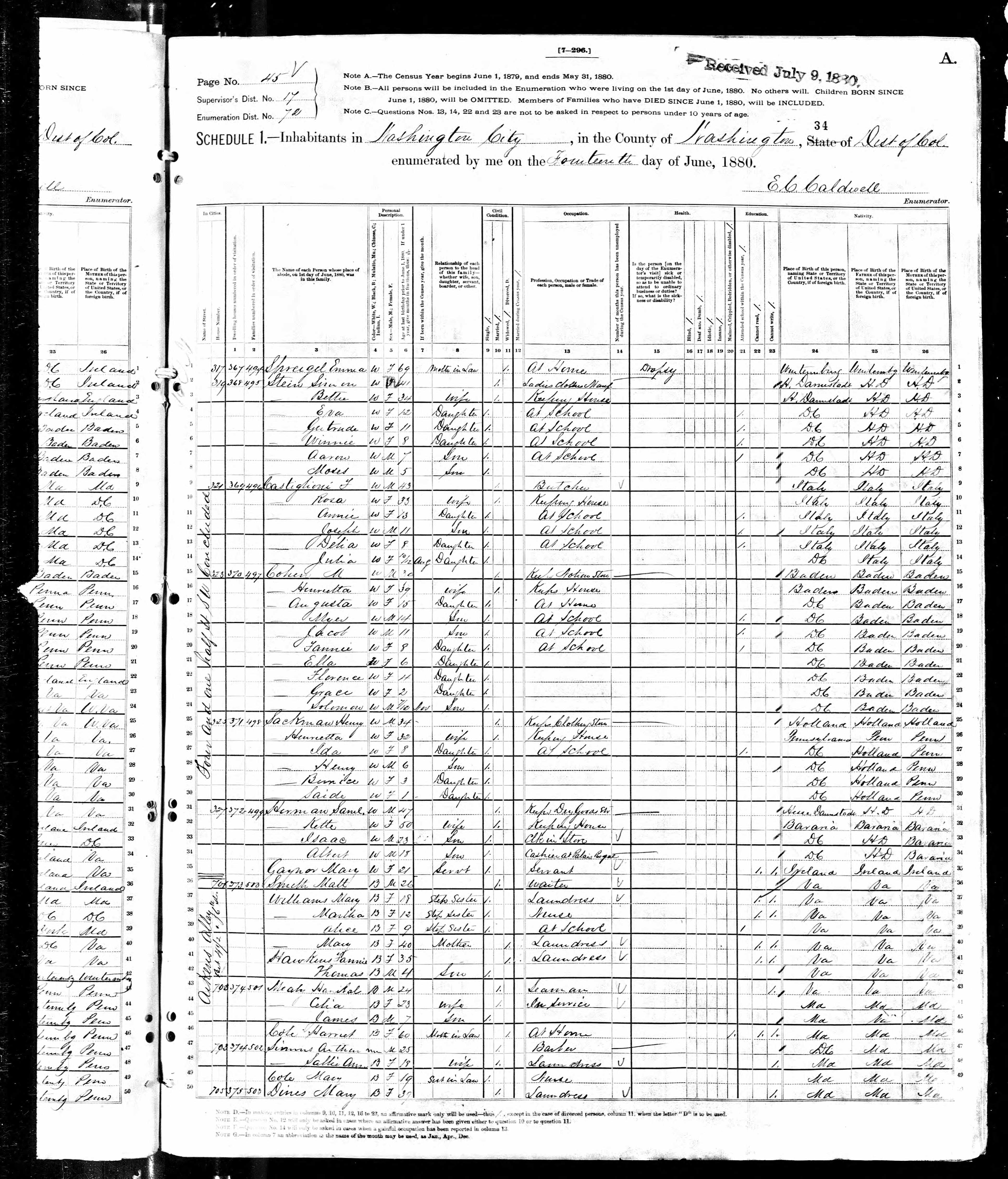
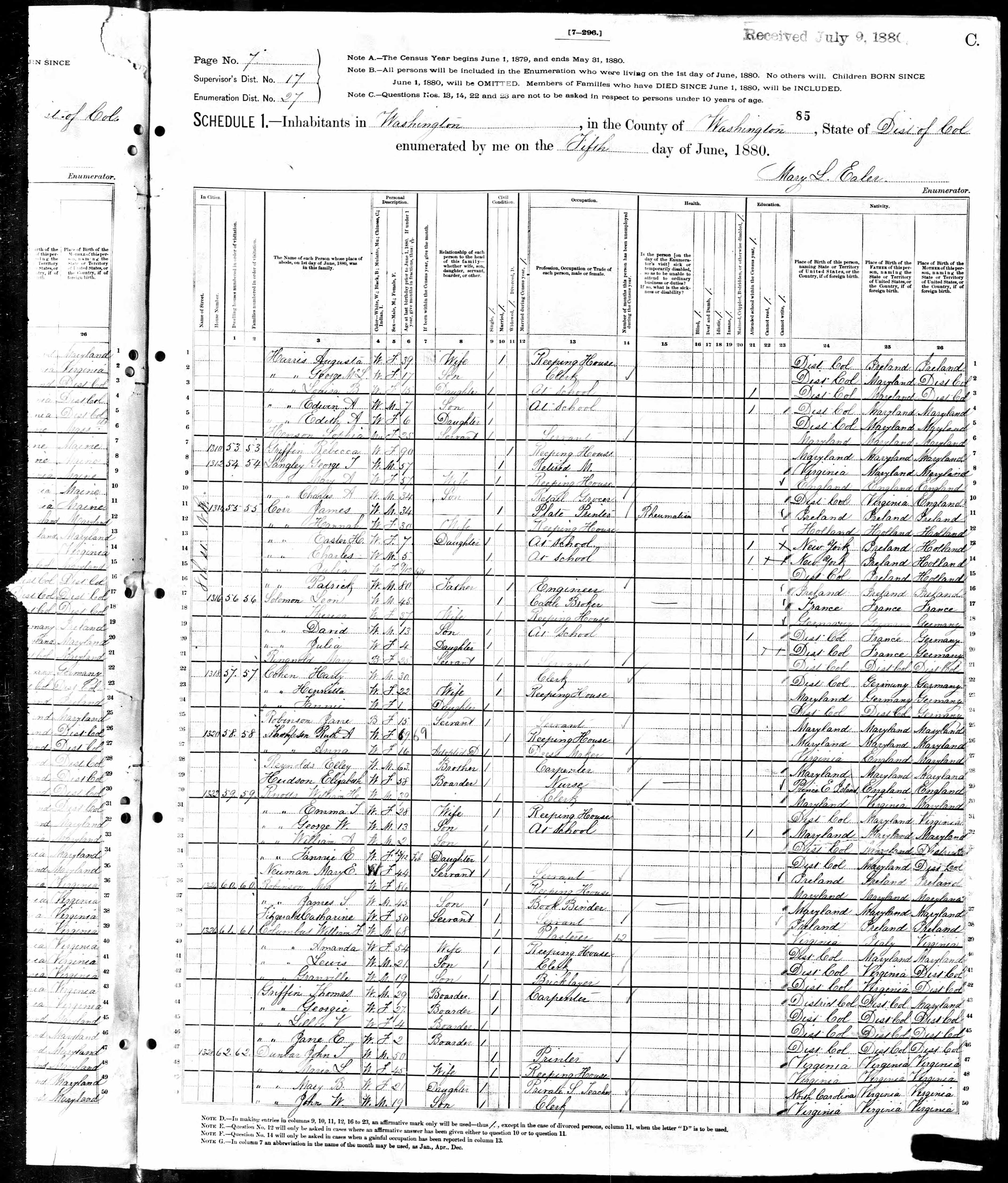
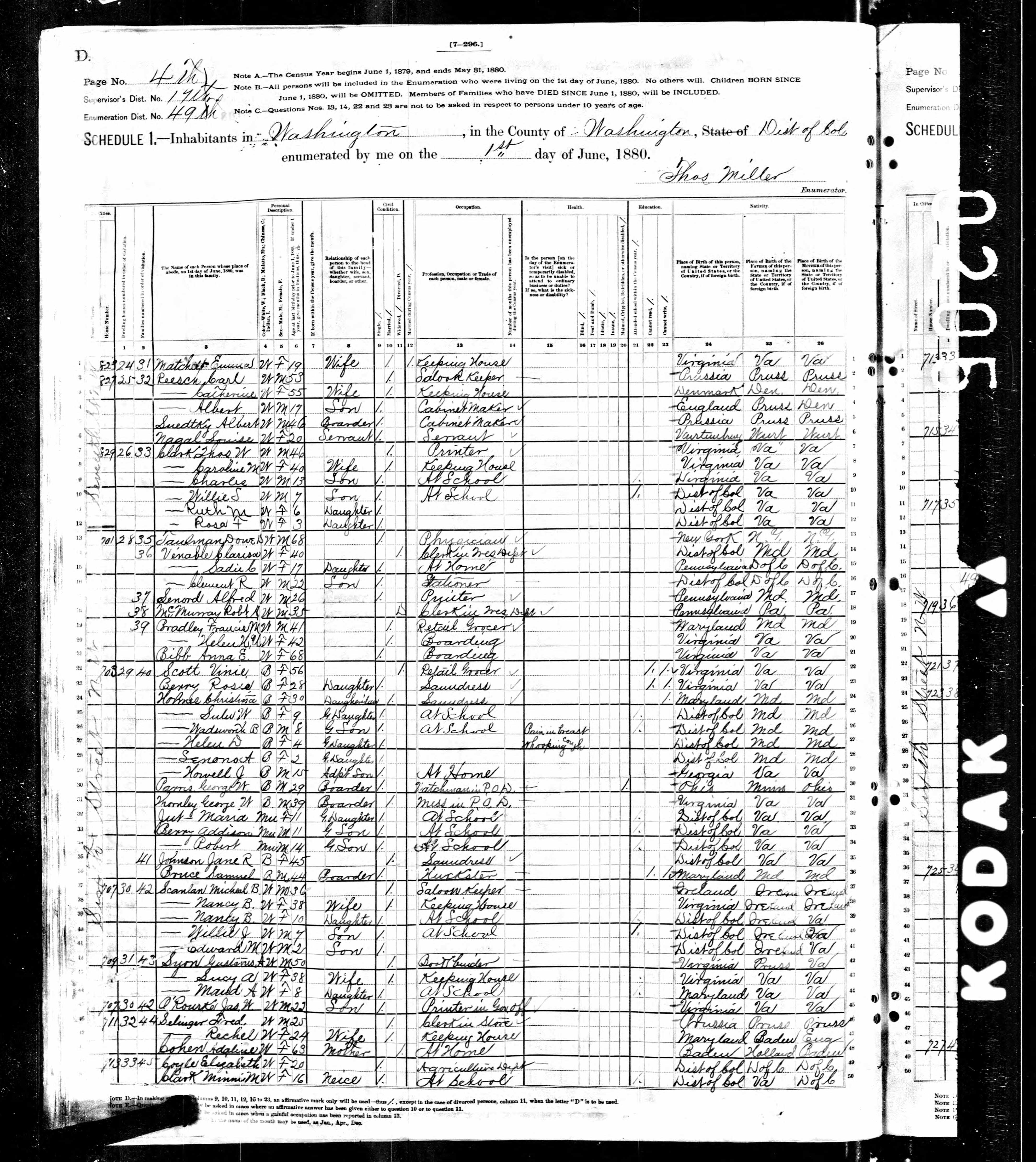
The twelfth child of Jacob and Sarah Cohen was Jonas Cohen, sharing the name with his uncle, Jonas H. Cohen.  Jonas was born on August 15, 1863, and spent his childhood at 136 South Street.  When he was sixteen, he was already working as a clerk in the pawnshop, according to the 1880 census.

On February 21, 1892, he married Sarah Weil in New York City.[1]  Jonas and Sarah were living at 776 South 20th Street in 1895, and Jonas was working as a pawnbroker.  Their son, Jonas Cohen, Jr., was born on June 28 that same year.  In 1900, Jonas, Sarah, and their son were living at 2216 North Carmac Street; Sarah’s older brother Henry, who was also a pawnbroker and apparently in business with Jonas, was also living with them at that address.

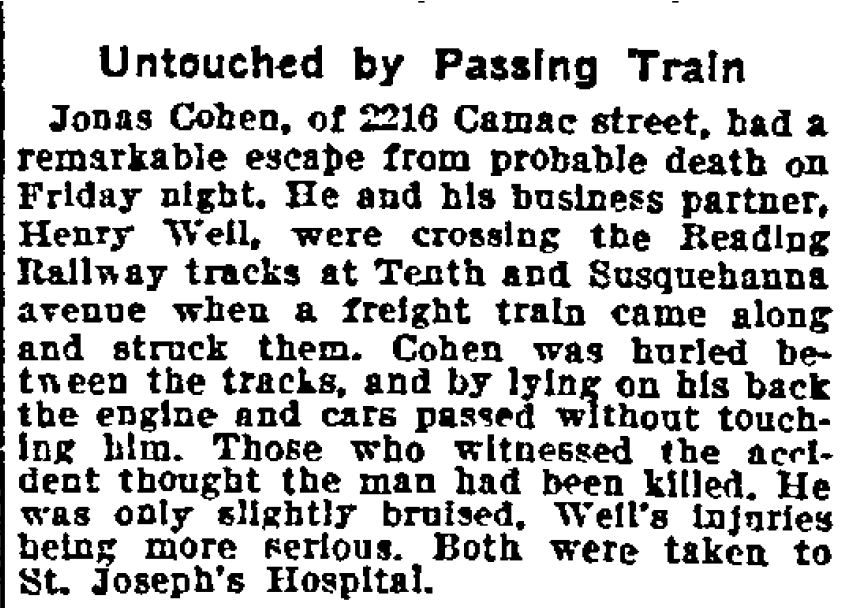
Less than two years later, tragedy struck the family.

jonas news article

(“Untouched by Passing Train,” Sunday, October 20, 1901, Philadelphia Inquirer (Philadelphia, PA)   Volume: 145   Issue: 112   Section: Third   Page: 11)

Although the paper reported that Weil’s injuries were more serious, Henry Weil survived the accident.  Unfortunately, his business partner and brother-in-law, my great-granduncle Jonas Cohen, ultimately did not.  Over three months later, on February 10, 1902, Jonas Cohen died from “traumatic delirium from injuries” sustained from an accident with the Pennsylvania Railroad, according to his death certificate.  He would have been 36 years old just eleven days after he died.  He left behind his young wife Sarah and his son Jonas, Jr., who was not yet seven years old.

Jonas Cohen death certificate 1902

Jonas Cohen death certificate 1902

Sarah apparently never remarried and lived with her father and/or her brothers for most of the rest of her life.  In 1910, she and Jonas, Jr., were living with Simon Weil, her father, and three of her brothers, Henry, Aaron, and Monroe, and Monroe’s wife Maude at 2524 Broad Street.  Sarah had been born and married in New York City, but at some point her father and at least several of her siblings had all moved to Philadelphia.  Sarah’s brothers Henry, Aaron, and Monroe were all pawnbrokers by 1910.  Her father had been in the dry goods business in New York.  Had Sarah’s husband Jonas lured them all to Philadelphia by offering to go into the pawn business with them?

In 1917 Sarah and her son were still living at 2524 Broad Street, and Jonas, Jr., had joined the pawnbroker business, now called Weil Brothers, located at 16th Street and Jackson, according to his World War I draft registration.  His uncle Monroe was also working for Weil Brothers, though at a different address.  The city directory for 1918 lists both Henry and Aaron Weil also as working for Weil Brothers and living at 2524 Broad Street.

The same was true in 1920.  Sarah and her son were living at 2524 Broad Street with her father Simon and her brothers Henry and Aaron. (Monroe and his wife had moved on and had a place of their own.)  Her brothers were working as pawnbrokers, and her son Jonas was a seaman in the United States Navy.

By 1930, Simon Weil had died, but his children Henry, Aaron, and Sarah continued to live together at the same address, and Jonas, Jr., now 36 years old and out of the Navy, continued to live with them as well.  All three men described their occupation as “money lender.”  By 1940, Jonas had married and moved out, but Henry, Aaron and Sarah, now all around 70 years old, were still living together at 2524 Broad Street.  Henry and Aaron had never married; Sarah had never remarried.  They had been living together as adults since at least 1910, and probably from the time Jonas, Sr., had died in 1902.  Had the awful accident that had led to Jonas’ death also scarred all of them in some way, making it hard for any of them to separate and move on with their adult lives?

The Weil Siblings 1940 census

The Weil Siblings 1940 census

Jonas, Jr., however, did leave and start a life of his own.  In 1936, he married Sally Coleman.  In 1940, they were living at 2201 Venango Street[2], and Jonas was still working as a pawnbroker.

Jonas, Jr. and Sally Cohen 1940 census

Jonas, Jr. and Sally Cohen 1940 census

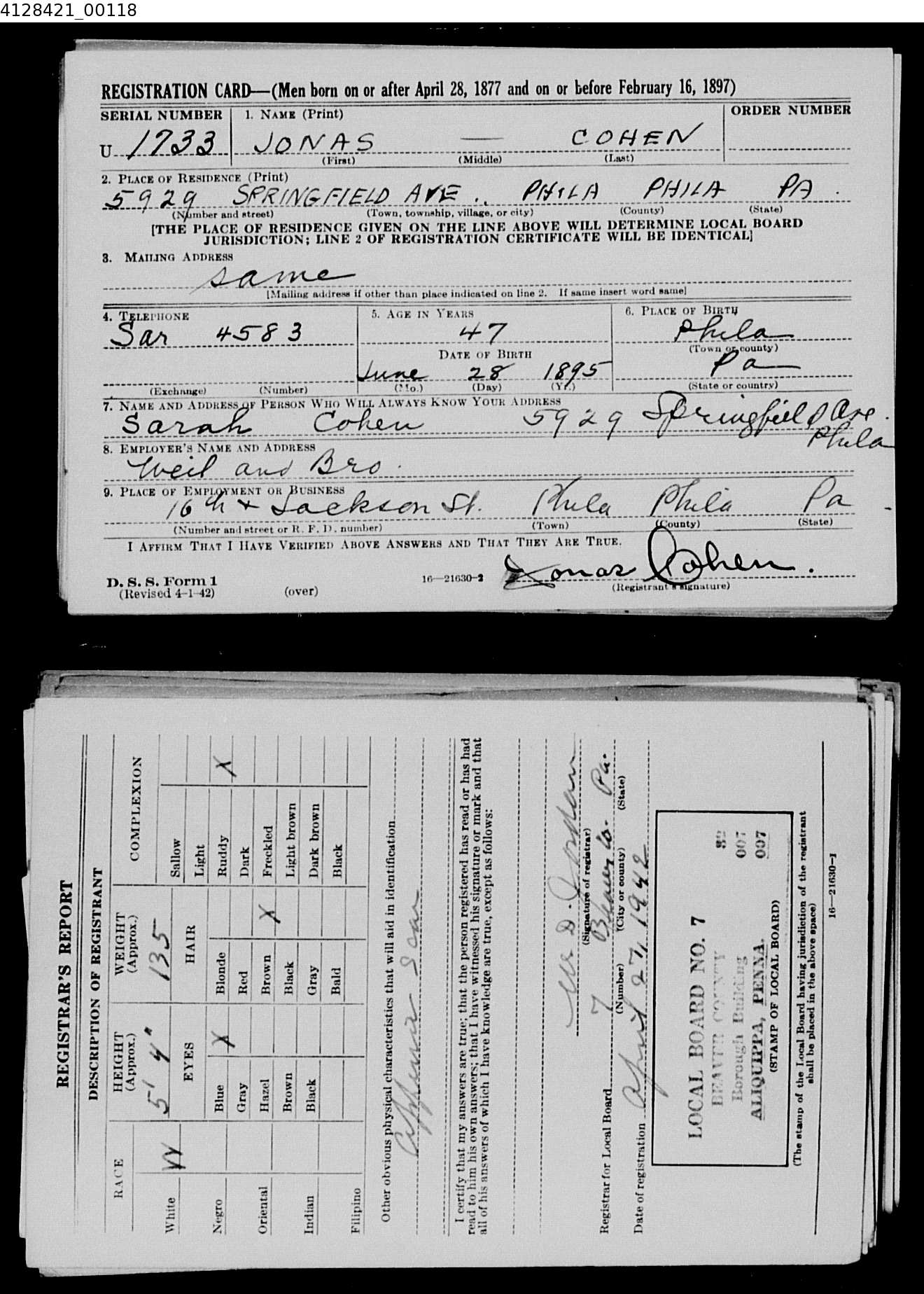
On his World War II draft registration he was living at 5929 Springfield Avenue, and his emergency contact was Sarah Cohen of the same address.  Unless Sally’s real name was Sarah, this would seem to refer to Jonas’ mother, not his wife, but I cannot be sure. Perhaps both his mother and his wife were living with him at that address.

Jonas Cohen, Jr. World War II draft registraiton

Jonas Cohen, Jr. World War II draft registraiton

Henry Weil died in 1945, or at least that is the date on the funeral bill paid by his brother Aaron.  It looks like he was cremated.  I could not find a death record for Aaron, but presumably he lived at least until 1945 since he paid that bill and since his death certificate is not in the database that runs up through 1944.  Neither Aaron nor Henry is buried at Mt. Sinai; their brother Monroe and his wife Maude Weil lived until 1953 and 1959, respectively, and are buried at Mt. Sinai. Perhaps Aaron and Henry were buried in New York at Union Field Cemetery like their father and presumably their mother.

Sarah died on June 18, 1959, and was buried at Mt Sinai next to Jonas, her husband of only ten years who had died almost 60 years earlier.  She was 89 years old, according to burial records.  Her sister Florence Weil Blaufeld had ordered her interment.

Sarah and Jonas Cohen’s son, Jonas, Jr., lived to be 90 years old.  He died on March 3, 1986, and is buried next to his parents at Mt. Sinai.  I could not find an obituary to help determine whether he ever had children or what he did from 1942 until 1986.  However, his interment order was authorized by someone named Sally Cohen.


[1] I thought that perhaps Sarah Weil was somehow related to Lewis Weil, who had married Jonas’ sister Rachel, but I cannot find a connection.  Even though Sarah’s father was named Simon, and Lewis’ brother was named Simon, even though both had ancestral roots in Germany, I could not find any definitive familial tie.

[2] My father was also living on Venango Street in 1940 with his mother and sister, according to the 1940 census.  I wonder if he knew that his father’s first cousin Jonas was living down the street.

How They Met: The Cohens

In a much earlier post, I wrote about how some of my maternal relatives met—my grandparents, my aunts and uncles, my parents, and others.  When researching my great-grandparents Emanuel and Evalyn Cohen and my grandparents John and Eva Cohen, I wondered how they had met.  Fortunately, my brother had heard the stories years ago and shared them with me.

My great-grandmother Evalyn Seligman Cohen was born in Philadelphia in 1866, but her family had moved to Santa Fe, New Mexico, before 1880 (more on that at a later time).   Evalyn (later Eva May) was probably the first woman in my family to go to college.  She came back to Philadelphia to start college at Swarthmore College and met Emanuel Cohen.  They fell in love and married in 1886, and Evalyn never finished college.  (Maybe if she had, Swarthmore would have accepted me back in 1970 when I applied there. But then again, if she had, I would never have been born.)  She was only twenty years old when they married.  If not for her ambitious and independent spirit, she might never have traveled east and met my great-grandfather.

Swarthmore College

Swarthmore College (Photo credit: Wikipedia)


My grandparents also only met because my grandmother Eva Schoenthal Cohen was willing to make the long trip back east.  She also was born in Pennsylvania, but her parents, Isadore and Hilda Schoenthal, had moved west to Denver, Colorado, by the time Eva was six years old.  Sometime in 1922 when she was eighteen years old (she had graduated from high school that June, so perhaps over the summer), she came east to visit with some of her family in Philadelphia.  She met my grandfather John Cohen at some social event while visiting Philadelphia, and as the family story goes, he was so smitten with her that he followed her back to Colorado to woo her and ask her to marry him.  She accepted his proposal, and they were married on January 7, 1923, when he was 27 and she was 19 years old.  As with her mother-in-law, if my grandmother had not been brave enough to travel from Denver to Philadelphia, my grandparents might never have met.

Denver Capital building

My father, the third Cohen man to fall in love quickly and marry a very young woman, also only met my mother because of her willingness to travel, although not across the country.  As I’ve recounted before, they met at Camp Log Tavern in the Poconos where my father was working as a waiter at an adult camp in the summer of 1950.  My mother, who was nineteen and living in the Bronx, came for a vacation, and my father fell in love with her at first sight.  She was less interested, so he had to track her down in the Bronx phonebook after she left.  They married in 1951 when she was twenty years old and he was twenty-four.  They will be celebrating their 63rd anniversary this September.

Camp Log Tavern Milford, PA

Camp Log Tavern Milford, PA

Do you see a pattern here? Not only the serendipity of how each couple met, but both my father and my grandfather had to pursue the woman they loved, my grandfather by taking a train across the country, my father by searching through phonebooks to find my mother.  Thank goodness for those impulsive and determined Cohen men and the traveling women they met and married, or my siblings and I would not be here today.

Florence and John Cohen 1951

Florence and John Cohen 1951


The Eleventh Child of Jacob and Sarah Cohen:  My Great-Grandfather Emanuel (FINALLY!)

About a month ago, my father (who reads the blog regularly) asked me when I was going to get to his grandparents.  Although I wanted to get there also, my linear mind would not let me “skip ahead.”  I knew that if I did, I’d get too caught up in my direct ancestors and not want to return to all the “lateral” relatives.  So I have stuck, more or less, to my plan and taken each of Jacob and Sarah’s children in birth order.  (Yes, I had to skip Reuben and Arthur while waiting to hear from descendants, but otherwise, I went in order.)  There are still two more children to do after my great-grandfather, Jonas and Abraham, so I still have to resist the temptation to move on to my great-grandmother’s Seligman line.  Also, I still have to return to Jacob’s brother Moses and his family and also some of Jacob and Sarah’s grandchildren whom I’ve yet to research or discuss.

But for now, I finally get to talk about my father’s grandfather Emanuel and his family.  Sadly, my father never knew Emanuel because he died just a few months after my father was born.  There is no one else left for me to ask about Emanuel since there are no other descendants still alive who would remember him.  But my father knew his grandmother, Emanuel’s wife Eva May Seligman, very well, and he remembers other family members as well, although he has not seen or been in touch with them for more than 60 years.  And I never knew any of his Cohen relatives other than my aunt, Eva H. Cohen, who died in 2011.  I never met my father’s father or his uncles or his cousins.

Thus, most of what I know about Emanuel and his sons and their families is based on the same kind of resources I’ve relied upon in all my other research, sprinkled with some family stories from my father or indirectly from my aunt as my brother remembers them.  As I was writing this post, my father also sent me copies of pages from a  family bible that revealed some other dates of births, marriages, and deaths.  There is also a suitcase filled with photographs and papers in my parents’ garage that I have not yet had a chance to examine.  I hope to get to that suitcase soon, but it may have to wait until after the summer.

That means that right now I have no pictures of my Cohen great-grandparents and only a few of my grandfather.  I have none of his brothers or their children.  Of course, it is in part because of this lack of knowledge that I started doing this work in the first place.  I knew so little about any of my grandparents, less about my great-grandparents, and nothing about my great-great-grandparents.  Now I am working hard to fill in those gaps.

So let me start to tell the story of my great-grandparents Emanuel and Eva Seligman Cohen, and eventually I will have to come back and add some pictures and other materials, assuming some exist in that suitcase.

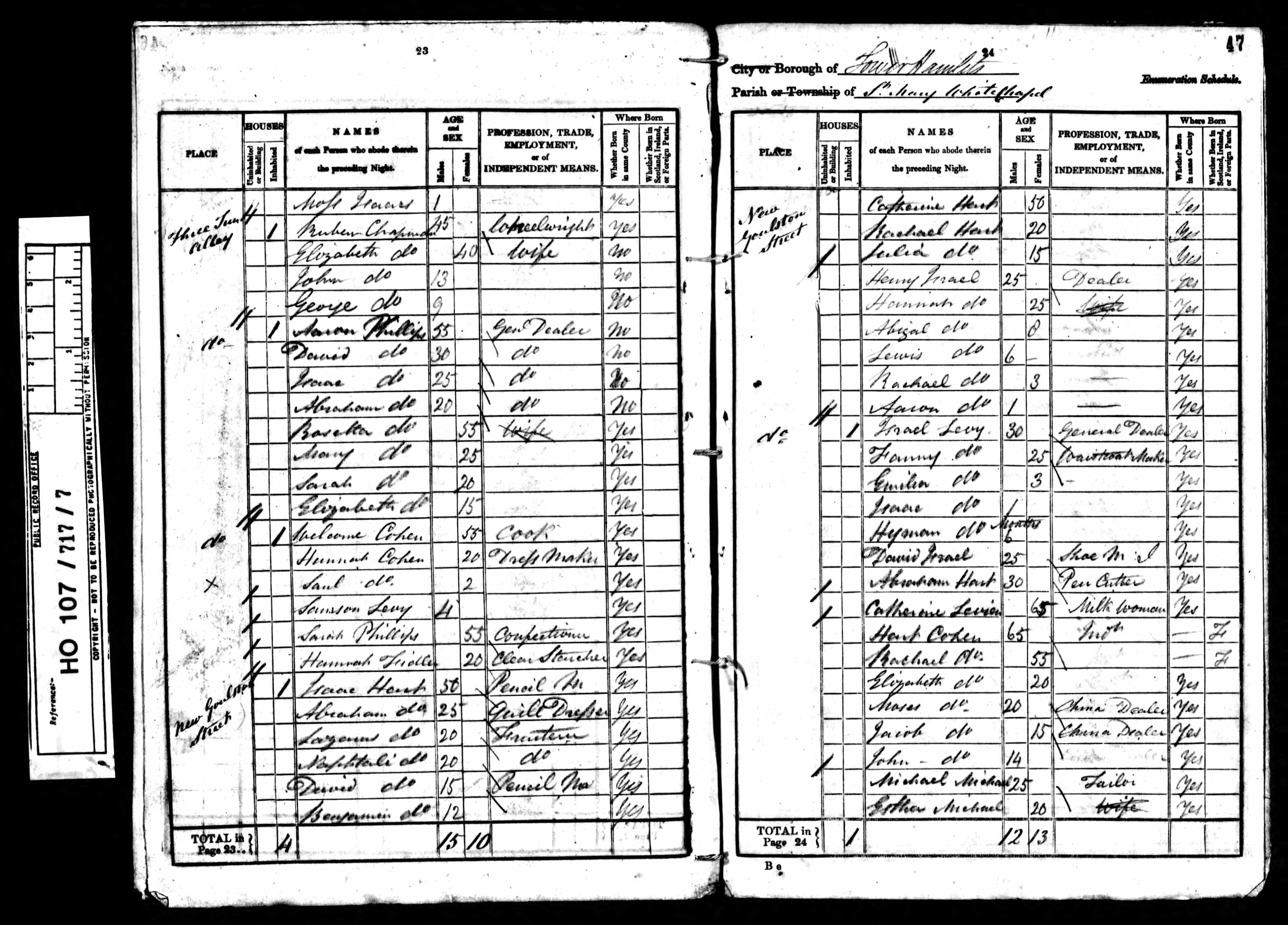
My great-grandfather Emanuel was the eleventh child of Jacob and Sarah Cohen, born June 10, 1862, during the Civil War.  (The family bible has a different date—June 14, 1860, but given that I have eight other sources indicating he was born in 1862, including his death certificate, I will stick with the 1862 date.)   In 1870, when he was eight years old, he was living with his parents and ten of his twelve siblings at 136 South Street in Philadelphia. I imagine that his childhood was a happy one.  His father’s business was successful, and he was surrounded by siblings.  His oldest sister Fanny was married when Emanuel was only four, and he had nieces who were only a little older than he was in addition to all his siblings.  His brother Lewis was only two years older and his brother Jonas two years younger.  It must have been quite a household.

Jacob Cohen and family 1870 US census

Jacob Cohen and family 1870 US census

By 1880, his life had changed.  His mother Sarah had died in 1879, and only five of his siblings were still living at home: two of his older sisters, Hannah and Elizabeth, and his three brothers closest to him in age, Lewis, Jonas, and Abraham.  Emanuel was working as a clerk in one of the pawnshops.  He was eighteen years old.

Jacob Cohen and family 1880 US census

Jacob Cohen and family 1880 US census

On January 27,  1886, Emanuel married my great-grandmother, Evalyn Seligman, who was later known as Eva May and as Bebe by her grandchildren after my aunt called her that when she was a toddler.  I don’t know how my great-grandparents met.  He was 24, she was 20.  In 1886, they were living at 404 South Second Street, and Emanuel was working for his father’s pawnbroker business.  Their first child, Herbert S. Cohen, was born on either January 28 (family bible) or March 5, 1887 (Philadelphia birth index). On this one, I will rely on the bible as the entry was made by Herbert’s mother, Eva May, who would best know when her child was born.  Their second child, Maurice Lester Cohen, was born on February 27, 1888 (both sources agree here), and the family was living at 1313 North 8th Street, and Emanuel was working at 901 South 4th Street.

On October 17 (bible) or 22, 1889, two and a half year old Herbert died from typhoid fever, as had several of his little cousins.  Just two weeks later, a third son, Stanley Isaac, was born on November 4, 1989.  How terrible it must have been for my great-grandparents to be mourning one child while another was born.  How did they find a way to celebrate that birth and manage through those difficult, early weeks of infancy while their hearts were broken?

Herbert Cohen death certificate 1889

Herbert Cohen death certificate 1889

In 1890, the family was still living at 1313 North 8th Street, and Emanuel was still working as a pawnbroker at 901 South 4th Street.  They were still there in 1893 because when Emanuel’s uncle, Jonas H. Cohen, died in January, 1893, the funeral took place at Emanuel and Eva May’s residence.  I wonder why, of all the nephews and nieces of Jonas, Emanuel was the one to have the funeral at his home.

funeral at emanuels

(“Mortuary Notice,” Thursday, January 26, 1893, Philadelphia Inquirer (Philadelphia, PA)   Volume: 128   Issue: 26   Page: 6)

By 1895, the family had moved.  Emanuel’s brother Isaac had also lost his wife Emma in 1893, and as of 1895, Emanuel and his family had moved into Isaac’s house at 1606 Diamond Street, presumably to help Isaac take care of his teenage son, Isaac W. On December 6, 1895, my grandfather, John Nusbaum Cohen, was born, completing Emanuel and Eva’s family.  Emanuel continued to work at the 901 South 4th Street pawnshop.
John Cohen as a baby

John Nusbaum Cohen about 1896

As I wrote about previously, Isaac was sixteen years older than Emanuel, so I am not sure why, of all the siblings, he chose to live with his much younger brother Emanuel.  I think it says a lot about what kind of people Emanuel and Eva May were, taking in these two family members while also raising three boys of their own.  Emanuel and Eva had also been the ones who opened their home for the funeral for Emanuel’s uncle Jonas. According to the 1900 census, they did, however, also have two servants helping them in the home so perhaps it was not as onerous as it might seem; perhaps they were the best situated to do these things.

Emanuel Cohen and family 1900 census

Emanuel Cohen and family 1900 census

I would imagine that the 1890s were overall not an easy decade for the extended Cohen family.  First, the family patriarch, Jacob, died on April 24, 1888, just two months after Maurice was born. His brother Jonas H. Cohen, the last of Hart and Rachel’s children, died five years later on 1893. Also, a number of Jacob’s young grandchildren died during this decade, including many of Reuben and Sallie’s children and also Benjamin Levy, Maria’s son. His brother Isaac had lost his wife Emma. On the other hand, there were many children born, many siblings married, and business overall seemed to be thriving for the family pawnshops.

As of 1905, Emanuel and his family had moved down the street to 1441 Diamond Street.  On the 1910 census, they are listed as living at 1431 Diamond Street, and Isaac, Emanuel’s brother, was still part of the household, along with Eva, all three of Emanuel’s sons, and two servants. Maurice, who was 22, was working as a salesman for a clothing business; Stanley (20) and John (14) were not employed outside the home.

Emanuel Cohen and family 1910 census

Emanuel Cohen and family 1910 census

In the 1913 and 1914 city directories Emanuel is listed as a pawnbroker at 1800 South 15th Street.  His brother Isaac died in 1914, and as of 1917 the family had moved again, this time to 2116 Green Street.

His oldest son Maurice married Edna Mayer on January 19, 1915.  Their son Maurice Lester, Jr., was born January 30, 1917.   According to the 1917 city directory, they were living at 4248 Spruce Street, and Maurice was working at the South Philadelphia Loan Office; on his draft registration that same year he described himself as self-employed as a broker.

Maurice Cohen World War I draft registration

Maurice Cohen World War I draft registration


On the 1920 census they were still living on Spruce Street, and Maurice’s occupation was pawnbroker.

Maurice Cohen and family 1920 census

Maurice Cohen and family 1920 census

In 1917 Stanley was still living at home and was the proprietor of a pawnshop at 2527 South 13th Street, according to his World War I draft registration.  In the 1917 city directory he is listed as working at the South Philadelphia Money Loan Office, the same business where his brother Maurice was working and presumably the shop located at 2526 South 13th Street.  He is also listed at the same business in 1921, living at 2114 [sic?] Green Street.

Stanley Cohen World War I draft registration

Stanley Cohen World War I draft registration

In 1917 my grandfather John was also living at home at 2116 Green Street and employed as an advertising salesman for the Morning Bulletin, according to his World War I draft registration.

John Cohen Sr. World War I draft registration

John Cohen Sr. World War I draft registration

According to the 1918 city directory, John was in the United States Navy at that time.  I have not yet found anything more specific about his military service.

In 1920, Emanuel, Eva (listed incorrectly as Edith), Stanley, John, and two servants were living at 2116 Green Street.

Emanuel Cohen and family 1920 census

Emanuel Cohen and family 1920 census

Interestingly, in the 1921 city directory, Emanuel’s business was now classified as watches and jewelry.  Had he left the pawnbroker business between 1920 and 1921, or was this just another way of describing his business?

I didn’t think I would be able to find the answer, but then, to be honest, I stumbled upon it.  I had found my grandfather John’s 1921 passport application almost a year ago and found it interesting that he was applying for a passport to go to Cuba for up to twelve months. I also found the similarity between his signature and my father’s signature rather remarkable.
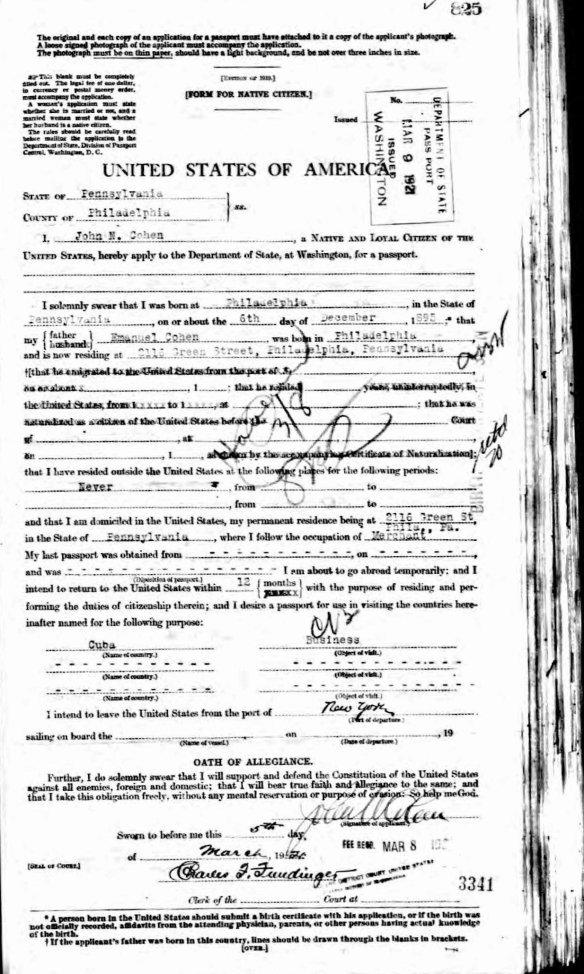
John Cohen passport app cropped

John N. Cohen passport application 1921

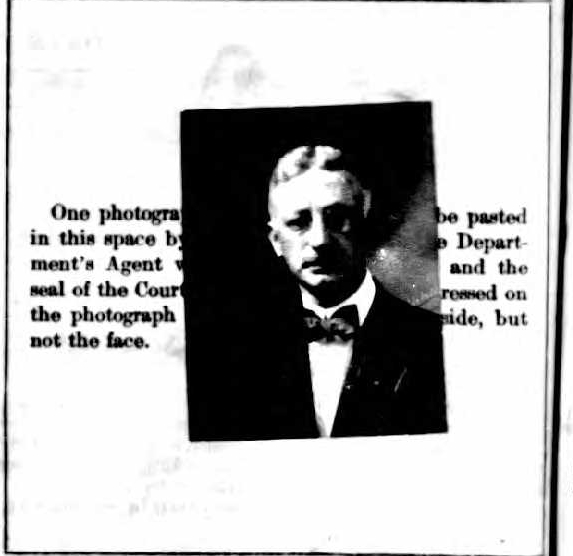
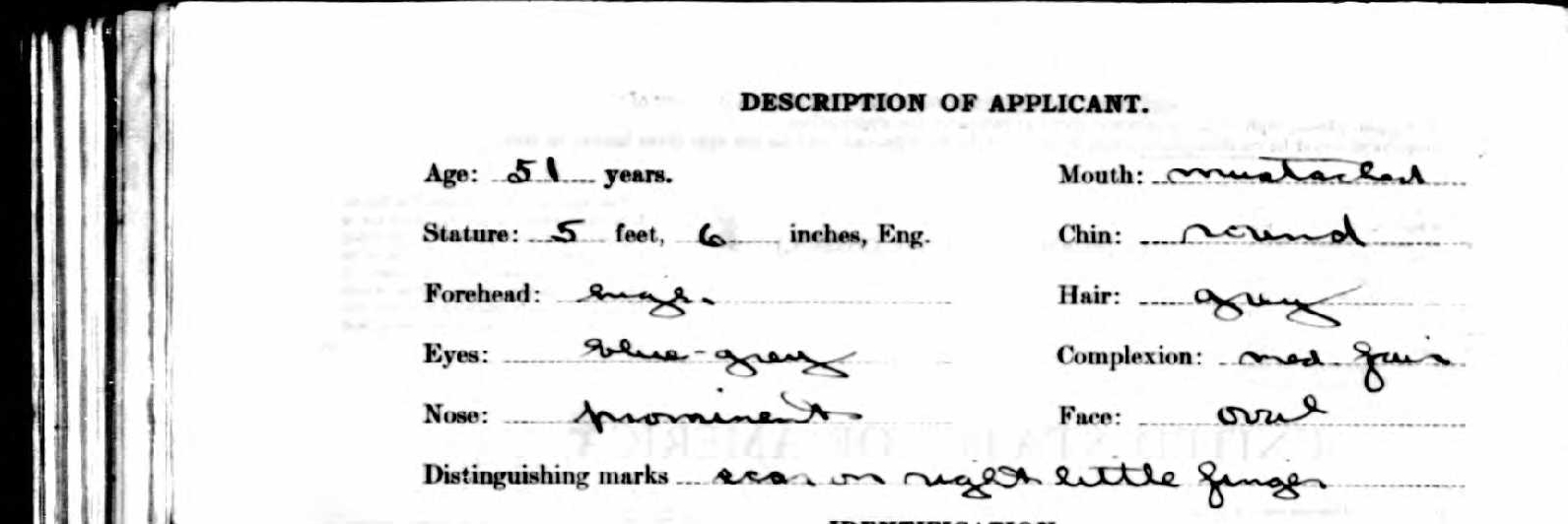
I had noticed that the page facing his application had a photograph of someone else, the person whose application preceded his in the database.  So I went to the following page to see if his photograph appeared on that page, and sure enough it did.  It also had a physical description of my grandfather: 5’ 6” tall, with a high forehead, straight nose, grey eyes, regular mouth, round chin, dark brown hair, dark complexion, and an oval face.
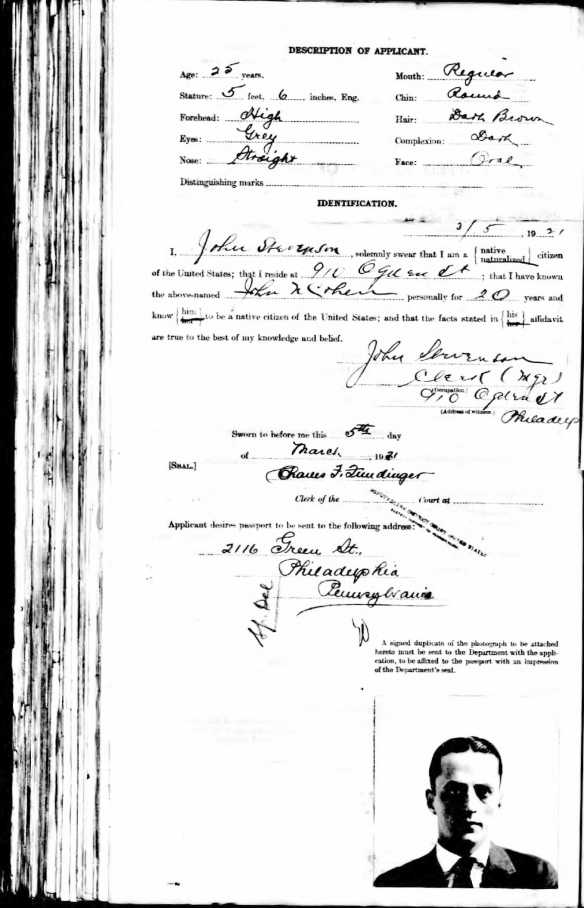
John N Cohen passport application page 2

John N Cohen passport application page 2

What I had not noticed the first time I studied this document was the letter that appears on the facing page—a letter signed by my great-grandfather Emanuel, certifying that his son, John N. Cohen, was going to represent the interests of the “Commodore” in Cuba.  The letter was on the stationery of the Commodore, located at 13th Street and Moyamensing Avenue, with the slogan “Our Policy One Price for All.”  I had never heard this business mentioned or seen it named on any other document.

Letter by Emanuel Cohen  March 5, 1921

Letter by Emanuel Cohen May 21, 1921

After some work on newspapers.com, genealogybank.com and Google, I finally found an advertisement for the business:

The Commodore ad from Our Navy, vol. 13

This was a business owned or at least managed by my grandfather when he returned from the Navy to provide merchandise to veterans at a fair price. I found this ad interesting in several ways.  First, I love that he sold suits “both snappy and conservative.” I also found it interesting that the ad proclaims that it has “no connection with any other store in Philadelphia.”  Was this my grandfather’s way of asserting his independence from the family pawnshop business?  Or was this some trademark issue involving a store with a similar name?  (I did see ads for a furniture store advertising a living room set as The Commodore.)  My father had never heard the store referred to by this name, but said he did recall that his father had a Navy friend whom he referred to as the Commodore who was his connection to the Navy Yard in Philadelphia.  My father does remember visiting the store years later when his grandmother was managing it and selling only jewelry, not men’s clothing, snappy or otherwise.

The years between 1920 and 1930 were years of growth for Emanuel and Eva’s sons.  In 1922, Maurice and Edna had a second son, Emanuel.  On January 5, 1923, Stanley married Bessie Craig, who was fourteen years younger than Stanley. Their daughter Marjorie was born two years later in 1925.

My grandparents, John Nusbaum Cohen, Sr., and Eva Schoenthal, were married on January 7, 1923, according to the family bible. (I assume they were married outside Pennsylvania since there is no marriage record in the Pennsylvania index for them) My aunt, Eva Hilda Cohen, was born January 13, 1924, and my father John, Jr., was born two years later.  My father recalls that the family was also living on Green Street in 1924 when his sister was born and at 6625 North 17th Street when he was born.  (There were no city directories available online for the years between 1922 and 1926.)  (The fact that there were two Emanuels, two Maurices, three Evas, and two Johns in their family must have created some confusion, though Maurice, Jr, was called Junior and Emanuel II was called Buddy. My father was always called Johnny.)

This is the only picture I have of my grandparents together.  They were certainly a handsome couple.  And they were certainly wearing  “snappy” clothing!  I am struck by the Star of David that my grandmother is wearing; they were not religious people, but obviously she felt a strong enough Jewish connection to be wearing such a large star.
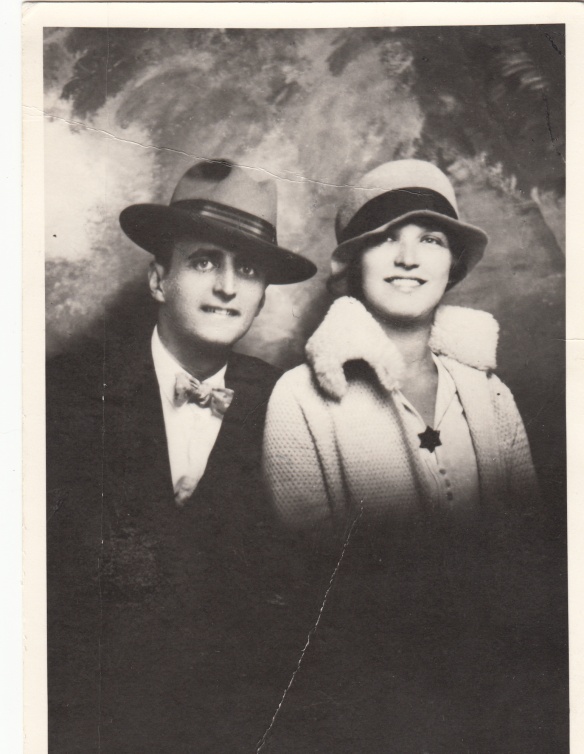
John and Eva Cohen  c. 1930

John and Eva Cohen, My Paternal Grandparents
c. 1930

Eva Hilda Cohen

Eva Hilda Cohen

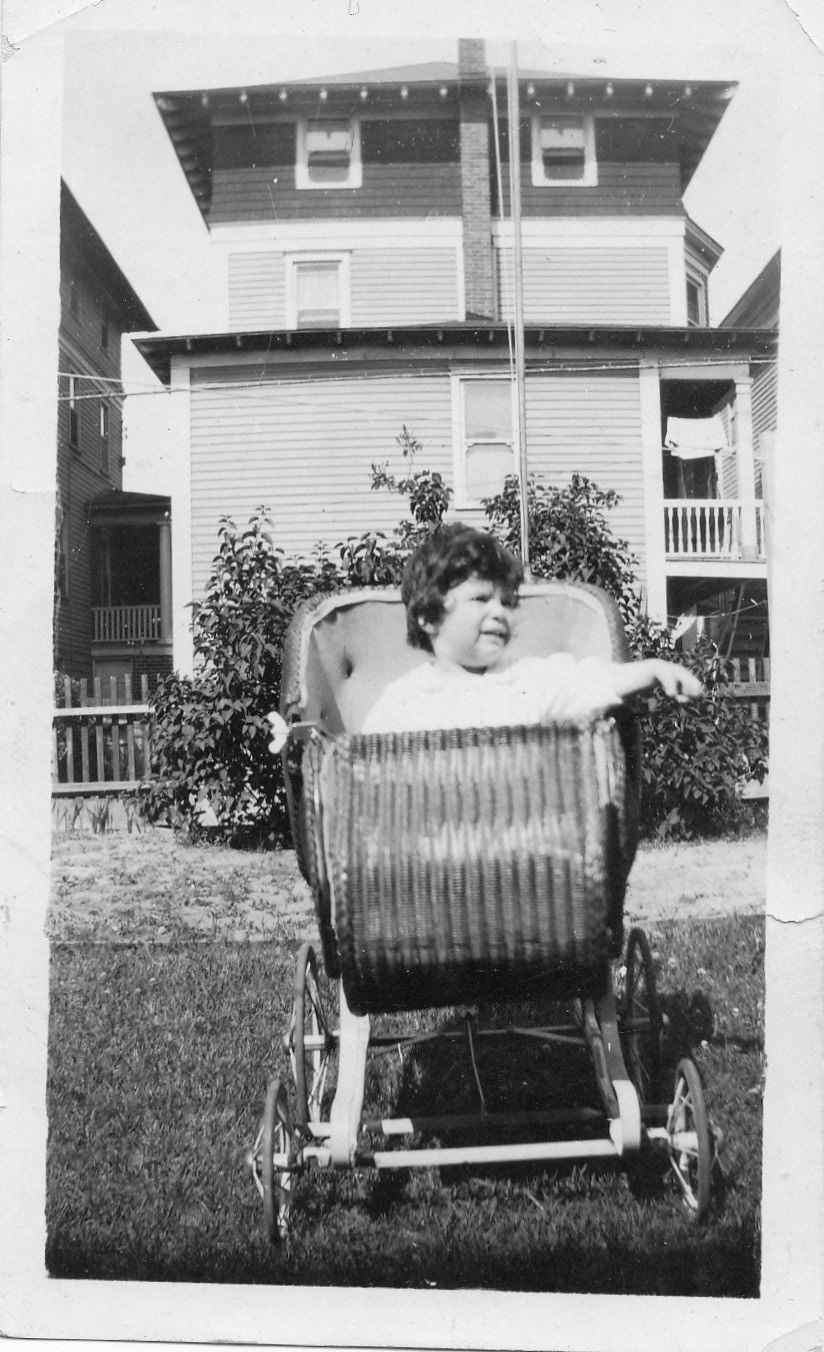
I have always loved this picture of my father; his face really has not changed in many ways.  He still has those beautiful, piercing blue eyes.

My father at 9 months old

My father at 9 months old

Reverse of John Jr at 8 months but 9 months

The reverse side of the photo above—inscribed “Taken a about 9 months, Johnny”

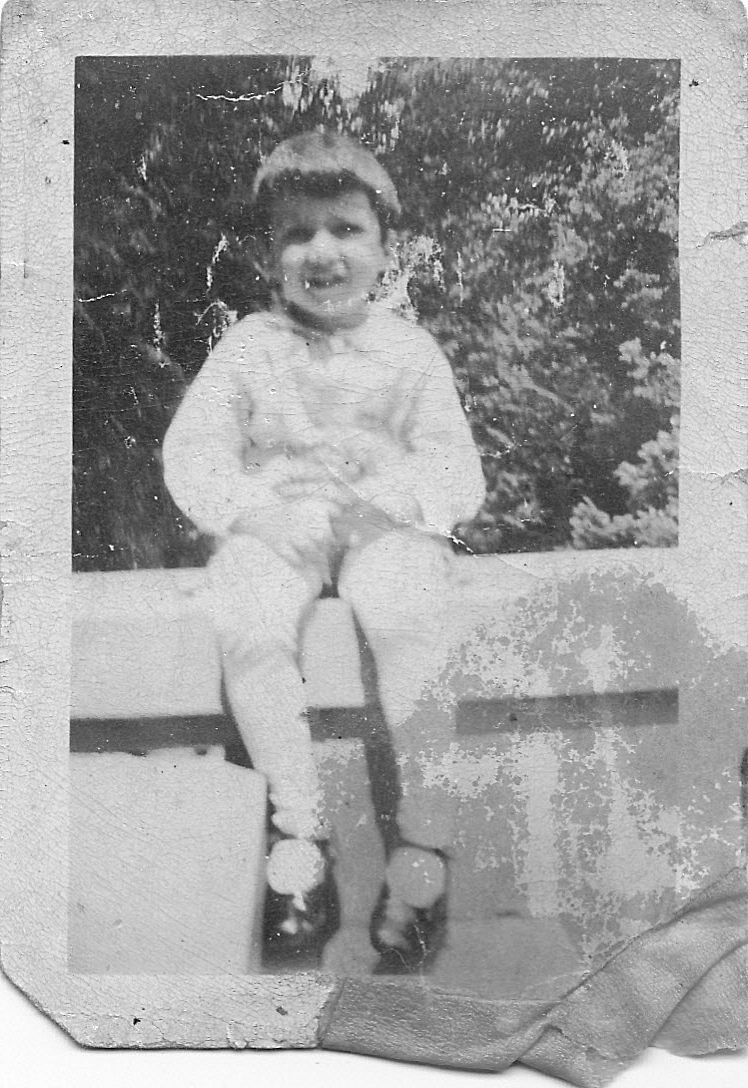
Another wonderful picture, capturing my father as a happy little toddler.

John Jr


Although the next photograph is badly damaged, I am including it in large part to show the inscription on the back, “Johnny Boy.”  My father said that his grandmother Eva May was the one to label the photographs, just as she was the one who made the entries for her children and grandchildren in the family bible.  I like to think that I have inherited her role as a family historian and photograph archivist.

Johnny Boy reverse of John Jr as child

“Johnny Boy”

John Jr little boy


This photograph below captures my aunt as a young girl.  She was a strong and independent person who always stood up for herself and knew what she wanted.


Eva Hilda Cohen

My Aunt, Eva Hilda Cohen

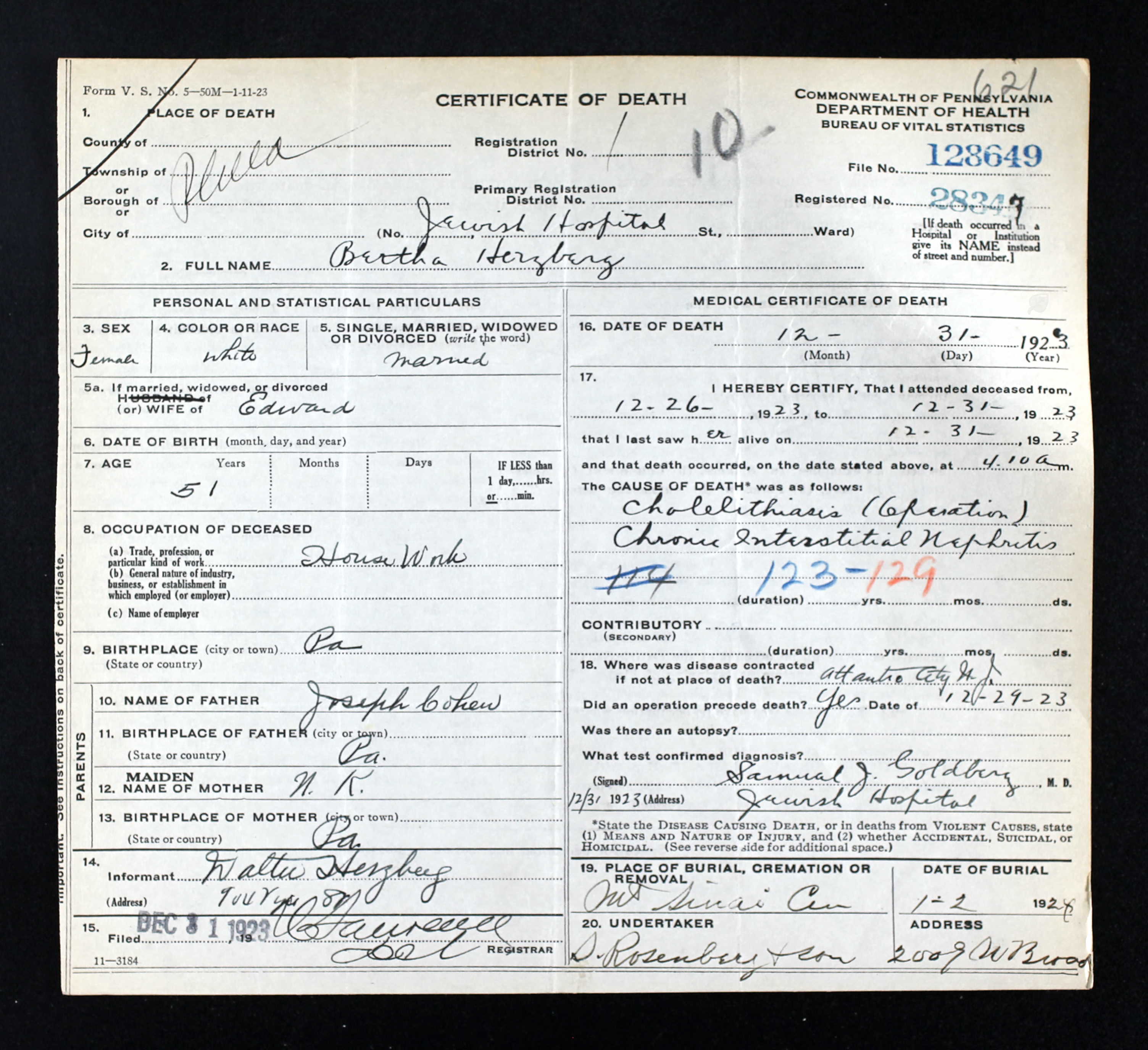
If the 1920s were years of growth, they were also years of loss.  On February 21, 1927, my great-grandfather Emanuel died after a cholecystectomy (gall bladder removal, according to my ever-reliable medical consultant).  It looks like the principal cause of death was pneumonia and either anemia or a hernia.  It also says he suffered from diabetes mellitus.  He was only 64 years old.

Emanuel Cohen death certificate 1927

Emanuel Cohen death certificate 1927

These were also years of loss for the larger Cohen family; by the time Emanuel died in 1927, he had lost all but two of his siblings, Hannah and Abraham, and Hannah would die just a few months later.  Although Jonas had died in 1902, Hart and Fanny in 1911, and Isaac in 1914, between 1923 and 1927 the family lost eight siblings: Joseph (1923), Elizabeth (1923), Lewis (1924), Maria (1925), Rachel (1925), Reuben (1926), and then Emanuel and Hannah in 1927.  Of the thirteen children of Jacob and Sarah Cohen, only one remained after Emanuel and Hannah died, the baby Abraham.

The next decade, the 1930s, were also very challenging years for Eva, Emanuel’s widow, and her three sons. According to the 1930 census, Stanley was now working as a broker. My grandfather John listed his occupation as a clothing and jewelry merchant on the 1930 census, perhaps still working at The Commodore; he and his family were still living at 6625 North 17th Street at that time, which was about fifteen miles north of the Commodore location.

My grandparents, my aunt and my father on the 1930 census

My grandparents, my aunt and my father on the 1930 census

I could not find Maurice on the 1930 census, unless he is the Maurice L. Cohen listed as living with a wife Celia, a son Lester, and a daughter Nannette.  I dismissed this household many times, but since I cannot find him elsewhere and since his son’s middle name was Lester and his other son was Emanuel, which could have been heard by a census taker as Nanette, I suppose, I am inclined to think that this is probably Maurice’s listing, but perhaps not.  At any rate, I was able to find Maurice’s death certificate.  He died from a self-inflicted gunshot wound to the head on August 14, 1931; family lore is that he had been suffering from cancer.  He was only 43 years old, and his sons were fourteen and nine years old when he died.

Maurice Cohen death certificate 1931

Maurice Cohen death certificate 1931

Some years after Maurice’s death, his widow Edna moved to southern California.  According to the 1940 census, she and her two sons, Maurice, Jr., and Emanuel, now called Philip, were living in Los Angeles, although the census indicates they were all still living in Philadelphia in 1935.  My father recalls going to camp with both of his cousins in 1938, so I assume it was sometime after that that Edna and her sons moved away.  My father said he never saw them again.

Edna Cohen and sons 1940 census

Edna Cohen and sons 1940 census

Maurice was not the only one to face serious medical problems during this time period.  My grandfather John contracted multiple sclerosis also during this period.  My grandmother, a sensitive and fragile person, was herself hospitalized and unable to care for her husband or her children, and so John, Sr., and his two children were taken care of by his mother, Emanuel’s widow, Eva May Seligman Cohen.  Once again my great-grandmother opened her heart and her doors to care for family members as she had done over 25 years earlier for her brother-in-law Isaac and his son.

In 1936, my grandfather was admitted to a Veteran’s Administration facility in Coatesville, Pennsylvania, over forty miles away from Philadelphia.  He lived the rest of his life until he died on May 2, 1946.  He was 50 years old.

John Cohen, Sr. 1940 census

John Cohen, Sr. 1940 census

My great-grandmother continued to care for his children, my father and his sister, until she died on October 31, 1939, from heart disease.  My father and aunt then lived with various other relatives until their mother was able to care for them again.

Eva May Seligman Cohen death certificate

Eva May Seligman Cohen death certificate

Stanley, Maurice and John’s brother, did not face the terrible health issues faced by his brothers.  In 1940 he was working as a pawnbroker, and according to his World War II draft registration in 1942, he was self-employed, calling his business Stanley’s Loan Office.

Stanley Cohen World War II draft registration

Stanley Cohen World War II draft registration

In the 1950s, Stanley and Bessie moved to Atlantic City, where he lived for the rest of his life. Bessie died in April, 1983, and Stanley died in July, 1987.  He was 97 years old.  I have located where his daughter was last residing and hope to find a way to contact her.

As for Maurice’s family, I don’t know very much about what happened to them after they moved to California.  Edna died in 1979, and Maurice, Jr., in 1988.  Both were still living in California when they died.  Emanuel Philip was harder to track down, but I eventually found him as Bud Colton in the California death index.  How, you might wonder, did I know that Bud Colton was the same person as Emanuel Cohen? Well, the death index listed his father’s surname as Cohen and his mother’s birth name as Mayer.  In addition, he was always called Buddy by the family.  Colton is fairly close to Cohen in pronunciation, and there was some family lore that he had in fact changed his name to something else.  Bud served in the army during World War II as Bud Colton.  He married Helga Jorgensen in April, 1957, when he was 34 and she was 49.  Bud died in February, 1995, and is buried as a veteran at Los Angeles National Cemetery.  I did not find any children of either Bud or Maurice, Jr.; although I found a few Maurice Cohens in the California marriage index, only one of those marriages seemed to have resulted in a child, and her birth certificate revealed that her father Maurice Cohen was not the one related to me.  The other two Maurice Cohen marriages would have been fairly late in Maurice’s life (if in fact it was the same Maurice Cohen), and I found no evidence of any children from those marriages.  Given the age of Helga when she married Bud, it also seems unlikely that that marriage resulted in any children.

It is rather sad that we know so little about my father’s paternal first cousins, but this was all I could find up to this point.  I will keep looking and hope that more information will turn up.  Perhaps in that mysterious suitcase I will find more pictures, more documents, more answers.  Nevertheless, I know a great deal more now than I once did about my great-grandparents Emanuel and Eva Cohen and my paternal grandfather John Nusbaum Cohen.

Below is the headstone for my great-grandparents Emanuel and Eva May and for my grandfather, John N. Cohen, Sr., who were buried at Mt. Sinai Cemetery in Philadelphia.  Maurice is also buried there, one section over.

headstone for emanuel, eva and john n cohen


To Reveal or Not: More Thoughts on the Ethics of Genealogy

My post yesterday prompted a lot of comments both here on the blog and also in two genealogy groups I follow on Facebook, Tracing the Tribe, which is a Jewish genealogy group, and the Ancestry.com group.  I am very grateful for all the thoughts and discussion, and I have a better idea of where to draw the line between revealing and not revealing information.   I will try to summarize the viewpoints articulated by those who participated in these discussions.

Generally speaking, there are two different views.  One view is that telling the truth is an important principle in reporting the results of genealogy research.  Genealogy is a form of history, and without all the details, we are distorting history.  If we delete information, we are not giving a full picture of a family’s history.  In fact, we are whitewashing the information and creating a picture that presents people as perfect when in reality people are always flawed, make mistakes, endure hardships, suffer from illnesses, marital problems, financial problems, and so on.  What is the point of history if it is not truthful?

On the other hand, many people argue that there is a need to respect the privacy and feelings of others and thus to keep certain information that may hurt someone or embarrass them from being disclosed, both publicly and to those it might hurt or embarrass.  Several people mentioned the traditional Jewish principles of not doing anything to shame or embarrass another and of  lashon hara—not to say anything about anyone, whether true or false, whether flattering or insulting.  My rabbi and dear friend Rabbi Herbert Schwartz also reminded me that even God did not reveal the truth all the time and that lying is sometimes better than truth-telling when the feelings of others are involved.

IAJGS

IAJGS (Photo credit: Wikipedia)

One person pointed me to the website for the IAJGS (International Association of Jewish Genealogical Societies)  and its statement of ethical principles for genealogists.  Among the guidelines they espouse is one that suggests that information that is more than 75 years old may be disclosed.  Quoting from the IAJGS website:

Regarding the “right to privacy” versus the “freedom of information” area of potential conflict:

  • Data more than 75 years old should be regarded as sufficiently historical to be available, without restriction.
  • More recent data should be evaluated in the light of sensitivities of the living versus the importance of disseminating information.
  • Generally, a request from an individual that certain information about themselves or close relatives be kept private should be respected.
  • It if is decided not to publish any particular piece of information, there should be a clear statement to that effect so that the reader is not misled by the omission.

Ethics statement approved by the IAJGS Board of Directors 2 November 2002

The website also includes the Ten Commandments in Genealogy written by Rabbi Malcolm Stern.  These include the following:

9. The sensitivities of living people must be respected and the memory of the deceased likewise, but for the latter it is permitted to record the objective facts about them.

All parties seem to agree that anything about a living person should not be disclosed.  I agree whole-heartedly with that point of view, and I only provide information about anyone living if they consent first.  I keep the details of my family tree on password-protected pages for that reason, i.e., that they include living descendants.

So where do I come out on this debate?  As I said, my views are more clear now than they were before, but they are not yet truly defined.  I agree with both views.  I honor the principle of truth.  As someone who loves history and who is educated in the law, I believe that knowing the truth is important to each of us personally and to our society as a whole.  But I also embrace the need to avoid harming another person if at all possible.  I would hate to think that something I write causes pain to another, but I also know that that pain is rooted in the truth I’ve revealed, not simply in the fact that I have revealed it.

For me that means that, as we lawyers like to say, it depends.  It depends on the circumstances.  Here are some of the circumstances I will and do consider before writing about something that might be upsetting to another person:

  1. Are these documented facts or just allegations? If the latter, I must indicate that they are only allegations or perhaps not even report them at all.  If it was information from a newspaper article, I will quote that source; if it is something that I was told by a relative, I would not report it unless I could find sufficient corroboration.
  2. How long ago did these events occur? I like the 75 year rule adopted by the IAJGS, meaning anything before 1940 would be considered generally publishable if documented.  For me, I might even use a 100 year rule, meaning anything before 1914 is publishable if documented.  However, even in those circumstances, I might still hesitate to reveal the information if there is some other reason not to do so.  For example, if a living descendant asks me not to do so (see #4 below) or if the facts are relatively insignificant.
  3. If I do reveal those older facts, I may also take steps to protect the identity of any living descendants of that person.  For example, if someone who lived 120 years ago committed a crime, is it necessary to reveal the names of his or her children or grandchildren in a blog post about that person? By making it less obvious who the descendants are, it will be harder for others to make that connection. If a descendant, say, a great-grandchild, looks hard enough, they might find out that their great-grandparent committed a crime, but if they look that hard, they also likely would have found it the same way I did—from publicly available records.
  4. For information that is more recent than 75 years, I would only reveal that information if I am sure that either there are no living direct descendants or if I am in touch with living descendants and am able to discuss the facts with them and get their permission to write about it on the blog.  I do not generally think it is my role to tell someone something that may upset them; I am not a psychologist and am not able to deal with the reactions I might cause.  But if I know that that person already knows the information, then I am more willing to let them know that I have learned about it from some public source and then to talk to them about it.  If I can’t find the living descendants, then I would not reveal information that is more recent than 1940.
  5. If a descendant asks me not to write about something on the blog, I will not do so.  Yes, that may distort history, but this is personal history, family history—not the kind that changes society or reveals the truth about how political decisions are made.  This is not a cover-up that will affect many people, if any, outside of one particular family.

Do these principles/guidelines make sense? I am still struggling with this, and I know that not everyone will agree.  The truth-seekers will not be happy with me for holding back some information; those who do not believe in revealing upsetting information will not be happy that I will reveal that information in certain circumstances.  I know that my thoughts and my practice will evolve over time, and I know that I will continue to struggle and to seek counsel from all of you.

Thank you to everyone who commented, both here and on Facebook, and for helping me think through this difficult issue.


Genealogy Ethics: What and Who Do You Tell the Things You Learn?

question

question (Photo credit: cristinacosta)

This past Sunday the New York Times ran an article about a reporter who learned that his great-great-grandfather, a New York City police officer, had killed a man under questionable circumstances, but had never gone to trial.  The reporter tracked down the descendant of the victim and told him the story.  That descendant had never known that his great-grandfather had been killed.  I found this story interesting, but it also raised a number of questions about the ethics of uncovering a family secret.  What lines should I draw when I learn something that might be upsetting to a descendant?

It doesn’t even have to be something involving criminal conduct.  It could be learning about financial troubles, medical issues, family issues—all of which can be discovered in public sources like newspapers, census reports, vital records, wills, court documents, and other records that anyone, whether related or not, can find.  Does the fact that these are publicly available facts make a difference in terms of disclosure and privacy?

Is there some point in time when revealing that information is clearly appropriate?  Is there some point in time when those events are not remote enough in time?  Does it matter whether the family involved never even asked you to do the research versus a situation where they asked but had no knowledge of the troubling information? Are there times you definitely should reveal information? Are there times that you definitely should not?  What about putting things on a publicly accessible source such as a blog? What are the proper lines in that context?

I am seriously interested in these questions and what others think about them.  Whether you are a genealogy person or not, I would really like to know what you think.  Please leave your thoughts here.  I really think this issue merits serious discussion.


Was the Census Taker Incompetent? Lewis Cohen 1862-1924

Having now completed the stories of the seventeen children of Reuben and Sallie Cohen, I can return to Reuben’s siblings, the other children of my great-great-grandparents Jacob and Sarah Cohen.  Reuben was their sixth child, followed by three daughters, Maria, Hannah, and Elizabeth, about whom I have already written.  That means we are up to Jacob and Sarah’s tenth child, Lewis.

Lewis was born March 20, 1862, and grew up with his siblings at 136 South Street.  In 1880 when he was eighteen years old, he was working as a clerk, presumably with his brothers in his father’s pawnshop.  In 1886 when he was twenty-four he married Carrie Dannenbaum.  At that time he was working with his brother Joseph as a pawnbroker at 1001 South 10th Street and living at 404 South Second Street.  By 1910, Lewis and Carrie had a daughter Helen, who was listed as being sixteen, and they were all living at 2144 Green Street.  Lewis’ pawnshop was still on South 10th Street at 1537, where he remained for another decade or more.

Lewis Cohen 1910 census

Lewis Cohen 1910 census

The only real wrinkle I encountered in researching Lewis was a strange entry in the 1920 census.  On that census, Lewis and Carrie are listed as living with a son named Isidor Solis Cohen, 23 years old, who was working as a clerk in a department store.  If Lewis and Carrie had a 23 year old son in 1920, then where was he in 1910 when he was thirteen?

Lewis Cohen 1920 census

Lewis Cohen 1920 census

I could not find any later record for him either.  I found him on two other ancestry.com family trees as Lewis and Carrie’s son, but aside from the 1920 census, the only records relied on for support on those trees referred to different Isidor Cohens—one whose parents were born abroad and one whose parents were born in New York, whereas both Lewis and Carrie had been born in Pennsylvania.

The only source used on those trees aside from the 1920 census that referred to Isidor as Isidor Solis Cohen was a World War I draft registration, but on that form Isidor listed his contact person as J. Solis Cohen, MD.

Isidor Solis Cohen World War I draft registration

Isidor Solis Cohen World War I draft registration

A quick search revealed that Jacob Solis Cohen was a prominent Philadelphia surgeon whose family had come to the United States far earlier than my Cohen family and from Russia, not England.  I found Isidor living with Jacob Solis Cohen on the 1910 census along with his numerous siblings.  It seemed pretty clear to me that Isidor Solis Cohen was not the son of Lewis and Carrie, but of Jacob Solis Cohen, MD.

So how did he end up living with Lewis and Carrie in 1920? Or was this just some strange mistake by the census taker?  When I dug deeper and searched for the Solis Cohen family in 1920, I found something rather odd.  Except for one brother who had married between 1910 and 1920 and one sister who was hospitalized, all of Isidor’s siblings and his father Jacob were living at 2113 Chestnut Street, but their listings were spread throughout separate pages of the census for the enumeration district.  Jacob was listed with one daughter; three daughters were listed together on a different page; and one brother, Myer Solis Cohen, was listed not only apart from his sisters and father, but with two people a few years older than he named Ramsburgle.  What made that even stranger was that Myer, aged 42, was listed as the son of the Ramsburgles, aged 49 and 48.  Unless there was some truly miraculous event, there was no way Myer was their son.

Myer Solis Cohen the 42 year old "son" of the Ramsburgles, aged 49 and 48

Myer Solis Cohen the 42 year old “son” of the Ramsburgles, aged 49 and 48

Mixed in between the census pages listing all the other Solis Cohens was a page that listed Isidor as Lewis and Carrie’s son.  The address was not 2113 Chestnut, but an apartment building called the Coronado located on the same block at 22nd Street and Chestnut.  All of these inconsistencies in this enumeration district convinced me that the listing of Isidor as the son of Lewis and Carrie was wrong, just as the listing of his brother Myer as the son of the Ramsburgles was wrong.

Thus, I believe that Lewis and Carrie had one child, Helen.  Although the 1910 census gave her age as 16, it also said she was a cook for a private family.  Looking at that census, it looks like the census taker had some information for Helen confused with information for the family cook, Margaret Johns.  The numerous cross-outs make it rather hard to read.  This was a different census taker, I assume, from the one who later took the 1920 census of the Solis Cohen family, but another census taker who was not very careful.  Later census reports put Helen’s year of birth at about 1890.

At any rate, Helen was not 16 in 1910.  Later that same year on September 28, 1910, she married William Bacharach, and the marriage record filed with their synagogue indicated that Helen was then 22.  I know that this is the right Helen Cohen because the address given, 2144 Green Street, is the same address where Lewis, Carrie and Helen were living in 1910.

Helen Cohen marriage certificate

Lewis died on May 9, 1924, from an intestinal obstruction caused by carcinoma sigmoid or colon cancer.  He was 62 years old.  His widow Carrie died four years later on June 14, 1928, from endocarditis.

Carrie Cohen

Carrie Dannenbaum Cohen

Their daughter Helen and her husband William Bacharach had three children, Augustus, Lewis Cohen, and Jeanne. I am very lucky to be in touch with two of Helen and William’s descendants.   They were able to supply me with the photos posted here and with some of the information as well.   William Bacharach came from a family that, prior to Prohibition, had been in the liquor business, but when Prohibition became the law, the family sold the business and developed a business as pawnbrokers; family lore is that they sold their liquor business to a company that became part of what is today’s Seagram’s.  Thus, William, like the Cohens, was a pawnbroker and spent his career in the business.   He was very successful.

Helen Cohen Bacharach and her children c. 1927

Helen Cohen Bacharach and her children c. 1927

During the Depression, William and Helen purchased a large house with seven bedrooms in the Oak Lane neighborhood of Philadelphia.    They also were very involved with the historic Rodeph Shalom synagogue and with the Philadelphia Jewish community in general.  Helen died in 1950 from cancer, and  William donated money and charity work to Moss Rehab, where there is an award given yearly in his name there, according to one of their descendants.  After Helen’s death William moved to Rittenhouse Square in Philadelphia.  William died in 1973 in Tucson, Arizona, where he had retired.


Jeanne, WIlliam, and Helen Bacharach

Jeanne, William and Helen Bacharach

Grandpa Bacharach

William Bacharach


This is what I know about Helen and William’s three children, Augustus, Lewis and Jeanne.

Jeanne, Lewis, and Gus Bacharach

Lewis, Jeanne, and Augustus Bacharach

Helen and William’s son Augustus was their first born child, born on October 24, 1912.  He was still living at home and not employed in 1930, presumably still in high school, but by 1940 he had married Jane Sinberg and was working as a salesman (I cannot decipher the entry for the industry).   In 1950, Augustus was working in radio repairs, according to the city directory.  He seems to have lived in the Philadelphia area all his life. He and Jane had one child.  His wife Jane predeceased him by six years, dying in 1975.  Augustus thereafter married Carolyn Sundheim Ostroff Osser, who had been married and widowed twice and had two children.  Augustus died in December, 1981, leaving Carolyn a widow for a third time.

Helen and William’s second child, Lewis Cohen Bacharach, was born in August 22, 1914.  He continued the Bacharach and Cohen family pawnbroker tradition until the 1960s when he closed the last of the family’s pawnshops.  He and his wife Mary retired to Tucson, Arizona, and both lived full and long lives even after retirement.   I was able to find a few articles and their obituaries which beautifully capture their lives and their commitment to helping others.

First, this profile of Lewis C. Bacharach from the June 2008 newsletter from his retirement community, Evergreen Estates in Lancaster, PA:

Resident Spotlight: Lewis Bacharach

Lewis was raised in Philadelphia, PA, the middle child with one brother and one sister. A graduate of Northeast High School, Lewis studied business for two years at Temple University.  In 1942 Lewis began three years in the United States Army in New Guinea. It was while training at Edgewood Arsenal, Maryland, that he met Mary. She drove for the Red Cross Motor Corps and was volunteering for an evening of Bingo. That night Lewis offered Mary a cup of coffee and four dates later they were engaged. In July the Bacharach’s will celebrate their 65th anniversary. They are the parents of two children and have two grandchildren.

Lewis said, “Doing for others is what brought him and Mary together.” They were always involved in community having singly or together volunteered for the following organizations: Art League, Brandeis Book Club, Lions Club, Mobile Meals, United Order of True Sisters, Tucson Medical Center, the March of Dimes and Food Bank. In 1977 Lewis helped organize and establish the LaCanada Magee Neighborhood Association, a neighborhood of 5,000 homes in Arizona. Lewis has served as president of Wyndmoor Lions Club, Whitemarsh Village Association and The LaCanada Magee Neighborhood Association. Lewis and Mary served as docents at the Arizona Desert Museum, a world known organization, where they had the privilege of hosting people from around the world.

Lewis said he misses “doing for others.” These days he faithfully visits Mary who is recuperating in the nursing care unit at Brethren Village.

http://www.evergreenestatesrc.com/jun08.pdf

I also was able to obtain more information about Mary from her obituary in 2011:

Mary was a graduate of Maryland Art Institute and moved to New York City where she was a window decorator. She also taught at the Devereaux Foundation and was a founding mother in the Mothers March of Dimes, a co-founder of the Tuscan United Order of True Sisters, an organizer of the Whitemarsh Village Policemen’s Ball, and a member of the National Council of Jewish Women. As a little girl, she sat on Babe Ruth’s lap and studied dance at the Peabody Institute in Baltimore. Her love of art was a guiding light in her life and she encouraged her son to become an artist. She was always doing for others and enjoyed being a Cub Scout Den mother. Brandeis University bestowed upon her the honor of “Woman of Valor.” At the age of 90 Mary wrote and illustrated a children’s book called Big Black’s Neighbors. She was a member of Temple Emmanuel in Tucson, AZ and attended Shaarai Shomayim in Lancaster, PA.

(Intelligencer Journal-Lancaster New Era (PA) – Monday, January 31, 2011)

Mary Bacharach

From Lewis’ obituary in 2013, I obtained this additional information:

[As a long time pawnbroker in Philadelphia, Lewis was] respected by his peers as well as his clients, among whom he was known for his honesty. In the ’60’s, he closed his business and went to work managing the bookstore of the Philadelphia Community College, where he stayed until retiring to Tucson, Arizona. During his time in Philadelphia, Lewis was involved in the Lions Club, Congregation Rodeph Sholom, and founded the Whitemarsh Village Association. While working and volunteering, he still found time to help his wife lead a Cub Scout Pack and raise his sons to value friendship, loyalty, and honor. He instilled the importance of a good name and the concept that a man’s word should be his bond.

When Lewis’s wife Mary visited Tucson in 1973, she fell in love with the desert. A few months after her visit, the house was sold and Lewis took on new challenges. Outgoing, gregarious (God help you if you went to the market with him; he knew and spoke with everyone), and willing to help anyone, he soon became part of the community. Along with Mary, he became a docent at the Desert Museum, where he loved introducing visitors to the plants and animals of the Sonoran Desert. He started a neighborhood association in Casas Adobes East, where he fought to preserve the natural habitat and put limits on construction, and volunteered with the Food Bank. …. When other family members moved west, Lewis introduced them to his circle of friends and became the patriarch of the family, a role that he enjoyed.

Lewis and Mary returned to Pennsylvania while in their 90’s and moved to Evergreen Estates. When Mary’s health declined, necessitating a move to a skilled nursing facility, Lewis remained at Evergreen, visiting her faithfully until her death. Meanwhile, the wonderful staff and residents at Evergreen became his extended family and a source of support and camaraderie. He was a regular at the nightly pinochle gathering and enjoyed kibitzing in the evening over ginger ale. While in Lancaster, Lewis loved spending time with his children and grandchildren, and took pleasure in family gatherings and dinners, especially if there was a martini on the menu. He was proud of his extended family, and looked forward to his almost nightly chats with his niece … who kept him up on the news in Tucson.

(Intelligencer Journal-Lancaster New Era (PA) – Friday, June 21, 2013)

Mr. Lewis C. Bacharach

Lewis Cohen Bacharach

Lewis and Mary were clearly well-loved not only by their children and grandchildren, but also by every community where they had lived during their long and meaningful lives.

Helen and William’s daughter Jeanne was born December 15, 1917.  She married Charles Towle, who became very well-known for his extensive collection of railroad related stamps.  According to Wikipedia, Charles L. Towle “was a stamp collector who studied postal history and wrote philatelic literature on the subject…. On the basis of his studies, Towle, co-authored with Henry Albert Meyer, and wrote Railroad Postmarks of the U.S., 1861-1886, and, in 1986 Towle wrote his four volume United States Rates and Station Agent Markings. Towle wrote extensively on transit markings and received numerous awards for his effort. For three years Towle edited The Heliograph, the journal of the Postal History Foundation.  … Towle was active in philatelic organizations, such as the Mobile Post Office Society, where he was president until he died, and as Chairman of the Board of the Western Postal History Museum, later renamed the Postal History Foundation.  ….Towle was named to the American Philatelic Society Hall of Fame in 1991.”

http://en.wikipedia.org/wiki/Charles_L._Towle

Family members told me that Charles’ stamp collection was donated to the University of Michigan.  Charles and Jeanne lived in Dearborn, Michigan, for many years where Charles was the president of a railway company during the 1950s and 1960s.  Charles and Jeanne later moved back to Philadelphia and then to Tucson, Arizona, where Charles became very interested in mineralogy, eventually donating that collection to other museums. He and Jeanne were also very active in the Arizona Sonora Desert Museum along with Lewis and Mary Bacharach.

Jeanne died in 1976 of cancer, like her mother Mary.  Charles died in 1990.  They had four children who survived them and many grandchildren.

Jeanne Bacharach

Jeanne Bacharach Towle

Thus, Lewis Cohen, my great-granduncle, has a wonderful legacy in the many contributions and commitments to community made by his daughter and son-in-law and their children.


The Genealogy Village: An Update on Maria Cohen and William Levy

Over three weeks ago, I blogged about Maria Cohen, Jacob and Sarah’s seventh child, and her life.  She had married William Levy, and they had had four sons, one of whom committed suicide as a teenager, and two others who predeceased her, Lewis, who died when he was 38 in 1915 only five years after marrying Emma Fogle, and Jacob, who died the following year when he also was only 38.  Only one son, Isaac, survived her.

At the time I wrote the blog, I could not find any records for Maria or William after 1900, except as names on their sons’ death certificates.  I did not know when either of them died.  In addition, although I had a death certificate for their son Lewis and was able to find his headstone through FindAGrave, I was confused by the fact that the headstone referred to Lewis and his wife Emma as father and mother, but I had no record of any child born to Lewis and Emma.  I put those questions aside after much searching, figuring I would return.

So I returned to Maria and William after the updates to the Pennsylvania death certificate database earlier this week.   First, I called Adath Jeshurun cemetery in Philadelphia to see if Maria and William were buried there.  Since all three of the sons who had died were buried there, I assumed that Maria and William would have been also, and that hunch paid off.  The very helpful woman at Adath Jeshurun gave me the dates that Maria and William died and were buried.

William had died September 10, 1906 when Maria was only 49 and had already lost her son Benjamin.  She would lose two more sons in the next ten years.  Maria herself died March 24, 1925.  I now had their dates of death, but still no death certificates.  Even with the new update, I could not find a death certificate for either William or Maria even though both had died before 1944.  I was bewildered.

I then searched for all people named Levy who died in 1925 and finally found Maria—spelled Mrriac in the ancestry.com index.  What?? Mrriac?? No wonder I couldn’t find it.  But it was clearly Maria—daughter of Jacob Cohen and “Sallie Jacob.”  She had died from diabetes and myocarditis and had been living at 5035 Funston Street in Philadelphia at the time of her death.  The informant on the certificate was Mr. S. Levy of the same address.  Since her only surviving child was her son Isaac Harry Levy, I had no idea who S. Levy was, unless he was the son of Lewis and Emma Levy.

Maria Cohen death certificate 1925

Maria Cohen death certificate 1925

I still could not find William Levy’s death certificate nor could I figure out how to find Lewis and Emma’s child.  I turned to others for help.  There is a Pennsylvania Genealogy group on Facebook and also a Tracing the Tribe group focused on Jewish genealogy.  I posted my questions on both groups, and within a few minutes, someone on the TTT group suggested I search the Pennsylvania death index by William’s date of death instead of by his name, and tada! There it was.  William also had died from diabetes.

William Levy death certificate 1906

William Levy death certificate 1906

But that still left me without an answer to the next question: who was the child of Emma and Lewis Levy?  Another half hour later I had that answer as well.  Somehow someone else with fresh eyes found Emma Levy, a widow, on the 1920 census, living with an eight year old daughter named Henrietta as well as two relatives named Fogel.  This was obviously the right Emma, and I now knew her daughter’s name.

Emma Levy 1920 census

Emma Levy 1920 census

They also appeared together on the 1930 census, but on the 1940 census, Henrietta was gone.  Now I need to find her married name.  Two kind people from the Pennsylvania group are continuing to help me.

I still do not know who Mr. S. Levy was on Maria’s death certificate, nor do I know what happened to Henrietta. I also have not found Maria on the 1920 census.  But with the help of others, I am able to put some closure on the sad life of Maria and William Levy.

A Man of Character and Integrity: A Profile of Reuben Cohen, The Pawnbroker

Reuben Cohen

Reuben Cohen

In 1921, The Literary Digest published a profile of Reuben Cohen, Sr., and his career as a pawnbroker.  As I posted previously,  I had a skeptical view of pawnbrokers before I started researching my Cohen ancestors.  Certainly some of that research has been consistent with that view, but overall my opinion of the pawnbroker business has changed dramatically, especially after reading from Wendy Woloson’s In Hock, Pawning in America from Independence through the Great Depression (2006).

There appears to be no reason to doubt the integrity or the character of most of the Cohen men who went into the pawnbroker business in Philadelphia, starting with my great-great-grandfather Jacob and carried on by his sons, sons-in-law, and grandsons.

The profile of Reuben Cohen, Jacob’s son, my great-grandfather’s brother, provides a fitting end to my telling of the story of Reuben and Sallie and their seventeen children.  It appeared in the Literary Digest for April 23, 1921, pages 48, 50, just five years before Reuben died.  Most of the article consists of direct quotes from Reuben himself, making it a valuable piece of family history for me and for all my Cohen cousins and relatives.

Reuben is portrayed as an honest, good, man, an articulate and thoughtful man, a man who believed that his work was not only about making money for himself and his family, but also about helping people who needed money and were not able to get that money from a traditional bank.  I am quoting the article in full because I hope that it helps to preserve the legacy of Reuben Cohen and also to provide a more positive view of the role of the pawnbroker.

PEOPLE AND PLEDGES THAT COME TO A PAWNBROKER

COFFINS, false teeth, wooden legs, anvils, anchors, horses, and auto mobiles—that sounds like an extract from the catalog of a museum of contemporary times, but, really, it is a partial list of odds and ends taken in by a Philadelphia pawnbroker. For fifty years, we are told, Reuben Cohen has performed the office of “uncle” to an innumerable army of more or less distant relatives whose ways of living, or misfortunes, led them to establish a connection with him. Once, he avers, it was an undertaker, to whom the continued good health of the community had meant serious financial loss. The undertaker had become overstocked with coffins, and needed hard cash for the butcher and groceryman he had failed to bury. At another time it was a horse dealer, who needed ready money more than a mount. At another time, still, it was a man who found that he could get along temporarily without his underpinning provided he could get something under his belt. False teeth form a ready article of sale and are more easily disposed of than anchors. But even an anchor may find a temporary resting-place in the back room of a pawnshop.

During his half century under the sign of the three balls Mr. Cohen evidently turned few away from his door. And he found that it isn’t only the poor who seek to be tided over an unlucky financial venture, or to raise money for an unexpected need. Sometimes people who are reputed rich ring the bell after nightfall, and come in lugging the family silver or a bagful of ancient heirlooms. Reuben Cohen has been “uncle” to them all, and he has had a rare opportunity to study all phases of human nature. Said he recently to a reporter for the Philadelphia Public Ledger:

“A woman who had all the appearance of class came into my place one day and pawned a fine silver set. It was after I had been in business long enough to have saved enough money to take a real vacation.

“My wife and I went down to the old Hotel Stockton, at Cape May, three days later. And whom should I see, as I walked into the lobby, but that woman who had pawned the silverware. She was drest in the height of fashion. No, she didn’t recognize me then, and she never recognized me many other times when I saw her there. But I recognized her. Incidentally, she never redeemed her silverware.

“Now you don’t want to get the idea that everyone who comes to a pawn broker’s shop is a waster, a spender, improvident, you know, and all that. Maybe some of those with that richness bluff are that way, but the majority of the people who come to me are poor.

“I think a reputable pawnbroker can be described as the poor man’s banker. Poor people can not get loans from banks. Still there are lots of times when a poor family that has only so much income coming in each week has to have what is to them a large sum at one time. They go to a pawnbroker then, and there’s no reason why they shouldn’t.

“Then there are some really well-to do people who can get loans from banks, but have real misfortunes and find themselves unable to pay off the bank loan. Then they pawn some stuff to get the money to pay off the bank loan.

“That was the case with the last fellow who pledged an automobile with me. He had to meet a note on a Camden bank, and he begged me to take the automobile as a pledge. I got stung on that deal, too. I had to sell that automobile later for a good deal less than I lent that man.

“I can tell the value of most things pretty well, but I don’t think I’ll take a chance on another automobile. I might still take a horse, but no more of them are being offered. I took quite a few in my day.”

Mr. Cohen gave a reminiscent chuckle as he told about the time an undertaker had pledged several coffins and some coffin trimmings: 

“My assistant was out when the coffins came in,” he said. “The coffins were stood up at the back of the store. When I heard my assistant coming in, I ran back and stood up in one of the coffins. When he saw me there, he gave a frightened jump and might have run out of the place if I hadn’t stept out and laughed. That undertaker’s business must have picked up, for he redeemed the coffins and the trimmings, and you can be sure I was thankful for that.

“Talking about business ups and downs, I had a funny experience one night ’way back. In those days Saturday nights were our busiest times. One Saturday night when old Maxwell Stevenson was running for Congress in this district he made a speech on the corner right across from my place.

“He talked for hours—in fact, until I closed in disgust. He must have been a wonderful speaker, for not a single customer entered my shop while that other attraction was running across the way. 

The veteran money-lender became curious when he was led into a discourse on the ethics of the business.  He said that he knew that the popular picture of the man in the establishment that advertised itself with the three golden balls was that of a merciless gouger.  That there were some of that type he did not doubt.

“But I know there are others.  Since you are asking me about my experience, I will tell you that the time with the automobile was not the only time I have been stung.  I took that machine at a value that I knew was higher than its true one because the fellow needed a certain amount of money to meet his note.  And the bank wasn’t going to wait for its money.

“The fellow promised, of course, to redeem the automobile, but I never said more than once, and, altho after each time I made up my mind to be more cautious, I’d make the same mistake, because I couldn’t resist the appeal some smooth tongued rascals could make. And, mind you, I don‘t pose as being unique in my business. I take great pride in the small success I have been able to make because I have always tried to get the confidence of my customers, and I am sure that is the reason for my success.”

Mr. Cohen is large, broad-shouldered and for all his sixty-seven years, presents a ruddy, healthy, well-preserved picture of a man who might well be taken for a prosperous insurance broker, the business of one of his sons. He has a cheerful appearance and a bluff, hearty manner.

He has never moved out of the neighborhood in which he grew up. He lives in a little house next door to his place of business. Despite his laughing good nature, he contest that he has had his share of sorrows. Of the eighteen children born to him and his wife only seven are living, four sons and three daughters.

There are two things of which he boasts. One is that his son, Simon L. Bloch Cohen, was a member of the First Division, and gassed, shell-shocked, and twice wounded, and was decorated with the Croix do Guerra by Marshal Foch. The other is that his lifelong friend, Warden Robert McKenty, of the Eastern Penitentiary, named one of his sons Reuben Cohen McKenty. 

Reuben died five years later, and thanks to Pennsylvania’s release of more recent death certificates, I now have access to his death certificate:

Reuben Cohen, Sr. death certificate 1926

Reuben Cohen, Sr. death certificate 1926

In Reuben’s memory and in memory of his son Simon of whom he was so proud, I will end this small chapter of my family history with a photograph of Simon’s Croix de Guerre and with the famous symbol of the pawnbroker, the three gold balls.

Croix-de-Gurre-Back Simon LB Cohen

Croix-de-Guerre awarded to Simon L B Cohen 1918

Croix-de-Guerre awarded to Simon L B Cohen 1918

Tradition symbol of pawnbrokers--three connect...

Pennsylvania, I love you!

OK, perhaps a bit of an overstatement, but yesterday morning I woke up to read online that the Pennsylvania death certificates up through 1944 were now available on ancestry.com.  (Previously, only those up through 1924 were available.)  As soon as I’d had my breakfast, I started searching for all my previously researched Cohen relatives who died between 1925 and 1944 to find their death certificates.  Within a half an hour I had found eleven of them.  Although they did not contain any amazing revelations, I was able to learn when and why several of my relatives had died.

I have updated the relevant blog posts for Hannah Cohen, Lewis Weil, Rachel Cohen, Martin A. Wolf and his wife Marie Morgan, Laura Wolf, Harry Frechie, and Samuel Rosenblatt, Jr.  I also have certificates for Reuben Cohen, Sr., Emanuel Cohen, and Abraham Cohen which will be discussed in later posts.  The only one of these that I was particularly interested in was that of Samuel Rosenblatt, Jr., who had died when he was only twenty and was his parents’ only child; he died of leukemia.  Laura and Martin A. Wolf, siblings and the children of Hannah and Martin Wolf, also died at relatively young ages—in their 40s, Laura of diabetes and Martin A. of ulcerative colitis.

If you are interested in seeing the certificates, I have posted them at the relevant blog posts as linked to above.

It was good to put some closure on some of those lives, although sad to be reminded again of how many of my ancestors died so young.  Thank you to the Commonwealth of Pennsylvania for opening up your records so that family histories can be told.

Arthur Lewis Wilde Cohen 1890-1955: Family Lore and The Tricks of Memory

Arthur Lewis Wilde Cohen, Sr.

Arthur Lewis Wilde Cohen, Sr.


When I first started researching my Cohen relatives about a year and a half ago, I was very fortunate to find one branch on that tree already recorded on ancestry.com by one of the direct descendants of Reuben Cohen, my great-granduncle.  The tree was created by the grandchild of Reuben and Sallie’s son Arthur Lewis Wilde Cohen.  I contacted the tree’s owner, and we exchanged a series of emails that established our family connection and that provided me with some wonderful background on Arthur Lewis Wilde’s children and grandchildren as well as some photographs.  This newly found third cousin of mine, Jim, was very helpful when it came to his father’s generation, but said he knew very little about the lives of his grandfather Arthur Lewis Wilde Cohen, Sr.,or his great-grandfather Reuben.

I filed away all the information and the photos my new cousin Jim shared with me, and then began to focus on my Brotman relatives, putting the Cohen research to the side for many months.  When I returned to the Cohens this spring, I dug up the information I’d gotten from Jim. In researching more deeply into the life of Arthur Lewis Wilde Cohen and his family, I experienced what all family researchers experience—that although family stories can almost always be very helpful in providing clues and richness to family history, you have to take into account that details often get blurry as stories are passed down from one generation to the next and that some facts are lost along the way. It took me some doing to untangle the family stories and find the facts, but with more research and more email conversations with Jim, I think I can now piece together the life of Arthur Lewis Wilde Cohen and his family.

Number eleven out of seventeen, Arthur Lewis Wilde was born on February 26, 1890.  In 1910, he was a clerk in a “brokerage.”  At first I thought this referred to the pawnbroker business, but since his two brothers Reuben, Jr. and Lewis II, were listed as clerks in a loan office, not a brokerage, I was not sure.  Apparently he was an insurance broker, as I found out from his draft registrations.

In December 1915, when he was 25, Arthur became engaged to Gertrude Fanny Bowman of Richmond, Virginia, and they were married on March 27, 1916, in Richmond.

arthur engagement

(“Will Hold Reception December 26,” Date: Sunday, December 19, 1915 Paper: Philadelphia Inquirer (Philadelphia, PA) Volume: 173 Issue: 172 Section: News Page: 5)

According to his 1917 World War I draft registration, Arthur was self-employed as an insurance broker, and he and his wife Gertrude were living in Philadelphia at 2250 North 20th Street.

Arthur LW Cohen, Sr. World War I draft registration

Arthur LW Cohen, Sr. World War I draft registration


Arthur enlisted in the Navy in April, 1918, and was honorably discharged in December, 1920.  By 1920, however, Gertrude was back in Richmond, living with her sister and identifying as single and working as a stenographer.

Gertrude Fanny Bowman 1920 census

Gertrude Fanny Bowman 1920 census

I cannot find Arthur on the 1920 census as he was serving in the military and perhaps overseas, but presumably the marriage with Gertrude was over.  Gertrude apparently never remarried and died in 1963 in Richmond.

Emilie Wiley Cohen

Emilie WIley Cohen

By 1930 Arthur had married a woman named Emilie Wiley, who had also been previously married.  Emilie had married Frank G. Brown in 1905 and had had two daughters with him, Dorothy, born in 1906, and Jean or Jenette, born in 1908.  Emilie also was divorced or separated by 1920, and sometime after the 1920 census she married Arthur LW Cohen.  They had two children, Arthur, Jr., and Emilie, who were 8 and almost 5, respectively, at the time of the 1930 census.

Living with Arthur and Emilie in 1930 in Philadelphia, in addition to their two own children Arthur, Jr. and Emilie,  were Emilie’s mother, aged 81, Emilie’s daughter Jean Harral, and Jean’s son Richard Harral, Jr.  Emilie’s older daughter, Dorothy (or Dot, according to my cousin) had married Leroy Lewis in 1928 in Norristown, Pennsylvania, and was living out that way in 1930.  She and Leroy had one daughter, and Dot lived in Norristown until her death in 1992.

Jean had also married sometime before 1927 when Richard Harral, Jr. was born.  Although she still listed her status as married in 1930, she was apparently no longer living with Richard Harral, Sr., who eventually remarried and lived in Upper Darby, Pennsylvania for the rest of his life with his second wife and their two children.

Sometime after 1930, Arthur and Emilie moved permanently to Cape May, New Jersey, where they lived in the house at 208 Ocean Street that had been in Arthur’s family for many years as the summer home of Reuben and Sallie and their children when Arthur was growing up.  Although I cannot find Arthur on the 1940 census, according to his World War II draft registration, he was still living at 208 Ocean Street in 1942 and was self-employed, working at the Land Title Building in Philadelphia.

ALWC ww2 reg

Arthur Sr’s grandson Jim believed that his grandfather had been a jeweler, but I cannot find any evidence of that in the records as it appears that at least up until 1942, Arthur Sr. was still working in the insurance business in Philadelphia. What Jim did share with me was that his grandfather was well-respected and loved by many people.  He was a very humble and generous man who never wanted recognition for his generosity.

Arthur, Sr, was also someone who fought off death several times.  According to Jim, “He was erroneously pronounced dead four separate times (shades of Simon), all as a result of heart attacks. According to stories told by my father and aunt, on one of the occasions he woke as an orderly was wheeling him to the morgue. When he did, the orderly fainted.  The fifth and final pronouncement was also from heart attack he suffered in the family home on Ocean St. This time, it was permanent.”

He died in 1955 at age 65 and was buried at Presbyterian Cemetery in Cold Spring, New Jersey, less than four miles from the family home at 208 Ocean Street.

His widow Emilie applied for a military headstone for Arthur and requested a Christian, not a Hebrew, symbol to be placed on that headstone.  Although his mother Sallie may not have been Jewish, as noted earlier, Arthur had been confirmed in Mickve Israel Synagogue in Philadelphia when he was fifteen years old.  Then again, his father Reuben had made a donation to the Episcopal Church in Cape May.  I asked Jim about the family’s religious affiliation, and he told me that he was not sure whether his grandmother Emilie was born Jewish, but that both of his grandparents practiced Christianity after they were married. Despite this, Jim said that his father, Arthur LW Cohen, Jr., was Jewish and Jim himself is Jewish.  As Jim described his parents’ approach, I was amazed by how inclusive his parents were in their approach, letting each of their children find a path that worked for them, each parent maintaining their own chosen path but also sharing in and respecting the other’s chosen path.   Apparently his grandparents had done the same.

Arthur L W Cohen, Sr. Military Headstone application

Arthur L W Cohen, Sr.
Military Headstone application

Jim was able to tell me a great deal about Arthur and Emilie’s children, Arthur, Jr., and his sister Emilie.  With his permission, I am quoting directly from his messages to me about his parents:

My father, Arthur, Jr. (“Bud”), was also a jeweler. After he came home from World War II, he opened a repair and retail jewelry store on the first floor of the family home at 208 Ocean St. in Cape May, NJ. It remained open for the next 48 years until his death in 1991.

Arthur Lewis Wilde Cohen, Jr.

Arthur Lewis Wilde Cohen, Jr.

He was very active in the Cape May community and loved the city dearly. He was president of the Mall Merchant’s Association for over 20 years, was instrumental in having the entire city declared a National Historic Landmark (it’s one of the few full towns registered as such) for its standing Victorian-era homes and history; and if there was any event – from silly pet parades to building dedications, Memorial Day ceremonies, Easter, Halloween, Christmas parades, and so on, you name it – he was always the Master of Ceremonies. He had a fatal heart attack in the early-morning hours of February 18, 1991.

My mother, Martha, was a music teacher and opera Soprano who attended the Juilliard School of Music. She retired from her opera career almost as soon as it started so that she could marry my father. She became a music teacher and sang at many events and functions. The Goodyear family always contacted her to sing at their family events – mainly weddings and funerals (which always amused me). She died in 2005 following a series of strokes.

He also told me this about his Aunt Emilie:

Aunt Emily Marion Cohen-Brown (who went by “Marion” or, as a nickname I’ve never understood, “Mitchell”), was a first-class florist and lived here in Cape May until her death from cancer in 2003. She had one son, Gary, who lived in Oregon and made unbelievable fudge. I know he had a wife and kids, but we’ve lost contact. He predeceased her, also from cancer. I never met her husband, Harry, who died before I was born. She made the absolute best Navy bean soup you could ever taste, and I wish I had the recipe.
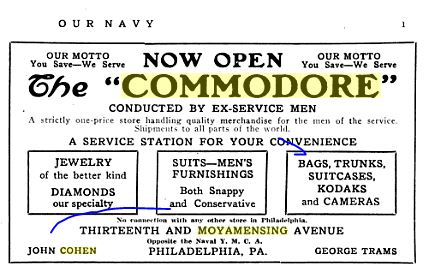
Although not a genetic relative of the Cohens, the story of Arthur Sr.’s stepdaughter Jean Harral and her son Richard is part of the family lore of Arthur Lewis Wilde Cohen and his descendants, so I will share it here.  Richard was mentally disabled, and at some point he and his mother Jean moved to New York City together.  Richard was working as a messenger for a company in New York, and his favorite pastime was sailing a model sailboat on the pond in Central Park.  In November, 1975, he was stabbed to death, apparently by a friend.  I could find no record of a trial or further development in the case aside from these few news articles from the New York Times.

Richard Harral murder part 1-page-001


Richard Harral murder-page-001

In December, 1975, just a month after Richard’s murder, his mother Jean died; accordingly to family lore, she starved herself to death out of grief over the death of her son.

I am deeply indebted to my cousin Jim for sharing his family’s stories with me as well as the photographs posted here.  There is nothing more meaningful for me in doing this project than hearing about my long-lost relatives from those who knew them best.